WINGS wingsmagazine.com
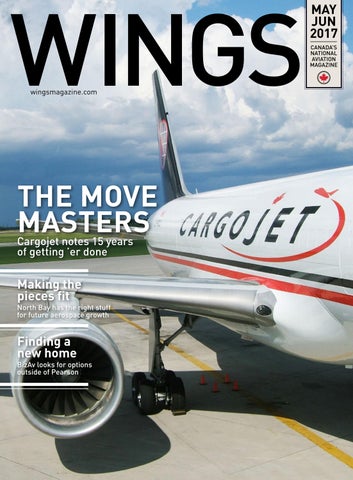
THE MOVE MASTERS
Cargojet notes 15 years of getting ’er done
Making the pieces fit
North Bay has the right stuff for future aerospace growth
Finding a new home
BizAv looks for options outside of Pearson
MAY JUN 2017 CANADA’S NATIONAL AVIATION MAGAZINE
The Phenom 300 — the best-selling business jet in the world — is a clean-sheet-design light aircraft that delivers best-in-class speed, climb and field performance, next-generation avio comfortable, highly intuitive cockpit, with large displays and state-of-the-art avionics, enhances situational awareness. Delivering superior comfort and style, the OvalLite™ cabin provid class, for abundant natural light. Up to 11 occupants also enjoy the best cabin altitude in the category. Contributing to its enviable presence on the ramp, the signature air stair leads to th performance, combined with class-leading fuel efficiency, reinforce its breakthrough status and strong acceptance in the marketplace.
nics, a spacious cabin and a largest-in-class baggage compartment. Its des ample leg and head room and the largest galley and windows in its he largest entrance door in its class. The Phenom 300’s superior overall
PHENOM 300: IT’S AMAZING “We looked at all different kinds of models, and there’s nothing that really jumped out and excited me until the Phenom 300 came along. The Phenom 300 won out, simply because of the reliability and its maintenance aspect. The most frequent comment I’ve had with the people in the cabin is how quiet it is. They can carry on their conversations; they don’t have to yell over the engine or the wind noise. What the Phenom 300 will carry, weight wise and baggage wise, was the first thing that impressed me. I looked back there, and thought, ‘Man, I’ve got all kinds of room.’ And sure enough, on our golfing trips, we usually have been able to put in six guys. Usually I can put six golf bags, six suitcases, two more suitcases for the crew, eight suit bags, miscellaneous bags, shoes, umbrellas, and all the different accessories they want for their golf trip, and I still have room left over. It’s amazing. From the very beginning to the very end of the purchase of the aircraft, it’s been just a really phenomenal experience.”
- Gary Sides, Phenom 300 Chief Pilot, Shamrock Capital Corporation Watch Gary’s story and request more information at EmbraerExecutiveJets.com/Gary
MAY/JUNE 2017
UPFRONT 6 Leading edge
Conduits for change
10 On the fly
News and opinion
14 Alternate Approach
A320: did Canada miss the bus?
16 At the Gate
Spreading its wings
17 Glidepath
Sorting out the process
18 TSB Feedback
Weighing in on CVR/ FDRs
BACK 50 Marketplace 54 On final
Reflections on the regulator
Lake Simcoe Regional Airport is just one option for GTA business travellers. P.33
FEATURES 20 A SUCCESSFUL GAMBLE
Strong strategic focus has Cargojet in growth mode BY BRIAN DUNN
PHOTO: MARTIN LAMPRECHT (MAIN); BRIAN LOSITO, AIR CANADA (TOP LEFT); DISCOVERY AIR DEFENCE (BOTTOM LEFT)
26 FITTING THE PIECES TOGETHER From top: A320: Did Canada miss the bus?. P.14 Spreading its wings. P. 16
North Bay has all the elements for aerospace expansion BY MATT NICHOLLS
33 A QUESTION OF ACCESS
Southern Ontario’s BizAv options are in significant transition BY DAVID CARR
39 WORKING TO RAISE THE BAR
Quebec’s diverse aerospace players continue to impress BY BRIAN DUNN
COVER PHOTO: GARY TAHIR FOR CARGOJET
WWW.WINGSMAGAZINE.COM
May/June 2017 | WINGS
5
LEADING
EDGE
By Matt Nicholls |
Conduits for change WestJet joins the ULCC fray
B
5
while having up to 49 per cent foreign voting interests. Now there’s a new player joining the ULCC game: Calgary-based WestJet announced in late April that it plans to launch its own ULCC later this year with an initial fleet of 10 high-density Boeing 737-800s. The plan is subject to an agreement with its pilots and other regulatory approvals. Clive Beddoe, co-founder of WestJet and chair of the board of directors, called the decision a natural progression for the airline. “Launching a ULCC will broaden WestJet’s growth opportunities and open new market segments by offering more choice to those Canadians looking for lower fares,” Beddoe said. Gregg Saretsky, WestJet president and
TOP DATA BURSTS… in this issue
1. As of Jan. 1, 2017 some 7,422 A320s have been delivered to 342 operators worldwide (Pg. 14). 2. DA Defence has flown more than 60,000 hours in support of the Canadian and German militaries. (Pg. 16). 3. $331 million: Cargojet’s revenue for 2016. (Pg. 20). 4. $30 million: North Bay's 10-year investment in Jack Garland Airport. (Pg. 26). 5. The Oshawa Executive Airport has built some 250,000 sq. ft. of new hangar space. (Pg. 33).
6
WINGS | May/June 2017
CEO, noted that the public perception of the ULCC model has changed over the past few years and now is the “right time” to make the move over to the low-cost model. “The complete unbundling of services and products in order to lower fares for the price-sensitive traveller has created the ULCC category,” he said. Not surprisingly, WestJet’s decision was met with skeptism from other ULCC competitors. Jim Scott, CEO of Canada Jetlines, called the announcement further evidence that “millions of Canadians continue to be underserviced by airlines in markets throughout the country.” Scott continued noting that, “most ‘airlines within airlines’ that have attempted to offer low-cost options for air travellers have failed in North America, including Zip, Ted, Song, Metrojet, Calite, and United Shuttle. The continent is littered with the graves of these lower-cost airlines, precisely because the model doesn’t work when the airline is owned by another airline.” Heady words indeed. Provided all goes as planned for WestJet, its ULCC model will be up and running by the end of the year. Yes, the conduits for change in the ULCC space are making it interesting for commercial travellers in Canada – more opportunities to be squished in like sardines. | W
“launching a ulcc will broaden WestJet’s growth opportunities and open new market segments.”
@Wings_Magazine WWW.WINGSMAGAZINE.COM
PHOTO: WESTJET
are bones service. Limited leg room. Increased fees for stowed bags, food and other essential services. Squished in like a canned sardine. Yes, the commercial flying experience on an ultra-lowcost carrier (ULCC) is certainly not for everyone. Yet for many passengers looking for an inexpensive, no nonsense flying option, a ULCC will get you from point A to B in a no nonsense, very basic fashion – done, simple. The ULCC model has been quite successful for many international airlines – Ryanair, Spirit, AirAsia and EasyJet come to mind – but it has yet to take off here in the Great White North. Canada Jetlines, Fly Naked and NewLeaf have all jumped into the ULCC game here in Canada in the past few years. NewLeaf may have promise, but it has run into several problems, including bungling its launch and earlier this year, cancelled flights from Calgary and Edmonton to Phoenix, leaving passengers out in the cold. NewLeaf called the situation a classic case of “the big guy squishing the little guy” in reference to its route competition with another Canadian airline that changed its route schedule to match NewLeaf’s own. And while NewLeaf aims to, well, turn over a new leaf, Canada Jetlines is in the process of executing its business plan to become Canada’s first true ULCC airline. The company maintains it will use “a proven and profitable commercial aviation ULCC model to create new passengers with low airfares.” Jetlines will operate flights throughout Canada and provide non-stop service from Canada to the U.S., Mexico and the Caribbean, starting with six Boeing 737 aircraft in its first year of operations. It has received an exemption from the Canadian government that will permit it to conduct domestic air services
Stay in Touch with Aviation News
Vol. 58, Issue 3 EDITOR
Matt Nicholls mnicholls@annexweb.com 416-725-5637
SUBSCRIBE
FLIGHT DECK
Online
Rick Adams, David Carr, Paul Dixon, Brian Dunn, Frederick K. Larkin, James Marasa, Carroll McCormick, Anna Pangrazzi NATIONAL ACCOUNT MANAGER
Mena Miu mmiu@annexweb.com • 416-510-6749
TODAY
MARKETPLACE ACCOUNT MANAGER
Kory Pearn kpearn@annexweb.com • 519-902-8574 ACCOUNT CO-ORDINATOR
Stephanie DeFields sdefields@annexweb.com • 1-888-599-2228 ext. 257 MEDIA DESIGNER
wingsmagazine.com/subscribe
Emily Sun
CIRCULATION MANAGER
Magazine
Carol Nixon cnixon@annexweb.com • 450-458-0461
Weekly E-Newsletter
GROUP PUBLISHER
Martin McAnulty mmcanulty@annexweb.com
Digital Edition
wingsmagazine.c om
PRESIDENT & CEO
Mike Fredericks
MAY JUN 2017
WINGS MAGAZINE
CANADA’S NATIONAL AVIATION MAGAZINE
P.O. Box 530, 105 Donly Dr. S., Simcoe, ON N3Y 4N5 Tel: 519-428-3471 Fax: 519-429-3094 Toll Free: 1-888-599-2228 and services we believe may be of interest to you. If you prefer not to receive this information, please contact our circulation department in any of the four ways listed above.
Printed in Canada ISSN 0701-1369
THE MOV MASTERSE
Cargojet note of getting ’er s 15 years done
PUBLICATION MAIL AGREEMENT #40065710
Making the pieces fit North
Annex Privacy Office privacy@annexbizmedia.com • Tel: 800.668.2374
CIRCULATION Email: apotal@annexbizmedia.com Phone:416-442-5600 ext. 3258 Fax: 416-510-6875 Mail: 80 Valleybrook Dr, Toronto, On M3B 2S9
Bay has for future aerosthe right stuff pace growth
Finding a new home
PHOTO CREDIT
TK
BizAv looks for options outside of Pears on
WG_MayJun17_EJS
.indd 1
2017-04-25
1:35 PM
Published six times per year (Jan/Feb, Mar/Ap, May/Jun, Jul/Aug, Sep/Oct, Nov/Dec) by Annex Business Media SUBSCRIPTION RATES Canada – 1 Year $ 32.95 (plus GST - #867172652RT0001) USA – 1 Year $ 57.95 Foreign – 1 Year $ 65.95 Occasionally, Wings magazine will mail information on behalf of industry-related groups whose products
Air Transport Association of Canada
ON THE
WEB
8
WINGS | May/June 2017
WG_Sub_HouseCircAd_MayJune17_CWM.indd 1
No part of the editorial content of this publication may be reprinted without the publisher’s written permission. ©2017 Annex Publishing & Printing Inc. All rights reserved. Opinions expressed in this magazine are not necessarily those of the editor or the publisher. No liability is assumed for errors or omissions. All advertising is subject to the publisher’s approval. Such approval does not imply any endorsement of the products or services advertised. Publisher reserves the right to refuse advertising that does not meet the standards of the publication.
Canadian Business Aviation Association
Magazines Canada
AVIATION THIS WEEK
PHOTO: ANNEX BUSINESS MEDIA
WINGS
COO
Ted Markle tmarkle@annexweb.com
Looking to catch up on the latest hot news from around aviation and aerospace? Check out Aviation This Week, a live digital version of the top news stories affecting a variety of key markets. It's quick, essential information you need to know! WWW.WINGSMAGAZINE.COM
2017-04-25 1:39 PM
Bombardier, Global 6000 and Exceptional by Design are trademarks of Bombardier Inc. or its subsidiaries. © 2017 Bombardier Inc. All rights reserved.
We didn’t get here by sheer luck. This was deliberate.
An act of craftsmanship and engineering prowess. Decades in the making. Meeting at the intersection of art and technology. Defying conventions. Redefining luxury. So when all is said and done,
we’ll know that we achieved something truly extraordinary. businessaircraft.bombardier.com
ON THE FLY For late-breaking news and exclusive web content, please visit us at: www.wingsmagazine.com
THE LEAD SAFETY AEROSPACE BIZJETS AIRPORTS PEOPLE ON THE MOVE
THE LEAD
C SERIES SHOWS ITS STUFF AT LCY A Bombardier C Series CS100, with representative payload, has successfully completed a non-stop flight from London City Airport in the U.K. to New York’s John F. Kennedy Airport. At least two operators are planning trans-Atlantic flights between London and the U.S. east coast using C Series aircraft. The flight was the high-profile centrepiece of a series of trials, including steep approach landing and short runway performance, to demonstrate the CS100 aircraft’s exceptional capabilities for operations to and from London City Centre. “The C Series is the only commercial aircraft that was specifically designed for operations at London City Airport,” Rob Dewer, vice president of the C Series aircraft program said. “The aircraft smoothly performed all eight take-offs and landings during a two-day period, as planned.” Located at the heart of London’s financial district, the city centre airport features a short runway that limited payload.
British Airways operates an all-premium class, 32-seat Airbus A318 to New York, but is disadvantaged with a necessary westbound stop in Ireland. Odyssey Airlines, a U.K. startup and Geneva-based PrivatAir, a luxury private charter carrier with a large fleet of Bombardier business jets, including the Global, plan to operate the aircraft in a 40-seat, business class configuration to New York and the Middle East. Transport Canada and EASA, it’s European equivalent, are expected to certify the CS100 to operate out of London City Airport in a few weeks. Bombardier already has extensive experience operating out of London City Airport with various aircraft types, including the Q400, Challenger 650 and, Global 5000 and 6000 business jets. CS100 launch customer SWISS will be the first airline to offer services with the C Series out of the airport later this year. “It has been a pleasure to welcome the Bombardier CS100 aircraft and its team to London City Airport for the first time,” said Declan Collier, chief executive of London City Airport. “Following the landmark nonstop flight to JFK, we look forward to the completion of its regulatory certification, followed by entry into commercial passenger operation with SWISS.” Will London City Airport be the key to unlock new orders in the run up to the Paris Air Show this June? Bombardier is going hard on the aircraft’s ability to offer direct intercontinental flights from
CS100 launch customer SWISS will be the first airline to offer services with the C Series out of LCY. 10 WINGS | May/June 2017
the London financial district to North America and the Middle East, as well as opening new routes within Europe, Russia and Northern Africa, which are not possible with other aircraft. As of early April, Bombardier had delivered six CS100s to SWISS and two of the larger CS300 aircraft to airBaltic.
SAFETY
TRANSPORT CANADA INSPECTORS SOUND AN ALARM A majority of Transport Canada (TC) inspectors expressed concern over aviation safety in Canada just ahead of a House of Commons Transport Committee study into aviation safety. These were the findings of an Abacus Data survey among frontline aviation inspectors. Approximately 82 per cent of inspectors believe that cuts to safety oversight will increase the risk of an accident. “The House of Commons Transport Committee should pay close attention to this report,” said Captain Greg McConnell, national chair of the Canadian Federal Pilots Association (CFPA), which commissioned the survey. “The opinions of this expert group show that Transport Canada’s aviation safety oversight has gone terribly wrong.” The hot button issue is TC’s safety management systems (SMS), which transfers responsibility for setting acceptable levels of risk and monitoring safety performance to the operators. Abacus found that 81 per cent of inspectors see SMS as a barrier that prevents them from identifying and fixing safety problems before they become accidents or incidents. Some 73 per cent believe SMS has exposed the public to elevated risk. Licenced pilots who work for TC and the Transportation Safety Board as aviation inspectors/investigators and who are members of the CFPA were surveyed. 64 per cent of pilots responded to the survey. Among other findings: • Most of TC’s pilot inspectors haven’t flown an actual aircraft in years. • Licenced pilot inspectors have flown actual aircraft so infrequently that some are at risk of their licences becoming invalid. WWW.WINGSMAGAZINE.COM
PHOTO: BOMBARDIER
10 10 11 11 12 13
•
70 per cent of respondents reported that they are sometimes or frequently assigned tasks for which they are not trained.
AEROSPACE
AIRBUS 350-1000 SURVIVES THE COLD
PHOTO: BOMBARDIER (BOTTOM); AIRBUS (TOP)
The newest member of the Airbus A350 XWB widebody family has completed rigorous cold weather ground and flighttesting in the extreme operation conditions of Iqaluit. The A350-1000, a larger variant of the A350-900, already in service, successfully completed five days of intensive testing at an outside air temperature that fluctuated between -28 degrees and -37 degrees Celsius. The A350-1000 has a longer fuselage than the A350-900 and can accommodate 40 more passengers. It also features a more powerful Rolls-Royce Trent XWB engine. “The A350-1000 has responded successfully to the ground and flight tests performed in the freezing temperature of Iqaluit, which demonstrates the already proven maturity and reliability of the A350 XWB,” said Emanuele Costanzo, flight test engineer at Airbus. Three years earlier, Airbus brought the A350-900 to the remote Baffin community for cold weather testing. The manufacturer has also used Iqaluit’s extreme weather to test the A380, and A350 engine ahead of the flight test program.
The A350-1000 has a longer fuselage than the A350-900 and can accommodate 40 more passengers.
Boeing, Bombardier, Cessna and Airbus Helicopters have also used Iqaluit as a cold weather test site.
INTERIOR CABIN SPECIALIST LANDS IN MONTREAL F. LIST, a global manufacturer of highend interiors for business and private jets will open a second North American production facility later this year in Montreal. The Austrian-based aircraft interior specialist also has facilities in the U.S., Brazil and Germany. “This state-of-the-art facility will bring us closer to our main customers in North America, resulting in shorter production lead-times, faster deliveries and greater flexibility,” said Michael Groiss, chief executive of F. LIST. “It will also enable us to provide better on-site support for innovative products delivered from our Austrian plan, while bolstering our aftermarket services for business and executive jets.” F. LIST Canada will include a showroom and veneer selection area as part of
its designation as a Veneer Competence Centre for flame retardant wood veneers, key components of its interior finishing business. “As a major global aerospace centre, Montreal is an ideal location for F. LIST to expand its operations to serve its North American customers,” says Hubert Bolduc, chief executive of Montreal International, an agency dedicated to bring foreign investment to the Greater Montreal Area.
BIZ JETS
GLOBAL 7000 NEARS SOUND BARRIER A Global 7000 flight test vehicle is the only large business jet to have flown within a whisker of the sound barrier. The aircraft reached a speed of Mach 0.995 during a flight test over Wichita, Kan. on March 29, coming 0.005 away from Mach 1 and the speed of sound. A second prototype completed its initial flight in Toronto on March 4 and has been transferred to Bombardier’s Flight Testing
Additional tests of the Global 7000 have seen the flight test crew exceed the maximum operating speed of Mach 0.925. WWW.WINGSMAGAZINE.COM
May/June 2017 | WINGS
11
ON THE
FLY
Centre in Wichita. Bombardier expects to have five test aircraft in the program. “Our flight test vehicles continue to show a high degree of maturity in testing, dispatching twice daily in many cases,” said Michel Ouelette, senior vice president of the Global 7000 and Global 8000 program. “We have strong momentum in the program right now and we are on track for entry into service in 2008.” In successfully “opening up” the performance capability to Mach 0.995 in the first five months of the testing, the flight test crew exceeded the Global 7000’s maximum operating speed of Mach 0.925.
EMBRAER DELIVERS FIRST PHENOM 100EV Embraer Executive Jets has delivered the first Phenom 100EV entry-level business jet to an undisclosed U.S. customer. Powered by modified Pratt & Whitney Canada PW617F1-E engines, the latest
12 WINGS | May/June 2017
Phenom has greater speed with superior performance, especially in hot-and-high operations. The Prodigy Touch flight deck, first introduced in the larger Phenom 300 light jet, is now included in the 100EV. “The Phenom 100 set new industry standards when it arrived in 2008, raising customers’ expectations of an entry-level business jet,” said Michael Amalfitano, chief executive of the Brazilian manufacturer’s business jet division. The Phenom 100 was Embraer’s first clean sheet business jet. More than 350 aircraft are flying in 37 countries, including Canada.
AIRPORTS
YVR SPEEDS UP BORDER PROCESSING Vancouver International Airport will roll out 90 next-generation BorderXpress kiosks to speed up border clearance for international arriving passengers.
Developed by Innovative Travel Solutions, an independent business unit within YVR, BorderXpress automates the administrative functions of border control. It has cut passenger wait times by more than 40 per cent and customs space requirements by 50 per cent. “Border clearance kiosks are the way of the future,” said Craig Richmond, chief executive of the Vancouver Airport Authority. “Not only do our BorderXpress solutions provide a modern and efficient experience for our passengers, they are also a smart choice for airports and government, as they help to reduce overall operating costs and free up boarder officers to focus more closely on enforcement and intelligence efforts.” The next-generation BorderXpress meets the requirements of Canada Border Service Agency’s (CSBA) new Primary Inspection Kiosk (PIK) program. Under the PIK program, the CBSA is expanding its use of border kiosks and will now offer self-service options to an increased
WWW.WINGSMAGAZINE.COM
number of incoming international travellers. Arriving international passengers will scan their travel documents, complete their declaration and verify their identity and admissibility using facial recognition technology before proceeding to a CBSA officer for final inspection. This process is expected to reduce time spent with CBSA officers and decrease overall processing times. Passengers can save even more time by completing their declaration in advance using the eDeclaration (Beta) mobile app, and scan their quick response (QR) code at a BorderXpress kiosk upon arrival. BorderXpress is marketed to airports around the world. More than 1,050 kiosks are currently in use at 34 airport and seaport locations, making YVR and Innovative Travel Solutions the market leader in automated border control technology. As of March 1, 2017, BorderXpress kiosks have processed more than 100 million passengers and have helped immigration officers process up to four times more
passengers per hour than through traditional clearance. The addition of the new BorderXpress kiosks will help Vancouver International Airport meet its goal of handling 25 million passengers by 2025.
PEOPLE ON THE MOVE
TRAXXALL TECHNOLOGIES OPENS NEW OFFICE IN WICHITA TRAXXALL Technologies, providers of an aircraft maintenance tracking and inventory management system, has opened its new office in Wichita, Kan. TRAXXALL staff and Wichita residents Jeff Rians and Robert Peterson will be joined by the following new members of the TRAXXALL team: James Carter. Formerly with the U.S. Air Force, stationed at McConnell AFB,
Carter has 14 years of aviation experience and holds a Master’s degree in Aeronautical Science and Technology from EmbryRiddle Aeronautical University. Christopher Mercer. Previously a logistics analyst with Boeing, Mercer also served in the U.S. Air Force for 20 years. He holds a Master's Degree in the Science of Management from Friends University. Coby Smith. Most recently, a supervisor with Hawker Beechcraft, Smith spent 10 years at Cessna and began his career in the US Air Force. He holds a Bachelor of Science in Aeronautical Engineering Technology from Purdue. Elijah Stepp has also joined the team. Stepp will remain based in Las Vegas, Nev. He has more than 35 years of aviation industry experience, most recently as a sales manager at Satcom Direct.
For more news, visit www.wingsmagazine.com
Please vote Skyservice for Canada’s Top FBO in the WINGS 2017 FBO Survey TM
Toronto | Montreal | Calgary | Ottawa
Business Aviation WWW.WINGSMAGAZINE.COM WG_Skyservice_MayJun17_CSA.indd 1
1.888.759.7591 info@skyservice.com www.skyservice.com May/June 2017 | WINGS 13 2017-04-21 3:22 PM
ALTERNATE
APPROACH By David Carr |
A320: did Canada miss the bus?
The Airbus A320 forges on and Canada could have had a larger stake
T
14 WINGS | May/June 2017
as possible that instead of being absorbed into Bombardier, the combined entity of de Havilland and Canadair would be operating either as a subsidiary of Airbus, or an equity partner in additional projects such as the A380 and A350. It is unlikely that Airbus would support both the Q400 and ATR72 turboprop lines, but Canada may still have been the European company’s ticket into the regional jet market, since Bombardier’s early regional jets do not compete with the Airbus product line. The same cannot be said, however, for the C Series, which was always intended to go head-to-head with Airbus and Boeing at the smaller end of the single-aisle market. Still, would Airbus and Boeing have been as quick to market with re-engined versions of the A320 and 737 if the C Series did not exist? It is a vicious circle, and on the 30th anniversary of the A320’s first flight, Airbus has pulled out far ahead of not only Bombardier, but its closest rival in sales for a new generation of single-aisle jets. Hindsight is 20/20. But for a C$500 investment in 1983, would Canada still be part of the ride? | W
“As of Jan. 1, 2017, 7,422 aircraft in the A320 family had been delivered to 342 operators worldwide.” worth considering – until they were. Airbus launched the A320 program in 1982. Development costs were pegged at approximately US$1.7 billion. But demand for the proposed new jet appeared to be soft, and funding for the program among some of the consortium’s government partners, especially Germany and the U.K. was uncertain. By 1983, Airbus was pitching other potential funding partners, including Lockheed that had recently announced it was pulling out of the commercial aircraft market after shutting down its L1011 TriStar program. Airbus’s pitch to de Havilland was for C$500 in government funding in exchange for a Canadian production facility. From the beginning, Airbus had signaled that marketability rather than easy sales from the consortium’s state-owned airlines would drive the case for developing new airplanes. Despite that and the temptation of bringing a new aircraft production line to Montreal, the government walked away from the proposal. There is little doubt that even with a minority stake in early A320 development, the face of Canada’s aerospace industry would look much different today. It is just
David Carr is a Wings writer and columnist. WWW.WINGSMAGAZINE.COM
PHOTO: BRIAN LOSITO, AIR CANADA
hirty years ago in February, the first Airbus Industries A320 airliner took flight. For the commercially struggling, Euro-state owned manufacturer, its entry into the single-aisle market turned out to be a game changer. As of Jan. 1, 2017, 7,422 aircraft in the A320 family had been delivered to 342 operators worldwide. Each month, 60 aircraft role of final assembly plants in Toulouse, France, Tianjin, China (2004), Hamburg, Germany (2011) and Mobile, Ala. (2015). There was a time when Montreal would have been among the first assembly plants on this list in exchange for an equity stake in the program. It’s a complete reversal from last year when Bombardier approached Airbus to buy into its troubled C Series program. So, what would Canada’s own aerospace industry have looked like today if the country had taken a piece of one of commercial aviation’s most successful airliner programs? In the mid-70s, the Liberal government of former prime minister Pierre Trudeau, wanted to leverage the design and engineering capabilities of de Havilland Canada and Canadair with the buying power of Air Canada, then a Crown corporation, to create a global market for Canadian-built air transports, larger in scale than the demand for Beavers, Buffalos and Twin Otters. An original proposal from the early 1970s was for Air Canada to partner with a Canadian construction company to buy and merge de Havilland and Canadair, effectively creating a nationalized aerospace company. Instead, the Trudeau government chose to go it alone, buying de Havilland from the U.K.’s Hawker Siddeley Group in 1974, and Canadair from General Dynamics two years later, for the purpose of merging the two. (That merger would not happen until 1996, when both units were absorbed into Bombardier.) At the time, conventional wisdom was that “Canavillandair” would either have to produce its own globally marketable designs, with Air Canada as a launch customer, or get involved with a U.S. program at an early design stage, with an Air Canada order as a sweetener. Despite development of the A300 – Airbus’ breakout airplane – European commercial projects weren’t
CAN WE CARRY MORE TROOPS AND MORE CARGO AND HAVE FUEL TO SPARE?
THE A330 MRTT – MULTIROLE GIVES YOU MORE. More fuel – 111 tonnes to refuel every present and future receiver. More passengers – 300 sitting in airline comfort. More payload – 45 tonnes. The A330 MRTT is an exceptional all-in-one solution, able to do all of the preceding in the same mission and over huge distances. And the fact that it shares its airframe with one of the world’s most successful civil jets guarantees the A330 MRTT will continue to offer more for years to come. Find out more at airbusds.com/A330MRTT
AT THE
GATE
By Brian Dunn |
Spreading its wings
Montreal’s Discovery Air Defence is poised for future development
S
16 WINGS | May/June 2017
scenarios, according to the information supplied by Public Services and Procurement Canada to industry. In addition to providing planes and pilots, the winner must also furnish maintenance crews and engineering support. The Canadian government estimates that aircraft operated by the winning bidder will have to fly between 2,500 and 3,500 hours a year. DA Defence is confident it is in a strong position to keep the business, according to Garrick Ngai, director of marketing at Discovery Air Defence. “We’ve flown more than 60,000 hours in support of the Canadian and German militaries, so we’ve had the experience, safety and reliability for over 10 years,” he said. “We’ve always performed as required.” While CAE submitted the bid, the real work will be performed by Draken, which saw one of its Douglas A-4K Skyhawks crash-land close to Nellis Air Force base near Las Vegas in August 2016, when the pilot ejected. DA Defence isn’t looking to expand into other industries to fuel its growth. “We’re very focused on Red Air aggressor training,” said Ngai. “NATO countries will get more out of their training budgets by using the training that we’re providing.” | W
“da defence operates the largest privately-owned operational fighter plane fleet in the world.” In February, DA Defence and Britishbased Inzpire Ltd. joined forces to bid for the U.K. Ministry of Defence’s Air Support to Defence Operational Training (ASDOT) program. The two companies will combine their unique capabilities in the live air training environment to deliver the most innovative, relevant and safe training solution for the ASDOT customer. But DA Defence is facing competition at home for the CATS contract. Ottawa will select a private company to act as a training partner for Canada’s top guns under a new 10-year contract worth an estimated $1.5 billion with an option for another five years. In addition to DA Defence, CAE in partnership with Draken International of Florida, has also submitted a bid as well as a third unidentified party. Draken offers fighter tactical training for the U.S. Air Force. The winning bid was to have been announced by the end of last year, but may not be revealed before the fall. The winning CATS bidder will provide aircraft to the Canadian Forces to simulate hostile threats for ground and naval forces as well as fighter pilots. The firm will also provide aircraft to tow targets and carry electronic warfare systems for various training
Brian Dunn is a Wings writer and columnist. WWW.WINGSMAGAZINE.COM
PHOTO: DA DEFENCE
ince 2005, Discovery Air Defence (DA Defence) of Montreal has been training Canadian fighter pilots under the Contracted Airborne Training Services (CATS) contract from the Department of National Defence. The company was started in 2000 by three former CF-18 pilots. Originally called Top Aces, it provided aviation consulting services to the DND and mainstream original equipment manufacturers before winning the CATS contract. It is a wholly owned subsidiary of Discovery Air, a global leader in specialty aviation services. In March, Clairvest Group, Discovery Air’s majority shareholder, bought the remaining shares it didn’t own and took the company private. In response, Discovery Air has noted, “it’s business as usual,” once the transaction is completed. Jacob Shavit, president and CEO of Discovery Air Inc. stated, “the proposed transaction is a logical evolution for Discovery Air given our current ownership structure.” Today, DA Defence operates the largest privately owned operational fighter plane fleet in the world. The fleet consists of 16 Dassault/Dornier Alpha jets, seven A-4N Douglas Skyhawks, two TA-4J Douglas Skyhawks and two 1124 IAI Westland planes. The company is now looking to acquire F-16 fighters for more advanced training. It has bases at Halifax, Victoria, Ottawa, CFB Bagotville and Cold Lake in addition to Mesa, Ariz. and Wittmund, Germany where DA Defence has been hired to do the same type of training for Germany’s armed forces. In addition to Germany, the company has spread its wings even further afield. In March, it was awarded a two-year trial contract in Australia to provide Red Air (DA Defence plays the role of enemy aircraft) and fighter support to the Australian Defence Force in conjunction with Air Affairs Australia Pty Ltd. The trial consists of three of DAD’s Alpha jets based at RAAF Base Williamtown. DAD will provide Red Air and fighter support to the Royal Australian Air Force, Joint Terminal Attack Controller (JTAC) training to the Australian Army and antisurface training for the Royal Australian Navy. The trial will begin in the third quarter of this year.
GLIDE
PATH
| By Paul Dixon
Sorting out the process
Forecasting future hardware needs is indeed a harrowing process
PHOTO: AIRBUS DEFENCE & SECURITY
S
o, we finally have a decision in the Fixed-Wing Search and Rescue (FWSAR) Replacement Project – but then again, maybe we don’t. In Dec. 2016, the federal government awarded the contract to Airbus Defence & Security and its partners for delivery of 16 C295W aircraft, training and support services. In January 2017, the unsuccessful bidder, Team Spartan, filed an application for a judicial review in a formal challenge of the decision of Public Services and Procurement Canada to select the C295W over Team Spartan’s C-27J. Where this takes us remains to be seen, but I suppose we could find ourselves starting all over again. The FWSAR Project is just one of many defence acquisitions in recent years that have heightened scrutiny on how the procurement process works (or doesn’t as the more cynical might point out). You will recall that DND and the Royal Canadian Air Force (RCAF) were in favour of the C-27J as a sole-source acquisition more than a dozen years ago, but things got in the way. Some of those things included a change in Liberal leadership, from Jean Chretien to Paul Martin, which led to a change in thinking. Martin campaigned on a promise to increase defence spending. Even with the minority government that the election delivered to him, he did carry through. But other events interceded, domestically and abroad. With Canada’s increased responsibilities in Afghanistan, there was a pressing need to replace the aging C-130 aircraft, which were well beyond their best-before date. The old Hercs were replaced by new Hercs, the C-130J and that was a solesource contract. Martin and Liberals were replaced in 2006 by Stephen Harper and a minority Conservative government. This is where partisan politics get in the way. Everything Conservative was now “good” and everything Liberal is “bad.” That might be overstating the situation, but not by much. In his book The Call Of The World: A Political Memoir, Bill Graham, who had been Martin’s minister of defence and served as interim Liberal leader after Martin’s resignation, writes of WWW.WINGSMAGAZINE.COM
Given what our military has been through in the past quarter century, from the first Gulf War, the Balkans and then Afghanistan, we now have a world that is far from calm. On top of that, we have to factor in the recent American election and the U.K.’s Brexit vote. When the world next comes calling at our door, what will it be? What hobbles our planning process is the amount of money any government will be willing to commit. Taxes have never been popular, and in recent years the “no new taxes” movement has reached a fever pitch. I grew up in a time where personal debt was bad and government debt was, well, not too many people understood it. Today, personal debt is great, but government debt is evil, wicked and nasty. It may not be what you want to do, but sometimes it’s the only thing you can do. One huge problem with our government planning process is it is essentially run on a four-year cycle. Do a little research and you’ll find that many of our international commitments have relatively short life-spans (measured in years) that reflect the term of the government. It’s hard to make a huge investment in hardware that will have an anticipated life span of as much as 40 years, when the government that signs off on the deal is only here for the short term. FSWAR has to be the most straightforward decision that can be made by this government or any government. The men and women who fly the missions deserve better and so do the people who depend on them. | W
“One of the major stumbling blocks for military procurement is you are almost always buying in today’s world to meet tomorrow’s challenges.” the problems he had with Liberal MPs and staffers who were more concerned with opposing the Conservatives at every turn. It even extended to policies the Liberals had introduced themselves when they were in government. Now that they were on the other side of the house, it was pure kryptonite. One of the major stumbling blocks for military procurement is you are almost always buying in today’s world to meet tomorrow’s challenges. Planning for the future isn’t easy at the best of times. It’s difficult in a stable country such as Canada, where so much of what we do with our military is dictated by events on the world stage.
Paul Dixon is a freelance writer and a photojournalist living in Vancouver. May/June 2017 | WINGS 17
TSB
RESPONSES
Weighing in on CVRs/FDRs
TSB’s Kathy Fox on point with regulatory assessment, industry shortfalls
I
BILL ARSENAULT, VP/ GENERAL MANAGER, MIDCANADA MOD CENTER, MISSISSAUGA, ONT. I found Kathy Fox’s column on Flight Data and Cockpit Voice Recorders quite informative and on point. Having been involved in 18 WINGS | May/June 2017
the change by amending the regulations. The TSB would then have nearly all of the data that they need to make a determination of what caused a particular accident or incident. I say nearly all because I am not an investigative expert. The TSB has plenty of those and they should be commended for the job that they do.
FDR and CVR installations are often costly for some aircraft operators.
dozens of Flight Data Recorder (FDR) installations and literally hundreds of cockpit voice recorders over the past four decades, we have seen technology change in that segment albeit at a snail’s pace in comparison to the rest of the avionics systems installed in these aircraft. The main issue at hand seems to be one of benefit and cost as Kathy Fox pointed out. From a benefit standpoint, aircraft owners and operators need to see the benefit equal or outweigh the cost factor. One potential outcome would be for insurance companies to step up and offer the operator discounts for having this technology installed. People with degrees in law would need to figure that out I suspect. From a cost perspective, the standards also need to catch up to the available technology. The Technical Standard Orders
(TSO’s) and European ED documents that were written to support FDR and CVR installations cover a wide range of requirements mainly geared to the markets that predominantly used recorders; the commercial and airline markets. If we want to install recorders in aircraft today, these are the only baseline documents available to installation and certification agencies have for compliance. Perhaps part of the answer of making these more cost effective for smaller aircraft is the development of new documents more geared to smaller aircraft. If we create the demand, the technology for FDRs and CVRs will catch up to 2017. Then we can use the technology to manufacture cost-effective solutions for smaller aircraft that meet the needs of the investigators. This will allow us to demand
VICTOR A. DOMINATO, OPS MANAGER/C.P., CENTAERO AVIATION LTD., WINDSOR, ONT. Kathy Fox wrote a very interesting article regarding the lack of investigating data. She did point out the current regulations allow some Canadian Operators to operate without CVR /FDRs. I want to point out that we as operators are being restricted in operating into the EU because our regulations regarding CVR/FDRs are not even meeting ICAO standards. When it comes to ICAO Standards, Canada is falling behind and becoming a third world country when it comes to aviation regulatory standards. Fox did not bring this up in her article. The Third Country Operator (TCO) requirements that are being quoted as limiting are Annex 6 to the Chicago Convention, Part I Paragraph 6.3 (Flight Recorders). Our CAR’s for 604/703/704 operators in some cases are not meeting ICAO standards. I checked with my TC POI recently. There is no discussion at this time on changing any of the standards on CVR/FDR even though our Minister of Transport was in the media making a statement after the Citation 550 Crash in Kelowna, B.C. He was quoted as saying that he would look into a review of the standard. | W WWW.WINGSMAGAZINE.COM
PHOTO: MID-CANADA MOD
n the March/April issue of Wings, Transportation Safety Board chair Kathy Fox painted a compelling argument for the importance of recorders of all forms – voice, video and data – in accident investigation. Devices such as cockpit voice recorders (CVRs) and flight data recorders (FDRs), which have been employed in the aviation industry for decades, are an invaluable source of information, noted Fox. Not only do they provide objective, hard data that can help investigators establish possible causes and contributing factors, but they also corroborate the sequence of events – and they can be especially valuable when there are no witnesses at all. Fox made reference to a pair of accidents in which aircraft did not have CVR/FDR units on board and this made investigations difficult. She concluded that in spite of current Transport Canada (TC) perspectives and regulations, the “TSB will nonetheless continue to advocate actively for the timely installation of recorders, and their expanded use, until action is taken.” For more information, see “Putting the pieces together,” page 50, March/April 2017 Wings. Fox’s excellent piece created plenty of discussion and feedback and Wings selected two responses to highlight its importance in the field as a hot topic issue.
Get To The Top
Master Efficiency Mastering the aviation game is complex. You need maximum output with minimal input. You need a fleet that reflects not only efficiency, but flexibility and optimized operations as well. Whether you're in the market for a new Pilatus, a pre-owned solution, or a consult, Levaero Aviation can help you master efficiency. Make Levaero your co-pilot to the top. Call now.
Leva:sro AVIATION
SALES • SERVICE • SOLUTIONS
Stan Kuliavas, Vice President of Sales sales@levaero.com 1 844-538-2376 www.levaero.com
A SUCCESS
GAMBLE
CARGOJET IS ON THE MOVE
BY BRIAN DUNN 20 WINGS | May/June 2017
WWW.WINGSMAGAZINE.COM
Cargojet delivers more than 1.3 million pounds of time sensitive cargo each week night across North America.
PHOTO: CARGOJET
SFUL O
n March 9, Cargojet reported its fourth-quarter and yearend results which showed an EBITDA of $27.9 million on revenues of $331 million for the fiscal year ended Dec. 31, 2016. It was a very encouraging result, especially when compared to a loss of $18 million on revenues of $289 million in 2015. The $18 million loss was mostly attributed to a one-time startup WWW.WINGSMAGAZINE.COM
cost related to a contract with Canada Post. “We are pleased with the financial results achieved in the fourth quarter and full year 2016,” said company president and CEO Ajay Virmani, a Delhi-born businessman with a degree in business from the University of Delhi. “We have grown the business with better utilization of aircraft and through our partnership with Air Canada and by controlling our operating costs.” Celebrating its 15th anniversary this
year, the Mississauga, Ont.-based company delivers more than 1.3 million pounds of time sensitive cargo each week night across North America on a fleet of 23 allcargo Boeing 767-300F, 767-200F and 757-200ERF aircraft and has worked with Air Canada Cargo to provide deliveries to and from South America. The company says it has a 98.7 per cent on-time delivery rate. Time sensitive cargo covers a lot of May/June 2017 | WINGS 21
industries, explained Virmani, including medical supplies, spare parts for the oil and gas industry, perishables and even ecommerce deliveries. Another important part of Cargojet’s business is its interline partnerships with more than 60 of the world’s largest airlines. “For example, British Airlines will fly a shipment to Toronto and we’ll take it from there to Calgary, its final destination,” he said. “We do a lot of that type of work.” It also serves the Canadian North from Edmonton, Winnipeg, Ottawa and Montreal through an interline agreement with
First Air. As a result, Virmani was pleased that investments to resolve critical transportation needs in Canada’s north and other support to further benefit Indigenous Peoples were announced in the latest federal budget. “Cargojet is committed to working with the federal government on these and other initiatives that will strengthen the overall safety and security of Canada’s airports, create new jobs for all Canadians and improve the reliability and cost-effectiveness of critical air cargo transportation to Canada’s North,” Virmani said.
Let us take care of you... We specialize in FBO Service, Charter, Aircraft Management and Aircraft Maintenance, with each department dedicated to ensuring the highest quality of service to meet your needs.
THANK YOU for your support in 2016. Vote for Kreos in 2017!
Hangar 18 Saskatoon, SK S7L 6S2 • Phone: 1-877-955-7367 • Fuel Inquires 306-242-0088 Email: fbo@kreosaviation.com • www.kreosaviation.com Unicom 122.85
22 WINGS | May/June 2017
Cargojet’s fortunes weren’t always so bright. In July 2001, Virmani initially acquired 50 per cent of Canada 3000 Cargo and bought the remaining half in February 2002 after Canada 3000 declared bankruptcy in early 2002 and renamed it Cargojet. When Virmani took over, the company had just four aircraft. In addition to its current fleet of 23 aircraft, it now has more than 800 employees, up from 60-plus. It also had $25 million in annual revenues at its inception. The company also provides international charter flights, but most of the deliveries are made within Canada. Virmani took a gamble when he purchased the company, but was confident it could succeed.
“In addition to its current fleet of 23 aircraft, Cargojet now has more than 800 employees, up from 60-plus.” “I was in the freight-forwarding business at the time, so I was on the other side of the desk,” he said. “I knew there was a demand for an all-cargo airline in Canada. Having used different cargo airlines, I felt the industry was a disaster. But I felt we could make a go of it if we offered a quality service. We were also able to acquire aircraft inexpensively and opportunities opened up. We picked up assets that were undervalued and put together a good and dedicated team.” In 2015, the company introduced more fuel-efficient widebody aircraft, consisting of five new Boeing 767-300F Extended Range Freighters, three new Boeing 767200F Extended Range Freighters and one new Boeing 757-200F Extended Range Freighter. The majority of the company’s revenues are generated by providing overnight air cargo services between 14 major Canadian cities, in addition to aircraft handling and aircraft and airport equipment fueling services through its Fixed Base Operations (FBO) business at the John C. Munro Hamilton International Airport. In 2014, Cargojet was awarded a contract with Canada Post and its Purolator subsidiary which went into effect in April 2015. The deal is expected to be worth about US$1 billion over seven years, based on current projections. Cargojet also provides cargo services for United Parcel Service Canada (UPS), TransForce, DHL and WWW.WINGSMAGAZINE.COM
It’s not just a place to land.
signatureflight.com or +1 888 367 0673
Cargojet president and CEO Ajay Virmani (left) hanging with Toronto Raptors star Kyle Lowry.
other major couriers and freight forwarers. In 2015, the company began cargo flights to Mexico, Colombia, and Peru under a contract with Air Canada, and also began service to Frankfurt, Germany with interline service throughout Europe. The new Air Canada Cargo flight, operated with a Cargojet B767-300 freighter, departs on Saturdays to Frankfurt. This flight will provide connectivity with flights already operating to/from Mexico City and to the recently expanded second frequency per week operated between Canada and Bogota, Columbia and Lima, Peru, which began in mid-October. Cargojet doesn’t have to hedge against higher fuel prices, since it passes higher fuel costs on to its customers and will also pass along any cost savings. “We also don’t go after retail customers like Apple for business,” Virmani said. “It’s up to our customers to go after new opportunities since we work with them.” Although it serves 14 domestic locations in addition to Newark, N.J. and Bermuda directly, Cargojet continues to look at growth opportunities in Canada. “We expect our e-commerce business to grow between 20-30 per cent a year and we will add many more international destinations through our partnership with Air Canada,” Virmani said. “We’re also exploring opportunities, which is rare in Canada, to expand horizontally into third party heavy maintenance since we have the capacity and expertise.” 24 WINGS | May/June 2017
The fourth quarter is typically the airline’s strongest as deliveries ramp up for the holiday season, noted Virmani, who last year visited all of the company’s bases across Canada to personally thank each one his employees for their contribution to Cargojet’s growth and success. “The tremendous growth of online shopping by Canadians is definitely contributing to increased demand for Cargojet’s time sensitive overnight air cargo services by all of our customers,” Virmani said. “All of our major customers have given us extremely heavy and challenging peak demands and forecasts. Cargojet’s overnight network is able to expand capacity as demand increases and we are fully prepared to meet our customer’s peak shipping season requirements to ensure all shipments are flown to various destinations to meet holiday deliveries.” The federal government has introduced legislation to raise the foreign ownership limit of Canadian airlines, including cargo carriers, to 49 per cent from 25 per cent. Despite this new limit, Cargojet shouldn’t be too concerned, according to Torontobased National Bank analyst Umayr Allem. “The fact they have a dominant market positions and a number of long-term contracts with major clients will make it hard for a competitor to move into the market, even with the new foreign ownership rules,” Allem said. One challenge facing Cargojet is the fact that with a dominant market position,
making it difficult to squeeze more business out of the domestic market, said Allem. The company could bump up its charter business, but that sector is “very choppy,” he added. And as suggested by Virmani, it makes sense to offer third-party heavy engine maintenance. “They have a large fleet,” Allem said. “They should also bring maintenance in house and they have the capacity to offer heavy maintenance to other airlines.” The company’s revenues were ahead of expectations for the year, but so were expenses as Cargojet tried to keep service levels up during severe weather in the fourth quarter, noted Brian Pow, vice-president, research and equity analyst at Acumen Capital in Calgary. But apart from that, Cargojet is in good shape financially, as total revenue of $94.1 million in the fourth quarter was up 11.6 per cent from the previous year and ahead of Pow’s estimate of $89.5 million. He forecasts revenue will reach $356.2 million this year and $366.7 million in fiscal 2018. Net earnings should hit $20.8 million and $22.9 million, respectively. In addition, net debt should remain close to its current level of $166.2 million. Like Allem of National Bank, Pow doesn’t think Cargojet should be concerned about potential competition. “The barriers to entry are huge,” Pow said. “And look at their market share. It would be tough to chip away at that, particularly with so many long-term contracts. With the small size of the Canadian market, it wouldn’t make a lot of sense for someone like Amazon to fly their own planes.” As for growth opportunities, the domestic market is limited. Pow expects Cargojet will expand its relationship with Air Canada. “We continue to expect the next leg of growth to come from the ACMI (aircraft crew, maintenance and insurance) business and charter. In terms of maintenance, they outsource a lot of their fleet maintenance. It would make a lot of sense to bring it in house.” Cargojet appears to be on path of continued growth for the foreseeable future with nothing but clear skies ahead of it. | W WWW.WINGSMAGAZINE.COM
PHOTO: CARGOJET
“ALL OF OUR MAJOR CUSTOMERS HAVE GIVEN US EXTREMELY HEAVY AND CHALLENGING PEAK DEMANDS AND FORECASTS.”
08
North Bay has invested more than $30 million in its airport in the past decade.
FITTING THE PIECES TOGETHER NORTH BAY HAS ALL THE ELEMENTS FOR AEROSPACE EXPANSION
P
“
unching above its weight. Open for business. Finding just the right niché to build on a strong foundation.” Poignant expressions all and certainly accurate ones to describe the city of North Bay’s aerospace footprint – a developing infrastructure with strong ties to the past striving towards an even brighter future. Located some 344 kilometres north of the GTA and centrally located between Sault Ste. Marie to the west and Ottawa to the east, this vibrant northern city of some 51,000-plus located on the shores of Lake Nipissing has one of the most diverse economies of Ontario’s northern communities – and a very rich aerospace history to boot. Much of that history is connected to the Royal Canadian Air Force (RCAF). Since the 1930s, North Bay has served as a strategic location for the RCAF as home to both 22 Wing North Bay and its 21 Aerospace Control and Warning Squadron. 26 WINGS | May/June 2017
The city’s military footprint is extensive and has grown from its initial use as an emergency landing field in 1933 to playing key roles in both the Second World War ferrying Liberator and Lancaster Bombers across the Atlantic to Europe. It also played critical roles during the outbreak of the Korean War before transforming into the main nerve centre for NORAD. In October 2006, Canadian NORAD Region air defence operations moved out of its Underground Complex into a new state-ofthe-art installation named the Sgt David L. Pitcher Building, after a Canadian serviceman who was killed in the crash of a U.S. Air Force AWACS patrol plane in 1995. The new $16 million command centre was built above ground and the complex proudly continues its role as one the most important air bases in Canada, responsible for the air defence of the nation almost half of the North American continent. WWW.WINGSMAGAZINE.COM
PHOTO: CITY OF NORTH BAY
BY MATT NICHOLLS
CARMICHAEL DRIVE
18 26
PAVED
ER
ULD
SHO
PAVED
ULD
SHO
ER
APRON
TAXI
PAVED
ER
ULD
SHO
PAVED
ULD
SHO
ER
TAXI
“L” APRO N
ULD
PAVED
“E”
SHO
APRO
N III
ER ULD
SHO
APRO N
PAVED
TAXI
ER ULD
SHO
ER
ULD
RT
PO
LICENSED APRON APRON I
WAY TAXI
ER ULD
SHO
ER ULD
SHO
GA
RA GE
DORE
EGE
COLL
AVIAT
ION
CAMP
RO AD
APRO
N II
TOWE
TAXI “G”
R
ADMI
NIST RA BUILD TION ING
US
JACK AIRPO GARLAN RT TE D RMIN AL
CANA
E AV ON IATI AV
CTL
O AD
N IV APRO
“L” TAXI
36
“J”
ER ULD
WA YD
RIV
E
ICH
RM CA
AIRPO
RT MA BUILD INTENAN CE ING
AIRPORT WAY
GA TE
E RIV
LD AE
RT R
SHO
O
PAVED
“L”
AIR P
TAXI
ER ULD
SHO
CFB NORTH BAY
H” TAX”
TAXI
“F”
PAVED
TAXI
PAVED
PAVED
AIR
AD RO
TAXI “H”
OSED
III
“L”
SHO
PAVED
PROP
III
TAXI
PAVED
ER
V
“L”
WATER TOWER
Providing aviation training for over 45 years, Canadore operates from state-of-the-art airside facilities and caters to both domestic and international students.
A modern, full service, barrier free passenger terminal.
LEFT: The passion principal: Canadore’s Kori Ibey (left) and Wade Culliton
In 2010, CFB North Bay’s operations centre took the first steps towards transitioning from air to aerospace defence, commencing preparations for Sapphire, Canada’s first military satellite. CFB North Bay commenced surveillance of space via Sapphire, Canada’s first military satellite that was launched into orbit from India in February 2013. Today, Sapphire is performing surveillance of objects orbiting at 6,000 to 40,000 kilometres altitude, and delivering data on those objects to the Space Surveillance Operations Centre (SSOC) in North Bay’s operations centre. In 2014, the Government of Canada awarded a contract to Raytheon Canada Ltd. for the operation and maintenance of the North Warning System. The North Warning System is comprised of 47 unmanned long- and short-range radar stations along the Arctic coast from Alaska to Labrador. The North Warning System is used to ensure Canadian sovereignty in the North and to support North American air surveillance and air defence operations under the North American Aerospace Defense Command (NORAD) agreement. CONNECTING THE DOTS North Bay’s military footprint past and present is a strong one, yet the future of its aerospace footprint lies in attracting new and diverse commercial and business partners to its hub around Jack Garland Airport. Located minutes from the 28 WINGS | May/June 2017
downtown core and situated around acres of wide open green space, the airport is served by regional, international and charter operators including Air Canada, Porter Airlines, Bearskin Airlines, Jazz Aviation LP and Sunwing. The city has invested more than $30 million in the past decade to upgrade the airport and surrounding lands, making it a prime spot for aerospace companies looking to expand and grow. With its 10,000 ft. runway, ample room for hangar space, MRO capabilities, fully-serviced parcels with full water and sewer connections, power, fibre-optic network access and competitive land values and incentives to offset development and operation costs, it’s a prime spot for international and domestic aerospace companies to call home. Rotary- and fixed-wing aviation training on both the flight and maintenance engineering sides of the equation are a true hallmark of the city’s aerospace footprint, with a variety of options available to aspiring students. The airport is home to some of the most respected training schools in the province, with Canadore College’s School of Aviation, Helicopters Canada Flight Training and Charter and Essential Helicopters all calling Jack Garland home. Other key aerospace players dot the site including Voyageur Aviation Corp. (Chorus) the Ministry of Natural Resources and Forestry (MNRF) – opening its new $9.5 million state-of-the-art Fire Response
Facility this year – and Comsatec Inc., an energy management firm based in Callander, Ont. and Toronto. With some 48,000-plus aircraft movements last year, the airport is a bustling spot with a diverse mix of aircraft and operations according to Jack Santerre, the airport manager at Jack Garland. Santerre recently took Wings on a tour of the airport and the surrounding property. “We have a diverse mix of aircraft traffic in North Bay,” Santerre told Wings . “There is the commercial traffic, the schools. Bombardier also comes up to do their testing for the C Series, the Q400s. We also see a fair amount of military traffic, although we are not a military airport. We get every thing from Hercs to Challengers to Griffons to C-17s.” A heavy-lift and de-icing exercise with an IL76 was also on the dance card for our tour, but was postponed at the last minute. Heavy-lift opportunities to far north mining operations are another potential area of growth for the city. Also enhancing traffic in the future will be the OMNR’s new fire fighting response facility, which will feature a state-ofthe-art 1,149 sq. metre Fire Management Headquarters that will have dedicated aircraft parking for two CL-415 water bombers, two bird-dog aircraft and two helicopters. “Anyone who had been here five years ago probably would have looked at me and said,
‘what the heck has happened here?’ ” noted Santerre. “We just finished developing our west end industrial park and all of it is serviced land, ready to go. Basically, there’s no hindrance for the master plan of the airport. The next phases are already lined up.” Erin Richmond, manager of economic development for the City of North Bay underscores the progress that is being made, acknowledging that ironclad partnerships between industry and the city and ease of operations are drawing cards that should foster growth. “One of the things we do at the city to help stimulate development,” Richmond said,” is our DART team, which is a development application review team. Any new development project that we encounter for the city, the DART team gets involved. The team is made up of representatives of everyone involved – economic development along with outside agencies such as the MTO and the Convervation Authority. Everyone comes together and reviews each application so new tenants don’t have to knock on 20 doors to get information. It’s a one-stop shop.” Santerre is on the team and is impressed with the way community partners work in unison. “The City of North Bay as a whole is a very strong supporter of the aviation community,” he said. “The city realizes the importance of an airport and how it helps drive the economy in the community. Airports are not only transportation hubs, WWW.WINGSMAGAZINE.COM
PHOTOS: MATT NICHOLLS
RIGHT: North Bay’s Essential Helicopters boasts a well-rounded, comprehensive pilot training program.
CANADIAN AVIATION CONFERENCE & TRADESHOW 2017 The major Industry Networking Event not to be missed! ATAC’s Canadian Aviation Conference and Tradeshow has been the national gathering for operators, industry suppliers and government stakeholders involved in commercial aviation and flight training in Canada for over 80 years!
BE PART OF ATAC 2017 TRADESHOW 500+ PARTICIPANTS AND 50+ EXHIBITORS
WWW.WINGSMAGAZINE.COM WG_David charles abramson_MayJune17_MLD.indd 1
MONDAY, NOVEMBER 6 to WEDNESDAY, NOVEMBER 8 FAIRMONT QUEEN ELIZABETH HOTEL, MONTREAL, QC
For more information contact: Debbie Simpson, Tradeshow Manager 613-233-7727 ext. 312 tradeshow@atac.ca www.atac.ca
May/June 2017 | WINGS 29 2017-04-24 1:44 PM
North Bay Airport
COMSATEC
AVIATION
INC.
For leasing information, please contact: Tom Waqué at 705-497-4996 or at twaque@comsatecaviation.com
Take advantage of this exceptional opportunity and operate your business in this unique space, conveniently located near Jack Garland Airport.
18,000
HANGAR DOOR 105 ft.
28 ft.
sq. ft. heated aircraft hangar 1 DELIVERY
BAY 10 ft. tall • • • • 30 WINGS | May/June 2017
2 OFFICES
143 sq. ft. LOADING
DOCK
Reception Area (600 sq. ft.) Storage Area on Second Floor Washrooms with Lockers & Showers AMO Service Available
customizable • • •
Private Apron Large Parking Lot Large Workshop
WWW.WINGSMAGAZINE.COM
PHOTO: MATT NICHOLLS
but they are catalysts for economic development and growth.” It also doesn’t hurt to have a mayor that lives and breathes aerospace – it’s in his blood. Mayor Al McDonald’s father was an RCAF pilot who was stationed all over Canada in a variety of roles. He shared some of his adventures and visions for North Bay’s aerospace future with Wings during a lunch break on our tour. “From a North Bay perspective, I think we have a great opportunity here,” McDonald said. “But it is about political will – it is putting a lot of time and effort into developing it. We have all the pieces here, it’s just how do you give it even more attention.” EDUCATIONAL BUILDING BLOCKS One of the pieces firmly in place in North Bay is its educational offerings for aspir- Canadore College’s school of aviation technology offers a variety of in depth aviation programs. ing aviation students. Canadore College School of Aviation is one the most respect- class instruction from experienced, indus- designs on a career on the fixed-wing side ed colleges in Ontario, offering students try-respected pilots. Current industry trends of the business. a diverse mix of academic programs in in forestry, mining and aerospace have creEssential’s educational programs on the fixed- and rotary-wing operations. From ated increased demand for both helicopter rotary side also include training in many flight training at partner Essential Heli- charters and qualified rotary pilots. of the soft skills students will need in real copters to one of the college’s structural, Founded in 2000, Helicopters Canada world situations: for example, learning to mechanical, avionic and composite repair has experienced steady growth with a fleet use a chain saw to build a heli pad, first aid, and engineering programs, the college has of six helicopters, delivering internationally all aspects of base development, aircraft a solid reputation throughout the industry. recognized flight training programs. Pro- scheduling, egress training and more. A tour of the bright, inviting campus re- gramming includes commercial licencing, “We have a lot of chief pilots come in and veals not only a high competency level of private licencing, foreign conversions, night speak to the students,” Elaine Ross, Essential’s administrator and student coordinaacademic proficiency, but an equally high rating, helicopter type ratings and more. level of commitment, dedication and pasTraining at Helicopters Canada aims to tor told Wings. “We also do a course that sion from its instructors, ensuring students prepare students for the realities and skills gives them a strong understanding of what are properly and effectively prepared for required in the industry. The students build to expect in the real world. future industry roles. their time learning advanced flying techThe college prides itself on its 15-1 stu- niques, which can include short- or long-line A LOOK TO THE FUTURE dent to professor ratio and is equally proud slinging, hover exit and water bucketing. It With its rich aerospace history, foundation of the fact its instructors – most active in is not uncommon for students to graduate of key pieces in place, busy airport and a the field themselves – bring hundreds of with five to 10 hours of solo slinging, which strong cohesive network of industry partners working in unison with city to drive years of practical experience to their roles in they can practise in the training fleet. a variety of engineering and maintenance “The world-class training program at business, North Bay is certainly not startfields. It is also basking in the glow of a new Helicopters Canada attracts students from ing at the bottom – and it’s open for busimulti-million dollar composites wing and around the world who are seeking a high ness and working its way up. Establishing a $400,000 boost to its avionics program. level of expertise, and the unparalled train- a key nichés that set it apart is one of the “I find it amazing how well we are ing environment North Bay provides,” Sha- goals going forward. And whether that’s providing support for punching above our weight,” noted Mar- na Sullivan, president of Helicopters Canada tin Galvin, dean of aviation, business and Flight Training and Charter said. “We train the city’s strong mining supply and service liberal studies. “We are not putting out as students to get a licence, but also train the sector – the possibility of airships perhaps? many graduates as the others in Ontario, skills employers are looking for.” – unmanned aerial vehicle (UAV) testing but we have so many graduates that are Essential Helicopters offers a variety of in the vast green space that surrounds the making a difference in the industry. helicopter training services that includes airport or BizAv growth, the city is working Part of this “difference” is most certainly flight training, charter and maintenance. Es- hard to entice new players to venture north. because of passionate instructors who en- sential has partnered with Canadore College “I explain it this way in business,” Mcsure the teaching methodologies closely to provide a one-of-a-kind College Pilot Pre- Donald said. “Let’s say, you walk into a groreplicate those of industry. It’s all about paredness Certificate program in commer- cery store and you see a can of Coke, Pepsi, supplying operators with young profes- cial helicopter pilot training, the only flight and RC Cola (with RC being North Bay). sionals that are skilled, professional and training program of its kind in Canada. Even though RC might be better than Pepsi adaptable to handle a variety of challenges. With a fleet of six aircraft including Jet and Coke, you probably will pick Pepsi or Rangers, R22s and R44s, the intimate Coke. What we need to be able to do is to GETTING IN THE SPIN classroom settings at Essential’s home get people to pick RC – because people just Aspiring helicopter pilots hoping to make base enable students the flexibility to pick don’t see us for what we offer right now. If their mark in the rotary world have two their program for total of 100 hours – they you were trying to put the whole puzzle tostrong options in Helicopters Canada Flight can mix it up based on their budget and gether, I think we have all the pieces right. Training and Charter and Essential Helicop- what they desire. Essential has also a new Now, we just need to try to inform people of ters. Both offer students intimate hands-on fixed-wing program for students that have what we have.” | W WWW.WINGSMAGAZINE.COM
May/June 2017 | WINGS 31
Elevate Your Career to New Heights. With Seneca’s Airline Pilot Flight Operations graduate certificate program: • Become Industry ready as a First Officer in just two semesters • Experience Multi Crew and Line Oriented Flight Training in 703 and 705 environments • Graduate with employment opportunities with our industry partners Must hold a valid CPL and Group 1 Instrument Rating. For more information or to apply: senecacollege.ca/fulltime/APF.html
LEKTRO
WG_Seneca_MayJune17_CSA.indd 1
2017-04-13 1:32 PM
Since 1945
The Original Towbarless Tug
Models From
15,000 to 280,000 lbs.
“Peterborough offers the best of a larger regional airport with benefits of a smaller community such as low cost of living and operations.” - John Gillespie President & CEO, Flying Colours Corp.
LET YOUR BUSINESS TAKE FLIGHT Peterborough & the Kawarthas is an excellent launching point for national, U.S. and global markets. Our unique offerings include: excellent access to unrestricted airspace, a highly skilled workforce, industry leading training facilities and desirable infrastructure to reduce operating costs.
REDEFINE YOUR SUCCESS IN PETERBOROUGH & THE KAWARTHAS. Find out how at PeterboroughED.ca/aerospace
Electric Towbarless Certified Easy to Use Universal Rugged Simple to Maintain www.
LEKTRO .com
1-800-535-8767 1-503-861-2288 sales@lektro.com 32 WINGS | May/June 2017 WG_PeterborioughAirport_MayJune17_CSA.indd 1
WWW.WINGSMAGAZINE.COM 2017-04-13 WG_Lektro_MayJune17_CSA.indd 7:59 AM 1
2017-04-18 10:12 AM
Oshawa, Waterloo and Simcoe Regional are part of a GTAA working group of 11 primary southern Ontario airports.
A QUESTION OF ACCESS
SOUTHERN ONTARIO’S BIZAV OPTIONS ARE IN SIGNIFICANT TRANSITION
B
PHOTO: MARTIN LAMPRECHT
BY DAVID CARR
usiness aviation in southern Ontario and around the Greater Toronto Area (GTA) is in for a shakeup. A plan announced last year to transform Pearson International Airport into a global mega hub will forever limit the level of business aviation activity at the sector’s busiest Canadian hub. Operators got a taste of what may be in store this spring as the Greater Toronto Airports Authority (GTAA) poured $30 million to repave runway 05/23 and completely rebuild the western tarmac, taking Canada’s busiest runway out of commission WWW.WINGSMAGAZINE.COM
until June. “We understand that they need to repair a 60-year-old runway,” says Rudy Toering, chief executive of the Canadian Business Aviation Association (CBAA). “We are working closely with the GTAA to make sure that access is equitable for the sector.” Toering reports that on a typical day, business aviation receives all of the slots it is entitled to. But between three in the afternoon until eight in the evening, the airport is off limits to business activity. “That just doesn’t work for business aviation,” adds Toering. “I don’t expect ever to see a time when business jets are banned from Pearson,”
says Chris Wood, manager of the Region of Waterloo International Airport. “But the most economical way for Pearson to gain more runway capacity and ultimately more passenger activity is to have larger aircraft use the runway slots carrying more passengers.” At the same time, Buttonville, a multiservice general aviation airport will shut down completely as early as this fall. Both developments look to throw open the door on new opportunities for primary airports serving the GTA. Missing from the picture is a Toronto version of Teterboro, the general aviation behemoth that primarily serves Manhattan. To some, this is a role that once could have been filled by Buttonville. “The GTA doesn’t seem to lend itself to the emergence of a single corporate aviation hub,” says Michael Drumm, manager for the Lake Simcoe Regional Airport, located and an hour and a half north of the city. “We see corporate aviation activities that are gradually displaced from Pearson, or new users looking for a base for their business aircraft going to the Toronto regional airport that make the most geographic sense.” Simcoe Regional is the “youngest” of southern Ontario’s airports, located in the heart of the province’s fastest growing region. Owned by two local municipalities, the airport has accelerated its drive to attract new traffic recently, attending more corporate aviation events and hosting a regional CBAA chapter meeting last year to expand its business connections within the aviation centre. “We have a 6,000-foot runway, road network to the GTA, and no urban encroachment that hinders our growth,” Drumm points out. “The County of Simcoe has major plans for the airport as a tool of economic development.” Stephen Wilcox, airport manager for Oshawa Executive Airport, agrees that corporate aviation will not empty out of Pearson entirely. He insists that no single airport will pick up Buttonville and the GTAA’s slack. “There will always be a place for corporate aviation at the GTAA,” he says. “They have always been clear about that. However, there will always be times when corporate traffic may not be able to get in and out [of Pearson] precisely when they want.” Oshawa is the airport closest to Buttonville, and has benefitted significantly from the shift in traffic. Wilcox estimates that corporate traffic at his airport has grown 50 per cent over the last five years, and is expected to double once Buttonville shuts down. “Corporate aviation will always choose the closest airport with approximate aviation facilities to the client’s ultimate destination,” Wilcox explains. “Within the concept of a network of airports, it is more appropriate to have corporate facilities at airports May/June 2017 | WINGS 33
around the GTA and not a single corporate hub. This is what is occurring today.” The airport that appears to have seen the biggest bump in corporate traffic is the Region of Waterloo International Airport, serving Canada’s hi-tech hub, often referred to as “Silicon Valley north.” “Waterloo saw an increase in hangar construction and about 30 new airplanes moved in when Buttonville first announced their plans,” says Wood. The 24/7 airport hosts three competing fuel providers, good FBO capacity, onsite Canada Border Service Agency (CBSA) services and a full
complement of snow clearing equipment. “Waterloo has taken Buttonville’s place as the busiest aviation airport in Ontario,” Wood says. Waterloo has been consolidating its gains by advertising in corporate trade publications and exhibiting at trade shows in Canada and the U.S. geared toward corporate aviation. “We would like to emerge as the leader on the west side of the GTA,” Wood adds. Oshawa, Waterloo and Simcoe Regional are part of a GTAA working group of 11 primary southern Ontario airports set up
to develop a more efficient regional airport network, and manage the shift of corporate aviation. The goal of the airport network is that each airport will fulfill a niché, so that the overall air travel capacity and business for the entire region can be optimized. This may include also shifting recreational traffic and flight training to smaller airports, freeing up the primary facilities to concentrate on other activities. “A new trend is emerging in the business aviation market,” Drumm points out. “The use of rotary-wing assets as transport from the downtown core to an airport for fixed-wing operations. We are already seeing that.” The CBAA also sits on the GTAA technical committee, which includes NAV CANADA, to determine the best way to keep Pearson open for the largest number of business jets possible. “We are still of the opinion that airports should not leave out a sector of aviation,” Toering says. “The GTAA wants business aviation as a part of their service. We are making tremendous progress with the support of Howard Eng (the GTAA’s chief executive) and his team. Nobody wants to leave opportunities on the table. An early win for the CBAA was a long sought after de-icing agreement for private operators. Reached last October, the agreement removes a thorn in the side of BizAv, where the sector received limited access to de-icing slots, and business jets could be bumped to the back of the queue by a commercial aircraft. Slots to the Central De-Ice Facility are now available to business aviation on a first-come, first-serve basis and operators are included during Departure Management Initiative (DTMI) periods – a severe winter weather departure slot metering process that also controls access to the de-icing facility. “I don’t buy into services based on the number of passengers,” Toering says. “A high percentage of those people who can afford to buy tickets on those airliners likely owe their jobs to the people who buy corporate jets. This is a $10.7 billion dollar business . . . getting the appointments and doing the high-level stuff that helps drive the economy. If you look at it like that, a Challenger 350 needs the same level of access as a Boeing 787.” Geography, including connectivity into the GTA will always factor into the equation of which airport to choose; infrastructure will remain the prime consideration. “Airports are infrastructure, and the user will always pick the infrastructure that best suits their needs at the time,” Wilcox says. In the last five years, Oshawa has built more than 250,000 square feet of new hangar space, with an additional 90,000 square feet expected to open in the fall. The airport offers Canada Border Service
34 WINGS | May/June 2017 startpac (kirby) 4.625 x 7.5.indd 1 WG_StartPac_MarchApr17_CSA.indd 1
WWW.WINGSMAGAZINE.COM 29/01/20179:13 14:12 2017-01-31 AM
MAKE HOUSTON YOUR FAVORITE DESTINATION, AND ARRIVE IN STYLE. YOUR FBO FOR CONVENIENCE AND LUXURY. The most convenient gateway to the Houston area, GlobalSelect is the premier, full-service FBO at Sugar Land Regional Airport (KSGR). • Award-winning service • Close proximity to game events in central Houston • 500,000 square feet of aircraft parking • State-of-the-art air traffic control tower and radar system • Wi-Fi available on the ramp • On-site car rental agencies • On-site customs
Visit ReserveGlobalSelect.com today to request a quote or make a reservation.
Branded Fuel Partner
Agency (CBSA) services and is about 45 minutes from downtown Toronto. The airport’s biggest challenge remains a 4,250foot runway. “There will be limitations just as there are today for every user based on capacity,” Wilcox says. “What is important is that the GTA has excellent airports that are now working and thinking as a network of airports.” Simcoe Regional has a 6,000-foot runway and is connected to Ontario’s 400 series of highways, but battles perception – especially when dealing with its location north of the GTA. “There is a perception that we are too far. But that’s not reality,” Drumm says. “The effects of a mega-hub will start to impact the normal course of business aviation as it exists today. We need to look at the lessons of other extremely successful airport networks and embrace this as the new reality. Van Nuys and Burbank, Calif., are both over an hour north of LAX.” For Wood, perception also matters. “The major challenge we face is being so close to Pearson where there are many FBOs and the great aviation infrastructure. Corporate operators are very reluctant to move to another airport until the inefficiencies negate the value proposition. This has not happened on a consistent basis yet,
Corporate traffic at the Oshawa Executive Airport has grown some 50 per cent over past five years.
although some companies maintain it is inevitable. It may become increasingly difficult to operate as efficiently from Pearson over the next decade. While many primary airports in southern Ontario are expected to add new infrastructure and capacity, they will do so in the shadow of Pickering, the 40-year plus plan for a second Toronto airport. “Pickering is the key to unlocking the full employment and development potential of the Greater Golden Horseshoe,” Wilcox insists, adding that, “the Pickering decision rests solely with the federal government. I believe it will advance as demand warrants.” Transport Canada continues to study a
the right relationship can help you soar.
I
PNC AVIATION FINANCE When it comes to financing private aircraft, we know you value decades of aviation expertise, track record and financial strength. That’s why aviation clients across the U.S. and Canada choose PNC Aviation Finance to help their business take off. To learn more, visit pnc.com/aviation. PNC is a registered mark of The PNC Financial Services Group, Inc. (“PNC”). Equipment financing and leasing products are provided by PNC Equipment Finance, LLC, a wholly-owned subsidiary of PNC Bank. Aircraft financing is provided by PNC Aviation Finance, a division of PNC Equipment Finance, LLC.In Canada, PNC Bank Canada Branch, the Canadian branch of PNC Bank, provides bank deposit, treasury management, lending (including asset-based lending through its Business Credit division) and leasing products and services (through its Equipment Finance division). Deposits with PNC Bank Canada Branch are not insured by the Canada Deposit Insurance Corporation. Deposits with PNC Bank Canada Branch are not insured by the Federal Deposit Insurance Corporation, nor are they guaranteed by the United States Government or any agency thereof. Lending and leasing products and services, as well as certain other banking products and services, require credit approval. ©2017 The PNC Financial Services Group, Inc. All rights reserved. CIB EF PDF 0715-070-195013
Pickering option, but has advised stakeholders that it will be at least another year before any announcement on the future use of the lands can be expected. “It would be very difficult to decide to significantly expand our airport if, indeed, Pickering gets the go ahead and becomes an airport regardless of the owner/operator,” Wood cautions. “We believe that existing airports should be given the opportunity to build and grow unencumbered by a Pickering airport decision.” Certainly, as the southern Ontario airport network develops and adds capacity, the case for Pickering will weaken, and push the decision further down the planning horizon. “Pickering continues to be a fundamental point of evaluation,” Drumm says. “We are basing our growth strategies on tangibles. We are updating our plan based on our location, ability to expand, the GTAA’s mega-hub strategy and other airports within the network. “In that regard, I do believe that the network itself will provide a yet-to-be-determined period of relief for the potential requirement of the Pickering airport, and will do so far more effectively in the form of a network than any one airport could ever do on its own.” Airport privatization may also weigh on whether Pickering is ever built, or who will build it. With its ambitious mega-hub strategy, plans to position Pearson at the centre of a bold regional ground transport strategy, and the potential of private ownership, the GTAA is unlikely to expand outside of YYZ, except perhaps through acquisition. Pearson has strong corporate aviation infrastructure, with additional FBO capacity in development. Still it is unlikely that the GTAA will move off its current cap on corporate aviation activity – at least for now. “There may not be new opportunities at Pearson,” Toering admits. “There will be sustainability of what we have now.” Which is good news for primary airports across southern Ontario. “There is an incredible amount of growth opportunity in the airport’s network servicing a very broad area,” adds Drumm. | W
36 WINGS | May/June 2017 CIBEF Know Ad_Aviation_4.625x5_195013_2017_final.indd 1 WG_PNC_Aviaiton_MayJune17_CSA.indd 1
WWW.WINGSMAGAZINE.COM 2/16/17 11:56 AM 2017-04-11 8:25 AM
CANADA’S GLOBAL DEFENCE & SECURITY TRADE SHOW Produced by:
WG_HE_CADSI_MarApr17_CSA.indd WG_MayJun17_EJS.indd 38 1
CANADIAN ASSOCIATION OF DEFENCE AND SECURITY INDUSTRIES
#CANSEC2017 defenceandsecurity.ca canseccanada.ca
2017-02-14 2017-04-27 11:50 2:43 PM AM
PHOTO: RCAF
MAY 31 - JUNE 1, 2017 | EY CENTRE, OTTAWA
WORKING TO RAISE THE BAR QUEBEC’S DIVERSE AEROSPACE PLAYERS CONTINUE TO IMPRESS
T PHOTO: RCAF
BY BRIAN DUNN
here are thousands of players in the Canadian aerospace industry, most of them flying under the radar as they try to build a solid client base along with a reputation as a reliable supplier. Many of these firms reside in Quebec, where more than 200 aerospace companies generated more than $15.5 billion in sales in 2015. And while much of the aerospace attention in Quebec is garnered by major aerospace leaders such as Bombardier Aerospace, Pratt & Whitney Canada, Bell Helicopter Textron Canada and CAE, the world’s third-largest cluster is driven by some 40,000 employees who create some of the most diverse and cutting edge aerospace products in the world. To highlight the province’s aerospace depth and influence, Wings has identified a selection of small but potent aerospace firms making noise here and on the global stage. WWW.WINGSMAGAZINE.COM
Keeping all processes in check
L-3 MAS, Montreal – L-3 MAS is Canada’s leading In-Service Support (ISS) integrator and recently celebrated its 30th anniversary. The company provides innovative and integrated solutions, spanning fleet and life-cycle management, Electronic Information Environment (EIE) applications, systems engineering, maintenance, material management, publications and data management and the full spectrum of ISS solutions, to maximize customer platform effectiveness. It also offers turnkey solutions for the design, prototyping, manufacture, repair and overhaul and certification of aerospace components. The company, originally known as Canadair Defence Services, was formed in Oct. 1986 after winning the Government of Canada’s long-term maintenance contract for the CF-18 Hornet. After May/June 2017 | WINGS 39
40 WINGS | May/June 2017
WWW.WINGSMAGAZINE.COM
being acquired by Bombardier and then sold to L-3 in 2003, the company now operates under the name L-3 MAS. Over the years, the company has differentiated itself from its competitors by expanding its range of services and becoming the leading ISS integrator in Canada. The business has also been recognized worldwide for its competencies in repair and maintenance of F/A-18 Hornet fighter jets. The strength of the Quebec aeronautical engineering community has contributed to its ability to develop innovative solutions, both for Canada’s Department of National Defence and for international F/A-18 operators. Its customers include Australia, Switzerland, Finland, Spain and the United States. Building on those strengths, L-3 MAS will benefit from the Federal government’s announcement to purchase 18 new Super Hornets to augment the RCAF’s aging CF-18 fleet. Boeing signed a memorandum of understanding (MoU) with L-3 MAS in late Nov. 2016 under which the companies will collaborate on production and support of the new Super Hornet fleet. “These achievements were made possible by a historic decision by the Government of Canada to purchase the data rights of the CF-18 fighter jet aircraft,” said Jacques Comtois, vicepresident and general manager of L-3 MAS. “This initiative not only allowed us to develop our competencies and solve structural problems encountered on the Canadian CF-18 fleet with innovative solutions, but to export our knowledge to other operators and expand our service offerings to capture new markets. Today, we are proud to be the premier ISS integrator in Canada and to offer a full line of products and services, including engineering, integration of special-mission equipment, component repair and overhaul, fleet management, prototyping and testing, and technical publications. Over time, we have won major ISS contracts on fleets of CC-150 Polaris tanker aircraft, CH-148 Cyclone maritime helicopters, CT-114 Tutor trainer aircraft and CH-147F Chinook transport helicopters.” Based at Mirabel International Airport, L-3 MAS employs more than 700 people across Canada and has operating centres in several cities across Canada, including Bagotville, Cold Lake, Trenton, Petawawa, Ottawa and Shearwater.
“It could be used by airlines. In fact, we have a couple of Boeings that are privately owned, but large airlines like Air Canada have larger programs that handle things like catering and scheduling in addition to maintenance.” With some 500 aircraft customers, including helicopters, TRAXXALL is relatively small compared to 40-year-old leader Camp Systems with 18,000 aircraft and 12-year-old Flightdocs with 2,000 aircraft. But it’s adding about 25 aircraft a month to its client list. “Fixed wing represents about 80 per cent of our business, because they’re accustomed to full service maintenance tracking providers, whereas rotary traditionally uses spread sheets. Helicopter operators really like our system, but a lot of them are fleet operators and find the annual subscription of $2,000 cost prohibitive.”
Focusing on the environment
TeraXion, Quebec City – TeraXion designs, manufactures and markets best-in-class photonic products to selected emerging markets including high-speed fibre-optic transmission networks, fibre lasers and optical sensing applications. It has diversified into the aerospace and military markets and is one of five companies selected by the Quebec government to participate in the second phase of an initiative called the Greener Aircraft Mobilizing Project or SA2GE. The company joins a list of heavy hitters, namely Bombardier, CAE, Esterline CMC Electronics and Thales Canada. The five selected participants will harness the resources of small and medium-size enterprises (SME) in Quebec’s aerospace sector, as well as universities and research centres, to develop innovative technological solutions. The work will focus, among others, on manufacturing, avionics, optics and analyzing big data.
Providing innovation in maintenance
TRAXXALL Technologies, Montreal – TRAXXALL executives maintain the firm delivers the most innovative aircraft maintenance tracking system on the market today – and they just might be right. Founded in 2013, TRAXXALL has sales and support staff across the U.S., and a sales office in London, serving Europe, Middle East, Asia and Africa. It launched its new Inventory Management Module (IMM) at the 2016 NBAA Business Aviation Convention & Exhibition in Orlando this past November. The product modernizes and simplifies the inventory management of components used in business aircraft maintenance. IMM improves aircraft maintenance work flow by simplifying the creation of purchase orders, accelerating the receipt of new parts and providing superior transparency of inventory status across multiple locations. Fully integrated with TRAXXALL’s aircraft maintenance tracking system, IMM allows operators to reduce aircraft downtimes during scheduled maintenance milestones. “Over the past few years, we have paid close attention to feedback from business aircraft operators, specifically directors of maintenance and parts managers,” said Mark Steinbeck, president, TRAXXALL. “We have learned that inventory management is one of the weak links in legacy maintenance tracking systems. This is a major issue because the availability of replacement parts is often the most important factor in getting an aircraft back into service.” TRAXXALL developed its cloud-based IMM which requires a password to access an operator’s data and uses the information to track and better plan their maintenance, explained Steinbeck who works out of Denver. WWW.WINGSMAGAZINE.COM
With the completion of the first of five CRJ200 VIP conversions for Jiangsu Jet Co. Ltd. in China last year. President Steven Wang was interviewed by the Shanghai Media Group at ABACE this April about the aircraft. Judging from the reactions at the conference, New United Goderich Inc. has set a new standard in the refurbishment market in the Asia region. New United Goderich is a One-Stop shop for Aircraft inspections, maintenance, refurbishment or modifications. Please review our Supplemental Type Certificates at www.modstore.aero
May/June 2017 | WINGS 41
The commercialization of products and services that will result from these technologies will facilitate adaptation to new environmental standards and a reduction in greenhouse gas (GHG) emissions in aerospace, in Quebec and internationally. TeraXion is developing an integrated photonic radio frequency (RF) module for airborne systems of communication. It can transmit, receive or convert RF signals by using optics. Apart from expanding the bandwidth limits of RF systems, the module will replace coaxial cables in aircraft by much lighter optical fibres.
In addition, TeraXion will develop an integrated multifrequency laser source for a next-generation navigation system. This will significantly reduce the weight of the gyroscope. “The potential for these innovations is very important, particularly in terms of reducing greenhouse gas emissions. We are confident of the success of TeraXion as it has more than 15 years of experience in designing and manufacturing high performance photonic modules for the telecommunications, fibre laser and remote sensing markets,” said SA2GE director
Dominique Sauvé. The SA2GE project is part of so-called “mobilizing” projects for Quebec. It was established in 2010 by the government as part of the Quebec Research and Innovation Strategy (QRIS). The first phase involved six large companies, 28 SMEs, and 16 universities and research centres in Quebec. The economic impact will be significant because in 10 years’ time, the commercialization of the technologies developed through Phase 1 is expected to generate the equivalent of 6,000 job years for a total of $2.8 billion in sales in Quebec. | W
Forging ahead FBO SURVEY 2017 WINGS magazine is LOOKING FOR CANADA’S TOP FBO’S!
VOTE IN OUR FBO SURVEY Does your favourite FBO deliver service with a smile? We want to hear about it! WINGS magazine is seeking to find the best of the best in our annual Canadian FBO survey.
Results will be announced in the September/October issue of WINGS magazine! Contest and survey close July 3, 2017
VOTE NOW AT
wingsmagazine.com/
fbo-survey
Here are some other Quebec-based companies hitting about their weight in the development of new and unique aerospace initiatives. Abipa Canada offers high-precision machining, mechanical assembly and kitting of engine, landing gear and structural components in complex steel alloys such as aluminum, inconel and steel. Its customers consist of OEMs, equipment manufacturers and integrators. Groupe DCM is one of the main designers and manufacturers of aircraft maintenance tooling and ground support equipment for commercial and military aviation in North America. It is an authorized manufacturer for Bombardier Aerospace and Boeing Commercial Airplanes and maker of spare parts, components and sub-assemblies for aerospace, transportation and other industries. Groupe Meloche specializes in precision machining, surface treatment, painting and assembly and manufacturing engineering for the aerospace and defence industries. In 2015, it signed a 10-year agreement worth up to U.S. $30 million with Pratt & Whitney to supply oil nozzles and pump plates for the company’s next-generation PurePower PW1000G engines. Nétur is a tier one manufacturer of jet engine components and assemblies with commercial and defence customers globally. It is a verticallyintegrated manufacturer with in-house capabilities for machining, processing and assembly. The company’s main activity is the machining and manufacture of mechanical parts and sets for the aeronautics industry. Nétur has been awarded Supplier Gold status by United Technologies Corporation.
42 WINGS | May/June 2017 WG_FBOhousead_MAY17_BAS.indd 1
WWW.WINGSMAGAZINE.COM
2017-04-24 2:15 PM
#179
The official publication of the Canadian Business Aviation Association
NEWS BRIEF
CBAA 2017 – BIGGER, BETTER….BE THERE!
F
or the first time, CBAA has partnered with other major aviation groups to create a oneof-a-kind event that marries the best of CBAA’s convention, exhibit and static with one of North America’s biggest airshows and a major aerospace conference. The result? CBAA 2017 could be the most significant Canadian aviation event you will attend this year. Working with AIAC-Pacific which is running its Aerospace Defence and Security Expo (ADSE), we will offer you a number of shared events, including a joint opening session featuring a high-powered keynote speaker and other activities. There’s more: ADSE delegates will have full access to the CBAA trade show, exposing our exhibitors’ products and services to an additional 400 leaders representing military and government aviation services. Also offering business-tobusiness meeting scheduling for the first time, the exhibition has been expanded to two full days to ensure that you don’t miss any opportunities to meet the 1,000 delegates we are expecting from both CBAA and ADSE! Delegates will also be able to end their participation on a high note, and buy a ticket to join us at our VIP Chalet at the Abbotsford www.cbaa-acaa.ca
International Airshow on Friday night. Enjoy Fraser Valley cuisine, a world renowned aerial performance, and end the evening with fireworks. Opportunities to meet pilots and walk the static line are available to all! We’re also focussed on giving delegates an excellent array of session topics and speakers. CBAA’s educational programming has been enhanced – running for two days concurrently with the trade show at Tradex and providing more opportunity to help attain your professional and business goals. We’ll be offering our popular streamed sessions for flight management/ operations, maintenance, pilots & crew, schedulers & dispatchers and FBOs, as well as several high-level briefings, panel discussions and open forums. You will find a partial list of topics on page 4 of this News Brief. For the most upto-date information, visit our convention page on www.cbaa-acaa.ca. It all adds up to one thing: if you are part of Canada’s $10.7 billion business aviation community, we invite you to join your colleagues from business, military and government aerospace and aviation at one of the most important industry gatherings our sector has ever held.
CEO’S CORNER
One of the questions I hear frequently is “Why should I be a member of CBAA?” or even more often “What’s in it for me?” In the last few years, it’s become easier to give a good answer. We have been dedicated to increasing the value of membership on every level: more members-only programming and services, more focussed and active advocacy, the ability to quantify the value of business aviation in Canada, more opportunities at our annual convention, enhanced chapter meetings and much more. There are many different reasons to join the CBAA. Some people want access to members-only tools like Partners-in-Safety, an SMS/ RMS service that assists operators’ regulatory compliance. Others use CBAA to reach out and network with their colleagues. Still others, and I think this is the majority, see the CBAA as their most effective way to influence decision-makers, ensure that business aviation’s role as an economic catalyst
continued on page 2 CBAA-ACAA News Brief
1
CONTENTS
DIAMOND SPONSOR
3 3 3 3 4 4 4 5 5 5 5 6
CBAA Working with Pearson Airport on Slot and Landing Restrictions Flight & Duty Times Update Sign Up for the CBAA Risk Management System (RMS) Rudy Toering Addresses Parliamentary Committee Registration Now Open for CBAA 2017 CBAA 2017 Program Highlights A Special Offer for CBAA Operator Members Call for CBAA Award Nominations CBAA Now Accepting Applications for $10K S&D Scholarship CBAA Welcomes Newest Member Request for Application for NAV CANADA Non-commercial User Nominee Thank You to Our CBAA 2017 Sponsors
1 Rideau Street, Suite 700 Ottawa, ON K1N 8S7 Tel: (613) 236-5611 • Fax: (613) 236-2361 Email: lberndt@cbaa.ca • Website: www.cbaa-acaa.ca
STAFF MEMBERS President and CEO Rudy Toering, rtoering@cbaa.ca Executive Assistant and Director of Administration Aime O’Connor, 613.236.5611 ext. 228, aoconnor@cbaa.ca Vice President, Government and Regulatory Affairs Merlin Preuss, 613.656.0505, mpreuss@cbaa.ca Membership and Communication Services Manager Lindsay Berndt, 613.236.5611 ext. 221, lberndt@cbaa.ca Marketing & Industry Relations Debra Ward, 613.274.0619 dward@cbaa.ca Events Coordinator Lise Hodson, 613.854.4686, lhodgson@cbaa.ca
Finance accounting@cbaa.ca 613.236.5611 ext. 222
BOARD OF DIRECTORS EXECUTIVE COMMITTEE Chair • Rod Barnard Director Aviation and Travel Services and Chief Pilot Kal Aviation Group Past Chair • Dave Hall Maintenance Manager/General manager Irving Air Services Inc.
continued from page 1
operations or landing and slot restrictions at Pearson is understood, and that we International Airport. are able to operate under Even the strongest and rational rules and regulations. most influential industry From our work with Transport groups must come to grips Canada on regulations and with the fact that in the real Rudy Toering, world, we probably won’t get policy, to our awareness President & CEO campaign to members of 100% of everything we have Parliament, to our discussions asked for. But, I guarantee with cabinet ministers, our appearance you that under the umbrella of the CBAA, before an influential Parliamentary our success will be your success, and your committee and more, advocacy has been own issues will be taken up as part of a our main focus for many years. common cause to be championed and However, some people still seem to fought for. think that the CBAA isn’t necessary: that Later this summer, we will have the one businessperson can call a government opportunity to show our collective clout bureaucrat and resolve an issue. at CBAA 2017. With senior government Unfortunately, the sound of one voice is officials in attendance, this is our best guaranteed to be lost in the cacophony opportunity to show up in numbers and of demands, issues and complaints that show the government that we mean represent an ordinary day on Parliament business – and that we are serious about Hill. Stand alone, you will fall alone. getting what we need. But, working together, business If you are a member of the CBAA, I aviation is a force to be reckoned with: thank you – you are part of a collective a $10.7 billion sector that cannot be movement that will help shape your ignored, whether the issue is taxation business for the better. If you are not a on the personal use of business aircraft; member, I have a question for you: What flight and duty time regulations for 704 are you waiting for?
2
CBAA-ACAA News Brief
Vice Chair • Anthony Norejko President Crew Sked Secretary • Bill McGoey President Aurora Jet Partners Treasurer • Michael Fedele Vice President and General manager Execaire , a division of I.M.P. Group Limited
BOARD MEMBERS AT LARGE Peter Bing • Chief Pilot Sobeys Inc. Louise Dunlop • President Sterling Aviation Services Jean-Christophe Gallagher, Eng. • Vice President/Business Aircraft Bombardier Clement Nadeau • Operations Manager/Chief Pilot A.G. Aviation Ltee. Jim Thompson • Chief Pilot Saskatchewan Air Transportation Services Executive Air Services Mark Van Berkel • President & CEO True North Avionics Jamie Vins • CEO Vins Plastics Limited David Weger • Sr. Director Administration Services Potash Corporation of Saskatchewan Inc. Gary Wood • Director – Corporate Sales & Marketing Flying Colours Scott Harrold • Regional Sales Manager Signature Flight Support James Elian • President & Chief Operating Officer AirSprint
ADVOCACY AND NEWS
CBAA Working with Pearson Airport on Slot and Landing Restrictions
T
he release of the GTAA directive that reinstated the ARO with a 48-hour slot requirement as well as a landing ban during runway rehabilitation pushed CBAA and its members into unprecedented action, that included a letter writing campaign from corporate CEOs to the Chairman of the GTAA and ongoing discussions aimed at finding a positive way
forward. As a result, the CBAA and the GTAA have established a Technical Committee, to meet as often as required, with an objective to find the best solutions for all parties. Members include up to three representatives from the CBAA membership, one representative from NAV CANADA as well as numerous airport operations reps. CBAA thanks the entire business aviation community
for its professionalism in dealing with this issue. To move forward, we are continuing to ask operators to provide us with all issues you are encountering, so we can include them in discussions to the committee. You can access a brief survey on the CBAA homepage, www.cbaa-acaa.ca. This survey is open to both CBAA members and non-members.
Flight & Duty Times Update
D
espite the aviation association coalition meeting with Minister Garneau, and a national enquiry on aviation safety by the powerful House of Commons Standing Committee on
Transportation, Infrastructure and Communities, it appears that Transport Canada is determined to have the new regulations published in draft form in June, with a consultation period to follow. Final regulations are
expected to be published by the end of the year. The coalition is continuing to escalate its an advocacy campaign in a number of areas, including to expand its campaign to include opposition MPs.
Rudy Toering Addresses Parliamentary Committee
R
udy Toering used his appearance in front of the powerful House of Commons Standing Committee on Transportation, Infrastructure and Communities, to emphasize the importance of right-sized regulations, Canadian BA’s admirable safety record, and, finally, urged the committee to take action to increase muchneeded resources at Transport Canada. He also addressed the issues around flight and duty time regulations and urged the committee to work with the minister to stop the publication of the regulations, subject to the findings of this committee which is currently studying aviation safety.
Sign Up for the CBAA Risk Management System (RMS)
T
he CBAA online RMS is the “one-stop” site for small CAR 604 operators to find all the information they need to comply with CAR 604 requirements and the RMS tools to do so. The sample operations manual has been recently reviewed by TC and they have found no issues with it; therefore, this key compliance document, with minor customization changes based on the unique aspects of an operations, may be implemented with confidence that all the requirements have been identified. Note that the operations manual includes an Audit Manual and CAR 604 checklist. Use of the manual depends on using the CBAA online RMS which, when implemented as designed, meets the CAR 604 requirements for SMS, QA, and Management Review of SMS. Seventy-five members already have an RMS account and the number continues to grow. To request an account and therefore access to all of the on site information and tools, members need only go to https://nad.obds.com/framework/Login.a5w and click on Request an Account.
www.cbaa-acaa.ca
CBAA-ACAA News Brief
3
EVENTS AND MEETINGS
EVENTS
A SPECIAL OFFER EXCLUSIVELY FOR CBAA OPERATOR MEMBERS
C
REGISTRATION NOW OPEN FOR CBAA 2017! Join your colleagues from across Canada when the CBAA joins forces with Aerospace Industries Association of Canada (AIAC) Pacific and the Abbotsford International Airshow and be part of one of Canada’s most exciting aviation events ever! Visit www.cbaa-acaa.ca to register.
UPCOMING EVENTS
BAA is proud to offer its operator members one free full registration per company. That is a saving of up to $600 per delegate, and aimed at supporting the attendance of all our operator members, regardless of size. The registration includes access to all sessions, meals, the static and exhibit. Extra fees apply for dinner at the CBAA Chalet at the Abbotsford International Airshow and for the Hope Air Charity Golf Tournament.
Contact Lindsay Berndt, lbernt@cbaa.ca to find out if you qualify.
Exhibitors and OEMs
will have the chance to meet with a potential audience of over 1000 aviation leaders when you sign up for our full two-day trade show, featuring a new business- to-business scheduling software to help you meet faceto-face with your most valuable clients.
RESERVE YOUR HOTEL ROOM EARLY! With the Airshow and ADSE happening during CBAA 2017, hotels will fill up fast, so make sure that you have a room by booking now. While cancellation rules apply, they are fairly close to the date of arrival, so you can change your booking without any penalties up to that point. CBAA has reserved space in several hotels, and full information is available on our website, www.cbaa-acaa.ca.
A not-to-be-missed educational program!
Wednesday June 7th Atlantic Chapter Meeting
T
he educational program will run for two days – featuring operational-focussed educational streams, critical information briefings, workshops and panel discussions on topics such as:
Tuesday June 20th Edmonton Chapter Meeting
•
Transport Canada and Nav Canada Update Business Aviation Trends and Outlook Expectation Bias and the Role it Plays in Accidents Getting Ready for ADS-B How to Assess Your Training Needs Managing Your Relationship with Airports Operational Risks from Around the World
Wednesday June 21st Calgary Chapter Meeting
• •
Thursday June 22nd Vancouver Chapter Meeting
• • •
Wednesday August 9th CBAA Golf Tournament
•
Thursday August 10th & Friday August 11th CBAA Convention and Exhibition
• • • • • •
Roundtable on Operational and Regulatory Issues Tax and Financial Planning for the Purchase and Use of Business Aircraft Turning Customers into Committed Fans! Using Technology to Increase Efficiency Workshop on CBAA’s Risk Management System and SMS Workshop on Dealing with Unruly Passengers
With much more to come – check out the latest sessions and find out about our speakers at www.cbaa-acaa.ca
Convention and Golf Sponsorship Opportunities Still Available
C
hoose from a wide range of sponsorship levels, opportunities and prices, and put your company in front of Canadian business aviation leaders, including flight department managers, owner/ operators, pilots, maintenance engineers, schedulers & dispatcher and many more. For more information, visit www.cbaa-acaa.ca or contact Lise Hodgson, lhodgson@cbaa.ca
4
CBAA-ACAA News Brief
MEMBERSHIP
Call for CBAA Award Nominations
M
embers are invited to submit nominations for CBAA’s prestigious annual awards, to be presented during CBAA 2017, August 9 – 11, in Abbotsford, BC. These include
the Award of Merit, granted to a person company or group in recognition of an outstanding contribution to aviation, and the CBAA Safety Award, recognizing outstanding achievements by members who
have demonstrated accidentfree records of operation. For nomination forms and terms of reference please visit the CBAA website, www.cbaa-acaa.ca
CBAA Now Accepting Applications for $10K S&D Scholarship
T
CBAA Welcomes newest member Rockwell Collins ARINC Direct Rockwell Collins ARINC Direct offers the most complete set of solutions for business aviation Flight planning and data link services International Trip Support (ITS) FOS® scheduling software Cabin connectivity Rockwell Collins ARINC Direct industry leading suite of products and services are designed to enhance the efficiency and effectiveness of corporate flight departments.
he Canadian Business Aviation Association (CBAA) is proud to offer a $10,000 annual scholarship to Canadian schedulers and dispatchers, starting in 2017. The scholarship is open to students (including air cadets) registered for aviation courses during the 2017-2018 academic year and to Canadian citizens or permanent residents who work for a CBAAmember company. It consists of a bursary that covers both the institutional and expense components related to education and training. The scholarship will be administered by a special CBAA committee chaired by Dolores Johnson, Director of Sales and Marketing at Million Air. Further information and the application form can be found on the CBAA website, www.cbaa-acaa.ca
REQUEST FOR APPLICATIONS FOR THE NAV CANADA NON-COMMERCIAL USER ASSOCIATION BOARD NOMINEE •
The CBAA Board of Directors has the responsibility to nominate one individual as a director on the NAV CANADA Board of Directors as the “Non-commercial user, association” representative.
•
The ideal candidate would have held, or currently holds, a senior (C-level) position, and demonstrates a strong business and financial background and an interest in NAV CANADA issues.
•
The current term of the CBAA-nominated position expires in February 2018, and the CBAA is looking for interested applicants. Appointees to the Board of Directors are described in Article III (a)(i), (ii), (iii) and (v) in the NAV CANADA by-laws and shall be appointed as described therein for a term not to exceed three years, commencing at the close of the annual meeting.
•
While this is a part-time position, the person nominated does not have to be retired. However, he or she must able to devote sufficient time to their duties as director. Further, as set out in Article III(f) of NAV CANADA’s by-laws, directors may not be: (i) elected to the Parliament of Canada or any provincial or territorial legislative assembly; (ii) an employee of the government of Canada or any provincial or territorial government; (iii) a director, officer, trustee or employee of a bargaining agent which represents NAV CANADA employees or an entity which has a material interest as a supplier, client or user of the ANS; or (iv) a person who is a director, officer or employee of one of the Members.
•
Interested individuals are asked to send their resumes and qualifications by email to Aime O’Connor at aoconnor@cbaa.ca
•
The CBAA Board of Directors will then deliberate on the CBAA applicant/nominee to the NAV CANADA board of Directors, taking into consideration all skills needed and ensure that the NAVCAN conflict of interest guidelines are met.
For more information, download the NAV CANADA by-laws and Code of Conduct and Conflict of Interest Guidelines for Directors and Officers and the 2016 Annual Information Form.
www.cbaa-acaa.ca
CBAA-ACAA News Brief
5
Thank You to Our CBAA 2017 Sponsors! DIAMOND SPONSOR
SILVER SPONSOR
BRONZE SPONSORS
HOUSE COMMITTEE STUDYING AVIATION SAFETY IN CANADA The House Standing Committee on Transport, Infrastructure and Communities (TRAN) has engaged in a study on Aviation Safety in Canada. ATAC welcomes this initiative and was happy to testify before the Committee on April 6th. ATAC raised four major issues: Fatigue Risk Management and the proposed new Transport Canada regulations, Safety Management Systems, Pilot Fitness to Fly, and Transport Canada Level of Service. Transport Canada has taken very different stances on Fatigue Risk Management and Safety Management Systems. The first issue is driven by Transport Canada’s desire to comply with ICAO Standards and Recommended Practices. While that objective is commendable, the socio-economic cost of the proposed measures has to be seriously taken into account. This is where industry’s cooperation becomes key to the successful implementation of the new regulations. Industry has been saying for years that a Canadian adaptation of ICAO Standards is essential if we wish to minimize the impact on the service Canadians require. Still, Transport Canada insists that the proposed regulation doesn’t add increased operational costs to Canadian carriers, an unsubstantiated claim unanimously rejected by industry. ATAC insists that the proposed new regulations will not enhance safety but will erode it through many unintended consequences, including inefficient use of valuable and limited experienced flight crew members. The proposed regulations will require that large airlines poach these resources from smaller carriers, leaving a huge vacuum of experienced pilots. Safety Management Systems (SMS) are widely recognized by industry as having
both a financial and safety benefit. The Transportation Safety Board has advocated for industry-wide implementation of SMS and ATAC has invested significantly in the development of a SMS template designed with the size and complexity of the smaller operator. ATAC cannot endorse Transport Canada’s recent decision to shelve SMS implementation for the smaller carriers indefinitely for apparent lack of resources to oversee its application. Smaller operators would benefit the most from SMS yet Transport Canada prefers to concentrate on imposing poorly planned Fatigue Risk Management regulations devoid of any cost analysis and input resulting from industry consultations. Fitness of Flight crews has been an area of interest for ATAC long before the Germanwings accident. Our insistence is that there needs to be a better dialogue between Transport Canada and the employers on loss of privileges. Where do you draw the line between the protection of privacy and the safety of the public? We have offered Transport Canada our assistance and suggestions in the hopes of finding a socially acceptable solution that enhances safety for the travelling public. Transport Canada appears to be waiting for the solution to come from another state. Following the December 31, 2016 incident in which an airline’s personnel dutifully prevented an intoxicated pilot from assuming control of an airplane, the Minister wrote to all Canadian air operators demanding that they confirm that “protocols are being implemented with all the required resources, including measures designed to confirm pilots’ fitness to fly”. The Minister missed an excellent opportunity to reassure the travelling public by using this incident
to point out that safety systems are effective in the Canadian air transport industry and should be praised. Transport Canada Level of Service has been an issue for many years and ATAC has often offered to help find solutions which would help the Department carry out its mandate more efficiently. There is no need for a formal inquiry into Transport Canada safety policies and practices, but two things are desperately needed if the Department is to offer the level of service required by our industry. One is obviously an adequate operating budget. While demand for air services in Canada has been growing at an annual rate of almost 5% the Transport Canada - Aviation Safety budget has been consistently cut. Total Aviation Safety Estimates for 2017-18 were set at $185.5M, down from $248.5M in 2011-12. That is a $63M or a 25.4% cut in six years, making it increasingly difficult for Transport Canada to properly carry-out its mandate. The other is that in the face of such cuts, Transport Canada needs to review its operations and focus on the key elements of its mandate. ATAC has been advocating for years that administrative duties be delegated to third parties and that Transport Canada concentrate on improving the efficiency of those key safety related oversight activities. We hope that the Members of the House Committee on Transport, Infrastructure and Communities recognize that air transport is a key socio-economic driver and that the Government needs to support it rather than simply see it as a revenue stream. This would require that the Minister of Transport champion this idea and counter the Minister of Finance’s endless appetite for revenue which holds little consideration for the long-term impact on our industry and on the Canadian people who rely on it.
John McKenna President and CEO
Air Transport Association of Canada 700 – 255 Albert Street, Ottawa, Ontario K1P 6A9 Phone: (613) 233-7727 • Fax: (613) 230-8648 Website: www.atac.ca
MARKETPLACE
BUILD YOUR POST MAKE AN A JOB ANNOUNCEMENT BRAND
KORY PEARN 519.902.8574
MARKETPLACE kpearn@annexweb.com
QUOTES ON: Cherokee Tanks Fuel Cells & Metal Tanks Repair, overhauled & new Technical Information or Free Fuel Grade Decals
MONARCH PREMIUM CAPS Premium Stainless Steel Umbrella Caps for your Cessna 177 through 210 www.hartwigfuelcell.com
info@hartwig-fuelcell.com
Keeping aircraft in the air since 1952
US: 1-800-843-8033 CDN: 1-800-665-0236
INTL: 1-204-668-3234 FAX: 1-204-339-3351
We Design and Build Hangars Individual • Corporate • FBO’s • T-Hangars • Architectural & Engineered Drawings • Municipal Applications & Permits • Airport Applications & Approvals • Transport Canada & NavCan Applications • Complete Construction
Questions? Email info@secandco.com Visit our website
www.secandco.com
50 WINGS | May/June 2017
WWW.WINGSMAGAZINE.COM
Leaders in advanced aviation training
ATPL Seminars
IFR Seminars
Ae AeroCourse IFR and ATPL/IATRA seminars feature quality instruction, valuable and practical course materials and foster an atmosphere conducive to learning. Our instructors are all pilots working in the Canadian aviation industry and we pride ourselves on cur keeping current on information and regulation changes.
WG_AeroCourse_MayJune17_CSA.indd 1
photo courtesy of Bombardier
2017-04-18 8:00 AM
Make your dream of becoming an airline pilot a reality! Exceptional Training, Excellent Facilities, Energized Environment Brampton Flight College (BFC) is recognized as one of the top-flight training schools in Canada. The IATPL program is designed specifically to provide students with the skills required by today’s airlines. It includes over 1000 hours of ground school, flight and simulator instruction, covering basic skills to highly advanced training.
Integrated Airline Transport Pilot Licence (IATPL)18-month program • Focused on advanced airline operational knowledge • Experience in a full motion simulator used by airlines • Includes training by industry experts from AeroCourse
For More Information: Call 905-838-1400 ext 248 admissions@bramfly.com bramptonflightcentre.com
At BFC, we are dedicated to produce qualified pilots, job-ready and familiar with current industry expectations. Students graduating from the IATPL program are eligible to apply to destination:porter, The Porter Pilot Mentoring Program. WWW.WINGSMAGAZINE.COM WG_Brampton_MarApr17_CSA.indd 1
May/June 2017 | WINGS 51 2017-02-24 8:42 AM
MARKETPLACE
Reach your Aviation Goals
MARKETPLACE
ACCESSORY OVERHAULS
STARTER-GENERATORS SAFRAN POWER (GOODRICH) SKURKA/APC THALES (AUXILEC)
WG_StudentAviation_JanFeb17_CSA.indd 1
2017-01-16 10:29 AM
WG_Heli_JanFeb17_Flyrite_CSA.indd 1 2017-01-05 11:18 AM
®
Flight School
Flight Training • Flight Reviews • Instrument Proficiency Checks Pilot Supplies Courses • DVDs • Headsets • GPS Radios • Flight Bags • Kneeboards • iPad accessories
sportys.com • phone: 1 (USA) 513.735.9000
VICE PRESIDENT CUSTOMER SERVICE AND PRODUCT SUPPORT - CALGARY Viking Air Limited has an exciting opportunity for a VP, Customer Service and Product Support. It is the global leader of utility aircraft support and services, and manufacturer of the world-renowned Twin Otter. Viking aircraft have been sold and delivered to 26 countries. Aircraft include de Havilland DHC-1 through DHC-7 and recently acquired from Bombardier the CL215, CL215T and CL415. Viking provides world class aircraft, parts and services to customers around the world. The VP will be responsible for the leadership, and focused growth of Viking’s customer service and product support business. This will naturally include aftermarket service and support to existing and new Viking customers but also expanding the service offerings with power by the hour programs. Your senior leadership and customer service experience will include solid knowledge of and success in growing market share with parts, service and support to the aviation industry. You have experience running your own P&L or equivalent. You have a high degree of integrity, a strong sense of urgency and results-orientation and enjoy promoting growth and best in class improvements. As such
52 WINGS | May/June 2017 WG_WMCMarketplace_Mayjune17_CWM.indd 1
you have a strong entrepreneurial bent and a proven track record of successfully developing, building, and growing businesses. You have a reputation for customer service excellence as well as outstanding leadership and relationship building skills. You are a driver but also very much a team player with strong core values. This is a unique opportunity to play a key leadership and development role and be part of the ongoing success and the future growth of the organization. The role offers an attractive compensation and benefits package. The role will be based in Calgary. Relocation assistance will be provided. Domestic and international Travel will be required. If interested please reply in confidence, at: http://tinyurl.com/Viking-VP-30557. To learn more about the role, please contact Don Sherritt at 1800-790-5040, ext. 3724.
VANCOUVER | EDMONTON |
CALGARY | TORONTO
Tel: 604.687.0391 | www.wmc.ca | careers.wmc.ca WWW.WINGSMAGAZINE.COM 2017-04-13 1:28 PM
MARKETPLACE
e t a d n ! a m b hing s d c a a n o e r g app t x e n fast is FLIGHT INSTRUCTOR MANUAL Flight Instructor Manual by Jeppesen is the most complete and detailed manual available for those wishing to become involved with flight instruction and to add the CFI rating to their list of credentials. Part 1 begins with the fundamentals of instruction familiarizing you with the various processes of teaching and learning both in the classroom and behind the stick. Part 2 covers the privileges of a CFI rating, impressing safety on your students, and specific situations common to both basic and advanced instruction. This is a high quality, hard bound book packed with full colour photos and drawings and special insets to help you understand the human side of flight instruction.
If so, contact us today for a quote on an ADS-B installation in your aircraft and
BEAT THE RUSH!
www.brantaero.com May/June 2017 | WINGS 53
WWW.WINGSMAGAZINE.COM
WG_BookAd_MayJune17_MLD.indd 1
2017-04-13 WG_ProgressiveAir_Brant_MayJune17_CSA.indd 11:17 AM 1
2017-04-11 1:45 PM
ON
FINAL By Ehsan Monfared |
Reflections on the regulator
Transport Canada’s progress through the eyes of a newly minted lawyer
H
54 WINGS | May/June 2017
among the operators of the engine type, as well as the policies of the manufacturer and its Designated Overhaul Facilities. In other words, without any technical justification, and on a sudden reinterpretation which had stood undisturbed for many years, an operator had some of its engines grounded because TC decided to halve its TBO allowance. Whether the cause is one of leadership and structure, make-work policy reinterpretations, or actual or union-manufactured labour shortages, TC needs to come to terms with the efficient and responsiveness demanded of it by Canada’s civil aviation players. I guess at the end of all of this, one really appreciates the fortitude and resilience of the men and women who deal with these regulatory impediments day in and day out. But for their love of aviation, I doubt much could get done through layers of red-tape and doublespeak which are so abundantly on offer by the regulator. Perhaps the recent federal budget, which earmarked $76.7 million over five years for updating regulations, certifications and standards, will allow TC to begin to meet the changing needs of our industry. | W
“So much of what we do with our military is dictated by events on the world stage.” if the DGACs had a supervisory role with respect to the regions, having two DGACs makes accountability, coordination, and clear leadership an elusive pursuit. For example, in May 2016, a Maintenance Staff Instruction, which is a set of instructions to inspectors across the country and which forms the basis for the operating authorities of some Canadian AOC holders, was cancelled without consultation. When TC was queried about this cancellation, industry was advised that they were re-drafting the MSI. And in essence, those who continue to operate subject to this MSI are operating in a virtual regulatory void and being grand-fathered at the pleasure of TC. The story gets worse. TC’s inexplicable and often sudden reinterpretations on matters of certification, or how operators obtain/maintain certain allowances, are damaging to the certainty which operators and manufacturers require to be able to deliver the services which Canadians need. We’ve for example seen reinterpretations relating to the reporting requirements for maintaining Time Between Overhaul (TBO) allowances which, pardon the pun, fly in the face of the prevailing practice
Ehsan Monfared is an aviation lawyer with Clark and Company in Toronto and a trained commercial pilot. WWW.WINGSMAGAZINE.COM
PHOTO: AERYON LABS
aving concluded my first full calendar year as a lawyer within the aviation industry, one point stands vividly clear: the technical competency regulator of Canada’s aviation industry lacks the efficiency and responsiveness warranted by our country’s advanced state of civil aviation. I hope the reader appreciates that while I want to shine a light on the shortcomings of Transport Canada (TC) in this piece, I must also zealously guard the privacy of our clients. While some departments, such as Foreign Operations Division appear to be generally accustomed to their standard practices, other departments, which are in desperate need of establishing standard practices, are floundering. Even in departments such as Foreign Operations which see little changes to their standard practices, the shortage of administrative staff regularly causes delays on files that we process. No better example of this human resource shortage comes to mind than TC’s approach to the regulation of Unmanned Aerial Vehicles (UAV). The memories of the Canadian Regulator being heralded as a leader in the field of UAV regulation are fading quickly, especially after the FAA implemented basic targeted regulations in August 2016. Anecdotally, we are aware that while the United States Department of Transportation had more than 110 staff members devoted to this effort, while TC ostensibly only had two a few months ago! This dynamic duo was responsible for developing and coordinating Canada’s response to this emerging sector. One of these two architects has now retired and the team, while expanded to eight, faces one impending retirement and two vacant positions. Further still, the overall structuring of TC and varying regional interpretations of the Aeronautics Act undermine the efficacy of Canadian air operators. Overall, part of the problem appears to stem with TC’s regional silos and the fact that the two director generals (DGACs) have little direct authority to interfere with the decisions taken by a region, irrespective of any lack of reasonableness of the decision or the lack of expertise to make such decisions. Even
Meet Citation Team Canada
Ken Moon
Mark Gardner
Ember Millott
Harald Maron
Ray Kuliavas
Steve Sperley
Western Regional Sales Manager, Execaire
Canadian Regional Sales Director, Textron Aviation
Sales Administrator, Execaire
Eastern Regional Sales Manager, Execaire
Vice President Aircraft Sales, Execaire
Vice President Sales, Textron Aviation
Trust Strengthens Our Relationships, Teamwork Drives Our Success. Execaire is proud to have earned the privilege of representing Cessna Citation in Canada for more than 22 years. So, we felt it was time to acknowledge the talented specialists that comprise Citation Team Canada – the country’s premier aviation sales, service and support organization, and Cessna’s exclusive Authorized Sales Representative in Canada.
Citation Team Canada offers comprehensive sales and support services for the entire family of Cessna Citations, the world’s best-selling business jets, for all corporate mission profiles and budgets. Call us. We’d love to show you how Citation Team Canada can help your organization rise to the next level of success.
Harald Maron (East) Tel: 905.673.0800 harald.maron@innotech-execaire.com
Mark Gardner Tel: 303.880.6372 mgardner@txtav.com
Ken Moon (West) Tel: 604.273.8686 ken.moon@innotech-execaire.com Cessna’s exClusive authorized sales representative for Citation Jets in Canada.
www.execair ejetsales.com
© 2017 Innotech-Execaire Aviation Group. All rights reserved. Citation is a trademark or service mark of Textron Aviation Inc. or an affiliate and may be registered in the United States.
Citation team
Canada
Technical Support Anywhere You Go
Honeywell delivers responsive and dependable service for your aircraft where and when you need it. Our global network of technical experts is available 24 hours a day 7 days a week. We are committed to using the latest technology to rapidly solve our customers’ technical issues and ensure their equipment is safe and reliable. Honeywell’s technical support is everywhere you are, whenever you need us.
Connect with us US/Canada: +1-855-808-6500 International: +1-602-365-6500 Aerotechsupport@Honeywell.com MyAerospace.honeywell.com
©2017 Honeywell International