WINGS www.wingsmagazine.com
the bottom line
Keeping our airports safe and secure
the Porter perspective Retro island airline continues to flourish
Past meets the present
PM 40065710
$6.00
Versatile Expedition fills a niche
mar aPr 2011 caNada’S NatIoNal aVIatIoN maGazINE
mar/aPr 2011
uPfront 5 leading edge
Taking it for granted
8 on the fly
News and opinion
12 Waypoint
Pat-down payoff!
14 alternate approach Into the theatre of the absurd
16 at the gate
Crossing the great divide
18 45˚42� north
Celebrating the ‘village green’
baCk 40 a look back
North American B-25 Mitchell
54 on final
Establishing a sea change
From top: Breaking the app barrier. P.25. deluce and the Queen. P.30.
the Expedition can be configured in a number of ways, making it a highly dependable and versatile performer. P. 32.
featureS 20 the bottom line
Keeping Canadian airports safe and secure
By BRIaN duNN
25 breaking the aPP barrier The iPad takes it up a notch
By RoB SEamaN
29 the Porter PerSPeCtiVe
Resourceful island airline continues to flourish
By PEtER PIGott
32 PaSt meetS the PreSent
Versatile Expedition E350 fills a niche
By NEIl macdouGall
36 attitude + attitude = PerformanCe BCIT leads the way
By Paul dIXoN
coVeR PHoTo: isTock
www.wingsMagazine.coM
March/April 2011 | wings
3
Beechcraft KING AIR 350i
The intelligent King Air, built for smarter business.
A CABIN DESIGNED FOR ULTIMATE PRODUCTIVITY. VISIT HawkerBeechcraft.com
UNCOMPROMISED CAPABILITY, INSIDE AND OUT. Brilliant performance, technology and fuel efficiency make the new-generation Beechcraft King Air 350i the most business-friendly turboprop in the sky. Quietly carrying full loads of people, fuel and baggage—it flies farther and faster, at a lower cost. The extra-spacious interior makes doing business on board easy, enhanced by an intelligent cabin management system and amenities unmatched by the competition. ✔ “Intelligent” Collins Venue™ CMS ✔ Revolutionary Flexcabin™ seating ✔ Quiet, roomy cabin built for business
✔ Proven worldwide reliability ✔ Range to go the extra distance ✔ Lowest cost per seat-mile in its class
UNITED STATES & THE AMERICAS 1.800.949.6640 EUROPE, MIDDLE EAST & AFRICA +44 (0)1244.523.803 ASIA-PACIFIC +852.3756.3755 ©2011 HAWKER BEECHCRAF T CORPORATION. HAWKER AND BEECHCRAF T ARE TRADEMARKS OF HAWKER BEECHCRAF T CORPORATION.
LEADING
EDGE
| By Matt Nicholls
taking it for granted
Airport security: it’s a hassle . . . and I’m glad it is
S
PHoTo: isTock
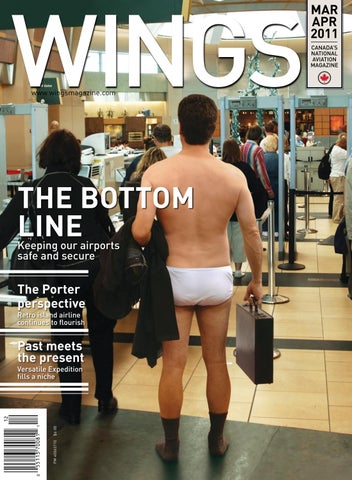
tripping down to the bare essentials. It’s how many are tempted to deal with heightened security measures at Canadian airports, and while I won’t go as far as our cheeky cover model and show up in skivvies, the thought has crossed my mind. Pat-downs, body scanners, excessive lineups . . . it’s more than enough to test your patience and make you consider drastic measures, however ridiculous they may seem. But when you stop and think about the big picture, it begs the question: What price do you put on your own security, your own safety? And how much inconvenience will you put up with? Do you feel safe and secure at Canadian airports? Like many commercial travellers, I have had the pleasure of spending plenty of “quality” time in airports from coast to coast. I have braved lines longer than the eye can see on numerous occasions (at 4 a.m., no less), dealt with dour customer service agents, and smiled warmly at security agents asking insipid questions about seemingly trivial matters. I’ve had shoes removed, buckles buzzed, my body patted. I’ve been scolded for not taking my laptop out of my briefcase, and have closely scrutinized decisions by security agents and wondered why things are done the way they are. I have even gone so far as to bring questionable articles in my briefcase to “test” the system – sharpened pencils or small penknives given to me as gifts at trade shows. Call it editorial curiosity. Guess what? They’re always scrutinized and confiscated. Through all of these “hassles,” what impresses me most is that the final objective is always met – flights are always safe and I feel secure in every airport environment I’ve been in. Even more impressive? I have yet to witness an outrageous incident at a security
5 www.wingsMagazine.coM
checkpoint that I would deem a heinous breech of a travellers’ civil rights – or worse, encounter a dangerous, life-threatening situation. It’s a significant point, especially when you consider that more than 200 million passengers moved through Canada’s
measures being imposed on Canadian passengers since new measures were implemented in late 2009. Some of these have targeted the elderly, children and frequent flyers – the wrong mix, says former American Airlines CEO Robert Crandall. He aptly observes that North American governments must identify those that are a security threat in the first place, and not concentrate efforts on low-risk passengers. It’s a critical point, which seems to be slowly resonating with the federal government. In early February, Chuck Strahl, minister of transport, and Rob Merrifield, minister of state (transport), announced new screening measures at Canadian airports that deal with some of Crandall’s concerns. The government’s objectives will include new equipment and lane configurations meant to enhance the flow of passengers and bags at security screening checkpoints. The Canadian Air Transport Security Authority will be installing equipment that will automatically separate suspicious bags from cleared bags, reducing congestion. In addition, CATSA is expanding the use of the Trusted Traveller CATSA Screening Line for pre-approved travellers who hold a valid Nexus card. There will also be new dedicated lanes for families and those who have special needs, with equipment specifically designed for bigger items like strollers. And great news for those who sew – or anyone else who feels the need to bring small scissors in their carry-ons. These items and tools, no longer than six centimetres (excluding the handle), are now permitted. Time will tell if the new security measures – and enhancements down the road – will speed up the airport screening process. No doubt, in our instant world of “I don’t have time for this,” there will be critics of the system. No matter. I will continue to plan ahead before trudging off to the airport and accept (and marvel at) the complexity of the process. Is it a pain sometimes? Yes. But if the payoff is arriving safe and sound at my next destination, I can put up with a little bit of inconvenience. Perhaps you can, too. | W
Pat-downs, body scanners, excessive lineups . . . it’s more than enough to test your patience and make you consider drastic measures. top 50 airports last year – not to mention those picking up/dropping off loved ones or congregating in the airport waiting areas. Serious issues are rare. However, as Wings correspondent Brian Dunn aptly points out in the first part of our two-part series on airport security in Canada (see The Bottom Line, pg. 20), things are not perfect. There have been high-profile examples of questionable body searches and over-the-top security
toP data burStS… in this issue 1. 2.3 million Canadians flew to/from a U.s. border airport last year (pg. 16). 2. the 28,000-square-foot, $7-million addition transforms the canada aviation and space Museum (pg. 18). 3. 44: number of full-body scanners purchased by caTsa (pg. 21). 4. $880: Cost of a top-of-theline iPad (pg. 25). 5. Porter airlines has spent $500 million on aircraft since 2006 (pg. 39).
Your feedback is always welcome. Please contact me at mnicholls@annexweb.com. March/April 2011 | wings
5
WINGS
mar aPr 2011 caNada’S NatIoNal aVIatIoN maGazINE
www.wingsmagazine.com
Vol. 52, issue 2 editor
Matt nicholls mnicholls@annexweb.com 416-725-5637
the bottom line
Keeping our airports safe and secure
aSSoCiate editor
the Porter perspective
andrea kwasnik akwasnik@annexweb.com 519-429-5181 • 888-599-2228 ext. 238
Retro island airline continues to flourish
Past meets the present Versatile Expedition fills a niche
ProduCtion artiSt
kelli kramer
PM 40065710
$6.00
SubScribe TODAY !
flight deCk
1 Year SubScription WingsMARAPR2011.indd 1
15/02/11 10:46 AM
only
3000
$
Roger Beebe, Ray canon, James careless, David carr, Paul Dixon, Brian Dunn, Frederick k. Larkin, neil MacDonald, James Marasa, carroll Mccormick, Mike Minnich, David olsen, Peter Pigott, Dr. Tarek sardana, Rob seaman, Blair watson aSSoCiate PubliSher
alison de groot adegroot@annexweb.com 1-888-599-2228 ext. 246
(all taxes included)
US $42.00 (USD) • Foreign $65.00 (USD)
Name: _______________________________ Company: ____________________________ Title: _________________________________ Address: _____________________________ City: _________________________________ Prov: ________________________________ P.Code: _______________________________ Tel: __________________________________ Fax: _________________________________ e-mail:________________________________
PLeASe cHecK ONe: ❑ Commercial aircraft owner/operator ❑ Business/private aircraft owner/operator ❑ Military ❑ Aircraft maintenance/overhaul firm ❑ Airport ❑ Aerospace, airframe & component manufacturer and distributor
❑ Fixed base operator ❑ Aviation services, consultants and aircraft sales ❑ Government ❑ Aviation associations and organizations ❑ Flying schools, clubs and colleges ❑ Other (please specify) ______________
PAYMeNT: Cheque - Payable to Annex Publishing Visa
MC
AMEX
Account #: __________________________ Expiry:_____________________________
adVertiSing SaleS
Ryan culver rculver@annexweb.com 519-429-5182 • 888-599-2228 ext. 273 grouP PubliSher
scott Jamieson sjamieson@annexweb.com PreSident
Mike Fredericks mfredericks@annexweb.com WingS magazine
P.o. Box 530, 105 Donly Dr. s., simcoe, on n3Y 4n5 Tel.: 428-3471 Fax: 429-3094 Toll Free: 1-888-599-2228
Publication Mail agreement #40065710 Return undeliverable canadian addresses to circulation Dept., P.o. Box 530, simcoe, ont. n3Y 4n5 e-mail: ncuerrier@annexweb.com Published six times per year (Jan/Feb, Mar/apr, May/ Jun, Jul/aug, sep/oct, nov/Dec) by annex Publishing & Printing inc. Circulation e-mail: ncuerrier@annexweb.com Ph: 866-790-6070 ext. 208 Fax: 877-624-1940 Mail: P.o. Box 530, simcoe, on n3Y 4n5 Subscription rates canada – 1 Year $ 30.00 (includes gsT - #867172652RT0001) Usa – 1 Year $ 42.00 Foreign – 1 Year $ 65.00
occasionally, wings Magazine will mail information on behalf of industry-related groups whose products and services we believe may be of interest to you. if you prefer not to receive this information, please contact our circulation department in any of the four ways listed above. no part of the editorial content of this publication may be reprinted without the publisher’s written permission. ©2011 annex Publishing & Printing inc. all rights reserved. opinions expressed in this magazine are not necessarily those of the editor or the publisher. no liability is assumed for errors or omissions. all advertising is subject to the publisher’s approval. such approval does not imply any endorsement of the products or services advertised. Publisher reserves the right to refuse advertising that does not meet the standards of the publication. Printed in canada issn 0701-1369
Signature: _________________________ Date: _____________________________
TO SubScribe:
Tel: 866-790-6070 Fax: 877-624-1940 Mail: Wings Magazine c/o Annex Publishing & Printing inc. P.O. box 530 Simcoe, Ontario N3Y 4N5 e-mail: ncuerrier@annexweb.com
www.wingsmagazine.com
GST#135274215RT001
6
Subscriptions non-refundable
wings | March/April 2011
PRO0211
Air Transport Association of Canada
ON THE
WEB
Canadian Owners & Pilots Association
Canadian Business Aviation Association
Magazines Canada
CareerS in aViation Visit our new Careers in Aviation website to learn more about job forecasts and career overviews, and to access a listing of universities, colleges, and private training centres and programs. www.careersinaviation.ca www.wingsMagazine.coM
WANTED:
RECHERCHONS :
“Sure, it’s kind of a desk job, but it’s not like any I’ve ever seen. My career is going somewhere. When you’re in the Forces, you’d be amazed where your office can take you.” Lieutenant PETER DENMAN
« C’est vrai que ça ressemble à un travail de bureau, mais en même temps, c’est incomparable. Ici, je sens que ma carrière s’en va quelque part. Dans les Forces, c’est surprenant de voir jusqu’où la vie de bureau peut mener. » Lieutenant PETER DENMAN
AIR TRAFFIC CONTROLLERS
CONTRÔLEURS AÉRIENS
ON THE FLY For late-breaking news, the Wings blog and exclusive web content, please visit us at: www.wingsmagazine.com
induStrY neWS PeoPle oPeratorS airPortS letterS to the editor Calendar of eVentS
induStrY neWS
the sector council for the aviation and aerospace industry, CCAA works closely with national and regional industry associations, many of whom are represented on CCAA’s board of directors. CCAA will continue to assist the industry with skills development and the demographic challenges it faces.
SeCtor CounCil rebrandS itSelf
WingS & WheelS readY to roll
The Canadian Aviation Maintenance Council (CAMC) has changed its name to Canadian Council for Aviation & Aerospace (CCAA). Describing the reasoning behind the name change, CCAA executive director Robert Donald stated, “Although its origins are in the aviation maintenance segment of the industry, the work of the council increasingly encompassed other areas. For example, in 2005, CAMC published four occupational standards for aerospace manufacturing, and in 2008 it completed a study of the aerospace industry. In 2010, it completed studies on commercial pilots (fixed wing and rotary) and Canadian airports. The CAMC name no longer reflected the true scope of the council’s work and consequently the name has now been changed to Canadian Council for Aviation & Aerospace (CCAA).” There are currently 34 sector councils, each operating in a major sector of the Canadian economy (e.g., mining, forestry, fishing, petroleum and trucking). As
The Canadian Air & Space Museum will host its sixth annual “Wings & Wheels Heritage Festival” at Downsview Park, Toronto, from May 28-29. A unique showcase in the centre of Canada’s largest city, the festival utilizes Bombardier’s Downsview Airport and historic hangars in adjacent Downsview Park to provide aviation and auto enthusiasts with a rich display of classic and modern aircraft, classic cars, trucks and motorcycles, and associated family-friendly exhibits. This year’s festival evokes the spirit of the Trans Canada Air Pageant air tour, which touched down in Toronto in 1931 with a spectacular showcase of military and civilian aircraft witnessed by 30,000 people over the green fields of Downsview. The 2011 Festival celebrates a number of aviation milestones closely associated with the history of one of Canada’s oldest airports, which has been home to an aircraft factory since 1929. Highlights of the 2011 festival include
the Wings & Wheels Festival is designed to appeal to aviation fans of all ages, with the goal of inspiring the next generation of aviation innovators, pilots, engineers and technicians.
a fly-in of Second World War RCAF training aircraft used in the British Commonwealth Air Training Plan and a homecoming fly-in of legendary de Havilland Aircraft of Canada and Bombardier Aerospace aircraft built at Downsview over 80 years. A special feature will be a unique and eclectic showcase of aircraft powered by the legendary Pratt & Whitney Canada PT6 gas turbine engine, which first flew at Downsview Airport 50 years ago in the nose of a Beech 18 aircraft on May 30, 1961. The Festival is designed to appeal to aviation fans of all ages, with the goal of inspiring the next generation of aviation innovators, pilots, engineers and technicians. Fly-in visitors to Downsview Airport must register in advance to ensure smooth festival operations. Airport and registration details will be posted on the museum web site in March. Visit www. wingsandwheelsfestival.com for more details.
PeoPle
aPex airCraft exPandS team
canadian aviation maintenance council executive director Robert donald announces the imminent name change at the ccaa Forum in Vancouver last october. 8
wings | March/April 2011
Gary Laderoute has joined Apex Aircraft Sales Ltd. at the Toronto Buttonville Municipal Airport. Continuing his long career in aircraft sales, Laderoute brings his expertise in turboprops and jets to round out the Apex sales team. Laderoute began his flying career in www.wingsMagazine.coM
PHoTo (ToP): anDY cLine, (BoTToM): ccaa
8 8 9 10 10 10
1959. In 1970, he joined the Cessna Aircraft Company as a district sales manager and progressed to become its Canadian sales manager in 1978. In 1979, Laderoute joined Field Aviation as light aircraft sales manager where he worked with a team of salespeople to market new Beechcraft, along with used piston aircraft, for all of Canada. He subsequently became part of its corporate aircraft sales division to sell new Hawker Beechcraft turbine aircraft as well as used turboprop and jet aircraft. In total, he worked more than 30 years with Field Aviation. Apex Aircraft Sales Ltd. has been in the business of selling resale piston singles and twins since 1988. It also represents Leggat Aviation Ltd. in the sales of new Cessna aircraft. Laderoute can be reached at the Buttonville office at (905) 415-2178.
oPeratorS
flYing ColourS deliVerS Challenger to China
PHoTos (ToP): anna PangRazzi, aPex aiRcRaFT, (BoTToM): FLYing coLoURs coRP.
Flying Colours Corp. recently delivered its first Bombardier Challenger 850 to China for a Hong Kong-based client. The new aircraft arrived at Flying Colours Canadian-based facility late in the second quarter of 2010 and was delivered to the customer prior to year end. The aircraft will be operated and managed by
Gary laderoute brings his expertise in turboprops and jets to round out the apex sales team.
Hong Kong-based, Metrojet. The 14-seat executive aircraft was elegantly designed and finished throughout, highlighted by the installation of a dual vacuum waste system based on the Global Express design and function. The cabin also consisted of a premium digital cabin management system including custom touch screen cabin controls and large cabin LCD displays. Flying Colours also installed a True North Global Broadband system allowing the customer to have true high-speed WiFi capability while in flight. This is the first of five new Challenger 850 aircraft Flying Colours is completing for Chinese based customers. “The Challenger 850 aircraft is an ideal aircraft for the China business jet market and we are looking forward to long-term growth in this region,” stated John Gillespie, president, Flying Colours Corp.
aVeoS PartnerS With Canadian north Aveos has signed two new five-year, fullservice maintenance agreements with Canadian North. The agreements provide airframe, engine, component and line maintenance, as well as inventory, engineering, fleet management and records services for the carrier’s B737-300 aircraft that provide passenger and cargo service to Northern communities, remote sites and destinations across Canada. The new 737-300 aircraft entered into service in January, 2011 and are powered by CFM56-3C1 engines, part of the engine offering for which Aveos has garnered a global reputation. “We are pleased to be expanding our relationship with a proven service provider such as Aveos,” said Steve Hankirk, vice president of operations at Canadian North.
the recent delivery marks the first of five new challenger 850 aircraft Flying colours is completing for chinese-based customers. www.wingsMagazine.coM
March/April 2011 | wings
9
ON THE
FLY
Calendar of eVentS marCh 2011 Heli-Expo 2011 March 5-8 orlando, Fla. www.rotor.com HAC 15th Annual Convention and Trade show March 25-27 Vancouver, B.c. www.h-a-c.ca CHC Safety & Quality Summit March 28-30 Vancouver, B.c. www.chcsafetyqualitysummit.com
aPril 2011 Aircraft Interiors Expo 2011 april 5-7 Hamburg, germany www.aircraftinteriorsexpo.com
maY 2011 EBACE 2011 (European Business Aviation Association) May 17-19 geneva, switzerland www.ebace.aero
June 2011 2nd Annual Summit Aircraft Repossession June 16 Miami, Fla. www.aeropodium.com 49th International Paris Air Show June 20-26 Le Bourget, France www.paris-air-show.com
JulY 2011 CBAA 2011 – Annual Convention, Trade Show and Static Display July 6-7 calgary, alta. www.cbaa.ca For a full list of events, please visit www.wingsmagazine.com and click on events in the community section. 10 wings | March/April 2011
“We continue to enjoy a strong partnership where we depend on them to be an extension of our airline as they help us reach our goals of on-time performance and maintenance reliability.” Aveos has the supporting systems in place to offer complete maintenance packages to airlines. “We are able to bring our customers cost-effective solutions due to our technical airline knowledge and by leveraging strong relationships with the aviation supplier community,” added Ron Elvidge, vice president, maintenance solutions.
airPortS
neW deParture SYStem for london ARINC Incorporated has successfully installed a remotely hosted common-use departure system for multiple airlines in just 89 days at the new departure lounge of London International Airport, London, Ont. The deployment – from contract on Oct. 14 to cutover on Jan. 12 – was ARINC’s fastest ever for a multi-airline implementation of its vMUSE Enterprise technology. vMUSE Enterprise provides full common-use functionality without the usual need for on-site server hardware and core rooms, and their recurring maintenance. The ARINC technology replaces dedicated departure gates previously used by Air Canada, WestJet, and United Airlines. It may be expanded incrementally to accommodate any number of positions and carriers. An airport spokesman said ARINC was chosen over other competitors based on its technology solution, as well as airline recommendations, favourable pricing, and the quickness with which it could be deployed. Initially used to handle seasonal traffic peaks and off-airport check-ins, ARINC vMUSE Enterprise was designed to deliver the full capability expected from a conventional networked common-use check-in and departure system. Airlines and airports of any size can add check-in and departure services efficiently whenever required with vMUSE Enterprise. Only a PC, laptop, or thin-client device is needed, along with industry standard peripherals and an Internet connection. ARINC installed vMUSE Enterprise on ten workstations in the London International Airport departure lounge. These will accommodate current requirements of United, Air Canada, and WestJet, with capacity for another airline later.
letterS to the editor
Carr driVeS it home “The problem is piling up” by David Carr – Wings July/August 2010: I came across Wings magazine while awaiting an appointment and was pleasantly surprised to read about the positive changes being made to “green” the aviation industry. David Carr’s article was especially interesting to read. While my family and friends travel frequently via plane, I haven’t had the pleasure for almost 20 years. But 20 years ago I was very concerned about the lack of attention to the huge volume of disposable waste that accumulated during an airplane trip. I hope Mr. Carr’s article inspires the proper authorities to wake up and implement the necessary changes. There is no excuse. The aviation industry needs to implement a zero waste program. A zero waste program would provide a positive image for the industry and address the serious waste problem, which is both an economical and environmental disaster. Maybe you can forward this to the appropriate authorities and encourage them to make 2011 the year to make Zero Waste a reality. Sincerely, Kelly Clune
Celebrating our CadetS “Providing a solid foundation – Celebrating the 70th year of the Royal Canadian Air Cadets” by David Carr, Wings Jan/Feb 2011: Nice piece by David Carr. I shall share the article with our own unit here in Windsor. I’m sure copies of it will be hung up at squadrons all across Canada. There were 14 original squadrons when the movement was born in 1941, one (#13) being in Windsor. The unit was amalgamated with two others in 1972. I have no way of verifying this, but it has been estimated that 10 per cent of all pilots in Canada are graduates of the Air Cadet Flying Scholarship program as well. I hope everyone takes the opportunity to visit an Air Cadet unit during our 70th anniversary this year to see what the program looks like in their community. S.P. Stephenson, CD Major, Commanding Officer 364 RC Air CS National Defence Government of Canada www.wingsMagazine.coM
WAYPOINT By Rob Seaman |
Pat-down payoff!
Enhanced airport security is giving bizav a second chance
A
12 wings | March/April 2011
are significant. The report
Commercial air travel is a task: goes on to say new pilots have been hired and the number of a temper-testing process of aircraft based at the field inhumiliating, impersonal actions. creased by a third in the past happens to the images that are generated by the scanners. Authorities swear they are destroyed; others swear not. It’s a gigantic mess for all concerned; however, business aviation is benefiting from it all on many levels – it’s helping to stimulate business. Every time a businessperson familiar with the benefits of corporate aircraft use is subjected to the rigours of commercial travel, bizav gets a second chance. To wit, corporate flight department hours increased in 2010 – and according to some, are almost back to pre-recession numbers. By the end of the year, charters in Canada were healthy again, and some weeks, getting an aircraft was a challenge, according to some major Canadian aircraft management groups. The same holds true in the United States. Case in point, a recent report in the Boston Globe indicated corporate jet activity was up seven per cent through 2010 at Hanscom Field, a small general aviation airport close to the city. Some “based” operators report that their business doubled from the previous year, while others at the site report more modest gains of 15 per cent. Either way, in a conservative, politically driven community like Boston, increases
three years – enough that the operators of the aerodrome are talking expansion. Similar news is coming from other spots in the United States and Canada. As charter activity increases, it creates a trickle-down effect – notably, bizav users who were waiting to move beyond charter and into some form of ownership are now turning to fractional or full-aircraft acquisition. The order books are also starting to load up again on the OEM side. Montreal’s Bombardier Aerospace, for example, is hiring staff for its corporate aircraft production division, while many forecasters are predicting recovery is on the way – some say in 2012, and others by late this year. Either way, it’s good news. We really need to thank the TSA, Transport Canada by default and airport screening folks for this turnaround. They have had some impact in the recovery of the corporate aviation market domestically and around the globe. And who knows – if they keep it up, we may be experiencing more good news in the near future. | W Rob Seaman is a Wings writer and columnist. www.wingsMagazine.coM
PHoTo: eDMonTon inTeRnaTionaL aiRPoRT
viation regularly gets its share of media attention regardless of whether it’s commercial, corporate, private or military. For example, airline pilots showing up for work drunk was a popular news item for a while. And then there was the front-end guys caught sleeping on the job. A real eye-opener. A couple of off-runway trips? Another great piece. Negative news stories like these really don’t do much to build the confidence of the travelling public. This, of course, is compounded by the fact that when taking a commercial flight, you can’t bring much on board, you must arrive hours beforehand to go through the humiliation of pre-flight screening, and you get treated with little customer service acumen – regardless of whether you’re a member of the flight crew or a passenger. From the passenger perspective, it begs the question: do I really want the folks entrusted with the operation of the aircraft and my safety rattled and flustered because of overt security measures? Gone are the days when heading out on a plane was a thrill and an adventure for the family to enjoy. Gone too are the times when a business trip between cities was routine and the travel just part of the process. Commercial air travel is a task – a temper-testing process of humiliating, impersonal actions. Small wonder everyone looks angry in commercial airports today. And every time terrorists (or troublemakers/pranksters) come up with a new scheme – such as printer cartridges that are actually bombs – everything is ratcheted up a notch. The Transportation Security Association (TSA) goes on high alert and, because we are great neighbours, Transport Canada has to follow. The latest wrinkle in airport security to enrage both flight crew unions and passengers is the introduction of full-body scanners and enhanced body search methods. These intense security measures have prompted mass protests and dramatic acts ranging from stripping to threats of organized mass refusals. The new tactics have prompted claims by some over “familiarity” in the search methods, and social networking sites including Facebook have groups devoted to it. There’s also a raging debate about what actually
Aerotek knows the value of flexible staffing services. Because let’s face it, business as usual ... rarely is.
Whether you’re looking for one key person or an entire staff, Aerotek has the experience, expertise and plenty of solutions to meet all your ever-changing needs. We can find, hire and oversee your workforce. And that can save time, money and your sanity. To find out how you can save time and money with Aerotek’s Staffing Solutions, call 888-AEROTEK or visit aerotekcanada.ca.
An Allegis Group Company. © 2011
ALTERNATE
APPROACH By David Carr |
into the theatre of the absurd Breaking down the UAE/Canadian landing rights dispute
I
14 wings | March/April 2011
for 50 per cent of the profit. Such an arrangement belies both Air Canada and Transport Canada’s argument that the route is already well served. How this plays out in Calgary and Vancouver – destinations Emirates would like to add to its route map – is the question. In the 1980s, Alberta forced the Mulroney government’s hand by electing its first Senator. Unilaterally allowing Emirates to fly to Calgary would be a symbolic, albeit largely hollow, gesture, but one that would be consistent with open skies and today’s reality that Canadian airports are independent businesses capable of negotiating their own commercial agreements. Historically, disputes over landing rights are not uncommon in Canada, but rarely have they been so vitriolic. Both Air Canada and Emirates have buttressed their arguments by tossing out predictions of gains and losses. These are largely red herrings. The issue is competition versus protectionism, and Air Canada is a quality airline that should be able to compete. Still, whatever happens next, Canadian consumers can take comfort that the UAE, unlike Brazil, is not a major food exporter and our grocery carts can be spared. | W
Disputes over landing rights are not uncommon in Canada, but rarely have they been so vitriolic. permission to land because Transport Canada stubbornly refused Lufthansa Toronto landing rights after more than 10 years of negotiations. The core interest in this dust-up is transfer traffic. Emirates, Etihad and Qatar Airways are using capacity and spacious, modern airports in the Gulf to draw traffic and become super-connectors. It appears to be working. Dubai has already jumped into the position of world’s third busiest international airport after LondonHeathrow and Hong Kong. Likewise, Air Canada’s global reach is extended through closer tie-ups with larger Star Alliance partners such as Lufthansa. It is a clash of business models not unlike the Airbus A380 versus serial delayed Boeing 787. The problem for Air Canada is that Emirates is flying to spots more Canadians want to go while side-stepping creaking and overcrowded international hubs such as London Heathrow. Air Canada gets it. As with Boeing and the launch of a larger 747-8I passenger aircraft, the airline sought to hedge its bets by proposing an alliance with Emirates where the UAE carrier would do the heavy lifting with daily flights to Toronto in exchange
David Carr is a Wings writer and columnist. www.wingsMagazine.coM
PHoTo: aiR canaDa
t should never have come to this. Canada’s spat with the United Arab Emirates (UAE) over expanded landing rights for Dubai-based Emirates and Abu Dhabi’s Etihad Airways has spiralled out of control, and is likely to result in another embarrassing climb-down by Ottawa, similar to when the federal government ordered the removal of tinned corned beef from store shelves during a scrap with Brazil over a trade dispute between Bombardier and rival Embraer. For the record, Hereford Premium Corned Beef sandwiched between two slices of white bread with pickled onion and a dab of HP Sauce is quite the treat. That the average Canadian household could be denied a grocery staple because of a quarrel between aircraft manufacturers over dodgy government subsidies never sat well in this corner. With the UAE dispute the retaliatory stakes are growing broader. Yes, the kingdom overplayed its hand when it linked commercial landing rights with continued access to an airbase that Canadian Forces used as a staging area for the war in Afghanistan. But how seriously are we supposed to take that when Defence Minister Peter MacKay upstaged his own government by sporting a Fly Emirates baseball cap? As often happens whenever aviation is concerned, we have entered the theatre of the absurd surrounded by walls of entry visas and Canadian businessmen being turned away at the Dubai customs hall. Duncan Dee, Air Canada’s chief operating officer, launched an over-the-top attack on the former Liberal government after foreign affairs critic Bob Rae came out in support of Emirates. Dee, a Liberal staffer before being hired by Robert Milton during the Chretien years largely for his bulging Rolodex, held his previous employer responsible for every airline bankruptcy in Canada prior to 2006. More recently, Canadian authorities drew strength from a German decision to block future Emirates flights to both Stuttgart and the new Berlin airport scheduled to open next year. The spin was predictable: see, it’s not just us. But dial back 40 years, when an Air Canada 747 bound for Frankfurt idled on the tarmac in Montreal after German authorities withdrew
we’ll give you all the big dots on the map and throw in a bunch of tiny ones for free. onboard the citation sovereign, the map is at your command. fly farther from shorter runways. fly farther with more payload. simply fly farther than other midsize jets. new york to los angeles. geneva to dubai. singapore to shanghai. no problem, with its 2,837 nautical mile range. after all, if you’re the sovereign, nothing should be off-limits to you, whether they be the big dots on the map, or the tiny ones that lesser aircraft will never conquer.
Call To sChedule a CiTaTion sovereign demo. 877-410-8650 | WWW.Wings.Cessna.Com
The Citation sovereign
AT THE
GATE
By Brian Dunn |
Crossing the great divide
Canadian airports are reeling as passengers opt for U.S. options
T
16 wings | March/April 2011
Council on Foreign Relations that when he joined the organization in 2002, Canada was the eighth most visited country in the world. Today, it has slipped to 15th place, which he largely blamed on the exorbitant rents Ottawa charges Canadian airports. There’s hope the situation will change. A Senate committee is looking at various aspects of Canada’s cost competitiveness, including airport rent and landing fees, border leakage, and tourism, with Transport Canada playing a major role in the discussion. A report is expected to be released later this year. In the meantime, Canadian airports realize they have their own role to play. For example, Pearson has reduced passenger landing fees by 20 per cent since 2007 and cargo landing fees by 40 per cent. The customer experience has also been enhanced through improved valet parking, value parking garages, and free Wi-Fi and mini pop-up movie theatres throughout the terminals. Vancouver doesn’t have any numbers, but seepage to the United States represents “several million dollars,” according to John Korenic, director of aviation marketing, Vancouver International Airport. In response, Vancouver is trying to promote benefits for passengers such as no border hassles and easy customs pre-clearance. The airport has also introduced an incentive program through which airlines can get rebates based on traffic growth. In addition, B.C. will eliminate the provincial fuel tax on trans-border and international flights in April 2012, and is providing marketing dollars to promote new routes. | W
One in six Canadian travellers bound for the United States and overseas crosses the border to catch a flight. Burlington and Plattsburgh, is the free ride Plattsburgh International Airport is getting; the airport terminal is 100 per cent subsidized and pays no rent. “And it has the audacity to advertise itself as Montreal’s U.S. Airport,” said James Cherry, president and CEO of Aéroports de Montréal. But Cherry is more upset that governments are undermining all Canadian airports’ ability to be world class due to overbearing costs. “We pay more than $40 million in taxes to the City of Montreal and about the same in rent to Ottawa. That’s close to 20 per cent of our revenue and we’re not getting anything back,” he says. Even the International Air Transport Association (IATA) is getting into the fray. IATA president Giovanni Bisignani noted in a luncheon speech before the Montreal
Brian Dunn is a Wings writer and columnist. www.wingsMagazine.coM
PHoTo: eDMonTon inTeRnaTionaL aiRPoRT
he trend of Canadians driving to U.S. border airports to catch cheaper flights shows no sign of abating and has now spread to the Maritimes with Maine luring customers away from New Brunswick to airports in Bangor, Presque Isle and Portland. It is estimated one in six Canadian travellers bound for the United States and overseas crosses the border to catch a flight instead of leaving from Canada. Vancouver, Winnipeg, Toronto and Montreal are the hardest hit among Canada’s major airports. Hamilton and Thunder Bay are also affected. Edmonton has a different, but just as serious, problem. It’s losing traffic to Calgary and, in reaction, devised a marketing campaign last year with the slogan, “Stop the Calgary Habit.” “We estimate that as many as 2.3 million Canadians flew to/from a U.S. border airport last year, via U.S. airports from coast to coast. And we believe the problem is only getting worse,” said Daniel-Robert Gooch, director, communications and policy at the Ottawa-based Canadian Airports Council. Last year, the council combined forces (called the National Travel and Tourism Coalition) with the major air carriers, hotel associations and tourism associations to develop two policy papers that were submitted to Ottawa on the issue. The Greater Toronto Airports Authority (GTAA) estimates 1.82 million of Buffalo’s five million annual passengers come from Ontario, resulting in an annual net loss of $640 million in direct and indirect revenue and a loss of 2,400 jobs for the GTAA and surrounding area. There are a number of reasons for this hemorrhaging, including cheaper fares as a result of more competition in the United States and aggressive marketing by some U.S. airports. Plattsburgh, N.Y., for example, bills itself as “Montreal’s U.S. Airport” with bilingual signage throughout the terminal. In addition to Plattsburgh, Montreal’s Trudeau International must compete with Burlington, Vt., which is also luring traffic south with discount carriers offering enticing deals to sun destinations. What grates Montreal, which loses an estimated 200,000 passengers a year to
DON’T MISS CANADA’S LARGEST
DEFENCE & SECURITY TRADE SHOW JUNE 1 & 2, 2011
Bringing solution-driven suppliers together with requirement-focused customers. CANSEC is your opportunity to access: Over 8,000 industry suppliers and government customers Over 400 booths, 128,000 sq ft of exhibition space
SHOW SPONSORS:
State of the art defence and security technologies, equipment and services
DEFENSE
Exclusively open to Government Employees, Canadian Military & Security Personnel, First Responders and CADSI Members
COMPLIMENTARY SHUTTLE SERVICE FROM MAJOR FEDERAL BUILDINGS
www.defenceandsecurity.ca call: 613-235-5337
1-866-786-4661
45˚42�
NORTH By Peter Pigott |
Celebrating the ‘village green’
Dynamic new entrance transforms the Canada Aviation and Space Museum
O
18 wings | March/April 2011
celebrate. Museums should be a place where knowledge is not only discovered but shared . . . and it is with these concepts and ideals in mind that the Canada Aviation and Space Museum seeks to enlarge its mandate and push the envelope by engaging the arts with its new facilities – and welcoming new communities to its ‘village green.’ Aviation and the arts has been a natural fit since the first humans took tentatively to the air and it is time to put them together in a national setting for Canadians to enjoy and celebrate.” With this extension, the museum plans to offer film and theatre classes and is lobbying for the National Arts Centre to use its facilities as a venue for its regionally themed theatre festival. Soon to come is a botanical garden, an astronaut’s walk and art shows. Now that it has been named the Canada Aviation and Space Museum, its mandate will feature space exploration and in May 2011, in co-operation with the Canada Space Agency, it will feature a 2,000-square-foot exhibit entitled “Living in Space.” It might be clichéd to say but, under its new director general, for the Canada Aviation and Space Museum, the sky is truly the limit. | W
“Aviation and the arts has been a natural fit since the first humans took tentatively to the air.” of taking off in flight.” And the upside-down Snowbird? “We chose the Snowbird aircraft because it is iconic. Millions of people see the Snowbirds across the country and around the world.” Near the entrance and the enlarged boutique are classrooms equipped with videoconferencing and distance learning. Ottawa’s Algonquin College already has joint programs with the museum and they will be joined by Ryerson University and other community colleges. Any of the colleges would be pleased to have the 250-seat multi-purpose auditorium, complete with folding tables, on its campus. “Museums need to be greater than the sum of their collections,” said Quick. They are honour bound to play a role as a meeting place for future ideas, dreams and a place to muse on the future predicated upon the mass and wealth of a nation’s collective past.” Quick added that museums today “need to act as stewards of the collections entrusted to them but they need to engage their communities’ regional, national and – with the new reality – international interests. The ‘village green’ is a place to meet, exchange ideas and
Peter Pigott is a Wings writer and columnist. www.wingsMagazine.coM
PHoTo: canaDa aViaTion anD sPace MUseUM
n the south shore of the Ottawa River, four nautical miles from the Parliament buildings, is a field that deserves its own historic marker. During the First World War, soldiers did target practice here before going off to the Western Front. A young William Lyon Mackenzie King, the future prime minister, drove here one hot August afternoon in 1918 to watch a Curtiss Jenny land with mail from Toronto. The site became an official airfield in 1920 as one of six that was opened across Canada by the Air Board. As RCAF Rockliffe, it was Canada’s first seaplane base and the old slipway where the first cross-Canada flight left in 1920 still exists; it has been used by the Canada Aviation and Space Museum to bring ashore several seaplanes for its collection. In 1931, the aviation celebrities Charles and Anne Morrow Lindbergh disembarked here from their Lockheed Sirius floatplane on their round-the-world flight. During the Second World War, Flying Fortresses packed with mail for Canadian soldiers in Europe lumbered down its runways. When the Air Force ceased active military flying from Rockcliffe in 1964, the historic site appropriately became home to the Rockcliffe Flying Club and the National Aviation Museum, some of which was then at Uplands Airport. The priceless collection was initially housed in three Second World War hangars on the south side of the field before being moved to the present magnificent building in June 1988. A storage wing was added to bring the aircraft deteriorating in the open air under shelter. In early 2010, work began on the main entrance that is scheduled to be opened on Feb. 23, 2011, the anniversary of the flight of the Silver Dart. Designed by Ottawa’s Cole+Associates Architects Inc., the 28-million square-foot main entrance to the museum is triangular in shape with floor to ceiling glass, and conveys a sensation of bright airiness. But when they enter, what visitors will notice first is a Snowbird aircraft suspended from the ceiling – upside down! “The museum never had an entrance that served as a proper introduction to the collection,” said Stephen Quick, the new director general. “We wanted a structure open as much as possible to the sky. The glassed-in entrance is designed to give visitors a sense
www.wingsMagazine.coM
March/April 2011 | wings 19
WHAT Is T BOTTOm LINE? keePing Canadian airPortS Safe and SeCure bY brian dunn
W
hen a lone terrorist walked into Moscow’s Domodedovo airport on Jan. 24 and detonated a powerful bomb that killed 35 and injured more than 165, it underscored just how vulnerable airports can be – and Canadian authorities are constantly
reviewing and implementing new security measures to keep them safe. The incident at Moscow’s busiest airport occurred in one of the many public areas where scores of people gather – a prime spot for a terrorist attack. Such areas are virtually impossible to screen, say security experts, and since
most airports in North America don’t restrict access to terminals, security is a greater challenge. Patrick Smith, an American commercial airline pilot and author, told the Associated Press after the incident that “airport security needs to be thorough, but it also needs to be rational, and the truth is that we can never
make any airport totally impervious to attack.” Canada’s Public Safety Minister Vic Toews says the bombing highlighted the persistence of terrorists and the need to find new measures to defend against them. “Terrorists simply do not give up when one avenue is closed, and that’s why I say, we make
PHoTos: canaDian aiR TRansPoRT secURiTY aUTHoRiTY (caTsa)
THE
one mistake and a terrorist might be successful,” he asserts. “That’s why we have to continue to be very vigilant, not only in terms of legislation that we’re bringing through, but also in practical measures on the ground.” Stricter security measures at Canadian airports have indeed been implemented over the past few months, and like everything in the aviation industry, they’ve been highly scrutinized. Enhanced measures followed shortly after a Nigerian passenger tried to www.wingsMagazine.coM
detonate explosives hidden in his underwear aboard a Northwest Airlines flight from Amsterdam to Detroit on Dec. 25, 2009. That event expedited the deployment of Canada’s first full-body scanner at Toronto’s Pearson International Airport by the Canadian Air Transport Security Authority (CATSA), a technology it had been testing for almost two years previous to the incident. And shortly after that, Toronto, Vancouver, Montreal, Calgary, Ottawa, Edmonton, Winnipeg
the canadian air transport Security authority has purchased 44 body scanners for canada's class 1 and class 2 airports.
is also replacing the current X-ray machines for carry-on bags with aTix technology that provides multiple views of a bag’s contents.
and Halifax also installed body scanners. CATSA has purchased 44 scanners and more than 36 are operating at Canada’s 16 Class 1 or Class 2 airports. Pat-downs have also been in effect pre-Christmas 2009, and full-body scanners since June 2008, in Kelowna, B.C., according to Mathieu Larocque of CATSA. The only change is that passengers selected randomly for further screening can opt for the fullbody scan or a pat-down. CATSA’s new testing facility in Ottawa allows the agency to evaluate new leading-edge technologies like the nextgeneration X-rays and full body scanners. One of the first technologies tested there was a split-lane system, which is being deployed across the country. Split-lane is a conveyor system that attaches to a pre-board screening X-ray. With split lanes, when a bin is identified by an X-ray operator as requiring further search, or if it sets off an explosive detection trace alarm, it is automatically routed into the recheck area. Other trials over the past year have included a partnership with Montreal’s Trudeau International Airport to evaluate boarding pass scanning systems and an explosive trace detector that is currently being tested at Pearson. CATSA
Pat-down problems But it’s the passenger screening procedures that have rattled a lot of travellers, particularly in the United States, where several lawsuits have been launched. Current procedures are expensive and target the wrong people, according to former American Airlines CEO Robert Crandall. Authorities are spending too much time and money on passengers such as children, the elderly and frequent flyers who do not present a security threat, Crandall argues. Instead, authorities should be spending more time trying to identify those who pose a real threat and less time on those who do not. A trusted traveller/Nexus program should be introduced for those who are not a threat. To identify potential terrorists, Crandall suggested airports should follow the lead of El Al Israel Airlines, which conducts thorough pre-flight background checks and has carefully trained personnel at airport terminals who can spot suspicious behaviour. “That’s something we’re looking at,” says Larocque. “We’ve received government funding to launch a pilot project to help us identify suspicious behaviour. And it won’t be based on racial profiling, because other airports around the world claim it’s not effective.”
Full-body scanners have been in place at canadian airports since June 2008. March/April 2011 | wings 21
Hall agrees with Crandall that Canada must follow the lead of Israel, which is what the U.S. and the U.K. are trying to do. “I feel the system needs to be more targeted, given our limited resources. I’m pleased with the direction we’re headed, but would like to see it happen faster.” Still, Canada’s airport security measures are respected worldwide and are way above the minimum standards set by the International Air Transport Association (IATA), Hall adds. What bothers the Air Transport Association of Canada (ATAC) is that we’re getting more and more security, but not necessarily better security, according to John McKenna, ATAC president and CEO. Says McKenna: “We’d like to see the whole procedure condensed into one process from four or five processes. Travellers are our customers and they don’t distinguish between airlines. They just see travelling as one huge inconvenience.” McKenna also agrees with Crandall that the wrong people are being screened. “Whenever I see a granny being patted down (as was the well-publicized case of an 82-year-old woman at Calgary International Airport in January), it makes my blood boil. If she can hardly get out of a wheelchair, I doubt she can make a run for the cockpit. Security people claim they can’t discriminate, but I think they can use better judgment.” And unlike U.S. cabin crews, some Canadian cabin crews are subject to screening, which is another waste of resources, says
authoRItIES Should BE SPENdING moRE tImE tRyING to IdENtIFy thoSE Who PoSE a REal thREat. Airport security must focus on behavioural recognition, agrees Capt. Craig Hall, Canada director for the Air Line Pilots Association’s (ALPA’s) national security committee. Says Hall: “While the current system is doing a good job, it’s doing a bad job of identifying bad people versus bad things. When you have a security paradigm that treats a Superior Court judge the same way as a paroled criminal, you have to re-evaluate the system.” Last year, ALPA released a white paper on a trust-based security system, noting the first security measures enacted in 1974 primarily to prevent hijackings to Cuba, must adapt to today’s new reality of suicidal terrorist attacks performed by trained individuals or groups. Some of the key findings in the white paper: • “The only means of providing genuine security is to positively identify known, trustworthy passengers, process them in an expeditious manner and concentrate our finite high-technology and behavioural screening resources on the small percentage of passengers whose trustworthiness is unknown or in doubt. Such a proactive security system will defeat the terrorists by anticipating future threats, will be much more effective and efficient than current security protocols and will reduce security-related inconvenience and delays for the vast majority of the travelling public, while protecting passenger privacy to the maximum practical extent.” • “There is so much publicly available information on virtually every citizen that a basic determination of trustworthiness is readily achievable.” • “What is presently lacking, and what is sorely needed, is the ability to leverage our knowledge about an individual’s trustworthiness and use that against our adversaries.” 22 wings | March/April 2011
McKenna, since they already go through a rigorous background check before they can fly. But most crew are exempted from random screening if they are in uniform and carry their Restricted Area Identity Card, according to Larocque. “We have to live with an acceptable amount of risk,” says McKenna. “But it costs more per passenger for security in Canada than anywhere else in the world and the cost has increased 53 per cent in the past two years. In Canada, travellers pay 100 per cent of security costs versus only 30 per cent in the U.S.” McKenna notes Ottawa collected $700 million in revenue from security charges, of which $500 million goes towards financing CATSA, according to the last audit of the system in 2004. He not only wonders what the remaining $200 million is used for, but why a more recent audit hasn’t been done. “And clearly the strings are being pulled by American authorities who are demanding only one carry-on bag for flights going to the U.S.,” says McKenna.
Streamlining the process Another option has been put forward by IATA that it believes would improve security and speed passengers through checkpoints. The proposal would eliminate the “one-size-fits-all” security screening process and instead impose different levels of screening for different types of travellers, with frequent travellers undergoing a less intrusive security search than other passengers. The concept proposes a set of three tunnels or enclosed pathways that are equipped with sensors, X-ray machines, cameras or other security equipment. Travellers will be assigned to a tunnel that reflects their security status, “Known Travellers,” “Normal Security,” or “Enhanced Security,” depending on the biometric and other personal information airlines and government authorities have about them. Under the proposed system, passengers would identify www.wingsMagazine.coM
themselves with a fingerprint, biometric passport or mobile phone boarding pass. Those walking through the Known Travellers tunnel would be subject to minimal inspection, while the other tunnels would require more stringent checks. All three tunnels would have metal detectors. By combining biometrics, passenger data and stand-off screening for explosives, such as sensors, the tunnels could allow some passengers to walk from curb to aircraft uninterrupted. The idea is similar to Global Entry, a trustedtraveller program run by U.S. Customs and Border Protection at U.S. airports. Launched in 2008, Global Entry promises quicker U.S. Customs clearance at automated kiosks for travellers who are considered low terrorism risks. Members must undergo a government background check, submit fingerprints and pay a onetime fee of $100.
of passengers were satisfied with their overall experience and 75 per cent were satisfied with physical searches.”
Sign of the times Whatever processes are put in place at Canadian airports in the months and years ahead, the fact remains commercial airline travel is getting more and more difficult. Fortunately, as federal Transport Minister Chuck Strahl vowed last December, the “provocative” American pat-down procedures that sparked John Tyner’s “don’t touch my junk” comment
to a U.S. screener that went viral on YouTube, won’t happen north of the border. Says Strahl: “Canadians obviously have the right to expect to be treated properly and respectfully at airports.” Being treated properly and respectfully at Canadian airports – now there’s something commercial passengers deserve. | W This is Part 1 of a two-part series on Canadian airport security. In the May/ June issue, Wings looks at airport cargo and the transportation of dangerous goods.
Survey says A new U.S. survey reveals three in four air travellers believe “there has to be a better way” to conduct air travel security screening. Eight in 10 support a trusted-traveller program that would provide alternative screening measures for American citizens who submit to a background check and meet other risk criteria. Respondents would take an average of two to three more trips per year if the hassle involved in flying could be reduced without compromising security. Those additional trips would add $84.6 billion in travel spending and support 888,000 additional jobs, according to research from the U.S. Travel Association. “Americans are clamouring for a better way, and it should be a wake-up call for our leaders in Washington,” says Roger Dow, president and CEO of the U.S. Travel Association, which commissioned the survey. “An efficient air travel security screening system that streamlines the process for trusted travellers can strengthen our security and economy. “Let’s get to work building the system Americans crave.” A majority of those surveyed believe Congress should make air travel security a top priority in the new term that began in January. According to the Consensus Research Group, which conducted the survey, “Travellers’ frustration with the system is not limited to just one or two security measures. It is across the board and includes a range of issues such as having to remove shoes and newly implemented pat-downs.” While a similar survey doesn’t exist for Canadian travellers, we seem to be OK with our current screening procedures, according to Larocque. “According to the last survey I saw, 83 per cent www.wingsMagazine.coM
March/April 2011 | wings 23
Since being introduced last spring and building on the success of the firm’s iPhone phenomenon, the iPad has quickly become the must-have item for many. It eliminates a lot of the frustrations of previous devices, combines many possibilities into a neat and very easy-to-use platform and provides the opportunity to do a multitude of different, unrelated things with the same device. Very cool!
Something for everyone . . .
Skyservice aviation has embraced iPad technology. here, captain Stephane Bilodeau, Skyservice EFB coordinator, and Bc campbell, VP Fly ops, show off their hardware.
BREAkING THE APP BARRIER
the iPad takeS it uP a notCh
N
PHoTo: skYseRVice BUsiness aViaTion
bY rob Seaman
ot so long ago, laptops and tablets provided the first opportunity to take your world along with you. When Wi-Fi was added to these devices, as well as to our home offices, and FBOs, it got even easier to stay connected, informed and work from just about anywhere. Thinking back, it was just 10 years ago that doing some e-mail and flight planning from a chair in an FBO was considered leading edge. Then such features became more prevalent on the cellphone, BlackBerry and smartphones, and, increasingly, laptops started getting left at home or in the car. www.wingsMagazine.coM
Why carry all that weight when the basics are covered off using a device from your pocket? The only challenge was screen size and quality, and for some, the key board was impossible to use. There are a couple of “given” things in technology and aviation. First – the best thing today will change tomorrow. Second – we are all suckers when it comes to having the next best “thing.” And we can always find a rationale for having it. That said, every once in a while a device or tool comes along that is truly universal and really does move the bar up a notch or two. For today and the near future, that thing seems to be the Apple iPad.
At $550 to $880 (depending on the model, memory and inclusion of 3G wireless capability or not), the iPad is not cheap in comparison to many current netbooks or all-inclusive smartphones – but then again, it is an iPad and it does so much more. The number of applications, or apps, seems to be endless and each day brings another. From business tools to entertainment and games, the iPad has something for everyone. And in typical Apple fashion, getting up and started is simple and the device is user-friendly. This is one device that has simplicity and user functionality built into every possible angle. No constant stream of updates and “patches” to the basic unit compared to other operating systems. Even the individual apps update seamlessly and without much fuss or user interface. Add all of this together and you have a tool that truly does the job it was intended to do. Battery life is great too (days as opposed to hours, depending on what you are doing or how you use it). And the added options such as keyboards, protective cases and desk or countertop stands are well thought out and very functional.
iPad breaks the barrier into aviation . . . The iPad has become more than just a pilot tool or a maintenance asset. It has managed to bridge the gap in numerous ways and in the process has become many things to many individuals based on their specific needs or wants. One of the best places for a quick search of just what is available to the aviation world is a website called www. aviatorapps.com. At press time, the site had an impressive 400 apps focused on aviation for the iPad. Each app listing has a quick link to the host site and from there a potential user can view just what it does and decide if it is worth purchasing. Typical of most iPhone and iPad apps, the prices are very reasonable and the majority of them cross over between iPhone and iPad – allowing better and more complete use. Another place to check out is www.MyGoFlight.com. As the site points out, while many apps have been created just for the iPad (with more created every day), some are being repurposed from their origins on the iPhone, some from personal computer software and some from print form. To help understand what is what, MyGoFlight has March/April 2011 | wings 25
developed a framework for understanding each iPad and Internet app and what it does. For ease of use, the apps are broken down into categories – pre-flight, in-flight, and post-flight. MyGoFlight charges subscriber fees for use of its service.
looking at some specific apps . . . With more than 400 apps, it is difficult to give a complete overview of the market. That said, here are some snippets of a few that stand out today. One of the leaders in the iPad app world from the flight ops arena is a product
called ForeFlight. According to the developers, users can see approach plates, routes, fuel prices, VFR/IFR charts, radar, flight rules and airport maps in greater depth and detail than ever before. Termed “the latest evolution” of the Pre-flight Intelligence product, ForeFlight has been specifically optimized for the iPhone and iPad platform. The app provides access to high-quality weather information, airport intelligence, service providers, flight planning, and much more. ForeFlight is purported to be very customer-focused, offering real-time support, quick fixes,
Employment Opportunities
FlightPath International, an internationally recognized training provider in the aviation industry, is currently seeking full-time and contract: • •
Avionics Aircraft Maintenance Instructors Mechanical Aircraft Maintenance Instructors
Maintenance Instructors will be responsible for conducting classroom instruction with approved courseware on the Bombardier CRJ-100/200 and CRJ-700/900 aircraft. Experience in aviation maintenance along with an ability to teach technical content with a high degree of accuracy and professionalism is an absolute must. FlightPath instructors have the unique ability to retain their current place of residence while being deployed to the main training site in Montreal and internationally. Please visit our website at wwww.flightpathinternational.com for a full job description and details or apply by email to careers@flightpathinternational.com
frequent updates, and personable service. Unlike many of the first-generation apps that fail to extend themselves beyond the 49th parallel, ForeFlight has incorporated Canadian data into its ForeFlight Mobile 3 HD product. This provides information and flight support for student, private, commercial, business aviation and military pilots. The feed is directly from Environment Canada, and the clear, bright, zoomable graphics provide indicators for lightning, hail, mesocyclones, echo top height and storm motion vectors. And, of course, because of iPad Wi-Fi, the data can be constantly updated via aircraft broadband systems while in flight. According to Jason Miller, co-founder of ForeFlight LLC and Preflight Intelligence for Pilots, they are actively working to provide nav charts for Canada, as well as more data, but a timeline is not available yet. And the cost? A three-month plan with everything included is $24 or you can go for a one-year option at $74.99. Check out the app at www.foreflight.com. At the 2010 National Business Aviation Association convention, AvConnect, (an AvFusion, Inc. company), revealed its new iPad application. AvConnect provides an online solution – connecting pilots and owner/operators to their service centres, maintenance managers, fellow pilots, OEMs and FBOs through advanced online and mobile applications. From flight tracks to logbooks and currencies, to complete maintenance tracking and tax preparation, AvConnect delivers a pilot and aircraft management system. According to Erik Murrey, CEO of AvFusion, Inc., “Our new iPad application takes aircraft management to a whole new level. The iPad has opened doors to expand our services through several AvConnect partners, from flight planning to instant communication and data exchange from the cockpit, to FBO reservations. We’re connecting pilots and owners to everyone that needs to know anything about their aircraft. The benefits are invaluable to pilots, fleet managers, directors of maintenance, OEMs, and even FBOs.” Pilots have every benefit of AvConnect, plus flight planning, moving maps and approach plates from WingX Pro7, service centre communication and document exchange through EBis software, online FBO planning from www. ALLFBO.com, and instant air-to-ground communications with Internet services through networks such as Aircell. Never one to be left behind when it comes to leading technology, Jeppesen announced during the 2010 AirVenture show that its Mobile TC (Terminal
26 wings | March/April 2011 flightpathad.indd 1
www.wingsMagazine.coM 11-02-07 10:06 AM
Charts) app is available as a free download at iTunes. Chart subscription services are available through Jeppesen and each paid subscription includes four “seat licences.” Typically, pilots will dedicate one seat licence for their panel-mounted MFD, one for use on their home computer, and one for a laptop, leaving one which can be used for the iPad. With Jeppesen Mobile TC you will have access to: • Jeppesen aviation charts, diagrams and maps • airport search, terminal chart browsing and favourites list • the ability to pan and zoom in portrait or landscape mode • brightness control for improved chart viewing while flying at night • chart favourites, Ref, SID, STAR, Appr and Taxi groups Jeppesen is well known for working well with others and this past fall, in conjunction with Avidyne, the two announced that owners of Avidyne displays with CMax Charts can now download terminal charts, airport diagrams and/or European VFR charts subscription from Jeppesen for the iPad at no additional charge. As we have come to see with many iPad apps – this is only a first step. Look for more to come soon. OEMs are jumping on the iPad bandwagon, too. Apart from working with the avionics world to bring the technology to the cockpit and cabin (as a passenger entertainment amenity), Cessna has a product called iFlite, which is currently focused exclusively on its single-engine fleet. The iFlite mobile data system is populated with critical flight information and planning features. With it, pilots can instantly access up-to-the-minute weather images, plan routes and check landing status. Checklists and Federal Aviation Regulations (FARs) also are available along with pilot training videos. With the iFlite app, pilots will have access to performance calculations and Pilot Operating Handbook (POH) subscriptions and will be able to file flight plans and access Cessna checklists from the devices. Once again, the cost is something to note – only $149 with an annual $99 subscription fee. For an additional $39 you can add the POH with a valid copy of the paper POH manual. Even the job market has some aviationskewed apps. Intaway Resourcing has released the first app for aviation recruitment. It allows viewers to live search the Intaway Resourcing database for current job opportunities and apply for a job right from the iPhone. According to Simon Thomas, Intaway’s sales director, “This app makes it easier and quicker to find the perfect job and to apply for it straight away.” The app is free and can be downloaded from the iTunes App Store simply by searching for “Intaway.” www.wingsMagazine.coM
What about real operators here at home? Flight departments in this country are embracing the iPad and starting to use it as part of their front-end resource kits. According to BC Campbell, vice-president of flight ops for Skyservice Business Aviation, “We have been using EFBs for over seven years, and recently completed our risk assessment to confirm that we can and will use iPads as EFBs. We have selected the standard configuration and two-year warranty (16 GB, Wi-Fi, 3G). We believe the iPad will be a significant enhancement
for those using EFBs, at a very reasonable cost with good potential for future growth. We purchased one iPad as a trial, and there are four out there now in various levels of use, so we are very comfortable with moving ahead.” Campbell says the selected units are fast and will have plenty of memory (their current EFBs now use no more than 4 GB). Skyservice completed EMI testing and sent an iPad out for explosive decompression testing (to FL510) – it passed. This is a requirement from an FAA Circular but, as Campbell notes, users would be prudent to ensure that the
Your hangar
our solution Custom-designed and built 50% faster than conventional hangars 4-season construction » benefit from an earlier roi optimal thermal efficiency » significantly reduce your energy bills maximum value from investment » specify your exact needs industry leader » Quality you can trust
1.866.466.8769 www.canam.ws/hangars
March/April 2011 | wings 27
units are safe. He says that while there is no USB port, the wireless is a lot faster than the present EFBs. Some third-party programs they have been using may not be compatible with the iPad, but the negatives are few, and far outweigh the positives. In comparing the market and reviewing the
28 wings | March/April 2011
apps to be used, Campbell feels Jeppesen’s new iPad application is very user-friendly and fast. Also, the batteries in an iPad are comfortably rated at eight to 10 hours of continuous use. (During in-house testing, an iPad was left on for three weeks of occasional use and standby). This means there
www.wingsMagazine.coM
PHoTo: skYseRVice BUsiness aViaTion
With a seemingly endless variety of apps, iPads are tremendous tools for aviation types seeking more information on their various areas of expertise.
won’t be a need to have AC power available in the cockpit, a costly modification for older fleets. “We will start with a standard group of applications, and go from there," says Campbell. "Since there are costs associated with many applications, we will need to manage this to take full advantage of what’s out there. As we add new aircraft, this is the package I will be including. As existing EFBs wear out, we will be replacing them with iPads.” Bottom line: if you are studying aviation maintenance, checking the weather, flight planning, or just wanting to sharpen up on some reading, there is an app for that. As for accessories, from knee pads to cabin brackets, someone somewhere has thought of the iPad and created the right tool. And while some of the apps are not fully Canadian in their support yet, they will be soon. And if you travel internationally, this tool will work for you now. Going forward we can expect to see iPads in virtually every aspect of aviation operations and support. It is one very cool piece of technology that even the average person – techy or not – will find useful and easy to operate and understand. The only thing that could not be found was an app to teach you how to use all of the iPad’s features. Perhaps that is coming soon. | W
Robert deluce, president and cEo, Porter airlines, with Queen Elizabeth II crew.
THE PORTER PERsPECTIvE retro iSland airline ContinueS to flouriSh
S
PHoTo: PoRTeR aiRLines
bY Peter Pigott
o far, 2011 has been a very good year for Robert Deluce and Porter Airlines. Scheduled to begin in February, Air Canada’s plans to return to Billy Bishop Toronto City Airport have been delayed – and in January, a judge ordered the carrier to pay $1.8 million in legal fees to Porter and the Toronto Port Authority. To see if they were popping the champagne, Wings correspondent Peter Pigott sat down with Porter’s president and CEO to get his perspective on everything from Queen Elizabeth II to making air travel fun again. WIngS: What made you start an airline from Billy Bishop Toronto City Airport, which was barely known then? DEluCE: I learned to fly at the airport as a high school student, so I had a familiarity with Toronto City Airport – Toronto Island Airport, as it was known then. I watched it as a place that www.wingsMagazine.coM
was waiting to be developed. It had potential and the opportunity came along in 2005/06 when we entered into agreements with the Toronto Port Authority (TPA) that would give us the necessary foundation blocks with which to build a really good airline. We moved ahead and haven’t regretted it. It’s been a very positive experience. WIngS: Let’s talk about your relationship with Air Canada. You are suing them right now for $5 million. Do you really want to fly them or is it the principle of the thing? Or is this a publicity stunt that Richard Branson would pull – David vs. Goliath? DEluCE: In regard to the personal lawsuit, it’s a case of ensuring that Air Canada is taken to task with respect to honouring the contract that dates back to my original sale of Austin Airways to them in 1986/87. It’s not so much about me flying with Air Canada, but about Air Canada being unhappy about the millions March/April 2011 | wings 29
of passengers now flying on Porter. I think on their part it’s a bit of a strategic move to try to bully and influence us. The good thing is, I’m not paying a lot of attention to this or their tactics. WIngS: What about your relationship with the Toronto Port Authority (TPA)? You came in here in 2006, built the airport up, brought publicity to the airport, and now because the TPA is a profit-making body, it’s allowing Continental Airlines and Air Canada in. How do you feel about this? I know that it’s only 16 slots and 30 slots to Porter’s 156, but Porter’s strength was its monopoly at Billy Bishop Toronto City Airport. DEluCE: Other carriers could have chosen to use the airport at any time since we’ve been here, but we recognized right from the beginning the value of this airport and how well it would work as main hub for short-haul regional destinations. The fact others are now seeing the value of this and are contemplating adding services here we take as a compliment. We have remained focused on providing customer service no matter who else comes in – that’s not going to change. Location is one thing, but providing a different level of service is quite another. I suspect Continental and Air Canada will introduce this airport to new passengers, who will ultimately end up being Porter fans.
WIngS: Continental Airlines has just merged with United Air Lines – their passengers who fly from here to Newark will have access to the world’s largest network. How is Porter going to compete? DEluCE: It’s an opportunity rather than an obstacle. Our business model is built around origin and destination traffic and we have been able to generate a significant amount of online traffic. One such instance is Thunder Bay, where we now have passengers that not only come to Toronto’s downtown airport, but connect to Ottawa, Montreal, Quebec City, Halifax, Boston and Chicago. Passengers coming out of our U.S. destinations will also see there are opportunities to connect with Porter out of this airport to places that we provide service to but our competitors like Continental do not. Our frequency out of Newark is very strong – 11 flights now that we hope to eventually grow to 14-15. We can hold our own quite nicely to anyone in that market. Regardless of who comes in, we will continue to remain focused on a good solid level of customer service – that is what will differentiate us. WIngS: What about the “mythical” rail link to Pearson? When it does happen, is it going to hurt both the TPA and Porter? What will Porter do?
Several prominent dignitaries have flown with Porter airlines in recent months, including Queen Elizabeth II and Prince Phillip. “It was a really special day for everyone,” said president/cEo Robert deluce.
air-to-air shot of Porter’s Q400 aircraft with toronto’s downtown in the background 30 wings | March/April 2011
DEluCE: Having a rail link to Pearson and a viable downtown airport aren’t mutually exclusive. Any time you can strengthen the transportation network by connecting to the airport with a rail link, that’s a very positive thing. We always thought of that rail link as being neutral to positive in terms of its impact on us. We appeal to those who reside in the downtown Toronto area. Nothing is going to change – we will still be an airline that services the downtown core. The simplicity of this airport is that you can leave from the downtown core in the complimentary shuttle bus to be accommodated here at the airport in a pretty nice lounge, and then enjoy a high level of superior in-flight services. It all adds up to a good value proposition, one our passengers will continue to appreciate. WIngS: Some of your recent passengers were Queen Elizabeth II and Prince Phillip. They flew Porter to Kitchener-Waterloo. What was that like? DEluCE: It was a real honour – a really good day for everyone. We did nothing special to the aircraft – I think we removed two seats just for a little bit of extra room, but there were some 40 other passengers who flew on the aircraft, too. Her Majesty was very much aware that the airport had once been called Port George VI Airport for the king, who, of course, was her father. Prince Phillip is a pilot himself and was particularly attentive – he had the map out and was looking at various landmarks as they flew to Kitchener. WIngS: The Q400 is a great aircraft, but has it reached the end of the envelope? In capacity and range how far can Porter take it? Any truth to the rumour that you might be upgrading to the CSeries? DEluCE: Bombardier are good partners and we always see benefit in being in such close proximity to the main assembly plant at Downsview. On their part, they don’t hesitate to bring some of their key customers through this airport. Sometimes, I think we are an extension of their sales department. It works for them and it works for us. As to the CSeries, we are very focused on the Q400. It’s a great airplane – there a lot of places we can access from this airport with the Q400 and, in the short term, that’s where our attention is. There are advantages to having just www.wingsMagazine.coM
PHoTos: PoRTeR aiRLines
“The Q400 is remarkably quiet – the little Cessna I occasionally fly from here is 10 times noisier.”
one type of aircraft and we have an order in for 10 additional Q400s; the first will be arriving in April. At this point, we are focused on an 800-mile radius out of Toronto, Montreal, Ottawa and Halifax, and when we look at cities within this circle we have a lot that we can go to. The Q400 is remarkably quiet – the little Cessna I occasionally fly from here is 10 times noisier. WIngS: One of the reasons for the Initial Public Offering (IPO) was to purchase new aircraft. But the IPO was dropped in June in favour of private financing. You cited “unfavorable market conditions for an IPO.” Could you elaborate? DEluCE: Timing is everything with IPOs: we had a good road show and we had a lot of interest but in that May/June time period there was a lot of uncertainty, the market itself was pretty rocky. We might have been able to close the transaction had we chased the price to some extent but our own view is we didn’t need to do that. We were able to do an internal equity raise and that satisfied our short-term equity requirements. We will probably come back in the first half of 2011 to examine whether we want to do a further private equity raise or whether we want to look at a further IPO. Market conditions will dictate what we will do. In hindsight, it was the right thing to do in withdrawing from the market. In the short term we are in good shape. Our resources are such that we don’t need to be in a hurry to do that and when we do it we will do it right. It’s not something we will think about until the first half of 2011. WIngS: Fuel prices continue to rise – what effect will that have on your expansion? DEluCE: Fuel prices over the last couple of years have been a bit erratic, but the good thing about the Q400 is even when fuel prices approached $150 a barrel back in 2008, our strategic advantage over our close competitors actually increased. The fact we have an aircraft that burns 23 per cent less fuel per seat mile than does the aircraft flown by our competitors gives us a significant advantage. WIngS: When I flew Porter, I couldn’t help but notice that the flight crew were both female. How many female pilots are there? How many people work for Porter altogether? I might add that Porter staff are wonderful people – I love flying the airline because of them. Porter is the way flying used to be when I was a kid. DEluCE: Porter employs 204 pilots, of which 15 are female and that is 7.4 per cent of the total. The total number of our team members will move to 1,200 this year. As to flying as it used to be – the retro style uniforms of the flight attendants, the pill box hats – all these things bring you back
Web Exclusive Here are some more questions that Robert Deluce answered: Q: i can’t help but notice the full-page ads for Porter in newspapers. How important is marketing for you? what is the segment that you are looking for? Businesspeople or vacationers? Q: why are there no entertainment/communication facilities on your aircraft? no television, telephone or wi-Fi? For the full Q&A session, including answers to these questions, please visit www.wingsmagazine.com and click “web exclusives.”
coNtINuEd oN PG. 39 www.wingsMagazine.coM
March/April 2011 | wings 31
PAsT mEE THE PREsENT
VerSatile exPedition e350 fillS a niChe bY neil maCdougall
W
ings correspondent Neil Macdougall recently flew the Expedition E350 with Wendy Lauzon of Canadian Backcountry Aircraft Inc., the exclusive Canadian dealer for the Expedition. Here is Macdougall’s take on the Canadian-made aircraft. -Ed.
32 wings | March/April 2011
Every new aircraft needs “ramp appeal” – that instant reaction that makes onlookers say, “I want one.” Judging from a recent fly-in tour of four Ontario airports, the new Expedition E350, a rugged, 315-horsepower, high-wing aircraft has just that . . . in abundance. Essentially three types of aircraft in one design,
the Expedition can be configured to be a cross-country cruiser, a rugged backcountry bushplane or a high-performance float plane. At most stops along the way, our striking yellow and white Expedition drew streams of pilots and onlookers, many of whom had never seen or heard of the aircraft before. And
because for years pilots have slavishly accepted four-seat planes with two doors, or even worse, one, the Expedition’s four large floor-to-ceiling doors sparked the most comments. A closer look at the Expedition reveals a castoring nose wheel, three-bladed propeller, wide-track undercarriage, raked wingtips and www.wingsMagazine.coM
the Expedition can be configured to become a cross-country cruiser, a rugged backcountry bushplane or a high-performance float plane.
is still ample leg room for all on board. Adventurers who like flying to out-of-the way places often have rough dirt airstrips to contend with. Therefore, the Expedition’s prop-ground clearance of 14 inches is a comfort on the all-too-common gravel-covered paved strips in the Arctic and other remote places. True STOL performance, thanks to Fowler flaps and a low stalling speed (54 kcas), as well as beefed up landing gear, makes landings over a 50-foot obstacle achievable in only 1,378 feet, while takeoffs over the same obstacle need 1,268 feet. And every Expedition comes standard with float kits, so the E350 can easily be turned into a big payload, highperformance float plane.
inside the expedition: safety first
ETs
a span-length row of vortex generators (VGs), which delay the stall and improve aileron control. All models have concealed float attachment points.
PHoTos: geoRge koUnis
nothing left behind The Expedition’s useful load of 1,520 pounds is the best in its class in North America. And unlike many four-seat aircraft, the E350 carries four people easily. Adventurers can remove the seats and carry two dirt bikes, two white-water kayaks, four surfboards or three mountain bikes. (Only www.wingsMagazine.coM
In the cockpit, dual controls are standard, and flaps, rudder trim and cowl flaps are electrically operated. The aircraft we flew, C-GBXC, the first production aircraft, features temporary round instruments, a Nav-Com-GPS and transponder. An Electronics International MVP-50 displays engine parameters on an easyto-read colour display. Enough space remains for a television and an e-book for each pilot. The E350 will come standard with the new Garmin G500 panel in which two 6.5-inch Australia’s Gippsland GA8 can better that. Still the safety rule for backcountry and mountain flying remains, “Take half the load and twice the deodorant!”) Another bonus for the adventure-seeker – the threefoot square rear doors and lack of wing struts make loading easy. Measuring roughly seven feet by three feet, the rear cabin seems large enough for a year’s supply of beer, or you can carry two bucket seats or three smaller ones. And if the middle seat is moved forward to improve elbow room, there
displays will replace the usual flight instruments; other options include synthetic vision, digital onboard weather radar and weather alerting. (“Steam gauges” are also available for pilots who dislike glass cockpits). A useful improvement for IFR, now almost standard, would be dual alternators. Less important would be a “both” position for the fuel selector (a proven safety feature) and moving the overhead switches to the spacious instrument panel. The optional autopilot is not integrated, which means hardware can be updated as new technology appears. Both pilot and co-pilot have four-point seatbelts, a feature other manufacturers should copy. The leather 22-G seats contain NASA memory foam, which moulds to your body as it warms, and occupants are surrounded by a welded 4130 steel cage similar to ones that protect race-car drivers. Another desirable safety feature – all four doors open 180 degrees, even with the flaps down. (In some aircraft, doors cannot be opened when flaps are down, a dangerous feature if a seaplane overturns).
Stol performance Takeoffs in the Expedition are made with 20 degrees of flap. During our flight, we bounded into the air in just a few hundred feet with three people and half fuel on board. (We could have climbed at 1,500 feet per minute, but lowered the nose to look for traffic). At 3,500 feet, 8 C and
adventurers can remove the seats and carry two dirt bikes, two white-water kayaks, four surfboards or three mountain bikes. March/April 2011 | wings 33
76 per cent power, we reached 149 knots TAS. The Expedition doesn’t fly like the Cirrus SR22 or the Cessna 206, nor should it. Each has its own character. The Expedition has what most pilots want: an uneventful stall, fine stability and predictable
handling. Overshoots are easily managed because of the modest trim change.
how does it stack up to the competition? Expedition sales are aimed at sports people with families of four or five, pilots who have
dirt airstrips or cottages on water, and backcountry pilots . . . indeed, anyone who wants to haul a big load quickly and conveniently. Typical flights, for example, might be: Vancouver to San Francisco, Calif.; Toronto to Augusta, Ga.; Winnipeg to Vail, Colo.; or
visit us at update 2011 airworthiness Symposium and tradeshow
SETTING THE STANDARD OF CUSTOMER SERVICE
M a i n t e n a n c e • R e pa i R • Ov e R h au l
Vector Aerospace is a leading, global provider of Maintenance, Repair and Overhaul services for Pratt & Whitney Canada’s PT6A, PW100, JT15D, PW307A and PW308A/C series of engines. Our reputation for superior customer service continues to grow at Vector Aerospace, Engine Services – Atlantic. We’re proud of our past – working hard for your future. A Fully Authorized Pratt & Whitney Canada Distributor and Designated Overhaul Facility
Toll Free: 1.888.769.0999
34 wings | March/April 2011
www.vectoraerospace.com
www.wingsMagazine.coM
PHoTo: neiL MacDoUgaLL
the Expedition E350 is ideal for trips such as toronto to augusta, Ga. for a weekend getaway.
Regina to Jasper-Hinton, Alta. – all non-stop trips with four 200-pound occupants and 100 pounds of luggage. Want to get away? The amphibian on Aerocet 3,400 floats can do an unrefuelled return trip to a resort 250 nautical miles each way with 500 pounds of passengers and baggage. Selling for US$495,000 (IFR versions cost US$500,000), the Expedition considers five aircraft as worthy competition: the Cirrus SR22 GTS X, the Mooney Ovation and the Cessna 182T Skylane, Cessna 206H and Cessna 350 Corvalis. OEMs that compare their models with competitors’ often omit unfavourable figures in their specification sheets. Remarkably, Expedition compares nine performance and weight figures with all five competitors. Now that’s confidence! According to the Expedition performance tables, the E350 has the best useful load (1,520 pounds) and the shortest
take-off distance over a 50-foot obstacle (1,286 feet). Its cabin width of 53 inches compares with its competitors’ 42 to 49 inches. And only the Expedition can carry five 180-pound passengers while carrying full fuel. Its useful load is a surprising 570 pounds (about three occupants) more than the Cessna 350 Corvalis. Cruise speed at 75 per cent power (159 knots) exceeds that of the Cessna 182 and 206H, but lags behind the other three aircraft. Range (750 nauti-
Steeped in heritage Expedition Aircraft of Parry Sound, Ont., has a rich heritage. It is part of Found Aircraft Canada Inc., which started producing rugged backcountry aircraft in 1996. But the story goes further back than that. The E350 can be considered a third-generation aircraft that traces its roots back to Found Brothers Aviation. The Expedition line of aircraft was launched at EAA Air Venture in Oshkosh, Wis., the E350 has four large floor-to-ceiling doors. and with a useful load of 1,520 in 2007. The E350 received pounds, it carries four people easily.
PHoTo: neiL MacDoUgaLL
thE lEathER G-22 SEatS coNtaIN NaSa mEmoRy Foam, aNd occuPaNtS aRE SuRRouNdEd By a WEldEd StEEl caGE SImIlaR to oNES that PRotEct RacE-caR dRIVERS cal miles) is better than the Cessna 206H even though the E350 has a larger payload. Inexplicably, Expedition shows no figures for service ceiling, although the E350’s 18,000foot ceiling matches that of the Corvalis and exceeds that of the Cessna 206 (15,700 feet).
Canadian Type Certification on July 29, 2008, and FAA Certification on Dec. 23, 2008. Production began in 2009. Inspired by Maule Aircraft’s practice of making several models from one airframe, Expedition offers the E350 with tricycle landing gear or
amphibious floats. And Expedition reportedly has more options in its future – an E350 Turbo with a 320-horsepower Lycoming TIO-540, and an E350XC with a tail wheel and a choice of either engine. August 11, 2010, was the 50th anniversary of the first
flight of the Found FBA-2A aircraft, and in all that time, only three airworthiness directives were issued on the airframe. That heritage augurs well for the Expedition. | W The Expedition E350 has a unique and dynamic history. For more on this remarkable Canadian plane, and to read more about the aircraft and its Canadian dealer, visit www.wingsmagazine.com and go to the web exclusives section.
The Beechcraft 1900. Picture it anywhere. ®
Whether it’s getting passengers where they need to be, hauling critical supplies to a remote destination, or deploying a paramedic crew for a life-saving mission, the versatile Beechcraft® 1900 is rugged enough to perform in some of the world’s toughest environments and sophisticated enough to get you there in style. Add turboprop efficiency and Beechcraft heritage, and you have a pre-owned aircraft that works as hard as an entire fleet to impact your bottom line. Visit the Beechcraft 1900 official website for a tour of its versatile configurations at www.raytheon.com, keyword: beechcraft1900.
www.raytheon.com Keyword: beechcraft1900
+1.316.676.1007
Raytheon Airline Aviation Services, LLC © 2011 Raytheon Company. All rights reserved.
www.wingsMagazine.coM
March/April 2011 | wings 35
BcIt’s 3,700-square-metre hangar houses an impressive array of fixed- and rotary-wing aircraft, including a WestJet 737-200 and a cutaway Bell 212.
bCit leadS the WaY
i
bY Paul dixon
t was born in the basement of a building on the grounds of the Pacific National Exhibition in eastend Vancouver 53 years ago with three Second World War surplus Harvards as teaching aids. Today, after more moves and name changes than a witness-protection plan refugee, the British Columbia Institute of Technology (BCIT) Aerospace Technology Campus has a home of its very own. Opened in 2007 under the flight path of YVR runway 26L, this glass slipper is the real thing. Gordon Turner joined BCIT as associate dean of aerospace programs in the spring of 2010 after more than 31 years with Air Canada. His challenge is to double the enrolment levels of the old facility to meet the well-documented current and future shortages in the work force, locally, nationally and internationally. BCIT is the only institution in North America accredited under both Canadian and European standards – Transport Canada, Canadian Aviation Maintenance Council (Canadian Aviation Maintenance Council (CAMC) recently announced its
36 wings | March/April 2011
new identity – Canadian Council for Aviation & Aerospace (CCAA)), and European Aviation Safety Agency (EASA) – enabling graduates of the program to work immediately in many countries around the world. Turner is proud to point out that they have just passed their most recent EASA B2 audit with flying colours. “It seems,” he says, “that we are either in the midst of an audit, preparing for an audit or have just finished one.” From its inception, the BCIT program has been based on the concepts of the aircraft apprenticeship training program developed by the RAF almost 90 years ago, which saw the students’ day split equally between academic and handson training. Students apply in the afternoon what they learned in the morning. Instructors are critical to the BCIT program. Unlike many post-secondary facilities in Canada and around the world that use professional lecturers to deliver classroom sessions, augmented by a handful of technical instructors in the shop, BCIT relies solely on people from the industry. While looking for people with a minimum of 10 years in the business, or as Gordon Turner says, “actively using their certification,” there’s a lot more to it than just
holding the qualifications. “We’re looking for people who want to expand themselves and motivate young people. We’re not looking for people who see this as an escape from the industry. It’s not just the technology, it’s the people.” In 2006, after nearly 30 years working for companies such as Island Helicopters and Frontier Helicopters, Liz MacFarlane, the first female graduate of the program, returned to BCIT as an instructor. Jack Baryluk’s business card introduces him as BCIT Aerospace’s “industry and training consultant,” giving little clue to the positions he has filled in more than 20 years with the program, among them acting associate dean, business development lead, chief instructor and hangar manager. He joined BCIT in 1986 after 15 years with Okanagan Helicopters and Highland Helicopters. Coming out of high school, Baryluk wanted nothing more than to work on jet engines. Then, as he says, he discovered helicopters, which have “jet engines and everything else!” As both Turner and Baryluk know, school-aged children looking at aviation as a potential career are almost exclusively focused on being a pilot, with little
www.wingsMagazine.coM
PHoTos: PaUL Dixon
ATTITuDE + ATTITu
charles Fernandez and Edmund Vung fill out a requisition form at the parts counter, just as they would in a work environment.
DE = PERFORmANCE awareness that there are myriad of other career paths under the aviation banner. One of the biggest challenges in recent years has been attracting students during the pre-Olympic building boom in British Columbia, as many were drawn to construction jobs. According to Turner and Baryluk, although a significant proportion of BCIT Aerospace students do enrol directly from high school, even more have been in the work force and realize they need formal education to provide longterm stability in their lives. Baryluk says it’s about “conditioning young people and getting them to be disciplined.” The instructors have to understand that Gen Y is very different from the baby boomers. According to Baryluk, the program only teaches three things “One, attitude, two, attitude, and three, attitude.” It’s about people who understand that they have to clean up after themselves. For Turner, it’s being able to follow instructions and understanding that all work is “done in accordance with.” He says the students who enter the program are already very motivated and when compared to the BCIT student population as a whole, discipline issues within the aerospace program are much www.wingsMagazine.coM
lower. The same issues exist, just at a much lower ratio. A new class starts every two weeks, year round, with 17 students to a class. Classes include avionics, maintenance, structures, aircraft gas turbine ( jet engine) programs, overhaul training and repair, and aircraft mechanical component training. Currently graduating about 400 students a year, the goal is to double the current enrolment. A large part of Baryluk’s job is promoting BCIT Aerospace around the province – from job fairs to trade shows to Rotary Club luncheons. The B.C. Ministry of Education’s own figures for student enrolment for the 2009/10 school year tell the story: 64,000 Grade 12 students leaving the system this year and only 42,000 Grade 1 students entering the education system. For Ontario, the numbers are 217,000 Grade 12 students and 132,000 Grade 1. That’s the future, with schools competing for students. BCIT sponsors the largest air cadet squadron in B.C., 692 Squadron RCACS. Formerly sponsored by Air Canada, increased airport security in the post-9/11 world saw the squadron turned away from there and BCIT was fortunately
placed to take them on. “It’s a great relationship,” says Turner. “Hundreds of cadets are exposed to the campus and our programs, and if we don’t get them, there are lots of brothers, sisters and friends out there who wouldn’t have heard about us otherwise.” Trading on Vancouver’s well-established position as Canada’s gateway to the Pacific Rim, BCIT attracts a significant number of students from Asia as the aviation market expands. Dorset College in Vancouver partners with BCIT to provide a 26-week certificate in aircraft studies that will provide international students with the requisite language and math skills to enter the 16-month Aircraft Maintenance Engineer diploma program. At any time there are three or four classes of international students. Today, after years of hand-me-down and borrowed facilities, the aerospace campus has its own purpose-built facility with offices, classrooms, workshops and the hangar all under one roof. The futuristic design was not based on whimsy, but is the result of a tightly constricted building footprint created by the proximity to a major arterial road on the front side with an environmentally March/April 2011 | wings 37
38 wings | March/April 2011
last September, BcIt, Eurocopter canada, and the Province of B.c. signed a partnership agreement for specialized training programs. marie-agnes Veve, then-president/cEo of Eurocopter canada, is flanked by dr. moira Stilwell, B.c.’s minister of advanced education, and don Wright, president of BcIt.
Kevin mccord with the main hub from a Bell 206.
public post-secondary anywhere, it was the result of a $2 million investment from the federal Western Economic Diversification Fund, with equipment donated by Raytheon Canada. The library, as Baryluk takes great pride in telling a visitor, is the second-largest aviation library in North America, after the Smithsonian, thanks to the support of Royal Bank to create the space and Eurocopter Canada to maintain the collection.
BCIT Aerospace provides training in many ways, from licensing course material to other Canadian institutions to creating and delivering customized training off site or on site. Recently, Baryluk travelled to Europe to deliver the EASA B1 Module 12 on behalf of Lufthansa. Lufthansa doesn’t own or operate any helicopters, but their clients do and Lufthansa is part of the BCIT family. The future is now. | W www.wingsMagazine.coM
PHoTos: PaUL Dixon
sensitive marsh area of the Fraser River estuary to the rear and the vertical axis limited by the immediate proximity to the airport runway. The height restriction made the use of standard construction cranes impossible, necessitating the modification of equipment specific to the site. The north wing of the building is office space that is leased to aviationrelated businesses, further cementing industry-school partnerships, while the south and west wings house the administration, library, cafeteria, 40 classrooms and 22 workshops. Classrooms are outfitted with the latest computers and data projectors, while wireless access points cover the entire campus as well as more than 1,000 VoIP data drops. As Baryluk says with evident pride, “Of all the facilities the program has been in over its lifetime, this is the first time the classrooms have been specifically designed as classrooms and not converted offices or storage space.” The south and west wings make up two walls of the 3,700-square-metre hangar, housing the aircraft collection, dominated by the WestJet 737-200. For students in the workshops, it’s as close as you can get to a real-world work environment, minus the paycheque. The orientation of the hangar and the glass walls allow the students to see and hear aircraft taking off and landing and, in the case of “heavies,” feel them as they pass over. Among the many aircraft in the hangar is a cutaway Bell 212 that was the brainchild of Baryluk. Visiting the Smithsonian in Washington, D.C., some years before, he had been impressed by the display of a steam locomotive that had been cut in half longitudinally to reveal its inner workings. As he struggled to explain the workings and purpose of a mixing unit to a class, he thought, “I sure wish I had a cutaway like that locomotive.” It took more than five years for students and instructors working after class on their own time to complete the project. Everything works and, when powered by an electric motor, it clearly illustrates how every moving part of the aircraft is interconnected. The close relationship with the aviation community is overwhelmingly apparent from the names of the corporate partners emblazoned on the walls as testament of their largesse. The provincial government provides the basic funding, with some specific grant funding from the federal government, but operational funding comes from tuition and the generosity of the professional community. One example is the Air Traffic Management and Integrated Security Simulation Laboratory (ATM Lab). The first air-traffic control training centre for a
the Porter perspective continued from pg. 31
to the days when flying was more fun. WIngS: But Porter staff is non-unionized. Why? How do you keep them satisfied? DEluCE: A very high priority is hiring the right people and creating an environment where individuals feel they don’t need to have a union in order to represent them. Ultimately, the team members and employees will decide if that’s something they want to do. We go out of our way to make sure we listen to them and that they’re well respected and well represented. We feel quite comfortable with the relationship and our employees feel the same way. The front-line team is very enthusiastic and happy; they are largely the ones who deserve credit for the high level of customer satisfaction that we enjoy with all our passengers. A recent Ipsos poll survey showed we have an 86 per cent satisfaction rating by passengers with the service they’ve received. And that compares favourably with our competitors, whose satisfaction rating is significantly lower. WIngS: The traffic statistics that Porter released last month show a year-over-year load factor improvement of 8.2 points to 55.8 per cent from 47 per cent. What do you attribute that to? DEluCE: In 2009, our break-even load factor was 49 per cent. Now, that’s the lowest break-even load factor of any airline in North America. It’s a combination of the aircraft, the airport and the level of service. But it works and it gives us a very big advantage over our competitors, many of whom have break-even load factors like WestJet at 71 per cent to Air Canada at 83 per cent.
THANK YOU
CANADA! For making DTI a global leader in SMS Training!
Call or email for a FREE CAP Planning Canada is leading the way in SMS Guide implementation, and DTI Training Consortium of Atlanta, GA, is proud to be a part of your success.
DTI – the training choice of North American federal regulators as well as individual operators – is offering its internationally heralded SMS/QA for the Aviation Industry to everyone interested in real world, practical applications of the new Safety Management Systems requirement in Canada. DTI is expert in all aspects of SMS/QA, period! We’ve actually done it, hands on, no sugar coating, and have come to determine that if you are a reputable company, you are probably doing 80 to 90 percent of what you need to do to implement a great system. Let us show you how to get the extra 10% that will make you stand out in the crowd! Visit: www.dtiatlanta.com Call: 1-866-870-5490
WIngS: Let’s talk about the future. What do you see for Porter 10 years from now? DEluCE: Definitely more organic growth and taking advantage of those destinations, which are within close proximity of our focus cities. More Q400s are part and parcel of what we can expect and whatever destinations we go to we shall maintain a close attention to detail. In the last year, we’ve added Myrtle Beach, Sudbury and Moncton, and increased service to places like Ottawa, Boston and Mont Tremblant. So, it’s not only adding destinations but increasing frequency as well. Our emphasis is on speed, convenience and service. Given the recent recession and, more importantly, the strategic investments we have made since 2006 in purchasing $500 million worth of aircraft and building a $49-million passenger terminal in Toronto, the bottom line profitability for 2010 should be positive and in line with our expectations. These investments are now paying off as routes mature, passenger numbers increase every month and the economy continues improving. We will continue to hire people as we grow, so I think there will always be a mix of experienced and new people with enthusiasm. We put a lot of effort into maintaining a corporate culture that lends itself to service – that will always be an important part of our growth. WIngS: I have written about the airline business in Canada for many years and know your family’s contributions to it. Your father must be very proud of you. DEluCE: He was. My dad passed away last January and he was certainly proud of what we are doing at Porter. He flew with us a number of times and he always had a little bit of advice – as you would expect of any father. On our part, we were lucky to have had him around as long as we did. He was an inspiration to us in this business. | W
Ule d e h c S g in m Upco Wknife VancoUVer
April 11&12 nce for SMS Quality Assura April 13 Principles Basic Auditing April 14 CAP Developing a
calgary
May 10&11 nce for SMS Quality Assura May12 Principles Basic Auditing May13 CAP Developing a
Winnipeg
July11&12 nce for SMS Quality Assura July 13 Principles Basic Auditing July 14 CAP Developing a
yello
July 25&26 nce for SMS Quality Assura July 27 Principles Basic Auditing July 28 CAP Developing a
ToronTo
6 August 15&1 nce for SMS Quality Assura August 17 Principles Basic Auditing August 18 CAP Developing a 6 August 15&1 n SPC for Aviatio tlanta.com Visit www.dtia 5490 087 call 1-866l ai em or iatlanta.com staboada@dt tails and de e et for compl s se ur additional co
Email: staboada@dtiatlanta.com www.wingsMagazine.coM DTI Ad.indd 1
March/April 2011 | wings 39 17/02/11 3:24 PM
A LOOK
BACk
north ameriCan b-25 mitChell
Rugged bomber was named after U.S. general | By Raymond Canon
S
The lift in morale was far greater than the amount of damage done; the purpose had thus been achieved. Mitchell made it useful for a variety of roles. It could be deployed not only as a medium bomber, but also for a ground attack, submarine hunter, trainer, photo reconnaissance or utility transport. The U.S. Navy and Marine Corps used some of the close to 10,000 that were produced during
QuiCk faCtS… about the North American B-25 J Mitchell Role: Medium Range Bomber Manufacturer: North American Aviation First Flight: August 19, 1940 Introduced: 1941 Status: Retired in 1963 Primary users: U.S. Air Force, Royal Canadian Air Force, Royal Air Force, Soviet Air Force number Built: 9,984 Top Speed: 272 mph (438 km/h) Range: 1,350 miles Crew: Six length: 52 ft. 11, in. Height: 16 ft., 4 in. Wing Span: 67 ft. 7 in. Service Ceiling: 25,000 ft. (7,600 m) Engines: Two Wright R-2600-92 Cyclones rated at 1,700 hp. forward, two at side and two in rear turret
40 wings | March/April 2011
the war. The most unique version was the inclusion of a 75-millimetre cannon in the nose that would surely have blown enemy aircraft out of the sky with one shot. However, due to the amount of time to load, aim and fire a shell, the targets were all on the surface. The RCAF was one of the numerous air forces that included the B-25 among its inventory. About 60 planes were diverted from RAF orders toward the end of the war but many more were bought after 1945. However, a number of RAF Squadrons flying the B-25 did so with Canadian crews. After the planes were transferred to auxiliary squadrons, they were cheaper to acquire than if they had been purchased earlier – and they could be used for a variety of purposes. The last B-25s were retired in 1963 after being used for navigational training. Given the many configurations of the B-25, it is difficult to provide a precise set of specs (though the “B-25 J” is featured below. This also makes it difficult to provide exact numbers on production, uses and transferred aircraft. Some planes even ended up in the late 1940s in the hands of the Chinese Communist regime. Whether they actually fought each other, as was the case on the Swiss and German Me-109s during World War II, is problematical, given that aircrew frequently misidentified aircraft they were fighting against. The B-25 has one other distinction; it is the only American military aircraft named after a person. Gen. Billy Mitchell was a pioneer in American military history and one of his namesakes can be seen at the Canadian Warplane Heritage Museum at Hamilton Int. Airport. | W www.wingsMagazine.coM
PHoTo: PeTeR LUBig
ome aircraft cross borders easily. Not only are they widely used in their country of origin but they are also popular with air forces in other countries. Quite often, it’s due to their versatility, or ruggedness, or both – and they are still in use long after production lines have shut down. The North American B-25 Mitchell medium bomber was one such aircraft. Designed and put into production even before the United States entered World War II in December 1941 following the Japanese attack on Pearl Harbor, the Mitchell soon demonstrated its versatility and was kept in production for four years. Such were its capabilities that the B-25 became the first medium bomber ever to fly from an aircraft carrier on a mission. In doing so, it made history in more ways than one. In 1942, the war in the Pacific was not going well for the Allies, particularly the U.S. In order to provide a boost for morale – as well as prove to the Japanese mainland they were not immune from attack – the American Air Force trained carefully selected aircrew to fly the B-25B from the deck of the aircraft carrier Hornet. Under the leadership of Lt. Col. Jimmy Doolittle, 16 B-25s did just that and became the first American (or Allied) aircraft to bomb the Japanese mainland. It caught the Japanese completely by surprise. The lift in morale was far greater than the amount of damage done; the purpose had thus been achieved. The aircraft were to land in China, a few did not. As a result, some aircrews either died or were executed in Japan. Apart from its aircraft carrier accomplishment, the characteristics of the
#136
CBAA News Brief
The official publication of the Canadian Business Aviation Association
February Is Member-Get-A-Member Month
O
ur members are our biggest and best advocates. We invite current members to join us in our Member-GetA-Member campaign throughout February. With the transition to a traditional trade association model starting in April, CBAA is strengthening its advocacy role and working to grow membership to make the voice for business aviation even stronger. Do you have someone in mind
February 2011
MeMber-
Get-AMeMber
You could win one of 6 $100 VISA gift cards
who is not yet taking advantage of all that CBAA membership has to offer? Now’s the time to get them on board! During the month of February any new member who was signed up by a current member of CBAA will save 20 % off their firstyear dues. PLUS, when you refer a company that becomes a new member in February you will BOTH be entered to win! • Up to six winners – three new and three current members –
will each receive a $100 VISA gift card. The more new members you sign up, the more chances you will have to win! Visit www.cbaa-acaa.ca starting February 1 to find out more about the campaign and let’s make the voice of business aviation even stronger!
CEO’s | CORNER n A New DAwN for CBAA
As we approach the second quarter of 2011, a new era begins for CBAA and its members. On April 1, 2011 the Private Operator Certificate (POC) program reverts back to Transport Canada. CBAA is working with Transport Canada at both the political and policy levels to ensure a smooth transition for POC Holders. 2011 is a year of transformation as well as CBAA reverts to a more typical association. As we build a new refocused CBAA, we are always mindful of the founders’ principles from 50 years ago. CBAA’s mission was “to monitor the safety and efficiency of business flying www.cbaa.ca
operations in Canada; to exchange ideas; keep in regular contact with regulatory agencies and maintain an internal communications network”. That remains part of our mission and activities today. Many of the issues faced by the Canadian business aviation community back in 1961 echo today: fuel tax refunds; investigations into ground-to-air telephones; pre-customs clearance, smoother cross-border flights, and other regulatory matters at Transport Canada. But, the world is more complex; new markets have emerged, along with new threats. The importance of business aviation has grown exponentially as business becomes trans-national,
and supply chains stretch across the globe. We have truly become a global village, and CBAA has grown and adapted to these times, representing the business aviation community both in Canada and internationally, ensuring that Canadian interests are articulated, and protected. What vision the CBAA founders had! A similar vision and mission drives CBAA today and will into the future. The operating and regulatory environment has become more complex both here in Canada and internationally – that’s a given. In this complex operating environment, now more than ever, business aviation in Canada needs a voice in Ottawa and beyond.
Sam Barone, President and CEO
To maintain that voice, the CBAA Board of Directors and staff have been working on the post 2011 “New CBAA” to ensure that it delivers what its members need to operate in the 21st century. With the POC reverting back to Transport Canada, CBAA will Continued on page 3
CBAA | News Brief
1
CBAA Supports Perimeter Security Initiative
3
President and Chief Executive Officer Sam Barone, ext. 238 • sbarone@cbaa.ca Executive Assistant Aime O’Connor, ext. 228, aoconnor@cbaa.ca Special Advisor to the President and CEO Art Laflamme, ext. 226, alaflamme@cbaa.ca
New CBAA Members
3
Vice-president, Marketing and Communications Andrew Oestreich, ext. 236 • aoestreich@cbaa.ca Marketing and Communications Analyst, Rachel Duchesneau, ext. 221, rduchesneau@cbaa.ca Director, Membership and Convention Services Janet Maslin, ext. 225 • jmaslin@cbaa.ca Certification Specialist, POC Program Shirley Londry, ext. 229 • slondry@cbaa.ca
Calendar of Events
3
Finance, Barb VanDoorn, ext. 222, bvandoorn@cbaa.ca Board of Directors – Executive Committee Chair • Rob Madden Director/Flight Operations Province of Alberta, Air Transportation Services Vice-Chair • Frank Burke Operations Manager/Chief Pilot Tidnish Holdings Limited
Canada’s Aviation Hall of Fame to Honor Four Inductees and Belt of Orion Recipient
Secretary • Dave Anderson Vice-president, Anderson Air
4
Treasurer • Jean Menard VP Commercial and Transport Sales EMS Technologies Past Chair • Doug Ware Manager, FlightSafety Canada Ltd. Board Members-at-Large Gary Banks • VP, Marketing & Sales Support; John Hopkinson & Assoc. Ltd. Gordon Berturelli, Senior Vice-president International Business Development World Fuel Services
CBAA 2011 SPONSORSHIP
r CBAA
5
BC Campbell • Vice President, Flight Operations Skyservice Business Aviation Inc.” Anne Dinwoodie • Director, Flight Services, Execaire Leonard Giacomelli, Director/Chief Pilot Scotiabank David Hall - Maintenance Manager Irving Air Services Inc.
Convergence Performance LLC to Present Aviation Human Factors Seminar at CBAA 2011
Scott Harrold, GM YVR/BD Canada & Pacific USA, Landmark Aviation YVR
7
Adam Keller • President; Chartright Air Inc. Joe Zigrossi • President and CEO; Global Aerospace Underwriting Managers Vice-presidents Airports • Rob Seaman, The Aviation Advantage Inc. Airworthiness • François Faust, Assigned Engineer; Skyservice Business Aviation Inc. Aviation Medicine and Human Factors • Dr. Randy Knipping Maintenance • David Hall, Chief of Maintenance; Irving Oil Transport Ltd.
CBAA 2011 Compensation Survey
7
CBAA SAVE THE DATE!
2011
2 CBAA | News Brief
Operations • BC Campbell, Vice-president Flight Operations; Skyservice Business Aviation Inc. Projects • Gary Banks, VP, Marketing & Sales Support; John Hopkinson & Assoc. Ltd. Training • Doug Ware, Manager; FlightSafety Canada Ltd.
ment & 50th
3, 2011
55 Metcalfe St., Ottawa, Ontario K1P 6L5 Tel: (613) 236-5611 • Fax: (613) 236-2361 E-mail: info@cbaa.ca • Website: www.cbaa.ca
8
To represent and promote the Canadian business aviation community globally, advocating safety, security, and efficiency
CBAA Supports Perimeter Security Initiative
C
BAA has recently written the Prime Minster in support of the Perimeter Security Initiative between the US and Canada. The agreement is complex and not without controversy, as it requires a greater degree of information sharing between the two countries. However, its result – easing of security requirement at the border, and a speedier flow of goods and people – would have great benefits for business aviation. In its letter to Prime Minister Harper, the CBAA stated that it would like to work with governments in any future discussions involving perimeter security. This is in keeping with CBAA’s ongoing efforts to ensure an open and safe border. Through initiatives such as the CBAA/NBAA Cross Border Issues Conference and its active engagement with Canada Border Services Agency and the US Customs Border Protection, CBAA continues to advocate for improved border processes for its members.
CALENDAR | OF EVENTS CBAA Dates to Note: July 6-7, Calgary, AB
CBAA 2011 – Celebrating the Association’s 50th Anniversary. Information: www.cbaa-acaa.ca Other Dates of Interest
CbAA Online buyers Guide Visit CBAA’s Online Buyers Guide for a complete listing of CBAA Associate Members to provide valuable services for your operations!
February 9-11, Savannah, GA
NBAA’s 22nd Annual Scheduler & Dispatcher Conference. Information: www.nbaa.org/events March 21-24, San Diego, CA
Visit www.cbaa-acaa.ca for more information!
NBAA’s 38th Annual International Operators Conference. Information: www.nbaa.org/events May 17-19, Geneva
11th Annual European Business Aviation Convention & Exhibition (EBACE2011). Information: www.ebace.aero
New CbAA Members
Travelers Aircraft Finance
Travelers Aircraft Finance provides fixed rate financing for aircraft in the General Aviation and in the Light Business Jet, Turboprop and Turbine Helicopter markets in Canada. Travelers provides financing for aircraft valued at under $5Million, while aircraft with higher values are also considered. The Travelers solution is ideal for high net worth individuals or for shared ownership where the aircraft is managed professionally and utilized for personal and business related travel. Qualifying aircraft include piston or turbine powered fixed and rotary wing aircraft.
www.cbaa.ca
CEO’s | CORNER Continued from page 1
require a different skills set to liaise with government on regulatory and operational issues. Look for exciting announcements in the near future that reflect changes to our focus and talent pool. To ensure the new CBAA will continue to be guided “for members by members”, staff will be undertaking focus groups and surveys across Canada, both electronically and face to face. In addition, we are formulating a new government advocacy and representation plan for 2012 that will clearly represent members’ needs
in the complex world of shifting government demands on aviation at home and abroad. We have also formulated a business plan to ensure CBAA’s strategic objectives and operations contribute to members in their daily operations, and to their bottom line. As we look back on this, our 50th anniversary, we also look to the future and look forward to being the voice of Canadian business aviation for another 50 years. HAPPY ANNIVERSARY, CBAA!!
CBAA | News Brief
3
Canada’s Aviation Hall of Fame to Honour Four Inductees and Belt of Orion Recipient 2011 Inductees are John W. Crichton; Donald T. Hamilton; Richard W. (Dick) Ryan; William J. (Bill) Wheeler; and Belt of Orion recipient, Hollinger Ungava Transport.
C
anada’s Aviation Hall of Fame (CAHF) will induct four Canadians, and recognize a Belt of Orion recipient, at its 2011 annual gala dinner and ceremony at the Canadian Warplane Heritage Museum, Hamilton, Ont., on Thursday, May 26, 2011. The Hall’s 2011 inductees are: John W. Crichton, the current president and CEO of NAV CANADA, and previous president of the Air Transport Association of Canada, and First Air; Donald T. Hamilton, a bush pilot in northern Alberta who went on to purchase Air Spray Ltd., a company that fights fires in western and northern Canada; Richard W. (Dick) Ryan, a First World War pilot and vice-president of Canadian Pacific Airlines; and William J. (Bill) Wheeler, a founding member of the Canadian Aviation Historical Society (CAHS) and editor of its Journal magazine. Québec’s Hollinger Ungava Transport Ltd.will receive the Belt of Orion award. This year’s inductees’ achievements span the spectrum of Canada’s rich aviation history. They are recognized for playing integral roles in the development of their respective aviation fields, and contributing to Canada’s development through these roles. The Hall was established in 1973, and these four honorees will bring the total number of inductees to 204. John W. Crichton (1946 - ) has served as president and CEO of NAV CANADA since 1997. Previously he was president of the Air Transport Association Aviation Hall of Fame of Canada and recipient, John Crichton executive vice4 CBAA | News Brief
Ontario College of Art, and a former art teacher, Bill encouraged Canadian artists by displaying their work on the cover of Journal. In producing the magazine he shared thousands of photographs and hundreds of previously unpublished stories with his readership. Bill Wheeler’s enthusiasm and support of the CAHS was instrumental in building the Society to 12 chapters across Canada, and in 2001, the CAHS received the Belt of Orion award from the CAHF. The 2011 Belt of Orion recipient, president of First Air. Crichton was owns Air Spray Ltd., whose aircraft a major force in shaping Canada’s are used to fight fires in western and Hollinger Ungava Transport Ltd. (HUT), was established in 1948 as a northern air transportation industry northern Canada. Richard W. (Dick) Ryan (1896- private airline to supply air transport to improve airfreight and passenger services to northern communities. 1992) flew as a pilot with the Royal services to the Iron Ore Company of His leadership led to the moderniza- Flying Corps and Royal Air Force Canada during construction of the tion of Canada’s civil air navigation in the First World War. In 1928, 573-kilometre Québec North Shore and Labrador railway system with the establishment of Ryan helped establish from the port of SeptNAV CANADA in 1996, the world’s the Moose Jaw Flying Îsles, Québec to Scheffirst privatized air navigation system. Club and served as the ferville, Québec. HUT NAV CANADA is the country’s chief flying instructor, operated in support of civil air navigation services provider, before going on to esexploration for iron ore supplying air traffic control, flight tablish Prairie Airways by hauling fuel, and all information, weather briefings, aero- Ltd. in 1934, which food, supplies and equipnautical information services, airport was later purchased ment to the 7,000 workadvisory services and electronic aids by Canadian Pacific ers building the railroad. to navigation. John Crichton has Airlines; Ryan would Aviation Hall of Fame HUT made its mark as been honoured many times for his go on to serve as a vice- recipient, Dick Ryan a unique aviation operapresident of the airline. work in Canada’s aviation industry. Donald T. Hamilton(1924 - ) During the Second World War, he tion in serving this purpose. Using a earned his pilot’s licence in 1946 trained navigators for the British fleet of 10 workhorse Douglas DC-3 Commonwealth Air aircraft and employing 80 pilots and and bought his first Training Plan (BCATP) over 100 mechanics, radio operators, airplane one year later. at the No. 3 Air Observer technicians and support staff, HolHe began crop spraylinger Ungava Transport flew up to School in Regina. ing and cloud seeding William J. (Bill) 70 flights a day at its peak. in the Moose Jaw area, Wheeler (1931 - ) is a before he moved on to founding member of the bush flying in northCanadian Aviation Hisern Alberta. He then Tickets to the 2011 torical Society (CAHS) worked in aerial surannual dinner and and served as editor of veying and northern Aviation Hal ceremony are $225, and l of Fame flying for the Distant recipient, Don Hamilton its quarterly Journal magaalso include a one-year zine for 45 years. Under Early Warning Line. Friend of the Hall membership. A tax receipt In 1957, he established Hamilton Wheeler’s editorship the Journal will be supplied for each Aviation Ltd., performing aircraft became a foremost magazine of Caticket sold. maintenance and flying cargo in nadian aviation history. A graduate northern Alberta. Hamilton now of the University of Toronto and the Hollinger Ungava Transport Ltd. Aircraft
To represent and promote the Canadian business aviation community globally, advocating safety, security, and efficiency
START PLANNING YOUR SPONSORSHIP SUPPORT NOW!
July 6 & 7 - Calgary, Alberta As you plan your 2011 budget, CBAA invites you to enhance your company’s image at CBAA 2011 through sponsorship. CBAA 2011 is the premier gathering of the Canadian business aviation community and marks the 50th anniversary of the Association. Celebrate with business leaders, government officials, business aircraft manufacturers, and corporate aviation department personnel. Recognizing the differing needs of our partners, CBAA has created a Convention Sponsorship Program which offers a wide range of opportunities. CBAA will work with sponsors to help reach your target audience effectively within your budget. Co-sponsorships are available by contacting CBAA.
BRONZE LEVEL
$2,500 - $7,499
Convention Tote Bags
$2,500
Bags bearing the sponsor’s and CBAA’s logos will be distributed to all registrants. Trade Show Refreshments
$2,500
$2,500
Water coolers will be strategically placed around the trade show floor. Your logo will be applied to the barrel of the cooler. Name Badge Lanyards
$3,500
Lanyards bearing the sponsor’s and CBAA’s logos will be distributed to all registrants. Trade Show Satellite Symposium
$5,000
An opportunity for your organization to hold an educational session, with content of your choosing, during a protected time slot. 50th Anniversary Logo Ice Sculpture
$5,000
The ice sculpture will be prominently displayed at the Celebration Event. Shuttle Transportation
Company Name acknowledgement of support: • on CBAA website before, during, and after the Convention • in CBAA publications before, during, and after the Convention
Refreshments will be served at the Trade Show throughout the afternoon. Trade Show Water Coolers
Benefits and visibility include:
$5,000
• on a banner stand at the convention • on a screen at the Plenary Session and Annual General Meeting • Right of first refusal to sponsor the same event in 2012 • Verbal acknowledgement at your sponsored event, where applicable • Hyperlink to your website from CBAA website • Post-Conference List of registrants: name, title, company affiliation • Inclusion of one promotional piece in delegate registration bags • Display of one (1) piece of company-branded material at your sponsored event • Two (2) complimentary Trade Show passes • 10% discount on an ad in the CBAA 2011 Show Guide by WINGS Magazine
Transfer from the Hotel to Trade Show and Static Display venue on Thursday, July 7. www.cbaa.ca
CBAA | News Brief
5
SILVER LEVEL
$7,500 – $12,499
Breakfast
$7,500
GOLD LEVEL
$12,500 – $17,499
Trade Show Closing Reception
$12,500
The buffet breakfast, served in the meeting room at the hotel, prepares participants for a morning of quality plenary sessions.
Enjoy a final opportunity to visit exhibitors and network with peers over light refreshments.
Keynote Speaker
The buffet will be served at the trade show.
$7,500
Trade Show Lunch Buffet
$15,000
Prospective sponsors or co-sponsors may contact CBAA directly to discuss.
Benefits and visibility include silver package benefits, upgraded as follows:
Trade Show Presentation Area
• More prominent logo and company name acknowledgement of support
TBC
Prospective sponsors or co-sponsors may contact CBAA directly to discuss. Vintage Aircraft on Static
Rates TBC
We are soliciting participation by a variety of vintage aircraft to include a historical element to our static display. Benefits and visibility include bronze package benefits, upgraded as follows: • Prominent logo and company name acknowledgement of support
• Display of four (4) pieces of company-branded material at your sponsored event • Six (6) complimentary Trade Show passes • 50% discount on an ad in the CBAA 2011 Show Guide by WINGS Magazine • Full-page advertorial in CBAA’s News Brief published in WINGS Magazine
PLATINUM LEVEL 50th Anniversary Celebration
$17,500 + $30,000
• Logo and company name displayed on individual banner stand
Help CBAA honour its history at this important celebratory event. Prospective sponsors or co-sponsors may contact CBAA directly to discuss.
• Signage in your exhibit space recognizing your support
Hangar and Ramp Space
• Display of two (2) pieces of company-branded material at your sponsored event
Provide space to host the CBAA 2011 Trade Show and Static Display.
• Four (4) complimentary Trade Show passes
Benefits and visibility include gold package benefits, upgraded as follows:
• 25% discount on an ad in the CBAA 2011 Show Guide by WINGS Magazine • Half-page advertorial in CBAA’s News Brief published in WINGS Magazine
RESERVED
• Most prominent logo and company name acknowledgement of support • Eight (8) complimentary Trade Show passes • Complimentary booth space on the trade show floor • Opportunity for a company representative to address participants
To reserve a CBAA 2011 sponsorship opportunity, please contact Andrew Oestreich, 613-236-5611 x 236, aoestreich@cbaa.ca or Janet Maslin, 613-236-5611 x 225, jmaslin@cbaa.ca.
Convergence Performance LLC to Present Aviation Human Factors Seminar at CBAA 2011 As part of CBAA 2011, Convergence Performance, LLC will be presenting an SM4 seminar on Aviation Human Factors, on July 5 in Calgary, AB.
C
ate of the United States Air Force Academy and holds degrees in astronautical and mechanical engineering. Mr. Daily was a fighter pilot and later a test pilot who assessed more than 50 different aircraft. He has managed technical support organizations with Six Sigma based systems for human space flight and served as a global CRM consultant bringing the aviation approach and applicable safety tools to large organizations across a wide range of industries. Prior to joining Convergent Performance, Pat was Director of Honeywell’s Defense and Space Electronic Systems Houston Engineering Center. Dan Boedigheimer is the Manger of Aircrew Standards and Training for a U.S. based air carrier and a human
onvergence Performance, LLC is a full service consulting firm that specializes in personal accountability training. Mr. Pat Daily (Senior Partner and Executive Vice President) and Dr. Dan Boedigheimer (Ph.D Aviation Safety, Human Factors Consultant), both of Convergent Performance, will give a cutting edge presentation highlighting the need for personal awareness and self management. This high energy seminar will provide a unique opportunity to network with other aviation professionals and learn about the latest approach to human factors in aviation. Pat Daily, M.S., is a Senior Partner and Executive Vice President of Convergent Performance. He is a gradu-
factors instructor and consultant for Convergent Performance. Dr. Boedigheimer holds a Masters in Aviation Safety from Embry Riddle Aeronautical University and Ph.D. in Aerospace Science from Northcentral University. In addition to speaking at the Aviation Human Factors and SMS Conference, NBAA regional forums, Bombardier’s Safety Standdown, and Aviation Week’s Fatigue Management Forum, Dr. Boedigheimer has authored two books, UC and UE Systems. He holds an Airline Transport Pilot license and is an FAA certified Aircrew Program Designee and Pilot Proficiency Examiner in the Beechjet 400A. This seminar is sponsored by Global-Aero.
GOLD
S I LV LV E R
CBAA 2011 Compensation Survey
W
ith the support of our members, the CBAA will be conducting its second Canadian Business Aviation Compensation survey. Participation in this survey is completely voluntary and will be made available to CBAA Members only. CBAA will provide participants with an impartial and confidential report summarizing the information for all positions covered by the survey. We strongly urge all members to participate as the value of the infor-
mation increases with greater participation. Rest assured that your information will be appropriately managed by CBAA as it was in the previous survey. As in 2008 only those who complete the survey will be entitled to the results which we anticipate releasing in March. Only CBAA member companies who operate aircraft are eligible to participate. The 2011 compensation survey is a valuable member benefit for private aircraft operators. In 2008, the CBAA began this project
and has since received numerous interested parties in receiving this information; however, only participating members were entitled to the information to maintain confidentiality. Once again, survey results will be distributed to survey participants only. It is up to the individual departments to determine whether to circulate the results internally. For more information, please contact Rachel Duchesneau at rduchesneau@cbaa.ca or at 613-236-5611 x.221.
CBAA is redesigning its web site to make it more relevant to members and C stakeholders. st Our aim is to create an essential resource for the business aviation c community that gives you the information, links and services you need. We need y your input to ensure that the new web site works for you. What would you like to see o cbaa-acaa.ca? We welcome all of your ideas! Please contact on R Rachel Duchesneau [rduchesneau@cbaa.ca] with your recommendations. www.cbaa.ca
CBAA | News Brief
CBAA 2011 is Canada’s premier event for Canadian Business Aviation, and this year marks the 50th anniversary of the Canadian Business Aviation Association (CBAA). Come celebrate CBAA’s 50th anniversary with business leaders, government officials, business aircraft manufacturers, corporate aviation department personnel and fellow CBAA members for what is sure to be CBAA’s most successful event to date! For more information, visit www.cbaa-acaa.ca/convention
See you at CBAA 2011!
SALES
1993 ASTRA SP
AVIONICS • VSI/TCAS Display 2 Collins TV1920D • TCAS II Collins TCAS-94 • EGPWS, including Windshear & Terrain Display, Allied Signal Mark VII • Weather Radar MFD Collins MFD-85B • Weather Radar R/T Collins RTA-854 • Dual VHF Nave 8.33 Spacing with FM Immunity. Collins VIR-32 • Dual VHF Comm 8.33 Spacing with FM Immunity. • Dual ADF Collins 60A • Dual FMS including GPS allied Signal FNS-XLS. • Air Data Computer Collins ADC-85 • Radio Altimeter Collins ALT-50A • Dual Transponder, Mode S Collins TDR-94D • ELT Artex 406 MHz • Cockpit Voice Recorder CVR, Fairchild “A100” • Dual AHRS, AH5-85 • AFIS, 400 • EFIS Collins EF1586 • Dual DME – DME-42 • HF – Bendix/King KTR 956 • Autopilot FCC 86G • MFD Collins MPU-86RN1 Digital Electronic Eng Control
www.wingsMagazine.coM KelownaFlightcraft_fullpage.indd 1
Kelowna Flightcraft Ltd. is pleased to offer for sale this 1993 Astra SP C-FMHB. The aircraft was imported into Canada from the U.S.A. in 2003, and flown by the same Captain, and operator Kelowna Flightcraft, a commercial air carrier in Canada, to the highest level of standards for one customer since 2003. SERIAL NUMBER 66 REGISTRATION NUMBER C-FMHB • RVSM/Dual GNS-XLS FMS • Engine on MSP • N.A.T. Globalstar Sat Phone ST400-000 • 7 Passenger Configuration, Aft Lavatory(not belted) • Max Take-off Weight 24,650 • Operated under Canada 705 regulations • Exterior Stripped and Repainted 1997 by Duncan Aviation • Interior –Installed April 2001 by Duncan Aviation $3.25 Million USD • Airshow 400
Price
AIRFRAME & ENGINES • 5934 TT, 3745 Landings • Manufacture: Honeywell-Garrett • Model: TFE731-3C-200G • Engines: 1762 hours since last shop visit Sept. 2004 • A, B & C Check Sept 6, 2009 158 hrs since last “C” Check • Weighing performed on June 5th 2008 • Basic Empty Weight- 13454 lb.
Quick Sale Price $2.95 million USD
Aircraft hangared in Kelowna BC Canada, with all logs, contact: Barry Lapointe – President, Kelowna Flightcraft Group of Companies for more information.
March/April 2011 | wings 49
22/10/10 10:04 AM
SERVICE
BT-67 BT-67
Special Operations by Basler
For more info contact: Bernie Scobie Basler Turbo Conversions, Ontario, Canada 519-372-3302 bscobie@aerocanada.com - www.aerocanada.com
50 wings | March/April 2011
www.wingsMagazine.coM
sales
And SERVICE
Tel. + 44 1753 832088 carlos@skyworld.co.uk The Regional Aircraft Marketing Specialist
For Sale or Lease Dash 8 Q400 (as appointed agent)
Package of six aircraft available for sale or long term lease • Build dates between 2007-2009 • 74 seats, 31 inch pitch • Good overall check status • Equipped with Head-up Guidance System
www.skyworld.co.uk
NEW TANKS -
wings0210:Layout 1
2/18/10
Jet B In Drums For Sale Order sizes up to 150 drums Bulk fuel deliveries of Avgas and Jet fuel also available. Call ROTAIVA LTD.
TOLL FREE
1-888-778-8765
e-mail: rotaiva@telusplanet.net Fax: (780) 706-2113 www.wingsMagazine.coM
MONARCH PREMIUM CAPS Premium Stainless Steel Umbrella Caps for your Cessna 177 through 210
Train in the U.S. Student Visas Available • Accelerated training • Experienced flight instructors • Safe, modern training aircraft • FAA approved for Private, Instrument and Commercial (single & multi)
sportysacademy.com fax:1(USA) 513.735.9200 phone: 1 (USA) 513.735.9000 Clermont County/Sporty’s Airport Batavia, OH 45103 USA
10 YEAR WARRANTY
QUOTES ON: Cherokee Tanks Fuel Cells & Metal Tanks Repair, overhauled & new Technical Information or Free Fuel Grade Decals 2:2
www.hartwig-fuelcell.com
info@hartwig-fuelcell.com
Keeping aircraft in the air since 1952
US: 1-800-843-8033 CDN: 1-800-665-0236
INTL: 1-204-668-3234 FAX: 1-204-339-3351
March/April 2011 | wings 51
SALES AIRCRAFT FOR SALE
1994 Cessna Citation V Ultra
Well maintained Citation V Ultra which has recently undergone a fresh Phase V inspection. The aircraft is enrolled on ProParts and is equipped with TCAS II, updated GNS-XLS FMS and HF avionics. The interior consists of 8 passenger seats in a double club configuration with refreshment center and aft lavatory. Make Offer
JohnHopkinson.indd 1
12/20/10 11:37 AM
Also available:
MU-2 Marquise S/N 0796 This versatile twin engine turbo-prop has undergone recent engine overhauls and can be purchased as a cargo aircraft or with a passenger interior. Price $495,000 “As Is”. Also MU-2 Marquise S/N 0783 – call for details. Harald Maron, Regional Sales Manager, 905-673-0800 harald.maron@innotech-execaire.com
www.execairejetsales.com
52 wings | March/April 2011
www.wingsMagazine.coM
sales
And TRAInInG
Leaders in Advanced Aviation Training AeroCourse offers both IFR and ATPL groundschool seminars and refresher courses taught by professional pilots specialized in training. The ATPL and IFR groundschools are three-day courses, designed to lead students through the steps and knowledge necessary to obtain their IFR or ATPL ratings. Recently, an online IFR course has been added to enhance our IFR training. Workbooks are also available that significantly contribute to your success in obtaining the IFR and ATPL ratings. Courses are available across Canada and in conjunction with leading flying clubs.
professional pilot - 2 year diploma Train with Selkirk College’s veteran faculty in challenging conditions. Apply now for September entry.
Call 1-800 461-8857 Find upcoming course dates and register online at aerocourse.com 1.888.953.1133, ex. 205 | selkirk.ca/aviation
Need healthcare but can’t afford to fly there?
Canada’s Newest Cessna Service Centre Ask us to provide any of your Cessna and Garmin Parts and Support.
Getting Canadians To Getting Better www.hopeair.ca
Mario Bergeron, Parts Sales Phone 403-288-5160 • Fax 403-286-2478 parts@cavalieraviation.com www.cavalieraviation.com
Factory Parts and service that Maintain your conFidence in Flight March/April 2011 | wings 53
www.wingsMagazine.coM cavalier_aviation_mar11 2 col.indd 1
14/02/11 1:41 PM
ON
FINAL Martin Eley | director general, Civil Aviation
establishing a sea change Float-plane safety on the West Coast an ongoing concern bY daVid olSen
F
54 wings | March/April 2011
of the rules, especially in bad weather. Is something lacking in our guidance material? Is there an aspect of training where we don’t focus enough on how to behave in certain conditions? WIngS: Given that passengers in an inverted sinking float plane are under extreme stress and only seconds from death, is not the prevention of accidents equally as important as emergency exits and life jackets? ElEY: TSB did a study of float-plane accidents in 1994 [updated by TC in 2010] and there is no question that accident prevention is what we want to do and is one of the drivers for SMS. That said, there will be times when things go wrong and, in the last year, we have paid renewed attention to ensuring that passengers understand the risks and what they can do to enhance their chances of surviving an accident. It’s a two-pronged approach – prevent accidents but help passengers because of the unique situation of float planes. To reiterate – although SMS is not yet regulated, voluntary early implementation will enhance accident prevention and a proactive safety culture will deal with little things before they turn into a tragedy. | W
The focus is on what we can do to improve the pilot’s work environment to help reduce pilot error. agreed to by CARAC, but they have not been implemented. What is TC’s action plan this year? ElEY: The justice department has completed drafting of the proposed regulations and the associated standards, and the Treasury Board has approved our regulatory impact analysis statement – a check and balance to ensure due process. We are getting ready to table them for Gazette I and we believe that is going to be in Spring 2011. WIngS: Float-plane accident reports often infer pilot error. What new actions are being placed upon operators and pilots? ElEY: From the human factors perspective, there is usually a reason for pilot error. The focus is on what we can do to improve the pilot’s work environment, to help reduce pilot error. If you expect pilots to do too much with too little information, or if they are preoccupied, does that mean there are inadequate procedures for the way they should be doing things? There are a lot of practices and guidance that, if robust, reduce the opportunity for pilot error to cause an accident. Make sure good information is available and ensure clear and consistent interpretation
For the full interview, please visit www. wingsmagazine.com and click on Web Exclusives. www.wingsMagazine.coM
PHoTo: isTock
loat-plane safety has become a major issue after four fatal crashes and one non-fatal crash on the B.C. coast in two years. Last October, Transport Canada (TC) convened a float plane safety workshop in Vancouver, and the CARAC Technical Committee considered an issue paper on the subject at its Nov. 15-17 meeting in 2010. Wings correspondent David Olsen recently interviewed Martin Eley, director general of Civil Aviation, to get his take on the issues. WIngS: After a May 2010 fatal floatplane crash near Tofino, a Victoria newspaper stated “float planes are inherently more dangerous than land-based aircraft.” Do you agree, or is the real issue that the float planeoperating environment is less forgiving? ElEY: Float planes are certified to the same standards as the corresponding landbased aircraft, so they are not inherently less safe. The major difference is that if things go wrong the aircraft becomes inverted. There are particular challenges in the West Coast environment but more regulation will not help if it is not the right type of regulation. The issue is, what are the best practices; what are the operating environments; are there any gaps in the system? A few accidents will not give us a full picture and that is what we want from the float-plane community. We are looking at water aerodrome regulations to introduce the same rigour as at land airports. WIngS: Flying boats are designed for a water-operating environment, but float planes are just land planes on floats. Do you believe that more should be done to design operational safety into float planes, and should Canadian manufacturers look at something like an updated Canadair CL415 amphibian? ElEY: Canada probably has the largest commercial float-plane operation in the world, employing a wide range of aircraft. The advantage of a fleet based on landplanes is that the landing gear can be changed for different conditions. There is no standard design in the industry – operators use the design that suits them best, which is a commercial decision. A specialized aircraft [such as the CL415] is outside the price range of most commercial operators and, in a passengercarrying version, I’m not sure the economics would work. WIngS: It is almost 11 years since water airport regulations and standards were
FOR SALE: • 1990 Caravan amphib 2561 TTSN, McCauley Prop, Deiced, Land gear incl, Silver Crown, KFC 150 FD/AP, HF, Dual ADF, RMI, Radar • 2004 Grand Caravan 816 TTSN, Deiced, Garmin 530/430, Blue Sky Exec Int, dual tables, CESCOM, APE II GWt, also has 10 place NEW Commuter interior, DVD, wireless headsets PLEASE NOTE: We will be touring Eastern Canada this spring with a NEW TKS Equipped Grand Caravan. Please contact us for a date and time near you.
FALCON 900LX 35 to 40% Greener For Our Blue Planet Nature always selects the most efficient design. So can you. On a typical 1,000 nm trip, the new Falcon 900LX uses 35 to 40% less fuel — releasing that many fewer emissions — than anything in its class. The secret? Superior aerodynamics and Aviation Partners’ winglets. Lighter-stronger materials. Integrated tri-jet power. And a design optimized for nonstop flights up to 4,750 nm and short airfields. Visit falconjet.com/900LX for details.
U.S. 201.541.4600 France +33.1.47.11.88.68