WINGS www.wingsmagazine.com
THE TIES THAT BIND
Sustainment and cost reduction of the F-35 program
GE comeback
How the GE90 became an influential engine platform
Airborne Wi-Fi
New connectivity options for general aviation aircraft
MAR APR 2020 CANADA’S NATIONAL AVIATION MAGAZINE
MARCH/APRIL 2020
UPFRONT 6 Leading edge
Canadian projects focus on aviation emissions
8 On the fly
Airbus blended-wing, Dash 8 maritime surveillance, and more
14 Air Traffic
Balancing life as a commercial pilot
Aireon’s new Iridium NEXT constellation, which is being leveraged by NAV Canada, provides the world’s first spacebased ADS-B system and adds access to a range of airborne data-driven applications. P. 16
15 Position Report
Turbulence in passenger protection regulations
BACK 44 Marketplace 46 On final
Rebuilding Boeing’s reputation
From top: The career of RCMP pilot Kathy Stewart. P.12. How the GE90 won 777 contracts and influenced engine design for 20 years P.14.
FEATURES 16 LAUNCHING GLOBAL COVERAGE
From Iridium to Garmin, the sky is the limit for Aircraft connectivity options and airborne Wi-Fi BY PHIL LIGHTSTONE
20 BOMBARDIER GOES CORPORATE
The most turbulent period in Canadian aviation since the cancellation of the Avro Arrow interceptor BY DAVID CARR
26 RCMP NORTHERN LIGHT
Pilot Kathy Stewart is recognized for her contributions to Canada’s aviation industry
PHOTOS FROM BOTTOM: GE AVIATION, MORGAN PALAGAIN, IRIDIUM,
BY JON ROBINSON
28 THE TIES THAT BIND
Lockheed Martin drives to reduce per-unit and flighthour costs of the F-35 Lightning II program BY JON ROBINSON
34 GE AVIATION’S GREATEST COMEBACK STORY How the GE90 engine became one of the most influential technology platforms in aviation BY RICK KENNEDY
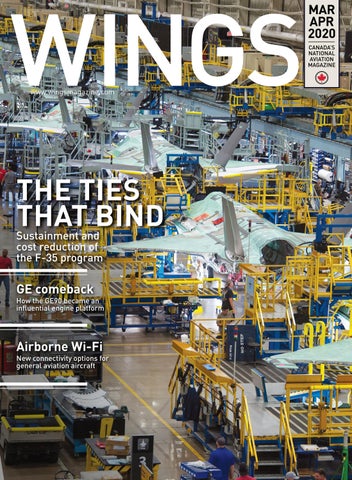
COVER PHOTO: LOCKHEED MARTIN F-35 PRODUCTION BY ALEXANDER H. GROVES
WWW.WINGSMAGAZINE.COM
March/April 2020 | WINGS
3
Stay in Touch with Aviation News
Vol. 61, Issue 2 EDITOR
SUBSCRIBE
Jon Robinson jrobinson@annexbusinessmedia.com 647-448-6188
Online
FLIGHT DECK
David Carr, Kendra Kincade, Sam Longo, Rick Kennedy, Phl Lightstone, Carter Mann, Carroll McCormick, Anna Pangrazzi NATIONAL ACCOUNT MANAGER
Mena Miu mmiu@annexbusinessmedia.com • 416-510-6749
TODAY
ACCOUNT CO-ORDINATOR
Barb Vowles bvowles@annexbusinessmedia.com • 416-510-5103 MEDIA DESIGNER
Brooke Shaw
CIRCULATION MANAGER
Jay Doshi jdoshi@annexbusinessmedia.com • 416-442-5600 ext. 5124
wingsmagazine.com/subscribe
GROUP PUBLISHER/VP SALES
Martin McAnulty mmcanulty@annexbusinessmedia.com
Magazine
COO
Weekly E-Newsletter
Scott Jamieson
Digital Edition
WINGS www.wingsmaga
zine.com
THE TIES THAT BIND
Sustainmen cost reductiot and the F-35 progn of ram
GE comeback
How the GE90 became an influential engin e platform
Airborne WiFi
MAR APR 2020 CANADA’S NATIONAL AVIATION MAGAZINE
Printed in Canada ISSN 0701-1369 PUBLICATION MAIL AGREEMENT #40065710 CIRCULATION Email: jdoshi@annexbusinessmedia.com Phone: 416-442-5600 ext. 5124 Fax: 519-429-3094 (main) 416-510-5140 Mail: 111 Gordon Baker Rd., Suite 400, Toronto, ON M2H 3R1
PM 40065710
$6.00
New connectivity options general aviati on aircraft for
WINGS MAGAZINE
P.O. Box 530, 105 Donly Dr. S., Simcoe, ON N3Y 4N5 Tel: 519-428-3471 Fax: 519-429-3094 Toll Free: 1-888-599-2228
Published six times per year (Jan/Feb, Mar/Ap, May/Jun, Jul/Aug, Sep/Oct, Nov/Dec) by Annex Business Media SUBSCRIPTION RATES Canada – 1 Year $ 34.50 (plus GST - #867172652RT0001) USA – 1yr -$ 78.50 CDN (USD $60.50) International – 1yr - $90.50 CDN (USD $69.50) Occasionally, Wings magazine will mail information on behalf of industry-related groups whose products
Air Transport Association of Canada
ON THE
WEB
4
WINGS | March/April 2020
WG_CircAd_MarApr20_MLD.indd 1
and services we believe may be of interest to you. If you prefer not to receive this information, please contact our circulation department in any of the four ways listed above. Annex Privacy Office privacy@annexbusinessmedia.com • Tel: 800.668.2374 No part of the editorial content of this publication may be reprinted without the publisher’s written permission. ©2020 Annex Publishing & Printing Inc. All rights reserved. Opinions expressed in this magazine are not necessarily those of the editor or the publisher. No liability is assumed for errors or omissions. All advertising is subject to the publisher’s approval. Such approval does not imply any endorsement of the products or services advertised. Publisher reserves the right to refuse advertising that does not meet the standards of the publication.
Canadian Business Aviation Association
Magazines Canada
AVIATION THIS WEEK Looking to catch up on the latest hot news from around aviation and aerospace? Check out Aviation This Week, a live digital version of the top news stories affecting a variety of key markets. It's quick, essential information you need to know! WWW.WINGSMAGAZINE.COM
2020-02-27 3:13 PM
Trust lives here In the world of critical services, having the right combination of experience, capability, capacity, and plane know-how is everything, and Babcock delivers it all. Babcock delivers full service turnkey firefighting operations, from planning, coordination, and detection, to monitoring, and flying, all with the utmost commitment to safety and efficiency. WORLD CALIBRE EMERGENCY AVIATION
Marine | Land | Aviation | Cavendish Nuclear
babcockcanada.com
LEADING
EDGE
By Jon Robinson |
Climate change and aviation
GARDN II on the potential of 19 Canadian projects to reduce emissions
T
5 6
WINGS | March/April 2020
called Airline initiatives to reduce climate impact, which was produced in partnership with travel technology company Amadeus. They began the study a year ago by analyzing what the world’s 58 largest airlines, which fly 70 per cent of the total available seat-kilometres, are doing to cut their climate impact. Also published in February 2020, their research found three-quarters of the world’s largest airlines showed improvements in carbon efficiency, measured as carbon dioxide per available seat, but that these efforts were muted by the ability for airlines to cut emissions overall. As an example, Becken and Pant point to the efforts by Spanish flag carrier Iberia, which reduced emissions per seat by about six per cent in 2017, but increased absolute emissions by seven per cent. Iberia’s six per cent per-seat reduction was in fact amongst the best results of all airlines, which illustrates the major challenge facing the industry in terms of emission reductions, as air travel continues to expand after a decade of significant growth. The Griffith research paper indicates that in 2018, when compared to 2017, the collective impact of all the climate measures being undertaken by the 58 biggest airlines amounted to an improvement of one per cent. Becken points out that improvement was erased by the industry’s overall 5.2 per cent annual increase in emissions. Referencing IATA statistics, Becken adds global airlines produced 733 million tonnes of CO2 emissions in 2014 and that airline emissions have risen by 23 per cent in just five years. The efforts of GARDN II and its partners will become increasingly more important to develop fundamental shifts as climate change in aviation moves from social awareness into economic necessity. | W
The use of SAF could reduce GHG emissions by as much as 18% per flight according to GARDN’s preliminary report. emission reductions by more than 85 per cent when compared to the use of conventional jet fuel. The organization points out that while SAF is not yet commercially available in Canada, this sector represents many business opportunities worldwide. The report also found that technologies reducing fuel consumption (increasing fuel efficiency) can lead to emission reductions of up to 13 per cent. A study commissioned by a non-profit about the potential benefits to be derived from its own government-funded program must be viewed with a grain of salt, but there is little doubt these innovations can pave the toward a more sustainable Canadian aviation industry. In contrast to the aspirations of GARDN II and its partners, a new study by Griffith University found that little has been achieved among the world’s major airlines as they build carbon-neutral programs and trial new aviation fuels. Susanne Becken, who is also on the Sustainability Advisory Panel of Air New Zealand, and Griffith University colleague Paresh Pant, co-authored a research paper
TOP DATA BURSTS… in this issue 1. 75 per cent of the systems on the E175-E2 are new. (P. 9) 2. More than 2,200 satellites are in orbit to serve airborne connectivity options. (P. 16) 3. Bombardier receives US$591 million in cash for its remaining A220 shares. (P. 20) 4. More than 110 Canadian companies contribute to F-35 production. (P. 28) 5. GE90-115B became the world's most powerful jet engine with 115,000 pounds of thrust. (P. 34)
WWW.WINGSMAGAZINE.COM
IMAGE: GARDN, GREENER CANADIAN AEROSPACE, MARCH 2019
he Green Aviation Research and Development Network in February 2020 released results of a study into the potential environmental benefits of 19 technologies being developed with Canadian partners. The non-profit organization was created in 2009 with funding from the Business-Led Network of Centres of Excellence (BL-NCE) of the Government of Canada and from the Canadian aerospace industry. Its aim is to reduce the environmental footprint of the next generation of Canadian aircraft, engines, and avionics systems through these technology projects. In 2014, the second program of the Green Aviation Research and Development Network (GARDN II) funded the 19 collaborative research projects with a total value of more than $20 million. These efforts include 27 industrial members and 20 research institutions focusing on quiet, clean and sustainable air transport. This group includes some of Canada’s most influential aviation companies like Air Canada, Bell, Boeing, Bombardier, Burloak, Heroux Devtek, Pratt & Whitney and WestJet. The projects are focused on issues like greenhouse gas emissions, fuel burn, noise pollution, non-volatile particulate matter and NOx emissions. According to the study conducted by AGECO Group and CIRAIG in 2019, if the 19 projects were applied to the entire Canadian aircraft fleet – under expected conditions – they would effectively reduce the emission of CO2 by 0.7 megatons. GARDN explains this in turn would facilitate Canada’s aviation industry to reach its goal of the 2.6 megaton CO2 reduction target by 2030. According to the study, 98 per cent of this reduction would be attributed to sustainable aviation fuels (SAF). GARDN notes SAF can result in CO2
DELIVERING RESULTS FOR OVER 50 YEARS. With the same commitment to quality and service established by our founder in 1970. X X X X
MAINTENANCE + MODIFICATIONS AIRCRAFT LEASING FLIGHT OPERATIONS RCAF AIRCREW TRAINING
1 (250) 491.5500
www.KFAero.ca
ON THE FLY For late-breaking news and exclusive web content, please visit us at: www.wingsmagazine.com
8 8 10 11 12
THE LEAD COMMERCIAL MRO BUSINESS AVIATION AEROSPACE
THE LEAD
GOVERNMENT OF CANADA RECEIVES DASH 8-103 FOR MARITIME SURVEILLANCE PROGRAM Transport Canada in late-January received a de Havilland Dash 8-103 msn 017 for its National Aerial Surveillance Program fleet. The aircraft was purchased pre-owned from Calgary-based Avmax Group and, according to Transport Canada, had the lowest number of hours when compared to any other Dash-8-100 on the market. Avmax’s MRO division prepared the aircraft for delivery and repainted it with the customer’s colour scheme. The aircraft acquisition was made through the Government of Canada’s Oceans Protection Plan and the Whales Initiative. The National Aerial Surveillance (NAS) Program’s primary missions include detecting oil spills and other marine pollution, and monitoring ship and endangered whale movements. Over the next two years, the Dash 8
will undergo modifications to become a maritime patrol aircraft, which will be equipped with specialized maritime surveillance systems that are currently used on Transport Canada’s existing fleet. The agency notes its surveillance aircraft are equipped with cameras that can covertly monitor vessels from five miles away and at 20,000-feet altitude. NAS aircraft are equipped with technology that can live stream video from the aircraft to personnel on the ground, in offices and to people’s phones. Transport Canada, in a statement about the new aircraft purchase, explains aerial surveillance is a vital tool to monitor Canada’s endangered, iconic whale populations, and decrease oil spills. It is used to monitor the designated shipping zones for endangered North Atlantic right whales, located in the Gulf of St. Lawrence, and in Arctic operations such as verifying vessel pollution detected by satellites. Transport Canada is also building a new National Aerial Surveillance Program Complex in Iqaluit, Nunavut, to support northern operations.
COMMERCIAL
BOEING 777X FIRST FLIGHT The new Boeing 777X jetliner on January 25 made its first flight, lasting three hours and 51 minutes, taking off from Paine Field in Everett, Washington before landing at Seattle’s Boeing Field. Boeing explains the 777X is based on the 777
The 777X includes the 777-8 and the 777-9, the newest members of Boeing’s widebody family.
with proven technologies from the 787 Dreamliner. The first of four dedicated 777-9 flight test airplanes, WH001 will now undergo checks before resuming testing in the coming days. Boeing explains the test fleet, which began ground testing in Everett last year, will go through a comprehensive series of tests and conditions on the ground and in the air over the coming months to demonstrate the safety and reliability of the design. Boeing states the 777X will deliver 10 per cent lower fuel use and emissions and 10 per cent lower operating costs than the competition through advanced aerodynamics, carbon-fiber composite wing and GE Aviation’s GE9X engine. Boeing expects to deliver the first 777X in 2021. The program has won 340 orders and commitments from carriers around the world, including ANA, British Airways, Cathay Pacific Airways, Emirates, Etihad Airways, Lufthansa, Qatar Airways and Singapore Airlines. Since its launch in 2013, the 777X family has outsold the competition nearly 2 to 1.
Transport Canada’s maritime surveillance aircraft are equipped with cameras that can covertly monitor vessels from five miles away and at 20,000-feet altitude. 8
WINGS | March/April 2020
Ultra-low-fare airline Swoop, a subsidiary of WestJet Airlines Ltd., on a January 4 flight from Edmonton International Airport (EIA) to McCarran International Airport in Las Vegas carried its two-millionth traveller since the airline’s first flight in June 2018. From an initial fleet of three aircraft and a network of five Canadian cities, the airline now holds nine Boeing 737-800 aircraft and service to 20 destinations throughout Canada, the U.S., Mexico and the Caribbean. Swoop’s network now serves 14 domestic, 10 transborder and WWW.WINGSMAGAZINE.COM
PHOTOS: AVMAX GROUP, BOEING
SWOOP REACHES TWOMILLIONTH TRAVELLER
four international markets. The airline’s new 2020 summer schedule is planned to increase Swoop’s frequency to 328 ultralow fare weekly flights. To commemorate its two-million-passenger milestone, Swoop presented an unsuspecting guest with a round-trip flight to anywhere Swoop flies. The winner, Travis Pickering, who was travelling with his wife and two children, received the prize during the flight.
EMBRAER E175-E2 INAUGURAL FLIGHT
PHOTOS: EMBRAER, S. RAMADIER, AIRBUS
The Embraer E175-E2 at the end of 2019 made its inaugural flight from the company’s facility in São José dos Campos. This marks the start of what will be a 24-month flight test campaign for the E175-E2, which is the third member of the E-Jets E2 family that also includes the E190-E2 and the E195-E2. Embraer will use three aircraft for the E175-E2 certification campaign. The first and second prototypes will be used for aerodynamic, performance and system tests. The third prototype will be used to validate maintenance tasks and will be outfitted with interior furnishings. The E175-E2 has one additional row of seats compared to the first-generation E175 and can be configured with 80 seats in two classes, or up to 90 in a single class. Embraer explains the airplane will save up to 16 per cent in fuel and 25 per cent in maintenance costs per seat compared to the E175. Embraer states, that like the E190-E2 and the E195-E2, the E175E2 will have the longest maintenance
Airbus’ BelugaXL, which entered service in January 2020, has the largest cargo bay cross-section of all existing cargo aircraft worldwide.
intervals in the single-aisle jet category with 10,000 flight hours for basic checks and no calendar limit for typical E-Jet operations. This means an additional 15 days of aircraft utilization over a period of 10 years compared to current generation E-Jets. The E175-E2 features new Pratt & Whitney GTF PW1700G ultra-high bypass ratio engines, a completely new wing, full fly-by-wire controls and new landing gear. Compared to the first-generation E175, 75 per cent of aircraft systems are new. Today, E-Jets are flying in the fleets of 80 customers from 50 countries.
AIRBUS BELUGAXL ENTERS SERVICE The Airbus BelugaXL in January entered into service, providing the plane manufacturer with 30 per cent extra transport capacity relative to its BelugaST predecessors, which are seven metres shorter and narrower by one metre. The BelugaXL will primarily be used for transporting large aircraft components to support Airbus’ production ramp-up of commercial
aircraft programs. This is the first of six BelugaXLs to begin work alongside the BelugaST aircraft, before the latter is ultimately phased out. The five other BelugaXL aircraft are scheduled to be introduced between 2020 and 2023. They will operate from 11 sites across Europe, most often destined for final assembly lines in Toulouse, France, and Hamburg, Germany. Launched just over five years ago, in November 2014, the BelugaXL was awarded Type Certification by the European Aviation Safety Agency (EASA) in November 2019, following a flight test campaign that included more than 200 flight tests, clocking over 700 flight hours. The aircraft made its first flight in 2018. At 63 metres long and 8 metres wide, Airbus states the BelugaXL has the largest cargo bay cross-section of all existing cargo aircraft worldwide. It can carry two A350 XWB wings compared to the BelugaST, which can only carry one. With a maximum payload of 51 tonnes, and a max take-off weight of 155 tonnes, the BelugaXL has a range of 4,000 km. The aircraft has a wingspan of 44.84 metres and height of 17.24 metres.
Compared to the first-generation E175, 75 per cent of the E175-E2’s systems are new. WWW.WINGSMAGAZINE.COM
March/April 2020 | WINGS
9
ON THE
FLY
BABCOCK AMO CERTIFICATION Babcock has received Approved Maintenance Organization (AMO) certification from Transport Canada. By meeting the regulatory requirements set by Transport Canada, Babcock receives authorization to perform maintenance on aircraft, avionics, instruments and structures for the following types: Beech King Air, Canadair CL 215, Canadair CL 415/215T, Cessna Citation 560, and Gulfstream Turbo Commander. “We are delighted to have received Approved Maintenance Organization certification from Transport Canada. This is an important milestone for Babcock as we continue to grow our Canadian aviation line of business,” said Rob Dyas, VP, aviation, Babcock Canada. Within its aviation division, Babcock operates and maintains approximately
Babcock receives AMO certification from Transport Canada for maintaining the Canadair CL 215 and Canadair CL 415/215T, in addition to three other aircraft types.
600 fixed- and rotary-wing aircraft in multiple countries, annually logging more than 20,000 hours of aerial firefighting, 58,000 hours of air ambulance flights, and 6,500 hours of search and rescue. Last year, Babcock delivered over 68,500 military flying hours to over 20,000 trainees, supporting the flying with 10 aeronautical maintenance centres in seven countries.
Centennial College in late-January 28 announced the renaming its recently opened Centre for Aerospace and Aviation at Downsview Park as The Bombardier Centre for Aerospace and Aviation. The college also announced it is receiving a Bombardier Global 7500 flight test vehicle for training purposes. The donated Bombardier Global 7500 business jet (serial number 70004), internally referred to as “The Architect” was the fourth Flight Test Vehicle (FTV4) of the program. It was used for interior validation testing. Since its maiden flight on September 28, 2017, the aircraft accumulated approximately 731 flight hours. Global 7500 aircraft are assembled at Bombardier’s facility in Toronto. Centennial explains its students will receive hands-on experience working on the
Reach your Aviation Goals
Leaders in advanced aviation training
ATPL Seminars
IFR Seminars
Ae AeroCourse IFR and ATPL/IATRA seminars feature quality instruction, valuable and practical course materials and foster an atmosphere conducive to learning. Our instructors are all pilots working in the Canadian aviation industry and we pride ourselves on cur keeping current on information and regulation changes. Seminars are held in major cities across Canada for more information visit aerocourse.com.
10 WINGS | March/April 2020 WG_Aerocourse_marApr20_CSA.indd 1
WWW.WINGSMAGAZINE.COM 2020-02-19 3:47 PM
PHOTO: BABCOCK
CENTENNIAL DOWNSVIEW FACILITY RENAMED AFTER BOMBARDIER
MRO
Global 7500 prototype, which will have a permanent spot outside Centennial’s new hangar at its Downsview Park facility, which opened in January 2019. The Global 7500 FTV4 donation is also made possible by those suppliers providing their systems within the aircraft, including: Collins Aerospace for its Avionic suite; Parker Hannifin for its fly-by wire system; Safran Power Units San Diego for the Auxiliary Power Unit; Woodward Inc. for the rudder pedal; GE Aviation Systems for the Aircraft Health Monitoring Unit; and GE Passport. In February 2019, Bombardier donated a CRJ200 to Centennial College for training purposes and is also providing the college with $150,000 for the completion of its Landing Gear Research project. Centennial explains this program is expected to train a minimum of 50 individuals for each of the next two years at its facility, which serves as the anchor for the new Downsview Aerospace Innovation and Research (DAIR) Hub.
PRECISION AVIATION ACQUIRES WORLD AVIATION Precision Aviation Group, a provider of products and value-added services to the worldwide aerospace and defence industry, on January 21 announced its acquisition of Toronto-based World Aviation Corporation (WAC), which specializes in the rewind and repair of rotary and static electrical (air and oil-cooled) generator and motor sub-components. The acquisition of WAC expands PAG’s footprint in Canada with the addition of this second location in Toronto. PAG also has a Canadian location in Vancouver. WAC is housed in a 20,000-square-foot facility with more than 60 highly skilled technicians, technologically advanced equipment, and engineering knowledge. Its operations have been fully approved by DOT/FAA/EASA, and HKAR. PAG holds 11 locations, nine Repair Stations, and more than 300,000-square-feet of sales
and service facilities in the United States, Canada, Australia, Singapore and Brazil. Working with both fixed- and rotarywing supply chains, PAG subsidiaries have MRO capabilities on more than 25,000 products, including accessories, avionics, dynamic components, fuel accessories, hydraulics, instruments, starter/ generators, and wheels/brakes.
BUSINESS AVIATION
PILATUS COMPLETES PC-24 ROUGH-FIELD CAMPAIGN Pilatus Aircraft in February obtained rough field certification from the European Aviation Safety Agency (EASA) and the Federal Aviation Administration (FAA) for its PC-24 aircraft to operate on wet and snow-covered unpaved runways, as well as for steep approaches. The new certifications fit with the company’s branding of the recently introduced
Top FBO in Central Canada (SASK, MAN, NUNAVUT)
Thank you to our valued clients for voting for Aerocentre Saskatoon
Call 800.265.3339
Hangar #10, John G. Diefenbaker Airport Saskatoon. SK S7L 5X4 Office: 306.931.8552 | Fax: 306.242.4111 info@yxeaero.ca | www.yxeaero.ca
WWW.WINGSMAGAZINE.COM WG_SaskatoonAerocentre_March20_BAS.indd 1
March/April 2020 | WINGS
11
2020-02-26 4:27 PM
ON THE
FLY
EMBRAER PHENOM 300E UPGRADE Embraer in February announced its Phenom 300E is now the first single-pilot jet to reach Mach 0.80, based on a series of enhancements, which also includes a quieter cabin and upgrades to its avionics. The Phenom 300E is now rated for a high-speed cruise of 464 knots and a fiveoccupant range of 2,010 nautical miles (3,724 km) with NBAA IFR reserves. Powered by two Pratt & Whitney Canada
PW535E1 engines with 3,478 pounds of thrust each, the aircraft is capable of flying at 45,000 feet (13,716 metres). Deliveries of the new Phenom 300E with these enhancements are scheduled to begin in May 2020. The Phenom 300E is also receiving avionics upgrades to include a runway overrun awareness and alerting system, predictive windshear, Emergency Descent Mode, PERF, TOLD, and FAA Datacom, among other features. Embaer explains the runway overrun awareness and alerting system acts as an additional pilot and warns if the aircraft’s approach is too steep or too fast, increasing situational awareness. Embraer has patented this technology and states it is the first OEM in business aviation to develop and certify it. Originally launched in 2005, Embraer states the Phenom 300 series has sustained more than half of the light jet market share since 2012. The aircraft is in operation in more than 30 countries and has accumulated more than onemillion flight hours. In October 2017, the new Phenom 300E was announced and entered service five months later. The new aircraft will continue to be designated “E” for “Enhanced.”
AEROSPACE
CANADA’S NEW ASTRONAUTS COMPLETE BASIC TRAINING Canadian Space Agency astronauts Jenni Sidey-Gibbons and Joshua Kutryk on January 10 completed the end of their basic training, which lasted for more than two years after their initial selection in July 2017 – Canada’s fourth such
The enhanced Phenom 300E is receiving an avionics upgrade to include a runway overrun awareness and alerting system, as well as predictive windshear. 12 WINGS | March/April 2020
Jenni Sidey-Gibbons in May 2019 prepares for training at the Neutral Buoyancy Laboratory (NBL) at the Sonny Carter Training Facility, near the Johnson Space Center.
recruitment process that happens approximately every seven years. Sidey-Gibbons and Kutryk, explains the Canadian Space Agency (CSA), are now ready to represent Canada on missions to the International Space Station (ISS), the Moon, or potentially Mars. This is the first class to graduate under NASA’s Artemis program, which aims to once again have astronauts set foot on the moon through the Lunar Gateway project. The class is particularly significant for NASA as it prepares to once again launch astronauts from American soil for the first time since 2011, when the agency shut down its Space Shuttle program, thereafter relying on Russia’s Soyuz program to get people into space and to the ISS. Lieutenant-Colonel Kutryk, age 37, is from Fort Saskatchewan, Alberta. He previously served as a test pilot, fighter pilot and engineer in the Royal Canadian Air Force. He holds a bachelor’s degree in mechanical engineering; master’s in space studies; master’s in flight test engineering; and master’s in defence studies. His certifications include airline transport pilot licence, fixed wing experimental test pilot, fighter pilot, civilian and military instructor pilot. Kutryk has more than 2,800 hours of flying experience on more than 25 aircraft types. Dr. Sidey-Gibbons, age 30, was born in Calgary and holds an honours bachelor’s degree in mechanical engineering from McGill University in Montreal, QC (2011), where she conducted research on flame propagation in microgravity in collaboration with the CSA and the National Research Council Flight Research Laboratory. She then moved to the UK to earn a Ph.D. in engineering with a focus on combustion from the University of Cambridge (2015). | W WWW.WINGSMAGAZINE.COM
PHOTOS: EMBRAER, NASA
PC-24 as the Super Versatile Jet, which is able to access nearly twice as many airports as competing business jets models. After the aircraft itself received EASA and FAA type certifications in December 2017, Pilatus then achieved approval for PC-24 operations on dry sand and gravel in 2018. The Swiss airplane maker then began a test campaign to certify the PC24 for operation in differing conditions on unpaved runways. This 2019 campaign, in which pilots performed more than 150 landings, included testing on unpaved runways in Switzerland, Great Britain, Italy and the Canadian north. Transport Canada granted the PC-24 type certification in June 2019. The PC-24 in 2019 was flown on snowcovered gravel runways at Kuujjuaq in Canada. A former Hudson’s Bay Company outpost located at the mouth of the Koksoak River on Ungava Bay, Kuujjuaq is described as the largest northern village in the Nunavik region of Quebec and now serves as the administrative capital of the Kativik Regional Government. Kuujjuaq Airport, YVP, holds two runways, including one with a 6,000-foot (1,829-metre) asphalt and one with a 5,000-foot (1,524-metre) gravel surface.
AIR
TRAFFIC By Kendra Kincade |
Balancing life as a pilot
First officer Trish Pulvermacher shares insight into a successful career
I
’m so fortunate, that after being an air traffic controller for 19 years, I now get to travel around this country sprinkling awareness about the dynamic industry of aviation with the hope to inspire women to look at aviation as a career for both passion and economic reasons. As my team and I talk to women of all ages across this vast country, we are asked really great questions. The number one question we hear is, “Why haven’t we ever hear of these careers before?” Another question that sometimes comes up from young women is, “Can you be a pilot and a mom?” Although I am a mother, I am not a pilot, so I decided to call upon a pilot and ask some questions to find out how one pilot balances being a pilot and a mother. Trish Pulvermacher is a first officer on an Airbus A320 with Air Canada and she has traveled the world – even before her start with Canada's flag carrier. She is married to a pilot and is a mom of two. Here are some of the key takeaways that Pulvermacher Pilot Trish Pulvermacher flies an A320 for Air Canada. shared during our conversation. Where did the love for aviation spark with you? While the spark for aviation had always been there, a particular moment while working at a hunting camp in the Yukon officially sealed the deal. I fell in love with being a salmon fishing guide but was always so full of envy while watching the pilots drop off the fishing guests in float planes. After working as a guide for a couple months, I finally had the opportunity to fly with a bush pilot. It was that day when I truly knew becoming a pilot was the career path meant for me. I know you worked in Africa for a bit, was that before you had children? What was that experience like? I worked in Africa for two and a half years, collectively. My first stretch was in East Africa as a fishing guide on the Nile and my second stretch was for a year and a half as a safari pilot based in Namibia. This was a lifelong dream for me and was everything I dreamt it would be. I basically lived on safari. It was a true mixture of all of my dreams and passions. It was before I children. My husband flew over many times to visit and 14 WINGS | March/April 2020
are fortunate to be able to bid an airplane and position that offers an excellent schedule while the kids are young. What is the biggest challenge you face in being both a pilot and a parent? Doing the initial training on any airplane is a lot of work. It requires all of your attention and all of your time. It usually takes a couple months. That balance is extremely challenging. I look to other moms who have had to work away from their kids for inspiration and knowing that it’s only temporary helps. And once it’s done, it’s a good life. What would you change to make life easier? The more you can overnight at home the better it is. But really there isn’t much I would change.
Mostly our schedules provide us with a lot of home time that most What is the most rewardfamilies do not have. ing thing about being both? got to safari me. We will continue to visit and bring our children there every couple of years. A piece of my heart will always be there. How did you navigate the path of becoming a pilot, which is very costly? I worked road construction, hunting/fishing guiding and waitressed. Every spare penny went to my flying. What have you learned most about being both a pilot and a mom? Scheduling is key. When our schedules come out every month, I get excited to organize everything and make it work. While my husband and I are working a lot, it helps to hire help to do a deep house clean once and awhile and sometimes order groceries online and get them delivered. But mostly our schedules provide us with a lot of quality home time that most families don’t have. When we’re home, we’re home. We
Knowing that my kids look up to me. Also, having something for myself outside of being a mom that I’ve worked so hard for. I am so thankful.
What is the biggest myth you think discourages women from becoming pilots? I don’t know – I’ve never felt that way. Women have been in the skies and pilots since the beginning of human flight. This year I endured a life-threatening medical experience that has since been resolved. I lived for months with many restrictions. Now that I have fully recovered, it has gifted me a with new sense of purpose, along with the reminder to be grateful for everything and everyone that has touched my life. In retrospect, I’ve come to embrace this past experience has a gift and to truly believe it’s up to us to choose how we want to live it. Follow our dreams, take advantage of opportunities and allow love and compassion to guide our lives.| W WWW.WINGSMAGAZINE.COM
POSITION
REPORT
| By Massimo Bergamini
Predictable turbulence
Canada’s new Air Passenger Protection Regulations hit expected bumps
PHOTO: GETTY IMAGES
W
hen Canada’s air passenger rights regime was announced last May, Transport Minister Marc Garneau described the new rules as world leading, but with recent media reports of growing consumer confusion and frustration, not ready for primetime might have been a more appropriate term. This latter description of the passenger rights regime is certainly more in line with calls of concern expressed by the airline industry at the time. In representations to the Canadian Transportation Agency (CTA), which was responsible for drafting the regulations, the National Airlines Council of Canada (NACC) last year warned that the government's rush to regulate passenger rights would produce “rules that reduce[d] consumer protection and convenience through higher fares, reduced service, and market confusion.” Canadian and foreign carriers all feared that the government had given little consideration to the complexity of implementing the new rules, particularly in the context of other industry-wide challenges, such as the grounding of the Boeing 737 MAX 8. NACC cautioned that the draft regulations lacked the clarity needed by airlines to translate them into day-to-day commercial practices and were often at odds with global airline operating realities. It also warned that the lack of clarity and sweeping nature of the new rules would result in litigation and third-party adjudication. In practice, this meant that implementation of the passenger rights regime would be more difficult because of new airline systems and procedures that would be required. It also meant that consumers and air carriers worldwide would have to wait for tribunals to sort things out. Pointing to troubling parallels with the government’s disastrous rush to implement Phoenix – its still-not-functioning payroll system – NACC had urged Minister Garneau to delay implementation to give the CTA and Transport Canada time to get the new rules right and to give the industry enough time to ramp up. While the government ultimately agreed to delay implementation of the more complex elements of the regulations by five months to December 2019, as the industry WWW.WINGSMAGAZINE.COM
Minister, should be surprised Under the new Air Passenger by reports of the passenger rights regulations experiencProtection Regulations, which choppy air. It was totally came into effect at the end of 2019, ing predictable; the result of a rushed political process, dethe amount of compensation signed to meet a political depends on the size of the airline timetable and agenda – in this case, last fall’s federal and the length of delay. had warned, this would not be nearly enough time for airlines to train thousands of staff and to roll out new systems; or for consumers and carriers to agree to what the rules really mean. The new Air Passenger Protection Regulations, however, came into effect in two stages, beginning on July 15, 2019, with airlines being required to meet new obligations concerning communication, denied boarding, tarmac delay, baggage and the transportation of musical instruments. As mentioned, the remaining obligations on flight disruptions and seating of children then came into effect on December 15, 2019. CTA explains, that to ensure what it describes as robust passenger protection, the regulations apply to all flights to, from, and within Canada, including connecting flights. Made under the Canada Transportation Act, the regulations apply to both large and small airlines, but the CTA notes different requirements for compensation and rebooking apply to small airlines, given their unique operating circumstances. Large airlines are defined by the CTA as those that have transported at least two million passengers in each of the two preceding years. All other airlines are considered to be small. Today no one, least of whom the Transport
election in Canada. And as the architect of this new regime, how is the Transport Minister dealing with the turbulence? Not very well, I would say. In a move reminiscent of a building contractor who tells a dissatisfied customer to take their complaints to the Better Business Bureau, the Transport Minister’s response to the growing confusion and frustration has been to advise travellers “who feel that they did not get an adequate response,” to take them to the CTA. But the Minister cannot wash his hands of the confusion and frustration that some air travellers have experienced – it is his to own, and his alone. As much as much as he might now want to deflect consumer dissatisfaction by pointing Canadians and others to the CTA or to individual air carriers, urging unhappy passengers to complain to the CTA does not cut it. Coming from the Minister who rejected repeated industry warnings and who justified the regulations by saying they were needed to make carriers treat their “passengers like people and not numbers”, this advice, like his regulations, sounds hollow. | W Massimo Bergamini, former CEO of NACC, is an Ottawa-based policy entrepreneur, advocate and writer. March/April 2020 | WINGS 15
A SpaceX Falcon 9 takes off from Vandenberg Air Force Base n January 2019 to deliver the final payload of 10 satellites into Low Earth Orbit for the Iridium NEXT satellite constellation, opening up a new era of aviation communications.
LAUNCHING GLOBAL COVERAGE FROM IRIDIUM TO GLOBALSTAR AND FROM SIRIUSXM TO GARMIN, THE SKY IS THE LIMIT FOR AIRCRAFT CONNECTIVITY OPTIONS AND AIRBORNE WI-FI
T
he past five years has seen an explosion of information streamed into an aircraft’s cockpit and cabin, regardless of altitude. With more than 2,200 satellites in orbit, and more on the way, the sky is the limit for connectivity options. Startup companies like OneWeb and SpaceX have received regulatory approval to launch copious amounts of satellites, which will clearly disrupt the aviation industry. Business Aviation (BA) has seen a number of aviation-focused service providers deliver access to data, fax and voice services, while airborne. Owners and operators are offered end-to-end services, regardless of altitude and location. Ray McFeetors, flying in his corporate Cessna CJ3, reports, “My iPhone and laptop connect automatically while airborne, no different then in my office. The system 16 WINGS | March/April 2020
is completely transparent to me, I just use it.” Some providers deliver content over their networks, such SiriusXM with aviation products that bring weather (and entertainment) into the cockpit, supporting both handheld and panelmounted devices (like Garmin’s 396/496 portable GPS, or their GDL 69/69a panel solutions). Pilots were provided with access to weather information, allowing strategic flight decisions to be made while in flight. SiriusXM weather is augmented by ADS-B IN (in the U.S.), providing data supported by a variety of EFB applications, including ForeFlight and Garmin Pilot. Low Earth Orbit (LEO) satellite networks from Globalstar and Iridium have added voice calling, sms texting, email and access to data-driven applications. There are three types of satellites: Geostationary (GEO); Medium WWW.WINGSMAGAZINE.COM
PHOTO: SPACEX
BY PHIL LIGHTSTONE
Earth Orbit (MEO) and Low Earth Orbit (LEO). GEO satellites are stationed roughly 22,300 miles above the earth and fixed above a specific point. A LEO satellite constellation typically is comprised of 30 or more satellites, orbiting at high speed, 485 miles above the earth. MEO satellites reside in space between LEO and GEO satellites. The LEO constellation is in constant flight and is designed to have a satellite fly by the user at all times, thereby maintaining the communications link. Historically, Globalstar and Iridium where the two thousand pound guerrillas LEO providers, delivering low latency and low data speed connections, ideal for voice, texting and email communications. Interestingly, Canada’s own Telesat has been quietly launching their own LEO constellation, with service expected begin in 2022. Change in the satellite industry being driven by OneWeb and SpaceX as they build out dense constellations. Adrian Steckel, CEO of OneWeb, commented, “The successful manufacture, delivery and launch of this batch of 34 satellites is the latest proof point of the OneWeb plan. Importantly, today’s mission (February 6, 2020) also brings us closer to our next step, realizing our ultimate vision of providing access to high speed, reliable internet to everyone, everywhere.” From an aviation perspective, the eco system can be split between satellite network providers, aviation hardware manufacturers and avionics shops. Compared to other industries, the aviation eco system is small, with a few players including: Globalstar; Iridium; Telesat; Gogo Flight (formerly AirCell); Collins Aerospace; Garmin; Honeywell; among others. Both Globalstar and Gogo manufacturer end point hardware, have their own networks and space operations centres. Network performance can be measured two ways, the end user experience or by the numbers – bandwidth, latency and price. Network reliability is typically greater than 95 per cent, based upon the product purchased, however, performance and reliability should be viewed from an end-to-end perspective: aircraft to satellite; satellite to satellite; satellite to ground stations; ground stations to terrestrial fiber networks (out to the open Internet). The cost of connectivity is very much like the conversation of “how long is a piece of string”. Bandwidth, lower latency, coverage and service levels will impact the monthly cost. Globalstar’s Sat-Fi2 hardware is a small device that easily fits into a flight bag. Weighing 12.6 oz, it incorporates a flipup satellite antenna, battery and built- in Wi-Fi antenna. It’s designed to turn your smartphone or tablet into a satellite-connected device, delivering voice, data and texting service. The Sat-Fi2 is assigned a March/April 2020 | WINGS
10-digit telephone number aligning to the country in which it was registered. The physical location of the Sat-Fi2 device does not matter during the telephone call. However, with a Canadian telephone number calling internationally, long distance rates will apply. Globalstar’s LEO constellation delivers roughly 72 Kbps of bandwidth (essentially a very fast modem, for those who remember dialup modems). The Sat-Fi 2 device can be situated on the aircraft’s glare shield and with visibility to the sky, connectivity should take place. With unlimited voice and data packages at US$50 per month (special time
limited offer), it’s an exceptionally cost-effective alternative for flight crews to have connectivity (backup) in the aircraft and while on layovers. Garmin’s approach to airborne connectivity is based upon their Connext product platform. Their avionics suite is satellite network agnostic. In fact, my Commander is equipped with a legacy Garmin AirCell voice hardware, TSOd/STCd allowing for integration of satellite telephony directly into the Garmin audio panel. Connext supports a variety of connectivity technologies including ADS-B, SiriusXM, and Iridium, with Wi-Fi
WWW.STARTPAC.COM
TOLL FREE 844.901.9987
START YOUR ENGINES!
START PAC - THE BEST THERE IS.
• 28 AMP HOURS @ 10 HOUR RATE • • 2400 AMPS PEAK CURRENT • • SUPERIOR STARTS ON ALL ELECTRICALLY STARTED TURBINE ENGINES •
www.STARTPAC.com OR TOLL FREE 844.901.9987
17 HE_Startpac_Jan20_CSA.indd NEW Li2800QC 4.625x7.5in.indd1 1
2020-01-13 AM 13/01/2020 9:41 11:22
and Bluetooth device connectivity. Although not designed to provide passengers with access from the cabin, it does provide connectivity options for the flight crew. Inmarsat’s Business Aviation division has spent over 20 years delivering aircraft communications, with over 40 years of satellite experience. In collaboration with partners like Satcom Direct and Honeywell, they deliver an end to end solution focusing on global mobility. With worldwide coverage, 13 satellites with eight additional satellites to be launched over the next 4 years, Inmarsat delivers a variety of packages focused on BA: Jet Connex
and SwiftBroadband. In 2022, Inmarsat will launch two GX satellites into highly elliptical orbits for service over the arctic. The current service delivers bandwidth beyond 20 Mbps per aircraft, supporting streaming video services like Netflix/YouTube, Voice Over IP, email, messaging, video conferencing, corporate VPN services and access to the internet. Honeywell’s JetWave MCS 8x000 compliments Inmarsat’s network and includes a satellite antenna; antenna controller (which tracks a geostationary satellite); Wi-Fi RF unit; and data modem. Secure communications are controlled through onboard firewall
TAKE OFF ON GRASS – FLY INTO ICE – LAND ON GRAVE L www.pilatus-aircraft.com
Stan Kuliavas, Vice President of Sales | sales@levaero.com | 1.844.538.2376
services enabled in the avionics package. Inmarsat’s newest GX satellites enable fast build-to-launch times, collapsing to a speedy 18 months (in the satellite game, this is super fast), with up to three satellites per rocket payload. To facilitate effective satellite network usage (think of satellite services as a scarce resource), Inmarsat has created steerable beam platforms, following known flight paths into airport hubs, thereby consolidating satellite resources to customer needs. Kai Tang, SVP Business Aviation, explains “Inmarsat is constantly innovating delivering fast, high impact and capacity satellite systems. Using the latest satellite and network technology, changes to the network may be made rapidly to meet the global mobility needs of our business customers.” AirCell (now Gogo Business Aviation) began delivering services in 1998, partnering with Garmin and delivering satellite telephone service, over its Air to Cell network. Gogo was successful in obtain an 850 GHz spectrum license from the FCC, allowing it to create an Air to Ground cellular network capable of delivering services to aircraft at 40,000 feet. With over 250 towers in North America, Gogo’s 4G network is being upgraded to 5G with service expected to be operational in 2021. Its service is augmented with Iridium and Inmarsat satellite services for aircraft operating outside of North America. Its GoGo KU platform delivers up to 25 Mbps of bandwidth to an aircraft. Gogo manufacturers its aircraft avionics platform, ATG and Avance, which provides the cellular, satellite and Wi-Fi hardware platform. The system supports a variety of content including: streaming video; e-mail; texting; voice calling; internet access; corporate VPN connectivity; inflight entertainment; and cockpit app data. Gogo offers flight departments and IT departments with an app to manage the aircraft hardware and services. Bandwidth can be increased without changing hardware. The move from 4G to 5G may require legacy ATG hardware to be upgraded to its newer Avance platform. Satellite connectivity combined with certified hardware and installation services, delivers a variety of bandwidth and latency options to meet user expectations and budget requirements of BA owners, operators and flight departments. Aircraft manufacturers are building new aircraft with a greater number of sensors designed to provide flight crew and maintenance teams with real-time data. Airborne Wi-Fi uncorks the genie providing the connectivity necessary to unlock the power of data and analytics for proactive aircraft operations and maintenance. | W 18 WINGS | March/April 2020
Pilatus_PC-24_Wings-117.48x190.5mm.indd 1 WG_Levaero_MarApr20_CSA.indd 1
18.02.2020 2020-02-1809:57:28 10:05 AM
NORTH AMERICA’S
LARGEST TRI-SERVICE DEFENCE EVENT MAY 27-28, 2020
EY CENTRE, OTTAWA
PRODUCED BY:
CANADIAN ASSOCIATION OF DEFENCE AND SECURITY INDUSTRIES
CANSECCANADA.CA
Air Canada's A220 fleet, with the first aircraft delivered in late 2019, will enable the airline to open new routes that were previously not feasible.
BOMBARDIER GOES CORPORATE
THE MOST-TURBULENT PERIOD IN CANADIAN AVIATION SINCE THE CANCELLATION OF THE AVRO ARROW INTERCEPTOR
B
ombardier commercial aviation has left the hangar. Since transferring majority ownership of the CSeries passenger jet to Airbus during a bruising legal tussle with Boeing over price discounting, that the Seattle giant would ultimately lose, Alain Bellemare, Bombardier’s chief executive has carved out pieces of the air transport business with surgical precision, including its dwindling regional jet unit to Japan’s Mitsubishi Heavy Industries and the aerostructures unit to Wichita-based Spirit AeroSystems. The end was inevitable. The rebranded Airbus A220 had already been pushed to the margins of Bombardier’s corporate jet and rail portfolios. At a mid-January Air Canada A220 launch event in Montréal, Calin Rovinescu, the airline’s chief executive, pointed out that when his airline signed a deal for 45 of the larger CSeries 300 variant in February 2016, it wasn’t clear whether the program could survive. From order to delivery, the Air Canada A220 has bookended the most-turbulent period in Canadian aviation and aerospace since the cancellation of the Avro Arrow interceptor in February 1959. And the dust hasn’t settled. Bellemare also spoke at the Air Canada event, but did not give a hint of the bombshell Bombardier would drop less than 24 hours later.
Commercial exit
Bombardier’s financial turnaround had stalled. The company was more than US$9 billion in debt and would struggle to meet further financial commitments to the A220 in proportion to its 33.4 per cent stake in Airbus Canada Limited Partnership. By Valentine’s Day, Bombardier was out, pocketing $591 million (all dollars in US funds), including an immediate payment of $531 million, and a 20 WINGS | March/April 2020
release from further financial obligations, pegged at approximately $700 million. The remaining $60 million will be paid over a twoyear period. As part of the transaction, Airbus also acquired the A220 cockpit and aft production capabilities from Bombardier in Saint-Laurent. That Bombardier was anxious to cash the Airbus cheque before releasing 2019 year-end financial results speaks volumes of the company’s crushing debt burden. In releasing financial results hours after the sale to Airbus, Bombardier reported that its complete exit from commercial aerospace will generate more than $1.6 billion in cash proceeds once the Mitsubishi and Spirit deals close, and eliminate close to $2 billion in liabilities and future commitments. This includes the Airbus Canada divestiture and relief from the CRJ program and aerostructures. The sale all but shatters the dream of Prime Minister Pierre Trudeau, father of the current prime minister, that Canada break out of its role as builder of rugged Beavers, Buffalos and Twin Otters to supply the world’s airlines with passenger jets. It was a vision that triggered the nationalization of Canadair and de Havilland, launched the Challenger business jet and set a course for Canada to pioneer the introduction of the industry altering regional jet. It also raises the question, what is next for the one-time aircraft and rail global powerhouse? Since selling the Q400 program to British Columbia-based Longview Aviation, Bellemare has signalled each of the company’s next moves, including a hasty exit from the A220. The path forward is less clear. Bombardier can be in trains or private jets. It must sell one of the businesses, and perhaps both. Bellemare set up a dual negotiation track to sell either Bombardier Transportation (BT), the WWW.WINGSMAGAZINE.COM
PHOTO: AIRBUS
BY DAVID CARR
Fly in for all your needs Fly out safely and privately from Quebec City
An affiliate company of
YQB | 611, 6th Avenue de l’Aéroport, Quebec
514 633-9311 | afsaviation.com
WG_Harnois Energies_MarApr20_CSA.indd 1
Our crew operate in some of our worlds most beautiful and remote locations. Take advantage of a Flexible Rotation Schedule,and Schedule begin your adventure. More information and how to apply can be found on our website:
2020-02-14 12:55 PM
Direct Entry Lifestyle We Are Hiring CRJ Pilots
3-2-1 OFFER 3
MONTHS FREE
2
HUNDRED DOLLAR REBATE
1
YEAR COPA MEMBERSHIP
of SiriusXM Weather & Entertainment on Garmin GDL™ 51/51R and 52/52R on Garmin GDL™ 51/51R and 52/52R
with purchase and activation of Garmin GDL™ 51/51R and 52/52R
Learn more at: siriusxm.ca/aviation
www.voyav.com
Conditions apply. See offer details.
March/April 2020 | WINGS 21
WWW.WINGSMAGAZINE.COM WG_Voyageur Aviation_MarApr20_CSA.indd 1
2020-02-18 WG_Sirius 10:01 _NovDec19_CSA.indd AM 1
2019-09-13 2:31 PM
rail division, or aviation to potential buyers, including Textron the maker of Cessna Citation business jets. (Textron’s Bell Helicopter subsidiary produces most of its commercial helicopters at Mirabel.) While there is some overlap in the Bombardier and Citation lines, especially at Learjet, Cessna’s Wichita neighbour, acquiring the ultra-long-range Global line would plug a gap in Citation’s product offering. Citation put the Hemisphere, its own entry into the ultra-long-range sector ‘on hold’ in 2019 over concerns with the engine.
Planes or trains
Airplanes appear to have won the day. On February 17, days after disposing of its remaining A220 interest, Bombardier reached a deal with France’s Alstrom to sell BT for between $8.4 million and $9 million. The sale must pass European regulatory hurdles that have already tripped up a merger between Alstrom and Germany’s Siemens. This deal can expect an easier ride. There is less overlap, especially in the two companies’ high-speed rail and signal businesses. Besides, western rail providers need to bulk up again China’s state-owned CRRC, making industry consolidation inevitable. Whether or not the Alstrom sale gets the green light, Bombardier’s 30-year involvement in commercial aviation is at an end. Nor does selling the train business take a sale of business aviation off the table, regardless of how controversial such a transaction would be in Quebec where Bombardier jets remain a source of provincial pride. Bombardier continues to make money selling higher margin corporate jets. Bombardier Business Aircraft delivered 142 jets in 2019, including 76 22 WINGS | March/April 2020
Challengers and 54 Globals, and remains a market leader in the ultra-long-range sector. But the business is more cyclical than trains. Unlike a direct competitor such as Gulfstream, a subsidiary of General Dynamics, Bombardier will be more exposed to market downturns. The guessing game of whether Bombardier should have stuck to its knitting and modernized its regional jet line ahead of developing the CSeries and going nose-tonose with Airbus and Boeing at the lower end of the A320 and 737 families will continue. It’s a tough call. The A220 is a true game changer that will likely break the sales curse of aircraft aimed at the 100to-150 passenger segment, including the A318. But the CSeries was too much airplane for Bombardier to take on by itself. The company lacked the resources, especially while simultaneously developing the Global 7500, scale and a global support network to bring the aircraft to market and realize the program’s full potential. Despite inroads made by Airbus to trim the A220’s bloated production costs, the aircraft’s breakeven point has been pushed deeper into the decade, another factor that reportedly influenced Bombardier’s decision to sell. Airbus delivered 48 A220s in 2019. The first aircraft to be built in Mobile, Alabama, an A220-300 will be delivered to Delta Air Lines later this year. At the end of 2019, the A220 order book stood at 595 aircraft. Airbus will have capacity to deliver 160 to 170 A220s when both North American production lines are fully operational. Airbus is also considering launching the A220-500, a stretched version of the CSeries that had always been in Bombardier’s back pocket and was perhaps
WWW.WINGSMAGAZINE.COM
IMAGE: AIR CANADA
The A220 is a centrepiece of an aggressive strategy for Air Canada to increase its share of U.S. international transit passengers from 1.3 per cent to two per cent; boosting revenues by an estimated $675 million and illustrating the industry impact of the game changing A220 developed in Montreal.
seen by Airbus and Boeing as a more direct competitor to the A320 and 737. Air France, which last year placed an order for 60 Airbus A220-300s is reported to be interested in the larger variant as part of a strategy to rationalize its cumbersome short- to medium-range fleet. Air Baltic, the launch customer of the former CSeries 300 also sees room for an enlarged version in its soon to be all A220300 fleet. A third and larger A220, along with the long-range A321neo, would tighten Airbus’ advantage against Boeing and the grounded 737 Max in the hot-selling single-aisle market. Airbus remains noncommittal, but the manufacturer could signal its intentions as early as this summer’s Farnborough Air Show. Mitsubishi also wants to build the M100 SpaceJet, a direct competitor to the Boeing Brazil (formerly Embraer) E175 in North America close to its target market, although new delays in certifying the M90 SpaceJet, Mitsubishi’s long awaited entry into the regional jet market, will likely have a knock-on effect on the development of the smaller M100. Montréal is a natural fit for both the A220-500 and M100 should Airbus and Mitsubishi go ahead. But in the pay-to-play world of aviation and aerospace, not without a cost. The Quebec government has already given Mitsubishi a $12 million interest-free loan to locate a next generation SpaceJet design centre in the province. Although Quebec increased its stake in Airbus Canada Ltd. to 25 per cent without any new investment, the value of its share is currently worth less than the $1 billion the government initially pumped into the struggling CSeries. That gap is expected to close if Quebec sells its interest to Airbus in 2026. According to the Montreal Gazette, Premier Francois Legault has been critical of the previous government for buying into the CSeries directly instead of purchasing an interest in Bombardier, and has ruled out any additional cash for the A220. He may not have a choice, especially if the government wants to keep a future A220-500 (and potential future stretches of the airframe) in Quebec that Bombardier has already modelled for Airbus. Toronto-based de Havilland Canada, which bought Bombardier’s turboprop business last year, sees new growth opportunities for the Dash 8-400 (formerly the Q400) in Asia-Pacific. Montréal remains one of the world’s largest aerospace manufacturing hubs. That is not changing any time soon. What has changed for the most part is that Canada is now a lurer of other manufacturers’ programs and no longer a launcher of our own. A situation that will be compounded should Bombardier sell its business aircraft division an exit transport altogether. | W
WG_Professional Women Controllers_MarApr20_CSA.indd 1
WWW.WINGSMAGAZINE.COM WG_KREOS_QP_FEB20_JLR.indd 1
2020-02-20 9:47 AM
March/April 2020 | WINGS 23 2020-02-14 8:50 AM
CERTIFIED OUTPERFORMANCE. LEAD THE WAY NOW. Unprecedented performance. Industry-leading technology. Exceptional comfort. Now certified. The Praetor 500 and the Praetor 600 are the world’s most disruptive and technologically advanced midsize and super-midsize business jets. Both have record-breaking, best-in-class range. Enviable performance in challenging airports. Full fly-by-wire with turbulence reduction capabilities. Unparalleled comfort in a six-foot-tall, flat-floor cabin. Ka-band home-like connectivity. Power the future. Take command. Lead the way – now.
Learn more at executive.embraer.com.
L E ADING THE WAY
RCMP NORTHERN LIGHT PILOT KATHY STEWART IS RECOGNIZED FOR HER CONTRIBUTIONS TO CANADA’S ROTARY-WING INDUSTRY
BY JON ROBINSON
K
26 WINGS | March/April 2020
Kathy Stewart in 2017 completed conversion training to become a Regular Member of the RCMP and now holds the rank of Special Constable.
women were honoured for their inspiring contributions to the aviation industry. “People should be able to do what they want if they have the interest, the talent, and the skill set… there has been steady progress since I started.” Stewart would soon prove her piloting skills during a checkride with Okanagan Helicopters Ltd., at the time one of Canada’s largest and most-progressive commercial operators. After graduating
from Canadore there were no jobs in the helicopter industry, which was reeling from the effects of the 1979 oil crisis and Canada’s ill-timed 1980 National Energy Program. Stewart returned to the University of Toronto to finish her Bachelor of Science degree, which she initially interrupted to pursue her dream of becoming a helicopter pilot. By the late-1980s, however, the industry once again needed pilots and Okanagan, which was transitioning WWW.WINGSMAGAZINE.COM
PHOTO: MORGAN PALAGAIN
athy Stewart first began thinking about becoming a helicopter pilot at age 19 after finishing up eight months of work in the Northwest Territories, including four months in a forestry camp. She was born and raised in Toronto, but the remoteness of Canada’s North appealed to her, as did the Bell Longranger based at the camp just outside of Yellowknife. Stewart’s first concrete step toward an outstanding career began in 1980 when she obtained a Private Pilot Licence (PPL). Now a Special Constable with the Air Services Branch of the Royal Canadian Mounted Police (RCMP), based out of Edmonton and with more than 13,000 flight hours, Stewart explains her sights were always set on the dynamic world of rotorcraft – “That ability to land virtually anywhere and to hover… your hands are on the controls and you are actively working the machine.” The fixed-wing PPL was a means to an end, completed just days before Stewart’s application interview to attend Canadore College’s aviation program, where she would eventually complete a Commercial Helicopter license. Stewart – despite checking all of the boxes – was not admitted to the program after being told it would be a waste of time and money because she would not find a job. She persevered and was admitted to the program, along with another female student, in her second attempt a year later. “Alexia Hannam at the NLAF gala said that she had never encountered any barriers to flying and I thought that is fabulous. That is the way that it should be,” says Stewart, recalling Hannam’s speech from the Northern Lights Aero Foundation annual event in September 2019, when both
N
toward new ownership as Canadian Helicopters, not only hired Stewart, but also made significant investments to elevate her skills. “I was over the moon to be hired by them, because they had everything from very small helicopters to the biggest operating in Canada and around the world,” says Stewart. “They had bases across Canada and the opportunities were tremendous for me at that time, that I could gain various endorsements and work in a variety of situations.” Stewart recalls being one of 18 lowtime pilots hired in 1988 by Okanagan, WWW.WINGSMAGAZINE.COM
which provided 72 hours of additional training on Jet Rangers. “It was not only a mountain course, but also an advanced operational course, and it just gave you a background to make you very strong as a low-time pilot getting started – exposure to a huge variety situations and skills,” says Stewart, who became a pool pilot on the Jet Ranger. In a matter of months, however, she was flying in northern Alberta and up into the Territories, quickly receiving an endorsement on an AStar. She flew with Canadian Helicopters into the year 2002 supporting a range of missions from fighting forest fires and wildlife management to powerline patrols and high-Arctic work. She earned a 500 endorsement working the diamond patch, followed by a twin-engine Bell 212 endorsement, and then a Sikorsky S-61 after obtaining an American license under NAFTA for seismic work in the U.S., which also led to wildfire missions. Stewart recounts one of her mostmemorable mission experiences in working the disaster zone of Hurricane Andrew when it reached south Florida in August 1992 as a Category 5, destroying more than 63,500 houses, damaging another 124,000, and killing 65 people. Canadian Helicopters sent two rotorcraft down initially to supply food, water and ice to survivors, before their mission changed to restore power. Hundreds of aircraft were working the disaster zone with little Air Traffic Control, because it had been wiped out by the storm. “Helicopters were between the ground and 500 feet; and fixed-wing were 500 feet and above,” explains Stewart, recalling how any sound surface from parking garages to playgrounds turned into makeshift helipads. “You didn’t lift-off without doing a 360 and having your head on a swivel because machines were flying by at 200 feet. It was organized chaos.” Stewart’s experience gained over these diverse missions was eventually leveraged by Canadian Helicopters when she was promoted as operations manager. She served in this role for approximately three years, adding critical career skills like budgeting, crew scheduling, and asset usage, but her love for flying led her to take on a new role with the RCMP in 2002. “I looked at the RCMP as being a dream job, very mission-oriented flying, flying that makes a difference most of the time,” says Stewart, who had one young son with a second on the way when the opportunity came up. “I wanted to be a mom but I also wanted to be a pilot; and with the RCMP I saw an opportunity to do both.” To support her new role, Stewart took
initiative to earn her instrument rating, because the RCMP at the time was flying nights unaided, without Night Vision Goggles (NVGs). “I recognized that if I got in over my head, having an IFR and those skills might help keep me and the operation safer,” says Stewart, noting the RCMP is now heavily leveraging NVGs. “It’s really important with the RCMP to bring skills with you. You will build a lot of skill on NVGs, but you probably won’t do a huge amount of specialties like mountain flying, low-vis ops or long-line. If you’re looking at the RCMP, it’s important to have a well-rounded career before you join.” Stewart feels police agencies more than ever recognize the efficacy of helicopters, even if they are constrained by budgets. The RCMP received its first twin-engine about a year ago. While more such investments are likely, she finds the AS350B3 to be a strong airframe for supporting the frontline members served by the Air Services Branch. “It is a proven platform for aerial support and being that eye in the sky. Our tactical flight officers and mission equipment provide tactical operational support to a command post or frontline members as situations unfold. The helicopter is a critical part of managing high-risk scenarios, as well as regular missions.” Most of the RCMP’s helicopter time involves a two-person crew – the pilot and a tactical flight officer on operational flights. “Approximately 10 to 15 per cent of the time, you wish you had a larger helicopter, primarily to support the Emergency Response Team or to haul a larger payload.” Stewart enjoys the tactical nature of the RCMP, as well as their search-and-rescue missions. In late-2019, her team found a lost person who had been missing for 36 hours in sub-zero temperatures. He was located in a remote, heavily wooded, snow-covered area with no trails or cutlines for ground access, using NVGs and FLIR to pick up the heat signature from a small campfire. This allowed the crew to guide a SAR team on the ground into the area in the middle of the night to rescue him. “We made a difference between him being found and successfully rescued versus the alternative,” says Stewart, who also participated in last summer’s extensive search in remote Manitoba for two murder suspects. “Each day is different and each mission is unique, so it keeps things young and fresh,” says Stewart. “Watching events unfold and contributing to a successful outcome by using the helicopter to its maximum effectiveness and supporting the frontline members is very rewarding.” | W March/April 2020 | WINGS 27
The F-35 JPO goal is to deliver 80 per cent mission capable rates in the near term, and achieve a $25,000 cost per flight hour by 2025.
TIES THAT BIND, FIFTH GENERATION BUILD LOCKHEED MARTIN DRIVES TO PROVIDE THE F-35 PROGRAM WITH MORE OPERATIONAL READINESS AT LESS COST
M
idway along the one-mile assembly line at Lockheed Martin Aeronautics’ F-35 Lightning II production facility in Dallas-Fort Worth, Kevin McCormick, business development lead for the program, points to a 50-inch hinge on a wing skin being manufactured for the carrier variant of the fifth-generation fighter. The designated F-35C model has foldable wingtips for storage on the hangar deck and to allow for two aircraft to be simultaneously brought up by elevator to the flight deck. When not folded to 29-feet, the F-35C has a larger wingspan than the F-35A and F-35B variants – at 43-feet versus 35-feet, respectively – to generate maximum lift when coming off the end of the deck. The larger horizontal surface area of its wings also allows the F-35C to bleed off energy for arrested carrier landings. The F-35C also has the greatest internal fuel capacity of the three F-35 variants, carrying nearly 20,000 pounds of internal fuel for what the F-35 Joint Program Office (JPO) describes as longer range and better persistence than any other fighter in a combat configuration. The F-35 program is officially run by the JPO to 28 WINGS | March/April 2020
coordinate multi-nation participation, with Lockheed Martin serving as the prime contractor. Combining its range with the fifth-generation capabilities of stealth and sensor fusion common to the other two variants, JPO notes the F-35C will serve as the U.S. Navy’s future first-day-ofthe-war strike fighter – unique in the world as a purpose-built carrier aircraft with very low observability never before deployed at sea. The U.S. Navy is the largest customer receiving F-35Cs, with the U.S. Marine Corps also acquiring the C variant in addition to the F-35B. The B variant is primarily defined by its lift-fan technology for vertical takeoff and landing. McCormick makes note of a rectangular cutout on the lower wing skin for a B model, which is where some 2,000 pounds of hot gas will be vented off the core of the engine to assist in its short takeoff and vertical landing. Most of the wings – being built vertically to save space – are for the F-35A variant, because seven of the eight international partners and all four foreign military sales customers are currently buying the A-designated model. “We have A models, B models and C models all coming off the same line and we do not have segregation between domestic or WWW.WINGSMAGAZINE.COM
PHOTO: LOCKHEED MARTIN
BY JON ROBINSON
international. It is one of the big selling points here,” says McCormick. “We’ve been doing that for years on the F-16 and other products out of this facility.” Hinting at recent manufacturing advances at the plant, McCormick notes how quiet the production environment is, because, unlike with its previous build of F-16s, there are no rivets used on the F-35 – a key attribute of the aircraft’s very low observability capabilities. The F-35A Lightning II Joint Strike Fighter variant is competing for Canada’s Future Fighter Capability Project (FFCP), which aims to procure 88 new generation fighters to replace the country’s ageing CF-188 Hornet fleet. The FFCP competition was launched in late2017 and now has three aircraft under consideration, including the F-35A, Boeing F/A-18 Super Hornet, and Saab Gripen E. Dassault and the consortium behind the Eurofighter Typhoon have pulled out of the competition with both noting Canada’s extensive interoperability requirements with U.S. forces as a primary reason, as well as the RFP’s Industrial Technological Benefits (ITB) obligations. Canada’s evaluation criteria for its Future Fighter procurement is based on technical merit (60 per cent), cost (20 per cent) and economic benefits (20 per cent). In February 2020, the federal government announced it would extend the FFCP submission deadline from March 30 to June 30, but maintained its schedule to choose the winning bid in 2022 and have the first aircraft delivered by 2025. The 20 per cent weighting toward economic benefits is ultimately defined by dollar-for-dollar obligations – meaning, the fighter supplier provides Canadian companies with revenue opportunities equal to value of the purchased aircraft. Technical merit weighting includes interoperability requirements with NORAD. This would naturally seem to provide more opportunity for U.S.-built fighters to win the contract, but all three of the remaining competitors face past political encumberments tied directly to aerospace business. Without wading too deep into the political motivations behind what will be an investment of more than $20 billion dollars, there are a clearly a number of reasons why the Trudeau government would support the procurement of the F-35 based on the three pillars of weighted criteria, cost, economic benefit and technical merit. Canada became an industrial partner of the F-35 Joint Strike Fighter Program in 1997 and there are now more than 110 Canadian companies contributing March/April 2020 | WINGS
to the production of the F-35 program, which equates to thousands of jobs and what Lockheed estimates to be more than $1.5 billion in terms of contract value over the life of the program. This includes that 50-inch hinge for the F-35C wing, which was procured from a Canadian company. McCormick points to the monitors sitting above the aircraft sections being working on in a staging area, which identifies where the JPO is at in terms of the worldwide delivery sequence of F-35s. He notes aircraft number 664 is bound for Australia and next to it is aircraft number 665, which will go to
the Marines. More than 455 F-35s had been delivered to customers by November 2019 with the aircraft in operation at 20 bases around the world. In late November, the Lockheed Martin Aeronautics facility in Dallas-Fort Worth was producing lots 11 and 12, which the company also refers to as LRIP 11 and LRIP 12. LRIP stands for Low Rate Initial Production and each lot identifies with when a contract is first awarded. LRIP 11, for example, was contracted in 2017 and those aircraft were being delivered throughout 2019. This lot timing is significant because
29 WG_CIA20_halfisland_MarApr20_MLD.indd 1
2020-02-19 12:40 PM
More than 110 Canadian companies contribute to the development and production if the F-35, which ultimately means more than $2.1 million worth of Canadian-built components are on every F-35.
it ultimately determines the price of each fighter jet for new contracts. If Canada is to name the F-35 as the winning bid, it would likely receive LRIP 15 aircraft, or perhaps from LRIP 16 given the new RFP extension. As a clean-sheet, fifth-generation fighter, which is primarily defined by stealth and sensor fusion, the initial cost of the LRIP 1 F-35A fighters was just under $250 million per unit (all remaining dollar amounts are presented in U.S. funds). It was not until LRIP 5 when the first nine F-35s were delivered to external customers at a cost of around $125 million per unit. “We set a target, that by lot 14, LRIP 14, we would get to an $80 million jet. Some folks said it was unattainable but we have reached it a year early. LRIP 13 will be less than $80 million for an A,” says Mike Shoemaker, vice president, customer initiatives at Lockheed Martin Aeronautics. Lockheed estimates the average price for the F-35A will be $79.2 million in LRIP 13 and $77.9 million in LRIP 14. Shoemaker joined Lockheed a year and a half ago after a distinguished 35-year military career, retiring in 2018 as Vice Admiral of the U.S. Navy. Serving as Commander of Naval Air Forces, he was responsible for the combat readiness of all Navy Aviation forces and 11 nuclear-powered aircraft carriers – 82,000 personnel, 168 squadrons, 2,800 aircraft and a $7.5 billion annual operating budget. He has also accumulated more than 4,400 flight hours, primarily in the A-7E Corsair and F/A-18C Hornet, with 1,066 carrier-arrested landings. In his new role with Lockheed, Shoemaker is the customer interface for Aeronautics product lines and services, predominantly for the F-35 program, ensuring that the company meets strategic milestones and satisfies both international customer and industrial partner requirements. “We’ve been successful in the cost piece of the program… 77 per cent of the cost of the airplane 30 WINGS | March/April 2020
is in the parts. We’ve been very aggressive and working with partners, trying to get them on long-term contracts, incentivizing them to reduce the costs of the parts that make up the F-35,” says Shoemaker, who also points to cost savings coming from what the company refers to as touch labour. “We’ve had a 75 per cent reduction in touch labour on this airplane since 2010.” LRIP 13 production will represent a 70 per cent decrease in per-unit cost since LRIP 1. Driven by an increase in assemblyline automation for the F-35, the Lockheed Martin Aeronautics facility has essentially doubled its production from 2017, when 66 aircraft were delivered, before reaching 91 aircraft produced in 2018, and holding to its target of 131 aircraft to be delivered by the end 2019. Lockheed Martin expects that by the end of 2022, the F-35 will reach nearly 30 bases with more than 860 aircraft delivered. Eight services, including the U.S. Air Force, U.S. Navy, and U.S. Marine Corps, have reached Initial Operational Capability with the F-35. This has resulted in more than 230,000 flying hours for the F-35, with more than 955 trained pilots and more than 8,475 qualified maintenance personnel. Luke Air Force Base in Glendale, Arizona, on February 21, 2020, achieved a major milestone by completing more than 56,000 F-35 flight hours. Canadian pilots would train at Luke if the F-35A Lightning II wins the country’s FFCP. “This really highlights the opportunities to be part of a growing worldwide fleet, 3,500 to 4,000 aircraft,” says Shoemaker, alluding to the potential for the F-35 to not only satisfy Canada’s FFCP technical requirements with an interoperable, true fifth-generation fighter, but also satisfy Industrial Technological Benefits obligations under the RFP. Lockheed Martin CEO Marillyn Hewson pegged the F-35 fleet number at 4,000 during the 2019 Paris Air
Show. “We may go beyond that. If you look at the number of F-16s we delivered as sort of the de facto NATO fighter years ago, we may replace them with F-35s, but I think the opportunities for a growing worldwide fleet are huge and certainly Canada has been an important part of the production piece so far.” Shoemaker also notes Canada would have a distinct advantage over other international partners of the F-35 program because the largest F-35 fleet will always be just south of its border. This will include an unprecedented 300 F-35s being delivered to the U.S. National Guard – the first time it is receiving brand new fighters off the production line. Japan currently holds the largest international F-35 fleet with a commitment for 147 jets. Poland recently committed to 32 F-35s and the JPO continues to be involved in Finland and Switzerland procurement competitions. “What we’re doing here with the F-35 is building a unified fleet,” says Steve Sheehy, director, sustainment strategies and campaigns, Lockheed Martin. “This is a single point of view. We’re pulling all the sustainment data together for that entire fleet, roughly 4,000 aircraft.” Sheehy has been involved in F-35 international logistics program management for more than four years. He is a former Colonel in the U.S. Air Force, where he spent 25 years in a range of maintenance and logistics roles for military aircraft like the F-15, F-16, U-2, RQ-4 and MC-12. In comparing the fleet position of the F-35 with the F-16, he notes the latter airplane has 28 independent fleets being served by 24 different supply chains. “The F-35 is engineered for sustainment,” he says. “The analytics and data we pull off this jet will allow us to drive to what we call a condition-based maintenance philosophy. We are able to predict what parts are about to fail.” Sheehy explains this predictive health analysis has been a significant factor in helping to drive up Mission Capable (MC) rates for the F-35. The company has a target of reaching an MC of 80 per cent, assuming the remaining 20 per cent will be equally accounted for by nonmission capable maintenance and supply. Sheehy notes the fleet is already seeing many operational cases of customers exceeding an MC of 80 per cent, particularly with the F-35A variant. “It’s also about the R&M of the components of this aircraft. To date, 73 per cent of the parts of the aircraft have not failed. That’s a huge testament to our suppliers.” In terms of cost per hour, Lockheed Martin states it is targeting the generally accepted rate of $25,000 for a fourth-generation fighter. The JPO recently noted an F-35 rate of around $36,000 per flight hour. The Lockheed team sees this hourly rate trending in the right direction and expects WWW.WINGSMAGAZINE.COM
its fifth-generation F-35A to reach $25,000 per hour flight time by 2025. To this end, the government initially asked Lockheed to develop processes that would result in nine maintenance hours per flight hour, but the team has already achieved six maintenance hours per flight hour. Sheehy describes a range of initiatives that are providing signficiant sustainment cost reductions for the F-35. To a point where the traditional flightline maintenance teams have adopted the term BOLT – Blended Operational Lightning Technician, because they are no longer working in task silos.
A primary tool of cost reduction is the legacy Autonomic Logistics Information System (ALIS), which is now being updated a new generation. Described as a portable maintenance aid, ALIS is the centrepiece of maintenance tasks and, therefore, operational capability for the F-35. With ALIS running an APU, which eliminates the need to start up the F-35’s powerful Pratt & Whitney engine, and an Integrator Power Package, maintainers are able to work on all F-35 systems from a laptop – with full visibility inside the aircraft control systems, weapons systems and fuel systems.
FBO SURVEY 2020 WINGS magazine is LOOKING FOR CANADA’S TOP FBOs!
VOTE IN OUR FBO SURVEY Tell us why your favourite FBO stands out, from pricing and fuel to customer service and the facility.
Voting opens April 1st Closes July 2nd
VOTE NOW AT
wingsmagazine.com/ fbo-survey
Voted BEST Rising STAR in Canada
Award
FBO SURVEY 2020
FBO SURVEY 2020
Leveraging ALIS, a crew chief with a laptop can actually transfer or check the condition of the entire fuel system and quantities per fuel tank, which alone changes the need for six people to just one. Sheehy also points to the how the F-35 uses pneumatics (air pressure) to release armaments from the weapons bay, as opposed to traditional explosive shells, which saves manhours in terms of cleaning carbon out of the systems. “On the F-35, 95 per cent of our line replaceable units are what we call firsttier removable. There’s nothing in front of them to stop them from being taken out,” explains Sheehy, describing yet another massive manpower reduction provided by the F-35 design. He also notes the F-35 uses six flight control systems driven by independent, self-contained Electro Hydrostatic Actuators (EHAs). “With a single button, in less than a minute, the flight controls on the aircraft are rigged. No one else can do that. Those six EHAs systems are all electronically tied together.” The F-35 also eliminates traditional steps of legacy fighters in pulling out critical computing hardware. The Communications, Navigation and Identification (CNI) system on the F-35 is actually stored on racks easily accessible from the outside of the aircraft, allowing for single-item swap outs. This again saves maintenance hours, but more importantly also protects the aircraft’s low observability (LO) platform. “On our aircraft, 86 per cent of the parts you need to get to are behind panels that require no LO restoration,” says Sheehy. “With other stealth aircraft, if you took off a panel on the aircraft, you had hours to restore the LO edges for that panel… There is no LO restoration required at all [on the F-35].” He explains the government asked for nine flight hours between LO maintenance events, but F-35 maintenance teams are now averaging 17 hours before they need to touch the LO system. Before heading over to the coating facility where the F-35 comes to life in its final stealth skin, McCormick finds an in-production F-35 that is destined for Norway, sitting in a main airframe fixture, where a jet typically stays for 45 days. “Okay – right here, the attach point will be on the aft portion, as well as on the wing’s centre barrel,” he explains, accommodating a request to find a feature that would likely be added to a Canadian F-35 contract. “That is where the doghouse faring for the drag chute will go, as well as the hydraulics that are already plumbed in… the Norwegians opted for the drag chute to slow the aircraft down in icy runway conditions.” | W 32 WINGS | March/April 2020
WG_FBO_Island_MarApr20_MLD.indd 1
2020-02-21 11:29 AM
capable of 102,000 pounds of thrust for a larger Boeing 777 model on the drawing board. The financial press had a field day with the apparent demise of GE’s most expensive new product in decades. The fall of the once-heralded jet propulsion technology wonder became woefully apparent when Jack Welch, then GE’s corporate chairman, wrote to a GE Aviation executive, “The GE90 is dead, put a stake in its heart.” Rubbing salt in the wound, even the GE90’s launch customer, British Airways, switched to a Rolls-Royce engine for future 777s. However, GE Aviation president Jim McNerney and his determined team in Evendale, Ohio, saw the GE90 in a very different light. And their doggedness would change jet propulsion history. McNerney inherited the GE90 troubles. He became president of GE Aviation in 1997 after leading several GE operations. While he wasn’t a propulsion engineer, he trusted his technical leaders in Evendale.
On-wing power
Derived from the GE90 platform, two massive GE9X engines power the first flight of the 777X in January.
GE AVIATION’S GREATEST COMEBACK STORY
HOW THE GE90 ENGINE BECAME ONE OF THE MOST INFLUENTIAL TECHNOLOGY PLATFORMS IN AVIATION
T
BY RICK KENNEDY, WITH FILES FROM THE GE AVIATION BLOG
he massive and futuristic GE90 engine, touted in the 1990s as the world’s largest and most powerful jet engine, had become an embarrassing business failure by 1998. Launched in 1990 with great fanfare, the GE90 was stuck in last place in a threeengine battle against Rolls-Royce and Pratt & Whitney to power the new Boeing 777 aircraft. Despite its technology breakthroughs, including aviation’s first carbon-fibre 34 WINGS | March/April 2020
composite fan blades, the GE90 program faced continual technical and financial setbacks. Some key airlines viewed the engine as too expensive and risky for the 777, designed to fly over the Pacific Ocean with only two engines. GE had expected other aircraft applications for the GE90, but they never materialized. Troubles culminated in 1998 with GE corporate taking a US$275 million tax write-off after cancelling a GE90 upgrade development program to make the engine
The Evendale team strongly believed in the long-term potential for their massive, beleaguered turbofan. For one, the GE90’s fuel efficiency quietly attracted rave reviews from operators of the extended-range 777200ER, which entered service in 1997. The more the 777 grew, the better the GE90 performed against its competitors. For the GE90-94B engine variant developed in 1998, GE designed a more capable compressor. It was the foundation for much bigger things to come. In late 1998, GE Aviation leaders traveled the globe to generate enthusiasm from several major carriers, most notably Air France, for a new GE90 being proposed to produce an unheard-of 115,000 pounds of thrust for bigger, longer-range 777s being evaluated by Boeing. Boeing’s balk at GE’s initial proposal for an exclusive engine agreement on the larger 777s did not deter McNerney’s team. While frustrated by the GE90, Welch agreed to support a larger GE90 if a sole-source engine deal on the 777 could be reached. Eight months of negotiations and lobbying with Boeing ensued. It involved a host of GE leaders, including Welch, McNerney, vice presidents Chuck Chadwell and Herb Depp, GE90 general manager Chaker Chahrour, and ace negotiator Robert Conboy. While this intense activity unfolded, Pratt & Whitney and Rolls-Royce also proposed higher-thrust engines to compete for larger, longer-range 777 jetliners. In a dramatic decision, Boeing selected the GE90-115B turbofan in July 1999 as the exclusive power for longer-range Boeing 777-300ER and 777-200LR jetliners. It was the greatest comeback in modern WWW.WINGSMAGAZINE.COM
al250 YOUR RECONFIGURABLE PISTON AIRCRAFT IN A COMPACT SIM TC LEVEL 2-IPC
DRASTICALLY INCREASE LEARNING SPEED AND REDUCE NUMBER OF PPL AIRCRAFT HOURS NEEDED BEFORE SOLO
400+ CERTIFIED SIMS 300+ CUSTOMERS 50 COUNTRIES SINCE 1994
MORE AT
ALSIM.COM
LEKTRO
WG_Alsim_MarApr20_CSA.indd 1
2020-02-19 9:48 AM ®
Since 1945
Models for aircraft 6,804 kg to 127,006 kg MTOW
www.
LEKTRO .com
1-800-535-8767 1-503-861-2288 sales@lektro.com March/April 2020 | WINGS 35
WWW.WINGSMAGAZINE.COM WG_LEKTRO_JULYAUG19_CSA.indd 1
2019-06-18 8:14 AM
GE Aviation history. At 115,000 pounds of thrust, the GE90-115B would be far-andaway the “world’s most powerful jet engine,” surpassing its GE90 predecessors and all competitors. In one fell swoop, the 777’s propulsion landscape transformed. The stakes for GE Aviation were huge, and tensions ran high in the president’s office in Evendale’s Building 100. After all, the company’s future in high-thrust turbofans was in the balance, and the winning solesource bid was financially complex and aggressive. In common aviation parlance, the bid was a “huge bet.” Two days before Boeing announced the deal, McNerney turns to Chadwell, his trusted lieutenant, and asks pointedly, “We didn’t get snookered, did we?” With a broad smile and calm assurance, Chadwell, who had a history of selling “big bets” to his bosses, responded, “Jim, it’s a good deal. It will make money for Boeing and GE.” Days later, Jack Welch reflected McNerney’s anxiety during a press event with Boeing at Rockefeller Center in New York City to announce the GE90-powered 777-300ER and -200LR. “The GE90 is the most money I’ve ever spent on a new product, so let’s hope it all works out,” he said. Publicly, Boeing said the 777-300ER and -200LR filled a niche market and
forecasted a conservative 500 orders. Also, many analysts viewed the Boeing forecast as too optimistic, because major carriers such as United, American, and Singapore already operated large 777 fleets with P&W and Rolls-Royce engines.
Derivative engines
In the end, the naysayers were wrong. While GE’s competitors boosted the power of their derivative engines, they still required substantial design changes to achieve thrust beyond 100,000 pounds. The GE90-115B was the right solution. “The GE90-115B is a culmination of our original strategy to build a new centerline engine,” said McNerney, adding that the engine “hits the sweet spot” on the original design from 1990. GE90 technical improvements would prove to bring greater efficiency to longerrange 777s at lower risk. The fan grew to 128 inches with composite blades in a more efficient, swept-aero design. The 3D aerodesigned GE90-94B compressor was adopted, which eliminated one stage (10 to 9) and added one booster stage (three to four). It increased airflow while managing core temperatures. Over time, Boeing orders more than doubled its original forecast of 500 deliveries. The GE90-115B launched in 2000
DELIVERING AVIATION EXCELLENCE
Calgary’s Premier FBO sunwestaviation.ca 1 888 291 4566
with a Japan Airlines order for 777300ERs and then demonstrated a fabulous service entry. The 777-300ER became the most profitable long-range jetliner and the most popular 777 by a wide margin. GE90-115B reliability and performance would set industry standards. Despite Welch’s early frustration with GE90 setbacks, one of his first calls after the GE90-115B win was to congratulate retired GE Aviation executive Brian Rowe, who masterminded the original GE90 concept. As Rowe wrote in his autobiography: “I felt vindicated that I had made the right choice in the size and configuration of the engine. Good airplanes grow, and they require good engines to grow with them.” Today, one can barely imagine GE’s commercial engine portfolio without the GE90-115B. Not only would the engine tally robust sales and airline accolades, but also its architecture and mechanical design influenced every GE and CFM turbofan for 20 years, from the popular GEnx and record-selling CFM LEAP engine to the Passport for corporate jets.
Adding the 777X
January 25, 2020, was a historic day for Boeing and GE Aviation with the first flight of the 777X powered by two GE9X engines. Derived from the GE90, the GE9X is a high-bypass turbofan developed specifically for the Boeing 777X. GE Aviation has been designing and testing the GE9X since 2013. In preparation for the 777X maiden flight, GE Aviation previously conducted 72 test flights of the engine totaling more than 400 hours on its Boeing 747 flying test bed in Victorville, CA. To date, the GE9X program has completed more than 4,100 hours of ground and air testing. GE Aviation is wrapping up certification testing for the GE9X and expects the engine to be certified later this year. Eight GE9X engines and two spares have been produced to support the Boeing test program. Engines for the first three aircraft have been delivered and the balance will soon be in Seattle. The GE9X engine is in the 100,000-pound thrust class and has the largest front fan at 134 inches in diameter with a composite fan case. The engine leverages 16 fourth generation carbon fibre composite fan blades. Other key features include: A highly efficient next-generation 27:1 pressure-ratio high-pressure compressor; a third-generation low emissions TAPS III combustor; 3D-printed parts; and lightweight and durable ceramic matrix composite (CMC) material in the combustor and turbine. | W 36 WINGS | March/April 2020
WG_Sunwest_MarApr20_CSA.indd 1
2020-02-19 7:39 AM
#196
The official publication of the Canadian Business Aviation Association
NEWS BRIEF CEO’S CORNER
Standing Up for Business Aviation One Politician at a Time MPs to share our prebudget One of the CBAA’s most submission directly – and many important jobs is to persuade of them did. We are indebted to government to make the right them for their support. choices for business aviation. The pre-budget submission The election of a new federal and members’ grassroots efforts government in 2019 was the have created a solid foundation kickstart we needed to take a for our work going forward, fresh approach to government opening doors and initiating relations. discussions at an unprecedented Our new message, which level. We are taking a higher change with government was first shared in letters to profile at key events such as programs and incentives that the Prime Minister, Minister the MP-focussed reception, promote the use of sustainable of Transport and other Aviation Day on the Hill. aviation fuel and new senior officials, is simple but These public activities support technologies that increase fuel compelling: business aviation our ongoing behind-the-scenes efficiencies. can be much more than an Rick Kennedy is a retiree, former media relations leader and author of GE lobbying with MPs, Ministers, Ensure fairtoand reasonable efficient and secure meansofof Aviation: 100 Years Reimagining Flight, be released in June 2020. committee members, civil tax policies that enable transportation – it can help servants and others. Canadian entrepreneurs and propel Canada forward by Our work doesn’t end corporations to use business helping create meaningful jobs with the release of the aircraft to compete and succeed. for Canadians, reducing our federal budget. In fact, it is Modernize Canadian Aviation carbon footprint and connecting just the beginning: we will Regulations for business our entrepreneurs and shortly be releasing valuable corporations to remote locations aviation to increase safety and new educational tools, reduce operational costs. and world markets. including a new info sheet on Consult with the business The 2020 federal budget business aviation’s positive aviation community through public consultation process environmental story and a 2020 the CBAA on any measures to gave us an exciting new update to our Economic Impact strengthen the transparency, opportunity to communicate Study, With our outreach and accountability and efficiency of our positions: we created and new and informative data, we distributed a detailed pre-budget Canadian airports. are on a steady path to build The submission was sent to submission, Shared Values, political support and educate the Ministers of Finance and Shared Opportunities: Business members of Parliament on the Transport, opposition party Aviation Working for Canada. value of business aviation to critics, and others who influence It presented recommendations Canada. policy. But that was the first that would not only strengthen For more information on step – in order to build support business aviation, but support CBAA’s lobbying efforts, please across party lines and in every the government’s agenda. In it, contact us at membersupport@ region, we asked our members we asked government to: cbaa.ca. to reach out to their local Take action on climate
Sharing our Values CBAA has always been a passionate voice for business aviation. If I had one criticism, it’s that I think we spent too much time in the past trying to explain what business aviation is NOT: business aviation is NOT a frivolous luxury; NOT a symbol of corporate excess, NOT a significant contributor to greenhouse gases and so on. While all of that is true, it is impossible to convince anyone of anything if all you do is speak in negatives. We need to tell the story in a different way. It is time to share our values and celebrate business aviation’s contributions to Canada. For example, not enough people outside the industry know how advances in business aviation aircraft, engines and avionics lead the way in technologies that reduce fuel consumption and carbon emissions. Or that business aviation and on-demand charter are often the only transportation service available to provide stable
continued on page 2
CBAA-ACAA News Brief
1
3
MEL Delegation Builds Future Opportunities
3
CBAA Creates New Tools to Educate and Influence Decision-Makers
3 3 3
Celebrating 25 Years with Hope Air Increasing our Profile in 2020 Don’t miss the opportunity to check out the new Skyservice FBO at YYZ!
4
Calendar of Events
4
Toronto is Calling
4
5 5
CBAA 2020 makes it easier than ever for newcomers to be part of business aviation’s premier event! CBAA welcomes new members
2
CBAA-ACAA News Brief
STAFF MEMBERS President & CEO Anthony Norejko, 613.236.5611 ext. 238, anorejko@cbaa.ca
Schedules & Dispatchers Scholarship Nominations
Executive Assistant and Director of Administration Aime O’Connor, 613.236.5611 ext. 228, aoconnor@cbaa.ca
5
Honouring our Own
Membership and Communication Services Manager Lindsay Berndt, 613.236.5611 ext. 221, lberndt@cbaa.ca
5
New CBAA Benefits
5
Join the CBAA today!
Vice President, Government and Regulatory Affairs Merlin Preuss, 613.883.7738, mpreuss@cbaa.ca
Industry & Public Relations Debra Ward, 613.274.0619 dward@cbaa.ca Events Coordinator Lise Hodgson, 613.854.4686, lhodgson@cbaa.ca
Finance accounting@cbaa.ca 613.236.5611 ext. 222
BOARD OF DIRECTORS EXECUTIVE COMMITTEE
CEO’S CORNER continued from page 1 and consistent transport to small, remote or Indigenous communities. Or how business aviation helps assure Canada’s success in international trade and creates jobs at home by linking entrepreneurs and companies to global markets. We created new communications to share our story: Starting with a letter writing campaign to political parties and leaders, and further developed our pre-budget submission, our message evolved into a simple, positive, and forward-thinking idea: sharing the ways that business aviation can help Canada prosper. With a minority government in Parliament, it was an excellent time to refresh our advocacy efforts and be heard. A minority government requires different political parties to seek solutions outside their own caucuses: they have to sit down and listen, to each other and to outside interests, like the CBAA. In order to get anything done, they have to find areas of mutual interest and support. There is no rubberstamping new laws: compromise is essential to get a bill passed. There is no comfort zone during a minority.
1 Rideau Street, Suite 700 Ottawa, ON K1N 8S7 Tel: (613) 236-5611 • Fax: (613) 236-2361 Email: lberndt@cbaa.ca • Website: www.cbaa-acaa.ca
Of course, while this is our best chance, there is still a lot of work to come. There are many competing interests vying for action and minority governments are not stable: you never really can be certain how long they last or what direction they might take. But, I believe that we are on the right track. With our work in Ottawa and the support of members who contacted their MPs to share CBAA’s positions, we are creating the ability to identify and work with a group of elected officials who are business aviation champions and advocates. It is a huge step forward and one that would not have been possible without the active involvement of our members. Thanks to our members, CBAA has become more focused on delivering value and making a difference. More than ever before, membership in CBAA is an opportunity to strengthen your business and to add your voice and aspirations to our collective goals. We invite you to get involved and be heard. For more information, contact membersupport@cbaa.ca or visit our website at cbaa-acaa.ca.
Chair • Peter Bing Director Aviation Operations Chief Pilot Sobeys Inc. Vice Chair • James Elian President & Chief Operating Officer AirSprint Past Chair • Rod Barnard Director Aviation and Travel Services and Chief Pilot Kal Aviation Group Secretary • Aime O’Connor Executive Assistant to the President & CEO and Director of Administration CBAA Treasurer • Scott Harrold Director Business Development Skyaviation International and EVO Jet Services
BOARD MEMBERS AT LARGE Jean-Christophe Gallagher • Vice President and General Manager - Customer Experience Bombardier Business Aircraft Gary Wood • Director – Corporate Sales & Marketing Flying Colours Lisa Clarke • Regional Sales Manager FlightSafety Canada Ltd. Ehsan Monfared • Partner YYZlaw Jacqueline Bailey • VP InflightSterling/ICFS Aviation Group Paul Carter • Toronto Base Engineer Levaero Aviation Ivano Mosca • CPA, CMA Vice-President Finance and Administration Innotech-Execaire Aviation Group Ian Darnley • Director of Business Development Sunwest Aviation Ltd. David Arbon • Aircraft Maintenance Manager/DOM Canadian Utilities Ltd.
www.cbaa-acaa.ca
ADVOCACY AND NEWS MEL DELEGATION BUILDS FUTURE OPPORTUNITIES
W
orking with Ed Ratzlaff, head of Aerofoil Consulting, the CBAA is proud to offer its members an MEL approval process that can reduce wait times from weeks or months to days. The first delegation of its kind, we are currently in discussions with Transport Canada to increase the number of delegations – and exemptions – that our subject matter experts can provide on other regulatory and operational matters.
GET THE INFORMATION YOU NEED, FAST. Have a question, but not sure who to contact at CBAA? Use our new special email address: membersupport@cbaa.ca to be sure that your inquiry is directed to the right person!
CBAA Creates New Tools to Educate and Influence Decision-Makers CBAA’s 2020 prebudget submission, Shared Values, Shared Opportunities: Business Aviation Working for Canada, was the first of a number of new tools being released during the first quarter of 2020 to help promote business aviation’s values and positive contributions to Canada. We plan to get ahead of potential public concerns about the environmental impact of business aircraft by producing a new Environmental Report, which uses infographics and critical data to demonstrate how our sector even with a miniscule carbon footprint, is a leader in carbon emissions reduction schemes. To continue to promote the value of business aviation jobs and economic impacts, we will be updating and refreshing one of our foundational documents, the Economic Impact of Business Aviation Operations and Manufacturing using the most recent statistic available and a new and engaging format. Together, these documents form a complete and compelling story about business aviation. Industry colleagues are invited to access and use these tools to advance their own discussions with politicians, business leaders and other influencers. Please contact us at membersupport@cbaa.ca or visit our website at www.cbaaacaa.ca for more information.
Celebrating 25 Years with Hope Air
The CBAA is celebrating a quarter century of supporting Hope Air, the national charity that arranges free non-emergency medical flights for low-income Canadians who must travel far from home to access healthcare. Twenty-five years and $395,000 in donations later, the CBAA is still an active and proud supporter. Here is to the next 25 years!
Increasing our Profile in 2020 Expect to see the CBAA creating more opportunities and working with partners to share the good news story about business aviation. Later this spring, we will join other aviation associations for the annual Aviation Day on the Hill reception, for the second year running. An event that routinely draws dozens of MPs, senators and others, the reception is an impactful way to share information and build relationships with politicians.
DON’T MISS THE OPPORTUNITY TO CHECK OUT THE NEW SKYSERVICE FBO AT YYZ! With CBAA 2020’s exhibit and static at Skyservice’s new FBO at Toronto Pearson International Airport, convention delegates will have a backstage pass to tour one of Canada’s newest and most advanced facilities. The first new construction of an FBO at Pearson International in 17 years, the spacious and state-of-the-art facility offers 90,000 sq. ft. of hangar space, premium amenities, including fully covered canopy protection, meeting and conference rooms and snooze rooms and more.
CBAA-ACAA News Brief
3
EVENTS & MEETINGS CALENDAR of Events Wednesday April 8th Atlantic Regional Chapter Meeting Sponsored by AirSprint
Tuesday April 14th Northern Alberta Regional Chapter Meeting Sponsored by AirSprint
J
oin hundreds of business aviation operators, OEMs and industry suppliers at Canadian business aviation’s premier event, CBAA 2020, June 16 – 18, held at the Marriott Toronto Airport hotel and the new Skyservice FBO at Toronto Pearson International Airport. This year’s convention continues the tradition of presenting timely and critical information curated for Canada’s business aviation community. We are pleased to announce the renowned aviation consultant, Rolland (Rollie) Vincent, President Rolland Vincent Associates, LL and JETNET iQ Creator/ R. Vincent Director will once again present his comprehensive Business Aviation Outlook created especially for the CBAA convention and featuring both global and Canadian data. Addressing a new and urgent topic, Cybersecurity for Business Aviation, one of Canada’s most notable aviation security experts will discuss how CBAA
Wednesday April 15th Southern Alberta Regional Chapter Meeting Sponsored by AirSprint
Thursday April 16th Pacific Regional Chapter Meeting Sponsored by AirSprint
Wednesday April 29th Quebec Regional Chapter Meeting – Sponsored by CAE
ELITE SPONSOR
ADVOCATE SPONSOR
and Canada can play a leadership role in business aviation cybersecurity. Chris Bartlett, President of CCX Technologies also review what operators need to know about the current threats C. Bartlett and outline the actions they should take to ensure a secure environment for their aircraft, crew and passengers at home or abroad. Back by popular demand, we are once again convening a panel of business aviation chief pilots and flight directors to identify and solve problems at the Operational Hot Topics and Best Practices session. Delegates will also get the latest updates from government and agency officials at Transport Canada, Nav Canada and other key organizations, as well as the most recent activities and best practices to recruit and retain staff. For more information and to register, please visit www.cbaa-acaa.ca
CBAA 2020 makes it easier than ever for newcomers to be part of business aviation’s premier event! Calling all private operators in the YYZ region and beyond! If you’ve never attended a CBAA convention before or you’re not a member of the CBAA, we’ve made it easier than ever to sign up and join over 700 delegates and guests at CBAA 2020! We are proud to offer “first-timer” rates for as low as $200; BOGO buy-one, get-one discounts for multiple attendees; special one-day rates and much more. No matter
the size of your operations – or your aircraft – the CBAA convention offers you unparalleled educational and networking opportunities – and, this year, an opportunity to check out Skyservice’s state of the art facilities at Pearson International Airport while you are touring the exhibition and static display. Please contact us at membersupport@cbaa. ca to find out how you can take advantage of our special pricing.
CBAA MEMBER PORD HOLDERS: DON’T MISS OUT ON YOUR COMPLIMENTARY FULL REGISTRATION! CONTACT LBERNDT@CBAA.CA FOR MORE INFORMATION. 4
CBAA-ACAA News Brief
www.cbaa-acaa.ca
MEMBERSHIP
CBAA welcomes new members
ESCROAIR CANADA INC.
Canada’s first and only aircraft escrow services company, was formed in 2019 to fulfill needs in the Canadian aviation industry for: • Escrow services • International Registry services • Aircraft registration/deregistration services With our combined experience of over 65 years in the aviation industry – there is no better team to manage your requirements. Our escrow agents are dedicated to providing unparalleled service. Contact us today and let us simplify your aircraft transactions. Email: Info@escroair.ca T: 416-238-8300 or 1-877-24-ESCRO (37276) EscroAir.ca
AVIATION GROUND FUELING TECHNOLOGIES
Aviation Ground Fueling Technologies (AGFT) is a fullservice provider of aviation fueling systems, parts and services. This spans the full lifecycle in design, engineering, turnkey fabrication, commissioning, maintenance and inspections to keep fuel systems fully operational and in compliance. AGFT has developed relationships with industry leading suppliers such as Eaton, Facet and Contitech to provide customers with high quality and proven components. As an aviation industry specialist, they are a reliable resource to those responsible for fuel storage, handling and aircraft fueling components and systems.
SCHEDULES & DISPATCHERS SCHOLARSHIP NOMINATIONS The Canadian Business Aviation Association (CBAA) promotes education and training as a means for individuals to increase their knowledge and professionalism. The CBAA Schedulers and Dispatchers Scholarship Committee will provide an opportunity for current and prospective Canadian schedulers and dispatchers and Air Cadets to receive bursary toward continuing their education. For information on how to apply, please visit our website www.cbaa-acaa.ca.
HONOURING OUR OWN Call for award NomiNees CBAA members are invited to recognize your business aviation colleagues who are raising the bar for excellence in business aviation and nominate them for the Award of Merit or the CBAA Safety Awards. We are also accepting nominations for the Honorary Lifetime Membership Award. More information is available on our website, www.cbaa-acaa.ca
New CBAA Benefits
Now hear this! Get the latest on CBAA’s activities, issues and more from our podcasts, now on Apple! We are in the process of developing our content and stay tuned for inciteful interviews with industry leaders, updates on the CBAA convention and exhibit and the latest in our advocacy efforts. For more information and for our schedule please visit our website, www. cbaa-acaa.ca.
JOIN THE CBAA TODAY! The CBAA promotes and simplifies business aviation through advocacy, operational support, industry connections and much more! For more information about membership, contact Lindsay Berndt, lberndt@cbaa.ca CBAA-ACAA News Brief
5
CBAA promotes and simplifies business aviation. Program and benefits that support your business
Delegations Members’ briefings and forums RMS and SMS regulatory tools and templates Flight Ops Leadership Council meetings One-on-one expert advice and support Business Aviation’s Environmental Footprint Scholarships and special education opportunities Economic Impact Study
Strategies and lobbying that support your goals
Awareness and education Government lobbying and issue resolution Airport access Learning, networking and marketing opportunities To find out what the CBAA can do for you, contact Lindsay Berndt at lberndt@cbaa.ca.
The voice of Canadian business aviation since 1961. www.CBAA-ACAA.ca
TORONTO IS CALLING!
AMAZING SPEAKERS EXTRAORDINARY SESSIONS TOUR THE WORLD’S MOST CUTTING-EDGE BUSINESS AIRCRAFT DON’T MISS CANADA’S BIGGEST BIZ AV EXHIBITION AND STATIC DISPLAY AT SKYSERVICE’S NEW STATE-OF-THE-ART FBO AT YYZ
Visit cbaa-acaa.ca for more information and to register
CBAA MEMBER PORD HOLDERS RECEIVE ONE COMPLIMENTARY REGISTRATION. Special introductory rates for first time operator attendees!
ATAC 2020 SPRING EVENT
CANADIAN AVIATION SAFETY COLLABORATION FORUM 2020
The 2020 ATAC Spring Event will be held on May 5 and 6 in Ottawa. Many activities spread over two busy days make up this important annual event, including committee meetings for Flight Operations, Technical Operations, Flight Training and Dangerous Goods. A session will also be devoted to the labour shortage in our industry. In addition, the ATAC Board of Directors will meet on the morning of May 6.
This year’s event was hosted by Transport Canada Civil Aviation (TCCA) in Ottawa on January 14-15. The event was well attended and included many ATAC operators. Various sessions on the agenda included important aspects of Safety Data Protection and Sharing. ATAC co-hosted a plenary panel session with the Air Canada Pilots Association (ACPA) on the subject of safety data protection and sharing with an intention of engaging with all operators and safety professionals present, as well as TCCA, to generate interest and a strong will to move forward on developing the necessary legal protections to encourage aviation safety data sharing in Canada. It was clearly identified that Canada lost much of the momentum it had in the early 2000’s when Canada was looked upon internationally as a leader in aviation safety initiatives, e.g. SMS implementation within the airlines. ATAC and ACPA jointly supported this important safety initiative at the Forum and strongly encouraged TCCA and the Canadian Government to amend the Aeronautics Act as soon as possible to enshrine the necessary protection of aviation safety data. With this protection in place in Canada, we will then be able to actively encourage safety data sharing throughout the industry and thus enable and foster the resulting safety benefits across all sectors of Canadian commercial aviation.
The Symposium, to be held in the afternoon of the first day, will focus on the direct short-term effects of global warming on aviation in Canada. This was the subject of an important session on the last day of ATAC’s 2019 Conference in Montreal. Operators, especially those servicing Canada’s northern regions, are already feeling the significant impact that global warming is having on runway surfaces and on airports in general. The symposium is open to all aviation stakeholders. ATAC is again co-hosting, with five other national aviation associations, the increasingly popular Aviation Day-on-theHill Reception with Members of Parliament, Senators, and staffers at the end of the first day. Last year, Aviation Day-on-the-Hill was a resounding success with well over 40 MPs and Senators from all over Canada networking with sponsoring associations’ members. This was our industry’s last chance to get our message out to MPs before last fall’s Election Campaign. This year’s event will be a unique opportunity to meet the new cohort of MPs and inform them of our key concerns. There are many government initiatives being considered that would have a major impact on our industry and it is our responsibility to see that politicians are well informed of our concerns before these issues are acted upon.
ATAC MRO INTERNATIONAL TRADE MISSION OPPORTUNITIES FOR 2020 The worlds largest Maintenance, Repair & Overhaul (MRO) annual tradeshow, MRO Americas 2020 will be held April 28-30 in Dallas, TX with many ATAC operators and MRO companies attending. ATAC will once again host an ATAC-Canadian MRO Alliance “Canada Showcase” booth for smaller companies wishing to have a presence on the tradeshow floor and at the same time be able to take advantage of sharing the booth and thus benefitting from much lower fees. In addition, the booth will have appropriate space to host B2B meetings. The always popular, ATAC organized, Canadian MRO Networking Event is planned for April 29. MRO Europe 2020 will be held in Barcelona, Spain on October 27-29 where ATAC has booked excellent tradeshow space to host a large pavilion in partnership with Lockheed Martin Commercial Engine Solutions. Please contact Les at laalders@atac.ca if you are interested in participating in either of the above ATAC International Trade Missions.
ATAC IS PROUD TO WELCOME THE FOLLOWING NEW MEMBERS
Aero-Emploi
CAE
Chinook Helicopters
CSI Leasing Canada
De Havilland Aircraft of Canada
First Nations Technical Institute
Jetstream Aviation Capital
Keitas Systems
Multi Pilots Simulations
Northsands Air Services
Thomas Aviation Services
Web Manuals
Go to www.atac.ca for more information on the 2020 ATAC Spring Event.
Air Transport Association of Canada 1505 - 222 Queen Street, Ottawa, Ontario, K1P 5V9 Phone: (613) 233-7727 • Fax: (613) 230-8648 Website: www.atac.ca
MARKETPLACE WG_Hartwig_Janfeb18_CSA.indd 1
2017-12-13 12:46 PM WG_LATTA_QUARTER_JULY_BAS.indd 1
2017-08-08 3:16 PM
We Design and Build Hangars Individual • Corporate • FBO’s • T-Hangars • Architectural & Engineered Drawings • Municipal Applications & Permits • Airport Applications & Approvals • Transport Canada & NavCan Applications • Complete Construction
Questions? Email info@secandco.com Visit our website
www.secandco.com
44 WINGS | March/April 2020
WG_PrairieAircraft_CBAAbuyersguie19_MLD.indd 1
WWW.WINGSMAGAZINE.COM
2019-05-24 10:16 AM
MARKETPLACE
ACCESSORY OVERHAULS
STARTER-GENERATORS SAFRAN POWER (GOODRICH) SKURKA/APC THALES (AUXILEC)
INTRO TO
WG_Heli_JanFeb17_Flyrite_CSA.indd 1 2017-01-05 11:18 AM
Presented by
Canadian Defence Supplement
AEROBATICS COURSE w i t h P at t y W a g st a f F
MANEUVERS: Photo: Saab
A comprehensive report on the primary aviation and aerospace objectives of Canada’s generational Defence Investment Plan under the Strong, Secure, Engage policy.
Project coverage will include, but is not limited to: • Future Fighter Capability • Future Fighter Lead-in Training (FLIT) • Future Aircrew Training (FAcT) • Strategic Tanker Transport Capability • Utility Transport Aircraft • Remotely Piloted Aircraft System • Cormorant Mid-Life Upgrade Modernization • Maritime Helicopter Replacement • In-service support contracts • Professional services contracts
• Spins • Rolls • Loops
• Cuban Eights • Immelman • Hammerhead
SPORTYS.COM/AEROBATICS
WINGS_2/20.indd WG_Sportys pilot shop_MarApr20_CSA.indd 2 1
• Split S • Tailslide
E312A $49.99
2020-02-18 2/13/20 10:27 5:31 PM AM
Photo: Boeing
Showcase how your company is leading the future of Canadian aviation and aerospace. Sponsored Content Packages Available Photo Maj. Eskil Amdal
For more information contact Mena Miu, National Account Manager, WINGS and HELICOPTERS 416-510-6749 | MMiu@annexbusinessmedia.com March/April 2020 | WINGS 45
WWW.WINGSMAGAZINE.COM
WG_CanDefencead_filler_MarApr20_MLD.indd 1
2020-02-19 12:00 PM
ON
FINAL By Rupert Younger
From complacency to confidence How Boeing’s new boss could rebuild the firm’s damaged reputation
B
46 WINGS | March/April 2020
Calhoun’s first priority must be to examine every aspect of how boeing operates. review and overhaul of Boeing’s operations. After all, this is an organization that systematically ignored safety concerns, withheld critical documentation from regulators, and whose immediate internal response to two catastrophic crashes was to blame others. Calhoun’s first priority must be to examine every aspect of how Boeing operates – and to be seen to be doing so. If it is to be credible, such a review should have a wide mandate and be overseen by an independent party reporting into the non-executive directors. Ideally, its findings should be made available to regulators, shareholders and the general public. Second, he needs to restore internal pride. One of Boeing’s greatest assets is its technical engineers, designers and production staff. Despite the failings of the 737 Max, this is a company with a proud history of manufacturing excellence. But this is a marketplace where the best talent can move quickly, and in Boeing’s case it seems clear that they are now extremely vulnerable to losing talent. Lastly, he needs to restore confidence, principally with regulators and customers but also, beyond that, with shareholders and other external stakeholders including the local communities where Boeing operates.
Confidence builds trust, which facilitates all aspects of business. When trust is low, there are more demands on a business, which often leads to greater inefficiency and cost. Regulators will want to see a commitment to a more proactive oversight regime, one that builds partnership rather than just compliance. Investors will need to believe that Calhoun is sufficiently independent to get to the bottom of why Boeing allowed itself to get into this position on one of its flagship products, and also how it is changing its culture to react differently to challenges – internally or externally. It is possible for insiders to achieve success after a crisis. Oil giant BP’s outgoing CEO Bob Dudley is a good example of an insider who balanced the importance of being able to act quickly after a crisis, leveraging internal knowledge and networks while also signalling a clear recognition of the need to learn from mistakes and to be humble. But success stories like this are rare. Boeing’s board needs to step up its oversight of its insider appointee to ensure that it joins the ranks of those companies who have emerged stronger after a crisis. | W Rupert Younger is Director, Oxford University Centre for Corporate Reputation. He is co-author of The Reputation Game. This article originally appeared on The Conversation. WWW.WINGSMAGAZINE.COM
PHOTO: BOEING
oeing expects the economic cost of its two fatal plane crashes to be as high as US$19 billion, and has confirmed its first annual loss in 20 years. As well as losing US$636 million in 2019, the company also said goodbye to CEO Denis Muilenburg at the end of the year. But investors and regulators may well be concerned about the arrival of his successor, company insider Dave Calhoun. If there is one lesson that we can take from the 737 Max scandal, it is that as a company, Boeing clearly believed itself to be more competent than it actually was. Boeing’s responses to the various disclosures of safety shortcomings have been widely seen as arrogant, dismissive and, eventually, begrudging. Appointing someone who has been on the company board for the last 10 years as a replacement CEO is hardly a recipe for fresh thinking, or anything resembling an independent appraisal of what needs to change. Calhoun seemed to express total confidence in Boeing employees when it comes to safety – a remarkable position given recent events. But it is easy to become institutionally arrogant like this if you are one of only a handful of large players in an industry. The long-haul aircraft market only has two suppliers, Boeing and Airbus. Commercial airline companies find themselves locked into purchasing schedules with one manufacturer, not least to ease the integration of new aircraft and the necessary training that comes with it. This environment breeds complacency. When customers are so locked in that changing supplier would require a massive amount of work, company managers become lazy, unresponsive, and – most damaging – deaf to concerns about product quality. In the case of Boeing, the fact that the product concerns related to safety showed just how far the company’s internal standards had lapsed. Boeing needs to balance the need for continuity with the need to be seen to be responding seriously to the largest crisis in the company’s history. That job falls directly to the new CEO, who should do three things if he is to succeed in rebuilding the reputation of the organization. As an insider, Calhoun could be motivated to try to brush past failings under the carpet. Instead, to begin with, he needs to conduct a complete
The Greatest Value for Your Aviation Training
FLIGHTSAFETY
IS HERE FOR
YOU
Your Advantages
Your Satisfaction
Your Safety Partner
Choose FlightSafety’s unequaled
Receive consistent value from every
Become part of the FlightSafety family
experience, master instructors and
safety-focused program, with teammates
during and after your training. We’ve
advanced-technology simulators
who go above and beyond to ensure
been dedicated to earning your trust
and precision training devices.
the best possible experience.
and enhancing safety since 1951.
flightsafety.com • 314.785.7815 • A Berkshire Hathaway company