WINGS
MAR APR 2018 CANADA’S NATIONAL AVIATION MAGAZINE
wingsmagazine.com
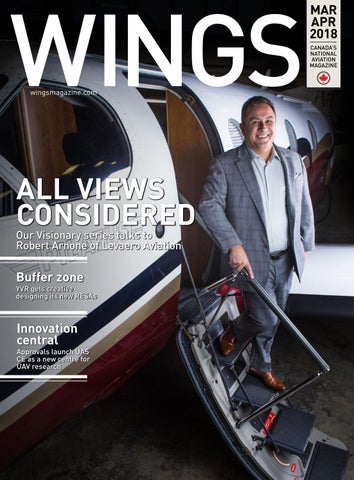
ALL VIEWS CONSIDERED
Our Visionary series talks to Robert Arnone of Levaero Aviation
Buffer zone
YVR gets creative designing its new RESAs
Innovation central
PHOTO CREDIT TK
Approvals launch UAS CE as a new centre for UAV research
The game-changing Legacy 500, with its exclusive fly-by-wire controls – previously available only in modern airliners and much larger business jets – is the benchmark for the future in performance, comfort and passenger experience. On the flight deck, the advanced Rockwell Collins Pro Line Fusion™ platform puts pilots in complete control in a cockpit environment that provides superior ergonomics. With seating for up to 12 passengers, the Legacy 500 features a spacious stand-up cabin with a flat floor, fully equipped galley, state-of-the-art in-flight entertainment system, elegant seating that converts into fully flat berths and the lowest cabin altitude of any medium-cabin aircraft. Its extensive main baggage compartment is complemented by a generous in-flight-accessible cabin stowage space. Boasting enviable speed, the clean-sheet design Legacy 500 delivers a high-speed cruise of Mach 0.82 and excellent runway performance.
LEGACY 500: YOU’LL NEVER WANT TO FLY ANYTHING ELSE “What we liked most about the Legacy 500 is the technology and value it added to our flight department. The cockpit enhancements, the autothrottle, autobrakes, the HUD, the EVS, the cabin enhancements – those were all things that stood out for us. Compared to other aircraft I’ve flown, the Legacy 500 is much more advanced and gives you a lot more confidence. The fly-by-wire technology makes the entire flying operation safer because of its redundancy, its precision and its ability to take the workload off the pilot. The avionics system is also very intuitive; it is very easy to transition into and become proficient. I always tell people, once you fly the Legacy 500 and feel how precise the aircraft is and know how reliable it is, you’ll never want to fly anything else. Really, I can’t imagine flying anything else anymore. It’s just a fantastic airplane with wonderful support. I can’t say enough. I highly recommended it.” - Paul Kohler, Aviation Manager/Chief Pilot, Michels Corporation Watch Paul’s story and request more information at EmbraerExecutiveJets.com/Paul
10-12 APRIL 2018
THE DESTINATION FOR THE AIRCRAFT INTERIORS INDUSTRY. Aircraft Interiors Expo 2018 10 - 12 April 2018, Hamburg Messe, Germany Aircraft Interiors Expo is the world’s market leader event dedicated to airlines and the supply chain to source the latest innovations, technologies and products for the cabin interiors, inflight entertainment, connectivity and passenger comfort industries. Register today www.aircraftinteriorsexpo.com
REGISTER NOW!
10 -12
Co-located with:
Organised by:
In co-operation with:
APRIL 2018
Supported by:
MAR/APR 2018
UPFRONT 8 Leading edge
Airports get a lot right.
10 On the fly
News and opinion
14 Alternate approach Disruptive technology
16 At the gate
Biofuel potential grows.
20 Glidepath
Who's going to fly it? Vancouver Airport is expanding its Runway End Safety Areas. P. 24
BACK 42 Marketplace 46 On final
The consultative approach.
FEATURES 18 CEO LEADERSHIP SERIES
Levaero's Robert Arnone pulls all views into his decision-making process. BY MATT NICHOLLS
22 BUFFER ZONE From top: Facette exits CBAA P. 10 Building it P. 30
More goes into designing RESAs than you might think BY CARROLL MCCORMICK
26 INNOVATION CENTRAL
UAS CE is Quebec's newest centre for UAV research and development BY CARROLL MCCORMICK
30 BUILDING IT – WILL THEY COME?
Business CMS more high-tech than ever BY BRIAN DUNN
32 FLYING CARS PHOTO CREDIT: YVR, MENA MIU, AEROPORT DE QUEBEC
Exploring the challenges and potential of VTOL aircraft BY DAVID CARR
COVER PHOTO: DAN HEWSON
WWW.WINGSMAGAZINE.COM
March/April 2018 | WINGS
5
Stay in Touch with Aviation News
Vol. 59, Issue 2 EDITOR
Patrick Flannery pflannery@annexweb.com 226-931-0545
SUBSCRIBE
FLIGHT DECK
Online
Rick Adams, Krista Bulmer, David Carr, Paul Dixon, Brian Dunn, Frederick K. Larkin, James Marasa, Carroll McCormick, Anna Pangrazzi, Bill Zuk NATIONAL ACCOUNT MANAGER
Mena Miu mmiu@annexbusinessmedia.com • 416-510-6749
TODAY
MARKETPLACE ACCOUNT MANAGER
Kory Pearn kpearn@annexweb.com • 519-902-8574 ACCOUNT CO-ORDINATOR
Barb Vowles bvowles@annexbusinessmedia.com • 416-510-5103 MEDIA DESIGNER
wingsmagazine.com/subscribe
Alison Keba
CIRCULATION MANAGER
Magazine
Barb Adelt badelt@annexbusinessmedia.com • 416-442-5600 ext. 3546
Weekly E-Newsletter
GROUP PUBLISHER
Martin McAnulty mmcanulty@annexbusinessmedia.com
Digital Edition
wingsmagazine.c om
PRESIDENT & CEO WINGS MAGAZINE
CANADA’S NATIONAL AVIATION MAGAZINE
P.O. Box 530, 105 Donly Dr. S., Simcoe, ON N3Y 4N5 Tel: 519-428-3471 Fax: 519-429-3094 Toll Free: 1-888-599-2228 Printed in Canada ISSN 0701-1369
ALL VIEW CONSIDERSE D
Our Visionary series talks Robert Arnone to of Levaero Avia tion
PUBLICATION MAIL AGREEMENT #40065710
Buffer zone
YVR get creat designing its ive new
Mike Fredericks
MAR APR 2018
RESAs
Innovation central
PHOTO CREDIT
TK
Approvals launc h UAS CE as a new UAV researchcentre for
WG_MARAPR18_ASK .indd 1
2018-02-27
11:33 AM
CIRCULATION Email: apotal@annexbusinessmedia.com Phone: 416-510-5113 Fax: 416-510-6875 (main) 416-442-2191 Mail: 111 Gordon Baker Rd., Suite 400, Toronto, ON M2H 3R1 Published six times per year (Jan/Feb, Mar/Ap, May/Jun, Jul/Aug, Sep/Oct, Nov/Dec) by Annex Business Media SUBSCRIPTION RATES Canada – 1 Year $ 34.00 (plus GST - #867172652RT0001) USA – 1 Year $ 59.50 Foreign – 1 Year $ 68.00 Occasionally, Wings magazine will mail information on behalf of industry-related groups whose products
Air Transport Association of Canada
ON THE
WEB
6
WINGS | March/April 2018
WG_Sub_HouseCircAd_MarApr18_MLD.indd 1 2018-02-27 1:04 PM
and services we believe may be of interest to you. If you prefer not to receive this information, please contact our circulation department in any of the four ways listed above. Annex Privacy Office privacy@annexbusinessmedia.com • Tel: 800.668.2374 No part of the editorial content of this publication may bereprintedwithoutthepublisher’swrittenpermission. ©2018 Annex Publishing & Printing Inc. All rights reserved. Opinions expressed in this magazine are not necessarily those of the editor or the publisher. No liability is assumed for errors or omissions. All advertising is subject to the publisher’s approval. Such approval does not imply any endorsement of the products or services advertised. Publisher reserves the right to refuse advertising that does not meet the standards of the publication.
Canadian Business Aviation Association
Magazines Canada
AVIATION THIS WEEK Looking to catch up on the latest hot news from around aviation and aerospace? Check out Aviation This Week, a live digital version of the top news stories affecting a variety of key markets. It's quick, essential information you need to know!
PHOTO CREDIT TK
WINGS
COO
Ted Markle tmarkle@annexbusinessmedia.com
WWW.WINGSMAGAZINE.COM
What’s Next?
Take the Next Step Through tireless work and sacrifice, you’re ready to take the next step. A step where time and efficiency are even more important to your success. At Levaero Aviation, we understand that a corporate aircraft may be that next step in your evolution. Whether you are interested in new or pre-owned aircraft, or have a specific interest in the Pilatus PC-12 NG or the new Pilatus PC-24 Super Versatile Jet, our mission is helping you find the right aircraft for your needs. What’s next? Give us a call.
Stan Kuliavas, Vice President of Sales sales@levaero.com 1 844-538-2376
www.levaero.com
LEADING
EDGE
By Patrick Flannery |
The view from down here Airports are getting a very great deal right.
I
5
Mass transit links to an airport are an absolute must. Mass transit links to an airport are an absolute must. And not city buses – dragging your luggage onto those is a pain in the posterior. There are no such links where I live in London, Ont., and, I have to say, it's very inconvenient. I'm actually fortunate to live quite close to the airport and can take a cab or Uber for relatively little money, but it would be a $20 to $30 ride each way from most other places in the city. The parking is inexpensive compared to major airports, but still adds up if you are away for any extended period. Because it's a smaller airport feeding hubs, you are limited in the flights you can select because you're always making a connection. That means it's often not possible to choose a flight time that will allow friends or family to drop you off. A light rail link or shuttles from the city centre would allow suburb-dwellers (which is most of us in London) to catch a ride with a spouse
1. The Boeing MAX 7 can carry up to 172 passengers and has a range of just over 7,000 kilometres. (P. 10) 2. The Cessna 408 SkyCourier's flat floor cabin is sized to handle up to three LD3 shipping containers. (P. 11) 3. The Pilatus PC-24 has a maximum cruising speed of just over 500 mph. (P. 12) 4. The joint Airbus/Bombardier C Series production line would cost US $300 million. (P. 14) 5. A biofuel trial in a Boeing 787 found a 20 per cent fuel savings on a trip from China to Chicago. (P. 16)
8
WINGS | March/April 2018
on their way into work and get dropped off at a station stop. An even better illustration of the benefits of a light rail link is the new-ish situation at Pearson. The addition of the UP train from Union Station has transformed the logistics of flying out of Toronto. For the previous 50 years, getting to Pearson from anywhere outside the city involved one of four unappealing options. You could drive in 401 gridlock (hoping there was no accident that could make you miss your flight) then either park in the extortionate on-site parking garage or park in the slightly less extortionate but freezing and remote off-site lots. Or you could take one of the out-of-town airport shuttles, getting intimately familiar with the tile work on the floor of the waiting area as you wait for two hours for your shuttle to arrive at each end, then getting even more intimately familiar with the person crammed in next to you on the short bus. Then there's that highway gridlock thing again. You could always simply fly to Toronto, but until recently that option was incredibly expensive - often more than doubling the overall cost of your flight (that seems to have changed recently...can someone tell me why?). Finally, option three was to take a train from London to Union then pay $65-plus for a cab to the airport. In gridlock. Now, I can catch a train from London, get on the UP at Union and arrive at the airport, working on WiFi all the way. Total cost each way is around $50. It's much better, but with the cost of the connector flights from London coming down so much recently, I often just fly straight from here to save time. I could say a thing or two here about the lack of good coffee shops on the gate side of security in some airports, or the total lack of anywhere to have a smoke, but that would just be nitpicking. So here's to you airport managers who have done such a great job that my only remaining complaint about air travel is related to something completely outside your control. You must be doing a very great number of things right. | W @Wings_Magazine WWW.WINGSMAGAZINE.COM
PHOTO CREDIT UP EXPRESS
n my short time working here on Wings, I've quickly become amazed at the complexity and sophistication of the aviation business. It's certainly not something an outsider like me can just jump into and offer anything substantive. The acronyms...my goodness, the acronyms... Fortunately, Wings has a powerful team of veteran writers – some of whom are former editors of this magazine – who have been instrumental in getting us through this little interlude. My thanks go out to David Carr, Brian Dunn, Paul Dixon and Carroll McCormick for their great work and advice. This issue puts some extra focus on airports with an article on the extension of the YVR's Runway End Safety Areas, a discussion of how YQB is looking to attract more business, a look at UAS CE's growth as a centre for UAV research and a speculative look at how flying cars might be regulated – if we ever get them. The only thing I might be able to add to such a lineup is a perspective on airports from an outsider who uses them quite a bit. I'm always impressed by what airports do. An airport is without a doubt the most difficult customer service environment there is. There's no other industry that has to try to keep paying customers happy and coming back in the face of so many challenges: volumes of moving people; safety risks; high security needs; strict regulatory controls; cargo logistics; the need for fast and accurate mass communication; and the generally emotionally fraught nature of air travel. And that's without considering what goes into actual flight operations. Even with all these factors in play, my experience in airports is generally pleasant. It's getting to the airport that remains the worst part of my trips.
MAY 30-31, 2018
EY CENTRE, OTTAWA
PHOTO CREDIT UP EXPRESS
CANADA’S GLOBAL DEFENCE & SECURITY TRADE SHOW
Produced by:
WG_MARAPR18_ASK.indd WG_Cansec_MarApr18_CSA.indd 9 1
CANADIAN ASSOCIATION OF DEFENCE AND SECURITY INDUSTRIES
#CANSEC2018 defenceandsecurity.ca canseccanada.ca
2018-03-05 2018-02-1611:08 7:44AM AM
ON THE FLY For late-breaking news and exclusive web content, please visit us at: www.wingsmagazine.com
10 10 11 11 12 12
THE LEAD COMMERCIAL PEOPLE SAR AEROSPACE BIZJETS
THE LEAD
ITC RULING SHOCKS AVIATION WORLD The U.S. International Trade Commission surprised observers on Jan. 26 by ruling in favour of Bombardier in the Montreal manufacturer's trade dispute with Boeing. The commission voted unanimously that Boeing did not suffer harm from prospective imports of C Series commercial jets. The ruling means duties of close to 300 per cent imposed by the U.S. Department of Commerce will not go into effect. In a statement, Bombardier said, "Today’s decision is a victory for innovation, competition, and the rule of law. It is also a victory for U.S. airlines and the U.S. traveling public. The C Series is the most innovative and efficient new aircraft in a generation. Its development and production represent thousands of jobs in the United States, Canada, and the United Kingdom. We are extremely proud of our employees, investors and suppliers who have worked together to bring this remarkable aircraft to the market. With this matter behind us, we are moving full
speed ahead with finalizing our partnership with Airbus. Integration planning is going well and we look forward to delivering the C Series to the U.S. market so that U.S. airlines and the U.S. flying public can enjoy the many benefits of this remarkable aircraft." Boeing felt a bit different: "We are disappointed that the International Trade Commission did not recognize the harm that Boeing has suffered from the billions of dollars in illegal government subsidies that the Department of Commerce found Bombardier received and used to dump aircraft in the U.S. small single-aisle airplane market. Those violations have harmed the U.S. aerospace industry, and we are feeling the effects of those unfair business practices in the market every day.
COMMERCIAL
AC MAX ENTERS SERVICE Fourteen years after Air Canada retired the last of its legacy Boeing 737-200’s acquired in the takeover of Canadian Airlines, the type has returned to the fleet. Air Canada’s first 737 MAX 8 entered service on December 11, on the Toronto – Calgary route, marking the next phase of the airline’s fleet modernization, which will include delivery of the first of 45 Bombardier CSeries 300 airliners beginning next year. “Introducing a new aircraft type to the
Air Canada will place 737 MAX on seasonal international routes. 10 WINGS | March/April 2018
fleet is always exciting for an airline, but we know customers will be even more thrilled by the Boeing 737 MAX, which is set to become the mainstay of our North American, narrow-body fleet,” Benjamin Smith, president, passenger airlines at Air Canada said. Not just North America. Air Canada will deploy the aircraft on seasonal service between Montréal, Reykjavik, Iceland and Dublin, St. John’s and London Heathrow, and Toronto, Shannon and Reykjavik. The 737 MAX uses 20 per cent less fuel per seat than the original Next-Generation 737. Smith noted that increased efficiency will enable Air Canada, “to compete more effectively and gives the aircraft extended range capabilities so we can launch new city pairings within North America and routes to select international destinations. The 737 MAX 8 will start to replace Air Canada’s Airbus A320 fleet, while the larger and longer-range MAX 9, which has struggled in orders against the Airbus A321neo (new engine option) will replace the airline’s fleet of A321 airplanes. Air Canada is the second Canadian airline to take delivery of the 737 MAX. WestJet introduced the type on the Toronto – Calgary route on November 9. WestJet will take delivery of 50 MAX aircraft over the next 10 years. Air Transat has ordered 10 A321neo jets. Air Canada has 61 firm orders for the 737 MAX, with 18 due to enter the fleet by year’s end. The airline is expected to take delivery of the full order, which includes 12 MAX 9 aircraft by 2021. Meanwhile, Boeing has rolled out the MAX 7, the third and newest member of the 737 MAX family. The MAX 7, which has been ordered by WestJet and ultra-low-cost upstart Canada Jetlines, can carry up to 172 passengers, and has a range of just over 7,000 kilometres, giving it the longest range of the MAX variants. “For our airline customers serving airports at high altitudes or remote locations, the MAX 7 is the ideal complement to their fleet. We look forward to demonstrating the incredible flexibility and range of this airplane,” said Keith Leverkuhn, vice president and general manager of the 737 MAX program. The MAX 7’s first flight was expected as Wings was going to press. A second aircraft will join the test program later this year. First deliveries to launch customer Southwest are expected in 2019. WWW.WINGSMAGAZINE.COM
PEOPLE
FACETTE LEAVES CBAA Jim Facette has tendered his resignation as president and CEO of the Canadian Business Aviation Association effective immediately and the CBAA board has accepted the resignation. According to the association, Facette and the board had "different visions for the future direction of the CBAA." "We appreciate the work Jim has carried out during his tenure with the CBAA, and thank him for his service," said a statement from Rod Barnard, CBAA chair. Facette had only been in the role since Dec. 1, 2017. The CBAA announcement continues: "The CBAA wishes to assure the membership that our roadmap for success remains fully intact. Rudy Toering has accepted the role as the interim president and CEO as the search begins for a new successor, who we expect to be in place for the CBAA 2018 Convention in June. "The board appreciates having Rudy’s proven leadership and sound industry knowledge in helping further the interests of the CBAA membership during this transitionary period. As you know, Rudy has been active on CBAA’s most critical files, such as the imposition of taxable benefits by the Canada Revenue Agency related to the legitimate business use of corporate aircraft, and the
CanWest order includes one King Air 350.
regulatory one-size-fits-all proposals from Transport Canada related to flight and duty times. His expertise on these and other issues, and his commitment to business aviation and the CBAA will be invaluable as we move forward together. "We wish to thank the CBAA team in Ottawa and our members for their ongoing support during this time."
SAR
CANWEST TAKES DELIVERY OF KING AIR Textron Aviation has begun delivery of nine Beechcraft King Air turboprop aircraft to CanWest Air, an Alberta-based air ambulance specialist. CanWest, a division of Nor-Alta Aviation will use the turboprops to provide air ambulance support to Alberta Health Services, and replaced the current fleet of King Air B200 aircraft.
CanWest’s eight King Air 250 and single King Air 350 will include special modifications, including a cargo door and heavyweight landing gear. Both types are able to operate on unimproved runways, which allows easier operation in remote locations in northern Alberta. “No other aircraft could have better met our mission,” said Kevin Schaub, director of maintenance at CanWest Air. “The King Air platform is a tremendous asset, especially when navigating through remote areas and the extreme environment in Alberta. Having previously operated King Airs, this is the platform we trust to best support our air ambulance missions. Not only will we continue to have incredible runways performance, but we also couldn’t be more confident in the ability, range, aircraft interior size and comfort, and operating limits of the new fleet to support our air ambulance mission.”
AEROSPACE
P&WC TO POWER CESNNA SKYCOURIER Cessna has picked the Pratt & Whitney Canada (P&WC) PT6A-65SC to power the new SkyCourier 408, large-utility turboprop. Built for high utilization operations, the twin-engine, high-wing SkyCourier will be offered in cargo and passenger variants. The cargo variant will feature a large cargo door and a flat floor cabin that is sized to handle up to three LD3 shipping containers with over 2,700 kilograms of maximum payload capability. The 19-passenger variant will include crew and passenger doors for smooth boarding, as well as large cabin windows for natural light and views. Both configurations will offer single-point pressure refueling to enable faster turnarounds. Jim Facette, middle, was introduced as CBAA president and CEO at the association's Christmas meeting. WWW.WINGSMAGAZINE.COM
March/April 2018 | WINGS
11
ON THE
FLY
The passenger version will not feature a pressurized cabin, and is being aimed at developing countries. “The aircraft will fulfill a gap in this market segment with its superior performance and low operating costs in combinations with the cabin flexibility, payload capability and efficiency only a cleansheet design can offer,” said Scott Ernest, chief executive of Textron Aviation. FedEx Express has agreed to purchase 50 aircraft as part of its feeder fleet modernization strategy, improving fuel efficiency, reliability and operating costs. Earlier this month, FedEx placed an order for 30 ATR 72-600F aircraft. “We worked closely with Textron Aviation to develop the Cessna SkyCourier 408, which includes several key features that will help us grow our business in small and medium-sized markets, especially in the air freight segment,” said David L. Cunningham, chief executive of FedEx Express. The volumetric capacity of the SkyCourier is twice that of the
12 WINGS | March/April 2018 WG_top20ad_halfH_JanFeb18_MLD.indd 1
Heaven helps the ready. Textron chose Pratt & Whitney's PT6A engine for the SkyCourier because GE was still testing its Advanced Turboprop.
single-engine Cessna Caravan 208. The large cargo door is a first for the FedEx current feeders fleet, which will help to provide faster service to freight customers shipping to or from smaller markets. Reports suggest that Textron went with the P&WC engine over the more advanced GE Aviation Advanced Turboprop to support the SkyCourier’s aggressive development timeline. FedEx expects to take delivery of its first new aircraft in 2020. The GE engine, which will power the Cessna Denali, single-engine turboprop, completed its first engine test run at GE Aviation’s facility in the Czech Republic.
BIZJETS
PILATUS HANDS OVER FIRST JET Pilatus has officially handed over its first PC-24 jet to PlaneSense, a New Hampshire-based fractional operator. The handover took place at the Pilatus Business Aircraft completions and support centre in Broomfield, Colorado on February 2, following a low-key ceremony at the Pilatus production facility in Stan, Switzerland. Described by Pilatus as the first super
WWW.WINGSMAGAZINE.COM 2017-12-18 8:44 AM
versatile jet for its short runway performance, the twin-engine PC-24 was launched in 2013 and completed its maiden flight in May 2015. “This project involved considerable risk, but we always believed 100 per cent in our PC24,” Oscar J. Schwenk, chair of Pilatus said in January after receiving European and Federal Aviation Administration type certification. The aircraft has a range of 3,000 kilometres and maximum speed of 815 kilometers per hour, faster than the 787 kilometers per hour than originally billed. “That is pure Pilatus, typical of the qualities which set up apart,” Schwenk added. The order book stands at 84 aircraft from 23 customers around the world, including six for PlaneSense, which also operates the world’s largest civilian fleet of PC-12 single-engine turboprops. “Though the PC-12 continues to be the foundation of our company, over time, we have heard from our clients and our prospects that a jet would be useful,”
The PC-24 was delivered with a top speed of 815 kilometres per hour, faster than the design specification said it would be.
George Antonidis, chief executive of PlaneSense told the RobbReport. “Though the PC-12 continues to be the foundation of our company, over time, we have heard from our clients and our prospects that the jet would be useful in their palette of choices,” says Antoniadis, who is the president and CEO of PlaneSense as well as its founder. “Some people just straight out prefer to be in a jet, or some people need to cover longer distances more quickly.” The PC-24 has a maximum cruising speed of just over 500 mph, compared to 328 mph for the PC-12 NG, the latest
version of the PC-12. Its range is just under 1,900 miles (1,650 nautical miles) when carrying three passengers and two pilots. The aircraft requires only 2,690 feet of runway to take off and just 2,525 to land. And it’s designed to land smoothly even on unpaved runways, leading Pilatus to bill the aircraft as the world’s first SVJ: super versatile jet. Correction: Our last Careers in Aviation Guide listing for Brampton Flying Club stated incorrectly that the club has a tie-in with Sheridan College's bachelor of business program. Wings regrets the error.
THE VISIONARIES:
Join WINGS and HELICOPTERS as we celebrate aviation and aerospace leaders.
Read how the change makers are looking to the future. Look for it in each issue of WINGS/HELICOPTERS starting March 2018. WWW.WINGSMAGAZINE.COM
March/April 2018 | WINGS 13
ALTERNATE
APPROACH By David Carr |
Disruptive technology
The ITC decision has changed the narrow-body landscape.
T
his magazine was correct when it went against industry wisdom and predicted in a January / February cover story on Bombardier that a punitive 292 per cent tariff on C Series airplanes exported to the United States had no where to go but down. But few could have foreseen that the U.S. International Trade Commission (ITC) would ratchet the amount to zero. Especially in a heightened period of U.S. protectionism. The leap from propellers to jets or narrow-body to wide-bodied aircraft notwithstanding, the C Series may be the most disruptive airliner of its class ever brought to market – albeit not in a way Bombardier first envisioned. Or would have liked. By stepping into the smaller end of the AirbusBoeing single-aisle sandbox, Bombardier had already forced the hand of the big two. Re-engined versions of the A320 and Boeing 737 were unveiled, whereas the manufacturers may have preferred to wring out the last drops of sales potential from the existing platforms while preparing to come to market with clean sheet designs. It appears that Boeing was further down that path with a 737 replacement based on the 787, and will likely be first out with a 797, a so-called middle-of-the-market design that Airbus suggests is already sown up with the A321neo (new engine option). What came as a surprise is that the Boeing trade dispute would drive the C Series into the arms of rival Airbus, triggering a re-positioning of the global chess pieces. As the U.S. ITC made clear, Bombardier did not engage in anti-competitive behaviour in landing a Delta order for up to 75 CS100 jets, because Boeing never had a competitive airplane in the running. After cancelling the 717 in 2006, it still doesn’t. But Airbus now does, neatly filling a gap in its product line – sending Boeing south to Brazil, where the American company already has a co-operative relationship with Bombardier’s regional jet rival, Embraer. A takeover of Embraer by Boeing is out of the question. The airplane maker is the crown jewel of Brazil’s high-tech sector. Greater collaboration with Embraer’s nextgeneration E2 jets – including a potential equity stake in the program – cannot be ruled out, giving Boeing a presence in the 14 WINGS | March/April 2018
a China-Russia consortium produces a jumbo jet to compete with the 787 and A330neo. Neither Airbus nor Boeing compete directly in the 100-to- 150-seat market, although the presence of the CSeries and E-Jet did influence pricing of larger A320 and 737 airplanes, giving buyers four competitors in one lucrative sector. Ironically, the industry’s reluctance to buy the CSeries has resulted in a consolidation of sorts. Depending on the outcome of talks between Boeing and Embraer, the game board could be reduced to two players, with Airbus and Boeing setting the terms. Since launching the CSeries 10 years ago, Bombardier has stirred the pot. The world’s two giant airplane builders have had to play catchup (while easily surpassing the CSeries in sales). A bitter trade dispute has resulted in a partnership that delivers added muscle to the CSeries program while giving Airbus an overnight advantage on its rival in a market segment – where Boeing was competitive before cancelling the 717 – with clean-sheet, advanced technology, setting the stage for an inevitable tie-up with Embraer, which once had a competitive leg up on rival Bombardier with its E-Jet program. Disruptive technology, indeed. | W
Since launching the C Series 10 years ago, Bombardier has stirred the pot. 60-to-100-seat market similar to the tie-up between Airbus and Bombardier. The rest is crystal balling. The ITC ruling has kicked away the primary case underpinning a second North American CSeries assembly line in Mobile, Ala., where Airbus already builds A320s. Even so, Airbus and Bombardier are moving forward on the U.S.$300 million production line, which could open within 12 months of receiving a regulatory greenlight on the CSeries deal. There is no doubt that the Airbus partnership has delivered a marketing boost for Bombardier. A recent “pause” in orders has been attributed to airlines trying to sort out what’s what, and ensuring that regulatory approval is in place to secure the future of the CSeries. The silence could be broken with a splash at this year’s Farnborough Air Show, where Bombardier launched the program in 2008. The ruling does free up Delta to take delivery of Canadian-built CS100’s until the Alabama site opens. Airline customers would prefer more and not fewer manufacturers competing for their orders. That is currently not possible in the wide-body sector, and will likely remain that way until at least 2030, when
David Carr is a Wings writer and columnist. WWW.WINGSMAGAZINE.COM
THINK INNOVATION, DURABILITY, QUALITY VISIT ROUSSEAUMETAL.COM TO FIND AVIATION MAINTENANCE EQUIPMENT LIKE NO OTHER
FLEXIBLE STORAGE FOR OPTIMAL USE OF SPACE
5S : Color-coded to organize your inventory Wide range of accessories adapts the storage to your needs Lifetime warranty on the rolling mechanism
rousseaumetal.com
AT THE
GATE
By Brian Dunn
Growing fuel
Biofuels may be ready for the next level.
F
or several years now, the development of aviation biofuels has been all the rage and there is plenty of hype out there as to how biofuels are going to revolutionize the skies. But how viable is the hype and when will this groundbreaking technology really start to pay off? The production of aviation biofuels is being encouraged by a 2016 agreement cobbled together by the International Civil Aviation Organization that aims to cap airline pollution at 2020 levels. Biojet fuels are expected to deliver 56 per cent of the industry’s targeted emissions by 2050, according to Lux Research of Boston. While there have been plenty of relatively short haul flights using biofuels, including some by Air Canada and Porter Airlines, among others, in November, Hainan Airlines completed its first transcontinental flight between China and the Chicago in 13 hours. The Boeing 787 aircraft GEnx engines were powered by a mix of jet fuel and biofuel derived from used cooking oil, which resulted in a 20 per cent savings in fuel costs, according to the airline. Air New Zealand and Virgin Australia are looking at producing their own biofuel in a move aimed at reducing emissions and improving fuel savings, while Alaska Airlines has been testing a new plant-based biofuel manufactured by the Northwest Advanced Renewables Alliance. And in 2014, Oslo Airport became the first hub airport in the world to receive regular deliveries of biofuel after SAS, KLM and the Lufthansa group signed a supply deal with Statoil Aviation. Even as more airlines are experimenting with biofuels, they still account for less than one per cent of global jet fuel consumption, partly because supply is limited and partly because it is two to three times more expensive than conventional Jet A fuel. One of the major concerns is food availability and the side effects of growing biofuel crops. Most biofuels are fuels converted from processed biomass including vegetable oils and animal fats. Plantation of these crops may not only sacrifice croplands for food, causing food shortages, but carbon dioxide would also be released during deforestation and biofuel production. But there is at least one local company that may have a solution. Agrisoma 16 WINGS | March/April 2018
proven track record and is committed to establishing a supply chain. The partnership is the first of its kind in Australia and will see Agrisoma work with Australian farmers to grow Carinata. That will be complemented by seeds grown elsewhere to feed its global travel network. The long-term goal is to grow the crop on 400,000 hectares to produce more than 200 million litres of bio jet fuel and replace 30 to 50 per cent of the airline’s annual fuel needs, says Agrisoma CEO Steven Fabijanski. “Agrisoma has the world’s largest collection of Carinata and an extensive modern crop improvement program that allows us to select high-yielding varieties ideally suited for production across a broad range of geographies.” In addition to Oslo, LAX is offering biofuel on site, while Montreal’s Trudeau Airport is experimenting with a similar program. The cost is high because there are very few dedicated biojet fuel manufacturing facilities, explains Fabijanski. The high cost will be offset once there are economies of scale. There has been some interest from Canadian carriers, including Porter Airlines, which used fuel from Agrisoma for its first biojet fuel flight in 2012. | W
The long-term goal is to replace 30 to 50 per cent of the airline’s annual fuel needs. Biosciences of Gatineau, Que., signed a deal last November to supply biofuel to Australia’s Qantas Airways made from Carinata seed – a non-food, industrial type of mustard seed that produces oil suitable for aviation and diesel fuel. The oilseed produced by Agrisoma is called Resonance Carinata. Described by the company as being hardy and droughttolerant, it is a non-food crop, meaning it is not meant for human consumption and can be grown on fallow land that would otherwise lie unused. Carinata is a crop that requires no specialized production or processing techniques and uses little water. Field trials in Gatton, Queensland, and Bordertown, South Australia, have demonstrated it should do very well in the Australian climate. It is sown either in fallow areas where crops fail or in between regular crop cycles, known as “cover cropping.” Rotational or cover cropping improves soil quality, reduces erosion for food crops and provides farmers with additional annual income. Qantas said it chose Agrisoma because the Carinata seed can be grown in Australia and the Canadian company has a
Brian Dunn is a Wings writer and columnist. WWW.WINGSMAGAZINE.COM
“A leader has to surround themselves with people who can offer a diverse and unique skillset.”
LEVAERO AVIATION’S ROB ARNONE LEADS THROUGH ATTENTIVE INTERACTION BY MATT NICHOLLS
S
triving to understand all aspects of the business. Ask those who know Levaero Aviation president/CEO Robert Arnone best, and this is precisely how they describe his quiet, effective leadership style, corporate philosophy and commitment to a growing client base. “Rob is the first one to tell you he doesn’t know all aspects of the business,” notes Steve Davey, Levaero’s vice 18 WINGS | March/April 2018
president, COO-DOM and Arnone’s long-time business partner. “Rob seeks input from the others, no matter what the project. “I have watched him sit and ask customers to explain certain areas of the business he doesn’t understand until he fully understands the complexities; he listens and absorbs.” Levaero Aviation is northern Ontario’s largest maintenance, repair and overhaul facility and is a multi-faceted
Q. What is your strategic vision for the company and are things progressing as planned? “We set forth to create a one-stop shop centre here, a turn-key solution. And from day one when Steve and I acquired the business, the focus was on the PC-12. But towards 2014, we realized we have an underserviced market. We wanted to expand our capabilities. So, we rebranded the company and now offer everything an operator needs – the equipment, right down to operating it for that client, providing the appropriate support and anything that falls in between.” Q. What are your customers telling you about the operation? “We continue to build a portfolio of repeat clientele which in itself says a lot. We service clients from all across North America, notably California, Alaska, into the Caribbean and as far away as South Africa. The clients who operate their own WWW.WINGSMAGAZINE.COM
PHOTO CREDIT LEVAERO AVIATION
A SUCCESSFUL LESSON IN LISTENING
“one-stop-shop” for everything Pilatus. The company provides national support to its Pilatus customer base, and to operators seeking specialized, often missionspecific, solutions. It’s also the exclusive Canadian sales and service centre for the Pilatus PC-12 and PC-24 aircraft. Levaero also specializes in aircraft acquisition and sales, parts and maintenance and aircraft charter and management services. Arnone has more than 18 years experience in the aviation field. He graduated from Thunder Bay, Ont.’s Lakehead University with an honours bachelor of commerce degree and later attained his professional designation of chartered accountant. He joined Levaero as the vice president of finance and was named president and CEO in 2006. Constantly seeking ways to innovate, Arnone was instrumental in the re-branding of the company in 2015 to Levaero Aviation (formerly Pilatus Centre Canada). In the first of Wings special Visionaries series, Arnone shares his vision of Levaero’s ascension, his thoughts on leadership and the future of the aviation industry in Canada. For an extended version of this piece, as well as the audio interview, please go to wingsmagazine.com.
equipment turn to us for support; they really know their needs. We need to capitalize on our experience and identify what their future needs may be – whether it be maintenance related or aircraft related.” Q. What makes the Pilatus aircraft lines so appropriate for the Canadian market? “It delivers range, it is capable of carrying cargo, it’s exceptionally reliable. It has short-field take off and landing performance, even on gravel and dirt. And it does so in the comfort of a pressurized environment, comfort with speed . . . and it is very economical.” Q. How are the 90-plus Canadian operators deploying the PC-12 and the PC-12NG? What’s the market for the new PC-24? “The PC-24 is a larger, faster, longer range offering than the PC-12 and it maintains the performance characteristics that made the PC-12 so popular. We have some operators that have opted to go with a PC-12 and a PC-24 in their fleets. The order book is strong, it is sold out, and it has only been open for the first three years of production. The biggest trend with the PC-12 is its continued popularity and deployment in a variety of different verticals.” Q. How is Levaero innovating in all areas of the business? “Anyone in aviation can appreciate the fact that innovation and aviation are not necessarily in sync. We don’t move with vast expedience; there are baby steps. We’ve tried to encourage our entire team to think outside of the box regardless of what facet it is, whether it be in maintenance, administration, charter bookings or anything that we do. And technology plays a big part in it. For example, our financial software is fully integrated with parts ordering, inventory control, on the floor with work orders. They are small steps, but in the end, it all counts.” Q. How would your employees describe your leadership style? “I certainly don’t see myself as the smartest guy in the room. A leader has to surround themselves with people who can offer a diverse and unique skillset. If you are the smartest person in the room, or
“I certainly don’t see myself as the smartest guy in the room.” WWW.WINGSMAGAZINE.COM
you think you are, the only thing you’ve accomplished is building a weak team – and that will lead to failure. My success, and this organization’s success, is our ability to put together a vast skillset for everyone to capitalize on it.” Q. Do you have any mentors that have helped shape your leadership mantra? “When I entered into aviation, a client who became a very dear friend of mine and a mentor, was Faan VanTonder. He was a resident of South Africa and we became dear friends. He has since passed away. He would always refer to the balance sheet of life. Every transaction has to be a win-win. Both parties have to come away from the table to be truly successful. I have taken both of these philosophies and pride myself that my balance sheet is measured by integrity and honesty – and I like to think it is asset heavy. “I would also be amiss if I didn’t say my partner and long-time friend, Steve Davey. He has helped shape my career in so many ways. Without Steve by my side, we would not have done what we have today. “Another person who continues to be a force in the Pilatus world is Chris Finnoff of Finnoff Aviation in Boulder, Col. Chris has 40 years experience in aviation and he was one of the original CEOs of Pilatus business aircraft, the U.S. subsidiary of the manufacturer and the OEM. I often think of what he has done and his innovative way of thinking. This has helped shape what I do and how I do it.” Q. What is your most important aviation memory and why? Do you have a favourite aircraft? “The logical thing for me to say is when both Steve and I acquired what was V. Kelner Pilatus Centre in Thunder Bay. We became the owners and turned it into Pilatus Centre Canada (now Levaero Aviation). But I continue to have fond memories dealing with my clients. Over the years, I have met some really interesting people from all around the world. As for my favourite aircraft? Anything in my service centre is my favourite aircraft.” Q. Levaero has always been a strong advocate for the development of future aviation and aerospace leaders – participating in the Wings and Helicopters Careers in Aviation Expos for example. How important are these programs to the future development of the industry? “It’s hugely important to us. We have done similar things with local expos (in Thunder Bay). We also have an aviation program at our local college and apprenticeship programs. It is extremely important – as an industry – to attract the most
“Anything in my service centre is my favourite aircraft.” passionate and skilled students. Otherwise, we will just fall short at the end.” Q. In what ways can we work as an industry to grow the Canadian aviation and aerospace footprint both here and abroad? “We are not going to go very far unless we can attract more talent to our industry. We have a massive shortage of pilots and it will not get much better in the near future. The shortage of AMEs is just beginning. We need to attract the high school entrants when they are deciding on their careers. Companies like ours need to get more involved at the grassroots levels – the pre-college career decision time. It is after all a very passionate and sexy industry.” Q. What keeps Robert Arnone up at night? “We have built a solid foundation for this company so I don’t lose a lot of sleep in that regard. But I have often found myself springing up in the middle of the night, showering and coming to work because I want to. I still love what I do and I am excited on Sunday night to come back to the office. I can’t see myself not doing this. But there will be a day when a change happens. And when that day comes, I want to make sure Levaero’s legacy continues.” Q. What are your future goals for the Levaero Aviation Group? For Robert Arnone? “Steve and I have often sat down and talked about what’s next. The cliché that comes out of that discussion is we’re not done yet. We’re not done building. We still think there is a vast, untapped market for what we do. We know we do it well. We service our clientele, we do it with honesty, we have integrity. We do it right and we keep getting more referrals. We want to capitalize on that and keep building that market, whether it is national or international. We are also seeking out opportunities. Ultimately we want to continue to grow and strengthen. We are committed to the Levareo group and positioning ourselves in the industry. Personally, I love what I do and the people I do it with. I don’t see myself going anywhere soon. But there will be a day – and when that day comes – I want to make sure Levaero’s legacy continues. | W March/April 2018 | WINGS 19
GLIDE
PATH
By Paul Dixon |
Getting nowhere fast
Better aircraft can't translate to profits without pilots.
T
he calendar has barely flipped over for 2018 and things are heating up already. That sound of rushing air you heard wasn’t a hurricane, it was just the management team at Bombardier daring to take a deep breath after the stunning ruling from the U.S. International Trade Commission overturning the 292.21 per cent tariff levied earlier on C-Series jets. The deal with Delta Airlines will go ahead. While we’re on the subject, when I see a number such as 292.21 per cent, I tend to think that someone out there is just a little too committed to their job. Another story of note for Canada was the (hopefully) first step towards the CF-18 replacement program with a one-day information session in Ottawa for interested parties, which Boeing chose not to attend. Now that Canada has moved ahead with a plan to buy Australia’s surplus F-18s instead of new F/A-18 Super Hornets from Boeing to bridge the gap until the next fighter (whatever it may be) comes on line, one might be inclined to think that Boeing may have overplayed its hand on the C-Series complaint. Interesting times indeed. On the global stage, at the same time the C-Series drama was playing out, we were seeing the curtain starting to descend on the jumbo jet market. Airbus was facing the end of the A380 program when Emirates stepped in and provided an order that will keep the production line open for another couple of years, and now British Airways is making noises about buying a smaller number of new A380s. The A380 never really gained the acceptance it needed to be a raging success, because it relied on maintaining the hub and spoke networks. Boeing bet against it with the B787, betting on the idea that a smaller, more efficient aircraft can connect markets via direct flights that weren’t even imagined a decade ago. While the 787 and 777 programs thrive, the 747 program is losing momentum. The major American carriers have all parked their 747s and it’s been quite a while since a Canadian carrier had one. We’ve entered an era of “two engines good, four engines bad.” It’s all about the cost to put that airplane in the air and keep it there. To be even more blunt, it’s all about 20 WINGS | March/April 2018
There’s only one problem: who’s going to fly it? doing it as cheaply as possible. In aviation, after the cost of the aircraft, it’s the cost of the fuel. Every single percentage point you save in fuel costs goes straight to the bottom line. When the 747 came on line, commercial aviation was still a novelty for the masses and it was still glamorous. A lot of the glamour has faded and no matter how airlines market themselves, taking a plane is still largely a matter of getting somewhere. It’s more about where you are going than how you are getting there. The challenge for airlines is to get those load factors up where they want them and keep them there. Smaller aircraft can do that, especially smaller aircraft that can fly incredible distances and eliminate those deadly transfers. The challenge to the airlines and the aircraft manufacturers is to keep their balls in the air. Get the bodies on the aircraft and keep designing and building more efficient aircraft. There’s only one problem: who’s going to fly it? The pilot shortage is a reality that we’ve been staring at for some years now, but it’s not going to go away and it’s going to get a lot worse in the next decade as the last of the baby boomers ride off into retirement. As aviation expands and as more aircraft come into service, who is going to fly them and just where are these next-generation aviators coming from? Consider the size of the air
force 50 years ago versus today and think about how many pilots were leaving the RCAF every year and moving into an airline job. The large commercial airlines, being at the top of the food chain, won’t have trouble attracting the talent they need. But the further you move down the food chain, the more challenging it will be to attract and, more importantly, retain staff. Smaller operators are already accepting pilots with bare-minimum qualifications and then losing them as they move on at the first opportunity. In the past year in the U.S., several regional carriers were cancelling flights at the height of the busy summer schedule due to a lack of pilots. Republic Airways filed for bankruptcy, citing amongst its reasons the inability to attract qualified pilots. So here we are, heading into a future were air travel promises to be more convenient than ever, thanks to the efficiency of new aircraft and the flexibility of routes they are able to fly. One rule of this business is that as you solve the problem in front of you it is imperative that you identity the problems the solution is going create. Our problem today is that technological changes have compressed time lines and the future becomes the present before we’re ready. It’s hard to figure out where you want to be when you find yourself already there before you realize it. | W Paul Dixon is a freelance writer and a photojournalist living in Vancouver. WWW.WINGSMAGAZINE.COM
Yellow chevrons mark this 300-metre Runway End Safety Area, one of four built so far for Vancouver airport’s runway ends.
VANCOUVER INTERNATIONAL AIRPORT COMPLETES ITS FIRST FOUR RUNWAY END SAFETY AREAS
A
BY CARROLL MCCORMICK
ll airports have their “official” runway lengths – the asphalt or concrete measured between the runway ends, or thresholds, where landing and departing aircraft belong. But for the rare occasion where aircraft might land short (an undershoot), not stop, or not become airborne (an overrun), on the runway given to them, many runways have Runway End Safety Areas (RESA) – obstruction-free, aircraftfriendly areas beyond those official runway ends onto which aircraft can land or roll to without sustaining severe damage. Even though the International Civil Aviation Organisation (ICAO) has required RESA standards, not all airports have official RESAs. In Canada, the Canadian 22 WINGS | March/April 2018
Aviation Regulations (CAR) recommend that Code 3 or 4 runways, (1,200 to 1,799 metres and more than 1,800 metres long, respectively) have at least a 90-metre long RESA at each end. But currently CAR does not require them. In 2011, YVR began planning the construction of RESAs for 08R/26L and 13/31 – its two South Airfield runways. Later, it began planning RESAs for 08L/26R – its parallel North Airfield runway; these runways are all Code 4. Not only would the RESAs add another layer of protection for departing and arriving aircraft, they would anticipate a required Canadian standard. “We expect a draft standard to be published this year in Canada Gazette Part I. It will then be republished [as enacted legislation] in Canada Gazette Part II in the first
half of 2019. [We expect] that Canadian airports will [then] have two years to comply,” says Brett Patterson, director of engineering projects with the Vancouver Airport Authority. YVR divided the job into two parts: Phase 1 focused on building the RESAs for runways 13/31 and 08R/26L; Surrey, B.C.,-based Jacob Bros Construction was the prime contractor and YVR hired Mississauga, Ont.,-based Hatch Ltd. as design consultant.
TO THE INNOCENTS AMONG US, PLANNING A RESA WOULD SEEM STRAIGHTFORWARD. Phase 2 is the construction of RESAs for the parallel runway 08L/26R in the North Airfield. Ground will be broken for this latter Phase in March 2018. Construction on the 08R and 26L RESAs began in the
spring of 2015. Contractors completed the 08R RESA that year, but the work on 26L, which included runway work and a taxiway extension for the RESA, was only completed last fall. Contractors built the RESAs for 13/31, commonly referred to as the crosswind runway, in 2016. To the innocents among us, planning a RESA would seem straightforward. Pull the required RESA length and width from a handy rulebook, calculate some load bearing requirements, stake off some acreage off the runway ends and start digging. But the engineering wheels for airport projects grind far finer than that. ICAO does have a required minimum RESA length of 90 metres and a recommended length of 240 metres. A RESA width is easy – usually twice the width of the runway. So, what is a good RESA length? It so happens that not all RESAs need to be the same length to provide the same calculated level of safety. To WWW.WINGSMAGAZINE.COM
PHOTO CREDIT YVR
BUFFER ZONE
AEROCENTRE
Call 800.265.3339
Hangar #10, John G. Diefenbaker Airport Saskatoon, SK S7L 5X4 Office: 306.931.8552 | Fax: 306.242.4111 info@yxeaero.ca | www.yxeaero.ca
WG_Saskatoon Aerocentre_Marapr18_CSA.indd 1
2018-02-21 9:59 AM
your flight plan with STEP 1: LEARN TO FLY
Get your commercial pilot licence with one of our flight school partners. Upon graduation continue to build your hours as an instructor or apply to one of our SOAR mentorship pilot opportunities. For a full list of our partners, visit airgeorgian.ca.
STEP 2: FLY WITH AIR GEORGIAN Do you have 800 hours of flying time? You’re ready to start your career with Air Georgian flying as an Air Canada Express First Officer! Gain airline experience and take advantage of quick upgrades, training department opportunities and fleet transfers.
STEP 3: INTERVIEW WITH AIR CANADA Have you dreamed of flying for Air Canada? We can help you achieve your dreams. As a pilot flying for Air Georgian you are guaranteed an interview with Air Canada. They have committed to hiring up to 40% of our pilots per year.
INTERESTED IN LEARNING MORE? Visit airgeorgian.ca/soar for program details
March/April 2018 | WINGS 23
WWW.WINGSMAGAZINE.COM WG_AirGeorgian_Resized_MarApr18_MLD.indd 1
2018-02-23 12:21 PM
get there, YVR’s first decision was to work to ICAO’s RESA risk level of 0.45 in 10 million. That is, the chance of an aircraft excursion undershooting or overrunning a RESA would be about one in twenty million – one rarity multiplied by
another rarity to yield an extremely unlikely event indeed. YVR then turned to the Transportation Research Board, a division of the National Research Council of the United States. It has something called the Airport
WERE YOU MEANT TO TOUCH THE CLOUDS?
With state-of-the-art flight simulators, your career will soar with one of the best aviation schools in Canada. Saultcollege.ca/aviation
Cooperative Research Program (ACRP) Report 50: Improved Models for Risk Assessment of Runway Safety Areas. An airport need “simply” feed the model with a cargo planeload of data about itself and a specific runway, and out pops a RESA length that meets the ICAO risk level of 0.45 in 10 million. “We used the ACRP 50 and incorporated aircraft data, runway slope, aircraft mix, the weather every hour for the past two years, movements, runway dimensions, etcetera to determine what length of RESAs would let us achieve the risk level of 0.45 per 10 million,” Patterson explains. The results? Five RESAs - for 08R/26L, 08L/26R and 13 - would need to be 300 metres long, and the sixth, for 31, needed only be 150 metres long, to meet the ICAO risk level. That research completed, YVR then turned to the business of just how to fit the RESAs on each runway end to minimize, for example, environmental disruption, cost and additional maintenance. The biggest challenge was on 08R, which ends just 90 metres short of a shore-side dyke. Pushing through the dyke to gain real estate (and other options) was duly considered and rejected. The planners found their 300 metres for the RESA with a combination of that 90 metres, repurposing 150 metres of runway west of the landing threshold, and shifting the 08R landing threshold 60 metres to the east. Adjustments on the 26L end allowed the planners to retain the old runway takeoff and landing length. The most difficult construction work scheduling was for the 08R/26L RESAs. During the day YVR needs both parallel
24 WINGS | March/April 2018 WG_Sault College_MarApr18_CSA.indd 1
WWW.WINGSMAGAZINE.COM 2018-02-21 7:26 AM
PHOTO CREDIT YVR
Runway End Safety Areas give aircraft that undershoot or overrun the runway a safe landing area.
THE BIGGEST CHALLENGE WAS 08R, WHICH ENDS JUST 90 METRES SHORT OF A SHORE-SIDE DYKE. PUSHING THROUGH THE DYKE TO GAIN REAL ESTATE WAS DULY CONSIDERED AND REJECTED. the right relationship can help you soar.
runways, so 08R/26L could only be closed at night. The airport gave the prime contractor, Jacob Bros. Construction and its subcontractors, just eight hours a night to pass through security PNC AVIATION FINANCE I When it comes to financing private aircraft, we know you value decades of aviation expertise, track record and financial and onto the airfield, convey its equipstrength. That’s why aviation clients across the U.S. and Canada choose ment and workers (as many as 200 on PNC Aviation Finance to help their business take off. some nights) to several work sites, work, To learn more, visit pnc.com/aviation. return the work sites to safe and debrisfree operating condition, and then leave PNC is a registered mark of The PNC Financial Services Group, Inc. (“PNC”). the airfield. Equipment financing and leasing products are provided by PNC Equipment Finance, LLC, a wholly-owned subsidiary of “Getting through security takes out PNC Bank. Aircraft financing is provided by PNC Aviation Finance, a division of PNC Equipment Finance, LLC.In Canada, PNC Bank Canada Branch, the Canadian branch of PNC Bank, provides bank deposit, treasury management, lending an hour at each end. You have about (including asset-based lending through its Business Credit division) and leasing products and services (through its Equipment Finance division). Deposits with PNC Bank Canada Branch are not insured by the Canada Deposit Insurance six hours to work. We understand the Corporation. Deposits with PNC Bank Canada Branch are not insured by the Federal Deposit Insurance Corporation, importance of keeping the airport opernor are they guaranteed by the United States Government or any agency thereof. Lending and leasing products and services, as well as certain other banking products and services, require credit approval. ating 24/7 and we take pride in being ©2017 The PNC Financial Services Group, Inc. All rights reserved. CIB EF PDF 0715-070-195013 one of the few local contractors with the expertise to perform complex airside paving work under tight deadlines,” says Scott Jacob, principal at Jacob Bros. CIBEF Know Ad_Aviation_4.625x5_195013_2017_final.indd 1 2/16/17 11:56 AM “It is a lot of collaboration and comWG_PNC_MarApr18_CSA.indd 1 2018-02-20 10:33 AM munication between different parties. Air traffic control and Nav Canada, the Jacob Bros.’ team, the subs – all brought together by someone from the engineering team. It is a marvel to watch,” Patterson adds. While the RESAs themselves required excavating thousands of cubic metres We are dedicated to your safety and world class of wet delta sand, and trucking in tens service excellence. We hope you will think of us when of thousands of tons of sand sub-base, voting in the upcoming 2018 Wings FBO Survey. crushed gravel, concrete and asphalt to build them, many other tasks also occupied the contractors: drainage pipes and manholes, kilometres-worth of electrical ducts, hundreds of lights, pavement marking and seeding, removal and reinstallation of some of the approach lighting. And since the instrument landing systems required adjusting after moving the thresholds, Nav Canada flight checked them and the airlines updated their planes’ approach plates. The result of this $150-million effort, which will continue on the North Airfield until 2020, is a win for everyone. “The RESAs,” Patterson says, “just PROFESSIONAL | EXPERIENCED | KNOWLEDGEABLE add another layer of safety. Our RESAs [will] have been built and we maintain TORONTO MONTREAL CALGARY OTTAWA the performance of our runways. We want to protect our carriers’ ability to 1.888.759.7591 | info@skyservice.com | www.skyservice.com operate in all-weather conditions.” | W
Skyservice is Canada’s leader in Business Aviation
March/April 2018 | WINGS 25
WWW.WINGSMAGAZINE.COM WG_SkyService_MarApr18_CSA.indd 1
2018-02-27 7:18 AM
The Unmanned Aerial System Centre of Excellence main building.
INNOVATION CENTRAL A QUEBEC TOWN IS CREATING A PREQUALIFICATION AND CERTIFICATION SITE FOR UNMANNED AERIAL VEHICLES
T
he approval of Beyond Visual Line of Sight (BVLOS) flying and Standard Operating Procedures (SOPs) are major milestones in becoming an international go-to facility for unmanned aerial vehicles (UAV) research and development and operator training in Alma, about 230 kilometres north of Quebec City. Alma conceived of the UAV test facility, named the Unmanned Aerial System Centre of Excellence (UAS CE), in 2011 as an economic project and registered it with Quebec’s Registraire des entreprises in June 2011. Located on the town’s airport, it has access to its 5000-foot runway and services such as de-icing, snow removal, fuel and office space. Infrastructure specific to the UAS CE includes a building built in 2013 with an 8,400-square-foot hangar and over 6,000 square feet of office space. Support equipment includes a mobile ground control station, vehicles, 3G internet access and a generator. UAS CE also built eight special flight zones – restricted airspace, or CYRs for short – extending from the surface to various heights, including one to 18,000 feet. The key feature of CYRs is that they can be closed to non-authorized planes for specific blocks of time, creating safe zones for unconventional aircraft activity. 26 WINGS | March/April 2018
The UAS CE also has access to CYR airspace belonging to nearby Canadian Forces Base Bagotville. “What we have is access to over 125,000 square kilometres, ranging up to 30,000 feet - about one-fifth the size of France,” Moffatt says. While there remain infrastructure projects poised to leap off the drawing board, the successes to date of the UAS CE are very much of note. For example, the BVLOS approval is important for any UAV operator, since simply flying around the corner of a building turns a Line of Sight flight into a BVLOS flight, which Transport Canada tightly regulates. “I find that operators are focused on Line of Sight operations. I tell them that they need to get organized, from a Transport Canada point of view, and get ready for BVLOS,” Moffatt says. Completing the SOPs was also a big coup, considering the UAS CE started with a blank sheet of paper. “I have a letter from Nav Canada and the Department of National Defence accepting our SOPs, and that Transport Canada has approved them. Transport Canada gave us a letter that lets us activate [our] CYRs through these SOPs. This is the final approval so UAS can manage these airspaces,” Moffatt says. Looking back at the past few years, Moffat says, “We couldn’t WWW.WINGSMAGAZINE.COM
PHOTO CREDIT UAS CE
BY CARROLL MCCORMICK
build the UAS without consulting Transport Canada, Nav Canada, and the Department of National Defence. We briefed them, then we shopped around to see if there was an interest in building the UAS. We talked to universities, for example. When we saw that we had interest in it, we registered and built it.” And interest there is. Just this May, for example, the Texas Lone Star UAS Center of Excellence and Innovation and the Texas A&M Engineering Extension Service penned an agreement with the UAS CE to work together to integrate UAS CE, with Harjit Singh Sajjan, Canada’s minister of national defence, centre. unmanned aircraft and aerial systems into North American airspace. Other companies and Said by UAS CE to be the first international organization of its organizations, such as General Atomics, Aero Montreal, Sparks- kind, ICATS’ mandate is to enable the development, testing and Drone and Drone Helix are also working with UAS CE. Other certification of UAVs. ICATS currently has 11 members. players include Arctic UAV Inc., which conducted a mission there Involvement in military research has been another goal. The this summer, and a company from Spain that wants to do 500 80-by-100-foot hangar was intentionally sized to hold two Predator UAVs. “We needed to be sure that the Predators could fit hours of circuits, beginning this fall. The UAS CE is also making its new presence felt internationally. into it. That was our target. We are working to follow the miliIn February 2014, for example, it, in collaboration with the UAV tary procurement process,” Moffatt says. The UAS CE was built test and service centre in Bordeaux, France; the Oklahoma State in anticipation of the procurement and testing of UAVs at CFB University – University Multispectral Laboratories in Oklahoma; Bagotville, and handling military as well as civilian contracts. “If we were to have any hope in getting the United States inand the National Aeronautical Centre in Wales, U.K., created the International Consortium of Aeronautical Test Sites (ICATS). volved, we had to meet their access regulations. So the areas
Call 800.667.7742 Concierge & Business Services Ground Services Fuel Passenger Services Pilot Amenities
3035 Tutor Drive, Regina International Airport Regina, SK S4W 1B5 info@yqraero.ca | www.yqraero.ca WWW.WINGSMAGAZINE.COM WG_Regina_Aerocentre_SeptOct16_EJS.indd 1
March/April 2018 | WINGS 27 2016-08-23 1:58 PM
The UAS CE has access to over 120,000 km2 of restricted flight zones.
of the building are card-controlled. We can restrict a visitor to just the administration area or allow access to the hangar too,” Moffatt explains. The UAS CE has had to assemble many other pieces as well, such as getting local buy-in, driving the development of new air traffic control procedures and educating government people in Quebec City and Ottawa. The Quebec government granted $800,000 to the UAS CE under its Aerospace Strategy, announced in 2016, and provincial and federal politicians, including Prime Minister Justin Trudeau, have toured the facility. However, to paraphrase Moffatt, both governments are still in the early stages of appreciating the potential, importance
and value of the emerging UAV world to Canada. Locally, pilots had to be assured that the restricted airspace would not interfere with their flying. “We have a very large focus on social acceptance from citizens and operators [airport users]. We inform operators through emails and NOTAMS. We respect their needs and freedom to fly,” Moffatt says. Before its own CYRs became active, UAS CE had permission to use the CFB Bagotville restricted airspace. And even though its own CYRs are now ready, UAS CE can still use Bagotville’s, in a collaboration that is becoming institutionalized in some unique ways. For example, Moffatt says, “We are proposing controls of UAVs by military air traffic controllers in Bagotville, and then transferring control to Nav Canada air traffic controllers for
FBO SURVEY 2018 WINGS magazine is LOOKING FOR CANADA’S TOP FBO’S!
VOTE IN OUR FBO SURVEY Does your favourite FBO deliver service with a smile? We want to hear about it! WINGS magazine is seeking to find the best of the best in our eighth annual Canadian FBO survey.
VOTE NOW AT
wingsmagazine.com/ fbo-survey 28 WINGS | March/April 2018 WG_FBOhousead_HalfPg_Feb18_CWM.indd 1
WWW.WINGSMAGAZINE.COM 2018-02-23 4:05 PM
PHOTO CREDIT UAS CE
Voting opens May 8th Closes July 2nd
Quebec. This will be the first time that a [military] air traffic controller will pass control of a UAV to a civilian air traffic controller. We haven’t tried this yet. We have to define the rules for [this].” Air traffic control and the UAS CE’s hard-won SOPs intersect in ways that have never been defined before, Moffatt explains. “The biggest part with a UAV is, if you lose link with the system, how [is it] going to behave? With manned planes, air traffic controllers clear the airspace if there is an emergency. But with UAVs, if you lose that link, how do you clear the airspace? How do you define it for a UAV? We are starting to define these procedures, in general. We need to get organized on training air traffic controllers on SOPs. “We are a test site, a test bed. We are breaking ground to satisfy Transport Canada inspectors and refining the SOPs as we go along. It’s a huge issue. There are no Transport Canada guidelines or guidance on how to write the SOPs,” Moffatt says. Issues covered by the SOPs include takeoff, landing, communication, conflict detection and avoidance, altitude, separation from other UAVs and from regular traffic, flight termination points, emergency communication and lost link. Take, for example, a lost-link emergency. “As soon as you lose control of the system, it must be able to go to a specific place and hold, or come back automatically and land,” Moffatt says. Or communications. “One of the restrictions we impose is having on-board relay communication so the operator can hear and communicate with manned traffic that may try and communicate with a UAV,” Moffatt adds.
The UAS CE’s capabilities and influence will continue to grow. As funding becomes available, for example, it will build a mini-village where developers and operators can work in controlled settings and pre-qualify UAVs for various clients. As well, Moffat explains, “Clients will be able to reproduce accidents and fires, and [do] search-and-rescue and firefighting training. It will include roads, houses made of different materials, power lines, railroads, pipelines, and hydroelectric lines.” Last fall, Moffatt organized a meeting of 70 organizations in Quebec to develop an action plan and continue to encourage Ottawa to development a federal strategy to support the UAV sector. The UAS CE is well on its way to bringing the Canadian UAV industry and its customers into this new slice of aviation. | W
LEKTRO
apexaircraft.com
The Original Towbarless Tug Setting the Standard in Excellence Since 1945
Models ranging
15,000 to 280,000 lbs.
Your Source for Quality Aircraft in Canada!
30
Toronto Buttonville Airport
905-477-7900
Electric Towbarless Certified Easy to Use Universal Rugged Simple to Maintain www.
1-800-535-8767 1-503-861-2288 sales@lektro.com March/April 2018 | WINGS 29
WWW.WINGSMAGAZINE.COM WG_Apex_MarApr18_CSA.indd 1
LEKTRO .com
2018-02-15 WG_Lektro_NovDec17_CSA.indd 9:49 AM 1
2017-10-20 12:49 PM
YQB is spending $277 million on a new international terminal. It's a bet on huge growth in global travel.
WILL THEY COME?
QUEBEC CITY'S YQB IS ALL-IN ON IMPROVING PASSENGER EXPERIENCE.
I
BY BRIAN DUNN
n November, Jean Lesage International Airport in Quebec City (YQB) opened a new international terminal that will double the size of the infrastructure in the hopes of attracting more flights. But that could be a challenge, since the airport still doesn’t offer public transport to the city and a lot of local residents prefer to fly out of Montreal. Having an ultramodern airport will attract a lot of curiosity, a lot of interest, more travellers and more airlines, said Quebec premier Philippe Couillard at the building’s inauguration. That could be wishful thinking. Despite doubling the number of passengers using the airport in the last 10 year to 1.6 million, it was only the 12th busiest airport in Canada in 2016, behind Kelowna which served 1.7 million travellers. And Kelowna only has a 30 WINGS | March/April 2018
population of 195,000 versus 530,000 for Quebec. The situation creates a vicious circle. Without a critical mass, airlines won’t be attracted to the airport, forcing travellers to look elsewhere. The new international terminal cost $277 million to build, so the airport wants to cash in on the growing demand for global air travel which is expected to triple in the next 15 years, from seven billion to 20 billion travellers, noted Gaetan Gagne, president and CEO of Aeroport de Quebec. And those that aren’t ready will miss out on the economic spinoffs, he added. A recent economic impact study by the Conference Board of Canada estimated YQB contributes $628 million to Canada’s GDP and supports close to 6,000 Canadian jobs. Gagne estimates that 1.3 million passengers from other
regions of the province are lost to Pierre Elliott Trudeau Airport each year instead of using his airport. Quebec City mayor Regis Labeaume wants to create a committee to figure out how to increase airline traffic, since a lot of flights to the U.S. have been lost over the past few years. He notes the city has an unemployment rate of just four per cent, 25 years of economic growth, an exceptional year for tourism, yet the number of flights to the U.S. keeps diminishing, which is not normal. But by the end of 2019, the airport will have invested $500 million on infrastructure upgrades, including the new terminal which will allow YQB to offer more flights to other international destinations, including Europe and the Caribbean, noted Gagné, who added that the airport is experiencing annual passenger growth of 6.5 per cent, the highest in Canada. And with a large convention centre, major corporations, several large insurance companies and Laval University research programs,
business travel now accounts for 40 per cent of YQB’s clientele. There is also the city’s growing port, Quebec Winter Carnival, summer festivals, its famed walled city, its designation as a UNESCO World Heritage Site and a new Club Med that will open in 2020, which will also drive growth. Infrastructure spending includes two major terminal expansions, a new five-storey parkade for 1,150 cars, revamping the airport’s two runways and new snow removal equipment. The airport also expects to begin construction of a new U.S. Customs preclearance facility in the spring of 2019. The new international terminal adds four gates and includes features like self-service technologies, larger and more efficient security screening facilities, a larger international arrivals hall and new primary inspection kiosks for customs to reduce waiting times for passengers. About 10 years ago, the airport launched a program called Le passager avant tout WWW.WINGSMAGAZINE.COM
(Passenger First), believing satisfied passengers would boost the airport’s bottom line. After all, without passengers, none of the airport’s other major stakeholders would last very long, Gagne reasoned. As part of the program, airport employees are empowered to be proactive if it helps passengers have a better airport experience. Quebec is the only capital with a population of 500,000 or more that doesn’t have public transport to the airport. If travellers don’t want to pay $35 for a taxi, they have to walk close to 25 minutes to the airport from the nearest bus stop. "The Capital Transportation Network receives a number of complaints, including from tourists, who do not come back to such a cheap welcome in Quebec City," says Etienne Grandmont, general manager of Acces Transports Viable. “While Quebec has a very positive image among tourists, this (transit) aspect is lacking." Gagne says he is
WWW.WINGSMAGAZINE.COM
aware of this shortcoming, but says le Reseau de Transport de la Capitale expects to have bus service to the airport by 2020. On a more positive note, YQB will be showcasing its plans for the future when it hosts the annual Routes Americas aviation forum in February, 2019, the first time the event will be held in Canada. Routes Americas brings together airports, airlines, tourism authorities and governments to plan future air services. The YQB event is expected to attract 80 airlines, 300 airports and over 1,000 delegates. “Quebec is a fascinating, historic city with a dynamic economy and exciting aviation Gaetan Gagne, president and CEO of Aeroport de Quebec, hopes next years' opportunities supported by Routes Americas event will put YQB on the map as a premier destination. the growth plans of YQB,” said Steven Small, brand director of industry’s biggest and most within North America,” said Routes. “It is an ideal location prestigious events. Hosting it Gagne. “It’s a unique opporfor the first Canadian Routes will certainly help Quebec City tunity to take a group of influAmericas and we look forward Jean Lesage International Air- ential players from the global to working with the highly pro- port to position its air services aviation industry and show fessional team in Quebec.” and to improve the visibility them everything the Quebec “This is one of the aviation and profile of the destination City region has to offer. | W
March/April 2018 | WINGS 31
TAXI! UBER UPS THE STAKES ON FLYING CARS EXPLORING THE CHALLENGES AND POTENTIAL OF VTOL AIRCRAFT
S
BY DAVID CARR
upersonic passenger transport is mounting a come back. Even so, flying at twice the speed of sound is old news. The next frontier will be on-demand aviation in an urban setting, meaning the arrival of the long promised flying car. Perhaps not in orderly lanes of bubble top flying traffic similar to TV’s The Jetsons, but it appears that the flying car is making inroads. “Mark my words, a combination of airplane and motor car is coming,” Henry Ford, founder of the Ford Motor Company, whose Model T brought motoring to the masses, said in 1940. “You may smile, but it will come.” 32 WINGS | March/April 2018
Since Ford’s time, garage inventors have tried to marry motoring with flight, including a 1973 test flight of a Cessna Skymaster wing and propeller assembly strapped to the roof of a Ford Pinto, which ended tragically. But as UAV technologies advance, some impressive names are giving lift to Ford’s words. In 2016, Uber, the global ride share company, floated the idea of small, jet-powered, electric vertical takeoff and landing (VTOL) aircraft zipping first between suburbs and cities, and eventually within cities themselves. The company, whose drivers experience their own share of frustrating traffic tie-ups, estimates that the average San Francisco
resident spends 230 hours a year commuting between work and home. It also says on-demand aviation can cut an approximately two-hour commute to 15 minutes. “The closest equivalent technology in use today is the helicopter,” Uber Elevate – the brand name for the aviation
"I THINK 2020 IS REALISTIC FOR A VEHICLE THAT IS NOT REPLACING AN AIRPLANE BUT REPLACING A CAR." - RICHARD PAT ANDERSON on-demand project, noted in its 2016 white paper. “But helicopters are too noisy, inefficient – polluting and expensive for mass-scale use.”
Uber is partnering with Embraer, Bell Helicopter and others to develop quieter and lower-cost VTOL aircraft to support the service. Uber, which would monetize rather than develop the technology and infrastructure, expects a first generation of air taxis to be airborne in Dallas and Dubai by 2020, with intra-city air tax service available after 2023. It is a timeframe that some industry experts believe is doable. “I think 2020 is realistic for a vehicle that is not replacing an airplane but replacing a car,” Richard Pat Anderson, director of the Flight Research Center at EmbryRiddle Aeronautical University told WIRED magazine last year. In February, Vahana made its first flight from the Pendleton UAS Range in Pendleton, Oregon. Developed at A3, a WWW.WINGSMAGAZINE.COM
Silicon Valley outpost of Europe’s Airbus, Vahana is seen as a milestone in launching urban air mobility, aka, the flying car. “In just under two years, Vahana took a concept sketch on a napkin and built a full-scale, self-piloted aircraft,” said Zach Lovering, the project executive of Vahana. Demonstrating that there is more drone than chassis in the evolution of the flying car, the vehicle spent 53-seconds in the air without passengers, reaching a height of five metres. Even if the aircraft is viable (and there are some huge technological challenges), what of the ecosystem needed to support an urban flying network, including vertiports and a regulatory framework? Uber estimates it would need 1,000 aircraft and 83 vertiports with 12 charging stations each to support a sustainable service in up to four cities (Los Angeles was recently added to the list).
“UberAIR will be performing far more flights over cities on a daily basis than has ever been done before,” Jeff Holden, Uber’s chief product officer said in a statement. That means integrating a fleet of air taxis with other aircraft, including police and news helicopters that occupy the skies in many urban areas. São Paulo, Brazil, for example, experiences hundreds of helicopter movements a day. Uber has signed an agreement with NASA to develop software to support a taxi network. The agreement aims to solve issues involved in operating hundreds or even thousands of driverless aircraft over urban areas and allow them to co-exist with existing air traffic control systems, as well as in and around busy airports, reports the Reuters news agency. The agreement tacks onto work NASA has completed with a number of industry
partners to develop UAV air traffic management systems. NASA has already tested driverless air traffic management over sparsely populated regions. This year, the agency plans to test services over moderately populated areas, followed by testing in highdensity urban areas in 2019, when Uber will become directly involved.
Even after 2023, highways are not going to morph into makeshift runways to rise above traffic snarls, and while a fleet of air taxis may cut commute times, it is not going to be driveway to doorway service. For the flying car industry, a sufficient number of spots to land and takeoff (with charging stations) will be the biggest operational challenge.
CYOO is Ontario’s Busiest GA/ Corporate ONLY Airport serving Oshawa, Durham Region and the Greater Toronto Area
Serving Toronto’s Corporate traffic with the lowest landing, ramp and fuel costs New United Goderich Inc. has established itself as the one-stop shop for all your aircraft maintenance, modification and refurbishment needs. As such, we are pleased to announce the recent amendment to our FAA Certified STC (ST03177NY) an ADS-B(OUT) solution for all variants of the Embraer ERJ-135/145 flying throughout the world.
Full Service Premier FBO open 24/7/365 GNSS/LPV approaches down to 250 ft AGL Nav Canada control tower and Canada Customs on-site
Meeting FAA and EASA 2020 ADS-B(OUT) requirements, as well as, current and upcoming mandates globally. The unique quality of our amended STC, is that it completely bypasses the aircraft FMS system, freeing operators from the need to upgrade the existing FMS software. It is done by utilizing a stand-alone FreeFlight 1203C SBAS (WAAS) GPS receiver/antenna connected directly into the aircraft transponders to transmit data. This allows the adopters of our solution to gain significant time and money savings in their ADS-B(OUT) upgrade.
Home to over 250 Aircraft, 5 aircraft maintenance facilities, 2 flight schools and 300,000 sq ft of hangar space
newunitedgoderich.com
www.oshawa.ca/airport March/April 2018 | WINGS 33
WWW.WINGSMAGAZINE.COM TAAS_M-17-1050_ADVERT_Wings-Quarter_1.0.indd WG_Oshawa Executive Airport_Julyaug17_CSA.indd 21
2017-06-05 9:41 9:31 AM
“A small number of cities already have multiple heliports and might have enough capacity to offer a limited initial VTOL service,” Uber reports. But these will have to be in the right locations, easily accessible from street level, with the space for up to 12 charging stations. NASA has studied VTOL air taxis operating in dense urban environments, using San Francisco as the model. The solution appears to be vertistops – or single vehicle landing locations where aircraft can pick up and drop of passengers – supported by a network of larger vertiports
FOR THE FLYING CAR INDUSTRY, A SUFFICIENT NUMBER OF SPOTS TO LAND AND TAKEOFF (WITH CHARGING STATIONS) WILL BE THE BIGGEST OPERATIONAL CHALLENGE.
where up to 12 VTOL aircraft can park, re-charge and receive other services. Uber is partnering with ChargePoint, the world’s largest charging network to create rapid-charging stations for its fleet of flying cars. “Rapid recharging is essential to this vision,” Nikhil Goel, Uber’s head of product for advanced programs said. “ChargePoint has proven their unmatched ability to build and support electric vehicle charging networks.” According to Uber, potential vertistops include helipads atop high-rise buildings, bringing the service to your doorstep — for condo dwellers at least. Then there are the aircraft themselves which will have to be quiet enough to blend into the urban noise-scape, and deliver zero operational emissions. Both concerns can be met by electronic propulsion, but what about keeping the payload in the air? Existing battery technology cannot support the gross weight (which will likely include a pilot, at least for the first few years of operation) needed to transport passengers over long distance commutes, and cannot be recharged fast enough to support a sustainable, highfrequency ridesharing operation. Uber expects battery technology to advance to support intra-city ridesharing over the next five years. And what of the cost? Uber estimates the per passenger cost of a 91 kilometre trip (one hour, 40 minutes) to be US$129, or only 17 per cent more than a similar distance covered by Uber X. Over the long term, that would drop to US$20. It is unlikely that there will be one flying car. Manufacturers will develop a series of vehicles to support different speeds, range capabilities and passenger capacity. There is a lot of work to do between now and 2020, including creating a regulatory environment to prevent the industry from descending into the wild west, similar to what happened during the dawn of the first motorized traffic age (and some would argue the early introduction of drones). For anybody born before or during the baby boom and fed on the concept of flying cars, it is okay to feel a little short-changed. The reality is nothing like the promise. According to Jaiwon Shin, NASA’s associate administer for the aeronautics research mission directorate; the sky remains the limit. Speaking at a White House workshop on drones and the future of aviation, Shin said, “fully autonomous air taxi operations, especially in very populated and heavy traffic areas… I think it’s an exciting possibility. A lot of new chapters in aviation are possible – it’s a dawn of a new era in aviation.” | W
34 WINGS | March/April 2018 WG_Startpac_MarApr18_CSA.indd 1
WWW.WINGSMAGAZINE.COM 2018-02-20 1:40 PM
#184
The official publication of the Canadian Business Aviation Association
NEWS BRIEF
National business aviation convention to tackle labour shortages, other critical issues
CEO’S CORNER
G
et critical information and build lasting partnerships at CBAA 2018, June 12 – 14 in Waterloo, ON. Featuring high-level educational sessions, renowned speakers and Canadian business aviation’s largest exhibit and static display, CBAA 2018 is a unique opportunity for you to get the information, tools and contacts your business needs to thrive. About 700 people are expected to attend the convention, which will showcase more than 80 leading aviation suppliers, including Canada’s largest static display of corporate and private aircraft. The exhibit and static will be held at the new Chartright fixed-base operator (FBO) facility at the Region of Waterloo International Airport, both of which are CBAA 2018 Diamond sponsors. The education program, which features an in-depth panel discussion on dealing with labour market shortages in business aviation, was designed by an industry-led planning committee who not only identified the topics that are most important to the business aviation community, but helped secure some of aviation’s most prominent and well-respected subject matter experts. Our speakers roster includes Rolland (Rollie) Vincent, 1 CBAA | News Brief
Our venue: the Chartright FBO at Region of Waterloo International Airport
President, Rolland Vincent Associates, LLC and JETNET iQ Creator / Director who will present a Business Aviation Market Forecast; Daniel Mollicone, Ph.D., CEO of Pulsar Informatics Inc, who will present on how to measure – and deal with - Pilot Fatigue in Business Aviation, and Kathy Fox, Chair of the Transportation Safety Board, who will answer your questions on the TSB’s investigations. Other leading-edge sessions include the impact of legalized marijuana, behaviour and etiquette in a post #MeToo world, sharing the skies with UAVs, mental health in aviation
and sessions on upset recovery, SMS, getting ready for CORSIA and much more. Additional details are available on page 4 of this News Brief, and you can register online at www.cbaaacaa.ca. As an added benefit to attendees, CBAA will again be offering specially-priced certified professional development courses on June 11th and 12th. These workshops, created or adapted for Canadian business aviation operations, are an important tool for our members to advance their careers and enhance their value as employees with career-oriented and certified training opportunities.
Our roadmap for success remains intact
I hadn’t thought I would have the privilege of addressing you as the CEO of the CBAA again. Yet, when Chairman Rod Barnard asked for my support to help the association through a time of change as the interim leader, the only answer I had was yes. I will be honest – as important as the CEO is to an organization, they are not the entire organization. CBAA is extremely fortunate to have a dedicated and professional team in Ottawa as well as an involved and committed board of industry leaders to guide it. With the board’s 100% commitment, and the Ottawa team to support our efforts, I assure you that the CBAA will continue to deliver on your behalf. Over the next few weeks and months, we will be asking for your input on a number of critical files. Your guidance is essential for us to be certain that we are truly representing
continued on page 2
To represent and promote the Canadian business aviation community globally, advocating safety, security, and efficiency
CBAA-ACAA News Brief
1
3 3 3 4 5
CBAA expands its safety-regime program with new sample ops manuals New “targeted” inspections from TC to begin April 2018, affecting 25% of all PORD holders
1 Rideau Street, Suite 700 Ottawa, ON K1N 8S7 Tel: (613) 236-5611 • Fax: (613) 236-2361 Email: lberndt@cbaa.ca • Website: www.cbaa-acaa.ca
STAFF MEMBERS Interim President and CEO Rudy Toering, 613.236.5611 ext. 238, rtoering@cbaa.ca
CBAA continues its work to ensure BA access at Toronto Pearson
Executive Assistant and Director of Administration Aime O’Connor, 613.236.5611 ext. 228, aoconnor@cbaa.ca
Operator members, sign up for your free convention registration
Membership and Communication Services Manager Lindsay Berndt, 613.236.5611 ext. 221, lberndt@cbaa.ca
2018 Schedulers & Dispatchers Scholarship accepting applications
Vice President, Government and Regulatory Affairs Merlin Preuss, 613.656.0505, mpreuss@cbaa.ca
Marketing & Industry Relations Debra Ward, 613.274.0619 dward@cbaa.ca Events Coordinator Lise Hodgson, 613.854.4686, lhodgson@cbaa.ca
Finance accounting@cbaa.ca 613.236.5611 ext. 222
BOARD OF DIRECTORS EXECUTIVE COMMITTEE Chair • Rod Barnard Director Aviation and Travel Services and Chief Pilot Kal Aviation Group Secretary • Bill McGoey President Aurora Jet Partners Treasurer • Michael Fedele Vice President and General manager Execaire , a division of I.M.P. Group Limited
BOARD MEMBERS AT LARGE
continued from page 1 for unrestricted access to your needs and fighting for Toronto Pearson International the right solutions. Airport. Additionally, we are Our work continues. putting together what I think We have recently met with is by far, one of the strongest senior political staff at CRA convention programs in years. to help move the process As our Chair stated, our Rudy Toering, roadmap for success remains along and restore certainty President & CEO into the tax policy affecting fully intact. The search is business aircraft. We are already underway for a new working with Transport Canada – and President and CEO who we expect to be our members – to ensure that they are in place for the CBAA 2018 Convention ready for the new targeted inspections in June. starting this spring. We continue to In the meantime, it is my honour to push for a reasonable flight and duty serve you. time regime for on-demand flights, and Rudy Toering
2
CBAA-ACAA News Brief
Peter Bing • Director Aviation Operations Chief Pilot Sobeys Inc.
Jean-Christophe Gallagher • Vice President and General Manager - Customer Experience Bombardier Business Aircraft Clement Nadeau • Operations Manager/Chief Pilot A.G. Aviation Ltee. Mark Van Berkel • President & CEO True North Avionics
Gary Wood • Director – Corporate Sales & Marketing Flying Colours Scott Harrold • Regional Sales Manager Signature Flight Support
James Elian • President & Chief Operating Officer AirSprint Susan Gunn • Operations P.M. Air
Lisa Clarke • Regional Sales Manager FlightSafety Canada Ltd. Ehsan Monfared • Associate YYZlaw
Lyn Shinn • VP, Central Region, HondaJet Sales and Pre-Owned Aircraft Sales Skyservice Business Aviation Inc.
www.cbaa-acaa.ca
ADVOCACY AND NEWS
CBAA expands its safety-regime program with new sample ops manuals
M
embers are encouraged to login to the CBAA website and download the new CBAA Sample Operations Manual (OM), available in “no employees” and “employees” versions. This manual, which was reviewed by Transport Canada, is available free-of-charge and meet the needs of small corporate operators and
owner-operators. Operators will need to edit and maintain these manuals to their specifications. Basic assistance with the Sample OM is available at no cost to CBAA members. The sample manual is part of CBAA’s Partners-in-Safety program designed for Canadian business aviation operations and offers a number of simple and effective
solutions to help you implement and remain compliant with your operations regulatory requirements. Information on Partners-in-Safety can be found at www.cbaa-acaa.ca, or contact Merlin Preuss, mpreuss@cbaa.ca for details.
CBAA meets with CRA political staff on new business aviation tax policy
A
New “targeted” inspections from TC to begin April 2018, affecting 25% of all PORD holders
I
n the December 2017 Transport Canada Aviation Safety Letter, TC signaled their intension to expand their inspection program for FY 2018/19 to include inspections of CAR 604 operators. These proactive inspections are a significant departure from TC’s previous approach to oversight of CAR 604 operators. The CBAA is working with TC to provide as much information and support to members as possible before, during and after these inspections. Please contact Merlin Preuss, mpreuss@cbaa.ca for more information.
t the time of this writing, the CBAA is still waiting for the CRA to release its administrative policy related to the taxation of the personal use of business aircraft. However, we are pleased to report that we elevated our advocacy efforts recently, with a productive and cordial meeting with the Minister of Revenue’s political staff on February 8th. We stressed the need for tax certainty – including the fact that many members are now asking our advice on what they need to put on the T4 slips for taxable benefits. As a result, we emphasized how important it was for the department to provide guidance immediately once the administrative policy has been reviewed. We also expressed our ongoing concern pertaining to certain technical issues that were identified in our September 5, 2017 letter to the CRA, which is available on the CBAA website. Finally, we requested that the CRA apply the prior administrative policy (found in IT160R3) to the date of the implementation of the new administrative policy in the coming weeks, a position that has been supported by the Canadian Bar Association.
CBAA continues its work to ensure BA access at Toronto Pearson
A
t the January 30th meeting of its Technical Working Group, the GTAA announced its intention to move to slot time reservations with the implementation of an Airport Reservation Office (ARO). At the same meeting, GTAA also announced that it would be the first airport in North America to implement Airport Collaborative Decision Making (A-CDM) to increase efficiency. However, it remains unclear at this time how exactly A-CDM would affect business aviation. To determine the best way forward, Rudy Toering has contacted John Ventresca, Associate Director Aviation Programs & Compliance at the GTAA, as well as CBAA members who were
in attendance. As a result, , a follow up meeting is taking place 21 Feb 2018 in YYZ to coincide with a Construction Planning Committee meeting. The CBAA has been extremely active on this file and continues to voice its concerns on the negative effect of slot reservations on business aviation. The CBAA was instrumental in helping establish the GTAA Technical Working Group and succeeded in delaying the implementation of airport slots. Currently, we are a member of the Technical Working Group as well as the CYYZ Construction Planning Committee, working to find a solution that can take full advantage of Air Traffic Control capacity.
CBAA-ACAA News Brief
3
EVENTS AND MEETINGS
EARLY BIRD REGISTRATION NOW OPEN! Register and save with early bird registration until April 1st 2018 at www.cbaa-acaa.ca.
Connect with people that matter to you with B2B TO GO
I
ncrease your networking opportunities at CBAA 2018 with B2B TO GO, an online business networking and scheduling app available to all delegates and exhibitors at no charge! Connect with the people that matter, and develop partnerships through proposed prequalified meetings.
Operator members, sign up for your free convention registration
C
BAA continues its commitment to encouraging as many operators (and their staff) as possible to attend our annual event by keeping registration fees low, and providing one complimentary convention registration to each CBAA operator member. This comprehensive no-charge registration package includes access to all major activities: educational and plenary sessions, the exhibit, static, meals and receptions. Only the professional development sessions, charity Golf Tournament and City Fun Night are extra. Contact Lindsay Berndt, lberndt@cbaa.ca to find out if you qualify.
Solve problems and plan for the future with our informative sessions and critical briefings: • Accidents & Incidents: the TSB Answers Your Questions • Behaviour and Etiquette • Business Aviation Forecast and Trends • Countdown to CORSIA • CRM Training • Dealing with Labour Shortages • From Toke to Yoke: Legalized Marijuana and You • Loss of Control/Upset Recovery • Mental Health Matters • Pilot Fatigue in Business Aviation • Resilience through SMS • Sharing the Skies: UAVs and YOU • Transport Canada and NAV CANADA Update • And more…. Current information is available at www.cbaa-acaa.ca. The program and speakers are subject to change without notice.
4
CBAA-ACAA News Brief
Don’t miss these renowned and expert speakers: • Mark Aruja, Chair, Unmanned Systems Canada • Gilles Bourgeois, Chief, Environmental Protection and Standards, Transport Canada • Louise Bradley, MS, RN, CHE, President and CEO, Mental Health Commission of Canada • Dr. Chris Broyhill, Vice President Consulting at MENTE Group LLC • Rob Donald, Executive Director Canadian Council for Aviation and Aerospace • Kathy Fox, Chair of the Transportation Safety Board of Canada • Dr. Suzanne Kearns, Associate Professor, Geography & Aviation • Gino Matteoni, Director Health, Safety, Signature Fight Support • Dr. Daniel Mollicone, CEO, Pulsar informatics • Bruce Parry, Senior Environment Manager, European Business Aviation Association • Paul “BJ” Ransbury, president & CEO, APS Aviation Performance Solutions • David Salisbury, Director of Medicine, Civil Aviation, Transport Canada • Rolland (Rollie) Vincent, President, Rolland Vincent Associates, LLC and JETNET iQ Creator/Director.
FORE!
J
oin us to support a great cause and enjoy some great golf. This year’s CBAA Hope Air Charity Golf tournament is being held at Whistle Bear Golf Club. A 178-plus acre course set on an impressive 232-acre property, this course has long been regarded as one of southern Ontario’s most distinctive destinations.
Calling all plane buffs!
CBAA has a static display that you won’t want to miss
T
hanks to SKIES Magazine, our static will feature the only airworthy Lancaster in the world, the Canadian Warplane Heritage’s beautifully restored and historic Lancaster MkX, dedicated to the memory of the WWII hero, Pilot Officer Andrew Mynarski. The Lanc will be joined by some of the most impressive business aircraft flying today, from: • Bombardier • Dassault Falconjet • Embraer Executive Jet • Gulfstream • Innotech Execaire • Columbia Aircarft Sales Inc.
Book your hotel room now
C
BAA’s official convention hotel (and the site for our educational program) is the Crown Plaza, KitchenerWaterloo. Avoid last minute hassles and book your accommodations now. More information at www.cbaa-acaa.ca. EVENTS
March 26-27 Manitoba Aviation Symposium
May 16 Mid Canada Biz Jet Show
April 11-12 CBAA Board of Directors Meeting
May 29 – June 1 EBACE
April 17-19 WATS 2018
June 7 Canadian Aviation Hall of Fame
May 7-9 ATAC Annual Spring Meetings
www.cbaa-acaa.ca
MEMBERSHIP
2018 Schedulers & Dispatchers Scholarship accepting applications
N
ow in its second year, the $10,000 CBAA Schedulers & Dispatcher scholarship is open to Canadian citizens who plan on pursuing training and education in aviation flight support such as scheduling and dispatching. The scholarship,
believed to be one of the largest offered in Canadian aviation, will be presented to the recipient(s) at CBAA 2018, June 12 – 14 in Waterloo, ON. To apply, please visit www.cbaa-acaa.ca. Last year’s recipients, Shelby Schulte, Manager, Flight Coordination at AirSprint Inc. and Jill Dermott, Customer Service Representative at Skyservice FBO and First Officer, Lake Central Airways, will attend the convention to share how the scholarship helped them advance their educational goals. For more information contact Aime O’Connor, aoconnor@cbaa.ca.
Save the dates for CBAA Chapter meetings in your region
P
lan now to join us at CBAA’s regional meetings – a great opportunity to find out about CBAA’s latest activities, get government and other critical updates, and network with your peers. CBAA thanks our generous sponsors, who make these events possible.
TENTATIVE MEETING DATES
Atlantic
April TBD
Quebec Ontario Manitoba
---
---
December TBD
March 28th June 27th
September 26th
December 5th
April 11th
September 27th
December 6th
June 13th (CBAA 2018)
May 16th (at mid Canada biz jet show)
Edmonton
March 13th June 6th
September 18th
December 11th
Calgary
March 14th June 7th (Hall of Fame)
September 19th
December 12th
Vancouver
March 15th June 5th
September 20th
December 13th
You can make a difference! The CBAA is accepting nominations to its 2018-2019 Board of Directors
I
f you are interested in becoming more active in the CBAA and make a real difference, we invite you to apply for one of the four Operator member positions open on the Board for a two-year term, beginning in June 2018. The Board typically meets for two one-day meetings a year at various locations across the country, and at the Annual General Meeting, which is held in conjunction with the Annual Convention and Exhibit. This is a volunteer position, and expenses relating to the function as a Director are borne by the
member company. Each Board member is expected to become an active participant in a body that functions effectively as a whole. In addition to assisting in the exercise of the major duties of the Board, members must use due diligence, loyalty and care in the performance of their duties. To put your name forward, please send your resume or bio to Aime O’Connor, Executive Assistant & Director of Administration, aoconnor@cbaa.ca. Please note that applications will be reviewed and only select candidates will be contacted.
CBAA welcomes new members Centennial College Established in 1966 in Toronto, Centennial College is Ontario’s first public college of applied arts and technology, offering 250 diploma, certificate and degree programs in business, community and consumer services, engineering technology, health care, media arts and transportation. Centennial is a pioneer in aviation technician training and was the first college to receive Transport Canada Approved Training Organization status for its Aircraft Maintenance and Avionics Maintenance programs. The college is relocating its aviation technician programs to the historic de Havilland site at Downsview Park in 2018. Centennial is a founding member of the Downsview Aerospace Innovation and Research (DAIR) Consortium.
Aviation Training Academy Aviation Training Academy is recognized Internationally as the "The NEW standard in Flightline Training", offering both web-based and on-site training for all aspects of Flightline operations. We offer both on-site and on-line training for compliance and understanding of Canada’s Aviation Industry Standards with our B836-14 Aviation Fuel Handling & Quality Control Training. Additional offerings are EI/JIG 1530 Liquid Petroleum Terminal Training, SMS Training and Audit Services, and much more. Our team brings over 90 years of combined Aviation Industry knowledge and experience in all areas of aviation operations to our energetic training offerings. Contact us by e-mail at: info@ aviationta.aero, or visit our website at: http://aviationta.aero
CBAA-ACAA News Brief
5
CONVENTION SPONSORS DIAMOND SPONSORS
GOLD SPONSOR
SILVER SPONSOR
BRONZE SPONSORS
MEDIA SPONSOR
EXHIBITOR LIST Aviall Canada Ltd Avfuel CAE Canadian Business Aviation Association Diamond Doors Inc Duncan Aviation Enterprise Holdings FlightAware 6
CBAA-ACAA News Brief
FlightSafety International FltPlan.com Flying Colours Corp. Gogo Business Aviation Honeywell Aerospace Hope Air Jeppesen Sanderson Inc. Jet Aviation Kadex Aero Supply
LEKTRO Inc Millionaire PNC Aviation Finance Pratt & Whitney Canada Corp Region of Waterloo Int Airport Rockwell Collins Satcom Direct Sheltair Aviation Services Signature Flight Support
Skies Magazine Skyservice Business Aviation TrainingPort.net Tronair, Inc. Wings Wipaire Inc.
www.cbaa-acaa.ca
HOW TO TRANSFORM AN ISSUE INTO A HUGE PROBLEM Transport Canada is preparing to bring into law new regulations that will reduce the number of hours that commercial pilots in Canada can work. These changes would have huge implications and seriously threaten the sustained service to communities across Canada – but particularly in northern and remote areas of Canada where people depend the most on air transport as a lifeline. If the new regulations move forward in their current form, they will significantly increase the cost of air travel. Remote, northern, and Indigenous communities will be hardest hit by the proposed new regulations as operators of commercial aircraft will have much less flexibility when deploying pilots to these regions, and pilots will need to be replaced more frequently. Operators will not be able to benefit from extended periods of summer daylight, and will have to deal with the logistics of replacing crews in remote locations and during a short summer operating season. The new regulations will aggravate the current shortage of experienced pilots at all levels of the commercial aviation community - the large scheduled airlines, commuter operators, air taxi operators, floatplane operators, and helicopter operators. Roughly 30% more pilots will be required just to maintain the current levels of service in Canada. For remote communities without well-equipped medical facilities who rely on MEDEVAC helicopter and aeroplane services to transport patients, the cost of these services may rise to unsustainable levels. Even for those services that continue to operate, operations are certain to be constrained and thus services reduced.
Fatigue is a risk in aviation, but these proposed regulatory changes are not proportional to the very low level of risk found here nor are they suited to the different types of air operations that exist in Canada. Also, the Minister is promoting a “one size fits all” set of regulations that just won’t work for many Canadians operators. Aviation fatigue is not - and never has been - on the Watchlist for the Transportation Safety Board for aviation, and the TSB has indicated that there are a low number of commercial aviation events where fatigue has even been a “factor” in Canada. In spite of these clear indications from the TSB that fatigue is an issue that is being managed in the Canadian commercial aviation community, the Minister is continuing to promote radical changes to the fatigue management regulations – ones that we believe will have disastrous consequences for the Canadian communities that we serve. We have urged the Minister to pause, and to consult in a more meaningful way with all commercial air operators. In summary, we believe that if the proposed regulations move forward in their current form, they will have the following effect: • The cost of air service at all levels of the industry will rise considerably – but particularly in northern and remote communities; • The cost of fresh fruit and vegetables will rise in the north; • Some operators will be forced to reduce or withdraw service, particularly to northern, remote, and Indigenous communities. Some of these
Air Transport Association of Canada 700 – 255 Albert Street, Ottawa, Ontario K1P 6A9 Phone: (613) 233-7727 • Fax: (613) 230-8648 Website: www.atac.ca
communities - during certain times of the year - rely on air service as their only link to the outside world – during the Winter months, or during freeze-up and break-up, for example; • MEDEVAC operators will have less flexibility when scheduling crews, and their operations are likely to be constrained or limited – the service may even become unsustainable; • The proposed new regulations would significantly aggravate the current shortage of experienced pilots at all levels of our industry with much higher negative impacts on the smaller carriers across the country and especially those that serve remote and northern communities. A higher number of pilots will be required at all levels of our industry to maintain current levels of service – many of which will have less experience. Given the overwhelming negative social and economic impact of the proposed regulations, other unintended negative consequences should be measured against any possible benefits. We are urging the Minister to revisit the most problematic elements of the current proposal, and to work with the industry to find solutions that are more proportional to the risk and appropriate to the different sectors of our industry. Commercial air operators in Canada are world innovators in terms of Safety Management Systems through which they are carefully and effectively managing rest amongst their pilots. The Federal Government says that they are serving the interests of all Canadians by constraining these essential air services, which we find very difficult to understand. We are asking for your assistance to appeal to the Minister of Transport to revisit the terms of these oppressive draft regulations to ensure that the interests of Canadians are protected. We are led to believe that these regulations may become law sometime this summer.
Leaders in advanced aviation training
ATPL Seminars
IFR Seminars
Ae AeroCourse IFR and ATPL/IATRA seminars feature quality instruction, valuable and practical course materials and foster an atmosphere conducive to learning. Our instructors are all pilots working in the Canadian aviation industry and we pride ourselves on cur keeping current on information and regulation changes.
WG_Aerocourse_MarApr18_CSA.indd 1
2018-02-15 10:19 AM
PHOTO CREDIT TK
MARKETPLACE
Reach your Aviation Goals
42 WINGS | March/April 2018 WG_BramptonFlight_MarApr18_CSA.indd 1
WWW.WINGSMAGAZINE.COM 2018-02-15 10:07 AM
Flight School
Flight Training • Flight Reviews • Instrument Proficiency Checks Pilot Supplies Courses • DVDs • Headsets • GPS Radios • Flight Bags • Kneeboards • iPad accessories
sportys.com • phone: 1 (USA) 513.735.9000
2017-01-20 3:14 PM
PHOTO CREDIT TK
HE_SOLOTRAINING_QP_JAN2017_ASK.indd 1
WWW.WINGSMAGAZINE.COM
March/April 2018 | WINGS 43
MARKETPLACE
®
MARKETPLACE
ACCESSORY OVERHAULS
GLOBAL DISTRIBUTOR OF CERTIFIED PISTON ENGINES & PARTS
STARTER-GENERATORS SAFRAN POWER (GOODRICH) SKURKA/APC THALES (AUXILEC)
WG_Heli_JanFeb17_Flyrite_CSA.indd 1 2017-01-05 11:18 AM
STOCK PARTS SHIP WITHIN 24 HOURS CONTACT US TODAY FOR YOUR QUOTE AND ASK ABOUT FREE SHIPPING
1-800-264-6019 WWW.PROGRESSIVEAIR .COM
CERTIFIED LYCOMING & CONTINENTAL PISTON ENGINES & ACCESSORIES
REPAIR OVERHAUL NDT COMPONENT PAINTING AIRCRAFT SERVICE
1-800-667-0522 WWW.PROAEROAV.COM 44 WINGS | March/April 2018 WG_progressiveAir_Jan18_CSA.indd 1
WWW.WINGSMAGAZINE.COM
2017-12-05 1:10 PM
MARKETPLACE
We Design and Build Hangars Individual • Corporate • FBO’s • T-Hangars • Architectural & Engineered Drawings • Municipal Applications & Permits • Airport Applications & Approvals • Transport Canada & NavCan Applications • Complete Construction
Questions? Email info@secandco.com Visit our website
www.secandco.com
WG_Hartwig_Janfeb18_CSA.indd 1
2017-12-13 12:46 PM
THE AVIATOR’S GUIDE TO NAVIGATION The Aviator’s Guide to Navigation has been revised and updated to equip experienced pilots and aviation students with a complete tutorial on modern navigation systems. From the basics of dead reckoning to the most advanced “glass cockpit” EFIS systems, the Fourth Edition of this comprehensive guide explains the full range of air navigation innovations, covering all the new technologies and tools that have emerged in the past ten years. Readers will find valuable new material on distance measuring equipment (DME), long-range navigation, and The Next Generation Navigation System. Filled with a wealth of detailed illustrations, the Fourth Edition of The Aviator’s Guide to Navigation features:
PHOTO CREDIT TK
• A highly readable tutorial on navigation fundamentals • Expert information on cutting-edge navigation tools and technologies that are changing how pilots fly • New to this edition: New information on GPS navigation and flight management systems, distance measuring equipment, area navigation, critical fuel scenarios, and international operations
WWW.WINGSMAGAZINE.COM WG_BookAD_MarchApr18_MLD.indd 1
March/April 2018 | WINGS 45 2018-02-16 1:09 PM
ON
FINAL By Daniel-Robert Gooch
A consultative approach
Canada's airports work hard to collect input before making changes.
L
46 WINGS | March/April 2018
a number of steps. Once there is a recast of a long-term capital plan, the airport presents a business plan to the airlines that includes costs, scope of work, construction period, airline payments and a breakdown of revenues such as airport improvement fees, among other details. Once airlines have been consulted, an agreement is sought by way of a majority in interest vote (66 per cent based on passenger volume). After about 30 per cent of the design is completed, the airport develops a report justifying the project, as well as a detailed costing and risk assessment. Comparisons are made of the capital expenditure budget and the amount in the capital plan to ensure the project remains within the amounts contained in the long-term projections. This report is presented to the airlines for consultation and endorsement, at which point another vote happens. Involving stakeholders early and often in the process is common for Canadian airports, and demonstrates the airport industry’s commitment to be transparent in its capital planning. Canada’s airports will continue to work in harmony with local stakeholders to support the needs of travellers now and into the future. | W
Pearson seeks airline endorsement for all projects over $50 million. terminals and inspection lines to shorten lineups at the border. Toronto Pearson International Airport consults and seeks airline endorsement for all projects over $50 million. One recent example is the Terminal 3 Enhancement Program. The renovation of Terminal 3 resulted in improved capacity for passenger flow and introduced new and refreshed facilities and retail offerings to better meet the needs of airport users today and in the future. In advance of a project of this magnitude, it engaged with our airline community through the technical sub-committee of the Airline Consultative Committee. It is through this forum that Toronto Pearson seeks input and feedback on projects and programs and presents its annual capital program to the airline community. The Vancouver International Airport’s 2037 master plan accommodates growth in passenger, aircraft and cargo volumes, and looks at how the needs of stakeholders and communities will be met in the future. While the master plan involves multi-year planning and consultations, the airport recently developed a more in-depth approach to consulting with airlines early and often in the process. The approach involves
Daniel-Robert Gooch is president of the Canadian Airports Council. WWW.WINGSMAGAZINE.COM
PHOTO CREDIT PEARSON INTERNATIONAL AIRPORT
ast fall, the YYC Calgary International Airport launched an industry-leading facility that recycles glycol. The facility transforms used de-icing fluid into a reusable product, providing both environmental and economic benefits. While this is a great environmental initiative, one of the key things to take away is the airport’s close collaboration with the airlines. In fact, the de-icing facility is owned by Calgary Glycol Facility Corporation, a consortium of airlines, making it the first-airline owned facility of this kind in Canada. “This is a great example of how the airline community at YYC collaborated to invest in infrastructure and an innovative Canadian-based technology to ensure its operations are environmentally sustainable,” said Geoffrey Tauvette, director of environment and fuel at WestJet, in a news release. This is just one example of the work airports do to ensure business decisions reflect the needs of stakeholders, specifically airlines. Before decisions are made, airports conduct comprehensive and meaningful consultation and engagement initiatives through public meetings and events, one-on-one briefings, surveys, social media outreach as well as community and airline consultative committees. Airports often align their investments based on the changing needs of their stakeholders. They refurbish runways, purchase ground power units to supply power to aircraft, install pre-conditioned units at gates to help airlines save money on fuel, and invest in initiatives to improve the flow of passengers. For example, Halifax Stanfield International Airport is currently undertaking a Passenger Processing Terminal Expansion project to provide additional passenger screening capacity, additional retail concession space and additional gate seating capacity based on projected passenger growth. The Montreal-Trudeau International Airport recently completed the expansion of the international jetty, and refurbished one of its runways. It worked in partnership with the Canada Border Services Agency last summer to develop a connections centre and added automated
YOUR GLOBAL AIRCRAFT SERVICES PARTNER
COMPLETIONS
PAINT
MAINTENANCE
AVIONICS
www.flyingcolourscorp.com | info@flyingcolourscorp.com
CANADA | SINGAPORE | USA