WINGS
MAR APR 2016 CANADA’S NATIONAL AVIATION MAGAZINE
wingsmagazine.com
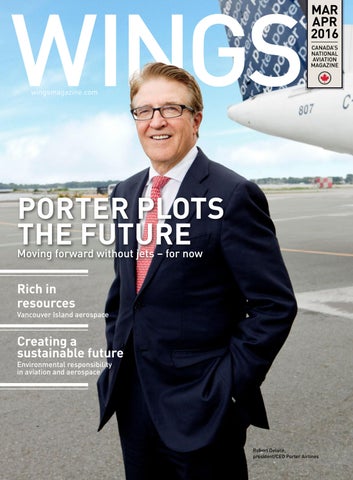
PORTER PLOTS THE FUTURE
Moving forward without jets – for now
Rich in resources
Vancouver Island aerospace
Creating a sustainable future Environmental responsibility in aviation and aerospace
Robert Deluce, president/CEO Porter Airlines
MARCH/APRIL 2016
UPFRONT 5 Leading edge
The constant need to innovate
8 On the fly
News and opinion
12 Alternate Approach C Series breakthrough
13 At the Gate
Following an established path
14 Glidepath
Look Ma, no hands . . . or pilot
BACK 35 Marketplace 38 On final
I spy: drones and privacy law
Porter Airlines president/CEO Robert Deluce is carefully planning his airline’s next move. P.16
FEATURES 16 PORTER PLOTS THE FUTURE
The airline is moving forward without jets – for now
PHOTO; PORTER AIRLINES (TOP); BOMBARDIER (TOP LEFT); CANADIAN FORCES COMBAT CAMERA (BOTTOM LEFT)
BY DAVID CARR
From top: C Series bargaining C-hip? P.12. Following an established path. P.13.
21 CREATING A SUSTAINABLE FUTURE
Environmental responsibility in aviation and aerospace
BY BRIAN DUNN
24 RICH IN RESOURCES AND OPPORTUNITIES
Vancouver Island’s aerospace footprint is as diverse as its geography
BY PAUL DIXON
COVER PHOTO: PORTER AIRLINES
WWW.WINGSMAGAZINE.COM
March/April 2016 | WINGS
3
Erin Grant, Bachelor of Aviation Technology Graduate (2013), now First Officer Jazz Aviation LP
Seneca and Jazz are proud partners and industry leaders. Seneca graduates are industry-ready and prepared for direct entry to a First Officer Pilot position through the Jazz Seneca Cadet program.
Find out more about this unique program. senecacollege.ca/aviation
LEADING
EDGE
| By Matt Nicholls
Innovation and persistence
Changing the aviation landscape doesn’t happen overnight
B
PHOTO: BOMBARDIER
ombardier Aerospace and Air Canada stole headlines in mid-February with the very welcome news that the aircraft finally has it first North American customer. Air Canada’s US$3.8 billion deal for 45 CS300 aircraft – with an option for 30 more CS300 aircraft (or smaller CS100s given the specific circumstances) was music to the ears of Bombardier’s commercial aviation team and it took some of the sting out of a concurrent announcement that the company is continuing its restructuring efforts in a big way, laying off some 7,000 workers globally in both the aerospace and rail sectors (for more, see “C Series breakthrough,” pg. 12). The C Series announcement was painfully necessary for Bombardier, and while cynics may wonder about government influence in the deal, Air Canada president and CEO Calin Rovinescu made it clear that the purchase decision was not based on government pressure, just prudent judgment and careful analysis of what the competition had to offer. “To get the Letter of Intent (LOI) took months,” he said. “This is consistent with how we buy aircraft with other manufacturers.” Bombardier is indeed faced with challenging economic conditions as it tries to make headway in the tight single-aisle 100- to 150-seat market. And despite a robust forecast from Boeing of 38,050 new airplanes valued at some $5.6 trillion over the next two decades – of which the single-aisle class (90 to 230 seats) represents a huge growth proposition – major global airlines have a bevy of innovative and worthy choices as well as the C Series: Boeing (737 series), Airbus (A320 series), Embraer (E-Jets) and China’s new Comac C919.
5 WWW.WINGSMAGAZINE.COM
It has the goods and technological acumen to make a difference in a big way. Pratt & Whitney president Bob Leduc, for one, is a believer. Pratt makes the engines for the aircraft (two PW1500G engines for both the CS100 and CS300) and he noted at the Singapore Airshow that the program is on the right path. When asked if he was worried about its future, he told Reuters, “I don’t think I am, because I find it hard to believe the government will let them fail.” Making headway in this market will be difficult but the rewards will be staggering. A new forecast from Embraer released at the Singapore Airshow mirrors the Boeing report. Embraer predicts global airlines will take delivery of some 1,570 new jets in the Asia-Pacific region in the 70- to 130seat segment over the next two decades valued at $75 billion. Market demand globally puts the numbers at 6,350 new jets valued at more than US$300 billion. All of the aircraft in this segment have sound attributes and advantages and the C Series faces a difficult challenge. But with persistence and patience, it can find a piece of the action. The Air Canada deal brings optimism and hope for future success. | W
This is consistent with how we buy aircraft with other manufacturers. Boeing’s 737 MAX 8 took to the skies for the first time in February and has drawn rave reviews for its innovative construction, fuel efficient design, range and flight capabilities. It remains on track for an introduction into service by Southwest Airlines for the third quarter of 2017. Not to be outdone, Airbus’ A320neo marked its own milestone in late January as the Lufthansa Group, Airbus’ largest customer and operator, took delivery of its first A320neo. Lufthansa is the first global airline to receive the neo. The aircraft is powered by Pratt & Whitney’s PurePower Geared Turbofan engines, which help the aircraft reduce emissions and noise and drive fuel costs down. The C Series is also a worthy competitor.
TOP DATA BURSTS… in this issue
1. Boeing’s new 737 MAX 8 has a range of 6,510 kilometres (pg. 8). 2. Charles Bombardier’s supersonic Antipode will travel 20,000 kilometres in under one hour (pg. 10). 3. 9,200: The new EHang 184 manned UAV can go 3,000 metres at 100 km-h (pg. 14). 4. $760 million The amount the Argonne National Laboratory has earmarked for green R&D (pg. 22). 5. Victoria International Airport will see some 1.7 million passengers in 2016 (pg. 24).
Your feedback is always welcome. Please contact me at mnicholls@annexweb.com. @Wings_Magazine March/April 2016 | WINGS
5
WINGS
MAR APR 2016 CANADA’S NATIONAL AVIATION MAGAZINE
wingsmagazine.com
Vol. 57, Issue 2 EDITOR
Matt Nicholls mnicholls@annexweb.com 416-725-5637
PORTER PLOTS THE FUTURE
MEDIA DESIGNER
Moving forward without jets – for now
Emily Sun
Rich in resources
FLIGHT DECK
Vancouver Island aerospace
Rick Adams, David Carr, Paul Dixon, Brian Dunn, Frederick K. Larkin, James Marasa, Carroll McCormick, Anna Pangrazzi, Amanda Winters
Creating a sustainable future
PHOTO CREDIT TK
Environmental responsibility in aviation and aerospace
SubScribe TODAY !
ACCOUNT MANAGER
Kory Pearn kpearn@annexweb.com 519-902-8574
Robert Deluce, president/CEO Porter Airlines
1 Year SubScription only
3295
$
ACCOUNT CO-ORDINATOR
Stephanie DeFields sdefields@annexweb.com 1-888-599-2228 ext. 257
(GST $34.60 • HST $37.23) US $57.95 (USD) • Foreign $65.95 (USD)
Name: _______________________________ Company: ____________________________ Title: _________________________________ Address: _____________________________ City: _________________________________ Prov: ________________________________ P.Code: _______________________________ Tel: __________________________________ Fax: _________________________________ email: ________________________________
NATIONAL ACCOUNT MANAGER
Mena Miu mmiu@annexweb.com 905-713-4351 GROUP PUBLISHER
Martin McAnulty mmcanulty@annexweb.com DIRECTOR OF SOUL/COO
Sue Fredericks
WINGS MAGAZINE
P.O. Box 530, 105 Donly Dr. S., Simcoe, ON N3Y 4N5 Tel: 519-428-3471 Fax: 519-429-3094 Toll Free: 1-888-599-2228
PLeASe cHecK ONe:
❑ Charter/Fractional ❑ Commercial Airlne ❑ Private Aircraft Owner/Operator ❑ Air Transport-Cargo ❑ Tour Operator ❑ Training/Education ❑ Airport ❑ FBO ❑ MRO ❑ OEM ❑ Aviation Distributor ❑ Aviation Fuel Supplier ❑ Aviation Services ❑ Aviation Sales/Marketing ❑ Para-Public/EMS/SAR/Law Enforcement ❑ Government/Military ❑ Resources - Construction, Fire, Forestry, Mining, Oil & Gas, Wildlife, etc ❑ Other (please specify) ______________
Printed in Canada ISSN 0701-1369 Publication Mail Agreement #40065710 Published six times per year (Jan/Feb, Mar/Apr, May/ Jun, Jul/Aug, Sep/Oct, Nov/Dec) Subscription Rates Canada – 1 Year $ 32.95 (plus GST - #867172652RT0001) USA – 1 Year $ 57.95 Foreign – 1 Year $ 65.95 Circulation Email: apotal@annexbizmedia.com Tel: 416-510-5113 Fax: 416-510-5170 Mail: 80 Valleybrook Dr., Toronto ON M3B 2S9
PAYMeNT: Cheque - Payable to Annex Publishing & Printing Inc. Visa
Occasionally, Wings magazine will mail information on behalf of industry-related groups whose products and
MC
services we believe may be of interest to you. If you prefer not to receive this information, please contact our circulation department in any of the four ways listed above. Annex Privacy Officer privacy@annexbizmedia.com Tel: 800-668-2374 No part of the editorial content of this publication may be reprinted without the publisher’s written permission. ©2016 Annex Publishing & Printing Inc. All rights reserved. Opinions expressed in this magazine are not necessarily those of the editor or the publisher. No liability is assumed for errors or omissions. All advertising is subject to the publisher’s approval. Such approval does not imply any endorsement of the products or services advertised. Publisher reserves the right to refuse advertising that does not meet the standards of the publication.
Account #: __________________________ Expiry:_____________________________
TO SubScribe:
Tel: 416-510-5113 Fax: 416-510-6875
Mail: Wings Magazine c/o Annex business Media circulation 80 Valleybrook Dr., Toronto, Ontario M3b 2S9
Air Transport Association of Canada
ON THE
WEB
email: subscribe@wingsmagazine.com
www.wingsmagazine.com
GST#135274215RT001
6
Subscriptions non-refundable
Canadian Business Aviation Association
Magazines Canada
CAREERS IN AVIATION Looking to catch up on the latest hot news from around aviation and aerospace? Check out Aviation This Week, a live digital version of the top news stories affecting a variety of key markets. It's quick, essential information you need to know!
PRO316
WINGS | March/April 2016
WG_MarApr16_subad_MLD.indd 1
Canadian Owners & Pilots Association
PHOTO: ANNEX BUSINESS MEDIA
Signature: _________________________
WWW.WINGSMAGAZINE.COM
2016-02-23 11:49 AM
WELCOME TO OUR WORLD
As a naval aviator, test pilot and astronaut, Mark Kelly has been recognized for his courage and determination. A true pioneer, he appreciates the innovation, craftsmanship and utility of the Exospace B55, the first Breitling connected chronograph. This multifunction electronic instrument, powered by an exclusive COSC chronometer-certified caliber, reinvents the connected watch by dedicating it to the service of aviation professionals. Performance, functionality, and reliability. Welcome to the world of tomorrow’s technology. Welcome to our world.
BREITLING.COM
ON THE FLY For late-breaking news and exclusive web content, please visit us at: www.wingsmagazine.com
THE LEAD COMMERCIAL INNOVATION MILITARY PEOPLE ON THE MOVE
THE LEAD
AC’S NARROWBODY FUTURE COMPLETES FIRST FLIGHT The Boeing 737 MAX 8 reached a significant milestone on Jan. 29, successfully completing its first flight and launching a comprehensive flight-test program leading to certification and delivery. To date the MAX family has 3,072 orders from 62 customers worldwide, including Air Canada which has ordered 33 737 MAX 8s and 28 737 MAX 9s, plus options and rights for up to 48 additional aircraft. The 737 MAX will be the centrepiece of Air Canada’s narrowbody fleet renewal program, which will eventually include a replacement aircraft for its Embraer fleet. “The 737 MAX is expected to yield significant cost savings and is a key element of our ongoing cost transformation program,” said Calin Rovinescu, chief executive officer at the time the US$6.5 billion (at list prices) order was signed. “Projected fuel and maintenance cost improvements of more than 20 per cent per seat will generate an estimated CASM
[costs per available seat mile] reduction of approximately 10 per cent compared to our existing narrowbody fleet. In addition, the 737 MAX offers improvements to the environment.” The first new airplane of Boeing’s second century, the 737 MAX is powered by the latest technology LEAP-1B engines from CFM International, and features Boeingdesigned Advanced Technology winglets. The airplane will have the capability to fly more than 6,510 kilometres, an increase of up to 1,055 kilometres over existing NextGeneration 737s, and going beyond the higher selling Airbus A320neo. The first MAX test-aircraft, christened The Spirit of Renton, completed a twohour, 47-minute flight, taking off from Renton Field in Renton, Wash. and landing at Seattle’s Boeing Field. “The first flight of the 737 MAX carries us across the threshold of a new century of innovation, one driven by the same passion and ingenuity that have made this company great for 100 years,” said Ray Conner, chief executive of Boeing Commercial Airplanes. Boeing expects nine months of testing, with a second ship joining the certification program by the end of February. The company is on track to start deliveries to launch customer Southwest in the thirdquarter of 2017. Air Canada, which is scheduled to take delivery of its first two 737 MAX aircraft in December 2017, is expected to take advantage of the airplane’s range by placing the aircraft on long and thin routes to Europe and South America.
The 737 MAX will be the centrepiece of Air Canada’s narrowbody fleet renewal program. 8
WINGS | March/April 2016
This new northern service will enhance travel options for both business and leisure travellers alike.
STARTUP LINKS HALIFAX WITH CANADA’S NORTH Halifax is about to become Atlantic Canada’s newest gateway to the Canadian Far North. Sarvaq Aviation is partnering with Nolinor Aviation, a Montreal-based charter airline and joint venture company, to offer a single weekly flight between Nova Scotia and Iqaluit. Sarvaq Aviation offers logistical and other services to clients in Nunavut. FlySarvaq, the newly branded company, will also offer twice weekly flights from Ottawa, putting the upstart in direct competition with First Air. The announcement was made at the 2016 Northern Lights Trade Show, and marks the first time either company has entered the scheduled market. “It is our hope that this service will create significant possibilities for Nunavummiut looking to travel south as well as open up more opportunities for people to visit Nunavut,” said Adamee Itorcheak, president of Sarvaq Logistics, a partner in Kitchener, Ont.-based Sarvaq Aviation. The route will be served by a Nolinor Boeing 737-200. Last year, Nolinor took delivery of its fourth 737-200. While these jets are costly to operate and growing increasingly difficult to find, they are some of the only jet aircraft able to land and takeoff from gravel runways, making the type the workhorse of several Canadian northern airlines. Nolinor operates aircraft for customers throughout Northern Canada, where they provide charter flights for WWW.WINGSMAGAZINE.COM
PHOTO: BOEING (LEFT); NOLINOR AVIATION (TOP)
8 9 9 10 11
industrial clients, government and resource industry clients. All Fly Sarvaq flights, which will be offered in three cabin classes, will be operated by Nolinor in what appears to be an Indirect Air Service Providers (IASP) arrangement, although the existing partnership between Sarvaq and Nolinor may permit the venture to sidestep the licensing concerns that have delayed the February launch of Winnipeg-based NewLeaf, Canada’s first ultra-low cost airline. “We are delighted to welcome FlySarvaq to Halifax Stanfield,” says Ian Arthur, chief commercial officer for the Halifax International Airport Authority. “This new service will enhance travel options for both business and leisure travellers, saving them time and money. The route will also stimulate growth between the two regions by improving the movement of cargo to and from Iqaluit and encourage Atlantic Canadians to explore this part of Canada’s North.”
COMMERCIAL
C SERIES ROUTE PROVING SHIFTS TO EUROPE
PHOTO: BOMBARDIER (TOP); IMAGINACTIVE (BOTTOM)
Bombardier’s C Series aircraft program has begun the ramp-up to full production. The final assembly facility is fully equipped and the CS100 aircraft that is scheduled to be delivered to launch operator SWISS is structurally complete. In January, SWISS flight crews began their CS100 aircraft flight training at
Bombardier’s CS100 is starting to ramp up its production.
Bombardier’s Mirabel facility, where they will undergo intensive training to prepare for the route-proving flights they will operate alongside Bombardier’s flight crew when the CS100 route-proving aircraft flies to Europe. “The [European route-proving] program will be operated from SWISS’ own base in Zurich, Switzerland,” said Fred Cromer, president of Bombardier Commercial Aircraft. “Yet another way we are ensuring a flawless entry-intoservice alongside our first operator.” The program will use SWISS’ schedule, crew, maintenance crews and aircraft destinations. “It’s truly a spectacular sight to see the C Series final assembly line fully stacked with production aircraft in various stages of assembly,” Cromer told a 2016 Dublin Air Finance Conference. “The line itself has been designed for maximum production efficiency and our skilled production teams reached a milestone this month when they rolled out the first structurally complete aircraft that will enter service with SWISS in the next few months.”
INNOVATION
LEAVING “CONVENTIONAL” SUPERSONICS BEHIND The withdrawal of the Concorde from service in 2003 brought supersonic passenger travel to a screeching halt. For the first time in aviation history the dream of always going faster and further took a backward step. Last year, Europe’s Airbus filed a patent for a supersonic transport that would carry up to 20 passengers at four times the speed of sound, cutting the travel time from London to New York to one hour, and Vancouver to Tokyo down to three. The patent claims to reduce the sonic boom that was an obstacle to Concorde opening routes. More recently, Flexjet – a U.S.-based fractional operator – placed a firm order for 20 Aerion AS2 supersonic business jets. The three-engine jet, now under development in collaboration with Airbus, is expected to make its first flight in 2021, and enter service in 2023. The supersonic
The Antipode would be able to take off directly from any airfield by using reusable rocket boosters. WWW.WINGSMAGAZINE.COM
March/April 2016 | WINGS
9
ON THE
FLY
will have a top speed of Mach 1.5 (67 per cent faster than the top cruise speeds of current or anticipated long-range subsonic jets) and carry eight to 12 passengers, with an intercontinental-capable range of 8,800 kilometres. The cost of the AS2 is estimated to be US$120 million. “Throughout its history, Flexjet has been on the leading edge of aviation technology, introducing advanced performance to our owners. We are proud to be at the forefront of the next revolution in business jets; supersonic travel,” said Flexjet’s chair, Kenn Ricci. But as Aerion and Airbus chart the return of commercial supersonic flight, Canadian inventor Charles Bombardier is looking to push the envelope further. Bombardier, who last year introduced the concept of the Skreemr, a 75-passenger supersonic transport five times faster than Concorde, has unveiled the Antipode, a hypersonic capable of reaching Mach 24 – 12 times the speed of Concorde – and transporting up to 10
10 WINGS | March/April 2016
passengers 20,000 kilometres in under one hour. “Unlike the Skreemr (which would rely on an electric-powered magnetic rail gun system and hydrogen rockets to propel it into the sky), the Antipode would be able to take off directly from any airfield by using reusable rocket boosters,” Bombardier explains on his website, imaginactive.org. “The rockets would attach to the wings of the Antipode and provide enough thrust to lift off, climb to 40,000 feet, and reach Mach 5.” The acceleration boosters would separate from the Antipode and fly back to the airbase. At Mach 5, the aircraft’s onboard computer would ignite its supersonic combustion ramjet engine and accelerate up to Mach 24 at 40,000 feet. Counter flowing jets of air on the aircraft’s leading edges would reduce heat and the sonic shockwave. The biggest obstacle appears to be the development of the engine. NASA has been working to develop scramjets – or
Supersonic Combustion Ramjets – into a practical technology. With a scramjet, the oxygen needed by the engine to combust is taken from the atmosphere, passing through the aircraft, instead of from a tank onboard. The aircraft becomes smaller, lighter and faster. Bombardier estimates that Antipode would cost US$150 million a unit. Likely higher given the price tag for the AS2. He points out that the cost advantage of the Antipode would be to transport highly ranked business or military officials across the globe in less than an hour.
MILITARY
FWSAR HOBBLES TO THE FINISH LINE The bids are in to replace Canada’s aging FWSAR (fixed wing search and rescue) fleet, kicking off an intense six-month evaluation and lobbying effort, with a
WWW.WINGSMAGAZINE.COM
PHOTO: EMBRAER
Embraer’s medium twin-turbofan tanker-transport KC-390 aircraft is ideal for SAR missions.
contract for an unspecified number of aircraft not expected before 2017. The contract is valued at $3.1 billion, including a 20-year maintenance contract. Embraer was a late entry into the ring, with its KC-390 jet transport going headto-head with the Airbus C295W and
WWW.WINGSMAGAZINE.COM
Alenia Aermacchi C-27J Spartan turboprops. The winning entry will replace the Royal Canadian Air Force’s (RCAF) SAR fleet of six 49-year old de Havilland CC15 Buffalo and 13 Lockheed Martin CC-130 Hercules aircraft of approximately the same age. The Department of National Defense (DND) originally saw the need for 17 FWSAR aircraft, but has decided to leave it to the bidders to determine the final number of airplanes needed to support the RCAF’s search and rescue requirement. Both the Airbus C295W (AirPro SAR Services) and Alenia C-27J (Team Spartan) proposals have sunk deep Canadian roots into their bids. AirPro includes Provincial Aerospace, Pratt & Whitney Canada, CAE and L3 Wescom. Team Spartan members include General Dynamics Canada, KF Aerospace, IMP Aerospace and Standard Aero. It is not clear the level of Canadian participation in the Embraer bid.
PEOPLE ON THE MOVE Cathay Pacific Airways has appointed Nick Hays as vice-president Canada. Hays will be based in Vancouver and will be responsible for the airline’s business and operations in Canada. Hays brings a diverse mix of experience to his new role. He joined Cathay Pacific’s parent company, John Swire & Sonsin Hong Kong in 2006. He has also held management positions with Steamships Shipping in Papua New Guinea and Swire Shipping based in New Zealand. In 2010, he transitioned to Cathay Pacific as Planning Projects Manager where he was responsible for route development for the airline’s North America and Australasia passenger business. . . . The Air Canada Pilots Association has a new CEO. Milt Isaacs took control of the association Feb. 1. For the past 11 years, Isaacs was president of the Association of Canadian Finance Officers (ACFO).
March/April 2016 | WINGS
11
ALTERNATE
APPROACH By David Carr |
C Series breakthrough
The challenge of selling aircraft in competitive markets
T
12 WINGS | March/April 2016
also contemplates options for another 30 CS300s, with rights to swap out part of the order for the smaller CS100 in certain circumstances). Under Bombardier's more aggressive pricing strategy, the price per unit will fall well below the top of the rate card, although Rovinescu insists no government money is involved. Cheap exports from organizations such as U.K. Export Finance (Bombardier is Northern Ireland's largest manfacturing employer) are likely. Bombardier estimates that 80 per cent of departures worldwide carry less than 150 passengers. Air Canada has not revealed the seating capacity of its CS300. Deliveries will begin in late 2019 and the first 25 aircraft will replace the Embraer 190 fleet on domestic and transborder routes. Boeing has agreed to take up to 20 of Air Canada's 45 Embraer's off the company's hands as part of the MAX order. Air Canada has a long history of collaboration with Bombardier. The airline was one of the launch customers for the Canadair Regional Jet and Air Canada Express partners operate one of the largest fleets of Bombardier aircraft in the world. Air Canada has provided the boost the C Series needed. But has it also given Bombardier the beachhead it wants? | W
Fred [Cromer] was focused on getting an order from a big North American carrier with an international footprint. other, and Airbus and Boeing are going to leverage lower per cost unit manufacturing costs and whatever else it takes to prevent Bombardier from gaining a substancial foothold in the 100- to 150-seat market segment. Boeing would have fought even more aggressively for the [United] contract than usual, given that Bombardier was in the running, George Dimitroff, head of valuations for Ascend, an airline consulting firm, told The Globe and Mail. Bombardier has now bagged what may be a game changing order. "It's a turning point," Alain Bellemare, Bombardier's chief executive gushed at the news conference announcing the deal. "Fred [Cromer] was focused on getting an order from a big North American carrier with an international footprint. This is a big milestone." While the Air Canada commitment is a LOI at this stage, Rovinescu says this is the way the airline buys airplanes. "To get to the letter of intent takes several months. This is consistent with how we buy airplanes with other manufacturers." Based on list prices, Air Canada's firm order for 45 aircraft is valued at US$3.8 billion. (The LOI
David Carr is a Wings writer and columnist. WWW.WINGSMAGAZINE.COM
PHOTO: BOMBARDIER
he drought has ended. Air Canada's breakthrough letter of intent (LOI) to buy 45 Bombardier CS300 aircraft ended a 15-year dry run, and with a quantity of airplanes Bombardier executives had conditioned analysists not to expect. Still, Bombardier's plan to lay off another 7,000 workers from its aircraft and train division captured headlines. What is the line that if your dog walks on water somebody will point out it can't swim? With the stroke of his pen, Air Canada chief executive Calin Rovinescu has dulled the danger of the C Series becoming a magnificiently-designed bargaining chip for mainline airlines to squeeze greater concessions out of Airbus and Boeing for narrowbody orders. The business of selling commercial airplanes is a fiercely competitive and often cruel one. It is certainly not for the weakof-heart. Nor does the best fit always win; which is likely the case when United Airlines, a Star Alliance partner with Air Canada, announced it had selected the larger Boeing 737-700 over the better suited Bombardier CS100 to fill the gap between its smallest Boeing 737 and Airbus A320 aircraft, and its commuter fleet. With United, the stars appeared to allign for Bombardier. The 100-seat CS100 slotted nicely as a replacement for United's aging regional jets. Fred Cromer, president of Bombardier's commercial aircraft division and the C Series' salesman-and-chief previously worked in fleet planning at Continental before it merged with United. And Bombardier finally woke up on pricing. "I know what it takes to win large orders," Cromer told Bloomberg News in December. Any new customer is "going to expect an aggressive deal." In the end, United's stars aligned brighter with Boeing. The 136-seat 737-700 entered into service in 1998. Boeing sweated the tail off an amortized design nearing the end of its production life to offer a discount too deep for Bombardier to match. Plummeting fuel prices and the commonality with United's 737 fleet also helped to off-set the added cost of operating a larger and thirstier airplane, tipping the scales in Boeing's favour. Customers play suppliers against each
AT THE
GATE
| By Brian Dunn
Following an established path
Northstar Aerospace’s varied products have it moving in the right direction
PHOTO: MCPL MARC-ANDRE GAUDREAULT, CANADIAN FORCES COMBAT CAMERA
N
orthstar Aerospace bills itself as “North America’s leading independent manufacturer of flight critical gears and transmissions,” with plants in Milton and Windsor, Ont., as well as in Phoenix and Chicago where it moved its head office from Toronto in 2003. The company began life in 1984 as Derlan Industries, a gear manufacturer in Cambridge, Ont., the same year it acquired Havlik Technologies, another gear maker in Cambridge. Three years later, it acquired D-Velco Manufacturing in Phoenix, which it continues to operate. Another division, Phoenix D-Velco Aviation Services, offers military and commercial engine component and structural repair and overhaul services. These include containment rings, hot section components, airflow and a number of airframe control surfaces and components. Chicago accounts for roughly 46 per cent of company revenues, which topped $183 million in 2013 and has grown yearover-year, according to Nicholas Bartolomeo Choo-Son, senior program manager, Northstar Aerospace (Milton). More recent figures have not yet been released by Wynnchurch Capital, a private equity firm that acquired Northstar in 2012. Milton was the second-largest producer at 36 per cent followed by Phoenix at 12 per cent and Windsor at eight. Total employment is around 830, including 220 in Milton and 80 in Windsor. Derlan changed its name to Northstar Aerospace in 2002 to reflect its focus on the aerospace business. Defense is by far the largest sector that Northstar serves at 74 per cent of revenues generated and commercial is at 26 per cent. Defense clients include the usual suspects like the U.S. Army, Boeing, AgustaWestland and Sikorsky, while the commercial side boasts Boeing, Bell Helicopter, Columbia Helicopters, Honeywell, General Electric and Rolls-Royce as clients. Its key programs on the defense side is manufacturing housings, shafts and gears, particularly Face Gears for the upgraded drive system for the Apache AH-64. Northstar also makes components and assembly of main transmission and nose gearboxes for the Apache. In addition, the company makes parts 13 WINGS | March/April 2016
Gear in April 2000, made Northstar the primary supplier of certain gears and transmission components to Boeing and the U.S. military. Northstar manufactures rotor heads for helicopters, which requires highly precise machining on metals such as titanium and faultless assembly of components that are primarily manufactured in Milton. Northstar is also a tier 2 supplier of rotary wing components, producing for companies that design and assemble helicopters globally. The components are used on the Boeing CH-46, AgustaWestland Lynx, Kaman SH 2G, Bell 609 Tilt Rotor aircraft, Bell UH-l, AH-1 Super Cobra and the Sikorsky UH-60 Black Hawk, mostly manufactured in Milton. In addition, the company produces a number of machined and fabricated parts, including structural aerospace parts, housings and casings for missiles and rockets and parts for accessory power units. These operations are done in Phoenix and Windsor. The Northstar Chicago facility has contracts directly with the U.S. government to provide MRO services on AH-64 Apache transmissions and on the forward, aft and combiner transmissions on the CH-47 Chinook. Phoenix repairs a variety of structural components, wing parts and flaps on older aircraft for commercial airlines, courier and freight companies. Looking to the future, Choo-Son sees opportunity on the commercial side, given that most military budgets are being pared back. He cited the medium to heavy lift helicopter program and the national shipbuilding procurement program as examples. | W
We’re seeing growth in business and regional aircraft, narrow body and wide body platforms out to 2030. for the complete drive system, including gears, housings and shafts for the CH-47 Chinook and repairs and overhauls the forward, combiner and aft transmissions and parts. On the commercial side, Northstar is involved in creating the Integrated Gear Box, Stepaside Gear Box, Auxiliary Gear Box and Access Drive Systems for the RollsRoyce Trent 1000 and supports other Trent engines like the Trent 500 and legacy programs. The principal applications of Northstar’s AGBs are for Bombardier’s regional and business jets and the F-22 Raptor. For Honeywell, it fabricated airflow component parts and precision machine housings in addition to repair and overhaul services. The acquisition of Boeing Precision
Brian Dunn is a Wings writer and columnist.
WWW.WINGSMAGAZINE.COM
GLIDE
PATH
By Paul Dixon |
Look Ma, no hands . . . or pilot
The Ehang 184 gives us a glimpse of the future of autonomous aircraft
E
14 WINGS | March/April 2016
good old days when your
The passenger has only to input father might pull over on a back road and say that it was their desired destination (don’t time for you to try driving. ask me how), click their heels and Oh no, when the computer hands off or “disengages” in off they go. all work? It’s very much a work in progress as the company offers this explanation in its handouts: “Because the 184 AAV represents an entirely new category of technology, there are regulations and agencies that are still catching up. We are in uncharted waters, and are working closely with government agencies across the planet to develop and regulate the future of transportation.” Look at the world of the driverless car and you can gain some insight into what the future might be for autonomous aircraft. Google has taken the lion’s share of the attention with its little jelly-bean cars, but they are only one of a number of companies in the race – companies with very deep pockets that are quite prepared to spend enormous sums in the pursuit. The State of California is developing regulations regarding the care and feeding of autonomous vehicles and requires companies to file reports on their work, miles driven, etc. and most importantly, the number of “accidents” their test cars have been involved in, as well as the number of times the software has dictated that the caretaker human onboard take over. It should be noted that these handovers aren’t like the
favour of the resident human, it will be in mid-stream and RIGHT NOW! Which brings us back to the world of commercial aviation and several disasters in the past decade that have resulted from a disconnect at the human-machine interface. When the machine (autopilot) encountered a situation outside its programmed capabilities and handed things off to the human side of the partnership, the situation was what rugby players used to call a hospital pass, because very little good would come of it. The research that has gone into developing autonomous automobiles is slowly starting to come to light. It’s all about processing information and then making decisions, the best or most appropriate information based on time and circumstances. A lot of this research could be used on the aviation side as well, such as the human factors and especially the human-machine interface. Success in the quest for the driverless car comes when the there is no driver, just passengers – as long as they have a place up front for the dog. | W Paul Dixon is a freelance writer and photojournalist living in Vancouver. WWW.WINGSMAGAZINE.COM
PHOTO: EHANG
very once in a while you have to stop yourself and wonder out loud, “what in the xxxx is going on here?” We’ve watched the proliferation of UAVs in recent years, especially at the personal level, sparked in no small measure by Amazon and others who are bound and determined to make our lives better in every way (not to mention their bottom line) through the use of UAVs. Five million small UAVs were sold into the North American Christmas market this past year and where they are at this very moment is anybody’s guess. I’m thinking many of these Christmas presents have already been consigned to the slag heap of Christmas presents past, when joy turns to dismay once the realization sinks in that they require direct human input which requires more than a bit of talent coupled with hard work. On the terrestrial side of things, recently the push has been towards developing driverless automobiles, with the ultimate goal to remove human input from the “driving experience” altogether. And that’s no driver input whatsoever, like that dystopian view of the industrialized robotic factory of the future. It’s a building full of robots, with one man and a dog. The man is there to feed the dog and the dog is there to prevent the machine from touching the machines. At this year’s Consumer Electronics Show in Las Vegas, Ehang, a Chinese company, introduced the Ehang 184, a UAV capable of carrying a passenger. I guess it’s not actually a UAV, because it’s not “unmanned,” but I’ll leave it to someone else to create a more accurate pigeonhole. The name “184” is derived from “one passenger, eight propellers, four arms.” It’s a quadcopter with 110-hp under the hood. Passengers up to 100 kilos (that leaves me out) can be transported to an elevation of 3,000 metres at speeds up to 100 km-h, limited only by the 23 minutes of go-go juice. The 184 is based on the premise that it will be totally autonomous. The passenger has only to input their desired destination (don’t ask me how), click their heels and off they go. The company wants you to know that there is a failsafe system, so should anything malfunction, the 184 will “immediately land in the nearest safe area.” Really? Of course it will. So how will this
Canada’s Fixed Wing SAR aircraft are overdue to be replaced. Every day, SAR crews put their lives at risk without question to keep Canadians safe. They deserve the tools to do the job effectively and safely. They need a PROVEN, RELIABLE, AND LOW RISK SOLUTION. The United States Coast Guard, Portuguese Air Force, Chilean Navy, Royal Oman Air Force and Brazilian Air Force, among many others, refused to burden their crews with developmental or experimental solutions. They insisted on getting the best of proven technology. They chose Airbus Defence and Space. WANT A REFERENCE FROM SOME OF THE WORLD LEADERS IN SAR? JUST ASK THEM. The C295, with more than 20% Canadian content, will be supported by Provincial Aerospace and Vector Aerospace. Find out more information at www.c295.ca
PORTER PL THE FUTURE
O
ttawa’s unilateral decision to close the door on jets at Billy Bishop, Toronto’s City Centre Airport dealt a setback to Porter Airlines and has put a backyard order for Bombardier C Series jets at risk. With the potential for U.S. customs preclearance at the urban airport 16 WINGS | March/April 2016
on the horizon and money in the bank from Porter’s sale of its terminal building last year, the airline approaches its 10th anniversary on a confident growth curve. And what should be read into the fact that the C Series order remains on the books? Wings caught up with Porter’s founder and chief executive Robert Deluce, the key
note speaker at the magazine’s Toronto edition of Careers in Aviation Expo this spring. Shutting down jets even temporarily (see, “Trudeau said ‘no’ – but did he really,” pg. 14, Jan/Feb) was a disappointment for the airline, but it does not appear to have dented the management team’s confidence level any.
“There was never a jet plan ‘A’ and a non-jet plan ‘B,’ ” Deluce insists. “The jet plan was getting the required approvals we needed to operate the CS100 from Billy Bishop Airport. Obviously, the decision has put us in a position where we’ve had to step back a little bit and think [about] what we want to do next and where we want to go. WWW.WINGSMAGAZINE.COM
PHOTO: PORTER AIRLINES
MOVING FORWARD WITHOUT JETS – FOR NOW BY DAVID CARR
Porter Airlines president/CEO Robert Deluce, seen here in the mock up cockpit of a CS100, says Porter will grow, with or without jets.
PHOTO: PORTER AIRLINES
LOTS But with or without jets, there is room for growth.” Porter, which remains in private hands, began operations in October 2006 with more than $125 million in start-up capital – one of the largest investments in a new airline in North America at the time – two Bombardier Q400 turboprops and a single route to Ottawa. Today, the airline operates 26 Q400s to 23 scheduled destinations in Eastern Canada and the U.S., and has grown to become the third largest scheduled airline in Canada, augmented by WWW.WINGSMAGAZINE.COM
seasonal routes to leisure spots such as Mont Tremblant and Florida. Deluce notes that the airline is debt free with cash on hand as a result of the sale of its purpose-built passenger terminal to Nieuport Aviation Infrastructure Partners, a Toronto-led international investment group that includes InstarAGF Asset Management and billionaire developer Larry Tanenbaum, part owner of the Toronto Maple Leafs. The sale was for an undisclosed amount thought to be upwards of $750
million, and is expected to help fuel the next phase of growth. “Building that terminal to a certain standard was a really good move on our part, given that there was no one else willing to step up to the plate,” Deluce says. “We took some considerable risk in doing that, but it was never intended as a core asset. We chose to conclude a sale and leaseback transaction with Nieuport. They are going to get out of it what they want and we have a long-term locked in arrangement that has helped us position ourselves for the future growth of the airline. We will use the balance sheet [from the sale] to help finance the airplanes we need.” Where these new airplanes go, and whether the fleet will contain jets, Deluce isn’t saying. While there is still room to grow at Billy Bishop the airport is constrained, which means any aggressive expansion strategy on top of the current structure will have to grow operations elsewhere. Interestingly, Porter’s order for 12 CS100’s – with options for a further 18 of the jets – remains on the books, but Deluce cautions against reading too much into that. “Just the opposite,” he warns. “We have had the deposit since April 2013, and there is really no good reason to remove it. It is a matter of us keeping our options open rather than being pointed in one direction. There is no reason to close that avenue off
while we are contemplating our next move.” Reports surfaced in February that one of the moves includes selling the airline. "There is no truth to that rumour," Brad Cicero, a Porter spokesperson told the CBC. "We have heard this many times over the last few years, but Porter is not for sale. There have been no discussions with any parties." Eventually, the airline would like to bring its acclaimed level of service to Western Canada, but such a move is unlikely before the economy rebounds. Porter would also like to push further into the U.S., but much of that expansion hinges on adding U.S. Customs preclearance at Billy Bishop Airport. The airport already handles more trans-border traffic than Halifax and Winnipeg, and recently overtook Ottawa as Canada’s sixth busiest cross border gateway. Eight Canadian airports currently have U.S. customs preclearance, and processed an estimated 11 million passengers last year. Canadian Transport Minister Marc Garneau was in Washington recently to discuss adding U.S. customs desks to Billy Bishop and Quebec’s Jean Lesage airports as part of the Beyond the Borders Action Plan signed by the previous government in 2011, and a more recently comprehensive preclearance agreement signed in March 2015. Such a move may result in Porter augmenting its Washington D.C. service at Dulles with the more convenient Ronald Reagan Washington
Quiet and reliable, the Q400 remains the backbone of the Porter fleet. March/April 2016 | WINGS 17
The decision has put us in a position where we’ve had to step back a little bit and think [about] what we want to do next.”
National Airport, which is not staffed by customs officials. “It will allow us to go into some U.S. airports that are strictly domestic airports, for which pre-clearance would be useful,” Deluce adds. More U.S. destinations also adds up to more American
dollars flowing north. As a Canadian airline, Porter has to balance the dual edged sword of lower fuel prices against a plummeting dollar. “We’ve had a good tail wind with the cost of fuel,” Deluce points out. “The bad news is that we pay for our fuel in U.S. dollars, and we pay
LEKTRO
Since 1945
The Ultimate Aircraft Tug
Models From
15,000 to 210,000 lbs.
Electric Towbarless Certified Easy to Use Universal Rugged Simple to Maintain www.
LEKTRO .com
1-800-535-8767 1-503-861-2288 sales@lektro.com
for other things in U.S. dollars. Having said that, we’d rather be where we are today with the lower fuel prices because there is a net benefit, and an increasing amount of our revenue is coming in in U.S. dollars.” For now, Porter will expand where it can, perhaps adding new services at core airports outside of Billy Bishop. “There are some short-term regional destinations that we can develop from this airport, and we have always stated that Ottawa, Montreal and Halifax are focus cities that we expect to grow over the long-term. That is still the case,” Deluce says. Since launching operations almost 10 years ago, Porter has yet to drop a single scheduled route, although some early destinations such as Chicago Midway and Boston were reported to be tough sledding. Deluce attributes this to research and will power. “We research our routes pretty carefully and are very nimble in terms of assessing new potential and putting things in place a little quicker than some larger airlines. Today, I can say we have some very strong routes, even if some were a bit slow in terms of developing – and we have had those sort of routes.” The economics of the Q400 has helped. Depending on fuel prices and other operating costs in specific markets, Porter pegs its breakeven load factor somewhere between 49 per cent to the higher 50s. On average,
18 WINGS | March/April 2016 WG_JanFeb16_Lektro_CSA.indd 1
each Q400 operates around the breakeven factor. As a private company, the airline does not have to disclose its finances, but Deluce says the company was profitable in 2015, and he expects the same for 2016. The passenger profile has altered over a decade from approximately 75 per cent business to a more balanced 60/40 business to leisure ratio, although Deluce insists the airline has not strayed from its business roots. “We are still a time sensitive, business-focused airline,” he says. “Many of those who fly with us on business like the product and will take a family member or partner to do something fun on the weekend to one of our leisure destinations, or a destination where they can enjoy a bit of free time such as Montreal and New York. The airline has also stimulated markets, especially in northern Ontario where Porter Q400s have broken the grip at single service destinations. “Affordable air fares, good frequencies and a choice of airlines can stimulate traffic tremendously, sometimes by 50 to 60 per cent,” Deluce points out. “We have seen that in almost every market we have been [in]. When the other airline had 100 per cent of the market and we come in and can gain 50 per cent market share or better, that’s good. When the overall traffic stimulates by 50 per cent or more, that isn’t bad either. Everybody is a winner.” WWW.WINGSMAGAZINE.COM
2016-01-15 2:31 PM
PHOTO: PORTER AIRLINES
The new pedestrian tunnel at Billy Bishop has been a boon for passengers.
Asked whether the Porter model could be exported to an ultra-low cost carrier, Deluce, an industry veteran long before Porter, offers some sound advice: be prepared. “The low-cost model has worked elsewhere in the world with considerable success, and there is no reason to think it can’t work somewhere in Canada. Certainly, anybody who is in the low-cost market place has moved more toward being a legacy rather than a truly low-cost carrier, so there is some appeal to the ultra-low cost model. Whatever the model, there is going to be pretty fierce and sometimes even predatory competition. When you start off as a new airline and you go into a market, you have to be well conditioned.” Indeed, operating a boutique airline from a downtown urban airport away from Pearson did not shield Porter from bruising competition. “We experienced all the predatory practices that have ever been deployed
has struggles to attract passengers, Deluce says a portion of passengers riding the rails have been good for business. “We do attract passengers from the two stations between here and Pearson,” he says. “We are getting passengers who are travelling the UPX in our direction, and some passengers who chose to fly in on Porter, overnight to take advantage of some of the amenities downtown, and take the train to connect to a long haul or international flight. We are two different airports. The UPX compliments what we are doing.” This April, Deluce will be the key note
speaker at Wings’ and Helicopters’ Careers in Aviation Expo April 9 inside the Porter hangar, meeting up with some of the eager students who one day might be piloting the aircraft, maintaining it or supporting the airline’s growth. Deluce makes a habit of attending most of the airline’s orientation sessions or interacting with the new flight crews, including a surge in women recruits. “The ability of a company like Porter to grow and expand is dependent on having really good people,” Deluce says. “We are looking hard to try and attract the best people as possible as we move forward." | W
IT IS A MATTER OF US KEEPING OUR OPTIONS OPEN RATHER THAN BEING POINTED IN ONE DIRECTION. anywhere in the world,” Deluce reflects. “Putting more capacity in. Discount prices. Litigation. Frequent flyer points. You name it, they came at us with it in spades.” In the end, close proximity to downtown Toronto, convenience and service, including free onboard snacks, beer and wine triumphed. Porter was chosen North America’s Best Regional Airline in 2014, according to U.K.-based Skytrax, and ninth among the 20 best global airlines according to New York-based Condé Nast Traveler’s 2015 Readers’ Choice Awards, putting the airline in a five-star list occupied by Qatar Airways, Virgin Atlantic, Emirates and Qantas. “Porter is the smallest airline to be recognized and it is a remarked achievement to be listed alongside global brands flying long-haul routes," Deluce said at the time. The landscape surrounding Billy Bishop Airport has changed dramatically since the first Porter Q400 took off, en route to Ottawa, its turboprop engines drowned out from the noise of the neighbouring expressway. Condominium units around the airport have grown like weeds. A new pedestrian tunnel linking the airport with the mainland is popular with travellers, and UPX, a dedicated rail link now connects Toronto Pearson International Airport with nearby Union Station, Canada’s busiest rail and commuter transit hub. Early airport detractors argued that once the rail link was up, the business case for Porter would evaporate. Instead, while the UPX March/April 2016 | WINGS 19
WWW.WINGSMAGAZINE.COM
WG_MarApr16_Rousseau_CSA.indd 1
2016-02-12 1:14 PM
Pratt & Whitney Canada continues to work within a high environmental standard.
CREATING A SUSTAINABLE FUTURE
ENVIRONMENTAL RESPONSIBILITY IN AEROSPACE
W PHOTO: P&WC
BY BRIAN DUNN
ith more than 100 fixed wing and rotary engines certified in the last 25 years, Pratt & Whitney (P&W) must be part of the sustainability initiative, according to Robert Cadieux, environmental and sustainable development manager with Pratt & Whitney Canada (P&WC). And he questions P&W’s contribution to increased consumption as the planet continues to consume more and more resources. “We must be better at anticipating WWW.WINGSMAGAZINE.COM
long-term trends. Trends will define the boundaries of our design space. Adapt versus extinction. It’s a question of response time,” Cadieux said at ‘Sustainability 2015,’ an international conference on environmental sustainability in air vehicle design and operations of helicopters and airplanes held in Montreal. The conference was organized by the Montreal-Ottawa Chapter of the American Helicopter Society. By its 100th anniversary in 2028, P&W wants to go from being the “best aerospace company in the world to being the best
aerospace company for the world,” Cadieux said. This will be achieved through initiatives like reducing emissions in the company’s 51,000-plus engines currently in operation through fleet upgrades, designing, manufacturing and servicing products with minimal environmental impact, promoting zero waste by using by-products that are 100 per cent recyclable and by becoming a force for positive change. As a major engine manufacturer, economic and environmental issues become intertwined, noted François Brophy, principle engineer with P&WC. In a session entitled “P&WC’s Perspective on Environmental Challenges,” Brophy said as the cost of energy increases and becomes more volatile, it impacts the profitability of the company. And climate change leads to a new regulatory framework, which also has an economic impact. “The historic focus of NOx emissions has shifted to CO2 emissions and particle matter,” he said. “We need to consider this in future engine designs. The next generation of small gas turbines will reduce the amount of fuel burn.” The aerospace industry can’t meet its environmental commitments without sustainable alternative jet fuel (SAJF), suggested Steve Csonka, executive director of the Commercial Aviation Alternative Fuel Initiative. In 2012, aviation produced 689 million tonnes of CO2, or around two per cent of the global total. The industry is expected to grow by five per cent annually, but cleaner fuel initiatives are only improving by about two per cent annually, leaving a three per cent deficit, noted Csonka. “We need to develop fuel to live up to our low carbon commitments,” Csonka noted. “There is no standard formula for jet fuel. SAJF is indistinguishable from current petroleum jet fuel and SAJF is not pulling carbon molecules out of the ground and putting them into the atmosphere. It decouples us from carbon growth.” One positive development is that multiple feedstock such as cellulose, triacylglycerols (animal and plant), sugar and starch, waste and synthesis gas, are making progress across the board. “What can industry do? Share in research costs, development and commercialization, reduce GHG through the reduction of conventional jet fuel and customize flight training,” he said. “We need 300 million gallons of alternative jet fuel (annually) for industry to meet their objectives over the next few years.” With oil below $40 a barrel, it makes the SAJF industry challenging, Csonka noted. “Some people have not locked in long-term contracts. There is a larger focus on lowcost feedstock in smaller facilities. I also believe the price of oil will continue to rise March/April 2016 | WINGS 21
and there are three new renewable fuel facilities coming on stream within the next three years in the U.S.”
Putting a charge in industry Great strides have been made in battery technology, but their efficiency may peak below the efficiency of fuel said Pat Anderson an engineering professor from EmbryRiddle Aeronautical University in Daytona Beach, Fla. With a maximum speed limited for an electric battery, the industry is now looking at a turbine-electric hybrid engine. After creating the first parallel-drive hybrid aircraft in the world, Embry-Riddle is creating a fully electric airplane. A Diamond HK-36 aircraft with a 133 horsepower electric motor is being modified to operate completely under electric propulsion. Battery systems, mission profiles and aerodynamics are being optimized to maximize safety and flight time. The project is a key to the future of aviation, where emissions and noise control are two of the most pertinent issues, according to Anderson. “Battery power is going to improve, but I don’t think it will get to the (efficiency) level of gas,” he said. “When I look at road vehicles, I think the brass ring is a fully electric battery powered vehicle. And the reason we have hybrids is because batteries
aren’t good enough. Since they’re not weight limited or volume limited, they’re probably going to hit gas in their regime, whereas since we’re weight sensitive that may not happen. “It may be that we may have smaller fully electric battery powered airplanes up to a certain speed and weight. And beyond that, you may have electric propulsion systems or hybrid propulsion systems that carry us past those speeds. And hybrid can mean a couple of things. It can either be the actual propulsion system or you may have a fully electric motor that can then be extracting electricity from a combination
heading for the long-term goal, which is to have partially electric propulsion, and then you may end up with fully electric propulsion, but the question is, where does the electricity come from? It may not be done fully with batteries.” Anderson mentioned the Argonne National Laboratory research centre in Illinois that has earmarked more than $760 million to pursue innovative technology in clean energy, including battery technology. “They think they have a good handle on land vehicles,” Anderson said. “Now they want to turn their capabilities and technologies for basic research towards aero-
IATA is projecting 4.1 per cent annual growth in passenger traffic over the next 20 years of battery, super capacitor, fuel cell reactor or something to that effect.” But this technology is a long-term process. Boeing and NASA are both looking at a 2035 timeline for a single-aisle airplane, Anderson said. And if battery doesn’t get to the “gravimetric density” of fuel, it won’t be a battery-powered vehicle, but a mixed methodology of some type. “But that’s the way nearly everybody is
MAKING A PILOT OUT OF YOU.
Graduates from the Seneca Airline Pilot Flight Operations graduate certificate program are eligible for interviews at Air Georgian that could lead to a piloting career path. WORKING TOGETHER TO ENSURE YOU HAVE A FUTURE CAREER IN AVIATION. Find out more & apply at senecacollege.ca/aviation.
The above is subject to meeting Air Georgian’s standardized testing and evaluations. Air Georgian is a Proud Air Canada Express Partner.
space applications which are more weight sensitive.” Noise, more than fuel consumption, is becoming a key factor for phasing out older aircraft, according to Steve Colavincenzo, chief, acoustics and vibration at Bombardier. “When we first designed the CSeries in 2000, we were not planning for Chapter 4 (airframe noise reduction), but for Chapter 5 and 6, they were not even introduced yet,” he said. Bombardier is involved in such things as landing gear noise reduction, wing tip/ flap noise reduction and slat noise reduction in collaboration with the University of Toronto and McGill University and the Green Aviation Research and Development Network (GARDN). GARDN is an industry-led consortium of 40 public and private sector partners, including industry heavyweights like Bombardier, Pratt & Whitney Canada, CMC Electronics and Bell Helicopter. It is targeting what it refers to as the “valley of death” in the innovation supply chain, which includes prototyping, testing and demonstration of early-stage, pre-competitive research on next-generation aircraft, engines and avionics systems. “Low noise can be a competitive advantage as some airports charge noise related fees in 22 countries and some aircraft are not even allowed to operate in some countries,” Colavincenzo said. In addition to noise limits being a major issue in Europe, people in general are “shocked” the aviation industry is still using leaded fuel and are demanding more environmentally friendly products, said Boyd Rodeman, engineering specialist and compliance lead at Textron Aviation. In North America, Phase One of a Piston Aviation Fuel Initiative is underway to facilitate the development of unleaded aviation gas or Avgas with the least impact on existing fleets. Phase Two in 2016 will see engine and aircraft testing on two selected
22 WINGS | March/April 2016 WG_MarApr16_Seneca_Airgeorgian_CSA.indd 1
WWW.WINGSMAGAZINE.COM 2016-02-16 10:33 AM
PHOTO: AIR CANADA
IN 2012, AVIATION PRODUCED 689 MILLION TONNES OF CO2, OR AROUND TWO PER CENT OF THE GLOBAL TOTAL. fuels supported by the National Research Council and Transport Canada. “Alternative fuel solutions come in many forms, including unleaded Avgas, Jet A and Biofuel blends,” he said. Cost is the key barrier to the development biofuels as 85 per cent of its cost is in the feedstock, according to the University of Toronto’s Murray Thomson. UofT is part of BioFuelNet Canada along with several other Canadian universities, industry partners and government representatives involved in initiatives to accelerate the development of sustainable advanced biofuels. He estimated the cost of biofuel at $1.23-$1.53 per litre and expects 1.3 billion gallons to be produced over the next few years. Air Canada expects to realize a 1.5 per cent improvement in fuel efficiency and 50 per cent reduction in CO2 emissions by
WWW.WINGSMAGAZINE.COM
Air Canada continues to support the advancement of biofuels and other green initiatives.
2020 and have carbon neutral growth after 2020, according to Mena Salib, manager of aircraft noise and emissions. “Airlines have to charge additional fees to passengers to offset their carbon footprint and the only solution is sustainable fuels,” he said. “Air Canada is continuing its fleet renewal and is one of the most fuel efficient airlines in the world.” IATA is projecting 4.1 per cent annual growth in passenger traffic over the next 20 years, or double the current traffic to
7.3 billion passengers by 2034, Salib noted. “What Air Canada has done is support the advancement of sustainable fuels and supports a Canadian-made solution. Twenty per cent of a ticket price is for fuel. Adding to that price is not a viable solution. One per cent of Air Canada fuel is 42 million litres, so we need availability and consistency of supply (of biofuels) with no segregation requirements. We’re looking for a partnership similar to many airlines in the United States.” | W
March/April 2016 | WINGS 23
RICH IN RESOURCE AND OPPORTUNITI VANCOUVER ISLAND’S AEROSPACE FOOTPRINT IS AS DIVERSE AS ITS GEOGRAPHY
T
BY PAUL DIXON
24 WINGS | March/April 2016
Brand new Series 400 Twin Otter taxis at Victoria International Airport, home of Viking Aviation.
vice-president of VIAA, grew up in Victoria and is a graduate of Camosun College and the University of Victoria. Initially he moved to Vancouver to work in high-tech, but moved back to Victoria and started his own business, Race Rocks 3D, because as he says, “there is a lot of entrepreneurial spirit here. People who have learned elsewhere and either came home to Vancouver Island or decided to settle here to start their own business. There is a high level of knowledge and coupled with that entrepreneurial spirit and international investment there is tremendous growth industry.” Today, Dewis develops technology enabled learning systems for a diverse list of clients in aerospace, defense and the oil and gas sector, including Boeing and the Royal Canadian Navy. Viking Aviation, known across Canada and around the world, is the single largest player in the Vancouver Island Aerospace sector. Viking’s Series 400 Twin Otter has
been a hit since the company re-introduced the iconic aircraft five years ago and recently announced sales into China and Russia, which illustrates just how strong the brand is. Further up island in Campbell River, Sealand Aviation is known for its improvements to the DHC-2 Beaver, particularly its cabin extension kit and the Alaska door, as just two of many innovations. Campbell River is also home to ASAP Avionics, established in 1997 by Mark Sylvester. A couple of years earlier Sylvester, then living in Saudi Arabia, came to visit a friend in Campbell River. He quickly decided that this was the place he wanted to spend the rest of his life. It took time to work through the immigration process, but having noticed the number of floatplanes coming and going he saw an opportunity. Drawing on his experience in the Royal Air Force, ASAP Avionics was the result. He developed a wiring kit for the DHC-2 and a glass cockpit for the WWW.WINGSMAGAZINE.COM
PHOTO: PAUL DIXON
he times they are a changing on Vancouver Island. Long known as the land of big trees and even bigger salmon, Vancouver Island is home to an expanding high-tech and aerospace industry that has overtaken tourism on the economic scale. The Vancouver Island Aerospace Association (VIAA) was formed in 2015 to promote Vancouver Island aerospace to global markets. VIAA represents all sectors of aviation and aerospace on the Island – aerospace manufacturing and maintenance, airlines and air transport, ground-based infrastructure in the forms of airports and their networks as well as the region’s postsecondary institutions – that collectively fuel the engine that is building the future. That future is based on the same trade routes that led the first Europeans to these shores almost 250 years ago. Europeans first arrived on the West Coast of what is now Canada in the late 1700s as part of what was then a global trade pattern. Sea otter pelts were highlyprized in China and were exchanged for tea, silk, porcelain and other goods that could be sold in Europe. The giant, firstgrowth forests provided masts and spars for the ships of the Royal Navy and by the 1850s, the British colony of Vancouver Island was established. The sea otter was hunted to the point of extinction, but by the time Vancouver Island joined with British Columbia and joined Confederation, forestry and mining along with fishing were the economic drivers. Victoria, now the capital of B.C., proudly saw itself as the last bastion of the British Empire. The island is long (480 kilometres) and narrow (80 kilometres at its widest), with rugged mountains running its length. More than half of today’s population of nearly 800,000 resides in metro Victoria on the very southern tip. The growth industry today on Vancouver Island is in high tech, with a strong link to aerospace. Scott Dewis,
ES IES
DHC-3 Otter as well as the Robinson R-44 and R-22 helicopters. Sylvester is currently president of the VIAA. STAYING CONNECTED Transportation and connectivity have always been a challenge on the island, with a single highway running up the north-south axis on the east side and a single, winding highway running to west coast from mid-island to the communities Tofino and Ucluelet at either end of Long Beach. The First Nations who have lived up and down the coast for thousands of years were master mariners in their seagoing canoes. Today, there are still many isolated communities that can only be reached by boat or floatplane. Once floatplanes (and later helicopters) arrived on the West Coast, they became an integral part of the transportation system that is no less diminished today. The body of water now known as the Salish Sea that lies between Vancouver WWW.WINGSMAGAZINE.COM
Island and the mainland is not unlike the English Channel in many regards, creating a barrier that can be much more than just distance. BC Ferries carries approximately eight million passengers a year on its three major routes between the mainland and the island. While sailing time for the routes is between 90 minutes and two hours, the imposition on business travellers or those catching flights out of YVR is much greater, as many trips would require an overnight stay in Vancouver at both ends of a trip, given the logistics of ferry schedules. Now, the airport community on Vancouver Island is meeting the needs of travellers and reaping the benefits. There are three major airports on Vancouver Island: Victoria (YYJ), Nanaimo (YCD) and Comox (YQQ), with community airports in Campbell River, Tofino and Port Alberni. Victoria has been the major airport on the island for years, with direct daily flights to major Canadian cities including Vancouver, Edmonton, Calgary and Toronto as well as direct flights to Seattle, San Francisco and Las Vegas, with seasonal flights to Hawaii and Mexico. Halfway between Victoria and Comox, recent improvements at Nanaimo Airport give it the capability to accept up to B373 and A319 size aircraft. Currently, Air Canada offers service to Vancouver and Calgary, while WestJet offers direct flights to Calgary. Further up the Island Highway, Comox Valley Airport is proving to be a major economic force multiplier for the region known as North Island. The airport is actually a tenant of the Department of National Defence, with the terminal building and infrastructure located on the southern side of CFB Comox, home of 19 Wing and 407 Maritime Patrol Squadron and 442 Squadron Search and Rescue. For years, the airport existed quietly out of portable buildings that were barely adequate for the small number of commuter flights that serviced the airport. That changed in 2001 when WestJet introduced service to Calgary. Since then, WestJet and WestJet Encore have added additional flights to Calgary and Edmonton as well as seasonal service to Puerto Vallarta, while Air Canada offers direct service to Vancouver. Regional carriers Central Mountain Air and Pacific Coastal Airline connect to Vancouver and smaller communities up and down the B.C. coast. From a handful of passengers 15 years ago, Comox is on track to serve more than 330,000 passengers in 2016. Add that number to Nanaimo’s 280,000 and the 1.7 million for Victoria, don’t forget to include Helijet’s scheduled helicopter service to Victoria and Nanaimo from Vancouver. Then there’s Harbour Air, the world’s largest floatplane airline, and a handful of smaller operators connecting communities
up and down the island to the mainland. Kenmore Aviation of Seattle operates daily scheduled floatplane service between Seattle and Victoria. All told, that’s close to three million passengers flying in and out of Vancouver Island and it’s important to realize that none of them are simply passing through. Every one of them is either starting or finishing their trip on the island. RELATIONSHIPS THAT BIND Fred Bigelow, CEO of the Comox Valley Airport, explains the symbiotic relationship with the civilian airport and military sharing the same patch of land. As a retired RCAF brigadier-general and one-time 19 Wing CO, he has a unique perspective on the situation. He knows that operational requirements for the RCAF takes precedence at all times and at some point in the future if CF-18s were deployed to Comox, it could have a serious impact on passenger operations. At the same time, the civilian airport has a 10,000 foot runway at its disposal, 24/7 ATC provided by the RCAF and dedicated fire/crash service. A significant benefit to 19 Wing is from having the staff at YQQ function as their air movement unit. “We have an office with a couple of techs and a counter in the terminal,” Bigelow explains. “When they are deploying people on a C-17, maybe going to Kuwait or wherever, this is where they load the freight, sort out the passengers and get the people on the plane.” Perhaps the biggest benefit YQQ offers the military is the fact that it is a civilian airport with flights that can get parents and children on a flight to perhaps Disneyland or to visit family in Eastern Canada with minimal hassle, unlike the more isolated bases such as Cold Lake that are many hours removed from those flights. For families that are often separated for long periods by the demands of deployments, it’s a bonus. The quick connection through the airport is also a prime reason so many military personnel choose to retire in the region. 19 Wing is also home to the Canadian Forces School of Search and Rescue (CFSSR). Every year a class of candidates goes through an 11-month course at CFSSR to earn the right to wear the distinctive orange overall and earn the title SAR Tech. With the long overdue Fixed-Wing SAR (FWSAR) Replacement Project on the horizon, Bigelow realizes when the new aircraft is eventually selected there will be a requirement to train pilots and crew on the aircraft. Under the auspices of Comox Valley Economic Development, a committee comprised of retired senior military officers and representatives from the airport developed a report that presents Comox and 19 Wing as the logical choice for the location of a new FWSAR Training Centre. March/April 2016 | WINGS 25
“This is the place to do it,” Bigelow says. “We’ve got the synergies with the existing school and the Cormorant school. It’s good for the military and it’s good for the community.” What Comox lacks in terms of an FBO for business aviation and support for general aviation, can be found a short distance up the highway in Campbell River. Owned and operated by the City of Campbell River YBL is a full service, all weather airport with a 6,500 foot runway. The airports at Tofino and Port Alberni are both owned and operated by the AlberniClayquot Regional District. Long Beach Airport will receive $1.27 million in funding from the new B.C. Air Access Program, part of “B.C. on the Move,” the Government of B.C.’s 10-year transportation plan. Improvements include improved runway lighting, with an eye towards serving the expanding tourist traffic into the region as storm watching, surfing and eco-tourism become increasingly popular. The Alberni Valley Regional Airport (YPB) is a small, uncertified airport with a lack of
the Airbus C295W with a customized Coulson tank system. The airport expansion was a critical factor in Coulson being awarded the contract. Coulson started its tank program in 2012 and now employs about 60 people on the project and expects to hire more in the future. They will also be building a 60,000 square foot building at the AVRA. Coulson Air Crane and VIH Helicopters of Victoria are global players in the rotary-wing world, with their heavy lift helicopters working around North America and around the world. Ascent Helicopters in Parksville and West Coast Helicopters of Port McNeil are two of the larger rotary companies on the island. EDUCATIONAL OPPORTUNITIES Post-secondary education is critical for future growth in the island’s aerospace sector. In 2014, the three universities and two colleges, with financial assistance from the provincial government, formed Vancouver Island Post-Secondary Alliance. The educational institutions work collectively
The growth industry today on Vancouver Island is in high tech, with a strong link to aerospace infrastructure, but plans are underway to upgrade the airport, lengthen and widen the runway and install improved lighting. One of the immediate beneficiaries of the improved airport will be the Coulson Group, best known as the owners of the Martin Mars water bombers. Coulson has developed a modular tanking system that can be installed in C-130 Hercules aircraft, turning the aircraft into an aerial tanker. It has operated both in the U.S. and Australia. When the AVRA improvements are finished, the aircraft will be homebased in Port Alberni. In November 2015 Coulson signed an MOU with Airbus Defense and Space that will see Coulson Group undertake the “industrialization, supply and support” of the new water bomber version of 26 WINGS | March/April 2016 Ad.indd 1
with local businesses in order to understand how to best design their courses to meet future needs locally, nationally and globally. The University of Victoria is nationally and globally recognized as a top university, recognized as a leading research institution on a number of fronts including aerospace. Royal Roads University in Victoria focuses on business and humanities, with most students already working professionals looking to broaden their education with a bachelor or master’s degree. Vancouver Island University (formerly Malaspina College) in Nanaimo operates as a regional university, incorporating trades and technical programs alongside academics. VIU has a research mandate that includes fisheries, aquaculture and economic WWW.WINGSMAGAZINE.COM
2015-04-24 1:30 PM
PHOTO: RCAF
A CC-138 Twin Otter Aircraft flies over the Strait of Georgia in British Columbia.
development. An early boost to the partnership was an agreement between Boeing and the three universities that will see a student from each university taken into a paid internship by Boeing each year. North Island College offers programs in Aircraft Structures Technician (AME-S) and Aircraft Sheet Metal Manufacturing Technician programs at its Campbell River campus. While Camosun College in Victoria doesn’t have a specific aerospace
program, many of their students and graduates still end up working in aerospace. Camosun does have a strong interaction with local employers through its Technology Access Centre, which offers experts in technical design, 3D scanning and modelling, rapid prototyping, sensor integration and robotics. In July 2015, the provincial government provided Camosun with $1.5 million to create a testing interaction that will be part of the Trades Education
and Innovation Complex currently under construction. The University of Victoria Centre for Aerospace Research (CfAR) has been conducting research into unmanned vehicles and their applications since 2012 at their facility at Victoria Airport. Dr. Jenner Richards explains their work. “We are involved in a lot of blue-sky stuff, but what makes us different is that we also design and fly machines for clients, who are actually collaborators in many cases,” Richards said. “We look at ourselves as a sandbox for industry. People have great ideas for UAVs, but they don’t have the resources or the know-how. They can come to UVIC and we can be their toolbox and test out their concept. We’ve done projects ranging from bird-scaring for a small company to move ducks off a field, to the other end of the scale where we work for companies like Boeing, Embraer and Bombardier where we look at advanced concepts such as
aero-servo elasticity, flying aircraft that are fully instrumented and helping to build a database of information that they use to benchmark and create tools that are then used in the next generation of aircraft.” One of their more interesting projects has been the Boeing SensorCraft project – a collaboration between the University of Victoria, Virginia Tech, the U.S. Air Force Research Lab and Boeing. The project involved the design, construction, ground and flight-testing of scale test aircraft for investigation into the next generation, high altitude, long endurance platform. The aerospace community on Vancouver Island is a very inclusive community, integrated vertically and horizontally. Each strata is strongly interlinked with those above, below and beside it, but not totally interdependent. There is plenty of growth potential from top to bottom, a win/win situation that others would do well to take note of. | W
Aircraft Maintenance Engineering Next intake is Sept 2016 at our Dawson Creek Campus Affordable student residences available!
380/16.0
2.12.j
NLC’s 15-month Aircraft Maintenance Engineering program is designed to train individuals wanting to work in the aerospace industry. Graduates receive the full training component and 1.5 years of the four-year experience component required for an AME licence, category M1 or M2. Apply online through the Apply BC link at nlc.bc.ca or email studentrecruiter@nlc.bc.ca for more information.
nlc.bc.ca WWW.WINGSMAGAZINE.COM WG_MarApr16_Northernlights_CSA.indd 1
1-866-463-6652 March/April 2016 | WINGS 27 2016-02-16 9:06 AM
LES AALDERS Executive Vice President & Vice President, Atlantic Canada and British Columbia
laalders@atac.ca ATAC Participation in ICAO Committee on Aviation Environmental Protection
ATAC represented its members during the 10th CAEP triennial meeting at ICAO in early February. ATAC actively supported the Canadian delegation as an advisor and ensured that aspects under consideration for adoption by ICAO were either mitigated or were otherwise in line with the requirements of our operators. Very good headway was made to incorporate Carbon Dioxide (CO2) and Nonvolatile Particulate Matter (nvPM) emission improvements through adoption of the latest technology for in-production and new aircraft types without allowing any type of phase out of existing types of aircraft. With the lead up to the triennial ICAO Assembly in the fall of 2016 these meetings are key to developing practical solutions that clearly show that ICAO is showing leadership and making progress with regards to reducing aviation emissions so that regional jurisdictions do not implement their own penalizing schemes.
ATAC at MRO Latin America 2016 and MRO Americas 2016 Plans
ATAC and several of its MRO (Maintenance, Repair & Overhaul) industry partners participated in the Aviation Week MRO Latin America 2016 Showcase and Conference, January 20-22, in Lima, Peru. ATAC facilitated a successful networking and information-sharing event at the Canadian Embassy the day before the conference and hosted a Canadian MRO showcase table alongside Industry Partners AJW Technique, Lockheed Martin Commercial Engine Solutions and Mxi Technologies. The next major MRO events facilitated by ATAC will be MRO Americas 2016 in Dallas, TX on April 4-6 and MRO Europe October 18-20 in Amsterdam both of which will include the
always successful Canadian MRO Networking events. Contact ATAC if you wish to be part of this world-reaching Canadian MRO team!
ATAC IS PROUD TO WELCOME THE FOLLOWING NEW MEMBERS Alkan Air Whitehorse, YK
WAYNE GOUVEIA Vice President, Commercial General Aviation & Vice President, Prairie and Northern
Legal Counsel
wgouveia@atac.ca Promoting Canadian Flight Training Internationally
The latest Transport Canada statistics provided to ATAC show that for 2015 the number of foreign commercial pilot licenses issued in Canada amounted to 43.5% of the total for fixed wing aircraft and 38% for helicopters. The majority of foreign students came from China (67%), India (16%), France (11%), USA (4%) and UK (2%). Three ATAC companies; namely, Calgary Flying Club, Ottawa Aviation Services and Super T Aviation Academy, were active participants at the Shenzhen Aviation Association Conference and the China AOPA Conference in Shenzhen China last September and were supported by the Guangzhou Global Affairs Officer, Christine Tian. The mission supported ATAC keynote presentations at both events, B2B meetings and trade show booth displays promoting the FlyCanada brand. Meetings in Shenzhen with the Beijing United General Aviation (BUGA) group resulted in the signing of an MOU between Calgary Flying Club at the AOPA exhibition and the subsequent signing of a pilot training contract. Initiatives such as the GOA International Outreach Program, under the leadership of ATAC and the Canadian Trade Commission, are instrumental in creating the global awareness and presence required to accomplish our objectives of increasing our market share within the Asia-Pacific region. Ireland has also been identified as an emerging opportunity for Canadian flight schools. Four ATAC companies; namely, Calgary Flying Club, Ottawa Aviation Ser-
Jean Mongeau, LL.L. Montreal, QC XL Catlin Toronto, ON
vices, Super T Aviation and Waterloo Wellington Flight Centre, were on the second GOA mission to Dublin supported by Global Affairs Canada to showcase Canadian flight training at the Pilot Careers Live Exhibition. The FlyCanada booth prominently displayed Canadian aviation scenes and landscapes and allowed the flight schools to interface directly with operators and next generation pilots from Ireland. Support was offered by the Canadian Ambassador to Ireland, His Excellency Kevin Vickers, who hosted the Canadians and their business partners to a dinner meeting at the Embassy in Dublin.
MIKE SKROBICA Senior Vice President and CFO & Vice President, Ontario
mikes@atac.ca U.S. TSA Causes Confusion With NOTAM On December 14, 2015 the U.S. Transportation Security Administration issued a NOTAM which impacted “civil” aircraft operations. The flights in question were Canada to Canada overflight of US airspace. This NOTAM would have required small aircraft operators to get clearance to undertake the flight in advance for each and every flight. ATAC lobbied representatives at the TSA, and succeeded in getting the NOTAM modified January 16.
Air Transport Association of Canada 700 – 255 Albert Street, Ottawa, Ontario K1P 6A9 Phone: (613) 233-7727 • Fax: (613) 230-8648 • Website: www.atac.ca
#172
The official publication of the Canadian Business Aviation Association
NEWS BRIEF CEO’S CORNER
Partners in Safety: One Year Later Partners in Safety, launched by the CBAA in 2015, is designed to give operators the compliance direction and tools they need not only to maintain Canadian business aviation’s high standards and stellar safety record, but to build them even higher. Over the last year, the program has evolved to integrate easily into operations of all sizes, with new elements added to simplify compliance and to increase the amount of trending data that operators can access. “This program has been well received by our members. They use it every day, and have provided excellent feedback.” said CBAA president and CEO, Rudy Toering. “As a result, while there are a lot of good SMS-related products in the marketplace, Partners In Safety stands out. It is the only program designed as 604 compliant from the ground up and vetted by Transport Canada.” Partners in Safety deals specifically with the problems of managing the cost and complexity of implementing a fully compliant 604 SMS system, especially for smaller owner/operators, providing a
variety of tools and resources to support the process. The program includes a number of elements that work together, including a CBAA Member SMS, a Template Operational Manual, OM Checklist and National Aggregate Database (NAD) for trending analysis. Costs to subscribe are minimal, thanks to the generous support of the program sponsors, Bombardier Business Aircraft and NAV CANADA. The program is constantly evolving and improving. CBAA is currently in discussions with major operator members to expand the NAD, inputting thousands of new records that will provide
a robust baseline for trend analysis. As well, materials will be updated to reflect the Guidance Material once it is issued by Transport Canada. A flight data analysis component will be released later this year. “Safety is the hallmark of business aviation, and Canadian business aviation has the best safety record in the world” said Toering. “But simply sitting on our laurels is unacceptable. Our operators are working in a complex and rapidly evolving environment. The CBAA has an obligation to its members – and to the entire sector – to ensure that the best tools are available. In a nutshell, that is what Partners in Safety is all about.”
My personal invitation to attend CBAA 2016, July 5 – 7, Calgary AB If you haven’t been to a CBAA convention recently, you don’t know what you’re missing. CBAA’s annual convention and exhibit has gone through a sea-change over the last few years. With close to 700 delegates, focussed educational and plenary sessions, an exciting exhibit and a record-breaking static display in St. Hubert last year, Canada’s national event for business aviation has never been more relevant to your business and your future. Operator delegates have told me how pleased they are at the quality and relevance of the educational and plenary sessions. Associate members have said that the CBAA convention is just the right size to meet the people they want to meet and conduct business. The OEMs report new opportunities to sell aircraft. People also tell us that our networking and social events, from the Hope Air Golf Tournament, receptions, dinner
continued on page 2 www.cbaa-acaa.ca
CBAA-ACAA News Brief
1
CONTENTS 3
CBAA secures two critical CARs 604 exemptions
3
New economic impact study will increase CBAA’s influence
3 3
Meeting with GTAA on de-icing suggests a way forward
3 4 4
Back to business as usual for US airspace fly-overs
Business aviation gets partial win on TCO requirements
Events Calendar Register for CBAA 2016: Session Highlights Static Display Exhibitors
2
CBAA-ACAA News Brief
STAFF MEMBERS President and CEO Rudy Toering, rtoering@cbaa.ca Executive Assistant and Director of Administration Aime O’Connor, 613.236.5611 ext. 228, aoconnor@cbaa.ca Vice President, Government and Regulatory Affairs Merlin Preuss, 613.656.0505, mpreuss@cbaa.ca Membership Sales & Communication Services Manager Lindsay Berndt, 613.236.5611 ext. 221, lberndt@cbaa.ca Marketing & Industry Relations Debra Ward, 613.274.0619 dward@cbaa.ca
5
Connecting with Parliament: A New Member Resource
Events Coordinator Lise Hodson, 613.854.4686, lhodgson@cbaa.ca
5 5
CBAA thanks the following CBAA 2016 sponsors
Finance accounting@cbaa.ca 613.236.5611 ext. 222
Welcome New Members
registration package includes free access to all major activities: educational and and more, are the best of both worlds: plenary sessions, the exhibit, static, meals they’re fun and pay off in making and and receptions. Only the charity Golf strengthening business contacts. Tournament and Gala CBAA Dinner are CBAA 2016 is a big-tent extra. convention, with something There is another reason for everyone – and our aim that your attendance is is to draw operators, big or so critical: the power of small, from every corner of numbers. Our annual the country. Everyone who convention is the one time has a job keeping our planes that Canadian business in motion will find something aviation operators come of value. together by the hundreds, Rudy Toering, Our educational sessions with a unified voice, to President & CEO do not come out of a demonstrate to Transport generic box: they are Canada – and to the entire created and customized to meet the government – that business aviation is needs and challenges of Canadian a force to be reckoned with. We need operators dealing with both Canadian you all in Calgary to share our good news and international regulations. Our stories, especially as the safest aviation associate and OEM members will be sector world-wide. exhibiting their goods and aircraft at Bottom line, the CBAA convention the full service facility of our Diamond is a great investment of your time, your Sponsor, Million Air FBO. business, and in business aviation. And we To open the event to as many are constantly in continuous-improvement operators (and their staff) as possible, mode, listening to feedback and we are pleased to provide one tweaking everything to make it better complimentary convention registration and more relevant to you every year. to each operator. The comprehensive I will see you there!
continued from page 1
955 Green Valley Crescent, Suite 155 Ottawa, ON K2C 3V4 Tel: (613) 236-5611 • Fax: (613) 236-2361 Email: lberndt@cbaa.ca • Website: www.cbaa-acaa.ca
BOARD OF DIRECTORS EXECUTIVE COMMITTEE Chair • David Hall Maintenance Manager Irving Air Services Past Chair • Frank Burke Vice Chair • Rod Barnard, Flight Department Manager/Chief Pilot, Kal Aviation Group Secretary • Bill McGoey, President Aurora Jet Partners Treasurer • Mike Fedele, Innotech Execaire
BOARD MEMBERS AT LARGE BC Campbell • Aviation Director, Chief Pilot Scotiabank Louise Dunlop • President, Sterling Aviation Services Peter Bing • Sobeys Jean-Christophe Gallagher • Vice President, Strategy and Marketing, Bombardier Business Aircraft; Clement Nadeau • A.G. Aviation, Ltee. Anthony Norejko • Director, Travel Services & Aviation/Chief Pilot, Walmart Canada Corporation; Jim Thompson • Chief Pilot Saskatchewan Air Transportation Services Andrew Tuck • Assistant Chief Pilot, Air Services Branch, RCMP Jaime Vins • CEO, Vins Plastics Limited Gary Wood • Corporate Sales and Marketing, Flying Colours Mark Van Berkel • President & CEO, TrueNorth Avionics Inc.
ADVOCACY AND NEWS
CBAA secures two critical CARs 604 exemptions
A
fter two years of CBAA’s continuous advocacy, TC has finally committed to extending the current CAR 604 exemptions relating to guidance materials and training-toproficiency, under certain conditions. This is the first “formal” acknowledgment that extensions to the exemption currently in place will happen. It is expected that the
guidance material will enable operators to “right size” their operation and the extension related to guidance material is required to permit operators time to make the changes to operations manuals. The training-to-proficiency extension is meant to ensure that there is a transition from the training-to-proficiency programs currently being used to the new program in the
exemption without having to revert to a PPC/PCC-based program. It is likely that this extension will only apply to those operators with a trainingto-proficiency program using level C and D simulators under an ATO, meaning if an operator has an aircraft-only program or one using only level A or B simulators or training devices, the extension and for that matter the exemption, will not apply to them. We have asked for an extension that would allow for a transition and allow for a year to make the transition.
New economic impact study will increase CBAA’s influence
F
ollowing our ground breaking 2014 study that demonstrated the economic impact of business aviation operations, CBAA, with industry sponsors and the support of Innovation, Science and Economic Development Canada, will release an expanded study that includes the direct impact of BA manufacturing as well as operations. Sponsors confirmed to date include Bombardier Business Aircraft, Pratt & Whitney Canada and CAE. The new report is due to be released in both official languages later this spring and will be used as an advocacy awareness tool with governments, key partners such as airports and other business leaders.
Back to business as usual for US airspace fly-overs
T
he FAA has rescinded a December NOTAM requiring private aircraft to apply for a waiver when transiting US airspace. The full text of the revised NOTAM can be accessed on the CBAA Members Forum.
www.cbaa-acaa.ca
This issue, which could have negatively impacted virtually every CBAA member, provoked the most activity ever on the Members Forum, with literally dozens of comments from operators across the country sharing their concerns.
CBAA sincerely thanks its members, whose input was invaluable, as well as COPA, and Transport Canada for their hard work in resolving this issue. We are currently working with TC and the TSA to help ensure the breach of protocol that led to this chain of events does not happen again.
Meeting with GTAA on de-icing suggests a way forward
C
BAA’s recent meeting with GTAA officials on Winter Ops identified actions for the GTAA, NAV CANADA, CBAA and its members, that could resolve issues related to fair access to de-icing. Minutes of the meeting, including action items can be found on the CBAA Members Forum.
Business aviation gets partial win on TCO requirements EASA’s Section 6.3.1.2.4, Flight Data Recorders, has been modified to provide some relief to foreign business aviation operators in part thanks to NBAA and CBAA efforts. Both the CBAA and NBAA continue to work to address other issues with the Third Country Operators regulations, including SMS, Flight Data Analysis Program and Pilot Proficiency Checks.
CBAA-ACAA News Brief
3
EVENTS AND MEETINGS
EVENTS CALENDAR
Tentative Upcoming Chapter Meeting dates 2016: Please visit www.cbaa-acaa.ca for confirmed meeting dates and meeting locations.
QUEBEC CHAPTER
March 2016 – TBD (please see website for further details)
ONTARIO CHAPTER
March 2016 – TBD (please see website for further details)
ATLANTIC CHAPTER
Last week of April 2016 – TBD (please see website for further details)
EDMONTON CHAPTER March 17th 2016 – Sponsored by Falcon Jet
CALGARY CHAPTER
March 16th 2016 – Sponsored by Falcon Jet
VANCOUVER CHAPTER
March 15th 2016 – Sponsored by Falcon Jet NOTEWORTHY
Get More at
Over 700 business aviation professionals are landing in Calgary for CBAA 2016, July 5th – 7th. The event – the biggest of its kind in Canada – offers you the best in skills development, educational sessions and networking/social opportunities. Attending CBAA 2016 will contribute to your – and your staff’s -- professional development and help you do more business, better. With the Calgary Stampede starting on July
Register for CBAA 2016! Online registration opens March 1st – take advantage of our early bird discounts. When you register for CBAA 2016, July 5 – 7, Calgary, AB, you’ll be joining 700 industry leaders for a national event that includes educational and plenary sessions, great networking and social activities and Canada’s largest business aviation exhibit and static. You won’t want to miss this made-in-Canada opportunity to learn, network and advance your business interests. Visit www.cbaa-acaa.ca for the latest information and to register.
SESSION HIGHLIGHTS Featuring well known speakers and subject matter experts such as Cpt. John M. Cox, SafeOps, Mike Tretheway, InterVISTAS Consulting, Peter Agur, Van Allan Group, Ric Peterson, Air Culinaire and others. Sessions include: • • • • • • •
Dealing with Unruly Passengers Economic Impact of Business Aviation in Canada, expanded report Federal Government Update Fitness for Duty How Social Media Affects Your ERPs and your Brand Lithium Batteries on Aircraft Maintenance Responsibilities of a Private Operator vs. an Aircraft Maintenance Organization • NAT Flight Planning • Overview of CARs • Safe Food Service And much more!
STATIC DISPLAY Canada’ largest display of private and corporate aircraft will include: • • • • • • •
EXHIBITORS Join us in welcoming returning and new companies to CBAA 2016 • • • •
8th, this is a great opportunity to combine your promotional and corporate activities, and invite your C-level executives and VIP clients to the static display. Take them on a private tour of some of the most exciting corporate and private aircraft, at the convention’s Diamond Sponsor venue – the Million Air FBO at YYC. Find out more at www.cbaa-acaa.ca, and see you in Calgary.
4
CBAA-ACAA News Brief
Bombardier Business Aircraft Dassault Falcon Jet Corp. Embraer Executive Jets Gulfstream HondaJet Quest Aircraft Company Textron Aviation
• • • • • • • • • •
Apron Fuel Services • • Avfuel CAE • Canadian Business • Aviation Association • CASP Aerospace • Duncan Aviation • • Enterprise Holdings FlightAware • FlightSafety International FltPlan.com • Flying Colours Corp. • Foreflight GoGo Business Aviation • Hope Air
IBAC Irving Aviation Services Jet Aviation Kinnear Upholstry LEKTRO Inc Maxcraft Avionics Million Air Calgary PNC Aviation Finance Pratt & Whitney Canada Corp. Professional Flight Management Region of Waterloo International Airport Satcom Direct
• • • • • • • • • • •
Scott Builders Inc Scott International Procedures Signature Flight Support Skies Magazine Skyservice Business Aviation SKYTRAC Systems TRAININGPORT.NET West Star Aviation Wings Wipaire Women in Corporate Aviation
MEMBERSHIP
Connecting with Parliament: A New Member Resource
C
onnecting to Parliament is a new program developed by the CBAA to encourage members to engage personally with their MPs at a local level. Available on the CBAA Members Forum, it consists of a number of tools and resources, including a customizable template letter to MPs, links to MPs’ contact information, the updated CBAA study on the Economic Impact of Business Aviation in Canada and more. Connecting to Parliament has three aims. First, increase the general awareness of the value and safety of business aviation, so that MPs can make good decisions based on factual information. Second, to encourage MPs to back government initiatives that directly support business aviation. Third, to create a cadre of knowledgeable MPs who will champion Canada’s $5.5 billion business aviation sector with their colleagues, and who we can turn to for support, should we face a critical issue. AS OF FEB 15
CBAA THANKS THE FOLLOWING CBAA 2016 SPONSORS DIAMOND SPONSOR
GOLD SPONSOR
SILVER SPONSOR
BRONZE SPONSOR
www.cbaa-acaa.ca
Welcome New Members Brian Deane Consulting Ltd. Brian Deane Consulting Ltd. is a Winnipeg-based company providing Quality Assurance program development and implementation services since 2009. Other services included company training program development and delivery, compliance audits, manual development and corrective action plan development and implementation. AviMall AviMall is a Swiss online aviation platform offering its Charter Promotion Module for FREE to instantly connect air operators and charter brokers worldwide on one charter marketplace. Members receive a Certificate of Lifetime Free Membership upon completing their profile guaranteeing the permanent access to the Charter Promotion Module without fees or commissions. It takes minutes to watch the tutorial videos on www. avimall.com and discover the advanced search features AviMall offers for ad-hoc flights and empty legs using the most accurate real-time pricing calculation. Sign up now and broaden your revenue’s horizon with AviMall, the fastest growing aviation network. AviMall – Connecting Aviation Professionals.
CBAA-ACAA News Brief
5
marketplace
®
Flight School
Flight Training • Flight Reviews • Instrument Proficiency Checks Pilot Supplies Courses • DVDs • Headsets • GPS Radios • Flight Bags • Kneeboards • iPad accessories
sportys.com • phone: 1 (USA) 513.735.9000
March/April 2016 | WINGS 35
WWW.WINGSMAGAZINE.COM
brantaero.indd 1
2016-02-12 11:01 AM
marketplace
NEW TANKS -
10 YEAR WARRANTY
QUOTES ON: Cherokee Tanks Fuel Cells & Metal Tanks Repair, overhauled & new Technical Information or Free Fuel Grade Decals
MONARCH PREMIUM CAPS Premium Stainless Steel Umbrella Caps for your Cessna 177 through 210 www.hartwig-fuelcell.com
info@hartwig-fuelcell.com
Keeping aircraft in the air since 1952
US: 1-800-843-8033 CDN: 1-800-665-0236
BUILD YOUR POST MAKE AN A JOB ANNOUNCEMENT BRAND
INTL: 1-204-668-3234 FAX: 1-204-339-3351
KORY PEARN 519.902.8574
MARKETPLACE kpearn@annexweb.com
We Design and Build Hangars Individual • Corporate • FBO’s • T-Hangars • Architectural & Engineered Drawings • Municipal Applications & Permits • Airport Applications & Approvals • Transport Canada & NavCan Applications • Complete Construction
Questions? Email info@secandco.com Visit our website
www.secandco.com
36 WINGS | March/April 2016
WWW.WINGSMAGAZINE.COM
marketplace
March 11-13 March 18-20 April 8-10 April 22-24
Calgary Vancouver Toronto Edmonton
March 18-20 Edmonton Ottawa April 1-3 April 15-17 Toronto May 6-8 Calgary
WG_MarApr16_Aerocourse_CSA.indd 1
2016-02-17 8:48 AM
AT WWFC, WE OFFER YOU COMMITMENT To you and your success ACHIEVEMENT From methodical, collaborative training CONNECTIONS To launch your career My dreams are becoming a reality. – wwfc student
CALL SARAH THOMSON TODAY!
wwfc.ca // 1-877-359-9932
Waterloo Wellington Flight Centre Professional programs are approved as vocational programs under the Private Career Colleges Act, 2005 (PC#105919) WWW.WINGSMAGAZINE.COM
March/April 2016 | WINGS 37
ON
FINAL Amanda Winters | guest columnist
I spy: drones and privacy law
Is it safe to photograph others using your new drone technology?
T
38 WINGS | March/April 2016
to take photographs Individuals and businesses would drones or video must consider whether their actions could do well to consult with privacy infringe on the privacy of anlaw experts before deploying other. Courts will likely have little difficulty finding that their drones in canada The trial judge concluded that the Hall family “had no reasonable expectation of privacy when working on or in the immediate area of the fence line but did, at all times, have a reasonable expectation of privacy when inside their own home.” The judge found that Wasserman’s conduct in aiming the surveillance camera towards the Hall residence was wilful, and that there was no legal justification for doing so. In Canadian jurisdictions without privacy legislation, the availability of actionable privacy rights is less clear. In the leading case of Jones vs. Tsige, Ontario’s Court of Appeal swept away any doubt as to the existence of a common law right to privacy in that province. The test adopted in Jones for measuring an invasion of privacy shares elements with the statutory tests noted above: the conduct must be intentional; there must be an invasion into a person’s private affairs without lawful reason; and the invasion must be unreasonable given the circumstances. However, courts in other provinces have been cautious about adopting the Jones decisio. What does this mean for those employing drones? Individuals or companies using
using drones to take photos or videos is a wilful act, or determining whether the drone user has a lawful reason for their actions. However, evaluating the reasonability of an infringement is less straightforward. While there is certainly a spectrum of privacy, as discussed in Wasserman, this may be modified depending on the actions of the wrongdoer. A single photograph taken of an individual walking down a public street may not be an unreasonable invasion of privacy, but what about a drone that follows that individual and videotapes her while she walks down that same public street? That person would have an argument that her privacy was breached by a drone and its operator, stalking and videoing her every move. Individuals or businesses would do well to consult with privacy law experts before deploying their drones in Canada. | W Amanda Winters is an associate lawyer in the Aviation Practice Group at Alexander Holburn Beaudin + Lang LLP. The Aviation Practice Group handles legal matters of special concern to the aviation community across Canada and internationally. Information: www.airlawblog.com WWW.WINGSMAGAZINE.COM
PHOTO: AERYON LABS
he use of unmanned aerial vehicles (UAVs), more commonly known as drones, continues to increase at a steady pace. I recently wrote about the implications for private companies using drones while in the employ of government entities. However, of even wider concern is the increase of drone use in the private sector, and the associated encroachments on the privacy of everyday citizens. Consideration of these issues is starting to creep into American case law, though tangentially in most cases. Canada’s Charter of Rights and Freedoms only protects rights vis-à-vis the government, so what recourse do Canadian citizens have against private individuals and companies? The answer depends on your home province. Four Canadian provinces have enacted legislation that creates actionable privacy rights, such that citizens can sue individuals or private entities that encroach on those rights. The key provisions in British Columbia, Newfoundland and Saskatchewan are identical. In these provinces, any wilful act committed without permission that violates a person’s privacy is actionable. The person whose privacy is breached does not need to show that he or she has suffered any monetary loss in order to obtain a remedy from the court. Manitoba’s law is slightly different, in that the word “wilful” is left out of the statute. Arguably, this creates stronger protections for citizens, as they need not show that a breach of privacy is deliberate – an inadvertent invasion is sufficient. In each of these provinces, determining whether or not a violation of privacy has occurred is based on what is reasonable in the circumstances. A useful example of how these statutes are applied is the B.C. case of Wasserman vs. Hall. Wasserman and Hall were neighbours in the rural area of Cobble Hill, B.C. After years of friendly relations, a feud ensued over the location of a fence along their shared property line. As the feud escalated, Wasserman put up surveillance cameras that were aimed at the fence line and Hall’s residence. At trial, Hall argued that the ongoing surveillance by Wasserman was a breach of Hall’s rights under the Privacy Act.
YOU’RE #1 And we hope you feel the same about us
We thank you for your business – and would appreciate your support in the Wings Magazine online survey coming up during May and June. Please come see us again soon! We’re always ready to take care of you with our famous Newfoundland hospitality.
GANDER (CYQX) • GOOSE BAY (CYYR) • ST. JOHN’S (CYYT)
SOMEWHERE BELOW YOU, THERE’S A WORLD FULL OF SPEED LIMITS. Leave everything else behind. The HondaJet won’t just get you there faster; it will do it with a level of comfort that makes getting there as exciting as the destination. Escape the gridlock. hondajet.com