WINGS wingsmagazine.com
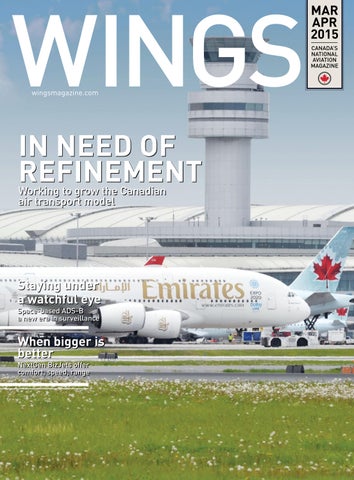
IN NEED OF REFINEMENT
Working to grow the Canadian air transport model
Staying under a watchful eye Space-based ADS-B a new era in surveillance
When bigger is better NextGen BizJets offer comfort, speed, range
MAR APR 2015 CANADA’S NATIONAL AVIATION MAGAZINE
PERFECT FOR HARD-TO-REACH PLACES. LIKE PROFITABILITY. The Pilatus PC-12 NG puts out-of-the-way destinations squarely in your “go-to” zone. Its mix of speed, range, nine-passenger cabin and short-field performance will allow you to complete more trips and use your fleet more cost-effectively. All for much lower acquisition and operating costs than comparable twins. Profitability? You’ll be flying there daily. www.pilatus-aircraft.com
Stan Kuliavas, Vice President of Sales | skuliavas@pilatuscanada.com | 1.855.745.2887
Centre Canada
MARCH/APRIL 2015
UPFRONT 5 Leading edge
An impressive first impression
8 On the fly
News and opinion
14 Alternate approach The finer points of fuelonomics
15 At the gate
Increasing its range
16 Glidepath
Saluting the MART team (l to r): Pilot Simon Pearce; senior technician Owen Rusticus; senior technician Bob Whitaker; and Pilot Susan Baumeler.
Will new ULCC brands fly in Canada?
17 CIA Hamilton
BACK 46 Marketplace 50 On final
The air taxi commitment
FEATURES 18 IN NEED OF REFINEMENT
CAC president Daniel-Robert Gooch seeks to redefine the Canadian Air Transport model BY DAVID CARR
PHOTOS: PAUL DIXON (TOP); BRIAN LOSITO, AIR CANADA (LEFT TOP); CANADA JETLINES (LEFT BOTTOM)
From top: The finer points of fuelonomics P. 14 Will new ULCC brands fly in Canada? P. 16
23 OPERATING IN THE RIGHT SPACE
Fortunes soar at aerospace leader MacDonald Dettwiler and Associates (MDA) BY BRIAN DUNN
26 STAYING UNDER A WATCHFUL EYE Space-based ADS-B is launching a new era of global air traffic surveillance BY JAMES MARASA
30 ENSURING THE COAST IS CLEAN
The NASP’s dedicated MART team is working to squash polluters BY PAUL DIXON
35 WHEN BIGGER IS INDEED BETTER
NextGen Bizjets offer comfort, speed and range BY FREDERICK K. LARKIN
COVER PHOTO: BRIAN LOSITO, AIR CANADA
WWW.WINGSMAGAZINE.COM
March/April 2015 | WINGS
3
I like to stay ahead of my aircraft. So if I’m 40 miles out with weather rolling in, I’m listening to what’s happening in front of me. AWOS. Pilot chatter. A quick check with flight service. Sometimes, there’s a lot to decipher. But I need to hear it clearly. Because when I do, I feel confident. Prepared. In the moment. And that allows me to just
focus on what matters,
flying.
Bose A20 ®
®
Aviation Headset
MORE NOISE REDUCTION. LESS DISTRACTION. Better sound can make all the difference, especially where you go. Which is why, with 30% greater noise reduction than conventional noise reducing aviation headsets, the A20 headset lets you hear more of what you need to hear. While proprietary cushions and minimal clamping force let you fly comfortably for hours. Meets or exceeds TSO standards. Take them for a 30-day, risk-free Test Flight.
To order 1.800.901.0497 | Learn more at Bose.ca/a20 facebook.com/BoseAviation
instagram.com/BoseAviation
*Risk-free refers to 30-day trial only, requires product purchase and does not include return shipping. Delivery is subject to product availability. ©2014 Bose Corporation. CC014275
twitter.com/BoseAviation Made in U.S.A.
LEADING
EDGE
| By Matt Nicholls
An impressive first impression Putting on the glitz in Doha for the A350 XWB
F
PHOTO CREDIT: MATT NICHOLLS
or those of you who might think the aviation industry lacks the glitz of a Hollywood gala, then you obviously haven’t experienced the electricity brought on by the introduction of a new aircraft. Such an experience becomes even more dramatic when that event takes place in an exotic city in the Middle East. Those lucky enough to get an invite to the early January introduction of the new Airbus 350 XWB with launch customer Qatar Airways in the capital city of Doha, experienced just such a spectacle. More than 150 aviation journalists from around the world were given a first-hand peak at the aircraft, as well as city tours, a spectacular evening dinner cruise on a traditional dhow and a variety of other activities – including a vivid, 40-minute 3D presentation on Qatar’s 2022 stint as host of the World Cup. Ah, the beautiful game in all its glory. And it didn’t end there. On the night of the unveiling, the A350 XWB debuted to a brilliant light show, followed by music, dinner and more aircrafts tours. It was an impressive display and my first reaction to the wide-eyed journalists surveying the new toy was immediately “kids in a candy store” – yes, it was a “selfie” fest to be sure. The event also offered a glimpse into the mysteries of Doha’s unique culture and a more acute understanding of the Qatar Airlines brand, its development as a growing influencer on the world stage and in many ways, the future of aviation itself. The A350 XWB is indeed a game changer in commercial aviation. Made of 53 per cent composite material and some 70 per cent advanced materials combining titanium and aluminum alloys, the aircraft is light, durable and developed with ease of systems to maximize efficiency. With its sophisticated, light-weight
5 WWW.WINGSMAGAZINE.COM
systems to take commercial passenger travel to a new level is precisely why concept Qatar Airways is gaining a strong reputation on the global stage. Such leadership is critical in the Middle East where competition is fierce and demand is on the rise. The region’s big three international carriers – Qatar Airways, Etihad and Emirates – are rapidly developing as trendsetters on the global stage. Enigmatic Qatar Airlines chief executive officer, Akbar Al Baker has a true passion for aviation. Dynamic, aggressive and confident, Al Baker’s passion for aviation transcends not only Qatar Airlines, but globally. He is actively involved in a number of industry associations and is committed to enhancing international safety standards. His goal is simple and one that makes sense – work to enhance the passenger experience and positively develop global aviation. Oh, yes, there is the bling factor, the glitz of a successful aircraft introduction, for example. But in the end, it’s also about value, transformation and leadership. “We would not be buying airplanes if we thought competition will impede our operation,” he said. “In any business, it is a question of survival of the fittest. How efficient we are, how we deliver on value to our customers, how we look after them – in this we are true leaders.” | W
You could easily sacrifice comfort in an aircraft to achieve better economics. But with the A350, this is not the case.” design and new wing concept, the aircraft will burn 25 per cent less fuel than aircraft of previous generations, making it solid on the pocket book for operators. Ease of maintenance will also be achieved with the A350 XWB, and the direct benefits from reduced fuel consumption will help lower carbon emissions per passenger. But as Mike Bausor, Airbus A350 XWB marketing director noted during the introductory press, economics is not everything. The aircraft is equally about technological enhancement and enhancing the commercial passenger experience. “You could easily sacrifice comfort in an aircraft to achieve better economics,” he said. “But with the A350, this is not the case. XWB stands for extra wide body, and with such a concept, we can economically integrate the first class and business class seats more efficiently with economy class with a wider cabin.” Developing efficient, dynamic new
TOP DATA BURSTS… in this issue
1. WestJet calculates that every one cent drop in the value of the dollar equals $15 million in increased operating costs. (pg. 14) 2. Montreal-Trudeau offers 130 direct destinations, including over 75 international destinations. (pg. 15) 3. $290 million: The amount airports paid in rent to the federal government last year. (pg. 18) 4. $3 billion: The order backlog for MacDonald Dettwiler and Associates (MDA). (pg. 23) 5. $58 million: The estimated cost of the new Falcon 8X. (pg. 35)
Your feedback is always welcome. Please contact me at mnicholls@annexweb.com. @Wings_Magazine March/April 2015 | WINGS
5
WINGS
MAR APR 2015 CANADA’S NATIONAL AVIATION MAGAZINE
wingsmagazine.com
Vol. 56, Issue 2
IN NEED OF REFINEMENT
EDITOR
Matt Nicholls mnicholls@annexweb.com 416-725-5637
Working to grow the Canadian air transport model
MEDIA DESIGNER
Brooke Shaw
Staying under a watchful eye Space-based ADS-B a new era in surveillance
FLIGHT DECK
Rick Adams, Krista Bulmer, David Carr, Paul Dixon, Brian Dunn, Frederick K. Larkin, James Marasa, Carroll McCormick, Anna Pangrazzi, Bill Zuk
When bigger is better
PHOTO CREDIT TK
NextGen BizJets offer comfort, speed, range
SUBSCRIBE TODAY !
ACCOUNT MANAGER
Jarah Stefek jstefek@annexweb.com 519-429-5191
1 YEAR SUBSCRIPTION only
3000
$
ACCOUNT CO-ORDINATOR
Stephanie DeFields sdefields@annexweb.com 1-888-599-2228 ext. 257
(GST $31.50 • HST $33.90) US $42.00 (USD) • Foreign $65.00 (USD)
Name: _______________________________ Company: ____________________________ Title: _________________________________ Address: _____________________________ City: _________________________________ Prov: ________________________________ P.Code: _______________________________ Tel: __________________________________ Fax: _________________________________ email: ________________________________
NATIONAL ACCOUNT MANAGER
Mena Miu mmiu@annexweb.com 905-713-4351 GROUP PUBLISHER
Scott Jamieson sjamieson@annexweb.com PRESIDENT
Mike Fredericks mfredericks@annexweb.com WINGS MAGAZINE
P.O. Box 530, 105 Donly Dr. S., Simcoe, ON N3Y 4N5 Tel: 519-428-3471 Fax: 519-429-3094 Toll Free: 1-888-599-2228
PLEASE CHECK ONE:
❑ Charter/Fractional ❑ Commercial Airlne ❑ Private Aircraft Owner/Operator ❑ Air Transport-Cargo ❑ Tour Operator ❑ Training/Education ❑ Airport ❑ FBO ❑ MRO ❑ OEM ❑ Aviation Distributor ❑ Aviation Fuel Supplier ❑ Aviation Services ❑ Aviation Sales/Marketing ❑ Para-Public/EMS/SAR/Law Enforcement ❑ Government/Military ❑ Resources - Construction, Fire, Forestry, Mining, Oil & Gas, Wildlife, etc ❑ Other (please specify) ______________
Publication Mail Agreement #40065710 Return undeliverable Canadian addresses to Circulation Dept., P.O. Box 530, Simcoe, Ont. N3Y 4N5 email: subscribe@wingsmagazine.com Published six times per year (Jan/Feb, Mar/Apr, May/ Jun, Jul/Aug, Sep/Oct, Nov/Dec) by Annex Publishing & Printing Inc. Circulation email: subscribe@wingsmagazine.com Ph: 450-458-0461 Fax: 877-624-1940 Mail: P.O. Box 530, Simcoe, ON N3Y 4N5
PAYMENT: Cheque - Payable to Annex Publishing & Printing Inc. Visa
MC
Account #: __________________________
Subscription Rates Canada – 1 Year $ 30.00 (includes GST - #867172652RT0001) USA – 1 Year $ 42.00 Foreign – 1 Year $ 65.00 Occasionally, Wings magazine will mail information
on behalf of industry-related groups whose products and services we believe may be of interest to you. If you prefer not to receive this information, please contact our circulation department in any of the four ways listed above. No part of the editorial content of this publication may be reprinted without the publisher’s written permission. ©2015 Annex Publishing & Printing Inc. All rights reserved. opinions expressed in this magazine are not necessarily those of the editor or the publisher. No liability is assumed for errors or omissions. All advertising is subject to the publisher’s approval. Such approval does not imply any endorsement of the products or services advertised. Publisher reserves the right to refuse advertising that does not meet the standards of the publication. Printed in Canada ISSN 0701-1369
Expiry:_____________________________
TO SUBSCRIBE:
Tel: 450-458-0461 Fax: 877-624-1940 Mail: Wings Magazine c/o Annex Business Media P.O. Box 530 Simcoe, Ontario N3Y 4N5
Air Transport Association of Canada
WEB
www.wingsmagazine.com
6
Subscriptions non-refundable
PRO0315
WINGS | March/April 2015
wings subad.indd 1
Canadian Business Aviation Association
Magazines Canada
NEW LOOK FOR WINGS ON THE Looking to checkout some great news
email: subscribe@wingsmagazine.com GST#135274215RT001
Canadian Owners & Pilots Association
PHOTO: LOCKHEED MARTIN
Signature: _________________________
and feature stories on a variety of key aviation disciplines? Check out the new-look Wings website for great news features in a variety of aviation disciplines! Go to www.wingsmagazine.com and check out the new look! WWW.WINGSMAGAZINE.COM
2015-02-25 2:02 PM
FROM GREAT AUTHORITY
COMES GREAT STRENGTH When you partner with Cessna, you get more than an aircraft. You get the widest range of offerings available in aviation, including the broadest product line, the most pilot-training resources, the largest global service network, and an 85-year lineage of success. This is aviation authority.
GRAND CARAVAN EX
Featuring the strength of an 867-horsepower engine powering the fastest climb in its class.
U.S. +1.844.44.TXTAV | International +1.316.517.8270 | CESSNA.COM
SINGLE ENGINE PASSION
TURBOPROP PERFORMANCE
CITATION JET LEADERSHIP
SERVICE EXPERTISE
ON THE FLY 8 9 11 12
THE LEAD AIRPORTS COMMERCIAL BIG NUMBERS
THE LEAD
BOMBARDIER: WHAT NOW? Bombardier has hit the ultimate re-set button. The blood-letting, which recently included the departure of Ray Jones, the marketing face of the CSeries jetliner, and the layoff of 1,000 employees in the United States and Mexico working on the revolutionary Lear 85, now on hiatus, has flowed up to the top office. In midFebruary, Pierre Beaudoin stepped down as chief executive of the largely familycontrolled airplane and train-maker. There are many late nights ahead for his successor Alain Bellemare, a former United Technologies (UTC) executive, who once headed Pratt & Whitney Canada and was most recently chief executive of the Connecticut-based technology giant’s aerospace division. Beaudoin is now executive chair of Bombardier and will have influence over the direction of the company, but it will be up to Bellemare to disentangle the Gordian Knot of airplane programs that has become tighter under Beaudoin’s watch. Bellemare will be wise to abandon
Bombardier’s recent British constable response to industry and market concerns over CSeries program delays, depleting resources and plunging stock values: “nothing to see here, please move along.” The markets have lost faith in Bombardier. On the day Beaudoin announced he was stepping down, the company finally confirmed their concerns. Delays in the CSeries program have cost Bombardier the two-year advantage the airframer had over the Airbus re-engined A320 aircraft. That was known. It has also cost the airframer an additional $1 billion in development expenses, pushing the ground breaking airplane to the $5.4 billion mark and obviously starving the business jet division of needed resources. Bombardier doesn’t need to break out the begging bowls, but it is proactively easing cash-flow problems, raising $2.1 billion by issuing $600 million in new shares while borrowing the rest. There are questions over the terms the wounded transport company can wring from the money markets, but the larger question might be how much this great Canadian enterprise will remain intact years from now. The company split into four divisions last summer and has since sold bits of its portfolio such as the military flight-training business to Montreal neighbour CAE Inc for just under $20 million to raise cash. All the while denying that the larger pieces such as business aircraft or commercial aircraft units are on the auction
With a number of setbacks in 2014 behind it, Bombardier is focusing on moving ahead its CSeries program. 8
WINGS | March/April 2015
block. That appears to have changed. On the day Bombardier announced an executive shake up, it admitted that “industry consolidation” (market speak for acquisitions, or in this case a merger or takeover) was on the table. Over the short term, with the Paris Air Show on the immediate horizon, Bombardier has to scrabble over recent setbacks to pull out the impressive win the CSeries is positioned to deliver but has been unable to do so, likely because Bombardier’s cash crunch has handicapped it from offering the sweet spot terms that customers for Airbus and Boeing’s re-worked A320 and 737 jets have been able to negotiate. A minor gain might already be in place. Bombardier has secured a launch customer for the CSeries when it finally enters service, still expected at the end of this year. That should also be atop Bellemare’s ‘to do’ list; ending the frustration of customers and markets by announcing a realistic date when the CS100 and CS300 (scheduled to make its first test flight by April) will enter service. Swedish regional airline Malmö Aviation was largely tipped to be the CS100 launch customer, although Bombardier denied that was ever set in stone. The Wall Street Journal had reported that Bahrain’s Gulf Air was a tentative launch customer, but dropped those plans in 2013. Bombardier refuses to say who the launch customer will be, or whether it is a new customer. There are orders for 243 CSeries aircraft, including 180 for the larger CS300. The CSeries is reported to be the preferred aircraft for Austrian Airlines, a subsidiary of Lufthansa Group, to replace its ageing fleet of Fokker regional jets, but no decision has been made and the airline is said to be frustrated by repeated delays. Swiss International Airlines, another Lufthansa subsidiary, has orders for 30 CSeries. Bombardier remains a family business, which often suffers from generational disease and clouds decision making. The corporate decision this year to deny the annual share dividend may help to sharpen the family’s focus, including getting chronic delayed airplane projects out the door. Even the rich have pocket book issues. In the meantime, the aircraft division is readying for Paris and has some tough and cynical questions to answer. WWW.WINGSMAGAZINE.COM
PHOTO: BOMBARDIER
For late-breaking news and exclusive web content, please visit us at: www.wingsmagazine.com
PLUNGING OIL PRICES, CANADA JETLINES GROWTH Cheap oil could be the ticket for Canada Jetlines, a proposed Canadian ultra-low cost carrier (ULCC) to gain traction in the tough Canadian market. No commitment to a launch date has been made. The carrier had expected to begin operations this summer using two older Boeing 737 aircraft. That timetable may be pushed back a few weeks at least, following the breakdown of an amalgamation agreement between Canada Jetlines and Inovent Capital, a capital pooling company. Canada has been an elephant’s graveyard for low cost ventures, and neither Air Canada nor WestJet would be expected to give a newcomer a soft ride. Air Canada has announced plans to introduce Rouge, its low cost subsidy on domestic routes this year between Nova Scotia, Toronto and Calgary, and Toronto and Kelowna, B.C. Jetlines plans to create hubs in Vancouver, Winnipeg and Hamilton over the next three years. It will sidestep direct competition with Air Canada and WestJet (avoiding Calgary and Toronto altogether), but is apparently ready to go head-to-head with the mainline carriers regional operators, Air Canada Express and Encore, promoting the advantages of jets over turboprops and fares about 30 to 40 per cent lower than current tariffs. Jetlines will follow the lowfare, high-yield business model of ULCC’s
Plunging oil prices could give ULCC airline Canada Jetlines a fighting chance in the Canadian market.
in Europe and the United States where a higher percentage of revenue comes from ancillary sales such as checked baggage and inflight cabin sales. Spirit Airlines, a Floridabased ULCC reports that 38 per cent of revenue comes from ancillary sales. Jetlines had hoped to raise $50 million through its partnership with Inovent. The company is reported to be in talks with another investor and that launch and growth plans remain in place including the eventual launch of an Initial Public Offering. For its part, Inovent says Jetlines has no right to terminate under the agreement, suggesting a messy divorce before its wheels up later this year. Jetlines expects to operate eight 737 Classics in 2016, growing to a mix of older and new 737s by mid-2018, as it makes its push into central Canada, the U.S. and the crowded sun destination market. Canada is the only developed economy without a ULCC. Many industry observers believe there is room for at least one such
carrier to operate below Air Canada and WestJet fares on Canada’s 20 busiest city pairs, and in many secondary markets, although both mainline carriers have been retooling their operations to compete aggressively at the lowest end of the market. Still, the lower fuel environment is seen as a benefit to new entrants like Canada Jetlines using older aircraft that are cheaper to capitalize (see, "The finer points of fuelonomics," page 14). “Although older aircraft would burn more fuel and need more maintenance, it would be offset by lower acquisition costs and cheap fuel,” said Brian Foley, a New Jersey-based Aviation analyst. Clearly Jetlines is thinking long haul. In December the company signed a definitive purchase agreement with Boeing to acquire up to 21 737 MAX aircraft for delivery starting in 2021. The deal includes a firm order for five aircraft with options for an additional 16 airplanes, with conversion rights to the 737-8 MAX.
PHOTO: CANADA JETLINES (TOP); VANCOUVER INTERNATIONAL AIRPORT (BOTTOM)
AIRPORTS
YVR EXPANDS NEW DOMESTIC TERMINAL Vancouver International Airport has opened a new $213 million expansion of its Domestic Terminal. The expansion and upgrades are the first major infrastructure project completed as part of the airport’s 10-year gateway strategy announced in 2012. “YVR is facing increased competition from other airports, and both travellers and airlines have choices,” said Craig Richmond, chief executive of the Vancouver Airport Authority. “In order to remain competitive and continue to be an economic generator and jobs creator for British Columbia, we must continue to invest in projects that make it easier and faster for passengers and their baggage to move through the airport.” The A-B Connector features new retail, artwork celebrating the B.C. Interior and WWW.WINGSMAGAZINE.COM
gate capacity, and will be used primarily by WestJet, Central Mountain Air, Air North, Hawkair, Sunwing and Air Transat. YVR is Canada’s second busiest airport and was voted Best Airport in North America in 2014 for the fifth consecutive year by Skytrax World Airport Awards. The facility is also the only North American airport to rank in the top ten for airports around the world. YVR’s $1.8 billion gateway strategy to attract new airlines and routes, and improve the customer experience, includes: • More than 700 metres of secure corridors and moving walkways to reduce connection time for passengers. • New high-speed baggage systems. (A faster baggage system to move luggage between international and
Vancouver International Airport has expanded its Domestic Terminal to better serve passengers.
domestic flights should open in spring 2016.) • Runway safety enhancements. Japan’s All Nippon Airways launched its first Canadian service to Vancouver with a daily Boeing 767. Australia’s Qantas recently announced increased seasonal service to Vancouver following a six flight trial in January. March/April 2015 | WINGS
9
ON THE
FLY
AIRPORTS
BILLY BISHOP TERMINAL SOLD Porter Airlines’ passenger terminal at Toronto’s Billy Bishop Airport has been sold to Nieuport Aviation Infrastructure Partners, a consortium that includes InstarAGF Asset Management and Larry Tanenbaum, chair of Maple Leafs Sports and Entertainment Limited, who owns the Toronto Maple Leafs and Raptors. Billy Bishop is Canada’s ninth busiest airport and handled 2.4 million passengers this year. Phase one of Porters’ purpose-built terminal opened in 2010. An $82.5 million passenger tunnel, which will serve as an alternative to the ferry linking the island airport with the mainland is scheduled to open this spring. The passenger tunnel will be managed by the Toronto Port Authority (TPA), which operates the city centre airport. Porter Airlines, which operates a fleet
10 WINGS | March/April 2015
of Bombardier Q400 turboprops put the terminal building up for sale last August to concentrate on its core business, including securing City Hall approval to relax a jet restriction and expand the main runway to accommodate a fleet of up to 30 CSeries jets. The agreement is a sale-leaseback deal that will enable Porter to continue operating out of the convenient downtown airport, where it holds most of the landing and takeoff slots. The purchase price was not disclosed but is speculated to be more than $700 million. Airports continue to be a sought after asset by fund managers, and the Ontario Teachers’ Pension Fund recently increased its stake in the U.K.’s Birmingham Airport to 48.25 per cent (see interview with CAC
president Daniel-Robert Gooch). Greg Smith, who co-owns InstarAGF told the Globe and Mail that airports are a sought after asset class that are increasingly hard to come by. Especially in Canada where major airports are locked into local airport authorities. At the same time that Nieuport Aviation wants in, Air Canada is considering pulling out. Air Canada operates only 15 flights to Montreal out of Billy Bishop, and has been unsuccessful in acquiring additional slots. Air Canada’s traffic and load factor at the airport increased in 2014 over the previous year, but is “assessing the viability of Billy Bishop operations based on current imposed terminal rates and terms.” It is not clear who would take over Air Canada’s 30 slots. The TPA and may want to sell slots to an operator other than Porter to avoid the appearance of what Air Canada chief executive Calin Rovinescu has already described as Porter’s playground.
WWW.WINGSMAGAZINE.COM
COMMERCIAL
PHOTO: BRIAN LOSITO, AIR CANADA
AC 787S TO DUBAI AND DELHI Air Canada will launch non-stop services between Toronto and Dubai, and Toronto and Delhi in November. They will be the seventh and eighth new international destinations to the airlines’ global network to have been announced in the past year. The three-times-weekly Dubai service using the yet to be delivered Boeing 787-9 series, will be Air Canada’s first non-stop flight to the United Arab Emirates at a time when traffic between North America and the region is growing. Dubai’s Emirates and Abu Dhabi’s Eithad Airways already serve Toronto and have pressed to increase frequencies to daily. Dubai International recently surpassed London Heathrow as the world’s busiest international airport and is a key connector airport. “The introduction of the Boeing 787 Dreamliner to Air Canada’s fleet has been
Air Canada is getting its iconic 787-9 Dreamliner in the air between Toronto and Dubai more frequently in 2015.
a catalyst for our international expansion plans, which will receive an additional impetus in 2015 when the larger Dreamliner 787-9 series aircraft begins to enter the fleet,” said Calin Rovinescu, Air Canada’s chief executive.
The Delhi service will be the inaugural route for Air Canada’s 787-9, and is expected to open new opportunities in the Indian subcontinent, currently the largest international market not served by Air Canada.
Say Goodbye to “Say Again” Clear communications with FANS and CPDLC Fast, secure CPDLC datalink “text” messaging eliminates radio communications confusion and gets you to the front of the line. Equip for FANS 1/A+ and CPDLC with SBAS Flight Management Systems, UniLink® Communications Management Units and datalink-recording Cockpit Voice Recorders.
UNS-1Ew / UniLink UL-801
Contact an Authorized Dealer or visit uasc.com/fans. Say Goodbye to “Say Again”. uasc.com sales@uasc.com (800) 321-5253 (520) 295-2300
WWW.WINGSMAGAZINE.COM Wings FANS Say Again March_April_02.indd 1
March/April 2015 11 2/19/15 9:26 AM | WINGS
ON THE
FLY
BUSINESS AVIATION’S
The Canadian Business Aviation Association (CBAA) recently released its first economic impact study in Canada, showing just how impactful business aviation is in this country. The numbers are impressive and in the words of CBAA president Rudy Toering, the information is “ground breaking.” Said Toering: “We finally have the evidence to back our claims about business aviation’s importance.” The data is key for the CBAA’s continued advocacy efforts and its drive to get government to understand the industry’s impact as an economic driver. “This study clearly shows that business aviation has a significant and catalytic impact on our economy and jobs.”
ECONOMIC IMPACT IN
BUSINESS AVIATION AVERAGE WAGES OUTPERFORM KEY INDUSTRIAL SECTORS Information & cultural industries
Business aviation
$69,000.00
CANADA IS HOME TO APPROX. 1,900 BUSINESS AVIATION AIRCRAFT, INCLUDING BOTH FIXED WING (76%) AND ROTOR AIRCRAFT (24%). THE MAJORITY ARE BASED IN QC, AB, BC & ON
$63,000.00
$58,000.00
Industrial Aggregate
$49,000.00
$47,000.00
Transportation and warehousing
Construction
More than 20%
10% to 20%
1% to 10%
Less than 1%
IT SUPPORTS:
11,500
$800 $1.3
$3.1 12 WINGS | March/April 2015
DIRECT persons years million in DIRECT wages
billion in DIRECT GDP billion in DIRECT economic output
BA = $640 MILLION IN TAXES
13
MILLION Municipal
470 170 MILLION Federal
MILLION
Provincial/ Territorial
WWW.WINGSMAGAZINE.COM
ALTERNATE
APPROACH By David Carr |
Finer points of fuelonomics
The burning issue is about the winners and losers of lower fuel costs
W
14 WINGS | March/April 2015
the economy is heating up. Indeed, with more people flying, airlines are adding more flights as weak routes become profitable. The potential of a return to the bad old days of fares priced to snatch market share may be enough for Airbus and Boeing to protect fat order books for fuel efficient airplanes from the plunge. It is important that, even in an age of cheap gas, that the aviation industry does not throttle back on increasing fuel efficiency. IATA estimates fuel efficiency improved by 1.8 per cent in 2014 with further gains expected in 2015. The association believes that efficiency improvements could be accelerated by reducing five per cent of wasted fuel burn as a result of airspace and airport inefficiencies. One of the biggest winners in 2015 could be ultra-low cost carriers (ULCC), including a potential startup in Canada (see, “On the Fly,” page 8), according to Foley. “Despite lower fuel costs, ticket prices so far have remained relatively unchanged. While this provides some shortterm financial gain to airlines it also paves the way for new entrants. The door is open for a new breed of startup to emerge that uses cast-off, practically new aircraft the majors are ditching in favour of new, fuelefficient models.” Lower fuel could be the jump start hesitant investors in a Canadian ULCC have been waiting for. | W
Bombardier expects lower oil prices to dampen business jet sales in the lucrative Middle East segment billion in revenue from lower fuel prices. Air Canada will not detail its fuelonomics before it releases its Q4 results as Wings was going to press. The practice is less in corporate aviation because operators lack the financial clout to lock in prices over the longer term. The benefit of lower fuel prices should be felt immediately within the general aviation and corporate sectors, which will likely result in more flying and new business for FBOs and charter operators. Bombardier expects lower oil prices to dampen business jet sales in the lucrative Middle East region. The energy sector is the single largest customer for Bombardier business jets. In early December, Khader Mattar, Bombardier’s region vicepresident of sales for the Middle East, Africa and Turkey told the National, an Abu Dhabi newspaper, that if the price of oil continued to drop it could result in decreased sales in the region. Conversely, lower oil prices could reignite sales in the struggling light and midsize jet market according to Brian Foley, a New Jersey-based general aviation analyst. He notes that the smaller segment is “price elastic” and not aligned to commodities, which means more people are likely to fly when fuel prices are low and
David Carr is a Wings writer and columnist. WWW.WINGSMAGAZINE.COM
PHOTO: BRIAN LOSITO, AIR CANADA
here is the price of oil headed over the next 12-months? The crystal ball remains cloudy. At the annual Global Airfinance Conference in Dublin, Ireland in January, duelling experts predicted the cost of oil could hover around the US$40 a barrel mark for at least the next couple of years, or creep up to US$100 a barrel by spring. There is enough room between the extremes to drive a fleet of tanker trucks through. There is one certainty: the current glut of oil will eventually be mopped up by demand and the price of oil will recover. How quickly or how high depends, unless the price dips further. All of which illustrates that the oil-dependent aviation sector is set for a volatile ride. It also may challenge conventional wisdom that operators will delay the capital cost of adding fuel efficient equipment in favour of holding onto their capital depreciated gas guzzlers a bit longer – or so Airbus and Boeing, with re-engined versions of the A320 and 737, and Bombardier with its clean sheet CSeries may hope. Winners and losers are inevitable, albeit more difficult to sort out in Canada where the benefit of plunging oil is offset by a battered “petrodollar” headed in the same direction. WestJet calculates that every one cent drop in the value of the dollar equals $15 million in increased operating costs. Nobody should be surprised if the fuel surcharge is erased and replaced by a currency surcharge. The Montreal-based International Air Transport Association (IATA) predicts that average return air fares (excluding taxes and surcharges) will fall by approximately 5.1 per cent over 2014, with cargo rates dropping slightly further. That is based on an average cost of US$99.99 a barrel when airlines fill up the tanks. The cost per barrel has fallen to less than half that, but many airlines are straight jacketed by hedging decisions made when oil was at its peak. Also known as forward fuel purchasing, airlines will hedge a percentage of their future fuel requirement to protect against volatility. Hedging is expected to cost Delta Airlines US$1.2 billion in 2015, but the carrier still predicts it will pocket an additional US$1.2
AT THE
GATE
| By Brian Dunn
Increasing its range
Making new connections will help grow Montreal’s business community
T
he November announcement of a memorandum of agreement signed by Air Canada and Air China to stimulate growth in air traffic between the two countries could mean Montreal is a step closer to getting its long awaited non-stop Montreal-Beijing route. “We congratulate the two carriers for signing this agreement and bringing us one step closer to a direct flight between Montreal and Beijing,” said Michel Leblanc, President and CEO of the Board of Trade of Metropolitan Montreal. “Having this flight is a priority for the business community, and today we are closer to achieving our goal.” The board of trade is also part of a wider initiative to increase more direct flights overall and ensure existing ones continue. This involves raising awareness in the business community to help increase passenger load factors on long-haul direct flights from Montreal. It’s part of “I See Mtl,” a project launched in November by Montreal business leaders of 180 formal commitments to revitalize the city. Joining the board of trade are Aéroports de Montréal (ADM), Tourisme Montréal and Montreal International, whose mandate is to attract foreign direct investments, international organizations and international strategic workers as well as promoting the competitive and international environment of Greater Montreal. “Aéroports de Montréal is pleased with the Montreal business community’s desire to offer concrete support to our development efforts in air service,” said James Cherry, president and CEO of ADM. “Our efforts have paid off in recent years, because Montreal-Trudeau is the Canadian airport that has most improved its service. Montreal-Trudeau offers 130 direct destinations, including over 75 international destinations, compared with 30 a decade ago.” Those figures were contained in a study by KPMG-SECOR to evaluate Montreal’s air service in comparison with other North American cities and to identify potential areas of development. Part of the study looked at the number of people travelling from Montreal to other cities via an intermediary airport, because Montreal WWW.WINGSMAGAZINE.COM
cross-border U.S. airports annually. Plattsburgh, just over an hour away by car, expects to double the 150,000 figure in less than 10 years and most coming from Quebec, according to Garry Douglas, president and CEO of the airport and of the Plattsburgh North Country Chamber of Commerce. The facility bills itself as Montreal’s U.S. airport and Douglas calls Plattsburgh Montreal’s U.S. suburb. And a lot of the signage at the airport is bilingual. Surprisingly, Cherry isn’t losing any sleep over Plattsburgh’s initiatives, claiming they’re small potatoes. “We’ve had far more growth of passengers travelling to the U.S. from Montreal than from Plattsburgh and Burlington (Vermont) combined. It’s a zero sum game for us. Some people living on the South Shore (closer to the U.S. border) may use Plattsburgh or Burlington, but very few people from downtown or the West Island use those airports.” Burlington is actually a bigger threat than Plattsburgh, because it has more flights and airlines than Plattsburgh, including Delta and JetBlue, but it’s a good two-hour drive from Montreal, Cherry pointed out. | W
“The board of trade is part of a wider initiative to increase more direct flights overall and ensure existing ones continue.” did not have a direct flight to those cities. “We knew about the number of people travelling to places like Seattle, Denver and Baltimore,” said Cherry. “But we were surprised to learn that a lot of Montrealers travel to San Diego.” And San Diego was one of eight cities that had the minimum required demand to justify a daily frequency. But only three had a sufficient level of demand throughout the year to provide a minimum level of profitability. Apart from San Diego, they are San Jose and Beijing. Four others, Rome, Barcelona, Lyon and Athens could support seasonal service, while Beirut could be profitable, but cannot currently be served for national security reasons. While Montreal is busy trying to attract new flights, it is being blindsided by Plattsburgh International Airport, which is spending US$55 million to accommodate mostly Canadian travellers at what Air Canada president Calin Rovinescu has called, “Quebec’s fastest-growing airport.” Not surprising as about 85 per cent of Plattsburgh’s 150,000 passengers last year were Canadians, overwhelmingly Montrealers and part of an estimated 4.5 million Canadians to fly out of
Brian Dunn is a Wings writer and columnist. March/April 2015 | WINGS 15
GLIDE
PATH
By Paul Dixon|
Will ULCC brands fly in Canada? Thirsting for a niche could leave new players crying in their beer
T
16 WINGS | March/April 2015
product. The fun part occurred when we tallied up the scores at the end of the session and, without fail, the “winner” in every session was the competitor’s product. So, what happened after that? We didn’t tell the tasters that most of them were drinking the “wrong” beer and I’ve no idea what happened at head office when they got the news. As of January 2015, the same two beers are still on the shelves across the country, first and second in sales nationally, just as they were back in the summer of 1974. What does this have to do with the airline business? If you’re still drinking the same beer you were in 1974, you’re paying almost seven times what you were for a dozen back then. Equate that to flying, and a Vancouver-Toronto route is about two-and-a-half times the price what it was back then. Today, microbreweries are taking on the factory breweries and having a significant impact on the market, not by offering cheaper products, but by offering a wider range of products that can appeal to market segments the factory breweries can’t hope to reach. And while microbreweries have a strong future, I can’t help but think that trying to start an ultra-cheap airline in Canada will leave someone crying in their beer. | W
It’s not a simple process for those of you who recall the Air Canada/ Canadian shotgun marriage. higher education (criminology if you’re keeping score). A friend and I spent one or two evenings a week over the summer helping his mother run marketing surveys on the subject of beer. Her company had been retained by one of the national brewers to conduct surveys aimed at a specific demographic – males in their early 20s. A group of suitable subjects were assembled in a meeting room and asked to sample four different bottles of beer and rate each on a scorecard, with no hint as to which company was conducting the survey. The samples had no labels or other identifiers other than a number. Three of the samples were the same beer (but from breweries in three different cities) from the sponsor and the fourth sample was from their main competitor, as a control. My friend and I had the job of disseminating and collecting the samples and the score sheets, straightening up the room afterwards and disposing of the unused beer at the end of the session (nobody said it was going to be easy!). The first thing our test subjects were asked to do was to write the name of their favourite beer at the top of their scorecard before the tasting began and about twothirds would write down the sponsor’s
Paul Dixon is freelance writer and photojournalist living in Vancouver. WWW.WINGSMAGAZINE.COM
PHOTO: CANADA JETLINES
he New Year promises to be an interesting one for Canadian airlines. The two majors, WestJet and Air Canada, are coming off successful years, with high load factors and happy shareholders. It was such a good year in 2014, in fact, that at least two different groups (Canada Jetlines and Jet Naked) announced they are on the hunt for the capitol required to provide Canadians with the option of an ultra-low cost carrier (ULCC) flight experience, staking out the bottom of the market. I would have thought, however, that the “ultra-low cost” crowd had already been hovered across the border by the lure of dirt-cheap flights on antique aircraft. At the 2014 Aircraft Interiors Expo in Seattle, Mark Krolick, managing director of United Airlines’ Marketing and Product Development division, talked about the challenges in melding United and Continental into one airline and creating a common brand image out of that amalgamation. It’s not a simple process for those of you who recall the Air Canada/Canadian shotgun marriage. Krolick spoke about the importance of understanding who his company’s potential customers are and building its brand and marketing programs around this perspective. He used examples of Starbucks and Dunkin’ Donuts to illustrate that if you are marketing yourself to the wrong crowd, it’s just not going to happen. United (and the other U.S. airlines) are marketing themselves as two class entities, economy and business-class. Except for a small number of routes, the premium first class base is just too small and they aren’t going after it. Around the world, first class is becoming an endangered species, with most airlines relying on business and economy. Brand loyalty is certainly an interesting concept. It’s all about creating an image that consumers can identify with and more importantly, want to be identified with. Understanding customer values isn’t a simple process, because the reality is that many of us aren’t too sure what we really like or even why we like it. I had my introduction to marketing more than 40 years ago just after my first brush with
CIA
EXPO | By Matt Nicholls
Hamilton CIA Expo excites
Young aviators get a sense of what it takes to succeed in their chosen career
PHOTO: JIM STUBBINGTON
S
o what does it take to make your mark in the world of aviation and aerospace? It’s all about having a flexible, hardworking, “can do” attitude while being as resilient and proactive as possible. And if you really want to make your mark, copious quantities of passion for your chosen field goes a long way. This was the overriding message conveyed by a selection of industry experts during Wings and Helicopters third annual Careers in Aviation Expo Saturday, February 7 at the Canadian Warplane Heritage Museum in Hamilton. Some 160 air cadets, high school and college students and career seekers descended on the iconic site for a fast-paced day of learning, education and more. “I think one of the great things about this event is it gives students of all levels a chance to learn about a variety of aviation and aerospace careers all in one spot,” said Glen Lynch, president and CEO of Montreal-based GAL Aerospace, one of the panelists in the afternoon session concentrating on varied aviation professions. One of the things that the team at Wings and Helicopters has done so effectively here is bring together experts in a variety fields to show students that there a whole selection of professions out there to chose from. Yes, there are certainly pilots, but there are many other options as well.” The day-long event feature four educational panels including helicopter and fixed wing pilots of varying disciplines; education and flight training; various aviation professional such as TSB inspector, air traffic controller, aviation sales, marketing and more; and maintenance and aerospace opportunities and educational paths. The day also featured countless networking opportunities for young adults, as panelists and exhibitors shared key industry information with young aviators. Students also had the opportunity to tour the fabulous Warplane Heritage Museum site and hop aboard a Pilatus PC-12NG, a mainstay in many Canadian operator fleets. Topics of discussion throughout the day ran the gamut, including cost of education for an aviation education, what skills WWW.WINGSMAGAZINE.COM
and the founder/director of operations with Aviation Solutions, a company designed to help aviation firms enhance operations. “You really stand out in your career development at all levels when you do those extra things. If that means in your first job your day is done, but you are out there helping someone else tie down an airplane and secure it for the night or you are handy with books and you offer your boss the chance to help out with the manuals – anything that can help you make a mark, do it. It’s all word of mouth in this industry, it’s very small, everyone knows one another. Future aviation professionals might also want to concentrate on developing their math skills and also pay close attention to soft skills such as the ability to cooperate, their ability to work well as a team, and the ability to adapt and be flexible in all aspects of career and work opportunities. The CIA Expo in Hamilton was just one of three careers events Wings and Helicopters team will be hosting in 2015. On Saturday, February 21, the team descended on Ottawa for its second event of the year at the Canada Aviation and Space Museum. On Saturday, April 11, the team sets up in Calgary at the Calgary Aero Space Museum. For more information, please go to www.careersinaviation.ca/expo/. | W
If you really want to make your mark, copious quantities of passion for your chosen field goes a long way. students need to succeed in their given field of choice, hot trends in the industry, challenges students might need to anticipate and overcome, opportunities for women in aviation, composite technology and the skills needed to work with new materials and so much more. Students even had the opportunity to meet and listen to a real rocket scientist – MDA’s Natalie Panek, who made several astute points about how young women can make their mark in the industry. One of the key messages reinforced throughout the day by panelists was aspiring students need to differentiate themselves from their competition through out all stages of career development. Volunteering, finding ways to make your mark with an aviation operation, augmenting your development in any way – it all sets you apart from the competition when you are just starting out. Having ample amounts of passion for your chosen field was also a common theme. “Differentiating yourself and showing that passion, any way that you can get ahead in someone’s eyes will go a long way in your development,” said Mike Schuster, a captain with Porter airlines
March/April 2015 | WINGS 17
IN NEED OF
REFINEMENT RETHINKING THE AIR TRANSPORT MODEL
BY DAVID CARR 18 WINGS | March/April 2015
WWW.WINGSMAGAZINE.COM
PHOTO: BRIAN LOSITO, AIR CANADA
F SOME C
anada has a pay as you go business model for air transport. The merits of the model versus the United States, where aviation infrastructure is subsidized, can be heavily debated, most recently in a 2012 Senate report, The Future of Canadian Air Travel: Toll Booth or Spark Plug, which recommended abolishing airport rent. WWW.WINGSMAGAZINE.COM
Everything, from the $290 million airports paid in rent to the federal government last year, to Ontario’s tripling of the tax imposed on aviation fuel drives up the cost of air transport, sends millions pouring across the border to buy cheaper seats on U.S. airlines and keeps an untold market of potential passengers buried. Another concern should be that in this user pay environment, less and less of the third party costs larded onto the price of
a ticket by governments go to benefit the industry or consumer. “More of the money that is going into the federal revenue stream from the aviation sector should go back to benefit users,” said Daniel-Robert Gooch, president of the Canadian Airports Council (CAC). “But we have a user pay system where users are putting money into the system, but they are not seeing the money back.” Far from it. March/April 2015 | WINGS 19
A clear example is the Canadian Air Transport Security Authority (CATSA), which is funded through a levy on every ticket purchased. While the number of passengers being screened at Canadian airports has risen considerably over the last five years, putting more money into the treasury, CATSA’s funding has been frozen to 2010 levels. “We have an air traveller security charge which is among the highest in the world. But the funding model where the corporation is dependent on appropriations from parliament is not working,” Gooch points out. While the security charge also pays for Transport Canada’s aviation security function and a few other security programs, there is still a yawning 20 WINGS | March/April 2015
gap in excess of $100 million on what CATSA collects on the government’s behalf and how the money is spent. “Even if you accept that the air travellers security charges goes to covering those other areas, the cost associated with those areas do not growth with traffic the way service required by passengers grows. Screening is not benefiting from any of the increase in funding.” Another example is the $38 million Airports Capital Assistance Program (ACAP) which is supposed to assist nonNational Airport System (NAS) airports with a specific level of scheduled traffic to receive infrastructure funding for projects related to safety. Except funding for the ACAP has not increased since the
NAS was introduced in 1996, and is only 13 per cent of the revenue the government hauled in from airport rents last year. The application is also cumbersome and difficult to understand to the point where some of Canada’s bigger smaller airports help out the smaller ones with the paperwork. Then there are the approvals. “There is inconsistency in decisions that are being made,” Gooch said. “We are seeing projects being denied that should be eligible under the priority areas being articulated in the program. As a result, some of the money in the program is not being spent every year. We believe that it could be.” In fact, the CAC estimates that if the program worked as it is supposed to, it WWW.WINGSMAGAZINE.COM
PHOTO: CAC
Since Transport Canada offloaded airports to local authorities, the industry has invested more than $17 billion in new facilities while keeping its hand out of the taxpayer’s pocket.
would also be underfunded by as much as $17 million just for the existing airports. Also feeling the capital pinch are five NAS airports with traffic volumes below 600,000 passengers a year. These airports are struggling to upgrade infrastructure but are not eligible for funding by the ACAP or, as a NAS airport, cannot participate in Infrastructure Canada’s $8.8 billion Building Canada Fund, introduced in 2011. The CAC estimates a need for up to $7 million in project funding for these smaller NAS airports and is asking for changes to federal infrastructure programs. The CAC is a division of the Washington-based Airports Council International-North America (ACI-NA). Its 45 members represent more than 100 airports, including all of the local airport authorities that are part of the NAS. Business has been good. Last year, member airports experienced a combined six per cent passenger growth. Airports are adding carriers and new infrastructure, including the $82.5 million pedestrian tunnel linking Toronto’s Billy Bishop Airport with the mainland, and a $300 million, six-gate international extension to Montreal’s Trudeau International. Since Transport Canada offloaded airports to local authorities, the industry has invested more than $17 billion in new facilities while keeping its hand out of the taxpayer’s pocket. Wings recently sat down with Gooch to discuss future growth, especially in the critical international transit sector which generates more income for airport operators. “If we want to capture a good share of the growth in connecting traffic between Asia and South America, for example, we need a transit without visa program [TWOV)],” he said. Canada currently has a limited TWOV operated by Citizenship and Immigration and the Canada Border Services Agency, but only for destination flights to the U.S., and only from a handful of Asian countries such as Thailand and the Philippines, and four cities in China: Beijing, Guangzhou, Hong Kong and Shanghai. The CAC estimates that on some TWOV flights from Asia, up to 80 per cent of travellers are continuing on to destinations in the U.S. The Conference Board of Canada calculates that expanding the existing TWOV program in Asia would result in 3,200 jobs, $270 million in GDP and an extra $110 million to the government. The CAC has been making progress with the government and expects announcements on improvements to the current program soon, including expanding the number of cities in China. Still, Gooch has his sights set higher. “The Middle WWW.WINGSMAGAZINE.COM
East is eating our lunch. Ten years ago they had no traffic between Latin America and Asia. Now they have 20 per cent.” As if to illustrate the point, Dubai International Airport topped London Heathrow as the world’s busiest international airport in 2014. Dubai handled 70.5 million international passengers versus Heathrow’s 68.1. “Heathrow is losing a lot of traffic to Dubai because we’re able to cater for the connections that Heathrow no longer has the capacity to service,” Paul Griffiths, chief executive of Dubai International Airport and a
former manager of London Gatwick told the U.K.’s Financial Times. In the case of Heathrow it comes down to capacity constraints, including only two runways. But it is all part of what Gooch calls “passenger facilitation,” including how you flow passengers efficiently through airports. “That is the way things work in most of the world: Canada and the United States are out of step on this. We need to be a little more like they are in Europe, Asia and the Middle East.” Another gain that the CAC has won for its members is a seat at the table when
March/April 2015 | WINGS 21
THE PUBLIC
PERCEPTION Statements and results from a 2014 Nanos research public opinion poll that show what Canadians believe when it comes to airports
82%
of respondents agree airports are important as part of Canada’s transportation network
73%
of respondents agree airports are important to international trade
70%
of respondents agree agree airports are important to the local economy
81%
of respondents support using federal infrastructure funds for safety and security projects at small and medium airports
53%
of respondents agree airports are operated by the government (federal, provincial or municipal) 22 WINGS | March/April 2015
Transport Canada is negotiating bilaterals. Gooch generally supports Canada’s current Blue Sky policy introduced in 2006 to open international air routes to Canada, although admits that bilaterals are not always pursued in the spirit of Blue Sky (while diplomatically sidestepping the issue of whether more routes and frequencies should be granted Emirates, Eithad and Qatar Airways, the socalled Persian Gulf super connectors). Despite being cut loose from Transport Canada and operating as businesses on equal footing with the airlines they serve, airports have never had a voice in negotiations. “Airports will participate at bilateral talks in the future, but we will do so through one representative, which will be a CAC representative,” Gooch said. This is in sharp contrast to airline involvement where there is no limit on the number of air carriers that can participate, including companies that do not operate internationally. “We still need to tip the balance. We still have airports that would like to have a direct stake in the outcome of talks because they have competitive commercial interests as well.” It has been 23 years since Transport Canada began commercializing airports, and 21-years since the NAS was introduced, expanding a hybrid model of local commercial management with Ottawa as the absent landlord. The NAS model has come under criticism, most recently after a severe snowstorm ground Toronto’s Pearson International Airport to a halt. A Globe and Mail editorial noted that airport boards of directors are not accountable to Ottawa or the public. So is the current model still serving Canadians? Gooch agrees. “The model we have in Canada has served the country very well,” he notes. “We have seen that $17 billion in infrastructure investment put into place and we now have the number one aviation infrastructure in the world. There are no shareholders in the Canadian model so any operating surpluses go back to the airport to benefit users.” Still, the Ontario Teachers’ Pension Plan recently more than doubled its stake in the U.K.’s Birmingham Airport to 48.25 per cent. The pension fund also has investments in Bristol Airport in the U.K. as well as airports in Brussels, Belgium and Copenhagen, Denmark. The Caisse de dépôt et placement du Québec has a 12.62 per cent interest in Heathrow. So why shouldn’t Canadians be able to invest in Canadian airports? “Investors certainly like airports that we know,” Gooch said. “But is it the right move for Canadian consumers and
Canadian communities that relay on airports? It depends on what the objective is. A lot of people put out privatization as a panacea for lowering costs for travellers. We are not sure it would be a lower cost option. A feature of the model, for example, is airport rent. If you went to a different model that cost doesn’t necessarily go away. You don’t pay rent to the federal government, but you are paying dividends to shareholders and are subject to taxation at different levels than you are now.” Gooch maintains one of the challenges is that the airport industry is not very well understood in Canada beyond its core function of getting passengers to their flights. They don’t see, for example, that under the current model, Canadian airports are a $34 billion industry supporting 405,000 jobs. “The public still thinks airports are run by the government. It can be challenging to get support for airports influencing government policy when Canadians think airports are the government,” he said. The Council has embarked on a public awareness campaign that recently included a splashy supplement in the Globe and Mail. Even so, Gooch is not opposed to changes in the future to the current model. “Things change in the industry. You never want to close doors to what will happen in the years to come.” And keeping an eye on the next thing is always front and centre at the CAC. “Expect passenger facilitation to be a big theme for airports in the next few years,” he said. In the next few months both the CAC and ACI-NA will be making presentations on the Beyond the Border action plan, a declaration signed between Canada and the U.S. to enhance security while thinning the border to accommodate the flow of people and goods. Gooch also wants to see programs such as NEXUS between Canada and the U.S. expanded to likeminded countries. “It’s about working more closely together with our international partners and doing things so that they are seamless for the traveller or shipper,” he said. Facilitating business and frequent travellers who represent a lower risk would free up security resources for those who warrant more attention and ensure smoother traffic flow. Gooch would also like to see countries working together to reduce the need for rescreening at transfer airports. “People are getting screened by security around the world. We need to ensure we are all screening to comparable standards and accepting those standards so that we are not rescreening passengers. That’s a few years off, but we are working on it.” | W WWW.WINGSMAGAZINE.COM
MDA is the operator and worldwide commercial data distributor for the RADARSAT-1 and RADARSAT-2 satellites.
OPERATING IN THE RIGHT SPACE
FORTUNES SOAR AT AEROSPACE LEADER MACDONALD DETTWILER AND ASSOCIATES (MDA) BY BRIAN DUNN
PHOTO: MDA
M
acDonald Dettwiler and Associates (MDA) appears to be on a roll, not to mention an order backlog of around $3 billion, about $1 billion more than a year ago. Based in Richmond, B.C., MDA is active in two principal markets. The largest is its communications division which provides space-based solutions for cost-effective global delivery of direct-to-home television, satellite radio, broadcast internet and mobile communications. Its surveillance and intelligence division is a supplier of space-based and airborne surveillance solutions, satellite ground stations, and geospatial information services. With more than 4,800 employees operating at 11 locations in the United States, Canada and internationally, MDA truly is a
WWW.WINGSMAGAZINE.COM
global aerospace leader and technological influencer. In Canada, it has some 1,700 employees, with 700 based in Richmond, 600 in Montreal (Satellite Subsystems) and 300 in Brampton (Robotics and Automation). Its surveillance and intelligence division is based in Richmond and has offices in Dartmouth, N.S. and Ottawa. It includes end-toend space missions, robotics and automation, airborne surveillance solutions, ground-based systems and geospatial services. MDA provides geospatial information and monitoring services derived from radar imagery and other sources to customers in defence, weather, transportation, energy and mining, and more. The company’s end-to-end space missions provide operational surveillance and monitoring solutions for civil, defence and March/April 2015 | WINGS 23
commercial applications, while its robotics and automation unit provides the robotics for the International Space Station, including the Canadarm and Dextre. Dextre is an extension of the Canadarm2. The dexterous dual-armed solution will be able to touch, sense, and respond much like a human. It is used for many of the servicing and assembly tasks performed by astronauts on space walks. MDA’s geospatial services are one of the largest satellite radar data providers in the world and the operator and worldwide commercial data distributor for the RADARSAT-1 and RADARSAT-2 satellites. MDA is also developing next-gen space automation capabilities for planetary exploration and on-orbit satellite servicing and repair. As part of its airborne surveillance solutions, the company provides unmanned aerial vehicle (UAV) surveillance that supports a wide-range of defence and commercial applications and aviation solutions to improve the safety and productivity for civil and defence air operators, among other applications. MDA offers turnkey UAV services, airborne radars, and related systems that turn data from surveillance sensors into meaningful insights for its customers, including system design and development through logistics support, training, maintenance and other operational services. Its airborne radar solutions provide high resolution imaging, advanced moving target identification and other advanced detection and identification modes. UAVs have a ceiling of 20,000 feet and a flying time of 24 hours, and because they’re a real airplane, they must be flown like one from the ground. And they shouldn’t be referred to as drones, which have a connotation of not being smart or not being able to think, according to MDA, whereas highly trained pilots operate UAVs or intelligence officers that can make decisions on how to fly the aircraft. MDA’s airborne radar solutions provide high resolution imaging, advanced moving target identification, and other advanced detection and identification modes. In October alone, MDA signed a $40-million contract amendment to provide UAV surveillance for the Royal Australian Air Force through to December 2017 with options for up to an additional three years. MDA’s service supports the RAAF plans to further develop Australia’s unmanned surveillance and reconnaissance capabilities. It signed another contract valued at US$6.4 million under its Indefinite Delivery/Indefinite Quantity (IDIQ) agreement with the U.S. Air Force to further enhance the flight path safety system that aids the design of airport approach and departure flight paths. The value of contracts awarded to date under the IDIQ agreement total approximately US$20.2 million. The U.S. Air Force uses an MDA-developed ground-based flight path design system, which supports the design of aircraft flight paths between the airport terminal area and en route phases of flight. MDA is extending this system, incorporating the Federal Aviation Administration terminal instrument procedures’ rules associated with satellite based navigation. MDA was also awarded a contract worth $10 million to provide multiple communication subsystems to Airbus Defence and Space. Not bad for a month’s work, which only includes aerospace related 24 WINGS | March/April 2015
WWW.WINGSMAGAZINE.COM
PHOTO: MDA
MDA plans to shift its surveillance and intelligence business towards more services, with more focus on intelligence within the government.
agreements. Other contracts were signed with undisclosed values. In addition to signing these deals, MDA completed the acquisition of Advanced Systems from General Dynamics, which specializes in the development and application of radar and other information sensors for the U.S. government with annual sales of about US$40 million. The deal is also expected to boost MDA’s ability to pursue other opportunities in the U.S. market. After visiting MDA management in November following the release of its third quarter results, National Bank financial analyst Kris Thompson was told the company is taking “aggressive steps” to improve the efficiency of Space Systems/Loral (SSL), two years after it was acquired by MDA for $875 million. SSL, with $1.1 billion in revenues in 2011, is a leading provider of geostationary commercial satellites, with experience building and integrating some of the world’s most powerful and complex satellites and spacecraft systems. The company has a long history of delivering satellites and spacecraft systems for commercial and government customers around the world and currently has more geostationary commercial capacity on orbit than any other manufacturer. In September, MDA was selected by the U.S. Air Force Space and Missile Systems Center to work with U.S. government agencies to host government payloads on commercial satellites. With a value up to $494.5 million, the Hosted Payload Solutions contracts prequalify SSL to bid on opportunities for hosted payloads, which can help the U.S. government get a variety of missions to orbit by integrating them with commercial satellites. The hosted payload concept speeds access to space and reduces space segment cost for both government and commercial missions. MDA also plans to shift the surveillance and intelligence business towards more services, with more focus on intelligence within the government (versus lower-margin civilian applications) and pursue commercial opportunities. At the end of October, an undisclosed customer selected MDA for its eighth satellite award in 2014. “We estimate that MDA is winning 30 per cent of commercial satellite contracts for the year. SSL’s active satellite builds this year are the highest in the company’s history,” said Thompson. Flow its third quarter results, MDA report sales of $507 million ($463.2 million a year ago), of which $373 million came from the communications side of the business, up 11 per cent from a year earlier and $134 million from surveillance and intelligence, a six per cent hike from the year earlier period. For the first nine months, revenue increased to $1.55 billion from $1.34 billion. For the year, Thompson estimates total revenue will be $2.069 billion, versus $1.818 in 2013 and will reach $2.227 billion in 2015. Communications will account for 72 per cent of the total and surveillance and intelligence will make up 28 per cent. In fiscal 2012, communications accounted for 44 per cent of MDA’s revenue, then shot up to 73 per cent in 2013, while surveillance and intelligence declined to 27 per cent from 56 per cent. That’s because in 2012, communications revenues only included SSL’s results for two months as the acquisition was only completed in November 2012. In 2013, it included 12 months of SSL revenues. In terms of geographical revenue, Canada represented 33 per cent of the total in 2011, but dropped to 13 per cent in 2013. During the same period, Europe also declined from 31 per cent to 14 per cent, but Australia went from eight per cent to 18 per cent. Asia and South America have predictably increased their respective shares. This shift is again attributed to the inclusion of SSL revenues in 2013, but not in 2011. However, geographical segmentation could change “significantly” from one year to the next, so a single year does not indicate a trend, according to the company. As for growth opportunities in surveillance and intelligence, MDA is focusing on the U.S. market and international markets where it claims to have made “significant progress. The main challenge is (tighter military) budgets.” With such diverse product offerings in its two divisions, MDA looks to be capable of growing both on the ground and in the air. | W
&
RECOGNIZING THE NEXT GENERATION IN THE CANADIAN AVIATION AND AEROSPACE INDUSTRY! Canada is full of young, skilled and knowledgeable people who are driving the aviation and aerospace industry forward. From pilots and AMEs to ground crew and business managers, they are the best and brightest in our industry. Join us as we celebrate the future of aviation and aerospace in Canada.
3
rd
ANNUAL AWARD SPONSORSHIPS
AVAILABLE ContaCt: Mena Miu
mmiu@annexweb.com
WHO CAN BE NOMINATED?
Anyone in the aviation or aerospace industries who is under the age of 40 as of December 31, 2015. Equipment and technology suppliers as well as operators are welcome.
ALL NOMINEES SHOULD: • • • •
Demonstrate a strong work ethic Show leadership and initiative Actively seek new opportunities for training and education Be involved in industry association or broader industry initiatives
NOMINATIONS ARE NOW OPEN
To nominate someone to be recognized as one of the Top 20 under 40, visit www.wingsmagazine.com or www.helicoptersmagazine.com and click on the “Top 20 Under 40” link to complete a nomination form. Nominations close on May 1st, 2015 The Top 20 Under 40 will be featured in the July/August 2015 issue of WINGS Magazine and the July/August/September issue of HELICOPTERS Magazine.
STAYING UNDER A WATCHFUL EYE SPACE-BASED ADS-B IS LAUNCHING A NEW ERA OF GLOBAL AIR TRAFFIC SURVEILLANCE BY JAMES MARASA
F
26 WINGS | March/April 2015
NAV CANADA is the lead investor in Aireon, along with Iridium, ENAV of Italy, the Irish Aviation Authority and Naviair of Denmark.
By upgrading to ADS-B, air traffic control agencies are trading up on a technology that has not fundamentally changed since the 1950s. ADS-B provides superior surveillance capability, with far greater accuracy than radar ever could. In fact, the U.S. Federal Aviation Administration (FAA) has mandated that all commercial aircraft be ADS-B compliant by June 1, 2020, as part of its air traffic control modernization strategy. However, ADS-B, in its current incarnation, is limited to regions of the world where a network of ground antennas can be installed and maintained. This can be impossible in some places, and prohibitively costly in others. So, in leaving
out the applicable remote, mountainous and oceanic parts of the globe, air traffic control is effectively blind to 75 to 80 per cent of the world’s navigable airspace. But that’s all about to change. Instead of looking up at aircraft, ATC is going to start looking down.
A potential solution: Aireon Don Thoma, CEO of Aireon LLC and a former U.S. Air Force Captain, was working in corporate development for Iridium Communications Inc., a Virginia-based satellite communications company, as they were planning for their next-generation satellite constellation. “We were looking at ways to leverage what turns WWW.WINGSMAGAZINE.COM
PHOTO: NAV CANADA AND AERION
irst there was Air France flight 447, and then, Malaysia Airlines flight 370. They were there, and then they were gone. MH 370 made no distress call, there were no signs of technical malfunction or engine failure, and the weather was just fine. But, somewhere over the Andaman Sea, something had gone horribly wrong. So how does one “lose” an airplane? The media has struggled with the notion that a passenger-carrying commercial aircraft could go missing without a trace. Those in the aviation industry however, were not entirely taken aback. Air transportation has had a thorn in its side since the times of Earhart and Lindbergh: aircraft beyond line-of-sight over the ocean are impossible to track in realtime. What is more, aircraft flying routes across vast sections of Africa, South America, and assorted regions of rugged or inhospitable terrain, are also outside the range of terrestrial surveillance. Canada’s north is no stranger to this issue. Long-haul flights routinely cross over the Yukon, Northwest Territories and Nunavut on polar routes between hubs such as New York and Los Angeles and destinations in Asia and the Middle East. For decades, much of the Arctic was beyond the scrutiny of air traffic control scopes. Controllers would use grease pencils and charts to plot routes between navigational aids. Conservative non-radar separation standards, based on pilot position reports and controllercomputed estimates, were applied. However, air traffic services in the north began to evolve with the introduction of ADS-B. Throughout the Arctic and Hudson Bay, ADS-B technology is providing information similar to radar through GPS-based surveillance. This has led to substantial gains in safety and efficiency in the northern control areas.
A
together and consequently developed a better understanding of the impact that global surveillance would have on airlines and air navigation service providers. After an in-depth analysis, something became clear to Thoma and his team. If they could leverage a satellite infrastructure that was already being deployed, and combine it with a surveillance infrastructure that was being mandated by Europe and the FAA, they would be able to offer surveillance coverage across the globe. According to Thoma, this posed “a very valuable business proposition that could enable substantial fuel savings for the airlines.” Armed with this insight, the Iridium team began discussions with air navigation service providers. John Crichton, President and CEO of NAV CANADA, had done a similar analysis. “I had, for many years, been interested in spacebased surveillance and the obvious benefits it brings. So I was quite open to it.” It appeared that a joint venture would be a benefit to both parties. “They manage one of the busiest remote air traffic corridors in the North Atlantic,” says Thoma of NAV CANADA. “Their whole corporate structure is built around providing efficiencies to their airline customers.” Within six months, a deal leading to the creation of Aireon was put in place, with NAV CANADA as the lead investor and eventually including three other ANSPs from around the world – ENAV of Italy, the Irish Aviation Authority (IAA) and Naviair of Denmark.
Growing demand for global tracking
out to be an incredible communications architecture,” he says. “Iridium NEXT” is an interconnected network of 66 cross-linked Low Earth Orbit satellites set to launch between 2015 and 2017. While Iridium is not innately linked with aviation, Thoma explains that the concept of providing global air traffic surveillance was a “serendipitous find” by a colleague who was attending a conference on ship tracking. Iridium’s next-generation satellites were designed with the ability to carry third-party sensors and other packages referred to as “hosted payloads.” So the question was raised: “Why don’t we look at putting ADS-B receivers on-board the Iridium NEXT satellites?” The concept took off from there. A team at Iridium began pulling the pieces WWW.WINGSMAGAZINE.COM
While the wheels at Aireon have been steadily turning, calls for a global tracking service are coming increasingly fast and furious. A report by the International Air Transport Association (IATA), released in November 2014, highlighted the risk to public confidence if large and modern aircraft continued to go missing. The IATA has emphasized that they would prefer a “performance-based approach to tracking,” allowing airlines to steer clear of additional equipage requirements. Along those lines, the IATA’s Aircraft Tracking Task Force has recommended that aircraft should transmit information on their position, track and altitude at least every 15 minutes in areas where air traffic control surveillance is unavailable. With aircraft routinely clocking more that 900 km/h over the ground, a 15-minute window leaves rescue workers facing a daunting search effort, should something go wrong over rough terrain or water. As tracking can, unfortunately, end up being more about providing answers after
ICAO HIGH LEVEL SAFETY CONFERENCE RESULTS IN CONCURRENCE WITH the high-profile global tracking issues discussed at the ICAO High Level Safety Conference in February, Aireon LLC made two significant announcements. The first was that the Aireon ALERT service will be managed from the Irish Aviation Authority’s (IAA) North Atlantic Communications Centre in Ballygirreen on the West Coast of Ireland. “Aireon ALERT offers precisely the kind of service currently being sought after by the International Civil Aviation Organization, the International Air Transport Association , airlines and other aviation bodies to help locate missing aircraft as fast as possible,” said Eamonn Brennan, Chief Executive of the Irish Aviation Authority. Secondly, at the sidelines of the conference, Aireon signed a Memorandum of Agreement with the Civil Aviation Authority of Singapore to enhance aircraft tracking in the Singapore Flight Information Region (FIR). This includes evaluating the requirements of the region and developing the needed policies to improve and harmonize the efficiency of air traffic management services in the Singapore FIR. Currently, some parts of the Singapore FIR are not under surveillance coverage, such as remote areas and over the oceans.
March/April 2015 | WINGS 27
The North Atlantic as seen on a controller’s screen in Gander. Aireon is projected to save airlines $125 million in fuel over the North Atlantic in the first year alone.
OF SPACE-
BASED
ADS-B
Real-time, global surveillance Improved situational awareness Improved conflict detection More flexibility in routings and
altitudes
Significant fuel and GHG savings Global aircraft tracking
Source: NAV CANADA 28 WINGS | March/April 2015
for aircraft tracking to be improved, Aireon and NAV CANADA announced the creation of the Aireon Aircraft Locating and Emergency Response Tracking service, dubbed Aireon ALERT. Once fully deployed by 2018, Aireon ALERT will allow authorized agencies to request the last position and track of any ADS-B equipped aircraft, anywhere in the world. However, Thoma insists that this was never part of the economic incentive for creating Aireon. “Our business is not to find an occasional missing aircraft,” he says. Instead, Aireon ALERT will be offered as a free public service, because, as Thoma puts it, “it’s the right thing to do.”
Space-based ADS-B The fundamental business model of Aireon will be to provide real-time surveillance capabilities that will improve safety and efficiency for air traffic control. “It won’t require additional investment by ANSPs who are already customers of Aireon services,” says Thoma. Currently, five ANSPs are signed on as subscribers WWW.WINGSMAGAZINE.COM
PHOTO: NAV CANADA AND AERION
THE BENEFITS
accidents as opposed to actually preventing them, there is a delicate calculus to be conducted in balancing the eventualities of locating a rare, lost aircraft versus investments that make tangible improvements to safety and efficiency. While ICAO’s 12th Air Navigation Conference in 2012 recommended extending surveillance through satellitebased ADS-B, Thoma emphasizes that airlines would “balk” if required to make any additional investments beyond what they had already put in place. Cyriel Kronenburg, Aireon’s VicePresident of Sales and Marketing, explains that Aireon was set up to provide real-time surveillance, while leveraging equipment that operators will already have on-board by way of FAA and European ADS-B mandates. “We want to offer surveillance throughout the world for ATC providers with the clear goal of creating additional efficiency and safety for the airlines,” he says. “But when you have surveillance, of course you can offer tracking.” In the wake of MH370, and the calls
including NAV CANADA, ENAV, the IAA, Naviair and NATS of the U.K. Crichton says that Aireon is currently in positive discussions with at least 10 other interested ANSPs. Aireon anticipates the performance of the space-based system to be at about the same level as terrestrial ADS-B. However, the rollout will involve extensive operational readiness testing. “We will launch two satellites that will validate the technical performance of the system,” says Thoma. This, in turn, will lead the way for a steady train of seven launches. It is expected that the entire constellation will be in orbit by the end of 2017. NAV CANADA has slated the North Atlantic to be the first deployment for space-based ADS-B. According to Crichton, 96 per cent of aircraft operating on the North Atlantic Tracks are already equipped for the service. The plan is to start by reducing the longitudinal separation standards on the North Atlantic Tracks from 80 nautical miles (10 minutes) to 15 nautical miles. Conservative estimates predict that, in the first year, airlines will save at least $125 million in fuel costs over the North Atlantic alone. This will also cut roughly
328,000 metric tons of CO2 emissions every year simply as a result of more aircraft being allowed to climb to their optimum cruising altitudes. From there, the service will expand to providing global coverage. Separation standards will be reduced, and radar-like surveillance will be available worldwide. Areas that were once hidden from land-based systems will be subjected to comprehensive, realtime coverage. So, too, will the aircraft flying in the airspace above them. “The Holy Grail,” says Thoma, “is userpreferred routes, direct point-to-point flights.” He highlights the fact that areas without surveillance necessitate that aircraft file on the track system or over navigational aids. These rarely provide a pilot with the most efficient path through the air. “By providing full surveillance, it’s an enabler to move towards user-preferred routes or direct routes over time.” Once the full benefits of Aireon are realized worldwide, initial projections are that airlines will save $500 million to $1 billion in fuel costs annually. “There are no implementations either in process, or planned, that could do what Iridium does and what Aireon will do on top of that,” says Thoma.
While global tracking has been garnering much of the media’s attention in recent times, there is a significant difference and corresponding safety benefit between tracking and surveillance. Tracking makes aircraft easier to locate, but there are innumerable safety benefits that come with radar-like surveillance. These include flexibility in routing, deviations, altitude and speed adjustments, as well as situational awareness in reference to other aircraft. If there is one constant in the world of aviation, it is technological change. The range and carrying capacity of modern passenger aircraft has dramatically increased, with the daily growth of the demand for air travel. So too has the pressure placed upon ANSPs to manage increasingly congested airspace. Spacebased ADS-B could be a game changer. “Aireon literally solves the problem in the most effective way,” says Crichton, highlighting the benefits of radar-like coverage from pole-to-pole. With oceans and remote areas of the world no longer blind spots to air traffic surveillance, Aireon could make lost aircraft a thing of another era, removing the thorn once and for all. | W
DTI is still the only private consulting group to have developed and taught the SMS and QA disciplines to BOTH the regulatory government agencies (ie. Transport Canada, U.S. DoD, NASA) and to the private enterprises that they govern. Over 300 Canadian Aviation Certificate holders have consulted with DTI in a myriad of ways, including:
• Calgary
• Attending workshops
• Toronto
• Company Specific training
• Winnipeg
• QA, SMS, MCM, MPM and
• And more…visit our website
FOQUA manuals building
for complete list of locations.
Workshops currently scheduled in the following locations this spring: • Edmonton • Vancouver
• Corrective Action Plan assistance
Contact us for answers to your questions and help achieving all you can be!
Interested in hosting workshops, contact us for incentives!
No one knows Quality Assurance, SMS or Regulatory Compliance issues like us! For more information, visit our website dtitraining.com | dtitrainingcanada.ca | 1-866-870-5490 WWW.WINGSMAGAZINE.COM DTI_Symposium_Halfpage_Mar2015.indd 1
March/April 2015 | WINGS 29 2015-02-12 4:19 PM
The MART team (l to r): Pilot Simon Pearce; senior technician Owen Rusticus; senior technician Bob Whitaker; and Pilot Susan Baumeler.
ENSURING THE COAST IS CLEAN ...
THE NASP’S DEDICATED MART TEAM IS WORKING TO SQUASH POLLUTERS
I
PHOTO: PAUL DIXON
BY PAUL DIXON
t may seem counterintuitive to operate an aerial surveillance program with aircraft painted fire engine red and the word “surveillance” in big block letters on both sides, but that is exactly what the federal government is doing with great success. Canada has the longest coastline in the world, with more than 200,000 kilometres of saltwater coast and the Great Lakes, all of it vulnerable to pollution from a variety of sources. Transport Canada (TC) and Environment Canada have teamed up to operate the National Aerial Surveillance Program (NASP), consisting of three aircraft: a Dash 8-100 based in Vancouver covering the Pacific region, a second Dash 8-100 in Moncton, N.B., covering the Atlantic, and a Dash-7 based out of Ottawa that covers the Arctic as well as the Great Lakes. The crews on these aircraft are made up of TC Aircraft Services Personnel and a Marine Aerial Reconnaissance Team (MART) of TC and Environment Canada specialists armed with an array of instruments and cameras to detect and record marine pollution. Wings was recently invited to join the Vancouver crew for a day onboard its Dash 8-100 otherwise known as “Transport 951.” The day starts with a team meeting to brief the day’s mission with particular emphasis on the weather in the areas they hope to fly. The pilots on WWW.WINGSMAGAZINE.COM
the day are Susan Baumeler and Simon Pearce, with Owen Rusticus and Bob Whitaker as the MART. There’s a strong law enforcement connection with this unit, as three of the four team members have backgrounds in policing. Baumeler started her career with the RCMP, first in patrol and then moving into aviation, eventually flying the Citation jet. She then moved over to TC as an inspector and then back into the cockpit with the NASP and now has more than 3,000 flying hours on the Dash 8. Pearce is the outlier, having worked his way through a variety of aviation jobs, but he knew his future was set the first time he spied the bright red airplane (a Twin Otter at that time) and said “That’s for me.” He now has more than 2,000 hours on the Dash 8. The MART members in the back of the plane have two different policing tracks. Owen Rusticus came to Environment Canada after 13 years with the RCMP, while Bob Whitaker took a slightly more circuitous route. Born in the U.K., he served five years with the RAF before joining the Surrey (U.K.) Constabulary. Emigrating to Canada in the ’90s, he joined the Calgary Police Service and then moved further west to serve with Victoria City Police before joining TC as a maritime safety inspector at the Maritime Safety Operations Centre (MSOC). The day’s mission is a bit
of a crap shoot – it could be anywhere on the Pacific coast, depending on a number of factors. If Environment Canada’s Integrated Satellite Tracking of Pollution Program (ISTOP) has detected anomalies on the ocean surface that are consistent with oil pollution, the MART unit will be tasked for a more detailed investigation with its array of sensors and most importantly, human eyes. For all the reliance on technology, the human eye is still the best tool for determining if that really is oil on the water.
To a first-time visitor it’s like trying to follow an auctioneer for the first time and constantly finding yourself half a step behind.” Mission duration can extend up to six hours, ranging out to the 200-mile international limit and extending as far north as Alaska. Off-shore, flying at 23,000 feet, the Side Looking Aerial Radar (SLAR) is able to cover a swath almost 100 kilometres wide. Interfaced with the Automatic Information System (AIS), mandatory on commercial vessels over 300 tons, ships can be identified and tracked by the aircraft
at a great distance. Other days will see the team working the inshore waters of B.C.’s Salish Sea, Straits of Georgia and Inside Passage at altitudes as low as 1,000 feet. One of the “neat things” about the job as Pearce notes is “flying under helicopters and seaplanes.” The SLAR has limited effectiveness on the inshore waters, placing maximum attention on the Mark 1.0 eyeball. The briefing complete, it’s time for a safety briefing onboard the aircraft. The focus on lifejackets, life rafts, survival suits and instructions on evacuating an aircraft after an ocean landing underscores the remote and harsh environments these aircraft often operate in. Securely belted into an observer’s big seat with a five-point harness, the mission starts the moment the aircraft lifts off and banks south over Richmond’s tidal shore, then heads up the main channel of the Fraser River. The river is dotted with pleasure craft, fishing boats, tug boats and ocean going freighters with a string of marinas, boatyards, industrial plants and docks lining the banks, all potential sources of pollution. Nothing spotted, we leave the Fraser, banking over Coquitlam to enter the east end of Vancouver harbour at Port Moody and fly west from there. There are more deep sea ships in Port Moody, marinas and private docks, Kinder Morgan terminal in Burnaby, Standard oil refinery and a myriad of March/April 2015 | WINGS 31
other industrial sites strung along the waterfront intermixed with the grain elevators, container terminals and bulk loading facilities that make up Canada’s largest port. We head over to the Lions Gate Bridge and a quick survey of the dozen or so ships at anchor in English Bay and then a moving target presents itself: the ferry Queen of Oak Bay on the Nanaimo route passes inspection as do several tug boats and their barges. There is a continual conversation in the headphones between all four members of the team. The pilots have taken the same observer training as the MART members in the rear of the plane and they are able to give the sensor operator in the rear some potential targets to check in advance of the aircraft’s passing. To a first-time visitor it’s like trying to follow an auctioneer for the first time and constantly finding yourself half a step behind. There’s so much to see looking out the observer’s portal, especially when you don’t know what you would be looking for. A churning in the water turns out to be dozens of Pacific white-side dolphins frolicking within sight of Vancouver, but if we hadn’t flown over them you would never know they were there. At Nanaimo, the plane banks left and we fly down the east coast of Vancouver Island, surveying marine traffic, marinas 32 WINGS | March/April 2015
and several large industrial plants. One area of interest is near Ladysmith, where TC gathers abandoned and derelict vessels from the region. It’s negative today, but near Chemainus, the late autumn sun shows up the unmistakable sheen of oil on the water at a small marina, over an area of as much as 1,000 square metres. Scanned with the aircraft’s sensors, the amount of the spill is determined to be about 1.5 litres. Spills of more than five litres or from an identified source are reported to the Coast Guard immediately, but as this spill was neither, it will just be noted as part of the day’s report. Where the source of the spill can be positively identified charges can be laid. Since 2004, evidence gathered by the NASP has resulted in charges from 29 incidents, with $1.86 million in penalties being levied following prosecution. At the same time, the sensor operator was capturing the data on the slick, the dilligent Wings observer on this flight was using a Nikon DSLR to capture high-resolution digital images. The MART members switch positions every hour or so to ease the strain. The concentration level is the same at both positions and the stress level is the same, but a change is as good as a rest. Continuing on down Vancouver Island, we pass over Victoria’s Inner Harbour
the provincial legislature and Empress hotel directly below, quickly followed by Esquimalt, home to the Royal Canadian Navy’s Pacific Fleet. The navy’s clean and we’re westbound over the Straits of Juan de Fuca, a target-rich environment as the only access route deep sea ships take to the ports of Vancouver and Seattle. The plane climbs to give the SLAR more room to work as the open expanse of the Pacific appears ahead and the land slips away behind us. A ship shows up as a white dot on the black radar display at the sensor operator’s position. The display above the radar screen projects the AIS information from the ship as well as the aircraft’s flight track. It’s the MV Morning Salute, an 88,000 dwt bulk carrier outbound from the coal terminal at Roberts Bank (Port of Vancouver) for Japan. Descending for a closer look, the sensor operator uses the Wescam MX-15 electo-optical system, zooming in to verify the name of the ship from almost six kilometres out. It used to be common practice for ships to dump their bilge water, a witch’s brew of oils, chemicals and other poisonous substances into the ocean as soon as they were out of sight of land rather than incurring the expense of disposing of it while in port. The result was the death of hundreds of thousands of sea birds and the further impact on the entire WWW.WINGSMAGAZINE.COM
PHOTO: MART
Transport Canada (TC) and Environment Canada have teamed up to operate the National Aerial Surveillance Program (NASP), consisting of three Dash 8-100 aircraft.
REGISTER NOW!
www.careersinaviation.ca/expo
Careers In Aviation • Ever want to fly planes? Build or fix them? How about work in business aviation at a fixed based operator, navigate planes or investigate accidents and help to enhance aviation safety? Maybe the thought of flying a helicopter in the far north or some other exotic locale gets your blood boiling? Or how about flying with the military – feel the need, the need for speed? • Wings and Helicopters magazines can help get your aviation or aerospace career ready for take off with our Careers in Aviation Expo. • Our impressive lineup of speakers will help guide you on your career path and answer any questions you have to help in career preparation as well as provide valuable insight on what career options are out there, what employers are looking for in new recruits, what to expect in the job market and so much more.
For more information on sponsorship and exhibitor opportunities, please contact: Mena Miu I 905-713-4351 I mmiu@annexweb.com Jarah Stefek I 519-429-5191 I jstefek@annexweb.com
CALL TO SPONSOR TODAY!
$29.99 (+TAX) Registration Includes: • 4 Educational sessions featuring over 20 aviation leaders • Networking with industry sponsors and exhibitors • Admission to the museum for the day • PLUS breakfast and lunch are included!
APRIL 11, 2015
Aero Space Museum of Calgary Calgary, AB
food chain. The Atlantic coast suffered the heaviest toll, especially the southeast coast of Newfoundland, leading to the creation of Canada’s first aerial patrols in 1968 over the Gulf of Saint Lawrence. The program was expanded in 1991 and in March 2014 Transport Minister Lisa Raitt announced that funding would increase for the NASP over the next five years to enable a projected 75 per cent increase in flying hours. The Morning Salute checks out and we head further up the west coast of Vancouver Island to check the site of where a tug boat sank off Tofino two days previously. The two crew had been rescued, but there are concerns about the fuel on board, though on this day there was no evidence of any oil in the area. There is a long history of shipwrecks along Canada’s Pacific Coast, with a popular theme being that there is at least one wreck for every mile of coastline and that is only the known wrecks. Public attention is riveted on the infrequent big events such as the Russian container ship Shimushir that was adrift off Haida Gwaii in October after losing power at the height of a Pacific storm and attention is focused on the potential environmental impact by increased tanker traffic through the Port of Vancouver and new oil terminals proposed for Kitimat. The problem today is not the off-shore pollution – which has been drastically curtailed by international awareness, off-shore patrols and advances in marine architecture – it’s the chronic pollution that comes from wrecks, abandoned vessels and industrial wastes. While the primary focus of the NASP is marine pollution, maritime safety and hazards to 34 WINGS | March/April 2015
navigation are high on the list of priorities as well. The site of the tug sinking is clear today, but the potential for damage to the new economy is readily apparent when flying over the area. Long Beach has become a major year-round tourist destination. The towns of Tofino and Ucluelet were built on logging and commercial fisheries, but today they have refocused to serve the international tourism boom. There may well be a shipwreck for every mile along this coast, but there is also a windswept, sandy beach around every headland. While the commercial fisheries are hanging tough, fish farms have proliferated up and down the entire coast and there are dozens of fishing lodges catering to the upscale market. It doesn’t take a large oil spill to have a huge impact on any one of these businesses. There are several historical wrecks along the B.C. coast that the NASP monitors on an ongoing basis. The B.C. ferry Queen Of The North sank off the north coast of B.C. in March 2006, with 220,000 litres of diesel and 22,000 litres of lubricating oil on board, as well as any fuel on the vehicles carried on board. While the oil slick at the time was described as “contained” and leakage in years following described as minimal, residents of the nearby first nations community of Hartley Bay have complained about the impact on local marine life which in turn has a significant impact on their economic well being and way of life. The NASP played a critical role in assisting the U.S. Coast Guard in the response to the Deepwater Horizon blowout in the Gulf of Mexico in 2010 and flew almost
WWW.WINGSMAGAZINE.COM
PHOTO: PAUL DIXON
MART members Bob Whitaker (standing) and Owen Rusticus (seated at the console) go about their duties on a typical flight.
300 hours between May 1 and July 15 Providentially, TC had participated in a major training exercise hosted by the U.S. Coast Guard where mutual aid had been a topic. The NASP was the primary aerial asset during this period and was used to determine the actual extent of the spill, identify fresh oil and direct recovery teams to the heaviest concentrations of oil. In Canada, the NASP aircraft have provided assistance to a number of government departments including DND and DFO, as well as the RCMP. The NASP played a critical role in the apprehension of the suspected killer of three RCMP officers in Moncton, N.B. in June 2010. The Dash 8 was able to use its sophisticated sensor suite to assist in the manhunt. The infra-red sensor in the MX-15 camera system was able to identify a heat source in a specific location. The satellite communications system was utilized to stream live video from the aircraft into the RCMP command post, while an RCMP member on board the aircraft was able to provide additional communications via secure radio. As we were approaching Vancouver at the end of our day, we had been listening to a drama unfold in the frigid waters off Jericho Beach in Vancouver. Coast Guard radio was in an extended dialogue with the volunteer rescue boat from the Jericho Sailing Club. The rescue boat, a small RHIB with a single crew member, had responded to a windsurfer in distress some distance from the shore. While the rescue boat got the now hypothermic victim to shore and waited for an ambulance, Coast Guard radio was now calling on Channel 16 for any vessel in the area to assist with a second windsurfer in distress and there was no response. Transport 951 advised the Coast Guard that we were five minutes flying time from the scene and would respond. With no lifesaving capabilities per se, the discussion on board centred on using the infra-red and video to locate the victim in the water and be able to direct any responding vessel. The situation was in hand by the time we passed overhead and we carried on to land at YVR. The day ends as it begins, with the four team members debriefing their mission. The discussion goes around the table, with two questions asked – what went well and what didn’t? Then it’s time to write the reports and forward information as necessary. For the visitors, the day went by in a flash and it’s difficult to comprehend the area covered in such a seemingly short time. For the MART unit, it’s another day at the office and they’ll be back to do it again tomorrow in the big red bird, with one simple message for would-be polluters: We are here, we want you to know we are here and please be sure to tell all your friends. | W
The new Dassault Falcon 8X, introduced in France in December, will have a maximum range of 6,450 NM.
WHEN BIGGER IS BETTER NEXTGEN BIZJETS OFFER COMFORT, SPEED AND RANGE
BY FREDERICK K. LARKIN
PHOTO: DASSAULT FALCON
S
ince the near meltdown of the global financial system in 2008, the economies of the G20 nations have struggled to recover. Some countries have had greater success than others in their quest for sustainable growth. Not surprisingly, business aviation took a direct hit when the financial storm broke six years ago. Corporations reacted by reducing the number of aircraft operated, deferring or cancelling airplanes on order, and shuttering flight departments. An effective way to gauge the damage inflicted on the industry is to review the number of corporate jets that have been produced during the past six years. To that end, Wings has assembled data published by the General Aviation Manufacturers Association of Washington, D.C. in the accompanying table. To simplify the exercise, we’ve placed the types of aircraft produced into two categories: A – large cabin, and B – very light jets (VLJ) through to Super Mid-Size (SMS). The numbers show that not only has there been a significant WWW.WINGSMAGAZINE.COM
decline in the production of business jets after the crisis began, but that there has also been a shift in interest towards the larger more expensive models. During 2013, eight manufacturers produced 678 business jets. That represents a 40 per cent decline from the 1,153 units built by nine OEMs in 2008. The number of smaller cabin jets (VLJ-SMS) produced declined 60 per cent from the 830 built in 2008 to the 342 made in 2013. The annual output of large cabin jets actually increased four per cent from 323 in 2008 to 336 in 2013. As a percentage of total units built, large cabin aircraft have increased from 28 per cent to 50 per cent. Through the first three quarters of 2014, the smaller jets were making a small comeback – representing 53 per cent of the 460 jets built during the first nine months. Is the trend towards larger business aircraft about to continue or reverse? That remains to be determined. Honeywell International released its “Global Business March/April 2015 | WINGS 35
Aviation Outlook 2014-2024” at NBAA 2014 this past October. It noted that, “operators continue to focus on larger-cabin aircraft classes ranging from super midsize through ultra longrange and business liner, implying these types of aircraft will command the bulk of the value billed from now until 2024.” Bombardier Aerospace, with product offerings that range from the light category through to the ultra-long range class, is expecting a rebound amongst the smaller models over the next two decades. Its “Business Aircraft Market Forecast 2014-2033” states that during that period, “the large category will generate a total of 5,250 deliveries, representing 24 per cent of overall industry unit deliveries.” This would suggest a return to a production mix not seen since prior to 2008.
Responding to market demands In the meantime, the three leading manufacturers of large cabin corporate jets have listened to their respective customer advisory committees and have been creating new models to meet the market’s evolving demands. The key criteria driving these new designs are: larger cabins, greater cruise speeds and increased range capabilities. The performance and pricing details provided below are all preliminary.
Bombardier With almost 700 members of the Global family (including the Global Express, Global Express XRS, Global 5000 and Global 6000) having departed the plant in Toronto, Bombardier is the second largest producer of long-range business jets. The company is developing two ultra-long range models that are intended to meet the requirements of passengers who have globegirdling itineraries.
36 WINGS | March/April 2015
CORPORATE JET UNIT PRODUCTION YEAR
2008
%
2009
%
2010
A- LARGE
323
28
274
32
305
B- VLJ > SMS
830
72
583
68
458
TOTAL UNITS
1,153
100
857
100
763
Source: General Aviation Manufacturers Association, Washington, D.C.
MODEL: GLOBAL 7000 Highlights: • The largest cabin of any purpose-built corporate jet will provide four zones. • Maximum range of 7,300 nautical miles (NM) at normal cruise speed of M.85. That represents a 22 per cent improvement over Bombardier’s current flagship, the Global 6000. • When time is important, it is expected to fly 5,100 NM at its max. cruise speed of M.90. Timing: First flight expected in 2016, deliveries that year. Estimated Price: US$75 million Competition: Gulfstream G650ER Observation: The 10 per cent less expensive G650ER will have a 200 NM greater range than the Global 7000 when cruising at M.85 and a 1,300 NM advantage when clipping along at M.90. For those who prefer more space to speed, the Global 7000s larger four zone cabin may be the feature that will keep current Global operators within the Bombardier fold when they upgrade.
WWW.WINGSMAGAZINE.COM
%
2011
%
2012
%
2013
%
40
288
41
284
42
336
50
60
415
59
388
58
342
50
100
703
100
672
100
678
100
MODEL: GLOBAL 8000 Highlights: • The longest range of any purpose-built corporate jet, with the anticipated ability to travel 7,900 NM at a normal cruise speed of M.85. • At the max. cruise speed of M.90, the projected range is an impressive 5,650 NM. Timing: first deliveries are expected in 2017. Estimated Price: US$71 million Competition: Gulfstream G650ER Observation: While the Global 8000 will have a 400 NM range advantage over the G650ER when cruising at M.85, the G650ER will outrun the 8000 by 750 NM when sprinting at M.90.
Dassault Having produced approximately 260 of its top-of-the-line Falcon 7X, the company has launched a pair of new models aimed at the upper tier of the business jet market.
Aero Space Museum of Calgary
MODEL: FALCON 5X Highlights: • A cabin height of 6' 6", the tallest in the industry. • Range of 4,750 NM at M.85, or 5,200 NM at M.80. Top speed of M.90. Timing: First flight is expected in the second quarter of 2015 with deliveries initiating during the first half of 2017. Estimated Price: US$45 million Competition: Bombardier Global 5000, Gulfstream G500 and Dassault Falcon 7X. Observations: Compared to the 7X tri-jet, the new 5X twin will have a 14 per cent larger cabin and 19 per cent more available thrust. Although it will have a 13 per cent shorter range than the 7X, its purchase price is expected to be about 15 per cent less than the 7X. Like the 5X, the Global 5000 can fly 5,200 NM, but it does so at M.85. With a cabin that is similar in size to the 5000, expectations of greater fuel efficiencies and an eight per cent lower list price, the 5X should provide an interesting value proposition. The Gulfstream G500 could prove to be the key competitor to the Falcon 5X. With a similar sized cabin, the G500 is expected to fly 250 NM further than the 5X at M.85 and is to be priced at $43.5 million versus $45 million for the 5X. MODEL: FALCON 8X Highlights: • Continuing the tradition of Dassault’s flagship models, the new 8X will have three engines. This is a feature that some owners, as well as their passengers, favour. • Range of 6,450 NM at M.80, a 500 NM (8.5 per cent) increase over that of the 7X. Top speed of M.90.
LEKTRO
Celebrating 70 Years of Innovation, 1945-2015
Models From
15,000 to 210,000 lbs.
www.asmac.ab.ca WWW.WINGSMAGAZINE.COM
open daily from 10:00-16:00
Electric Towbarless Certified Easy to Use Universal Rugged Simple to Maintain www. US
LEKTRO .com
1-800-535-8767 INT’L 1-503-861-2288 sales@lektro.com March/April 2015 | WINGS 37
Making its mark (left): Since the first flight of the Gulfstream II 48 years ago, the company has been the premier producer of large cabin long-range corporate jets. A grand entrance (right): The new Gulfstream G500 made a grand entrance at a special Gulfstream event in October 2014.
Gulfstream Since the first flight of the Gulfstream II 48 years ago, the company has been the premier producer of large cabin long-range corporate jets. In the ultra-long range segment, it has delivered 193 Gulfstream Vs, approximately 470 Gulfstream G550s and almost 100 G650s. The company is aiming to maintain its significant share of the most prestigious niche of the business jet market with the addition of two seventh generation Gulfstream models to its product line. GULFSTREAM G500 Highlights: • A new flight deck with touch screens and active control side sticks. • Range of 5,000 NM at M.85, or 3,800 NM at M.90. Max. operating speed of M.925. Timing: First flight due in 2015, with deliveries beginning in 2018. Estimated Price: US$43.5 million
The Global 8000 is Bombardier’s créme de la créme of BizAv aircraft in the ultra long-range market. 38 WINGS | March/April 2015
Competition: Bombardier Global 5000, Dassault Falcon 5X. Observations: While the G500 will have a slightly smaller cabin than the Global 5000, it is expected to have a 10 per cent lower purchase price than the GL5T. The G500 will fly five per cent further than the Falcon 5X and is priced about three per cent less than the 5X. Expect keen competition between these three models. GULFSTREAM G600 Highlights: • Same new flight deck as the G500, providing type rating commonality. • Range of 6,200 NM at M.85, or 4,800 NM at M.90. Max. operating speed of M.925. Timing: First flight expected in 2016, with initial deliveries following in 2019. Competition: Bombardier Global 6000, Dassault Falcon 8X. Estimated Price: US$54.5 million Observations: The G600 is expected to have a list price that is 7.5 per cent below that of the Global 6000 and six per cent less than the Falcon 8X. As well, the G600 is forecast to have a three per cent greater range than the Global 6000 at M.85. While the 8X will have a four per cent greater range than the G600, it will only get that far by cruising at M.80.
Innovative new designs = healthy competition, attractive solutions These six new models promise to bring more to the corporate aviation arena – specifically, more comfort, higher speeds and greater range capabilities. While potential buyers will compare cabin sizes and interior layouts, block times on frequently travelled routes and the improved abilities to connect distant points on a map, other criteria will be assessed in making a final purchase decision. Operational reliability, AOG support and the considered opinions of both influential passengers and flight crews concerning a particular airplane’s design (inside and out) are other factors that often influence the selection of a particular model. A dynamic that figures into the competitive landscape of business jet sales is brand loyalty. Atop the list of purpose built corporate jets is the Gulfstream G650. It is not only the fastest large cabin jet, but also flies the furthest and costs the most to acquire. Ever since the first business jet flew in September 1957, demand for these “time machines” has grown. Despite anemic economic conditions, geopolitical tensions, terrorism and epidemics, the number of corporate jets in service around the world have continued to expand decade after decade. As the need for international travel has increased, so have the range capabilities of business jets. These six latest examples of innovative aeronautical design will represent another generation of aircraft that reflect the advancing requirements of their customers. | W WWW.WINGSMAGAZINE.COM
PHOTO: GULFSTREAM (TOP LEFT); FREDERICK K. LARKIN (TOP RIGHT); BOMBARDIER (BOTTOM)
Timing: First flight is expected in the first quarter of 2015, with deliveries beginning during the second half of 2016. Estimated Price: US$58 million Competition: Bombardier Global 6000, Gulfstream G600 and Dassault Falcon 7X. Observations: The maximum range of both the Global 6000 and the Gulfstream G600 come close to 6,450 NM of the 8X (6,000 NM and 6,200 NM, respectively), however, they can cover those distances at M.85. Given that the 8X is expected to list for $58 million, compared with $62 million for the Global 6000 and $54.5 million for the G600, it will be interesting to see how the market ends up being divided among these three types.
#166
The official publication of the Canadian Business Aviation Association
NEWS BRIEF CEO’S CORNER
CBAA’s SMS Program is Here
T
he CBAA Member SMS program has been launched, and members are taking advantage of the only program that has been both designed specifically to meet 604 regulations, and has been vetted by Transport Canada. Along with the SMS program, the companion National Aggregate Database is coming online this spring, allowing subscribers to submit de-identified information and receive aggregate reports for trend analysis required under the new regs. Later in the year, CBAA will launch a nonpunitive flight data recording and analysis program for members. These initiatives are part of the CBAA’s Partners in Safety program announced in 2014. “The CBAA is committed to working to ensure that every operator, regardless of size, have the tools they need to embrace a culture of safety” said Rudy Toering, president & CEO of CBAA. The CBAA is also working with third-party providers to develop workshops and training opportunities designed specifically for its programs. “Partners in Safety is the evolution of safety culture, taking
CBAA’S FOUR PILLARS it to the next level” Rudy explained. “It will be a complete solution for both single and multiple aircraft operations. It not only adheres to the requirements under the 604 regulations, but can embed a culture of safety into any private operation.” BOMBARDIER AND NAV CANADA JOIN PARTNERS IN SAFETY The program is getting a lot of support within the aviation community, with both Bombardier and Nav Canada on board as corporate sponsors. “Our corporate partners play a key role, and will help defray the costs of the National Aggregate Database and significantly reduce the fee we charge to members.” he said. “It’s clear from their reaction that they ‘get’ the importance and value of our initiative, and are behind us 100%. We are extremely proud that they have come on board with Partners in Safety, the most
important and complete safety program for 604 operators in Canada”. Both Bombardier and Nav Canada are renown worldwide for their dedication to promoting a culture of safety. Bombardier’s ground-breaking Safety Standdown is now a year-round global human factors program offering online and social media resources. As of November 2013, more than 7,400 corporate, commercial and military pilots, crew members, maintenance personnel, flight department managers and owners have graduated from Safety Standdown seminars around the world. Nav Canada was one of the first in its industry to implement a company-wide SMS program, with a safety record that reflects its ongoing focus on safety excellence and the overarching objective of achieving a safety record in the top 10 per cent of world ANS providers -- a standard Nav Canada has consistently met.
Rudy Toering, President & CEO The CBAA Board of Directors just completed a months-long in-depth examination of CBAA’s strategic objectives. Everything we do was on the table, and validated against two fundamental questions: 1) Does this activity help our members succeed in their businesses and, 2) Is this activity adding value to CBAA membership? The result was a threeyear business plan based on key strategic objectives we call the Four Pillars: CBAA’s essential work on behalf of its members. The Four Pillars are: 1. Advocacy 2. Partners in Safety 3. Enable Cost Efficient Operations 4. Knowledge and Networking CONTINUED ON PAGE 2
www.cbaa-acaa.ca
CBAA-ACAA News Brief
1
CONTENTS 3
3
3
CBAA defends industry interests at Transport Canada 604 Info Sessions
STAFF MEMBERS President and CEO Rudy Toering, rtoering@cbaa.ca Executive Assistant Aime O’Connor, ext. 228, aoconnor@cbaa.ca Vice President, Government and Regulatory Affairs Merlin Preuss, 613-656-0505, mpreuss@cbaa.ca Membership Sales & Communication Services Manager Lindsay Berndt, (613) 236-5611 ext. 221, lberndt@cbaa.ca
3 4 4
6
CBAA pushes for changes to proposed Flight & Duty Time regs
955 Green Valley Crescent, Suite 155 Ottawa, ON K2C 3V4 Tel: (613) 236-5611 • Fax: (613) 236-2361 Email: info@cbaa.ca • Website: www.cbaa-acaa.ca
CBAA submission to the Canada Transportation Act Review Panel key for business aviation Event Calendar Look Who’s Coming to CBAA 2015!
Marketing & Industry Relations Debra Ward, 613 274 0619 dward@cbaa.ca Events Coordinator Lise Hodson, lhodgson@cbaa.ca
Finance Barb VanDoorn, ext. 222, bvandoorn@cbaa.ca
BOARD OF DIRECTORS EXECUTIVE COMMITTEE Chair • David Hall Maintenance Manager Irving Air Services Past Chair • Frank Burke, Operations Manager/Chief Pilot, Tidnish Holdings Limited Vice Chair • Rod Barnard, Flight Department Manager/Chief Pilot, Kal Aviation Group
5
New Members
6
Membership Benefits
Secretary • Andrew Wilson Litigation Council Rohmer & Fenn Treasurer • Mike Fedele, Innotech Execaire
more accountability and These are the core greater commitment to activities that not only building clear value for our ensures CBAA retains its members. role as the official voice for I, and all of our business aviation, but that members, owe a debt of CBAA is also engaged with gratitude to the CBAA its members, helping their directors, who took time businesses become better. from their own affairs to Once we validated Rudy Toering, delve into the who/what/ our objectives, we built a President & CEO where/why and how of the three-year business plan CBAA. Their belief in the association, including key projects, programs and and its importance to our community targets that support the objectives – and was not only inspirational, but it was our our members – fully. This is not the reality-check. We’re not following the entire scope of our effort going forward; Ottawa-centric world view. CBAA is there is much more that we are doing being directed by what matters to you. on a day to day basis. Yet, this summary Our business plan will continue will provide our industry – members to evolve and change, based on our and non-members alike – with idea of members’ needs and ideas. I look our roadmap. We know where we are forward to working with you to ensure heading and how to get there. that the CBAA makes a positive and This is a new, and in my opinion, clear contribution to your business. better way for the CBAA to approach its work: with more transparency,
Executive Committee member • Scott Harrold Landmark Aviation
BOARD MEMBERS AT LARGE Dave Anderson • Vice President/Owner Anderson Air BC Campbell • Aviation Director, Chief Pilot Scotiabank Louise Dunlop • President, Sterling Aviation Services David Mann • Director of Aviation, TransCanada Pipelines; Bill McGoey • President, Aurora Jet Partners Clement Nadeau • A.G. Aviation, Ltee. Anthony Norejko • Director, Travel Services & Aviation/Chief Pilot, Walmart Canada Corporation; Jim Thompson • Chief Pilot Saskatchewan Air Transportation Services Andrew Tuck • Assistant Chief Pilot, Air Services Branch, RCMP Jaime Vins • CEO, Vins Plastics Limited Joe Zigrossi • President and CEO; Global Aerospace Underwriting Managers CBAA Advisory Board OPERATIONS BC Campbell • Aviation Director, Chief Pilot Scotiabank NETWORK OPERATIONS Dave Anderson • Anderson Air AIRPORTS Rob Seaman • The Aviation Advantage AIRWORTHINESS Francois Faust • Assigned Engineer Skyservice Business Aviation MAINTENANCE David Hall • Manager of Maintenance Irving Air Service Inc. TRAINING Doug Ware • Manager, FlightSafety Canada Ltd PROJECTS Gary Banks • Vice President, Marketing & Sales Support, John Hopkinson & Associates Ltd AVIATION MEDICINE AND HUMAN FACTORS Dr. Randy Knipping
2
CBAA-ACAA News Brief
ADVOCACY AND NEWS
CBAA pushes for changes to proposed Flight & Duty Time regs
E
arlier this year, the CBAA participated in a week of meetings with Transport Canada, aviation associations and unions, with the goal of changing the proposed new amendments regarding flight and duty times. The new regulations, if adopted as is, could have a catastrophic effect on charter operations. With CBAA working in a coalition of nine other associations, these meetings culminated in a joint letter to Minister Lisa Raitt outlining our concerns and calling for further consultation well in advance of the publication of proposed amendments in Gazette I, expected as early as the summer 2015. This action was in addition to CBAA’s earlier intervention, correspondence with Martin Eley, Transport Canada director general of Civil Aviation, outlining our specific concerns related to business aviation. Copies of our correspondence to Ms. Raitt and Mr. Eley are available on our website, cbaa-acaa.ca. Please note that some material may require a member login. For information on how to access documents, please contact Lindsay Berndt, lberndt@cbaa.ca.
CBAA defends industry interests at Transport Canada 604 Info Sessions
T
ransport Canada took a cross-Canada journey in February and March with a series of “information sessions” on the new 604 regulations. CBAA president & CEO Rudy Toering attended the majority of the meetings, representing the CBAA and those members who were not able to attend. “My purpose was to ensure that Transport Canada was responsive to our concerns, and that we hold them to the promises they made to us in terms of the issues that we identified and have worked with them to address. CBAA has concerns with every one of the topics to be discussed at these info sessions, and has been working to resolve them with Transport Canada.” Rudy explained. More information on CBAA’s position and engagements with government are on our website, cbaa-acaa.ca.
CBAA submission to the Canada Transportation Act Review Panel key for business aviation
C
BAA took advantage of the opportunity to influence aviation policy for the next 10 years with its submission to the CTAR Panel. Legally mandated to review and offer recommendations to government every 10 years, the panel is being led by the highly influential and respected businessperson and former Cabinet minister, David Emerson. “Many of the themes the panel wanted to explore were in our wheelhouse,” said CBAA president and CEO Rudy Toering. “The panel wanted to find solutions to the challenges of serving remote or small communities effectively, while maintaining a reasonable rein on government costs.
www.cbaa-acaa.ca
Unquestionably, business aviation is part of a workable, non-government, tax-payer free solution. Thanks to the data in our Economic Impact Study, we were able to create a persuasive case for
properly incorporating business aviation – and its unique abilities to serve this country – in government policy going forward.”
CBAA-ACAA News Brief
3
EVENTS AND MEETINGS
QUEBEC CHAPTER MEETING
March 4th 2015 Sponsored by BOMBARDIER
VANCOUVER CHAPTER MEETING April 16th 2015
ONTARIO CHAPTER MEETING
April 23rd 2015 Sponsored by GULFSTREAM
EDMONTON CHAPTER MEETING May 26th 2015 Sponsored by EMBRAER
CALGARY CHAPTER MEETING May 27th 2015 Sponsored by EMBRAER
VANCOUVER CHAPTER MEETING May 28th 2015 Sponsored by PILATUS CANADA
Look Who’s Coming to CBAA 2015!
T
he CBAA convention preparations are well under way. Sponsors and exhibitors are booking early to ensure their presence at what is shaping up to be another great convention. Check out the latest list of returning – and new – CBAA 2015 participants, and visit our website, cbaa-acaa.ca for frequent updates.
OUR ROSTER OF DISTINGUISHED AND EXPERT SPEAKERS WILL INCLUDE: • Elaine Parker, Vice President, Operations, Beyond Risk Management • Gilles Ouimet, former Chair, Pratt & Whitney, Canada • Ken Elliott, VP Avionics Systems, Jetcraft Avionics • Laura Everington, Manager, Global Regulatory Services, Universal Weather & Aviation • Merlin Preuss, Vice President, Government & Regulatory Affairs, CBAA • Mike Tretheway, Chief Economist & Chief Strategy Officer, InterVISTAS Consulting • And many more
STATIC DISPLAY CANADA’S LARGEST DISPLAY OF PRIVATE AND CORPORATE AIRCRAFT WILL INCLUDE:
Bombardier
Gulfstream
Textron Aviation
Columbia Air Services
HondaJet
Dassault
Innotech Execaire
EXHIBITORS JOIN US IN WELCOMING RETURNING AND NEW COMPANIES TO CBAA 2015
CBAA 2015 CONVENTION
Montreal – St-Hubert Diamond Sponsor AVFUEL CYHU h-18 Services June 16th-18th 2015
4
CBAA-ACAA News Brief
Apron Fuels Avfuel Corp CAE CASP Aerospace Inc. CBAA Chartright Air Group Embraer Enterprise Holdings Inc. Flight Safety International GoGo Air Hope Air Kadex Aero Supply Kinnear Upholstery Landmark Lektro Million Air
PNC Aviation Finance Pratt and Whitney Canada Professional Flight Management Satcom Direct Scott Builders Scott International Procedures Sennheiser Signature Flight Support Skyservice Business Aviation Start Pac / Rotorcraft Enterprises Trainingport.net Universal Weather & Aviation Western Aircraft Wings Wipaire
SPONSORS WE SINCERELY THANK THE FOLLOWING COMPANIES FOR THEIR GENEROUS SUPPORT
DIAMOND
MEMBERSHIP
Welcome New Members Banyan Air Service (FXE)
P L AT I N U M
S I LV E R
BRONZE
We are eager to welcome you to sunny South Florida. We are conveniently located at Fort Lauderdale Executive Airport (FXE) midway between Miami and Palm Beach, Florida and our location is a gateway to the Bahamas. Our award winning FBO is open 24/7, U.S. Customs is available daily 8:00 A.M. – 9:00 P.M. We offer quick turns at Customs, ramp-side vehicle access, rental cars on-site, and a team that wants to exceed your expectations. We also offer aircraft sales and management, turbine airframe and engine maintenance, avionics installations and services, one of the largest aviation stores and Jet Runway Café.
Fly Easy Powering business aviation with advanced technology, FlyEasy redefines empty leg and aircraft quoting software in the industry. Aircraft managers can now automatically notify customers about empty legs for only the routes and cities they care about and look marvelous with instant and accurate quote estimates on their site. The platform integrates seamlessly with NBAA’s Air Mail system, allowing one-ways posted in FlyEasy to get significantly more reach on the Charter Availability announcement list. Look great and sell more by sharing your empties with other air operators and brokers using the FlyEasy Network. Visit http://FlyEasy.co/Products to sign up today!
MEDIA SPONSOR
GOLF SPONSORS PROCEEDS GO TO HOPE AIR, CBAA’S OFFICIAL CHARITY
www.cbaa-acaa.ca
CBAA-ACAA News Brief
5
WAYNE GOUVEIA
Vice President, Commercial General Aviation & VP Prairies and Northern
wgouveia@atac.ca
Flight Training International Marketing The ATAC flight training companies have been active participants in the Department of Foreign Affairs & Trade Development (DFATD) GOA program for more than a decade. GOA enables small/medium size enterprises to access international markets by participating in Canadian missions. In October 2014, five ATAC companies were invited to the China Academy of Civil Aviation conference in Shanghai. ATAC companies met with the regulator and were informed of future developments in general aviation. On this mission ATAC signed a MOU with the Shenzhen Aviation Transportation Association in Guangzhou, China. On the heels of the ATAC mission, Prime Minister Harper led a Canadian mission to Beijing and with the help of DFATD signed a MOU with the National Development and Reform Commission of the People’s Republic of China. ATAC will support the Prime Minister’s MOU in aviation training services and equipment, maintenance repair and overhaul and technical support, to name a few. At this time of the year ATAC creates proposals for future GOA flight training missions. The following missions have been submitted by ATAC and are waiting for approval from DFATD. They include a Professional Pilot Exhibition in Dublin, Ireland in March 2015, AOPA Flight Training Exhibition in Shenzhen, China in September 2015 and a Professional Pilot Training Exhibition in London, England in November 2015. To increase visibility for Canadian flight training in international markets, the plan is to incorporate a Canadian booth at each venue, manned by ATAC companies.
MIKE SKROBICA
Senior Vice President and CFO & VP Ontario
mikes@atac.ca
ATAC Weighs In On Upcoming Ontario Budget ATAC made a presentation to the Ontario Standing Committee on Finance and Economic Affairs on January 22, 2015. The Ontario Legislative Committee was holding pre-budget consultations. ATAC highlighted three issues which were seen as crucial to ATAC’s Members: 1. 2.
3.
Aviation Fuel Tax Increases - last year’s budget saw a 148% increase in aviation fuel taxes. ATAC advocated rolling this back. Ontario Retirement Pension Plan – this measure, again introduced last year, calls for a joint employer/employee 4% contribution to a retirement fund to those employees not currently covered. This will negatively affect flight schools in Ontario. Carbon Tax – a carbon tax for Ontario has been trial ballooned by the Ontario Government. ATAC advocated that if it is regulated that it applies to motor vehicles only.
LES AALDERS
Executive Vice President & VP Atlantic Canada and British Columbia
laalders@atac.ca
ATAC Provides Solutions to TC re: Pilot Flight & Duty Time Regulation Proposal ATAC has continued to work closely with our members and other industry colleagues to find reasonable ways forward regarding the regulatory proposal that TC issued as a Notice of Proposed Amendment (NPA) last September on Pilot Fatigue after several years of deliberations followed by silence. The proposals from industry would allow for gradual improvements in the various sectors of our industry, where warranted, and be commensurate with the anticipated safety gain and have a much reduced negative impact on safety and air carrier service to communities with lower
ATAC IS PROUD TO WELCOME THE FOLLOWING NEW MEMBERS Avianor Inc. Mirabel, QC
Global Aerospace Mississauga, ON
Mxi Technologies Ottawa, ON
Pacific Sky Aviation Inc. North Saanich, BC
population levels. In addition the Canadian economy would be less significantly impacted and allow air service to continue to be the great socio-economic enabler that it is, within this vast country of ours with its many remote areas. ATAC will continue to advocate for solutions that improve safety and at the same time do so in a sustainable manner.
ATAC MRO Successes @ MRO Latin America in Buenos Aires For the first time ATAC and Canadian MROs attended MRO Latin America held this past January in Buenos Aires, Argentina. On the afternoon before the trade show, ATAC and our embassy colleagues in Buenos Aires worked hand in hand to hold a “Meet the Trade Commissioners” session with Canadian MROs attending the event and to gain intelligence regarding the South American MRO market, with a particular focus on Argentina and Brazil. Aerolineas Argentinas’ senior management provided an excellent briefing to the group regarding their recent restructuring and MRO needs for the immediate future and longer term. The following two days of conference and B2B meetings were found to be very productive and it is anticipated will lead to many contracts.
Air Transport Association of Canada 700 – 255 Albert Street, Ottawa, Ontario K1P 6A9 Phone: (613) 233-7727 • Fax: (613) 230-8648 • Website: www.atac.ca
MARKETPLACE
NEW TANKS -
10 YEAR WARRANTY
QUOTES ON: Cherokee Tanks Fuel Cells & Metal Tanks Repair, overhauled & new Technical Information or Free Fuel Grade Decals
MONARCH PREMIUM CAPS Premium Stainless Steel Umbrella Caps for your Cessna 177 through 210 www.hartwig-fuelcell.com
info@hartwig-fuelcell.com
Keeping aircraft in the air since 1952
US: 1-800-843-8033 CDN: 1-800-665-0236
46 WINGS | March/April 2015
INTL: 1-204-668-3234 FAX: 1-204-339-3351
WWW.WINGSMAGAZINE.COM
MARKETPLACE
Let us help you achieve your IFR and ATPL Ground School training goals Leaders in Advanced Aviation Seminars AeroCourse has been assisting students to reach their aviation goals for over 25 years. Our IFR and ATPL/IATRA weekend seminars feature quality instruction and valuable and practical course materials presented in a fun atmosphere conducive to learning. Our instructors are all highly qualified professional pilots working for Canada’s major airlines. Face-to-face instruction from experienced pilots makes a difference in guaranteeing your success.
Register today at www.aerocourse.com or call 1-800-461-8857 Upcoming Seminars: ATPL Mar 20-22 Calgary
IFR April 17-19 Toronto
Apr 24-26 Edmonton May 1-3 Ottawa
WWW.WINGSMAGAZINE.COM
Mar 6-8 Edmonton
Mar 13-15 Toronto
Mar 27-29 Ottawa
April 10-12 Toronto
March/April 2015 | WINGS 47
MARKETPLACE
®
Flight School
Flight Training • Flight Reviews • Instrument Proficiency Checks Pilot Supplies Courses • DVDs • Headsets • GPS Radios • Flight Bags • Kneeboards • iPad accessories
sportys.com • phone: 1 (USA) 513.735.9000
We Design and Build Hangars COPA is a not-for-profit organization with over 17,000 members. Its mission is to protect Personal Aviation and promote it as a valued, integral and sustainable part of the Canadian Community. More information may be found on COPA's website at www.copanational.org
Reporting to the Board of Directors, the President & CEO leads a small team of dedicated professionals at COPA's national office in Ottawa. The President & CEO is responsible for providing valuable membership services, contributing to the corporate strategy and business plan, leading and integrating corporate goals and deliverables, influencing governments, assisting the Board with regard to corporate governance while leading and managing the national office. The successful candidate will have experience with how governments work at the political level and related legislation; knowledge of the challenges facing General and Personal Aviation in Canada; experience in managing and leading teams and effectively working with a Board of Directors. Ideally the candidate will bring experience with regulatory structures and regulations affecting aviation and its impact on the aviation industry. A comprehensive job description, inclusive core and desirable qualifications, may be found at www.copa.recruiterbox.com
Individual • Corporate • FBO’s • T-Hangars • Architectural & Engineered Drawings • Municipal Applications & Permits • Airport Applications & Approvals • Transport Canada & NavCan Applications • Complete Construction
Questions? Email info@secandco.com Visit our website
www.secandco.com
Interested individuals may apply in confidence for the position through the online recruiting website at www.copa.recruiterbox.com or forward their application via e-mail to copa@applications.recruiterbox.com
48 WINGS | March/April 2015 Ad.indd 1
WWW.WINGSMAGAZINE.COM 2015-02-17 3:49 PM
Let your Career Take Flight!
MARKETPLACE
Are you looking for a flight school that will engage you? One that will help launch your career in aviation? A flight school with a solid industry reputation? The Waterloo Wellington Flight Centre (WWFC) is that school. Partnered with both the University of Waterloo and Conestoga College, WWFC provides students with a choice between an aviation degree or diploma. In the competitive world of aviation a post-secondary education gives you the edge you need to stand out in the industry. Our graduates leave ready to work coast-to-coast in entry level flying positions. Find out more! Visit www.wwfc.ca or call us today! 1-877-359-9932 Waterloo Wellington Flight Centre Professional programs are approved as vacational programs under the Private Career Colleges Act, 2005 (PC#105919)
WWFC Ad.indd 1
2015-02-20 8:58 AM
TAKEOFFS & LANDINGS THE CRUCIAL MANEUVERS AND EVERYTHING IN BETWEEN Leighton Collins’ Takeoffs and Landings — The Crucial Maneuvers and Everything in Between provides expert, flight-tested techniques pilots need in these critical phases of flight, in every contingency of arrival and departure, VFR and IFR, single and twin, tricycle gear and taildragger. Back in print, this revived aviation classic is about the realities of flying into and out of an airport, and the practical matters of taking off and landing safely and skillfully, every time.
WWW.WINGSMAGAZINE.COM Wings_BookAd_marapr15.indd 1
March/April 2015 | WINGS 49 2015-02-23 1:11 PM
ON
FINAL By Kathy Fox | Chair, Transportation Safety Board
The air taxi commitment
TSB stepping up its investigations into air taxi accidents
O
50 WINGS | March/April 2015
and other stakeholders to gain a full understanding of the issues involved. This includes identifying the major safety issues and how they are being managed, as well as examples of “best practices.” In the end, we may make recommendations to address any identified systemic deficiencies. This won’t be the first such investigation we’ve conducted. The TSB has carried out SIIs into Survivability in Seaplane Accidents, VFR Flight into Adverse Weather, and Post-Impact Fires Resulting from Small Aircraft Accidents to name a few. In the meantime, we will continue our push for safety. In addition to the current SII and our accident investigation reports, we have recently released our updated Watchlist, which identifies the eight issues currently posing the greatest risk to Canada’s transportation network. A number of these issues are aviation-related, including safety management systems and regulator oversight, the risk of collisions on runways, and an unacceptable number of approach-and-landing accidents. It is our hope that, by working together, regulators and industry will be able to effect key safety improvements that will lead to safer flights for everyone – and making what happened at Snow Lake a tragedy that won’t be repeated. | W
change, even well-intentioned change, is often resisted by those who have to implement it. However, change, even well-intentioned change, is often resisted by those who have to implement it, and sometimes new safety measures are viewed as an inconvenience, or worse, a burden to be avoided if possible. That’s because safety initiatives cost money, which isn’t always easy to find for a small operator with thin margins. And while it’s easy to quantify the cost of implementing new technology, or additional training, or hiring more staff – it’s not always easy to quantify the safety benefits. Put another way, while you may be able to calculate the costs avoided by not investing in new safety initiatives, it’s extremely hard to calculate the increased level of risk by not making that investment. More however, must be done, because the current number of accidents and fatalities involving air taxis – 175 fatalities in the last decade alone – is too high a cost to pay. Therefore, starting in early 2015, the TSB will conduct a Safety Issues Investigation (SII) into risks associated with air taxi operations. The scope will be much broader than our normal accident investigations: we’ll be analyzing historical data along with case studies of selected accidents in Canada, and occurrences from other nations. We’ll also be engaging industry, the regulator
Kathy Fox is Chair of Canada’s Transportation Safety Board (TSB). WWW.WINGSMAGAZINE.COM
PHOTO: TSB
n a November morning in 2012, eight people boarded a Cessna 208B in Snow Lake, Man., bound for Winnipeg. The trip was expected to take a little over two hours, but barely one minute into the flight, tragedy struck. According to our investigation report released earlier this year, the aircraft was overweight, and its takeoff and climb performance was reduced by accumulated ice on the leading edges of its wings and tail, and it crashed into a nearby wooded area, killing the pilot and seriously injuring all seven passengers. In most respects, Canada has a very safe air transportation system. In fact, prior to the 2011 crash of First Air flight 6560 in Resolute Bay, Nunavut, there had not been a fatal accident involving a major Canadian scheduled airliner in the previous 10 years. That record, unfortunately, is dramatically different for smaller carriers. For the 10year period ending in December 2013, almost 60 per cent of all commercial aviation accidents – and 65 per cent of the fatalities – involved air taxi aircraft; those carriers operating under Canadian Aviation Regulations (CARs) subpart 703. Yes, every accident is unique – a singular combination of causes and contributing factors, be they human, mechanical, environmental or organizational. But what happened at Snow Lake is in some ways all too typical of some air taxi accidents. TSB investigators continue to see certain underlying causal and contributing factors frequently: a small operator, for example, flying out of a remote aerodrome usually with less infrastructure; deficiencies in pilot decision-making and crew resource management, especially in poor weather; and deficiencies in operational control, especially in self-dispatch operations. To address these problems, the TSB has previously called for a wider implementation of safety management systems (SMS), mandatory training in modern crew resource management techniques, and the installation of ground proximity warning systems to name just a few. In 2012, Transport Canada (TC) responded, mandating Terrain Awareness Warnings Systems (TAWS) with the goal of reducing the number of aircraft involved in controlled flights into terrain (CFITs).
Canada’s Premier Defence Trade Show
May 27-28, 2015 EY Centre, Ottawa •
More than 10,000 industry suppliers and government customers;
•
400 exhibitors and 120,000 sq. ft. of indoor and outdoor display space;
•
More than 30 international defence delegations;
•
Confirmed Ministerial keynote speakers such as the Minister of National Defence and the Minister of Industry; and
•
B2B/B2G networking events.
Register Today
www.defenceandsecurity.ca
Show Sponsors:
Exhibit and sponsorship opportunties still available!