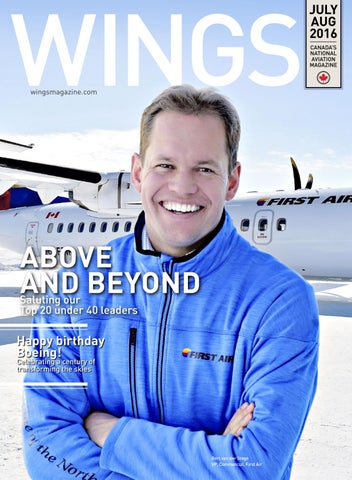
WINGS wingsmagazine.com
ABOVE AND BEYOND
Saluting our Top 20 under 40 leaders
Happy birthday Boeing!
Celebrating a century of transforming the skies
Bert van der Stege VP, Commercial, First Air
JULY AUG 2016 CANADA’S NATIONAL AVIATION MAGAZINE
JULY/AUGUST 2016
UPFRONT 4 Leading edge
The magic of Boeing
8 On the fly
News and opinion
12 Alternate Approach Understanding token issues
14 At the Gate
Hitting on all cylinders
16 Glidepath
The waiting game continues
BACK 47 Marketplace 50 On final
Making a decision on PFD’s
Boeing’s C-17 Globemasters are versatile workhorses for the Royal Canadian Air Force (RCAF). P.28
FEATURES 18 TOP 20 UNDER 40 SPECIAL: ABOVE AND BEYOND
Young aviation and aerospace leaders are setting new standards From top: Understanding token issues p. 12 The waiting game continues p. 16
BY MATT NICHOLLS
28 THE BOEING COMPANY’S CENTURY OF INNOVATION
The iconic aerospace giant has transformed the skies both here and abroad
PHOTO; RCAF (MAIN); FOTOLIA (TOP LEFT); PAUL DIXON (BOTTOM LEFT)
BY DAVID CARR
32 HAVE A VISION, THEN FOCUS
Ontario’s Airborne Sensing centres in on the lost art of airborne sensing BY FREDERICK K. LARKIN
37 HIGHLIGHTING TRANSFORMATIVE PROCESSES Aéro Montréal’s innovation conference explored new ideas, concepts BY BRIAN DUNN
COVER PHOTO: LINDSEY GIBEAU
WWW.WINGSMAGAZINE.COM
July/August 2016 | WINGS
3
LEADING EDGE | By Matt Nicholls
The magic of Boeing
Global aerospace giant marvels with its transformative ingenuity
I
5 4
WINGS | July/August 2016
Such passion isn’t just
“The Boeing facility was especially found at the facility; it’s also shown in the boardroom. fascinating to me given its Take Wendy Sowers for incredible influence on the example. The Director of the Boeing Company’s anworld stage.” composites and parts for Boeing Commercial Airplanes, including wing to body fairings, engine strut forward fairings, engine strut and aft fairings, and landing gear doors. A Tier 1 sponsor of the 787 Dreamliner program, Boeing Winnipeg also manufactures the engine inlet inner barrel for the 737 MAX. The level of commitment on the shop floor to various procedures and ingenuity in manufacturing procedure was inspiring, and it made me stop and consider where such passion comes from – an intrinsic element of the company’s DNA as Jim Barnes, Boeing defence, space and security business development director for Canada, notes in Carr’s feature.
TOP DATA BURSTS… in this issue
1. 8,300: The number of BizJet deliveries Bombardier is predicting by 2025. (Pg. 8). 2. Delta’s order for 75 C Series aircraft will cost the airframer $500 million. (Pg. 9). 3. 23.1 million: The number of global traveller’s bags that went missing last year. (Pg. 12) 4. NAV CANADA earned $29 million in 2015 by selling its own technology (Pg. 14) . 5. There are more than 260 Boeing aircraft in Canada, carrying more than 80,000 people per day. (Pg. 28).
nual market forecast gave an informative and stirring (at least to me) presentation at this year’s excellent 27th Canadian Airline Investment Forum in Toronto. Boeing’s long-term outlook on the commercial side shows robust growth. In 2015, for example, global airlines took delivery of new hardware worth more than $122 billion. With high demand in Asia-Pacific, North America, Europe and the Middle East, that market share is expected to increase to $172 billion by 2020. And with a forecast need of some 38,050 commercial aircraft over the next 20 years, there should be plenty of continued opportunity for growth both in Canada and abroad. Opportunity is not restricted to just the commercial side. Military products such as the CH-18 Hornet, C-17 Globemaster and CH-147 Chinooks – stalwarts of the Royal Canadian Air Force (RCAF) – are in high demand, as countries look to replace aging fleets and augment resources. At The Boeing Company, the future looks very bright indeed. Congratulations on a century of innovation and influence! It’s truly a remarkable achievement. | W @Wings_Magazine WWW.WINGSMAGAZINE.COM
PHOTO: RCAF
n editing David Carr’s excellent feature on the 100th anniversary of global aerospace icon The Boeing Company and its immeasurable influence in the development of military aircraft, commercial aircraft and space technology, (see, “Boeing: A century of innovation,” page 28), I began to reminisce about one of the most enjoyable journalistic experiences I have had as the editor of Wings magazine. A few years back, Ken Webb, executive director of the Manitoba Aerospace Association, invited me out to Winnipeg to get a closer look at the province’s aerospace footprint. For those of you who are unfamiliar with Manitoba’s aerospace exploits, take note: this is one of the most closely knit clusters in the country with strong collaboration between academia, industry and government. Three world-class firms lead the way here in terms of their far-reaching global influence – StandardAero, Magellan Aerospace and Boeing Technology Canada – yet there are 23 established regional and national firms mixed in with several outstanding academic institutions working in unison to drive aerospace growth. Ken and I hit the pavement at 7 a.m. and didn’t stop until the wee hours of the evening. I was amazed at some of the innovative, technologically advanced aerospace achievements. The Boeing facility was especially fascinating given its longevity and incredible influence on the world stage, meeting high-volume and stringent production demands from global airlines. Boeing Winnipeg is one of the largest aerospace composite manufacturers in the country, employing more than 1,400 people in 80,000 sq. ft. of workspace covering two facilities. It produces nearly 1,000 end-item
APPOINTMENT NOTICE Mr. Neil R. Wilson, President and Chief Executive Officer of NAV CANADA, is pleased to announce the following executive appointments:
Raymond G. Bohn Senior Vice President, Human Resources
Larry Lachance Vice President, Safety and Quality
As Senior Vice President, Human Resources, Mr. Bohn’s responsibilities are critical to the mandate of NAV CANADA to ensure air navigation safety and efficiency through a skilled and motivated workforce. His key priority is the ongoing development of a culture and systems that foster high performance and employee engagement.
As Vice President, Safety and Quality, Mr. Lachance is responsible for the NAV CANADA Safety Management program which provides internal safety oversight of the management of operational risk as required by the Canadian Aviation Regulations.
Mr. Bohn joined NAV CANADA in 2000 as Senior Manager, Pension and Benefits and occupied a series of progressively more senior managerial positions in Human Resources and Finance. From 2012 to 2015, he held the position of Vice President, Revenue and Pension Administration, providing leadership and direction to the ANS Revenue team. Prior to joining NAV CANADA, Mr. Bohn ran his own consulting business.
Following a successful early career as an air traffic controller, Mr. Lachance occupied a series of progressively more senior managerial positions in Operations. As Assistant Vice President, Operational Support, he was responsible for ATS Systems Integration, Standards and Procedures, Safety, and Operational Coordination. In 2012, Mr. Lachance was appointed Vice President, Operations where he provided overall direction and guidance to the operational performance of the Company.
Elizabeth Cameron Vice President, Labour Relations
Donna Mathieu Vice President, Pension Investments
As Vice-President, Labour Relations, Ms. Cameron is responsible for developing labour relations strategies and mandates for collective bargaining for NAV CANADA. She acts as chief negotiator at the collective bargaining tables and manages the grievance and arbitration portfolios, as well as related functions.
As Vice President, Pension Investments, Ms. Mathieu is responsible for the overall investment and management of the assets of the NAV CANADA Pension Plan.
Ms. Cameron joined the Company in 2004 as Director, Labour Relations bringing to the position over 17 years of Human Resources and Labour Relations experience in the sectors of transportation, municipal government and academic institutions. Most recently, she held the position of Assistant Vice President, Labour and Employee Relations. Prior to joining NAV CANADA, Ms. Cameron was Director of Human Resources at Carleton University.
With an extensive career in the areas of investment management, external and internal audit, transaction services and financial reporting, Ms. Mathieu joined NAV CANADA in 2003 as Director of Internal Audit. In 2009 she moved to the Finance Department to lead the Company’s IFRS transition project and in 2010, she assumed the role of Director, Pension Investments. She was promoted to Assistant Vice President, Pension Investments in 2014 where she continued to support the design and implementation of the NAV CANADA Pension Plan’s investment strategy. Prior to joining NAV CANADA, Ms. Mathieu was a partner with KPMG.
Leigh Ann Kirby Vice President, General Counsel and Corporate Secretary
Rob Thurgur Vice President, Operations
As Vice President, General Counsel and Corporate Secretary, Ms. Kirby is responsible for all legal and corporate service functions at NAV CANADA.
As Vice President, Operations, Mr. Thurgur is responsible for the operational performance of NAV CANADA, ensuring the safe, efficient and cost effective management of air traffic services and aeronautical information services.
Prior to joining NAV CANADA, Ms. Kirby spent ten years at the senior levels with MBNA Canada Bank (MBNA) and The Toronto-Dominion Bank (TD Bank). She was most recently Associate Vice President – Legal at TD Bank where she acted as a senior advisor to executive management to meet legal and regulatory obligations, and provided support to the retail, marketing and credit card businesses. Prior to that, Ms. Kirby held the position of Chief Legal Counsel for MBNA. She also developed a strong track record in civil litigation early in her career.
Following an early career as an air traffic controller, Mr. Thurgur was the Manager of Area Control Centre Operations in the Toronto Flight Information Region. In 2012, he was appointed Assistant Vice President, Operational Support where he was responsible for the automation and standards used in the Company’s Air Traffic Services operation as well as international coordination with global air navigation service providers and regulators. He has also been appointed the Canadian representative to the North Atlantic Systems Planning Group, a position he has held since 2013.
www.navcanada.ca
WINGS
JULY AUG 2016 CANADA’S NATIONAL AVIATION MAGAZINE
wingsmagazine.com
Vol. 57, Issue 4 EDITOR
Matt Nicholls mnicholls@annexweb.com 416-725-5637
ABOVE AND BEYOND
MEDIA DESIGNER
Brooke Shaw
Saluting our Top 20 under 40 leaders
FLIGHT DECK
Happy birthday Boeing!
Rick Adams, David Carr, Paul Dixon, Brian Dunn, Frederick K. Larkin, James Marasa, Carroll McCormick, Anna Pangrazzi, Amanda Winters
Celebrating a century of transforming the skies
SubScribe TODAY !
MARKETPLACE ACCOUNT MANAGER
Kory Pearn kpearn@annexweb.com 519-902-8574
Bert van der Stege, VP. Commercial, First Air
1 Year SubScription only
3295
$
ACCOUNT CO-ORDINATOR
Stephanie DeFields sdefields@annexweb.com 1-888-599-2228 ext. 257
(GST $34.60 • HST $37.23) US $57.95 (USD) • Foreign $65.95 (USD)
Name: _______________________________ Company: ____________________________ Title: _________________________________ Address: _____________________________ City: _________________________________ Prov: ________________________________ P.Code: _______________________________ Tel: __________________________________ Fax: _________________________________ email: ________________________________
NATIONAL ACCOUNT MANAGER
Mena Miu mmiu@annexweb.com 905-713-4351 GROUP PUBLISHER
Martin McAnulty mmcanulty@annexweb.com WINGS MAGAZINE
P.O. Box 530, 105 Donly Dr. S., Simcoe, ON N3Y 4N5 Tel: 519-428-3471 Fax: 519-429-3094 Toll Free: 1-888-599-2228
PLeASe cHecK ONe:
❑ Charter/Fractional ❑ Commercial Airlne ❑ Private Aircraft Owner/Operator ❑ Air Transport-Cargo ❑ Tour Operator ❑ Training/Education ❑ Airport ❑ FBO ❑ MRO ❑ OEM ❑ Aviation Distributor ❑ Aviation Fuel Supplier ❑ Aviation Services ❑ Aviation Sales/Marketing ❑ Para-Public/EMS/SAR/Law Enforcement ❑ Government/Military ❑ Resources - Construction, Fire, Forestry, Mining, Oil & Gas, Wildlife, etc ❑ Other (please specify) ______________
Printed in Canada ISSN 0701-1369 Publication Mail Agreement #40065710 Published six times per year (Jan/Feb, Mar/Apr, May/ Jun, Jul/Aug, Sep/Oct, Nov/Dec) Subscription Rates Canada – 1 Year $ 32.95 (plus GST - #867172652RT0001) USA – 1 Year $ 57.95 Foreign – 1 Year $ 65.95 Circulation Email: apotal@annexbizmedia.com Tel: 416-510-5113 Fax: 416-510-5170 Mail: 80 Valleybrook Dr., Toronto ON M3B 2S9
PAYMeNT: Cheque - Payable to Annex Publishing & Printing Inc. Visa
Occasionally, Wings magazine will mail information on behalf of industry-related groups whose products and
MC
services we believe may be of interest to you. If you prefer not to receive this information, please contact our circulation department in any of the four ways listed above. Annex Privacy Officer privacy@annexbizmedia.com Tel: 800-668-2374 No part of the editorial content of this publication may be reprinted without the publisher’s written permission. ©2016 Annex Publishing & Printing Inc. All rights reserved. Opinions expressed in this magazine are not necessarily those of the editor or the publisher. No liability is assumed for errors or omissions. All advertising is subject to the publisher’s approval. Such approval does not imply any endorsement of the products or services advertised. Publisher reserves the right to refuse advertising that does not meet the standards of the publication.
Account #: __________________________ Expiry:_____________________________
TO SubScribe:
Tel: 416-510-5113 Fax: 416-510-5172
Mail: Wings Magazine c/o Annex business Media circulation 80 Valleybrook Dr., Toronto, Ontario M3b 2S9
Air Transport Association of Canada
ON THE
WEB
email: subscribe@wingsmagazine.com
www.wingsmagazine.com
GST#135274215RT001
6
Subscriptions non-refundable
PRO716
WINGS | July/August 2016
WG_subad_JulyAug16_MLD.indd 1
Canadian Owners & Pilots Association
Canadian Business Aviation Association
Magazines Canada
AVIATION THIS WEEK
PHOTO: ANNEX BUSINESS MEDIA
Signature: _________________________
Looking to catch up on the latest hot news from around aviation and aerospace? Check out Aviation This Week, a live digital version of the top news stories affecting a variety of key markets. It's quick, essential information you need to know! WWW.WINGSMAGAZINE.COM
2016-06-29 10:41 AM
WHERE SAFETY WORKS At Mark’s Commercial, safety is our business. You’ll get the right products sent to the right place at the right time.
We make it easy to outfit your workforce with innovative workwear that maximizes safety and performance. Mark’s Commercial is home to the most advanced and innovative workwear and PPE brands available, suitable for any industry. Wholesale programs, online ordering, direct delivery and a responsive Client Services Team make Mark’s Commercial the only wholesale workwear supplier you need when safety matters most.
Make safety work for you go to markscommercial.ca
ON THE FLY For late-breaking news and exclusive web content, please visit us at: www.wingsmagazine.com
THE LEAD COMMERCIAL BUSINESS AVIATION
THE LEAD
NORTH AMERICA TO LEAD BIZJET GROWTH The United States and Canada will continue to lead in new business jet deliveries with almost one in every three new airplanes headed for a North American customer according to Bombardier Business Aircraft’s 10-year forecast for the private aviation market. Demand for larger aircraft will dominate despite a softening in deliveries this year, and the sector is expected to get stronger as growth returns to emerging economies such as Latin America and China. The report, which was released at the annual European Business Aviation Convention and Exhibition (EBACE) in Geneva, predicts 8,300 new business jet deliveries from 2016 to 2025 in the light, medium and large aircraft segments, valued at approximately $318 billion (US$250 billion). “Bombardier Business Aircraft continues to invest in innovative and efficient business aircraft solutions and new aircraft development programs, including the Global 7000 and Global 8000 aircraft,” the manufacturer said in a statement. “As an important driver for business jet growth,
new aircraft programs ensure [we are] well positioned to meet market demand.” Bombardier sees economic indicators such as world GDP growth, rebounding stock markets and low interest rates supporting a hardening used aircraft market, fatter order books and more deliveries for OEMs, which have had to realign to recent dips in market demand. Other economic and industry drivers of business jet demand include: • Trade globalization, particularly with and between emerging markets, increasing the need for direct city-to-city access. • Renewed demand in emerging markets as business jet adoption approaches mature market levels. • Introduction of new programs, particularly in the large category (while the light and medium categories will be constrained by lack of clean sheet design introductions). • Retirements. 220 large, 680 medium and 1,100 light business jets will be retired by 2025, including 1,390 retirements in North America. North America, the birthplace of business aviation and the largest market for business aircraft, is forecast to receive 3,930 deliveries over the next 10 years, valued at $134 billion (US$105 billion). Globally, the large category will account for 29 per cent of deliveries and 52 per cent of revenue. The medium category evens out at 34 per cent of deliveries and revenue, and the light category will make up 37 per cent of deliveries and 14 per cent
Bombardier predicts 8,300 new business jet deliveries from 2016 to 2025 in the light, medium and large aircraft segments. 8
WINGS | July/August 2016
of revenue. More than 80 per cent of deliveries in North America will be light and medium jets.
FLYING COLOURS PARTNERS WITH CAE
CAE, Flying Colours have partnered to deliver combat training for the RCAF’s CATs program.
Flying Colours Corporation is teaming up with CAE in its bid to deliver combat support training services to the Royal Canadian Air Force (RCAF), navy and army. Montreal-based CAE recently submitted a bid for the Contracted Airborne Training Services (CATS) program in partnership with Draken International, operator of the largest fleet of privately-owned fighter aircraft. The CAE and Draken team have proposed a fleet of Douglas A-4 Skyhawk fighter aircraft to support the CATS program. If the bid is successful, the Peterborough, Ont.-based modification specialist would be used to provide maintenance, repair and overhaul services. “Flying Colours was identified by CAE as a high quality, good value provider of aircraft support services in Canada,” said Mike Greenley, vice-president and general manager of CAE. “We are proud to add the business to our pan-Canadian team of partners and sub-contractors.” This is the first joint venture between the two Canadian companies. To help kick it off, CAE executives travelled to Flying Colours Peterborough headquarters to participate in the unveiling of a CT-155 Hawk aircraft painted in World War II commemorative livery to honour the 75th anniversary of the RCAF 419 “City of Kamloops” Squadron. The re-painted aircraft serves the NATO Flying Training Program in Canada, which is run by CAE. The CAE/Draken proposal calls for six single-seat and 10 twin-seat Skyhawk aircraft. The last Skyhawk rolled off the WWW.WINGSMAGAZINE.COM
PHOTOS: BOMBARDIER ( LEFT, TOP RIGHT); RCAF (TOP LEFT); MATT NICHOLLS (BOTTOM RIGHT)
8 9 9
Douglas production line in 1979. These aircraft have had extensive upgrades and deliver capabilities similar to Canada’s CF18 fighter aircraft, which they would go up against in training exercises.
COMMERCIAL
BACK IN THE GAME?
Boeing is reported to be considering a new version of the 737 MAX to go head-to-head with the C Series. The Bombardier entrant had already forced Airbus and Boeing’s hand to introduce re-engined versions of the A320 and 737. Despite the yawning gap in order books, it would appear that Boeing no longer thinks that is enough and is considering scrapping a 126-seat version of the MAX with a 150-seat airplane, according to the Wall Street Journal (WSJ). The smallest MAX variant is scheduled to enter service with Southwest Airlines in 2019. The WSJ is reporting that a direct competitor to the C Series would need the blessing of both Southwest and United, who recently also picked the larger 737-700 over the CSeries to replace its fleet of aging regional jets. Reuters has reported that Southwest would “absolutely” consider a new version of the MAX. Bombardier is back in the game, although the price for a ticket was steep. It is estimated that Delta’s order for 75 aircraft will cost the airframer $500 million (US$391 million). Ironically, it's equal to the amount Airbus sought from an earlier Trudeau government in the 1980s for an equity stake in the A320 program, and a production line in Montreal. Airbus chief salesman John Leahy says that Delta is acquiring the C Series for approximately $28 million (US$22 million). Saks Fifth Avenue technology at Walmart prices for sure; but no less a giveaway than when a fledgling Airbus was desperate to break into the market with an order from a premium pedigree. Delta is one of the world’s savviest procurers of airplanes, and Richard Anderson, its former chief executive was an early C Series booster . . . at the right price. The Delta order is Bombardier’s largest to-date and has broken the near chokehold that Airbus and Boeing have had in the U.S. with the A320NEO and 737 MAX. That too is part of Delta’s DNA. Delta has a history of upsetting established jet makers and providing new entrants a foothold in its fleet, reports the WSJ. Delta was the launch customer for Bombardier’s 50-seat CRJ100 and Northwest Airlines, which merged with Delta in 2008, was the first U.S. airline to purchase WWW.WINGSMAGAZINE.COM
The Bombardier C Series celebrated its first commercial flight flying executives from Dublin to Zurich at the conclusion of the IATA conference.
the Airbus A320. However deep the discount, it appears it might be deep enough to trigger another trade dispute with Bombardier’s traditional rival, Brazil’s Embraer over government subsidies. Government support for aerospace remains commonplace and fights over subsidies mirror the old line about prostitution; we know what you are, we are just quibbling over the amount. The hot button this time is up to $2 billion in Quebec and federal government aid. Should Brazil take the issue to the World Trade Organization, the global arbiter in such disputes, Bombardier will argue that the Delta deal was signed while a federal and Quebec bailout remains stalled on the bargaining table. At a recent International Air Transport Association (IATA) meeting in Dublin, Alain Bellemare, Bombardier’s chief executive, signalled that the company will throttle back on its discounting policy. “It’s clear that we took a more aggressive position on the recent orders,” Bellemare told Bloomberg News, and the company is at the right stage to transition to a highermargin approach to sales. The C Series enters commercial service with launch customer SWISS on July 15, between Zurich and Paris Charles de
Gaulle. Manchester, Prague and Budapest will also be among first destinations. At the conclusion of the IATA conference, 100 passengers and luggage, including senior executives from about 20 Star Alliance member airlines flew from Dublin to Zurich aboard a CS100. The one hour and 50 minute flight consumed 20 per cent less fuel than competing single-aisle aircraft currently flying that route. The C Series has orders for 370 aircraft, including 232 of the larger CS300, which has been ordered by Air Canada. The recent passenger flight also confirmed for Bombardier that with 100 passengers, luggage and fuel, the CS100 could have flown direct from Dublin to Montreal.
BUSINESS AVIATION
CHARTRIGHT’S WATERLOO FBO OPEN FOR BUSINESS There’s a new FBO at the Waterloo International Airport as the Chartright Air Group celebrated the opening of its new facility in grand style June 16. It was also the perfect backdrop for CBAA president/CEO Rudy Toering to share some
The Waterloo facility features more than 50,000 sq. ft. of hangar space, a full-service FBO, office space, parking facilities and more. July/August 2016 | WINGS
9
ON THE
FLY
important business aviation news. Several members of the Chartright team, the Waterloo International Airport and members of the Canadian business community turned up for the event, which gave attendees a chance to tour select business aircraft and ride on a Leonardo Helicopters’ AW139. The Chartright hangar/FBO is the latest location for the firm, which specializes in aircraft charters, aircraft management, helicopter services and more. Founded in 1987, Chartright manages more than 30 private business jets and operates in several locations across the country, including Toronto, Vancouver, Calgary, Regina and Timmins. The Waterloo location will offer business owners and travellers a host of services including fuel, hangarage, maintenance, and pilot facilities. Chartright is also relocating its helicopter maintenance business from the Toronto site to the new facility, offering clients a wider variety of services. The Waterloo facility features more
than 50,000 sq. ft. of hangar space, a full-service FBO, office space, parking facilities and more. It’s an intriguing option for business travellers who want to utilize a location near the GTA but don’t want to deal with the higher costs of operating through Toronto’s Pearson International Airport. “This represents a diversification for us both operationally but also from a service offering point of view,” Adam Keller, Chartright president, told Wings. “Being here in Waterloo means we now have corporate relief from Pearson which is overflowing, but we also have the ability to control our fuel services and our FBO services. That diversity will give us strength but also gives us opportunity because Toronto is just simply full. Keller notes that the plan initially will be to “basically fill the facility up” with clients. The process will be to take existing clients from Toronto who want to avoid the hustle and bustle of Pearson and give them the luxury of guaranteed
hangar space – an issue they will not have to deal with in the roomy confines of the new location in Waterloo. “And with them, we will bringing the maintenance services that we have at the Toronto site,” Keller said. “With the fuel with have here, it offers tremendous value for clients and Chartright – everything is cheaper than it is at Pearson. Fuel, landing fees . . . it’s all cheaper here. Once we become known, this is going to become a large draw for others in the business community.” Another advantage to the Waterloo locations, Keller noted, is clients do not have to deal with the de-icing snafus business aircraft encounter at Pearson – nor is congestion a problem. “Yes, there are a lot of cost advantages to this airport, but from a positioning point of view, it just makes sense. It is less congested, it is an easier experience – and frankly you are working with an airport that covets business travellers.” The Waterloo Airport is on the cusp
NATIONAL AVIATION CONFERENCE & TRADESHOW 2016!
TUESDAY, NOVEMBER 15 to THURSDAY, NOVEMBER 17 The major Industry Networking Event not to be missed! WESTIN BAYSHORE HOTEL VANCOUVER, BC ATAC’s National Aviation Conference and Tradeshow has been the national gathering for operators, industry suppliers and government stakeholders involved in commercial aviation and flight training in Canada for over 80 years!
BE PART OF ATAC 2016 TRADESHOW 500+ PARTICIPANTS AND 50+ EXHIBITORS
10 WINGS | July/August 2016 WG_ATAC_HALFPAGE_MAYJUNE2016_ASK.indd 1
For more information contact: Debbie Simpson, Tradeshow Manager 613-233-7727 ext. 312 tradeshow@atac.ca www.atac.ca
WWW.WINGSMAGAZINE.COM 2016-04-22 12:42 PM
of growth – as is the Waterloo business community, particularly in IT development – and Keller maintains that Chartright could be a definite benefactor of this growth spurt in the months and years ahead. “We are hoping to become as valuable to the Waterloo Region a well as they talk about new transportation services. So it’s a great step for Chartright.” Constantine Tsokas, senior director of maintenance with Chartright, called the new location a boon for clients from a line maintenance point of view due to the immense space and overall organization of the facility. “The ample floor space enables us to be able to drive new and existing business. In Toronto, we are simple challenged for space," Tsokas said. Doing more for business aviation in general is Toering’s goal as president/ CEO of the CBAA and he was pleased to announce that Chartright and the Region of Waterloo Airport will be the
WWW.WINGSMAGAZINE.COM
co-hosts of the 2018 CBAA conference and tradeshow. “Business aviation operates from major hubs but it also operates from regional airports,” Toering said. “Waterloo fits that mold perfectly.”
G600 FUSELAGE TAKES WING Gulfstream Aerospace recently joined the wing to the fuselage on the first G600 flight-test aircraft, with the program tracking for entry into service in 2019. “The wing-to-fuselage join is a significant step in manufacturing the first G600 and reflects our continued steady progress toward first flight,” said Mark Burns, president of Gulfstream. The G600 and shorter-range G500 are clean-sheet, wide-cabin aircraft with more than a passing resemblance to Gulfstream’s popular G650. The aircraft are powered by the Pratt & Whitney Canada (P&WC) PW800 family of engines, a break from Gulfstream’s traditional
relationship with Rolls Royce. The G600, which features twin P&WC PW815GA engines, can fly up to 11,482 kilometres at Mach 0.85, or 8,890 kilometres at a speedier Mach 0.90. The G600 follows the shorter-range G500, which began testing in May 2015. The G500 test fleet includes four flight test aircraft, and has accumulated more than 800 hours flying time. The G500 will enter service in 2018. “Achieving these milestones speaks to the maturity of both programs and demonstrates our commitment to ensuring these aircraft deliver the performance, safety and reliability we promised,” Burns said. The G500 and G600 are part of a shopping basket of aircraft by Qatar Executive, a division of Qatar Airways. “The incoming addition of these new aircraft will enable us to widen the range of services available to our clients seeking bespoke and tailored travel services,” said Akbar Al Baker, chief executive of Qatar Airways.
July/August 2016 | WINGS
11
ALTERNATE
APPROACH By David Carr |
Understanding token issues
What happens when a “smart” airport just isn’t that smart?
B
12 WINGS | July/August 2016
It’s not the long lines or lost luggage that causes frustration, it’s the lack of information. It’s not the long lines or lost luggage that causes frustration – it’s the lack of information that would help to defuse a situation. And here’s the irony. SITA’s annual IT Summit, where this correspondent was travelling back from, is a global showcase of technologies aimed at improving air transport by increasing a terminal building’s capacity without adding to its size, raising the bar on pay-as-you-go inflight service and hammering out bumps along the journey. Some of what was on display is bells and whistles. Most is technology we can use such as plotting in real time the walking time and distance from check-in to gate; red flagging the bottlenecks; pushing out offers from airside shops and restaurants; and being alerted when your bag does not make the flight. All of this requires a level of cooperation between airlines, airports and other stakeholders that, for the most part, is missing from the game. There are notable exceptions such as Miami International Airport and Montreal Trudeau, which is rolling out an app that puts 90 per cent of information a customer will need within two clicks of a
smartphone. And there are encouraging signs on the horizon. For example, 92 per cent of airlines and 90 per cent of airports plan to make major investments in mobile and R&D over the next three years to streamline the travel experience. Many technologies are aimed at monetizing the passenger – helping to fatten an airlines’ bottom line and boost non-aeronautical revenue in the terminal building, which will have a mitigating impact on airport user charges. The future is going to call for more, not less, cross-channel cooperation between stakeholders. SITA delegates were recently given a taste; a secure, verifiable “token” on a mobile or wearable device containing biometric and other personal data. SITA Lab is partnering with ShoCard – a California-based mobile identity company – to develop a travel identification system that will replace multiple travel documents with a simple face and device scan. The potential is enormous, but the revolution is years away. And it’s a good thing because right now, too many stakeholders are struggling to work together to even connect the hi-tech basics. | W David Carr is a Wings writer and columnist. WWW.WINGSMAGAZINE.COM
PHOTO: FOTOLIA
arcelona is one of the world’s smartest cities for its use of new and integrated technologies to manage sectors such as vehicular traffic and urban transport. Later this year, Barcelona takes the torch from Montreal as host of the annual Smart City Expo. Authorities from Barcelona Airport should take notes. The global rush is on for airports to become smarter, at least from this passenger’s perspective – since I just experienced the Barcelona Airport in action. A smart airport, for example, would have alerted customers of a 45-minute knot at passport control; severely short-staffed and positioned far down the passenger stream, after security and retail. But at the Barcelona Airport, there was none of that. This is information travellers need, especially those of us trapped at the end of the queue with 30 minutes or less to catch a flight. The process was no smoother on this side of the Atlantic. After almost an hour studying the baggage carousel, I arrived at the realization that my bag missed a connecting flight to Toronto at Dublin. Here’s the thing: stuff happens. For the short-term at least, airport checkpoints such as security and border controls are going to thicken as the terrorist threat increases, passenger volumes continue to swell and cash-strapped governments struggle to keep up. America’s Transportation Security Administration scrambled earlier this year to add screeners ahead of the busy summer season. Canada could be next, as funding for CATSA has not kept pace with passenger growth. Mishandled baggage is headed in the other direction. According to SITA, a global leader in air transport technology and passenger communication, the number of lost bags has been cut in half since 2007. Even so, bags go missing – 23.1 million last year, with transfers accounting for almost 50 per cent of all mishandled bags. Yet, statistics are all relative. If you are working in Canada, the jobless rate is 7.6 per cent. If you are without a job, it’s 100 per cent. Statistically speaking, there is a 100 per cent chance my bag was the first to be mishandled with a report tucked inside on airline industry performance improvements in handling baggage.
AT THE
GATE
By Brian Dunn |
Hitting on all cylinders
NAV CANADA continues its global transformation
N
14 WINGS | July/August 2016
the target balance of $100 million. “The purpose of the one-year temporary rate reduction is to return this additional $50 million to customers,” said president and Neil Wilson. NAV CANADA has developed another new technology known as iSign, which allows controllers to log into work and receive pre-shift briefings on an iPad, replacing sign-in sheets and binder books. The system was rolled out last year and the company hopes to sell it to airports and other aviation clients. Australia has installed NAV CANADA’s tower software at four airports, including Adelaide and Melbourne and last year signed a contract to add it to four more. NAV CANADA is providing a modified version of its NAVCANsuite of ATC tools called INTAS (Integrated Tower Automation Suite), while Saab of Sweden will provide overall project management and system integration as well as integration of surface automation tools. INTAS combines flight data, operational data, surveillance, and airfield lighting control, providing air traffic controllers with an environment that enhances safety and efficiency, and reduces controller workload. | W
NAV CANADA has leapt ahead of the U.S. by using Controller Pilot Data Link Communications.
network will relay signals from all ADS-B equipped aircraft to controllers worldwide, allowing 100 per cent global air traffic surveillance regardless of terrain, location or infrastructure and without requiring any additional surveillance infrastructure by the air navigation service providers or equipment by the airlines. NAV CANADA earned $29 million, or two per cent of its $1.33 billion total revenue in 2015, from selling its technology, which is still a drop in the bucket of overall revenue, but will likely increase. “Our main source of revenue is what we charge airlines,” explained Ron Singer, manager of media relations at NAV CANADA. “Looking for further sales will always be part of our overall revenues, because we operate on a cost recovery basis. The additional money will go towards reducing our service charges. In fact, we have lowered our service charges twice in the last 12 years due to greater efficiencies.” In April, the agency announced a temporary rate reduction of 3.7 per cent for the company’s next fiscal year, from Sept. 1, 2016 to Aug. 31, 2017. That’s because it forecasts a year-end balance of $150 million in Brian Dunn is a Wings writer and its rate stabilization account, compared to columnist.
WWW.WINGSMAGAZINE.COM
PHOTO: NAV CANADA
AV CANADA has truly transformed itself in the 20 years since it became an independent non-profit corporation; from a federal agency struggling with outdated technology into a global leader in air-traffic systems. About 18 years ago, it began to replace the traditional paper strips used to track air traffic in the country’s 41 control towers with a computerized system that improves safety and efficiency by linking airports electronically – a technology it now sells around the world. It generated $135 million in revenue over the past five years exporting its products. Its success has even caught the attention of the U.S. Congress, which is calling for the much-maligned U.S. air traffic system to be spun off from the Federal Aviation Administration (FAA) into something similar to NAV CANADA. One industry expert praised the agency for its innovations and said others could learn from it, but wouldn’t comment on whether the FAA should spin off its ATC system as he is doing some analysis on the subject for the FAA. With automation, controllers no longer have to perform the time-consuming task of printing out and distributing the strips – what had been a full-time job in some facilities. It also transmits flight data instantly to the rest of the country, making the coordination of long-range flights across regions easier. And it enhances safety by such things as notifying controllers about construction on runways. Its technology is now used in eight other countries, including Australia, the U.K. and Dubai. NAV CANADA has also leapt ahead of the U.S. by using Controller Pilot Data Link Communications – an efficient email-like communication with pilots instead of radio voice calls. In addition, NAV CANADA is a majority partner in Aireon LLC of McLean, Va., which in 2018, will provide the first global air traffic surveillance system using a space-based Automatic Dependent Surveillance-Broadcast network (ADS-B). NAV CANADA will be the launch customer for the system, which Aireon is promoting to other countries. The space-based ADS-B receiver
GLIDE
PATH
By Paul Dixon |
The waiting game continues The RCAF will have to wait for an upgrade to the CF-18
S
16 WINGS | July/August 2016
passengers enthralled for hours. Today, if we’re not connected 24/7, with access to every conceivable form of digital entertainment, then somehow we are being oppressed. If there is going to be a change in business in Ottawa, how about taking a hard look at what it would take to create a level playing field for Canadian airports – and especially how to coerce some of those five million or so Canadians who would rather fly out of American airports to stay on this side of the border when they are coming and going. I realize many people are only interested in the “cheapest” flight and no amount of rationalizing is going to persuade them to change their ways. For years, there have been complaints about the rents airports are charged by the landlord, which directly translates into the landing fees charged the airlines and in turn are passed on to the flying public. The one common thread with our major airports is the landlord – and there’s no reason the landlord can’t take the initiative to find a better way than the status quo. Creating a more level playing field, getting some of those border-crossers to spend their money in their local Canadian airport, and empowering Canadian airports by giving them a solid foundation to compete for more business domestically and internationally would be a good thing for Canadian airlines. And who knows? There might even be a big enough piece of that pie for a legitimate low-cost airline to have a chance. | W
If we’re not connected 24/7, with access to every conceivable form of digital entertainment, then somehow we are being oppressed. and Vancouver to London (Gatwick). The response was fairly muted, certainly more so than it would have been even a year ago. If there’s a big outrage in the cabin, it would be about the level of inflight entertainment (IFE) and Wi-Fi. It wasn’t that long ago that you could go to your local airport, get on an airplane, and with several hundred other people, be transported halfway around the world. The miracle of flight itself used to be all that was required to keep
Paul Dixon is a freelance writer and photojournalist living in Vancouver. WWW.WINGSMAGAZINE.COM
PHOTO: PAUL DIXON
ometimes there’s just too much to write about, so I’ve presented a summer smorgasbord with this column: a few snack bites for your consideration. Rumblings out of Ottawa in early May would have us believe that the federal cabinet has decided to purchase the F/A18 Super Hornet as an “interim” replacement for those CF-18 Hornets still lingering. Well, it would be nice to see some replacements for the current Hornets arrive before we have to park the last of our legacy aircraft. Six years ago, when I interviewed (then) Major-General Yvon Blondin, the replacement for the CF-18 was a large part of our conversation. At that time, the F-35 was considered a done deal and that’s how our conversation proceeded. Now, six years later, the F-35 is very much not a done deal by any stretch of the imagination. What hasn’t changed are the general’s remarks in 2010 about the reality that you can only get so much out of an airframe before you have to retire the aircraft. Six years ago, Gen. Blondin had 78 of the original 138 CF-18 Hornets at his disposal. There are less today and the number of airworthy aircraft will continue to decline as they age out, though there are talking heads in Ottawa suggesting that they can keep going until 2025. What irks me is not just the fact the remaining aircraft are creeping closer and closer to pumpkin time. The unseen cost in this fiasco is the time that has been expended by senior staff at DND, Public Works, Treasury Board – and who knows how many other ministries – as they flit away the years. I’m not going to say their time has been wasted. But beyond the basics, it hasn’t been very productive. The sad truth is that every day given over to the F-18 replacement project after the first couple of years is a day that could have been spent working on something else. That’s what I’d like to know – that the work didn’t get done because we were reinventing the wheel. Now, let’s turn your attention to the announcement that Westjet will not be offering complimentary meals on its new service connecting Edmonton, Calgary
OUR ENGINEERS
HAVE DISCOVERED A WAY TO MAKE
SKIES BREATHE EASIER Regional turboprop airplanes powered by Pratt & Whitney Canada engines have greater propulsive efficiency than similar sized regional jets, consuming 25-40% less fuel. In a single year, this can save around 5,000 tons of CO2 per plane, making both the planet and your bottom line healthier. This is evolutionary engineering.
and grew in their respected spheres. Featured alphabetically, our Top 20 Under 40 achievers represent the resourcefulness, commitment and dedication organizations are craving in today’s marketplace. We salute the achievements of all who participated.
Sean Davies, co-owner/operator, Maintair Aviation Services in Thunder Bay, Ont.
ABOVE AND BEYOND
YOUNG AVIATION AND AEROSPACE LEADERS ARE SETTING NEW STANDARDS
I
BY MATT NICHOLLS
n an inspiring address to young aviators and aerospace professionals at Wings and Helicopters Careers in Aviation Expo in Calgary this past May, WestJet Encore president Ferio Pugliese emphasized the importance of developing young leaders in Canadian aviation and aerospace. Finding and retaining these difference makers, Pugliese noted, continues to be one of the most important tasks corporations face each year. Fortunately, many Canadian aviation and aerospace firms are blessed with employees who are taking the reigns and implementing change for the better: developing new systems, processes and value-added efficiencies to enhance 18 WINGS | July/August 2016
operations. In our annual Top 20 Under 40 report, we uncover 20 influencers who are working to fill this much-desired leadership gap. Many are not only implementing change, but are extending their leadership abilities by helping with various industry associations and community projects. The 20 individuals featured here were carefully selected by our editorial team following an online contest that ran earlier this spring. Candidates were nominated by colleagues based on their influence to drive change, leadership skills and more. In most cases, nominators had several years of experience working with the candidates, observing how they cultivated their skills
Doing anything necessary to get the job done as efficiently as possible. It’s the perfect way to describe the work habits of Denis Bourgouin. The 39-year-old is the director of maintenance for Winnipegbased Fast Air, a role he continues to refine and grow. Bourgouin began his career as a groomer, working his way up through the ranks to the position he holds today. Over the years, he has continued to develop himself, and he now holds several aircraft maintenance endorsements. During the company’s implementation of the Gulfstream fleet, Bourgouin played a key role in the process, working closely with the Gulfstream team on deliveries. In his current role, he is responsible for most of the financial aspects of the department and AMO staff. Definitely a “people” person, Bourgouin works closely with all members of the team to ensure personal expectations are met. Through his leadership, the AMO has longserving team members who are more than happy to come to work. Bourgouin is always looking for ways to improve on the firm’s processes to increase aircraft availability. A key member of the management team, Bourgouin is also a supporting member of the Central Aircraft Maintenance Engineers Association. His leadership and attentiveness to detail set him apart from the crowd – and make him a definite asset to both Fast Air and Manitoba aerospace.
NAME: SHAWN BRAIDEN TITLE: PRM, AEROFLIGHT INTER. SERVICES/HARBOUR AIR GROUP/TANTALUS AIR LOCATION: RICHMOND, B.C. Shawn Braiden, 37, was been bitten by the aviation bug long ago. At the age of 12, he joined the Royal Canadian Air Cadets 676 squadron in Sydney, B.C. In 1997, he received his pilot’s licence, while working as a volunteer at WWW.WINGSMAGAZINE.COM
PHOTO: MAINTAIR AVIATION SERVICES (MAIN), DENIS BOURGOUIN
NAME: DENIS BOURGOUIN TITLE: DIRECTOR OF MAINTENANCE, FAST AIR LOCATION: WINNIPEG, MAN.
the Victoria Flying Club. Braiden felt it was essential to attain his AME’s licence because this would give him valuable insight into how his air-
PHOTOS: HARBOUR AIR, AVERSAN INC., HELI-ONE, NAV CANADA
craft worked. He attained his AME “M” licence from BCIT and then accepted a part-time position with Harbour Air as an apprentice/ groomer. Four months later, he completed the BCIT program and became a full-time apprentice at Harbour Air. He also worked part-time for Tasman Helicopters. Braiden’s leadership skills, passion for the industry and commitment to safety was noticed early on at Harbour Air. In 2000, he was appointed crew chief despite only being an apprentice. In 2001, he attained his AME licence and in many ways, his career was set to soar. In 2005, Braiden was instrumental in creating the Coal Harbour Line Maintenance base and in 2013, he was accepted by Transport Canada as a PRM delegate. He accepted that role at Harbour Air a few months later. As he has progressed with the company, he has focused on improving efficiencies and ensuring the top safety for his crew. He is currently responsible for a fleet of 40 aircraft, in addition to approximately 30 third-party aircraft, as well as the firm’s quality assurance policies. An active member of the aviation community, Braiden sits on the BCIT Program Advisory Council and is a member of the Vancouver Soaring Association, COPA EAA and the Cessna 195 club. The proud owner of two vintage gliders and his own Cessna 195, to say Braiden has followed his aviation passion would be an understatement.
NAME: SEAN DAVIES TITLE: CO-OWNER/OPERATOR, MAINTAIR AVIATION SERVICES LOCATION: THUNDER BAY, ONT. It wouldn’t be far-fetched to say Sean Davies isn’t just good at one thing – he’s proficient at many. The 36-year-old is the co-owner/operator of Thunder Bay, Ont.-based operator Maintair Aviation Services – a Shell Aviation dealer and ground handling provider, and president of Deciphr, an aviation leasing and consulting firm. Davies is an aviation veteran of some 18 years with expertise in a number of areas including sales, marketing, flight and ground operations, safety development, scheduling and strategic planning. It’s an impressive WWW.WINGSMAGAZINE.COM
background for sure. A graduate of the Confederation College Aviation program in 2000, he began his career with Slate Falls Airways and then quickly moved to a management position with Wasaya Airways where he was employed for 11 years. An entrepreneur at heart, Davies then took on the role of manager at Maintair with the future intent of becoming a partner in the company. He became co-owner in August 2014. Today, Davies puts his skills and expertise to work in a number of enterprises and also finds time to support the community he calls home. Whether working with the Thunder Bay Regional Health Sciences Centre raising dollars and awareness for its many services, or sitting on the advisory committees for clubs and associations, Davies always finds time to give back. Davies is also the recipient of the 2012 Queen Elizabeth II Diamond Jubilee Medal for outstanding and remarkable achievement for the Governor General of Canada, and is a supporter and Advisory Council member of Confederation College. He is recognized throughout his community as a dynamic supporter of both aviation and the city he loves.
NAME: GARY DEW TITLE: HARDWARE ENGINEER, AVERSAN INC. LOCATION: MISSISSAUGA, ONT. It didn’t taken Gary Dew much time to make a significant impact on the Aversan team – and he hasn’t stopped since. The 28-year-old hardware designer heads up one of Aversan’s largest projects and his leadership abilities have been apparent since he joined the organization. After just six months, Dew proved himself working on the C919 embedded controller and designed an automated test rack for the program. He has since led the electrical engineering design and development on a number of other projects, including a Thales train simulator. Now working with NG HUMS, Dew is spearheading a team of seven engineers working on system architecture and design. As well as being a gifted hardware designer, Dew is very proficient at understanding client needs and design schedules. They trust his expertise and he is a great liaison for his colleagues. The group is thrilled to work with such a reliable, open teammate, one that fully
understands the challenges they face. Always maintaining his composure under tight deadlines and pressure, Dew is a valuable asset to not only to Aversan, but the aerospace community as a whole.
NAME: JESSE GORANSON TITLE: MANAGER, MARKETING AND STRATEGY, HELI-ONE LOCATION: VANCOUVER, B.C. Jesse Goranson, 34, has been with Heli-One for fourand-a-half years, originally starting with the company as an external consultant. After developing a passion for the aviation MRO industry, Goranson took on a permanent role with Heli-One to develop and execute business intelligence initiatives. He then took on a bigger role as the manager of marketing and strategy and works to identify new markets and opportunities to grow Heli-One’s reach and capabilities. Goranson works with Heli-One’s global facilities, OEMs and industry partners to further develop areas of potential growth and development. He has spearheaded notable achievements that include leading the launch of a new website, increasing the addressable market by 20 per cent through OEM partnerships and has generated an additional 10 per cent in annual sales through the launch of marketing automation and enterprise technologies. Capable and always displaying a sound work ethic, Goranson is an important asset to the Heli-One operation on a number of levels.
NAME: WARREN GOSSELIN TITLE: DIRECTOR, TECHNICAL OPERATIONS, REVENUE SERVICES NAV CANADA LOCATION: OTTAWA Warren Gosselin is a skilled, hard-working member of the NAV CANADA team. The 36-year-old is responsible for managing NAV CANADA’s maintenance contract with the Canadian Air Transport Security Authority (CATSA), in which he is embedded as a client executive. Under this contract, NAV CANADA maintains passenger security equipment at the country’s airports. July/August 2016 | WINGS 19
NAME: MilENA KohANENKo TiTlE: CoMpliANCE MANAgEr, lEdCor iNdusTriEs iNC., lEgAl loCATioN: VANCouVEr, B.C. Moving a company forward isn’t possible unless you yourself are forward thinking – and Milena Kohanenko fits this description. Kohanenko, 35, oversees the regulatory compliance of Ledcor’s Aviation division – both fixed and rotary wing – as its aviation compliance manager. Constantly raising the bar has been a hallmark of Kohanenko’s leadership style and those that have worked with her quickly realize she is a passionate leader who knows the regulatory environment inside and out. Kohanenko holds a law degree from the Ukraine and is an IRCA certified ISO auditor and COR auditor. Previous to her current role, she was the director of compliance for the Summit Air Group and the compliance manager for Arctic Sunwest Charters reporting to the accountable executive. She designed, implemented and maintained a best in class Quality Assurance Program (QAP) at both companies. Kohanenko is well-respected by both her peers and colleagues at Ledcor for her unwavering professionalism and commitment to safety in aviation. 20 Wings | July/August 2016
NAME: JoCElyN lEBEll TiTlE: dirECTor of CorporATE sErViCEs, hAwKAir loCATioN: TErrACE, B.C. From concept to completion, it takes a driving force to get the job done, and for 13 years, Jocelyn Lebell, 34, has quietly helped to build the Hawkair brand. As a young honours graduate from the BCIT Marketing Management program, Lebell joined the airline industry and has thrived on the complexities and challenges of her various roles. Upon joining Hawkair, she took on the challenge of revenue management and was instrumental in modernizing the process. She was a key innovator of the Ultra-Econo fare, and in 2014, she entered Hawkair’s Women in Leadership Program as the pioneering woman. She also became director of corporate services, where she translates corporate strategy into business strategy enabling the team to attain personal development goals. Today, she is a senior executive and leads the Corporate Business Services Business Unit. A passionate speaker and active member of several industry associations including BCAC, NATA and ATAC, Lebell is committed to giving back to her community. She was recently named to the Board of Directors of the Northern Savings Credit Union in Prince Rubert, B.C., providing valuable input into key initiatives as well as acquiring business intelligence to help foster the development of Hawkair. Confident, attentive and innovative, Lebell is very conscious of her roles and is an active participant in advocating for young women seeking to grow in aviation and aerospace.
NAME: CANdACE MCKiBBoN TiTlE: ExECuTiVE dirECTor, BC AViATioN CouNCil loCATioN: VANCouVEr, B.C. Candace McKibbon, 25, has always understood the importance of “doing a little bit extra” no matter what the task. She did so as a student at BCIT and she’s showing the same kind of commitment and initiative in her role as executive director with the BC Aviation Council (BCAC). McKibbon graduated from the BCIT Airport Operations diploma program in February 2014. As a student, she brought
passion, leadership ability and determination to the industry in a number of ways, volunteering for key events such as the CHC Safety & Quality conference and working as a mentor for other students. In her role as executive director, she works tirelessly to find new ways to connect key players in the B.C. aviation and aerospace community, with a particular emphasis on helping young aviators in career development. An engaged volunteer for a number of organizations, McKibbon still works closely with the Aviation Leadership Foundation and the BCAC, connecting young aviators to established professionals to share experiences. McKibbon has been honoured with a bevy of important awards for both community and scholastic achievement, and continues to impress both co-workers and other industry leaders with her ongoing commitment to B.C. aerospace.
NAME: dusTy MillEr TiTlE: wEsTwiNd CApTAiN/ dEpuTy flighT sAfETy offiCEr, disCoVEry Air dEfENCE loCATioN: ViCToriA, B.C. Dusty Miller, 38, is not your typical pilot A day at the office for Miller could mean flying in remote northern geographical locations, ferrying across the Atlantic or towing an aerial target being shot at by the Navy. Since joining Discovery Air Defence (DA Defence) in 2009, Miller has flown more than 1,100 hours on the Westwind special mission aircraft delivering service under the interim Contracted Airborne Training Services (iCATS) program, and earned his captain qualification in February of 2015. Miller is involved in flying unique missions involving Electronic Warfare Training, Aerial Target Towing and real-time quality assurance verifications of Canada’s northern early warning radar system . . . to name just a few. Miller also played a key role in the delivery of the company’s A-4N fleet from Mesa, Ariz. to Wittmund, Germany. The ferry involved several winter transits across the North Atlantic including stops in Greenland and Iceland. This was a major achievement for Miller professionally and a milestone for the company, as it prepared the program with the German Armed Forces. Miller is not just a pilot. When he is not flying, he helps out on engineering tasks as an apprentice aircraft maintenance technician on the Westwind and Alpha jets. It’s a unique skill base that assists him in all WWW.Wingsmagazine.com
PHoTos: Ledcor indusTries inc., HaWkair, Bcac, discovery air defence
Gosselin is responsible for overseeing other existing maintenance service contracts and acquiring new ones – a task he has proven to excel at. Before moving to the head office, Gosselin was manager of technical operations for the Winnipeg flight information region, responsible for ANS equipment across much of central Canada and Nunavut. Gosselin has been a key member of the NAV CANADA team for a decade and has led several highly successful national initiatives that have fostered significant change and improvement within the ANS. He has also won two awards of merit for outstanding service. Gosselin is dedicated to improving the culture of the organizing through his strong leadership skills and work with colleagues. Within NAV CANADA’s broader company initiatives, he is part of a core team involved in collaborative efforts with industry partners. He continually proves to be one of the most dynamic leaders at NAV CANADA – resourceful, attentive and influential.
LEKTRO
WG_Northernlights_julyaug16_CSA.indd 1
2016-06-16 7:34 AM
The Original Towbarless Tug Setting the Standard in Excellence Since 1945
Models ranging
15,000 to 280,000 lbs.
Electric Towbarless Certified Easy to Use Universal Rugged Simple to Maintain www.
LEKTRO .com
1-800-535-8767 1-503-861-2288 sales@lektro.com July/August 2016 | WINGS 21
WWW.WINGSMAGAZINE.COM
WG_Lektro_CBAAguide16_CSA.indd 1
WG_FanshaweCollege_JulyAug16_CSA.indd 1 2016-06-06 2:27 PM
2016-06-06 2:29 PM
flight safety endeavours. Miller is also the company’s deputy flight safety officer, in charge of developing and maintaining safety standards such as fatigue management, human factors and more. Outgoing and friendly, Miller brings an impressive skill base to his role and is an invaluable part of the team.
the right relationship can help you soar.
NAME: MICHAEL NAULT TITLE: PROGRAM DIRECTOR, LIGHT HELICOPTERS, BELL HELICOPTER TEXTRON CANADA LOCATION: MIRABEL, QUE.
Helping to influence change at one of Canada’s top aerospace companies is a To learn more, visit pnc.com/aviation. dream come true for Michael Nault. PNC is a registered mark of The PNC Financial Services Group, Inc. (“PNC”). For the past 10 Equipment financing and leasing products are provided by PNC Equipment Finance, LLC, a wholly-owned subsidiary years, the 32-year-old program director of PNC Bank. Aircraft financing is provided by PNC Aviation Finance, a division of PNC Equipment Finance, LLC. In Canada, PNC Bank Canada Branch, the Canadian branch of PNC Bank, provides bank deposit, treasury management, at Bell Helicopter Textron Canada has lending (including asset-based lending through its Business Credit division) and leasing products and services (through its Equipment Finance division). Deposits with PNC Bank Canada Branch are not insured by the Canada Deposit played a critical role in helping to drive Insurance Corporation. Deposits with PNC Bank Canada Branch are not insured by the Federal Deposit Insurance Corporation, nor are they guaranteed by the United States Government or any agency thereof. program development at the Mirabel, Lending and leasing products and services, as well as certain other banking products and services, require credit approval. Que.-based company. After graduating ©2015 The PNC Financial Services Group, Inc. All rights reserved. CIB EF PDF 0715-070-195013 from école Polytechnique de Montréal with a bachelor’s degree in mechanical engineering in 2006, Nault began his career as an airframe structures engineer. After only a few years, he was selected WG_PNCAviation_JulyAug16_CSA.indd 1 2016-06-09 1:20 PM by Textron to participate in a leadership CIBEF Know Ad_Wings_4.625x5_195013_R3.indd 1 8/28/15 12:32 PM program where he moved to the U.S. for three years to work at other Textron business units. Nault worked at as product engineer at Kautex, an automotive business unit, then went to Bell’s research and development centre to work on flight tests on the BA609 (now AW609) tilt rotor aircraft. He completed the development program at Lycoming engines as a systems engineer before coming back to Mirabel in 2011 to manage the technical team supporting the Bell 206L4 and 407 assembly lines. In 2013, Nault was named chief engineer for the in-production of light single helicopters, becoming technically accountable for the 206L4 and 407. Over the course of two years, Nault led his team through several safety and performance initiatives leading to the successful launch of the Bell 407GXP at Heli-Expo in 2015. Nault was awarded the Larry D. Bell Pioneer Award and the 2015 Textron Chairman’s Award for Innovation, and was also named program director for Bell Helicopter’s light single aircraft. An active and passionate member of several industry associations including the board of directors of the MontrealOttawa chapter of American Helicopter
I
22 WINGS | July/August 2016
PHOTOS: BELL HELICOPTER TEXTRON CANADA
PNC AVIATION FINANCE When it comes to financing private aircraft, we know you value decades of aviation expertise, track record and financial strength. That’s why aviation clients across the U.S. and Canada choose PNC Aviation Finance to help their business take off.
Society (AHS) International, Nault is one of Canada’s leading ambassadors for the helicopter industry.
PHOTO: MDA
NAME: NATALIE PANEK TITLE: MEMBER OF TECHNICAL STAFF, MDA’S ROBOTICS AND AUTOMATION DIVISION LOCATION: BRAMPTON, ONT.
Are proud to join the Fast Air group of companies
AIR CHARTER | MANAGEMENT | MAINTENANCE | MEDEVAC | A NEW FBO (CYWG)
Change agent. Leader. Influencer. Mentor. These are just some of the words that aptly describe 31-year-old Natalie Panek. Panek is a member of technical staff with MDA’s robotics and automation division in Brampton, Ont. Her accomCONGRATULATIONS to Denis Bourgouin, Fast Air Director of Maintenance. plishments are visible through her trailFast Air is proud to have you as a part of our team! blazing work on non-traditional projects, and she has been making her mark on the Canadian aerospace industry ever Fast Air is a Dealer and Installer for: since she set her sights on a career in space. Telephone: 204.982.7240 (24 hrs) | Fax: 204.783.2483 | Toll-Free: 1.888.372.3780 (24 hrs) Panek graduated with a degree mechanical engineering degree (with distinction) from the University of Calgary info@flyfastair.com | W W W . F LY F A S T A I R . C O M in 2007 and participated in the university’s inaugural solar car project. She attained a VFR private pilot’s degree during her undergraduate studies, and went www.yxeaero.ca 2016-06-22 10:23 AM WG_FastAir_JulyAug16_CSA.indd 1 on to complete her master’s of applied 800.265.3339 science in aerospace engineering from the University of Toronto in 2009, before accepting two back-to-back internship programs at NASA in 2008 and 2009. The Saskatoon Aerocentre is Since 2010, Panek has worked at the benchmark for service and MDA performing robotic analysis for safety in FBO amenities and we various space programs, and currently are dedicated to our customers is working on MDA’s contract with ESA’s 2018 ExoMars program. Panek is very with complete enthusiasm. passionate about sharing her work with the public, particularly the topic of satelCongratulations to our own lite servicing as a means to more sustainGraham Snell for making the able exploration. Wings Magazine Top 20 Community service and helping menunder 40! tor young women in career development is something Panek is passionate about, Visit our website at and she is very giving of her time to www.yxeaero.ca and please support a variety of initiatives. She is a mentor for Cybermentor, a University of visit us anytime in Saskatoon! Calgary program that promotes women in science and engineering, and is also a member of their advisory council. Panek also mentors through the 4-H Canada’s Leadership Excellence Awards of Distinction (L.E.A.D.) program and has worked as a judge and volunteer for important organizations such as the Ninety-Nines and Women of Aviation Worldwide. She is also a passionate speaker and writer for a number of organizations. July/August 2016 | WINGS 23
NAME: CHRISSY PERRY TITLE: CHIEF FLYING INSTRUCTOR, KF AEROSPACE DEFENCE SERVICES LOCATION: PORTAGE LA PRAIRIE, MAN. For Chrissy Perry, teaching aspiring fighter pilots the nuances of their craft is a rewarding and exciting experience. Perry, 39, joined KF Aerospace Defence Services in Portage la Prairie, Man. as a class 1 instructor in the fall of 2008. KF Aerospace Defence Services is the primary flying training school for the Royal Canadian Air Force (RCAF). Perry was employed as a line instructor upon joining the operation, but within a few years, she moved to the role of assistant chief flying instructor. In fall 2010, Perry was promoted to
chief flying instructor, and has done an outstanding job guiding the careers of aspiring military pilots. She supervises a staff of 25 instructors, has developed – with Transport Canada – one of four instructor refresher courses in Canada, worked with the DND as a liaison in the policies and procedures of the flying program and so much more. In addition to providing her students with the skills and knowledge to advance their careers as military pilots, Perry has still found time to carry out a bachelor of arts at the University of Manitoba with a strong base in psychology. Always learning and honing her craft, Perry is a professional, dedicated leader who excels in all aspects of her role.
NAME: ERIK POLZIN TITLE: FOUNDER/CEO, SITKA AVIATION LOCATION: SPRUCEDALE, ONT. In many ways, Erik Polzin, is living a life many only dream of. Polzin, 33, is a commercial pilot and engineer with
in the Canadian VFR helicopter industry with an affinity for the Far North – its people, culture and varied flying experiences it provides. He is the founder/CEO of Sitka Aviation, a Sprucedale, Ont.-based firm that caters to a wide range of clients in a variety of disciplines. Polzin has flying endorsements on several machines and is qualified to work on Bell, Airbus and Robinson helicopters – mastering the ability to offer his customers both flexibility and expertise in a number of realms. His path to success has been gleaned from good old-fashioned hard work, persistence and dedication to his craft. After attaining his commercial pilot’s licence from E-Z Air Helicopters in 2004, Polzin quickly enhanced his skills with a bachelor’s degree in aircraft maintenance engineering in 2007. He went to work as an apprentice engineer in 2007 with Chilliwack, B.C.-based Western Aerial Applications before catching on as an engineer/pilot at Bi-Air Applications. He moved to a role of seasonal pilot with Glacier Helicopters, before catching on with Trinity Helicopters, which later merged with Summit Helicopters in 2013. Bitten by the love of the Far North and the
PICTURE YOURSELF HERE.
THE SKY’S THE LIMIT WITH A JAZZ JOB! Find yours today at flyjazz.ca
24 WINGS | July/August 2016 WG_Jazz_JulyAug16_CSA.indd 1
WWW.WINGSMAGAZINE.COM 2016-06-21 9:58 AM
PHOTOS: KF AEROSPACE DEFENCE SERVICES, SITKA AVIATION
Panek possesses a unique combination of skill, dedication and insight, helping Canadian aerospace reach new heights.
NAME: JEFF ROBERTS TITLE: AVIONICS/ELECTRICAL SYSTEMS DESIGNER, AME, AVMAX LOCATION: VANCOUVER, B.C. Jeff Roberts prides himself on his versatility and ability to handle a variety of jobs in a professional, efficient manner. The 27-year-old Avionics/Electrical Systems Designer and AME at Avmax in Vancouver has proved to be an invaluable addition to the team when he came on board three years ago. Roberts graduated from BCIT in 2008 from the Avionics Maintenance Technology program and spent four-and-a-half years at Kelowna Flightcraft (now KF
Aerospace), where he gained his AME licence before joining the team at Avmax. He started out in the avionics division before progressing to the engineering division. He has worked at both the Calgary and Vancouver locations, and has travelled all over the world, handling a variety of different tasks. Roberts’ interpersonal skills and strong sense of customer service often stand out, and he is often complimented for his business acumen and overall knowledge base. Roberts also shows his leadership skills in his community. He is the founder of Family Photos Kelowna, an organization that raises funds for cancer research.
NAME: STEPHANIE ROBINSON TITLE: B1900D CAPTAIN, AIR GEORGIAN LOCATION: MISSISSAUGA, ONT. Stephanie Robinson was trained to be at a pilot at Seneca College in the bachelor of aviation technology program and she
continues to share her passion with aspiring aviators learning to soar. Robinson, 25, is a B1900D captain with Mississauga, Ont.-based Air Georgian and is a spokesperson for the Seneca Career Pathway Partnership. A dedicated member of the aviation community, Robinson has already won several awards for her positive outlook and enthusiasm for her craft, including the Russ Bannock Award and the Lloyd Cripps Memorial Award. She has also participated in numerous career events to promote and educate the next generation of pilots. One of the main messages Robinson likes to share with aspiring aviators is there are many avenues you can follow to attain your final role as a commercial pilot, just don’t get discouraged if things don’t work the first time. Persistence, commitment, hard work and dedication will eventually pay off. Robinson is living proof of all of these sentiments. She has set a goal of being part of the training department either on the flight line or in the simulator. Igniting the passions of young adults in both high school and public school is one of her goals.
Continued on page 35
Because our graduates are helping to shape the future. Congratulations Seneca alumna Stephanie Robinson on being named one of WINGS Top 20 under 40 winners. senecacollege.ca/aviation
26 WINGS | July/August 2016 WG_Senecatop20_JulyAug16_CSA.indd 1
WWW.WINGSMAGAZINE.COM 2016-06-06 1:10 PM
PHOTOS: AVMAX, AIR GEORGIAN
chance to operate his own business and service his own clients, he created Sitka Aviation in 2013 – and hasn’t looked back. Polzin’s entrepreneurial spirit, “can-do” attitude and commitment to the highest standards for his clients have helped make his dream of business ownership a success.
A EROSPACE
For the complete story and our capabilities, visit KFAero.ca
KF Aerospace would like to congratulate
Chrissy Perry Chief Flying Instructor KF Aerospace Defence Services, Southport, MB
for being chosen as one of the
WG_KFAerospace_JulyAug16_CSA.indd 1
2016-06-07 7:45 AM
A EROSPACE
WWW.WINGSMAGAZINE.COM WG_NavCanadatop20_Julyaug16_CSA.indd 1
July/August 2016 | WINGS 27 2016-06-08 9:25 AM
Air Canada continues its global growth expansion thanks in part to its Boeing B777 and B787 products.
THE ICONIC AEROSPACE GIANT HAS TRANSFORMED THE SKIES BOTH HERE AND ABROAD BY DAVID CARR
A
viation, in the poem by Royal Canadian Air Force Pilot John Gillespie, has enabled mankind to touch the face of God. For 100 years, The Boeing Company has supplied the innovation and machines to enable us to do so. For most of its first 100 years, Boeing has been tightly woven into Canada’s narrative. On March 3, 1919, William “Bill” Boeing climbed into the rear seat of a company built C-700 airplane behind pilot Eddie Hubbard in Vancouver to fly to Seattle and complete the first international airmail service to reach the United States. Philip Johnson, a Boeing executive, would become vice-president of operations at Trans Canada Airlines, later to become Air Canada. Johnson left TCA in 1939 to return to Seattle as president of Boeing. Today, Canada is one of the largest international supplier networks for Boeing worldwide, including more than 560 suppliers and 2,000 Boeing employees in 12 locations, coast-to-coast. “Canada has the
28 WINGS | July/August 2016
second largest group of Boeing-badged folks outside of the United States,” Jim Barnes, Boeing defence, space and security business development director for Canada told Wings from his office in Ottawa. Approximately 1,400 employees – 80 per cent of the Canadian workforce – are based in Winnipeg, at Boeing’s commercial composite centre of excellence. Winnipeg’s only customer is Boeing Commercial Airplanes in Seattle and Charleston, S.C., where it supplies complex composite part for the complete 700 series of aircraft, including the one-piece composite acoustic inner barrel on the engine nacelle inlet for the 737 MAX, which will help to reduce the operational noise of the airplane by up to 40 per cent. The Winnipeg plant is one of the largest composites plants in North America, but size and pedigree are not guarantees of a share of every airplane line that Boeing produces. “Boeing Winnipeg must to compete for every contract,” Barnes points out. “And it’s tough. Canada has very qualified
suppliers and we have long standing relationships with them. Because once we find a good supplier anywhere in the world – and Canada has a lot to offer – they become part of our global supply chain, which includes thousands and thousands of jets worldwide with a tremendous order backlog.” That backlog currently stands at 5,700 jets. Today, there are more than 260 Boeing jetliners in service in Canada, carrying more than 80,000 passengers a day on approximately 620 flights. These include everything from vintage 737-200s, still operating from gravel airstrips at many of Canada’s concrete-challenged northern airports, to the 787 pushing deep across the Pacific and into the Middle East and India, opening new non-stop services in key markets. On the military fixed wing side, C-17 Globemasters provide the Royal Canadian Air Force (RCAF) with essential heavy-lift capability, while the (former McDonnell Douglas) CF18 Hornet continues to defend the skies. For rotary, the versatile CH-147 Chinook is now a fixture in the RCAF fleet. And when a replacement for the modernized, but aging Hornet is announced, the contract could go to Boeing. WWW.WINGSMAGAZINE.COM
PHOTO: BRIAN LOSITO, AIR CANADA
BOEING: A CENTURY
WestJet’s Boeing 767 is helping the Calgarybased airline reach new heights.
PHOTO: WESTJET
Y OF INNOVATION There appear to be two immediate business opportunities on the Canadian horizon: a potential WestJet order for the Boeing 787, and a replacement aircraft for the CF-18, after the current government appears to be shifting course away from the Lockheed Martin F-35 Joint Strike Fighter (JSF). Before moving to Ottawa, Barnes had managed the Canada, Malaysia and Japan Super Hornet campaigns. “It is by far the biggest campaign out there,” Barnes points out. “That isn’t a surprise to anybody and with respect to the amount of aircraft and the value of the contract, and what it would bring to Canadian industry.” Boeing has satisfied $8.6 billion (US$6.7 billion) of the $12.7 billion (US$9.6 billion) in agreed industry offsets for previous defence procurements, including $960 million (US$749 million) in spin-offs for the original order for four C-17 Globemaster III aircraft, one year ahead of schedule. Sixtyone companies, including small- and medium-sized operations shared in work packages in aerospace manufacturing, research and development, engineering software and training systems on the Globemaster WWW.WINGSMAGAZINE.COM
program. “From a capability perspective, the Super Hornet is one of the most advanced combat proven fighters that are out on the market today. The U.S. Navy will be flying that platform variant until 2040 and beyond. As part of that, they are going to continually upgrade the Super Hornet to stay steps ahead of the threat as it evolves. You don’t know what that threat is going to be so you have to have room for growth, which we do. It was one of the 900 lessons we learned from the legacy,” Barnes says. One of the advance sensor features that Barnes highlighted is the active electronically scanned array (AESA) radar. AESA radar allows a pilot to detect, track and destroy multiple enemy aircraft at significantly longer ranges. In 2000, Boeing provided the United States Air Force with the world’s first operational fighter jets with the advanced-technology radar system on three refitted F-15C aircraft. “AESA has many combat hours on it so it is a proven concept that has already been integrated into the aircraft. Integrating a sensor as advanced as that takes a lot of effort,” Barnes adds.
AESA has turned out to be a game changer between the Block I version of the Super Hornet which was essentially legacy Hornet avionics in a bigger airframe, to the Block II that is being pitched in Canada. “It provides the capability step that is good for up north, protecting North America and even as the RCAF likes to call it, the ‘away games’ where you contribute to coalition efforts. From a capability standpoint, we have everything to satisfy the three primary missions, with emphasis on the north.” The campaign to replace the CF-18 fleet has heated up, with full-page ads spilling over into national newspapers. Australia, and early customer for the F-35, has also bought 24 Super Hornets “off the shelf” in part over concerns about F-35 delivery schedules. The Royal Australian Air Force (RAAF) expects to operate the Super Hornets beyond 2040, but may be replacing the aircraft with the F-35 around 2030. Canada could take a similar track. “The F-35 is not a replacement for the Super Hornet [with the U.S. Navy.] It is a complimentary aircraft,” Barnes said. “It is going to replace the legacy Hornets on the deck. The RAAF expects to retire the last July/August 2016 | WINGS 29
The Boeing CH-147 Chinook is proving to be a key asset to the RCAF in many operations.
of its legacy Hornets by 2022. Canada’s CF-18 fleet will remain in service until at least 2025, but it that sustainable given the money needed to keep updating the platform? “You always have to be able to outpace the threat,” Barnes said. “Maybe we can do something earlier. We will go as fast as the government of Canada would like us to go.”
Riding the commercial wave On the commercial side, Boeing remains bullish on Canada, in part because of Air Canada’s shift away from Airbus (the 737 MAX is set to replace the A320 on the mainline fleet, although that type will remain in service with Rouge). The company has come a long way, Barnes admits. “If you look at our portfolio in Canada a decade ago, it wasn’t nearly as strong as it is now. Look at Air Canada, they are flying variations of our 777, 767 – our newest airplane, the 787, and have the 737 MAX on order. WestJet has an all 737 fleet and are now looking at a wide-body. They have a lot of
DEFINING BOEING MOMENTS
Boeing launches the Model 40. It would become the backbone of U.S. airmail delivery in the 1920s and 1930s. A 1927 version, the Model 40A would become the first Boeing airplane to carry passengers – albeit only two – alongside sacks of mail. 30 WINGS | July/August 2016
On July 15, 1916, William “Bill” Boeing incorporated the Pacific Aero Products Company. He would change the name to the Boeing Airplane Company in 1917. Here are 12 “air” marks from the past 100 years – just a mere sampling of how Boeing has transformed the skies.
The revolutionary Model 247 was considered the first modern airliner for its all-metal, twin-engine design. It would quickly be usurped by the Douglas DC2 and DC3.
1933
1942
B-29 Superfortress, bomber makes its first flight. This was the world’s heaviest production airplane and one of the most technologically advanced of the Second World War.
The eight-engine, B-52 Stratofortress, America’s first long range, swept wing bomber makes its maiden flight. In August 2014, the B-52 celebrated 60 years in the air.
1952
1954
Boeing rolls out Model 367-80, which would be the prototype for the 707-passenger jet. It would revolutionize the jet age and launch the “700”family of commercial jets. The company invested $16 million on the pioneering aircraft; equal to all the profit Boeing had made since the end of the Second World War. WWW.WINGSMAGAZINE.COM
PHOTOS: RCAF
1920s
experience working with Boeing Commercial on that 737 series of aircraft. There are three other operators that have about 107 airplanes in operation – we have 260 plus aircraft currently in service and 180 on order. It’s a tremendously different landscape than a decade ago.” For almost 60 years, Boeing has defined the commercial jet market by using technological leaps to stay ahead of the competition, beginning with the world-beating 707. In the 1950s and 1960s, the 707 and 727 medium-range tri-jet would virtually render a new generation of propeller-driven aircraft obsolete overnight. (On March 4, the first 727 ever built made its final flight from Everett, Wash. to the Seattle Museum of Flight. The aircraft, resplendent in its original United Airlines colours took 25 years to restore). Boeing bet the company on developing the 747, pioneering the era of mass transport. The company put rival Airbus on its back foot by launching the clean-sheet, best-selling 777 rather than, as expected, re-engineering and
stretching the 767, further cementing Boeing’s dominance in the twin-aisle category. But while Boeing’s fleet of 10,000 airplanes account for half of the world’s jetliners in service, the company has stumbled slightly in the bread and butter single-aisle category. Airbus’ re-engined A320neo family is outpacing the 737 MAX series, especially at the larger end of the market, where the A321neo is outselling the 737 MAX 9 by a margin of three to one. Boeing counters that the MAX 8 is better positioned than Airbus in the 165-seat market, an industry sweet spot accounting for approximately 70 per cent of demand. Boeing is already considering scrapping the smallest member of the MAX family, the 126-seat MAX 7. The company is also under pressure to step-up from the MAX 9 and re-enter the midsize or so-called middle-of-the-market (MoM), which was left behind in 2006 when it discontinued production of the high-cost 757, in response to a market that appeared to be tacking between larger long range aircraft, or smaller airplanes. The 757 narrowbody remains popular with operators for its high performance and longer range, enabling niche transAtlantic services such as Toronto-Dublin. Airlines like United, a 757 operator, are pressing Boeing for an aircraft with 20 per cent more range and payload than the vintage 757. The Reuters news agency reported that Ron Bauer, vice-president for fleet planning at United, recently described that airplane as a “757 on steroids.” For Boeing, the choice would appear to be between “MAX 10” – a further stretch of the 737 design – to compete directly against the larger A321neo, or a launch of
the 797, a clean-sheet design that would not likely enter airline service before 2022. Development costs would be substantial at a time when Boeing already has a lot on its plate including bringing the 737 MAX to market in 2017, developing the larger, but shorter range 787-10 and expanding the 777 product line. A decision on whether to green light a new airplane is expected by the end of the year.
Emerging markets and innovation While the CF-18 replacement dominates the current landscape, Boeing has identified other emerging requirements in Canada including Maritime Surveillance Aircraft such as the P-8, a derivative of the 737-800, and unmanned aerial vehicles (UAV) such as the Insitu RQ-21 Blackjack, built as a small tactical aircraft for the United States Navy. “We’re looking at unmanned vehicles integrated to manned airspace. There are strong military responsibilities, but also commercial activities as well. It can help out with pipeline surveillance. These are the things we are working on in defense that will have commercial applications. Everybody gets concerned when you take a pilot out of the loop. But the redundancy built into these aircraft is maturing greatly. It will be interesting in the future to see the number of unmanned aircraft,” Barnes said. That’s the story of Boeing – a great airplane builder, outstanding technology company and world changer. Barnes, who has a picture of Bill Boeing looking over his shoulder in his Ottawa office, was employed by McDonnell Douglas in 1997 when Boeing merged with its long-time
Boeing launches the 727 trijet to service smaller airports with shorter runways, and the smaller, shorter range 737 known as the “baby Boeing.” The 727 became the first commercial airplane to break the 1,000-sales mark and the 737 would go on to be the most ordered airplane in commercial history.
1970
1960s
WWW.WINGSMAGAZINE.COM
Boeing revolutionizes air travel again with Pan Am’s inaugural commercial flight of the Boeing 747. Boeing bet the company on the “Queen of the Skies” following the loss of the competition for a gigantic military transport.
The RCAF’s CF-18 is one of the most advanced combat proven fighters on the market.
rival to create the world’s largest integrated aerospace company. He was immediately absorbed by the company history. “What impressed me most is what has lived within the company DNA from day one with Bill Boeing,” Barnes says. He tells the story of how Boeing, a timber merchant, caught the aviation bug. It was January 1910, when the founder of the airplane giant that would bear his name was one of 20,000 spectators each day that crowded into the viewing stands outside of Los Angeles to take part in the first real air show to be held in the United States. Topping the bill at the 11-day spectacle were Glenn Curtiss, the father of naval aviation, and French aviator Louis Paulhan with his famous Farman biplane. “An air show in those days was a huge deal,” Barnes points out. “It wasn’t as impressive as today with jet fighters doing loops and rolls; it was just airplanes flying by with people in their Sunday best.” But 29-year old Boeing was a restless spectator. He wanted to fly. An attempt to catch a ride in Paulhan’s
The Canadian Forces takes delivery of the first of 138 McDonnell Douglas CF-18 Hornets. McDonnell Douglas would merge with Boeing in 1997.
1982
1990 The 777, the first new Boeing airplane in more than a decade, is launched. It was the first jetliner to be 100 per cent digitally designed using three-dimensional computer graphics.
Farman was unsuccessful. Boeing would get to fly four years later, on July 4, 1914, when Terah Maroney, a pilot, gave Boeing and Conrad Westervelt, a lieutenant in the U.S. Navy, a flight on his Curtiss floatplane. Later, Boeing would tell Westervelt, “there isn’t much to that machine of Maroney’s. I think we could build a better one.” They did: the B & W Seaplane, completed in June 2016. The pair would build two before going their separate ways. The aircraft would set the course for Boeing the man, and Boeing the company. Build better is rooted in Boeing’s culture and was perhaps most famously echoed in London in 1950 when Maynard Pennell, a company engineer, assessed the Britishbuilt de Havilland Comet, the world’s first commercial jetliner, by telling his boss, chief executive Bill Allen that, “we could do better,” helping to launch the 707 and Boeing’s great leap forward. “That’s the vision and motto we live by today,” Barnes adds. “It’s in my DNA too. There is always a better way of doing something.” | W
Delivery of the first CC-177 Globemaster to the RCAF
2007
Air Canada takes delivery of its first 787 Dreamliner. As much as 50 per cent of the primary structure of the super-efficient 787, including the fuselage and wing, is made of composite materials.
2013
Delivery of the first CH147 Chinook to the RCAF
2014
July/August 2016 | WINGS 31
HAVE A VISION, THEN FOCUS ONTARIO’S AIRBORNE SENSING CENTRES IN ON THE LOST ART OF AERIAL PHOTOGAPHY
A
BY FREDERICK K. LARKIN
erial photography in Canada began when the Air Board organized the first experimental flight over Ottawa in 1920. Although revolutionary at the time, the practice quickly became the most effective method of topographical surveying. That decade, flying boats traversed the nation to gather the first accurate measurements of the country’s size and to provide details of its entire landscape. The Canadian industry expanded dramatically after the Second World War when operators including Kenting and Spartan used exotic high-performance aircraft, such as Lockheed P-38 Lightnings and de Havilland DH-98 Mosquitos, to photograph vast remote regions of the country. Some 95 years after it was introduced, aerial photography continues to play a supporting role for organizations developing Canada’s infrastructure and monitoring its natural resources and environment.
The Evolution of a Survivor Today, only a handful of Canadian companies specialize in providing “eyes in the skies” for public and private sector organizations. One of them, The Airborne Sensing Corporation of Toronto, is in its 37th year of operation. In 1980, Alex Giannelia was a young member of the Ontario Ministry of Natural Resources’ forestry department. Having spent almost four years there without any formal education related to trees, he realized that his career advancement prospects might be limited. Equipped with a thorough knowledge of photography, he saw an opportunity to assist the forestry industry through the provision of aerial photography. On April 1, 1980 he established Airborne Sensing as a sole proprietorship. Spotting a niche market for colour/ 32 WINGS | July/August 2016
Aerial photography continues to play a supporting role for organizations developing Canada’s infrastructure.
infrared imaging, he approached forest products companies. Upon winning his first contract, he mortgaged his house and bought his first airplane in May 1981. “C-GERX” was a 1960 Piper PA-23-160 Apache G. He then equipped it with a military surplus Fairchild K-17 colour/infrared camera, that he had purchased for about $5,000 – about a 95 per cent discount from the price of a new one. Not long after, three of the Canadian industry’s largest players (Capital Air Surveys of Pembroke, Northway-Gestalt of Toronto and Kenting Earth Sciences of Ottawa) either downsized or shut down. Aided by the economic downturn at that time, he was also able to lease a mapping camera and was now suitably equipped. Later that decade, the company developed an in-house ability to process colour prints of aerial photographs. It meant working with rolls of 9-inch by 9-inch film
that were up to 500 feet in length. Given its expanded capabilities, the tiny firm was permitted to bid on government contracts thereby significantly increasing its target market. During the 1990s, aerial photography became more sophisticated with the development of forward motion compensation (FMC) technology and Kinematic GPS-assisted surveys using the global positioning system (GPS). The industry’s transition from film to digital technology took place soon after. This meant that clearer images with greater location details could be produced faster and at a lower material cost. Airborne Sensing became one of the first 10 North American companies to offer these technologies. As its capabilities evolved, so did its fleet of aircraft. An Aztec C was purchased and briefly joined the Apache from 1983 until 1985, then a Turbo Aztec F was bought in 1987. The Apache WWW.WINGSMAGAZINE.COM
Aerial photography is a competitive business that has seen many providers perish.
PHOTOS: AIRBORNE SENSING
“During the 1990s, aerial photography became more sophisticated with the development of forward motion compensation (FMC) technology.” departed in 1985, then a second Turbo Aztec F arrived in 1996. For the following decade it was a two aircraft operation. In July 2006, the company initiated a new phase of growth with the purchase of a PA-31-325 Navajo C/R. It provided greater range and increased speed – important factors for particular missions. In 2010, Airborne Sensing was awarded a significant contract in Ecuador that required a high performance aircraft. At that time, the market values of corporate turboprops were still depressed as a result of the global financial meltdown that began two years earlier. Alex Giannelia located and purchased a Rockwell 690C Jetprop Commander 840 in the U.S. The extensive modification performed to install a camera hatch in the belly of its pressurized fuselage cost more than 50 per cent of the airplane’s purchase price. The company now had a photographic platform that could operate WWW.WINGSMAGAZINE.COM
at much greater speeds, spend far more time aloft, cruise at significantly higher altitudes and perform reliably in extremely cold conditions. The most recent fleet expansions took place when a second Navajo C/R and a third Aztec F were added in 2013 and 2015. Another move forward with respect to sensor technology occurred last year, when the company acquired an Optech GEMINI LiDAR system. Laser Imaging Detection And Ranging (LiDAR) involves aiming a laser beam down at a 90-degree angle to the landscape below. The resulting reflections enable a three dimensional measurement of the surface’s elevations. Because LiDAR “penetrates” foliage, it is able to provide extremely accurate data in heavily forested regions.
Mission profiles Over the decades, Airborne Sensing has
worked as far north as Iqaluit, as far east as Newfoundland and Bermuda, as far south as Ecuador, and as far west as Victoria and San Francisco. The standard subjects of aerial photography are commonly referred to as “The Four Cs: cities, countryside, corridors and coastlines.” Typical clients of Airborne Sensing include government agencies, transportation companies, real estate developers, engineering firms, map producers, environmental consultants and natural resource companies. It has flown missions in support of: • Rights of way for highways, railways, pipelines, shipping lanes and electric power transmission lines; • Construction related to housing developments (urban/high rise and suburban/low rise), industrial production facilities, and shopping centres; • Forest inventory counts, plant species July/August 2016 | WINGS 33
“Typical clients of Airborne Sensing include government agencies, transportation companies, real estate developers, engineering firms, map producers, environmental consultants and natural resource companies.” Airborne Sensing aircraft typically fly between three and eight hours per day.
34 WINGS | July/August 2016
images of the lands within the province that lay west of a line running from Collingwood to Niagara Falls. During five weeks in April and May, when there was no snow on the ground or leaves on the trees, they photographed 45,572 square kilometres. Three aircraft were used to capture some 80,000 images. These photos were later used to update maps and land data banks maintained by the provincial government.
A closer look at the team The 21-member team that accomplishes these tasks is intentionally compact. Besides the president, there are eight pilots (including the chief ), seven camera/sensor operators, three managers responsible for image production, geomatics engineering and client relationships and two support personnel. The company’s headquarters in downtown Toronto house the image processing facility, the dispatch centre, as well as the marketing and administrative offices. Given the level of activity in La Belle Province, an office was opened in Quebec City last April. With the increase in airline traffic at Billy Bishop Toronto City Airport, not to mention the future shutdown of Buttonville Municipal Airport, the company was forced to move its fleet 50 kilometres east to Oshawa. Don’t expect to ever see them together there. A map on the wall of Giannelia’s office is regularly updated with six markers depicting the ever-changing locations of his airplanes.
Surviving the decades Aerial photography is a competitive business that has seen many providers perish. Its key barriers to entry are capital and technical know-how. Giannelia bases his
firm’s ability to win business on the quality of its work at rates that are acceptable. A winning bid must be sensitive to the client’s budget, yet it must provide a margin that enables the producer to remain afloat. A review of Airborne Sensing’s history would suggest that the following have been largely responsible for its longevity: • Constant attention paid to ongoing advances in camera and sensor technologies, as well as to operating and production techniques; • Opportunistic purchases of key assets (cameras, sensors and aircraft) at attractive prices; • Moderating operating costs by utilizing the most appropriate aircraft on any given contract; • Developing and maintaining client relationships through the timely delivery of work that meets or exceeds the clients’ expectations along with a fee that is both competitive and compensatory; and • Attracting and retaining talented personnel, and recognizing the importance of keeping them up to date on technological developments.
A final observation North America’s landscape is constantly changing, either as a result of human activity or natural events. Therefore, a map is obsolete as soon as it has been produced. This promises to provide a market for Airborne Sensing going forward, but the competitive forces shall continue to demand the running of a tight ship. Given that he has survived three and a half decades, Capt. Giannelia and his crew should be able to avoid negative developments as long as they continue to focus on their clients. | W WWW.WINGSMAGAZINE.COM
PHOTOS: AIRBORNE SENSING
identification, invasive species detection and tree regeneration surveys; • Wildlife studies and animal herd inventories; • Base metal (nickel and iron ore) mining exploration and development; • Water quality and watershed studies; • Design and development of energy projects related to hydro-electricity, wind farms, natural gas extraction and coal mining; • Emergency response planning along shorelines; • Disaster response management; and • Media and entertainment productions such as movies, television and online maps. The daily schedule of flight operations can vary depending on weather conditions and the nature of the work required. Aircraft typically fly between three and eight hours per day. Contracts have been as short as several minutes and as long as two years. A median flight pattern would see an aircraft fly a block of parallel lines, each about 20 to 40 kilometres long, spaced apart by 0.5 NMs. The longest that the company has ever flown in a single day is 900 NMs. The altitude flown at can be as low as 1,000 AGL and as high as FL280. Of course, the skies need to be clear for photographic work. The company’s fleet of six aircraft includes a trio of Aztecs, a pair of Navajos and the Commander 840. The three types give the company operational flexibility by allowing it to match the performance specifications of the platform with the requirements of the mission. An example of a very large contract that the company completed was the southwest Ontario Orthoimagery Project (SWOOP) in 2010. It produced high-resolution
Continued from page 26
PHOTO: SASKATOON/REGINA AEROCENTRES, TRAXXALL TECHNOLOGIES, MICHELLE VALBERG, L R HELICOPTERS
NAME: GRAHAM SNELL TITLE: GENERAL MANAGER, SASKATOON/REGINA AEROCENTRES, LANCASTER AVIATION FUELS LOCATION: SASKATOON, REGINA, SASK. True leaders find solutions to challenges no matter how great they may seem. Graham Snell can certainly relate. When the 38-year-old was named general manager of the Saskatoon/ Regina Aerocentres and Lancaster Aviation Fuels in the spring of 2013, the business had challenges that had been growing for a number of years. Customer service levels were not up to professional standards, the safety commitment was barely acceptable and staff had little direction. Graham has worked tirelessly to rebuild the team and instill a “can-do” attitude that has transformed the business and win customers back. Internal processes from IT to human resources are once again in check, and clients are definitely noticing. Hard work, commitment and sound leadership. Yes, creating a top FBO is a team effort, but Snell has been a driving force in making it all happen at the Saskatoon/Regina Aerocentres and Lancaster Aviation Fuels.
NAME: MARK STEINBECK TITLE: PRESIDENT, TRAXXALL TECHNOLOGIES LOCATION: MONTREAL, QUE. With more than 14 years of aviation experience in a variety of disciplines, Mark Steinbeck, 33, certainly has the business acumen and vision to take Montreal’s Traxxall Technologies to new heights. But it’s his sound leadership skills and keen understanding of his craft that help set him apart. Steinbeck has worked his way up in the corporate ranks of three separate aviation companies, enabling him to gain experience in not only aircraft maintenance tracking but sales and marketing, customer service and general management. He started his career at Avtrak managing the customer service team before WWW.WINGSMAGAZINE.COM
being promoted to a sales role, where he consistently exceeded all targets and eventually managed the North American sales team. In his next position at aircraft management firm Mayo Aviation, Steinbeck gained an entirely new perspective: the ability to see the industry from a client’s point of view, understanding challenges aircraft operators have in keeping their fleets in top condition. Steinbeck was recruited by Traxxall in late 2014 to a company at a crossroads: the founders had a vision to create a “clean sheet” tracking system moving the company from a product development entity to one concentrating on commercialization. Steinbeck became the driver of the brand, helping to transform and lead the company’s sales team and more. Steinbeck is driven by a competitive spirit, commitment to technological innovation and a passion for service excellence. It’s this rare combination of skills that have helped Steinbeck reach new heights.
NAME: BERT VAN DER STEGE TITLE: VICE-PRESIDENT, COMMERCIAL, FIRST AIR LOCATION: KANATA, ONT. Bert van der Stege is certainly not afraid to shake things up. The 38-year-old vice-president of Kanata, Ont.-based First Air has played a critical role in the restructuring of the airline since joining the organization in November 2013. First Air is currently in the midst of a three-year transformation that includes a $110-million investment in modernizing the airline’s fleet including the introduction of new ATR 42-500 aircraft. Van der Stege has been instrumental in spearheading the introduction of new
codeshare partnerships with other northern carriers to allow each partner to benefit from efficiencies and synergies. He also started a strategic alliance with CargoJet and Alaska’s Lynden Air Cargo for a critical heavy-lift Hercules operation. An active member of the Board of the Northern Air Transport Association (NATA), van der Stege has been very vocal and supportive in highlighting the needs of northern aviation at both the territorial and federal levels. First Air is dedicated to serving the needs of Canada’s northern communities and van der Stege certainly plays a critical role in leading the change and making northern aviation sustainable
NAME: GABRIEL ZELLBECK TITLE: ASSISTANT CHIEF PILOT, L R HELICOPTERS LOCATION: CALGARY, ALTA. Gabriel Zellbeck, 34, isn’t one to back down from a challenge. Zellbeck got his Canadian CPLH certificate from Helicopters Canada in North Bay, Ont. and got his first break with L R Helicopters in Calgary. He flew as a news pilot on the Robinson R44 and then spent countless hours flying tours and ENG to build time. When the opportunity to move over to a pilot training role came along, Zellbeck seized it. A passionate and dedicated instructor, he is happy to provide the necessary instruction to his students, but also to share stories and experiences that reflect his unique combination of effort and enthusiasm it takes to achieve every goal. Zellbeck continues to hone is craft, accumulating some 2,000 hours as a vertical reference and forestry pilot. His ability to plan, organize and execute all roles is an inspiration to both students and staff alike. | W
WINGS AND HELICOPTERS MAGAZINES WOULD LIKE TO CONGRATULATE THE WINNERS AND NOMINEES OF THIS YEAR'S TOP 20 UNDER 40 AWARDS PROGRAM.
WE WOULD ALSO LIKE TO THANK SENECA COLLEGE for sponsoring this important national initiative.
Please stay tuned for next year's online nomination process and remember to vote for your firm's top young leaders! July/August 2016 | WINGS 35
36 WINGS | July/August 2016
WWW.WINGSMAGAZINE.COM
The Boeing 787 is reaching the physical installation limit for engines.
HIGHLIGHTING TRANSFORMATIVE PROCESSES
AÉRO MONTRÉAL’S INNOVATION CONFERENCE EXPLORED NEW IDEAS, CONCEPTS
T
PHOTO: BRIAN LOSITO, AIR CANADA
BY BRIAN DUNN
rying to predict the future is like trying to drive down a country road at night with no lights while looking out the back window,” the late management consultant and author Peter F. Drucker once quipped. But that was what two aviation specialists were asked to do in a presentation entitled, “The Future of Aerospace by 2050,” at the recent Aerospace Innovation Forum in Montreal organized by Aéro Montreal. Two of the main things that will shape the future of aerospace is halving the industry’s CO2 emissions and improving society’s benefit from aviation, according to Alan Epstein, vice-president of technology and environment at Pratt & Whitney. In terms of CO2 reductions, it would mean 85 per cent of in-production aircraft will be non-compliant. Two ways to reduce CO2 is by reducing the WWW.WINGSMAGAZINE.COM
energy required to fly an aircraft and to find alternatives to jet fuel. “We need a technical solution for larger aircraft since they account for 90 per cent of aviation fuel burn,” Epstein said. “If fuel prices increase, expect to see 100-seat turboprop aircraft.” By 2050, there will be 16 billion passenger trips a year, four times today’s figure, according to Robert Pearce, deputy associate administrator for strategy, NASA. In addition, there will be 50 per cent less carbon emissions due to more efficient aircraft and operators and lower carbon energy from biofuels. The Boeing 787, for example, is reaching the physical installation limit for engines, said Pearce and so NASA and its industry partners are working on several different models. One is the Hybrid/Blended Wing Body (HWB), a cross between a conventional aircraft and a flying wing design. The program’s goal is to learn July/August 2016 | WINGS 37
more about the low-speed flight control characteristics of the concept when applied to large transport or cargo aircraft. The HWB design could potentially get up to 30 per cent better fuel economy than traditional aircraft due to its unique shape. Another model, the D-8, is based on a modified tube and wing with a very wide fuselage to provide extra lift and its low sweep wing reduces drag and weight. Its embedded engines sit aft of the wings. The aircraft would be used for domestic flights and is designed to fly at Mach 0.74 carrying 180 passengers 3,000 nautical miles in a coach cabin roomier than a Boeing 737-800. A third design, a truss-braced wing model, features very high aspect ratio wings to substantially increase wing efficiency that would improve fuel consumption by five to 10 per cent over advanced conventional wings. Boeing designed the concept as part of subsonic Ultra-Green Aircraft Research to help conceive airplane technologies and designs needed 20 years from now to meet projected fuel efficiency and other green aviation requirements. NASA is also conducting ground experiments of distributed electric propulsion engines that are five times more energy efficient than piston engines, according to Pearce. The first flight is expected next year. In addition, it is looking at supersonic aircraft “to make the world a smaller place as we believe we can solve the sonic boom problem.”
Seeking new frontiers Another panel discussion touched on new opportunities and challenges for major global OEMs. One potential challenge could come from new low-cost entrants to the market, noted Denis Gardin, senior vice-president and head of new technology Ventures at Airbus Group. In the past five years, Airbus has adopted an innovative model and working like a new startup by launching new platforms such as a small electric aircraft and the Zephyr highaltitude Pseudo satellite. Future trends include globalization, more collaboration, lower barriers to entry to the business, more competition, increased public/private cooperation and more expectations from clients, predicted Naveed Hussain, vice-president of aeromechanics at Boeing Research and Technology. The company has more 348 research projects at 11 sites globally and some breakthrough technology includes composite liquidhydrogen fuel tanks, subsonic, ultra-green aircraft research and noise reduction prototypes. Collaboration between competing OEMs is a key to progress in aviation, said Fassi Kafyeke, senior director of strategic technology and advanced product development at Bombardier Aerospace. “Technological development and the demonstration phases require industrial collaboration between OEMs, their suppliers and research centres. There was industry-university collaboration for the composite structures of the C Series.” Everyone is interested in increasing their slice of the pie, but they should also be interested in growing the pie. The best way 38 WINGS | July/August 2016
Eyes on defence Canada’s Defence Policy Review under the Trudeau government was a topic of discussion in a session entitled “Defence and Security Market: New Business Perspectives for Enterprises in Canada.” Lieut. Gen. Michael Hood, CO, Commander at the Royal Canadian Air Force, was asked to comment on the F-35 being eliminated from the review. “We were never under contract with the F-35. Unfortunately, there is no forum for opposition parties to have access to important information,” he said. “We can’t exclude anyone from an open and transparent competition.” Asked where the air force is going with UAVs, Hood said they worked well in Afghanistan, but not so well in places like off the coast of Newfoundland. “The technology is great to a point.” Another topic was the relationship between OEMs and small and medium-size enterprises (SME) that want bid for contracts. It’s all about job creation, R&D and the export capability of the product, according to Charles Bouchard, CEO of Lockheed Martin Canada. “For SMEs wanting to work with OEMs, they have to be consistent, persistent and patient, because it may take months or even years for contracts to be awarded. And what do you [SME] bring to the table? Are you cheaper, faster, better? In defence, what are the challenges and how can we work together? What is the value proposition and how can we export it? Look beyond the Canadian market.” Asked how SMEs should approach OEMs for business, it is an education process, said Mike Greenley, vice-president and general manager of military at CAE Canada. “Make sure the government and OEMs are aware of your capabilities by educating them. Know your value proposition and I can’t overemphasize the need for patience.” DND will not buy everything in the acquisition guide, Greenley added. “Therefore SMEs must learn about the signals out there.” | W WWW.WINGSMAGAZINE.COM
PHOTO: NASA
NASA’s D-8 protype aircraft is based on a modified tube and wing with a very wide fuselage to provide extra lift.
to achieve that goal is collaboration among OEMs, Hussain said. Bombardier is sharing information with Boeing on such things as icing and composites, Kafyeke added. Collaboration means more eyes, resources and more cooperation on a problem, added Steve Dyer, vice-president of engineering at Bell Helicopter Textron. “I would like to see more collaboration between Canada and the U.S.” With everything in place in Canada, including centres of excellence like Aéro Montreal, Kafyeke predicts that more and more research will be done in this country within the next five years. “Is the industry becoming overconfident?” asked Joseph Anselmo, editor-in-chief of Aviation Week Magazine & Space Technology. Commercial aviation is no longer a cyclical business, according to Airbus, he noted. “Is an implosion coming? Absolutely not, but the squeeze on suppliers to reduce costs is only going to intensify. And automation, while not likely to reach the level of the auto sector, will also increase.” Plans are on schedule to manufacture heavy lift cargo airships at Mirabel, according to Michael Dyment, CEO of LTA Aerostructures. The company, which moved from Washington, D.C. to Montreal two years ago, has the financing lined up, he said, following a session entitled, “The Future of Flying: Electric Aircraft and Aerostructures.” While the company will initially target the mining sector in the north with its limited roads, small airstrips and short shipping season, it plans to lobby the federal government to transport pre-fab houses to northern communities where housing is desperately needed, said Dyment said. The airships will initially be powered by turbo prop engines, but the next generation will be electrical engines being developed in collaboration with Montreal engineering school École de technologie supérieure.
GROUND P WER AT ITS BEST NEW PATENTED QUICK CHANGE GPU LINE
BATTERIES
POWER SUPPLY
• 24V, 26V, OR 28V OPTIONS • • 62 AMP HOURS AT 10 HOUR RATE •
• 28 - 28.5 VOLT OUTPUT •
• 3200 PEAK AMPS • • 10-SECOND BATTERY CHANGES • • AUTOMATIC SOFT STARTS • • EXTENDS TURBINE LIFE •
• 50-300 AMP DC CONTINUOUS OUTPUT • • OVER-VOLTAGE/CURRENT PROTECTION • • NO DUTY CYCLE • • EXTENDS AIRCRAFT BATTERY LIFE • • AC INPUT: 110V OR 220V OPTIONS •
www.STARTPAC.com OR TOLL FREE 844.901.9987
3300QC (7x5).indd 1 WG_Startpac_MayJune16_CSA.indd 1
19/04/2016 13:31
Fly Direct.Fly Efficient.Fly Affordable.
2016-04-25 1:40 PM
CHARTER AIR TRANSPORTATION SERVICES INC.
1-855-FLY-CATS | flycats.ca
July/August 2016 | WINGS 39
WWW.WINGSMAGAZINE.COM Ad.indd 1
2015-04-24 1:30 PM WG_CATS_top10_Julyaug16_CSA.indd 1
2016-06-27 1:12 PM
#174
The official publication of the Canadian Business Aviation Association
NEWS BRIEF
43,000 workers strong: CBAA’s new study proves the value of BA to Canada A new and more complete picture of the value of business aviation has emerged with the release of CBAA’s 2016 Report on the Economic Impact of Business Aviation Operations and Manufacturing in Canada, demonstrating the sector’s huge contributions in every region of the country. The report, supported by Bombardier Business Aircraft, Pratt & Whitney Canada and CAE, is an expansion of the 2014 study that examined the economic impact of operations only. The new study includes the total, direct, indirect and induced economic impacts of both operations and manufacturing, broken out nationally and by province. The report also includes 11 case studies developed with CBAA members, that demonstrate the on-the-ground, real-world value of business aviation. “CBAA broke new ground with the 2014 report. It was the first time we were able to make our case with hard numbers, and it changed the way government listened to us, and how they responded.” said CBAA’s president and CEO, Rudy Toering. “It was the logical next step to incorporate BA manufacturing to our existing data and take the message further. As far as we www.cbaa-acaa.ca
Ongoing Economic Impacts of Business Aviation Operations & Manufacturing in Canada Annual Total Impacts: 43,170 FTEs of Employment $3.3 billion in wages
GDP
$5.2 billion in gross domestic product $10.9 billion in economic output
know, this is the first time that all the information on BA has been put together in one document, so the sector could be viewed as a whole,” he continued. “I was expecting interesting results, but I have to say, the final numbers surprised – and impressed -- me.” The report shows that operations and manufacturing are virtually equal in terms of employment and revenues, with operations generating $5.5 billion in economic output and 23,500 full time equivalent jobs, with manufacturing’s contributions at $5.4 billion and 19,670 FTEs . The findings were released officially at a plenary session during CBAA 2016 by the report’s lead author, Mike Tretheway, Chief Economist
& Chief Strategy Officer, InterVISTAS Consulting. Available in both official languages, the report will get wide distribution through the aviation sector, business media and government officials. “The findings have implications for every level of government” Toering said. “We will be working from Ottawa and with our members at the local level to make sure that everyone, from MPs and Senators to provincial legislators and municipal councillors, as well as business leaders and the media, understand the bottom line contribution that business aviation makes – and what is at stake for Canadians if the value of this essential business tool is not respected.”
CEO’S CORNER
One of my first actions as your CEO was to determine the economic impact of business aviation in Canada. It was clear to me that if we are to promote our economic importance we needed the numbers to back it up. After a long and rigorous process, we had our answer: business aviation operations alone was worth $5.5 billion annually to Canada. That’s a number that gets you noticed. The study allowed us, for the first time, to show government the number of jobs, amount of taxes and revenues that were at stake if they took actions that harmed our sector. Because of the report, we have secured more respect for our sector, which increases our ability to successfully advocate for federal regulations and policies that support our growth. Based on that success, we were ready to take it to the next level – and show the impacts of both operations PLUS manufacturing in our next report. This time, the answer was even better. Generating $10.9
continued on page 2 CBAA-ACAA News Brief
1
CONTENTS 3
CBAA secures extension to current CAR 604 exemption to January 31, 2017
3
Business aviation prepares for latest round of fatigue regulations consultation
3
CBAA monitoring, ready to push back against new CRA interpretation
3
Rudy Toering puts business aviation on the table at Transport Canada Round-table
4 4
Events Calendar Rod Barnard Elected 2016-2017 Chair
4
Abbotsford International Airport to host CBAA 2017
5
Directors-at-large
5
CBAA Welcomes New Members
continued from page 1 billion and employing 43,170 of senior bureaucrats in people in total, the data every department whose were even more impressive policies affect BA – and than I hoped. But numbers it’s a broad list, including alone do not tell a story. As Transport Canada, someone once said, data are Innovation, Treasury just summaries of thousands Board, Environment, of stories – you need to Finance and Public Safety, tell a few of those stories to to name a few. The report Rudy Toering, help make it meaningful. will also be sent to every President & CEO And that’s what we have MP and Senator, so, at the done. The report includes very least, they cannot say eleven case studies, from many different that they were not informed. types of businesses, which provide the Finally, we will be working with our real-life examples of the importance members and the media to help get of business aviation. They convince in the story of business aviation out to a way that cold numbers cannot. As as many people in Canada -and in well, for the first time, the full report is the international business aviation available in both official languages; only community – as we can. fitting since business aviation affects Please contact the CBAA office for everyone in Canada. a copy – and help us get the word out The report is a critical educational tool, that Business Aviation Matters – to and we will be putting it into the hands everyone!
955 Green Valley Crescent, Suite 155 Ottawa, ON K2C 3V4 Tel: (613) 236-5611 • Fax: (613) 236-2361 Email: lberndt@cbaa.ca • Website: www.cbaa-acaa.ca
STAFF MEMBERS President and CEO Rudy Toering, rtoering@cbaa.ca Executive Assistant and Director of Administration Aime O’Connor, 613.236.5611 ext. 228, aoconnor@cbaa.ca Vice President, Government and Regulatory Affairs Merlin Preuss, 613.656.0505, mpreuss@cbaa.ca Membership Sales & Communication Services Manager Lindsay Berndt, 613.236.5611 ext. 221, lberndt@cbaa.ca Marketing & Industry Relations Debra Ward, 613.274.0619 dward@cbaa.ca Events Coordinator Lise Hodson, 613.854.4686, lhodgson@cbaa.ca
Finance accounting@cbaa.ca 613.236.5611 ext. 222
BOARD OF DIRECTORS EXECUTIVE COMMITTEE Chair • Rod Barnard Director Aviation and Travel Services and Chief Pilot Kal Aviation Group Past Chair • Dave Hall Maintenance Manager/General manager Irving Air Services Inc. Vice Chair • Anthony Norejko Director, Travel Services & Aviation/Chief Pilot Walmart Canada Corporation Secretary • Bill McGoey President Aurora Jet Partners Treasurer • Michael Fedele Vice President and General manager Execaire , a division of I.M.P. Group Limited
BOARD MEMBERS AT LARGE Peter Bing • Chief Pilot Sobeys Inc. Louise Dunlop • President Sterling Aviation Services Jean-Christophe Gallagher, Eng. • Vice President/Business Aircraft Bombardier Clement Nadeau • Operations Manager/Chief Pilot A.G. Aviation Ltee. Jim Thompson • Chief Pilot Saskatchewan Air Transportation Services Executive Air Services Mark Van Berkel • President & CEO True North Avionics Jamie Vins • CEO Vins Plastics Limited David Weger • Sr. Director Administration Services Potash Corporation of Saskatchewan Inc. Gary Wood • Director – Corporate Sales & Marketing Flying Colours
2
CBAA-ACAA News Brief
ADVOCACY AND NEWS
CBAA secures extension to current CAR 604 exemption to January 31, 2017
T
he CBAA has succeeded in securing an extension of the current CAR 604 exemption as well as an exemption that applies only to persons that, prior to May 30, 2014, were operating a turbinepowered pressurized aeroplane certificated for more than six passenger seats that was: not the subject of a TPOC, and not a large aeroplane or a turbo-jet
powered aeroplane. Originally, the exemption was slated to end on June 1st, 2016. The extension was granted in part because the guidance material had not be released. We are also pleased to inform you that a CAR 604 and SMS for small operators guidance material are in their final review stages as is the exemption to establish
a Training to Proficiency program for CAR 604 operators. CBAA is committed to working with TC to resolve any outstanding issues prior to the end of the exemption period. CBAA members can view the full exemption on the CBAA website.
Business aviation prepares for latest round of fatigue regulations consultation
T
C appears to be gearing up to introduce their phase II flight crew fatigue management regulations, which is expected to affect both CARS 704 and perhaps even CARS 604 operations. Fatigue rules introduced in 2015 affected only CARS 705 operations. At that time, CBAA worked with a coalition of 10 other aviation associations to demonstrate, using fact-based evidence, how the rules created for crews flying scheduled service flights are not applicable for other forms of aviation. CBAA is currently preparing to respond to TC’s next step, which is expected to be a formal Notice of Proposed Amendments. Members are encouraged to stay informed and involved, and should watch for a Members’ Forum email update, or check CBAA’s weekly e-bulletin for updates.
CBAA monitoring, ready to push back against new CRA interpretation
T
he value of the personal use of a business aircraft is being subject to a new and unfair interpretation, according to reports from CBAA members who have experienced an audit. Prior to 2012, the value was deemed to be the equivalent of the cost of a commercial first class fare. Now, it appears that at least in some cases, CRA has created a new determination, based on the annual rental value of such aircraft. The key flaws of this approach is that, irrespective of the actual facts and context involved, it presupposes that:
www.cbaa-acaa.ca
1. there is no valid business use during this period, and 2. the value of the benefit should be determined based on the period in the year that the aircraft was available for use by the individual (i.e. any time that it was not being used by anyone else) rather than the period of actual use. The CBAA has had a positive relationship with CRA in the past, collaboratively resolving an issue related to HST assessments. We are prepared to discuss this issue
with the CRA to avoid the multiple litigations that will follow if this unjustifiable interpretation continues. Given the impact of business aviation’s $10.9 billion contribution to Canada, it is our view that the CRA’s actions are short sighted and could well have unintended consequences. These actions may generate additional tax revenues in the short term, but at a potential loss of hundreds of millions of dollars in lost sales opportunities as people re-evaluate business aviation in light of CRA’s rulings.
Rudy Toering puts business aviation on the table at Transport Canada Roundtable C BAA’s president attended
a Transport Canada roundtable consultation on “the traveller” -- and made sure that issues related to business aviation travellers were also put on the table for discussion. CBAA followed up on the meeting with a submission that issues and recommended actions in greater detail. The submission offered a number of recommendations focussed on three critical areas of transportation policy: access to airports and airport services; identifying ways to improve TC levels of service and standardize delivery across the country, and a number of recommendations related to ways to improve business aviation’s regulatory framework.
CBAA-ACAA News Brief
3
EVENTS AND MEETINGS
EVENTS CALENDAR
THE CBAA HONOURS…..
Rod Barnard Elected 2016-2017 Chair
CBAA 2016 was a time for us to honour members who, in some way, have gone above and beyond the ordinary, and have acted in ways that are a credit to our sector.
R
This year, we also were pleased to recognize the efforts of some of our Alberta members, who were instrumental in saving the lives and property of thousands during the Fort McMurray and northern Alberta wildfires. Lifetime Honorary Member Former Chair, Frank Burke, recently retired as Chief Pilot of Tidnish Holdings was named a Lifetime Honorary Member, in a special presentation made by Dave Hall, CBAA’s Immediate Past Chair. Frank was instrumental in guiding the association through its reorganization and search for a new president and also volunteered his time to develop the CBAA Ops Manual template that has proven to be a popular tool for many members. Alberta Wild Fires CBAA members were asked to nominate those whose actions merited a special recognition at CBAA’s annual event. We are proud to acknowledge the heroic efforts by the following organizations and their employees: Canadian North, City of Lloydminster, Enbridge, Clean Harbors Industrial Services Canada Inc., Suncor, Sunwest and Syncrude.
4
CBAA-ACAA News Brief
od Barnard, Director Aviation and Travel Services and Chief Pilot, Kal Aviation Group, has been named Chair of the CBAA board of directors. Anthony Norejko, Director Travel Services and Aviation/ Chief Pilot, Walmart Canada Corporation has taken on the position of Vice Chair. Rod joined Kal Tire in 2004 as a Line Captain, after launching his career as a commercial pilot in the early 1990s, including positions at Kenn Borek Air and Trans Maldivian Airways. He became Flight Department Operations Manager and Chief Pilot for Kal Aviation in
2005 and currently holds the position of Director, Aviation and Travel Services/Chief Pilot”. Other executive committee members include Past Chair, Dave Hall, Maintenance Manager/ General Manager, Irving Air Service Inc.; Secretary, Bill McGoey, President , Aurora Jet Partners, and Treasurer, Michael Fedele, Vice President and General Manager, Execaire, a division of I.M.P. Group Limited. “I am excited at the opportunity. There is no other organization or association which serves
this constituency as CBAA does” said Rod. “I thank our outgoing Chair, Dave Hall for his incredible leadership, and look forward to working with Rudy, the board and our members to continue to build success for the CBAA – and increase prosperity for Canadian business aviation.”
Abbotsford International Airport to host CBAA 2017 CBAA has announced that the Abbotsford International Airport in B.C.’s Fraser Valley will play host to Canada’s $10.9 billion business aviation sector for CBAA 2017, August 9 – 11. As an added bonus for attendees, convention will take place just before the Abbotsford Airshow and will coincide with the Aerospace, Defence & Security Expo also held at the Abbotsford airport, giving CBAA delegates access to two of Canada’s most important – and influential – aviation events. “The fact that we could time our event to both the Airshow and Expo is sure to be a huge attraction. Holding the three events together gives Canadian aviation unprecedented level of synergy and focus.” said CBAA president & CEO Rudy Toering. “The airport facilities are excellent – and we have the full commitment of the city and airport team to make our convention a success. Watch for more information over the next few months.
MEMBERSHIP CONVENTION SPONSORS
CBAA Welcomes New Members
DIAMOND
Calgary Airport Authority The Calgary Airport Authority is responsible for the management, operation and development of Calgary International (YYC) and Springbank (YBW) Airports. One of Canada’s busiest airports, and Alberta’s cargo gateway, YYC is an important economic engine for the city, region and province, supporting 48,000 jobs and generating more than $8 billion per annum in economic activity.
P L AT I N U M
GOLD
S I LV E R
BRONZE AVIATION SERVICES INC.
MEDIA
GOLF SPONSOR AVIATION SERVICES INC.
Airco Aircraft Charters Ltd. Airco Aircraft Charters Ltd. has been in the aviation industry since 1987. Airco has been a charter service provider since 1991 and currently has 1900Ds, King Airs and Navajos available for charter. Airco operates out of the Edmonton International Airport from a brand new and spacious hangar. In the hangar there is space available for short-term or long-term aircraft storage. In addition to charter services and hangar storage Airco also offers maintenance services to a wide variety of aircraft with the help of our team of dedicated and experienced AMEs. Call Airco today at 1-800-724-7261 or email Mary Anne at ma@aircocharters.com for a quote on any of the services listed above. Sprung Structures Our durable, precision-engineered tension membrane structures are the solution of choice for the Aviation Industry looking for a fast, reliable and cost-effective building solution. Applications include Aircraft Hangars, Warehousing, Cargo Sort Facilities, Emergency Vehicle Storage and Connecting Corridors. Sprung structures are engineered to meet or exceed the requirements of most building codes and standards. Relocatable clearspan design is available in widths 30’ – 200’ by any length. Lease or purchase. Proven technology worldwide.
www.cbaa-acaa.ca
CBAA-ACAA News Brief
5
LES AALDERS
Executive Vice President & Vice President, Atlantic Canada and British Columbia
laalders@atac.ca ATAC Joint Flight Ops/Tech Ops Committee Meeting on May 18th Highlights
ATAC hosted a joint session of ATAC committees with NAV CANADA and Transport Canada Civil Aviation on the afternoon of May 18th. NAV CANADA provided updates on their Navigation Aid Modernization Plan, Runway Safety, and Weather Camera Installations in general, and especially the ATAC request for Weather Cameras to support Seaplane Ops between Vancouver and Victoria. The two TC Directors General Civil Aviation, Aaron McCrorie and Denis Guindon, were accompanied by the new Director, Standards, Robert Sincennes. They provided updates on current regulatory and service improvement initiatives on certain key issues such as: • Crew Resource Management (CRM) • Flight Crew Fatigue Management • Seaplane Ops • Minimum Take-off Performance • Cockpit Voice Recorders • Level of Service issues including the pilot project for streamlined manual approvals.
ATAC CTA Review Consultation with TC Air Policy on May 19th Highlights
ATAC facilitated a full day of in-depth discussions regarding the CTA Review Report between ATAC members and TC Air Policy. TC was represented by Sara Wiebe, Director General Air Policy, Colin Stacey, Director, National Air Services Policy and Dave Dawson, Director Airports and ANS Policy. Excellent dialogue took place on the key Report topics of Foreign Ownership, Airport Governance, Cost Competitiveness, The North, and Consumer Protection and was instrumental in developing ATAC input to the Minister regarding the report.
ATAC MRO Europe Plans for Amsterdam
WAYNE GOUVEIA
Vice President, Commercial General Avi-
The next major MRO event facilitated by ATAC will be MRO Europe 2016 from October 18-20 in Amsterdam. Contact ATAC if you wish to be part of this world-reaching Canadian MRO team!
ation & Vice President, Prairie and Northern
ATAC Annual Fuel & Emissions Data Gathering Input Successful for 2015
Members of the Flight Training Committee along with other participants were part of a series of updates at the Marriott Hotel on May 17th. Updates included: • Reports about the World Airline Training Symposium 2016 Orlando, Florida. • Professional pilot license delegations to 3rd party vendors were discussed as the way forward with Transport Canada withdrawing resources for exam delivery. • Updates on the Jazz Aviation Pathway Program, which awards scholarships to top aviation, flight schools management students. • UAV update by Unmanned Systems Canada Chair Mark Aruja. • Summary of the Global Opportunities for Association missions from 2015/2016.
ATAC successfully collected 2015 data from 17 ATAC operators. This excellent participation by ATAC members was the best ever and provides us indisputable evidence proving the proactive climate change actions our industry is taking and the resulting beneficial environmental results.
MIKE SKROBICA
Senior Vice President and CFO, Vice President, Ontario
mikes@atac.ca U.S. FAA Reauthorization Bill Is Far From Resolved
Both U.S. House of Congresses have produced Bills to reauthorize the FAA. Normally a joint session would be held to reconcile differences in the two Bills, but in this case more negotiations will be called for. The House’s Bill calls for the privatization of the FAA’s Air Navigation Service (ANS), while the Senate’s Bill does not privatize the ANS. ATAC participated in meetings with the U.S. Government Accounting Office (GAO). The GAO was researching the privatization of NAV CANADA as a potential model for the U.S.
ATAC Begins Renewal Process On Airport Improvement Fee Agreement
The Memorandum of Agreement on Airport Improvement Fees (AIF) expires in June 2019. ATAC, the administrator on this agreement, has begun the renewal process. The AIF has collected $60 Billion for the capital projects of 31 airports. ATAC has already visited two airlines (Air Canada and WestJet) and one airport (Calgary). Another visit is scheduled for Winnipeg Airport shortly.
wgouveia@atac.ca Ottawa Flight Training Committee: May Meeting Update 2016
Canadian Flight Training Missions Proposed for Fiscal Year 2016/2017
Global Affairs Canada has now approved ATAC’s application for proposals supporting International Pilot Training missions through Global Opportunities for Associations (GOA) funding. In the 2016-2017 fiscal year proposals were submitted to attend two targeted events. The first event in Shenzhen China, October 14-16, 2016, is the Civil Aviation Administration of China (CAAC) biennial Summit hosted by the regulator and is a must attend event for companies looking for updates on new rules and regulations affecting training of pilots in the International market. ATAC has received expressions of interest from nine flight schools who train Chinese pilots in Canada and will return to China for employment. At the Shenzhen venue will also be the 4th AOPA Flight Training Exhibition which is focused on training providers in the General Aviation sector of China Aviation. The second flight training mission targeted in the GOA proposal is the Pilot Careers Live Exhibition in London, England on November 5, 2016. This is the largest pilot training exhibition in Europe and five ATAC companies are planning to man the FlyCanada booth at the venue.
Air Transport Association of Canada 700 – 255 Albert Street, Ottawa, Ontario K1P 6A9 Phone: (613) 233-7727 • Fax: (613) 230-8648 • Website: www.atac.ca
THE SCHOOL YOU WANT
GLOBAL DISTRIBUTOR OF CERTIFIED PISTON ENGINES & PARTS
marketplace
The Skills You Need STOCK PARTS SHIP WITHIN 24 HOURS
AT WWFC, WE OFFER YOU COMMITMENT To you and your success ACHIEVEMENT From methodical, collaborative training CONNECTIONS To launch your career
CONTACT US TODAY FOR YOUR QUOTE AND ASK ABOUT FREE SHIPPING
CALL SARAH THOMSON TODAY!
wwfc.ca // 1-877-359-9932 Waterloo Wellington Flight Centre Professional programs are approved as vocational programs under the Private Career Colleges Act, 2005 (PC#105919)
1-800-264-6019
WWW.PROGRESSIVEAIR .COM 2965 AIRPORT RD., KAMLOOPS, BC V2B 7W8
BUILD YOUR POST MAKE AN A JOB ANNOUNCEMENT BRAND
WG_WWFC_Quarter_Apr16_EJS.indd 1
2016-04-22 2:58 PM WG_ProgressiveAir_MayJune16_CSA.indd 1
KORY PEARN
2016-04-06 9:22 AM 519.902.8574
MARKETPLACE kpearn@annexweb.com
July/August 2016 | WINGS 47
WWW.WINGSMAGAZINE.COM
brantaero.indd 1
2016-02-12 11:01 AM
marketplace
NEW TANKS -
10 YEAR WARRANTY
QUOTES ON: Cherokee Tanks Fuel Cells & Metal Tanks Repair, overhauled & new Technical Information or Free Fuel Grade Decals
MONARCH PREMIUM CAPS Premium Stainless Steel Umbrella Caps for your Cessna 177 through 210 info@hartwig-fuelcell.com
www.hartwig-fuelcell.com
Keeping aircraft in the air since 1952
US: 1-800-843-8033 CDN: 1-800-665-0236
INTL: 1-204-668-3234 FAX: 1-204-339-3351
Looking for employees? Reach 1,000s of Aviation Professionals Contact Kory Pearn kpearn@annexweb.com
View digital edition at
www.wingsmagazine.com/digital
July 22-24 Sept 9-11 Sept 23-25 Oct 14-16
Toronto Toronto Calgary Vancouver
Sep 9-11 Sept 16-18 Oct 14-16 Nov 11-13
Calgary Toronto Toronto Ottawa
®
Flight School
Flight Training • Flight Reviews • Instrument Proficiency Checks Pilot Supplies Courses • DVDs • Headsets • GPS Radios • Flight Bags • Kneeboards • iPad accessories
sportys.com • phone: 1 (USA) 513.735.9000
48 WINGS | July/August 2016
WWW.WINGSMAGAZINE.COM
marketplace
We Design and Build Hangars Individual • Corporate • FBO’s • T-Hangars • Architectural & Engineered Drawings • Municipal Applications & Permits • Airport Applications & Approvals • Transport Canada & NavCan Applications • Complete Construction
Questions? Email info@secandco.com Visit our website
www.secandco.com
A Pilot’s Guide to sAfe flyinG by sAnder VAndeth An ideal reference for the GA pilot, summarizing the many ways of avoiding situations that can affect the safety of a flight. This internationally acclaimed book is perfect for GA and sport pilots to learn the accumulated wisdom (from over 80 years of accident investigation) on how to avoid situations that can impair the safety of a light airplane flight. It is a long practical reference that will help pilots avoid the pitfalls that have trapped many pilots over the years. Easy to read and focusing on the facts a pilot really needs, this book is one of the most complete references available on almost any aspect of general aviation safety. Now includes the extra booklet 178 Seconds, a pocket size manual serving as a checklist for all phases of flight.
WG_BookAd_JulyAug16_MLD.indd 1
2016-06-27 2:58 PM
LYCOMING & CONTINENTAL PISTON ENGINE & ACCESSORIES
REPAIR OVERHAUL NDT AIRCRAFT SERVICE
1-800-667-0522
WWW.PROAEROAV .COM
2965 AIRPORT RD., KAMLOOPS, BC V2B 7W8 July/August 2016 | WINGS 49
WWW.WINGSMAGAZINE.COM
WG_ProAero_MayJune16_CSA.indd 1
2016-04-06 9:21 AM
ON
FINAL Michael Dery | guest columnist
Making a decision on PFDs
Transport Canada proposes new regulations for floatplanes
C
50 WINGS | July/August 2016
Commercial seaplane pilots are not required to have underwater egress training, which teaches potentially life-saving strategies for exiting a submerged plane. Though the impact was considered survivable, the remaining six passengers were unable to escape the aircraft and ultimately drowned. Following the accident, the TSB made two safety recommendations. First, the TSB recommended that the Department of Transport require all new and existing commercial seaplanes to be fitted with regular and emergency exits that allow rapid egress following a survivable collision with water. Second, the TSB recommended that the Department of Transport require that all occupants of commercial seaplanes wear a PFD prior to boarding and during operations on or above water. On May 21, Transport Canada (TC) published proposed changes to the CARs in response to the TSB recommendations. The proposed changes incorporate the PFD requirement, and state that the PFD may be “worn” in a pouch that is attached to the person’s waist. However, the recommendation regarding modification of aircraft exits was not included, because a stakeholder focus group found that such measures were not “presently viable.”
The proposed changes also include a new pilot training requirement. Commercial seaplane pilots are to undergo specific training (and recurrent training every three years) to facilitate underwater egress after an accident occurs, and to further mitigate the risks associated with exiting a seaplane following an accident. Operators are also subject to additional rules depending on the nature of their operation. Canada is the only country that has proposed the mandatory wearing of PFDs by seaplane passengers. The changes have raised valid criticisms in the industry, including concerns about premature/ inadvertent inflation hampering timely escape, equipment durability, discomfort, increased costs, and limited access to training for pilots stationed in remote areas. Time will tell whether these measures have the potential to increase the likelihood of survival following a seaplane accident over water. | W Michael Dery is a partner in the Aviation Practice Group at Alexander Holburn Beaudin + Lang LLP. The Aviation Practice Group handles legal matters of special concern to the aviation community across Canada as well as internationally. For more information, please see www.airlawblog.com. WWW.WINGSMAGAZINE.COM
PHOTO: PAUL DIXON
anada has the highest volume of seaplane operations in the world. The Transportation Safety Board of Canada (TSB) estimates that in the Vancouver Harbour alone, about 300,000 passengers travel on about 33,000 seaplane flights each year. The Canadian Aviation Regulations (CARs) currently require that a personal floatation device (PFD) is carried for each person onboard the aircraft. Occupants are not required to wear the PFD during the flight. Additionally, commercial seaplane pilots are not required to have underwater egress training, which teaches potentially life-saving strategies for exiting a submerged plane. The TSB has often highlighted the high risk of drowning for occupants of seaplane accidents on or above water. Ultimately, the issues can be narrowed to two areas: limited access to life saving equipment or resources, and inadequate preparedness or training. In the event of a collision over water, occupants who survive the initial impact may be unable to locate and access escape routes. Alternatively, survivors may be focused on escaping the submerged aircraft and may not have sufficient time to locate and don a PFD. Tragically, the TSB estimates that half of all people who survive the initial impact are unable to exit the submerged aircraft and drown inside the vessel. Moreover, 86 per cent of passengers who safely escape the submerged aircraft subsequently drown awaiting rescue. In November 2009, the pilot of a commercial seaplane initiated a left hand turn shortly after take-off from Saturna Island, B.C. During the turn, the left wing dropped, the nose pitched down, and the pilot applied maximum power. The atmospheric conditions and bank angle caused an aerodynamic stall. The aircraft descended rapidly and collided with the water. The surviving pilot was able to escape the aircraft using skills he learned in an underwater emergency training course taken six weeks earlier. The other surviving passenger (after initially moving away from the exit in order to stay above water) was eventually able to safely locate the submerged escape route. Neither survivor retrieved a PFD, but instead held on to nearby floating objects.
S Tar Ting wiTh SafET y
WE’RE CHANGING THE FACE OF AIR COMBAT TRAINING. Discovery Air Defence congratulates Dusty Miller, Deputy Flight Safety Officer, on becoming the 2016 recipient of WINGS Top 20 Under 40 award. Dusty couples his love for hockey as a former off the ice NHL official with his passion for flying. He is a highly-experienced Westwind captain, a RCAF-trained flight safety investigator and a safety leader for Discovery Air Defence operations worldwide. Dusty is a key member of our team of experienced pilots, expert technicians and maintainers who are committed to the safe and dependable delivery of advanced air combat training to the world’s leading air forces. Experience matters.
Discover more at experiencematters.ca
|
|
AN ICON JUST GOT LARGER
THE NAVITIMER 46 mm