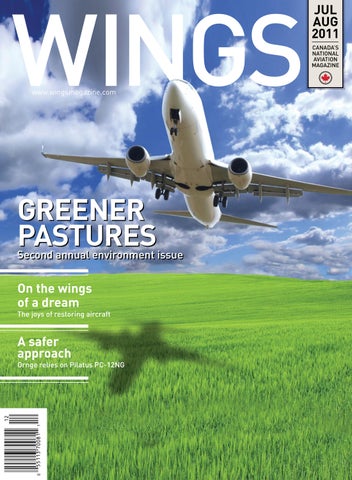
WINGS www.wingsmagazine.com
greener pAstures
Second annual environment issue
On the wings of a dream
The joys of restoring aircraft
A safer approach
Ornge relies on Pilatus PC-12NG
JuL Aug 2011 CaNada’S NaTIONal avIaTION maGazINe
JuLY/August 2011
upFrOnt 5 Leading edge
Renewing resources
8 On the fly
News and opinion
14 Waypoint
A question of justice
16 Alternate Approach A fuel of dreams
18 At the gate
Banking on the CSeries
19 45º 42΄ north
Evaluating the ideas of tomorrow
The Pilatus PC-12NG powers the Ornge philosophy. P.32.
20 Women in Aviation Lt.-Col. Carmichael
BACK 58 Marketplace 62 On Final
Restricted access
FeAtures 22 green WItH energY
Reducing aviation’s carbon footprint is a shared responsibility BY PeTeR PIGOTT
From top: lt.-Col. maryse Carmichael. P.20. vintage aircraft. P.38.
27 pOWer tO CAre
Environmental applications that are making a difference BY PeTeR PIGOTT
32 A sAFer ApprOACH
Pilatus PC-12NG powers the Ornge philosophy BY maTT NICHOllS
38 On tHe WIngs OF A DreAM
Restoring vintage aircraft is an investment in your soul BY ROB SeamaN
43 AHeAD OF tHe CurVe
Seneca raises the professional development bar BY aNdRea KWaSNIK
coVeR PHoTo: FoToLia
www.wingsmagazine.com
July/August 2011 | wings
3
1.2 1.2 billion dollars invested in available inventory means we stock the parts so you don’t have to. And you can usually have what you need the next day. Aviall works hard to provide you with exactly what you need, precisely when you need it. Aviall Delivers.
LEADING
EDGE
| By Matt Nicholls
renewing resources
Worldwide commitment to greener skies continues to grow
I
PHoTo: guLFsTReam
f you want to highlight innovation in the international aerospace community, there’s no better place to do it than in the city of lights – specifically, the Paris International Air Show. With more than 2,000 exhibitors from 46 countries, the annual gathering is the pinnacle of the annual airshow circuit. Held June 20-26, this year’s event showcased some of the most advanced technology in aerospace, and front and centre was a strong commitment to enironmentally conscious air travel. Industry leaders showed off their green credentials with impressive presentations, demonstrating a worldwide commitment to reducing CO2 emissions remains a steadfast goal. The “greening” of aviation’s greatest event kicked off in dramatic fashion two days before the doors opened with Honeywell’s dramatic transatlantic crossing by a Gulfstream G450 business jet to land at Le Bourget. The seven-hour journey across the pond from Morristown Airport in New Jersey closely followed the historic Atlantic crossing by Charles Lindbergh, and marked the first transatlantic journey using biofuel. The Honeywell-operated aircraft flew from North America to Europe, with a 50/50 blend of Honeywell “Green Jet Fuel” and petroleum-based jet fuel powering one of its Rolls-Royce Tay Mk 611-8C engines. The G450 was the world’s first business jet to be powered by a biofuel. The G450’s transatlantic flight was followed by Boeing’s own historic crossing. The new 747-8F debuted in Paris, having made the transatlantic flight with all four of its General Electric GEnx-2B engines powered by a blend of 15 per cent camelina-based biofuel mixed with 85 per cent traditional kerosene fuel (Jet-A). Gulfstream worked closely with Honeywell to ensure the viability of the company’s
5 www.wingsmagazine.com
biofuel, which is derived from camelina, an inedible crop. The co-operative effort also supports the commitment many GA partners have to achieving the business aviation industry’s goals on emissions reductions, including carbon-neutral growth by 2020 and a reduction in total carbon emissions
such as the National Research Council, Nav Canada, Porter Airlines, Pratt & Whitney Canada, Bell Helicopter Textron Canada, Bombardier Aerospace, and countless others, are making concerted efforts to reduce their carbon footprint and implement new technologies to preserve the environment. And it’s not all about environmental responsibility. As Sylvain Cofsky, executive director of the Green Aviation Research & Development Network (GARDN) points out, the pursuit of a green business strategy can produce plenty of green in revenue – especially given that aviation transports more than 2.3 billion annually and traffic growth is increasing five per cent annually. “The world’s 2,092 airlines have a total fleet of nearly 23,000 aircraft, and the replacement costs – or revenues – of new aircraft to enter fleet between now and 2020 is $1.3 trillion,” he notes. GARDN is a business-led network of centres of excellence with a budget of more than $24 million over four years (20092013). Created by the federal government, its mandate is to promote environmental research in Canada in the area of sustainable aviation – the first Canadian aerospace initiative focusing on reducing the environmental footprint in this industry. Its first “Fly Green – Making Our Dreams A Reality” conference Feb. 23 at Ottawa’s Canada Aviation and Space Museum (see “Green with energy,” pg. 22) showcased cutting-edge green technologies, and brought to light important research in the area of sustainable aviation. With key objectives ranging from fostering the development of technologies that will reduce aircraft noise and emissions in the vicinity of airports, to reducing the production of greenhouse gases by the aviation sector, GARDN is committed to applying a greenconscious approach to Canadian skies. So, as the lights went out on another extravaganza in Paris, it was comforting to know organizations here and abroad continue to value the economic viability and environmental importance of a greenconscious approach. | W
This flight demonstrates the advances being made as this industry moves toward enhanced environmental efficiency. of 50 per cent by 2050, relative to 2005 levels. Alternative fuels could account for 40 per cent of these reductions, while the remaining improvements will come from technology and operations. (For more on biofuels and Canadian applications, see “A fuel of dreams,” pg. 16.) Here in Canada, the commitment to reducing our environmental footprint is being revealed in any number of important areas of product development. Organizations
tOp DAtA Bursts… in this issue 1. 946 million. number of litres of biofuel Rentech will produce annually (pg. 16). 2. us $3.7 billion. Value of business and private aircraft shipments in Q1 2011 (pg. 18). 3. aviation industry has kept its carbon footprint under 20 million tonnes annually (pg. 23). 4. 21,000: number of annual medical transports ornge makes (pg. 33). 5. 300,000: average price of a vintage aircraft (pg. 41).
Your feedback is always welcome. Please contact me at mnicholls@annexweb.com. July/August 2011 | wings
5
WINGS
JuL Aug 2011 CaNada’S NaTIONal avIaTION maGazINe
www.wingsmagazine.com
Vol. 52, Issue 4 eDItOr
matt nicholls mnicholls@annexweb.com 416-725-5637
greener pAstures
Second annual environment issue
AssOCIAte eDItOr
andrea Kwasnik akwasnik@annexweb.com 519-429-5181 • 888-599-2228 ext. 238
On the wings of a dream
The joys of restoring aircraft
A safer approach
Ornge relies on Pilatus PC-12NG
prODuCtIOn ArtIst
Krista misener
SubScribe TODAY ! PM40065710 Return Undeliverable Canadian Addresses To Circulation Dept. P.O. Box 530 Simcoe, ON N3Y 4N5
FLIgHt DeCK
E-mail: ncuerrier@annexweb.com
Ray canon, David carr, Paul Dixon, Brian Dunn, Frederick K. Larkin, neil macDonald, James marasa, carroll mccormick, mike minnich, David olsen, Peter Pigott, Dr. Tarek sardana, Rob seaman, Blair watson
1 Year SubScription WINGS_JulyAugust11.indd 1
11-07-04 8:52 AM
only
3000
$
AssOCIAte puBLIsHer
alison de groot adegroot@annexweb.com 1-888-599-2228 ext. 246
(GST $31.50 • HST $33.90) US $42.00 (USD) • Foreign $65.00 (USD)
Name: _______________________________ Company: ____________________________ Title: _________________________________ Address: _____________________________ City: _________________________________ Prov: ________________________________ P.Code: _______________________________ Tel: __________________________________ Fax: _________________________________ e-mail:________________________________
PLeASe cHecK ONe: ❑ Commercial aircraft owner/operator ❑ Business/private aircraft owner/operator ❑ Military ❑ Aircraft maintenance/overhaul firm ❑ Airport ❑ Aerospace, airframe & component manufacturer and distributor
❑ Fixed base operator ❑ Aviation services, consultants and aircraft sales ❑ Government ❑ Aviation associations and organizations ❑ Flying schools, clubs and colleges ❑ Other (please specify) ______________
PAYMeNT: Cheque - Payable to Annex Publishing Visa
MC
AMEX
Account #: __________________________ Expiry:_____________________________
ADVertIsIng sALes
Ryan culver rculver@annexweb.com 519-429-5182 • 888-599-2228 ext. 273 grOup puBLIsHer
scott Jamieson sjamieson@annexweb.com presIDent
mike Fredericks mfredericks@annexweb.com WIngs MAgAzIne
P.o. Box 530, 105 Donly Dr. s., simcoe, on n3Y 4n5 Tel.: 428-3471 Fax: 429-3094 Toll Free: 1-888-599-2228
Publication mail agreement #40065710 Return undeliverable canadian addresses to circulation Dept., P.o. Box 530, simcoe, ont. n3Y 4n5 e-mail: ncuerrier@annexweb.com Published six times per year (Jan/Feb, mar/apr, may/ Jun, Jul/aug, sep/oct, nov/Dec) by annex Publishing & Printing inc. Circulation e-mail: ncuerrier@annexweb.com Ph: 866-790-6070 ext. 208 Fax: 877-624-1940 mail: P.o. Box 530, simcoe, on n3Y 4n5 subscription rates canada – 1 Year $ 30.00 (includes gsT - #867172652RT0001) usa – 1 Year $ 42.00 Foreign – 1 Year $ 65.00
occasionally, wings magazine will mail information on behalf of industry-related groups whose products and services we believe may be of interest to you. if you prefer not to receive this information, please contact our circulation department in any of the four ways listed above. no part of the editorial content of this publication may be reprinted without the publisher’s written permission. ©2011 annex Publishing & Printing inc. all rights reserved. opinions expressed in this magazine are not necessarily those of the editor or the publisher. no liability is assumed for errors or omissions. all advertising is subject to the publisher’s approval. such approval does not imply any endorsement of the products or services advertised. Publisher reserves the right to refuse advertising that does not meet the standards of the publication. Printed in canada issn 0701-1369
Signature: _________________________ Date: _____________________________
TO SubScribe:
Tel: 866-790-6070 Fax: 877-624-1940 Mail: Wings Magazine c/o Annex Publishing & Printing inc. P.O. box 530 Simcoe, Ontario N3Y 4N5 e-mail: ncuerrier@annexweb.com
www.wingsmagazine.com
GST#135274215RT001
6
Subscriptions non-refundable
wings | July/August 2011
PRO0711
Air Transport Association of Canada
ON THE
WEB
Canadian Owners & Pilots Association
Canadian Business Aviation Association
Magazines Canada
pHOtO COntest Got the perfect shot of a Canadian fixed-wing operator in action? The editors of Wings magazine are looking for Canada’s best aviation photography. Enter your photo for a chance to be featured in the Wings 2012 Special Edition Calendar. www.wingsmagazine.com www.wingsmagazine.com
TIME TO RAISE YOUR EXPECTATIONS INTRODUCING THE NEW 3,350 NM FALCON 2000S Finally, a large-cabin aircraft with the airfield agility and efficiency of a smaller jet at a midsize price. This is the one you’ve been waiting for. The new Falcon 2000S has it all. Unparalleled comfort. Unrivalled performance. And unbeatable value.
Raise your expectations. Visit www.falcon2000S.com.
Eastern Canada +201.981.2869 Western Canada +201.245.9399
ON THE FLY For late-breaking news, the Wings blog and exclusive web content, please visit us at: www.wingsmagazine.com
InDustrY neWs OperAtOrs peOpLe eVents CALenDAr suMMer reADIng
InDustrY neWs
tHe COLD, HArD FACts Weather and weather-related phenomena contribute to a significant percentage of aviation accidents each year. And Mother Nature can be particularly harsh on Canadian winter operations, dealing rapidly changing weather and runway conditions that bring low ceilings, airframe-icing conditions, poor visibility, and runway contamination by ice, snow, water and slush. To address these issues, the Air Canada Pilots Association (ACPA) is once again bringing together global experts in winter aviation safety for its second International Winter Operations Conference. Taking flight Oct. 5-6 in Montreal, experts will share lessons learned, best practices in the industry and their latest technological advances. In the 25th anniversary year of the Challenger shuttle disaster, keynote speaker at the conference will be Allan J. McDonald, former director of the Space Shuttle Solid Rocket Motor Project at the time of the accident and co-author of Truth, Lies and O-rings: Inside the Space Shuttle Challenger Disaster. Industry speakers include represent-
atives from Airbus, Boeing, Bombardier, Embraer, AEROMAG, ATR, Deicing Innovations and GE Aviation. The agenda also features speakers from the International Civil Aviation Organization, Flight Safety Foundation, National Transportation Safety Board, Universite du Quebec a Chicoutimi, and University of Waterloo. To learn more about this important leading edge conference, including registration, the complete agenda and sponsorship opportunities, visit www.winterops.ca.
AnOtHer CAuse FOr HOpe Joining the growing list of Hope Air supporters, Dryden Air Services (DAS) is bringing an innovative donation agreement to the table. Inspired by WestJet’s support of Hope Air, DAS has agreed to donate $125 to Hope Air for every one of its clients who flies on WestJet departing from a Dryden-serviced airport. With operations in Saskatoon, Regina, Winnipeg, Hamilton and Ottawa, Dryden Air Services (DAS) is a ground-handling service provider to both domestic and international airlines with passenger and cargo-related operations. As a result of this collaborative agreement with Hope Air, individuals and families in these communities will have improved access to health care. “Dryden Air Services is committed to improving the quality of life in the communities where we operate” says
In October, aCPa will bring together global experts in winter aviation safety at its second International Winter Operations Conference. 8
wings | July/August 2011
dryden air Services ramp agents James mcCusker (left) and Francois vermeulen.
Dryden Air Services president Wade Morrell. “We are proud to partner with Hope Air in supporting their mission of Getting Canadians To Getting Better.” Welcoming Dryden Air Services into the fold of Hope Air supporters, Hope Air executive director Doug Keller-Hobson said, “Hope Air wouldn’t be able to celebrate 25 years of service without the continued support from the air transportation industry in Canada. We are very excited to have Dryden Air Services on board as a supporter and appreciate their commitment to improving access to health care in Saskatchewan, Manitoba and Ontario.”
green sKIes AHeAD Green Skies Ahead, a new exhibition exploring energy efficiency in the aviation sector, opened on June 16 at the Canada Aviation and Space Museum in Ottawa. The exhibit takes visitors on a tour of the innovative carbon-friendly technology that will shape commercial aviation over the next 50 years: high-efficiency jet engines, new super-light, super-strong composite materials, innovative wing designs, and, cutting-edge navigation technology that will create superhighways in the sky. “Powered flight has enriched our lives but at a cost to the environment,” says Denise Amyot, president and CEO of the Canada Science and Technology Museums Corporation. “This exhibition is a glimpse into the near and more distant future of energy-efficient, carbon-conscious aviation technology.” Audio, video, and touch screen technologies provide an interactive experience for visitors of all ages. Highlights include an aircraft design lab where visitors can www.wingsmagazine.com
PHoTo (LeFT): acPa (ToP): DRYDen aiR seRVices
8 9 10 10 13
try to create fuel-efficient aircraft or take an up-close look at a real turbo jet. The exhibition is part of Let’s Talk Energy – Engaging Ideas for Canada’s Future, a six-year national initiative designed to engage Canadians in exploring energy production, distribution, and consumption while encouraging them to discuss key issues surrounding energy in Canada. The initiative also includes exhibitions at the Canada Science and Technology Museum and the Canada Agriculture Museum, both which opened in July.
OperAtOrs
LeADIng eDge CO-Op At CArLetOn u
PHoTo (BoTTom): maF, (ToP) : James PaRK
Carleton aerospace engineering students are being offered a unique opportunity to participate in cross-discipline training that will combine their engineering education with aviation-related experience and accreditation. In May, Carleton University’s Department of Mechanical and Aerospace Engineering, Ottawa Aviation Services (OAS) and B-Con Engineering (B-Con) announced they have entered into a partnership that will allow Carleton aerospace engineering students to take part in three new initiatives: a co-op engineering and professional pilot-training program; an advanced simulator technology partnership; and a research project to anticipate problems and then repair the structure of modern aircraft.
Carleton University aerospace students Jathunath Thiyagalingam and Indira mukasheva.
The co-op engineering and professional pilot training program will provide engineering students with 15 placements each year to obtain either a Commercial Pilot’s Licence or a Private Pilot’s Licence. The program, which welcomed its first students in May, also gives co-op students the chance to be trained as dispatchers, safety management system and quality auditors, maintenance technicians, or aviation administrators while receiving hands-on pilot training. They will graduate with a bachelor of aerospace engineering, as well as obtaining a pilot’s licence with multiengine and IFR ratings. With the advanced simulator technology partnership, aerospace students will work with Carleton engineering professor Rob Langlois to transform an OAS-owned Diamond Aircraft Katana into a flight simulator. In what Langlois describes as an “anything but textbook” experience, their goal will be the creation of an immersive, more realistic and cost-effective visual system. B-Con’s existing technologies in the area of spherical-projected display will also contribute to the Carleton University Simulator Project (CUSP). The technology
will first be demonstrated on the OAS Katana simulator and then applied to CUSP before being offered to the simulator industry for implementation in commercial applications. One of the applications of the CUSP simulator, with its expanded range of motion and enhanced visual solution, is to provide better unusual attitude and upset recovery training for pilots. Montrealbased simulator manufacturer Mechtronix supports the training of engineers for Canada’s simulator industry through its longtime involvement with CUSP. Discussions are also underway between Carleton and OAS to set up a research program for proactive composites maintenance for general aviation aircraft, including lowcost structural health monitoring, design of repairs and loads monitoring. Under this partnership, students will be trained to repair OAS’s modern composite aircraft fleet.
MAF HeADs nOrtH Non-profit organization Mission Aviation Fellowship, best known for its flights in Third World countries, has started flying
Band councillor George Harper accepts cases of water from maF pilot Nathan driediger on behalf of the First Nations community at Red Sucker lake, man. www.wingsmagazine.com
July/August 2011 | wings
9
ON THE
FLY
JuLY 2011 EAA AirVenture Oshkosh July 25-31 oshkosh, wis. www.airventure.org
August 2011 Rally for the Cure aug. 28 Buttonville municipal airport Toronto, ont. www.rallyforthecure.ca
septeMBer 2011 Elsie MacGill Northern Lights Award sept. 29 unionville, ont. www.northernlightsaward.ca
OCtOBer 2011 Airport Management Conference of Ontario (AMCO) Convention and Tradeshow oct. 2-4 Brantford, ont. www.amco.on.ca International Winter Operations Conference oct. 5-6 montreal, Que. www.winterops.ca NBAA 64th Annual Meeting and Convention oct. 10–12 Las Vegas, nev. www.nbaa.org Canadian Council for Aviation and Aerospace (CCAA) Forum & AGM oct. 19-21 winnipeg, man. www.avaerocouncil.ca www.camc.ca
nOVeMBer 2011 Air Transport Association of Canada (ATAC) Annual Meeting and Tradeshow nov. 13-15 montreal, Que. www.atac.ca/en/events/agm For a complete list of events, please visit www.wingsmagazine.com and click on events in the community section. 10 wings | July/August 2011
into Canada's most isolated First Nations communities as part of a new initiative called “Wings to Northern Canada.” “Many Canadians don't fully realize how isolated some of our First Nations communities are – especially those that lack access to year-round roads – but I think most Canadians are aware of the serious health and social problems being experienced in these places,” says Mark Outerbridge, president of Mission Aviation Fellowship (MAF) of Canada. Canadian MAF pilots assisted in Haiti after the devastating earthquake of 2010 and in Indonesia after the Indian Ocean tsunami of 2004 – also in Africa during the decades-long civil wars in countries such as Sudan and Angola. MAF has several aircraft available for northern Canada, including a six-seat Piper Saratoga. Based in Steinbach, Man., this plane is being used in northern Manitoba and Ontario, where many of Canada’s most isolated First Nations communities are located. In regions where roads exist only for a few months in the winter when the ground is frozen solid, flights provided by MAF are offering a vital link between communities. Pilot Nathan Driediger of Chilliwack, B.C., flew MAF’s six-seat Piper Saratoga aircraft from his base in Steinbach, Man., 700 kilometres to the northeast to deliver clean water to Red Sucker Lake after household water tanks in that community were found to contain dangerous bacteria. He has also provided flights for the Mennonite Central Committee, as well as Frontiers Foundation, an organization that trains First Nations communities to harvest timber for the purpose of building their own houses. “As the demand for our flights increases across northern Canada, we are committed to bringing more aircraft into operation,” Outerbridge adds. “We are consulting with First Nations representatives to make sure that MAF services are appropriate and welcomed by their communities.” For more information about the Wings to Northern Canada program, visit www. mafcanada.ca.
peOpLe
IAtA’s neW LeADersHIp Major leadership changes are underway at the International Air Transport
Tony Tyler has succeeded Giovanni Bisignani as IaTa’s director general and CeO.
Association (IATA). As of July 1, Tony Tyler, former chief executive of Cathay Pacific, succeeded Giovanni Bisignani as IATA’s director general and CEO, at which point Bisignani became director general emeritus. The leadership changes were announced at the conclusion of the Association’s 67th AGM and World Air Transport Summit in Singapore in June. Said Tyler, “Leading IATA is a heavy responsibility. This is made all the more difficult because Giovanni has raised the bar high. I will be a strong advocate for all of our member airlines. My goal is to make the world a better place for airlines to do the important business of connecting 2.8 billion people and 48 million tonnes of cargo.” Peter Hartman, president and CEO of KLM Royal Dutch Airlines since 2007, has succeeded David Bronczek, CEO of FedEx Express, as chairman of the IATA board of governors following Bronczek’s one-year term. The appointment is effective for one year, ending with the conclusion of IATA’s 68th AGM next year. Also announced at the conference, Alan Joyce, CEO of Qantas, will serve as chairman from June 2012, following Hartman’s term.
truenOrtH AppOInts MArrOCCO TrueNorth Avionics has appointed Thomas Marrocco, an experienced sales executive with a strong background in global business development, to vice-president of worldwide sales. Most recently, Marrocco led enterprise software sales for the global commercial aviation and MRO marketplace at Mxi Technologies, and previously held senior executive positions within the www.wingsmagazine.com
PHoTo: iaTa
eVents CALenDAr
THE QUIET
REVOLUTION INTRODUCING THE S1 DIGITAL PILOT’S HEADSET FROM SENNHEISER
BOOTH #288
The Sennheiser S1 Digital aviation headset is designed to give you maximum control over noise levels in the cockpit, so you can focus on the joy of flying. At the push of a button, the S1’s exclusive NoiseGard™/ digital technology accurately analyzes the cockpit’s noise levels to achieve superior noise cancellation during all phases of flight—from take-off to landing. Design features like adjustable headband contact pressure and a special “comfort zone” for glasses ensure you stay comfortable. And with a Bluetooth interface, clear voice transmission and a customizable treble boost function, you’ll never miss a word.
Sennheiser aviation headsets. Put on before flight.™ Learn more: www.Sennheiser-Aviation.com/S1 or scan the QR code with your smartphone. See these Sennheiser Premium Aviation Headset Dealers to experience “The Quiet Revolution“:
Designed in collaboration with
SCAN WITH YOUR QR CODE READER
MADE IN
GERMANY
BMW Group DesignWorksUSA
ON THE
FLY
Dassault, Boeing and a number of airlines, and I look forward to working with him as he brings TrueNorth’s products to an even wider audience of aircraft operators.” Headquartered in Ottawa, with U.S. offices in New Jersey and the Kansas City area, TrueNorth Avionics is a developer of executive airborne telecom solutions for business aviation.
CHIDIAC JOIns CMC eLeCtrOnICs Thomas marrocco is the new vice-president of worldwide sales for TrueNorth avionics.
Claude Chidiac is CmC’s vice-president of customer support and strategic development.
in engineering as well as an MBA from McGill University. CMC delivers innovative cockpit systems integration and avionics solutions to its customers worldwide. Its principal locations are in Montreal, Ottawa, and Chicago.
PHoTo (LeFT): TRuenoRTH aVionics, (RigHT): cmc eLecTRonics
telecommunications and IT industry, including iSTAR Internet, Siemens and AT&T Canada. Said Mark van Berkel, TrueNorth’s president, “Thomas is a results-oriented leader who has directed global sales campaigns and negotiated long-term strategic partnerships with such companies as
Esterline CMC Electronics has welcomed Claude Chidiac to its ranks as vice-president of customer support and strategic development. Most recently, Chidiac was vice-president, business development, business aviation, at StandardAero, based in Arizona. Previously, he was managing director of Grob Aerospace USA. Chidiac has also held various positions at Bombardier over the past two decades in program and product line management, strategy and planning. He holds a degree
12 wings | July/August 2011
www.wingsmagazine.com
suMMer reADIng Looking for interesting reading? Add Flying on the Edge and Aviation Mysteries of the North to your summer list. Flying on the Edge is a true adventurous account of starting a bushplane and helicopter charter service in the wild and untamed Canadian north during the 1960s. A book guaranteed to keep readers engrossed from start to finish, Flying on the Edge is a fascinating collection of true incidents and bizarre stories of aircraft and people encountered while trying to develop a small airline business in Newfoundland and Labrador. Author/pilot Gene Manion invites readers to climb into the cockpit and share this thrilling journey with him. The Hon. John Crosbie (now lieutenantgovernor of Newfoundland and Labrador) writes the foreword and calls it a thrilling account of that difficult era and the best account he has read about bush flying. Author Gene Manion joined the RCAF after graduating from high school, and during a seven-year stint as a pilot, he
instructed NATO air students, and flew jet fighters during the Cold War. Thereafter, he spent 43 years in Newfoundland, flying brush planes, commuter craft and helicopters. Gene Manion now lives in the Thousand Islands area. Visit www.tidespoint.com or www. chapters.indigo.ca for more information. Aviation Mysteries of the North More than 100 aircraft have vanished in the far reaches of Alaska and Canada. In his new book, Aviation Mysteries of the North, author Gregory P. Leifer details the circumstances of 17 of these missing aircraft, including a commercial airliner carrying 38 passengers and crew, a military transport with 45 occupants, an Air Force bomber carrying a nuclear payload, and two U.S. congressmen on a campaign tour. Historical perspectives and aircraft
descriptions add an informative background to the stories from takeoff to the final moments. Covering four decades of aviation history, through the searches to the controversy, the events of these disappearances are presented. Aviation Mysteries of the North includes more than 180 photographs and map illustrations, including flight routes and last known positions of the aircraft. Author Gregory P. Leifer holds an FAA Airline Transport Pilot certificate and has flown more than 11,000 hours in various aircraft. Twenty-one years of his 30-year flying career have been spent in Alaska, where he now works with a major helicopter company on the Trans-Alaska pipeline. Visit www.publicationconsultants.com for more information.
Critical missions: Your expertise Getting you there safely: Ours Some missions are critical, and the ability to fly them safely requires the right information displayed with reliability you can count on. Backed by WAAS/SBAS navigation guidance, Universal Avionics’ Flight Management System provides integral map display with flight plan progress data displayed on a crisp 8.9” large-format MFD. Add video, charts, terrain avoidance and Synthetic Vision for vital situational awareness.
EFI-890R
Getting you there safely, when it matters most. Contact your Authorized Universal Avionics dealer or visit www.uasc.com to learn more.
www.wingsmagazine.com
www.uasc.com marketing@uasc.com (800) 321-5253 (520) 295-2300
July/August 2011 | wings 13
WAYPOINT By Rob Seaman |
A question of justice
“Know before you go” when operating abroad
A
14 wings | July/August 2011
after the accident. NTSB concludes by the evidence that the flight display warning was available to the crew but not noticed and acted upon until after impact. NTSB also states that the flight crew of the Legacy, although not in violation of any regulations, was not aware of the loss of transponder and collision avoidance functionality, lack of ATC communication, and the flight’s progress reference altitude convention. In its followup, the Federal Aviation Administration has been asked to require an enhanced aural and visual warning requiring pilot acknowledgment in the event of an airborne loss of collision avoidance (ACAS) system functionality for any reason. As NTSB notes, ACAS systems are an integral component of current airspace safety, and this accident highlights the need for upgraded cockpit warnings whenever functionality is compromised. In the bigger picture, the incident is evidence of the need for pilots to be prepared and secure in their awareness of and planning for aircraft operations at all times – but in particular, away from home. Foreign airspace involves someone else’s oversight, governance and interpretations; individual rights are very different in such circumstances. As aviation operations grow and expand, pilots need to be vigilant and prepared for anything. | W
This is somewhat precedentsetting and deserves a good debate and challenge for many reasons. of Embraer), with a planned stopover in Manaus. After takeoff, the pilots were issued a number of interim altitudes during climb, the last of which was to the initial cruise altitude of FL370. At about 15:51 hours, the Legacy flight crew performed a routine frequency change to ATC at a point just south of Brasilia. Radar and radio communications indicate that the airplane was level at FL370. ATC acknowledged and instructed the crew to “ident,” or provide an enhanced radar return from its transponder. ATC radar data indicates that the Legacy’s transponder return was observed. This was the last radio communication between the Legacy crew and ATC. Data from the FDR indicates the Legacy crew did not perform any abnormal manoeuvres during the flight, and the plane was level at FL370, on course, and at a steady speed when it made contact with the B737 at a point about 460 nautical miles north-northwest of BRS. NTSB investigators determined, “for reasons which at that time were not yet determined,” the collision avoidance system in the Legacy airplane was not functioning at the time of the accident, disabling the ability to detect and be detected by conflicting traffic. In addition, CVR data indicates the flight crew was unaware of this until
Rob Seaman is a Wings writer and columnist. www.wingsmagazine.com
PHoTo: HenRY YanDLe
court in Brazil has convicted two American corporate aviation pilots for their roles in a 2006 mid-air crash with a Brazilian airliner. The two U.S. pilots, Joseph Lepore and Jan Paladino, have been found “guilty of negligence for actions taken.” The incident took place over the Amazon River and killed all 154 people on the Boeing B737-800, while everyone on the Embraer Legacy business jet survived. In late 2006, Brazilian police charged the two ExcelAire Legacy pilots, who were detained in Brazil for more than two months after the crash, with “endangering aircraft safety.” They were then allowed to return home with a promise of co-operation for the resulting trial. In his sentencing, Judge Murilo Mendes pronounced a sentence of four years and four months in prison, but immediately reduced it to community service, which the two men will be permitted to carry out in the United States. Both Lepore and Paladino took part in the proceedings – by videoconference. Mendes also ruled that air traffic controller Jomarcelo Fernandes dos Santos was not guilty of wrongdoing in the collision of the two aircraft. Mendes also called for the suspension of their pilot licences for the duration of the sentence period. The suspension is an intriguing part of the case. While Brazil is a member of ICAO, the ability of a civil trial judgment to be applied to international aviation rulings is raising questions for some. This is somewhat precedent-setting and deserves a good debate and challenge for many reasons – not the least of which, in this case, some questions surrounding the “inquiry” credibility and findings. So, how did the judge come to his decision? Basically, he was working off the findings of an official Brazilian inquiry that “found” the accident occurred in part because the ExcelAire aircraft was flying about 300 metres higher than instructed to by its approved flight plan. However, a probe by the U.S. National Transportation Safety Board (NTSB) put most of the blame on Brazilian air traffic control (ATC). According to the NTSB initial report of 2007, the ExcelAire Legacy departed Professor Urbano Ernesto Stumpf Airport in São Josè dos Campos, Brazil (the home
W H AT I F J E T E N G I N E S H A D THEIR OWN ENERGY DRINK? When EADS launched the world’s first aircraft powered by algae biofuel, it unveiled a higher-energy fuel that considerably reduces consumption. Explore our ideas and share yours at eads.com/thinkbank
ALTERNATE
APPROACH By David Carr |
A fuel of dreams
Ontario seeks to flourish with development of low-carbon jet fuel
T
16 wings | July/August 2011
a plant at Heathrow Airport to convert some of London’s four million tonnes of waste into biojet fuel by 2014. Despite the progress, companies like Rentech and Solena still have a tough slog before producing sufficient quantities to quench a thirsty industry. The bill for producing enough fuel for the global airline industry remains unclear both in dollars and environmental impact. At $1.20 to $1.40 a litre, the cost of producing alternative fuel for aviation is double that of Jet A. More than $600 million will be spent on the two refineries in White River and Heathrow to produce over 100 million litres of fuel, or a fraction of the 89 billion litres that the U.S. domestic airlines and Air Force guzzle annually. It is also not clear what impact supplying the feedstock necessary to produce biofuels especially will have on land use and on the global food supply. All of these initiatives may lead to the ultimate pan industry trade-off: wean the massive automotive industry off both fossil fuels and biofuels in favour of electric in order to supply the aviation industry with increasingly cleaner fuel. In the meantime, Canada needs a presence in the growing market for alternative aviation fuel, and appears to have stalked the right horse. | W
Cynics may position this as a snake oil salesman riding into town to get rich on the gullible locals. also be a factor in whether the Olympiad Project gets the so-called green light. The Canadian output is a drop in the bucket compared to the 946 million litres of RenJet the company is contracted to supply annually to 13 U.S. and international airlines. Beginning in 2012, ramp vehicles for eight airlines at LAX will gas up with Rentech’s ultra-low-sulphur diesel fuel, to be produced from green waste and reported to leave a near-zero carbon footprint. Making fuels greener and consuming less are essential ingredients in air transport’s plan to be carbon neutral by 2020 even as the industry fills the skies with more airplanes. The U.S. Federal Aviation Administration recently awarded $125 million to Boeing, GE Aviation, Honeywell, Pratt & Whitney and Rolls-Royce North America to research and develop technologies to reduce jet engine fuel consumption and emissions. British Airways reports that conventional fuel is responsible for 99 per cent of its carbon footprint, and has set a target to cut net carbon dioxide emissions in half by 2050. The airline has entered into a partnership with the Solena Group, a Washington D.C.based renewable energy company, to build
David Carr is a Wings writer and columnist. www.wingsmagazine.com
PHoTo: isTocK
he world’s second largest oilproducing country is ready to place a bet on the future of alternative fuel for aviation. The province of Ontario has reached an agreement with Los Angelesbased Rentech to convert unusable Crown timber into low-carbon jet fuel. The Olympiad Renewable Energy Centre would be located in White River in Ontario’s northwest, but appears to be conditional on several factors, including Rentech tapping into the federal government’s NextGen Biofuels Fund (NGBF), a $500-million pot of cash used to cover 40 per cent of an energy project’s development and construction costs up to $200 million. The money would be repaid from a percentage of revenues. Rentech is hitting all the high notes, including jobs in a region hard hit by the slump in the forestry sector, a steady flow of low-carbon jet fuel for Canadian air transport and an 18 per cent equity stake for the Pic River First Nation. Cynics may position this as a snake oil salesman riding into town to get rich on the gullible locals. They would be wrong. In April 2010, a United Airline Airbus A319 took off from Denver International Airport with a 60/40 mix of conventional fuel and RenJet synthetic fuel in one of its two engines. According to the International Air Transport Association’s 2010 Report on Alternative Fuels, nine airlines have conducted test flights using a variety of alternative fuel blends, including sugar cane, wood chips, algae and oil-rich plants such as camelina and jatropha, and at least three more test flights are planned over the next two years. Assuming the Olympiad Project clears the NGBF hurdle, it is expected to annually convert 1.1 million cubic metres of dead wood into 85 million litres of RenJet and 43 million litres of naphtha (a flammable liquid commonly found in lighter fluid, industrial cleaning solvents and the fuel used to fire up that old Coleman camp stove) beginning in 2015. Producers are hesitant to build refineries without a customer guaranteeing to buy every last drop of inventory. Rentech is in discussions with several Canadian operators and it is likely that the outcome of those negotiations will
Thinking outside the box inside the cabin Aircraft Interiors Expo Americas provides a unique platform to see the latest concepts, designs and product innovations in the interiors industry. Taking place in Seattle, the hub of aviation, the expo provides the opportunity to meet with industry suppliers for commercial airlines, airframe manufacturers, cabin products and services, completion facilities and more.
Register free now at: www.aircraftinteriorsexpo-us.com/wingsad
Organised by:
Aerospace & Aviation
Held alongside:
AT THE
GATE
By Brian Dunn |
Banking on the Cseries
Pratt & Whitney’s new home relying on Bombardier’s success
T
18 wings | July/August 2011
value of its deliveries of “Some have posited this MoU as a the business aircraft decline 16.5 per cent in the first quarharbinger of an emerging player slightly better than the alliance, one that could challenge ter, industry average. Accordthe Airbus and Boeing duopoly.” ing to the General Aviation decision to build its Legacy 600/650 business jets in that country and China’s purchase of Teledyne Continental Motors and some rights to bankrupt Epic Aircraft. But Bombardier’s agreement with COMAC of China intrigues him the most. He says the two companies will consider aircraft commonality and joint sales initiatives, but no concrete steps have been announced. “Some have posited this MoU (memorandum of understanding) as a harbinger of an emerging player alliance, one that could challenge the Airbus and Boeing duopoly. But the reality is that COMAC and Bombardier have considerable product overlap and there is nothing to discuss. In fact, the latest agreement follows a previous MoU that went nowhere,” says Aboulafia. He is referring to the 2007 Paris Air Show where Aviation Industries of China agreed to build the CSeries fuselage, and Bombardier agreed to help AVIC develop a 90/140-seat ARJ21-900. And since then, China hasn’t ordered a single CSeries aircraft and the ARJ21-900 “looks dead.” On the delivery front, Bombardier saw
Manufacturers Association (GAMA), the total value of all shipments of business and private aircraft of US $3.73 billion was down 19.6 per cent from the year earlier period. During the first quarter, the value of Bombardier’s business aircraft deliveries reached $1.3 billion versus $1.5 billion a year earlier. The company delivered more Learjets, but fewer of the larger Challengers and Global Express aircraft. In total, Bombardier delivered 42 business aircraft versus 47 a year ago. The Montreal-based company still remains the most important player in the industry, ahead of Gulfstream, which delivered $1.05 billion worth of business aircraft during the quarter, and Dassault Falcon, which delivered $407.2 million. Joseph B. Nadol III of Wall Street’s J.P. Morgan says in a report that Bombardier’s worst days are behind it and figures it will pick up 10 more orders this year than last, to 160 units, but mostly in the lowermargin Learjet division. | W Brian Dunn is a Wings writer and columnist. www.wingsmagazine.com
PHoTo: PRaTT & wHiTneY
here was a grand ceremony in early May to launch Pratt & Whitney Canada’s $360million, 300,000-square-foot engine assembly plant and test centre at Mirabel Airport north of Montreal. All the bigwigs were there, including Quebec premier Jean Charest, Louis Chênevert, chairman and CEO of United Technologies Corp., which is P&WC’s parent company, and P&WC president John Saabas. The plant will assemble and test the PW1524G engine for Bombardier’s CSeries aircraft, the PW800 family of engines for the next generation of large business jets and GTF engines for other aircraft in various stages of development. There’s a lot riding on the CSeries to make the plant viable. In a note to clients, analyst Richard Aboulafia of Teal Group in Fairfax, Va., questions the long-term success of the CSeries, calling it an “enormous gamble. With Airbus accelerating the A319 Neo and going after Republic (Airlines), there’s a risk the CSeries remains a marginalized product.” But Pratt & Whitney president David Hess of Hartford, Conn., scoffs at suggestions the CSeries is a lame duck, noting it has a great number of attributes, including great economics. Such sentiment must be spreading, as Bombardier had confirmed eight firm orders for CSeries by the end of June – including three at the Paris Air Show. Another possible candidate for the Mirabel plant, which is located next to the mothballed airport (except for cargo and private aircraft), is the final assembly for a larger GTF engine that will power the Airbus A320 Neo. Hess says a decision where to build the engines will be made “sometime this year.” Snagging the Neo work would be a real coup for P&WC as Airbus expects to sell some 4,000 of the aircraft over a 10- to 15-year period. The Mirabel plant received $250 million in financial aid from Quebec, half in the form of loans, in addition to federal government money. But Saabas was quick to point out that P&WC has spent $8 billion in R&D since 1982 and is spending another $2 billion over the next five years. Getting back to Bombardier, Aboulafia points to a recent wave of China-bound aircraft programs, including Embraer’s
45˚42�
NORTH By Peter Pigott |
evaluating the ideas of tomorrow Aviation through the eyes of the National Research Council
PHoTo: nRc
A
djacent to the Ottawa Airport in leafy surroundings that would not be out of place on a university campus is the National Research Council’s Flight Research Laboratory at Uplands. Established to adapt postwar American and British aircraft designs to Canadian needs, the NRC’s Institute for Aerospace Research (IAR) has been conducting research into aerodynamics, gas turbines, and structures and materials performance since 1946. On the walls of the boardroom wall are photos of historic aircraft – a Mitchell bomber, an F-86, a “flying wing” and, of course, the Avro Arrow. In their day, all were used to test theories and/or equipment designed to make for safer, more capable aircraft. Flight tests have ranged from assessing rotorcraft-handling qualities to evaluating how modified equipment or degraded flight conditions can affect the performance of pilots and aircraft. “What we do at NRC Aerospace are two research programs,” said its chief pilot Robert Erdos. “The first is the traditional aerospace engineering discipline of flight mechanics and avionics (i.e., building better aircraft). The other is airborne research, where we use the airplane to do a science, which could be geophysical, or electrical engineering such as radar or studies in meteorology for agriculture. In both cases, the common denominator is doing something with an airplane which has never been done before.” Erdos came from the military and at the Lab he is able to combine his first love (flying) with his second (aeronautical research). “The five pilots in the NRC are all ex-Air Force test pilots that got out of the military but are still working for the federal government,” he says. “We take an experienced crew in a carefully instrumented aircraft and go into conditions that certified airplanes and operational crews would never experience. Simply put, we bridge the gap between theory and the market.” The Laboratory maintains a small fleet of dedicated research aircraft to support projects in its main program areas: flight mechanics, avionics and airborne research experimentation. These flying test beds – spotless in gleaming white and blue with www.wingsmagazine.com
When the ex-RCAF trainer was built, no one could have imagined the future capabilities of its LCD glass cockpit which is used for airborne field experiments. The IAR is working on a number of key projects, including: • certification of the “Seawind” composite amphibian for AeroNautic Development Corp; • installation of a high-bandwidth sat-com system on the Convair for military research; • upgrades to the NRC’s Bell 412, to include a new FADEC PT6 engine and glass cockpit; • implementation of a data acquisition system on the new Extra 300 research aircraft, which is planned for studies in human neuro-cognitive performance in dynamic environments. When not at the NRC, Erdos can be found at Vintage Wings of Canada, flying the Hawker Hurricane, which, he says, “is reminiscent of prodding awake a dragon.” He says he has discovered why the 70-yearold aircraft is called the Hurricane. The consummate pilot, Erdos personifies the spirit of the National Research Council’s Flight Research Lab. | W
“The common denominator is doing something with an airplane which has never been done before.”
red stripes – are kept in an attached hangar. To the untrained eye, it all looks like an immaculately preserved collection of old aircraft – among them are helicopters, a Harvard and a Convair airliner. But none are what they appear to be and Erdos explains what each does. The holds of each of the innocuous-looking aircraft are crammed with complex instruments. The Bell 412 helicopter, for example, is unique in the world. As an Advanced Systems Research Aircraft, it is specially configured for research into digital flyby-wire and fly-by-light control systems. Beside it is its sister Bell 205, an airborne simulator that can operate as a surrogate UAV (unmanned aerial vehicle). The Falcon 20 that once transported VIPs for the federal government (and starred in CBC’s The Rick Mercer Report) is actually a micro gravity research facility. The Convair 580 and Twin Otter are fitted with instrumentation to collect data on air pollution, severe weather, cloud formation and earthatmosphere exchange of greenhouse gases. Older than all of the others is the me- Peter Pigott is a Wings writer and ticulously maintained Harvard Mark IV. columnist.
July/August 2011 | wings 19
WOmEN
IN AvIATION
History maker
Lt.-Col. Carmichael leads the Snowbirds with passion | By Andrea Kwasnik
PHoTo: DnD
F
rom her early beginnings in the Air Cadets to her current command of the elite 431 Air Demonstration Squadron, Lt.-Col. Maryse Carmichael has always operated by the same philosophy – work hard and follow your passions. The first woman selected to fly with the Snowbirds in 2000, and then a decade later the first woman chosen to lead the squadron, it is clear the two-time history maker has the right stuff. Here is a snapshot of what makes Lt.-Col. Carmichael tick. Q | What motivated you to join the 630 Air Cadet Squadron in Beauport, Que., at age 13? A | I joined the Air Cadets because I was interested in aviation and also to follow in the footsteps of my three older brothers. Being in the Air Cadets gave me a solid foundation for my present career in aviation and in the Canadian Forces. Q | With more than 3,300 hours of Air Force flying, what has been the most rewarding part of your job? A | Whether I was instructing student pilots in Moose Jaw in the 1990s, transporting VIPs while on the Challenger in Ottawa, or representing the skill, professionalism, and teamwork of the men and women of the Canadian Forces during my time with 431 Air Demonstration Squadron, the Snowbirds, I think the most rewarding part of my flying career has been contributing to the overall mission of the Canadian Forces. Q | Becoming the first female pilot to fly with the Snowbirds must have been quite an honour. What kind of pressure did you feel in that role? A | It was indeed quite an honour to be selected to fly with the Snowbirds; it was also a chance to realize a lifelong dream for me. I remember seeing the Snowbirds at the Bagotville air show in the late 1970s and being mesmerized by their performance. I did feel some pressure at the time. My husband tells the story of hearing of the mid-air collision our team had in June 2001 (before he and I met) and of his first thought being, “I hope it’s not the girl.” Fortunately, I was not involved in the accident. Q | How would you describe your commanding style? What’s the best way to keep your squadron motivated?
20 wings | July/August 2011
receiving my wings. I was disappointed at the time, although I ended up realizing another dream later on, flying with the Snowbirds. Q | Is there anything left to be done to entice young women into aviation? A | I think the only thing we can do is to expose them at a young age to aviation and let them know that it is an option and a great one at that Although my parents did not work in the aviation sector they certainly introduced my three brothers and me to air shows and later on the Air Cadets. Actually, my youngest brother is also a pilot for the Government of Quebec, flying its medevac Challenger and Dash-8. Q | Is there a person, aviator or otherwise, that inspires you? A | There are so many successful/remarkable people that it would be hard to pinpoint only one. Of course, being from Quebec City, I grew up listening to Celine Dion. What an inspiring example of perseverance, hard work and passion. There is also another fabulous lady who shares those personality traits, Canadian astronaut Julie Payette. Both ladies are a great source of motivation and inspiration. Q | The Snowbirds exude excellence. What advice can you give young people to strive for excellence? A | A Saskatchewan painter, Yvette Moore, titled one of her latest works, “The Pursuit of Perfection.” Her painting displays our nine-ship formation practising during the winter months. I think the title sums up the Squadron philosophy quite well and I think this is the advice I would give to young people entering the world of aviation. Never stop learning . . . | W
“The most rewarding part of my flying career has been contributing to the overall mission of the Canadian Forces.” A | I have just completed my first year of command and I have to say that it is a work in progress. Having been part of 431 (AD) Squadron previously, I have a great foundation to now lead the men and women who make up this unit. I know the passion they have, their professionalism, and their sense of duty; I am very proud of them and what they accomplish on a daily basis. In order to keep them motivated I just have to ensure they have lots of air shows to go to and represent the Canadian Forces! Q | Any at point, did you feel that you were not going to achieve your goals? A | I have to say that I worked quite hard during my early pilot training with the Canadian Forces. The failure rate was quite high and I would see fellow students returning home on a regular basis. I did not want to be one of them. One of my goals early on was to fly F-18s, but unfortunately I was not selected to fly fighters after
Lt.-Col. Carmichael continues the discussion, including her proudest moment and life in a two-pilot household, at www.wings magazine.com under Web Exclusives. www.wingsmagazine.com
One heart Three legends
N AVI T IM ER
C HR ONO MAT
T RA NSOC EA N
With its Manufacture Caliber 01, Breitling has created the most reliable, accurate and top-performance of all selfwinding chronograph movements – entirely produced in its own workshops and chronometercertified by the COSC. A perfectly logical accomplishment for a brand that has established itself as the absolute benchmark in the field of mechanical chronographs.
La Swiss
Toronto Montreal Vancouver
416 925 3500 514 954 1661 604 682 3088
WWW. BR EI TLI NG. COM
GREEN
WITH ENERGY
It's A sHAreD respOnsIBILItY BY peter pIgOtt
PHoTo: FoToLia
A
s with every area of human activity, aviation impacts the environment. This, of course, takes several forms, but it’s mainly disturbances caused by aircraft noise and engine emissions. Just how seriously is the aviation community impacting the environment? According to the United Nations Intergovernmental Panel on Climate Change (IPCC), the aviation industry www.wingsmagazine.com
produces two per cent of the world’s manmade emissions of carbon dioxide (CO2). Through investment in new technology and operating procedures, the aviation industry has kept its emissions growth to three per cent, or some 20 million tonnes annually – and it’s achieved this rate even though passenger numbers are increasing at an average of 5.6 per cent annually. But as laudable as this is, a carbon footprint in this range is unacceptable in this, or any
other, industry; there’s little doubt, serious change is needed. “What might not be fully understood is how fast the concentration of carbon dioxide in the atmosphere is accumulating,” says Tim Leslie, supervisor of the National Research Council’s IAR Flight Research Laboratory in Ottawa. “We are simply creating CO2 at a greater rate than can be reabsorbed. Alarmists suggest this growth rate is exponential. I don’t quite interpret July/August 2011 | wings 23
A united front With such an alarming prospect looming, it’s comforting to know corporate leaders in Canadian aviaiton are taking steps to find environmentally friendly solutions and processes for change. Such was the impetus for the development of the first annual “Fly Green – Making our Dreams a Reality” conference held Feb. 23 at the Canada Aviation and Space Museum in Ottawa. The event was the brainchild of the Green Aviation Research & Development Network (GARDN), a partnership between centres of excellence that brings together industry, university and government partners to lower noise and emissions pollution from the aerospace industry, and ultimately to reduce its ecological footprint. Organized by Sylvain Cofsky, GARDN’s network manager, the event featured internationally renowned speakers from NASA, the International Civil Aviation Organization (ICAO), “Clean Sky,” ONERA (the French Aerospace Lab), and senior experts from Bombardier Aerospace, Bell Helicopter Textron Canada, Pratt & Whitney and Esterline CMC Electronics. The consensus from the experts in attendance was telling: to minimize the environmental impact that the anticipated growth in air traffic will have over the next 10 to 30 years, future aircraft designs will need to balance the reduction of community noise, greenhouse gases and manufacturing’s environmental footprint. The conference kicked off with a poignant presentation from Dominic Collin, co-ordinator of the Aircraft Noise Research Network (X-Noise), who described the extensive noise reduction research programs in Europe and the challenges the sector faces in order to achieve its environmental goals. Collin pointed out that the effective mitigation of aviation noise could alleviate one of the bottlenecks to air traffic growth. Professor David Zingg, director of the University of Toronto Institute of Aerospace Studies and Canada Research Chair in Computational Aerodynamics and Environmentally Friendly Aircraft Design, followed with an insightful presentation
detailing the growing field of multidisciplinary optimization (MDO) and its applicability to the design of environmentally focused aircraft. Professor Zingg demonstrated how today’s MDO software tools allow aircraft designs to “converge” on highly aerodynamically efficient configurations to reduce fuel burn and therefore greenhouse gas emissions. Environmentally focused aircraft designs must of necessity consider the full life-cycle environmental footprint, he argued. Gavin Campbell, director of Design Engineering & Technology Development at Bombardier Aerospace in Belfast, detailed the extensive efforts his company is making to design advanced materials and manufacturing processes that reduce lifecycle waste, reduce weight and improve
efficiency of next-generation aircraft such as the Bombardier CSeries and Lear 85. Campbell’s presentation, “Moving towards carbon neutral growth in the aviation sector: A perspective from the industry leaders,” detailed key elements aviation companies need to consider when developing aircraft of the future – elements that have been incorporated into the design of new Bombardier aircraft. Future initiatives, according to Campbell, must encompass: • Uniformity of scale. Improvements in aircraft design is not the only area that contributes to carbon-neutral growth. There are three other areas to consider: operations, infrastructure and alternative fuels. All elements work together to contribute to overall improvements
Change makers global aviation firms are making real strides in developing ways to achieve carbonneutral growth, reduce fuel consumption and be more environmentally responsible. Leading initiatives that stand out include: • Porter airlines’ Bombardier Q400s use Pratt & whitney Pw150a engines, the most advanced turboprop engines currently in service. These engines produce nearly twice the take-off power of older turboprop engines, with significantly improved fuel efficiency. Porter is also working with Bombardier to complete the first biofuel trial with the Q400 aircraft. The two companies are part of a consortium led by Targeted growth canada to demonstrate a camelina-based biofuel on the aircraft. Pratt & whitney are also partners in this project. camelina-based biofuel can reduce emissions by 80 per cent, while cutting down on sulphur dioxide. a test flight is currently scheduled for 2012. • nav canada’s environmental management project produces improved efficiencies achieved through new technologies and procedures that will save 8.4 million metric tonnes of aviation-related greenhouse gas emissions in the period from 2009 to 2016. • air Transat’s head office at the montreal-Trudeau airport is the first building in canada to obtain LeeD-eB Platinum certification. The company’s headquarters has just been awarded the u.s. green Building council’s LeeD Platinum certification in the category “existing Buildings.” • The global aviation industry has agreed to ambitious carbon reduction targets. Through the air Transport action group, the aviation sector is the first in the world to agree to capping net carbon emissions from 2020 and reducing 2005 levels of net carbon emissions by 50 per cent by 2050. • southwest airlines’ “green Plane” sets a new standard for green aircraft. new seats, Porter is working with Bombardier to complete new cabin equipment and new the first biofuel trial with the Q400. carpets will save more than $10 million a year in fuel costs and reduce emissions. new materials will save about five pounds per seat, or roughly 470 pounds per plane. • Lufthansa has introduced new clean engines that run more frequently, improving performance and life span. The engines will provide fuel savings across the entire fleet – translating to 74,000 tonnes less co2 per year.
24 wings | July/August 2011 www.wingsmagazine.com
PHoTo: FReDeRicK K. LaRKin
it this way – it strikes my scientific mind as more linear. Regardless of the actual shape of the slope, it is much steeper than it should be.” Leslie maintains that there will soon come a time (in our lifetime, he estimates) when the Earth’s CO2 absorption capabilities will be overwhelmed. “And this is when a steep linear slope will actually become exponential and we may find ourselves creating an atmosphere not unlike that of Venus,” he says. “Our very existence as a species is at stake.”
•
•
•
•
PHoTo: BomBaRDieR
•
across the whole aviation system as well as in new products. Commitment to technology. For optimum results, balance is required. For example; the CSeries aircraft has a “game-changing” engine, but it also makes use of improved aerodynamics, advanced material use and the use of the latest generation in system technology. On their own, these improvements will not offer as much as when used together: this is what the CSeries “optimal aircraft integration” is all about. It produces a better overall reduction in fuel burn. Bombardier aircraft design teams have also made 70 per cent of the environmentally efficient CSeries jet with advanced structural materials, delivering significant weight savings. This has contributed to the CSeries’ 20 per cent fuel burn advantage. Operational requirements. From an operational standpoint, there are many factors an airline operator can consider. These include optimization of weight and load factors; the option of reducing speed and the amount of fuel carried; optimization of maintenance capabilities; engine handling and aircraft idling; the use of continuous descent approach; and flight planning accuracy. Understanding infrastructure. Aviation infrastructure is constantly improving. Both NextGen and the Single European Sky ATM Research Programme (SESAR) will ensure this happens within the air traffic control systems in both the United States and Europe by opening up more airspace to commercial carriers. This will allow for greater efficiencies in the system and will therefore contribute to further reduction of fuel burn. Biofuel enhancements. With the recent rapid development of biofuels within the aviation industry, this potentially will be the biggest gain in terms of reducing CO2 emissions if you consider the whole life cycle of biofuel. (For more on biofuels, see “A fuel of dreams,” pg. 16.) Deciphering the technology roadmap. With the co-ordination of research and development within the Canadian aviation industry through the Canadian Aviation Environmental Technology Roadmap (CAETRM), the Consortium for Research and Innovation in Aerospace in Quebec (CRIAQ) and the educational institutions, the Canadian
www.wingsmagazine.com
The CSeries “optimal aircraft integration” includes its “game-changing” P&W engine, improved aerodynamics, advanced material use and the use of the latest generation in system technology.
aviation industry is well positioned to tackle the reduction of aircraft emissions and overall environmental impact of its future products.
A question of fuel management Although careful consideration must be given to the processes and outcomes in the development of environmentally friendly aircraft, carefully monitoring the fuel that powers these aircraft is also crucial. That’s precisely where companies like Montreal-based Esterline CMC Electronics come in. Esterline is a world leader in the development of environmental aerospace technologies. The company’s Flight Management System (FMS) recently achieved certification of airline standard Performance Vertical Navigation (VNAV), and can help to reduce an aircraft’s fuel consumption – and hence, a company’s carbon footprint. “For the airlines, the overriding priority is efficiency and reducing harmful emissions,” says Rex Hygate, marketing and sales manager for Esterline CMC Electronics. “Almost half of the normal operating costs for an airline are in fuel. Consequently, technologies that maximize fuel efficiency in flight are extremely important.” The FMS is a flight deck computer that works to monitor fuel consumption. The pilot enters the flight plan into the FMS and the FMS then guides the autopilot both laterally and vertically. Performance VNAV continually optimizes the speed, altitude and descent path in order to minimize fuel, yet meets the schedule requirements of the flight. To accomplish this, the FMS holds a detailed airframe and engine flight model together with a detailed wind model. In cruise mode, it continually calculates the most efficient speed and optimum altitude as the aircraft burns fuel and becomes lighter. In descent, the FMS calculates the “Top of Descent,” and the exact descent path that meets the air traffic control constraints is determined – but burns the least fuel. The resulting path is called a “Continuous Descent Approach” or CDA.
Minimizing fuel also minimizes harmful CO2 and NOx emissions, Hygate adds. In addition, CDAs minimize airport vicinity noise. Currently, the company’s CMC’s CMA-9000 FMS, with performance optimization VNAV capability, is entering service on the Sukhoi SJ100 Russian Regional Jet.
sustainability and climate change A Sustainability and Climate Change Strategic Advisor at PricewaterhouseCoopers (PwC) in Montreal, Janice Noronha has more than 17 years’ experience in developing sustainability and carbon strategic insights, reporting systems and frameworks in the transportation, metals, aerospace and mining sectors. Noronha remains optimistic the aviation community is taking the right steps in working to develop a greener environment. “Over the past year, the aviation industry, both commercial and business aviation, came together to shape a common vision and goal to reducing its CO2 emissions,” she says. “Through this collaboration, the aviation industry has committed to a carbon-neutral growth objective, which means capping its emissions by 2020.” Noronha maintains this rather ambitious goal could become challenging given that the aviation sector is expected to grow at a rate of 5.6 per cent per year until 2020, compared to a carbon-efficiency rate of less than one to two per cent per year. But despite growth projections, the industry can get there, she contends. Through a well-defined carbon reduction roadmap, the sector is gearing itself towards even greater fuel efficiency in aircraft and engine technologies, while also investing in streamlined air traffic infrastructure and aircraft operating practices that eliminate unnecessary fuel burn. In fact, significant progress has been and continues to be made. Over the past four decades, fuel-efficiency increases of up to 70 per cent have been documented, and according to IATA (International Air Transport Association), improvements of a further 25 to 30 per cent by 2020 are July/August 2011 | wings 25
wan
t
expected. But, will this be enough to offset the industry’s growth rate? Noronha asks. Post 2020, the roadmap relies on building even more efficient aircraft with additional technologies powered by non-carbon sources. Already, the level of industry investment, collaboration and progress in the successful testing and certification of second-generation biofuels is providing a positive outlook. The challenge, however, will be in the commercialization of these fuels as a truly cost-competitive option, Noronha says. Questions around the future price of fossil fuels, coupled with political, social and demographic factors, contribute to the uncertainty surrounding alternative fuel usage. Despite legitimate concerns over the availability of fossil fuels, oil may continue to play a key role in the overall energy mix. The International Energy Agency anticipates that by 2030 fossil fuels will likely cover more than 85 per cent of energy needs, and even the most pessimistic estimates place the price of oil at around $200 per barrel. “Regardless, there appears little question of the importance of alternative fuels in not only helping the aviation sector to significantly reduce emissions but also in lessening its dependence on oil,” Noronha says.
A combined approach As we wait for a clear alternative fuel option to emerge, the achievement of carbon-neutral growth objectives will hinge on a combination of technological and market-based measures, such as carbon offsets, Noronha maintains. Market-based systems will require accuracy, completeness, and transparency in carbon emissions data. Already, aircraft operators under the regional European Union Emission Trading Scheme are being subjected to necessary financial-level data controls and audit trails by third-party audit firms. These types of verifications will also be important when making carbon-efficiency claims on aviation product attributes. At a global level, ICAO continues to play an integral role in moving the sector towards an international framework. Just recently at its 37th Assembly, ICAO defined its guiding principles for setting up market-based measures for international aviation, focusing on a transparent, cost-effective and administratively simple solution that minimizes carbon leakage, market distortions and duplication in accounting for global CO2 emissions. “With consensus on these guiding principles, there will be a movement toward an international market-based mechanism
that would enable carbon offsetting,” Noronha says. “Such a mechanism will be critical in meeting the aviation industry’s carbon-neutral growth commitments in the short term, while hedging on alternative fuels for the long term.”
no silver bullet If the aviation community is to reach its goal of significantly reducing the amount of CO2 in the atmosphere, serious work needs to be done – and now – says the NRC’s Leslie. “Not factoring in the very real consideration of reducing carbon dioxide emissions ignores an important reality,” he says. “There are plenty of organizations scrambling to resolve the big issues like creating biofuels and modifying aircraft design. I am so very glad they are.” Leslie maintains a greater commitment to R&D from smaller companies right on up to the major players in the industry, is critical to achieving the ultimate goal. “If we don’t make small changes as individuals the major players simply don’t stand a chance at solving the big issues through R&D,” he says. “In my view there is no one silver bullet here; rather, it will be a combined effort of R&D as well as looking for efficiencies whenever and wherever we can.” | W
Jetco Jets
Freedom to Fly When you want
where you want
Fractional Jet Ownership • Cessna Citation • Low Initial Buy-in • Edmonton, Alberta based
et’s face it. With all the turmoil in the world today, fuel prices are skyrocketing. And there’s no end in sight. That poses a conflict of your own: You love flying your jet, but it costs more every day because it literally sucks fuel — guzzling through each flight, instead of sipping. Why not be eco-friendly and fly a fuel-efficient Pilatus PC-12 NG instead of that light jet? You’ll save around a third or more on fuel costs for typical missions — even more when compared to heavier jets — and you’ll be flying far, fast, and high in executive-class comfort for six or more (instead of four or less). Sure, there are lots of other ways to fly places quickly and in style. But they suck.
Contact
James Jespersen | 780.405.5485 | james@jetcojets.ca John MacGregor | 780.966.7504 | john@jetcojets.ca www.jetcojets.ca 26 wings | July/August 2011
Come fly the PC-12 NG Stan Kuliavas, Director of Sales 855.745.2887 skuliavas@pilatuscanada.com www.PILATUSCANADA.com
www.wingsmagazine.com
POWER TO CARE
enVIrOnMentAL AppLICAtIOns tHAt Are MAKIng A DIFFerenCe
BY peter pIgOtt
PHoTo: FoToLia
C
anadians are routinely being recognized as world leaders for innovation in aviation – and this also holds true in the realm of green aviation. For this special green issue of Wings magazine, correspondent Peter Pigott spoke with two influential Canadian engineers – and highlighted the environmentally conscious efforts of one prominent Canadian airport – to underscore how innovative thinking is making the reduction of CO2 emissions a real possibility. www.wingsmagazine.com
greener skies through unconventional aircraft design: Dr. David zingg If there’s anyone in this country capable of designing the next sustainable aircraft, it’s Dr. David Zingg. Awarded a Guggenheim Fellowship in 2004, Dr. Zingg has been a professor at the University of Toronto Institute for Aerospace Studies (UTIAS) for 24 years. He is a Fellow of the Canadian Academy of Engineering and currently holds the J. Armand Bombardier Foundation Chair in Aerospace Flight.
Dr. Zingg’s research areas include aerodynamics, computational fluid dynamics and aerodynamic shape optimization. His current research is focused on applying high-fidelity aerodynamic shape optimization to the design of novel aircraft configurations and motivated by the need to reduce greenhouse gas emissions from aircraft. Dr. Zingg has held a Tier 1 Canada Research Chair in Computational Aerodynamics and Environmentally Friendly Aircraft Design since 2001. He also serves on the board of directors of the Green Aviation Research and July/August 2011 | wings 27
Development Network (GARDN). “The impact of aviation on climate change is a pressing issue,” says Zingg. “Although there remains some uncertainty on the precise figure, the general consensus is that aviation contributes roughly 4.9 per cent of all human contributions to global warming. The industry has targeted a 50 per cent reduction in total carbon dioxide emissions by 2050, and this must be achieved while simultaneously reducing emissions of nitrogen oxides, which also indirectly contribute to global warming, and noise from aircraft.”
WHIle SOme PROGReSS CaN Be made THROUGH CHaNGeS IN THe OPeRaTION OF aIRCRaFT, SIGNIFICaNT TeCHNOlOGICal advaNCeS aRe Needed.
28 wings | July/August 2011
The vancouver airport authority recently launched its Green Team, a committee of employees focused on furthering environmental initiatives and awareness at YvR.
optimization (or MDO) is needed to find a true optimum given the integrated nature of the design challenge. Dr. Zingg and the team at UTIAS are conducting research to develop new techniques for MDO and to apply them to the design and evaluation of novel unconventional aircraft concepts and technologies. High-fidelity MDO requires substantial computing resources, and UTIAS researchers are fortunate to have access to the powerful SciNet computing facilities. “Advanced MDO capabilities of the type under development at UTIAS will be crucial to the development of future generations of aircraft that will incorporate new advanced technologies,” says Dr. Zingg. “These may involve configurations that are radically different from current aircraft in order to achieve the desired reduction in emissions.
powering the future with green engines: Dr. William Lin Developing cleaner engines to power the environmentally astute aircraft of tomorrow is a tremendous challenge – one Dr. William Lin wholeheartedly embraces. Dr. Lin is an experimentalist in fluid mechanics and fluid-structure interactions. He earned a B.A.Sc. in mechanical engineering from the University of Waterloo and a PhD from the University of Western Ontario. During his graduate studies, Dr. Lin developed a novel wind tunnel to simulate an intense thunderstorm wind pattern that is known to damage ground-level structures. Through a Mathematics of Information Technology and Complex Systems (MITACS) Elevate post-doctoral fellowship, he is currently collaborating with an industrial-academic www.wingsmagazine.com
PHoTo: VancouVeR aiRPoRT auTHoRiTY
Given that there is no single straightforward means of achieving the desired reduction in emissions, says Dr. Zingg, progress is needed on a variety of fronts, which can generally be categorized as operational or technological. And while some progress can be made through changes in the operation of aircraft, significant technological advances are needed to achieve this goal. For example, emissions can be lowered by improving fuel efficiency through reductions in aircraft drag and weight, by improved combustor designs, and through burning biofuels. Relevant technologies include aerodynamics, materials, structures, combustion and biofuels. An aircraft is a tightly integrated system with complex interdependencies. When a new technology, such as laminar flow control is introduced, an implementation will often require a redesign of the aircraft to incorporate it in the most efficient manner, says Dr. Zingg. There is also a demand for advanced tools for the design of aircraft. The need to reduce aircraft drag and weight has also spurred interest in unconventional aircraft, such as truss-braced wings, hybrid wing bodies and box wings, he says. The development and evaluation of such concepts is also dependent on suitable design tools, especially since there exists no body of design experience for these configurations. The field of multidisciplinary analysis and design has emerged to address the need for efficient and accurate aircraft design tools. In particular, high-fidelity multidisciplinary analysis based on first principles is required for accurate prediction of performance, fuel burn, and emissions of future aircraft. Multidisciplinary
team to characterize the flow through a new “green” jet engine. “The aerospace industry is a key sector of the Canadian economy, in terms of dollar value, engineering innovation and the employment of many highly skilled workers,” says Dr. Lin. “To remain competitive with global rivals, Canadian aircraft engine manufacturers must improve products by reducing emissions and fuel consumption. Improving the performance of the compressor – this is one of the core components of an aircraft engine – will help meet increasingly demanding environmental and overall engine performance targets.
research/afm/main.htm) research team is based at the University of Calgary and the University of Western Ontario.
Making green everyone’s priority: Vancouver International Airport The average passenger trolling through the terminals at Vancouver International Airport may not notice the myriad of initiatives in place to reduce energy consumption, greenhouse gas emissions and waste. But as part of its comprehensive Environmental Management Plan, the Vancouver Airport Authority is striving to
achieve environmental excellence through the ongoing operation and development of a truly sustainable airport. The Environmental Management Plan includes a number of programs, plans and initiatives monitored by a department focused on building upon YVR’s reputation as an innovative environmental leader in the aviation industry. In addition, the Airport Authority recently launched its Green Team, an interdepartmental committee of employees focused on furthering environmental initiatives and awareness at YVR. “The Airport Authority’s dedication is
“dOING WHaT’S GOOd FOR THe eNvIRONmeNT IS alSO GOOd FOR OUR COmmUNITY aNd THeReFORe OUR BUSINeSS.” With the support of GARDN and MITAC systems, researchers at the Advanced Fluid Mechanics Group from the University of Western Ontario and University of Calgary are collaborating with a major Canadian engine manufacturer to investigate new compressor geometries that reduce weight and improve aerodynamics. The turbulent flow field within two new designs will be quantified by using the Laser Doppler Velocimetry (LDV) technique in full test rigs of the compressor stages, says Dr. Lin. “It is critical to develop a thorough understanding of the flow field behaviour in that operating region in order to design more efficient stages,” he says. “Design improvements in turbomachinery are largely based on computer simulations that can optimize compressor designs. Unfortunately, while computer simulation is a powerful tool, the unsteady nature and complexity of high-speed flows in rotating machinery severely test the limitations of computational techniques and models.” The novelty of this research lies in the detailed flow measurements, which will provide accurate and unique experimental data sets for the velocity and turbulence distributions within the flow through two new compressor stages, he says. These results will be used as a benchmark for software performance tests, thereby allowing an understanding of the physical reasons for deficiencies in numerical models and offering guidance for their improvement. The experiments are currently being designed and will be carried out in 2011. The AFM Group (www.eng.uwo.ca/ www.wingsmagazine.com
July/August 2011 | wings 29
as part of its environmental management Plan, the vancouver International airport has many initiatives in place to reduce energy consumption, greenhouse gas emissions and waste.
30 wings | July/August 2011
•
•
•
information display monitors when no flights are scheduled. Since the Energy Reduction Team’s creation, Vancouver Airport Authority has saved more than 24 gigawatt hours of electricity and $5.5 million dollars. Reducing emissions: Reducing emissions on YVR’s Sea Island home is a core focus of the Airport Authority’s commitment to sustainable transportation and connectivity. With thousands of passengers travelling to and from the airport via taxi every year, the Airport Authority introduced an incentive program in 2004 for lowemission taxis as a means to reduce overall vehicle emissions. In 2010, 56 per cent of YVR’s taxi fleet consisted of hybrid vehicles as part of the program. Other emissions-reducing include a $300-million investment in the Sea Island segment of the Canada Line rapid transit system as part of the commitment to sustainable transportation and connectivity.
•
Reducing waste: In 2010, the Green Team spearheaded a unique partnership with Quest Food Exchange, an organization that collects and distributes overstock, mislabelled or near-expiry products that would otherwise go to waste and diverts that food to people who need it. In addition to a $100,000 donation over two years, the Airport Authority continues to rally the entire YVR community to support Quest and thereby divert unnecessary food waste from the landfill; during the last five months of 2010, more than 1,000 kilograms of food was donated.
More green from green From reducing waste and energy at major Canadian airports to designing greener engines and more efficient aircraft, it’s comforting to see such a proactive approach to building a stonger, environmentally astute aviation sector. As the YVR’s Anne Murray notes: “Doing what’s good for the environment is also good for our community and therefore our business.” | W www.wingsmagazine.com
PHoTo: VancouVeR aiRPoRT auTHoRiTY
to operating YVR in a sustainable manner that focuses on integrating the environmental, economic and social aspects of our business,” says Anne Murray, vice-president, community and environmental affairs with the Vancouver Airport Authority. “As a community-based organization, we are committed to respecting our natural setting and nearby habitat while leading the way in overall environmental excellence.” How is it being achieved? Here are just some of YVR’s green initiatives: • Reducing energy: In 1999, the Airport Authority created a crossdepartmental energy reduction team to identify and implement energy-reducing initiatives. Some examples of energy-conscious initiatives in place include: installing an econo-mode setting on baggage conveyor belts to shut the belts down when no bags are present; installing carbon dioxide sensors to control heating, ventilation and air conditioning according to the number of people in the area; and patenting a black box to regulate electrical power to the flight
A sAFER APPROACH
F
or Mike Newransky, the mere thought of being branded a “hero” for the work he embraces makes him seriously ponder the meaning of the word. As one of 46 fixed-wing pilots flying for Ontario’s notfor-profit transport medicine 32 wings | July/August 2011
firm, Ornge, Newransky has spent the past two years traversing the vast expanse of northwestern Ontario, flying out of Ornge’s Transport Medicine Centre of Excellence in Thunder Bay. He has flown countless missions with first officer Jeff Brendish and various two-person paramedic teams
into tiny airstrips in places most have never heard of. The team provides residents with the most precious of commodities – critical medical attention when they’re in their most vulnerable state. From helping the severely injured following serious car crashes on Ontario’s most
northerly roads, to dealing with critical care cases in remote parks, to patient transfers between medical facilities, it’s all part of the Ornge mandate. And it’s a responsibility every member of the more than 400 Ornge employees across the province holds in the highest regard. “It’s absolutely www.wingsmagazine.com
PHoTo: oRnge
pILAtus pC-12ng pOWers tHe Ornge pHILOsOpHY BY MAtt nICHOLLs
The Ornge fleet of Pilatus PC-12NG aircraft takes part in more than 21,000 patient transports annually.
end of the day, we can say that we were instrumental in saving someone’s life. And there is a good feeling about that. But you are serving; it’s not so much about the hero complex – I use that word very, very carefully.”
PHoTo: maTT nicHoLLs
An Ornge awakening
satisfying to know what you are doing for a patient, but the hero term I really don’t like to use,” says Newransky. “I think of myself more as a servant.” And while Newransky feels proud when asked about the impact he’s had as an Ornge pilot, it’s his experience as a patient’s loved one that humbles him the most – and makes him seriously evaluate the hero moniker. In April 2005, Newransky’s wife, Carla, suffered a heart attack while at work in Thunder Bay. He was off duty at the time and got the call from his Ornge co-workers with the tragic news. In shock, he donned the patient’s escort chair behind his usual captain’s chair while co-workers attended to Carla. They were airlifted to Sudbury by one of the Ornge www.wingsmagazine.com
subcontractors, Thunder Airlines. Fortunately, they made it to the hospital in time, and Carla has since recovered, but the experience gave Newransky a unique perspective on his role as an Ornge employee and a better understanding of what he does as a pilot. “Suddenly, here I was the spouse of a patient,” he says. “As a pilot, I had flown regularly with this team, I was with medics I had worked with on a regular basis, so, it really hit home for them. I could tell it was more than just a job . . . it was more than just building time. “There are a lot of people at Ornge who look at it like it’s more than just flying, which is why you have that level of compassion to the buzzwords that they use. Because, at the
A vital part of Ontario’s medical system, Ornge provides sophisticated medical transport for ill and critically injured patients in the air and on the ground. The history of the non-profit organization dates back to 1977 when the province established a helicopterbased aero-medical program at Toronto’s Buttonville Municipal Airport associated with Sunnybrook Hospital. After more than two decades of service, the program grew to include a variety of aircraft and several bases across Ontario. In 2002, base hospitals in Sioux Lookout, Thunder Bay, Sudbury, Timmins and Toronto were amalgamated under the Ontario Air Ambulance Base Hospital Program. In 2005, the Ontario government announced the OAASC (Ontario Air Ambulance Services Co.) was appointed to co-ordinate all aspects of the province’s air ambulance services. The company changed
its name to Ornge in 2006, a play on words to describe the uniqueness of the colour of the medical transport vehicles. Since assuming responsibility for all aspects of the provincial transport medicine programs in 2006, Ornge has been actively seeking ways to modernize its service and make it more sustainable for years to come. Serving an area of more than 1.1 million square kilometres is a daunting task, especially given the province’s unique geographical and climate-related realities. To ensure the safe transport of patients to and from medical facilities provincewide, Ornge deploys a variety of fixed- and rotary-wing aircraft from its various bases. The Ornge air fleet includes 11 Sikorsky S-76 helicopters, an aging fleet that is currently being phased out after the introduction last year of 10 state-of-the-art AW-139s from AgustaWestland. Ornge also owns 10 Pilatus PC-12 fixedwing aircraft and has access, through its subcontracting agreements, to more than 50 aircraft operating a number of bases across Ontario. The co-ordination of these medical assets is a challenging task, as helicopters, fixed-wing aircraft and critical care land vehicles handle approximately 21,000 transports annually. Co-ordination of all medical transport assets is handled
members of the Ornge Timmins crew before their flight. From left: Chad Barnhart (pilot), devon michaels (pilot), Tina lennon (paramedic) and dan lefebvre (paramedic). July/August 2011 | wings 33
Paramedics mike Rumble (foreground) and anik malabossa care for a patient in-flight aboard the PC-12NG.
The Pilatus story FAsT FACTs ABOuT THE PILATus PC-12NG The multi-purpose Pilatus Pc-12ng is a single-engine turboprop passenger and cargo aircraft. introduced in 1989 at the national Business aviation association show by stans, switzerland-based Pilatus aircraft, its primary users are civilian and government operators, including canadian organizations such as nakina air service, express air, Pascan aviation, air Bravo, ornge, oPP, RcmP, and the nishnawbe-aski Police service. KEY FEATuREs: • Pratt & Whitney Canada PT6a-67P engine, flat-rated at 1,200 SHP – “It just sips fuel,” says Ornge pilot mike Newransky. • 330-cubic-foot pressurized passenger cabin with seating for up to nine passengers – Ornge primarily configures it for two medics, one patient and one passenger, though it can hold up to two patients. • Standard forward passenger door and large (53-inch X 52-inch) aft cabin door. • State-of-the-art Honeywell Primus apex avionics – “Simply awesome,” says Ornge chief pilot Jim Bennett. • 280-knot (322-mph) maximum cruise speed.
34 wings | July/August 2011 www.wingsmagazine.com
PHoTo: maTT nicHoLLs
from the company’s head office and medical command centre in Mississauga, an impressive facility that houses administrative offices, the Ornge Academy of Transport Medicine, and a busy control centre, known as the Ornge Communications Centre, manned by a bevy of communications officers at the ready to cycle priority calls to various bases for crew deployment. It’s a highly complex operation, which accurately reflects the Ornge mandate – compassion, collaboration and innovation to provide the highest level of care to patients in need quickly and efficiently. Ornge CEO Christopher Mazza has witnessed firsthand the tremendous disconnect that can exist between the medical and air transport teams, and it’s a situation he contends will never happen at
Ornge. “Transport medicine is not about aviation and medicine. It’s not about ‘you fly and we’ll do our thing.’ It’s a team,” says Mazza, an emergentologist who has had an accomplished career as a transport medical professional in the U.S. and Canada. “It’s the integration of the two most regulated professions on the planet in a marital relationship. You don’t make decisions without me. I don’t make decisions without you. Ornge was created on that philosophy.”
into a somewhat stressful position. We know nothing about the condition of the patient, but a lot of our calls are critical, so having people who are from the area or are somewhat familiar with the area and the environment is great. “Innovative thinking is nice, too. Sometimes, we are told the runway is clear in a northern reserve and it’s clear, but it may have snowed the night before
and now it’s not clear. So, that’s where the innovation comes in. Our pilots have some of the best equipment at our bases, but if it’s not safe, we don’t go. Safety is paramount and we simply don’t take chances.” Bennett says he’s always impressed with the commitment of the Ornge team in dealing with the myriad situations that can occur in a given shift. Pilots and medics have to be
ready at the drop of a hat to be deployed to any number of locations throughout the province – calls often change while they’re in flight – and to deal with different medical emergencies, or the possibility of a “duty out” situation in a remote destination. During a rideout from the Thunder Bay base in January, the crew I flew out with – Newransky, Brendish,
“I COUld Tell IT WaS mORe THaN JUST a JOB . . . IT WaS mORe THaN JUST BUIldING TIme.”
PHoTo: maTT nicHoLLs
excellence personified The Ornge philosophy is easily discernable at the Transport Medicine Centre of Excellence in Thunder Bay. Located on the south side of Thunder Bay International Airport, it’s a miniature version of the main headquarters in southern Ontario – a state-of-the art medical training facility housing everything the main northern base needs from administrative support to medical simulator training rooms. When not on call, there’s also ample opportunity for pilots and medics to relax in quiet areas, a gym, and other luxuries they so rightfully deserve given their challenging roles. The Thunder Bay base also has a full-service hangar and is adjacent to aircraft supplier Pilatus Centre Canada, which does all the maintenance on the fleet’s PC-12NG (see “Helping hands,” pg. 36). Some 24 Ornge pilots call Thunder Bay home (the two other fixed-wing bases in Sioux Lookout and Timmins also have 11) and, as chief pilot Jim Bennett notes, the team brings just the right mix of experience, attitude and commitment to the table. Skills he looks for when seeking new staff include glass cockpit experience, dealing with varied weather conditions and adaptation to rapidly changing situations. Compassion, innovative thinking and a team-oriented perspective are also important. “I’d hate to hang my hat on the fact that they are from the north, but it’s a very dynamic, interesting place to work,” says Bennett. “You’re taking people www.wingsmagazine.com
Ornge PC-12NG pilots Jeff Brendish and mike Newransky contend they are not heroes: “We are serving the public. I use the term hero very carefully,” says Newransky. July/August 2011 | wings 35
paramedics Mike Rumble and Anik Malabossa – dutied out in Sudbury after we had successfully transported a 60-yearold cardiac patient from Kirkland Lake to a waiting ambulance for transport to Sudbury Regional Hospital. At 10:30 p.m., it was too late to safely return to the base in Thunder Bay so the crew stayed at a local hotel. Newransky, Brendish and I returned in the PC-12NG the next morning.
“IT’S THe INTeGRaTION OF THe TWO mOST ReGUlaTed PROFeSSIONS ON THe PlaNeT IN a maRITal RelaTIONSHIP.” “This is what it’s like as a member of the Ornge team,” said Rumble over a bowl of steaming oatmeal the next morning. “We’re constantly on the go and the due to the nature of the job, you just have to stay flexible.” Added Brendish: “We just don’t compromise on safety; you fly when it’s safe. Everything we do is based on this premise.”
Bringing it all home
Helping hands MAINTAINING THE PC-12NGs FOR ORNGE Is A sIGNIFICANT CHALLENGE, ONE THE TEAM AT THuNDER BAY’s PILATus CENTRE CANADA LTD. Is READY AND WILLING TO TAKE ON
The Pilatus centre canada team currently has a maintenance contract with ornge and is in the process of finishing up the retrofitting of the interior for the last of 10 Pc-12ngs for ontario’s not-for-profit medical air transport provider. Delivery of the last aircraft is expected later this summer. Pilatus centre canada equips the planes with medical equipment and cabinets from washington-based LifePort inc. as well as avionics and communications systems necessary for effective flight. conveniently located in a new state-of-the art facility right next to ornge’s Transport centre of excellence, Pilatus centre canada is the canadian distributor of Pilatus Pc-12 aircraft. Part of the Kelnar group, the company was founded in 1997 by prominent northwestern ontario aviation mogul Frank Kelnar. “Part of the reason for the development of the next facility was to increase our own capacity,” says vice-president steve Davey. “we have 11,000 square feet in the new hangar and it houses all of our administration and shop space. The new facility will also include the maintenance, parts, sales and finance departments. everyone is under one roof.” The new operations will help the Pilatus centre canada continue to be a leading service provider for Pilatus aircraft countrywide.
The secure transportation of patients throughout the province is made possible
Air Transport Association of Canada
77th Annual General Meeting and Tradeshow Don’t miss out on Tradeshow 2011 ATAC, founded in 1934, is Canada’s national trade association for commercial aviation and flight training industries as well as aviation industry suppliers. For further information: Debbie Simpson, Tradeshow Coordinator Phone: 613-233-7727 ext. 312 E-mail: tradeshow@atac.ca
November 13 -15, 2011 Fairmont The Queen Elizabeth Hotel Montreal, QC
Check out ATAC’s website at www.atac.ca. For information on membership and benefits call 613-233-7727 ext. 311 or e-mail membership@atac.ca 36 wings | July/August 2011
www.wingsmagazine.com
PHoTo: maTT nicHoLLs
ames and members of the Ornge Timmins crew prepare the PC-12NG Pilatus for a mission flying out of Thunder Bay International airport.
not only by Ornge staff but by the aircraft it flies. The PC-12NG is a highly respected aircraft that gets outstanding praise from both medics and pilots for its versatility and configuration as a flying hospital. Medically configured in Thunder Bay by Pilatus Centre Canada, the aircraft has the right mix of power and reliability to get crew to patients, and get them safely on their way. “I simply love it,” says Bennett. “I came off a Challenger 604 and I came on to this, and I have to admit, it is simply a phenomenal aircraft to fly . . . and the avionics are amazing. It’s the ideal aircraft for what we do.” Newransky concurs, adding that the strength of the aircraft is reflected in the organizations entrusting it to their own operations, including the Ontario Provincial Police, Royal Canadian Mounted Police and Royal Flying Doctor Service in Australia. “The nice thing about the PC-12NG is it has already been used for medevac operations in the past, so Ornge is flying a proven model,” he says. “And they run like a Swiss watch. They are extremely versatile aircraft with an ergonomically friendly cockpit. For the mechanic turning the wrench, everything is properly laid out – they love working on the aircraft.” Bennett agrees and says the right choice of aircraft is just an extension of Ornge’s commitment to serve Ontarians with the best medical transport possible. It’s a role that even this veteran aviator of 30-plus years gets choked up over, which he did when describing his team. “It’s not just a sense of accomplishment when you move a critically ill person; it’s a feeling of being human,” says Bennett. “It’s hard to describe, but at the end of the day I look at it like this: I have excellent people working for me, they do an excellent job, and I sleep better at night.” And thanks to Ornge, thousands of Ontario residents will sleep better at night as well. | W www.wingsmagazine.com
“I feel as at home landing the PC-12NG in remote areas as I do at bigger airports,” says pilot mike Newransky. Here, the Timmins crew taxis at Thunder Bay International airport.
PELICAN > ADVANCED LIGHTING TOOLS REMOTE AREA LIGHTING PORTABLE • BATTERY POWERED RECHARGEABLE SAFETY APPROVED LIGHTS LED TECHNOLOGY • WATERPROOF 9435 RALS
> ADVANCED CASE SOLUTIONS SHOCK-MOUNTED METAL DECKS FOLDABLE OR FIXED METAL GUARDS CUSTOM DESIGNED FOAM CUSHIONS HEAVY DUTY HANDLES
PROTECTIVE CASES AND ADVANCED LIGHTING SOLUTIONS FOR THE AVIATION INDUSTRY For over 50 years Pelican has been providing protective cases and advanced lighting solutions to the Aviation Industry. From off-the shelf Protective Packaging and customized Advanced Case Solutions to rechargeable Remote Area Lighting and safety flashlights, we provide the best solutions that you can count on in the harshest conditions. www.pelican.ca/wings ©2011 PELICAN PRODUCTS, INC. ALL TRADEMARKS ARE REGISTERED AND/OR UNREGISTERED TRADEMARKS OF PELICAN PRODUCTS, INC., ITS SUBSIDIARIES AND/OR AFFILIATES.
Pelican Products, Inc. (Canada) 10221-184th Street Edmonton, Alberta T5S 2J4 Tel: (866) 273-5422 • Fax: (780) 481-9586
July/August 2011 | wings 37
ON THE WINGs
DREAM
restOrIng VIntAge AIrCrAFt Is An InVestMent In YOur sOuL – AnD tHe pOCKetB
F
or some, old aircraft provide an opportunity to remember times past. For others, they represent a chance to experience history that is still alive and real. And for many, the sound of an old piston engine, or sight of the aircraft flying, is a fitting memorial to people and events that hold
38 wings | July/August 2011
significant importance. No disrespect to modern aircraft, but older “birds” create an emotion, memory and thrill that their current generation counterparts have not yet earned. And as more than one vintage aircraft pilot or engineer has said – “we do not own them, we are just looking after them until they pass to someone else who will care for
and appreciate them as we do.” Those who operate a vintage aircraft are “custodians” for the present, keeping something for the future in good order. I have always found vintage aircraft owners to be interesting and willing to share tales relating to their pride and joy. Driving around to explore airports when I was still in university led me one day to
discover a group at the Mount Hope Airport near Hamilton. It was the Canadian Warplane Heritage (CWH) – in its infancy. At that time, the collection was based in one of the old hangars left over from the Commonwealth Training Command days. There were six Harvards of various models and ages, a B25 Mitchell, a TBM Avenger, a FG1D Corsair, www.wingsmagazine.com
s OF A PHoTo: PeTeR HanDLeY
BOOK BY rOB seAMAn and a Chipmunk that made up the flyable portion of the collection. To enter this magical place, you walked in through an open hangar door from the ramp – there was no real security in those days. In the side rooms were a couple of projects underway that would one day result in the Yale and Lysander that are now part of the museum’s www.wingsmagazine.com
active fleet. The hangar also sheltered a temperamental Tiger Moth that was not airworthy but getting slow and steady attention from some other volunteer folks. The same could be said for the Avro Anson. This was the nucleus of what was to become the first and, at present, largest museum of flyable aircraft in this country. It was started by a handful of
a vWoC Corsair, a Harvard (left) and a P51 mustang (right) grace the modern hangar of vintage Wings Canada. The hangar was created in the image of a period facility.
longer alone and while it led the way, it now has some very good “company” in the flying museum arena.
like-minded businessmen who wanted to fly something more interesting than the Cessna and Piper aircraft they had at the time. They began with a Fairey Firefly in rented space at Pearson airport in Toronto and then moved to Mount Hope. The operation grew from there - flyers, engineers, and others like myself came on board – folks who wanted to learn and be involved. Through donations, events and various funding activities, what started as a little club grew to become the business and respected museum we see today. For Canada, it was groundbreaking work that others have come to benefit from in many ways. CWH was on the leading edge of the operation and maintenance of older aircraft, including relations with Transport Canada for PPCs and airworthiness issues. This series of firsts did not come without its setbacks. Tragedies along the way included a hangar fire that took a number of aircraft but luckily spared the Avro Lancaster bomber. Before that, there was the loss of the original Firefly and CWH co-founder Alan Ness in an air show mishap. Then there was the emergency landing that led to a fire and loss of the first P51 Mustang (although happily there were no fatalities in this case). In later years, the Corsair was sold to sustain the museum financially (and also save the cost that would be involved in some required and extensive repairs). Some of the early members who brought their wisdom, experience and enthusiasm to help build the spirit as well as physical attributes of the CWH have passed over the years. They were in their retirement (or close to it) when the museum started, and for many, the ability to learn from their real experience is something that fortunately has been passed along. A young fellow could learn a lot by sitting and listening back then – which many of us did. CWH today is no
A growing interest One of the most recent and quickly rising members of the flying museum fraternity is Gatineau, Que.-based Vintage Wings of Canada (VWoC). Michael Potter, following his retirement from a highly successful career in the technology sector, started this museum. Potter’s interest in collecting vintage aircraft started in 2000. As his acquisitions grew, he decided to form a foundation to acquire, manage, maintain and fly the aircraft. He has also recruited a core group of professional pilots from the ranks of former military personnel and the National Research Council Flight Test Laboratory, to assist in managing, displaying and flying the collection. The 18 aircraft (all but two of which are currently flyable) are displayed by these pilots at events both home based and within reasonable travel from the home base. Recently, there has been some “correction” to the VWoC collection – in part to make room for the new acquisitions and also as a result of the organizaiton’s refocus from vintage aircraft to more notable Canadian military ones. Accordingly, some of the earlier parts of the group have been or currently are for sale. The remaining aircraft in the group are each presented in the “colours” of a noted Canadian aviation veteran or discipline. As of May 2011, VWoC completed and returned to the air its Fleet “Cornell” – making a total “training” fleet of four aircraft representing the Commonwealth Training Command Program of WWII. Restoration work continues on the second of three Spitfires – the Roseland Supermarine Spitfire Mk IX. Also in the spring of 2011, VWoC brought home the remnants of the third – a Mk XIVe that will now enter a long-term restoration program. One of the most noted aircraft in the collection is an F86 Sabre – or, more accurately, July/August 2011 | wings 39
The vWoC Robert Hampton Grey memorial FG1d Corsair in flight. This is the second aircraft to wear these colours in the history of the Canadian aviation museums.
Canadair Sabre Mk 5 – that has become known across this country as Hawk One. A flyable aircraft when acquired, Hawk One was redone to celebrate the 100th anniversary of powered flight in Canada and repainted into the famous colours of the Golden Hawks aerobatic team (who operated from the late 1950s to 1964, when they were disbanded). Many target this as the golden
is currently waiting for its Certificate of Airworthiness from Transport Canada). For those whose interests run a little more recent, there is also a relatively new group to check out – the Jet Aircraft Museum – a charitable aviation foundation specializing in Canadian Forces jet aircraft. The museum officially opened in September 2009 and is located at the London Interna-
and personal with the aircraft and learn from the dedicated members about a time when aerial warfare was is in its infancy and chivalry still played a very big role in things.
Buying vintage aircraft If owning and operating your own vintage aircraft is a dream, it’s one that can be easily satisfied – for the right money, of course. Over the years, vintage
World War fighters, he went to a desert “boneyard” and chose parts from a line of available Corsairs. What he noted was the fuel in the tanks was worth more than what he was paying for the entire aircraft! How things have changed. In the early days of the CWH, a P51 could be had for under $100,000. Dennis Bradley, founder of the museum, advised me in 1980 that
age for the RCAF and the tribute is well received. Another Ontario group that operates vintage aircraft in similar, but more focused, efforts is the Canadian Harvard Association – a Tillsonburg, Ont., group whose volunteer museum includes six Harvard aircraft, a Tiger Moth and a Yale (which has been completely restored over the past 18 to 20 years and 40 wings | July/August 2011
tional Airport. For those whose interest goes back to before the Second World War, you can’t miss the Great War Flying Museum located at the Brampton Flying Club. This unique collection has an interesting and unique assembly of replica First World War aircraft (many of which members built themselves). Visitors get up close
aircraft have proven to be a good financial investment, as the demand and collectibility has increased. I remember reading in a book called Flying the Old Ones by Paul Mantz (he made his fame and fortune putting together aircraft fleets for movies and TV shows in the 1960s and 1970s) how when assembling some Second
if I were smart, I would invest the $15,000 (or less) required for an L-Bird (vintage observation and utility aircraft from the Second World War) and enjoy the aircraft while watching its value grow. I wish I had listened; today the entry level for such an aircraft is at minimum $50,000 – and that buys something basic and worth restoring. As for the exotic or www.wingsmagazine.com
PHoTo: PeTeR HanDLeY
“THeRe aRe a lOT OF THe ‘mIllIONaIRe NeXT dOOR’ GUYS WHO Have SUCCeSSFUl BUSINeSSeS aNd CaN aFFORd TO INveST IN THe aIRCRaFT.”
PHoTo: PeTeR HanDLeY
Training aircraft hold an important place in Canada’s aviation history. Here is a primary trainer Tiger moth (foreground) and an advanced trainer Harvard (background).
“big iron” warbirds like a P51, you had best be prepared to start at a cool $1 million. Courtesy Aircraft, based in Rockford, Ill., has been a leader in the brokerage of war aircraft for many years. Founded in 1957 by D.M. Clark, as a new Cessna aircraft dealer, the firm grew through the ’60s to include Piper and Champion (Citabria) dealerships. In addition, Courtesy was active in the sales of select used aircraft. In the early ’70s, due to the knowledge and enthusiasm of the founder’s son, Mark Clark, Courtesy Aircraft became heavily involved in sales of a new market – warbirds. This market consisted primarily of Second World War and Korean era ex-military trainers, fighters and bombers, such as the T-6/SNJ Texans, P-51 Mustangs and B-25 Mitchells. In the early ’80s, Clark purchased the company from his father and relocated to the Greater Rockford Airport in Rockford. The business continued to prosper and another www.wingsmagazine.com
new market began to emerge: the postmodern era warbirds such as the L Birds, T-34 Mentors, O-2 Fighting Skymasters and T-28 Trojans. With more than 3,000 aircraft sold and delivered, Courtesy continues its tradition of excellence in the sales of both warbirds and civilian aircraft. According to Clark, there is no “typical” client. “There are guys who are on the Forbes 400 and guys in ‘hock’ who buy an L-bird. Some have one and others have 15 or more. Some fly all the time and others just have them parked under the G-550 wing. There are probably more guys that fly them than just polish them. Most of the owners like to share them with others so people can see them. And there are a lot of the ‘millionaire next door’ guys who have successful businesses and can afford to invest in the aircraft. I would say most of the buyers have GA aircraft in addition to a warbird.” When looking at the current market, prices are stable
or increasing, though the rate of increase has slowed. There’s also a trend among buyers to gravitate towards Second World War aircraft. “They seem to mean a lot for many different people,” he says. “They have touched many lives and almost everyone can relate to them. As the World War II guys die off, these aircraft are a link to their sacrifices and, as we know, the aircraft are not being made anymore.” As of May 2011, Courtesy had sold 17 aircraft. Last year, 56 were sold while 2009 marked the slowest year to date with 38, down four from 2008. The average price for a vintage aircraft was $300,000; however, the range has been from under $100,000 into the millions. The recession has also caused lower unit sales but higher value per deal, Clark says. “The collector type aircraft seem to be going to larger collections and more aircraft per collector. Some of the smaller guys have been downsizing a bit. The fighters seem
to always have the best appreciation, while the trainers are a good stable investment also, as the costs are lower and they are pretty liquid.” Some of the hot items Courtesy has for sale include a North American F-86A Sabre – a very rare “A” model of the first swept wing jet fighter in the West. It boasts a complete and fully original cockpit and is the world’s only airworthy “A” model. It can be yours for a mere $1 million! Another gem is a 1945 General Motors FM-2 Wildcat. This aircraft was delivered on Aug. 6, 1945, to NAS San Diego and then stricken from the Navy ranks on Nov. 30, 1945 – so it could be the lowest-time flown Wildcat still in existence. This is a current project that has been totally disassembled down to bare aluminum and brought back up with new hardware and equipment. It is possibly one of the most original Wildcats still flying with all original equipment, just as it would have rolled off the July/August 2011 | wings 41
maintenance of vintage aircraft is an ongoing part of their responsible and safe operation.
assembly line. It still retains its original armour plating, replica guns and radios. All hardware is CAD 1 plated “Silver” and it boasts original hose clamps, AN fittings and fabriccoated wiring. The aircraft still has a “Breeze” shotgun starter that uses a four-gauge blank shotgun cartridge to start the engine. Original shells and reloadable shells are included or a normal electric starter can be
easily fitted. The price? A cool $1.295 million.
the point of purchase When buying vintage or warbird aircraft there are important considerations to remember such as the aircraft’s damage history. In the GA world, previous damage history is a showstopper to a sale, but in this market, such things are virtually impossible to
avoid and considered by many to be part of the provenance. Case in point, Courtesy has a second FM-2 “project” available for a mere $695,000. This aircraft is totally untouched so far and completely original. The Wildcat is a great example of a pristine aircraft. Formerly assigned to a carrier training squadron in Lake Michigan in June of 1944, the Wildcat suffered a landing accident after only six months of service. After missing all of the wires on the USS Wolverine, it dropped off the bow, hitting the water and sinking to more than 250 feet. After spending 48 years under water, it was raised in 1993 and originally went to NAS Pensacola, where it spent a few years until it was traded out with a full release from the Navy. Clark calls this one a “time capsule” as it still had the control lock in the storage compartment, Phenolic fuse pliers in the fuse panel and even paint chips on the gun blisters
where spent shells would strike while being discharged. Back in the ’70s and early ’80s, most would pass on this aircraft as too much work and not worth the investment. Today, however, it is a rare find and worth the time and money required to return it to the skies.
More than just an investment To some people, restoring vintage aircraft can be a lucrative pastime. I wish I had had the foresight, on more than one occasion, to tap into this market and to see its potential growth. But the fact is, it’s much more than that – owning a vintage aircraft helps connect the present to the past. It brings happiness and a sense of pride, harkening back to the golden age of aviation. And thanks to folks like Dennis Bradley and Michael Potter, Canada has some valuable and special aviation heritage in place for us to enjoy in the years to come. | W
The pinnacle aviation and aerospace award that recognizes, promotes and inspires past, present and future generations of Canadian Women in the industry
Thursday, September 29, 2011 at The School Restaurant 4121 – 14th Avenue, Unionville, Ontario www.theschoolfinedining.com TICKETS $85.00 per person
For ticket purchases, more information on Roberta Taylor, information on how to nominate future honourees, donations and sponsorship opportunities, visit our website: www.northernlightsaward.ca. You may also contact us at info@northernlightsaward.ca or 416-877-2083.
WInGS
PROUD MEDIA SPOnSOR 42 wings | July/August 2011 northernlightsaward2.indd 1
2011 EMnL AWARD WInnER Roberta (Robbie) Taylor, Senior Instructor, Faculty of Human and Social Development at University of Victoria, B.C. is the 2011 recipient of the Elsie MacGill Northern Lights Award. Roberta blazed the trail 45 years ago when she began her career as a commercial bush pilot. Her many achievements include aircraft operations manager; air search and rescue, fire, ferry and test pilot; mentor and public speaker on women’s issues in the aviation industry.
www.northernlightsaward.ca www.wingsmagazine.com 11-06-24 1:39 PM
PHoTo: PeTeR HanDLeY
Join us at the GALA AWARD Dinner
Hands-on simulator time gives participants a chance to review and discuss teaching methods and techniques.
AHEAD OF THE CuRvE
seneCA rAIses tHe prOFessIOnAL DeVeLOpMent BAr
BY AnDreA KWAsnIK
PHoTo: aLex saLagean, seneca coLLege
When Transport Canada stopped delivering Flight Instructor Refresher Courses in 2007, Seneca College was the first to step up to the plate to fill the gap. Wings associate editor and Seneca grad Andrea Kwasnik visited her alma mater to see firsthand how Seneca is keeping Canada’s instructors on top of their game.
A
fter an 18-year absence, stepping back into Seneca College’s hangar at the Toronto Buttonville Municipal Airport brought back instant memories of my years in the Aviation and Flight Technology (AFT) program – the intense training, the demanding course curriculum, the camaraderie, and above all, the professionalism of the flight instructors. The AFT program left an indelible mark on me and on my fellow graduates, and for those of us who went on to flight instructing, shaped the way we taught our own students. Returning to the Buttonville hangar north of Toronto to take part in Seneca’s Flight Instructor Refresher Course (FIRC), it was clear by the end of the day of lectures and group discussion, hangar www.wingsmagazine.com
workshops, and hands-on simulator time, that Seneca has added a very unique and worthwhile course to its roster. By offering the instructor community a chance to learn new techniques, refresh old knowledge and skills, and share best practices with instructors from across Canada, Seneca is advancing industry safety by raising the bar on professional development.
A vital part of our industry It’s hard to deny pilot competency is the key to flight safety. And the training system that produces pilots and ensures they remain competent is a cornerstone of Canada’s aviation infrastructure. Therefore, as the face of training, flight instructors play a pivotal role in industry safety by shaping the way students acquire knowledge, form attitudes and, most importantly, develop decision-making skills. Equally important, then, is the continuous improvement of instructors to ensure they deliver the safest and most effective instruction possible. Gary Anderson is an Air Canada pilot and instructor in its training department. A graduate of Seneca’s aviation program in July/August 2011 | wings 43
1993, he has remained closely connected to the college throughout his career and is currently a professor and flight instructor in the Bachelor of Applied Technology-Flight degree program. An instrumental part of the refresher course, Anderson maintains it’s vital for instructors to seek additional training on a regular basis because the current system makes instructors prone to complacency. “As instructors, we often work very independently and tend to focus on areas that we see as needing attention,” he says. “Often these points are misaligned with what the industry and safety data are telling us is important . . . it’s difficult to keep abreast of the latest changes from just reading about it on our own.” As of September 2010, there were more than 3,000 instructor ratings in force in Canada, 2,000 of which were in the aeroplane category. In order to earn a flight instructor rating, a pilot must have a Commercial Pilot’s Licence, complete at least 55 hours of combined classroom and dual flight training with a Class I instructor, and then pass a written test and a flight test with a Transport Canada inspector or pilot examiner. Because the instructor rating is based on a class system, a new instructor is granted a Class IV instructor rating, and as he or she gains more experience and qualifications, is granted additional privileges as a Class III, II or I. But how well does the instructor community continue to develop instructors after their initial training? Often a pilot trains to become a flight instructor at a flight training unit (FTU), and is subsequently hired on by the same FTU to join the ranks of its flight instructors; the teaching methods and culture of the school have become engrained. But what if poor habits or shortcuts are picked up during the instructor rating? And after several years of teaching, can an instructor become complacent or stop developing his or her own skills and instructional techniques? Are there gaps in knowledge that have gone unchecked for years? Seneca FIRC manager and Class I Flight Instructor, Greg LeBlanc, joined the college’s instructing team in 2005 and is a First Officer on the E190/E175 at Air Canada. “Many other professionals in our country attend courses, workshops and seminars as part of their professional development,” LeBlanc says. “For instructors upgrading from a Class III to a Class II or Class I, there are no courses or ground school requirements prior to the upgrade flight test . . . our goal is to provide flight instructors with the same type of opportunity as other professionals. There has been a big void in this area.” As airline pilots, both Anderson and LeBlanc are quite familiar
aircraft maintenance engineer Jake Branch discusses a safety briefing with course participants at one of Seneca’s Beechcraft Bonanzas.
with the rigorous training requirements that are in place to ensure they remain proficient and competent. According to Anderson, most airlines follow a similar footprint of pilot training involving either a six-month Pilot Proficiency Check (PPC), or an eight-month Advanced Qualification Program (AQP) cycle that involves many hours of simulator training, testing and evaluations. On top of this, there is annual recurrent ground school training on topics such as winter operations and crew resource management (CRM). Although not mandated like the airlines, flight schools should encourage their instructors to exercise their due diligence as professionals, to “sharpen their own saws” and keep on top of training approaches. “Regular training helps remind us that although we are comfortable teaching what we know, there is always more to learn and new ways to improve . . . it’s about lifelong learning,” says Anderson. “Instructors that don’t have this perspective are often left behind when there are paradigm shifts in technology (such as simulation and glass flight decks) or training approaches (for example, competency-based or student-centred learning). Seeking professional development training pushes us out of our comfort zone and challenges and energizes us to improve our skills.”
seneca raises the bar When Transport Canada stopped delivering Flight Instructor Refresher Courses in 2007, it granted the flight training industry authority to conduct its own courses under General Aviation
Landing a plane in the presence of a crosswind is one of the most challenging and potentially dangerous manoeuvres a pilot can perform. and since the early days of powered flight, pilots have struggled to learn proper crosswind landing techniques. in the safety of the hangar, the Redbird xwind simulator allows students to master crosswind landings without risking an accident. instructors can call up any scenario and provide students with the practice they’ll need to better handle the real event when it may occur. The Redbird xwind utilizes a unique motion platform that simulates the forces felt during those crucial five seconds during a crosswind landing in which the plane must interact with the ground. The platform delivers 60 degrees of roll, 90 degrees of yaw, and 14 feet of lateral drift. This motion, along with the proper peripheral visual cues, strengthens a pilot’s skills to better recognize alignment, bank angle, and lateral position over the centreline. in addition to being a valuable teaching tool, the Redbird is being used in seneca’s five-year research project: innovation Through simulation: enhancing canada’s next generation of Pilots. 44 wings | July/August 2011
a FIRC attendee battles a serious crosswind in the safety of the Redbird Xwind simulator.
www.wingsmagazine.com
PHoTos: aLex saLagean, seneca coLLege
The Redbird has landed
Regular training keeps instructors on top of paradigm shifts in technology and training approaches.
Advisory Circular (GAAC) 421-001. Seneca College was the first institution to be approved by Transport Canada as an authorized FIRC provider and ran its first course in April 2007. Instructing with Seneca College since 1996, Mary Norman was instrumental in developing Seneca’s FIRC. “Our first priority was to meet the requirements set out by Transport Canada,” she says. “But we also wanted to take advantage of our simulators as training aids, and, of course, our staff with a wide variety of backgrounds and skills, to present a refresher course that was dynamically new and different.” With sharing best practices top of mind, safety has been integrated into every aspect of the course. Whether working directly with AMEs in the hangar, participating in class discussions and
lectures, or flying the simulators, course participant involvement is key and an open mind critical. According to the FIRC instructors, often a perspective can change just by listening and watching others, which in turn helps instructors emphasize the key areas to improve in their own teaching back at home. “All topics on the agenda lend themselves the opportunity to discuss safety – whether it pertains to a specific exercise, pilot decision-making, or scenario-based training, managing risks, etc. The attendees are exposed to such a wide variety of topics, they are able to participate in many more discussions regarding safety than they would by just doing a renewal with a pilot examiner,” adds Norman. (As with instrument ratings and pilot proficiency checks (PPCs), instructor ratings must be renewed with Transport Canada at various intervals, depending on the level of skill and experience of the instructor). There are currently three other Transport Canada authorized FIRC providers across Canada – Allied Wings, Aviation Solutions and NavPath Aviation Ltd. – and TC provides information on course opportunities on its website (www.tc.gc.ca) under flight training.
Back to basics Under the direction of Lynne McMullen, chair of Seneca’s School of Aviation and Flight Technology, and former CFI, the FIRC is offered twice a year. It takes place at Seneca’s newest campus in Markham, Ont., and at the nearby Buttonville airport. Experienced flight instructors, pilot examiners and industry experts lead participants through three days of professional development and comprehensive learning, with an optional fourth day for a more in-depth insight into industry-leading research, development and training. The in-class topics are relevant and timely,
PHoTo: aLex saLagean, seneca coLLege
Need healthcare but can’t afford to fly there?
Skyservice has a highly skilled team composed of individuals recognized within the industry who have vast experience in both corporate and airline aviation industries. No task is too big or too small. We have the trained personnel to provide 24/7 NDT coverage, whether requested within Canada or required elsewhere throughout the world. Parts pick-up and delivery services, if required, may also be arranged. Our Transport Canada approved facilities at Toronto and Montreal have the capability of accomplishing the following NDT methods: • Ultrasonics (UT) • Eddy Current (ET) • Magnetic Particle (MT) • Liquid Penetrant (PT) • X-Ray (Aircraft Structures)
Getting Canadians To Getting Better www.hopeair.ca www.wingsmagazine.com
The Skyservice NDT teams guarantee you prompt professional service at competitive prices. Please contact: Gary Smith, NDT Manager YYZ\YUL (416) 807-9845 gary_smith@skyservice.com July/August 2011 | wings 45
and include teaching situational awareness, threat and error management, instructor supervision, SMS, Canadian air regulations made simple for instructors, and flight training challenges. An essential part of Seneca’s course mandate is to get input from key industry partners. Audra Oakes, Civil Aviation Safety Inspector, Aviation Enforcement, with Transport Canada, has participated in the program since March 2010. Providing a thought-provoking refresher on the Canadian Aviation Regulations (CARs), she reminds instructors that regulations are made not only for the adherence of pilots, but also to protect the unsuspecting public that fly with them. Members of the general public have little knowledge of how to judge what is safe in an aircraft or the level of competence of a pilot. Building on the theme, Brian Carlick, an instructor for 22 years who has taught at Seneca for 10, says students in flight training are also part of the “unsuspecting public,” and while training, are unaware of what they don’t yet know. “Skills alone are of little use to a student who doesn’t know why it is done that way or what issues or dangers he is avoiding in the process,” he says. “Instructors need to think of the passengers their students will carry in the near future.” Understanding how a student will connect to the information being taught is so important, reinforces Carlick. “Students of this generation are too familiar with video games, TV screens, iPods, and cellphones – they tend to fixate on instruments,” he says. “We need to instil the importance of an ‘eyes up’ culture in all our lessons.” Stressing that instructors tend to put too much emphasis on getting their students to achieve a certain level of skill or knowledge, Carlick leads a session about shifting the point of emphasis in teaching from skills improvement to decision-making.
“Teaching skills in the framework of decision-making, rather than the other way around, gives us a more effective and inherently more basic framework in which to teach – this is a revelation for some instructor participants,” he says. Being immersed in learning with a group of qualified instructors for three days, he adds, reinforces a deeper pattern and common thread of decision-making as a key part of each lesson. “That is a “best practice” you feel in the group and that’s difficult to put in a handbook or to discover in one-on-one teaching.”
the value of the simulator As the training world evolves, instructors need to adapt to the changing environment by keeping on top of new techniques, for their own professional credibility, and more importantly, for safety. For example, the use of flight training devices (FTDs), or simulators, is becoming an increasingly more efficient and effective method of training. It allows instructors to create a variety of scenarios and conditions that can’t be taught in an actual aircraft, making it a greener, safer and more cost-effective way to teach. And advances in aircraft systems, new cockpit technologies, the modernization of our air traffic system, and emerging new concepts in flight training, such as the multi-crew pilot licence (MPL), are demanding newer, safer and smarter ways of training. To that end, Seneca has incorporated hands-on simulator time, during which scenario-based training is covered in several of its sims, including the Redbird X-wind trainer, Beechcraft Baron, Cessna 172S, and Bombardier CRJ. According to LeBlanc, the time spent in the simulators reinforces how to use these tools to teach anything from basic flying to the advanced techniques used in multi-crew training in a simulated airline environment.
Don’t miss ccaa’s event of the year! The 20th CCAA Forum & AGM in Winnipeg, MB October 19 to 21, 2011 Radisson Hotel Winnipeg Downtown The CCAA Forum & AGM continues to be one of the foremost events for the Canadian aviation and aerospace industry. The goals of the Forum are to provide industry professionals with the opportunity to examine current trends and best practices, and for CCAA to consult with industry on its projects and priorities. In addition, popular social events such as the Welcome Reception and the Awards Banquet & Gala Evening are perfect occasions for delegates to socialize in a relaxed and informal atmosphere. The Forum is preceded by CCAA and industry meetings beginning on Monday, October 17. In addition, preForum training workshops will be offered on Wednesday, October 19. It is both valuable and productive to hold these meetings and workshops before the Forum because they bring many stakeholders together to exchange ideas about the work and direction of CCAA and the industry. For more information about Forum presentations and workshops, please check the web site at http://www.avaerocouncil.ca/index.php/en/events/2011-forum-a-agm. Sponsorship is essential to the success of the Forum. To discuss corporate sponsorship opportunities, please contact Gail Vent, Director, Membership Services at 1-800-448-9715, ext. 223 or at gvent@avaerocouncil.ca.
See you in Winnipeg! www.avaerocouncil.ca
46 wings | July/August 2011
www.wingsmagazine.com
In fact, Seneca is partway through a five-year research project that is looking at the viability of allowing students more simulator training time to acquire some of the roughly 200 flight training hours in the Commercial Pilot Training requirements. Supported by a $2.3 million grant from the Natural Sciences and Engineering Research Council’s (NSERCs) College and Community Innovation Program, Seneca is partnering with aviation hardware and software companies, Transport Canada, aviation colleges, and flight-training schools. (Visit www.wingsmagazine. com to read more about this industry-leading research project: “Innovation through simulation” in our web exclusives section).
taking the message back home Validating the usefulness of the simulators is Class I instructor Deanna Wiebe, chief flight instructor at Calgary’s Bissett School of Business, Mount Royal University. Wiebe recently travelled to Ontario to participate in an FIRC. “Having the chance to use the crosswind simulator was invaluable,” Wiebe says. “Actually being able to experience it for myself, and not just hear about it, showed me the amazing training opportunities it has [see “The Redbird has landed,” pg. 44]. Teaching a student how to manage crosswinds is challenging in the aircraft as there is so little time in the landing phase for a student to practise their skills . . . I was so impressed with the simulator that I brought the information back to Mount Royal University and we are looking at getting one as well. “One of the most useful aspects of the course was that we were able to discuss the gaps and problems we see with flight training, both from our own experiences and from flight test results. We were guided into discussion on how to improve, not just focus on the fact that things need to change. It was really emphasized that WINGS half-page ad 7”w x 5”h
we are the ones doing the training, so if we don’t like the results, we need to change what we’re doing. “Another useful part of the course was the ‘Threat and Error Management’ sessions. I see a huge value in bringing that back to my program to improve awareness and safety. There is so much more to flying an aircraft beyond the flying skills, and that’s what this session focused on.” Course participant Jeremy Holdsworth, now a Class II instructor at Canadian Flight Academy in Oshawa, chose to renew his Class III instructor rating by taking Seneca’s FIRC rather than a Transport Canada flight test. Beyond the value of collaborating with like-minded professionals with the common goal of improving safety in the industry, Holdsworth found the networking possibilities invaluable. “All of the presenters had fantastic communication skills, and it was beneficial to be able to bounce ideas off each other in the group settings,” he says. “It really reinforced that there is more than one right way to do something.”
A worthwhile investment An early 1900s U.S. Supreme Court justice and advocate of progressive thinking, Oliver Wendell Holmes Jr., said, “Man’s mind stretched to a new idea never goes back to its original dimensions.” By offering instructors a chance to learn new techniques, and collaborate with industry colleagues on strategies, safety systems and best practices, Seneca is upping the ante on industry safety and keeping Canada’s flight instructors on top of their game. | W Seneca’s next FIRC will be held Oct. 24-26, with an optional fourth day of professional development on Oct. 27. Find out more about the course at www.senecac.on.ca/school/aviation/irc/.
Are we the best FBO in Canada?
Visit us and see. Since Starlink Aviation joined Signature's global network last year we've put all of our energy into being the best FBO in Canada. Canada’s a big place. But we have a lot of energy and a big promise. The Signature Service Promise for exceptional service every time you lower your airstairs. And if you haven’t been to our Montreal location, visit us and experience our world-class service. ®
Cast your vote for Signature CYUL
by July 31st in the WINGS Canadian FBO Survey.
SignatureFlight.com “Signature Flight Support” and the related logos and proprietary processes are owned by SIGNATURE FLIGHT SUPPORT UK REGIONS LTD. and are used under license to CORPORATION STARLINK F.B.O. INTERNATIONAL INC., the owner and operator of the FBO.
www.wingsmagazine.com
July/August 2011 | wings 47
Early Bird rate deaddline isfast approaching! Reserve Your Booth Space Today!
” c i t “
“to c” Canada’s only all encompassing public safety and national security showcase SecureTech is a new international public safety & national security showcase by the Canadian Association of Defence & Security Industries, UKTI and US Commercial Services.
Visit Our Booth At:
Conference Tracks Shared Solutions to our Common Threatds
Booth: N5-120
Booth: 8317
Contact Leslie Johnston at 613-614-2842 or sponsorship@defenceandsecurity.cad
The Conference portion of the event will take place October 25 – 26 in Ottawa, Canada and will be the first Canadian event to incorporate multiple symbiotic issues under one umbrella.
Get all the detailsd and contact info atd:
www.securetechcanada.com
#138
News Brief The official publication of the Canadian Business Aviation Association
FOCUS ON...Lobbying the New Federal Government
W
ith the new MPs settled into their seats, it’s back to business in Ottawa – but long before the election results were announced, the CBAA was already hard at work to get its agenda heard, and acted on. Strengthening its ability to influence government decision making, the CBAA recently appointed John McNamara as Director, Government and Regulatory Affairs, to report to Merlin Preuss, VP, Government and Regulatory Affairs. John’s Transport
Canada background in working with POC and CBAA adds an extra layer of expertise to what CBAA has built with Merlin’s personal experience and knowledge. CBAA’s Government and Regulatory Affairs team has laid the foundation with Transport Canada and other departments to highlight concerns and recommend solutions in the five key areas where government regulates business aviation: safety, security, economic policy, customs & immigration and the environment.
CBAA’s biggest challenge is trying to contain Transport Canada’s unbridled enthusiasm to over-regulate business aviation while, at the same time, supporting members as they begin to access services from TC that had been efficiently and readily provided by CBAA in the past. In the three months since Transport Canada took over the POC program, there have been far too many unanswered questions about what TC requires, or will require, or how
operators would comply. The bottom line is that TC simply was not prepared to consult with, or provide service to, the business aviation sector. As a result, CBAA has continued to pressure TC to find solutions to the myriad of current and anticipated problems – and to find them quickly. The CBAA has a long, hard fight ahead if it is to prevent the new regulations from choking off Continued on page 3
CEO’s | CORNER With the new session of Parliament, Ottawa is settling into its businessas-usual mode. As anticipated, the recently released federal budget contained no surprises, and some good news for business aviation of all sizes and types of company, including a temporary hiring tax credit for small business, the launch of the review of aerospace policy and programs, the continued push towards the Canada-US Shared Vision for Perimeter Security and Economic Competitiveness, and a series of initiatives to enhance international trade and expand free trade agreements. This good news is tempered by the reality of day-to-day Ottawa, where the standing order seems to www.cbaa.ca
be to stand still. This has never been clearer than in our protracted discussions with Transport Canada on the POC transition. From the day the transfer was announced, we’ve been in constant discussion with Transport Canada. Working with our members, CBAA has identified key issues, proposed realistic solutions and tried to educate Transport Canada on the real harm that their lack of preparation could cause to the business aviation sector. Yet at this writing, three months into Transport Canada’s management of POC, many critical issues still remain unresolved and others have been fixed with temporary and patchwork solutions.
This was, and continues to be, unacceptable. CBAA’s response has been to up the ante significantly, building on our internal expertise with the appointment of John McNamara as Director, Government and Regulatory Affairs, supporting Merlin Preuss, who was named Vice President, Government and Regulatory Affairs, in April. Coming from senior positions within Transport Canada, Merlin and John not only have vast experience in our critical files, including POC, but have insider expertise on how Transport Canada works, and how to get things done; they know how to go under, around, over and through the obstacles that seem to be the norm in Ottawa. That
Sam Barone, President and CEO
doesn’t make our job easy – but it does make our ability to resolve issues infinitely more likely. While POC is the chief priority, it is not the only one. CBAA continues to pressure government on other files, dealing with border and customs issues, the environment, safety and other areas that impact our members’ business. Continued on page 3
CBAA | News Brief
1
New CBAA Members
4
55 55 Metcalfe Metcalfe St., St., Ottawa, Ottawa, Ontario Ontario K1P K1P 6L5 6L5 Tel: Tel: (613) (613) 236-5611 236-5611 •• Fax: Fax: (613) (613) 236-2361 236-2361 E-mail: E-mail: info@cbaa.ca info@cbaa.ca •• Website: Website: www.cbaa.ca www.cbaa.ca President President and and Chief Chief Executive Executive Officer Officer Sam Sam Barone, Barone, ext. ext. 238 238 •• sbarone@cbaa.ca sbarone@cbaa.ca Executive Executive Assistant Assistant Aime Aime O’Connor, O’Connor, ext. ext. 228, 228, aoconnor@cbaa.ca aoconnor@cbaa.ca
Calendar of Events
5
Vice Vice President, President, Government Government and and Regulatory Regulatory Affairs Affairs Merlin Merlin Preuss Preuss ,, 613-656-0505, 613-656-0505, mpreuss@cbaa.ca mpreuss@cbaa.ca Director, Director, Government Government and and Regulatory Regulatory Affairs, Affairs, John John McNamara, McNamara, ext. ext. 226, 226, jmcnamara@cbaa.ca jmcnamara@cbaa.ca Vice-president, Vice-president, Marketing Marketing and and Communications Communications Andrew Andrew Oestreich, Oestreich, ext. ext. 236 236 •• aoestreich@cbaa.ca aoestreich@cbaa.ca Marketing Marketing and and Communications Communications Analyst, Analyst, Rachel Rachel Duchesneau, Duchesneau, ext. ext. 221, 221, rduchesneau@cbaa.ca rduchesneau@cbaa.ca
FltPlan.com Authorized Flight Planning Privileges by NAV CANADA
Director, Director, Membership Membership and and Convention Convention Services Services Janet Janet Maslin, Maslin, ext. ext. 225 225 •• jmaslin@cbaa.ca jmaslin@cbaa.ca
5
Finance, Finance, Barb Barb VanDoorn, VanDoorn, ext. ext. 222, 222, bvandoorn@cbaa.ca bvandoorn@cbaa.ca Board Board of of Directors Directors –– Executive Executive Committee Committee Chair Chair •• Rob Rob Madden Madden Director/Flight Director/Flight Operations Operations Province Province of of Alberta, Alberta, Air Air Transportation Transportation Services Services Vice-Chair Vice-Chair •• Frank Frank Burke Burke Operations Operations Manager/Chief Manager/Chief Pilot Pilot Tidnish Tidnish Holdings Holdings Limited Limited
CBAA at EBACE
5
Secretary Secretary •• Dave Dave Anderson Anderson Vice-president, Vice-president, Anderson Anderson Air Air Treasurer Treasurer •• Jean Jean Menard Menard VP VP Commercial Commercial and and Transport Transport Sales Sales EMS EMS Technologies Technologies Past Past Chair Chair •• Doug Doug Ware Ware Manager, Manager, FlightSafety FlightSafety Canada Canada Ltd. Ltd. Board Board Members-at-Large Members-at-Large
CBAA Continues to Add Resources to Enhance Member Services and Offerings
5
Gary Gary Banks Banks •• VP, VP, Marketing Marketing && Sales Sales Support; Support; John John Hopkinson Hopkinson && Assoc. Assoc. Ltd. Ltd. Gordon Gordon Berturelli, Berturelli, Regional Regional Marketing Marketing Manager Manager FlightSafety FlightSafety International International BC BC Campbell Campbell •• Vice Vice President, President, Flight Flight Operations Operations Skyservice Skyservice Business Business Aviation Aviation Inc.” Inc.” Anne Anne Dinwoodie Dinwoodie •• Director, Director, Flight Flight Services, Services, Execaire Execaire
More Performance. More Leadership. Bombardier Leads The Way.
Leonard Leonard Giacomelli, Giacomelli, Director/Chief Director/Chief Pilot Pilot Scotiabank Scotiabank
6
David David Hall Hall -- Maintenance Maintenance Manager Manager Irving Irving Air Air Services Services Inc. Inc. Scott Scott Harrold, Harrold, GM GM YVR/BD YVR/BD Canada Canada && Pacific Pacific USA, USA, Landmark Landmark Aviation Aviation YVR YVR Adam Adam Keller Keller •• President; President; Chartright Chartright Air Air Inc. Inc. Andrew Andrew Wilson, Wilson, Litigation Litigation Counsel Counsel Cavanagh Cavanagh Williams Williams Conway Conway Baxter Baxter LLP LLP Joe Joe Zigrossi Zigrossi •• President President and and CEO; CEO; Global Global Aerospace Aerospace Underwriting Underwriting Managers Managers
CBAA – Save the Date
6
Vice-presidents Vice-presidents Airports Airports •• Rob Rob Seaman, Seaman, The The Aviation Aviation Advantage Advantage Inc. Inc. Airworthiness Airworthiness •• François François Faust, Faust, Assigned Assigned Engineer; Engineer; Skyservice Skyservice Business Business Aviation Aviation Inc. Inc. Aviation Aviation Medicine Medicine and and Human Human Factors Factors •• Dr. Dr. Randy Randy Knipping Knipping Maintenance Maintenance •• David David Hall, Hall, Chief Chief of of Maintenance; Maintenance; Irving Irving Oil Oil Transport Transport Ltd. Ltd.
CBAA 2011 Golf Sponsors
7
Operations Operations •• BC BC Campbell, Campbell, Vice-president Vice-president Flight Flight Operations; Operations; Skyservice Skyservice Business Business Aviation Aviation Inc. Inc. Projects Projects •• Gary Gary Banks, Banks, VP, VP, Marketing Marketing && Sales Sales Support; Support; John John Hopkinson Hopkinson && Assoc. Assoc. Ltd. Ltd. Training Training •• Doug Doug Ware, Ware, Manager; Manager; FlightSafety FlightSafety Canada Canada Ltd. Ltd.
CBAA 2011 Sponsorship
2 CBAA | News Brief
8
To represent and promote the Canadian business aviation community globally, advocating safety, security, and efficiency
FOCUS ON...lobbying Continued from page 1
business aviation in Canada, and affecting Canada’s corporations’ ability to serve customers, do deals and create jobs. Business aviation is a prime mover in Canada’s Economic Action Plan; TC’s actions fly in the face of everything the government is trying to achieve. The strategic importance of aviation to Canada is not in doubt; the government was quick off the mark, ready to legislate Air Canada’s strikers back to work. Certainly, the millions of dollars and uncountable hours of productivity riding on business aviation services are at least of equal importance. Simply said, all indications are that Transport Canada is proposing a regulatory regime very like that for commuter airlines (Subpart 704). This would add a regulatory burden to our sector that is unsubstantiated by any risk assessment. Even under the CBAA delegation, Canadian business aviation was already the most heavily regulated in the world, and the new regulatory regime promises to make the past one look tame by comparison. The problems started with the total lack of consultation with industry on the new requirements, on a transition plan, or on how and at what level TC was going to provide services. Given that the April 1, 2011, deadline for publication of new regulations is long past, the CBAA requested that it be fully consulted on the Gazette Part I regulations before they were to be released. This request was denied; therefore, the CBAA anticipates a long and difficult consultation period once the new regulations are officially published. CBAA and operators faced their first major hurdle on the very first day of TC program management. Transport Canada brought the new Interim Order requirements into effect immediately as of April 1. Since there was no consultation and no prepublishing of the Order, POC holders had no time to prepare to meet the new requirements. This meant that each and every POC holder was www.cbaa.ca
in regulatory non-compliance as of midnight of March 31, 2011, with all the attendant risks of ad hoc enforcement, legal liability and compliance with conditions of insurance. After over a month of effort, the CBAA succeeded in having TC issue a “Letter of Comfort” providing POC holders a measure of protection from these risks throughout the life of the Interim Order. TC’s decision to change the issuing of Temporary POCs to the registered owner rather than the title holder of the aircraft, which had been the CBAA practice, has also presented many challenges. If the registration shows that the aircraft is commercial (“commercial” rather than “private” selected on the registration) and the flight is operated under a TPOC issued by TC, there is no proof provided in the TPOC that the flight can be operated privately. While the problem does not exist as long as the private operator is operating under a TPOC covering a CBAAissued POC, this is only a temporary and partial answer. TC, at this point, refuses to provide any information to prove that the flight is being operated privately on the documents they issue. CBAA will continue to work with TC to find a solution to this problem. Another unintended consequence of issuing TPOCs to registered owners is that TC has indicated that management companies are not authorized to operate aircraft under a POC and carry the title holder et al. As nearly half of the former CBAA POC holders use management companies, the TC approach technically grounded these aircraft on April 1, 2011. The CBAA requested that 1) TC issue a blanket exemption to restore the status quo, and that 2) TC should require title holder information on the TPOC, so inspectors could easily know which aircraft are being operated privately by a management company. This would effectively solve both problems. Another pressing, ongoing need is to resolve service level issues. TC has not published a level of service policy for the sector. Actual levels of
service are problematic given questions around the level of knowledge of field inspectors and TC capacity. Service, which the CBAA provided within days, now can take months. Having multi-million dollar aircraft on the ground for weeks awaiting TC service, as Canadian business opportunities are left to languish, is unconscionable. The CBAA lobbied TC heavily on the problem and presented TC with a solution: the creation of a Delegation of Authority to an individual to provide special authorized person, ops spec issue, a/c type addition to POC, and recommendations to issue a POC or any part thereof. The delegation would also include, while the Interim Order is in effect, the approval of such things as
the addition of aircraft to a POC, and management changes that are part of the maintenance of the CBAA POC, which is the base document supporting the TPOC. CBAA developed and presented TC with a draft delegation document and is willing to sponsor such a delegate in the same way that Air Canada, for example, sponsors its pilots, who are delegated check pilot authority. TC is currently reviewing the CBAA delegation document. While the problems with POC transition have absorbed a lot of the CBAA’s time recently, there are many ongoing challenges in the other operational and regulatory development areas that we continue to work on. Updates and progress on these issues will be offered in future articles.
CBAA Online Buyers Guide Visit CBAA’s Online Buyers Guide for a complete listing of CBAA Associate Members to provide valuable services for your operations! Visit www.cbaa-acaa.ca for more information! CEO’s | CORNER Continued from page 1
Above and beyond our central role as the advocate for business aviation, CBAA is working to support growth and opportunity in other ways as well. For example, our participation at EBACE, the European Business Aviation Convention & Exhibition, helped broker some key deals and open doors to new business opportunities. We’re also working with key
media to promote the public’s understanding and appreciation of the impact and importance of business aviation to the Canadian economy. We have an aggressive and challenging agenda. But, over the last few months, we have built an internal core of expertise and ability that is more than up to the task.
CBAA | News Brief
3
New CBAA Members Satcom Direct
ARGUS International, Inc.
The mission of ARGUS International is to provide the aviation industry and the public it serves with the information needed to make informed decisions and manage risk. We strive to be the acknowledged global leader in delivering innovative solutions to help our customers succeed in the world’s rapidly evolving aviation markets.
CRS Jet Spares, LLC
CRS Jet Spares supports the Business Aviation industry through sales, services and exchange of parts. Founded in 1982, CRS has been providing services to Gulfstream, Hawker, Falcon, Lear, and Challenger operators around the world. Providing AOG services to meet and exceed the global business aviation community.
Eagle Tugs
Eagle Tugs has been providing commercial aviation, military, industrial and transit customers in Canada with robust, reliable and highly functional tow tractors, for over 40 years. Responding to customer demands, Eagle created an electric version of its successful all wheel drive diesel tractor line. The Eagle eTT series are All Wheel Drive, All Wheel Steer electric aircraft tractors, providing customers with an all-weather, zero-emission solution to their aircraft handling needs. Eagle Tugs is committed to providing its customers with the highest quality equipment and the highest level of customer service. Eagle backs this commitment with the only standard 3-year/3,000-hour Warranty. At Eagle Tugs, we earn our wings without ever leaving the ground.
Fly Service Canada
Fly Service Canada has been experienced in aviation services since 1996 and is now covering Canada for assistance in arranging, handling, and slot permissions. Fly Servıce also offers GSA business and cargo services across Canada.
Gateway Facilities, ULC
Gateway Facilities, ULC is a combined service provider for the aviation industry. We provide a fixed base of operations (FBO), cargo handling, office and warehouse space, and in co-operation with our partners, we offer aircraft maintenance and chartering services to our clients. We pride ourselves on our superior customer service, which we believe will keep our clients happy and assure them that they have come to the right place.
Genesis Aviation
Genesis Aviation is a specialized corporate aircraft charter, business aviation sales & consulting firm based in Calgary, AB. We are dedicated to providing practical advice and effective client service solutions to corporations and individuals who use or are considering the use of business aviation.
4 CBAA | News Brief
Satcom Direct is the leading innovator of satellite voice, fax and broadband data service solutions for Business, Military, Government and Heads of State aircraft that demand secure and reliable global communications. Our extensive product portfolio includes: Inmarsat’s SwiftBroadband, Swift 64 and Classic Voice; Iridium Aero Services; and ViaSat’s Yonder Ku-band Mobile Broadband. In addition, our primary product, Global One Number, is an advanced connection service for aeronautical, maritime, and land mobile applications that make satellite communications as reliable and simple to use as ground-based telephones. Satcom Direct’s innovative technologies also include Aero V, Aero X, FlightDeck Freedom, OneView, Plane Simple, SD Flight Tracker and Satcom OnSite.
Ship it AOG
Based in Addison, Texas, Ship it AOG is a rapidly growing international distributor of business aircraft parts, ground support equipment, specialized tooling and technical services, and maintains a complete library of technical documentation on site. The company supports major aircraft manufacturers, such as Bombardier Challenger 601, 605 and 300; Global express; Learjet; Gulfstream; Raytheon Hawker 700 and 800; and Falcon jets. True to its name, Ship it AOG prides itself on prompt and efficient service through instant availability of spare parts and groundsupport equipment.
Starlink Aviation
Starklink Aviation is an integrated business aviation services company providing aircraft management, charter, maintenance and FBO (under the Signature Flight Support Services banner) services to the business aviation community. We are a Hawker Beechcraft- and Embraerauthorized services facility.
Toronto Aircraft Maintenance Inc.
Toronto Aircraft Maintenance is a premium jet maintenance centre location at Lester B. Pearson International Airport. This Transport Canada approved AMO specializes in Bombardier Challenger and RJ series, Cessna Citation, Hawker Beechcraft, and Gulfstream jets.
Universal Avionics Systems Corporation
Universal Avionics manufactures and markets an extensive line of advanced flight deck avionics. Product lines include the UNS-1 SBASenabled (WAAS) Flight Management Systems; the EFI-890R Flat Panel Display system; a line of LCD Integrated Cockpit Displays; Vision-1® Synthetic Vision Systems; Terrain Awareness and Warning Systems; Cockpit Voice and Flight Data Recorders; Radio Control Units and the Application Server Unit which integrates charts, electronic documents and checklists with displays systems. Sales channel to business aviation is through the authorized Canadian dealer network to CAR 703/704/705 operators and state aircraft operations.
To represent and promote the Canadian business aviation community globally, advocating safety, security, and efficiency
CALENDAR | OF EVENTS July 4, Calgary
Introduction to IS-BAO Workshop presented by IBAC. Sponsored by Colt International. 0830-1630. Skyservice FBO. Information: www.cbaa-acaa.ca/convention/cbaa-2011-1/ introduction-to-is-bao-workshop-and-auditor-accreditation-workshop July 5, Calgary
Auditor Accreditation Workshop presented by IBAC. Sponsored by Colt International. 0830-1630. Skyservice FBO. Information: www.cbaa-acaa.ca/convention/cbaa-2011-1/ introduction-to-is-bao-workshop-and-auditor-accreditation-workshop July 5, Calgary
Aviation Human Factors Seminar presented by Convergent Performance. Sponsored by Global Aerospace. 0830-1630. Westin Calgary Hotel. Information: www.cbaa-acaa.ca/convention/cbaa-2011-1/ aviation-human-factors-course July 6-7, Calgary
CBAA 2011 – Celebrating the Association’s 50th Anniversary. Information: www.cbaa-acaa.ca/convention September 29, Vancouver
Pacific Chapter Meeting Landmark Aviation Contact: sharrold@landmark.com Other Dates of Interest December 8-9, Toronto
CBAA/NBAA Cross Border Issues Conference http://www.cbaa-acaa.ca/communications/calendarevents/industry-events/cbaa-nbaa-cross-borderissues-conference
CBAA Continues to Add Resources to Enhance Member Services and Offerings
S
am Barone, President and CEO, is pleased to inform the membership that, effective immediately, John McNamara joined CBAA as Director Government and Regulatory Affairs, reporting to Merlin Preuss, VP, Government and Regulatory Affairs. John was born and raised in Hamilton and went on to enjoy a 28-year career with the Canadian Forces. After graduating with an engineering degree from Royal Military College, John completed pilot training at Moose Jaw and Cold Lake, Alberta. Highlights of his
www.cbaa.ca
career included a tour with the Snowbird Aerobatic team and several tours overseas, including an exchange tour with the Royal Netherlands Air Force, staff of the NATO Tactical Leadership Programme at Florrennes, Belgium, and flying CF-18s at Canadian Forces Base Baden, Germany. After leaving the CF, John joined the Bombardier Aerospace Training Center, where he was type-rated on the Challenger 604. He subsequently flew the Challenger for Execaire before returning to Ottawa to work at
FltPlan.com Authorized Flight Planning Privileges by NAV CANADA
N
AV CANADA has authorized flight plan filing privileges to FltPlan.com for Intra-Canada flights. This approval process was initiated in January 2010 by Randy Charron and undertaken by Ken Wilson, President of FltPlan.com, and Jeff MacDonald, NAV CANADA Director, Operations Planning & Programs. Their combined efforts have made this no-cost Internet service an effective flight planning tool in Canada that all of our members can enjoy and benefit from. This website is geared towards the IFR Business Aviation Pilot and is overwhelm-
ingly utilized by business aviation in the United States. This unique website is easy to set up and use. If you want to file flight plans with FltPlan.com, you only have to e-mail FltPlan.com one time to register and verify that you are a valid user and that all your pertinent information has been entered correctly. After that, you only need to click the “File This” checkbox on the Main Menu page and press the “Press Here When Done” button. A message will be returned saying Flight Plan will be Filed. It’s easy and, best of all, it’s free.
CBAA at EBACE
I
n May, the Canadian Business Aviation Association was able to attend the 11th annual EBACE event in Geneva through the support of the Department of Foreign Affairs and International Trade’s (DFAIT) Global Opportunities for Associations (GOA) program. The event was hugely successful and CBAA was able to accomplish many of the goals set out in the application to the program. The event was extremely well attended and the attendees were there to do business. CBAA generated several leads with various organizations from around the world, including Canada, the U.K., U.A.E.,
Turkey, Malta, China, the U.S. and other European countries. Some of these leads will attend CBAA 2011 in July, have already become members and are looking to expand their network of contacts and partnerships. CBAA has created the awareness that Canada has many operators and a strong business aviation industry. Unfortunately, due to the late notice from DFAIT that the CBAA was successful with the GOA application, we were unable to invite member SMEs to join us at EBACE. We were, however, able to invite SMEs to join us at NBAA in Las Vegas.
Transport Canada’s Operational Standards branch. He participated in several Operational Evaluations on new aircrafttypes and was rated on the Challenger 605, Challenger 300, Global Express and Embrear 175 as well as TC’s own Citations. While at Transport John worked very closely with CBAA staff in the development and implementation of the POC program.
John has spent most of the past three years working in Kandahar, Afghanistan, as Director of Operations and deputy Project Manager for ATCO Structures and Logistics’ contracts to support NATO’s International Security Assistance Force. The many services ATCO provided included transient aircraft services, freight handling and a Category 9 Fire department as well as numerous airfield facilities and support functions.
CBAA | News Brief
5
More Performance. More Leadership. Bombardier Leads The Way.
W
ith the new Global family of aircraft, Bombardier reaffirms its position as the ‘First Family’ of business aviation. The new I AM GLOBAL initiative is driven by a mindset focused on providing global leaders with not only faster, more comfortable travel, but also greater control, new power, and a more responsible way to reach the world. Shining examples of Global creativity and ingenuity at work are a revolutionary transonic wing design, contributing to optimizing aerodynamic efficiency for the new Global 7000 and Global 8000 aircraft; and an engine specifically designed for Global aircraft, producing the lowest emissions in its class. In the cockpit of all Global aircraft, the Global Vision flight deck – first avionics suite to blend seamlessly with the cabin –
presents pilots with advanced technologies, unparallelled ergonomics and unprecedented control. In addition to their outstanding performance and uncompromising cabin environment, all Global jets are ‘future-minded’ manufactured, using greener technologies, processes and resources. The Bombardier Challenger series is ensuring an even more essential response to today’s business needs with many additions to its aircraft baseline equipment offering. The Challenger 605 aircraft’s Bombardier Enhanced Vision System (BEVS) option takes visibility to a new level of clarity, significantly increasing situational awareness in difficult weather or low visibility conditions. The Challenger 300 aircraft now include Dual HF communication with SELCAL, 3D
flight plan mapping, and enhanced weather radar as part of the original equipment installation. The new Learjet generation balances sleek beauty and smart business like never before, with
large cabin concept to a midsize jet. Additionally, no other in its category can deliver as many nonstop destinations on as little fuel*. The Learjet 45 XR aircraft is the only jet in its class offering true double-club
new strength, and unprecedented efficiency and range capabilities. The Learjet 85 business jet is first in its class with a composite wing and fuselage structure. Powered by more efficient next-generation engines, the new aircraft will offer a transcontinental range of 3,000 nautical miles*. The Learjet 60 XR Signature Series, with its redesigned interior, combines bold design with increased functionality to bring the
configuration and fuel efficiency that increases with range. As Bombardier consistently sets standards against which all others are judged, 2011 will stand out as a particular milestone year, with the world’s pre-eminent business jet manufacturer demonstrating leadership on so many new and exciting fronts. *Under certain operating conditions.
CHECK OUT CBAA’S NEW WEBSITE: http://www.cbaa-acaa.ca
The Canadian Business Aviation Association (CBAA) has created a new look and website. “The new clean corporate look represents the CBAA going forward – it is a completely new brand and fresh approach to how we represent our sector and communicate to our members,” said CBAA CEO Sam Barone. The website, online in English and French, offers a number of new features and resources for both members and non-members, intuitive navigation and frequent updates on industry news and association activities. The corporate logo and graphics reflect the new direction and focus of the association and will now be used in all promotional and business materials. “As the website evolves, it will become an essential tool for everyone involved in business aviation,” explained Andrew Oestreich, CBAA Vice President of Marketing and Communications. “The new website will feature more current news as well as online registration options for both membership and conferences. Over time, we will enhance its content and useability for the industry.” ”We are in a sense, a new organization, and we developed a new corporate identity that reflects our new approach,” Sam explained. “The new look and website are central to our commitment to serve our membership and to present a strong and unified voice for the business aviation community.”
6 CBAA | News Brief
CBAA 2011 is Canada’s premier event for Canadian Business Aviation, and this year marks the 50th anniversary of the Canadian Business Aviation Association (CBAA). Come celebrate CBAA’s 50th anniversary with business leaders, government officials, business aircraft manufacturers, corporate aviation department personnel and fellow CBAA members for what is sure to be CBAA’s most successful event to date! For more information, visit www.cbaa-acaa.ca/convention
See you at CBAA 2011!
To represent and promote the Canadian business aviation community globally, advocating safety, security, and efficiency
CBAA 2011 is Canada’s premier event BOTTLED WATER cARTs for Canadian Business Aviation,POWER and this year
marks the 50th anniversary of the Canadian Business Aviation Association (CBAA). BREAKfAsT
GOLf HOLEs sPONsORs
Come celebrate CBAA’s 50th anniversary
with business leaders, government officials, business aircraft manufacturers, corporate LuNcH
aviation department personnel and fellow CBAA members for what is sure to be CBAA’s most successful event to date! For more information, visit
cHiPPiNG cONTEsT
www.cbaa-acaa.ca/convention
See you at CBAA 2011! fOuRsOmE PHOTOs
GOLf HOLE cO-sPONsORs
REfREsHmENT cART
www.cbaa.ca
CBAA | News Brief
7
rarie Aircraft Sales Ltd.
CALGARY
www.wingsmagazine.com
July/August 2011 | wings 57
sales
and SERVICE
Promote Your Training Contact Ryan Culver
rculver@annexweb.com 58 wings | July/August 2011
www.wingsmagazine.com
sales
and SERVICE
NEW TANKS -
10 YEAR WARRANTY
QUOTES ON: Cherokee Tanks Fuel Cells & Metal Tanks Repair, overhauled & new Technical Information or Free Fuel Grade Decals
MONARCH PREMIUM CAPS Premium Stainless Steel Umbrella Caps for your Cessna 177 through 210 www.hartwig-fuelcell.com
info@hartwig-fuelcell.com
Keeping aircraft in the air since 1952
US: 1-800-843-8033 CDN: 1-800-665-0236
www.wingsmagazine.com
INTL: 1-204-668-3234 FAX: 1-204-339-3351
July/August 2011 | wings 59
sales
and TRaInInG
Leaders in Advanced Aviation Training AeroCourse offers both IFR and ATPL groundschool seminars and refresher courses taught by professional pilots specialized in training. The ATPL and IFR groundschools are three-day courses, designed to lead students through the steps and knowledge necessary to obtain their IFR or ATPL ratings. Recently, an online IFR course has been added to enhance our IFR training. Workbooks are also available that significantly contribute to your success in obtaining the IFR and ATPL ratings. Courses are available across Canada and in conjunction with leading flying clubs.
Call 1-800 461-8857 Find upcoming course dates and register online at aerocourse.com
60 wings | July/August 2011
www.wingsmagazine.com
sales
and TRaInInG
professional pilot - 2 year diploma Train with Selkirk College’s veteran faculty in challenging conditions. Apply now for September entry.
1.888.953.1133, ex. 205 | selkirk.ca/aviation wings0210:Layout 1
2/18/10
2:2
Jet B In Drums For Sale Train in the U.S. Student Visas Available • Accelerated training • Experienced flight instructors • Safe, modern training aircraft • FAA approved for Private, Instrument and Commercial (single & multi)
sportysacademy.com
www.wingsmagazine.com
fax:1 (USA) 513.735.9200 phone: 1 (USA) 513.735.9000 Clermont County/Sporty’s Airport Batavia, OH 45103 USA
Order sizes up to 150 drums Bulk fuel deliveries of Avgas and Jet fuel also available. Call ROTAIVA LTD.
TOLL FREE
1-888-778-8765
e-mail: rotaiva@telusplanet.net Fax: (780) 706-2113
Canada’s Largest Air Cargo Carrier
We deliver unparalleled fleet reliability WWW.fLightCrAft.CA
full Service MrO • Components • Landing Gear • Engineering • Airframe • Paint • Interiors • Avionics
We provide outstanding customer service www.wingsmagazine.com
July/August 2011 | wings 61
ON
FINAL Krista Bulmer, J.D. | guest columnist
restricted access Deciphering the harsh realities of cabotage restrictions
F
62 wings | July/August 2011
duty tax. “Commercial use” is defined as “the transport of persons or of goods for remuneration or in the framework of an economic activity of an enterprise.” This is a much broader definition than exists in Canada and may result in corporate aircraft being caught under this definition. The consequences are no less harsh for corporate jets being operated within the EU and pilots need to be cautious about transporting EU residents from point to point within the EU. For any trip outside of Canada, it is crucial that the operator obtain advice from a lawyer qualified to practise aviation law in that jurisdiction and for the pilot-in-command to contact the appropriate regulatory authority well in advance of departure to ensure the flight does not violate the foreign country’s cabotage restrictions. | W This is for information purposes only and is not to be construed as actual legal advice nor take the place of legal counsel. You should not act or abstain from acting based upon such information without first consulting a legal professional.
Small air operators and private pilots do not have the political heft of a large national airline. management of a Canadian corporation flies to Teterboro Airport in New Jersey, picks up senior management of the U.S. subsidiary, continues on to Miami, then returns their U.S. team to New York before returning to Canada. Under the U.S. Code of Federal Regulations, “foreign civil aircraft that are not engaged in commercial air operations into, out of, or within the U.S may be operated in the U.S. and may carry non-revenue traffic to, from or between points in the U.S.” Therefore, as long as the passengers between New York and Miami are travelling on a private aircraft without remuneration, the flight has not violated the regulations. However, using that same example, if the aircraft had been a charter flight hired for the trip to Miami, the carriage of passengers between New York and Miami is prohibited. In the European Union (EU) the financial impact of a cabotage violation is staggering and pilots could be liable to pay up to 20 per cent of the cost of the aircraft as the VAT or import tax duty. The regulations state that a non-EU-registered aircraft in “private use,” or “use other than commercial,” may enter the EU for a period of up to six months without being liable for VAT or import
Krista Bulmer is a lawyer practising aviation law, business law and civil litigation with the law firm, Willson Lewis LLP in Toronto. Willson Lewis LLP offers the services of experienced legal counsel in civil litigation, employment law, equine law and family law. www.wingsmagazine.com
PHoTo: isTocK
or some, flying around the world in a private jet sounds like a dream come true. There’s a real sense of freedom in being able to leave on a moment’s notice and make detours along the way at your heart’s desire. But before getting swept away by the romance, you need to be keenly aware of cabotage restrictions that put limitations on your freedom to operate in jurisdictions outside of Canada. Cabotage is the right given to a foreign carrier to provide air services within another country. Under Article 7 of the Chicago Convention, a contracting state can refuse permission to foreign aircraft to take “passengers, mail or cargo carried for remuneration or hire” from point to point within that state’s territory. Contracting states also cannot grant the exclusive right to any other state or airline to provide air services for remuneration or hire within its own territory. So, how does any of this apply to private or corporate aircraft? Cabotage restrictions normally apply to both commercial and private operators where it may be construed that there has been the provision of air services for “remuneration or hire.” Unfortunately for pilots-in-command, the rules and regulations relating to cabotage vary from country to country, as does the interpretation of what it means to provide air services “for remuneration or hire.” Air Canada got into hot water with the U.S. Department of Transportation in 2009 after charter flights carrying sports teams were found to have been offside U.S. cabotage restrictions. Specifically, Air Canada had violated the restrictions because the aircraft that had been hired were transporting sports teams from point to point within the U.S. before returning to Canada. This particular dispute was settled at the political level, but small air operators and private pilots do not have the political heft of a large national airline and will need to be vigilant when flying their Canadian aircraft across borders. Violations of cabotage restrictions could be disastrous for a small operator due to potentially large fines and the impounding of the aircraft. So, what exactly is considered to be a violation in the U.S.? Consider the following scenario. A private jet carrying senior
HAWKER 4000. THE ULTIMATE BUSINESS SPACE. VISIT US AT CBAA 2011 JULY 6 -7 Calgary, Canada (YYC)
STEP INTO A NEW LEVEL OF COMFORT AND PRODUCTIVITY. We know that the experience you’ll have traveling on any one of our aircraft is just as important as how fast you’ll get there. In the Hawker 4000—the world’s most technologically advanced super-midsize business jet—we engineer our interiors with your need for productivity in mind. Hawker Beechcraft craftsmen bring superior workmanship to a spacious cabin that accommodates eight in stand-up, stretch-out comfort. With amenities and finishes that set the benchmark for business aviation, you and your team can maximize time spent traveling. Learn more HawkerBeechcraft.com
UNITED STATES & THE AMERICAS +1.316.676.0800 EUROPE, MIDDLE EAST & AFRICA +44 (0)1244.523.803 ASIA-PACIFIC +852.3756.3755 ©2011 HAWKER BEECHCRAF T CORPORATION. ALL RIGHTS RESERVED. HAWKER AND BEECHCRAF T ARE TRADEMARKS OF HAWKER BEECHCRAF T CORPORATION.