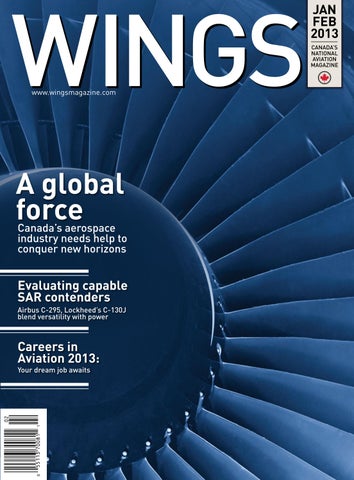
WINGS www.wingsmagazine.com
A global force
canada’s aerospace industry needs help to conquer new horizons
Evaluating capable SAR contenders airbus c-295, lockheed’s c-130J blend versatility with power
Careers in Aviation 2013: Your dream job awaits
JAN FEB 2013 caNada’S NatIoNal avIatIoN maGazINe
Go Where Others Can’t. INTRODUCING THE FALCON 2000LXS It is the ultimate combination of nonstop range, airfield agility and widebody cabin. No other 4,000 nm aircraft can deliver so many airports in such quiet comfort. Thank optimized aerodynamics, new inboard slats and highly advanced acoustics. Thank Falcon DNA. And go where others can’t.
DNA. It Matters. Eastern Canada +201.981.2869 Find out why. Scan the code. Or visit falconjet.com/2000LXS
•
Western Canada +201.245.9399
JANUARY/FEBRUARY 2013
UpFRoNt 5 leading edge
PHOTO: PRaTT & wHITnEy Canada
Will it be a bold and exceptional future?
8 on the fly
News and opinion
14 Waypoint
Getting out when you’re down
16 Alternate approach Playing the alliance game
18 At the gate
Building a future with Boeing
david emerson's new report outlines several strategies to make canada's aerospace industry more internationally relevant. P. 22.
20 legal eagle
Deciphering training bonds
21 glidepath
Increased need for accountability
BACK 48 marketplace 54 on final
Avoiding an international incident
From top: Building a future with Boeing P. 18. In support of the heavy lifters P. 27.
FEAtURES
22 SolviNg thE gloBAl ChAllENgE
New report details Canada’s future in aerospace market BY davId carr
27 iN SUppoRt oF thE hEAvY liFtERS
C-130 Hercules, C-295 are capable FWSAR contenders BY Paul dIxoN
C-1 CAREERS iN AviAtioN 2013
Positive indicators in key markets could mean opportunities for those searching for aviation careers BY davId carr
32 CApitAliziNg oN EvERY oppoRtUNitY B.C.’s London Air Services grows its fleet to meet high demand BY Paul dIxoN
38 ADS-B/ElECtRiC gREEN tAxiiNg SYStEm New technologies promise cost saving and enhanced safety BY BrIaN duNN COVER PHOTO: ISTOCK
www.wIngSMagazInE.COM
January/February 2013 | wIngS
3
The destination for the aircraft interiors industry Aircraft Interiors Expo 2013 9-11 April 2013, Hamburg Messe, Germany Aircraft Interiors Expo is the unrivalled launch pad for tomorrow’s designs in cabin interiors, in-flight entertainment, connectivity and passenger services.
Register your interest to attend at www.aircraftinteriorsexpo.com/wingsa
Co-located with:
World Travel Catering & Onboard Services 9 – 11 April 2013
Hamburg Messe , Germany
Organised by:
In association with:
LEADING
EDGE
| By Matt Nicholls
A bold and exceptional future? Industry, government must act on Emerson report
N
PHOTO: MaTT nICHOllS
ear the conclusion of the impressive Aerospace Industries Association of Canada’s (AIAC) Aerospace Summit Dec. 5-6 in Ottawa, two telling announcements underscored the importance of recommendations made by former cabinet minister David Emerson in his comprehensive new report on the state of the Canadian Aerospace industry. (for more, see “Solving the global challenge,” pg. 22). On the final day of the summit, the federal government announced it was scrapping the controversial Lockheed Martin F-35 Joint Strike fighter program after a KPMG audit determined costs for the project were markedly higher than originally forecast: in excess of $30 billion for the total life cycle of the program. The price of the aircraft – the government’s choice to replace its aging CF-18 fleet – was originally pegged at some $9 billion for 65 planes, $15 billion when maintenance and other costs were factored in to the buy. Given the negative feedback from opposition members and Canadian taxpayers over excessive costs and mismanagement of the process, the Conservatives had little choice but to start over with this poorly managed debacle. They now head back to the drawing board to consider more aircraft options including Boeing’s Super Hornet, Dassault’s Rafale, Saab’s Gripen, the Eurofighter Typhoon and the F-35 itself, which could still end up being the ultimate choice. Aspects of Emerson’s report likely influenced the government’s decision. In his Beyond the Horizon: Canada’s Interests and Future in Aerospace, Emerson emphasizes a need for the federal government to make sure there are industrial and regional benefits (IRBs) and in-service support (ISS) contracts when signing procurement agreements. Lockheed Martin has been reluctant to share
5
The Conservatives had little choice but to start over with this poorly managed debacle. its proprietary technology information with its closest clients. Continuing to ensure aerospace remains a centrepiece of Canada’s international trade agenda and encouraging state-to-state partnerships with emerging aerospace powers is another key point in of Emerson’s report. Its importance and the current state of the Canadian aerospace industry were underscored when the Conference Board of Canada (CCB) released its Aerospace Industry Outlook days after the conference. The CCB report shows industry profits have been on a turbulent ride since the 200809 recession. After reaching a high of $710 million in 2010, profits fell in 2011 and are
top DAtA BURStS… in this issue
1. Bombardier’s record-breaking order with VistaJet is worth $7.8 billion (pg. 8). 2. 22,000: The approximate number of suppliers and partners the Boeing Co. has around the globe (pg. 18). 3. Canada’s aerospace industry directly employs more than 66,000 people, (pg. 22). 4. 460,000: The estimated number of professional licensed pilots worldwide (pg. C-4). 5. 3,040 nm: The estimated range of the C-295, a leading contender for Canada’s FwSaR contract (pg. 27).
www.wIngSMagazInE.COM
projected to dip again in 2012 and 2013. Fortunately, there’s good news on the horizon for the Canadian aerospace industry. While U.S. economic growth remains slow, many American companies have improved their financial position – a situation that is expected to lead to increased demand for business jets. The improved outlook in 2015 and beyond will also coincide with the anticipated arrival of Bombardier’s CSeries jets on the market. Opportunities will also grow if the recommendations in Emerson’s report are embraced and implemented by industry, various levels of governments and key suppliers. It’s an effort that’s more than worth it. Canada’s aerospace industry generates more than $22 billion annually with exports making up 80 per cent of that output. Some 160,000 Canadians are employed in Canadian aerospace and the more than 700 aerospace companies are world leaders in technology, manufacturing and space development. At Wings, we recognize the importance of this key Canadian sector and will be featuring Canada’s world-renowned leading aerospace companies in a special series throughout 2013. Beginning in the March/April issue, we will feature leading aerospace companies, individuals and decision makers from five distinct Canadian regions: the GTA, Montreal, Winnipeg, the Fraser Valley and Atlantic Canada. Please feel free to contact us with any intriguing story angles; it’s our goal to highlight the very best of the industry. Will it be a positive future for Canada’s aerospace sector? Only time will tell. But judging by the enthusiasm, ideas and passion of industry leaders and government officials at the AIAC conference, the future looks bold, exceptional and bright. | W Your feedback is always welcome. Please contact me at mnicholls@annexweb.com. @Wings_Magazine January/February 2013 | wIngS
5
WINGS
JAN JAN FEB FEB 2013 2013 caNada’S caNada’S NatIoNal NatIoNal avIatIoN avIatIoN maGazINe maGazINe
www.wingsmagazine.com www.wingsmagazine.com
vol. 54, issue 1 EDitoR
A Global global A force Force
Matt nicholls mnicholls@annexweb.com 416-725-5637
canada’saerospace aerospace canada’s industryneeds needshelp helptoto industry conquernew newhorizons horizons conquer
mEDiA DESigNER
EvaluatingCapable capable Evaluating FWSARcontenders contenders FWSAR
Brooke Shaw
airbusc-295, c-295,Boeing’s Boeing’sc-130J c-130J airbus blendversatility versatilitywith withpower power blend
Flight DECK
Careersin in Careers Aviation2013: 2013: Aviation
Ray Canon, david Carr, Paul dixon, Brian dunn, Frederick K. larkin, neil a. Macdougall, James Marasa, Carroll McCormick, david Olsen, Rob Seaman
Your Yourdream dreamjob jobawaits awaits
SubScribe TODAY !
ASSoCiAtE pUBliShER
alison de groot adegroot@annexweb.com 1-888-599-2228 ext. 246
1 Year SubScription WINGS_JANFEB13.indd WINGS_JANFEB13.indd1 1
only
3000
$
12-12-18 9:37 AM PM 12-12-21 12:20
ADvERtiSiNg SAlES
(GST $31.50 • HST $33.90)
adam Szpakowski aszpakowski@annexweb.com 1-888-599-2228 ext. 246
US $42.00 (USD) • Foreign $65.00 (USD)
Name: _______________________________ Company: ____________________________ Title: _________________________________ Address: _____________________________ City: _________________________________ Prov: ________________________________ P.Code: ______________________________ Tel: _________________________________ Fax: _________________________________ e-mail:________________________________
PLeASe cHecK ONe: ❑ Commercial aircraft owner/operator ❑ Business/private aircraft owner/operator ❑ Military ❑ Aircraft maintenance/overhaul firm ❑ Airport ❑ Aerospace, airframe & component manufacturer and distributor
❑ Fixed base operator ❑ Aviation services, consultants and aircraft sales ❑ Government ❑ Aviation associations and organizations ❑ Flying schools, clubs and colleges ❑ Other (please specify) ______________
PAYMeNT: Cheque - Payable to Annex Publishing & Printing Inc. Visa
MC
AMEX
Account #: __________________________
SAlES ASSiStANt
Stephanie deFields sdefields@annexweb.com 1-888-599-2228 ext. 257 gRoUp pUBliShER
Scott Jamieson sjamieson@annexweb.com pRESiDENt
Mike Fredericks mfredericks@annexweb.com WiNgS mAgAziNE
P.O. Box 530, 105 donly dr. S., Simcoe, On n3y 4n5 Tel.: 428-3471 Fax: 429-3094 Toll Free: 1-888-599-2228
Publication Mail agreement #40065710 Return undeliverable Canadian addresses to Circulation dept., P.O. Box 530, Simcoe, Ont. n3y 4n5 e-mail: subscribe@wingsmagazine.com Published six times per year (Jan/Feb, Mar/apr, May/ Jun, Jul/aug, Sep/Oct, nov/dec) by annex Publishing & Printing Inc. Circulation e-mail: subscribe@wingsmagazine.com Ph: 866-790-6070 ext. 208 Fax: 877-624-1940 Mail: P.O. Box 530, Simcoe, On n3y 4n5 Subscription Rates Canada – 1 year $ 30.00 (includes gST - #867172652RT0001) USa – 1 year $ 42.00 Foreign – 1 year $ 65.00
Occasionally, wings magazine will mail information on behalf of industry-related groups whose products and services we believe may be of interest to you. If you prefer not to receive this information, please contact our circulation department in any of the four ways listed above. no part of the editorial content of this publication may be reprinted without the publisher’s written permission. ©2012 annex Publishing & Printing Inc. all rights reserved. opinions expressed in this magazine are not necessarily those of the editor or the publisher. no liability is assumed for errors or omissions. all advertising is subject to the publisher’s approval. Such approval does not imply any endorsement of the products or services advertised. Publisher reserves the right to refuse advertising that does not meet the standards of the publication. Printed in Canada ISSn 0701-1369
Signature: _________________________
TO SubScribe:
Tel: 866-790-6070 Fax: 877-624-1940 Mail: Wings Magazine c/o Annex business Media P.O. box 530 Simcoe, Ontario N3Y 4N5
Air Transport Association of Canada
ON THE
WEB
e-mail: subscribe@wingsmagazine.com
www.wingsmagazine.com
GST#135274215RT001
6
Subscriptions non-refundable
PRO0113
wIngS | January/February 2013
wings subad.indd 1
Canadian Owners & Pilots Association
Canadian Business Aviation Association
Magazines Canada
CAREERS iN AviAtioN This issue marks the return of our exclusive Careers in Aviation supplement, a handy guide to help you better understand what a career in aviation is all about. Check out www.careersinaviation.ca for news, updated listings and more! www.wIngSMagazInE.COM
12-12-18 9:51 AM
PHOTO: ROyal CanadIan aRMEd FORCES
Expiry:_____________________________
ON THE FLY For late-breaking news, the Wings blog and exclusive web content, please visit us at: www.wingsmagazine.com
iNDUStRY NEWS opERAtioNS CommERCiAl REpoRt gREEN AviAtioN pEoplE
iNDUStRY NEWS
lARgESt oRDER iN BomBARDiER’S hiStoRY VistaJet, a Swiss-based luxury aviation company, has signed a deal for up to 142 Global business jets, which includes a firm order for 56 Global jets and options for a further 86 Globals. If all options are exercised, the list value of the order will be $7.8 billion, making it the largest business aircraft sale in Bombardier’s history. The value of the firm order is close to $3.1 billion at 2012 list prices, although discounting means VistaJet, an exclusive operator of Bombardier business aircraft, is unlikely to pay close to list. VistaJet’s business model includes returning aircraft to the manufacturer after two-and-a-half years to maintain a state-of-the-art fleet. “By any standard, this is a historic order for Bombardier,” said Steve Ridolfi, president of Bombardier Business Aircraft. Analyst Brian Foley of New Jersey-based Brian Foley Associates described the deal to the Montreal Gazette as, “almost an airline type order.” Walter Spracklin, an analyst with RBC Dominion Securities Inc., wrote in a note to clients that the order, “establishes Global as the predominant large-cabin ultra-range business aircraft.”
For VistaJet, the order signified a key part of its expansion plans and ambitions to make business aviation more accessible to emerging markets such as the so-called BRIC (Brazil, Russia, India and China) economies and to Africa. “Our customers need to fly pointto-point across the globe, and in many instances on short notice,” said Thomas Flohr, founder and chair of VistaJet. “Whether it’s a direct flight from Los Angeles to Shanghai, from London to Luanda or from Kinshasa to Ulan Bator, we are seamlessly connecting our customers to every corner of the world.” The VistaJet order extends the Global backlog to 38 months, and comes six months after Bombardier grabbed the lion’s share of fractional operator NetJets’ record-setting $9.6 billion order for 275 Challenger 300 and 605, and 150 Cessna Latitude jets. In a related story, Bombardier delivered its first Signature Series Global 6000 aircraft to NetJets in November. NetJets Signature Series aircraft are new airplanes that are customized from design through production for the fractional market. Bombardier also recently delivered the 200th Challenger 605 to an unidentified customer.
BizAv mARKEtS ShoW StRoNg UptiCK Several recent business aviation market reports show that the industry upturn that began earlier this year continued into 2012’s final quarter. ARGUS International Inc. reported business aircraft flight activity in October reached its second highest level since January 2009. The number of flights that month increased by 8.1 per cent from September,
Bombardier’s record-breaking vistaJet order is worth approximately $7.8 billion, the largest business aircraft sale in Bombardier’s history. 8
wIngS | January/February 2013
Industry market report surveys reveal a definite uptick in business aviation acitivity heading into 2013.
reaching its highest level since March 2011, according to the company’s TRAQPak report, which monitors serial-number-specific aircraft arrival and departure information of all instrument flight rules operations in the United States and Canada. All operational categories saw flight activity increases, with FAR Part 135 operations leading the way with an 11.7 per cent gain, followed by a 7.5 per cent gain in Part 91 operations and a 2.9 per cent increase in the fractional sector. Year-over-year, flight activity increased for all sectors by 2.8 per cent, with Part 135 posting a 9.7 per cent increase and Part 91 growing more modestly at 1.7 per cent. Fractional flight activity fell by 5 per cent year-over-year, according to the report. TRAQPak’s survey followed a report from the General Aviation Manufacturers Association, which said general aviation aircraft shipments and billings through Sept. 30 increased by 4.2 per cent to 1,393 aircraft, while the value of those shipments rose 1.4 per cent to $12.3 billion, compared to the same period in 2011. Turboprops posted the largest increase (10.5 per cent) as total deliveries numbered 368 for the first nine months of 2012. Deliveries of piston-driven aircraft rose by 3.5 per cent to 597 units in the first nine months of this year, while business jets posted a slight gain of 0.2 per cent, with 428 deliveries through the first three quarters of 2012. Brazil’s Embraer Executive Jets forecast that total business jet deliveries could reach 650 units in China by 2022, accounting for a total value of about $24 billion and representing roughly 9 per cent of the total business jet market worldwide. The report, which was issued during the 9th China International Aviation & Aerospace Exhibition (Airshow China 2012), said the country today boasts a fleet of about 267 business jets, up from just 78 jets in 2007. Embraer www.wIngSMagazInE.COM
PHOTOS: BOMBaRdIER
8 10 11 11 12
said 77 per cent of China’s business aircraft fleet today is made up of super mid-size to ultra large jets. These reports come on the heels of several surveys published last October during NBAA’s 65th Annual Meeting & Convention (NBAA2012) in Orlando. Honeywell’s 21st Annual Business Aviation Forecast predicted that nearly 10,000 new business jets, valued at about $250 billion, will be delivered between 2012 and 2022. The company also officially labeled 2011 as the trough of the downturn that began in 2009, and it predicted a 9 per cent gain in deliveries in 2012 over last year.
PHOTOS: EMBRaER (TOP); daSSaUlT FalCOn (BOTTOM)
imp ADDS CASCADE to poRtFolio IMP Group International, a Halifax-based multi-service organization with extensive aerospace, aviation and airline interests, has bought Cascade Aerospace of Abbotsford, B.C. for an undisclosed price. Cascade provides fleet management, in-service support, aircraft modification, engineering support and maintenance, repair and overhaul services to Canada’s Department of National Defence, major original equipment manufacturers, and commercial aviation companies. Cascade became only the second Lockheed Martin C-130 Heavy Maintenance Centre in the world earlier this summer. Cascade will be part of IMP’s Aerospace and Defence business, but will retain its separate identity. IMP’s Aerospace and Defence operates numerous locations across Canada providing engineering, depot level maintenance and support services to military platforms, electronic systems, and the manufacturer and assembly of metal and composite components. IMP believes that the acquisition aligns with the Canadian government’s objective of encouraging the development of a world-class Canadian aerospace in-service support capability that can compete in export markets. The buyout is subject to regulatory approvals.
the legacy 500 is embraer’s third clean-sheet design since entering the executive field in 2005.
an earlier regional jet design. “This is the aircraft that will move us from industry player to industry leader,” said Ernest Edwards, president of Embraer Executive Jets. “The Legacy 500 breaks through the traditional midsize jet envelope to offer something that has never been done before. Fly-by-wire does for business aviation what GPS has done for navigation.” Powered by two Honeywell HTF 7500E turbofan engines, the 500 features a Rockwell Collins Pro Line Fusion avionics with synthetic vision and a six-foot cabin, the largest in its class. “It is raising the bar in terms of technology, performance, style and comfort for future designs,” said Marco Tulio Pellegrini, COO and senior vice-president operations. The 500 will be followed by Embraer’s fourth clean-sheet design, the mid-light Legacy 450, which will enter service one year later. “Clean-sheet designs are part of our DNA,” added Pellegrini, pointing to the success of the entry-level Phenom 100 and light Phenom 300, the first of Embraer’s clean-sheet airplanes. The 500 flight-testing and delivery schedule had to be pushed back one year following complications integrating the fly-by-wire control system. First deliveries are no expected to begin in 2014, coinciding with an expected turnaround in the sluggish midsize sector. The 500 will compete directly with the Cessna Citation Latitude and Bombardier Learjet 70/75. Both aircraft are in development. The Latitude is expected to
make its first flight in mid-2014 and Cessna recently announced a 25 per cent boost to its range, to 2,500 nautical miles. Bombardier announced the Learjet 70 and 75 light and midsize business jets this year at EBACE. The aircraft will replace the Learjet 40XR and 45XR, which have arrived at the end of the production line at the Learjet facility in Wichita. The 70 is expected to enter service in mid-2013.
40 YEARS YoUNg: DASSAUlt CElEBRAtES BiRthDAY Dassault Falcon Jet Corporation turned 40 on Dec. 1. The manufacturer of higher end executive tri-jets and twin jets, Dassault Falcon was formed in a partnership between Pan American World Airways and Dassault Aviation, manufacturer of the Rafale fighter. The partnership was formed to help accelerate expansion of executive jets in the U.S., the world’s largest market. Pan Am was the launch customer for the Falcon 20. “The history of Dassault Falcon Jet is quite remarkable. Some of the most recognized names in aviation have their history intertwined with ours,” said John Rosanvallon, chief executive of Dassault Falcon Jet, and executive vice-president of civil aircraft for Dassault Aviation. “Charles Lindbergh and [Pan Am CEO] Juan Trippe launched Pan American Business
EmBRAER BUilDS oN itS lEgACY The world’s first midsize business jet to incorporate a fly-by-wire control system took off from Embraer’s headquarters in Sao Jose dos Campos, Brazil on Nov. 27, for a one hour and 45 minute maiden flight. The Legacy 500 is the air framer’s third clean-sheet design since entering the executive field in 2005 with the Legacy 600, a super midsize executive jet based on the same platform as www.wIngSMagazInE.COM
French airplane manufacturer dassault Falcon celebrated its 40th anniversary late last year. January/February 2013 | wIngS
9
ON THE
FLY
Jets with the Falcon 20. Fred Smith launched FedEx with a fleet of Falcons.” More than 500 Falcon 20s were produced before production ceased in 1984. Since the first Falcon 20 rolled off the assembly line in 1963, Dassault Falcon has delivered more than 2,200 executive airplanes to 81 countries worldwide. The company is expected to deliver its 500th Falcon 900 tri-jet next summer. At NBAA 2012, Dassault Falcon launched the Falcon 2000 LXS, offering improved airport performance, payload and cabin comfort compared to the Falcon 2000 LX, which it will replace. Powered by two new generational Pratt & Whitney Canada 308C engines, the 2000 LXS will have a range of 4,000 nautical miles and will allow operators to access more airports because of new full-length inboard slats, which will give the airplane categoryleading airport performance and balanced field length. The 2000 LXS will need just 2,260 feet of runway, identical to the length needed for turboprop aircraft.
opERAtioNS
SimplY thE CAt’S mEoW Charter Air Transportation Services (CATS), Canada’s newest private jet charter company has began operations from its base at Toronto’s Lester B. Pearson International Airport. CATS operates a fleet of Hawker Beechcraft Premier 1A aircraft and will be able to transport up to six passengers 1,000 nautical miles non-stop, often at rates lower than the cost of commercial business class fares depending on the size of the group. “CATS offers business travellers a business-focused alternative,” said Kevin Heitman, the operator’s chief operating officer. “Our service has been designed to offer flexible flight times, customized flight plans and a relaxing and productive in-flight experience, allowing our passengers to worry less about how they are getting to their meeting, and more about what they’re going to do once they arrive.”
FlExJEt tRANSitioNS to pApERlESS CoCKpit Flexjet, Bombardier’s fractional jet ownership subsidiary, has received conditional authorization from the Federal Aviation Administration for the use of Apple iPads as Electronic Flight Bags. The authorization follows six months of validation testing across Flexjet’s aircraft fleet. The Electronic Flight Bags’ mobile technology replaces paper-based reference materials – including navigational charts and aircraft operating manuals – with real-time data and increased situational awareness for those operating the aircraft. Each iPad weighs less than a kilogram and eliminates more than 54 kilograms of printed materials typically required per flight. Replacing paper with the device also results in approximately two litres of fuel saved per hour of flight. Flexjet’s transition from paper to electronic navigational charts was expected to be complete as Wings went to press.
24/7 READY TO SERVE AROUND THE WORLD
A Fully Author ized Pratt & Whitney Canada Distr ibutor and Designated Overhaul Facility
MAINTENANCE
l
R E PA I R
l
OVERHAUL
To l l Fr e e : 1 . 8 8 8 . 7 6 9 . 0 9 9 9 l www.vectoraerospace.com
SETTING THE STANDARD OF CUSTOMER SERVICE 10 wIngS | January/February 2013
www.wIngSMagazInE.COM
CommERCiAl REpoRt
gREEN AviAtioN
WoRlD’S pilotS SAY BONJOUR to moNtREAl
CANADA ShoWCASES ‘pEtRolEUm-FREE’ Civil Flight
The International Federation of Air Line Pilots Association (IFALPA) has joined the International Air Transport Association, the International Civil Aviation Organization and Airports Council International in calling Montreal home. IFALPA opened the doors to its new world headquarters on November 13, in front of numerous guests from the civil aviation sector. “The civil aviation industry is progressing at an unprecedented rate and the IFALPA has a duty to be front and centre in the decision-making process. And front and centre is right here, in Montreal,” Capt. Don Wykoff, IFALPA president said. The association represents approximately 100,000 pilots worldwide, and was previously located in London, England.
Canada has joined the front of the class in biofuel research and development. A National Research Council of Canada (NRC) Dassault Falcon 20 has become the world’s first civil jet to be powered by 100 per cent biofuel. The one-hour flight over the Ottawa region took place Oct. 29 last fall. The Falcon’s two General Electric CF700-2D2 turbofans were fed ReadiJet, an unblended ‘drop in’ fuel transformed by Albuquerque-based Applied Research Association (ARA) and Chevron Lummus Global which uses Resonance Energy Feedstock, a unique industrial oilseed crop commercialized by Ottawa’s Agrisoma Bioscience. ARA produces Readijet under contract to the U.S. Air Force Research Laboratory. Resonance Energy Feedstock was
launched by Agrisoma on a commercial scale in 2012 across a broad region of western Canada. “I have now flown the world’s first 100 per cent biofuel flight,” said Tim Leslie, one of NRC’s pilots. To date, flights on biofuels have been restricted to a 50 per cent blend with petroleum. ARA’s proprietary catalytic hydrothermolysis process converted oil from Resonance Energy Feedstock into a biofuel that represents a complete replacement of conventional fuel and a potential breakthrough for the renewable fuels industry. The flight over the capital was tailed by an NRC T-33 aircraft, outfitted with an array of under-wing sensors to collect information on the emissions generated by the biofuel. The federal research and development organization is expected to release the results in early 2013. “This flight changes everything,” said Steven Fabijanski, chief executive of Agrisoma. “We have witnessed petroleum-free aviation.”
Mission Manager
Flight management with mission support NVG-capable Multi-Mission support featuring six search patterns, Mark on Target, and WAAS/SBAS capabilities for precision-like LPV approach procedures. The right information with reliability you can count on. Contact your Authorized Universal Avionics dealer or visit uasc.com to learn more.
WAAS/SBAS-MMMS Family - LP/LPV Monitor, UNS-1Lw, -1Fw and -1Ew
www.uasc.com sales@uasc.com (800) 321-5253 (520) 295-2300
Wings Missions Manager Ad_January 2013.indd 1 www.wIngSMagazInE.COM
12/6/12 3:53 PM January/February 2013 | wIngS 11
ON THE
FLY
AiR CANADA NEW ChAiR oF AlliANCE BoARD Calin Rovinescu, chief executive of Air Canada has been named chair of the Star Alliance executive board. The appointment came the same week that Air Canada announced an aggressive push into the growing Asian market. Rovinescu succeeds Rob Fyfe, chief executive of Air New Zealand, who held the post for the past two years. In his role, Rovinescu will conduct the two annual board meetings and act as the designated spokesperson for the board. He said he was looking forward to using the two-year appointment to deepen the alliance and pursue shared priorities including strengthening the global network and providing a greater seamless travel experience. “Partnerships are essential to succeed in this business,” Rovinescu said. “It is my determination to see that we continue to foster commercial cooperation among member carriers to further strengthen our position as the leading global airline network.” That same week, Air Canada announced plans to strengthen its own global network with additional flights to China, Japan, South Korea and Turkey. This upcoming summer, Air Canada will add three additional weekly flights between Toronto and Beijing, and four more weekly flights to Beijing from Vancouver. The carrier will also increase its three-times-weekly service from Calgary to Tokyo Narita to daily in May and launch a new direct service from Toronto to Istanbul. “With our Asia expansion alone, we will be flying 11 daily departures or more than 43,000 seats a week across the Pacific Ocean this summer – a commitment of up to 14 wide-body aircraft valued in excess of $2 billion,” said Ben Smith, executive vice-president and chief commercial officer. Air Canada, United Airlines and Lufthansa were among the founding Star Alliance partner airlines. Star is the largest airline alliance, representing more than two dozen airlines around the world.
pARtNER JEt NAmES NEW CEo Mississauga-based Partner Jet has announced the appointment of James (Jim) A. Morrison as chief executive. Partner Jet specializes in the executive 12 wIngS | January/February 2013
and private travel sector with a focus on aircraft management, sales, maintenance and charter sales. Morrison brings a wealth of corporate and commercial aviation experience to the company. He began his flying career in 1966 and began his aviation career with Ottawa-based Bradley Air Services. He has held senior management positions with Air Creebec, Air Ontario, Skyservice and Execair, and until January 2011, was chief operating officer with Porter Airlines.
hoNoURiNg KEY iNFlUENCERS One of aviation’s top awards is celebrating more than 10 years of honouring key industry achievers. The David Charles Abramson Award, awarded annually at the ATAC Annual General Meeting and Conference to a deserving member of the flight instruction community, this year recognized Paul Harris, manager of flight operations at the Pacific Flying Club in Vancouver. An innovator in the field of flight instruction, Harris has spent more than 20 years and 12,000 hours guiding young pilots. Other award winners at this year’s event included Patrick Lafleur, chief flight instructor at the Passport Helico in Mascouche, Que. Lafleur received a Safety Management Systems workshop sponsored by ATAC in honour of his work in the industry. Chris Walsh, director of training, manager of corporate safety and quality at Moncton Flight College, was also honoured for his contributions on the fixed-wing side. He received a three-day instructor refresher course sponsored by Seneca College. For more than 10 years, the David Charles Abramson Award has recognized industry leaders in the flight instruction arena. The David Charles Abramson Memorial (DCAM) Flight Instructor Safety Award is named in honour of Jane and Rikki Abramson’s son, a heroic individual whose life came to a tragic end in 1998. David Abramson’s professionalism as a flight instructor was the inspiration behind this annual recognition of excellence in Canadian flight training. David lost his life while on a routine training flight with a student on July 18, 1998. He was just 24. David’s heroic actions that day saved the life of his student – and established a legacy for all to follow.
zoran Bratuljevic has been named president and chief operating officer of montreal-based Starlink aviation.
BRAtUlJEviC NAmED pRESiDENt At StARliNK moNtREAl, lYNCh StEpS DoWN Zoran Bratuljevic has been named President and Chief Operating Officer of Montreal-based Starlink Aviation following the departure of President & CEO Glen Lynch in mid-December. Bratuljevic, who has more than 30 years of aviation industry experience, has been with Starlink for the past seven years, serving as General Manager and Vice President before being named Chief Operating Officer in March of 2012. “Starlink has experienced tremendous growth while maintaining a critical focus on customer service,” said Bratuljevic. “My job is to make sure we continue to deliver both. We have built and exceptional team here, a team that has and will continue to drive our success.” Starlink Aviation (CYUL) began in 1981 as Avionair, a small operator of light twin-engine aircraft for charter operating out of a 5,000 square-foot hangar on Ryan Avenue in Dorval. In 1991 the company was purchased from its founder by Gilles Bruneau who directed the growth of the business to a fleet of six aircraft including four turboprops. The company now operates FBO, aircraft management, charter, maintenance and corporate shuttle divisions out of a 88,000 squarefoot hanger with more than 20 aircraft in its owned and managed fleet. In 2010, Starlink’s FBO operation became part of the global Signature Flight Support network and the first Signature FBO in Canada. Starlink/Signature has been named “Top FBO in Canada” and “Top FBO in Quebec” in the Wings Canadian FBO Survey two years in a row. www.wIngSMagazInE.COM
PHOTO: MaTT nICHOllS
pEoplE
W O R L D C L A S S T R AV E L E R S
David Beckham. A global icon who insists on perfection. Precision and style. A legend forged by accomplishments. On his wrist is the Breitling Transocean Chronograph Unitime, the ultimate traveler’s watch. Manufacture Breitling Caliber B05, officially chronometer-certified by the COSC, endorsed by a 5-year Breitling warranty. High-performance selfwinding chronograph. Universal time function enabling permanent readings of the time in all 24 timezones thanks to a patented mechanism and an ultra-user-friendly crown-operated correction system. Comfort and elegance for first-class travelers. Signed Breitling.
CAD 11,200 Recommended retail price
WAYPOINT By Rob Seaman |
getting out when you’re down ‘Bry the Dunker guy’s’ training methods could save your life
A
14 wIngS | January/February 2013
preparedness. Gaining experience first-hand, in a warm pool facility, is time well spent. Survivors who have put the training to the test know how critical the course is. One survivor, “Jason,” notes: “I am writing you today to thank you, Bryan. Years ago, I attended the Underwater Egress Training you offered. In September of 2012, I was the pilot of a float equipped Cessna involved in an accident resulting in being submerged and belted in. I have no doubt that your training saved my life and the life of my passenger. “In spite of the fact I had taken your training, I still had trouble finding the door handle and exiting the aircraft. The training I received was always mentioned on my preflight speech and luckily my passenger listened and remembered what I had told him. He was able to open his door and escape, while I was still struggling with mine, thinking this is what it feels like to drown. Then with only seconds left to live, I consciously thought about breathing water in but gave it one more try to escape and found my way out the passenger door. I firmly believe that everyone who operates an aircraft should have this training as it does work and is as valuable as you hold your life.” What’s that old saying about an ounce of prevention? Thank heaven there are people like Bryan Webster who think this way and can help others when their chips are down. | W
Bryan Webster will train and help prepare you for the day when reactive action comes into play. these requirements to allow for more training, but he also points out that this does not explain the higher-time, experienced pilots ending up inverted in the water. According to Webster, in egress-related accidents, the colder the water, the higher the mortality rate. “Cold shock masks the real life-threatening situation – that being the lack of air available, and the very short time for survival added to that taken in finding an exit,” he says. Aviation Egress Systems is Webster’s corporate entity established to train flight pilots and cabin crew and even passengers in all aspects of planning for – and executing – a safe egress from an emergency situation. In business since 1998, the firm has been directly credited with saving one life per year (14) regarding “in water” aircraft emergencies. Webster has trained in excess of 5,000 people and his work covers everything from briefing cards and passenger pre-flight briefs through hands on egress experiences – in the dunk tank. Regardless, if you’re flying a corporate jet, weekend pleasure craft, rotarywing ship or smaller commercial aircraft, Webster will train and help prepare you for the day when reactive action comes into play. Many pilots say, “This is really not something I need to worry about – and dismiss the idea of training. But the fact is, everyone should think about this sort of emergency
Rob Seaman is a Wings writer and columnist. www.wIngSMagazInE.COM
PHOTO: ROB SEaMan
s pilots, we never think it will happen – that horrific moment when an off-airport incident occurs, throwing you into the water with lifethreatening consequences. If you fly over or near water, you should stop to think about how you would get out of the aircraft should you wind up “in the drink.” Some planning and training today could save your life when and if that time ever comes. During a recent filming session for a new pilot and aviation safety product called SmartPilot.ca (a special undertaking being underwritten by the Search and Rescue Directorate), I had the pleasure of getting to know Bryan Webster. Webster is wellknown in the aviation community as a director of the Canadian Owners and Pilots Association. He is also an expert on egress training and he’s aptly referred to as “Bry the Dunker Guy.” The point of the episode was to show how to plan and train for a challenging water egress scenario once an aircraft has impacted a body of water. “Egress stats in general are one of those contentious issues which over the years, I have found can cause heated debate and bring many different outlooks due to water temperature and accident geographic locations,” Webster says. “The Transport Canada website lists lives lost and the results cannot be disputed.” For unknown reasons, 2012 had a higherthan-usual aircraft accident rate related to aircraft involved with water. In his best guess, Webster notes this could be related to the great weather we experienced across Canada – and attributed to more aircraft being out in general, more students doing float training or just bad luck. Webster points to a horrific Beaver crash in Northern Ontario early in the Spring, followed by one into Pigeon Lake north of Toronto and then a student on his first Solo in Okanagan Lake. This was followed by a “gear down” amphibious crash into the water on Vancouver Island, and then an instructor perishing near Vancouver in a 172 during float training. “Unfortunately, these statistics have always been a factor in our aviating community, thus we mitigate the risk by training in general – which for floats is presently only seven hours to qualify for an endorsement,” he says. Webster feels that there should be a review of
APPOINTMENT NOTICE Mr. John W. Crichton, President and Chief Executive Officer of NAV CANADA, is pleased to announce the following executive appointments: Rudy Kellar | Executive Vice President, Service Delivery
As Executive Vice President, Service Delivery, Mr. Kellar provides leadership and direction for Air Traffic Operations, Technical Operations, and Engineering, ensuring effective alignment of these key functions in the provision of safe, efficient and cost effective air traffic services and aeronautical information services. Mr. Kellar joined NAV CANADA in 2005 as General Manager, Edmonton Flight Information Region, where he worked with Operations staff and customers to significantly enhance service levels. In 2007, he was appointed Vice President, Operations and has contributed extensively to the safety and efficiency of aircraft movement within Canadian airspace and international airspace delegated to NAV CANADA. Prior to that, Mr. Kellar was Chief Executive Officer of Air Contractors, a cargo transport airline based in Dublin, Ireland, from 2001 to 2005.
Brian Aitken | Executive Vice President, Finance and Chief Financial Officer
As Executive Vice President, Finance and Chief Financial Officer, Mr. Aitken is responsible for providing executive leadership to the Finance function of NAV CANADA. Mr. Aitken joined the Company in 2002 as Senior Director, Finance, and was promoted to Assistant Vice President, Finance in 2007. In 2008, Mr. Aitken was appointed Vice President, Finance, CFO and Treasurer, responsible for the management of financial resources and risks, while ensuring the effective, efficient administration of financial information and reporting systems for the Company and its pension plans. Prior to joining NAV CANADA, he was Vice President, Treasury at Domtar Inc. and Chief Financial Officer at E.B. Eddy Forest Products Ltd. and Calian Technology Ltd.
Neil Wilson | Executive Vice President, Administration and General Counsel
As Executive Vice President, Administration and General Counsel, Mr. Wilson is responsible for all legal and corporate service functions as well as Human Resources, and Customer and Commercial Services. Mr. Wilson joined NAV CANADA as Vice President, General Counsel and Corporate Secretary in 2002. In addition to his continuing role as Chief Legal Officer, Mr. Wilson is also the Company’s Corporate Secretary, and oversees Contracting, Logistics and Fleet, Insurance, Environment and Occupational Health and Safety, as well as Corporate Security. Prior to joining NAV CANADA, he was a partner in the Ottawa office of Gowling Lafleur Henderson LLP.
Larry Lachance | Vice President, Operations
As Vice President, Operations, Mr. Lachance is responsible for providing overall direction and guidance to the operational performance of the Company, ensuring the safe, efficient and cost effective management of air traffic services and aeronautical information services. In 2007, Mr. Lachance was appointed Assistant Vice President, Operational Support and was responsible for ATS Systems Integration, Standards and Procedures, Safety, and Operational Coordination. Before that, he occupied a series of progressively more senior managerial positions in Operations, following a successful early career as an air traffic controller.
Raymond Bohn | Vice President, Revenue and Pension Administration
As Vice President, Revenue and Pension Administration, Mr. Bohn provides leadership and direction to the ANS Revenue team responsible for forecasting air traffic and related revenues, rate setting for customer service charges, collection and analysis of flight data for billing and planning purposes, invoicing service charges to customers and managing credit risk and accounts receivable processes. He also leads the Pension Administration team responsible for the administrative policies, procedures, systems and actuarial valuations related to the operation of NAV CANADA’s pension plans. Mr. Bohn joined the Company as Senior Manager, Pension and Benefits in 2000, and was appointed Director, Compensation, Benefits and HR Systems in 2003. In 2005 Mr. Bohn was appointed Assistant Vice President, Human Resources, and in 2008 was appointed Assistant Vice President, Revenue and Pension Administration.
www.navcanada.ca
ALTERNATE
APPROACH By David Carr |
playing the alliance game
Commercial airline partnerships prepare for ‘seismic shift’
A
16 wIngS | January/February 2013
recently signed an interline agreement with Ireland’s Aer Lingus, a former oneworld member, that is expected to grow into a full code sharing relationship later this year. Unaligned Etihad Airways is linking up with Air France, a founding member of SkyTeam, and is encouraging Air Berlin, its German partner in oneworld to do the same. TAM, Brazil’s largest airline is expected to exit Star later this year, the result of a merger with Chile’s LAN, a founding oneworld member, and a judge’s ruling that the combined unit cannot be a member of both. The two airlines will likely maintain separate brands so it is not automatic that TAM will apply for membership in oneworld. Rather, the airline may operate unaligned and negotiate bilateral code shares with Air Canada and other former Star Alliance carriers. This is not the end of the airline alliance, although they are going to become more fluid as airlines consolidate or partner airlines chase markets where the alliance presence is weak such as Africa and India in the case of Star. Alliances are also only as strong as their weakest partner, suggesting that on some routes travellers are not going to like the connections made for them. Recent developments may have also finally ended legacy airlines’ mistrust of and hostility to the big three Gulf carriers, at least among some members of oneworld and SkyTeam. Star chief executive Mark Schwab recently told an industry forum in Panama City that he was comfortable keeping Gulf carriers out of the alliance. It’s a puzzling position to take and echoes the attitude of American automakers to Japanese imports in the 1970s, or the tin ear record labels first turned to the digital revolution. | W
You have benefits around the margins, but unless you have common ownership, there are going to be different perspectives. to Europe, with the exception of London, to Emirates through its spectacular Dubai hub. The two airlines will operate up to 14 daily flights between Australia and Dubai. “This is the most significant partnership the Qantas Group has ever formed with another airline, moving past the traditional alliance model to a new level,” Alan Joyce, Qantas chief executive said. Even so, Qantas is insisting it will remain in the oneworld family, although it is difficult to see how over the long term – especially as it markets the 10-year arrangement with Emirates as “the world’s leading airline partnership,” and now that Qatar Airways, one of Emirates three Gulf rivals, has joined oneworld. Qantas is not the only airline to step outside the club and make new friends, although none to that extent just yet. Air Canada
David Carr is a Wings writer and columnist. www.wIngSMagazInE.COM
PHOTO: aIR Canada
ir Canada chief executive Calin Rovinescu is stepping into the position of chair of the Star Alliance executive board at the same time cracks are forming along the traditional airline alliance model. A near rupture occurred at rival oneworld last September when Australia’s Qantas Airways, a founding member, announced a new partnership with unaligned Emirates, and cancellation of a 17-year business agreement with fellow oneworld partner British Airways on routes between Australia and the U.K. “This deal will have a fairly seismic shift on the alliances,” Tim Clark, Emirates president and chief alliance sceptic told the Wall Street Journal. Alliances were formed in the 1990s to capture connecting passengers by building seamless global networks, share value-added perks such as premium lounges and frequent flyer points, and reduce operating costs by leveraging procurement for everything from cabin interiors to aircraft orders – all to varied degrees of success. The world’s three global tie-ups – Star Alliance, oneworld and SkyTeam – fly approximately 46 per cent of the industry’s global seat capacity. Of the three, Star Alliance, which was first out of the gate with Air Canada, United Airlines and Lufthansa as founding partners, is the dominant partnership with approximately 25 per cent of global capacity and a level of integration that has left oneworld, at least, circling. But leveraging costs has not panned out. “Those objectives work well on paper and less so in terms of execution,” Air Canada’s Rovinescu told Wings. “So as long as you have separate management with separate opinions whether it has to do with a seat or the toilet paper you are going to have on an airplane, it is going to be really tough to achieve. You have benefits around the margins, but unless you have common ownership there are going to be different perspectives.” Star has had more success cementing a global network. There are signs, however, that airlines might be shifting toward bilateral rather than group partnerships – WestJet’s preferred business model, and one recently evidenced by the Emirates-Qantas tie-up. Here, Qantas is essentially outsourcing the flying of all so-called Kangaroo routes
Works well with others.
Flight departments everywhere are under pressure to deliver more for less. The King Air 350i lets you do just that, without compromise. Its unsurpassed versatility and payload, combined with class-leading range and efficiency, carries more people farther at lower cost than any other aircraft. More for less, or the ideal stable mate? How about both. We build aircraft you can believe in.® HawkerBeechcraft.com For more information please contact us: United States & the Americas +1.316.676.0800 Europe, Middle East & Africa +44 (0) 1244.523803 or Asia-Pacific +65.6423.0321 ©2012 Hawker BeecHcraft corporation. all rigHts reserved. Hawker, BeecHcraft and “we Build aircraft you can Believe in.” are trademarks of Hawker BeecHcraft corporation.
AT THE
GATE
By Brian Dunn |
Building a future with Boeing
Aerospace behemoth is careful to select just the right business partners
W
18 wIngS | January/February 2013
per cent of the latest CSeries program, according to another presentation by Louis Bouchard, senior business analyst, industry relations at Bombardier Aerospace. That presents a challenge to the company which has more than 1,700 suppliers in more than 70 countries. To meet this challenge, Bombardier has a code of conduct that is incorporated into every amendment and new contract with a target of 100 per cent commitment to the code by suppliers in the next few years. In 2008, there were 20 suppliers committed to the code. By 2011, that figure had risen to 245 suppliers. Bouchard says it’s important to be aware of a supplier’s operational performance at all times, to involve suppliers in strategic discussions through dedicated forums and to demonstrate that an OEM is committed to a supplier’s improvement by implementing supplier development programs. What’s the best way to impress the Boeing brass? “Lead by example. Show your suppliers that you live by the highest standards,” says Bouchard. “Develop efficient communication channels with your supply base. Show your suppliers that you are willing to contribute to their development. “Take advantage of continuous improvement programs and business processes to tackle social and environment issues and seize every opportunity with your suppliers to reinforce good behaviour through recognition programs.” For Boeing, consistently striving for perfection is the only way to go. | W
Boeing has more than 200 major Canadian suppliers that enjoy about $1 billion in economic spinoffs annually. which govern the purchases of materials and stipulate that each Boeing business unit determine its own requirements. And when determining which suppliers to put on its bid list, Boeing considers a company’s location and size, capabilities and continuous cost improvements, among other criteria. In addition, Canadian suppliers must have ISO 9001 and AS9100 certification, a Proprietary Information Agreement and a Controlled Goods Directorate in addition to BEST code, Portal Access (Exostar access and Redars & Teamcenter) and DPM/MBD certification. The best way to start the process is to log onto Boeingsuppliers.com. From there a supplier must register their company to access SupplierGATEWAY which is a Boeing tool to help collect accurate information about suppliers and their capabilities in a secure environment. This is important, because it puts a supplier in Boeing’s database and they may be contacted if a bid opportunity arises that matches their products and services requirements. By requiring that each Boeing business unit determines its own requirements for procurement and selects its own sources of supply, the company emphasizes the importance of competitive bidding as a good business practice. The supply chain portion of the total cost of an aircraft is increasing and represents 67 per cent of the older Challenger 850 program, 78 per cent of the newer Challenger 300 and 84
Brian Dunn is a Wings writer and columnist. www.wIngSMagazInE.COM
PHOTO: wESTJET
ith sales of $68.7 billion in 2011, Boeing Co. is a behemoth. It does nearly $40 billion worth of business annually with more than 22,000 suppliers and partners globally and its 12,000 aircraft represent three quarters of the world’s fleet. Boeing has a major presence in Canada as well, employing more than 1,500 workers at facilities in Halifax, Montreal, Ottawa, Winnipeg, Calgary, Richmond and Vancouver. It has more than 200 major Canadian suppliers that enjoy about $1 billion in economic spinoffs annually. These figures were part of a presentation made at Aéro Montreal’s Global Supply Chain Summit last September called “Doing Business with Boeing.” Created in 2006, Aéro Montreal brings together all the major decision makers in Quebec’s aerospace sector, including companies, educational and research institutions, associations and unions. Its mission is to optimize the competitiveness of Quebec’s aerospace industry. The September presentation outlined what Boeing looks for in suppliers and what the requirements are to get on the list. One requirement is that suppliers work closely with Boeing to deliver world-class products, goods and services and sustained high performance in cost, quality and delivery. Suppliers must also be financially healthy and lean, customerfocused, innovative and responsive. In addition, suppliers are judged on five levels of performance, from a gold standard for 100 per cent quality acceptance and on-time delivery to a low red standard for 98 per cent quality acceptance and 90 per cent on-time delivery. Boeing didn’t say what happens to a supplier that slips into the red. Suppliers must also do their research to understand how their products and services can benefit Boeing and to share their commitment to performance excellence in terms of cost, quality and delivery. The company is also looking for suppliers who are financially healthy and focused on improving affordability and efficiency through lean operations and will share their knowledge on how to better manage both businesses and deliver value and solutions. Another key prerequisite for a potential company to become a supplier is to understand Boeing’s procurement practices
UPDATE 2013 Airworthiness Symposium & Trade Show
Coast Plaza Hotel - Calgary, Alberta CANADA
MARCH 13-15, 2013
AIRWORTHINESS
symposium & trade show
Hosted by the Western Aircraft Maintenance Engineers Association & Recognized by Transport Canada
Industry Trade Show Exhibitors Informative Seminars and Workshops for Fixed and Rotary Wing
In-Depth Mini-Courses Banquet and Max Ward Award
Official Media Sponsors
"The AME; a Guardian for the Vested Interests”
For more information, including courses, registration and schedule, see
www.wamea.com
Phone: (780) 462-1173 Fax: (780) 413-0076 E-mail: info@wamea.com
LEGAL
EAGLE By Neil J. Macdonald |
it’s bond – a training bond, that is Understanding the role of training bonds in the workplace
W
20 wIngS | January/February 2013
employee to stay, and forgive the bond debt by that quotient each month. If employers use this type of formula, employees should not be reluctant to sign training bonds as these types of contracts are mutually beneficial. The employer has a trained work force that they can count on for a minimum period, and the employee has an upgraded skillset and an employment commitment from the company. We should also mention a note to employers. Sometimes an employee signs on to a training bond and for whatever reason decides to leave early. We should view this as a simple business transaction, and not a personal vendetta. We should not expect the employee to pay the costs of the bond per the above formulas, and move on with bad feelings – never to be hired back again. Things happen in life, and people can and do change their minds – or circumstances can also change. If one views these movements as part of the cost of doing business (accounting for those costs properly, of course) training bonds will be viewed as simply a normal part of the education of aviation professionals. | W
In order for a bond to be effective in the eyes of the court, it should adhere to the standard conditions of any legal contract. elements. Certainty as to terms should be the driving force in all contracts. Contracts are an exchange of “something”; consideration is the term used to describe this concept. If you already had the training, then were subsequently asked to sign a training bond, that bond “contract” could or should fail for lack of consideration in court. The inequality in bargaining power can also come into play in situations where a junior employee is told they need to sign a bond in order to continue to work. Employers can avoid being off side of the law by laying everything out in advance, in detail. This is also the case for the financial and time elements. The financial commitment the employee signs on for should reflect the true cost of the training. Courts are reluctant to enforce a contract where an employee is asked to pay well above the actual value of the training costs. The time an employee is required to stay with the company after training needs to be realistic as well. A five-year term should easily fail the test, while a one- to two-year minimum seems reasonable. Having the employee pay back costs on a pro-rata basis is also common. Divide the cost of training by the number of months you require the
Neil J. MacDonald is a pilot, lawyer and aviation consultant. njm@neiljmacdonald.com This is not a legal opinion. Readers should not act on the basis of this article without first consulting a lawyer for analysis and advice on a specific matter. www.wIngSMagazInE.COM
PHOTO: ISTOCK
ith a new operating season upon us, crews will be looking for jobs and employers will be looking for crews. It sounds pretty simple, right? Well, it may be business as usual yes, but that’s only until someone wants you to sign a training bond. Regardless of whether you’re a pilot or an engineer, training bonds seem to be here to stay. The main concept – where employees either stay for an agreed amount of time, or the employer agrees to pay for a percentage of an employee’s training costs – is not going away any time soon, although the law is evolving. It seems reasonable that since employees are the ones who will benefit in the long run, they should bear the cost of their own education. It’s no different for many other professionals. Doctors, lawyers, and accountants, for example, spend thousands of dollars to get the skills that allow them to work in their chosen fields. A yearly upgrade in training is also required and it takes years to pay off student debt associated with these professions. Pilots and engineers are in much the same boat. Some will come from the military where it can be argued that they had most of their credentials paid for. Of course, it sounds good while they are in the military, but once out, these professionals are in the same situation of having to convert to civilian licences and bear the associated costs. Modern cockpits are more sophisticated than they were in earlier generations, so it takes training to learn the latest systems. For example, how the glass presents the information and guidance information in an aircraft is somewhat familiar, yet it presents that info. in an equally confusing format. For the most part, many training costs are paid for by an employer. As an example, pilots usually don’t have to pay for a PPC each year. The training bond is an amount the employee agrees to pay back should they decide to leave the company before a specific time. This is where the law comes into the picture. In order for a bond to be effective in the eyes of the court, it should adhere to the standard conditions of any legal contract. I have written several articles on contracts, so I don’t want to get too in-depth here regarding contract law. The main areas to look for are consideration, which links in with bargaining equality, and the financial and time
GLIDE
PATH
| By Paul Dixon
increased need for accountability Transport Canada, minister need to make stronger impact: ATAC
PHOTO: PaUl dIxOn
T
he Air Transport Association of Canada (ATAC) AGM in Vancouver last Nov. 13-15 was built on the theme, “The Need for a New National Aviation Policy” and the key speakers were definitely on message, from the opening address by ATAC president/CEO John McKenna, to the morning plenary featuring Sen. Denis Dawson and CEO of Intervista Consulting Gerry Bruno, to the luncheon presentation by Tony Gugliotto, senior VP of marketing/business development with YVR. Dawson (above centre), chair of the Standing Senate Committee on Transportation and Communications, was quite blunt in calling out the government for failing to take a leadership position in policy development. He gave a brief history lesson in outlining the changes that have occurred in Ottawa since he first arrived as a young member of Parliament in the mid’70s. There was no national transportation policy or aviation policy at the time and the government owned all the airports under the stewardship of Transport Canada. Subsequently, individual MPs would make their pitch to the minister of transport for improvements to airports within their constituencies. In the early ’90s the regionalization, privatization and semi-privatization of airports changed the dynamic. Decisions regarding expenses were all of a sudden being made locally, but the money was still flowing to Ottawa. Then 9/11 happened and security became a big deal. In the United States, where the attacks took place, the federal government took responsibility for the new levels of security, whereas in Canada, the expense was directly downloaded on to the operators and their customers. The result? More than a billion dollars has been taken out of the industry in taxes and fees. In Dawson’s view, the American government assumes responsibility for many of the costs associated with airports and aviation because it wants to encourage people to travel by air; in Canada, we seem to be putting obstacles all over the place. McKenna (above left) lamented in his opening remarks that unless the minister of transport is willing to champion the industry, there won’t be a level of awareness at the cabinet level or higher. Dawson agreed and was blunt in saying that in recent years, the power www.wIngSMagazInE.COM
extended-range airliners, has made cities such as Toronto, New York, Chicago and even Dallas became gateway cities for direct flights from Asia. Between 2000 and 2010, YVR saw no growth on the Asia routes. What YVR has done in the past two years is concentrate on attracting new Chinese airlines serving cities outside of Beijing and Shanghai. Today, YVR serves the most Chinese airlines of any North American airport (six), with a total of 63 weekly flights. Canada’s “lost airport,” the five million Canadians who choose to cross the border and fly out of American airports to take advantage of cheaper fares, was touched on by all speakers. Gugliotto pointed out that when the operating costs for airlines are so high at Canadian airports, it’s not just a matter of Canadians crossing the border; it’s also a matter of other airlines deciding that all things being equal, it’s not in their best financial interests to fly into Canada, so they take their business elsewhere. In the end, there are many challenges facing the industry today, and through ATAC, operators are trying to meet these challenges and be competitive in a world market that changes daily. There may not be a silver bullet, but a change of attitude on the part of the federal government and a demonstrated willingness to embrace the issues in something more than a sound bite or press release is urgently needed. | W
Things will be status quo until the federal government sees the aviation sector as an economic driver rather than a source of revenue. in cabinet lay with the Minister of Finance and the transport portfolio didn’t carry much clout. And things will be status quo until the federal government sees the aviation sector as an economic driver rather than simply a source of revenue. Bruno spoke to the changes that have taken place over the past 20 years and with a wistful tone about what might have been. He characterized the Canadian aviation business as having moved out of the Dark Ages, but said it has yet to reach the Renaissance. He maintains that the federal government has been dragging its feet on too many issues that other governments have moved ahead on, for example, expanded open skies with the U.S. and open skies with the European Union. Many external factors have had an impact on the aviation industry in recent years, from 9/11 and skyrocketing fuel prices to the world economic meltdown. Other factors have added to the challenges faced by airports such as YVR as Gugliotto outlined. Conceived as a gateway airport, YVR was known as Canada’s connection to the Orient, but that changed starting in 2000 as Russia opened its airspace to airlines flying the polar routes between Asia and North America. This development, coupled with the emergence of
Paul Dixon is freelance writer and photojournalist living in Vancouver. January/February 2013 | wIngS 21
a more comprehensive commitment by government to research and development, education and training will help canada maintain a leadership role on the world stage. B.c.’s vector aerospace is one of the country’s leading mro organizations.
SOLvING THE GLOBA
NEW REpoRt DEtAilS CANADA’S FUtURE iN AERoSpACE mARKEt
C
anada’s aerospace and space industry is at a crossroads and David Emerson may have just the right solutions to send it down an even more prosperous path. Eighty per cent of Canada’s aerospace output is set for export, so how Canada’s aerospace manufacturers respond to emerging global pressures is going to play a significant role in determining whether the world’s fifth largest aerospace industry will stall or continue to punch above its weight. “There has been a tendency to think we can continue without changing our approach,” Emerson, former chief executive of the Vancouver International Airport Authority, cabinet minister in both Paul Martin and Stephen Harper’s governments, and more recently, head of a federally commissioned review of the aerospace sector, told Wings. “With big shifts in the global economy, we are at risk of falling into a hole we can’t dig ourselves out of. If you stand still, you go backwards. You have 22 wIngS | January/February 2013
to run faster to stay in the same place.” Emerson released his two-volume report entitled, “Beyond the Horizon: Canada’s Interests and Future in Aerospace” in November and presented its findings in Ottawa Dec. 5-6 at the Aerospace Industries Association of Canada’s (AIAC) 2012 Canadian Aerospace Summit. Emerson’s solution for filling in the “hole” is a major overhaul of aerospace policies and programs, and the government is putting more bite into its promotion of Canadian aircraft manufacturing abroad. As the report states: “Presidents, prime ministers and senior officials around the world help open doors for their nations’ aerospace firms by highlighting those firms’ strengths and successes.” “I hear from people and they say, you didn’t do this, and you didn’t do that,” Emerson told about 500 key industry leaders at the AIAC summit. “No, we didn’t do everything for everybody, but I think if you look at the recommendations in the report as a package that goes through the total sectors, an important recommendation is
Canada step up and recognize that aerospace and space are national priority sectors – and we need to develop a national technology strategy that recognizes this. “We have a technology strategy for health sciences, resources, and agriculture, for example, which tend to get preferred access with science and technology funding. And yet, the aerospace industry is the second-most research-intensive industry in Canada and has been for some time. Bombardier is at the top of the list as a company this year, Pratt & Whitney was last year . . . this is an industry that is absolutely research intensive and employs either directly or indirectly well over 100,000 people. The wages are well above the manufacturing average, it’s one of the most export-intensive industries in the global economy: we should be recognized as a Canadian priority sector.” thE pRomiSE oF A StRoNg FUtURE In some respects, the aerospace sector is rolling along just fine. Aerospace is a $22-billion industry in Canada, directly www.wIngSMagazInE.COM
PHOTO: VECTOR aEROSPaCE
BY DAviD CARR
Winnipeg’s Standardaero is just one of canada’s many successful global aerospace companies.
PHOTO: STandaRd aERO
AL CHALLENGE employing approximately 66,000 (92,000 indirect jobs), largely highly skilled workers. Globally, Montreal’s Bombardier and CAE rank 16th and 47th respectively in the top 100 aerospace companies, and Pratt & Whitney Canada, a subsidiary of Connecticut-based United Technologies (ranked fifth), is the world’s largest supplier of turbine engines for business jets, regional aircraft and helicopters. The industry also boasts countless smaller, less noteworthy operations making a significant mark both in North America and on the global aerospace scene. Montreal is home to the world’s third largest aerospace cluster after those in Toulouse, France and Seattle. But aerospace manufacturing in Canada has spread beyond Montreal and Toronto to growing aerospace clusters in Atlantic Canada, Winnipeg, Peterborough, B.C.’s Fraser Valley and more. Sidney, B.C.’s Viking Air, to cite just one example, is upgrading and extending the life of rugged de Havilland Canada aircraft such as the Beaver, the Otter and the Caribou in the absence of www.wIngSMagazInE.COM
Establishing a working blueprint Here’s a look at some of the key recommendations found in Emerson’s report: list aerospace and space under the government’s Science and Technology Strategy – make the development of science and technology a top priority. • Create a government-funded program to support large-scale aerospace technology demonstration. • Create a government-funded program to co-fund a Canada-wide initiative to facilitate communication and collaboration amongst aerospace, companies, researchers and academics. • Bring emerging aerospace players into multilateral agreements that create fair, competitive conditions for Canadian aerospace firms. • Have the government negotiate bilateral agreements with countries where potential market and partnership opportunities are likely to benefit Canada and its aerospace and space sectors. Have government review export and domestic control regimes to ensure they are • not unnecessarily restrictive and that export permits be issued expeditiously. For a full list of recommendations, see, Beyond the Horizon: Canada’s Interests and Future in Aerospace and Reaching Higher: Canada’s Interests and Future in Space at www.aerospacereview.ca. •
January/February 2013 | wIngS 23
replacements. Companies such as Standard Aero, Cascade Aerospace, Flying Colours, Field Aviation, Marinvent, Xiphos and Provincial Aerospace are also making a substantial impact on the world stage. But much more needs to be done to protect the future market success of the Canadian industry, especially if Canada is to continue to make its mark. Market conditions are creating a whole new playing field, one in which more government input is needed to help industry keep up. “It is a completely different industry now,” Emerson says. “The tectonic shifts in the
24 wIngS | January/February 2013
global economy are reshaping markets, innovation and even where technology is coming from.” Increasingly, new technologies will be coming out of emerging economies such as China, Russia, Mexico and others who are underpinned by heavy government investment and lower production costs to build airplanes or insert themselves into the higher end of the global supply chain. And as more suppliers enter the field, the supply chain for airframers and engine suppliers is shrinking as original equipment manufacturers (OEMs) and their
tier 1 integrators consolidate the supply base to reduce risk and cost. According to the aerospace review, for example, Brazil’s Embraer had 350 suppliers to build the 145 regional jet in 1996 and only 40 working on the E-Jet family of aircraft in 2004. Likewise, Bombardier has shaved the supply chain from 130 suppliers for the CRJ 700-1000 series of aircraft in 2001 to 30 for the CSeries. Although airframes, aircraft, and parts distort the picture, components, avionics and electrical systems make up almost 50 per cent of every dollar spent on aerospace manufacturing in Canada. Maintaining a spot at the elite end of the global OEM and tier 1 supply chain against increased competition may be one of Canada’s biggest challenges both abroad and in its own backyard. As Emerson noted in the report: “A new aircraft takes years to develop and bring to market, and it can remain in service for decades. A company that is frozen out of a supply chain today can lose sales and opportunities for decades.” Emerson expanded on this point at the AIAC conference. “When it comes to space and aerospace, there’s an allergy in Ottawa these days when we’re talking about longterm or talking about strategy,” he said. “But whether it’s aerospace or space, you’re talking about projects that are usually at least 10 years. And during those 10 years, you’re tying up some of the best minds in the country, you’re tying up capital, you’re putting money at risk in terms of R&D, and the enemy of success when product development is long like that is short-term thinking, gyrations in your decision making, and not having a stable eye on the horizon. Industry has got to know where the process is going. And this is an area that the government has got to take some responsibility in and measurable pride in maintaining the certainty and stability so the businesspeople who put their money on the line support the industry and help grow the Canadian economy.” It’s clear that the current government has done less than it could have, and much less than foreign governments including the U.S. and European countries, have in promoting its aerospace interests abroad. Some of that is not Canada’s fault. A telephone call from Ottawa does not carry the same weight as a call from Washington, Berlin or London. There is also a sense that Stephen Harper’s government is hesitant to promote Canadian aerospace because it does not want to be seen in public as carrying Bombardier’s water. Canada’s Economic Development Corporation (EDC) is an international expert in the murky world of aerospace financing while turning a profit. There was a time when EDC financing could trump government intervention. That, too, is part of the www.wIngSMagazInE.COM
changing landscape, Emerson notes. “We are now in a world where governments are dealing with government. Especially where democracy is not the law [China]. Here, if you are not dealing government to government in a commercial way then you are not going to be particularly successful.” CompEtiNg iN thE NEW ENviRoNmENt In 2008, Bombardier, pioneer of the regional jet, green-lighted the CSeries family of airliners, aimed at filling the 110 to 149seat sector. For the first time, the world’s third largest builder of civil aircraft was taking direct aim at Airbus and Boeing at the smaller end of their bread and butter product line, the A320 and 737. Since then, the big two have played cat and mouse with re-engined versions of their legacy designs against Bombardier’s clean sheet. Most analysts agree that Bombardier is launching a superb airliner, yet the airframer, unlike the business jet division that just landed a deeply discounted $7.8-billion order for Global aircraft from Swiss-based VistaJet, does not know how to market the aircraft. “While this wasn’t the CSeries order that we believed would be most impactful,” Walter Spracklin, an analyst with RBC Dominion Securities wrote in a note to clients, “we believe this order will be well received.” So, has the government’s refusal to act as a salesman for Canada’s aircraft builders been partially responsible for soft CSeries sales? Emerson refuses to be drawn into a single program, but adds that, “when you look at other countries, there tends to be visible support to sell their products.” He is, however, bullish on collaboration agreements similar to the one Bombardier inked with China’s COMAC, while pointing to the need to take such agreements further. The agreement was signed last March and could lead to a common cockpit design between the CSeries and COMAC’s larger C919 single-aisle aircraft, and a breakthrough order for the Bombardier jet. “If you look at future demand for aircraft and the economies that are going to dominate that demand, there is no doubt in my mind that if you are not prepared to put a physical presence on the ground such as joint ventures and production, you are not going to be particularly successful,” Emerson told Wings, adding that governments are also going to have to step in to protect Canadian companies and technology transfers in case deals go sideways. Bombardier manufactures aircraft in Northern Ireland, Mexico, Morocco and the U.S., and has recently denied reports it is considering opening a second Q400 turboprop production line in Russia. On the aerospace side, Emerson has www.wIngSMagazInE.COM
delivered 17 recommendations he describes as “revenue neutral” and responds in the report to obvious emerging trends (some are listed in “Establishing a working blueprint.” The Vancouver-based Fraser Institute disagrees. Mark Milke, an institute fellow, describes the report as an “apologia for subsidies,” in an opinion piece for the National Post. Said Emerson at the AIAC conference: “I have already been trashed by the Frasier Institute and I’m not sure if that’s a badge of honour or something I should be in any way worried about. I think our report was
very balanced, we looked at what other countries are doing in the world, we did get around to all of the main players in the aerospace business . . .” Emerson also said, “the good old days of multi-lateral rules, trade and investment and a nice level playing field that Canada helped build through the WTO and the UN and elsewhere, those days are sliding away on us. Parts of the tectonic shifts in globalization have created fissures between developing and developed countries, whether it’s in trade or in the UN or between democratic countries
January/February 2013 | wIngS 25
and non-democratic countries. We have all kinds of messy developments that are emerging in the global economy. And those developments will manifest themselves on the competitive playing field. They will manifest themselves if you say, “If you want to sell planes in the country which is where the market is going forward, you’re going to have to put a plant in our country, and you’re going to have to start loosening up on intellectual property. Those situations are coming and the competition is going to be severe.”
26 wIngS | January/February 2013
the canadian aerospace industry generates $22 billion in revenue annually. montreal SIm manufacturer cae has emerged as a major player on the international stage.
Pratt & Whitney canada, a subsidiary of connecticut-based united technologies, is the world’s largest supplier of turbine engines for business jets, regional aircraft and helicopters.
Canadian aerospace by the numbers Number of aerospace companies in Canada
$22 billion Amount of revenue aerospace generates annually $1.6 billion Amount committed each year to research and development
66,000
92,000
Direct number of employees in the aerospace industry Spinoff jobs created by the aerospace and space industries www.wIngSMagazInE.COM
PHOTO: CaE (TOP); PRaTT & wHITnEy Canada (BOTTOM)
iS it timE to ANtE Up? For his part, Emerson is as blunt on the subject of subsidy and whether the government is going to have to raise the ante to continue to be a key player in global aerospace and maintain over 66,000 highly skilled jobs. “You hear complaints all the time, but if you look at what governments are spending on their aerospace industries Canada is not at the top of the pack. We are somewhere in the middle, which is surprising given the size of our industry,” he said. That, he insists, is not a signal to open the taps. “There is a place for an intelligent light touch where government can be helpful. We need to find that balance where you don’t need to put taxpayer money where private money will go.” Minister of Industry Christian Paradis, who also spoke at the conference, was quick to endorse the report and said he would work to make the recommendations a key priority going forward. He echoed AIAC president/CEO Jim Quick’s assertion that the industry must come together and use its strengths and talents to create an environment that contributes stronger economic benefits to Canada and better way of life. “Our government understands the challenges you face – the role you play, the jobs you create, the contribution you make, the future you are building . . . and we intend to be an active partner,” Paradis said. “We are committed to building on our partnership with AIAC and the entire sector. That’s why our government launched the review in the first place. That’s why I am working with my colleagues on solutions. This report is not going to sit on the shelf collecting dust – I will continue to champion this industry in our country and around the world. It’s a thoughtful, focused and wellorganized approach that ensures Canada continues to thrive in both the aerospace and space industries for years to come. Taking action on these recommendations is precisely what’s needed in the months and years ahead for the continued success of the Canadian aerospace and space markets.. | W – with files from Matt Nicholls
the c-295’s maximum range of 3,040 nautical miles places all of canada’s search-and-rescue area of responsibility in its reach within one crew day from existing Sar bases.
IN SuPPORT OF HEAvY LIFTERS C-130 hERCUlES, C-295 ARE CApABlE FWSAR CoNtENDERS
BY pAUl DixoN
PHOTO: aIRBUS
t
alk of new fixed-wing searchand-rescue aircraft (SAR) for the Royal Canadian Air Force (RCAF) first surfaced in 2002 in the last gasps of the Chretien government. Now, 10 years later, there may be light at the end of the tunnel, albeit still a faint light. The RCAF FWSAR project was initially derailed in 2004 by criticism from the defense industry that had written the aircraft specification in such as way as to exclude all contenders but one. For the next few years, the FWSAR project languished as other matters took precedence, such as the War in Afghanistan, acquisition of the C-17 Globemaster,
www.wIngSMagazInE.COM
C-130J Hercules and CH-147 Chinook and the ongoing saga of the CH-148 Cyclone, to name just a few. In 2008, the federal government introduced its Canada First Defence Strategy. The report examined increasing funding to the military, enhancing the capacity of the Canadian Forces by investment in the foundation of military capabilities, with one of the five key areas specifically identified as being the acquisition of 17 fixedwing search-and-rescue (FWSAR) aircraft. The paper goes on to address partnership with Canadian industry and the positive impact it will have in enabling Canadian industry to develop skills and talents that
will allow them to compete more equitably in the world market. In 2009, the government invited input from the Canadian aerospace industry on requirements for the FWSAR project. This was reviewed by the DND, Public Works and Government Services Canada (PWGSC) and Industry Canada (IC), and was hailed by the government as an example of its commitment to consult with industry on major projects. The government then tasked the National Research Council Canada (NRC) to conduct an independent review of the FWSAR statement of operational requirements (SOR), first written in 2004. This was the document that had January/February 2013 | wIngS 27
the 17th and final aircraft of canada’s new cc-130J Hercules fleet lands at 8 Wing trenton, ont., last may. the c-130J is one of the aircraft being considered for a FWSar role.
28 wIngS | January/February 2013
wide range of targets. The military is not simply buying an aircraft, but rather buying an aircraft that comes with a Canadian company (known as the Canadian In-Service Support (ISS) Integrator) to provide the in-service support for the aircraft including all the associated sub-systems (technology). In the September/October 2012 issue of Wings, we kicked off our detailed look of the FWSAR project by outlining top contenders for the contract, along with key details about the specifications of the aircraft. In the November/December 2012
issue, we reported on B.C.’s Viking Air and its DHC-5 NG Buffalo as the replacement for the current CC-115 Buffalo. Viking may be in a unique situation in the FWSAR, as both OEM and ISS Integrator. Here are two more contenders for the job: the EADS/CASA C-295 and the Lockheed Martin C-130J. vAlUE ADDED: EADS/CASA C-295 The EADS C-295 is Airbus Military’s entrant into the FWSAR competition, with Discovery Air of Yellowknife as its ISS partner. The C-295 is the stretch version
tAlE oF thE tApE C-130J
C-295
Wingspan
132 ft. 7 in.
84 ft. 8 in.
Overall length
112 ft. 9 in.
80 ft. 3 in.
Crew
3 (2 pilots, loadmaster)
2 pilots
Maximum takeoff – transport
175,000 lb.
51,146 lb.
Operating weight – empty
37,480 lb.
24,000 lb.
Maximum level speed
362 knots
311 knots
Service ceiling
28,000 ft. (with 42,000 lb.)
25,000 ft.
Take-off distance
3,127 ft. (at 155,000 lb.)
2,200 ft.
Maximum range
3,040 nm
720 nm www.wIngSMagazInE.COM
PHOTO: CPl. daRCy lEFEBVRE, ROyal CanadIan aIR FORCE
been cited as being written to exclude all but one specific aircraft. In its report, the NRC recommended improving the technical requirements and other criteria that were used as justification for the choice that was made in 2004. In 2010, the NRC submitted its report to the government and the document was reviewed by the DND, PWGSC and IC. Based on that report, the Air Force revised the statement of requirements (SOR). Unlike the 2004 SOR, specifications are now much broader. For consideration in the competition, companies must demonstrate that their aircraft are capable of covering the country’s three search-and-rescue geographic sectors; have the capacity to carry the wide range of equipment and personal gear required for a wide range of operations; be equipped with a rear-loading ramp; and be able to conduct operations within the standard crew-day model. The rear ramp on the aircraft is required to eliminate the risk of injury SAR techs may be exposed to when jumping from a side door exit. More importantly, the rear ramp gives the jump master maximum overview of the situation, optimizing operational efficiency and safety. Beyond the aircraft performance specifications and criteria, there is the technology that must be included, a full suite of radar and multi-spectral electro-optical/infrared (EO/IR) that would enable all-weather day/night detection and identification of a
CAREERS IN AvIATION 2013
poSitivE iNDiCAtoRS iN SEvERAl KEY mARKEtS CoUlD mEAN oppoRtUNitiES FoR thoSE SEARChiNg FoR AviAtioN CAREERS
i
COVER and InSIdE PHOTO: MaTT nICHOllS
BY DAviD CARR
f you’re thinking of a career in aviation, here’s some handy advice: think checklist. Canada has one of the most dynamic and diverse aviation and air transport industries in the world, including a rebounding airline sector, strong corporate aviation prospects, the second largest helicopter fleet in the world, and Montreal; which represents the third largest cluster of aerospace jobs in the world. The Aerospace Industries Association of Canada (AIAC) estimates that more than 80,000 Canadians are employed by more than 400 aerospace firms across the country. And while many basic aircraft maintenance, repair and overhaul (MRO) functions have peeled away to lower-wage countries, Canada remains strong in higher end and more sophisticated MRO. In the most recent downturn, equipment manufacturers and repair and overhaul shops were able to stem the full impact of the skills shortage by holding onto older workers whose retirement plans were also put on hold by the same fiscal crisis. They will not be able to continue pulling at that thread for much longer. This adds up to strong demand for hundreds of thousands of skilled professionals to keep the airplanes flying and maintain Canada’s position as a leading global manufacturer and exporter of aircraft engines, flight simulators and components. For those who have landed on the idea of a career in aviation – along with those who are still weighing career options or even considering a mid-career reboot – it’s a case of choices and choosing. Hence the need for a checklist. And while the jobs are available or will be opening up in the near future, aviation is a more complex industry now than when the pilots getting ready to exit the cockpit or the maintenance technician putting down the tools first joined. Flight school on its own may no longer be sufficient, and that pilot licence may need to be linked with a college degree or university diploma. Fortunately, Canada’s training programs are just as diverse. The country’s flight schools, colleges and universities offer excellent programs to help chart a course along one of the hundreds of career paths available, www.CaREERSInaVIaTIOn.Ca
both in the air and on the ground at airports, in air traffic control or with one of the major equipment manufacturers. In starting your career options, consider what job in aviation best matches your skill potential and ambition and map out your approach from there. Talk to professionals in your chosen field. These interactions will be invaluable to your pursuit, and don’t be afraid to approach industry professionals in all fields – they were in your shoes once, too, and are more than happy to share their experiences and insights. Industry associations such as the Canadian Business Aviation Association, the Helicopter Association of Canada and the Air
Transport Association of Canada are also excellent sources for information and career guidance. Research what education and licensing requirements will give you a competitive edge and which training schools offer the courses and programs you will need. Don’t be shy about looking out of province and don’t forget to consider costs. Learning to fly, for example, is very expensive and not all schools help to arrange financing. Valuable information on education, training and job prospects is available here in Wings Careers in Aviation 2013, your onestop resource to launch a rewarding career in aviation. | W CaREERS In aVIaTIOn 2013
C-3
i
n late 2012, representatives of 14 major U.S. airlines and regional carriers joined Embry-Riddle, the world’s largest university specializing in aviation and aerospace, for a Pilot Supply Summit to address the looming projected shortage facing the aviation industry as veteran pilots retire from the flight deck and more airplanes enter the sky. In 2010, there were an estimated 460,000 licensed pilots in the world. “More than 980,000 are expected to be needed by 2030,” according to the Montreal-based International Civil Aviation Organization (ICAO). 2030 seems like a long time off, but as Dr. Tim Brady, dean of Embry-Riddle’s College of Aviation at its Daytona Beach Campus pointed out, “it’s not a future problem; it is upon us now.” Indeed, ICAO calculates that approximately 52,500 pilots will have to be trained each year in Canada and elsewhere to meet demand. This means a lot of opportunities for Canadian flight school and aviation college graduates. In addition to major
C-4
CaREERS In aVIaTIOn 2013
airlines such as Air Canada, WestJet, Porter and Jazz (branded as Air Canada Express), Transport Canada estimates there are more than 800 on-demand aviation service providers. Canada’s geography and resource-based economy presents many interesting flight opportunities outside of the airline sector, including piloting floatplanes along the British Columbia coast, flying into remote mining towns in the booming north, taking the controls of a new-generation corporate jet out of Pearson, and passing your knowledge onto students as a flight instructor. There are also a variety of speciality services such as law enforcement and medical emergency. Future pilots should enter flight school with a sense of direction on where they want their career to go, and whether that careers fits with their preferred lifestyle. For example, being a pilot for a charter operator often involves flying on short notice and has less routine than flying for a scheduled operator. Most pilots work toward the 1,500 hours
flying time necessary for an Airline Transport Pilot Licence, which means there is a lot of time to fill from the less than 200 hours that the average flying school student graduates with. Entry-level jobs at this stage would include flight instructor, air taxi pilot or general aviation pilot as you build up the time. There is also the Canadian Forces. As would be expected, military flying is one of the most demanding careers in aviation, including fighter pilots, search and rescue, and flying heavy-lift transports into some of the world’s toughest airports. Larger airlines such as Air Canada, WestJet and Air Transat tend to hire pilots who have built up flying time over several years. It is not uncommon for a recruit to have clocked more than 500 hours flying heavy jets. As Canada’s larger airlines accelerate recruitment by hiring from the military (less of a source of new pilots than once was the case) and regional airlines, it has a “pull” effect on the industry as a whole as pilots from operators and flight instructors are recruited higher up the chain. www.CaREERSInaVIaTIOn.Ca
PHOTO: aIR Canada
FLIGHT OPERATIONS PILOT
HELICOPTER PILOT
“
A
nybody can land and stop. It takes real skill to stop and land.” So Geoff Goodyear, president of Newfoundland-based Universal Helicopters, told a novice Helicopters magazine editor at his first industry meeting. There is an attitude among pilots in the rotary-wing community that is not as evident among fixed-wing pilots, even though most helicopter pilots start out with a fixed-wing licence. With approximately 1,700 aircraft, Canada has the second largest fleet of helicopters in the world, and the sector needs pilots. According to a 2010 Human Resources Study published by the Canadian Council for Aviation and Aerospace and the Air Transport Association of Canada, Canadian helicopter pilots are retiring at a rate of 17 per cent a year. Most of Canada’s rotary-wing operations are resource based, so there are many exciting job opportunities open to helicopter pilots including exploration for oil and mining companies, flying in and out
of rural communities, heli-logging, aerial construction, fire suppression, dropping of skiers on mountain peaks and medevac flights to hospitals with landing pads. As with fixed-wing, it is a gradual climb to the desired career spot. Most graduates leave school with 100 hours flight time, while most operators are looking for pilots with 1,000 hours minimum experience to satisfy customer demand. Entry-level positions often require 175 to 200 hours flying experience and include flight instructor or working as first officer in a twocrew operation. Many flight schools have commercial businesses such as tour operations that help students build up flight time and gain more experience.
The cost of acquiring a commercial helicopter licence is between $70,000 and $80,000 depending on the school and type of aircraft. Some students choose to learn on piston machines only to reduce costs, but given that the bulk of Canada’s helicopter fleet is turbinepowered, that is a careerlimiting strategy. The bread and butter of Canada’s helicopter sector is utility-based and supports the country’s vast resource industry, which makes work cyclical. As a result, helicopter pilots often find themselves “on the road” and camped in remote locations. There is also a growing executive charter sector in large urban areas such as Vancouver, Calgary and Toronto that will add an element of stability and predictability to your career.
Educating Aviation Professionals for 40+ Years
PHOTO: ROyal CanadIan aRMEd FORCES
Our GrAduAtEs: Responsible / Knowledgeable / Skilled / Airline Industry Ready dEGrEE Bachelor of Aviation Technology diPlOmAs Aviation Operations / Aviation Safety FIND OUT MORE
senecacollege.ca
www.CaREERSInaVIaTIOn.Ca
CaREERS In aVIaTIOn 2013
C-5
WHAT DID IT COST TO BECOME A PILOT IN 2010? PRIvATE PILOT LICENCE (Minimum costs based on average times for a Private Pilot Licence in a C-152) 40 hours dual @ $169/hr $6,760 15 hours solo @ $109/hr $1,635 8 hours ground briefing @ $50/hr $400 $195 yearly club membership ground school $325 Books and supplies $195 Headset $200-$500 Incidental costs: Medical $150 Flight test $250 Transport Canada licence processing fees and written examination $250 ICaO mandatory language proficiency test $125 total estimated cost: $10,485
C
anada has many excellent flight schools for both fixedwing and rotary-wing pilots. The flight school listings in Wings Careers in Aviation 2013 are intended to offer a snapshot of schools across Canada and some of their specialties. Transport Canada recommends determining your aviation goals and researching the school that will help you to achieve those goals. Many factors should go into making that determination, including location of the school, facilities, the number of training aircraft available and the quality of maintenance. An unwritten industry standard is one training aircraft for every four or five full-time students, although that ratio changes with part-time students. These C-6
CaREERS In aVIaTIOn 2013
airplanes clock a lot of air time and are often put through tough paces. Maintenance is also an important consideration for both safety and scheduling. None of the final determinations should be made based on school literature alone. Make a list of potential schools, narrow the field and visit as many as you can. Arrive with questions for the instructors, insist on looking at the equipment and make certain you learn more about the school by talking with students. Flight school is split between hands-on airplane training and ground school, where students learn such things as the principles of flight, pilot decision-making, navigation, etc. Before making a final decision, ask about a school’s approach to ground school. Many schools offer simulator training to
MuLTI-ENGINE RATING (estimated cost based on Twin Seneca I aircraft) 7 hours duel @ $325/hr $2,275 ground school tutorial 4 hours @ $50 /hr $200 Multi-engine study guide and aircraft SOPs $50 Multi-ride examiner fee $300 Transport Canada multi-endorsement fee and aP fee $50 total cost: $2,875 All figures courtesy of Pacific Flying Club, Vancouver, B.C. www.CaREERSInaVIaTIOn.Ca
PHOTO: MaTT nICHOllS
FLIGHT SCHOOLS
COMMERCIAL PILOT LICENCE (based on a C-152) 35 hours dual @ $160/hr $5,915 30 hours solo @ $109/hr $3,270 ground school $395 total: $9,580 additional flight time (building time to reach 200 hours total time) 80 hours solo flight time @ $109/hr $8,720 Incidental costs: Medical (Cat. I, ECg, x-ray, audiogram) and lVC fees $150 Flight test $300 licence processing fees and Transport Canada written fees $250 PFC yearly membership $195 Total incidental costs $ 895 total costs exclusive of applicable taxes: $19,195
build up skills, which can be a very attractive option that avoids the constant cost of renting a training aircraft. Finally, learning to fly is expensive. Most flight schools in Canada are cost competitive but the final cost will depend on what you want to get out of your training. Aircraft rental and instructor time, for example, is typically based on when the airplane is running and not just in the air. Some flight schools may charge extra for different instructors (see, "A Guide to Flight Instructors," next page.). You may also have to factor in travel and accommodation. Most schools allow students to “pay as you go’” and one option to lower costs is to pay for “blocks” of instructor and aircraft rental time in advance. Ask if a school offers financing or has links with financial institutions that offer loans for flight training.
ocean Air Floatplanes | Seaplanes Victoria, B.C. Seaplanes are a way of life along coastal Canada. Coastal jobs require high levels of experience because of the many challenges that the coast offers. Victoria, B.C.based Ocean Air Training offers both a 15-hour course and 50-hour professional pilot course. The company’s beautiful
Gulf Island’s setting just outside Victoria and close in proximity to Vancouver, creates a perfect training environment for learning to be an experienced bush/ urban seaplane pilot. The Professional Seaplane Training Course is designed for the ambitious student seeking a career in seaplane piloting. The cost is approximately $14,500. Training to fly a Cessna 180 with floats takes place in confined areas, wherever water is a runway – in lakes, rivers, high-altitude mountain ranges and the coastal environment at real working seaplane docks. Ocean Air has two highly experienced instructors with an extensive background in float operations throughout Canada on floats both on the coast and in the Canadian North. www.oceanair.ca
of dual flight instruction, plus 30 hours of solo flight training. The dual includes five hours night, five hours cross-country and 20 hours of instrument training. The solo time must include a flight to a point at least 300 nautical miles from the departure airport, as well as five hours of night flying. To issue a licence, the candidate must have a total of 200 hours flight time, with at least 100 hours of pilot-in-command (PIC). A successful candidate will require an increased level of theoretical knowledge beyond that of a private pilot and will be tested through a written examination administered by Transport Canada. Glacier offers a Commercial Ground School course to students to gain the knowledge and experience required for the written examination. www.glacierair.com
glacier Air | mountain Flying Squamish, B.C.
mountain view helicopters Flight School | Rotary Wing Drumheller, Springbank, Alta.
Glacier Air is one of southwest B.C.’s premier mountain flying operators with extensive experience over the Sea-to-Sky Corridor, from Vancouver to Whistler. Glacier Air offers a number of flight training programs from its base at Squamish Municipal Airport, including commercial pilot licence. This course includes 35 hours
Alberta’s Mountain View Helicopters has been training pilots for commercial or private helicopter licences from its Springbank Airport headquarters since 1995. The company also provides advanced and recurrent training for pilots working in Western Canada. (Unlike with
Our Aviation programs can help you take flight. Our leading-edge programs in Aircraft Maintenance and Avionics Maintenance are taught at one of the largest aircraft maintenance training facilities in Canada. Our instructors are equipped with years of experience, and our program offers an intense mix of theoretical learning and hands-on training that will get you career ready. If you want to sit in the pilot’s seat, our Professional Pilot training program could allow you to earn your private and commercial licence as well as a multi-engine IFR rating in just 12 months. For more information, contact: Mike Barleben, 416-289-5000 ext. 7280, mbarleben@centennialcollege.ca or James Passant, 416-289-5000 ext. 7510, jpassant@centennialcollege.ca or visit us at centennialcollege.ca/transportation See where experience takes you. www.CaREERSInaVIaTIOn.Ca
CaREERS In aVIaTIOn 2013
C-7
A GUIDE TO FLIGHT INSTRUCTORS
millennium Aviation | Fixed Wing (including Aerobatic training) Saskatoon, Sask. Millennium Aviation is Saskatoon’s only dedicated flight school, offering a wide range of courses, including private and commercial licensing, night ratings and aerobatic training for those who wish to unleash their inner daredevil. Environment Canada statistics illustrate that Saskatoon has some of the best weather in C-8
CaREERS In aVIaTIOn 2013
Canada for visual flight rules (VFR) flight training. Millennium’s airport in Saskatoon offers a varied flight experience with light aircraft, commuter twins, military trainers and commercial jets using the facility daily. Accelerated learning is possible because the company runs a complete operation, including a diverse fleet of Cessna 150, Piper PA 28 140 and 180, Mooney M20F and Piper Twin Commanche. The ground school runs continuously and is supplemented by video assisted learning. www.millenniumaviationltd.com
harv’s Air | Fixed Wing/online ground School training St. Andrews, Steinbach, Man. Manitoba’s four extreme seasons allow pilots to experience all types of flying conditions from cold air performance to hot summer day. Harv’s Air is a family-owned training operator with locations near Steinbach and St. Andrews, Man., both in the Winnipeg area. In business since 1973, the company offers comprehensive courses for both recreational flying and those seeking a career in aviation. Harv’s Air operates a large mixed fleet of airplanes consisting of trainers, highand low-wing aircraft, and airplanes with the latest computerized cockpits, including the Diamond DA40 equipped with the Garmin G-1000 glass cockpit. Harv’s Air also offers
an online ground school option that allows students to complete theoretical material at their own pace while remaining connected to fellow students and instructors through discussion forums and email. www.harvsair.com
Waterloo Wellington Flight Centre | Fixed Wing Waterloo, Ont. The Waterloo Wellington Flight Centre (WWFC) is located at the Region of Waterloo International Airport and is one of the largest flight training centres in Canada. Founded in 1932 as a flying club, WWFC offers programs and services for students pursuing aviation as a career, as well as for individuals who enjoy flying as a hobby. Its www.CaREERSInaVIaTIOn.Ca
PHOTO: MaTT nICHOllS
a fixed-wing pilot, an aspiring rotary-wing pilot does not require a private license before progressing to a commercial license.) Mountain View’s staff of four Class 1 instructors trains on a fleet of Robinson RH22, RH44 and Bell BH06 helicopters. The Springbank facility provides several advantages, including exceptional flying weather found on the Prairies, the proximity to the mountains for use as a valuable training tool and the experience gained through frequent contact with air traffic controllers in nearby Calgary. For the uncertain novice, Mountain View offers a discovery or familiarization flight, which offers the opportunity to pilot a helicopter. The discovery flight consists of a 20- to 30-minute ground briefing followed by 30 minutes in the helicopter. www.mvheli.com
In Canada, there are four classes of instructor. • Class 1: This is the highest level of instructor. A Class 1 instructor is a supervising instructor who not only trains people to be pilots, but also trains people who wish to become instructors. To become a Class 1, you have to have 750 hours of instructing time, pass a written test and pass a flight test to the Class 1 Standard. Class 2: This is also a supervis• ing instructor. To become a Class 2, again must pass a written and flight test and complete 500 hours of instructing. • Class 3: An instructor becomes a Class 3 after having completed all requirements from Transport Canada while they are a Class 4 instructor. This includes a specific number of students who have gone solo and successfully passed flight tests, and completed 100 hours of instructing (in most cases have done more). • Class 4: This is the most novice of instructors, having recently completed their training with a Class 1, and successfully passed the written and flight tests. They are under direct supervision of a Class 1 or 2 instructor and cannot send anyone solo or on a flight test without the approval or a Class 1 or 2. All instructors are accountable to the chief flight instructor (CFI), who has been deemed suitable to fill the position by Transport Canada.
fleet consists of 24 Cessna, Diamond and Piper aircraft, and ground training takes place at a recently opened 15,000-squarefoot flight school facility. WWCF has 20 flight instructors on staff, including 12 that hold a Class 1 or Class 2 rating. The flight centre is partnered with Conestoga College and the University of Waterloo to offer diploma and degree programs in combination with a Commercial Pilot Licence and MultiEngine Instrument Rating. It also offers a Fast Track Professional Pilot program for students who already have a postsecondary education. WWFC has a well-developed network among entry-level aviation employers across the country. www.wwflightcentre.com
Brampton Flight Centre | Fixed Wing Brampton, Ont. For a quality pedigree it is tough to beat the Brampton Flight Centre, which is owned and operated by the Brampton Flying Club, an organization that has been training pilots for careers in global aviation since 1946. With a staff of more than 30 instructors, BFC the “Centre” (which should not be mistaken for BFC the “Club”) offers a broad base of courses from recreational flying up to career starters such as a one-year college program
and a four-year degree program that take advantage of the centre’s tie-up with Sheridan College’s Bachelor of Business in Global Business Management, described as a strong fit for an ambitious professional pilot. Advanced training instructors include an experienced Air Canada pilot and Sunwing first officer. BFC has 23 aircraft available for training, including Cessna 172s and Piper Seminole aircraft. College flight and ground school instruction is provided by primarily aviation college graduates, supported by active airline pilots for the Advanced Airline Training courses. The top graduates in each class are offered jobs with BFC as instructors. www.bramptonflightcentre.com
CONSIDER JOINING THE AIR CADETS
Want a jump-start on an aviation career? Then check out the Royal Canadian Air Cadets. Operated by the Canadian Forces, the Air Cadets are open to Canadians 12-18 years old. As Air Cadets, students get to take part in a variety of flight opportunities. Top cadets can even earn their glider or Private Pilot’s Licence through the program. The Air Cadets program also offers sports, model aircraft building and music. And although being an Air Cadet can help students get ahead in aviation, joining in no way obligates them to serve in the Canadian military. Learn more at www.cadets.ca.
Silverline helicopters | Rotary Wing Holland Landing, Ont. Silverline Helicopters was established in 1999 as a flight training operation. The company’s base of operation is the Holland Landing Airport north of Toronto. This location provides a very diverse training environment with confined areas both in bush and marshlands. To expose students to a busy airspace environment, some training is done at controlled airports such as the Buttonville Municipal Airport. Silverline currently offers private license training only. The operator’s
two flight instructors have a variety of flying experiences, including IFV, fire suppression, ENG and remote bush flying. The training fleet consists of a Robinson R44 and Bell 206 JetRanger for students wishing to add a turbine rating to their licence. Night ratings are available for licensed pilots with required experience. www.silverlinehelicopters.com
AEROSPACE
BCIT works.
A leader in aerospace and aviation training since 1957, BCIT produces the job-ready grads industry demands. Our Aerospace Technology Campus – a 300,000 square-foot state-of-the-art facility adjacent to the Vancouver International Airport – offers globally-recognized, accredited programs in areas including: > Aircraft Gas Turbine Engine Technician > Aircraft Maintenance Technician > Avionics Technician > Commercial Pilot Training > Airport Operations
Find out why our grads are in demand.
bcit.ca/transportation www.CaREERSInaVIaTIOn.Ca
CaREERS In aVIaTIOn 2013
C-9
AvIATION COLLEGES: THE BENEFITS
C-10
CaREERS In aVIaTIOn 2013
against unexpected circumstances such as a failed health check or a company that is grounded. Aviation colleges help to shape the raw pilot into an industry professional. They also offer career counselling and open students up to broader networks so it is easier to make the right connections to that important first job.
Selkirk College | professional pilot program Castlegar, B.C. The Selkirk College Aviation-Professional Pilot program is an integrated approach to flight training emphasizing Multi-Crew Coordination Training and Airline Transport Pilot Licence standards. The college delivers university level courses, ground school, computer-based training exercises and professional flight training. Selkirk’s aviation facility offers an advanced classroom-training environment, dispatch area and modern flight-training simulators. Flight training is completed in a fully equipped fleet consisting of five Cessna 172P and two twin-engine Beech Travelaire aircraft. Graduates are licensed and qualified to enter the industry as Group 1 Instrument Rated Commercial pilots. A unique part of the Selkirk program is its
approach to two-crew training. The traditional model endorsed by most schools involves a single condensed block of twocrew training in the later stages of the program. This isn’t the case at Selkirk. Five years ago, the school adopted a model that integrates two-crew training into the simulator syllabus throughout the entire two-year program. From the first semester onward, students receive instruction in two-crew and single-pilot IFR. Selkirk aviation courses are transferable toward an aviation degree at Embry Riddle Aeronautical University. www.selkirk.ca/programs/ba/aviation/
British Columbia institute of technology | Airline and Flight operations program Flight School partner: pacific Flying Club Vancouver, B.C. The British Columbia Institute of Technology (BCIT) has partnered with the Pacific Flying Club to offer the Airline and Flight Operations program. BCIT is a leader in aviation technology training and the Pacific Flying Club is the largest flighttraining centre in Western Canada. Together, their Airline and Flight Operations program produces graduating students www.CaREERSInaVIaTIOn.Ca
PHOTO: gEORgIan COllEgE
h
ow do you want to position yourself in the job market? Aviation is an increasingly complex and high-techdriven industry. A pilot licence alone may not cut it, especially when you consider that an estimated 95 per cent of the competition for higher-end airline jobs will also hold a college degree. Canadian colleges with aviation programs teach essential skills not always found at flight schools, which is why many of the larger schools are associated with colleges to give students a better rounded education, and make them more attractive candidates for recruiters. Listings of select colleges with aviation programs that offer a flight-training component in Careers in Aviation 2013 include the partnering flight school for easier reference. Not everything taught in the college setting will be directly linked to aviation. However, college offers students a deeper understanding of the technical aspects of the industry, teaches critical decisionmaking and communication skills when working with crews both in the flight deck and on the ground. Many flight schools recommend that students with no intention of ever trading a cockpit seat for a desk job consider a college degree as a safeguard
with a variety of aviation skill sets. The program covers a range of aviation-related subjects such as aviation safety and risk management, crew resource management, survival skills, air carrier and airport security systems and airline ground handling procedures. Licences and rating obtained during this intensive 16-month program include the Private Pilot License, Commercial Pilot Licence, Night Rating, Multi-Engine Rating, M-IFAR Rating and an introduction to multi-crew flying. Students must obtain at least 70 per cent in all courses. www.bcit.ca www.pacificflying.com
Confederation College | Aviation Flight management Thunder Bay, Ont. Confederation College’s Aviation Flight Management program includes Private and Commercial Flight Training with additional units on “floats and skies.” The college’s fleet of Cessna 172 and Cessna 180 aircraft are continuously being updated with advanced technologies. The college also offers training on advanced simulators. The program has its roots in the remote northern climate of bush flying under extreme conditions. It sets the standard for
job opportunities all over the world, from the freedom of bush pilot work in the north, to joining major airlines. Ground school is provided at the School of Aviation, located at Thunder Bay International Airport, with learning conducted next to the runway. www.confederationc.on.ca
georgian College | Aviation Flight management Barrie, Ont. Georgian College’s three-year diploma program in Aviation Management has an integrated paid co-op component so students can graduate with the equivalent of one year of work experience in the aviation industry. Georgian provides in-depth classroom sessions studying the aviation industry and specifically aviation business management to provide real world work experience. Successful graduates of the program can continue on to complete a four-year degree through a unique articulation agreement with Embry-Riddle Aeronautical University in the U.S., the world’s largest university specializing in aviation and aerospace. Georgian also has articulation agreements with Griffiths University in Australia and Loughborough University in the U.K. www.georgiancollege.ca
Conestoga College | Aviation – general Arts and Sciences program Flight School partners: Waterloo Wellington Flight Centre, great lakes helicopter Breslau, Ont. The Aviation-General Arts and Sciences program is a two-year Ontario college diploma program for both fixed-wing and rotarywing pilots. Students in this program will take classes at Conestoga College as well as at the Waterloo Wellington Flight Centre (WWFC) or Great Lakes Helicopter depending on whether they choose the fixed- or rotary-wing option. Graduates will acquire a commercial pilot’s licence as well as a diploma in general arts and science. Founded in 1932 as a flying club, the Waterloo Wellington Flight Centre is one of the largest flight-training centres in Canada, with 20 instructors on staff and a fleet of 24 Cessna Diamond and Piper aircraft. A very low ratio of students to instructors for the Conestoga College program enables the instructor to spend more one-on-one time with students. The collaboration with Great Lakes Helicopter will include 50 hours of flight instruction on a Robinson R22 during the first year, and 55 hours on the larger R44 during the second
Continued on page C-13
Your Career On Wings
alliedwings.ca
www.CaREERSInaVIaTIOn.Ca
Our people enjoy rewarding, quality work in a friendly environment where we have one thing in common: We are proud of what we do! At the heart of the aviation industry, our strong and growing companies provide the lifestyle, community, coworkers and satisfying challenges that will bring your career to new heights.
flightcraft.ca
CaREERS In aVIaTIOn 2013
C-11
t
eams of technicians power every airplane. Mechanics maintain and overhaul aircraft structures, repair the engine, install new systems such as flight deck avionics and conduct essential safety checks. Canada has the fifth largest aerospace manufacturing sector in the world, producing aircraft components, avionics, engines and complete aircraft construction. A joint study by Foreign Affairs and International Trade Canada and the Canadian Council for Aviation and Aerospace (CCAA) reports that there is a labour shortage in nine of 10 key occupations in the Canadian aerospace manufacturing sector and a skills shortage in all 10. By 2017, 40 per cent of the Canadian labour force will be over 55 years of age and considering retirement, including the more C-12
CaREERS In aVIaTIOn 2013
than 80,000 aviation technical personnel. The company that represent Canada’s cluster of heavy-hitters – among them Bombardier (the world’s fourth largest civil aircraft manufacturer), Pratt & Whitney Canada (the largest supplier of engines for regional and business aircraft and helicopters) and CAE (the world leader in simulation and modeling), are also creating an additional need for maintenance of their new products. Still, it is not as simple as backfilling the vacancies. New-generation aircraft, carbon composites and more complex systems will require sophisticated skill sets and more education than once was the case. Aviation technical personnel must possess a strong knowledge of aircraft systems, aerodynamics and aircraft structures along with a clear understanding of the interrelationship among components on an aircraft. Aircraft maintenance is also a very manual-driven industry that requires a high level of literacy and numeracy skills and the ability to follow technical drawings and blueprints. A variety of skilled trades are required for the building and maintenance of aircraft, requiring different licence ratings, levels of study and documented work experience. The list of aviation maintenance colleges in Wings Careers in Aviation 2013 also includes examples of a specific program, although most Canadian colleges on the list have a broader scope of programs available.
AmE ASSoCiAtioNS iN CANADA • • • • • • •
The Canadian Council for Aviation & Aerospace (CCAA) www. avaerocouncil.ca Canadian Federation of AME Associations www.cfamea.com Central AME Association www.camea.ca Western AME Association www.wamea.com Pacific AME Association www.pamea.com Atlantic AME Association www.atlanticame.ca Ontario AME Association www.ame-ont.com
Avionics maintenance technician In the past 10 years, avionics has penetrated every aspect of an aircraft’s operation, and has ensured a strong demand for avionics maintenance technicians. An avionics maintenance technician installs, repairs and maintains various complex aircraft computers and subsystems including “fly by wire,” auto flight, global positioning and satellite navigation. Avionics technicians are involved in integrating avionics systems into the aircraft, technical writing and troubleshooting. An avionics technician is eligible to obtain an Aircraft Maintenance Engineer Licence and release aircraft for service. Aviation machinists Aviation machinists fabricate, repair, rework or modify aircraft parts and components to exacting specifications. They must be familiar with exotic and specialized materials used in aviation, and will often be called upon in the design phase of a project because of their knowledge of materials, processes and fabrication techniques. Newer carbon-fibre composites such as those being used in the Boeing 787 will bring new opportunities for aviation machinists. Aerospace Engineers In Canada, aerospace engineers are at the core of a vibrant industry, developing new systems and aircraft that meet the highest standards for safety and performance. Each year, more than 1,200 new and modified aeronautical products are built or operated in Canada. A day in the life of an aerospace engineer could include developing new aircraft flight systems, designing new propulsion systems, or studying and analyzing aircraft aerodynamics. Aviation maintenance inspector An aviation maintenance inspector inspects the structural and mechanical systems of an aircraft to ensure it complies with Transport Canada, operator and manufacturer performance and safety standards. In some organizations, the aviation maintenance inspector plans and implements every aspect of inspection techniques to make sure the quality of aircraft repairs and maintenance performed meets industry standards. An inspector can also be an AME who releases aircraft. Aircraft line maintenance technician Aircraft line maintenance involves technicians who diagnose and correct troubles on the aircraft conduct major aircraft checks and effect repairs. www.CaREERSInaVIaTIOn.Ca
PHOTO: VECTOR aEROSPaCE
AvIATION MAINTENANCE ENGINEERS
AVIATION TECHNICAL CAREERS
Qualified aircraft maintenance technicians have found challenging careers in all areas of Canada’s airline and aerospace sectors. Below is a brief description of several specialized roles.
Continued from page C-11 year. The program will also include a winter survival course and night rating. Students also have an option for a turbine rating on a Bell 206 JetRanger. www.conestogac.on.ca www.flightcentre.com www.greatlakeshelicopter.ca
Seneca College | Bachelor of Aviation technology Flight School partner: toronto Airways Markham, Ont. Seneca College and Toronto Airways have been offering joint aviation training for more than 30 years. Seneca’s Bachelor of Aviation Technology program is described as the only aviation technology-based degree program in Canada. The program provides a rigorous aviation technology-based curriculum that applies this theory to aviation. The breadth of knowledge and skills prepared students to cooperate safely in a complex aircraft, to understand the technologies and human factors that affect the successful operation of an aircraft and to assume the professional responsibility associated with being a commercial pilot. Students will also learn business management, airport operations and
planning and air carrier administration to gain a larger sense of the aviation industry. Classes are conducted at Seneca’s facilities in Markham and at Toronto’s Buttonville Airport. www.seneca.on.ca www.torontoairways.com
Algonguin College | general Arts and Science Flight School partner: ottawa Flying Club Ottawa, Ont. This two-year Ontario College Diploma program delivers more than 16 months of concurrent training designed to provide students with the knowledge and skills required to become a commercial pilots. The program officers practical skills such as fuel and aircraft handling, winter operations (always comes in handy in Canada, less so if a student intends to pursue a career in the Gulf States), cockpit resource management, maintenance and skills and dispatching. Through a series of classroom-based courses and hands-on practical labs, students develop the required level of proficiency to complete the Transport Canada Commercial Pilot Licence written examination and practical flight test. A college contract with the Ottawa Flying Club provides up to 250 hours of flight time
experience. During the final term, students can select one of several areas of specialization, including flight instructor, advanced multi-IFR or seaplane rating. www.algonguincollege.com www.ofc.ca
moncton Flight College | B.Sc. Aviation technology Moncton, N.B. The Moncton Flight College (MFC) is the oldest and one of the largest flight schools in Canada, offering a broad range of aviation courses, including Private, Commercial, Instrument, Multi-Engine, Instructor and Aerobatic. MFC’s fleet of 40 aircraft is made up largely of the Diamond DA20-CI Eclipse, Cessna 172 and King Air C90B. The college also has eight simulators, including the DA40 Level 5 FTD, ATC810 Level 2 and nine situational awareness trainers. MFC offers a four-year bachelor of science degree in partnership with Mount Allison University and is a member of the CAE Global Academy, the world’s largest flight school network operated by the Montreal-based flight simulator firm, services and training giant CAE. The college was the school of choice for the first two phases of CAE’s Multi-crew Pilot Licence program. www.mfc.nb.ca
TAKE FLIGHT 2-YEAR DIPLOMA AVIATION – PROFESSIONAL PILOT
CURTIS STOCKILL 2011 AVIATION PROFESSIONAL PILOT ALUMNUS, COMMERCIAL PILOT, AIR CANADA JAZZ
If you would like to become a fully qualified commercial pilot, trained by some of the best instructors in Canada in the nation’s most challenging terrain, Selkirk College Aviation will exceed your expectations and prepare you well for the Canadian Aviation Industry. View after take off over Selkirk College and West Kootenay Regional Airport, Castlegar BC
45 Years Of Flight Training Excellence www.CaREERSInaVIaTIOn.Ca
selkirk.ca/aviation CaREERS In aVIaTIOn 2013
C-13
AvIATION COLLEGES – MAINTENANCE the British Columbia institute of technology | Aircraft maintenance Engineer Vancouver, B.C. The British Columbia Institute of Technology (BCIT) is Canada’s largest aerospace training facility. The Institute offers aircraft maintenance engineering programs in avionics, maintenance and structures at its state-of-the-art Aerospace Technology Campus (ATC) located at Vancouver International Airport. The Aircraft Maintenance Engineer program consists of 16 continuous months. Approximately 50 per cent of the day is spent on theory discussions in a classroom setting, followed by hands-on practical training. The program is designed to follow a national/international set of standards and is approved by Transport Canada and the CCAA. Successful completion of the diploma program will result in an experience credit of 18 months of the 48 months required by Transport Canada to obtain an AME M licence. www.bcit.ca
okanagan College | Aircraft maintenance Engineer, Structures Kelowna, B.C. The Okanagan College AME Structures program consists of 37 weeks of full-time studies. Approximately 50 per cent of the day is spent on theory discussions in a classroom setting, followed by hands-on practical training in the shops located in the College’s Aerospace Campus at Kelowna International Airport. The program follows a national/international set of standards and is approved by Transport Canada and the CCAA. Transport Canada grants graduates of this program with 10 months experience credit toward the 36-months’ experience requirement. www.okanagan.bc.ca
SAit polytechnic | Aircraft Structure technician, Avionics technology and Aircraft maintenance Engineers technology Calgary, Alta. SAIT Polytechnic offers three full-time aviation programs at its Art Smith Aero Centre, located at the Calgary International Airport. The Aircraft Structure Technician, Avionics Technology and Aircraft Maintenance Engineers Technology programs cover all aspects of aircraft structure repair, including general C-14
CaREERS In aVIaTIOn 2013
aviation, corporate, charter, transport category aircraft and helicopters. Some of the courses in these programs are web-based and will require students to access information from the Internet. www.sait.ca
Red River College | Aerospace manufacturing technician Winnipeg, Man. In 1989, Winnipeg-based Stevenson Aviation Technical Training Centre introduced Canada’s first nationally accredited Aircraft Maintenance Engineer Apprenticeship Program. Part of Red River College, the Stevenson Campus offers a wide range of aviation maintenance courses in partnership. The Aerospace Manufacturing Technician program, a collaborative effort between Boeing Canada and Bristol Aerospace prepares students for positions as skilled production workers in the area of aerospace composite manufacturing. The Gas Turbine Engine Repair and Overhaul program in partnership with StandardAero provides students with the technical knowledge, skills and techniques required to be a skilled worker in the area of repairing and overhauling gas turbine engines. Non-Destructive Testing teaches inspection techniques designed to detect discontinuities or defects (such as cracks) in different types of materials. The Aircraft Maintenance Engineer program will develop knowledge and skills in maintenance of large and small aircraft, including fixedwing aircraft and helicopters, and to provide Transport Canada approved training toward an AME licence. A good portion of program hours will be devoted to the study of aircraft maintenance theory. www.rrc.mb.ca
Confederation College | Aerospace manufacturing Engineer technician Thunder Bay, Ont. The Confederation College School of Aviation is located at Thunder Bay International Airport. The college has a well-established Aviation Technician – Maintenance Program designed and developed in consultation with the industry and Transport Canada. Confederation College also offers Aerospace Manufacturing Engineering Technology and Technician programs at its Aviation Centre of Excellence (ACE). The centre is located on the north side of runway 25 and has its own apron and taxiway. ACE has a sizeable fleet
of non-flying fixed-wing and rotary-wing aircraft, including a McDonnell Douglas DC9, Cessna’s and Bell 47 and 206 helicopters. www.confederationc.on.ca/ aircraftmaintenance
Canadore College | Aircraft Structures technician North Bay Ont. Canadore College offers its Aircraft Structural Repair program at its 87,000-squarefoot Aviation Campus located at the North Bay Airport. The college also has two partner programs through First Nations Technical Institute and Essential Helicopters. The Aircraft Structural Repair Technician curriculum focuses on the maintenance, repair and fabrication of aircraft structural components. In addition, students will be prepared with job-entry skills that include sheet metal layout, blueprint reading, structural repair of fuselages, wing and empennage sections, and heat and corrosion treatment. Students of the Aircraft Maintenance Technician program will study the complexities of fixed and rotary-wing aircraft while gaining theoretical skills necessary for apprenticeship employment. This program also prepares graduates to write the Transport Canada Aircraft Maintenance Engineer examinations www.canadorec.on.ca
Centennial College | Aircraft maintenance technician Toronto, Ont. Centennial College’s Aircraft Maintenance Technicians program teaches skills in aircraft maintenance, power plant structures, inspections, troubleshooting, mechanical, electrical and electronic applications. Students will also acquire other sciences related to aircraft maintenance. A significant portion of time is spent on practical application in labs working on aircraft engines, conducting aircraft and component inspections in a maintenance environment and performing flight-line activities. Centennial’s Option M, Aircraft Maintenance, emphasises the repair of a wide range of electrical and mechanical systems within an aircraft, including: hydraulics, fuels, environmental systems, engines, surface controls and undercarriage systems, and the aircraft’s frame and external skin. The college also teaches aviation maintenance servicing practices and procedures and aviation regulation requirements. www.CaREERSInaVIaTIOn.Ca
mohawk College | Aircraft maintenance Engineer Hamilton, Ont. Building on its unique partnerships with the Canadian Warplane Heritage Museum and the Hamilton International Airport, Mohawk’s two-year program offers students an excellent balance of theoretical knowledge and practical application. Students in this CCAA-accredited two-year program have an opportunity to work on a variety of aircraft, including a helicopter, vintage aircraft and heavy jet transports. In addition, Kelowna Flightcraft Ltd. recently donated a Boeing 727-100 for the Aviation Technician program, bringing the fleet up to 13. The Mohawk program is a living laboratory that focuses on developing key skills students will need to maintain aging aircraft as well as understand rapidly changing technologies – a blend of living history and modern standards. www.mohawkcollege.ca
NSCC| Aircraft maintenance Engineer, Avionics Dartmouth, N.S. NSCC’s Aviation Institute is a modern 43,000-square-foot training facility where students build their skills using the latest technology applied to real aircraft. The
www.CaREERSInaVIaTIOn.Ca
AME Avionics program provides the skills needed to service, maintain, repair, overhaul, inspect and test aircraft systems. Systems include electrical power distribution, communication, navigation, data and various instrumentation systems. Students learn the use and maintenance of hand tools as well as sophisticated and specialized tools and equipment. www.nscc.ca
holland College | gas turbine technician Summerside, P.E.I. Holland College’s Aircraft Gas Turbine Engine Repair and Overhaul Technology program is CCAA accredited. In this program, students will learn the techniques, procedures and the documentation requirements necessary to perform the disassembly, inspection, repair, reassembly and testing of the turbine engines used to power today’s aircraft. The program consists of approximately 60 per cent practical and 40 per cent theory. Hands-on, practical training is carried out on a variety of turbine engines including the Pratt and Whitney 100 series turbine engine used on the de Havilland Dash 8 aircraft, the Pratt & Whitney PT6, one of the world’s most popular turbine engines and the Rolls Royce 250 for
light turbine-powered helicopters. www.hollandcollege.com
College of the North Atlantic | Aircraft Structural Repair technician Gander, N.L. The College of the North Atlantic Gander campus is part of the Lufthansa Technical Training network of approved schools. The two-year Aircraft Maintenance Engineering Technician (AMET) program offers training in the inspection, maintenance and repair of aircraft, and aircraft components. Topics include the role of the AME as being responsible for aviation safety and airworthiness. Courses cover all aspects of aircraft maintenance for both fixed-wing and rotary-wing aircraft, and include safety practices, ground handling, inspection techniques, power plant, structural repair, aircraft systems and avionics. Graduates are granted 21 months experience credit toward the 48-months’ requirements for the licence. An optional semester allows graduates of the AMET program to carry on and also meet the training requirements for the issuance of a European Aviation Safety Agency Aircraft Maintenance Licence. This standard is currently recognized in 33 countries in Europe. www.cna.nl.ca
CaREERS In aVIaTIOn 2013
C-15
uNIvERSITIES WITH AvIATION DISCIPLINES
C
anada has the fifth largest aerospace industry in the world and is home to industry giants such as Bombardier, the world’s third largest commercial aircraft manufacturer, and Pratt & Whitney Canada, the world’s largest supplier of small turbine engines for business jets, regional aircraft and helicopters. Aerospace is also the second most research-intensive industry in Canada. Feeding the necessary skills to this high-tech industry are many excellent Canadian universities with Aerospace Engineering programs at the undergraduate, graduate and PhD levels. Aerospace has become an increasingly global industry, and so too is the search for talent, especially during a worldwide shortage of skills. Many international students are choosing to study aerospace engineering
C-16
CaREERS In aVIaTIOn 2013
at a Canadian university, and many Canadian graduates are able to find high value jobs at home and abroad.
University of Fraser valley | Abbotsford, B.C. The University of Fraser Valley (UFV) offers one, two and four year aviation training programs in cooperation with Vancouver-based Coastal Pacific Aviation. Aviation subjects are taught by Coast Pacific instructors and academic courses are taught by instructors at the university’s Abbotsford campus. UFV’s one and two year diploma programs consist of training for a commercial licence followed by advanced training, including multi-engine and instrument training. The four-year degree program takes students through the private licence, commercial licence and advanced training, and meets the academic requirements for the UFV Bachelor of Business Administration.
mount Royal University | Calgary, Alta. Mount Royal University’s Aviation Diploma program combines flight training to become a commercial pilot with an academic diploma. This comprehensive two-year program combines flight training with business, technology and human resources training. Students will earn approximately 250 hours of total flying experience, and 420 hours in basic commercial ground school. Mount Royal also offers non-credit private pilot training that is focused on preparing students for the Aviation Diploma program. Some courses in the program are transferable to the prestigious degree program at Embry-Riddle Aeronautical University in the U.S., the only aviation-oriented university in the world.
University of manitoba | Winnipeg, man. The University of Manitoba’s Mechanical
www.CaREERSInaVIaTIOn.Ca
Engineering program offers courses in aerodynamics, propulsion systems, engineering and aircraft/spacecraft dynamics. This program is aimed at students wanting to be part of designing and redesigning aircraft and spacecraft components.
University of Western ontario | london, ont. Commercial Aviation Management (CAM) at the University of Western Ontario (UWO) was launched in 1999. Within the CAM program, students have the option of combining their four-year bachelor’s degree with professional pilot flight training. CAM students graduating with the flight option would receive a bachelor’s degree in Management and Organizational Studies and a Transport Canada approved Integrated Commercial Pilot’s Licence with Multi-Engine and Instrument Ratings. Students in the commercial aviation stream pursue courses in human factors in aviation, aviation law, airport planning and management, and more.
Ryerson University | toronto, ont. Ryerson University offers comprehensive, accredited undergraduate and graduate degrees in conjunction with conducting leading edge research in diverse aerospace fields. Ryerson’s Bachelor of Aerospace Engineering
degree includes directly related studies in aerodynamics, stress analysis and structural design, flight mechanics, stability and control, aircraft performance, propulsion, avionics and systems, together with courses in the fields of Mechanical and Electrical Engineering. The program is one of only two Canadian undergraduate programs in Aerospace Engineering accredited by the Canadian Engineering Accreditation Board.
University of toronto | toronto, ont. The University of Toronto Institute of Aerospace Studies (UTIAS) includes undergraduate and graduate studies. The undergraduate program is offered through the Engineering Science Program. At the graduate level UTIAS offers researchintensive programs leading to MASc and PhD degrees, and a professionally oriented program leading to the MEng degree. The scope of UTIAS research includes aeronautical engineering (aircraft flight systems, propulsion, aerodynamics, computational fluid dynamics and structure mechanics) and space systems engineering (spacecraft dynamics and control).
Concordia University | montreal, Que. The John Molson Executive Education
Centre’s Aviation Management Institute (AMI) at Concordia University offers noncredit courses in leadership development and aviation management to partners in the aviation industry. AMI has developed e-learning programs for both the International Civil Aviation Organization (ICAO) and Airports Council International (ACI). AMI offers two public programs: Aviation Security Professional Management in response to the growing demand to maintain aviation security, and the Airport Executive Leadership Program, targeted at future airport CEO’s, Deputy CEO’s and vice presidents.
mount Allison University | moncton, N.B. Mount Allison University’s Bachelor of Science (Aviation) is offered in partnership with the Moncton Flight College (MFC) and is targeted at students wanting a university degree while preparing for a career in aviation. The major is an interdisciplinary science program, featuring in-depth study of geography, mathematics and physics, together with professional flight training. First-year courses are taken at the Mount Allison campus at Sackville. Students then complete an intensive flight training program at the MFC campus in Dieppe, that includes ground school and flying instruction.
Check out the reasons to train with us... ➤➤The largest flight training center in the GTA offering all
levels of aviation education! ➤➤Advanced fleet of modern aircraft - from single to multi engine - including glass cockpits! ➤➤Modern facilities and classrooms!
➤➤The only advanced training simulation centre in the GTA
that includes a generic single and multi-engine simulator plus both a C172 and a King Air C90A with 6 axis motion! ➤➤IFR renewals for single and multi-IFR ratings on simulators. ➤➤Airline Transition courses available.
The Toronto Buttonville Municipal Airport and Toronto Airways Flight Training – THE ONE PLACE TO GO FOR IT ALL! For more information contact: John Davis | john.davis@torontoairways.com 2833 - 16th Avenue, Box 100, Markham, Ontario, Canada L3R 0P8 Tel: (905) 477-8100 | Web Site: www.torontoairways.com www.CaREERSInaVIaTIOn.Ca
TM
CaREERS In aVIaTIOn 2013
C-17
AIRCRAFT MAINTENANCE CREW
AeroCourse offers both IFR and ATPL groundschool seminars and refresher courses taught by professional pilots specialized in training. The ATPL and IFR groundschools are three-day courses, designed to lead students through the steps and knowledge necessary to obtain their IFR or ATPL ratings. Recently, an online IFR course has been added to enhance our IFR training. Workbooks are also available that significantly contribute to your success in obtaining the IFR and ATPL ratings. Courses are available across Canada and in conjunction with leading flying clubs.
Call 1-800 461-8857 Find upcoming course dates and register online at aerocourse.com
C-18
CaREERS In aVIaTIOn 2013
F
www.CaREERSInaVIaTIOn.Ca
PHOTOS: SKySERVICE TOROnTO (lEFT); MaTT nICHOllS (RIgHT)
Leaders in Advanced Aviation Training
or those looking for a career in aviation but not interested in becoming either a pilot or an aircraft maintenance technician, the airport ramp provides a number of worthwhile career opportunities. The ramp attendant – or ramp agent – is an integral part of any airline or private aviation fixed-base operator (FBO), and typically works out of the passenger terminal, aircraft hangars or airfreight buildings. Most ramp attendants are employed by airlines, third-party air service providers or airport authorities. Attendants operate aircraft service vehicles and equipment such as towing trucks, food service trucks, de-icing and lavatory servicing trucks. They marshal aircraft to and from the gate and are most visible loading and unloading baggage and freight, or running bags to connecting flights, especially in cases where domestic, international and trans-border baggage is coming off a single flight. It is demanding physical work and airlines typically have standards on how much a candidate is able to lift on a regular basis, or repetitively lift on raised services. On some aircraft the ramp attendant must climb into the hold and manually load and shift baggage. There is also more to the job than meets the eye. Each aircraft is different, and the weight of an aircraft changes daily. The way freight and baggage is distributed will have a direct effect on aircraft performance and fuel consumption. For this reason, the attendant must keep in close communication with the aircraft dispatcher, who will have already calculated how much weight can be placed in each hold. Ramp agents may also perform the duties of a Provisioning Agent, including stocking aircraft with cabin items necessary for the flight. Essential skills include document use, excellent oral communication, time management and decision making skills. Candidates are expected to pass a security check. Air Canada insists that its “station attendants” be available for two weeks of full-time training. The job involves working around loud aircraft and machinery and typically includes shift work, weekends and holidays.
FLIGHT OPERATIONS DISPATCH
A
flight dispatcher is like a ground captain, except where the captain is operating a single aircraft, an airline dispatcher can be responsible for up to 50 aircraft during a single shift, including charting routes and alternates, calculating fuel loads and aircraft weight, monitoring flights (known as “flight watch”) and taking decisions whether to divert or cancel flights if an aircraft cannot continue to operate safely. A dispatcher is also plugged into air traffic control to ensure the most efficient routings and minimize costly air traffic control delays. According to the U.S. Department of Labor, flight dispatch jobs are expected to grow at an annual rate of 12 per cent over the next five years as older dispatchers retire, aircraft systems become more complex and the skies become more crowded. It is not just large airlines that rely on dispatchers. Smaller carriers are also hiring dispatchers for the operations team. As the rate of retirement for air traffic controllers increases, flight operations centres are going to be competing with NAV CANADA and one another for these skills. An airline dispatcher makes joint decisions with the flight captain to ensure a safe and efficient flight, including giving the
www.CaREERSInaVIaTIOn.Ca
crew a situational update prior to departure, including aircraft activity and weather information and feeding data to the flight deck en route. Flight dispatchers must be Transport Canada licensed, scoring at least 70 per cent on every exam. The dispatcher is also expected to demonstrate the same level of knowledge and proficiency in decision-making as the flight crew. A commercial pilot licence, flight services specialist experience, air traffic control experience or related experience within a flight operations centre can improve career prospects, especially with the larger air carriers.
making contact with Canada’s leading aviation associations is an excellent way to gain knowledge about a potential career in aviation. Air transport Association of Canada (AtAC) www.atac.ca Aerospace industry Association of Canada (AiAC) www.aiac.ca Canadian Business Aviation Association (CBAA) www.cbaa-acaa.ca
CaREERS In aVIaTIOn 2013
C-19
AIR NAvIGATION
safety, cut costs and reduce greenhouse gas emissions. Recruitment opportunities at NAV CANADA are moderate but steady. The company is recruiting 80 air traffic controllers and flight service specialists a year, and also has demand for technologists and engineers. Air traffic control recruits should not expect to land in a major control centre or control tower within the first year. Be prepared for postings to remote facilities. Candidates for air traffic and flight services positions do not need aviation-related experience to apply for a career, but will
PHOTOS: naV Canada
t
he world’s air navigation service (ANS) providers are responsible for the safe and efficient movement of aircraft across the globe. As the country’s civil ANS provider, NAV CANADA keeps watch over 18 million square kilometres of airspace, including the western half of the North Atlantic, the busiest oceanic air space in the world (the U.K.’s NATS keeping its eye on the eastern half ). Its 40,000 customers range from the weekend recreational pilot to the biggest international airlines. NAV CANADA guided more than 12 million aircraft in 2011, making it the second largest ANS service in the world. NAV CANADA operates seven area control centres in major cities across Canada, 42 control towers, 56 flight service stations and eight flight information centres, and while the airport control tower remains the most visible symbol of air navigation, the company’s support of domestic and international air transport runs much deeper. The ANS is a high-performance business providing air traffic control, weather briefings, aeronautical information services, airport advisory services and electronic aids for navigation. In addition, NAV CANADA works closely with airlines to improve
Women and Girls – have you dreamed of flying, of becoming a pilot? The Northern Lights Award Foundation is hosting
a Women of Aviation Worldwide Week event
March 9 and 10, 2013
Buttonville Airport, Markham, Ontario Come experience the thrill of flying a small aircraft ; meet some wonderful pilots and other aviation industry professionals.
For more information or to register visit: www.womenofaviationweek.org Visit our booth at the 2013 WINGS Careers in Aviation Expo, Saturday, April 6th, 2013 at the Holiday Inn Yorkdale, 3450 Dufferin Street, Toronto, Ontario. www.careersinaviation.ca
C-20
CaREERS In aVIaTIOn 2013
www.CaREERSInaVIaTIOn.Ca NLIGHTS.indd 1
12-12-19 2:41 PM
be subject to an intense comprehensive screening process that includes online testing and an in-depth assessment session and interviews. In addition to basic requirements NAV CANADA looks for additional qualities in potential candidates including, sharp judgment, excellent problem-solving abilities and information processing skills, strong motivation, a good memory and strong spatial-reasoning abilities. Training for a career in air traffic services takes eight months to two and a half years, depending on the career stream. Programs
are full-time and challenging. Trainees receive a salary once they enter on-the-job training. Once training is successfully completed, employees receive very competitive salaries and benefit – including a pension plan –with opportunities for career advancement and work on special projects. NAV CANADA also supports youth enrolled in academic programs by offering work experience through a Summer Student Enrolment Program.
• Commercial and Private Flight Training • Recurrent, Advanced and Specialty Training • Instructor Rating • Night Rating • Type Rating • Numerous Operational Courses • Certified Winter Survival • Certified Underwater Egress Our charter division • Expertise with Foreign Licence Conversions specializes in Mining and and International Students Exploration, Survey, Tourism • Full and Part-time Courses available and Specialty Flying • We hire from our Graduates!
CaREERS In aVIaTIOn 2013
www.CaREERSInaVIaTIOn.Ca Essential Helicopters.indd 1
12-12-11 2:12 PM
C-21
FLIGHT ATTENDANTS
F
light attendants greet passengers, explain and demonstrate safety procedures, check the general condition of the aircraft cabin, ensure that all necessary supplies are on board, attend to the safety of passengers during takeoffs, landings and emergencies, serve food and beverages to passengers and make flight announcements. Always a demanding job, in these turbulent days they also have to know how to deal with Deportees, Reporting Device Interference, Animals in the Cabin and Prisoners and Escorts. The work environment consists of long hours “on your feet” in confined spaces under varying conditions, including turbulence. There are varied and changing work schedules and shifts, which may include on-call demands, time zone changes, extended time away from home, and work on weekends and statutory holidays. This is not a job for the faint-hearted: candidates are warned that, despite having to look poised and neat at all times, the
C-22
CaREERS In aVIaTIOn 2013
position requires strenuous physical work and that they must be able to lift, push and pull heavy items or equipment. Here are some of the skills you need to have to be a flight attendant in Canada: • Must be able to an “ambassador of customer service” for a given airline or organization • Must have a strong commitment to safety • Must be a caregiver – able to help in all situations • Must be able to accept assignments nationwide depending on airline or service. This could mean international destinations • Must be willing to work odd hours • Must be fluent in English and potentially other languages including French • Must possess a valid passport, be able to attain a Transport Canada Security clearance and be self-confident and well-groomed • Must be able to interact and work well with people.
www.CaREERSInaVIaTIOn.Ca
•
Whether you are looking for a career or just about to start one, come learn about different career paths the aviation industry has to offer: airplane pilots, helicopter pilots, maintenance engineers, aerospace design & engineering, aviation business management, air navigation, flight operations and more.
•
Meet with Canada’s leading aviation colleges, universities, flight schools and hiring managers from Canada’s largest aviation operators and aerospace companies.
•
Find out what it takes to get hired!
•
Tour the Downsview FlightSafety simulator training centre
Your registration includes: speaker sessions covering a variety of aviation career paths, networking with Canada’s top training programs and hiring managers, tour of a leading edge flight simulator training facility, luncheon with keynote speaker, coffee breaks and the Careers in Aviation exhibit hall.
WHere
Holiday Inn 3450 Dufferin Street Toronto ON M6A 2V1
WHen
Saturday, April 6 9am until 3pm
HoW
Visit: wwwcareersinaviation.ca to register! $59 for early bird sign-up
SponSored by
The sky is calling
Air Canada and Air Georgian are looking for the next generation of pilots. This is not a career path for underachievers. We’re looking for applicants who want to train with the best, and pursue a career with an industry-leader in commercial aviation. Through our training and development program we offer young people a fast track to becoming a commercial pilot. In just 50 weeks we can put you in the cockpit of an Air Georgian airplane, a member of the Air Canada Express family, with future progression to a position with Air Canada. If you’re a high school graduate or a college or university student with an excellent academic record, a history of community involvement, and a desire to take on new challenges, we invite you to contact us and learn more about joining our team.
NEXT GENERATION OF
Pilots Wanted
AIR GEORGIAN
www.ClearedForTakeoff.ca
PHOTO: PaUl dIxOn
david Schellenberg, ceo of cascade aerospace, was honoured and privileged when lockheed martin named cascade aerospace one of only two lockheed martin-authorized Hercules Service centres in the western hemisphere.
of Airbus’ C-235, with a larger payload and different engines. There are more than 100 of the aircraft, which is built at Airbus military facilities in Spain, in service with 13 countries around the world as multi-role tactical transports. Chile is one of several countries using the twin-engine C-295 in the long-range maritime patrol role, replacing its aging and larger four-engine P3 Orions. Airbus Military markets the C-295 as being versatile and robust, with the lowestcost life cycle of any aircraft in its class. With the largest cabin volume and floor space out there, the C-295 offers space for storage of all SAR gear while providing space for crew rest and preparation – including galley and toilet, optional data management console, stretchers for medevac operations, and four ergonomically designed spotter seats for maximum comfort during extended searches. The rear ramp is certified and proven in static line parachute egress as well as 450-pound aerial delivery by static line. The C-295’s maximum range of 3,040 nautical miles (nm) places all of Canada’s SAR area of responsibility in its reach within one crew day from existing SAR bases. Airbus claims the C-295 has the lowest life-cycle costs in its class compared to its competitors, which translates into a potential savings of up to $1 billion in operating costs. In October 2012, at a ceremony in Yellowknife, Airbus Military signed a www.wIngSMagazInE.COM
Kelly Johnson called the c-130 Hercules the ugliest airplane he had ever seen when it was originally unveiled. memorandum of understanding with Discovery Air that would see Airbus provide the aircraft and Discovery Air the training, engineering and maintenance for the 20year cycle of the FWSAR project. Discovery Air Inc. is a Canadian specialty aviation company, offering a wide range of aviation services in a number of locations across the country. Through its subsidiaries Air Tindi and Great Slave Helicopters, Discovery Air has the experience of providing air service across Canada’s north and into the high arctic on a year-round basis. Discovery Air Technical Services (DATS) boasts an 80,000-square-foot facility located at Jean Lesage Airport in Quebec City. DATS provides a wide range of services, with certification from Transport Canada, the Federal Aviation Administration and the European Aviation Safety Agency. Discovery has also established ongoing business relationships with the Canadian military. Top Aces, another Discovery subsidiary, is the exclusive supplier of combat airborne training services to all branches of the Canadian Forces. Flying as Red Team, Top Aces provides realistic training scenarios and exercises for air and surface personnel. Discovery Air is a leading sponsor
of Hawk One, the classic RCAF F-86 Sabre operated by Vintage Wings of Canada. With a longer cabin than the C-27J, the C-295 can hold more pallets of cargo or medical litters, and its air-to-air refueling capability extends the aircraft’s range. Though some have criticized its slower cruising speed of 260 knots, the company claims that Portugal picked the C-295 precisely because of its low and slow capability. EADS has brought onboard Pratt & Whitney Canada for the engines and Thales Canada for the avionics. thE mERitS oF thE C-130J Kelly Johnson, godfather of Lockheed’s legendary Skunkworks, called the C-130 Hercules the ugliest airplane he had ever seen when it was originally unveiled more than half a century ago. Looks notwithstanding, the C-130 is still going strong, one of a handful of aircraft in the world that has flown for its original purchaser for more than 50 years. The RCAF accepted delivery of its first C-130B in October, 1960. The aircraft has proven itself to be a reliable heavy-lifter, supporting missions across Canada and abroad under extremes of climate, geography and human misconduct. January/February 2013 | wIngS 29
costs are offset when comparing the cc-130H with the cc-130J, as the cc-130J does not require a flight engineer and can fly operations with a flight crew of three – two pilots and a loadmaster.
30 wIngS | January/February 2013
chile is one of several countries using the twin-engine c-295 in the long-range maritime patrol role.
and provincial cabinet ministers, George Schulz, Lockheed Martin VP and general manager for C-130 programs extolled the dedication of Cascade Aerospace in supporting the RCAF C-130 fleet and now rising to meet the demands of the world market. In response, David Schellenberg, CEO of Cascade Aerospace described the designation as an honour and a privilege for Cascade. It’s a solid partnership that certainly helps make the CC-130J a solid contender for the FWSAR contract. DElivERiNg thE gooDS Both Airbus and Lockheed Martin are highly capable international companies with long histories of supplying aircraft
to the Canadian military – and their Canadian in-service partners are equally strong and established. The EADS/CASA C-295 and Lockheed Martin C-130J are both highly capable aircraft with solid international successes to illustrate their worthiness as solid FWSAR options. And while a final decision has yet to be made, one thing is certain – the Buffalos and legacy Hercs aren’t getting any younger. A decision needs to be made soon – our courageous SAR teams from coast to coast deserve it. Editor’s note: In the March/April issue of Wings we will profile the Alenia Aermacchi C-27 Spartan and the Bell-Boeing V-22 Osprey. | W www.wIngSMagazInE.COM
PHOTO: lOCKHEEd MaRTIn (TOP); aIRBUS (BOTTOM)
The RCAF has utilized the C-130H as a primary SAR aircraft from bases in Winnipeg, Trenton and Greenwood for a number of years. It is quite obvious that many RCAF personnel have become fond of the aircraft for a number of very good reasons and actively support transitioning to the CC-130J for SAR purposes. One of the obstacles facing the C-130J is the question of operating costs in comparison to twinengine competitors. Costs are offset when comparing with the C-130H as the C-130J does not require a flight engineer and can fly operations with a flight crew of three – two pilots and a loadmaster. Last August at the 50th Abbotsford International Air Show, Lockheed Martin announced that Cascade Aerospace of Abbotsford, B.C. (which was purchased by Halifax, N.S.-based IMP Group in November 2012) would be authorized as a C-130 Heavy Maintenance Centre, only the second such centre in the world. Cascade is one of only two Lockheed Martin-authorized Hercules Service Centers in the western hemisphere and one of 13 worldwide. An HMC is a centre that is authorized to do work on the new C-130J aircraft whereas an HSC is authorized to do work on the legacy C-130B-H aircraft. Lockheed Martin had awarded a 20-year contract in 2010 to Cascade for maintenance services to support Canada’s new CC-130Js. Cascade also provides fleet management services directly to the RCAF for its legacy model C-130 fleet. In front of a large gathering of VIPs including federal
CAPITALIZIN
OPPORTuNITY B.C.’S loNDoN AiR SERviCES gRoWS itS FlEEt to mEEt high DEmAND
BY pAUl DixoN
an accountant first and foremost, london drugs/ london air Services’ ceo Wynne Powell understands the value corporate aircraft have brought to his universe.
PHOTO: lOndOn aIR SERVICES
NG ON EvERY C
apitalizing on every opportunity and having the foresight to create your own is how many successful Canadian firms stay profitable in tough times. This is precisely the path the owners of London Air Services have taken over the past several years. www.wIngSMagazInE.COM
London Air Services was initially created to be a time machine within B.C.’s H.Y. Louie Company, a $4-billion empire that includes the IGA food chain and London Drugs. In an interview with Wings at London’s home base at Vancouver International Airport, Wynne Powell, CEO of London Drugs and London Air, explained how he became charged with the
responsibility of building that time machine. Initially, deterred by what he saw as the high cost of ownership, Powell chartered aircraft as required. However, this approach quickly proved unsatisfactory. “We found that the planes weren’t to the quality that we were necessarily comfortable with,” Powell recalled. “We were always
safety conscious, whether or not they had safety problems you couldn’t say, but they were older aircraft which always raises the safety concern over new aircraft. Also, you couldn’t get them on short notice.” Powell’s solution wasn’t simply to buy a corporate aircraft, but to turn it into a business by chartering the company’s aircraft out when it was available. January/February 2013 | wIngS 33
Familiar with the Lear 35 and Lear 55, Powell settled on the then-new Lear 45 as the ideal aircraft, but there was one small problem – a five-year waiting list. However, fortune smiled three months later, when a company that had ordered five Lears decided they only needed four.
equipment that went beyond the range of a Lear 45, so that led to the acquisition of a Challenger 604, which put London into the international market.” Within a couple of years, London Air Services had grown to its current fleet of five Lear 45s and three Challenger 604/605s.
It soon became abundantly clear that our business was growing and one plane was not enough, so we bought a second. Powell flew out that day, and as he tells it, “cut the deal and bought it. Then, we had to Canadianize it and bring it up to commercial standards because we wanted to run 604 and 605s – 604 privately and 605 charters. So, for the first few months we ran it as a 604 and once we got all the Transport Canada paperwork in order, we became a 605 operator.” That was in early 1999 and it didn’t take long for the firm to realize that one plane was not enough. As Powell recalls, “it soon became abundantly clear that our business was growing and one plane was not enough, so we bought a second. Then it became clear to us that we needed
An accountant first and foremost, Powell understood the value that using corporate aircraft brought to his universe: time was money and in many cases, time was much more than just money. “There’s always sticker shock when you’re chartering planes,” Powell says. “Warren Buffet probably had the biggest sticker shock and he talked ill of the charter business until he realized how much money you can make by using your time more effectively. Now, he’s the world’s largest owner of aircraft with NetJets and he’s a tough, tough taskmaster on financials. I think he’s a great outside validator on the financial wisdom of using these aircraft.”
When selling service to corporate clients, Powell is very big on the “time is money” mantra. “At the very beginning when we started, Air Canada was still at their very, very high rates for last-minute bookings,” he says. “I was able to show CFOs that if you were taking six people to Toronto and could avoid a hotel booking, it was virtually a break-even with going with Air Canada, at that time. That got the CFOs over the initial sticker shock, because they were still in sticker shock with the airline prices. About eight out of 10 companies that originally booked with us are still with us. So, the CFOs moved from being concerned about the sticker price to realizing it’s not what you spend, it’s what you make as a result of the way you handle your business.” thE high-END SEt In 2001, H.Y. Louie acquired the Sonora Resort, a move that would drive London Air Services into an elite service class. A fishing lodge located on an island in British Columbia’s Inside Passage, Sonora Resort had existed for years as one of the scores of fishing lodges that dot the coast of British Columbia, where men caught big salmon and smoked bigger cigars. Rebuilt, expanded and rebranded, Sonora
Theme: Building an Accident Free Legacy: Predictive Safety to Avoid ‘the Inevitable’
18TH - 20TH MARCH 2013 Westin Bayshore Resort & Marina, Vancouver, BC, Canada
w w w. c h c s a f e t y q u a l i t y s u m m i t . c o m 34 wIngS | January/February 2013
www.wIngSMagazInE.COM
Resort today is an 83-room complex that wouldn’t look out of place beside the chateaux and estates that line the shores of Italy’s Lake Como or Switzerland’s Lake Lucerne. The target audience has broadened to include families and couples along with corporate groups from around the world by offering a wide range of experiences, including eco-tour excursions, ocean kayaking, grizzly bear watching, aboriginal journeys, whitewater rafting, glacial helicopter tours, lots of fishing and even a full-service spa. Achieving Relais & Chateaux certification for Sonora Lodge in 2009 set the standard of service for London Air Services. It took five years for Sonora to earn the certification as one of only 14 properties (resorts, hotels and restaurants) in Canada to have that distinction. Powell takes obvious pride in saying, “you cannot buy Relais & Chateaux certification, it’s impossible to buy. It took us five years to earn it and our standards were already high, but their standards are incredible. They run secret reports on you all the time your standards are held and the chef standards are among the top in the world. It’s the platinum standard.” The achievement has not gone unnoticed as evidenced by glowing testimonials from the world’s media, including Forbes, the Globe and Mail, Huffington Post, National Geographic Traveler and the Michelin Guide to name but a few. TripAdvisor, the world’s largest on-line travel advisory site, has ranked Sonora as the top Canadian destination resort. London Air Services thrives on mastering the details that define a five-star resort. “It’s the little details,” Powell says. “We know what newspapers our clients like, we know what they like to eat. Our sister company, IGA, offers a food service. When we leave out of YVR, the food is always first class because it comes out of IGA and the specifications are very appropriate. You know how when you get food at the airports around the world there’s an element of risk? Our customers aren’t at risk when they leave YVR. On top of that, how many airlines have a Relais & Chateaux chef on staff? When one of the chefs is needed for a very special flight, we put them right on board. Not too many airlines can do that.” As the commercial airline business changed over the past decade and seat prices started to come down, the direct dollar for dollar comparison was no longer valid for the charter business. It’s possible to fly cheaper by booking well in advance with commercial airlines, but there is still much more to consider in the overall equation. Powell explains: “If you buy a couple of weeks beforehand, it’s always going to be cheaper to go the commercial www.wIngSMagazInE.COM
airline, but you’re going to be a minimum two hours at the airport, there’s parking, driving in, etc. and you’re also going to be waiting for luggage and all that when you get there. All those times get stripped away. You start looking at the effectiveness and efficiency again and you can’t match it using commercial aircraft.” As the London Drugs empire has expanded throughout British Columbia and Alberta, use of the corporate aircraft has given Powell and his management team the opportunity to practise what they preach. Powell says his corporate aircraft
are invaluable in helping his teams stay productive. “We leave YVR around 7:30 a.m., arrive in Prince George at 8:30 a.m., the store opens at 9 a.m.,” he says. “I’m in the store looking around, then at 10:30 a.m. to 11 a.m. B.C. time, I’m in Grande Prairie. At 2 p.m., I’m in Lethbridge. At 4 p.m. I’m in Red Deer and at 6 p.m., I’m in Calgary. I’m back home at 10 p.m. [Before we had the corporate jet], I used to do this trip with Air Canada. It took a week and there was a lot of downtime. Now, we take the whole senior management team with us.
AVIATION SERVICES THAT GO
• Flight Operations & Fleet Management • Maintenance & Engineering • Avionic & Structural Modifications • Pilot Training We deliver RELIABILITY
Supporting Commercial, Military & VIP Customers from around the World
FWSAR
For information on careers with Kelowna Flightcraft please visit flightcraft.ca January/February 2013 | wIngS 35
The plane is always full and when we leave each location, we have our privacy so we are able to have our management meetings. The efficiency and effectiveness, speaking as an accountant, is absolutely amazing.” Maintaining just the right corporate culture at London Air Services is paramount, and Powell is very careful when asked about his staff and what it takes
36 wIngS | January/February 2013
to build the right team. “We’re very careful when we hire because we want to get good people,” he says. “We give them fulltime work, they get good benefits and we try to build a strong team spirit. While we’re a large company, we’re privately held – we’re a family company and we try to have those family values still show within the environment. Being privately held you can always do what you believe
is right to do and it makes a world of difference. For the airline business, we’ve had a relatively low turnover. A lot of the pilots we hired 10 years ago are still with us and that’s unusual. We are very fortunate, because we buy the newest and best equipment so we attract pilots who want to fly the newest and the best. They love the equipment and they love the safety standards.” To wit, all of London Air Services’ Lear 45s are three years or younger. “And we’ve just done a deal with Bombardier where we’re changing them all to Lear 75s when the 75 comes out,” Powell says. “That will happen at the end of 2013 if Bombardier is on schedule. We’re very excited about that aircraft. It brings the Global type cockpit the vision talk cockpit to the Lear and the Garmin stuff looks very exciting. The Lear 75 offers improved performance and greater fuel efficiency over the current Lear 45s, while the Global 7000, slated for delivery in 2017, with its range of 7,400 nautical miles and larger payload will allow LAS to fly routes such as Vancouver-Beijing non-stop.”
www.wIngSMagazInE.COM
PHOTO: lOndOn aIR SERVICES
london air Services thrives on mastering the details that define a five-star resort. Says ceo Wynne Powell: “It’s all about the details.”
PHOTO: lOndOn aIR SERVICES
on the apron at london air Services’ 60,000-square-foot hangar at Yvr – three lear 45s, one challenger cl-600 and an aW139.
EStABliShiNg top SAFEtY StANDARDS Leading by example is an important element of establishing just the right corporate culture, and Powell takes careful note of this principle every day. “Safety starts at the top and I can tell you that the ‘tone at the top’ from myself is extremely safety conscious. We started our Safety Management System before it was required and there are no shortcuts on safety or repairs. Everything is done to factory specifications. We do everything the factory way, the best way. The mechanics understand there’s no cutting of corners, we always want it done to the very best of specifications. We want the people flying our aircraft to know that everything is done to the highest standards.” The company’s commitment to detail extends to every facet of the operation. London Air is a minority owner of Avitat, the ESSO FBO at YVR, which is London Air Services’ passenger hub. “We bought in as part owner because we wanted to be sure that that business provided the standards that we needed and it worked
out very well for us and our partner, Derrick Watts, does a great job for us,” Powell says. “Behind Avitat is the company’s new 60,000-square-foot hangar that serves as London’s headquarters. “We’ve been blessed with success and the customer loyalty has been fantastic,” says Powell. “You can lose customer loyalty in a second if you’re not careful. You have to be priced correctly, you
have to have the correct staff, the right equipment.” To sum up just how successful the operation has become, Powell smiles and says, “the common comment I get from customers if they ever leave us to try another airline, is straightforward – it wasn’t London Air, so, we’re back.” For London Air Services, there couldn’t be a better compliment. | W
Not just a tug.
It’s a +1-503-861-2288 / 1-800-535-8767 www.lektro.com / sales@lektro.com www.wIngSMagazInE.COM
January/February 2013 | wIngS 37
ELECTRIC GREE TAXIING SYSTEM NEW tEChNologiES pRomiSE CoSt SAviNg AND ENhANCED SAFEtY
BY BRiAN DUNN
o
38 wIngS | January/February 2013
Honeywell’s electric Green taxiing System would replace the tugs that currently push aircraft away from the gate so the main jet engines can power up safely to taxi down taxiways.
the development of the same provisions in other ICAO member countries. Some of these navigation specifications are also based on GPS. United Airlines is taking the technology a step further to reduce its reliance on controllers and increase the efficiency of its routes. The company is testing equipment that captures the location of all aircraft within 200 nautical miles on a screen in the cockpit. The SmartTraffic System is made by Honeywell International and allows pilots to manoeuvre closer to other planes. That means they can take more efficient paths to their destinations. “The system allows aircraft to climb through each other’s altitude to fly at more efficient altitudes which saves time
and fuel,” explained Robert Witwer, vicepresident of advanced technology at Honeywell of Morristown, N.J. The downside is that longer flights have to fly at lower levels initially to burn off enough fuel before they can climb to a higher altitude. United Airlines is testing technology that shows controllers and pilots exact locations of aircraft which can safely be separated by only 15 nautical miles, giving pilots the option to take more efficient routes. And some lower altitudes may be better than higher ones due to winds and severe weather, said Witwer. Pilots using the SmartTraffic System on overseas flights would need to receive permission from controllers to change altitudes, but the 15 nautical miles of nautical www.wIngSMagazInE.COM
PHOTO: HOnEywEll
perators of all sizes are always searching for ways to cut costs and improve safety: thanks to several emerging technologies, goals of fiscal responsibility and more refined operations are more attainable than ever. For example, as part of an upgrade of the U.S. air-traffic system, the Federal Aviation Administration (FAA) formed the Surveillance and Broadcast Services program office in 2005. The program office will change the country’s air traffic control system from one that relies on radar technology to one that uses precise location data from the global satellite network. Enabling this move is a proven technology called Automatic Dependent Surveillance-Broadcast (ADS-B). ADS-B is a crucial component of the country’s NextGeneration Air Transportation System. With ADS-B, both pilots and controllers can see radar-like displays of traffic and the displays update in next to real time and do not degrade with distance or terrain. The system also gives pilots access to weather services and flight information services. While radar technology works well over most land where there are plenty of radar stations, there is no radar over mountain ranges or the oceans. Therefore, planes traveling in remote areas have to follow established routes and stay more than 50 nautical miles apart, making it harder for them to climb to higher altitudes for a more efficient fuel burn. New GPS systems installed in aircraft will send out its location every second compared with once every four to 12 seconds currently which will help controllers guide traffic with more precision. Canada is currently developing a number of navigation specifications for performance-based navigation (PBN) based on the latest issue of the International Civil Aviation Organization (ICAO) PBN manual. The development of these navigation specifications is in line with
EN M
separation from other aircraft is more than two-thirds less than the current spacing required by the FAA. Having a better picture of air traffic may also improve safety during emergencies and storms, when flight paths may be changed. United estimates that each year it can save an average of $190,000 for each plane that flies international routes. “Flight trials are expected to continue until the end of 2013 and the results will determine our path to the (commercial) market,” said Witwer. Domestically, ADS-B commenced in January 2009 with 250,000 square nautical miles of airspace over Hudson Bay in Northern Canada. About 35,000 flights a year use this airspace with the majority of flights linking Europe and North America. Others transit to Asia, including those using polar tracks. ADS-B has enabled reduction of the www.wIngSMagazInE.COM
separation minima for aircraft properly equipped and accordingly allows more aircraft to follow the most efficient flight trajectory. Controllers currently use ADSB tactically, by applying reduced separation between so equipped aircraft on an “opportunity basis” within the Hudson and Minto sectors. This means each aircraft will have the appropriate protected airspace around it applied based on its capability. In March 2012, NAV CANADA extended its surveillance to cover a 1.3-millionsquare-kilometre portion of airspace over the North Atlantic, the busiest oceanic airspace in the world. ADS-B surveillance has enabled the Gander Area Control Centre to safely reduce separation standards for properly equipped aircraft from approximately 80 nautical miles (NM) to initially 10 NM. This gives air traffic controllers greater ability to provide aircraft with more cost-effective flight profiles, including earlier climbs to fuel-efficient altitudes. In the U.S. model, another consideration and benefit is that the ground stations used for ADS-B are much smaller, take up less land and require virtually no maintenance. This has – or will – result in serious cost savings to the ATC budgets. One can optimistically hope that such savings will help to reduce operator/user fees. Last July, Iridium Communications and NAV CANADA announced a planned joint venture. This new relationship promises to offer worldwide ADS-Bbased air traffic surveillance services using the upcoming Iridium “Next” satellite network. These satellites begin launching in 2015 and will be completed in 2017. The Iridium-NAV CANADA joint venture, called Aireon, will add 1090ES ADS-B receivers to each of the 66 satellites (and backups) destined to form the Iridium “Next” constellation. The lowearth-orbiting Iridium satellites will offer worldwide coverage, including polar regions, and with the ADS-B payloads will provide complete visibility to all aircraft everywhere, helping air navigation service providers (ANSPs) decrease inefficiencies. This new capability will extend the benefits of current radar-based surveillance systems, which cover less than 10 per cent of the world, to the entire planet.” Aireon is expected to become operational in 2018 – two years before the FAA’s ADS-B out equipage mandate takes effect. ADS-B ground stations are currently being installed worldwide, with the entire U.S. airspace expected to be covered by next year. There is, however, no way to provide surveillance over oceans or remote areas that lack radar coverage without using satellite communications. Aircraft are already broadcasting
GPS-derived position information over satellite networks on oceanic routes. The Aireon system adds the ADS-B ground station type technology to a worldwide satellite network and makes it possible to deliver comprehensive surveillance data to ANSPs like NAV CANADA that plan to work with Aireon. moviNg iN A NEW DiRECtioN In addition to its role in the expansion of ADS-B, Honeywell is working on another cost-saving project in conjunction with Safran SA of France that could save upwards of $200,000 per aircraft per year. The technology is called the Electric Green Taxiing System and it would replace the tugs that currently push aircraft away from the gate so the main jet engines can power up safely to taxi down taxiways. Honeywell, among other manufacturers, is devising electric motors that weigh about as much as a V-8 engine strong enough to move 180,000-pound (81,650-kilogram) jets, letting pilots taxi without relying on main engines or diesel tugs. Using the Auxiliary Power Unit (APU) generator to power motors in the main wheels, each of the aircraft’s powered wheels is equipped with an electromechanical actuator, while unique power electronics and system controllers give pilots total control of the aircraft’s speed, direction and braking during taxi operations. Taxiing on electric power is an example of how technology, in this case motors so small they fit in the hub of a jet’s nose wheel, can revolutionize something as routine as an airliner’s journey between the terminal and the runway. Aircraft equipped with the system will be able to “pushback and go” more quickly, thereby reducing both gate and tarmac congestion, improving on-time departure performance and saving valuable time on the ground. The Electric Green Taxiing System greatly reduces engine emissions, thereby reducing a key emissions source for airports’ impact on air quality. In addition to eliminating the need for aircraft pushback and towing via tug tractor, it also reduces brake wear, extends main engine life, improves ground crew safety and reduces noise in the airport environment. While the SmartTraffic System is focused on transcontinental routes, the Green Taxi shows more value for shorthaul aircraft like the Boeing 737 or Airbus A320 which do a lot of turnarounds in a day, Witwer pointed out. As taxi operations burn a significant amount of fuel (as much as five million tons of fuel per year for short-haul aircraft), the Electric Green Taxiing System January/February 2013 | wIngS 39
can result in savings of up to four per cent of total block fuel consumption. “Short hauls do a lot of taxiing time, especially in a place like Newark, where you can be 20th in line,” said Witwer. “And there are a number of airports in Europe that have tough emission standards that would make the Green Taxiing System appealing. I believe it’s a game-changing technology. It’s hard to imagine that 10 or 20 years from now that we’ll still be using jet propulsion engines to propel aircraft around airports.” The first public demonstration of the Electric Green Taxiing System will occur at the Paris Air Show in June on a Safran A320 aircraft. The system, either for new aircraft or as a retrofit solution to in-service aircraft, could be available as early as 2016, according to Witwer. The prospect of annual savings of $200,000 per jet from lower fuel use and less ground time has sparked interest from Airbus and airlines such as EasyJet and Alitalia. Airlines face the highest sustained prices ever for jet fuel. United Continental, the world’s biggest carrier, says it burns $25,000 of fuel per minute. Jet fuel delivery in New York averaged $3.12 per gallon in 2012, more than four times as much as a decade ago.
Taxiing on one engine has become a common fuel-saving practice for twinengine jets in recent years and planes already make electricity when they’re at the gate by running small turbine engines or APUs. What’s new in today’s technology is the convergence of airlines’ search for more efficiency and recent advances in miniaturizing electric motors to propel a plane at the 32 kilometres per hour it may need for taxiing. The Honeywell-Safran team estimated its unit would weigh a maximum of 880 pounds, while startup WheelTug Plc of Gibraltar said its electric-taxi technology is only about 300 pounds. Another entry, a venture between L-3 Communications Holdings Inc., New York, and Crane Co., Stamford, Ct., isn’t commenting on its system. WheelTug’s motor fits in the hub of a jet’s front wheel and is just five inches wide, according to chief executive officer Isaiah Cox. That’s half as wide as it was two years ago, when the company still had to attach the motors outside the hub. Cox compares it to packaging an elephant into the nose wheel of an aircraft. It would not only eliminate the cost of a pushback from a tug that runs between $50 and $150, but also the consumption
of about 55 gallons of fuel taxiing before and after takeoff, based on average burn rates and ground times at U.S. airports, Cox noted. WheelTug said its system may save about $500,000 per plane annually, including benefits such as less wear on engines. Honeywell and Safran said their savings may exceed $200,000 per plane per year by paring fuel use and ground time and eliminating charges for tug services. Crane also said taxiing on electricity would cut noise, reduce emissions and shrink the risk of having a jet’s main engines damaged by tarmac debris. Combining small electric motors and new cockpit controls won’t be the only challenge for Honeywell and its rivals. Suppliers will have to convince airlines that the savings will outweigh the extra fuel burned in flight from the equipment’s added weight. As operator costs continue to increase and companies continue to find ways for be more fiscally responsible, it’s encouraging to see company’s such as Rockwell Collins, Honeywell, Iridium Communications, Safran, L-3 Communications, NAV CANADA and more developing real solutions for challenging situations.| W – With files from Rob Seaman
From the ground up, rely on us for the highest standards. Skyservice offers a unique environment with a diverse collection of aircraft. We are currently looking for leaders to join the Skyservice Maintenance team at our YYC, YUL and YYZ locations. We are currently looking for: • Aircraft Maintenance Engineers • Aircraft Maintenance Apprentices • Avionics Technicians If you enjoy working on modern business and regional aircraft utilizing the latest tools of the trade, equipment and machinery relying on your precision, analysis and troubleshooting skills to ensure efficiency and safety we want to hear from you! Please email your resume to maintenance_careers@skyservice.com with the position and location of interest as the subject of your email. Skyservice is an equal opportunity employer and welcomes applications from all interested parties. We would like to thank all applications for their interest as we will only be contacting those selected for an interview. No agencies please.
40 wIngS | January/February 2013
www.wIngSMagazInE.COM SkyService_Standards_Jan2013.indd 1
12-12-17 10:40 AM
#154
The official publication of the Canadian Business Aviation Association
News Brief
The year in review
2
012 was the year that the CBAA’s advocacy produced real and measurable results. “With the association restructuring behind us, this year we focused all of our efforts on protecting and promoting our members’ interests, and we are winning the day,” said President and CEO Sam Barone. The CBAA advocates for its members on five regulatory fronts: safety, security, environment, customs/immigration and economic regulation. “Our underlying message has been that business aviation is a key corporate advantage and business tool and cannot be regulated or viewed as commercial aviation,” explained Barone. “Last year at this time, our
message to members was one of urgency and alarm,” he said. “Transport Canada was proposing new regulations that would have made Canadian business aviation the most heavily regulated in the world. The effects could have been crippling. Today it’s a completely different environment. Thanks to the unrelenting efforts of the CBAA, in particular our Vice President, Government and Regulatory Affairs, Merlin Preuss, we have shifted Transport Canada thinking 180 degrees. They are now considering an IS-BAO type model that would work for business aviation operators and provide the level of safety management that we need.” Another issue CBAA addressed this year was the pro-
Ceo’S CoRneR posed new regulations for crew fatigue management and flight and duty times. “This was another example of government trying to treat business aviation as if it were commercial,” said Barone. “Flight and duty times that work for commercial flights simply do not work in our world. The CBAA, in concert with like-minded associations, has issued a dissent report, outlining a more realistic approach. The report is working its way up the channels now, and we hope for a positive and responsive outcome shortly.” The CBAA has also helped the international aviation community’s push back on the EU’s Emissions Trading System (EU-ETS). “Thanks to a concerted global effort, the EU has ‘stopped the clock’ on its costly and potentially harmful scheme,” said Barone. “As onerous as the proposed cap and trade system was for commercial aviation, it was far worse for business aviation, and demonstrated a complete disregard for how business aviation operates. With increasing numbers of our members now flying to Continued on page 3
www.cbaa-acaa.ca
Sam Barone
Stepping it up in 2013 When I look back at our successes in 2012, compared with where we started from, when Transport Canada repatriated the POC program in mid-2011, I am almost astounded by how far we have come, and how quickly. With our members solidly behind us, and leadership from our Board, the CBAA has become an influential and respected voice both in Canada and internationally. We bring a professional and unified voice of business aviation to the table, with advocacy positions that are well-reasoned, persuasive and reasonable. As a result, we are receiving an increasingly positive reception from civil servants, politicians and the business community. CBAA has become part of the solution. Continued on page 2
CBAA-ACAA CBAA-ACAA News News BriefBrief 1
CONTENTS
3
3
3
Cross-border issues and answers
3
Save the date CBaa2013 Vancouver
4
CBaa featured at BaSS
4
CBaa2013 sponsorship and exhibit opportunities
4
CBaa2013 coming together as one of the best events of the year
5 5 6
events calendar Member resources online Membership benefits
www.cbaa-acaa.ca Sam Barone Continued
Our aim for 2013 is simple: to do more for business aviation than ever before. CBAA will continue to press for a fair and appropriate regulatory environment that acknowledges our nada’s Voice For Business Aviation sector’s unique needs and importance to our economy; a strong relationship with those who affect our sector, from airports to officials to suppliers; a financing system that allows the maximum number of businesses to take advantage of business aviation; and more. Success has many fathers, and there are many people to thank for the progress we’ve made. I would like to note our staff, who have been unflagging in their hard work and determination to do the best job possible for our members. Our board has guided the association through some rough waters, always keeping us focused on our goals and supporting the Ottawa office at all times. Our chapter chairs have been our active and committed voice in the regions, promoting the value of the
association and keeping the Ottawa office on top of local issues as they break. Finally, and most importantly, I recognize our members, who understand that the CBAA is their partner and a necessary part of their success. I urge everyone who has a stake in business aviation – and that is a large group – to continue to support our efforts and renew or join the CBAA today. Quantity, they say, has a quality all its own. As strong as the CBAA has become, we can become stronger. As many wins as we have achieved, we can win more. But we can only do it with the clout of a large and stable membership. CBAA will continue to fight the good fight – and do it better and more effectively every year. But we need every one of you to add to our collective voice if we are to reach our ultimate goals. On behalf of the staff and board of directors, I’d like to thank our members for their support and direction. It is our honour to work with you and for you. Best wishes for a joyous, and prosperous, new year.
55 Metcalfe St., Ottawa, Ontario K1P 6L5 Tel: (613) 236-5611 • Fax: (613) 236-2361 E-mail: info@cbaa.ca • Website: www.cbaa-acaa.ca
sTAff MeMBers president and Chief executive officer Sam Barone, ext. 238 • sbarone@cbaa.ca executive assistant Aime O’Connor, ext. 228, aoconnor@cbaa.ca Vice president, government and Regulatory affairs Merlin Preuss , 613-656-0505, mpreuss@cbaa.ca Membership and Communications Services, Rachel Duchesneau, ext. 221, rduchesneau@cbaa.ca Marketing & industry Relations Debra Ward, 613 274 0619 dward@cbaa.ca Finance, Barb VanDoorn, ext. 222, bvandoorn@cbaa.ca
BoArd of direCTors eXeCUTiVe CoMMiTTee Chair • Frank Burke Operations Manager/Chief Pilot Tidnish Holdings Limited past Chair • Rob Madden Director/Flight OperationsProvince of Alberta, Air Transportation Services Vice Chair • David Hall Maintenance Manager Irving Air Services Secretary • Andrew Wilson Litigation Council Rohmer & Fenn treasurer • Jean Menard Strategic Sales Director - OEM Accounts Honeywell
BoArd MeMBers AT LArge Rod Barnard • Flight Department Manager /Chief Pilot Kal Aviation Group Gordon Berturelli • Regional Marketing Manager FlightSafety International BC Campbell • Vice President, Flight Operations Skyservice Business Aviation Inc. Louise Dunlop • President, Sterling Aviation Services Michael Fidele • Innotech Execaire Scott Harrold • GM YVR/BD Canada & Pacific USA, Landmark Aviation YVR Bill McGoey • President, Aurora Jet Partners Clement Nadeau • A.G. Aviation, Ltee. Jim Thompson • Chief Pilot Saskatchewan Air Transportation Services Jaime Vins • CEO, Vins Plastics Limited Joe Zigrossi • President and CEO; Global Aerospace Underwriting Managers Vice-presidents Airports • Rob Seaman, The Aviation Advantage Inc. Airworthiness • François Faust, Assigned Engineer; Skyservice Business Aviation Inc. Aviation Medicine and Human Factors • Dr. Randy Knipping Maintenance • David Hall, Chief of Maintenance; Irving Oil Transport Ltd. Network Operations • Dave Anderson, Anderson Air Operations • BC Campbell, Vice-president Flight Operations; Skyservice Business Aviation Inc. Projects • Gary Banks, VP, Marketing & Sales Support; John Hopkinson & Assoc. Ltd. Training • Doug Ware, Manager; FlightSafety Canada Ltd.
2
CBAA-ACAA 2 CBAA-ACAA NewsNews Brief
AdvOCACy ANd NEwS
Cross-Border issues – and answers – at joint conference
o
perators who attended the Cross-Border Issues Conference jointly held by the CBAA and NBAA in Ottawa this past December, will find cross-border activities a lot simpler, thanks to the value of briefings and information they received at the event. Now in its third year, the conference reached a new high, according to CBAA President and CEO Sam Barone. “The quality of the information was outstanding,” he said. “I cannot think of any other single venue that could provide so much needed and topical information, from such an expert field of speakers.” Sam also acknowledged the NBAA’s huge contributions to the event. “The NBAA was a key partner, helping shape the program, manage speakers and promote the event. Cross-Border is just an indication of what CBAA and NBAA can achieve working co-operatively. My special thanks go to Scott O’Brien, Senior Manager, Finance & Tax Policy, and Dina Green, Director Registration, Meetings and Seminar Exhibits for everything they did.” Cross-Border Issues Conference presentations, which include U.S. licensing and enforcement, cabotage, operational issues, and taxes and fees are available to CBAA members online at cbaa-acaa.ca. Member login is required.
SAVE THE DATE! CBAA2013 is Canada’s premier event for business aviation. Join your peers from across Canada for informative educational sessions and seminars, exhibits from aviation’s leading suppliers and Canada’s largest static display of private and corporate aircraft. More information will be posted on the CBAA website as it becomes available, at www.cbaa-acaa.ca
June 25 to 27, 2013 in Vancouver, BC
Canada’s Voice For Business Aviation
the year in review Continued from page 1 Europe, this was a priority file for us, and we worked with our counterparts through the International Business Aviation Council (IABC) and with the government of Canada to stop EU-ETS in its present form.” As long-haul and cross-border flights become more important to members, the CBAA stepped up its international efforts, working with the CBSA to increase the number of passengers allowed into Canada on business flights from 15 to 39, and joining forces with its U.S. counterpart, NBAA, to address cross-border issues, including holding a successful bi-national conference dedicated to this topic. The CBAA also supported its industry with local advocacy. “The CBAA doesn’t live in the clouds with Ottawa-based regulators and international bodies,” said Barone. We are constantly working
www.cbaa-acaa.ca
with our local chapters and individual members to identify and fix problems on the ground. For example, we have been working with individual airports and regional CBSA stations to address a wide range of issues that impact our members. Each region is different, but a short list of our activities includes increasing night flights, ATC, customs clearance at FBOs, runway taxi times, deicing costs, and others.” Finally, 2012 saw CBAA increase its reach to the influential business community with targeted media stories in the National Post, and Business in Calgary and Business in Edmonton magazines. “Ultimately, our clients are Canadian enterprises of all sizes which use business aviation as part of their corporate strategies. Their understanding and support of our sector is vital,” Barone said. “This year, we began to use public
media in a very focused and intentional way, promoting the value of business aviation to key audiences.” The work accomplished by CBAA in 2012 is only the beginning, according to Barone. “We have done an enormous amount of behind-the-scenes work, building a foundation of understanding and trust. I think in 2013 those efforts will be translated into even more accomplishments and wins for CBAA and our members. My one message to close out the year is to urge everyone who is involved in business aviation to be a part of the CBAA. A strong and united membership is critical as we go forward. Every time we rack up a win for our members, the entire business aviation community benefits. We need everyone involved in our sector to be a member and get behind us, if we are to make the strides I know are possible.”
CBAA-ACAA CBAA-ACAA News News BriefBrief 3
EvENTS ANd mEETiNgS eVeNTs CALeNdAr
JANUAry 22-26, 2013 Schedulers & dispatchers Conference San antonio, tX Information: http://www.nbaa. org/events/sdc/2013/
MArCh 4-7, 2013
international operators Conference San diego, Ca Information: www.nbaa.org
ApriL 11 & 12, 2013
Flight Safety Foundation Business aviation Safety Seminar Montreal, QC Merlin preuss, CBaa Vice president, government and Regulatory affairs, to speak. Information: www.flightsafety. org/BASS
MAy 21-23, 2013
13th annual european Business aviation Convention and exhibition (eBaCe2013) geneva, Switzerland Information: http://www.ebace. aero/2013/
JUNe 25-27, 2013
CBaa 2013 Vancouver, BC Information: www.cbaa-acaa.ca
CBaa2013 sponsorship and exhibit opportunities
C
BAA2013 sponsorship and exhibit opportunities are now available for CBAA2013, Canada’s premier business aviation gathering. With operators from around the country, a trade show featuring the latest in goods, technology and services, a static display and a series of must-attend educational seminars, CBAA2013 will put sponsors and exhibitors front and centre at the industry’s most dynamic event. Prime sponsorship slots fill up quickly. For more information, contact Lise Hodgson, lhodgson@cbaa.ca.
CBaa featured at first Business aviation Safety Seminar (BaSS) to be held outside the united States
M
erlin Preuss, CBAA Vice President of Government and Regulatory Affairs, will address the first Business Aviation Safety Seminar (BASS) to be held outside the United States. As a former Director General of Civil Aviation at Transport Canada and an architect of the Canadian aviation SMS, Merlin is one of Canadian aviation’s most influential and knowledgeable individuals. Held annually in partnership with the U.S. National Business Aviation Association (NBAA), and this year supported by the CBAA, the 58th annual Business Aviation Safety Seminar provides a forum for examining safety matters of special concern to business aviation industry leaders, operators, regulators and university researchers. The 2013 event will be held April 10–11, 2013 at the Fairmont Queen Elizabeth Hotel in Montreal, Que. For more information, please visit: www.flightsafety.org/BASS.
CBaa2013 coming together as one of the best events of the year
C
BAA2013, slated for June 25-27 in Vancouver, is shaping up to be one of the industry’s most exciting and informative events of the year under the direction of conference committee chairs Darryl Shaw, Manager, Client Services, London Air Services; Peter Stanislawski, General Manager, Airside FBO Operations Ltd.; and Christine Marcenuik, Executive Assistant, Aurora Jet Partners. “Our members have told us what they want at their annual convention, said Lise Hodgson, CBAA Event Planner. “As a result, we are increasing the number of workshops and seminars, looking to providing practical “how-to’s” on daily operational activities, from scheduling to SMS. We will also be holding special plenary sessions and one-of-akind executive briefings at the hangar to maximize the time delegates have with exhibitors and the static display.” CBAA2013 will start with its annual charity golf tournament on Tuesday, June 25. Wednesday will be dedicated to hands-on workshops and seminars and Thursday to plenaries, the exhibit and static at the state-of-the-art London Aviation Centre, sponsored by London Air Services in Vancouver. Social events and networking opportunities will round out the event. “CBAA2013 will have something of interest for everyone in the business aviation community, and we are very pleased to be back in Vancouver ” said CBAA President and CEO, Sam Barone. “The committee and staff are developing a program that will provide value for everyone attending, from operators to suppliers to OEMs.”
4
CBAA-ACAA 4 CBAA-ACAA NewsNews Brief
mEmbErShip
Members’ resources online at cbaa-acaa.ca
C
BAA members are reminded that they can access a wide range of current and archived information and important notices at cbaa-acaa.ca. Check the website frequently for the latest in national and international airworthiness directives, NOTAMS, bulletins, reports and more. Member login is required. CBAA members also receive exclusive advanced notification and access to this information in the CBAA Business Aviation Bulletin e-mailed directly to them every Thursday. If you are a CBAA member, but are not receiving your weekly e-mail Bulletin, please contact Rachel Duchesneau, rduchesneau@cbaa.ca.
Membership matters! Become part of the CBaa today
i
f you are not yet a member of the CBAA, we urge you to join hundreds of business aviation operators and suppliers who have come together to make their businesses – and sector – stronger. Your membership will allow us to protect your interests and enhance your ability to: • Manage your business under a responsive, industry based, IS-BAO type regulatory regime; • Access major slot-restricted airport hubs such as Toronto, Calgary, Montreal and Vancouver; • Avoid the implementation of commercial airport-style security processes at FBOs; • Ensure that commercial fatigue management rules are not applied to business flights; • Avoid restrictions on who you can fly; • Fly under reasonable and business aviationcentric international rules and regulations. And, as a 2013 member, you will also have unlimited and timely access to need-to-know information such as Airworthiness Directives, NOTAMs and other official notices, IFR Type Rating renewal services, special discounts on a range of goods and services, and more. Please visit cbaa-acaa.ca for more information.
www.cbaa-acaa.ca
Canadian Business Aviation Association
2013 MEMBERSHIP
Letter from the CEO Your ability to use business aviation is essential to your ability to succeed. The CBAA is the only Canadian association that promotes business aviation’s interests both in Canada and internationally. As the Canadian and global economies and regulatory regimes evolve, the need for a collective and clear voice has never been more important. Protect your interests.
Be heard. Make a difference. Join the CBAA. Sam Barone President & CEO
CBAA-ACAA CBAA-ACAA News News BriefBrief 5
MEMBERSHIP
BENEFITS
CBaa-aCaa.Ca
CBAA defends your interests – and helps support all aspects of flight operations. Members enjoy a wide array of exclusive benefits, plus direct influence on the CBAA’s advocacy agenda.
Influence Government
Members drive the CBAA advocacy agenda, determine the issues and propose solutions. Recently, members have provided essential input into our discussions with the Canada Border Services Agency, fatigue management regulations, and the new business aviation regulatory framework. For more information on CBAA member benefits, visit our website, http://www.cbaa-acaa.ca/ or contact rachel Duchesneau, rduchesneau@cbaa.ca.
operators resource centre
The Operator Resource Centre is your one-stop destination for all information relating to operations in Canada and internationally. Here you will find information and documents from NAV CANADA, Transport Canada Internal Process Bulletins, the POC Manual (for reference), and more.
InDustry partners proGram
Take advantage of CBAA’s exclusive agreement with industry suppliers for savings and special deals on insurance, training and a range of other products and services.
new Job boarD
CBAA members can now submit employment opportunities on CBAA’s new Job Board! Reach out to industry professionals to fill your employment needs, and find new career opportunities with other CBAA member companies! Contact Rachel Duchesneau, rduchesneau@cbaa.ca for more information.
Ifr anD aIrcraft type renewal forms CBAA will complete and file these forms for members.
www.cbaa-acaa.ca For more information on how the CBAA works for the business aviation community, and how it can work for you, contact Rachel Duchesneau, rduchesneau@cbaa.ca
John McKenna
President and CEO, Air Transport Association of Canada
The Civil AviATion Advisory BoArd ATAC announces that the newly created Civil Aviation Advisory Board (CAAB) held its first meeting in Ottawa on December 3rd. The CAAB resulted from one of the key recommendations tabled at the May 2011 ATAC Industry Symposium where national and regional aviation and related associations gathered to participate in a day of discussions focused on Transport Canada level of service issues. ATAC members, along with the Canadian aviation industry at large, are very concerned about the impact of the continually reducing level of service provided by Transport Canada. An important factor identified is an obvious reduction of resources to meet growing demand from the industry combined with an increasingly complex aviation environment. A consequence of this problem is the lack of responsive feedback between the regulator and the certificate holders to fix
persistent problems in a timely manner. Existing consultation methods, such as the Civil Aviation Regulation Advisory Council (CARAC) and the Canadian Aviation Executives’ Safety Network (CAESN), are designed to address longer term strategic solutions and not to address recurring problems encountered between the regulator and certificate holders efficiently. In order to improve communications, the ATAC led CAAB was created to provide a semi-annual forum for effective feedback between national associations representing civil aviation operator certificate holders and the regulator, working with Regional and National Transport Canada Civil Aviation representatives. The purpose of the CAAB is to identify and review civil aviation related operational, safety and level of service issues and to develop, propose and advocate for reasonable and implementable solutions nationwide in a timely manner.
nATionAl AviATion PoliCy A new National Aviation Policy (NAP) is needed for our industry. We operate in a regulatory and financial framework that must be reviewed and revised in view of our ever changing socio-economic parameters. Cognizant of this, the Minister of Transport created a Roundtable entitled “Charting a Path for the Future of Aviation in Canada” which examined challenges and impediments facing Canada’s aviation industry over the next five to ten years. This roundtable brought together senior management from industry and government last spring for three full day meetings for top level discussions. Also, under Senator Dawson’s chairmanship, the Senate has been conducting a “Study on emerging issues related to the Canadian airline industry” for the past two years. The first of two reports was released last June and the second report is expected in the next few months. The development of a new NAP will clearly identify some long overdue structural changes needed in both the regulatory framework and the monetary parameters of our industry. These policy changes would rightfully endorse our industry as the important economic enabler that it is. Only then will our industry be able to prosper and be competitive both domestically and internationally. A long list of issues require the attention of the government including fuel taxes, airport rents, security costs, the absence of a level playing field with the other modes of transport, foreign ownership, reaffirmed federal jurisdiction over aviation, aviation emissions environmental laws and trading schemes, labour issues, cross border issues, nationally and internationally recognized certification, and appropriate alignment of flight and duty time regulations with the international community. The NAP is not intended to tackle specific issues, regardless of their importance, but by putting into place a revised regulatory and monetary framework, addressing many of
these issues will become an easier task. There are four major components of this proposed new policy: 1. Rationalize Regulatory Burden 2. Review and reduce, where feasible, the Tax Burden 3. Establish a level playing field between modes of transport 4. Promote world leading services and skills training Our objective is to draft a policy which, if applied, would help make our aviation industry more sustainable and more competitive. The NAP would promote the aviation industry through favourable regulation, taxation and infrastructure policies. We are studying what is being done internationally to maximize the leverage of aviation as an economic enabler and to see how any of those initiatives could contribute to our effort. In the US, Airlines for America proposed a new U.S. National Airlines Policy in 2012. In Australia, the government tabled a National Aviation Policy White Paper entitled “Flight Path to the Future” which sets out its commitment to aviation by providing a policy framework for the development of the aviation industry. This is an important ATAC undertaking and we are inviting our members and other Canadian aviation associations to join in the effort as we believe that a new National Aviation Policy would greatly benefit all segments of our industry. Our objective is to complete the drafting of the NAP over the next few months, present it to the Minister next spring and make it public at our 2013 ATAC Spring Event in May. Air Transport Association of Canada 700 – 255 Albert Street, Ottawa, Ontario K1P 6A9 Phone: (613) 233-7727 • Fax: (613) 230-8648 Website: www.atac.ca
MARKETPLACE
NEW TANKS -
10 YEAR WARRANTY
QUOTES ON: Cherokee Tanks Fuel Cells & Metal Tanks Repair, overhauled & new Technical Information or Free Fuel Grade Decals
MONARCH PREMIUM CAPS Premium Stainless Steel Umbrella Caps for your Cessna 177 through 210 www.hartwig-fuelcell.com
info@hartwig-fuelcell.com
Keeping aircraft in the air since 1952
US: 1-800-843-8033 CDN: 1-800-665-0236
INTL: 1-204-668-3234 FAX: 1-204-339-3351
48 wIngS | January/February 2013
www.wIngSMagazInE.COM Avionics.indd 1
12-12-17 8:45 AM
MARKETPLACE ®
Flight School
Flight Training Flight Reviews Instrument Proficiency Checks Pilot Supplies
Courses • DVDs Headsets • GPS Radios Flight Bags • Kneeboards iPad accessories sportys.com • phone: 1 (USA) 513.735.9000
wings12.indd 1
11/28/12 10:40 AM
Follow us on Twitter @wings_magazine
When You Need
Heat!
BT400 NEX-D DUCTIBLE GSE HEATER
• AVIATION • OIL & GAS • MILITARY
1-800-486-4328 • info@hermannelson.com www.hermannelson.com www.wIngSMagazInE.COM
January/February 2013 | wIngS 49
MARKETPLACE
50 wIngS | January/February 2013
www.wIngSMagazInE.COM
MARKETPLACE
Western Canada’s Factory Authorized Propeller Facility
Complete Maintenance Support & Sales: • • • •
Metal & Composite Propellers Turbine & Reciprocating Governors NDT and On wing Maintenance Experienced, factory trained with licensed, certified personnel 1-800-773-6853 24/7 & AOG Technical Support www.canadianpropeller.com
Staying in touch with your customers every day! @wings_magazine www.wingsmagazine.com
online to receive weekly enews Contact Adam Szpakowski (519) 429-5182 aszpakowski@annexweb.com www.wIngSMagazInE.COM
January/February 2013 | wIngS 51
MARKETPLACE
Keystone AIRCRAFT MAINTENANCE LTD. AMO 67-04 Winnipeg/St.Andrews Airport, Manitoba
Aircraft Maintenance – Structures – Avionics • Over 75 Years of Combined Maintenance, Sheet Metal, Structures, and Avionics Experience • Airframe Rebuild & Overhaul • STC and SB Modifications
• General & Commercial Aviation Maintenance on Piston & PT6 Aircraft • Avionics Installations, Modifications, Maintenance, and Repair
Please contact us at maintinfo@keystoneair.mb.ca or call us at 204-338-1114 52 wIngS | January/February 2013
www.wIngSMagazInE.COM keystone_MPlace_janfeb 13.indd 1
12-12-17 2:04 PM
MARKETPLACE
Beechcraft King Air, Beechcraft 1900 | Exchanges & Overhauls | Consignment | Logistics
We Buy Beech Parts Inventory Cash Offers, Large or Small Inventories
Piston, Turboprop, Jet Aircraft, General Aviation, Corporate and Regional. Please email listing to Dan Ciomek (dciomek@proaviation.com) or toll free at 800.283.2105 (U.S. and Canada).
404.767.0282 | 800.283.2105 (U.S. AND CANADA ONLY) INFO@PROAVIATION.COM
www.wIngSMagazInE.COM
January/February 2013 | wIngS 53
ON
FINAL By Krista Bulmer
Avoiding an international incident Sorting out air carrier liability for injury during long-haul flights
O
54 wIngS | January/February 2013
the statement of claim were clear that the cause of his alleged injury commenced during the flight when the flight attendant refused to provide a blanket and continued throughout the plaintiff’s confinement by police. Therefore, the Court upheld that there was a “chain of causation” and that the acts complained of by the plaintiff began on the aircraft and continued after disembarkation, so they were all part of the chain that caused the alleged injury. The Court also reinforced the case law that interprets the term “accident” under Article 17 broadly and confirmed that an “accident” includes intentional acts of wrongdoing by carrier staff. In this case, the refusal of flight attendants to bring a blanket or provide heat fell within the definition of “accident” under the Convention. The plaintiff was permitted to proceed with his claim for damages due to his bronchitis that arose as a result of the “accident,” but his claims for punitive, exemplary or other non-compensatory damages were struck because claims for these kinds of damages are not permitted under the Convention. Furthermore, the case law supported Canjet’s position that damages for psychological injury, without accompanying physical injury, are not recoverable under the Convention so the plaintiff’s claims under these heads of damage were also struck. The end result is that Canjet’s potential liability was dramatically reduced and the Court decision supports the idea that the Convention should offer consistency and certainty to aviation claims that arise during international flights. Of course, every legal proceeding is based on its own unique set of facts but it is clear that an air operator’s liability may be significantly limited in cases where the Convention applies.| W
The refusal of flight attendants to bring a blanket or provide heat fell within the definition of “accident.” severe bronchitis he contracted as a result of the incident. Canjet brought a motion to strike the plaintiff ’s claim on the basis that it did not disclose a cause of action since the injury was an “accident” that occurred while he was on the aircraft and is governed by the Convention. The Convention applies “to all international carriage of persons, baggage or cargo performed by aircraft for reward. It applies equally to gratuitous carriage by aircraft performed by an air transport undertaking.” The Convention applies to commercial operations and may also apply to those independent agents who perform services for the carrier, including maintenance providers. Article 17 of the Convention gives rise to liability for injury caused by an “accident” while onboard the aircraft or during the process of embarkation or disembarkation. Gontcharov argued that his injury occurred with his wrongful arrest by police after disembarkation but the allegations in
Krista Bulmer is a lawyer practising aviation law, business law and civil litigation with the law firm, Wires Jolley LLP in Toronto. www.wIngSMagazInE.COM
PHOTO: ISTOCK
ne of the most significant concerns for commercial air operators is limiting liability when there is an incident during a flight that could expose their company to court proceedings that claim large amounts in damages. In particular, if the organization operates international flights, it’s important to be aware of the various international treaties and conventions that may limit the liability of an air carrier. In Canada, the Carriage by Air Act incorporates the Warsaw Convention of 1929 and the Montreal Convention of 1999 (the “Convention”). The goal of these conventions was to create consistency in the application of the law to all air carriers operating internationally and they effectively limit an air carrier’s liability in certain circumstances. In June 2012, the Ontario Superior Court of Justice reviewed the application of the Convention in the case of Gontcharov vs. Canjet and sets out when the Convention applies to international air travel. According to his statement of claim, Gontcharov had purchased a return ticket through a tour operator for a vacation in Puerto Plata; his flights were operated by Canjet. On the return leg of the flight, he complained that he was cold and asked the flight attendants to either turn up the heat or provide him with a blanket; however both requests were denied. When he asked a second time for a blanket, he was told he was a “high-maintenance passenger” and that he would be charged $10 for the blanket. When the aircraft landed, Gontcharov was escorted off the aircraft by police and was required to stand aside with four armed guards to allow other passengers to disembark. He was detained by police for a few hours and was released with an apology from the airline. The plaintiff commenced legal proceedings against Canjet claiming general damages, aggravated and punitive damages for pain and suffering and infliction of mental distress, and damages for forcible confinement and false imprisonment. The plaintiff also claimed he suffered damages from
Modern business communication technology is so good, it’s almost like you’re there. But you’re not. No matter how technology improves, nothing can replace real-life facetime. It builds relationships and trust. It inks deals. A Citation business jet puts your best people face-to-face with clients and prospects faster and more often. And gets them back home in time for important family events. At Citation Team Canada, we live and breathe business aviation. Let us demonstrate what it can do for your organization.
C
I
T
A
T
Harald Maron Eastern Canada 905.673.0800 harald.maron@innotech-execaire.com
I
O
N
T
Ken Moon Western Canada 604.273.8686 ken.moon@innotech-execaire.com
E
A
M
C
Steve Kent Eastern Canada Tel: 845.988.9654 skent@cessna.textron.com
A
N
A
D
A
Mark Gardner Western Canada Tel: 303.880.6372 mgardner@cessna.textron.com
CESSNA'S EXCLUSIVE AUTHORIZED SALES REPRESENTATIVE FOR CITATION JETS IN CANADA. www.execairejetsales.com