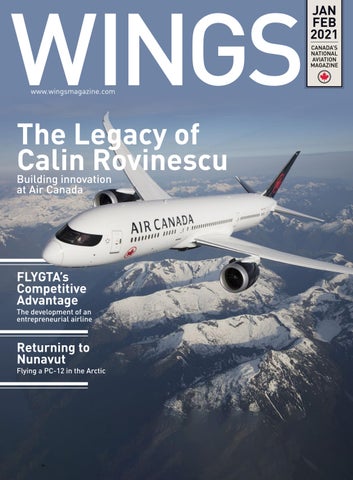
WINGS www.wingsmagazine.com
The Legacy of Calin Rovinescu
Building innovation at Air Canada
FLYGTA’s Competitive Advantage
The development of an entrepreneurial airline
Returning to Nunavut
Flying a PC-12 in the Arctic
JAN FEB 2021 CANADA’S NATIONAL AVIATION MAGAZINE
JANUARY/FEBRUARY 2021
UPFRONT 6 LEADING EDGE
New voices and timelines, same needs
8 ON THE FLY
Remembering Chuck Yeager, King Air 260
12 POSITION REPORT
737 MAX, ready to fly again
13 ALTERNATE APPROACH Projecting 2021 traffic numbers
FLYGTA Airlines, founded by Chris Nowrouzi and David Nissan in 2016, leverages Billy Bishop as its hub. P.34
14 AIR TRAFFIC
Realizing a PC-12 dream in Iqaluit
16 BUSINESS AVIATION Why FBOs can help usher in rapid testing
BACK
60 Marketplace 62 ON FINAL
Developing modern-day test pilots
From top: Calin Rovinescu’s Air Canada legacy. P.52. The passing of Chuck Yeager and a new generation of test pilots. P.62
FEATURES 17 CAREERS IN AVIATION GUIDE 2021
The ultimate training resource, featuring sponsored content of SAIT and Centennial aviation programs BY JON ROBINSON, DAVID CARR AND CARROLL MCCORMICK
49 CALIN ROVINESCU’S AIR CANADA LEGACY
How a generational aviation leader fostered innovation in a legacy carrier BY DAVID CARR
52 GROWING TINTINA
A new generation of bush pilots combine their passions for flight and the north BY JON ROBINSON
55 FLYGTA’S COMPETITIVE ADVANTAGE
The development of an entrepreneurial airline in Canada’s busiest aviation corridor
PHOTO: PORTS TORONTO
BY PHIL LIGHTSTONE
COVER PHOTO: AIR CANADA
WWW.WINGSMAGAZINE.COM
January/February 2021 | WINGS
3
Stay in Touch with Aviation News
Vol. 61, Issue 1 READER SERVICE
SUBSCRIBE
Print and digital subscription inquires or changes, please contact Jay Doshi, Audience Development Manager Tel: (416) 510-5124 Fax: (416) 510-6875 jdoshi@annexbusinessmedia.com Mail: 111 Gordon Baker Rd., Suite 400, Toronto, ON M2H 3R1
Online
EDITOR
Jon Robinson jrobinson@annexbusinessmedia.com 647-448-6188
TODAY
FLIGHT DECK
David Carr, Kathy Fox, Kendra Kincade, Phl Lightstone, Carroll McCormick NATIONAL ACCOUNT MANAGER
Mena Miu mmiu@annexbusinessmedia.com • 416-510-6749
wingsmagazine.com/subscribe
ACCOUNT CO-ORDINATOR
Barb Vowles bvowles@annexbusinessmedia.com • 416-510-5103
Magazine
MEDIA DESIGNER
Brooke Shaw
Weekly E-Newsletter
GROUP PUBLISHER/VP SALES
Martin McAnulty mmcanulty@annexbusinessmedia.com
Digital Edition
WINGS www.wingsmaga
zine.com
The Lega of Calin Rovcy inescu
Entrepreneu rshi
p and innovati
COO
Scott Jamieson sjamieson@annexbusinessmedia.com
JAN FEB 2021
CANADA’S NATIONAL AVIATION MAGAZINE
WINGS MAGAZINE
P.O. Box 530, 105 Donly Dr. S., Simcoe, ON N3Y 4N5 Tel: 519-428-3471 Fax: 519-429-3094 Toll Free: 1-888-599-2228
on at Air Can
ada
FLYGTA’s Competitiv Advantage e The
Printed in Canada ISSN 0701-1369
developme entrepreneur nt of an airline
Returning Nunavut to
in the Arctic
PHOTO CREDIT
TK
Flying a PC-12
PUBLICATION MAIL AGREEMENT #40065710 Published six times per year (Jan/Feb, Mar/Ap, May/Jun, Jul/Aug, Sep/Oct, Nov/Dec) by Annex Business Media SUBSCRIPTION RATES Canada – 1 Year $ 34.50 (plus GST - #867172652RT0001) USA – 1yr -$ 78.50 CDN (USD $60.50) International – 1yr - $90.50 CDN (USD $69.50) Occasionally, Wings magazine will mail information on behalf of industry-related groups whose products and services we believe may be of interest to you. If you prefer not to receive this information, please contact our circulation department in any of the four ways listed above.
Air Transport Association of Canada
ON THE
WEB
4
WINGS | January/February 2021
WG_CircAd_JanFeb21_MLD.indd 1
Canadian Business Aviation Association
Annex Privacy Office privacy@annexbusinessmedia.com • Tel: 800.668.2374 No part of the editorial content of this publication may be reprinted without the publisher’s written permission. ©2021 Annex Publishing & Printing Inc. All rights reserved. Opinions expressed in this magazine are not necessarily those of the editor or the publisher. No liability is assumed for errors or omissions. All advertising is subject to the publisher’s approval. Such approval does not imply any endorsement of the products or services advertised. Publisher reserves the right to refuse advertising that does not meet the standards of the publication.
Magazines Canada
Canadian Owners and Pilots Association
Visit Annex Business Media's group of brands focused on all aspects of Canada’s aviation and aerospace sectors, including Wingsmagazine.com, Helicoptersmagazine.com and UAVCanada.com. Annex is also the publishing partner of COPA, providing news and marketplace content through COPAnational.org and Canadianplanetrade.ca. WWW.WINGSMAGAZINE.COM
2021-01-08 3:08 PM
DIRECTORY
SHOWCASE YOUR SCHOOL/ORGANIZATION IN THE CAREERS IN AVIATION ONLINE DIRECTORY FOR MORE INFORMATION PLEASE CONTACT: MENA MIU • 416-510-6749 mmiu@annexbusinessmedia.com
The essential source for Canadian aviation education and training. Career Guide to the fixed-wing, rotary-wing and RPAS industries. Add a FREE online listing or choose a cost-effective package to highlight your programs.
wingsmagazine.com/schools
LEADING
EDGE
By Jon Robinson |
New voices, same needs
IATA revises outlook for airline industry performance in 2021
T
5 6
He has worked in various roles with General Electric Canada, Enbala Power, and the Ontario Energy Board. In his new role with Transport Canada, Alghabra will also continue to help lead the investigation into the Ukraine Airlines Flight 752 tragedy. Alghabra takes on a very challenging portfolio in the current environment, but the shuffle is a welcome change if only to provide a new voice and level of commitment to address the pressing needs of Canadian aviation. Alexandre de Juniac, who has served as the lead voice for the global commercial airline industry since 2016 as director general and CEO of IATA, is stepping down in March, to be succeeded by Willie Walsh, former CEO of International Airlines Group. de Juniac and his team have
TOP DATA BURSTS… in this issue 1. King Air 200 is rated for a max range of 1,720 nautical miles. (P. 9) 2. IATA predicts passenger numbers will reach 2.8 billion in 2021. (P. 13) 3. FLYGTA began operations in 2016 with two pilots and one Piper Navajo. (P. 49) 4. Air Canada, before the pandemic, ordered 45 A220s for its modernization plan. (P. 52) 5. Tintina generates 80 to 85 per cent of its revenue through July to September. (P. 54)
WINGS | January/February 2021
done an admirable job over the past year providing the industry with the sharp realities of pandemic economics. In November 2020, this included a revised, difficult outlook for airline industry performance in 2020 and 2021. Deep industry losses will continue into 2021, even though performance is expected to improve. IATA projected a net loss of US$118.5 billion for 2020 (deeper than the US$84.3 billion forecast in June) and a net loss of US$38.7 billion is expected in 2021 (deeper than the US$15.8 billion forecast in June). After a difficult first half of 2021, IATA projects aggressive cost-cutting will combine with increased demand during 2021, which could result in turning cash-positive by the fourth quarter – earlier than previously forecast. “This crisis is devastating and unrelenting. Airlines have cut costs by 45.8 per cent, but revenues are down 60.9 per cent,” said de Juniac. “This loss will be reduced sharply by $80 billion in 2021. But the prospect of losing $38.7 billion next year is nothing to celebrate.” This projection, however, was based on the re-opening borders with testing and/or the availability of a vaccine. The New Year, had a difficult start in controlling Covid-19, with slower than expected vaccinations in many countries, including Canada. The country’s aviation industry is ready for new leadership to provide a way forward. | W
This crisis is unrelenting... Airlines have cut costs by 45.8%, but revenues are down 60.9%.
WWW.WINGSMAGAZINE.COM
PHOTO: IATA
he International Air Transport Association over the past three months issued two critical statements addressing the Canadian government’s approach to its domestic aviation sector during the Covid-19 pandemic. In December, IATA expressed “deep disappointment and frustration” that the government has failed to provide concrete support. At the start of January, as coronavirus surged across the world, IATA once again expressed frustration with Canada’s new Covid-19 testing requirement for all arriving air travellers needing a negative test result before boarding a plane. The frustration within IATA’s second statement, publically shared by Canadian operators, largely pointed to a lack of preparation in implementing the new testing, but it was not long after that the United States implemented similar measures to face more infectious Covid-19 strains emanating out of the UK and South Africa. IATA’s first statement of disappointment, however, focuses on what has been a year of inaction to support one of the country’s most important economic engines. Prime Minister Justin Trudeau on January 12 announced a range of cabinet moves, including the appointment of Omar Alghabra as the new federal minister of transport. Alghabra succeeds Marc Garneau, who remains in the federal cabinet as minister of foreign affairs. The shuffle was largely initiated by the departure of Navdeep Bains, minister of innovation, science and industry, who announced his decision to not to run in the next election. A mechanical engineer by trade, Alghabra holds a Master of Business Administration and was a Distinguished Visiting Fellow with the Faculty of Engineering and Architectural Science at Ryerson University.
EXCITING DAYS AWAIT YOU Socialize, discover, learn and celebrate! FLY IN, DISCOVER AND VACATION
JUNE 24-2 JU N 2 2
AN UNFORGETTABLE STAY Whether you stay at a hotel, camp under your wing or in your RV, your stay will be one to remember.
YOUR VACATION DESTINATION A part of the country worth exploring! Register today: www.copanational.org/en/saint-jean-2021/
DES JOURS EXCITANTS VOUS ATTENDENT Socialisez, découvrez, apprenez et célébrez! RENDEZ-VOUS AÉRIEN, DÉCOUVERTES ET VACANCES
UN SÉJOUR INOUBLIABLE Que vous séjourniez dans un hôtel, campiez sous votre aile ou dans votre VR, votre séjour sera inoubliable.
VOTRE DESTINATION VACANCES Une région du pays à découvrir Inscrivez-vous maintenant: www.copanational.org/fr/saint-jean-2021/
ON THE FLY For late-breaking news and exclusive web content, please visit us at: www.wingsmagazine.com
THE LEAD COMMERCIAL DRONES BUSINESS AVIATION AIRPORTS GENERAL AVIATION AEROSPACE
THE LEAD
NASA Administrator Jim Bridenstine released a statement describing Yeager’s impact: “Gen. Yeager’s pioneering and innovative spirit advanced America’s abilities in the sky and set our nation’s dreams soaring into the jet age and the space age. He said, ‘You don’t concentrate on risks. You concentrate on results. No risk is too great to prevent the necessary job from getting done.’”
REMEMBERING CHUCK YEAGER
COMMERCIAL
Retired Air Force Brig. Gen. Charles “Chuck” Yeager passed away in early December at age 97. The World War II fighter ace became the world’s bestknown pilot at age 24 when in 1947 he pushed the Bell X-1 to become the first person to fly faster than sound. He continued to break records and fly for more than 60 years. In 1953, he flew an X-1A to a record speed of more than 1,600 mph and would eventually retire from the United States Air Force in 1975. In 2002, at age 79, he flew the X-15 close to 1,000 mph at Edwards Air Force Base. His career was recorded in Tom Wolfe’s book, The Right Stuff, and the subsequent film made in 1983, highlighting how he inspired a generation of space explorers.
TRANSAT MOVES FORWARD WITH SALE TO AIR CANADA Transat AT Inc.’s shareholders approved a revised purchase offer from Air Canada despite the disclosure of a late, higherpriced competing bid. The Montrealbased tour operator’s shareholders voted in a virtual meeting on Tuesday after the $5 per share offer was recommended by the company’s leadership. Transat disclosed in a press release before the shareholder meeting that in late November it received an unsolicited offer from a private investor outside the air transport and travel industry. The unidentified investor was allowed to conduct due diligence with full access to the company’s financials, Transat said. Ultimately, however, Transat’s board concluded that the new offer was not better than Air Canada’s despite being a higher price. Transat reported last week that it lost $238.1 million attributable to shareholders in the fourth quarter. That brought its losses for the year to $496.5 million on 96-per-cent drop in revenues to $1.3 billion. In October, Air Canada’s offer price was brought down to $5 from $18, reflecting the new market reality for travel-related industries since the start of the pandemic.
FLAIR AIRLINES APPOINTS NEW CHIEF COMMERCIAL OFFICER Chuck Yeager and the Bell X-1A at Edwards Air Force Base, California, on Dec. 12, 1953, a speed record at the time. 8
WINGS | January/February 2021
Flair Airlines announced the appointment of Garth Lund as Chief Commercial Officer. An experienced Ultra LowCost Carrier (ULCC) executive, Lund is joining Flair from European airline Wizz
Montreal-based tour operator Transat AT capped an unprecedented year by losing $238.1 million in the fourth quarter.
Air. A Canadian ULCC, Flair Airlines states it has clear growth ambitions both domestically and with cross-border expansion. At Wizz Air, Lund most recently served as Head of Financial Planning and Controlling, with previous roles including Head of Pricing and Revenue Management and Head of Network Development. The appointment of Lund continues the strengthening of the executive team which began in October with the appointment of a new CEO, Stephen Jones, also from Wizz Air. As Chief Commercial Officer, Lund will be responsible for all of Flair Airlines commercial functions including network planning, scheduling, pricing and revenue management, ancillary revenue, sales and distribution, mobile and web channels, marketing, branding, customer experience, and communications.
DRONES
CANADA AWARDS RPAS CONTRACT TO ELBIT The Government of Canada has awarded a $36.16 million contract to Elbit Systems Ltd. for the acquisition of a remotely piloted aircraft system (RPAS). The contract, announced by Anita Anand, Minister of Public Services and Procurement, and Marc Garneau, Minister of Transport, includes communications links, ground control stations, sensor packages, one remotely piloted aircraft, WWW.WINGSMAGAZINE.COM
PHOTO CREDIT U.S. AIR FORCE; AIR TRANSAT
08 08 08 09 10 10 11
training, and the optional purchase of spare parts. The contract fits into Transport Canada’s National Aerial Surveillance Program, as part of the government’s efforts to verify the use drone technology and its safe integration into Canadian airspace. “This investment will help to enhance the security and surveillance capacity under the program, leading to a cleaner and safer environment,” said Anand. Under the agreement, Elbit Systems of Israel will provide its Hermes 900 StarLiner RPAS as an addition to the existing Transport Canada National Aerial Surveillance Program fleet. The drone is expected to be delivered by December 2022. The Hermes 900 StarLiner is rated for a range of more than 1,400 nautical miles, as a medium-altitude, longendurance RPAS capable of operations to 72 degrees north latitude. Transport Canada plans to use the aircraft to detect oil spills, survey ice and marine habitats, and monitor activity on the ocean in Canada's Arctic.
BUSINESS AVIATION
TEXTRON ADDS KING AIR 260 TO TURBOPROP LINEUP
PHOTO CREDIT ELBIT SYSTEMS; TEXTRON
Textron Aviation introduced the King Air 260 turboprop into its Beechcraft King Air 200 series aircraft family. The company explains its assembly production
Deliveries of the Beechcraft King Air 260 turboprop are expected in early 2021.
for the King Air 260 is already underway, and certification and deliveries are expected in early 2021. The introduction of the aircraft comes on the heels of the recently introduced Beechcraft King Air 360, which achieved FAA type certification in October 2019, with customer deliveries now underway. Textron notes key enhancements to the King Air 260 include the addition of the Innovative Solutions & Support (IS&S) ThrustSense Autothrottle, along with a new digital pressurization controller that schedules cabin pressurization during both climb and descent. The cockpit also offers the Collins Aerospace Multi-Scan weather radar system as a standard feature on every King Air 260. The Collins Multi-Scan RTA-4112 weather radar, explains Textron, provides pilots with a fully automatic system that it optimized to detect short-, mid- and long-range weather. The Beechcraft King Air 200 is rated for an occupancy of up to nine, a maximum range of 1,720 nautical miles and a top cruise speed of 310 ktas.
GULFSTREAM DELIVERS FIRST EASACERTIFIED G600 Gulfstream Aerospace delivered the first Gulfstream G600 certified by the European Union Aviation Safety Agency (EASA) to an undisclosed customer. In addition to EASA and U.S. Federal Aviation Administration certifications, the G600 also holds type certificate validations from the aviation agencies in Bermuda, Cayman Islands, Isle of Man, San Marino and Mexico. After a recently announced range boost, its third, the G600 can now travel 6,600 nautical miles (12,223 kilometers) at its long-range cruise of Mach 0.85 and 5,600 nm (10,371 km) at its high-speed cruise of Mach 0.90. The aircraft’s Symmetry Flight Deck features active control sidesticks, as well as what Gulfstream describes as the most extensive use of touch-screen technology in business aviation. The cabin of the G600 can be configured with up to four living areas and features 14 panoramic windows.
The Hermes 900 StarLiner is rated for a 1,400-nm range, capable of operations to 72 degrees north latitude. WWW.WINGSMAGAZINE.COM
January/February 2021 | WINGS
9
ON THE
FLY
AIRPORTS
NANAIMO AIRPORT PLANS $29M INVESTMENT
Dave Devana became president and CEO of Nanaimo Airport in May 2020, succeeding the retiring Mike Hooper.
a slow pandemic recovery with passenger traffic returning to 2019 levels by 2024. A statement from YCD explains the COVID-19 pandemic presented the airport with the most-difficult financial challenges in its history. An estimated 181,072 passengers will travel through its gates in 2020, down an estimated 63 per cent from the record 491,499 in 2019. As a result, the airport forecasts a $1.4 million loss in 2020 compared to a $3.75 million surplus in 2019.
NAV CANADA LAYS OFF ANOTHER 180 WORKERS NAV CANADA in December announced more restructuring efforts which will 10 WINGS | January/February 2021
Aéro Mag’s electrically powered aircraft de-icing truck at Montreal-Trudeau International.
impact approximately 180 jobs across the country, including layoffs of operational and technology staff. The private, nonprofit corporation stated the reductions were made based on a detailed review of historical air traffic, the current environment, and longer-term traffic forecasts. NAV CANADA has now eliminated approximately 900 jobs, or 17.5 per cent of its workforce since the beginning of the COVID-19 pandemic. On November 27, NAV CANADA released its traffic figures for the month of October 2020, which decreased by an average of 59.5 per cent compared to the same month in 2019. This marks a slight improvement from figures released in the previous month, when comparing September 2020 to September 2020 with an overall traffic decrease of 62.6 per cent.
AÉRO MAG ELECTRICALLY POWERED DE-ICING TRUCK Aéro Mag commissioned what it describes as the world’s first electrically powered aircraft de-icing truck. The Montreal company, which specializes in aircraft de-icing operations, states the truck will reduce its greenhouse gas (GHG) emissions by 87 per cent when compared to the use of traditional deicing trucks. This equates to a reduction of 35 tons of CO2 per truck each year. Aéro Mag holds a strategic objective to become a carbon-neutral company by the year 2035. Established in 1994, Aéro
Mag today has more than 1,500 employees in 17 airports around the world. To date, it has de-iced more than 500,000 aircraft. Aéro Mag has also developed a process to recover, recycle and reuse deicing products used in aircraft de-icing operations, ensuring that the glycol recovers at least 99.5 per cent of its purity and is reusable for the same purpose.
GENERAL AVIATION
AVIATION UNLIMITED EXCLUSIVE CANADIAN DEALER OF DIAMOND Diamond Aircraft on November 20 announced a renewed partnership with its long-time sales representative in Canada, Aviation Unlimited. Founded in 1983, Aviation Unlimited is a familyowned business specializing in high performance, technically advanced, owner-flown aircraft – serving as one of Canada’s longest continuously operating general aviation companies. Aviation Unlimited has been directly affiliated with Diamond Aircraft since 2004. Under the 2020 renewed agreement, Aviation Unlimited becomes Canada’s exclusive Diamond dealer. These operations will be run through its main office at Oshawa Executive Airport. The Diamond DA62, with its carbon composite airframe, features fully integrated Garmin G1000NXi and is powered by the Austro Engine 180hp AE330 with single power lever control. In addition to aircraft sales, Aviation WWW.WINGSMAGAZINE.COM
PHOTO: NANAIMO AIRPORT; AÉRO MAG
The Nanaimo Airport Commission on December 21 introduced a $28.8 million infrastructure capital plan it is undertaking to help fuel the Central Island’s economic recovery. The commission states this investment over the next five years will enhance Nanaimo Airport’s (YCD) infrastructure to provide additional route development options, including Toronto, Edmonton, Kelowna and seasonal sun destinations. YCD currently provides direct service to Toronto, Calgary and Vancouver’s international airports. The Commission adopted this 20212025 Financial Plan in November, focusing on a budget that is based on
will expand SiriusXM’s coverage area in Canada and the Caribbean, for years to come. This will include a significant boost in providing robust and reliable information to Canada’s general aviation sector. Maxar previously built a total of seven satellites for SiriusXM, including its first-generation Sirius satellites that launched in 2000. Leaders from Diamond Aircraft and Aviation Unlimited celebrate their renewed distribution partnership.
Unlimited is one of Canada’s largest suppliers of parts and it also holds a Transport Canada Approved Maintenance Organization (AMO). Based in Hangars 1 and 2 of Toronto Buttonville Municipal Airport, Aviation Unlimited Maintenance specializes in corporate aircraft maintenance and repair service for piston, turboprop and jet aircraft.
PHOTO CREDIT DIAMOND AIRCRAFT; RAALF
PIPER CERTIFIES PILOT 100 TRAINER Piper Aircraft received type certification from the Federal Aviation Administration for its Pilot 100 trainer aircraft, which was introduced at Sun-n-Fun in 2019. After certification, Piper began deliveries to its launch customer, American Flyers, which is scheduled to take delivery of eight 100i aircraft by the end of 2020. The Pilot 100i is an IFR-certified version of the Pilot 100 equipped for VFR flying. The new trainer aircraft family is a derivative of the Piper PA-28 line, which first reached the market back in the 1960s as the Cherokee. The company states the new Pilot 100i rounds out its portfolio of training aircraft products, which also includes the Archer TX, Archer DX, Arrow, and Seminole. With IFR and digital autopilot capabilities, the Pilot 100i is priced under US$300,000. The Pilot 100i includes the Garmin G3X system, which Piper states to provide the advantages of a glass cockpit without the costs. The aircraft is powered by the 180 hp Lycoming IO360-B4A engine, which offers 128-ktas (237-km/h) maximum cruise speed and 522-nm range with a 45-minute reserve.
AEROSPACE
PRATT & WHITNEY CANADA PT6 MILESTONE Pratt & Whitney on December 2 announced that the 50,000th PT6 WWW.WINGSMAGAZINE.COM
turboprop engine has rolled off the production line, achieving what the company describes as an exceptional milestone in General Aviation. The company notes, that with the new PT6 E-Series engine now in full production, powering the Pilatus PC-12 NGX, the numbers of PT6 in the field continue to grow. Pratt & Whitney describes the PT6 turboprop engine as a proven choice for demanding, high-cycle/high-power applications in single- and twin-engine aircraft for all kinds of missions and applications. The engine fleet’s current flying population is more than 25,000 units and it has accumulated more than 410 million flight hours – more flying time than anyone else in this segment. The most recent evolution of the PT6 engine is found in the 2019 launch of the PT6 E-Series, described by Pratt & Whitney as the first turbine engine in the general aviation market to offer a dualchannel integrated electronic propeller and engine control.
SIRIUSXM’S NEW SXM-7 SATELLITE PERFORMING PROPERLY SiriusXM, along with its program partners Maxar Technologies and SpaceX, announces that its SXM-7 satellite is performing properly after launching into low-earth orbit on December 13. SXM-7, a high-powered digital audio radio satellite, was launched aboard a SpaceX Falcon 9 rocket from Cape Canaveral, Florida. Shortly afterward, SXM-7 deployed its solar arrays and began receiving and sending signals. The satellite was to then begin firing its thrusters to commence its journey to its final geostationary orbit. SXM-7 will provide continuous, reliable delivery of SiriusXM’s audio entertainment and information services to consumers in the United States, and
RYERSON SOLAR AIRPLANE CREATEV FLIES FOR OVER 10 HOURS The solar-powered airplane CREATeV, designed by aerospace engineering students of Ryerson University’s Applied Aerodynamics Laboratory of Flight (RAALF), on November 12 completed a flight lasting just over 10 hours. The flight took place at the Author Gliding Airfield owned by the York Soaring Association. This was the second flight of 2020 for CREATeV, following a fivehour flight completed on Nov. 4. The group behind CREATeV, led by Dr. Götz
CREATeV in flight over the York Soaring Association field.
Bramesfeld, an Associate Professor in Ryerson’s Aerospace Engineering program, holds a goal to set a flight duration world record for solar-powered aircraft, which would mean flying nonstop for three months. CREATeV has a wingspan of 6.3 metres (20.6 feet) and weighs about 12 kilograms (26.5 pounds), usng a mix of solar power and batteries. RAALF explains possible applications of a solar-powered aircraft include a range of environmental observations, such as trying to better understand climate change related effects, forest-fire detection, wild-life observation and communication relay. | W January/February 2021 | WINGS
11
POSITION
REPORT
By Ronnie Gipson Jr. |
737 MAX, ready to fly again
Why plane certification still needs to be fixed and how to do it
T
12 WINGS | January/February 2021
have to start over and get a new original type certificate. The second component to resolving this problem would be to step in and review what areas the FAA can delegate oversight authority for system changes in an amended aircraft certification application review. What are the obstacles to making these changes? One would be money. The FAA has a budget and these are very costly measures, because the FAA will need more engineers and administrators. Congress has to be prepared to spend the money to make it happen by increasing the FAA’s budget. Implementing the proposal of a 20-year cap on the validity of that original type certificate is also going to impose a greater financial cost on the aircraft manufacturers of transport category aircraft. They’re not going to have as much time to get a return on their investment for the aircraft that they produce. As a result, the aircraft are going to cost more, which means the airlines are going to end up paying more for those planes. And that cost is going to trickle down to the flying public in those seats. | W
The capabilities of MCAS and what it was supposed to control were never fully revealed. type certificate process was not the same system that ended up in the aircraft. How will the recent recertification for the 737 MAX ensure that the model is now safe? The FAA has had to backtrack and give the MCAS system the intense level of scrutiny it deserved. The FAA has required the manufacturer to go back and make significant adjustments to the software, in addition to changes to the operator’s manual. How can the certification process be improved? I see two paths to take. First, for a transport category aircraft, regulations are changed so that the manufacturer can receive amended type certificates for only 20 years after the original type certificate has been issued by the FAA. Here’s how that would work: An aircraft manufacturer designs an aircraft for certification in the transport category and applies for the original type certificate in 2020. Once the original type certification is awarded in, say, 2025, then the manufacturer should have 20 years. That means that the manufacturer would have until the year 2045 to seek an amendment to that original type certificate. Beginning in 2046, if the aircraft manufacturer wants to make subsequent design changes, they
This column was originally published by The Conversation. Ronnie Gipson Jr. is an expert in aviation law, whose work was cited in the House Committee’s report on the 737 MAX grounding. WWW.WINGSMAGAZINE.COM
PHOTO: BOEING
he process for the certification of a transport category aircraft is a very involved and costly process. Aircraft manufacturers that go down this path are committed to spending hundreds of millions of dollars from initial design to dynamic flight testing for regulation compliance. Once the airplane satisfies the regulator’s requirements, it earns an original type certificate, allowing the manufacturer to produce and sell the aircraft. As time goes on, technology advances and the aircraft manufacturer identifies ways to improve on their original design. So the manufacturer goes back to the regulator and says, “We want to take this initial design that we have and amend it because we made some changes.” At this point, the aircraft manufacturer files what’s called an amended type certificate application for a derivative aircraft from the baseline aircraft. For example, the original type certificate for the first 737 design was submitted to the Federal Aviation Administration (FAA) in 1967. That original design has had multiple derivative aircraft approved by the FAA, with the 737 MAX being the 13th version. In the amended type certification process, the regulatory authority focuses only on what’s changed. Another thing to keep in mind is that the FAA just doesn’t have the workforce to oversee all the tests that go with an amended type certificate approval. Therefore, the FAA reviews most of the critical changes related to safety and delegates the noncritical changes for review to the manufacturers – in this case to a body in Boeing which consists essentially of Boeing employees. And that’s what happened here. MCAS wasn’t necessarily presented as a change in the design impacting control in flight. As a result, the MCAS was not a priority for the FAA in the amended certificate approval process. The capabilities of MCAS and what it was supposed to control were never fully revealed. That’s really where the problem started. It was with the narrative that was being presented to the FAA; and the lack of oversight in the amended type certificate process. The result was that the MCAS system that was initially presented to the FAA at the beginning of the amended
ALTERNATE
APPROACH | By David Carr
Dancing on the head of a needle Why air traffic and airline revenue might return in the New Year
PHOTO: BOEING
C
anadians are itching to get out of the house and get away. Pent up demand, airline travel credits and bank accounts swollen by COVID-19 savings will drive the initial recovery in air transport, ending what has been described as the biggest shock to hit aviation since the Second World War. Especially here in North America, where a rebound in domestic air travel has lagged other jurisdictions, including China. But how soon, and are we looking at a bounce or a more gradual curve? “People have not lost their desire to travel,” the International Air Transport Association (IATA), an industry group reports. “The market response to even small measures to lift quarantine is immediate and strong. Where barriers have been removed, travel rebounded. The thirst for the freedom to fly has not been overcome by the crisis.” IATA predicts that passenger numbers will grow to 2.8 billion in 2021, returning to 2010 levels and 1.7 billion shy of 2019 before Covid-19 brought air transport to its knees. IATA is not expecting a return to pre-pandemic levels until 2024, although some analysts predict the rebound will be quicker. Much depends on the severity of a third wave, the lifting of border restrictions and how quickly we can get the vaccine into arms. Based on the pace of vaccinations, Brian Pearce, IATA’s chief economist says it will only be in late 2021 and in 2022 when air travel rises back substantially. One of the likeliest trends in any early rebound is that it will be short. Insomuch as short-haul routes will fill up first, led by the so-called VFR (visiting friends and relatives) and leisure markets. Good news for low-cost operators as these are typically price-sensitive travellers, which creates an interesting situation in Canada that is poorly served in the ultra-low-cost carrier (ULCC) sector despite the arrival of Swoop and Flair. Retiring Air Canada chief executive Calin Rovinescu once hinted at deploying Rouge, its low-cost leisure airline, on inter-Canada routes in response to local ULCCs. Could lower-cost Rouge A320s be a part of Air Canada’s domestic ramp up, at least over the short-term? Business travel is expected to be a laggard in the rebound, WWW.WINGSMAGAZINE.COM
could not come at a worse time. While IATA expects an industry return to ‘cash positive’ in late 2021, it sees airlines still burning through cash, at least in the first six months. “We are projecting a further US$60 to $70 billion of cash burn, as airlines struggle to restructure costs to match the halved revenues the industry faces,” Pearson told a conference in November, suggesting that more government money might be needed, outside of the US$173 billion that has already been poured into keeping the industry afloat. IATA is already critical of what it sees as Canada’s failure to provide “concrete support measures” for the airline industry. “The government has been stating for months that it is working on a vital support package for Canada’s airlines. It has failed to deliver thus far,” Peter Cerda, IATA’s regional VP, Americas said in December. Air transport will recover, but pulling out of the tailspin will take time and is vulnerable to many factors outside of the industry’s control, including a global recession and vaccine distribution. Not enough Canadians will have been vaccinated in the first half of 2021 to support air travel, suggesting that a jab will be less of a factor in the early days of the recovery. | W
The thirst for the freedom to fly has not been overcome by the covid-19 crisis. although expectations for virtual meetings post-pandemic (like the number of employees who will continue to work from home) is highly exaggerated and expect airlines to go hard to expose the limits of technology. Many airlines expect a gradual return to the business-class cabin, followed by a burst as the same pent-up demand that drives the VFR and leisure sectors will influence business travel. Covid-19 will both support and challenge many current trends in flight operations. The Airbus A380 and older wide-body aircraft have been casualties of the pandemic. The shift away from wide-bodies for longer-range, single-aisle aircraft such as the Airbus A321 LR will accelerate as airlines right-size fleets. Point-to-point service may also be slow to return, which is good news for hub airports such as Toronto Pearson. “We are going to see hubs being of renewed importance as I think we are going to see fewer city pairs with sufficient passenger flows to justify lots of point-to-point services,” Pearce said at IATA’s annual general meeting in November. And then there is the cost. It will be expensive taking aircraft out of storage and re-starting operations. This expense
David Carr is a former long-time editor of Wings and Helicotpers magazine. January/February 2021 | WINGS 13
AIR
TRAFFIC By Kendra Kincade |
Returning to Nunavut with wings Kelly Lamontagne realizes her dream of flying a PC-12 in the Arctic
K
14 WINGS | January/February 2021
Although for a while it
Our community loves airplanes... looked like Kelly would stay Nolinor for many years they represent connection, life, at and ‘climb her way up,’ never safety and dreams. once did she give up on her time. Undeterred, Lamontagne went to work researching and planning how she could make her new dream come true. Before she knew it, she once again set off to Quebec as a first step, where she obtained her Private Pilot’s License, muti-IFR and Commercial Licence at Lachute Aviation. She picked this flying school because it offered a modular base flight training program, allowing her to make a living as she trained to become a pilot. Training is expensive and Lamontagne needed money to help pay her living expenses, as well as pay for the training. Perhaps it was fate that led her to find a job working as a ramp agent for Nolinor Aviation in Mirabel, Quebec. A job that made her realize she did not just love flying, she fell in love with aviation. Nolinor is based at the Mirabel Airport, which is one of Canada’s most important aviation hubs, where Lamontagne did everything related to ground ops, fuelling, grooming, towing, luggage, passenger escorts, catering, and cargo… lots of cargo! This job also included travelling to Yellowknife, the capital city of Canada’s Northwest Territories, for a three-week cargo – an experience she will never forget.
dream to return to Nunavut with her wings. Luckily for Lamontagne, Nolinor’s Chief Pilot believes in helping his staff grow and spread their wings. He made a phone call on her behalf to see if their partner company Panorama Aviation was hiring. Within three months she received a call from the Chief Pilot at Panorama, and Lamontagne was given a very unique interview – jumping into one of their airplanes, instead of sitting in front of a desk answering questions. “Best way to do an interview,” Lamontagne recalls. “Anyone can prepare answers in an interview, but this shows how are you going to fly and act in front of passengers – Best interview I ever had!” Obviously, Lamontagne aced it because three weeks later she was offered the job. She was beyond thrilled: “On the first day of flying in my new role, I landed at Toronto Pearson Airport. It was exhilarating.” Even more important than having the opportunity to land at Pearson was that this job would help her find her way back home in Iqaluit. Today, Lamontagne is living the dream she set out to fulfill five years ago. She is now a First Officer for an air taxi charter operation in Iqaluit. In this role, her past ramp experience has made her a well-rounded WWW.WINGSMAGAZINE.COM
PHOTO: PROVIDED BY KELLY LAMONTANGE, ELEVATE AVIATION
elly Lamontagne is a pilot. This statement seems so simple and straightforward, but it is a declaration laced with inspiration for an entire community who needs to look no further for an example of what a dream – driven by passion and hard work – can achieve. At the young age of six months old, Lamontagne’s family moved to Iqaluit and the beautiful, vast tundra of Nunavut settled deep in her soul. Even after moving to Quebec at age 11, where she finish college, Lamontagne knew one day she would return to the north and make it her permanent home. “It felt like I flew back home after a long vacation,” Lamontagne says, upon her returned to Iqaluit in 2014, embracing once again the nature, friends and community of the territory’s capital. This is her home, where she is part of something important. “When I moved back up to Iqaluit in 2014, my first job was at the high school and I met so many awesome students that I still chat with these days. I love following them as they grow into young adults with dreams and aspirations; and I hope they are inspired by my path in becoming a pilot.” Five years ago, Lamontagne was living in Iqaluit uncertain of what to do for a career. She was helping coach the Iqaluit Senior Women’s Hockey Team. When the team was invited to Kangiqsujuaq to play in a tournament they chartered an airplane over to the small neighbouring community in Nunavik. She could not have realized how that flight would change the trajectory of her life. Lamontagne was offered to sit in the flight deck of the Pilatus PC-12. She was taken back seeing that the First Officer was a young woman, who opened up a world of possibility and inspired a dream. On that flight, Lamontagne made a promise to herself to one day fly a PC-12 over the beautiful tundra where she grew up. Becoming a pilot is a long, difficult journey for most, but it was all the more arduous for Lamontagne because of her location in Canada’s north. There are no flight schools offered in her community and the closest one would take her a long way away from her friends and the community she loved. She simply did not want to leave a second
Reach Your Aviation Goals
employee. While the Captain does the flight planning, Lamontagne, as the First Officer, will be given information on the next flight and get to work towing the airplane out; and even fueling the airplane when it’s at the company’s home base in St-Hubert, on the south shore of Montreal. “I smell like fuel all the time,” she laughs, “it’s my favorite perfume.” Lamontagne also makes sure the airplane is configured properly for cargo or passengers. AeroCourse has been helping pilots She loves having the opportunity to still reach their aviation career goals and work the airplane, not just fly it. become airline pilots for over 30 years. “After all the hard work is done, I get Whether you are interested in quality aviation resource materials, you need to sit down in front of the airplane, strap assistance with an exam, or you want in, and take off into the sky,” she says. “I’m an advanced ground school program doing exactly what I set out to do – fly a ma you prepared for an airline to make PC-12 in Iqaluit, my arctic home. Bucket job, AeroCourse is there to help. list item – complete.” AeroCourse offers IFR and ATPL/IATRA Lamontagne also understands what seminars and airline preparation it means to serve as a role model in her courses in partnership with leading community. “It’s important to show youth schools. Our courses feature in Iqaluit that when you are passionate exceptional instruction with skilled about something, you work hard, you can pilot educators, valuable course make your dream come true,” she says. materials and foster an atmosphere conducive to learning. Seminars are l “People in Iqaluit know if they want to do held in both in-person and virtually. specific post-secondary programs that are Registration and resources are not available in Nunavut after high school, available online at aerocourse.com. they have to go away. And for many young people, they think it can be impossible. I want to show them that it’s possible. Why not encourage them to fly?” Lamontagne says. “The people in our community love airplanes... for us, they represent connection, life, safety and dreams.” WG_Aerocourse_JanFeb21_CSA.indd 1 It’s very true. The airplanes in Iqaluit bring in food, allow people to access, education, medical treatment and surgeries, and connect families to their home communities. “If we don’t have airplanes, the entire community would have to revert to hunting for their food and online shopping would be impossible” she states. “Airplanes represent an entire world of options that would otherwise not be assessable to us.” Now that Lamontagne has accomplished her dream of flying a PC-12 in the Arctic, are new aspirations starting to stir? “Wouldn’t it be wonderful if I could participate in starting a flying school right here in Iqaluit to help others have an easier time to access training for the youth of the north? It might be the most northern flight school in Canada and it would offer something that is not normally accessible for them to take a part in something that is so necessary up in the north.” Dreams are realized through passion and hard work, staples of aviation. “My parents always told me if I work hard, life will reward me and I guess that’s the message I want to spread,” she says. “Go after your dreams – it’s possible.” | W
Leaders in advanced aviation training
Resources:
1-800-461-8857
2020-12-03 5:37 PM
Kendra Kincade is founder and executive director of Elevate Aviation. January/February 2021 | WINGS 15
WWW.WINGSMAGAZINE.COM WG_MIRAviation2_Nov20_CWM.indd 1
2020-10-26 8:35 AM
BUSINESS
AVIATION By Anthony Norejko |
Reopening with rapid testing
How business aviation can help build a safe return to Canadian skies
T
16 WINGS | January/February 2021
transportation, but it would add to the aviation sector’s understanding about testing and help accelerate the use of rapid screening. If we could secure rapid testing pilots at FBOs, it would not be the first time that business aviation was able to find solutions that helped the entire aviation sector. Business aviation has often led the way in the use of new technologies that increase efficiencies, enhance safety and reduce carbon emissions: Everything from being the first aircraft type to deploy winglets, to the current push toward the production and use of sustainable aviation fuel. Now we have a new role to play. Business aviation can help rebuild our sector, quickly responding to demand where commercial operations are not back to capacity or cannot serve the need. This will be an invaluable asset to help Canada kick start its economy as the aviation sector in general ramps up. The last few months have been about many things, not the least of which are the lessons we have learned. One of the lessons I have learned is that every element of aviation, including business aviation, has a unique role in making the whole system work. If we are to build our way back, the only way we can do it is together. | W
FBOs are excellent venues to establish rapid testing and track results. and quarantine the small number of travellers who may be infectious. There are already several testing pilot programs that show promise. The one underway at Calgary International Airport is aimed at reducing quarantine time for international travellers who show negative test results. Other pilots are focused on predeparture testing for some international destinations. This is a good start, but without federal leadership to launch a national and standardized rapid testing program, we will still be held back by quarantine rules that differ between provinces and the confusing and inconsistent interpretations of federal regulations at different international border entry points. Here is where business aviation can help. With relatively small numbers of passengers who are all monitored and processed in a highly controlled and controllable environment, FBOs are excellent venues to establish testing and track results, particularly rapid screening tests. Not only would this be a potential game changer to the thousands of Canadian companies and communities that rely on non-scheduled flights to provide essential
Anthony Norejko, president and CEO, Canadian Business Aviation Association WWW.WINGSMAGAZINE.COM
PHOTO: ADOBE STOCK
he last 10 months have not only highlighted the differences between business and commercial aviation, but the commonalities as well. I am convinced that the path to a real recovery in the air sector will take all of us pulling together, along with NAV CANADA, airports and, of course, government. At this writing, many Canadians are dealing with new lockdowns, and travel from the UK to Canada is temporarily banned. As difficult as they are, we hope these measures will lead to reductions in the virus spread and new opportunities to safely ease air travel restrictions. The sector is at a breaking point. While business aviation has not seen quite the same declines as scheduled service, the challenges have been the same: Travel restrictions and blanket 14-day quarantines have decimated demand, with little or no change in the immediate future. Nevertheless, there are reasons to be optimistic. Business aviation flight management and fractional ownership companies are reporting an upswing in the number of people interested in using business aviation for the first time. Consumer surveys are consistently reporting that people will want to travel once they are confident that it is safe to do so. But reopening Canada’s skies is not the same as flicking a light switch. Too many complex systems have been powered down since March. Staff have been cut. Airplanes have been mothballed and routes eliminated. NAV CANADA has raised its fees by 30 per cent and is contemplating reducing services. Airports that are dealing with a drop in demand of between 85 and 95 per cent are being forced to make decisions that could severely impact the level and type of services they can provide to both commercial and general aviation. While a successful roll out of vaccines may be the long-term solution, the process will take time that the aviation sector does not have. But there is a short-term answer: Rapid testing at airports and FBOs. This is the single most-important action the government can take to safely reopen air travel in the shorter term. With rapid testing in place, it would be relatively easy to identify
CAREERS IN AVIATION & AEROSPACE 2021
EDUCATION AND TRAINING RESOURCES FOR CANADIAN FIXED- AND ROTARY-WING INDUSTRIES
SAYGE TREMBLAY, VANGUARD AIR CARE AND FAST AIR
THE FUTURE OF AEROSPACE AND AVIATION
The Bombardier Centre for Aerospace and Aviation at Downsview Campus is a dedicated training ground for aerospace and aviation mechanics. With focused courses, cutting-edge equipment and industry professionals guiding our programs, your aircraft are always in good hands with a Centennial College graduate.
centennialcollege.ca/downsview
CIA2021
PILOTEXECUTIVE AND SUMMARY TECHNICIAN
GROWTH OUTLOOK
COMMERCIAL MARKET OUTLOOK 2020–2039
20-Year Market Demand
SOURCE: BOEING
T
2,430 Deliveries
32,270 Deliveries
7,480 Deliveries
930 Deliveries
Regional Jet
Single Aisle
Widebody
Freighter
he Boeing Company in midNorth America Russia and Central Asia Europe October plans 43,110announced 8,995 Deliveries 1,250 Deliveries 8,810 Deliveries to consolidate production of Global Deliveries 2039 Total Fleet: 10,610 2039 Total Fleet: 1,870 2039 Total Fleet: 9,050 Services Market Value: $1,925B Services Market Value: $220B Services Market Value: $1,840B 787 jets at its facility in North Charleston, South Carolina, starting in mid-2021. The2.5% company 3.2% explains this Fleet decision wasGDP made to preserve liquidity and reposition certain Growth Growth lines of business given the current global business environment. Just days earlier, the company released its annual global 48,400 forecasts for 4.0% the commercial aviation, 2039 which Traffic defence and aerospace sectors, Fleet of the Growth accounts for the ongoing impact COVID-19 pandemic on near-, mediumand long-term market conditions. $9,040B The 2020 2.1M Boeing Market Outlook Latin America Africa Middle East Asia-Pacific (BMO) projectsNew that the commercial aviaServices 2,610 Deliveries 1,015 Deliveries 2,945 Deliveries 17,485 Deliveries 2039 Total Fleet: 3,060 2039 Total Fleet: 1,540 2039 Total Fleet: 3,500 2039 Total Fleet: 18,770 tion and services markets will continue Market Personnel Services Market Value: $480B Services Market Value: $215B Services Market Value: $725B Services Market Value: $3,635B to face significant challengesValue due to the pandemic, while global defense and government services markets remain more Boeing’s newest Market Outlook analyzes aircraft demand to 2039. |3 stable. “While this year has been unprecedented in terms of its disruption to our autonomous systems, satellites, spacecraft per year; and the global commercial fleet industry, we believe that aerospace and de- and other products to national and inter- is expected to reach 48,400 by 2039, up fense will overcome these near-term chal- national defense. This demand continues from 25,900 airplanes today. During this lenges, return to stability and emerge with to be global in nature, explains Boeing, period, Boeing states Asia will continue strength,” said Marc Allen, chief strategy with 40 per cent of expenditures expected to expand its share of the world’s fleet, accounting for nearly 40 per cent of the fleet officer, Boeing. to originate outside of the United States. The BMO forecasts a total market value Beyond the lower demand for near-term compared to about 30 per cent today. Boeing states single-aisle airplanes, of US$8.5 trillion over the next decade, commercial services, the BMO forecasts a including demand for aerospace prod- US$3 trillion market opportunity for com- such as the 737 MAX, will continue to be ucts and services. That forecast is down mercial and government services through the largest market segment, with operators from US$8.7 trillion a year ago due to the 2029, with digital solutions emerging as projected to need 32,270 new airplanes impact of the COVID-19 pandemic. Boe- what Boeing describes as a critical enabler in the next 20 years. Single-aisle demand ing states airlines globally have begun to with customers focused on leaner opera- will recover sooner, according to Boeing, recover from a greater than 90 per cent de- tions to adjust to future market demand. due to its key role in short-haul routes cline in passenger traffic and revenue early Boeing notes life-cycle services and sup- and domestic markets as well as passenger this year, but a full recovery will take years. port will help customers scale their opera- preference for point-to-point service. The 2020 BMO includes projected de- tions to meet efficiency and cost objectives In the widebody market, Boeing foremand for 18,350 commercial airplanes in aligned to market recovery trends. casts demand for 7,480 new passenger the next decade – 11 per cent lower than Boeing also released its 2020 Commer- airplanes by 2039. The company explains the comparable 2019 forecast – valued at cial Market Outlook (CMO), an annual the widebody demand will be affected by about US$2.9 trillion. In the longer term, 20-year forecast addressing the market for a slower recovery in long-haul markets, the commercial fleet is forecast by Boeing commercial airplanes and services, pro- typical after air-travel shocks, as well as to return to its growth trend, generating jecting an increase in the share of deliver- uncertainties from COVID-19’s impact on demand for more than 43,000 new air- ies replacing older passenger aircraft that international travel. planes in the 20-year forecast time period. are being retired in an accelerated replaceAir cargo demand is expected to grow The BMO also projects a US$2.6 trillion ment cycle, especially in the first decade. four per cent annually, according to BoeAccording to its commercial forecast, ing, and generate further demand for 930 market opportunity for defense and space during the next decade. This spending Boeing notes, that over the next 20 years, new widebody production freighters and projection, explains Boeing, reflects the passenger traffic growth is projected to 1,500 converted freighters over the foreongoing importance of military aircraft, increase by an average of four per cent cast period. | W
WWW.WINGSMAGAZINE.COM
January/February 2017 | WINGS C3
CIA2021
TOP 20 UNDER 40
Sponsored by:
A NEW GENERATION OF LEADERS INFLUENCING THE FUTURE OF CANADIAN AVIATION
I
n the 2020 Top 20 Under 40 program, sponsored by the Seneca School of Aviation, WINGS and HELICOPTERS magazines recognize inspiring young leaders influencing the direction of Canadian aviation and aerospace. Illustrating the diverse career opportunities available in Canadian, these 20 leaders – listed here alphabetically and all under the age of 40 – are chosen based on their demonstration of leadership, innovation, influence, achievement and/or dedication shown to their organization and the aviation industry. This list was compiled in mid-2020 and some of these leaders may have since taken on new opportunities.
CEO, Howard Eng, who was succeeded by Deborah Flint in mid-2019.
PRABH BANGA Associate Director, Strategy and Growth, Greater Toronto Airports Authority
Toronto, ON Prabh Banga, age 34, was deeply involved with municipal public policy when an opportunity arose at Toronto Pearson. “I always had a desire to work in the sustainability field at a global level,” says Banga. Moving over to Canada’s largest airport in 2015, she initially focused on regulation and compliance, before adding more complex sustainability integrations from operations and employees to passengers and the community.. This would evolve into an integral role in writing GTAA’s strategic plan, as a key member of the airport’s new Strategy and Growth department. Here, Banga increasingly worked with then GTAA C4 WINGS | January/February 2017
being promoted to Chief Duty Manager three years later. In this role, Beninger was responsible for leading an essential unit and a team of eight duty managers, becoming a change management leader for the 24/7/365 department. In 2017, Beninger, who was promoted to his new OCC Director role in April 2020, was the recipient of the Canadian North’s Nanuq Award, an annual peer-driven program to recognize exceptional leadership and contribution.
the World Cup circuit, Cosco earned his Commercial Pilot's License in 2014 through BCIT’s Flight Operations program and in early 2015 became a First Officer on the Super King Air with Alkan Air out of Whitehorse. He would then also fly the BE20 for Carson Air before returning to Whitehorse to join Tintina Air in April 2017.
ADAM BENINGER Director, Operational Control Centre, Canadian North
Ottawa, ON Adam Beninger, age 36, in 2018 was promoted into a challenging new position as Director of Integration to establish the structure, planning, communications and reporting to steer the merger of First Air and Canadian North – forming one of Canada’s most-important transport networks. Beninger first joined the company in 2003 in the cargo department of First Air’s Ottawa International Airport location. In 2011, he transitioned to the Operational Control Centre as Duty Manager, ultimately
JONATHAN DAVIS Instructor, Aerobatic and Tailwheel, Calgary Flying Club
IAN COSCO Check Pilot and Co-owner, Tintina Air
Whitehorse, YT Ian Cosco, age 32, grew up in a family of pilots. After spending nine years as a professional freestyle skier, reaching
Springbank, AB Jonny Davis, age 30, first flew in a helicopter at age eight growing up in Newfoundland and Labrador, but his passion for flight was fueled by his older brother, Ben, a fixed-wing pilot. The younger Davis focused on becoming a Canadian Forces pilot, but with few new spots WWW.WINGSMAGAZINE.COM
— LET YOUR CAREER TAKE FLIGHT. AEROSPACE EDUCATION FOR A COMPLEX WORLD. BCIT is one of Canada’s largest post-secondary aerospace trainers — with a 300,000 square-foot Aerospace Technology Campus, and a fleet of over 20 aircraft near the Vancouver Airport. Attend an upcoming online info session and explore our Aircraft Gas Turbine (Jet Engine) Technician, Aircraft Maintenance, Airport Operations or Commercial Pilot programs. Learn how BCIT gives our students the best opportunity to launch their careers at bcit.ca/aerospace
—— Students at BCIT Aerospace Technology Campus.
—— BRITISH COLUMBIA INSTITUTE OF TECHNOLOGY
CIA2021 becoming available, he instead turned toward a military SAR Technician program that was accepting direct-entry applicants. Davis in 2010 trained at Manitoba Emergency Services College, but the Canadian military changed plans with the bulk of its deployed members set to return from Afghanistan. His CPL was finished in Pitt Meadows, BC, while pursuing a Bachelor of Interdisciplinary Studies at Thompson Rivers University in Kamloops, focusing on Expedition Leadership.
ADAM FALLWELL Director, Flight Operations, AirSprint
Calgary, AB Adam Fallwell, age 37, was introduced to aviation at a young age due to his father’s career at Canadian Airlines. He began flying lessons at the age 14 and then attended the aviation program at Mount Royal College, graduating in 2003. After a few years of flight instructing, Fallwell was hired by AirSprint as a PC-12 First Officer. Fallwell, over the next 12 years at AirSprint, would climb the ranks of PC-12 Captain, Senior PC-12 Captain, Assistant Chief Pilot, Chief Pilot, and now Director, Flight Operations. In his current role, Fallwell oversees the flight department consisting of around 80 pilots; and liaisons with Transport Canada and the other departments within AirSprint. With AirSprint’s recent expansion into overseas operations, Fallwell continues to work with his team in developing new training and standards for these operations.. C6 WINGS | January/February 2017
BLAKE HACHÉ First Officer, Air Transat
Toronto, ON Blake Haché, age 26, has been with Air Transat for 1 1/2 years, becoming one of the youngest North American pilots ever to fly an Airbus widebody. He was crossed trained as an Airbus 330/320 First Officer before being furloughed as a result of COVID-19. Without any family connections to aviation, Haché became an Air Cadet and received both a Glider Pilot Scholarship and Private Pilot Scholarship with the program, finishing as a Warrant Officer 1st Class. He started at Air Transat at just 24 years of age on the Airbus 330, having already amassed some 3,000 hours. He started his career as a Flight Instructor with Confederation College at 19 years of age after graduating from the college's Aviation Flight Management Program.
Aerospace in 2016 as a Parts Cleaner, employing chemicals and an abrasive blast process in accordance with Pratt & Whitney Canada manuals. He also signed on as one of the company’s First Responders. A year later, Vector was sold by owner Airbus to StandardAero. By this time, Jessome took on a new role as Accessories Technician, testing and inspecting fuel surge accumulators, oil to fuel heaters, and reduction gearbox rear housing PCU port repairs. Concurrently, Jessome was also tasked as a Training Associate to develop a program for Cleaning Technicians. Jessome in January 2019 was appointed to his current role, overseeing a group of employees and helping to lead daily operations. Earning his Magnetic Particle Inspection Level II certification, Jessome also performs magnetic particle inspections of PW100, PT6A and JT15D engines.
STEVEN JOHNS
JONATHON JESSOME Summerside, PE Jonathan Jessome, age 27, began working with Vector
PRATEEK KONNUR Aviation Safety Manager, Barrick Gold
Flight Instructor and MIFR Team Lead, Waterloo-Wellington Flight Centre
MPI Technician and Operations Lead Hand, StandardAero
Flight Instructor, Multi/IFR Team Lead, Supervisor, Company Check Pilot, Duty Pilot, Authorized Person, Radio Examiner, and Acting CFI. As a flight instructor, he provides multi and IFR ground school and flight instruction to students enrolled in Conestoga College, University of Waterloo, and Integrated Airline Transport Pilot’s Licence programs.
Waterloo, ON Steve Johns, age 35, started flying in 2004. A graduate of the Conestoga College/WaterlooWellington Flight Centre Aviation Program, Johns completed his Flight Instructor Rating and has now been working with the Waterloo-Wellington Flight Centre (WWFC) as a flight instructor for 14 years. As a Class 2 instructor, with his vast experience, Johns’ duties with WWFC have included Ground School Instructor,
Toronto, ON Prateek Konnur, age 27, enrolled Seneca’s Aviation Safety program in September 2011. As a student, Konnur served two internship placements at Porter Airlines, which included a team project to explore the threat of lasers to aviation. The work was recognized nationally by the industry based on compelling data focused on mitigating the risk. Konnur graduated from Seneca with the highest academic standing in 2014 and was immediately offered a full-time position within Seneca’s School of Aviation Safety department. Over the next four years, he played an integral role toward elevating the safety and quality of Seneca’s flight training and producing the next generation of professional pilots. GEOFF KOOTS Chief Pilot and Co-owner, Tintina Air
Whitehorse, YT Geoff Koots, age 31, found his passion for aviation after WWW.WINGSMAGAZINE.COM
p
T HE BEST TIME TO FLY THE BEST IS NOW Introducing the brand-new PC-12 NGX, the most advanced single-engine turboprop ever. Featuring general aviation’s first Electronic Propeller and Engine Control System, a digital autothrottle, enhanced avionics with smart touch screen controller. And all that at reduced operating costs and more speed. With the PC-12 NGX, Pilatus just made the best even better. www.pilatus-aircraft.com
EXPLORE A FUTURE IN AVIATION jointheteam@levaero.com | 1.844.538.2376 | www.levaero.com
CIA2021 this flying is done for mining companies that need to access – and have supplies brought into – difficult locations.
starting flying lessons in his last year of high school. After completing his primary flight licences, Koots moved from a small town just outside of Red Deer, Alberta, to take a ramp job in Fort Simpson, Northwest Territories, with Wolverine Air. Koots is rated to fly all eight of Tintina’s aircraft, which typically generate 80 to 85 per cent of the company’s annual revenue through the months of July to September. A lot of
MATTHEW LEIS Training Captain, Keewatin Air
Winnipeg, MB Matt Leis, age 28, comes from a family of pilots including his father who flew for the Canadian Forces. Earning his Glider License before a Driver’s
Licence, Leis graduating from Carleton University in 2014 with a Bachelor’s degree in Political Science and Government. During this time, he also worked on earning his Commercial Pilot’s License with a group 1 multi-IFR from Ottawa Aviation, where he worked as a dispatcher. In addition to Winnipeg, Keewatin holds bases in Nunavut (Cambridge Bay, Igloolik, Iqaluit and Rankin Inlet), Manitoba (Churchill and Thompson), and the Northwest Territories (Yellowknife) as a lifeline to the north. JAMES LINDSEY Vice President, Corporate Business Development, Perimeter Aviation
Winnipeg, MB James Lindsey, age 38, found a passion for aviation early in life, enrolling in the aviation management program at Georgian
College in Barrie, Ontario. While there, he acquired his Private Pilot’s Licence at Lake Simcoe Regional Airport. After school, he attended Loughborough University to complete a Master of Science Degree in Airport Planning and Management. Lindsey then started his career as an aviation planner and, over the course of the next 12 years, established himself as one of Canada’s foremost aviation planners and airport
At the Victoria Flying Club
Proudly Canadian For 75 Years
Offering the highest quality Multi-IFR training with our team of dedicated professional instructors. Together we bring to the cockpit over 40,000 hours of industry and teaching experience.
Train in our two new B95 Travel Air rebuilds, with GTN 750Xi glass cockpits & GFC 600 digital autopilots
RPL, PPL, and CPL training available in our immaculate fleet of 10 Cessna 172S aeroplanes and Redbird FMX1000 FTD Info@flyvfc.com | 1 (250) 656-2833
VFC programs are recognized as Career Training by the P.I.T.B of the B.C. Ministry of Advanced Education C8 WINGS | January/February 2017 WG_Victoria_CIAGuide21_CSA.indd 1
WWW.WINGSMAGAZINE.COM 2021-01-04 11:12 AM
CIA2021 technical experts. His background includes the creation of airport master plans both in Canada and internationally, instrument approach design, and he is just one of a handful of heliport exports in Canada.
OMRINDER MAHIL Airport Duty Officer, City of Abbotsford
Abbotsford, BC Mindi Mahil, age 30, has been
in aviation since being hired by YVR as a screening officer for G4S and the Canadian Aviation Transportation Security Association in 2008. During this time, he attended SFU to obtain a Bachelor’s degree in Political Science. In 2014, he was hired as an Airport Service Delivery Manager for CATSA from 2014 to 2016. Mahil then joined Abbotsford International Airport, YXX, as an Airport Technician. During his first year, Mahil took the team lead in fostering critical relationships with all airport partners. He was then promoted to Airport Duty Officer, overseeing the entire operation (terminal and airside) at the age of 28. Mahil works closely with Transport Canada to keep all of the airport’s documentation up to standards, which included rebuilding the Safety Management System, and Security Plan.
PATRICK O'BRIEN Manager, Flight Operations, Innotech-Execaire Aviation Group
Dorval, QC Patrick O’Brien, age 31, began his life in aviation at age 12 with the Air Cadets, where he earned both his Glider and Private Pilot’s Licences, aging out as Squadron Commander of 690 Lakeshore in Montreal. O’Brien then received a Bachelor of Science degree from
Carleton University, where he also earned an MBA in International Business, while pursuing his Commercial Pilot’s Licence and multi-IFR at Cornwall Aviation. O’Brien is also leading the implementation of paperless flight deck solutions with plans to convert the company’s 40-plus aircraft fleet to electronic journey logbooks in 2021. O’Brien is also leading Execaire’s CORSIA implementation, leveraging data analytics to formalize plans to minimize the operation’s carbon footprint. WESLEY PHILLIPS Manager, Operations and Avionics, Cascade Aerospace
Abbotsford, BC Wes Phillips, age 36, started his career as an Avionics Apprentice after graduating from BCIT as one of its top students in 2004, quickly gaining his
Learn Start your career in AVIATION MANAGEMENT. Our advanced diploma program prepares you to work in airline or airport management, airport operations, flight dispatch, safety and security management, and more. • 3 paid co-op work terms • high graduate employment rate • articulation agreements to continue on to degree and master-level studies
APPLY TODAY. START SEPTEMBER 2021. GeorgianCollege.ca/AVIA
WWW.WINGSMAGAZINE.COM BUS-20-473 Aviation Management Ad_FV02.indd 1 WG_GeorgianCollege_CIAGuide21.indd 1
January/February 2017 10:07:07 | WINGS 12/10/2020 AMC9 2020-12-23 9:15 AM
SPONSORED CONTENT
C
SAIT’s Avionics Technology program covers the servicing and repair of aircraft electrical and electronic systems and maintaining the aircraft communication, navigation and data systems.
TRAIN FOR CAREERS
THE SOUTHERN ALBERTA INSTITUTE OF TECHNOLOGY’S AIRCRAFT MAINTENANCE ENGINEER PROGRAMS ARE RECOGNIZED GLOBALLY BY CARROLL MCCORMICK
T
raining in a large and superbly equipped facility located at the Calgary International Airport – Canada’s fourth-busiest – students in the aircraft avionics, structures and maintenance programs enjoy a modern, industry-relevant, and highly immersive learning experience. Once they graduate they can go straight into industry jobs, and can earn their E, S or M category Aircraft Maintenance Engineer (AME) licences. Called the Art Smith Aero Centre, the facility is one of the crown jewels of the Southern Alberta Institute of Technology (SAIT), a globally recognised name in aviation training. Completed in 2004, it occupies 17 acres (6.9 hectares) of airport land, has 128,000 square feet (11,900 square metres) of apron with airside access, a 21,000 square foot (1,950 square metres) hangar, seven state-of-the-art classrooms and 13 labs. Aviation training at SAIT dates back to 1930. It launched the Aircraft Maintenance C10 WWW.WINGSMAGAZINE.COM WINGS | January/February 2017
Technology program in 1957, the Avionics Technology program in 1975, and the Aircraft Structures Technician program in 1996. All of the programs are conducted in English. Students come from all over the world to train at the Art Smith Aero Centre, but a first visit to the facility is only a few mouse clicks away as a splendid virtual tour on the SAIT website. Drop into the spotless hangar and “walk” around a dozen aircraft that include helicopters such as the Bell 206 and R44, a stunning Royal Canadian Air Force Harvard, a King Air 200, and two Challenger 601s. Not a hands-off museum, students get hands-on training at workbenches loaded with aircraft components, and on the aircraft themselves. In fact, it is a point of pride at SAIT that students receive training in environments designed to replicate aviation industry workplaces. The structures lab, by virtue of being equipped to keep 32 students at a time busy, more resembles an aircraft manufacturing plant than a classroom.
“As you walk into the avionics shop, the most striking thing is that component overhaul shops in industry and our labs are purposefully very similar. The facility is modelled like you would see out in the industry,” says Stephanie Hogewoning, the Aviation programs’ academic chair in the School of Transportation. Hogewoning, herself an Avionics Technology alumnus, has observed an increase over the years in female applicants to the avionics and structures programs. She believes that there is a huge pool of qualified female candidates for careers in these fields. The one-year Aircraft Structures Technician program, which accepts 32 students per year, covers all the aspects of aircraft structure repair to general aviation, corporate, charter, transport category aircraft, and helicopters. Training includes traditional aluminum sheet metal structure as well as advanced composite material manufacturing and repair. Successful students will receive a SAIT Aircraft Structures January/February WWW.WINGSMAGAZINE.COM 2021 | WINGS 2
C
Classes for SAIT’s Aircraft Structures Technician and Avionics Technology programs are scheduled at the Art Smith Aero Centre at the Calgary International Airport.
IN AVIATION Technician certificate. Graduates with 95 percent attendance and minimum marks of 70 percent in each course will receive 10 months credit towards their S Category AME license. The two-year Avionics Technology program, which typically accepts 32 students per year, covers all the aspects of aircraft avionics systems used in general aviation, corporate, charter, transport category aircraft, and helicopters, leading to a SAIT diploma in the sector. Graduates with 95 percent attendance and minimum marks of 70 percent in each course will receive a credit equivalent to 18 months of work experience towards the E category AME license from Transport Canada. While the diploma and certificate are tickets into aviation careers, AME licences confer higher pay and more responsibility in the company. AME licence holders are also able to sign off on work and are better positioned to work their way up in company ranks. SAIT’s industry partners enthusiastically support the Art Smith Aero Centre’s industry-like training environments with supplies, equipment, time and co-op programs. These close partnerships help the Art Smith Aero Centre keep its fingers on WWW.WINGSMAGAZINE.COM
the pulse of industry. Staying abreast of other pedagogical methods is also important. SAIT was already in the process of developing its digital content, but the COVID-19 pandemic accelerated those plans. “A big change in both programs is the significant increase in the use of our digital learning program, accelerated by COVID-19. This will provide us with a far more robust digital training program and allow students to immerse themselves in the program, with no limitations to what they can read and learn. We have been able to maintain our face-to-face contact in our labs, but our digital contact is a fantastic addition to the programs,” Hogewoning says. As the commercial aviation industry recovers from the effects of the pandemic, the deficit in AMEs that was already looming before 2020 will only become greater. “Post-COVID, what we are going to see is a huge increase in demand. We are angling ourselves toward solving this with an expanded program. We are on a growth trajectory,” Hogewoning says. “In the postCOVID world we want to expand these programs to meet the needs of industry and double the number of students we take in.”
Learn more at sait.ca. January/February 2017 2021 || WINGS WINGS C11 3
CIA2021 Scheduled Services & Cargo; and as Senior Director, Strategic Analysis & Business Planning. With a background in productivity improvement and project management, Pope was promoted in 2018 to lead the process of merging First Air and Canadian North in terms of operations.
AME license. Within three years at Cascade Aerospace, Phillips became Crew Lead for a team of technicians on multiple aircraft types, performing in a range of situations from heavy C-Check maintenance to complex modification programs. Phillips was soon promoted to the Engineering Liaison Group as Cascade’s Avionics Representative in 2010 before another promotion to Avionics Supervisor. He oversaw approximately 80 Avionics Technicians, across multiple aircraft, project types and shifts, while also helping to recruit and develop apprentices.
ANDREW POPE Vice President, Customer and Commercial, Canadian North
Ottawa, ON Andrew Pope, age 32, leads Canadian North’s airport and cargo operations, marketing and sales, and community relations. His team plays a critical role in representing the airline in all 35 communities in which it operates. An alumni of Queen’s University, where he completed a Bachelor of Engineering degree, Pope joined Canadian North in 2015 as VP, C12 WINGS | January/February 2017
MATT ROSS Technician, StandardAero
Summerside, PE Matt Ross, age 35, has 13 years of experience in the Canadian aerospace industry, having initially joined Atlantic Turbines (a predecessor company of StandardAero) as a Process Assistant in 2007, working in the company’s Thermal Spray and Epoxy shop. In this role, Ross helped to develop a new hard masking process as part of a continuous improvement project. This reduced the time and consumables required to repair components, minimizing cost and TAT. He has trained on all sections of the PT6A, PW100 and JT15D engine lines, and spent several months in the PW150A shop, before its relocation to Singapore. Ross’ main focus now is to support the Post-Inspection group, but he also supports the Piece Part group and the Class 4 (final inspection) groups when required. ELIZABETH TESSIER Sales Executive, World Fuel Services
Montreal, QC Elizabeth Tessier, age 38, discovered a passion for aviation in her youth attending air
of the team providing air ambulance services for Manitoba. As the interface between the Provincial Centralized Dispatch System, medical teams and the operational Flight Crews, her duties are critical to the success of Vanguard’s medevac missions. Tremblay also works closely with the maintenance department at Fast Air and is relied upon to train new duty officers joining the team. shows at St. Hubert Airport, YHU. At age 16, she landed a job at the airport’s cafeteria, even if it meant a long bus ride, to spend the summer learning about aircraft. Tessier also found a passion for business development, which led her to pursue a communications degree at Université du Québec à Montréal. Her career began leading the Montréal region for DO & CO. After completion of the LUX FBO, Tessier moved to World Fuel, which she describes as an incredible opportunity to visit airports and FBOs across Eastern Canada.
SAYGE TREMBLAY Duty Officer, Vanguard Air Care
Winnipeg, MB Sayge Tremblay, age 20, became involved in the aviation industry at age 14 through a unique program at Sturgeon Heights High School, which has been running for 18 years under the leadership of former bush pilot Joe Vodopivec. Tremblay then joined the Air Cadets, earning Glider and Private Pilot’s Licences. Tremblay has been a Duty Officer with Vanguard Air Care for the past two years, serving as a key part
JARED WILLIAMS Vice President, Operations, AirSprint
Calgary, AB Jared Williams, age 38, has amassed more than 6,000 hours of flight time and nine type ratings. At age of 18, he became one of Canada’s youngest ever flight instructors and by age 21 held an Airline Transport Pilot Licence, flying as a First Officer on various turboprops. At age 26, Williams became Chief Pilot of a regional airline where he was eventually promoted to VP of Operations. In 2017, Williams joined AirSprint, Canada’s largest private aviation fractional ownership company, where he took on the role of Vice President of Safety and Quality – earning a Safety Leadership Training Certification. In his current role, Williams oversees a staff of more than 100 and all operational aspects of AirSprint, including operations control, flight operations, maintenance, training and standardss. Maintaining his passion for flight, Williams continues to fly for AirSprint and is currently an Embraer Legacy Captain. WWW.WINGSMAGAZINE.COM
ician – n h c e T n io t ia Av tenance in a M t f a r c ir A ram p diploma prog Two-year Co-o
Learn to maintain, repair and troubleshoot complex aircraft systems - everything you need to know to prepare for the Transport Canada Aircraft Maintenance Engineer (AME) license.
Hands-on Co-op program
CHANGE YOUR LIFE THROUGH LEARNING
Highly Trained Instructors
EMPLOYERS: Facilitate opportunities for career advancement and skills development.
confederationcollege.ca
Support your employees to apply.
WG_Confederation College_CIAJan21_CSA.indd 1
2020-12-14 10:40 AM
ONE YEAR DIPLOMA PROGRAM
Genesis Flight College is a private career college offering specialized flight training programs which expose students to the most advanced equipment available in the industry. Graduates of the one year program achieve a COMMERCIAL PILOT DIPLOMA and have the credentials required to begin flying as a career immediately. NEW DIAMOND FLEET G1000 FOR ENTIRE PROGRAM
FLYGENESIS.CA January/February 2017 | WINGS C13
WWW.WINGSMAGAZINE.COM WG_GeneisisFlight_CIAJan18_CSA.indd 1
2017-12-12 1:23 PM
CIA2021
FLIGHT TRAINING
FIXED- AND ROTARY-WING TRAINING CENTRES BY PROVINCE AND TERRITORY
Alkan Air Flight Academy Whitehorse Alkan Air is partnered with Yukon College to offer one year or 30 credits toward the school’s two-year Aviation Management diploma program. The majority of ground school courses occur during the evening at Alkan Air and flight training must take place during daylight hours (exception is night time flight training). Alkan Air itself provides Private Pilot and Commercial Pilot License training. The operation provides a unique environment to learn in a northern climate, with access to an international airport and gravel strips in remote areas.
BRITISH COLUMBIA Canadian Flight Centre Boundary Bay & Kamloops Canadian Flight Centre opened in 1979 at B.C.’s Boundary Bay Airport, near Vancouver, and became one of the first flight schools to specialize in instrument flying and other advanced training. CFC has trained thousands of pilots and today its students come from six continents (Antarctica excluded). Kamloops proximity to the mountains provides the opportunity for mountain checkouts.
Canadian Helicopters | Penticton Canadian Helicopters operates its flight school under the name HNZ Topflight, providing training programs to both company pilots and external clients. The school traces its origins to 1951 when it was known as the Canadian Helicopters School of Advanced Flight Training. Canadian Helicopters also provides ground based and simulation instruction for Royal Canadian Air Force pilots as a subcontractor to Allied Wings Flight Training Services. This facility is located at the Canada C14 WINGS | January/February 2017
Wings Aviation Training Centre near Portage La Prairie, Manitoba.
Chinook Helicopters | Abbotsford Chinook Helicopters began training operations in 1982 at the Abbotsford Airport, from where it continues to operate. The Abbotsford area is well suited for yearround helicopter training. Chinook utilizes the expansive Fraser Valley for all initial flight exercises, and the Coastal Mountain Range for intermediate and advanced exercises.
Coastal Pacific Aviation | Abbotsford Coastal Pacific Aviation, located at Abbotsford Airport, partners with The University of the Fraser Valley to combine a diploma or degree together with a Commercial Pilot’s Licence with multi-engine and instrument rating. Its programs also include Seaplane Endorsement, Private Pilot Licence, Commercial Pilot Licence, Multi-Engine Rating, Instrument Rating, Night Rating and Instructor Rating.
Ocean Air Floatplanes | Victoria Ocean Air training specializes in seaplanes for both commercial and private licenses, helping more than 300 pilots earn their Canadian Seaplane Rating since 2002. With Transport Canada Floatplane/Seaplane Endorsement training, the company provides 15- and 50-hour programs amid the Gulf Islands with close proximity to Vancouver.
Okanagan Mountain Helicopters Kelowna Okanagan Mountain Helicopters started as a helicopter flight training school in 2003. Its courses are designed to address commercial helicopter companies with a range of operational flying. Its facility at Kelowna International Airport also introduces students to controlled radio procedures, multiple training locations for confined areas and mountain flying
introduction within a control zone, and the best blend of controlled and uncontrolled practice areas.
Pacific Flying Club | Boundary Bay The Pacific Flying Club (PFC) was formed in 1965 as the Canadian Pacific Airlines Employees Flying Club. Students train at Boundary Bay Airport, where it has been located since 1985. The not-for-profit organization has a fleet of 27 aircraft and three simulators. It is a partner with the British Columbia Institute of Technology’s flight program.
Southern Interior Flight Centre Kelowna Southern Interior Flight Centre is located at Kelowna International Airport in the Okanagan Valley, which allows for exposure to every level of controlled and uncontrolled environments a pilot might encounter. The Southern Interior Flight Centre provides a range of flight training programs, including the ability to obtain a Commercial Aviation Diploma Program, Flight Instructor Rating, Commercial Pilot Licence, Private Pilot Licence, Recreational Pilot Permit, Night Rating, Instrument Rating, Multi-Engine Rating, and VFR-OTT. The centre’s VFR Over-The-Top Rating (VFR OTT) builds on the knowledge you have learned in your Private Pilot training, and allows you to fly an aircraft under Visual Flight Rules (VFR) above the clouds. If you can meet the weather, skill and equipment requirements, the CFR OTT Rating is a great way to keep flying when others are stuck on the ground.
Victoria Flying Club | Sidney The Victoria Flying Club (VFC) has been training professional pilots since 1946. VFC works with its students to develop a training program that will help you reach any of your flying goals. It operates a fleet of 10 Cessna 172 SPs and two newly WWW.WINGSMAGAZINE.COM
PHOTO: ADOBE STOCK
YUKON
A Leader in Aviation Training Train for Your Career Largest number of aircraft out of any Ontario college Over 40,000 sq. ft. of premium aviation lab training space
17,000 sq. ft. hangar filled to capacity with aircraft The campus is located next to Jack Garland Airport’s 10,000 ft. runway
Quality Full-time Programs • Aircraft Structural Repair • Aircraft Maintenance – Technician/Technology • Avionics Maintenance –Technician/Technology • Helicopter Flight Training • Aviation Fundamentals Canadore Aviation Hangar Tour canadorecollege.ca/tours
canadorecollege.ca • North Bay, Ontario • Apply at ontariocolleges.ca/canadore
CIA2021 FLIGHT TRAINING rebuilt twin-engine IFR-rated glass cockpit Beechcraft 95s, as well as a Piper Seminole. VFC also offers a Redbird simulator. The VFC is accredited as a Private Training Institution with the Ministry of Advanced Education, as well as a Designated Learning Institution federally. As such, VFC’s students can seek student aid as well as using their RESP and/or VETB funding towards their post-PPL flight training.
ALBERTA Absolute Aviation | Wetaskiwin Absolute Aviation is a flight training and aircraft maintenance facility, largely serving students from Edmonton and central Alberta. Absolute operates out of Wetaskiwin Regional Airport in close proximity to Edmonton International. The school operates in both uncontrolled and controlled airspace with a fleet including Cessna 172 aircraft and also the Citabria 7ECA for single engine training and the PA-60 for multi-engine training.
Calgary Flying Club | Calgary The Calgary Flying Club (CFC), based CYBW Springbank Airport, provides a range of flight training, including Private Pilot Licence Commercial Pilot Licence, Multi-Engine Rating, and Advanced IFR Program. Its advanced IFR program is designed for either single or multi-engine aircraft and teaches you how to fly under instrument flying rules. The multi-engine component adds complexity and increases safety. It is essential for career pilots. Its Seneca II is equipped with WAAS Garmin 430, 750, storm scope, weather radar, auto pilot, and de-icing equipment.
Centennial Flight Centre Edmonton Centennial Flight Centre, in operation since 1967, is located at Villeneuve Airport, approximately 20 kilometres northwest of Edmonton. It provides training for Recreational Pilot Permit, Private Pilot Licence, Commercial Pilot Licence, Multi-Engine and Instrument Rating. Centennial maintains a fleet of four Cessna 172Ms (primary trainer), one Cessna 172S, one Piper Arrow and one Piper Seneca I.
Edmonton Flying Club | Edmonton Edmonton Flying Club, home of the Edmonton Flight College, is located just west of Edmonton, operating out of Parkland Airport in Parkland County. Originally founded in 1927 as the Edmonton and Northern Alberta Aero Club, the club’s first president was Canadian World War 1 C16 WINGS | January/February 2017
flying ace, Wilfrid R. May. Today, the Edmonton Flying Club is a member-owned organization with a diverse fleet of aircraft and providing flight training at all levels from recreational pilots to Commercial Multi-Instrument rated, career-ready pilots.
Mountain View Helicopters Springbank Mountain View Helicopters (MVH) has trained pilots for commercial or private helicopter licences from its Springbank Airport location since 1995, near Calgary International. MVH is able to provide flying weather found on the prairies and also proximity to mountains. It is a commercial operator and able to design courses to develop skills sought by other operators.
Super T Aviation | Medicine Hat Super T Aviation is one of the premier flight schools in Western Canada. Serving southern Alberta since 2008, Super T Aviation is a family owned operation and part of the Bar XH Sales group of companies. In 2019, Super T purchased a modern ALX simulator from Alsim. This is Super T’s second Alsim simulator after purchasing an AL200, which has been in operation since 2014. The flight academy provides a range of training from ground school and PPL to a Commercial Pilot License and various instrument ratings.
SASKATCHEWAN Mitchinson Flight Centre Saskatoon Founded in 1946, Mitchinson today is located in its own hangar at the Saskatoon John G. Diefenbaker International Airport. This allows students to fly in an ATC-controlled environment, providing experience for flying in larger centres, but without the traffic delays and congestion of a larger airport In 2013, Mitchinson was purchased by professional airline pilots who previously trained at the school.
MANITOBA Brandon Flying Club | Brandon The Brandon Flying Club’s Flight Academy has served the region since 1936. Located at Brandon Municipal Airport, just outside of Winnipeg, BFA offers a continuous ground school, as well as Recreational, Private, and Commercial courses. Night VFR Over the Top and Instrument Ratings are also available. Transport Canada Written Recreational, Private, Ultra Light,
and Helicopter exams can be completed at the centre as well.
Harv’s Air | Steinbach Harv’s Air is a family owned and operated flying school that also provides air taxi and aircraft maintenance from two locations, Steinbach and St. Andrews, in the Winnipeg area. In business since 1973, the company offers a range of training from Recreational Pilot Liscence to Airline Transport Licence programs.
PilotTraining | Steinbach Founded in 1999, PilotTraining.ca provides online instruction for aviation written examinations. Courses can be used as credit toward the Transport Canada groundschool requirement. The operation is approved to conduct ground schools with Harv’s Air, its parent company. Courses are completed by using multimedia tools such as video, mp3, presentations, animations, web pages, and automatic correcting and referenced practice questions.
Prairie Helicopters | Gimli Prairie Helicopters, which also provides charter helicopter services, describes itself as Manitoba’s only turbine helicopter flight school. Its head office and main hangar are located at the Gimli Airport approximately 45 minutes north of Winnipeg. The operation holds a fleet of Bell 407, Bell 206L3 and Bell 206B helicopters.
Winnipeg Aviation | St. Andrews Winnipeg Aviation has provided pilot training for more than 45 years. The school is based at St. Andrews Airport, 15 kilometres outside of Winnipeg. This provides for proximity to an international airport and uncontrolled grass strips. St. Andrews holds three runways for training with and without crosswinds.
ONTARIO Altohelix | Markham and Oshawa Altohelix is partnered with Toronto Airways to run full time UAV ground school and flight training with units based in two Greater Toronto locations, including Markham and Oshawa. It provides training required for the Transport Canada Special Flight Operation Certificate (SFOC) and Pilot Permits, leveraging instructors who hold Air Transport Pilot Licenses with Flight Instructor rating.
Aerocourse | Oakville Aerocourse provides advanced aviation ground school seminars, including ATPL WWW.WINGSMAGAZINE.COM
MFC
TRAIN WITH CONFIDENCE MFC Training is Canada’s professional flight school with almost a century of flight. Commercial pilot license in only 12 months. w w w. m f c t r a i n i n g .c o m
CIA2021 FLIGHT TRAINING and IFR seminars, advanced multi-crew program, as well an IATPL program in conjunction with Brampton Flight Centre. The IFR seminar is designed to lead students in a logical progression through the steps and knowledge necessary to carry out an IFR flight. It is intended to help students prepare for the Instrument Rating INRAT exam and show pilots the practical world of instrument flying. It provides a solid foundation in all the practical and theoretical aspects of IFR flight.
Brampton Flight Centre | Brampton The Brampton Flight Centre (BFC) has training pilots since 1946. Located close to Toronto Pearson International Airport, BFC teaches students to fly in controlled and uncontrolled environments. BFC is controlled by the Brampton Flying Club, which owns its airport that covers almost 240 acres. It provides a one-year Professional Pilot Diploma program as a registered Private Career College.
Brantford Flight Centre | Brantford As one of the oldest flight training schools in Canada, the Brantford Flight Centre (BFC) has been providing quality flight training in Brantford, Ontario since 1929. Its instructors hold a vast history of experience from the aviation industry, offering students extensive knowledge of the Airline, Corporate and Instructor fields. Located in uncontrolled airspace, BFC allows students to avoid costly delays due to airspace congestion.
Canadian Flight Academy | Oshawa In January 2020, Toronto Airways, through its Canadian Flight Academy subsidiary, is set to begin a new Integrated Airline Transport Pilot Licence curriculum, which also provides support for new flight instructors. Based at Oshawa Executive Airport, the rejuvenated Canadian Flight Academy (CFA) program will provide greater opportunities for aspiring pilots through new collaborations with Seneca College’s School of Aviation and Jazz Aviation.
Diamond Flight Centre | London Diamond Flight Centre has been training pilots at the London International Airport since 2009 and, as a registered Private Career College (PCC) in the province of Ontario, holds a full-time staff of certified flight instructors. The school also holds a fleet of 10 training aircraft manufactured in London, Ontario, by Diamond Aircraft, which develops modern glass-cockpit aircraft like the 2-seat DA20 and the new 7-seat DA62. C18 WINGS | January/February 2017
Genesis Flight College | Collingwood Genesis Flight College is a registered Private Career College providing an emersive one-year commercial pilot diploma program. Located at Collingwood Regional Airport, students can enjoy the surrounding landscape and many activities available in the region. The most significant advantage of the Genesis program is that 100 per cent of the flying is in advanced aircraft (DA40 and DA42) with glass cockpits. Its program is designed to prepare students for direct entry into a commercial flying job with expert-level knowledge of the advanced electronic flight management systems of the Diamond fleet. In addition to a diploma, specific programs provided by Genesis Flight College include Commercial Pilot Licence, Multi-engine, Group 1 Instrument.
Great Lakes Helicopter | Waterloo Great Lakes Helicopter is a Transport Canada-approved, Ontario Private Career College, while also offering charters. Based at the Region of Waterloo International Airport, the operation offers training year-round and focuses on both commercial and private licensing. Great Lakes is partnered with Conestoga College for a program that provides both a Commercial Helicopter Pilot’s Licence and a diploma.
Helicopters Canada | North Bay Helicopters Canada for approximately 20 years has provided commercial and private flight training to both domestic and international students. Its training area is situated at the Jack Garland Airport, which provides access to heavily forested areas with lakes and rivers for developing the skills needed for a large sector of the helicopter industry.
St. Thomas Flight Centre St. Thomas Established in 1996, the St. Thomas Flight Centre offers flight training from Recreational Pilot Permit through to Commercial Pilot Licence and Multi-Engine Instrument Ratings. The centre holds Private Career College status and operates out of St. Thomas Airport in an uncongested flight training environment. School offices are located in the main terminal building and ground school classes are held on site. The Flight Centre has two additional satellite locations at Chatham airport and London airport.
Spectrum Airways | Burlington Spectrum Airways has been training pilots for more than 40 years. The training
facility is situated at the heart of Burlington Executive Airport, one of the busiest airparks in Ontario. The airport averages 30 flights on weekdays. Registered as a Private Career College, Spectrum’s training programs include Private Pilot License, Commercial Pilot License, Night Rating, Multi-Engine Rating, Instrument Rating/Multi Instrument Rating and Instructor Rating.
Waterloo Wellington Flight Centre Waterloo Waterloo Wellington Flight Centre (WWFC) is located at the Region of Waterloo International Airport, offering a range of aviation training programs for fixed-wing aircraft, as well as its Remotely Piloted Aircraft Systems. Specific fixedwing programs, licences and ratings available at WWFC include: Recreational Pilot Permit, Private Pilot Licence, Commercial Pilot Licence, and Integrated ATPL, as well as Multi-Engine Rating, Instrument Rating, Night Rating, and Flight Instructor Rating. WWFC has partner programs with aviation programs of the University of Waterloo and Conestoga College. WWFC’s RPAS program was established in 2014 and has been a leader in the Unmanned Aerial Vehicle industry ever since. The program has evolved over the years to a once a month weekend course, custom courses and instruction in various sectors. The program provides certification for Instruction for Basic and Advanced RPAS piloting. WWFC has provided drone instruction for government, education, research, public and private sectors, as well as for recreational use. The program is wellrounded in that it provides information on Transport Canada regulations.
Windsor Flying Club | Windsor The Windsor Flying Club (WFC) was incorporated in 1944 and has been in continuous operation since – now entering its 77th year of high-level training for pilots as one of the longest serving original flying clubs in Canada. The club holds approximately 280 members and is also home to the Canadian Historical Aircraft Association. WFC provides programs for obtaining Private Pilot’s Licence, Commercial Pilot’s Licence and Night Rating.
QUEBEC Air Richelieu | Montreal Air Richelieu is an accredited flight training centre with facilities that include multimedia classrooms and flight preparation rooms. The school is located at St-Hubert WWW.WINGSMAGAZINE.COM
CIA2021 Airport, approximately 20 minutes from Montreal, and controlled by the Montreal Flying Club. Programs allow students to earn commercial and private pilot licences, along with the multi-engine, instruments and night rating, as well as a diploma recognized by the Ministry of Higher Education, Research and Science of Quebec.
Dorval Aviation | Montreal Dorval Aviation is a commercial air operator and a flight training centre located at the Montreal International Airport. We operate a diversified fleet of aircraft that can fulfill all of your traveling requirements, or flight training needs. It provides courses from simple introduction to aviation to Commercial Pilot License, as well as an internship program. Dorval Aviation also provides specialized recurrent training courses for commercial air operators, as per Canadian Regulations.
Laurentide Aviation | Montreal Laurentide Aviation has been providing professional flight training since 1946. Based at Les Cedres Aerodrome, an uncontrolled airport, approximately 25 kilometres west of Montreal, Laurentide offers bilingual inflight and ground school
instruction, as well as recreational, private and commerical pilot lisence courses.
NOVA SCOTIA Debert Flight Centre | Truro Debert Flight Centre is part of the Truro Flying Club and operates out of Debert Airport, which has been home to the club since 1972. Debert Airport is an uncontrolled air space located less than is less than five minutes flight time from training areas.
Moncton Flight College | Dieppe MFC Training Aviation Career Pilot Programs provide all the required flight hours and examinations to graduate with a Commercial Pilot License, Multi-Engine and Instrument ratings. This program structure is designed to achieve maximum learning efficiency by ensuring that both flight training and in-class content is integrated through all training phases. These programs allow future pilots to move through the modules in a condensed time frame and provides a quicker transition to becoming a Captains. Under this blanket, MFC offers the 1-year ICPC, Diploma in
Aviation Technology and Aviation Degree options. The Modular Pilot Training programs are structured to meet the needs of a student wishing to either extend their pilot training or wishing to complete one or more Licences and/or ratings on their own time schedule. Specific programs available at MFC Training include: Integrated Commercial Pilot Course (ICPC), Diploma in Aviation Technology (IATP), Bsc in Aviation (Joint program with Mount Allison University), Bcomm in Aviation (Joint program with Mount Allison University); and Modular options (RPP, PPL, Night Rating, CPL, Multi-Engine Rating, Instrument Rating, Class IV Instructor).
NEWFOUNDLAND GFT Aerospace College | Gander GFT Aerospace has provided flight training since 1992, evolving from its roots as EVAS Air. Its facility is located at Gander International Airport. The aerospace college provides a fleet of 17 aircraft, including a helicopter, a flight simulator, large classrooms, individual briefing rooms, and a large technical library for students.
Integrated Airline Transport Pilot Licence (IATPL) Program • At Super T Aviation Academy, our objective is for you to live the life of a commercial pilot from day one, developing your passion alongside the experience required to turn your dream into a fulfilling and lifelong career. • Our full-time, 18 to 24 month training program focuses on stick and rudder skills, upset recovery, pilot decision making, and extensive ground school training. • We start your training in the simulators and in single engine aircraft, then build you up to fly multi-engine and multi-crew operations in our King Air B200. • Upon graduation, you’ll be ready to take to the skies – fully trained and prepared for your dream career.
supertaviation.ca WWW.WINGSMAGAZINE.COM WG_SuperT_CIAGuide21.indd 1
1 (888) 541-6636
contact-us@supertaviation.ca January/February 2017 | WINGS C19 2020-12-23 10:25 AM
CIA2021
FLIGHT TRAINING COLLEGES
CANADIAN COLLEGES WITH FLIGHT TRAINING PROGRAMS BY PROVINCE
Yukon College | Whitehorse The Aviation Management diploma program at Yukon comprises a block transfer of pilot training credentials earned at Alkan Air (or other recognized flight schools) that equals one year or 30 credits and an additional 30 credits earned at Yukon. Students are expected to earn a Commercial Pilot License while concurrently earning academic credits. However, students may enter the program with some pilot training (a Private Pilot License, for example) or a completed commercial license. Students may complete the ground school and flight training component of the Aviation Management diploma in a flexible manner. The majority of ground school courses occur during the evening at Alkan Air and flight training must take place during daylight hours (exception is night time flight training). All flight training components are organized directly with Alkan Air Flight School. Students receive a Diploma of Aviation Management after completing Transport Canada’s Commercial Pilot License
BRITISH COLUMBIA British Columbia Institute of Technology | Burnaby The British Columbia Institute of Technology (BCIT) is partnered with Pacific Flying Club to provide students with the skill set to become airline pilots. The program is fully integrated, combining flight training with industry focused academic training. Flight training for fixed-wing aircraft is conducted at Pacific Sky Aviation’s flight school at Boundary Bay Airport, outside of Vancouver. Rotary-wing flight training, for those interested in becoming helicopter pilots, is provided by Chinook Helicopters in Abbotsford. BCIT’s Airport Operations diploma C20 WINGS | January/February 2017
program is designed for the demands of airport operation environments. The 16-month Airport Operations program provides students with a comprehensive, interdisciplinary program of study. BCIT also offers an online Airport Operations Part-time studies Associate Certificate.
College of New Caledonia New Caledonia The College of New Caledonia provides an Aviation Business diploma program, which accepts applications for continuous intake. The program is designed to provide trained single engine VFR pilots for entrylevel pilot in command positions with Canada’s northern air carriers and with similar air taxi companies operating in difficult conditions around the world. The program centers around a PilotPlus approach to providing a supply of pilots to Canada’s northern air carrier industry. If taken in the minimum possible time, the ABD is a five semester program running over 24 months, with a four month break between semesters two and three. The program training for both the Private and Commercial pilot licenses and float rating.
Douglas College | New Westminster Douglas College’s Associate of Arts Degree for Future Professional Pilots is a program for students who wish to continue to a career in the aviation industry. This program is jointly offered with Professional Flight Centre, located at Boundary Bay Airport in Delta. Douglas provides the academic instruction leading to the Associate of Arts Degree and Professional Flight Centre provides the ground and flying instruction with enough flight experience to obtain a Commercial Pilot License and Multiengine Instrument Rating.
two distinct and separate areas of study: flight training and business studies. The business portion is completed at Okanagan College and normally consists of two business courses per semester for a total of eight courses over two years. The flighttraining portion taken with Southern Interior Flight Centre, out of Kelowna Airport, and consists of flight training, theory and exams. Southern Interior Flight School offers graduating students the opportunity to become flight school instructors.
ALBERTA Red Deer College | Red Deer Red Deer College’s (RDC) partnership with Sky Wings Aviation Academy combines a foundation in business with flight training. The 1-year Certificate program holds its business management courses at the Donald School of Business. Sky Wings Aviation Academy is located in Penhold, Alberta, near Red Deer and halfway between Calgary and Edmonton. Sky Wings states its students can expect a wide variety of flying conditions during their training. Flight training is provided approximately ten minutes from the RDC campus at Red Deer Regional Airport. Sky Wings Aviation Academy has providing flight training since 1982. Highlights of the Aviation Diploma Program include a trans-continental flight crossing the Canadian/U.S. border, familiarization training for a regional or national airline and crew resource management. Most RDC courses are university transferable.
SASKATCHEWAN
Okanagan College | Kelowna
Saskatchewan Polytechnic Saskatoon
The Commercial Aviation diploma program at Okanagan College consists of
The Saskatchewan Polytechnic is a member of Polytechnics Canada, an alliance of WWW.WINGSMAGAZINE.COM
PHOTO: ADOBE STOCK
YUKON
CIA2021 11 research-intensive, industry-responsive post-secondary institutions. The Polytechnic’s Commercial Pilot program is offered in partnership with the Saskatchewan Aviation Council, a membership-based association. The Commercial Pilot diploma program provides a strong foundation in the basic principles of aviation. Students study aviation-related topics such as the theory of flight, advanced aircraft systems and flight. Flight training takes place at a student’s home flying school.
ONTARIO Algonquin College | Ottawa Algonquin College’s Aviation Management is a two-year diploma program designed to provide students with the knowledge and skills required to become a commercial pilot. Through a series of classroom courses and practical labs, students have the opportunity to complete the Transport Canada Commercial Pilot Licence written examination (CPAER) and practical flight test. Algonquin has contracted the Ottawa Flying Club and Ottawa Aviation Services to provide up to 250 hours of flight time experience. During the final term, students can
select one of the following areas of specialization: flight instructor, Initial Airplane Type Rating (IATRA) or seaplane rating. Flight Training is a non-funded activity and is an additional cost to complete this program of study. The program also offers practical skills that enhance employment opportunities, such as fuel handling, aircraft handling, winter operations, cockpit resource management, maintenance skills and dispatching. First year courses run from September to June and Flight Training continues throughout the Spring/ Summer term. Upon graduation, students receive an Ontario College Diploma in General Arts and Science, with concentration in Aviation Management.
Conestoga College | Kitchener Conestoga provides the opportunity to earn an Ontario College Diploma in its two-year Aviation, General Arts and Science, program. The pilot training portion of the program provides students with a choice between flying airplanes at Waterloo Wellington Flight Centre or flying helicopters at Great Lakes Helicopter. Training takes place at the Region of Waterloo International Airport. In addition to the regular Conestoga College tuition
costs, fees for the Waterloo Wellington Flight Centre and Great Lakes Helicopter training are additional. The pilot training of Conestoga program is designed to allow students to undertake the Transport Canada commercial pilot license testing.
Confederation College | Thunder Bay The Aviation Flight Management program at Confederation College combines business, management and flight training into one program. The 2 1/2-year program has been running at Confederation since 1973. The business and management training provide students with background knowledge to complete a detailed and comprehensive understanding of today’s aviation industry, while the college operates its owns aircraft (13) and three advanced flight simulators at its Aviation Centre of Excellence hanger at Thunder Bay International Airport. A student’s private pilot flight training begins in the first week of the first semester right from our hangar at the Thunder Bay International Airport. This training provides the opportunity become a commercial pilot. Confederation College explains its graduates have found aviation employment in northwestern Ontario, as
GREAT EDUCATION GREAT TRAINING GREAT AIRPLANES
www.fanshawec.ca WWW.WINGSMAGAZINE.COM WG_Diamond_CIAGuide21.indd 1
www.dfclondon.com
www.diamondaircraft.ca
dan.uwo.ca/undergraduate/cam January/February 2017 | WINGS C21 2020-12-23 9:55 AM
CIA2021 FLIGHT TRAINING COLLEGES well as with major (international) airlines, medevac and charter operations, scheduled services, flight instruction and the Canadian Armed Forces.
operations. This program allows students to complete a fixed-wing Canadian Private and Commercial Pilot license with Multi Engine and Instrument Ratings.
Fanshawe College | London
Georgian College | Barrie
Fanshawe College’s Norton Wolf School of Aviation and Aerospace Technology provides a range of programs, including: Aircraft Maintenance Engineer, Structural Repair Applied Aerospace Manufacturing; Aircraft Maintenance Engineer, Maintenance; Aircraft Maintenance Engineer, Avionics; Aircraft Maintenance Engineer, Maintenance & Avionics; Commercial Flight and Aviation Leadership; Composites and Advanced Materials Aerospace Manufacturing; Flight Services (including Flight Attendant/Cabin Crew training); and Remotely Piloted Aerial Systems Commercial Operations. The school’s Commercial Flight and Aviation Program provides a three-year diploma, focusing on safety management systems, Canadian air regulations, flight operations and logistics and airline
Georgian’s three-year Aviation Management advanced diploma program consists of 38 courses, and students graduate with both a management and aviation skillset. Management courses are designed to give students an understanding of marketing, human resource management, communications and project management. A variety of aviation courses provide a solid understanding of the aviation industry in Canada and around the world. Students can also complete the examination to receive their Restricted Aeronautical Radio Operation License. The program focuses on airport operations management, aviation business management, aircraft dispatcher and air traffic controller tracks. The program, which has a fall 2021 intake, includes three hands-on co-op opportunities within the aviation industry.
SEE YOUR CAREER TAKE OFF! Certificates • Aircraft Structural Repair Technician • Flight Services
Diplomas • Aviation Technician – Aircraft Maintenance • Aviation Technician – Avionics Maintenance
Advanced Diplomas • Aviation Technology – Aircraft Maintenance and Avionics • Commercial Flight and Aviation Leadership
Graduate Certificates • Applied Aerospace Manufacturing • Composites and Advanced Materials Aerospace Manufacturing • Remotely Piloted Aerial Systems Commercial Operations
Start September. Apply Today!
WG_Fanshawe_CIAGuide21.indd 1
fanshawec.ca/aviation
There are several educational pathways for graduates. Georgian’s Aviation Management program is the only three-year program in Canada that allows students direct entry into Griffith University’s Master of Aviation Management, with only an additional one-and-a half years of study. Students can also choose to complete one of four Bachelor of Science degrees with Embry-Riddle Aeronautical University, with only one additional year of study.
Sault College | Sault Ste. Marie Sault College`s Aviation Technology – Flight program is designed to prepare students for a career as a professional pilot. Graduates of the program who meet qualification criteria established by Transport Canada, will have successfully completed the requirements for the Integrated Commercial Pilot License Aeroplane, including the multi-engine instrument rating (CPL(A)IR). This licence meets all the requirements for a student to be a commercial pilot. Individuals with previous flight training start with a modified flight training program in the beginning; however, all students will be at the same level by second year. Students gain hands-on training with the college’s own fleet of aircraft, including 10 Zlin and two Seminole Piper planes. These aircraft are supported by advanced flight simulators. Each aircraft includes advanced radio navigation systems and real-time aircraft tracking systems.
Seneca College Peterborough and Toronto Seneca College, through its School of Aviation, is now educating students at the degree level with its 4-year Honours Bachelor of Aviation Technology program, which provides a technology-based curriculum and application of this theory to aviation. Flight training and classroom instruction for students in year’s two to four of the program takes place at Seneca’s Peterborough Campus. As a graduate, students may pursue future career options like professional pilot, flying instructor, air traffic controller, and civil aviation inspector. Seneca’s Airline Pilot Operations program focuses on the study of airline operations and administration. Offered at its Toronto campus, Seneca’s Flight Services program encourages students to develop career-related skills, knowledge and behaviours needed for passenger service. Seneca has a range of partnerships with industry partners like Toronto Airways, CAE, Sunwing Airlines and Jazz Aviation, including direct entry into airlines. WWW.WINGSMAGAZINE.COM 2020-12-23 1:45 PM
WG_STUDENTFINANCIAN_CIA21_MLD.indd 1
2020-11-23 WG_CalgaryFlyingClub_CIAJan21_CSA.indd 5:57 PM 1
2020-12-17 11:59 AM
DIRECTORY
SHOWCASE YOUR SCHOOL/ORGANIZATION IN THE CAREERS IN AVIATION ONLINE DIRECTORY FOR MORE INFORMATION PLEASE CONTACT: MENA MIU • 416-510-6749 mmiu@annexbusinessmedia.com
WWW.WINGSMAGAZINE.COM
The essential source for Canadian aviation education and training. Career Guide to the fixed-wing, rotary-wing and RPAS industries. Add a FREE online listing or choose a costeffective package to highlight your programs.
wingsmagazine.com/schools January/February 2017 | WINGS C23
CIA2021
UNIVERSITY PROGRAMS
AVIATION AND AEROSPACE DEGREE PROGRAMS BY PROVINCE
Fraser Valley University Fraser Valley Completion of the program provides students with a university degree, private and commercial pilot licenses certified by Transport Canada, supplemented by both night and multi-engine instrument ratings. In fourth year, students have the option to specialize in either heavy jet transport operations or professional flight instruction. In the classroom, students gain knowledge necessary to pass Transport Canada examinations, cover human factors affecting pilot decision-making, and learn how to be a member of an airline crew. UFV provides an opportunity to finish this training in four years, when it can typically take up to six years to complete.
University of British Columbia Vancouver University of British Columbia does not offer a specific aerospace engineer program, while offer a range of programs within its engineering department, including Mechanical. However, the school supports a range of aerospace-oriented, student-led teams.
to become a commercial pilot. Students require a completed Private Pilot’s License in order to begin the program. Practical flying experience is accumulated on Mount Royal’s fleet of aircraft consisting of Cessna single-engine aircraft and Seneca multi-engine aircraft.
ONTARIO Carleton University | Ottawa Carleton’s Aerospace Engineering program emphasizes the development of analytical, computational, and hands-on engineering and design skills related to the aerospace field. The broad range of topics and applications included in this discipline are covered in four main streams: Aerodynamics (aerospace propulsion and atmospheric flight); Aerospace Structures (lightweight vehicles for flight and space travel); Aerospace Electronics and Systems (aircraft control, communication and navigation systems); and Space Systems Design (astronautics and space/satellite technology).
Queen’s University | Kingston
MacEwan’s partnership with Transport Canda allows allows students to earn a Business Management diploma with a specialization in aviation management. To complete the Aviation major, students must apply to the Business Management program. Upon graduation students declare the Aviation major. Students can block transfer credits to the third year of MacEwan’s Bachelor of Commerce.
Engineering and Applied Science provides opportunities geared at aviation and aerospace design. Mechanical engineers are needed wherever there is machinery. They drive every stage of design, manufacturing, construction and research. In this program you will combine the study of basic engineering with practical courses in machine design, robotics and manufacturing methods. Hands-on design is integral to this program, so you may find yourself involved in designing artificial joints, or even a spacecraft, depending on your specialization. If you choose the Materials option, you’ll study developments in materials and nanotechnology.
Mount Royal University | Calgary
Ryerson University | Toronto
Mount Royal University’s Aviation Diploma program combines an academic diploma with the flight training needed
Ryerson’s Aerospace Engineering bachelor’s program provides students with the opportunity to study aerodynamics,
ALBERTA MacEwan University | Edmonton
C24 WINGS | January/February 2017
stress analysis and structural design, flight mechanics, stability and control, aircraft performance, propulsion, avionics and systems. Students also learn to design, test, manufacture and maintain aircraft or spacecraft, as well as vehicles for transport on land and water. The program provides knowledge to work in fields involving commercial and military aircraft or spacecraft engineering; space exploration, teaching, research, military service; air transportation and space-based telecommunications. Pursue a graduate degree (MEng, MASc, PhD) in aerospace engineering.
University of Toronto | Toronto Students who wish to study Aerospace Science and Engineering at the University of Toronto enroll in the four-year undergraduate Engineering Science program. In the first two years, this program emphasizes mathematics, chemistry, physics and computing. Towards the end of the second year of Engineering Science, students must select a speciality option for their third and fourth years of study. This includes an Aerospace Engineering option, taught primarily by UTIAS professors. UTIAS is the university’s graduate program focused on scientific exploration and aerospace research. UTIAS faculty members are international leaders in computational aerodynamics, micro and nanosatellites, combustion and propulsion, robotics for space and terrestrial applications.
University of Waterloo | Waterloo Established in 2007, Waterloo’s Aviation program allows students to earn a Bachelor of Science degree and, working with the Waterloo Wellington Flight Centre, a Commercial Pilot Licence. Welcoming approximately 45 new people each year, Students in the Aviation program have a choice of pursuing either the Geography and Aviation (BES) and Science and Aviation (BSc). In the BSc program students have a choice of specializing in either Earth Sciences or Physics or remaining in the broadly based unspecialized program. WWW.WINGSMAGAZINE.COM
PHOTO: ADOBE STOCK
BRITISH COLUMBIA
CIA2021 Students in the BES program will automatically receive a Geomatics option.
University of Windsor | Windsor Windsor’s Aeronautics Leadership program combines a liberal arts and leadership-focused education with commercial flight training. Students enroll in a Bachelor of Arts, Liberal Arts and Professional Studies. This includes courses in arts, humanities, social sciences, business, science, and engineering. This is coupled with flight training run by industry partner Journey Air.
Western University | London Western’s Commercial Aviation Management program allows students to earn a Bachelor’s degree in Management and Organizational Studies, with specialized courses in aviation management. Within the program, students have the option to combine a degree with professional pilot flight training, ultimately receiving a Transport Canada approved Integrated Commercial Pilot License with MultiEngine and Instrument Ratings.
Lassonde School of Engineering provides an Beng degree. It focuses on areas of study from orbit control and space-based optics to ground station communications and robotics. Students learn about the management of complex multidisciplinary projects, including missions within the solar system.
QUEBEC
undergraduate and graduate Aerospace engineering programs. Students in the graduate program follow at least two specialization courses (with the exclusion of case studies) given by the other participating institutions. Candidates who successfully complete the professional master’s in Aerospace Engineering program obtain a Master of Engineering (MEng) degree.
NEW BRUNSWICK
Concordia University | Montreal Concordia’s Aerospace Engineering (BEng) program is offered by the Department of Mechanical, Industrial and Aerospace Engineering, Gina Cody School of Engineering and Computer Science. The program allows students to specialize in Aerospace and Propulsion, Aerospace Structures and Materials, or Avionics and Aerospace Systems. It provides access to areas like mechanical, electrical, computer, and industrial engineering to the conception, design, implementation and operation of aerospace systems.
York University | Toronto
École Polytechnique de Montréal Montreal
The Space Engineering program at York’s
Ecole Polytechnique de Montreal provides
Mount Allison University, Moncton The Aviation program is a degree-level platform with professional flight training. The flying portion of the program is offered through a partnership with Moncton Flight College. In the first year, students take introductory courses in mathematics, computer science, physics and geography. Flight training begins in year two, with students continuing to take three courses per term on campus and ground school training in second, third, and fourth year. Students complete more than 200 hours of flying and graduate with a Commercial Pilot Licence, multi-engine class rating and Group 1 instrument rating.
Reach your Aviation Goals Reach your Aviation Goals
Learn from the Experts.
For over 30 years, AeroCourse has been a leader in advanced aviation training in Canada helping pilots reach their goals. We hold advanced aviation ground school seminars and courses as well as publish several manuals and workbooks. We offer IFR and ATPL seminars, online courses and specific advanced aviation programs run in partnership with flight colleges, schools and airlines. Ask us about IATPL and airline preparation programs. AeroCourse instructors are professional pilots and flight examiners with thousands of hours experience bringing a wealth of knowledge to the courses. Now offering virtual and in-person options.
Our instructors’ experience and dedication set them apart. They have an incredible knowledge base and vast experience. They are dynamic and enthusiastic. Having exceptional instructors ensures a productive learning environment and helps students acheive success.
Groundschool Dates ATPL IFR Jan 8-10 - Toronto Jan 15-17 - Calgary Feb 5-7 & 20-21 Virtual Class (MST) Mar 12-14 - Toronto Mar 19-21 - Calgary
Jan 9-10 & 16-17 Virtual Class (EST) Jan 8-10 - Calgary Feb 5-7 - Toronto Feb 26-28 - Calgary Mar 13-14 & 20-21 Virtual Class (MST)
*(Face-to-Face Class - Subject to COVID-19 rulings)*
Call 1800-461-8857 Visit AEROCOURSE.COM
WWW.WINGSMAGAZINE.COM WG_Aerocourse_CIAJan21_CSA.indd 1
Virtual classes will be added as needed
January/February 2017 | WINGS C25 2020-12-03 5:42 PM
SPONSORED CONTENT
REACHING NEW LEV ADVANCED AIRCRAFT AVIONICS AND MAINTENANCE AT CENTENNIAL’S CENTRE FOR AEROSPACE AND AVIATION
C
BY BY DAVID CARR
entennial College’s Centre for Aerospace and Aviation took hands-on aircraft maintenance and avionic maintenance training to a whole new level in early 2020, with the arrival of a Bombardier Global 7500 business jet, one of the newest and most advanced airplanes in the sky, and the only aircraft of its kind in the world to be parked at an aviation training college. For over half a century, Centennial has prided itself in supplying the aviation community in Canada and around the world with well-trained and qualified maintenance technicians. The renamed
Bombardier Centre for Aerospace and Aviation, a dedicated, state-of-the-art, 12,700-square-metre campus opened in 2019 at Toronto’s Downsview Park, and procuring a Global for training purposes, amplifies this commitment. “Hands-on is the best way to learn a skill,” says Jamie Milks, coordinator of the Aircraft Maintenance programs. “The Global 7500 is the most advanced training aircraft anywhere in the world. It is fly-by-wire, has a high-performance wing, carbon-fibre technology and the latest avionics packages. It is the technology that today’s students will be working on for decades to come.” Like the industry it so expertly serves, Centennial’s Downsview Campus was hit hard by Covid-19. And was quick to adjust. Within weeks, 16 of 18 apprenticeship classes were completing most of their training requirements. Hangars have been divided for spacing. Labs and workshops are open, but with capacity for fewer students at a time, which make pre-class prep work vital. Online course material is more comprehensive and training sessions are recorded,
creating a permanent learning archive. In April, the school received Transport Canada acceptance that Aviation Technician training was sufficient to meet the objectives of its rigorous training standard. “We didn’t miss a beat,” Jim Passant, coordinator of the Avionics Maintenance programs, explains. “And we’ve been able to put more tools in the tool box for the future.” Layoffs at major airlines such as Air Canada and WestJet have also helped. Centennial has been able to recruit more of aviation’s most experienced and skilled maintenance technicians as instructors. Many, nearing retirement, will stay at the school as the industry bounces back and jobs open up for well-trained graduates. A lesson in resiliency for students considering a career in aviation. Hiring has slowed during the pandemic, but demand is still there and will come back. The Bombardier Centre for Aerospace and Aviation is ready, with some of the best-connected faculty in the industry. Centennial launched its Aviation Technician – Aircraft Maintenance program in 1967. The Avionics Maintenance program
Centennial College’s aviation program in early 2020 received one of the industry’s most advanced aircraft in the Bombardier Global 7500 jet – flight test vehicle number four, known as “The Architect”.
2 C26WINGS WINGS| |January/February January/February2021 2017
WWW.WINGSMAGAZINE.COM
EVELS OF TRAINING was added in the 1970s. The college was one of the first in Canada to receive Transport Canada Approved Training Organizations status to provide aircraft maintenance basic training or type training. Courses today are developed in consultation with Centennial’s advisory councils made up of leading industry professions to ensure they remain and of the highest quality. The Aviation Technician – Aircraft Maintenance program provides students with an understanding of aircraft maintenance in areas such as general, commercial and private aviation. The program equips students for a number of career opportunities, including manufacturing (Canada is one of the world’s largest manufacturers of aircraft, engines and components), the airline industry, corporate and general aviation, flight training and the military. The Aviation Technician – Avionics Maintenance program provides students with an understanding of complex electronic and electrical systems related to the navigation, guidance, communications, instrumentation and flight controls of modern aircraft. Graduates are equipped with skills to install, inspect and troubleshoot sophisticated equipment across a diverse range of fleets as they become more digitally advanced. Maintenance and Avionics each offer a three-year program for students who want to add managerial and business skills to their technical learning. The industry is always on the lookout for technicians with broader managerial skills, and who understand the business beyond the shop floor. This program is an excellent fit for students with supervisory and leadership ambitions. The school’s experienced instructors walk students through industry-standard techniques as they work on components such as airframes, engines, electrical and hydraulic systems, propellers, avionics and aircraft instruments in the best equipped labs and workshops in the country. “There isn’t anything we don’t have,” says Passant, pointing out that major Canadian airlines do not spend as much in test equipment as Centennial. “In normal operations, we are using a piece of test equipment more in a week than an airline would use in two months. Constantly updating and maintaining our test equipment is an important part of what we do.” Equipment includes an industry leading collection of airplanes valued at over WWW.WINGSMAGAZINE.COM
Centennial’s 12,700-square-metre campus dedicated to aviation anchors the emerging Downsview Aerospace and Research (DAIR) hub.
$100 million for students to work on. Centennial’s training fleet of over 10 fixed wing and rotary aircraft and hulls is one of the largest and most diverse in Canada ranging from the Robinson R22 helicopter and Piper Cherokee to a Eurocopter AS350 and Bombardier CRJ 200 regional airliner. “Students are working on what they are seeing in the sky,” Passant says. In addition to Bombardier, several suppliers donated their respective systems on the ground-breaking Global 7500, gifting Centennial a fully functioning aircraft. It illustrates the strong connections the school has with the industry, that can also serve as a job pipeline for graduates. Whether a student picks aircraft maintenance or avionics maintenance, they are not only preparing for a career working on today’s most sophisticated aircraft and systems, they are part of the future of Canadian aviation and aerospace. The campus anchors the growing Downsview Aerospace and Research (DAIR), a cutting-edge research and innovation hub that will enhance workplace training and industry R&D. Centennial students are designing complex aircraft parts on state-of-the-art computers and simulators. Centennial is Bombardier’s trainer of choice in the manufacturing and maintaining of its aerospace products, and the school partners in manufacturer-specific research programs such as working with Safran Landing Systems, a DAIR resident, on next-generation landing gear technologies. “We maintain close ties with the industry,” Milks says. “There’s fibre optics
research and development going on with a company dealing with instrumentation systems. They’re going to be using one of our turboprops as a testbed. It’s R&D that’s coming into our hangar, and our students will be a part of it.” Covid-19 has disrupted every part of Canada’s aviation and aerospace sector. With a legacy that stretches over 50 years, Centennial’s aerospace and aviation programs have weathered many of the industry’s deepest downturns and have always been strategically positioned to supply airlines and manufacturers with highly qualified maintenance technicians when growth and demand for skills returns. As it will post-Covid-19. “When the aerospace and aviation sectors are looking for highly skilled employees, they are coming to us,” Milks says. Excellent instructors, state-of-the-art labs and workshops and a fleet of training aircraft that includes one of the most sophisticated jets in the sky, only tells part of the story. When students select a college to set their career path, they should look beyond the tangibles. “We are driven,” Passant says. “Students are motivated by faculty and faculty are motivated by students. They want to be here. You see it in everybody’s eyes.”
centennialcollege.ca/downsview January/February January/February2017 2021||WINGS WINGS C27 3
CIA2021
AVIATION TECHNICIAN COLLEGES
MAINTENANCE, REPAIR AND OVERHAUL COLLEGE PROGRAMS BY PROVINCE
British Columbia Institute of Technology | Vancouver British Columbia Institute of Technology (BCIT) School of Transportation prepares students for careers as Aircraft Maintenance Engineers, Aviation Maintenance Technicians (Avionics) and Gas Turbine/ Jet Engine Technicians. Its Aerospace Technology Campus is located at the Vancouver International Airport and features a 40,000-square-foot hangar that holds BCIT’s fleet of light piston, turboprop, corporate and jet transport aircraft, as well as light and medium helicopters. BCIT’s Airport Operations diploma program is designed for the demands of airport operation environments. The 16-month Airport Operations program provides students with a comprehensive, interdisciplinary program of study. BCIT also offers an online Airport Operations part-time studies Associate Certificate. BCIT’s Aerospace facility is the largest provider of human capital resources to the aviation industry in British Columbia. In addition to category M and E technician programs, the school also provides courses for fixed- and rotary-wing pilots, and unmanned aerial vehicles.
ALBERTA SAIT Polytechnic | Calgary The Southern Alberta Institute of Technology provides two primary programs, Aircraft Structures Technician and Avionics Technology. (See page 10 for a detailed description). The Avionics Technology program offers the student the knowledge and skills required to start a career as an aircraft maintenance engineer (AME) E. As an E-licensed AME, you will be responsible for the servicing and repair of aircraft electrical and electronic systems C28 WINGS | January/February 2017
and maintaining the aircraft communication, navigation and data systems. The Avionic Technology program covers all the aspects of aircraft avionics systems used in general aviation, corporate, charter, transport category aircraft, and helicopters. The program is four semesters in length with a break between semesters two and three. The Aircraft Structures Technician program offers the student the knowledge and skills required to enter a career to become an aircraft maintenance engineer (AME) S. As an S-licensed aircraft maintenance engineer, you will be responsible for the manufacture and repair of aircraft and aircraft components. The Aircraft Structures Technician program covers all the aspects of aircraft structure repair to general aviation, corporate, charter, transport category aircraft, and helicopters.
SASKATCHEWAN The Saskatchewan Indian Institute of Technologies | Saskatoon The Saskatchewan Indian Institute of Technologies (SIIT) was created in response to the need for quality, post-secondary education for First Nations people. The SIIT Aircraft Maintenance Engineer program is open to First Nation and nonFirst Nation students, and delivers the knowledge and skills required for eligibility to apply as an apprentice in the aircraft maintenance industry. This includes learning to troubleshoot, maintain, repair and overhaul aircraft to meet Transport Canada’s standards.
MANITOBA Red River College | Winnipeg Red River College (RRC) Aircraft Maintenance Engineer program is designed to develop the knowledge and skills in maintenance of both large and small airplanes
and helicopters. It is designed to develop skills in maintenance of both airplanes and helicopters. Time in the program is split between the study of aircraft maintenance theory and practical projects. Upon graduation, if the student attained Transport Canada approved training status, they will be granted 19 months of the 48 months aviation maintenance experience and the three technical examinations required to obtain an AME license.
ONTARIO Canadore College | North Bay Canadore Canadore College’s programs includes: Aircraft Structural Repair Technician; Aviation Technician – Aircraft Maintenance; Aviation Technician – Avionics Maintenance; Aviation Technology – Aircraft Maintenance and Avionics; Aviation Technology – Aircraft Maintenance and Structures; First Peoples’ Aviation Technology – Flight; Aviation Fundamentals; and Helicopter Flight Training. The Aircraft Structural Repair Technician program allows students to specialize in repair, upgrading and the modification of an aircraft. Graduates receive 10 months accreditation towards a Transport CanadaIssued Aircraft Maintenance Engineer’s Licence, Category S. The Aviation Technician – Aircraft Maintenance program trains students how to troubleshoot vital aircraft components and systems, including piston and turbine engines, electrical systems, hydraulics, and navigation and communication systems. Study the challenging complexities of fixed and rotary wing aircraft while gaining the theoretical knowledge you need for apprenticeship employment. The program is approved by Transport Canada. For Helicopter Flight Training, a partnership between Canadore and Essential Helicopters offers a unique blend of academic, operational and WWW.WINGSMAGAZINE.COM
PHOTO: ADOBE STOCK
BRITISH COLUMBIA
CIA2021 hands-on training. The college-structured classes combined with extensive practical training, both on the ground and in the air, will provide you with the skills, knowledge and attitude necessary to operate helicopters safely and efficiently.
Centennial College | Toronto Centennial College’s aviation technician programs offered within the School of Transportation include: Aviation Technician (Aircraft Maintenance), Aviation Technician (Avionics Maintenance), Aviation Technology (Aircraft Maintenance & Management), and Aviation Technology (Avionics Maintenance & Management). The Aircraft Maintenance program provides mechanical, electrical, electronic and other science skills related to aircraft maintenance. It emphasizes the repair of electrical and mechanical systems within the aircraft. Students will study hydraulics, fuels, environmental systems, engines, flight controls, landing gear system and airframes and structure. The Avionics Maintenance program covers aircraft communications, navigation and data systems, and inspection and troubleshooting of basic electronics circuits. (See page 25 for more information about the Centennial School of Transportation.)
Confederation College | Thunder Bay Confederation Confederation College’s Aviation Center of Excellence is located at the Thunder Bay airport and includes the flight management and aircraft maintenance programs. The school’s Aviation Technician – Aircraft Maintenance program is one of the longest running programs in the country, and recently celebrated 50 years of delivery in September 2019. New for 2020 is a mandatory summer co-op work placement between years one and two that provides our graduates with direct industry experience. The program is well known for small class sizes and accessible, experienced faculty. Students train on helicopters, fixed wing, piston and turbine engines, all while learning about safety, standard practices, electrical, and structural repair. Approximately half of the program is delivered hands-on in various shop classes. Eligible graduating students of the two-year program receive a minimum of 18 months of accreditation towards earning their Aircraft Maintenance Engineer (AME) license (M category). Up to an additional three months of accreditation time may be earned depending on the length and type of co-op work term completed. Eligible graduates of its 18-month Co-op program can earn up to 21 months credit towards Transport Canada’s 48-month AME licence requirement. WWW.WINGSMAGAZINE.COM
Fanshawe College | London Fanshawe’s Norton Wolf School of Aviation and Aerospace Technology provides a range of programs, including: Aircraft Maintenance Engineer, Structural Repair Applied Aerospace Manufacturing; Aircraft Maintenance Engineer, Maintenance; Aircraft Maintenance Engineer, Avionics; Aircraft Maintenance Engineer, Maintenance & Avionics; Commercial Flight and Aviation Leadership; Composites and Advanced Materials Aerospace Manufacturing; Flight Services (including Flight Attendant/Cabin Crew training); and Remotely Piloted Aerial Systems Commercial Operations. Its Aircraft Structural Repair program prepares students to repair, overhaul, and modify commercial aircraft in accordance with high standards of aviation safety. The hands-on, project-based curriculum in this program provides students with technical training for material and component assembly, fabrication, manufacturing, and repair. In its Aircraft Maintenance program, you’ll learn about all aspects of aircraft systems used in general aviation, corporate, charter transport category aircraft, and helicopters. In its Avionics Maintenance program, you will learn about all aspects of aircraft avionics systems used in general aviation, corporate, charter transport category aircraft, and helicopters. You will also study aerodynamics, safety and flight control systems.
Mohawk College | Hamilton Mohawk’s School of Aviation provides Aviation Technician - Aircraft Maintenance; Aviation Technician - Aircraft Structures; and Aviation Technician - Avionics Maintenance programs. These programs provide unique hands-on training with a fully operational 727-200 and several small aircraft. The two-year AME-M program allows you to shorten your apprenticeship by 18 months, with a total of 48 months of practical work experience required. The school is now one of Canada’s most modern based on its partnership with KF Aerospace, which recently completed a 150,000-square-foot expansion, providing Mohawk with state-of-theart shops, classrooms and hangar space.
QUEBEC École nationale d’aérotechnique Montreal Located in the suburbs of Montreal, École nationale d’aérotechnique (ÉNA), the aeronautical institute of cégep ÉdouardMontpetit is the largest aeronautical educational center in North America. The institute’s five hangars house 39 aircraft, including 28 airplanes and 11 helicopters. . ÉNA is the only school in Quebec that offers programs in Avionics, Aircraft
Maintenance, and Aerospace Engineering Technology, all of which combine practice and theory. In addition to these three-year programs in French, Aircraft Maintenance is also offered in English. Graduates from two programs, Avionics (in French), and Aircraft maintenance, (in English), also benefit from an official Transport Canada recognition when they apply for the Aircraft Maintenance technician license to certify aircraft airworthiness.
NOVA SCOTIA Nova Scotia Community College Dartmouth The Nova Scotia Community College’s (NSCC) Aviation Institute is located in a 43,000-square-foot training facility. The school provides a two-year Aircraft Maintenance Engineer, Mechanical, diploma program. Courses focus on aircraft servicing and ground handling functions, Canadian Aviation Regulations, using specialized equipment to repair and maintain aircraft systems, interpret wiring diagrams and aircraft drawings, and assess sheet metal damage and appropriate repair procedures. The school also provides a one-year Aircraft Maintenance Engineer, Structures, certificate program.
PRINCE EDWARD ISLAND Holland College | Summerside Holland College provides a one-year Aircraft Turbine Technican certificate program at its Summerside Waterfront Campus in PEI. Aircraft turbine technicians inspect aircraft engines, troubleshoot issues with mechanical systems, and modify, repair, and test turbine engines. Students learn techniques, procedures, and documentation requirements with an emphasis on practical training using a variety of turbine engines.
NEWFOUNDLAND College of the North Atlantic | Gander The College of the North Atlantic (CNA) is part of the Lufthansa Technical Training network of approved schools. The two-year Aircraft Maintenance Engineering Technician program is located at the school’s Gander campus in Newfoundland. Graduates of this program earn North American and European certification and can attend the Institute of Technology in Carlow, Ireland, to earn an undergraduate degree in Aircraft Systems Maintenance with only one additional year of school. The one-year Aircraft Structural Repair Technician program also takes place at the Gandar campus. January/February 2017 | WINGS C29
CIA2021
NORTHERN LIGHTS AERO FOUNDATION 2020 AWARD RECIPIENTS CELEBRATING THE LEADERSHIP OF WOMEN IN CANADIAN AVIATION AND AEROSPACE
T
he Northern Lights Aero Foundation every year recognizes leading contributions of eight Canadian women in aerospace and aviation, highlighting the diverse career opportunities available to young people based on seven program categories, including: Business, education, engineering, flight operations, government, trailblazer, and rising star. Named after aviation pioneer and human rights advocate Elsie Gregory MacGill, the Elsie Awards provides a platform for those entering the industry to aspire too.
Business Award | Nancy Barber Barber was appointed Chief Operating Officer of Bombardier Aviation in July 2020 and is responsible for harmonizing operational processes across all manufacturing sites. Prior to this, Barber was COO of Final Assembly Line and Deliveries for Learjet, Challenger and Global aircraft programs in production at Bombardier’s facilities in Montreal, Toronto, and Wichita, as well as the business unit’s Procurement function. Barber was also instrumental in the creation of Bombardier’s Women in Leadership conference and is a mentor in the Northern Lights mentorship program.
Education Award Jo-Anne Tabobandung Tabobandung is the Dean of Aviation at the First Nations Technical Institute (FNTI) on the Tyendinaga Mohawk Territory. FNTI delivers the only Indigenous postsecondary Aviation program of its kind in Canada, serving First Nations, Metis and Inuit people from coast-coast-coast. She graduated from the program in 1992, and has flown for the company Charter service and held the position of Chief Flight Instructor for 14 years.
Engineering Award | Kathryn Atamanchuk, P.Eng., MBA, PMP, FEC After completing a Bachelor of Science in Mechanical Engineering from the University of Manitoba in 1999, Atamanchuk began her career at StandardAero as a T56 Service Engineer. In her 13 years at StandardAero, she gained experience in both technical and engineering leadership roles while also completing an MBA. For the last eight years, Atamanchuk has been an Engineer-in-Residence and Industry Partnerships Facilitator for the Price Faculty of Engineering at the University of Manitoba. C30 WINGS | January/February 2017
Flight Operations Award Stacey Jackson With over 20 years of experience in the aviation industry, Jackson has done mountainous, glider and medevac flying and captained a Dash-7 for the United Nations in the Middle East and Africa. She received an Honours Diploma in Aviation Flight Technology from Sault College, a Bachelor of Science in Aeronautics, Summa Cum Laude, and a Master of Science in Aeronautics, specializing in human factors and aircraft accident investigation, at EmbryRiddle Aeronautical University. Jackson is a current aircraft accident investigator with the Air Line Pilots Association, representing the WestJet Airlines, where she operates a B737NG.
Government Award Lieutenant Colonel Diane Baldasaro A graduate of the Royal Military College of Canada, Baldasaro received her pilot wings and flew the CC-130 Hercules at 435 Squadron in Winnipeg. After promotion to Aircraft Commander, she became an Instrument Check Pilot and Squadron Standards Pilot at 436 Squadron in Trenton. Following four deployments to Afghanistan, Baldasaro advanced to Major as Squadron Aircrew Leader. Next, she was posted to 2 Canadian Forces Flying Training School as Chief Flying Instructor. Returning to Trenton, Baldasaro completed the Joint Command and Staff College program, then became Deputy 8 Wing Operations Officer. Promoted to her current rank of Lt. Colonel, she was Operational Planning Team Lead for the RCAF Air Test and Evaluation Rebalance.
Trailblazer Award Honorary Colonel Kendra Kincade Kincade worked as an Air Traffic Controller
for nearly 20 years, until transitioning to her role as NAV Canada’s Employee Brand Specialist. In 2015, Kincade founded Elevate, a non-profit devoted to helping women realize their potential, where she is currently Chair and Executive Director. Elevate is a support network for women in aviation, with a mentorship and bursary program and the Elevate Aviation Learning Centre that inspires the pursuit of careers in the industry. Kincade is an Honorary Colonel of the RCAF 417 Helicopter Squadron.
Rising Star Award | Maegan Extross Extross earned her Glider Pilot’s License and Private Pilot’s Licenses through the Air Cadet program, before graduating as a Warrant Officer Second Class in 2015. She attended the Aviation Safety Advanced Diploma Program at Seneca College, where she became the President of the Seneca Aviation Association in her first year. Extross was chosen to be the Valedictorian of her class and graduated with Honours. She completed a co-op term with NAV CANADA, where she was hired full-time after her graduation in 2018. She works as a Research Analyst, providing traffic and safety analysis.
Rising Star Award | Kathleen Legge Legge received her wings at age 17 through the Air Cadet Power Pilot Scholarship and then completed the Integrated Commercial Pilot Course, both at Moncton Flight College. Legge transitioned to a flightline position, flying cargo on the Cessna Caravan and operating single pilot to challenging Maritime destinations. Legge was later hired as a King Air 200 Captain for Maritime Air Charter. In addition to being Assistant Chief Pilot, Company Aviation Safety Officer, and Marketing Manager, she is also the Director of Flight Operations. WWW.WINGSMAGAZINE.COM
Plan for
Success “My program provided me with the employer-recognized skills I needed to find a job in the industry I was passionate about—aviation.” ASHLEY Aviation Technician – Aircraft Maintenance ‘17 and Aircraft Structures ‘18
Explore Aviation at Mohawk Mohawk’s three Aviation Technician diploma programs combine theory and practice to deliver the skills needed to excel on the job. Choose to specialize in Aircraft Maintenance, Aircraft Structures or Avionics Maintenance. Learn more at mohawkcollege.ca/aviation
Future Ready. Together. MOHAWK FUTURE READY PREMIUM EMPLOYER
The Skills You Need - The School You Want 519-648-2213 • 1-877-FLY-WWFC • wwfc.ca Partnered with:
Waterloo Wellington Flight Centre professional programs are approved as vocational programs under the Private Career Colleges Act, 2005 (PC# 105919).
Calin Rovinescu’s accomplishments in business and his contributions to Canadian social causes earned him an induction into the 2020 Canadian Business Hall of Fame.
ROVINESCU’S AIR CANADA LEGACY
BUILDING ENTREPRENEURSHIP AND INNOVATION WITH THE NATION’S LEGACY FLAG CARRIER
PHOTO: AIR CANADA
BY DAVID CARR
C
ould a pre-Calin Rovinescu Air Canada have survived Covid? There are too many variables to give a direct answer, including whether the federal government would have been more willing to prop up a weaker Air Canada. What is clear, is that prior to Rovinescu’s return in 2009 as chief executive officer, Air Canada was charting a perilous course. Burdened with WWW.WINGSMAGAZINE.COM
debt and a $4.2 billion pension shortfall, losing money and market share, analysts were giving even odds on a second trip into bankruptcy protection. Under Under Rovinescu’s leadership, a re-energized Air Canada has transformed into a global powerhouse. The airline has renewed its fleet, hammered out labour peace, developed strategic connections to the US market that feeds passengers into
its international route network, launched Rouge, a low-cost leisure airline, acquired rival Air Transat (subject to regulatory approval), navigated the logistical nightmare of the Boeing 737 MAX grounding that parked 20 per cent of its narrow-body capacity indefinitely and pushed out delivery of another 12 aircraft that were expected in 2018, restored the depleted pension fund and posted a $1.4 billion profit before Covid-19. An impressive checklist in an industry driven by checklists. According to the Globe and Mail, Air Canada was the best performing stock on the TSX, in all industrial categories in the 10 years since Rovinescu took over, ending December 31, 2019. “Calin’s record in successfully transforming Air Canada into a sustainable, global aviation industry leader is directly attributable to his strategic leadership and unflappable courage to make difficult and innovative decisions,” Air Canada chair, Vagn Sorensen said in a recent statement. Air Canada also delivered a life line to the struggling Bombardier C Series (now Airbus A220) program with a break out order ahead of Delta Airlines, and restored the traditional ‘rondelle’ to pride of place on the tails of its fleet as part of an ambitious rebranding. Now, with the 737 MAX returning to the skies, a national Covid vaccine program taking root and expectations that passenger traffic will begin to rebound in 2021, Rovinescu has called it a day. “While Covid-19 has decimated the global airline industry, fortunately we entered the pandemic much healthier than any other airline in the world,” Rovinescu said in a statement announcing his retirement. “Air Canada will be extremely well positioned for the recovery when borders reopen, travel restrictions are lifted and the broader economy is functioning again.” Mike Rousseau, Air Canada’s deputy chief executive and chief financial officer will succeed Rovinescu on February 15. What he takes over is a tighter and more aggressive ship than the one his predecessor inherited. In January 2020, at the Air Canada hangar in Montréal, the airline unveiled the final piece of its fleet modernization; its first Canadian-built Airbus A220 300. An aircraft ideally suited for Air Canada’s long and thin city pairs. “The arrival of a new aircraft type is always a major event for an airline,” Rovinescu told a crowd of dignitaries and Air Canada employees gathered for the event. “We remember it for a quarter of a century – maybe forever. Each new jetliner begins new capability and creates new opportunities for Air Canada. We are pleased to have made a landmark order in 2016 that paved the way for major airlines like Delta [and] JetBlue to follow suit. The unveiling was also a company tribute January/February 2021 | WINGS 17
18 WINGS | January/February 2021
Air Canada’s first Airbus A220-300, designed and built in Mirabel, Quebec, made its inaugural test flight in December 2019. Before the pandemic, Canada’s flag carrier ordered 45 A220s to complete a fleet and route modernization plan.
ROVINESCU ALWAYS ATTACHED AN ENTREPRENEURIAL LENS TO THE REINVENTION OF AIR CANADA’S LEGACY BUSINESS. India and Latin America, and growing connecting traffic, especially out of the U.S. where each 1.5 per cent increase in sixth freedom passengers adds more than $600 million to revenues. Prior to Covid and the closing of the border, Air Canada operated up to 230 daily flights to 58 U.S. airports. The rapid expansion global strategy left some analysts and investors nervous early on, but it has paid dividends. “There are strong U.S. domestic hub carriers, but none of them play the role of global hub carriers like many airlines in Asia and Europe,” Benjamin Smith, Air Canada’s then president of airlines and chief operating officer (now chief executive of Air France-KLM) told Wings at the 2017 unveiling of a return to basics livery. “We are already the largest foreign carrier into the U.S. You can’t transit in the U.S., but for international travellers you can
transit out of Toronto, Montreal and Vancouver like you can Amsterdam and Seoul.” A more visible example of Rovinescu’s entrepreneurial spirit has been Rouge, its lowcost international leisure airline, deploying 767-300ER and A319 aircraft spun off from the mainline fleet. Talking to Wings ahead of the 2013 launch, he described Rouge as a growth opportunity that would allow Air Canada to restore services to vacation markets that were no longer competitive because of a higher cost structure, and to open new leisure services such as European holiday destinations on a season basis. “All legacy carriers have to consider some strategy to deal with lowcost carriers,” he said at the time. “We need to serve some of the sun destinations and pure leisure destinations with a product that is different from the competition – a full-service product.” Rouge is consistent with Rovinescu’s approach to the challenge of low-cost airlines. “The competition that comes from low-cost carriers is very appealing,” he said, “because every day of the week somebody is doing something new. That forces us as an organization to be more competitive.”
To launch Rouge, Air Canada had to negotiate labour concessions, including lower wages, greater worker flexibility and lower overheads compared with the mainline carrier to increase capacity 18 per cent and cut operating costs by up to a quarter. Unlike short-lived, low-cost brands such as Air Canada Tango and Zip, Rouge has confounded sceptics with staying power. Since it’s launch with two 767ER and two Airbus A319 aircraft, the Rouge fleet has grown to 21 767s and 38 Airbus narrow-body’s, including 14 of the larger A321. You could have bought 1,000 Air Canada shares for less than $800 when Rovinescu became CEO in 2009. That investment would be worth over $21,000 today, despite markets being bruised by Covid-19. And what of the recovery? Rovinescu was somewhat prescient in his 2012 Wings interview, three years into the restructuring. “If I look at [a] continuum of 25 years dating back to privatization, we have had a lot of structural change and a lot of good positive steps. Privatization was the first step. Restructuring was the second step. There will be a third step, a fourth step and a fifth step.” Reinventing Air Canada WWW.WINGSMAGAZINE.COM
PHOTOS: AIR CANADA, AIRBUS
to the legacy of its chief executive. The last three letters of the airplane’s ‘C-GROV’ registration were in honour of Calin Rovinescu (the ‘C’ being a happy coincidence). “This designator was hand-selected by the Air Canada team as a small way of recognizing and thanking [him] for his incredible and historic decade as CEO of Air Canada,” an emcee told the crowd. Launching a rebuild of Air Canada in 2009 was nothing new for Rovinescu. The corporate lawyer has either advised or undertook two previous makeovers, including privatization in 1988 and as its chief restructuring officer during bankruptcy protection. He also helped fend off a hostile takeover by the Toronto-based Onex Corporation in 1999 (Onex would buy WestJet 20 years later) and restore operations after 9/11. In a November 2019, pre-Covid Report on Business cover story where he was named Canada’s Outstanding CEO of the Year (for a second time), Rovinescu compared Air Canada’s 9/11 challenge with the grounding of the 737 MAX. “9/11 was catastrophic for the industry. It was sudden, it was overnight. But what we faced with the grounding of the MAX was actually much, much more significant and much more complicated for us to deal with.” Rovinescu has always attached an entrepreneurial lens to the reinvention of the business. “When you hear the words entrepreneurship and innovation in the context of airlines, it typically refers to those who have recently started an airline,” he told Wings in a 2012 interview, “However, if you take a legacy structure that has 75 years of history and needs to have a different model to operate as opposed to simply being destroyed, the drivers in that transformation are going to have to be just as entrepreneurial and innovative.” The entrepreneurial focus included an ambitious strategy to turn Air Canada into a North American global airline by utilizing so-called ‘sixth freedom’ flying out of its Canadian hubs, deploying Boeing 787s on emerging markets in China,
post-2009 can be considered a third step. The grounding of the 737 Max was enough to force a weaker and less resourceful airline off of its stride. And nobody could have predicted the devastation Covid-19 would have on the industry. Unlike other jurisdictions, Ottawa has been slow to provide financial assistance to Canada’s beleaguered airline industry outside of the Canada Emergency Wage Subsidy. In his final months, Rovinescu has been instrumental in mitigating the negative impacts of the pandemic including the retirement of 79 older, thirsty airplanes such as the Boeing 767, cancelling orders for 12 Airbus A220 300 and 10 Boeing 737 Max 8 aircraft, while deferring deliveries on another 31 narrow-body jets over a threeyear period (with a backup plan to buy more aircraft starting in 2022 if the rebound is stronger than expected). Air Canada has raised approximately $6 billion and is engaged in a much deeper costing cutting than
first announced that should result in $1.5 billion in savings this fiscal. “Our Covid-19 Mitigation and Recovery Plan is now nearly complete and the remaining steps will be put in place prior to year-end,” Rovinescu said in November. “We continue to implement a series of significant fleet, capacity, network and workforce reductions that are required for the next several years before we rebuild from that smaller footprint.” Two recent building blocks that incoming CEO Rousseau will add to the pile will be the finalizing of the acquisition of Air Transit, including a renewed fleet of 199-seat Airbus A321LR long range narrow-bodies, and a potential Covid-19 triggered shift to a dedicated freighter fleet. “We liked Transat before Covid, and we continue to like Transat after Covid,” Rovinescu told the Montreal Gazette. All-cargo flights were one of the few bright spots in 2020, and Air
Canada is considering converting some 767s into dedicated freighters to cash in on growing e-commerce. The incoming CEO has also flagged the likelihood of adding A321LR’s to the mainline fleet, following the cancellation of 11 Max aircraft. “It gave us some optionality on potentially some other plans we might want to look at in the middle of the decade,” Rousseau told the Wolfe Global Transportation Conference, as reported by Forbes Magazine. “The LR would be more interesting to us than the [Airbus] neo. We’ll see how the market evolves.” Under Rovinescu’s leadership, Air Canada has been named The Best Airline in North America eight times in the last 10 years. He has been recognized as Strategist of the Year and the Financial Post Magazine’s Outstanding CEO of the Year in addition to The Globe and Mail’s two recognitions. He has served as chair of the Star Alliance chief
executive board and chair of the board of governors of the International Air Transport Association. In 2018, he was appointed a member of the Order of Canada and awarded the Executive Leadership Award at the Airline Strategy Awards in London, England. “I have enjoyed a unique and very special relationship with Air Canada and our outstanding people for over three decades, on the frontlines of many of the company’s defining moments,” Rovinescu reflected in a statement. “But, more than anything else in my career, I am especially proud of the company’s transformation over the last dozen years during which we built Air Canada into one of the world’s leading carriers and a global champion for Canada. This is directly attributable to the efforts of the wonderful women and men of Air Canada who have supported this multiyear transformation with innovation, hard work and great devotion.”| W
TAKE OFF WITH CONFIDENCE. Get SiriusXM Aviation Weather in flight FREE for 3 Months when you purchase and activate a Garmin GDL™ 51/51R or 52/52R. Plus get a $200 Rebate and a 1 Year COPA Membership.
Learn more at: siriusxm.ca/aviation Conditions apply. See offer details.
January/February 2021 | WINGS 19
WWW.WINGSMAGAZINE.COM
WG_SiriusXM_JanFeb21_CSA.indd 1
2020-12-10 WG_GlobalAircraft_NovDec20_CSA.indd 3:38 PM 1
2020-11-09 1:21 PM
GROWING TINTINA
Geoff Koots and Ian Cosco invested in Whitehorse-based Tintina Air in 2017..
A NEW GENERATION AND THE PASSION OF BUSH FLYING IN THE YUKON
T
intina Air is a Yukon owned and operated air charter business with aircraft based in both Whitehorse and Dawson City. Its diverse single- and multi-engine fleet includes the Canadian classic Beaver bushplane, well suited for lake or river access in the summer and frozen destinations in the winter. Operating year-round, Tintina Air provides 24 hour IFR and VFR charter service with wheel-, float-, and ski-equipped aircraft offering landing capabilities on gravel, water, and snow or ice. The company primarily leveraged its Cessna Caravan aircraft, flying mining and exploration clients into off-strip locations, throughout late-2020 to ease the impact of the Covid-19 pandemic. This includes its fleet powerhouse Cessna Grand Caravan, dubbed the Supervan based on a 900-horsepower Garrett engine conversion. which seats nine passengers or holds up 3,000 lbs of 20 WINGS | January/February 2021
freight. The IFR-certified, turbine-engine Grand Caravan, with its exceptional short-field capabilities, can haul 16-foot lumber or up to seven drums into the many off-strip locations Tintina flies. The slightly smaller Caravan C208 is Tintina’s workhorse carrying eight passengers or up to up to 2,800 pounds of freight, again reaching rough strips it often creates and maintains for clients. Tintina offers these charter flights to remote locations throughout the Yukon, Northwest Territories, northern British Columbia and Alaska. The team holds an extensive knowledge of bush strip locations and conditions throughout the north based on decades of collective local experience with its core group of bush pilots, who are also owners. They all hold an Airline Transport Pilot's License, key instrument ratings for the north, and average more than 9,000 hours in a large variety of aircraft. Long-time pilot Dave Sharp re-discovered his love for bush WWW.WINGSMAGAZINE.COM
PHOTO: ELI PASQUALI
BY JON ROBINSON
flying and, with a DHC-2 Beaver on wheels, founded Tintina Air in 2010. By 2015, he began bringing like-minded pilots into the fold. In 2017, Ian Cosco and Geoff Koots would both invest in Tintina, providing the two young pilots with the opportunity to build an aviation business around their passion for bush flying in Northern Canada. Sharp, who holds more than 15,000 hours in the air, presented a succession plan to Cosco, Koots and long-time bush pilot Freddie Feldman. Today, the four co-owner pilots, along with director of maintenance, Matt Wolsynuck, are growing Tintina as a unique charter operation in Canada’s north. “Dave started with the idea that he could go into more aggressive strips [and] that has held true for Tintina,” says Cosco, who recently took on the role of General Manager for the company, while continuing to serve as its Approved Check
Pilot. “We go into some strips some other companies won’t, because we have the experience and different safety measures.” Tintina now has eight aircraft in its fleet and the team is focused on developing a new business model for single-pilot
spending nine years as a professional freestyle skier, reaching the World Cup circuit, Cosco earned his Commercial Pilot’s License in 2014 through BCIT’s Flight Operations program. With the addition of Underwater Egress Training and Wil-
“We had two Beavers on wheels and that really caught my interest… The places we go and the interesting flying we do was definitely a big draw for me to come here.” IFR bush flying, in addition to VFR. “We provide both, which keeps us on our toes,” says Cosco. “We do a lot of flying where we’re half IFR, and then you have a scud run through the mountains to get into a strip.” Cosco, age 33, grew up in a family of pilots flying floatplanes and into the bush. Northern aviation has always been a primary part of his life. After
derness Survival Certificates, Cosco in early 2015 became a First Officer on the Super King Air with Alkan Air out of Whitehorse. He would then go on to fly the BE20 for Carson Air before returning to Whitehorse to join Tintina Air in April 2017. Now serving as Chief Pilot for Tintina, Koots, age 32, was not born into a flying family
but found a natural passion for flight when he started lessons in his last year of high school. He stuck with it, quickly completing a range of pilot ratings. Koots then moved from his small home town just outside of Red Deer, Alberta, to take a ramp job in Fort Simpson, Northwest Territories, with Wolverine Air. Koots recalls how the job opened up his eyes to the 703-charter world and he returned next summer to fly a Cessna 206 for Wolverine. “It was a great place to learn with a lot of experienced people; and then I had an opportunity to come to Whitehorse,” says Koots. “I jumped at it and I’ve been here ever since.” Koots began flying for Whitehorse Air Services and then, in the summer of 2012 at Dawson City Airport, met Dave Sharp who was hauling fuel drums out to his Beaver. By next Spring, Koots joined Tintina. “The work that we do, and
LEKTRO
®
Since 1945
Models for aircraft 6,804 kg to 127,006 kg MTOW
www.
LEKTRO .com
1-800-535-8767 1-503-861-2288 sales@lektro.com January/February 2021 | WINGS 21
WWW.WINGSMAGAZINE.COM
WG_LEKTRO_JULYAUG19_CSA.indd 1
2019-06-18 8:14 AM
our fleet, is what drew me to Tintina Air. When I first started here, we had two Beavers on wheels and that really caught my interest,” says Koots. “There are not too many wheeled Beaver operators in the country… The places we go and the interesting flying we do was definitely a big draw for me to come here.” Koots is rated to fly all of Tintina’s aircraft, which typically generate 80 to 85 per cent of the company’s annual revenue through the months of July to September. A lot of this flying is done for mining companies that need to access – and have supplies brought into – difficult locations. Koots estimates around 75 per cent of the company’s revenue comes from the mining and exploration sector, which has helped provide stability for Tintina through the COVID-19 pandemic. “We were expecting things to be really slow but mining and exploration still continued on, so we had a good year,” says Cosco, noting that the season started later than usual, but, perhaps driven by a spike in the price of gold, really took off before 22 WINGS | January/February 2021
Around 75 per cent of Tintina’s revenue comes from the exploration and mining sector, which has helped to provide stability for the Yukon company during the Covid-19 pandemic. fall. “Once it started, we were flat out for three months.” Tintina also provides services for hunting and outfitting operations, sightseeing and glacier tours, rafting groups, film crews, government/tourist charters, and everything in between. Because the team was busy with mining and exploration work this season, however, flying into remote locations, they were somewhat separated from witnessing the impact of
WWW.WINGSMAGAZINE.COM
PHOTO: ELI PASQUALI
Ian Cosco in fall 2020 added to his check pilot role to serve as general manager of the growing Tintina Air operation.
the pandemic, even as they were aware of other members from the Yukon’s tight-knit aviation community struggling under the weight of COVID-19. “We have solid relationships with our clientele and as they grow, we will grow with them. I’m really optimistic about the future,” says Cosco. Koots adds that metal prices are still relatively strong and that next year should be a bumper year for exploration in the Yukon, particularly if vaccines are effective. “Drills are already spoken for, projects for next summer, which is pretty rare,” he says. Tintina was flying into off-strip runways through all of September this year, and into mid-October, dealing with the harsh weather the envelopes the region during the fall – noted by both Koots and Cosco as actually being more difficult to fly in than winter conditions. For its exploration and mining clients, Tintina typically flies for more than an hour into base-camp locations. The team is often busy cutting down sprouting trees on their client’s unpublished strips. “Saplings can do a lot of damage when you’re doing 70 knots,” says Koots. With a high number of takeoffs and landings in this environment, Tintina’s aircraft take more of a beating than a typical charter operation, making its maintenance capabilities critical. Tintina’s AMO was slower this year, but the benefits of holding a certified maintenance operation has provided great benefits since the company added a 10,000-square-foot hangar in 2018. The investment also increased its overall aviation presence in the region, not to mention how it provided a more hospitable working environment during the Yukon’s long winter months. The AMO team, which just finished painting one of Tintina’s older Navajos, has a full schedule into early 2021. The AMO operation is led by Wolsynuck with the recent addition of Mitch Sheppard. In addition to being a certified AME, Wolsynuck himself is an experienced GA pilot flying a 1957 Super Cub C-FLRK on wheels and serving as a board director on the Yukon Chapter of COPA. This Chapter, Flight 106, focuses on issues uniquely critical for the region’s general aviation community, such as safety and the maintenance of airport infrastructure and services. Even the smallest airports provide an enormous amount of economic and social impact to the region in terms of employment, emergency services, moving goods and connecting people. Tintina Air’s new core of aviators is adding influence and knowledge to this infrastructure. “We make sure everyone at Tintina knows we are a team and we all need to work together,” says Cosco. “This has worked out very well for us. We now have a young ambitious crew that is eager to learn and grow together.” | W
FLYGTA was founded in 2016 by Chris Nowrouzi and David Nissan, who expanded beyond Billy Bishop by focusing on business commuters and regional tourism.
FLYGTA’S COMPETITIVE ADVANTAGE THE SOFTWARE DEVELOPMENT OF AN ENTREPRENEUR AIRLINE BY PHIL LIGHTSTONE
PHOTO: FLYGTA
F
LYGTA Airlines, a CAR 703 and 704 operator, began its operations with two pilots and one Piper Navajo. Founded in 2016 by Chris Nowrouzi and David Nissan, these commercial pilots/instructors turned entrepreneurs, created their airline in a sprint rather than a crawl, walk and run. Flying out of Toronto Billy Bishop Island Airport (CYTZ), their vision was to provide affordable flights, tours and point-to-point flights to tourism destinations in Southwestern Ontario. With tours to Canada’s wine country, in Niagara On the Lake, they began flights to St. Catherines, arranging ground transportation for WWW.WINGSMAGAZINE.COM
their tourism passengers. Toronto residents were attracted to a lifestyle marketing pitch, inclusive of a modern Website and social-media networking through Instagram, LinkedIn, Facebook and Twitter. In the beginning, Nowrouzi and Nissan were each working 80-hour weeks trying to keep up with the flying, regulatory requirements, maintenance, back office and business development activities. FLYGTA’s business model is structured around low-cost, low-margin tickets, attracting both tourism from Toronto and business travelers commuting in Ontario and New York state. In 2019, their flights and routes expanded by leveraging Billy Bishop as their first airport, but the operation quickly
expanded with bases created in St. Catharines/Niagara District Airport (CYSN), Kitchener/Waterloo Airport (CYKF), Muskoka Airport (CYQA) and Toronto Buttonville Municipal Airport (CYKZ). Their expansion to Buttonville started in 2019, with renovating the old “Prop Shop” retail space and converting it into a state-of-the-art passenger lounge and moving their maintenance environment into a heated hanger. In 2020, FLYGTA’s expansion continued with a base at Montreal Mirabel International Airport (CYMX) and Muskoka Airport (CYQA). David Nissan, explains “It was important to our business and operating model to create our own maintenance organization, thereby controlling costs, quality and time. Controlling maintenance insured that FLYGTA’s priorities were always at the top of the line.” During 2019, FLYGTA had
13 aircraft, including Piper Navajos, Piper Seneca, GippsAero Airvan, King Air B-100, Cessna C207, Cessna Citations, and Embraer Phenom 300. During 2020, the fleet was right-sized to six aircraft, five of which are turboprops and jets with one Piper Navajo. The move to turboprops and jets has seen an improvement in dispatch reliability while reducing the cost per nautical mile and vastly increasing range. Key to FLYGTA’s expansion, was its approach to business development and flight operations, always leaning on the side of passenger/crew safety and business risk management. Nowrouzi and his business development team forged relationships with Ontario municipalities promoting tourism. The Niagara and the Muskoka regions were first onboard to garner the benefits of air travel-based tourism. January/February 2021 | WINGS 23
FLYGTA, working with the City of Kingston, established scheduled flights from Toronto to Kingston with an introductory one way fare as low as $39. (inclusive of all taxes and fees), filling the gap which Air Canada had left. In late 2020, that fair is now as low as $49. (inclusive of all taxes and fees). With an expansion into tourism, through acquisition, passengers are able to book hotels, car rentals and tourist activities, like Thousand Island boat cruises, directly from FLYGTA. During Covid-19, FLYGTA, like most airlines, furloughed roughly half of its employees. As with many charter operations, the company was initially conducting one-way flights moving Canadians and Americans back home. Tourismbased flights stopped in March 2020 and were re-established in August before more strict lockdowns came into effect at the end of 2020. Health risks were mitigated through eliminating onboard snacks and drinks, eliminating the need for passengers to remove their masks while in flight. Strict disinfecting protocols were followed for the aircraft, crew areas and passenger areas. Charter flights increased as business travelers chose charters over airline business-class tickets. Interestingly, one-way flights comprise 80 per cent of their revenue. That revenue contribution allowed FLYGTA to remain profitable during the initial months of Covid-19. Key to FLYGTA’s success has been creating both a digital and physical environment focusing on customer satisfaction. Innately, these principles drive repeat business, lower customer acquisition costs and additional travel products purchased on the same transaction. These concepts went into the requirements of their airline management system. In the beginning, FLYGTA used a hodgepodge approach to software, finding that most of the cost-effective systems were focused on the needs of flight schools rather than a small airline. With a business model offering scheduled flights, charter and tour operations, finding an affordable comprehensive airline management system was problematic. The processes and data delivery requirements are different between these three distinct services (scheduled, charter and tourism). Customer satisfaction and system usability were key components as Nowrouzi and Nissan looked to the software providers in the aviation and tourism industry. As a fledgling start up, software acquisition and monthly operating costs were another set of constraints, limiting potential software providers. To create a competitive advantage, in a highly regulated industry, the business 24 WINGS | January/February 2021
partners embarked on a software development effort, partnering with a Canadian software development company, ABOMIS Innovations Inc., to design and implement a full airline management system. The collaboration delivered 21st century techniques and a grass roots understanding of the business and operational requirements of an airline. Their software automated the end-toend process both from the customer’s and operator’s perspective. FLYGTA’s team focused on the business, industry and regulatory process requirements embracing all operating groups and most importantly their customers. ABOMIS took FLYGTA’s designs, concepts, reporting and business rules and created a digital environment, inclusive of Web applications and smart-device apps.
To create competitive advantage in the highly regulated aviation industry, Nowrouzi and Nissan focused on software development, partnering with a Canadian company called ABOMIS. Nowrouzi reports, “We focused on a consolidated system rather than a bestof-breed approach which delivers a controllable competitive advantage.” Their new system contains the basic modules which most airlines require: dispatch; flight tracking; pilot tracking; safety management; CRS (fare, revenue, ticketing); booking; passenger check in; and GDS integration. Unique to their system is the use of artificial intelligence and machine learning. This has the impact of delivering business driven analytics allowing FLYGTA staff to make informed decisions based upon meaningful data. As an outcome, the risk factors associated with making back-of-the-napkin, gut-feeling decisions are minimized. Training new FLYGTA employees on the system takes roughly one day. Outside of the standard new employee onboarding time, the time to maximum productivity (TMP) is radically reduced. With no legacy IT systems and archaic processes (typically handicapped by the underlying technologies), Nowrouzi explains their operating costs and overhead
are reduced relative to that of a typical airline. He believes that FLYGTA’s overhead is roughly 10 per cent of a typical legacy airline with artificial intelligence managing revenue and eliminating people costs. Ticketing and customer service are completely managed by the customer delivering 80 per cent reduction in costs. Expansion of FLYGTA’s revenue flights was facilitated through linking into a global community of travel trade. A Global Distribution System (GDS) network facilitates transaction enablement between a community of travel agencies, airlines, hotels and car rental companies. Implementation is planned for the immediate future. Typical one time and operating GDS costs create a barrier of entry to start-up aviation companies. FLYGTA’s can-do attitude, however, facilitated the exploration of alternative digital entry points into the global travel industry. With that in mind, FLYGTA has been collaborating with an undisclosed company focusing on interfacing with an I.A.T.A. New Distribution Capability (NDC) system. NDC will allow FLYGTA to bring its flights to the travel ecosystem, while also allowing them to sell and book hotels, rental cars and other tourism products, by adopting the ONE Order concept outlined by IATA. Both online travel agencies (like Expedia) and office-based agencies will be able to book FLYGTA flights. In essence, this delivers vertical integration without the costs and capacity constraints that typical airlines do not incur. NDC integration has been delayed due to the global impacts of Covid-19. However, Nissan expects that NDC integration should happen in the near future. With a field-tested production airline management system, FLYGTA is planing to market the new system, yet to be named, to the regional airline industry. Through a joint venture, software development and technical support activities will be executed by ABOMIS with FLYGTA focusing on sales, design, process and technology improvements. Based upon the drive with which Nowrouzi and Nissan have brought to FLYGTA, this new initiative can deliver a new profit stream, while providing the regional airline ecosystem with access to valuable software. Nowrouzi expects the sales and marketing activities to begin in January 2021. FLYGTA is focused on weathering the Covid-19 storm. Since the fall, its charter operations have been busy moving snowbirds to their warm destinations. Hopefully, Covid-19 rapid testing, delivered to the airline industry, will help drive revenue levels. What’s on the horizon for FLYGTA – only time and the pandemic can tell. | W WWW.WINGSMAGAZINE.COM
WHAT IS THE GOVERNMENT WAITING FOR? The Air Transport Association of Canada appeared before the House Standing Committee on Transport, Infrastructure and Communities on December 3 to comment on the impact of COVID-19 on the aviation industry. Below is the opening statement by ATAC President, John McKenna. “The damage is easy to assess. Operations are at levels 80 to 90% lower than one year ago. Tens of thousands of jobs lost. We are having a hard time generating enough revenues to meet our short-term obligations. Airports can’t generate enough revenues to meet their own obligations, so they are raising fees to passengers and operators. Not allowed by law to incur deficits, NAV CANADA has implemented a fee increase of 29.5% as of last September 1.
Canada’s Emergency Wage Subsidy program has certainly been most appreciated. Also, the initial support of regional air transport in the North was most welcome. However, much more must be done if regional air transport in Canada is to survive as there are many other remote parts of the country that rely upon air transport as an essential service.
We don’t blame these stakeholders, forced to impose increases in the absence of Government assistance. All these fee increases, however, dangerously limit our industry’s ability to survive during the pandemic and seriously undermine our industry’s future recovery strategy.
5 Set up a financial aid program immediately. The key factor in this program being the availability of substantial, equitable and easily accessible funds.
The challenge is not to measure the impact on our sector, the challenge is to come up with solutions to limit the irreversible damage to our national aviation transportation system. While the Prime Minister recognizes that our industry is one of the hardest hit, only limited support has come from the Government. The Financial Update presented by the Minister of Finance on November 30 offered nothing in the way of financial relief to regional carriers and little more than repeating promises of a process regarding financial assistance for the larger airlines. We have written over half a dozen letters since March to the Government offering suggestions and our full cooperation in finding simple and efficient solutions. We have yet to receive a single acknowledgement from the Government of Canada. On November 8, the Minister of Transport issued a statement to the effect that “the air sector cannot respond to these challenges on its own, given the unprecedented impacts on its operations.” He anticipated discussions would begin that week to establish a process with airlines regarding financial assistance. Three weeks later, we are still waiting for this process to begin. In fact, we have been waiting since our first letter dated March 16, 2020. So, the question that the aviation industry has been asking for months is “What is the Government waiting for?” We fear two things from an airline perspective. The first is that the Government is simply waiting to see who survives, and perhaps then step in to help re-establish regional services at a great cost. Our other fear is that the Government will choose to help only the two largest national carriers. That would demonstrate a profound lack of understanding of Canada’s air transportation network and quickly lead to a significant and very long-lasting disruption of domestic scheduled air services. The role of aviation as a key economic enabler seems to have been completely overlooked by this government.
To limit the sweeping damage to the air industry, the Government of Canada must:
5 Dedicate specific and adequate financial support for regional airlines. 5 Provide NAV CANADA with commensurate funding that the recent 29.5% fee increases are designed to provide. 5 Champion Rapid COVID-19 Testing Programs and contact tracing for international arrivals and fully utilize the available science in reducing quarantine periods at Canada’s major airports as soon as possible. 5 Recognize that the December 12th implementation deadline of the new Pilot Flight and Duty Time Regulations is totally unrealistic. Canadian carriers are already fighting for survival and operating within unprecedented travel restrictions and thus cannot achieve the necessary pilot training and software development and implementation, and most definitely are not able to bear the extra cost at this crucial time. There are already adequate fatigue regulations in place. A deferral to post-pandemic times will not jeopardize safety in any way and there would not be any cost to the government or taxpayer. 5 Order the Canadian Transportation Agency to work with carriers rather than enforcing APPR regulations which leaves carriers with no choice other than to cancel flights in the face of the Agency’s totally disconnected appreciation of the reality that our industry is facing in complying with the constantly changing government health restrictions on travel. Our plea to the Government is to support aviation in Canada when it most needs help, work with industry, increase inter departmental cooperation efficiency, assume a leadership role in the coordination with provinces in finding Canada-wide solutions and finally lift travel restrictions using the science available. Service cuts have already been announced all over Canada and more are to come unless something is done soon.”
Air Transport Association of Canada 1505 - 222 Queen Street, Ottawa, Ontario, K1P 5V9 Phone: (613) 233-7727 • Fax: (613) 230-8648 • Website: www.atac.ca
#201
The official publication of the Canadian Business Aviation Association
NEWS BRIEF
CBAA lobbying for rapid testing With COVID-19 currently in its second wave, business aviation continues to be an optimal choice, and sometimes the only choice, for companies and communities that need to stay connected safely and efficiently. But BA flights are being constrained by the lack of rapid testing at airports and FBOs. Testing can increase consumer confidence in flying and help reduce quarantine time safely, and the entire aviation community is interested in developing testing processes. There are already a number of pilot programs across Canada, including one at the Calgary International Airport that may reduce quarantine for both commercial and business passengers. But that is only a beginning.
The CBAA is currently working with airports and with government partners such as the Public Health Agency of Canada to participate in existing pilots such as at Calgary, or to create new FBO-based testing that ensures the health and safety of BA travellers. This is a rapidly evolving situation, and we will share updates on our
progress through social media and on our website. New essential services designation issued for returning crews Canada’s Chief Public Health Officer amended her essential services designation to exempt from quarantine crew returning from mandatory training. The exemption is given to the following class of persons: Members of a crew for any conveyance who are re-entering Canada after having left to undertake mandatory training relating to the operation of a conveyance, and who are required by their employer to return to work as members of a crew on a conveyance within 14 days of their return to Canada.
CBAA membership has never been more important. Your national voice to lobby government Fly with confidence and safety Influence government to create policies and regulations that support BA
Connect with colleagues and SMEs Use our innovative technologies to stay connected and solve the challenges of COVID-19 together
Use Partners in Safety tools to support your operations
Your supplier source
Find the right vendors through our Industry Partnership Program and online Buyers Guide
“We can only have a voice with strength in numbers. CBAA is that vehicle and needs all of us to support to ensure our say. I highly recommend membership. You will not be disappointed.” Ian Struthers, Aviation Manager & Chief Pilot, Air 700 Ltd.
1
CBAA-ACAA News Brief
www.CBAA-ACAA.ca
www.cbaa-acaa.ca
EVENTS CBAA to celebrate the people in BA with new campaign
The CBAA will be marking its 60th anniversary in 2021 with a yearlong celebration of our dynamic and critical sector. Called WE are Business Aviation, the campaign will share stories of the passionate commitment of the people who design, fly and use business aircraft and make a difference in the lives of Canadians every day. Look for the campaign launch early in the new year.
Save the Dates: Check Thrust Thursdays Will Be A Monthly Event in 2021 CBAA’s popular online member updates, Check Thrust Thursdays, will be held on the third Thursday of every month in 2021. Each update will feature a special guest speaker, the latest on operational hot topics and opportunities for our online community to share information. Mark your calendar for the first Check Thrust Thursday of 2021: January 21, starting at 1 pm Eastern and featuring our special guest, Brigitte Diogo, Vice President, Health Security Infrastructure Branch of the Public Health Agency of Canada. CBAA members will receive a Zoom invitation in the new year. For more information, or to receive an invitation, please contact us at membersupport@cbaa.ca. Special thanks to our 2020 Check Thrust Thursday sponsors: TrainingPort.Net. Standard Aero and Airble
MEMBERSHIP Operators rely on CBAA for timely information
With information from government agencies such as Transport Canada difficult to find and confusing to understand, the CBAA has become a go-to resource for operators looking for current and accurate data. CBAA welcomes back operators who have been away for a while, and sincerely thanks all its renewing members for their continued support in these times. In 2021, we will continue to provide our members with the tools and information they need to simplify their operations and understand the current regulatory environment. Renewal notices have been sent out. If you would like more information about your membership or would like information about joining the CBAA, please contact us at membersupport@cbaa.ca.
New opportunities for associate members in 2021
With the June 2021 convention cancelled, the CBAA is developing new and innovative ways for associate members to connect with potential buyers in 2021. We are expanding existing opportunities, such as Industry Partnership Program and creating new networking opportunities online and, hopefully, face-to-face events as the year progresses. For more information on networking opportunities, or to share your ideas with us, please contact us at membersupport@cbaa.ca.
A limited number of Check Thrust Thursday sponsorships are available for 2021. Contact membersupport@cbaa.ca to find out more.
CBAA 2021 Convention Cancelled
Even before the latest provincial and global lockdowns, the CBAA board of directors made the difficult decision to cancel the inperson annual convention and exhibit, CBAA 2021, which was to be held in Toronto, June 16 to 18. We are currently looking at a few different options, including hosting a virtual event and/or and tailored regional specific in-person events later in the year when it is safe to do so. No matter what, we will continue to keep you informed and in touch all year long, with innovative and easy-to-use web and appbased tools that will seamlessly connect you to your colleagues. In 2021, you will be able to take advantage of: • Regularly scheduled live Check Thrust Thursday member updates, featuring notable guest speakers and timely information • Regionally based information updates and online events • Real-time data via the members-only WhatsApp messaging system • New Associate Online Membership Directory • New and enhanced sponsorship and networking opportunities for associate members
CBAA-ACAA News Brief
2
MARKETPLACE SPORTY’S
NEW!
FLIGHT GEAR You can pay more, but you won’t find a better flight bag
Unmatched durability Light weight High visibility interior
Pilot-centric design Personalization options Customizable add-ons
SPORTYS.COM/FLIGHTGEAR
Not all Canadians can easily reach the vital medical care they need
WINGS_1/21_.indd 1 WG_Sportsman_JanFeb21_CSA.indd 1
2021-01-04 12/22/20 10:29 9:35 AM AM
That’s why Hope Air provides free travel and accommodations for Canadians in financial need who must access medical care far from home. Learn more at hopeair.ca.
28 WINGS | January/February 2021 WG_Hartwig_Janfeb18_CSA.indd 1
WWW.WINGSMAGAZINE.COM WINGS print - 1/4 page.indd 1 2017-12-13 12:46 PM
2020-12-16 1:41 PM
WE DESIGN AND BUILD AIRCRAFT HANGARS - ANYWHERE IN CANADA! Individual – Corporate – FBO’s – Airline
MARKETPLACE
& &
HERE’S WHAT WE CAN DO FOR YOU:
What’s New:
Architectural & Engineered Drawings Municipal Applications & Permits Airport Applications & Approvals Transport Canada & NavCan Applications Complete Construction
Questions? Phone 519.857.7639 or visit www.secandco.com If you already have a design or drawings, send it along in in CAD or PDF for an estimate to:
steve.secco@secandco.com
WG_PrairieAircraft_CBAAbuyersguie19_MLD.indd 1
WG_SEC_CO_JanFeb21_MLD.indd 1 2019-05-24 10:16 AM
2020-11-18 7:53 AM
ACCESSORY OVERHAULS
STARTER-GENERATORS SAFRAN POWER (GOODRICH) SKURKA/APC THALES (AUXILEC)
WG_Heli_JanFeb17_Flyrite_CSA.indd 1 2017-01-05 11:18 AM
January/February 2021 | WINGS 29
WWW.WINGSMAGAZINE.COM Untitled-3 1
2020-12-21 9:23 AM
ON
FINAL By Guy Gratton |
Developing modern-day test pilots How a critical role evolved from skilled mavericks to flight engineers
C
30 WINGS | January/February 2021
range of experience to be able to provide their skills to different research programs, and to offer insights from comparison between them. How does somebody become a test pilot today? Not starting as a fighter pilot, but typically as an aerospace, electronic or mechanical engineer. Those who will become the most senior test pilots are then likely to join one of the military services, commanding several aircraft types and rated as highly skilled fliers. They are then eligible to apply for a place at one of the world’s eight test pilot schools, for which they’ll need their government’s generous funding – fees for the one-year course are at least US$1 million. Here they learn the fundamental skills and theory of test flying on a dozen or more aircraft types and, after graduating, go to work at a national military flight test centre. The test pilot role has changed since Yeager set stunnning records in the 1940s, but it has also stayed the same. Every new or modified aircraft or spacecraft will require pilots to first take to the skies and often take considerable risks, so that flight crews and their passengers never need to. | W
When Chuck Yeager flew the Bell X-1, the whole program was owned by the engineers. taking measurements and observations of everything from speed and altitude to the behaviour of complex internal systems. They might be doing that on their own, or in conjunction with a crew, both on board and on the ground with instruments connected to the aircraft by telemetry. When Chuck Yeager flew the Bell X-1 in 1947, the whole programm was owned by the engineers. The test pilot would be brought in very late in the process, when the aircraft was nearly ready to fly. Today, the role is very different, with test pilots often involved in planning flights from the early stage, influencing cockpit and procedure design, and testing prototypes in flight simulators long before a physical aircraft takes to the skies. That might sound as if they could go years without actually flying, but test pilots will work across multiple programs, some totally new, some more mature. This is why test pilots must maintain the expertise required to understand and pilot not one but many aircraft. Yeager and his contemporaries would have been very familiar with that. Then, as now, most pilots qualified on very few types of aircraft. But a test pilot needs a wide
This column was originally published by The Conversation. A Chartered Aeronautical Engineer , Guy Gratton is Visiting Senior Research Fellow, Brunel University London. WWW.WINGSMAGAZINE.COM
PHOTO: JACK RIDLEY, U.S. DEPARTMENT OF DEFENSE
harles “Chuck” Yeager, who has died aged 97, epitomized the test pilot of the 1940s and 1950s. A fighter pilot hero of the Second World War and later Korea, he was dashing, loyal and supremely skilled. Yeager – along with his friend Bob Hoover – was one of the last of a generation of larger-than-life test pilots, usually former fighter pilots, who traded on their bravery and skill, rather than perhaps their scientific knowledge and teamwork. It was a risky job and many died. British pilot Geoffrey de Havilland Jr. died when testing his father’s company’s tailless DH 108 Swallow in September 1946, after it went out of control and broke up over the Thames Estuary. Valentine Baker died in 1942 testing his company’s MB3 aircraft, leading his business partner, Sir James Martin, to refocus on making ejection seats. But the next generation of test pilots were different. Almost always university graduates, they worked in increasingly large and complex teams, generally alongside a much less well known but equally important flight test engineer, with many moving between these two pivotal roles. The first of these were typified by two contemporaries: American Neil Armstrong, who became the first man to walk on the Moon; and Briton Eric Brown, who was the first pilot to take off and land from a carrier in a jet aircraft. He conducted 2,407 aircraft carrier landings and flew 487 types of aeroplane – more than any other pilot to date. One of the post-war greats was John Farley. An engineering apprentice turned fighter pilot and later test pilot, he led much of the test flying of the UK’s successful Hawk and Harrier aircraft, and performed flying displays at Farnborough which are still legendary. Many others are relatively anonymous. Few outside of the industry have heard of Canadian test pilot Billie Flynn, but he has test flown and often displayed almost every major fighter of the last 30 years. First and foremost these men and women are pilots, capable of flying new, modified and often not yet fully understood aircraft. They must also be research engineers, because while flying that aeroplane (or helicopter, airship or spacecraft) they must be able to conduct experiments with it. This means flying precise conditions and
The ultimate resource to buy and sell within Canada’s aviation community From parts and planes to helicopters and hangars, Canadian Plane Trade is the easiest and fastest way to search the aviation marketplace. Post your ads to Canadian Plane Trade through a range of costeffective online and print packages.
CANADIANPLANETRADE.CA
COPA members receive a 10% discount
POWERED BY THE CANADIAN OWNERS AND PILOTS ASSOCIATION
UPCOMING PRINT DEADLINES: MARCH – FEB 5, 2021
APRIL – MARCH 5, 2021
MAY – APRIL 9, 2021
PACKAGES AVAILABLE BUDGET
STANDARD
PREMIUM
ULTIMATE
Regular positioning 1 photo online No video No photo in magazine Up to 35 words printed in magazine 100% secure
Regular positioning 6 photos online No video 1 photo(s) in magazine Up to 35 words printed in magazine 100% secure
$45
$80
Featured positioning 9 photos online 1 video 1 photo(s) in magazine Up to 75 words printed in magazine 100% secure
Featured positioning 12 photos online 1 video 1 photo(s) in magazine Up to 125 words printed in magazine 100% secure
$95
$120
FOR 30 DAYS
FOR 30 DAYS
FOR 30 DAYS
FOR 30 DAYS
INSTRUCTOR-LED TRAINING ONLINE
Learn on Your Schedule From Your Location Trust online training developed and perfected to maximize and enhance the learning experience. Choose from scheduled, instructor-led recurrent ground school and maintenance training,
always-available eLearning courses, or develop a custom course library to meet your specific needs.
www.flightsafety.com/online-training/ • 201.528.0170 • A Berkshire Hathaway company