topcropmanager.com
November 2026
WESTERN EDITION
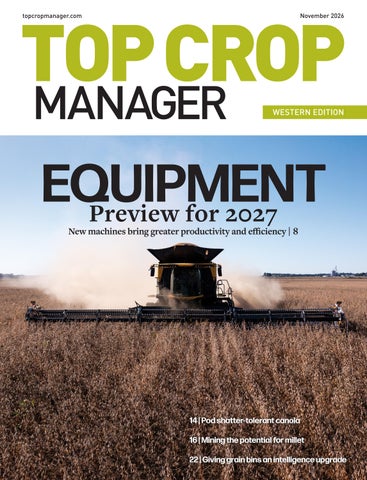
EQUIPMENT Preview for 2027 New machines bring greater productivity and efficiency | 8
14 | Pod shatter-tolerant canola 16 | Mining the potential for millet 22 | Giving grain bins an intelligence upgrade
FOUR NUMBERS, ONE COMMITMENT. 1909 is only four numbers, but with one strong commitment. We stand by our word and provide genuine value to you. Since 1909, UFA has built a hard-earned reputation for reliability, integrity and know-how. Combined with AgraCity’s offering of Canada’s largest selection of high-performance crop protection products, 1909 Crop Protection Solutions provides direct-to-farm delivery of the essential crop products that you want and need. You have our number, give us a call.
AgraCity is now 1909 Crop Protection Solutions.
1909.UFA.com 2
TOP CROP MANAGER WEST
|
1 (844) 2MY- FARM
©2026 UFA Co-operative Ltd. All rights reserved. 14723
November 2026
November 2026 Vol. 52, No. 8 topcropmanager.com
KNOW. GROW.
CANOLA
14
6 Watch for these canola varieties in 2027 Options are listed for next year.
14 Cracking the code on pod shatter-tolerant canola Researchers discover new method.
MACHINERY
8 Equipment preview for 2027
New machines bring greater productivity.
SOIL AND WATER
16
22
16 Mining the potential for millet
Exploring millet for soil remediation.
18 Microbiome-informed canola crop management Plant-soil-microbiome interactions.
STORAGE
22 Giving grain bins an intelligence upgrade Applying AI to grain storage.
AGRONOMY UPDATE
26 Clubroot spores spread in the wind
ON THE WEB
FACT FINDING: FIELD PEA RESPONSE TO PHOSPHATE FERTILIZER
More peas, please. That’s the rationale behind past and on-going research, conducted by Agriculture Applied Research Management sites in Saskatchewan, exploring how phosphorus fertility and phosphate fertilizer placement affects field pea yield.
ON THE COVER: The CR11 is an extension of the Twin Rotor technology that New Holland has been developing for 50 years. Photo courtesy of New Holland.
Readers will find numerous references to pesticide and fertility applications, methods, timing and rates in the pages of Top Crop Manager. We encourage growers to check product registration status and consult with provincial recommendations and product labels for complete instructions.
FROM THE EDITOR by Kaitlin Berger
TOPCROPMANAGER.COM November 2026 | Volume 52 | Number 8
Canadian Gold I’ve attended six weddings so far this year. You all know the drill at a wedding. Sometimes you luck out with the people at your table and can find plenty of things to talk about. Other times, not so much. Two of the weddings I attended this summer were hosted on farms in Alberta’s Peace Region, so I had the good fortune of finding myself in conversations with quite a few farmers. If you’re anything like me and discover someone who works in agriculture at a social event, you could talk to them for hours. You’ve got some of the same challenges on your mind and some of the same excitement for future innovations. Even when we’re in different roles or sectors in the industry and we don’t understand something about another sector, we’re usually approaching things with a positive framework to learn. However, the challenge is sharing that positive framework with people who didn’t grow up in the industry and aren’t currently working in it. That’s something that came up quite a bit during the Influential Women in Canadian Agriculture digital roundtable discussion I hosted in July – the importance of conversations with those not connected to agriculture. According to a 2021 statistic from the Government of Canada, the farm population represented 1.6 per cent of the total population in Canada, so those conversations are more important than ever. I was thinking about all of this while I was putting together this issue on canola. Canola is Canada’s agricultural success story. Those of us in agriculture are familiar with canola’s “Made in Canada” process of cultivar development. If you’re not, the Canola Council of Canada has a great visual history of its development. They also list its importance, including being a major source of income for growers and a source of jobs for approximately 206,000 Canadians. Canola has come a long way, but it also has a lot more potential. As you’ll find in this issue, researchers have discovered a new method for creating pod shatter-tolerant canola hybrids (page 14). They’re even looking into the nitty-gritty understanding of plant-soil-microbiome interactions to see how to improve canola crop management (page 18). Do the rest of Canadians know the story of canola or know its important uses as oil, meal and even a potential renewable biofuel? While I’m hesitant to repeat the cliché to ‘tell your story,’ it’s good advice. Perhaps a better refrain is to ‘open up the conversation,’ especially if you find yourself sitting at a wedding reception with someone who’s never met anyone who works in agriculture. Sincerely,
The farm population represented 1.6 per cent of the total population of Canada...
@topcropmanager @TopCropManager
KAITLIN BERGER editor kberger@annexbusinessmedia.com
4
TOP CROP MANAGER WEST
Reader Service Print and digital subscription inquiries or changes, please contact Angelita Potal, Customer Service Administrator Tel: (416) 510-5113 | Fax: (416) 510-6875 Email: apotal@annexbusinessmedia.com Mail: 111 Gordon Baker Rd., Suite 400, Toronto, ON M2H 3R1
Editor KAITLIN BERGER (403) 470-4432 kberger@annexbusinessmedia.com Western Field Editor BRUCE BARKER (403) 949-0070 bruce@haywirecreative.ca National Account Manager QUINTON MOOREHEAD (204) 720-1639 qmoorehead@annexbusinessmedia.com National Account Manager REENA UPPAL (437) 922-7359 ruppal@annexbusinessmedia.com Account Coordinator JULIE MONTGOMERY (416) 510-5163 jmontgomery@annexbusinessmedia.com Group Publisher & VP, Content Strategy MICHELLE BERTHOLET (204) 596-8710 mbertholet@annexbusinessmedia.com Audience Development Coordinator LAYLA SAMEL (416) 510-5187 lsamel@annexbusinessmedia.com Design Manager BROOKE SHAW CEO SCOTT JAMIESON sjamieson@annexbusinessmedia.com Printed in Canada ISSN 1717-452X PUBLICATION MAIL AGREEMENT #40065710 SUBSCRIPTION RATES (Canadian prices do not include applicable tax) TOP CROP MANAGER WEST – 8 ISSUES Feb, Mar, Mid-Mar, Apr, May/June, Sept, Oct and Nov – Canada 1 Yr $51.45; 2 Yr $82.21 USA 1 Yr $116.69 CDN; Foreign 1 Yr $139.50 CDN TOP CROP MANAGER EAST – 3 ISSUES Mar/Apr, Sep/Oct, Nov/Dec Canada 1 Yr $51.45; 2 Yr $82.21 USA 1 Yr $116.69 CDN; Foreign 1 Yr $139.50 CDN POTATOES IN CANADA – 1 ISSUE Spring – Canada 1 Yr $18.56; 2 Yr $29.70 USA 1 Yr $41.90 CDN; Foreign 1 Yr $53.57 CDN Occasionally, Top Crop Manager will mail information on behalf of industry related groups whose products and services we believe may be of interest to you. If you prefer not to receive this information, please contact our customer service department listed above. Annex Privacy Office privacy@annexbusinessmedia.com Tel: 800.668.2374 No part of the editorial content of this publication may be reprinted without the publisher’s written permission © 2026 Annex Business Media. All rights reserved. Opinions expressed in this magazine are not necessarily those of the editor or the publisher. No liability is assumed for errors or omissions. All advertising is subject to the publisher’s approval. Such approval does not imply any endorsement of the products or services advertised. Publisher reserves the right to refuse advertising that does not meet the standards of the publication.
You can’t control what happens to your canola, but you can control how it responds. Wave biostimulant from UPL, your source for Interline® herbicide, improves nutrient uptake for enhanced plant vigor, growth and overall health. This easy-to-use, naturally derived abiotic stress mitigator increases profit potential by reducing the costly effects of environmental stressors such as excessive moisture, drought and cold. Field trials have also shown a yield increase of almost 2 bu/A.* TAKE SOME OF THE STRESS OUT OF YOUR SEASON.
ASK YOUR RETAILER ABOUT WAVE BIOSTIMULANT TODAY.
Always read and follow label directions. UPL, the UPL logo, Interline and Wave are trademarks of a UPL Corporation Limited Group Company. ©2026 UPL Corporation Limited Group Company. UPL AgroSolutions Canada Inc. is the Canadian affiliate of UPL Corporation Ltd. (UPL Corp) 26-UPL-2110 9/26 *UPL Research Trials, Western Canada, 2019-2024
topcropmanager.com
TOP CROP MANAGER WEST
5
CANOLA
Watch for these canola varieties in 2027 Options are listed for next year. BY KAITLIN BERGER
W
hat new canola varieties are available next year? Top Crop Manager has put together a list for 2027. All information comes from the respective seed companies.
BASF
BAYER | DEKALB
DEKALB DK905TF is a high yield potential, specialty oil hybrid, providing characteristics of a High-Oleic, Low-Linolenic (HOLL) profile. It contains Straight Cut Plus genetics (SC+), providing enhanced pod shatter protection to lock in yield. Its disease package delivers clubroot resistance (CR) protection to many predominant pathotypes found in Western Canada, including 3H, 8N, 8A and more, and blackleg resistance (E2/Rlm7). DK905TF is only available through Richardson Pioneer.
BRETTYOUNG
BY 7203LL features the Pod DefendR trait for shatter protection, Clubroot DefendR for stacked, 6
TOP CROP MANAGER WEST
ABOVE New canola varieties are built to tackle disease challenges and optimize yield in 2027.
next-generation clubroot resistance, and Blackleg DefendR for enhanced blackleg protection. This mid-maturity hybrid is slightly earlier than BY 7204LL. BY 6222TF is an early-mid-maturing hybrid that combines Blackleg DefendR and Clubroot DefendR traits for disease protection. BY 6222TF also comes with the Pod DefendR trait providing pod shatter tolerance suitable for straight-cut harvesting and delayed swathing. This hybrid delivers reliable yield potential and adaptability across a wide range of growing conditions.
CANTERRA SEEDS
CS4200 LL is a PodProtect LibertyLink hybrid that is around an 8.0 on the Canola Council of Canada (CCC) shatter scale. It has mid-late maturity, making it more suitable for the mid- to long-season growing zones. For disease protection, CS4200 LL combines first- and November 2026
Photo courtesy of Kaitlin Berger.
InVigor L342PC is a mid-maturing next-gen second-generation clubroot resistant hybrid – and a step up in clubroot resistance. It has one of the most robust disease packages in the lineup with excellent blackleg resistance, high yield potential, and patented Pod Shatter Reduction technology. InVigor L346PC is a mid-maturity hybrid that builds on the strong foundation of InVigor L345PC, bringing an enhanced disease package while maintaining similar standability to InVigor L340PC. Growers can rely on its patented Pod Shatter Reduction technology, first-generation clubroot resistance, and high yield potential. InVigor LR347PC is a mid-maturity, dual-trait hybrid that gives you the flexibility of both the LibertyLink technology system and TruFlex canola with Roundup Ready technology to help manage weed resistance and promote high yield potential. This hybrid has patented Pod Shatter Reduction technology, a very strong disease package with strong blackleg resistance, strong Verticillium stripe performance and first-generation clubroot resistance.
BASF Agricultural Solutions is investing millions to expand its Canola Breeding Centre of Innovation in Saskatoon, Sask. With construction beginning in 2026 and ending in 2027, the funding will help improve breeding capacities and advanced automation.
second-generation clubroot resistance, including resistance to pathotypes 3A, 3D, and 3H. It also carries the blackleg resistance gene Rlm9, a less commonly deployed gene within resistance Group F, helping provide a diverse disease-resistance package. It has high oil content relative to industry checks. CS3400 TF is a PodProtect TruFlex (i.e., RoundUp) hybrid that is around a 7.7 on the CCC shatter scale. It has excellent early-season vigour. It’s also the strongest experimental product for yield performance out of DL Seeds 2025 Coop2 data set at 106.1 per cent of WCC/RRC checks. As a mid-maturity hybrid suitable for all growing zones, it has strong standability and multigenic blackleg resistance R – A, E2 and 1st and 2nd generation clubroot resistance.
MAIZEX
MC 4227TF is a high-performance TruFlex hybrid with early-mid maturity and an excellent pod-shatter rating of 7.0 based on the CCC shatter scale. It offers resistance to both blackleg and clubroot. MC 5172LL is a high-performance, mid-maturity LibertyLink hybrid with excellent pod-shatter resistance (7.5 rating based on CCC shatter scale) and very good yield potential. It offers resistance to both blackleg and clubroot and has above-average standability.
PIONEER
P1444L is the earliest-maturing LibertyLink hybrid ever offered in the Pioneer brand lineup. This 100 Series hybrid combines strong pod shatter tolerance with excellent control of major clubroot pathotypes (CR genes 1, 2 and 5). It also offers robust blackleg protection with resistance to both seedling and adult plants. P1541SL is a Pioneer brand 100 Series canola hybrid featuring built-in Sclerotinia resistance, Pod Shatter Premium (PSP) technology for straight-cutting with confidence, and strong Verticillium stripe tolerance. This well-rounded hybrid also delivers strong clubroot resistance (CR3) and is rated moderately resistant (MR) for blackleg. P1590L is the first Pioneer brand 100 Series Identity Preserved (IP) LibertyLink hybrid. P1590L offers improved pod shatter tolerance and earlier maturity than other Pioneer IP hybrids. Its smaller, more compact plant type improves overall harvestability and makes straight cutting more manageable. P592G is designed specifically for Western Canadian growing conditions. Pioneer brand P592G pairs premium Identity Preserved (IP) genetics with Optimum GLY herbicide flexibility for top-end yield potential and profitability. This hybrid combines strong disease topcropmanager.com
protection with advanced weed control, allowing growers to tackle tough, Group 1-resistant wild oats without sacrificing performance or crop safety. P691L is a high-performing, LibertyLink Identity Preserved (IP) hybrid backed by an elite disease package. Pioneer brand P691L is a mid-to-late maturing hybrid that delivers excellent early-season vigour and dependable agronomic performance. It features above-average Verticillium stripe protection alongside strong adult blackleg resistance.
PROVEN SEED – EXCLUSIVELY AT NUTRIEN AG SOLUTIONS
PV 785 TCN brings together multigenic clubroot resistance and NTACT Technology in a TruFlex hybrid. Designed for growers managing higher-pressure clubroot environments, it delivers strong agronomic performance alongside added confidence at harvest. NTACT helps protect pod integrity and supports harvest flexibility, while the multigenic disease package strengthens protection under pressure. PV 281 CLCM brings multigenic clubroot protection and harvest management flexibility into the next generation of Clearfield hybrids. Designed for growers looking to diversify herbicide systems without sacrificing yield potential or harvest confidence, this hybrid combines strong agronomics with added disease protection for higher-pressure acres. With PV 281 CLCM, growers have the option to straight cut or delay swath while maintaining confidence through harvest.
WINFIELD UNITED CANADA | CROPLAN
CP26T3C is a mid-maturing TruFlex hybrid that offers high yield potential, strong clubroot resistance for increased protection, and an excellent pod shatter rating. With a great blackleg resistance package and strong standability, this is an option that’s going to perform on tough acres while excelling in high yield zones. CP26L2P was formerly B3060. This hybrid offers exceptional pod shatter, top-end yield potential, and a strong disease package for any farm. As the earliest-maturing LibertyLink hybrid in the CROPLAN portfolio, it is a great option for farms in shorter growing regions while still packing a punch in areas where the growing season is longer. CP26O3C was formerly B4022. This first Optimum GLY addition to the CROPLAN lineup offers strong yield potential, multiple pathotype clubroot resistance, and excellent early-season vigour in tough spring conditions. Combined with an excellent blackleg package for seedling and adult resistance, and mid-maturity, this is a great hybrid for those seeking a glyphosate-tolerant option. TOP CROP MANAGER WEST
7
MACHINERY
Equipment preview for 2027 New machines bring greater productivity and efficiency. BY KAITLIN BERGER
8
TOP CROP MANAGER WEST
NEW HOLLAND CR11 TWIN ROTOR COMBINE
The old adage is that time is money. Saving time and labour in the field at harvest is the priority based on many of the upgrades in the CR11 Twin Rotor combine from New Holland. The CR11 is an extension of the Twin Rotor technology that New Holland has been developing for half a century to help ensure faster harvesting speeds and next-to-zero grain loss. “Farmers in Western Canada, specifically, have lots of challenges that come up with seasonality and harvest management,” says Warren Feist, territory business November 2026
Photo courtesy of New Holland.
W
hile every operation has unique needs, equipment companies have a couple key priorities in common when it comes to their newest releases; they want to help growers save time and reduce labour needs. Whether it’s the the CR11 Twin Rotor combine from New Holland, John Deere 8 Series and 9RX 710, 770 and 830 tractors, the Fastrac 6000 Series tractors at JCB North America or the new AF Series combines at Case IH, the goal for each new machine is to increase productivity and
contribute to greater efficiency on the farm. ABOVE The CR11 is an extension of the Twin Rotor technology that New Holland has been developing for 50 years.
We’re developing the high yielding, pod shatter hybrids you need. Our 2027 DEKALB canola seed lineup is our most advanced ever. We’re not holding back. We’re working harder to be your #1 canola seed.
DEKALB. CHALLENGE THE STATUS QUO.
DEKALB.ca | 1 888-283-6847 |
@DEKALB Canada |
@Bayer4CropsCA | #AskBayerCrop
ALWAYS READ AND FOLLOW PESTICIDE LABEL DIRECTIONS. Bayer, Bayer Cross, DEKALB and Design® and DEKALB® are registered trademarks of Bayer Group. Used under license. Bayer CropScience Inc. is a member of CropLife Canada. ©2026 Bayer Group. All rights reserved.
topcropmanager.com
TOP CROP MANAGER WEST
9
manager for New Holland in Saskatchewan. “They are looking for more harvest efficiencies, and the CR11 is one of those combines that really help the situation on the farm when it comes to labour shortages and driving down the cost of harvesting, ultimately impacting their bottom line.” The CR11 combine produces up to 775 horsepower (hp) with a grain tank capacity of 567 bushels (bu), and is part of a series including the CR10, a smaller version of CR11 which produces up to 634 hp with a grain tank capacity of 455 to 567 bushels. “When you have a bigger capacity combine, you can do more acres with less labour essentially, so the CR11 in some cases are replacing two combines on some farms,” says Feist. Both new combines follow previous versions, including CR8.90, CR9.90 and CR10.90, but the CR11 is an all-new combine in the way it operates. “The whole purpose of it is less maintenance, more infield uptime, so it’s got more horsepower,” says Feist. It boasts faster unloading speeds with a six bushel-per-second unload rate. The higher horsepower and faster speeds don’t mean less efficiency for this model. In fact, the CR11 has minimal grain loss compared to other combines on the market. “When we do demos to competitive customers, they’re very impressed by the amount of grain that’s actually going into the tank versus going out the back of the combine,” says Feist. While the model is as fuel efficient as possible, productivity really shows up in reduced labour from running one combine instead of two. The 396-gallon fuel tank also cuts time for refueling. Ideally, maintenance is minimized too. The CR11 has fewer belts and chains that have potential to cause problems at crunch time. “Minimizing the amount of belts and eliminating drive chains is a huge advantage because farmers know that belts, pulleys, and chains are usually one of those things that are the first to break,” says Feist. Harvest is always a race against the clock – and the higher horsepower of CR11 provides a better chance of beating unpredictable weather. With labour being a continuous challenge in Canadian agriculture, the higher capacity of this combine also provides an option for getting more done with fewer hands. “In the northern areas where we see a lot heavier crops like wheat and canola,” says Feist, “the CR11 is really the combine of choice in those areas in northern Alberta and in the north of Saskatchewan and Manitoba.”
ABOVE The updates to the 8 Series (250 to 410 hp) focus on improving the in-cab experience.
the year, comfort and customization can ensure long days behind the wheel are more manageable. The new John Deere 8 Series (250 to 410 horsepower) tractors for model year 2027 are built on the performance of the 8R, 8RT and 8RX lineup with updates to improve comfort, productivity and precision agriculture capabilities. The Reactive Command Steering (RCS) is a feature on select 8R models that makes it easier to maneuver the high-powered machines and achieve tighter turns in the field. RCS ensures the steering wheel automatically returns to center and allows operators to adjust to their preferred steering response. The new CommandARM Console keeps comfort at the operator’s fingertips. It features the CommandX, CommandX Plus or CommandX Pro transmission drive lever options to make operation as smooth as possible. “In terms of transmission controls, just the in-cab feel for what that customer is going to be able to see and
RIGHT The Reactive Command Steering on select 8R models makes it easier to take tighter turns in the field.
JOHN DEERE 8 SERIES AND 9RX 710, 770 AND 830 TRACTORS
For growers spending hours in the tractor throughout 10
TOP CROP MANAGER WEST
November 2026
Photos courtesy of John Deere.
MACHINERY
ABOVE RIGHT The 9RX 710, 770 and 830 tractors provide a higher horsepower option for growers.
BELOW RIGHT The 56-volt electric offboard power helps growers improve planting precision.
experience is now going to be integrated in through our whole 8 Series portfolio,” says Sarah Daniels, product marketing manager at John Deere, “and that makes it really easier for the customer to be able to get up and get ready for their day.” With the 56-volt electric offboard power, this series is especially suited to growers hoping to improve planting precision. Precision ag technology also adds to making the experience better, and the job easier, with a G5 display, StarFire receiver, and JDLink modem that use field and machine data to simplify decision-making for farmers. For farms in areas of low connectivity, there’s an additional option called JDLink Boost which is a satellite connectivity solution. “In areas where [cell service] is spotty, it sometimes is hard to stay connected and have a connected machine,” says Daniels. “So, JDLink Boost is going to be that aftermarket field kit that customers
can work with their dealers to put on the cab to increase your overall connectivity and streaming with both field and machine information into the John Deere Operations Center.” In preparation for 2027, it’s worth noting the 9RX 710, 770 and 830 tractors are available for growers looking for a high-horsepower option. “When you’re looking at sheer horsepower increase, you’re going to be able to either pull wider implements or you’re going to be able to do a job maybe a little bit faster than you were doing,” says Daniels, “which essentially actually is going to allow you to be more productive. You’re going to get more done in less time.” The tractors from both series are autonomy ready, which means they’re ready for the future, and they’re equipped to help farmers address major challenges, including labour availability and increasingly narrow windows to complete field operations. “If a tractor can be out in the field doing tillage work and the farmer can go to his kids’ T-ball game,” says Daniels, “if you look at it from a personal standpoint, the ability that autonomy is going to be able to provide to a customer to be able to do the things that they essentially want to do is, I don’t know who wouldn’t look to that and say that might be of interest or a benefit to me.”
FASTRAC 6000 SERIES TRACTORS AT JCB NORTH AMERICA
As farms grow, there’s more distance to cover between fields, and growers are looking for faster tractors that will cut the commute and perform well at seeding, spraying and harvest. Fastrac 6300, a tractor model in the Fastrac 6000 Series at JCB North America, offers Western Canadian grain producers a versatile option that delivers up to 335 hp with a maximum transport speed of 66 km/h. “It’s designed for operations where the machine is expected to travel long distances between fields, power demanding implements throughout the day and still be ready topcropmanager.com
TOP CROP MANAGER WEST
11
for the next job without compromise,” says Sam Ullyott, product sales manager at JCB. Its versatility is not just about speed, however. It’s about making the job more efficient in the field, too. That’s why the new model is backed by a high-capacity hydraulic system that delivers up to 108 gpm of flow. “For Canadian growers, that means the tractor is equipped to handle today’s larger planters, air
seeders and other high-demand implements while maintaining consistent hydraulic performance during long days in the field,” says Ullyott. Another key feature is the optional integrated Central Tire Inflation System (CTIS) to adjust tire pressure from the cab based on each setting. “While the tire inflation system doesn’t reduce the number of passes a grower needs to
ABOVE RIGHT Fastrac 6300 offers Western Canadian producers up to 335 hp with a maximum transport speed of 66 km/h.
“For Canadian growers, that means the tractor is equipped to handle today’s larger planters, air seeders and other high-demand implements while maintaining consistent hydraulic performance during long days in the field.” 12
TOP CROP MANAGER WEST
make, it can reduce the impact of every pass,” says Ullyott. “That’s especially important during planting and spraying when field conditions may be less than ideal and protecting soil health is just as important as covering acres. This model also includes the enhanced iCON operating system for a more intuitive touchscreen interface that reduces the time it takes to set up display layouts and adapt the tractor for different implements. This system is straightforward for operators to learn, whether they were already familiar with Fastrac or not. Other features include hydro-pneumatic suspension and the mid-mounted cab and 50:50 weight distribution to minimize the discomfort from bumps in the field, as well as four-wheel steering with optional Twin Steer guidance. “When you put all of those features together, the result is a tractor that’s easier to operate, less fatiguing over long days and better equipped to help operators stay productive during the busiest times of the year,” says Ullyot. When it comes to improving equipment models, Ullyot says the approach should never be to add technology to be flashy and innovative. Rather, it’s about figuring out the real challenges operators are facing in the field and how to solve them. “The Fastrac 6000 Series is a good example of that approach,” he explains. “It wasn’t developed simply to add another model to the lineup. It was built in response to customer feedback, filling a new horsepower class while delivering the transport speed, field capability and versatility growers told us they were looking for.” In other words, each person has to choose which equipment is going to accomplish their tasks best. For the Fastrac 6300, Ullyot says “the goal is simple: spend less time traveling, November 2026
Photo courtesy of JCB.
MACHINERY
adjusting equipment or making compromises, and more time covering acres when conditions are right.” The model is now available to order in Canada for delivery in 2027.
Photo courtesy of Case IH.
CASE IH AF SERIES COMBINES
For growers looking for technology that makes harvest more efficient, Case IH has the new AF Series, including the AF9, AF10 and AF11 combines. “They’re built upon the basis of past axial flow combines with a whole bunch of new features and extra capacity, technology-driven efficiency, and to provide the customer with a better bottom line,” says Trent Nowosad, product specialist at Case IH. The AF9 is a single rotor design rated for 578 horsepower and has a grain tank capacity of 455 to 567 bushels. The AF10 is also a single rotor with a maximum 775 hp and a grain tank capacity of 567 bu. The AF11 is a dual rotor design unit with 775 hp and a 567 bu grain tank. The rotor designs for this series offer a new level of harvest efficiency. “The top end model, the dual rotor, has two 24-inch axial flow topcropmanager.com
ABOVE Case IH has new AF Series, including the AF9, AF10 and AF11 combines.
rotors in it, so it really has that high-end capacity, that ability to deal especially with very tough, probably wet harvest conditions,” says Nowosad. While the single rotor designs are similar to past models, the entire series includes rotors that are 37 to 40 per cent longer for a larger threshing and separation area. “They are match capacity combines,” says Nowosad. This means they have extra capacity for threshing and separation in the rotor area, an increased cleaning shoe area, higher horsepower, a new Cross Flow Plus cleaning system, and increased elevator and tank capacity that match. “Not only are we able to bring more material in with a wider feeder throat on these combines, we’re able to thresh it, separate it, clean it, and transport it to the grain tank,” he adds. All models in the AF Series come with Harvest Command. While not new, its high level of technology matched to a more advanced system provides more control, allowing operators to set parameters so the combine automatically self-adjusts to maintain grain quality. “There’s 18 sensors throughout the
threshing and separating area of this combine that are monitoring things like ground speed, rotor speed, fan speed, pre-sieve, upper sieve, lower sieve and cage vane angles – and then are adjusting those through the software to maintain throughput and maintain grain quality and to minimize losses,” says Nowosad. Another automation feature unique to this series is the optional radar spread automation. This uses radars on each side of the residue management system to monitor and adjust where the machine throws straw and chaff. “We’re not throwing straw into uncut crop, which would make it harder to cut. We’re also compensating for crosswinds because it has sensors available for that,” says Nowosad. “It really lets us tailor that spread.” The AF Series automation features foreshadow what growers may see in the future from Case IH – and their continued drive to use automation technologies to make equipment more efficient. “We are going to see a continued integration of technology, smart technology,” says Nowosad, “technology that allows the farmer to do more with less.” TOP CROP MANAGER WEST
13
CANOLA
Cracking the code on pod shatter-tolerant canola Researchers discover new method. BY LEEANN MINOGUE
C
14
TOP CROP MANAGER WEST
DISCOVERING THIS NEW MECHANISM
ABOVE Pod shatter can cause significant seed loss and contribute to volunteer canola challenges.
Nichol and his research partners did not set out to develop new pod shatter-tolerant canola. “A lot of science happens when you’re messing around with the plant, and you say ‘Hmm. This seems strange,’” Nichol says. In this case, Nichol, Logan Skori – CEO and founder of AgGene – and Marcus Samuel, professor at the U of C and principal investigator, were working with the ABI3 gene when they noticed that, after they altered the gene, the pods of the plants contained more lignin and seemed harder to break open. Changing the expression of the ABI3 gene allowed Nichol and the team to change the amount of lignin in the plant’s seed pods. Increasing ABI3 expression in CONTINUED ON PAGE 24
November 2026
All photos courtesy of Justin Nichol.
anola plants evolved to spread their own seed. When the plant is mature, the drying pod (also called the silique) shrinks. This shrinkage puts pressure on the specialized tissue that forms the seam between the two pod halves, the dehiscence zone, causing it to split. The split opens the pod, so seeds are dispersed and fall to the ground in a process called dehiscence. While this is useful for plants in the wild, it’s an economic drain when it happens in standing canola in growers’ fields. According to a research paper entitled the Goldilocks zone of lignin, pod shatter can cause approximately three per cent to 50 per cent seed loss. Plus, scattered seed contributes to volunteer canola problems in subsequent years. Before the first pod shatter-tolerant canola hybrid seed was released in 2014, growers managed pod shatter largely by swathing canola to dry. However, the release of InVigor L140P decreased pod shatter loss and allowed growers to straight cut their canola. By 2020, a Canola Council of Canada survey found that just over half of canola growers were straight cutting at least some of their canola and 19 per cent had stopped swathing canola altogether. Now straight combining is the default. The pod shatter-tolerant varieties most farmers are growing were created through genetic changes to the plants’ dehiscence zone. Researchers identified the indehiscent gene involved in forming the dehiscence zone in the plant pods and worked with indehiscent gene mutations to strengthen the dehiscence zone and ensure pods with a stronger seam will take longer to split apart – a feature built into the InVigor canola line. Now, Justin Nichol, a plant cellular and developmental biology scientist at the University of Calgary (U of C) is taking a different path to the same destination. Rather than strengthening the pods’ dehiscence zone, or seam, Nichol and his colleagues have found a way to strengthen the actual pods. They’ve identified the gene that regulates the production of lignin, the material that strengthens pods, and used this gene to build a pod that’s not so quick to spring apart.
DEC 3, 2026 Grande Prairie, AB Following a successful first year, Top Crop Summit is returning to Alberta’s Peace Region for an even bigger second edition. Designed for growers, agronomists and crop advisors, the summit delivers expert agronomy research, insights, and production strategies tailored to the Peace Region—helping you make informed decisions and boost productivity next season.
Rate: d ir B ‑ y l r a E $70.00 0) 3 . t c O s d n (e Register to attend or exhibit at
TopCropSummit.com
Platinum sponsor
topcropmanager.com
Gold sponsor
Silver sponsor
TOP CROP MANAGER WEST
15
SOIL AND WATER
Mining the potential for millet Exploring millet for soil remediation, feed and more. BY ADELINE PANAMAROFF
16
TOP CROP MANAGER WEST
ABOVE Vaid tested proso millet to see if it could grow in favourable conditions in southern Alberta.
Initial trials were conducted in Vulcan and Lethbridge. The Vulcan trials failed due to technical issues with equipment, but the Lethbridge plots produced good results. “Our Lethbridge plots last year were seeded late (early July), and yet the millets could grow, and produce seeds. This confirmed that millets are compatible with southern Alberta’s photoperiod and that millets can be considered as a second crop for a season,” Vaid says. For the 2026 season, Vaid expanded variety testing to include pearl and barnyard millet, comparing their performance with barley. Vaid is conducting these November 2026
All photos courtesy of Neha Vaid.
P
oor soil – whether it’s due to degradation, saline conditions, over-use of fertilizers or general characteristics – drains profitability from agricultural land. Research at the University of Lethbridge is exploring whether millet could help remediate the soil and then be used as an effective feed crop. Doctor Neha Vaid, assistant professor at the Biological Sciences Department at the University of Lethbridge, has been working with several varieties of millet to see how they perform in southern Alberta. She’s also studying potential carbon sequestering values in greenhouse situations to see if millet is a high carbon capture option for producers interested in carbon credit as a revenue stream. In 2024, Lethbridge County approached the university over concerns of general soil erosion that has been a chronic issue due to the region’s high winds. “I was more focused on millets as heat- and drought-tolerant forage crops,” Vaid explains, “and then the two worlds collided in a way because the drought tolerance of millets is because of their dense fibrous root structure that dig in deep in the soil – and that hold on soil is essential to prevent soil erosion as well.” Millet has been understudied as a viable crop in Canada, with only a few studies conducted on varieties on Prince Edward Island. Once Lethbridge County expressed interest in Vaid’s millet research, she decided to start from scratch and see which varieties would grow in the region. Seed companies, which are supplying the seed for the trials, have also confirmed they want science-based answers to the most common questions they get from customers. While Corns Seeds and Millborn Seeds Canada have been producing several varieties of millet in bulk for years for a small market, this research would provide clarity on the purpose of growing millet, when to grow it and what conditions are best for its success. Initially, Vaid tested foxtail and proso millet to see what types of millet could grow in favourable conditions in the region. With only one full season of millet trials completed in 2025, more studies are necessary to understand the full potential this crop could offer producers in southern Alberta.
trials at the Crop Diversification Centre South (CDCS) in Brooks, Alta., and on land near Lethbridge, Alta. provided by Farming Smarter, one of Vaid’s partners. As is standard practice, the initial trials are conducted on high-quality land with optimal conditions. However, the crops receive no nutrient inputs and do not receive any additional water other than natural precipitation. If the trials are successful, researchers will then see how the most productive varieties perform in poor conditions.
GOOD POTENTIAL FOR FEED AND FORAGES
To continue her research, Vaid has been seeking funding from industry partners, including Result-Driven Agriculture Research (RDAR) and Egg Farmers of Alberta (EFA). Of top concern for poultry producers is the rising price of corn feed, and millet offers an alternative. “A lot of egg farmers do have small pieces of land,” Vaid says, “and it would be better profitably and [more] environmentally sustainable not to depend too much on supply chain and geopolitics and what happens with transport of feed.” Millet can be a very good substitute for a large portion of the corn feed for chickens and pigs. “A lot of millets actually have very high protein content as compared to other cereal crops. They are very rich in vitamins, micronutrients, and minerals such as iron and calcium that we are generally provided as external supplements to the animals,” Vaid says. Millets are also high in digestible fibre. As a forage crop, millet is great for silage when harvested young. As a C4 plant, it grows quickly enough for southern Alberta’s short growing season to come back twice one season to offer a second harvest, or a second grazing pass as a cover crop in tame pasture.
BUILDING ON THE BIOMASS
With interest from producers in potential carbon credit topcropmanager.com
TOP LEFT TO RIGHT Foxtail was also included in initial trials to determine what types of millet could grow in the region; Proso millet is grown in trials on land near Lethbridge, Alta. provided by Farming Smarter.
revenue, Vaid is investigating millet’s carbon sequestering potential. So far, it’s strong, though it is still undergoing study in greenhouse conditions. As a C4 plant, millet does a 50/50 split of carbon sequestering, with half below ground, and half in the vegetative zone. All varieties of millet have dense, fibrous root zones that can produce a lot of biomass when left in the soil, which is one measurement of soil carbon. Biofuel industry stakeholders have also expressed interest in the biomass that millet can create post-harvest. “If they could sell that biomass for biofuel or for silage, that byproduct can improve economic prospects for farmers,” Vaid adds.
SOIL REMEDIATION PROSPECTS
As a soil remediation tool, through anecdotal information and studies done in other countries, millet has performed well in absorbing leftover nutrients from over-fertilized land, and it even performs well in saline soil. Vaid’s goal is to determine if this is also true in southern Alberta. “On the environmental footprint side, a McGill University study calculated that millets contribute substantially less to global warming as compared to wheat and maize. Because millets need little to no irrigation and few chemical inputs, the same review notes they let farmers avoid tillage practices altogether in drier soil, which shortens cultivation time and reduces the soil disturbance associated with erosion,” Vaid says. Studies abroad have shown that millet works best after legumes, not cereals. However, Vaid will need to determine where millet fits in a rotation with oilseeds. Once Vaid has gotten her proof-of-concept with another season of trials concluded at the end of the 2026 growing season – and new funding – the research can add more expansive millet studies in the years to come. TOP CROP MANAGER WEST
17
SOIL AND WATER
Microbiome-informed canola crop management Understanding plant-soil-microbiome interactions to optimize canola. BY VANESSA FARNSWORTH
T
18
TOP CROP MANAGER WEST
any patterns or signatures that we can identify to inform our next step? And will it advance our understanding of the map of the microbiome for canola?”
DIGGING DEEPER
Research plots show canola at vegetative stage with attached soil.
In 2016, Taye conducted a field study at a site near Saskatoon to answer some of these questions. He grew sixteen genetically diverse canola genotypes in a randomized complete block design with three replicates. Every week for 10 weeks, beginning 18 days and ending 81 days after seeding, three random canola plants were harvested from each plot and shaken to dislodge the bulk soil. The remaining soil for each set of three plants was combined before being analyzed. Taye discovered that canola root interactions with soil microbes aren’t haphazard. Instead, the microbiome around canola roots form structured bacterial networks that evolve as the plant grows. While some of those microbial groups establish early and remain stable across all growth stages, others dynamically reorganize. Understanding these patterns, he says, has the potential to inform everything from the November 2026
Photo courtesy of the Helgason/Lamb/Siciliano research team, USask.
here is no question that canola is one of Canada’s most important crops, so it’s no wonder that some of the most innovative crop research in this country has canola in its sights. That research is increasingly looking at the crop’s root zone microbiome. However, Zelalem Taye, an assistant professor in the Faculty of Land and Food Systems and the Faculty of Forestry and Environmental Stewardship at the University of British Columbia (UBC), who specializes in plant-soil-microbiome interactions, says that studies looking into the microbial communities associated with canola’s rhizosphere rarely venture beyond cataloguing which microbes are present. His goal is to develop a deeper understanding of how those bacterial communities are connected, if those connections change as canola develops, and if some microbial groups retain their importance across all growth stages. “A lot of studies have identified individual microbes and studied their presence and absence. What we also ask is how they are associated,” he says. “Knowing what’s present is excellent information. But are there
Choosing TruFlex® LibertyLink® helps ensure that your operation stays competitive by taking care of the things you can control. When you plant canola with dual herbicide tolerance, you get an extended spray timing window in the event of weather delays for in-season adaptability and broader weed spectrum control for more comprehensive coverage. To set yourself up for a winning season, choose the versatility of TruFlex® LibertyLink®. ALWAYS READ AND FOLLOW PESTICIDE LABEL DIRECTIONS. TruFlex® canola contains Roundup Ready® technology. Roundup Ready® Technology contains genes that confer tolerance to glyphosate. LibertyLink® Technology contains genes that confer tolerance to glufosinate. Glyphosate will kill crops that are not tolerant to glyphosate. Glufosinate will kill crops that are not tolerant to glufosinate. Roundup Ready® and TruFlex® are registered trademarks of Bayer Group. Used under license. Liberty®, LibertyLink® and LibertyLink logo® are registered trademarks of BASF, used under license by BASF Canada Inc. All other trademarks are trademarks of their respective owners. Bayer CropScience Inc. is a member of CropLife Canada. ©2026 Bayer Group. All rights reserved.
topcropmanager.com
TOP CROP MANAGER WEST
19
SOIL AND WATER
development of crop management strategies and climate-resilient agricultural practices to the creation of next-generation soil health tools. “Microbes are not just sitting there. Depending on the growth stage, the availability of resources from the plant, the microbes that are around, and by making different connections with other microbes, they can alter what’s around the plant. We also identified that canola tends to make a backbone of microbes that are persistent across growth stages,” he says. “That means our land use management and early-stage soil condition is crucial, and if we’re looking for a biotechnological approach or want to select canola for specific bacterial groups, we need to understand if there are these kinds of patterns.” A key finding of the 2016 study was that microbial network complexity peaks at flowering, something that suggests this growth stage may be critical to plant-microbe interactions, nutrient uptake and stress response. Another important finding had to do with bacterial groups, some of which appear to help drive changes in the microbial community, forming new associations as the plant transitions across growth stages.
INFORMING CURRENT RESEARCH
While a field study undertaken in 2016 may seem like old news, Taye argues that the questions he sought to answer when he did his PhD research at the University of Saskatchewan (USask) a decade ago are even more relevant today as interest in biologicals and climate-resilient agriculture escalates. Genomics data collected in experiments done years or decades ago, he says, shouldn’t be ignored. As analytical processes and AI technologies progress, that data can be mined even as new data is being produced. In Taye’s case, the findings of that earlier study had a direct influence on his current research program at UBC where his lab focuses on microbiome-informed approaches to sustainable agriculture and ecosystem resilience. “Much of crop improvement has focused on plant genomics and breeding, which remain essential, but the plant is also part of a larger plant-soil-microbiome system. We can’t fully separate the plant from the interacting microorganisms around it,” Taye says. “I want my research group to bring about a paradigm shift for both producers and researchers. Relying on plant genomics alone gives us an incomplete picture. My group will try to bring about a microbiome-informed next-generation canola optimized for nitrogen-use efficiency, drought and disease resistance.” Taye sees his work as augmenting existing breeding and agronomic practices, not replacing them. “The ultimate goal is not only to understand those processes, 20
TOP CROP MANAGER WEST
RIGHT Lead researcher Zelalem M. Taye, assistant professor in the Faculty of Land and Food Systems and the Faculty of Forestry and Environmental Stewardship at UBC, specializes in plant-soilmicrobiome interactions.
but to translate that understanding into better crops, healthier soils and more sustainable production systems,” Taye says.
IMPLICATIONS IN THE FIELD
And while Taye’s research may not point to any input recommendations or changes canola growers can make to their farming practices today, it does identify microbial patterns and candidate groups that could prove essential in the development of future biological tools and resilient production systems. With nitrogen being a major input cost for growers and sometimes lost from the system rather than taken up by the crop, Taye wants to confirm if efficiency is also shaped by the relationship between the plant and the microbiome. “In terms of increasing sustainability and resilience, it’s important for us to not look at the plant alone or at the soil microbes alone,” says Taye. “We need to understand them as a system. We need to acknowledge those interactions and respect them.”
QUESTIONS TO CONFIRM
Taye is far from done. His next step is to run tests to determine whether the candidate taxa and core communities he’s already identified through computational analysis are really present ecologically and if they interact the way they appear to do. He also wants to confirm that there is a core group of bacteria that forms a stable, sustained backbone as the plant grows. Taye also wants to show that plant-microbe interactions improve crop resilience, nutrient-use efficiency, plant health, stress tolerance and/or yield stability in the field. If those things can be validated under field conditions, they have the potential to aid in the development of microbiome-informed next-generation canola varieties in Western Canada. November 2026
Seed-Safe Sulfur. Built for Prairie Springs. A fertilizer that works with your seeding system, not against it. Polysulphate® Premium delivers sulfate-based sulfur, potassium, magnesium and calcium in one low-salt, low chloride granule.
✓ Safe for seed row placement ✓ Gradual release, available sulfur ✓ S, K, Mg and Ca in one granule
www.icl-growingsolutions.ca topcropmanager.com
TOP CROP MANAGER WEST
21
STORAGE
Giving grain bins an intelligence upgrade
Applying AI and machine-learning tools to grain storage. BY JOEY SABLJIC
FROM MANUAL TRACKING TO AI-POWERED PROACTIVENESS
The old, manual way of tracking grain – writing down where it came from, what variety it was, how it was handled – was slow and geographically limited. Jayas describes a different picture now taking shape 22
TOP CROP MANAGER WEST
ABOVE A new review paper co-authored by Jayas explores dozens of AI and ML tools that could be applied to improving grain storage. with AI-powered systems: Every grain bin, anywhere in the world, gets a unique digital identity. A grower or grain handler enters the bin’s physical details once – such as size, height, whether it has aeration fans or fumigation capability – and from there, a mathematical model running in the cloud can estimate temperature, moisture and gas levels at every point inside, using whatever sensors are already installed. When something drifts outside the normal range, whether it’s a temperature spike, moisture pocket, or insect infestation showing up in a camera feed, the system can recommend a fix, or in some designs, start acting. “For example, an AI-powered system could inform the farmer that it has turned on the aeration system in a bin for a specific reason,” Jayas explained. “But of course, the farmer always has the option to override the system.” The same idea applies to pest control. Because different insect species respond to different treatments, an AI system can identify the culprit from an image and recommend or even initiate the right response, whether that’s cooling, CO2 fumigation or phosphine, before a human ever climbs the ladder. For an industry that’s constantly dealing with labour shortages and expanding operations, that matters. Monitoring a hundred bins by hand with a small crew is not only difficult, but unsustainable long-term. “But with the technology now, you can do that,” says Jayas.
TEACHING A COMPUTER TO SEE A KERNEL THE WAY HUMANS DO
Some of the most striking progress Jayas has seen is in simple recognition – telling grain from foreign material, or a wheat kernel from a barley one, even from a fragment. Early in his career, identifying kernels meant painstakingly measuring a range of features – including length, width, colour, surface roughness – then grouping the results into classes based on those measurements, and November 2026
Photo courtesy of Digvir Jayas.
M
uch of grain storage still depends heavily on humans – whether it’s climbing bins to check roofs for condensation, popping the hatch for a smell test or manually logging information. Modern grain bins aren’t short on technology, however, with temperature cables threaded through the grain mass, aeration fans wired to switch on and off and probe traps set to catch early insect activity. The sensors are already talking, but what’s missing is a system that listens, interprets and acts on what they’re saying in real-time. Digvir Jayas has spent more than three decades working on that gap. A distinguished professor emeritus at the University of Manitoba and one of Canada’s foremost authorities on stored grain quality, Jayas has watched the field move from measuring kernel length and colour by hand toward systems that don’t just collect readings but make sense of them. A new review paper co-authored by Jayas and published in the Journal of Stored Products Research looks at dozens of artificial intelligence (AI) and machine-learning (ML) tools that could be applied to everything from spotting insects and mycotoxins to sorting grain at the elevator. From what Jayas has seen, many of these tools can do the job with 90 per cent accuracy – or better.
classifying unknown kernels by how closely their features matched each class. Deep learning has effectively skipped that step by mimicking how people actually learn. “You present the system with multiple images that this is a wheat kernel. And you provide it with full kernels, cracked kernels, partial images and images at different angles,” Jayas explains. “Next time when it sees the partial image, it can identify that this is a wheat kernel.” The single biggest advantage, he notes, is speed: What took teams of humans hours upon hours can now happen in a matter of milliseconds. That same capability is starting to reshape receiving at terminal elevators, Jayas says. Instead of a person opening a rail car and eyeballing it, a machine-vision system can sample a car, assess its grain quality and foreign material content, and route it to the bin that makes the most sense, whether that’s one needing cleaning or one ready to ship.
AI AT INDUSTRIAL SCALE IN GRAIN STORAGE
Jayas points to three reasons AI isn’t running at an industrial scale grain storage yet. First, grain is a low-margin commodity. “The return often doesn’t justify the major investment when the old ways of doing things are still working,” he says. Second, there simply aren’t enough researchers building grain-specific AI tools, compared to sectors like electronics; and much of the industry hasn’t been exposed to what’s possible, so few people inside are pushing for it. Layer onto that very real concerns about data privacy and whether competing grain companies would ever agree to share information, and it’s clear why Jayas found most of these tools are still living in small-scale pilot studies rather than daily operations. THE TRACEABILITY PAYOFF Still, pieces are emerging commercially, including, Another major upside is documentation, explains Jayas. If a buyer disputes grain quality down the line, a fully AI-powered and “sensored-up” supply Jayas noted, companies building AI-powered bin sensors chain could potentially produce a paper trail all the way back to the farmer, aimed initially at large integrated operations rather than down to which field those grains came from, what variety was grown and individual farms, simply because the economics work better at scale first. In other words - change may arrive what it was treated with. The same data can let an exporter blend grain from multiple bins with at the elevator before it arrives at the farmyard. “I think there’s huge potential, but it’s not being realized yet,” he surgical precision to hit a customer’s exact specification. 26_011564_Top_Crop_Western_Edition_NOV_CN Mod: August 25,says. 2026 9:28 AM Print: 09/11/26 page 1 v2.5
π SERVING CANADA FROM CANADA
ORDER BY 6 PM FOR SAME DAY SHIPPING
COMPLETE CATALOG topcropmanager.com
TCW_Uline_Nov26_CSA.indd 1
1-800-295-5510
uline.ca TOP CROP MANAGER WEST
23
2026-09-14 11:26 AM
CANOLA
Cracking the code on pod shatter-tolerant canola | CONTINUED FROM PAGE 14
the plant caused more lignin to be produced; decreasing ABI3 expression resulted in less lignin in the pod. It took some time to determine the optimal amount of lignin in a seed pod. Too much made the plant pods rigid and difficult to crack open. Some shatter tolerance is ideal, but too much would leave growers with unopened seed pods in combine hoppers. At the other extreme, with almost no lignin, the seed pods became weak and floppy, and the plant’s normal mechanism for opening the pod doesn’t work. Nichol’s team were looking for the ‘Goldilocks’ zone of lignin, where plant pods have just the right amount of strength to open eventually, but not too easily. Nichol is fascinated by the way this relatively simple mechanism controls the plant, and how scientists can make changes to seed pods that directly improve harvestability. “It’s a combination between the actual reproduction system, and how the plant tries to disperse itself. How can you play with these genetic pathways to do what you want with it?”
CONTROLLING LIGNIN PRODUCTION
The ABI3 gene has significant impact on pods, regulating lignification, as well as seed maturation, pod maturation and pod opening, but it doesn’t control the entire plant. Nichol refers to their work with ABI3 as “working downstream of the main system.” That is, they can keep the plant’s normal pod separation process intact. In contrast, most of the pod shatter-reduction technologies used today involve knocking out a higher-level gene, which “changes the whole morphology of the pod,” Nichol says. In this lab experiment, to increase the level of lignin production, the researchers inserted DNA to overexpress the ABI3 gene, but adding this foreign material is currently unmarketable and more work is required.
ABOVE Nichol and his team have identified the gene that regulates the production of lignin, the material that strengthens canola pods.
FROM MUSTARD PLANTS TO YOUR FIELD
Nichol has tested this method on Westar canola, but the initial research work was done using Arabidopsis thaliana, a small mustard plant. This small, fast-growing plant is used by researchers as a model organism, largely because it was the first plant to have its genome
“A lot of science happens when you’re messing around with the plant, and you say ‘Hmm. This seems strange.’” 24
TOP CROP MANAGER WEST
fully sequenced. “All plant scientists use it around the world for anything really,” Nichol says. The seed pod of the Arabidopsis thaliana is a lot like a canola seed pod and results can easily be transferred for use in canola. They also have potential for application in soybean, field pea, chickpea and lentil.
WORKING TOWARD FUTURE APPROVAL
While there’s opportunity for creating a new pod shatter-tolerant canola plant, it will be many years before this method is used to create commercially available hybrid seed. Researchers in Marcus Samuel’s lab at the U of C are still finalizing their methodology and have more papers to publish. No field trials have been done. Regulatory approvals may be required. While it will be at least the mid-2030s before plant pods with Goldilocks levels of lignin are seeded in growers’ fields, it’s worth the effort. “Our lab is entirely oriented toward agricultural application,” Nichol says. “That’s hands-down what we do. A lot of the science that we do here is trying to help out farmers directly and address the problems they face in the fields.” November 2026
topcropmanager.com
TOP CROP MANAGER WEST
25
AGRONOMY UPDATE
by Bruce Barker, P.Ag | CanadianAgronomist.ca
Clubroot spores spread in the wind
C
lubroot, caused by the obligate parasite Plasmodiophora brassicae, was first found on canola in Alberta in 12 fields in 2003. Since then, it has spread to over 4,300 confirmed canola fields in Alberta, with isolated cases in Saskatchewan and Manitoba. The disease can cause near total yield losses. The pathogen survives as long-lasting resting spores in the soil that can live for up to 20 years to infect subsequent canola crops. The movement of these spores in soil particles is one of the main vectors for the spread of the disease. An early strategy to prevent this was the sanitization of farm equipment prior to moving from field to field. However, anecdotal reports suggested that the spores may move through wind and water soil erosion. A research study conducted by Stephen Strelkov at the University of Alberta evaluated if P. brassicae spores can be detected in wind-blown dust, and at what volume. The research occurred at four sites in Alberta. Three were in central Alberta at a commercial field in Parkland County, the Crop Diversification Centre North in Edmonton, and research plots in a commercial field northeast of Edmonton (50th St site). The fourth site was in southern Alberta in a commercial field near Bassano, Alta. Airborne dust samplers were set up at the four sites in 2011 and 2012. In 2011, these Big Spring Number Eight (BSNE) samplers, that swivel with the wind and collect dust in a pan, were placed above ground level at 4, 14, 24 and 41 in (0.1, 0.35, 0.6, 0.8 and 1.05 m) with five samplers per post at the central Alberta locations. Three posts were set up on the east side of the Parkland site. Four posts were set up on the east side of the fields at the other two central sites. An additional post was placed west of each field at these sites. At Bassano in 2011, four samples were placed at a height of 0, 10, 20, 30 in (0, 0.25, 0.5 and 0.75 m) at five posts positioned along the edge of a natural gas lease. The samplers were placed in the fields from July to October 2011. In 2012 in central Alberta, the samplers were placed equally at four points on the east and west edges of the fields, at 4, 20 and 40 in (0.1, 0.5 and 1 m) above the ground, and were kept in the field from May 11 to October 25. At Bassano, the number of samplers and heights were the same as the first year, but with four additional posts added in the southwest portion of the 26
TOP CROP MANAGER WEST
P. brassicae spores were detected in wind‑blown dust in up to 50 per cent of sampled collections (2012), confirming that clubroot can move short distances through airborne soil particles.
field near an irrigation canal. Weather data was collected for the Parkland site and the site northeast of Edmonton in 2012. At Parkland County, wind gusts were as high as 51 km/h, but this site had little exposed soil following canopy closure, so the expectation was that there would be little dust collected. At the 50th St site, the highest wind gusts were 20 km/h, and there was some exposed soil between the research plots. Dust was collected from the samplers every two weeks in central Alberta and twice per growing season at Bassano. The dust was dried, pelleted, weighed after each collection, and pooled with the previous collections. In 2011, a mean of 387 mg of dust was recovered from each sample, and 251 mg in 2012. All samplers had at least 150 mg of pooled dust to be assessed for DNA analysis except for a few samples at Bassano. The distribution of resting spores in the commercial fields was also determined at Parkland and Bassano by PCR analysis of 100 soil samples collected from each field. Eight of 100 soil samples at Parkland tested positive for P. Brassicae DNA, which were primarily found near the eastern side of the field near the field entrance. At Bassano, 58 of 100 soil samples tested positive. Using quantitative PCR analysis, P. Brassicae DNA was found in 15 of 74 dust collections in 2011 and 41 of 81 dust collections in 2012. There was no correlation between sampling height and resting spore frequency or concentration in both years. At both Parkland and Bassano, the sampler locations with the highest frequency and quantity of P. Brassicae DNA were found closest to the areas of the field with the highest qPCR results from soil tests. Overall, the research found that short-distance movement may occur with wind-blown dust that can spread the clubroot pathogen, but it did not assess the long-distance movement of P. Brassicae spores in wind-blown dust, and whether this may be a source of new infestations. Given the relative slow movement of clubroot over greater distances on the Prairies over the last decade, long-distance movement may be less likely. However, the massive windstorm in southeastern Saskatchewan in the spring of 2026 serves as a reminder that wind-blown dust may still be a concern for disease transport. Bruce Barker divides his time between CanadianAgronomist.ca and as Western Field Editor for Top Crop Manager. CanadianAgronomist.ca translates research into agronomic knowledge that agronomists and farmers can use to grow better crops. Read the full research insight at CanadianAgronomist.ca.
November 2026
Save $25/bag on corn
& $1/unit on soybeans. Book by Dec. 11th, 2026* *Terms and conditions apply. For full program terms and conditions, visit DEKALBrewards.ca.
topcropmanager.com
TOP CROP MANAGER WEST
27
28
TOP CROP MANAGER WEST
November 2026