

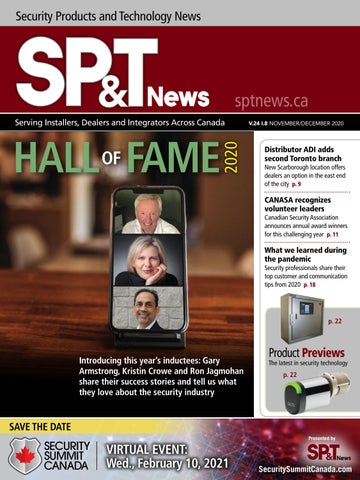
Serving Installers, Dealers and Integrators Across Canada Distributor ADI adds second Toronto branch New Scarborough location offers dealers an option in the east end of the city p. 9 CANASA recognizes volunteer leaders Canadian Security Association announces annual award winners for this challenging year p. 11 What we learned during the pandemic
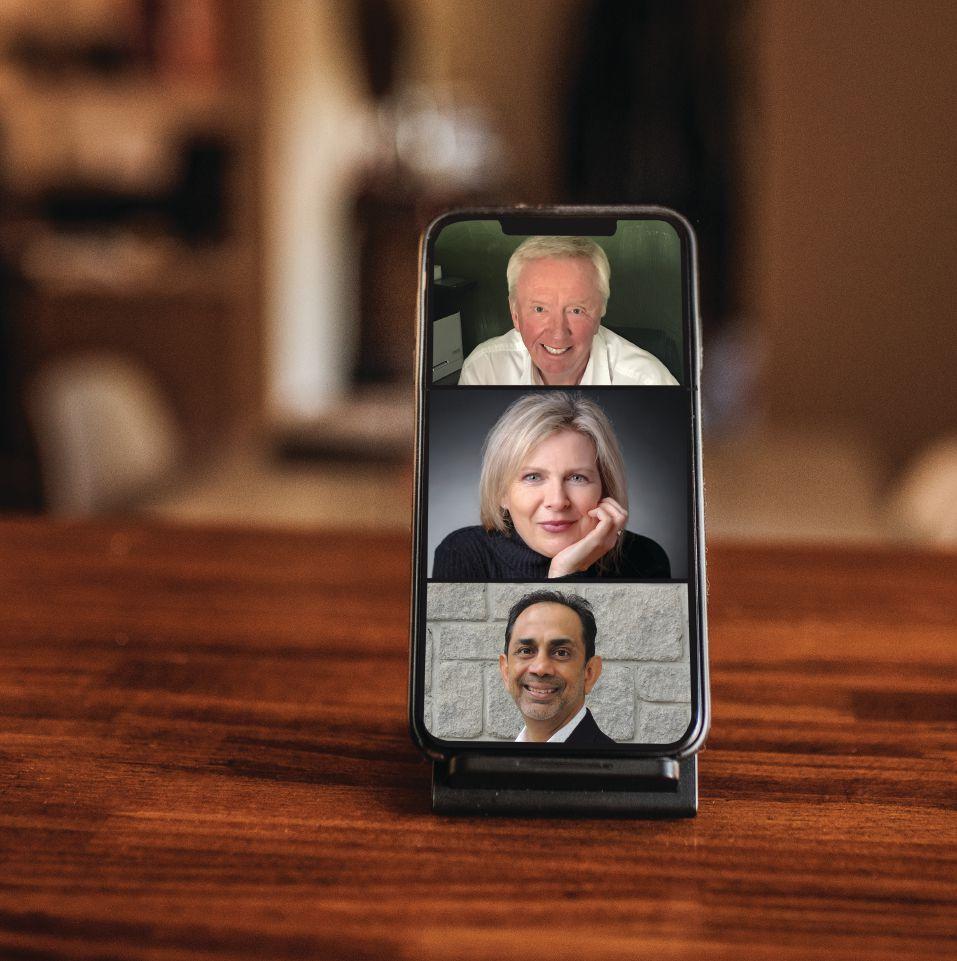
Introducing this year’s inductees: Gary Armstrong, Kristin Crowe and Ron Jagmohan share their success stories and tell us what they love about the







The Latest IP Technology Dealers Corner Thousands of Independent Dealers Personalized Customer Service
24/7 Monitoring 365 Days a Year
• Wholesale Monitoring
• Interactive Services
• Video Monitoring
• Managed/Hosted Card Access
• Advanced Web Services
• Acqusition and Funding Program

Cover Story Hall of Fame 2020
Celebrating the careers and accomplishments of Gary Armstrong, Kristin Crowe and Ron Jagmohan — three leaders who have made their mark on the security industry. By
Neil Sutton
CANASA exec director recognized with special
ADI opens second Toronto branch

10 Lessons Learned
The Price family showed us how to build an alarm business By Victor Harding
11 CANASA Update
CANASA recognizes achievements in a difficult year By Patrick Straw
12 Camera Corner
Seeing so much more By Colin Bodbyl

By Neil Sutton

s I write this, the Province of Ontario has just announced the latest set of COVID-19 restrictions for the City of Toronto and Peel Region — not a surprise for us Torontonians, as the infection numbers have been trending in the wrong direction for some time now.
COVID fatigue has definitely set in. My own children ask me on an almost daily basis, when will this be over? I give them my best guess and reassure them that one day this will pass, as difficult as it may be to visualize today.
Several weeks ago, I reached out to a number of security professionals and asked them to offer their best advice on coping with COVID — more precisely, to share with our readers their tips for helping their staff and customers make the best of a bad situation. Their responses addressed: positive and accurate messaging, utilizing video conferencing platforms effectively, helping businesses stay on their feet, accommodating employees’ work from home needs, and perhaps most importantly, paying attention to each other’s mental health.
Sharing information is something the security industry has become better and better at over the years, and the knowledge exchange has been truly inspirational at times during this current health crisis.
I don’t think any of us have any concrete answers as to when we can expect “a return to normal” (though surely our “normal” is forever altered), but until we do, collabo-
ration is probably our most valuable ally.
It’s also encouraging to see people’s efforts acknowledged. I don’t think I’ve ever been more grateful to receive the list of CANASA’s annual award winners as I was this year. The list wasn’t accompanied by photos of roomfuls of people with smiling faces — these days, awards are couriered out to their recipients, or at best received at arm’s length, the presenter and winner both masked. The crowded rooms and abundant photos will return one day soon, when it’s safe to congregate. What’s important is the recognition of security professionals giving back to their communities.
As we were planning this issue, there was some initial debate as to which story should be featured on the cover: the impact of COVID-19 this year or our annual Hall of Fame. It didn’t take long to arrive at the decision to put our winners on the cover. I have known all three of them — Ron Jagmohan, Kristin Crowe and Gary Armstrong — for many years, initially by reputation and then in-person. Their leadership during this tough year has been stellar, but it’s the body of work and years of service that we want to recognize. The pandemic will eventually go away — the strength of the security community is here to stay.

Your Partner in Securing Canada Security Products & Technology News is published 8 times in 2020 by Annex Business Media. Its primary purpose is to serve as an information resource to installers, resellers and integrators working within the security and/or related industries. Editorial information is reported in a concise, accurate and unbiased manner on security products, systems and services, as well as on product areas related to the security industry.
Group Publisher, Paul Grossinger 416-510-5240 pgrossinger@annexbusinessmedia.com
Associate Publisher, Jason Hill 416-510-5117 jhill@annexbusinessmedia.com
Editor, Neil Sutton 416-510-6788 nsutton@annexbusinessmedia.com
Associate Editor, Alanna Fairey 416-510-5228 afairey@annexbusinessmedia.com
Media Designer, Graham Jeffrey gjeffrey@annexbusinessmedia.com
Account Coordinator, Kim Rossiter 416-510-6794 krossiter@annexbusinessmedia.com
Circulation Manager, Shawn Arul sarul@annexbusinessmedia.com Tel: 416-510-5181
COO, Scott Jamieson sjamieson@annexbusinessmedia.com
EDITORIAL ADVISORY BOARD
Victor Harding, Harding Security Services Carl Jorgensen, Titan Products Group Antoinette Modica, Tech Systems of Canada Bob Moore, Axis Communications Roger Miller, Northeastern Protection Service Sam Shalaby, Feenics Inc.
111 Gordon Baker Rd, Suite 400, Toronto, ON M2H 3R1 T: 416-442-5600 F: 416-442-2230
PUBLICATION MAIL AGREEMENT #40065710 Printed in Canada ISSN 1482-3217
RATES: Canada: $43.00 + HST/yr, USA: $98.00/yr and International: $112.50/yr Published 8 times a year




Occasionally, SP&T News will mail information on behalf of industry-related groups whose products and services we believe may be of interest to you. If you prefer not to receive this information, please contact our circulation department in any of the four ways listed above.
Annex Privacy Officer privacy@annexbusinessmedia.com Tel: 800-668-2374
No part of the editorial content of this publication may be reprinted without the publisher’s written permission. ©2020 Annex Publishing & Printing Inc. All rights reserved.
Annex Publishing & Printing Inc. disclaims any warranty as to the accuracy, completeness or currency of the contents of this publication and disclaims all liability in respect of the results of any action taken or not taken in reliance upon information in this publication.


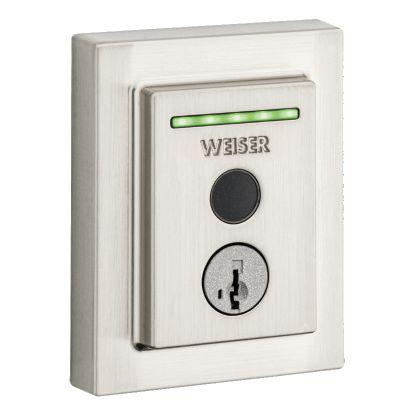
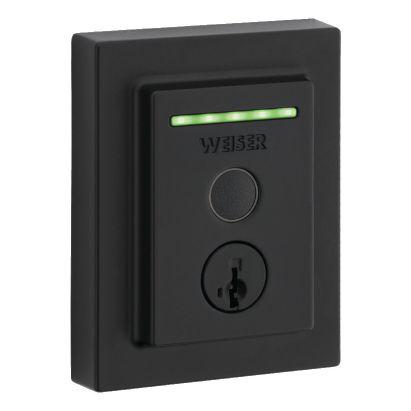

1 UNIQUE FINGERPRINTS
WI-FI ENABLED
• Up to 100 fingerprints/50 users
• BHMA Grade 2 certified
• 256-bit AES encryption encryption security
• Featuring SmartKey Security™ - protecting against advanced break-in techniques
• No hub required by connecting directly to your home Wi-Fi network
AToronto company has launched an app-based alarm response service that will put a security guard on the scene faster than previously possible, according to one of the firm’s executives.
“When I designed TAG, I designed it with the dealers in mind.”
— Michael Shvarzman, TAG Dispatch
The app and accompanying infrastructure, called TAG Dispatch, is available to central stations and alarm dealers, says managing partner Michael Shvarzman. Utilizing an on-demand model, TAG Dispatch sends out a request for dispatch based on the alarm’s location. A TAG security guard, or “Tagger” in the company’s parlance, can respond to the call via the app and immediately make their way to the premise in question. The system is designed to reduce alarm response to minutes, says Shvarzman, overcoming
the age-old problem of slow or delayed dispatch that has frequently plagued the security business.
The average response time is currently under 20 minutes, says Shvarzman, but could be as low as 10. “If the monitoring centre receives an alarm from the end user, whether it’s a business or residential, they follow the action plan, which would be to call the keyholder to see if they can reach them. We get into the picture when they can’t reach anyone and now it’s time to dispatch,” he explains.
Once the Tagger arrives at the premise, they follow the protocol as determined by the app, checking perimeter doors and windows, and taking pictures. The information is filed as a report to the central station, which can also be delivered as a pdf to the property owner or manager.
“Once he finishes his inspection and he hits submit, within 30 seconds, the monitoring station has a complete report with the timeline, the dispatch, when the Tagger received the call, when he was on route, when he got to the site, inspected it…. All the timelines are there. It’s all GPS driven. It’s all done automatically by the TAG
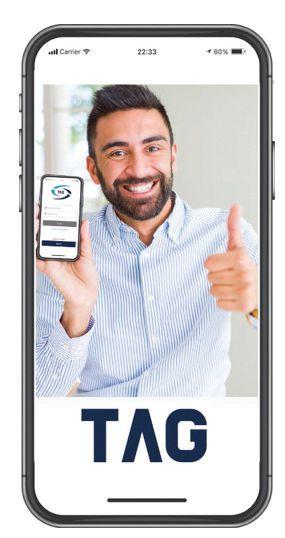
platform,” says Shvarzman.
The service is currently available in Ontario’s Golden Horseshoe and across the Greater Toronto Area.
TAG Dispatch is also expanding to Vancouver, Langley and Burnaby in B.C. and in London, Ont.
Shvarzman says there are more than 500 Taggers currently signed up for the service. To qualify, they submit an application that includes information about their current guard licence, driver’s licence, work history, etc. Once they have
Patrick Straw, executive director of the Canadian Security Association since 2017, was recently recognized by his peers and fellow CANASA members for his leadership, particularly during 2020 — an especially difficult year for everyone due to the massive challenges posed by the COVID-19 pandemic.

Straw was visiting ADI’s Toronto location on Oct. 22 when he was presented the “Outstanding Commitment” award by branch manager Joanne Rowe on behalf of CANASA members. The presentation was arranged as a surprise for Straw.
“You have shown support to all member companies, improved relationships with police services and been an
open door of support to the industry,” said Rowe during the presentation.
“During the challenges of COVID-19, you have maintained momentum on key association initiatives and been a needed resource during a very difficult time.”
CANASA also recently announced its annual awards, acknowledging members and volunteers for their service to the organization (see CANASA Update column on p.11).
completed TAG’s training course and are approved, they are sent a TAG branded safety vest and running lights that can be affixed to their vehicle.
Shvarzman declined to say who the app’s current customers are but confirmed that several central stations are already using the service. There are no set-up fees or monthly billing, he says — customers follow a pay-as-you-go model. The Taggers are paid per alarm call they attend.
Shvarzman, who was an alarm dealer for more than 18 years, says he’s familiar with many of the industry’s pain points such as false alarms and slow response. “When I designed TAG, I designed it with the dealers in mind. It was to solve problems for the dealers…. I was struggling with a lot of those issues that dealers are struggling with every day.”
The service was launched in March — not an ideal time to start a business, acknowledges Shvarzman. A self-described people person, Shvarzman says he prefers in-person contact and faceto-face networking. When the COVID-19 pandemic brought all that to a swift end, he resorted to video-conference meetings, as so many other businesses have done.
While the circumstances may be unusual, they have not stifled business growth, he says. Residential alarm owners may have been home most of the time during the earliest months of the pandemic, but many commercial businesses sat vacant, requiring additional guard response to any alarms that may have been triggered. When life eventually returns to normal, and more people go back to work, that will even out over time. He anticipates a roughly 60/40 split in commercial versus residential business over the long term.
— Neil Sutton


RV centre tracks vehicle access with mobile credential

Oregon-based Guaranty RV Super Centers, a dealer of recreational vehicles, has selected a mobile credentialing solution to help secure and track keys.
The company is using the TRAC-Box key management solution from Supra (part of the Carrier Corp.). The solution offers means for tracking the keys and fobs used to open vehicles. Each TRACBox uses Bluetooth to communicate with Supra’s eKEY mobile app on smartphones carried by Guaranty sales associates. To unlock a keybox, the staff enter a PIN code into the app and remove the keys from a built-in container.
Reporting also tracks the frequency of RV showings, enabling management to see which RVs are most popular and reposition them accordingly.
“With the Supra TRAC-Box, we’ve improved security and gained valuable sales and marketing insights,” said Marty Nill, managing partner, Guaranty, in a statement.

Restaurant group updates communications backbone
Thrive Restaurant Group, one of Applebee’s largest U.S. franchisees, recently deployed an updated network, communications and security infrastructure. The solution includes a secure SD-WAN architecture with network upgrades, 4G/LTE wireless capability, unified communications as service (UCaaS) with cloud-based VoIP and a business security systems platform.
Thrive, which operates 81 restaurants across 10 states, deployed a network and communications backbone utilizing Interface Security Systems as a managed service provider. Interface implemented a secure SD-WAN architecture with network upgrades for connectivity between all of Thrive’s locations. The company also provided a secure video surveillance platform with remote viewing.



• The SecurTek Monitoring Solutions board of directors has introduced Katrine White as SecurTek’s new president and CEO.
• Toronto-based Patriot One Technologies Inc. has announced the appointment
Medical clinic deploys selfscreening tablets
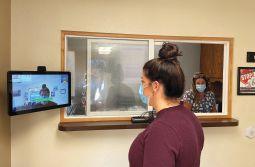
A Washington medical clinic is using a self-service temperature checking device to allow visitors and guests to scan themselves before entering the premises.
“As a medical provider, we have to see patients who are potentially infected — whether it’s with COVID19 or the flu — while protecting those waiting to be seen,” said Mary McAllister, rural health clinic manager at Willapa Medical Clinic, in South Bend, Wash., in a statement. The health centre has deployed the TAURI temperature check tablet from Glory Star. The unit senses patients as they approach and scans their temperature from up to three feet away. Results are available in less than three seconds, according to the manufacturer. The tablet’s sensor provides a temperature accuracy of +/0.3 °C. When a temperature is detected, a chime sounds to let staff know to move a patient into an exam room.

of Peter Evans as CEO. Former CEO Martin Cronin continues on with the company as a director.
• Frank Hayes joins Finlandbased digital locking company iLOQ as Canadian country manager. Hayes was inducted
Jan. 11-14, 2021 CES Online www.ces.tech
Feb. 10, 2021
Security Summit Canada Online www.sptnews.ca
Feb. 28 - March 4, 2021
BICSI Winter Conference Online www.bicsi.org
March 4, 2021
Security • Police • Fire Career Expo Online www.canadiansecuritymag.com
June 15-18, 2021 ESX Louisville, Ky www.esxweb.com
July 19-21, 2021
ISC West Las Vegas, Nev. www.iscwest.com
Aug. 22-26, 2021
BICSI Fall Conference Las Vegas, Nev. www.bicsi.org
Sept. 27-29, 2021
GSX Orlando, Fla. www.gsx.org
November 17-18, 2021
ISC East
New York City, NY www.isceast.com


into the SP&T News Hall of Fame in 2019.
• Anna de Jager has joined TAG Dispatch Inc. as managing partner and COO. De Jager has more than 20 years of security industry experience.
• Opengear has appointed Joel
Sheppard as regional sales manager for Canada. In this role, Sheppard will lead sales and strategic partnerships throughout the region.
• Greg Brazas has returned to the Reilly’s Lock and Security team as director of sales.
ADI Global Distribution recently opened its second branch location in the Toronto area — a 10,000 sq.-ft. facility in Scarborough, just east of the city, offering customers an alternative to the existing branch located in Etobicoke to the west.
ADI now operates 10 branches across Canada. The selection of new potential branch locations is “a pretty well-oiled process,” says Doug Adlam, general manager, ADI Canada.
“We made it a point to mirror the product assortment in the two branches.”
— DougAdlam,ADI
“The Greater Toronto Area represents one of the largest markets in North America. We really felt that by opening a second location, ADI is better able to serve dealers across the city and surrounding areas.”
The east-west balance offered by the Etobicoke and now Scarborough locations addresses some of the travel challenges of getting across the city, adds Adlam, giving dealers the option to visit a location that makes the most sense for them. The two branches are also similarly stocked. “We made it a point to mirror the product assortment in the two branches to provide our customers with a seamless buying experience, no matter which branch they go to.”
The new Scarborough branch is managed by ADI veteran Ed O’Hearn, and several staff from the Toronto location have already transferred over. “That’s one of the things I’m really pleased with — our ability to develop internal talent to support our expansion in the new markets,” says Adlam.
The branch features 24-hour pick-up lockers and an express window for customers who have placed orders in advance.
It also adheres to the pandemic protocols that the company has adopted for its other branches including: face coverings for all team
When TELUS Custom Security Systems acquired ADT Canada, they locked down their leadership in the home security industry by combining the nation’s best wireless network with 125 years of reliability and service.
“Now that we’re well-positioned to expand our commercial enterprise market footprint, I am pleased to announce the appointment of Dan Marston, Director of Commercial Sales, Eastern Canada and welcome him to the TELUS team,” says Sean Thompson, VP, National and Commercial Accounts. “With his extensive industry leadership and knowledge, Dan brings the ability to marry our best-in-class networks with our exceptional install and service capabilities. This unique value proposition is one that Dan and I are excited to share with our new and existing customers to enhance what is most important to TELUS, our customer experience.”
According to Marston, “With TELUS best-in-class national highspeed network and robust technology solutions, combined with 125 years of installation and service excellence in our ADT brand, we are confident that our team is fully prepared and destined to succeed.”
“I recognize this appointment as an opportunity to capture the unique service excellence of TELUS coupled with advanced security solutions aimed at enhancing safety and satisfaction.
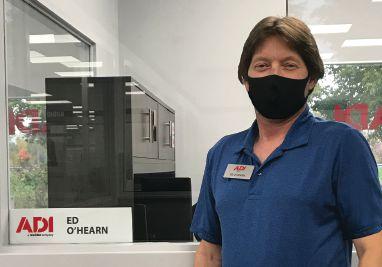
members, plexiglass shields at checkouts and pick-up counters, hand sanitizing stations, signage promoting social distancing, floor markings to direct foot traffic, and increased cleaning for high-touch areas.
Regarding the possibility of further Canadian expansion for the company, Adlam says, “we’ll continue to analyze future market opportunities.”
— Neil Sutton

We are confident TCSS will offer a service level and culture that will strengthen the loyalty of both our current and future customers and our valued team members.”
Over the last 30 years, Dan and his teams have successfully managed large commercial security companies to grow their business through the latest security technologies and service excellence. Dan’s professional track has seen him hold executive-level positions at Diebold Canada, Securitas Electronic Security and most recently, Avante Logixx.
Is it time for your organization to conduct a high-level assessment of your Enterprise/Commercial security and cloud-based technology needs? If so, connect with TELUS Custom Security Systems.
Dan Marston 647.212.8508 danmarston@adt.ca Regional Sales Director – Commercial TELUS Custom Security Systems (TCSS)

IBy Victor Harding
B.C.-based Price’s Alarms is a great example of a Canadian success story in the alarm and monitoring industry
want to pay tribute to the Price family — Bob, Peggy and Kevin — for the truly amazing job they did in building Price’s Alarms over many, many years into one of the premier alarm dealers in Canada.
“As a family, the Prices will be sorely missed in the Canadian alarm industry.”
As many of you know, the Price family recently sold the company to Telus. Before they sold, Price’s was the largest independent alarm company in Canada and would have stacked up against many large U.S. independents. On top of that, they were an active buyer of alarm accounts.
For me, as a broker, Price’s was always a potential buyer for any block of accounts I had for sale on Vancouver Island, any part of the B.C. lower mainland and even into the interior of B.C. What was good about dealing with Price’s is they liked to buy, they knew how to buy, they had the money to buy and, most importantly, they were not afraid to pay a full price for a good set of accounts. In my field, these are all important factors.
As a reasonably active and successful buyer, there may be things to learn from Price’s approach to acquisitions. Bob Price told me he often bought in order to get into a new market or establish a new office. They did this when they first came to the B.C. lower mainland from the Island. On the Island, where they were a dominant player, Price told me they were motivated by the opportunity to “enhance our current base” or build density. It did not hurt that they were also taking out a competitor. The multiples they paid, which varied between 30-40X RMR, depended not so much on the mix between residential and commercial but “on the strategic importance of establishing a new market or gaining dominance in an existing market,” according to Price. Finally, he indicated that in the earlier years, acquisitions really contributed to Price’s growth but in later years, acquisitions were needed because organic growth was not able to stay ahead of normal attrition.
As a family, the Prices will be sorely missed in the Canadian alarm industry.
Switching gears, because I have been quite

busy these days doing alarm account deals, I want to pass on some more advice to those who still own monitored accounts and think they might want to eventually sell them. You will have heard some of this from me before.
Alarm accounts in Canada are still selling despite the pandemic, and so far at prices close to what they have always sold at. But note that south of the border the market for alarm accounts is cooling off, and not because of the pandemic. My take is multiples just got too high and attrition started to climb. Whether that trend comes to Canada remains to be seen. Certainly the market for alarm accounts in Canada is not as crazy as it used to be. Buyers are being more discriminating.
I have noticed it is much harder today to sell smaller blocks of accounts, i.e. blocks under 300. These smaller blocks are selling to smaller buyers at lower multiples. Some of the bigger buyers won’t touch anything under 500 accounts; the transaction costs are too high.
There is a divide starting to show in the market between what I will call “old” accounts and “new” accounts. Old accounts tend to be priced lower (average price under $25/month), are on older panels and do not have cell or Alarm.com service on them. New accounts tend to be higher priced ($30/month or higher), have newer panels installed on them and a higher percentage of cell or Alarm.com installed on them. Amazingly enough, some dealers still think they can install an alarm panel, not touch it for 15-20 years and expect to get the same price for that account as an account with newer panels. If you want a decent multiple for your accounts, upgrade your panels.
Here are some other trends. Commercial accounts seem to be in more demand than residential. The telcos like Telus, Rogers and Bell are dominating the residential market more and more with offers that independents cannot touch. If you don’t have signed contracts on your accounts, don’t bother trying to sell them. If your accounts are programmed to your station’s line, be prepared to have to move them to the buyer’s station. If they are priced under $25/month, be prepared for a lower price.
As for the billing function, it is amazing to me that more alarm dealers have not moved their customers to monthly pre-authorized payment (PAP) and still bill their accounts annually by invoice! Not only is PAP a less expensive way to bill, the stats show that there is less attrition and buyers will love you. Finally, annual billing is also a complete pain when it comes time to sell because the seller almost always thinks the resulting large deferred revenue deduction is unfair.
My last two tips are about price expectations and getting advice. Too many dealers have unrealistic expectations of what their accounts are worth. If you are selling 250 accounts, don’t expect a multiple of 35-36X RMR. Think 30X. If you are selling 1,000 accounts don’t expect a multiple of 40X. Think 35-36X.
Lastly, there is a lot more to selling a block of alarm accounts than some dealers think. To get the best possible deal, you need to canvass several buyers, not just one or two.
Victor Harding is the principal of Harding Security Services (victor@hardingsecurity.ca).
By Patrick Straw
We may not be able to celebrate their accomplishments in person, but we applaud their dedication and service
Each year, CANASA presents awards to the exceptional people who contribute to our association, and more importantly to the standards and integrity of our industry in Canada.
In my almost four years here, I am still overwhelmed by the amount of time and dedication that these people commit. From our board of directors, our team at the CANASA head office and from all of our members across Canada: THANK YOU!
R.A. Henderson Award: Don Budden, Atlantic Security Automation Partners Canada Inc.
This award is given to a member of CANASA who has demonstrated extraordinary achievements in the security industry. Don has been a champion of our industry for decades and his dedication and commitment are unmatched.
President’s Award of Excellence: Neil Jones, Tyco Security Products
I think it goes without saying that Neil’s support, time and overall dedication to the association have been integral to the continued success of CANASA.
Outstanding Contributor Award: Gordon Hebb, Wilson Security Ltd.
Gordon’s initiatives on the National Board reflect an open-minded view and willingness to bring our association to the next level through leveraging technology and the combined experiences of our volunteers.
Outstanding Contributor Award: Patti Jones, Telsco Security Systems Inc.
Since Patti began her term as president of the Northern Alberta Regional Council, not only have the region’s member meetings been some of the best attended across the association, she has managed to repair and improve the relationship between the association and the Edmonton Police Service.
Outstanding Contributor Award: Michael Polo, Hall Telecommunications Supply Ltd.
Mike has been a resource for fellow CANASA members and staff and we are thankful for his dedication to the association.
Regional Council of the Year: Eastern Ontario Regional Council
The Eastern Ontario Regional Council has showcased what CANASA is all about. Thank you, Chris Izatt, and the rest of your council for such outstanding dedication and engagement.
Public Service Partner: Wendy Drummond, Toronto Police Service
With many Ontario police services investigating best practices for alarm response programs, Wendy went out of her way to share the experience with the TPS. She participated in our Monitoring Symposium and is still active with her new role in human resources and recruitment.
Patrick Straw is the executive director of CANASA (www.canasa.org).

By Colin Bodbyl

TAugmented reality is a largely unexplored but potentially game-changing technology for surveillance
he term “augmented reality” (AR) was coined in 1990 by a pair of researchers at Boeing who were tasked with finding an alternative to the expensive design and marking boards used to display a plane’s schematics.
“AR has barely begun its journey into the video surveillance industry.”
The two created a headset that could project a computer-generated visual of the diagrams. Since then, AR has become a revolutionary technology for applications ranging from video games to surgery, but the video surveillance industry is yet to be impacted by it.
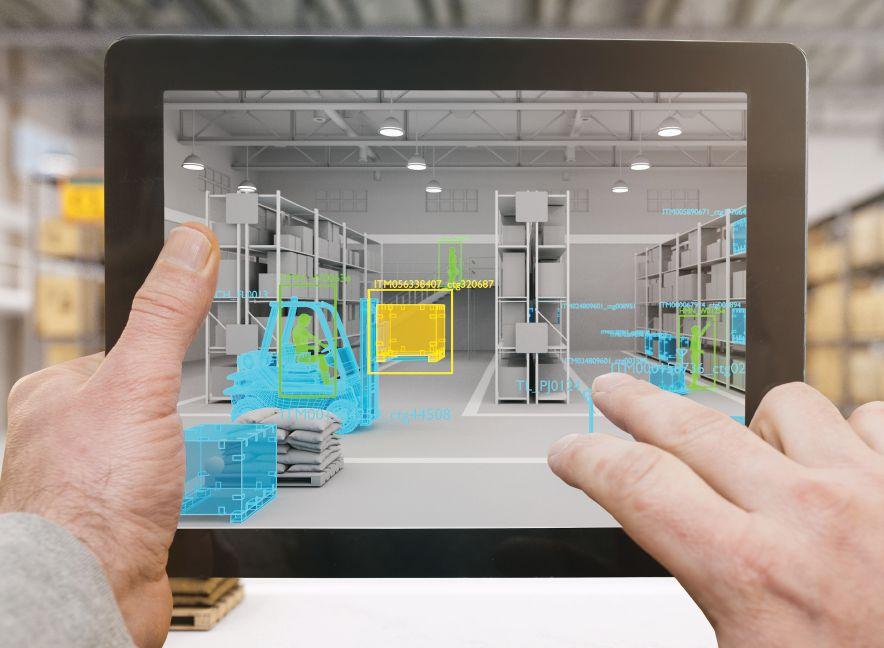
For those unfamiliar with AR, it can most simply be described as an artificial layer on top of what a person perceives as reality.
Today augmented reality covers a broader spectrum of technology including audio and touch applications, but those use cases are not well known. Instead, most of us will know AR from games like Pokémon Go or design apps from companies like IKEA that let you see through the camera on your phone what a piece of furniture would look like in your home.
A very small number of video surveillance manufacturers have started using AR to layer information on top of camera feeds. Details like streets, buildings and business names are layered over the camera feed to help security personnel recognize key landmarks in a scene. Of course, this can be very useful in certain applications, but AR will have far more interesting appli-
cations in the future as video surveillance technology improves.
One area of video surveillance where AR could help is the tracking of objects as they pass from one camera view to another. Imagine a scenario where a suspicious person is detected by a camera on the outside of a building and it appears that they are attempting to break-in through a locked door. Anticipating the break-in, a security operator might choose to switch to a view from a camera that is on the inside of the building facing the same door. The challenge becomes that the operator now needs to watch two cameras simultaneously to monitor the activity in case the suspect gives up and moves on to another entrance point.
Using AR, it would be possible to take the silhouette of the person captured on the outside camera
and layer it onto the view of the camera from inside the building. This would give security personnel an almost x-ray view of the door where they could see where the person is on the outside of the door, but from the inside camera. Now imagine applying that same AR across all cameras. Staff could easily track objects, including ones that might be hidden or obscured in the view they are currently watching.
The same technology could also be used to enhance the nighttime capabilities of a camera. Complementary technologies like radar or asset tracking can pinpoint the location of an object and are unaffected by light or weather conditions. By integrating the information from these sensors with the surveillance system and then using AR to layer that data over the camera view, a nighttime image
with poor lighting could suddenly be populated with critical information about the location of specific items in the scene.
By now most people have had at least some experience with AR, either through a video game or a software application on their phone.
While it may be old news in the gaming space, AR has barely begun its journey into the video surveillance industry. In the future, we are likely to see AR become a complementary tool for traditional video surveillance cameras. Just as video surveillance allows people to see into multiple spaces at once, AR may someday allow us to see through the visual confines of those spaces.
Colin Bodbyl is the chief technology officer of Stealth Monitoring (www. stealthmonitoring.com).



Since 2015, SP&T News has celebrated the milestones and careers of security industry professionals who have made a difference to their communities, customers and staff — leading by example through their entrepreneurship, ability to face adversity, and generosity of spirit. In a year like 2020, these qualities are more important than ever.
The Hall of Fame inductees this year are Kristin Crowe, Ron Jagmohan and Gary Armstrong. As leaders, they all bring different perspectives to the table but also share some common traits — notably their enthusiasm for the security industry. Please join us in celebrating their accomplishments.

At 16, most people are thinking about graduating high school with an eye towards post-secondary education or maybe even some career plans. Gary Armstrong was buying his first company.
Armstrong was already working in the company part-time: a fibreglass business that made canoes and truck caps. He bought the company in 1978, with the support of his father who mortgaged his house to help finance the deal. From then on, the only boss Armstrong would work for was himself.
other 10 years for Armstrong to fully pay off his creditors. Other business owners might have thrown in the towel, but Armstrong was undeterred and his resolve earned him the respect of at least one business partner. Armstrong had purchased the windows and doors for his new factory from a supplier in Indiana. He says the owner and his wife, then in their 80s, drove up to New Brunswick and handed Armstrong a cheque covering all the interest he had paid them over a decade, plus more.
“I always tell people, be true to yourself,” says Armstrong. “Be as straightforward as you can with people. Perseverance, dedication and hard work … if you get knocked down, get back up. And certainly understand your own strengths and weaknesses, no matter what kind of company you run.”
His path to security began in the late 1980s, when Armstrong developed an interest in supplying two-way audio devices to assist the elderly and designed the technology with a business associate. He acquired a Fredericton-based answering service and subsequently moved into the alarm monitoring business in 1989. The facility became ULC-certified in 1994. The company opened a central station in Halifax in 1997, replaced it with another more modern facility in 2002, then a fully bilingual Moncton station followed in 2003. Armstrong’s expanded westward in 2019 with the acquisition of a central station in Edmonton (that station has since been fully renovated).
“Over the years, you learn a lot. I have surrounded myself with really good people.”
Armstrong has since established and run multiple companies, including the one he is best known for in the security industry: Armstrong’s National Alarm Monitoring, based in Coal Creek, N.B., which provides third-party alarm monitoring to more than 700 dealers across Canada.
Armstrong also owns and operates Armstrong Enterprises, a property management company with holdings across Atlantic Canada, and Renewables NB, a geothermal energy company, serving clients in New Brunswick.
The road to this success was not easy for Armstrong. He can recall occasions in his early years of running a business when he and his wife Jennifer were grateful to be invited over to one of their parents’ houses just to be assured of a good meal.
When Armstrong was about 23, there was an explosion at the fibreglass factory he had invested so much of himself in. The facility was eventually rebuilt, but it would take an-
Armstrong established the geothermal business in 2008 after he took a university course offered by the Canadian Geothermal Coalition. His initial interest in the subject came from his desire to harness geothermal energy for his own facilities. He did that and more. “It ended up that we built probably one of the biggest geothermal companies in all of Atlantic Canada,” explains Armstrong enthusiastically. “We’ve got 165 or 170 installs. We do big buildings and commercial buildings. I’m involved in a lot of design work now.”
Today, Armstrong splits most of his time between geothermal and security — clearly passionate about both. (When SP&T interviewed Armstrong for this story, he was in Fredericton, overseeing a geothermal installation project.)
“Over the years, you learn a lot. I have surrounded myself with really good people,” says Armstrong. Over the course of the interview, he refers repeatedly to Dan Small, general manager, hired by Armstrong more than 27 years ago; Kim Caron, business development man-
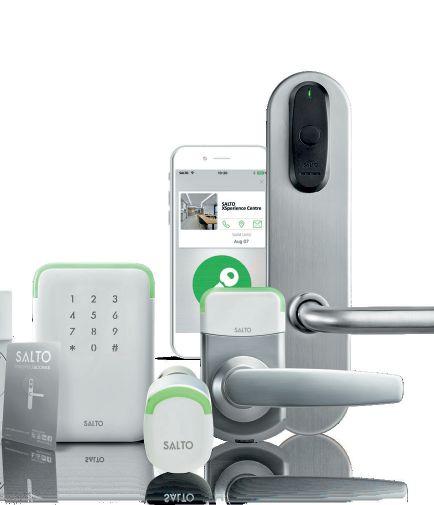
SMART LOCKS DESIGNED TO FIT YOUR BUILDING’S NEEDS.
Realising tomorrow’s keyless buildings today with innovative thinking and advanced mobile-based access control technology.
ager, who has been with the company for over a decade; and his son Colin, who joined the family business in 2006 as Moncton station manager.
“When I see a good person in the industry, I try to get them,” adds Armstrong, “whether it’s the geothermal industry or the alarm industry, or even the property management side.”
Colin Armstrong was appointed as the company’s CFO in 2019, taking over for his mother
Jennifer Armstrong, who served in that role for many years until she passed away last December following a diagnosis of cancer.
Gary Armstrong says he has seen the security business change significantly in the 30-plus years he has been involved in it — from the early days when everything was “run off ticker tape and a Rolodex” to today’s innovation and the entry of more and more mass market
service providers and telcos. As difficult as the pandemic has been, Armstrong — ever the optimist — is mindful of the rapid acceleration in technology and the work-from-home cultural shift that has occurred as a result.
“I believe in this industry,” says Armstrong, assessing the totality of his career. “I’ve got lots of good friends in the industry and I have really enjoyed it.”
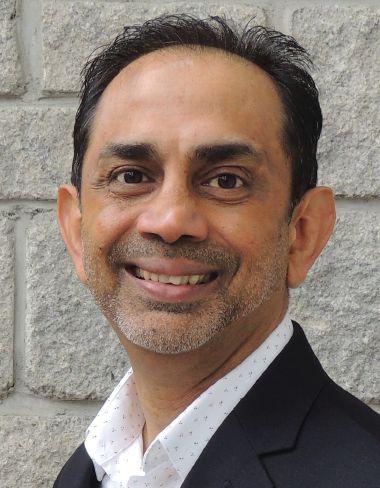
Ron Jagmohan says there are two common threads that run through his 30-year security career: learning and leadership.
“[They] have always been at the core of everything I do,” says Jagmohan. “It was not until later in my career that I realized these two things go very well together.”
In 1989, Jagmohan emigrated to Canada from his native Guyana, where he had served as a military officer working in aviation.
The economy was in the midst of a downturn in the early 90s. “Aviation was doing poorly, so I couldn’t get a job in my field. And security was doing quite well. That sounds familiar, doesn’t it?” says Jagmohan, with a knowing reference to the security industry’s reputation for stability during times of crisis.
Jagmohan took a job at Europlex, a maker of intrusion systems, and learned the business under the tutelage of George Watson. “I learned a great deal,” he says. “George is a great mentor and teacher, so I got my feet wet there.”
In 1994, distributor ADI took on Europlex as a vendor and Jagmohan joined the company as a subject matter expert on commercial intrusion systems. “It was a special role created for me,” by another major figure in his career, Ken Hall, says Jagmohan. (Hall would serve as a mentor to many during his own legendary security career, tragically cut short by cancer at age 51.)
“I just fell in love with what I was doing and [I had] a lot of transferable skills,” he says.
Working at a distribution business in the 90s
exposed Jagmohan to many new categories of security products, as well as a variety of different vendors and customers, and he absorbed as much information as he could.
“It was a huge learning curve for me and I was just a sponge,” he says.
In 1997, security manufacturer Ademco was looking to establish a presence in Canada and Jagmohan was recruited to kickstart the business here.
“That was a really cool experience, starting off as the first employee,” he says. “We were huge in the U.S. [but] we were more or less a start-up in Canada, having that backing from a large company in the U.S.”
Jagmohan built his own team at Ademco Canada. A few years later, in 2000, the company’s parent organization was acquired by Honeywell and “we moved from [being] a Fortune 500 company to a Fortune 100 company. Everything changed, of course, under the Honeywell umbrella, but it was gradual.”
As the new millennium dawned, the industry began to slowly change too, with the emergence of IP-based and wireless equipment. Jagmohan became an early advocate of network technology, but he says it was an uphill battle to convince some industry veterans that it was a good fit for the security business. “I remember technicians telling me, ‘I don’t need a wireless system. I can fish a wire anywhere I need to,’” he says.
ber of people I have trained and certified with the ATC program over the years,” he says.
Jagmohan says he worked with CANASA consistently for about 20 years before stepping away to focus on his growing responsibilities at Honeywell. But Jagmohan recently returned to the fold and rejoined the education committee for CANASA as director-at-large, then as committee chair. He is now in the process of revising the ATC program to reflect new technology.
“The scope of the industry has changed tremendously. We need to teach things like networking [and] all kinds of wireless technologies… There’s much work to be done in terms of bringing that program up to 2020,” he explains.
In 2018, the Honeywell organization spun off its homes and ADI businesses under a new name, Resideo Technologies, and Jagmohan’s new title with the organization is global training leader. “The scope has expanded and the scope has changed,” says Jagmohan of the transition, “but it’s about not only learning [for] myself but developing a team, empowering them, giving them the opportunity to unlock their potential and also become leaders.”
“Pay close attention to this industry. This is certainly a place that you want to be.”
But Jagmohan persevered, believing IP systems to be the future of the industry. His interest in technology branched into an advisory role with Underwriters Laboratories Canada (ULC), where he served on several committees: the S500F committee for fire alarms, S300A for intrusion alarms, and as chairman for the S559 working group, a standards group for fire alarm monitoring equipment. Jagmohan’s participation with ULC spanned from his early days at ADI until he stepped away 2018.
Jagmohan has also been an active member of the Canadian Security Association (CANASA), particularly on the education side.
He credits industry veteran Mark Fairley for getting him involved with CANASA’s alarm technician course program, first as a student and eventually as an instructor. “I’ve lost count of the num-
Jagmohan says he values the diverse skillset amongst his team members, which makes the overall organization stronger.
Jagmohan’s curiosity for new technology has never faded over the years he has been engaged with the industry. Security has changed a lot over the decades, particularly in recent years. “I think our industry is growing up. People respect it. I also think it’s growing up from a business perspective,” says Jagmohan, noting the number of large companies and telco providers that have demonstrated a renewed interest in security. “They’ve brought a different level of engagement, not only with employees but with customers and how business is done in general. I see that as a certain degree of maturity.”
His advice for young people considering a career in security? “I would say, pay close attention to this industry. This is certainly a place that you want to be….There is lots of opportunity for someone to make this a home, make this a career and be extremely successful. I would say, jump in with both feet.”

For Kristin Crowe, security means family and community.
Kristin’s brother Kevin Reynolds has traced their family line all the way back to 1803 (there’s a rich history on the Alarm Systems website). But their security story began in the early 1960s when their father Glynn Reynolds, an electrician by trade, started an electrical company, Andreynolds. An entrepreneur at heart, Reynolds expanded into the alarm business in 1972 with the establishment of Alarm Systems. He also acquired T.A.S. (Quinte) Co. Ltd., the nearby business that was receiving the alarm calls. The two companies, Alarm Systems and what is now T.A.S. Communications, remain in the family today, serving Belleville, Ont., the Bay of Quinte Region, as well as most of southeastern Ontario.
family as well as my dad’s business partner … to make sure that this person — Kristin Crowe — was going to be able to come in here and run the company successfully and grow the company. It was a very interesting time. Lots of difficult decisions,” she says.
Glynn Reynolds passed away in 2008, leaving Crowe and her brothers Kyle and Kevin as co-owners. Kyle focuses on the business’s finances, Kevin works as a licensed electrician and technician, with Crowe in charge of operations.
“I miss him dearly,” Crowe says of her father. “He was an inspiration and certainly a fabulous role model, not only within our family but also in the community and as a business leader.”
As the newly-installed president, Crowe spent most of her time on the communications side of the business. Security came into much sharper focus, she says, following the acquisition of Brockville, Ont.-based Falcon Security in 2007. According to Crowe, the former owner of Falcon, Russell Chartier, felt strongly that the company should align itself with a similar-sized business that serves a community.
“This is the core,” says Crowe of the twinned Alarm Systems and Falcon businesses. “I made the decision that this is going to be who we are.”
“The more people you connect with, the more doors will open.”
The company has grown and enjoyed some big wins since then, says Crowe, including several contracts with the Department of National Defence. The company also recently installed the security systems for a new police station in Belleville.
Crowe first got involved in the family business in high school, primarily working for the answering service. When she graduated, she decided to leave Belleville and blaze her own trail. She worked at a retail company for a dozen years, ultimately as a national sales manager, based in Toronto while routinely travelling the country for business. “I lived and worked all over Canada. I learned that industry and loved it, I absolutely loved it,” she says.
When Crowe was ready to start a family, she looked homeward and resettled in Belleville full time. “I decided to come back [and] be closer to family and simplify my life a little bit,” she says.
Working in the family business again wasn’t immediately on her mind, says Crowe, but when her father bought out his business partner in 2001, the company went through a reorganization and needed a new leader. “My dad and my two brothers came to me and said, ‘We need somebody to sit at the helm of the business.’ That’s sort of where it all began.”
Crowe took over as president of both companies, leaning on her sales, marketing and business expertise from her years in the retail industry.
“It was kind of an interview process with my
Alarm Systems expanded again in 2018 when it opened a new signal receiving station and contact centre in Belleville, utilizing property than was purchased by Glynn Reynolds almost 50 years ago.
As a female business leader and company owner in the security industry, Crowe says she has often found herself to be the only woman in the room. But the industry is changing, says Crowe, as more women enter the profession. She is a strong advocate for mentorship in the industry and advises young women to pursue networking opportunities whenever possible. “You’ll find some people you connect with. And the more people you connect with, the more doors will open and the easier it gets,” she says.
As much as the business grows, it will never lose its focus on serving its community and customers, says Crowe, and the ongoing pandemic has only underlined that philosophy. “We protect people and property. It’s what we do. It’s been all about keeping our customers in the community safe, keeping our employees safe. That’s been at the forefront during all of this.”
— Neil Sutton


It goes without saying that this has been a challenging and in many ways exhausting year.
Everyone, regardless of their profession, title, company or industry, has had to adapt to new circumstances and in many cases learn new skills. SP&T News reached out to security service providers, vendors, integrators and monitoring professionals and asked them to provide some insight into what they have learned during the pandemic. We asked them to tell us how they have adapted to meet their employees’ and clients’ needs and this is what they shared with us.

Andrew Elvish, vice-president of marketing, Genetec
The security industry excels at planning for the unexpected, and while the pandemic took the world by surprise, our industry has shown extraordinary resilience and resourcefulness. We have seen so many of our customers and partners quickly adapt to the new needs and challenges posed by the situation. They’ve been able to repurpose
and adapt their existing security infrastructure to meet some of the new challenges created by the pandemic. Some of our hospital customers, for example, started using Security Center along with intercom-enabled security cameras in patients’ rooms attached to IV poles to enable medical staff to speak directly with patients and conduct basic visual medical assessments without entering the rooms. This smart, quick fix decreased the risk of transmission and conserved their limited PPE supplies while making use of existing security infrastructure.
We at Genetec have also had to adapt quickly. When we moved our entire global workforce to work from home overnight in mid-March, we were immediately operational because we already had the technology and cybersecurity protocols in place to ensure all our employees could safely access the tools, critical systems and
information they needed to do their jobs from home. Over the last few months, we have also put a lot of emphasis on supporting our employees to foster a continued sense of community. We have weekly townhall meetings with our president, mental health support, health and fitness programs and even team cocktail hours and virtual cooking classes led by our company’s chef and the kitchen team.

For TSI, it has been business as usual. TSI’s work from home policy was already well-established years before the pandemic, so in that regard, there has been no disruption to the dayto-day business. For me, not being able to meet clients face-to-face was my biggest challenge, but in this new reality, client phone calls and virtual meetings on Teams/Zoom/Skype have become the new way. At the beginning of the pandemic, for the most part, our clients’ facilities were on stand-down to the point where projects in progress where stalled and only essential service calls were being approved. TSI’s approach has been to keep well-connected with our clients to ensure that they know we are there for them. This is a priority for TSI and has become more important than ever. I believe the biggest lesson learned during the pandemic, both from a personal and a business perspective, is adaptation.

Although the COVID-19 pandemic is not considered a typical disaster situation, our experience in disaster recovery services was effective in helping monitoring centres handle the challenges of managing their systems remotely. Equipment remained functional in offices, but signals were still coming into receivers without people onsite to manage them, so we approached this as an evacuation. By early April, when most of the U.S. and Canada was in lockdown, we enabled over 50 companies and their employees to manage alarms and events with the same efficiency and procedures they would follow as if they were in the office.
We excelled in being an IT team for smaller to mid-size companies that didn’t have the resources to transition to remote working on
“Realizing trends and creating new, effective and relevant processes is paramount for business continuity.”
— Carl Jorgensen,Titan Products Group
their own and helped them with our infrastructure and technology. We also had customers with 100,000 to 200,000 accounts and 30 to 40 operators on a shift that needed to be on the same automation package. Our team was able to transition all of them to working remotely without interruption, which goes to show the importance of planning ahead and making sure the right procedures are in place for anything that could come your way.

Adopting a “new norm” in 2020 has proven to be very challenging in our personal and professional lives.
The uncertainty of economic stability and social limitations has left us living our lives day by day. However, it has also opened the doors of opportunity so we can attempt to create new realities. Realizing trends and creating new effective and relevant processes is paramount for business continuity.
Titan Products Group has modified our business processes to connect with our customers — relationships are key to our success. Virtual meeting and online collaboration tools have been integrated into our sales process for qualifying and discovery so we can be extremely productive with compliance and negotiation. Increased return on time invested (ROTI) was the result of utilizing virtual communication methods because of social distancing and government guidelines. This has proven to be good for our business.

As a service provider and employer resident we were forced to learn quickly how to operate in a COVID environment. First and foremost was protecting our employees so we could maintain service delivery to our clients.
News coverage of the pandemic was omnipresent. Discerning accurate information from propaganda became a challenge so we relied
“First and foremost was protecting our employees so we could maintain service delivery to our clients.”
— Roger Miller, Northeastern Protection Service
heavily on the provincial and federal public health officers for clear, accurate, up-to-date information. As their directives changed, we learned to pivot and adapt to the changes. One example of this is the wearing of masks. Initially masks were not being recommended so we didn’t adopt that step. But as masks became required, we adjusted.
Clear communication with employees, clients and suppliers to ensure we were meeting each other’s safety needs was critical to our continued work flow. Submitting COVID screening forms became the status quo for our service team. We are now about eight months into the pandemic and I have to congratulate each member of the Northeastern team for exceeding client expectations daily. Our pandemic plan has so far been successfully tested in real-time and met our expectations.

Greg Harman, regional director of sales, StoneLock
COVID-19 has transformed the preconceived notion that virtual conferencing is a detriment to successful business relationships. Throughout the last seven months, StoneLock’s adaptation to online engagement has paved the way for quality and timely interactions with customers around the globe. The collaboration that used to occur in-person on a yearly basis is now facilitated virtually on a monthly or even a bi-weekly basis. This feedback loop has created a faster iteration process to provide exactly what our customers need in a significantly expedited manner. Our ability to communicate more efficiently, execute faster, and build strong relationships virtually have far surpassed expectations.
COVID-19 has been a reminder to our team at StoneLock that, at the end of the day, providing security technology that addresses the prevalent needs of family and friends is what keeps us developing innovative products that address real-world security problems.

Keith D’Sa, country manager - Canada, Axis Communications
Like many others, Axis Communications has shifted to remote work, employees and partners balancing their personal and professional lives. We have adjusted well to this virtual world because our focus has been
“We have an amazing team, and dealers that have been very supportive, and for this we want to thank everyone.”
— Kim Caron,Armstrong’s NationalAlarm Monitoring
on four pillars: people and culture; processes; technology tools; and phased planning.
Axis prides itself on its culture. We have worked to stay connected with our people including weekly Fika’s (Swedish for coffee break) and socials. We look for ways to engage and motivate employees through sharing a purpose for the organization and a supportive environment. We also take the extra step and use video during our calls to help us stay connected with each other. Some employees have seen incredible changes in their roles; some of our sales team are taking to blogging and others are learning new responsibilities.
Working remotely is still work and sometimes one forgets that. I would say that although it can be draining and difficult — take some time for yourself and encourage your colleagues to do the same to help maintain a good worklife balance. This pandemic is not going anywhere for now, so it’s best to get comfortable and prepare for the long race.

Kim Caron, director of business development, Armstrong’s National Alarm Monitoring
It seems like yesterday we were on a work trip when COVID started to heat up. We were heading home on Friday, March 13, when our world at Armstrong’s changed during a routine flight home. The following 24-48 hours proved to be the start of the new norm and as things unraveled we were in full reaction mode with all staff hands on deck. Over the next few days, we were able to deploy staff home with laptops, phones, headsets, monitors and a complete plan in place.
Were we always planning for this day? We didn’t think we were, however, all the years of preparation with our network and telecommunications infrastructure planning ensured we have the best technology. Our plan was simple: protect our staff while providing a seamless transition to our dealers and their clients.
Fast forward seven months, we are now dealing with hiring staff, keeping communication strong internally and externally, learning and accepting the new norm, which changes daily. Few people have gone back to work and
remain working from home, which makes monitoring alarms harder. It’s not the same world as before and may not be for a long while. We have an amazing team, and dealers that have been very supportive, and for this we want to thank everyone.
I think what sticks out most is how connected and resilient we really are: as a company, an industry and as a society as a whole. When COVID first hit, it hit hard. Everyone was scrambling, people were scared, and there were many unknowns. Then, fairly quickly, businesses began to better assess the situation. Many companies, like ours, were able to re-assemble in a 100 per cent virtual capacity and operate near peak efficiency.
When this started, some customers halted operations. Others moved full speed ahead. We needed to meet people where they were, without expectations. Empathizing with the challenges of not only our customers, but our supply chain partners, and employee family proved essential in helping us navigate the pandemic — lessons that will carry forward after normal business returns.
We also learned the role technology can serve in unknown times. The acceleration of cloud adoption for mission critical business systems, as the technology has proven itself this year, is just one example. Additionally, while it’s safe to say that we’re all “Zoomed” out, the pandemic has shown us how newer technologies can amplify positive and safe customer experiences.

David Price, vice-president, communications & corporate development, Camden Door Controls
To me, the pandemic has clearly demonstrated the value of market and product diversification. We are seeing how the companies that have done well during this time are the ones that have been able to pivot easily to a new set of corporate objectives. This includes changing
“The pandemic has fundamentally changed the skills needed for sales representative success.”
— David Price, Camden Door Controls
the products we sell, the way that we sell them, and in many cases, who we sell them to.
We have also learned that staff working remotely can be incredibly beneficial to our company. Like a lot of companies, Camden Door moved to remote work due to the need to provide social distance between office workers. We were amazed to learn that it not only accomplished that, but actually improved performance, increased job satisfaction, and allowed us to make more efficient use of office space!
The pandemic has fundamentally changed the skills needed for sales representative success. In the past, success has been built on highly attuned interpersonal relationships. This is extremely difficult to accomplish without in-person contact.
Sales success in a post-pandemic world changes this dynamic. Fundamentally, success moving forward will be based (at least in equal parts) on an ability to provide knowledge leadership, and the ability to communicate that knowledge utilizing video, webinars and other internet-based communication technologies.

Steve Danelon, regional vicepresidentCanada, Allied Universal
Allied Universal continues to receive questions from clients surrounding return to workplace safety plans. We are currently offering our clients guidance and tools in order to alleviate any confusion regarding provincial or local regulations. This guidance includes risk mitigation planning and resources, best practices on workplace signage, employee/visitor traffic flow and how to maintain a clean and disinfected workplace as well as temperature prescreening services for occupants entering the property that is tailored to the facility.
During the onset of the pandemic, we received a vast amount of questions surrounding “How can we make sure that our employees/ customers will adhere to provincial or local guidelines we are implementing at our facility?” We realized that our client’s employees/visitors need to feel safe and see that all the required safety protocols have been implemented. This is why we decided to offer our CARE Ambassador program for our clients.
In addition, Allied Universal is constantly looking to hire security professionals and staff across the country. This has been challenging due to the fact that we are hiring during a time of high unemployment coupled with people’s fears about contracting the virus. We knew we had to think and act fast — to explore new ways to hire in this challenging new environment. We decided to launched virtual job fairs across the country. We also leveraged our highly advanced technology to schedule, interview and on-board candidates/new hires remotely.





















































































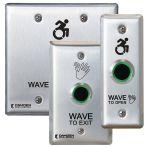
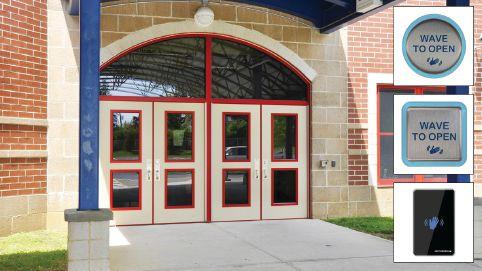
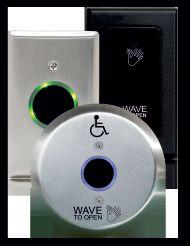
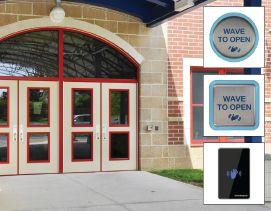
Camden CM-221 Series ValueWave switches help eliminate the spread of germs through the convenience of hands-free activation. Suited for indoor or outdoor use as part of an automatic door or access control system, ValueWave no-touch switches are designed for easy installation in high traffic applications. CM-221 Series switches are available in a range of models with narrow, single and double gang stainless steel faceplates and a selection of laser etched faceplate graphics. Features include an adjustable sensor range 5 to 20 cm; and adjustable time delay (0.5 to 20 sec.) and toggle operation. www.camdencontrols.com
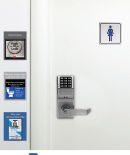
Alarm Lock introduces a solution to quickly convert multi-stall restrooms to single occupancy. Retrofitting standard locks in minutes, wireless Trilogy Privacy Standalone Pushbutton PIN Locks feature an inner privacy pushbutton. After entry, using a PIN code or ID card, the user pushes the privacy button on the back of the lock, on the inside door, to ensure their privacy. The lock will not open from the front entry side until the user exits, or optionally, the privacy session “times-out” following a preset duration, after a few mins, up to 250mins. A self-adhesive, bilingual usage sign is also furnished. www.alarmlock.com
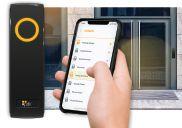
PDK announced several updates to its “touch” Bluetooth reader and mobile app. The reader automatically senses encrypted credentials on locked phones carried by users, even when they’re inside pockets, bags and purses. The reader’s new “touch-free” feature, designed to support COVID-19 best-practices for workplace safety, allows credentialed users to simply wave their hand within 2-3 inches of the reader in order to indicate an intent to enter. The result is a touch-free “walk-through” experience that requires no contact with phone nor reader. www.prodatakey.com
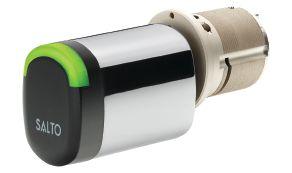
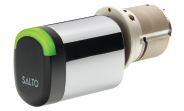
SALTO Systems and BioCote have added antimicrobial technology to the new SALTO Neo Cylinder Range. The Neo Cylinder is a compact smart door lock cylinder equipped with wireless access control design technology. It is designed to provide smarter building management and can be installed on doors where fitting an electronic escutcheon is not normally possible or required, including standard doors, server racks, gates, cabinets, electric switches, sliding doors, and more. BioCote is an antimicrobial agent that contains silver-ions which are engineered to provide continuous, built-in protection on SALTO product surfaces and hardware devices. www.saltosystems.com
Dormakaba can transform a manual opening door into an automatic opening. Touchless actuators deliver operation for access control, door automation, alerts, and handicap accessibility. dormakaba’s RCI switches provide functional control with a selection of options for momentary release, maintained release, time-delay, or emergency release. Switches can be mounted as a remote switch and/or located at the door. dormakaba’s Mobile and Touchless Access Programs can be tailored to meet any building’s needs. www.dormakaba.us
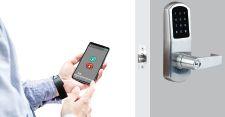
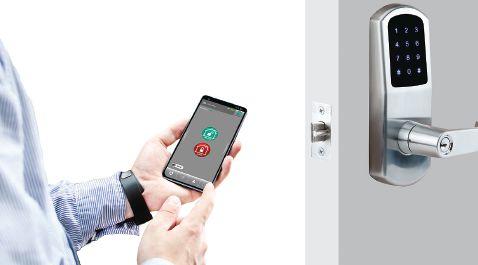
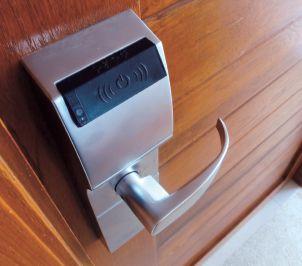
pdqSMART-XLS is an access control solution that offers mobile centric Bluetooth access control enabling the user to lock/unlock from their smartphone. It can be installed on any existing network with no third parties to integrate with. The solution offers flexible control via smartphone, RFID, PIN Pad, smart remote, smart watch or key as well as cloud-hosted software with wireless mobile management. It provides scalability for thousands of devices and users. The unit is affordable and does not require hard wiring, control panels, servers or an IT guru. Locks are future-proofed with over-the-air firmware updates. The locks are certified commercial Grade 1. www.pdqsmartnetworked.com
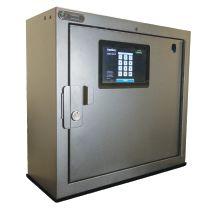
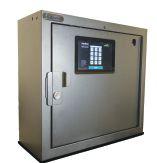
Suitable for keys and other assets that require a high level of security and accountability, the Intelligent Key Cabinet (IKC) is an electronically controlled steel cabinet that requires biometric fingerprint, PIN, or prox card authentication (optional) for access. Authorized users have access to only specific keys stored in the cabinet. The IKC electronically keeps a record of key removals and returns, by whom and when. IKC is also an addition to the Medeco XT Intelligent Key system: it can simultaneously secure and charge Medeco XT electronic keys. www.medeco.com
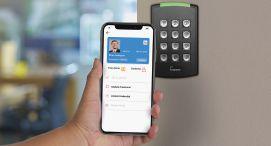
Symmetry Mobile is a web credential application designed to be used with AMAG’s Symmetry Bluetooth readers. Symmetry Mobile supports COVID-19 and return to work guidelines by promoting physical distancing and frictionless setup. Symmetry Mobile credential management platform delivers a solution for organizations using mobile devices to gain access to secured doors. Frictionless setup of a credential eliminates the need to physically interact with the security team or visit a badging office. The Mobile Credential Portal allows central management of the credentials, photos and devices remotely. www.amag.com


















• FREE text & email notifications
• FREE unsupervised openings & closings
• FREE report distribution for you and your customers