• Nortek releases 2GIG EDGE panel with facial recognition
• Armstrong’s gains foothold in Quebec market
• Union of Nova Scotia Mi’kmaq deploys Everbridge
Leo Levit, chairman, ONVIF Steering Committee
platform
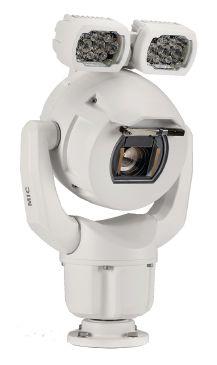
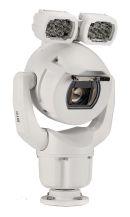
Bosch has introduced the first cameras based on its Inteox open camera platform starting with the MIC inteox 7100i.
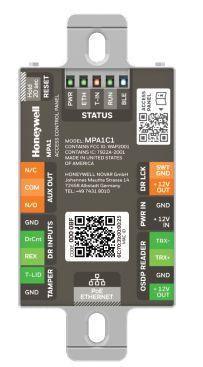
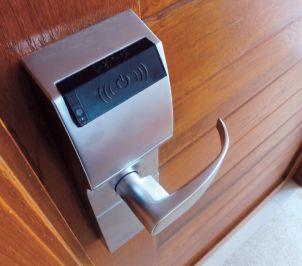
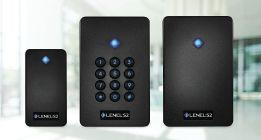
Access control panels
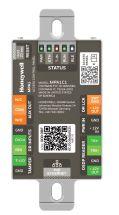
Honeywell announced the launch of MPA1 and MPA2 access control panels that offer cloud,
EDITOR’S LETTER
MBy Neil Sutton
Enabling home health care
y 10-year-old daughter asked me one morning as we were driving to school — which do you prefer, working from home or working in an office?
I had to think for a minute. Not one to let me slip away from a question easily, she insisted I had to choose one over the other. OK, the office, I said, but couldn’t help but add that a combination approach may be the path forward for many of us. (As someone who has had to manage an on-again, off-again classroom and home schooling situation, she seemed to accept that compromise and adaptation was inevitable.)
While many of these decisions have been made for us due to the current pandemic restrictions, we have all been asked to make accommodations and pursue alternatives to the lifestyles (both at work and at home) we were accustomed to prior to 2020.
It’s in this spirit that we present our cover story on personal emergency response services (better known as PERS) — a market that was already gaining significant traction before the pandemic shone a brighter spotlight on home health-care issues.
Parks Associates vice-president of research Jennifer Kent (quoted in the article), may have expressed it best when she said, “COVID-19 has forced health-care providers to develop new models of health-care [for] the home and I expect PERS providers to be part of that solution.”
This issue also features the second in our SP&T@25 series with guest columnist Ivan Spector. Spector, a veteran of the security industry with a strong track
record of volunteerism with both the Canadian Security Association (CANASA) and the Monitoring Association (TMA), is one of the returning columnists from our 20th anniversary issue back in 2016
I knew Ivan would bring a strong perspective to the changes that have occurred in the security industry over the last five years, and he did not disappoint.
Read his thoughts on p. 16, but to sum up one of his key observations, the security industry of 2021 looks quite a bit different from that of 2016 — a situation that has been amplified by the last year (and counting) of social and industry change.
This issue also features a check-in with security standards body ONVIF as they welcome a new steering committee chairman, a mass notification case study featuring the Union of Nova Scotia Mi’kmaq, and a look at a new incident management tool developed by veteran employees of PPM 2000.
I would also urge you to visit the SP&T News website (www.sptnews.ca) on a regular basis, not only to read our daily industry news coverage and feature articles, but also to check out our new regular video series highlighting security industry icons in recognition of our 25th anniversary this year. SP&T’s associate editor Alanna Fairey hosts the series and she has some great guests lined up for future episodes.
We have a lot more coming up to mark our anniversary, so keep checking in!
@SecurityEd
(416) 510-6875
Your Partner in Securing Canada Security Products & Technology News is published 6 times in 2021 by Annex Business Media. Its primary purpose is to serve as an information resource to installers, resellers and integrators working within the security and/or related industries. Editorial information is reported in a concise, accurate and unbiased manner on security products, systems and services, as well as on product areas related to the security industry.
Group Publisher, Paul Grossinger 416-510-5240 pgrossinger@annexbusinessmedia.com
Associate Publisher, Jason Hill 416-510-5117 jhill@annexbusinessmedia.com
Editor, Neil Sutton 416-510-6788 nsutton@annexbusinessmedia.com
Annex Publishing & Printing Inc. disclaims any warranty as to the accuracy, completeness or currency of the contents of this publication and disclaims all liability in respect of the results of any action taken or not taken in reliance upon information in this
With a full range of Built Ford Tough® Commercial Vehicles, we make it easy to choose the one that’s right for your business. From the versatility of Transit and Transit Connect to the legendary power and capabilities of F-Series, you’ll nd a dependable partner that’ll get to work – day in and day out.
KEY FEATURES
Super Duty® has best-in-class max. available payload of 7,850 lbs*
F-150 has class-exclusive^ available Pro Power OnboardTM that offers exportable power on demand
Transit has 3 lengths, 3 heights and 58 cargo congurations
Transit Connect has a compact footprint, and a max. cargo space of 145.8 cu ft†
TRANSIT
2021 SUPER DUTY
F-150
TRANSIT CONNECT
LINE CARD
Carol Lovell reflects on three decade career
Carol Lovell is passionate about the security industry, as evidenced by her years of service, volunteer efforts and palpable enthusiasm for the subject matter. It’s also in her blood.
Lovell spent most of her 33-year career working with door hardware and access control products before deciding to step away at the end of 2020 when both she and her husband Tony Harte, who worked in the security industry for more than four decades, decided to retire.
“I got into doing what I do because I love people. I love meeting people. I like to be out. I like to see what their challenges are,” says Lovell.
When Lovell’s grandfather retired in 1985, he turned over the business to her brother Brian, who renamed it SLD.
Lovell continued to work for the company. She moved away from the clerical duties and got into the field, meeting with clients and “putting things together from the hardware side, but also looking at their security requirements.”
Lovell has split most of her career between two organizations — the family business, Toronto-based Security Locksmith & Design (SLD) and ASSA ABLOY. SLD was founded by her grandfather under the name Pollock Locksmith in 1950. She worked in the company as a teenager during the summers, taking on clerical work.
“He gave me the opportunity to dabble in a little bit of everywhere,” she says.
At 14, she demonstrated her locksmithing skills for a school presentation, picking a classroom lock using a set of tools her grandfather had prepared for her. “The teacher was in awe,” says Lovell. The experience also cemented her attachment to the industry. “That’s when it really started.”
She left the company twice to have her two children and then again in 2010 to work for access control giant ASSA ABLOY. Lovell came back to SLD two years later, then rejoined ASSA ABLOY in 2015, where she worked until her recent retirement. During her second stint with the company, she focused on the health-care sector and its access control needs.
Throughout her career, Lovell has engaged with security associations, predominantly ASIS International. Lovell says she was encouraged by Bill Bradshaw, former senior regional vice-president of ASIS Region 6 (Canada), to get involved with the local Toronto chapter and share her professional knowledge.
She joined ASIS in 2005 and quickly felt at home. “I got that feeling of acceptance and welcome immediately,” she says. A year later, she was approached to join the chapter’s executive committee as treasurer, a position she held until 2011 when she took on the role of chapter chair. Lovell also served as ASIS Toronto’s vice-chair in 2018 and volunteered
with the chapter’s women in security committee, which organizes an annual seminar event.
Lovell says her volunteer efforts with ASIS also helped her to expand her network of end users. Working with hospitals in the last few years has been especially gratifying, she says. She put her gregarious nature and industry knowledge to work in the health-care sector, providing consultations to clients in the Toronto area.
Martin Green, manager of security, telecommunications and emergency preparedness at Baycrest Health Sciences, has known Lovell for two decades through their mutual engagement with security associations, as well as in a professional capacity in health-care security.
Green says he always appreciated her enthusiasm and approach. “She’s collaborative,” says Green, who recalls her willingness to make hospital site visits in one of ASSA ABLOY’s mobile showroom vehicles. “She was always so good at letting you know what was out there. And if you called her up, she was always super-quick to come up with a solution.”
Lovell says she might technically be retired, but she’s assured Green and other friends and colleagues in the security industry that she doesn’t plan to step away permanently.
There’s a shortage of skilled professionals working in the security trade — particularly on the hardware side, notes Lovell. She’s hoping to work with young people to spur their interest and engage with schools and learning institutions to help promote an industry that has been so good to her over the years. “It’s in my DNA,” she says.
New SP&T@25 series spotlights industry icons
Anew bi-weekly video series called SP&T@25 debuted recently on the SP&T News website, spotlighting security industry newsmakers and icons from the past quarter-century.
The series kicked off this January to mark SP&T’s 25th anniversary, featuring magazine founder Bob Rodkin in the first entry for the series. Rodkin recalled the early days of SP&T back in the ’90s along with its special relationship with sister publication Canadian Security
“I really thought the two magazines should be together,” Rodkin told SP&T@25 host Alanna Fairey, SP&T’s associate editor.
Additional guests thus far include Patrick Straw, executive director of the Canadian Security Association (CANASA); Rick Snook, business
— Neil Sutton
Carol Lovell
SP&T News founder Bob Rodkin chats with Alanna Fairey
LINE CARD
Applications
Ohio parish upgrades access control
Our Lady of Perpetual Help Parish in Grove City, Ohio, has deployed an ISONAS access control solution.
The parish comprises seven buildings, including the church, preschool, elementary school, rectory, storage garage, athletic building and modular classrooms.
With 28 exterior doors, the parish recognized the need to upgrade its security. Local integrator Systems 28 led the project, which included the installation of 24 ISONAS RC-04 reader controllers. Along with the hardware, Pure Access software was deployed for its remote access capabilities.
“We especially like the remote access functionality, as it has been great for us to be able to lock and unlock doors remotely during regular times and emergency situations like the global pandemic,” said Kevin Radwanski, facilities director at Our Lady of Perpetual Help Parish, in a statement.
Appointments
N.J. high school receives grant for security
Roselle Catholic High School in Roselle, N.J., has upgraded security systems including an Aiphone video intercom system.
The school was awarded a state grant to implement new security and selected an Aiphone IX Series Peer-to-Peer IP Video Intercom System, including two master stations, two video door stations, and 43 audio sub stations to connect each of its classrooms. The school’s front office staff is now able to respond to visitor access requests at the main entrance while also making visual confirmation. A feature allows teachers to communicate directly with the front office and also enables a quick lockdown in the event of an emergency. “With these improvements, the teachers now feel more secure with what’s going on in the building and they have an easier way to communicate,” said principal Tom Berrios in a statement.
Finnish housing rental adopts digital locking
AD
Nokian Vuokrakodit Ltd, a non-profit rental housing company owned by the City of Nokia in Finland, is using iLOQ’s digital locking solution in many of its existing properties with a plan to install more.
The company manages and rents homes to city-dwellers as well as newcomers, with a portfolio of about 1,000 apartments and terraced houses ranging from studio flats to four-room family homes.
• Kevin Darnell has joined Hanwha Techwin as retail business development manager for the retail sector in North America.
• Kahl Betham has been appointed CEO for the Gallagher Group. Sir William
Gallagher will shift to the role of president of Gallagher Holdings Ltd.
• Graybar Canada announced the appointment of Bill Jones as the new vice-president, Central Region.
• Hikvision Canada has
In 2020, iLOQ successfully won a tender to provide a locking system for the company’s new properties — installation will take place over the next two and a half years.
“We look forward to quickly increasing the amount of iLOQ locks and keys in our rental property portfolio,” said Jani Haukkajärvi, technical property manager and foreman, Nokian Vuokrakodit, in a statement.
June 3, 2021
Focus On Campus Security Online www.canadiansecuritymag.com
June 9-10, 2021
Security Canada Virtual - Spring Online www.securitycanada.com
June 15-17, 2021
ESX Virtual Experience Online www.esxweb.com
July 19-21, 2021
ISC West Las Vegas, Nev. www.iscwest.com
August 22-26, 2021
BICSI Fall Conference Las Vegas, Nev. www.bicsi.org
September 27-29, 2021
GSX Orlando, Fla. www.gsx.org
October 4-6, 2021
ESA Leadership Summit Frisco, Tex. www.esaweb.org
October 7, 2021
Canadian Security Honours Online www.canadiansecuritymag.com
appointed Luay Yacoub as regional sales manager. Based in British Columbia, he will focus on supporting the Vancouver area.
• AlertEnterprise announced the appointment of Mark Weatherford as chief information security officer (CISO).
• Tara Compher has been appointed as TMA’s programs and administrative coordinator, overseeing TMA’s Five Diamond, IQ and FirstNet programs.
Kahl Betham Bill Jones
Luay Yacoub
Mark Weatherford Tara Compher
Kevin Darnell
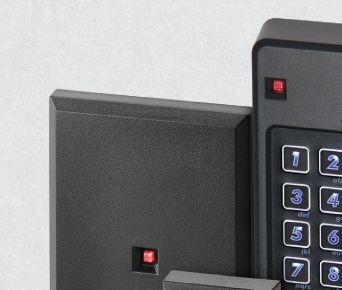
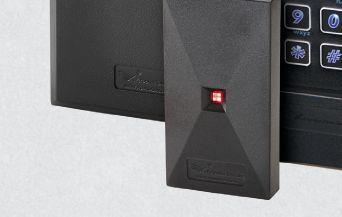
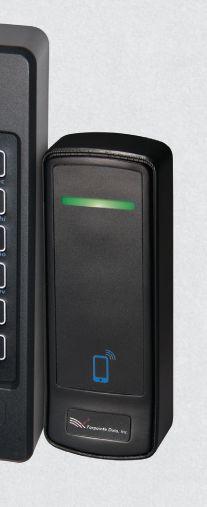
1 OSDP is a real global standard approved by the Security Industry Association (SIA) and International Electrotechnical Commission (IEC), open to use by any manufacturer.
2 OSDP provides a guideline for interoperability among various companies’ access control and security products, such as card readers and door controllers.
3 OSDP offers the option of encrypted communications between reader and door controller, independent of any encryption between credential and reader.
4 OSDP is built on the RS-485 serial transmission standard, needing just four conductors.
10 THINGS ACCESS CONTROL CUSTOMERS MUST KNOW ABOUT OSDP
7 OSDP is more cyber secure than the most common access control communications protocol.
8 OSDP provides secure communications by specifying FIPS-197 encryption (AES).
5 OSDP offers point-to-point and multi-drop topologies.
6 OSDP provides a true bidirectional protocol, addressing business requirements for secured and confidential authenticated messaging.
9 SIA provides a guide to find and explore verified OSDP products that meet its standards.
10 Farpointe Data is honored to be among the first three manufacturers to have earned the SIA’s new OSDP Verified mark on its mobile, contactless smartcard and proximity solutions. Plus, these readers are fully potted and IP67-rated!
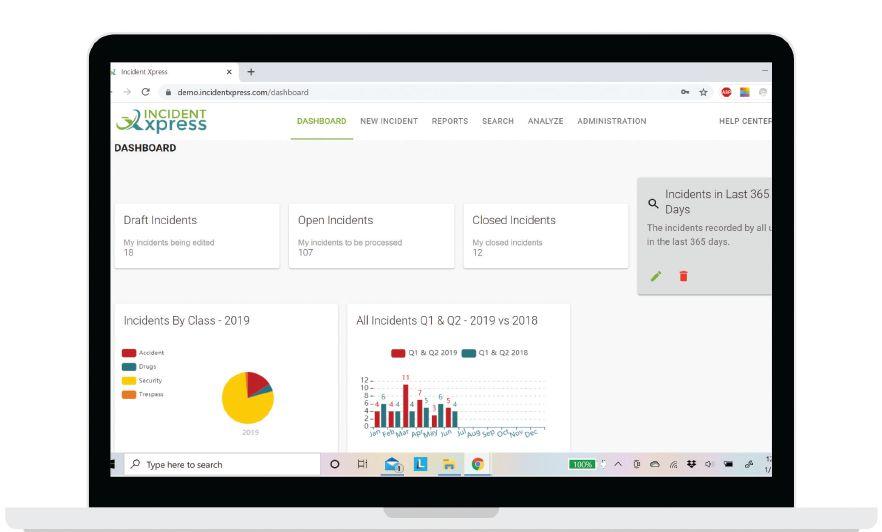
Anew incident management software solution has recently entered the market, designed for medium-sized businesses.
Incident Xpress is aimed at users who may not have the need or appetite for complex enterprise suites, according to the company’s founders, yet still require a solution that will help them manage security incidents.
Incident Xpress comprises a four-person team: Denis O’Sullivan, managing director; Cora Bolianatz, marketing director; Danny Oh, technology director; and Gerry McCracken, financial director. All four were once part of PPM 2000, an Edmonton-based incident management company founded by O’Sullivan in 1988. That company was sold to a private equity group in 2014 and ultimately became a part of Resolver.
When O’Sullivan sold the PPM business, his original plan was to retire from the security industry, but the idea of a simplified approach to incident reporting sparked a desire to return. “It’s always been at the back of my mind that reporting software should be less expensive,” says O’Sullivan.
The company incorporated in 2019 and spent a year building a platform. Incident Xpress soft launched in November 2020 and is now actively scouting for clients. “Now we’re very happy that we feel like we have a very stable and good product,” says O’Sullivan.
Bolianatz says Incident Xpress is targeting a North American customer base, adding that customers could include small colleges, health-care facilities, retirement homes or satellite offices of larger companies.
When users sign up, they can choose from four industry verticals: corporate, education, health care and hospitality. Feature sets and reporting templates are geared to one of those four, and designed to simplify the set-up process for the user. Features include reporting tools, email notifications, audit functionality, Excel export functionality and a privacy setting that will allow reports to be locked down and protected once an incident has been closed.
To try or buy Incident Xpress, customers can visit the company’s website. Video tutorials explain the software’s features and how to use them. The interaction is designed to be simple and basically selfserve, says Bolianatz, though the company is able to offer support services during regular business hours. Users can also submit tickets through a dedicated help cen-
“It’s always been at the back of my mind that reporting software should be less expensive.”
— Denis O’Sullivan,Incident Xpress
“We wanted to make it as simple as possible for people to configure our software.”
— Cora Bolianatz,Incident Xpress
tre. “We wanted to make it as simple as possible for people to configure our software [and] learn how to use it,” she says.
The software runs in the cloud on Microsoft’s Azure platform, which provides a level of customer assurance, adds O’Sullivan. “Using Microsoft Azure gave us access to a lot of security features. So the data on their server at rest is encrypted, and it’s encrypted in communication between the user and the server,” he explains.
The company also prides itself on up-front and simplified pricing. Every system starts with five concurrent users for an early adopter price of $49.50 a month. Customers can scale with 10-user packs for an additional $49.50 a month or $495 annually. “We want to be an affordable, easy-touse solution to those companies that are in the mid-market,” says O’Sullivan.
“The fact that we have cloudbased software and work with this low-touch model, it works really well with what we’re trying to do,” adds Bolianatz. “People are looking for solutions like that — something they can find easily online, learn about easily online, test out themselves. If they have simple questions, they can come to us and we can answer those questions for them, but basically we’re putting everything into their hands.”
With a staff of only four, the company is deliberately small and nimble, says Bolianatz. But as the company grows, there may be expansion on the horizon. “As we grow, we’ll manage that to the best of our ability, but our goal is to keep the price down for our subscribers,” she says. “That’s the whole point of this — to provide them with comprehensive reporting software [that’s] affordable.”
— Neil Sutton
Incident Xpress dashboard, as viewed on a laptop screen (image courtesy Incident Xpress)
Nortek releases 2GIG EDGE panel with facial recognition
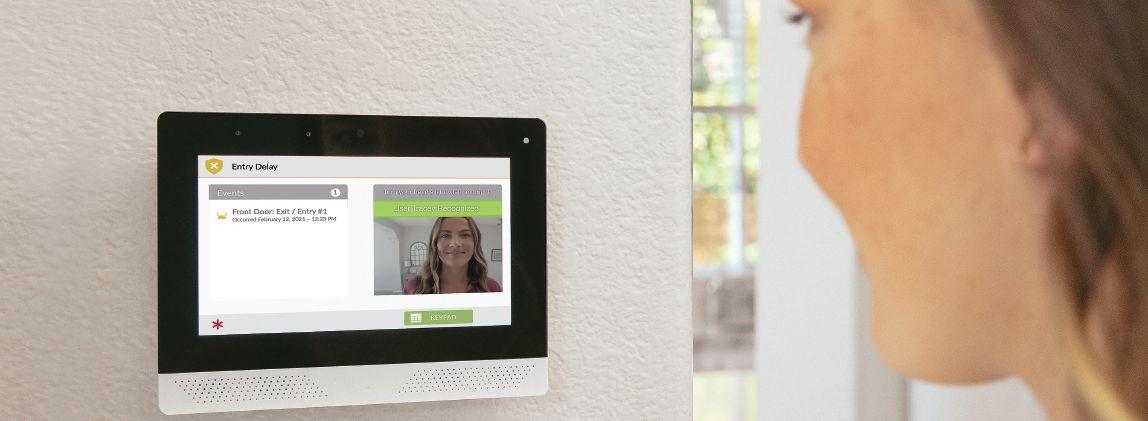
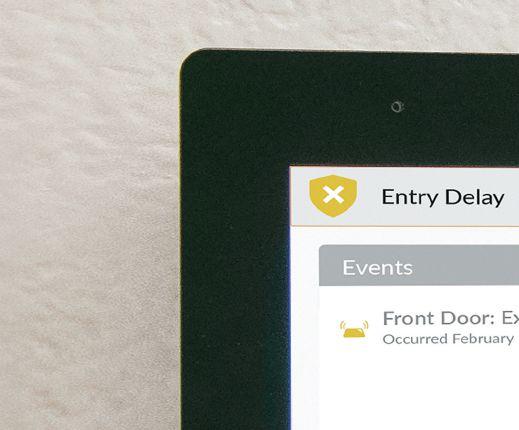
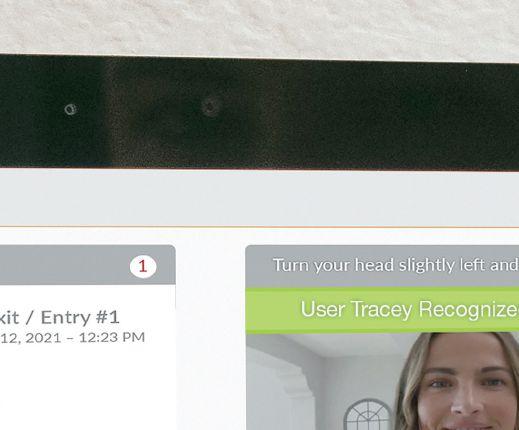
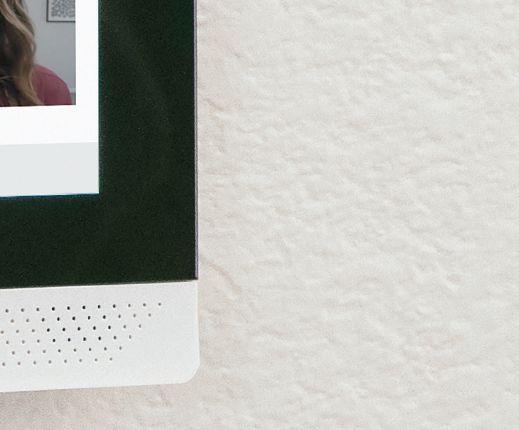
Nortek Control is touting its new 2GIG EDGE security and automation panel as a revolution in the home automation market, with built-in facial recognition that allows the user to disarm their system with a look.
The new panel, launched in March and available in both English and French, allows up to 10 users to enroll via the facial recognition interface. Biometric data is stored on the edge, not the cloud, according to Nortek, to enhance privacy and security, and deleted personal data leaves no trace behind. The facial interface cannot be spoofed, according to the company, and should be able to detect users wearing hats or glasses.
“We’re not sending anything to the cloud, no files, no analysis is being done there, so that adds that extra layer of privacy. When they delete their biometric data — their user profile — it’s gone,” explained Quinto Petrucci, vice-president of product management, 2GIG.
Nortek is well on the road to enhancing products across its multiple divisions, according to Chris Larocca, Nortek’s president and CEO. The company gained new technology as a result of its 2018 acquisition of IntelliVision Technologies, a developer of AI and deep learning video analytics software. In 2019, Nortek introduced an ELAN Intelligence Touch Panel, which was the first Nortek product to incorporate facial recognition capabilities.
As a company, Nortek undertook a rebranding initiative in 2020, said Larocca, who joined
“What we try to do is make this the centre of your smart home.”
— Quinto Petrucci, 2GIG
in 2019, and also scaled up its investments in R&D. “We believe that this will be the most disruptive residential security product on the market,” said Larocca of the new EDGE product. “And this will be the beginning of a lot of products released by Nortek Control across all of our divisions that will have that level of analytics embedded.”
In addition to its facial recognition interface, the EDGE panel can be disarmed when it comes into proximity with an enrolled Bluetooth-enabled phone, a keyfob or via a traditional PIN code.
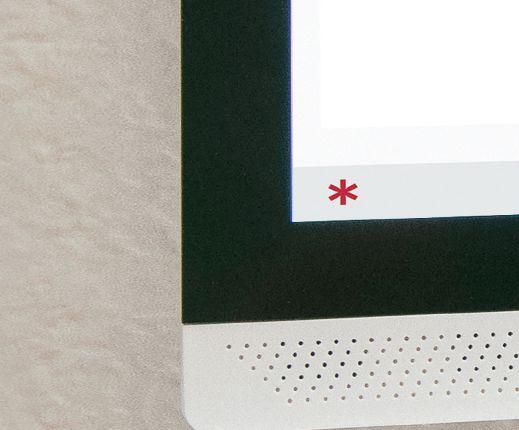
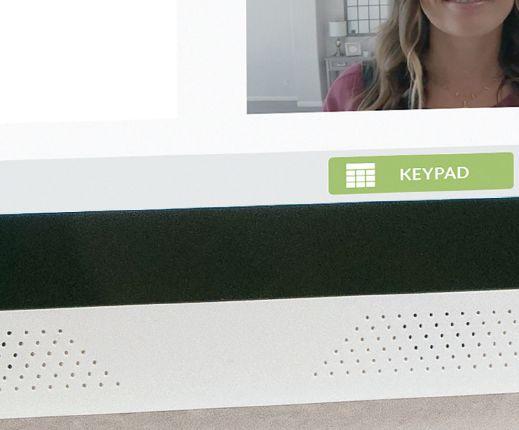
EDGE also supports ONVIF camera integration, allowing camera feeds to be viewed directly on the panel’s screen. The hardware itself is also a step up from previous iterations — it’s 50 per cent thinner and features a high-resolution screen that’s five times brighter. Additional features include dual microphones for noise and echo cancellation, front-firing speakers, built-in radio, and glass-break sensor. The unit has been upgraded with a 1.6 GHz quad core processor — Nortek says it’s four times faster than the previous generation of 2GIG panels.
The panel is Z-Wave compatible and sup-
ports up to eight additional Keypads per system, which feature the same functionality as the EDGE unit with the exception of facial recognition. Voice activation is possible through popular digital assistants.
“First and foremost, what we try to do is make this the centre of your smart home,” said Petrucci. “This is where you want to go to interact on a daily basis, whether it’s with your security system, your automation control, your locks, your lights, your thermostats.”
According to Petrucci, the panel is also forwards compatible with 5G. “It’s not just a new product from 2GIG, it’s a new platform. We took great pains to make sure this product is advanced enough so that we can continue to add value for the customers for years and years to come,” he said.
At launch, Nortek is offering a blitz of training and marketing support for dealers and partners through its 2gigedge.com portal, as well as a wide variety of branded swag. Through the months of March and April, product training is offered daily, Monday to Friday, via online and in-person sessions, as well as tutorial videos.
EDGE scored an early victory back in January when it won an award pre-launch, recognized with the Consumer Technology Association’s 2021 Security and Surveillance Product of the Year Mark of Excellence Award. According to Nortek, the product will be available broadly through distribution starting mid-March.
— Neil Sutton
Nortek Control’s 2GIG EDGE is capable of enrolling up to 10 users via its facial recognition interface (image courtesy Nortek)
Armstrong’s gains foothold in Quebec market
Armstrong’s National Alarm Monitoring announced in March that it has acquired the monitoring assets of Montrealbased Surveillance Plus Inc.
Surveillance Plus has provided alarm monitoring services to Canadians for almost two decades. The company is privately-owned and operates a ULC-listed monitoring facility. Armstrong’s, based in Atlantic Canada, has provided wholesale alarm monitoring services across Canada since 1989.
“With the acquisition of the CML monitoring station in Edmonton in 2019, we con-
“This acquisition … is the perfect fit to meet the demands of our dealers.”
tinue to seek the opportunity to grow, and this current acquisition of Surveillance Plus is the perfect fit to meet the demands of our dealers,” said company president Gary Armstrong in a prepared statement.
“Armstrong’s continual growth supporting dealers across Canada brings excitement with the addition of Surveillance Plus,” said Kim Caron, Armstrong’s national director of business development. “Both companies are known for quality alarm monitoring and strong core values.”
Caron said the acquisition gives Armstrong’s a true foothold in the Quebec market. The company already offers fully bilingual services, but bringing Surveillance Plus into the fold provides a local presence in the province. The company also operates
three other central stations across Canada, in Dartmouth, N.S., Moncton, N.B. and Edmonton.
“With the fast-pace, evolving world of alarm monitoring, we were looking for a quality company that would help take our dealers into the next phase of monitoring services, and we have found this with Armstrong’s,” said George Valsamis, president of Surveillance Plus.
According to Caron, the addition of Surveillance Plus increases Armstrong’s account base by 15 per cent and overall number of dealers by 10 per cent. Armstrong’s is ULC-listed and provides two–way audio, video verification, and financial, burglary and fire monitoring. Gary Armstrong was named to SP&T News’ annual Hall of Fame in 2020.
Access Direct partners with NorthPoint Sales
Access Direct Sales has entered a strategic partnership with Toronto, Ont.based NorthPoint Sales.
Based in the Greater Toronto Area (GTA), NorthPoint will represent the full offering of the Access Direct product portfolio in the Central Region.
Incorporated in February, NorthPoint president Clark Northcott said that the company’s “intent is to offer manufacturers sales and design support for the Ontario security market.”
Calling 2020 a “year of reflection,” Northcott — who most recently worked at Hikvision Canada — began to reassess how he wanted to spend his time and what he wanted to achieve in his career.
“I realized that I really wanted to kind of enjoy that family time, [improve] work-life balance and reconnect with customers,” Northcott explained. “I found that a lot of the roles that I had before were more management side where I was doing the big picture and behind the scenes involvement. What I really enjoy is connecting with people, working with [them] and helping them.”
After his role at Hikvision, Northcott
looked at building his own business.
Access Direct president Mark Cup heard that Northcott was starting his own enterprise and got in touch, as they were looking for a salesperson in the GTA.
The strategic partnership between Access Direct and NorthPoint is a “full circle” moment for Northcott — he had previously worked at Access Direct for 10 years as a regional sales manager.
“It’s really a ‘new-old’ partnership,” Cup explained. “We’re really happy to have Clark from a personal perspective and we know what he’s capable of professionally. It’s just such a good fit for us.”
The feeling is mutual, according to Northcott. “The partnership obviously ties in well because they’re looking to find a strong individual to be part of their team and cover this market in the GTA. And given the experience that I’ve had in the past with them, it was sort of like a natural connection to reconnect.”
Reflecting on the benefits of the partnership, Cup said that working alongside Northcott will not only be a plus for customers, but to the two businesses as well.
“We’re going to try to support each other,” Cup said.
Looking ahead, Northcott would like to see NorthPoint come out of the COVID-19 pandemic thriving and taking advantage of all the potential in the Toronto market.
“There’s lots of opportunity. Despite COVID, we proved that we were able to grow during a pandemic. I think a lot of companies have struggled with that and I think … I can take that experience and put it into this business to help it grow,” Northcott concluded. “I think Access Direct and NorthPoint will definitely both benefit from this partnership.”
— Alanna Fairey
Mark Cup, Access Direct Sales
Gary Armstrong Kim Caron
Clark Northcott, NorthPoint Sales
Dormakaba opens new Customer Discovery Center
Dormakaba recently opened the doors of its new Customer Discovery Center, based in its North American headquarters in Indianapolis. Due to the COVID-19 pandemic, the opening ceremony and tour of the new facility was held virtually.
Dan Stewart, business development manager, dormakaba, conducted the virtual tour, providing an inside look at the company’s access control solutions.
“Utilizing our touchless controller, we simply scan our hand in order to open the door to enter into the Discovery Center,” said Stewart. “[We’re] making sure touchless solutions are available for our customers in order to ensure that we’re coming back into a sanitary environment [and] to ensure that people are getting access back to their buildings the way they need to.”
Stewart explained that dormakaba structured the centre to showcase the company’s products and invite partners to come in to share solutions.
The facility is divided into multiple zones that highlight specific products addressing a dozen different markets including airports, colleges and universities, K-12, government, health care, sports and entertainment, and senior living.
“Typically, a partner will come in with an idea of what they need, and a challenge that they’re trying to address. The Discovery Center allows us the opportunity to address that for them in order
to be able to go ahead and discover the solution that they need,” Stewart explained. “Beyond that, we have the opportunity to help them see different solutions. These solutions include how we can help them improve their functionality, improve their efficiencies in their buildings, beyond what they came here to see. That really helps them and for us to become a consultative partner in order to help them to improve their buildings.”
Looking ahead at the future of the new building, Stewart said he hopes that the new Discovery Center and access control solutions will represent dormakaba’s commitment to providing safe and reliable solutions to its customers and that the company will continue to innovate.
“We say we’re going to do what we’re going to do,” Stewart concluded. “That’s what we wanted to do here in the Discovery Center — we wanted to make a nice, engaging environment for us to come together to collaborate, to learn from each other and to really pull it all together.”
Although limited to virtual visits and extremely small gatherings at this time due to the pandemic, dormakaba said in a statement that it expects to host customer visitors through tours, training and interactive experiences. The Customer Discovery Center will host visitors by scheduled appointment only for the time being.
— Alanna Fairey
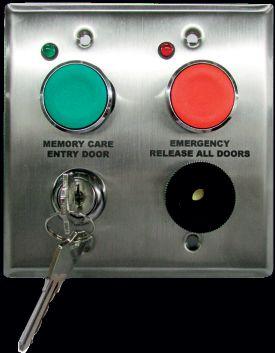
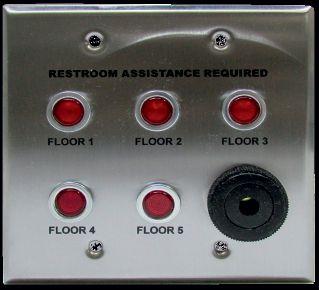
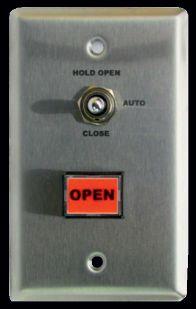
Custom Control
at Stock Model Price & Delivery
Here’s another first from the industry’s leading door control manufacturer – a program of stock control panel components that can be configured and shipped within days of your order, at a stock product price!
• Components in stock for any application
• Stainless steel faceplates from jamb size to 4 gang
• 1/4” or 1/2” LEDs, option for LED lit 2” x 2” custom message
• A range of push buttons, including illuminated buttons with custom text
• Option for sounder and barrel key switch
• Option for laser etch graphic on faceplate and engraved, paint filled, text on 1” push buttons
Union of Nova Scotia Mi’kmaq deploys Everbridge
The Union of Nova Scotia Mi’kmaq (UNSM), serving five First Nations communities across Cape Breton Island, recently deployed mass notification tools to help manage emergencies ranging from weather events to missing persons.
The project is led by UNSM’s emergency management coordinator Jennifer Jesty.
Jesty is the organization’s first emergency coordinator, hired in April 2020, weeks after the COVID-19 pandemic was declared. Jesty is originally from Cape Breton but had spent much of her professional life as a firefighter and advanced care paramedic working in the oil and gas industry in Alberta.
The UNSM serves approximately 10,000 people; the largest of the five communities is the Eskasoni First Nation with approximately 6,000 Band Members. UNSM, considered to be a Tribal Council, provides support in the form of housing services, health care, early childhood education, and more recently, emergency management.
Jesty says she felt ready to return to her home province when she learned of the job posting. Her first day on the job started as soon as her mandatory quarantine period in Nova Scotia was completed.
As an emergency coordinator, Jesty says her role is to be proactive. “My job is to try to predict the future a little bit … and maybe put plans in place if they’re not already there,” she says.
One of the first policies Jesty considered was an active shooter plan — a decision made in the wake of the tragic mass shooting event in Nova Scotia that claimed the lives of 22 people on the weekend of April 18, 2020.
Jesty’s research and discussions with emergency and security professionals led her to Everbridge, a mass notification software tool already in use in other parts of the province.
Jesty says she wanted to provide
Chiefs the ability to send out emergency messages to their specific communities. But first she needed community buy-in and a rollout plan. “I had to make sure everything was made very clear right from the get-to,” she explains.
Jesty posted information on Facebook groups and created a sign-up form for community members to fill out using a webbased service called JotForm. In addition, paper forms and posters were distributed at key community locations and summer students visited Elders’ homes to explain what Everbridge is and ask them to sign up.
“I got pretty good buy-in at first,” says Jesty. There were initially about 1,000 people registered with the software. But that was still not enough to make the impact Jesty was looking for.
The Everbridge system went live on Sept. 1, 2020. The first message was sent soon after to help locate a missing person. That message was effective insofar as people who had registered for notifications were amongst larger groups who hadn’t, and it wasn’t long before the number of registered users more than tripled.
“Once it got up and running and it was used to find a couple of kids right out of the gate, the buy-in was a thousand per cent,” says Jesty.
Since Sept. 1, the service has been used approximately 25 times — nine of them for missing person cases. All nine were reunited with their families, most of them within an hour of the alert being sent. In missing person cases, the Band Chief and local RCMP are notified and consulted. “We’re trying to very much make this a joint effort with the RCMP,” says Jesty. “The Chief is always aware before any alert [is sent out].”
Jesty says the rollout has received financial support from Indigenous Services Canada on an ongoing basis, which has been a boon to the project’s success.
“In partnership with First Nations communities, provincial and territorial governments and non-government organizations, Indigenous Services Canada’s Emergency Management Assistance Program (EMAP) helps communities on reserve access emergency assistance services to build resiliency, prepare for natural hazards and respond to them using the four pillars of emergency management,” explained the department in an email to SP&T News. The Everbridge system “was identified as an important method to inform Cape Breton First Nations regarding emergency events which may affect their communities.”
Mass notification tools in general have experienced something
of a renaissance over the past year, their communication abilities harnessed by organizations looking for more outreach opportunities.
Claudia Dent, senior vice-president of product marketing, Everbridge, who spoke to SP&T News sister publication Canadian Security for an article published in the recent Winter issue, described the degree to which alerting software has been utilized by some customers for non-emergency purposes.
“We saw messaging traffic during the last year balloon,” she said. “It wasn’t because of an emergency evacuation or fire or a blizzard coming… [those are] moments in time, so to speak. This was an ongoing set of communications across both public and corporate [networks] to really keep everybody engaged.”
But for now, Jesty says the UNSM’s rollout of Everbridge will be limited to emergencies only. “We’re not even six months into using it,” she explains. “I feel like I really wanted to make sure the community had a firm grasp on using Everbridge — when to send it, the protocols around it — before we start looking at other things.”
The UNSM’s use of the software is deliberately minimalistic, she says, adding that Everbridge’s technical support staff have been helpful in configuring the tools to meet the communities’ specific requirements, such as a text-only function for certain types of messages. “They were really good about tailoring the system for what we needed it for.”
Jesty says the adoption rate amongst the communities to date has been very encouraging, calling the overall project “a remarkable success.” More features may be considered for implementation in the future, such as location-based tools that could target messages with greater accuracy.
“Emergency management in general is ever-evolving,” says Jesty. “I’m always looking for new ideas.”
— Neil Sutton
Jennifer Jesty, UNSM
New Partnerships New Possibilities
Working with top educators to deliver a practical approach to professional certification programs.
Paragon Professional Institute (PPI), with expertise in physical security and asset management training, is pleased to announce its partnership with the University of Waterloo, and collaboration with professional educators from Schulich School of Business, DeGroote School of Business, Wilfrid Laurier University, and George Brown College in creating multiple registered professional certi cation and designation programs in the security industry.
Join us on April 22nd to learn more. Register at https://ppieducation.com/certi cation-program-launch/
By Ivan Spector
Years of transformation
The security industry is not without its challenges and technology is moving rapidly, but there is also much to appreciate
SP&T News is celebrating its 25th anniversary this year. We’ve invited guest columnists to share their memories of the past 25 years of the Canadian security and alarm industry — with a focus on how far we’ve come since 1996 and where the industry might be headed next.
It was five years ago that I was asked to write about the Canadian security industry for SP&T’s 20th anniversary.
Then, I wrote about false alarms as an ongoing problem, the three T’s (Training, Training and Training), education, free alarms, competition and new technologies. While these issues are just as relevant today, it seems that five years was a long, long time ago.
“The pace of change has certainly not diminished.”
On this, SP&T’s 25th anniversary, everything that I will comment on below fits into these categories:
• Attrition during the pandemic has increased as more people are economizing due to job losses and are staying at, and working from, home.
• In an increasingly complex installation, design and customer support world, many small/medium-sized full-service companies are taking a long, hard look at the value proposition of continuing to provide in-house monitoring services. Infrastructure costs, technology improvements and human resources are ongoing and burdensome expenses and detract from focusing on and staying abreast of new technologies. Large and state-of-the-art third-party monitoring facilities are providing monitoring services in a cost-effective and efficient manner.
• While many monitoring contracts represent a higher gross revenue, the fact is the app providers account for a percentage of that revenue, which goes to them. So, while the gross revenues may be up, net revenues tell a deeper story.
• Work from home (WFH) will continue to impact the economy and the way we work. Kudos to UL/ULC for moving so quickly to address this reality. It will be of great interest to see what the new WFH standard will look like.
• Increasing pressure from telecommunication
companies and disruptors entering our space allows for the consumers to see who can race to the bottom.
• Encroachment from DIY and MIY companies will continue to have a downward pressure on some segments of the industry.
• It is a continuing struggle to find skilled, willing and able younger installers and service people. Many top people in the field are having increasing demands put on them regarding IP connectivity and network connections. Training in this critical area needs to be emphasized.
• Front line customer service people are bearing the brunt of client IP and app-related problems.
• Certain sectors have been decimated. Retail, travel, restaurant and hospitality are just a few that will take years to recover. Those who have focused on these verticals will need to shift.
• There are also bright spots in the industry. Access control systems are gaining more acceptance. Much-promoted COVID prevention/ detection technologies are prevalent. In spite of commoditization of the camera market, it still remains robust in commercial and industrial applications and the customer benefits not only from better technologies but by much lower hardware prices.
• AI will have a great impact on the industry, particularly once it can be unleashed at the
consumer level.
• Industry disruptors will continue to have an impact — think Google’s investment in ADT in the U.S., Telus buying ADT in Canada, the subsequent strategic alliance between Google and Telus and Telus continuing on its acquisition spree.
• Big data and privacy concerns will become a very large issue. It is not a question of if something will happen.
• Cloud-based managed services will continue to move forward and gain more traction.
In closing, these are interesting times and the pace of change has certainly not diminished (nor will it). But at least I am not talking about false alarms!
One last comment: SP&T and Paul Grossinger have been a great strategic partner for the Canadian Security Association (CANASA) and the entire Canadian security industry. I applaud their commitment and we should all appreciate their support. Thanks to Neil Sutton as well for continuing that important relationship.
Congratulations to SP&T News and here is to the next 25 years! Stay well and be well. There appears to be light at the end of the tunnel during these turbulent times.
Ivan Spector is the president of Alarme Sentinelle/ Sentinel Alarm, past-president of TMA and pastpresident of CANASA.
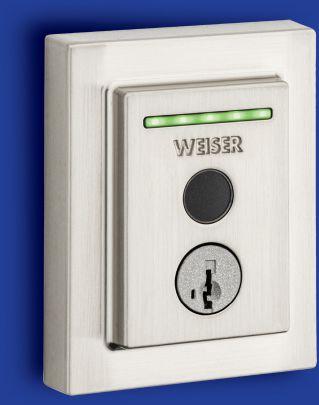
WI-FI ENABLED SMART LOCK WITH FINGERPRINT ACCESS
1 UNIQUE FINGERPRINTS
WI-FI ENABLED
• Up to 100 fingerprints/50 users
• BHMA Grade 2 certified
• 256-bit AES encryption encryption security
• Featuring SmartKey Security™ - protecting against advanced break-in techniques
• No hub required by connecting directly to your home Wi-Fi network
By Colin Bodbyl
Eyes and ears in security CAMERA CORNER
Surveillance coupled with audio technology has advantages, but is anyone listening?
Remote audio has become a critical part of everyday life.
From car radios to cell phone conversations, our lives would be very different without the ability to transmit and record audio from remote locations. But the technology has never gained popularity in the video surveillance industry. Some end users may not even realize their video surveillance system has the ability to support audio technology. Yet leveraging the functionality can add great value to the complete solution. There are three different methods in which audio can be deployed in combination with video surveillance.
One-way inbound audio is what most people imagine when we talk about video surveillance with audio. This is done using a microphone to record the audio from the area surrounding the camera. The microphone required to offer this service can be very small and is often built into the camera. Recording audio without the consent of those being recorded is illegal in some areas. The variety of laws that differ by region, along with the fact that many of them are unclear, has prevented audio recording from ever becoming a standard feature. Where laws permit, audio recording in combination with video surveillance is most commonly deployed in courts, police stations and prisons.
One-way outbound audio is the opposite solution. With outbound audio, the camera is
“The lack of clear or consistent regulation creates hesitancy.”
used to project audio that can be heard in the area the camera is located. This typically requires an external speaker that is not supplied or built into the camera, although the camera itself will need to have an audio output to support the speaker. Outbound audio can be particularly useful as a tool for deterring criminals. It can also be used as an operational tool, for transmitting messages from a remote location. Some examples include warning workers of potential safety violations or alerting tenants of a building to vacate a particular area that is closing for the night. The risks and liabilities associated with outbound audio are minimal, though operators could find themselves the target of noise complaints if the technology is not used responsibly. Two-way audio is of course the combination of the above two solutions. This is often better accomplished through an intercom, but is technically possible through a camera. For effective two-way communication, installers will likely need to use both an external microphone and speaker strategically positioned for best performance. Another challenge for two-way audio can be routing these conversations through the video management software. This can be especially difficult in situations
where multiple two-way audio locations exist, or multiple operators are using the same software. This complexity is partially what has prevented video systems from becoming a tool for managing two-way audio, since purpose-built intercom systems are far superior at scale.
Audio solutions deployed using any of these three methods remains rare in the video surveillance industry. Manufacturers have removed many of the technical and cost barriers that once existed by including free audio support on cameras and in video management software. Unfortunately, the lack of clear or consistent regulation creates hesitancy amongst integrators who choose not to promote the technology. In the consumer market, big box manufacturers have been far less careful, with video doorbells being a clear example of a product that both records and transmits audio with little concern for legal barriers. This could either open doors for the security industry to leverage audio more frequently in similar applications or could drive regulators to clarify the laws with more specific terminology. Either way it brings attention to a widely available, though severely underutilized, security product. The surveillance industry will be watching closely what happens with consumer products, but for the near future it is likely that audio on video surveillance systems will remain a niche product.
Colin Bodbyl is the chief technology officer of Stealth Monitoring (www.stealthmonitoring.com).
LESSONS LEARNED
TBy Victor Harding
Selling alarm accounts today
The market may be active, but there are always some key variables to consider before a sale
he market for selling alarm accounts is quite active today in Canada but along with that is the need to remind sellers about a few important topics.
“Your average monitoring rates are critical. Do the math.”
It is critical that as a seller you pass on accurate information about your account base to the buyer. When it comes time to sell, don’t just ballpark your number of accounts and their RMR. Look at your most recent wholesale monitoring bill and your last 12 months monitoring revenue to get at your RMR. Over-estimating accounts/ amount of RMR by five per cent may not seem like a big deal, but when you are multiplying the actual RMR by something like 36X, a $2,500 difference in the account base RMR equates to $90,000.
Holdbacks percentage most likely will be higher these days. Fifteen per cent (as opposed to 10 per cent) is a reasonable holdback to expect these days. Why? Contrary to what you may read, many dealers are losing more accounts in these virus shut-down days than they normally would. Secondly, for the buyer, it is all about risk. When times are more risky, holdbacks go up!
Your average monitoring rates are critical. Do the math. Higher average rate accounts mean higher gross margin per account. Higher gross margin means the buyer can pay more and get their money back faster. If your average rate on your account base today is below $20/month when lots of accounts have cell and interactive service, you won’t likely get the best price when you sell. In some cases, the buyer may pass altogether.
Which panels you have installed matters more than ever. Buyers do not want to buy old “clunkers,” regardless of how well they work! They want panels that can take cellular and interactive service, because that is way the industry is going. If a buyer sees a bunch of older panels, they immediately think upgrade costs and that could mean a lower price or no deal at all. In addition, a buyer will place extra value on downloadable panels that are actually being actively download-
ed. Who wants to roll a truck today if they don’t have to? Finally, as alluded to above, today an account base with 50 per cent cell or interactive service on them is worth more than an account base with only 25 per cent.
Very few alarm account bases these days are growing. In fact, based on what I am seeing, many account bases are actually shrinking. This could be partly due to the pandemic, although I think this was happening before the virus hit. Shrinking bases mean less money when you sell because you have fewer accounts to sell but also because buyers don’t like to buy shrinking bases so they pay less. Unless you are a high-volume door-knocker or are very good at selling custom-designed smart home security, it is tough to grow an alarm account base today. Note to dealers: compare your alarm account base today to what you had a year ago and ask yourself, is this pattern going to continue? My guess is that it is only get worse as the telcos step up their campaigns.
Commercial accounts are more attractive than residential these days. For the most part, commercial accounts have higher rates, generate more service and upgrade revenue and are less likely to cancel. Moreover, in Canada the telcos are making it almost impossible to compete in the residential market. If I had a middle-of-the-
road-priced residential account base today, I would definitely be thinking of selling.
Every seller of alarm accounts will have to produce a detailed listing of their accounts, with all the monitoring and billing info. So be prepared to compile one no matter how big or small you are. I call this list the Acquisition Spreadsheet. Each buyer has their own format for this spreadsheet but they all get at the same information. This spreadsheet not only helps calculate the purchase price but also gives the buyer all the billing info for the accounts once they take them over. The problem is that not only is it critical that the list be totally accurate and include every account, but it can be very time-consuming to do.
Be realistic about the multiple you will get. Multiples are simply not as high as they were 18 months ago. This is partly due to the pandemic, but also partly just a general pull back coming from buyers. Moreover, I am not seeing any crazy high multiples from any of the bigger buyers. I have not seen any deal go beyond 40X in at least 18 months. Alarm accounts still hold great value and are still very saleable, but I would describe the market today as being more discriminating and more restrained.
Victor Harding is the principal of Harding Security Services (victor@hardingsecurity.ca).
By Patrick Straw
Full speed ahead for Security Canada CANASA UPDATE
Following last December’s successful virtual event, CANASA is preparing for a spring showcase
With 1,300 attendees from across the country, our 2020 virtual trade show was such a huge success that we’re bringing you another one this spring.
Security Canada Virtual — Spring 2021 will take place June 9-10, and planning is well underway.
By exhibiting at Security Canada, you not only reap the rewards of connecting with our members across the country but you also support the Canadian Security Association (CANASA) and the Canadian security industry at the same time. This is the only show in Canada that brings the entire security industry together, so mark your calendars and stay tuned. Here’s what some of our industry leaders had to say about our last virtual show.
“As my first virtual show, I found the experience very educational, and actually more interactive than I had anticipated. Security Canada Virtual exceeded expectations. Was a real pleasure to see customers and colleagues that I haven’t been able to meet/see in quite some time.” — Dan Small, Armstrong’s National Alarm Monitoring
“I thank everyone that was behind the scenes to make this an informative and enjoyable experience.” — Carmine Panaro, Reilly Lock and Security Systems
“Security Canada was a success! They did a great job of putting together a show for professionals to network and see new products, despite the pandemic.” — Tom Bennett, True Steel Security
Happy anniversary
Congratulations to SP&T News on 25 years of excellence.
We are lucky in Canada to have a first class publication dedicated to the products and services provided by our industry. CANASA works very closely with SP&T and together we help to be a source of information for all security professionals in this country. Well done, SP&T, and continued success.
CANASA membership
If you are an integrator, installer, manufacturer, consultant, IT professional, cybersecurity company, government security professional or any other aspect of the security landscape, consider joining CANASA if you are not already a member.
“CANASA delivers a quality show with the ability to learn, network, find new solutions. I look forward to this show each year.” — Rick Snook, ASIS International and Axis Communications
We look forward to seeing all of our vendor partners and exhibitors and thank them for their continued support. To book a booth, contact Steve Basnett, sbasnett@canasa.org.
Contact me at pstraw@canasa.org and let’s have a chat.
Patrick Straw is the executive director of CANASA (www.canasa.org).
Patrick Straw
Home health care CHECK-UP
The global pandemic and stay-at-home movement is generating interest in a market that was already on the rise
By Alanna Fairey
While the personal emergency response service (PERS) market has seen some growth in recent years, the COVID-19 pandemic has accelerated a need for seniors and their family caretakers to consider it as a health-care option.
Telus currently offers their LivingWell Companion to support aging Canadians across the country. According to Juggy Sihota, vice-president of consumer health, Telus, the wearable device comes with fall detection and GPS capabilities.
“If a patient has a fall, we will detect that they’ve fallen, get in contact immediately through our 24/7 live operators support, and we’ll be able to make sure that they get emergency services dispatched to wherever they are,” Sihota says. “Because we have GPS-en-
Image: Jackie Niam / iStock Getty Images Plus
abled technology, patients can stay safe and independent for as long as they like.”
Sihota adds that the LivingWell Companion offers support in multiple different languages, which helps seniors who do not speak English as a first language.
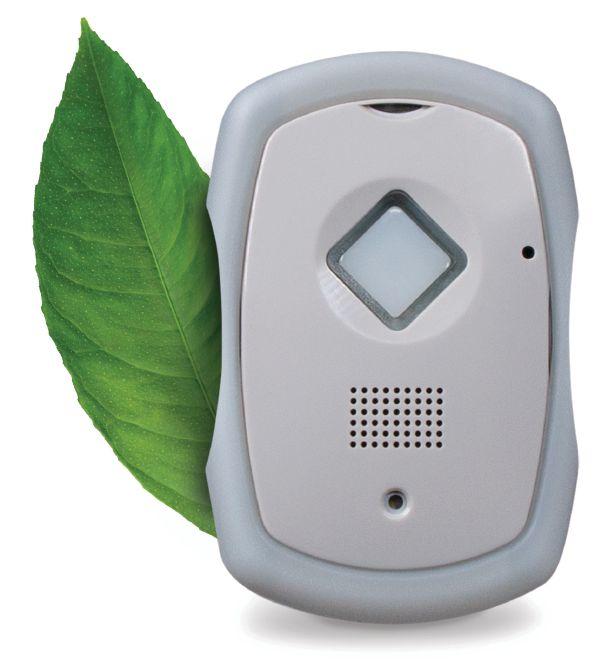
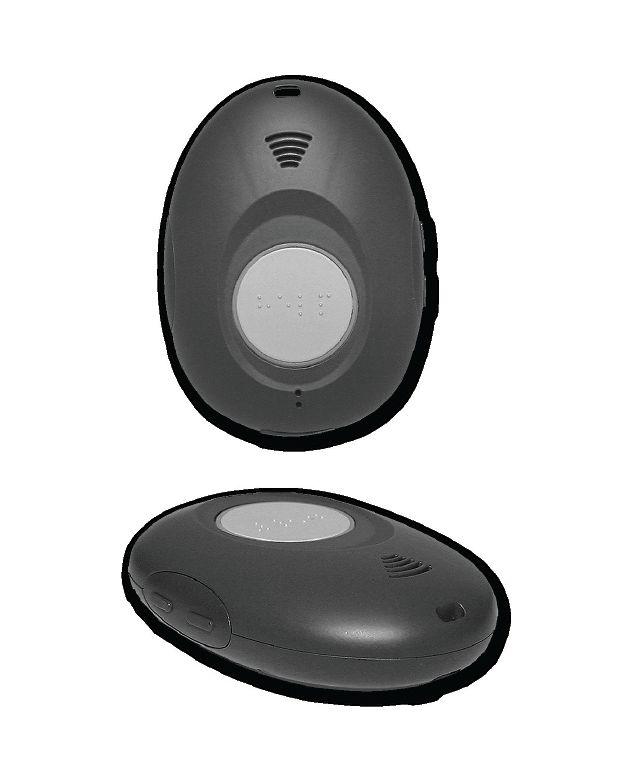
For its part, Toronto area-based GlobalTek Security has its own Life Guardian PERS technology, which also sends real-time notifications of potential emergencies to family members. Among the wearable pendant’s more notable features is its one-touch operation (that includes braille), fall detection alert, and waterproof technology. Additionally, the device is not hackable.
Aaron Kozlowski, managing partner at GlobalTek’s Life Guardian shares, “Only our monitoring centre can call you, and it’s on a protected phone number. This will ring your device directly. You can also quickly locate your pendant remotely if misplaced, using a single command.”
David Doyle, head of Philips Home Monitoring, Phillips Lifeline, shares that the company has three PERS solutions: HomeSafe,
HomeSafe with AutoAlert and GoSafe, which are all wearable pendants.
Noting that there has been an increasing trend of people not having a landline — includ-
ing seniors — Doyle says that the Philips devices are able to work without a landline communicator.
“We have a version of our service that works just fine if you don’t have a landline communicator — the base communicator is cellular,” Doyle explains. “It’s the same button that they were [using] but the call goes over the cellular network instead of the telephone network.”
A push for change
While the PERS market is not a new concept, the COVID-19 pandemic has given a push for more innovation and drive for change.
Parks Associates’ data shows steady patterns of demand for PERS solutions between 2019 and 2020. For instance, approximately 60 per cent of family caregivers rated a traditional PERS device as appealing in both years and approximately 55 per cent of caregivers found a smart watch with a panic button appealing in both years.
However, according to Jennifer Kent, vice-president, research, Parks Associates, the pandemic may cause seniors and their family caretakers to become more proactive, rather
“COVID-19 has forced health-care providers to develop new models of health-care [for] the home and I expect PERS providers to be part of that solution.”
— Jennifer Kent, Parks Associates
than reactive buyers.
“The unfortunate reality of the PERS market is that the overwhelming majority of customers acquire the solution only after a fall or other medical emergency has taken place,” Kent says. “The incredibly trying conditions for seniors and their caregivers over the past year may lead to more proactive planning and purchasing of assistive solutions.”
Doyle says that Philips Lifeline has seen a shift in the market since the beginning of the pandemic.
“People are more sensitized than ever to the need for their loved ones to remain safe and independent in their homes,” Doyle relates. “That’s always been the case, but I think COVID has accelerated that, which has been a market shift for us under the current circumstances and has led to more inquiries and demand for the service.”
Doyle also shares that Philips Lifeline has had to adapt in terms of their installation into the home and move to remote communication and installations.
Having launched the LivingWell Companion back in 2018, Sihota says that Telus customers had been looking for PERS solutions prior to the COVID-19 pandemic.
“As people are getting older, they’re certainly using the health-care system more, and our seniors are requiring more health-care support as they’re getting older. While you might live longer, you’re not necessarily always living healthier and access to health-care support becomes more essential as you age,” Sihota explains. “In that regard, [Telus] took a look at the way that our seniors are living and the fact that seniors want, for the most part, to live at home and independently for as long as they can.”
When the pandemic hit and seniors were named among the most vulnerable to the virus, Sihota says that Telus customers had driven considerable demand for digital health solutions.
“More and more seniors are wanting to live at home and independently with dignity and with grace and we have digital health-care solutions that can help them with that,” Sihota says.
“The pandemic intensified those demands because of things like social isolation, and the inability of people being able to get the type of
support that they would normally have.”
GlobalTek’s managing partner Lee Melarangeli says that COVID-19 has not so much changed the way that they do business, as the company has always offered PERS solutions, however, the pandemic has made their services timely.
Melarangeli adds, “Without question, given the statistics, these COVID hotspots tend to be in retirement and long-term care facilities. Seniors on waiting lists are now opting to live at home longer, and some permanently, with the assistance of our devices and technologies.”
Bright future
With a population that is getting older, PERS solutions will continue to develop and serve a purpose in the health-care sector.
“The experience that COVID has highlighted for our seniors that if people have the option, you’re going to want to stay in your home, and longer even still as a result of what’s happened with COVID,” Sihota says. “We are going to drive a lot of innovation in this space, so that it makes it even more attractive and more interesting and more a part of your lifestyle to have this type of support that gives both caregiver and the seniors more peace of mind.”
Sihota says that Telus is working in partnership with government and health authorities across the country to help shape and form the roadmap on the services Telus currently offers.
With users expecting more innovation in the space, Doyle predicts that seniors will increasingly become comfortable using the evolving technology.
“Mobile PERS (MPERS) has a bright future,” Doyle says. “With the transition of networks to 4G and 5G, that’s going to enable greater technology, more efficient technology, longer battery life for that technology. That’s a trend that’s been underway for many years, and it’s accelerating right now and it will continue.”
Noting that there was a big move in telehealth options over the past year, Kent expects to see the trend of PERS providers expanding into telehealth to continue, as many seniors were forced to try telehealth visits for the first time out of necessity.
“Seniors continue to be a very high-need population from a medical perspective but underserved by technology providers who tend to focus on younger demographics,” Kent explains.
“PERS providers understand this segment of the population and can be the last-mile providers into the home for health-care providers and systems who have very little experience operating businesses outside of the hospital or doctor’s office.
“COVID-19 has forced health-care providers to develop new models of health-care [for] the home and I expect PERS providers to be part of that solution.”
Kozlowski and Melarangeli anticipate that PERS technology will continue to develop new innovations as well as improve in accuracy. “The accuracy of a fall alert is going to get better,” Kozlowski confirms.
Melarangeli further reiterates, “And while no PERS device is perfect, the technology is constantly improving. Thus, false positives will continue to decline, while the GPS accuracy for positioning will refine.”
GlobalTek’s iHelp+ PERS medical alert pendant (image courtesy GlobalTek)
Creating a reliable network
The role of a strong cabling foundation in home automation systems
By Daniel D. Dunar
Now more than ever, people are spending their time at home.
As the role of the home continues to evolve, so do new technologies, driving end-user interest in making at-home comfort more manageable and customizable.
At the foundation of these systems is a strong network cabling infrastructure. Dealer, installer and integrator businesses can take advantage of this growing interest with home network retrofits or new installations. In order to protect system performance, establishing a reliable cabling backbone must be a first priority.
Creating a strong network
Though internet networks can be forgiving, a consistent connection is critical for the transfer of information to smart home devices. Without a dependable connection, devices are unable to function reliably, threatening system performance.
When implementing a strong home network, installers and end users can choose between wireless or wired system elements or create a hybrid approach with components of each.
Wireless
Even in wireless systems, cable is a necessity. Category cable must be used to create a cabling backbone that powers remote connectivity throughout the home.
In order to maintain a reliable connection, networking systems must use cable built for the speed and needs of its devices. High quality category cables verified to the necessary performance level ensure reliable network connectivity and support consistent wireless performance.
One of the biggest advantages of a wireless system is its convenience — for integrators, installers and end users. Installing cable in existing structures can be time-consuming and complicated. Wireless systems require minimal cables, making them easier to integrate in retrofit installations, in comparison to wired systems.
End users also benefit from the ability to ac-
cess their network connection throughout the home. This gives them the freedom to use their internet connection without relying on the location of a hardwired connection.
Despite their convenience, wireless networks, without precautions, can add security risks. Wireless networks can be hacked remotely from outside the home, threatening the security of personal data and smart home devices. End users can mitigate some risk by updating router firmware and changing the default password on their routers. Even with these precautions, wireless networks are not nearly as secure as wired connections.
Wireless networks also leave device performance to the mercy of a network’s speed. A network is only as fast as its weakest link, and depending on the number of applications in the system, bandwidth limits can cause inconsistent device performance.
Network reliability is influenced by the home’s environment and can be negatively impacted by interference from other devices and objects, structural elements and device distance from the router.
In order to optimize network reliability, routers must be placed in the location that provides the greatest wireless coverage, not the most convenient area.
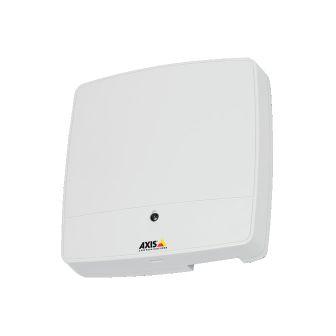
AXIS Visitor Access for AXIS Entry Manager
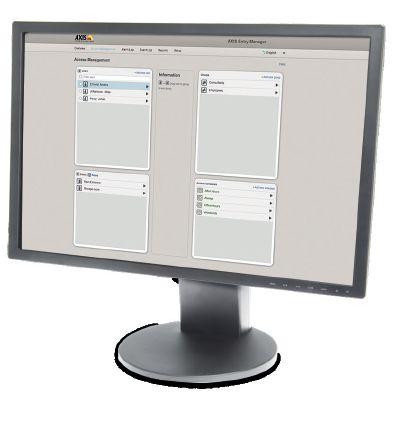
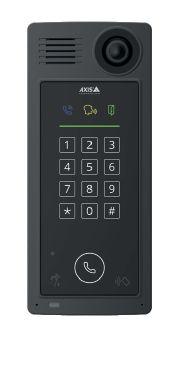
Want to easily control who enters a building and when…without the need to buzz visitors in? With AXIS Visitor Access, you get an easy add-on application for AXIS Entry Manager, making it simple for small sites to grant visitors access using a QR code as a credential. All you need is an AXIS A1001 Network Door Controller and an Axis door station.
For more information, please visit: www.axis.com/products/access-control or call us at 1 800 444 AXIS, option 1.
Wired
In wired systems, the network connection is hardwired by running cable throughout the home. As a result, wired networks are easier to integrate in new construction, versus retrofit installations.
Despite requiring more work up front, wired networks offer a more reliable point of connection and experience less interference than wireless systems. This supports faster data speeds over longer distances, without interruption from other devices or obstacles.
Wired systems are also more secure, protecting personal data and device security. To breach a wired network, attackers must physically connect to the network.
When installing a wired system, whether in retrofit or new construction, it’s important to take into consideration long-term use of these systems. Anticipate future needs and incorporate additional cabling throughout the home to prepare for new device integration. This can optimize the system’s longevity and ability to adapt to changing system needs.
Hybrid approach
Leveraging a hybrid approach with wired and wireless elements can ease the strain of a retrofit installation while adding wired system benefits. This can protect device performance while delivering a reliable connection throughout the home.
When designing a cabling system, consider the installation environment, the end user’s plan for future device integration and the specific needs of individual devices to determine a network approach that protects system longevity and agility. Most importantly, make sure to build your network with cable designed to optimize system performance.
Choosing a quality cable
When designing a network system, cable type and quality must be a key consideration. To achieve continuous network connectivity, it’s important to choose reliable category cable to establish a strong backbone for your system.
“A consistent connection is critical for the transfer of information to smart home devices.”
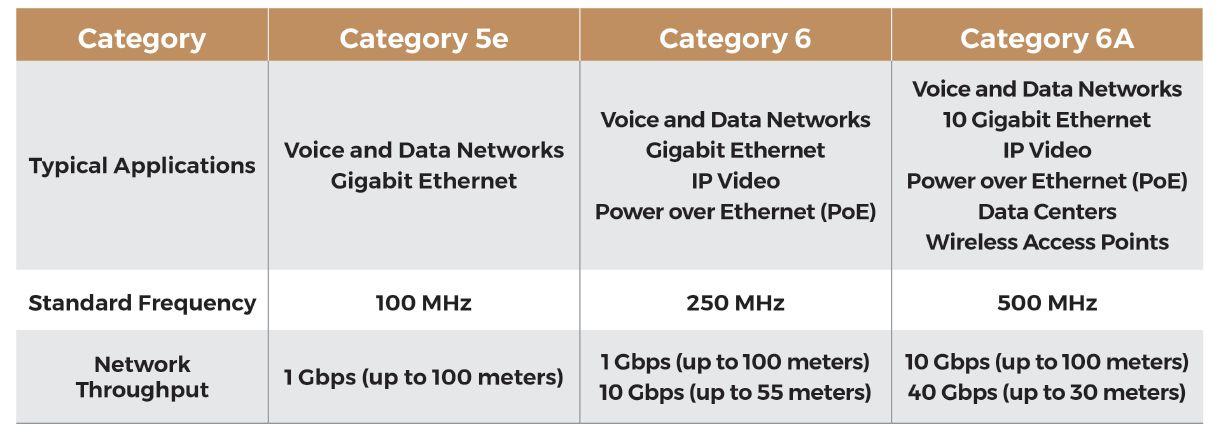
Currently, the minimum recommended grade for network cabling is Cat 5e. Cat 6 and Cat 6A both offer increased performance capabilities but may be an unnecessary upgrade. These cables operate best in systems with the aforementioned capabilities (see chart above).
Though sometimes portrayed as a superior alternative to Cat 6A cable, Cat 7 cable is generally unsuitable for North American systems. Cat 7 cable connectors are incompatible with most devices and its performance is essentially identical to the more device-compatible Cat 6A cable. Cat 5e, Cat 6 and Cat 6A cables are recognized by TIA/EIA standards; Cat 7 cable is not.
In addition to being recognized by the TIA/ EIA, reliable networking cable is also designed to meet specific industry standards. The following elements are critical in category cables and are an indication of product quality.
Pure copper conductors: Pure copper conductors are required in all communications cables; any alternative materials are not compliant with the National Electric Code (NEC) and can cause voltage drop and signal loss — leading to device failure. When paired with the demands of an integrated system, non-compliant cables are unable to function consistently, threatening the performance of the entire network.
Cable listings + verifications: Cables must receive listings and verifications from a nationally recognized testing laboratory. Cable listings test products to standards that mimic the environment and conditions in which they will be installed.
A listing signifies that cable meets all required fire and safety standards and has been manufactured using high-quality plastics with all necessary additives. A listing mark on the cable’s packaging and listing text and file number
included on the cable’s print legend signify the cable has been listed by a reputable organization.
Cable verifications, alternatively, test a cable’s electrical performance standards. Each category level has its own requirements that cable must meet, and performance levels increase as the category number increases. Manufacturer claims of performance beyond the identified standards should be examined and considered with extreme caution.
A verification mark on the cable’s packaging and verification text on the cable’s print legend demonstrates that the product is verified. As a note, listings and verifications for the same product can be received from different organizations.
Though not required by law, choosing products tested to listing and verification standards demonstrates that safety requirements have been met, while allowing installers and integrators to better identify the cable that will best support their system.
The role of a trusted manufacturer
No matter the network approach you take, the cable you choose to install will impact system performance and longevity. Avoid excess voltage drop, signal loss and device failure by carefully choosing cables for your application from a manufacturer you can trust. This will save you time and money, and ultimately, help you build your business reputation to win more bids.
A reliable home network provides the continuous connectivity that entertainment, comfort and home automation devices depend on for consistent performance. Set future smart home technology integrations up for success by choosing cable built for your network system. Simply put, a strong network cabling infrastructure creates a reliable connection that gives end users the flexibility to continue customizing their at-home comfort, one smart home device at a time.
Daniel D. Dunar is the marketing leader for Genesis Cable, a Resideo Technologies brand (www. genesiscable.com).
Smarter Video Alerts
MORE ENGAGED CUSTOMERS
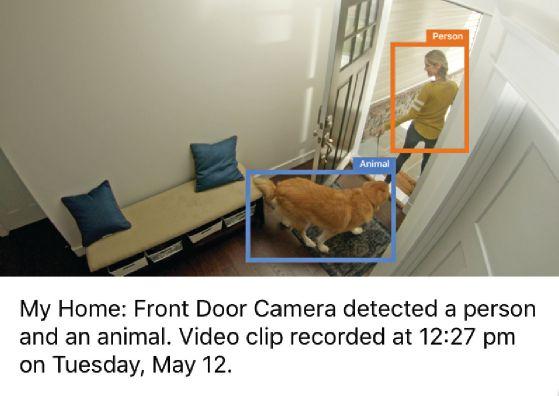
Reduce the noise with Video Analytics from Alarm.com
Video Analytics from Alarm.com is the must-have solution that delivers video alerts about what matters most to your customers like unexpected visitors, package deliveries and more.
Powered by industry-leading AI, virtual tripwires and activity zones let customers filter out routine movement and detect people, vehicles and pets.
Include Video Analytics from Alarm.com alongside your standard video offering to:
Lower support costs
Create customer engagement
Increase customer retention
Boost monthly RMR
Make Video Analytics part of your standard video service package and create more engaged, satisfied customers today. Learn more about partnering with Alarm.com at alarm.com/partners.
QA &
Leo Levit, chairman, ONVIF Steering Committee
By Neil Sutton
Leo Levit was recently appointed as chairman of ONVIF’s steering committee, taking over from Per Björkdahl, who served in the role for nine years.
ONVIF was established in 2008 by founding members Axis Communications, Bosch Security Systems and Sony. It has since expanded to more than 500 members, including 22 full members (the original founding members, as well as others including Hikvision, Canon, Honeywell and ASSA ABLOY), 19 affiliate, 15 contributing, 42 observers and more than 400 user members.
According to ONVIF, its mission “is to provide and promote standardized interfaces for effective interoperability of IP-based physical security products.”
Following its November 2019 annual membership meeting, ONVIF stated that there were more than 13,000 conformant products, highlighting the market’s support for the profile concept.
In addition to his ONVIF appointment, Levit serves as director of system integration at Axis Communications. Prior to that he was global product manager of analytics solutions for the company. His previous industry experience also includes Sony Mobile Communications and Ericsson Mobile Platforms. SP&T News reached out to Levit to ask him about his goals for the organization and what might be on the horizon. He responded to questions via email.
SP&T News: What are your aims for the organization and what words of advice did your predecessor offer?
Leo Levit: My focus for ONVIF is simple — it is on how ONVIF can continue being relevant for its members and to the industry. In the words of my predecessor, and I am sure of his predecessor also, my aims are to drive ONVIF in
“Interoperability offers possibilities and opportunities for the integrator community to more easily tackle those issues brought on by COVID-19.”
a direction that meets the needs of the industry, as directed by the member companies, who ultimately decide the specific profiles and initiatives of ONVIF. For now, we are focusing on how the strategy of ONVIF will continue to adapt to the overall changing landscape of the security industry and global demands.
SP&T: Is there an opportunity for ONVIF to branch out into other areas of security technology beyond surveillance and access control?
LL: This is a great question, especially giving the aforementioned changing security landscape and the attention that security technology is gaining in mainstream markets.
Right now, ONVIF isn’t “branching out,” so to speak, but in general there are opportunities here for the security industry to look at different ways and different uses for deploying systems in various ways. For example, our Release Candidate for Profile M opens up the possibility to extract data that isn’t just valuable for security and safety applications but can be used for other business intelligence purposes as well.
We have the opportunity to explore a more vertical interoperability approach, allowing this multi-purpose usage. It’s something I look forward to exploring further with ONVIF.
SP&T: What is ONVIF’s role in terms of AI/machine learning and IoT in current and future security technology?
LL: To expand upon my answer
above, interoperability is more necessary now than ever because of this shifting landscape.
The use of AI-based algorithms is dependent on the sensor’s ability to provide data and metadata — and that requires interoperability beyond just the camera. It’s important that we encourage and enable the adoption and growth of different applications within AI and within security devices. This will open up a great potential for the devices and clients in surveillance systems to provide increasing value beyond simple surveillance.
SP&T: How does open source factor into ONVIF’s plans?
LL: The opening of the GitHub platform last year was an important step forward for ONVIF, primarily because it has enabled organizational processes to function more easily and shortened the turnaround time for specification proposals.
It also allows not only ONVIF member companies but developers from other companies and industries to provide input to the development of ONVIF specifications based on their diverse perspectives and experiences. As technology continues to evolve at a faster pace, this open source methodology will help keep the work of ONVIF more relevant to the industry at large.
SP&T: How is ONVIF communicating with integrators and end users to make sure their interoperability needs/requests are heard?
LL: Our manufacturer members are the largest conduit for ONVIF to receive information about the
needs of integrators and end users, as they are also trying to solve integrator and end-user pain points through their product development efforts.
Another part of our communications efforts with those stakeholders takes place at the various industry events that would typically be held throughout the year, and also through opportunities such as this interview to communicate what ONVIF is doing and open the door for feedback on what they have read.
I should also mention that membership in ONVIF is open also to integrators and end users who wish to have more of a participatory role in the organization and specification development.
SP&T: The COVID-19 pandemic has been a factor in the security industry in terms of business practices and the growth of technologies like touchless access control and temperature monitoring, but what has been the impact on ONVIF specifically?
LL: Technologically speaking, it hasn’t impacted ONVIF greatly as we’re a global community used to working in a remote fashion. That being said, we do rely on those important interactions and collaborations that take place at in-person events and meetings. We do see, however, that the pandemic has only highlighted the need for interoperability and we believe that makes our work even more important.
While ONVIF isn’t the whole solution, interoperability offers possibilities and opportunities for the integrator community to more easily tackle those issues brought on by COVID-19, such as integrating technologies for pandemic response into existing systems more easily as well as deploying systems that can solve new use cases triggered by the pandemic.
Product Previews Video Surveillance
Cloud surveillance
VIVOTEK
VIVOTEK announced an update to its VIVOCloud lightweight cloud surveillance service. VIVOCloud is a lightweight cloud service designed for SMB users that provides remote and reliable surveillance in the cloud. With version 2.10, VIVOCloud supports a playback export feature, an NVR alarm management feature, a mute notification feature, an SD card setting and more. Additional features include: optimizing the user experience such as adding devices and connection stability and optimizing NVR configurations. The new version also fixes an issue where timeline playback might not normally work while enabling daylight saving time, as well as general bug fixes. www.vivotek.com
NVRs
Hanwha Techwin America
New NVRs in the Wisenet X series (XRN-6410DB4/ XRN3210B4) are scalable to a total of 160TB (Terabytes) of available SATA HDD recording capacity. Both units support a recording bandwidth of 400 Mbps and include dual HDMI video outputs. The NVRs will be available in 64 channel (XRN-6410DB4) and 32 channel (XRN-3210B4) configurations and support simultaneous playback of all channels on a local monitor. The 64 channel (XRN-6410DB4) includes dual redundant power supplies to ensure continuity of recording for mission critical applications. Both models support RAID 5 and RAID 6 configurations which provide redundancy for video storage data.
www.hanwhasecurity.com
Hybrid recorders
March Networks
X-Series Hybrid Recorders deliver a 400 per cent increase in throughput over previous generation recorders. It is a true hybrid platform supporting a mix of analogue, HD analogue and IP channels, but with all the power and storage capacity needed for demanding all-IP installations. Available in 16, 24, 32, 48 and 64-channel configurations, the embedded, Linux-based appliances also feature a dedicated AI engine and SoC technology from NVIDIA. The X-Series platform comes preconfigured with March Networks’ next-generation video management software, which supports future add-on applications like face recognition.
www.marchnetworks.com/x-series
Multi-sensor camera
Dahua Technology
Featuring four 1/2.7-in 5MP progressive-scan CMOS sensors, each with a 2.8 to 12mm motorized lens, the DH-IPC-PDBW82041N-B360 allows each unstitched sensor to be configured independently of the others. The camera offers FlexStream technology that displays simultaneous video from each sensor in a single channel. With its ability to simultaneously move each sensor module and its integrated IR illuminators at up to 98 feet (30 meters), around the camera’s internal track for 180-, 270-, or 360-degree fields of view, the Multi-Flex can be configured to minimize blind spots for improved situational awareness.
Wall mount recorder
Speco Technologies
www.dahuasecurity.com
Speco has released a new NDAA compliant wall mount recorder with the WNRN. The 4K H.265 Wall Mount NVR with Smart Analytics comes in four, eight and 16 channels. The NVR has real time recording at up to 8MP resolution (4K), allowing for more details when zoomed in. It supports H.265 video compression which uses up to 40 per cent less storage than H.264. The recorder is equipped with EZ Search 2.0 which allows the user to search 24 hours of recorded video in under 90 seconds by breaking down the footage from day to hour to minute. The recorder also comes equipped with advanced analytics, including object and line crossing along with human and vehicle detection (used with Speco analytics cameras). www.specotech.com
Open camera platform
Bosch
Bosch has introduced the first cameras based on its Inteox open camera platform starting with the MIC inteox 7100i. The new cameras support predictive solutions with machine learning, neural network based video analytics, and third-party software apps. These Inteox cameras can be classified as “Driven by OSSA.” This distinction signifies that the cameras follow the Open Security & Safety Alliance Technology Stack for video security devices, ensuring connectivity with the S&ST Application Store. www.boschsecurity.com
Privacy protector
Genetec
Genetec states that its solutions are designed to help customers enhance cyber hygiene and respect privacy by making data and privacy protection features more accessible and configurable. Available on-demand for the Genetec Security Center unified platform, the KiwiVision Privacy Protector automatically obscures individuals’ faces caught within a camera’s field of view, so security operators only see what they need to see. Being able to access unobscured footage requires an additional layer of access permissions that is only used when an event warrants an investigation. www.genetec.com
Dome IP cameras Matrix
Matrix Project Series Dome IP cameras are designed to meet the needs of medium-large enterprises. According to the company, these impact-resistant devices come with an unbreakable enclosure and provide high-definition video footage and clear images even in harsh environments. They are designed and operate at extreme operating temperatures. Features include: Sony STARVIS Sensor for colour images in low-light; H.265 compression; intelligent video analytics; a larger field of view (up to 113°); adaptive and smart streaming; true WDR (120dB); in-built storage (512GB); high signal-to-noise ratio (>70dB); region of interest; and FTP/NAS support. www.matrixvideosurveillance.com
Product Previews The latest in security technology
Cylindrical lock PDQ
PDQ has introduced the SF Series Grade 2 Standard Duty Cylindrical Lock. The SF shares common levers and finishes with the company’s Grade 2, SD Cylindrical and CL Interconnected locks, so it’s possible to mix and match for a uniform look. Four functions include Privacy, Passage, Entrance, plus Single Dummy, and there are five designer levers to choose from, as well as six architectural finishes including black. The unit retrofits all major manufacturers’ door preps. www.pdqlocks.com
Motion sensors
Leviton
Leviton’s Decora Motion Sensors are designed to provide users optimal management of lighting and motor loads with enhanced detection functionality for accurate switching. Occupancy and vacancy sensors offer flexible single pole or three-way installation options, wiring with or without a neutral conductor, and a slim profile. The sensors use passive infrared (PIR) detection to monitor a room for occupancy through a segmented lens. Automatic-ON and Manual-ON models are available, providing options for bathrooms, hallways, basements and more. www.leviton.com/sensors
Personal PA system TOA Canada
The ER-1000A-BT Personal PA System delivers clear audio instructions while allowing the use of hands for further direction. The wearable equipment has a slightly curved design to fit over the waist. With a built in digital amplifier and an optimized frequency for speech, a clear voice can overcome a noisy place. The lightweight system will cover a range of up to 100m (300ft), is easy to operate and runs on either 6 (9 V DC) Alkaline batteries or 6 (7.2 V DC) rechargeable NiMH batteries. www.toacanada.com
INTEGRATOR
YEAR
Three-factor authentication
Alcatraz
Alcatraz has added three-factor authentication (3FA) to the Rock facial authentication platform. The Rock can be used for one-, two- or three-factor authentication. In one-factor authentication, the Rock is the primary access control device and facially authenticates authorized users. In two-factor authentication, the Rock is used in combination with a badge reader to grant access. In three-factor authentication, the Rock is used along with two additional access control devices, like a badge reader and a PIN reader. www.alcatraz.ai
Sponsored by:
Product Previews The latest in security technology
Mobile-ready readers
LenelS2
BlueDiamond mobile-ready readers are designed to provide simultaneous support for a wide range of physical credentials and can be upgraded to support BlueDiamond mobile credentials. BlueDiamond readers work with existing infrastructure and are access control platform agnostic. They include support for the standard output protocols including Supervised F/2F (SF/2F), Wiegand, OSDP and OSDP V2. The BlueDiamond platform supports a wide array of non-proprietary credentials with simultaneous support for a range of card technologies including standard proximity, HID iCLASS, MIFARE and DESFire EV1 and EV2. www.LenelS2.com
Low profile enclosures
Video Mount Products
Smart radio
Motorola Solutions
Motorola Solutions has launched the MOTOTRBO Ion smart radio with voice, broadband data and multimedia capabilities. Its fully open Android application ecosystem allows for integration of mobile data applications. A 13-megapixel camera and 4-inch, high-resolution touchscreen lets workers attach photos to work tickets, use video chat for remote diagnostics and view detailed images, schematics, diagrams, photos and videos. The MOTOTRBO Ion smart radio works on the digital mobile radio (DMR) standard, Wi-Fi, public LTE and private broadband networks. www.motorolasolutions.com
Aluminum IR switch
STI
Cord connectors SCHURTER
Available in a 5U configuration in both switch depth and server depth, VMP’s low profile enclosures are designed to securely mount EIA standard rack mount equipment and are made of pre-assembled heavy-duty steel. These enclosures feature locks on the front door and mounting rails are reversible and feature threaded screw hole options for both 12-24 and 6mm mounting preferences, making them suitable anywhere floor space is limited. The ERVWC-5U20 (28.8in. H x 25.6in. W x 9.75in. D) and ERVWC-5U36 (42.75in. H x 25.6in. W x 9.75in. D) both have 150 lb. weight capacities. www.videomount.com
STI says its new NoTouch Cast Aluminum IR Switch helps eliminate the spread of germs. The Switch is constructed of heavy duty die cast aluminum. STI’s button includes three interchangeable snap-in illuminated messages (white OPEN, green EXIT, blue EXIT), and is customizable. The switch includes a Form “C” dry contact, 0.5A @120VAC, 1A @24VDC, adjustable relay latch time of 0.5 ~ 20 seconds, operating voltage 12VDC – 24VDC, 45mA (maximum), dual colour status LED (green/red or red/ green), and a 1.5 ~ 6 inch detection range. www.sti-usa.com
Scratch-resistant Lectern
AmpliVox Sound Systems
AmpliVox Sound Systems has introduced the new made-in-the-USA Capri Lectern featuring a sweeping curved design. The new lectern features scratch-resistant melamine finish available in 12 different colours to match any decor. Additional features include: edge banding trim in 11 different colours; a 24”w x 18”d reading table with paper stop; and four glides for easy positioning and with felt pads to protect surfaces. The unit is lightweight at 40 lbs, ships flat and assembles in 15 minutes with no tools, according to the company.
Access control panels
Honeywell
www.ampli.com
Honeywell announced the launch of MPA1 and MPA2 access control panels that offer cloud, web-based or on-premise hosting options. MPA1 is a single door POE powered controller with a dedicated Device Utility App for fast commissioning. MPA2 is a cloud, and standalone access control panel for two door access control. The MPA2 panel features enhanced security due to a 128-bit AES encrypted bi-directional Open Supervised Device Protocol (OSDP) communication with access control readers. www.security.honeywell.com
SCHURTER expands its portfolio of rewireable IEC cord connectors, series 4782 (C13, 70°C) and 4781 (C15, 120°C), to include gray and white versions in addition to a black version. The detachable cord connectors are suited for small series builds with varying cable lengths and country-specific plugs, that would otherwise require large order minimums. A protective cable guard with a diameter of 8.5 mm or 10 mm is pre-assembled at the factory. The screw terminals accept cables with cross-sections between a minimum of 3 x 0.75 mm2/18 AWG (0.82 mm2) and a maximum of 3 x 1.5 mm2/14 AWG (2.08 mm2).
www.schurter.com
Credential family
HID Global
HID Global has expanded its Seos credential family. The Seos 16K features the highest memory in the series to support multi-application deployments. Seos Essential is a new, single-application credential that delivers security and data protection for deployments where complex implementations are not necessary.
HID’s TÜV-certified Seos 16K card is the successor to its offering for multi-application use cases that require 16 kilobytes (KB) of memory. The Seos Essential card is fully supported by the HID Sign and iCLASS SE reader platforms. It is also available as a multi-technology card. www.hidglobal.com