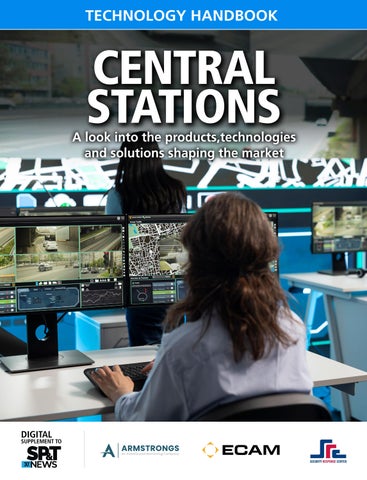
TECHNOLOGY HANDBOOK
CENTRAL STATIONS
A look into the products,technologies and solutions shaping the market
DIGITAL
SUPPLEMENT TO
MARKET TRENDSHANDBOOK TECHNOLOGY
HOMEGROWN SECURITY New Brunswick-based QSA wins Integrator of the Year for its local focus and vision of the future BY NEIL SUTTON
2
the best systems and technology available.”
QSA Life Safety & Security QSA Life Safety & Security was founded in 1971 and currently operates a head office in Fredericton and a second location in Charlottetown, PEI. With a staff of about 30 people, the company serves customers across New Brunswick, PEI, Nova Scotia and Newfoundland and Labrador. The company’s range of services includes fire alarm monitoring, mass notification, surveillance systems, access control, communications, as well as life safety and health-care solutions. It serves customers across education (post-secondary and K-12); government and public safety, industrial, property management, and health-care institutions, among others. QSA was awarded Integrator of the Year 2026 (sponsored by Graybar Canada) by impressing judges with a nomination that emphasized its strong employee culture, focus on modernization, examples of business growth and customer care, and overall security and life safety expertise. The successful combination of those elements is what will propel QSA into the future, says Westland.
Gerrit Westland, owner and president; Brent Daigle, project manager; Michelle Lim, VP of growth and transformation, QSA
“Security is a fundamentally human activity.”
SP&T News Technology Handbook - Central Stations
— Gerrit Westland, QSA
Trust and expertise As QSA’s new owner and president, Westland is also deeply aware that he is now part of a company with 55 years of history serving the Atlantic region. He says he trusts the knowledge and expertise of QSA’s technical staff, many of whom also have decades of industry knowledge and field experience. Westland says he favours a decentralized approach to company leadership, empowering the staff to make their own decisions and become leaders themselves. “How am I going to presume to know how to do it better than our senior technicians? I need to rely on the experience and training of our people,” he says. Westland says the company also pays its employees above the industry average and expects top quality performance in return. “We are placing our bets on local, we are placing our bets on Atlantic Canada and the people who live here serving the people who live here,” he says. “I think that’s been important, not just to our customers, but to our employees as well, because we’re serving our neighbours, we’re serving our communities. That will
PHOTOS: QSA Life Safety & Security
W
hen Gerrit Westland was looking to move back to his native New Brunswick and invest in a local company, security wasn’t necessarily top of mind. But the industry, with its combination of financial stability and mission of safety, proved to be an ideal choice. Just over a year ago, Westland left behind a career in corporate finance and private equity, relocating from Toronto to Fredericton. There, he acquired a 55-year-old alarm and security business, QSA Life Safety & Security. “I had the pleasure of stepping into something that already had a deeply rooted foundation,” says Westland, who was also named to SP&T News’ Top 10 Under 40 list earlier this year. “There’s so much opportunity, and there’s so much changing,” he says of the security industry. Security is an “absolute necessity for any business owner or home owner…. It’s so important to get it right. We’re investing in it constantly.” Aside from its reputation as an industry capable of successfully navigating economic fluctuations, security is also undergoing a technology transition with its measured approach to cloud-based infrastructure and artificial intelligence. But perhaps most importantly, “security is a fundamentally human activity,” says Westland, “and something that allows us to have an edge by using
CENTRAL STATIONS
Planning for growth
continue to allow us to thrive.” QSA also invests heavily in technology training, says Westland, through its “QSA Academy” program. The company completed an Ascom (maker of nurse call systems and other solutions for healthcare) training module for staff earlier this summer, and will provide Ubiquiti (wireless data communication) training beginning in the fall. Social gatherings and team-building
exercises are also a regular part of the QSA routine. Staff meetings are held every morning, which helps to set the tone for the day. Weekly “Toolbox talks” also provide a forum for technical updates and troubleshooting. On Fridays, the company breaks at 3:30 p.m. for a barbecue and tailgate. The Friday tradition is an opportunity for some food and socializing, but also allows some time to assess the week gone by and set the agenda for the week to come.
Gerrit Westland, owner and president, (centre) and the technician team at QSA
Like Westland, Michelle Lim hadn’t originally envisioned herself working at a regional security company, but she quickly saw the appeal. She joined QSA shortly after Westland took over and is currently the company’s vice-president of growth and transformation. With a background in sales and marketing for a variety of different industries, including steel and robotics, Lim says her current role is about the “amplification” of QSA’s service offerings and success stories, in addition to identifying growth opportunities for the company and leading its modernization agenda. The company is proud of its Atlantic Canadian heritage, says Lim, and emphasizes its focus on catering to a local clientele (the company slogan is “Care without compromise.”) Good customer service shows up in the details, she says. Customers receive handwritten thank-you notes from the sales person they dealt with, and a card from the company with Westland’s direct cell phone line. “It’s just another way to say, ‘We care,’” says Lim. QSA also recently revamped its inbound phone system so customers can speak directly with a human being, typically within 20 seconds of calling, without having to navigate a complex call tree or listen to a recorded voice. Lim is also proud of the fact that QSA switched to 100 per cent cotton for its staff t-shirts. It’s a small thing, but it makes a difference, she says. “It always comes down to our people.” Westland sees QSA as a platform for growth. The company has a solid client base in New Brunswick and PEI, where it has office locations, and plans to increase its presence in the other Atlantic provinces. The next step, says Westland, is developing a customer base outside the region, through a combination of organic growth and potentially through acquisition. “I think expanding west is going to be our next logical step,” he says. Westland says he’s keenly aware that multi-national security providers are operating in Canada, having entered the Canadian market via an M&A strategy. While outside investment is a solid indicator that the security industry is healthy and growing, Westland believes he can tell another story. Homegrown ownership and local, personalized service provides “a tremendous advantage,” he says. “That’s where we are going to distinguish ourselves.”
SP&T News Technology Handbook - Central Stations
3
MARKET TRENDSHANDBOOK TECHNOLOGY
CENTRAL STATIONS
Central Station Monitoring Strengthens Transportation and Logistics Security
T
ransportation and logistics operators invest heavily in video surveillance across yards, loading docks, storage facilities, and rail terminals. Yet recording an incident does little to interrupt it. When footage is reviewed only after cargo goes missing, even a clear picture of what happened may come too late to prevent the loss. Central station monitoring helps close that gap by connecting detection with human verification and a defined response. For logistics operations, its value extends beyond seeing activity as it happens. It creates an opportunity to intervene while giving security leaders visibility into how incidents are handled and where protection needs to improve.
From Detection to Response
Effective remote video monitoring brings detection technology, trained professionals, and site-specific response protocols together. Video analytics flag activity for review, while monitoring operators assess what they see against the site’s operating hours, authorized activity, and escalation instructions. That context matters in logistics environments, where vehicle movement and personnel activity may continue around the clock. A person entering a loading area during an active shift requires a different assessment than someone approaching parked trailers in a restricted yard after hours. Monitoring instructions should account for legitimate after-hours deliveries and establish an escalation process when authorization cannot be confirmed. For example, if analytics flag a person entering a restricted trailer area, a monitoring operator reviews the activity, checks the site’s instructions, and assesses whether intervention is needed. Depending on the circumstances and agreed protocols, the operator can issue an audio warning, notify site personnel, coordinate guard response, or contact law enforcement. The incident and response are documented for follow-up. This process creates an opportunity to deter suspicious activity before it develops into a loss. When an incident does occur, recorded footage and response documentation also support investigation and review. For security integrators and monitoring providers, effective delivery starts before the first alert. Camera views must cover the
4
SP&T News Technology Handbook - Central Stations
areas of concern, detection rules must reflect site conditions, and escalation instructions must identify who to contact and when. Changes to yard layouts, shift schedules, or access procedures should prompt a review of the monitoring plan.
Visibility Creates Better Decisions
The value of central station monitoring also depends on what logistics leaders can learn from it. Knowing that a site is monitored is useful; understanding what triggered an alert, how operators responded, and how the incident ended provides a stronger basis for managing security. ECAM Central supports this visibility by giving customers access to incident activity, operator response information, and operational data across their monitored properties. While ECAM’s monitoring teams assess and respond to activity, the customer platform helps make that work visible and easier to review. For organizations managing multiple facilities, this information can reveal recurring issues. Repeated incidents near one entrance may prompt a review of access procedures, lighting, or camera coverage. A pattern of alerts during shift changes may indicate that schedules or monitoring instructions need updating. Comparing incident activity across locations can help leaders decide where additional attention or resources are needed. These insights turn individual events into opportunities to improve the broader security program. They also support accountability by helping customers understand the actions taken on their behalf and the outcomes of those interventions. For transportation and logistics operators, effective protection requires a connection between surveillance, informed response, and ongoing review. Central station monitoring brings those capabilities together, helping organizations address threats earlier and use what they learn to strengthen protection across their facilities. To learn how central station monitoring can strengthen security across your transportation and logistics network, visit ecam.com or call 1-855-755-7233.
EVERY CAMERA, ALWAYS MONITORED Real-Time Monitoring. Rapid Response. Proven Results.
ECAM BENEFITS AND FEATURES Clean Energy • Methanol fuel cell and solar powered • 94% reduction in CO2 vs Diesel Generator
AI-powered Camera Analytics • Remote monitoring, event based surveillance
Designed to operate in Canadian climate Energy on demand vs. Overproduction • Lower operating costs and less fuel consumption
Proudly Canadian Made
Contact our security experts: 1-855-755-7233 ecam.com/contact SP&T News Technology Handbook - Access Control
5
MARKET TRENDSHANDBOOK TECHNOLOGY
CENTRAL STATIONS
Beyond Monitoring: Building a Smarter Dealer Growth Platform
T
echnology is changing nearly every aspect of the security industry. AI-powered analytics, video remote guarding, connected devices and increasingly sophisticated monitoring platforms are creating new opportunities for dealers—but technology alone doesn’t create growth. Dealers also need the tools, expertise and support to turn those capabilities into services customers will buy and recurring revenue that can scale. That thinking is behind the Becklar SMART Dealer Network, a new dealer growth platform coming 2027. The SMART Dealer Network is designed to help security dealers identify opportunities, generate demand, strengthen their teams and grow their businesses.
Turning Technology into Revenue
One of the challenges facing dealers is determining how emerging technologies fit into their existing business model. The SMART Dealer Network is designed to help bridge that gap. Dealers gain access to product and platform training, sales best practices, market insights and a Value Creation Playbook that can help them understand not simply what to sell, but how to position solutions around customer needs and business outcomes. That includes helping dealers identify opportunities within their existing customer base, develop new sales plays, evaluate ROI and take advantage of special packages and pricing. The objective is straightforward: help dealers sell more while building sustainable recurring revenue.
Technology That Helps Create Demand
Technology is also becoming increasingly important before the sale. Through the SMART Dealer Network, Becklar is bringing AI-assisted marketing capabilities into the dealer growth equation. Members can access lead-generation resources, exclusive sales plays, co-branded marketing assets and priority access to new leads and opportunities.
6
SP&T News Technology Handbook - Central Stations
The program is designed to help dealers create demand without requiring every organization to build a sophisticated marketing operation internally. Customer-facing materials and customizable campaigns can further help dealers take new solutions to market while maintaining their own brand and customer relationships.
Building Dealer Capabilities
As security technologies become more advanced, education becomes increasingly important. The SMART Dealer Network provides training, certifications, expert support and proven best practices designed to strengthen capabilities across dealer organizations. But the relationship isn’t intended to be one-directional. Participating dealers can also have opportunities to help influence the future of Becklar’s SMART Protection Platform through advisory boards, design partnerships and beta access to new features. The program also includes SMART Dealer Awards recognizing dealer achievement. That creates a feedback loop between the companies developing technology and the dealers deploying it in the real world.
More Than a Partner Program
Ultimately, the SMART Dealer Network reflects a larger shift taking place across the security industry. As technology evolves, successful dealers will need more than products and monitoring services from their partners. They’ll need resources that help them translate innovation into measurable business value. By combining technology, sales enablement, marketing, education and collaboration, Becklar is building the SMART Dealer Network around that idea. More than a partner program, it’s a growth platform built to help dealers compete, differentiate and scale.
SP&T News Technology Handbook - Access Control
7
MARKET TRENDSHANDBOOK TECHNOLOGY
CENTRAL STATIONS
Our Mission: To watch out for your clients 24/7/365. Many people take security for granted, until something happens. An after-hours break-in. A destructive fire. A life-threatening emergency. Preparing for the unexpected is our world at Security Response Center. Our number one priority is keeping your customers safe and secure at all times. Our highly skilled and experienced, our security professionals are trained in all areas of residential, commercial, and industrial security monitoring. All Monitoring Staff are TMA 5 Diamond Certified, and our Company has been U.L.C Listed for Burglary, Fire Protection Systems, Central Station Sprinkler Supervisory and Bank Safe and Vault Protection. In addition, we are a Manitou Elite Certified Monitoring Center dedicated to motivating our staff, getting more from our monitoring operations, and maximizing our success. Through SRC, you can offer your customers exceptional service and value. In fact, our standard monitoring price covers many features that others charge extra for. As an independent verified full-service provider, SRC meets or exceeds Underwriters’ Laboratories of Canada’s stringent standards for security monitoring of residential, commercial, and industrial properties. Our monitoring services include: • Supervisory Signals • Medical Alarms • Intrusion Alarms • Video Monitoring • Fire Alarms
100% Canadian Owned and Operated https://securityresponse.ca/ 1-800-333-7721 8
SP&T News Technology Handbook - Central Stations
SP&T News Technology Handbook - Access Control
9