




























By Neil Sutton
AEuropean division of Japanese imaging and optical products giant Canon said in June that it will acquire major VMS player Milestone Systems.
At press time, the deal was expected to close in early July. Financial terms of the deal were not disclosed. “The only thing we are disclosing is, they are acquiring 100 per cent of the shares,” says Karl Erik Traberg, a spokesperson for the Danish security products firm.
Privately-held Milestone was founded in 1998. Now under new ownership, the company will continue to operate as a standalone entity with its staff and offices intact, says Traberg. “All the Milestone offices around the world will continue as they are; the headquarters will stay as they are; the management team will continue as is it. We will continue working with our partners, suppliers, service providers and everybody as we have done so far.”
Jacco Leurs, head of professional imaging, Canon Europe, notes that Canon has followed a similar model with other acquisitions in the past few years. The company purchased medical software solutions firm Delft DI in 2012 and the I.R.I.S. Group, a document management solutions company in 2013.


T“Both these software group companies operate separately, while simultaneously collaborating strongly within the Canon Group to drive growth in the relevant sectors,” says Leurs in an email interview.
Traberg adds that Milestone will continue to pursue its open platform strategy. The company, known for its XProtect software platform, currently supports more than 3,400 surveillance devices from a variety of manufacturers. “We started about six years ago, pushing the open platform consistently and putting significant resources behind it. We’ll continue doing that,” he says.
The addition of Milestone provides Canon instant recognition in the surveillance market, accord-
ampa, Fla.-based Digital Watchdog has acquired Innovative Security Designs. Irvine, Calif.-based ISD was founded in 2012 by a former IQinVision employee, Ian Johnston.
“Digital Watchdog is the perfect complement for ISD,” says Johnston, the company’s president and CEO, in a statement. “We are thrilled to join their exceptional team to pursue our common vision of next generation solutions.”
ISD’s Lynx, an edge surveillance camera that runs on Microsoft Windows, won two awards at last year’s
ing to Leurs, helping the company to achieve its growth goals.
“Canon has identified the network video surveillance business as an important driver for future growth of the company globally and this acquisition is a strategic step which significantly enhances our offering and capabilities in this market sector,” says Leurs. “The network video surveillance market is a multi-billion euro industry which continues to show huge growth potential and Canon has a strong commitment to build a long term presence as a leader in this industry. Acquiring Milestone allows us to realize these ambitions faster.”
Days before the acquisition was announced, research firm IHS published data ranking Milestone and Montreal-based Genetec as the two largest global suppliers of VMS software in 2013 — a market that is currently worth in excess of US$900 million and is forecast to grow to more than US$3 billion by 2018.
IHS noted that Genetec is stronger in the Americas with Milestone leading in the EMEA (Europe, Middle East, Africa) region. Despite the relative strength of Milestone, IHS also noted that the VMS market is currently “fragmented” with no single company owning more than a 10 per cent global market share.
Security Industry Association New Product Showcase at ISC West in Las Vegas, Nev.
“ISD’s ability to captivate the attention of the industry with unique and differentiated solutions has been remarkable.” says HK Lee, CEO of Digital Watchdog, in a statement.
Lee adds that ISD will “remain an independent company” to Digital Watchdog to “preserve what makes ISD special” and will continue to pursue partnerships with OEM customers. “Our combined strengths make this a very powerful relationship,” Lee says.
Vancouver-based Avigilon recently reported that its revenue for the second quarter this year was up 66 per cent compared to the same period in 2013 — $65.2 million versus $39.2 million last year.
“It was another quarter of profitable growth for Avigilon, highlighted by record revenue and increased EBITDA, while we made significant investments for future growth,” says Alexander Fernandes, founder, president, CEO and chairman of the board.
“At our current annualized run rate, we are more than halfway to our target of $500 million by the end of 2016.”

However, the company reported a dip in net income
for Q2 2014 ($2.8 million) compared to Q2 2013 ($3.4 million). Reduced net income was attributed to “a foreign exchange loss of $1.9 million, compared with a $0.3 million gain in the same period last year, and $1.5 million in acquisitions related expenses.”
The company also stated that “it plans to continue to invest significantly to expand sales reach, accelerate innovation and build brand awareness,” adding that “in the short term, however, as the necessary investments are incurred in advance of associated revenue, these initiatives are expected to put pressure on the company’s adjusted EBITDA and net income.”
Astudy conducted by Leger on behalf of Axis Communications indicates the degree to which popular TV crime shows are skewing Canadians’ perceptions of what today’s surveillance can accomplish.
According to the study of 1,500 Canadians, 68 per cent said they watch crime dramas like CSI, Criminal Minds, Castle and Law and Order. Seventy-one per cent believe that recorded surveillance can be enhanced using software and 75 per cent believe facial recognition technology can identify one person out of a crowd.
The reality is somewhat different, says Axis Canada country manager Bob Moore. “If you don’t start out with high resolution video, enlarging it will result in a bigger, blurrier, more pixelated image. Video clarity cannot be fixed after the fact. As a rule of thumb, an image must supply 80 pixels from ear to ear to ID a face.”
Canadians surveyed are also unsure of most video storage policies; 27 per cent said they have “no idea” how long video is retained, while 26 per cent believe it is stored indefinitely.
CEO Pierre Racz discusses the Cloud as a competitive advantage
By Neil Sutton
Pierre Racz’s vision for the future of Genetec is one that encompasses the Cloud, the growing power of the end user and an expansion beyond its security roots.
Racz, Genetec’s president and CEO, started the company in his basement and officially launched Genetec about four years later in 1997. The company has since grown into a leading video management software company that employs about 500 people globally. He spoke recently at a twoday media event held at the company’s Montreal headquarters.
“The things that we were dreaming of doing in the 1980s are now becoming a reality.”— Pierre Racz
The company’s new mantra is a “mission control” approach, building on its unified platform Security Center, which encompasses its three main lines of business: surveillance systems, access control and licence plate recognition. The next phase of that development is a broader control environment that would allow an end user — like an airport or municipality — to manage not only security but other aspects of its operations from a single dashboard. The company is seeking significant user input into future product design in an effort to meet their evolving requirements, says Alain Côté, Genetec executive vice-president.
That approach is several years out,
but Racz says that hybridization, or “the seamless unification of on-premise systems with the Cloud” is a large part of what is driving the company’s current and development goals. He likens the impact of the Cloud to the release of Microsoft’s landmark operating system Windows 3.1 in the early 1990s and the rise of object-oriented programming. “The things that we were dreaming of doing in the 1980s are now becoming a reality,” he says.
The idea that data can be stored and managed from an off-site location has democratized IT systems, he says. “People have lost faith in their IT departments. They don’t ask them to provision their devices. The IT department has lost that battle. Users are provisioning [their devices] themselves in the Cloud. . . . People are doing this not in spite of the IT department but because of the way that they’re structured,” he says.
Genetec’s entry into Cloud-based security management, Stratocast, was introduced in 2013. Powered by Microsoft’s Windows Azure platform, Stratocast is a Video Surveillance as a Service (VSaaS) solution for the small to medium-sized business market. At launch, one Canadian user commented it allowed him to store four weeks of video off-site where his old DVR could only store one week. Users can choose to store in the Cloud or manage their own data locally at the camera with an SD card or buy their own storage drive.
Genetec has to compete with several other major security vendors in this space — Axis offers its own AVHS service and Sony launched a Cloud-based security product last year in partnership with Next Level Security Systems — and the adoption


of Stratocast has been slower in North America than Europe.
Jonathan Doyon, director of product technologies and employee No. 4 at Genetec, says that may be due to sluggish Internet speeds here. According to broadband research company Ookla, Canada ranks 55th in the world with upload speeds of 5.2 Mbps (the U.S. is 40th with 6.5 Mbps; Iceland is 10th with 26.6 and Hong Kong is first with 60.4).
Doyon also says that the Snowden NSA leak has had a chill effect on Cloud-based storage, with customers concerned about how their data might be viewed or intercepted, but the market is adjusting. As reported in the Financial Times and Engadget, Microsoft recently said it will allow overseas customers to store personal data on non-U.S. servers. Genetec
MOBOTIX has announced its full product line is now available through Ingram Micro Canada.
The entire MOBOTIX product suite, including the new M15 with exchangeable camera modules, Q24 Hemispheric Camera, the D15 DualDome Camera, the S15 Double Hemispheric Camera and the T24 IP Video Door Station, will be available through Ingram Micro’s branches.

“We are excited about the opportunity to expand our relationship with Ingram Micro,” says Steve Gorski, general manager, MOBOTIX, in a statement. “Ingram Micro offers the business resources, geographic reach and advanced technical support needed to further enable our channel partners to capitalize on the growing demand for our video surveillance solutions in the Canadian market, as well as the U.S.”
currently offers data hosting in the U.S., Europe and Hong Kong with a fourth centre coming online in Australia soon.
Doyon says there is “more to come” from Genetec in terms of addressing issues of Cloud-based surveillance. While largely still a small and medium-sized business market, the Cloud is growing in popularity as a solution for enterprise storage needs — particularly as a redundant back-up to on-site storage options. Doyon also says that Cloud-based hosting is drawing more interest from IT providers than physical security integrators, since they are able to bundle surveillance with a mix of other data management options. “The most successful [integrators] we have are in IT,” he says.
In an effort to move with the times, Genetec currently releases new versions of Stratocast every two months, says Racz, but the aim is to accelerate the release cycle to once every three weeks.
Genetec also recently adopted a Cloud-based architecture for its own IT systems. Keeping servers on site proved to be unnecessarily and prohibitively expensive, he says — almost half the cost of keeping servers on Genetec premises would have been devoted to cooling. “Compute power was only 20 per cent of the cost. For a couple of years now, all of our corporate IT is run in a data centre that is far, far away from here,” he says.

ONVIF, a standards body for IP-based physical security products, is launching an education campaign designed to make sure manufacturers are fully aware of how its conformance process works.

There have been examples of companies that may be claiming ONVIF compliance without having actually met all the necessary criteria, according to the chairman of the organization’s steering committee Per Björkdahl.
“Up to now, I wouldn’t say we have had an issue with this,” says Björkdahl, but cases are started to emerge. He says, however, that most cases are probably not intentional and there may be some isolated instances of misunderstanding that can be corrected through education.
“We do have a conformance process that you have to follow to be able to claim conformance. There might be some misinterpretation of how this process works,” explains Björkdahl, adding that ONVIF members “come from all over the world” and there could be language or communications barriers leading to misunderstanding in some of these cases. “We have to quite closely look at each and every case,” he says.
Currently, all ONVIF-compliant products, of which there are more than 3,000, are listed on the organization’s website. To be eligible for that list, ONVIF must certify that a product is conformant with its criteria.
“One of the things that we are undertaking is to make sure that the process is known, and to make it clear to everyone that you have to follow this process,” says Björkdahl, adding that ONVIF is looking at posting videos or webinars on its website to aid in its education efforts.
Vicon Industries completed its merger with IQinVision following Vicon shareholder approval at the company’s annual meeting, held Aug. 28.
Weeks later, on Sept. 12, the company also announced that it had found a successor for CEO Ken Darby who said that he had delayed retirement when news of the merger first emerged in March. Former chief marketing officer for
Milestone Systems Eric Fullerton replaces Darby as CEO and has also been appointed as a company director.
In a prepared statement, the company said, “In its search for a new CEO, the Board sought a candidate who could return Vicon to prominence in the video security and sur veillance systems market and also integrate the businesses and operations of Vicon and IQinVision.”
MSD Capital, L.P., the private investment firm for Michael S. Dell and his family, has made a multi-million dollar growth capital investment in Eagle Eye Networks.
Eagle Eye makes a Cloud-managed security and operations video management system (VMS). The Series B funds will be used to expand the Eagle Eye’s technology infrastructure. Also participating in the round were Austin Ventures and Enrique Salem, former CEO of Syman-
IndigoVision reports growth in U.S., overseas

IndigoVision is reporting in its sixmonth interim financial report a 23 per cent increase in revenue in the United States, Asia Pacific and EMEA, and company revenue is up by 14 per cent to £18.4 million ($33.8 million).
“EMEA and the United States achieved their highest rates of growth for many years, and growth continued in Asia Pacific and Latin America,” says Marcus Kneen, IndigoVision chief executive officer. Recent U.S. wins include a national industrial security project for a Fortune 500 company and continued expansion for a Las Vegas casino.
Hikvision, Solink form integration partnership

Hikvision and Ottawa-based Solink announce the integration of Hikvision’s embedded recording solutions with Solink’s event-based video discovery platform. The integration allows Hikvision’s video recorders to access Solink’s contextual analytics and business applications for loss prevention, operations, risk management and other data intensive fields. Solink’s retail application uses video data to help retailers make decisions around loss prevention and con-
tec and current board member at FireEye.
“Michael Dell continues to be at the top of his game in driving technology innovation,” says Dean Drako, president and CEO of Eagle Eye.
“I was greatly impressed with Dean Drako’s execu tion as founder and long-time CEO of Barracuda Net works,” adds Dell. “Cloud technology is transforming the video surveillance industry, with broad applications spanning both security and business operations.”
tent management. “With integrations to many point of sale and retail solution vendors currently available, Solink can analyze customer and employee behaviour by leveraging video and data analytic triggers,” says Solon Angel, head of product at Solink.
March Networks certified by Lenel

March Networks has received factory certification from Lenel Systems International for OnGuard 2013 and 2012 on the latest release of its Command video management system (VMS) software and new 8000 Series Hybrid Network Video Recorders (NVRs). Customers accessing the Command VMS in their OnGuard interface will be able to take advantage of capabilities including live and recorded video display, dual video display on alarm, and complete video playback and pan-tilt-zoom control.

Milestone Systems has released Device Pack 7.2 for partners and customers using Milestone XProtect security solutions. Device Pack 7.2 has deep driver support for more than 3,000 devices. The Milestone Device
Packs include optimized drivers that enable all relevant capabilities of a camera or other hardware device to be managed fully by XProtect software. The company says it has added more than 2,000 supported devices since 2011. Christian Bohn, Milestone Systems vice-president of corporate marketing and alliances, says, “The ability to add 2,000 devices in just three years is only made possible by having an open platform strategy, and clearly showcases the power of our open platform.” The 3,000th supported device was the AXIS Q6045 HD high-speed PTZ dome camera


Video surveillance solutions provider DVTEL, announces integration of its Latitude enterprise-class network video management system (NVMS) with the Symmetry security management platform by AMAG Technology, an access control, IP video and intrusion detection system provider. The companies say that joint customers will benefit from the integration of IP video surveillance and access control and gain new levels of situational awareness. AMAG’s Symmetry access control system permits users to view live and recorded video from Latitude-managed cameras within Symmetry’s client software, based on events or manual requests.








By Neil Sutton

or security media outlets, ISC West traditionally kicks off with the Axis Communications press breakfast. The company usually has a theme for these events. Evoking memories of Sesame Street, breakfast was brought to us by the number four.
Founded in 1984, Axis is now entering its fourth decade, but the “four” that drew everyone’s attention was the launch of Axis’ 4K camera, which will be available later this year.
Axis was only one of many surveillance manufacturers to showcase new 4K technology at ISC West. Also known as Ultra HD, 4K brings surveillance equipment more in line with the high resolution consumers have come to expect from their television screens.
Some might argue — and a few people I spoke to at ISC did — that 4K is really more of a show piece with limited practicality. What’s the point, especially when so many people are still getting mileage out of their fiveand even 10-year old systems?
The truth is, the application of 4K, at first at least, will likely be small. Most end users probably don’t need

Ithat kind of resolution and may not even have the infrastructure to support it. It makes sense for surveying very large areas like sports stadiums and parking lots, but you’re not likely to see it in your average building lobby.
“Without innovation, there can be very little progress.”
But to the naysayers, I would suggest that the security industry needs to keep raising the bar and stretching its goals. Without innovation, there can be very little progress. If device manufacturers didn’t keep up with their massive R&D efforts, we’d all still be making calls on cell phones the size of house bricks. And 4K may become commonplace sooner than some think. One manufacturer, Sentry360, recently suggested it will become the standard for surveillance by 2016. That might be optimistic, but it’s not beyond the realm of reason.
Another camera technology that has yet to come into its own is Cloud-based surveillance. Technologywise, it couldn’t be much further apart from the super
high-res of 4K, but in its own way, it’s just as important — probably more so. It offers small businesses a means to monitor their premises via a hosted solution for a relatively small monthly fee. As IP cameras get cheaper, the equipment cost is going down, and open market competition continues to drive down the price of storage.
What’s more interesting than the technology itself is how people are using it. Pelco by Schneider Electric quietly launched a Cloud-based service last year called “Multisight” and showcased it in their booth at ISC West. Interestingly, the primary use for the service is operational management for small restaurants and retailers, not security. The idea that surveillance and security are interchangeable terms when it comes to cameras no longer applies.
I’ve heard anecdotally from a few integrators that the Cloud just isn’t ready for security (or perhaps security isn’t ready for the Cloud). But I think it’s vital that security companies continue to try new technologies and push the envelope of what’s possible. In order to keep the future in focus, we need more development today.
By JF Champagne
A year after the marathon attacks, the role of surveillance in public life comes into focus
returned from ISC West in Las Vegas with the belief that our industry is stronger than ever.
To quote Don Erickson, CEO of the Security Industry Association (SIA), “ISC West is a good indicator of how vibrant our industry is and ISC West 2014 is the largest show since 2007.” SIA is the primary sponsor of ISC West and a close partner of CANASA.
There were also a record number of people for the annual Mission 500 Security 5K event, a security industry initiative that supports World Vision and benefits children in need. More than 700 people registered and raised in excess of $100,000.
I ran next to Fredrik Nilsson, general manager for Axis Communications — a regular at Security Canada Central and other industry events in Canada, and a great resource if you want to learn more about what is happening in the industry.
We spoke about his participation on a panel discussion at ISC where they talked about privacy and CCTV.
He referenced the bombing during the Boston marathon a year ago to illustrate how the public’s perception is changing.
“I suspect younger generations will embrace new models of privacy and data protection.”
Fredrik mentioned a Time magazine survey following the Boston events that showed that 80 per cent of Americans are in support of more cameras in public spaces, a sharp increase from a previous poll a decade or so ago. The reasoning being that the public is able to appreciate the positive impact of video surveillance and is more accepting as a result. The same survey also saw a decrease in support for “data surveillance,” such as monitoring of emails and cell phones where the public did not see a positive impact for the population.
We can appreciate the efforts that went into identifying the people behind the bombing and we know many privately-owned and installed CCTV systems were leveraged in this effort. In fact, the first pictures of the suspects were from a private business while they were in a “public space.”
I like to believe that this is great news for the private sector. It would be hard to refute the positive impact the systems we install have on protecting the public and helping law enforcement solve crimes.
I suspect younger generations will embrace new models of privacy and data protection. There will be boundaries placed on government and public agencies to prevent the concentration of information while allowing private enterprises to protect their interests and also serve the greater good.
We may have to improve how we interact with law enforcement to exchange information but it is all good for business.
JF Champagne is the executive director of CANASA (www.canasa.org).

RBy Colin Bodbyl
Quality, not price, should be your guide to ensure you are receiving top notch service
emote video monitoring is becoming increasingly popular.
With technology improving and many integrators looking to create new RMR streams from surveillance installations, there are now central stations across the country trying to capitalize on this trend.
Monitoring fees range from less than a hundred dollars per month up into the thousands and it is challenging for integrators to choose the best one. Considering the importance of well-trained and experienced operators, here are three questions integrators should always ask.
What alarm technology are you typically monitoring?
There are dozens of different alarm technologies, some better than others. Monitoring centres that are used to working with high-false alarm technology, like video motion, are far more likely to miss alarms from better technology, like video analytics. It is important to choose a monitoring centre that is accustomed to the type of alarm devices you offer.
MAre any of your operators’ trained technicians?
With classic alarm systems, operators could only choose to bypass alarms when they became overactive. With video analytics, operators have a whole new level of control. Several monitoring stations are now employing technicians who are able to adjust analytics systems on the go. This might appear to most as only a small advantage, but to integrators and end users, an in-house technician can greatly reduce unnecessary service calls while at the same time maximizing the effectiveness of every system.
“Any respectable monitoring station will allow customers to tour their centre.”
Do you offer tours of the monitoring centre?
Any respectable monitoring station will allow customers to tour their centre. As an integrator it is your responsibility to take a tour of any monitoring
station you choose to contract. While inside, watch how operators are handling video alarms. Do they flip through them, watching only a few seconds of each clip? Or do they take their time, inspecting each video alarm carefully before deciding what caused it.
While price is not a clear indicator of quality monitoring services, it is important to understand how each monitoring station arrives at their costs. Operators who are overwhelmed by false alarms can cost significantly more than operators who monitor more advanced and low false alarm technology. It may be worth paying extra for a central station with in-house technicians, but you certainly do not want to be paying for the excessive false alarms caused by other accounts.
When choosing the best video monitoring centre focus on quality services, not price, because the cost of a great video monitoring service should always be easy to justify.
Colin Bodbyl is the principal of Zeecure (www.zeecure.com).
By Colin Bodbyl
With so many surveillance options available, information overload can lead to buyer paralysis
any manufacturers now have more than 100 different IP camera models to choose from, but is complexity driving away their customers?
There is no one camera for every application. Manufacturers need to offer a variety and selection of cameras that can be adapted to fit the majority of end-users needs. In the past that meant having a line of dome, box and PTZ cameras while letting smaller manufacturers service niche applications.
In the last few years, however, leading manufacturers have rapidly expanded their product lines to capitalize on smaller niches while at the same time trying to offer more options than their competition. With the proliferation of megapixel technology adding to product line growth, even the simplest of cameras is now being offered at multiple resolutions. Expanding of product offerings to serve a wider customer base is easy to justify. Unfortunately, in the process of targeting smaller niches and offering more selection, some manufacturers may actually be driving customers away.
Sheena Iyengar of Columbia University (and author of “The Art of Choosing”) suggests that when customers are faced with too many choices they become more likely not to make a purchase.
“Complex offerings only make customers more likely to question their choices.”
In the late 1990’s Iyengar conducted an experiment in which customers at a large grocery store were presented with a table of jams to taste from. At random intervals, Iyengar would alternate between presenting shoppers with six and 24 different jams to taste from. The results of the experiment revealed that 40 per cent of shoppers stopped to taste jam when six jars were displayed while 60 per cent stopped at the larger display. When it came to purchasing, however, 30 per cent of customers who tasted from the smaller selection ultimately purchased a jar, while only three per cent of customers who tasted
from the larger selection made a purchase.
An important element of the experiment was how each customer made their purchasing decision. Rather than allowing customers to make a purchase at the tasting table, they had to go to the jam aisle to make their final selection. Customers who tasted jam at the smaller table were more decisive.
As camera manufacturers continue to expand their offerings, they need to keep Iyengar’s study in mind. Do not overwhelm customers with hundreds of cameras to choose from. Instead, group similar products into single categories and marketing materials. If a camera is offered in four different resolutions, do not list it as four different cameras, instead list it as one camera available in multiple resolutions. Complex offerings only make customers more likely to question their choices, and customers who question their choices are more likely not to make one.
Colin Bodbyl is the principal of Zeecure (www.zeecure.com).

Electricity
producer
GDF Suez installs IP cameras to discourage copper thieves and add some operational efficiency
By Neil Sutton
To help reduce vandalism and copper theft at its Ontario solar and wind turbine facilities, GDF Suez required some extra sets of eyes.
GDF Suez, the world’s largest independent producer of electricity, sought help from integrator, Freedom Lock and Security, based in Orangeville, Ont. The company recommended an Axis Communications camera set-up running on top of a Luxriot VMS.
It was a unique challenge, says Gord van der Grinten, owner of Freedom Lock, since energy producing equipment is sensitive and requires a security solution that can meet its unique demands.
“It’s the magnitude of the project that made it so interesting. I may never get to work on sites like that again,” says van der Grinten. “There were a few regulations and a few restrictions with the type of installation — mainly the towers where they’re all pre-engineered. You can’t even drill a 1/8th-inch hole anywhere without causing a major issue.”
The cameras are attached to magnets which are part of the wind turbine structure, and are connected to the network over fibre. A mix of Axis P3364-LVE fixed dome network cameras and P5534-E and Q6034-E PTZ cameras were deployed. Footage recorded is used for both operational and security purposes and is stored in the Luxriot VMS.
“They budgeted for security and they wanted to standardize some very high quality camera equipment,” says van der Grinten. While Axis is a known quantity in the security industry, Luxriot is a lesser-known brand. van der Grinten acknowledges this but says, “from a quality standpoint, it’s a very robust. From a business standpoint, it is going to do what all the other really good systems do, but allows me to have kind of a niche product.”
GDF Suez is already noticing the positive effects of a having a new surveillance system. Company staff can view surveillance images remotely via desktops, tablets or smart phones. The cameras take still images that are sent to maintenance personnel. Based on these images, a technician may be able to diagnose an issue remotely, thus saving a few hours of driving.

“The copper in substations is there to protect equipment and personnel.”
— Gord van der Grinten, Freedom Lock and Security
“If the maintenance tech is at a certain location, he can look . . . at the site and spin the PTZ around and know that everything is good,” explains van der Grinten.
For Lauge Nielsen, GDF Suez’s director of wind farm operations for southern Ontario, having a deterrent against vandalism and theft is a major reason why the company opted to harden its security. Some vandals have taken potshots at the company’s solar panels with golf balls. While the panels are quite robust, a well-struck ball can do significant damage. A bigger concern is copper theft. It’s a major issue for energy producers, not only because it could harm operations, but because it poses a potentially lethal risk to a would-be thief.
“The problem is [potential thieves] go into areas that they really should not be in. The copper in substations is there to protect equipment and personnel, but when they start cutting that stuff off, it creates a risk for them too. It’s a huge problem,” says Nielsen. “If they cut the wrong piece off, it’s about life and death.”
Nielsen says that good quality surveillance images may come into play as evidence, should an act of theft or vandalism be prosecuted as a crime.
“Because of the amount of electricity and voltage at these locations, everything is grounded,” adds van der Grinten. “Each fence has a heavy-duty copper cable going in to the ground and it runs along the fence. Somebody with a set of bolt cutters can get an awful lot of copper in a short period of time. It does become a potential for theft or at least attempted theft.”
there is still work to be done in terms of optimizing its effectiveness. “We are still integrating all the systems into one centralized surveillance [platform]. It will definitely make a difference in the future when it’s all integrated,” he says. The long term plan is to back up surveillance footage to a redundant site, providing a more robust storage solution.
learned quite a few lessons about implementing a security project.
“You’re always better off building it to expand,” he says. “Whatever you think you need in the beginning, it’s never what you need when you get started. What we have now is good, but within the next year we’ll probably have to add more cameras and cover more blind spots. I guess the lesson is, never






















































































































Increasing amounts of video and longer retention policies are creating the need for larger and smarter storage options


By Vawn Himmelsbach
Cameras are more intelligent than ever before, with the ability to capture high-resolution images.
But, as we continue to capture video (and are required either internally or by legislation to keep that data for longer retention times), our storage needs are growing, too. And with 4K video on the horizon, that problem is just going to get worse.
In Canada, our consumption of capacity within disk storage systems grows at roughly 30-40 per cent per year, compared to video data growth, which has been tracking at 50-55 per cent per year, according to research firm IDC Canada.
“As you can imagine, the demands this places on storage administrators is huge,” says Dave Pearson, research manager, enterprise storage and networking at IDC Canada.
To top that off, we can expect an eightfold growth in data by 2020, while the number of storage administrators grows by less than 1.2 times.
As a result, there’s a need for automating the data lifecycle, and a need to move less useful video data to cold storage or to completely purge it without constant human interaction. “Big, cheap, dumb storage might seem cost-effective when you first buy it, but for enterprises with large numbers of feeds and complex compliance rules, smarter systems are a must,” says Pearson.
Beyond the traditional video surveillance architecture of cameras directly networked to DVRs and NVRs, a number of alternative options for storing video surveillance exist, says Niall Jenkins, research manager, video surveillance and security services, with IHS Technology. These alternative storage solutions include enterprise storage equipment and Cloud-based VSaaS (video surveillance as a service).
“For enterprises with large numbers of feeds and complex compliance rules, smarter systems are a must.”
— Dave Pearson, IDC Canada
As the transition from standard-definition cameras to megapixel cameras continues, it puts pressure on the storage requirements for video surveillance systems, says Jenkins.
Enterprise storage equipment, such as DAS (direct-attached storage), NAS (network-attached storage) and SANs (storage area networks) can provide a scalable solution to this problem, he says. DAS solutions provide additional storage directly attached to the DVR and NVR, while both NAS and SAN solutions add storage to the network that the video
surveillance system can access.
“Storage capacity just to capture the actual footage is not that expensive,” says Pearson. “It’s going to be managing it that’s the issue.” And that’s where cheap consumer disk falls down. More advanced storage solutions have those capabilities built in — but, as soon as you need that management layer, costs go up.
New storage solutions are here and available now, says Pearson. With hybrid systems, for example, the user can review the last 24 hours of video; then the data is moved from expensive disk to a managed storage solution or even the Cloud. “I don’t believe there’s a pure Cloud solution today that can handle the bandwidth for pure video capture,” he says.
But the Cloud is being used in other ways. VSaaS solutions record the video feeds in a separate location to where the security cameras are installed, according to Aaron Dale, video surveillance analyst at IHS. The video is typically recorded in a large data centre where storage can be easily scaled to the user’s requirements.
The lack of recording on-site also reduces the need for equipment maintenance, and installation costs can be managed through service contracts rather than up-front equipment costs. But there are some challenges to this architecture. “VSaaS solutions are susceptible to upstream bandwidth limitations, which can limit camera numbers per WAN (wide area network) connection, and a loss of the network renders the security solution non-operational,” he says. Consequently, full VSaaS solutions are often
used in locations where security is not a critical concern.
A hybrid Cloud-based video surveillance solution is an emerging alternative. In a typical hybrid application, the on-site storage will record continuously and at full frame rate and resolution, while the off-site storage will reduce the frame rate and resolution of the video surveillance data. On-site storage may store video surveillance data for all security cameras, whereas the off-site storage may be used only for selected critical cameras.
Hybrid solutions are an area of focus for Montreal-based VMS maker Genetec.
“What we’re seeing is a trend where organizations have policies, mandated by government legislation or internal policy, to keep video for longer periods of time,” says Erick Ceresato, product marketing manager for Genetec. And it’s compounded by the fact that a lot of cameras on the market are saving a lot more data.

“One of the directions we’re looking into is being able to offload some of the data from servers into the Cloud,” he says. Users could save as much as they need locally, and send any incremental storage for longer-term retention into the Cloud. (So, users might keep the data on their servers for the first 30 days and then transfer it into the Cloud for a seven-year period).
“When files are uploaded to the Cloud, just as you would access a Dropbox system, you could bring [those files] up on on-premise servers,” says Ceresato. “The operator will have the same experience if video is stored locally or in the Cloud.”
This means as storage needs expand, the security team doesn’t have to request additional budget for servers; instead, they’re making an operational purchase in a managed or Cloud-based service.
“The big challenge is they want higher resolution, they want longer retention, but they struggle with the budget to be able to do this,” says Craig Cotton, senior director of solutions and alliances with EMC Isilon.
Historically, organizations used direct-attached storage and, when that wasn’t enough to meet their needs, moved on to SANs using RAID. “RAID technologies, including our RAID technologies, are not terribly efficient,” says Cotton. “There’s a lot of overhead in protecting the data.” With 100 terabytes of storage, you can only actually use about 40-60 per cent of it.
But there are other options that are achievable today — particularly if organizations aren’t ready to embrace emerging trends like the Cloud.
EMC’s Isilon scale-out NAS, for example, offers a distribution file system that presents a cluster of storage appliances as a global namespace, so all camera streams point to single, scalable volume of storage. That means servers access the same data by connecting to any node in the cluster. And it can scale out to more than 20 petabytes in a single volume.
“They want higher resolution, they want longer retention, but they struggle with the budget to be able to do this.”
— Craig Cotton, EMC Isilon
The Isilon cluster also protects an organization’s investment in storage with emerging techniques that can transfer video data and move it into the Cloud.
Cotton says a move to simpler systems and denser platforms (that take up less space and energy), presenting a single pool of storage and providing more efficient writing of video files to disks can help organizations with their storage needs, without breaking the bank.
Agility and flexibility are increasingly critical in storage solutions.
A customer may have done the math and know exactly how much storage they need, but there’s something called “configuration drift,” says Greg Pellegrino, product manager with Pivot3. Down the road, they may add new cameras or increase the res-
olution of their cameras, which changes the demand for storage.
“The ability to take a building block approach to account for configuration drift really helps our customers,” he says. They can essentially scale out storage with converged video recorders running on the same nodes as the storage.
Traditionally the systems have dictated the storage retention, says Clark Northcott, security business development manager with Pelco by Schneider Electric. “For the most part, the industry has limited how much storage is available based on one budget,” he says.
One way around this is pruning the video; in other words, a customer can trim down video after 30 days, so they still have their best video for the first month, but long-term storage isn’t as taxing.
Last year the company launched MultiSight, a video service that, among other things, helps to predict what video the user will need. “So we’ll back up or send the most relevant video to the Cloud,” says Northcott. That helps to take advantage of the cloud, without all the bandwidth challenges.
The next step in the progression toward the Cloud is the emergence of big data and video. “One of the interesting future outlooks for big data is capturing intelligence from video that’s independent of video itself,” says Pearson.
There’s a relatively small repository of metadata (such as the number of people in a video frame or the speed of objects moving in that frame), and that’s very condensed compared to the raw data itself. Keeping that on-premise and putting the video in cold storage can help to provide insight from big data, he says.
The typical sales methodology around security is scare tactics: how secure is your organization or how compliant is your organization? While those tend to sell themselves, channel partners could take that a step further to show efficiency gains and even revenue-producing opportunities from managing video, says Pearson.
In particular verticals, such as retail, more insight can be drawn from surveillance, such as tracking customer movements and volume.
This can make an investment in storage solutions more enticing to customers who can get additional value — and possibly a return on investment — from that technology.












Our focus is tracking objects of interest from every angle

Tracking relevant details of moving objects, 24/7. The AUTODOME IP 7000 HD family provides roundthe-clock protection regardless of lighting conditions, time-of-day or object movement. With starlight technology we deliver images where others show no image at all. Making darkness totally visible. In scenes with both bright and dark areas objects of interest are enhanced and can be easily identified with the dynamic model. The AUTODOME IP 7000 HD family is equipped with Content Based Imaging Technology ensuring intelligent tracking and perfect exposure of objects of interest while keeping storage costs and network strain at the lowest level without compromising video quality. Learn more at www.boschsecurity.com/hdsecurity

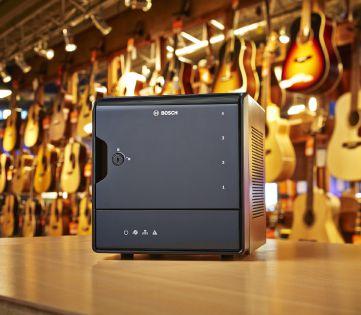
Safe data storage and excellent usability. When securing a business, you want to work with a professional surveillance system that doesn’t require special expertise. With the DIVAR IP 2000 storage unit, Bosch offers the ability to create a professional video surveillance solution that is both easy to install and easy to use. The unit is especially designed for 24/7 continuous video recording and is easily viewed and controlled from anywhere, regardless of available bandwidth. So now, you can easily keep an eye on your store from anywhere, any time. Learn more at www.boschsecurity.com/hdsecurity Our focus is making professional video surveillance easy for

SP&T News Security Integrator of the Year winner Habtech credits hard work and solid preparation for the success of the Toronto South Detention Centre project
By Neil Sutton
The Toronto South Detention Centre is what you might get if you built a jail out of building blocks — giant, concrete building blocks.
The TSDC, which officially opened in January of this year, is comprised in part of prefabricated concrete cells, which were assembled on site. The prison is part of the Ontario Ministry of Community Safety and Correctional Services ongoing effort “to build new, state-of-the-art facilities with ultra modern features and advanced technology that enhance public safety and internal safety and security.”
The 1,650-bed facility is thoroughly modern in design and includes a mental health assessment unit, a special needs unit and an area devoted to Aboriginal programs. Inmates are also able to spend time with visitors through on-site video teleconferencing tech-
nology (though in-person visits are permitted in special cases).
The new facility may be a model of modernity, but it is still primarily designed for incarceration, and as such features a highly robust security infrastructure — one that was recently recognized by SP&T News’ editorial advisory board as an outstanding example of security integration. The firm responsible for that integration is Mississauga, Ont.-based Habtech, this year’s recipient of the Security Integrator of the Year award, sponsored by Anixter Canada. Judges recognized the scope of the project, as well as its complexity, plus Habtech’s ability to work with a broad range of stakeholders and contractors.
For Habtech, its approach was not unlike the prefabricated cell strategy — much of the hard work was done before any of its employees even set foot in the jail. Everything had to be tested and proven well
before it could be installed on site.
“I think the big thing for the project in this case was that there was so much detail done with the customer before we actually got on site. A lot of the things were cleared up before we ever got there, so it made it a lot easier,” says Don Connor, general manager for Habtech.
Habtech was involved with the project from the outset. As part of a P3 (public-private partnership) team led by Fengate Capital Management and general contractor EllisDon, Habtech was selected through a competitive bid process to work on the electronic security aspects of the TSDC.
“In the first steps, as far as Habtech’s integration goes, what we had to do was come up with some sample products for the ministry to review so they could see [what it was going to look like] and how it was going to feel,” says Connor.
“We had a lot of meetings with approximately 10 to 15 representatives of the customer. . . . We had to get all the PLCs (Programmable Logic Controller) and all the integration up and running and be able to demonstrate that it all worked at the same time. We had 29 PLC panels connected and running and functioning.”
Habtech was ultimately responsible for the integration of numerous security subsystems, including CCTV, door control, a perimeter and intrusion detection system, fire alarm, lighting and power control, the public address and intercom system, as well as the aforementioned video visitation system. The company also developed a GUI for touch screen control systems and digital recording systems. Products deployed include technology from Axis Communications, Pelco by Schneider Electric, Genetec, Aimetis and Notifier by Honeywell. The infrastructure was designed using Wonderware — a first for Habtech since it usually uses its own custom software. Another first was integrating with the facility’s elevator system.
“We had never done integration to elevators at this level in the past,” says Connor. “It’s probably the most complex project we’ve ever worked on.”
Habtech had to work with several other parties also contracted to work on the site, including several U.S.-based security consultants, EllisDon as the general contractor, as well as Habtech’s own sub-contractors which dealt with conduits, wiring, etc.
There were also two phases to the project: Designed for inmates serving weekend sentences, The Toronto Intermittent Centre is a separate facility but part of the TSDC framework. It was up and running several years earlier than its big brother. While a great deal of the work was accomplished before installers were on site, effective communication was essential at all times.
“With the size of the building and the number of IP-based systems that there are — not just ours but those of the subcontractors — it was a very in-depth endeavour to make sure that we didn’t cross paths and have systems corrupt each other,” says Connor. There were, of course, regularly scheduled meetings between all of the stakeholders, but there were also “a lot of informal meetings and a lot of walking around the job site.”
“Because we go last, our schedule gets really, really condensed,” adds Mike Godara, Habtech’s vice-president. “We only put up devices after the walls are painted. To finish in that period was a

challenge. We had to deploy multiple testing teams and partition the system for testing, and then test the entire system together.”
As a P3 project, TSDC is covered by a Design, Build, Finance and Maintain (DBFM) contract, and as general contractor, EllisDon was responsible for the Design Build portion of that.
“There was so much detail done with the customer before we actually got on site.”
— Don Connor, Habtech
“EllisDon was the GC on the project. It was our team that pulled together the bid,” explains Geoff van der Lee, director of special projects for EllisDon. “Habtech was brought on board as a design-build partner. . . . They were involved from Day 1. They were on board right from ground-breaking right up until completion.”
This is the fourth prison project van der Lee has been directly involved with and “every single one of them gets more complicated than the one before,” he says. “The one that we constructed in Toronto South is very integrated, very electronic-security driven. There are checks and balances and controls on pretty much everything.”
But, like any major project, there were some
stumbling blocks along the way, says van der Lee. Meeting the scheduled completion day was a challenge, he says, particularly considering the timeframe and the fact that the project comprised two major components that were completed years apart but still had to be fully integrated.
There were times when not everyone involved saw “eye to eye,” and “there were a few teething issues, as you might expect on a project of that size,” says van der Lee, but ultimately it’s the end result that matters most. “The success of the project speaks to how well the team worked well together,” he says. “Generally, everything worked very well.”
He credits much of the success to the preparation work performed by all parties involved, including Habtech’s diligence before actual on-site work. “Generally the commissioning went well,” says van der Lee, “and [Habtech] had most of the issues resolved before the materials hit on site. We ended up doing a lot of the software testing off-site at Habtech’s plant, so that by the time it actually arrived, it was, in essence, proven.
“Mike’s crew has been great,” adds van der Lee. “There’s been a lot of . . . issues to deal with that a lot of people have worked very hard to fix and make sure work properly and satisfactorily to the ministry. I can’t fault them in any way for the service they’ve shown.”
Habtech has been working in the security integration field for almost a quarter century, much of it in corrections. Due to the nature of the work, the integrator isn’t used to the spotlight, so to have a major project recognized by an award is a rare treat. “We kind of keep to ourselves and don’t talk a lot,” says Connor, “but it’s nice to be recognized as Security Integrator of the Year.”
• Construction first announced May 9, 2008
• Built on the site of the former Mimico Correctional Centre (dating back to 1887)
• Replaces the Toronto Jail and the Toronto West Detention Centre
• 1,650 inmate beds (TSDC)
• 320 inmate beds (Toronto Intermittent Centre)
• Built to meet LEED Silver certification
• Most cells include a bunk bed, two stools, a shelf, a sink and a toilet
• 70 video visit terminals for public use and five video privacy booths
For Godara, the award is the perfect way to cap off a career. He is planning to retire next year and the TSDC project is a highlight amongst his life’s work. “I’m glad we finished it and it came out great,” he says.
“This will be the thing that I always remember. I’m an electrical engineer and automation is my field. This being the most automated system, it gives me pleasure to be able to do in my career what I was trained for. Being recognized for our work is an honour.”

With so many camera companies introducing Cloud-based solutions, there has to be a payoff somewhere down the line
By Tristan Bronca
The Cloud is perhaps one of the most widely used but poorly defined computing terms to arise in recent years.
The National Institute of Standards and Technology defines the “Cloud” as “a model for enabling ubiquitous, convenient, on-demand network access to a shared pool of computer resources.” In other words, a computing model that is versatile, accessible but otherwise defined almost however one chooses. In science, this vagueness is central to the definition itself, as the term is “commonly used to describe a large agglomeration of objects…any set of things whose details are not inspected further in a given context.”
Since the earliest iterations in the mid-90s, this is how the Cloud has been understood: as a loosely defined collection of data. Yet a sizeable number of computing companies have touted it as the future of data storage and those attitudes have begun to take hold in the surveillance industry. The software-based Cloud now offers an alternative
to expensive hardware-based technologies which require not only a camera (or set of cameras) but also a DVR or some other “box” from which those devices could be managed. Cloud-based systems, on the other hand, connect cameras and other devices to a number of control points.
Iveda’s Sentir is one such product. It’s a video surveillance hosting platform that’s pitched as a “turnkey solution” for enterprise and small business customers alike.
“It’s flexible enough,” says David Ly, the CEO of Iveda, “so that if you’re a small $500,000 alarm company with a Dell server in your backroom, you can use Sentir.” At the other end of the spectrum, he points out that Philippine Long Distance Telephone Co. (PLDT), a telecom company with over 70 mil lion subscribers, is also using Sentir for their customers.
This scalability is a core aspect of Sentir’s appeal. Adaptability is another.
“I used to go and buy PC video games and these games on the side of the box that say ‘min imum system requirements’ and if my comput er didn’t meet those requirements, the game just sucked,” Ly explains. “That’s what traditional soft ware was designed to do, and our video surveillance world today — no matter how fancy the software — is the same way.” Sentir, on the other hand, isn’t.
“Well, what’s more secure: your office in this mini mall . . . or is it a tier four data centre?”
— Rahul Rao,Transoceanic Intelligence Solutions
and Sentir comprises about 50 per cent of their security business. Rahul Rao, TOIS’s founder, estimates that within that vertical, about 60 per cent of its revenue comes from larger clients: universities, logistics companies, tourism, even cities.
Surveillance giant Axis Communications offers a Cloud-based platform called AVHS. Canada country manager Bob Moore says its biggest client is an American electronics company that uses it for monitoring its safe rooms. He estimates that currently about five per cent of the company’s


From a business perspective this dramatically widens the potential client pool since companies like Iveda don’t always know what kinds of infrastructure those clients have in place. “Being Cloud means you have to be software-defined,” he says, “that means your software has to be clever enough to sniff out the capacity of the existing environment — how much processing power do you have, how much storage is available — and go ahead and allocate enough [resources], whether it’s for two or 2,000 cameras.”
According to Ly, the majority of Iveda’s revenue comes from telecom companies like PLDT who resell to residential end-users or small business owners. He says that often these companies will charge a monthly fee for the service, a portion of which Iveda will collect as a licensing fee (Ly says this ranges from $3 to $5 per device per month). As is customary for most Internet or cell phone providers today, the telecoms often include the hardware gratis. “There’re a lot of small guys that don’t like to buy big systems,” Ly says. “They were obligated to in the past but today, think of all the small guys in the streets of Vancouver — the laundromats, the bread shops — that can just buy one or two cameras and pay $10 or $20 bucks a month and they’re done.”
Enterprise customers are different in many respects. Transoceanic Intelligence Solutions (TOIS) is one of Iveda’s resellers based in Vancouver
Clients like these have more complex networking needs than the small business owner. Furthermore many of these larger clients also have in-house expertise available to them to maintain the software, meaning the appeal of effectively outsourcing that responsibility to the Cloud’s host is some-
Rao says that neither of these obstacles are easy to overcome which is perhaps why, he speculates, sales have experienced only modest growth in the few months they’ve offered Sentir. But the more likely reason, according to Rao, is most prospective clients don’t understand it.
He cites the example of a local night market (an outdoor district with stalls that sell artwork, food, video games, electronics and other knick knacks) that had a number of “interesting” requirements, since they were both outdoor and mobile. They also wanted to mix and match different cameras within their already existing interface. According to Rao, Sentir could simplify the process, giving them a way to connect and organize their inputs, but before they could do that, they had to convince the owner they could pull it off.
With bigger corporations, this process becomes more complicated when multiple facilities and multiple brands of camera come into play. Not only that but Rao also says enterprises have a smaller window of opportunity to make the sale. “[You need] to price it out properly when they’re in a position to make that decision,” he says. Because enterprises buy in cycles, if the reseller can’t get the customer what it wants by the end of the fiscal year, for example, they may have to wait another 12 months to try again.
While this is no different than implementing any other security network, the sales process for the Cloud also comes with two additional challenges. A recent survey conducted by U.S.-based Eagle Eye Networks found that of the 250 IT, video surveil-
“At some point in the future, I think Cloud computing will be ubiquitous in all our lives.”
— Bob Moore,axis Communications
lance professionals and managers surveyed, 65 per cent “wanted at least some Cloud video recording” but 79 per cent “saw at least one hurdle to Cloudmanaged video surveillance.”
“One thing that does hold it back are individual’s broadband and the broadband costs,” says Bob Moore. “One reason why people would store their data locally as well as on the Cloud is because you don’t need to send all your highest resolution pictures to the Cloud when all you want to do is get a notification through your mobile device to see what happened.” Moore says that Axis’ AVHS is flexible enough to allow clients to configure it in such a way that their broadband costs don’t shoot through the roof but often as the number of devices in a system grow, so too does the bandwidth required to connect them.
While 41 per cent of Eagle Eye’s survey subjects said high bandwidth usage was stopping them from embracing the Cloud, another 45 per cent pointed to another reason: security of the system itself. Moore mentioned that some of AVHS’ Canadian clients expressed some reservations about having their surveillance data hosted on American servers, where different privacy laws didn’t always make it clear who or what had access to the data.
But the more fundamental concern comes back to the definition of the Cloud as something “ubiquitous,” “convenient” and “shared;” all terms that marketers have since realized are at odds — at least in theory, if not in reality — with the security that these clients so value.
Rao acknowledges that, but also says these abstractions don’t apply to Sentir, especially for small and medium businesses. “When they say they want to store something onsite, I would say, ‘Well, what’s more secure: your office in this mini mall that doesn’t have a physical security guard, where anyone could break in and steal your servers or DVR at night, or is it a tier four data centre that has armed guards and biometric access control?’”
For big businesses that do have some of those things, Rao points out that the Cloud is still more secure because it decentralizes control of the system. “If you’re building redundancy across multiple data centres, heaven forbid one of your data centres goes down, then all of your data is stored in a separate centre in a different part of the country.”
He went on to say that this perception that the Cloud is less secure really only applies to the public Cloud and even then there is free software to layer on top to secure it.
“At some point in the future I think Cloud computing will be ubiquitous in all our lives,” Moore says, “and I’m not totally sure what the impact on my industry will be but we always take the longterm look at our business so it will always remain a large part of [it] going forward.”
David Ly spoke about the future more confidently: “Iveda is going to phase out the box technology,” he says, “you can attach whatever projections or visions you have to that but I truly believe that if it’s not Iveda, it’s going to be another Cloud concept.”
Tristan
Bronca is a freelance writer based in Toronto.

the PSIA the HDcctv Alliance and more are on a mission to make technology easier to use, but integrators may need more convincing
By Linda Johnson
When integrator Rob Quinn refers to compatibility standards as the Holy Grail of the security industry, he captures two truths.
First, making installations easier and less frustrating is a much sought-after goal. Second, the goal often seems far off.
“I think in the future, standards will make installs easier. It’s a possibility in the future,” says Quinn, president of Toronto-based Quinn Digital Asset Protection. “But at this point, I haven’t seen a huge change.”
The several organizations created to develop and promote compatible specifications see the situation more positively, of course. And today, by going into new areas and expanding their range of conformant products and services, they expect their interoperability standards will — in the not-so-distant future — become a more integral, and really useful, component of daily security operations.
Per Björkdahl, chairman of the steering committee of ONVIF (open network video interface forum), says the organization’s mandate is set by its member companies and has not changed since 2008, when it was founded by Axis Communications, Bosch Security Systems and Sony. “I think we’re more than ever on track,” he says.
“The alliance was started to facilitate interoperability in relation to video only, but its scope has expanded now to include any physical security product or application.”
The wider purpose was a response to their belief, adopted about a year ago, that in future, every security system will share the same communication interfaces, Björkdahl says. “The mission for us, then, would be to produce and promote these interfaces to the industry. And, of course, it is a huge task to make sure this interconnection is carried out in the correct way,” he says.
After video, the second area they went to is
access control. “We see the same type of development; you can pick and choose equipment from different manufacturers and put the system together.”
Overall, Björkdahl says, ONVIF interoperability standards have served their purpose. An integrator can choose, for example, an NVR from Bosch and a camera from Pelco, and they work together.
“But you have to also realize the ONVIF standard does not completely resolve all the different features of the camera. It’s a base set of features that cover a good 70 to 75 per cent of all the camera deployments,” he says.
The approach of the Santa Clara, Calif.-based Physical Security Interoperability Alliance (PSIA) has been to work on standards for the physical security ecosystem, says David Bunzel, executive director. Thus, in addition to video, they deal with analytics, storage, access control and intrusion.
In the last year, however, they have branched out to a new area called PLAI (physical-logical access interoperability), a specification for credential management. The new specification, he says, should be particularly useful to companies with multiple locations and security systems.
As well as helping customers, Bunzel says he expects PLAI will open up opportunities for security companies.
“A customer will want to have all their systems integrated with the PSIA specification if that’s being used to manage credentials. So everybody’s credentials will be used for a variety of functions within a company. It’s not only access and managing presence, it could transcend to building management issues, energy, lighting and presence management or facility management,” he says.
“There are many different things that will get
the physical security people — and potentially building management people — engaged.”
Bunzel says he thinks interoperability standards still represent a very dynamic segment. “I don’t want to say our efforts have not been as valuable as we hoped they would be, but standards take time. And the market is still trying to get a number of different things ironed out.”
Many businesses are currently moving more towards adopting interoperability, he says. There are, for example, very active programs with the PSIA specs in a number of companies: related to PLAI, to access control and to intrusion. These products may have significant benefits to the market. “Are they in the market right now? Are they having a strong influence in the market right now? Not today. But we would expect within the next six to 12 months you’re going to be seeing products and services that do include these specs that will have an impact in the market,” he says.
Andrew Kellett, principal analyst of infrastructure solutions at the London, U.K.,-based analyst firm Ovum, says they are not seeing much comment on standards at the moment from a pure-play IT security standpoint.
“However, future convergence between physical and logical security is happening, especially in areas such as identity management, so there is future potential there. I could also see possible links in some areas of Internet of Things usage as more devices become IP enabled, but that is probably further down the line,” he says.
The HDcctv Alliance, based in Holgate, Australia, was formed in 2008 to standardize and promote specialized HD surveillance local-site transport solutions, says Todd Rockoff, executive
“Standards take time. The market is still trying to get a number of different things ironed out.”
— David Bunzel, PSIa
“The
— Scott Bartlett, Southwest Surveillance Systems
director. The alliance continues to support both the first generation, HD-SDI, and second generation, HDCVI, technologies.
In the last few years, he says, HDcctv technologies have provided a cost-effective and reliable alternative to IP technology and the widespread availability of HDcctv equipment has accelerated the migration to HD surveillance. “People started buying IP in 2010. But the migration to IP cameras was in fact a migration to HD. People who can afford HD were doing IP,” he says.
“But today, because of what’s happened in specialized solutions, HD is free. You can have HD that’s just as reliable as NTSC, exactly as convenient, the same price, with stunning performance.”
Some situations, such as transmitting 4K images, demand Ethernet technology, Rockoff says. But HD-SDI offers superior fidelity, and HDCVI is more resilient. HDCVI works over any existing legacy infrastructure: coax, UTP, phone wire.
“HDcctv technologies have really enabled HD products for the installed base,” he says. HDcctv camera sales are growing exponentially year over year.
Quinn says standards have not improved interoperability very much for integrators in part because those standards that are in place are still relatively generic and don’t speak to the full capabilities that manufacturers have built into their cameras and other devices.
“At the end of the day, you don’t get access to all of the functionality of the edge devices unless the manufacturer of the software still writes that
integration using the ATI or SDK to that edge device,” he says.
It is true, Quinn says, when you know the camera is ONVIF compliant and the software is ONVIF compliant, you will be able to see and record the video.
“But beyond that, you’re still looking for full integration of the capabilities of the camera by the software manufacturer, which is no different than it was 10 years ago before all the standards were put in place,” he says.
“The big picture is people are usually buying cameras for more than just video. There’s usually other capabilities built into the camera, and without having specific software to manage that, ONVIF doesn’t give you access to those.”
Scott Bartlett, CEO of Las Vegas, Nev.-based Southwest Surveillance Systems, says standards are not very effective right now because too few people have adopted them.
“It’s not really happening. The IT space seems to be a lot more upfront and accepting of standards versus in the security and surveillance space,” he says.
Another obstacle to the greater adoption of standards, Bartlett says, is that many equipment manufacturers — despite saying they use open standards — are still very proprietary.
“Looking at the security space right now, I think we’re a lot like VOIP (voice over IP) was in its early stages. It’s kind of fragmented. People are looking for standards, but when standards are out there, they’re not following them,” he says.
“And the manufacturers have that proprietary hook in their own equipment. ‘We’re open from an architectural standpoint, but if you use our cameras, you get a lot more features.’ It’s one of those things.”
In future, Björkdahl says, he expects ONVIF will continue in its current direction, promoting a greater degree of interoperability among the different security systems.
“And I hope ONVIF can deliver those communication interfaces for that, to make it happen,” he says, adding the standards body already has seen huge acceptance in the market.
“We have more than 500 members who together have more than 3,000 conformant products. So we have a very good footprint when it comes to interoperability.”
At PSIA, Bunzel says, they hope specifications proliferate and make the implementation of security products easier. “Security products, as they’ve gone to IP, have not taken advantage of some of the valuable interoperability — connectivity things — that can happen. The Internet of Things is supported by a lot of the different initiatives that we’re involved in.”
The PSIA would like to see specifications built into systems to reduce the amount of work people do, he says. “Right now, companies are doing the same thing over and over again, employing custom coders to be able to make these products work and interoperate with their system,” Bunzel says.
“If we can take a little bit of that heavy lifting and put it in a standard space format, we’re going to make it easier to implement these products. That will, hopefully, expand and open up the market opportunity and make the pie bigger so more companies can benefit.”







Bosch Security Systems
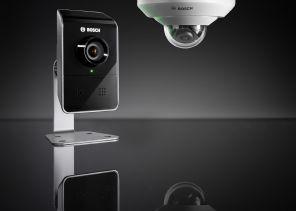
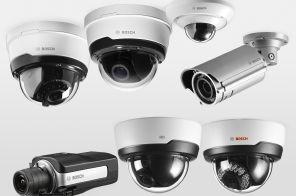
The IP 2000 family is ideal for small retail shops and residential applications. Store video in the cloud, on a NVR or the built-in SD card. Access video and control cameras with the free Bosch Video Client or Video Security app. View video and HD images via a mobile device anytime and from anywhere regardless of available bandwidth with Dynamic Transcoding technology. The IP 2000 cameras support Dynamic Transcoding when used with a DIVAR IP recording solution or VIDEOJET transcoder. www.boschsecurity.us
With the DIVAR IP 2000 storage unit, Bosch offers the ability to create a professional video surveillance solution that is both easy to install and easy to use. The unit is especially designed for 24/7 continuous video recording and is easily viewed and controlled from anywhere, regardless of available bandwidth. It installs in less than 15 minutes without training or certification.
www.boschsecurity.us
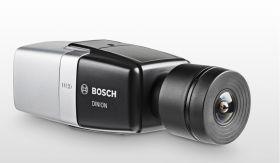
With the DINION IP ultra 8000 MP, Bosch enables you to see every detail, everywhere. Covering a large area and identifying objects at a great distance is challenging. That’s why the 4K ultra HD technology in this camera offers 12MP resolution to deliver amazing detail even when zoomed in. The 30 FPS rate for a 4K ultra HD camera captures fast moving objects in high resolution. This provides the level of detail that makes the difference when collecting video evidence.
www.boschsecurity.us
Bosch Security Systems
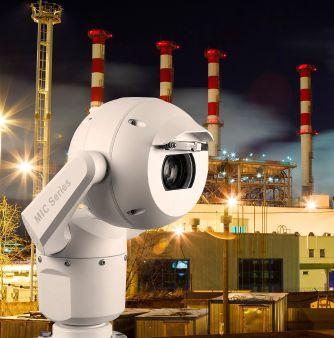
The MIC family of ruggedized PTZ cameras provides reliable surveillance in the most difficult outdoor locations by combining high-quality HD imaging with an IP68/NEMA 6P-rated architecture. The cameras deliver the highest quality images in areas with extreme conditions like roads or highways, transportation facilities, city surveillance and critical infrastructure sites. They withstand a range of harsh conditions – from -60 to +60 degrees Celsius with up to 100 percent humidity to rain and snow, high wind gusts and significant vibration.
www.boschsecurity.us
Bosch Security Systems
This low light HD camera delivers 720p resolution at up to 60 IPS with clear images even at night. High sensitivity in color and monochrome – down to 0.017 and 0.0057 lux respectively – combines with Content Based Imaging Technology for detailed images in all lighting conditions, and 60 IPS provides optimum performance in scenes with fast-moving objects. The vandal-resistant IP66-rated cast-aluminum housing, polycarbonate window, and hardened inner liner makes it ideal for indoor or outdoor use.
www.boschsecurity.us
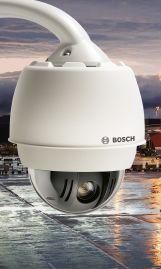
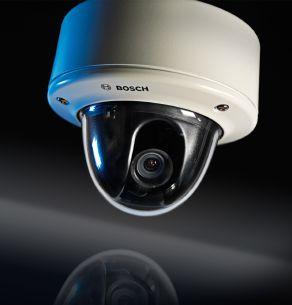
Delivering relevant IP video images in all lighting conditions, Bosch offers its proven starlight and dynamic technology in the AUTODOME IP 7000 HD family of high-speed PTZ domes. Whether capturing video in harsh sunlight or extreme low light, two camera models provide round-the-clock protection. They ensure maximum image details are captured for traffic and transportation, industrial, government, city surveillance and other applications faced with difficult lighting and moving objects indoors or out.
www.boschsecurity.us
The IP 4000 and IP 5000 camera families provide a comprehensive portfolio for professional surveillance for small and medium-sized organizations. With these cost-effective cameras, Bosch raises the bar for everyday surveillance situations, including schools, hospitality sites, shops, commercial buildings and more. The IP 5000 family offers resolutions up to 5MP to make it easy to distinguish individuals or minor details. For applications where cost is more important than fine scene details, the IP 4000 family offers 720p resolution.
www.boschsecurity.us
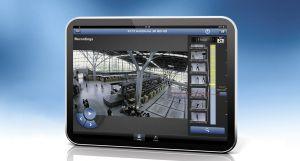
The Video Security app combined with Dynamic Transcoding technology delivers smooth live video streaming and instant access to HD images when needed, regardless of available bandwidth. The app allows scrolling through various camera locations with a single swipe and complete control of cameras including PTZ and focus functions. Bosch IP cameras support Dynamic Transcoding when used with a DIVAR IP recording solution or a VIDEOJET transcoder.
www.boschsecurity.us
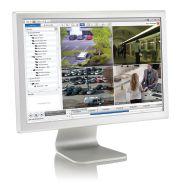
Avigilon Control Center (ACC) 5.2 was built on an open platform and designed to be both scalable and user-friendly. For organizations with large, distributed sites such as retail chains, multi-national corporations, school campuses, and critical infrastructure operations, ACC 5.2 enables them to respond more quickly to real-time incidents and conduct more efficient investigations. With ACC 5.2, organizations can migrate from ACC 4.12 or earlier versions of ACC 5.0 and keep large and distributed locations more secure.
www.avigilon.com
March
The full HD 1080p outdoor vandal resistant and waterproof Fixed Dome Network Camera (WVSFV631LT) is the latest addition to the company’s 6 Series i-PRO camera line. The camera is IP66 rated, water and dust resistant and features a built-in long-focus variable-focal lens. The WV-SFV631LT with its variable focal length of 9mm to 22mm is suitable for applications where the camera needs to produce an image but be located some distance from the subject, such as on a high ceiling in a large lobby. Leveraging UniPhier LSI processors, the new 6 Series camera delivers high definition video images in 1080p resolution and an up to 133dB of dynamic range thanks to its Enhanced Super Dynamic and Adaptive Black Stretch (ABS) technologies. www.panasonic.com
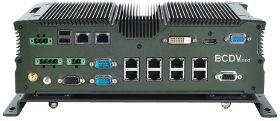
The Rigid Series product line is designed for outdoor recording in any environment. This new fan-less technology holds up to 4TB of video storage and is powered by an Intel Core processor. The Rigid Series includes models that offer POE, 3G, Wi-Fi, and GPS connectivity. The units are suitable for a wide range of mobile applications and installations in harsh environments. BCDVideo’s Rigid Series are built to order and include a twoyear warranty. The units meet MIL-STD810G vibration and shock compliance, as well as FCC Class A, and RoHS standards. www.bcdvideo.com/rigid-series
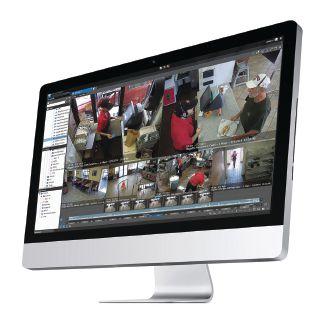
Command VMS version 1.7 introduces an intelligent interface design that enhances the user experience and further speeds centralized investigations. New motion histograms enable administrators and fraud or loss prevention investigators to find the video they need from any location, while interactive maps with thumbnail previews and map-to-map navigation provide security staff with rapid search and review capabilities. With the latest feature en hancements, organizations can remotely configure recordings and monitor IP camera per formance via Command’s single, browser-based interface. The software provides at-a-glance system information on schedule settings, recording conditions, estimated retention times and storage size per camera. www.marchnetworks.com
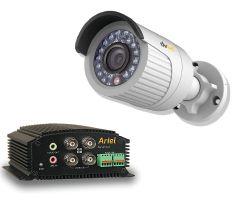
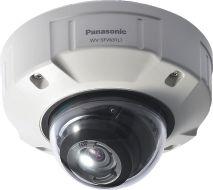

This solar wireless, low-power video surveillance system is equipped with a central receiving hub, eliminating the need for trenching, cabling and permitting. By utilizing specifically designed solar energy panels, the system consumes less that 1/10th of the power of an industry standard IP camera and transmits data wirelessly up to 1/2 mile. An embedded lithium ion battery powers the camera for up to five days on a single charge. The ultra-low power functionality reduces the solar panel size to 1.2ft2 The end user benefits from a smaller footprint. www.micropower.com
Ariel 720p and 720p Bullet cameras are weather-resistant, low bandwidth IP video surveillance equipment fit for any size enterprise. The video quality combined with IR illumination offers clear imaging in dim lighting or high motion and reduces utility costs and consumption. Each camera comes equipped with web interface for viewing and configuration as well as tamper detection and multi-zone VMD. The 16-port Ariel video encoder ensures a seamless transition from analogue to digital video surveillance by transferring analogue signals over digital streams to enable real-time audio/video streaming. www.dvtel.com
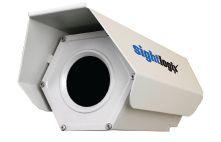
The third generation Thermal SightSensor has four times the processing at one-third the size, and consumes less than half the power of the prior generation. By combining solar power and wireless communications with an accurate outdoor detection system, the SightSensor eliminates much of the installation costs. With lens options that range from wide areas (90˚ FOV) to 600m distances, the NEMA 4X, nitrogen-purged Thermal SightSensor provides high Probability of Detect (PD) and low Nuisance Alarm Rate (NAR) video analytics day and night, in all weather conditions. The unit supports ONVIF, H.264. www.sightlogix.com
The SNC-XM631 is powered by the IPELA ENGINE EX signal processing system, allowing it to deliver full HD picture quality in challenging lighting conditions using Sony’s wide dynamic range technology (View-DR) and image stabilization technology. The indoor camera has a wide viewing angle of 113° to improve the field of view in compact spac es. It is also vandal-re sistant with an IK10 rating, and it has sensor in/out capabilities that allow it to integrate with other security systems such as alarms or infrared devices. The SNC-XM631 is designed for a number of indoor applications www.sony.com/security
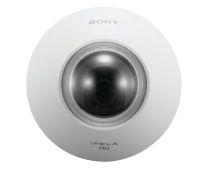
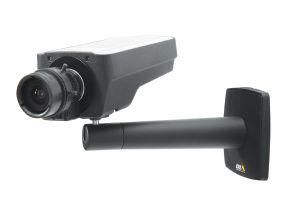
Axis Communications
The indoor AXIS Q1615 and outdoor-ready AXIS Q1615-E combine new capabilities like wide dynamic range, electronic image stabilization and shock detection with Axis technologies, such as Lightfinder and HDTV 1080p resolution. In addition to the ability to transition between Axis’ latest wide dynamic range innovation – WDR – Forensic Capture – and Lightfinder mode AXIS Q1615/-E offer several image processing features to enhance image usability, such as barrel distortion correction and electronic image stabilization.
www.axis.com
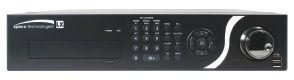
The LX DVR is the latest addition to the Speco hybrid DVR series. The LX is the first hybrid DVR from Speco combining both IP megapixel technology with 960H analogue recording capability. The LX allows users to migrate to IP at their own pace. The LX hybrid allows viewing of both IP and analogue cameras on the same screen as well as the option to view both live and playback on the same monitor at the same time. The LX is fully customizable with per-channel scheduling as well as HDMI output for 1080p HD resolution monitors and BNC loopouts for all the analog channels. The LX features an intuitive graphical user interface for easy setup and installation.
www.specotech.com
The IPS5204ES Full HD 1080p Speed Dome IP Camera features 20X optical and 12X digital zoom (240x total zoom) to capture details such as licence plates and point-of-sale transactions. This professional-grade IP camera comes equipped with day/night functionality for continuous 24/7 monitoring, along with Wide Dynamic Range to automatically provide the right amount of contrast. It also includes PTZ capabilities, with 360° panning and 90° tilting to make wide surveillance coverage possible, coupled with its 4.7mm to 94mm zoom range. Dome movements and speeds are programmed using a web browser. Key to the camera’s capabilities is its three megapixel, high-definition CMOS sensor. www.meritlilin.com
The equIP Series S is a family of IP-ready products — including box cameras, IR indoor domes and rugged domes — that integrate with Honeywell and third-party NVRs. The cameras deliver full HD video (up to 30 ips) with 720p, 1080p, 3MP or 5MP resolution for applications from small convenience and retail up to large systems for campus or city surveillance. All of the cameras feature on-board SD card storage to help prevent video loss by storing locally when communication to the NVR or video service is off-line. The equIP Series S features P-Iris that enables sharper images with better clarity and contrast by optimizing the depth of field and sensitivity most suited to any application. www.security.honeywell.com
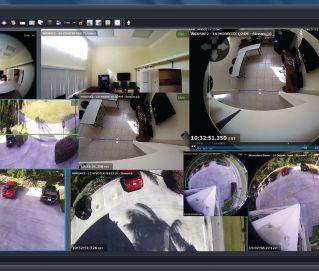
V5.44 is the latest version of WavestoreUSA’s advanced IP video surveillance software suite. V5.44 features include support for a new mobile application, increased storage, additional cameras per server and new levels of system expandability, along with greater compatibility in open architecture and platform support. WaveEye is a mobile application which allows users to stream and review video. www.wavestoreusa.com
Sentry VMS Mobile is a free mobile app that provides users with VMS control from most Apple and Android mobile devices. Support for the mobile app is built directly into the Sentry VMS platform and requires no additional, dedicated mobile servers to be added to the network. The app provides secure, user-authenticated access to live and recorded video from any camera on the network. Sentry VMS Mobile provides facility maps, layouts and camera lists. Features include a motion indicator and the ability to take snapshots of video. www.ipvideocorp.com
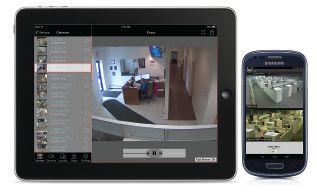
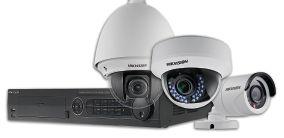
The Turbo HD Analog solution supports latency-free 1080P HD over up-to 500 metres of coaxial cable and offers compatibility with traditional SD cameras, Hikvision IP cameras and HDTVI-compliant cameras and DVRs. At launch, the Turbo HD product family consists of a range of Hikvision DVRs and 720P/1080P cameras, including bullet, dome, PTZ dome, turret, vari-focal, vandalproof and low-light units. The product family is based on HDTVI (High Definition Transport Video Interface) technology and is suited to upgrading existing standard definition systems at low cost. The Turbo HD DVRs can also connect with traditional SD analogue cameras.
www.hikvision.com
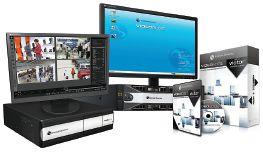
American
Version 4.5 of the VideoEdge NVR includes features such as Auto Discovery, which allows users to locate cameras on the network and assign IP addresses to any VideoEdge NVR with the click of a button. The latest version of VideoEdge also includes a new Watermarking process that allows security officials to assign a unique visual mark to the video that is specific to its business. www.americandynamics.net
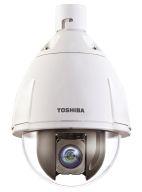
The IK-WP41A Pan-Tilt-Zoom (PTZ) IP dome camera is purpose-engineered to provide broad surveillance coverage outdoors. It features full 1080p HD video resolution, 20x optical zoom to help identify distant objects, 360° continuous pan for overview surveillance, along with highspeed PTZ to precisely follow moving objects. The camera’s self-contained IP66-rated weatherproof housing protects sensitive electronics from ad verse conditions. Power over Ethernet Plus (PoE+) 802.3at simplifies instal lation since only one Ethernet cable is needed for transmitting video, power and PTZ controls. www.toshiba.com
Siqura
The miniature H.264 1-CH video server VS8100 is compact and designed for front-end installations and discreet surveillance applications, such as homes, offices, retail stores, banks, and city surveillance, allowing for migration from an analogue to digital surveillance system. Through VIVOTEK’s video servers, data received from analogue cameras can be encoded by VIVOTEK’s self-developed advanced codec system and broadcast via an IP network for monitoring and recording. The VS8100’s compact size, no larger than a human finger, means that minimal footprint is required to deploy the technology in a variety of applications. The high-performance H.264 compression format is able to reduce video file sizes, enabling bandwidth efficiency maximization and storage capacity optimization. www.vivotek.com
Tamron
The company has developed two new 1/1.8”, 2MP fixed-focal-length models: 6mm (M118FM06) and 12mm (M118FM12) ultra-high performance lenses for FA/Machine Vision applications. The high-end fixed focal series in this category will be expanded to six models from the current four. The same as the preceding models, the new models offer: compatibility with 1/1.8” and 1/2” 2MP FA/Machine Vision Cameras; a sophisticated optical design to boost high image quality; distinguished uniformity in resolution and contrast from centre to corner; and a compact form factor.
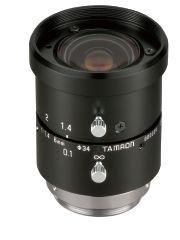
www.tamron-usa.com
EVE is a line-up of affordable click & go video encoders that upgrades an analogue CCTV system to an IP solution. EVE encoders are small, affordable and easy-to-use devices that digitize analogue video signals and send them directly over any IP network. EVE supports 960H-enhanced video streams and includes features such as image quality enhancement (motion-adaptive deinterlacing, 3D noise filter, fog correction) and interoperability with third-party systems. EVE comes in three different flavours. EVE ONE lets you migrate to IP one camera at a time. EVE FOUR upgrades four analogue cameras to IP, while EVE 4x4, a 16-channel rack encoder acts as a replacement for a DVR or analogue video switcher.
www.eve.nl
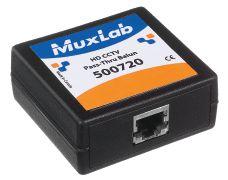
Muxlab

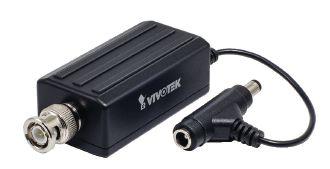
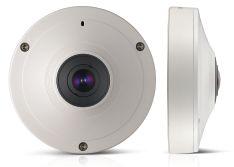
Samsung Techwin SNF-8010 and the new mobile SNF-8010VM fisheye cameras are omnidirectional cameras that offer five megapixel definition with digital pan/tilt/zoom, intelligent video analytics and on-board SDXC storage up to 64GB. Images captured with the fisheye cameras can be dewarped and/or displayed in a variety of configurations, including single or double panorama and 360° view. Images can also be dewarped on the client side for viewing and recorded in full 360° view prior to dewarping. PTZ functionality allows users to electronically pan, tilt and zoom in on specific areas for a more detailed view. www.samsung-security.com
The HD CCTV Pass-Thru Balun (500720), HD CCTV Pass-Thru Balun with Cable Lead (500720CL), and the Active HD CCTV Receiver Balun (500721) are all part of a new line which focuses on the SD, HD and 3G environments. The Active HD CCTV Receiver Balun provides extended distance between an HD-SDI CCTV camera and an HD-SDI DVR via Cat5e/6 cable. The 500721 supports up to 150 feet @ HD-SDI (720p, 1080i). The baluns work in pairs and can be interchangeable. The 500721 features LED diagnostics and supports MuxLab mounting accessories (models 500720 and 500721). www.muxlab.com
The FlexMount S15 thermal camera is a compact, weatherproof and customizable surveillance solution that delivers high-resolution footage in any environment. The dual thermal sensor modules, which measure thermal radiation, can function in total darkness or during the daytime to detect motion in shadows or inclement weather. These thermal modules can also measure sensitivity up to 50mK (millikelvin) and can differentiate between positional and on-the-spot movement. The S15D FlexMount also houses two 5MP image sensors (equipped with microphones), which are fully weatherproof, flexible, scalable and discreet enough for industrial mounting or monitoring two adjacent areas at once. www.mobotix.com
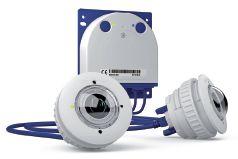

The latest release of exacqVision introduces VideoPush, which allows users to easily push selected cameras or entire views to another monitor, such as a public display monitor or video wall. exacqVision 6.4 also finds, assigns IP addresses and connects certain IP cameras to a user’s network automatically. Additionally, the latest version of the Exacq Mobile app allows users to set camera tours to regularly peruse important cameras.
www.exacq.com


Brian Wiser, may be a relative newcomer to the world of security, but that doesn’t mean he doesn’t have the necessary experience to fill the top sales job at Bosch.
Prior to joining Bosch, he spent almost three decades working at Ingram Micro, a large U.S.-based distributor whose primary business is IT systems. Several years ago, Ingram set its sights on the physical security business — some of that business fell under Wiser’s purview, exposing him to a new range of technologies. SP&T News spoke with Wiser barely a month after he joined Bosch to ask him how he’s getting up to speed.
SP&T News: How long were you at Ingram Micro?
Brian Wiser: I was at Ingram Micro for 28 years. It was fantastic seeing all the changes taking place in IT. At my last role there, one of the things I managed was the security business. One of the things that’s been really fascinating to me and what really attracted me to Bosch was the convergence that was happening. You saw things change dramatically and you saw a lot of IT partners or network infrastructure VARs suddenly get into security and be fairly successful at it. You also saw the security integrators adapt to the new technologies and change their business in ways they probably hadn’t had to in a while. That was exciting to watch and fun to be a part of it while I was at Ingram.
SP&T: Does coming from IT give you an advantage in the physical security world as it goes through its own transitions?
BW: I think it might. IT has had to dramatically change. VARs and resellers have had to dramatically change their business models probably two to three times — from products to managed services to Cloud-based . . . and you include mobility in there. It’s really altered the landscape. They’ve been very adaptive, as they are with security. What’s exciting and has been a beneficial experience is being able to watch that happen in IT, and then with my exposure to physi-
By Neil Sutton
cal security and my relationship with Bosch, we’re starting to see that with the security integrator and see how well they are starting to adapt to those trends also. Mobility [also affects] them too in terms of user interfaces. I think it’s been helpful for me to see that before and to have gone through those transitions so I can help security integrators go through those transitions too. I think they’re adapting very well to that.
“Certainly, we want to grow our share in the IP video market and we believe we have the portfolio to do that.”
SP&T: Are your experiences with IT VARs applicable to dealing with issues facing security integrators?
BW: I think the challenges are actually the same. How do you constantly stay ahead of technology trends and how do you grow your business and position yourself for further growth and try to stay ahead of the curve? I think a lot of the challenges are very similar. There might be a timeline that’s different, but for the most part, I think they’re going through the same things.
One of the opportunities I think that is probably there is in the service or full solutions space. I think there’s many integrators that do a fantastic job of that, but IT had to, for survival reasons, adopt a very sophisticated services business much sooner in order to stay alive. I think you’re seeing that with the security integrators, but it’s a different timeline.
The integrators that I’ve dealt with before, and now [in my role] at Bosch are pretty savvy. I’m just starting to talk to customers now . . . they’re a pretty savvy group and I think they’re open to new marketing ideas and new ways to grow their business.
SP&T: Do integrators need to add new tools to their arsenal in order to keep up?
BW: I don’t think integrators are missing any tools, it’s how integrators can leverage their whole ecosystem, which is very important — leveraging partnerships, like with Bosch, to help them grow their business, and to lean on those partner-
ships and eliminate redundancies in the channel, so the dealer and integrator can focus truly on servicing their customers and leveraging partnerships with companies like ours and others to really provide a much more seamless way to go to market.
SP&T: There was a wave of large acquisitions in the IT market about a decade ago and the pace of acquisition has now accelerated in security. Can we expect to see this trend continue?
BW: To your point about mergers and about dealers changing the way they go to market, having the benefit of hindsight is helpful there. I think the more Bosch can work with the whole ecosystem — work with the distributors and how they go to market — I can leverage that from what I’ve seen before, and I think working with the integrators is also going to be really helpful. A lot of those same types of dynamics took place five to eight years ago [in IT] now seem to be taking place in security.
SP&T: What are your plans for the Bosch sales organization?
BW: I’m definitely in learning mode. The process is just starting for me with all the customers and the partners and understanding my management team. We have great people here and I’m getting to know them. I’ll be doing a lot of travelling and still in “sponge mode” for the next couple of months, gathering information for long and short term opportunities. Certainly, we want to grow our share in the IP video market and we believe we have the portfolio to do that and the integration partnerships required to compete effectively. Also to grow the mid-range and the panel business. We have some new products in that regard as well. And then with the intrusion business in Canada, we’re looking to expand our dealer program (see story on p.8)
SP&T: Today’s IP camera market is very competitive. How do you differentiate Bosch’s products?
BW: From a Bosch perspective, we have an amazing portfolio. One of the things we want to focus on really is increasing the breadth of our partnerships and getting our products out there more — whether that be through increased marketing or [some other means], the point

is that when people use our products, we have amazing brand loyalty. People trust them and know them.
SP&T: What role are standards playing in the maturation of the IP video market?
BW: Where I come from is more of an open world. I think certainly the industry is going more in that direction and Bosch is certainly addressing that. We work with many different partners across our whole ecosystem. I’ve always worked in a world where we encourage those partnerships. I think that’s something I have experience with, and as I learn more about this marketplace, I think it’s going in that direction.
SP&T: Are you seeing more IT skillsets being developed in the physical security world?
BW: There were some question marks a while ago with how fast some security integrators could adapt to the changing environment. I think it’s been exciting to watch security integrators move rapidly and change some of their business models and improve their value proposition and adapt well. I think they’ve done a much better job than a lot of people would have given them credit for three or four years ago.
SP&T: Conversely, are you seeing more pure IT resellers now entering the physical security market?
BW: Yes, absolutely. I think there was some perception, and maybe reality, of low-hanging fruit. What you saw was quite a few network infrastructure VARs realize that they can set up base level security systems and do a fairly good job of that and capture some of that business. Then you saw the pro A/V installers and dealers cross into that space as well when convergence was happening. On the other side too, with consumerization trends and mobility trends, the home installers get into the security space . . . and reach into the commercial market in order to survive and start doing things like houses of worship. They were also getting into the security space. You saw this coming in from all directions. There was a certain level of expertise required and they could get in pretty quick [but] to put in much more sophisticated physical security solutions, that’s a bigger learning curve. Security integrators understand that and have defended their turf pretty effectively.