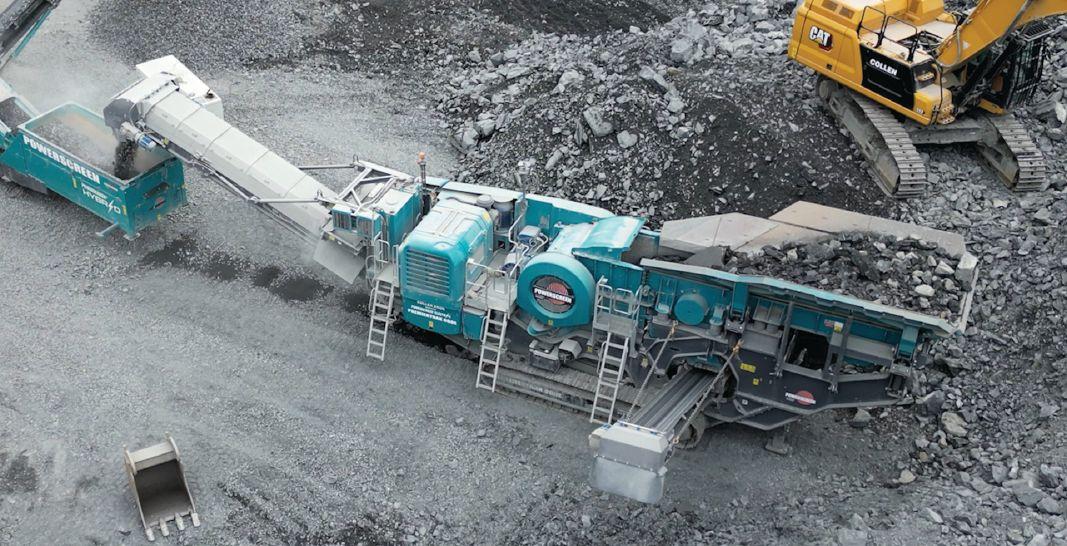
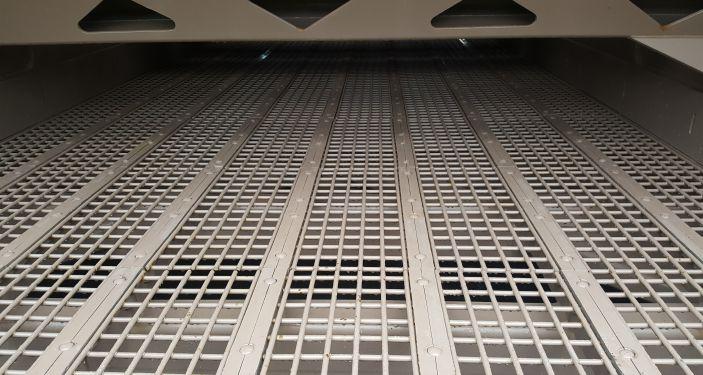
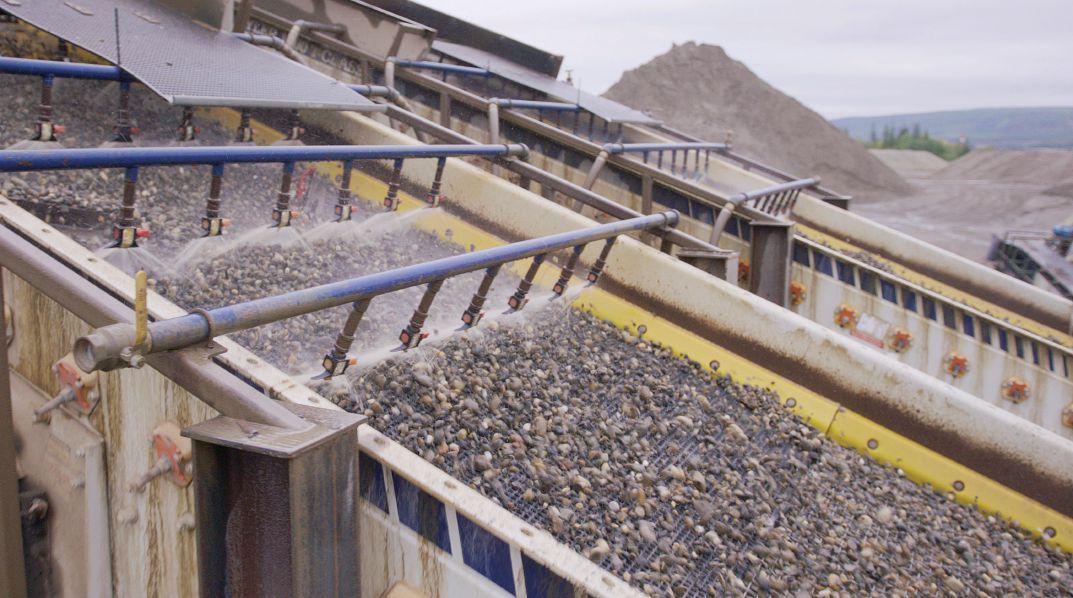
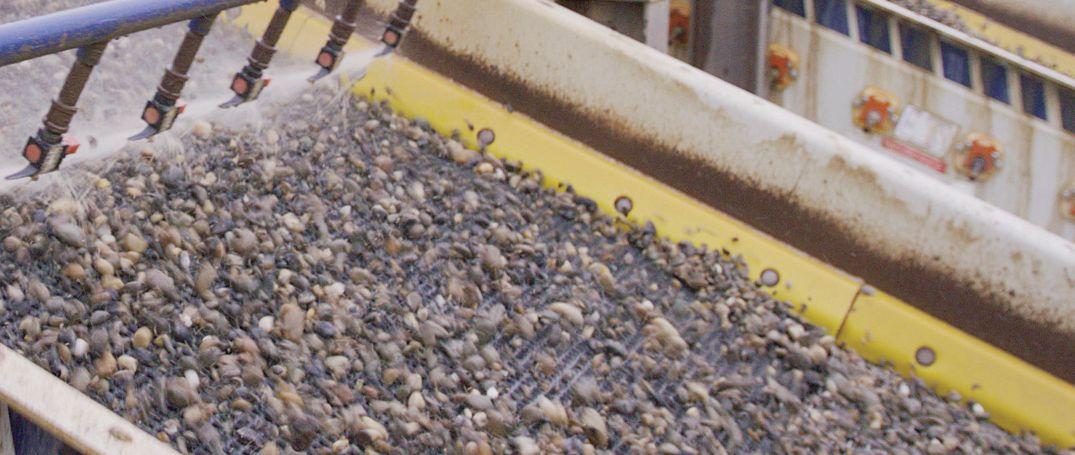
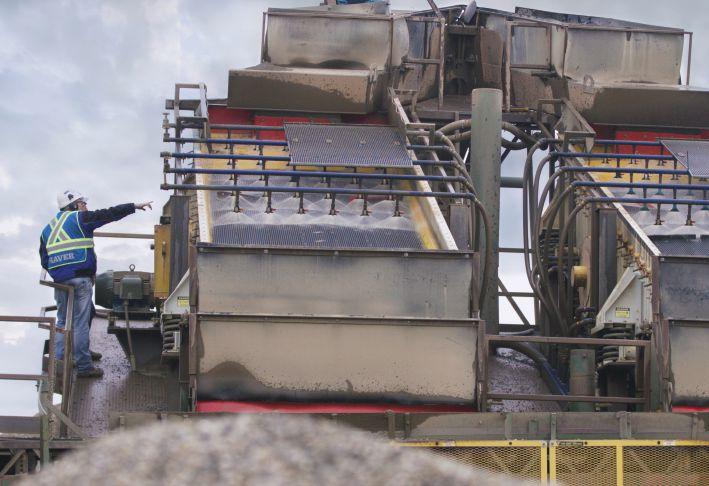
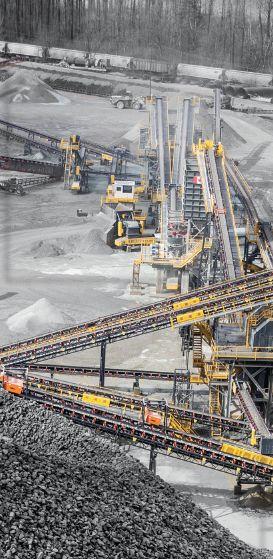
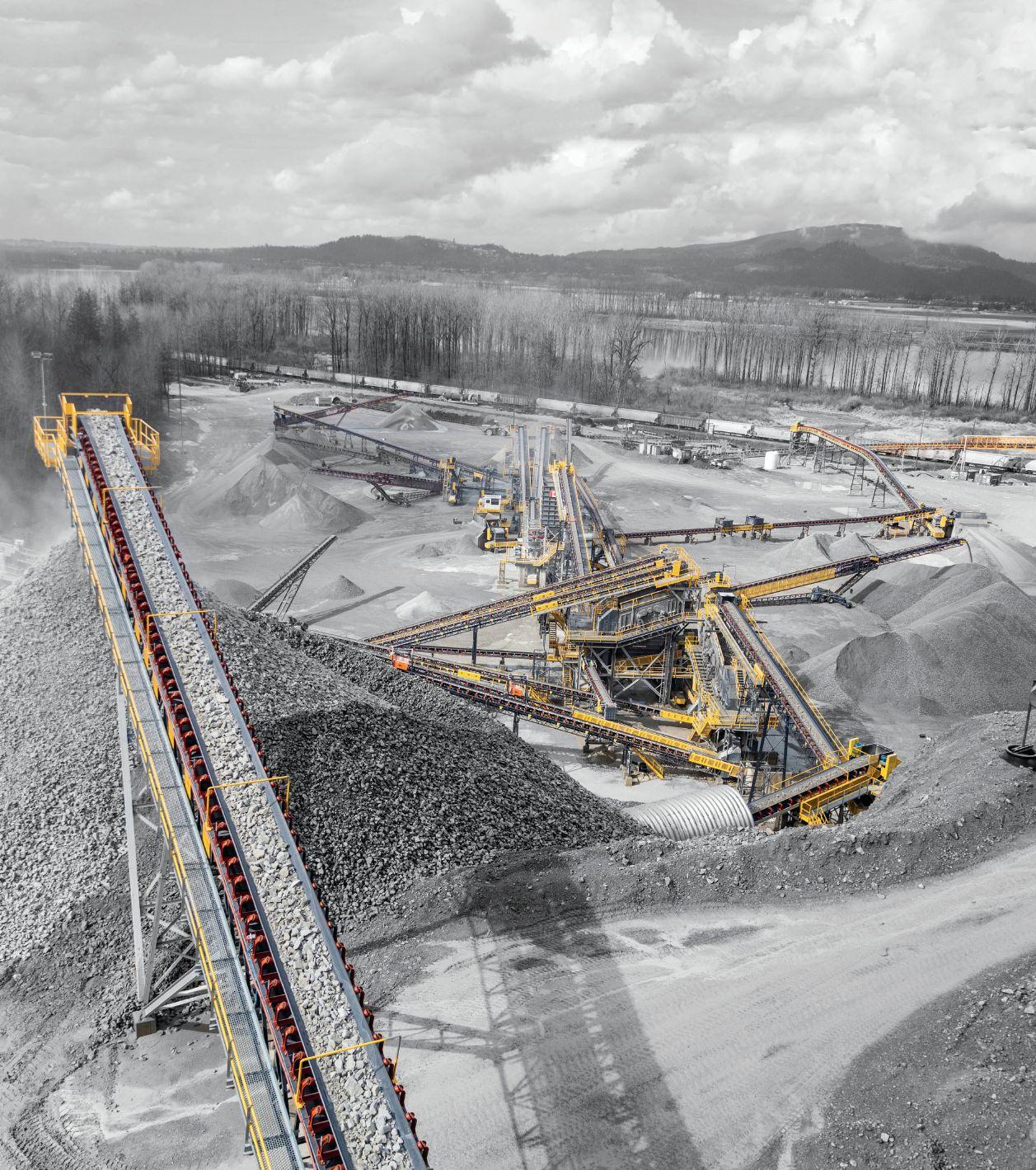
THE MOBISCREEN EVO SCREENING PLANTS –4 TIMES MORE POWER.
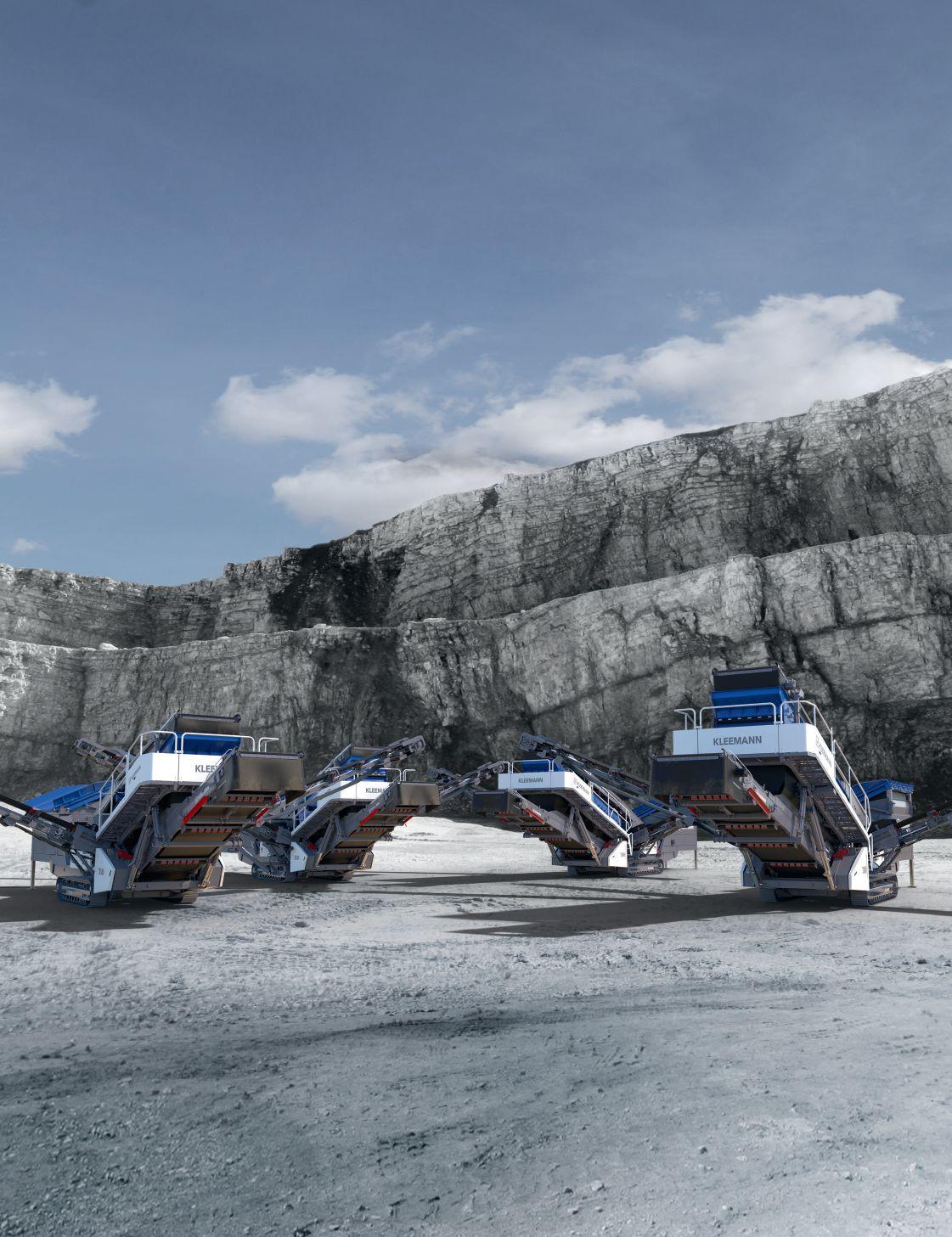
MOBISCREEN MSC 952 AND 953 EVO – even more performance with a 9.5 m2 screen surface
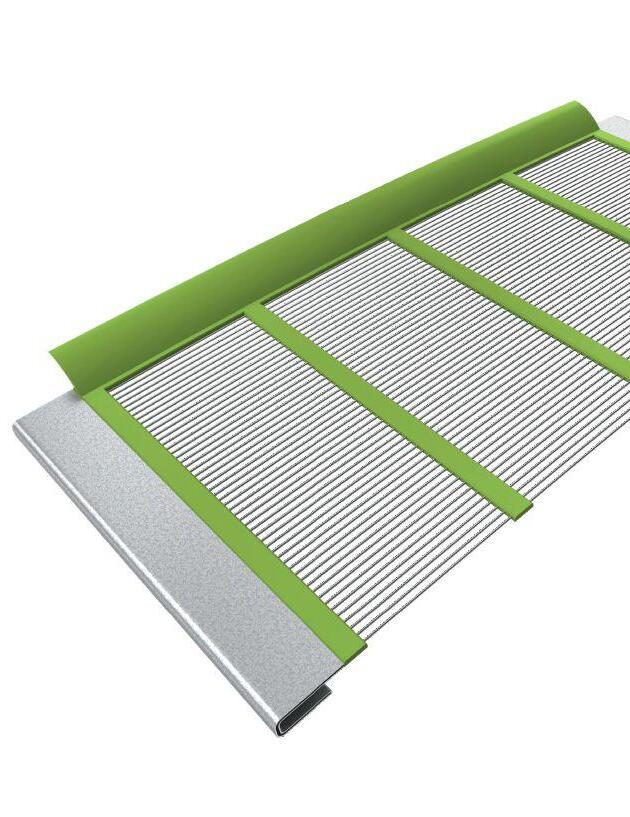
HIGH FLEX IBILITY AND FIRST C LAS S SCREENING RESULTS. Th e M OBISCREEN MSC EVO screening plants are charac ter ised by high application ve rsatility, excellent transport chara cteris tics and fa st se t-up times. Precise results with a ve ry wide vari et y of fe ed mate rials and low consumption are guaran te ed –where flexibility m eet s prec ision. The efficient MSC EVOs thus impress w ith top performan ce valu es across the board.
www.kleemann.info
B.C.
Quarry
Digging into the industry
Quarry Tech 2023 is accepting proposals for presentations
Hello!
If you’re a regular reader, I know I’m not the face you’re used to seeing in this column. In the last issue, after many years of exceptional editing and writing, Andrew Snook bid you all a fond farewell. Now, it is my humbling and daunting task to step into his work boots as the new editor of Rock to Road.
With nearly two decades in journalism, including time spent reporting on Canada’s trucking industry, as well as writing about municipal councils and infrastructure projects from coast-to-coast, I hope I can continue to provide you the valuable news and information you’ve come to depend on to help keep your business moving.
I’ve been grateful for the warm welcome I’ve received over the last several weeks. From getting to tour quarry sites and seeing rehabilitation projects first-hand, to digging into the latest in screening technology, I’ve gotten to meet some friendly folks as I dive into what the industry has to offer. I’m excited to continue to connect with as many people as I can, sharing your stories and hearing what issues matter most to you.
QUARRY TECH 2023 IS COMING!
One of the places I am most looking forward to connecting with you is at Quarry Tech 2023. This year Rock to Road’s premier event exclusively for quarry, sand and gravel pit owners and operators is being held in Kanata, Ont. on Oct. 24.
We’re excited to bring you the latest on crushing, screening and conveying technologies, rehabilitation, sustainability, market trends, in-cab technologies and more in this one-day educational forum.
If you have specific challenges you want answers to, or just want to stay on top of the latest news, we hope to see you there.
PROPOSALS ARE NOW BEING ACCEPTED
Do you have an interesting project you’ve been working on, or did you recently complete an upgrade? We’d love to hear about it!
Sharing ideas keeps the industry moving forward. If you have an evidence-based presentation on a recent project or development on your site, we’d love to consider it for Quarry Tech.
In addition to the knowledgeable speakers we have lined up to tell you about the latest in screening technologies, using environmental management plans to make rehabilitation easier, and how to better navigate the consultation process when seeking a new license, to name a few, we’re seeking presentations on the following topics:
• Labour management, including proven recruiting and retention techniques;
• The latest in crushing technologies including case studies on how they’re proven to increase production or lowering costs;
• Blasting operations best practices;
• Navigating new legislation;
• Dealing with supply chain management issues;
• The latest in electrified equipment, or the use of alternative fuels;
• Preventative maintenance solutions.
If you have an idea for a great presentation that’s not on the list, reach out anyway. We’re always excited to hear what you have to say.
The deadline for proposal submissions is Aug. 25, 2023. All submissions or questions about proposals can be sent to me at ebate@annexbusinessmedia.com. If you’re interested in being a Quarry Tech sponsor, you can contact Laura Goodwin at LGoodwin@annexbusinessmedia.com.
I can’t wait to meet you at Quarry Tech 2023!
@RocktoRoad
BUILT TO CONNECT
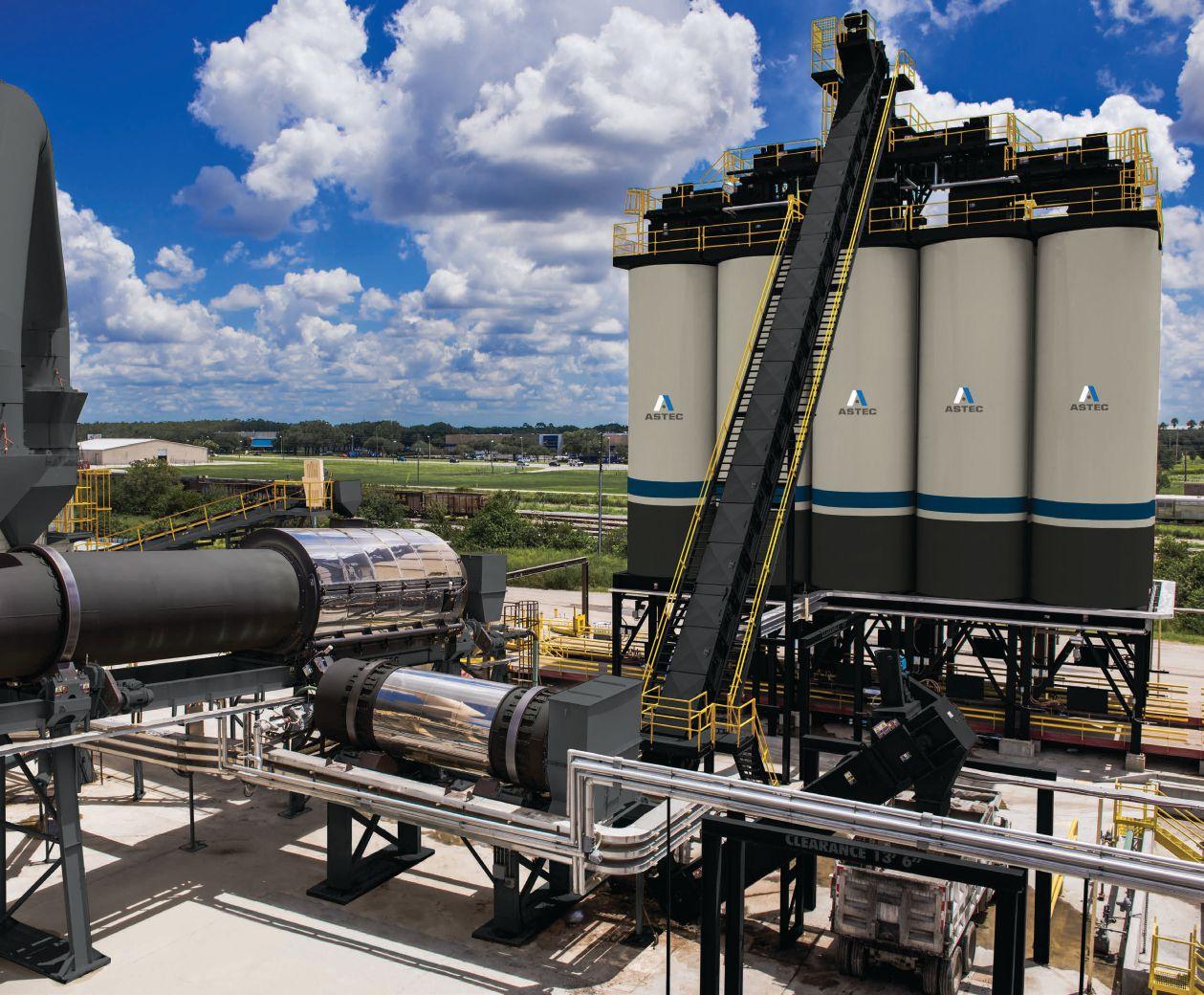
As a decades-long leader for asphalt plant innovation, Astec has introduced numerous products contributing to sustainability. From the Double Barrel® dryer/mixer introduced in 1988 to the debut of the high RAP Double Barrel XHR in 2016. In addition to these industry-changing products, Astec also leads in sustainability with our warm mix system, the V-PAC stack temperature control system, low emission burners, and blue smoke systems.
Astec is well-equipped to carry our culture of innovation into the future. Our dedication to sustainability includes new product development teams and an on-staff product manager for sustainability.
Reach out to learn more about how we can help you meet your asphalt plant sustainability goals.
Sustainable Innovation
McCloskey reorganizes brands
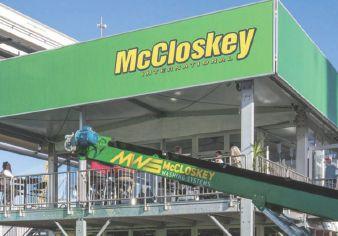
Things are on the move at McCloskey. The company announced they have restructured their brand line, consisting of Lippmann, McCloskey International, McCloskey Environmental, MWS Equipment and TESAB, to be known as Material Processing Products Global (MPP Global) moving forward.
As part of this rebranding, Lippmann’s vice president, Kevin Kiesgen, has been promoted to vice president of global sales
Barda
for MPP Global. Kiesgen said that that this change is largely for the sake of organizational efficiency; each product line will remain independent and dealer relationships will be unaffected.
"For current customers of each brand, there are no changes in the way they interact with their equipment's dealer or OEM," said Kiesgen. "The formation of MPP Global is primarily for internal efficiencies."
Equipment wins ASV’s Dealer of the Year Award
Compact track loader manufacturer
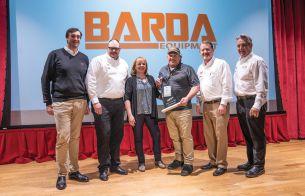
ASV announced the winners of its Dealer of the Year Awards for 2022 in the categories of Large Market, Medium Market, and Small Market, with Grand Prairie, Alta.based Barda Equipment becoming a second-time winner in the Large Market category.
Barda Equipment is a multi-location dealer with a focus on the forestry, landscaping, oilfield, and building construction sectors. The company previously won the award in 2019 and have a partnership with ASV of more than 35 years.
This year’s winners also include Connecticut-based Butler Equipment in the Medium Market category, along with Duffy’s Sales & Rentals in Wisconsin winning the Small Market Award.
“These three dealers stand out due to their commitment to ASV and excellent customer service standards,” Jeff Pate, director of sales for ASV, said in a press release. “We are proud to have them as our partners representing our brand in their communities.”
Haver & Boecker
Niagara
names new certified sales manager
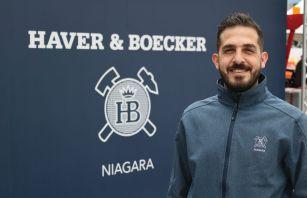
Haver & Boecker Niagara has appointed Wajdi Jumeian as its new certified sales manager for California.
Previously their sales manager for screening technology in the Middle East, Jumeian is based in Livermore, California, and brings 11 years of mineral processing knowledge to the role. Previous experience includes a B.S. in industrial engineering from Hashemite University in Jordan and a prior position as commissioning engineer for Germany’s Hosokawa Alpine Aktiengesellschaft.
As Haver & Boecker Niagara’s California sales manager, Jumeian is responsible for cultivating new and existing relationships with mining and aggregate customers, and consulting on solutions to increase productivity and efficiency.
"I’m excited to join the North American team and use my experience and knowledge to help customers in California solve their screening challenges,” Jumeian said in a press release from the company. “I’m confident we can work together to improve efficiency and profitability and tackle some of the regulatory challenges customers in California face.”
McCloskey exhibition at CONEXPO
Grand Prairie, Alberta’s Barda Equipment team won Dealer of the Year for 2022.
Wajdi Jumeian, certified sales manager, Haver & Boecker Niagara
BY ELIZABETH bate
EARLY TO RISE
Early rehabilitation can make pits wealthierhealthier, and wiser
> It’s a cool spring day in the middle of June as John Edworthy and his son Tim show off a 40-acre section of their farmland.
The corn is just starting to take shape on this part of the land. The wide, green fields paint a pastoral picture and looking at it, you’d never know that just a few short years ago this section was part of the active North Dumfries quarry pit.
NORTH DUMFRIES PIT AWARD-WINNING EXAMPLE
The Edworthys are partners with Heidelberg Materials and Cambridge Aggregates, leasing the companies the land for the pit in North Dumfries, Ont., and taking an active role in its rehabilitation.
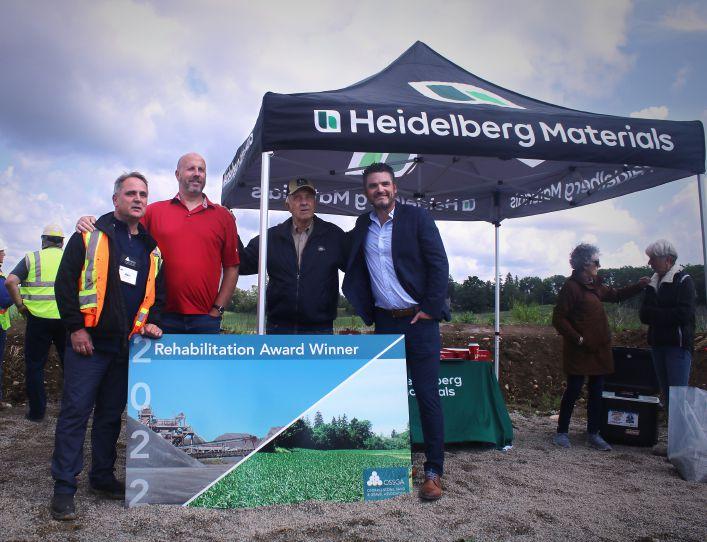
The team was presented with the 2022 Judges’ Choice Award in progressive rehabilitation from the Ontario Stone, Sand and Gravel Association (OSSGA) at an on-site presentation June 14. The presentation was part of a larger tour of rehabilitation projects in Southwestern Ontario.
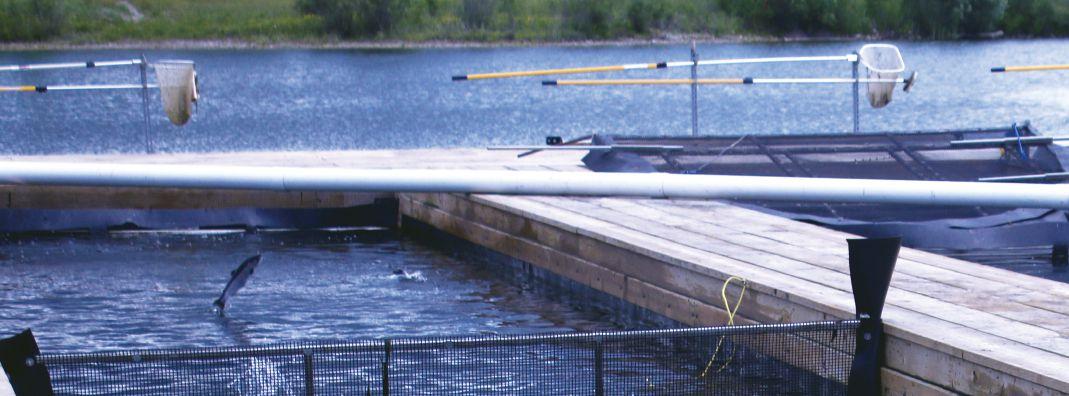
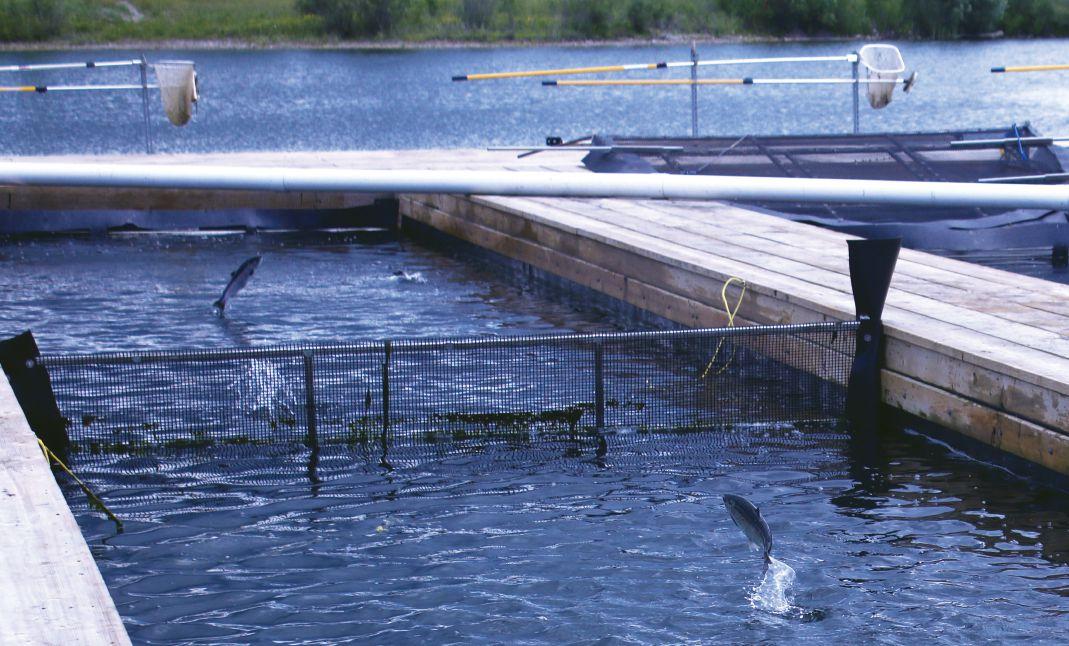
Fish jump out of the water at the McMillian Pit/ Izumi Aquaculture in Puslinch, Ont.
OPEN HOUSE
SEPTEMBER 7TH
* Registration required.
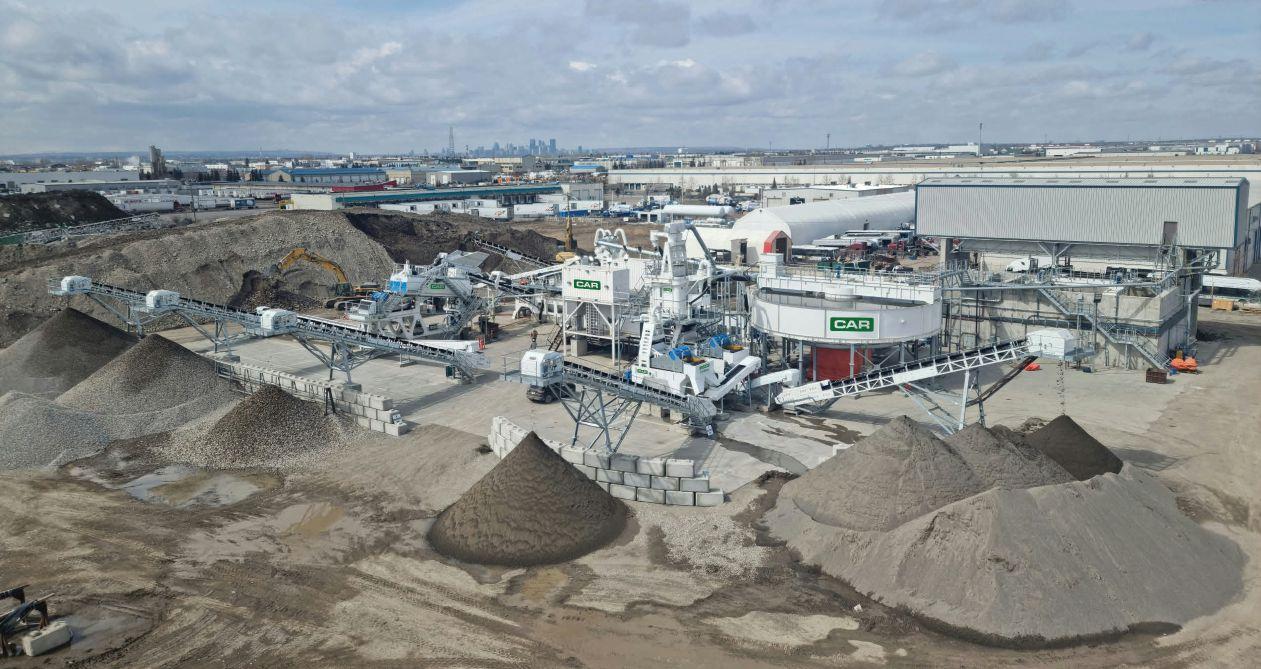
CDE and Calgary Aggregate Recycling are delighted to invite you to an Open House event at their plant in Calgary, Canada. You will meet a team of technical experts for a tour of the 250tph wet processing facilities, with a detailed demonstration of each step of the C&D waste and contaminated soils recycling process.
Want to learn more about this innovative project and view the plant in operation transforming waste materials into valuable recycled sand & aggregates?
Please scan the QR code or visit: cdegroup.com/calgary to register for this Open House.
Heidelberg general manager Kevin Hurley says the group has worked closely together to make sure the site meets its goal of continuing to be productive agricultural land even before the pit’s licence is surrendered.
“We’ve progressively rehabbed this site. It serviced the local Waterloo region community with aggregates for their buildings that are going up, and houses and roads. To get it back to beautiful farmland and have the farmers be happy with how the crops are going as soon as possible — it’s nice to have a good news story,” Hurley said.
Each year the area being farmed at the North Dumfries Pit grows a little larger, starting as beans before moving to corn — all cash crops. The progressive work allows the soil to settle and become part of the land once again.
The next phase of the plan for the pit involves adding even more active farmland, as well as restoring the native ecological system by adding Oak Savannah, Woodland and prairie and native grassland.
EARLY REHABILITATION IS KEY
Farming isn’t the usual business of pit operators, but OSSGA board member Ken Zimmerman thinks it should be incorporated into operations more.
“The industry’s changed over the last 20 to 30 years. There’s really no reason to wait until the end to progressively rehabilitate a site,” he said.
Incorporating early rehabilitation into site plans, even before a pit’s license is surrendered, can have benefits for quarry operators, farmers, and the surrounding communities, says Zimmerman.
“There’s all kinds of benefits to getting it done sooner, rather than later. Why would you wait until the end? You have to move soil, it costs more money to move the soil twice, and you don’t want the soil sitting, so why would you not want it back on the floor… for agricultural use?”
Zimmerman said allowing soil to sit in storage for too long may even be harmful to future use, killing the nutrients. Reintegrating the soil with the land sooner allows it to settle, creating a better environment for future crops.
ADVANCED REHAB IS A WORTHY ENDEAVOUR
When creating a plan for rehabilitation of a site, going above and beyond minimum re-
quirements and engaging in advanced projects may generate income in unique ways.
The rehabilitation of the McMillian Pit in Puslinch, Ont., a combined effort from CBM Aggregates and Izumi Aquiculture, began in 2014 as a way to restore natural balance and create a profitable agriculture business.
Where once CBM mined below the water table here, now the pit is a man-made pond, home to fresh farm-to-table fish being sold in the community and surrounding areas. Izumi says it has even taken orders from local restaurants that plate the product for dinner the same day.
The advanced rehabilitation project created not just the pond with a floating “raceway” style of fish breeding area, but planting trees and creating wetlands to renew the local flora and fauna.
Everything at the McMillian Pit goes back into helping renew the area, including fish waste products, which are used as super-fertilizer on this and other sites.
EARLY REHAB MAKES GOOD NEIGHBOURS
Tim Edworthy’s daily view of the North Dumfries Pit is as close as they come; the landowner’s home still sits right next door to the operation.
Edworthy says the lack of a crusher on the site, as well as strict regulations about operating hours, mean the pit has been quiet and respectful during their tenure.
“They’re the best neighbours you could ask for,” he said.
This flies in the face of recent negative press coverage insisting pits and quarries are loud, destructive and cannot be returned to their natural state; an opinion Hurley says is simply wrong.
“Often you only hear one side of the story and it’s not necessarily fact based. Getting that information out there hopefully helps people to understand the reality,” he said. “This is sustainable construction at its finest.”
OSSGA director of environment and sustainability Ashlee Zelek says the Judges’ Choice Award is meant to draw attention to the importance of progressive rehabilitation.
“The Judges’ Choice award celebrates the techniques and approaches to progressive rehabilitation,” she says. “It’s important for the community to see and understand that extracted areas of the site are being continually restored.”
Left to right: Ken Zimmerman, Tim Edworthy, John Edworthy and Kevin Hurley in North Dumfries, Ont.
ROCK TO ROAD
Efficiency and Productivity
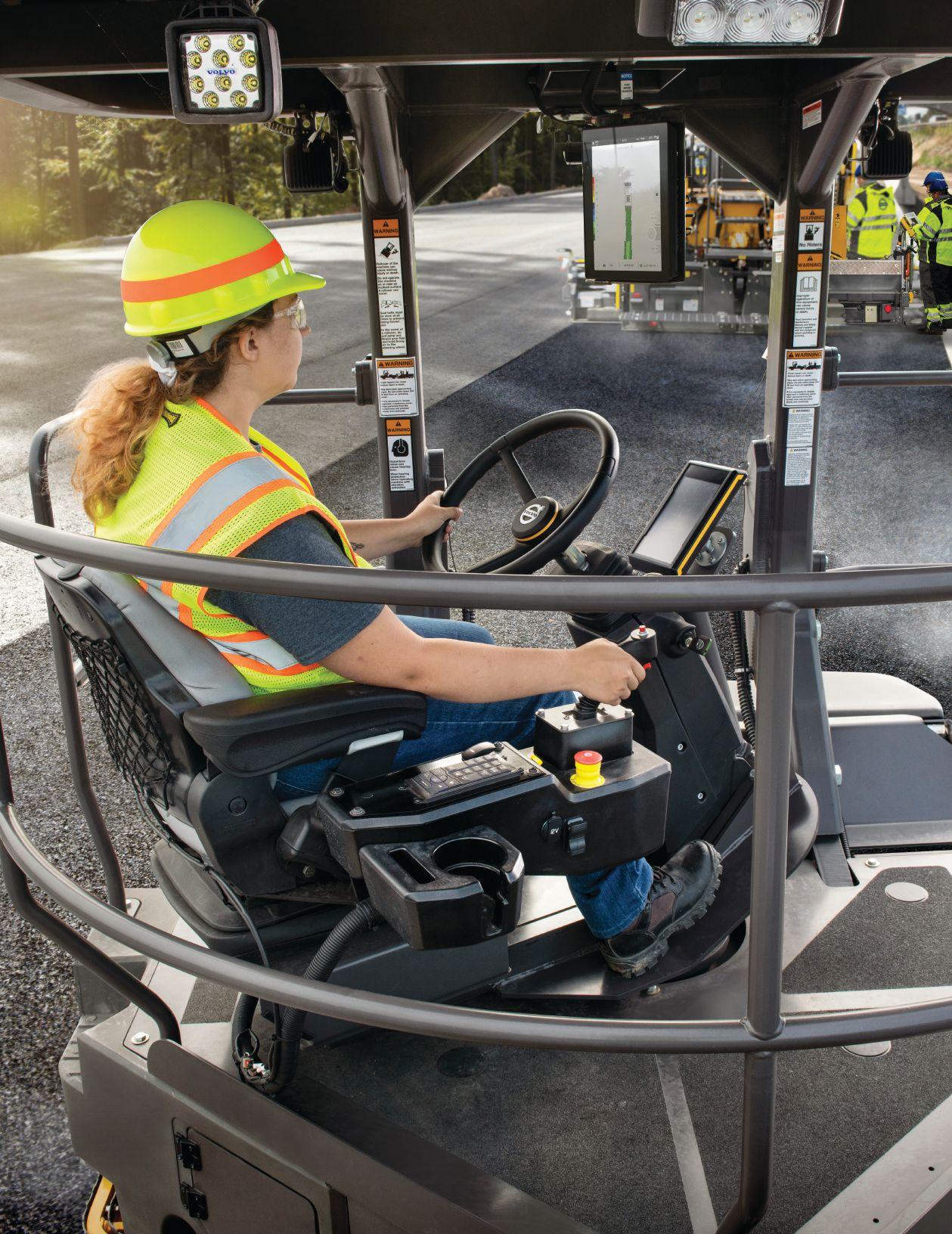
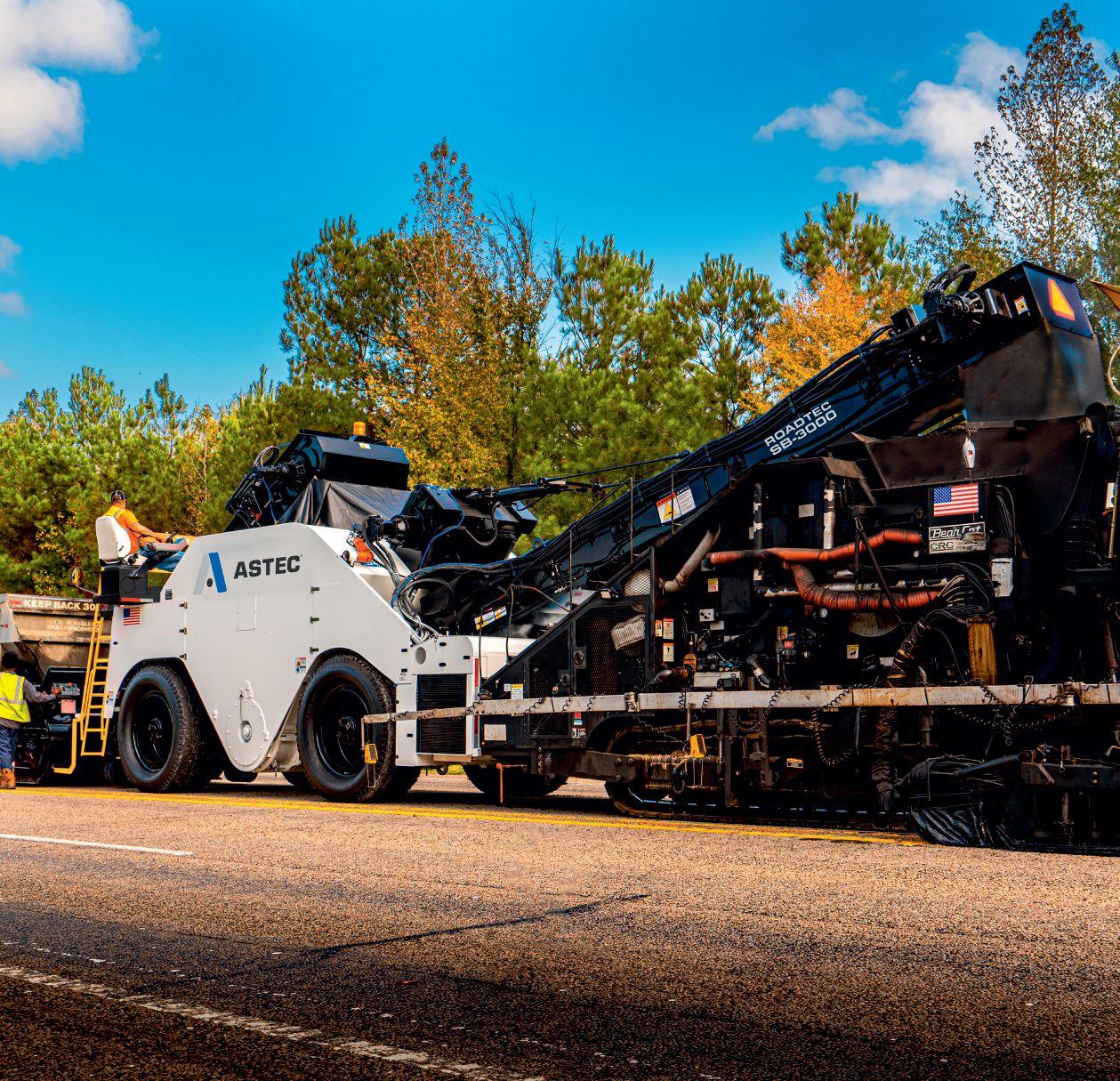
Designed with safety and operator comfort in mind, the SB-3000 Shuttle Buggy ® material transfer vehicle features adaptive cruise control, bright LED lighting, four-wheel steering for easy transport and ground-level maintenance access for added convenience. Operators can rely on clear sightlines and the ground operator is safely protected inside the structure of the machine. The Roadtec SB-3000 is the perfect blend of traditional craftsmanship and modern technology.
Scan to learn more about the SB-3000.
CUSTOMIZABLE EFFICIENCY
BY ELIZABETH bate
Versatility is the key to the future of screening
> Screening aggregate is a noisy, dirty job. Screeners develop wear and tear, material gets stuck in places you’d rather not think about, and the downtime can seem to go on forever. It’s not always ideal, but what else is there? Historically, screening has been seen as a system where not much development can be done, or so you might imagine.
If you’re currently running and repairing decades-old screening equipment, like many operators, you might not be aware of the advancements screening technology is making.
The latest developments can reduce downtime, make maintenance and repair easier and save your operation money.
If it’s time to look for something new, you may be surprised at how far screening equipment has come. This month, Rock to Road has the rundown on all the new features to look for.
THE FUTURE IS ELECTRIC
While electric machines are the standard for stationary screens, until recently the feature has been harder to find on mobile units, which typically operate using a diesel hydraulic system.
With no end in sight for rising fuel prices, running a full day on diesel can be a major expense. Darryl Steen, a mobile equipment specialist with Frontline Machinery, says bringing electricity to mobile units represents a huge advancement in technology.
“The biggest thing, the most exciting thing, is electrification. Most of the mobile [units] typically have always been diesel hydraulic, which is inherently inefficient,” he said. “Even a mid-sized machine running four to five litres of fuel an hour, costed out over 10,000 hours of use, and that’s a pretty serious number.”
Steen estimates that running the screener off electricity, even if it’s plugged into other equipment running diesel, saves a minimum of 30 per cent in fuel burn.
“That’s real money, that’s real dollars.”
While creating new machines to be more economical and efficient is the primary concern of manufactures, Ciarán Fanning, director of engineering for Terex says incoming legislation is another concern.
“Obviously diesel creates a lot of carbons and a lot of nasties and there’s a lot of countries and regions trying to get rid of diesel engines and diesel screens. A big focus for us, is how we move to an alternative power supply,” he said.
While the majority of regulations restricting or banning diesel engines are currently in Europe, as Canada moves towards its netzero goals, emission-friendly equipment may be the way to go. Electric mobile equipment can help take a site from emission-heavy to emission-light by being a primary power source for other equipment.
New electric and electric-hybrid mobile machines not only have the ability to plug into line power on electrified sites, something Steen calls the ultimate situation, but they can plug into generators or other equipment on sites that don’t have the same kind of power.
The reverse is true as well, allowing other equipment to be plugged into the electric mobile machines, making it possible to power nearly an entire site off the mobile screening unit.
That customizable flexibility allows operators to run the equipment in the most
economical way possible without having to worry about how they’re going to power their machines.
Flexibility is a theme with newer equipment, allowing individual customization across a number of features.
JUST LIKE LEGO
When it comes to screen media, Alex Caruana, national manager – Canadian aggregates, with Polydeck, says the old way of doing things meant if a machine came set up for a single kind of media, owners could be stuck
with what they were given.
“The old way of doing things if your screen came set up for wire cloth, you were a bit hampered. Without a great deal of effort, you were kind of stuck there,” he says.
In order to change the type of screening material to make it more efficient, a lot of downtime and expense was needed.
Now, the latest machines can be set up to receive different types of screening material, right where it’s needed most.
“Hybridization is the latest thing. It’s been building over the last couple of years or so,
but it’s at the point where there is little we cannot do,” Caruana said. “What a lot of operators are looking at in terms of hybrid screens is choosing the exact, correct blend to put the purpose-built media in the exact right parts of each screen.”
This hybrid technique means operators can not only swap out different types of screening material as they need to, but that they can use two or more types of material at the same time, in different areas of the machine. The heavier duty items can be placed where the most impact resistance is needed, and lighter duty items can be used where more throughput is needed on a screen.
This kind of hybrid system can be requested through an OEM when a machine is being ordered initially, saving time and money down the road.
“A lot of producers are realizing that outfitting a screen with a hybrid system right off the hop, by requesting it through their OEM, although a little bit more costly initially, it is the way to go because then you can use whatever you want,” Caruana says.
“It becomes plug and play then, it’s like putting a Lego set together. You pick exactly where you want each piece.”
Another advantage modular has over classic is being able to replace material with more efficiency and less downtime as it wears out.
“When you burn out a small section, all of a sudden, you send one human being into that machine, they change that one or two sections and then they’re back out… and the thing’s ready to rock and roll again.”
Modular paneling can help increase the longevity of a piece of equipment too, making it possible to balance media easier, Caruana says.
“I can’t sermonize enough about balancing the media on the deck and protecting the subframe,” he said.
That includes putting “high open area panels where you need them, high life panels where you need them. You can do it, it may take a little bit of upfront effort, but you can do it to the point where you reduce your failure cycles.”
Reducing failure cycles helps to reduce unplanned downtime, saving sites money and hassle.
ALERTED BEFORE THERE’S A PROBLEM
Thomas Jordan, Technical Sales Manager
for Wirtgen America says Kleemann’s integrated telematics systems aim to reduce downtime by letting operators know there might be an issue sooner, allowing them to take care of it before it becomes a major problem.
“On our portable screening equipment, we call it interlinking,” he said.
The screener will communicate with the equipment in front of it or behind it, through wireless technology, so it becomes an integrated part of a complete operating system.
“With the new wireless technology, it’s linking into the machine downline and once it detects a buildup of material or something out of the normal, it’ll actually slow itself down,” Jordan says. “So, it’s constantly monitoring itself and the units ahead of it and behind it. They aren’t operating as individual units, they’re all working together.”
That monitoring allows the machine to keep from overloading and getting blocked, reducing the amount of time it takes to clear the system and get back to normal.
While systems like Kleemann’s allow operators to reduce unplanned downtime, Caruana says planned downtime may be the key to keeping machines running longer and more efficiently.
MAINTENANCE IS KEY
Daily, weekly and monthly checklists are important to keeping a machine running and sites should be ensuring they’re completed, even if it takes a little extra time at the beginning and end of each day.
In addition to regular checklists, deeper inspections are necessary a couple of times a year. With supply chains still experiencing slowdowns, Caruana says the key to longevity and reduced downtime is regular overall health checks, so problems can be caught while they’re still repairable on site.
“A lot of operators are very good at bearing maintenance, motor maintenance and so on, but there’s nobody crawling through that machine to inspect their deck frames, their feed boxes, and some of these things that may not be super visible from outside of the machine,” he said.
If operators don’t have someone on site to inspect the machine more thoroughly, OEM and product sales reps may be able to provide someone to help complete larger scheduled maintenance tasks, like a walkthrough.
“It’s very worthwhile to get someone to come in at five or six in the morning, before you start up, lock out of the machines, go through and then talk about what needs repair or replacement.”
Those walkthroughs could save a machine that may otherwise be a victim of supply chain backups. With some reports saying it could be up to a year for some parts to come in, regular inspections are a life-saving operation for some sites.
If you’re not replacing your equipment this year, or you’re looking to preserve the health of your new equipment, regular maintenance and scheduled downtime are crucial to making sure equipment stays in top shape.
The Polydeck Metaldex.
MIXTURE MATTERS
BY STEVE fair
> Producing the most tons per hour, ensuring product meets specifications and maximizing the wear life of screen media can be difficult to achieve using only one type of media. Finding the perfect balance of high wear and maximum longevity isn’t always an easy task. The feed end may wear out before the discharge end or using a full deck of a more durable type of screen media may reduce your tonnage.
Many times, the solution lies not in a single “screen-all” product,
Careful selection and the correct blend of screen media can mean thousands of dollars in savings for a mining or aggregates operation. For best results, work with a reputable screen media manufacturer or certified dealer for informed advice.
but in the ideal mix of screen media types to ensure all phases of screening work correctly. The process of choosing that mix is best accomplished through careful analysis — including diagnostic analysis — an inspection of screen media and the vibrating screen itself, followed by a recommendation from an expert.
To help find the best media for each phase, here are a few checkpoints to increase screening productivity.
• Vibration analysis: Vibration analysis systems can provide real-time, 24/7 monitoring of machine performance. The resulting data can help producers spot abnormalities the human eye cannot detect before they become costly, such as a hairline crack in the side plate or a twisting motion that will affect both screening efficiency and the wear life of your equipment. This helps minimize downtime and maintenance costs, improving overall profitability.
• Inspection: A visual inspection of the vibrating screen and screen media is necessary to better understand areas for improvement. The discarded screen media pile is one of the first places to look for problem areas, such as broken wires, wear areas, pegging or blinding. Premature wear often occurs with screen media that can’t handle heavy material or excessive abrasive fines. Screen me-
the best screen media for an application. Producers can customize the screen deck by choosing screen media that maximizes productivity for each phase by blending the optimal combination of open area and wear life.
The material begins its path down the screen deck during the first phase — layered screening — where the screen media should be able to handle a deep bed depth, high impact and a mix of coarse and fine particles. Heavy-duty options, such as those using polyurethane, rubber or perfo-
Once a task has been identified as having a high potential for injury, it must be assessed for all the risk factors.
dia openings should be a focus when looking for wear. For example, wear is apparent if the square openings in engineered media begin to round. Types of media unsuited for the application can also result in blinding, pegging or carryover, leading to the added cost and time commitment of rescreening. Additionally, broken screens mean costly, unscheduled change-outs.
• Phases of screening: Screen media manufacturers can help evaluate how material moves through the three phases of screening — from layered to basic to sharp — to give recommendations on
rated plate, can excel in withstanding high top sizes and abrasion.
Screen media with the ideal combination of wear life and open area is best for the next phase — basic screening — where most of the screening action takes place. Hybrid screen media, for example, pairs polyurethane’s durability with an open area similar to woven wire and is often a good choice for the middle of the deck.
Sharp screening takes place at the discharge end and requires maximum open area to allow any remaining undersized particles to fall through and for near-sized material to pass, preventing contamination.
Thorough machine inspections are designed to help maximize an operation’s productivity and profits.
Woven wire or self-cleaning media provide the best open area in this phase.
• Screen media selection: Screen media inspections provide the information required to recommend the best type of media for each phase of screening. A certified screen media representative will work with you to decide what combination of media will provide the most efficient solution for each phase. This often means using a blend of different types of screen media to achieve the best combination of wear life with open area.
• Implementation: The last step is to start switching out screen media. Changing out one section at a time — such as beginning at the feed end of the top deck — helps pinpoint where performance improvements are being made.
Careful selection and the correct blend of screen media can mean thousands of dollars in savings for a mining or aggregates operation. For best results, it is recommended to work with a reputable screen media manufacturer or certified dealer for informed advice.
Steve Fair is the Tyler engineered media manager at Haver & Boecker Niagara. He has more than 26 years of industry experience. He works with customers to identify screening challenges, improve their screening applications and increase screening efficiency.
BY GRANT cameron
BRIDGING THE GAP ON THE FRASER RIVER
B.C. is using modern techniques to replace the Pattullo Bridge, reducing the impact on residents and the environment.
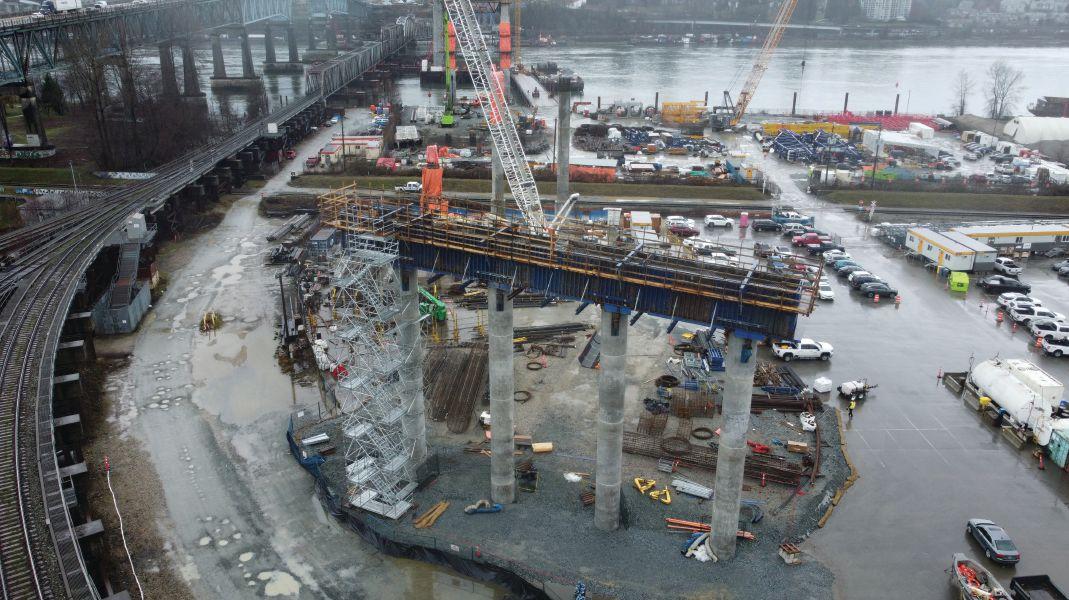
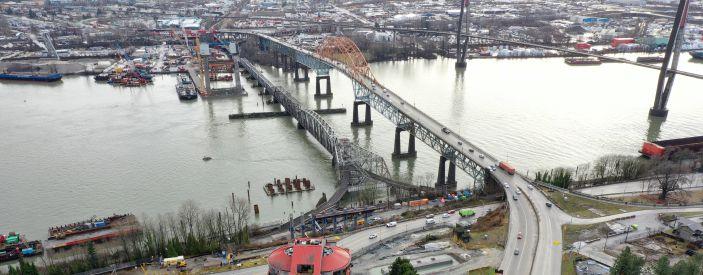
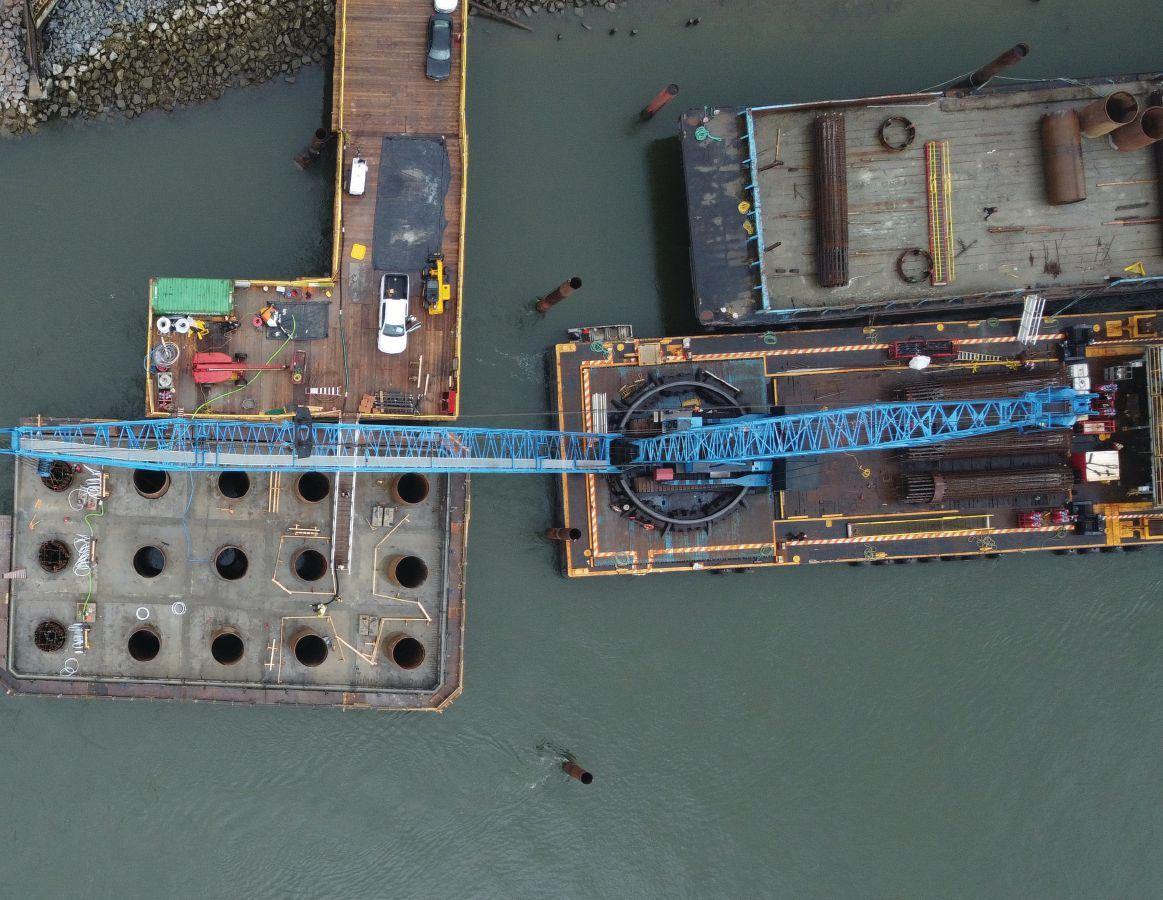
> A small army of operators on tower, crawler and rough-terrain cranes along with excavators, dozers and other heavy equipment has descended on the shores of the Fraser River between Surrey and New Westminster, B.C., where a new, $1.38 billion crossing is being built to replace the existing Pattullo Bridge.
The toll-free, modern, four-lane structure is being constructed upstream and northeast of the existing bridge. It will have one pier and a single main tower in the river channel, reduced from six piers for the current structure.
Fewer in-river supports result in less construction activity and
Aerial view of a bridge pier in Surrey. All photos courtesy of B.C. Ministry of Infrastructure.
infrastructure in the river, minimizing the impacts on aquatic habitat and making for easier navigation of the river for boaters.
Pile installation was recently completed for the in-river foundations. Twenty-seven piles were installed over a six-month period for one foundation and another 15 were anchored in place over five months in 2022 for the other.
In New Westminster, site prep continues and work is under way on an overpass reha bilitation and street intersection. Work on the bridge foundation and piers will continue.
In Surrey, pile installation has started for off-ramp foundations and a road overpass. Upcoming activities include continued construction of the bridge foundations and ongo ing site preparation and road work along 112 Avenue.
In addition to the main bridge foundations, a total of eight off-ramp foundations are be ing built – one in New Westminster near the McBride Boulevard-East Columbia Street inter
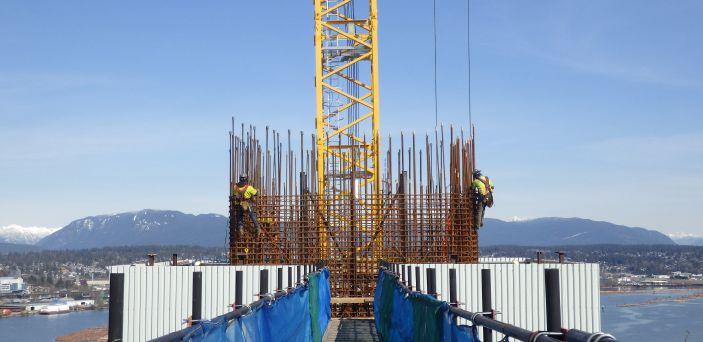
Crews working inside the main bridge tower's east leg to install reinforcing rebar.
View of the future New Westminster bridge approach.
INGENUITY TO ADDRESS CHANGE
A MODERN APPROACH TO PILE INSTALLATION
Pile installation has been a key part of the Pattullo Bridge Replacement Project.
In New Westminster, a drilled shaft methodology was used instead of intermittent pile driving, to minimize noise and vibration for nearby residents.
In Surrey, crews would drive a steel pile into the ground, then stop to weld another steel pile section onto the driven pile, and then start up again until the pile reached the required depth.
After the steel pile was driven or drilled into the ground, it was filled with rebar, followed by concrete to fill and “plug” the pile.
The timing and placement of the in-river piling has been a big deal. The work took place during the “least risk window,” which is from mid-June to the end of January, after freshet flows subside, to protect fish.
Determining the hydraulic effect the bridge would have on the river was an essential part of the planning process, as the Fraser River is an important ecosystem for many marine species like salmon and sturgeon.
A team studied how the bridge would impact other downstream structures, the way the river would flow, and where sedimentation and scour would take place.
“It’s the longest river in B.C. with high water-flow velocities, particularly at this location,” says Itagawa. “The bridge hydraulic effects have been a key design element to ensure no adverse impacts due to scour and sedimentation on downstream structures and navigation channels.”
As part of the project, the team built a 1:80-scale model of the foundations in a lab to test different hydraulic scenarios. Numerical modeling was also used to check the design. A number of scenarios, were run, including peak river flows and record floods, to determine the best place for bridge infrastructure.
“A major consideration in the construction of the bridge is protecting aquatic life of the river, including the need to have as little impact on it as possible as per various provincial and federal regulatory permits,” notes Itagawa.
To minimize disturbance to fish during in-river bridge foundation works, the contractor used an underwater noise mitigation system. This system included a confined bubble-curtain system which has underwater tubes that release a wall of
bubbles to dissipate the noise around the pile driving work areas. The air acts as an absorber and reflector of the sound waves.
The project went through both provincial and federal environmental assessments and permitting processes. The assessments reviewed many aspects of the potential environmental and social impacts of the project, including fish and fish habitat, marine use and navigation, archaeology, traffic, and potential noise.
BUILT TO LAST
Because B.C. is prone to earthquakes, the bridge replacement is designed to last 100 years and is being built to modern seismic standards.
Itagawa says there have been a number of challenges to the project, one being that construction work had to be co-ordinated around the opening and closing of a rail swing bridge which is approximately 50 metres away.
The Fraser River is an active marine transportation route supporting B.C.’s economy. It has commercial marine traffic supporting many industries as well as Indigenous fishing and marine use. A navigation protection zone was developed in consultation with the port, marine users, and Transport Canada.
“Keeping the transportation channels maintained during active construction has been
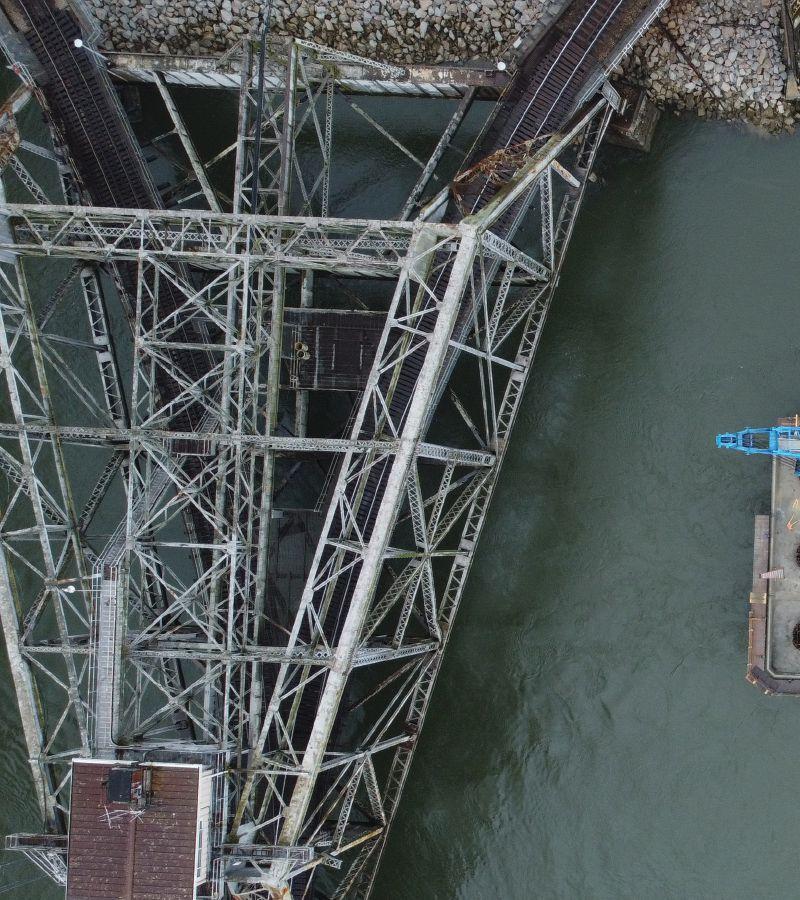
Aerial view of a pier on the New Westminster side.
" Keeping the transportation channels maintained during active construction has been critical,"
- Wendy Itagawa, executive project director of the Pattullo Bridge Replacement Project.
critical,” says Itagawa. “Our contractor works closely with Transport Canada and marine users to keep marine traffic informed through regular updates.”
The bridge was supposed to open this year but on-site investigative work and permitting processes took longer than anticipated due to the complexities of the project and challenges presented by the COVID-19 pandemic.
The bridge is now scheduled to open in 2024. The replacement was deemed necessary as the existing Pattullo Bridge, which opened in 1937, does not meet modern design standards. Traffic lanes are too narrow and the bridge requires lane closures at night for safety. It only has one narrow sidewalk with no protection from traffic.
The existing bridge will be demolished when the new one opens.
Once completed, the bridge will improve safety and reliability for drivers, cyclists and walkers, as well as the movement of goods, and better connect Surrey and New Westminster with modern, wider lanes.
The project is being delivered under the province’s Community Benefits Agreement (CBA). The CBA prioritizes hiring local workers, including Indigenous Peoples, women, people with disabilities and other under-represented groups who are qualified to do the work, in a safe, welcoming work environment.
The idea is geared to diversifying and growing B.C.'s skilled workforce by providing opportunities for Red Seal apprentices to work on site and gain the experience they need to launch good careers in the trades.
BY JACK burton
BIG QUARRY IN LITTLE NARROWS
The reopening of a well-known quarry hopes to put a Cape Breton community at the top of Canada’s gypsum power players
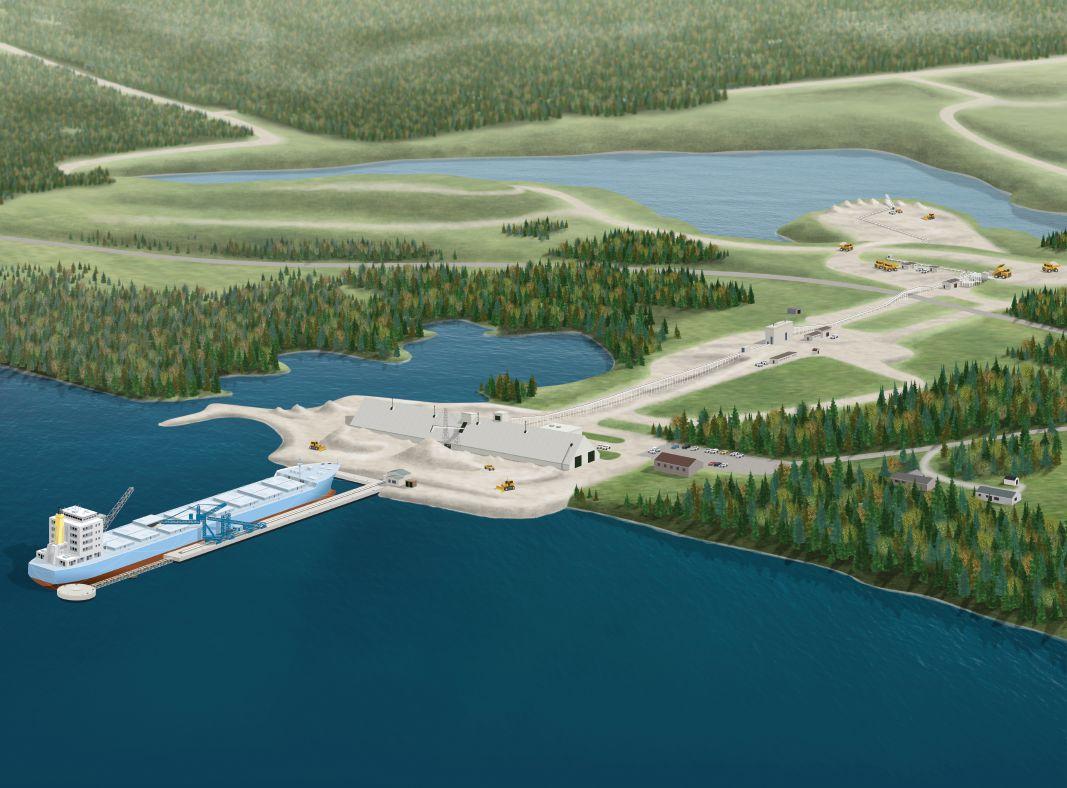
> Little Narrows is a community of just under 4,000 located in Nova Scotia’s Victoria County, but don’t be fooled by its size – big things are happening, thanks to a $104 million investment by the Canadian Gypsum Company (CGC), a subsidiary of U.S. Gypsum (USG), to reopen a quarry that closed in 2016.
CGC announced in May of this year that they will be fully funding the project with an investment of $104 million, with the quarry’s reopening process to reach completion in 2026. Once onsite operations resume, the quarry will have an annual output of
Set to reopen by 2026, Little Narrows’ gypsum quarry is receiving a $104 million upgrade, with an expected output of up to two million tonnes of gypsum per year over the next five decades.
up to two million tonnes of gypsum and an estimated operational lifespan of 50 years.
As a part of the reopening process, the project will have fresh quarrying technology installed, including a new dock, shiploader, crusher, and conveyor systems.
New mining equipment and vehicles, including drills, loaders, excavators, and haul trucks, will also be purchased for onsite operations.
Currently, CGC are in the process of acquiring numerous permits, and are performing the extensive data collection and surveying required. The company is carrying out this process alongside a third-party team to ensure that provincial and federal regulations are met.
COMMITMENT TO SUCCESS
Erik Hinze, CGC’s plant manager for the Little Narrows project, said that the company’s decision to reopen the mine, which they also owned during its initial operational run from 1954 to 2016, came from the goal to increase both the company’s supply and Canada’s footprint when it comes to gypsum resources.
“Relaunching the Little Narrows quarry
will help reinforce CGC’s supply of gypsum — the largest in the world — to ensure the continued sustainability and availability of our industry-leading products,” said Hinze. “This investment will also cement our long-term commitment to the Canadian market, and our dedication to providing the best experience for our customers across North America.”
Prior to the announcement, CGC ex-
NEED APPRENTICES?
tensively consulted with the provincial government, Invest Nova Scotia, and the Victoria County municipal government, in addition to holding discussions with the local Mi’kmaq people of Cape Breton Island — the original landholders of the area.
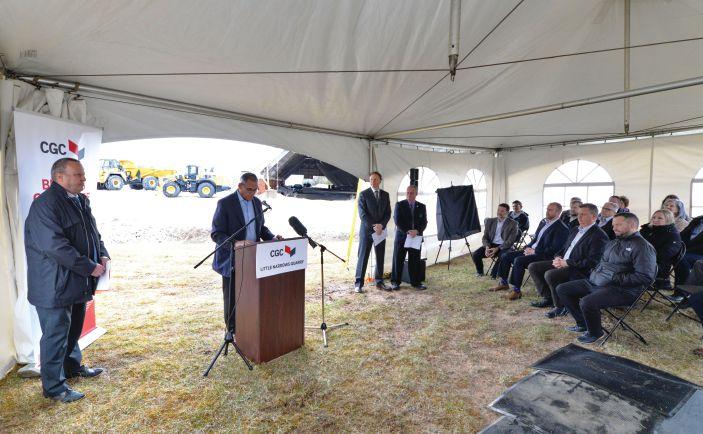
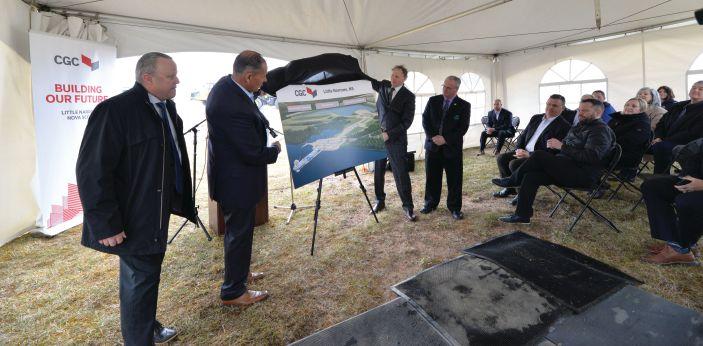
CGC revealed plans for their reopening project on May 1, 2023, following extensive consultations.
“We know that impacts to their Aboriginal and treaty rights must be identified and addressed, so there must be opportunities for their partnership and for generating economic and social benefits for their communities through this re-launch,” he said.
Hinze is clear that this investment and the subsequent reopening is viewed, both by CGC and the local governments and communities, as not a brand new venture but rather a return to the legacy of gypsum mining that helped define the local area and its economy during the quarry’s initial operations.
“Given this history, we are deeply connected to Little Narrows and Cape Breton, and we’re thrilled to return to drive economic growth and support the local community as both a neighbour and partner,” he said.
BUILDING BACK TO THE TOP
This history speaks not just to Nova Scotia’s reputation as a major mining exporter, but specifically the role that gypsum played in helping the province achieve this status in the first place.
“Mining is a strong part of our history in Nova Scotia, particularly gypsum,” said the province’s Minister of Finance, Allan McMaster. “In particular, we’ve historically been a powerhouse as a supplier of gypsum: 80 per cent of Canada’s gypsum output has come from Nova Scotia, and the hope is that the reopening of this quarry restores our place in the mining world, and for gypsum mining on this continent.”
McMaster attributes the province’s struggles with retaining their long-held position in the industry, and the ensuing initial 2016 closure of the quarry, to changes in the economy. He cites both the impacts of the 2008 housing crash on the residential construction sector, in addition to a brief industry trend that saw an increase in demand for coal-derived synthetic gypsum.
“When the housing market unravelled in 2008, of course things like wallboard and other gypsum products collapsed with it,” he said. “From there, the advent of synthetic gypsum became very popular, because you had coal plants producing a byproduct material that could be converted and used to replace gypsum. So as a result, we saw the real drop in interest in our gypsum quarries, and they basically all closed here in our province.”
The quarry’s reopening occurs as the demand for synthetic gypsum has severely dwindled, a result of the industry’s trend toward greener, emission-friendly processes and the subsequent movement away from coal-reliant solutions.
GENERATING GENERATIONS OF GYPSUM
The population of Little Narrows has embraced the return to the North American quarrying market this investment can bring. The history of the quarry and its longstanding relationship with the community has meant this announcement has been received with widespread positivity, said McMaster, in large part due to its impact on the local economy.
“The fact that they've been operational before, and that people were used to it being active in the area, meant that there wasn't a lot of opposition to reopening; there was no ongoing concern,” he said. “I know locally, people value what it means for the economy, so I never heard of any resistance to it, to an over $100 million investment, and to over 100 good-paying jobs returning.”
The large output of the quarry, in addition to the site’s estimated 50-year lifespan, means that all parties involved – McMaster, the local community, and CGC themselves – see it as not just an immediate-term investment, but one that will impact generations in the community to come.
“On the day that the announcement was made by USG, they themselves were mentioning that this really is a generational investment; one that will potentially impact several generations,” said McMaster. “Over the next 50 years, we could have two, maybe even three generations of lo-
CGC’s approaching return to the area since the quarry’s original closure in 2016 has been embraced by locals, who see the company’s investment as a solid show of confidence in the community.
cals working there: when you have a stable resource with a long lifespan, you have a stable workforce.”
TALK OF THE TOWN
A considerable deal of excitement is shared by both CGC and the province, but this enthusiasm is perhaps felt strongest by the local community, who stand to see the most immediate and wide-ranging impacts and benefits of this investment and the changes it will bring.
“There’s definitely a buzz – I can feel it throughout our whole community,” said Parker Horton, the economic development officer for Victoria County. “After the announcement, it was definitely the talk of the town. People see this as an incredible organization, with a long-standing history in our community, that is providing incredibly good-paying jobs and opportunities for them.”
Horton credits the sense of conviction in both the quarry and surrounding community that CGC have displayed with this investment as a significant reason for the welcome return the company has been met with.
“I have to tip my hat to CGC – they are completely driven. They're doing this all through their own analysis and through their own team, and this is all privately funded,” he said. “This, to me speaks volumes of their confidence in their investment. This is a well-established company that sees the potential, understands what they have and are investing accordingly.”
Rock to Road is excited to announce Quarry Tech is coming to the Ottawa region for 2023!
Quarry Tech is an exclusive event for quarry and pit owners and operators that will offer attendees case studies and panel sessions presented by industry experts covering a wide variety of key industry-specific topics.
Are you interested in presenting at Quarry Tech? The call for proposals to present at future Quarry Tech forums is open now! Email ebate@annexbusinessmedia to apply.
PAVING THE WAY FORWARD
BY JACK burton
Emerging solutions for a changing industry
> Demand for roadbuilding and infrastructure projects is soaring nation-wide, with Canadian road builders having paved their way coast-to-coast nearly eight times between 2019 and 2020.
This is according to Canada’s most recent Core Public Infrastructure Survey, finding more than 43,000 kilometres of road projects to have reached completion between 2019 and 2020. That’s just under eight times the country’s width of 5,500 kilometres at its widest point.
The demand for new and better roads isn’t slowing down. To
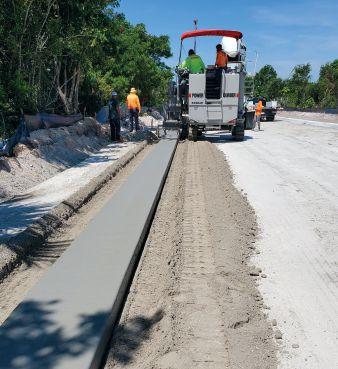
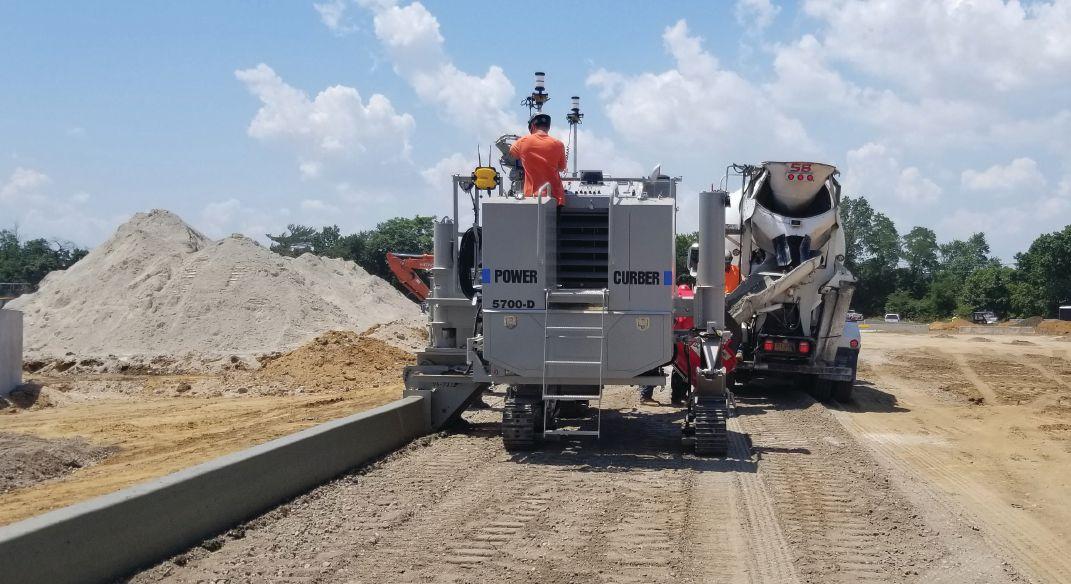
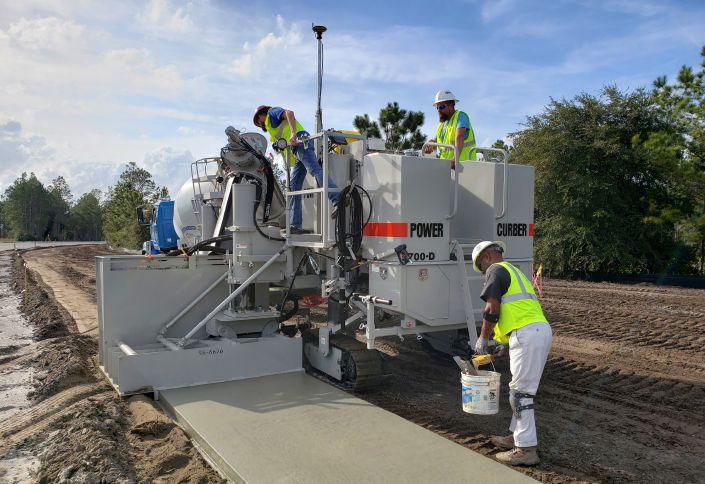
Power Curbers’ stringless machine control solutions allow producers to meet the increased demand for paving projects amidst the reduced labour supply that the industry is facing.
meet these paving demands, however, a number of issues, like road quality, sustainability, and labour shortages, need to be properly addressed.
Fortunately, manufacturers and equipment providers have been attentive to these issues, with a number of new solutions emerging to help contractors and paving professionals find success by looking to the needs of the industry’s present and future.
BEWARE OF WEAR AND TEAR
Paving projects across the country range from easing high-traffic corridors to adding infrastructure to remote communities, but one driving need growing in influence, according to Wirtgen Group’s district sales manager for Central Canada Daulta O’Hanlon, is the repair and rehabilitation of worn-down roadways.
“A major challenge over the last few decades has been an increase in the number of vehicles per citizen, as well as a dramatic increase in the average traffic speed and overall load,” said O’Hanlon. “This overloading has strongly shortened the lifespan of pavements.”
These trends highlight the value of solutions that maximize the overall operational lifetime of these roadways and reduce future maintenance needs, especially as contemporary vehicle design shifts toward being more demanding on pavement.
“There have been some major steps taken to improve the quality and performance of pavements, with one of them being the addition of a polymer to bituminous binder,” O’Hanlon explained. “Polymer-modified asphalt has gained some importance as of late, as it now plays a fundamental role in road paving that’s efficient and long-lasting.”
Polymer-modified asphalt is a step toward maximizing the density of pavements to meet current load demands, but O’Hanlon highlighted difficulty exists in replicating the lab results when applying these solutions in the field.
“A perfectly-performing mix in the lab is very challenging to replicate when applied in the field, as it takes more effort to compact in a small temperature zone,” he said. “Also, the polymer-modified mix leaves the asphalt plant at a certain temperature and density, and that gives producers a limited time frame when laying the mix down.”
The screed process increases pavement density by squeezing air out of the mixture
Reception to Power Curbers' 3D mapping and smart technology solutions has been overwhelmingly positive from clients making the transition.
that has been laid during the pre-compaction phase. O’Hanlon shared that the common method for this process in North America is to use a vibrating screed to spread the asphalt according to desired road thickness, slope and ride specs.
Wirtgen has approached the screeding process as an opportunity to attempt to replicate the lab testing results of polymer-modified asphalt with the development of the Vögele AB600TV.
The three-metre extending screed uses both a tamper and vibrating approach designed to maximize density during the pre-compaction phase. The AB600TV’s increased density output comes from the tamper design, which pre-compacts the mix before the screed plates reach it.
“With the asphalt pre-compacted, the screed is less susceptible to deviations in the mat, increasing ride spec and putting less pressure on asphalt rollers to achieve density within the desired temperature zone,” O’Hanlon explained.
ADAPTING SUSTAINABLY
Asphalt and pavement’s significant contributions to greenhouse gas emissions also means professionals in the roadbuilding industry will have to adjust as legislative regulations surrounding sustainability and carbon output continue to grow in both comprehensiveness and influence on their bottom line.
“Sustainability goals and regulations are catching on everywhere, so products and solutions that help customers meet those regulations will continue popping up and being fine-tuned in the months and years to come,” said Mark Eckert, product manager for compactors at Volvo CE.
The true demand across the paving industry is not just for solutions that are in alignment with this sustainable future, but for tools that accommodate these changing needs at no expense in quality to the finished product or project, says Eckert.
“Determining the right solutions to dial in productivity and accuracy remain critical parts of our customers’ work and becomes even more of a challenge with how essential protecting profit margins is in the face of all of this,” he said.
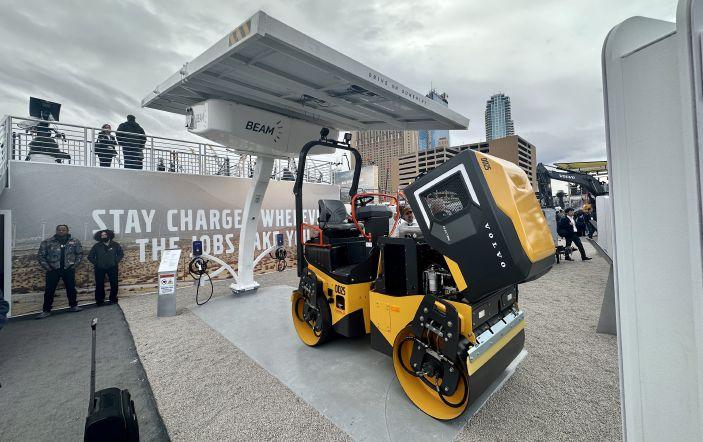
Volvo CE considers alternatively powered equipment and smart technology a large part of the company’s future, said Eckert, with a glimpse at this future visible in their DD25 electric asphalt compactor.
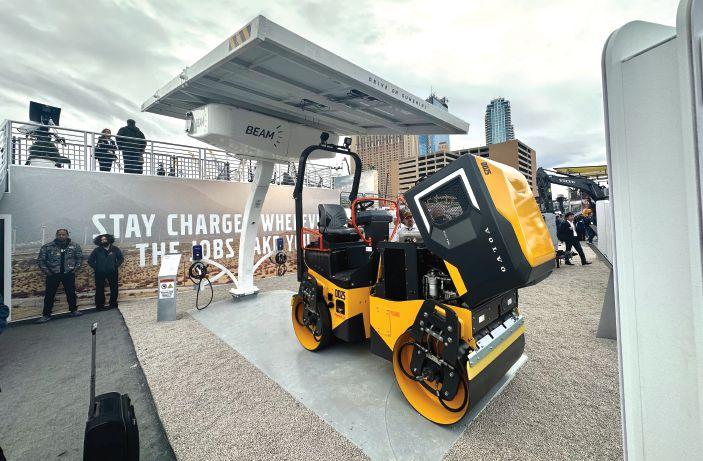
Eckert described the machine as a zeroexhaust emission solution for small-scale compaction projects like street repairs and parking lots, that still manages to boast 30 per cent more available power than its counterparts.
“The result is a more responsive machine in terms of speed and vibrations, that performs better on grade thanks to the size of its components, and better at high eleva-
tions than diesel machines, which lose power with increased altitude,” said Eckert.
Satisfying increased environmental regulations is not the only avenue where green technology can save paving producers money, with electric solutions also driving down costs in other areas of potential financial burden, such as downtime.
“With no engine to service, and electric components, batteries, and motors all being maintenance-free, upkeep requirements are reduced as well, saving serious time and money,” said Eckert.
WORKING SMART
While the high volume of current and forthcoming infrastructure projects are not a problem for paving producers, there is an issue when it comes to contractors having the sufficient labour force to meet these demands.
Regardless of which direction this shortage trends, there may be a light at the end of the tunnel in the form of automation and smart technology, said Stephen Bullock, President at Power Curbers LLC.
“Although there is quite a bit of available work out there, contractors aren’t able to expand their services due to a lack of labor supply,” Bullock said. “Several contractors have commented that they’re hesitant to enter the world of 3D and GPS technology, but that they can no longer find anyone willing to pound pins and set up the stringline [for paving jobs.]”
Bullock highlighted 3D stringless control, a technology trend that Power Curbers has come to specialize in, as a potential solution for meeting demand with quality results, even in the absence of adequate workers.
This solution replaces the traditional method of manually laying the stakes and stringlines used to control elevation with smart technology and robotics, at no compromise to precision.
“Stringless control has really evolved over the past 15 years, with real momentum gained over the last three or four,” Bullock explained. “Machine control is provided through a combination of GPS and robotics to replace the stakes and stringlines traditionally used for controlling elevation and steering slipform machines.”
Despite the recent emergence of this technology, Bullock shared that the reception to it amongst Power Curbers’ customers has been positive, especially with regards to its capabilities and compatibility in overall on-site operations.
“We’ve all been thrilled with how well the integration has gone, and the ease of transition we’ve been able to provide our customers,” he said. “We constantly get positive feedback from machine control partners regarding how smoothly our systems can be integrated relative to other machinery on the market.”
Volvo CE is offering a glimpse at paving's sustainable future in their DD25 electric asphalt compactor.
LOUISVILLE, KY theutilityexpo.com
> NOVEMBER 17 MHCA 2023 AGM WINNIPEG, MAN. mhca.mb.ca
> NOVEMBER 29-30 SHCA Industry Summit & Trade Show
REGINA, SASK. saskheavy.ca
> NOVEMBER 29 TO DECEMBER 1 The Building Show
TORONTO, ONT. thebuildingshow.com
> MARCH 25-27 World of
NASHVILLE, TN Worldofashpalt.com
Canadian Construction Association
one more load
Opportunities for rehabilitation are endless
When it comes to project planning, biodiversity is key
Sand and gravel operations, as a regulated landuse practice, often address biodiversity as a key consideration throughout the lifecycle of an operation. Planning a project to comply with biodiversity-related regulations and policies is important for obtaining approvals and reducing delays, disruptions during operations phases, or even the outright rejection of project applications.
The project planning, permitting and approvals stages require inventories and assessments of the biodiversity of the proposed site, so that avoidance or mitigation of any potential negative impacts can be planned before a project is approved. Key pieces of biodiversity-related legislation may apply, including the Federal Species at Risk Act and Migratory Birds Convention Act, or any number of provincial jurisdictionspecific policies and regulations.
Environmental management plans can be useful documents for guiding biodiversity protection and management throughout the operation of a project. For example, implementing standard vegetation clearing windows to avoid potential harm to nesting migratory birds may be a common component of such plans. Other biodiversity monitoring components could include assessments of mitigation measures, such as whether transplanted rare plants or compensation habitat is on the anticipated success trajectory.
While biodiversity-related policy and legislation can pose potential challenges or constraints to project planning and operations, it’s also important to recognize the significant opportunities and benefits that aggregate operations and good biodiversity management can offer to a given setting. An aggregate operation can be a blank canvas. A pit or quarry can offer the potential for the restoration and rehabilitation phases with near endless opportunities to provide alternative and varying habitats and enhance biodiversity.
Wetland creation and restoration is one component that is frequently implemented and that can provide key breeding and feeding habitats for a huge variety of wildlife and plants. Habitat for at-risk bird species can also be provided through grassland resto-
ration, or within vertical substrate faces for cliff and bank nesters. Barren or exposed substrates can also provide opportunities to create rare habitat types that are inherently more suited to these immediate postextraction conditions, and these can even act as transitional habitats as part of a longer-term rehabilitation or restoration plan to another end land use.
Environmental and Social Governance (ESG) is an increasing component of the social license to operate and is becoming critical for corporations, the public and investors. Maintaining and improving biodiversity forms a significant part of that. The United Nations Biodiversity Conference (COP15), held in December 2022 in Montreal and attended by 188 governments, yielded a landmark agreement to guide global action on nature through 2030. One of the agreed to points was requiring transnational companies and financial institutions to monitor, assess and transparently disclose risks and impacts on biodiversity through their operations, portfolios, supply and value chains. Many companies are already tracking and publishing their biodiversity progress as part of their ESG.
The industry is being recognized for biodiversity achievements and some incentives are available to continue this work. Provincial aggregate organizations have a variety of awards that can be obtained through biodiversity projects. Additional recognition opportunities are available through Non-Governmental Organizations (NGOs) or the myriad of outside environmental groups. Other voluntary mechanisms such as the Biodiversity Indicator Reporting System (BIRS) methodology developed in partnership with the International Union for the Conservation of Nature (IUCN) are also available.
Nicole Charlton is a senior ecologist with SLR who focuses on botany, vegetation community classification, and species at risk. She helps clients navigate the approvals, permitting and compliance environments on a wide range of projects and provides advice and specifications on habitat and restoration plans and monitoring.
NICOLE charlton
A LONG WAY TOGETHER
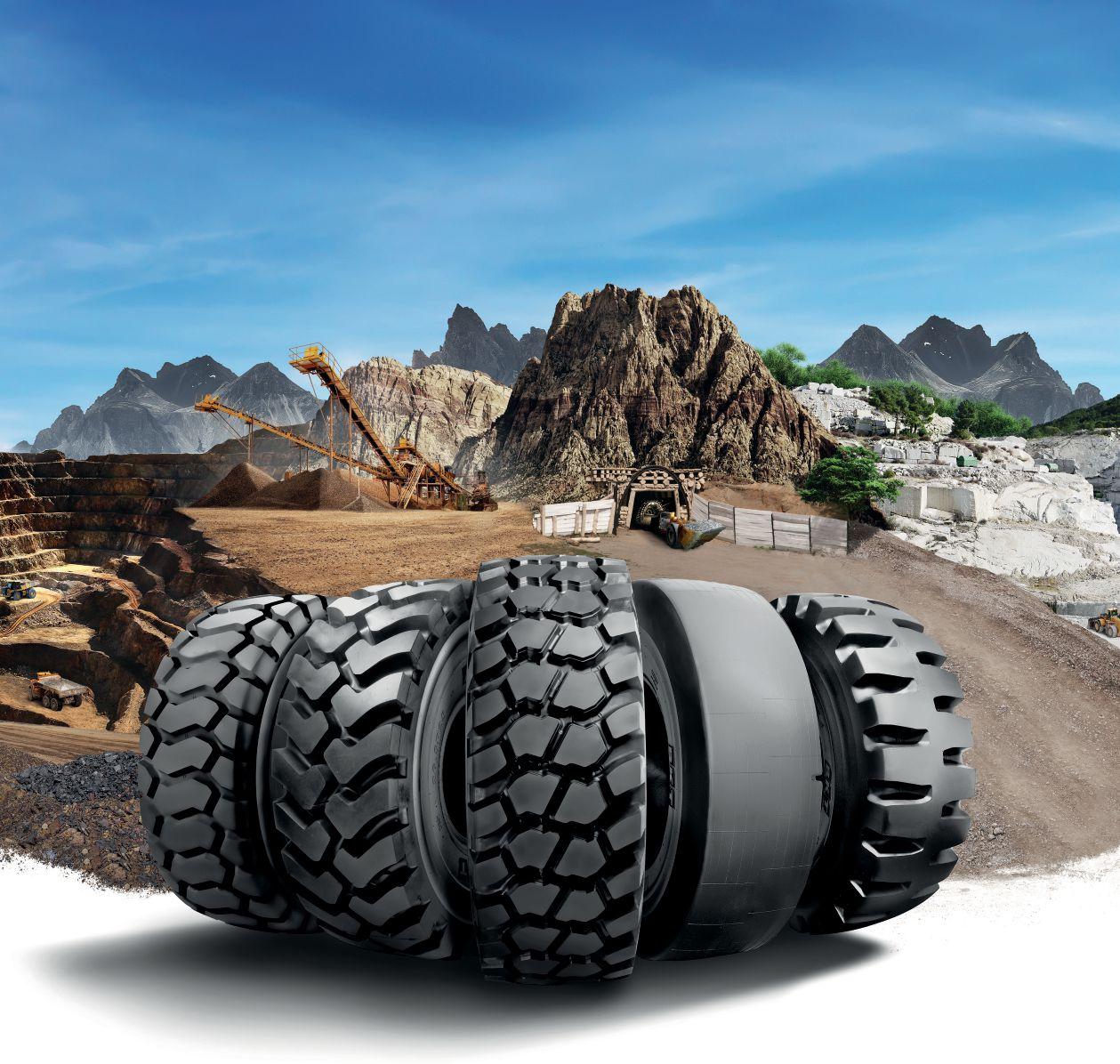
WHEREVER YOU ARE, BKT IS WITH YOU
No matter how challenging your needs, BKT is with you offering a wide range of OTR tires specifically designed for the toughest operating conditions: from mining to construction sites.
Sturdy and resistant, reliable and safe, able to combine comfort and high performance. BKT is with you, even when work gets tough.