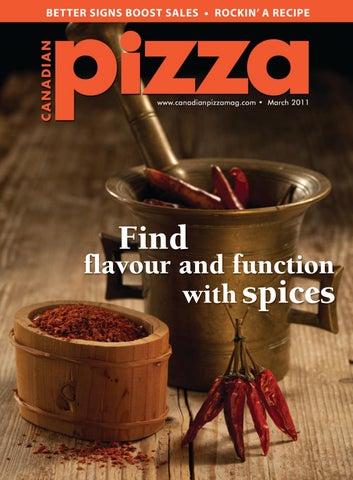
Find
flavour and function with spices
Volume 17 Issue 2 March 2011
14
14 Find Flavour and Function with spices
Try some of these mighty spices to add functionality and pizzazz to your menu.
16 indian inFusion 20
With ethnic offerings heating up menus, try bringing some exotic Indian flavour to your pizza.
20 a closer look at nook
This little restaurant that prides itself on small and simple is making a big impact in Vancouver’s west end.
24 saving dough 22
with simple green With Earth Day coming up in April, why not try some of these simple ideas for going green? You just may find yourself saving dough.
26 delivering tough 26
conversations with integrity Try these tips for successfully getting hard messages across to your staff.
www.canadianpizzamag.com
DEPARTMENTS 6
editor’s desk
8
pizza bites
10
canadian pizza online
12
the pizza chef
18
making dough
22
marketing insights
30
pizza on fire
MARCH 2011 pizza 3
“Packed from Fresh Tomatoes, Not from Concentrate”...
President Tom Cortopassi (kneeling) and “Coach” Dino Cortopassi (standing) in one of our
Since 1942, our Restaurateur customers’ success has depended on the superior taste of the food they serve and of our products. As a family-owned business, it feels good knowing that so many of our customers have relied on our “Packed From Fresh Tomato” products from generation to generation.
Whether your restaurant has a long family history, or whether you’re the founder, you can depend on our family making the best “Real Italian” tomato products...always Packed From Fresh Tomatoes, Never From Concentrate...generation after generation!
Tom Cortopassi President/Owner
Dino Cortopassi Coach/Owner
Generation after Generation.
tomato fields in Stanislaus County, California
IT
Y
THE
S
L
StaniSlauS E
AL
O F
Q U
A
The “Real Italian” Tomato Company 1202 “D” Street
Modesto, CA 95354 Toll Free 1-800-327-7201 ©2010 Stanislaus Food Products
from the editor’s desk march 2011, vol. 17, no. 2
The foodie books ood TV and the various other media dedicated to all things foodie have been catalysts for the consumer savvy that’s blossomed recently. This plethora of food porn has contributed to some of the highest expectation you’ve ever faced as a restaurateur. The immediate medium of the masses, good old television, has likely been the chief instigator through the rise of the Food Network. However, good old books are still known as a mainstay that rouses the influencers. Books take their imbibers where TV and magazines cannot – really far into the meat of the matter, no food pun intended. It’s probably of value to know what books your customers are reading. The strength of that depth can be revolutionizing for people. The deepest reaching philosophies of humanity were etched on paper, as they continue to be. So, what are folks studying up on these days? I recently cruised the non-fiction bestseller lists of 2010 for Amazon (Canada), Chapters/Indigo and Barnes and Noble. I didn’t see as many food-related books as I expected, but they were present nonetheless. When it comes to non-fiction food books, the focus of the book buyers seems to be first on weight loss and second on morality. However, this trend may also reflect the sheer number of books written about weight loss in comparison to the few that deal with heavyweight ethics. After perusing the lists in detail, I wondered more about our nation’s relationship insecurities than about their food worries. There were a surprising number of “how to love” books on all the lists. Some human challenges are perennial. Some of the more interesting titles topping the lists relating to weight loss and diet were: The 4-Hour Body: An Uncommon Guide to Rapid Fat-Loss, Incredible Sex, and Becoming Superhuman by Timothy Ferriss; Made to Crave: Satisfying Your Deepest Desire with God, Not Food by Lysa TerKeurst; and
F
6 pizza MARCH 2011
notable for pizza, The Carb Lovers Diet: Eat What You Want, Get Slim for Life by Ellen Kunes and Frances Largeman-Roth. On morality and eating, I found such bestselling titles as Eating Animals by Jonathan Safran Foer; Women, Food and God by Geneen Roth; and The Omnivore’s Dilemma: A Natural History of Four Meals by Michael Pollan. I recently finished reading the latter, and give it two thumbs up for being entertaining, enlightening and lacking in dogma. While I didn’t find Steak by Mark Schatzker on any of the lists I was reviewing, the book has been recommended to me by a few people, and it’s widely publicized by major media outlets. You’ll find it time well spent to venture down to a bookstore and see what’s popular or being heavily promoted. From there, you can ask yourself if your pizzeria is catering to the food conversation of the day. If you see an abundance of cheese books, perhaps it’s a good time to get experimental with your dairy. With weight loss being so topical, is there a pizza you can offer that fits in with a healthy eating idea that’s hot in the press? There are always trends, and potential opportunities to capitalize on those trends. A glance at a person’s bookshelf provides some of the most telling insights into his or her values, interests and beliefs. Books are also a great way to foster conversation and shared interests. Perhaps it’s worth considering doing a monthly draw for a book related to some aspect of your pizzeria, whether it be your location, your style of pie or recipes for the home chef. Encouraging a fuller exploration of a subject through books is a great way to help educate your customers and yourself. You may even get some great recommended reads. •
editor Laura Aiken laiken@annexweb.com 416-522-1595 assistant editor Brandi Cowen bcowen@annexweb.com 888-599-2228 ext. 278 publisher Christine Livingstone clivingstone@annexweb.com 519-429-5173 888-599-2228 ext. 239 sales assistant Sandy Mels smels@annexweb.com 519-429-5183 888-599-2228 ext. 219 production artist Kate Patchell group publisher Martin McAnulty mmcanulty@annexweb.com president Mike Fredericks mfredericks@annexweb.com mailing address P.O. Box 530, 105 Donly Dr. S., Simcoe, ON N3Y 4N5 PuBLICAtION MAIL AgreeMeNt #40065710 returN uNDeLIVerABLe CANADIAN ADDreSS tO CIrCuLAtION DePArtMeNt, P.O. Box 530, Simcoe, ON N3Y 4N5 e-mail: cnowe@annexweb.com Published eight times per year (Jan/Feb, Mar, Apr/May, Jun, Jul/Aug, Sept/Oct, Nov, Dec), by Annex Publishing & Printing Inc. Printed in Canada ISSN 1203-6838 circulation e-mail: cnowe@annexweb.com tel: 866-790-6070 ext. 207 Fax: 877-624-1940 Mail: P.O. Box 530, Simcoe, ON N3Y 4N5 subscription rates Canada – 1 Year $ 18.90 (includes gSt - #867172652rt0001) $ 20.34 (includes QSt/HSt) uSA – 1 Year $ 40.00 Occasionally, Canadian Pizza Magazine will mail information on behalf of industry-related groups whose products and services we believe may be of interest to you. If you prefer not to receive this information, please contact our circulation department in any of the four ways listed above. No part of the editorial content of this publication may be reprinted without the publisher’s written permission. ©2011 Annex Publishing & Printing Inc. All rights reserved. Opinions expressed in this magazine are not necessarily those of the editor or the publisher. No liability is assumed for errors or omissions. All advertising is subject to the publisher’s approval. Such approval does not imply any endorsement of the products or services advertised. Publisher reserves the right to refuse advertising that does not meet the standards of the publication. www.canadianpizzamag.com
pizzabites Study pegs keys to bringing diners back for more
CRFA show to feature three top Canadian chefs three of Canada’s top chefs will be on the menu at the CrFA show in toronto this March. the show, which runs March 6 to 8 at toronto’s Direct energy Centre, will feature chefs Vikram Vij, Mark Mcewan and ezra title. Chef Vikram Vij is the chef/owner of Vij’s restaurant and rangoli, both located in Vancouver. He is the author of two cookbooks and has started a new venture creating packaged gourmet curries, available throughout Canada this year. Vij is past president and an active member of the Chefs’ table Society of British Columbia, which is dedicated to supporting innovative and sustainable food programs. Vij is also a certified sommelier. Chef Mark Mcewan is the chef/owner of four restaurants in toronto – North 44, Bymark, ONe and Fabbrica, along with the recently opened gourmet food store Mcewan. His tV show The Heat highlights the challenges of his catering company and has aired for three seasons. Mcewan’s first cookbook, Great Food at Home, was published earlier this year and he also has a line of cookware available at Sears. Mcewan is the head judge of the tV show Top Chef Canada. Chef ezra title is the chef/owner of Chezvous Dining in toronto. Formerly a chef at Jardiniere in San Francisco and restaurant Daniel and Blue Hill at Stone Barns in New York, title returned to toronto to apply his style of cooking with the finest seasonal ingredients from local producers using time-honoured French techniques in unique ways at his own restaurant. title is also the host of Healthy Gourmet, which highlights the ongoing battle between taste and nutrition.
8 pizza MARCH 2011
hat is it that makes consumers want to return to a restaurant again and again? The keys are the social experience and the availability of healthy menu options, according to new research from the University of Tennessee and the College of Charleston. Researchers from the two schools have developed a 20-item scale called DinEX, which can predict whether diners will like a restaurant and return to it. “Given the research we did to develop and test DinEX, we’re confident that this is the new generation of restaurant rating systems,” said John Antun, an associate professor in the Department of Retail, Hospitality and Tourism, and director of the Culinary Institute at the University of Tennessee, Knoxville. “Food, service and atmosphere have always been critical factors in a restaurant’s success, but recent literature suggests restaurants have become a significant social outlet for people.” Antun added that the team’s research showed, “diners also rank “health” high
w
among the factors that will determine whether or not they’ll return to a restaurant.” To develop DinEX, the team assembled a small panel of restaurant owners and operators from several regions of the U.S. and asked each member to list “guest expectations” in the areas of food, service, atmosphere and social connectedness, as well as any other areas they felt were relevant. This list of 108 items was used to develop the first draft of a survey. This 108-item survey was presented to six focus groups – three groups of restaurant professionals and three groups of restaurant customers – who completed the survey and critiqued it. The results produced a revamped 100-item survey, which was tested with the public. The survey was then pared down further, eventually resulting in the 20-item DinEX questionnaire. According to findings published in the Journal of Foodservice Business Research, the survey is “efficient and yet comprehensive” in measuring the five key areas of desire for restaurant patrons: food, service, atmosphere, social and health.
pizzabites
New world record for most pizzas made in an hour After turning out a whopping 206 pies in 60 minutes, a Domino’s Pizza franchisee clinched the world record for the most pizzas made in an hour. On Dec. 9, 2010, Findlay, Ohio’s Brian edler shattered the previous guinness World record of 168 medium cheese pizzas. the old record was set by the Food Network’s Bob Blumer in July of last year. edler is a former u.S. Pizza team member and has won the fastest pizza maker title at various national and international competitions. to prepare for the world record attempt, he spent three months training to turn out pizzas that met the parameters specified by guinness World records. the pies made during the record attempt were cooked in XLt pizza ovens, which edler credits for helping him meet his goal. All proceeds from the sale of edler’s record-setting pizzas were donated to support the united Way of Hancock County and the City Mission of Findlay.
Pizza Pizza launches new chicken wings n addition to the chain’s popular sweet chili, honey garlic and hot sauce flavours, Pizza Pizza has expanded its wing line to include Forty Creek Whisky BBQ, Caribbean jerk, chipotle Amarillo, and sesame ginger teriyaki Thai. The wings are tossed in a large bowl to coat each individual piece in one of seven sauces. For a limited time, the new wings will be sold for 50 cents each in orders of 10, 20 or 30, with the purchase of any whole pizza. The nationwide launch follows a successful test in the Hamilton, Ont., market in November 2010.
i
Packaged Facts predicts trends onsumer thriftiness and healthconsciousness will continue to exert a notable influence over the ingredient and flavour trends emerging this year, according to Packaged Facts. The predicted trends are explored in the eighth edition of Packaged Facts’s annual Food Flavours and Ingredients Outlook series. “Heading into 2011, consumers are growing ever more weary of economic and nutritional health gloom and doom. Many have spent the last few years reinventing their financial and employment lives, and are now starting to focus more emphasis on their overall well-being and happiness in a way that is reflective of their values, being more pragmatic and deliberate in making decisions about how to spend both their time and their resources,” says Don Montuori, publisher of Packaged Facts. The firm predicts that food marketers from the retail and foodservice sectors will take that consumer mindset to heart. Some of the key trends predicted to hit it big this year are:
c
Flavours from around the globe Ethnic food will remain a bright spot for food service and retailers, providing variety and interest without taxing smaller food budgets. The growing presence of food trucks, with their varied ethnic fare at reasonable prices, will bring this national trend home to the local level. Sustainability trumps local, organic and natural Local, organic and natural foods will more often be connected with ecofriendliness and a more holistic lifestyle approach to eating that promotes sustainability. As a result, there will be greater use of natural, organic, local and antibiotic and hormone-free ingredients at QSRs and fast casual restaurants. At retail, the popularity of private label organic products is anticipated to continue while growth in directly marketed local and organic produce, meats and locally processed foods sold via farmers’ markets
and community-supported agriculture is anticipated. Wellness overall Food will get more attention as the foundation of health and wellness activities will be better integrated into overall lifestyle. Growing recognition that digestive health is a key link in promoting overall good health will help drive sales of yogurt and other foods containing probiotics, but glutenfree foods will likely show signs of slowing down after a year of explosive growth that some might consider to be a fad. Plethora of produce Vegetables, more so than fruit, will take on added importance this year as they move to the centre of the plate. More finedining restaurants are starting to focus on vegetables as the main attraction, with either no accompanying meat, or with meat used sparingly, as a condiment to accentuate flavour. Look for considerable menu experimentation, with taste palates developing to savour a broad array of produce. Turnips, parsnips, black and purple kale, broccoli, spiragello, Romanesco, eggplant, celeriac, and sunchokes will become more commonplace. Flavour and ingredient crossovers A key trend will see greater crossover of savoury ingredients into sweet foods and sweet ingredients into savoury foods. For example, the use of olive oil will extend into a wide range of desserts and sweet goods including ice cream, gelato, cake and muffins. Satisfying sweets Agave will surrender some of its sweetening prominence to the less exotic but always special honey, while stevia gains ground at a slower pace. Figs, pears, cherries and blackberries look likely to be the most popular fruits, along with the super fruit combination of blueberry and pomegranate. America’s appreciation of artisanal and retro desserts is expected to continue this year, with home-made pie and ice cream showing a great deal of creativity.
MARCH 2011 pizza 9
pizzabites
Low-sodium cheese, high-sodium taste ood scientists at University College Dublin have created a processed cheese product with 60 per cent less sodium than full salt versions that is reported to have little difference in terms of taste and structure. The research, published in the journal Food Research International, found that cheese made from dry protein ingredients (such as casein powder) was rated well by tasters who preferred the reduced salt versions to those with standard levels of sodium chloride. According to O’Sullivan, emulsifying salts, which include phosphates and citrates, and sodium chloride, are the main sources of added sodium content in processed cheese. By altering the manufacturing conditions, researchers were able to maintain the taste and structure of the imitation cheese while reducing the sodium content by up to 60 per cent. These methods also reduced processing times and the amount of energy required for mixing and manufacturing. The post-manufacture hardness of the cheese also decreased due to slight changes in the way fat and moisture are distributed within the product. Although the pilot-scale conditions the team employed to produce the imitation cheeses are not directly comparable to manufacturing conditions on an industrial scale, the team believes its methods could easily be scaled up for industrial production.
F
read these stories and more at www.canadianpizzamag.com
news highlights •
CFIA FINDS ERRoRS IN NuTRITIoN INFo
•
N.B. MINISTER’S DuAl MINIMuM wAgE PRoPoSAl STIRS DEBATE
•
CANADA PRESENTS oPPoRTuNITIES FoR u.S. ChAINS
•
oPERAToRS SEEk To REDEFINE “MAgIC” PRICE PoINTS
•
BREAkFAST PIzzA hEATS uP MoRNINgS
read these stories and more at www.canadianpizzamag.com
10 pizza MARCH 2011
NEw PRoDuCTS Professional liquid concentrated bases from Knorr are prepared from highquality ingredients, and free from artificial colours and flavours. DIgITAl MAgAzINE Visit www.canadianpizzamag.com to sign up for your free trial.
Fin
flavour d and func with sp tion ic
es
sponsored by
NOMINATE your
Are you giving bAck to your community or cAuses thAt mAtter to you? Are you an independent owner or franchisee? Nominate yourself for the Pizza with Purpose Award sponsored by Saputo. We are looking for fundraising activity, sponsorships, participation in community events and creative contributions. Think out-of-the-box. Contributions can be local or national in scope, or both. The winner won’t be determined solely on the amount of money raised but on a culmination of activity over the whole year. Everything you do counts. Your entry will be evaluated by a panel of industry experts. saputo will award $2,500 to the winning pizzeria.
2010 Winner Naheed Shariff
To nominate your business, please complete the application below. Track your efforts right up until April 1, 2011 and feel free to let us know how it’s going! Since everything you do this year counts, take until June 1, 2011 to submit your final application to us detailing your year of giving back. The winner will be announced in August 2011 and featured in the September/October 2011 issue of Canadian Pizza magazine. The final day to submit yourself as a candidate is April 1, 2011. NAmE(S) _______________________________________________________________________________________________________ COmPANY NAmE ________________________________________________________________________________________________ AddrESS _______________________________________________________________________________________________________ PhONE _________________________________________________________________________________________________________ E-mAil _________________________________________________________________________________________________________
Please provide us with a brief (100 words) description highlighting your charitable efforts. __________________________________________________________________________________________________________ __________________________________________________________________________________________________________ __________________________________________________________________________________________________________ __________________________________________________________________________________________________________ __________________________________________________________________________________________________________ Submit this form to canadian Pizza magazine Pizza with Purpose Award mAiL Annex Publishing & Printing inc. PO Box 530, 105 donly dr. South, Simcoe, Ontario, N3Y 4N5 fAx 1-888-404-1129 e-mAiL laiken@annexweb.com
The Pizza with Purpose award sponsored by
the pizza chef
Put your pizzeria on the map Diana Coutu oogle Maps is the leading mapping software for people on the go and for apps that use any type of location-based platform. Google has been aggregating local information from Yellow Pages and reviews from sites such as TripAdvisor, Citysearch and Yelp. Google Places has created thousands of websites for business owners and yet most of them are still unclaimed. Best of all, this is a completely free resource with no set-up costs or ongoing fees. How great is that? Unfortunately, the majority of pizzeria owners are unaware of this free resource and could fall prey to paying someone who understands how to utilize it. I predict that many of you will have individuals coming into your shops this year and offering to set you up on Google Places for anywhere from between $500 and $1,500. They’ll probably make it sound extremely complicated too. Not to worry: I’ll save you some money and explain it all in this article. When people leave their homes these days, they typically take three things: their keys, their wallets or purses, and their cellphones. More and more of these cellphones are smartphones or iPhones that have incredible capabilities, including a Google Maps app. When these busy people are on the move and looking for a place to eat, the first thing they do is pull out their cell and search “what’s near me.” This is where the two-kilometre rule comes into play. People are looking for something local. This is what’s called local mobile marketing. It’s local, because it’s localized to the individual’s location. It’s mobile, because the individual is typically mobile. It’s marketing, because essentially it’s targeted marketing to these people on the go. If your business is on Google Maps, then chances are it’ll show up on their phone search. But if you haven’t claimed your Google Places listing, there won’t be very much information besides the
g
12 pizza MARCH 2011
address and phone number. In some cases, it could be outdated information or show an incorrect location on the map. To be clear, a Google Places listing isn’t meant to replace your website. However, if you don’t already have a website, this is a great place to start that will put your pizzeria on the map. When you claim your business listing you can add your website, your hours of operation, your phone number, whether you take reservations, the forms of payment you accept, and the neighbourhoods where you deliver. You can even add up to 10 pictures and videos. You can also include a coupon to help these mobile diners decide to visit your pizzeria. Now when these mobile diners come to your pizzeria they can “check in” on their smartphones, which means telling the world they’re at your restaurant. When several dozen people have “checked in” at your pizzeria, you can become a favourite Google place. This also facilitates your guests adding reviews of their dining experiences. Again, this isn’t something that you have to pay for. This is a free resource to help mobile people find your establishment. Apps such as Foursquare use the Google Places resource, in many cases automatically uploading reviews to the Google Places site. This article isn’t meant to list all available apps and sites, as new ones are being developed every day and space here is limited. If you’re interested in more articles on this topic, please e-mail me or the editor. how To lIST youRSElF oN googlE PlACES Create a new Gmail account for the business, unless you already have one. Go to www.gmail.com to do this. You’ll see a box on the lower right side of the page that says, “Create an account.” Click on it. Next, go to www.google.com/places and click on “places for business.” Log in and search for your business. Click “claim this
listing” when you find it. Complete the various screens, entering the requested information, selecting the categories that your business might be found under, and uploading photos, etc. On the last screen, Google will either have two ways to verify the business listing or just one. If they have the phone verification method, make sure you are physically at your pizzeria and expect Google to immediately call with a four-digit code. As soon as you click the finish button Google will call you. Get the code and enter it into the page you are now on. Otherwise, Google will only tell you that it is sending out a verification post card to your business and to expect it in two to three weeks. Your Google Places listing is also where you will be able to generate a QR code. A QR code is a two-dimensional picture that can be scanned by a smartphone and decoded. For example, once scanned, it will automatically launch the user’s Internet browser and bring the person right to your website. Or it could bring the customer to your Google Maps listing and show all the information you’ve entered. Or it could go to your coupon. As of writing this article, QR codes are not being used by Google Places in Canada; however, it seems safe to expect them soon. Google Places is a great tool. It’s free, effective and simple to set up. Don’t miss out on making it easier for diners to find your restaurant. Especially those two-kilometre customers who are nearly outside your door! • Diana Coutu is a two-time Canadian Pizza magazine chef of the year champion, an internationally recognized gourmet pizzaiolo, the co-owner of Diana’s Gourmet Pizzeria in Winnipeg, Man., and a member of the board of directors for the CRFA. In addition to creating award-winning recipes, Diana is also a consultant to other pizzeria owner/operators in menu development, creating systems to run a pizzeria on autopilot, along with marketing and positioning to help operators grow their businesses effectively and strategically. She is available for consulting on a limited basis; for more information contact her at Diana@dianasgourmetpizzeria.ca.
THROUGH THICK AND THIN At Franco’s Pizza, our customers expect that same delicious east coast flavor in every pie. And Gary, my local distributor, understands that. Gary has been recommending ADM products to me for years. His ADM sales rep, Jim, tells him what’s happening in the industry, the right time to buy and which flour is right for my recipes. That’s why he recommended ADM Gigantic® Flour for Franco’s Original White Pie. Our customers can’t get enough. This type of partnership is important to a business owner like me. After all, whether it’s thick or thin, the crust is the foundation of my pizza; I want to build it with partners I can trust.
See the full line of ADM bag flours at www.adm.com/milling. Franco’s Pizza, Buffalo, NY
For customers around the world, ADM draws on its resources—its people, products, and market perspective—to help them meet today’s consumer demands and envision tomorrow’s needs. © 2010 Archer Daniels Midland Company Gigantic is a registered trademark of ADM Milling Co.
www.adm.com/milling
800-422-1688
feature
The hotter the pepper, the more capsaicin is present. Capsaicin has also shown promise in combating disease.
Find flavour and function with spices These mighty spices add a healthy kick and zip to your pies BY BrANDI COWeN
T
he spices that give your pies their special kick may also pack a functional punch. Flavourful seasonings such as black pepper, cayenne pepper and chili peppers have been linked to a variety of health benefits, including lowering high cholesterol, reducing inflammation, killing cancer cells, improving digestive health and assisting in weight loss. Regardless of your customer demographics, odds are there’s something functional in the pepper family that will appeal to the health-conscious pizza lover.
14 pizza MARCH 2011
CAPSAICIN Capsaicin (pronounced cap-say-a-sin) is the active component that gives cayenne, chili and other hot peppers their bite. The health benefits associated with this functional component of hot peppers are varied. In animal studies, capsaicin has been linked to decreased blood levels of low-density lypoprotein (often referred to as “bad” cholesterol) and increased high-density lypoprotein (or “good” cholesterol) in the bloodstream, according to the Medical Journal of Australia. That same publication also reports that cap-
saicin is a natural anti-inflammatory that inhibits the body’s responses to internal stimuli that can cause inflammation. This property of capsaicin offers a natural treatment for bursitis, arthritis and other conditions characterized by inflammation. Moreover, capsaicin can alleviate everything from the pain of a simple headache to chronic back pain. Capsaicin has also shown promise in combating disease. A 2007 study led by the University of Pittsburgh School of Medicine’s department of pharmacology found that the capsaicin that makes chili
research is needed to understand the mechanisms by which piperine produces these effects. Piperine has also been shown to improve the bioavailability (the extent to which a nutrient or medication can be used by the body) of other nutrients. In a study published in the journal Nutrition Research, researchers found that in a double blind study, participants who consumed beta-carotene supplemented with piperine demonstrated “significantly greater increases” in beta-carotene levels than participants who consumed the same level of beta-carotene without a piperine supplement. These findings suggest that cooking with black pepper may improve overall health by helping the body gain greater nutritional rewards from the foods it consumes. The list of benefits associated with spices in the pepper family is long, and the summary provided here is by no means exhaustive. Several studies have shown that black and cayenne peppers are both rich in phenols. These phenols have strong antioxidant properties, which may prevent some cancers and slow the growth of others by seeing out cancerPIPERINE The substance that gives black pep- causing free radicals in the body and deper its pungency is called piperine, and stroying them. Other research has deterstudies have shown that it can help mined that cayenne pepper may prevent numerous ailments. It has natural antibi- stomach ulcers by killing harmful bacotic properties, which can help combat teria in the digestive system and stimulating the production of bacterial infections, and its extra stomach mucous to spiciness can help reduce capsaicin protect the stomach lining congestion from colds, flu from hydrochloric acid. and sinusitis. Like capsacan alleviate There have also been studicin, piperine has also been everything from ies linking the capsaicin in shown to act as a natural cayenne and hot pepper anti-inflammatory. the pain of a to healthier looking skin. In a 2008 edition of the journal Food and Chemi- simple headache In both cases, the capsaicin is believed to encourcal Toxicology, a daily to chronic back age greater blood flow to dose of piperine was pain. the skin. reported to have antiWhether your customdepressant effects. On top ers are looking to betof that, brain function ter manage their weight, seemed to improve as a result of regular piperine consumption. shake off arthritis pain, or improve their According to the research team from overall health, there are spices in the pepThailand’s Khon Kaen University, “Pip- per family that can help. Why not make erine may be served as the potential the most of the powers of peppers and functional food to improve brain func- craft a functional pie that caters to both tion.” However, they noted that further their health and their love of pizza? •
pepper hot causes pancreatic cancer cells to die. In 2008, The journal Apoptosis reported that mice grafted with human pancreatic tumours, and treated with capsaicin, developed tumours half the size of those found in mice treated with saline. The capsaicin-treated mice also demonstrated higher levels of proteins associated with apoptosis, the process by which the body disposes of cells that are either damaged or unnecessary. In cancer cells, apoptosis is usually defective, which allows these damaged cells to survive and multiply unchecked. The amount of capsaicin in various types of peppers is measured in Scoville heat units (SHU). While assorted varieties of chili peppers can be found across a wide swath of the Scoville scale, cayenne pepper ranges between 30,000 and 50,000 SHU. The scale runs from zero to more than 16 million SHU. In short, the hotter the pepper, the greater the amount of capsaicin present and, therefore, the greater the functional benefits to be reaped.
New weapon to combat listeria in meat products In February, Health Canada approved the sale of a new product to inhibit the growth of Listeria bacteria in packaged meat products. griffith Laboratories’ Micocin is derived from a strain of naturally occurring Carnobacteria maltaromaticum, a bacteria that produces an antibiotic to inhibit the growth of Listeria. Micocin is a superfine powder that is diluted in water and then deposited onto foods during packaging. Listeria cannot thrive in this environment, which results in safer food for consumers. griffith Laboratories’ senior vice president of new technology, David Smith, is “excited to bring this groundbreaking ingredient to the marketplace.” Micocin is already being used in some consumer food products. In a press release, griffith Laboratories states: “it has no effect on the flavour, texture or appearance of the products to which it is introduced, so consumers can be protected without the addition of extra chemicals or technical-sounding ingredients being added to the food label.” the technology is being developed into a variety of products by CanBiocin, a company formed by a partnership between griffith Laboratories and the university of Alberta. the approval comes ahead of new federal legislation to protect Canadians from Listeria, expected to be announced on April 1. the legislation is in response to recommendations of the Weatherill report, prepared by an independent investigator following the 2008 Listeria outbreak that killed 23 people. the Weatherill report offers 57 recommendations to improve the safety of ready to eat meats, including a recommendation that Health Canada “review its approval processes and fast track, where appropriate, new food additives and technologies that have the potential to contribute to food safety giving particular attention to those that have been scientifically validated in other jurisdictions (provinces or countries).” Micocin has already been granted generally recognized As Safe (grAS) status in the united States, and is approved in Mexico, Costa rica and Colombia.
MARCH 2011 pizza 15
feature
The spice options in Indian cooking are vast, a key to that big taste being in the blend.
Indian infusion BY LAurA AIKeN
A
blank canvas, pizza becomes the art of its maker and the rules are few. Well, unless of course we are speaking of authentic Italian styles where there can be many specifications. Even then, there is still room for much creativity. This malleable nature of pizza lends itself greatly to the many ethnic flavours that are now quite mainstream in Canada. For example, Indian dishes such as butter chicken have made their way onto even the most meat and potatoes of pub menus. There are many different cultural foods that have traversed their way into pizzerias, a Thai pizza being one of the most common offerings. I recently tried a sushi pizza at a Japanese restaurant, which goes to show that if you have the ingredients there are many things you can call pizza. But Indian food seems to be an up and comer in the pizza world. We reviewed more than one submission in our Chef of the Year contest that incorporated recognized Indian flavours into the recipe. Plus, the bold flavours associated with Indian cooking can put the zip back in an item that you are reducing salt, sugar or fat from. To explore this avenue of Indian piz-
16 pizza MARCH 2011
za further, I turned first to a book called Indian Spice Kitchen by Monisha Bharadwaj. The author is a consultant in menu creation for India’s parliament and entertainment industry, and the book itself is an award winner. Considering there are 20 odd spices that can comprise a curry, the book’s title is true to form. Bharadwaj takes readers through short summaries and recipes of each common spice in India. She notes at the very beginning of the book that using ingredients correctly to get authentic results in Indian cooking requires trial and error, thus patience will be rewarded if you want to experiment with in-house sauces and recipes that will definitely be un-replicated elsewhere. However, there are a number of companies out there providing readymade sauces and that is certainly a viable route to take. Some of the spices used in Indian cooking are quite familiar, and others not-so-much. It would take an inordinate amount of paper to explore them all here, so I’ve narrowed our discussion down to perhaps those with the most potential for pizza applications.
Celery seed, mustard, cinnamon, nutmeg, coriander, cumin, fennel, cloves, cardamom and chillies are Indian fixtures already well known in North American kitchens. Fresh coriander leaves are commonly sprinkled over Indian dishes so you may want to consider garnishing your Indian pizza with these as well. While chillies are a very key spice to Indian cooking, Bharadwaj notes that they have only been known in India for about the last 400 years. They were first introduced by the Portuguese in the 15th century but they had been domesticated in Mexico since about 7,000 BC. Despite this late start in the game, India has become the largest producer and major exporter in the world, writes Bharadwaj. There are many types of chillies grown all over the world, such as the recognizably Mexican serranos or jalapenos. The author describes Indian chillies varieties as long and fat, round like cherries or small and slender. Chillies, fresh, dried or powdered, are used in nearly all savoury Indian dishes. Turmeric is what the Bharadwaj calls “the heart and soul of any curry.” Associated with cleansing in Indian cultures, this member of the ginger family can act as a
thickening agent and is known for its ability to impart a golden yellow colour to its dishes. Flavour wise, it’s warm and earthy. The author notes that India is also the world’s biggest producer and exporter of this spice, which appears to be growing in recognisability and popularity. Saffron is, of course, widely associated with Indian dishes and you may find a use for these expensive little threads that are extracted from flowers by hand. The threads are so light, writes Bharadwaj, that 750,000 hand-picked flowers yields only about one pound, making them an expensive addition to the kitchen. But just a few strands soaked in water or milk then added to the liquid of a dish will add fragrance and colour. A saffron cream sauce drizzled over your pizza would certainly up its cache in the classy pie department. At the root of Indian cooking seems to be the way various spices blend together. For example, garam masala is a blend that I used to think was a spice unto itself. It’s actually a combination of black peppercorns, cumin seeds, stick cinnamon, cardomaom seeds, cloves and bay leaves. Or all those ingredients less the peppercorns and bay leaves and plus nutmeg and mace, depending whose recipe you’re reading. Amounts vary by the hand of the blender. Garam masala is a unique and exotic flavour that can jazz up many non-Indian dishes, write Vikram Vij and Meeru Dhalwala in their book Vij’s, based on their well-known Indian restaurant in Vancouver. The authors actually even note of a close friend who does indeed sprinkle this spice on their pizza! The husband and wife team write that they first used store bought ground spices when they opened the restaurant in 1994 but within six months were roasting and grinding the spices themselves. “The colour of the chicken curry changed from a lighter to a deeper brown, and the texture became less gritty. So, although the previous chicken curry tasted fine (in retrospect, not nearly as good), our second chicken curry required less of each spice but resulted in a dish with a stronger, richer flavour and a more velvety texture,” write the husband and wife team. Pre-roasting each individual spice, while time consuming, brings the ingredients to the height of their flavour. If you do choose explore roasting your own spices, the
authors caution to do so in a well ventilated area as the aromas are strong. The word “masala” has two meanings in Hindi, firstly as a spice as in garam masala, or an individual spice, and the second meaning refers to the spices cooked in an onion-garlic-tomato sauce that is the base preparation for most Indian curries. Masala is the “stock” of the curry, as Vij and Dhalwala refer to it, and can be simple or complex. Like pizza, Indian cooking is diverse, regionalized in its customs and requires a practice of process. If you are looking to further research Indian flavours, you are likely to find more information geared to Canadian tastes about northern Indian food, specifically Punjabi and tandoori methods, as these are most commonly known outside of India. While goat, lamb and chicken are most common inside India as Hindus don’t eat beef and Muslims don’t eat pork, the chefs at Vij’s write that many Indians serve pork and beef dishes outside India to meet the demands of Western or European tastes. The philosophy of Vij’s is to “keep our spices and cooking techniques Indian, while using the meats, seafood and produce that are available and popular.” It is certainly possible to bring an authentic Indian taste to your pies using the ingredients in your own backyard. A conversation about pizza and Indian cooking wouldn’t be quite complete without mentioning paneer. This mild Indian soft cheese is fairly basic to make, accessible to buy and can be eaten raw, cooked in a sauce, marinated or grilled. I imagine it could also be sprinkled on top of pizza. Paneer can be made in large batches and frozen without affecting quality, according to Jeeti Ghandi, an Indian food celebrity, in her book Indian Flavour. Ghandi is a dietitian and focuses on healthy cooking. If you are looking for great healthy substitution ideas in recipes, this book is a good resource. Yogurt is also a mainstay of Indian cooking that you may want to consider using as a garnish or dipping sauce. This article is far from exhaustive in discussing the ingredients used in Indian cooking, but it does highlight some essentials and hopefully provide you with some ideas should you want to bring the luxuriously rich aroma and taste of an Indian kitchen into yours. •
Find
flavour and function with spices
SubScribe TODAY ! only
1800
$
(GST $18.90; QST/HST $20.34) US $40.00 (USD) • Foreign $50.00 (USD)
Name: ________________________________ Business: _____________________________ Address: ______________________________ City: __________________________________ Prov: _________________________________ P.Code:________________________________ Tel: __________________________________ Fax: __________________________________ e-mail: ________________________________ 1. NATure OF buSiNeSS: (Select only one): ❏ independent Pizzeria ❏ Pizza chain/Franchise ❏ Gov’t, library, school ❏ Other ______________________________ (Specify) 2. JOb TiTle: ❏ Owner ❏ restaurant Mgmt ❏ Other – allied to the field ______________________________________ (Specify) 3. Years in business: ❏ under 5 years ❏ 10-19 years ❏ 35+ years
❏ 5-9 years ❏ 20-34 years
4. Annual Gross Sales: ❏ less than $250k ❏ $500k-$750k ❏ Over $1 million
❏ $250k-$500k ❏ $750K-$1 million
PAYMeNT: cheque - Payable to Annex Publishing & Printing inc. Visa Mc Account #: _________________________ expiry: _________________________ Signature: _________________________ Date: _________________________
TO SubScribe:
Tel: 866-790-6070 Fax: 877-624-1940 Mail: canadian Pizza Magazine c/o Annex Publishing & Printing inc. P.O. box 530, 105 Donly Dr. S., Simcoe, Ontario N3Y 4N5 e-mail: cnowe@annexweb.com
www.canadianpizzamag.com
GST/HST#867172652RT0001 • QST#1036778161
0311PZ
MARCH 2011 pizza 17
making dough with Diane
8 ways to enhance signage Diane Chiasson f done right, proper signage and point-of-sale (POS) materials can help increase sales and impulse buys dramatically. Signage is one of the least expensive ways to market your business. Good signage outside your operation will help draw in passing customers. Customers waiting in your restaurant for their pizza or a table provide a captive audience. Take this opportunity to tell them about your new promotions and products, fill out forms to build your database, or buy additional products such as chips, cookies or even gift cards at the cash register. Check out these eight easy tips for on improving your signage and POS materials to boost sales.
i
SEND ThE RIghT MESSAgE A big, beautiful sign alone may not necessarily sell your product. Hire a good marketer who will know what to put on your signs to sell your products. Use alluring adjectives to describe your food. Sell the benefits and reveal the savings. For example, let your customers know how much they would save if they bought your pizza deal instead of buying all the components separately. Or if you have put together a more health-conscious pizza combo, spell out the health benefits. SIzE AND PlACE MATTERS The size of your signage and POS materials can have a big impact on the overall message you want to send. Signs that are too big can be overwhelming for customers. Signs that are too small may be hard to read. Your signs should be placed at eye level so customers do not have to crane their necks to read your offer. For smaller POS materials, make sure your signs are placed next to the products you are selling so there is no confusion as to which products the signs are promoting. Signs need visibility. If the name of your restaurant is placed above a window or awning, it may not be visible to potential customers
18 pizza MARCH 2011
walking by. Consider putting your logo on the front door as well, or hanging a banner perpendicular to the front of the store. Banners will also move around in the wind, which helps attract attention to your establishment. Try placing signs in unexpected locations such as on the ceiling, restrooms, parking lot, stairwell or any other place in your operation where customers are bound to look. However, don’t get overzealous with your signs. Don’t plaster signs all over your store. Be strategic. FoNT SIzE AND ColouRS Your signs and POS materials should all be cohesive and visually coordinated. They should be the same size and colour, use matching fonts and reflect the same images. If you use too many different sizes, colours and fonts, you will confuse your customers as to what message you want to send them. Use high-contrast colours to attract attention, but keep it simple and easy to read. Avoid handwriting your signs or using fonts that are written in italics, slants or all caps. PhoToS SEll Use professionally taken photos. Tantalize your customers with images of your food that will make their mouths water, or show how much food they will be getting for that price. Since pizza operators usually offer several choices for toppings and side dishes with their pizzas, photos are also a good tool to ensure customers know exactly what they are getting with each order. MAkE A ClEAR oFFER wITh A ClEAR PRICE Many pizza operators offer several different combinations of pizza, drinks and side dishes, but it can be confusing for the customer to figure out exactly which deal would be most suitable for them. Make sure that your signs offer clear cut information on exactly what they get with each
promotion, and how much each deal costs. TRy DIgITAl Digital signage offers many benefits, mainly because it can be updated instantaneously. It is also more environmentally friendly as it eliminates the use of paper, which can also tear and rip easily. Digital can also provide more entertainment value to your customers; you can create slideshows or even short commercials of your promotions. You can also create short cartoons or animation to attract the attention of kids. kEEP SIgNS ClEAN AND CuRRENT The sign outside your store is the first impression customers get of your operation. Make sure that your sign is clean, fresh and positive. If your sign is dirty, has missing letters or lights that are burned out, it gives the impression that your pizza operation does not care about itself, and therefore, will not care about its customers. Make sure that your signs are always updated and accurate. REINFoRCE youR BRAND Your logo should appear somewhere on all of your signs and POS materials (ideally, in the same place, such as always in the lower righthand corner). The most successful companies use memorable images that help keep their brands dominant in the minds of consumers. Review these easy-to-implement tips to evaluate how effective your current signs and POS materials are. A few tweaks may be all your operation needs to bring in extra sales. • Diane Chiasson, FCSI, president of Chiasson Consultants Inc., has been helping restaurant, foodservice, hospitality and retail operators increase sales for over 25 years. Her company provides innovative and revenue-increasing foodservice and retail merchandising programs, interior design, branding, menu engineering, marketing and promotional campaigns, and much more. Contact her at 416-926-1338, toll-free at 1-888-926-6655 or chiasson@chiassonconsultants.com, or visit www.chiassonconsultants.com.
feature
A Closer Look at Nook This little restaurant is making a big impact in Vancouver’s west end BY BrANDI COWeN
T
20 pizza MARCH 2011
Mike Jeffs minds the kitchen at Nook, a successful Vancouver tapas restaurant.
says the 2,000-square-foot space looked “ridiculous” with just 50 seats. In the end, they went with a 65-seat dining area, which, he admits, can be a lot to handle. If Jeffs had his way, he would “never open a restaurant with more than 30 seats again.” A gooD REPuTATIoN Being able to set up shop in a neighbourhood where they already had a successful restaurant with a solid reputation was a major advantage for Jeffs and Welsh. They opened Tapastree, a tapas restaurant offering cuisine with both international and
west coast influence, in 1997. The pair spent the next 12 years establishing a reputation for quality fare and excellent service at a reasonable price. By the time Nook was ready to open its doors in May 2009, the entrepreneurial duo were well known in Vancouver’s west end. “It was a lot easier for us to open up than it would have been for any other person to open up in the neighbourhood. There’s virtually nobody who’s been down here longer than us, and we have a good reputation,” Jeffs says. “We didn’t have to do any advertising or marketing. We opened our doors and
4 tips for building a good reputation 1. 2. 3.
4.
Identify what you can do well, then do it well every time. Keep it simple. A simple dish done extraordinarily well is more impressive than an extraordinary dish done poorly. Be realistic about what you can manage. More seats mean more room for customers, but unless you can consistently deliver excellent food and service, seats will go unfilled. Use quality ingredients. Customers will notice and be willing to pay for them.
Photo: Michelle Vella
wo years ago, Mike Jeffs and Nicole Welsh’s landlord offered them additional space in the building where they already operated a successful tapas restaurant. The pair seized the opportunity to bring something new in pizza to Vancouver’s food scene. Thanks to Jeffs and Walsh, the city now has Nook, a 32-seat antipasto bar on Denman Street. Occupying just 1,090 square feet, the restaurant offers 18 menu items, including six pizza options. Jeffs calls signing up for the space an “impulse decision,” but, he explains, “Nook is one of those things. I didn’t know if it would work because it’s very small, but it was something that I wanted to do.” He admits that he didn’t think too far ahead when planning for the restaurant – he created the menu in just 15 minutes, and has stuck to it ever since – but this approach has worked well for Nook. “It’s a real simple little restaurant. We focus on what we can do, and what we can do well,” Jeffs explains. “If you want one of our six pizzas or one of our six pastas or one of our six antipasto, then this is the place for you. If you’re looking for more choices than that, this isn’t the place for you.” This simplicity is a necessity, due to Nook’s small size. But it also reflects Jeffs’ changing attitude towards managing a kitchen. “I’m not interested in running around like an 18-year-old line cook anymore,” he says. “Thirty seats is just the perfect amount. You’re never in trouble, you can do a really good job and if you get 30 seats all at once, it’s not the end of the world.” The experience of serving a smaller number of diners has been so positive that when Jeffs and Welsh decided to close their sister restaurant Tapastree and reopen as an Italian restaurant under the name Tavola, they tried to cut down on the amount of seating offered. But Jeffs
A well-designed small space can provide big room for social fun.
Nook’s story so far has been an unusual one, filled with spur of the moment decisions and challenges imposed by a small operating space. But at the end of the day, Jeffs believes that those factors are integral to the restaurant’s success. “Left to my own devices, it probably wouldn’t have worked out like that. If I could have had everything my way, it would have been a lot harder and it probably wouldn’t be as great as it is,” he reflects. “It worked out and I wouldn’t change a thing.” •
MARCH 2011 pizza 21
Photo: Michelle Vella
know they’re being served quality ingrediwe’ve had a lineup ever since.” Between 75 and 100 diners come ents. The kitchen uses salamis from a local through those doors every night. On a very sausage maker, Oyama Sausage Company, busy night, that number may reach as high and buffalo mozzarella from a Vancouver Isas 160. Many of those customers are regu- land farm that raises its own meat. Such high quality can be pricey, but the lars. Jeffs estimates that he and his staff know more than three-quarters of the people they way Jeffs sees it, that’s no reason to settle for inferior ingredients. “It’s serve on any given night. my theory: the flour and Nook’s small size and community atmosphere has it’s a real simple water theory,” he explains. gone a long way towards little restaurant. “When flour and water are the bulk of your product, building a base of loyal, regwe focus on you can afford to put really ular customers, but it’s the food that keeps them comwhat we can do, good things on top. That is the secret to what we do: we ing back again and again. The pizza menu includes and what we can use the very best ingredients you can use.” pies topped with salami and do well. Working with qualolives; prosciutto, arugula ity ingredients is also a key and roasted garlic; Italian component of Jeffs’ mission sausage, chilies and sweet onions; ricotta, roasted tomatoes, olives, for Nook. At the end of the night, he wants onions and garlic; and anchovies, olives and customers to walk away feeling they “have chilies. Rounding out the pizza offerings is a had a good time and some tasty food, and that’s it. Once again, it’s a simple place with margherita pie. Regardless of what they order, customers simple goals.”
marketing insights
A Natural Order Michelle Brisebois ertain words are used so often and thoughtlessly that they cease to have deep meaning. For example, the term natural has been bandied about the food and beverage industry like a tennis ball at Wimbledon. Webster’s Dictionary defines natural as “living in or as if in a state of nature untouched by the influences of civilization and society.” One could make a literal case in saying that if food were natural as in truly untouched by the influences of civilization, it wouldn’t be starring on a menu but instead be enjoying a blissful existence far from the threat of harvest or slaughter. The word natural is open to interpretation. While it has a positive connotation, it doesn’t necessarily define the product for the consumer. Is there a more natural way to say natural? To market our pizza menu effectively, we need to understand what consumer need is driving the use of the word natural. To put it simply, people want to know where the food came from and what’s in it. In its annual survey of 1,500 chefs in the U.S., The National Restaurant Association says that the sourcing of local produce and meat, menus filled with simple and healthy food, and sustainable business practices top the list of what’s hot in the industry this year. Diners have a myriad of reasons for wanting to know about the origin of menu items. The back story may enhance their enjoyment of the meal, allowing them to get a sense of the place where the ingredient was grown. The wine industry refers to this as terroir. Health concerns around additives, pesticides and hormones have been widely reported in the media, prompting anxiety on the part of consumers
c
22 pizza MARCH 2011
what words do you use to describe your healthy pizza?
to escalate. Considering people’s many reasons for wanting the lowdown on their grub, it’s best to be specific about the pedigree of menu items. Instead of just using the descriptor natural, tell patrons what the food is free from, whether it’s pesticides, hormones, gluten or dairy, etc. If you source an ingredient from a local farmer who employs sustainable and/or humane practices, promote this through your pizza menu and via your staff so they can sell the selections to your diners effectively. Be wary of making it sound like a eulogy for the animal. Focus on the farmer’s systems rather than the life
and death of the main course. Research shows that guilt has no place on an effective menu. The Healthy Eating Consumer Trend Report, released last November by Technomic, says that “nearly half of all consumers want healthier menu items, but only about a quarter of them actively consider nutrition when dining out.” These results suggest that healthy menu items are important in drawing customers to your restaurant but may not perform as strongly at the till. The study also noted that wording has a significant impact in motivating consumer selections. Sixty-seven per cent of consumers
said they were willing to spend up to 20 per cent more for a food or beverage that said “certified” organic, yet just 18 per cent indicated they would do so for an item labelled simply organic. Similarly, 67 per cent of consumers said they would spend up to 20 per cent more for a food or beverage item labelled “allnatural” compared to 59 per cent who said they would do so for an item claiming to be just “natural.” These findings highlight the importance of being as specific as possible with your words. Smoke and mirrors won’t cut it anymore. It’s time to put our money where their mouths are. “Consumers definitely expect restaurants to offer something they consider to be healthy, and they expect them to be able to do it in a way that still tastes really good,” says Kelley Weikel of Technomic. “The expectations are really high.” Many of the industry’s trend-watchers quickly get to the heart of the mat-
ter when it comes to sustainable eating options. While food grown locally or without pesticides can be perceived as healthier, consumers also often believe it tastes better too. Study after study always circles back to the importance of taste for consumers. Knowledge, taste and availability are key barriers to healthier eating, reveals a five-country study by Ketchum titled Food 2020: The Consumer as CEO. When asked what factors aside from cost prevent them from buying healthier foods, 44 per cent of consumers said knowing what’s truly healthy, 43 per cent reported taste; and 35 per cent cited availability. Consumers in Germany, Argentina and China are more likely to cite knowledge as a barrier, while consumers in the United States and China list taste. The top barrier in the United Kingdom is availability. Be specific, be transparent and focus on dazzling their taste buds. What could be more natural than that? •
If you source chickens that run free, tell your customers about it. Michelle Brisebois is a marketing professional with experience in the food, pharmaceutical, financial services and wine industries. She specializes in retail brand strategies.
MARCH 2011 pizza 23
feature
Saving dough with simple green BY JuLIe FItz-gerALD
G
reening up your restaurant to do your part in saving the earth is a no-brainer, but discovering that a greener restaurant can also increase profits . . . well, that’s just good business. With the 21st International Earth Day approaching on April 22, here are some ways to make easy environmentally friendly changes to your pizzeria while putting more money into your pocket. From small efforts such as replacing lights with compact fluorescent light bulbs, to big efforts like becoming a certified green restaurant, you’ll find no shortage of steps you can take to save the planet and increase efficiency in your business. As a non-profit organization servicing and certifying restaurants across the United States and Canada for the past 20 years, the Green Restaurant Association’s website states that medium to large business owners can see net savings of several thousand dollars per year, while small business owners can expect to see a net savings of around $1,000 per year based on simple earth-friendly changes to their restaurants. Joe Leroux, owner of Amadio’s Pizza in Port Credit, Ont., has seen even greater savings than those mentioned above since making green changes to his pizzeria in an effort to become more efficient. Some of these changes include retrofitting all of the lighting in his store, having his pop cooler on a timer and keeping the compressor fans on his various coolers and freezers clean. “I know that I’ve saved substantial amounts of money each month with the
24 pizza MARCH 2011
small changes that I’ve made compared to how I was operating, it’s made that much of a difference. My utility bills have never been over a thousand dollars per month. My store is 1,500 square feet and I run six deck ovens,” he says. Leroux’s knowledge of instrumentation has taught him that the most important change restaurant owners can make to become greener and more efficient, is to keep the compressor fans and condensing coils clean throughout their stores. “Have your compressor fans serviced regularly or do it yourself by vacuuming them out. If they’re blocked with dust, they can decrease the efficiency
of your coolers and freezers very fast, which means they will be running longer than what is needed and that will use a lot more energy,” he advises. Another way Leroux has increased efficiency while going green is through a POS system that logs orders. The system has reduced the amount of paper required for receipts, and reducing the amount of time spent on the phone per order. “It really allows me to operate the business knowing what time the delivery came in, how much time we have to get it delivered, what the co-ordinates of the delivery
are, and which deliveries can go together. This saves a lot of gas by cutting down on idling and using more direct routes. What I now do with three drivers I used to be doing with five. Basically, going green is good for the bottom line.” An additional great tip for going green is to shop locally whenever possible, something that has become a movement in its own right. The local movement emphasizes that buying locally reduces fuel emissions caused by products travelling across the continent to reach consumers. Leroux is a fan of shopping locally and buys most of the items he needs within a two-kilometre radius of Amadio’s, but he warns, “Sometimes buying local at the farmer’s market is three times as much as you pay at the wholesaler’s for the same product. So what do you do?” Leroux is fortunate enough to be located mere minutes away from A.J. Lanzarotta Wholesale Fruit and Vegetables,
a vegetable wholesaler in Mississauga, Ont. This is where he goes to buy local high-quality produce. Using high-quality ingredients is yet another practice that has contributed to the success of Leroux’s business. “By buying a better-quality product, you get a better taste, a longer shelf life and you can use a little less with a higher-quality product, so in the end it costs the same.” While feeling morally good about the green choices you’ve made is probably the best benefit, the Green Restaurant Association also highlights six other benefits to going green on its website: garnering good publicity, cutting costs, improving staff productivity and morale, driving in new customers and increasing customer loyalty, staying ahead of legislation, and creating a healthier environment in which to live. Leroux has experienced many of these benefits, including publicity and customer loyalty first hand thanks to the green
changes he’s made at Amadio’s. “I’ve had a couple of articles in the local newspaper written on [my green efforts], so yes, customers are aware and they are supportive of it. It basically comes down to the fact that it’s smart business. A lot of my customers are small-business people so they do understand what I’m doing and they think it’s a good idea. Those ideas you want to share because it’s only one Earth,” he says. Thanks to high-profile spokesmen rallying on behalf of our planet and the tireless efforts of teachers and environmental groups, the urgency and importance of every Canadian joining together to make green choices is clear. The added fact that going green can increase the efficiency of a business, providing an immediate return to owners, further proves that we can’t afford to sit idly by. Implementing Earth-friendly changes in our homes and businesses just makes sense. •
MARCH 2011 pizza 25
feature
Delivering tough conversations with integrity Four techniques to say what needs to be said, when no one wants to say it. BY JOAN MAJOrS “
I
’d like to see you in my office at the end of the day.” What is it about a request like this that makes everyone involved just dread the moment? Unfortunately, this is the way most people have learned to handle the concerns: take care of business and lay down the law. When it comes to delivering tough conversations, starting with the right question and the right attitude can change everything about the encounter and the outcome. Many people simply cannot handle these types of conversations well. There are four guidelines, which will allow even the most timid at heart, as well as the brutally honest, a way to offer unpleasant information while maintaining integrity and having empathy. It is important to remember a few guidelines, and critical you understand it doesn’t matter if the conversation is between a manager to subordinate, subordinate to CEO/manager, or teacher to parent. The ability to start with a question allows the other party to listen and participate at their rate of speed, not yours. You must be willing to wait for the answer. This allows the other party to actually choose to engage in the conversation.
ASk PERMISSIoN To CoACh When you have an issue with a team member and need the individual to listen and participate in the actions that follow, you must engage them in the process. Consider calling the team member to your office and find something to compliment them on, and then; deliver the tough news about the issue at hand. Such as, “Susan, you are one of our
26 pizza MARCH 2011
having a difficult conversation doesn’t have to mean headaches for all.
best sales representatives. Do I have permission to coach you in another area?” She will most likely say yes because this is less brutal and it gives you the freedom to discuss her constant tardy behaviour or whatever the issue is. She is now involved by saying yes. It is a symbiotic relationship not a reprimand. ASk PERMISSIoN To BE hoNEST In a situation where you have a subordinate who wants to confront an issue or challenge with someone in management, it works similarly but the words would be different. For instance, if you have a teacher to a parent/ administrator or a team member to the CEO/ doctor/lawyer/leader, most of these individuals want to maintain a good work environment but these conversations can be tricky. We will use Susan again now with John. Timing is important in these conversations and
you would never want to make someone else look bad or foolish; this won’t serve you well, so be discreet. Step into their office or schedule a time to go over a couple of concerns. Susan might say, “John, Do I have permission to be honest with you?” John will respond with less concern about the outcome because you have been respectful in your request. Besides, who would say, “No, I want you to lie to me!” Often people will seem puzzled that you ask. Don’t fill in the silence, wait for their response. However uncomfortable this might seem it will create the results you want by allowing both parties to listen differently. lEAVE ouT ThE lIMITINg TERMS When speaking to someone about their habits, behaviours, or personal life, it is of utmost importance to leave out the limiting terms. For instance, if you are going
to discuss an area that is sensitive, the normal nature is to want people to like you so they will often use words like, we, little, sort of, kind of and other words that seem to make it less impactful. Let’s take a doctor to patient and manager to team member scenario. Dr. Likeme says, “Mrs. Smith we have a little spot on your X-ray.” Her thought, if “we” have the spot and it’s “little” then you get the treatment! The manager says to the team member, “Susan, we have a little problem with your tardiness.” The thought that follows, if “we” have the problem and it is “little,” don’t call me! How about this, “Mrs. Smith, there is a spot on your X-ray and I am concerned and you should be too.” This allows the patient to own the spot and their concern. For the manager and team member, “Susan there is a problem with your continuous tardiness; I am concerned and believe you should be too.” Both of these scenarios allow the person to hear the concern. These should only be shared after asking permission to be honest. We have already proven that this
question allows the party to be engaged at a different level. It also cuts down on the defensive mechanism we have. ASSuME INNoCENCE When having tough conversations don’t assume you know everything about the individual or the behaviour that is being displayed. It is often more than meets the eye and the very reason one should always assume innocence. When you ask for permission to coach or be honest, presume that the other party has no idea there is an issue or problem, assume innocence. Just because Susan is habitually tardy doesn’t mean she is doing it to disrespect you or the organization. Don’t assume that you know why this is happening. Susan could have a dying mother or a new diagnosis that is causing her to have blood work done often in the morning. Susan could have an issue that only you should investigate. Especially since she has been a great employee up to this point. Assuming Susan is innocent is much more productive to everyone in-
volved. Ask permission to coach and then ask if he/she can fulfil the request. Just ask; it is not only the question but the cure for misguided and bad relationships in businesses and elsewhere. If you wonder what is happening, then just ask. But when you ask, don’t ask with an attitude, assume innocence and be curious…like a small child! Remember, manager to team use permission to coach. Subordinate to manager use permission to be honest. Use words that don’t limit the impact of the information. Lastly, assume innocence and stay away from accusatory language. These four techniques will cut down on the defense mechanism we all have in our personalities when we know bad news is coming! Focus on the fix not the flaw; this can help you encourage others to greatness! • JoAn Majors is a member of the National Speakers Association and the Global Speakers Network. As a professional speaker and published author, her systems deliver results and encouragement to the workplace and home. For more on her seminars and her latest book, “Encouragementors: 16 Attitude Steps for Building Your Business, Family & Future,” please visit: http://joanmajors.com.
SAVE 50% up to
On Your Cheese Cost With The Great Canadian Appetizer Company
Used in your favourite recipes, Easy Melt Flavoured Shreds delivers the quality, flavour, and functionality of 100% natural cheese, while offering cost effective savings and price stability.
Easy Melt F lavoured 75/25 Chees e Blend Shred s
natural - 75% alternative analog cheese made with palm oil and 25% cheese natural like perform to ted formula y speciall cheese is - Trans Fat Free - Reduce s ingredi ent costs, offers price stability and higher profits - Replicates the taste and functio nality of 100% natural cheese without compro mising the taste and texture
CALL TODAY FOR YOUR FREE SAMPLE JL INTERNATIONAL 905.763.2929 www.jlinternational.ca MARCH 2011 pizza 27
feature
Oliveri clinches Chef of the Year P
asqualino Oliveri captured the 2011 Canadian Pizza magazine Chef of the Year crown with his ‘La Regina’ pizza. Oliveri of the soon-to-open Pizzeria La Regina was one of four finalists in this year’s bake-off, hosted for the first time by Moretti Forni Canada at their Dupont Avenue location in Toronto. Oliveri narrowly edged by Marina Rondinelli of Rondo’s and Pizza Plus in Bright’s Grove, Ont., who submitted a ‘Blazing BBQ’ pulled pork pizza. The remaining finalists, Tom Stankiewicz of Bondi’s Pizza and Rick Nixon of
Itza Ristorante & Pizzeria, tied and will receive honourable mentions in Canadian Pizza magazine for their O Sole Mio and Italian Garden recipes, respectively. Oliveri’s win will see him cash in on a trip to the Las Vegas Pizza Expo from March 1 to 3, $1,000 cash, a cover feature in Canadian Pizza and a guaranteed spot in finals for the Traditional category of the pizza making competition. His winning entry featured a cream of broccoli sauce, sausage, grilled red peppers, red onions, mozzarella and parmigiano cheese. As runner-up, Rondinelli has also
equipment
won a trip to the Expo and entry into the preliminaries of the non-traditional category of competition. On Feb. 9, all four finalists shipped their ingredients, including their own dough, sauce and toppings to the Moretti Forni kitchen, where they were baked and scored by a panel of seven judges, including representatives from Canadian Pizza magazine, Moretti Forni and the contest’s sponsor, Saputo. Stay tuned for the April/May issue of Canadian Pizza magazine, which will feature Oliveri on the cover and all the finalists’ recipes.
Advertisers’ Index Company .................................................................. Page #
ADM Milling Company ...........................................................13 Annex BookStore ..................................................................21 Burke Corporation ....................................................... 31 (IBC) Crown Custom Metal ...............................................................7 JL International ......................................................................27 Middleby Marshall .................................................................19 Ricco Food Distributor ...........................................................27 Salerno Cheese.....................................................................25 Saputo Dairy Products .............................................. 32 (OBC) Saputo Pizza With Purpose Award ...................................... 11 Springer’s Meats Inc. ............................................................25 Stanislaus ............................................................................4, 5 Thunderbird Food Machinery ................................................23 Viau Foods Inc. ............................................................. 2 (IFC) Use these advertiser contact numbers to find out more about a product advertised in this issue or to place an order. This index is provided as a service. Canadian Pizza Magazine is not liable for errors or omissions.
28 pizza MARCH 2011
equipment
Heated delivery SyStemS
ElEctric HotBag DElivEry SyStEm No temperature drop from oven to customer • Bag heats to & stays at 160°-175° • Heats from top & bottom
• Lightweight Thermoloft™ nylon
• The original, proven & patented In-store delivery system heats up to 12 HOTBAGS at once.
800-927-6787 www.HotBag.com
Made in the USA by the Check Corporation
marketing
Learn tips & tricks from a Master Pizzaiolo. Order your copy of Canadian Pizza Baking Champion Diana Coutu's cookbook Passionate About Pizza at www.annexbookstore.com
COnSulting ServiCeS
pOS SyStemS
Double Your Sales Immediately!
“Since we installed SpeedLine, we’ve tripled our sales and lowered our food cost.” - DIANA COUTU, DIANA’S GOURMET PIZZERIA.
Book an online demo today! www.speedlinesolutions.com I 888.400.9185
3x2 ad April 09.indd 1
3/25/2009 9:23:46 AM
MARCH 2011 pizza 29
pizza on fire
Rockin’ a recipe Tom Stankiewicz he task of creating a new pizza recipe is a fun and inevitable challenge for pizzaiolos. A new recipe can be a way to combat declining sales, attract new clients, or simply expand and update your existing menu. It sounds like an easy job: just mix some toppings together, put them on your pie and the pizza will fly out the door in no time. If only it were that easy. Anyone can make a pepperoni, mushroom and green pepper pizza. If you take a minute and type “pizza recipes” into an Internet search engine, thousands of results will turn up offering step-by-step instructions for different pies. The trick is to pick that perfect combination of ingredients that will result in a unique but very tasty pizza. I’d like to share with you the simple process I follow that helps me create successful recipes for my store and competition. First, you need to know who your customers are and why you are introducing a new pie at this time. Perhaps your menu could use a new recipe to give your customers more choice. This is a great solution if your clients are telling you that they’re getting tired of ordering the same thing over and over again. Rather than let your customers get their “new” fix from your competition, it is definitely worth a try to add a new pizza to your menu and keep their loyalty. If you’ve noticed your weekly sales slowly declining, there are a few techniques you can use to investigate what might be behind the slide. Ask your staff if they have recently received any feedback from customers. Design a short comment card and place it at the front counter so customers can provide their feedback on the spot. If you’re not do-
t
30 pizza MARCH 2011
ing it already, it might be a good idea plain anymore. Many of us offer whole to spend some time at the front counter wheat, herb and garlic and jalapeno and deal with your clients directly. This crusts, just to name a few. It takes trial will give a small window of opportunity and error to find out which toppings to ask them a few questions while they taste better with one kind of dough than are paying for their order. with another. For examThere can be many reasons ple, jalapeno pizza dough for a decrease in sales, so can be a winner if it is stick to what it’s important to identify complemented by mild, has worked in what they are in your sperather than spicy, topcific case. You might dispings (unless, of course, the past, but cover that it’s as simple as you’re trying to create a add a unique not offering enough choice super spicy pizza). Keep on your menu. in mind, too, that if you flavour to get If you’re planning to are creating this pizza recyour customers’ ipe for a selected group attend a pizza competition, your end goal is not of clients with health attention. only to create a fantastic concerns, gluten-free and and delicious recipe, but low-sodium dough might also to win. A recipe that be worth exploring. will be judged at a contest may have When it comes to sauce, I’ve found to be more unique or adhere to certain our customers never question what type restrictions, unlike one that is just be- of sauce we put on our pizzas. Most asing created to refresh your menu. Give sume it’s a tomato sauce with various yourself some time to think carefully spices. However, I have a few clients before deciding on a final draft. who request barbecue sauce on their When it comes to your menu, select- pizza instead. On the odd occasion, I ing toppings can be tricky because you will have someone ask what we can ofalready offer the best combination of top- fer besides tomato or barbecue sauce. pings for your clients. Some combina- Our alternative is olive oil with either tions are so commonplace they’ve become herbs or our special seasoning. classics, such as Hawaiian and all-meat If you need to create a new pizza recpizzas. When you’re trying to introduce ipe, ensure that you have the answers a new combination of toppings that will to the big question: Why? Without unappeal to many people, you have to pre- derstanding why you’re doing it, and pare yourself for a rather long process for whom, your new pizza recipe could before you get a winner. My suggestion be a disaster for your store. But, under would be to avoid introducing something the right circumstances and done for that is drastically different from what you the right reasons, your new pie might already offer. Stick to what has worked in be a winner. • the past, but add a unique flavor to get Tom Stankiewicz has been in the pizza business for your customers’ attention. more than 15 years. He has been the proprietor of Another factor to consider these days Bondi’s Pizza in London, Ont., since 2000 and is is your dough. Pizza dough is not just president of the Canadian Pizza Team.
The Taste of Excellence We know quality is as important to your business as it is to ours. That’s
www.saputofoodservice.ca
why at Saputo, we’re dedicated to excellence in every mozzarella product we produce. Whether block, shred, diced, or IQF, Saputo Mozzarella delivers the high-quality flavour, appearance and texture you expect. Offer your customers the taste of excellence. Offer them Saputo. VancOuVer
(604) 946-5611
TOrOnTO
(905) 264-7600
darTMOuTh
(902) 468-5700
edMOnTOn SaSkaTOOn
(780) 468-5811
OTTaWa
(613) 741-9718
MOncTOn
(506) 859-8888
(306) 931-0040
MOnTréal
(514) 747-0303
ST. JOhn’S
(709) 753-3943
WInnIpeg
(204) 987-6345
Québec
(418) 651-5220