PULP& PAPER
PAPERWEEK HIGHLIGHTS INNOVATIONS IN PAPERMAKING CHEMISTRY AND MORE SAFEST MILLS IN CANADA
CANADA
OVER 100 YEARS OF SERVING THE INDUSTRY
SUMMER 2026 pulpandpapercanada.com
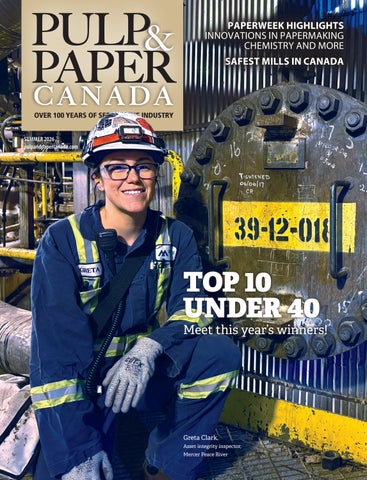
TOP 10 UNDER 40
Meet this year’s winners!
Greta Clark, Asset integrity inspector, Mercer Peace River
PULP& PAPER CANADA
Summer 2026 Vol. 127, No. 2 An Annex Business Media Publication PRINT EDITION ISSN 0316-4004 ONLINE EDITION ISSN 1923-3515
OVER 100 YEARS OF SERVING THE INDUSTRY
COVER STORY 6
Top 10 Under 40 Awards
I t’s time once again to honour exemplary individuals whose hard work, dedication and contributions over the course of their careers have helped steer Canada’s pulp and paper sector.
FEATURES 14
20
PaperWeek: Spotlighting innovation
6
ere are some highlights from the Pulp and Paper H Technical Association of Canada’s (PAPTAC’s) flagship conference.
23
Irving Pulp & Paper improves brightness control
Process engineer Jacob Wall discussed his project’s progress as part of a PaperWeek session on bleaching.
23
OFIA Convention: Navigating the future
This year’s gathering coincided with the Ontario government’s release of a new plan to support the forest industry.
28 Safest Mills in Canada
elebrating 100 years, the contest recognizes C the outstanding records of participating facilities across the country. ai169116848127_PPC_Social_Icons.pdf
1
2023-08-04
20
DEPARTMENTS 4 Editorial 5 Op-Ed 30 Giving Back
1:01 PM
30 Follow us on Facebook and LinkedIn @pulppapercanada
MISSION STATEMENT: To promote the pulp and paper industry in Canada by publishing news of its people and their innovations in research, technology, management and financing, as well as forecasts of future trends. Serving the industry since 1903.
For breaking news, visit pulpandpapercanada.com Cover photo: Mercer Peace River pulpandpapercanada.com
Summer 2026
PULP & PAPER CANADA
3
EDITORIAL
Safety first
N
orth America’s pulp and paper industry has been reeling following one of its deadliest incidents in recent history. At about 7 a.m. PT on May 26, a chemical tank used in paper pulp production imploded, ruptured and collapsed at Nippon Dynawave Packaging’s (NDP’s) facility in Longview, Wash. Estimates suggest the 900,000-gal capacity tank released 550,000 to 570,000 gallons of white liquor. Casualties included 11 workers dead (nine on the scene and two later in hospital) and seven workers and one firefighter injured by burns and inhalation. NDP suspended production, established an ‘incident response headquarters’ and promised to work with authorities, including the U.S. Chemical Safety and Hazard Investigation Board (CSB), as they investigate the spill and what could have caused it. CSB, for its part, expects to release an investigation update before October and a fuller report a year after the disaster. “The failure appears to have occurred midlower on the white liquor tank,” says FPInnovations corrosion researcher Matthew Tunnicliffe, based in Vancouver. “In some published images, it is possible to see the tank collapsed with what appear to be large sections of its shell deformed outward. Corrosion‑related damage Peter Saunders mechanisms exist in white‑liquor service and Editor may have contributed to the failure. Mill engineers can reassess similar assets handling white liquor, including inspection scope, frequency and coverage of known degradation modes. The root cause of each of these mechanisms is different and there are always multiple contributing factors: process upsets and changes, human error, improper maintenance, improper inspection and damage modes not anticipated by inspections.” Nippon Paper’s U.S. subsidiary was no stranger to industrial incidents, including fires in 2023 and 2025, the amputation of a worker’s finger in 2025 and the development of a sinkhole earlier this year. While these were not deadly, they too ought to have been prevented. With prevention top-of-mind, we once again highlight in this issue what are reportedly the safest mills in Canada and, through our Top 10 Under 40 Awards, some of the professionals responsible for ensuring strong levels of safety performance at those—and other—facilities. “In a high-risk environment like a pulp mill, hazards are attempted to be eliminated, substituted or engineered out,” is how Mercer Celgar, a northern bleached softwood kraft (NBSK) pulp mill near Castlegar, B.C., described measures following its recent Safety Day, Mercer’s self-audit that has become an annual event over the past decade. “When that is not practicable, administrative controls and personal protective equipment (PPE) prevail.” Congratulations to all of this year’s winners—and let’s make sure the Longview disaster is never repeated, anywhere. PPC —Peter Saunders 4
Summer 2026
PULP & PAPER CANADA
READER SERVICE Print and digital subscription inquires or changes, please contact Angelita Potal, Customer Service Administrator Tel: (416) 510-5113 Fax: (416) 510-6875 Email: apotal@annexbusinessmedia.com Mail: 111 Gordon Baker Rd., Suite 400, Toronto, ON M2H 3R1 Editor PETER SAUNDERS 416-510-5119 psaunders@annexbusinessmedia.com
CEO SCOTT JAMIESON 519-429-5180 sjamieson@annexbusinessmedia.com
Brand Sales Manager SONYA HESSON 416-510-5224 shesson@annexbusinessmedia.com
Group Publisher ANNE BESWICK 416-510-5248 abeswick@annexbusinessmedia.com
EDITORIAL/SALES OFFICES 111 Gordon Baker Rd., Suite 400, Toronto, ON M2H 3R1 Phone: 416-442-5600 Audience Development Manager Shawn Arul 416-510-5181 sarul@annexbusinessmedia.com
Account Co-ordinator SHANNON DRUMM sdrumm@annexbusinessmedia.com
Media Designer Alison Keba
Print in Canada ISSN 0316-4004 (Print) ISSN 1923-3515 (Digital) PUBLICATION MAIL AGREEMENT #40065710 SUBSCRIPTION RATES Canada $61.00 - 1 year; $98.12 - 2 year; $19.50 - Single copy USA $147.45 CDN per year Overseas - $159.12 CDN per year Occasionally, Pulp and Paper Canada will mail information on behalf of industry related groups whose products and services we believe may be of interest to you. If you prefer not to receive this information, please contact our circulation department in any of the four ways listed above. Annex Privacy Office privacy@annexbusinessmedia.com Tel: 800-668-2374 The editors have made every reasonable effort to provide accurate and authoritative information but they assume no liability for the accuracy or completeness of the text or its fitness for any particular purpose. All rights reserved. The contents of this publication may not be reproduced in part or in full without the publisher’s written permission © Annex Publishing & Printing Inc.
Sustaining member, Pulp and Paper Technical Association of Canada; Member, Alliance for Audited Media.
pulpandpapercanada.com
OP-ED
Challenges in decarbonizing Canadian kraft pulp mills By Enrique Mateos-Espejel
C
anada’s pulp and paper sector stands at a strategic inflection point. Global competition is intensifying, cost structures favour international competitors and investment decisions made now will determine whether Canadian mills can retain their relevance in international markets or will continue to cede market share. At the same time, the sector’s kraft pulp mills are faced with energy-efficiency challenges that are critical to achieving lower operating costs. Natural Resources Canada (NRCan) statistics show the pulp and paper sector is one of the country’s top 10 most greenhouse gas (GHG) intensive industries. The decarbonization of mills needs investments—but the savings that result from reducing a mill’s fossil fuel costs and avoiding carbon taxes can enhance the acceptability of these investments. While the Canadian pulp and paper sector’s fuel utilization relies mainly on biomass sources (including wood waste and spent liquor), the industry also still uses fossil fuels, including natural gas and heavy fuel oil. According to NRCan’s statistics, the industry’s non-biogenic (i.e. combustion of fossil fuels) GHG emissions for 2022 were 8.1 Mt CO² eq/year (or 5.1 Mt CO² eq/year excluding electricity), of which pulp mills emitted 4.9 Mt CO² eq per year (or 3.4 Mt CO² eq per year excluding electricity). One of the principal challenges Canadian kraft mills face with efforts toward decarpulpandpapercanada.com
Image courtesy FPInnovations.
bonization is they are older and less efficient when compared with more modern mills in other parts of the world. Typically, modern mills require 50% less thermal energy than an average Canadian kraft pulp mill (~10 GJ/t vs ~20 GJ/t) and consume less water (~10 m³/t vs ~70 m³/t), according to a modern mill reference model and FPInnovations’ benchmarking of energy use in Canadian pulp and paper mills. An average Canadian kraft pulp mill’s fossil fuel use— which, again, is mainly natural gas—is in the lime kiln and for the purpose of energy production. Energy consumption of Canadian lime kilns is, on average, 8.5 GJ/t lime compared with 5.4 to 6.8 GJ/t lime for some modern mills. High energy consumption has an impact on overall production costs (~5 vs. ~50 $/t), according to RISI Fastmarkets. Modernization is crucial for mills to decarbonize, but also to remain competitive. Canadian mill owners need to consider their full context to select the optimal options
that can help them achieve decarbonization and modernize operations. FPInnovations has been researching these options. The following are some of the pathways to modernization. It is feasible to reduce fuel consumption for energy production by 10% to 30% by optimizing existing water and energy networks, minimizing water consumption, ‘debottlenecking’ processes, optimizing automation and increasing boilers’ efficiency. New boilers are more efficient and operate at higher pressures and temperatures. Upgrading recovery boilers would create a surplus of bioenergy, translating into more power being sold to the grid. As per an FPInnovations internal report, lime kiln decarbonization can be achieved by replacing fossil fuel with biomass-based fuel. This has been proven technically feasible by implementations in several mills around the world. Solid firing seems the most suitable, as the technology is well-known (with more than 10 installations
around the world), requires less capital, is the best fit for average Canadian lime kiln capacities and involves a less complex process than other options. There are other new and mature technologies to further reduce energy and chemical use, including membranes for black liquor concentration, oxygen delignification, lime mud drying, more efficient evaporators and tall oil or lignin extraction (used internally or to sell), among others. Carbon capture, utilization and storage (CCUS) might play a role in decarbonization and its integration is technically feasible, but its economic feasibility would depend on government subsidies and offtake agreements. Modernization will also help reduce labour costs and offer opportunities for integration (e.g. packaging and/ or hardwood uptake). PPC Enrique Mateos-Espejel is a senior scientist in FPInnovations’ thermal process group. Contact him at enrique.mateos-espejel@ fpinnovations.ca.
Summer 2026
PULP & PAPER CANADA
5
TOP 10 UNDER 40 T
he nominations for Pulp & Paper Canada’s 2026 Top 10 Under 40 Awards arrived from across the country and, for that matter, across various types of organizations that contribute to the pulp and paper sector in their own ways. Nearly all of the nominees were highly worthy contenders for these awards, for which we congratulate their expertise and drive, but in the end, only 10 could win. And here they are ….
6
Summer 2026
PULP & PAPER CANADA
Edited by Peter Saunders
Marc-Alexandre Audet Marc-Alexandre Audet, 36, is maintenance manager for Domtar’s Saint-Félicien Market Pulp Mill in Quebec. He has been with the company since 2012, when he joined Fibrek as a maintenance supervisor and engineer. With corporate changes, he became a mechanical maintenance supervisor and planner in 2015 for Resolute Forest Products, which was rebranded as Domtar in 2024. Audet has become a trusted right-hand leader within his organization, nominated for this award by general manager (GM) Marie-Noelle Watts, to whom he directly reports. He is known for consistently delivering on his commitments with rigour and efficiency, demonstrating outstanding performance and maintaining a strong focus on cost control and adherence to timelines. Highly driven and results-oriented, he does not count the hours required to achieve his objectives, but every minute of his time is used productively. Possessing a strongly entrepreneurial mindset, Audet makes decisions based on both the Saint-Félicien Mill’s long-term sustainability and the goal of building his career within the organization for years to come. He champions projects with confidence, clarity, conviction and enthusiasm, relying on facts and sound reasoning to gain others’ support. Audet anticipates and proactively addresses his team’s needs. He promotes knowledge sharing across departments, including procurement and finance, to foster stronger cross-functional collaboration and strengthen organizational alignment and cohesion. From a technical standpoint, Audet is exceptionally competent. He has extensive expertise in reliability processes, preventive maintenance, capital projects and major shutdowns. He can effectively manage competing priorities, quickly assimilate new concepts and propose practical solutions. Audet’s commitment to safety is exemplary. He ensures rules and procedures are respected and leads by example. Having established a strong presence, he never shies away when challenges arise. He pulpandpapercanada.com
accepts responsibility, acts with honesty and transparency and can be counted on to do what is right. As a manager, Audet demonstrates genuine courage. He is willing to take clear positions, address difficult issues head-on and make tough decisions with confidence, while remaining attentive to his team’s well-being and development. He is also never hesitant to seek external expertise when needed.
birth of her second son. Due to her ambition, adaptability and strong performance, Clark is currently the succession candidate to become the mill’s chief inspector. In fact, she was nominated for this role by the current holder of that title, Jody Menssa, CET.
Greta Clark Greta Clark, 39, is an asset integrity inspector for Mercer International’s northern bleached softwood kraft (NBSK) and northern bleached hardwood kraft (NBHK) pulp mill in Peace River, Alta., about 500 km north of Edmonton. Clark has been with the company for 14 years, having originally joined in 2012 as a temporary fibreline operating technician—a job that, through her dedication, soon became permanent. She obtained her fourth-class power engineering certification during her time in the department. After transitioning to the steam plant in 2017, where she served as a steam and recovery operating technician, Clark obtained her third and second-class power engineering certification. And today, she is rapidly closing in on her first-class certification, having completed six of the eight required papers. Throughout her tenure, Clark has demonstrated a drive for continuous improvement, an exceptional aptitude for complex technical operations and a level of discipline that has made her an indispensable asset to the mill. She transferred to the reliability team and advanced into her current role in 2024. Since then, Clark has successfully obtained National Board of Boiler and Pressure Vessel Inspector Certification, Alberta InService Pressure Equipment Inspector Certificate of Competency and American Petroleum Institute (API) 510 Certification for pressure vessel inspectors. And she achieved her most recent wave of certifications while balancing maternity leave and the Summer 2026
pulpandpapercanada.com PPC_Domtar._Summer26_CSA.indd 1
PULP & PAPER CANADA
7
2026-07-29 1:38 PM
As Menssa puts it, “Greta represents the very best of the next generation of leadership in the pulp and paper industry. She is a dedicated mother, a relentlessly driven professional and an absolute cornerstone of our reliability and safety operations. She has earned the profound respect of her peers across departments, cementing herself as the definitive go-to person for fixed asset mechanical integrity at the mill. Her journey is a textbook example of what can be achieved through unwavering work ethic, professionalism and absolute ownership of one’s career trajectory.”
Taiwo Dada Taiwo Dada, 34, is plant manager in succession for Cascades’ Winnipeg facility, which designs and manufactures corrugated packaging for a variety of markets. He is known for his motto, “Be better every day.” With a master’s degree in mechanical engineering, Dada worked in the automotive, pipeline, agricultural and industrial machinery sectors before joining Cascades Winnipeg as a process lead in 2021. He quickly established himself as a valuable and trusted member of the team, known for his innovative thinking, ability to engage others and strong results. Dada designed and optimized production process flows to maximize performance and eliminate inefficiencies, conducted root cause analyses to resolve quality issues, implemented process controls to reduce non-conformance, developed and documented standard operating procedures (SOPs) and training materials, partnered with engineering and maintenance teams on product changes and system upgrades to ensure minimal disruption to operations and coached production staff on ‘lean’ principles to foster a culture of proactive problem-solving.
8
Summer 2026
PULP & PAPER CANADA
Within eight months, he was promoted to continuous improvement lead, a role that enabled him to lead cross-functional teams and business to further enhance operational efficiency and reduce production costs. He developed and implemented lean manufacturing strategies to improve the plant’s performance, collaborated with product, safety and quality teams to refine its manufacturing processes in alignment with industry best practices and compliance standards and facilitated rapid changeovers to reduce waste and maximize its equipment’s effectiveness. The following year, he was named continuous improvement manager. As the primary liaison between the plant’s operations, maintenance and quality assurance teams, he provided strategic direction to enhance efficiency and operational effectiveness, championed a safety-first culture by ensuring adherence to relevant policies and conducting incident investigations, established key performance indicators (KPIs) and achieved measurable improvements in equipment performance and production speed—all of which positioned him for his upcoming role as plant manager. “This achievement is a testament to his leadership and operational ability,” says Toni Leonetti, Cascades’ general manager (GM) for Western Canada, to whom Dada reports. “As he transitions into this role, he will continue to work alongside his mentors and leadership team to ensure continued success for both the facility and its employees.”
Ethan Katz Ethan Katz, 34, is an engineering technical manager for Irving Tissue in Toronto. He originally joined the company in 2017 as an engineer-in-training (EIT), having studied engineering chemistry at Queen’s University, and quickly distinguished himself as a results-driven professional with a deep passion for papermaking. Katz’s ability to manage multiple priorities while driving improvements led to a rapid expansion of his responsibilities, including oversight of two paper machines early in his career. He was promoted to light dry crepe (LDC) technical leader in 2019, senior process engineer in 2022, through-air drying (TAD) production manager in 2023 and his current role in 2025. Over his career with Irving Tissue, Ethan has successfully managed several high-impact initiatives. He led base sheet improvements across the paper mill, assumed ownership of roll management, including Yankee surface management, and delivered multiple grind projects, all of which required both technical expertise and operational discipline. He has an ability to absorb new information and translate it into actionable plans. Also, ever since his rise to senior process engineer, Katz has played a key role in mentoring and developing the next generation of process engineers. His natural curiosity and commitment to continuous improvement drive innovative ‘outside the box’ thinking and measurable results. He is currently further strengthening his capabilities by working toward his Lean Six Sigma Black Belt. Katz has demonstrated a strong commitment to leadership pulpandpapercanada.com
development. After completing a formal leadership program, he stepped into an asset manager role for a year to broaden his technical and operational perspective, particularly in TAD processes. And today, as the site’s engineering technical manager, he leads all process engineering efforts across papermaking and converting operations. What truly sets Katz apart is his combination of technical excellence and genuine care for people. He supports his team both professionally and personally, fostering a positive and engaged work environment. His thoughtfulness—whether recognizing team members during difficult times or celebrating their successes—demonstrates a level of empathy rarely seen alongside such high technical capability. He also volunteers his time to support the local community.
Karah Morehouse Karah Morehouse, 25, is a process engineer at AV Group NB’s specialty cellulose pulp mill in Nackawic, N.B., located on the Saint John River near Fredericton. Raised in Nackawic, Morehouse first joined the company in 2019 as a co-op and summer student in process engineering. She quickly became known for her curiosity, work ethic and ability to turn her classroom knowledge into practical improvements to mill operations. After completing her chemical engineering degree at the University of New Brunswick (UNB), Morehouse returned to the mill full-time in 2023 as a junior process engineer. She soon became a key technical resource with day-to-day responsibilities spanning the entire fibreline, from digesters through brownSTRUGGLING WITH MOISTURE IN PRODUCTION?
IMPLEMENT NIR MOISTURE MEASUREMENT that works.
ASK US ABOUT YOUR APPLICATION TODAY info@moisttech.com
pulpandpapercanada.com PPC_Moisttech_Summer26_CSA.indd 1
941-727-1800
Summer 2026
PULP & PAPER CANADA
9
2026-07-22 10:19 AM
stock washing, screening and bleaching to the dry end of the pulp machine. “I have worked closely with Karah since her first day in the industry and have seen her grow within her role and gain the respect and admiration of her colleagues and anyone she interacts with,” says Dubois Chemicals’ Cejay Riley. Morehouse works side-by-side with the operations team to identify any process drift early, establish its root cause and implement controls accordingly, to maintain stability and efficiency in alignment with dissolving pulp quality requirements. Recognizing how fibreline performance depends on integration across supporting systems, including steam, utilities and co-ordinated process control, she bridges gaps between departments to improve the mill’s overall performance by relying on facts, trends and clear technical rationale. “It was a pleasure working with Karah on the blow heat upgrade feasibility and cooking liquor heater replacement projects,” says Bruce Der, P.Eng., president of A.H. Lundberg Systems. “I was impressed by her work on project justification and savings, scheduling and tie-ins.” “I’ve worked with Karah and the Nackawic team on multiple projects,” says Brad McLean, Kemira’s area manager for Atlantic Canada. “She has moved beyond the traditional role of a process engineer to become a change-maker. Her ability to translate raw data into practical, actionable solutions for operators has made her a highly respected team member.” And just last year, 2025, the Forest Products Association of Canada (FPAC) recognized Morehouse with its Rising Star Award, calling her a forward-thinking leader.
Corey Pedneault Corey Pedneault, 38, is president of Mitchel-Lincoln Packaging, based in Ville Saint-Laurent, Que. Pedneault studied at Montreal’s Concordia University from 2006 to 2011, earning his bachelor’s degree in accountancy and graduate diploma in chartered accountancy. During that education, he worked for Ernst & Young as a senior staff accountant. After achieving his licence as a Char10
Summer 2026
PULP & PAPER CANADA
tered Professional Accountants of Canada (CPA Canada) auditor, Pedneault served LXR & Co. as financial controller, Richter Consulting as a senior associate and, for nearly eight years, Medicom Group, where he rose from corporate controller to corporate vice-president (VP) of finance to SVP of finance and sales operations. He then joined Mitchel-Lincoln as chief financial officer (CFO) in 2024 before rising to his current position in 2025—and also to Quebec senior vice-president (SVP) for Atlantic Packaging, which acquired full ownership of Mitchel-Lincoln in 2020. As president of Quebec’s largest corrugated packaging manufacturer, which originally opened for business back in 1965 as a distributor before partnering with Atlantic Packaging in 1968, Pedneault has faced a dual challenge of preserving its entrepreneurial ‘family business’ spirit while also providing agile and visionary leadership to ensure technological innovation and new heights in productivity. Under his governance, Mitchel-Lincoln’s Montreal, Drummondville and Vaudreuil facilities have undergone major moderniza-
tions, demonstrating Pedneault’s ability to combine aggressive industrial growth with the contemporary environmental requirements of the pulp and paper sector. Beyond strong financial and operational performance, however, it is his management style that sets him apart. Faithful to an ‘open door’ business philosophy passed down by the founders of Mitchel-Lincoln, Pedneault has established a corporate culture focused on the well-being, safety and skills development of the company’s nearly 1,000 employees. His managerial vision helps show how modern leadership relies primarily on listening and teamwork, but his impact also extends beyond the walls of his company’s plants. He actively participates in efforts to promote the circular economy and showcase technical trades to young people. Through community involvement and a vision for a sustainable packaging future, he has become an ambassador for the entire sector. Indeed, he has come to represent the future of the industry: resilient, innovative and socially responsible. pulpandpapercanada.com
Jessica Susanto Jessica Susanto, 36, is a senior advisor focused on continuous improvement projects, based at Domtar’s ‘centre of excellence’ corporate offices in Richmond, B.C. Susanto joined Paper Excellence Canada in 2011 as a business analyst and served as an environmental quality specialist at its Howe Sound Pulp & Paper Mill in Port Mellon, B.C., in 2012. Over the years since, she has distinguished herself as an emerging leader through her ability to bring people together, recognize excellence and strengthen a culture of continuous improvement across the business that was rebranded as Domtar in 2024. One of Susanto’s most significant contributions has been her leadership of Domtar’s annual Continuous Excellence Conference, an employee engagement and knowledge sharing initiative that brings together participants from more than 60 mills, business units and corporate functions. The conference celebrates performance improvement and showcases employees’ ingenuity, dedication and
FIBERGLASS MAT TECHNOLOGY FORUM October 5-7, 2026 • Charlotte, NC
The Trail Begins in Charlotte.
Will You Be There?
Join manufacturers, suppliers, distributors, and researchers for three days of expert-led sessions, exclusive R&D facility tours, and networking with the people shaping the future of the fiberglass mat industry. This year's forum explores sustainability as the driving force behind fiberglass mat innovation, from forming fundamentals and EPA compliance to AI-driven quality systems and beyond.
pulpandpapercanada.com PPC_Tappi_Summer26_CSA.indd 4
Scan for More Information Summer 2026
PULP & PAPER CANADA
11
2026-07-28 8:01 AM
problem-solving capabilities. Susanto dedicates months of planning and co-ordination to ensure the success of this pan-company event. She manages approximately 40 continuous improvement projects submitted from across Domtar, organizes them into seven categories (productivity, supporting functions, performance, environment, health and safety, employee idea and business unit/corporate functions), recruits and co-ordinates judging panels and oversees every aspect of the conference from start to finish. Through Susanto’s leadership, employees are given a platform to present their achievements, share innovative solutions to business challenges and demonstrate how they are helping advance the company’s objectives. The conference enables teams to learn directly from each other’s successes, encouraging the replication of best practices and the adoption of ideas that improve safety, efficiency, sustainability and operational performance. What began as a recognition initiative has become a cornerstone of continuous improvement culture, whereby Susanto helps create a stronger sense of connection and shared purpose. As she consistently goes well beyond expectations, her attention to detail and commitment to fairness have earned the trust and respect of colleagues throughout Domtar. Her work reinforces the principle that continuous improvement is not simply a process, but also a mindset driven by engaged employees who are empowered to make a difference.
Meaghan Woolsey Meaghan Woolsey, 33, is technical manager for Nova Scotia’s Port Hawkesbury Paper (PHP), nominated for this award by seven of her co-workers and managers. Woolsey is a chemical engineer with more than 10 years’
experience. While earning her bachelor’s degree at Queen’s University, she began working in the oil and gas sector for Suncor, which took her to Calgary as a chemical processing and drilling student engineer. After graduating from Queen’s, Woolsey continued to work for Suncor as an engineer-in-training (EIT) and then a licensed professional engineer (P.Eng.) in Fort McMurray, Alta. She next switched sectors by transitioning to PHP in Port Hawkesbury, N.S., in 2021 as a process engineer and took on her current role in 2023. At PHP, Woolsey has played a central role in ensuring a cohesive, capable technical department enforces mill-wide quality and ties the other departments together. She deliberately recruited for and developed this team of three engineers, one lab supervisor and five technicians by setting clear expectations for rigour and thoroughness in its work, raising the standard of its technical function to provide a competitive edge. Woolsey’s job involves quality monitoring, process improvement and product development. By working closely with internal crossfunctional teams, sales and the technical field service group, she helps ensure the mill’s capabilities align with its customers’ needs. She has also built collaborative relationships beyond the mill, working closely with contractors and external groups involved in product testing and trials. These collaborations have been valuable to PHP and reflected well on Meaghan’s ability to represent the mill professionally and to engage with researchers and specialists. In 2024, she presented on paper wood furnish at a Pulp and Paper Technical Association of Canada (PAPTAC) Atlantic Branch Meeting. Her presentation was well-received, reflecting both her technical depth and her willingness to share knowledge with the broader industry. One of the primary reasons Woolsey was considered for a management role is her self-direction. She does not need to be told what to do—and when an operational problem arises, she dives into it, gathering meaningful data, analyzing it methodically and presenting well-supported conclusions. With this systematic approach to problem solving, she will challenge established assumptions when she has data to back her up.
Nataliya Voronova Nataliya Voronova, 39, is manager of financial reporting for Alberta-Pacific Forest Industries (Al-Pac), reportedly North America’s largest single-line kraft pulp producer, with an office in St. Albert and mill in Boyle, Alta. Her work bridges manufacturing, engineering, sustainability, environmental reporting, corporate planning and audit and risk assurance. An accountant by training, Voronova was working for PricewaterhouseCoopers (PwC) when she moved from Moscow, Russia, to Edmonton. She became certified as a chartered professional accountant (CPA) and joined Al-Pac in 2017, where she rose to her current role within four years. As Al-Pac finance business unit leader Najmus Khan puts it, Voronova’s “influence extends well beyond traditional financial reporting.” “She has transformed finance into a strategic operational partner that directly supports business performance, capital gov12
Summer 2026
PULP & PAPER CANADA
pulpandpapercanada.com
ernance, operational efficiency, sustainability and innovation,” he says. “Her work has materially strengthened reporting and decision-making across Al-Pac’s mill operations.” One of Voronova’s most significant contributions was helping lead the modernization of the company’s Capital Project Manual. She integrated International Financial Reporting Standards (IFRS) accounting principles directly into operational and engineering workflows to improve consistency, transparency and accountability for long-term asset management across a large, industrial manufacturing environment. She has also designed and implemented Net Direct Cash Cost (NDCC) and Business Excellence (BE) analytical framework models to integrate fibre and operational costs, logistics and production metrics into financial insights, which Al-Pac’s leaders can use to evaluate efficiency, competitiveness and profitability. Voronova’s contributions have supported sustainable and responsible practices, as she has played a key role in developing environmental liability models, reforestation provision frameworks, inventory revaluation methodologies, throughput costing models and governance controls supporting responsible capital investment. Earlier this year, she earned a CPA Alberta Early Achievement Award. This honour recognizes the outstanding contributions and achievements of CPAs who have held their designation for 10 years or less. Beyond her own development, Voronova actively mentors CPA students, analysts and finance professionals within Al-Pac on IFRS interpretation, audit readiness, governance expectations and costing concepts. “Her ability to balance operational demands with long-term strategic thinking has earned significant trust across the organization,” says Khan.
Yale Zhu Yale (Yeling) Zhu, 36, is co-founder and chief technology officer (CTO) of Vancouver-based DicinFoam, a bio-based materials company wholly owned by the Yinka Dene Economic Development Limited Partnership (YLP) in Burns Lake, B.C., which works with organizations in the forestry, mining and energy sectors to support the community of Wet’suwet’en First Nation. (‘Dicin’ means ‘wood’ pulpandpapercanada.com
in the Wet’suwet’en language.) Emerging from a joint research program between the University of British Columbia’s (UBC’s) department of wood science and YLP, DicinFoam combines forest products research, Indigenous holistic perspectives, economic development and practical commercialization. It focuses on converting underused resources into market-ready products. At the heart of this effort to create new application pathways for pulp beyond traditional markets is Zhu’s proprietary technology. His patented process converts wood pulp into lightweight, fire-retardant foam products to serve as alternatives to petroleumbased materials in protective packaging, moulded inserts and non-structural building materials (e.g. thermal insulation). With its early development sponsored by British Columbia’s ministry of forests and now with further funding from Natural Resources Canada’s (NRCan’s) Investments in Forest Industry Transformation (IFIT) program, the process relies on lignocellulosic nanomaterials. Zhu was nominated for this award by Feng Jiang, his postdoctorate supervisor, who explained to CleanEnergy.ca, “we wanted to create something that performs like polyurethane foam, but is renewable, fire-safe and derived from waste.” The technology is designed to ensure strong performance for existing applications while improving their sustainability through product recyclability and, under appropriate end-of-life conditions, biodegradation. It is one part of a broader opportunity for the pulp and paper sector to move away from volume-based commodity production and toward innovative, low-carbon, higher-value biomaterials. Zhu has taken a leadership role in advancing the technology from the research lab toward commercialization with a pilot plant, scaling to 50 tonnes per year and providing an opportunity for Indigenous full participation. His colleagues share a vision to expand pulp applications, upcycle underused forest resources and create local jobs in the emerging bioeconomy. Further, Zhu has served as an instructor for a graduate course, Introduction to Bio-based Renewable Materials and Energy, at the UBC Forestry Summer Institute and delivered undergraduate guest lectures related to biomass valorization and bio-based materials. PPC Summer 2026
PULP & PAPER CANADA
13
INDUSTRY EVENTS
PAPERWEEK: SPOTLIGHTING INNOVATION PAPTAC’s national conference went fully virtual this year. By Peter Saunders
T
Graphic courtesy PAPTAC.
he Pulp and Paper Technical Association of Canada (PAPTAC) moved its flagship conference, PaperWeek, to an online-only format this year. The virtual event drew hundreds of attendees in February from across Canada and beyond. What follows are some of the highlights.
Innovation in papermaking chemistry One of the first sessions was introduced by Przemyslaw ‘Przem’ Pruszynski, technical director and owner of Pruszynski Paper Chemistry Consulting. He taught biochemistry and organic chemistry at Halifax’s Dalhousie University and the University of Toronto’s (U of T’s) Scarborough campus and, in his industrial career, researched forest products for Dow Chemical in Sarnia, Ont., and pulp for Nalco (now an EcoLab company) in Burlington, Ont., before Nalco took him to the U.S., where he continues to work today. Nina Shivyari, a scientist with Solenis (who also has worked for Dow), presented methodological approaches for the development of new contaminant control agents for felt and wire passivation applications. “Contaminant buildup on felts and wires will impact paper machine efficiency,” she noted. “Deposit formation reduces fabric life and increases downtime. Effective passivation requires chemistry tailored to specific surfaces and systems.” She went on to discuss an integrated 14
Summer 2026
PULP & PAPER CANADA
testing strategy using mylar and nylon films, which addresses surface tension and contact angle and incorporates gravimetric and peel tests. “Our previous work has indicated a correlation between reduced surface tension and improved performance,” she said, “and a higher percentage reduction in peel force equals a more effective treatment.” Shivyari also presented a case study about a tissue mill that had experienced felt deposit problems. The four tests described above were effective and “usually agreed with each other.” Such an approach can be adapted to various felt types, wire materials, pulp compositions, coating formulations and mill conditions. Next up was Bruce Barker, director of technical consulting for Nalco Water, who discussed using chemistry to improve dry strength properties for paperboard used in boxes. “Chemistry optimization is key for increasing efficiency and lowering additive costs,” he said. “Lower weight reduces
greenhouse gas (GHG) emissions. Can you spend less energy per tonne of paper produced?” Barker covered standard synthetic starch options, including glyoxalated polyacrylamide (GPAM) and polyvinyl amine (PVAM). He also presented a case study where a novel dry strength additive, whose chemistry is spatially extended and stays on the surface compared to a standard strength aid, helped a North American producer of recycled containerboard increase annual production by 12,000 tons, reduce annual energy use by 1.5 million kWh and thus deliver $3.1 million in annual value. Another Nalco colleague, scientist Jiayu Wang, also described new strength additives, but specifically for making betterquality paper towels. “We want to improve the efficiency of a wet strength resin (WSR) for profitability and secondary benefits in wet end,” she said, before describing hot a new anionic promoter can improve the efficiency of pulpandpapercanada.com
Nina Shivyari
Screenshots by Peter Saunders.
polyamidoamine-epichlorohydron (PAE) wet-strength aids. “It reduces machine/ sheet breaks due to deposits, increases machine speed and promotes sustainability through less chemical use, water and energy savings and increased fibre yields.” Finally, Rasmus Pinomaa looked at the future of fibre-based products through his role as sustainability director for Kemira. “There are consumer drivers for sustainability, but its total value is yet untapped,” he said. “Fibre remains a top-tier material in consumers’ minds. A winning strategy will focus on product innovation, process efficiencies and data transparency. Expectations are growing from our most critical stakeholders. Recyclability, recycled content, credible data and material efficiency resonate more than abstract claims.” He gave such examples as optimizing chemical consumption and stabilizing purified water quality. “Cost efficiency often correlates directly with reducing environmental impacts,” he said. “Process and resource efficiency is good for the planet and the pocketbook!”
Bruce Barker
The case for ozone Xylem pulp and paper key account manager Alexis Métais delivered a presentation titled, ‘Ozone, the Most Local and Green Bleaching Chemical.’ Based in France, he was introduced by Valmet business manager Mona Henderson, who—as head of PAPTAC’s bleaching committee—was moderating PaperWeek’s first bleaching session.
Métais went on to compare the sourcing and use of ozone, chlorine dioxide and hydrogen peroxide in modern-day pulp and paper mills, ranked from strongest to weakest oxidant. He pointed out ozone reacts with almost all types of lignin structures, chlorine dioxide reacts primarily with free phenolic groups and both are unstable and must be generated on-site, while hydrogen peroxide, which reacts
My name is McKenna Goulette. This is my Story.
My TAPPI Story is about turning a student connection into a career-long community where I’ve gained leadership opportunities, built relationships, expanded my technical knowledge, and helped support the next generation of industry professionals. – McKenna Goulette Student Recruitment Specialist University of Maine Pulp and Paper Foundation Young Professionals Division Chair, TAPPI
There’s more to my story. Scan and view my story.
TAPPI.org pulpandpapercanada.com PPC_Tappi_Summer26_CSA.indd 3
Summer 2026
PULP & PAPER CANADA
15
2026-07-28 8:01 AM
INDUSTRY EVENTS
Jiayu Wang
Rasmus Pinomaa
Joyce Henry
Alexis Métais
Jordan Solomon
Sebastien Corbeil
with carbonyl groups, is instead delivered ready to the pulp mill. He also quoted a general manager (GM) of a pulp mill who cited “low bleaching costs and minimum pitch problems” as the primary reasons to use ozone bleaching, with reference specifically to a more than 50% reduction of pitch. In an overview, the presentation listed the following benefits of ozone: • Lower sensitivity to market and logistics ‘crises.’ • Better bleach plant effluent quality, with reductions of 20% to 40% for chemical oxygen demand (COD), 50% to 75% for absorbable organic halides (AOX) and 40% to 60% for colour. • Similar-to-better strength properties. • Significantly lower extractive content. • Accurate viscosity control in dissolving pulp production.
nor storage of hazardous chemical precursors,” said Métais. “In addition to its effluent quality benefits, the use of ozone reduces the carbon footprint of bleached pulp production.” The “greenest” claim referred in part to the lower electricity demand of production. That said, Métais was not only advocating for ozone. “Each phase of bleaching benefits from a certain chemical,” he said, “so the greater diversity of bleaching chemicals you use, the more efficient and selective the process will be—and the more flexible your plant will be.”
Canada (NRCan), the session opened with a keynote presentation by Joyce Henry, director general for the Canadian Forest Service (CFS). “Diversification is critical,” she said. “Pulp and paper mills can diversify in areas like packaging and energy.” As she explained, the federal government is providing $2.35 billion to the forest sector. The industry, in turn, will be able to provide input as to the strategies for such investments. “A national bioeconomy strategy is important,” Henry said, “but there’s an immediate focus on stabilizing the forest sector with the transformation task force and the map it puts forward.” The feds will also work with provincial governments. “We’re part of a federation and they’re critical to what we do,” she said. “We work very closely with them. They also work with Global Affairs Canada to drive market diversification in other countries. We also
“Ozone production is a pure on-site technology, where there is neither transport 16
Summer 2026
PULP & PAPER CANADA
Transforming forest products Biofor, the bioeconomy-focused segment of PaperWeek, included a session titled ‘Federal Government Initiatives in Support of Transforming Canada’s Forest Products Industry.’ Chaired by Bruno Gagnon, circular bioeconomy manager for Natural Resources
pulpandpapercanada.com
need to integrate Indigenous knowledge of biomanagement in response to the threat of wildfires. We understand the integrated nature of the sector as a whole.” In addition to incentivizing modern methods of wood construction for housing, which gets lots of mainstream attention, Henry emphasized the value of the rest of the supply chain, with the task force incorporating further input from the industry. “I’m a huge believer in bioheat and district energy systems,” she added. “We have a bioheat program focused on remote, rural and Indigenous communities to get them off diesel, rather than targeting builtup urban areas.” Henry was followed by Jordan Solomon, president and CEO of Ecostrat, who explained the relevance and goals of its Biofuel Development Opportunity (BDO) Zone ratings, as covered on this site. “We need more global markets for our forest products,” he said, “but we see a significant gap in Canada’s ability to promote these assets to companies all over the world. BDO Zone ratings are designed
pulpandpapercanada.com PPC_Rodrigue Metal_Summer26_CSA.indd 1
to fill that gap. They send clear signals to developers all over the world that a region is biomanufacturing-ready.” The program has made some headway, but much potential implementation still remains untapped. “Within North America, there are now more than $10 billion of announced projects in BDO Zones,” said Solomon. “Less than 15 zones are in Canada. The vast majority are in the U.S., even though the ratings were developed in Canada, with funding from NRCan, CFS and the Standards Council of Canada (SCC) and the Canadian Standards Association (CSA) issued standard CSA W209:21, Biomass supply chain risk, in 2021—but we do have some success in Canada, like November 2025’s announcement of an $845-million Provectus biofuels plant in a BDO Zone in Vegreville, Alta.” He also cited the example of Ontario’s Renfrew County, with an AA rating for woody biomass, where Harvest Bioindustrial Group is planning an acetonebutanol-ethanol (ABE) biorefinery with lignin extraction.
No biofuel plants have actually been built in BDO Zones yet, but one way to measure the program’s success in the meantime is uptake of the ratings. “We can track them,” said Solomon. “We see 850 downloads per rating after they are issued at bdozone.org. These are not advertisements—they are technical ratings for people seriously looking at developing plants.” The next metrics for success are plant announcements. Ecostrat reports 10% of issued ratings attract such announcements within 2.5 years. “The BDO Zone project has only been around for three years,” Solomon pointed out, “and some of these are $1-billion projects that will take years to achieve.” The next speaker was Sébastien Corbeil, president and CEO of CelluForce, a startup company launched in 2010 to develop and market cellulose nanocrystals (CNCs), which have applications in cosmetics, medical devices, elastomers and the oil and gas industry. “This is a new class of products with no benchmarks, no established market
Summer 2026
PULP & PAPER CANADA
17
2026-07-29 10:10 AM
INDUSTRY EVENTS
Maxime Cossette
Alexander Koukoulas
Chris Walton
and no standard processes,” he explained. “Commercialization is not linear; it requires parallel innovation in processes, products, applications and market education to get us from science to industrialscale specialty material.” CelluForce is directly tied to the pulp and paper sector. It was initially formed as a joint venture (JV) between Domtar and FPInnovations. Another shareholder, since 2017, has been Suzano, which produces eucalyptus pulp in Brazil. The company’s head office and laboratories are in Montreal, but its manufacturing plant was built at Domtar’s fine paper mill in Windsor, Que. “Domtar means our raw materials are next door,” said Corbeil. “We plan to expand our existing plant before launching any others and we are exporting our products worldwide. Transforming the forestry sector with new materials is a long journey!” One of the key enablers behind CelluForce’s growth from demonstration plant to commercial-scale manufacturing was the federal government’s Investments in Forest Industry Transformation (IFIT) program, created in 2010. Another beneficiary of this program has been Kruger Products, whose senior vice-president (SVP) of fibre supply and strategic initiatives, Maxime Cossette, was next to speak at the Biofor session. “IFIT has supported strategic innovation at Kruger to address challenges in commodity volatility, hard-to-decarbonize processes and fibre scarcity,” he explained. “Most capital maintains rather than transforms. We have aging assets and an indus-
trial base facing a cyclical market. Our sector needs to move from commodities to niche, value-added products, decarbonize its processes and develop new products, but the market won’t fund first-of-its-kind technical risk, long commercialization timelines, high capital requirements and uncertain payback in cyclical markets.” By way of example, IFIT helped Kruger’s Place Turcot containerboard mill in Montreal become the first in North America with 100% recycled saturating kraft. “Risk-sharing changes what’s possible,” said Cossette. “Private capital is unlocked for first-of-its-kind deployments, so you can demonstrate technology at an industrial scale.” He also cited IFIT’s support for Kruger’s pulp mill in Kamloops, B.C., where a new advanced pulp washing system, AI-enabled process control and the production of ultra-clean specialty pulps are reducing chemical use, diversifying the product portfolio and positioning the mill to grow despite fibre and market constraints; and for its Wayagamack coated paper mill in Trois-Rivières, Que., which is demonstrating a path to decarbonize pulping and lime kilns’ industrial processes through carbon capture and heat recovery.
18
Summer 2026
PULP & PAPER CANADA
Reimagining the forest sector Biofor also offered a panel titled ‘Reimagining the Forest Sector: Innovation, Bottlenecks and Bold Futures.’ Session chair Shabnam Sanei, director of bio-innovation and technology for Canfor (and former biomaterials project manager for Domtar), set the stage for the discussion to come. “There are so many innovative ways to
valorize our biomass, pulp and paper and woody resources into valuable products,” she said. “It would be good to have a bold future!” Alexander Koukoulas, an independent advisor operating as A2K Consultants and former director of AFRY’s bioindustry business area, continued by outlining the challenges facing this bold future. “With closures and consolidation outweighing new investment, Canada’s forest products sector is a mature, slowly contracting export system that hasn’t grown in 25 years,” he said. “The trees are there, but the capital isn’t. Pulp is down slightly. Paper is down about 60%. Global pulp growth is concentrating in regions with low-cost fibre and strong integration. And the U.S. south offers faster fibre growth than Canada—so Canadian companies have invested in pulp capacity there.” To make Canadian pulp ‘investible’ once more, he said, will require a combination of existing mills (which are underused) and new ones to help build a strong bioeconomy, with a focus on new export markets. “The domestic market is too small to sustain production,” he said. “Canada must treat the forest products industry as a strategic national asset. The challenges are significant, but global brand owners are looking for sustainable materials and the technology is there to valorize existing streams, including lignin, tall oil, hemicellulose sugars and power. Carbon is also emerging as a new byproduct.” To bridge the gaps, Koukoulas emphasized the importance of sound, technical business models. “A developer needs a business plan that will be profitable,” he said. “We want to bring new products to market, but with real discipline. It can’t just be about demonstrating them.” Chris Walton, director of partnerships development for the Centre for Research and Innovation in BioEconomy (CRIBE) in Thunder Bay, Ont., spoke further about the role of government. “Capital flows to competitive mills, which currently are not those in Canada,” he said. “We need to ensure our primary anchor kraft mills are competitive. Integrated biorefinery clusters will foster collaboration and attract investment. The federal government needs to pulpandpapercanada.com
focus on the high level, while the provinces, which manage forests of different species of trees, attract new investment. Ontario, for example, is sitting on a lot of wood—more than 10 million m3 per year of surplus supply! Tell the world there is an opportunity here.” Part of the problem, he said, is the cyclical nature of government. “We need regulatory certainty and long-term vision,” he said. “We typically deal with programs and policies on an election cycle, which does not help attract significant capital investment. You’re not going to make a $1 billion investment when things can change in a year or two. Our counterparts in Europe have longer windows of funding certainty, allowing a more proactive mode of programming to reflect the capital intensity of the industry.” Walton admitted Canada’s mills are currently finding it difficult to compete globally because other jurisdictions’ input and operating costs are lower, but also emphasized “we haven’t seen significant capital investment or modernization efforts for pulp mills in decades.”
“Canada should be leading the way in renewable materials and chemicals,” he said. “We were leading in pulp and paper research and development (R&D) 30 years ago. We need to drive meaningful and transformational investments back here.” While Walton agreed with the need to reach new export markets, he also reinforced the importance of trade with the U.S. “We’ll always be exposed to their market,” he said. “They need our products, despite what has been said.” The key to success, he concluded, would be greater integration of forest products with other industries. “Integration with primary industry is critical,” he said. “Pulp mills are a platform the same way petrochemical refineries attached to primary refineries are. I’m not convinced Canada’s forest industry will make investments in hybrid biorefineries. We need to partner with the chemical and fuel industries.” The only way this will happen, according to Walton, is through smarter government programming.
“We’re well-intentioned, but collectively we aren’t programming like the European Union (EU), which is targeted, has the right people represented on project teams and provides funding that can make a difference,” he said. “CRIBE is given $1 to $2 million for innovation challenges over a 10-year period, but you need $10 million to move anything forward. It takes five years, not six months, to get a project off the ground in a meaningful fashion. Our competitors are outspending us. The federal government needs to make it easier for Canadian companies to partner with them.” Final panelist Matyas Kosa, bioproducts lead for West Fraser, had to miss the session due to illness, but nevertheless contributed his thoughts via the written word. “Capital investment doesn’t come here because there’s no economic feasibility,” he wrote. “Hybrid biorefineries, producing materials from biomass and serving as intermediates for crude-based materials, will show economic feasibility. Past 2050, biomass will, in theory, be the source of all materials.” PPC
SAFETY NEVER
SLEEPS
Qualify. Orient. Verify. All in one safety platform. tappisafe.org Scan to learn more
pulpandpapercanada.com PPC_Tappi_Summer26_CSA.indd 2
Summer 2026
PULP & PAPER CANADA
19
2026-07-28 10:27 AM
PROCESSES
IRVING PULP & PAPER
IMPROVES BRIGHTNESS CONTROL
A multi-year project aims to save costs and reduce operator effort. By Treena Hein and Peter Saunders
A
mong its research and development (R&D) projects, Irving Pulp & Paper has been analyzing the brightness control systems at its northern bleached softwood kraft (NBSK) mill in Saint John, N.B., in an effort to ensure sufficient consistency of performance while reducing costs and operators’ effort. Launched in 2023, this multi-year program has also involved input from BTG Group, a Voith company whose engineers specialize in providing process improvement systems for pulp, tissue, board and paper mills around the world. Jacob Wall, a process engineer at the Saint John mill (and, incidentally, a win-
ner of one of Pulp & Paper Canada’s Top 10 Under 40 Awards back in 2022), discussed the project’s progress in February at the Pulp and Paper Technical Association of Canada’s (PAPTAC’s) PaperWeek, as part of the virtual conference’s first session on bleaching. Grace Du, a senior process control engineer with BTG Group, joined him to deliver the presentation, which was titled ‘Pulp Brightness Transitions / Program to Minimize Variation’ and has also been referred to since as ‘Shifting Target Brightness Control.’
A mill on the grow First, Wall provided some background context about the Saint John mill. Run
by a team of more than 350 employees, it currently produces 920 tonnes per day. Construction is very much underway, however, to upgrade various components of the mill, with the goal of producing more than 1,600 air-dried tonnes per day by the end of 2028. “The construction is busy every day here,” Wall told the PaperWeek audience. “We are going to increase production by 50%.” Expanding upon the tissue mill that dates back to 1987, a continuous digester was implemented from 2014 to 2016, to cook wood for fibre and pulp byproducts; a pulp dryer was added from 2019 to
Figure 1: Pulp bleaching process flow diagram.
20
Summer 2026
PULP & PAPER CANADA
pulpandpapercanada.com
PaperWeek screenshots by Peter Saunders. Process engineer Jacob Wall is guiding the Saint John mill’s ongoing brightness control program.
Grace Du is a senior process control engineer with BTG Group, whose technology is key to the initiative.
2022, to prepare the mill’s pulp for shipping around the world, and a warehouse was built during the same period; an environmental treatment facility was built from 2022 to 2025, where the fresh water used to make pulp is cleaned before it is expelled; the bleachery was updated from 2023 through 2025; Project NextGen, which will use a new recovery boiler and turbine to use biomass as ‘green fuel’ to generate the power needed to make more pulp, began in 2025 and is expected to reach completion in 2028; and, finally, direct air coolers are being added from 2026 to 2028 to reduce the temperature of warm water for reuse, thus reducing the site’s overall water consumption.
Targeting brightness The mill’s bleaching process can be seen in Figure 1. The majority of pulp produced at the site is sold internally to Irving Tissue mills, with a target brightness of 87.5%. (In the past, Wall had worked within Irving Tissue and Irving Paper while pursuing his chemical engineering degree from the University of New Brunswick (UNB), thus making him well-suited to guide this new initiative.) The rest of the mill’s pulp production, accounting for one or two days of each week, is campaign market pulp for Irving’s external customers. Its brightness target is 89%. Yet, as Wall recalled in his presentation, until 2023, the mill ended up targeting 89% brightness all of the time. An analysis of its brightness control system determined that successfully transitioning back and forth between the two intended targets would save 10% in bleaching costs. “Some runs used too many chemicals and were too bright,” Wall explained at PaperWeek. “After Irving installed a new pulp machine in 2022, we started to incorporate scanner brightness in 2023,” Du told attendees. From there, Irving Pulp & Paper developed transition plans for every run. In 2024, the switch was made to differential targeting of brightness, depending on whether the pulp being produced was intended for internal or external sale. “Then we started shifting the brightness control in 2025,” said Du at PaperWeek. As may be expected with any change in processes, there were challenges at that point. These included overshooting and a slower
Empowering your operations for sustainable growth Valmet’s lifecycle partnership Valmet’s lifecycle partnership gives you a structured way to keep your line reliable and competitive across every stage – from early planning to daily operations and future improvements. We support you through proactive collaboration and open dialogue, backed by industry expertise, digital services, and a connected team. Partner with Valmet to maximize the long-term value across the full lifecycle. valmet.com
Summer 2026
pulpandpapercanada.com PPC_Valmet_Summer26_CSA.indd 1
PULP & PAPER CANADA
21
2026-07-24 11:24 AM
PROCESSES speed than desired for reaching the brightness targets. Adjustments to the chlorine dioxide (ClO2) level were based on the feed Kappa. The adjustments’ timing was based on (a) retention times and (b) when pulp was scheduled on the machine. Three methods were examined for adjusting brightness: custom plans, procedure and control program (see Figure 2). The control program method scored best in terms of requiring minimal staff and operator involvement, minimal target overshoot and high repeatability.
Analysis of historical data
Staff involvement
Operator involvement
Target overshoot Repeatability
Custom plans
High
Low
Low
Medium
Procedure
Low
Medium
High
Medium
Minimal
Minimal
High
Control program Minimal
Figure 2: Methods for controlling brightness.
ClO2 dosages at each stage to achieve the new brightness targets.
Additional analysis of historical data
Historical data revealed correlations between stage brightness and final brightness. For example, for every 1-unit increase in final scanner brightness, an increase in 0.8-unit change in D2 feed brightness was required; and an increase in 0.6-unit change in D2 brightness was required.
Historical data also revealed correlations between each stage ClO2 dosage changes and final scanner brightness. For example, for every 1-unit increase in scanner brightness, approximately 1.2 lb/tonne of ClO2 was required in D1 stage.
Control program benefits
Instead of waiting one retention time to see the effect from feedback control, initial ‘bump’ increases or decreases would allow faster achievement of the brightness targets. That is, when the scanner brightness target increases, the controller will apply an initial bump up in D0, D1 and D2 ClO2 offsets. And when the scanner brightness
It was determined the control program could provide immediate adjustments to and optimize the mill’s bleaching process. When the scanner brightness target increases or decreases, the controller could immediately increase or decrease the stage brightness targets accordingly. The feedback controller would then adjust the
Control benefits
target decreases, the controller will apply an initial bump down of 80% in D0, D1 and D2 ClO2 offsets. And, as mentioned, the brightness control program reduced overshooting compared to other methods.
Next steps The team at Irving Pulp & Paper will continue to refine the ClO2 bumps by stage and incorporate Kappa data into them. They will also incorporate tower retention time into the program. “Operators like it because they can focus on other tasks,” Wall said at PaperWeek. PPC Treena Hein is an award-winning freelance writer based in Ontario. Peter Saunders, as editor of Pulp & Paper Canada, attended PaperWeek 2026, including Wall and Du’s presentation.
22
Summer 2026
PULP & PAPER CANADA
pulpandpapercanada.com
Images and chart courtesy Irving Pulp & Paper.
Irving Pulp & Paper’s brightness control efforts join many other upgrades to its mill.
INDUSTRY EVENTS
Brian McClay
OFIA CONVENTION:
NAVIGATING THE FUTURE
The event coincided with a new provincial plan to support the forestry sector.
By Peter Saunders
T
he Ontario Forest Industries Association (OFIA) held its 83rd convention on Apr. 29 at Toronto’s One King West Hotel. What follows are some of the day’s highlights.
Rolling out the roadmap Ontario’s premier, Doug Ford, took the pulpandpapercanada.com
stage early on to discuss his government’s new ‘Roadmap to Protecting Ontario’s Forest Sector,’ which had been officially announced the previous day. “I thank all of the champions from the forest sector,” he said to the packed house of industry professionals. “No matter the challenge, whether it’s COVID or being attacked by the U.S. president’s unfair tariffs, we have the strongest leaders in
the word. We’ll always have your back.” With that stance in mind, Ford highlighted the three pillars of the plan: defend, adapt and grow. “Forestry is a #1 priority sector,” he said. “We need to unleash it, invest in it and get government out of the way. We can’t control what Trump does, but we can build a more resilient economy. We worked with the federal government to Summer 2026
PULP & PAPER CANADA
23
INDUSTRY EVENTS drop the harmonized sales tax (HST) on homes. We’re cutting development fees by 50%. More homes will be built with Ontario lumber. We will upskill forestry workers, streamline permits, cut red tape holding back projects and get rid of bureaucracy.” Ford was accompanied by the provincial minister of natural resources, Mike Harris, and the associate minister of forestry and forest products, Kevin Holland, in the government address that opened the convention. “I know it’s a difficult time for the sector,” said Ford. “We have the largest plan to build in Canadian history, with Ontario taxpayers supporting Ontario workers. We depend on a strong forestry sector. And if you don’t act immediately, you end up in last place.” Ford also made a brief mention of supporting the potential of biomass as a renewable energy source.
Investor perceptions The government address was followed by an economic outlook for the forestry sector from Sean Steuart, managing director at TD Cowen, to help navigate “emerging market trends and financial conditions.” While Steuart’s background is largely in finance, commerce and business, he also previously worked for pulp and paper mills in Canada and the U.S., including the one now owned by First Quality in Dryden, Ont. “In softwood market pulp, compromised economics for high-cost producers necessitate further capacity closures,” he said. “Softwood mill inventories of 47 days of supply remain excessive.” Steuart said contractions have been led by graphic paper, including newsprint, printing and writing, where “structural demand had eroded” and domestic capacity has dropped 73%. “Lumber and pulp supply reductions have accelerated since 2018,” he added. “Over the past eight years, Canadian softwood market pulp capacity has declined by 30% and softwood lumber by 18%, led by cuts in British Columbia.” While Steuart explained European forest products companies are outperforming their North American counterparts in equity performance and “we’re not 24
Summer 2026
PULP & PAPER CANADA
Doug Ford
optimistic for a resolution to the longrunning softwood lumber trade dispute with the U.S. in the near to mid-term, as they are not motivated to negotiate,” he also provided some optimism. “This commodities sector gets a lot of bad press and some of it is warranted, but the worst is behind us for forest products,” he said. “In packaging, we’ve seen a sea change in North American containerboard capacity. Lumber prices are back above cash costs in the U.S. and near break-even for average Canadian sawmills. The 10-year average return on capital employed (ROCE) is 13% for North American wood products and 14% for tissue.”
“We depend on a strong forestry sector.” – Doug Ford Looking ahead—and again to Europe—Steuart pointed to opportunities in the growing bioeconomy. “European pulp and paper companies develop growth in biomaterials and add margin stability,” he said. “Biochemicals, including additives for adhesives, coatings and personal care items, offer resilient margins during weak market cycles for pulp, paper and packaging.”
Pulp and paper outlook Steuart’s outlook was followed immediately by another as Brian McClay, chair of Montreal-based pulp and paper intelligence provider TTO BMA, shared his
Sean Steuart
insights into current market trends. McClay began his career as a wood pulp statistician in 1978 at the Canadian Pulp and Paper Association (CPPA)— which today is the Forest Products Association of Canada (FPAC)—and became manager of its wood pulp section in 1980. As such, he has witnessed major changes in the business over his decades of experience. “Paper is still a growth business globally, but it is slowing,” he said. “China is the dominant player, with a 200-million-tonne capacity that is twice as big as the U.S., and is now making a lot of its own pulp, including softwood. Canada remains the world’s largest producer of newsprint, but that is heading toward zero.” China has become a major exporter of paper and board to India, the Middle East, North Africa and Europe, but as McClay pointed out, the structure of this business “has changed dramatically.” “Graphic paper has been dropping since the early 2000s, but e-commerce continues to drive growth of paper and cardboard packaging,” he said. “Paper and cardboard now comprise nearly 32% of the global packaging market. The biggest grade in this business is containerboard; cardboard boxes are a really good product that’s going to continue to grow. And tissue paper, the demand for which has grown with global wealth, is now the biggest end-use market for pulp.” Despite drop-offs in graphic paper, the lion’s share of global book market remains hard copies at 84.2%, far above audiobooks and ebooks. One particularly long running bestseller, the Bible, has even seen its print sales increase in the U.S. market. pulpandpapercanada.com
While softwood pulp remains a key product in North America, it is increasingly being substituted around the world by hardwood pulp, even though it does not provide the same properties and benefits. “The supply of northern bleached softwood kraft (NBSK) has slowed down and will continue to decline,” McClay said. “It has become a specialty pulp and is priced like one. Some 4.7 million tonnes of softwood pulp capacity in Canada has closed since 2022—and more mill closures are coming across the northern hemisphere. The only NSBK expansion has been Irving’s, where there is a big bioenergy component.” He pointed out new pulp mills are now being built only in Brazil, the world’s largest producer of market pulp—and even it faces headwinds, as Brazil’s currency becomes stronger, land costs rise and competition increases to use that land to grow coffee beans, corn (for ethanol) and soybeans instead of forestry. Even as Canadian mills shut down and most NBSK producers are losing money, McClay explained, the product is increas-
“Biochemicals offer resilient margins during weak cycles for pulp, paper and packaging.” – Sean Steuart ingly important for large tissue companies as they install larger through-aid dry (TAD) machines. “U.S. companies like Kimberly-Clark need Canada’s NBSK pulp,” said McClay. “They are our core customer.” The global market also faces instability due to climate change, from wildfires threatening pulp mills in the southeastern U.S. to typhoons affecting Vietnam’s supply of chips to China.
The forest bioeconomy One of the newest team members at OFIA is Maryam Arefmanesh, who spoke at the convention about opportunities in the forest bioeconomy. Arefmanesh joined OFIA in February
2026 as director of energy, innovation and manufacturing. She is a chemical engineer who studied the valorization of forest biomass at the University of Toronto (U of T) before working at global consulting firm AFRY for the past four years. In her new role, she is tasked with advancing OFIA’s forest biomass energy directive, helping streamline environmental permits and reduce red tape to facilitate investment and growth, expanding international trade and market access for emerging products and strengthening the global competitiveness of Ontario’s bioeconomy, with a focus on products like low-carbon fuels, chemicals and materials that are seeing demand growing rapidly
Leave no trace
High-pressure cleaning systems for optimized cleaning, improved efficiency, and increased production.
DOCTORING, CLEANING, AND FILTRATION • FIBER PROCESSING • DRYING pulpandpapercanada.com PPC_Kadant_Winter25_CSA.indd 1
Summer 2026
PULP & PAPER CANADA
25
2025-01-27 9:26 AM
INDUSTRY EVENTS
Maryam Arefmanesh
around the world. “The bioeconomy only works as integrated system, not as isolated projects,” she said. “Pulp mills will supply not only pulp, paper and packaging, but also bioenergy, including solid biofuels, liquid biofuels and electricity). Efficiency will be achieved through shared infrastructure, roads and cost base.” Arefmanesh discussed examples around the world where formerly single-product mills are shifting to become energy providers. Some are still in the works, such as Arauco in Brazil (targeting 2027), Beaver Lake Energy in the U.S. (2028) and, right here in Canada, Nova Sustainable Fuels (2031), which will use sawmill residuals in Guysborough County, N.S., to produce renewable fuel. That said, some are already operational, such as UPM in Germany and TAALERI and Metsa Fibre in Finland. “It’s not a future promise, it’s happening right now,” Arefmanesh said. “There are people paying for these products. You need an affordable, sustainable feedstock, a bankable offtake and credits, the right fit of technology to site, community/ Indigenous partnerships, capital discipline, market validation and competitiveness.” As such efforts can drive new investments in mills and infrastructure, create 26
Summer 2026
PULP & PAPER CANADA
jobs and fortify aging industrial bases, she emphasized many of the right circumstances are in place in Ontario. “Ontario has an abundant fibre resource base, forest industry infrastructure, proximity to market and technical capacity in manufacturing,” she said. “We need clear action and timelines, policy and industrial co-ordination and investment at scale. Forestry sits on the feedstock of the next industrial age.”
A future beyond pulp mills Scott Jackson, CEO of the Centre for Research & Innovation in the Bio-economy (CRIBE), followed Arefmanesh by discussing how to unlock new opportunities in the wake of pulp mill closures. Jackson has plenty of experience in the field. After earning a B.Sc. with honours in environmental biology at Queen’s University and a master of forest conservation at University of Toronto (U of T), he headed to Brazil as a research assistant
for Conservation International, investigating mahogany’s natural regeneration. He continued as a research consultant in Bolivia and back in Canada, joining OFIA as manager of forest policy in 1999. As owner of SMJ Consulting, he helped natural resource companies develop environmental management systems (EMSs). Then he was director of conservation biology for the Forest Products Association of Canada (FPAC), until joining CRIBE last year. “CRIBE’s vision is for Ontario to become a global leader in developing and producing advanced, wood-based materials and in sustainable forest management,” he told the convention audience. “We have lost most of our pulp mills, but still have significant sawmills. We need to build on anchor mills; they pay the freight!” Jackson cited the province’s plentiful available woody biomass, including wood chips, residuals, tops, slash and crooked trees, and focused on such strategic markets as energy, liquid fuels, buildings and automotive components. “From traditional lumber products, we can extract lignin, hemicellulose and cellulose,” he said. CRIBE partnered with Mattamy Homes‘ modular construction division, Stelumar Advanced Manufacturing, for a ‘hackathon’ in February. The winning team from Jarbo, Sweden, pitched woodbased insulation that stood out from the competition for its acoustic, thermal and fire performance properties. Vancouverbased Plantee Bioplastics earned an honourable mention. CRIBE also awarded conditional approval to the Fraunhofer Innovation Platform for Composites Research (FIPComposites) at Western University in London, Ont. The joint venture (JV) between Western and the Fraunhofer Institute of Chemical Technology (ICT)
“Forestry sits on the feedstock of the next industrial age.” – Maryam Arefmanesh pulpandpapercanada.com
Scott Jackson
Graeme Scott
Landon Tresise
in Germany uses materials engineering to develop new manufacturing processes for an industrial scale. Another key is supporting industry hubs to bring expertise together. With a regional approach in mind, CRIBE has helped launch a cluster in Ontario called Nexus Northwest. Most recently, Queen’s University professor of energy geography Warren Mabee prepared a biochar primer for CRIBE in March. Mabee’s background spans pulp and paper science, wood chemistry, advanced forest products, bioenergy and biofuels. “We need to start making these decisions,” Jackson told the OFIA audience, “or the primary sector will suffer for it.”
including “pellet induration, where we use iron ore and coke breeze; cokemaking and blast furnace, our most carbonintensive process by far, where we use coal and nut coke; and electric arc furnace (EAF) steelmaking, where we could replace two carbon inputs with biocarbon: charge carbon and injection carbon for slag foaming.” ArcelorMittal is currently running trials to do just that. Scott is working with the Canadian Iron and Steel Energy Research Association’s (CISERA‘s) research and development (R&D) program.
to refineries. In a session titled ‘Connecting Forest Resources to Canada’s Refineries: Co-Processing as a New Value Pathway,’ Tresise explained how CFA member companies—such as Shell, Petro-Canada Lubricants, SunCor, Co-Op, Irving and Cenovus Energy—are required by provincial and federal clean-fuel regulations and biofuel policies to gradually reduce the carbon intensity of their refineries. “Capacity is high across British Columbia, the Prairies, Ontario, Quebec and Atlantic Canada,” he said, “but by way of example, Ontario imports 97% of its biofuels.” Moving beyond current feedstocks like canola, soy, yellow grease, corn oil and tallow, there is an opportunity to coprocess forest-product feedstocks on a more localized basis. Tresise mentioned potential hosting locations in Ontario include Thunder Bay, Sault Ste. Marie, Sudbury, Sarnia, Hamilton and Toronto; in some cases, connecting refineries with local wood supply and pulp mills. “Co-processing biogenic feedstocks alongside crude oil in existing refineries offers a $10-billion economic impact,” he said. “Starting in British Columbia before spreading to Ontario, we aim to increase our feed rates from 5% to 10%. Europe is already at 20%!” There are numerous benefits to such co-processing: it uses a fast, scalable, drop-in fuel; it improves energy security by increasing local sourcing; and it can strengthen the forest and agricultural sectors. “We’re now working with CRIBE to establish what’s needed to move forward,” Tresise said. “We need significant volumes to make this work.” PPC
Partnering with the steel industry The first speaker following lunch was Graeme Scott, programme leader at ArcelorMittal, which manufactures more than 100 grades of Dofasco steel in Hamilton. He shared insights about partnership opportunities between his industry and forestry. As an alloy of carbon and iron, steel is among Canada’s most carbon-intensive products in terms of manufacturing. “Canadian steel is some of the cleanest in the world,” Scott said. “It is only higher in intensity than steel from Brazil and France. And it is key to decarbonization technologies, including geothermal, hydroelectric, nuclear, solar, hydrogen and wind, but we also have to look at ways to decarbonize steel itself. One way is bioenergy.” Scott listed opportunities across Canada’s $15-billion steel production sector for the use of biocarbon-based energy, pulpandpapercanada.com
“Tissue paper is now the biggest end-use market for pulp.” – Brian McClay “The blast furnace is where the huge opportunity is, but there are technical challenges to overcome and ensuring sufficient supply,” he explained. “New materials can’t impact our production; they must be a drop-in replacement for current fuels. But we do have an opportunity in Ontario to make this work!”
Co-processing with refineries Next up was Landon Tresise, director of government and stakeholder relations for the Canadian Fuels Association (CFA), who presented a national update on opportunities to connect forest resources
Summer 2026
PULP & PAPER CANADA
27
HEALTH AND SAFETY
SAFEST MILLS IN CANADA F
or 100 years, Pulp & Paper Canada’s Safest Mill in Canada contest has been benchmarking performance across the country. The contest recognizes the outstanding safety records of participating mills by ranking their frequency from lowest to highest. In any event of a tie, mills are broken out in order from the most to the least worker hours. Canada’s pulp and paper mills have increasingly focused in recent years on risk prevention strategies to enhance safety. Congratulations to all participating mills for achieving their safety goals! PPC
“We have implemented a clear accountability structure for workplace health and safety to ensure consistency and commitment. We use a simple formula: Effort × Impact = Results. This approach helps us focus on simple, meaningful actions, establish clear accountability and deliver tangible results.” – Domtar Alma
“The Safety at Every (STEP) initiative was introduced to reinforce proactive hazard recognition and decisionmaking before work begins. The campaign encourages all Team Members and contractors to stop and consider four key questions: S – Is it Safe? T – What is my Training? E – Have I Evaluated the Risks? P – Am I Prepared?” – Alberta Pacific Forest Industries
2025 RESULTS Category A. Over 80,000 worker hours per month
Total recordable incidents
Total hours worked
Mill frequency
Kruger Products, Crabtree, Que.
3
998,673
0.6
Alberta-Pacific Forest Industries, Boyle, Alta.
4
1,046,171
0.76
Port Hawkesbury Paper
4
612,850
1.31
“At the start of 2025, we launched our Reasons to be Safe and Healthy Campaign, featuring video messages from members of our operating committee and initiatives, such as decals, floor stencils and stickers, designed to keep safety top-of-mind. We also rolled out individual training sessions on our 9 Safety Rules to help strengthen awareness and accountability across our teams.” – Mondi Hinton
28
Summer 2026
PULP & PAPER CANADA
“Throughout 2025, we focused on strengthening our safety culture through targeted program updates. To mitigate the knowledge gap left by retiring employees, we overhauled our lockout program and training to better support and protect our newer workers. In parallel, we utilized direct feedback from our field teams to optimize the Field Level Risk Assessment (FLRA) process.” – Mercer Celgar
pulpandpapercanada.com
Category B. 50,000 to 80,000 worker hours per month
Total recordable incidents
Total hours worked
Mill frequency
Kruger Products, Sherbrooke, Que.
0
760,559
0
Kruger Pulp and Paper, Kamloops, B.C.
3
677,830
0.89
Irving Pulp & Paper, Saint John, N.B.
4
762,887
1.05
Kruger Products, New Westminster, B.C.
4
703,463
1.14
Mondi Hinton, Hinton, Alta.
3
731,930
1.41
Mercer Celgar, Castlegar, B.C.
9
800,222
2.25
Mercer Peace River Pulp, Peace River, Alta.
9
695,643
2.59
“We identify workplace risks and control them using the hierarchy of controls, including engineering controls, personal protective equipment (PPE), training, procedures and site rules. Roles and responsibilities are clearly defined and a top-down leadership approach promotes accountability through coaching, audits, inspections, regular follow-ups and continuous communication.” – Domtar St-Félicien
Category C. Less than 50,000 worker hours per month
“Our 2025 strategy centred on serious injury and fatality prevention through strong leading indicators. The team raised 1,123 safety flashes and closed 1,065 (95%), exceeding its inspection target by completing 43 against a goal of 36. We sharpened our focus on high-energy hazard controls and reviews of potential for serious injuries and fatalities (SIF).” – Mercer Peace River Pulp
Total recordable incidents
Total hours worked
Mill frequency
Domtar, Alma, Que.
0
527,882
0
Domtar, Meadow Lake, Sask.
0
410,207
0
Irving Tissue Dieppe, Dieppe, N.B.
0
381,625
0
Lake Utopia Paper (JD Irving), Utopia, N.B.
0
307,452
0
Kruger Products Lennoxville, Sherbrooke, Que.
0
79,507
0
Domtar, Skookumchuck, B.C.
1
488,572
0.41
Domtar, Kenogami, Que.
1
362,564
0.55
Domtar, Gatineau, Que.
1
283,535
0.71
Domtar, St-Félicien, Que.
2
543,794
0.74
Kruger Products Scarborough, Toronto, Ont.
1
224,423
0.89
Kruger Products Trenton, Quinte West, Ont.
2
412,735
0.97
Kruger Products Laurier, Gatineau, Que.
2
403,230
0.99
Kruger Products Richelieu, Gatineau, Que.
2
341,132
1.17
Irving Tissue Saint John, Saint John, N.B.
3
243,217
2.47
Irving Paper, Saint John, N.B.
7
445,653
3.14
pulpandpapercanada.com
Summer 2026
PULP & PAPER CANADA
29
COMMUNITY
GIVING BACK The latest outreach initiatives from the pulp and paper industry.
The Canadian forest products sector is passionate and devoted—not just to the industry itself, but to local communities and society at large. Here we share the initiatives of pulp and paper companies working to make positive social, environmental and economics impacts across the country.
A Monday morning in February at J.D. Irving’s headquarters in Saint John, N.B., was made cheerier by young visitors when students from Prince Charles School across the street stopped in to celebrate 25 years of the Partners Assisting Local Schools (PALS) program with treats and handmade cards. PALS began in 2000 as a partnership specifically between their school and Irving, but has since grown into a network of more than 30 schools and more than 150 community partners, working together to address barriers to education, foster inclusivity and build a stronger community. In addition to supporting thousands of students across New Brunswick, the program has now reached a school in Halifax, as well. The PALS network provides mentorship, resources and care
Doug Marion, maintenance and engineering (M&E) manager for Aditya Birla Group’s AV Group NB dissolving-grade pulp mill in Nackawic, N.B., is head coach of the champion FHS Black Kats girls’ hockey team. Marion shares his passion for the sport with the student athletes. Meanwhile, the crew from AV Group’s other mill in Atholville, N.B., supports a local charity, Maison Notre-Dame House, through such fundraising events as the Gerard Bertin Bowling Alley tournament. “Passion is the value that drives our purpose at home, in the community and at work,” the company wrote on LinkedIn.
to students and schools. Its many volunteer initiatives include school supply drives, PALS Holiday Hampers (filling boxes with donations for those in need), PALS En Route to Success (work placements to help students gain experience), mentoring, the Kids on the Go bus (free transportation to and from co-curricular and extracurricular activities). “My father always recognized the need to do more to support young people in our community,” says co-CEO Jim Irving, referring to late chair James K. Irving. “It was a deep personal interest that grew over the years. We are proud of PALS and all it continues to achieve to create meaningful change. This milestone is a testament to the power of partnerships and the shared belief every child deserves the opportunity to succeed.” In January, Kruger Products announced the sixth year of its Big Assist program, which raises funds to make hockey more accessible and inclusive for kids across Canada. Since its launch in 2020, the program has provided more than $1 million to more than 50 minor hockey associations and helped more than 1,500 families get past barriers to participation. The program also enlists Canadian pro hockey stars to help rally votes for deserving organizations by showcasing how the ‘power of the assist’ supported their own journeys. This year’s ambassadors were Matthew Schaefer, first overall 2025 NHL Draft pick and three-time Team Canada gold medalist; MariePhilip Poulin, four-time Olympic medalist and three-time world champion; and Hayley Wickenheiser, five-time Olympic medalist and Hockey Hall of Famer. “Growing up, I was fortunate to have people who gave me that extra assist, whether it was a coach who believed in me or a community that helped me stay on the ice,” says Wickenheiser.
How has your business given back? Let us help you share your successes! Email the editor at psaunders@annexbusinessmedia.com. We’d love to hear from you!
30
Summer 2026
PULP & PAPER CANADA
pulpandpapercanada.com
In memory of Robert K. Irving The pulp and paper industry has lost a true force and respected leader. Robert K. Irving’s vision, dedication, and enduring commitment to excellence helped shape our industry and left an indelible mark on our sector. His legacy will endure. We extend our sincere condolences to his family and colleagues.