

Skill shortages require education reform
BY GWYN MORGAN
Statistics Canada data shows that employment in the professional, scientific and services sector hit a record high in December while factory jobs continued to decline.
The new jobs pay better than the old jobs being lost, a trend that presents a historic opportunity to build national prosperity. But it’s only an opportunity if there are enough workers with those in-demand skills.
A report published last year by the Ca-
A
“A CIBC report published last year confirmed that huge sums are being wasted churning out graduates in out-of-demand fields…”
nadian Chamber of Commerce estimated that Canada would face 1.5 million vacancies for skilled jobs by 2016. A survey published by the Canadian Council of Chief Executives, which represents 150 of the country’s largest employers, provided more specific insight. Two thirds responded that the growing shortage of skilled workers would have a medium to high impact on their major projects and/ or investments. Engineers topped the
list of workers “most difficult to find and retain,” followed by information technology professionals.
Solving skills shortages isn’t just a matter of replacing retiring veterans. The structural shift from lower-skilled manufacturing to higher skilled professional, scientific and services requires substantial growth in the number of Canadians possessing the needed training.
Filling the shortage for these in-demand
Turn your efficiency vision into real-life energy savings with PlantStruxure PES, the innovative Distributed Control System.

There was a time when every company leader had one question at the top of their agenda: how to produce and sell more? But times have changed, and so has the question. Today, you need to know how to deliver more while consuming less: less energy, less raw materials, less CapEx and less OpEx.
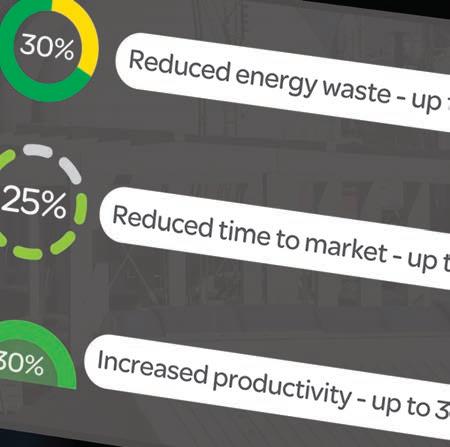
Meet PlantStruxure PES, the next generation process automation system from Schneider Electric™ that delivers new insight to enterprise efficiency. By automating energy management into every process area, it executes your boardroom strategy for sustainable production at every enterprise level, right down to the plant floor, cutting energy costs by up to 30%. What will you do with all the money you save?


3 core values of PlantStruxure PES:
Digitize your plant to deliver key system data right to your engineers’ fingertips
Accelerate time-to-market with standardization that reduces engineering time by up to 25%
Bring intelligence to your operations with system-wide cross references


skills starts with changing the choices students make. And the foundation for learning those skills requires an understanding of basic math and science.
This shouldn’t be too difficult because most youngsters are naturally curious about the world around them.
All too often this nascent scientific curiosity diminishes around the time students enter middle school, mainly because their teachers fail to make science fun by bringing its wonders alive. And, due to a union-driven placement system based on seniority rather than qualifications, many teachers are unqualified to teach science in the first place.

Consequently, students with high potential in math and science make course choices that prevent them from entering any field requiring STEM (science, technology, engineering and math) skills. Worse, many of the high school graduates who have managed to gain the qualifications needed to enter STEM programs are being turned away when they apply to university. Applicants to most engineering faculties require high school marks averaging upwards of 85% to make the cut, even higher for medicine. Yet universities refuse to reallocate funds to open up more slots for students in these critically needed skills area.
Canada’s greatest challenge
A CIBC report published last year confirmed that huge sums are being wasted churning out graduates in out-of-demand fields, such as arts and humanities, while turning away thousands of fully qualified STEM applicants. This is a travesty, both for the students who are blocked from realizing their potential and for the country. But rigid professor union-dominated university governance means it won’t change unless the provinces with jurisdiction over those ivory towers force it to happen.
The ability of any nation’s workforce to produce value-creating goods and services determines the living standards of its population. As the proportion of skilled workers rises, so rises national prosperity. And when that proportion falls, growth investment is stymied, incomes drop, tax revenues to fund social programs collapse and the country falls into economic decline.
Since the reversal of that decline starts with educational choices made in middle school, the downward spiral may require generations to reverse.
The skills shortage is the biggest challenge our country faces.
Meeting that challenge will require the determined and united commitment of every level of government, our educational institutions and business leaders across the nation. A daunting challenge indeed.









Gwyn Morgan is the retired founding CEO of EnCana Corp. This column is distributed by Calgary-based Troy Media.
Comments? E-mail jterrett@plant.ca.