SEPTEMBER 2020 | WWW.PLANT.CA | $12
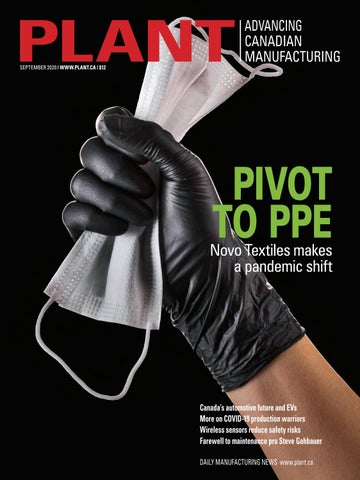
PIVOT TO PPE
Novo Textiles makes a pandemic shift
Canada’s automotive future and EVs More on COVID-19 production warriors Wireless sensors reduce safety risks Farewell to maintenance pro Steve Gahbauer DAILY MANUFACTURING NEWS www.plant.ca
PLT_Sept2020_AMS.indd 1
2020-08-28 9:44 AM
Is it worth the risk?
Right now, the demands on hand hygiene in public spaces are higher than ever before and for many, merely entering a public restroom with air dryers means feeling unsafe*. And with 41% of your restroom users being less likely to visit places that do not offer paper hand towels*, relying on air dryers could even risk your business. Make the safer choice – change to Tork paper hand towels today.
Visit torkusa.com/saferchoice to learn more *Survey conducted by United Minds in cooperation with CINT April 8–13, 2020. The survey covered the US, with a total of 1,012 respondents.
Tork, an Essity brand
PLT_Tork_Sept20_CSA.indd2 1 PLT_Sept2020_AMS.indd
2020-08-14 9:44 2020-08-28 8:20 AM
14 8:20 AM
CONTENTS
September 2020 Vol. 79, No. 05
FEATURES 14 PERFORMANCE Drive agility by establishing the best way to execute and take action that everyone can follow.
16 MAINTENANCE Remembering the late Steve Gahbauer, PLANT contributing editor and friend of Canadian maintenance.
17 THINK LEAN Reap the benefits of Deming’s Plan-Do-Check- Act cycle with value stream mapping.
10 AGILITY
Novo Textiles responds to the COVID-19 challenge by making the switch from cushions to surgical masks.
12 COVID-19 Some additional examples of manufacturers responding to supply needs arising from the pandemic.
18 CCOHS SAFETY TIPS Steps to take that will identify and address breathing hazards for a safer and healthier workplace.
19 INDUSTRY 4.0 Wireless sensors help to eliminate potential hazards by reducing contact with machinery.
DEPARTMENTS 4 Editorial 6 News Bulletins 7 Careers 8 Industry Mix 9 Economy PLANT Pulse 20 Leading Edge: Innovative ideas for plants 21 Plantware Events 22 Postscript: Manufacturers head into an uncertain recovery
15 AUTOMOTIVE There are challenges ahead for Canada’s automotive industry but there are also opportunities related to electric vehicles.
PHOTO GORODENKOFF - STOCK.ADOBE.COM COVER IMAGE: GROUPCHEERS - STOCK.ADOBE.COM
PLANT—established 1941, is published 7 times per year by Annex Business Media. Publications Mail Agreement #40065710. Circulation email: bolechnowicz@annexbusinessmedia.com Tel: 416-510-5182 Fax: 416-510-6875 or 416-442-2191 Mail: 111 Gordon Baker Road, Suite 400, Toronto, ON M2H 3R1. Occasionally, PLANT will mail information on behalf of industry-related groups whose products and services we believe may be of interest to you. If you prefer not to receive this information, please contact our circulation department in any of the four ways listed above. Annex Privacy Officer: privacy@annexbusinessmedia.com Tel: 800-668-2374. No part of the editorial content of this publication may be reprinted without the publisher’s written permission. ©2020 Annex Publishing & Printing Inc. All rights reserved. Performance claims for products listed in this issue are made by contributing manufacturers and agencies. PLANT receives unsolicited materials including letters to the editor, press releases, promotional items and images from time to time. PLANT, its affiliates and assignees may use, reproduce, publish, re-publish, distribute, store and archive such unsolicited submissions in whole or in part in any form or medium whatsoever, without compensation of any sort. This statement does not apply to materials/pitches submitted by freelance writers, photographers or illustrators in accordance with known industry practices. Printed in Canada. ISSN: 1929-6606 (Print), 1929-6614 (Online).
www.plant.ca
PLT_Sept2020_AMS.indd 3
PLANT 3
2020-08-31 9:45 AM
EDITORIAL
Shoring up our future closer to home
T
he COVID-19 pandemic has clearly demonstrated the world’s fortunes can turn very quickly, bringing into question how business is conducted and with whom. It certainly reinforces the need for manufacturers to continuously focus on forecasting, evaluating and managing risk. Speaking of risk, this truly disruptive year has also demonstrated how quickly trade peace can go sideways as the pandemic intrudes in other ways, such as how it impacts the fortunes of a certain sitting US president with an election looming in November. Take aluminum tariffs: we probably thought that was settled with CUSMA. Yet the Trump administration slapped a 10% tariff on Canadian aluminum barely a month after the trade deal went into effect. This as the US struggles to extricate itself from the devastating economic and medical effects of COVID-19. The reasoning? Washington’s chief White House protectionist claims Canadian imports have surged this year and represents another fantasy security threat. The Aluminum Association, which represents US and foreign companies, opposes the tariff. It says Canadian raw aluminum shipments to the US are within historical norms. The folly of this move is evident. It may be about shoring up a very few jobs during an election year, but there’s an obvious point that’s MIA in the White House calculus: tariffs aren’t helpful to economic recovery. The cost of products containing aluminum will go up, impacting manufacturers and consumers, and the tariff will encourage the purchase of aluminum from other countries, such as Trump’s trade adversary, China. Add Canada’s $3.6 billion worth of reliatory tariffs on US aluminum products and you have to ask how that’s making America Great Again. US protectionist policies and the pandemic have at least one thing in common: they place a lot of pressure on global trade and that brings into question how supplier relationships will proceed in the future. The Association for Manufacturing Excellence (AME) is addressing the global supply chain issue with a white paper called, A Manufacturing Marshall Plan. It offers some important post-pandemic guidance that will be of value to manufacturers and help bring jobs back to Canada. (Download the whitepaper at https:// bit.ly/31q7H9z) The onslaught of the pandemic further exposed weaknesses in global supply chains: shortages of key materials and supplies, high transportation costs, quality issues and unpredictable delivery times. AME’s whitepaper calls for reshoring, nearshoring and leanshoring (total cost analysis and the application of lean practices rather than those that allowed work to be offshored in the first place). Sourcing supplies domestically or closer to home would eliminate many concerns and result in less risk, especially when some other calamity strikes. But AME warns establishing domestic supply lines will require greater productivity, efficiency, speed, quality and competitiveness. This means embracing the digital revolution, and that’s an issue for Canadian manufacturers. This year’s Advanced Manufacturing Outlook survey (results to be officially published in October) shows just 30% of respondents applying IIoT capabilities, but that’s an improvement over the 24% from last year’s survey; and 17% compared to 8% last year have a plan to invest in the technology over the next 12 months. Encouraging but more companies need to embark on a digital transformation. Realigning supply chains and investing in technology will be challenging for manufacturers that have had to deal with so many disturbances. Yet it is necessary to restore economic harmony and ensure Canada’s manufacturing sector has the agility to withstand future upsets.
Editor Joe Terrett 416-442-5600 ext. 3219 jterrett@plant.ca Senior Publisher Scott Atkinson 416-510-5207 satkinson@annexbusinessmedia.com National Account Manager Ilana Fawcett 416-829-1221 ifawcett@annexbusinessmedia.com Media Sales Manager Jason Bauer 416-510-6797 / 437-218-0941 jbauer@annexbusinessmedia.com Media Designer Andrea M. Smith asmith@annexbusinessmedia.com Circulation Manager Beata Olechnowicz 416-510-5182 bolechnowicz@annexbusinessmedia.com Account Coordinator Debbie Smith 416-442-5600 ext 3221 dsmith@annexbusinessmedia.com COO Scott Jamieson sjamieson@annexbusinessmedia.com
Subscription Price Canada $76.00 per year, US $201.00 (CAD) per year, Foreign $227.00 (CAD) per year. Single Copy Canada $12.00. Add applicable taxes to all rates. Combined, expanded or premium issues, which count as two subscription issues. Mailing Address Annex Business Media 111 Gordon Baker Road, Suite 400 Toronto, ON M2H 3R1 Circulation Beata Olechnowicz 416-510-5182 bolechnowicz@annexbusinessmedia.com Fax: 416-510-6875 or 416-442-2191
K
Joe Terrett, Editor Comments? E-mail jterrett@plant.ca.
4 PLANT
PLT_Sept2020_AMS.indd 4
September 2020
2020-08-28 9:44 AM
PLT_AM
KEYNOTE SESSIONS
JOIN US OCT. 27–29
Energize your journey at the 36th annual AME International Conference • 100% Virtual • 40+ Hours of live & on-demand content • Deep dive into vital industry topics including: 2-Second Lean Benchmarking Connectivity Culture Engagement Enterprise
Gemba Innovation Integration Internet of Things Kaizen Leadership
LeanShoringTM Passion Performance Measure Resiliency Supply Chain TWI
SESSIONS: Our practitioner-based sessions include:
Katie Anderson
Michael Lombard
Michael Muilenburg
Thomas Rajan
Leadership Coach, Author, Consultant, Professional Speaker
Operational Technology & Strategic Planning Manager at 3M AGCO Corporation
Seizing the upside of disruptive innovation in manufacturing
Alcon
Leading a kaizen revolution
Coherent, Inc.
Data doesn’t speak for itself
Managing Director, East Bay service area at Kaiser Permanente
Managing Director, Global Co-Brand Partnerships at American Airlines
Delphi Technologies
Hoshin kanri: Realizing impact through strategic relevance
Isao Yoshino HM Electronics, Inc. Lean transformations: Cultivating excellence through positive culture
Keynote Sessions
IMP Aerostructures Kata-mazing: Kata is not about change, it’s about evolution
In-depth Workshops
Innovair Group
Continuously seeking improvement
Lincoln Electric Deploying lean initiatives
Best-practice Tours
Practitioner Presentations
Toyota Leader (retired), Former NUMMI Training Manager
Interactive Exhibits
Networking Opportunities
REGISTER NOW
AME.ORG/VIRTUAL PLT_AME_Sept20.indd 1 5 PLT_Sept2020_AMS.indd
2020-08-25 2020-08-28 10:46 9:44 AM
NEWS BULLETINS D-BOX Technologies Inc., a Longueuil, Que. manufacturer of immersive entertainment tech, has signed a partnership deal with a French video game publisher. Ubisoft will integrate D-BOX’s motion technology into its game development process. Gelpac, a manufacturer of multiwall paper bags and polyethylene packaging, is investing $ 5 million in its plant in Marieville, Que. The company said bringing in higher performance equipment will aid its growth in the Canadian and US markets. Solaris Disinfection Inc., an IoT-connected service robotics manufacturer based in Mississauga, Ont., has acquired Jetbrain Robotics, a Hong Kong-Gurgaon, India based manufacturer of autonomous mobile robotics used in hospitals. Solaris’s Lytbot automated disinfection system with pulsed UV technology eradicates more than 99% of pathogens in as little as 10 seconds. Kaycan said its vinyl siding recycling initiative in Alberta will help reduce waste in landfills. The manufacturer in Carstairs, Alta. has launched its GreenSENSE R3V program to recycle the damaged vinyl siding from homes following severe hailstorms in the province. The company is picking up the waste from homes in areas where it’s replacing siding. FortisBC Energy Inc. is launching a Clean Growth Innovation Fund to help accelerate the reduction of greenhouse gas emissions. The distributor of natural gas and electricity based in Surrey, BC is committing $4.9 million to the fund annually until 2024 to advance projects that decarbonize its natural gas supply. Energy company Chevron USA Inc. in San Ramon, Calif. and an Oakville, Ont.based renewable energy provider intend to co-develop power projects that will provide electricity to strategic assets across Chevron’s global portfolio. Working with Algonquin Power & Utilities Corp., Chevron plans to generate more than 500 megawatts of its existing and future electricity demand from renewable sources.
6 PLANT
PLT_Sept2020_AMS.indd 6
Noble Foods acquires US co-packing business MONTREAL — Noble Foods Nutrition Inc. has acquired the co-packing activities of Betty Lou’s Inc., a US energy bar manufacturer, to become a medium-sized manufacturer in North America. The Montreal-based contract manufacturer said co-packing activities will continue uninterrupted at Betty Lou’s 100,000 square-foot McMinnville, Ore. facility, and all Betty Lou products manufactured there will continue under the ownership of founder Betty Lou Carrier. “After 42 years, I have decided to sell the co-packing activities of Betty Lou’s to Noble Foods and focus efforts on our private Betty Lou’s brand,” said Carrier. “Noble Foods has been co-packing bars for more than 20 years with a high level of organization, professionalism, and dedication to bar manufacturing.” In 2018, private equity firm Novacap acquired an interest Noble Foods intending to acquire other bar contract manufacturers. Noble Foods Nutrition has more than 100 employees at its Montreal plant. Created over 42 years ago, Betty Lou’s was the brainchild of Carrier and was originally a method for her to remove refined sugar from her family’s diet.
Cascades shuts Etobicoke plant TORONTO — Cascades Inc. has closed its Etobicoke, Ont. containerboard packaging facility as part of a strategic repositioning of the production platform in the province and its global optimization initiatives. The manufacturer of green packaging and tissues based in Kinsey Falls, Que. said production will be redeployed to other units within the region. The plant closure will impact 125 employees. Its Cascades Recovery+ facility and offices also located in Etobicoke won’t be affected by the closure.
The three-wheeled SOLO EV.
PHOTO: ELECTRA MECCANICA
SOLO looking for US plant site ElectraMeccanica narrows its focus to three VANCOUVER — ElectraMeccanica Vehicles Corp., a designer and manufacturer of electric vehicles, has narrowed its search for a US-based assembly facility. The Vancouver company makes the single-occupant, three-wheeled SOLO EV. Seven candidates were sent requests for proposal. In June, the company narrowed the candidate list to five. Following comprehensive proposals and site visits, the list has been narrowed to Arizona, Florida and Tennessee, and further narrowed to the Phoenix, Nashville and Orlando areas. The company anticipates selecting a location by the end of November. The plant is expected to employ up to 250 people and feature an engineering technical centre, including plans for multiple labs to support ongoing vehicle, chassis and power electronics testing, plus comprehensive research facilities. The facility will also reduce or potentially eliminate tariffs and provide logistical efficiencies.
Nanotech Security to expand Thurso plant VANCOUVER — Nanotech Security Corp., a developer of nano-optic security features used in the government and banknote and brand protection markets, is expanding its production facility in Thurso, Que. The Vancouver company has invested more than $1.5 million in the 28,000 square-foot “highly secure” production facility to increase capacity. The expansion includes a ISO 7 level clean room for
advanced equipment and is adding UV recombination capabilities, as well as a proprietary silver spray system and a new water-based demetallization machine. Utilities are being upgraded and modifications made to coaters and quality control systems to support summer orders for the production of anti-counterfeit solutions such as LumaChrome colour-shifting films.
September 2020
2020-08-28 9:44 AM
5N Plus develops new detection wafers MONTREAL — 5N Plus Semiconductors has completed the development of a new generation of infrared detection wafers made of indium antimonide semiconductor materials. The company is the St. George, Utah subsidiary of 5N Plus, a producer of made of indium antimonide semiconductor materials in Montreal. It expects demand for INZBE3 to rise through the balance of 2020, as focal plane array manufacturers and industrial customers increase its adoption. 5N Plus has scaled up production and now supplies INZBE3 in various finished semiconductor wafers up to five inches in diameter.
Vention raises $38M to scale its cloud platform Expands the range of automated processes
Modular plug-and-play automation components PHOTO: VENTION snap together.
MONTREAL — Vention, a manufacturing automation technology company in Montreal, has raised $38 million to further develop its cloud-based platform, grow its library of plug-and-play automation components, and continue international expansion. The series-B financing round was led by Georgian Partners and included participation from previous investors Bain Capital Ventures and White Star Capital. Vention makes automated equipment. Its platform combines a suite of machine design and industrial automation technologies with hundreds of plug-and-play components. Applications include material handling, conveying, pick and place, machine tending, fixturing and more.
www.plant.ca
PLT_Sept2020_AMS.indd 7
CBSA investigating gluten charge Quebec manufacturer alleges unfair pricing
Wheat gluten is used to enhance whole-grain baked goods. PHOTO: VLADISLAV - STOCK.ADOBE.COM
OTTAWA — The Canada Border Services Agency (CBSA) is launching an investigation by a Quebec food manufacturer to determine whether wheat gluten from Australia, Austria, Belgium, France, Germany and Lithuania is being sold at unfair prices in Canada. ADM Agri-Industries Co., a manufacturer of shortening, table oils, margarine, and other edible fats and oils in Candiac, Que. filed the complaint with the support of Permolex Ltd. The grain fraction company in Red Deer, Alta. incorporates a flourmill, a gluten plant and a FCC grade
ethanol/alcohol plant. ADM Agri-Industries alleges the Canadian industry is facing an increase in the volume of imports that are cutting into sales and creating unfair competitive pressures. The Canadian International Trade Tribunal will begin a preliminary inquiry into the harm issue and will issue a decision by Oct. 13. CBSA will investigate the unfair prices allegation, and make a preliminary decision by Nov. 12. There are currently 119 special import measures in force.
Circa acquires Teletics assets
Software platform provides remote monitoring CALGARY — Circa Enterprises Inc. is acquiring most of the assets of Teletics Inc., a Calgary manufacturer and supplier of fully monitored, rugged wireless voice devices for $322,000. The Teletics business will operate as a separate product line within Circa’s telecom segment. Circa is a Calgary-based manufacturer of equipment for the telecommunication, electrical utility and construction industries. Teletics’s cloud-based software platform will be integrated with the Circa Guardian product line to add wireless connectivity and provide remote monitoring with alarm and event notification capabilities. This will expand Circa’s presence in the IoT space. Teletics designs, manufactures and supplies fully monitored wireless analogue, VoIP and WiFi devices designed to withstand harsh environments and climates.
CAREERS General Motors Co. has appointed Steve Carlisle executive vice-president and president, North America. He has been senior vice-president and president at Cadillac since April Steve Carlisle 2018. Before that, he was president and managing director of GM Canada from November 2014. Born and raised in Woodstock, Ont., he began his GM career in 1982 as an industrial engineering co-op student at the Oshawa Truck Assembly Plant. Hammond Power Solutions (HPS), a manufacturer of drytype transformers based in Guelph, Ont., has appointed Matt Kovara to the newly created position of power quality sales Matt Kovara manager. Previously he was national sales manager at Power Quality Components in the US. Retired astronaut Tim Kopra will join MDA’s leadership team as vice-president of robotics and space operations. His career spans the US military, NASA as well as private equity and venture capital. MDA is a satellite, robotics and surveillance technology company based in Richmond, Ont. Sam Allen has joined Kraken Robotics Inc. as a strategic advisor. He will help the ocean technology company based in St. John’s, NL refine its strategy for the international offshore energy market. Allen is the former president of Technip Canada, a subsea construction company. Nadia Theodore has been appointed senior vice-president of global industry and government relations at Maple Leaf Foods Inc. She succeeds Rory McAlpine who is retiring after 15 years with the Mississauga, Ont. company. Theodore comes to the food processor from the Canadian government, where she has filled a variety of roles, including as a Consul General of Canada.
PLANT 7
2020-08-28 9:44 AM
INDUSTRY MIX
MISCELLANY FROM THE WORLD OF MANUFACTURING
Ballard circles the globe 1,250 times Fusion demo plant adds investors The world needs more emissions-free electricity and a Vancouver company is developing a technology that, if successful, would dramatically alter production. General Fusion recently secured additional financing from two global institutional investors to support its fusion demonstration plant program. The company is banking on fusion energy as a potential source of carbon-free and economically competitive electricity, and it’s the only Canadian company working on commercializing the technology. PI3 plasma injector. PHOTO: GENERAL FUSION The undisclosed capital support comes from GIC (a sovereign wealth fund established by the Government of Singapore) and deep technology fund IBX as the developer of fusion energy accelerates its commercialization program toward power plant validation over the next five years. General Fusion said its participation in this financing round comes with funding from another large financial institution based in Asia. Fusion technology generates carbon-free electricity by using heat from nuclear fusion reactions. Its magnetized target fusion system involves a sphere filled with molten lead-lithium that’s pumped to form a vortex. A pulse of magnetically confined plasma fuel is then injected into the vortex. An array of pistons drive a pressure wave into the centre of the sphere, compressing the plasma to fusion conditions. This process is repeated as the heat from the reaction is captured in the liquid metal and used to generate electricity via a steam turbine.
Stronach family feud ends
The clash of the Stronach titans has ended with an out-of-court settlement that splits control of the family empire into two kingdoms. Automotive giant (Magna International) and all-round risk taker Frank, 88, launched a lawsuit in Ontario Superior Court against daughter Belinda, two grandchildren and a former business associate for more than $500 million. He alleged they mismanaged the family’s assets and conspired to take control of them. For the defense, Belinda said her father was blowing the family dough on pet projects involving a cattle ranch, golf course, Frank Stronach in 2013. and other ventures: as in huge dollars, like PHOTO: MAVILA2/CREATIVECOMMONS more than $100 million in losses from the agricultural business alone. Canadian Press cited two steel Pegasus statues for a racing course that were initially to cost US$6 million but clocked in at $55 million. Frank and wife Elfriede, through their own business entity, will assume full leadership, ownership and control of the thoroughbred stallion and breeding business, farm operations in North America plus all European assets. But they’ll no longer have any interest in The Stronach Group. Father and daughter issued statements about how pleased they are, etc. Now it’s back to their separate businesses, a kingdom divided but at peace.
8 PLANT
PLT_Sept2020_AMS.indd 8
Ballard Power Systems has come a long way since the enterprise was founded in 1979: about 50 million kilometres, in fact. That’s the distance travelled by commercial heavy- and medium-duty trucks powered by the company’s proton exchange membrane (PEM) hydrogen fuel cell technology. Another way to look at it: 1,250 times around the world. Ballard’s FCmove eighth-generation Ballard’s products – with the eighth genera- fuel cell module. PHOTO: BALLARD POWER SYSTEMS tion power module launched in 2019 – are used in 15 countries. That includes approximately 1,000 fuel cell electric buses (FCEBs) and 2,200 commercial trucks. About 70% of the more than 50 million kilometres have been clocked by vehicles in China, with the remaining vehicles deployed in Europe and North America. “To date, more than 66 countries have established net-zero carbon targets in 2050 and more than 20 governments representing over 70% of global GDP have announced hydrogen roadmaps,” said Randy MacEwen, Ballard’s president and CEO. “Increasingly, policy is focused on decarbonizing heavy commercial vehicles that disproportionately contribute to transport emissions and have been difficult to abate – until now. The total addressable market for engines in these vehicles exceeds $130 billion annually.” FCEVs monitored by Ballard delivered fuel cell uptime of approximately 98% during the first half of the year.
Canada was taking advantage of us, as usual. The aluminum business was being decimated by Canada, very unfair to our jobs and our great aluminum workers. US president Donald Trump during a speech at a Whirlpool manufacturing plant in the battleground state of Ohio.
DigifabQG to help with 4.0 Quebec manufacturers have a new tool to help them initiate or accelerate a digital transformation. Longueuil, Que.’s industrial expertise centre (IEC), now known as DigifabQG, gives manufacturers a single point of contact with digitization experts. DigifabQG, a contraction of digital and fabrication and QG for Quartier General (or Siemens Canada is providing $6.5 headquarters), belongs to a network that inPHOTO: SIEMENS cludes four IECs in Longueuil, Saint-Laurent, million in equipment. Drummondville and Quebec City. The centre has three areas: discovery, featuring success stories and existing technologies; demonstration, where software, packages and technologies are tested before use; and the interaction zone, where experiences replicate real-world industrial situations. Four specialists in artificial and business intelligence, robotics, advanced automation, manufacturing optimization and business strategies have access to a network of partners that will help accelerate projects.
September 2020
2020-08-28 9:44 AM
ECONOMY
Looking at recovery Positives for manufacturing
I
www.plant.ca
PLT_Sept2020_AMS.indd 9
RECORD RISE OF JUNE SALES billions of $ 60 55 50 45 40 35
Current dollars
Trend-cycle (current dollars)
2012 constant dollars
Trend-cycle (2012 constant dollars)
30 25 June 2015
2016
2017
2018
2019
June 2020
Manufacturing sales rose by a record 20.7% to $48.7 billion in June, following an 11.6% increase in May, reports Statistics Canada. Sales were up in all 21 industries, led by motor vehicles and motor vehicle parts. However, sales were 13.2% below their pre-pandemic level in February. Total sales decreased from $162.4 billion in Q1 to $125.3 billion in Q2, a record 22.8% decline. That’s the lowest since the third quarter of 2009.
Source: Statistics Canada, CANSIM
58%
158,000
Number of small businesses that may close because of a drop in sales, as tens of thousands remain ineligible for government help from the CEBA loan program and CECRA rent subsidy, says the Canadian Federation of Independent Business.
IMAGES/PHOTOS: STOCK.ADOBE.COM
t’s been an unsettling year with COVID-19 and the craziness emanating from the Trump show to the south (aluminum tariffs, really?). But aside from having much enhanced health and safety requirements to contend with while adopting COVID-appropriate operating processes, things may be looking up for manufacturers. The Bank of Montreal’s summer Blue Book outlook for small business describes how it sees the recovery working out in five sectors, and manufacturing is looking okay, but with some challenges. BMO observes some smaller companies have moved to produce personal protective equipment and products. As employees return to their offices and plants, their demand for PPE, guards and sanitizers will continue. And ditto for healthcare workers. However, the sector’s share of GDP has been shrinking since 2000 (15.7%) settling at 10.2% in 2019, but BMO economists warn of further shrinkage from the COVID shutdown if demand doesn’t revive quickly enough to keep some companies in business. It comes down to how well the global economy recovers in the year ahead. Assuming global factory activity shows signs of recovery next year, BMO expects a 6% rebound for Canadian plants from a 7% setback. There are competitiveness issues in play for some industries in particular, such as auto production, which has dropped 20% from five years ago. BMO’s report notes a less than complete recovery of auto sales in North America could raise questions about future production in Canada. Suppliers face similar uncertainties. Potential positives for automotive include shortened supply chains, production closer to markets and CUSMA with its production requirements offering a “slight” net benefit. BMO’s short-term outlook for the energy sector is a little less rosy. Crude oil prices are well below preCOVID-19 levels. Production is down 760,000 b/p from a year ago and will creep up in the coming year, although still depressed. Download the report at https://bit. ly/31WEnqe.
Small businesses that laid off staff due to COVID-19 and are now planning to rehire in the next three months, according to a Wagepoint survey.
$123,422
30%
Percentage of manufacturers who are engaged with IIoT, according to the soon-to-be-published 2020 Advanced Manufacturing survey conducted by Canadian Manufacturing Daily. That’s up from last year’s survey (24%).
Average salary (national) of manufacturing executives who responded to the 2020 EMCPLANT Manufacturing Salary Survey. Statistics Canada pegs average pay for production workers (as of June) at $59,215.
$3.2
BILLION
Canada’s merchandise trade deficit with the world. It widened in June, increasing from May’s $1.3 billion. Statistics Canada reports imports and exports rebounded sharply, mostly on the strength of motor vehicles and parts. Imports were up 21.8% and exports by 17.1%. However, compared with February, imports were down 14.3% and exports decreased 17.9%. Import prices were down 5.1%, while export prices rose 5.9%.
PLANT 9
2020-08-28 9:44 AM
AGILITY
SEW
ESSENTIAL MAKING THE SWITCH FROM CUSHIONS TO MEDICAL MASKS How a BC textile manufacturer quickly moved to serve COVID-19 PPE demand. BY NOELLE STAPINSKY
T
Jason Zanatta, owner of Novo Textiles.
10 PLANT
PLT_Sept2020_AMS.indd 10
PHOTOS: ABBY LAWSON
he decision to retool and shift into a new manufacturing process and sector can be a risky business. Accomplishing such a feat in a matter of weeks at the beginning of a global pandemic is impressive, but also precarious. For family-owned Novo Textiles in Coquitlam, BC, its only choice was to use 20 years of sewing expertise to remain essential or shutdown completely. Yet it also demonstrated sharp business intuition and agility. Before provinces started issuing state of emergency orders and government relief programs came into play, Jason Zanatta, who owns Novo and travels extensively for his business, saw the signs and immediately started strategizing his pivot plan. Novo specializes in a variety of cushions for the hospitality, interior design and retail sectors. “In January our business remained very strong in terms of demand for our regular product flow,” he says. “But in February when the virus [COVID-19] started to spread from Wuhan, China to Europe, and cases started showing up in BC, I stopped travelling.” Just as he pulled back on his travels, a number of Novo’s biggest retailers started cancelling and delaying orders, or went radio silent on order commitments. “It was very concerning as a business owner because we’re a just-in-time manufacturer. Our business is largely dependent on
a rolling flow of orders. And with any kind of extended shutdown, we’d be out of business very quickly,” says Zanatta. The 16,000-square-feet textile facility, which employed 15 team members pre-pandemic, held the experience, and similar raw materials and processes to almost seamlessly segue into making surgical masks. “In the last week of February, I started working with my extended network in both Asia and Europe. I inquired about machining availability and what it would look like to pivot out of cushions and into masks to help with the worldwide personal protective equipment (PPE) shortage. A unique part of it all is that within my network of equipment suppliers, one was already actively producing surgical mask-making machinery.”
Achieving level one It was a two-month lead-time to get one of these machines, but Zanatta negotiated, paid a significant premium, and secured the first machine off the line, then got it on a flight to Canada within a couple of days. Within seven days of its arrival, Novo was manufacturing level one surgical masks. By June, it had three surgical mask production lines, 15 ear-looping stations and four packaging stations producing 100,000 units per day. To facilitate this manufacturing changeover, the Novo team disconnected its previous machinery, dismantled raw material racking and loaded it all into two 40-foot ocean containers for storage. “It’s been like the factory has been in a continual flux for two to three months now,” Zanatta says.
September 2020
2020-08-28 9:44 AM
About three weeks into running the new machinery, Novo received its Health Canada Certificate, a process that typically takes up to three months to achieve. “This allowed us to start supplying masks primarily to the health care system in western Canada, but we’ve shipped to Quebec and Ontario as well,” he says. With new machinery and production in full swing, the Novo team has almost tripled to 40 employees. And the learning curve for his seamstresses and the others he has employed from the local needle trade wasn’t that significant. “Running the machines is similar to a number of processes we were already using and it’s similar machinery to what we were running to manufacture things like pillowcases,” he says. “And our team has definitely helped on the quality control side. They’ve provided a lot of great suggestions on how we can tweak the product to make it more consistent and to make sure the ear-loops were being welded more consistently and strongly to the facemasks using our ultrasonic welding process. Even things as simple as positioning the machine to optimize flow… it’s been a really great team effort.” Or course, more employees and operating amid a pandemic meant a drastic change to safety protocol, although Zanatta admits they had to learn that Zanatta wearing a mask and making one. part on the fly. product. The machines are positioned six-feet “First, the reliability, quality and safety apart, taking up double the space needed unstandards of theses machines are second der normal circumstances. Production runs to none. Second, I would rather invest any on two different shifts to limit the amount of dollar in my pocket into another Canadian people in common rooms during breaks. All company. Supporting Canadian businesses staff members are required to wear hairnets, helps all of us.” gloves and masks before they’re allowed into He also believes the long-term viability and the plant. feasibility of such a partnership is important. And during the peak of the pandemic, the “If something were to go wrong or we need production manager would check all staff servicing, they’re just a short flight away.” temperatures with a laser monitor. “That’s what we are doing to make sure we weren’t exposing anyone or exasperating the Approved for sale problem,” Zanatta says. Novo planned to start N95 production July 1 This is just the start of Novo’s foray into with prototyping and testing in the first few the medical supply business. The company weeks of the month. NOISH N95 certificainvested $600,000 of its working capital in tion from Health Canada and a variety of lab the surgical mask production lines. Novo has tests were to pave the way for products to be also invested $1.5 million in two new N95 approved for sale and in the marketplace by ventilator mask machines that are designed Aug. 1. and built by a Windsor, Ont.-based engineerThe two new machines, which are 90% ing and robotics company. automated, will be capable of producing up Zanatta says investing in Canadian-made to 30,000 units per day. To operate them, machinery is very important to the finished Zanatta will be adding five additional em-
www.plant.ca
PLT_Sept2020_AMS.indd 11
ployees. “I’ve never had fulltime mechanics or engineers on staff, but I just hired a millwright. And I’m in the process of hiring a fulltime mechatronics and robotics specialist from our local polytechnic school. We will also be looking for skilled machine operators and adding shipping and receiving staff.” To help with his machinery investments and growth in the medical sector, Zanatta is working with George Stefan, a partner, SR&ED/government incentives with BDO Canada LLC, an international network of consulting and business advisory firms. “We started looking into how BDO can help with funding applications,” Stefan says. “We are now moving to the Scientific Research and Experimental Development (SR&ED) program and looking for support for scaling up the operation.” He points out there are also different streams of applications for Next Generation Manufacturing Canada (a.k.a. NGen), an industry-led community that facilitates advancements in research and technology. And there’s potential for regular corporate funding down the road. “We are also looking at revising a project Zanatta was getting off the ground prior to the pandemic shutdown.” For the last four years, Novo has been developing a way to process pre-consumer textile waste into a usable raw material, extending the life of the material and diverting it from landfills. “I proved the model and had a number of LOIs from major US companies that were going to take millions of pounds of this material before the pandemic hit,” Zanatta says. It has been a whirlwind of change for Novo Textiles in such uncertain times. One thing is certain, it’s medical supply business is here to stay. If and when the economy returns and with it demand for the original products, Zanatta plans to purchase a new facility to house that manufacturing operation. “The future forecast is positive.” In fact, Zanatta is predicting annual revenues to be four times what they were in previous years. “Our business will be significantly larger than it was prior to the pandemic. We took a big risk and now we’re seeing the rewards.” Noelle Stapinsky is a Hamilton-based business writer. E-mail noellestapinsky@ gmail.com. Comments? E-mail jterrett@plant.ca.
PLANT 11
2020-08-28 9:44 AM
COVID-19 Challenges continue as the federal government focuses on vaccine development.
Premier Doug Ford checking face shields at Eclipse Automation. PHOTO: OFFICE OF THE PREMIER
BY PLANT STAFF
T
he COVID-19 pandemic saga is entering its next phase. The federal government says it’s “aggressively” pursuing vaccines, treatments and supplies to treat/prevent the virus. In fact, it’s investing $56 million to support clinical trials for a COVID-related vaccine candidate from Variation Biotechnologies Inc., a US biotech firm with a research facility in Ottawa. Along with that, it’s working with pharmaceutical companies to establish a guaranteed supply base of potential vaccine candidates, while procuring equipment and the supplies needed for manufacturing vaccines and support materials.
Managing the CORONAVIRUS MANUFACTURERS RESPOND TO SUPPLY NEEDS Meanwhile, Canadian Press reported only a small number (606) of the 40,000 new ventilators (about $1.1 billion) have been delivered. Manufacturers forecast faster delivery but chief
A POWERFUL COMBINATION OF
RELIABILITY, DURABILITY AND PERFORMANCE Sullair LS Series Air Compressors
public health officer Dr. Theresa Tam, warns a fall surge of COVID-19 cases could overwhelm the health-care system, including the supply of critical care beds and ventilators.
COVID-19 continues to pose a threat that will require diligence and discipline to manage. Manufacturers are responding by applying their expertise to the production of medical equipment and supplies. The following are some examples: • Eclipse Innovations Inc. (established in April), an affiliate of Eclipse Automation Inc. in Cambridge, Ont., has been given more than $1.4 million to scale up its operations to manufacture N95 masks as part of the Ford government’s plan to increase production capacity for personal protective equipment (PPE). Adding new capacity allows the company to make 1 million N95 respirators per week. And the investment will help in the development of a range
EXPERIENCE THE SULLAIR DIFFERENCE IN
ONE HARDWORKING PACKAGE RELIABILITY including the full-color, easy-access Sullair Touch Screen controller
DURABILITY including the patentpending, new generation Sullair air end
PERFORMANCE including highly efficient Electronic Spiral Valve technology
Available in 125, 150 and 200 hp models
Find your local authorized Sullair distributor today at SULLAIR.COM
© 2019 Sullair, LLC. All rights reserved.
018191_Sullair_Plant Canada_8x5.375.indd 1
12 PLT_JulyAug_Sullair.indd PLANT 1
PLT_Sept2020_AMS.indd 12
6/19/19 4:40 PM
September 2020
2019-06-20 11:33 AM
2020-08-28 9:44 AM
of different mask sizes and styles, such as horizontal and vertical fold. • AirBoss of America Corp.’s US-based AirBoss Defense Group (ADG) has been awarded a US$121 million contract by the US government department overseeing PPE destined for the national stockpile. The Newmarket, Ont. manufacturer of rubber, survivability and anti-vibration products said it will supply 50,000 FlexAir powered air purifying respirator (PAPR) systems, and 3 million high efficiency filters, plus related accessories, including spare protective hoods. • Clean Works Medical in Beamsville, Ont. and Pure Life Machinery are getting $2 million from the Ontario Together Fund for the manufacture of the Clean Flow Healthcare Mini. The sanitizer can decontaminate up to 800 N95 masks per hour, as well as other PPE, using UV light, hydrogen peroxide and ozone to destroy up to 99.99% of pathogens and viruses on surfaces. • H-Source Holdings Ltd. (Vancouver) is partnering with Relevium Technologies (Montreal) to develop, strategically source and supply PPE globally. Relevium operates in the health and wellness segment. H-Source has developed a proprietary SaaS technology for members to buy, sell, track and transfer medical supplies, pharmaceuticals, capital equipment and products. The platform is registered and approved in 35 US states, as well as Canada and Europe. • FPInnovations is getting $1.3 million from the federal government to develop a biodegradable filter for single-use facemasks. The not-for-profit that specializes in innovations supporting the Canadian forest sector will develop the filters using sustainable and biodegradable material made from
www.plant.ca
PLT_Sept2020_AMS.indd 13
forest fibres. Canadian pulp and paper mills will manufacture the product that will be used domestically, but also aimed at international markets. • Kruger Inc. is partnering with Pulp Moulded Products Inc. (PMP) for the supply of low-carbon footprint fibres to produce a prototype of a lowcost, single-use biodegradable mask.
PLT_CenterLine Windsor_Sept20_CSA.indd 1
This recyclable and compostable alternative developed by PMP (a manufacturer of sustainable packaging in Newmarket, Ont.) for non-frontline users will be made from KruPulp, Kruger’s FDA-compliant and FSC-certified pulp. • A visitor management specialist in Toronto has launched a smart tool that automatically and discreetly scans the body temperature of staff and visi-
tors to a plant at sign-in. iLobby’s FeverCheck uses a smart thermal camera that accurately and discreetly scans for elevated body temperature – a symptom of COVID-19 – in seconds, sending an instant notification to security or management, who can deny access if necessary. Comments? E-mail jterrett@plant.ca.
PLANT 13
2020-08-20 8:12 AM
2020-08-28 9:44 AM
PERFORMANCE Establish the best way to execute an action that everyone will follow. BY HUGH ALLEY
M
any companies have demonstrated a remarkable ability to completely retool their operations during the pandemic. Some did it in days and they shifted production
Driving
AGILITY HOW STANDARD WORK HELPS GET IT RIGHT
REVOLUTIONIZING HR & EMPLOYEE BENEFITS To Save You Money!
Canada’s First and Only HR Hub of Services, Support and Technology EMC Protects is a partnership focused on Canadian organizations and Canadian employees - ensuring all manufacturers are living fully and freely. EMC Protects includes access to a variety of employee benefits in order to meet the specific and unique needs of each individual organization.
Start Saving Today! www.emccanada.org/protects
to produce supplies and equipment needed to protect workers and citizens. We have learned a lot, such as how tightly linked our supply chains are and vulnerable to outside shocks. And we learned that when we need to, we can create, test and approve new products faster. In the early days of the pandemic, attention was on the work of the engineers and designers, and the commitment of business leaders to get on with it. The hard slogging comes as the economy reopens. How can the work be done while keeping appropriate physical separation? Workstations and work practices are getting a rethink about what needs to change. For example, one company didn’t have the space to expand, so it reduced the number of workstations on a line from 12 to nine while maintaining the same production rate.
Standard work There was a common thread among many companies. They applied the concept of standard work, which allowed them to experiment effectively and rapidly. Some people shy away from standard work. “It treats everyone like robots,” is a common complaint. Not so. The genius is in how you figure out the precise mix of ingredients to get the flavour and texture you’re after. Workers adding an ingredient to a vat offer an example. The instruction was to add two scoops. One operator used two heaping scoops and lobbed them in, one after the other. Another
14 PLANT PLT_Excellence_Sept20.indd 1
PLT_Sept2020_AMS.indd 14
added two scant scoops, slowly sprinkling the material onto the surface over a minute or so. Although the additive was a small proportion of the total (7,000 litres of product), there was a 50% difference in how much was added. Note, both operators followed the instruction. Standard work would have helped produce a more consistent product. In operational terms, we need to know the best way now to assemble an item, or test a subassembly, or complete a sales order, or record a payment. That’s the “standard” referred to in standard work – it ensures everyone uses that particular method. You’re also in a position to experiment and easily see whether the new process gives a better or worse result. The company reducing 12 workstations to nine was able to rethink the layout and have everyone working efficiently and effectively in a little over a week, thanks to clearly stated standard work in the instruction documents. The Training Within Industry Job Instruction was used to document their work processes. It’s in the public domain and readily available (www.twi-institute.com/ training-within-industry). If you already have a way to document work, make sure it’s used. Either way, find a mechanism for standardizing your work so you can use it as a base for improvement. That will give you the ability to respond quickly to shocks like COVID-19. Hugh Alley is an industrial engineer based in the Vancouver area who helps organizations achieve significant performance gains in delivery, quality and cost in a short timeframe. Call (604) 866-1502 or e-mail hughralley@gmail. com. His book, Becoming the Supervisor: Achieving the Company’s Mission and Building Your Team, is available at all the usual book outlets. Comments? E-mail jterrett@plant.ca.
September 2020 2020-08-25 10:58 AM
2020-08-28 9:44 AM
AUTOMOTIVE There are challenges for the Canadian industry to overcome but also opportunities. BY PLANT STAFF
C
anada’s automotive sector contributes about $20 billion to GDP annually so it’s key to the economy. And especially so for Ontario where, under normal circumstances (as in COVID-19 free production), it accounts for more than 20% of GDP. When the North American auto industry shutdown over COVID-19, so did sales. As production began ramping up in May, a rebound began – then less vigorously in June, according to a Scotiabank Global Economics flash report. It’s a 46% (monthover-month) improvement, although annualized sales are down 16% year-over-year at and estimated 1.6 million units. DesRosiers Automotive Consultants Inc. in Richmond Hill, Ont. reports 165,000 vehicles sold in July, a 6.2% increase. That’s down 4.9% below July 2019, but a good month nonetheless. The annual sales forecast is 1.5 million units for 2020, but there is caution centred on how events in the US impact the Canadian economy. Pushing ahead of the COVID -19 disruption, the question hanging over the industry is what the future looks like. A recent report by KPMG (Canada’s Automotive Future) states production of electric vehicles by the major OEMs will accelerate rapidly over the next five years, as will autonomous features. By 2025, the advisory firm predicts as many as 13 million EV and hybrid vehicles produced annually. Ontario may have been North America’s top automotive supplier in 2017 (more than 2 million vehicles), but Canada’s industry produces just 0.4% of global EV production, 80% lower than
www.plant.ca
PLT_Sept2020_AMS.indd 15
Design engineers working on an electric vehicle chassis prototype.
Canada’s auto
INDUSTRY INVESTMENT HAS SLOWED, ELECTRIC VEHICLES BECKON the global average, according to the International Council on Clean Transportation (ICCT) in Washington. It identifies Canada as the 12th largest vehicle producer, fifth in in commercial vehicle production exporting nearly $3 billion in heavy-duty vehicles, and sixth globally in electric heavy-duty vehicles. ICCT says Canada’s position would be strengthened with stronger action on transitioning to EVs.
Overhaul needed Investment by OEM automakers has slowed and current production levels are at risk. GM has closed its Oshawa, Ont. operations, and there’s some question about Ford in Canada’s Oakville, Ont. plant where it assembles the Lincoln Nautilus and Ford Edge. The automaker has scrapped plans to produce the Edge SUV after cancelling the Flex and
MKT last year. Although the automaker says it has no plans to exit Edge production, it doesn’t specify where the vehicles will be produced. Unifor began negotiations with the Detroit Three in August and attracting EV production investment will be part of the mix. But the KPMG report says Canada’s industry will need a significant overhaul to accommodate design, engineering and assembly of EVs, which will be very different from the production of internal combustion engines (ICEs). For example, EVs have thousands of fewer parts. It comes down to challenges and opportunities. An encouraging factor is the 200 Ontario companies that develop cutting-edge automotive technologies. KPMG calls that a “critical step” leading to participation in the future supply chain.
PHOTO GORODENKOFF - STOCK.ADOBE.COM
Having infrastructure in place will help drive EV manufacturing investment in Canada. Government climate change goals are setting the stage and there are initiatives such as a federal $300 investment in infrastructure, establishing charging stations and promoting consumer purchases of vehicles. But KPMG warns attracting investment will require Ontario cutting red tape. Dominant battery technology – hydrogen or lithium – is still up in the air. Lithium will require materials and metals, many of which can be sourced and processed in Canada. The country is also strong in artificial intelligence. There are more than 350 automation and robotics companies in Ontario’s Toronto-Waterloo corridor, making Canada well placed to develop the autoworker of the future. Making a transition to EV production offers promise, but don’t expect to see an end to ICE vehicles anytime soon. Internal combustion vehicles will continue to have a strong presence. EV sales are not expected to exceed ICEs until at least 2040. Download Canada’s Automotive Future at https://bit. ly/2YxA1oX. Comments? E-mail jterrett@plant.ca.
PLANT 15
2020-08-28 9:44 AM
MAINTENANCE A civil engineer, veteran PLANT editor and contributor. BY JOE TERRETT, EDITOR
T
he world of maintenance and PLANT Magazine have lost an advocate and friend. Steve Gahbauer, who was a tireless supporter of the maintenance profession and wrote about it for decades, passed away May 15. He was 90. He leaves his wife Edith, son Marcel and his wife Lisa, granddaughter Dayna and grandson Robin. When I first met Steve in 1988 he was a section editor on PLANT, at the time part of Maclean Hunter’s publishing business. He was a very precise man, in his thinking, his writing and how he kept his office in order. In those days, business-to-business (B2B) publishing involved cascading piles of paper press releases and reports. Unlike most editors’ offices, Steve kept his in perfect order; in fact, he would take great care to perfectly align an organized pile of “to read” paper with the corner of his desk. And he actually read all that material. Little wonder his attention to detail and his enthusiastic coverage of technology, maintenance issues and industry events made him one of the most knowledgeable editors in manufacturing. That precision was part of his DNA. He was a civil engineer, but returning to Canada after post-graduate engineering studies at Lehigh University in Bethlehem, Pa., he chose writing – his other great interest – and joined Southam as an assistant editor for the B2B publisher’s construction magazines from 1960 to 1964. Soon global adventure beckoned and he went to Kuwait from 1965 to 1970 as resident engineer for a waterfront project. He returned to Canada and from March 1971 to December 1973 he oversaw a construction site for Giffels in Mississauga, Ont. After that engineering job he
16 PLANT
PLT_Sept2020_AMS.indd 16
Steve Gahbauer in 2000. Inset: Steve with grandson Robin.
Remembering
STEVE
WRITER, EDITOR AND MAINTENANCE ADVOCATE was back to writing. He started Dec. 19, 1973 at Maclean Hunter as an assistant editor, eventually landing at PLANT and retired Nov. 30, 1994. Well, he didn’t really retire. In fact, he would often remark that he was busier in his retirement than when he was employed. He had other interests that included hiking and nature (he wrote a blog for the Rouge Valley Naturalists). But he also maintained his connection with the maintenance profession. Cindy Snedden, executive director of the Plant Engineering and Maintenance Association of Canada (PEMAC), relates how Steve’s attendance at meetings and coverage of maintenance issues brought him in contact
with the association’s founders. They invited him to become the first executive director of the non-profit from 1994 to 1998.
PEMAC connection “Even after leaving that office, Steve made it a tradition to attend the PEMAC MainTrain conference until 2013, when it became too difficult for him to travel due to health constraints,” Snedden said. “Each year since he has reached out to the PEMAC staff to express pride and interest in the association’s activities and to make a specific request for the conference proceedings so that he could produce articles of interest for PLANT Magazine.” His dedication to the mainte-
PHOTOS: PROVIDED BY EDITH GAHBAUER
nance profession and physical asset management also earned him the Sergio Guy Award in 1999. Ben Stevens, who Steve described as a maintenance guru and appeared often in his writing, noted: “He had a dominant theme and that was education. He was always pushing for answers to the question, ‘How can we work to raise the skill level of people in the maintenance profession?’” He pursued that theme until October last year when, approaching his 90th birthday, he decided to retire from writing for real. In journalism, 30 is used to signify the end of an article before it goes into production. We still have a couple of Steve articles to go. When they’re published, that’s a 30 to his written work, but Steve’s contributions to maintenance will continue to be appreciated. Thanks to Cindy Snedden and Edith Gahbauer for contributing to this article. Comments? E-mail jterrett@plant.ca.
September 2020
2020-08-28 9:44 AM
THINK LEAN could quickly tell if a deviation in process began to generate scrap above the norm. When the amount of time spent on monitoring and inputting daily scrap data was calculated, leaders found the equivalent of 14 people could be diverted to other things and yield improvement. Pondering the Deming cycle (plan, do, check, act).
PHOTO: TSUNG-LIN WU - STOCK.ADOBE.COM
Our new
REALITY MANAGING PROCESSES WITH DEMING AND VSM Reap benefits by adapting Deming’s PDCA cycle with value stream mapping. BY RICHARD KUNST
O
ne common result of COVID-19: everyone is changing processes, mostly to avert a reoccurring problem. These changes are naturally done using “job skill and experience” and these days that involves regulatory guidance. These are reactionary gestures and few pause to determine value or the impact on cost. You need to pause and reflect using a rational process to verify or modify your changes. A great approach is to capture the voice of the customer (VOC) using “critical to” (CT) trees, then quickly plot a new process using enterprise value stream mapping (EVSM). Validate the map against the VOC to insure its intended results are delivered within cost targets. Every process change provides an opportunity to improve customer satisfaction while reducing costs and improving velocity, so pause, reflect, document and adjust.
Value stream mapping (VSM) is an opportunity to “learn to see” waste within processes but it seems the tool is too often used as an initiative rather than a solid management practice conducted – at minimum – annually. And many organizations use the (William Edwards) Deming cycle (plan, do, check, act, a.k.a. PDCA ) in either a formal or informal manner. Both are great management techniques. Changing the order of the Deming cycle and imposing it on the VSM will reap significant benefits. “Check” happens as you draw a current state map. You must walk the value stream. Constantly check the current state against control plans and/or the original quoted process plan for manufacturing a product or delivering a service. At one plant the check phase monitored specific metrics annually to see if initiatives were actually delivering the desired results. The daily monitoring and recording of scrap generation were abandoned in favour of relying on the annual VSM exercise as the review point. It was decided through other techniques team members
Add value “Act” happens when the current state map is concluded with a list of deviations based on the control plan. If a customer requirement has crept into the value stream as changes, review the cost impact and ask if the customer is willing to pay for the changes requested. Intermittent change in the process can allow non value-add activities to slip into the value stream. Remove them immediately! This is a good time to compare the current state map to the costing model to ensure they’re in sync.
Richard Kunst is president and CEO of Cambridge, Ont.-based Kunst Solutions Corp., which helps companies become more agile, develop evolutionary management and implement lean solutions. Visit www. kunstsolutions.com. E-mail rkunst@kunstartofsolutions. com. Comments? E-mail jterrett@plant.ca.
MURPHY MEANS
MORE More
VALUE
No One Gives You More!
Feature for feature: Murphy packs-in more for your money. Get it done right the first time.
N.R. MURPHY LTD. DUST COLLECTORS 430 Franklin Blvd., Cambridge, ON N1R 8G6 E-mail: 4nodust@nrmurphy.com
(519) 621-6210
www.nrmurphy.com
PLANT 17
www.plant.ca PLT_NovDec19_NRMurphy.indd 1
PLT_Sept2020_AMS.indd 17
It’s normal when there’s change in a process that the appropriate manpower is not immediately removed. The front liner will want to test the new process before relinquishing the headcount. Wrong! Assign them to do other activities such as 5S or set-up reduction. If the process change doesn’t work you can quickly return the resource without impacting customer needs.
2019-10-22 2:05 PM
2020-08-28 9:44 AM
CCOHS SAFETY TIPS Steps to take that will improve workplace health and safety.
Respiratory hazards include dust, mist, particles and fumes. PHOTO: CHINNACHOTE - STOCK.ADOBE.COM
M
any workers’ jobs take an unexpected toll on their physical health. An occupational disease is disruptive, disabling and can be fatal. However, taking preventive action on respiratory hazards will help prevent diseases such as mesothelioma, lung cancer, silicosis, asbestosis, and other serious occupational illnesses. Recognizing and preventing work-related diseases can be more challenging than trying to prevent injuries. Many occupational diseases are connected to workplace exposures that occurred many years before. It’s possible for a worker not to experience immediate health effects such as irritation and coughing, yet develop lung cancer decades later. As well, occupational dis-
Clearing the
AIR
IDENTIFY AND ADDRESS BREATHING HAZARDS eases often result from repeated exposures to invisible gases or particles, rather than from a single event. Employers need to take action
MOVI-C®: 100% Automation from a single source Control every motor: MOVIDRIVE® inverter technology
Workplace deaths
Cut complexity:
MOVI-C® CONTROLLER control technology
Motion solutions for every application: Save time and cut costs:
Drive technology
Local site: sewcan.ca Corporate site: sew-eurodrive.ca
Engineering software MOVISUITE®
M
E
CIAL
D
I
A
by identifying and addressing hazards such as particulates. They include particles, dust, mist or fumes in the surrounding air that pose risks to workers. Breathing is the most common way they enter the lungs. According to national data from the Association of Workers’ Compensation Boards of Canada (AWCBC), occupational diseases caused 64% (612) of deaths versus traumatic fatalities at 36% (339) in 2017.
Keep in mind these numbers do not include deaths in workplaces not covered by a compensation board (from diseases not accepted as work-related), illnesses not acknowledged as being associated with a workplace exposure, and illnesses not reported. Cancer Care Ontario and the Occupational Cancer Research Centre estimate approximately 1,300 cancer cases per year in the province are related to exposure to asbestos, diesel engine exhaust, crystalline silica and welding fumes. According to the Ontario Ministry of Labour, long latency illnesses emerging years after exposure to a disease-causing agent accounted for the largest portion of compensation benefit costs between
18 PLANT PLT_SEW_Sept20.indd 1
PLT_Sept2020_AMS.indd 18
2008 and 2017. Employers can improve worker safety by doing the following: • Complete a hazard assessment to identify respiratory agents in the workplace. • Can the hazard be eliminated or prevented from entering the air? • Implement proper controls and work practices to prevent respiratory hazards and to ensure exposure to agents is kept below legal limits. • Make sure work areas have proper ventilation. • Provide information, instruction and supervision to workers. • Train workers on respiratory hazards specific to their workplaces. • Provide training on the correct use and fit testing of PPE. • Properly maintain PPE. A legal limit or guideline should never be viewed as a line between “safe” and “unsafe.” Strive for “as low as reasonably achievable” exposure. Within Canada, the provinces, territories and the federal government list which occupational exposure limits are enforceable under their health and safety legislation. Workers have a right to be safe on the job. Identifying solutions for eliminating or reducing respiratory hazards helps prevent future harm. The Canadian Centre for Occupational Health and Safety (CCOHS) in Hamilton contributed this article. CCOHS provides information, training, education, management systems and solutions that support health and safety programs and the prevention of injury and illness in the workplace. Visit www.ccohs.ca. Comments? E-mail jterrett@plant.ca.
September 2020 2020-08-10 11:30 AM
2020-08-28 9:44 AM
TECHCENTRE INDUSTRY 4.0
SUPPLY LINES
Digital technology reduces worker exposure to safety risks. BY FREDERIC BAUDART
T
echnological advances are changing the maintenance and reliability landscape in numerous ways. Reducing maintenance personnel’s exposure to risks is one of the most beneficial changes. Wireless sensors reduce the need to have contact with machinery as it’s operating, or with assets in dangerous or hard-toaccess areas. Keeping employees healthy and safe has far-reaching benefits. Safe workplaces see higher productivity and lower turnover. “Many companies have developed sophisticated injury prevention programs to reduce injuries and ill-health related to the physical environment of the workplace,” according to Workplace Safety & Prevention Services, a not-for-profit focused on health and safety in Ontario workplaces. “The result for these employers is lower workers’ compensation costs and a healthier bottom line.” Federal, provincial and territorial labour ministers have been working together to streamline and reconcile workplace health and safety standards with the goal of promoting regulatory cooperation across Canada. Their efforts cover everything from the contents of first aid kits to fall protection equipment and exposure limits for hazardous airborne substances. From sudden hazards, such as falls or working in confined spaces, to those that build up over time such as breathing in harmful substances, there are many ways maintenance workers could be put at risk on the job.
www.plant.ca
PLT_Sept2020_AMS.indd 19
Motion Industries headquarters. PHOTO: MOTION INDUSTRIES
MOTION ACQUIRES TRC
Wireless 3561 FC vibration sensor provides continuous monitoring of rotating equipment. PHOTO: FLUKE
Wireless
SENSORS NO PHYSICAL CONTACT WITH OPERATING MACHINERY “Occupational hazards can be divided into two categories: safety and health.
Exposure to hazards Workers have benefited from advances in both technology and training as businesses have sought to mitigate the hazards workers face. The industrial internet of things (IIoT) reduces exposure to dangerous situations. Installing interconnected IIoT devices such as wireless sensors on equipment reduces a number of hazards. Routine measurements – often relying on handheld tools, working with live equipment, or taking routes through dangerous areas – leave maintenance workers facing a number
of risks. Wireless sensors make it possible for workers to take measurements remotely. Not only that, they send data to the cloud, which is accessed wherever there’s an internet connection. And the sensors are typically small devices that measure immediately and last for years. Equipment failures also expose maintenance workers to risky situations. When assets break down, they can – among other things – overheat or spill harmful chemicals. But reliability teams following condition-based maintenance methods can act before it’s too late. When an asset’s performance starts to slip or it operates outside parameters, reliability pro-
Motion Industries Inc. is acquiring TRC Hydraulics, a Dieppe, NB-based supplier of hydraulic products and services. TRC Hydraulics designs, manufactures and maintains hydraulic components and systems. It also engineers customized hydraulic and mechanical solutions, and offers the additional services of experienced fabricators, welders, machinists, and hydraulic technicians. In 2019, it expanded by opening a facility near Spartanburg, SC. Motion is a distributor of maintenance, repair, and operation replacement parts in Birmingham, Ala., and a wholly owned subsidiary of Genuine Parts Co. No financial details were released.
SMART DORIGO BUILDING Dorigo Systems has opened its new facility in Burnaby, BC’s Glenlyon Business Park. The provider of electronics manufacturing services said the custom-built corporate campus covers more than 105,000 square feet of manufacturing space to optmize speed of production while maintaining quality standards. The plant is equipped with advanced digital technologies supported by Industry 4.0 communications that deliver detailed, reliable and up-to-theminute information. They allow production checks at every step of the process. And smart building technology heats, cools and lights the facility.
PLANT 19
2020-08-28 9:44 AM
fessionals identify the issue and solve it before the asset becomes unsafe. When unexpected downtime is minimized and asset maintenance actions are planned in advance, teams are less likely to rush and make mistakes caused by urgency. To stay on top of an asset’s condition, what should be monitored? Vibration and temperature data are two obvious candidates. Vibration is an effective indicator of the four most common types of mechanical failures: misalignment, looseness, bearing wear and imbalance. The severity of an asset’s vibration or its surface temperature will allow maintenance teams to spot anomalies, gain insight into root causes and schedule actions for a time when they won’t interrupt production. As data is aggregated over time, teams learn from historical performance to spot and solve issues faster. Power problems cause premature wear in machinery. Measuring and aggregating current, voltage, frequency and energy consumption means maintenance teams quickly spot fluctuations that damage equipment. To leverage data, sensors need to work in conjunction with software. The right software will automate the collection, storage and organization of data, but also assets, work orders and more. With everything in one place, teams see and act on priorities while minimizing failures and downtime. In addition, some software solutions send push notifications to internet-connected devices when an asset begins operating outside thresholds. When real-time and historical data are accessible to workers, there is less need for them to spend time in dangerous environments taking measurements. Actions based on the real-time condition of rather than on a calendar results in assets lasting longer and failing less. Workers are safer when there’s no urgency. Frederic Baudart is lead SME manager for Fluke Corp., which manufactures electronic test tools, biomedical equipment and networking solutions. Visit www.fluke.com/ en-ca. Comments? E-mail jterrett@plant.ca.
20 PLANT
PLT_Sept2020_AMS.indd 20
LEADING EDGE Innovative ideas for plants
DETECT AND PROCESS ANALOGUE
Software provides customized reports
Analogue variables such as pressure, flow and temperature must be monitored to ensure safe automation. Wieland Electric Inc. has extended the samos PRO COMPACT safety controller portfolio with three new input modules (SP-SAC, SP-SAR4, and SP-SACR22) that reliably detect and further process For engineering applications. PHOTO: WIELAND analogue. These modules are suited for engineering applications in glass, metals or chemicals plus specific areas of mechanical engineering such as conveyor systems, presses and CNC machines They support sensors with a 0/4-20mA interface as well as temperature-dependent resistors such as Pt/Ni. Values are monitored with the Limit, Range, Relation and Difference function blocks in user programs created with samos PLAN 6, the licence-free programming software. All inputs and outputs have uniquely assigned visual displays that clearly show operating status at any time and the PLAN 6 software provides a customized report, ensuring documentation complies with all applicable regulations. Wieland Electric Canada in Oakville, Ont. is a supplier of the German company’s electrical and connection products. www.wieland-electric.ca
COMBI-CS STACKS UP
Wins IFOY lowlifter award
Applies thermal imaging.
PHOTO: THERMA SCANS
KEEP YOUR WORKPLACE SAFE
Tech detects employee temperature COVID-19 has altered the way manufacturers ensure workplaces are safe. Many plant protocols require employee temperature checks. Therma Scans, a Mississauga, Ont. manufacturer of thermal image screening, has developed an easy-to-use real-time technology that measures skin temperature without contacting skin. Thermal imaging and non-contact cameras detect heat emitted from employees. Energy is converted into an electronic signal, which is converted into visible thermal images that are transmitted in real-time to a monitoring dashboard. Triggering temperature threshold settings are monitored and controlled for multiple cameras under the same account via the app and/or the online dashboard. Notification is immediate when there’s a reading of an out-of-threshold temperature. https://thermascans.com
Combilift’s Combi-CS pedestrian counterbalance stacker is a winner, according to the 2020 IFOY Awards for the global materials handling industry. The Irish manufacturer based in County Monaghan won the Warehouse Truck Lowlifter Category. The company touts it as the only pedestrian counterbalance stacker that will operate in a conventional reach truck aisle. It features Combilift’s multi-position tiller arm, which turns to the left or right of the unit to position the rear drive wheel. This places the operator more safely at the side of Combi-CS pedestrian counterthe machine rather than at the rear, and balance stacker. PHOTO: COMBILIFT provides the best visibility of the load and surroundings. Combilift USA is based in Greensboro, NC. www.combilift.com
September 2020
2020-08-28 9:44 AM
PLANTWARE
SHARPEN YOUR VISUALS
ALISS delivers precise imagery NexOptic Technology Corp., an optics and artificial intelligence innovator based in Vancouver, has created what it describes as a transformative neural ISP technology. It’s engineered into NexOptic’s All Light Intelligent Imaging Solutions (ALIIS). Signal processors manipulate images from raw data into the precise and coherent imagery increasingly used for new application paths in robotics, industrial automation, automotive and other areas. ALIIS learns a camera profile, extracts edges, textures, lighting and patterns, then it enhances the image. Images and video are corrected in a fraction of a second using edge processing for sharper resolution, with reduced image noise and motion-blur. Faster shutter speeds significantly reduce file and bandwidth requirements for storage or streaming applications, and enhance long-range image stabilization. Downstream applications include computational imaging, facial recognition and object detection, giving it even broader market applicability. www.nexoptic.com
Enhances images.
PHOTO: PUTILOV_DENIS - STOCK.ADOBE.COM
EVENTS ISA Automation Expo & Conference ISA-Edmonton Oct. 27-28, Edmonton Presented by the International Society of Automation (ISA) Edmonton. More than 175 exhibitors and internationally renowned speakers, local experts and trending world-class content. Visit https://aecalberta.ca/ AME Toronto 2020 AME Oct. 27-29, Virtual conference The Association for manufacturing Excellence presents its 36th international lean conference, a virtual event that will allow attendees greater access to practitioner-based sessions. Best
www.plant.ca
PLT_Sept2020_AMS.indd 21
IO-Link Master.
PHOTO: CARLO GAVAZZI
DIGITAL CONNECTION Runs 16-plus months, without issues.
PHOTO: NTN
BEARING HANDLES ‘DEMANDING’
For heavy industrial applications There’s a new bearing in town. The Bower Type E from NTN Bearing Corp. of Canada Ltd. (based in Mississauga, Ont.) is designed to meet demanding applications in heavy industries such as aggregate, wood processing, mining, cement, steel, water treatment and construction. The one-piece sturdy cast iron housing with elongated mounting slots holds a spherical roller bearing insert that allows for +/- 2 degrees of misalignment. It has a set screw locking collar, machined brass retainer, double-lip heavy contact seal with metal shield, and an extended inner ring. Sizes range from 1 7⁄16 to 4 15 ⁄16 pillow blocks with either 2-bolt or 4-bolt configurations and it’s a direct drop-in interchange with other Type E pillow block units. Since the spring of 2018, NTN has conducted 11 onsite trials of the bearing and they have run without issues at each location for 16-plus months, a minimum of 2.5 times longer service life than the bearings that were replaced. www.ntn.ca
practices, deep dives into key industry issues and keynotes. Visit ame.org/virtual.
Become digitally transformed and connected with Carlo Gavazzi’s IIoT-enabled IO-Link Masters network blocks. An embedded web interface and OPC UA provides full remote access and control of the IO-Link master and connected devices. The YL212 for machine installation has a fully encapsulated IP67 housing for use in harsh evironments. It integrates the future-proof L-coded M12 power connector for higher current in a more compact size compared to the 7/8-in. standard. The YN115 DIN rail version for control cabinets includes pluggable/removable push-in and screw terminal connectors for a quick and error-proof installation of the IO-Link devices and module. Both fully support EtherNet/IP, PROFINET IO, and MODBUS TCP. Carlo Gavazzi (Canada) Inc. is a supplier of automation technology based in Mississauga, Ont. www.GavazziOnline.com
business networking and education. Visit www.ptda.org.
Future Aluminum Forum Industry 4.0 Aluminum Association of Canada Dec. 8-9, Quebec City Presented by the Aluminum Association of Canada. The focus is on Industry 4.0 and what’s happening in the world of digitalization. Visit https://futurealuminiumforum.com.
CMTS 2021 SME Oct. 4-7, 2021, Toronto The Canadian Manufacturing & Technology Show (CMTS) features advanced technologies, keynote speakers and panellists from the highest level of government and business. Visit https://cmts.ca.
PTDA 2021 Canadian Conference PTDA June 9-10, 2021, Montreal The 2021 conference will be held in Montreal. It brings together key decision makers of the Canadian power transmission/motion control industry for
FABTECH Canada SME June 2022, Toronto Presented by the Society of Manufacturing Engineers. The focus is on fabrication technologies. Visit https://canada.fabtechexpo.com.
PLANT 21
2020-08-28 9:44 AM
POSTSCRIPT
Manufacturers head into an uncertain recovery BY JAYSON MYERS
T …COVID-19 HAS AGGRAVATED THREATS AND ACCELERATED TRENDS THAT WERE ALREADY APPARENT IN MANUFACTURING GLOBALLY.
22 PLANT
PLT_Sept2020_AMS.indd 22
he pandemic has really knocked the wind out of Canadian manufacturing and the economy, which contracted by 20% between February and April. Manufacturing production, which directly contributes 10% to GDP, dropped by one-third in March and April. With plants shutting down or reducing capacity, output levels were down in every industry sector. Automotive production was hardest hit. Every Canadian assembly plant ceased operations in April, while many motor vehicle parts suppliers in North America either operated at limited capacity or closed operations completely. Parts production plummeted by 86% for the month. Other equipment producers were affected as well. Aerospace production fell by close to 11% while production of other types of machinery and equipment was down by 17%. Impacts were felt throughout the supply chain with primary metals and plastic and rubber products both down by onethird, and fabricated metals off by 28%. Food production fell by almost 13% thanks to the closure of meat processing facilities. Meanwhile, petroleum refining was hit by a triple whammy of global over-supply, falling prices and lower energy demand. Of course, other sectors that either depend heavily on manufacturers for their businesses or are important domestic customers were also hit hard. But there is a glimmer of hope. As workplaces opened up, recovery slowly began to take shape. Exports rose by 7% in May and sales to the US increased by 9%. Auto shipments jumped 16%, building permits increased by more than 20% and 290,000 more Canadians were employed during the month than in April, with 79,000 more jobs in manufacturing. We’ll need to wait a while longer to get the full statistical read on the early summer, but early indications are looking good, and it appears manufacturing is leading the way. However, here’s a long way to go before we can say we’re firmly on track to a sustainable recovery. Our exports are still 40% lower than where they were a year ago and auto production is down significantly. Much uncertainty remains. As the economy opens up, the threat of another wave of infection is very real. Increasing case numbers in the US threaten both demand and production activity. Manufacturers are as much if not more at risk from supply chain disruptions as they are from faltering
customer demand. As the recovery gets underway and manufacturers are focusing on ensuring safe and healthy workspaces, let’s not forget COVID-19 has aggravated threats and accelerated trends that were already apparent in manufacturing globally. These include weakening demand in key markets, increasing levels of political risk and trade protection, intense competition, oversupply, falling prices and rapid rates of technological change. In many ways, the pandemic has been a great reckoning. Companies with the strongest cash reserves, the most transparent and resilient supply chains and the greatest agility to take advantage of new opportunities are best positioned to ride the wave to recovery. In the short-term, many companies have turned to producing medical and personal protective equipment products critical for fighting the pandemic. With recovery underway, more opportunities are opening up as supply chain gaps become apparent and more manufacturers are looking to nearshore critical and higher value materials, components and equipment. To take advantage of opportunities, manufacturers need to be globally competitive. Canada is a high cost country to do business, and probably will be more so as we recover from the debt hangover we’ll inherit from the pandemic. Advanced technologies – digital systems, new materials, machine learning and smart production systems – will be important tools. Using them productively and profitably requires a focus on creating value by delivering solutions to customers, not just products. This involves identifying critical processe, as well as bottlenecks and non-value-adding activities. Putting in place information and management systems, skill sets, supply chains and business partners that achieve business objectives is also key. Let’s hope the economy revs up rapidly, but don’t assume it will be business as usual. Manufacturers most capable of managing change – their processes, technologies and above all, people – will lead the way. Jayson Myers, the CEO of Next Generation Manufacturing Canada, is an award-winning business economist and advisor to private and public sector leaders. E-mail jayson.myers@ngen.ca. Visit www.ngen.ca. Comments? E-mail jterrett@plant.ca.
September 2020
2020-08-28 9:44 AM
CO849_A PLT_May
WHAT IF… YOU COULD SAVE MILLIONS OF LITERS OF WATER BY MAKING A FEW SIMPLE CHANGES? REPLACE NOZZLES AT THE FIRST SIGN OF WEAR Worn nozzles spray over capacity, resulting in water waste. Check nozzle flow rates regularly; visual checks won’t detect wear. Replacing nozzles that are spraying just 15% over capacity can save millions of liters of water. Using less water means you’ll reduce chemical and energy use too.
AUTOMATE TANK CLEANING
Automated washing of tanks, totes, drums, vats and more will ensure thorough, repeatable cleaning using the least amount of water possible in the shortest amount of time. Processors often reduce cleaning time by as much as 75% and water use by 50% or more.
RIGHT-SIZE YOUR NOZZLES In many operations, lower capacity nozzles can be used without compromising product/process quality. We helped one processor save more than one billion liters of water annually on conveyor cleaning. Evaluate and test your nozzles to see if you can experience similar benefits.
Reducing water use is good for the environment and the bottom line. Let us help you make some of the simple changes described above. We help companies around the world reduce water, energy and material use, decrease waste, minimize environmental impact and improve worker safety. Let our spray technology advance your sustainability initiatives.
MAKE EVERY DROP COUNT! To learn more visit spray.com/sustainability
CO849_AD_Whatif-Tank_9x12_PlantMag_052019.indd 1 PLT_MayJune_Spraying.indd PLT_Sept2020_AMS.indd 23 1
5/20/19 4:19 PM 2019-05-21 2020-08-28 11:05 9:44 AM
DISPLAY YOUR WAY
Large, small, or no screen at all, the C-more Headless HMI lets you decide
Headless HMI With the C-more headless HMI, you can display your factory floor data how and where you choose. The EA9-RHMI has all the powerful functionality of the C-more Touch Panel HMIs, but without display size restrictions. This HDMI-enabled device works with televisions, monitors, projectors, and most any other HDMI display device or use the C-more Remote HMI mobile app and/or the embedded Web Server if you prefer no local display at all. The choice is yours!
C-more Headless HMI priced at:
$399.00 (EA9-RHMI)
Features include:
• HDMI Video/Audio output with multiple resolutions • VGA 640x480, SD 720x480, XGA 1024x768, HD 1280x720 • Compatible with ELO Resistive Touch screens • Multiple connections • Ethernet and RS-232/422/485 serial ports support programming and device connections • USB-B port for programming, monitoring and configuration • USB-A port for USB HID devices such as pen drives, touch screen displays, keyboard, mouse and bar-code scanners • SD card slot for log files, project memory or graphic media • Get control on-the-go with the C-more Remote HMI mobile app and embedded Web Server • 82MB of user memory
Now with FREE software!
C-more HMI design software can now be downloaded free-of-charge. Get started on your project today or take it for a test drive. Download as often as you need. No license or key needed. Get your copy now at: www.go2adc.com/cmoresw
Research, price, buy at: www.automationdirect.com/cmore
Orders over $49 get FAST FREE SHIPPING Our shipping policies make it easier than ever to order direct from the U.S.!
Fast free standard shipping* is available for most orders over $49 U.S., and that includes the brokerage fees (when using an AutomationDirect nominated broker). Using our choice of carrier, we can reach most Canadian destinations within 2 to 3 days. *Free shipping does not apply to items requiring LTL transport, but those shipments can take advantage of our negotiated super-low flat rates (based on weight) that include brokerage fees. See Web site for details and restrictions at: www.automationdirect.com/canada
To see all products and prices, visit www.automationdirect.com All prices shown are U.S. Dollars
Order Today, Ships Fast! * See our Web site for details and restrictions. © Copyright 2020 AutomationDirect, Cumming, GA USA. All rights reserved.
PLT_Sept2020_AMS.indd 24 PLT_Automation Direct_Sept20_CSA.indd 1
1-800-633-0405
the #1 value in automation
2020-08-28 9:44 AM 2020-08-14 11:25 AM