SEPTEMBER 2019 | WWW.PLANT.CA | $12
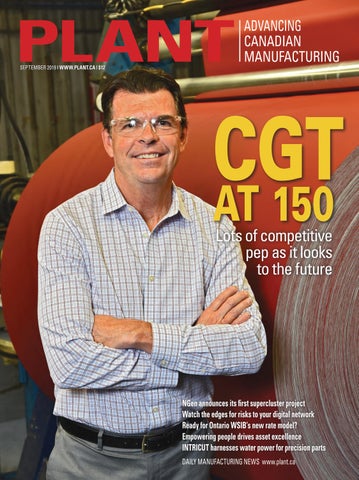
CGT AT 150 Lots of competitive pep as it looks to the future
NGen announces its first supercluster project Watch the edges for risks to your digital network Ready for Ontario WSIB’s new rate model? Empowering people drives asset excellence INTRICUT harnesses water power for precision parts DAILY MANUFACTURING NEWS www.plant.ca
PLT_Sept2019_issue_AMS.indd 1
2019-09-06 9:37 AM
Hygienic Design Enclosures Extra cleanliness & protection for the harshest conditions! Specially designed to handle the unique hygiene and protection needs of the Food & Beverage, Mining, Oil & Gas and other industries... when traditional enclosures may fail to provide required features & benefits to withstand the extreme conditions! • 30˚ forward sloping and overhanging roof repels water, bacteria, caustic substances & objects • Joint-free exterior blue gasket is easy to see, clean, replace • Stainless steel construction and no dead zones for harmful material and bacteria to accumulate • Hinges are completely internal, so cleaning is not an issue
IP 66/69K, cUL approved!
Contact marketing@rittal.ca or visit rittal.ca/hd for the brochure and more details!
1-800-399-0748 | marketing@rittal.ca, www.rittal.ca/hd
PLT_April_RittalRighthand.indd PLT_JanFeb_Rittal.indd 1 12 PLT_Rittal PLT_Sept2019_issue_AMS.indd Systems _Sept19_CSA.indd 1
2018-04-06 2019-01-08 11:43 2019-08-20 2019-08-20 2019-09-06 10:48 12:50 11:46 9:19 9:37 AM AM PM
11:43 00 10:48 12:50 11:46 9:19 AM AM PM
CONTENTS
September 2019 Vol. 78, No. 06
MORE FEATURES 15 MEDICAL NGen announces its first supercluster project: iVoxSol’s geneediting manufacturing process.
16 PERFORMANCE Take it slow. Rushing instructions leads to rework, losses and potential injuries.
20 THINK LEAN Stopping the line prevents quality defects from becoming a production issue.
12 COATINGS/FILMS
CGT is celebrating its 150th anniversary but this Cambridge, Ont. manufacturer is firmly fixed on the future.
23 CCOHS SAFETY TIPS How to deploy emergency showers and eyewash stations to avoid injuries from hazardous products.
DEPARTMENTS
17 CYBERSECURITY Look to the edges and take a holistic view of security to develop a comprehensive strategy.
19 INSURANCE PREMIUMS A new Ontario WSIB rate model in 2020 aims to make planning easier.
21 WATERJET INTRICUT’s micro machine provides custom prototyping or machining of small components.
25 MAINTENANCE The City of Mississauga’s asset excellence is powered by its enabled people.
4 Editorial 6 News Bulletins 7 Careers 8 PLANT Online 10 Industry Mix 11 Economy PLANT Pulse 26 Leading Edge: Innovative ideas for plants 28 Products and Equipment 29 Plantware Events 30 Postscript
Cover photo of CGT president Craig Richardson: Rodney Daw
PLANT—established 1941, is published 8 times per year by Annex Business Media. Publications Mail Agreement #40065710. Circulation email: blao@annexbusinessmedia.com Tel: 416442-5600, ext 3552 Fax: 416-510-6875 or 416-442-2191 Mail: 111 Gordon Baker Road, Suite 400, Toronto, ON M2H 3R1. Occasionally, PLANT will mail information on behalf of industry-related groups whose products and services we believe may be of interest to you. If you prefer not to receive this information, please contact our circulation department in any of the four ways listed above. Annex Privacy Officer: privacy@annexbusinessmedia.com Tel: 800-668-2374. No part of the editorial content of this publication may be reprinted without the publisher’s written permission. ©2019 Annex Publishing & Printing Inc. All rights reserved. Performance claims for products listed in this issue are made by contributing manufacturers and agencies. PLANT receives unsolicited materials including letters to the editor, press releases, promotional items and images from time to time. PLANT, its affiliates and assignees may use, reproduce, publish, re-publish, distribute, store and archive such unsolicited submissions in whole or in part in any form or medium whatsoever, without compensation of any sort. This statement does not apply to materials/pitches submitted by freelance writers, photographers or illustrators in accordance with known industry practices. Printed in Canada. ISSN: 1929-6606 (Print), 1929-6614 (Online).
www.plant.ca
PLT_Sept2019_issue_AMS.indd 3
Download Rittal’s new Climate Control Handbook: www.rittal.ca/climatecontrol Contact Marketing@rittal.ca or visit rittal.ca for more information.
PLANT 3
2019-09-06 9:37 AM
EDITORIAL
Death by 1,000 cuts: Confront your local candidates
T
he federal election is coming up fast and manufacturers should take time during the run-up to put local candidates’ feet to the fire. This is your chance to query and complain about how the federal government impedes business activity with layers of costly regulations and outright cash grabs, such as the carbon tax, and the proposed Clean Fuel Standards (CFS) regulation. First the carbon tax. Never mind whether or not this measure actually changes consumer behaviour. Or that it has any worthwhile impact on lowering greenhouse gas emissions when Canada’s share of the global total is about 1.6%. That’s even as the Trump administration plays Darth Vader against environmental and climate stewardship by taking a light sabre to US emission reduction efforts. The Canadian Federation of Independent Business (CFIB) rightly complains the so-called revenue-neutral tax is hitting small companies disproportionately. Companies, municipalities, universities, school boards and hospitals will get just 7% back in rebates and grants compared to families at an alleged 100%. According to survey results released earlier this year, CFIB found 71% said the added cost of the carbon tax would make it harder to further invest in reducing emissions. The federal plan expects small businesses to pass added costs on to consumers, but 80% of the carbon taxed firms said they’ll get away with passing on maybe less than 25% of the new costs and more than half said they would have to eat the entire cost. Incidentally, businesses in British Columbia are chaffing under a growing tax burden, exacerbated by the province’s self-inflicted carbon tax, implemented in 2008. BC is often cited as an example of how gloriously successful carbon taxing is at changing consumer behaviour and lowering emissions. But the Business Council of British Columbia (BCBC) estimates the recent $10 per tonne increase (total $40 per tonne) will cost companies an additional $170 million in aggregate costs. It notes businesses are responsible for 40% to 50% of the carbon tax revenue, which raises concerns about the resources and export sectors. The fear is carbon and other tax burdens will impede capital investment with the BCBC noting most big resource investments are going to the US. Which brings us to the CFS. Canadian Manufacturers & Exporters (CME) has made peace with balancing the environment and economy, but it’s not happy with the federal government’s latest draft of the CFS regulation, which would go into effect in 2020. Its main concern is the regulation will add costs to business that will put Canadian companies at a competitive disadvantage. The draft would require fuel suppliers to reduce carbon in their products up to 15% by 2030. That’s on top of other federal and provincial carbon levies. The CME believes the 30 mega-tonne greenhouse gas emission reduction and the timelines are unrealistic; and it warns of additional, costly duplication with the inevitable red tape generated by competing provincial and federal policies. In a submission (see https://cme-mec.ca) to the federal government, CME draws a line directly inking declining investment since 2013 to lagging output and export growth. Dollars are fleeing the country as foreign investment continues to erode. The impact of the CFS is an additional $200 per tonne, a 50% to 110% increase in market price to already high energy costs. This could drive out high carbon producers to places where there are less stringent regulations (America, for instance). CME would like the government to reconsider the CFS or exempt manufacturing. Federal candidates need reminding that the consequences of declining and lost investment will do little to create jobs and encourage innovation. That’s less than helpful when it comes to balancing the environment and the economy.
Editor Joe Terrett 416-442-5600 ext. 3219 jterrett@plant.ca Senior Publisher Scott Atkinson (416) 510-5207 satkinson@annexbusinessmedia.com National Account Manager Ilana Fawcett 416-829-1221 ifawcett@annexbusinessmedia.com Media Designer Andrea M. Smith asmith@annexbusinessmedia.com Circulation Manager Beata Olechnowicz 416-442-5600 ext. 3543 bolechnowicz@annexbusinessmedia.com Account Coordinator Debbie Smith 416-442-5600 ext 3221 dsmith@annexbusinessmedia.com Vice President/Executive Publisher Tim Dimopoulos (416) 510-5100 tdimopoulos@annexbusinessmedia.com COO Scott Jamieson sjamieson@annexbusinessmedia.com
Subscription Price Canada $76.00 per year, US $154.50 (US) per year, Foregin $174.50 (US) per year. Single Copy Canada $12.00. Add applicable taxes to all rates. Combined, expanded or premium issues, which count as two subscription issues. Mailing Address Annex Business Media 111 Gordon Baker Road, Suite 400 Toronto, ON M2H 3R1 Circulation Bona Lao 416-442-5600 ext. 3552 blao@annexbusinessmedia.com Fax: 416-510-6875 or 416-442-2191
Joe Terrett, Editor Comments? E-mail jterrett@plant.ca.
4 PLANT
PLT_Sept2019_issue_AMS.indd 4
September 2019
2019-09-06 9:37 AM
PLT_July
PLT_JulyAug_Syspro.indd 1 PLT_Sept2019_issue_AMS.indd 5
2019-07-03 2019-09-06 11:37 9:37 AM AM
NEWS
Hexagon picks GTA for MI division HQ
BULLETINS Electrovaya Inc., a lithium-ion battery innovator based in Mississauga, Ont., has landed two purchase orders worth $1.1 million from existing, unidentified customers. One 450,000 order is for Elivate battery systems for electric materials handling vehicles. A $650,000 order is for automated guided vehicles. Life sciences company Rapid Dose Therapeutics Corp. in Burlington, Ont. has signed a manufacturing agreement with Thrive Cannabis in Brantford to produce QuickStrip cannabis products for both the Canadian medical and recreational markets. QuickStrip is a smoke-free drug delivery system. Thrive Cannabis is developing premium brands for the recreational market and distribution in 2020. dynaCERT Inc., a Toronto manufacturer of carbon emission reduction technology, has received purchase orders for 400 HydraGEN units from KarbonKleen Inc., a preferred systems provider for dynaCERT’s technology. The units use onboard, on-demand injection of hydrogen gas in the air intake of diesel engines to significantly reduce fuel consumption, carbon emissions and other greenhouse gases. Two hundred and fifty units are bound for the US, the rest for Mexico. New Flyer of America Inc., the US subsidiary of Canadian bus manufacturer NFI Group Inc. in Winnipeg, has won a new contract for 75 clean-diesel, 40-foot Xcelsior heavy-duty transit buses for Pace Suburban Bus. It’s a suburban bus division and regional paratransit provider of the Regional Transportation Authority in the Chicago metropolitan area. The new fleet will replace older buses currently in operation. It will soon be possible to produce bottles from glass collected through curbside recycling in Quebec. An agreement in principle has been reached between glass bottle and jar manufacturer Owens-Illinois in Montreal and conditioner Groupe Bellemare in Trois-Rivieres. Technical discussions on the quality of glass required for remelting, optimal conditioning and colour-sorting equipment were led by the working group assembled by Eco Entreprises Quebec.
6 PLANT
PLT_Sept2019_issue_AMS.indd 6
New facility will showcase technology product lines
SeaVision 3D reconstruction of a mooring chain.
PHOTO: KRAKEN
Kraken gets $1.8M funding for mooring chain laser sensor Inspection tool to be used at Husky Energy’s SeaRose floating production vessel ST. JOHN’S, NL — Kraken Robotic Systems Inc. has been awarded $1.8 million in funding for the development of a mooring chain laser inspection sensor that will be used in offshore oil and gas applications. The funding follows successful trials with Husky Energy. The energy company is providing $1.26 million with $540,000 coming from Newfoundland and Labrador. The project cash component is $720,000. This new 16-month development project will address remaining technology gaps ahead of commercialization. Multiple mooring chains anchor floating production, storage and offloading (FPS0) vessels to the seafloor. Regular inspections with millimetric accuracy are required to look for signs of wear, and verify system integrity. Current practice requires a large support vessel to deploy a remotely operated vehicle, which carries a mechanical calliper on its hydraulic manipulator. While the chain is moving in the water column, the ROV pilot must grasp a chain link to perform the required measurement. This process must be repeated several times, sampling several links in each mooring chain. Kraken’s laser scanning sensor solution performs contactless mooring chain inspection from a two-metre standoff distance in a few seconds per link. Kraken Robotic Systems is a subsidiary of Kraken Robotics Inc., based in St. John’s, NL.
OAKVILLE, Ont. — Hexagon’s Manufacturing Intelligence division is setting up its Canadian headquarters in Ontario’s GTA. The US provider of manufacturing intelligence solutions based in Kingstown, RI, is building a 15,000 square-foot facility in Oakville, Ont. When completed in the fourth quarter of this year, it will house up to 100 employees. The building will include a stateof-the-art training centre, multiple meeting rooms, and offices for Hexagon teams involved in product development, quality assurance, sales, engineering, customer support, and administration. A product showroom will serve as a focal point for Hexagon’s most innovative metrology and manufacturing technologies. The company will consolidate all its Manufacturing Intelligence businesses in eastern Canada into the new building, which includes headquarters for Forming Technologies’ development, sales and engineering, MSC Software, and teams from Hexagon’s production software and metrology solutions portfolios.
Hexagon’s new Oakville headquarters. IMAGE: HEXAGON
Protection for SMEs from cyber threats FREDERICTON — The federal government has launched a security certification program that will help small and medium-sized enterprises (SMEs) protect themselves from cyber attacks. According to StaySafeOnline.org, 71% of data breaches happen to small businesses and nearly half of them have been the victim of a cyber
attack. CyberSecure Canada is a voluntary cyber security certification program that helps SMEs achieve a baseline level of cyber security. The program is an initiative under the National Cyber Security Strategy (www.publicsafety.gc.ca). The talent development initiative will focus on cy-
bersecurity, in partnership with educational institutions and the private sector, and is expected to create up to 70 highly skilled jobs. The federal Atlantic Canada Opportunities Agency is providing $997,000 to TechImpact, an Atlantic Canada-based digital technology promoter, to develop and deliver the project.
September 2019
2019-09-06 9:37 AM
Orlick honoured for excellence BSI award recognizes focus on quality, customers
Orlick’s excellence award from BSI PHOTO: BSI Canada. TORONTO — Orlick Industries Ltd. has been awarded the 2018 BSI Canada Award of Excellence. BSI, a provider of business improvement standards and training, has recognized the Hamilton-based manufacturer of aluminum die casting parts and components for its continuous focus on quality improvement and its customers. Orlick serves OEM and Tier 1 customers, operating from five plants covering 580,000 square feet. The company is certified to IATF 16949, a quality management system in the automotive industry supply chain, and the ISO 14001 Environmental Management System (EMS). “Orlick has always provided resources for effective performance of the management systems,” says Pierre Dovala, commercial director of BSI Canada. “Top management has always been actively involved in BSI audits – opening/closing meetings and site visits. The leaders at this company consistently push continual improvement and customer focus.” BSI Group Canada Inc., with offices in Toronto and Montreal, provides ISO certification, assessment training and software. Its excellence award was created in 2011 to recognize customers that excel in the implementation of international business standards. The judging panel included a multi-disciplinary team at BSI Canada that interviewed clients, auditors, senior account managers, and other client-facing personnel.
www.plant.ca
PLT_Sept2019_issue_AMS.indd 7
Wood pulp producer Sappi acquires Matane Mill for $175M 270,000-megatonnes per annum capacity JOHANNESBURG, South Africa — Sappi Ltd., a global producer of dissolving wood pulp, speciality and packaging papers, graphic paper and biomaterials, is acquiring a Quebec pulp mill from Rayonier Advanced Materials for US$175 million. The Matane Mill located on the south shore of the St. Lawrence River at the mouth of the Matane River, has a 270,000 megatonnes per annum capacity of high-yield hardwood pulp. The mill has 129 employees. The South African company says the Canadian acquisition increases its fast-growing packaging businesses in both North America and Europe, reduces its pulp costs and establishes certainty of supply will increase supply over time to Sappi’s mills in North America and Europe. Rayonier Advanced Materials, based in Jacksonville, Fla., is a producer of cellulose-based technologies. The company also manufactures products for lumber, paper and packaging markets. It has manufacturing operations in the US, Canada and France. Sappi, based in Johannesburg, South Africa has manufacturing operations on three continents, in seven countries.
Polar Bear Genome opens Leduc cannabis R&D plant Will manufacture ingredient extracts and isolates research/analytical lab to perform proprietary extractions, isolations, formulations and testing. Manufactured products will include ingredient extracts and isoArtist’s rendition of the completed Polar Bear Genome BioPharma Facility. IMAGE: PBG lates, and finished products. Contract product develLEDUC, Alta. — Polar opment and manufacturBear Genome (PBG) Bioing services will also be Pharma Canada Corp. has offered for Canadian and opened its 25,000 squareinternational businesses foot research and manulooking to create nutrafacturing facility in Leduc, ceutical and medicinal Alta. where it will produce cannabis products. natural health and mediciWhen the plant is up and nal cannabis products. running, the company says The building’s offices will 50 new jobs will be created open for work as construcover the next three years. tion on the production area PBG BioPharma is a continues over the next biopharmaceutical comnine to 12 months. pany based in Alberta and The facility will contain Ontario. both a manufacturing and
CAREERS McCloskey International, a manufacturer of crushers, screeners, stacking conveyors and washing systems in Keene, Ont., has appointed Daragh Cullen dealer man- Daragh Cullen ager for the Eastern US and Caribbean. He brings 20 years of experience working with construction equipment OEMs. He’ll be based in Florida. Ariel Rubinstein comes to Atlas Copco Compressors Canada president and general manager of the Swedish manufacturer’s Canadian office. The supplier Ariel Rubinstein of compressors and other industrial equipment is based in Saint-Laurent, Que. Rubinstein joined Atlas Copco Argentina in 2004 and is currently general manager there. He moves into the Canadian position in October. Electrovaya Inc. has appointed John Macdonald to its board of directors. He was the first employee of Enercare Inc., which began operations in 2006. As president and CEO, he built the company into one of North America’s leading energy solutions companies. He retired in 2018 when the company was sold to Brookfield Infrastructure for $4.3 billion. Electrovaya is a manufacturer of lithium-ion batteries. Debbie Simpson, CFO at Maple Leaf Foods Inc. in Mississauga, Ont., is taking on a new challenge in a different industry. She leaves in November following a transition period that will lead to the appointment of a new CFO. Derby Building Products Inc. has named Justin Clauer district sales manager. He’ll support the Quebec City manufacturer of exterior stone and shake construction materials in the North Central Region. Clauer served as midwest regional sales manager at Palram Americas for the past three years.
PLANT 7
2019-09-06 9:37 AM
NEWS
MANN+HUMMEL acquires Hardy Filtration German company expands manufacturing capabilities, global reach ucts said the acquisition expands the global footprint and manufacturing capabilities of Tri-Dim Filter Corp.’s business. It was acquired by MANN+HUMMEL last year. Hardy Filtration, founded in 1993, has been developing, manufacturing and marketing a variety of filtration products for various applications, such as air filters, paint booth filters and dust collector bags. “After the Tri-Dim acquisition in summer 2018, a subsequent acquisition of Hardy made perfect sense to increase our ability to satisfy and grow our Canadian customer base,” said Sean Cromie, (L-R) Graham MacDonald, vice-president and directeur general of Tripresident and general manager of MANDim Canada, and Hardy management team Geneviève Hardy and Luc N+HUMMEL’s life sciences and environPHOTO: MANN+HUMMEL Girard. ment business unit. Hardy, an employer of more than 80 people, LYDWIGSBURG, Germany — MANN+HUMwill continue to operate through its Trois RivMEL has acquired Hardy Filtration, an air filtraieres headquarters. tion company in Trois-Rivieres, Que. Terms of the deal were not disclosed. The German manufacturer of air filter prod-
PLANT ONLINE SOUNDING OFF
What readers have to say about breaking news Have you checked out PLANT’s daily news online? Here are some headlines that have inspired members of the Canadian manufacturing community to chime in. They’re edited, but use the links to see the raw – and for some – longer versions of their remarks plus the stories that inspired their reactions. Stay up-to-date on the developments – domestic and global – that affect Canada’s industrial sectors by watching the news feed at www. plant.ca or reading PLANT’s twice-weekly newsletter (hit Subscribe on the website). Federal government gave millions to Irving’s Atlantic Wallboard subsidiary http://www.plant.ca/zFf07 $50 million coming from Canadian taxpayers is not merely peanuts. Irving (and others) keep getting handouts and all these peanuts amount to a “grove.” Atlantic Wallboard is still operating, who agreed to “contribute” $50 million without any assets as security? Since it’s a subsidiary of Irving, why wasn’t there some mechanism to hold it accountable for repayment? These programs stink!
8 PLANT
PLT_Sept2019_issue_AMS.indd 8
Bernier says elections law restricting partisan ads is ‘absurd’ http://www.plant.ca/4c33h Why is plant.ca producing fake news… “an outspoken climate-change denier”. Even the stupidest child can understand the climate changes. Only very stupid, weak minded, bobble-headed adults believe humans are the main cause of climate change. Max, like any adult (except Liberals), knows there has been climate change since before there were people. Perhaps someone can educate the Liberals (and
www.plant.ca) on this FACT. Canada well placed to meet world’s growing energy demands http://www.plant.ca/as3hR Crucifixion is too lenient a punishment for you. Climate change will ruin humanity and directly kill millions. And Canada is one of the highest carbon emitters per-capita on the planet, so hardly “responsible” at all. Demand for luxury shellfish is polluting the ocean with plastic http://www.plant.ca/MS8j4 Who put all of the plastic in the ocean in the first place? Shouldn’t they be responsible for cleaning up the oceans? If it were an oil spill, the oil company would clean it up. Trudeau breached Conflict of Interest Act, says ethics
Quebec firms get $124,419 CED funding PLESSISVILLE, Que. — Two Quebec manufacturers are putting $124,419 of repayable CED federal funding to work that will improve productivity and develop a new product. Pro-Innov, a manufacturer of agricultural equipment in Plessisville, Que., has received $37,675 to develop a model of a harvester for haskap (edible blue honeysuckle) berries, a long, sweet Japanese superfruit. Trépanfils (1997) Inc. got $86,744 to purchase digital production equipment. It makes a range of wirebound boxes, pallets and related packaging products for the military. The funding came through the Canada Economic Development for Quebec Regions (CED) program.
commissioner http://www.plant.ca/yjAWZ Why is it political animals never pay for their crimes? Mr. Dress-up should be charged… Trudeau pressed for update on Canada’s arms deal with Saudi Arabia http://www.plant.ca/HmwLl I don’t agree with sending armoured vehicles to Saudi Arabia. This will increase the killing of more people in Yemen. After the peace settlement you can go ahead. Unifor gives Irving’s Halifax Shipyard 48-hour strike notice http://www.plant.ca/BGjbm Why is it in Nova Scotia every time there’s work going forward, they strike, rather than appreciate the employment? I grew up there, left long ago and nothing has changed. Federal Court orders ‘Product of Israel’ labels off West Bank wines http://www.plant.ca/nRYDk Israel should simply relabel the wine “made in the only democracy in the Middle East.”
September 2019
2019-09-06 9:37 AM
NEWS
$4M FedDev funding for auto parts, metals manufacturers Will help two Ontario companies with operations expansion and machinery purchases CONCORD, Ont. — Two Ontario manufacturers have received $4 million in funding through the FedDev Ontario program. Global Plas Inc., a supplier of moulded plastic parts to Tier 1 automotive manufacturers in Concord, got $2.5 million to expand operations and incorporate advanced robotics and automation. The funding allows the company to renovate its new 71,000-square-foot facility (adjacent to its 55,00 square-foot plant), add new production lines and install four injection moulding machines, plus automation equipment. Global Plas anticipates adding 50 new skilled jobs to the York region. The company is currently delivering on a five-year contract with Toyota Canada Inc. to manufacture door and fender parts for the new Toyota RAV4. With production increasing to 480,000 sets per year, Global Plas is purchasing a higher volume of raw materials. In Fergus, Wellington Perforated Sheet & Plate Inc., is putting the $1.5 million contribution into
“
Toyota’s new RAV4.
PHOTO: TOYOTA
the installation of new equipment. The manufacturer and distributor of perforated metal sheets and plates used in noise reduction, construction and filtration, is adding a 500-tonne advanced perforating press with a complete finishing line. The new machinery will cut production leadtime in half. Adding a new degreasing line will also reduce the company’s environmental impact while a new laser cutter will increase Wellington’s capabilities and extend its reach into new markets.
$800,000 REGI funding for Usimex SAINT-GEORGES, Que. — A Quebec manufacturer is getting $800,000 in non-repayable funding through the federal government’s regional steel and aluminum initiative for specialized machinery. Usimax, a manufacturer of speed reducers and specialized gears in Saint-Georges, Que., will use the funding to buy specialized CNC (computer numerical control) machinery. The company will also be able to manufacture ultra-high precision ground gears for heavy power transmission applications. Usimex’s products are used in aerospace, defence and the rail and agriculture sectors, as well as in medical devices and various types of vehicles. The funding was awarded under the Regional Economic Growth through Innovation (REGI) Steel and Aluminum Initiative announced in March.
MACHINES CAN LEARN BUT THEY CAN’T READ MINDS.
“
Brendan Daniel, Chief MAXOLUTION ® Engineer, Canada.
Tired of hearing the Buzz words AI, AR, 4.0 and industrial IoT? Then stop hearing about them and start seeing what is relevant to your business today? SEW’s Live Lab is now open at Humber in the Barrett CTI. See sophisticated system solutions in “actual reality”. Follow us on our social channels for more information or contact us directly.
M
www.plant.ca PLT_June_SEW.indd 1
PLT_Sept2019_issue_AMS.indd 9
E
CIAL
D
I
A
PLANT 9
2019-05-09 2:55 PM
2019-09-06 9:37 AM
INDUSTRY MIX
MISCELLANY FROM THE WORLD OF MANUFACTURING
Gummies in edible limbo Watch for carbon leakage The notion that the Trudeau government’s carbon tax is revenue neutral has been rendered somewhat ironic when you consider the impact of carbon leakage, noted in a new study by the Fraser Institute, a Canadian public policy think-tank (that leans a bit to the right). It contends Canada’s federal carbon tax will increase 13 vulnerable manufacturing sectors. production costs in certain key PHOTO: ADOBE STOCK sectors. That could drive firms to relocate industrial activity to countries with less-stringent climate policies, hence the leakage. The study identifies 13 vulnerable sectors. They include petroleum and coal-products (an almost 25% cost increase), agriculture chemicals, basic chemicals, cement and concrete products, and primary metals. Yes, the federal government has designed a plan that includes tax rebates to help limit the harm to affected sectors. But the study notes the plan is not tied to the incremental cost of reducing emissions, leading to some firms being worse off – even under the federal plan. “Under a worst-case scenario, we’ll lose businesses and jobs without having any real impact on global greenhouse gas emissions,” said Ross McKitrick, senior fellow at the Fraser Institute and co-author of The Impact of the Federal Carbon Tax on the Competitiveness of Canadian Industries. Download the report at www.fraserinstitute.org, look for “studies.”
There is certainty in uncertainty Canadian manufacturers have been dealing with business uncertainty at some level since – coincidentally – Donald Trump was elected president of the US. Who can forget all the fun involved with the NAFTA renegotiation, or the steel and aluminum tariffs? Now we have a US trade war with China that threatens to tamper with world economic growth. After Trump slapped additional tariffs on Chinese imports, the Red Dragon retaliated by raising tariffs on $75 billion of US imports. This sent the US president into a Twitter rage. He decreed America’s companies “… are hereby ordered to immediately start looking for an alternative to China.” One trade association declared the escalating tariffs as ”the worst economic mistake since the Smoot-Hawley Tariff Act of 1930 – a decision that catapulted our country into the Great Depression.’’ Maybe the imperial order to abandon Making America great one cap at China is predictable Trump bluster. PerPHOTO: ADOBE STOCK haps he was out of sorts after his Greena time. land real estate deal got a thumbs down and a “ha-ha” from Denmark. Even so, it reinforces the uncertainty for businesses and it has done little to put a shine on his Make America Great Again promises, as economists warn his policies are hurting manufacturers and courting recession. What does all this mean for Canadian companies? Finally there is some business certainty: uncertainty will prevail until the end of 2020.
10 PLANT
PLT_Sept2019_issue_AMS.indd 10
On the cannabis industry front, edibles will be legal as of Oct. 17, and some processors are prepping for the production of gummies, although they are waiting on Health Canada to detail how unappealing these treats must be to kids. Canadian Press reported colourful, Cannabis leaf gummies. chewy, THC- or CDB-infused bears and PHOTO: ADOBE STOCK other shapes, are unlikely to hit shelves by mid-December (earliest edibles can be sold) but companies are pushing ahead with plans for something that isn’t colourless, flavourless and blobby. Processor Zenabis Ltd. in Vancouver is prioritizing the gummies category because of its popularity in US states where cannabis is legal. And a Deloitte survey shows Canadian rate gummies as their top choice of edible followed by cookies, brownies and chocolate. The advisory firm pegs the annual value of the Canadian cannabis products market at an estimated $2.7 billion, with edibles accounting for up to $1.6 billion.
As a global community, we must recognize that China is a growing power and increasingly assertive towards its place in the international order. But make no mistake: we will always defend Canadians and Canadian interests. Prime Minister Justin Trudeau, speaking to the Montreal Council on Foreign Relations
Engineer honoured for expertise Congratulations to Russell Johnston of Handling Specialty, a manufacturer of custom material handling systems in Grimsby, Ont., who is the latest recipient of the George Burwash Langford Memorial award. It comes from the Ontario Association of Certified Engineering Technicians and Technologists (OACETT) and honours the founding chairman of its certification board. The association confers the CTech and CET designations. Johnston, the company’s advanced engineering specialist, was recognized for his outstanding technical expertise and actively mentoring the next generation of engineering technologists. He joined Handling Specialty 20 years ago as a graduate and the company says he has held several roles, Russell Johnston, award winner. PHOTO: HANDLING SPECIALTY excelling in each.
September 2019
2019-09-06 9:37 AM
ECONOMY
Trade deficit Behind in July by $1.1 billion Trade is front and centre thanks in large part to the disruptive policies of the Trump administration and its ongoing tariff fracas with China. And so it goes. A TD Economics note reported Canada posted a trade deficit of $1.1 billion in July, after a revised deficit of $55 million in June. Exports dropped 0.9% over five of 11 categories to $49.8 billion, driven by a 6.7% slump in energy exports on falling crude oil prices. Metals and non-metallic mineral products exports were up, mostly attributable to an increase in gold exports but including a surge in aluminum exports that followed the removal of US tariffs. Imports were up 1.2% to $50.9 billion. The merchandise trade surplus with the US narrowed to $4.6 billion in July, while the deficit with the rest of the world widened to $5.7 billion. TD economist Omar Abdelrahman noted trade tensions remain the greatest downside risk while a weak global manufacturing backdrop adds another limiting factor on Canadian exports. Download the note at https:// economics.td.com/ca-international-trade.
Big on exporting Most (78%) of Canada’s small manufacturers (fewer than 500 employees) who responded to a CanadianManufacturing.com survey are exporting in varying degrees. The survey, deployed April to June, found sales among exporters averaged 45% of revenues. Of those not exporting, 32% said their product is not suitable, 28% are happy with Canadian sales (28%) or they’re short of resources (28%). The US is by far the preferred destination for exports (90%) followed by Mexico (40%), the UK (26%), and Latin America as well as other Asia (24%). Those planning on entering new markets are focusing on other EU (20%), other Asia (16%) and Latin America (16%). Download the roundtable report at CanadianManufacturing.com, an Annex Business Media online daily news source for manufacturers.
www.plant.ca
PLT_Sept2019_issue_AMS.indd 11
ROBOT MARKET IS GROWING Order Growth (Units, YoY) Automotive
88%
Semi & Electronics/Photonics
12%
Life Sciences/Pharma/Biomed
8%
Food & ConsumerGoods
3%
All Other Industries Automotive Component Plastics & Rubber
-8%
Metals
-11% -20%
0%
20%
40%
Source: RIA
$14.4 BILLION
June manufacturing sales in Quebec, which Statistics Canada reports had the highest increase at 1%. Sales decreased in eight provinces from May. Ontario sales increased 0.2%.
0.4% Rise in the Machinery and Equipment Price Index in Q2, following a 1% rise in Q1. The import component was up 0.4%. The domestic component increased 0.1%, according to Statistics Canada. Manufacturing was the largest contributor.
60%
80%
100%
The North American robotics market is up 7.2% from January to June, according to the Robotic Industries Association (RIA) in Ann Arbour, Mich. Companies ordered 16,488 robots valued at $869 million. The largest driver of the year-to-date growth was an 83% increase in units ordered by automotive OEMs. Other growth industries were semiconductor and electronics (12%), life sciences (8%), and food/consumer goods (3%). In Q2 alone 8,572 robots valued at $446 million were ordered, which represents growth of 19.2% and a 0.6% boost in dollars compared to the same period in 2018.
70%
Percentage of digital services jobs a TD Economics report says are located in just five cities (Toronto, Montreal, Vancouver, Ottawa and Calgary), compared to a spread of about 50% in the US over 10 cities.
2%
Percentage of sales to Western Europe reported by respondents to the PLANT Manufacturers’ Outlook 2019 study. Central and Eastern Europe were good for 0.9%.
49.2
The IHS Markit Canada Manufacturing Purchasing Managers’ Index for August was down from 50.2 in July, which was above the 50.0 no-change value for the first time since March. The August reading was the lowest for three months and signalled a modest downturn in overall manufacturing performance. IHS Market reports a sharper reduction in new order intakes was key to the drop. New work has declined for six months, with the latest fall being the fastest since December 2015. Survey respondents cited US-China trade tensions, subdued energy sector spending and greater global economic uncertainty as main contributors to the decline in demand. Export sales also fell, which manufacturers linked to softer US economic growth and worsening business conditions in the automotive sector.
PLANT 11
2019-09-06 9:37 AM
COATINGS/FILMS
CELEBRATING
150 YEARS CGT LEVERAGES ITS HISTORY OF INNOVATION
From wagon wheels to car interiors, the Cambridge manufacturer honours its legacy of making things in Ontario. BY KIM LAUDRUM
C
GT Ltd. has been around almost as long as Canada. The manufacturer of coated fabrics and film for automotive interiors and pool liner markets marks its 150th anniversary this year, leveraging innovation and technology to drive growth well into the future. Five generations of the Chaplin family ran the business in Cambridge, Ont., starting with ancestor industrialist William Chaplin. He kicked things off
12 PLANT
PLT_Sept2019_issue_AMS.indd 12
with wagon wheels and hatchet handles in the 1860s. “Even then – before 1900 – the company was exporting all around the world,” says Craig Richardson, CGT’s CEO, who took over the role in January 2013. Prior to that, he worked in Canada’s food processing sector, including 14 years as president of Grand River Foods, a $250 million manufacturer employing more than 400 in the Kitchener-Waterloo Region. Before Grand River Foods, he was president of Strathroy Foods, one of Canada’s largest processors of frozen vegetables for the international market. Six years later, he’s talking wagon wheels to car interiors, and joking that the company
Craig Richardson and Bryan Litwiller at the windup end of the printer where the film gets PHOTOS: RODNEY DAW a protective clear lacquer coating.
September 2019
2019-09-06 9:37 AM
Below (L-R): Milling process at the calendar. Vinyl is heated and mixed to eliminate air; the calender, where vinyl is taken from a molten state and made into sheet; the plastisol line, about 100 metres long; screens show the operators current process status at various locations; and paste bags containing the additive that provides the base film colour for the calendering process.
www.plant.ca
PLT_Sept2019_issue_AMS.indd 13
“is still in the transportation sector.” Key to the company’s durability is innovation and technology and a workplace culture that encourages employee engagement. Not long after Henry Ford opened his Canadian operations in 1905, Canadian General-Tower (now CGT) made the canopy for the Model-T convertible. Demand for rubber products rose during World War II. Innovation pushed the development of an alternative to rubber that could adhere to various substrates. The Chaplin’s business began to experiment with polymeric film or vinyl, making raincoats and other consumer goods. In 2012 Rick Chaplin sold the then-$300 million company to Holcan Investments of Burlington, Ont., a privately held investment firm. Today, CGT employs 1,200 people worldwide with plants in Cambridge (500 employees), Texas (250), China (400) and an additional 50 staff in sales offices in Michigan, France, Japan and Germany. Like CGT, Cambridge has also transformed over the years. The textile firms and shoemakers have moved to China and India, while “automotive is now the name of the game,” Richardson says. The area is home to a vibrant vehicle manufacturing hub that includes Toyota’s luxury Lexus RAV4 plant. ATS and ComDev, companies known for advanced automation and technology are here. As is the GM CAMI plant where the Chevrolet Equinox is made in nearby Ingersoll. Geographically Cambridge is close to a huge Canadian and northeastern US auto market. Today, CGT creates polymeric film and vinyl sheeting for two main markets: automotive interiors and pool liners. The company exports almost 100% of its products to the US and Mexico. “We’re a polymer surface manufacturer. We are responsible for meeting the automotive OEM’s defined customer haptics: that’s understanding how the touch,
PLANT 13
2019-09-06 9:37 AM
The plastisol wind up area where operator Jacqueline Pearle performs a quality control check to monitor the depth and colour of the surface texture.
feel and look of virtually all surface material in the car makes the customer feel,” Richardson says. The material has the buttery-soft feel of leather, but with the durability, lighter weight and lower price point of a synthetic material. The polymeric film process starts with a resin, which is melted and rolled. It comes out a thin-gauge film, five feet by six feet wide, in a rainbow of colours. By using special rollers it’s possible to create a texture on the film. CGT produces the material in Cambridge using a calendering method – a finishing process that smooths, coats or thins a material. “Calendering is an older method that’s good for producing strong and durable material,” Richardson explains. An extrusion method is used at the newer plants in Texas and CGT’s Global Innovation Centre in Changshu, China. There, CGT is “developing products for future... We share intellectual property with Canada and the US.” The polymeric film is sent in rolls to cutand-sew operations, mainly in Mexico, then shipped to the US automotive seat manufacturer. Two years ago, CGT built an $80 million, 250,000 square-foot plant in New Braunfels, near San Antonio, Tex. to serve the southern US and Mexico markets. That plant was expanded this year to 400,000 square feet. CGT continues to operate from its 500,000 square-foot plant in Cambridge. The plant in China is 500,000 square feet. CGT produces 60 million yards of polymeric film annually: 52 million yards for the automotive sector, with the remaining 8 million yards for non-automotive purposes. “We’re optimistic [about the future]. We’ve invested in new machinery and building space. The Texas plant is the most modern polymeric film company in the world,” Richardson says. CGT’s new facility there will see production currently being sub-contracted to firms in China and the US brought in-house.
14 PLANT
PLT_Sept2019_issue_AMS.indd 14
The plastisol fabric splicing station where Joe Maher prepares the next roll of fabric to adjoin in line. This allows continuous operation.
He credits China as being a significant factor in CGT’s growth over the past six years. “Fifty per cent of the size of CGT’s growth is from China. CGT grew from close to $350 million in 2013 to more than $600 million today.” Global trade wars challenge the company’s long-term strategies for growth. “We’ve become short-term in our planning because we are reacting to tweets and crises in other countries,” he says. “To think that we can simply pass costs on is unacceptable to OEMs. We have our own challenges doing business in southwestern Ontario, such as the high cost of energy and the cost of maintaining employees.” And competition in the coverstock field is heating up. “In 2010 there were eight suppliers of our product globally to the automotive market. Today there are 19. Much of that has come on the back of exploding growth in China and India. There has been consistent growth in North America, as well,” Richardson says. “We’ve become used to large international conglomerates in this industry.”
Diversifying markets Adopting a strategy to diversify markets is key to CGT’s future. It’s looking to expand into agriculture, marine and aerospace. “Eighty per cent of our portfolio is in automotive,” Richardson notes. “The other 20% is in pools, containment ponds and roofing membranes. Hopefully we can increase that portfolio to 35%. That would mitigate our exposure to global disruption out there. The Canadian dollar also has a profound impact [on global trade].” The company continues to innovate. CGT is participating in an industrial research project with McGill University to develop the next generation of biodegradable plasticizers. The intention is to advance research into the development of green and non-toxic materials. The initiative is funded by Canada’s MITACS Research & Innovation program. CGT recently developed a calendered vinyl
for Toyota interiors that contains bioplastics, replacing petroleum-derived coatings. The company is registered to the ISO 14001 environmental standard and its sustainability efforts include recycling. Up to 4 million pounds of PVC are recycled at the Cambridge facility per year. CGT also recycles its solvents. “Eighty-nine per cent of all of the waste at the Cambridge facility is recycled or reused,” according to Richardson. What’s in store for the future? CGT anticipates microbial surfaces will be in demand for car-sharing vehicles and is working on developing such materials. Scented coverstocks could enhance the car driving experience for some consumers and OEMs are keen to deliver. How does a Canadian manufacturing company endure for 150 years? Richardson credits its people. Building an organizational culture of employee recognition for exceptional ideas and performance can help, he wrote in The Globe and Mail. It drives employees to perform meaningful work and gives employers an opportunity to gather relevant metrics on employee performance. Engaged employees are more likely to go above and beyond their role requirements, generating long-term value, ultimately increasing your knowledge capital while lowering turnover, and boosting productivity on average by 22%, Richardson says. “I think our commitment to engagement is a profound contributor to helping our company reach the milestone of celebrating its 150th anniversary in 2019.” Engagement will help drive CGT forward in the coming years as it strengthens the Chaplin legacy and the company’s position in the global marketplace. Kim Laudrum is a Toronto-based business writer and regular contributor to PLANT. E-mail klaudrum@rogers.com. Comments? E-mail jterrett@plant.ca.
September 2019
2019-09-06 9:37 AM
MEDICAL Its advanced technology transforms the way vectors are produced. BY PLANT STAFF
N
ext Generation Manufacturing Canada (NGen) has launched its first Advanced Manufacturing Supercluster project, providing conditional support for a consortium that will ramp up production of gene-editing reagents. The project, led by iVexSol Canada, will develop an advanced manufacturing process for lentiviral vectors (LVVs). These critical components in the manufacturing of cell and gene therapies (CGTs) fight cancer and repair a variety of rare and inherited genetic disorders in both children and adults. iVexSol (intelligent Vector Solutions) Canada, based at the MarS Centre in Toronto, is a newly formed vector manufacturing company with an advanced technology that transforms the way vectors are produced. The almost $4.3 million project, with $1.89 million in supercluster funding from NGen, is expected to lead to the creation of approximately 470 jobs. The announcement was made Aug. 21 at the MaRS building, a fitting launch point. MaRS is a not-for-profit corporation that helps commercialize publicly funded medical research and other technologies. The project includes three other collaborators: CCRM Enterprises Inc. in Toronto, a wholly owned subsidiary of the Centre for Commercialization of Regenerative Medicine (CCRM), will provide the supporting manufacturing infrastructure and downstream processing capabilities; GE Healthcare, a GE company in Chicago, will provide manufacturing process expertise, along with access and the use of specialized tools and technology; and STEMCELL Technologies, a biotech company in Vancouver, will provide advanced reagents.
www.plant.ca
PLT_Sept2019_issue_AMS.indd 15
Gene-editing reagents are critical to cell and gene therapies.
iVexSol’s
REAGENT NGEN LAUNCHES ITS FIRST SUPERCLUSTER PROJECT The conditional NGen support is subject to the partners entering into a final agreement and obtaining internal approval by the relevant stakeholders. “We were looking for good proposals and plans, and this one met all the strategic and eligibility criteria,” says NGen Canada CEO Jayson Myers. The project checked the boxes for being transformative and giving Canada a competitive edge in advanced manufacturing; being collaborative; and having significant commercial potential. “Advanced technologies are not just leading to the development of new life-saving therapeutics; they’re opening up new ways to manufacture biomedical products. This project shows how advanced manufacturing leads to more investment and high value jobs in Canada,” Myers says. And he emphasized the importance of the collaborative piece. “There’s lots of risk in collaboration company-to-company so this does prime the pump a bit to derisk some innovation
investments.” iVexSol’s project will attract and retain high-end talent. Having access to a steady supply of high-quality LVVs will also benefit the 40 companies that comprise Canada’s CGT ecosystem, while attracting others to Canada.
High-quality vectors LVVs have been produced using costly, inefficient and hard-toscale legacy methods that have led to global shortages of the reagent and slowed the progress of clinical trials that would lead to the development of life-saving CGTs. iVexSol’s process aims to address these shortages by producing nearly 10 times the quantity of high-quality vectors in the same time as conventional methods, at a fraction of the cost. Demand for vectors is expected to escalate. Over two years, Canadian and US regulators have approved the first CGTs for market, which, along with approved clinical trials, are showing positive results in treating a variety of conditions
PHOTO: ADOBE STOCK
including leukemia. Expectations of further breakthroughs are attracting billions of dollars of investment into advanced clinical research for CGTs that target other diseases. iVexSol believes the transformative nature of its manufacturing platform will position the consortium as a global leader in supplying this critical therapeutic agent to meet rapidly expanding global demand. Based on an expected 200 clinical trial applications each year, the US Food and Drug Administration anticipates approving 10 to 20 new CGTs per year by 2025. Industry-focussed, not-forprofit NGen Canada in Hamilton is leading the Advanced Manufacturing Supercluster with up to $230 million in government funding for projects, matched dollar for dollar by the private sector. The federal Innovation Superclusters Initiative is investing up to $950 million to support business-led projects. The five supercluster projects are expected to create 13,500 jobs over 10 years and add $13.5 billion to the Canadian economy. Manufacturers still have time to tap into the funding. “There are about 30 projects in the Advanced Manufacturing Superclutser pipeline and there is an open call for proposals,” Myers says. Information is available at the NGen website (www.ngen.ca). Comments? E-mail jterrett@plant.ca.
PLANT 15
2019-09-06 9:37 AM
PERFORMANCE Engineer trains apprentices on tube PHOTO: ADOBE STOCK bending machine.
tomers’ requirements:
1 Rushing instructions can be misleading and dangerous. BY HUGH ALLEY
I
n Alice’s Adventures Through the Looking Glass, she runs with the Red Queen but they don’t go anywhere. The queen tells her, “here, you see, it takes
SLOW FOR FASTER RESULTS
MORE More
QUALITY No One Gives You More! More than 14,000 systems sold over the past 75 years
N.R. MURPHY LTD. DUST COLLECTORS 430 Franklin Blvd., Cambridge, ON N1R 8G6 E-mail: 4nodust@nrmurphy.com
(519) 621-6210
www.nrmurphy.com
16 PLANT
PLT_Sept2019_issue_AMS.indd 16
2
Take it
MURPHY MEANS
Tell them what needs to be done. What is the task, and what should the finished product be (200 Type B widgets, or the Monthly Inventory Report, or this area swept...)? Tell them how you want it done. Which material and where is it; which processes; who can help; what extra safety precautions are required; any special tolerances or instructions from the customer; and what’s not normal about the order? Yes, it’s probably all written on the work order, but you know how often people miss things. Ask how long it will take if they aren’t interrupted. It’s not that you will accept the estimate, but if it’s much different from yours, there’s likely a misunderstanding about the task. Based on what you’re told, work out if the estimate meets your schedule. If not, take appropriate action, whether that means getting help or reassigning the work. Ask for a summary of the instructions. This ensures you know you haven’t missed anything.
all the running you can do, to keep in the same place. If you want to get somewhere else, you must run at least twice as fast as that!” It’s often the same in a plant. Most people feel rushed by customers’ rising expectations. It’s extremely tempting to rush instructions to staff, but doing so is misleading and potentially dangerous. Misleading, because it almost always takes more time, and dangerous because mistakes in communication lead to rework, losses or injuries.
Meeting requirements As you hand work to someone else, you have a mental picture of the expected outcome. When you abbreviate instructions, it raises the odds the team member’s vision doesn’t match yours. Chances are the person will guess at the unknowns, increasing the possibility of rework. Or the person will ask for clarification, resulting in lost time. These four steps will help ensure clear instructions and the resulting work will meet cus-
3
4
It may take a bit longer to run through these steps, but it’s far less likely your team member will come back with questions, and less likely you’ll have to correct a mistake. The time it takes to hand out work will be less, freeing you up to do higher value work. Hugh Alley is an industrial engineer based in the Vancouver area who helps organizations achieve significant performance gains in delivery, quality and cost in a short timeframe. Call (604) 8661502 or e-mail hughralley@ gmail.com. Comments? E-mail jterrett@plant.ca.
September 2019
2019-09-06 9:37 AM
CYBERSECURITY Take a holistic view of security to develop a comprehensive strategy. BY GRAHAM BUSHKES
E
arlier this year, an organization known as the Cyber Threat Alliance (CTA) released a report. In it, the group – which represents some of the world’s most prominent cybersecurity companies – doubled down on an important warning it first issued in 2016: beware of the growing risks associated with the “edges” of IT networks. While that threat was critical several years ago, the stakes today are even higher. For years, those who oversaw company networks could mostly rely on firewalls to keep threats at bay. Those days are gone. Today, as manufacturers continue to embrace the many benefits that come with IoT and digital transformation, their risk profiles continue to grow. The explosion in endpoints has greatly expanded risk across the growing attack surface, and worse. Once a threat successfully makes its way inside these increasingly complex network environments, it becomes far more difficult to address. To truly reap the benefits of the digital age, security professionals must adopt a new mindset and shift their attention to new connected edges where the risk of attacks are at their highest. The following are areas that require focus: Defending the device edge. It’s difficult to overstate the impact mobile technology has had on manufacturing. We take for granted the use of devices that grow smarter, faster, and more powerful with each passing year. But this power and convenience comes at a cost. IoT devices are fundamentally insecure, often using easily exploited communications code or including hard-coded back doors. Many can’t even be updated or patched. What’s more, not only are these devices often
www.plant.ca
PLT_Sept2019_issue_AMS.indd 17
More endpoints means greater risk of a cyber attack.
PHOTO: ADOBE STOCK
Look to the
IT EDGES …TO SECURE YOUR NETWORK’S DIGITAL TRANSFORMATION
implemented as-is, right out of the box, most companies are reluctant to conduct maintenance on them, as the demand for 100% operational uptime means many decide to simply leave well enough alone. It should be no surprise, then, that these devices are so often successfully targeted by cyber criminals. To properly defend the device perimeter companies must ensure all communications are encrypted, and that the security systems inspect that encrypted data at network speeds. It’s also important to establish a way to automatically identify and assess every device on the network from the moment they connect, then tie access to segmentation policies. This ensures each device is restricted to predetermined areas, without the need for manual intervention. “Hardening” of devices should
also be an integral part of any cyber hygiene program. When a device is booted it should automatically trigger an automated security check to ensure that nothing has been compromised. Patching and updating critical systems to remove vulnerabilities, where possible, also needs to be simple and automated. To help with this, configurations should be standardized and regularly checked for errors or manipulation. Segmentation helps ensure devices that can’t be automated remain protected and separated.
Another front opens Defending the cloud edge. The race to the cloud by manufacturers is well underway, prompted by its inherent efficiency, scalability, elasticity, the massive computing power it offers users, and the prospect of more streamlined costs. Yet despite its
many benefits, cloud computing has also opened another front for attackers to target and exploit. The issue isn’t that cloud computing is insecure, but rather how companies choose to approach it. Cloud users often have a misconception about the security provided in the cloud, mistakenly believing that providers deliver all necessary security services. The reality is that cloud providers are only obligated to secure the underlying cloud infrastructure shared by all customers. Securing corporate data, applications and computer resources are the responsibility of the client. Complicating the issue further is IT managers who are pressed for time, and may be tempted to seek out security solutions that can be rapidly implemented because they sit on top of the cloud infrastructure as a simple overlay. The problem is, any security
PLANT 17
2019-09-06 9:37 AM
solution that’s not designed from the ground up for the cloud will inevitably leave gaps in functionality, making it very difficult to establish any kind of consistent security policy that companies need, especially across and between different cloud and physical environments. Simply put, it’s a trade-off that companies can’t afford. Protecting the cloud starts with deploying “cloud-native”
security solutions, designed to leverage the management controls and APIs built into the cloud. But even those can run into trouble if users try to deploy and operate them in a “multi-cloud” environment that leverages many different providers and solutions. Just because a security application is designed for the cloud doesn’t necessarily mean it’s equipped to communicate seamlessly between dif-
ferent deployments. And when it comes to security, that kind of consistency is critical.
Ad hoc measures To avoid this, companies should seek out solutions that take advantage of connectors, designed to translate commands and policies between different environments, enabling security updates to move seamlessly across cloud boundaries with a single click.
Data Collector
Detect, Measure, Analyze
Ultrasound and Vibration
sdtultrasound.com/sdt340 Scalable Multi-technology Multi-platform
18 PLANT
PLT_Sept_SDT.indd 1
PLT_Sept2019_issue_AMS.indd 18
UAS4.0
Defending the WAN edge. Cloud-based computing also puts pressure on organizations that support multiple remote offices. To keep pace with digital business requirements, many have had to transition from using traditional wide area network (WAN) technologies to software-defined WAN systems (SD-WAN). They optimize the performance of things such as hosted applications and unified communication services. However, most SD-WAN solutions come with minimal security, requiring organizations to resort to ad hoc measures when securing their branch connections and environments. The takeaway for network managers is this: look for SD-WAN solutions with a fully integrated suite of security features that also work seamlessly with the other security solutions deployed across the organization. That ensures a consistent level of security at every branch location, while simplifying overhead through a single management and policy orchestration console. It provides visibility and control across every aspect of the distributed network. While each edge has unique vulnerabilities, all must be seen as part of the same security environment. Stepping back and taking a holistic view of security is a prerequisite for developing a comprehensive strategy. An integrated, proactive stance, underpinned by security solutions that function as part of a unified and integrated fabric, are important steps on the way to achieving success during ongoing digital transformation efforts. Graham Bushkes, the country manager for Fortinet Canada, has more than 32 years of experience in the IT industry. Fortinet is a provider of network and content security in Burnaby, BC. Visit www. fortinet.com.
Analysis Software
Comments? E-mail jterrett@plant.ca. 2019-08-26 10:02 AM
September 2019
2019-09-06 9:37 AM
INSURANCE PREMIUMS Ontario manufacturers to make the transition in 2020. BY JANINE DYCK
A
re you ready for the Ontario WSIB’s new premium rate model? Beginning Jan. 1, 2020, the Workplace Safety and Insurance Board will introduce a new way of setting premium rates for almost 300,000 businesses across Ontario. The new model will make it easier to understand how businesses are classified, better reflect individual claims experience and help businesses plan for the future by providing projected rate information. What’s changing in the new model? First, streamlining how businesses are classified using the North American Industry Classification System (NAICS), which is already used by the Canada Revenue Agency and Statistics Canada. This change will move 155 different rate groups to 34 classes/ subclasses. Second, setting an average premium rate for each class based on its risk profile and share of responsibility to maintain the insurance fund. This will make premium rates easier to understand. Each NAICS class breaks down into a series of risk bands, and each risk band will have an associated premium rate. The difference between each risk band will be approximately 5%. Next, a profile using specific claims history will compare risk to other businesses in your class. Those with similar risk profiles will be assigned to the same risk band and premium rate. Third, WSIB will help companies plan for any changes in premium rates. Manufacturers will no longer have to wait for rebates or surcharges. The current approach to rate setting, including MAP, NEER and CAD7 experience rating programs, will be eliminated. Additionally, the new model
www.plant.ca
PLT_Sept2019_issue_AMS.indd 19
The new model will move 155 different rate groups to 34 classes/subclasses.
A new model for
RATES WSIB AIMS TO MAKE YOUR PLANNING EASIER will introduce projected rates. Companies previously in an experience-rating program will receive final NEER and CAD7 statements in 2020, as well as final adjustments, which will include an assessment of 2019. Businesses registered under the MAP program received their final statement in 2018, and will receive any final adjustments this year.
Staggered increases To ensure smooth transitions into the new model, initial rate increases will be staggered over time, while rate decreases will be applied immediately. Here’s how the transition will work: • In 2020, each business will be assigned a starting point rate and projected premium based on previous rates, claims experience, size of business, NAICS classification and whether or not it was in an experience
rating program previously. This will determine the 2020 premium rate. Businesses with projected premium rate decreases will move down to their projected risk band. • In 2021, businesses with projected premium rate increases will move up a maximum of one risk band from the 2020 level. Businesses with projected premium rate decreases will move down to their projected risk band. • In 2022, businesses that have not yet reached their projected premium rate will move up a maximum of two risk bands above their 2021 risk band. Businesses with projected decreases will move down to the projected risk band. • Starting in 2023, policies for premium rate setting under the new model will be in effect. Businesses with projected premium increases will
PHOTO: ADOBE STOCK
see rates increase up to three risk bands per year until they reach the projected premium rate. This protects them from any sudden changes to premium rates. Businesses eligible for decreases will see their rates decrease up to three risk bands per year until they reach their projected premium rate. Manufacturers can apply WSIB programs and tools to improve safety performance now. Compass allows anyone to find and compare health and safety statistics for workplaces across the province and the new Workwell app evaluates health and safety management systems. There are also services and resources customized for small businesses (visit www.wsib.ca). What’s next? The 2020 premium rates are coming this fall and WSIB will help companies prepare. For more information or to sign up for WSIB’s monthly webinars and newsletter about the new premium rate-setting model, visit wsib.ca/rateframework or e-mail rateframework@wsib. on.ca. Janine Dyck is vice-president of employer services, Workplace Safety and Insurance Board (WSIB), Ontario. Comments? E-mail jterrett@plant.ca.
PLANT 19
2019-09-06 9:37 AM
THINK LEAN Stopping the line prevents a quality defect from becoming a quality issue. BY RICHARD KUNST
O
ne of the basic principles of a successful lean program is “respect for people,” but what does this mean? You have an environment where everyone is respected and no one is blamed, but the processes are always suspect and open to improvement. At Toyota, everyone is respected and equal, but hired as professionals with specific talents. It means being an excellent cleaner (janitor), developing automation through robotics (engineers) or making inventory dance through the supply chain until it is required line-side. Toyota also knows if you distract a team member, it takes at least 22 minutes for that person to get his/her rhythm back. That’s why processes are visually monitored and observed without interrupting the team member. Professionals capable of making decisions are overlaid within the organization. They’re empowered to stop the line if it’s suspected a quality defect is about to enter the process. Stopping the line has consequences. It could immediately idle 2,500 team members, but making this choice rather than allowing a quality defect to escape is what makes the Toyota brand synonymous with quality. This is part of the philosophy of jidoka, one of two pillars supporting the Toyota Production System (the other one is just-in-time). It involves providing machines and operators with the ability to immediately stop work when an abnormal condition is suspected. This enables operations to build in quality at each process and to separate people and machines for more efficient work. Jidoka highlights the causes of problems because work stops immediately when a problem
20 PLANT
PLT_Sept2019_issue_AMS.indd 20
Warning lights indicate a problem.
PHOTO: WERMA
Respect your
PEOPLE LET THEM CONTROL THE PROCESS TO BUILD QUALITY
first occurs. This leads to improvements in the processes that build in quality by eliminating the root causes of defects. Sometimes jidoka is called autonomation, meaning automation with human intelligence. It gives equipment the ability to distinguish good parts from bad autonomously, without being monitored by an operator. This eliminates the need for operators to continuously watch machines, which results in large productivity gains because one operator handles several of them. The concept of jidoka originated in the early 1900s when Sakichi Toyoda, founder of the Toyota Group, invented a textile loom that stopped automatically
when any thread broke. Previously when a thread broke, the loom would churn out mounds of defective fabric, so each machine needed a watchful operator. Toyoda’s innovation let one operator control many machines.
Lighting up problems Andons in the operating system combine with respect for people and empowerment of team members. The direct translation from Japanese means a lamp. In final assembly, each station is equipped with an andon cord. If a team member detects a problem or feels assistance is needed, the cord is pulled once, which lights up the station on a large andon board in yellow. This indicates the team leader is needed imme-
diately. Two pulls for a major obstacle will immediately stop the line and the andon board will glow red, signalling immediate help is required. An andon indicates production status (for example, which machines are operating), an abnormality (for example, machine downtime, a quality problem, tooling faults, operator delays, and materials shortages), and needed actions, such as changeovers. It also displays the status of production in terms of the number of units planned versus actual output. Empowering team members is one way to ensure quality problems are detected before they become larger production issues. It’s certainly worked well for Toyota. Richard Kunst is president and CEO of Cambridge, Ont.-based Kunst Solutions Corp., which helps companies become more agile, develop evolutionary management and implement lean solutions. Visit www. kunstsolutions.com. E-mail rkunst@kunstartofsolutions. com. Comments? E-mail jterrett@plant.ca.
September 2019
2019-09-06 9:37 AM
PRECISION PARTS INTRICUT micro waterjet technology for prototyping or machining small components. BY TREENA HEIN
W
aterjet technology follows the same basic principles as when it was first used by coal miners during the 1800s. They designed simple systems using pressurized water from streams or rivers to cut through debris and coal to increase access. Today’s waterjets are big machines with deep water tanks that cut almost any material at 60,000 to 87,000 psi. But the scale of waterjet technology used at INTRICUT’s custom tool and die shop in Niagara Falls, Ont. is quite different – and for good reason. This family-run enterprise is using a micro waterjet for prototyping or machining very small components, a niche application for which there is growing demand. The machine delivers edge finishes in the 16Ra inch range, and cut tolerances of 0.0005 of an inch, depending on material type and thickness. Think of it as waterjet cutting approaching wire EDM precision, but faster. It’s the only micro waterjet system used for custom work in Canada, according to INTRICUT, and it’s one of the latest innovations instigated by Kevin Stoll and his dad, Mike, who opened his shop in 1996. The business began in a small building with one wire EDM. However, at the time demand for tool and die shop services was strong, and growth included many other services, including sink EDM, CNC machining and reverse engineering. Clients included John Deere and General Motors. Over time, Mike expanded the shop space to 3,600 square-feet and increased the staff to six employees. Meanwhile, Kevin was growing up. By 13, he was cleaning the machines, sweeping floors and learning the ropes. When it came time to decide on a career
www.plant.ca
PLT_Sept2019_issue_AMS.indd 21
OMAX’s MicroMAX waterjet.
PHOTO: INTRICUT
Precision
PARTS
HARNESSING WATER POWER
path, it was pretty clear where he was heading. Both grandfathers, three uncles and his father were tool and die makers, so you could say the trade is in Kevin’s blood. He completed his apprenticeship and is now co-owner with Mike. In 2005, manufacturing in Ontario was showing signs of slowing. Many of INTRICUT’s primary customers closed while others moved to China. At this point, Mike decided to invest in a machine that would allow his shop to offer more services, so he bought one of the first conventional waterjets in the Niagara Region. As he had hoped, it attracted orders from, for example, architectural and interior design customers for logos, signs, and floor medallions cut from materials such as granite.
This carried INTRICUT through the economic downturn.
Waterjet experience By the end of 2017, INTRICUT had 12 years of conventional waterjet experience under its belt. But Mike and Kevin felt it was time for a new plan that would move the business forward. “We had done abrasive waterjet cutting for more than a decade, so we were already very familiar with the technology,” Kevin explains. “We noticed that there was a growing demand for quick turnaround and smaller, lighter, high-precision parts and assemblies made from advanced materials. A micro waterjet seemed to be a logical direction to go. No one else in the region had one, so we would be able to offer unique services.”
After many hours of research, they decided on the OMAX MicroMAX. Its 5-axis cutting head was key,” Kevin says. “It makes it possible to cut without a taper, thus allowing us to produce parts with straight-walled, 90-degree edges and a finish comparable to parts cut on a wire EDM.” The machine produces shims, brackets, ring frames, gaskets and spacers, gears and other specialty components: the applications are virtually endless. “We can cut almost any material, metal or non-metal, and any complex shape – including holes – in one process, eliminating secondary operations. There’s no heat-affected zone that can cause distortion or edge hardening, so we handle tasks where laser and wire EDM are contraindicated.” As they had hoped, putting the focus on micro cutting resulted in growing demand for precision work. “We’ve never looked back,” Kevin says. “Our customers are in automation, energy, electronics, research and development, marine, food and beverage and we mostly work with metal, but also do other materials including stainless steel, hastelloy,
PLANT 21
2019-09-06 9:37 AM
titanium, Inconel, plastics, glass and composites.” Although sales grew 20% last year (at least partly due to achieving ISO certification), the Stolls are looking at an even higher rate this year. But reaching potential customers and getting them to understand the accuracy achieved with the micro waterjet is the biggest challenge. “People hear the term and they think about the big rip-
Samples of precision machined parts.
PHOTO: INTRICUT
and-tear conventional waterjet machines because that’s what they’re familiar with,” Mike says. “The micro waterjet is entirely different.” The plan is to continue to exhibit at trade shows where potential customers see what is achieved with the micro waterjet machine. INTRICUT will also continue to reach out to engineers directly. “The potential is there, and the customer base is growing, so we are heading in the right direction,” Mike adds. This fiscal year’s goal is to obtain their first US-based micro waterjet order. The Stolls are also considering the purchase of a vision measurement instrument that handles extremely small and detailed parts. They hope this new capability will open doors to the aerospace and medical sectors on both sides of the border. “We are just an hour from Toronto, and the number of specialized manufacturers is growing in this region. There are good opportunities for growth,” Mike says. Indeed, they see a significant amount of high-tech manufacturing in the Southern Ontario. This is creating demand in the machining sector for specialty and niche work, all of which bodes well for this innovative family business.
Faster. Better. Connected. Seamless connectivity in industrial automation To find out more visit us at booth #1131
Treena Hein is a freelance business writer based in Pembroke, Ont. E-mail treenahein@outlook.com. Comments? E-mail jterrett@oplant.ca.
22 PLT_FESTO_CMTS_Sept19_CSA.indd PLANT 1
PLT_Sept2019_issue_AMS.indd 22
2019-08-20 2:39 PM
September 2019
2019-09-06 9:37 AM
CCOHS SAFETY TIPS
Eyewash station.
PHOTO: ADOBE STOCK
Splash
EMERGENCY HOW ARE YOUR DECONTAMINATION PROCEDURES? Install shower and eyewash stations close to workers exposed to hazardous products.
E
mployees who work with or near hazardous products should know the appropriate safety precautions. However, incidents can happen – and when a corrosive product comes into contact with a worker’s eyes, face or body, the first few seconds are the most critical. Delaying treatment, even for a few seconds, can result in serious injury.
Emergency showers and eyewash stations provide workers on-the-spot decontamination and the ability to flush hazardous substances away. There are different types of units available. Conduct a job hazard analysis to match the hazard and products used at the workplace. Some other points to consider: • Emergency showers flush the head and body only. Eyewash stations are for the eye and face area only. • Combination units contain a shower and eyewash station. They provide the most compre-
Emergency station location The emergency shower or eyewash station should be located: • as close to the hazard as possible • not be separated by a partition from the hazardous work area • on an unobstructed path • where workers can easily see them • on the same floor as the hazard • near an emergency exit where responding emergency response
personnel can reach the victim easily • in an area where further contamination will not occur • away from any electrical equipment that may become a hazard when wet Include a drainage system for excess water that may be considered a hazardous waste (special regulations apply).
PLANT 23
www.plant.ca PLT_Sept_Wainbee.indd 1
PLT_Sept2019_issue_AMS.indd 23
2019-08-09 9:22 AM
2019-09-06 9:37 AM
hensive protection and should be used wherever possible. Currently there is no Canadian standard for the design or placement of eyewash stations or emergency showers. As a result, the American National Standards Institute (ANSI) Standard for Emergency Eyewash and Shower Equipment (ANSI Z358.1-2014) acts as a guide. It specifies equipment be capable of providing flushing liquid for a minimum of 15 minutes to dilute
and wash away contaminants. Other references recommend a minimum of 20-minutes if the nature of the contaminant is not known. The time can be modified if the identity and properties of the chemical are known. For example: • minimum five minutes for non-irritants or mild irritants, at least 20 minutes for moderate to severe irritants; • at least 20 minutes for most corrosives; and
• at least 60 minutes for strong alkalis (such as sodium, potassium or calcium hydroxide).
Medical attention In all cases, if irritation persists, repeat the flushing procedure. It’s important medical attention is administered as soon as possible after first aid. Always keep a clear, unobstructed path to the emergency shower or eyewash station, and frequently test the unit to ensure
STAINLESS STEEL WITH CARBON STRENGTH
www.tsubaki.ca 24 PLANT
PLT_Sept2019_issue_AMS.indd 24
1-800-263-7088
it’s well maintained and operating correctly. The 2014 ANSI standard recommends water should be tepid, between 16 and 38 degrees C. Temperatures higher than 38 degrees C are harmful to the eyes and can enhance chemical interaction. Long flushing times with cold water (less than 16 degrees C) can cause hypothermia and may result in not rinsing or showering for the recommended time. With burns injuries, the American Heart Association (2010) noted water temperatures of 15 to 25 degrees C help to cool the site, which reduces pain, edema, and depth of injury. Install anti-scalding devices, constant flow meters and other devices that maintain a constant temperature and flow rate. Instruct workers on the proper way to use emergency showers and eyewash stations. Provide access to written instructions that should also be posted beside the emergency facilities. ANSI recommends access to the emergency station in no more than 10 seconds. However, the 10-second rule may be modified depending on the potential effect of the hazardous product. Highly corrosive products may require emergency equipment to be closer to the workstation. Each well-lit shower or eyewash station should be identified with a highly visible symbol that does not require language skills to understand. Consult your local occupational health and safety agency to check legislation for equipment installation requirements. The Canadian Centre for Occupational Health and Safety (CCOHS) in Hamilton contributed this article. CCOHS provides information, training, education, management systems and solutions that support health and safety programs and the prevention of injury and illness in the workplace. Visit www.ccohs.ca. Comments? E-mail jterrett@plant.ca.
September 2019
2019-09-06 9:37 AM
TECHCENTRE MAINTENANCE
SUPPLY LINES
Aerial view of the planned Endress+Hauser Canada Customer Experience Centre. PHOTO: ENDRESS+HAUSER
NEW CUSTOMER CENTRE
People are supported to succeed.
How Mississauga successfully revamped its management processes. BY STEVE GAHBAUER
P
lants have been executing asset management strategies for some time, but only recently has this subject been formalized through various standards, or for some industries, tasked through regulations for compliance. Many manufacturers are heading down a path of rapid deployment, which poses a significant cultural challenge, making alignment, engagement and internal championing an immense change management project. Nigel D’Souza conducted a comprehensive workshop on this subject at the 2018 MainTrain maintenance conference in Ottawa, convened by the Plant Engineering and Maintenance Association of Canada (PEMAC). He’s an Ontario professional engineer and the manager of asset management for the City of Mississauga in Ontario. D’Souza shared how the city conducted a comprehensive
www.plant.ca
PLT_Sept2019_issue_AMS.indd 25
PHOTO: ADOBE STOCK
Achieve asset
EXCELLENCE MANAGING CHANGE THROUGH PEOPLE, PROCESSES, TOOLS revamp of its asset management approach, which offered insights for manufacturers. The main goal was to reduce operating expenses and execute more capital construction projects on time and on budget. These goals were achieved by enabling and empowering teams to define the process, develop knowledge and make decisions. This demonstrated that managing change involves people, processes and tools; and the need to adapt and adjust. A common phrase came up during workshops and meetings about this initiative: ‘What we do is very different from what they do.’ “The reality is we are all doing exactly the same thing: we’re trying to optimize the life cycle of our assets,” D’Souza said.
“The methodologies are only different for aspects such as condition monitoring, level of service, and applied tactics.” People also learned a lot from each other that could be leveraged. Initially the program was baselined against known best practices and standards, such as maturity indices available through sources such as manuals, best practice documentation and standards. But this exercise also identified otherwise unknown practices and the rationale behind them. “From there, mapping existing and target business processes helped to define how we wish to standardize our practices and how we will measure and modify, or improve, and where we find deficiencies or poor
Endress+Hauser Canada, a supplier of industrial measurement instrumentation, is building a new $28 million green Customer Experience Centre in Burlington, Ont. It aims to achieve LEED Gold certification and function on a net zero carbon/energy basis. The new building, near the company’s current location, will be two-storeys and approximately 47,000 square-feet. Customers will have access to a process-training unit, plus a calibration laboratory, an expanded workshop and a large training centre. But the most interesting feature is a live, full-sized tree that will add oxygenation.
CANADIAN DEBUT Harting Canada is introducing two new connector products to the Canadian market. The Han 1A compact, modular connector for controllers, small drives and control cabinets is configurable with up to 12 contacts for transmitting data, power and signal. Use it for smaller interfaces in machine design and robotics. It takes up 30% less space than the Han 3A. T1 industrial single pair ethernet (SPE) connectors are configured to carry power and data on one pair of wires instead of two. The German manufacturer of connectivity products bases its Canadian operations in Montreal.
PLANT 25
2019-09-06 9:37 AM
performance,” he said. Messaging is key. The goal was to focus on how people are supported to succeed and own the delivery of services by measuring and changing the process. Older practices focussed on how people were measured to ensure they were complying with processes. “This, being a fundamental shift, strengthened the understanding that this was also a change in management style and that it was endorsed by senior leaders,” he said. Awareness building and desire were the toughest things to execute because they involve changing preconceptions about the purpose of the initiative. It can be perceived as systems to help only management targets and foster an accountability culture. True asset management is optimizing value, not minimizing operating costs.
Identify champions During Mississauga’s process, it turned out mapping helped identify champions who would influence the group and provide leadership at a more local demographic within the organization. “Utilizing this method allows us to have leverage from various levels of the organization and representation from the different roles throughout our service delivery. Additionally, we are able to have all voices represented during discussions for the development of processes and standards,” D’Souza said. Ongoing training has become crucial as part of an annual cycle. This includes a review of the process prior to beginning each fiscal cycle, and reviewing the roles and responsibilities. It allows for questions, as well as suggestions for improvements, which can be reasonably implemented. “With buy-in and knowledge secured for the organization and a clear understanding of how everyone plays a role in achieving the goals, we are now able to apply the tools over our business processes,” he said. All groups are responsible
26 PLANT
PLT_Sept2019_issue_AMS.indd 26
for the care and support of the assets throughout their life cycles. Building the alignment and support lies in the structure of the group and many organizations feel this can be solved with the creation of a committee. That’s a good start, but D’Souza emphasized the importance of a leader to facilitate collaboration and the standardization between all parties. In Mississauga they have delegated knowledge leaders in different areas of the organization. There are numerous applications used to support various processes in asset management, but the opportunity exists to leverage standard business processes to bring it together in a first phase. He warned this must not be viewed as an IT project or technology project, but as the deployment of asset optimization practices. He has witnessed numerous projects bogging down in IT policy and constraints. Again, this requires the support from senior leadership to ensure the purpose of what is being done is not lost. The challenges of data management and analysis can be addressed through harmonization of practices and standardization of nomenclature, allowing for information to be processed with minimal manipulation. Acknowledging not having perfect data allows audits to provide a level of confidence in recommendations for optimized decision-making. He stressed the importance of the program focussing on people and enabling the processes that allow it to succeed. This, in turn, provides an organization with the ability to derive value from its assets. Education, a full understanding of the culture shift, and benefits provide a baseline from which to start. Steve Gahbauer is an engineer, a Toronto-based business writer and a regular contributing editor. E-mail gahbauer55@ gmail.com.
LEADING EDGE Innovative ideas for plants
QUALITY LASER TEXTURING
Higher material removal rate GF Machining Solutions raises the bar for laser surface texturing. The AgieCharmilles 1000 U and 1200 U lasers reduce cycle times by 30% to 50% while handling everything from precise geometric patterns to quick engraving. Equipped with 30- and 50-W FlexiPulse sources, they shorten or lengthen the laser pulse duration. This allows engineers to adjust instability time according to the application and material used, to find the ideal quality-to-speed ratio. A higher material removal rate is improved with faster scanning. The excelliSHIFT system delivers true 3D scans at travel times of 600 mm/sec. mechanical and 30,000 mm/sec. optical (254 focal length) for further reductions in required machine movement. Beyond the hardware, Smartpatch software module analyzes jobs to generate the optimal patching strategy that helps users obtain the highest quality in the shortest amount of time. GF Machining Solutions, based in Lincolnshire, Ill., makes machine tools. www.gfms.com
Definition and strategies. PHOTO: ANTWORKS
PUZZLED BY RPA?
Playbook provides the answers Discussions about robotic process automation (RPA), artificial intelligence and digital transformation are hot topics for manufacturers but missing from the conversation are solutions and strategies necessary for robust automation.
The LASER S 1000 U.
So says AntWorks, a Singapore-based provider of artificial intelligence and intelligent automation solutions. That’s why it has sponsored the Intelligent Document Processing (IDP) Playbook. The report by research firm Everest Group was created independently with a technology-agnostic methodology. It walks through the definitions and strategies necessary for companies to process large amounts of data – including unstructured data – to be cleaner, faster and more accurate than competitors. The playbook also tracks industry trends and best practices, analyzes IDP market characteristics and includes enterprise case studies by Mercer. Download the playbook at www. ant.works/idp-playbook.
Comments? E-mail jterrett@plant.ca.
September 2019
2019-09-06 9:37 AM
IMAGING GOES FIBRE OPTIC
Camera delivers 4 MP at 563 fps Mikrotron is bringing the advantages of fibre optic transmission to industrial imaging with its EoSens 4FIBER camera. This fanless high-speed camera delivers 4 MP resolution (2,336 x 1,728) at 563 framesper-second (fps) over nearly 300 metres via its Covers nearly 300 metres. MTP fibre camera-to-computer interface. PHOTO: MIKROTRON Compared to copper cabling, fibre has very low attenuation loss over long distances resulting in virtually no signal strength loss, and it’s immune to electromagnetic energy. Frame rates are accelerated by defining up to three independent regions of interest. Up to 225,000 fps is possible at lower resolution. The 80 x 80 x 53 mm camera has a metal housing and installs easily in space-sensitive areas. The German manufacturer of high-speed industrial cameras has North American offices in Poway, Calif. www.mikrotron.de/en
PHOTO: GF MACHINING
Extends reach.
Sampling in real time.
PHOTO: YASKAWA MOTOMAN
IMPROVE PRESS HANDLING
Robots eliminate inconsistencies Yaskawa Motoman is making life easier in the pressroom. Its long-reach, shelf-mounted PH-series robots (six-axis PH130RF and PH200RF, both with a high vibration rating) work in tight spaces and service multiple presses. Their fast axis speeds and acceleration capabilities eliminate inconsistencies, reduce cycle time and increase production output. The PH130RF (130 kg payload) services press pitches up to 7 m, and the PH200RF (200 kg payload) from 6 to 8.5 m. With high moment and inertia ratings, they easily handle large blanks and formed parts. Both models’ long-life speed reducers handle highly repetitive handling operations, as well as high-performance drive systems on the S-, L- and U-axes. Installation is quick. A single cable connects the manipulator to the controller. Yaskawa Canada Inc. is based in Mississauga, Ont. with a regional office in Pointe Claire, Que. www.motoman.com
www.plant.ca
PLT_Sept2019_issue_AMS.indd 27
PHOTO: CAS
QUALITY MEASURED AT HIGH SPEED
Accuracy reduces failure frequency The difference between a quality and defective part is often measured in milliseconds. CAS DataLogger has a high-speed device that captures all the data to reduce the frequency of failures. Its Delphin Expert Series Data Loggers provide an automated setup for accurate process monitoring. Feasibility investigation is performed, for example, by connecting to a pressure transducer that monitors hydraulic presses and other parameters from part-forming machines using real-time sampling in the 100 to 500 Hz range. With the DAQ system, sampling is quick enough to detect force versus time. Internal data memory handles continuous recording of up to 250 million samples. The package includes the Expert Logger device (eight styles) and ProfiSignal Software. CAS DataLogger is a distributor of data loggers, paperless recorders and data acquisition equipment in Chesterland, Ohio. www.dataloggerinc.com
PLANT 27
2019-09-06 9:38 AM
PRODUCTS AND EQUIPMENT CUTTERS CUTTERS FOR CABLE AND WIRE ROPE Simplex’s HCC-series and CC-series cover a range of portable cutters for cable and wire rope, or chain and metal bar stock. Models include handheld cutters with integrated pumps to powerful, portable models with double-acting cylinders for cutting heavier materials.
Ten HCC models in three tool configurations cut cable and wire rope from 0.71- to 4.72-in. in diameter, including lead, underground and telephone-grade cable, plus steel and aluminum wire rope. Capacity ranges from 7.9 to 43.8 tons with a maximum pressure of 10,150 psi. Six CC models come in three tool configurations. They range from the powerful handheld CCP model with integrated
Superior Suction, Safety & Solutions. Guaranteed. VAC-U-MAX compressed-air powered industrial vacuum cleaners are engineered for 100% more suction power for even the finest powders & combustible dusts now ATEX Approved & Certified - the first line offering for Class I & Class II hazardous area locations. Since 1954 VAC-U-MAX has provided “Intrinsically Safe” Industrial Hygiene Solutions for Flammable Liquids - FL SeriesTM, Combustible Dusts - CD SeriesTM and the SR SeriesTM for Reactive Powders. Flammable Liquids MDL55 23954
Reactive Powders MDL55SR
Capacities from 15 to 125 tons.
pump requiring no external power, to CCS and CCD models powered by an external pump for faster cutting on tougher jobs. The cutters slice through chain and metal bar from 0.75to 1.94-in. with capacity ranging from 15 to 125 tons at up to 10,125 psi. Simplex, based in Menomonee Falls, Wis., makes industrial-grade cylinders, pumps, jacks and tools for industrial positioning and lifting. www.tksimplex.com
COUPLINGS
Combustible Dusts MDL15
COUPLING HUBS HANDLE MISALIGNMENTS
Designers now have a new off-the-shelf coupling for use in systems in corrosive, vacuum or cleanroom environments. Ruland’s 303 stainless steel Oldham coupling Combustible Dusts MDL30 40008SS Combustible Dusts hubs are (Food/Pharma) MDL55 40012/3 (General Purpose) zero-backlash and Let us solve your industrial vacuum cleaning challenges. accommoVisit vac-u-max.com/vacuum or call 800-VAC-U-MAX. date all Zero backlash. forms of misalignment in a wide variety of servo-driven applications. Two hubs mate to a centre disk that easily customizes the couplings with clamp or set screw hubs in inch, metric, keyed and keyless bores. Vibration at high speeds of up to 6,000 rpm is reduced and the hubs operate with low bearing loads, protecting sensitive system components such as bearings from premature failure. WET/DRY • AIRWET/DRY OPERATED AND ELECTRIC DRUM-TOP • CONTINUOUS DUTY • COMBUSTIBLE DUST • AIR OPERATED & ELECTRIC DRUM-TOP • CONTINUOUS DUTY COMBUSTIBLE DUST • CENTRAL SYSTEMS • CONTINUOUS-BAGGING • LIQUID & SLUDGE CENTRAL SYSTEMS • CONTINUOUS-BAGGING • LIQUID & SLUDGE • FLAMMABLE LIQUIDS The disk is available in acetal FLAMMABLE LIQUIDS • SUBMERGED RECOVERY •• PHARMACEUTICAL METALWORKING • PHARMACEUTICAL SUBMERGED RECOVERY • METALWORKING • STEEL SHOT STEEL & SHOT • INTERCEPT HOPPERS PRE-SEPARATORS for zero-backlash and high INTERCEPT HOPPERS PRE-SEPARATORS • HSE / & INDUSTRIAL HYGIENE SOLUTIONS HSE / INDUSTRIAL HYGIENE SOLUTIONS • METAL CHIP COLLECTION & CLEANING torque capacity, PEEK for high temperature and low outgassing,
28 PLANT PLT_March_VacuMax.indd 1 PLANT_Combustible_Dust_Vacs-ATEX_3.875x7.875.indd 1
PLT_Sept2019_issue_AMS.indd 28
and nylon for dampening and noise reduction. In the event of failure or wear the disk is replaced, restoring the original performance characteristics. Oldham couplings also act as a mechanical fuse during torque overload, with the disk breaking cleanly and stopping power transmission. The couplings come in bore sizes from 1/8 to 3/4 in. and 3 to 20 mm. Ruland makes shaft collars, rigid couplings and motion control couplings in Marlborough, Ma. They’re available in Canada from RotoPrecision Inc. www.rotoprecision.ca
ELECTRICAL ROTARY SWITCH IS COMPACT Sontheimer compact rotary switches cover a variety of operation types with switching diagrams and mounting modes in a 30 x 30-mm package. Features include 1 hp at 240 VAC, 3-phase; 0.75 hp at 240 VAC, 1-phase; 300 VAC rated voltage. ingress protection (single central hole) IP65; and a 10 A-rated thermal current, plus a rated voltage of 300 VAC. ITC Electrical Components is a master distributor of electrical components based in Concord, Ont. www.itcproducts.com
MATERIAL HANDLING POSITIONING FOR PICKING FORKLIFTS Lock-In-Place brakes from Miki-Pulley provide long-term positioning for direction control wheels on picking forklifts and similar applications. Designed for both braking and holding, these Power-Off engaged BXH model brakes open using an electromagnetic field, and hold in a default closed posi-
September 2019 2019-03-04 2:56 9/6/2018 9:30:39 AMPM
2019-09-06 9:38 AM
PLANTWARE tion with compression springs. They have double the torque of similar Braking and holding. brakes for dynamic braking and provide power-off, fail-safe braking in the most demanding applications. The primary moving part is the armature plate. To open the brake and allow free rotation, current is applied to the stator coil producing an electromagnetic field, attracting the armature plate to the stator and away from the rotor disc. When no current is applied (power-off), recessed compression springs push the armature plate back into the rotor disc to halt and hold rotation. This feature provides fail-safe braking and maintains the brake position over long periods without
consuming power. Brake torque is 2.950 ft./lb. to 32.452 ft./lb. (4 to 44 Nm), brake outer diameter is 3.268 to 76.221 in. (83 to 158 mm) and ambient temperature is -10 to 40 degrees C. Miki Pully is a Plymouth, Minn. manufacturer of mechanical elements. www.mikipulley-us.com
BARRIER GUARDS DOCK OPENINGS
Withstands 30,000 lb. of force.
Dock openings are one of the biggest safety hazards at any facility where material handlers and forklift operators are at risk of falling off. The Dok-Guardian XL safety barrier from Rite-Hite stops up to 30,000 lb. of force.
EVENTS Canadian Manufacturing Technology Show SME Sept. 30-Oct. 3, Mississauga, Ont. The Canadian Manufacturing Technology Show (CMTS) is Canada’s national event for manufacturing technologies, best practices and industry connections. Live technology, keynotes, panel discussions and technical sessions. Visit https://cmts.ca. Advantage Through Excellence – Future of Manufacturing EMC Oct. 9-10, Vaughan, Ont. Excellence in Manufacturing Consortium (EMC) conference. Peer-to-peer networking and sharing of global best practices. Streams include: Advanced Manufacturing and Innovation; Export Development and Growth; Operational Excellence; Future State of Manufacturing; and Plant and Best Practice Tours. Visit www.futureofmfg.ca. Manufacturing Matters LEDC Oct. 3, London, Ont. The London Economic Development Corp. (LEDC), in partnership with the London Region Manufacturing Council, presents this half-day conference for manufacturers and
www.plant.ca
PLT_Sept2019_issue_AMS.indd 29
It’s made from bright red PVC-coated fibreglass mesh curtain and four yellow heavy-duty polyester restraint straps to provide a strong barrier. The 58-in.-high curtain stretches across openings of up to 12-ft., 5-in. wide. The barrier is anchored on both sides of a dock with steel warden guards that house the mesh curtain during loading/unloading. A light duty model stops up to 5,500 lb. of force, which is recommended for facilities using pallet jacks or smaller material handling equipment. The barrier interlocks with a Rite-Hite Dok-Lok vehicle restraint to create a sequence of operation. The red light on the control box indicates when the curtain is safely locked. When the lock button is pressed, the light turns green and the curtain releases for loading and unloading of a trailer. Rite-Hite, based in Milwaukee, Wis., is a manufacturer of material handling systems. www.ritehite.com
For unmonitored devices.
CLOUD CONNECTION The Industrial Internet of Things (IIoT) delivers greater visibility and access to machine and process data through cloud computing. Connect unmonitored devices to the cloud with the STRIDE Pocket Portal. The wireless IIoT data logger has an RS-485/power port, input/ output port and browser interface providing limited control with Modbus RTU write capability . The device requires a Wi Fi internet connection and a monthly data subscription. Pocket Portal is supplied by AutomationDirect, a distributor of industrial automation products based in Cumming, Ga. www.automationdirect.com/ pocket-portal
MORE ERP VALUE service providers. Information from industry leaders and keynote speakers, plus peer-to-peer networking. Visit www.ledc.com/events/manufacturing-matters-2019. Physical Asset Management Program University of Toronto School of Continuing Studies Nov. 4-8, Toronto An intensive five-day course covering asset management strategies offered in partnership with the Faculty of Applied Science and Engineering. Focus is on cost-related issues. Dr. Andrew Jardine, an international authority in the asset management field, leads the program. A new topic this year is the “Role of Emerging Technologies in Physical Asset Management.” Register at https://2learn. utoronto.ca/coursebasket/publicCourseBasket.do?method=load. Best Manufacturing Apps Conference Microsoft Canada Nov. 12, Mississauga, Ont. The Microsoft Canada Best Manufacturing Apps Conference brings together Canadian manufacturers and industry experts to keep them ahead of manufacturing’s digital transformation. Fifteen exhibitors will present their digital products. Visit https://voxism.com/event/ bmac-best-manufacturing-apps-conference-november-12-microsoft-canada.
SYSPRO Canada’s latest enterprise resource planning (ERP) release adds to the software’s last-mile functionality. The global ERP software developer (Canadian headquarters in Mississauga Ont.) has improved ease-of-use, performance and system security. New features include: • Ken the SYSPRO Bot sets alerts to surface on preferred messaging apps. • New artificial intelligence capabilities predict and inform certain business outcomes. • Digitalization of the supply chain with an interactive web self-service platform for suppliers and customers. • Managing supplier returns. • A full traceability system and the inclusion of new product recall capabilities. • A digital tax tool. Financial controllers create outputs that align with regulatory requirements to remain compliant. www.syspro.com
PLANT 29
2019-09-06 9:38 AM
POSTSCRIPT
New approaches needed for workforce development BY JAYSON MYERS
E “THE USE OF NEW DIGITAL TECHNOLOGIES IS RESHAPING THE WAY EDUCATION AND TRAINING IS BEING DELIVERED…”
30 PLANT
PLT_Sept2019_issue_AMS.indd 30
very year, the World Manufacturing Forum brings together business leaders, academics and practitioners, researchers and policy makers from more than 50 countries, to discuss the latest trends reshaping manufacturing. They share best practices and encourage collaborative approaches to address challenges facing the industry. This year the Forum’s focus is on the skills required by an advanced manufacturing workforce. One thing that’s striking about the discussions is how similar the challenges are around the world, especially skills and workforce development. Another common challenge is the need to overcome current and future labour shortages. Workers with a wealth of expertise are retiring and manufacturers are finding it difficult to source people with the skills and experience needed for their current operations. Many companies are turning to automation, but that creates demand for new technical skills, which are also in short supply. Companies recognize the need to attract more people, whether it’s a younger generation or increasing the participation of women, aboriginal employees, people with disabilities, or other under-represented groups. It’s not just a good thing to do, it’s a business imperative. And, there’s much more to it than making manufacturing look sexier! Manufacturers are competing with every other business sector sourcing technical talent. That’s why the Forum’s report declares at the very beginning the onus for developing an advanced manufacturing workforce rests primarily with manufacturers. A key message from industry leaders is new approaches are needed to close current and future skills gaps. They include: more investment in worker training; a more proactive approach to recruitment and the organization of work; more partnerships and collaboration between industry and education; more work-integrated education combining academic study and practical experience; and the use of new technologies to provide personalized, task-specific training. The rapid pace of technological change is a huge disruption to workforce development. It calls for more collaboration across industry and more partnerships between industry and educators to keep up with technical progress. The necessary new management systems and operating processes require a reorganization of work within enterprises and across supply chains. It’s a question not only of preparing employees with
appropriate skills, but of figuring out how people should work together to get the job done. It’s also about building partnerships to bring in the expertise that companies lack. With manufacturers relying on their suppliers more as solution providers, access to expertise and skills development are becoming increasingly important elements of their knowledge supply chains. Another interesting issue is whether it’s easier to train workers in digital skills or find and train software developers or computer and data scientists in manufacturing skills. More manufacturers are focusing on upgrading the digital skills of their current employees. The use of new digital technologies is reshaping the way education and training is delivered. Online training augmented with virtual reality, and gamification offer workers (and customers) personalized learning opportunities on demand. They’re another important factor contributing to the de-institutionalization of education at relatively low costs. This doesn’t mean academic education is unimportant. Employees need a solid grounding in science, technology, engineering and mathematics. Education in those fields should begin at an early age, well before students enter secondary school. There is a host of important non-technical skills as well, such as teamwork, problem solving, management, systems thinking and design. Educators in our schools, universities and colleges play an integral role in preparing young people for future careers and in upgrading the skills of employees already in the workforce, but they can’t do it on their own. Customized technical training, practical work-integrated learning experiences and on-the-job education will all demand closer partnerships with manufacturers, in addition to proactive support from government. In the end, the Forum’s report concludes it’s not really technology that defines an advanced manufacturing enterprise or supply chain. It’s people, how they work together and how they use the available tools that will determine whether a manufacturer is prepared to compete and thrive in an era of rapid technological change, more demanding customers and shifting market forces. Jayson Myers, the CEO of Next Generation Manufacturing Canada, is an award-winning business economist and advisor to private and public sector leaders. E-mail jayson.myers@ngmcanada.com. Visit www.ngmcanada.com. Comments? E-mail jterrett@plant.ca.
September 2019
2019-09-06 9:38 AM
CO849_A PLT_May
WHAT IF… YOU COULD SAVE MILLIONS OF LITERS OF WATER BY MAKING A FEW SIMPLE CHANGES? REPLACE NOZZLES AT THE FIRST SIGN OF WEAR Worn nozzles spray over capacity, resulting in water waste. Check nozzle flow rates regularly; visual checks won’t detect wear. Replacing nozzles that are spraying just 15% over capacity can save millions of liters of water. Using less water means you’ll reduce chemical and energy use too.
AUTOMATE TANK CLEANING
Automated washing of tanks, totes, drums, vats and more will ensure thorough, repeatable cleaning using the least amount of water possible in the shortest amount of time. Processors often reduce cleaning time by as much as 75% and water use by 50% or more.
RIGHT-SIZE YOUR NOZZLES In many operations, lower capacity nozzles can be used without compromising product/process quality. We helped one processor save more than one billion liters of water annually on conveyor cleaning. Evaluate and test your nozzles to see if you can experience similar benefits.
Reducing water use is good for the environment and the bottom line. Let us help you make some of the simple changes described above. We help companies around the world reduce water, energy and material use, decrease waste, minimize environmental impact and improve worker safety. Let our spray technology advance your sustainability initiatives.
MAKE EVERY DROP COUNT! To learn more visit spray.com/sustainability
CO849_AD_Whatif-Tank_9x12_PlantMag_052019.indd 1 PLT_MayJune_Spraying.indd 1 31 PLT_Sept2019_issue_AMS.indd
5/20/19 4:19 PM 2019-05-21 2019-09-06 11:05 9:38 AM AM
Your Success is Our Success
AutomationDirect is your trusted source for cost-effective control solutions
www.vacuumtechnology.com For over 30 years Vacuum Technology Incorporated has focused on developing practical, affordable, and custom-tailored solutions for industrial vacuum/ leak testing applications worldwide.
Jesus Chavez Service and Test Engineer Vacuum Technology Inc.
“We found the CLICK PLC from AutomationDirect to be a reliable, easy-to-use, I/O interface for our machines. We replaced our bulky, aging, relay circuit boards and ribbon cable PC connections with smaller, more affordable, Ethernet-capable CLICK PLCs. Besides their PLCs, AutomationDirect’s fast, same-day shipping and easy ordering are an added plus for us.” - Jesus Chavez At AutomationDirect, customer satisfaction is priority one and we are continually expanding our offering of low-cost industrial control products to satisfy a wide range of applications. Our CLICK PLC line was designed to provide simple control solutions and is perfect for small systems or even relay replacement. With hardware starting at only $69.00 and FREE straightforward software, CLICK PLCs will be your go-to choice when time and cost savings are imperative.
www.CLICKPLCS.com
Orders over $49 get FAST FREE SHIPPING Our shipping policies make it easier than ever to order direct from the U.S.!
Fast free standard shipping* is available for most orders over $49 U.S., and that includes the brokerage fees (when using an AutomationDirect nominated broker). Using our choice of carrier, we can reach most Canadian destinations within 2 to 3 days. Order by 6pm ET and in-stock orders ship the same day! *2-day free shipping does not apply to drop-ships, or orders requiring LTL transport, but those shipments can take advantage of our negotiated super-low flat rates (based on weight) that include brokerage fees. See Web site for details and restrictions at: www.automationdirect.com/canada
To see all products and prices, visit www.automationdirect.com All prices shown are U.S. Dollars
Order Today, Ships Today! * See our Web site for details and restrictions. © Copyright 2019 AutomationDirect, Cumming, GA USA. All rights reserved.
PLT_Sept_Automation.indd 1 PLT_Sept2019_issue_AMS.indd 32
1-800-633-0405
the #1 value in automation
2019-08-09 2019-09-06 10:22 9:38 AM AM