SEPTEMBER 2018 | WWW.PLANT.CA | $12
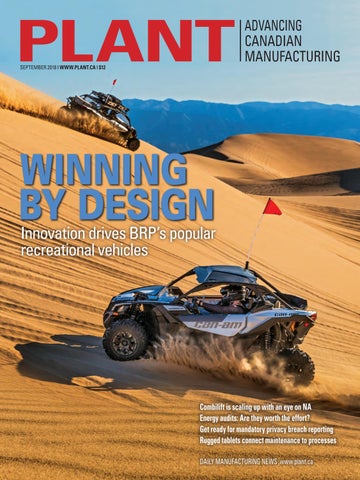
WINNING BY DESIGN
Innovation drives BRP’s popular recreational vehicles
Combilift is scaling up with an eye on NA Energy audits: Are they worth the effort? Get ready for mandatory privacy breach reporting Rugged tablets connect maintenance to processes DAILY MANUFACTURING NEWS www.plant.ca
PLT_Sept2018_AMS.indd 1
2018-09-10 2:50 PM
SPECIAL
LIMITED TIME
OFFER
WHAT DO YOU NEED TO MEASURE? FLIR delivers world-class thermal cameras and test & measurement tools with the accuracy, reliability, and versatility you need to tackle your most challenging jobs.
BONUS BUYS
Visit flir.ca/promos
PLT_JulyAug_Flir.indd 1 2 PLT_Sept2018_AMS.indd Annex Print 9(W) x 12(H) (Bleed .25 W&H).indd 1
2018-07-25 2018-09-10 11:14 2:50 PM AM 7/24/2018 1:47:05 PM
5 11:14 AM 8 1:47:05 PM
CONTENTS
September 2018 Vol. 77, No. 06
FEATURES 15 ADDITIVE MANUFACTURING Advanced image analysis improves part safety. 24 THINK LEAN How to create a lean environment: make processes robust. 25 CCOHS SAFETY TIPS Prevent exposure to fumes and gases. 26 CYBERSECURITY Reporting privacy breaches will soon be mandatory. Are you ready? 27 CUSTOMERS Friction in your value chain is costing you money. 28 PERFORMANCE Valuable lessons from the TWI Summit.
12 INNOVATION
Design is driving BRP’s winning recreational vehicles in international markets.
29 ELECTRICITY There are significant gains to be made from auditing your energy use and implementing the recommendations.
DEPARTMENTS
16 TECH TIP Watch for damage to a motor’s core and the effects of vibration.
17 ASSETS What to watch for when scaling up your plant’s production.
18 MATERIAL HANDLING Irish forklift innovator Combilift is taking on North America.
23 INSIDE MAINTENANCE Fundamentals of tribology and why they’re important.
4 Editorial 6 News Bulletins 8 Careers 10 PLANT Online 11 Economy PLANT Pulse 31 Tech Centre Feature: Rugged tablets connect techs to processes Supply Lines 32 Leading Edge: Innovative ideas for plants 34 Products and Equipment 37 Plantware Events 38 Postscript
COVER IMAGE: BRP
PLANT—established 1941, is published 8 times per year by Annex Business Media. Publications Mail Agreement #40065710. Circulation email: blao@annexbusinessmedia.com Tel: 416442-5600, ext 3552 Fax: 416-510-6875 or 416-442-2191 Mail: 111 Gordon Baker Road, Suite 400, Toronto, ON M2H 3R1. Occasionally, PLANT will mail information on behalf of industry-related groups whose products and services we believe may be of interest to you. If you prefer not to receive this information, please contact our circulation department in any of the four ways listed above. Annex Privacy Officer: privacy@annexbusinessmedia.com Tel: 800-668-2374. No part of the editorial content of this publication may be reprinted without the publisher’s written permission. ©2018 Annex Publishing & Printing Inc. All rights reserved. Performance claims for products listed in this issue are made by contributing manufacturers and agencies. PLANT receives unsolicited materials including letters to the editor, press releases, promotional items and images from time to time. PLANT, its affiliates and assignees may use, reproduce, publish, re-publish, distribute, store and archive such unsolicited submissions in whole or in part in any form or medium whatsoever, without compensation of any sort. This statement does not apply to materials/pitches submitted by freelance writers, photographers or illustrators in accordance with known industry practices. Printed in Canada. ISSN: 1929-6606 (Print), 1929-6614 (Online).
www.plant.ca
PLT_Sept2018_AMS.indd 3
PLANT 3
2018-09-10 2:50 PM
EDITORIAL
Energy and trade: double trouble
I
n case you haven’t noticed, Canada is in a pretty tough spot on two fronts. On one hand, the reality show actor and US president Donald Trump has declared war on America’s formerly trusted northern neighbour. That would be us, folks. Apparently, we, a tiny nation of some 36 million-odd souls, have managed to hornswoggle the world’s greatest superpower on trade, making us the target of his take no NAFTA prisoners tweet raging as the negotiation to refresh the threeway agreement approaches its endgame. On the other hand, efforts to get oil sands production to tidewater from landlocked Alberta, thus reducing Canada’s reliance on discounted sales to our bellicose neighbour, have run aground following the Federal Court of Appeal overturning the Trudeau government’s approval of the Trans Mountain pipeline project. Both hands represent troubling times ahead. The Trudeau government can take credit for the pipeline fiasco. The federal court cited a flawed National Energy Board environmental assessment of how tanker traffic would impact BC’s coast, and Ottawa had not meaningfully consulted with the affected indigenous groups. The Liberals were critical of the Harper regime’s fast and loose treatment of the consultation process with indigenous/ aboriginal groups and its quickie approach to environmental assessment. Lesson not learned. Now the project is set back for who knows how long. Prime Minister Justin Trudeau, full of sunshiny optimism, has gambled he could balance fossil fuel to tidewater with a national carbon policy. He put all is chips on the Trans Mountain project after shutting out the Northern Gateway and wearing down TransCanada pipeline’s patience, leading to its abandonment of the proposed Energy East expansion. When Kinder Morgan got fed up with the political and legal uncertainties surrounding the Trans Mountain project, Ottawa took over, and will pay $4.5 billion for the privilege of holding the bag. Trudeau has vowed the pipeline will be completed, but his determination isn’t reassuring. He will continue to face a hostile government in BC, opposition from green warriors who would like to see an end to all fossil fuel development, especially the oil sands, and aboriginal stakeholders who are now empowered by the Federal Court to throw their weight around. Trudeau has also lost the confidence of a key ally. Alberta Premier Rachel Notley told Justin to stick his national carbon policy. And the Prime Minister can expect pushback from Saskatchewan and Ontario. So much for pipeline/carbon policy balance. Energy makes up about 10% of our GDP. Its development is key to Canada’s economy. The ongoing shenanigans and the Trudeau government’s Keystone Cop management of the pipeline file does not inspire confidence in Canada’s energy sector, where potential capital investment is on hold or cancelled. Business is looking for regulatory certainty, but not seeing it. Indeed, Suncor Energy won’t move ahead with additional crude production expansions until there’s physical progress on pipeline approvals. Meanwhile, at this writing, Canadian and American negotiators are working furiously to bring Canada into the sneaky bilateral deal concluded during the final inning of summer between Mexico and US, as Trump fulminates on the sidelines, threatening Canada with a devastating 25% tariff on autos if the Trudeau government refuses to capitulate. Whatever the outcome, America’s aggressive, confrontational and bad neighbour behaviour has taken the shine off Canada as a place to invest. So, we are facing double trouble over an inability to get Alberta’s oil sands production to tidewater, and trade with our friends in the US. The Trudeau government will be challenged to restore waning business and investor confidence as these dramas unfold, or face unsavoury long-term economic consequences.
Associate Publisher Jeff Brownlee 416-277-8428 jbrownlee@annexbusinessmedia.com Editor Joe Terrett 416-442-5600 ext. 3219 jterrett@plant.ca Art Director Andrea M. Smith National Account Manager Ilana Fawcett 416-510-5202 ifawcett@plant.ca Account Coordinator Debbie Smith 416-442-5600 ext 3221 dsmith@annexbusinessmedia.com Annex Business Media Vice President/Executive Publisher Tim Dimopoulos (416) 510-5100 tdimopoulos@annexbusinessmedia.com President & CEO Mike Fredericks Circulation Manager Beata Olechnowicz 416-442-5600 ext. 3543 bolechnowicz@annexbusinessmedia.com Subscription Price Canada $74.50 per year, US $151.50 (US) per year, Foregin $171.00 (US) per year. Single Copy Canada $12.00. Add applicable taxes to all rates. Combined, expanded or premium issues, which count as two subscription issues. Mailing Address Annex Business Media 111 Gordon Baker Road, Suite 400 Toronto, ON M2H 3R1 Circulation Bona Lao 416-442-5600 ext. 3552 blao@annexbusinessmedia.com Fax: 416-510-6875 or 416-442-2191
Joe Terrett, Editor Comments? E-mail jterrett@plant.ca.
4 PLANT
PLT_Sept2018_AMS.indd 4
September 2018
2018-09-10 2:50 PM
PLT_July
78971
© 2018 Penske. All Rights Reserved.
We deliver confidence. We deliver it by the truckload, because we know companies can’t thrive without it. Penske is built around helping your day-to-day operations run as smoothly and efficiently as possible. Our truck rental, leasing, contract maintenance and logistics solutions will help you carry the load so you can focus on your core business. Learn more at gopenske.ca.
PLT_JulyAug_Penske.indd 51 PLT_Sept2018_AMS.indd
2018-07-24 2:50 2018-09-10 3:18 PM PM
NEWS BULLETINS Schneider Electric is relocating its current operations in Edmonton and 102 employees currently at two leased locations to a newly constructed, 77,000 square-foot space. It will provide the energy management and automation company with the capacity it needs to introduce production of ready-to-install compatible power panelboards to QED switchboards, motor control centres and lighting panelboards. Move-in is set for March 2019. Helm Welding (1983) Ltd. is celebrating 50 years in Lucknow, Ont. where it employs 30 people. The company, a member of the Excellence in Manufacturing Consortium, manufactures products for the agricultural industry and exports to the US, Mexico, Europe, South America, Japan and China. Pond Technologies Holdings Inc. has entered into a non-binding letter of intent to acquire Regenurex Health Corp. in Agassiz, BC for about $7.6 million. Regenurex cultivates and extracts astaxanthin, an antioxidant and valuable nutraceutical product made from algae. Pond, based in Markham, Ont., has developed a technology that allows industrial emitters of CO2 to use the greenhouse gas to grow algae for products used in animal feed and other nutraceutical products. Pinnacle Foods is moving production of its gluten-free products to alternate locations and closing its plant in Laval, Que. after a contract was not renewed. Approximately 150 employees will be affected when the plant ceases operations in November. The company, based in Parsippany, NJ, makes branded food products. Wi-LAN Inc.’s subsidiary Atria Technologies Inc. has acquired a portfolio of more than 85 patents and applications from MagnaChip Semiconductor Corp. in Cheongju, South Korea. The patents cover semiconductor process technologies used in the manufacture of semiconductor devices. MagnaChip makes analogue and mixed-signal semiconductor products. Wi-Lan, a Quarterhill company based in Ottawa, is a patent licensing company.
6 PLANT
PLT_Sept2018_AMS.indd 6
Collaboration on cannabis research VANCOUVER — MYM Nutraceuticals Inc. is partnering with the University of Sherbrooke in Quebec to study the medicinal and industrial uses of cannabis and hemp. University researchers will work with an on-site coordinator to target expertise in various faculties and training centres. Collaboration will include identifying the best alternative energy systems in greenhouses to the effects of cannabinoids on the nervous and immune systems. Research will also cover industrial materials manufacturing, eco materials, hemp fibre biofuels and opportunities created from the by-products of cannabis production. “The signing of this partnership agreement with University of Sherbrooke furthers our goal to be at the forefront of cannabis plant research and development,” said Rob Gietl, CEO of MYM, a medicinal cannabis company based in Vancouver. MYM is a shareholder in two projects in Quebec with more than 1.5 million square feet of production space, and in two cannabis projects in Australia and Colombia.
Garaga opens doors in US market Acquires a US garage door manufacturer
Co-president Maxime Gendreau, executive chair Michel Gendreau and PHOTO: GARAGA co-president Martin Gendreau.
ST-GEORGES, Que. — Canadian garage door manufacturer Garaga Inc. is expanding into the US with the purchase of Mid-America Door Co. in Ponca City, Okla. No financial details were released. Both companies make residential and commercial sectional doors but Garaga specializes in polyurethane products, while Mid-America Door provides its dealers with pan and styrene products. Garaga plans to grow both brands independently by leveraging and sharing each other’s strengths. “We are excited about the opportunities this transaction brings as we will combine our expertise to better serve each of our dealer networks” says Martin Gendreau, co-president of Garaga. “After working on this acquisition, we find there is a great culture fit between our two businesses.” By combining the companies there will be dealers in 40 states. Garaga employs 245 people and has manufacturing plants in St-Georges, Que. and Barrie, Ont.
Aurora gets OK for softgels Capcium will handle encapsulation production EDMONTON — Aurora Cannabis Inc. has received Health Canada authorization to produce cannabis softgel capsules at its state-of-the-art Aurora Vie facility in Pointe-Claire, Que. Production will be handled by Capcium Inc., the Montreal-based manufacturer that specializes in high-volume softgel encapsulation. Aurora holds a 19.99% stake in the company, which is the cannabis company’s exclusive manufacturer CanniMed softgel of softgel products in North America. capsules. PHOTO: AURORA Aurora is also launching, through its wholly-owned subsidiary CanniMed, a line of hardshell, vegan, precision-dose, medical cannabis capsules. Aurora, based in Edmonton, has sales and operations in 14 countries across five continents. Its Canadian facilities also include Aurora Sky and Aurora Mountain in Alberta.
$3.8M contract for oil collecting equipment DARTMOUTH, NS — DSS Marine Co., a provider of environmental response equipment, has been awarded an almost $3.8 million contract by the federal government. The Dartmouth, NS manufacturer will provide 11 boom high-speed sweep systems to the Canadian Coast Guard that will improve response times in the event of an oil spill. The Coast Guard uses the systems to gather oil slicks into a concentrated area, where skimmers and pumps work more efficiently to remove the spill. The 11 systems will be delivered within six months across Canada, and the contract includes an option to purchase 60 additional units.
September 2018
2018-09-10 2:50 PM
Consortium completes Manitoba power projects OAKVILLE, Ont. — The Siemens Canada and Mortenson consortium has successfully completed ± 500-kilovolt (kV) Bipole III high-voltage direct-current (HVDC) power converter stations for Manitoba Hydro. The transmission line will act as an electricity highway bolstering the reliability of Manitoba’s electricity supply by reducing dependence on existing HVDC transmission lines and converter stations, while ensuring low-loss transport of renewable hydropower from northern generating stations. HVDC converter stations are specialized substations that support the conversion of electric power from high-voltage alternating current (AC) to current HVDC, or vice versa, a critical component to interconnecting separate power systems. The Bipole III converter stations include the Keewatinohk Converter Station in northern Manitoba near Hudson Bay, and the Riel Converter Station near Winnipeg. These stations have a transmission capacity of 2,000 megawatts, which meets more than 40% of the province’s peak electricity demand. The two companies were responsible for the turnkey supply of the HVDC converter equipment and associated facilities. Siemens delivered the system design and the manufacturing, supply and commissioning of the core HVDC technology. Mortenson, a US builder and provider of energy services, delivered design support and construction services for the infrastructure, including converter station building, AC filters and DC switchyards. Siemens, the German-based industrial technology company with Canadian headquarters in Oakville, Ont., has commissioned more than 50 HVDC systems worldwide since the 1960s.
New Flyer lands big CHARGE order 40 all-electric buses for Montreal and Laval
An all-electric Xcelsior CHARGE. PHOTO: NEW FLYER
WINNIPEG — More bus deals for the NFI Group Inc. The Winnipeg-based manufacturer’s New Flyer Canada subsidiary won an order for 40 forty-foot, battery-electric Xcelsior CHARGE buses from the Société de transport de Montréal and the Société
de transport de Laval. New Flyer will proceed with a pilot bus in October and begin production following a nine-month review. The new order, supported by funding from the provincial and federal governments, includes 10 buses for STL and 30 buses for STM, making it the largest Canadian battery-electric bus procurement to date. Both agencies operate battery-electric bus pilot programs, with STL and STM committing to buy only electric as of 2023 and 2025. The buses, with 466 kWh batteries on board, will slowcharge at a depot. No financial details were released.
www.plant.ca
PLT_Sept2018_AMS.indd 7
Candiac tests autonomous shuttle The goal is more sustainable municipal transport CANDIAC, Que. — Candiac begins running an autonomous electric shuttle in September as part of a demonstration project offering free transportation from a park-and-ride lot to various stops in the Quebec city. The project, a first in Canada, involves transportation company Keolis Canada, French bus Shuttle will carry passengers during the fall. manufacturer NAVYA, the Quebec Government and Propulsion Québec, la Grappe industrielle des véhicules électriques et intelligents du Québec and Technopôle IVÉO. An operator will be on board the shuttle for the duration of the project to answer questions and take control of the vehicle as required. The shuttle will run through the fall, followed by an experimental phase with no passengers to ensure performance during winter conditions. The project’s aim is to contribute to the evolution of autonomous transport technology.
Catalyst pleased with ITC ruling Tariffs blocked, no threat to US newsprint producers plained the rising cost of newsprint was making it harder to operate. Tariffs were lowered in a decision earlier in August, although newsprint buyers would have been subject to an anti-dumping levy of up to 16.88% and anti-subsidy duties of up to 9.81%. But the ITC found Canadian newsprint did not cause or threaten injury to Catalyst’s Rumford paper mill. PHOTO: ALEXIUS HORATIUS US producers. As a result, there will be no antidumping or RICHMOND, BC — The Trump Adcountervailing duty orders issued on ministration’s tariffs aimed at Canadiuncoated groundwood paper imports an newsprint were blocked by the US from Canada used in the production International Trade Commission (ITC) of newspapers, directories, flyers, on Aug. 29, much to the satisfaction of catalogues and books. US newspapers and Canadian news“Catalyst is very pleased with the print manufacturer Catalyst Paper. ruling from the US International The US Department of Commerce Trade Commission,” said Ned Dwyer, had slapped a 20.26% countervailing president and CEO of Catalyst Paper. and antidumping duty on the Rich“We are a global exporter of pulp mond, BC company, responding to and paper products and we play by a petition from the North Pacific the rules. The facts show that the Paper Co. The Washington competitioner’s allegation that Catalyst pany claimed Canadian newsprint Paper has harmed the US newsprint suppliers were taking advantage of industry is false.” government subsidies to sell paper at North Pacific Paper can appeal the unfairly low prices. ruling. The newspaper industry com-
PLANT 7
2018-09-10 2:50 PM
NEWS CAREERS
SSL expands Psyche project work Looking for insight into how our planet formed
Bombardier Inc., the Montreal-based transportation company, has appointed Danny Di Perna as COO of its aerospace operations. He’ll lead the aerospace engineering, procurement Danny Di Perna and transformation functions. Aerostructures and engineering services will also report to him. Most recently, he was vice-president of global sourcing for GE Power, where he was responsible for strategic sourcing, procurement and supply quality.
HERNDON, Va. — California-based SSL has been selected to build and test the Psyche Compute Element, a flight system component designed by NASA’s Jet Propulsion Laboratory for Psyche, a NASA Discovery Mission. SSL is a manufacturer of satellites and spacecraft systems. It’s part of Maxar Technologies, formerly the Canadian technology company MacDonald, Dettwiler and Associates Ltd. (MDA). The Psyche mission will
The Honourable John Manley joins Montreal aerospace company CAE as board chair. Manley has been an independent director of CAE since 2008. He succeeds James John Manley Hankinson, who has retired, having served as a director since 1995 and as chair since 2013. Manley is president and CEO of the Business Council of Canada, which represents the CEOs and entrepreneurs of leading Canadian corporations. He’s also former Deputy Prime Minister of Canada. He was first elected to Parliament in 1988 and was re-elected three times.
Kruger investing $575M in new tissue plant
Trevor Newell joins Aleafia, a medical cannabis company in Toronto, as chief marketing and technology officer. He was co-founder and president of SHOP. CA Network Inc., Canada’s first eCommerce Marketplace. He also earned a six sigma master black belt at GE. ZCL Composites has appointed Ted Redmond the Edmonton company’s president and CEO. He brings 20 years of experience as a president, CEO and executive vice-president of manufacturing and energy businesses. Most recently he was president and CEO of a North American crane and heavy haul company servicing the construction, heavy industrial and energy markets. ZCL Composites is a manufacturer of fibreglass tank systems supplied to the petroleum industry.
8 PLANT
PLT_Sept2018_AMS.indd 8
investigate a metal asteroid that’s expected to offer insight into how our planet was formed. As the main on-board computer, the Psyche Compute Element acts as Jet propulsion space lab. RENDERING: SSL the brain of the spaceDiscovery Mission candidates. craft, functioning as the coorIt’s scheduled to launch in dinating centre for command 2022. and data handling. The spacecraft recently SSL is also providing a solar completed a NASA mission electric propulsion spacecraft systems review and is on track chassis for the project. to meet its next development The Psyche mission was milestone. selected over four other NASA
SHERBROOKE, Que. — Kruger Products LP is building a new, state-of-the-art tissue plant in the Brompton area of Sherbrooke, Que. featuring what it describes as Canada’s largest through-air-dry (TAD) machine. Quebec is investing $105 million in the $575 million project, which the paper manufacturer says will create 180 jobs. The new plant, located next to an existing facility, will produce 70,000 tonnes of bathroom tissue and paper towels annually, increasing production of Cashmere, SpongeTowels and Purex brands. “This new facility combined with our Memphis TAD location will allow us to rebalance our ultra premium tissue capacity to better serve our customers across North America. The Brompton site will also be part of a critical manufacturing hub in the region, working with our other locations in Crabtree, Gatineau and Sherbrooke to produce great quality tissue products for our company,” said Dino Bianco, Kruger’s CEO. TAD technology uses less fibre for a plusher, stronger, soft and more absorbent product. Kruger has been operating a TAD machine at its Memphis plant since 2013, but its TAD 2 machine will be the first of its kind in Québec. Construction is to begin early next year, with the plant operational by early 2021. The project is expected to generate $250 million in direct spending and one million person hours of employment.
Xebec wins big US PSA tech order MONTREAL — Xebec Adsorption Inc. has won what it describes as a “multi-million dollar” landfill gas upgrading order from an unnamed US-based customer. Xebec, a global provider of gas adsorption technology based in Montreal, said one of its pressure swing adsorption (PSA) systems, a nitrogen rejection unit (NRU), has been selected by one of the largest landfill gas-to-energy developers for delivery in the first quarter of 2019. “Upgraded landfill gas to renewable natural gas (RNG) is playing an increasingly important role in the deployment of low carbon fuels in transportation. We expect Xebec to be playing an important role in this transition, as we move from a fossil fuel economy to a low carbon renewable energy future,” said Kurt Sorschak, Xebec’s president and CEO. Since the conversion of landfill gas to electricity is struggling against lower-priced solar and wind power projects, Xebec said more waste companies and developers are looking at converting gases to fuels as a low carbon alternative and a more promising market. Xebec’s proprietary technology is applied to nitrogen, oxygen and CO2 using a single stage PSA unit. The NRU operates in a wide range of CO2 levels, optimizing the removal process upstream of the unit to maximize the overall efficiency of the landfill gas upgrading plant. Xebec’s licensed rotary valve technology replaces the network of piping and valves used in conventional PSA systems with two compact, integrated valves. They speed up (or intensify) the rate gas flows into a PSA system that uses adsorbent beads in the separation process. The US Environmental Protection Agency has identified 400 landfills suitable for gas to energy or RNG projects. Xebec is estimating approximately 120 to 160 landfills could qualify for the production of RNG, creating a potential market size of US$1.2 billion to $1.6 billion. Xebec has an almost 42,000 square-foot manufacturing facility in Blainville, Que. with 50 employees and an almost 20,500 square-foot plant in Shanghai, China, plus sales offices in Houston and Erbusco, Italy.
September 2018
2018-09-10 2:50 PM
Fast Track tests fuel extender VANCOUVER — Loop Energy’s heavy-duty fuel cell range extender will power two new hybrid-electric Class 8 drayage trucks that will operate for one year as part of a Fast Track fuel cell truck project in Southern California. The Vancouver fuel cell technology company said the trucks will face demanding road operations, towing up to 80,000 pounds of freight throughout the San Diego and Los Angeles regions. The hybrid trucks will incorporate a range of technological advancements including Loop’s FC-REX fuel cell range extender, TransPower’s T-NMC energy storage technology provided by Nissan, and battery-electric drive systems supplied by TransPower. This collaboration will extend the operating range of Peterbilt trucks beyond 200 miles (322 kilometres) without refuelling or recharging. “To meet the commercial demands of heavy-duty freight movement, zero-emission heavy-duty trucks must provide sufficient vehicle range, quick refuelling and meet the power needs demanded by fleet operators, without any impact to freight load,” said Ben Nyland, president and CEO of Loop Energy. “Loop’s range extender means truck operators do not have to choose between hauling batteries or freight, and they can transition to zero-emissions without any impact to cost of ownership.” Fast Track is funded by California Climate Investments and consortium partners. Loop fuel cell range extenders will be integrated by TransPower into the two Peterbilt 579 truck gliders in early 2019. After road testing at Peterbilt’s PACCAR Technical Center in Mount Vernon, Wash., the trucks will enter daily operational service in California during the second quarter of the year. Loop Energy works with vehicle manufacturers to design and deliver carbon-free motive solutions using both electric and hydrogen fuel cell technologies.
www.plant.ca
PLT_Sept2018_AMS.indd 9
Uniboard increasing capacity in Val-d’Or LAVAL, Que. — Uniboard Canada Inc. is investing $38.5 million in its Val-d’Or facility, the second phase of a major upgrade to build a world-class particleboard and thermally fused laminate facility. This latest round of modernization will focus on screening, sifting, milling and intermediary storage equipment. Following phases will involve upgrading the press and finishing lines. The company says its new dry preparation capabilities will improve fibre processing efficiency.
The project includes a new building with state-ofthe-art safety systems. Quebec and Canada are contributing $19.9 million towards the project: a $10 million repayable interest-free loan from the province through the ESSOR program; a $5 million loan from CED through the Quebec Economic Development program; and a $4.9 million non-repayable financial contribution from NRC. Uniboard’s mills in Sayabec, Val d’Or, Mont-Laurier and Laval, Que. employ more than 850 people.
One integrated platform for all your automation needs. One platform for electric automation means seamless connectivity. From electromechanical actuators when joined with servo motors and servo drives to complete positioning systems, motion control solutions as well as entire handling systems and decentralized control solutions - always with the right software and interface. festo.ca/ea Plant half page - EA 2018.indd 1 PLT_Sept_Festo.indd 1
15/08/2018 10:21:01 AM
PLANT 9
2018-08-21 10:02 AM
2018-09-10 2:50 PM
NEWS
Weichai Power buys a piece of Ballard Joint venture is aimed at China’s zero-emission transportation market VANCOUVER — Ballard Power Systems has entered into a major collaboration with a Chinese automotive and equipment manufacturer that includes a significant ownership stake and a joint venture in China, all with an eye on the potential for a zero-emission transportation in the massive Chinese market. Weichai Power is investing Chinese company will manufacture Ballard fuel cell stacks. PHOTO: BALLARD $163 million in the Burnaby, buses, commercial trucks and forklifts. The BC developer of hydrogen fuel cell technolcompany has also committed to building and ogy for a 19.9% stake, making it the largest supplying at least 2,000 fuel cell modules for shareholder. the Chinese market. Weichai will own 51% of the joint venture Zhongshan Broad-Ocean Motor Co. Ltd., to Ballard’s 49%, and will pay the Canadialso a Ballard shareholder, has agreed to an company $90 million for the exclusive invest $20 million to retain its 9.9% piece of right to make next-generation LCS fuel cell the company. stacks and certain LCS modules for use in
Cavendish to close PEI packaging facility O’LEARY, PEI — Potato producer Cavendish Farms will close a fresh produce packaging facility in O’Leary, PEI by the end of the year. The move is blamed on the limited availability of potatoes in the province. General manager Ron Clow says Cavendish had a shortfall of 68 million kilograms of potatoes in PEI last year, which it made up for it by buying from new sources on the island as well as from producers in New Brunswick, Manitoba, Alberta and Maine. He said the company has already made arrangements to import 29.4 million kilograms of potatoes to the province this year, which is not economically sustainable. The firm will focus on frozen potato processing in New Annan, PEI. The O’Leary facility will still be used for raw potato storage, providing some seasonal employment.
PLANT ONLINE SOUNDING OFF
What readers have to say about breaking news Have you checked out PLANT’s daily news online? Here are some headlines that have inspired members of the Canadian manufacturing community to chime in. They’re edited, but use the links to see the raw – and for some – longer versions of their remarks plus the stories that inspired their reactions. Stay up-to-date on the developments – domestic and global – that affect Canada’s industrial sectors by watching the news feed at www. plant.ca or reading PLANT’s twice-weekly newsletter (hit Subscribe on the website). Ontario changes EV program after Porsche buyers get $5,000 rebate http://www.plant.ca/Qv8jl A way to make EVs more feasible is to standardize battery modules for cars like propane tanks for BBQs. Pull into an EV station, and swap out an empty module for a recharged one, pay a fee, and drive away. Freeland to rejoin talks with US, Mexico after they agree to overhaul NAFTA http://www.plant.ca/36tK2 I commend Freeland in her steadfast demeanour in dealing
10 PLANT
PLT_Sept2018_AMS.indd 10
with the psycho named Trump. Chrystia, hold your ground. We can sell our goods (cars, wheat, oil) to other countries. GOP and some Democrats, too reject talk of impeachment http://www.plant.ca/TTHm6 Trump said that he was going to clean the swamp. The only thing I see is that he made it bigger and deeper. Canada preparing retaliation if Trump implements auto tariff http://www.plant.ca/g0V0X I often wonder what would be
the most productive and cost effective way to resolve a tariff dispute. At present we have government cemented in its protection of the supply management cartel and an auto industry lining up for corporate welfare, all at the expense of the taxpayer. Eliminating the cartel provides reduced pricing and great savings to every Canadian. Maintaining the cartel brings billions more in expenses to the auto industry through corporate welfare yet still placing thousands of jobs at risk, with no clear winner. In the end, the winners will be those who have the most to gain: the elite who have caused this problem to begin with. Trump denies wrongdoing, says Cohen is making up stories http://www.plant.ca/kOGni Trump is a compulsive liar. He has lied so much he’s confused what he said to whom. Mean-
while he is hurting the US all over the world. When is he going to stop? I, for one, am tired of his lies. Reality White House: Trump, Omarosa trade insults, charges http://www.plant.ca/cvid6 Never in the annals of history has such an unqualified, mentally deranged, petty, and uneducated individual held such a prestigious position. [He] has little or no understanding of the function of the job he now holds. Freeland defends Canada’s position in Saudi Arabia spat http://www.plant.ca/WaNdk Ms. Freeland is out of line tweeting her personal opinions about Saudi’s human rights issues. Those are best left to the PM to express in a gentler less confrontational tone. Ms. Freeland is garnering a very negative international negotiations reputation, with NAFTA and many EU countries which will cost Canadians millions of dollars in lost business opportunities and jobs. Trudeau needs to step in or make a cabinet change soon before more damage is done.
September 2018
2018-09-10 2:50 PM
ECONOMY
Tariffs take a toll ...but Canada will take a bigger hit than the US
T
rade, Trump and tariffs have been a constantly moving target all summer. As of Aug. 27, the ground shifted suddenly as US President Donald Trump hailed the end of NAFTA with a bilateral Mexico deal. Canada could be part of it, have a separate deal, perhaps no deal, or its Trumpian bluster and this is the basis for a threeway with more negotiating to come. As the trade drama plays out, the Bank of Montreal has highlighted some key points to ponder in a BMO Capital Markets report. Since the end of tariffs are tied to some kind of trade agreement with the US, Canada has the most to lose if there’s no deal. BMO says tariffs to-date could reduce GDP by almost 0.5%, or by 1.5% if proposed duties on autos are imposed. This would add to the jobless rate, although it suggests the Bank of Canada could step in to cushion the blow. The tariff toll in the US to-date has been modest but BMO says it will rise if further rounds are launched. Imposed tariffs will reduce US GDP by 0.025% over a year or two, while proposed and counter duties could reduce growth by 1¼%. Fiscal stimulus has propelled the US economy forward, masking the effects of tariffs. Despite concerns about their impact on material costs and supply chains, investment and hiring have actually strengthened. But BMO places low odds (about 15%) on a US recession occurring within a year. As interest rates rise and stimulus fades, the bank warns the US economy will be more vulnerable to shocks, such as trade warring. Growth is expected to be close to 3% in the second half of the year with a boost from tax cuts and federal spending adding 1% to GDP. The bank welcomes the truce between the US and EU, but notes a deal to roll back tariffs and avoid new ones must be ratified by all 28 EU nations (Italy has recently pledged to derail a done deal with Canada). Look for the report, Tariff-ic, for Now at https://economics.bmocapitalmarkets.com.
www.plant.ca
PLT_Sept2018_AMS.indd 11
EI BENEFICIARIES STABLE IN JUNE number 650,000
600,000
550,000
500,000
450,000
400,000
June 2013
2014
2015
2016
2017
June 2018
The number of people receiving employment insurance rose 0.8% from May to 460,000 in June, but has declined significantly (13.4%) compared to June 2017. Manufacturing and utilities showed a 13.9% drop. In New Brunswick, Quebec, Ontario and Alberta, the number of beneficiaries fell across all broad occupational groups. There were increases in Quebec (4%) and Nova Scotia (2.3%), but the remaining provinces were relatively stable. Claims were up 3.7% from May.
Source: Statistics Canada
A slight decline in Canadian auto sales as of June, down 0.2% year-to-date, but they’re still at record highs, according to Scotiabank’s Global Auto Report.
2.1% Q2 increase of the Machinery and Equipment Price Index, following a 0.2% decrease in Q1, according to Statistics Canada. Manufacturing posted a 2.3% gain.
1,485,954
Tonnes of aluminum produced in Canada year-to-date as of June, according to Natural Resources Canada. That’s an 8.2% decline from the same period last year.
1.1%
$93B M&A activity in Canada in the first half of 2018, primarily due to a surge in cannabis deals, energy and real estate, according to an outlook report by PricewaterhouseCoopers Canada. Canadian companies are looking outside the country for deals.
$111B
The digital factory market as of 2026, growing at a compound annual growth rate of 35%, says a report by ABI Research, a UK market research firm. The food, beverage and tobacco product industry represents the largest revenue opportunity globally (US$19 billion). Durable goods tops the list for Canada, followed by food, beverage and tobacco products, which is notably larger than the next two closest industries (chemical products and automotive). In the US, the biggest segment is chemical products. In Germany and Japan, it’s automotive.
PLANT 11
2018-09-10 2:50 PM
INNOVATION
BRP BY
DESIGN R&D FUELS ITS WINNING RECREATIONAL VEHICLES There are growing markets to be tapped in Mexico, Brazil and China. BY KIM LAUDRUM
H
ow did Bombardier spin-off company and recreational vehicle manufacturer BRP Inc. become the envy of design engineers worldwide, every stock broker’s darling, and a true Canadian success story? Research and development. “Innovation has been a big part of our DNA from the beginning,” says Patrick Dussault, vice-president, global manufacturing and supply chain, for Bombardier Recreational Products. Recipient of more than 70 international awards, BRP has design credentials that proudly arise from its Quebec heritage. From Joseph-Armand Bombardier’s first patent in 1937 for the B7 snowmobile to the first SkiDoo snowmobiles for sport in 1959, Bombardier ploughed its way to become recognized among the world’s top innovators in recreational vehicles. Fifteen years ago parent company Bombardier Inc., the Montreal-based transpor-
tation giant, sent the manufacturer of the well-known Sea-Doo watercraft and Ski-Doo snowmobile to blaze trails on its own. Since then BRP’s stock has shot up 154% and as of this writing, the company is number six on the TSX for stock performance with a 40.4% return. And it’s expected to grow more than 16% over the next three years. Why? BRP made a series of gutsy moves to develop on- and off-road vehicles for the burgeoning power sports market, whose fanatics pay up to $29,000 for the latest model, a CAN-AM Maverick X RS Turbo R side-byside ATV. There’s a growing recreational adventure market in Latin America (especially Brazil and Mexico) and in Asia Pacific (think China). Growth continues in stable, but growing markets in North America and Europe, including Russia, according to National Bank analyst Cameron Doerkson. BRP operates plants in Valcourt, Que., the US, Mexico, Finland and Austria, and employs 10,000 people worldwide. Products include Ski-Doo and Lynx snowmobiles; SeaDoo watercraft; Can-Am on- and off-road vehicles; Evinrude and Rotax marine propulsion systems; as well as Rotax engines for
RXT-x 300 Sea-Doo is built for large bodies of water.
NEW MARINE GROUP CREATED BRP Inc. has acquired aluminum fishing boat manufacturer Alumacraft, based in St. Peter, Minn., leading to the creation of BRP Marine Group. Tracy Crocker, who was senior vice-president and general manager of BRP’s Evinrude Outboard Motors, will lead the new enterprise. Crocker says with Evinrude’s 100-year history of innovation in outboard engine manufacturing and BRP’s expertise in power sports, BRP Marine Group will develop innovative, fuel-efficient and environmentally friendly outboard engines. “We will apply a buy, build and transform strategy to do for the marine business what we have done for the power sports business,” says BRP CEO José Boisjoli. Retaliatory tariffs slapped on US goods coming into Canada included 10% on motorboats. The National Marine Manufacturer’s Association reports that 65% of boats sold in Canada last year came from the US. There aren’t enough marine manufacturers in Canada to supply the domestic market. Some boat dealers across the country are anticipating higher sticker prices as a result of the tariffs. Alumacraft employs 200 people. Installing a snowmobile’s rear suspension.
12 PLANT
PLT_Sept2018_AMS.indd 12
September 2018
2018-09-10 2:50 PM
karts, motorcycles and recreational aircraft. Last December BRP announced it was investing $100 million in an expansion of its global production capacity, mainly to double output at its Juarez 2 plant in Mexico, to keep up with demand for its side-by-side power sports vehicles. When asked whether it was a good idea or not to invest in expansion given the uncertainty about NAFTA, José Boisjoli, BRP’s CEO, said: “We cannot manage our business waiting for the government to finalize negotiations.”
Research and development Boisjoli was named by Quebec business journal La Presse CEO of the Year in 2017. BRP’s annual revenue is expected to reach $4.487 billion in 2018. Of that $199 million – or 4.4% is earmarked for R&D. BRP engineers eat, breathe, and sleep design and innovation. Four centres for innovation in Quebec alone foster the culture that attracts people from around the world. Who wouldn’t want access to the latest tools and toys for creating vehicles that are a joy to ride? From clay models to 3D printing, CAD/CAM programs to virtual reality, the designers experiment creating new models
DESIGN WINNER Among its many accolades, BRP Inc., builder of the Sea-Doo and Can-Am Maverick, picked up three Good Design Australia Awards its power sports products in the product design automotive and transport category. The winning vehicles are: the Can-Am Maverick X3 MAX side-by-side; the Can-Am Maverick Trail side-by-side; and the Sea-Doo RXT-X watercraft. PHOTOS: BRP
A Ski-Doo in a ventilated, soundproof test chamber.
www.plant.ca
PLT_Sept2018_AMS.indd 13
A validation centre for process inspectors.
PLANT 13
2018-09-10 2:50 PM
that incorporate their customers’ most ardent desires – and their own. Many of BRP’s creators are power sports fanatics, too. They ride what they design – and they wear the gear they design. Representatives from R&D, engineering – both design and mechanical – manufacturing, the supply chain and marketing all contribute by committee to new product innovation at BRP, Dussault says. “We also have to consider the voice of the customer and have that represented in that committee. Manufacturing and our supply chain are also represented there in the early stages of innovation and design.” BRP’s challenge? The consumer base wants more product choice. But the lower-volume production means economies of scale from mass-production are not there. How does BRP resolve that challenge? “We are loaded with innovation. We have to reduce our costs, but meet demand,” Dussault says. “We pay attention to best practices in the auto industry, even though we don’t have the same capacities. For example, we have adopted a modular architecture strategy for our manufacturing which makes it way easier to manage.” BRP has dedicated plants that manufacture close to their markets. In Valcourt they make snowmobiles and the Can-Am Spyder. Finland also makes Lynx snowmobiles in Scandinavia. Mexico has two plants: one makes off-road vehicles, the other makes Ski-Doos. “We like to control vertical integration of our manufac-
turing,” Dussault says. “We adopted lean manufacturing more than 10 years ago, using a wall-to-wall post system. We have a full mix, low-production volume. There is not a lot of material on the line. Like the automotive sector, we practice component manufacturing. There is a onepiece flow, pull system.”
Vertical integration What manufacturing brings to the table is crucial to realizing cost reductions while meeting customer demand. Input from plant operators tells them if there’s a faster, better or less expensive way to make a part. Denys Lapointe is the senior vice-president, design innovation and creative services at BRP. As an example of their collaborative design process he points to development of the Spark sport watercraft. The manufacturing team suggested one way to shave a lot of cost would be to fully inject a personal watercraft, but the presses didn’t exist. “We challenged ourselves and came up with a new manufacturing process using a polytech material as a substrate from one of our suppliers,” Lapointe says. The result was a new entry-level watercraft vehicle that is sold in the US for $5,000. It would have been priced at $10,000 using the other manufacturing method. “Our manufacturing folks are very involved right from the beginning. We create new experiences for the consumer. That means we have to challenge the product
BRP unveils modernized Valcourt plant Part of a $118 million investment rolling out over five years
B
RP inaugurated its modernized plant in Valcourt, Que. on Aug. 20 where the recreational vehicle manufacturer makes Can-Am Spyders and Ski-Doo snowmobiles. Valcourt, BRP’s centre of expertise for design, research, development and manufacturing for all BRP activities worldwide, got the upgrades over three years, part of a five-year, $118 million investment. “Valcourt has always been at the heart of BRP’s innovation and modernInside the Valcourt plant. PHOTO: BRP izing the plant was critical to ensuring its efficiency,” said BRP’s president and CEO José Boisjoli, in a statement. The modernization project is part of BRP’s strategic growth, agility and lean objectives that brings the operation into the world of Industry 4.0. The facilities are designed for flexibility featuring modular manufacturing and assembly, with the capability to develop new concepts in conjunction with the design and engineering departments. The plant also allows quicker production and personalizing of snowmobiles and three-wheel vehicles on the same line.
architecture. We’ll come up with ideas and sometimes our manufacturing experts will say, ‘Hey guys, you’re dreaming!’ Or quite the contrary, sometimes they’ll tell us there is a way to accomplish that.” What kind of skill sets does BRP look for when hiring? “We’re always on the lookout for welders,” Dussault says. But more importantly, they want people who embrace the values of the company, particularly on innovation. “There are a lot of expectations on our end. We want a workforce that is completely involved in making problems as visible as possible and providing solutions.” US tariffs slapped on Canadian-made steel and aluminum is one such problem with which BRP is grappling. This could adversely affect the plant in Wisconsin, among other places. Vehicle frames and shaft systems are made of either steel or aluminum, and engines are made in Austria. “Our procurement department is developing ‘what if’ scenarios,” Dussault says. But these days, ‘what if’ scenarios are as numerous and fleeting as clouds. “Like everyone we want to make sure we optimize all three trade agreements. We source locally for some things, globally for others. Mexico is a great place to produce and we are trying to leverage our Mexico supply base. It depends on what happens with NAFTA,” Dussault says. “Sixty-five percent of our revenues come from North American growth. Looking at just off-road vehicles, North America represents more than 65% of that revenue. So, we’re not looking to move our Mexico plants. The plants are successful for us, particularly on cost and quality. Warranty costs are around one per cent.” The international market is growing too. “Years ago the power sports market was a North American play. The international market is now 35% of revenues and growing,” Dussault says. In Asia, for example, the playground is not as established, but with a growing middle class, BRP is working hard to define a strategy there. What’s the takeaway for Canadian manufacturers? Dussault offers this advice: to grow the business, know your markets, seize global opportunities, optimize cost savings through the application of technologies and embrace a dedicated workplace culture that nurtures talent and creativity. It’s certainly working for BRP. Kim Laudrum is a Toronto-based business writer and regular contributor to PLANT. E-mail klaudrum@rogers.com. Comments? E-mail jterrett@plant.ca.
14 PLANT
PLT_Sept2018_AMS.indd 14
September 2018
2018-09-10 2:50 PM
ADDITIVE MANUFACTURING NRC and AP&C research improves cleanliness and safety.
T
he National Research Council of Canada (NRC) and Advanced Powders & Coatings (AP&C), a GE Additive company, have developed a new way to test the quality of powders used in 3D printing, leading to stronger, cleaner, safer and more reliable printed parts for aerospace and medical devices. NRC says this innovative method detects very low concentrations of foreign particles using x-ray micro-computed tomography and 3D image analysis. Each particle is visualized and its size, brightness and overall concentration measured. Researchers validated the method in collaboration with industrial partners using titanium powders destined for aerospace parts. The teams are now expanding their capabilities to other materials and metals, such as nickel alloys. NRC says this new way of testing will be very useful to qualify recycled powders in applications where safety is important. “The competitiveness of 3D printing relies heavily on the capability of machine users to recycle their powders; however, the industry is concerned that foreign particles will be introduced in the feedstock as the powder is recycled,” says Frederic Larouche, executive vice-president and chief technology officer at AP&C. “The method we are developing could help confirm that the feedstock maintains the utmost cleanliness during processing.” Additive (or 3D) manufacturing builds objects by adding multiple layers of material (in this case metal) often initially in powder form. Users produce very complex metallic objects at much lower costs, and with much more precision, compared to traditional methods. The National Research Council of Canada and AP&C, with Canadian offices in Boisbriand,
www.plant.ca
PLT_Sept2018_AMS.indd 15
Advanced image
ANALYSIS
IT IMPROVES THE SAFETY OF 3D-PRINTED METAL PARTS
Que., are cooperating further on improving and developing metal powder characterization methods that are better adapted to the specific needs of the 3D printing industry. NRC is working on the flow of metal powders, measuring the spherical and porous qualities of the particles. Comments? E-mail jterrett@plant.ca.
THE POWER TO CONNECT Featuring the NEW EPIC® MH modular connectors
We know that you demand the latest, greatest, and most innovative connection solutions. EPIC® MH is a modular connector system is capable of combining power, signal, and data transmissions into one single connector. Modular components mount into standard EPIC® housings and are mateable with other industry-standard systems in the market. Customize and simplify points of connection on machinery with the UL Recognized MH system. www.lappcanada.com
PLT_Sept_LappUSA.indd 1
PLANT 15
2018-08-27 2:00 PM
2018-09-10 2:50 PM
TECH TIP Watch for damage to the core, and the effects of vibration.
Motor
n important final test using electrical signature analysis is power factor analysis, whether the motor is operating no-load, or not. Sometimes numbers are manipulated in core loss tests (dimensions are changed, voltage applied) to get the results
APPLY POWER FACTOR ANALYSIS
A
TESTING
Ultranalysis Suite 2 An all-in-one application to manage, trend, and analyze ultrasound and vibration data.
Organizing your condition monitoring program has never been easier with UAS2 • Measurement Matrix • Static Trend Graphs and Alarms • Dynamic Time Waveforms and FFT • Hierarchical Tree Structures
hůƚƌĂƐŽƵŶĚ ^ŽůƵƟŽŶƐ
• Copy, Paste, Rename, Drag-n-Drop edit • Custom user login rights • 3rd party data access via SQL query tool • Single user or network version
sdtultrasound.com/uas
1-800-667-5325 • hearmore@sdtultrasound.com
PHOTO: FOTOLIA
close when cores are damaged due to excessive stripping temperatures. However, if the core is damaged and the correct voltage is applied, whether the motor is loaded or not, the current increases. This is because the power factor (phase angle) becomes worse as the core absorbs more energy to generate the same magnetic field. For instance, if the original no-load power factor was 0.6 and after rewinding drops to 0.2, there has been significant damage to the core. Also watch for how vibration affects the mechanical and electrical components or generator. The effects become more serious as the insulation system ages or is exposed to temperature extremes. Connections that are in contact with the inside of the connection box, or passing through a conduit, abrade against the stationary components, causing them to wear. Brittled windings experience fractures in the insulation system, and the conductors move against contaminants and other conductors, working toward winding shorts. In effect, the resistance to failure decreases with high vibration, which may come from unbalance, misalignment, the surrounding structure, and other equipment. Ensure that alignments are performed properly and that equipment is balanced; and investigate the cause of the abnormal vibration. Source: MotorDoc LLC. Visit www.motordoc.org. Comments? E-mail jterrett@plant.ca.
16 PLANT
PLT_Sept2018_AMS.indd 16
September 2018
2018-09-10 2:50 PM
ASSETS Have a preventive maintenance plan in place before you begin. BY BRYAN CHRISTIANSEN
W
hen ramping up production, you’ll likely run into asset management challenges. Addressing them is easier when you understand what to expect. Here’s a breakdown of typical issues and what to consider if you plan to drastically scale up production: • Time and productivity constraints. Scaling up your facility means you’re either expanding it by adding new assets, you plan to run the production in an additional shift, or both. Each of these scenarios mean work for your maintenance team, including more things to maintain, more spare parts to manage, and more inventory to track. Keep in mind maintenance departments are often pressured to keep the costs down, so they’re probably stretched to their limits as it is. The team will need additional training to keep those assets in peek condition. • Invest in your maintenance team. Make sure it has the people, knowledge and resources needed to ensure this transition goes as smoothly as possible. • Emergency repairs. When scaling up production, current assets operate for long periods, sometimes longer than recommended. Be prepared to do some emergency repairs. Critical system failures often go handin-hand with moving quickly and breaking things. • Minimize the risk of failure and the number of breakdowns. Keep your assets in peek operating condition, which usually means one thing – having a solid proactive maintenance plan already in place. This is helped along with a modern, mobile CMMS. Scaling maintenance work is much easier using its powerful analytics. You can
Implementing a preventive maintenance strategy when scaling up doesn’t have to be a long, expensive process.
Scaling up
PRODUCTION?
ASSET MANAGEMENT CHALLENGES TO WATCH quickly add new assets to your maintenance plan, reassign work orders as needed, track if the work is being done on time, speed up the onboarding of new technicians and have complete oversight over maintenance operations. • Low adoption rates. Scaled production typically means more assets, which means expanding your workforce, maybe organizing some additional training for your maintenance technicians and implementing new procedures (or a new strategy). Keeping a lot of balls in the air creates problems if you’re not seeing the required adoption rates. To get around this, ensure the manager, technicians and other techs are onboard with the project. When all the players are prepared and understand what’s expected, it will be much easier to ensure a streamlined transition and an easier scale process. • Surplus asset policies. Companies tend to sell surplus assets “as is”, without implicit or explicit warranties. This is a bad practice. Instead, develop a section of your terms and conditions documents that cover risk explicitly. This is one of the best ways to initiate better reporting practices and ensure transac-
tions are clear and transparent. Bryan Christiansen is foundProblems are easier to resolve er and CEO at Limble CMMS when you anticipate them and in Lehi, Utah. Visit https:// know what they will look like. 3:54 PM limblecmms.com nrmurphy_mmmore_16 16-06-16 Page 2
Murphy means
MORE.
Quality more
No one gives you more. We sold more than 14,000 systems in the past 70+ years. Get it done right the first time.
430 Franklin Blvd., Cambridge, ON N1R 8G6
(519) 621-6210
Fax: (519) 621-2841
E-mail: 4nodust@nrmurphyltd.com Web Site: www.nrmurphy.com
PLANT 17
www.plant.ca PLT_Sept_NRMurphy.indd 1
PLT_Sept2018_AMS.indd 17
PHOTO: FOTOLIA
2018-08-21 10:09 AM
2018-09-10 2:50 PM
MATERIAL HANDLING
Combilift
SCALES UP IT’S EYEING EXPANSION IN NORTH AMERICA Irish forklift innovator is targeting 30% growth in Canada and the US. BY DAVID KENNEDY
F
or a modern vehicle production plant, Combilift’s new manufacturing facility and headquarters in the Republic of Ireland is noticeably devoid of robotics. Dozens of workers across four production lines piece together the company’s forklifts and material handlers, building each machine to meet precise customer specifications, almost entirely without the assistance of automation. The focus on manual production over robotics is far from an
oversight. Martin McVicar, the company’s managing director and one of its two co-founders, says the plant will serve as a new benchmark for the mass production of customized products. “It’s still a very manual process,” he says. “Even though there’s a little more labour content, that gives us great flexibility.” The new 500,000 square-foot (46,500 square-metre) plant officially opened its doors in Monaghan recently. It’s a testament to the 20-year-old company’s highly innovative products and its ability to carve out a niche for itself in an already mature market. Nestled among the rolling
Inside Combilift’s new plant.
Painted parts drying.
Welder at work.
Aerial view of Combilift’s new plant.
18 PLANT
PLT_Sept2018_AMS.indd 18
PHOTO: COMBILIFT
September 2018
2018-09-10 2:50 PM
geared on developing innovative forklift trucks that are focussed on a niche market.” The firm was founded in 1998 by McVicar and Robert Moffett – of “Moffett Mounty” fame – and has since grown into the 13th largest producer of forklifts in the world. It currently has about 40,000 forklifts in operation in factories, warehouses and material yards in 85 countries.
Diversified lineup
PHOTO: COMBILIFT
Installing wheels
green hills of Eire, close to the Northern Ireland border, the facility is one of the largest in the country under a single roof. It includes welding, assembly and spare parts operations, as well as office space for sales and administrative staff and design engineers. There’s also
A Combilift forklift taking the tilt test.
www.plant.ca
PLT_Sept2018_AMS.indd 19
room for further expansion on the 100-acre (40-hectare) site if Combilift continues to build on its success and innovate its way into new market segments. “Our intention is not to get into the high-volume production of forklift trucks,” McVicar says. “Our business is very much
Finished forklifts.
Though Combilift originally broke into the market by offering novel equipment for handling long goods, it’s since diversified its lineup, using the tough environment during the 2008-09 recession as a catalyst to move into the manufacturing and warehousing markets. “We feel the downturn has done our business a world of good because customers now take more time to analyze what they’re buying,” McVicar says. In the years leading up to the crash, he adds, companies simply wanted “another forklift” and did far less research into solutions that could save space, reduce overall costs and improve safety. Innovative products such as Combilift’s Aisle Master, an articulated truck that operates in an aisle as narrow as 72 inches (1.8 metres), cater largely to manufacturing and logistics operations where floorspace is at a premium. Its range of pedestrian stackers, which include a novel tiller arm that allow operators
to use the lift without standing directly behind it, are another product aimed at saving space and boosting safety. To ensure it remains on the cutting edge, the company pumps 7% of its annual revenue into research and development each year. Combilift’s new 50 million euro (approximately $77 million) plant will allow it to ramp up production of its existing products and hit the ground running with new equipment. The site currently employs 550 workers, while a further 200 will be added to payroll over the next three years. The new facility also has space to install two additional lines as the company zeroes in on its goal of doubling its output. An aggressive North American growth plan is one of the main rationales for the scale-up. This year alone Combilift is targeting 30% growth in Canada and the US, according to Paul Short, the company’s president for North America. “The business sentiment in the US and Canada is really good, “ he says. “There’s a lot of infrastructure spending expected, there’s a lot of owner/operators and businesses investing.” Short also pointed to the recent corporate tax changes in the US as a factor that will trigger spending south of the border. Combilift has a foothold in North America through its sales and support facility in Greensboro, NC. It currently has
Working on the engine.
PHOTOS: DAVID KENNEDY
PLANT 19
2018-09-10 2:50 PM
Rittal Automation Systems We automate panel building
PLT_Sept_Rittal.indd PLT_Sept2018_AMS.indd 1 20
2018-09-10 2:50 PM
Processes Optimization of the complete Optimization of the complete workflow workflow in enclosure manufacturing Rittal Automation Systems supports all process stages in control and switchgear in enclosure manufacturing engineering. From manual tools through to fully automated systems, find your customized solutions for process-optimized workshop operations.
The Rittal Automation Systems business unit with its portfolio of services supports all process stages in control and switchgear engineering. From manual tools through to fully automated systems, find your customized solutions for process-optimized workshop operations. ◾ Machining of enclosures and components ◾ Assembly of terminal blocks on DIN rails ◾ Assembly of wires and cables ◾ Automated wiring solutions ◾ Handling systems and tools
Assembly
Wire processing
Tools
Handling
Assembly: Our component mounting products are used for the automated manufacturing of terminal strips in control and switchgear engineering. ◾ Athex – Terminal assembly and labeling
Wire processing: Take advantage of our professional, sensible solutions in wire processing. ◾ Cutting machine ◾ Stripping machines ◾ Stripping/crimping machines
Tools: The right tool for every application. ◾ Screwdrivers ◾ Pliers ◾ Insulation stripping and crimping tools ◾ Hole punching tools
Rittal Systems Ltd. • 6485 Ordan Drive • Mississauga, Ontario L5T 1X2 • Canada Phone: 905-795-0777 • Toll-free: 800-399-0748 • Email: marketing@rittal.ca • Website: www.rittal.ca
PLT_Sept2018_AMS.indd 21
2018-08-30 2:50 2018-09-10 9:17 PM AM
50 workers, but is already moving ahead with plans to double headcount. Back across the Atlantic at Combilift’s new base of operations, workers on the assembly plant’s Line 1 piece together nine all-electric trucks each day. Its second line produces eight gas models a day, while Lines 3 and 4 are reserved for the company’s larger forklifts, topping out at a multidirectional truck with a
25,000-kilogram (55,000-pound) capacity. A separate production area is dedicated to assembling the Irish firm’s Straddle Carrier, a unique material handler that lifts a prodigious amount of weight by “straddling” over the load. The somewhat ungainly piece of equipment has found a number of applications lifting large products, such as wind turbine blades and slabs of pre-cast
concrete. While in-factory automation isn’t a focus for Combilift, McVicar hinted that the company does have automated guided vehicles of its own in the pipeline. Having partnered with a technology company that has a history of using contour mapping and GPS in the mining business, Combilift’s material handlers are preparing to shift palettes
BAD MOVE. GOOD MOVE.
David Kennedy is the editor of On-Site magazine, an Annex Business Media publication. E-mail DKennedy@on-sitemag. com. Comments? E-mail jterrett@plant.ca.
Want to be an asset expert? Become CAMA-certified
A
Up to 75% more tensile strength and 30% higher transmittable force.
move-series
The New Generation of Timing Belts
22 PLT_Sept_Brecoflex.indd PLANT 1
PLT_Sept2018_AMS.indd 22
in busy plants and warehouses without a human at the controls. “As we all know, warehouse parameters change daily,” McVicar says. “We believe that we’re going to come to market with a system that instead of an AGV product, it’s an intelligent gated vehicle is really what we’re targeting.” Combilift says it’s currently piloting two of the vehicles in food and automotive plants. “I’d be surprised if you’re going to see automated trucks built here in the next five years, but you’re definitely going to see us building automated gated vehicles for other clients.” It’s an unconventional way to approach automation, but if the past 20 years are any indication, the Irish success story will continue to take on its larger rivals in niche areas and come out on top.
www.brecoflex.com
2018-08-07 9:31 AM
re you or a member of your plant’s maintenance team interested in becoming a certified asset management assessor? CAMA (Certified Asset Management Assessor) certification developed by the World Partners in Asset Management LLC is available through the Plant Engineering and Maintenance Association of Canada, a member association. Certification demonstrates the holder has the necessary knowledge, experience to serve as part of an ISO 5500x certification-of-organizations process. Register for a pre-scheduled exam or book your own. E-mail pd@pemac.org.
September 2018
2018-09-10 2:50 PM
INSIDE MAINTENANCE Following a regimented lubrication regime will prevent downtime and save money. BY STEVE GAHBAUER
M
aintenance of lubricating oils in critical applications is essential but many programs lack the basic tools, required knowledge, sufficient manpower or maintenance budget to keep them within specification, thus missing out on their full benefits. Furthermore, lubricant maintenance is often reactive and limited to reducing particulate matter instead of targeting the causes of failure. This disconnect is costing industry hundreds of millions of dollars annually. Here are some statistics from several studies: 90% of rolling element bearings do not reach their design life because of faulty lubrication; 80% of hydraulic system failures are caused by lubricant contamination; 70% of component replacements are due to surface degradation caused by friction and wear; more than 50% of equipment failures are the result of improper lubrication. That’s why knowing how tribology works is so essential to running a profitable maintenance operation. A discussion at a technical education seminar on lubrication fundamentals, hosted by the Society of Tribolology and Lubrication Engineers (STLE) – Hamilton, ran through some of the fundamentals. Navdeep Swach, a certified lubrication specialist, maintenance biologist and coach at ArcelorMittal Dofasco in Hamilton, defined tribology as “the study of rubbing” or the science concerned with interacting surfaces in contact and in relative motion, causing friction and wear. Friction and wear cause abrasion, erosion, adhesion, surface fatigue and, above all, corrosion. While these causes can’t be eliminated, their
www.plant.ca
PLT_Sept2018_AMS.indd 23
More than half of equipment failures are the result of improper lubrication.
Rubbing the wrong
WAY
WHY UNDERSTANDING TRIBOLOGY IS IMPORTANT consequences are mitigated by following a lubrication regime that’s anchored in five principles: using the right lube, at the right place, the right time, right amount, and in the right way.
Increase reliability The most frequent failure modes are often related to lubricant contamination, chemical degradation or cross-contamination. Other causes include the use of the wrong lubricant type or grade, says John Melanson, an engineering manager at SKF-Canada Ltd. in a presentation about lubrication management. Best practices increase equipment reliability, productivity, machine uptime and safety, and reduce energy consumption, wear, noise, downtime, operating expenses, repair costs and lubricant con-
sumption. In the same lubrication fundamentals seminar, Mike Deckert, vice-president of Flo Components Ltd., a lubricant specialist company in Mississauga, Ont., reiterated these points: • Manual lubrication is still the predominant method of lubrication for grease-lubricated bearings (more than 95% ). • Maintenance budgets have been declining, resulting in fewer technicians carrying out inspection data interpretation, lubrication requirements and analysis. • Plant production has increased, allowing less scheduled time for lubrication/ maintenance. • Longer intervals between servicing are required for mobile equipment.
PHOTO: FOTOLIA
Deckert defines the basic functions of a lubricant as reducing friction, wear and temperature, minimizing corrosion, sealing out contaminants, and helping to dampen or absorb shock. He also reminds us that lubrication intervals depend on the metal-to-metal contact area of bearings, machine speed, operating temperature, and the type of grease used (thicker grease tends to have a longer staying ability in a bearing). Finally, some good advice from Ken Brown, principal of Eco Fluid Center Ltd. in Toronto and an executive member of STLE-Toronto, in a presentation to students at Ryerson University. Usually you can’t find all the answers to tribology problems inside an organization, so regularly attend technical meetings, develop contacts, network with colleagues, and learn from studies. He also advises ISO 55000 asset management standards are great for real engineering with a focus on root cause analysis and training. Steve Gahbauer is an engineer, a Toronto-based business writer and a regular contributing editor. E-mail gahbauer@ rogers.com. Comments? E-mail jterrett@plant.ca.
PLANT 23
2018-09-10 2:50 PM
THINK LEAN
Henry Ford recognized the benefit of organizing tasks into manageable components.
Break down tasks to their simplest functions, create flow and make it visible. BY RICHARD KUNST
A
non-lean environment is mediocre processes managed by amazing people. In a lean environment, amazing robust processes can be staffed with mediocre people. Why is developing robust processes so difficult? In many cases people have become victims of their environment. Over time, complexity has crept in making it harder for new people to learn, typically it takes longer and outcomes are unpredictable. Take the assembly of a car. If one employee built an entire vehicle, he/she would need to possess many skills to complete the tasks. Welding to assemble the frame, building the engine and attaching other drive train components; upholstering to create the interior; painting the exterior, and so on…
24 PLANT
PLT_Sept2018_AMS.indd 24
PHOTO: FORD
Make processes
ROBUST ... AND CREATE A LEAN ENVIRONMENT Imagine finding such a multiskilled employee. It would be like training a thoroughbred horse. Henry Ford was brilliant. He knew that to be effective, cost positive and predictable, tasks would have to be broken down into small manageable components. Now we have individual specialists, not generalists, with many eyes to contribute continuous improvement ideas. Even McDonalds has mastered the art of work breakdown and includes the use of andons (notification system for quality or process problems).
So observe every process and break them down into simple tasks, and continue to break them down to very minimal and simple elements.
Create flow Office and administrative processes are prime candidates. Since little has been done to lean out these processes, there are huge opportunities for cellular methodologies and single piece flow. Next look at how to create flow within a process. A great way to accomplish this is by adopting timed delivery routes,
which accomplishes a couple of things. They maintain employees focused at their workstations while materials are conveyed or advanced through the process, and they will establish a cadence. Remember people will expand work to fill the time allocated. Start your routes small and simple – a mail run or clearing the garbage. Walking around is like a timed delivery route. The organizational memory is based on when the boss comes by. Team members learn to meet specific metrics and deliverables. You need to make the process visible. The status of a process or where problems are happening will quickly be evident. Make sure you have “talking floors” so you know where items are to be located, or if they’re missing. Shadow boards for holding tools works well in any work environment, but consolidating them into one location isn’t necessarily ideal since every 30 inches of reach consumes 0.6 seconds. As processes became more visible, you’re creating distributed accountability, which leads to standard work and some element of empowerment within controllable limits. You’re also getting close to having the true lean environment. Finally, it’s important to track process compliance as a feedback loop to the employees, but it’s also a way to measure success. Metrics should be simple. As the process becomes more robust and predictable, you and your team will be ready for more complex metrics. Richard Kunst is president and CEO of Cambridge, Ont.-based Kunst Solutions Corp., which helps companies become more agile, develop evolutionary management and implement lean solutions. Visit www. kunstsolutions.com. E-mail rkunst@kunstartofsolutions. com. Comments? E-mail jterrett@plant.ca.
September 2018
2018-09-10 2:50 PM
SAFETY TIPS Develop controls that will protect welders and bystanders from harmful effects.
W
elding gases and fumes pose a serious threat to anyone who inhales them. They’re a complex mixture of metallic oxides, silicates and fluorides, formed when a metal is heated above its boiling point and its vapours condense into very fine particles. Welders have the highest risk of exposure, but anyone nearby will also be exposed. Each fume will be different depending on the material being welded, the electrode and the type of welding. Airborne gases and fumes include: nitrous oxide; carbon dioxide; carbon monoxide; argon; helium; ozone; and metal fumes such as manganese and chromium. Effects from short-term exposure are eye, nose and throat irritation, dizziness, and nausea, but longer term they include asthma, pneumonia, reduced lung function, stomach ulcers, kidney damage, nervous system damage and cancer of the lungs, larynx and urinary tract. WorkSafeBC suggests the following controls: 1. Elimination/substitution
Combine the use of protective equipment with at least one other risk control. PHOTO: FOTOLIA
Control welding
RISKS
HOW TO PREVENT EXPOSURE
• Substitute a safer process or material. • Use less hazardous materials (such as manganese-free welding rods). • Apply a process such as cold joining that generates fewer gases or fumes. • Improve designs to reduce the amount of welding required. 2. Engineering controls • Modify facilities, equipment and processes to reduce exposure. • Improve general ventilation. • Set up fans to move the smoke
away from the welder and other workers. • Use local exhaust ventilation to remove contaminated air. • Use turntables so gases and fumes don’t cross the welder’s face. 3. Administrative controls • Modify work practices and policies, apply awareness tools and training. • Develop a plan to control exposure. • Post warning signs. • Schedule work away from areas used for big jobs.
• Set up separate stations for work and street clothes. • Implement a hygiene awareness program. 4. Protective equipment • Use it in addition to at least one other control. • Provide appropriate respirators, eyewear and protective clothing. • Fit-test workers to ensure respirators are operating properly. • Verify personal protective equipment is working. For more information, see the CCOHS Welder’s Health and Safety Guide at www.ccohs.ca/ products/publications/welders.html. The Canadian Centre for Occupational Health and Safety (CCOHS) in Hamilton contributed this article. CCOHS provides information, training, education, management systems and solutions that support health and safety programs and the prevention of injury and illness in the workplace. Visit www.ccohs.ca. Comments? E-mail jterrett@plant.ca.
“Industrial Transformation Begins Here...” - Han-Modular® The biggest transformation the industry has never seen before
HARTING-usa.com
Combine Different Media into One Customizable, Plug & Play Connector Solution Space-savings. Flexible. Low-Maintenance. IIoT-Capable. ■ See how you can save cost and time by downloading the Han-Modular® app. HARTING-usa.com/hartingapplications
www.plant.ca PLT_MayJune_HartingCanada.indd 1
PLT_Sept2018_AMS.indd 25
■ Free up your time by taking advantage of HARTING’s assembly business. HARTING-usa.com/customized-solutions
PLANT 25
2018-05-07 11:25 AM
2018-09-10 2:50 PM
CYBERSECURITY What you need to know when new provisions come into force. BY SANDY BOUCHER
T
he Digital Privacy Act came into force in 2015, and made key changes to the Personal Information Protection and Electronic Documents Act (PIPEDA). Since then, private sector organizations subject to PIPEDA have known that mandatory privacy breach reporting would be implemented across Canada at the federal level; but they didn’t know then what they would be expected to disclose in the event of a breach. The government released new provisions that will come into force on Nov. 1. Any manufacturer holding private information of an employee, client or customer that experiences a digital breach must report the incident according to PIPEDA rules. Here’s what the changes mean for your business. Which breaches must be disclosed? Both affected individuals and the privacy commissioner are to be notified when breaches pose a “real risk of significant harm.” Significant harm is defined as a risk of bodily harm, humiliation, financial loss, identity theft, damage to reputation or relationships, loss of employment or professional opportunities, negative effects on their credit, or damage to/ loss of property. Early indications are the privacy commissioner is taking an aggressive stance on what type of data loss meets this standard. When must breaches be disclosed? When it’s determined a breach has occurred, the affected individuals must be notified “as soon as feasible.” What should be included in the notifications? Affected individuals must receive notifications that contain: • a description of the circumstances of the breach; • the day or the period during which the breach occurred;
26 PLANT
PLT_Sept2018_AMS.indd 26
Personal data breach? Be prepared to comply with PIPEDA rules.
Privacy
BREACH
REPORTING WILL SOON BE MANDATORY. ARE YOU READY? • a description of the personal information that was breached; • a description of the steps taken to reduce or mitigate the risk of harm to the individual; • a description of the steps the individual can take to reduce or mitigate the risk of harm; • a toll-free number or e-mail address the individual can use to learn more about the breach; and • information about the organization’s internal complaint process, and the individual’s right to file a complaint with the privacy commissioner. Manufacturers must also provide the privacy commissioner with a written report that describes: the breach and its cause (if it’s known); an estimate of the number of people at risk of significant harm; a description of the personal information that
was compromised; details of how the organization is working to resolve the breach and reduce risk of harm; a description of how the organization plans to reach each of the affected individuals; and a contact person who can answer more questions about the breach. How must individuals be notified? They are to receive notification directly by e-mail, mail, phone or in person. That said, there are three cases where indirect notification is permitted if: issuing a direct notification is cost prohibitive; the affected individual would suffer further harm; or the organization doesn’t have direct contact information for the affected individual. Where direct notification is impossible, manufacturers must still take steps to provide indirect notification – either by post-
ing a “conspicuous message” on the company website for 90 days or by placing an ad likely to reach the affected individuals. What exposure does a company face? The privacy commissioner may choose to launch an investigation. Similarly, an affected individual may have the right to launch a civil lawsuit, which is why companies are expected to keep records of the breach for two years. Finally, organizations that fail to notify affected individuals following a breach could face financial penalties and legal action. As data security incidents mount, the likelihood of privacy breaches will only rise. No organization is immune, but robust incident response planning and processes will help your company validate, assess, contain and remedy data breaches with minimal disruption, publicity and cost. Sandy Boucher is a senior manager, advisory services at Grant Thornton LLP, a Canadian accounting, tax and advisory firm. Call (416) 3697027. E-mail Sandy.Boucher@ ca.gt.com. Visit www.grantthornton.ca. Comments? E-mail jterrett@plant.ca.
September 2018
2018-09-10 2:50 PM
CUSTOMERS It’s costing you dollars – both hard and soft – while eroding competitive advantage.
Create a frictionless customer experience. PHOTO: FOTOLIA
an exchange of 24 e-mails including the return of a wrong product before they actually got it right. Despite perfect production, Fitbit suffers from massive friction, massive costs that should never be there, and risks losing customers.
BY ANNE GRAHAM
C
ostly friction is everywhere in your business, at every stage of the value chain. On the shop floor, it’s re-work and on-time issues. In the supply chain, it’s poor-quality products and lost time required to resolve the problem. Friction costs soft dollars that you’ll never be able to track, hard dollars that are leaking out of your bottom line, and it’s costing you competitive advantage. Customers love the path of least resistance because it’s frictionless – and whoever gets there first in your industry is going to dominate. Let’s step away from the shop floor for just a moment and take a broader look at enterprise excellence across the value chain, with a couple of examples that will get you thinking:
1.
Look for friction at the front end of the value chain. We talk about IoT (the Internet of Things) in terms of connecting our manufacturing and supply chain processes more efficiently, but have you heard of the Dash Button? It’s still clumsy and inelegant versus what’s yet to come, but it’s a game changer for consumer goods and there are already thousands of them. Place one of these small devices for your favourite products in your laundry, kitchen, bathroom or elsewhere in the home. When you’re running short, simply push the button. Amazon delivers the product to your door by one day later – frictionless. If there’s a Tide button in your laundry, what chance do Woolite or Cheer have by adding the friction of a trip to the store, standing in line to check out, and hauling their products home?
www.plant.ca
PLT_Sept2018_AMS.indd 27
Fixing failures
Feeling the
BURN? BEWARE OF FRICTION IN YOUR VALUE CHAIN First with frictionless wins. In your own value chain, how many policies, procedures, legalese, terms and conditions are actually making it difficult for customers to buy from you? What is it costing you in backand-forthing and lost business? What could you do to create a frictionless front-end experience for your customers? What could your suppliers do to create a frictionless front-end for you? Efforts by you and your suppliers will eliminate waste and costs.
2.
Frictionless at the back end could eliminate massive waste. I LOVE my Fitbit…and if I didn’t, the amount of friction I experienced at the back end of the value chain would have had me running for a competitor.
The product was manufactured perfectly, but a design flaw put massive cost into their system that eliminated any margin they may have earned on the sale. Less than a month after buying a replacement Charge HR for one that fell apart after about nine months, it happened again – the rubberized band separated from the face. I experienced a frictionless WOW when I first contacted them. Instead of the usual “send us your bill to prove warranty” nonsense, they simply asked me to snap a photo of the damage with my smartphone, and they’d replace it, no charge. Of course, they already knew when it had first gone into service, thanks to the IoT! Without boring you with all of the gory details, that simple replacement eventually required
In your own value chain, consider your customer service department, and how much of their time is spent on fixing post-sale or post-delivery issues versus helping customers buy. How often do your customer service agents apply root-cause analysis to a problem rather than simply going on to the next customer? Up to 83% of the typical customer service agent’s time is spent fixing – and that’s pure waste. It’s friction for them and for your customers. What’s the solution? I use a process I call “Staple Yourself to the Experience” that focuses beyond the shop floor to find hidden waste that you’re not seeing today. To achieve a higher level of enterprise excellence, simply track a customer transaction from start to finish and use your lean tools to look for waste, streamline and create a frictionless customer experience at every stage of the value chain. You’ll earn customer loyalty, eliminate costs that shouldn’t be there, and improve profitability by double-digits.
Anne Graham is the principal of The Legendary Value Institute, a consulting firm based in Vancouver. She is the author of Profit in Plain Sight and an AME director in BC. Visit www.AnneCGraham.com. E-mail anne@annecgraham. com. Comments? E-mail jterrett@plant.ca.
PLANT 27
2018-09-10 2:50 PM
PERFORMANCE
Driving
IMPROVEMENT LESSONS FROM THE ATLANTA TWI SUMMIT Three themes emerged that demonstrate training works.
themes ran through the conference proceedings:
1.
BY HUGH ALLEY
T
Surprise that training had worked! It showed up in several ways. When head office decreed a certain level of performance but with no supporting budget, one presenter was desperate and turned to training. In other cases there was an immovable deadline, so management was looking for anything that would help
he February Training Within Industry (TWI) Summit in Atlanta featured presentations from many industries including manufacturers with sales ranging from a few million dollars to several billion. Three
INNOVATING
SAFETY
Training should come from supervisors or trained staff.
achieve the objective. Repeatedly, presenters expressed their surprise that despite their expectations and experience, the TWI programs worked. They typically described how they found the TWI programs, implemented them and what contributed to their success. But underlying so many presentations was the widespread belief going in that training doesn’t work, followed by their absolute delight when it did. It was striking that each organization had implemented it a bit differently, yet it had worked every time. The takeaway? Not all training is equal. Training with a good structural foundation, such as TWI, is effective.
2. SAFEST REELS PATENTED REWIND SYSTEM
DURABLE. RELIABLE.
HOSE, CORD, & CABLE
PRO GRADE REELS SOLUTIONS FOR:
IN THE INDUSTRY.
Eliminate dangerous whipping hazards. Requires no external power source. Wide array of reel models & options to increase worksite efficiency & safety.
WATER | AIR | POWER | HYDRAULIC | PNEUMATIC | VACUUM | WELDING AND MORE
www.coxreels.com
Training has to be done by supervisors or trained staff. It can’t be done by corporate trainers. There were two reasons for this. When people on the job develop training they’re more attuned to the mistakes that can happen, so they’re better at heading them off. And because trainers are local, they’re better placed to note people doing things right or to correct them and redo the bits that didn’t stick. Either way, it means fewer mistakes. The takeaway? Push training
28 PLANT PLT_April_Coxreels.indd 1
PLT_Sept2018_AMS.indd 28
PHOTO: FOTOLIA
to front line leaders.
3.
Developing good instruction drives standard work processes. Many presenters describe how creating a job breakdown pushed the team into conversations about the current best way to do a task, and how the shift to “the current best way” improved productivity and quality. The takeaway? You need a reliable instruction method to get that standard work across to your team. The energy and enthusiasm from people using TWI modules was infectious. More importantly, attendees learned that choosing TWI (http://twi-institute.org/training-within-industry), a proven approach to training, drives improvements in productivity and quality. It’s a choice worth making.
Hugh Alley is an industrial engineer based in the Vancouver area who helps organizations achieve significant performance gains in delivery, quality and cost over a short timeframe. Call (604) 866-1502 or e-mail hughralley@gmail. com. Comments? E-mail jterrett@plant.ca.
September 2018 2018-03-27 1:15 PM
2018-09-10 2:50 PM
ELECTRICITY Significant cost savings result from implementing recommendations.
At Furlani’s Foods, a bread manufacturer in Mississauga, Ont., radiant heat reduction was achieved by applying a new thermal insulation layer on the oven and using more efficient burners. PHOTO: EBC
BY JOHN NICHOLSON
A
ny good business owner knows the two ways to affect the bottom line: make money or save money. Most businesses focus on the former at the expense of the latter. In Canada, there is renewed interest in energy audits because of the rising cost of electricity and the availability of government assistance to offset the cost of the audit and implementation of recommendations. Many public utilities around the world encourage energy conservation. From the public utility perspective, it’s cheaper to invest in electricity reduction programs than it is to construct new generation capacity. With climate change policy becoming enacted as legislation in many jurisdictions across North America, the drive toward energy conservation is being accelerated. For the most part, reducing energy use also reduces a business’s carbon footprint. The most basic form of an audit is the examination of the electricity use at a facility, which includes a walk-through to determine potential no/low cost energy savings. More complex audits breakdown energy uses, identify conservation measures, and calculate the cost/
Energy
AUDITS
ARE THEY WORTH THE EFFORT? benefit of implementing specific energy saving measures. Brian Bobbie, president of the Altech Consulting Group, which has been performing energy audits since early 1990s, says energy audits usually pay for themselves. “We view energy audits as an important first step in reducing the electricity costs
for businesses. We’ve found that companies that arrange to have an energy audit also find efficiencies in other areas of the facility such as water usage.” There are very few instances where companies that commit to energy audits do not find it useful. There is plenty of anecdotal evidence that significant cost savings result from implementing the recommendations from an energy audit.
Do energy audits pay?
Thanks to an energy audit, Magnotta Winery in Vaughan, Ont. also met York Region’s PHOTO: EBC sewer bylaw limits, reducing surcharge costs.
www.plant.ca
PLT_Sept2018_AMS.indd 29
There are plenty of examples of companies implementing energy saving measures that have immediate pay off that reduce electricity bills by 20% or more. But to qualify for rebates, you need to ensure that you hire a qualified energy auditor who is a professional engineer (P.Eng.), certified energy manager (CEM) or other designation specified in the program. Ask the firm for its designation, request referenc-
es and confirm with licensing bodies. “There are a number of firms in Canada that have the qualifications, expertise and experience to conduct an energy audit,” says Bobbie. “The key to a successful audit is finding an auditor that has a depth of experience, can do the cost-benefit analysis, and payback calculations that allows for easier decision making on what energy saving recommendations to implement.” Ask candidate firms for examples of how they were able to use the findings from energy audits to generate recommendations that were practically integrated with the business and operations of the company. Would you refuse $25,000 in financial incentives to conduct an energy audit? Ontario utilities, through the Save-on Energy Program, offer just that to businesses interested in arranging for an energy audit and reducing energy costs. The program not only applies to industries that own their own buildings but companies that are tenants as well as commercial firms, institutions and multi-residential buildings. Ontario’s audit funding program covers up to 50% of the cost of an energy audit. The funding allotment is based on the size of the building. Buildings up to 30,000 square feet receive an incentive of $0.10 per square foot up to a maximum of 50% of the audit cost. Buildings larger than 30,000 square feet receive $3,000 and $0.50 per square feet up to $25,000 or 50% of audit costs thereafter. There are several types of audits ranging from a simple electricity survey and analysis to a detailed analysis of capital-intensive modifications. The detailed analysis identi-
PLANT 29
2018-09-10 2:50 PM
fies potential capital-intensive projects from the electricity survey analysis. Detailed field data combines with in-depth engineering analysis to provide potential project costs and savings calculations. To get started, contact your local hydro electricity company. It will guide you through the application process. You need to complete a form and also select an acceptable auditor.
Available capital incentives What is the use of an energy audit that has some really good suggestions if you can’t afford to implement them? Under the existing programs, there is funding available for implementation. In Ontario, a capital incentive program provides up to 70% for the cost of capital equipment. The small capital incentive supports investment in capital projects for large projects that will increase the efficiency of a
30PLT_April_Gorbel.indd PLANT 1
PLT_Sept2018_AMS.indd 30
process or system at a facility. The project capital incentive is aimed at very large process and system energy efficiency projects. Generally, large projects that don’t fall within the Small Capital Incentive Agreement parameters would go through the Project Incentive Agreement. Your local hydro electricity company pays out the funds. The Ontario Independent Electricity System Operator (IESO) oversees the entire program, which is responsible for balancing the supply of and demand for electricity on a second-by-second basis across Ontario’s high-voltage transmission lines. It’s also the lead on province-wide conservation efforts that are expected to reduce electricity consumption by seven terawatt-hours by the end of 2020. To find success stories, one needs only to visit the web sites of the local electrical utility.
Almost all of the web pages for utilities have a link to conservation programs. For example, a meat processing facility saved $70,000 in annual electricity costs by rescheduling the electrical loads from refrigeration systems. The payback on the cost of implementing the modifications was one month. Another company was able to immediately realize an annual savings in electricity costs of $19,000 from a refrigeration system by better controlling the airflow through the plant. Another success involves the Flakeboard Co. Ltd. located in Sault Ste. Marie, Ont., a manufacturer of medium density fibreboard panels used in construction. It replaced an industrial dryer with a new, energy efficient unit. The result was annual savings of $130,500 in electricity costs. Moreover, Flakeboard received $355,600
from the local utility to offset the cost of the new equipment as part of the power authority’s incentive program to reduce energy use. Pulling the trigger on an energy audit is similar to the commitment to lose weight or to quit smoking. It’s common sense that it will be helpful but competing priorities and procrastination sometimes push it down the list of things to do. Now is a good time to make an energy audit a priority. The Ontario incentive program is set to expire in 2020. John Nicholson is president of Environmental Business Consultants (EBC) in Toronto. E-mail john.nicholson@ ebccanada.com or call (647) 836-4064. Visit http://www. ebccanada.com. Comments? E-mail jterrett@plant.ca.
September 2018
2018-04-04 8:50 AM
2018-09-10 2:50 PM
TECHCENTRE INDUSTRY 4.0
SUPPLY LINES
MCTs aid predictive maintenance of nondigitized legacy equipment.
P
redictive maintenance (PdM) takes technicians out from under the maintenance routines set by the equipment manufacturer. Focus is on the component, subassembly, machine or system-based performance within a production environment. Instead of working out of the service section of the operator’s manual, technicians apply algorithms customized to the needs of the asset to detect operational anomalies. To grow beyond condition monitoring, PdM requires a hearty diet of data to build an operational history. Several recent technological advances such as the Industrial Internet of Things (IIoT) are now capturing that data automatically from sensors in real time and sending it to the cloud where it’s accessed from multiple users, anywhere, anytime. Even with the arrival of advanced digital technology, workers still play a vital role in the process. Human attention is needed to meet the numerous equipment demands, as is the deductive reasoning that only they bring to the table. To facilitate their effectiveness, mobile computing tablets (MCTs) are enabling onthe-spot data input and decision-making. Maintenance is crucial to the production lifecycle, which according to one study, accounts for as much as 70% of its total costs. In fact, unscheduled downtime can cost process industries alone up to $20 billion annually (around $12,500 per hour), according to the ARC Advisory Group. It takes time for PdM to build an operating profile. Manufac-
www.plant.ca
PLT_Sept2018_AMS.indd 31
Calvin Wallace (left) with retiring Joe PHOTO: BECKHOFF Ottenhof.
NEW BOSS AT BECKHOFF
A bridge to predictive maintenance.
PHOTO: TEGUAR
Go mobile to prevent equipment
FAILURE
RUGGED TABLETS CONNECT TECHNICIANS TO PROCESSES turers need to identify which ones are the most crucial, then identify the data to develop the performance profile, looking for patterns to tie together events from the past, along with normal behaviour patterns. IIoT sensors play a major role in accumulating data, which is transmitted to a centralized server, and in a growing number of operations, to a cloud server. Using one of many PdM software programs, the data is processed based on constantly developing models and algorithms for diagnosis and prognosis. This will eventually result in work orders for just-in-time attention to the asset. Canadian companies, how-
ever, are not keeping pace with these developments. PLANT’s 2018 Manufacturers’ Outlook study found 69% of respondents do not apply IIoT technology.
Need to catch up Mobile computing provides these companies a bridge to PdM and a way to work with existing IIoT. This solution is especially applicable when used with legacy equipment (70% of industrial assets), which lacks the latest sensing or digital features. Even in a robust IIoT environment rugged tablets have a role to play. Some performance aspects require human observation. MCTs replace the traditional clipboard. Digital data goes
The Canadian operations of Beckhoff Automation Ltd., a provider of industrial automation technology, has a new managing director. Calvin Wallace takes over from retiring Joe Ottenhof, who remains on the board of directors. Wallace will oversee all operations at the Mississauga, Ont. headquarters where administration, sales and marketing, customer service and technical services are managed. The facility also houses a customer training area and warehouse.
AFRICAN CHANNEL McCloskey International has added BL&D Plant Hire & Sales to its global network of distributors. The equipment dealer, based in Lusaka, Zambia, serves Zambia and Zimbabwe. McCloskey, based in Keene, Ont., designs and manufactures crushers, screeners, stacking conveyors and washing systems. Its markets include aggregate, mining, construction and demolition, waste management and recycling, landscaping and composting.
NEW ATLANTIC FACILITY Sommers Generator Systems, a manufacturer and distributor of generator systems, has relocated its Atlantic Canada regional headquarters in Dieppe, NB. The company, based in Tavistock, Ont., said the new, larger facility provides more space for its rental systems, generators, transfer switches and parts.
PLANT 31
2018-09-10 2:50 PM
LEADING EDGE instantly to the server, eliminating the long interval between data entry on tracking sheets to manually logging the information into the system. Tablets also reduce transcribing errors that lead to defects. An MCT receives information, too. The technician’s observations are fed to the server on the spot with work orders appearing as soon as they’re live. No matter how modern the factory, there’s no denying it’s a rough environment for equipment, especially electronics. Here’s what an MCT has to offer: • Handles any industrial environment. Expect these units to be dropped. Look for MIL-STD-810 shock and resistance that withstands a typical three-foot drop. • Component level rugged design. Onboard solid-state drives result in a thinner and lighter device. and additional stability to the hard drive, especially when jostled. • Designed to run with a variety of operating systems. These include Windows Embedded (IoT), Windows Professional, Linux and optional Android platforms. • Touchscreen design. Various settings, automatic light sensors, and screen film options account for low-light, sunlight, glare and wide viewing angles. • Protection against environmental hazards. Most industrial tablets are rated IP65, which keeps all dust and water out of the internal circuitry. Some tablets have special wide temperature range options allowing processors to maintain optimal operating temperatures, regardless of outdoor conditions. Operational life happens on the plant floor. MCTs will help manufacturers, especially those with legacy equipment, advance their predictive maintenance capabilities while taking an important step towards the application of advanced technologies such as IIoT. Contributed by Tegaur Computers, a Charlotte, NC provider of rugged mobile computing tablets. Visit https://teguar.com.
Innovative ideas for plants
GATEWAY TO IIOT
Three MICA kits to get you started
CISS, RFID and Ethernet kits.
PHOTO: HARTING
Looking for a way into the world of Industrial Internet of Things (IIoT)? Harting, the German manufacturer of connection technologies, has three kits to get you started that connect to the Harting MICA mini-computer. The CISS kit creates a basic condition-monitoring application. A sensor measures seven different parameters, including vibrations, acoustics, temperature, humidity and more. An easy-to-use dashboard shows all of the sensor readouts. The RF-R300 RFID asset tracking kit contains industrial RFID tags, the RF-R300 reader, two antennas and all the cabling. The Basic Ethernet kit connects peripheral devices using communications protocols such as Modbus-TCP or OPC UA. Cabling is included plus a basic version of the MICA and software. Harting has Canadian offices in Dorval, Que. www.harting-usa.com/technologies/iiot/ products/starterkits/
AVOID MOTOR DOWNTIME
Smart sensor monitors condition Food and beverage manufacturers place a demand on motors to run continuously for long periods of time, which can lead to premature failure without close monitoring. The ABB Ability Smart Sensor for low voltage motors addresses this challenge. It retrofits to many types of motors in minutes, attaching to the frame without wires and uses Bluetooth Low Energy to communicate operational data such as the need for service to a smartphone app, desktop PC or in encrypted form to the cloud for advanced analytics. Collected data includes vibration, bearing health, cooling efficiency, airgap eccentricity, rotor winding health, skin temperature, energy consumption, loading, operating hours, number of starts and rpm speed. ABB is a Swiss industrial technology company with Canadian headquarters in Saint-Laurent, Que. Smart sensor monitors status and health of the motor fleet. PHOTO: ABB https://new.abb.com/ca
Comments? E-mail jterrett@plant.ca.
32 PLANT
PLT_Sept2018_AMS.indd 32
September 2018
2018-09-11 8:01 AM
YOUR FACE IS THE PASSWORD
HSBC offers iPhone facial recognition Here’s a first for fans of very mobile banking. HSBC is offering its Canadian business customers facial recognition. iPhone users log into the HSBCnet app, which already offers Touch ID log-in. The software creates a 30,000-point map of your face that adjusts for changes as you age, grow facial hair, wear makeup or add glasses. “The new functionality speeds up log-in times to less than a second,” said Caroline Creighton, a senior media relations manager at HSBC Bank Canada. Check your balance, review transactions and using a hard token, you pass through an additional security layer to move money and authorize payments. Set up is less than two minutes, and HSBC says there’s less than a one in a million chance of a recognition failure, which – if it does happen – will most likely be a false negative. And tight device/ banking security is handled by Apple and HSBCnet. Facial recognition is available in 24 countries, and since rollout in the spring, 20% of HSBC’s customers are using it, increasing mobile payments by 60%. The largest transaction globally so far? $1 billion. www.business.hsbc.ca
30,000-point face map.
PHOTO: HSBC
LET THERE BE LIGHT!
Safeguard robotic work cells The Allen-Bradley GuardShield 450L light curtain from Rockwell Automation provides a safe work environment between robotic work cells and the rest of the plant. An integrated laser alignment system optimizes setup with multiple visible laser points and a simple touch of the ILAS symbol on the front window of the stick. It has a full-length protective field and easily integrates with hand and finger protection applications from 150 to 1,950 mm in 150-mm increments. Advanced features and functionality include cascading, built-in muting and blanking. Rockwell Automation Inc., based in Milwaukee, is a supplier of automation technology. www.rockwellautomation.com
Easy to install.
www.plant.ca
PLT_Sept2018_AMS.indd 33
PHOTO: ROCKWELL AUTOMATION
Integrates into existing databases.
PHOTO: FOTOLIA
MAKE THE 4.0 TRANSITION
Manage your software delivery NOS Microsystems, A UK-based specialist in electronic software distribution, is making the transition to Industry 4.0 seamless for industrial automation users. The getPlus electronic software delivery manager is lightweight at just 200 kB and integrates into existing databases to establish or enhance the ratio of existing ESD with easy access to software updates. getPlus links to your suppliers’ current web interfaces and provides a platform that automates the updating process, generating a unique targeted sales point based on collected user data. It also simplifies system integration by knowing all user dependencies and entitlements, and running prechecks before download. Tax and customs regulations are bypassed and the automation provider has a direct platform to inform customers of new devices or updates. www.getplus.com
PLANT 33
2018-09-10 2:50 PM
PRODUCTS AND EQUIPMENT LIGHTING SUPER LIGHT FOR PRODUCTION The CHECKLINE LS-3-LED stroboscope from Electromatic Equipment Co. shines a super-bright light on demanding production environments. Forty high-performance LEDs in a 10 x 4 matrix produce a peak brightness of 5,000 Lux over a 25 cm-wide area. The LS-
Easily adjusted flash rate.
Superior Suction, Safety & Solutions. Guaranteed.
3-LED is either fixed-mounted or hand-held. Adjustment of the flash rate, duration and delay is easy with a large, backlit LCD with nearby control knobs. The operator selects an optimal balance of brightness and image sharpness for each application; and an external input syncs the strobe with a remote sensor. A rugged aluminum housing and the LED light source make it virtually maintenance free. Its tripod mount eases installation on a range of equipment. Electromatic Equipment is a supplier of measurement instruments based in Cedarhurst, NY. www.CheckLine.com
RELIABLE LIGHTING FOR PLANTS
VAC-U-MAX compressed-air powered industrial vacuum cleaners are engineered for 100% more suction power for even the finest powders & combustible dusts now ATEX Approved & Certified - the first line offering for Class I & Class II hazardous area locations. Since 1954 VAC-U-MAX has provided “Intrinsically Safe” Industrial Hygiene Solutions for Flammable Liquids - FL SeriesTM, Combustible Dusts - CD SeriesTM and the SR SeriesTM for Reactive Powders. Reactive Powders MDL55SR
Flammable Liquids MDL55 23954
Combustible Dusts MDL30 40008SS (Food/Pharma)
Combustible Dusts MDL15
2,000 lumens.
High-intensity PODIS LED lamps from Wieland deliver 2,000 lumens with customizable light colours and illumination patterns. A lamp with a standard dispersion provides uniform illumination of a work area or room. Narrow light cones illuminate localized Combustible Dusts MDL55 40012/3 (General Purpose)
work areas such as workstations and a confined area of a machine. And wide light cones work in long, narrow areas such as hallways, tunnels, shafts or wind towers. Wieland Electric Inc. is a global manufacturer of electrical products, with a Canadian office in Oakville, Ont. www.wieland-electric.ca
MIXER BLENDS DRY WITH WET SOLIDS
Recombines 288 times per minute.
Munson’s 700-TH-140-SS stainless steel rotary batch mixer with integral spray line uniformly distributes added liquid to dry bulk solids – trace to large volumes – in one to three minutes. Proprietary mixing flights of the rotating drum tumble, turn, cut and fold material, providing free space between particles, which recombine 288 times per minute. The flow pattern allows liquid additions to be sprayed over a wide expanse of moving mate-
TOOLING
Let us solve your industrial vacuum cleaning challenges. Visit vac-u-max.com/vacuum or call 800-VAC-U-MAX.
CUT CARBIDE RODS AUTOMATICALLY
The 2 Rod Auto-Cut CNC carbide cut-off machine from Rush Machinery automatically cuts carbide rod into precision lengths. This production machine, designed for cutting tool manufacturers and carbide rod processors, has a large capacity magazine and an automatic loader to provide hours of unattended operation. It doubles the production rate of manual machines for cutting Doubles production. carbide and hardened steel rod. Easy to use CNC controls feature a touch screen operator interface for quickly setting parameters for rod diameter and length. WET/DRY • AIRWET/DRY OPERATED AND ELECTRIC DRUM-TOP • CONTINUOUS DUTY • COMBUSTIBLE DUST • AIR OPERATED & ELECTRIC DRUM-TOP • CONTINUOUS DUTY COMBUSTIBLE DUST • CENTRAL SYSTEMS • CONTINUOUS-BAGGING • LIQUID & SLUDGE CENTRAL SYSTEMS • CONTINUOUS-BAGGING • LIQUID & SLUDGE • FLAMMABLE LIQUIDS Rush Machinery Inc., based in Rushville, NY, manufactures and FLAMMABLE LIQUIDS • SUBMERGED RECOVERY •• PHARMACEUTICAL METALWORKING • PHARMACEUTICAL SUBMERGED RECOVERY • METALWORKING • STEEL SHOT STEEL & SHOT • INTERCEPT HOPPERS PRE-SEPARATORS services production and support machinery for the cutting tool INTERCEPT HOPPERS PRE-SEPARATORS • HSE / & INDUSTRIAL HYGIENE SOLUTIONS HSE / INDUSTRIAL HYGIENE SOLUTIONS • METAL CHIP COLLECTION & CLEANING industry. www.rushmachinery.com
34 PLANT PLANT_Combustible_Dust_Vacs-ATEX_3.875x7.875.indd PLT_Sept_VacUMax.indd 1 1
PLT_Sept2018_AMS.indd 34
September 2018 9/6/2018 2018-09-06 9:30:39 10:15 AMAM
2018-09-10 2:50 PM
rial, yielding batch uniformity ≥99.9%. A sliding intake chute with twin doors on opposite sides of the vessel provide rapid access to the interior, intake spout and seal area for cleaning, sanitizing and visual inspection of all material contact surfaces. In addition to blending, the flights direct material towards and through a stationary, pneumatically-actuated plug gate valve for total discharge, eliminating residual that would otherwise be wasted or require manual removal prior to cleaning. The mixer has a usable batch capacity of 4 m3, a total capacity of 7.5 m3 and it’s equally effective in blending batches from 100% of rated capacity to as low as 5% without liquid additions, and to 33% with liquid additions. Munson Machinery Co. Inc. makes processing machinery in Utica, NY. www.munsonmachinery.com
TOOLING FACER RECONDITIONS SEAT GROOVES
Phonographic finish.
The manual Esco Flange Hog 110 reconditions rather than cutting and replacing damaged raised- and flat-face
flanges in the field. Damaged pipe flanges are refaced with a phonographic finish on-site, meeting ASME B16.5 standards. The tool mounts to the flange ID in seconds with a clamping range of 0.9 to 10 in. and 0.005-in. alignment accuracy. It rapidly machine flanges with a reach up to 14 in. OD and comes with straight and 90-degree tool bit holders. Bits are two-sided and specially formed to cut through highly alloyed materials. ESCO Tool is a supplier of metal tooling based in Hollis-
A POWERFUL COMBINATION OF
RELIABILITY, DURABILITY AND PERFORMANCE
ton, Ma. www.escotool.com
WELDING
Sullair LS Series Air Compressors
CONTROL WELDING OXYGEN LEVELS
Reads from 1,000 to 1 ppm.
When welding titanium, it’s crucial the weld is purged of oxygen as low as 50 ppm or less. Titanium parts are usually welded inside an enclosure, where oxygen is controlled in the atmosphere surrounding the weld. The PurgEye Desk from Huntingdon Fusion Techniques HFT reads oxygen levels from 1,000 to 1 ppm (highly accurate to 10 ppm), ensuring welders achieve perfect oxide-free, zero colour welds. It’s equipped with PurgeNet for in-line connection of additional accessories that allows the monitor to control systems based on oxygen level, and provide indications of high and low levels. Automatic diagnostics detect and report a number of possible faults, and an organic light emitting diode display ensures brighter, sharper readings at longer distances. The monitor comes with an integral pump that delivers the exhausting purge gas to the measuring sensor consistently. Use it in ultra-clean conditions in process industries. Huntingdon Fusion, based in the UK, is a manufacturer of welding technology. www.huntingdonfusion.com
EXPERIENCE THE SULLAIR DIFFERENCE IN
ONE HARDWORKING PACKAGE RELIABILITY including the full-color, easy-access Sullair Touch Screen controller
DURABILITY including the patent-pending, new generation Sullair air end PERFORMANCE including highly efficient Electronic Spiral Valve technology Find your local authorized Sullair distributor today at
ELECTRONICS MORE MICRO SWITCH CHOICES ITC Electrical Components has expanded its range of small limit switches (micro switches) cov-
© 2018 Sullair, LLC. All rights reserved.
PLANT 35
www.plant.ca 016085_Sullair_MRO Ad_3.875x11.indd 1 PLT_Sept_Sullair.indd 1
PLT_Sept2018_AMS.indd 35
SULLAIR.COM
8/15/18 10:01 2018-08-27 1:50 AM PM
2018-09-10 2:50 PM
PRODUCTS AND EQUIPMENT
40- and 50-mm bodies.
ering multiple applications for control, monitoring, protection and signalization.
Tend series with 40- and 50-mm bodies include plunger, lever, long lever, and lever with roller actuators. Electrical ratings are 15, 16 or 21 A depending on the models, at 250 or 125 VAC. DC models are also available. ITC Electrical Components is a master distributor of electrical components based in Concord, Ont. www.itcproducts.com
HEAT PROCESSING HEAT WITH HORIZONTAL AIRFLOW Grieve’s 1045 high-temperature horizontal airflow cabinet oven heat-treats at temperatures of up to 677 degrees C. The 38- x 38- x 38-in., 350,000 btu/hr. oven has a 2,000 cfm, 2 hp recirculating blower providing horizontal airflow. The 12-in. thick insulated
walls are comprised of 2 in. of 1,260 degree C ceramic blanket with 10 in. of 10 lb./ cf density Aluminum-steel exterior. rockwool. Features include an aluminized-steel exterior, 16-gal. stainless steel interior and a 325 cfm powered forced exhauster. Grieve Corp. makes heat-processing equipment in Round Lake, Ill. www.grievecorp.com
MOTION DRIVE SYSTEM HANDLES PRECISION MOTION
STAINLESS STEEL WITH CARBON STRENGTH
Axial thrust up to 800 lb.
www.tsubaki.ca 36 PLANT
PLT_Sept2018_AMS.indd 36
1-800-263-7088
The Precision Motion Drive System from Amacoil/Uhing is an Uhing Model RG rolling ring linear drive integrated with a motion controller for precision linear motion applications. It’s programmable and meets application requirements for precision winding/spooling, pick-and-place machines, X-Y coordinate tool movement, metrology equipment and other machinery providing fast, accurate positioning and reciprocating linear motion. Depending on the size of the RG drive nut, the system provides from seven to 800 lb. of axial thrust. Linear movement of the drive head is controlled via software and monitored by sensors feeding back to an electronic control unit. Up to 20 programs are stored, which may be recalled at the touch of a button. The core PLC/software package controls multiple Uhing Model RG drive stations to help
September 2018
2018-09-10 2:50 PM
Plantware sustain high production rates. A stepper motor controlled by a Siemens S7 PLC is included in the package. Amacoil, based in Aston, Pa., is a distributor of Uhing rolling ring drives. www.amacoil.com
COMPACT AUTOMATION AND MOTION CONTROL Festo’s new high performance CPX-E modular control system provides engineers and machine builders with a powerful option for automation systems’ I/O and motion control. Standardized platform.
Designed as an EtherCAT master and motion controller, it provides a standardized platform for stepper and servo motor motion control for parts handling, assembly systems, palletizing, gluing and dispensing. The CPX-E also controls automation systems, such as packaging machine palletizing units, as well as selective soldering and water handling systems. Its scalable functions include linear and multi-axis movements such as slides and gantries, contour applications and robotics. Individual function modules combine to create an application-optimized automation platform. Choice of components includes control units, bus modules, digital and analogue input
EVENTS Pack Expo International 2018 PMMI Oct. 14-17, Chicago Features advanced packaging equipment, materials, containers, automation technologies and other supply chain solutions. The PACKage Printing Pavilion brings together suppliers of the latest digital packaging solutions. Visit www.packexpointernational.com. SMRP 26th Annual Conference SMRP Oct. 22-25, Orlando Presented by the Society for Maintenance & Reliability Professionals (SMRP), the 26th Annual Conference will host maintenance, reliability and physical asset management professionals for education, certification and networking. Visit http://smrp.org/Conference. 2018 STLE Tribology Frontiers Conference STLE Oct. 28-31, Chicago Tribology researchers share their latest work. Presented by Society of Tribologists and Lubrication Engineers (STLE). Visit www.stle.org. Physical Asset Management Program U of T Nov. 5-9, Toronto Offered in partnership with the Faculty of Science and Engineering at the University of Toronto, St. George campus. Taught by two world-class instructors. Features fundamental need-to-know material combined with proven, leading-edge approaches that have shown measurable payoffs. Visit http://learn.utoronto.ca.
www.plant.ca
PLT_Sept2018_AMS.indd 37
and output modules. Depending on the module combination, the CPX-E deploys strictly as a remote I/O system with bus module or as a centralized or decentralized control system using a control unit. CPX-E controllers with Codesys V3 software have comprehensive PLC programming functions. The system integrates into the most popular fieldbus networks, EtherCAT, PROFINET, and EtherNet/IP. And OPC UA client and server functions ensure it’s Industry 4.0 ready for cloudbased host environments. Festo is a global supplier of automation technology with a Canadian office in Mississauga, Ont. www.festo.com
FABTECH 2018 FMA, SME, PMA, AWS, CCAI Nov. 6-8, Atlanta North America’s largest metal forming, fabricating, welding and finishing event. Sponsored by Fabricators & Manufacturers Association International (FMA), SME (Society of Manufacturing Engineers), Precision Metalforming Association (PMA), American Welding Society (AWS) and Chemical Coaters Association International (CCAI). Visit www.fabtechexpo.com. 2018 CME Manufacturing Conference CME Nov. 7, Ottawa The theme of this year’s Canadian Manufacturers & Exporters (CME) Annual General Meeting & Manufacturing Conference is Advancing Innovation for Global Success. The focus will be on strategies to remain globally competitive and scale-up exports through new technologies and skills development. Visit www.cme-mec.ca, Events. ATX Montreal UBM Nov. 14-15, Montreal The Automation Technology Expo (ATX) Montreal showcases automation and robotics technology. Includes smart plant design; automation/assembly; robots and robot accessories; production machines and equipment; automation identification controls; integrators; and motion control. Visit https://admmontreal.com/en/atx. Plast-Ex UBM June 4-6, 2019, Toronto For Canada’s plastics processing marketplace. Showcases products, innovative business solutions, marketing solutions, packaging services, material handling and logistics solutions. Visit http://admtoronto.com/plastex.
Visualized machine data.
PHOTO: FUJI
SMART AUTOMATION WITH IOT SOFTWARE
F
uji Machine is making part traceability, predictive maintenance and remote operation of machining automation a lot smarter. Its LAPSYS Internet of Things (IoT) software links to any Fuji machine to read scanned laser etchings that trace the origin of a part, including machine and spindle. Lines are visualized by sending data from each module to the upper MES system. Big data is analyzed for a variety of different tasks within a Plan-Do-See cycle. Plan tasks include scheduling, process engineering, program creation and simulation. Do tasks cover tool changeover guidance, consumable part ordering, updating software and updating manuals. And See tasks deal with traceability, operation monitor, quality control management and error analysis. Remote monitoring unifies management of data for each machine and each line for tracking progress and machine status, plus other indexes such as alarm frequency. Access is also allowed to the application that’s displayed on the machine operation panel for editing and checking data. And saved data is analyzed to predict machine faults or errors before they occur, minimizing machine downtime to a minimum. Fuji’s machines employ built-in robotic automation, inprocess autogauging for quality control, and they’re engineered with reliable custom workholding. Fuji Machine America Corp., based in Vernon Hills, Mich., provides sales and support for Fuji machinery, supplied by the Japanese parent company. www.fujimachine.com
PLANT 37
2018-09-10 2:50 PM
POSTSCRIPT
Investing in tech: you need a business strategy BY JAYSON MYERS
I
UNDERSTANDING WHAT DRIVES VALUE FOR CUSTOMERS IS CRUCIAL FOR DEVELOPING NEW OR MORE INDIVIDUALIZED PRODUCTS AND SERVICES…
38 PLANT
PLT_Sept2018_AMS.indd 38
nvestment in technology is too often seen as an end in itself. Economists and policy makers encourage manufacturers to invest more, expecting productivity to improve and provide a boost to economic growth. But they rarely point out what’s in it for manufacturers, or the potential risks. It’s not uncommon, on the other hand, for manufacturers to invest in a new piece of equipment or a new software system and rarely use it. Indeed, there are a lot of 3D printers sitting idle today. In fact, according to a recent Statistics Canada survey, a quarter of Canada’s manufacturers invested in some form of advanced technology over the past three years without any clearly defined business objectives in mind. Another 30% to 40% didn’t achieve their business objectives. Companies that invest in technology without properly defined needs, business objectives, necessary skills and a system to manage the technology, will be very lucky to get a competitive payback. Business strategies and models need to be reviewed and recalibrated on a frequent basis. Customers, governments and stakeholders are more demanding than ever. Competition is intense, political and market risks are high and, technological capabilities are rapidly becoming more sophisticated. Business models, supply chains and entire industries are being disrupted by digital technologies; however, they’re offering manufacturers new opportunities to improve competitiveness and grow their businesses. That’s why it’s surprising only 7% of Canadian companies regularly benchmark against their competition. It seems like a pretty good place to start understanding the competitive challenges, and how advanced technologies could be used to develop new, improved products and processes, and entirely new lines of business. But technologies are only an enabling tool. The critical questions are: What are they intended to do, and how does that contribute to business competitiveness? Manufacturers may have a number of different business objectives in mind when they invest in technology, such as cost reduction, process improvement, new product development, quality control, and improved health, safety and environmental practices. Identifying and customizing the most appropriate solutions to meet objectives in a way that maximizes value for customers while minimizing associated risks and costs is an important and challenging step.
Lean principles provide the best methodology I know of to define objectives and the purposes that determine how technology is deployed in a systematic way. Understanding what drives value for customers is crucial for developing new or more individualized products and services, and in determining non-value-adding activities that must be eliminated to attain peak operating efficiency. Virtual design and simulation systems optimize products, processes and entire production systems; speed up product development and testing; enable greater product variation and operational flexibility; and engage customers in product and service design. Sensors and IoT networks enable data collection and real-time monitoring of operational performance. Computing power offers unprecedented capabilities to analyze data while harnessing algorithms to develop new products and services and predict performance. Automation and robotics eliminate bottlenecks, enable workers to focus on higher value tasks and speed up complex production systems. And smart materials used with new additive manufacturing, biotechnology, nano- and micro-manufacturing processes are enabling a new generation of complex, smart products and, some say, ushering in the next industrial revolution of the human-technology interface. But technologies will deliver the best results only if manufacturers are aware of what customers value and how those technologies improve the way value is delivered. Lean is an effective guide for technology deployment and provides a framework for demystifying and assessing the potential of digital technologies in manufacturing. It helps determine the types of new products and services that provide a better solution for customers, the processes and systems that need to be reconfigured to eliminate constraints and optimize performance, the most important data to collect and analyze, and the skills and management systems required for successful execution. It’s all key to unlocking the exponential value of advanced technologies and meeting business objectives.
“
Jayson Myers is the CEO of Next Generation Manufacturing Canada. The award-winning business economist and advisor to private and public sector leaders was president and CEO of Canadian Manufacturers & Exporters between 2007 and 2016. E-mail jayson.myers@ngmcanada.com. Visit www.ngmcanada.com. Comments? E-mail jterrett@plant.ca.
September 2018
2018-09-10 2:51 PM
PLNT_M
PLANT EXPO Mark October 10, 2018 on your calendar Bingemans Centre, Kitchener, Ontario
PLANT
E P
PLANT OPERATIONS PRODUCTION AND AUTOMATION
CONNECT
to products and services
SAVE
time and money
GROW
your bottom line PlantExpo is Southern Ontario’s premier event for anyone in manufacturing, processing, machinery, and maintenance and repair markets.
“
“
This was by far the best trade show for TDT Crews/WorkForce Capital in 2017. We were visited by potential clients who were specifically there to do business, not just to chit-chat. The Plant show was cost effective, had good quality leads which is proof of the excellent marketing that you and your team put out for this show. We are looking forward to the 2018 Dex/Plant Expo. Donna Parisien Manager, Business Development TDT Crews/WorkForce Capital
Put your products in front of hundreds of potential buyers including… Plant Managers Engineers Technologists Plant Operations Production Managers Designers Maintenance Managers Safety Managers Purchasing Managers and more…
PlantExpo will help your company connect, save, grow.
Don’t miss out – Reserve your table today! To view more information go to www.PLANTExpo.ca
EXHIBIT SALES HAVE STARTED AND SPACE IS FILLING QUICKLY! To discuss sponsor and exhibitor options, contact: Jeff Brownlee, Associate Publisher 416-277-8428 jbrownlee@annexbusinessmedia.com
PLT_Sept2018_AMS.indd 39 PLNT_May2018_PlntExpo_9x12_AMS.indd 1
Ilana Fawcett, National Account Manager 416-829-1221 ifawcett@canadianmanufacturing.com
Presented by:
2018-09-10 10:58 2:51 PM 2018-05-28 AM
Expansion shouldn’t be expensive. Get more I/O for less with BRX remote I/O controllers EBC100 Remote I/O Controller priced at only:
$249.00
(BX-EBC100-M-D)
DMIO Remote I/O Controller priced at only:
$159.00
(BX-DMIO-M-D)
MBIO Remote I/O Controller priced at only:
$234.00 (BX-MBIO-M-D)
*All remote I/O controllers are shown fully expanded
Remote I/O Controllers Don’t let high prices impede your growth. Expand your control system, as needed, with low-cost BRX remote I/O controllers. Thousands of additional I/O points are possible which can be distributed all around your plant or facility. Communication with the local controller is done via one communication cable, eliminating costly I/O wire runs to remote devices. BRX remote I/O controllers are ideal for use with Do-more! systems, DirectLOGIC ERM100 modules or any Modbus Client/Master device. • Up to eight discrete, analog, or temperature I/O expansion modules can be connected to each remote I/O controller (I/O expansion modules start at $36.00) • Up to 63,232 I/O points possible (when using Modbus TCP) • AC and DC powered units available • All units have built-in Ethernet port, 10/100 Mbps • Modbus I/O units have onboard RS-485 port with removable 3-Pin connector • Supported protocols: Do-more! Ethernet Remote I/O, Host Ethernet Remote I/O, Modbus RTU and Modbus TCP
Ethernet Base Controller (EBC100) Use with: AutomationDirect BRX Ethernet MPUs / Do-more! H2 Ethernet CPUs / Do-more! Terminator Ethernet CPUs / DirectLOGIC H2 and H4 ERM100 modules
Do-more! I/O Controller (DMIO) Use with: AutomationDirect BRX Ethernet MPUs / Do-more! H2 Ethernet CPUs / Do-more! Terminator Ethernet CPUs
Modbus I/O Controller (MBIO) Use with: ANY Modbus RTU Master / Modbus TCP Client
www.BRXPLC.com
Orders over $49 get FAST FREE SHIPPING Our shipping policies make it easier than ever to order direct from the U.S.!
Fast free standard shipping* is available for most orders over $49 U.S., and that includes the brokerage fees (when using an AutomationDirect nominated broker). Using our choice of carrier, we can reach most Canadian destinations within 2 to 3 days. Order by 6pm ET and in-stock orders ship the same day! *2-day free shipping does not apply to drop-ships, or orders requiring LTL transport, but those shipments can take advantage of our negotiated super-low flat rates (based on weight) that include brokerage fees. See Web site for details and restrictions at: www.automationdirect.com/canada
To see all products and prices, visit www.automationdirect.com All prices shown are U.S. Dollars
Order Today, Ships Today! * See our Web site for details and restrictions. © Copyright 2018 AutomationDirect, Cumming, GA USA. All rights reserved.
PLT_Sept_AutomationDirect.indd PLT_Sept2018_AMS.indd 40 1
1-800-633-0405
the #1 value in automation
2018-08-22 2:51 2018-09-10 3:41 PM PM