OCTOBER 2026
PLANT.CA
DEFENCE READINESS Arming SMEs for the new market p.14
POWER SHIFT How plant leaders can turn energy risk into advantage p.18
TRADE WINDS Navigating Q4 and beyond p.20
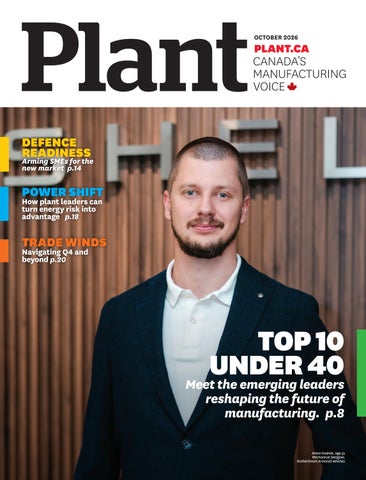
TOP 10 UNDER 40 Meet the emerging leaders
reshaping the future of manufacturing. p.8 Anton Doshak, age 33 Mechanical Designer, Roshel Smart Armored Vehicles
70 YEARS OF EXPERIENCE. POWERING WHAT’S NEXT. One partner for the technologies, expertise and solutions driving Canadian manufacturing forward.
MOTION & CONTROL
FILTRATION
AUTOMATION
ENGINEERED SYSTEMS
SERVICE & SUPPORT
Hydraulic, pneumatic
Filtration and
Control and
Application expertise
Technical support,
and electromechanical
fluid-conditioning
connectivity
and system integration
commissioning and
solutions engineered
solutions to protect
technologies for
that turn complex
service to keep
for reliable machine
critical equipment
smarter, seamless and
challenges into
critical equipment
performance.
and processes.
precise operation.
complete solutions.
performing.
Hydraulic Cylinders Pumps & Motors Valves & Manifolds Pneumatics Electromechanical Actuation
Hydraulic Filtration Compressed Air Filtration Process Filtration Fuel Filtration Desiccant Breathers
Machine Controls & HMIs Sensors & Connectivity Configurable Controls Industrial Networking Equipment Programming
Hydraulic Power Units Control Panels Lubrication Systems Pneumatic Systems Custom Engineered Systems
Start-Up & Commissioning Troubleshooting & Repair Preventive Maintenance System Upgrades Application Support
ONE WAINBEE. MANY STRENGTHS.
Wainbee Limited | 5789 Coopers Avenue, Mississauga, Ontario, L4Z 3S6 1-888-WAINBEE (924-6233) | salesleads@wainbee.com | WAINBEE.com
CONTACT US
From individual components to engineered systems, Wainbee brings together leading technologies, technical expertise and service to keep Canadian industry moving.
8 INSIDE In every issue 4 EDITORIAL
7 COMMENTARY 22 POSTSCRIPT
14
COVER STORY
8
14
TOP 10 UNDER 40 Ten reasons to be optimistic about the future of Canadian manufacturing. UNPRECEDENTED: ARMING CANADIAN SMEs FOR DEFENCE READINESS The new defence strategy opens the door for Canadian SMEs. Here’s how to walk through it.
18 18
THE POWER SHIFT As Canada’s energy grid transforms, demand-side tools are key to managing cost and resilience.
20
WEATHERING THE STORM A manufacturer’s guide to surviving Q4 and beyond.
Syspro Torque is live. Made to Act. Syspro’s industrial-grade AI execution platform, purpose-built for manufacturers.
Register your interest.
Torque. Trust. Transform. © 2026 Syspro. All rights reserved.
October 2026 / Plant PLT_Syspro Software_Oct26_CSA.indd 1
3
2026-09-16 12:13 PM
EDITORIAL
BY KIRSTYN BROWN
CANADA’S MANUFACTURING VOICE OCTOBER 2026 • Volume 85, Number 2
Technology execution now outweighs adoption
F
or years, the conversation around advanced manufacturing in Canada centred on adoption. Manufacturers had to be convinced that automation, data and AI were worth the investment, and the most common obstacle was money. But the 2027 Advanced Manufacturing Outlook Report, released this month alongside this issue of Plant, suggests the conversation is changing. Each year, the report surveys Canadian manufacturers on their technology use, investment plans and business challenges. To add context to the results, I also bring together a panel of industry experts to discuss what the numbers mean in reality. This year’s roundtable included representatives from NGen, EMC, IDC, MNP, SYSPRO and other organizations working closely with Canadian manufacturers. One of the biggest changes in this year’s survey, which was conducted in the Spring, is where manufacturers are facing barriers. Funding challenges fell to 34 per cent, down from 52 per cent last year and the lowest level in at least five years. Resistance to change rose to 49 per cent, up from 40 per cent and the highest level over the same period.The group of respondents who said the right resources are difficult to find also nearly doubled, rising from 13 per cent to 23 per cent. At the same time, investment intentions appeared to cool. Planned investment in AI fell from 64 per cent to 51 per cent, while 3D printing, cloud computing and virtual reality each dropped 15 points or more. To me, the data initially looked like a loss of momentum. But when I put the findings to our roundtable, the panel saw something different: a shift in priorities. Manufacturers are learning that new technology doesn’t deliver results without clean, reliable data underneath, and many are focusing there first. That may help explain why the use of manual processes to
Connect with Plant facebook.com/PlantMagazine/ 4
Plant / October 2026
collect data jumped from 33 per cent to 47 per cent. (Several panelists suggested this reflects companies shoring up the basics before automating further.) The most digitally advanced firms, however, told a somewhat different story. Resistance to change and skills shortages are far less of a concern for this group, at 27 per cent and 13 per cent respectively, yet uncertain ROI is their top barrier, cited by 40 per cent. Our panel suggested this has less to do with skepticism than with experience. These are the companies that have actually seen major projects through and learned that a pilot that works well on one line does not necessarily translate across an entire operation. What I took from the conversation is that manufacturers largely understand what automation and AI can do for them, but execution is easier said than done. Technology applied to a process that has not been optimized will not fix that process – it may even make existing problems more expensive. The companies pulling ahead appear to be the ones that recognized this early and did the less visible work of stabilizing their processes, trusting their data and bringing their people along before scaling up. The full report explores these findings in greater depth, along with manufacturers’ views on tariffs, cybersecurity, data governance and the practices that distinguish the industry’s most advanced organizations. It is available now as a free download at Plant.ca. Do the survey results and roundtable insights reflect what you’re seeing in your own organization? Or has your experience been different? I’d love to hear from you.
READER SERVICE
Print and digital subscription inquiries or changes, please contact customer service Angelita Potal Tel: (416) 510-5113 Fax: (416) 510-6875 email: apotal@annexbusinessmedia.com Mail: 111 Gordon Baker Rd., Suite 400 Toronto, ON M2H 3R1 EDITOR Kirstyn Brown
226-931-4194 · kbrown@annexbusinessmedia.com
NATIONAL ACCOUNT MANAGER Ilana Fawcett
416-829-1221 · ifawcett@annexbusinessmedia.com
MEDIA DESIGNER Curtis Martin ACCOUNT COORDINATOR Debbie Smith 416-510-5107 · dsmith@annexbusinessmedia.com AUDIENCE DEVELOPMENT MANAGER Beata Olechnowicz 416-510-5182 · bolechnowicz@annexbusinessmedia.com GROUP PUBLISHER, MANUFACTURING Paul Grossinger
pgrossinger@annexbusinessmedia.com
CEO Scott Jamieson
sjamieson@annexbusinessmedia.com ANNEX BUSINESS MEDIA
111 Gordon Baker Road, Suite 400 Toronto, ON M2H 3R1 Tel (416) 442-5600 · Fax (416) 510-5134 www.annexweb.com SUBSCRIPTION RATES
Canada – $80.62 per year USA – $213.22 (CAD) per year International – $240.80 (CAD) per year Add applicable taxes to all rates. Combined, expanded or premium issues, which count as two subscription issues. ISSN: 1929-6606 (Print), 1929-6614 (Online). PUBLICATIONS MAIL AGREEMENT NO. 40065710
Return undeliverable Canadian addresses to: PLANT Circulation Department, 111 Gordon Baker Rd. Suite 400, Toronto, ON M2H 3R1 ©2026 Annex Business Media. All rights reserved. Performance claims for products listed in this issue are made by contributing manufacturers and agencies. PLANT receives unsolicited materials including letters to the editor, press releases, promotional items and images from time to time. PLANT, its affiliates and assignees may use, reproduce, publish, re-publish, distribute, store and archive such unsolicited submissions in whole or in part in any form or medium whatsoever, without compensation of any sort. This statement does not apply to materials/pitches submitted by freelance writers, photographers or illustrators in accordance with known industry practices. PRINTED IN CANADA
KIRSTYN BROWN, EDITOR Comments? E-mail kbrown@annexbusinessmedia.com
/plant-magazine
plant.ca PLANT.CA
Built for what’s next Advice that keeps pace with your production line Margins are tighter, inputs cost more, and the pressure to modernize hasn’t eased. Our manufacturing advisors understand what you’re up against and help you make the calls that keep production moving and plan for what’s ahead.
Scan here to see how we can support Canadian manufacturers:
Ryan Magee, Partner, Assurance & Accounting | 416.613.3120 | ryan.magee@mnp.ca
MNP.ca
COMMENTARY
BY FRANCIS DE LOS SANTOS
The true cost of diversification: What it really takes to enter a new market
N
ot long ago, I spoke with a shop owner considering expansion. Business was steady, but after months of uncertainty and rising costs, they realized something simple: waiting costs more than moving forward. I’ve had this conversation dozens of times, and I’ve been on both sides of the table. I’m a Red Seal Machinist who has worked everywhere from small machine shops to multi-billion-dollar corporations. I’ve stood in front of CNCs at 2 a.m. trying to figure out why a part went out of tolerance. I’ve seen businesses both thrive and struggle because of diversification. The first question manufacturers ask is usually, “What market should I go after?” But a better one is: “What’s the actual cost of getting there?” Not just in dollars, but in strategy, operations and culture. Because diversification often costs more than people expect. Understanding that reality can save years of missteps, frustration and lost opportunity. Imagine a typical Canadian machine shop: 10 employees, several CNC mills and lathes and a solid reputation for quality work. They mostly work with aluminum, steel, ductile iron and sometimes plastics. And throughout the years, they’ve weathered every downturn. Times have changed, and now the owner is looking to diversify into one of three highgrowth markets:
Nuclear: Where paperwork reigns
Most CNC shops can machine components for the nuclear industry. That’s often the first surprise. Many parts use familiar 6
Plant / October 2026
alloys and require reasonable tolerances, making this market a logical fit. The challenge is everything after the chips hit the floor. In nuclear, documentation can become as important as the part: traceability, inspection records, certification packages, quality systems and process documentation are all part of the deliverable. Earning a place on the approved supplier list can take years, and even then, work is never guaranteed. From my 19 years of experience, the biggest misconception
systems. Process repeatability. Documentation. Producing one part to spec isn’t enough. The real challenge is machining that part consistently, hundreds of times to exacting aerospace standards. To even bid, you’ll need to invest in advanced measurement tools, rigorous tracking and AS9100 certification. But process is only part of the story: your whole team must buy into stricter paperwork, inspections and regular training. Aerospace success means building a culture of quality,
Success in the nuclear sector is a test of endurance, not speed, requiring lots of paperwork, lengthy qualification periods and a long-term commitment before returns begin to materialize. is how long the process can take. For instance, it may take four years from a conversation to your first job, which translates to five years until your first meaningful purchase order. Success in the nuclear sector is a test of endurance, not speed, requiring lots of paperwork, lengthy qualification periods and a long-term commitment before returns begin to materialize.
Aerospace: Precision has a price
Aerospace is often seen as the promised land: long contracts, strong customers, attractive margins. But those opportunities come at a cost. Moving from ±0.002” to ±0.0002” isn’t incremental, it’s transformational. Your approach to the workpiece changes because everything matters. Machine tolerances. Calibration. Work-holding. Environmental controls. Inspection
traceability and repeatability. That’s where the real investment begins.
Biotech: Unexpected costs
At first glance, microfluidics appears straightforward: mostly plastics, three-axis machining, fairly simple geometries, no exotic alloys. The reality is very different. Many applications require aerospace-level tolerances, contamination control, surface finishes, environmental monitoring, validation protocols, documentation and clean-room requirements. As a result, the discussion quickly shifts from machining capability to environmental control. It isn’t enough for a room or part to look clean – it must be certified, measured and validated as clean. Often, the largest investment isn’t the machine tool; it’s the infrastructure around it.
Key takeaways
Don’t settle for easy answers. Be informed with realistic intent. Successful diversification is more than technical skill. It’s an honest self-assessment of whether your business is prepared for barriers to entry, qualifications, timelines, investment, documentation, culture and risk. Choosing the right market isn’t just about opportunity, it’s about understanding the true cost of getting there.
How your economic development office can help
As the Advanced Manufacturing Business Consultant for Mississauga’s Economic Development Division (Invest Mississauga), I support a topfive Canadian sector spanning aerospace, automotive, supply chain, food & beverage and MedTech. Many businesses are surprised to learn that economic development offices exist to support their growth. Now you know. We’re here to help you make smarter decisions, not to run your business. That’s why our Built-to-Last series brings real-world insights from industry leaders to meet the real needs of businesses today. If you’re considering diversifying, expanding or automating, connect with your local economic development office.We may not always have the answer, but we likely know someone who does. Before you invest significant money in diversification, invest a little time in a conversation. Fancis de los Santos is the Advanced Manufacturing Business Consultant at Invest Mississauga – part of the Economic Development Division. at francis.delossantos@mississauga.ca PLANT.CA
TOP 10 UNDER 40
COVER STORY
Pardeep Chahal, 36
Elias El Dik, 33
Top 10 under 40
This year’s honourees are meeting a defining moment for Canadian manufacturing with ambition, technical expertise and a commitment to innovation that could reshape the industry. BY KIRSTYN BROWN ELIAS EL DIK, 33
Quality Engineer, CoolIT Systems, Calgary, Alta. Elias El Dik’s career reads like a tour through Canadian manufacturing’s most demanding sectors — aerospace composites, additive manufacturing, gas detection, clean energy — and has landed him at CoolIT Systems, doing failure analysis on the liquid cooling systems running AI data centres. At CoolIT Systems, a Calgary manufacturer of liquid cooling systems for AI data centres, Elias El Dik says he spends his days “tracking down why things fail... and making sure they don’t fail the same way twice.” That instinct — treating quality as its own discipline rather than an afterthought to design and manufacturing — comes from a career spent moving through some very different corners of manufacturing, including aerospace composites, additive manufacturing, industrial safety devices and clean energy. 8
Plant / October 2026
“Over the years, it became something I excelled at in its own right, and today I carry all three as lenses I apply to every problem, regardless of title.” Earlier in his career, at Immensa Technology Labs, El Dik did work he still calls some of the most meaningful of his career, including figuring out which decades-old, unsupported industrial parts were genuine candidates for reverse engineering rather than simple reproduction, cutting turnaround time on legacy components from 16 weeks to three. El Dik also holds a seat on the Standards Council of Canada’s ISO/ TC 261 committee for additive manufacturing. He says he wants his next chapter to be consulting, bringing what he’s learned across sectors to Canadian manufacturers navigating fragile, tariff-exposed supply chains. “I can bring distributed, digital-first approaches — reverse engineering, digital warehousing,
on-demand production — into the rooms that need them, especially in Canada’s remote industrial regions, where a single failed part can mean weeks of costly downtime.”
PARDEEP CHAHAL, 36
Plant Manufacturing Quality Leader (New Model), Honda of Canada Mfg., Alliston, Ont. Pardeep Chahal joined Honda of Canada Mfg. as an engineering associate 12 years ago. He now leads quality readiness for the company’s new CR-V program, pulling engineering, production, quality and equipment teams together through one of the most demanding stretches of a vehicle launch. From late 2023 to late 2024, Chahal managed Honda’s body-in-white weld department, the most automated welding operation in Honda North America. There, he introduced automated vision-system upgrades, equipment enhancements and digital management tools that cut downtime and improved reliability. He also led stamping operations development for Honda’s nowpaused EV plant project, bringing hot stamping into the company’s Canadian production for the first time. What set his work apart was the focus behind it: he built those upgrades to make frontline associates’ jobs easier, not just to move the numbers. That instinct carries into how he leads, too, saying that mentoring early-career engineers is something he treats as central to the role. “Ultimately, I hope to contribute to building a workforce that is adaptable, highly skilled and prepared to meet the challenges of a rapidly evolving industry,” he says. PLANT.CA
ASHLEY KALYN, 31
International Trade Consultant, Peacock Tariff Consulting, Orillia, Ont. Ashley Kalyn spent more than a decade in consultative sales, luxury client service and broadcast journalism before moving into trade and tariffs just over a year ago. She now manages a global portfolio of manufacturing clients at Peacock Tariff Consulting, helping them navigate tariffs, duty recovery and a regulatory landscape she describes as constantly changing. This year, that meant helping clients respond to Section 338 tariffs and other trade shocks. That work included preparing broadcast segments for Canadian and U.S. news outlets so manufacturers and the public could understand what was happening and what options existed. She’s also helped build out the company’s workshop series on international market entry strategies. Kalyn says the work carries weight for her beyond the client relationship. “I’ve sat across from these people, met them at their level and felt their stress firsthand,” she says. “I come from a family-owned small business myself, so I deeply understand the day-to-day struggle… It’s not abstract to me, it’s personal.” This past September, Kalyn represented the firm on a European tour as it expands into global tariff mitigation. “For me, this isn’t about generating more business for my company,” she says. “It’s about educating business owners on the real options they have, because there is more opportunity in this moment than people realize.”
AEDAN FIDA, 29
CEO & Co-Founder, Blade Air, Scarborough, Ont. Aedan Fida co-founded Blade Air in 2017 with his older brother, Joseph, and business school friend Giancarlo Sessa, betting that the most overlooked product in a building — the HVAC air filter — could be reengineered into an energy efficiency tool. Nine years later, the company manufactures from its own 12,000-square-foot plant in Scarborough, having made two acquisitions to bring IP, supply chain and manufacturing in-house. Fida’s Pro Filter cuts HVAC fan energy use by 15 to 40 per cent with no retrofit required. In May, USGBC California — the organization behind the LEED building standard — recognized the technology with its 2026 Market Transformation Award, citing it for reframing filtration as an energy strategy rather than routine maintenance. “When the people who set the standard validate the result, the conversation shifts from whether the technology works to how
Ashley Kalyn, 31
fast it gets adopted,” Fida says. Since acquiring an additional manufacturing operation in 2024, Fida’s team has tripled throughput through process changes alone, without major capital investment — the kind of result he wants Canada to be known for producing. “It should be impossible to talk about HVAC efficiency without our technology in the conversation,” Fida says of his longterm goals for Blade Air. He sees the company’s Canadian manufacturing base as the proof point for what’s possible here. “Strong margins, high-quality products and good jobs are all available here,” he says. “We intend to be the case study people point to when they need to justify building in Canada at any stage in their business life cycle, from startup to world-class.”
Aedan Fida, 29
Stephane Labine, 31
STEPHANE LABINE, 31
Director of Fabrication, Lopes Limited, Coniston, Ont. Stephane Labine started at Lopes as a summer student in 2015, driving delivery trucks and doing odd jobs during mining shutdowns between university terms. He came on full-time after finishing his engineering degree, moving from project coordinator through project manager and fabrication manager to his current role overseeing the company’s entire fabrication operation — a team of about 60 working out of a 60,000-square-foot shop. Lopes’ fabrication business once leaned heavily on nickel mining. Labine helped push it into power generation, gold mining and industrial processing instead. “That growth hasn’t just strengthened Lopes,” he says. “It’s also helped show that October 2026 / Plant
9
TOP 10 UNDER 40
COVER STORY
Northern Ontario fabricators can compete across multiple industries.” Rather than taking shortcuts, Labine credits relationships and consistency for creating that shift. “Staying adaptable in how we operate, and never cutting corners on project execution” is how he describes the approach that broadened the client base while giving the business more stability. Labine wants to help modernize fabrication in Northern Ontario without losing the trade itself in the process. “I want to help show that fabrication isn’t just about producing products and parts,” he says. “It’s about developing people, solving complex problems and creating lasting value for the years ahead.”
MICHAEL NEWMAN, 32
Co-Founder & COO, TetraGen Robotics, Winnipeg, Man. Michael Newman was working as a manufacturing engineer at a bus maker before pursuing a master’s degree at the University of Manitoba focused on industrial robotics. Through conversations with manufacturers during that time, he noticed traditional robotic welding systems were built for highly repetitive production, while most manufacturers dealt with multiple part types, frequent changeovers and real variation between pieces. In 2022, he co-founded TetraGen. The company builds welding robots that use 3D vision to read a part and adjust the weld path to it, rather than requiring identical, pre-programmed conditions. The company built its first system in a co-founder’s basement, carrying the industrial robot down the stairs by hand. That robot now runs at a customer’s plant. TetraGen has since moved into a 6,000-squarefoot facility in Winnipeg and closed an oversubscribed $1.8-million seed round.
Michael Newman, 32
10 Plant / October 2026
Connor Buskermolen, 28
By creating robots that adapt to real-world variation with minimal programming, Newman says the company isn’t just improving on existing automated welding. “We are fundamentally transforming where and how it can be applied across the industry.” His goal, he says, isn’t to sell more robots. “We want to help define what the next generation of robotic manufacturing looks like.”
CONNOR BUSKERMOLEN, 28
Manager, Data Systems, Kumi Canada, Bradford, Ont. Connor Buskermolen joined Kumi Canada, a Tier-1 automotive supplier, as an IT intern in 2021, doing basic troubleshooting at a time when the company had no centralized analytics system. As he learned the business, he started building tools to connect data across the organization and put it to use, and the scope of those projects grew until the company created an entirely new department, and his current role, around the work. He designed and led the internal platform that’s now the hub for Kumi’s digital transformation work — a cloud-based system built from the ground up that pulls ERP and MES data together with shop-floor metrics into one connected environment. It now supports everything from quality and process auditing to employee training and compliance tracking, work that previously ran through separate, disconnected systems. Buskermolen says he wants to keep closing the distance between traditional manufacturing and newer technology — and to open the industry up to people who don’t come from a traditional manufacturing background.
“I hope this evolution helps broaden what a career in manufacturing can look like,” he says, “creating new opportunities for people with backgrounds in software, data, automation and other emerging technologies to bring their skills and perspectives into the industry.”
CLARA SESTON, 27
Equipment Engineer, Honda of Canada Mfg., Alliston, Ont. Clara Seston got her start at Honda of Canada Mfg. as a production student while studying chemical engineering, rotating through assembly, weld and paint over successive summers before graduating in 2022 and moving into equipment engineering full-time. Her job is to identify existing equipment problems and come up with solutions to improve safety, cost, delivery or environmental impact.
Clara Seston, 27
PLANT.CA
The project she’s proudest of is a new electric regenerative thermal oxidizer she pushed from research through installation, the first fully electric unit of its kind in North America. Seston researched the technology, proposed the switch and carried the project through to completion. “This project was successfully able to reduce CO2 emissions, reduce the operating utility cost, and improve the delivery and end of life concerns seen with the previously existing equipment,” she says. What the project proved mattered as much as the result itself. “Environmentally beneficial projects do not always need to cost more or create an increase in OPEX for the company,” she says. “Creative solutions to existing issues can balance different output drivers and create a strong competitive edge for Canadian manufacturing.”
ANTON DOSHAK, 33
Mechanical Designer, Roshel Smart Armored Vehicles, Toronto, Ont. Anton Doshak says his path to Roshel came from a passion for advanced manufacturing, operational scale and what he calls “tactical safety innovation.” At the company, he oversees production and prototyping workflows for a lineup of armoured vehicles. The most rewarding part of his job? “Knowing that every vehicle leaving our facility directly serves to protect human lives in the most challenging environments,” he says. Doshak’s recent focus has been tightening assembly processes and integrating more advanced engineering steps as Roshel scales to meet rising global demand — work he says has lifted both throughput and product quality, and helped set a new pace for agility in Canada’s defence manufacturing sector. He credits much of that to the team around him as much as the mission itself. Looking forward, Doshak wants a hand in building a Angelo Canadian manufacturing sector defined by resilient supply chains, advanced automation and high-quality standards. As he sees the best of his career is yet to come. “My single greatest project and defining achievement are still ahead of me.”
Anton Doshak, 33
MICHAEL O’NEILL, 25
Production Coordinator, Mahler Machining, Vancouver, B.C. Michael O’Neill had finished his aerospace engineering degree at the University of Southern California and moved home to Vancouver to start a career in business when he was introduced to Mahler Machining’s new owners. They had bought the shop intending to scale it and he ended up in manufacturing instead. As production coordinator for the past two years, he handles scheduling, order management and staffing and has taken on a growing role in improving operations. His biggest project replaced Mahler’s paper-based order system with a digital ERP platform. O’Neill worked on every stage, from installing PCs at more than 20 workstations to designing workflows and training machinists with decades of experience. A year later, the shop handles more volume than it could on paper and is fully AS9100 certified, the traceability standard aerospace suppliers need. “The most rewarding time is when I begin to see the benefits of a challenging project start making people’s jobs easier,” he says. He wants Mahler to become Western Canada’s leading manufacturing partner. “I hope that through continuous improvement and process innovation, Mahler can provide fast and cost-effective solutions to support our customers’ innovation right here in Canada,” he says.
Michael O’Neill, 25
October 2026 / Plant
11
Cascades PRO® Paper Hand Towels By choosing a Cascades PRO® paper hand towel made of 100% recycled fibers, instead of an equivalent product made from virgin fibers, you can significantly reduce your environmental footprint while keeping your business clean and efficient.
32% less impact on climate change*
61% less impact on ecosystem quality*
56% less water consumption*
Ask your distributor about Cascades PRO® or visit cascadespro.com to learn more. *Potential savings based on the life cycle assessment (LCA) approach for each Cascades’ product category, compared to equivalent industry products made of 100% virgin fibers. LCA study on Cascades tissue paper products (2023) conducted by Groupe AGÉCO, an independent third party, in accordance with ISO 14040 and ISO 14044. Basis for comparison (functional unit): 1 square meter (m²).
DEFENCE
FEATURE
Unprecedented: Arming Canadian SMEs for defence readiness The new defence strategy wants 70 per cent of contracts to go to Canadian firms — but SMEs need certifications, clearances and capital to compete.
Whether Canada’s national defence strategy offers a viable market potential for the domestic manufacturing industry is no longer up for debate. Industry observers agree this unprecedented opportunity is real and it’s here. Now, the race is on to get SMEs defence ready to enter this multibillion-dollar supply chain, and the Canadian manufacturing industry is mobilizing. It’s the driver for the recently launched CME Defence initiative by the Canadian Manufacturers & Exporters (CME). CME Defence is a platform dedicated to supporting Canadian manufacturers looking to participate in national defence supply chains. “We knew about the commitment to sourcing up to 70 per cent of the new spend in Canada. That’s a great opportunity for CME to not only introduce ourselves to the defence world… but an opportunity for CME 14
Plant / October 2026
to establish a very specific defence section of the association,” says Dennis Darby, CME’s president and CEO. Officially announced in February 2026, the Canadian government’s Defence Industrial Strategy (DIS) includes $180 billion in defence procurement and $290 billion in defence-related capital investments over the next decade. The strategy also sets an explicit target of awarding 70 per cent of defence contracts to Canadian firms. Following the unveiling of the CME Defence program, the association has conducted “listening tours” across the country, which included roundtable sessions between manufacturers and prime defence contractors. It’s a model the CME has adopted from its counterpart in the U.K., according to Darby. “What we make sure at every meeting is that there’s a range of people who are in different parts of the supply chain. We
always make sure we have a prime contractor — whether it’s Bombardier or Lockheed Martin or Pratt & Whitney, or in some cases Irving Shipbuilding — and then also people one and two levels down,” he explains. These roundtable discussions, held throughout the spring of this year, were instantly popular among members and provided a rare and valuable opportunity to place SMEs in the same room as major contractors and buyers. The purpose, Darby says, was to gauge the interest of the manufacturing sector and what they know and didn’t know about conducting business in the defence space. “Because it’s obviously not the same as the general market.” The majority of the questions coming from manufacturers throughout the listening tour came down to two things: What does it mean to be defence ready and how much will it cost them? PLANT.CA
Photo: © Gophotograph / Adobe Stock
BY MARI-LEN DE GUZMAN
Laying the groundwork
‘Defence readiness’ may seem a little overwhelming for SMEs, especially those with no previous experience servicing the defence industry. The key is to take it one step at a time, advises Jonathan Clow, senior executive account manager at Ottawa-based 123 Defence, a Canadian veteran-owned consulting company helping SMEs become eligible to participate in defence supply chains. The first step, Clow says, is to do an internal assessment of whether defence is a good fit for your business. The opportunity may be there for the taking, but it doesn’t always mean it’s the right opportunity for your company. “I think the primary thing a company needs to do is to get better educated and gather more information so they can scope out whether that opportunity is good for their business,” says Clow, a Royal Canadian Air Force veteran. If the answer is ‘Yes,’ the next step is more education. Explore existing systems and resources and utilise them. Incubators or accelerators are also a great resource for companies taking the initial steps.
“Virtually every incubator, accelerator or innovation centre in any of the provinces will have a defence component,” Clow says. He adds some of the notable incubators include NGen Canada and the Regional Innovation Centres in Ontario; Circle Innovation and Export Navigator in British Columbia; and Centre for Ocean Ventures and Entrepreneurship (COVE) in Nova Scotia. Once the company has determined its suitability for a defence play, it can then start evaluating what certifications it needs, and when and how to get certified. While some companies may assume that doing business with the government requires a long list of certifications and compliance requirements, Clow notes that’s not necessarily the case. “First of all, we need to demystify working in the defense sector. Everyone talks about how difficult the government procurement process is. People need to understand that in Canada, in general, (the Department of National) Defense buys nothing. Public Services Procurement Canada is the Crown contracting agency. So, when people talk about procurement processes, it’s not DND; it’s primarily focused on PSPC.” C
Path to certification
The good news for manufacturers contemplating getting into the defence business is that the process is already familiar to them. Many SMEs in the automotive industry or health-care supply chains, for example, are already used to stringent regulations and certification requirements. Defence should be approached just like any other business challenge, Clow notes. “Although these are markets that are used to regulations and certifications, they don’t necessarily understand defence and how it works.” Not all certifications are created equal, either, and Clow cautions over-certifying can be an expensive mistake for SMEs. “Not every company needs everything,” he says. “It depends on what product they’re delivering and who they’re delivering it to.” He illustrates the threshold with a pen: sell the government a standard, off-the-shelf pen and a level 1 Canadian Program for Cyber Security Certification (CPCSC) — enough to see federal contract information and bid through Canada Buys — will cover it. But a different specification for that pen, say 25 per cent wider with a different coloured cap, changes the calculus.
Make Smarter Decisions Faster!
Monitor your equipment performance in real time. • Machine Performance Monitoring • Continuous Improvement • Proactive Alerts • OEE Measure - Analyze - Improve
Get the insights you need to keep everything running smoothly and reduce costs with ShiftWorx.
Contact ShiftWorx today:
1.800.682.0486 www.machinemonitoring.com October 2026 / Plant
PLT_Six S Patrners-half _Oct26_CSA.indd 1
15
2026-09-18 1:06 PM
FEATURE
“Now I’ve given you specifications. Now I need level 2, because as soon as the government gives you that type of information, our peer adversaries could potentially use that against us,” Clow explains. The same scoping logic applies to security clearances, which divide into personal clearance — what an individual may see — and physical clearance, or where they may see it. A manufacturer does not necessarily need to secure an entire plant floor; often only a handful of staff members require access to full drawings. Working out which certification tier applies to their business is not something most SMEs can do alone, Clow says, and seeking out risk compliance experts would be helpful. Timelines are also a significant consideration. Foundational eligibility, such as CPCSC level 1, takes roughly three months. But anything requiring level 2 and other contract security program elements should be planned as a year’s work. “Realistically, you’re looking at a year down the road. So, if you wait until the opportunity essentially knocks on your door, you’ve got another year until you’re actually eligible for the contract,” Clow says. Adopting a “calculated forward leaning” stance into the defence space can be the difference between winning or losing a contract, he adds. “The vast majority of SMEs will be plugging into supply chains, and 16
Plant / October 2026
“We sincerely believe that this is a generational opportunity for Canadian SMEs. This is not a fad.” - Peter Dawe, BDC primes and OEMs will essentially say, ‘Can you deliver this or not? Yes. Are you certified? No. See ya,’ and they’re going to move on to the next company,” Clow explains.
Financing the opportunity
Recognizing the multi-billion-dollar supply chain potential generated by Canada’s Defence Industrial Strategy, major financial institutions have acted swiftly to roll out multi-billion-dollar funding programs designed to support defence-related businesses. CIBC has committed $2 billion over five years, RBC earmarked $1.4 billion, and Business Development Bank (BDC) has expanded its defence platform to $6 billion, specifically to support Canadian SMEs pursuing opportunities in the defence sector. “We sincerely believe that this is a generational opportunity for Canadian SMEs. This is not a fad,” says Peter Dawe, senior vice president of defence strategy at BDC and a retired major general who served 35 years in the Canadian Armed Forces. His confidence is grounded in numbers: Canada’s defence industry supported 81,000 jobs and contributed $11 billion to the country’s GDP in 2024. But the more useful
insight for manufacturers is what that capital is meant to solve. Defence does not pay the way commercial markets do. “Often, it takes front-end investment to lead to the longer-term revenue,” Dawe says. “It’s just how defence is structured. It’s a very challenging environment, but it is not insurmountable.You just need to know what you’re getting into.” BDC’s recent survey of businesses has revealed a highly engaged SME sector, participating in defence at varying degrees. About 57 per cent of SMEs in the defence sector are direct contractors, while 43 per cent are suppliers. Dawe offers some useful insights for SMEs to get in front of funders. “First and foremost, we look at the business fundamentals,” he explains, “because to be able to pivot, to be able to scale, you need a strong foundation to start with.” Beyond that are the certifications, security clearances and the capital to adjust machinery or expand capacity — all of it “in anticipation of that supply chain opportunity.” Dawe cites a misconception he often encounters of businesses missing the target of where the real opportunity lies. “I don’t think people appreciate the degree to which the defense supply chains are the opportunity, rather than trying to find niche opportunities directly with the operator,” he says. “If you’re not dealing with the procurement directly, if you’re dealing with the supply chain, it’s a much easier proposition.” Supplying a prime contractor means selling to a company rather than bidding into a government process. The federal competition is already settled by then, “because the ship has already been procured,” Dawe says, leaving the SME to answer a straightforward purchasing decision rather than navigate procurement. Policy is adding to that demand, since foreign primes selling into Canada must invest in or partner with Canadian firms under Industrial and Technological Benefits obligations. And suppliers need not look like defence companies, either. As Dawe notes: “You don’t need to be in the production of armaments and munitions to be useful in a defence supply chain.” PLANT.CA
Photo: © Vasiliy / Adobe Stock
DEFENCE
TURNS OUT THERE IS SOMEPLACE LIKE HOME... JUST WITH A LITTLE
LEARN WHY SAPUTO CHEESE/ ENDURANCE TECHNOLOGIES CHOSE THE BORDERPLEX
Come for the opportunity Stay for the chile
Where Business Feels Like Home!
ENERGY FEATURE
Why demand-side energy solutions are now a strategic risk and leadership priority. BY KEVIN LOCKHART
Canada’s energy system is changing. Today’s business decisions are increasingly influenced by concerns related to access to security, stability and cost-effectiveness as these factors shape competitiveness, resilience, operating margins and investments. For executive teams, this places energy as a primary consideration for where a manufacturing or process facility operates, where and how to invest capital and how to avoid or absorb disruptions. As a result, demand-side energy solutions have moved from a technical conversation happening within operations teams to a strategy conversation happening in the boardroom.
From utility cost to strategic decision-making
Demand-side energy solutions have often been treated as a line item, a cost to be managed rather than a potential lever to improve and protect business operations. 18
Plant / October 2026
However, as recently highlighted in Powering Canada Strong, Canada’s national electrification strategy, that framing no longer fits the moment. Canada’s energy systems are changing and meeting the strategy’s goal of doubling electricity supply in Canada over the next two decades positions electricity as the backbone of the Canadian economy. Broad electrification of industry, transportation and buildings offers a platform on which affordability, resilience and economic and climate performance will ultimately be determined. As buildings, transportation and industry electrify, grid capacity and interactivity are increasingly first-order priorities rather than background infrastructure. The scale of the shift is significant. Scaling electrification over the coming two decades to serve growth from advanced manufacturing, electrification and digital infrastructure all at once will shape our economic competitiveness for a generation. For building
Uncertainty is the new operating environment
Building owners and operators, businesses and supply chain actors are managing more moving parts than ever. This includes volatile supply chains, long equipment lead times, slow interconnection process, as well as disruptions related to cyber risk and weather-related events. Behind these challenges, there is good news, nonetheless. With a long history of clean electricity generation and a genuinely competitive starting point compared to peer PLANT.CA
Photo: Lorado / Getty Images
The power shift
owners, portfolio owners, facility and fleet operators and businesses across supply chains, the practical message is that energy planning assumptions, which more than ever now includes operations electrification, need to be updated sooner rather than later. Energy management considerations must go beyond solely addressing energy demand to consider energy supply and the flow between the two. Demand-side management (DSM), energy efficiency, distributed energy resources (DERs), local storage and demand response are cost-reduction and potential revenue-generation tools that can defer infrastructure spending, reduce system strain and improve overall grid performance. Ignoring the demand side of the equation means building more expensive energy infrastructure than needed, both at the grid and building level.
countries, Canada has a strong foundation for growth. With the ability to deliver clean, reliable and cost-competitive electricity Canada can use low-carbon, grid interactive energy assets as an advantage to attract investment, strengthen industrial competitiveness and insulate the domestic economy from external shocks.
Demand-side solutions as risk reduction
Canadian businesses are faced with four familiar risk areas that can be viewed through an energy lens. This includes: • cost risk and the impact of rising energy costs on margins, • reliability risk related to grid disruptions across the supply chain that affects operations and customer delivery, • exposure to external, cyber, or other security risks that impact business continuity, and, • transition risk that affects compliance, market access, and future competitiveness. Investing in demand-side energy solutions can address all four risk areas at the same time. Businesses can lower their electricity use and peak demands through energy efficiency measures, reduce exposure to peak conditions with the use of energy storage assets and smart controls and leverage demand response technologies to better manage energy during critical hours. Each are complementary levers that improve cost performance and resilience together.
From individual upgrades to an integrated strategy
Bringing an energy lens to operations means a shift from isolated decisions, for example looking at process systems, rooftop solar, storage and procurement individually, and towards an integrated strategy. Doing so helps owners and operators gain better control over cost volatility while improving reliability and energy security. This integrated approach, the combination of distributed energy resources such as rooftop solar, battery storage, demand response, smart building controls, vehicle-to-grid capability, helps building owners and operators respond to immediate challenges and informs long-term planning. First, owners and operators can make better use of existing infrastructure to meet rising demand and cost volatility through peak shaving and, in markets that offer time of use programs, by shifting electricity load to lower-cost periods. Next, by taking advantage of these grid assets as a way to enhance energy flexibility to reduce their exposure to broad system disruptions, owners can build protect business operations from disruptions and improve their businesses’ resilience to extreme weather, equipment failure or cyber disruption. Through this energy lens and integrated strategy, the case for greater energy productivity — doubling the economic value Canadians generate from each unit of energy consumed — shifts beyond energy and emissions considerations to become an essential financial and strategic approach.
The time is now
As policy and market signals become increasingly aligned, the role of demand-side and distributed resources rises in prominence.This is because they manage rising load at lower cost than supply-side expansion alone and support an increased focus on efficiency, electrification and industrial modernization that aligns with government and utility programs. Moreover, as system constraints and grid expansion plans take hold, the value of flexibility will be increasingly recognized. The time is now to find ways to offset upfront costs, de-risk new technologies, and build internal capacity. Owners and operators can position their organizations for success by identifying assets most exposed to volatile prices, peak charges, outages or grid constraints, then assess where a combined package of efficiency, controls, storage or onsite generation offers the strongest business case. And, by bringing together all aspects of their organization, including operations, maintenance, finance and procurement, ensure energy-related upgrades decisions are considering flexibility, resilience and strategic value. Transitions are messy, and success is rarely a straight line. There will be missteps and wrong turns. But through early action and sound strategy, success is achievable. Building owners and operators who build flexibility into their operations now will be best positioned to manage volatility, protect output, and capture the upside of a changing energy landscape. Kevin Lockhart is the director of the Pembina Institute’s buildings program and is based in Toronto. His interest is in new and existing buildings with low energy use and emissions that provide, safe, healthy housing for all Canadians.
Servicing all makes and models.
Day or Night.
No single blueprint
In practice, an integrated energy strategy is designed around how a facility operates. This means a food processor might optimize refrigeration that enables shifting cooling to lower-cost periods and add thermal storage to cut peak demand without interrupting production. An automotive or plastics plant may find its biggest opportunity in compressed air systems, motors and scheduling flexibility. And any facility with strong continuity requirements may combine batteries, smart controls and onsite solar to protect critical operations during outages. While there are many different approaches, the value comes from matching technologies and operating strategies to the real load profile, production schedule and risk exposure of the facility.
TORONTO | MONTREAL | VANCOUVER s e w - e u r o d r i v e . c a
October 2026 / Plant PLT_SEW Eurodrive_Fall26_CSA.indd 1
19
2026-09-17 1:29 PM
TARIFFS
FEATURE There are still options
None of this means manufacturers are out of moves. The U.S. isn’t the only market available, and the shipping routes businesses have relied on for years aren’t the only ones in play. Canada’s trade with markets outside the US is already shifting in a meaningful way, and more options are opening up as carriers, ports and governments adjust to the current environment. The manufacturers who come out ahead over the next year will be the ones willing to get a little creative about how they move product and where they send it. That doesn’t require reinventing the business. In many cases it comes down to a few specific decisions: which port a shipment leaves from, which market it’s ultimately headed to and whether there’s a smarter way to book the space it needs.
A manufacturer’s guide to surviving Q4 and beyond. BY ALYANNA JONES Manufacturers are starting the fourth quarter of 2026 under real, well-documented pressure. Tariffs have escalated sharply over the past few months, shipping capacity is behaving unpredictably and the path into 2027 still carries a fair amount of uncertainty. Here’s where things actually stand, what’s realistic to expect over the coming months and the practical steps worth taking now.
The current climate
Tariffs are the clearest disruption to trade right now. In July, the U.S. signed proclamations adding 50 per cent tariffs on a wide range of Canadian goods, with the measures taking effect in late August. Canada responded on Sept. 8 with roughly $27.6 billion in counter-tariffs of its own, covering steel, dairy, appliances, agricultural equipment, pulp and paper and electronics. On top of that, CUSMA’s mandatory six-year review concluded this summer without a renewed long-term commitment from the U.S., meaning the agreement now faces annual reviews instead of the longer runway manufacturers had counted on. 20 Plant / October 2026
One notable exception so far has been energy. Oil and gas have largely been left out of the tariff fight, which matters because Canada’s pipeline infrastructure runs almost entirely toward the U.S., with limited capacity to redirect that volume elsewhere. If energy gets pulled into the dispute at some point, the likely response would be reduced production and capacity in the short term, since there isn’t an easy alternative outlet for that volume today. The practical result for manufacturers is higher costs, and not only on goods directly hit by tariffs. Everyday products are affected too, since logistics and supply chain costs are climbing broadly. Expect that to continue through the holiday season and into the new year. At the current pace, prices are likely to stay elevated through most of 2027, with a reasonable chance of easing by summer if shipping capacity normalizes and tariff pressure doesn’t escalate further. That timeline depends heavily on policy decisions still to come, so it’s worth treating as a general planning horizon rather than a guarantee.
One shift in ocean shipping is worth understanding, because it’s a real opportunity for manufacturers willing to plan around it. Carriers ordered a large number of new vessels during the shipping boom of a few years ago, and many of those ships are now entering service at a time when cargo demand has cooled. Rather than a shortage of ships, the industry is managing an oversupply, and carriers are responding by cancelling sailings and skipping port calls on major routes to keep rates from collapsing. For manufacturers, that creates an opening. When a scheduled sailing does run, it often has space that would otherwise go unused. Instead of booking dedicated capacity months in advance at a premium, it can pay off to watch for a vessel already sailing toward your destination and secure the space that’s left over. It’s a similar idea to buying tickets to a concert or game after the first inning rather than paying full price up front.You’re not requesting a new route be built around your shipment; you’re finding one already underway and filling an open slot on it. This works especially well for manufacturers with products that have a reasonably long shelf life. If you’re building something like tools or hardware for the U.S. market, it can make sense to build inventory now and hold it, then wait for the right sailing and book into it when the timing and price line up, rather than committing to guaranteed capacity early. PLANT.CA
Photo: © Bigbag and Sandbag / Adobe Stock
Weathering the Storm
Hitching a ride
It’s also worth exploring whether you can share container space with another business shipping to the same destination, splitting the cost of a full container instead of each paying for partial capacity separately. This kind of planning is becoming specialized enough that it’s turning into its own function inside manufacturing and logistics teams, less about ordering further ahead and more about staying flexible on timing. It may be worth building that capability internally, since spotting these opportunities takes ongoing attention to sailing schedules and available space.
Canada-Mexico: An alternative worth watching
to cost more than the road and rail options manufacturers are used to, but it signals a real, growing effort to build a direct connection that doesn’t depend on U.S. cooperation. Along similar lines, Quebec and the wider east coast are worth a look for manufacturers shipping outside North America altogether. Montreal, the largest port on Canada’s east coast, already handles significant volume headed to Europe and is a natural option for businesses looking to reduce reliance on U.S.-bound routes. Smaller ports are starting to play a role too. The Port of Churchill in Manitoba shipped grain to Europe this year for the first time since 2020, with more shipments planned, and while ports like Churchill can’t handle the largest container ships, they’re well suited to the medium-sized vessels increasingly available.
Carney is in Europe pushing for a closer relationship with the European Union, including a novel associate-membership arrangement covering trade, energy, AI and critical minerals. Neither is likely to resolve overnight, but both reflect real, ongoing efforts to build alternatives to relying so heavily on the U.S. market. There’s genuine reason for encouragement here. Canada’s exports to China are up roughly 30 per cent in the first half of 2026 compared to the year before, and trade with the EU and United Kingdom remains larger still, even if growth there has been steadier rather than dramatic. In the meantime, the most useful thing manufacturers can do is protect themselves formally. Build flexibility into shipping and supplier contracts rather than assuming today’s rates or routes will hold, and lean on customs brokers, freight forwarders, or trade consultants rather than navigating these decisions alone. This is a good time to get crafty, build the right relationships, and make sure the business is protected on paper as conditions continue to shift.
Another shift worth understanding involves Canada and Mexico. Goods moving between the two countries have traditionally travelled by road or rail, often routed through the U.S. As tariffs and border friction persist, that What to watch going forward route becomes less reliable, and both coun- A few developments over the coming weeks will shape how this plays out. tries are actively working on alternatives. The U.S. and China are expected to hold Canada and Mexico are developing a new land-and-sea trade corridor designed to move talks this month aimed at reducing tariffs, goods between them without crossing U.S. and the outcome is likely to set the tone for Alyanna Jones is an International Trade Economist at territory, targeted to be fully operational by global tariff policy more broadly. Peacock Tariff Consulting. 2028. It’s a multi-year undertaking and likely Around the same time, Prime Minister 26_011555_Plant_OCT_CN Mod: August 21, 2026 3:49 PM Print: 09/03/26 page 1 v2.5
π SEE WHAT SAFETY IS ALL ABOUT
ORDER BY 6 PM FOR SAME DAY SHIPPING
COMPLETE CATALOG
1-800-295-5510
uline.ca October 2026 / Plant
PLT_Uline_Oct26_CSA.indd 1
21
2026-09-04 10:14 AM
POSTSCRIPT
BY SCOTT MCNEIL-SMITH
Manufacturing sovereignty starts on the shop floor
I
f there is one lesson Canadian manufacturers can take from 2026, it’s that the meaning of resilience has changed. For years, resilience meant having enough inventory, alternate suppliers and flexibility to work around disruption. Today, tariffs, geopolitical instability, changing alliances, cyber risks, labour constraints and pressure on critical supply chains are forcing Canadian manufacturers to ask another question:What capabilities do we need to control, to sustain and to scale ourselves? This goes beyond resilience. Canada has entered a period of historic investment in infrastructure, resources and defence – all requiring manufacturing capability. Industry, government, markets and our allies are placing greater value on secure domestic supply chains, critical resources, strategic technologies and industrial capacity. This is not just a defence moment or a critical minerals moment, but a sovereign manufacturing capability moment. Resilience is the ability of manufacturers to withstand disruption. Sovereignty is about ensuring Canadian manufacturers have the capabilities to respond to whatever comes next, here at home. Sovereignty does not mean we need to manufacture everything ourselves. We are a trading nation, and partnerships with trusted allies remain essential. Recent events have demonstrated the risk of assuming every critical input, component or technology will always be available when we need it. Real manufacturing sovereignty means understanding what we make, what we could make, what we cannot afford to lose and where gaps exist between our resources and the finished
22 Plant / October 2026
capabilities Canada requires. Critical minerals are a good example. Possessing abundant resources in the ground is important but does not create sovereignty on its own. Unless we can convert these resources here – through processing, materials production, manufacturing and scale-up – we are exposed.
This connects directly with a key constraint highlighted in the 2027 Advanced Manufacturing Outlook Report. Manufacturers are focused on cost. Not surprisingly, cost reduction moved to the top of the operational priority list in this year’s report. However at the same time, many compa-
Canada also has something manufacturers have asked for repeatedly: a stronger national conversation about the strategic value of making things here. Canada should not measure sovereignty by tonnes in the ground. We should measure it by how much qualified, customer-ready material and products we can actually deliver. This also applies to everyday products. A sovereign manufacturing strategy is not only about military equipment or major infrastructure. It is about creating more value within Canada before products reach consumers. Chapman’s Ice Cream recently provided an excellent example, announcing it would replace more than 70 per cent of its American ingredients with Canadian and non-U.S. sources by mid-2027. That is more than a procurement change. It shows how a manufacturer can strengthen domestic supply chains, create demand for Canadian producers and connect consumer choice with industrial capacity. No single company can transform a supply chain on its own. However, if more manufacturers look first for domestic sources where they are competitive and available, they can help create the demand suppliers need to invest, expand and improve. This is how a stronger domestic market develops: through more value being created, captured and circulated within Canada – not through isolation.
nies face barriers to technology investment and advanced manufacturing adoption, and some are delaying investment because of tariffs and uncertainty. That response is understandable. If manufacturers postpone investments needed to improve their productivity, automation, cybersecurity, quality and capacity, they may protect cash in the short term, but at the expense of weakened competitiveness and greater risk over the long term. The opportunity ahead will not be built around spending alone. Defence and other procurement create demand signals, but industry must have the production capability and capacity needed to respond. For manufacturers, this means examining where existing capabilities can serve new domestic, defence or dual-use and other growth markets; understanding the certifications and procurement pathways needed to participate; investing selectively in productivity and advanced technologies; developing the workforce capabilities those investments require; and building stronger relationships with Canadian suppliers and customers. We also need to view our industrial base as a connected system. We continue to see companies searching for Canadian
suppliers while others search for new customers; strong capabilities that are not always visible to major purchasers; and firms that may be only one certification, technology investment or partnership away from a new supply chain. Connecting these dots matters and is a focus for EMC. We are mapping these capabilities and enabling the sector to connect with new customers and supply chains coast-to-coast. The past year has tested Canadian manufacturing. Trade uncertainty has disrupted planning, costs remain challenging and investment decisions are being scrutinized more carefully. Yet Canada also has something manufacturers have asked for repeatedly: a stronger national conversation about the strategic value of making things here. The challenge now is turning that conversation into lasting industrial capacity and a stronger domestic market. If we use this moment to map our capabilities, close critical gaps, strengthen domestic supply chains, invest in productivity and people and connect Canadian manufacturers to major national opportunities, the result can extend far beyond infrastructure, natural resources and defence. This sovereignty starts on the shop floor. It is built by making more of what matters, adding more value before products leave our shores and creating enough demand at home for Canadian capability to grow. Our next step is readiness and making more of what matters – here. Scott McNeil-Smith is Vice President, Manufacturing Sector Performance for Excellence in Manufacturing Consortium of Canada (EMC) – Canada’s largest manufacturing consortium. #Make-It-Here PLANT.CA
ASSESS
|
IMPLEMENT
|
OPTIMIZE
|
GROW
Your ERP Journey, Our Proven Guidance.
From selection and implementation to optimization upgrades and continuous improvement, we help manufacturers grow with control and confidence. You can rely on Six S Partners’ 20 years of experience helping customers solve operational challenges through proven best practices and Epicor Kinetic ERP.
Explore Your Next Steps www.sixspartners.com 1.866.579.7497
Scan to see how Six S Partners helped Athletica get control with ERP.
Extensive Up-to-Date LABOUR MARKET INTELLIGENCE
MACRO-LEVEL LMI RESOURCE WITH MICRO-LEVEL DETAIL S C A N T O PA R T I C I PAT E
Through ManufacturingGPS, EMC will work directly with manufacturers across Canada to understand their evolving workforce and business challenges and connect them with practical resources, supports and solutions. Leveraging EMC’s national network of more than 40,000 manufacturing employers, the initiative will create a direct connection to industry—helping manufacturers navigate change, address immediate needs and build long-term workforce and economic resilience.