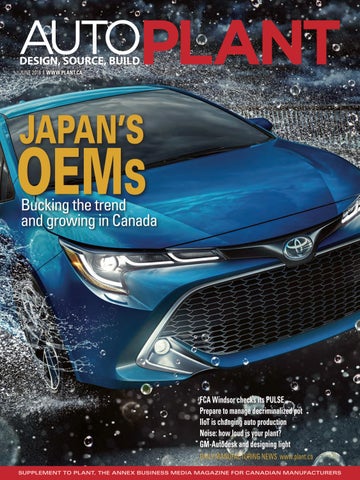
JUNE 2018 | WWW.PLANT.CA
JAPAN’S
OEMS
Bucking the trend and growing in Canada
FCA Windsor checks its PULSE Prepare to manage decriminalized pot IIoT is changing auto production Noise: how loud is your plant? GM-Autodesk and designing light DAILY MANUFACTURING NEWS www.plant.ca SUPPLEMENT TO PLANT, THE ANNEX BUSINESS MEDIA MAGAZINE FOR CANADIAN MANUFACTURERS
AutoPLT_Spring2018 AMS.indd 1
2018-06-12 1:08 PM
ITC Mach ad1 2-2013 F Bleed.pdf
1
2/25/13
2:44 PM
C
M
Y
CM
MY
CY
IT’S TIME TO TAKE A CLOSER LOOK AT ITALIAN MACHINERY We are your link to over 10,000 Italian manufacturing solutions providers from every industry. When you’re looking for the competitive advantage that comes with innovative technologies, take a closer look at Italian-made industrial equipment. We connect you to partners who offer problem-solving, flexible design, expanded functionality, and creative, cost-effective solutions. Our goal is to help you achieve your goals. When you’re ready, look to Machines Italia.
©
For more information on Machines Italia call 888-ITALTRADE email or visit www.machinesitalia.org
PLT_ItalianTrade_75th.indd AutoPlant_Spring_Italia.indd AutoPLT_Spring2018 AMS.indd 11 2
2016-10-05 2018-06-12 11:56 2018-06-12 9:29 PM 1:08 AM
CONTENTS
June 2018 Supplement
FEATURES 21 INSTRUMENTATION Global growth of monitoring technology is growing, driven by wireless advances and IIoT.
8
23 CCOHS SAFETY TIPS How loud is your plant? Conduct an assessment and turn down the volume.
INDUSTRY
Japanese automakers are expanding their investments in Canada amid changing trade conditions.
25 SUPPLIERS Magna International innovates and expands its global reach: a round-up of some its latest developments.
13 ASSEMBLY FCA’s PULSE body shop transfer system improves production at its Windsor, Ont. plant.
17 SUSTAINABILITY General Motors adds to its green credentials with a co-generation project that will help power its St. Catharines, Ont. engine plant.
DEPARTMENTS 4 Editorial 5 News Events 7 Economy PLANT Pulse 12 Rearview 26 Backseat Driver
T
12 5 11:56 9:29 AM
24 CLEAN TECH A FleetCarma study shows Canadians are buying more electric vehicles.
19 LAW How decriminalizing marijuana will impact the workplace and management strategies.
21 INDUSTRY 4.0 The Industrial Internet of Things is changing automotive production as it delivers quality in real time. COVER: TOYOTA CANADA
PLANT—established 1941, is published 8 times per year by Annex Business Media. Publications Mail Agreement #40065710. Circulation email: blao@annexbusinessmedia.com Tel: 416442-5600, ext 3552 Fax: 416-510-6875 or 416-442-2191 Mail: 111 Gordon Baker Road, Suite 400, Toronto, ON M2H 3R1. Occasionally, PLANT will mail information on behalf of industry-related groups whose products and services we believe may be of interest to you. If you prefer not to receive this information, please contact our circulation department in any of the four ways listed above. Annex Privacy Officer: privacy@annexbusinessmedia.com Tel: 800-668-2374. No part of the editorial content of this publication may be reprinted without the publisher’s written permission. ©2018 Annex Publishing & Printing Inc. All rights reserved. Performance claims for products listed in this issue are made by contributing manufacturers and agencies. PLANT receives unsolicited materials including letters to the editor, press releases, promotional items and images from time to time. PLANT, its affiliates and assignees may use, reproduce, publish, re-publish, distribute, store and archive such unsolicited submissions in whole or in part in any form or medium whatsoever, without compensation of any sort. This statement does not apply to materials/pitches submitted by freelance writers, photographers or illustrators in accordance with known industry practices. Printed in Canada. ISSN: 1929-6606 (Print), 1929-6614 (Online).
www.plant.ca
AutoPLT_Spring2018 AMS.indd 3
AutoPLANT 3
2018-06-12 1:08 PM
EDITORIAL
Driverless vehicles: not such a great idea
T
he technology wizards have spent roughly $80 billion over the past three years on driverless vehicles, according to the Brookings Institute. Acknowledging the limitations of its data gathering, the Washington, DC research firm says it’s likely the amount is much higher. Concerned about all the effort going into developing transportation that relieves drivers of responsibility for what’s happening on the road? Don’t worry, you’re not a Luddite. There is reason to question the driverless preoccupation. Experts and enthusiasts will tout the safety benefits. In 2016, more than 37,000 deaths in the US were attributed to motor vehicle accidents. In Canada (2015) there were more than 1,800 fatalities. More than 90% of deaths are attributed to human error and distracted drivers are responsible for much of the carnage. Bob Lutz, former vice-chair of General Motors, suggests when autonomous technology is up and running properly, this number would be reduced to 5%. Looking past Lutz’s magical forecasting and on a cheerier note, occupants of a driverless vehicle will have the time to concentrate on those distractions, such as their smart phones, Netflix or reading an engrossing-e-book; why, it will even be okay to have a nap. No parking? Your ride will drop you off and find a spot. The disabled, or seniors in their 80s, 90s and 100s no longer allowed behind a steering wheel needn’t worry. There will be no steering wheel and they’ll have transportation to any destination. And feel free to tie one on after work because drinking and driving won’t be an issue. Even better, the major victims of all this enhanced safety will be personal injury lawyers. How will these Jetson-like vehicles work? They’ll gather data using a combination of sensors, radar, cameras and algorithms firing up lightning-fast computer power working with GPS technology to build a 3D model of the vehicle’s immediate environment. Artificial intelligence will identify other vehicles, people, lane markings and speed signs, crunch the data, plan and execute, then adapt to changes as they occur. Getting all that right is sure putting a lot of faith in technology, and there are some red flags to consider: like a planet-wide electromagnetic pulse taking out everything electronic. Okay, that’s unlikely and would probably screw up a regular car, but who hasn’t had trouble with random computer meltdowns? There’s going to be a lot of data in the software and ample opportunity for glitches. So think of the risk multiplied across a national transportation system. And consider the security issues. There are no impregnable firewalls. Beware of mischief and malicious intent. Driverless vehicles will also be putting a lot of faith in GPS mapping that sometimes provides misdirection with comic and/or aggravating results. How will roadblocks be handled? Also, weather conditions can impair sensing conditions and the technology won’t know what to do when it encounters a policeperson directing traffic because it can’t read human hand signals. There are also legal implications. If there is a mishap, who is to blame: the car manufacturer; the municipality; or the tech providers? Much of the speculative safety advantage evaporates if there isn’t widespread adoption by drivers. The techno-doubters will inject all that human unpredictability we currently endure. And let’s not overlook the so-far unimagined calamities caused by technology. Plus, there’s a danger the skill level of drivers will diminish. No kidding! Do we really need to find another way to make us dumber and more disconnected from our surroundings? Using this technology to enhance vehicle and road safety makes sense, but drivers must be responsible for what happens on the road. Reduce distractions and perhaps consider retesting periodically to ensure drivers are focused and sharp, but leave the big decisions in human hands.
Associate Publisher Jeff Brownlee 416-277-8428 jbrownlee@annexbusinessmedia.com Editor Joe Terrett 416-442-5600 ext. 3219 jterrett@plant.ca Art Director Andrea M. Smith National Account Manager Ilana Fawcett 416-510-5202 ifawcett@plant.ca Account Coordinator Debbie Smith 416-442-5600 ext 3221 dsmith@annexbusinessmedia.com Annex Business Media Vice President/Executive Publisher Tim Dimopoulos (416) 510-5100 tdimopoulos@annexbusinessmedia.com President & CEO Mike Fredericks Circulation Manager Beata Olechnowicz 416-442-5600 ext. 3543 bolechnowicz@annexbusinessmedia.com Subscription Price Canada $74.50 per year, US $151.50 (US) per year, Foregin $171.00 (US) per year. Single Copy Canada $12.00. Add applicable taxes to all rates. Combined, expanded or premium issues, which count as two subscription issues. Mailing Address Annex Business Media 111 Gordon Baker Road, Suite 400 Toronto, ON M2H 3R1 Circulation Bona Lao 416-442-5600 ext. 3552 blao@annexbusinessmedia.com Fax: 416-510-6875 or 416-442-2191
Joe Terrett, Editor Comments? E-mail jterrett@plant.ca.
4 AutoPLANT
AutoPLT_Spring2018 AMS.indd 4
June 2018
2018-06-12 1:08 PM
NEWS EVENTS IMTS 2018 AMT Sept. 10-15, Chicago The International Manufacturing Technology Show (IMTS) 2018 presented by the Association For Manufacturing Technology (AMT) with more than 2,400 exhibitors. Pavilions will cover metal cutting; tooling and workholding systems; fabricating and laser; abrasive machining/sawing/finishing; controls and CAD-CAM; EDM; gear generation; machine components/cleaning/environmental; and additive and quality assurance. Visit www.imts.com. Hannover Messe USA 2018 Hannover Messe Sept. 10-15, Chicago The Hannover Messe USA premier will feature the latest trends and developments in Industry 4.0 and industrial digitalization. Visit https://hannovermesseusa.com. 2018 MainTrain Conference PEMAC Sept. 24-27, Ottawa Annual professional development conference for asset management, maintenance and reliability professionals. Hosted by the Plant Engineering and Maintenance Association of Canada (PEMAC). Visit www.pemac.org/conference. Pack Expo International 2018 PMMI Oct. 14-17, Chicago Advanced packaging equipment, materials, containers, automation technologies and other supply chain solutions. The PACKage Printing Pavilion brings together suppliers of the latest digital packaging solutions. Visit www.packexpointernational.com. Physical Asset Management Program U of T Nov. 5-9, Toronto Offered in partnership with the Faculty of Science and Engineering at the University of Toronto, St. George campus. Taught by two world-class instructors. Features fundamental need-to-know material combined with proven, leading-edge approaches. Visit http:// learn. utoronto.ca.
www.plant.ca
AutoPLT_Spring2018 AMS.indd 5
Unifor and Lear settle
Magna a GM supplier of the year
Ajax plant closure now off the table
Lear makes automotive seats in Ajax, Ont.
PHOTO: LEAR
AJAX, Ont. — Unifor and the Lear Corp. managed to prevent a potentially bad outcome arising from the rejection of a contract offer at the company’s automotive seat plant in Ajax, Ont. Union Local 22 says its members voted in favour of a contract May 4. They had voted 94% against a deal offered by the Southfield, Mich.-based parts supplier on April 30. The union had said it was seeking to end the “current pay disparity in the seat manufacturing sector.” On May 1, Lear said it would close the plant that employs 320 workers. With the acceptance of a subsequent offer, Unifor said the company had fully retracted its notice to close the plant.
TROY, Mich. — Magna International picked up two GM Supplier of the Year awards for innovations in lighting and driveline performance. The automaker’s 26th annual awards in Orlando, Fla. recognized suppliers that go above and beyond requirements. Magna is a global automotive parts and system supplier based in Aurora, Ont. Its D-Optic LED headlamp uses multiple high-power LEDs and can be custom-developed to a vehicle’s specific styling. The technology, which debuted on the 2018 Chevrolet Traverse, improves forward visibility. Magna also supplies GM with driveline products such as the single-speed Actimax transfer case, two-speed Ultimax transfer case, electronic limited slip differential and Actimax beveloid transfer case. Benefits include improved handling and performance, dynamic four-wheel and all-wheel drive, and optimized fuel efficiency. Magna’s powertrain portfolio is also positioned to support increased vehicle electrification.
GM, Autodesk are lightening up design Advanced technology reduces mass, consolidates parts consolidate parts that can’t DETROIT — General Mobe achieved through more tors is harnessing the power traditional methods. of advanced design and 3D GM and Autodesk engineers printing technologies to dehave produced a proof-ofvelop the next generation of concept part – a seat bracket lighter-weight vehicle parts. – that’s 40% lighter and 20% The Detroit-based autostronger than the original maker is collaborating with part. It also consolidates Autodesk, the San Rafael, eight different components Calif.-based design software into one 3D-printed part. developer, to come up with GM and Autodesk have future product designs. formed a multi-year innoAutodesk’s generative vation alliance that will see design software uses cloud them collaborate on projects computing and artificial ininvolving generative design, telligence-based algorithms additive manufacturing and to rapidly explore multiple A proof-of-concept seat bracket design. materials science. Execuversions of a part design PHOTO: GM tives and engineers from and generate hundreds of both companies will participate in a series of options based on parameters set by the user, onsite sessions to exchange ideas, lessons and such as (among others) weight, strength, materiexpertise. al choice and fabrication method. The user then General Motors also has on-demand access to determines the best options. Autodesk’s full portfolio of software and techniThe technology provides significantly more cal specialists. opportunities to reduce vehicle mass and
AutoPLANT 5
2018-06-12 1:08 PM
NEWS
Toyota investing $1.4B in Ontario
CAMI surpasses 5M vehicles
Plants will be the North American hub for the RAV 4
Employees get a first crack at 2018 Equinox
Toyota’s 2019 RAV4.
PHOTO: TOYOTA
CAMBRIDGE, Ont. — Toyota is expressing its confidence in Canada’s automotive industry with a $1.4 billion investment in its Ontario assembly plants that will support its pursuit of future production mandates for the province. Toyota Motor Manufacturing Canada will apply its new global architecture to retool the Cambridge and Woodstock plants, installing advanced manufacturing platforms to make the Canadian operations the North American hub
6 AutoPLANT AutoPlant_Spring_SEWEurodrive.indd 1
AutoPLT_Spring2018 AMS.indd 6
for the RAV 4 crossover SUV, including hybrid versions. Canada’s largest vehicle producer is also reducing its carbon footprint. Vehicles produced at the plants will be more fuel-efficient while volatile organic compound emissions will be reduced in select shops by 10%. The investment, supported by $110 million each from the federal and Ontario governments, will add 450 jobs to Toyota’s current 8,000-person workforce, create 1,000 new co-op placements and contribute to new automation technology in the paint and plastics shop. Toyota will also spend $220 million on R&D over the next 10 years. The automaker assembles RAV4s, Lexus RXs and Corollas at its Ontario production facilities, but it’s moving Corolla production to Mexico in 2019.
INGERSOLL, Ont. — CAMI Assembly has rolled its five millionth vehicle, a 2018 Chevrolet Equinox, off the production line at its Ingersoll, Ont. assembly plant. CAMI employees will get an opportunity to purchase the 2018 Cajun red Chevrolet Equinox LT AWD through Searles Motor Products, the local dealership. CAMI Assembly has been producing the current-generation Chevrolet Equinox compact SUV since January last year. The plant was originally established in 1989 as CAMI Automotive Inc., a joint venture with Japanese automaker Suzuki Motor Corp, pro(L-R) Pat Shea, sales manager, Searles Moducing models for tor Products; Bob Searles, president/owner, both companies. Searles Motor Products; Bill Morrison, asThe partnership sistant plant manager, CAMI Assembly; and ended in 2011 and Gary Duff, plant manager, CAMI Assembly. now the plant is PHOTO: CAMI operated by GM.
June 2018
2018-05-30 9:09 AM
2018-06-12 1:08 PM
ECONOMY
Senior execs sour on economy
ECONOMIC TRENDS IN THE AUTOMOTIVE SECTOR
Lowest confidence level in six quarters
TRANSPORTATION SALES DECLINE Manufacturing sales rose 1.5% in March with 14 of 19 industry subsectors showing increases. Statistics Canada reports transportation wasn’t among them. It fell 5% thanks to declines in motor vehicle and motor vehicle parts manufacturing, partly as a result of a strike at an assembly plant and changes to some models manufactured in Canada. The most significant output gains came from machinery, food products, non-metallic mineral products and plastics and rubber products.
C
www.plant.ca
AutoPLT_Spring2018 AMS.indd 7
58
56
Current dollars
Trend-cycle (current dollars)
2012 Constant dollars
Trend-cycle (2012 constant dollars)
54
52
50
48
46 Mar. 2013
2014
2015
2016
Mar. 2018
2017
Source: Statistics Canada
$53B 417,300 Individuals Statistics Canada says are registered to apprenticeship programs in 2016, down from 455,900 in 2015.
2.2%
Increase in business productivity in 2017 following a 0.6% increase in 2016. Hourly compensation ($51.10) rose 2.1% compared with a 0.6% increase (2016).
2.1M IMAGES: FOTOLIA
onfidence in Canada’s economy has soured among business leaders in the first quarter, according to a survey by the Conference Board of Canada. The Ottawa-based research organization’s Index of Business Confidence fell 6.9 points to 93.1, its lowest level in the last six quarters. The survey, conducted March 9 to April 13, identified several reasons for growing pessimism among executives. They don’t expect the rapid sales growth of 2017 to continue, but they’re also concerned about the impact of government policy on competitiveness (cited by half the firms); the availability of labour (40%); and the cost of labour. Other factors holding them back are: competitive impact of US tax cuts; a weak Canadian dollar; NAFTA’s uncertain future; the rising cost of capital goods; and better opportunities abroad. “The first-quarter results for 2018 are closer to the 2016 average, a sign that businesses see the economy moving into a new, slower-growth phase,” said Matthew Stewart, the Conference Board’s director of national forecasting. The research firm says weaker investment intentions suggest a reduced ability to increase production and exports in the future. Firms that believe now is a good time to invest in machinery and equipment declined from 52% to 34%, while those who see this as a bad time to invest rose from 17% to 21%. Those planning to increase capital investment by at least 10% fell from 28% in the previous quarter to 22%, while firms anticipating capital expenditures to increase fell two points (but still a solid 60%). Expectations for the overall economy have also worsened. The balance of opinion (respondents believing economic conditions will be better in six months minus those who project that conditions will be worse) was at 19 percentage points in the previous survey. It is now -6 percentage points.
billions $
Average annual Canadian motor vehicle exports annually over the next five years, according to the Conference Board of Canada. Watch for lower-than-average vehicle ownership rates among millennials and seniors impacting US sales going forward.
Canada’s position among the global automotive producer hierarchy, and it’s the fourth largest auto exporter by value, according to the International Organization of Motor Vehicle Manufacturers.
9th
Canadian motor vehicle sales for 2018, according to Scotiabank’s Global Auto Report. Sales were stronger than expected in March at an annualized 2.08 million. Light truck purchases (CUVs, SUVs, pickups and vans) jumped 5% year-over-year and accounted for more than 71% of overall new vehicle sales, up from less than 55% as recently as 2012. Overall purchases rose 1.9% year-over-year in Q1. In Ontario, an 11% year-over-year jump in fleet volumes is consistent with strengthening business investment, which accelerated in late-2017 at the fastest pace since mid-2015.
AutoPLANT 7
2018-06-12 1:08 PM
INDUSTRY
Japan’s auto
OEMs THEIR RISING INFLUENCE IN CANADA’S INDUSTRY The Japanese brand is expanding its footprint amid changing trade conditions. BY JEFF BROWNLEE
K
aizen. It’s the Japanese philosophy of focusing on continuous improvement in all aspects of life and a term that best describes the history of the Japanese vehicle manufacturers in the Canadian market. Since Japanese vehicles first appeared on Canadian asphalt in 1965, there have been a number of speed bumps including trade disputes, oil crises as well as unorthodox trade barriers to the Canadian market that resulted in the creation of a Japanese-run joint venture. Yet the industry has been on a continuous improvement growth curve since the mid1990s, with production topping more than one million units for the second consecutive year in 2017. That represents 46% of total Canadian light vehicle production. In terms of sales, 2017 was a record-breaking year for Japanese auto manufacturers, with light-duty vehicle sales growing by 5.8% to 719,807 units. Six individual automakers posted record sales with Honda and Toyota recording fourth and fifth top overall sales in Canada, respectively.
8 AutoPLANT
AutoPLT_Spring2018 AMS.indd 8
The Honda Civic, Canada’s top-selling car the past two decades, came just shy of 70,000 units – almost 40% ahead of its nearest rival. “Japanese automakers and Canadians have built a strong partnership together for more than 50 years,” says Larry Hutchinson, chairman of the eight-member Japan Automobile Manufacturers Association (JAMA) Canada and president, Toyota Canada. “JAMA Canada members are committed to continuing to deepen and grow that partnership through ongoing investment in vehicle and parts manufacturing, distribution, sales and service infrastructure and employment growth.” The economic footprint of the eight members of JAMA, a not-for-profit trade association based in Toronto, helps create a strong and globally competitive auto industry in the country. According to a 2017 study, The Economic Contributions of the Japanese-Brand Automotive Industry to the Canadian Economy, 2001-2016 by McMaster University faculty professors, Greig Mordue and Brendan Sweeney, the Japanese-brand auto industry supports more than 203,000 jobs across Canada. Direct employment figures totalled 85,678, which represents a 69% increase since 2001. Earnings for those workers totalled more than $5 billion and gener-
Left: Checking the rear bumper assembly of a Honda Civic. Centre: Assembled Honda Civics in Alliston, Ont. Right: Honda’s 2016 CRV
PHOTOS: HCM
June 2018
2018-06-12 1:08 PM
Toyota’s popular RAV4 crossover. The automaker’s Ontario operations will be the hub for RAV4s in North America. PHOTO: TOYOTA
of these industries shrank. Japanese-owned firms are thus unique in this respect; they have consistently delivered growth and stability within an environment of economic uncertainty and change.” Toyota Motor Manufacturing Canada employs more than 8,000 at its Cambridge and Woodstock factories while Honda employees 4,200 at its Alliston, Ont. facility. And Hino Motors Canada employs 96 at its 177,000 square-foot truck manufacturing plant in Woodstock.
History in Canada
ated $1.7 billion in Employment Insurance premiums, QPP/CPP contributions, personal income taxes and import tariffs. The report illustrates how JAMA members are bucking an industry trend.
www.plant.ca
AutoPLT_Spring2018 AMS.indd 9
“Between 2001 and 2016, growth of employment in Japanese-brand and Japanese-owned automotive firms has far outpaced growth in the automotive industry itself,” states the report. “In fact, nominal
employment in manufacturing establishments owned by Japanese-brand and Japanese-owned firms in vehicle assembly, automotive parts manufacturing and tire manufacturing grew while total employment in each
In total, more than $11 billion has been invested by Japanese car brands in Canadian automotive manufacturing and assembly plants since 1986. The supply chain includes more than 40 auto parts plants, the majority located in Ontario, with a handful in BC and Quebec. There are an additional 20 materials, machine tools, subassembly and service shops in the Golden Horseshoe. As of 2016, there were approximately 1,238 Japanese auto dealerships across the country and a total of 17.4 million vehicles have been built in Canada since 1986 with overall sales topping 15.8 million since 1965. Trade has been instrumental to the growing Japanese presence in the Canadian market. Investment and production growth in Canada would not have happened without open access to the much larger US market and preferential trade agreements like the Canada-US Free Trade Agreement as well as NAFTA. Today, Canada’s exports of Japanese-brand vehicles exceed imports from Japan, the US and other countries combined by more than 4.5 million units (since 1993). In 1965, Canada signed the Auto Pact with the US and that
AutoPLANT 9
2018-06-12 1:08 PM
event, along with a view to the future, led Nissan to open up the first Japanese distribution office in Vancouver. Additionally, Canadian Motor Industries (CMI) started selling Toyota and Isuzu vehicles in the Canadian market at the same time. “It was a big, big carrot,” says JAMA executive director David Worts of the duty remission program that was intended to fully integrate the North American auto industry. Canada, unlike the US, decided to implement the Auto Pact multilaterally. Qualifying manufacturers could import parts and vehicles, duty free, from any GATT country as long as they met certain safeguards of production and Canadian value added in their operations. In the early years, the smaller Japanese imports didn’t fare well in a market that had a penchant for much larger vehicles. “The vehicles were out of place with the tenor of the North American market at that time,” Worts adds. “The Japanese struggled for a number of years.”
impossible to meet the standards on the timetables being suggested and any forcing of the issue would cost consumers millions, if not billions of dollars.” In 1975, Honda unveiled its Compound Vortex Controlled Combustion engine that not only surpassed proposed requirements, but exceeded them without a loss of power and with no additional cost to the consumer. The power plant (1488cc, 53-horsepower) would run on unleaded gasoline and didn’t require a catalytic converter. “This turned the entire automotive environment debate upside down,” DesRosiers writes in the study, A Short History of the Japanese Automotive Industry In Canada. “The industry moved very quickly from ‘we can’t do it without increased cost’ to ‘we will find a way to do it quickly and with little increased cost.’” While the 1970s saw the demand for smaller, more fuel-efficient vehicles, the early 1980s was a tumultuous, yet defining time for the North American
(L-R): Putting tires on a Lexus RX450h hybrid; battery installation; fitting a windshield.
That is until, the first oil crisis in 1973 that sent the price of gasoline skyrocketing, plus mounting pressure from governments for improved environmental performance and the first efficiency targets. “The automotive sector was spending significant dollars to fight these initiatives in Ottawa and Washington,” according to auto industry expert Dennis DesRosiers. “The basic message to government was that it was
10 AutoPLANT
AutoPLT_Spring2018 AMS.indd 10
auto industry. The decade started with the foreign manufacturers, particularly the Japanese, gaining a larger market share and the Big Four automakers registering a combined loss of $4 billion following the 1979 energy crisis. With mounting concerns over the future of the North American auto industry, the US and Japan entered into a voluntary quota system in 1981 that would curb the number of imports in
the American market. However, the Japanese wouldn’t agree to the same arrangement with Canada. “This exacerbated what was already a serious situation in our domestic market,” states Ed Lumley, former minister of trade and industry. “We needed to do something to dramatically to emphasize our sincere desire to ensure the long-term viability of our auto industry.” Lumley, who made many trips to Japan as a Cabinet minister, borrowed an idea from the Japanese on one such trip. He saw “boatloads” of European vehicles sitting in a harbour in Tokyo because they didn’t meet regulatory standards. “That’s when a light went on,” he adds.
which mandated investment by all foreign automakers in Canada with increased levels of local Canadian content as a condition of market access. This definitely got the attention of the Japanese, who informally created the Japanese Automakers Manufacturers Association (JAMA) Canada. Lumley, who had been preaching to the Japanese to look at the Big 3’s disproportionate investment in Canada (rather than the US) as a model to emulate, took the unprecedented move of inviting Takishi Ishihara, president and CEO of Nissan as well as the president of JAMA, to Canada for a bilateral discussion. Lumley met Ishihara at the Toronto airport and drove him to his cottage in the Thousand Islands for a mini summit on the future of the Japanese auto Vancouver harassment industry in Canada. Canadian officials instituted a The unusual meeting between slowdown on customs clearance a senior government official of for Japanese vehicles at the Canada and one of Japan’s top Port of Vancouver – a tactic that industry leaders resulted in the earned the moniker in the Japan formal incorporation of JAMA auto industry as the “Vancouver as a not-for-profit association harassment.” in addition to the creation of the Pacific Automotive Co-operation (PAC) in 1984. A unique to Canada joint venture company, PAC shareholders included 11 Japanese automakers (JAMA members) and 21 major Japanese auto parts makers. The president and vice-presidents of PAC were seconded from JAMA member companies and reported to the PAC Steering Committee of JAMA in PHOTOS: TOYOTA Tokyo. PAC’s main objective was to “No question it was not a promote automotive investment tactic without risk,” Lumley in Canada and support new busiwrites in A Short History of the ness opportunities with CanadiJapanese Automotive Industry an auto parts suppliers. In Canada. “I took my lumps Lumley’s plea to invest in Canin Parliament, in the public and ada gained traction with a series especially in the media.” of investments in Canada beginThe slowdown was eventually ning in 1985 with the creation lifted and Japan took advice on of the CAPTIN (Toyota) wheel restricting the number of vehifactory in Delta, BC, followed by cles it would ship to Canada, but the opening of Honda’s factory in 1983 the federal government in Alliston in 1986 and Toyota released a task force report, in Cambridge in 1988. CAMI, an An Auto Strategy for Canada,
June 2018
2018-06-12 1:08 PM
CAMI Automotive, a GM-Suzuki partnership, now under GM as CAMI Assembly.
initial joint venture between Suzuki and GM, opened its plant in Ingersoll in 1989. CAMI Automotive became a fully owned entity of General Motors in 2011 and is now known as CAMI Assembly. Since the first Canadian-made, Japanese cars rolled off the assembly line in 1986, trade agreements shaped the evolution of the industry in Canada. Specifically, the Canada-US Free Trade Agreement closed the Auto Pact to new entrants and omitted Honda and Toyota from an annex that would give the automakers preferential treatment. The 1990s began with a deep recession and a market slump cut vehicle imports from Japan by 75% – from 295,000 units at the peak in 1987 to 70,000 units in 1995. NAFTA was also brought into force and the Japanese automakers were concerned with the significant increase in the content requirement from 50% in the FTA to 62.5%, as well as the push by the US auto industry for “tracing” to account for the value of all non-originating materials in a traded good. PAC was dissolved in 1997 and its official functions were transferred to JAMA Canada. One of the main issues it had to deal with was the Canadian government’s refusal to make any changes to its most-favoured na-
www.plant.ca
AutoPLT_Spring2018 AMS.indd 11
tion (MFN) vehicle tariff, which Honda and Toyota believed was discriminatory to non-members of the Auto Pact. Japan and the EU launched a World Trade Organization (WTO) dispute. In 2000, the WTO ruled that the Auto Pact was inconsistent with WTO rules and despite an appeal by Canada, the federal government repealed the agreement in 2001 and instituted a standardized 6.1% import tariff for countries outside NAFTA.
Trade agreements Fast-forward to today and trade is once again dominating the agenda. Canada, the US and Mexico are in midst of a renegotiation of NAFTA and the new Comprehensive and Progressive Agreement for Trans-Pacific Partnership (CPTPP) has domestic and Japanese automakers in this country at odds with each other. Worts says that NAFTA needs to be updated and he’s hopeful that the posturing about “tearing up” the document is just that. “If it did happen, it would be hugely disruptive and create a period of uncertainty that investors would have real difficulty with.” In terms of the CPTPP, it appears history is repeating itself as the Japanese manufacturers in Canada are welcoming the deal while the domestic automakers are raising red flags,
specifically about reciprocal market access and the overall net benefit to Canada’s domestic automotive sector. In a nutshell, the CPTPP reduces Canada’s 6.1% import tariff for all CPTPP countries to zero over four years and requires a fully-assembled vehicle to have 45% regional content in order to be considered duty free. The content requirements for PHOTO: CAMI parts will range between 35% and 45%. Current regional content requirements in NAFTA stand at 62.5% for vehicles and 50% for parts. During the current NAFTA renegotiation, the US pushed for even higher content levels. Angelo DiCaro, UNIFOR national representative and trade policy analyst, says it’s a bad deal. “Canada exports virtually no cars or parts to the Japanese market. In fact, we import $5.5 billion in auto goods from Japan each year, while they buy back about $30 million. That means we sell to Japan in one year what they sell to us every two days. It’s a gross imbalance that a trade agreement can hardly help fix – but it certainly can make things worse.” And that’s also troublesome for Flavio Volpe, president of the Automotive Parts Manufacturers’ Association, who says that we can’t be in two boats at once. Volpe has been constantly raising red flags about the impact on NAFTA renegotiations, access to the Japanese market and impact on the Canadian auto sector. He took to Twitter Feb. 20 – the day complete text of the agreement was released – to point out some key challenges in the Canadian government’s own economic analysis, published the same day. “The report states that US imports into Canada would now
drop $3.3 billion through 2040, mainly in automotive. Never mind that those cars have Canadian parts – if correct, that’s a gap that smart US negotiators could then be seeking to close in NAFTA 2.0 final terms. One pocket to another,” Volpe tweeted. “The net CPTPP auto and auto parts gain claimed is only $172 million by 2040. Contextually, the Canadian auto sector ships $85 billion in goods annually. This huge 22-year increase represents approximately 0.2%. If you account for inflationary dynamics, this actually represents a decline in real dollars.” That reinforces the concern of Mark Nantais, president of the Canadian Vehicle Manufacturers’ Association, which represents the Detroit 3. He contends access for automotive exports from domestic factories to the CPTPP markets has not been materially improved by the agreement. “Canada’s trade agenda needs to ensure our large manufacturers get fair reciprocal access to the markets of our trading partners before we further open up Canada’s market to companies that do not manufacture in Canada or employ significant numbers in Canada,” he says. “Otherwise this is a harmful one-way street for automakers who invest billions in Canada.” Worts says the agreement will open doors of opportunity in all the CPTPP member states. “Importantly, this agreement will also restore a level playing field on vehicle tariffs that are needed as a result of Canada’s trade agreements reached with South Korea and Europe. As a country that relies on global trade, Canada’s focus must be on building bridges, rather than barriers.” Jeff Brownlee is the associate publisher of PLANT and CanadianManufacturing.ca. E-mail jbrownlee@annexbusinessmedia.com. Comments? E-mail jterrett@plant.ca.
AutoPLANT 11
2018-06-12 1:08 PM
REAR-VIEW
CAW’s split with the UAW
Chrysler in Canada: 93 years FCA Canada celebrates its 93rd anniversary in June. It began as The Chrysler Corp. of Canada Limited in Windsor, Ont. on June 17, 1925. That was a mere 11 days after Walter P. Chrysler founded the Chrysler Corp. in Detroit. In 1928, the automaker 1933 Dodges on final assembly line at the Windsor added Canada’s Dodge PHOTO: FCA Passenger Car Assembly Plant. Bros. operations and truck manufacturer Graham Bros., while establishing the Plymouth and DeSoto divisions. A year later, the first new assembly facility opened.
Tracking distance Nova Scotian Samuel McKeen is credited with coming up with the first version of what would become the modern odometer in 1854. Gear plates were attached to the frame of a carriage and connected to a pinion on the wheel that measured the number of revolutions. But there have been many Modern odometer. PHOTO: FOTOLIA other attempts to measure distance travelled going back to at least 15 BC. Roman architect Vitruvious describes a large wheel mounted on a small frame like a wheelbarrow that dropped a pebble into a container for each revolution. Probably not too practical for chariots and long distances, what with the number of pebbles required, and all that manual counting…
Before Unifor and the Canadian Auto Workers, unionized automotive workers were represented by the Canadian Region of the United Auto Workers (UAW). The Canadian branch began two years after the UAW (in 1935) following a strike at General Motors in Oshawa. There were many factors leading to CAW’s divorce from the UAW, and one of the biggies was the Canadian view that the US union was allowing too many concessions during collective bargaining. Another factor brings us to today with the imperilling of NAFTA and threats of Bob White, CAW’s first president. tariffs on imported autos by the Trump PHOTO: UNIFOR administration. An early America First effort saw the UAW lobbying Congress to force the transfer of auto production in Canada to the US. By 1985 the split – led by Bob White, Buzz Hargrove and Bob Nickerson – was complete. White, who died last year, served as president of the CAW from 1985 to 1991.
Welcome to Ford City Once upon a time the Ford Motor Co. had its own bedroom community within the boundaries of Windsor, Ont., where it had a big plant. Ford had formed a partnership with the Walkerville Wagon Works Ford Motor of Canada plant in Ford, 1920. in 1904 to bypass tariffs by sending up incomplete vehicles and parts from the US. Employees on the Canadian side of the border turned them into finished automobiles for the domestic market. In the first year, 17 employees assembled 117 cars. By 1910, the Ford Motor Co. of Canada moved to an even bigger facility within Ford City (or just “Ford”) and eventually expanded its operations over hundreds of acres. By 1913, the community was incorporated as a village and the automaker had 1,400 people on the payroll earning $4 and hour, based on a 48-hour week. Ford (the municipality) attained town status in 1915, but ironically never made it to city status. In 1929 it became East Windsor.
Quebec’s GM connection
General Motors Canada once had a footprint that extended beyond Ontario. It opened a plant in St. Therese, Que., a suburb of Montreal, in 1965 where it produced a range of different models starting with the full-size 1966 Chevrolet Biscayne. A number of GM’s lacklustre models chugged along the assembly line, such as the Chevrolet Vega, as well as some notable anchor brands such as the Olds Cutlass, but the coolest cars were the sporty F-body Pontiac Firebird and Chevy Camaro (1993 to 2002). There was some labour trouble in 1970 when employees rightly demanded more French (their labour contract was written in English). And closure was threatened in the mid-1980s because of high absenteeism and work quality issues. GM relented, expanding and modernizing the plant, helped along by a low-interest government loan, a labour deal and improved quality. But by 2002 the plant was operating well under its annual 250,000-vehicle capacity (40,000) and was closed. The site is now commercial-residential.
12 AutoPLANT
AutoPLT_Spring2018 AMS.indd 12
1976 Chevrolet Vega hatchback.
PHOTO: VEGAAIRBOB
June 2018
2018-06-12 1:08 PM
ASSEMBLY A new vibration-proof system from KUKA targets zero maintenance. BY ALYSSA DALTON
A
s the saying goes, good things come to those who wait, but in this case, it looks like good things also come to those who are the first in line. Almost three years ago, Fiat Chrysler Automobile’s (FCA’s) Windsor, Ont. assembly plant signed up to be the launch customer for a new body shop transfer system, embracing a new technology from robotics innovator KUKA Systems that promises to be 30% faster than conventional friction-based transfer systems. Developed and patented in the US, KS PULSE (Propulsion Using Linear Synchronous Energy) is a body shop transfer system that moves car and truck body sections from robotic workstation to workstation as they are built. It generates an electromagnetic force to propel dedicated carriers or pallets along a rail between workstations, designed specifically for automated assembly lines in body-in-white production lines where the task performed in each station is between 30 to 60 seconds, says Kevin Laurence, who came up with the original technology concept. Today Laurence is director in charge of PULSE products and development at KUKA North America in Sterling Heights, Mich. The system deploys throughout the entire body shop, eliminating the need for multiple systems through the facility. “It can be adapted to all body manufacturing processes, and engineered to fit atypical building dimensions, like low ceilings,” Laurence says. Linear synchronous motors in the rail and magnets on the chassis — provided by MagneMotion, a developer of modular conveyor systems — form the core of the system. After placing the ‘bricks’ next to each other
www.plant.ca
AutoPLT_Spring2018 AMS.indd 13
KS Pulse moves vehicle body sections through robotic work cells.
FCA‘s faster
PULSE
BODY SHOP TRANSFER IMPROVES PRODUCTION
and through programming, “they all act like one motor,” says Laurence. “No matter what system we need to build for a customer, we have all the Lego blocks in our toolbox for the track.” The system is friction-free and completely vibration-proof. As a result, Laurence says there are no moving parts to be serviced and zero maintenance needs to be done. The solid-state linear motors mean the PULSE line has fewer wear components, such as sensors, connectors and cables that can fail, which improves the overall productivity of a body shop by preventing unscheduled downtime. Having no moving parts to generate thrust eliminates the need to store hundreds of spares. “We could run this with no wheels. We could put a piece of UHMW — which is basically a linear bearing without the roller balls – and it would slide on
the rail. The reason for that is the ferrous material inside the motor blocks and then there is magnet on the chassis. There are 1,700 pounds of attracted force that pull those magnets into the motors, so you need to maintain the 12-millimetre gap, otherwise it gets stuck to the track. The rollers that maintain the gap are the only moving part,” he explains.
Carrier or pallet versions PULSE also incorporates turntables, cross transfers, elevators and both high- and low-speed rails. Everything is sized for 15 years. Laurence says the motors are 100% potted and “based on our duty cycle, it’s about 130 years. None of us will ever be able to prove that, but it makes perfect sense if you think about it. It’s an electronic board with some copper coils, and because
PHOTO: FCA
it’s 100% potted, it’s filled with resin so there are no moving parts.” A PULSE line switches among up to four distinct model variations, and he notes its flexible design means it costs “much less” to add a second model-handling capability than it would with conventional transfer systems. “All you have to do is shoot in the risers and then you bring in the rail and set it on top. Each one of those has six plugs, and because of the configuration file, once you get that loaded, it’s basically just turning the system on. No tuning has to be done.” Depending on the application, there’s a choice between a carrier or pallet version. Both systems use the same spare parts, keeping the inventory as small as possible, which “makes the lifecycle cost very attractive,” says Laurence. FCA Windsor, which employs more than 6,000 people, produces the Chrysler Pacifica, Chrysler Pacifica Hybrid and Dodge Grand Caravan. Since installing the carrier version of the PULSE system, Windsor’s body shop production has increased. The system was integrated into the line where the inner and outer body side panels are “married.” PULSE helped increase the transfer speed while reducing downtime caused by the previous chain-driven system.
AutoPLANT 13
2018-06-12 1:08 PM
Don’t sweat it! Rittal Climate Solutions keep your electrical components cool! Our new-gen Blue e+ cooling units offer: Efficiency – Up to 75% energy savings Versatility – Multi-voltage capability and cUL certification User Friendly – Touch screen interface, NFC control, optional IoT interface Need more information? Contact marketing@rittal.ca Or visit: www.rittal.ca/climatecontrol
Stay tuned for our Summer Cooling Promo: May 1 – Aug 31
1-800-399-0748 | www.rittal.ca/climatecontrol
PLT_April_RittalRighthand.indd AutoPLT_Spring2018 AMS.indd 114 14-15
2018-04-06 2018-06-12 10:48 1:08 PM AM
6 10:48 AM
Sponsored Content
Rittal Cooling Systems: ‘Built Ford Tough’ to outlast! Ford Motors speeds up huge cost & energy savings after efficiency check of cooling units!
C
ologne’s Ford engine plant shut down a number of times in one year due to defective cooling units. As a result, Ford immediately accepted Rittal’s offer to carry out a manufacturer-independent inventory of all the cooling units and to identify potential energy savings. The analysis by Rittal’s service specialists showed the urgent need to repair and replace 11% of the cooling units installed. In addition, Rittal drew up a comprehensive energy efficiency calculation, which resulted in savings of more than half a million euros within 10 years, with a payback period of just 2.4 years for the investment in the new cooling units. Over 220 cooling units from different manufacturers put to the test The Rittal technicians checked the maintenance status of more than 220 cooling units at the Cologne Ford factory, relating to both Rittal climate control units, as well as third-party equipment. They checked the cooling unit components for dirt accumulation, damage and bearing noise. Then they drew up a maintenance checklist and made a number of improvement suggestions. Analysis showed that of the 220 enclosure cooling units installed, 25 were defective and needed to be repaired or replaced. The majority of these systems were competitor products with an average age of just five years.
“ Rittal’s inspection revealed significant savings potentials for our plant.” Helmar Bencker, Plant Engineering & Environment Manager at Ford in Cologne
Impressed by practical tests with Rittal Blue e+ cooling units Parallel to the service check, the Rittal team set up a practice-oriented test facility at the engine plant. From July 2016 onwards, the 2.6-kilowatt Rittal Blue e+ cooling unit was compared with a 2.5-kilowatt cooling unit from a competitor. Initial findings show that the Blue e+ unit offers energy savings of 88.9% compared to the third-party system. Manufacturing plant’s maintenance manager impressed by results Based on the data collected, Rittal compiled a comprehensive efficiency calculation for the Ford plant in Cologne. Replacing 150 cooling units by Rittal “Blue e” and “Blue e+” systems would make it possible to achieve savings of more than CAD 860,000 and 276.3 tons of CO2 over a useful life of ten years. Deducting the investment sum would result in a brief payback period of just 2.42 years, clearly less than the 3.5 years required.
Its efficient products and consulting service have helped Rittal to get closer to being included in the technical delivery specification again with its cooling units. This represents a major endorsement for the Rittal service team and their new consulting services.
Download Rittal’s new Climate Control Handbook: www.rittal.ca/climatecontrol Contact Marketing@rittal.ca or visit rittal.ca for more information.
AutoPLT_Spring2018 AMS.indd 15
2018-06-07 1:08 2018-06-12 2:44 PM
“It brings a part in and drops down to traditional tooling. We didn’t upset how our customer likes to build cars, just because we’re transferring it with PULSE technology,” says Laurence, describing the project in Windsor. The installation was part of an extensive multi-billion-dollar overhaul to transform the Windsor body shop into a stateof-the-art facility — more than 80% of the equipment is new or has been modified. Success with the Windsor line installation prompted Fiat Chrysler to order another installation as part of the retooling at the Sterling Heights plant where the next generation of RAM 1500 light trucks is to be built. Meanwhile, Jaguar Land Rover has selected PULSE to be its main transfer system at its new 300,000 square-metre plant in Nitra, Slovakia, becoming the first in Europe to implement the system. With an annual capacity
16 PLT_April_Gorbel.indd AutoPLANT 1
AutoPLT_Spring2018 AMS.indd 16
of 150,000 vehicles, the plant will produce a range of all-new aluminum JLR vehicles. The first cars are scheduled to come off the line late this year.
Customer approach “There have been many leaps in manufacturing history, such as assembly lines, automated machines, robotics, digital control,” says Laurence. “In KUKA’s opinion, PULSE is the next big leap. It’s faster, safer, uses less electrical power, requires minimal maintenance, is more reliable with hardly any downtime, and requires a fraction of the spare parts traditional systems need.” PULSE was the result of a customer approaching KUKA. Laurence and his team began developing the technology as an in-house research and development project at the 2007 KUKA Toolbox global summit. In 2013, PULSE entered the laboratory testing phase, and af-
ter 1.2 million test cycles, it was officially launched in 2015. “There is about $6.5 million dollars worth of equipment in the test lab. We made sure what we’re selling is actually going to work. Every component is represented in a body shop.” The test lab duplicates the exact framer that operates KUKA Toledo Production Operations (KTPO). Located in Toledo, Ohio, KTPO builds the bodyin-white of all Jeep Wranglers sold worldwide and in August 2017, surpassed its two-millionth production milestone. A PULSE line is to be installed during the KTPO plant makeover this year. PULSE makes a 22-foot movement of a 1,500-pound payload between two consecutive stations in 3.2 seconds, an improvement of up to five seconds over legacy transfer systems. The savings in time means there can be a reduction of process equip-
ment – fewer stations, robots, fixtures, weld guns and other components. “We knew this [would be] new technology and everybody is going to be afraid of it, so it [has] to be way better in every aspect of the job,” Laurence says. He likens the body shop to a chain. “If one link breaks, the whole body shop is down.” Thanks to Laurence and his team, PULSE ensures the links of the chain are strong. This article was originally published in the October 2017 issue of Manufacturing Automation. Alyssa Dalton is the editor of Print Action and former editor of Manufacturing Automation magazine, an Annex Business Media publication. E-mail adalton@annexbusinessmedia.com. Comments? E-mail jterrett@plant.ca.
June 2018
2018-04-04 8:50 AM
2018-06-12 1:08 PM
SUSTAINABILITY
A rendering of the General Motors co-generation plant in St. Catharines, Ont.
The automaker’s facilities in Oshawa are now 100% landfill free. BY ANNETTE MCLEOD
G
eneral Motors of Canada has added to its green credentials. In February the automaker announced its Oshawa Assembly plant and Canadian Technical Centre Oshawa Campus are now 100% landfill-free, which makes 142 global GM facilities that meet the criteria – more than any other auto manufacturer. The addition of Oshawa Assembly means GM diverts 100% of the waste from its Canadian manufacturing facilities. St. Catharines Propulsion and CAMI Assembly in Ingersoll, Ont. have been landfill-free since 2008 and 2014, respectively. “Solar, wind and landfill gas are the key sources of renewable energy that underpin GM’s global efforts to achieve RE100 by 2050,” says Doug Yates, GM Canada’s director of environment and energy. “GM Canada and the St. Catharines Propulsion Plant are proud to contribute to GM’s vision of reduced greenhouse gas (GHG) emissions via sustainable manufacturing.” He calls the drive towards a complete reliance on renewable energy a “perfect complement” to their electric vehicle strategy. Used Chevrolet Volt batteries are already powering GM’s Mil-
www.plant.ca
AutoPLT_Spring2018 AMS.indd 17
Garbage to
ENERGY GM TO TAP LANDFILL GAS FOR CO-GENERATION POWER ford Proving Ground data centre offices; the batteries are collected from out-of-service vehicles and recertified for continued use. Yates says up to 80% of their storage capacity remains even after the vehicles have been retired, helping to contribute to a “circular economy.” As another part of its commitment to sustainability, the company announced in December plans to reduce more than 75% of the greenhouse gas emissions from its St. Catharines Propulsion Plant by capturing landfill gas to generate electricity and recovering thermal energy to provide power and heat. Steve Carlisle, former president and manufacturing director of GM Canada (now heading the Cadillac Group in the US) said in a release cutting greenhouse gases from transporting and landfilling waste and in the supply chain roughly offset the total cost of greenhouse gas emissions from its manufacturing operations.
The St. Catharines co-generation project is a partnership among GM, Alectra Utilities, Integrated Gas Recovery Services (IGRS) and the TargetGHG program funded by the Ministry of Research, Innovation and Science, which is administered by Ontario Centres of Excellence. The Ontario-funded not-for-profit OCE connects entrepreneurs, academics and investors to commercial innovation.
Accelerating innovation “The project is key to the Ontario government’s ‘cap and invest’ program and aligns with OCE’s core mandate of accelerating innovation,” says Martin Vroegh, OCE’s senior director, greenhouse gas reduction technology. “The innovative use of landfill gas being cleaned, transported, and utilized for electricity generation and heat production for the manufacture of goods demonstrates sustainable manufacturing and reduces GHG emissions, which drives competitiveness
PHOTO: GM
and facilitates the creation of high-quality jobs.” It’s IGRS’s role to collect gas from the Walker Environmental Group’s landfill in Thorold, Ont. using a series of drilled wells, then clean and deliver it to the GM plant via a dedicated pipeline now under construction. The engines and generators are new and will be located in an existing building that’s being refurbished. On its side of the pipeline, GM will deploy a 6.4-megawatt co-generation plant that will contribute to its 2020 emissions reduction targets. When implanted early next year, the facility will reduce direct GHG emissions by 5,153 tonnes annually, contributing to the province’s broader goal of reducing emissions below 1990 levels 15% by 2020, 37% by 2030 and 80% by 2050. “Success is achieved when the St. Catharines Propulsion Plant is generating 32% of its electricity needs from a renewable fuel and reducing plant greenhouse gas emissions by 77%,” Yates says. The co-gen project would be the province’s “first complete renewable landfill gas industrial co-generation system that delivers renewable landfill gas from an offsite source and distributes it via a dedicated pipeline to a co-generation plant located at a large industrial facility,” according to GM. That’s a lot of modifiers, but it doesn’t diminish the project’s significance at the
AutoPLANT 17
2018-06-12 1:08 PM
vanguard of what could become a mainstream process. “While the co-location of a manufacturing facility and a landfill have created a unique synergy, using landfill gas to offset fossil fuel use will be seen to be more prevalent going forward,” Vroegh says. “We are seeing many new gas-to-pipeline projects, which opens up additional manufacturing facilities to reducing their GHG footprint
by displacing fossil fuel use directly from their existing pipelines.”
Anaerobic digestion More companies and municipalities are looking at trying to use some form of anaerobic digestion – a biological conversion of organic material to make methane – and then turn that into electricity and residual heat, says Grant Allen, professor and chair
of the chemical engineering and applied chemistry department at the University of Toronto. “The more we value reducing our carbon footprint, the more common it will become.” Allen says landfills naturally generate methane through the anaerobic digestion. “One option is to just allow the methane to go into the atmosphere but methane is even worse than C02 as a greenhouse gas,” he says.
LEAKChecker
LUBEChecker FOCUSED. SIMPLE. AFFORDABLE. Ultrasound detectors for every application and budget
TRAPChecker sdtultrasound.com/checkers
While the specific technologies differ, he says such co-generation projects take the combustible methane, send it to a boiler to make steam, and then make electricity through a turbine, or they send it directly to the turbine. “Basically, if you have methane, it’s just natural gas,” he says. “As you can take natural gas and make electricity from it, you can take the stuff that comes out of a landfill.” One challenge is that landfill gas is not as clean as the natural gas that comes from a pipeline, so it may require some cleaning. Once the methane has been drawn off, and the high-pressure steam put into the turbine to generate electricity, what’s left after the steam has condensed is still hot, and that residual heat can be used to offset buildings’ heating requirements. Naturally, it’s common in co-generation processes to try to use as much of the energy generated as possible. “You can take the methane and turn it into heat, but it’s much better if you can turn some of it into electricity,” he says. Such projects are already impacting the way we think about landfills. Allen suspects contemporary landfill designers are asking themselves how they can build in some of the processes for collecting methane. “When we first started landfilling stuff, people weren’t thinking about capturing the gas,” he notes. We won’t see backyard methane-capturing devices attached to our compost heaps – they just don’t generate enough gas. But Allan predicts technologies built into the landfills of the future will help bring costs down for small and medium-sized companies that lack GM’s considerable resources. Annette McLeod is a Toronto-based freelance journalist. Visit www.nettiewrites.ca or e-mail annettemcleod@rogers. com.
TIGHTChecker
Comments? E-mail jterrett@plant.ca.
18 PLT_March_SDT.indd AutoPLANT 1
AutoPLT_Spring2018 AMS.indd 18
2018-03-09 10:16 AM
June 2018
2018-06-12 1:08 PM
LAW How decriminalizing marijuana will impact management strategies. BY LISA BOLTON
T
he Trudeau government has committed to passing and implementing the Cannabis Act (Bill C 45) year. In addition to making recreational use of the drug legal, the legislation will regulate marijuana production, distribution and retail sale. Legalization of cannabis compounds concerns many employers already have about medicinal marijuana in the workplace, particularly in hazardous and safety sensitive environments. Relying on testing to address workplace drug use or impairment may seem appealing; however, it’s currently permitted only in limited circumstances and, depending on the methods used, results may not be considered reliable. Drug testing’s primary purpose is to indicate the presence and extent of on-the-job impairment. Historically, courts and arbitrators have taken a cautious approach to permitting testing. Methods were not able to measure current impairment due to the long period of time some drugs take to metabolize. However, a recent Ontario Divisional Court decision favourably commented on the
Decriminalized pot, federal target July 1.
Workplace
DRUG USE LEGALIZED POT A BUZZ-KILLER FOR EMPLOYERS reliability of oral fluid testing to measure recent drug use and impairment. The court also accepted that obtaining fluid via mouth swab for testing was less invasive than more traditional testing of blood or urine samples. Several Canadian police forces implemented oral swab testing as a pilot study to
Prepare for legalized pot
E
nsure drug and alcohol policy is broad enough to address impairment from prescription, illegal and legal recreational drugs. A minimum policy should: • Prohibit an employee in a safety-sensitive position from working while impaired. • Require an employee to disclose information about any drug use that may impair safe work performance, including proactive disclosure of drug use by an employee with a dependency. • Obtain information regarding the use of impairing drugs in a way that respects privacy and encourages compliance. • Set out a process for obtaining additional medical information to facilitate accommodation. • Ensure the employee (and union, if applicable) participates in the accommodation process. • Identify appropriate restrictions on the use of marijuana. • Identify consequences in the event of a breach of the policy (discipline and termination).
www.plant.ca
AutoPLT_Spring2018 AMS.indd 19
PHOTO: FOTOLIA
assess its reliability for roadside applications. Although advances are being made to improve testing reliability and minimize privacy concerns, it remains to be seen whether oral fluid testing will gain widespread acceptance by other courts and adjudicators.
Duty to accommodate When can an employer test? Note the following: Pre-employment and pre-access testing. Canadian courts and arbitrators have typically held this type of testing is not permitted because it neither demonstrates impairment at work (testing occurs before work begins); nor predicts future impairment. Random testing. It’s only permitted in rare circumstances. An employer must demonstrate a unionized workplace is dangerous and there’s evidence of an ongoing drug problem. Canadian courts have permitted random alcohol testing in
a non-unionized workplace where: an employee works in a safety-sensitive position in a dangerous work environment; and there’s an alcohol abuse problem in that workplace. Post-incident and reasonable cause testing. If, after a significant workplace accident or near miss, there’s a reasonable basis to suspect impairment as a factor, an employer may require testing of those involved. Similarly, if an employee whose actions suggest impairment (slurred speech and/or the smell of marijuana), an employer may wish to test. In both of these contexts testing is generally permissible provided the employee works in a safety-sensitive position and the workplace has appropriate policies in place identifying the circumstances in which testing may occur. Return to work testing. It’s typically part of a return to work program or a condition of a last chance agreement stipulating a positive test result will result in termination. Ongoing testing for monitoring purposes may also be an appropriate requirement for an employee returning to work from drug dependency treatment. Special considerations apply when marijuana is used to treat a disabling medical condition such as epilepsy, chronic pain or post-traumatic stress disorder. Human rights legislation requires an employee to be accommodated unless it would result in undue hardship for the employer. This may mean permitting an employee to use marijuana during working hours if it’s medically required (subject to safety considerations). However, an employer may implement rules regarding the use of medical marijuana, so long as appropriate accommodation is provided. This may include exploring alternatives to smoking (such as ingesting marijuana) or requiring the employee to smoke in a designated area during scheduled breaks or meal periods; and restricting the employee from smoking
AutoPLANT 19
2018-06-12 1:08 PM
while in uniform, in public view, in a company vehicle, or in the vicinity of others who may come into contact with the smoke or lingering odour. Accommodation does not mean allowing an employee to carry out his or her duties while impaired. Under Ontario’s Occupational Health and Safety Act (OHSA), an employer has an obligation to take every reasonable precaution to protect the health
and safety of workers. This includes identifying hazards that may result from an employee working while under the influence of medical marijuana.
Duty to accommodate Bottom line: an employer must consider health and safety when assessing possible accommodation options for an employee who uses medical marijuana for treatment of a disability. In the
case of a safety-sensitive position, this may mean considering whether the employee can be reassigned to a non-safety-sensitive position. Drug dependency can be a disability triggering the duty to accommodate. To evaluate the need for accommodation and address any potential safety risks, an employer may implement a policy requiring proactive disclosure of drug or alcohol
BAD MOVE. GOOD MOVE. Up to 75% more tensile strength and 30% higher transmittable force.
move-series
The New Generation of Timing Belts
20 PLT_June_BrecoFlex.indd AutoPLANT 1
AutoPLT_Spring2018 AMS.indd 20
www.brecoflex.com 2018-05-02 11:33 AM
dependency and use. In a recent Supreme Court of Canada decision, the court found an employer did not discriminate against a truck driver when it terminated his employment following a positive drug test administered in response to a workplace accident. The employer’s policy required employees to proactively disclose drug or alcohol dependency without fear of discipline or termination, with the promise of rehabilitation assistance. However, the policy stated if disclosure occurred after an incident and positive test, the employee would not be protected from discipline or termination. The employee, who advised of his drug dependency and use only after the accident, was terminated for failing to comply with the disclosure requirement in the policy. The Supreme Court of Canada upheld the dismissal, finding the employee’s addiction did not prevent or shield him from complying with the employer’s policy. While each situation must be assessed on its own facts, this decision is welcome news for employers that may wish to require proactive disclosure of drug or alcohol use as a means of reducing the potential for workplace accidents. If passed, the Cannabis Act’s removal of incidental marijuana consumption and possession from the Criminal Code will present challenges for employers. Manufacturers should prepare by updating management controls that cover policy, accommodation, discipline and discharge. Lisa Bolton is a lawyer with Sherrard Kuzz LLP, an employment and labour law firm representing management. E-mail mbadrov@sherrardkuzz.com. Call (416) 603-6958, (416) 603-0700 (main) or (416) 420-0738 (24 hour). Visit www.sherrardkuzz.com. Comments? E-mail jterrett@plant.ca.
June 2018
2018-06-12 1:08 PM
INDUSTRY 4.0 Defects are spotted and fixed before vehicles roll off the assembly line. BY MICHAEL MARTIN
A
s we move into the Fourth Industrial Revolution, or Industry 4.0, some consider automation to be a recent phenomenon. It’s not. Take the automotive industry: long before the internet or computers, Henry Ford realized if cars were going to replace the horse and buggy and change the way we travel, he had to find a faster way to build them. As a result, he created the assembly line, which automated many of the tasks. This revolutionized the auto industry, and manufacturing. As cars rolled down a 140foot line, assembly went from 12 hours to 93 minutes. More importantly, automating the process lowered the price of the Model T from $850 (about $21,000 today) to just $260 ($3,500). Ford had created an inventory and a price point that the masses could afford. Automotive manufacturers now face realities Henry Ford never had to contemplate. Companies using advanced technologies such as artificial intelligence (AI) and the Industrial Internet of Things (IIoT) are driving unprecedented changes within the automotive industry. New operating models involve connected systems that reduce
Testing and diagnostics on the production line.
Quality in real
HOW IIOT IS CHANGING AUTOMOTIVE PRODUCTION costs while improving other factors such as efficiency, product quality and time-to-market. Under these conditions technology is expected to do more and always work – downtime is not
an option. Until recently, manufacturers applied an assembly line model to production. In auto plants, vehicles were built using the same design and manufacturing plans.
Monitoring market is growing Driven by advances in wireless tech, IIoT
Smart phone used to monitor PHOTO: FOTOLIA machinery.
www.plant.ca
AutoPLT_Spring2018 AMS.indd 21
Processes were mostly manual, with even the critical quality assurance stage executed as a stand-alone task on the line. We’ve all heard of “Friday afternoon” or “Monday morning” vehicles, which refer to the hit or miss human element, with misses often not being caught until after the car is built.
TIME
INSTRUMENTS
T
PHOTO: FOTOLIA
he global equipment monitoring market is growing, driven by advances in wireless technology and declining costs of IoT components, according to a study by a Dublin research firm. Research and Markets forecasts 6.7% growth over the next five years from US$3.23 billion to $4.47 billion. Cloud-based solutions with real-time functions, IIoT and big data analytics will drive the growth. Monitoring of vibration, thermal, motor current, alarm and GPS are key to production. Equipment monitoring ensures uninterrupted operations of machinery with minimized downtime.
Quality in real time IIoT is increasingly used to improve the manufacturing process. Instead of building, then checking afterward, manufacturers are testing in real time as the vehicle moves along the assembly line to immediately detect, identify and correct defects. Machine-embedded IIoT sensors check quality assurance (QA), monitoring
This improves the efficiency of the machinery and reduces maintenance costs. Vibration monitoring will account for the biggest segment. Widely used for predictive maintenance, it’s capable of detecting a fault before any repair at an early stage and identifying its precise location. Research and Markets says decreasing prices of sensors and wireless systems have made it the most preferred technique. Of the processes, online will command. Widely used in 24-hour production environments, online processes provide real-time data to plant operators, an advantage over portable equipment monitoring. For deployment, on-premise will lead market share. These monitoring solutions collect accurate data in real time, with sufficient lead-time to resolve incipient faults.
AutoPLANT 21
2018-06-12 1:08 PM
machinery for weakness, and enabling it to fix itself. One major car manufacturer is now performing all its testing along the assembly line before the body is even on the chassis. Today’s cars have dozens of built-in CPUs used to monitor and control vehicle functions, but they’re also used to test processes during production. As vehicles become more complex, value is added to the bottom
line. Unlike 20 years ago when QA would focus on the engine, the transmission and other major components, manufacturers now check systems not imagined years ago. Are the seats heating and cooling as they should? Do brake-activated seatbelts actually work? With IIoT, computers are always talking to each other to ensure all parts work seamlessly and exactly as designed. Manufacturers no
longer build lemons. As plants with their sprawling, complex systems and equipment become instrumented through the IIoT, AI and data analytics provide deeper insight into the data generated on the factory floor.
IIoT advances This insight is improving reliability, quality, safety, and equipment performance, while leading to a
better understanding of the various factors that impact productivity, drive up costs and impede time to market. But as IIoT advances, cyber crime becomes a growing threat to businesses. All connected systems are vulnerable to attacks. Most of the valuable data generated from IIoT devices appeals to hackers who want to make money from the information, wreak havoc, or worse. Manufacturers are susceptible to industrial and economic espionage as hackers attempt to steal intellectual property and internal operational information. Consequences include financial loss because of lower productivity to dangerous work conditions. As cyber criminals adopt AI, OEMs will have to keep pace and use it to defend their vehicles from attack. It’s not just cars and trucks – the end-to-end vehicle ecosystem must be protected at every stage and with a dynamic response that escalates as the threats advance. While the threats are real, technology companies are developing cybersecurity solutions that keep pace with IIoT and connected devices. To prevent breaches, systems must be designed to embed security as technology is developed and deployed. This approach is spreading as automotive companies are required to comply with rigorous security regulations. Connected technology is expected to mesh into virtually every industry ecosystem. Even so, IIoT is still evolving. Manufacturers at the beginning of an IIoT journey should not consider this an all or nothing model. It takes time to transition to newer systems. A thoughtful and systematic approach will drive valuable results. Michael Martin is the Internet of Things lead executive for Network Services at IBM Canada. Comments? E-mail jterrett@plant.ca.
22 PLT_April_RotoPrecision.indd AutoPLANT 1
AutoPLT_Spring2018 AMS.indd 22
2018-04-04 9:02 AM
June 2018
2018-06-12 1:08 PM
CCOHS SAFETY TIPS How loud is your plant? Conduct an assessment or employee survey to identify sources, gauge noise level, and who is exposed.
I
ndustrial noise is more than just annoying and disruptive – it can cause permanent hearing damage. Exposure limits measured in decibels (dB) vary across Canada. In most jurisdictions, the limit is 85 dBA, but federally it’s 87 dBA, and 90 dBA in Quebec. Yet even without technical measurements there are certain signs that determine if there’s a noise problem in a plant: • Must voices be raised to be heard? • After a shift, are ears ringing, and do people find they need to play car radios louder than on the way to work? • After a few years, do employees find it hard to understand conversations at parties, restaurants or other crowded places? Hearing issues include tinnitus (a ringing or buzzing in the ear) or temporary hearing loss that may improve over time in a quiet place, or permanent hearing loss. Permanent loss may occur in a person exposed to noise often, for long periods or at high frequencies. Noise-induced permanent hearing loss worsens as long as the exposure continues. Initially, it’s most pronounced at a frequency of 4,000 Hz, but spreads across other frequencies over time and as the noise level increases. However, sometimes, just one short burst of extremely loud noise (such as a gunshot) can cause acoustic trauma that damages hearing. Other factors that affect hearing include vibration, the worker’s age, certain medications and diseases, and exposure to ototoxic chemicals, such as toluene and carbon disulfide. Noise also has other health effects. Though difficult to
www.plant.ca
AutoPLT_Spring2018 AMS.indd 23
Hearing protection is one way to protect workers from industrial noise.
Turn down the
PHOTO: FOTOLIA
VOLUME HOW INDUSTRIAL NOISE AFFECTS WORKER HEALTH
pinpoint, researchers believe it may act as a general stressor that causes symptoms unrelated to hearing, such as high blood pressure, or changes to heart rate. A noisy environment also affects how a worker breathes and sleeps, and generally has a negative impact on physical and mental health.
Use controls How noisy is your plant? Conduct an assessment or survey to determine the sources and the amount of noise, who is exposed, and for how long. The most obvious and effective solution is to use the
hierarchy of controls. Where possible, eliminate the source of the noise. The next best option is to control noise at its source by lowering it to acceptable levels with engineering controls. They substitute or modify the noise source or workplace environment by enclosing the noise source, adding acoustic soundproofing and using mufflers on equipment. Administrative controls and the use of appropriate personal hearing protection also help. They involve rotating work schedules, or changing production schedules to keep noise
exposure time within acceptable limits. Workers should wear appropriate personal hearing protection such as earmuffs or plugs, but only as an interim measure until noise is controlled at the source. If monitoring noise levels are at an action level or above the legislated limit, develop and implement a hearing conservation program. Eight jurisdictions specifically require such a program when noise exceeds the occupational exposure limit (BC, Newfoundland and Labrador, PEI and federal jurisdictions), 85 dBA (Northwest Territories, Nunavut, Saskatchewan) or when there is excess noise (Alberta). The hearing conservation program includes a policy and procedure. The CSA Standard Z1007 Hearing Loss Prevention Program Management recommends the following hearing conservation elements: • Hazard identification and exposure monitoring • Control methods (using the hierarchy of controls) • Hearing protection devices (selection, use, and maintenance) • Audiometric testing • Hazard communication, education, and training • Recordkeeping • Continuous monitoring and improvement All employers have a duty to provide a safe work environment and take all reasonable precautions to do so. Controlling noise is key to preventing work-related hearing loss. The Canadian Centre for Occupational Health and Safety (CCOHS) in Hamilton contributed this article. CCOHS provides information, training, education, management systems and solutions that support health and safety programs and the prevention of injury and illness in the workplace. Visit www.ccohs.ca. Comments? E-mail jterrett@plant.ca.
AutoPLANT 23
2018-06-12 1:08 PM
CLEAN TECH FleetCarma study tallies 18,560 electrified models sold last year, up 68% over 2016.
T
he rapid rise of electric vehicles on Canadian streets hit a new benchmark in 2017 as drivers traded in their gas and diesel cars for EVs and automakers injected new electrified models into the fast-growing market. Canadian EV sales topped out at a record 18,560 last year, increasing 68% over their 2016 vehicle tally of 11,023, according to a FleetCarma report released in February. The study included sales of both plug-in hybrids and battery electric vehicles. The fleet management and telematics firm based in Waterloo, Ont. shows sales accelerating across the country, with Ontario emerging as the largest buyer, wresting the title from Quebec for the first time. Ontarians purchased 7,477 EVs last year, a 120% increase over 2016. Sales in Canada’s three other significant markets also picked last year, increasing 44% in Quebec, 53% in BC and 26% in Alberta. Greater availability of charging stations coast to coast and improving economics of electrics are two factors playing a major role in the maturing market. A new vehicle also took over the top sales spot for battery
The 2017 Chevrolet Bolt EV recharging.
PHOTO: GM
2017 jump in
EV SALES MORE CANADIANS CHOOSE ELECTRIC VEHICLES electrics last year. Canadians purchased more than 2,000 Chevrolet Bolts from January to December, eclipsing sales of Tesla’s Model X (1,806), Tesla Model S (1,675) and Nissan’s Leaf (1,380). The Chevy Volt continues to top the Canadian hybrid market
with 4,340 vehicles sold in 2017.
Battery traction While the Canadian market was once dominated by plug-in hybrids, last year battery electrics gained significant traction with sales growth of 92%, compared to 48% for hybrids.
Chevrolet Bolt: Canada’s Green Car of the year
T
he Chevrolet Bolt is the Overall Winner of the 2018 Canadian Green Car Award. This marks the third consecutive win for General Motors following the program’s 2017 and 2016 awards. The Bolt EV, winner of this year’s Zero Emission category, was selected by a panel of Canadian automotive journalists from among six category winners as the vehicle that best combines environmental benefits and mass-market appeal. The independent Canadian Green Car Awards recognizes vehicles, widely available in Canada, that combine impressive environmental attributes with strong mass-market appeal. Assessment criteria include fuel consumption, emissions and price, as well as the judges’ evaluations of performance, driving experience, value, features and “green” qualities.
24 AutoPLANT
AutoPLT_Spring2018 AMS.indd 24
Ester Bucci (centre), a GM advertising and communications manager, accepts the 2018 Green Car Award on PHOTO: GM behalf of Chevrolet.
Meanwhile, EVs were not the only winners in the Canadian automotive market last year. Vehicle sales hit an all-time high of just over 2 million, according to automotive consultancy DesRosiers Automotive Consultants in Richmond Hill, Ont. – a fifthstraight year of record sales. Dealerships moving light trucks – a category that includes SUVs – fuelled the overall sales increase. Light truck sales increased 8.7% to nearly 1.4 million vehicles in 2017 as passenger cars sales declined 3.4% to about 640,000 vehicles. Electric technology is steadily taking hold, but still makes up a fraction of the overall Canadian car market. EV sales accounted for slightly less than 1% of all vehicle sales. The segment was expected to hit another milestone by the end of February when FleetCarma projected electric vehicles on Canadian roads were to accelerate past 50,000. Read a complete breakdown of the study at www.fleetcarma.com/electric-vehicle-sales-canada-2017. This article was contributed by CanadianManufacturing. ca, an Annex Business Media online news channel. Comments? E-mail jterrett@plant.ca.
June 2018
2018-06-12 1:08 PM
SUPPLIERS Canada’s biggest automotive supplier extends its reach in the global auto industry. BY PLANT STAFF
T
here’s nothing like the satisfying “Fumph” of a car door closing. Two things drivers look for are the feel of a car’s door opening and closing, and the quietness of the cabin. Magna International has developed a door latch to address both concerns and has secured its first production contract to supply its new Comfort+ latch to an unnamed European automaker. The latch mechanics turn sliding friction into rolling friction, which the Aurora, Ont.-based auto parts and components supplier says significantly reduces the efforts required to open and close a car door by 40% to 60%. With reduced opening and closing efforts, automakers can increase sealing around the door, which helps create a quieter cabin. After 100,000 slams, traditional latches typically need an average 35% more effort. Magna’s latch performance remained consistent after more than 1 million slams.
A BMW first Here’s another first for the auto supplier: providing seats to the BMW Group. Magna opened a 255,000square-foot seat manufacturing plant in Spartanburg County, SC in March, and it
New door latch reduces open-close effort.
www.plant.ca
AutoPLT_Spring2018 AMS.indd 25
Door modules for the Chinese market. PHOTO: MAGNA
Magna’s latest
MOVES
NEW PLANTS, TECHNOLOGY AND COLLABORATIONS will add 25,000 square feet for a total of 740 jobs. Magna has three other plants in the state and employs 1,450 people.
Self-drivng Lyft Magna is leveraging its advanced technology know-how with Lyft, a rideshare company based in San Francisco. Their multi-year collaboration will jointly fund, develop and manufacture self-driving systems. Magna will also invest $200 million in Lyft equity. Lyft will lead co-development efforts at its Palo Alto-based self-driving engineering centre, and Magna will contribute its manufacturing capabilities, vehicle systems knowledge, and expertise in safety and ADAS to PHOTO: MAGNA the collaboration.
The companies will share jointly-created IP and utilize Lyft data to improve systems; and Lyft will make use of Magna’s vast automotive experience for its fleet’s self-driving systems. This scalable technology is expected to be market-ready over the next few years and deployed by Magna across the industry.
32nd plant for Mexico Magna has added to its Mexican manufacturing base with the opening in April of a new 189,000-square-foot plant in San Luis Potosí, Mexico. The facility will produce structural welded assemblies for global automakers, including BMW and Mercedes-Benz. It currently employs 400 people but the payroll is to grow by approximately 1,000 employees at full production. That makes 32 Magna facilities and more than 28,000 employees in Mexico.
Expanding in China Magna has also been busy expanding its reach in the Chinese market. It has partnered with Beijing Hainachuan Automotive Parts Co. Ltd. (BHAP) to supply an unnamed German OEM in China with door modules. Their joint venture will build a new plant in Beijing with production beginning in 2021. The project will generate 100 new jobs. Another joint venture with GAC subsidiary GAC Component Co. Ltd. (GACC) will produce composite liftgates for a global automaker’s crossover vehicle starting late this year. The new 55,900 square-foot plant in Changsha, China will start with 116 employees. Lightweight, fully recyclable, composite liftgates achieve up to 25% savings in mass over steel versions and are delivered as complete assemblies. Magna says its composite materials allow for greater design flexibility with deeper draws and tighter radii. Additional benefits of the full-system assembly and delivery are reduced complexity of the total liftgate module, lower tooling investment and increased throughput at the assembly plant. Comments? E-mail jterrett@plant.ca.
AutoPLANT 25
2018-06-12 1:09 PM
Say good-bye to Ford sedans
President [Donald] Trump needs to stop playing games and start supporting the American economy with positive action.” Linda Hasenfratz, Linamar Corp. CEO, on Trump’s musing about automotive imports as a security threat.
Ford’s Canadian operations were spared cuts to its production roster as the Detroit-based parent company phases out almost all its car models. Sedan sales have been in decline since 2012, edged out by SUVs and CUVs. Ford Canada’s Oakville plant makes the Edge, Flex, Lincoln MKX and MKT, all SUVs. So say goodLast ride for the Ford Taurus. PHOTO: FORD bye to the Ford Taurus as it dies for a second time. This once formerly popular car died once before (in 2006), but was resurrected a few years later. Production ends in March 2019.
FCA’s cruising glitch
What are you paying?
Fiat Chrysler has recalled 4.8 million vehicles in the US to ensure the cruise control is under control. The automaker is correcting, or as it said in a statement, “upgrading” the software to eliminate the possibility of an unlikely scenario. Cruise-control systems initiate acceleration as needed to maintain driver-selected speeds. Testing showed that if a short occurs during acceleration, the 15 models affected. PHOTO: FCA driver wouldn’t be able to cancel cruise control, except by braking or shifting into neutral and braking. Drivers were advised to get the glitch fixed immediately. The recall includes 15 2014 to 2018 gasoline-powered, automatic models. FCA is sorting out which Canadian and Mexican vehicles are affected.
Canadians bought more than 2 million vehicles in 2017 but 67% of drivers don’t know what the yearly cost is, according CAA. For the record, it’s about $3,300. Almost 25% of the 1,530 drivers polled by the automotive association think depreciation is the least expensive aspect of owning a vehicle, but actually it’s the opposite. Fuel is second at $1,500 for a compact. Routine Average is $3,300. scheduled maintenance ranges from $500 PHOTO: FOTOLIA to $700 a year, excluding tire replacements. CAA offers a Driving Costs Calculator at CAA. ca/carcosts that compares long-term costs, including environmental, and electrics or hybrids versus gasoline-powered vehicles.
Car maintenance that delivers Add auto maintenance to the list of things you can order on the go. GoWrench Auto, a Hamilton startup, will send a mobile automotive maintenance service featuring fully vetted and certified mechanics directly to you. The service is available in 45 cities with more to come. The company has secured $525,000 in funding that will be used to scale-up operations, bring on mechanics and develop a B2B and consumer-facing platform. Ontario Centres of Excellence through its Market Readiness program Mobile car service. PHOTO: FOTOLIA is among the investors.
26 AutoPLANT
AutoPLT_Spring2018 AMS.indd 26
“
DeLorean widow in Back to the Future dispute Back to the Future is creating problems in this timeline for the widow of automotive innovator John DeLorean, creator of the futuristic, gull-winged “DeLorean.” The car was featured in the 1985 movie and 1989 sequel starring Michael J. Fox. Associated Press reported Sally DeLorean has a 1989 contract with Universal giving her 5% of net receipts for merchandise featuring the car and logo. Her suit says an unaffiliated Texas company called DeLorean DMC12 gull-wing. PHOTO: GENEX DeLorean Motor Co. claims it has a right to the money and has already collected a substantial payment from the movie studio. As of 2015 the company is allowed to use the DeLorean name and trademarks, but she contends their agreement didn’t transfer contractual rights. Whatever the outcome, last word goes to Dr. Emmett Brown, speaking of the DeLorean to Marty McFly: “The way I see it, if you’re gonna build a time machine into a car, why not do it with some style?”
June 2018
2018-06-12 1:09 PM
PLNT_M
PLANT EXPO Mark October 10, 2018 on your calendar Bingemans Centre, Kitchener, Ontario
PLANT
E P
PLANT OPERATIONS PRODUCTION AND AUTOMATION
CONNECT
to products and services
SAVE
time and money
GROW
your bottom line PlantExpo is Southern Ontario’s premier event for anyone in manufacturing, processing, machinery, and maintenance and repair markets.
“
“
This was by far the best trade show for TDT Crews/WorkForce Capital in 2017. We were visited by potential clients who were specifically there to do business, not just to chit-chat. The Plant show was cost effective, had good quality leads which is proof of the excellent marketing that you and your team put out for this show. We are looking forward to the 2018 Dex/Plant Expo. Donna Parisien Manager, Business Development TDT Crews/WorkForce Capital
Put your products in front of hundreds of potential buyers including… Plant Managers Engineers Technologists Plant Operations Production Managers Designers Maintenance Managers Safety Managers Purchasing Managers and more…
PlantExpo will help your company connect, save, grow.
Don’t miss out – Reserve your table today! To view more information go to www.PLANTExpo.ca
EXHIBIT SALES HAVE STARTED AND SPACE IS FILLING QUICKLY! To discuss sponsor and exhibitor options, contact: Jeff Brownlee, Associate Publisher 416-277-8428 jbrownlee@annexbusinessmedia.com
PLNT_May2018_PlntExpo_9x12_AMS.indd 1 AutoPLT_Spring2018 AMS.indd 27
Ilana Fawcett, National Account Manager 416-829-1221 ifawcett@canadianmanufacturing.com
Presented by:
2018-05-28 AM 2018-06-12 10:58 1:09 PM
WHAT DO YOU NEED TO MEASURE? FLIR delivers world-class thermal cameras and test & measurement tools with the accuracy, reliability, and versatility you need to tackle your most challenging jobs. For more information please visit: www.flir.ca/work/
1
AutoPlant_Spring_Flir.indd AutoPLT_Spring2018 AMS.indd 1 28
2018-05-08 2018-06-12 9:48 1:09 AM PM