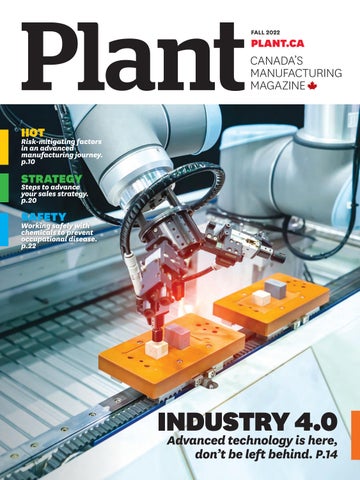
FALL 2022
PLANT.CA
IIOT
Risk-mitigating factors in an advanced manufacturing journey. p.10
STRATEGY Steps to advance
your sales strategy. p.20
SAFETY
Working safely with chemicals to prevent occupational disease. p.22
INDUSTRY 4.0 Advanced technology is here,
don’t be left behind. P.14
14
10
INSIDE FALL 2022
10 14 18 20 22
RISK-MITIGATING FACTORS IN AN ADVANCED MANUFACTURING JOURNEY Manufacturers have clear aspirations to engage with Industry 4.0, but without knowing how or where to begin, they won’t realize their goals.
18
Cover story DON’T BE LEFT BEHIND Advanced manufacturing, IIoT, Industry 4.0, technology, no matter what you call the next generation of manufacturing, it is here, and you need to know about it. CAUTIOUSLY EMBRACE INDUSTRY 4.0 Before your enthusiasm creates an impulse to automate you need to pause, look deeply at the process, simplify, and ponder automation.
20
FOUR STEPS TO ADVANCE YOUR SALES STRATEGY FOR TODAY’S CUSTOMER Consider whether your sales strategies are sufficient to catch and retain the attention of today’s younger buyers. WORKING SAFELY WITH CHEMICALS TO PREVENT OCCUPATIONAL DISEASE Employers have a responsibility to recognize the hazards by identifying all chemicals that are used, stored, handled, and generated in their workplace.
In every issue
4 EDITORIAL 6 NEWS 24 TECH CENTRE 26 POSTSCRIPT Industry 4.0 – Are you ready?
22
Cover photo: ©xiaoliangge/Adobe Stock
@PLANT_Magazine
Fall 2022 / Plant
3
EDITORIAL
BY MARIO CYWINSKI FALL 2022 • Volume 80, Number 4
Technology moves fast Are you keeping up with the advances?
T
he days of sticking with the status quo, and expecting to be competitive, are long gone. Today’s customers are just a click away from comparing your company to the abundance of competitors on the market globally. Years ago, the baseline was if a company did not have a web site it would lose customers, as people would say in a surprised tone, “wow, you don’t have a web site?” Today’s customers expect a lot more than just having a web site.Your web site has to be the gateway to your company and showcase what it can offer them. Including having the most advanced manufacturing technology available on the market.
The majority of companies are either applying or plan to apply IIoT technology. Recently, Plant magazine and Canadian Manufacturing surveyed their audience for the annual Advanced Manufacturing Outlook report, to gauge where Canadian companies are when it comes to adopting Industry 4.0 technology. We also conducted a roundtable to discuss the findings of the survey with industry experts. The overview is found on page 14 of this issue, while the polybagged report goes much deeper into the findings. I won’t repeat the insight found in those write-ups; however, I do want to point out some highlights. The survey found that 26 per cent of respondents applied IIoT capabilities this year, while another 26 per cent are in the process of evaluating its relevance to their operations. A further 14 per cent have a plan and are investing in technology for deployment in the next year. This is very positive, and the numbers certainly appear to be moving in the right direction. However, on the flip side, a total of 34 per cent of respondents said they are either not familiar with IIoT capabilities (20 per cent)
or it is not applicable to them (14 per cent). This result brings me back to my initial point about companies sticking to what they have been doing, and expecting to remain competitive. Customers today want more and can seek solutions globally to achieve the results they need. The one caveat of jumping into the deep end of advanced manufacturing, and making your operations fully advanced, is to make sure you are updating in the right areas, and for the right reasons. Nothing is worse than spending a plethora of money on new equipment and technology to later find out it did not help your operations to better compete and was simply a drain on resources. The report and subsequent roundtable discussion reiterates, that if you are updating your operations you should try to achieve the following (which survey respondents said they are applying): improving efficiency/ productivity (43 per cent), providing more visibility into production processes (28 per cent), improving maintenance functions (28 per cent), analytics functionality (24 per cent), tracking materials or shop floor assets (23 per cent), tying in business data from shop floor to top floor (20 per cent), developing new services/revenue streams (14 per cent), consolidating control rooms (14 per cent), and developing smart products (12 per cent). For many small to medium sized companies, it is challenging to know what to update with the limited resources and where to start, planning is certainly key. We trust you will find the Advanced Manufacturing Outlook Report and supplemental articles in this issue helpful in your journey to automate your operations.
MARIO CYWINSKI, EDITOR Comments? E-mail mcywinski@plant.ca
Connect with Plant magazine @PLANT_Magazine facebook.com/PlantMagazine/ 4
Plant / Fall 2022
/plant-magazine
READER SERVICE
Print and digital subscription inquiries or changes, please contact customer service Angelita Potal Tel: (416) 510-5113 Fax: (416) 510-6875 email: apotal@annexbusinessmedia.com Mail: 111 Gordon Baker Rd., Suite 400 Toronto, ON M2H 3R1 EDITOR Mario Cywinski
226-931-4194 · mcywinski@annexbusinessmedia.com
ASSOCIATE EDITOR Monica Ferguson
416-510-5206 · mferguson@annexbusinessmedia.com SENIOR PUBLISHER Scott Atkinson 416-510-5207 · satkinson@ annexbusinessmedia.com NATIONAL ACCOUNT MANAGER Ilana Fawcett
416-829-1221 · ifawcett@annexbusinessmedia.com
MEDIA DESIGNER Svetlana Avrutin ACCOUNT COORDINATOR Debbie Smith 416-442-5600 ext 3221 · dsmith@annexbusinessmedia.com AUDIENCE DEVELOPMENT MANAGER Beata Olechnowicz 416-510-5182 · bolechnowicz@annexbusinessmedia.com GROUP PUBLISHER Paul Grossinger pgrossinger@annexbusinessmedia.com COO Scott Jamieson sjamieson@annexbusinessmedia.com ANNEX BUSINESS MEDIA
111 Gordon Baker Road, Suite 400 Toronto, ON M2H 3R1 Tel (416) 442-5600 · Fax (416) 510-5134 www.annexweb.com SUBSCRIPTION RATES
Canada – $ 76.00 per year USA – $201.00 (CAD) per year International – $227.00 (CAD) per year Single copy – Canada $12.00 Add applicable taxes to all rates. Combined, expanded or premium issues, which count as two subscription issues. ISSN: 1929-6606 (Print), 1929-6614 (Online). PUBLICATIONS MAIL AGREEMENT NO. 40065710
Return undeliverable Canadian addresses to: PLANT Circulation Department, 111 Gordon Baker Rd. Suite 400, Toronto, ON M2H 3R1 ©2022 Annex Business Media. All rights reserved. Performance claims for products listed in this issue are made by contributing manufacturers and agencies. PLANT receives unsolicited materials including letters to the editor, press releases, promotional items and images from time to time. PLANT, its affiliates and assignees may use, reproduce, publish, re-publish, distribute, store and archive such unsolicited submissions in whole or in part in any form or medium whatsoever, without compensation of any sort. This statement does not apply to materials/pitches submitted by freelance writers, photographers or illustrators in accordance with known industry practices. PRINTED IN CANADA
plant.ca PLANT.CA
Get Talent Get Money Get Started
apply today
1
SUBMIT APPLICATION
2
HIRE STUDENTS
3
GET WAGE SUBSIDY
up to*
www.emccanada.org/wil
Today’s students will become part of your workforce. You can help shorten the distance.
W O R K I N T E G R AT E D L E A R N I N G
NEWS AVIATION
AIR CANADA AND SAAB JOIN AS SHAREHOLDERS
Air Canada and Swedish Saab announced that they are joining as Heart Aerospace shareholders. Heart Aerospace is investing in the production of battery-driven planes in Gothenburg and expects to grow to 500 people within three years. Together with airport owner Castellum, it is investing in
Photo: Heart Aerospace.
a campus for electric aircraft industry at Säve airport. Heart Aerospace’s facility at Säve airport, will be called “Northern Runway”, and will include a headquarter, a research and development centre, a prototype hangar, a test-flight hangar, and a final assembly hall. Säve has no commercial flight traffic.
CONSTRUCTION
NORTH AMERICA’S FIRST 3D PRINTED TWO-STORY BUILDING
Canadian 3D construction Photo: nidus3D. printing company, nidus3D, is Nidus3D used the BOD2 building North America’s first two-story 3D printed building in printer from COBOD, in 3D construction printing solutions, whose Ontario. technology has already been proved in several countries and used to 3D print the first two and three-story buildings in Europe. The two-story house is the second structure nidus3D built, the first being earlier this summer. The building will have a studio on the ground floor and a residence above. The area of the building will be 2,300 square feet. One of the new innovative methods nidus3D developed in the project was a 3D printed horizontal beam printed on site and lifted into place by a crane. With the COBOD International 3D construction printing technology, nidus3D has set out to address the current housing gap in Canada. The complete building took 80 hours to print, down from the 200 hours of the first building.
OPERATIONS
SIGMA LITHIUM APPOINTS INDEPENDENT DIRECTOR
Sigma Lithium appoints Dana Perlman as its third independent director. Perlman has over 20 years of experience in strategy, finance, Photo: Sigma Lithium. investment banking, business development, acquisitions, risk management and investor communications.
KING STEEL PARTNERS WITH SIEMENS
King Steel Machinery and Siemens have joined in collaboration with supplier Ruhyih Automation, to begin integrating digital twin technologies into injection molding machines. 6
PLANT.CA
Plant / Fall 2022 PLT_Mitsubishi_Oct22.indd 1
2022-09-21 10:23 AM
NEWS
The agreement ensures energy and carbon reduction throughout the industry by incorporating energy efficiency from the very start of the production process. Through this agreement, the three parties will help launch Taiwan to the forefront of a global sustainable manufacturing push. The deal sees the three global players joining to represent Taiwan and Germany by promoting energy efficiency, carbon reduction, and information security, in addition to continuing to support the advancement of ESG 4.0, combination of ESG and Industry 4.0.
Photo: Henkel.
Photo: King Steel Machinery.
The initial mandate of the board will be to provide guidance and foresight to TMU and Magnet on establishing its governance framework and ensuring a strategic growth agenda.
MILESTONE
MITSUBISHI CELEBRATES 20 YEARS IN CANADA
TECHNOLOGY
HENKEL’S INAUGURATION OF ADHESIVE TECHNOLOGIES INSPIRATION CENTER
Henkel inaugurated its Inspiration Center Düsseldorf (ICD) with an investment of 130 million euros. The Adhesive Technologies business unit built a global
innovation and customer centre on the premises of the company headquarters. With a floor area of 47,000 square meters, the ICD provides space for 30 laboratories, four technology centres and over 650 Henkel experts. The inauguration of the ICD will take place during a multi-day customer event focused on innovation and sustainability.
Toronto Metropolitan University and Magnet announced the newly appointed members of Magnet’s inaugural Advisory Board. Magnet’s social innovation and technology platform serves to support businesses of all sizes to connect with talent and stakeholders such as service providers, industry associations, policy makers and researchers, and to collaborate to deliver workforce development solutions.
Photo: Mitsubishi.
MAGNET ANNOUNCES ADVISORY BOARD
MURPHY MEANS
Celebrating 20 years in Canada, Mitsubishi Motor Sales now has 96 dealers in Canada, a refreshed SUV line-up with the Outlander PHEV plug-in hybrid, and 379,744 vehicles on the road. Soon to be released in the 2023 Outlander PHEV.
MORE More
experience
No One Gives You More!
Ask the Experts: 14,000 systems / over 75 years. Get it done right the first time.
N.R. MURPHY LTD. DUST COLLECTORS 430 Franklin Blvd., Cambridge, ON N1R 8G6 E-mail: 4nodust@nrmurphy.com
(519) 621-6210
Photo: TMU.
www.nrmurphy.com
Fall 2022 / Plant
@PLANT_Magazine PLT_NRMurphy_Oct22.indd 1
7
2022-09-16 10:41 AM
NEWS ENERGY
INDECK NILES ENERGY CENTER ADDS OVER ONE GIGAWATT OF POWER
Indeck Energy Services along with its Korean partners KOSPO and DL Energy, notified the PJM Interconnection of the start of commercial operation for the Indeck Niles Energy Center in Niles, Michigan. The plant achieved the start of operation safely, with the highest standard of quality, and delivers approximately 1.1 gigawatt of electricity, the equivalent output needed to power approximately 635,000 US homes and businesses. Through a contract with Kiewit Power Constructors, the engineering, construction and procurement contractor, GE provided H-Class combined cycle plant equipment to Indeck Niles and is expected to provide parts, repairs and maintenance
Photo: GE Gas Power.
services for 25 years. Indeck developed the plant to fill the need for generating resources created by the decommissioning of older, costly and/or less-efficient coal-fired and nuclear plants in the region. The plant, built by Kiewit, includes all major equipment supplied by GE: two GE 7HA.02
gas turbines, powering two H65 generators, an STF-D600 steam turbine powering a H84 generator, and two Heat Recovery Steam Generators which are triple pressure reheat drum, along with a Mark VIe Distributed Control System software solution and services to support the availability and reliability of the plant.
AUTOMOTIVE
MERCEDES-BENZ PLANS TO SOURCE BATTERY MATERIAL FROM ROCK TECH LITHIUM
Rock Tech Lithium and Mercedes-Benz announced that they are about to enter into an
The digital economy is transforming lives at a whirlwind pace. Keep up with the right solutions for your business. Illumiti, a Syntax company, is a leading systems integration and management consultancy for SAP® technologies committed to delivering strategy, technology, and business transformation to ambitious clients. It is a leading implementer of SAP solutions in North America and an SAP platinum partner. Illumiti offerings include the full suite of SAP® SuccessFactors® solutions along with SAP® Business ByDesign®, SAP S/4HANA®, application management services, and cloud hosting.
Learn more at Illumiti.com 8 ILUM_13694_Illumiti_AdvMfg_RegularPrint_Ad_Final.indd Plant / Fall 2022 1 PLT_Illumiti_Oct22.indd 1
PLANT.CA 2022-09-27 4:37 PM
2022-09-28 3:23 PM
TOYOTA CONTRIBUTES TO HURRICANE FIONA RELIEF EFFORTS
Photo: Rock Tech Lithium
agreement which provides for a partnership to produce lithium hydroxide for the automaker and its battery suppliers. Under the intended binding agreement, Rock Tech has agreed to deliver up to 10,000 tonnes per year of its planned production to the manufacturer and its partners starting in 2026. Mercedes-Benz aims to become fully electric by the end of the decade. From 2025 onwards the car maker plans that all newly launched vehicle architectures will be all electric. To help make this a reality, Mercedes-Benz intends to enter a strategic partnership with Rock Tech, lasting for at least five years and an option to prolong.
Toyota is donating $100,000 to Canadian Red Cross to support relief efforts in affected Eastern Canada communities. Toyota Canada Inc., Toyota Motor Manufacturing Canada and Toyota Financial Services are making the combined donation to the Canadian Red Cross. “With the Canadian Red Cross’ boots-on-the-ground approach, we know they’re the right organization to help the affected communities as quickly as possible,” said Darren Cooper, president and CEO, Toyota Financial Services. “It’s a long road ahead but, with the collective efforts and support of Canadians from coast to coast to coast, we know our friends near Atlantic Canada will make a full recovery.” The Canadian Red Cross is currently on the ground and working closely with community leaders to provide emergency humanitarian assistance.
Photo: Blackline Safety.
SAFETY
BLACKLINE SAFETY ANNOUNCES CONNECTED SAFETY PROGRAM
Blackline Safety announced a $2 million deal with Coventry, England-based Severn Trent Water, for connected personal gas detection devices to protect its employees and support digital transformation. Blackline Safety will protect more than 10,000 workers across six of the 12 UK water and wastewater authorities that now use Blackline’s technology. SevernTrent began the deployment of the first 1,650 Blackline G7c wearable devices. The water
authority will soon replace their existing gas detection units with more than 2,600 Blackline Safety G7c wearable devices and associated services. Blackline’s G7 lone worker and personal gas detection devices detect gas hazards, instantly notify workers and managers in real time, enable contact tracing and corrective action to be taken to mitigate future incidents. The three-year investment, secured via Blackline Verwood, UK-based distribution partner Breathe Safety, includes an option to extend for an additional five years of service. Visit www.plant.ca/news for more industry news and events.
22_002428_Plant_OCT_CN Mod: September 8, 2022 12:14 PM Print: 09/14/22 11:22:15 AM page 1 v7
FANS
π
TOOL CABINETS
FACILITY FUNDAMENTALS
CARTS AND TRUCKS
ORDER BY 6 PM FOR SAME DAY SHIPPING @PLANT_Magazine PLT_Uline_Oct22.indd 1
WAREHOUSE SAFETY
1-800-295-5510
uline.ca Fall 2022 / Plant
9
2022-09-19 9:41 AM
ADVANCED MANUFACTURING
FEATURE
Risk-mitigating factors in an advanced manufacturing journey Manufacturers hoping to gauge their level of technological maturity may be hard-pressed unless they know what they are looking for. For one, there is no set definition on what advanced manufacturing is, but consensus is growing on a set of criteria, including being R&D intensive, having a high percentage of the workforce employed in STEM-related occupations, being at the cutting edge of design and productivity, and displaying higher-than-average capital expenditures. 10 Plant / Fall 2022
“I am seeing a page turn, where there’s more interest in buying more automation in Canada. I think it’s due to the changing of the guard from the Baby Boomers to a younger generation of project managers and technical specialists.” - Ben Whitney If manufacturers are to level-set, the industry needs clarity on how advanced manufacturing is defined for specific contexts, says Brendan Sweeney, managing director at the Trillium Network for Advanced Manufacturing. This will not only go a long way in helping to determine Ontario’s—and
Canada’s—advanced manufacturing strengths but will also identify those industries that require more support. At the very least, says Sweeney, advanced manufacturing involves “the successful achievement of business objectives by developing, producing, or adopting new and novel technologies.”
However, the criteria do not amount to a zero-sum game. “It is much more dynamic—what is advanced today might not be advanced tomorrow,” said Sweeney. “What is advanced in pharma might not be advanced in aerospace. What is advanced in furniture manufacturing, might not be advanced in machine building.” Sweeney adds that technology can solve a particular problem, but it depends on the context. For example, in producing medical devices or robotics, the process of building the product may not be automated, but the PLANT.CA
Photo: ©Artur/Adobe Stock
Manufacturers have clear aspirations to engage with Industry 4.0, but without knowing how or where to begin, they won’t realize their goals. BY PLANT STAFF
Is automation in your future? medical device or product may be extremely advanced. Similarly, some processes are extremely advanced and highly automated, as in the case of a plastic bottle manufacturer that manufactures two billion plastic bottles a year. According to the Trillium Network, ESG (environmental, social and governance) practices should be part-and-parcel of the definition. “If you’re really harmful to the environment, then you’re not advanced, and if you have no intention of diversifying your workforce in a place like Ontario, then you’re not advanced,” said Sweeney. The criterion of contributing to society is an appeal to advanced companies to be purposeful beyond their own pockets. “That could mean that we’re moving away from an internal combustion engine to an electric vehicle that is for the better of the environment,” said Sweeney. Other industry examples include healthcare (making vaccines, PPE); food security (“Could we kill chickens more humanely?”), or “Can we improve safety protocols so that workers don’t get COVID?”. For Sweeney, adding a condition for paying workers a decent wage is also fundamental. “Did you know that the average hourly wage in Ontario is $30?” he asks. “There’s an owner of a machine shop in St. Catharines, Ont., whom I love to quote: ‘If it’s your first day at the shop and you’re 18 years old, the job might only be worth $18 an hour. But by the time you’re 30, I must get you $30 an hour, or else you’re leaving for my competitor.’ So, pay well.”
Consider the City of Mississauga
Like Sweeney, Walter Garrison points out that levels of engagement with emergent technologies differ with every company, its managers, and the overall understanding of the technology. As a former advanced manufacturing business integrator for the City of Mississauga economic development office, Garrison has observed how manufacturers, particularly smalland medium-sized enterprises (SMEs), struggle to adopt new
technologies, unless they are well capitalized. “For one, they have to understand how to successfully research the technologies that are out there, how to test those technologies and how to implement that technology,” said Garrison. Beyond a manufacturer’s own capabilities, understanding the local landscape and the manufacturing ecosystem matters a great deal, suggests Garrison. “Those companies that had headquarters elsewhere, but had a location in Mississauga, were competing with other jurisdictions for work packages,” he said. “If they were able to demonstrate superiority at workplace efficiency, that would make all the difference. As far as being engaged with IIOT and Industry 4.0, I certainly think those companies that monitor national trends and are focused will get their directives from the global HQ.”
Motorized Driven Roller Conveyors The New Industry Standard
We bring you Canadian-Made Professional Conveying Solutions. MDR or Motorized Driven Roller Conveyors are quickly becoming an industry standard, replacing CDLR and Line Shaft in warehouse systems, distribution centers, automation projects and a variety of other specialty applications.
Relationship between location and talent
Compared to the GTA, Ontario and the rest of Canada, Mississauga has no shortage of automation companies. “There certainly are examples in the city of world class manufacturing, where Industry 4.0 has been well adopted and companies continue to push the envelope,” he said. “Systems integrators, seem to be more in Cambridge area, and sometimes in Vaughan.” Manufacturers whose clientele have international scope need to be at the leading edge of innovation and how efficient their production practices are, says Garrison. “You’ll see robotic arms in operation, but you’ll see an understanding and a mindset that is well thought out before they integrate that process into complex industries like aerospace or defense,” he said. There’s no question Mississauga’s growth can be partly attributed to its proximity to Toronto. Malton, a neighbourhood in its northeast end, is home to Toronto Pearson International Airport—Canada’s busiest airport—and the site where many multinational corporations locate their headquarters. Manufacturing companies gravitate to the area because it is located
Rolmaster Conveyors offers customers a broad range of 24V driven roller and control options. Driven rollers come in several diameters and a wide range of conveyor widths for both case and pallet applications. Control options include pre-programmed units for simple installations and retrofits. Rolmasters’ robust design allows for completely enclosed controls and simple installation.
www.rolmasterconveyors.ca info@rolmasterconveyors.ca
(800) 461-6806 121 AVENUE ROAD, CAMBRIDGE, ONTARIO, CANADA N1R 1C2 Fall 2022 / Plant
@PLANT_Magazine PLT_Rolmaster_Oct22.indd 1
11
2022-09-26 1:13 PM
FEATURE
Photo: © whyframeshot/Adobe Stock
ADVANCED MANUFACTURING
between Toronto and Waterloo, Ont. (The Toronto-Waterloo Corridor is the largest tech cluster in North America outside of Silicon Valley.) Garrison also describes the city as a hub for engineering talent. “The idea that Mississauga is a bedroom city is a thing of the past,” said Garrison. “In fact, immigration, which was halted in 2020 and to a certain extent in 2021, is picking up again. A lot of people coming into the city are skilled and highly qualified.”
12
Plant / Fall 2022
Small plant advantage
Ben Whitney, president of Armo-Tool and Abuma Manufacturing, agrees that Canada has a smart, engaged workforce. He points out; however, that manufacturers in this country generally lag the U.S. For Whitney, there is an opportunity for SMEs to capitalize on. “With smaller plants, it’s hard to have the right people,” said Whitney. “But it’s a good time now with the labour shortage and the blessing of the smart
people that we do have to spend a bit of money and turn people loose on feeling out what’s the right solution for us.” The same prospect extends to branch plants, he says, where there may be an opportunity to take on a project that corporate views as a little bit risky. “At a smaller plant in Canada, we can devote the resources and turn ourselves into the test sites for some of these [emergent] technologies. We can take the opportunity to go first, rather than being the
laggard in some of these strategies and technologies.” Based in London, Ont., Armo-Tool has a unique vantage that allows Whitney to steer both technological and process innovation. The privately-held, family-owned company was started in 1969 by Whitney’s father as a precision grinding and coating shop. The outfit expanded over the years to include progressive and transfer stamping dies, tooling, and automation, particularly for the automotive industry. In
PLANT.CA
2017, the company acquired Abuma, which specializes in low volume, high quality steel and aluminum fabrication. “We were able to take the stainless-steel fabrication expertise of Abuma, plus Armo Tool’s robotics automation experience, to approach some new industries,” said Whitney. “Traditionally, Armo-Tool served a lot of automotive business. However, with some of the new capabilities, we’re able to diversify to food and beverage, and consumer product assembly and packaging.” Still, achieving a ‘true’ Industry 4.0 assembly line model in a facility characterized by ‘single machine automation level complexity’ can be difficult, admits Whitney. “A lot of what we’re trying to do is get more live information into the hands of more people—which isn’t exactly Industry 4.0. It is machine data sharing. In our process the people are the productivity machines, and the goal is to make sure that they have the information they need all the time to make good decisions.” In recent years the company’s investments have focused on educating the team of 180 members and working together to coordinate activities, particularly once routines were disrupted through the pandemic, said Whitney, who mentions there are a lot of hidden opportunities to be had from a small investment in data. For instance, Armo-Tool uses the services of FreePointTechnologies, a developer of machine monitoring software to monitor its CNC equipment. “By doing that we are able to identify what a lot of root causes are of, not necessarily downtime, but of non-productive time,” said Whitney. The appetite for machine monitoring is evident across the industry. “There has always been a ton of data in the machinery, but it wasn’t actionable,” said Whitney. “And it wasn’t getting into the right people’s hands in a timely fashion. Now that the machine can be tied directly back to the work, one can monitor the true causes of scrap, and track the causes of downtime and do all kinds of great analyses.” @PLANT_Magazine
A lesson in contrasts
Garrison, Sweeney, and Whitney agree that the challenges of the day can be overwhelming, especially for manufacturers who are hesitant to make feasible technology improvements. The restraint is never more palpable than when Whitney compares underlying trends and the behaviours of his U.S. and Mexican customers—especially with respect to the level of technology
Etalex-PubCdnManufacturing-sept2022.indd 1 PLT_GroupeSJM_Oct22.indd 1
they require for solutions. “Canadian customers oftentimes want the same machine from 10 years ago, with little advancement as possible,” he said. In contrast, Mexican customers, that tend to have younger technical workforces and younger leadership, want new technology and tend to order the most cutting-edge machine possible. “To me, that’s really exciting and has strengthened opportunities for
them,” said Whitney. “In Canada, sometimes we do that. However, I am seeing a page turning, where there’s more interest in buying more automation in Canada. I think it’s due to the changing of the guard from the Baby Boomers to a younger generation of project managers and technical specialists. I also think that with the labour shortage, there’s more interest in doing a more ambitious project from our customers in Canada.”
2022-09-15 Fall 2022 / Plant 15:19 13 2022-09-16 1:10 PM
ADVANCED MANUFACTURING
COVER
Don’t be left behind Recently, Plant conducted the 2023 Advanced Manufacturing Outlook survey, which measured advanced manufacturing (IIoT and Industry 4.0) among respondents in the manufacturing industry who are senior decision makers. The research was conducted by R.K. Insights, earlier this year for Plant Magazine and Canadian Manufacturing Online. In addition to the survey, Plant conducted a roundtable with industry experts, to gauge their reaction to the results, and discuss the future of advanced manufacturing. Combined they looked at advanced manufacturing adoption, digitalization, processes, financing, cyber security, data collection, and training. They also looked at which technologies are being invested in, and how those technologies will be used. 14
Plant / Fall 2022
97 per cent of respondents have undertaken measures to protect their company against a cyber-attack.
“When we talk about retaining talent where you have a generation of millennials that use technology for anything and everything, it is a challenge to ask those very same people to file an expense excel spreadsheet manually,” said Krishan Chauhan, director of business operations, Canada, Sap Concur.
IIoT adoption and investment
IIoT adoption is increasing slowly, as we saw 26 per cent of respondents applying IIoT capabilities this year (up from 24 per cent in 2020), while another 26 per cent are in the process of evaluating its relevance to operations, and a further 14 per cent have a plan and are investing in technology for deployment in next 12 months. Only 20 per cent said they are not familiar with IIoT capabilities (down from 24 per cent in 2020), and 14 per cent said it is not application to them.
“The last couple of years has taught us that we should be very concerned about companies, large and small, that aren’t making investments in technology. If you look at who’s disappeared during the pandemic, and those still around, they are the ones who have invested in technology,” said Dennis Dussin, president, Alps Welding. “I don’t see how you can be competitive, have effective processes and serve customers in today’s environment if you’re not making those investments. The number of people not concerned should be in the single digits, close to zero.” For companies that are not investing in IIoT, the main reason cited was the technology was too costly (33 per cent). Followed by difficulties integrating advanced technologies into existing systems (30 per cent), lack of skills to support investment PLANT.CA
Photo: ©Blue Planet Studio/Adobe Stock
Advanced manufacturing, IIoT, Industry 4.0, technology, no matter what you call the next generation of manufacturing, it is here, and you need to know about it. BY MARIO CYWINSKI
(27 per cent), uncertainty, risk, and disruption (23 per cent), lack of financing and support (20 per cent), among others. “Make sure that IoT is giving you the type of data to make decisions, and as soon as you’re not making them, you’re operating your business the way you have in the past, based on natural trends of what they’re used to for the past 25-30 years,” said Hussam Malek, partner, consulting, MNP. “The problem is those trends have changed drastically, now being a global competitor and globalized environment, not having that information and data, is really going to impact losing clients, but also affect your profitability it is going to come down drastically, not being able to control them.” Conversely, what happens to those companies that do not invest in IIoT? Companies are worried, with 18 per cent ‘very’ and 53 per cent ‘somewhat’ concerned for their companies if they do not invest in IIoT; with 22 per cent not very concerned, and six per cent not at all concerned. “Losing employees and not being
able to attract younger people into your workforce is a major concern,” said Jayson Myers, CEO, NGen. “Younger people coming into the advanced manufacturing workforce are expecting companies to be up-todate in terms of the technologies they are using.”
How safe is your technology?
The survey found that 56 per cent of respondents mentioned having experienced a cyber-attack or breach at their company. Overall, 41 per cent had a phishing attack, 14 per cent had a data breach or loss of proprietary data; personal or financial information, 14 per cent had a breach through a third-party vendor, among others. That leaves a whopping 44 per cent who said they had no breach or attack. “More than half of companies are blissfully unaware that they’ve suffered an attack. These numbers are measures of delusion. The idea that a piece of open-source code is buried in systems, and in some cases down in layers that were never even designed to have a regular update cycle has caught
Come visit us at booth #5
OCTOBER 20, 2022
The Barrett Centre, Humber College
TORONTO 1.800.367.8039
MONTREAL 1.800.361.2928
Local: sewcan.ca @PLANT_Magazine
PLT_SEW1_Oct22.indd 1
·
VANCOUVER 1.800.972.5481
Global: sew-eurodrive.ca Fall 2022 / Plant
15
2022-09-16 9:14 AM
COVER
companies off guard,” said Peter Coffee, VP for Strategic Research, Salesforce. “If this wasn’t a wake-up year, I don’t know what will be.” How do you avoid a cyber-attack? One of the most important tools is to educate the company’s workforce on how to avoid getting scammed in the first place. This is especially true for more sophisticated attacks. It is reassuring to see that 97 per cent of respondents have undertaken measures to protect their company against a cyber-attack. Of those 70 per cent have a security infrastructure, 52 per cent have taken on a cybersecurity risk assessment/review, 46 per cent had a cybersecurity strategy, 44 per cent have data privacy controls, 33 per cent have a cyber breach response plan, and 23 per cent have crisis management procedures and/or a business continuity plan. “Our internal pulse data shows that careless, untrained, or unaware employees are the top source of vulnerability for most firms. With employees, it’s not just a technical vulnerability, but potentially socially engineered ones, manufacturers should look out for.This is where attackers are using technology to gather sophisticated information on companies and individuals, then
using that information to engineer access by contacting the company directly and fooling people into opening the gates,” said Scott McNeil-Smith, VP of manufacturing sector performance, Excellence in Manufacturing Consortium (EMC). “This can include pretending to be customers, suppliers, and service providers, to access financial, IP and other information, to redirect payments or enable further, more comprehensive cyber-attacks. It’s getting harder to tell the difference between real and fake, so having cybersecurity procedures in place that includes educating staff, and policies for access and monitoring controls, and maintaining and testing back-ups is vital to protect against what could happen if something does hit the fan.”
Benefits of advanced manufacturing
When we asked how companies are applying IIoT, we found that organizations are improving efficiency/productivity (43 per cent), providing more visibility into production processes (28 per cent), improving maintenance functions (28 per cent), analytics functionality (24 per cent), tracking materials, shop floor assets (23 per cent), tying in business data from shop floor to top
floor (20 per cent), developing new services/ revenue streams (14 per cent), consolidating control rooms (14 per cent), and developing smart products (12 per cent). “What I’ve heard a lot is the “where do we start” and having that strategic score card is critical to this, so you could go into a plant that has 10,000 pieces of equipment, or a plant that has 50,000, and for both, understanding the production critical equipment
Manufacture greater success As disruptions in today’s manufacturing landscape intensify, it’s more important than ever to develop carefully targeted strategies. From leveraging datadriven tax planning, accounting and assurance solutions, and industry benchmarking, to identifying savings and investment opportunities, MNP can help.
Ryan Magee, CPA, CA 416.613.3120 | ryan.magee@mnp.ca MNP.ca
16
Plant / Fall 2022 PLT_MNP_Oct22.indd 1
PLANT.CA 2022-09-29 4:04 PM
Photo: © SweetBunFactory/Adobe Stock
ADVANCED MANUFACTURING
“It’s important to step back, and look at your critical areas, throughput challenges, and equipment availability, and then assessing these areas.” -Kristina Sturek
and having a score card will help determine where to start,” said Kristina Sturek, director, US projects, Illumiti. “It’s important to step back, and look at your critical areas, throughput challenges, and equipment availability, and then assessing these areas. What is it that we want to measure, what do we want to improve, where do we need our cost savings and improvements? Then choose that one area based on the analysis and reliability
assessment, that is where your pilot should start, after a period of six to 12 months your business case will write itself, you are going to see the cost savings by increasing your equipment uptime, reducing wrench time, reductions in materials and overtime costs, especially with predictive maintenance.” It is good to see that most respondents are seeing a benefit from using advanced manufacturing. In all, 78 per cent said they saw a benefit, with the most common benefits mentioned by respondents being increased throughput (38 per cent), reducing downtime (36 per cent), increased quality of product (33 per cent), product innovation (23 per cent), reduced staff requirements (20 per cent), among others.
Data collection and use
All companies collect data. We live in a world of data, if you have an electronic device, it is collecting data of some sort. However, while the data is being collected, often that data is
not fully utilized for its benefits. While different areas of a company may have specific data, they may only keep data within that area, and not share it with the whole organization. What we found was that 96 per cent of respondents said that sharing data would benefit the whole organization. “For us, having just gone through an ERP system upgrade, and understanding that the raw information that’s coming out of it isn’t going to be a benefit to every employee. Therefore, creating tools to analyze that data has allowed us to create tools that automate people’s decision making,” said Stephen Loftus, CEO, Innovative Automation. “It’s another step in the automation process, the data is allowing us to make those decisions, no different than any person analyzing that data making the decision.” Mario Cywinski is the editor of Plant magazine, MRO magazine, and Food and Beverage magazine, contact him at mcywinski@plant.ca..
Momentum for what’s next. Manage your cashflow, not uncertainty, with Concur Expense—the world’s leading expense management solution trusted by over 51,000 businesses of all sizes.
Learn more at concur.ca/momentum @PLANT_Magazine
PLT_Copper_Oct22.indd 1
Fall 2022 / Plant
17
2022-09-20 11:43 AM
IIOT
FEATURE
Cautiously embrace Industry 4.0 Before your enthusiasm creates an impulse to automate you need to pause, look deeply at the process, simplify, and then ponder automation. BY RICHARD KUNST
Pause
I still am convinced that the best methodology to document, observe, reflect, and strategize your business processes is by participating in a facilitated enterprise value stream workshop. Indeed, many practitioners start using value stream mapping, which is good, but it only identifies ‘waste’ through the lens of inventory. Enterprise value stream mapping allows you to analyze your information flow in a granular manner seeing just how complete and accurate your information flows are. Ultimately the map allows you to look at your business in a holistic manner, be honest with yourself during the mapping exercise and document accordingly.
Reflect
The most critical time within your business is the first hour and the last hour. It is indicative of how quickly the process becomes effective and how easy is 18
Plant / Fall 2022
Collaboration is critical
“Would I want my child to perform this function or make it into a career?” If the answer is no, then that process becomes a potential viable candidate for automation. it to retire at the end of the day. Variability is the cancer of any process, and we need stability of process before we can even consider any form of automation.
“Not for my child ...”
While I walk and observe processes, in the back of mind is the question, “would I want my child to perform this function or make it into a career?” If the answer is no, then that process becomes a potential viable candidate for automation. For example, White Castle is now employing “Flippy” an automated kitchen assistant which allows kitchen technicians to perform other tasks more tailored to creating that positive customer experience. Before your enthusiasm creates an impulse to automate you again need to pause, look deep at the process and then simplify, and ponder automation. Simplification does not have to be an advanced science; it can consist of a simple workplace
organization (remember robots are not good at searching). Second, a proper material conveyance and replenishment (develop a cadence) and finally, a great opportunity to translate ‘tribal knowledge’ into a quantifiable repeatable operation.
“I fear a recession, a downturn in business and losing the employees I currently have ...”
All are valid concerns so let us demyth. Recession and a downturn in business are bundled together. Business runs in cycles and only those with the vision, tenacity, and commitment to see through to next cycle will ultimately be the industry winners. When times are slower it provides more time to implement automation, recover from mistakes and ultimately achieve stability within the process. Once stability has been accomplished in your new process it is easy to speed it up. Employees are yours to lose.
As you look to embrace automation you will need an automation partner. Don’t jump on the first opportunity, be just as diligent with selecting a collaboration partner, as you would in selecting a new employee. Ultimately, their influence and impact could transform your business with an ever-lasting impact. Collaboration is a successful strategy for organizations to become nimble, and nimble companies unlock new value for themselves and customers.
As you embrace Industry 4.0 be sure to reflect
Do an enterprise value stream workshop; simplify; look at your operations to simplify, obsolete or automate as if it is your child doing the work; be strategic, build your vision and strategy despite storm clouds on the horizon; respect your people, skills will need to be shifted for Industry 4.0; and cautiously select a collaboration provider. The embrace of Industry 4.0 should be met with an innovative approach while integrating legacy systems with automation to enhance being nimble and competitive. Richard Kunst is an author, speaker and seasoned lean practitioner based in Toronto, who leads a holistic practice to coach, mentor and provide management solutions to help companies implement or accelerate their excellence journeys. You can reach him at www.kunstsolutions.com. PLANT.CA
Photo: ©Mariia/Adobe Stock
Labour shortages are prompting many businesses to jump into solutions using automation as a replacement. Industry 4.0 is no longer a novel concept to businesses. A lot has been written about Industry 4.0, which has triggered automation technologies to evolve regularly to transform how facilities operate day-to-day. Businesses must first understand their own business and processes, and then plan what needs to be changed before automating and transforming. When facing pressures to satisfy customers it is crucial to pause and reflect, you may not have the time to do it, you also cannot afford not to if you want a successful outcome.
There is no doubt that the advent of automation will change jobs and lives. It becomes important to how you manage the speed of adoption within your organization. Encourage your employees to learn new skills and capabilities, so they can continue to be a valuable resource to your organization. As you invest in automation, make sure you are also investing in your people, they deserve it.
STRATEGY
FEATURE
Four steps to advance your sales strategy for today’s customer Consider whether your sales strategies are sufficient to catch and retain the attention of today’s younger buyers. BY SHAWN CASEMORE In a recent economic update, the host, a highly regarded Canadian economist, shared that the Canadian market is now near the peak of its economic recovery. Alternatively, the U.S. is still in its early days. This might not seem like a big deal if you’ve struggled to match supply with demand. However, it suggests that demand may be slowing, at least here in Canada. There is one way to protect yourself from a possible economic downturn, and it begins and ends with sales. However, if you’ve been holding back on assertively selling during the last 12 to 24 months, you might be in for a surprise. The
The labour shortage impacts sales professionals as it has many other professions, but it extends beyond talent. labour shortage impacts sales professionals as it has many other professions, but it extends beyond talent. In my latest book, The Unstoppable Sales Machine, I dedicated an entire chapter to discussing how buyers who seek products and services have changed. Putting feet on the street and selling to sell is no longer effective. Sure, you’ll get the odd meeting, but
overall, a demographic shift is changing how buyers buy. Once keen to meet, baby boomers who were still working in 2020 took the pandemic as an opportunity to retire, replaced by younger, more technologically savvy buyers. A study by the Federal Reserve of St. Louis suggested that 2.6 million more baby boomers retired during the pandemic than expected. Younger generations replacing those baby boomers have an increased desire to solve their problems. A Gartner study conducted in December 2020 found that 62 per cent of Millennials and 75 per cent of Generation Z referred to sources such as Google and YouTube to solve their problems.
Procter & Gamble { Belleville, Ontario} The Bay of Quinte Region is home to a large cluster of manufacturing facilities including many well-known multi-national corporations. Strategically located, the region is known as a prime Canadian logistics and manufacturing hub that provides fast access to major Canadian and US Markets.
To learn why manufacturing works here and what is Proudly Made in Bay of Quinte, visit madeinquinte.ca
20QEDC_Plant-Half-2.indd Plant / Fall 2022 1 PLT_Quinte_Oct22.indd 1
PLANT.CA 2022-09-23 8:29 AM 2022-09-26 10:47 AM
Photo: ©Blue Planet Studio/Adobe Stock
Another study by Gartner suggests that nearly 50 per cent of a buyer’s time is spent researching before engaging with sales. We have younger generations in the seats of the people we used to sell to, and they don’t want to spend an afternoon on the golf course discussing business. Fortunately, there are solutions you can introduce that turn the tables in your favour and help you to accelerate sales in this new market. 1. Have an active digital presence. If you have an outdated website, then you might as well have no website.Your digital presence is your calling card, the number one way buyers will ‘assess you from afar’. Update your existing website with current and valuable information. While you are at it, add a live chat feature, that your inside sales staff can use during regular business hours, engaging with site visitors to respond to questions. 2. Include social selling as part of your sales strategy. As of this writing, LinkedIn has 830 million members in over 200 countries. If you want a window into new selling opportunities, your sales team, executives, and company should be active on LinkedIn.
or even the entire product or service. Online payment has become a normal behaviour, so take advantage of the opportunity to improve your cash flow, reduce paper and (most importantly) get ahead of your competition.
Even the non-premium (no-cost) version of LinkedIn provides a window of opportunity to find new prospects and referral opportunities and can offer the ability to connect with almost anyone. 3. Empower your customers to buy. For example, if you stop by the Tesla website, you can select a car with options and features within minutes and purchase. You might not think your product or service can sell on the Internet, but unfortunately, you’d be wrong. Get creative about using your website to collect deposits, advance payments,
4. Focus on adding value. From the first interaction a prospect has with your company, be it your website, meeting someone at a trade show, or even if they are to stop by, and the entire experience must engulf them in value. In the highly transactional world that we live in, adding value is a simple way to get your prospects thinking, “if I get this much value and haven’t made an investment yet, what will I get when I do?” Whether the economy remains at its current level or slows isn’t the question you need to consider. Instead, consider whether your sales strategies are sufficient to catch and retain the attention of today’s young buyers. When you do this, you’ll position your company to withstand whatever the future might hold. Shawn Casemore is keynote speaker, consultant, and author of three books, including his latest book, The Unstoppable Sales Machine. To learn more about Shawn and his work, visit www.shawncasemore.com.
RETHINK MFG. WITH CREFORM FLOW RACKS
Creform flow racks. A simple, yet effective way to ensure that manufacturing runs at peak performance. Built for ergonomics, efficiency and FIFO inventory management, each incorporates flow lanes and levels to present containers and parts at assembly stations, machine loading points and for other material handling applications. When used in combination with workstations, carts and AGVs, Creform flow racks are an integral part of the systems approach to industrial material handling. Create other economical, flexible, reliable structures and AGVs. ®
WORKSTATIONS
FLOW RACKS WITH PLACON ® ROLLER CONVEYORS CRE-451 8x5.375.indd 1 @PLANT_Magazine PLT_Creform_NovDec21.indd 1
CARTS
AGVs
w w w. c r e f o r m . c o m • 8 0 0 - 8 3 9 - 8 8 2 3 9/30/21 10:12 AM Fall 2022 / Plant 21 2021-11-02 3:45 PM
HEALTH AND SAFETY FEATURE
Working safely with chemicals to prevent occupational disease
Employers have a responsibility to recognize the hazards by identifying all chemicals that are used, stored, handled, and generated in their workplace. BY CANADIAN CENTRE FOR OCCUPATIONAL HEALTH AND SAFETY
Identifying hazards and assessing risk
Each workplace is unique. Employers have a responsibility to recognize the hazards by identifying all chemicals that are used, stored, handled, and generated in their workplace. They must also assess the risk of exposure to chemicals for their specific workplace, considering both the likelihood and severity of the exposure. These risks will depend on the chemicals present, the type and duration of the tasks being performed, the work environment, and other workplace-specific factors. Once risks are assessed, they must implement appropriate control measures following the hierarchy of controls (more on this below). In some situations, additional information such as occupational hygiene monitoring is needed to assess the hazard. Understanding routes of exposure is another key part of the risk assessment. Inhalation is the most common, followed by contact with skin or eyes. Unintentional ingestion can happen if food, hands, or cigarettes are contaminated, workers should never drink, eat, or smoke in areas where they may be exposed to chemicals. Injection is a less common method of exposure, occurring when a sharp object punctures the skin and injects a chemical directly into the bloodstream. Regardless of how the chemical gets into the body, once inside it is distributed by the blood stream. In this way, the chemical can harm organs, which are far away from the original point of entry, and where it entered the body. In some cases, it may be years between the 22 Plant / Fall 2022
time of exposure to the chemical and the development of a disease. This time is known as the latency period. Many occupational diseases have longer latency periods – they tend to be detected after prolonged exposure over time, making it challenging for researchers to track and study the effects of individual chemicals.
General health and safety when working with chemicals
After the hazards and risks of chemicals have been identified and assessed, appropriate control measures need to be put in place to protect workers. It is important to control the hazards by considering the most effective measures first, also known as the hierarchy of controls. Elimination and substitution are the first and most effective control measures in the hierarchy, which involve removing the hazardous chemical from the workplace or replacing it with a less hazardous one. If elimination or substitution is not feasible or if there is remaining risk, the next most effective measure is engineering controls. These include design updates or modifications to plants, equipment, ventilation systems, and processes that reduce the source of exposure. Administrative controls, the third most effective measure, alter the way the work is done, including timing of work, policies and work practices. Work practices involve standard operating procedures such as housekeeping, equipment maintenance, personal hygiene practices, workplace-specific procedures, and training. It is critical that employers provide education and training about the potential hazards of the products and how to work with them safely. Training should cover safe work practices, procedures first aid measures in case of exposure, and how to respond to spills.
The last control measure to consider when other controls are unable to adequately protect workers is personal protective equipment (PPE).
Putting theory into practice
Workplace hazard control should be overseen and implemented by qualified individuals, and in consultation with health and safety committees or representatives, supervisors, and workers. It is also important to always follow the requirements of the applicable occupational health and safety legislation, fire codes, building codes, standards, environmental regulations, transportation of dangerous goods (TDG) regulations, and industry good practices. When developing procedures for proper storage and disposing of a chemical, follow the recommendations from sections seven and 13 of the Safety Data Sheet (SDS), along with any regulatory requirements, standards, and codes for your jurisdiction. Ensure all containers are clearly labeled to avoid misuse or incidents. When working with a chemical, make sure the necessary controls are followed to limit exposure, as outlined in your workplace’s procedure for the specific chemical and task. This will include requirements for ventilation, proper storage and disposal procedures, and the kind of PPE that needs to be worn. Encourage workers to report any concerns to a supervisor. They can also speak with their health and safety committee or representative for guidance on how to work safely with chemicals. The Canadian Centre for Occupational Health and Safety (CCOHS) promotes the total well-being — physical, psychosocial, and mental health — of workers in Canada by providing information, advice, education, and management systems and solutions that support the prevention of injury and illness. Visit www.ccohs.ca for more safety tips. PLANT.CA
Photo: © NVB Stocker/Adobe Stock
When chemicals are used, stored, or generated in the workplace, there are unique hazards. Some have properties that make them an immediate safety concern, such as explosive, flammable, and corrosive chemicals. Others cause adverse health effects on our organs and body systems. Adverse health effects may result in occupational diseases ranging from contact dermatosis to cancers. Over the last several decades, research has helped us better understand why certain illnesses are common in certain occupations. It has also led to advances in preventing occupational disease through the implementation of control measures, like using alternative chemicals that are less harmful.
NEED APPRENTICES?
Up to $20,000 in help is available right now! *
Build your future workforce with support from the Canadian Apprenticeship Service for small and medium-sized businesses. • Free access to employer-apprentice matching services • Free access to mentorship programs • Free access to diversity and inclusion training
Apply for your grant at ApprenticeSearch.com/CAS
*E&OE, some conditions apply. See website for details.
TECH CENTRE
NEW PRODUCTS
Photo: Acieta.
Photo: Ledvance.
Photo: Rite-Hite.
IN-PLANT BARRIERS
Rite-Hite announced an extension of its GuardRite line of in-plant safety barriers, the GuardRite Polymer Safety Barrier. Capable of stopping equivalent impact levels as its steel counterparts, the GuardRite Polymer Safety Barrier is made from scratch-resistant, impact-modified polypropylene, which allows it to bend and absorb collisions with little or no damage to floors, material handling equipment, or the barriers themselves.
The GuardRite Polymer Safety Barrier comes in five models to accommodate specific applications to provide pedestrian, equipment, and product safety by clearly defining work areas, walkways, and storage areas. www.ritehite.com
LEDVANCE LINK
Ledvance launched Ledvance Link, a wireless connected lighting solution. This makes networked lighting control quick which helps save
“
labour, materials, and time. Options available to tailor a Ledvance Link lighting control solution to the exact needs of the project. For new installations, there are network-ready, connected luminaires. For retrofits, there are field installable, plug and play controllers, sensors, and accessories for a range of compatible luminaires. www.ledvance.com
robot mounted on a mobile platform to move quickly between production Photo: Rite-Hite areas. The system is compatible with Fronius, Lincoln Electric and Miller welding units. www.acieta.com
POCKETJET 8 SERIES
WELDING COBOT
Acieta launches the FastARC CW cobot to complete welding tasks so that manufacturers can increase output by assigning complex jobs to skilled welders. The FastARC CW includes a FANUC CRX-10iA/L 6-axis
Photo: Brother Mobile Solutions.
Brother Mobile Solutions launches PocketJet 8 series which includes enhancements to print speed and
SEW-EURODRIVE’s MOVI-C® modular automation system are quick and easy. Everything from a single source.
“
—Shane Carnegie, Electronics Product Manager
TORONTO 1.800.367.8039 Local: sewcan.ca
24 Plant / Fall 2022
PLT_SEW_Oct22.indd 1
MONTREAL 1.800.361.2928 ·
VANCOUVER 1.800.972.5481
Global: sew-eurodrive.ca
PLANT.CA
2022-09-20 1:08 PM
quality, USB Type-C connectivity, and a broader range of compatible media, including thicker paper and labels. The PocketJet 8 series provides users with increased printing speeds, higher print quality for small font, detailed graphics, complex barcodes and QR codes, and simplified connectivity https://brothermobilesolutions.com
TAPE BONDING SYSTEM
pressure pulsations and spikes. Added manual isolation and throttling needle valves isolate instruments from the sensed media, while block and bleed valves isolate instruments with the added ability to bleed off unwanted pressure. Both valves also allow for removal and maintenance of measurement instruments without shutting down the process. https://www.automationdirect. com/pressure-sensors
AI ENHANCEMENTS TO SAPERA VISION SOFTWARE
Photo: Teledyne.
SaperaTM Vision Software from Teledyne offers field proven image acquisition, control, image processing and AI functions to design, develop and deploy machine vision applications.
The new upgrades include enhancements to its AI training graphical tool AstrocyteTM, image processing and AI libraries tool Sapera Processing. Sapera Vision Software is ideal for surface inspection on metal plates, location and identification of hardware parts, detection and segmentation of vehicles and noise reduction on x-ray medical images. www.teledynedalsa.com For more products, visit: www. plant.ca/technology-centre
Photo: 3M.
3M introduces VHB Extrudable Tape bonding solution. This bonding solution combines the benefits of 3M VHB Tapes with the versatility of a liquid adhesive. Initially used for bonding panels to the frames of specialty vehicles like ambulances and box trucks, this new bonding solution proved superior to other methods due to its ability to distribute stress loads across an entire surface instead of concentrating stress loads around each individual fastener. https://engage.3m.com/3MVHBExtrudableTape
Safe radar sensor PSENradar
WINTERS PRESSURE ACCESSORIES
Rain
Steam
Dust
Photo: AutomationDirect.
AutomationDirect has added pressure sensing accessories from Winters. These accessories will protect delicate pressure measurement equipment from damage caused by pressure surges, and superheated media. Included in the new product release are siphons that protect pressure gauges, transmitters, and switches from the effects of high-temperature media such as steam. New pressure snubbers protect instruments by suppressing
Safe protection zone monitoring in rugged conditions!
Pilz Automation Safety Canada L.P. - Mississauga, ON www.pilz.ca - info@pilz.ca - +1 905 821-7459
Fall 2022 / Plant
@PLANT_Magazine PLT_Pilz_Oct22.indd 1
25
2022-09-22 10:50 AM
POSTSCRIPT
Industry 4.0 – Are you ready?
If there’s one thing that Plant’s survey says loud and clear, it’s that investments in technology won’t be enough to sustain and grow Canada’s manufacturing economy.
T
he results are in. Plant’s Survey of Industry 4.0 capabilities and outlook for 2023 clearly indicates that Canada’s manufacturers are on the road to transforming their businesses by adopting digital and other advanced technologies. They know the stakes are high. However, there are also some worrying signs that many companies may not yet be ready to take full advantage of the technologies they are looking to deploy. Indeed, they may be putting their businesses at risk by not paying as much attention as they should to what is needed to translate their investments in technology into real and sustainable performance improvements. Here’s what the survey tells me. More manufacturers are in the process of adopting digital technologies to connect information and production systems on the plant floor and back office, across facilities, with suppliers and customers. They are doing so primarily to improve productivity and operating efficiencies, provide greater visibility into production processes, track materials and shop floor assets, and enhance maintenance and equipment operating efficiencies. Also, they are seeing benefits by way of increased throughput, decreased downtime, and better product quality. More manufacturers are planning to increase investments in robotics and automation, artificial intelligence, cloud computing and data analytics solutions. Again, production efficiencies are the main motivator for investment. There are still some major challenges that stand in the way of greater tech adoption. No surprise that skill shortages top the list. Difficulties integrating digital technology with legacy systems, overcoming resistance to change, keeping up with the pace of technological change, finding funds with which to invest, and making the financial 26 Plant / Fall 2022
case for investment are other real impediments to tech adoption. There aren’t too many surprises. The challenges are just about the same as they have been over the past five years. The real story is in what does not seem to be very important for many manufacturers. The first thing that stands out is that while efficiency improvements are the most important objective for technology investments, relatively few companies connect those investments to creating value for customers. You may be tired of me saying this, but how can any company identify waste – the costs that should be cut – without knowing what processes are critical for creating customer value? I see too many companies investing in AI or automation or data collection and analytics technologies without a clear idea of where in there processes these great ‘solutions’ should be deployed to deliver bottom line benefits. Greater inefficiencies naturally result. Sometimes stranded assets – automated equipment standing idle because downstream processes aren’t equipped to handle higher throughput. Instead of reducing costs, ill-placed investments rapidly become a money pit. They impact the bottom line, unfortunately in the wrong way. Another observation is that too many companies see digital and advanced technologies simply as a replacement for exiting ways of doing things. That’s a money-losing proposition as well. Unless
manufacturers use data to create new business opportunities, new ways of providing value for customers, and new sources of services-based revenue, the only thing they will be able to accomplish in the best of circumstances is to become an efficient producer of commodity products with prices continuing to fall in the face of competition. The business of manufacturing is no longer one of just getting the product out the door. It must be one of providing solutions for customers and for their customers’ customers. The lack of skilled talent is a major constraint on improving manufacturing performance. It’s a good reminder that technology isn’t enough on its own to get better productivity results and no guarantee of business success. Advanced technologies are powerful tools. However, it takes people to figure out how to use them productively, to operate and maintain them, come up with customized solutions in the first place, and to lead and manage a business successfully. With a quarter of Canada’s manufacturing workforce retiring by 2030 and fewer young people looking for jobs in the sector, the challenge is only going to go from serious to acute. There’s another very concerning set of survey results and they’re related to cybersecurity. One-third of manufacturers say they aren’t concerned about cyberthreats. That’s a mistake. Many may not be aware they have already been hacked. According to one of the world’s largest insurance
underwriters, manufacturing is the sector most under threat of cyberattack, attacks are increasing, and the severity of threat – losses suffered by manufacturers – is increasing even more rapidly. Manufacturers are under threat from attacks on their information systems, from attacks on their suppliers and their customers, and most insidious of all, from attacks on the smart products and equipment they use or produce. Among the manufacturers that do perceive the danger of cyberthreats, 20 per cent say they are confident they have done enough to shield their business. Don’t believe it. Cyberattacks are becoming more and more sophisticated. When companies report that they are investing in technologies or software programs to protect themselves, beware. Over 90 per cent of cyberbreaches come because of human error. Cybersecurity training for employees is vitally important. It’s a real concern when fewer than half of manufacturers have a cybersecurity strategy, only onethird have a cyberbreach response plan, and less than a quarter have crisis management procedures let alone a business continuity plan in place. At a time when manufacturing and manufacturing supply chains are more interconnected and more interdependent than ever before, a cyberattack that shuts down a supplier, a customer, a production system, a CPU in a smart product can have devastating effects. I don’t want to put a downer on the outlook for Industry 4.0 in Canadian manufacturing, there’s a lot to be optimistic about. However, we’re talking about serious constraints on business growth. If there’s one thing that Plant’s survey says loud and clear to me, it’s that investments in technology won’t be enough to sustain and grow Canada’s manufacturing economy. It takes much more than that. And far-sighted manufacturing leadership above all. Jayson Myers, the CEO of Next Generation Manufacturing Canada, an award-winning business economist and advisor to private and public sector leaders. E-mail jayson.myers@ngen. ca. Visit www.ngen.ca. PLANT.CA
Photo: ©Alexander Limbach/Adobe Stock
BY JAYSON MYERS
The #1 Trade Show & Conference for Fluid Power, Power Transmission, and Motion Control
CO-LOCATED WITH CONEXPO-CON/AGG (two shows, one price)
The International Fluid Power Exposition (IFPE) is the place where engineers meet to:
CONNECT WITH TOP MANUFACTURERS Including Bosch Rexroth, Danfoss Power Solutions, Parker Hannifin, Poclain, IFM Efector, Hawe Hydraulik, Husco, and 375+ more!
Spark new ideas with in-depth technical conversations with other engineers.
Join your peers from these OEMs: ∙ Caterpillar Inc
∙ Komatsu
Discover solutions current suppliers can offer to your unique challenges.
∙ Volvo Construction Equipment
∙ John Deere Construction
∙ Liebherr
∙ KOBELCO Construction Machinery USA
Find new partners among suppliers pushing the envelope on what fluid power can do.
∙ CASE Construction Equipment
∙ Doosan Bobcat
∙ LBX Company
“ There’s no other show in the world I think that brings the OEM machine manufacturers and the suppliers as close together as this show. It’s a good place to meet and learn about what’s going on. In the Americas, in the Western Hemisphere, this is the show for fluid power.”
KEN ROSENBECKER SALES MANAGER NORTH AMERICA | WIPRO INFRASTRUCTURE ENGINEERING
IFPE only happens once every three years! SAVE 20% OFF REGISTRATION
Register now at IFPE.com and type AD20 in the Promo Code box
INTERNATIONAL FLUID POWER EXPO MARCH 14-18, 2023 LAS VEGAS, NV, USA
RFID Devices at Great Prices
RFID Read-Write Modules
Starting at $158.00 (RLH-M18PA-NIS) RFID read/write modules are transceivers that can read and write data to/from RFID tags (transponders) using high-frequency RFID technology. Unlike barcode scanners they do not require a clear line of sight and their performance is not affected by dirt or other markings. Contrinex RFID read/write modules offer fast data transfer times and communicate to higher-level devices such as a PLC over a communications network. These RFID Read/Write unitsuse the IO-Link protocol. • Read/Write distance of up to 78mm away, IP68/IP69k environmental rating • HF RFID technology operates on 13.56 MHz and complies with ISO/IEC 15693 • IO-Link V1.1 compatible • RFID tags available in EEPROM and FRAM memory types with up to 2,000 bytes of user memory
Also Available
Barcode scanners
Limit switches
RFID READ-WRITE MODULES STARTING AT
$158.00 (RLH-M18PA-NIS)
RFID tags
Research, price, buy at:
www.automationdirect.com/rfid-devices
Orders over $49 get FAST FREE SHIPPING Our shipping policies make it easier than ever to order direct from the U.S.!
Fast free standard shipping* is available for most orders over $49 U.S., and that includes the brokerage fees (when using an AutomationDirect nominated broker). Using our choice of carrier, we can reach most Canadian destinations within 2 to 3 days. *Free shipping does not apply to items requiring LTL transport, but those shipments can take advantage of our negotiated super-low flat rates (based on weight) that include brokerage fees. See Web site for details and restrictions at: www.automationdirect.com/canada
To see all products and prices, visit www.automationdirect.com All prices shown are U.S. Dollars
Order Today, Ships Fast! * See our Web site for details and restrictions. © Copyright 2022 AutomationDirect, Cumming, GA USA. All rights reserved.
1-800-633-0405
the #1 value in automation