For planet and pocketbook
Good management practices don’t just come with ecological benefits. | 8
A match made in manure
Helping close gaps in manure trade. | 12
A return to ‘analog’
A look at manure progress, practices and storage in Ontario. | 18
November/December 2026
What’s hiding in manure lagoons?
manuremanager.com
For all your sweep and rotary injecting requirements • Hybrid II, Rotary, & Python models have weight forward pivoting design built in for contour following.
• No need for a 2nd bolt on pivoting bar & all the associated weight out the back. • Best Durability & Warranty
DIETRICH Hybrid II Injector
• Best actual injection/coverage of wide gallonage ranges • Best options for various requirements
DIETRICH DIETRICH
Rotary Injector
A/R Pivot Injector
US Patents 6973884, 8544395 Other patents pending
• Patented cupped covering blades have a flat center to deter soil build up and are adjustable using an impact only for maximum aggressive coverage or minimum disturbance • Patented Conical blade creates a wider furrow for higher GPA than conventional coulter/vertical till injectors • Carriage bolts for easy impact adjust covering blades • 24” – 30” spacing
DIETRICH
Series 70 A/R Sweep Injector • DSI’s signature injector • High performance Coulter down pressure design • 4 Sweep options for lower rates to 20,000+ GPA • 5 Tube options, including plug-free wing drop • Liquid stays where injected, properly placed for full utilization by crop • Clozr option for different operation requirements
• 30° left & right pivot angle to accommodate contours & end row turning on dragline • Same time-proven Series 70 ability/reliability • Special design for dragline or tank toolbars • Optional Wing Drop for plug-free operation, high or low GPA, and longer life
3 YEAR
WARRANTY on all models
• 18” – 30” spacing • Patented Conical blade creates a wider furrow for higher GPA than conventional coulter/vertical till injectors • 18” spacing, 8 wave Conical blade, & 2 Clozr blades on dragline result in higher GPA injected/covered than a single closer blade design
NEW! Slurry Tube • 4.2” DOM Slurry Tube for heavy wall injection hose & longer life • Highest GPA actually injected/covered in the industry • Non-grease hubs on all models for maintenance free operation • Swivel coulters reduce side loads
Ask your dealer for more information on these DSI Injectors or contact us for a dealer near you (309) 965-5110 | DSIAG.com
CONTENTS
November/December 2026 Vol.24, Issue 5
16
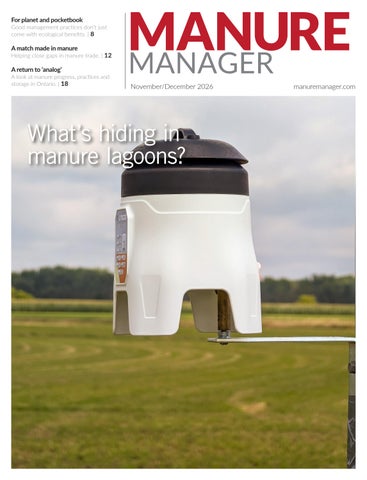
ON THE COVER Air samplers to detect pathogens in manure. Image courtesy of Tucker Burch.
A hidden threat?
In recent years, HPAI has been identified in dairy cows, and in their manure. Can producers use technology to detect – and stop – its spread? Editorial
4
Industry News
6
On Track
21
Manure Mastery
22
Safety Matters
24
Manure Minute
26
8
12
For planet and pocketbook
A match made in manure
A return to ‘analog’
BY MATT JONES
BY TREENA HEIN
BY BREE RODY
Responsible manure practices have ecological and economic benefits, say experts.
Producers with excess poultry manure may be able to find buyers through a new app.
18 How new innovations in manure, biosolids and more are faring with the public in Ontario.
November/December 2026 - MANURE MANAGER 3
FROM THE EDITOR
MANURE MANAGER November/December 2026 Volume 24, No. 5
BREE RODY | @ManureManager
Reader Service Print and digital subscription inquiries or changes, please contact Angelita Potal, Customer Service Administrator Tel: (416) 510-5113 Fax: (416) 510-6875 Email: apotal@annexbusinessmedia.com Mail: 111 Gordon Baker Rd., Suite 400, Toronto, ON M2H 3R1
Who knows what’s in store? Who says talking about the weather is just small talk? First of all, small talk is a necessary skill everyone should try to master in their lifetime. It helps when you’re meeting new people – which you’re hopefully going to do a lot this winter as you take off for trade shows and conferences! Secondly, when you’re a farmer, the weather is never a small topic. Weather dictates everything a farmer or manure applicator does – schedule, speed, quality, quantity – and ultimately can impact pricing as well. These days, as more extreme and challenging weather events take place, it feels like the logistics of weather talk are getting more intense. For example, with a super El Niño weather pattern poised to strike the U.S. this fall, it’s likely that this will mean a shorter application window – both because ground temperatures in many regions are expected to drop to the recommended temperatures for application later than usual, and because there’s likely to be a good deal
Published by: Annex Business Media, P.O. Box 530 Simcoe, ON N3Y 4N5
in our recent Pits, Ponds and Pumps themed e-news week, as well as our Application Week and webinar)! Solid manure storage – whether temporary or longer-term – is also relevant. In this month’s Manure Minute, Minnesota’s Chryseis Modderman gets granular on compost siting and sizing. Our November/December issue is a good time to talk storage, because that’s when storage can be the most relevant. Appropriately, this is when Manure Manager takes its annual hibernation to prepare for its spring issues – in which we cover processing, solid manure, liquid manure and more – in March. During this time, we’ll be producing plenty of original digital content, while also attending and hosting some events, like the new Ascent career fair in Ontario. We and our sister agriculture brands at Annex Business Media are organizing this event to engage with and inspire the next generation of ag innovators. One goal with this career fair – a place where small talk is sure to help you make a crucial connection – is
“More extreme weather events... put pressure on storage.” of rainfall this fall. That, in turn, puts a pressure on storage. And while many who store their liquid manure in a pit like to empty it for the winter – to avoid potential overflow – some experts, like the ones at Iowa State University Extension – are saying some flexibility may be needed there. Of course, there’s more to storage than simply liquid storage in pits and ponds (speaking of which, thank you, readers, for engaging enthusiastically @ManureManager 4 MANURE MANAGER - November/December 2026
to showcase the many meaningful ag careers on top of primary production. Take, for example, the number of chemical, equipment and agtech companies looking for data scientists One of the top data inputs for these technologies? Weather. Just saying. Anyway, if you’re in an area bracing for a warmer and wetter fall and winter, take all the precautions you need – and stay on top of our website for the most up-to-date info and innovation! •
@ManureMag
Manure Manager
Editor BREE RODY (437) 688-6107 brody@annexbusinessmedia.com Advertising Manager SHARON KAUK (519) 410-4854 skauk@annexbusinessmedia.com Account Coordinator JULIE MONTGOMERY (416) 510-5163 jmontgomery@annexbusinessmedia Media Designer KELLI DECONINCK Group Publisher & VP, Content Strategy MICHELLE BERTHOLET mbertholet@annexbusinessmedia.com Audience Development Manager SHAWN ARUL (416) 510-5181 sarul@annexbusinessmedia.com CEO SCOTT JAMIESON sjamieson@annexbusinessmedia.com Printed in Canada Publication Mail Agreement #40065710 SUBSCRIPTION RATES Canada – 1 Year $40.31 2 Years $68.95 (plus applicable taxes) USA – 1 Year $91.23 CAD Foreign – 1 Year $103.96 CAD GST – #867172652RT0001 Occasionally, Manure Manager will mail information on behalf of industry-related groups whose products and services we believe may be of interest to you. If you prefer not to receive this information, please contact our circulation department in any of the four ways listed above. Annex Privacy Officer privacy@annexbusinessmedia.com Tel: 800-668-2374 No part of the editorial content of this publication may be reprinted without the publisher’s written permission. ©2026 Annex Business Media. All rights reserved. Opinions expressed in this magazine are not necessarily those of the editor or the publisher. No liability is assumed for errors or omissions. All advertising is subject to the publisher’s approval. Such approval does not imply any endorsement of the products or services advertisted. Publisher reserves the right to refuse advertising that does not meet the standards of the publication.
manuremanager.com
Mark your calendars! THE MANURE EXPO IS COMING TO ONTARIO!
Aug 10: Tour Day Aug 11-12: Expo Days Elora Research Station Elora, Ontario
Brought to you in co-operation with:
Compare Today’s Technology, Discover Tomorrow’s Solutions FOR EXHIBITOR, SPONSORSHIP AND DEMONSTRATION OPPORTUNITIES, CONTACT SHARON KAUK | SKAUK@ANNEXBUSINESSMEDIA.COM | 519-410-4854
ManureExpo.ca
Xxxxx 2026 - MANURE MANAGER 5
INDUSTRY NEWS manuremanager.com
Nebraska feedlot breaks ground on digester A Nebraska-based feedlot is set to become the staging ground for one company’s mission to prove the potential of agricultural renewable energy. Broken Bow’s Adams Land & Cattle feedlot recently broke ground on a new renewable natural gas (RNG) facility in the company of spectators from the agriculture and energy industries, as well as government and community leaders. The facility will capture manure from Adams’ 250,000-head feedlot, converting it into RNG through eight anaerobic digesters, which are capable of generating more than 4,400 standard cubic feet per meter of biogas. Massachusetts-based energy infrastructure specialist
Amaresco is behind the new facility, through its subsidiary Neogenyx Fuels. The Broken Bow location is Neogenyx’s first agricultural RNG facility. Once the biogas produced by the facility is upgraded to pipeline-quality RNG, the facility is expected to produce approximately 1.2 million MMBtu annually for transportation and other applications. Besides the energy produced, byproducts from the facility include livestock bedding and agricultural amendments. The American Biogas Council estimates that the project will reduce greenhouse gas emissions by approximately 63,700 metric tons annually, equivalent to carbon sequestered by roughly 63,800 acres of U.S. forests annually.
After more than four decades in teaching, research, extension education and leadership, Dr. John Shutske is calling it a day. Shutske, professor and extension agricultural safety and health specialist with UWMadison’s department of biological systems engineering, officially retired in early October. H 41 years in the business included long stints at UW-Madison,
University of Minnesota and time with ag industry organizations and insurance providers. At Minnesota, he cofounded the university’s Center for Research in Agricultural Safety and Health, which served as a prototype for a similar center in Wisconsin. He was also among the founding faculty of the university’s Center for Animal Health and Food Safety, and played a key developing role
in the National Center for Food Protection and Defense, the first U.S. Department of Homeland Security Center for Excellence. He’s held numerous leadership roles at UWExtension including interim provost and vice chancellor, associate dean, director of the UW Center for Agricultural Safety and Health and more. Over the years, his areas of research and
interest expanded to include automation, robotics and AI. He’s also served as a frequent writer and columnist, including for Manure Manager. Shutske says he plans to stay active in research, education and professional engagement, including working with colleagues on funded projects, working independently on the Ag Insight Collaborative, which he founded, and more.
Stricter storage rules for California dairies coming A new policy by the California’s Water Resources Control board is one some environmental groups say is long overdue, but with which they aren’t still 100 percent satisfied – and one producers say will put even more pressure on the dairy industry. The State Water Resource’s Board recently agreed – unanimously – to adopt regulations that impose stricter requirements on dairy farms in to mitigate water pollution in the area, stemming from nitrogen runoff in soil, waterways and groundwater. The order, which was adopted in late September, places stricter limitations on water pollutants from dairies in the area. The proposed requirement is for Central Valley dairies to comply with a nitrate drinking water standard of 10 milligrams per liter – along with new rules for storing and applying 6 MANURE MANAGER - November/December 2026
manure, as well as providing alternative drinking water to residents when nitrate levels in the water supply is at too high of a level. Some advocates have expressed concerned that Spanish speakers were not given ample understanding or opportunity to comment on the matter, which received no public comments after it was posted for public feedback in early September. Others expressed concern that indigenous communities were not given appropriate chances for input. Nevertheless, most have expressed satisfaction at the levels proposed. Representatives of the dairy industry, however, have expressed concern that these new requirements will place downward pressure on small- and medium-sized dairies, leading them vulnerable to takeovers and, eventually, industry consolidation.
PICTURED, LEFT: JOHN SHUTSKE
Influential editor Shutske retires
BY THE NUMBERS Manure storage
127,000
94%
Estimated number of manure storage facilities in the U.S.
dairy farmers 18% Canadian who store solid manure
10
12
Estimated number of pits (both open and confined)
Estimated number of manure ponds in the U.S.
farmers in Canada 83% Swine who store liquid manure
Number of hog operations in the U.S. Heartland region that use a pit or tank system.
57,000
63,685
farmers in Canada 78% Dairy who store liquid manure
Specially designed for manure transfer & travelling irrigators Extremely low friction loss
Number of U.S. states that produce 70% of the country’s dairy manure
farmers in Canada 42% Beef who store solid manure poultry farmers 76% Canadian who store solid manure
Number of U.S. states that increased manure production from 1970 to 2023
Oroflex Drag Hose
For extreme UV and ozone conditions Superior bend radius and kink resistance Ø 4” Ø 6”
Available in 4”- 6” diameter in 660’ lengths
sales@kuritec.com
www.kuritec.com
AD OROFLEX DRAG CANADA.indd 1 MM_Kuritec_NovDec26_CSA.indd 1
10/7/26 18:22
November/December 2026 - MANURE MANAGER 7 2026-10-21 7:49 AM
For planet and
Proper manure management practices are often framed as strictly an ecology concern. But it’s also an economic one. BY Matt Jones
One of the pressing topics as it relates to manure management is the potential for impacts on waterbodies either on or near farms. Most livestock farmers are keenly aware that improperly stored, managed or applied manure can cause significant challenges in those waterbodies, which can have impacts on wildlife and plants that rely on that water – to say nothing
of potential impacts on your business from environmentalists if they get the impression that your operation is an ecological villain. But where some feel stalled or trapped is what to do about it. Recommendations for safety and mitigation with storage can vary by jurisdiction, and the benefits and impacts of some practices can still divide farming and research communities.
ABOVE NDSU assistant professor of soil science Brady Goettl 8 MANURE MANAGER - November/December 2026
IMAGE COURTESY OF BRADY GOETTL
pocketbook
ABOVE Safety recommendations for storage and management can vary by jurisdiction, but some best practices are considered universally beneficial and applicable.
IMAGE BY BREE RODY
But new techniques and technologies are emerging every year, with even more research efforts underway across North America, including working with real farm operations, to examine the potential impacts of those interactions. UNDERSTANDING THE IMPACT Mary Keena, a livestock environmental management specialist with North Dakota State University (NDSU) says that while she doesn’t conduct research herself, she engages with researchers and engages with the topic from the perspective of livestock. “How are we managing our livestock and what kind of impact will that have on our water quality?” poses Keena hypothetically. “Mostly surface water quality, but groundwater is also something that we keep in mind. So, best management practices, whether that is water divisions, moving our animals around, if we’re going to concentrate them in animal feeding operations. Have we gone through the steps to implement those best management practices – dikes, containment ponds – to make sure that we are actually protecting our water?” Keena notes that there are potentially both long-term and short-term impacts from those interactions. While accumulation of materials in waterbodies over a long period of time is a concern – and can cause issues such as oxygen depletion in a water body – the impacts can happen very quickly, even within a single season. “When the water conditions are right, so there’s just the right amount of nutrients, just the right temperatures and no wind movement in a season within a couple of days we’ll have a blue-green algae bloom,” says Keena. “That causes rashes on people if you’re swimming in a lake, we don’t want to swim there, we don’t want to put our dogs in there. And it can cause
a fish kill. And our livestock drinking out of blue-green algae blooms does cause them to die and that is very fast.” NDSU assistant professor and extension water engineer Laxmi Prasad broadly examines water management in terms of best management practices – proper manure management is one of those management practices, particularly in areas where livestock is predominant. “Managing manure efficiently is important to reduce those valuable nutrient exports and contribute to the production systems,” says Prasad, who notes that the farmers he interacts with understand this topic intimately. Whether they pursue new technologies or techniques is generally down to whether they can afford them, not whether they believe in them. While this topic is often boiled down to a strictly ecological concern, there is also an economic aspect. Fertilizers and manure treatments can be expensive and if they are improperly managed or applied those expensive nutrients can be lost to a watershed. “Nutrient pollution is a challenge – it is a well-recognized problem,” says Prasad. “We are losing our valuable nutrients to water bodies and that is happening for different reasons. Sometimes there are extreme precipitation events. They could drastically transport a significant amount of your nutrients out of the field even though all the practices have been implemented. Many times nutrient loss also happens through soil erosion, sediments, not just synthetic or dissolved fertilizers. If there are extreme events, soil erosion or sediment losses can take all those nutrients. Keeping those nutrients within the field is very, very important.” Prasad says that we must keep getting better, both on the research side but also on the implementation of that research. Are there other complimentary management practices that would November/December 2026 - MANURE MANAGER 9
benefit these efforts? Not just implementing the right amount of fertilizer, but integrating those efforts into saturated buffers or vegetative strip buffers for example. “Integrating them with other management practices will magnify the benefit or improve the benefit of holding those nutrients,” says Prasad. “We have to do a better job continuously. It’s not that there will be a solution and we can forget about it. It’s a continuous effort to keep understanding the system better and better.” APPLYING AND HANDLING MANURE Regarding applications, Prasad observes that a good amount of research has been conducted looking at the best rates, timing and locations for application. In addition to what’s being done on the field, standards have also been developed for the handling of manure, such as separating liquids and solids to apply them at the right places depending on nutrient content. Prasad adds that there have been engineering systems developed to efficiently collect, store, transport and apply manure in ways that they are benefitting the crops but not impacting waterbodies. NDSU assistant professor – soil science Brady Goettl focuses heavily on fertility management and works with fertilizer rates and sources and building nutrient recommendations. Echoing Prasad’s comments about lost nutrients, Goettl emphasizes that every pound of fertilizer that a farmer applies costs money, so it’s in their best interest to apply the least amount necessary in order to support their crops. “The less fertilizer we’re putting out there, the less nutrients have the chance of either leeching through the soil profile as
nitrate, reaching our groundwater or running off as phosphorus into our surface water,” says Goettl. “If best management practices are followed, we’re very much trying to minimize the amount of losses because losses cost money. Agronomically, it’s in our best interest to keep the fertilizer where we put it, and environmentally, keeping the fertilizer where we put it is going to have less impact on the overall environment.” No matter what, every system will have some leaks in it, Goettl explains, but following best management practices will significantly decrease the environmental impacts. Asked about whether the topic required a case-by-case or a more holistic approach, Goettl say it’s really both. “We know right off the bat some fertilizer sources are going to be more stable in our soil,” says Goettl. “I’ll use nitrogen for the example of that. If we’re applying urea, the method that we put that urea on will have an impact on how much we lose or how much we retain. If we’re applying perhaps an ammoniabased product, if we put that on the surface, now there’s less of a chance of that being lost but there’s an opportunity for other things. So it’s really a check and balance situation. When we talk about best management practices, usually they are coupled with each other.” RISING STARS Goettl says that one technique that he is excited to see adopted more widely is variable rate applications – the process of either zone or grid mapping fields based on their crop productivity or total soil test values and then applying that fertilizer only where it needs to be done. In that way, the entire field isn’t treated
THE INNOVATIVE BIOSELECT FOR EFFICIENT MANURE SEPARATION. + Low Life-Cycle Costs + Turnkey from a Single Source: Separator Pump(s) Control Unit Stationary or Mobile Skids + Patented Profile Auger with Counter Bearing for No Auger Screen Contact + Continuously Variable Dry Matter Content + Large Capacities
SCAN TO WATCH THE BIOSELECT IN ACTION!
844-647-7867 www.boerger.com
10 MANURE MANAGER - November/December 2026 MM_Boerger_MarApr23_CSA.indd 1
2023-02-24 12:02 PM
as one homogenous unit and applications can be much more specifically targeted in order to maximize nutrient use efficiency. “It’s not a new technology, but there’s continually more acres being added and being managed under that system,” says Goettl. “Perhaps some newer technologies would be some of the new fertilizer products that are coming out on the market. This gets to be a slippery slope because there are a lot of new products. Some of them have strong research bases behind them, others are coming out with very little research. I think there’s good opportunities, but it’s hard to say which one of these will work and which one of these won’t. But I think there’s opportunity there if folks and researchers have the time and the ability to investigate some of those things.” Robb Meinen, an assistant research professor and director of the Pennsylvania Nutrient Management Program at Penn State, has been involved in nutrient efficiency work looking at nitrogen and dribble bar manure applications. He observes that while technology can enhance the basics of manure management, at the end of the day the basics are the most important part. “We have the principles – the biology and the ecology and the soil conditions and the crop,” says Meinen. “All those things are standards and we advance the knowledge. But at the end of the day, we still need to work with the chemistry and the environment that we’re in. It’s going to be different for every field and every farm and every state and getting people to think about what works best for their system is crucial. I might not be able to go out and afford the best technology but I can still manage nutrients as efficiently as I can with the technology that I have,
and think about how I can improve.” Meinen notes that nutrient efficiency doesn’t necessarily mean that a farmer will get more money for their product – it has to make sense for them from an efficiency perspective, to either minimize input costs or maximize efficiency. And the upfront costs of employing new tech are part of that decision. Asked about new technologies that he’s excited about in this field, Meinen also cited variable rate applications though he specifically described the potential of a farm-level system that utilizes interfaced data. For example, if a combine can go through a field and harvest corn or grain and then know what parts of the field have higher or lower yield. If we have that data from the harvest, we could utilize that same technology in nutrient and manure application. There are also technologies now that can read the value of liquid manure, nitrogen and phosphorus as applied. “Technologies tend to be costly as they emerge, but then hopefully become more affordable as time goes on,” says Meinen. “So cost is currently a barrier to that and I also see that policy is sometimes a barrier to adoption because all our manure applications in every state are regulated at some level…In Pennsylvania, some of our rules – our legislation – are now 25 and 30 years old. The technology we’re at was so far in the distance that the door wasn’t necessarily left open…‘When we get to that point, we’ll adjust the rules.’ But the process of adjusting rules is something that has its own lag time. It involves a lot of processes, a lot of agency and industry stakeholder input. So change doesn’t come as fast in the policy world as change occurs in the technology world and that lag can be a barrier to adoption.” •
SEPCOM® V2-200 The vertical separator is designed to dewater liquid-solid mixtures in which the ratio of liquid to solids fluctuates dramatically. This machine design includes two vertical screws manufactured from SINT® engineered polymer. The unique design ensures there is no clogging or loss of the plug during operation. Separation is performed by a combination of gravity and mechanical compression. This flexibility allows the machine to separate the liquid phase from the solid phase of a wide range of materials where the percentage of the liquid inside the solids may be constantly changing. APPLICATIONS • Animal Manure (Cows, Hogs, Chickens,…) • Low Fiber Waste • Digestate from Biogas Plants DESIGN DATA • Flow Capacity: Up to 130 gpm • Motor HP: 7.5 • Dry Matter: Up to 28% • Hopper for stable feeding
MM_SAVECO_FEB26_BAS.indd 1
SEPCOM MICRO-FILTER MFT-500 The SEPCOM Micro-filter MFT is a machine for the micro-filtration of raw or digestate animal slurry (Pigs, Cows, Chickens). In some cases, it can be used as an alternative to the centrifuge for a fraction of the installation cost and operating cost. The micro-filtered liquid can be used for fertigation, or in systems that reuse the liquid, or stored in manure lagoons for easy removal. BENEFITS • High filtration efficiency • Quick installation
• Easy maintenance • Low operating costs
• Food Compost • Rubber Recycling • Industrial Waste
• Dual Vertical Screws • Self-Adjusting counterpressure system • Never loses the solids plug.
SAVECO North America 7809 100th Street Pleasant Prairie, WI 53158 Jeff.moeggenberg@savecowaterna.com 224-441-4204
November/December 2026 - MANURE MANAGER 11 2026-02-17 12:20 PM
A MATCH MADE IN MANURE
Inside a successful manure matchmaking platform BY TREENA HEIN
IMAGE BY BOB NICHOLS, USDA
BELOW Poultry litter from AKC Poultry in Arlington, GA is loaded up to be delivered to a treatment facility. AKC was able to address its nutrient management and water quality concerns through the USDA-NRCS.
Question: In the internet age, how do livestock farmers with excess manure connect with grain farmers who could use some? Answer: Through the internet, of course. Of course, there are lots of steps to getting a matching app or website platform up and running – from initial idea to sourcing the funding for development, to marketing, adoption and incorporation of feedback – but a team in the Delmarva peninsula region near Chesapeake Bay has done just that, providing a template for success that can be used across the U.S. and the world. The story begins in 2018. A new law was passed in Maryland, where there’s a large concentration of chicken production, spurring some sort of solution for chicken farmers to ship their excess litter to field crop growers in the region. “Discussions started to happen about the new ‘Phosphorus Management Rule’ that was put in place,” explains Holly Porter, executive director of the Delmarva Chicken Association (DCA) in Georgetown, DE. “Any fields with a soil P level above a certain amount would not be able to receive any manure. That prompted concern among farmers, and there was also some undue concern
12 MANURE MANAGER - November/December 2026
outside the chicken industry that because of this new rule, farmers would dump excess litter somewhere off their farms.” In 2019, Porter and others joined a group called the Delmarva Land and Litter Collaborative (DLLC) – a diverse and experienced collective of farmers and other broiler industry members, environmentalists, and state and federal officials from various government departments. Members noted that among the nine counties located along the long eastern shoreline of Chesapeake Bay, many farms in the lower two thirds of these counties had levels of soil P that precluded acceptance of litter under the new Maryland regulations. However, litter could be readily used in the upper counties and other areas of the region. It was clear that some kind of connecting mechanism was needed, to help chicken and grain farmers find each other in an easy way. MAKING AN APP The first step was to apply for funding. DCA worked with the DLLC to successfully apply for a grant from the National Fish and Wildlife Foundation. They received almost $50,000 in funding in late 2020, which would go towards app creation but also towards spreading the word to make sure the app would be used (and the manure logistics problem would thus be solved). Porter provided the industry perspective on the small app development team. There were not two but three target audience, she explains: grain farmers, chicken farmers and the region’s large number of third-party haulers who clean out barns and haul the litter. “We had a lot of virtual conversations, and the app developer went to work,” Porter recalls. “Then we did beta testing and we officially launched in 2021 in Android and Apple.” The Littr app had a filter for geographical area, what you were seeking (manure or farms to deliver manure to) and manure type you wanted to ship or receive (the region’s poultry farms mostly grow broilers, says Porter, but there’s also some turkey and egg production). Those contacts selected by a user would receive an alert through the app asking for a response, but connecting outside the app was also possible. That is, after narrowing down your selections, you could simply just click on a contact’s phone number and dial it.
RECEPTION AT FIRST, AND LATER At launch time in 2021, Porter notes there was a lot of excitement and interest among those who’d already heard about the app. Some of the farmers and haulers had been part of the testing phase and had talked about it to others. They’d also given their feedback and the app team had made changes, which gave the project credibility. But marketing the tool was still essential. “It was important to spread the word to make sure we’d get good uptake,” says Porter. “I did over 15 presentations
locally. We sent marketing materials to our memberships and local grain producers associations and farm bureaus. We also spread the word through other poultry associations in the region.” All the hard work paid off. During the first two years, almost 700 users registered on the app. Manure was flowing where it needed to go. USER POPULATION, AND NEEDS Porter and everyone else thought the main users would be the chicken farmers, keen to
When the going gets tough, turn to the toughest pumps, mixers, and recirculators in the field. Vaughan has unique pump configurations specially designed for agricultural applications, including: • • •
Barn Finish Pits Separator Feeds Lagoons
• • •
Digester Mixing Scraped Manure And More!
888-249-CHOP | CHOPPERPUMPS.COM
MM_Vaughan_NovDec26_CSA.indd 1
November/December 2026 - MANURE MANAGER 13 2026-10-14 9:37 AM
employ this new lifeline during a stressful, scrambling time. But in fact, there were many more grain farmers using the app than poultry farmers, and even more haulers. This makes sense, says Porter, because these
REFLECTIONS ON SUCCESS Porter says that besides the effective matching of those with manure and those who want it, the whole project had
14 MANURE MANAGER - November/December 2026
ABOVE Poultry litter in a field near Holly Porter’s Delaware office. RIGHT The current Littr.io native mobile interface for iOS.
another huge dimension of success. “We’re a heavily regulated region,” she explains, “and we as an industry took the challenge of this new law in Maryland and created a solution that worked. We realized we do need to highlight that achievement.” And not surprisingly, the matchmaking tool has drawn interest from others in other parts of the U.S. “I’ve had calls from Mississippi, Alabama, Kentucky and Pennsylvania,” says Porter. “You could make the website platform national, you just pick your region, and it could be for all types of manure. It would be nice to see that, but we’re happy with our regional success in the meantime. Anyone with questions about the platform can contact me at porter@dcachicken.com.” TWO OTHER PROJECTS There are at least two other matching
IMAGES COURTESY OF HOLLY PORTER.
haulers are the connectors, the ones who are actually transporting the litter, and the app was a stellar marketing tool for them. It’s safe to say that by 2023, everyone producing, receiving and transporting manure in the region was aware of the app. That year, the team acted on some feedback and created a new way for chicken farmers, grain farmers and haulers to connect. As Porter explains, “a lot of the Littr users are older and don’t particularly like apps, so we created a mobilefriendly website (www.littr.io) with the same set-up. We tried to import all the app’s registered users to the website, but there were technical issues and so everyone had to re-register. But a lot of people didn’t need to register again because they already had their connections in place. So, while there aren’t nearly as many users now as there were initially with the app, the connections have been made and that’s what counts.”
apps that have been created in the U.S., and while both are non-functional at this point, that doesn’t mean that they, like the Littr tool, didn’t fulfill their purpose. For example, Robb Meinen, director of the Pennsylvania Nutrient Management Education Program at Penn State, notes that there have been several in his region. “My experience with a few of these efforts is that, while a program or app that connects people with excess manure to people that can use the manure in their cropland is a great idea and assists in ‘manure-shed’ management goals, the use of the app is low because you really only need to use it once,” he says. “Once you know a person, you can just call or text them to discuss your next manure exchange.” Another matching app was created at University of Nebraska-Lincoln a few years ago but the platform it was built on no longer exists, says the university’s Animal Manure Management extension educator, Leslie Johnson. “It was made in Glide apps which was a Google-based and free,” she says. “I don’t remember exactly what it went to, but we didn’t feel like enough people were using it
to justify our time and expenses [to recreate it].” MANURE NUTRIENT ANALYSIS APPS There are also a few apps out there that help farmers with manure management and regulatory compliance. One is The Farm Crap app, launched in the UK in 2019 and recommended by the UK Government Agriculture and Horticulture Development Board. It embeds the current Nutrient Management Guide data on all crops and manure types, providing a simple interface that helps farmers make fertility decisions (and record manure use, which is a government requirement). It was intended to boost use of manure in crop growing because it enables farmers (without having to hire consultants) to determine nutrient values from different types of manure. It also estimates savings from using manure instead of chemical fertilizer. Another similar app is the ‘Value of Manure Calculator,’ launched in early 2025 by the Cornell University Nutrient Management Spear Program. “It can
be used when meeting with farmers to quickly estimate the N, P and K value of manure,” says Spear Program leader Dr. Quirine Ketterings. “We had an excel version, so the on-line version is an expansion for use in meetings where farmers or farm advisors can participate. We use it in training sessions and manure and fertilizer decisions, where its use really helps engage farmers into discussions about nutrient use and availability.” To use the app, users enter (1) the percent solids, N, P, and K nutrient content from a recent manure analysis, (2) the implemented or planned manure application rate, (3) crop nutrient needs, and (4) fertilizer costs. The app will then return past and current N credits, P and K credits, and the fertilizer replacement value of the manure. Once the land application cost per gallon of manure is added, the tool also calculates the land application cost per extra mile hauled and the break-even hauling distance and costs. The app uses manure N credits that are in line with Cornell’s 2023 ‘Nitrogen Guidelines for Field Crops in New York.’ •
W E R M F G Drag-Line Systems & Accessories
w ww
. w er gr o up. c a
Phone: 519 887 9319 20 HOSE COILER SYSTEM Toll Free: 877-557-7527 www.wergroup.ca 20 X 6” Hose Capacity.
Lead & trailed units can be operated
42822 Blyth Rd. Walton, ON, Canada, N0K 1Z0 Email: wer@tcc.on.ca in unison or independently.
Dealer Opportunities in Some Areas
TIDAL-WAVE Dribble Boom by WER
TANK MOUNT DRIBBLE BOOM
• Available in 30’ and 40’ • Full galvanized frame • WER Distributer • Rear hitch (max towing 5000 lbs)
DRAGLINE DRIBBLE BOOM
• Available in 30’/40’/60’ • Full galvanized frame • WER Distributer • C/W ball blow-out • Rear hitch (max towing 5000 lbs)
MM_WER Sales_JanFeb24_CSA.indd 1
TPH COILER
Use as a stand alone unit, or as an addition to a developing drag line system. (3 models available).
HOSE MOVER
The telescopic hyd width adjustment provides a large surface radius when moving hose.
INLINE CHOPPER
Improve productivity by reducing blockages in the drag line system and reduce pump repairs.
DISTRIBUTOR
The high grade chopping system, and auto-reverse function, ensure an obstruction free distribution.
SPREAD BOOM
Maximize Efficiency with better spread. Heavy duty construction & galvanized frame. November/December 2026 - MANURE MANAGER 15 2024-01-22 2:44 PM
WHAT’S HIDING in the lagoons?
Researchers look to detect key HPAI indicators at the lagoon level. BY TREENA HEIN
One approach to deal with this is to disinfect air coming into the barn. Among other studies this year, researchers at University of Saskatchewan are finishing up an initial look at ionization (adding electrical charge to air or water droplets) to kill HPAI virus and other pathogens in incoming barn air. Similarly, in British Columbia in June, the Novel Tools and Technology for HPAI Prevention Program got rolling, which also involves evaluating ways to filter or treat incoming or recirculated barn air. But Tucker Burch and Joseph Heffron at USDA Agricultural Research Service in Wisconsin are going to the source to find out how much HPAI virus actually enters the air when contaminated liquid dairy manure is sprayed on fields. HOW TO MEASURE Burch, an agricultural engineer of the Environmentally Integrated Dairy Management Research unit at USDA ARS Midwest region, first notes that to measure how many microbes might be present in a sample of air, there are three potential options. You can take your air sample and ‘catch’ organisms on a solid or liquid medium, or you can detect them through using a filter. He and Heffron chose to test filtering technology. The initial test in 2025 took place in a field of about 400 meters at the research dairy farm at a University of Wisconsin Marshfield agricultural research station, during normal tanker application. The air samplers were set up at varying distances from the tanker, up to six meters. It became likely, however, that viruses in dairy manure might be too sparse to serve as reliable tracer to test the sensitivity of the filtering detection method. The team thus needed a virus in high-enough concentrations to be able to detect it in air samples taken nearby. Heffron was already using something at the research dairy farm to study microbes in lagoons that might work. These virus ‘trackers’ are coliphages, viruses that specifically infect E. coli bacteria and are naturally present in large numbers in the feces
ABOVE Soil measurements approximately two weeks after a liquid dairy manure application event. Measurements shown include soil moisture, temperature, and electrical conductivity. 16 MANURE MANAGER - November/December 2026
IMAGE COURTESY OF: TUCKER BURCH, USDA-ARS
W
hen new manure management challenges emerge, it’s heartening to hear that solutions are actively being pursued. With the challenge of how to store, spread and otherwise handle manure infected with pathogens, help is on the way in the form of new cutting-edge research in Wisconsin. In this case, the pathogen is that now-famous virus that causes highly pathogenic avian influenza (HPAI), commonly known as bird flu. This disease, as everyone in livestock farming is aware, continues to circulate in wild bird populations and infect commercial poultry farms across North America and around the world. It’s not just poultry – in recent years, the virus has been found in the milk of dairy cows, and a study fromt Emory University found it in manure lagoons at several California dairies, leaving farmers and manure managers with questions. How much of a risk does dairy manure containing HPAI pose in terms of transmitting the disease to wild birds or other wildlife, or to nearby commercial livestock and poultry farms? Does the virus concentration level drop over time – and if so, how long must manure be stored for that to happen? Or, can manure containing the virus be safely land-applied right away? That is, during spray application of liquid dairy manure, is the virus be carried on the wind? How much? Indeed, to the alarm of many in the livestock farming sector, there have been reports in the U.S. of poultry farms that tested positive for HPAI shortly after nearby dairy farms had spread manure. There have also been reports in Canada and the U.S. of flocks being infected by HPAI despite no chance that the pathogen entered the poultry barn through barn entrance biosecurity lapses (by humans not changing their boots and putting on barn coveralls). This means the virus is entering poultry barns and infecting birds through the barn’s ventilation system – through intake of outside air.
of all mammals. “This makes coliphages convenient for studying the fate of viruses in manure,” Burch explains. “Coliphages have been used for decades in the fields of water and wastewater treatment as tracers and to validate treatment process performance, and we want to bring some of those lessons from the water and wastewater industries to manure management.” A YEAR IN REVIEW This summer, Burch and Heffron added large quantities of coliphage to the tanker in the hopes of catching ‘a detectable signal’ in air samples downwind of tanker spray application. The study design is similar to one that their research group conducted previously on spray-irrigated dairy manure. This means when manure is being applied as part of regular operations at the research farm, “we set up air samplers upwind and downwind of the field, measure concentrations of microorganisms in the samples, and record weather data like wind speed, temperature, relative humidity and the amount of sunlight,” says Burch. “Those data then go into a
statistical model that helps us understand and predict how concentrations decrease with distance downwind of the field while manure is being applied.” In turn, that will eventually allow Burch and Heffron “to give recommendations on things like setback distances and weather conditions,” says Burch, “that are favorable for reducing risk to surrounding farms.” As of early October, the team had conducted two trials, with several more planned before the end of 2026. Looking forward, Burch expects preliminary results to be ready in 2027 with final results in 2028. “We will continue conducting sampling trials with our partner research farm. Our goal is to collect two years of field data so we have the ability to generalize across years and a variety of weather conditions.” If this current approach doesn’t enable the detection of coliphages (and therefore doesn’t enable the team to predict what would happen with HPAI virus), Burch says the fallback option is to try and detect naturally-occurring bacteria in the manure. “That should be reliable because we already know
there are plenty of bacteria present,” he says. “It’s just more limited with respect to understanding what happens with viruses because bacteria and viruses often disperse and die off in the environment differently from one another.” Burch adds that in conjunction with the aerosol sampling trials, the team is also studying degree of virus survival on the fields. OTHER RESEARCH Burch, Heffron and team are also looking at how long the virus survives in lagoon effluent over a range of temperatures to determine minimum holding times that should be used in different conditions. Burch adds, “right now, we’re looking at what we believe the most relevant and likely transport pathways are for viruses in contaminated manure, but there are other factors and technologies that could be studied, like injection or low-aerosol techniques like the use of drop nozzles.” This team would also like to study potential effects of manure treatment and processing (e.g., anaerobic digestion, solids separation) on the survival of pathogens in dairy manure. •
Smart Performance
YOU CAN COUNT ON! Smart Technology Built for Drag Hose The new 1020 HD pumps are built to pump manure, built to run smoother to save fuel, run at a lower rpm with larger and wider impellors to reduce engine wear and plugging issues.
Nutrient Application Systems
MM_SMARTTURNER_MARCHAPRIL26_BAS.indd 1
647.962.0379 smartturnerag.com
November/December 2026 - MANURE MANAGER 17 2026-02-26 2:40 PM
A return to ‘analog’
Manure Expo chairs discuss the return to an in-person Expo in Ontario. In Southern Ontario, leaves have begun to shift from their deepest red to a paler shade before falling from the trees. Thanksgiving has passed, as have many county fairs showcasing the best of an area’s agricultural commodities, homecrafts and food products – thus marking the unofficial completion of harvest. Some farm activities persist, but for the most part, farm workers have left their respective work sites, fall manure application has concluded, harvest has slowed and planning for next year has begun. For field crop specialist Christine Brown and environmental specialist Andrew Barrie, both with the Ontario Ministry of Agriculture, Food and AgriFood (OMAFA), they’re also shifting into planning mode – for the North American Manure Expo. “I’m really looking forward to it,” Brown says excitedly in an October interview. Still 10 months out from the Expo, with the 2026 Nebraska event barely in the rearview, Brown and Barrie, who chair this year’s local committee, still have a lot of work ahead for the Expo, which will take place Aug. 1012 at the Elora Research Station near Elora, ON.
“It’s a chance to offer something to the industry that you wouldn’t see elsewhere – like the safety components, the education,” she says. “Those kinds of things that come together with the different industry partners to see the event through – it’s a real highlight.” As the vision for this year’s Expo begins to shape, Brown and Barrie first begin with a look back. THE VIRTUAL SUCCESS The lockdown days of the COVID-19 pandemic are now a speck in the rearview mirror, and five full Expos have taken place since restrictions in Ontario lifted: Pennsylvania in 2022, Wisconsin in 2023, New York in 2024, Ohio in 2025 and, this past summer, Nebraska. Some 900 attendees attended the 2021 Expo. While some may think of the event – which was postponed from 2020 – as “the online Expo” or “the virtual Expo,” it did indeed have a concrete location and host farm beyond the World Wide Web. In this case, it was hosted virtually from Listowel, ON’s Maplevue Farms.
ABOVE Liquid manure stored on a southern Ontario farm serves as the stage of an agitation demo for the 2021 North American Manure Expo. 18 MANURE MANAGER - November/December 2026
IMAGES BY MICHELLE BERTHOLET.
BY Bree Rody
“We had no idea how it would go,” Barrie admits. “It was early in the virtual days.” Equipment demos were filmed by an on-site team, while education sessions were filmed and broadcast from the educators’ home offices with live Q&As. Exhibitors participated as well, with virtual “booths” giving attendees a peek at products through videos, recorded interviews and readily available info. Brown says while there was disappointment that attendees could not view Maplevue in-person, many positives came from the Expo. For her, the biggest highlight was taking a queue from the popularity of the education sessions and turning those into Manure Mondays, a webinar series still hosted by OMAFA to this day. “We did get a chance to see that farmers in Ontario are really interested in manure. We would never have had that idea if not for this opportunity.” Now, though, the Expo is back “offline.” With this year’s event held about a 45-minute drive away from Maplevue, the team is looking to showcase southern Ontario in a way only an in-person trade show could. A VERY VARIED LAND When asked how this year’s growing season went in Ontario, Barrie and Brown both hesitate, then laugh. Ontario boasts a land area of 894,639 square kilometres (344,092 square
miles) – more than one million square kilometres (415,599 square miles) when counting water. This makes Alaska the only U.S. state with a larger area than Ontario, where dividing into regions like north, south, east and west still don’t even tell the full story. For example, in Norfolk County, a fruit and vegetable hub nestled along the northern shores of Lake Erie, Ontario soil maps indicate that fields in the area consist mostly of sandy loam. In the neighboring county of Haldimand directly to the East, almost immediately when crossing the county line, the soil is a thicker clay. Barrie, who is Bruce County, cradled between the eastern shore of Lake Huron and the western shore of Georgian Bay, says it can be even more conspicuous than that: “It can literally be the crossing of a field boundary line,” he explains. “Any farm can have such a variety of soil types itself, even within one field. Our ministry has obviously been doing a lot of testing on that – what you will see in variability is phenomenal. It’s something farmers get used to; they know this part of their field dries out first, this one takes longer.” ABOVE Liquid manure injected on a southern Ontario field as part of virtual equipment demonstrations being filmed.
BIG PUMPS TO HANDLE BIG JOBS Cornell’s White Iron 81022MPL with the robust, yet compact EM19DBK Frame and Run-Dry™ Option tackles the toughest manure slurries. Featuring: 6000 GPM / 420’ TDH at BEP at 1800 RPM 7500 GPM max flow High Efficiency Low NPSHr Proven Cornell construction for handling sand laden manure Hard face seal with run-dry seal protection With an 8” discharge, 10” suction and 3.5” solids handing, and built for high-operating pressures, MP pumps are specifically designed for coarseabrasive slurry applications. Constructed of high chrome iron, with a Brinell hardness rating above 650. Talk with your authorized Cornell dealer about finding the best model for your application.
Cornell now offers cell connect monitoring of temperature, vibration, GPS, pressure and more.
CORNELL PUMP COMPANY
www.cornellpump.com P +1 (503) 653-0330 I F: +1 (503) 653-0338 manure@cornellpump.com
MM_Cornell_NovDec23_CSA.indd 1
November/December 2026 - MANURE MANAGER 19 2023-11-02 1:32 PM
MANURE STORAGE IN ONTARIO, BY THE NUMBERS • 240 days: Most commercial livestock operations with 300 units or more require storage capacity for at least 240 days, to account for Ontario’s long winter, during which spreading is difficult or prohibited in many areas. Many farms construct storage solutions with higher capacity for greater flexibility. • 300 days: Under specific conditions, solid manure can be stored in temporary storage structures that meet specific and strict setback requirements for no more than 300 days. • 3.3–4.8 meters (10–16 feet): Concrete manure storages constructed in Ontario today are recommended to be around this height, and placed at least half underground, to reduce the likelihood of sudden pressure collapse at the lower points of the storage. • 3–4.2 meters (10–14 feet): The recommended depth for earthen manure storage (manure ponds) in Ontario. • 20 percent: Ontario estimates that precipitation can result in a 20 percent increase in liquid volume in outdoor earthen storage for liquid manure, increasing the cost of land application.
As for the season in their respective areas, weather posed some challenges – Barrie says in Bruce County, as with many counties, the start to the season was marked by cool weather early on, and primary planting was done over a period of two weeks, which he says is “pretty unbelievable. That’s farmers being resilient.” Wet and dry spells plagued many areas, but Barrie noted that Ontario has seen some exceptional crop yields (Brown is quick to add: “So far”), and says farmers are proving to be strong at adapting. “People get panicked as spring goes on if it’s later and nothing is in the ground,” he says. “Sometimes, you just have to walk away, and I think farmers are getting better at doing that – knowing they can plant more acres per hour with better management, precision management. What used to take them a month, they can now do in half the time.” He adds, “They certainly have learned that it bites you in the butt if you say, ‘I’ve got it in the ground, but it’s in poor conditions.’ That never fares well.” “It usually means re-plant,” Brown adds. THE ONTARIO MANURE ‘SCENE’ Those tighter timelines affect all inputs, including manure. Manure application is not ubiquitous in Ontario, but it’s certainly more common than it is in many other areas. According to Statistics Canada, which tracks key agricultural statistics in its comprehensive Census of Agriculture every five years, 42 percent of Ontario’s 48,000 farms report applying manure in some form. Of those that apply manure, 58 per cent apply solid or composted manure incorporated into the soil (across a combined 780,159 acres); 7,520 (37 percent) surface-apply solid or composted manure (across 312,613 acres); 16 percent apply liquid manure injected or incorporated into the soil (across 537,949 acres) and 13 percent of farms surface-apply 20 MANURE MANAGER - November/December 2026
liquid manure (across 315,909 acres). Overall, in terms of acreage, 21.5 percent of Ontario’s crops have some form of manure applied to them, overindexing significantly against the whole country (where 7.8 percent of farm acres have manure applied). Brown adds that the numbers likely don’t include biosolids or other organic amendments, which she says are also gaining steam. The Census doesn’t track the seasonality of application, but Barrie says it’s likely there are fewer acres of spring-applied manure strictly because of those tightening spring windows. He adds that the ministry has worked hard to raise awareness of compaction impacts, which he says may lead to less of a springtime rush. “Picking a time when the conditions are out there for handling heavy equipment – that message is really being applied.” Advances in precision fertility, including manure, an increase in split application and more consideration of 4R principles also mean it’s more likely that many Ontario regions see more fall manure applications than spring – although the chairs are quick to remind readers that seasonable variability is vast across the province. Brown adds that tech advances are exciting to watch in terms of their manure influence. “Technology changes have really changed the acceptance and the willingness to try in-crop application,” she explains. “It depends on what kind of manure you’re working with. If you’ve got a solid, that’s obviously not going to work as well as with a liquid manure.” Barrie says early in his career, manure was seen as a “waste” product. “We were always talking about how we could get rid of it and deal with the waste,” he says. Now, he says, that attitude is rarely found. Brown says she experienced less discourse about manure being a “waste,” but in the last decade she has seen an emphasis not just on the fertility value, but also on its benefits to soil health and to microbial populations. “It has changed the wat farmers store and apply manure, because they’re now looking for more opportunities where they can apply manure.” THE NEW AND NOW Six years between Expos has given both Barrie and Brown time to reflect on the advances in farming and manure over a few short years – and the pace of change. For Brown, the biggest change she’s seen in recent years is the mainstreaming of biosolids and organic amendments. “There used to be, even among farmers, a pretty bad attitude toward it – very ‘not in my back yard.’ The introduction of some processed organic amendments, biosolid pellets… some farmers who were trying to save money have tried it, and they’ve seen the benefits, and their neighbors have seen the benefits. Slowly, the attitude has changed.” Speaking of change, as Brown and Barrie shift their focus to next year’s Expo, they’ve looked at how to maximize the experience with a literal boots-on-the-ground event. With the event held at a university research farm, Barrie says they’re taking advantage of an “unbelievable facility.” In 2021, attendees didn’t have to leave their computer chair to hop from segment to segment. Brown and Barrie say this year’s location will enable them to hopefully having all Expo components either on site or close to one site. But with still so much to come, Brown says her favorite Expo aspects will always be the same: “Really, it’s about the networking – between the industry, applicators and extension. Hopefully it brings relationships that last beyond this event.” •
ON TRACK
manuremanager.com
Amazone creates new spreading solution German manufacturer Amazone has debuted a new integrated spreading solution. The Catros Pro compact disc harrow is powered at its “heart” by the SynCult DosiMat DMX slurry distributor from Vogelslang. The system is characterized by high application rates of up to 10,000 liters per minute (approximately 2,600 gallons per minute) and a consistently high accuracy of distribution, regardless of the flow-rate. The distributor and hoses, down to the first row of disks, are installed in-factory by Amazone, ensuring a fully integrated, ready-to-use solution with optimally routed hoses. The spreader is designed for precision liquid spread, close to the ground and just behind the first row of disks, which deposit the liquids (“slurry,” as it is known in the U.K. and E.U.) directly into the open slit. The second row of disks then closes the soil, allowing for low-loss application with minimal ammonia emissions and optimal nutrient utilization. The 510 mm coarse-serrated disks enable working depths between five and 14 centimeters (two to 5.5 inches). The broader product range includes three-point linkage mounted implements in working widths of five, six and seven meters, ideal for both trailed and self-propelled liquid/slurry tankers. Rounding out the range is trailed models with a center running gear in working widths of eight and nine meters, designed specifically for high-capacity twinand tri-axle self-propelled tankers. Released internationally earlier this year, the Catros Compact disc harrows are available in parts of North America through specialized dealers.
New Holland adds three new Workmaster models New Holland North America has expanded its Workmaster line of compact tractors with the addition of three new models for 2027: the Workmaster 45C, 50C and 55C. All come with available front-end loaders, rear-mounted implements and backhoe attachments, which make them ideal for applications including material handling, loader work, livestock feeding and more. The tractors are powered by a turbocharged, three-cylinder, 1.9-liter engine, which provides up to 49 PTO horsepower. The tractors each boast 2,320-pound rear hitch lift capacities at 24 inches behind the ball ends, which allows operators to confidently manage a wide range of implements and attachments. Customers have a choice between a 12by-12 synchronized gear transmission, or a three-speed servo-assisted hydrostatic transmission (S-HST). An electric cruise control can be added to the HST models as well.
COMMITTED TO QUALITY YOU CAN DEPEND ON For more info visit huskyfarm.ca or call 1-800-349-1122 Trailing shoe booms from 6m to 30m in width. BlackBird trailing shoe boom in stock 2026. Various incorporation options available. Contact us for more info on tank sizing options.
MM_Husky_NOVDEC26_JLR.indd 1
November/December 2026 - MANURE MANAGER 21 2026-10-22 11:41 AM
MANURE MASTERY Christine Brown | OMAFA
If the soil organic matter (SOM) levels in Ontario soils could be magically increased by one percent, the benefits would be substantial. Higher SOM improves resilience to both wet and dry weather conditions by enhancing water infiltration, increasing water-holding capacity, and improving internal soil drainage. These improvements can reduce runoff, soil erosion, and the impacts of weather extremes. The value of SOM has been demonstrated in long-term field research. In one multi-year study, plots receiving compost every three years consistently yielded more than those receiving commercial fertilizer alone. During a particularly dry June and July, the compost-treated plots produced 27 additional bushels of corn per acre, highlighting the benefit of improved soil waterholding capacity. A one percent increase in SOM would also improve nutrient cycling, support soil biological activity, help reduce phosphorus losses to surface water, and contribute to carbon sequestration goals. On average, a one percent increase in SOM represents approximately 5.8 tons of carbon per acre stored in the soil. The challenge is that increasing SOM is a long-term process. Organic matter levels declined over many decades and rebuilding them requires sustained management. Even a 0.1 percent increase can result in measurable improvements in soil health. PRACTICES THAT BUILD SOIL ORGANIC MATTER The following management practices can help maintain or increase SOM: • Longer crop rotations that include small grains or perennial forages; • Cover crops and winter cover; • Application of manure and other organic amendments; and • Reduced tillage and increased residue retention ABOVE Solid manure applied to maintain or build soil organic matter.
THE ROLE OF MANURE AND ORGANIC AMENDMENTS Applying manure or compost can help maintain or increase soil organic matter, although gains are
22 MANURE MANAGER - November/December 2026
typically greater when manure is combined with other soil health practices. Table 1; Adding Organic Amendment to Increase SOM by one percent vs. to Match Crop Needs, compares several manure types and application rates based on either crop nutrient requirements or the amount required to increase SOM by one percent. The comparison highlights an important reality: the amount of manure required to increase SOM by one percent in a short period would greatly exceed crop nutrient requirements. Applying manure at such rates would result in excessive nutrient loading and would not be practical agronomically or environmentally. Manures with a high carbon-to-nitrogen (C: N) ratio, particularly those containing substantial bedding, generally contribute more organic matter to the soil than liquid manures. The bedding supplies additional carbon that can be incorporated into stable soil organic matter over time. A common question is how much of the organic material added in manure actually becomes soil organic matter. The answer depends on several factors, including manure composition, soil texture, existing SOM levels, microbial activity, and cropping practices. For the purposes of the comparisons in Table 1, several simplifying assumptions are used: • The top six inches of soil in one acre (an acrefurrow slice) weighs approximately two million pounds; • Only about 20-30 percent of the carbon added through manure solids or crop residues becomes stable soil organic matter;
IMAGE COURTESY OF CHRISTINE BROWN
Manure and soil organic matter
stimulate crop growth and soil biological activity, both of which contribute to soil building processes.
• The remaining carbon is largely utilized by soil microorganisms as an energy source. Although adding enough manure in a single application to increase SOM by one percent is unrealistic, repeated
applications at agronomic rates can contribute to gradual SOM increases over time. Solid manures with higher bedding content generally provide more stable carbon than liquid manures. At the same time, nutrients supplied by manure
BUILDING SOM THROUGH COMMON PRACTICES The greatest improvements in SOM occur when manure applications are combined with other soil health practices. These practices work together to create synergies that increase carbon inputs and support soil biological activity. For example, manure applications can stimulate cover crop growth, resulting in greater biomass production than either practice alone. Reduced tillage helps preserve soil structure and slows organic matter decomposition, while retaining crop residue returns additional carbon to the soil. Maintaining and building soil organic matter requires a long-term commitment. Manure plays an important role, but the greatest gains occur when manure is integrated into a broader soil health strategy that includes diverse crop rotations, cover crops, residue retention, and reduced tillage. •
2027
BUYERS GUIDE Add
YOUR COMPANY
Purchase your listing before Jan. 29, 2027. ManureManager.com/add-company
MM_BG_OCT26_JLR.indd 1
November/December 2026 - MANURE MANAGER 23 2026-10-22 11:40 AM
SAFETY MATTERS BREE RODY
RIGHT Educators demonstrate proper response to unplanned spills.
Manure spills happen. Ideally, they wouldn’t. But even the most welltrained operators can encounter road trouble or an unexpected malfunction and find themselves with a mess on their hands. So yes, spills happen – but the right response makes a difference. One of the biggest factors in a positive outcome is getting all the right parties involved and informed. Making a call to a spill response line to report a manure spill might seem intimidating. But Jordyn Sattler, a regional crops educator with University of Wisconsin-Madison Extension, says a friendly – and familiar – voice can make all of the difference. “If you can get to know the people on the other side of the line, it can make it less daunting,” Sattler tells Manure Manager. “They’re on your side.” Two recent spill response demonstrations, part of a collaborative effort between University of Wisconsin-Madison Extension and the Wisconsin Department of Natural Resources (DNR) showcased techniques to control a manure release so farmers and commercial applicators alike can respond in the most effective way possible to a manure spill. Held Sept. 23 and Oct. 1 in the Lafayette and Walworth Counties respectively, the events featured educators (including Sattler), first responders and government officials. Sattler says it was important to give hands-on training to those in Southwest Wisconsin, where manure hauling is a big business, even though there fortunately have not been too many incidents. “We know manure spills happen,” she says, matter-offactly. “They’re accidents.” Most haulers and farmers, she says, are well aware of the risks associated with manure spills and how to potentially mitigate them. But in-person education is important. “You can read things all day long, but doing something in-person is different – it tends to hit home when you can see it on the ground and go through the steps in real time.” Spills are a sensitive topic, she acknowledges, as they can lead to negative press for the farming and manure industries. Farmers want to be good neighbors and do what’s right, she says, so many like to show the initiative to come out to these events. And getting to know those officials to whom they would report a theoretical spill is critical. Kevin Erb, outreach program manager with the division of extension’s natural resources institute, says Extension did plenty of these demonstrations from 2002 until about 2018, when they felt “the message had gotten across.” But in the last decade,
24 MANURE MANAGER - November/December 2026
a new generation of farmers and haulers have come in – and a new generation of regulators, too. And, he says, looking back 20 years, it was time to revisit things and re-contextualize the demonstrations and help people understand that the cleanup can’t create another, bigger problem. “If we look back 20 years, the idea was, if we spill manure on the road, let’s get it cleaned up for the road safely – let’s use the firehose to clean it up.” But now, with greater awareness, one knows “you can’t exactly blast it into someone’s front yard in their flower bed – it’s going to end up in somebody’s pond.” Demystifying the process is important, says Erb, who wants to approach the events with no stigma associated with an honest mistake. “Having an accidental spill is not illegal – failing to report it, failing to clean it up is.” Looking at spill response data from around Wisconsin, Erb says the good news is, a greater percentage of spills are being self-reported by farmers, and the number of incidents being reported by a neighbour is going down. “Farmers and haulers are reporting more – that’s a good thing.” But that new generation of regulators means some farmers and haulers night require more vigilance, because one figure that has also gone up is the percentage of problems found during unannounced and announced inspections. “If an agency walks onto your farm and there’s a week’s notice, you should be able to fix an issue before an agency gets there,” Erb warns. Overall, says Erb, the events are important for connections, and for helping everyone to understand that agencies are not there to simply deliver fines right off the bat. •
IMAGE COURTESY OF UNIVERSITY OF WISCONSIN-MADISON EXTENSION
All thriller, no spiller
BUSINESS DIRECTORY manuremanager.com
Simplify your pumping operations.
Now controllable through your phone From your mobile device, use the SunovaWorX Web Portal to: • Start/Stop engine • Set engine speeds • Monitor pump vitals
• Control valves • View real-time pump activity • Track GPS location
1.855.386.9679 sales@sunovaworx.com sunovaworx.com
MM_AL-INS_dbcard_MarApr26_CSA.indd 1
MM_Sunova_JulyAug23.indd 1 2026-02-23 7:18 AM
2023-06-20 10:32 AM
MM_Metal360-BC_NovDec26_CSA.indd 1
2026-10-22 1:15 PM
November/December 2026 - MANURE MANAGER 25 MM_VTI_DBLCARD_JulyAug23_MLD.indd 1
Untitled-2 2023-06-30 9:371AM
2025-09-19 12:21 PM
MANURE MINUTE
CHRYSEID MODDERMAN | University of Minnesota Extension
Manure compost siting and sizing Composting is as much an art as it is a science. When we think of composting manure, we often jump to the main components of temperature, moisture, particle size, oxygen, and carbon to nitrogen ratio. Certainly, those are important, but let’s back up a step and look at choosing a site and size to put the art and science of composting to work.
from rainfall to add moisture to the compost, and you will have to add water to bring moisture levels up to the minimum 40 percent. Even raw manure with high starting water content will dry out with turning throughout the composting process and need water added. The most common issue I see with compost not breaking down properly is that it’s too dry.
WHERE IS BEST? As in real estate, it’s all about location, location, location. The ideal composting location is out of the way and can be accessed with hauling and turning equipment. Know your local setback requirements to avoid runoff into sensitive features. Look for a flat area, outside of areas that flood, with a nonpermeable base to avoid leaching. Some areas have rules about what needs to be used for a base, so make sure you check your local regulations. Also, try to be considerate of your down-wind neighbors; a colleague recently told me his neighbor is building a “Mt. Vesuvius of Crap” too close to his house. While composted manure becomes a nearly odorless product, it still starts out as raw manure with all its splendid aroma. Clean water diversion is important as well because any water that encounters the manure will carry away pollutants. Soil berms may be built to divert rain and uphill water, and gutters and downspouts can be added to barns and buildings to divert water. Placing compost near rain barrels
HOW BIG? The size of a pile will be determined by the size and needs of an operation. Some will have one large pile, while others will have multiple, smaller piles that may be at different stages. A pile should be a minimum of three feet wide, by three feet long, by three feet deep. Anything smaller won’t be able to generate the internal heat necessary for composting. If you’re composting in winter, that minimum size should be five feet by five feet by five feet. For max size, don’t exceed the size at which your machinery can effectively turn and mix – and if your turning equipment is the neighbor with a pitchfork, you may want to avoid a 50-foot pile (depending on how much you like the neighbor). To determine how much space is needed, ask yourself the following questions: • Is this your only manure storage system? Or will you have a raw manure pile as well? • How much, and what kind of bedding will be in the manure? • How long will the compost pile remain before being hauled away? Three months would be a fast Don’t plan for space based on completed compost size. turnaround on composting with meticulous daily or other water access will be helpful for when water management, so probably plan for longer than needs to be added to the piles. that. DO YOU NEED A ROOF? Roofing over the compost is often not necessary but may be a worthwhile investment to control moisture. This is especially true if you live in an area with high annual precipitation as excess water limits room for the oxygen necessary for the decomposition process; and once you have soggy compost with a strong ammonia smell, it’s hard to course correct. I’ve seen success using tarps for large rain events, though that is a bit more laborintensive. The drawback of a roof is you get no help 26 MANURE MANAGER - November/December 2026
Remember that composting reduces manure volume by around 50 percent, so piles may be combined or moved to more-confined storage as they break down. You will still need the space for the full starting volume of the raw manure; don’t plan for space based on completed compost size. Make sure actual space allotted for storage accounts for some variability. It’s always best to err on the side of having too much space for manure, rather than cutting it close. That way, if you change bedding or add animals, you won’t need to expand your storage size. •
Sat Feb 6, 2027 | 9am-3pm | Bingemans Conference Centre | Kitchener, Ontario
Learn more & register
Book your booth or sponsorship
The one-stop ag career fair. Explore career opportunities, hear from experts and connect with new hires.
ASCENTCAREEREXPO.CA Presented by Annex Business Media’s Agriculture Media Network
Connecting students, skilled tradespeople, emerging professionals and those seeking a career change with agriculture employers.
STRONGER. FASTER. SMARTER. A clear step forward.
12-inch discharge new GEA SuperPump 1200
Next Generation of GEA Lagoon PTO Pumps - 1200 & 800 Series Built for today’s manure management challenges, the next generation of GEA Lagoon PTO pumps delivers the performance and durability operators expect. Faster loading, powerful agitation, rugged GEA Tuff wear components, and easier maintenance help increase productivity and reduce downtime. Backed by 70 years expertise, these new pumps are engineered to keep you moving when every minute counts. Ask your GEA dealer about the new SuperPump 800, AgiPump 800 and SuperPump 1200
Scan the QR code to watch the new SuperPump 1200 pumping in real-world conditions and hear firsthand feedback from a GEA dealer.