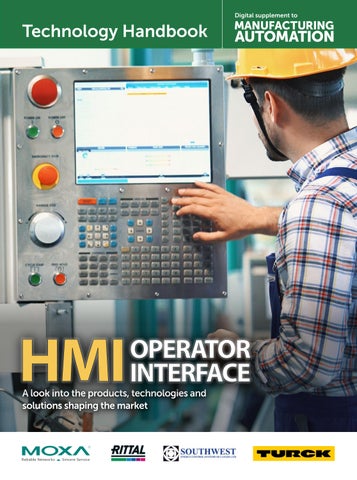
Digital supplement to
Technology Handbook
Deployment
omplex Configuration oriented user interfaces, which are often very mplicated and come with a steep learning curve IA engineers, make it harder to update nfigurations and handle basic troubleshooting sks.
HMI
oxa’s Solution Architecture Networking Infrastructure
e& Industrial ork Routers ement
XPANEL Durable Reinforced Aluminum Die Casting (12”, 15”) Real-time Data Logging High Quality LED Display Convenient & Powerful Designing Tool Page Resizing Screen sizes: 4.3”, 7”, 10.4”, 12.1”, & 15”
OPERATOR INTERFACE EasyLynk
Industrial Industrial Ethernetinto Wireless LAN products, technologies and A look the solutions shaping the market
• High resolution wide screen LCD, 65536 colours • 8MB + 128MB flash memory & 128KB battery backup memory • Various communication interfaces, including RS232/422/485, Ethernet, and USB port • Powerful and friendly7 PC-based editing software (EZ Studio) • Front panel IP65 protection; ARM9 based CPU • Screen sizes: 4.3”, 7”, & 10.1”
Full product range available from Southwest Energy Control Systems of Canada Ltd. For information or to purchase, call 905-420-8400 or email phughes@southwestenergy.ca
www.southwestenergy.ca
Technology Handbook | HMI & OPERATOR INTERFACE
Devices
Inc.
nuauto.com
Case Study: Optimizing Manufacturing and Resources With Condition Monitoring Application: CNC Monitoring Systems
Introduction Computer Numerical Control (CNC) machines are used in a variety of manufacturing operations to automate machine tools according to programmed commands. Although a factory in China already used Moxa’s NPort 5110 to send instructions in the form of TCP/ IP packets to its CNC machines, maintenance engineers still had to visit each machine to ensure proper operation and perform routine maintenance tasks. Having the right information at the right time about these machines can help factory managers allocate enterprise resources more efficiently and improve production output. Since every second a CNC machine is idling, off line, or shut down for maintenance translates into lost profits, the factory needed a way to monitor the status of its CNC machines to optimize its manufacturing process. This computer integrated solution provider used Moxa’s NPort 5110 serial device servers to connect each CNC machine to the factory’s Ethernet backbone formed by Moxa’s EDS-408A unmanaged Ethernet switches. In this way, technicians were no longer required to manually install new manufacturing programs onto each CNC machine. However, technicians still had to make regularly scheduled visual inspections to ensure that the CNC machines were working properly. Each CNC machine had three different colored indicator lights that technicians used to monitor the machine’s status and determine specific maintenance tasks. A red light indicated that the system was offline or shut down, a green light indicated that the machine was idling, and a yellow light indicated that the system was
running normally. The company realized they could save time and money by remotely monitoring the condition statuses of all the CNC machines by connecting each CNC machine to Moxa’s ioLogik Ethernet remote I/O server, which would notify the direct numerical control (DNC) server whenever a CNC machine was idle or offline.
System Requirements • Active event triggers for data acquisition • Assist in improving machine utilization • Accurate data to develop dynamic production plans • Provide real-time data for the MES and ERP system
colored indicator lights that technicians used to monitor the machine’s status and determine specific maintenance tasks. A red light indicated that the system was off line or shut down, a green light indicated that the machine was idling, and a yellow light indicated that the system was running. Factory managers realized they could save time and money by remotely monitoring the condition statuses of all the CNC machines by connecting each CNC machine to an ioLogik Ethernet remote I/O server, which would notify the direct numerical control (DNC) server whenever a CNC machine was idle or off line.
Products Used EDS-408A Series 8-port entry-level managed Ethernet switches ioLogik E1200 Series Ethernet remote I/O with 2-port Ethernet switch ioLogik E2200 Series Smart Ethernet remote I/O with Click&Go Logic NPort 5100 Series 1- port RS-232/422/485 serial device servers
Moxa Solution The factory in China was looking for a solution that could provide readily available monitoring information about all the CNC machines’ statuses to help eliminate unnecessary maintenance visits and focus resources on system bottlenecks. Thanks to the NPort 5110 serial device servers connecting each CNC machine to the factory’s Ethernet backbone formed by EDS-408A unmanaged Ethernet switches, technicians were no longer required to manually install new manufacturing programs onto each CNC machine. However, technicians still had to make regularly scheduled visual inspections to ensure that the CNC machines were working properly. Each CNC machine had three different
2 MANUFACTURING AUTOMATION · Technology Handbook HMI & Operator Interface
Why Moxa • Robust product design provides reliable operation in harsh environments • Reliable serial-to-Ethernet communication without packet loss for precise production control • Proactive data acquisition for real-time asset monitoring • Intelligent local alarm alerts personnel and data analysis to save maintenance effort • Complete industrial Ethernet communication and remote monitoring solutions
1-800-387-6268 sales@manuauto.com
Learn more at www.moxa.com/IIoT
Technology Handbook | HMI & OPERATOR INTERFACE
The ergonomic way to use machines in the workplace!
O
ptimised ergonomics are essential in the work-place. Not only do machines need to satisfy safety requirements, but they must also be designed so that they are as easy to use as possible. Operator terminals on machines should be flexible and easy to position. For this to work in the same way for operators of different sizes, height-adjustable support arms, command panels and stand systems are imperative.
conductively connected, thus ensuring potential equalisation. It is not necessary to attach separate earthing straps. The adjustment of the mounting arm system is also very simple. The weight setting remains stable for long periods of operation – readjustment is not neces-sary.
Reliable cable protection
Flexibility for every application
Rittal’s flexible CP 40/60/120/180 support arm systems enable operator terminals to be mounted in every conceivable application. The systems have different section sizes, and can be easily combined with adaptors, designed so even preassembled cables with connectors can fit through the openings, saving valuable time and resources. An enclosure with the complete operator terminal can be installed on the support arm, or just one monitor can be installed via a VESA adapter.
Command panels demand attention
Within the support arms, the cables are perfectly protected from environmental influences. When mounted, the support arms meet the high IP 54 protection category. A trouble-free connection of the operator terminal to the machine is guaranteed, especially important in harsh industrial environments. The design prevents the cables from coming into contact with the moving parts of the height adjustment mechanism.
The support arm can be configured online
Simple to assemble and adjust
The support arm system is so well designed that an employee can assemble it alone, without any assis-tance. All the metallic parts are automatically
that can be transferred directly to the shopping cart.
Rittal offers an online configurator for its support arm systems to assist designers to select suitable arms, or users to put together with just a few clicks. The CAD data for the readyconfigured system can be easily downloaded and loaded into every common CAD program. Finally, the configurator automatically generates a parts list
4 MANUFACTURING AUTOMATION · Technology Handbook HMI & Operator Interface
Command panels in aluminium and carbon steel meet the highest ergonomic and assembly efficiency requirements. The ultimate combination of design and function, they can be combined with Rittal support arm systems and pedestals.They offer time-saving planning with configurators, and a wide variety of variants are available off the shelf.
Study and stable stand systems Rittal’s stand systems are sturdy pillars that are ideal for your applications, meeting all ergonomic and technical requirements. They are suitable for secure accommodation of cables whatever the housing type.They are available in a wide variety of pedestals, as well as carbon steel consoles, bases and columns, with a wide range of accessories. Operator terminals form the vital interface between man and machine. They need to be placed to allow the machine to operate ergonomically in every situation. Rittal works tirelessly to ensure that our products not only meet the highest standards of quality but that they offer the end user utmost safety and above all, ease of operation! After all, a happy and relaxed worker is a more productive and accomplished one! For more information, please visit www.rittal.ca/hmi or contact marketing@rittal.ca
• • •
1-800-399-0748, marketing@rittal.ca,
product range available from Southwest Energy Control Systems of Canada Ltd. Technology HandbookFull & OPERATOR INTERFACE | HMI
For information or to purchase, call 905-420-8400 or email phughes@southwestenergy.c
www.southwestene Satisfying Customers with Quality Products & Value Solutions Since 1982
S
outhwest Energy Control Systems of Canada has been successfully supplying quality products and delivering exceptional customer service since 1982. Southwest Energy is continually evolving, and as such, we have recently diversified our product portfolio. We have expanded our operation to include a wide selection of new products, including Human-Machine Interface devices, to serve a greater number of industries. Our years of distribution experience in petroleum and industrial sectors have provided us the opportunity to address many other market segments. With a 15,000-square-foot facility, our operation allows for the design, assembly, and distribution of products specific to the needs of our customers throughout Canada. Southwest Energy Control Systems provides innovative solutions for building automation and fuel management systems for a wide variety of industry sectors. We distribute DIN rail components, terminal blocks, circuit breakers, servo and VFD cables, DIN rail power supplies, overload circuit protection, surge suppression, heavy duty connectors and relays, sensors, AC drives, LED commercial, industrial, and retail lighting, LED sign lighting, environmental equipment, building automation controls, process controls, and SCADA (supervisory control and data acquisition).
Maximize ROI and Building Automation For over 35 years, Southwest Energy Control Systems has been providing sensible building automation technology for small- and medium-sized buildings. We have developed a building solution that provides everything you need and nothing you don’t.
We Provide the Schematics Our team provides comprehensive system schematics and drawings for every project. We are perfectionists when it comes to building automation systems, and we want to ensure every system we sell works perfectly. Southwest Energy Control Systems’ experience and extensive technical background allow us to provide comprehensive energy systems by offering reliable and cost-effective solutions.
Canadian-Based for Faster Delivery OEMs depend on a reliable and timely supply of automation systems, DIN rail electro-mechanical components, and LED lighting. For Canadian-based companies, Southwest Energy Control Systems is the logical choice for timely, hassle-free delivery. We are based in Canada and keep inventory in our Canadian warehouse.
Cut Out the Middle Men for Better Prices When you rely on Southwest Energy Control Systems, you are not just saving time – you are saving money through the elimination of one, sometimes two,
6 MANUFACTURING AUTOMATION · Technology Handbook HMI & Operator Interface
middle men. Most importantly, you will enjoy in-depth support for all your Canadian-approved automation, DIN rail components, and lighting needs.
We Want to Help You Have questions about automation systems, DIN rail components, or LED lighting? We want to help. Components and LED lighting supply is a core business at Southwest Energy Control Systems, so customer service is a must. Our sales and technical team are accessible and ready to serve. We ensure the highest standards in service in our category and maintain a broad inventory of components and LED lighting in order to serve the needs of OEMs quickly and efficiently. Proudly located in Pickering, ON, we can be reached by calling 905-4208400 Monday to Friday from 8:30am to 4:30pm, or via email at info2@southwestenergy.ca. For more information, please visit our website: www.southwestenergy.ca.
XPANEL Durable Reinforced Aluminum Die Casting (12”, 15”) Real-time Data Logging High Quality LED Display Convenient & Powerful Designing Tool Page Resizing Screen sizes: 4.3”, 7”, 10.4”, 12.1”, & 15”
EasyLynk
• High resolution wide screen LCD, 65536 colours • 8MB + 128MB flash memory & 128KB battery backup memory • Various communication interfaces, including RS232/422/485, Ethernet, and USB port • Powerful and friendly7 PC-based editing software (EZ Studio) • Front panel IP65 protection; ARM9 based CPU • Screen sizes: 4.3”, 7”, & 10.1”
Full product range available from Southwest Energy Control Systems of Canada Ltd. For information or to purchase, call 905-420-8400 or email phughes@southwestenergy.ca
www.southwestenergy.ca
Technology Handbook | HMI & OPERATOR INTERFACE
Ethernet Cable: Implementing Solid or Stranded Cables
W
ith businesses becoming increasingly more communication-centric, virtually every industry is now relying on industrial Ethernet technology to network critical devices and control systems as well as to enhance process automation and improve efficiency. As one of the most widely used networking technologies, Ethernet connects more than 85 percent of LAN connected PCs and workstations, providing a flexible solution that delivers real-time data and status updates to ensure constant information accessibility and instantaneous data transfer. In order to utilize these communication capabilities, Ethernet cables are required to provide the necessary connectivity. These cables are used to connect devices, such as PC, switches and routers, to transmit and receive data. To ensure proper cabling installation, organizations such as the American National Standards Institute, Telecommunications Industry Association and Electronic Industries Association provide clear, concise instructions and standards that assist users in setting up reliable Ethernet connections. Along with understanding the correct regulations, selecting the appropriate cable for an application is equally important. Identifying the various cable categories, classes and types and their distinctions is critical, as cables are separated into distinct categories, such as 5, 5e and 6, classes like C, D, E and F and are defined as solid or stranded. By recognizing these classifications, as well as the uses and purposes for
8 MANUFACTURING AUTOMATION · Technology Handbook HMI & Operator Interface
stranded and solid cables, users can select the ideal cable to meet their application requirements. Turck has released a white paper entitled Ethernet Cable: A Guideline to Implementing Solid or Stranded Cables. The paper is intended as a resource to help technicians identify and implement the right type of Ethernet cabling to ensure reliable network performance in industrial applications. The paper notes that understanding Ethernet cable classifications and their uses, combined with proper cabling installation technique, will allow users to meet diverse Ethernet cable application requirements for networking critical devices and control systems. “Solid and stranded cables each have their individual purposes and benefits,” states the document. “Knowing when and where they should be used will improve networking performance and efficiency.” As networking continues to be a necessary component of businesses in virtually any industry, understanding the types, standards and purposes of various Ethernet cable options is crucial to ensuring reliable network performance and continuous access to important data. By using ASNI/TIA/EIA568 as a guideline, users can install, test and maintain the cabling required for their networking applications.
Your Global Automation Partner
Reduce Downtime in Your DC with More Reliable Industrial Ethernet Smart warehouses are connecting more data into the network than ever before using Industrial Ethernet. Don’t let non-industrial grade Ethernet cable put your warehouse communication in jeopardy. Safeguard against future network failures with Turck. Our connectivity solutions are more rugged – standing up to the toughest industrial use. From optimizing enterprise level data communication to ensuring real-time communication at a robotic pick station, our connectivity experts design reliability and toughness into every solution we make.
SENSORS | CONNECTIVITY | FIELDBUS TECHNOLOGY
www.turck.ca 1-877-513-7769
A NEW DAWN FOR DATA Connecting numerous SCADA systems leads to a bright future for a solar products manufacturer
photovoltaic (PV) modules. In 2011 the company began providing operations and maintenance (O&M) services for utility-scale solar plants, first in Ontario, then globally. Today, Canadian Solar O&M provides services in Canada, the United States, Japan, Europe, Australia and China.
BY JIM MEYERS
C
anadian Solar is a fast-growing global company that knows how to leverage technology to streamline its processes. With a variety of utility-scale power projects, Canadian Solar has subsidiaries in 20 countries on six continents, with more than 12,000 employees. Founded in 2001 in Ontario, the company provides solar energy solutions, and is a manufacturer of solar 10 MANUFACTURING AUTOMATION · Technology Handbook HMI & Operator Interface
As the O&M division grew, a key challenge was bringing in numerous kinds of data from a variety of systems used by solar plants operated by Canadian Solar. To help create a solution that would allow the company to ingest all this data in a streamlined fashion, Canadian Solar brought in system integrator
Eramosa Engineering, which has offices in Guelph, Calgary, Toronto, Detroit and London. The consulting engineering firm specializes in supervisory control and data acquisition (SCADA) systems, along with automation, process control, system integration, instrumentation and control, and electrical engineering. “Eramosa and Canadian Solar have been working together for the past few years to add SCADA systems to their solar plants throughout Ontario,” says Clayton Balfour, system integrator for Eramosa. “We were then approached by them to [build] a more global, more central monitoring platform.” The resulting solution is CSEye – a custom, computerized maintenance management system (CMMS) and asset performance–monitoring application for utility-scale, solar-plant O&M.
with cloud-hosted central gateway and historian allows server and resource scalability. The system has more than 40 spokes, with more planned for the future. With the software’s unlimited licensing, Canadian Solar does not need to pay more fees for additional clients, devices, tags, or projects. Implementing the software “CSEye is our online, cloud-based CSEye is based on Ignition by Inductive Automation, an industrial application platform for everything that deals with platform with several tools for building monitoring, management of opersolutions in SCADA, human-machine ations and maintenance activities, interface (HMI), and the Industrial and reporting,” says Thevenard. “Now Internet of Things (IIoT). The Ignition everybody in our group is using it. For platform helped Canadian Solar and the operators, that’s their workhorse – Eramosa to provide access to critical that’s what they look at all the time. It’s operational data from various existing been used by our engineering team to SCADA architectures while allowing the log issues, track work orders and track warranty claims. It’s been used by our project to scale as needs arose. Didier Thevenard, senior manager of analysts to do all the reporting and operations and analytics for Canadian sending [of] daily and monthly reports Solar O&M, says the company’s focus is on to clients. It’s even been used by our clients themselves.” large, utility-scale solar plants Pete Samson, technical that produce electricity from group leader for Eramosa, the sun. “We operate about points out that Canadian 40 of those sites in Ontario, CSEye Solar has a number of roles Canada, and in California. All The maintenance those different sites have their management system to manage, from field technicians and data analysts to own SCADA systems,” he says. pulls historical and data into senior managers and main“To monitor them, we used to real-time 40 different “spokes,” tenance workers. “Centralhave to connect to each and with more planned izing all of these services every one of them independ- for the future. through a single system has ently. Our vision was to bring all the data from those various sites definitely streamlined their processes to one single platform, to have all our and increased operational efficiency,” he says. monitoring data in one place.” With Ignition as its foundation, CSEye provides a single application environ- Transitioning to success ment that pulls historical and real-time Previously, Canadian Solar had separdata from various architectures includ- ate systems for performance monitoring OPC-UA, Modbus, Ethernet IP, ing, maintenance management and Siemens Ethernet, and RESTful web ser- reporting. As the company’s portfolio vices. The hub-and-spoke architecture expanded globally, it was clear that the
40
many disparate tools involved would not scale to meet the needs of the O&M team. A new approach was needed. The new system reliably feeds historical data from each spoke for near-real-time analysis. It uses distributed tags for centralized alarming and alarm management. It uses spokes with templated tagging structures, allowing for integration to the central gateway. The system also has standard charting tools for performance monitoring, while also providing fully customizable Python scripting and database queries for development of the maintenance management system. Building out the custom application brought a single application generating specific and relevant content for all users. Canadian Solar can now respond more quickly to performance deviations and reduce the amount of lost power-generation opportunities. The company can also turn system alarms into actionable work orders with technician dispatch and resolution tracking. And it’s all on an architecture that’s ready for future adaptation and enhancement. “Canadian Solar has been really happy that we’ve been able to bring all their data into a central location, and optimize it so they can get the information they want,” says Eramosa’s Clayton Balfour. His colleague Pete Samson says Canadian Solar will also benefit from new projects that move closer to the network edge, using existing infrastructure under the Ignition automation software. | MA Jim Meyers is the success manager at Inductive Automation. inductiveautomation.com
Technology Handbook HMI & Operator Interface · MANUFACTURING AUTOMATION 11
IT’S ALL ABOUT
APPS A look at current trends in the growing use of manufacturing apps – and what’s ahead BY TREENA HEIN
A
pps have been around for years in the manufacturing sector and their use is only going to expand, due to the way they add so much intelligence and value in the quest to better manage assets and processes. “Apps were critical in the past, they are critical now and they will be even more critical going forward,” says Craig
12 MANUFACTURING AUTOMATION · Technology Handbook HMI & Operator Interface
Resnick, vice president of consulting at ARC Advisory Group. “It’s all about increasing productivity and profitability, as well as eliminating unscheduled downtime through gathering and sharing information effectively.” A straightforward example of how an app adds value, says Resnick, would be a sensor detecting if a motor is running too hot or vibrating uncharacteristically. “This sensor data is then sent to
“It’s all about increasing productivity and profitability, as well as eliminating unscheduled downtime through gathering and sharing information effectively.” of Things (IIoT) – the ability to connect (with training included, often through manufacturing by embedding sensors YouTube). However, Alexandra Tregre, busiinto assets and gathering immediate data, then sending a signal to the people ness development manager at Stable who can check the process or service Kernel, is of the opinion that out-ofthe asset. (In Resnick’s view, edge the-box apps often do not properly devices – data repositories physically address the unique challenges most situated close to where the data was enterprises face, nor are they always generated – are used with apps where built for scalability or efficiency. “Even data is gathered in real-time; the cloud out-of-the-box solutions need to be is mostly used for storage of data after a modified to address the specific use case to solve business challenges and detected situation is dealt with.) Some interesting real-life industry improve workflows,” she notes. She app examples are described in a recent adds that “every company that wants to report called “Five Manufacturing deploy mobile software must make the Companies with Mobile Apps that decision to either pay less for a cheaper, Got it Right,” from Atlanta-based app hybrid development solution and risk developer Stable Kernel. The Womble a poorly built, insufficient product that Company built an app that serves the produces technical debt, or to invest in firm itself, and its suppliers and custom- the product up front and mitigate risk.” Quebec-based Poka is an example ers, by integrating a barcode scanner that tracks every piece of pipe the firm of an app maker that has produced produces. Through the app, Womble many customized solutions, helping has seen significant improvements in manufacturers to drive performcustomer relations and productivity, ance and productivity with real-time 100 per cent inventory traceability information. For the Leclerc Group, a North American snack and more. Another example manufacturer with over 950 in the report is Caterpillar people employed across many Underground Mining, which facilities, Poka has reduced built an app that tracks all variation in production across equipment (locations, part eight plants. As a result of numbers, lot numbers), warethese improvements, Leclerc house inventory and more; Virtual reality, saw a reduction in downtime it has reduced regular cycle augmented reality and touchless tech by 9.5 per cent, and start-up count by 50 per cent. are all on the horizon and changeover time accelerResnick cautions, however, for manufacturing ated by 31 per cent. that while in-house apps being apps to use as they WestRock, a $14-billion made by some manufacturers automate processes and gather data. paper and packaging comcan certainly be effective, all pany, issued iPads with Poka software is going to require updating and even overhaul. Therefore, apps in 2016 to help deliver video-based there must be contingencies in place training and work instructions to their if, for example, the app designer leaves workers across their global operations. the company. That’s one of the reasons The result is better comprehension and Resnick believes most manufacturers retention of information as well as a 50 are using out-of-box app solutions. per cent reduction in the time it takes They are both proven and cost effective to capture and document procedures.
VR/ AR
the cloud or a local ‘edge’ device, which contains analytics software to convert this data to meaningful information,” he explains. “This information is then used to, for example, schedule a service call and a replacement motor to be shipped to synchronize with this service, which helps to avoid an unplanned downtime.” This app example demonstrates the effectiveness of the Industrial Internet
Technology Handbook HMI & Operator Interface · MANUFACTURING AUTOMATION 13
In terms of how manufacturing apps are generally being sold, Resnick notes that a lot of them are now being marketed as a service, moving away from a model of paying once as a capital expense. “You pay a monthly fee that comes out of the operational side of budget, and updates are automatic,” he says. “For the app firm, it helps secure the customer long-term.” Going forward, both Resnick and Raman Chitkara – who recently retired as global technology industry leader at multinational professional services firm PwC (PricewaterhouseCoopers) – predict the increasing use of artificial intelligence (AI) in app development – software programs that can make decisions based on huge amounts of historical data. Chitkara predicts that AI will be able to coordinate and integrate apps, directing them to work with each other to find proactive rather than reactive ways to produce desired outcomes. For her part, Tregre also believes that combining AI/machine learning and leveraging the Internet of Things provides limitless opportunities for apps in manufacturing. As manufacturers continue down the path of using high-tech to maintain a competitive advantage, she sees “huge”
“Every company that wants to deploy mobile software must make the decision to either pay less for a cheaper, hybrid development solution and risk a poorly built, insufficient product that produces technical debt, or to invest in the product up front and mitigate risk.” opportunity for developing innovative high-tech solutions that meet the needs of workforces wherever they are, “and mobile apps are at the crux of that.” Looking ahead, Resnick lists another hot app trend to be digital twinning (when an asset is delivered to a plant, a digital simulation of the asset comes with it). “With a turbine, for example, you can run the turbine’s digital twin first and determine with the simulation if there are problems that can be solved before the actual turbine is commissioned,” he explains. “Such as additional heat or vibrations being generated above the design specification based on abnormal bearing wear, which could lead to unplanned downtime.” Two other major trends, says Resnick, are augmented reality (being able to see what’s in front of you but also wearing a device that provides additional information in your visual field) and
Quebec-based app maker Poka creates customized communication and training solutions for manufacturers, helping to solve problems in real time, standardize operating procedures and improve workforce capability. 14 MANUFACTURING AUTOMATION · Technology Handbook HMI & Operator Interface
virtual reality (an entirely virtual visual field) to do things like practice training scenarios. Tregre agrees. “The continued application of VR, AR, touchless tech and so on all have great potential to be leveraged within manufacturing apps to further advance the value of mobile products by solving critical problems and challenges of the future,” she notes. “These technologies allow companies to further automate complex processes via apps while also responding real-time to the critical data that is gathered.” However, while Chitkara acknowledges that further digitization and automation of the industrial world will be very transformational with numerous benefits, he stresses that it must also be prepared for challenges. Increasing digitization, he warns, will give industrial firms a “full taste” of what it means to be technology companies – which means navigating how to manage strong dependence on software, cloud computing and so on. He firmly believes that digitization in the industrial arena is not going to be as easy and rapid as it has been in the consumer sphere. Tregre adds a cautionary note on app development and use. “We see large enterprises neglecting a research phase at the beginning of a project,” she says, and without that solid research, “the app will be built on assumptions and fail to deliver the intended results or provide any value.” And one last thought – also cautionary but empowering, too. Among others, Stable Kernel believes that the increasing use of apps will be critical to attracting young talent in the manufacturing sector – so much so that the company wrote a paper on the topic, viewable on their website, stablekernel. com. | MA Treena Hein is an award-winning, Ontariobased freelance science and tech writer.
SIMPLIFY WITH SCADA Modular, on-demand subscription software built for the 21st century offers economical predictive process analytics to improve efficiencies BY BERT BAECK
A
t times it seems hard to believe we’re already in the second decade of the 21st century, but what is even harder to believe is that the majority of manufacturers are still only using technology that is at least 30 years old. Many of these systems work wonderfully for what they are meant to do – collect and store data and monitor processes. However, these systems alone cannot help industrial companies meet the challenges of today’s global market. Although there are several reasons for this situation, the perception that change is too difficult and expensive is the leading cause for companies to remain hesitant to take advantage of the new opportunities promised by the Industrial Internet of Things (IIoT). A recent LNS Research survey of over 400 manufacturing executives showed the vast majority of companies do not have plans to invest in IIoT technology in the near future. When we consider how expensive many of the existing systems are, it’s understandable why industrial companies are reluctant to invest in new technology. Unfortunately, these executives are often looking at old technologies that have been tweaked to try to take advantage of IIoT opportunities and that may require removing their current systems.
The good news is there are very affordable technologies developed specifically for the internet age that work with existing systems to help manufacturers gain deep insight into process behaviour that translates into fast ROI.
SCADA information is more valuable than ever SCADA systems were originally designed to collect data and monitor processes. Since they generate such enormous amounts of data, historians were added to store this data. Initially, historians were used to fulfill regulatory requirements, such as generating reports for government agencies. Leading industrial
The solution calculates the possible trajectories of the process and predicts process variables and behaviour before they happen.
companies recognized the data hidden in their historians could provide valuable information on plant processes and production, but accessing and using the data could be very difficult because historians weren’t designed for “read” purposes or a two-way transfer of information. Manufacturing execution systems (MES) were introduced in the early 1990s in an attempt to bridge the gap between plant-floor SCADA systems and enterprise ERP software. They also promised to provide analytics, such as KPI data, to improve plant-floor operations. While MES has been able to provide more advanced capabilities than SCADA systems, they are expensive and often require extensive engineering to be implemented. Moreover, they were developed for a different business era in which systems were still largely siloed and internet optimization was largely an afterthought.
Technology Handbook HMI & Operator Interface · MANUFACTURING AUTOMATION 15
21st-century technology has arrived When we consider the amount of time and money industrial companies have spent on traditional software, we can understand the reluctance of some manufacturers to enhance their systems. They are still trapped in the fear that any new solution will be expensive as well as require extensive engineering and training for employees. In addition, they are apprehensive about becoming locked into a cycle of difficult and expensive upgrades, patches and limited scalability. To really take advantage of the IIoT, companies need nextgeneration solutions that were developed for that purpose. These solutions are able to offer users the best of new technologies, particularly in terms of ease of use and affordability. Google for industry As mentioned earlier, while historians hold a wealth of valuable data for improving operations, accessing that data and turning it into actionable information has been time-consuming and difficult. Many applications were based on data modelling, which required A recent LNS extensive engineering and data Research survey asked over 400 scientists. As a result, only mission- manufacturing critical applications were targeted, executives if they leaving vast areas of improvement have plans to invest in IIoT technology in opportunities hidden. the near future. Most In 2008, engineers from of them reported Covestro (then known as Bayer they do not. MaterialScience) knew there had to be a better way to leverage timeseries data. They worked with different types of analytics models and identified their limitations for scaling-up beyond pilot projects. Eventually, they were able to use their deep knowledge of process operations to create “pattern search-based discovery and predictive-style process analytics” developed for the average user. The unique multi-dimensional search capabilities of this platform enable users to find precise information quickly and easily, without
400
expensive modelling projects and data scientists. A simple example of how this works is the song title–recognition app Shazam. While the technology used by Shazam is different, the concept is similar. Instead of trying to map every note in a song to its vast database of songs, Shazam uses pattern-recognition software that seeks “high-energy content” or the most unique features of a song, then matches it to similar patterns in its database. This is a very simple explanation of a complex process, but the important thing is that it enables users to quickly find a song title with a very high rate of accuracy. Naturally, industry demands more sophisticated algorithms that are capable of going beyond mere search. Often called Google for Industry, this software works by connecting to existing historian databases, then implementing a column store database layer for an index. This software makes it easy to find, filter, overlay and compare interesting time periods to search through batches or continuous processes (Figure 1). Moreover, this next-generation solution enables users to search for particular operating regimes, process drifts, operator actions, process instabilities or oscillations. By combining these advanced search patterns, users unlock the true information they need. For example, an operator can compare multiple data layers or time periods to discover which sensors are more or less deviating from the baseline, then can make adjustments to improve production efficiency. Bringing it all together In addition to easy search, this new technology provides process data contextualization and predictive analytics capabilities. Engineers and operators can provide annotation to give greater insight. The predictive analytics capabilities enable an early warning detection of abnormal
16 MANUFACTURING AUTOMATION · Technology Handbook HMI & Operator Interface
and undesirable process events by comparing saved historical patterns with live process data. Moreover, the solution calculates the possible trajectories of the process and predicts process variables and behaviour before it happens. This gives operators the ability to see if recent process changes match the expected process behaviour and to proactively adjust settings when it does not. A 21st-century business model This new solution with out-ofthe-box predictive process analytics (discovery and predictive) also employs a modern business model: online subscription pricing. In addition to making process analytics affordable to all companies, this setup also frees businesses from having to spend the time and money on adding additional licenses and upgrades. Each time a user logs in, they automatically get the latest version of the software. Companies now have the option to enhance the value of the investments they have made in high-quality historians. Low-cost predictive analytics solutions that complement their existing historians enable companies to better use the data collected by those historians to provide them with valuable business insights. With an affordable, plug-andplay solution to uncover new areas for improving operation efficiencies, the question becomes why more businesses aren’t using software that is created for the IIoT generation. The future is here and companies can no longer operate solely using existing systems if they want to stay competitive in this new world. | MA Bert Baeck is co-founder and CEO of TrendMiner with over 10 years of professional experience within big data/analytics in the manufacturing industry. Previously, he worked as a process optimization engineer for Bayer MaterialScience (now Covestro). trendminer.com
DON’T MISS OUT on your next issue of
IT’S FAST, IT’S EASY AND IT’S FREE!
HERE’S HOW: FOR FASTEST SERVICE VISIT
AutomationMag.com AND CLICK THE SUBSCRIPTION BUTTON
AutomationMag.com