VOLUME 4, ISSUE 1 • APRIL 2021
RI
ROBOTICS INSIDER COPPER START10 REFINING SHEETS WITH ROBOTS ROAD TO 13 CANADA’S AUTOMATION ADOPTION ASSISTANT 16 MOBILE DEMONSTRATES GREAT GRIP
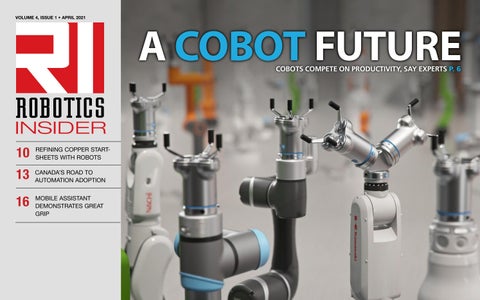
A COBOT FUTURE COBOTS COMPETE ON PRODUCTIVITY, SAY EXPERTS P. 6
CONTENTS Columns 3 Market watch
Presented by Manufacturing AUTOMATION, Robotics Insider reports on the world of industrial robots and its developing opportunities, challenges and technologies. By sharing unique perspectives and information, we strive to help improve your manufacturing efficiency. Editor – Kristina Urquhart kurquhart@annexbusinessmedia.com Associate Publisher – Kathryn Swan kswan@annexbusinessmedia.com Group Publisher – Paul Grossinger pgrossinger@annexbusinessmedia.com Media Designer – Graham Jeffrey gjeffrey@annexbusinessmedia.com Account Coordinator – Debbie Smith dsmith@annexbusinessmedia.com Audience Development Manager – Urszula Gryzb ugrzyb@annexbusinessmedia.com Tel: 416-442-5600 ext. 3537 COO – Scott Jamieson sjamieson@annexbusinessmedia.com No part of the editorial content of this publication may be reprinted without the publisher’s written permission. ©2021 Annex Business Media. All rights reserved.
2 April 2021 • Robotics Insider
Photos: (Cover, this page bottom left) OnRobot. This page: (Top) zhudifeng/Getty Images (Bottom right) Ionic Mechatronics
Canada makes gains in robot density, N.A. sees rise in robot sales
FEATURES 6 A cobot future?
How are collaborative robots key to strengthening North America’s position in the global marketplace?
10 Refining with robots
An Ontario automation firm custom-built an automated assembly machine using robots for use at a copper refinery
13 Tools for adoption
Canada must improve automation and robotics adoption to grow, says NGen report
13
6
10
16 A helping hand
Festo researchers unveil robotic mobile assistant with gripping technology
111 Gordon Baker Rd, Suite 400, Toronto, ON M2H 3R1 T: 416-442-5600 F: 416-442-2230
MARKET WATCH
By Kristina Urquhart
CANADA MAKES GAINS IN ROBOT DENSITY, N.A. SEES RISE IN ROBOT SALES
C
anada is slightly above the world average for robot density in the manufacturing industry, according to a recent report by the International Federation of Robotics (IFR). The 2020 World Robotics report, which is based on statistics from 2019, shows that Canada ranks 18th in the world for robot density, with 165 units installed per 10,000 employees. A record global average was set in 2019 of 113 units per 10,000 employees. Canada’s robot density is largely attributable to the concentrated deployments in its automotive sector. (See more on Canada’s robotics adoption on p. 13.) By regions, Western Europe (225 units) and the Nordic European countries (204 units) have the most automated production, followed by North America (153 units) and South East Asia (119 units). The report says the world’s top 10 most automated countries are: Singapore (1), South 3 April 2021 • Robotics Insider
Korea (2), Japan (3), Germany (4), Sweden (5), Denmark (6), Hong Kong (7), Chinese Taipei (8), USA (9) and Belgium and Luxemburg (10). “Robot density is the number of operational industrial robots relative to the number of workers,” says Milton Guerry, president of the International Federation of Robotics. “This level measurement allows comparisons of countries with different economic sizes in the dynamic automation race over time.”
North American robots on the rise North America is gaining ground in that race, according to another report, this one by the former Robotic Industries Association (RIA), now part of the Association for Advancing Automation (A3). The report indicates orders of robots from non-automotive sectors surpassed automotive robot orders in 2020 for the first time ever. Sales of robotic units in North America increased 3.5 per cent in 2020 over 2019. This
Photo: Thossaphol / iStock / Getty Images Plus
MARKET WATCH growth was driven by a strong Q4 that was the second-best quarter ever for North American robotic sales, with a 63.6 per cent increase over Q4 2019, says A3. North American companies ordered 31,044 robotic units, valued at $1.572 billion in 2020. In Q4, companies ordered 9,972 units valued at $479 million. “The surge in robot orders that we’re seeing, despite the pandemic, demonstrates the growing interest in robotic and automation solutions,” says Jeff Burnstein, A3 president, in a statement. “It’s promising to see the growth of robotics in new applications and reaching a wider group of users than ever before.” Year-over-year orders in life sciences increased by 69 per cent, food and consumer goods grew by 56 per cent, and plastics and rubber saw a 51 per cent increase. Automotive orders increased 39 per cent in 2020. “In 2020, we saw two trends in particular that propelled growth in non-automotive orders for robotics technology,” says John Bubnikovich, chief regional officer, North America for KUKA Robotics. “First, the automation competence level in general industry has grown, and that matured into greater demand for the technology. Second, consumer behaviour shifted significantly and the expectations created by this shift were tough to 4 April 2021 • Robotics Insider
satisfy without automation.” At the same time, Bubnikovich says, supply chain disruptions and instability in the workforce made industries accelerate automation strategies.
COVID changes priorities The same trends are being noticed by other major robot manufacturers. “With the changes in people’s personal buying behaviour caused by COVID, robots have been utilized in record numbers to allow for the fulfillment of orders in the e-commerce space while allowing for correct social distancing practices,” says Dean Elkins, segment leader, handling at Yaskawa Motoman. “In addition, robots largely aided in the production of personal protection and testing equipment and the medical devices needed to keep our society healthy and safe.” “We have seen a substantial increase in activity in non-automotive sectors, as customers focus on making their production lines more flexible and better able to efficiently achieve high-mix, lowervolume production in response to constantly evolving customer demands,” says Mark Joppru, vice-president, consumer segment and service robotics for ABB’s Robotics and Machine Automation USA division. “In food applications, for example, where robots were traditionally used to automate simpler processes like case loading, they are increasingly
being commissioned for higher value processes, like directly preparing food, resulting in improvements to food safety and hygiene. While these trends have existed for several years, COVID has changed perceptions and priorities for customers, accelerating the adoption of robotic automation.” In August of 2020, A3 reported on the strain to supply chains and economic uncertainty due to COVID-19. Alex Shikany, A3 vice-president, membership and business intelligence, noted that despite a drop in orders, industry leaders showed optimism about the remainder of 2020, and accurately predicted the strong finish to 2020. “The pandemic has created a sense of urgency for manufacturing companies to invest in automation like never before,” says Mike Cicco, president and CEO of FANUC America. “Traditionally, companies have implemented automation to reduce cost, increase output and improve quality. However, the pandemic has added an additional factor that is driving manufacturers to re-examine their supply chain to increase flexibility, minimize disruptions, and move it closer to their customers. “With this mindset, there are more opportunities for scaling robotic applications across multiple facilities, especially for larger companies. The untapped potential for automation is a promising sign for our industry; the opportunities for automation today are truly limitless.”
COVER STORY
A COBOT FUTURE?
A recent A3 webinar explored how collaborative robots are key to strengthening North America’s position in the global marketplace By Kristina Urquhart
C
ollaborative robots that work alongside humans are poised not only to push manufacturers to reshore production, but also to drive more small businesses into cloud-based operations, said industry experts in a recent online event. Mark Cuban, robotics investor and entrepreneur of Shark Tank fame, Enrico Krog Iversen, CEO of end-of-arm tooling company OnRobot, and Rob Goldiez, CEO of the robotics-as-a-service startup Hirebotics, recently participated
6 April 2021 • Robotics Insider
in “Manufacturing: The Next Generation – Through Collaborative Automation,” a webinar hosted by the Association for Advancing Automation (A3) and moderated by Robert Huschka, A3’s director of education strategies. The panelists explored how collaborative robots (cobots) – expected to account for 30 per cent of the total robot market by 2027, according to a 2019 report by Interact Analysis – are integral to strengthening North America’s position in the global marketplace
Photo: OnRobot
and in establishing the continent as a manufacturing powerhouse.
Reshoring on the horizon The COVID-19 pandemic has brought about changes in not only consumer behaviour, but in the manufacturing process as well, said Cuban. Demand has grown for certain products, direct-to-consumer
delivery has skyrocketed and there has been a move in some regions for people to shop locally. Manufacturers, meanwhile, are considering the benefits of regionalizing their supply chains after experiencing bottlenecking and shortages in spring 2020 – but they aren’t necessarily making the required equipment and
COVER STORY
infrastructure changes to on-shore quite yet. “A lot of companies will rethink their supply chain strategy and when they do that, they will spread the manufacturing out over more regions, more countries,” noted Iversen. He said that as this happens, companies will need to automate more production because they won’t have enough available workers to connect all of their operations together. Cuban said he doesn’t see reshoring taking off right away, because companies are still in survival mode – even if their production has increased to meet demand. But as manufacturers implement more automation, this reshoring phenomenon will begin to happen naturally, leading to what Cuban calls “America 2.0,” a more self-sufficient era of domestic production.
“We’re not going to compete on cost of labour; we’re going to need to compete on productivity. And I think robotics are going to be a big part of that,” Cuban said.
Investments in infrastructure
Closing the skills gap
Cuban said he encourages his companies to review their manufacturing processes on an annual basis to see where they might be able to produce domestically. “As the technology changes, those opportunities are going to increase,” he said. “In terms of America 2.0 and being competitive, we need to invest.” That extends beyond companies, venture capitalists and other investors to government leaders, who Cuban said should see robotics as
The panelists said software that makes robots more easily programmable by operators who don’t have engineering backgrounds is crucial to help close the skills gap, because there is currently a shortage of workers who have the specialized knowledge to program a robot. Easy-to-use software – a hallmark of collaborative robot technologies – also ensures that workers whose jobs are displaced by automation will be able to learn how to do the new jobs that
7 April 2021 • Robotics Insider
the most important infrastructure investments of the 21st century – both from a hardware and a software perspective. More investments would allow the U.S. to compete with countries such as Germany, Japan and China, who are currently among the global leaders in robotics. Cuban noted that charging robot taxes, while controversial, is one way to help to shore up money, which could then be put back into these infrastructure investments.
the robot revolution will bring, such as in support, maintenance or sales. Additionally, software that is what Cuban calls “platformable” – i.e., that which creates an overall ecosystem of products to improve company growth or productivity – “is critical to what we’re going to need to do to be a manufacturing powerhouse,” he said. “We’re not going to compete on cost of labour; we’re going to need to compete on productivity. And I think robotics are going to be a big part of that. “Innovators who are able to push down costs and compete more cost effectively because of robotics – I think that’s going to be the key to progressing forward.”
The value of cobots There is currently a chasm between the largescale producers that have the capital to purchase robotics and the small companies that don’t, Cuban said. As collaborative technologies trickle down to the entrepreneurial level, he noted that small manufacturers will be able to use robotics technology to depend less on other countries for production. And new companies that use robotics right from inception will start to improve price competition – meaning that existing businesses will have no choice but to compete, Cuban said.
COVER STORY
Education on what’s possible is the greatest barrier to pushing down robotics implementation past the large-scale producers, the panelists said. In the current market landscape, smaller companies tend to be less knowledgeable about the value created by robotics, and collaborative robots especially, said Iversen. Cobots can be used throughout the plant to manage many tasks, including pick and place, machine tending, quality inspection, packaging and palletizing, industrial cleaning, material handling and logistics. The pandemic has highlighted additional benefits afforded by cobots – workers can maintain social distancing within the production environment, and labour shortages can be solved by adding these robots to the floor. Iversen estimated between 70 and 80 per cent of tasks currently in a factory can be automated by collaborative technology. “The question is, where can you not bring value?” he asked. Cobots bring bigger gains in value creation over cycle time, Iversen said. As a result, he expects the two categories of “traditional” industrial robots – the kind often found behind safety guarding – and collaborative robots to disappear as manufacturers learn about the flexibility offered by cobots, especially when it comes to making customized products. 8 April 2021 • Robotics Insider
automation is still really hard. Collaborative robots have unlocked automation.” He likened the cobot trend to how the internet and mobile devices brought the power of computing to the mass population.
Simplicity is key
Making robots accessible Hirebotics’ Rob Goldiez said that cobots have made automation more accessible to small businesses, and the robots-as-a-service (RaaS) option that his company and others provide means manufacturers can stay up to date with the latest technologies via robot rentals powered by the cloud, without having to make huge capital investments. For example, Hirebotics – which currently markets a RaaS cobot welding solution called BotX – was able to help its customers throughout the pandemic because it already had a quick deployment methodology and a cloud-based platform in place. “Every manufacturer can benefit from automation,” said Goldiez. “The problem that we’ve seen in our own experience is that
The RaaS model was interesting to Cuban – who was one of the investors in Hirebotics – because he frequently works with entrepreneurs who he thinks would benefit from the flexibility. “They know their costs are being squeezed so they are looking for better solutions,” he said. Goldiez pointed out that while on the hunt for better solutions, some manufacturers make the mistake of jumping into automation too deeply and too quickly. “Start simple. Start with the repetitive, the easy, the dull, the dirty, the dangerous,” he advised. “Go with the things your people are always complaining about doing, and don’t worry about if the collaborative robot is faster than the human or not. Put your people in a position where they can use their brain.” As for the robotics and automation vendors who are marketing these solutions, Cuban had some helpful advice. End users need “simplicity and examples of success,” he said. “That visibility is going to change the game.”
One servo drive for any ethernet! Electrical Connectivity
The new servo drive CMMT-AS offers connectivity of the hardware and software, great efficiency, compact design and easy operation. • For point-to-point and interpolated motion with focus on dynamic motion and precise positioning • Direct fieldbus integration • Quick and easy commissioning with the Festo Automation Suite festo.com/cmmt-as
APPLICATION
REFINING WITH ROBOTS
An Ontario automation firm custom-built an automated assembly machine with robots for use at a copper refinery By Treena Hein
C
Photos: Ionic Mechatronics
10 April 2021 • Robotics Insider
ompared to their new cousins, older manufacturing systems are far from optimal – they’re usually labour-intensive and inefficient in a variety of ways. But these old warhorses definitely have their value. Companies in various specialized sectors nurse them along for years, even decades, scrounging parts and hobbling together solutions when repair is needed, all for one simple reason: these old machines fit with their greater existing process and, until recently, no one could offer their owners a cost-effective alternative. No one, that is, except firms like Sudbury, Ont.– based Ionic Mechatronics. In this case, the client (Sierrita Copper Refinery, nestled in southwest Arizona’s Sierrita Mountains) rather desperately needed a new copper starter-sheet assembly machine – and, for the better part of 2019, one of the Ionic teams built just that. It’s one of many custom machines the company produces for clients
APPLICATION in various heavy industry sectors every year. “The existing machine required three to four operators for loading and assembly, with several stations and conveyors,” says Ryan Catton, Ionic’s business development manager. “After a lot of data gathering, on-site visits and analysis, we created an automated system that removes most of the conveying and manual intervention from the process. Robots handle the sheet handling and assembly, and workers are freed from the risk of repetitive strain injuries and back injuries from lifting and placing heavy metal pieces.” The first robot picks up what is called a “blank” sheet from a bin and places it on a “table,” where it’s flattened. Meanwhile, another robot is picking up the other two in-feed parts: hanger bars and loop material. When the assembly machine senses all components are present, it folds and staples the components, creating a starter-sheet. The third robot moves each finished sheet to a conveyor, one every 19 seconds, and then those sheets are used to collect dissolved copper in the refinery’s electrolytic cells. These three robots have customized suctioncups and mechanical grippers. Ionic chose KUKA robots because the company has used them in similar projects, and supplier consistency where possible helps to ensure servicing efficiency across customer sites. Ionic’s local “partner-on11 April 2021 • Robotics Insider
“Production hardly paused. When our system was ready, the new and old systems ran in parallel for a little while and then the controls were flipped over with only about a day of downtime.” the-ground” is CAID Industries, which provides front-line support for the entire system.
The build process Every build for Ionic includes analysis of things like desired throughput rate, how to integrate the solution with existing processes and the space footprint available. “In this case, we had a limited footprint, but we were lucky that we had room to build in another area so that the existing startersheet assembly machine was able to run during the build,” says Catton. “Production hardly paused. When our system was ready, the new and old systems ran in parallel for a little while and then the controls were flipped over with only about a day of downtime.” Because a refinery is a corrosive and humid environment, stainless steel or painted carbon steel were required instead of materials made from aluminum or coated with zinc, for example. But besides being able to stand up to corrosion, the
system also had to handle variability (thickness, width, nodulation, slight warping) in the blank sheets, hanger bars and loop material. But Ionic designers had made systems adaptable to a range of tolerances before, and so this was nothing new. Overall, handing a range of tolerances is a matter of determining the scope of variability for each parameter, and engineering the assembly machine and robots (hardware and software for both) to handle the top and bottom of the scope. “There’s also a range of temperatures in many refineries,” Catton explains. “They’re generally open to the environment and you can get pretty hot and cold air coming in at different times of the year. So, we look closely with the client at quality variability, ambient temperature changes and all other relevant factors that could affect system operation, and agree on the range of tolerances we’ll build into their new system. The client ensures that in-feed component quality and environmental conditions stay in the agreed-on range.”
A safer space Along with significant automation of starter-sheet manufacture, Ionic has also automated safety of the process. “We specialize in automation of safety design,” says Catton. “We do careful risk assessments and make sure not to introduce new risks. In this case, everything is guarded so there are
APPLICATION
Ionic chose KUKA robots because the company has used them in similar projects, and supplier consistency ensures servicing efficiency. no operators in the robot movement area, and if operators do have to enter, we’ve incorporated light curtain sensors so that movement stops before a worker could reach any risk point.” In case of loss of power, everything reverts to a safe position using gravity or electricity. “We also incorporate a lot of redundancy into safety systems,” Catton adds. “There are back-up relays which take over in case the first fails and operators are alerted to any issues within the safety circuit.” Indeed, other than enabling Sierrita to keep the starter-sheet process, the primary benefit of the new system has been improved safety. “There is now no manual handling of the parts and thus no repetitive strain injuries,” says Catton. “Also, the old machine had frequent stoppages due to mechanical failures.” And although the new Ionic system can enable faster production than what is occurring now at Sierrita, the refinery cannot support added capacity at this time. With this starter-sheet system now built in Arizona, word is spreading and other starter12 April 2021 • Robotics Insider
sheet refineries in various parts of the world are approaching Ionic to investigate options. Catton explains that over the years, the startersheet process “was essentially abandoned as automation evolved and many refineries went to a permanent cathode process, but there are many dozens of plants around the world that still
use starter-sheet. So, it’s very satisfying for us to provide a cost-effective way to give a traditional refining process a bright future, and also reduce health and safety risks for employees.” Treena Hein is an award-winning freelance writer based in Ontario.
REPORT
TOOLS FOR
ADOPTION Canada must improve automation and robotics adoption to grow, says NGen report By Kristina Urquhart
T
he growth of Canada’s manufacturing sector depends on the implementation of automation and robotics, but many companies still find technology implementation “unappealing,” says a new report by Next Generation Manufacturing Canada (NGen). The Canada’s Automation and Robotics Landscape report encourages information sharing within the sector to ensure Canada’s competitiveness as a whole, says Stewart Cramer, chief manufacturing officer at NGen. The industry-led organization, which facilitates funding for
13 April 2021 • Robotics Insider
Canada’s Advanced Manufacturing Supercluster and de-risks technology transformation projects, recently formed an Automation & Robotics Advisory Board with 20 of its members. Participants included AIS Technologies Group, Automate Canada, Clearpath, Eclipse Automation, Siemens, Festo, Humber College and ABB, among others. The group initially met in October 2020, then completed an online survey and participated in one-onone conversations with NGen to discuss ways to advance technology adoption in Canada. Photo: zhudifeng / iStock / Getty Images Plus
REPORT “Automation and robotics have the potential to be transformative for companies large and small,” Cramer says. “[NGen hopes] to offer reliable and vendor-agnostic information to help organizations to succeed in their respective Industry 4.0 journeys.”
‘Few Canadian exemplars’ Automation and robotics are most frequently used in Canada for handling and assembly tasks, as well as vision-guided quality control, teleoperation and additive manufacturing. But the survey respondents – comprised of OEMs, automation vendors and system integrators – indicated that beyond the automotive sector, use of automation and robotics decreases significantly. “Most smaller companies in Canada have not fully automated their processes, certainly [not] beyond ‘islands of automation’ (e.g. material feeding a machine),” notes the report. “Fully connected enterprises – using Industry 4.0 digital data and sensors (Internet of Things) internally and externally – often seems to be somewhere on the Gartner hype curve, with few Canadian exemplars.” Because of strong automotive sector adoption, Canada’s robot density (robots installed per 10,000 employees) is 165, which is higher than the global average of 113, the report says. Outside of the automotive sector, Canada’s robot adoption is 14 April 2021 • Robotics Insider
indeed lagging – 71 as opposed to the U.S.’s 139. Canada also has a slower rate of adoption – over the past four years, average robot density increased 20 per cent, whereas in the U.S., it jumped 39 per cent. Canada is also 44 per cent below the “expected” robot adoption rate, which is measured using payback relative to national wage levels. “The only certainty is that if Canada can maintain its vehicle assembly market then new automation and robotics investment and innovation will follow,” says the report. “Canada cannot afford to lose its automotive industry.”
Barriers to adoption Survey respondents cited several reasons for slow automation and robotics adoption, chief among them the availability of funding. Also suggested were people and their attitudes toward innovation, regulations, global competitors and the impact of COVID-19. Collaboration within the industry, availability of raw materials, reliability of the supply chain and the presence of U.S. competitors were also noted as barriers, but to a lesser degree. Three additional challenges consistently came up:
1. Lack of training. The advisory board was not confident that students and future workers are receiving the necessary skills to prepare them for careers in
automation and robotics. And in order to adopt these technologies, SMEs themselves need to improve their programming and simulation expertise, as well as their business case analysis. “As one survey respondent noted, while the robot manufacturers are the driver, and the SME is the adopter, there is still an application knowledge gap that cannot be filled with three days’ manufacturer training,” the report says. Nearly all respondents said they spent between a moderate amount and a great deal of time educating customers on the applications and benefits of their technology and services.
2. Perceived high costs. Respondents said that overall, Canadian industry is “somewhat aware” of the capability and cost of automation, but nearly 60 per cent of those surveyed also said their customers underestimate the costs of automation integration projects. The report notes that a “low-cost” solution can still total several years’ minimum-wage salary, which can be difficult for companies to justify.
3. Relative lack of flexibility. Many SMEs have high-mix, low-volume production. This differs from large automotive companies that enable low-mix, high-volume production, which can be better served by “inflexible” automation such as industrial robots
REPORT and conveyors. However, as the automotive industry transitions to more electric vehicle production, there will be a wider range of products due to the variety of electric motor sizes. This means the automotive sector too will need flexible options. AI and machine vision are expected to provide that flexibility, the report says. In NGen’s follow-up interviews, a respondent said that “time, money and talent” are the main reasons why their customers don’t implement automation and robotics. “It was very much to the point and very much aligned with the feedback from other Automation & Robotics Advisory Board members,” says Cramer. “It is a recurring theme with SMEs when considering their need to adopt emerging technologies and processes, and how they lack the know-how and resources required to do it right.” The report also noted a pervasive attitude among SMEs: “The feeling is often that there is no need to act now, that ‘the business is not going to die today or tomorrow,’ and there is ‘always a bigger emergency to focus on.’”
Potential solutions NGen already provides government matching funding to de-risk automation and robotics implementation, offer financial support for training programs and facilitate information sharing. The organization asked respondents what else 15 April 2021 • Robotics Insider
New web tools forthcoming
Photo: MBPROJEKT_Maciej_Bledowski / iStock / Getty Images Plus
can be done to dismantle the barriers to adoption. One suggestion was for a national body to partially fund the cost of prototype systems so that customers could visit proof-of-concept solutions. Another was for a “mobile road show” that could travel directly to manufacturers to showcase smaller-scale solutions on site, but it would be difficult to do for larger applications. Respondents noted that their Canadian customers tend to want to see the technology in action over a simulation. As a result, opinion was divided on whether or not additional demonstration facilities would actually increase adoption.
NGen is planning a web portal for its members to help determine whether automation or robotics are suitable for their operations, and to also create awareness within the industry. The portal could reduce the burden on suppliers having to start the technology implementation conversation from scratch. The organization is looking at a dual-pronged approach, with education modules to prepare companies for adoption through webinars, case studies and white papers, and marketplace modules that showcase demonstration projects and connect manufacturers with experts and service providers. Depending how users answer an initial checklist, automated answers would lead to case studies and payback calculators that align with their goals. Cramer says that NGen is working to roll out a new collaboration platform by this summer, with early versions of two “Technology Adoption Portals” (TAP) – one for additive manufacturing and the other for automation and robotics. “We also hope that by publishing this type of report and facilitating a conversation around advanced manufacturing, we do raise awareness of the challenges that Canada’s manufacturers face in staying competitive,” says Cramer.“ Should new opportunities for support arise, we will be well-placed to ensure that manufacturers are well-informed and able to respond appropriately.”
TECHNOLOGY
A HELPING HAND Festo researchers unveil robotic mobile assistant with gripping technology By Robotics Insider Staff esto has developed the Bionic Mobile Assistant helper, which mimics the gripping ability of the human hand. The concept robot is part of the company’s Bionic Learning Network, a research network linking Festo to well-known universities, institutes, development companies and private inventors. The Bionic Mobile Assistant includes three major subsystems: Bionic SoftHand 2.0, an upgraded version of the pneumatic gripper first presented by Festo in 2019 that mimics hand movements and actions; the DynaArm electric robot arm on which Bionic SoftHand 2.0 is mounted; and a ballbot for 360-degree mobility. The researchers envision the Bionic Mobile Assistant on the assembly line performing ergonomically strenuous or monotonous tasks, or as a personal assistant or service robot. To enable the Bionic SoftHand 2.0 to carry out a human’s hand movements somewhat realistically, the researchers incorporated compact valve
F
16 April 2021 • Robotics Insider
technology, sensors, electronics and mechanical components. The fingers and opposable thumb are made of flexible bellows structures with air chambers, surrounded by a firm yet yielding knitted fabric. This makes the hand light, adaptive and sensitive, yet capable of exerting strong force. The pneumatic fingers are actuated by a compact valve terminal, with piezo valves, mounted on the hand. Making the thumb and index finger longer than in Bionic SoftHand 1.0 increased the lateral swivel range of both fingers. They now work well together and grip with great precision. Thanks to a 3D-printed wrist with two degrees of freedom, the hand also can move both back and forth, and left and right for a very tight gripping radius. To increase the stability of the fingers, each air chamber contains two structural elements that act like bones. A bending sensor determines the positions of the fingertips. The hand also wears a glove with tactile force sensors, which allows it to sense the nature of the item to be gripped, and adapt its gripping force accordingly. The hand also has a depth camera inside the
Photo: Festo
wrist so it can visually detect objects and grip them, even if they are partially covered. The ballbot is actually a drive that the robot balances on, allowing the Bionic Mobile Assistant to move freely in all directions. All energy supplies are on board: a battery for powering the arm and robot, and a compressed air cartridge for the pneumatic hand. The robot can work autonomously, orienting itself independently in three dimensions using two cameras.
DON’T MISS OUT ON YOUR NEXT ISSUE OF IT’S FAST, IT’S EASY AND IT’S FREE!
HERE’S HOW: For fastest service visit AutomationMag.com AND CLICK THE SUBSCRIPTION BUTTON
AutomationMag.com