VOLUME 3, ISSUE 4 • NOVEMBER 2020
RI
ROBOTICS INSIDER 6
Q&A ON AI-ENABLED ROBOTIC VISION
LEARNING IN 13 MACHINE LOGISTICS FACE 15 MANUFACTURERS ROBOT UPGRADES WITH “BATCH SIZE ONE”
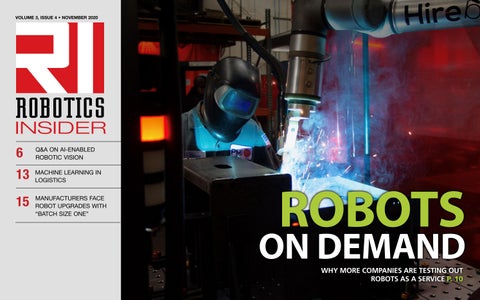
ROBOTS
ON DEMAND WHY MORE COMPANIES ARE TESTING OUT ROBOTS AS A SERVICE P. 10
CONTENTS Columns 3 Market watch
Robot demand expected to temporarily slow due to COVID-19
6 Spotlight
Editor – Kristina Urquhart kurquhart@annexbusinessmedia.com Group Publisher – Paul Grossinger pgrossinger@annexbusinessmedia.com Media Designer – Mark Ryan mryan@annexbusinessmedia.com Account Coordinator – Debbie Smith dsmith@annexbusinessmedia.com Circulation Manager – Urszula Grzyb ugrzyb@annexbusinessmedia.com Tel: 416-442-5600 ext. 3537 COO – Scott Jamieson sjamieson@annexbusinessmedia.com President & CEO – Mike Fredericks
2 November 2020 • Robotics Insider
Francois Simard, Omnirobotic
Photos: (Back) fotografixx/Getty Images. (Foreground left) Texas Instruments. (Foreground right) B&R Automation
Presented by Manufacturing AUTOMATION, Robotics Insider reports on the world of industrial robots and its developing opportunities, challenges and technologies. By sharing unique perspectives and information, we strive to help improve your manufacturing efficiency.
FEATURES 10 Robots on demand
Why more companies are testing out robots as a service (RaaS)
13 Preparing for disruption
How machine learning helps companies react quickly to changing circumstances
15 The flexible factory
With “batch size one,” manufacturers are facing the prospect of upgrading their robotics infrastructure
10
13
15
111 Gordon Baker Rd, Suite 400, Toronto, ON M2H 3R1 T: 416-442-5600 F: 416-442-2230
MARKET WATCH
By Kristina Urquhart
ROBOT DEMAND EXPECTED TO TEMPORARILY SLOW DUE TO COVID-19
T
he global robotics market had a strong start to the year. Sales were humming along, and the number of robot installations worldwide was at an alltime high. A recent report by the International Federation of Robotics (IFR) shows there are a record 2.7 million industrial robots operating in factories around the world – an increase of 12 per cent over 2018. The World Robotics 2020 Industrial Robots report says 373,000 new robot units shipped globally in 2019. This is 12 per cent less compared to 2018, but still the third highest sales volume ever recorded.
“The stock of industrial robots operating in factories around the world today marks the highest level in history,” says Milton Guerry, president of the IFR. “Driven by the success story of smart production and automation, this is a worldwide increase of about 85 per cent within five years (2014-2019).” And then came the pandemic.
COVID-19 impact It’s too early to tell what the economic impact will be on the robotics market, but U.K.-based automation market intelligence firm Interact Analysis expects a decline in revenue as high as eight per cent before the market stabilizes in
“[Some] economies report to be at the turning point right now. But it will take a few months until this translates into automation projects and robot demand,” says Guerry. “2021 will see recovery, but it may take until 2022 or 2023 to reach the pre-crisis level.” 3 November 2020 • Robotics Insider
Photo: rozdemir01/Getty Images/iStockphoto
MARKET WATCH 2021 or 2022. Guerry at the IFR echoes this, saying that the effects of COVID-19 on the market won’t be known for some time. IFR’s early numbers indicated a 12 per cent reduction in sales, particularly in automotive and electrionics manufacturing. “The remaining months of 2020 will be shaped by adaption to the ‘new normal,’” Guerry says. “Robot suppliers adjust to the demand for new applications and developing solutions. A major stimulus from large-scale orders is unlikely this year. China might be an exception, because the coronavirus was first identified in the Chinese city of Wuhan in December 2019 and the country already started its recovery in the second quarter. “Other economies report to be at the turning point right now. But it will take a few months until this translates into automation projects and robot demand. 2021 will see recovery, but it may take until 2022 or 2023 to reach the pre-crisis level.” Here’s where the market was at before COVID-19 hit, according to the IFR’s World Robotics 2020 Industrial Robots report.
Sales were up in North America The U.S. is the largest industrial robot user in the Americas, reaching a new operational stock record of about 293,200 units – up seven per cent from 2019. Mexico comes second with 40,300 units, which is an increase of 11 per cent, followed by 4 November 2020 • Robotics Insider
Canada with about 28,600 units – which is up two per cent. New installations in the United States slowed down by 17 per cent in 2019 compared to the record year of 2018. Although, with 33,300 shipped units, sales remain on a very high level representing the second strongest result of all time. Most of the robots in the U.S. are imported from Japan and Europe. While there are not many North American robot manufacturers, there are numerous important robot system integrators. Mexico ranks second in North America with almost 4,600 units sold – a slowdown of 20 per cent. Sales in Canada are up one per cent, to a new record of about 3,600 shipped units. South America’s number one operational stock is in Brazil with almost 15,300 units – up eight per cent. Sales slowed down by 17 per cent with about 1,800 installations – still one of the best results ever – only beaten by record shipments in 2018.
International markets saw growth Asia remains the strongest market for industrial robots – operational stock for the region’s largest adopter, China, rose by 21 per cent and reached about 783,000 units in 2019. Japan ranks second with about 355,000 units – plus 12 per cent. A runner-up is India with a new record of about 26,300 units – plus 15 per cent. Within five years, India has doubled the number of industrial robots
operating in the country’s factories. Europe reached an operational stock of 580,000 units in 2019 – plus seven per cent over 2018. Germany remains the main user with an operational stock of about 221,500 units – this is about three times the stock of Italy (74,400 units), five times the stock of France (42,000 units) and about ten times the stock of the UK (21,700 units).
Outlook Globally, COVID-19 has had a strong impact on 2020, and will likely affect robot sales because manufacturing volumes slowed around the world, particularly in automotive. But the pandemic also offers a chance for modernization and digitalization of production on the way to recovery. In order to stay competitive, manufacturers will be looking to invest in new technologies, including robotics, which can help improve operational efficiency and enable social distancing. According to the IFR, in the long run, the benefits of increasing robot installations remain the same: rapid production and delivery of customized products, and keeping production in developed economies – or reshoring it. For more on what bringing production back home means for automation in Canada, check out the November/December 2020 issue of Manufacturing AUTOMATION.
FHA-C Mini Actuator with Integrated Servo Drive Harmonic Drive LLC 42 Dunham Ridge Beverly, MA 01915 800.921.3332 www.HarmonicDrive.net
The Servo Drive is inside!
This evolutionary product eliminates the need for an external servo drive! • Actuator + Integrated Servo Drive utilizing CANopen communication • 24VDC Nominal +7-28VDC Supply Voltage Range • Single Cable, only 4 conductors needed: CANH, CANL, +24VDC, 0VDC • Zero Backlash • Dual Absolute Encoders
• Panel Mount Connectors with 4 exit options • Output Sensing Encoder 14bit (16384 cpr) resolution • Input Sensing Encoder 15bit (32768 cpr) resolution • Control Modes Including Torque, Velocity, and Position Control, CSP, CSV, CST • Harmonic Drive HDL Software
Electromate 6221 Highway 7, Unit #15 Vaughan, Ontario, Canada L4H 0K8 (877) SERVO98 (737-8698) www.electromate.com Harmonic Drive®, Harmonic Planetary® and Quick Connect® are registered trademarks of Harmonic Drive LLC. Electromate is the exclusive Canadian distributor of Harmonic Drive® products (except the Province of Alberta).
Partners in Precision
SPOTLIGHT
Francois Simard, CEO of Omnirobotic
A
Quebec-based startup is giving industrial robots the ability to see using an artificial intelligence (AI) platform for high-mix production environments. We checked in with Francois Simard, one of Omnirobotic’s two founders, about how he and Laurier Roy plan to bring their solution for custom manufacturing to the masses.
What is a self-programming robot?
Francois Simard, Omnirobotic
6 November 2020 • Robotics Insider
A robot that can see plan and execute a value-added process on never-seen-before parts by itself – so it is radically different from any robot programming techniques existing today. It is setting goals and constraint to an AI, instead of recording a fixed motion in space. So the robot will find by
itself how to apply the process. This is useful because with the right constraint and knowledge, we can actually train a robot that would understand what it does, and execute on never-seen-before parts in unstructured environments without any locating jigs, and on varying production.
What are some of the challenges that high-mix manufacturers have when it comes to production processes? High-mix refers to any manufacturers that are either doing made-to-order, just-intime manufacturing, or mass customization – aerospace, heavy equipment, sheet metal products, structural steel, and office furniture are some examples. By contrast, the automotive and electronics sectors are mass manufacturers. By definition, high-mix manufacturers have a hard time automating their production, as product models are varying constantly over weeks, and [often] it varies from hours to hours. So, robotics and automation
historically were designed for mass manufacturers and are unable to adapt to varying production shapes. Therefore, high-mix manufacturers are relying heavily on skilled labour, even today – and that pool of workers is on the decline. The result is that many high-mix manufacturers that we’re encountering today are struggling just to maintain their current production level. There are not even talking about the increasing their productivity or quality at this point, and they are suffering from high turnover.
Tell us more about Omnirobotic’s vision technology and how it works. If you want to get an AI-driven robot to understand what it does, first, you need the AI to have a full 3D representation of the object to be processed. Current 3D technology used in industrial applications is limited to a single point of view, so only some faces are digitized. We needed a way to construct a full 3D model of real physical objects, in real time. A
SPOTLIGHT new technology appeared in 2012 – sensor fusion. The idea is to gather 2D information from all around the object and incrementally create a robust 3D model of the object inside a graphic card’s memory. This technology was initially developed by Microsoft for the Kinect sensors [in] the game industry. We knew that we could adapt it. So we’ve built industrialgrade 3D cameras that are more accurate and tougher than the consumer-grade 3D cameras that you can see on consumer drones. Using an array of 3D sensors, we can create a full 3D model of parts traveling down conveyors, or we can use a single, mounted robot on a camera and move it around the object to create the same result. Omnirobotic is providing the brain and the eyes for industrial robots. Our platform is really creating add-ons to make robots intelligent devices that understand what they’re doing. We’re not selling the robot. We sell the camera, and we are renting the brain that is puppeteering the robot. 7 November 2020 • Robotics Insider
world before executing it in the physical world. The AI can explore many appropriate moves in virtual simulation, but it will retain the best solution to be realized in the physical world. This is how the AI never fails.
This technology can be applied across many areas in manufacturing, but you’re targeting the finishing department first. Why did you decide to do that?
Photo: Omnirobotic
How does Omnirobotic use the digital twin in its solution? We’ve talked about seeing, now we’re going to be talking about planning. For the AI to plan correctly, it must have an exact digital twin of the equipment. This includes the robot kinematic representation, the collidable “buddies” around the robot, and of course, the part itself on
which the robot will be working. Within a simulation environment, the AI can explore possible ways to perform the process at a rate approximately 1,000 times faster than a human could using an offline programming software. It’s an offline programming software on steroids, if you like. This is how the AI can validate the kinematic solution in the virtual
The technology could be applied at several locations in a manufacturing plant, but the finishing department, and coating specifically, has been a challenge because there’s a high quality expectation from the customer [that] is set to the final product. [It’s] where you’re basically applying the finishing process that is seen by your customers. But let’s be honest – doing that job is boring, repetitive. And it’s a very difficult goal [for a human] to achieve that quality, eight hours a day, standing in a small room, covered with protective equipment,
SPOTLIGHT and having no social interaction. The human body hasn’t been built for that type of challenge. And even more importantly, we knew that coatings were a dangerous job. No matter how much protective equipment you wear, applying industrial coatings will eventually damage your lungs and will lead to musculoskeletal problems. It could cost you your health; it could cost you your life. So for us, that was the obvious place to start.
Omnirobotic recently secured $6.5 million in funding to commercialize your AI platform. How will you use the money? With this investment, we have three objectives. First, we will continue building out the technology for spring application. We’re going to be building partnerships to accelerate our market penetration, and we’re developing the framework upon which we’ll be able to add new processes like welding and machining in the future. For the short term, most of 8 November 2020 • Robotics Insider
Photo: Omnirobotic
the spending is focused on hiring very talented people to make our platform usable by our partners. This is critical because we won’t be able to commercialize [this] and serve the whole planet by ourselves. We need to leverage existing networks. And that’s where most of the investment will go. From now to Christmas, we’re
expected to grow nearly to 30 people.
What are your plans to expand the sales growth once you’ve scaled up the technology? Eventually, we would like to create an AI platform that is so compelling, and so easy to use that even the manufacturers themselves
would be able to build their own solution using it. We’re not there yet. We’re a long way from that objective, so in the short term, our objective is to sign on partners to train them and to get them having customer success. We’re targeting companies that are in the field of robotic integration, or automation component OEMs at this time.
WORKING TOGETHER AS EQUALS.
Humans and robots are working more closely together. Sensors help robots make more intelligent decisions and give them the ability to sense objects, the environment, or their own position. Thanks to sensors from SICK, robots perceive more precisely – the prerequisite for close collaboration. For all challenges in the field of robotics: Robot Vision, Safe Robotics, End-of-Arm Tooling, and Position Feedback. We think that’s intelligent. www.sick.com/robotics
COVER STORY
ROBOTS ON DEMAND
Why more companies are testing out robots as a service (RaaS) By Treena Hein
C
OVID-19 has brought many issues to the forefront for Canadian manufacturers, among them an unstable labour situation and the unforeseen costs of distancing, disinfection and other new safety protocols. Addressing the labour issue, which was already a widespread industry stressor, with technology is a good idea – but the pandemic has made cash scarce for many firms right now. However, the current desire to reap the benefits of automation is strong. Honeywell’s 2020 Intelligrated Automation Investment Study, for example, found that over 50 per cent of U.S. companies are increasingly open to investing in automation to
10 November 2020 • Robotics Insider
survive changing market conditions brought about by the pandemic. So, what’s really needed is a very low-cost, low-risk automation option – and that’s exactly why the “robots as a service” (RaaS) concept is gaining traction. While it’s been around for more than 15 years, it was identified as an “emerging trend to watch” by industry pundits a couple of years ago. And last year – before the pandemic – global consulting firm ABI Research predicted that there will be 1.3 million RaaS deployments globally by 2026.
Why RaaS? “RaaS can help during periods
Photo: Hirebotics
COVER STORY
where employees can’t be at work or there’s a spike in demand,” says Yarek Niedbala, vice-president of sales at KUKA Robotics Canada. “[RaaS] contracts can be negotiated to allow companies to terminate the agreement when employees are able to return to work or when demand drops.” He adds that with robotics in place, there are fewer operators on the plant floor, which means a lower likelihood of spreading COVID-19. Labour issues aside, Jonathan Chang, overseas marketing manager at ForwardX Robotics, notes that shifts in consumer expectations caused by SKU proliferation have given rise to more high-mix, lowvolume manufacturing, making traditional, bolted-down automation options a sometimes-risky choice. So, eyes are turning to RaaS, but how does it differ from robot rental, a service that has been around for quite a while? Hirebotics co-founder Rob Goldiez first stresses that slapping the term RaaS onto a rental offering doesn’t make it so. RaaS is a system, 11 November 2020 • Robotics Insider
he explains, that’s comparable to SaaS (software as a service), which “transformed the software industry not just because it was a different way to buy, but also because it allowed companies to quickly scale up or down without the traditionally long implementation cycles of the past.” That is, compared to a lockedin robot rental contract situation, RaaS is generally pay-as-you-go and highly flexible. A customer that has a particular RaaS unit this week can get a different one next week, or a bigger one, or another one of the same, or return it – depending on changing circumstances. In addition, at the “service” end of RaaS is the capability to have the robot connected to the cloud, using
machine learning to collaborate with other robots and much more. Amazon, Google and Honda are among the companies exploring this, and indeed already offering it.
Wide array of uses RaaS can be used in warehouses for item picking, security, cleaning, disinfection and more. In manufacturing, Hirebotics is currently focused on using RaaS for MIG welding. “The shortage of skilled workers is a massive problem in the industry that is only getting worse,” Goldiez explains. “Our BotX [collaborative robot] offering allows companies to, in a matter of hours, have their staff trained and running production. It takes longer to create a new job posting.”
Shifts in consumer expectations caused by SKU proliferation have given rise to more high-mix, low-volume manufacturing, making traditional, bolted-down automation options a sometimes-risky choice.
Goldiez notes that there are a lot of things cobots can already do, and that future cobot RaaS applications will likely be in areas “closest to the core of the three Ds – dull, dirty and dangerous – where it’s hard to find people and where human mistakes can lead to quality issues,” he says. “Applications like gluing, grinding and finishing.” Quebec-based Waybo currently offers robot cells as a service, which can interface with other equipment such as grinding wheels, marking machines, digital inspection machines and saws. For its part, ForwardX Robotics aims to offer its RaaS offerings to North American manufacturers for many types of handling applications (its RaaS products are already in place in China). Speaking specifically about handling uses with autonomous mobile robots (AMR), Chang says RaaS can be used to automate parts of workflows in the SME factory, including raw material delivery, work-in-progress movement, finished
COVER STORY
goods transfer and storage, waste material disposal and pallet recycling. “Furthermore, with intelligent solutions like AMRs, manufacturers can easily adjust workflows and re-route robots to fit their needs,” he says, further cutting costs and increasing productivity.
be designed appropriately for its intended task and requires tooling, fixturing, feeding mechanisms, programming and so on. Indeed, he says sometimes the design and engineering of such a cell can take so long that it makes the RaaS model impractical.
Challenges of RaaS
Looking forward
As is common with many other forms of automation, it can be difficult with RaaS to nail down the metrics to measure parameters for success. Goldiez adds (and this can be the case with many types of automation) that RaaS can also trigger a fear of failure in plant managers. “Too many people have heard horror stories about businesses that purchased automation and struggled to get it working,” he says. “Or, they purchased automation that wasn’t flexible and the benefits are only partially realized. There’s also a fear that employees won’t embrace it out of fear of losing their jobs.” With RaaS in particular,
Despite the challenges and select current applications available with RaaS, it’s likely that with labour shortages and constant improvements in capability, adoption of the concept will grow. It’s one of many robotic options now available, and along with the autonomous mobile robots, cobots and more, “today, the customer is spoiled for choice,” notes ARC Advisory Group. Of course, more choices are coming soon. For example, KUKA is about to launch SmartFactory as a Service – the rental of an entire plant run by robots.
12 November 2020 • Robotics Insider
Photo: fotografixx / Getty Images
specific applications will require customization of the robotic hardware, which of course requires time and comes with costs. And with any robotic system, it may also be challenging to successfully achieve high levels of quality and consistency in certain applications. For example, grinding and polishing “where the robot […] needs to ‘feel’ the amount of force that it’s
exerting,” says Niedbala. In addition, he explains that some applications require a proof of concept, testing various tools to determine which one works and so on. High-speed applications in particular require lots of optimization. Niedbala adds that whether a robot is purchased, rented or under a RaaS arrangement, it’s only a part of the robotic cell, which must
“With intelligent solutions like AMRs, manufacturers can easily adjust workflows and re-route robots to fit their needs.”
Treena Hein is an award-winning freelance writer based in Ontario.
LOGISTICS
PREPARING FOR
DISRUPTION Three ways machine learning helps companies react quickly to changing circumstances
Photo: Texas Instruments
By Sameer Wasson
A
s areas around the world began to adapt to the pandemic, like millions of others, my family and I had to search for alternate ways to shop for and purchase necessities. While shopping online is easier than ever – even in urban areas like where we live – delivery of an order is just now becoming less complicated and more reliable. As more people were quarantined in their homes, delivery may have slowed for a few days, but most retailers were able to stay open and deliver orders. That is a remarkable achievement. While demand was spiking to 13 November 2020 • Robotics Insider
unprecedented levels, warehouses that were fulfilling orders suddenly had to operate with fewer people working farther apart to maintain social distancing. I give credit not only to the teams executing online operations but also to a less-noticed piece of the puzzle: processors and software that enable warehouse robots to identify patterns and learn continuously from the activity taking place around them. These robots collaborated with their human partners to sort and send orders from warehouses to every corner of the planet. The use of machine learning in
warehouses and factories has been on the rise for a few years, but the pandemic has been a wake-up call. Among the lessons: Consumer demands are changing faster than production lines across many industries are capable of handling. Some companies shut down production to help contain infection risks for employees working close to each other on assembly lines. Without workers to assemble products, some operations came to a halt. But other companies had a better experience. Businesses that invested in unmanned robots guided by machinelearning algorithms were able to react
creatively, swiftly and productively. In the warehousing and distribution sector, for example, companies that depended on humans to drive forklifts were sidelined, while those using unmanned robots “driven” by machine learning algorithms kept warehouses humming. Machine learning is a form of artificial intelligence designed to recognize patterns in enormous amounts of data generated by electronic images, video, text and speech. Algorithms identify patterns and turn them into rules that guide robots to make intelligent, safe, secure and autonomous decisions,
SAFETY
such as where to insert the right rivet in the right place at the right tension on an assembly line. Or algorithms can guide a fleet of warehouse robots to receive and store products, choreograph order fulfillment, optimize inventory and deliver goods on a more continuous basis. It’s also the same technology that is enabling more autonomy in our automobiles. Those capabilities are made possible with the combination of processors, software and specialized algorithms. In my role leading processors strategy and products for our company, I continually monitor trends in the market and talk regularly to our customers. Here are three insights I’ve gained about the role that machine learning will play in the way we work and meet customer needs:
1. The right investments can help you prepare for the future As businesses look to the future, they should consider investing in machine learning tools that can anticipate 14 November 2020 • Robotics Insider
challenges before they arise. For example, predictive maintenance can help businesses monitor and interpret data from sensor networks and detect when equipment might fail so they can proactively schedule maintenance repairs and avoid costly downtime. Networks of sensors and processors can be used for predictive maintenance in factories, building automation, smart homes, automotive and vehicle battery management systems, and other applications. Regardless of your industry, making an investment in digital transformation can help companies continue operations and be agile to changing circumstances.
2. Machine learning can help optimize retail operations Machine learning is making an impact far beyond the factory or the warehouse floor. Look at grocery stores, for example. While there aren’t many robots in the aisles when you buy a loaf of bread today, retailers are beginning to test the waters.
In some stores, robots monitor the shelves, connect to cloud-based inventory-management systems and notify employees when items are out of stock, in the wrong location or priced incorrectly. They can identify a spill and even clean it up. One example is a grocery store chain in China that uses robots as shopping carts. An autonomous cart follows a shopper – avoiding other people and objects – and scans items as they are placed in it.
3. Robots can make filling orders more efficient In areas such as inventory management, machine learning algorithms can take into account customer demand for a particular product to guide an unmanned robot to store the goods on shelves closest to the receiving docks, where the products are ready for pickup and delivery to end users. When orders come in, the unmanned robot instantly knows where the item resides in the warehouse and the shortest and
safest route to move it for pickup. These advancements are not novelties. Software and a new generation of processors are making it easier to get started with machine learning and robotics. In some cases, the robot system with machine learning technologies can pay for itself just one year after installation. The key to making machine learning and robotics more mainstream is developing affordable, practical innovation. Through machine learning, robots are being transformed from science fiction to science. They are able to adapt quickly to change, reduce costs and improve the customer experience. Manufacturers and logistics companies that fail to adapt to change and build more agile systems will fall further behind those that embrace the technology. Sameer Wasson is vice-president and general manager, process business unit, at Texas Instruments. This article was reprinted with permission.
OPERATIONS
THE FLEXIBLE FACTORY
With “batch size one,” manufacturers are facing the prospect of upgrading their robotics and automation infrastructure By Jacob Stoller
U Photo: B&R Industrial Automation
15 November 2020 • Robotics Insider
nderneath the compelling headline on BMW’s “design your own vehicle” website, there is some telling fine print. “This is a configurator,” the disclaimer reads. “Your ability to obtain the vehicle you build depends on availability.” These words reflect the difficulty, even for luxury brands, of moving away from the traditional paradigm of mass production. While responses to the growing granularity of customer demand – mass-customization, flexible manufacturing, batch-of-one manufacturing – are often touted as the way of the future, many hurdles remain. The basic idea, of course, is nothing new – the term “mass customization” was coined in the 1990s – but the more recent expectation of consumers that they can order anything they want from anywhere in the world has created a dynamic
OPERATIONS where consumers no longer want to buy the car that’s sitting on the local lot. “Canadians for some reason love their car to be custom,” says Johnston Hall, product specialist with Omron Canada. “Everyone has to be different, and that requires small production runs.” The impact is being felt by OEMs and parts suppliers alike. “I know automotive suppliers who used to have to make 20 different variations of a product, and now they have to do 5,000 variations,” says Michael Gardiner, manufacturing industry solution executive at Microsoft Canada. The trend is putting a strain on manufacturers’ existing infrastructure. “Manufacturers are having to adapt to that philosophy,” says Mike Hutson, solutions architect for Toronto-based software provider Syspro Canada. “The key is, how can they change their manufacturing environment to suit that? If you’re set up to mass produce, then it’s very difficult to change.”
Transition at multiple levels The difficulty for manufacturers is that the smaller batch trend touches all aspects of the business – production planning, material handling, fabrication, packaging, and delivery through the supply chain. Consequently, there are no magic bullets. “It’s not just one thing – it’s a combination of things that manufacturers have to do,” says Hutson. 16 November 2020 • Robotics Insider
“A classic robotic line is not adaptable – if a piece isn’t in the right position, the robot won’t pick it up,” says Gardiner. “If you really want your system to adapt, it has to be more cognitive, so that it can adapt to different learning situations.” Tech vendors are responding with different pieces of the proverbial jigsaw puzzle. ERP systems are being adapted to configure small batches and orchestrate them through the supply chain. Material handling methods and industrial controls are being re-architected to support small-batch or batchof-one production with existing infrastructure. Additive manufacturing or 3D printing is dropping in price, making it viable for selected small production runs. “Tech providers – hardware and software, automation or robotics – are re-architecting their own systems and methods that may have been in place for decades in order to accommodate this,” says Gardiner, “and all this is happening at the same time. In the last five years, I’ve seen more movement than I saw in the previous 15 in the industry.”
The solutions generally support a modular manufacturing strategy, where a core component is mass-produced, and components that vary by customer preference are made in smaller batches and installed in “Lego-block” fashion. The approach allows manufacturers and distributors to shrink their product portfolios while leveraging their existing infrastructure. “Manufacturers have a massive amount of capital geared for pure mass production,” says Hutson, “so when it comes to mass customization, modularization is the most practical way to do that.” Industrial pumps are a good example. As Hutson explains, the customer can use a software module called a configurator to select a housing, and then choose the motor, valves and other components. Using rules-driven algorithms, the configurator then generates a quote and orchestrates the order into the fabrication or assembly process. The modular approach can require significant human intervention on the factory floor, however, and the need to mitigate that is spawning a new breed of intelligent machines.
Smarter machines Efforts to produce in smaller batches are often hampered by the inflexibility of traditional automation technology, much of which may have
OPERATIONS been in service for decades. The approach, therefore, often involves prohibitive set-up costs. “A classic robotic line is not adaptable – if a piece isn’t in the right position, the robot won’t pick it up,” says Gardiner. “If you really want your system to adapt, it has to be more cognitive, so that it can adapt to different learning situations.” Machine learning software, supported by the latest generation of vision sensors, can learn on its own how to set up a machine for a non-standard order. “This doesn’t mean you have to buy all new equipment,” says Gardiner. “A lot of what we’re doing in the tech industry is taking existing equipment and making it smarter. For example, adding artificial intelligence (AI) to existing camera systems using overlay software and edge computing.” One approach is to equip machines with machine automation controllers (MACs), recently introduced by manufacturers such as Omron, which can track components through the production line without involving humans. In automotive, this could match custom parts such as car seats to a particular vehicle on the line. “The machine can read the bar code and know what seats are supposed to go into that car,” says Hall. Another piece of the puzzle is making production lines more flexible so that they can support modular 17 November 2020 • Robotics Insider
Photo: Omron Automation Americas
production. Austrian equipment manufacturer B&R Industrial Automation’s answer to this is to replace fixed conveyors with track-based conveyance systems that allow, in railroad yard fashion, for workpieces to be automatically switched to the right machines (pictured, p.15).
“At the core is intelligent track technology, in which individually controlled shuttles adapt to each product being produced, assembled or packaged – instead of a volume of products conforming to a rigidly sequential process,” says John Kowal, B&R’s director of business development, who is based in Chicago. Track systems also require less space. “Track systems can cut production line footprint in half compared to lines connected by conveyors,” says Kowal. “In a clean room environment, cutting the costly isolator space in half can save hundreds of thousands of dollars.” Gardiner envisions an automotive factory of the future where the arrangement of machinery no longer follows the fixed production line format. “Products will take different routes in the factory depending on which model is selected,” he says. “Instead of a long production line, an automated guided robot will take the product to what area it needs for processing next. There are manufacturers that are already doing this.”
From prototype to production Additive manufacturing, also known as 3D printing, has gained considerable attention in the smaller batch conversation, and for good reason – the technology often simplifies the design process, is remarkably versatile for executing complex designs,
OPERATIONS and eliminates setup and tooling costs that often require high volumes to amortize. “With additive manufacturing, you have the entire supply chain from raw materials, to design, to manufacturing, all under one roof,” says Mihaela Vlasea, assistant professor of engineering at University of Waterloo specializing in metal additive manufacturing. Costs are dropping. For example, Vancouverbased 3DQue has developed technology that makes additive manufacturing price competitive for small and medium-sized plastic parts runs. The key has been automating material-handling tasks that have traditionally slowed down the process. “We have an automated system for parts release, and software that drives the whole system,” says Stephanie Sharp, 3DQue’s CEO. “So we’ve minimized manual intervention from design to shipping. This way we’re able to be cost competitive with injection molding.” Metal additive manufacturing is also advancing rapidly. “The cost of materials has drastically gone down, and there are more options for materials you can print with,” says Vlasea. That said, additive manufacturing, at least on the metals side, is still expensive compared with traditional fabrication methods – and significantly slower, notes Mark Kirby, additive manufacturing business manager at the Kitchener, Ontario– 18 November 2020 • Robotics Insider
“Instead of a long production line, an automated guided robot will take the product to what area it needs for processing next. There are manufacturers that are already doing this.” based Renishaw Canada Solutions Centre, which helps companies develop metal-based additive manufacturing capabilities. “You’re not going to be using it to drive costs out of an existing product,” says Kirby. “You’re trying to develop new products that have to be higher performance – parts that cost more but deliver higher value.” One example is fuel injectors for aircraft engines. “The fuel injector is one of those poster-child components,” says Kirby. “Because we’ve reduced the number of individual pieces that are welded and brazed together, it fails less often.” Kirby envisions the emergence of that will expand over time as additive technology improves. “It’s hard to predict, but I think the biggest impacts will be ironically in the places people least expected it,” he says.
Solving age-old problems Demand for smaller batches may be the burning
platform that’s driving a more flexible approach to manufacturing, but the resulting trend to smaller localized facilities has many other benefits. “The adaptive machine is great for re-shoring, overcoming the skills gap and addressing growing labour shortages,” says B&R’s Kowal, “and compared to offshore production and long trips in containers, manufacturers will be able to fulfill custom orders overnight.” “With additive, I can produce a thousand parts per week, or a few hundred a day,” says Sharp, “so I don’t have to keep tens of thousands of them in inventory. That means I don’t need warehousing space, and that reduces the environmental footprint.” The resulting facilities are also more attractive places to work. “You can now have urban factories,” says Vlasea. “If you come into our site, we’re in an office building with full metal manufacturing facilities on the main floor. “So we can bring all of these manufacturing jobs closer to younger people, who view [this as] a cool place to be – right downtown. That really attracts a new wave of engineers.” Jacob Stoller is a journalist and author who writes about Lean, information technology and finance. jacobstoller.com
DON’T MISS OUT ON YOUR NEXT ISSUE OF IT’S FAST, IT’S EASY AND IT’S FREE!
HERE’S HOW: For fastest service visit AutomationMag.com AND CLICK THE SUBSCRIPTION BUTTON
AutomationMag.com