VOLUME 3, ISSUE 1 • APRIL 2020
RI
ROBOTICS INSIDER 3
PANDEMIC COULD BOOST ROBOTICS MARKET
COBOT INSTALL ON A WIRE 11 AEDM MACHINE DOUBLES OUTPUT IMAGE-PROCESSING 13 HOW SYSTEMS ALLOW ROBOTS TO SEE OBJECTS
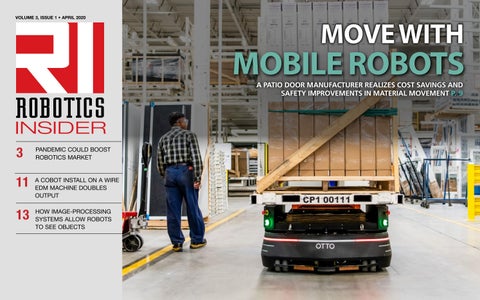
MOVE WITH
MOBILE ROBOTS A PATIO DOOR MANUFACTURER REALIZES COST SAVINGS AND SAFETY IMPROVEMENTS IN MATERIAL MOVEMENT P. 9
CONTENTS Columns 3 Market watch
Pandemic calls for critical look at supply chain, digitization and robotics
6 Spotlight
Ed Mullen, Mobile Industrial Robots
Presented by Manufacturing AUTOMATION, Robotics Insider reports on the world of industrial robots and its developing opportunities, challenges and technologies. By sharing unique perspectives and information, we strive to help improve your manufacturing efficiency.
FEATURES 9 Optimizing with OTTO
A patio door manufacturer realizes cost savings and safety improvements in material movement
Editor - Kristina Urquhart kurquhart@annexbusinessmedia.com
11 Lights out production
A machine shop implements a collaborative robot on a wire EDM machine to double output
Publisher - Klaus Pirker kpirker@annexbusinessmedia.com Vice-President & Executive Publisher Tim Dimopoulos tdimopoulos@annexbusinessmedia.com
13 Seeing without eyes
Media Designer, Team Lead - Graham Jeffrey gjeffrey@annexbusinessmedia.com
9
Account Coordinator - Debbie Smith dsmith@annexbusinessmedia.com Circulation Manager - Urszula Grzyb ugrzyb@annexbusinessmedia.com Tel: 416-442-5600 ext. 3537
How image-processing systems allow robots to see and recognize objects
15 Building a bot
Three Ontario students create an awardwinning pick-and-place robot
COO - Scott Jamieson sjamieson@annexbusinessmedia.com
11 2 April 2020 • Robotics Insider
13
111 Gordon Baker Rd, Suite 400, Toronto, ON M2H 3R1 T: 416-442-5600 F: 416-442-2230
MARKET WATCH
By Kristina Urquhart
PANDEMIC CALLS FOR CRITICAL LOOK AT SUPPLY CHAIN, DIGITIZATION AND ROBOTICS
T
he COVID-19 pandemic will change manufacturing in North America. At the time of this writing, it’s already happening, even as we see new cases of the novel coronavirus roll in across Canada and the United States by the hour. Some manufacturers – like those in the automotive industry – are seeing demand dwindle, while others that produce items like hand sanitizer, disinfectant wipes, bath tissue and paper towel are mobilizing to ramp up production and churn out product as fast as possible to meet overwhelming demand. Simultaneously, in an effort to stem the virus’s spread, large swaths of the workforce are retreating
into their homes to work remotely. Those who remain in the workplace are practicing social distancing where possible, and employing rigorous sanitation practices. According to public health officials, this coronavirus, left unchecked, could strike between a third and three-quarters of Canadians – which is a massive portion of the total workforce. The as-yet-unknown economic ramifications of COVID-19 have prompted panic selling on the stock market, and an oil price war between Russia and Saudi Arabia. Global financial markets crashed on Mar. 9 and fell to record lows on Mar. 12. On Mar. 16, they were hit again, with investors
Post-crisis, manufacturers will need to ensure they have the flexibility to deal with portions of their workforce being out of the plant, and to accommodate SKU changes on the go as production ramps up or down to meet demand. 3 April 2020 • Robotics Insider
Image: Ca-ssis, E+, iStock / Getty Images Plus
MARKET WATCH reacting to widespread retail closures and strict international travel bans taken by both Canada and the U.S. This is the time for companies to take stock of their operations, from production through the supply chain, and think critically about how they may be better prepared in the future. “It’s kind of like a new world order,” Craig Resnick, vice-president, consulting at ARC Advisory Group, says in an interview. “The only certainty is uncertainty.” Dealing with demand Over the last few weeks, Resnick’s client list of manufacturers and automation suppliers have been contacting him for advice on scaling their plans for emergencies, whether they be pandemics, natural disasters or tariff wars. “One of the things they want to take this time to do is to say, how can we be more resistant in the future?” he says. “How do we do a better job operating remotely, because the workforce is inaccessible either because of a weather disaster or because of a pandemic?” One thing that makes the current situation differ from the 2008-2009 recession, Resnick says, is that demand continues for many products, especially in food and beverage and pharmaceuticals. A new concern is how to be flexible and agile with the packaging of products so they can go 4 April 2020 • Robotics Insider
straight from the manufacturer to the consumer, because there isn’t time for products to be tied up in the logistics chain. “The theory now is that maybe the distribution centre model doesn’t really work for sending things to consumers,” Resnick says. “How can factories be asked to have deliveries going right to a consumer? [It] completely changes the way they have to package products because they’re not doing a bulk package to go to a distribution centre.” Panic buying has challenged manufacturers and distributors in North America over the last week, with consumers flocking to grocery stores in droves to stock up on products. Resnick says consumer behaviour is likely to change long-term as well. Cleaning product manufacturers may need to increase their number of production lines if consumers start using more of these products even after the virus subsides. Robot market could see upswing One of the positive effects that may come out of the COVID-19 crisis is that manufacturers could become increasingly interested in how robotics and automation can help their business, both from a production and workforce augmentation standpoint, Resnick says. With collaborative robots, which are what manufacturers are currently most interested in, he says, “your robot becomes kind of like your avatar.
They give the ability to actually control some of the processes that you’re responsible for in the plant, even if you’re not physically there.” Post-crisis, manufacturers will need to ensure they have the flexibility to deal with portions of their workforce being out of the plant in case of emergency, and to be able to accommodate SKU changes on the go as production ramps up or down to meet demand. Packaging and material handling requirements may change on a moment’s notice. More robots and automation will be required to respond to those kinds of fluctuations – but companies will also need more human talent to manage them. While the economic effects of COVID-19 on the North American manufacturing sector remain to be seen, according to ARC, previous global pandemics have caused revenue losses of up to $18 billion in automation markets alone. “Companies that will survive long term are the companies who have the best tools to be flexible, agile, nimble, and can do the best job of quickly changing runs, controlling their plants, monitoring their plants, adjusting their supply chains, and being able to deploy their workforce from really any location,” says Resnick. “There’s no one on the planet who knows how this is exactly going to turn out. But they recognize that when this thing does subside, the old normal cannot be the new normal.”
Need reliable and high speed I/O data over long distances?
Interconnectivity for pneumatics and electric automation The new I/O system in IP65/IP67 enables powerful I/O modules and existing valve manifolds to be directly integrated to a fieldbus. • • • •
Up to 500 I/O modules including IO-Link masters 50 m cables between modules Simplified integration using L5X export/import on Rockwell systems Ability to create power zones
Learn more about the CPX-AP-I
festo.ca
SPOTLIGHT
Ed Mullen, VP sales of the Americas division for Mobile Industrial Robots
M
obile Industrial Robots (MiR), which produces autonomous mobile robots (AMRs), recently announced it’s building a $36-million collaborative robot hub with Universal Robots in Europe. We talked to MiR’s VP sales for the Americas to see how the AMR business is picking up speed stateside.
How is MiR meeting new demand for these vehicles? Ed Mullen
6 April 2020 • Robotics Insider
This is fairly new technology with regard to autonomous material handling and our strategy still remains focused on educating our partners and educating the general manufacturing audience on what an AMR can do for their business. Our
business over the last four years has been selling low-volume seed units into large multinational companies. Now we’re in a transition phase, where a lot of these early-on proofof-concepts are starting to turn to bigger deployments. Companies are now comfortable with the technology, and they understand how to apply it. They’ve identified applications that are showing a positive return on investment. Our focus now is leaning more towards building up a team of resources that can help with bigger deployments. That leads us to a system integrator program that we’re starting to develop. Companies that act as integrators can now partner with us and we can leverage their capabilities to assist in these larger deployments.
What challenges do you currently face with education? We want to be able to just allow an end user to take full ownership of the product and evolve it as their business changes. That’s really what manufacturing has grown into – it’s
more of an agile environment where one week they may be doing one type of product and another week they may be doing a completely different product on that same production line. And that’s the appeal of cobots and AMRs – this flexibility and adaptability, and the ability to have a customer take ownership and change the function of the piece of automation.
How does MiR Americas support Mobile Industrial Robots, which is based in Denmark? We’ve implemented a team of application engineers now that are on top of our tech support engineers. The focus of us in the Americas is to provide the highest level of support, both sales and technical. This team is another mechanism to assist customers more intimately on commissioning robots and make sure that they understand the technology, and that they apply it correctly.
What specific advancements has MiR made with the artificial intelligence of its AMRs? We’ve been investing more and
SPOTLIGHT
What’s been your strategy so far on partnering with other companies to offer tooling for MiR’s AMRs?
give customers a tool and let them develop the proper solution for the application. We’ve got a couple of solutions that made a little more sense for MiR to integrate into our robots. For example, for the bigger robots, we have a pallet movement system, which lifts a pallet off of a rack, and we supply the lift and the rack as an accessory to the robots to put together a solution. Even more important than this is giving external companies the tools to integrate solutions very easily into our platform. What we’ve started to organize this past 24 months is a program called MiR Go. It’s an ecosystem that allows external companies to develop solutions and post them on our MiR Go site. It exposes those solutions to the general audience worldwide. It allows companies to go to that site, look at specific solutions, contact those companies and buy an already designed, manufactured solution for that particular application if it fits.
Instead of developing solutions and forcing customers to work with our solutions, our strategy has been, let’s
What should manufacturers be aware of safety-wise, since AMRs move freely
more into artificial intelligence (AI). We’ve launched our first product, which is the static AI camera that can be mounted in more challenging locations within a manufacturing environment. We can start to learn the environment and feed that data back to our fleet system so that the fleet can help make the robots more efficient in the environment, make better decisions on where to navigate and where not to navigate during certain times of the day, or recognize when certain things are present or not present, to determine when and where to dispatch the robot. As we progress through developing and expanding our product line of AI technology, that will be the next phase, to put a dynamic AI camera integrated into the robot, so that we can learn the environment even better as we’re navigating around.
7 April 2020 • Robotics Insider
around a production facility? Our robots have built-in safety with Cat 3/PLd. Specifically, there’s not much that they have to do to change their environment with regard to safety in order to use the robots. Our robots are fully compliant to work around people in traffic areas. But if you think about what that does – it will slow the robots’ speed down when it has more obstacles in front of it. What we’re seeing is customers are reviewing processes and procedures and creating lanes so that the robots can see a faster throughput and better track times between pickup and dropoffs.
What should a manufacturer consider when evaluating whether an AMR is right for their facility over another type of automated guided vehicle (AGV)? Floor space is becoming a premium. The general environments are becoming much more condensed than they were 15 or 20 years ago. Twenty years ago, AGV technology was very prevalent in the bigger companies, [which] could afford
to dedicate a particular lane for an AGV – and that static route, where that AGV just does the same thing over and over, all day long, seven days a week, is the way they would generate an ROI on it.
How do AMRs help with the skills shortage? The task of moving things is not a high-skilled job. If you look at a general manufacturing environment, where you’ve got a skilled operator that’s doing a highlevel task [like] running a stamping machine or a CNC machine, and [they’ve] got to stop what [they’re] doing to take those products on a machine to another process by carrying, pushing or pulling – that’s where we see the inefficiency of that operation. If we can keep the skilled labour doing what makes the company money and bring in autonomous robots to handle the material movement, that’s where you’ll start to see the higherefficiency model start to shine. This interview has been condensed and edited.
FHA-C Mini Actuator with Integrated Servo Drive Harmonic Drive LLC 42 Dunham Ridge Beverly, MA 01915 800.921.3332 www.HarmonicDrive.net
The Servo Drive is in the Actuator!
This evolutionary product eliminates the need for an external servo drive! • Actuator + Integrated Servo Drive utilizing CANopen communication • 24VDC Nominal +7-28VDC Supply Voltage Range • Single Cable, only 4 wires needed: CANH, CANL, +24VDC, 0VDC • Zero Backlash • Dual Absolute Encoders
• Panel Mount Connectors with 4 exit options • Output Sensing Encoder 14bit (16384 cpr) resolution • Input Sensing Encoder 15bit (32768 cpr) resolution • Control Modes Including Torque, Velocity, and Position Control, CSP, CSV, CST • Harmonic Drive HDL Software
Electromate 6221 Highway 7, Unit #15 Vaughan, Ontario, Canada L4H 0K8 (877) SERVO98 (737-8698) www.electromate.com Harmonic Drive®, Harmonic Planetary® and Quick Connect® are registered trademarks of Harmonic Drive LLC. Electromate is the exclusive Canadian distributor of Harmonic Drive® products (except the Province of Alberta).
Partners in Precision
COVER STORY
OPTIMIZING WITH OTTO A patio door manufacturer realizes cost savings and safety improvements in material movement with an OTTO Motors mobile robot By Kristina Urquhart
O
ver the past five years, Toronto-area manufacturer Sunview Patio Doors has transitioned its factory from a manual, paper-driven operation to one that’s fully automated. The company, which produces about 80,000 windows and doors every year, is bringing its operations into the Industry 4.0 era in response to increasing customization options and higher customer demand for faster delivery times. So far, Sunview has implemented automation such as robotic work cells, an automated
9 April 2020 • Robotics Insider
storage and retrieval system in the warehouse, and enterprise-wide software. Two years ago, when Sunview was looking to replace its traditional tow motors in order to reduce traffic on the shop floor, it purchased its first autonomous mobile robot (AMR) from the Clearpath Robotics–owned OTTO Motors. Sunview worked with a robot integrator to implement OTTO at the end of its first production line. Once a patio door comes off the line, an operator sends a signal and
OTTO will bring over the next empty pallet. The operator will then load the pallet, and OTTO will deliver the finished goods to the warehouse storage system, where the vehicle will wait to be called again back to the production line.
A safe solution Kurt Oberparleiter, vice-president of operations at Sunview Patio Doors, says his company called on OTTO Motors to test its AMR ahead of a full-scale plan to eventually replace all of Sunview’s tow motors with autonomous vehicles. He says Sunview’s existing tow motors are frequently damaged when operators inadvertently bump into objects on the spatially challenged factory floor, and the vehicles are also a safety concern for people moving throughout the facility. When the Sunview team initially researched solutions for material movement, they considered traditional automated guided vehicles (AGV) that use magnetic tape or lasers. “We were worried
COVER STORY
“OTTO doesn’t run into anything, it shows up for work on time, it doesn’t complain. It does what’s required.” because those AGVs are easy to defeat,” he says. “If someone moves a garbage can, or there’s some debris on the floor, or if someone walks in front of it, some of those AGVs will require a reset.” However, OTTO’s fleet of selfdriving vehicles – currently available in three weight specifications for small, medium and heavy payloads – uses laser-based perception and AI to move through facilities without additional infrastructure. Onboard sensors and software learn and understand the working environment and adapt to changes in real time, detecting people, obstacles and equipment along the way. “OTTO is our best driver in the factory right now. It doesn’t run into anything, it shows up for work on time, it doesn’t complain. It does what’s required,” says Oberparleiter, who says he’s been most impressed with the vehicle’s safety performance. 10 April 2020 • Robotics Insider
Cost considerations Cost was the main driver behind the initial implementation. Oberparleiter says that AMRs are less expensive to maintain in the long run because they don’t require the regular propane top-ups and servicing that traditional tow motors do. AMRs also eliminate the need for human drivers, who can be freed up for more challenging and complex tasks. “We face the common problems that the Toronto market has today in that it’s difficult to get skilled workers,” says Oberparleiter. “It’s a little bit tough when you’re trying to run a factory and you need everybody to show up every day.” Rick Baker, chief revenue officer at OTTO Motors, says that the company has spent considerable effort over the past few years learning its customers’ needs. “For some of our customers, it’s about reducing labour. For some, it’s
really about safety, and preventing any potential for impact against another human,” he says.
Expanding the ecosystem OTTO Motors is continually updating its software to ensure maximum reliability, and, since first debuting its self-driving vehicles on the market in 2016, has focused on growth in North America, Europe, Japan and New Zealand, as well as on developing partnerships to offer tools and assemblies. A recent partnerships is with Boston Dynamics’ logistics robot, Handle, which uses a vision system to pick boxes and pallets and place them on top of the OTTO vehicle. There will be more comprehensive applications to come, says Baker, “where we’re a part of their overall portfolio. What you’ll see from the go-to-market strategy moving forward is doubling down our efforts to bring scale and leveraging [those partnerships] in market.” He says that gaining insights from the data collected by OTTO’s AI and fleet management systems is an area
of continuous improvement. “Putting data in context really is where the power lies for the customer,” says Baker.
A flexible future Sunview Patio Doors reached its ROI in about 16 months with its first OTTO robot. Oberparleiter says Sunview is finishing other projects over the next couple of years but after that, the company plans to replace its entire tow motor fleet with OTTO’s mobile robots. He says manufacturers looking to implement an AMR may need to be prepared to modify the layout of their factory to optimize the robot’s paths, and to allow it to learn its environment. “It feels to me like this is the future,” Oberparleiter says. “The age of tow motors and people driving cars and machines inside factories, those days are starting to disappear. And I’m glad that we’re doing this legwork to get our factory to where it needs to be in terms of what the future will bring. We need to stay competitive.”
APPLICATION
LIGHTS OUT PRODUCTION A machine shop implements a collaborative robot on a wire EDM machine to double output and meet early deadlines By Robotics Insider Staff
The challenge: Demand outpacing production As a full-service machine shop, California’s True Precision Machining focuses on quality control, quick turnaround time and innovative solutions to meet the requirements of customers in the medical, aerospace and communications industries. However, even with a highly trained and skilled
team, it was challenging to meet certain deadlines. Producing parts fast enough on their wire EDM machine is just one example of this challenge. “We typically run two shifts per day for five days, totalling 80 production hours per week,” explains Marvin Rodriguez, vice-president of True Precision Machining. “A 500part job would take at least a week to finish working at that pace – and
“We finished a job in one 3.5 days that would have taken a week to complete.” 11 April 2020 • Robotics Insider
that’s not accounting for downtime or breaks. To stay competitive and meet our customers’ high demands, we need to be faster than that.” Rodriguez recognized that the existing production schedule took advantage of only 80 of the 168 hours in a week. What if they could operate at a higher capacity, taking advantage of all available hours, unhindered by machine downtime?
The solution: 24/7 production with a robot During their extensive research of
collaborative robotics, the True Precision team discovered Productive Robotics’ OB7 cobot at a trade show and taught it a task on the spot. “We were impressed by the noprogramming user interface and how simple it was to teach the cobot tasks,” says Rodriguez. “This would be a solution that we could develop on our own without hiring outside integration.” OB7 features seven axes, which provide a great degree of flexibility and the ability to work in confined spaces.
APPLICATION
“People think that robots take away jobs, but it has actually helped grow our business, become more competitive and better utilize the talents of our team.” “We saw how well OB7’s seventh axis worked during the CNC demo, and we wanted that in our shop,” says Rodriguez. The seventh axis allows operators to place OB7 to the side of a machine door, rather than directly in front of it. The OB7 can reach around into the machine, freeing up space for machine operators to work. OB7 would allow True Precision to expand their hours of production through working “lights out,” or around-the-clock, even when employees are not at the facility.
Ready, set, assemble When it came time to install OB7 for the Alpha Wire EDM machine, True Precision set up the automation work cell entirely on 12 April 2020 • Robotics Insider
their own. “We did not have any prior experience with cobots, but we were able to create the necessary tooling and configure our environment to work with OB7,” says Todd Ackert, president of True Presicion Machining. After the few days spent planning the work cell, the team turned to assembling the OB7 and had the cobot up and running in a matter of hours. “OB7’s intuitive user interface made the process simple. We physically moved the robot control handle to introduce a task and customized our waypoints on the tablet interface for more precision,” says Rodriguez. The 500-part job on the wire EDM machine was soon working 200 per cent faster and could
continue to operate round-the-clock. “We finished a job in one 3.5 days that would have taken a week to complete,” says Rodriguez. “Working ‘lights out’ with OB7 allows us to go home and return the next morning with a job completed, ready to start the next. OB7 has saved us significant time and money, while increasing quality and precision.”
Expanding implementation to grow business “People think that robots take away jobs, but it has actually helped
grow our business, become more competitive and better utilize the talents of our team,” says Ackert. OB7 allowed True Precision to bring in more orders, meet deadlines faster and simultaneously allow their workers to focus on other highly valuable tasks. Looking forward, True Precision plans to implement OB7 on multiple other machines in their facility. “In the process, [we’ve] learned to strategize more efficient, creative and innovative methods for automating future jobs with collaborative robots,” says Ackert.
TECHNOLOGY
SEEING WITHOUT EYES How image-processing systems allow robots to see and recognize objects By Teresa Fischer
T
he robot moves over a box with colourful building blocks of different shapes, deliberately picks up a yellow triangle and sets it down next to the box. This is a process that could hardly be easier for a human, but one that has posed major challenges for robot programmers since the 1980s. Bin picking, as it is called, is one of the most difficult tasks in robotics. It is not the actual picking up and setting down that poses problems. The difficulty is in recognizing unsorted objects. This is because the robot lacks one of the most important human abilities: vision. 13 April 2020 • Robotics Insider
Seeing without eyes
Perception is the difference
The German Duden dictionary defines vision as “the act of perceiving (by means of the sensory organ eye).” How is a machine supposed to use this ability when it is lacking this sensory organ? The solution is to be found in image processing systems. Image processing works in a very similar way to human vision: neither humans nor machines actually see the object itself, but rather the reflections of light bouncing off the object. In humans, the iris, pupil and retina bundle and focus the light and present it in colours. This information is then forwarded to the brain. In a machine, these steps are performed by cameras, apertures, cables and processing units.
“Despite the many similarities between human and technological vision, there are major differences between the two worlds,” explains Anne Wendel, director of the machine vision group at the VDMA Robotics + Automation Association. “The greatest difficulty is understanding and interpreting image data. In the course of their lives, humans learn the meaning of objects and situations that they perceive with their eyes on a daily basis and filter them intuitively for the most part. By contrast, an image-processing system only identifies objects correctly if they have previously been programmed or trained.” The brain of a small child can distinguish
TECHNOLOGY between apples and pears just as quickly as between a cat and a dog. The same task is very difficult for a technological system.
Deep learning helps with recognition To enable the correct identification of objects, there are software algorithms for a wide range of different tasks. In order to program these correctly, the developers of image processing systems must already know in advance what the system will subsequently have to achieve for it to be designed accordingly. “Deep learning – the use of artificial neural networks – allows images to be classified with better success rates than previous methods and can be of help here,” says Wendel. Good results can be achieved, particularly where standard applications are concerned. However, a large quantity of image material is required – normally far more than the production process provides, especially of defective parts.
previously be tapped using smart cameras or PC-based systems. Value creation is shifting further from hardware to software.
Deriving actions from information
A question of data protection
According to KUKA vision expert Sirko Prüfer, the combination of image processing and robotics goes a step further: “We actively involve the robot in the so-called ‘perception-action loop.’ It is not enough for us to capture the information from the image. We concern ourselves with what action can be derived from the information for the robot.” In combination with mobility, this can open up new fields of application: from the robotic harvesting of highly sensitive varieties of fruit and vegetables to applications in the health care sector that require comprehensive recognition of a room. Another major topic of the future is that of “embedded vision” – in other words, the direct embedding of image processing in end devices. One example is assistance systems in cars and autonomous driving, which are impossible without integrated vision systems. Embedded vision is making inroads into fields of application that could not
Whether bin picking, automated harvesting or the use of embedded vision, all these applications require a high level of capacity for the image processing. Edge and cloud computing concepts will play a pivotal role in the future. Data protection and data security issues arise here, and ones in which image processing expert Wendel sees challenges: “As in many other areas of production, there is a fundamental question: Who owns the network? And the data? And the condensed reproduction of the data?” This is an area that remains to be clarified, especially as the vision market grows in Germany and beyond (see above figure). The challenges demonstrate just how superior human vision and judgment still are to their technological counterparts. Even if bin-picking solutions are constantly improving: there is no substitute for the human eye.
14 April 2020 • Robotics Insider
Teresa Fischer is deputy group spokesperson for KUKA AG. This article was reprinted with permission.
EDUCATION
BUILDING
A BOT
Three Ontario students create an award-winning pick-and-place robot By Kristina Urquhart
L
ogan Woodrow, a firstyear engineering student at Barrie, Ontario’s outpost of Lakehead University, had his robot ready to go and was set to compete in the 2020 VEX Robotics World Championship in Kentucky this spring before the event was cancelled due to the COVID-19 pandemic. “I was looking forward to competing and representing Canada,” he says. 15 April 2020 • Robotics Insider
Woodrow (pictured middle) and fellow students Carson Brown (Ontario Tech University, far right) and Daneep Lahl (Humber College, right) make up the PIVX Panthers, a private team competing at the VEX U college and university level. After beginning their robot design in May 2019, the trio won the VEX U national competition on Feb. 8 and were one of two teams from Canada to earn a spot in this year’s world championship. While they’ll have to wait one more year to compete again,
EDUCATION lot from building a robot for competition. It’s his second year in a row earning a spot at the VEX Robotics championship – in 2019, during his senior year at Patrick Fogarty Catholic Secondary School in Orillia, Ontario, Woodrow competed on a team that earned one of only 14 spots in the province to advance to Kentucky at the high school level. Last year, his biggest takeaway was “how strategy can change the game and the outcome,” he says. “I was most impressed by the variation of interpretation – teams from all around the world were given the same game outline and [had] to use the same VEX components, but there was a difference between the robot designs.” Seeing those differences influenced his robot build this year with the PIVX Panthers. “Offensive capabilities were most important to me,” he says. For this year’s Vex U Worlds, called “Tower Takeover,” robots were to compete on a 12’x12’ playing field. Two “alliances” of two teams each were to face off in 16 April 2020 • Robotics Insider
matches consisting of a 45-second autonomous period, followed by a 1:45-second driver-controlled period. In order to win, competing alliances would have to stack cubes in towers or deposit cubes in goals. This required each team to fabricate two robots, one with a 15-inch base and one with a 24-inch base. Each robot had to intake one five-inch cubes at a time, with an
expandable tray allowing each robot to hold 15 cubes when stacked. Each robot had to have 14 motors, one brain and one battery. The PIVX Panthers used a 3D printer and the required VEX components to build their bot. The team installed tracking wheels, which are unpowered wheels equipped with a rotary encoder on them, on the robot.
“Since they are unpowered, we can track the absolute movement of the robot on the field,” says Brown, who is also a co-founder of the Toronto Robotics Society, an educational robotics group for high school and middle school students. Brown says the rotary encoders provide the x and y coordinates as well as the rotational translations of the robot. “We also use potentiometers to sense the movements of our lift and tilting mechanism to score cubes in the scoring zones and tower,” he says. In addition to winning the national competition, the PIVX Panthers robot also snagged the Vex U “Amaze Award,” which is given to a team with a well-rounded and top-performing robot. Woodrow credits the strength of Brown’s programming, Lahl and Brown’s combined strategy and his own design and build skills in developing a successful solution. “I am interested in robotics and automation because of how quickly these fields are evolving,” he says.
DON’T MISS OUT ON YOUR NEXT ISSUE OF IT’S FAST, IT’S EASY AND IT’S FREE!
HERE’S HOW: For fastest service visit AutomationMag.com AND CLICK THE SUBSCRIPTION BUTTON
AutomationMag.com