VOLUME 2, ISSUE 4 • NOVEMBER 2019
RI
ROBOTICS INSIDER 6
TALKING END-OF-ARM TOOLING WITH ONROBOT
CUSTOMIZED 10 TESTING BOTTLE MANUFACTURING WITH ROBOTS CONTROLLERS 13 CHOOSING FOR SMALL ASSEMBLY ROBOTS
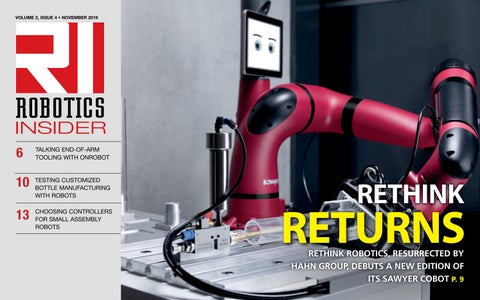
RETHINK
RETURNS RETHINK ROBOTICS, RESURRECTED BY HAHN GROUP, DEBUTS A NEW EDITION OF ITS SAWYER COBOT P. 9
CONTENTS Columns 3 Market watch
Continued robot growth on horizon as trade tensions ease
6 Spotlight
Kristian Hulgard, OnRobot
Presented by Manufacturing AUTOMATION, Robotics Insider reports on the world of industrial robots and its developing opportunities, challenges and technologies. By sharing unique perspectives and information, we strive to help improve your manufacturing efficiency.
FEATURES 9 Rethink returns
Rethink Robotics, resurrected by HAHN Group, debuts a new edition of its Sawyer cobot
10 Getting personal
Editor - Kristina Urquhart kurquhart@annexbusinessmedia.com
A test concept for customized bottle manufacturing uses robot- and gripperassisted filling
Publisher - Klaus Pirker kpirker@annexbusinessmedia.com
12 Achieving accuracy
Vice-President & Executive Publisher Tim Dimopoulos tdimopoulos@annexbusinessmedia.com
9
Media Designer, Team Lead - Graham Jeffrey gjeffrey@annexbusinessmedia.com Account Coordinator - Debbie Smith dsmith@annexbusinessmedia.com
API’s robot calibration software and laser tracking improve automated process performance
13 Controller considerations
Evaluate the controller before investing in a small assembly robot
Circulation Manager - Urszula Grzyb ugrzyb@annexbusinessmedia.com Tel: 416-442-5600 ext. 3537 COO - Scott Jamieson sjamieson@annexbusinessmedia.com
10 2 November 2019 • Robotics Insider
12
111 Gordon Baker Rd, Suite 400, Toronto, ON M2H 3R1 T: 416-442-5600 F: 416-442-2230
MARKET WATCH
By Kristina Urquhart
CONTINUED ROBOT GROWTH ON HORIZON AS TRADE TENSIONS EASE
W
e’re currently witnessing the longest period of economic expansion in American history and, with the trade war between the U.S. and China easing somewhat, North America is so far staving off a recession. While long-term interest rates are low and stocks are at all-time highs, we are seeing some slowing in the global economy, said Douglas Porter, chief economist at the Bank of Montreal, during his economic outlook keynote at the Advantage Through Excellence Conference hosted by the Excellence in Manufacturing Consortium (EMC) in Toronto this past October. Porter predicted 30 per cent odds of an economic downturn by 2020, with the U.S. clocking in at slightly below its annual average of two per cent growth. “We’re most likely to grind ahead with subpar growth,” he said. The manufacturing sector has been the most affected by the U.S.-China trade war, Porter said. Companies have been cooled off on capital 3 November 2019 • Robotics Insider
spending because of the uncertainty surrounding trade tensions. The robotics market in 2019 How that trickles down to the robotics market this year remains to be seen, but a recent report by the Robotic Industries Association (RIA), part of the Association for Advancing Automation, indicates the North American robotics market is up 7.2 per cent in the first half of 2019. From January to June, North American companies ordered a total of 16,488 robots, valued at $869 million. The largest driver of the year-to-date growth was an 83 per cent increase in units ordered by automotive OEMs. Other industries that saw increases include semiconductor and electronics (12 per cent), life sciences (eight per cent), and food and consumer goods (three per cent). In the second quarter alone, North American companies ordered 8,572 robots, valued at $446
MARKET WATCH million. This represents a growth of 19.2 per cent in the number of robots ordered, and a 0.6 per cent boost in dollars compared to the same time period in 2018. “Robot use continues to grow, which is helping make U.S. companies more competitive and leading to new job growth,” says Jeff Burnstein, president of the Association for Advancing Automation. “We are currently experiencing the greatest period of robot expansion in history – over 180,000 robots have been shipped to American companies since 2010, and more than 1.2 million new manufacturing jobs have been created during this time.” Global robot investments Meanwhile, the global robot investment reached a record of US $16.5 billion in 2018, according to the new World Robotics report released by the International Federation of Robotics (IFR). A total of 422,000 units were shipped globally in 2018 – an increase of six per cent compared to the previous year. IFR forecasts shipments in 2019 will recede from the record level in 2018, but expects an average growth of 12 per cent per year from 2020 to 2022. “We saw a dynamic performance in 2018 with a new sales record, even as the main customers for robots – the automotive and electrical-electronics industry – had a difficult year,” says Junji Tsuda, president of IFR. 4 November 2019 • Robotics Insider
“The US-China trade conflict imposes uncertainty to the global economy – customers tend to postpone investments. But it is exciting, that the mark of 400,000 robot installations per year has been passed for the first time. The IFR’s longer-term outlook shows that the ongoing automation trend and continued technical improvements will result in double digit growth – with an estimate of about 584,000 units in 2022.” Asia is the world’s largest industrial robot market. In 2018, there was a mixed picture for the three largest Asian markets: Installations in China and the Republic of Korea declined, while Japan increased considerably. In total, Asia grew by one per cent. Robot installations in the second largest market, Europe, increased by 14 per cent and reached a new peak for the sixth year in a row. In the Americas, the growth rate reached 20 per cent more than the year before, which also marks a new record level for the sixth year in a row. Robot use by industry worldwide According to the IFR’s report, the automotive industry remains the largest adopter of robots globally with a share of almost 30 per cent of the total supply in 2018. After a very strong year in 2017 that saw a 21 per cent increase of installations, this level was maintained and slightly increased by two per cent in 2018. Investments in new car production capacities
and in modernization have driven the demand for robots. Using new materials, developing energyefficient drive systems and high competition in all major car markets pushed for investments. The electrical/electronics industry was about to replace the automotive industry as the most important customer for industrial robots in 2017. However, in 2018, global demand for electronic devices and components substantially decreased. This customer industry is probably the one most affected by the US-China trade crisis as Asian countries are leaders in manufacturing electronic products and components. The cobot market For the first time, the World Robotics report analyzed the market for collaborative industrial robots (cobots). Cobots are designed to perform tasks in the same workspace as human workers. The IFR definition implies that a cobot is necessarily an industrial robot as defined in ISO 8372:2012. The number of units installed is still low, with a share of 3.24 per cent. In 2018, less than 14,000 out of more than 422,000 industrial robots installed were cobots. The year before that, roughly 11,100 units were cobots. From 2017 to 2018, annual installations of cobots increased by 23 per cent. To read more about cobot applications, turn to p. 6 for our Spotlight Q&A with Kristian Hulgard of OnRobot.
GET MORE WITH FANUC’S COBOTS FANUC cobots are easy to use and offer more choices for speed, reach and payload than any other brand.
Discover
our line of collaborative robots and see how much more FANUC offers.
888-FANUC-87 www.fanuccanada.com © 2019 FANUC America Corporation. All Rights Reserved
For additional information or to request an automation audit visit
fanucamerica.com/cobots
SPOTLIGHT
Kristian Hulgard, general manager of the Americas division for OnRobot
W
ith the International Federation of Robotics World Robotics Report recently indicating there’s been 23 per cent growth (see more on p. 4) in the cobot market, OnRobot, the Danish manufacturer of endof-arm-tooling for collaborative applications, is poised for success. Here, Kristian Hulgard, general manager of OnRobot’s Americas division, discusses cobot adoption. Kristian Hulgard
How are you planning to address the new demand in the market? Going from a smaller market now to a bigger market requires us to grow faster than the market is growing. We
6 November 2019 • Robotics Insider
want to be representative of all robot brands in all industries and on all applications. Now we’ve checked one of the boxes, with our One-System Solution, [which] means our tools communicate to all types of robots. So now we need to add even more tools to our portfolio and then get out there on more applications.
Let’s talk more about the One-System Solution, which unifies communication between a robot and OnRobot’s tooling solutions. What challenges does this application solve? Everybody who’s in automation knows that every robot has their own language. Every robot has their own way of being programmed. We’ve created what’s like a plug-and-play system that you attach to the robot – you click on our tool, and no matter what robot you attach it to, you have the same user experience. You have the same interface that connects to the robot. So if you can program your robot, you can program our tools. And what we see now with our partners, our integrators, our distributors, is
they are reducing their integration time on the education, and they’re providing more to the end user. So, the end users get a faster, cheaper and easier solution.
What technology allows the robots to communicate with your tooling, no matter what brand they are? We have what we call the Compute Box, which is our own translator. The metaphor is that our Compute Box is like Google Translate – so no matter what language we send to the Compute Box, it will translate that into something that our tools can understand and vice versa. It just simply makes the tools and the robots speak in the same language.
What is the market landscape like for OnRobot in Canada, and to a larger extent, North America? In Canada and America in general, we’ve predominantly been representing the metal and machining industry. Now going forward in the past year, we’ve seen a high growth in our products going to packaging and assembly and pick-and-place
SPOTLIGHT tasks. [Our products] are not only for machine tending, which has been the “normal” collaborative robot application. Our products have been have been introduced in the past year on a wide variety of applications in a lot of different industries. And that’s the trend we would like to see and that we’re going after. The sky is the limit right now and the market opportunities, especially in Canada, are everything from food and beverage to electronics to packaging to processing.
Has the global manufacturing downturn affected OnRobot’s growth? We’ve only seen growth this year and last year as well. We tend to try to not only take a piece of the pie that’s already there, but hopefully also add something new to that pie, if that makes sense – like opening up new possibilities for automation, making it easier and making it more affordable for the end user to be able to automate processes they weren’t able to automate before. Even though the big numbers of 7 November 2019 • Robotics Insider
the industry have gone down, we have seen clear growth this year, and with our ambition, our goals and the strategy that we’ve set, then we will also see massive growth next year. That’s 100 per cent sure. We try to expand the market, instead of just addressing the already existing market.
What are some of the challenges you have in your role right now in terms of getting the word out about cobot implementation? We want to educate a very large market and that in itself is a challenge. You need to reach a lot of people in a short time and be the most effective as possible. We’re changing the focus a little bit from the products that go to the customer to the overall solution. The normal process would be: now we buy a robot, now we buy a gripper, now we buy a stand. But now it’s about changing the mindset of the customers or the end users to talk about solutions, to talk about applications. Everything has to work together. Everything has
to be easy. Because if you lose your collaborativeness for one product or one part of the application, then you kind of lose the whole value. When you get an iPad, you don’t read the manual, you just pick it up and use it. And we see that collaborative automation is going that way. The customer wants everything to be easy. So they pick up a collaborative robot, they know how to program it, it’s easy – but if the gripper or the tool is complicated, the value disappears. Every single part needs to be collaborative. That’s where we see the market going.
Are there any trends in end-of-arm tooling that you foresee over the next three to five years? More and more tools are moving away from pneumatic and into electronic. You want your tools to be controlled by software; you want intelligent tooling, meaning you want feedback from your tool. If it’s a gripper, you want to know, what am I gripping, am I gripping it right, what is the size of the object I’m gripping? You want all this information, and
you can only get that from electric tools. So more and more end users – the integrators and distributors, they’re moving away from the traditional pneumatic gripping solutions and tools and now into electric, software-controlled tools. That’s clear trend in the market now.
OnRobot has said it’s going to be upping its portfolio from 10 products to 50 by the end of next year. Can you elaborate more on what’s next? I can’t speak about specifics, but if you can make up the application you want to use a lightweight industrial robot or a cobot for, then we will produce a tool to go on that robot or around the robot to help that application. Whatever type of application you can think of out there, we will have a product to support that application. It’s an ambitious goal to say 50 products by the end of next year, but I’ve seen the roadmap myself and I can say that I’m very confident that we will have somewhere between 40 and 50 products in a year from now.
FHA-C Mini Actuator with Integrated Servo Drive Harmonic Drive LLC 247 Lynnfield Street Peabody, MA 01960 800.921.3332 www.HarmonicDrive.net
The Servo Drive is in the Actuator!
The FHA-C Mini Series is a family of extremely compact actuators that deliver high torque with exceptional accuracy and repeatability. As part of the FHA-C Mini family, an integrated servo drive version utilizing CANopen® communication is now available. This evolutionary product eliminates the need for an external drive and greatly improves wiring while retaining high-positional accuracy and torsional stiffness in a compact housing. • Actuator + Integrated Servo Drive utilizing CANopen communication • 24VDC Nominal +7-28VDC Supply Voltage Range • Single Cable, only 4 wires needed: CANH, CANL,+24VDC, 0VDC • Zero Backlash • Dual Absolute Encoders
• Panel Mount Connectors with 4 exit options • Output Sensing Encoder 14bit (16384 cpr) resolution • Input Sensing Encoder 15bit (32768 cpr) resolution • Control Modes Including Torque, Velocity, and Position Control, CSP, CSV, CST • Harmonic Drive HDL Software
Electromate 6221 Highway 7, Unit #15 Vaughan, Ontario, Canada L4H 0K8 (877) SERVO98 (737-8698) www.electromate.com Harmonic Drive®, Harmonic Planetary® and Quick Connect® are registered trademarks of Harmonic Drive LLC. Electromate is the exclusive Canadian distributor of Harmonic Drive® products (except the Province of Alberta).
Partners in Precision
COVER STORY
RETHINK RETURNS Rethink Robotics, resurrected by HAHN Group, debuts a new edition of its Sawyer collaborative robot By Kristina Urquhart
O
ne year after its initial shuttering and subsequent takeover of assets by HAHN Group, Rethink Robotics presents a new update to its collaborative robot (cobot). The Sawyer BLACK edition is now quieter, with more reliable components and higher quality than initial versions of Sawyer, which had previously struggled in the industrial market. According to The Robot Report, the first version of the robot used series elastic actuators that presented problems with accuracy, and this latest version is expected to fix the problem. The HAHN Group first debuted the new cobot in October 2019 at K 2019, a trade fair for plastics and rubber, as part of a palletizing application for the packaging of boxes and plastics parts. Tasks that are dangerous for humans are, among others, possible applications for the new Sawyer BLACK. Some of these include CNC
9 November 2019 • Robotics Insider
machine assembly, circuit board assembly, metal processing, injection moulding, packaging, loading and unloading, as well as tests and inspections. The cobot solution is ready for use immediately after delivery and is equipped with the powerful Intera software that delivers userfriendly programming and data insights, along with two camera systems. The Sawyer BLACK edition can be pre-ordered now; first deliveries will take place later this year. The HAHN Group announced it would continue work on the Sawyer cobot at the Automate 2019 fair. “Sawyer stands for simplicity, and speed of programming. Within the new setup of the company, Rethink Robotics GmbH plans to improve the reliability,” said Philipp Unterhalt, managing director of the HAHN Group and interim CEO of Rethink Robotics at the time. Unterhalt has since returned full-time to his role at HAHN Group, with Daniel Bunse replacing him as CEO of Rethink Robotics. Going forward, Rethink Robotics GmbH plans to expand Sawyer into an entire robot family, including models with a higher load capacity as well as simpler models with less equipment. Service robots will complete the portfolio in the future.
INNOVATION
GETTING PERSONAL A test concept for customized bottle manufacturing uses robot- and gripper-assisted filling By Robotics Insider Staff
T
he trend toward customization and personalization of mass products is showing no signs of slowing down. In addition to the automotive and pharmaceutical industries, this trend is gaining traction in food production. One of the primary challenges of this development with respect to personalized production currently lies in the fact that the consumer world is so closely connected to the world of production. At this point in time, general production has yet to be designed so that it can ensure the requested flexibility in volume and
10 November 2019 • Robotics Insider
format in a way that is economical and sustainable. There are already some personalized foods (e.g. Coca-Cola’s name-branded cans, etc.) on the market. However, primarily in the beverage industry, the production and process control structures that companies have been using are rapidly exhausting their potential. A flexible new concept for beverage filling Wide-ranging possibilities are emerging as part of Industry 4.0 for producing individualized mass products in the future that are both highly customizable while remaining
profitable. This problem brought together academia and industry in a new robotic test concept. Professors in brewing and beverage technology and food packaging technology from the Technical University of Munich partnered with German production research firm Fraunhofer IGCV and industry partners Krones, Beckhoff Automation, ProLeiT, Siemens, Dekron, Yaskawa Europe, Weihenstephan brewery and Infoteam Software. All parties worked alongside each other to come up with an innovative automation concept for individualization.
RoboFill 4.0, as the project has been dubbed, is a concept for filling and beverage technology that makes it easy to add more production modules. The purpose of this concept is the industrial supply of customized beverage bottles or packages. The focus is on having lot sizes in small batches down to even single units. According to project specifications, all plant components were to be configured as cyber-physical system components. This is a core principle of Industry 4.0. The idea is that the components use network and cloud technologies to communicate continuously with each other and
INNOVATION
When the gripper specialists from Germany-based Zimmer Group were asked to take part in the project, they faced some challenges. Developing the right gripper for handling various glass bottles and with robots turned out to be highly complex and costly. with higher-level systems. This makes it possible to achieve autonomous production control, while also laying the foundation for using numerous optimization processes in production technology (e.g. predictive maintenance). Servo grippers for bottle handling When the gripper specialists from Germany-based Zimmer Group were asked to take part in the project, they faced some challenges. Developing the right gripper for handling various glass bottles and with robots turned out to be highly complex and costly. Putting everything into practice meant that concepts from different areas were interconnected and all had to be taken into account, including force-controlled gripping, sealed components, using exclusively food-safe materials and 11 November 2019 • Robotics Insider
lubricants (NSF-H1) and ensuring the grippers communicated with the robot control system. Furthermore, it had to be ensured that the gripper handling the glasses would not break any, especially in the case of an emergency stop or power outage. The Zimmer Group development team also had to develop special gripper fingers, which were intended to handle any potential type of bottle from 0.33L up to 0.75L by gripping the neck and body of the bottle. There was only one electrical gripper from Zimmer Group’s latest generation of products, the GEH6000 series with servo drive, that was suitable for this application. The problem was that this gripper was only available as a prototype at the time and it had not been designed for
many of the requirements previously mentioned. It is very complex to seal such a compactly designed electrical long-stroke gripper in such a way that it can be cleaned with a spray of soapy water, or to make sure that a bottle bursting will not lead to a system failure due to a short circuit. Several development loops had to be carried out. In these loops, we took the knowledge gained in elaborate tests and applied it to the component geometry and the process for coating the components, as well as to the materials used for the various installed seals and wipers. Developing a gripper-controller interface This solution eliminates communication problems with the robot control system. Unlike the conventional solutions, this solution does not feature a second control system operating in parallel for the grippers operating with IO-Link. Instead, an in-house gripper-controller interface (HMI) was developed and integrated into the robot control system. “By implementing the Zimmer
HMI into the robot control system, many industrial robots now feature the option to control as many as four electrically or pneumatically driven Zimmer grippers,” says Erik Bauhaus, project coordinator and developer M-TB at Zimmer Group. To keep development time and costs for the gripper fingers as low as possible, they were designed in advance using FE analyses and then additively manufactured in a 3D printing process. A similar approach was taken in developing the bottle carrier for the Beckhoff XTS system. Employees drew upon their extensive experience with using food-grade lubricants. The in-house prototype creation and the option to start carrying out complex tests as early as the R&D stages were both significant factors in ensuring this project succeeded. By the end of the project, the test system was being commissioned at Germany’s Weihenstephan brewery and is being tested extensively over the next few years for marketreadiness and suitability for everyday use.
APPLICATION
ACHIEVING ACCURACY API’s robot calibration software and laser tracking improve automated process performance By Robotics Insider Staff
C
ole Technologies, located in Columbus, Indiana, is a certified Universal Robots system integrator supplying automation systems specializing in pick and place, deburring and plastic part-trimming applications. One recent project involved the de-flashing of moulded parts where a more accurate robot path was deemed necessary. The company contracted API Services to perform on-site robot calibration using the API RADIAN 12 November 2019 • Robotics Insider
6DoF (six degrees of freedom) laser tracker, in conjunction with its proprietary robot measuring software (RMS), to improve programmed robot motion path accuracy. The RMS system uses a multiple SMR tracker target frame directly mounted onto the robot endeffector, allowing for dynamic robot tracking. Recorded measurements are used to determine tracked robot position points revealing true robot position and orientation. RMS procedures use ISO 9283 guidelines to check accuracy, repeatability, pose, distance, drift and overshoot by exercising all robot joints. The robot’s working envelope can be defined applicable to the planned robot application function.
“The availability of additional robot accuracy allows us to provide a better outcome for the customer regardless of application,” says Steve Richard, director of engineering at Cole Technologies. “API [was] able to directly interface with our RoboDK robot programming software for robot calibration, making it seamless and efficient to load the new parameters.” Measuring a free-point cloud
consisting of 80 points, the RMS software generated a new DH (Denavit-Hartenberg) frame model parameter set that was used to correct errors in joint angles and link lengths. The revised DH parameter can be directly input into the robot controller or used to update the robot motion path program, as was the case at Cole Technologies, which resulted in significant improvements to the robot’s accuracy.
TECHNOLOGY
CONTROLLER CONSIDERATIONS When selecting a small assembly robot for your manufacturing application, evaluate the controller’s key features By DENSO Robotics
S
mall assembly robots are continuing to achieve ever-higher levels of implementation in all manufacturing sectors. In order to function, a robot requires a controller that (1) contains the programs that tell the robot what to do, (2) serves as a coordinating link between the robot and other devices in the automation cell and (3) captures operational and error data and communicates it to the outside world – which increasingly today means the Industrial Internet of Things, or IIoT. Robot controllers are usually designed to work with a specific robot or line of robots, and in most cases cannot be used with robots from a different vendor. As a result, controllers are not offered separately, but as part of the complete robot package, and are consequently not always given as thorough an evaluation as the robot itself. Since controllers play such a vital role in robot operation, however, knowing how to evaluate their key features can lead to making a wiser buying decision. 13 November 2019 • Robotics Insider
What is a small assembly robot? Small assembly robots are a class of industrial robot arms consisting of fouraxis (also referred to as SCARA) and six-axis articulated robots. Despite their name, small assembly robots can carry out a much greater variety of tasks than just assembly. These include all the various functions involved in manufacturing packaging and other industrial applications, including, among others, assembly, dispensing, inspection, machining, parts finishing, pick-and-place, polishing and spot-welding.
TECHNOLOGY Essential considerations When choosing your small assembly robot, consider these features: Form factor: Small robots, which have been around since the 1960s, originally had controllers the size of a refrigerator. Today’s trend is toward much smaller controllers, some of which are only about the size of a desktop computer. These take up less valuable floor space, and are easier to integrate and redeploy in new applications. They are also easier ship for repair if necessary. Some manufacturers who are not specialists in small robots, however, use the same large controller design for their small robots as for their large ones, resulting in significantly less ease of use, but no gain in function. Number of axes and auxiliary functions controlled: Most manufacturers offer only one specific controller for each of their robot models. Some, however, offer a choice of controllers for a given model, usually as a way of presenting lowercost options. When this is the case, the onus is on the buyer to ensure that the controller is capable of running extended axes and auxiliary functions such as conveyor tracking and network IOs. Processing speed: Some controllers have a user-upgradable CPU, to accommodate code-intensive applications involving high-speed vision checking, higher math operations, multiple robot tasks, multiple cooperative robots, an entire cell being controlled by a single controller, etc. Ease and cost of integration: Some controllers come with all of their functions built in and allow the user to activate them, saving the time and expense of a service call. Additional built-in capabilities can also make it easier to integrate commonly used peripherals such as a vision system, extended axes, a conveyor or a vibratory table. Other controllers have software and firmware licenses, with additional post-sale charges required to activate even basic features such as palletizing, 14 November 2019 • Robotics Insider
avoidance and collision detection. Further charges and a service call may also be required to extend the I/O configuration, or obtain updates and license renewals. Ease and cost of programming: Traditionally designed controllers require the user to learn a specialized programming language, plus additional languages for each piece of peripheral equipment. Today’s newer-style, PC-based controllers are more flexible, and can take advantage of ORiN (Open Robot/Resource Interface Network), a standard created by the Japan Robot Association. ORiN allows users to program the robot in a single, common language such as C++, C#, Java, Visual Basic or VBScript, greatly speeding up and reducing the cost of development and integration. The same language can also be used to program peripheral devices, eliminating the need to use different, proprietary programming software for each one. In addition, many manufacturers offer offline programming software packages, often with 3D simulation modules, that can further reduce development time and costs. Some of these packages come with expensive but often-unnecessary advanced features, however, offsetting the cost-saving advantages. Versatility: Some controllers can be used with any robot in a manufacturer’s lineup. This allows stocking of only a single spare controller instead of a separate one for each type of robot, saving considerable time and money and reducing the length of possible downtime. Connectivity: Most controllers are available with a wide variety of network I/O options, but some have only a limited choice, so the user needs to verify in advance which are available. In addition, some controllers come with built-in functionality that allows easy connection with a PLC or PAC, enabling single-platform control of the
TECHNOLOGY robot and peripherals without having to learn a different programming language for each device. Thus, being able to collect all device data in a master control centre where it is easily accessible is a distinct advantage when connecting with the Industrial Internet of Things. Expandability: Some manufacturers offer inexpensive, user-upgradable DAQ (data-acquisition) expansion boards while others may require a service call to install and enable them. Teach pendant: Teach pendants do not typically come with a controller, but must be purchased separately. They are usually considered to be a necessary time-saving tool for programming the robot. Some manufacturers require the purchase of a teach pendant for every robot. Some do not have such a requirement, so a single pendant can be used for any number of robots of the same type. DENSO Robotics is part of DENSO Corporation, a robotics designer and automotive parts manufacturer. 15 November 2019 • Robotics Insider
What to look for when choosing a robot controller 1. Experience and specialized expertise of the manufacturer: Look for a manufacturer that has established itself as an industry leader and whose robots have stood the test of time. Small, high-speed, high-inertia robots and their controllers have their own design challenges. A manufacturer that specializes in such robots is likely to have expertise that others do not. 2. Type of manufacturer: Robot manufacturers fall into two basic categories: (1) those whose primary business is selling robots and (2) those whose primary business is producing and selling other products, which they manufacture with robots they design and build themselves. Manufacturers in the second category depend on their robots to keep their products competitive in the marketplace. As a result, they are likely to design robots and controllers that have the highest productivity levels, longest working lifetimes and lowest maintenance requirements – and therefore the lowest cost of ownership. 3. Compact design: A lightweight controller with a small footprint makes integration easier and saves valuable factory floor space. 4. Stackability: Controllers with a front-to-back airflow design allow multiple units to be stacked on top of each other without danger of malfunctioning or shutting down due to overheating, which can otherwise be the case with a bottom-to-top airflow. 5. Processing speed: An upgradeable CPU means that the controller can be redeployed in future applications that
may require more processing speed. It also saves costs by not having to purchase excess processing speed that may never be needed. 6. Modular expandability: A controller that can accommodate additional peripheral equipment without having to purchase a new unit when needs change can result in substantial long-term cost savings. 7. Ease of integration with a vision system, PLC or other devices: Look for a controller that is easy to integrate with peripheral devices. Some controllers have built-in vision systems, but these tend to be limited and might not meet the requirements of your application. 8. Affordable offline programming software: In general, most applications are not difficult to program. Be sure the offline programming software being offered does not include expensive, advanced features that are unnecessary for what you need. 9. External connectivity: To take advantage of the many benefits of the Industrial Internet of Things, be sure to verify whatever additional hardware is required for the controller to send and receive properly formatted data. 10. Automatic backup: An automatic backup system can prevent the loss of valuable data. Not all controllers have one though, so it pays to ask. 11. Safety standards: Virtually all controllers today meet RIA and ANSI safety standards, but not all are available with UL certification, so if this is a requirement, it should be verified at the beginning of the buying process.
DON’T MISS OUT ON YOUR NEXT ISSUE OF IT’S FAST, IT’S EASY AND IT’S FREE! SOFTWARE: Why small business environments cannot follow the enterprise approach. p.24
CYBERSECURITY: Keeping ADVANCED WARNINGS: your plant floor secure in the Industrial Internet of How the connected industry can help you predict and prevent failures. p.20
TECHNOLOGY: Cloud and Fog computing will advance SCADA systems. p.22
INDUSTRY WATCH: Making sense of Big Data, IIoT and Industry 4.0. p.10
BACKSTORY: Boost your business by expanding into international markets. p.30
Things era. p.12
Your resource for Canada’s industrial automation news
AutomationMag.com
50 years of
Glad
PM 40065710
PM 40065710
Ontario plant celebrates milestone anniversary p.18
NOVEMBER/DECEMBER 2017
MARCH/APRIL 2017
DOMESTIC INVESTMENT Ontario manufacturer purchases a new vertical machining centre, slashing lead time and internal costs. p.16
MAY17 AC Branding Front Cover Banner (MA).qxp_Layout 1 4/20/17 3:32 PM Page 1
Automation, electromechanical, cabling, and interconnect products from 300+ manufacturers.
thinkallied.com thinkallied.com MA_AlliedBanner_May.indd 1
MA_mar_Apr_ 2017.indd 1 MA_AlliedCover_JanFeb .indd 1
2017-04-21 11:48 AM
2017-03-01 9:51 AM 2016-12-21 9:16 AM
HERE’S HOW: For fastest service visit AutomationMag.com AND CLICK THE SUBSCRIPTION BUTTON
AutomationMag.com