Digital supplement to
Technology Handbook
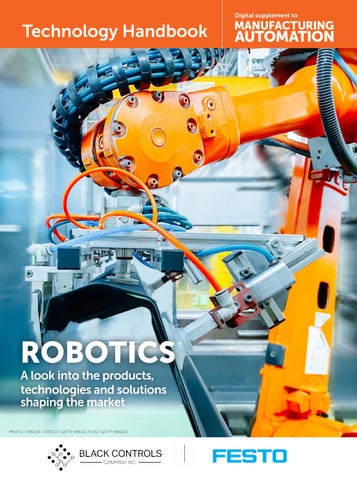
ROBOTICS A look into the products, technologies and solutions shaping the market
PHOTO: TONGTA / ISTOCK / GETTY IMAGES PLUS / GETTY IMAGES
Technology Handbook | ROBOTICS
Black Controls Company Inc. To Attend Hannover Messe in April
B
arrie, ON - Black Controls Company Inc. will be exhibiting this year at the upcoming Hannover Messe industrial technology trade show in Hanover, Germany. This event is to be held from April 22- 26th, 2024, and will feature over 130,000 attendees and 4,000 exhibitors from across the globe. As the world’s leading industrial trade fair, companies from a variety of interconnected industries will come together to present solutions, products, and innovations for sustainable industrial transformation. As a part of the NGen (Next Generation Manufacturing Canada) pavilion, Black Controls will be available to share their industrial controls and automation solutions alongside other leaders excelling in Canadian manufacturing. The company’s founder and owner Rick Black shares his thoughts about the company’s inaugural exhibit at Hannover Messe, “I am looking forward to attending Hannover Messe with my team this year. As we continue to expand, connecting with global industry leaders will allow us to promote our capabilities and increase our depth of knowledge. Our goal is to bring our local energy to the world stage and continue to expand our company’s connections so we can better serve our current and future clients.”. With customers supported in over 15 countries, the Ontario-based company looks forward to continuing to grow their global presence and connections within the global manufacturing community. To learn more about this event, visit: https://www.hannovermesse.de/en/
About Black Controls Company Inc. Black Controls is a locally owned and operated automation integrator located in Barrie, Ontario, Canada. Since 2019, they have been dedicated to offering clients superior automation solutions to
meet their unique requirements. Black Controls operates from a 13,000-squarefoot facility with dedicated operations, engineering, manufacturing, assembly, and development departments. Backed by a dedicated and talented team, customers can expect tailored automated systems designed to fit highly specific needs. Black Controls specializes in automated systems for materials handling, assembly, quality inspection, and functional testing. The technologies that Black Controls deploys in their systems include autonomous mobile robots (AMRs), industrial robotics, vision and barcode reading systems, PLC, SCADA, servos, variable frequency drives, and custom software solutions. Black Controls is a full-scale systems integrator and has a proven success in the processes of: • Initial concept and execution of proof-of-concept • System engineering and simulation • Software design and programming • Manufacturing of custom components and material procurement
2 MANUFACTURING AUTOMATION · Technology Handbook Robotics 2024
• Control panel assembly and wiring, equipment assembly and wiring • System development • Installation and commissioning at the customer’s location Additionally, Black Controls offers service and support for current and legacy systems that their customers are currently operating - as well as upgrades to existing systems such as completing retrofits for new product requirements or quality control inspections. With clients spanning across multiple industries, including Automotive, General Industry, and Contract Sterilization, Black Controls has extensive industry knowledge that they can apply to your unique application.
To learn more, visit www.blackcontrols.com - and visit their booth within the NGen Pavillion at Hannover Messe, Hall 7 Stand D28, from April 22 to 26th, 2024. #HM24
Industrial Controls Design, Manufacturer, and Integration Specialists
Find Out How Our Talented Team Can Help Support Your Automation Needs
BLACKCONTROLS.COM +1 (705) 252-1100 info@blackcontrols.com
Technology Handbook | ROBOTICS
With Cartesian robots, Festo extends a helping hand
Figure 1: A hybrid gantry comprised of an electrical horizontal and pneumatic vertical axis for a box-pushing application in the packaging industry, moving an 11 kg max payload exposed to 180 N lateral force resulting in a large moment load.
B
e it electric, pneumatic or hybrid, a Cartesian robot is often a better choice than an articulated or delta robot. Cartesian technology is incredibly scale-able and flexible. In many applications, they are the most spaceand cost-efficient option. The ability to move smaller payloads at long distances can make them superior to conventional robots where payload and reach are proportional. With gantries, one pays only for the axes needed. With a 6-axis robot, one might overpay, spending for axes one does not use. Today, Festo has more stock gantry models and standard handling system configurations than ever, ready to install and easy to commission, from tiny to gigantic – for payloads of a few grams to hundreds of kilograms. Furthermore, one can design a custom 2D or 3D gantry or cantilever system in 20 minutes, give or take, using Festo’s Handling Guide Online. One of the noteworthy developments in Cartesian robotics has been the improved capabilities and affordability of electric Cartesian gantries, with further advances in servo and gripper technology and controls.
Figure 2: An all-electric gantry, for positioning an x-ray camera in an inspection station. Comprised of a horizontal and vertical axis with a 50 kg payload and only 24v DC power available.
Figure 3: An all-pneumatic gantry, 3 axes plus gripper, for a 0.2 kg payload as part of syringe assembly in the life tech sector.
That has prompted some engineers – even at plants with a compressed air supply – to think, a priori, of all-electric solutions even in applications where there still might be a good use case for pneumatics. Festo has extensive portfolios of both electric and pneumatic solutions, so has no bias for either. “In general, anything under a 200mm stroke, where you don’t have to access multiple locations – if you are just going left-right, one hard stop to another – that’s a case for pure pneumatics,” says William Debono, Senior Project Lead with Festo’s Customer Solutions (CS) Department. “Anything much over the 200mm mark, for multiple locations, then you move into an electric solution or the blended area where your Z axis might be pneumatic, your horizontal axis electric. In end-of-arm tooling, pneumatic still predominates with grippers.” There have been many advances in electric grippers, “but still there are limitations in payload, reduced cycle time, less force.” If a stock or online-designed Cartesian robot isn’t adequate, when even more engineering support and custom-
ization is required, machine builders can partner with Customer Solutions to generate or optimize a design or even a recently installed gantry. Customer Solutions can review the suitability of a design, validate the technical assumptions behind it, troubleshoot a problem, suggest changes, procure special accessories, even build and test a complete gantry, be it all-electric, all-pneumatic or hybrid. Customer Solutions can help address challenges like space or power limitations or the need for an aggressive cycle time or pick rate. The range of what these collaborations can achieve is demonstrated in Figures 1, 2 and 3. Partnering with Festo Customer Solutions extends an OEM’s engineering capacity on a project basis so it can embrace ambitious or complex challenges while managing its costs with confidence.
4 MANUFACTURING AUTOMATION · Technology Handbook Robotics 2024
For more on Festo Customer Solutions, click here. For more on Festo Cartesian solutions, click here
Innovate today for a new tomorrow Realize your vision with Festo’s approach to smart automation. Partner with Festo today.
Industry Leadership Superior Quality Products Global Training & Support
www.festo.com
ROBOTICS
Integrating robots on existing manufacturing processes often requires changes to the production line and workflow.
BEHIND THE SCENES: ROBOT INTEGRATION
C
urrent robotics technologies have advanced to the point where a wide range of solutions are available for the unique needs of all types and sizes of manufacturers. However, integrating robots into existing production lines is not without its challenges. Barrie, Ontario-based automation solutions provider Black Controls has expanded its capabilities to offer robotic integration in response to the growing market demand in this space. Matthew Heisz, programming team leader at the
company, shares that currently, general part manufacturers most commonly demand robotic material handling or assembly solutions. For example, it could be a robot with a screwdriver, installing screws; picking and placing components and installing them into a larger component. The company also sees a demand for welding applications.
Improving existing systems The Black Controls team recently worked on a robotics project for a customer in Scarborough, Ont.
6 MANUFACTURING AUTOMATION · Technology Handbook Robotics 2024
Heisz shares that the customer had a robotic cell connected to an injection molding machine. The system was already implemented but they were encountering issues with product quality. As per the production process, the part was coming out of the molding machine and then a clip was installed in it. With the existing system, there was an issue with the clip installation. So, the manufacturer requested the Black Controls team to add camera inspection to validate the products. They also asked if it would be possible to make
PHOTO: BLACK CONTROLS
Navigating robot implementation challenges for optimum results. BY SUKANYA RAY GHOSH
cycle-time improvements and process improvements as the equipment was not the most efficient. The team immediately jumped into action. “We went down to their facility along with another supplier and did a feasibility study for the actual inspection. We provided the quote to them. Once we received the job, we did a site visit and made sure that we had the latest programs of it,” says Heisz. The Black Controls team added the camera and the logic to make it work. They added the routines and extra points to the robot, programming it to stop at the camera inspection position. While the solution was a simple one, there were some challenges to be addressed during the integration process itself. There were issues with variations in the parts that were being produced. Potential delay between the parts coming out of the mold machine and being presented to the camera would result in inspection variations that had to be correctly analyzed. Heisz notes that another challenge was that they weren’t working with machines that they had programmed. “You always struggle with learning other equipment’s program to figure out how best to incorporate your new logic into it,” he says. He adds, “In the original program the robot profiles weren’t necessarily smooth. There were some opportunities with some handshaking where you had both robots sitting stagnant for longer than necessary or idle when they shouldn’t be. So, we took our time reviewing it, understanding the application, and then implementing the solution.” The Black Controls team made the machine vision camera implementation a useful process so that the customer would not only see how many times a part failed but also understand which part was in front of the camera when it failed, giving them the means to track and display that information. After the implementation, not only was the issue with the clip installation resolved, but the customer was also able to be confident that the parts they
were producing were good. The was also significant cycle time improvement for one of the part variants. “We were basically able to take it down to the point where the robots are always ready right as the molding process is finished. Previously, a mold would be sitting open for eight to 10 seconds with no action while the robots were still processing the previous parts,” says Heisz.
An AMR material handling project A different type of robotics integration project that Black Controls recently worked on is installing automated mobile robots (AMRs) in a facility in Newmarket, Ont. The ask of the project was to use AMRs to move products to and from the manufacturing facility’s warehouse and production lines. Heisz notes that AMRs were new technology for the Black Controls team. So, the initial step was to understand how they work. The technology was new territory for the customer too. Both teams had to work together through the implementation process to adapt the systems and make them as simple as possible to meet the customer’s requirements. Since the AMRS were being used as part of a fleet, the Black Controls team ensured that proper communicating commands to the fleet were in place to call and get the status of the robots. The robots then required programming to accomplish their tasks and interact with the PLC for the system. Heisz says that while the AMR implementation process was quite straightforward and simple, there were different layers to it that needed to be taken care of. “We had to connect multiple lines to our PLC, and coordinate pickups and drop offs between the warehouse and the station. There was a significant layer of communication logic that had to be worked through and implemented. All the communications to the fleet were done using an API structure. We added another piece of software that sat in between to communicate between our PLC and the fleet specifically for this. There was a lot involved in just establishing
basic controls before we could develop the process and the application,” explains Heisz. The manufacturer undertook the AMR project to replace human material handlers who were responsible for bringing the bins from the warehouse to the line. After adding AMRs, the employees could be deployed to do other tasks. In addition, the facility was able to increase throughput per shift. Where the employees were able to move 80 bins per shift, the AMRs managed to move 90 in a shift. Heisz adds that there was a significant learning curve for the facility’s line workers. While the hand-off with their colleagues was a smooth process, they had to learn how to call the robots and move the bins as needed. They had to learn how the AMRs interacted with the system. The warehouse operators were also trained on how to read the information on the screen and work with the AMR fleet. Heisz shares that Black Controls did not provide the robots. “The customer had done a concept trial with an AMR distributor. We came on as the integrator. So, there was a concept in place, with details and expectations on how the AMRs were to function. The implementation process was a team effort where we all worked to figure out which ideas would work and how we should approach things. The distributor was able to support the process as necessary,” he says. The Black Controls team trained the customer’s line operators, team leads and maintenance staff to ensure that the AMR fleet would run smoothly. “We showed them how to fix the robots and recover them should they get stuck or are not able to manoeuvre. We trained them on how to address communication failures as well,” adds Heisz. He adds that with any robotics project, there are always challenges like time associated with setting up robots. The integrator must figure out the communication and control structure. The key, he says, is to work with the customer to understand what they need and ensure that the project is a feasible one. | MA
Technology Handbook Robotics 2024 · MANUFACTURING AUTOMATION 7
TECH TALK
Kristian Hulgard is general manager of the Americas division at OnRobot. He has been part of the collaborative robot market since its emergence and is a thought leader in cobot applications and activation of robots in the collaborative space.
BY KRISTIAN HULGARD
It’s the end of robot programming! The ‘no-programming’ approach democratizes collaborative automation and simplifies robot integration.
The ‘no-programming’ method simplifies the process of deploying collaborative automation on CNC machines by eliminating hours of repetitive, manual programming tasks. CREDIT: ONROBOT
I
ndustrial robot programming has evolved massively since the days of punch tape and paper-based flowcharts. Teach pendants existed back in the 70s, but they were clunky affairs, intimidating to non-experts, and not exactly user-friendly. The 1980s brought usability improvements as pendant makers incorporated digital displays and more intuitive interfaces. At the same time, the rise of computer-based programming led to the emergence of all
sorts of robot programming software, more user-friendly interfaces, offline programming, and CAD integration. Expert engineers were still required for the vast majority of industrial robot programming tasks, however. And yet, despite incremental improvements in usability accumulating over time, robot programming methods stayed more or less the same until the emergence of collaborative robots (cobots) and lightweight industrial robot arms in the 2000s.
8 MANUFACTURING AUTOMATION · Technology Handbook Robotics 2024
FULFILLING THE PROMISE OF COLLABORATIVE AUTOMATION
Collaborative automation is the fastestgrowing segment of the industrial robot market. Cobot-based systems are attractive to companies of all sizes thanks to their affordability, fast ROI, small footprint, and ability to switch between different products and applications. Designed to break down barriers to automation adoption, particularly among small to medium size businesses (SMEs), these lightweight, collaborative industrial
Automated deployment platforms remove the need for manual work for integrators by automating program logic, signals exchange, event handling and robot motion planning. CREDIT: ONROBOT
robots enable easy hand-guiding and ship with intuitive teaching pendants. Recently, so-called ‘low- and no-code programming’ approaches have come to market. These systems use visual modelling and drag-and-drop user interfaces. Low-/no-code programming is an advancement, but unless the application is very simple, some programming knowledge is still required to ensure a safe and successful deployment. DO YOU HAVE ‘NOPROGRAMMING’ EXPERIENCE?
Today, another leap in usability has been achieved – the elimination of programming altogether. And not only do I feel fine about that, I think it’s a massively positive development; a fulfilment of the democratizing premise of collaborative automation, which promises to deliver robots that can be deployed easily, regardless of the end user’s previous robotics experience, or lack thereof. The elimination of robot programming liberates both end-users and robotics integrators, slashes deployment times, and improves return on investment (ROI). Combined with the growing trend towards open, plug-and-play hardware, these new, ‘programming-free’
The elimination of robot programming liberates both end-users and robotics integrators, slashes deployment times, and improves return on investment (ROI). approaches also help to address the labour and skills shortages being experienced by both manufacturing companies and robotics integrators. This enables both manufacturers and robot integrators to boost their business despite labour shortages, thereby supporting automation adoption globally. TIME-CONSUMING TRADITIONS
Deploying traditional industrial robots is a costly and time-consuming process that requires robotics engineers with in-depth knowledge of numerous robot systems and programming languages. This complexity has pushed traditional industrial automation beyond the budgets and competencies of SMEs. Collaborative automation, to varying degrees, breaks down this complexity, via a range of usability features that enable people with little or no previous robotics experience to deploy automation quickly, safely and effectively.
For example, many cobot brands provide hand-guiding features designed to speed up the deployment process. Instead of wasting time in pendant-based programming, cobot users can program the system by guiding the robot and end-effector into position by hand and setting various points along the way. While collaborative automation has proven fast and easy to deploy for straightforward processes, many end users have found that their ideal application is actually more sophisticated than they assumed. Moreover, reprogramming and redeployment for new products or to add productivity improvements has proven challenging for many SMEs, requiring the expertise of an integrator. For SMEs with high-mix, low-volume production requirements, the complexity remains sufficiently high to put them off a robotics investment altogether. DECADES IN THE MAKING
User-friendly interfaces and programming techniques reduce deployment lead times and costs, benefitting endusers and integrators alike. But the culmination of all of these trends and advancements in usability is fully automated deployment and programming.
Technology Handbook Robotics 2024 · MANUFACTURING AUTOMATION 9
TECH TALK BY KRISTIAN HULGARD
This decades-old industry goal has been achieved. Programming-free deployments liberate integrators from a wide range of tedious manual programming processes, making collaborative industrial automation deployments faster and easier than ever before. This new technology automates the process of building, running, monitoring, and redeploying collaborative automation. The result is complete applications that can be deployed and redeployed directly on the manufacturing floor in a few simple steps, with zero programming required. The time savings are impossible to ignore. For example, deployment of a collaborative palletizing application using traditional methods will typically take an integrator around 40 hours to complete. Using the new, programming-free approach, the entire deployment takes around four hours – a massive 90 percent time savings. Or consider a collaborative CNC machine tending application that typically takes 36 hours to set up, program, test and deploy using traditional deployment approaches. Robotic machine tending deployment requires expertise at each step. This begins with choosing the robot and its mounting to fit into existing shop floor layouts and to work with defined infeed and outfeed setups. Next, single or dual grippers must be sourced, and these must meet workpiece size,
weight, and type requirements. Decisions have to be made on how best to mount the tool to meet the application’s needs. Should you use an end-effector quick changer to enable fast and easy change-overs for handling different work pieces? Additionally, CNC machine integration requires an understanding of the machine’s capabilities and communications so that actions such as door opening and closing and starting machine cycles can be automated. Meanwhile, multi-step applications add additional complexities such as defining realignment or regrip steps, and cleaning steps before or after processing. No wonder setup typically takes at least 36 hours. By contrast, using the automated ‘no programming’ system, that same application deployment takes approximately six hours. This minimizes time and cost by enabling end users and integrators to get the system up and running for faster returns. The platform automatically discovers most of the installed hardware and configures the interfaces to provide immediate control over them. Meanwhile, workspace obstacles are defined using a single simple interface. The platform automatically generates an optimized, collision-free path for the robot arm. The platform also automatically generates all the program logic, signals exchange, events handling, and path planning of the robot for the entire application – based on just a few inputs.
10 MANUFACTURING AUTOMATION · Technology Handbook Robotics 2024
HOW TO ELIMINATE PROGRAMMING
This new approach to automation deployments is built on software that abstracts the programming details required for successful deployment such as path planning, program logic, signals exchange and event handling. All that complex robotics know-how is built into the system. All the user has to do is define the cell boundaries and obstacles and from there the software automatically produces an optimized program for that specific application, whether it’s machine tending or palletizing. Once the automated setup is complete, users just click a button to run the application. They can also monitor application performance in real-time to boost productivity and minimize downtime. All of this means that complete applications can be quickly deployed on the factory floor and that ongoing changes can be managed in-house even by operators with zero prior robotics experience. Many collaborative automation companies have always aspired to empower SMEs with technology. It’s all part of a collective industry aim to democratize robotics by breaking down barriers around complexity and cost. By eliminating programming, collaborative automation has taken a giant step towards those goals. In the process, manufacturers and end users are liberated from tedious manual programming tasks forever – and they feel fine. | MA
PRESENTED BY
IN PARTNERSHIP WITH
Where manufacturing leaders chart their path to success! Join us on June 4, in London, Ont., for a day of networking, education, information sharing and great automation takeaways. Register today to be part of an event that will bring together leaders, visionaries, and experts to discuss the latest automation solutions shaping Canadian manufacturing today and tomorrow! Why attend CALS24?
June 4, 2024 London, ON Four Points by Sheraton London
Early bird rates end May 6!
• Network with liked-minded manufacturing leaders • Learn from an automation-focused agenda curated specifically for manufacturing leaders • Participate in interactive “ask the expert” breakout sessions • Explore tabletop displays showcasing the latest automation products and services • Connect with peers to forge partnerships for future collaboration • Enjoy breakfast and lunch (included for all attendees)
For more information, please contact: Kathryn Swan, Manufacturing AUTOMATION, 647-339-4880; kswan@annexbusinessmedia.com Nicole Vlanich, Automate Canada, 519-818-8866; nicole@camm.ca
Register today at www.CALSummit.ca
2022 SHOW GUIDE OFFICIAL him to work in this industry. p.6 Innovations shares what motivates Joshua Pickard from Eigen
environment. p.10 high-mix low-volume manufacturing A heavy equipment maker adds cobots to its
UNDER 40
TOP 10
FLIP FOR
LEND A HAND
COBOTS
Your resource for Canada’s industrial automation news Your resource for Canada’s industrial automation news
technology. p. 12 power of AI to operational AIoT promises to bring the IS CANADA READY FOR AIOT?:
control. p. 14 of production using EtherCAT and PC-based Automated welding system increases speed
CASE STUDY:
Messe 2023. p. 22 participation at Hannover An overview of Canada’s THE BIG PICTURE:
in technology adoption p. 8 Canadian manufacturers lag INDUSTRY 4.0: CATCHING UP WITH
implementaion in a growing capacity. p. 16 Artificial intelligence will allow machine vision
FAR-SIGHTED VISION:
the industry today p. 24 artificial intelligence shaping Notes from the field: Trends in THE BIG PICTURE
Canada’s #1 Resource for Industrial Automation Leaders & Decision Makers
SUBSCRIBE NOW
automationmag.com