Digital supplement to
Technology Handbook
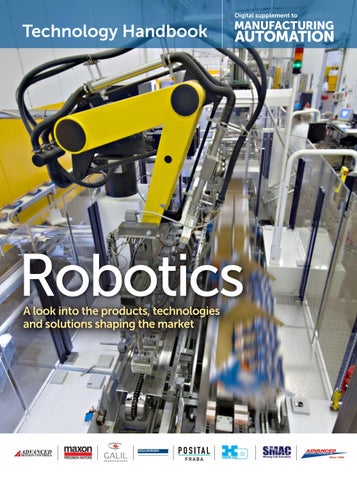
Robotics A look into the products, technologies and solutions shaping the market
Technology Handbook | ROBOTICS
Motion control considerations for Robotics by Karl Meier, Executive Team – ADVANCED Motion Controls
T
he rates at which physical robots are integrating into society today has increased so much that new categories are being created for their use and general purposes as well as dedicated designs versions compete for acceptability. The future of robots and robotics technologies is an economic area where it can be projected that new companies with new achievements will be some of the largest in the world in a short period of time. Intelligence is key to robots but what makes robots move so they can accomplish the activities they are designed to do is vital to their performance, and ultimately their existence. This brief article introduces the many aspects of motion control needing consideration when applying drive technology to robotic systems and platforms. Any mechanical object that moves generally has a motor for operation. The electric motors incorporated into robotic designs are based on needed torque/force, speed and acceleration/deceleration parameters and are typically going to be either servos or steppers. In industrial robotics platforms, each motor selected will have a controlling drive that operates the motor to ensure required performance. By design and construction of each, servo systems are much more efficient than steppers and offer a much wider operating range. As servo drives are more widely used and accepted, the focus here will be on servo-based motion control. Robots can have many different axes needing motion control and likely will include more than just main mobility of either propulsion or traction. For instance, there can be separate steering, arm extension/retraction, gripping, joint rotation, lifting, haptic feedback, etc. All of these functions usually incorporate a drive specifically tuned for that axis to provide the necessary controlled motion. The drives themselves receive commands from a supervisory controller that also maintains overall functionality of the entire system/platform. Motion control for the entire robotic system has traditionally been categorized into two areas: centralized or distributed. A centralized control scheme requires the controller to continually calculate all torque/force, speed and position commands (called the control loops) for every axis, while simultaneously running complex programs that plan not only the motion profiles but also scan I/O or vision information to maintain complete robot operations. This can place a heavier burden on the processor(s) selected for use and may make the system unmanageable when increasing scalability. In distributed control systems, motor control requirements are placed with the drives themselves and conducted over network communications where the controller merely monitors 2 MANUFACTURING AUTOMATION · Technology Handbook Robotics
activities of the drives with limited computation needed. This allows the controller to operate more effectively and be more available for all other system functions. There are numerous networks to choose from as well as standardized function calls allowing motion control and system functionality to work very closely together. CANopen, EtherCAT, Modbus, Ethernet POWERLINK, PLCopen, etc. offer fully documented methods of getting up and running quickly and greatly reduce development time. As robots need to manage on-board power as much as possible for continued operation, the choice for servo drives is wise as they are most efficient. This includes a power range from 10Watts to more than 50kW! However, and along with the servo motors, drives need to be ‘sized’ appropriately. Since the robot will have a pre-established voltage level available to the drives, sizing relates to being able to provide the minimum current required to allow the motor to maximize its abilities. As well, drives are offered in various platforms to include available back-plane mounted and PCB plug-in module versions, both with standard and extended environment capabilities. Custom designs are also available allowing robot OEMs to ‘think outside of the box’. Custom engineered designs provide the prospect of achieving results not otherwise possible and often at costs less than that of off-the-shelf designs. This information and insight has provided many industries with application excellence using servo driven robots and robotic platforms. For example: Material Handling’s - Palletizers, Sorters, Automated Fork Lifts; Warehousing’s - Storage & Retrieval Systems, Automated ‘Pick & Present’ Systems; Manufacturing’s - Automated Guided Vehicles (AGV’s), Transfer Lines, Assembly Cells; Medical’s – Surgical, Scanning Systems; Homeland Security and Defense’s: Unmanned Vehicle Systems (UVS’s) for Air, Ground and Submersibles, Remote Control Detection; Service’s – Telepresence, Inspection, Repair and Delivery. Many more robots exist and many more are coming. Stay tuned to what the future holds…
ADVANCED Motion Controls® 3805 Calle Tecate Camarillo, CA 93012 Phone: (805) 389-1935 amcleads@a-m-c.com www.a-m-c.com
ELECTROMATE 6221 Highway 7, Unit #15 Vaughan, Ontario, L4H 0K8 Phone (905) 850-7447 sales@electromate.com www.electromate.com
Technology Handbook | ROBOTICS
T
maxon drives set the world in motion
he maxon motor combines electric motors, gears and DC motor controls into high-precision, intelligent drive systems that can be custom-made to fit the specific needs of customer applications. maxon motor helps provide innovative solutions at competitive prices for numerous applications in various markets, such as industrial automation, medical technology, security technology, instrumentation, communications, and consumer applications, among others.
Offering solutions that fit your customized needs maxon motors manufactures small, high-quality brush and brushless DC motors ranging in size from 4 mm to 90 mm. maxon’s rhombic wound ironless rotor motors provide exceptionally high efficiency, low EMI emissions, fast acceleration, no preferred rotor position, torque constants and long service life. The drive components are assembled and designed within our modular system according to your individual needs. You can combine, according to your requirements, motors with 10 different product classes with planetary, standard or special gearheads, feedback devices, brakes and control electronics.
Brushed and brushless configurable DC motors more versions, more power Now even stronger, more efficient and with yet more combination options: There are new additions to the maxon family of X drive products. Several long versions of brushed DC motors, with higher torques and more power, have been added to the product range along with matching planetary gearheads. Each of the 3-stage versions can now be combined with the next smaller motor. This saves space, weight and costs. In addition, maxon launched a brushless DC motor (ECX) line to its configurable online program. These motors 4 MANUFACTURING AUTOMATION · Technology Handbook Robotics
are available with diameters of 8, 16 and 19 mm achieving speeds of up to 120,000 rpm. They run very smoothly and are highly efficient in standard or sterilizable versions (up to 2,000 autoclave cycles). Ideal for use in hand-held surgical tools and industrial spindles. maxon motor’s X drives are extremely powerful and are now available in maxon’s online shop, where customizing the drives is easy. Customers can fit the drives with specific mechanical and electrical components specific to their application needs. It is possible to customize the shaft lengths, winding types, ball bearings and much more. When combined together with maxon encoders and planetary gearheads, you form a high-precision, robust drive system ideal for any application from aerospace to medical to robotics. In fact anywhere that requires a compact, powerful, quiet and strong drive system. The X program is a lean and automated process which ensures that all configurable drives are ready for shipment within 11 working days. In addition, detailed product data may be viewed immediately online and 3D CAD data for the configuration is available for downloading. Visit dcx.maxonmotor.com for more information.
ELECTROMATE 6221 Highway 7, Unit #15 Vaughan, Ontario, Canada L4H 0K8 Phone: 877-SERVO98 Email: sales@electromate.com www.electromate.com
TRA CONFIGURABLE
Gearhead, motor and encoder tailored to your needs.
11DAYS
READY IN
Assemble your individual maxon DC drive: You can configure the gear stages, the motor bearings, the shafts, the encoder and much more. Design your custom drive online today and your finished drive will ship from Switzerland in 11 working days.
dcx.maxonmotor.com
Technology Handbook | ROBOTICS
Raspberry Pi Interface with Galil Controllers
A
n HMI or Human Machine Interface is needed in many motion control applications. These devices are used to allow a user to instruct a machine on what to do without the need of a full PC. There are many sources for HMIs and many can cost thousands of dollars. With the arrival of the Raspberry Pi Foundation and its Raspberry Pi models, a small but powerful option arrived. Adding to this, the official Raspberry Pi 7” touchscreen display, and the Galil application programmer interface this powerful trio form the foundation for an inexpensive but fully capable HMI that can be customized for any motion control application. The following video shows this application in action: http://www.galil.com/raspberrypi The strength of this new HMI option can be found in the software that can be developed to run on it. There are free software tools that can allow a person to create just about any kind of interface to run on the Raspberry Pi. The software acts as the glue to take in the input from the user in the touch interface and the Galil gclib API translates those simple instructions into the commands to send to the motion controller and PLCs. This lowers the bar of entry to something similar to developing a modern mobile phone app. The online community provides plenty of assistance to get started and allows you to create interfaces to run on these fast and inexpensive computers. This example Raspberry Pi based HMI is using the Raspberry Pi 3, the latest version of the Raspbian Linux operating system, Python for its programming language, Kivy for its user interface framework, and Galil gclib for communication with the motion control hardware. The Galil gclib C API can be used on various platforms in many different programming languages. Its function is to communicate with the Galil controller at a higher level and dictate the overall application flow. Because gclib is written in low level C it can be used in other higher level languages such as Python. Galil has provided a Python wrapper and example code to make installing and using the API very easy. Most motion applications can be broken down into the following simple flow diagram.
Mechanical System & I/O & PLC HMI
Motion Controller
In this application a technician enters values into an interface for the material to be processed. The technician enters 6 MANUFACTURING AUTOMATION · Technology Handbook Robotics
Figure 1: Touchscreen and Motion Controller the desired length of material and the number of pieces to cut. The Python application takes in the commands from the technician and relays the information to the motion control system. Its main job is to handle the overall application and rely on the other systems to report success or failure. The motion controller performs the needed motion elements to physically move the motors and cutting tools. A “Cut To Length” screen displays the user interface items needed to modify the cut to length application including entering the number of cuts, the desired length, and the begin button to start the process. The Python application downloads the needed code to the controller and requests information from the controller to display to the user. This application is a powerful demonstration of the advancements in computer hardware that have driven down prices but increased performance. Advancements in software have provided easy to use tools with free and open source programming languages and frameworks. By combining these advancements with Galil Motion Control products, interfaces can be easily made for any motion control application. The Raspberry Pi with touch screen display used in this demonstration cost around $100. All software used in this demonstration is free or open source.
GALIL MOTION CONTROL 270 Technology Way Rocklin, CA 95765, USA galil.com
ELECTROMATE 6221 Highway 7, Unit #15 Vaughan, Ontario, Canada L4H 0K8 Phone: 877-SERVO98 Email: sales@electromate.com www.electromate.com
Galil Motion Control
ALL THE RIGHT MOVES...
...for Ultimate Precision
Galil Motion Controllers handle virtually any application Between our flexible product offering and our affordable custom solutions, we can accomodate all of your motion and I/O needs. Select one through eight axes. Choose internal multi-axis servo or stepper drives. Increase the number of axes and I/O by daisychaining through built-in Ethernet ports. Guaranteed low price per axis with driver included. Galil products are easy to program and use, backed by unparalleled technical support and both ISO 9000 and ISO 13485 certification. • Process commands in as little as 31 microseconds • Handle all modes of motion, simple to complex • Handle ultra-high resolution systems • Support closed loop stepper motors • Up and running in minutes • Use virtually any encoder • EtherCAT master available
SOLD AND SERVICED BY ELECTROMATE
galil.com 1.800.377.6329
Technology Handbook | ROBOTICS
K
High Power Density for Lighter, Smaller and More Compact Robots
ollmorgen motion solutions play an important role in a variety of different robotic applications, including surgical automation, mobile robots, autonomous vehicles, intralogistics/Automated Guided Vehicles (AGV’s) and rehabilitation robots. Our expertise makes us a unique motion partner who understands the business and technical needs in robotics. Kollmorgen offers highly configurable catalog products such as the AKM® Servo Motor, AKM®2G Servo Motor, KBM™ Frameless Motor and TBM Frameless Motor as well as the design and manufacturing expertise to create a motor for perfect fit and performance.
Surgical Automation
Kollmorgen provides low cogging, high torque dense housed and frameless servo motors with low dynamic friction that enables a more responsive surgical robot. By arming the surgeon with better tactile feel and accuracy during the procedure, surgical robots decrease operative trauma, improve patient outcomes and shorten lengths of stay from prostate, cardiac, gynecological and many other types of surgery.
Mobile Robots
Mobile robotics takes many forms with a wide range of autonomy – from Autonomous Mobile Robots (AMR), to Remotely Operated Underwater Vehicles (ROVs) and more – mobile robots are taking on the challenges of operating and making decisions in difficult environments. The most famous ROV expedition had Kollmorgen technology on board - Jason Jr allowed the world to see the RMS Titanic in 1986. Our expertise in Aerospace and Defense started in the 1950s when we worked with MIT to develop stabilized platforms for inertial guidance systems. Now we support challenging applications in the air, land and sea. Our customers rely on our high torque density and product longevity to make sure their missions are successful.
Autonomous Vehicles
Autonomous vehicles have been capturing our imaginations for years and now the sensing technology and artificial intelligence has advanced far enough to make it feasible. Kollmorgen technology can be found on a wide range of autonomous applications, from steering, to locomotion, to Light Detection and Ranging (LIDAR). Kollmorgen products are currently on vehicles being tested across the country. Our capability to provide a wide range of standard products quickly coupled with our ability to create and produce a ground-up design is enabling smaller, more compact and lighter systems. 8 MANUFACTURING AUTOMATION · Technology Handbook Robotics
Intralogistics and AGVs
The world of traditional robotics and AGV is beginning to overlap into smarter, more dynamic and more versatile robots. Artificial intelligence is advancing so robots and AGVs can better operate in a human environment, with more natural navigation and without expensive external sensing markers or reflectors. Kollmorgen’s technology is in underwater ROV’s, in drone systems delivering lifesaving materials, more independent AGV and intralogistics systems, nuclear handling systems and security systems. Kollmorgen’s ability to provide a wide range of standard, configurable motors expedites prototyping and speed to market for OEMs.
Rehabilitation
Reduction of battery size and weight is enabling new possibilities in rehabilitation applications. We have a strong history in rehabilitation – Kollmorgen helped build the world’s first successful self-contained artificial heart and Left Ventricular Assist Device (LVAD) in 2001. Kollmorgen’s torque dense and light weight products are in applications such as post-stroke rehabilitation, motorized prosthetics and rehab exoskeletons.
About Kollmorgen
Since its founding in 1916, Kollmorgen’s innovative solutions have brought big ideas to life, kept the world safer, and improved peoples’ lives. Today, its world-class knowledge of motion systems and components, industry-leading quality, and deep expertise in linking and integrating standard and custom products continually delivers breakthrough motion solutions that are unmatched in performance, reliability, and ease-of-use. This gives machine builders around the world an irrefutable marketplace advantage and provides their customers with ultimate peace-of-mind. For more information visit www.kollmorgen.com, email support@kollmorgen.com, or call 1-540-633-3545.
KOLLMORGEN 201 West Rock Road, Radford, VA 24141 Tel: 540.633.3545 www.kollmorgen.com
ELECTROMATE 6221 Highway 7, Unit #15 Vaughan, Ontario, Canada L4H 0K8 Phone: 877-SERVO98 Email: sales@electromate.com www.electromate.com
Kollmorgen Motion Solutions play a vital role in a variety of robots, including collaborative, industrial articulated, and surgical by providing: • High power density to reduce size, weight and system complexity • Smooth, precise motion for control and safety • Broad range of size and power • Standard and optimized options to meet specialized requirements
Our expertise makes us a unique motion partner who understands the business and technical needs in robotics. Kollmorgen offers highly configurable products such as AKM® & AKD® servo motors and drives, KBM & TBM frameless motors, and stepper motors & drives. We also offer machine design and manufacturing expertise to help you optimize your robot.
Find out more at www.kollmorgen.com/robotics ©2017 Kollmorgen Corporation. All rights reserved. KM_AD_000320_RevA_EN Specifications are subject to change without notice.
Technology Handbook | ROBOTICS
POSITAL Sensors – Precision Feedback for Collaborative Robots orientation of all of its moving parts. This is typically provided through rotary encoders mounted in each of the device’s joints. Encoders measure rotation and return a digital signal that reports the angle of rotation (absolute encoders) or rate of motion (incremental encoders) to the control system. The ‘right’ encoders for cobots need to be accurate, reliable, and compact, with excellent dynamic response characteristics. They also need to be reasonably priced. POSITAL-FRABA has responded to this challenge by developing new sensing technologies – such as magnetic and capacitive rotary encoders – that provide cobot manufacturers vital feedback for closed-loop control systems. In order to ensure that these devices meet the needs of cobot builders, POSITAL-FRABA offers products with a wide range of performance characteristics, communications interfaces and physical configurations.
A
very exciting development in the area of robotics is the development and growing popularity of socalled collaborative robots, or “cobots”. Cobots, in contrast to traditional industrial robots, are designed to interact with human workers in a shared workspace. They are typically smaller and less powerful than traditional factory robots and are equipped with a variety of proximity sensors, load sensors and other features designed to avoid dangerous collisions between the robots and the people working around them. This focus on safety means that cobots are easier to deploy in a normal factory setting, since they don’t required special fenced off operating areas. Cobots have been used to perform repetitive tasks in light assembly, packaging, materials handling and medical laboratories. Cobots have also been used to help workers avoid direct contact with environments not conducive to direct human interaction, such as high temperature environments, chemically aggressive reagents and toxic pathogens.
Enabling Technologies for the Cobot Revolution
Many cobots are designed to mimic a human arm, with flexible “shoulder”, “elbow” and “wrist” joints. Accurate measurement of the rotary position of these joints is central to enabling the cobots’ control system to keep track of the spatial 10 MANUFACTURING AUTOMATION · Technology Handbook Robotics
POSITAL Kit Encoder for Servomotors and Robots.
POSITAL-FRABA Inc. 1800 East State Street, Suite 148 Hamilton, NJ 08609, USA Phone: 609-750-8705 info@fraba.com www.posital.com
ELECTROMATE 6221 Highway 7, Unit #15 Vaughan, Ontario, L4H 0K8 Phone (905) 850-7447 sales@electromate.com www.electromate.com
KIT ENCODERS
Innovation in Motor and Robot Control Feedback POSITAL’s magnetic kit encoders are a rugged and versatile alternative for absolute position feedback in motors and robots Multi-turn capabilities based on POSITAL’s innovative energy-harvesing system eliminate the need for backup batteries Easy installation with built-in self calibration Compact and robust design Resolution of up 17 bits; revolution count range 16 bits
www.posital.com
Technology Handbook | ROBOTICS
Harmonic Drive LLC ogy results in gears and actuators that have very low weight, yet deliver very high torque. This combination results in gears with exceptionally high torque density and actuators with exceptionally high power density.
Harmonic Drive LLC engineers and manufactures precision servo actuators, gearheads and gear component sets. We work closely with companies of all sizes to understand their application requirements and provide a standard or custom engineered solution to enable the success of their design project.
Design Features of Harmonic Drive® Products Some of the design features that make Harmonic Drive® products particularly well-suited for robotic applications include: •
•
•
With over 50 years of experience, our expert engineering and production teams develop enabling technologies and prod¬ucts to meet the needs of an evolving motion-control market. We are very proud of our outstanding company history. Our highprecision, zero-backlash Harmonic Drive® actuators and gears have, and continue to play, critical roles in robotics.
Performance Benefits for Robotic Applications The majority of the world’s leading robot manufacturers use Harmonic Drive® gears and actuators to take advantage of their superior performance including: • High Accuracy – Standard accuracy of Harmonic Drive gears is <1 arc-minute, but they are commonly manufactured with <30 arc-second accuracy per customer request. • Excellent Repeatability – Typical repeatability is ± 5 arcseconds. • Zero Backlash – Harmonic Drive products inherently have true zero backlash. Lost motion (defined as hysteresis in the low torque region) of the gear is measured by applying ± 4% of rated torque to the output while the input is rotationally locked. Lost motion in Harmonic Drive gears is <1 arcminute and is maintained for the life of the gear. • High Torsional Stiffness – Up to 30% of the gear teeth are engaged at all times, resulting in high torsional stiffness. • High Torque Density – The simplicity of the gear technol12 MANUFACTURING AUTOMATION · Technology Handbook Robotics
Through-Hole Design – Many of our gearheads and actuators feature a large hollow shaft that allows cables, pipes, or coaxial shafts to pass through the center of the gear or actuator. This can greatly simplify a design and improve reliability. Cross Roller Output Bearings are widely integrated in the products and provide high axial, radial, and moment load capacities in a compact space. No Change in Size or Weight with Gear Ratio – Unlike other gear technologies, harmonic gears have the same size, weight, and form factor regardless of gear ratio. This feature allows design flexibility or revisions without the need to redesign the entire mechanism. Reduction ratios of 30:1 through 160:1 are commonly available.
Gears and Actuators in Action Harmonic Drive® gears and actuators are used in a wide range of applications, each of which takes advantage of a different characteristic of the gear technology. Some applications depend on zero backlash and high positional accuracy. Some require a high torque-to-weight ratio. Others depend on the unique configurations available. And some installations utilize all of these attributes.
Harmonic Drive and Harmonic Planetary are registered trademarks of Harmonic Drive LLC.
HARMONIC DRIVE LLC 247 Lynnfield Street, Peabody, MA 01960 Toll Free: 800-921-3332 Phone: 978-532-1800 www.HarmonicDrive.net
ELECTROMATE 6221 Highway 7, Unit #15 Vaughan, Ontario, Canada L4H 0K8 Phone: 877-SERVO98 Email: sales@electromate.com www.electromate.com
247 Lynnfield Street Peabody, MA 01960 800.921.3332 www.HarmonicDrive.net
Electromate* 6221 Highway 7, Unit #15 Vaughan, Ontario, Canada L4H 0K8 www.electromate.com
Harmonic Drive is a registered trademark of Harmonic Drive LLC. Robonaut image courtesy of NASA/JPL-Caltech. * Electromate is the exclusive Canadian distributor of Harmonic Drive® products (except the Province of Alberta). Technology Handbook HMI & Operator Interface · MANUFACTURING AUTOMATION 13
Technology Handbook | ROBOTICS
How Smart is your Screwdriver? By John Miewald
M
ost consumer goods are assembled with small screws by hand. This close hand-eye work is prone to error. SMAC Moving Coil Actuators, out of Carlsbad, California, has come up with a solution that removes human error and replaces fallible pneumatic screwdrivers with what they call the “Smart Screwdriver.” Using a pneumatic handheld auto-feed screwdriver to install screws is dramatically more productive than manually picking up a screw, inserting it into a part, and driving it home, but simple pneumatic screwdrivers are not an ideal solution either. Workers using pneumatic tools with compressed air and dials to estimate the amount of torque for the screw can strip or misalign the threads if an incorrect torque or angle is used. For some manufacturers, a misaligned critical screw could result in stopping an assembly line. There is little or no feedback on the work until the device goes to QA. If QA misses the critical screw, it could lead to faulty products, angry customers, and the one word no manufacturer wants to hear- particularly in the automotive and aerospace industries: recalls. When you add this all up, a small screw could cost big money. A common problem with screws and lug nuts is crossthreading. Cross-threading means the threads on a lug nut or screw are not aligned with the threads on the stud when you start to screw them together. To avoid cross-threading, many assemblers will start lug nuts or screws by hand, turning the screw the wrong way until he feels a bump and hears a sound. This is the screw falling into position. The assembler would then turn the screw several rotations before using a wrench or screwdriver to “snug” it into place. Up until now, this process has been difficult to automate, performed by human operators only. This is how the Smart Screwdriver automates the process. First, it performs a fast approach, then finds the surface with our patented Soft-Land capability. Then, it turns counter clock-wise and the screw moves up and drops as the first thread is found. This is, in effect, “thread matching” and prevents cross-threading. The linear rotary actuator then starts rotating clock-wise. A “snug” torque can be applied. This is useful when there are a number of screws holding a part on the 14 MANUFACTURING AUTOMATION · Technology Handbook Robotics
clamping surface and they need to be snugged evenly, then a final torque is applied. The entire time, the Smart Screwdriver is monitoring the torque and pitch verification. Good, shallow, cross/no-threads, and the precision of the thread are detected through feedback of positon & torque off both axes. The SMAC Smart Screwdriver performs the same work as a pneumatic auto-feed tool electronically. There is no compressed air, no mechanical parts, and no need for oil or recalibration. On top of being maintenance free the Smart Screwdriver also has a high degree of programmability, so that you know the screw is correctly inserted, when linear height, degrees of rotation and the desired torque have been reached. The smart screwdriver monitors the linear position and force, rotary torque and degree of rotation while simultaneously driving the screw. These parameters are all completely programmable with the capability to have feedback sent to a PLC or database in real time. This ability to perform work and verify all in one move eliminates the need for down the line quality checks that are costly and time consuming. The SMAC Smart Screwdriver is intended for a wide range of screw sizes, including but not limited to 1.4 millimeter or less, like those found in watches, eyeglasses, cameras, consumer electronics, cell phones, power tools, etc. SMAC Moving Coil Actuators tend to be small but the Smart Screwdriver is so small that it could be attached to a larger robotic arm for special applications, providing 100% quality every time. Of course, the reverse could also be done. The Smart Screwdriver could be used to automatically disassemble a device, quickly, efficiently, and carefully.
SMAC Moving Coil Actuators 5807 Van Allen Way Carlsbad, California, 92008 Phone (760) 929-7575
ELECTROMATE 6221 Highway 7, Unit #15 Vaughan, Ontario, L4H 0K8 Phone (905) 850-7447 sales@electromate.com www.electromate.com
Technology Handbook | ROBOTICS
Automate almost anything
F
ounded in 1986, Advanced Motion & Controls Ltd. is a North American Market leader in the field of Industrial and Factory Automation. Our organization’s customer-base is engaged in a diverse range of industries including; automotive, telecommunications, computer/IT, furniture, construction equipment and food, beverage and packaging. AM&C prides itself as employer of an innovative professional workforce comprising; Engineers, Machine Designers, Programmers, Assembly & Maintenance Departments and Purchasing & Procurement professionals. Our credo is:
”Solutions for industry on the move!” Universal Robots: Your Collaborative Choice for robots When we say the UR robot can automate virtually anything we mean virtually anything – from assembly to painting, from screw driving to labeling, from injection molding to welding and from packaging to polishin Find out How…
The UR robots are packed with truly amazing benefits. Take a look for yourself Easy programming: Patented technology let operators with no programming experience quickly set up and operate our robots with intuitive, 3D visualization.
with none of the traditional added costs associated with robot programming, set-up, and dedicated, shielded work cells. Finally, robotic automation is affordable for small and medium sized enterprises. Automate virtually anything with a collaborative robot arm from Universal Robots. From gluing and mounting to pick and place, and packaging, a robotic arm can streamline and optimise processes across your production operation.
Omron Robotic Technologies Omron’s unique combination of software and control architecture addresses factory automation challenges, from producing a high volume high variety mix of products to short product lifecycles that require rapid production line changes. Fully integrated control, software architecture and development environment, meet current and future needs for process design, flexible operation and predictable maintenance. The flexibility and agility of Omron solutions are ideal for industries such as Food and Beverage, Automotive and Electronics.
Industrial Intelligent Robotics (SCARA, Six-Axis) Omron’s industrial robot innovations continue with its expansive line of Cobra SCARA robots, Viper six-axis (articulated) robots
Omron Mobile Products
Fast set up: Universal Robots has revolutionized robot setup, reducing typical robotic deployment measured in weeks to a matter of hours. The average set-up time reported by our customers is only half a day.
Omron Mobile products provide the logistical productivity and intelligence currently unrealized through conventional conveyance, transport, and AGV systems. Robots powered by Motivity are people aware and work in existing facilities with minimal to no retrofits.
Flexible deployment: Don’t be limited by dedicated robotics. Universal Robots are lightweight, space-saving, and easy to re-deploy to multiple applications without changing your production layout.
Have a question or would like to discuss automation, we are more than pleased to come and visit and more importantly showcase to you our breadth of product and application experiences.
Collaborative and safe robots: Now you can replace human operators in dirty, dangerous, and dull jobs to reduce repetitive strain and accidental injuries. Eighty percent of the thousands of UR robots worldwide operate with no safety guarding (after risk assessment), right beside human operators. Fastest payback in the robot industry: Universal Robots gives you all the advantages of advanced robotic automation, 16 MANUFACTURING AUTOMATION · Technology Handbook Robotics
26 Saunders Road, Barrie, Onatrio L4N 9A8 Toll Free: 1-800-461-5679 www.advancedmotion.com
Cobot Line Up
YOUR CHOICE TO
AUTOMATE
ALMOST ANYTHING With over 30 years of automa�on experience, Advanced Mo�on & Controls Ltd is your #1 choice for cobo�c and robo�c automa�on.
Universal Robots
�a�in� robot auto�a�on accessible to all levels of industry We�re dedicated to brin�in� safe, �exible and easy to use � axis industrial robo�c arms to business of every size, all over the world. We develop industrial collabora�ve robot arms that automate and streamline repe��ve industrial processes. �his approach enables produc�on departments to assi�n their sta� members more en�oyable tas�s � crea�n� �obs that provide them with new challen�es that add value to the company.
The complete solution for factory automation and machine controls
Control
Robots
• Machine controller, HMI and I/O • Direct database communication
• Parallel, SCARA, articulated
for HMI and IIoT applications
and mobile robots
• Easy to use software to
automatically generate code
Vision and measurement • Product position and orientation detection for pick and place applications • Quality & Test Measurement
Contact Us Today... Sales, Manufacturing and Distribution Headquarters 26 Saunders Road, Barrie, Ontario L4N 9A8 TOLL FREE: 1-800-461-5679 www.advancedmotion.com
4 Locations Across Canada
Toronto Cambridge Barrie Montreal and online
THINKING INSIDE THE BOX Automating pizzeria operations with the help of robots BY TREENA HEIN
I
f anyone is a pioneer in the automation of food processes, it’s Alex Garden. A Canadian ex-pat and now-popular conference panelist, he founded Zume Pizzeria in Silicon Valley, Calif., with Julia Collins in June 2016. “My original idea was actually to create a way to bake pizza enroute to your door and didn’t have anything to do with robots – that came later,” Garden recalls. “I developed the idea for ‘Baked On The Way’ technology after sitting next to an owner of several pizza franchises on a plane, discussing the downsides of the business: weak unit economics, rigid delivery structure, no
room for flexibility with ingredients, customer complaints from cold, soggy pies, etc. From there, the idea sparked to take on the $40 billion per year pizza delivery market, but do it better.” A few years later in 2015, Garden and Collins got together and fleshed out a pizza company based on one founding principle: high-quality food at a fair price.
“We then developed our first team of robots,” Garden says, “to support that mission.” There are no storefront Zume stores, only pizza delivered from a central facility, where robots ‘Pepe’ and ‘Giorgio’ dispense the sauce, ‘Marta’ spreads the sauce, and ‘Bruno’ puts the pizza in the oven for pre-baking (after a human puts on the toppings). A human transfers the pizza to one of seven delivery trucks, each with up to 56 onboard ovens. A software program maps the routes to customer addresses and automatically coordinates baking
“Automation exists to improve the quality of human lives. Before we start any automation project, we must have the conviction that it will create a safer, more engaging work environment for our employees.”
18 MANUFACTURING AUTOMATION · Technology Handbook Robotics
times so that by the time the truck gets to your door — brought to you by the driver — your pizza will have just finished cooking. Zume now delivers more than 400 pies a day. Garden says that instead of focusing on stunts (he points to the unsuccessful use of drones and a cancelled plan to use reindeer in Japan, both by Dominos), they worked to develop a delivery process that would actually improve pizza quality and taste. “Automation exists to improve the quality of human lives,” he notes. “Before we start any automation project, we must have the conviction that it will create a safer, more engaging work environment for our employees and that it will improve our margins so we can invest even more in delivering high-quality food to our customers.” In the process, Garden and his team discovered there is an enormous selection of companies and equipment out there for process automation, and “with today’s CAD systems, flexible manufacturing and our imaginations to contend with, it’s really easy to engineer a complex system that checks the box of ‘so cool’ but fails in production,” he says. “In our experience, the best automations are the most simple.” Garden also notes that once they automate something, the real stamp of approval comes later from Zume’s “amazing food and delivery workforce... when they tell us automation is really making their lives easier and safer.”
PHOTOS: ZUME PIZZERIA
Application challenges Bruno, the robot which picks up a topped pizza from the conveyor and places it in the pre-bake oven, is an ABB IRB 2600. Nicolas De Keijser, assembly and test business line manager for ABB Robotics’ North American division, says enabling Bruno to maintain a pizza’s round shape proved to be a significant challenge. “When transferring, dough can easily stretch or ripple up,” he explains. “This was addressed by developing an innovative gripper attached to the robot arm with a built-in conveyor.” De Keijser says it was also a challenge to perfectly synchronize the motion of the robot and the gripper with the movement of the main conveyor.
Marta, which spreads the sauce, is an ABB IRB 360 FlexPicker unit. This unit employs both a camera and sensor to detect a pizza’s arrival in front of it and its exact location. “This allows the robot to accurately spread the sauce in a specific pattern,” De Keijser says. “Depending on the type of pizza, the spreading pattern of the sauce varies.” He says the use of robots in kitchens is very new, but that robots are being used around the world in similar applications such as spreading sauce in a frozen pizza plant and packing food items. For ABB, De Keijser says novel uses of robots in the service, entertainment and retail industry are “definitely” an increasing trend.
Impact on human jobs Zume has more than 130 full- and parttime human employees, and Garden says the use of the four robots has provided several “amazing advantages.” Labour savings allow Zume to provide an average hourly wage of $16.31, and all employees are shareholders with company benefits. Savings from robot use have also been reinvested in higherquality ingredients. In addition, Garden says further automation of remaining repetitive pizza-making tasks will allow the replaced employees to get “involved in areas of the company that they are most interested in.” As kitchen staff is eventually cut from six to two — with the two remaining humans slicing and
preparing toppings and overseeing quality control — the four replaced workers will move into what Garden describes as “more stimulating roles in the company, like marketing or data science.” He adds that “jobs that require more advanced creative skills, like tasting and recipe development, will always be done by humans. Jobs are sacred to us, so we believe there’s room for people and robots to coexist.” Not everyone shares that view. The topic of robots in restaurants came up in a May 2016 interview on Fox Business with former McDonald’s USA CEO Ed Rensi. Commenting on a possible $15 minimum wage, Rensi stated that “it’s cheaper to buy a $35,000 robotic arm than it is to hire an employee making $15 an hour” to bag French fries. Rensi went on to call a $15 minimum wage “very destructive” and predicted it would “cause a job loss across this country like you’re not going to believe.” For its part, Zume continues to automate. The firm has installed a dough-pressing machine that can turn out a pie every nine seconds, four times faster than without it. “In terms of drones and self-driving cars, we’re always monitoring the latest technology and there may be room for those types of developments in the future,” says Garden. He adds that “eventually, we’d like to grow across the West Coast, then the entire country, then across the globe. Everyone loves pizza!” | MA
Technology Handbook Robotics · MANUFACTURING AUTOMATION 19
LOOKING TO THE FUTURE: A COBOT SUCCESS STORY BY ROBOTIQ
T
wo years ago, architect Brian Vallario and finance worker Gerard Masci decided it was time to bring back something that was long gone in the American eyewear industry: the Made-in-USA label.
The two friends, without any manufacturing background, wanted to bring eyewear production back to the United States. They started their brand, Lowercase NYC, and automated their processes right from the beginning. In only five days, they’ve programmed a Universal Robot and a Robotiq’s 2-fingers gripper to operate the CNC machine by itself, allowing the three employees to focus
20 MANUFACTURING AUTOMATION · Technology Handbook Robotics
on the countless things they have to do in this start-up business.
A five-day integration project Before launching Lowercase, Vallario specialized in digital fabrication in an architecture firm. He didn’t know much about robots, but was aware of the benefits of automation.
“We really needed something that was easy to program and that we could manipulate on the fly. If I make a change on a design, I have to be able to apply the changes quickly.” “I had done a little bit of research on robots when I was in graduate school, but I never really had any working experience with them. It was a complete learning process but it went fairly smoothly. With the help of Axis New Jersey , we were put in touch with an integrator but the majority of the integration was done on our own,” he said. Cynthia Kradjel, account man ager for the New York metro area at Axis, found the perfect match for the start-up business. “When Lowercase came to us with their design concept, our automation engineers put together a cost effective solution, yet flexible enough to be redeployed as their business grew,” she said. “We recommended Universal Robot mainly because it is collaborative, but also because it is easy for users to program it and change how they want to depl oy it. As the business grows, they may want to add movements or add numbers of stops in the process that the robot does. We also chose the Robotiq Gripper as an ideal solution for thi s application. We felt that it will be able to accomplish the types of move ments in a very repeatable and practical way. We then brought an integra tor, Richlin Machinery, who was able to design a platform where the robot stands and was also able to design a solenoïd based solution so that the robot can communicate with the CNC machine and bring parts in and out as needed.” A few months have passed and for Lowercase and Axis New Jersey, this integration, that took only a week, was a success. “Overall, we think the solution was flexibl e, easy to redeploy and cost effective, compared particularly to industrial robots, which require caging, and once they’re integrated, they need to br ing an integrator back to make any changes,” Kradjel said. “In the case of Lowercase, we helped train them so that they’re able to program the robot
and k eep it current with what they want to do on a daily basis.” Since one of the cofounders came to the eyewear industry with a financial backg round, any equipment chosen to build the factory had to be worth every penny. Masci was willing to implement robotics into the production and quickly realized that the price of a robot and the price of integration were two different things. “The cost to automate was extremely high, but we were always able to get our heads around that because of the value that the robot would add to the process. The main problem was that the i ntegration cost of most robotic solutions was three to four times the cost of the solution itself. When we worked out a solution using the UR5 and the Robotiq gripper, the integration cost was a fraction of the actual purchase price. Then it made it tenable for a small company of two people to integrate a robot into our solution.”
Quality first: Robotdriven repeatability and consistency The r epeatability and consistency of the robot-machine combo was a huge benefit for Lowercase. “We have 17 different styles now,” said Vallario. “We really needed something that was easy to program and that we could manipulate on the fly. If I make a change on a design, I have to be able to apply the changes quickly. And since we are competing against bigger, highend eyewear manufacturers, we have to deliver the highest quality even if we do quite smaller productions.” To bring its eyewear to life, Lowercase imports the material in sheets. It is cut down into small tablets and the frames are then cut in the CNC machine, which is tended by the UR5 and the Robotiq Gripper. The robot picks up the raw material, loads it into the first position, closes the door, presses the go button and then does it all over
again for the second position. It then removes the finished pair of glasses and puts it in a bucket. The eyewear then goes through many steps of fine-tuning before it is ready to be shipped. Each production batch in the CNC machine averages 500 units, with around 30 to 40 units of each style. But even with such a small volume, Vallario believes the automated process is by far the best solution. “I only have a few manual tweaks to do on the vices every time. The rest is all automated,” he explained. “This automation is important for us. Eyewear production is a very labour-intensive process and we are such a small team that any improvement we can make on our efficiency is huge. Having a product that allows myself to sit at the computer and work on design or go work on the more labour-intensive stuff that can’t be done by machines is a big plus for us.”
The future is bright Without seeing life through a pair of pink glasses, Vallario and Masci say they definitely see great things coming for Lowercase. Automation is an important part of many of their future projects, not only regarding the addition of new robots in the factory, but also to raise hirings, they said. “A collaborative robot is operating our CNC machine, but we’re not hindering jobs,” said Vallario. “Automation just creates different jobs. Right now, we’re not looking for someone to operate a CNC machine, but we are looking for engineers and designers who can work with robotics to improve processes. If that helps us grow as a business, that helps creating jobs.” And even though Lowercase’s cofounders do not think that eyewear production could be fully automated — just yet — they said they see many other opportunities to bring more robots into their team. “As we grow, we are definitely looking for new ways to automate our processes,” continued Vallario. “A lot of time-consuming steps involved into doing a pair of glasses require delicate handwork. We’ll never be able to automate everything but there is a lot that can be done and we’re looking forward to it.” | MA
Technology Handbook Robotics · MANUFACTURING AUTOMATION 21
ROBOT OR COBOT: FIVE KEY DIFFERENCES Cobots are on the rise. How do they differ from conventional industrial robots? BY HANNOVER MESSE
T
he concept for collaborative robots — or cobots — was born in 1995 as part of a research project spearheaded by the General Motors Foundation. The idea was to make robots so safe that they could literally work hand in hand with people. Now, 20 years later, cobots have found a place on many factory floors, and also in public awareness. And yet many don’t really understand how cobots are different from robots. 1. Partnering in human-machine teams Classic industry robots are powerhouses that carry out their work following a fixed program, without regard for the people working around them. Accidents are prevented using fences and cages.
Cobots, however, are specifically designed to work together with people, not just for them. Instead of being caged, they work in a cooperative environment and assist with complex tasks that cannot be fully automated. For example, they can hand components to human coworkers, who execute the more precise assembly or quality control tasks. 2. Relief from risky activities Cobots fulfill tasks that could be risky for people, such as safely transporting sharp, pointed or hot work pieces, or dangerous bolting work. This results in fewer accidents, and leaves technicians to focus on less arduous aspects of production. 3. “Smart” and safe behaviour Cobots are designed to work seamlessly together with their human colleagues.
22 MANUFACTURING AUTOMATION · Technology Handbook Robotics
They immobilize at the slightest touch thanks to sophisticated sensors, to prevent any danger to nearby people. Closed areas and safety fencing are no longer needed. 4. Flexible and teachable Cobots are very easy to program. Unlike traditional industrial robots, which require specialized programming skills, some cobot models even learn independently. For example, from a technician performing a movement with the robot arm, which the cobot can then automatically reproduce. Other systems can be given work instructions without coding, using a graphic user interface. Employees can thus flexibly reprogram cobots and use them for a variety of tasks. 5. Usable anywhere Not only are cobots easy to reprogram, they are also relatively easy to move and utilize at other points on the production chain. Most cobots can be mounted on any surface — horizontal, vertical, on the ceiling. And they are often light enough to be carried by just one person. | MA
DON’T MISS OUT on your next issue of
IT’S FAST, IT’S EASY AND IT’S FREE! DICK MORLEY: A glimpse into the many facets of the esteemed “Father of the PLC.” p.18
spOtlight: highlights from our fireside chat with nathalie pilon, aBB canada managing director. p.15
Defence-in-Depth Best practices to help industrial operators deploy the internet of things securely and reliably. p.22
TRAINING: How you can millennials and SPOT THE DIFFERENCE: attract simultaneously boost your How to choose the right lighting for machine vision business. p.17
applications. p.26
ETHERNET GAINS: Acadian Seaplants capacity grows by 40 per cent with new processing facility. p.20
LIGHTING RETROFITS: LEAN MANUFACTURING: Industy bakery welcomes Defining culture as an environment favourable to continuous improvement. p.10
INDUSTRIAL NETWORKS: Selecting components that make the grade. p.24
Machine safety: how you can prepare for the upcoming Ontario machine safety blitz. p.21
AutomationMag.com
Your resource for Canada’s industrial automation news
MOTORS AND DRIVES: An overview of the most popular rotary motion technologies. p.24
PC-BASED CONTROL
IN THE DRIVER’S SEAT
from 3D printers to industrial sensors and the internet of things (iot) — key trends and technologies that will impact your plant floor this year. p.16
HANNOVER WRAP-UP: Couldn’t attend this year‘s Hannover Messe? Catch up on standout moments from the action-packed fair. p.26 OCTOBER 2016
MARCH / APRIL 2016
PM 40065710 AlliedCover_MA_Jan.indd MA october 2016.indd 1 1
2016-11-01 2015-12-23 10:04 1:58 PM AM
Think Allied for Industrial Automation. More Brands. More Products. More Solutions. See it all at thinkallied.com/industrialautomation
NOVEMBER/DECEMBER 2016
30 ISSUE
SEPTEMBER 2016
TH ANNIVERSARY
PM 40065710
2016-01-07 2015-12-23 2:29 1:58 PM PM
The 2016 Canadian Manufacturing Study finds the industry is strengthening, slowly but surely p.19
AutomationMag.com
PM 40065710
More Brands. More Products. More Solutions. See it all at thinkallied.com/industrialautomation
The evolution and future of industrial automation p.18 AlliedCover_MA_Jan.indd 1
A RECIPE
PM 40065710
Think Allied for Industrial Automation.
2015-12-23 1:58 PM
Think Allied for Industrial Automation. More Brands. More Products. More Solutions. See it all at thinkallied.com/industrialautomation
FOR GROWTH
AlliedCover_MA_Jan.indd 1
AlliedCover_MA_Jan.indd 1 Our editorial advisory board discusses the challenges in Canada’s manufacturing future, and how to overcome them p.18
2015-12-23 1:58 PM
2015-12-23 1:58 PM
JUNE 2016
2016_MA_ISSUE.indd 1 1 AlliedCover_MA_Jan.indd
2015-12-23 12:20 1:58 PM 2016-03-02 PM
MAY 2016
CLIMB
More Brands. More Products. More Solutions. See it all at thinkallied.com/industrialautomation
OF RAMPED-UP AUTOMATION Automating specialized armored vehicles has paid big dividends for Inkas. p.18
AutomationMag.com
Think Allied for Industrial Automation.
More Brands. More Products. More Solutions. See it all at thinkallied.com/industrialautomation
AlliedCover_MA_Jan.indd 1 1 2016_MA_MAR_APR16.indd
More Brands. More Products. More Solutions. See it all at thinkallied.com/industrialautomation
AutomationMag.com
Your resource for Canada’s industrial automation news
PM 40065710
Your resource for Canada’s industrial automation news
Think Allied for Industrial Automation.
SECRET TO SUCCESS: Industry players share how they achieve longevity in a turbulent market. p.21
PM 40065710
ENJOYING THE BENEFITS
pM 40065710
problem p.18
LESSONS LEARNED: Tips for how you can avoid pitfalls and make the best decisions in automation. p.28
Think Allied for Industrial Automation. JAnUARY / FEBRUARY 2016
A look at how connected manufacturing benefits both know there’s a manufacturers and customers. p.24
Your resource for Canada’s industrial automation news
AutomationMag.com
AUTOMATION SOFTWARE: Four big-picture benefits of PLM for small manufacturers. p.24
Sodecia uses PC control, EtherCAT and programmable safety to accelerate robot cell performance for automotive assembly. p.22
in 2016
Ontario startup allows factory managers to
LET’S DIGITIZE: act before they
MACHINE SAFETY: Integrated safety technology boosts motion system functionality. p.15
MACHINE SAFETY: Ensuring safe operations with collaborative robots. p.14
THE SLOW
Your resource for Canada’s industrial automation news
Top 5
TOUCH
COST CONTROL: How a stronger employeecustomer connection will improve productivity. p.26
INTERNET OF THINGS: Manufacturers who embrace IoT are leading the digital transformation. p.23
AutomationMag.com
Your resource for Canada’s industrial automation news
THE MAJIK
HMI CHECKLIST: Top factors and features to consider when shopping for an HMI solution. p.22 AutomationMag.com
Your resource for Canada’s industrial automation news
retrofit for non-energy operational savings. p.22
Think Allied for Industrial Automation. More Brands. More Products. More Solutions. See it all at thinkallied.com/industrialautomation
AlliedCover_MA_Jan.indd 1 1 2016_MA_june16_GWJ.indd
2015-12-23 2:54 2016-06-02 1:58 PM PM
HERE’S HOW: FOR FASTEST SERVICE VISIT
AutomationMag.com AND CLICK THE SUBSCRIPTION BUTTON
AutomationMag.com