Digital supplement to
Technology Handbook
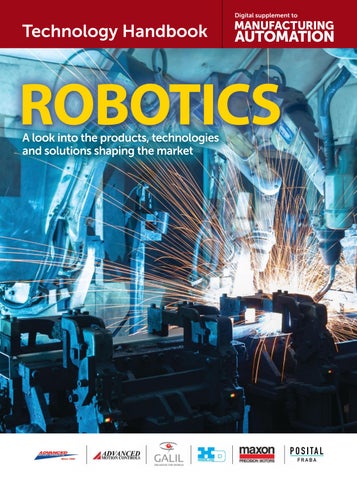
ROBOTICS A look into the products, technologies and solutions shaping the market
Technology Handbook | ROBOTICS
Automate almost anything
F
ounded in 1986, Advanced Motion & Controls Ltd. is a North American Market leader in the field of Industrial and Factory Automation. Our unique organization has grown from a singleperson 1000 sq. ft. Industrial unit (selling industrial supplies door-to-door) to over 34,000 sq. ft., two-thirds of which is our modern Headquarters location in Simcoe County on Highway 400 in Barrie, Ontario, Canada. The Barrie operation serves as our Sales, Manufacturing and Distribution Center and supports our regional offices in Mississauga, Cambridge, Ontario, Montreal Quebec and our new location in Halifax Nova Scotia. Our organization’s customer-base is engaged in a diverse range of industries including; automotive, telecommunications, computer/IT, furniture, construction equipment and food, beverage and packaging. AM&C prides itself as employer of an innovative professional workforce comprising; Engineers, Machine Designers, Programmers, Assembly & Maintenance Departments and Purchasing & Procurement professionals. Our credo is:
”Solutions for industry on the move!” Universal Robots: Your Collaborative Choice for robots When we say the UR robot can automate virtually anything we mean virtually anything – from assembly to painting, from screw driving to labeling, from injection molding to welding and from packaging to polishing. Find out How…
The UR robots are packed with truly amazing benefits. Take a look for yourself Easy programming: Patented technology lets operators with no programming experience quickly set up and operate our robots with intuitive, 3D visualization. Fast set up: Universal Robots has revolutionized robot setup, reducing typical robotic deployment measured in weeks to a matter of hours. The average set-up time reported by our customers is only half a day. Flexible deployment: Don’t be limited by dedicated robotics. Universal Robots are lightweight, space-saving, and easy to re-deploy to multiple applications without changing your production layout. Collaborative and safe robots: Now you can replace human operators in dirty, dangerous, and dull jobs to reduce repetitive strain and accidental injuries. Eighty percent of the 2 MANUFACTURING AUTOMATION · Technology Handbook Robotics
thousands of UR robots worldwide operate with no safety guarding (after risk assessment), right beside human operators. Fastest payback in the robot industry: Universal Robots gives you all the advantages of advanced robotic automation, with none of the traditional added costs associated with robot programming, set-up, and dedicated, shielded work cells. Finally, robotic automation is affordable for small and medium sized enterprises. Automate virtually anything with a collaborative robot arm from Universal Robots. From gluing and mounting to pick and place, and packaging, a robotic arm can streamline and optimise processes across your production operation.
Omron Adept Robots Omron Adept Technologies, Inc. is a global, leading provider of intelligent vision-guided robotics systems and services. Joining Omron Corporation in October 2015, Adept is now a part of the acceleration of OMRON’s “Complete Automation Solution” strategy for its Industrial Automation Business, which provides automation solutions for the manufacturing industries
Industrial Intelligent Robotics (SCARA, Six-Axis) For 30 years, Adept has been an industry leader in the development of innovative and powerful industrial robots for high-speed, precision manufacturing, packaging, and factory automation. Adept’s industrial robot innovations continue with its expansive line of Cobra SCARA robots, Viper sixaxis (articulated) robots
Adept Mobile Products Adept Mobile products provide the logistical productivity and intelligence currently unrealized through conventional conveyance, transport, and AGV systems. Robots powered by Motivity are people aware and work in existing facilities with minimal to no retrofits. Have a question or would like to discuss automation, we are more than pleased to come and visit and more importantly showcase to you our breadth of product and application experiences.
26 Saunders Road, Barrie, Onatrio L4N 9A8 Toll Free: 1-800-461-5679 www.advancedmotion.com
Cobot Line Up
YOUR CHOICE TO
AUTOMATE ALMOST ANYTHING Now in our 30th year of automa�on experience, Advanced Mo�on & Controls Ltd is your #1 choice for cobo�c and robo�c automa�on.
Universal Robots
Making robot automa�on accessible to all levels of industry We're dedicated to bringing safe, flexible and easy to use 6 axis industrial robo�c arms to business of every size, all over the world. We develop industrial collabora�ve robot arms that automate and streamline repe��ve industrial processes. This approach enables produc�on departments to assign their staff members more enjoyable tasks - crea�ng jobs that provide them with new challenges that add value to the company.
Robot Line Up
Cobra SCARA Series
Contact Us Today...
Viper Six-axis Series
Sales, Manufacturing and Distribution Headquarters 26 Saunders Road, Barrie, Ontario L4N 9A8 TOLL FREE: 1-800-461-5679 www.advancedmotion.com
Lynx Mobile Series
Now with 5 Locations Across Canada
Toronto Cambridge Barrie Montreal Halifax and online
Technology Handbook | ROBOTICS
Motion control considerations for Robotics by Karl Meier, Executive Team – ADVANCED Motion Controls
T
he rates at which physical robots are integrating into society today has increased so much that new categories are being created for their use and general purposes as well as dedicated designs versions compete for acceptability. The future of robots and robotics technologies is an economic area where it can be projected that new companies with new achievements will be some of the largest in the world in a short period of time. Intelligence is key to robots but what makes robots move so they can accomplish the activities they are designed to do is vital to their performance, and ultimately their existence. This brief article introduces the many aspects of motion control needing consideration when applying drive technology to robotic systems and platforms. Any mechanical object that moves generally has a motor for operation. The electric motors incorporated into robotic designs are based on needed torque/force, speed and acceleration/deceleration parameters and are typically going to be either servos or steppers. In industrial robotics platforms, each motor selected will have a controlling drive that operates the motor to ensure required performance. By design and construction of each, servo systems are much more efficient than steppers and offer a much wider operating range. As servo drives are more widely used and accepted, the focus here will be on servo-based motion control. Robots can have many different axes needing motion control and likely will include more than just main mobility of either propulsion or traction. For instance, there can be separate steering, arm extension/retraction, gripping, joint rotation, lifting, haptic feedback, etc. All of these functions usually incorporate a drive specifically tuned for that axis to provide the necessary controlled motion. The drives themselves receive commands from a supervisory controller that also maintains overall functionality of the entire system/platform. Motion control for the entire robotic system has traditionally been categorized into two areas: centralized or distributed. A centralized control scheme requires the controller to continually calculate all torque/force, speed and position commands (called the control loops) for every axis, while simultaneously running complex programs that plan not only the motion profiles but also scan I/O or vision information to maintain complete robot operations. This can place a heavier burden on the processor(s) selected for use and may make the system unmanageable when increasing scalability. In distributed control systems, motor control requirements are placed with the drives themselves and conducted over network communications where the controller merely monitors 4 MANUFACTURING AUTOMATION · Technology Handbook Robotics
activities of the drives with limited computation needed. This allows the controller to operate more effectively and be more available for all other system functions. There are numerous networks to choose from as well as standardized function calls allowing motion control and system functionality to work very closely together. CANopen, EtherCAT, Modbus, Ethernet POWERLINK, PLCopen, etc. offer fully documented methods of getting up and running quickly and greatly reduce development time. As robots need to manage on-board power as much as possible for continued operation, the choice for servo drives is wise as they are most efficient. This includes a power range from 10Watts to more than 50kW! However, and along with the servo motors, drives need to be ‘sized’ appropriately. Since the robot will have a pre-established voltage level available to the drives, sizing relates to being able to provide the minimum current required to allow the motor to maximize its abilities. As well, drives are offered in various platforms to include available back-plane mounted and PCB plug-in module versions, both with standard and extended environment capabilities. Custom designs are also available allowing robot OEMs to ‘think outside of the box’. Custom engineered designs provide the prospect of achieving results not otherwise possible and often at costs less than that of off-the-shelf designs. This information and insight has provided many industries with application excellence using servo driven robots and robotic platforms. For example: Material Handling’s - Palletizers, Sorters, Automated Fork Lifts; Warehousing’s - Storage & Retrieval Systems, Automated ‘Pick & Present’ Systems; Manufacturing’s - Automated Guided Vehicles (AGV’s), Transfer Lines, Assembly Cells; Medical’s – Surgical, Scanning Systems; Homeland Security and Defense’s: Unmanned Vehicle Systems (UVS’s) for Air, Ground and Submersibles, Remote Control Detection; Service’s – Telepresence, Inspection, Repair and Delivery. Many more robots exist and many more are coming. Stay tuned to what the future holds…
ADVANCED Motion Controls® 3805 Calle Tecate Camarillo, CA 93012 Phone: (805) 389-1935 amcleads@a-m-c.com www.a-m-c.com
ELECTROMATE 6221 Highway 7, Unit #15 Vaughan, Ontario, L4H 0K8 Phone (905) 850-7447 sales@electromate.com www.electromate.com
Technology Handbook | ROBOTICS
Raspberry Pi Interface with Galil Controllers
A
n HMI or Human Machine Interface is needed in many motion control applications. These devices are used to allow a user to instruct a machine on what to do without the need of a full PC. There are many sources for HMIs and many can cost thousands of dollars. With the arrival of the Raspberry Pi Foundation and its Raspberry Pi models, a small but powerful option arrived. Adding to this, the official Raspberry Pi 7” touchscreen display, and the Galil application programmer interface this powerful trio form the foundation for an inexpensive but fully capable HMI that can be customized for any motion control application. The following video shows this application in action: http://www.galil.com/raspberrypi The strength of this new HMI option can be found in the software that can be developed to run on it. There are free software tools that can allow a person to create just about any kind of interface to run on the Raspberry Pi. The software acts as the glue to take in the input from the user in the touch interface and the Galil gclib API translates those simple instructions into the commands to send to the motion controller and PLCs. This lowers the bar of entry to something similar to developing a modern mobile phone app. The online community provides plenty of assistance to get started and allows you to create interfaces to run on these fast and inexpensive computers. This example Raspberry Pi based HMI is using the Raspberry Pi 3, the latest version of the Raspbian Linux operating system, Python for its programming language, Kivy for its user interface framework, and Galil gclib for communication with the motion control hardware. The Galil gclib C API can be used on various platforms in many different programming languages. Its function is to communicate with the Galil controller at a higher level and dictate the overall application flow. Because gclib is written in low level C it can be used in other higher level languages such as Python. Galil has provided a Python wrapper and example code to make installing and using the API very easy. Most motion applications can be broken down into the following simple flow diagram.
Mechanical System & I/O & PLC HMI
Motion Controller
In this application a technician enters values into an interface for the material to be processed. The technician enters 6 MANUFACTURING AUTOMATION · Technology Handbook Robotics
Figure 1: Touchscreen and Motion Controller the desired length of material and the number of pieces to cut. The Python application takes in the commands from the technician and relays the information to the motion control system. Its main job is to handle the overall application and rely on the other systems to report success or failure. The motion controller performs the needed motion elements to physically move the motors and cutting tools. A “Cut To Length” screen displays the user interface items needed to modify the cut to length application including entering the number of cuts, the desired length, and the begin button to start the process. The Python application downloads the needed code to the controller and requests information from the controller to display to the user. This application is a powerful demonstration of the advancements in computer hardware that have driven down prices but increased performance. Advancements in software have provided easy to use tools with free and open source programming languages and frameworks. By combining these advancements with Galil Motion Control products, interfaces can be easily made for any motion control application. The Raspberry Pi with touch screen display used in this demonstration cost around $100. All software used in this demonstration is free or open source.
GALIL MOTION CONTROL 270 Technology Way Rocklin, CA 95765, USA galil.com
ELECTROMATE 6221 Highway 7, Unit #15 Vaughan, Ontario, Canada L4H 0K8 Phone: 877-SERVO98 Email: sales@electromate.com www.electromate.com
Galil Motion Control
ALL THE RIGHT MOVES...
...for Ultimate Precision
Galil Motion Controllers handle virtually any application Between our flexible product offering and our affordable custom solutions, we can accomodate all of your motion and I/O needs. Select one through eight axes. Choose internal multi-axis servo or stepper drives. Increase the number of axes and I/O by daisychaining through built-in Ethernet ports. Guaranteed low price per axis with driver included. Galil products are easy to program and use, backed by unparalleled technical support and both ISO 9000 and ISO 13485 certification. • Process commands in as little as 31 microseconds • Handle all modes of motion, simple to complex • Handle ultra-high resolution systems • Support closed loop stepper motors • Up and running in minutes • Use virtually any encoder • EtherCAT master available
SOLD AND SERVICED BY ELECTROMATE
galil.com 1.800.377.6329
Technology Handbook | ROBOTICS
Harmonic Drive LLC ogy results in gears and actuators that have very low weight, yet deliver very high torque. This combination results in gears with exceptionally high torque density and actuators with exceptionally high power density.
Harmonic Drive LLC engineers and manufactures precision servo actuators, gearheads and gear component sets. We work closely with companies of all sizes to understand their application requirements and provide a standard or custom engineered solution to enable the success of their design project.
Design Features of Harmonic Drive® Products Some of the design features that make Harmonic Drive® products particularly well-suited for robotic applications include: •
•
•
With over 50 years of experience, our expert engineering and production teams develop enabling technologies and prod¬ucts to meet the needs of an evolving motion-control market. We are very proud of our outstanding company history. Our highprecision, zero-backlash Harmonic Drive® actuators and gears have, and continue to play, critical roles in robotics.
Performance Benefits for Robotic Applications The majority of the world’s leading robot manufacturers use Harmonic Drive® gears and actuators to take advantage of their superior performance including: • High Accuracy – Standard accuracy of Harmonic Drive gears is <1 arc-minute, but they are commonly manufactured with <30 arc-second accuracy per customer request. • Excellent Repeatability – Typical repeatability is ± 5 arcseconds. • Zero Backlash – Harmonic Drive products inherently have true zero backlash. Lost motion (defined as hysteresis in the low torque region) of the gear is measured by applying ± 4% of rated torque to the output while the input is rotationally locked. Lost motion in Harmonic Drive gears is <1 arcminute and is maintained for the life of the gear. • High Torsional Stiffness – Up to 30% of the gear teeth are engaged at all times, resulting in high torsional stiffness. • High Torque Density – The simplicity of the gear technol8 MANUFACTURING AUTOMATION · Technology Handbook Robotics
Through-Hole Design – Many of our gearheads and actuators feature a large hollow shaft that allows cables, pipes, or coaxial shafts to pass through the center of the gear or actuator. This can greatly simplify a design and improve reliability. Cross Roller Output Bearings are widely integrated in the products and provide high axial, radial, and moment load capacities in a compact space. No Change in Size or Weight with Gear Ratio – Unlike other gear technologies, harmonic gears have the same size, weight, and form factor regardless of gear ratio. This feature allows design flexibility or revisions without the need to redesign the entire mechanism. Reduction ratios of 30:1 through 160:1 are commonly available.
Gears and Actuators in Action Harmonic Drive® gears and actuators are used in a wide range of applications, each of which takes advantage of a different characteristic of the gear technology. Some applications depend on zero backlash and high positional accuracy. Some require a high torque-to-weight ratio. Others depend on the unique configurations available. And some installations utilize all of these attributes.
Harmonic Drive and Harmonic Planetary are registered trademarks of Harmonic Drive LLC.
HARMONIC DRIVE LLC 247 Lynnfield Street, Peabody, MA 01960 Toll Free: 800-921-3332 Phone: 978-532-1800 www.HarmonicDrive.net
ELECTROMATE 6221 Highway 7, Unit #15 Vaughan, Ontario, Canada L4H 0K8 Phone: 877-SERVO98 Email: sales@electromate.com www.electromate.com
247 Lynnfield Street Peabody, MA 01960 800.921.3332 www.HarmonicDrive.net
Electromate Industrial* 6221 Highway 7, Unit #15 Vaughan, Ontario, Canada L4H 0K8 www.electromate.com
Harmonic Drive is a registered trademark of Harmonic Drive LLC. Robonaut image courtesy of NASA/JPL-Caltech. * Electromate Industrial Sales is the exclusive Canadian distributor of Harmonic Drive® products (except the Province of Alberta).
Technology Handbook | ROBOTICS
T
maxon drives set the world in motion
h maxon motor combines electric motors, gears and DC motor controls into high-precision, intelligent drive systems that can be custom-made to fit the specific needs of customer applications. maxon motor helps provide innovative solutions at competitive prices for numerous applications in various markets, such as industrial automation, medical technology, security technology, instrumentation, communications, and consumer applications, among others.
Brushed and brushless configurable DC motors more versions, more power
speeds of up to 120,000 rpm. They run very smoothly and are highly efficient in standard or sterilizable versions (up to 2,000 autoclave cycles). Ideal for use in hand-held surgical tools and industrial spindles. maxon motor’s X drives are extremely powerful and are now available in maxon’s online shop, where customizing the drives is easy. Customers can fit the drives with specific mechanical and electrical components specific to their application needs. It is possible to customize the shaft lengths, winding types, ball bearings and much more. When combined together with maxon encoders and planetary gearheads, you form a high-precision, robust drive system ideal for any application from aerospace to medical to robotics. In fact anywhere that requires a compact, powerful, quiet and strong drive system. The X program is a lean and automated process which ensures that all configurable drives are ready for shipment within 11 working days. In addition, detailed product data may be viewed immediately online and 3D CAD data for the configuration is available for downloading. Visit dcx.maxonmotor.com for more information.
Now even stronger, more efficient and with yet more combination options: There are new additions to the maxon family of X drive products. Several long versions of brushed DC motors, with higher torques and more power, have been added to the product range along with matching planetary gearheads. Each of the 3-stage versions can now be combined with the next smaller motor. This saves space, weight and costs. In addition, maxon launched a brushless DC motor (ECX) line to its configurable online program. These motors are available with diameters of 8, 16 and 19 mm achieving
maxon precision motors, inc. 101 Waldron Road, Fall River, MA 02720 Email: info@maxonmotorusa.com www.maxonmotorusa.com
Offering solutions that fit your customized needs maxon motors manufactures small, high-quality brush and brushless DC motors ranging in size from 4 mm to 90 mm. maxon’s rhombic wound ironless rotor motors provide exceptionally high efficiency, low EMI emissions, fast acceleration, no preferred rotor position, torque constants and long service life. The drive components are assembled and designed within our modular system according to your individual needs. You can combine, according to your requirements, motors with 10 different product classes with planetary, standard or special gearheads, feedback devices, brakes and control electronics.
10 MANUFACTURING AUTOMATION · Technology Handbook Robotics
ELECTROMATE 6221 Highway 7, Unit #15 Vaughan, Ontario, Canada L4H 0K8 Phone: 877-SERVO98 Email: sales@electromate.com www.electromate.com
TRA CONFIGURABLE
Gearhead, motor and encoder tailored to your needs.
11DAYS
READY IN
Assemble your individual maxon DC drive: You can configure the gear stages, the motor bearings, the shafts, the encoder and much more. Design your custom drive online today and your finished drive will ship from Switzerland in 11 working days.
dcx.maxonmotor.com
Technology Handbook | ROBOTICS
POSITAL Introduces Kit Encoders for Servomotors and Rotating Equipment
P
OSITAL-FRABA is introducing a new set of component-level products that are designed to be built into servomotors or other types of equipment when real-time measurements of rotational position and/or commutation signals are required. Based on POSITAL’s well-proven magnetic incremental rotary encoder technology, these new products offer manufacturers a flexible way of building rugged and precise measurement capabilities directly into their products. POSITAL’s new kit solutions for machine shaft position sensing offer a unique combination of accuracy, reliability, cost efficiency and low maintenance requirements. Unlike most optical motor feedback systems, these new products provide full multiturn position measurements without the cost and complexity of gear-driven code-wheels or the extra maintenance requirements imposed by backup batteries. Proven Magnetic Sensor Technology The new motor feedback kits use the same core technology as POSITAL’s well-proven IXARC magnetic rotary encoders. Key components include a compact electronics package, built on a 35 mm diameter PCB, and a small permanent magnet that would be mounted on the end of a motor’s shaft. The electronics package contains four Hall-effect sensors, a powerful 32-bit microprocessor and a POSITAL-developed Wiegand wire system that captures electrical energy from the rotary motion of the magnet. This energy harvesting system powers a rotation counter so that every complete rotation of the motor shaft is reliably recorded – regardless of whether or not control system power is available. No backup batteries or complex gear-trains required! Manufacturing costs for equipment containing the new POSITAL kit encoders are reduced since these devices don’t require the extreme cleanliness and assembly precision that built-in optical encoders demand. And, because the solid-state electronics package is more tolerant of shock and vibration than the transparent code disks and optical sensor arrays found in optical devices, the new POSITAL kit encoders can be relied upon to provide longer, more 12 MANUFACTURING AUTOMATION · Technology Handbook Robotics
CLICK HERE TO LEARN MORE!
trouble-free operating lives. Compared to the optical incremental encoder components used for many precision servomotors, the magnetic sensors are much more tolerant of sensor-to-shaft alignment errors, Small positional offsets are compensated through a built-in electronic self-calibration capability. As a result, there is less need for highprecision assembly techniques and specially-trained staff. The maximum electrical resolution of these devices is 17 bits, with an accuracy of +/- 0.2 degrees. The range of the rotation counter is over one million revolutions. The operating temperature range is -30 to 115 degrees Celsius.
See how it all fits together.
POSITAL-FRABA Inc. 1800 East State Street, Suite 148 Hamilton, NJ 08609, USA Phone: 609-750-8705 info@fraba.com www.posital.com
LINK TO VIDEO
ELECTROMATE 6221 Highway 7, Unit #15 Vaughan, Ontario, Canada L4H 0K8 Phone: 877-SERVO98 Email: sales@electromate.com www.electromate.com
KIT ENCODER
Innovation in Servomotor Feedback POSITAL’s magnetic kit encoders are a rugged, versatile and easy-toinstall alternative to resolvers and optical rotary encoders Muilti-turn capabilities based on POSITAL’s energy-harvesing system eliminate the need for complex gear-trains or backup batteries Easy installation with built-in self calibration Compact and robust design Electrical resolution of up to 17 bits for absolute versions; 16,384 PPR for incremental models
www.posital.com
THE GRIP IS KEY Ramping up robotic assembly line tasks BY TREENA HEIN
R
obotic grippers are an integral part of many manufacturing lines today, and for good reason. They provide, among other things, very different gripping strengths and extensive handling dexterity for handling objects of various sizes, weights and fragility levels. They also allow for quick setup and changeover from one complex assembly task to another, saving critical time and money. This type of gripping technology is exactly what Robotiq of Levis, Que., specializes in. Founded in 2008, the company has steadily grown the markets for its grippers, which can be found in factories worldwide. Robotiq grippers are used for three main tasks: general universal assembly, machine tending (feeding machines and also
placing the completed part for the next step), and product testing. About half of Robotiq’s sales are in North America, with a quarter in Europe and another quarter in Asia. The most common sectors using Robotiq grippers are SME contract manufacturers, general industry component manufacturers, automotive tier, and electronics. “The common need in all these companies, no matter what the sector, is flexibility,” explains Robotiq president Samuel Bouchard. “Companies generally manufacture a lot of different parts and need to adapt their production continuously.” How they work Robotiq makes two versions of its standard 2-Finger products as well as a 3-Finger universal Adaptive Robot Gripper. All of the grippers ensure that both the grip
14 MANUFACTURING AUTOMATION · Technology Handbook Robotics
is correct and that the object continues to be held — intelligent gripping if you will, notes Bouchard. The feedback system for gripping pressure and detecting object presence employs a combination of motor current monitoring and encoder data. In addition, the grippers are electric, which means cycle times can be slashed compared to situations where other grippers are used, according to Bouchard. He says this is because electric grippers only open and close as much as needed, unlike pneumatic grippers which operate only from fully open to fully closed. The electric aspect also allows adjustment of speed, force and finger position. “So, our grippers give more options to the computation software by being able to pick a part from different orientations,” Bouchard notes. “This is a very important aspect in making efficient unstructured picking [bin picking] a reality.” Case studies Before we look at two companies where Robotiq grippers have helped boost automated manufacturing speed and
efficiency, let’s check in on the typical scenario. “Usually companies who go with our grippers install it on a robot for a new cell,” says Bouchard. “Considering the high frequency of changeovers and the high mix of parts, it would be impossible to have an adequate ROI for their robotic cell using the traditional custom tooling approach. Said another way, the use of a flexible Robotiq gripper really leverages the flexibility of the whole cell and makes it really worthwhile.” Genesis Systems Group, a firm that specializes in the integration of robotic cells, needed a solution for an aerospace customer with a machine-tending task where different parts were being produced with an Okuma double spindle lathe. One of the goals was to run the system unattended for the shift — lightsout manufacturing — and a big challenge was the wide range of parts that needed to be produced, parts from less than 1 in. to 6 in. in diameter. Another major challenge was the fragility of some of the finished parts. The feeding gripper needed to be able to pick up blocks weighing as much as 25 lb., but the finished parts could deform with as little as 2 lb. of gripper force and be easily scratched. A gripper that could handle both challenges would be ideal. Genesis designed a series of fingers resident on one Robotiq gripper, with some fingers being used for loading and some for unloading tasks — allowing a single gripper to do everything with no changeover required. The finger position and force could be selected by the robot and automatically controlled during the cycle. While the initial cost of this complex gripper was high, it was
quickly offset by the reduction in tool changer complexity that would have otherwise been required, says Bouchard, adding that it also provides Genesis with great flexibility for future tasks. Inertia Switch is another manufacturer that recently chose a Robotiq solution. The firm produces many types of switches for aerospace, mechanical and electrical products. Bouchard notes that at the time Inertia started to automate the process in question, they decided to create a conventional work cell that is fully guarded and cannot be easily reprogrammed. “The grippers they had were pneumatic and limited to a few parts, and since Inertia Switch makes over 1,000 different parts, they needed a more flexible solution to optimize their machine tending production process,” he notes. “Optimizing this process also meant that any machinist should be able to easily manage the robot system and the gripper with minimum setup time.” Inertia chose the Robotiq 2-Finger Adaptive Gripper because it was the only solution that fits with most of their parts. Bouchard says ROI was achieved in less
than a year and provides new application opportunities going forward. After the installation, Slobodan Todoric, a machinist and programmer at Inertia Switch (pictured left), described the gripper as a “game changer.” “The gripper is very flexible, it can pick up the small parts that we make at Inertia… it’s flexible. You can grab onto many different surfaces, round, square, whatever you want. It’s durable.” Todoric continues, “We got the software and we just loaded it up on the universal robot and it started working and it’s perfect, just plug and play.” Although Bouchard and his team have accomplished a great deal and taken manufacturing automation to the next level, he believes we have only begun to see what robots can do on assembly lines and beyond. “For many years, we have moved so much information into the digital world, and now robots can use this information and act back on the tangible world. There are very exciting things to come.” | MA Treena Hein (treenahein.wordpress.com) is an award-winning Ontario freelance science and tech writer.
Technology Handbook Robotics · MANUFACTURING AUTOMATION 15
Sodecia accelerates robot cell performance for automotive assembly BY SHANE NOVACEK
W
ith 32 manufacturing facilities around the world, Porto, Portugal-based Sodecia is a designer of automated assembly systems for automotive applications. Sodecia strives to deliver high performance and
functionality while keeping cost under control, and says it has increased reliance on PC-based control technology in recent years. Counting 12 of the world’s largest automotive manufacturers as key clients, Sodecia generates the bulk of its business in the auto industry. Sodecia operates globally as a full-service supplier of manufacturing solutions for
16 MANUFACTURING AUTOMATION · Technology Handbook Robotics
chassis, powertrain and body in white (BIW) commodities. In the automotive industry, BIW refers to the sheet metal components of vehicles that are welded together before moving components, such the motor and sub-assemblies have been attached. Based in London, Ont., Sodecia’s Global Tech & Automation Centre (GTAC) delivers automation products and engineering support to the company’s manufacturing divisions. “We pride ourselves on our ability to continue evolving,” says Brent LekxToniolo, control system concept developer, Sodecia GTAC. “Although each
PHOTOS: BECKHOFF AUTOMATION
PC-BASED CONTROL IN THE DRIVER’S SEAT
assembly line built is always slightly different, the core machine technology remains the same.” Unsurprisingly, cutting cost while boosting product quality is the most amplified challenge faced by Sodecia, it says, as the company operates in the demanding automotive manufacturing marketplace. Most competitive integrators rely on the end customer to select, for example, the PLC platform to be used on their projects. Sodecia GTAC says it is “active in selecting best-in-class turnkey automation technologies that deliver optimum results in every application.” The Sodecia GTAC integration group has been automating projects with PCbased control technology from Beckhoff technology since 2008. “We’ve built 49 manufacturing lines based on Beckhoff PC-based control, ranging from machines with a single robot to lines with over 20 articulated robots,” reflects Jon Bysma, controls specialist,
Sodecia GTAC. One of the most recent Sodecia GTAC projects included 21 Kuka robots of various sizes, including payload capabilities ranging from 210 kg, 30 kg and 6 kg. The scale of this project is larger than any other undertaken by Sodecia GTAC. The PC-based control system from Beckhoff handles all sequencing aspects of the assembly line. This includes, for example, controlling fixture clamp/ unclamp sequences, part detecting and error-proofing, calling specific robots into fixtures, and deciding which tasks the robots need to perform. The PCbased controller also handles robot-torobot interference detection, general production count and OEE tracking, while managing overall fault detection and annunciation by acting as the HMI for the machine, and integrating all safety aspects of machinery, such as e-stops, safety gates and light curtains, among others.
Higher automation horsepower, more safety While Kuka KR C4 controllers handle the motion control for each robot, TwinCAT PLC software running on one Beckhoff CP6202 panel coordinates the entire 21-robot welding cell. “As a strong sign of continuity, Sodecia has been using the same Beckhoff panel PC type since 2008,” says Toniolo. “The device is cost-effective, robust and highly reliable.” Sodecia used software libraries in TwinCAT to speed programming of the robot work cell. “The TwinCAT development environment and Sodecia’s modular code framework based on Structured Text greatly reduced engineering time,” recounts Rob Remillard, lead controls engineer, Sodecia GTAC. “In TwinCAT, we can quickly develop sections of code in any of the IEC 611313 languages, prove them out and deploy instances of code for evaluation.”
Technology Handbook Robotics · MANUFACTURING AUTOMATION 17
EtherCAT industrial Ethernet technology also factors heavily in the application, handling all robotic communications, the full I/O system and programmable safety functions via the Beckhoff TwinSAFE line of safety I/O terminals. Sodecia GTAC uses TwinSAFE on all the company’s designs. Integrating 228 devices, this machine in particular is one of the largest TwinSAFE deployments in North America, notes the company. “We stress modular machine designs to streamline safety configuration,” Toniolo adds.
“Running all the PLC tasks and HMI software in one PC-based controller saves significant floor space on its own.” Sodecia even uses TwinSAFE technology for safe robot teaching. “During teaching and program verification procedures, the robot technician(s) are in a safeguarded space and TwinSAFE handles robot-to-robot lockout,” Bysma explains. Sodecia manages changes to the robotic assembly cells — if the enduser wishes to safely move a robot while any changes are made, functionality can be disabled by the safety master to prevent servo power from enabling that robot. Each major automated component in the Sodecia GTAC robotic assembly line is connected to an EL6900 TwinSAFE logic terminal and a series of EL1904 and EL2904 safe digital I/Os to handle the processing of the safety signals, as well as communication with other safety equipment. Safety functions include e-stops, machine monitoring, “And” and “Or” functions, and decouplers. The assembly line’s offline nut welders also feature motion safety functions such as STO (Safe Torque Off) and SS2 (Safe Stop 2), as well as two-hand function for machine initiation. Sodecia 18 MANUFACTURING AUTOMATION · Technology Handbook Robotics
ability to generate methods of diagnostics that are simply not available with other fieldbuses,” Toniolo says. “For just one example, we’ve used information from EtherCAT to localize cable breakage right down to the exact cable in the line, resulting in indicators that blink on the HMI.”
Auto plant savings hit the accelerator
L to R: Calvin Wallace, regional sales manager, Beckhoff Automation; Jon Bysma, controls specialist, Sodecia GTAC; Rob Remillard, lead controls engineer, Sodecia GTAC; and Brent Lekx-Toniolo, control system concept developer, Sodecia GTAC.
The entire 21-robot welding cell is coordinated by TwinCAT PLC software running on one Beckhoff CP6202 Panel PC with a 15-in. screen that is equipped with an Intel Celeron ULV processor.
GTAC integrated Beckhoff AX5103 EtherCAT servo drives with AX5805 TwinSAFE drive option cards in the nutwelder equipment, providing motion control for the application of nuts to the stampings used in the main assembly. Machine-mountable EtherCAT Box I/O modules in IP67 protection are also used throughout the Sodecia assembly
line. The EP1908 TwinSAFE EtherCAT Box boasts additional safety connectivity to switch plates at each safety gate entrance. Various EtherCAT Box modules are also used in non-safety technology settings, connecting to sensors, cylinders, air pressure switches, solenoid valves and other devices. “EtherCAT has given Sodecia the
Because unscheduled downtime in the automotive industry is especially pronounced, Sodecia says it puts “herculean efforts” into harnessing the best technology available and putting it into a “very robust, reliable and quickly-commissioned package for their high-profile clients.” “The new PC-controlled manufacturing line has achieved an average cycle time of just under 50 seconds and can produce 72 complex parts per hour and up to 355,000 parts per year,” explains Toniolo. “Today, it is automation technology from Beckhoff that has proven most capable in helping Sodecia GTAC maintain this throughput.” As a result of the functionality in PCbased control and EtherCAT, Sodecia GTAC has reduced time to market “significantly,” cutting control system commissioning time by 50 per cent, according to Mark Mierkalns, plant manager, Sodecia GTAC. “For example, a simple one or two robot system from Sodecia with four operator stations would normally take up to two months to complete from a PLC configuration and programming perspective. Through the use of TwinCAT, this timeframe has been slashed down to two weeks.” Freeing up plant floor space is another area of improvement. “Running all the PLC tasks and HMI software in one PC-based controller saves significant floor space on its own,” continues Mierkalns. “Integrating safety technology into one universal control platform is another key enabler. I suspect if we went back to a traditional architecture with separate PLCs, HMI hardware and safety system, the control platform footprint would be 50 per cent larger than it is today.” | MA Shane Novacek is the marketing communications manager at Beckhoff Automation LLC. For more information, visit www.beckhoff.ca or www.sodecia.com.
Technology Handbook Robotics · MANUFACTURING AUTOMATION 19
DIGITAL TRANSFORMATION Connected manufacturing benefits manufacturer and customer alike BY SEAN RILEY
T
oday, and more than ever in the future, technology is sitting right at the heart of the manufacturing industry. Through digital advancements, the scope for revolution is enormous, and for those who recognize that digital transformation is the only way to survive and thrive, the time to strike is now. Much is being written about smart manufacturing or Industry 4.0 — the next industrial revolution — yet few actually understand the holistic benefits this trend can provide to the entire value chain. In essence, smart manufacturing is the fusion of the online world — its capabilities for real-time insight, connectivity and interactive communication — with existing manufacturing production capabilities and processes. All underpinned by a combination of software, sensors, processors and communications technology, or a digital manufacturing platform. With smart manufacturing, machinery
and equipment will no longer simply govern and drive the production process, they will be capable of continuously optimizing the production process and also connecting it to the outside world: the enterprise, customers and suppliers. The production process will give off enormous amounts of data that can be used to optimize quality, yield, energy utilization and uptime by understanding and adjusting current performance while predicting future needs, such as remaining useful life for components and equipment. The Industrial Internet of Things (IIoT) is a key enabling technology as it provides the data for continuous streaming analysis. But analyzing and optimizing production efficiency is only a single outcome of the larger objectives for smart manufacturing. The real purpose is the merging and harmonizing of data, robotics and people — with the main goals of improving customer value, productivity and product quality across the entire enterprise, not just the shop floor.
20 MANUFACTURING AUTOMATION · Technology Handbook Robotics
The role of robotics In a smart factory, intelligent manufacturing equipment is connected to a series of modules that can communicate with operators, as well as with each other. Each module performs a different task and can be rearranged in any order. These modules are able to understand when it’s their turn to carry out a task, and have the ability for new modules to be added at any time. Each piece of equipment can self-assess, self-regulate and communicate a constant stream of accurate data about its activity. When building a circuit board for instance, a programmable logic controller (PLC) can tell a paintbrush that is applying adhesive to one side of a semi-conductor wafer to depress the brush by a specific level and to apply 1/16-inch worth of adhesive. In reality, the brush will degrade and more or less adhesive may find its way onto the back of the wafer. Testing can determine on intermittent variables when the brush may need to be replaced, but that takes time and isn’t exactly foolproof. In connected manufacturing, maintenance technicians understand when to take action because brush wear is understood and remaining useful life is predicted based on vibration during application, adhesive usage or other factors used to
determine adhesive application quality. Through this one example, it is easy to see how efficiencies in production can be made almost immediately. While advanced robotics are critical pieces of equipment, proper smart manufacturing also requires people to work alongside the automated equipment where appropriate, to allow for more flexible production. What makes a factory truly smart — and not just an efficient production line — is the ability to use the data coming off the sensors, in real time to improve operational efficiencies inside and outside the plant. Being able to see and react to customer and supplier data immediately becomes the core of a well-functioning, smart supply chain hub. Advanced robotics will bring about a future where humans will work alongside robotics in combined work cells without a fear of injury, as the robots will be smart enough to not only avoid humans, but interact with them. The technology underpinning this will be similar to the smart cars that can drive themselves or, at a minimum, avoid collisions. This will enable a new level of flexibility in manufacturing as there will be cases when extra flexibility is required — for example when the production requirement is extremely small or a short time frame exists, and the requirements cannot be entered into the advanced robot. Interestingly enough, this also changes the requirements for labour in production as these positions will require an individual to be able to perform a large variety of tasks with speed and consistent quality, most likely resulting in a wage increase to find and retain the right persons.
Maintaining quality control While increasing efficiencies and reducing costs are attractive prospects, the biggest value driver for the adoption of automation is actually the potential impact on product quality. Calculating the tradeoff is actually easier than expected. To do this, data on quality certainty, yield and productivity can be evaluated between manual processes and automation. Where this gets very interesting is that currently this calculation requires understanding the maintenance costs of the automation equipment in addition
to the capital expenditures and cost of capital over the term of the loan. However, connected manufacturing extends beyond the four walls. It provides data to equipment manufacturers and services so they can provide an outcome-based cost model, allowing for the value comparison to be much simpler and the true cost to be aligned with actual requirements, which is uptime, yield, quality and availability. Ultimately, smart factories are about enhanced, more finite control over the production line — ensuring the line is not overproducing, not under producing, and that planned, finished good yield consistently occurs. The potential of 3D manufacturing Although the development and integration of 3D printing, or additive manufacturing, is still in early stages, there is huge potential for its impact on the industry’s future. Plenty of manufacturers are finding uses for it, and it will likely be the last piece in the technology puzzle needed to streamline a facility and maximize production line flexibility. 3D printing is already revolutionizing business for some manufacturers. Rather than buy specially made parts and components, this technology enables production on premise to be a fraction of the cost, whilst eliminating lengthy lead times and intellectual property worries. Some see a future where customized consumer products can be ordered online and manufactured on demand; Amazon is already said to be planning fleets of lorries with 3D printers on board for instant manufacture and delivery, the moment an order is placed. The real significance of successfully implementing 3D printing on the factory floor is the potential to incorporate customer specific components and items put together without disrupting the production line. Smart 3D printers will pave the way for mass customization — the ability for manufacturers to make huge amounts of product that are very personalized. This, coupled with the data stream coming off the sensors on the production line, will allow customers to make changes to their product orders and afford suppliers the ability to react within reason.
Let’s digitize The vast majority of manufacturers have not gotten further than the initial stage of making their factories smart — a process which should begin by pursuing technology with less critical, slower moving SKUs. This is where manufacturers can begin to iron out the kinks and realize the true potential of robotic technology, 3D printing and a flexible, digital manufacturing environment. Technology has enabled businesses to collect and analyze more data about their customers than ever before. It has also facilitated a two-way flow of information, meaning customers can communicate with brands as much as brands can communicate with customers. With real and deep insight, manufacturers can create products, services, pricing models and business processes that best suit their customers and offer a level of service that puts them ahead of the competition. At the end of the day, the goal of moving towards intelligent manufacturing is to deliver the customer exactly what they want, at the price they want, while still maximizing efficiency and productivity as an enterprise. For manufacturers, being able to control, customize and manipulate capacity based on what components and products are coming off the product line allows them to shift capacity from one product to another without bankrupting themselves — a reality hitting home for more companies recently. As manufacturers around the world aim to meet increasing customer demands, smart factories will be the key to success. Harnessing the power of robotics and intelligent manufacturing technology will provide greater agility, efficiency and flexibility to deliver customized products without pushing the limits of capacity. There has never been a time riper for companies to invest in smart technology, and those able to digitize will find themselves at the head of the pack. | MA Sean Riley is the global industry director, Manufacturing & Transportation at Software AG. His focus areas include value discovery and enablement; process improvement; financial and economic modelling; and collaboration enablement. He has more than 10 years of experience in supply chain related fields with a specific focus on logistics operations.
Technology Handbook Robotics · MANUFACTURING AUTOMATION 21
DON’T MISS OUT on your next issue of
IT’S FAST, IT’S EASY AND IT’S FREE! DICK MORLEY: A glimpse into the many facets of the esteemed “Father of the PLC.” p.18
TRAINING: How you can SPOT THE DIFFERENCE: attract millennials and How to choose the right lighting for machine vision simultaneously boost your applications. p.26
business. p.17
AUTOMATION SOFTWARE: Four big-picture benefits of PLM for small manufacturers. p.24
Defence-in-Depth Best practices to help industrial operators deploy the internet of things securely and reliably. p.22
Couldn’t attend this year‘s Hannover Messe? Catch up on standout moments from the action-packed fair. p.26
LESSONS LEARNED: Tips for how you can avoid pitfalls and make the best decisions in automation. p.28
AutomationMag.com
Your resource for Canada’s industrial automation news
Your resource for Canada’s industrial automation news
Machine safety: how you can prepare for the upcoming Ontario machine safety blitz. p.21
PC-BASED CONTROL
AutomationMag.com
AutomationMag.com
Your resource for Canada’s industrial automation news
PM 40065710
spOtlight: highlights from our fireside chat with nathalie pilon, aBB canada managing director. p.15
HANNOVER WRAP-UP:
IN THE DRIVER’S SEAT
Top 5 in 2016 from 3D printers to industrial sensors and the internet of things (iot) — key trends and technologies that will impact your plant floor this year. p.16
MARCH / APRIL 2016
A RECIPE
PM 40065710
FOR GROWTH
JUNE 2016
Sodecia uses PC control, EtherCAT and programmable safety to accelerate robot cell performance for automotive assembly. p.22
Think Allied for Industrial Automation. More Brands. More Products. More Solutions. See it all at thinkallied.com/industrialautomation
AlliedCover_MA_Jan.indd 1 1 2016_MA_MAR_APR16.indd
JAnUARY / FEBRUARY 2016
Our editorial advisory board discusses the challenges in Canada’s manufacturing future, and how to overcome them p.18
Think Allied for Industrial Automation. More Brands. More Products. More Solutions. See it all at thinkallied.com/industrialautomation
2015-12-23 12:20 1:58 PM 2016-03-02 PM
pM 40065710
AlliedCover_MA_Jan.indd 1
2015-12-23 1:58 PM
Think Allied for Industrial Automation. More Brands. More Products. More Solutions. See it all at thinkallied.com/industrialautomation
2016_MA_ISSUE.indd 1 1 AlliedCover_MA_Jan.indd
2016-01-07 2015-12-23 2:29 1:58 PM PM
HERE’S HOW: FOR FASTEST SERVICE VISIT
AutomationMag.com AND CLICK THE SUBSCRIPTION BUTTON
AutomationMag.com