THE AGE OF RESILIENCE: Canadian manufacturers selling products into the EU need to rethink cybersecurity. p. 16
LEAPFROGGING INDUSTRY 4.0:
Paul Hogendoorn examines how AI laggards may be primed to come out ahead. p. 22
OPERATIONAL IMPROVEMENT IN MOTION: Using motion systems as a tactical business asset. p. 7
Your resource for Canada’s industrial automation news
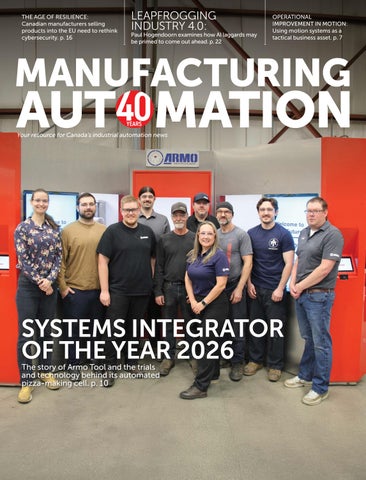
SYSTEMS INTEGRATOR OF THE YEAR 2026 The story of Armo Tool and the trials and technology behind its automated pizza-making cell. p. 10
THEY'LL SELL YOU LEAD TIMES. WE'LL SELL YOU SOLUTIONS. For more than thirty years we have been the escape hatch for many operations that were tired of markups, minimums, and “we’ll get back to you.” With us, you get industrial controls, from fuses to motors, sold straight to you with upfront pricing and inventory levels, not on-the-fly price calculations to protect a margin.
PLCs - HMIs - Drives - Motors - Motion Control - Enclosures - Wire/Cable - Sensors - Circuit Protection - Fluid Power - Pilot Devices - Communication - Power Products - Safety - Power Transmission - Much More!
QUALITY PRODUCTS AT GREAT PRICES. Many of our products are sourced in the U.S., and we pick the rest because they can survive a real factory floor. With live stock levels and live pricing there is no quote theater, what you see is what you pay.
DOWNTIME DOESN’T WAIT AND NEITHER DO WE. Shipping is fast, and free for orders over $49. With more than 45,000 items ready and waiting, and warehouse automation built to fire orders out, you'll get ahead of competitors that are waiting on a call back.
STUCK? TALK TO SOMEONE WHO’S BEEN THERE. Don’t pay $150 for a “tech visit” to learn the DIP-switch setting. Get FREE support from people who have turned wrenches and chased faults themselves.
ALL THE INFO WITH ZERO GUESSWORK. Guessing is how a $40 part turns into a wasted afternoon. Every spec, manual, video, selector, and CAD file is online 24/7, so you can size it, check it, and buy with confidence.
NO HASSLE RETURNS If the product isn’t right, you’re not stuck with it. Almost every stock item carries a 45-day money-back guarantee, and warranties on many products run from one year to lifetime. Spec it, run it, and send it back if it doesn’t earn its keep.
Research, price, buy at: www.automationdirect.com
Orders over $49 get FAST FREE SHIPPING Our shipping policies make it easier than ever to order direct from the U.S.!
Fast, FREE shipping on most orders over $49 U.S., including brokerage fees. Most Canadian destinations receive delivery in 2 to 3 days. Excludes LTL shipments. See restrictions and details: www.automationdirect.com/canada All prices shown are U.S. Dollars
Order Today, Ships Fast! * See our Web site for details and restrictions.
© Copyright 2026 AutomationDirect, Cumming, GA USA. All rights reserved.
1-800-633-0405
the #1 value in automation
November/December 2026 Vol. 41, No. 4
DEPARTMENTS 4 From the editor 5 Automation upfront
10
The latest industry news, deal makers and movers and shakers
COLUMNS 14 Software
CONTENTS
Diversifying through the noise
22 Industry watch Leveraging AI to leapfrog Industry 4.0
NEW PRODUCTS 20 Machine Vision 20 Robotics 20 Software 20 Servos and Motors 20 Machine and Operator Safety 20 End-of-arm tooling 21 Sensors 21 Machine Building 21 Enclosures 21 Cables and Connectivity
ON THE COVER: PHOTO COURTESY ARMO TOOL
MA_Murr_NovDec26_CSA.indd MANUFACTURING AUTOMATION 1 ·November/December 2026
7
7
Operational improvement in motion Motion systems are evolving from simply managing movement to delivering operational data. How can you use that data to improve your business? By Treena Hein
COVER STORY
10 Systems Integrator of the Year
16
The story of Armo Tool and the trials and technology behind its automated pizza-making cell. By Jared Dodds
16 The age of resilience With the introduction of Europe’s Cyber Resilience Act, Canadian manufacturers selling products into the EU need to rethink cybersecurity. By Jack Kazmierski
AutomationMag.com 3 2026-10-28 2:54 PM
FROM THE EDITOR BY JARED DODDS Your resource for Canada’s industrial automation news
Reader Service
Another year wiser
A
nother year of Manufacturing AUTO- than going in and a number of new industry MATION is in the books, and while connections. At an event earlier this year, a I still have some industry events friend in the industry complimented me on and story ideas coming to close the job I have been doing trying to build a out 2026, I wanted to take the opportunity brand in the manufacturing sector and truly with this editor’s note to round up some of my be the face of this magazine. It meant a lot, thoughts from the year and give you a sneak as it was a goal of mine coming into 2026, peek into where my head is at going into a but it also reinforced the fact that people are looking to put a face to the person on the critical 2027 for Canadian manufacturing. At the time of writing, the governments other side of their email thread. Getting out there and meeting with people of Canada and the United States is a sure-fire way to discover new have announced their intentions opportunities for your business, to resume formal trade talks. This and it’s something I will be emis big news for manufacturers in A deal for the phasizing even further next year. both countries. Alan Arcand, chief sake of a deal, Finally, I am keeping a close economist for Canadian Manufac- rather than one turers & Exporters, said at a recent that is mutually eye on industrial AI. I recently event that 80 per cent of Canada’s beneficial, isn’t attended IFS Unleashed 2026, my second year at the event, manufacturing exports still go to the outcome the U.S., and during a recent trip any of us should and the tone surrounding AI has shifted significantly from the end to Rhode Island to visit a manufacbe looking for. of 2025. The conversation is no turer, I learned that they continue longer centred on the runaway to import 50 per cent of their aluminum from Canada despite increasing costs, train of AI growth leading manufacturers to simply because there isn’t a provider in the believe they have to jump on now or risk being U.S. that can give them the quality they need. left behind. Instead, manufacturers and other Our two economies are inextricably linked, end users are asking the tough questions and tariffs are hurting both sides. However, about ROI and ease of implementation, and, a deal for the sake of a deal, rather than one even as companies go public with some of that is mutually beneficial, isn’t the outcome the most lucrative valuations in the history of any of us should be looking for — the devil business, the answers surrounding that ROI remain murky at best. This is not an indicator will be in the details. Moving to travel, it has become crystal that AI is going away — but some companies clear to me that trade shows are back in a big are starting to emerge as the leaders in the way, and manufacturers and systems integra- space, bringing realized value to manufacturtors alike need to prioritize industry events ers, while others just aren’t cutting it. In 2027, in 2027. I had an incredible year of travel and we’ll look to determine who those leaders in events that took me to Germany, across the the clubhouse truly are. Thank you to the audience for another U.S. and to my own backyard in Ontario. No matter which event I attended, the result incredible year. It’s been an honour, and I was the same — engaging conversation, can’t wait to get started on the next. Happy a better grasp of the concepts coming out holidays and enjoy the issue. | MA CONNECT jdodds@annexbusinessmedia.com
/company/automation-mag
EDITORIAL ADVISORY BOARD JIM BERETTA, President, Customer Attraction and host of The Robot Industry Podcast JONATHAN GROSS, Managing Director, Pemeco Consulting MIHAELA VLASEA, Associate Professor, Department of Mechanical and Mechatronics Engineering and Research Co-Director, Multi-Scale Additive Manufacturing Laboratory at the University of Waterloo SHELLEY FELLOWS, Past-Chair, Automate Canada STEPHANIE HOLKO, Director, Project Development at Next Generation Manufacturing Canada WALTER GARRISON, Former Advanced Manufacturing Business Consultant for City of Mississauga
4
November/December 2026 · MANUFACTURING AUTOMATION
Print and digital subscription inquiries or changes, please contact customer service Angelita Potal Tel: 416-510-5113 Fax: 416-510-6875 email: apotal@annexbusinessmedia.com Mail: 111 Gordon Baker Rd., Suite 400 Toronto, ON M2H 3R1 EDITOR
Jared Dodds jdodds@annexbusinessmedia.com Tel: 416-510-5225 PUBLISHER
Kathryn Swan kswan@annexbusinessmedia.com Tel: 647-339-4880 GROUP PUBLISHER, MANUFACTURING Paul Grossinger pgrossinger@annexbusinessmedia.com MEDIA DESIGNER
Alison Keba akeba@annexbusinessmedia.com ACCOUNT COORDINATOR
Debbie Smith dsmith@annexbusinessmedia.com Tel: 416-510-5107 AUDIENCE DEVELOPMENT MANAGER
Urszula Grzyb ugrzyb@annexbusinessmedia.com Tel: 416-510-5180 CEO Scott Jamieson sjamieson@annexbusinessmedia.com CONTRIBUTING WRITERS Jack Kazmierski, Paul Hogendoorn, Steve Slothouber and Treena Hein Published by Annex Business Media 111 Gordon Baker Rd., Suite 400, Toronto, ON M2H 3R1 Tel: 416-442-5600 • Fax: 416-442-2191
Printed in Canada ISSN 1480-2996 Publication Mail Agreement #40065710 SUBSCRIPTION RATES Canada — $45.61 (+tax) per year Canada — $12.00 (+tax) single copy United States — $103.96 CAD per year Foreign — $118.81 CAD per year ANNEX PRIVACY OFFICER email: privacy@annexbusinessmedia.com Tel: 800-668-2374 Occasionally, Manufacturing AUTOMATION will mail information on behalf of industry related groups whose products and services we believe may be of interest to you. If you prefer not to receive this information, please contact our circulation department in any of the four ways listed above. The contents of Manufacturing AUTOMATION are ©2026 by Annex Business Media and may not be reproduced in whole or part without written consent. Annex Business Media disclaims any warranty as to the accuracy, completeness or currency of the contents of this publication and disclaims all liability in respect of the results of any action taken or not taken in reliance upon information in this publication.
Association Partner
AUTOMATION UPFRONT
automation technology. While this may shift the regional pattern of robot demand, there is no indication that the long-term growth trend in industrial robotics is coming to an end from a global perspective. GOVERNMENT
Federal government expands Productivity Super-Deduction
ROBOTICS
PHOTOS: IFR, MARK CARNEY, GOVERNMENT OF CANADA, X (TWITTER)
IFR releases World Robotics 2026 Report The global operational stock of industrial robots increased by nine per cent to a record five million units in 2025, the International Federation of Robotics (IFR) shared in its World Robotics 2026 Report. This was driven by an 11 per cent jump in annual installations, with factories worldwide installing more than 600,000 new units over the year. “Industrial automation is progressing at high speed,” said Jane Heffner, president of the IFR, in a media release. “The new mark of five million robots operational in factories worldwide is more than double the number seven years ago. The strongest growth is taking place in Asia, followed by the Americas. Europe is moving ahead more slowly.” In Canada, robot installations were up five per cent to almost 4,000 units. The average annual growth rate from 2020 to 2025 was nine per cent (CAGR). Across the rest of North America, the United States surpassed Japan in 2025 to become the second-largest market for industrial robots, following China. Installations of industrial robots in the U.S. grew by 12 per cent to almost 38,500 units, which is the third-highest number recorded in the history of these statistics. In Mexico, robot installations declined by seven per cent to fewer than 5,200 units. This marks the third consecutive downswing year. China has further strengthened its position as the world leader in robot adoption. Annual installations grew by 20 per cent year over
year and now account for 59 per cent of global deployments. The latest figures show that 354,000 industrial robots were installed in China in 2025, exceeding last year’s annual record by almost 60,000 units. Japan took a step back in 2025, despite being the second-largest market for industrial robots in Asia. The country installed 36,219 units in 2025, representing a 19 per cent decrease and moving behind the U.S. globally. Demand for robots is expected to grow slightly, but a major recovery is unlikely in the short to medium term. Germany is the fifth-largest robot market in the world, and by far the largest in Europe. In 2025, it had a 41 per cent share of the total installations in the EU. Between 2020 and 2025, the country’s annual installations across industries grew by two per cent on average per year (CAGR). However, sales fell eight per cent to fewer than 25,000 units in 2025. Global robot demand is expected to continue its long-term growth trajectory. Installations are forecast to rise by nine per cent to 655,000 units in 2026 and reach 806,000 units in 2029. Despite substantial regional differences, with countries such as China, the U.S. and India as strong growth markets, the global outlook remains positive. The need for more resilient supply chains and recent developments in trade and industrial policy in several major economies are resulting in increasing relocation activity in the manufacturing industries. Building manufacturing capacity in high-wage economies and countries facing labour shortages will drive the demand for
MANUFACTURING AUTOMATION ·November/December 2026
Prime Minister Mark Carney has introduced an addition to the Productivity Super-Deduction, originally outlined in Budget 2025, in the form of the Productivity Mega Deduction. This new tax incentive will increase the amount of assets eligible for immediate 100 per cent cost deduction from roughly 15 per cent of assets to more than 65 per cent, including fibre-optic cable, mining property, oil and gas pipelines, software, research and development, computer equipment, aircraft, vehicles and more. In addition, the government is making immediate expensing permanent so businesses can recover these costs sooner. The government said this will lower the after-tax cost of investing and reduce Canada’s marginal effective tax rate (METR) on new business investment to 6.4 per cent from 13 per cent, which the government is calling the lowest of any major economy in the world. In comparison, the Department of Finance said that the OECD average METR excluding Canada is 19 per cent, the G7 excluding Canada sits at 26 per cent and the U.S. at 16.9 per cent. A portion of the capital cost of a depreciable property is deductible as capital cost allowance (CCA) each year for income tax purposes, with the CCA rate for each class of property prescribed in the Income Tax Regulations. CCA deduction rates are generally determined by the class to which the property belongs and calculated on a declining-balance basis.
AutomationMag.com
5
AUTOMATION UPFRONT
The afternoon began with a keynote required to facilitate AI, namely data centres presentation from Aaron Prather, director and sovereign compute, and the opportunities of market intelligence for the Association in this emerging market vertical for manufacfor Advancing Automation (A3). Prather, a turers and automation providers alike. The panel included Christopher Chong, well-known voice in the robotics industry, provided those in attendance with a snapshot founder and chief executive officer of Skeena of robotics performance across North America Data Centers Corporation, a company in the in 2026, which is shaping up to outpace 2025 early development stage of a proposed digital and approach heights not seen since the wake infrastructure campus in Terrace, B.C., and Craig Tavares, president and chief operating of pandemic shutdowns. Part of this growth, across both the contin- officer of BUZZ HPC, an NVIDIA Cloud Partent and Canada in particular, is due to the surge ner company that offers large-scale clusters in robotics adoption from industries outside of with thousands of GPUs. The two experts examined all aspects of the automotive, particularly the automotive parts AI infrastructure question, including why the manufacturing industry. This is an important trend to track, as federal government is putting eggs in the AI automation adoption in automotive has repre- basket, how this investment will affect manusented the vast majority of robot purchases in facturers, how manufacturers will contribute Canada until now, marking a major shift for to the advancement of AI infrastructure and what governments can do to continue on the the country. “The diversification of all the different path toward sovereign AI. “Sovereignty involves more than just locat[purchasing] industries now is allowing the [robotics] industry to continue to grow when ing servers in Canada. It means that you really one industry is having a bad day or a bad year,” need to consider ownership, operational control, applicable laws, security, data governance Prather said. The next editorial session continued the … AI software, we can evolve that in weeks; robotics conversation, with Anthony Caccia- the major electrical connection and data centre tore, founder of the CAS Group, examining the can take a five-year lead time,” Tavares said. Chong concurred, saying, “You can’t just use ironic nature of collaborative applications in a presentation titled The cobot isn’t collaborative. policy to create sovereignty … You’ve got to EVENTS Cacciatore, a participant in Canada’s ISO/ physically build these things and that requires TC 299 robotics standards work, focused on a huge amount of investment, a lot of planning, Future of Automation 2026 why the safety of a collaborative application expertise and knowledge.” shines spotlight on robotics, AI Throughout these editorial sessions hinges on how the tool is being infrastructure used, not the hardware alone, Scan this QR code to were three Application in Action presentations from the event sponsors Manufacturing AUTOMATION hosted the an- and how businesses can ensure watch all the WAGO, Weidmüller and Redzone nual Future of Automation Technology Forum safety and performance as they presentations from QAD, without whom the event on Sept. 23 for more than 170 registrants, up adopt robotics. on-demand! would not have been possible. Closing out the editorial from 130 in 2025. The event examined topics WAGO representative James Lee critical to the advanced manufacturing conver- slate was a panel discussion shared engaging insights on the comsation across this country, including robotics, that brought together experts pany’s PLC agent, designed to provide to discuss the infrastructure artificial intelligence, data centres and more. immediate support without requiring engineers to copy and paste code to external AI tools. In a prerecorded session, Gary Martins from Weidmüller discussed practical industrial AI and how the organization is enabling machine builders and other end users to transform raw data into actionable insights, including predictive maintenance and anomaly detection. Finally, Steven Crews, representing Redzone from QAD, delivered a presentation AI-Powered Applicatons focused on shop-floor continuous improvement through the company’s Champion AI VIDEO-ON-DEMAND AVAILABLE NOW platform, which included multiple case studies and client success stories. | MA
Immediate expensing allows taxpayers to fully deduct the cost of an investment in the year that it becomes available for use. Depreciable property eligible for immediate expensing would include all capital property that is subject to the CCA rules acquired on or after Sept. 15, 2026, except buildings (and additions to buildings) included in CCA classes 1 and 3; property included in CCA classes 14 and 14.1 (e.g., franchises, licences and goodwill), and class 51 (e.g., regulated natural gas distribution pipelines); certain vehicles in classes 10 and 10.1; and property depreciated under Schedules V and VI of the Income Tax Regulations. Immediate expensing would also be available for Canadian development expenses incurred on or after Sept. 15, 2026. Manufacturing and processing buildings would not be eligible for the Productivity Mega Deduction because of the exclusion of class 1 buildings, but would continue to be eligible for temporary immediate expensing as announced in Budget 2025. Property that is not eligible for immediate expensing would continue to be eligible for the existing temporary Accelerated Investment Incentive.
6
November/December 2026 · MANUFACTURING AUTOMATION
MOTION CONTROL
OPERATIONAL IMPROVEMENT IN MOTION Motion systems are evolving from simply managing movement to delivering operational data. How can you use that data to improve your business? BY TREENA HEIN
PHOTO:© SANKAI / ISTOCK / GETTY IMAGES PLUS
I
n order to capitalize on artificial intelligence and the continued development of Industry 4.0, manufacturers need data: high-quality, easy-to-access data. On top of traditional sources, business leaders are looking toward motion control systems as a key provider of that data. Motion control technology is now expanding from simple and precise execution of movement to collecting operational data from across the shop floor. This not only leads to process efficiencies but also informs big-picture business decisions. “Modern motion control systems now leverage drive controllers as intelligent sensor nodes, eliminating external hardware by capturing internal motor telemetry directly,” said Warren Osak, president of Electromate, a specialist distributor of robotic, mechatronic and motion
control engineering products. “This data is processed by edge-friendly, explainable AI models and streamed via the cloud, on-premises architectures or MQTT [Message Queuing Telemetry Transport, a lightweight messaging protocol designed for connecting IoT devices].” The question is this: what types of data can be valuable to industrial operators around motion control? Anand Vishnubhotla, chief technology and software portfolio leader for Process Automation, Honeywell Technologies, highlighted speed, acceleration, stability and torque. “The data provides critical information for closed-loop control in high-performance processes such as trajectories to precise location, but this data also enables connected solutions to deliver more advanced control technology,” Vishnubhotla said.
MANUFACTURING AUTOMATION ·November/December 2026
Example systems One technology platform being developed to gather, transmit and analyze data from motion control systems is maxon MIND, which is now getting finishing touches from Switzerland-based maxon. It’s based on the recognition that motors in modern motion control drive systems are not just actuators but sensors that can provide data for analysis of the condition of the entire system — and potentially other components within it as well, depending on the drivetrain specifics. This AI-based system is designed to monitor and flag anomalies in any drive system application where personal safety, reliability, process quality or user experience must be very precisely maintained. As Claude Jaquemet, maxon’s digital business development manager, explained, those applications span medical sample analysis systems, automated sample-taking, automated surgery, industrial automation, logistics and more. “The application must allow repeatable diagnostic cycles under controlled and comparable load conditions,” Jaquemet said. Here is an overview. Picture a machine of your choice with a drive system that includes an electric motor, gearbox, encoder and master controller. Data is gathered on AutomationMag.com
7
MOTION CONTROL
the master controller, and when a diagnostic cycle is initiated, the controller records data from the motor and enriches it using data from relevant reference cycles it’s already been trained with. The data is further prepared for analysis and then transmitted to the cloud. Here, maxon’s machine-learning model analyzes the data and compares it with the reference state. Any slight deviation detected — in the condition of the entire motion control drive system — is flagged, with explanation. As motion systems continue to become more sophisticated, the key for manufacturers is ensuring they are speaking directly to their operation, rather than remaining untuned or generic. For maxon, this means focusing on individual client design load profiles, usage cycles and environmental conditions, as well as system testing and validation under real operating conditions, allowing them to calibrate models directly to the shop floor. This allows a customer’s specific model to learn what “normal” means through the given machine’s reference cycles. In initial training, various potential fault modes are also included for reference in detecting abnormalities. Training data that might be inaccurate because of motor temperature effects is avoided by keeping a consistent payload, drivetrain configuration and other factors.
degradation within drive system components is definitely feasible, but there may be limits to this depending on drivetrain specifics. This means that faults close to the motor, such as in the bearings or gearbox, are clearly visible in the drive signals, but components farther down the drivetrain (past belts, couplings or high gear ratios) give weaker signals and are harder to tell apart. Having said that, the maxon team expects that within five years, it will be possible to have reliable fault localization for common components and first estimates of remaining healthy operating time. That will involve the use of machine learning combined with physical knowledge of the drivetrain, more real degradation data from test benches and learning transferred between similar drive systems. The maxon team pointed to several factors holding back further development of solutions that gather and analyze data from motion control systems. One is the scarcity of real-world fault data. Others include variable operating conditions and the reality that controllers currently aren’t built to log high-rate data. Another limiting factor is that integrating such systems into customer IT/OT systems still raises cybersecurity and trust questions.
Expanding use
AI with motion
Jaquemet said that detection of faults or
In July, Honeywell Technologies introduced
8
Experion Cognition, a new layer that works alongside the existing control system portfolio so an AI-powered agent can actively manage process aberrations. The AI proactively detects abnormalities and then makes both automated decisions and recommendations to mitigate them. By analyzing data from IoT sensors on various motion control systems, assets such as motors and pumps, and more, it can identify problems before they become outages, Vishnubhotla said. “We ran our first live deployment at a Borouge International Ruwais petrochemical site in Abu Dhabi,” he said, “and we plan to roll the platform out commercially later this year.” In multiple pilot trials at the Ruwais site, the platform was able to make predictions an average of five to 10 minutes before alarm incidents. Looking ahead, Vishnubhotla said integration of AI with real-time data will accelerate operational efficiency as companies invest in physical AI solutions. “This will include everything from assembly to quality monitoring to the logistical movement of products throughout plants,” he said. “The systems themselves will become more agentic and learning in nature. In addition, there will be a significant continued focus on strengthening cybersecurity and having effective guardrails on the path to autonomous operations. Overall, smart and more autonomous manufacturing will be
November/December 2026 · MANUFACTURING AUTOMATION
PHOTO: MAXON
maxon recognizes that modern motion control drive systems are not just actuators but sensors that can provide data for analysis of the condition of the entire system.
strengthened by IoT data sources that use AI to make more-informed decisions.”
Evolutions from academia With every new area of engineering, academics are also pushing the boundaries. In this case, members of the American Society of Mechanical Engineers (ASME), Sagil James, professor of mechanical engineering at California State University, and Kelvin Sunilkumar Kollamolel, founder of engineering consulting firm Ketiv in California, published a pilot study on data from motion control systems as part of the ASME 2025 Computers and Information in Engineering Conference. They focused on PLCs, stating that despite Industry 4.0 advances, the controllers “largely remain isolated as rigid controllers, without incorporating modern technologies like IoT connectivity, cloud computing or data analytics.” Kollamolel and James sought to enhance PLC capabilities to achieve real-time data processing, connectivity and intelligent automation, “demonstrating their potential as intelligent decision-making hubs.” To do this, they integrated PLCs with IoT modules, cloud platforms and analytics, allowing for the collection of operational data, remote processing and analysis of this data informing performance optimization. A team at the University of Bielsko-Biala in Poland also published work on enhancing PLC capabilities in the journal Sensors, combining them with machine vision systems for automated quality assurance. In three scenarios (3D-printed prototypes with controlled defects, inspection of automotive electrical connectors and evaluation of fibre-optic tubes), “detection accuracy exceeded 95 per cent.” In addition, “PLC-level triple verification reduced false classifications by 28 per cent compared to camera-only operation.” Meanwhile, a team at the University of Galati in Romania has taken a digital-twin approach to see how PLCs and other components can be used to validate and optimize manufacturing processes, error detection and more, before the motion control system and other parts of a robotic cell are built or deployed.
failure firsthand or learn about it through a report such as The GenAI Divide: State of AI in Business 2025 from MIT NANDA, which found that 95 per cent of enterprise generative AI pilots fail to scale or deliver measurable impact on the bottom line, leadership has questions surrounding these systems. Many of these questions and failures,
however, stem from a lack of reliable data to drive these projects. Manufacturers need to ask themselves whether they are getting every drop of information they can from their processes and converting that information into actionable decisions. Motion systems have long been seen as just a cog in the machine; we must now ask what stories that cog might tell. | MA
Opportunities for manufacturers The data behind advanced technology and AI adoption projects is, overwhelmingly, negative. Whether organizations experience MANUFACTURING AUTOMATION ·November/December 2026 MA_Festo_NovDec26_CSA.indd 1
AutomationMag.com 2026-10-19 9:30 AM9
Pictured from left: Morgan Woods, Riley Sinasac, Alek Baker, Ben Azzopardi, Darren Page, Steve Cook, Christina Koroll, Ivan Gluscic, Jacob Cook and Ryan Peacock
Whitney, the company started as a tooling shop, getting its name from the specialized industrial metal-coating process known as Armoloy. “They bought a little building that was supposed to be a flower shop, and they couldn’t afford all the land,” Whitney said. “So, they had to buy half of it and subdivide what was there.” Whitney joined in 2000 as a designer and PLC programmer before becoming president in 2008. After a major acquisition of Abuma Manufacturing, a fabrication company, in 2017, the company employs more than 200 people and operates across a physical footprint of 140,000 square feet. Whitney attributes this growth, and its pizza project, to the company’s “Never Say No” attitude. Whitney said a customer would come in wanting tooling made, then ask the next day whether Armo could refurbish a machine. “We’d say, ‘How did you know? That’s exactly what we do!’” he said. “And then a few years later, they would say, ‘Hey, could you build me one of those introduced to push this project machines from scratch?’ ‘How to the finish line and, admittedly, did you know? It’s exactly what tasted some unbelievable pizza. we do!’” This mindset, alongside the From that point, I knew this project would be one I would be vertically integrated capabilities thinking about for years to come. of Armo, led directly to the comBecause of that, I am pleased to pany’s partnership with Donatos introduce you to Armo Tool, this Pizza and Appetronix, and the year’s Systems Integrator of the completion of its 24/7 robotic Year, and share what makes this kitchen cell. project stand out.
DELIVERING THE DOUGH BY JARED DODDS
T
he first meal I had when I moved to Toronto in 2023 was a frozen pizza. Alone, this is unremarkable; what made it special to me was that it was from an automated pizza shop, at a time when limiting human contact was still somewhat of a priority. I watched as my order went through the system, believing this would be the first of many automated pizzas I would enjoy in my new apartment. For anyone who has ever had pizza from an automated provider, you will not be shocked
10
to hear it was terrible. The disappointment stuck with me all the way until September 2025, when Christina Koroll, automation business development manager for Armo Tool, approached me with a project the company had just completed: a pizza-making cell, run entirely by robots, which was installed at John Glenn Columbus International Airport in Ohio. My skepticism was significant. But then I had a chance to visit Armo Tool for a front-row seat, where I checked out the technology, heard more about the problem solving the team
The Armo Tool story Before we dive into the project in earnest, let’s set the scene with the history of Armo Tool. Founded in 1969 by the grandfather of president Ben
The pitch
The client, Appetronix Inc. (formerly SJW Robotics), is a London, Ont.-based food tech company that develops autonomous kitchen robotic systems for the hospitality industry. It was
November/December 2026 · MANUFACTURING AUTOMATION
ALL PHOTOS: ARMO TOOL
The story behind Armo Tool, this year’s winner of Systems Integrator of the Year, and the trials and technology behind its automated pizzamaking cell.
SYSTEMS INTEGRATOR OF THE YEAR
The Armo Tool team worked with customer Appetronix to deliver a fully automated pizza-making cell, making Donatos Pizza for travellers walking through John Glenn Columbus International Airport in Ohio. Pictured here: Ivan Gluscic and Christina Koroll.
approached by Donatos Pizza, an Ohio-based, family-run pizza company, with the concept of an autonomous pizza-making cell. Two years ago, Whitney and his team were called in by Appetronix CEO Nipun Sharma to take a look at RoWok, an Asianbowl robotic cell that was the first venture from the company, manufactured by a smaller integrator. Whitney told Sharma to reach out if another project ever came up. When the opportunity from Donatos was presented, Sharma did just that. The concept was simple: high-quality food (not a robot show with a disappointing output) created by mimicking operations in the back of a restaurant. This is accomplished through a number of single stations with
a robot performing the movements of a human, transporting the pizza from station to station into a final, code-access locker where the customer collects their food. But as any systems integrator can tell you, a simple concept does not immediately mean simple execution.
The execution Because the cell was designed for an airport, the team was limited from the jump in the tools it could use. “We weren’t allowed to use pneumatics or air,” said Ryan Peacock, controls manager on the project. “The original one went to an airport which wasn’t like a factory environment where they have air supplies. So strictly electric across the board.” There are 10 electric actuators
MANUFACTURING AUTOMATION ·November/December 2026
and nine motion control servos in the cell, alongside two NSF-certified FANUC six-axis industrial robots. The entire design is managed by a swath of motion controllers, HMIs and sensors, primarily from Omron. An order placed through a mobile app or touchscreen begins the process, with the first robot pulling the dough from a refrigeration unit (modified by Armo) and rotating the pan 360 degrees as the sauce dispenses before presenting it under the cheese chute. A vision system checks the work after each dispense. “There’s a vision check to ensure the quality of the sauce, the placement is proper, there’s enough sauce on it,” Peacock said. Pepperoni is placed in a circular motion, delivering the edge-to-edge toppings Donatos
requires, before the pie is sent into the oven for a two-minute, 20-second bake. The second robot scrapes it onto a cutting board, slices it and puts it in a container in a customer locker. The whole process takes about six minutes. The initial pain point was the variety of tasks the robots were required to address — human hands are dexterous enough to execute a variety of jobs, while traditional end-of-arm tooling (EOAT) is more focused, often designed to do one particular thing exceptionally well. To account for this, Armo designed custom EOAT, with Peacock emphasizing the importance of being able to work with the pan, the cutting board and the box all with the same level of precision. AutomationMag.com
11
The process begins with a FANUC six-axis robot pulling dough from a customized refrigeration unit and transferring it to the topping distribution station.
Pepperoni and cheese are distributed from Edge-to-Edge, a Donatos promise, with a vision system ensuring an even spread.
Armo Tool developed custom EOAT to ensure the robot could effectively operate across each of the stations.
12
This focus on in-house, robust solutions extended across the entire design. Project manager Morgan Woods said early drafts employed a number of off-theshelf products that existed on the market. The project team progressed away from those pieces of the puzzle as it became clear what worked in theory isn’t what fit best in practice. “They were more of a prototype-style unit versus what I needed, an in-production environment. It has to pass NSF, it needs to be reliable and robust. If there’s power cycling, it needs to be able to handle that. If someone drops something, it
needs to be able to handle it,” Woods said, emphasizing that reliability, while sometimes more costly, is the overarching goal for automated units, particularly in a hard-to-access environment like an airport. Whitney described the starting point plainly. “The single stations from the restaurant are not set up to work 100 per cent of the time consistently,” he said. “Some of those machines were being run by Raspberry Pis or a little foot pedal that fires them. Upgrading the controls and electronics of those stations so that they’re bulletproof, that’s part of what we brought.” Human intervention represented another significant challenge. The solution was designed for a human to enter once or twice a day to restock ingredients. As a project team, Armo had to account for the unpredictability humans can introduce to a streamlined automated system. “We can simulate a test environment and try to stress it. But there will always be something that the operator comes up with that you just did not expect, or even that you tried to train against,” Woods said. “You say put three bags of cheese in, and they go for eight. You have to have the foresight or
After just over two minutes in the oven, another FANUC six-axis robot transfers the pizza to the cutting and boxing stations, before placing it in a locker for customers to collect. November/December 2026 · MANUFACTURING AUTOMATION
SYSTEMS INTEGRATOR OF THE YEAR
retroactively capture those changes. “A lot of additional defence against operators was added,” she explained. Whitney has seen it firsthand. “The next thing you know, they [operators] pushed the robot out of the way. They didn’t put the trays in properly. They scrubbed the trays so hard that they’re no longer non-stick and the dough won’t come off of the tray.” Peacock said that, because there is no technician on site, the controls team had to make the cell recoverable by anyone. “There’s no operators. There’s nobody maintaining it. So, we had to have kind of a single button of recovery,” he said. “Finding all those scenarios, working through all those different situations was very time-consuming.”
The outcome So, through all the trials, tribulations and team execution, what was the final deliverable? The automated pizza cell was installed in June 2025 — since then, it has served more than 15,000 fresh pizzas. The project was such a success for Appetronix and Armo that they are creating other automated food cells, including a Mexican bowl concept. The cell I toured was the second unit, with a third close behind, both of which feature improvements based on the company’s lessons learned. “A lot of the change between the first unit and the second unit was actually restructuring how we were handling spare parts,” Woods said. “Whenever possible, we got rid of belt drives so that we could have direct drives and fewer things that could provide failure points.” The team also standardized drives and sensors and split the outbound mechanisms into separate stations after seeing binding on an integrated table. The automated nature of the cell has proven integral — Woods shared an anecdote about a snowstorm last winter that shut down every other food outlet at the airport, leaving Donatos as the only option. Even on days when the weather cooperates, passersby are fascinated by the robots. Ray Schott, co-founder and chief innovation officer of Appetronix, watched one man order a pizza, collect it from the locker and offer it to the next person in line. He had already eaten lunch, the man explained: “I just wanted to see how it worked!” “People assume that it’s just a frozen pizza that we’re reheating,” Schott said. “And they come in and they look at it and they go, ‘Oh, wait a second.’ And then it goes in and
they’re like, ‘That’s not a frozen pizza,’ and we’re like, ‘No, it’s not.’” This project speaks to the ingenuity and performance of the entire team at Armo — if the food didn’t taste good, the novelty would wear off, as it did for me. Having punched in a code myself and tasted the pizza this solution is producing, I can assure you the
end product is anything but novel — it’s an encapsulation of what Canadian systems integrators can provide when presented with a challenge. Congratulations to the entire team at Armo. And for anyone passing through John Glenn Airport, give the pizza a try — it’s certainly worth the dough. | MA
Control the Flame. Protect the process with PNOZmulti 2 Burner
** Call your Pilz expert for a chance to taste our Burner Management Hot Sauce and discuss your application **
For more information
MANUFACTURING AUTOMATION ·November/December 2026 MA_PilzAutomation_NovDec26_CSA.indd 1
AutomationMag.com 13 2026-10-08 9:09 AM
SOFTWARE
Steve Slothouber is an automation veteran with more than 20 years of experience working as a controls lead and project manager on large-scale automation projects. He is the founder of EmberOps, which builds CRM, quoting and sales systems for machine builders, system integrators and component suppliers in industrial automation. He has also built EmberApps, an end-to-end quoting tool for applications engineers at machine builders and integrators.
BY STEVE SLOTHOUBER
Diversifying through the noise
F
Farmers asked to hunt
Most sales teams in industrial automation have gotten used to repeat work, vendor referrals and managing existing accounts. They’re farmers. Now they’re being asked to hunt again, something many of these companies haven’t done in years. Hunting today looks quite different than it did 15 or 20 years ago, and that’s where many people get discouraged with outreach. They try a single call, email or message and expect it to bring business in the door. Winning business in a new industry takes consistent, contextual follow-up, and most people run it on memory and Outlook. A six-month follow-up on a sticky note gets buried, and you only remember when something prompts you, usually too late. Calendar reminders help, but at the volume it takes to break out, they just add to the noise. Hunting is difficult without the right systems and strategy. It takes precise targeting, relevant messaging and volume to cut through the noise. 14
What a CRM should do
It starts with understanding your ideal client profile. Which industries do you want to get into? Which geographies? Who are the action people you need to be reaching out to?
Everyone is inundated with notifications, emails, calls and Teams messages across more tools than ever, and very little of it is structured. A good customer relationship management (CRM) software cuts through that noise and serves up only what’s important. For a sales rep, that means seeing what needs to be done today, with all of the context attached. They can come back to a prospect, get up to speed quickly and know the next move. They make the call or send the email, set the next follow-up and move on to the next one. The measure I use is prospects touched per hour, meaning how many prospects a rep can reach with a relevant, contextual message. In my work with machine builders, integrators and component suppliers, getting there comes down to six practices. Know who you’re chasing
It starts with understanding your ideal client profile. Which industries do you want to get into? Which geographies? Who are the actual people you need to be reaching out to? The plant manager, the manufacturing engineer, the maintenance team, the director of operations or production. You need to get very clear on who your avatar
is. Scoring is what helps you prioritize the right opportunities. When leads and deals are scored against your ideal client profile, reps know where to spend their time first. Track the pain
When I look at people’s cold outreach, they often lead with everything about themselves, and that rarely works. Prospects don’t want to have to piece together how you can help them. They want to know, “How does this serve me?” What works better is articulating the problems they go through, clearly and succinctly. If you can articulate their pain, they’ll inherently see you as someone who can solve it. Picking up on that pain and asking the right questions is a muscle teams have to build, and call transcripts are one of the best sources for it. Tracked in the CRM, those pains are visible to every rep before the next conversation, and to marketing, which needs them to get your positioning right. Plan for seven to 15 touches
Most teams don’t reach out or follow up nearly enough. It’s really the farmers who have lost this habit. You need at least seven touches with a prospect, and automated email sequences don’t
November/December 2026 · MANUFACTURING AUTOMATION
IMAGES:© SABELSKAYA / ISTOCK / GETTY IMAGES PLUS
or many Canadian machine builders, integrators and suppliers, the automotive industry has always come down to price. Three quotes on every request, with everyone pushed to the bare minimum. And now, with tariffs, many companies are rethinking the longterm viability of participating in the industry. They’re looking for greener pastures. Most shops trying to diversify are going after life sciences, food and beverage, aerospace, defence or nuclear. For many of them, the technical leap is a small one. But getting conversations in those industries is a much larger task. They have a much higher barrier to entry than automotive. It takes far more outreach than shops are used to. Nurturing cycles can stretch half a decade from concept to purchase order, and winning takes patience and consistency.
has nearly doubled in size. The CRM is where reps live, so it should already be up to date for pipeline reviews, without any prep. That only happens if it’s easy to use and serves the rep rather than the manager. Useful AI embedded in the CRM helps here: reps just talk to it, and it updates every field for them. Get visibility
count. The best reps I know will reach out up to 15 times before they give up. That’s the level of persistence it takes to win better-margin work in new markets. That persistence is only sustainable when the CRM serves up the history and the next move, so reps aren’t digging for context every time. Watch your current accounts
For component suppliers, the bigger challenge is often properly servicing the accounts they already have. One supplier we worked with had no idea one of its customer’s branches had stopped ordering. It had quietly gone silent, and no one caught it. As one of their people told me, “I totally forgot about them. We service all of their other branches, but they just kind of stopped.” We solved that with an automated flagging system that analyzes sales history and puts a customer on the reps’ dashboard when they’re slowly dropping off or have stopped abruptly. Now the reps know about it while there’s still time to act. By the end
of the third quarter, the supplier had already set an all-time sales record, beating last year’s total. Cut the friction
Quoting is where friction costs the most. Your quote is the prospect’s first true glimpse into your engineering and your turnaround.
MANUFACTURING AUTOMATION ·November/December 2026 MA_Accutron_SeptOct26_CSA.indd 1
Individually, friction points look like little things. Together, they drag on the sales process, making it harder to win new clients and to service existing accounts. For one machine builder we work with, removing friction meant automating folder creation for quotes, tracking revisions and integrating with their ERP. When a deal closes in the CRM, the project is created automatically with all of its information, budgets included. Quoting is where friction costs the most. Your quote is the prospect’s first true glimpse into your engineering and your turnaround. It’s the real first impression, and it’s how they’ll gauge your capabilities. That’s true in every industry, and when you’re new to one, it may be the only impression you get. Since cutting that friction, especially around quoting, that machine builder
Once the friction is gone, the CRM can show you what’s actually happening. Machine builders have a constant struggle with feast-or-famine cycles. With a clearer view, you can react to the dips and make hiring decisions based on data instead of gut feel. For suppliers, it’s visibility into their accounts: who’s actually giving them the most orders, versus who’s just poking them for quotes. One supplier we worked with connected its ERP and CRM so they could see exactly that. Once they understood where their best opportunities were, the company went from about $4 million in our first year together to about $7 million so far this year. Cutting through the noise
Diversifying out of automotive may be a small technical leap, but breaking into a new industry takes years of follow-up, all while protecting the accounts you already have. That can’t run on memory and sticky notes. It takes persistence, the hunger to hunt again and a system that cuts through the noise to serve up what’s important. | MA
AutomationMag.com 15 2026-08-18 10:24 AM
CYBERSECURITY
THE AGE OF RESILIENCE With the introduction of Europe’s Cyber Resilience Act, Canadian manufacturers selling products into the EU need to rethink cybersecurity. BY JACK KAZMIERSKI
The horizontal nature of the CRA means it establishes cybersecurity requirements across sectors.
For automation companies, its reach can include products such as PLCs, HMIs, industrial PCs, robot controllers, sensors, actuators, connected machinery and software. According to João Paulo Vaz, machinery safety consultant and training advisor with Pilz Canada, the regulation generally applies to products with digital elements whose intended purpose includes a direct or indirect logical or physical connection to a device or network. “Put simply, many industrial products that process, store or exchange digital data will be subject to CRA requirements,” Vaz said. He explained that the CRA requires manufacturers to integrate cybersecurity throughout the product lifecycle, from design
and development to vulnerability management, security updates and post-market support. That lifecycle approach is also central to the ISA’s position. “At the end of the day, a secure product lifecycle is essential. It has been for decades, and CRA compliance is intended to further support that,” Fallon said. For companies already working with ISA/IEC 62443, the transition may be less disruptive than for organizations starting from scratch. “Our experts have suggested that suppliers who are already certified against ISA/ IEC 62443 using stringent certification programs, like those offered by ISASecure, may be 80 to 90 per cent of their way toward meeting corresponding requirements in the CRA,” she said.
PHOTO:© PIXINOO / ISTOCK / GETTY IMAGES PLUS
F
or Canadian manufacturers selling into Europe, cybersecurity can no longer be treated as something to address after a product has been designed and built. It needs to be part of the process from the outset. The European Union’s Cyber Resilience Act (CRA) is bringing cybersecurity requirements directly into the product development process, with implications extending from initial design and engineering through production, deployment, vulnerability management and endof-life. The CRA will be fully applicable on Dec. 11, 2027, but important reporting obligations are already in effect. For Canadian companies supplying products to the European market, that means waiting for the final deadline is not a realistic strategy. “ The biggest misconception among non-EU companies is that the CRA is a European problem that doesn’t impact them,” said Claire Fallon, chief executive officer of the International Society of Automation (ISA). “Many assume that being outside the EU, or having no European office, exempts them. It doesn’t. What matters is where the product is sold on the market.”
Cybersecurity: part of product development The CRA is a horizontal regulation, which means it establishes cybersecurity requirements across sectors rather than targeting one industry. 16
November/December 2026 · MANUFACTURING AUTOMATION
For automation companies, the reach of the CRA can include products such as PLCs, HMIs, industrial PCs, robot controllers, sensors, actuators, connected machinery and software.
PHOTO: © TRAITOV/ ISTOCK / GETTY IMAGES PLUS
However, Fallon said that while those companies that already adhere to ISA/IEC 62443 are well-positioned, compliance with these standards does not guarantee compliance with the CRA. “Significant changes are being discussed, and it’s important to educate yourself on the differences,” she said.
into product specifications, architecture, software development, testing, technical documentation and change management processes,” he said. Fallon stressed the need for an ongoing process. “Risk assessment is an ongoing process that you should keep revisiting through design, testing, production and commissioning, using
feedback from the field,” she said. Fortinet’s cybersecurity experts agreed in a statement. “Even though the regulation will not be fully applicable until 2027, it should already be influencing product design and development decisions,” they said. “You cannot simply add security onto an existing product in its finished form.”
Start at the concept stage One of the biggest changes for manufacturers is where cybersecurity enters the product development process. It cannot be added shortly before a product is released. Vaz recommended starting cybersecurity risk assessments during the concept stage, before important design decisions have been finalized. “Manufacturers must adopt a secure-by-design approach, incorporating cybersecurity requirements
“Put simply, many industrial products that process, store or exchange digital data will be subject to CRA requirements.” – João Paulo Vaz, Pilz Canada
MANUFACTURING AUTOMATION ·November/December 2026
AutomationMag.com
17
CYBERSECURITY
Responsibility beyond the factory floor The CRA also changes what happens after a product leaves the manufacturer’s facility. Traditionally, the end of manufacturing could represent a significant handoff of responsibility. Under the CRA, however, manufacturers will have continuing responsibilities related to vulnerabilities, security updates, incident response and post-market support. Manufacturers must monitor for vulnerabilities, assess emerging threats, provide security patches and updates, maintain vulnerability-disclosure processes and communicate relevant security incidents, Vaz explained. They also need to establish an appropriate support period. Vaz said that manufacturers are
“Many assume that being outside the EU, or having no European office, exempts them. It doesn’t. What matters is where the product is sold on the market.” – Claire Fallon, ISA generally required to address vulnerabilities throughout the support period, which normally must extend for at least five years, unless the expected product lifetime is shorter. This creates a practical challenge for industrial equipment manufacturers, whose products may remain in service for many
MODULAR AUTOMATION FROM A SINGLE SOURCE
years. It also reinforces the need for clear lines of responsibility between manufacturers and customers. “The asset owner, however, is responsible for securely deploying, configuring, maintaining and operating products within their own environments,” Vaz said. He used a PLC as an example. The manufacturer is responsible for addressing known exploitable vulnerabilities in the PLC and providing security patches when necessary. The customer, meanwhile, is responsible for securely configuring and operating the device.
Know what is inside the product
Powered by :
MOVISUITE®
Another major consideration is the software supply chain. Modern automation products can contain third-party software, open-source libraries, firmware and other components that the manufacturer did not develop internally. Under the CRA, manufacturers need visibility into those components and the risks associated with them. A Software Bill of Materials (SBOM) can play an important role. “Outsourcing development does not outsource responsibility,” Vaz said. “Manufacturers must understand what software, firmware, libraries, open-source packages and other third-party components are included in their products, where they
18 MA_SEW Eurodrive_novDec26_CSA.indd 1
come from and how they could affect cybersecurity throughout the product lifecycle.” Fortinet’s experts pointed to the growing importance of third-party risk management, noting that recent incidents have pushed supply-chain security concerns to the board level. Enhanced vendor assessments, code verification and continuous monitoring of suppliers are becoming important parts of a resilient product development process.
Reporting is not an afterthought For Canadian companies, one of the most immediate CRA considerations is vulnerability and incident reporting, as these reporting obligations have applied since Sept. 11, 2026. “During the first few hours of an incident, the priority is to verify and triage the issue, determine whether it qualifies as an actively exploited vulnerability or reportable incident, assess its potential impact, identify affected products and software versions, initiate containment measures and begin gathering the information required for regulatory notifications and customer communications,” Vaz said. He recommended establishing a formal vulnerability and incident response process, supported by clear escalation procedures, current product
November/December 2026 · MANUFACTURING AUTOMATION 2026-10-28 2:47 PM
inventories and designated security contacts. A Product Security Incident Response Team, or PSIRT, can coordinate assessment, remediation, communications and regulatory reporting. “The key challenge is not the reporting deadline itself, but having the people, processes, documentation and visibility needed to make informed decisions quickly and consistently,” Vaz said.
Build on existing processes For manufacturers that have not yet established a mature cybersecurity program, the prospect of adding another compliance framework can seem daunting. The answer, however, is not necessarily to create an entirely separate cybersecurity bureaucracy. Much of the necessary documentation can be incorporated into existing engineering and quality processes. Documentation should include security risk assessments, security requirements, software inventories and SBOMs, security testing results, vulnerability management procedures, incident response plans and records of security updates and disclosures. Vaz pointed to IEC 62443-41 as an example of a framework in which many of these activities can already form part of a secure product development lifecycle. Fortinet’s experts recommended approaching the issue through four related capabilities: anticipate, withstand, recover and adapt. That means identifying potential threats before they materialize, ensuring essential operations can continue during an incident, restoring functions after an event and continuously improving the organization’s
approach as threats and technology change. “You need to embed cybersecurity into the core product development and business strategy — this shouldn’t be an afterthought,” the experts said.
Powering What’s Next Engineered Solutions for Motion, Automation and Electrification
Working toward the 2027 deadline Canadian manufacturers selling into Europe have roughly 13 months between now and the CRA’s full applicability date. Fallon compared the situation to the lead-up to the EU’s General Data Protection Regulation. “GDPR is a data privacy regulation with global implications, and many companies found themselves scrambling to comply in the months beforehand, not fully recognizing what compliance would take,” she said. “Companies can’t afford to make the same mistake with the CRA.” Her advice is to begin now while continuing to monitor the regulatory process. “Agility is key,” Fallon said. “Educate yourself on what is already set and what is likely to change.” For a Canadian manufacturer, that can start with a gap assessment: identify products sold into Europe, determine which contain digital elements, map the software and hardware components inside them, review existing security practices and identify who is responsible for vulnerability management and incident response. Fortinet’s experts also recommend that companies stay engaged with industry organizations, standards bodies and policymakers rather than simply waiting for the final rules. “Do not wait for the deadline to begin integrating baseline product security,” they advised. “This should influence your engineering and design decisions right now.” | MA
ENGINEERED FOR YOUR APPLICATION Motion & Drive Systems Precision motion, electric actuation and variable-speed drives Control & Automation Custom control panels, PLC programming and system integration Mobile Electrification Integrated technologies for electric and hybrid mobile equipment
LET’S ENGINEER YOUR NEXT SOLUTION Scan the QR code to learn more 1-888-WAINBEE (924-6233) | WAINBEE.com Motion & Control · Filtration · Automation Solutions
MANUFACTURING AUTOMATION ·November/December 2026
AutomationMag.com MA_Wainbee_NovDec26_CSA.indd 1
19
2026-10-28 2:19 PM
NEW PRODUCTS
MACHINE VISION
real-time action is undertaken. This allows process adjustments to occur proactively while experienced personnel handle the exceptions that require their judgment. flexxbotics.com
iiQKA.AI Vision KUKA Robotics has released its new iiQKA.AI Vision, AI-powered software designed to fully integrate into the KUKA ecosystem. The intelligent software supports both 2D and 3D vision and enables typical applications such as bin picking, assembly, quality control and depalletizing. With drag-anddrop configuration, users can implement productive vision applications without specialized knowledge. For low-latency AI inference and secure, local data processing, iiQKA.AI Vision’s image processing runs as edge computing directly in the controller on the KUKA AI Extension Platform, an integrated computing unit based on the NVIDIA Jetson Orin module. For object recognition in robust processes, the AI algorithms used in iiQKA. AI Vision precisely distinguish objects from the background and automatically calculate suitable gripper points. kuka.com
ROBOTICS AX6 Epson Robots, a provider of SCARA robots, has expanded its six-axis robot lineup with the new AX6 collaborative robot. With the release of the AX6, Epson now offers a full portfolio of robot safety tools, including industrial robots that maximize speed and performance, collaborative robots that maximize worker interaction and redeployability and industrial 20
collaborative tools that balance the two use cases. The AX6 features a customizable Python development environment, end-of-arm multifunctional user buttons and an Ethernet port, a compact, lightweight design and more. It is compatible with multiple power sources, supporting 100 V to 240 V AC and 48 V DC. epson.ca
SOFTWARE
Flexxbotics Platform Autonomous manufacturing platform company Flexxbotics has announced the latest release of the Flexxbotics Platform and a set of solutions designed to help manufacturers increase production capacity, improve yields and reduce downtime by scaling human expertise across multi-site operations for greater levels of autonomy. Instead of simply reporting what already happened, Flexxbotics detects changing conditions, determines corrective responses and enables controlled action before small issues become production losses. Production teams define where software can act autonomously, which automated responses are authorized and when human-in-the-loop approval is required before
EC-i 70 800W Electromate Inc. has announced the Canadian availability of the new maxon EC-i 70 800W brushless DC motor. The motor extends the EC-i family with a 70 mm platform designed for applications that need high output, flexible configuration and a cost-optimized design without the ingress protection and industrial connectors of an enclosed servo motor. Based on the established IDX70 motor design, the EC-i 70 800W is an iron-cored inner-runner motor with an aluminum flange and housing. Integrated Hall sensors are supplied as standard to simplify commutation and system integration. The motor has an open rear side and exposed connectors, making it suited to installations where the surrounding machine or enclosure provides the required environmental protection. The EC-i 70 800W is available in two winding options: 48 V and 60 V. electromate.ca
MACHINE AND OPERATOR SAFETY 3D Dynamic Safety Module Quebec-based palletizing solutions provider beRobox has introduced its 3D Dynamic
Safety Module for its PALTZ robotic palletizers. The new module aims to introduce dynamic movement to safety detection around a robot. Powered by Sonair’s safety-certified ADAR One 3D ultrasonic sensor, the safety module integrates detection directly onto the robot arm. As the robot moves through its workspace, the sensor moves with it, creating a dynamic protective zone that continuously adapts to the robot’s position. By knowing where the robot is and detecting people and objects around it in three dimensions, beRobox’s new safety module can respond according to what is happening within the palletizing workspace in real time. The result is a safety system that can be more selective in how it reacts to operator interactions. berobox.com
END-OF-ARM TOOLING 2FC physical AI gripper Robotiq has launched the 2FC physical AI gripper, a production-ready adaptive gripper with tactile sensing and embedded intelligence, helping robots learn from physical interaction and act reliably on what they learn, from the lab to production. The 2FC physical AI gripper builds on Robotiq’s 2F adaptive gripper, with more than 30,000
November/December 2026 · MANUFACTURING AUTOMATION
PHOTOS: KUKA, EPSON ROBOTS, FLEXXBOTICS, ELECTROMATE, BEROBOX
SERVOS AND MOTORS
deployed worldwide, and adds tactile sensing, compute at the wrist (the AI Hub) and Contact Core, Robotiq’s software for physical AI. The gripper captures pressure, vibration, proprioception, force, position and current, synchronized at the millisecond level in a shared time frame through a unified API. A ROS 2 package and a C++ SDK will be available on Robotiq GitHub. With compute built into the gripper, the 2FC currently runs grasp skills locally and in real time: grasp quality assessment, incipient slip detection, object pose estimation, object centering and advanced grip check. robotiq.com
PHOTOS: ROBOTIQ, BALLUFF, THG AUTOMATION, ALTECH, BINDER
SENSORS
BTL Entry sensor line Balluff Inc. is offering BTL Entry rod-style magnetostrictive position sensors, which the company describes as ideal for linear position measurement and reliable position feedback for standard hydraulic applications. The sensor is designed for easy integration, dependable performance and cost-efficiency, and uses non-contact magnetostrictive technology to combine reliable
measurement performance with long service life and reduced wear. The BTL Entry Line price is 40 per cent lower than that of the Balluff BTL C1 rod-style sensor from the Standard Line. With analog outputs, including the standard M18x1.5 thread size as well as a ¾-inch option and an M12 connector, the BTL Entry line can be integrated quickly and easily into hydraulic systems. balluff.com
MACHINE BUILDING
MobileRunner modular track Robotic welding and automation solutions provider THG Automation has developed a modular floor track system designed for its Mobile Platform collaborative automation system. The THG MobileRunner is designed to carry components mounted to the existing Mobile Platform, extending system reach and flexibility. The solution features a 1 kW servo-driven motor and heat-treated rack-and-pinion drivetrain for accurate and reliable positioning. The company has mounted all necessary hardware and cabling to the base so the entire system moves simultaneously, with the goal of removing restraints associated with fixed cable lengths. thgautomation.com
MANUFACTURING AUTOMATION ·November/December 2026
ENCLOSURES
cabinet-style enclosures and pushbutton enclosures. altechcorp.com
CABLES AND CONNECTIVITY M12 portfolio Industrial enclosure range Altech Corporation has expanded its range of industrial enclosures to include 10 individual series and nearly 1,000 products. The full range of industrial enclosures accommodates control, junction and terminal applications and features plastic and aluminum housings, ingress protection up to IP69 with UL Type 3R/12/12K or 4X/12K protection also available. In addition, Altech industrial enclosures are designed to mount directly to walls, panels or other surfaces. A variety of materials are available to resist threats such as chemicals, corrosion, flames, impacts and outdoor conditions. The range includes small-to-medium enclosures, medium-to-large enclosures, distribution enclosures featuring a high air exchange ventilation system, harsh-environment boxes, economy junction boxes,
binder is expanding its M12 program with angled panelmount connectors for centric PCB mounting. The connectors receive the circuit board at its edge and sit flush with it, rather than on top of it. As a result, the connector and the board no longer add up in height — an advantage wherever the electronics need to fit into a slim, cylindrical housing. The mounting is designed for PCB thicknesses of one to two millimetres. The THR version is reflow-solderable and can be processed on the existing SMT line without any special steps. The integrated pick-up surface makes the component graspable for the pick-and-place machine, so it runs through the line together with the rest of the assembly. binder-connector.com
ADVERTISER INDEX Accutron Instruments Inc..............................................15 Annex Business Media (Mfg EH Podcast ad)............. 23 AutomationDirect.Com.....................................................2 Festo Inc...............................................................................9 Murr Canada........................................................................3 Pilz Automation Safety Canada, L.P.............................13 SEW Eurodrive Ltd........................................................... 18 SICK Sensor Intelligence................................................ 24 Wainbee Limited.............................................................. 19 TO ADVERTISE Contact Kathryn Swan, publisher, at kswan@annexbusinessmedia.com or 647-339-4880. AutomationMag.com
21
INDUSTRY WATCH BY PAUL HOGENDOORN
Paul Hogendoorn is a serial entrepreneur who has built multiple manufacturing and manufacturing technology companies. He has been a regular contributing columnist for more than 20 years. For more insight or information from Paul on related topics, please contact paul@tpi-3.ca or visit TPI-3.ca.
A
rtificial intelligence is a great equalizer, especially for manufacturing companies that fear they are behind the Industry 4.0 curve. In fact, if you believe your company has been lagging in that area, I’m going to suggest something to you that may seem counterintuitive — your company may be in a very advantageous position because it has not yet deployed an MES system. Sounds ludicrous, I know, but I’ve observed it to be true in more than one manufacturing company in the last six months. Something disruptive is happening in the industry, and that something is AI. But what is surprising is how it’s getting there — not through technology platforms, but organically. Technology experts and industry analysts have been touting AI as one more urgent reason to advance your company to an Industry 4.0 state, suggesting that if you don’t have a modern MES system, you had better hurry up and get one so you can catch up. The notion is that if you were lagging before, you are even more certainly going to be left behind now because “you’re not ready for AI.” I found the opposite to be true. Companies that for one reason or another didn’t deploy an end-to-end MES system in the last five or 10 years didn’t fade away and die. They continued running their business well and continued to meet the expectations of their customers. I’ve often said, “the company with the best customers wins,” and the companies with the best internal processes and good people end up with those customers. It’s never, “the company with the best technology wins.” Technology is a commodity, and with AI, that’s even more true today. As far as plant-floor technology is concerned, AI levels the playing field. It’s no longer who has the biggest engineering team or who has the biggest technology budget, but rather who has the best ideas and who has the best access to their data. The issue I have had with most established MES systems is that there is a premium set on knowing how to use the system. If you don’t know how to leverage the technology, you become dependent on the provider, its channel partner or one or two people in your organization who are proficient. And that introduces a significant constraint in the
22
I’ve often said, “the company with the best customers wins,” and the companies with the best internal processes and good people end up with those customers. continuous improvement and data-driven decision loop. AI democratizes the data analysis process and even the software development process. People who know the manufacturing processes well need only a bit of AI aptitude, or they need to work in tandem with a clever young person who does. Manufacturers no longer need to rely on a single great programmer or have their own full-stack development team. They need people who have good ideas and know where to find the data. About a year ago, I encountered a small niche manufacturer that gave up on trying to find an ERP and MES system that could replace its hodgepodge, ad hoc collection of software utilities it used to get orders out the door. Most of their disparate systems collected and stored data, but there were no drivers or easy-to-utilize APIs to connect to the MES and ERP systems they were looking at. Their choices were to spend a lot of money having drivers built or start collecting data from scratch while learning and deploying a new system. Instead, they decided to use AI to build what they called an umbrella layer that covered all their disparate systems, pulling the data from each system into it, without changing any of those systems. Over time,
the plan is to incorporate the functionality of some of the stand-alone software utilities into the umbrella layer, eventually consolidating them all. They have only one person involved in this, and it’s all happening cost-effectively and non-disruptively. In the last six months I have worked with two other manufacturing companies (one large and one small) that have chosen the same approach. Each of them was using accounting software initially developed in the 1980s or 1990s, and each of them had connected their critical machines and processes to stand-alone or home-built data collection systems. One of them had seven different data lakes, containing years of relevant process and production data, but none of that data was easily accessible outside of the canned reports built into those systems. Through some experimentation with AI, they experienced a few very exciting early wins, which encouraged the management teams to give their people a broader AI mandate to see what they could do. AI is rapidly making technology, and even software development, a commodity. Software technology was never one of the core pillars of successful manufacturing companies — even though many tech companies, industry experts and government incentive programs may have suggested it was. Good people, good products and good customers — those are the pillars. Technology is only a tool, and now with AI, those tools are available to everyone. Who is going to do best in the next half decade? My bet will be on the companies with the best ideas and the best access to their data. You don’t need MES as a starting point; you need clever people who know your processes with some good ideas of their own, and one or two people with an aptitude and appetite for AI. And beyond that, they need to see what they can do. The more experts suggest it’s about technology, the more I say it’s about people. You don’t want to rent know-how and insights from outside sources; you want to develop it and keep it in-house. And it’s the same with your data; you don’t want to rent access to it. You need to own it, control it and have easy access to it. I think the technology laggards have always understood this. | MA
November/December 2026 · MANUFACTURING AUTOMATION
PHOTO:© BOBBOZ / ISTOCK / GETTY IMAGES PLUS
Leveraging AI to leapfrog Industry 4.0
Finally, a manufacturing podcast worth your commute! Find Us Wherever You Podcast.
manufacturingeh.ca
SICK.COM
VISION AND BARCODE READERS
GS1 STANDARDS ARE ON THE HORIZON GS1 Sunrise 2027 is reshaping how enterprises manage product data and traceability. These requirements aren’t just checkboxes—they represent a strong growth opportunity for companies that embrace automation. SICK is committed to helping customers stay ahead of these mandates with sensor-based solutions that ensure accurate identification and data capture across the supply chain.