Digital supplement to
Technology Handbook
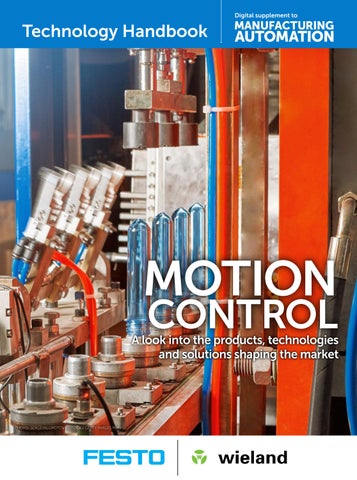
MOTION
CONTROL
A look into the products, technologies and solutions shaping the market
PHOTO: SERGEYKLOPOTOV / ISTOCK / GETTY IMAGES PLUS
Technology Handbook | MOTION CONTROL
T
Festo’s ready-to-go automation moving EV battery production forward
he automotive industry as we know it had reached a mature phase long before automation – the introduction of the first articulated robots in the 1970s – began to revolutionize how cars and trucks were manufactured. No such technological lag is facing the electromobility transition. Festo is adapting its proven automation technology to key applications in virtually every stage of the electric vehicle (EV) battery life cycle. Over the past two decades, Festo has evolved from a pneumatic component supplier to the top mechatronics company in the world, with pneumatic and electric solutions that can be applied singly or in combination under a unified state-of-the-art architecture. Festo has leveraged this unrivalled capability to develop leading-edge solutions for the EV sector, for jobs like rotor stator assembly in motor manufacturing, but especially in battery manufacturing. Since 2022, Festo’s electromobility initiative has highlighted key product rollouts, including an automated degassing battery cells as well as an chemical processing solution for recycling the valuable materials in batteries. This year, Festo is automating
dry room electrode assembly: the unrolling, cutting, aligning and layering of anodes and cathodes. In automating the EV eco-system, Festo is demonstrating how its breakthrough technologies for factory and process automation are readily adaptable to both established and emerging industries. This year‘s unveiling of the chemical processing solution highlights how two of those innovations assist in automating battery production. The world’s first high-precision proportional valve terminal – VTEP – maintains roll tension critical in electrode assembly – at a significantly lower cost than electric automation. VTEP is part of a new concept, controlled pneumatics, a Festo development combining high-speed, long-life, energy-efficient piezo-electric valve cartridges with sensors and control algorithms into a single smart unit. Users set performance parameters per valve channel. The proportional pressure valves provide closed-loop control to those presets for highly dynamic response and precise pressure control to maintain roll tension in electrode production.
applications requiring speed, precision and dexterity for which Festo Cartesian-style gantries are better-suited than articulated robots. Gantries have a smaller footprint so if job requires fewer degrees of freedom, operators only pay for the functionality they need. The typical pathway for battery assembly involves taking electrically charged cells, degassing and sealing them per this video, placing them in modules and loading the modules into packs. Tooling to accomplish that first stage includes adaptive grippers like Festo’s DHAS, a bit of ingenuity borrowed from nature. The process chamber is the heart of degassing. Pneumatic and electric actuators are used to pierce and seal the cells. A cantilever handling system employing compact spindle axes like Festo’s ELGT with integrated double guide ensures dynamic, safe loading and unloading.
EV Battery degassing/sealing chamber
The world’s first proportional valve terminal, VTEP (top left), is ideal for the web control of battery foils.
An automated chemical processing solution for recycling the valuable materials in EV batteries
The same dry room solution also highlights the huge bandwidth (a 200mb rate) and exceedingly low cycle time (under 100ms) of the Festo Automation Platform (AP). The AP’s remote I/O and CPX-AP-I decentralized I/O communicate at backplane speed. Moving to final battery assembly, many steps are high volume
2 MANUFACTURING AUTOMATION · Technology Handbook Motion Control
The loading of modules requires dispensing of a paste-like thermal conductor. This demands great accuracy, assured by Festo drives and sensors. Next, the modules are pressed down by a Festo servo press solution, as this video demonstrates, to maximize the contact with the conductor. These are core applications in lithium-ion battery manufacturing, but Festo plans to be ready with solutions for other EV battery chemistries that reach commercialization. For more information on Festo solutions on battery cell production, click here
Innovate today for a new tomorrow Realize your vision with Festo’s approach to smart automation for automotive manufacturing. Partner with Festo today.
Industry Leadership Superior Quality Products Global Training & Support
www.festo.ca Technology Handbook Motion Control · MANUFACTURING AUTOMATION 3
Technology Handbook | MOTION CONTROL
From Compliance to Protection: Enhancing Machine Safety Through Motion Monitoring
A
ccidents and injuries caused by inadequate safety measures can have severe and lasting consequences, from physical harm to costly liabilities and reputational damage. By staying up to date with machine safety regulations, businesses can not only protect their workforce but also leverage technological advancements and innovative solutions to enhance safety and productivity.
BRING ON THE MOTION Motion monitoring is a critical component of functional machine safety, ensuring that machinery operates within safe limits and predefined parameters reducing the risk of accidents and damage. By continuously tracking the movement and position of critical machine components, motion monitoring systems detect over speed, vibrations, or unplanned stops. When integrated with safety protocols, these systems provide real-time data that triggers automatic interventions, such as alerts, machine shutdowns, or adjusting its operation, to protect both operators and equipment. Implementing motion monitoring enhances operator safety, protects equipment, and ensures compliance with industry safety standards, making it the proactive approach to safety in industrial automation.
samos© PRO MOTION: The controller responsible for motion monitoring With samos© PRO MOTION, the technology company presents a new all-in-one safety controller with integrated motion functionality. A total of six TÜV-certified motion function blocks ensure that up to 60 percent fewer modules are required and therefore more space is available in the control cabinet than with comparable providers. Among other things, the compact, programmable controller enables safe standstill monitoring, even with vertical and slowmoving axes, and also scores points with an anti-vibration toolbox for macro and micro vibrations. Whether mechanical engineering or intralogistics wherever reliable standstill, speed, direction and position monitoring is required, the compact safety controller from Wieland Electric with up to 70 kHz motion inputs on the base module is suitable. The integrated motion function modules include safe standstill monitoring (SSM), which can be implemented with both a speed window and a position window. The limits of the position window or hysteresis can be defined very easily using intuitive configuration options, allowing vertical and slow-moving
axes to be monitored reliably and continuously, for example in construction cranes, lifting platforms, high-bay warehouses or presses.
A SAFETY ECOSYSTEM Our samos® PRO MOTION system works intuitively and seamlessly integrates with all other safety devices on the machine, ensuring a comprehensive and cohesive safety environment. Safety Light Barriers that detect unauthorized access to hazardous areas, to Emergency Stops that allow immediate halting of operations. The system also interfaces with Interlocking Devices to ensure machinery cannot be accessed while in operation and Safety Switches that monitor crucial positions and movements. This comprehensive integration improves both the machine’s functionality and safety, enhancing overall protection and reducing downtime, while maintaining compliance with safety standards.
A LICENSE-FREE PROGRAMMING SAFETY SOFTWARE Wieland Electric also offers powerful programming software for the new samos© PRO MOTION. The intuitive samos© PLAN6 configuration tool has an extensive library of TÜVcertified function blocks that contain typical, applicationspecific safety functions. The simple handling via drag & drop significantly reduces engineering effort, project planning time and also the possibility of errors. Users also benefit from simple documentation and save time with the CE declaration of the machine. With the integrated one-click documentation, the documents for the CE declaration of conformity are available at the touch of a button, saving time in the approval process.
Need help identifying which safety devices to use and where? Contact us for a free consultation 4 MANUFACTURING AUTOMATION · Technology Handbook Motion Control
SAFETY TECHNOLOGY + SERVICES
AN INTUITIVE SAFETY ECOSYSTEM TAILORED TO COMPLY WITH MACHINERY SAFEGUARDING Find Your Solution WITH A COMPLETE SAFETY PACKAGE + Risk assessment and safety concept
planning + Full suite of safety technology compliant with the latest global standards + Level A license-free safety programming software
SAMOS® PRO MOTION PROGRAMMABLE CONTROLLER
INTERLOCKING DEVICES
SAFETY SWITCHES EMERGENCY STOP DEVICES
SAMOS® PLAN PROGRAMMING SOFTWARE
SAFETY LIGHT BARRIERS
www.wieland-electric.com
Technology Handbook Motion Control · MANUFACTURING AUTOMATION 5
TECHNOLOGY
EMERGING APPLICATIONS IN MOTION CONTROL An in-depth look at how new technologies are driving a range of new application areas in manufacturing BY TREENA HEIN
An on-machine module allows motion control integration in previously uncontrolled factory floor assets .PHOTO: ROCKWELL AUTOMATION
B
esides precision, accuracy and faster speed, motion control customers in the manufacturing industry are looking for new solutions that offer greater safety, ease of integration, flexibility and reduction of waste. Industry is keeping up with many new innovations recently marketed or soon to launch. We approached industry stakeholders in the motion control space for insight into emerging trends and the technology behind them.
Hot new applications – replacing hydraulics and more James C. Fadool, global OEM technical consultant at Rockwell Automation, points to a big current push to replace hydraulics with servo motors, as hydraulics are noisy, expensive, have safety issues and produce a lot of heat and waste oil. “It’s in its infancy but moving fast,” he says. “There have been smaller applications like a small assembly press in automotive, but now
6 MANUFACTURING AUTOMATION · Technology Handbook Motion Control
it’s into large applications like a large stamping press. You can also collect and store related data easily.” In terms of other broad areas where motion control is expanding, Will Morris, motion control category manager at RS, points to packing and packaging. “We have three [systems] in our own warehouse that enable us to automatically pack certain-sized products and increase our shipments,” he says. “Some other uses we see are our filling, sealing and labelling
machines.” Morris also lists medical/ lab processes, CNC machining, 3D printing and cobot applications as growth areas for motion control.
More cobot applications supported by advanced safety features With people-machine interaction increasing each year, the emergence of standardized advanced safety motion control features for cobots is happening now. An example is the advanced palletizer from Universal Robot & Robotiq, notes Warren Osak, president of Electromate. “They are designed with inherent safety features, allowing them to work harmoniously alongside humans without the traditional safety barriers,” he explains. Advanced robot safety features include safe limited speed and positioning. “It’s a case of technology catching up with demand,” says Fadool. “Industry has been asking for improved safety functions such as safe limited positions for a long time and it’s great to be able to fill that need. Customers want the ability to safely move product as quickly as possible, but advanced positioning limitation also boosts process efficiency because recovery is so much faster after a jam occurs in terms of dealing with the issue and cleaning up.” The ability to safely hold position during the cycle, for example, or while there is still material in the machine (as opposed to having to run it out of material) also means that less product falls down to become waste once a panel is opened to deal with a jam.
Wireless supports pneumatic and harsh environment applications More and more motion control ‘communication’ is wireless, which works particularly well for pneumatic applications where data bandwidth is less intense (simple solenoid activation commands), explains Robert Almedia, business development manager at Advanced Motion & Controls. He adds that “operating in a frequency band not impacted by EMF noise
A 7th axis is a linear transfer system for moving robots along another linear axis. PHOTO: FESTO
from adjacent equipment can make communications even more robust and tolerant to harsh conditions. Using a wireless communication platform for motion control also provides a wireless communication hub for other associated sensors or devices employed in the motion control system.”
Modules extend motion control into previously uncontrolled assets and more Fadool points to on-machine motion control as a major trend that provides multiple benefits and enables the integration of motion control in new material handling and packaging applications. “On-machine drives have been popular in smaller select applications for about ten years, but over the last four years or so, we’ve noticed much higher demand,” he reports. “We’ve therefore launched several dedicated on-machine solutions like Armor Kinetics and Armor Power Flex.” Bolt-on motion control modules also mean just that: modularity. Customers can purchase them as desired to control motion in assets not controlled previously. Fadool adds
that “with on-machine servo motors and drives, we can replace those that are clutch-based or mechanically driven, providing better efficiency and accuracy.” For the machine-building OEM, on-machine motion control modules also provide cost savings in panel development time. “There’s no need for huge build-out of panels and wiring,” says Fadool. “OEMs can build that same panel in probably onequarter of the time.” Another benefit of on-machine modules is saved spaced when doing re-fits. Machine size can be reduced with no excess cabinets required. “It’s a single-cable solution that’s really valuable for processes like packaging and automotive assembly,” says Fadool, “where every inch of space is at a premium.”
IO-Link boosts manufacturing flexibility/ efficiency and more complex applications The use of IO-Link communication protocol is steadily gaining popularity, according to Eric Rice, Festo product market manager, electric automation. “It provides real-time data exchange between sensors,
Technology Handbook Motion Control · MANUFACTURING AUTOMATION 7
TECHNOLOGY actuators and controllers, enabling greater flexibility and efficiency in manufacturing processes,” he says. “With its plug-and-play simplicity and interoperability across various devices and vendors, IO-Link also simplifies system setup and maintenance. Additionally, it offers detailed diagnostic information, reducing downtime and enhancing predictive maintenance capabilities. IO-Link is increasingly embraced by users and well-supported by automation component suppliers. As a result, it’s expanding beyond its traditional applications in simple sensors and actuators to more complex devices like electromechanical linear axes.” These linear high-precision motion control solutions (repeatability of +/0.015mm and speeds up to 1.3 m/s) are straightforward to control through IO-Link and offer uncomplicated point-to-point motion control without unnecessary features, explains Rice. “They also cost significantly less than traditional servo systems, which often have more functionality than required and therefore cost considerably more than alternative solutions, such as pneumatic cylinders. The affordability of these IO-Link linear axes places them in a comparable price range to pneumatic alternatives, making them an excellent upgrade path.”
Integrated controllers speed up application development Almeida notes a trend of integrated controllers/drives in the robot/actuator – replacing an external controller (containing servo drivers, inputs/ outputs, expansion slots and logic board) that typically requires panel space, can generate heat and usually has functionality aspects that aren’t required for every application. “For those more basic and straightforward applications. a family of robots has been developed that retains only the most often-used functionality and physically incorporates those components into the robot itself,” Almeida says. “This creates a very compact and effective robot package that is very simple to
deploy (use typical wall voltage). This has made development of applications quicker and easier.” Indeed, integration is enabling companies to deploy robots for smaller applications in-house. “Organizations can now take advantage of smallerscale productivity gains, which when done multiple times, contribute largely to overall productivity,” Almeida observes. “As a bonus, when selfdeployed, the organization ‘owns’ the solution, including the development. This means all the knowledge and understanding of the solution stays inhouse, giving them the ability to modify and redeploy assets as needed without the need for external resources.” This approach also attracts new talent interested in development and design. However, Almeida notes that as with all-in-one robots, some trade-offs are involved. “Typically, electricallydriven actuators are used when no air source is available, the application requires more than two positions or you require dynamic control of speed or force,” he explains. “These simpler designs function as an enhanced pneumatic actuator allowing for two or three positions without any programming needed, basically functioning like single or double solenoid valves or closed-center valves. Acceleration and speed can be dialed in at the actuator without the need for flow controls or specialized programming. With a big push on for energy conservation for economic and environmental reasons, machine builders are finding these actuators more attractive.”
Higher motion control speed and precision driving more SCARA applications Osak reports that the use of SCARA robots such as the MCS500 from Mecademic are revolutionizing microassembly. “As manufacturing pushes the boundaries of speed and precision, SCARA robots are set to play an everincreasing role,” he says. “In industries like electronics manufacturing, they adeptly handle tasks that require
8 MANUFACTURING AUTOMATION · Technology Handbook Motion Control
immense precision.” Osak adds that in the automotive sector, the consistent repeatability of SCARA robots enable them to excel at inspection and testing, guaranteeing that every part meets and often surpasses stringent quality benchmarks.
7th axis solution spurs more diverse motion control applications Rice reports a trend to extend the reach of articulated robots by mounting the base to the moving carriage/mounting plate of an electromechanical linear actuator – referred to as a 7th axis solution. “The 7th axis adds versatility to the robot’s capabilities, making it suitable for a more diverse set of tasks and applications,” Rice explains. “It can improve cycle times and reduce the need for repositioning the robot, increasing overall efficiency in an industrial setting.”
Better torque control spurs beverage, serialized part applications and more Rockwell is being asked more and more about safe limited torque output torque monitoring in motion control applications. “It’s great to have this on the fly for things like bottling lines, ensuring lids and caps are applied with the correct amount of force,” Fadool explains. “This demand has been around for a while, and we’ve developed workarounds in the past, but about 18 months ago, we released a virtual torque sensor that gives customers the ability to increase process speed without impacting quality control, and they no longer need an external load cell to do this.” And now that higher-speed computing/controllers and cheaper data storage are available, Rockwell’s sensor also allows customers to gather, analyze and store a lot more data related to torque. “We can measure everything to do with the motor and store that data along with the serialized part numbers, or timestamp in the case of bottling lines,” says Fadool. | MA
DATA ANALYTICS
THE CRITICAL ROLE OF DATA ANALYTICS IN MANUFACTURING MA poll results reveal key expectations of Canadian manufacturers from current motion control solutions BY SUKANYA RAY GHOSH
C
ollecting and analyzing data is becoming increasingly critical for manufacturing businesses to stay competitive. Data is used to gauge productivity and efficiency of operations; maintain assets; monitor supply chains; manage change and more. In a recent Manufacturing AUTOMATION poll, respondents shared the level of connectivity and data analytics they hope to capture with the latest motion control solutions. With the option to select multiple options, 67 percent of respondents each selected advanced IoT integration, realtime analytics and in-depth insights as their top choices. Thirty-three percent indicated that they were satisfied with basic remote monitoring and 33 percent of respondents noted that they were onboard with minimal data collection from motion control solutions. The significant interest in advanced IoT integration indicates that manufacturers are looking for solutions that can seamlessly connect various devices and systems. Canadian manufacturers today have a desire for more sophisticated automation strategies that embrace interoperability and open up avenues for smarter decision-making through connected devices. Advanced IoT integration can help increase flexibility in operations, especially when product life cycles are becoming shorter every day. Manufacturing businesses today understand the importance of real-time analytics in capturing relevant data
timely to manage operational needs. This allows them to make informed decisions quickly, respond to issues as they arise and adjust processes accordingly. It is no surprise, therefore, that they expect motion control solutions to assist in collecting data in real time. Not all data being captured is relevant. Using raw data to capture in-depth insights into processes offers an additional competitive edge to manufacturers. Current motion control solutions can be aligned with these goals to help create long-term analytical strategies for success and growth. When investing in automation solutions, most businesses expect to extract the most value from the solutions. The lower interest in basic remote monitoring and minimal data collection could indicate a transition phase for
manufacturers. While some still see value in these simpler capabilities, the majority clearly aim for more advanced options. It is important to note that even the simpler solutions are additional capabilities offered by motion control solutions apart from their primary functions. The poll results demonstrate a growing demand among Canadian manufacturers for sophisticated motion control solutions that leverage advanced connectivity and analytics. Businesses are likely to increase their investments in advanced motion control solutions that offer sophisticated options for capturing and processing data, as well as connectivity. As the industry evolves, the shift in demand will help shape product development and strategic investments in automation. | MA
Technology Handbook Motion Control · MANUFACTURING AUTOMATION 9
Canada’s #1 Resource for Industrial Automation Leaders & Decision Makers
SUBSCRIBE NOW 10 MANUFACTURING AUTOMATION · Technology Handbook Motion Control
automationmag.com