Digital supplement to
Technology Handbook
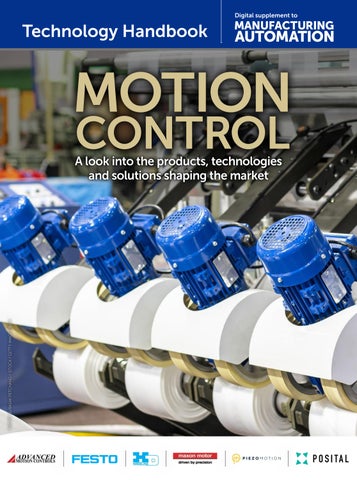
MOTION CONTROL
PHOTO: SURASAK PETCHANG / ISTOCK / GETTY IMAGES PLUS
A look into the products, technologies and solutions shaping the market
Technology Handbook | MOTION CONTROL
W
Servo Drives in Industry 4.0
hereas the third industrial revolution began with the computerization of individual machines, the fourth industrial revolution is seeing the development of smart factories with machines that share data in all stages of manufacturing through internet connections. The standards for these practices are becoming known as the Industrial Internet of things (IIoT) or Industry 4.0.
then it can send it to the controller which can make it available over the intranet or internet. Factory managers can set up alerts when a machine’s component readouts reach a level indicating that they might need attention or replacement. If the machine owner’s technicians can’t fix a machine’s problems themselves, they can seek help from the machine’s original manufacturer. With access to the status of the machine’s components, remote technical support becomes much more streamlined.
Smart Factories
Industry 4.0 makes smart factories possible by gathering more data from all of its machines. By installing different sensors throughout a machine, its internal operating statuses can be monitored over an intranet and even recorded for future reference. For machines or robots in an industrial setting, this shared data can be used to create virtual representations of each machine as well as the entire manufacturing facility. The Role of Servo Drives
By design, servo drives are a natural gathering point of machine status data. Their central location in each machine system gives them direct real-time access to many critical pieces of information. This doesn’t just include current, voltage, speed, position, and back EMF from the motor; it also includes operating information from all the devices connected to the servo drive including I/O devices and sensors (such as limit switches, door sensors, temperature sensors or even accelerometers). Servo drives also have their own useful internal operating data to provide. Since servo drives are already connected to a network bus, all that data is easily accessible by the machine’s main controller. From the main controller, the data can be compiled and then shared or accessed via an internet connection with the facility’s servers or even over the web.
Quality Control The data servo drives send to the controller can not only be shared with the facility’s central command to observe in the moment, but also logged over time. This creates a record of each component’s readings and can make it apparent when errors may have been occurring. Products being built can be tracked throughout the entire assembly process. This data can also be logged. If it’s found that a certain machine was operating incorrectly for a certain time, it becomes easy to determine which products were possibly affected and isolate them for inspection. Efficiency The digital record of each IIoT machine’s processes and performance can also be analyzed and used to improve overall manufacturing productivity. With data on timing and throughput of each machine process, algorithms can be developed to optimize efficiency for different jobs. New algorithms can also be developed to modify production procedures if a machine is currently non-operational to preserve as much efficiency as possible.
Advantages of Shared Machine Data
Making IIoT machine status available throughout the factory and beyond has numerous benefits. Maintenance and Technical Support Analysis and readouts of temperature, pressure, speed, or other properties can indicate the health of components within a machine. As long as the servo drive has access to the relevant data, 2 MANUFACTURING AUTOMATION · Technology Handbook Motion Control
ADVANCED Motion Controls® 3805 Calle Tecate Camarillo, CA 93012 USA Tel: 805.389.1935 www.a-m-c.com
ELECTROMATE 6221 Highway 7, Unit #15 Vaughan, Ontario, Canada L4H 0K8 Phone: 877-SERVO98 Email: sales@electromate.com www.electromate.com
Servo Drives for Every Application Over 230 Off-the-Shelf Servo Drive Models Endless Possibilities for Custom Solutions Renowned Service and Engineering Support
50 amps continuous 100 amps peak 255-373 VDC / 200-240 VAC
150 amps continuous 250 amps peak 20-54 VDC
25 amps continuous 50 amps peak 10-55 VDC
12.5 amps continuous 25 amps peak 40-175 VDC
3805 Calle Tecate | Camarillo, California 93012 +1 (805) 389-1935 www.a-m-c.com
Technology Handbook Motion Control · MANUFACTURING AUTOMATION 3
Technology Handbook | MOTION CONTROL
Seamless connectivity is coming – No need to wait for it
I
t’s a dilemma for both factory and process automation: there are many exciting technological advances on the horizon like plant-wide IIoT, Industry 4.0 flexibility, field-to-cloud deterministic Ethernet and artificial intelligence, but how does one begin to approach them? Capital budgets are tight, amortization cycles rigid. Yet one can’t sit on the sidelines forever. These futurist megatrends offer the prospect of “true seamless connectivity” – all mechanical, electrical and intelligent interfaces in a production environment working together as one. From an investment standpoint, what can be accomplished now that improves productivity and competitiveness and still fit neatly into that seamless future as it takes shape? “Enhanced connectivity” products provide such a low-risk pathway forward. These are smart devices that can optimize conventional production. With open interfaces like OPC UA, these devices move industrial automation a big step closer to true device interoperability. They play a critical role in the consistent and uniform exchange of information within production processes. Their ability to generate real-time data, and in some cases perform analysis and self-diagnosis, make them perfect for incorporation into true IIoT or Industry 4.0 setups. Download our whitepaper “Connecting the Factories of Tomorrow – Today” and see how Festo‘s “enhanced connectivity” products can be
a stepping stone to true seamless connectivity. Click here. Among Festo’s portfolio of enhanced connectivity products, Motion Terminal VTEM is truly revolutionary, yet accessible. VTEM is a cyberphysical system – the pioneer of digital pneumatics – that uses its digital and electronic “smarts” to mimic capabilities of traditional pneumatics with greater flexibility, consistency and a lot less complexity, and even those of servo-electric actuators like varying positioning and speed profiles. The IIoT factory promises process optimization, preventive maintenance with early warning notification of premature component wear or looming failure, and improved energy efficiency. VTEM can provide that now within the production zone it controls. VTEM’s Motion Apps control the manifold’s piezo valve technology. That enables vastly quicker product and format changeovers than can be aWchieved with conventional pneumatics. That, in turn, makes small batch or customized production runs practical from a technological standpoint, which meets the goals of Industry 4.0. By changing parameters using Apps, entire processes can be reconfigured in minutes for a different product or packaging rather than the hours or more it takes with conventional pneumatics to adjust multiple devices along the production line. Can digital pneumatics substitute for an entirely servo-electrically driven application and do it better, with less?
4 MANUFACTURING AUTOMATION · Technology Handbook Motion Control
See the short case study in our whitepaper, “Connecting the Factories of Tomorrow – Today”. The Motion Terminal provides the functionality of 2/2-, 3/2-, 4/2- or 4/3-way valves, as well as proportional technology and servo-pneumatic functions. There are apps to optimize energy usage, detect leaks, perform conditioning monitoring. VTEM also integrates intelligent sensors for control, diagnostics and self-learning tasks. Users can perform motion tasks using a single valve type, integrating complex movements, variable positioning and preset travel time. VTEM’s software and electronic management and monitoring of processes from the manifold pre-empts the need for up to 50 different components used in conventional pneumatics – like directional control valves, flow and proportional flow control valves, pressure sensors and pressure regulators, and more. Engineering is easier, and there are fewer parts to wear or fail or stock. VTEM is one of several Festo components for enhanced connectivity to start you along the path to true seamlessness. To read more about VTEM, click here.
5300 Explorer Drive Mississauga, ON. L4W 5G4 Phone: 1 877 GO FESTO festo.canada@ca.festo.com • www.festo.ca
More efficient, more flexible, more productive
The future of your production
Motion Terminal VTEM replaces over 50 components with one piece of hardware that combines the benefits of electrics and pneumatics.
Learn more at festo.com/VTEM Technology Handbook Motion Control · MANUFACTURING AUTOMATION 5
Technology Handbook | MOTION CONTROL
HARMONIC PLANETARY® GEARS OFFER LOW BACKLASH FOR LIFE.
B
uilding a high precision actuator is easily achieved by coupling any servomotor to one of our precision Quick Connect® servo gearheads. Planetary gears have simultaneous meshing between the sun gear, planet gears, and the internal ring gear. Harmonic Planetary® gears use a precision engineered elastic ring gear which compensates for interference between meshing parts. This proprietary Harmonic Planetary® gear design provides smooth and quiet motion and maintains low backlash for the life of the gearhead.
Harmonic Planetary® Gears • Ratios: 3:1 - 50:1 • Peak Torque: 3.9 N•m - 3940 N•m • Low backlash for life • HPG Series, Rack and Pinion available as a kit • Right Angle and Hollow Shaft Options • Output Configurations: Hollow Shaft, Flange, Keyed Shaft, Smooth Shaft • Multiple product lines including HPN, HPG, HPGP, HPF
offer high precision and low backlash (standard: < 3-arc-min, optional: <1 arc-min). Innovative ring gear ensures consistent, low backlash for the life of the gearhead. Washdown hardened versions of HPG gearheads featuring improved ingress protection are now available in six frame sizes and dozens of ratios. HPG gearheads are well-suited for AGV/ AMR applications. The HPF Harmonic Planetary® gear unit delivers high torque and high-accuracy with a hollow shaft design. An extra-large cross roller bearing serves as the output flange and can directly support large loads with exceptionally high moment stiffness. The large coaxial hollow shaft allows cables, shafts, ball screws or lasers to pass directly through the axis of rotation. Harmonic Drive LLC has a dedicated website for its Harmonic Planetary® gearheads, offering users a quick and easy way to choose the best product for their application. Developed with the design engineer in mind, the website features a robust product selector tool, PDF and DXF drawings, as well as downloadable 3-D solid models.
Product Line Overview HPN Planetary gearheads are priced to deliver a great value. They feature a robust design utilizing helical gears for quiet performance and long life. These gearheads are available with short lead times and are designed to mount to any servo motor with our Quick Connect® coupling. HPN gearheads are suitable for use in a wide range of applications for precision motion control and positioning. They are dimensionally compatible with popular gearhead models. HPG and high torque HPGP Quick Connect® gearheads 6 MANUFACTURING AUTOMATION · Technology Handbook Motion Control
Harmonic Drive and Harmonic Planetary are registered trademarks of Harmonic Drive LLC.
HARMONIC DRIVE LLC 42 Dunham Ridge Beverly, MA 01915 Phone: 978-532-1800 Email: sales@harmonicdrive.net www.HarmonicDrive.net
ELECTROMATE 6221 Highway 7, Unit #15 Vaughan, Ontario, Canada L4H 0K8 Phone: 877-SERVO98 Email: sales@electromate.com www.electromate.com
Servo Mount Gearheads Low Backlash For Life!
HPN Harmonic Planetary® value series provides a low cost solution without the need to compromise on quality or performance. This new value series of planetary gears carry the reputation for quality and reliability for which Harmonic Drive® products are known throughout the world. • Helical Gearing • Available in 5 frame sizes • Peak Torque: 9Nm to 752Nm • Ratios: 3:1 to 50:1 • Quick Connect® mounting system
• High Efficiency • Backlash: <5 arc-min (single stage), <7 arc-min (two stage) • Fast Delivery • Shaft output available with key and center-tapped hole or with center-tapped hole
Harmonic Drive LLC 42 Dunham Ridge Beverly, MA 01915 800.921.3332 www.HarmonicDrive.net
Right Angle Configuration Available!
Electromate 6221 Highway 7, Unit #15 Vaughan, Ontario, Canada L4H 0K8 (877) SERVO98 (737-8698) www.electromate.com
Harmonic Drive®, Harmonic Planetary® and Quick Connect® are registered trademarks of Harmonic Drive LLC. Electromate Industrial Sales is the exclusive Canadian distributor of Harmonic Drive® products (except the Province of Alberta).
Partners in Precision
Technology Handbook Motion Control · MANUFACTURING AUTOMATION 7
Technology Handbook | MOTION CONTROL
T
maxon drives set the world in motion
he maxon motor combines electric motors, gears and DC motor controls into high-precision, intelligent drive systems that can be custom-made to fit the specific needs of customer applications. maxon motor helps provide innovative solutions at competitive prices for numerous applications in various markets, such as industrial automation, medical technology, security technology, instrumentation, communications, and consumer applications, among others.
Offering solutions that fit your customized needs maxon motors manufactures small, high-quality brush and brushless DC motors ranging in size from 4 mm to 90 mm. maxon’s rhombic wound ironless rotor motors provide exceptionally high efficiency, low EMI emissions, fast acceleration, no preferred rotor position, torque constants and long service life. The drive components are assembled and designed within our modular system according to your individual needs. You can combine, according to your requirements, motors with planetary, standard or special gearheads, feedback devices, brakes and control electronics.
Brushed and brushless configurable DC motors more versions, more power Now even stronger, more efficient and with yet more combination options: There are new additions to the maxon family of X drive products. Several long versions of brushed DC motors, with higher torques and more power, have been added to the product range along with matching planetary gearheads. Each of the 3-stage versions can now be combined with the next smaller motor. This saves space, weight and costs. In addition, maxon launched a brushless DC motor (ECX) line to its configurable online program. These motors are available with diameters of 4, 6, 8, 13, 16, 19 & 22 mm 8 MANUFACTURING AUTOMATION · Technology Handbook Motion Control
achieving speeds of up to 120,000 rpm. They run very smoothly and are highly efficient in standard or sterilizable versions (up to 2,000 autoclave cycles). Ideal for use in handheld surgical tools and industrial spindles. maxon motor’s X drives are extremely powerful and are now available in maxon’s online shop, where customizing the drives is easy. Customers can fit the drives with specific mechanical and electrical components specific to their application needs. It is possible to customize the shaft lengths, winding types, ball bearings and much more. When combined together with maxon encoders and planetary gearheads, you form a high-precision, robust drive system ideal for any application from aerospace to medical to robotics. In fact anywhere that requires a compact, powerful, quiet and strong drive system. The X program is a lean and automated process which ensures that all configurable drives are ready for shipment within 11 working days. In addition, detailed product data may be viewed immediately online and 3D CAD data for the configuration is available for downloading. Visit dcx.maxonmotor.com for more information.
ELECTROMATE 6221 Highway 7, Unit #15 Vaughan, Ontario, Canada L4H 0K8 Phone: 877-SERVO98 Email: sales@electromate.com www.electromate.com
TRA CONFIGURABLE
Gearhead, motor and encoder tailored to your needs.
11DAYS
READY IN
Assemble your individual maxon DC drive: You can configure the gear stages, the motor bearings, the shafts, the encoder and much more. Design your custom drive online today and your finished drive will ship from Switzerland in 11 working days.
dcx.maxonmotor.com
Technology Handbook Motion Control · MANUFACTURING AUTOMATION 9
ADVERTISEMENT FEATURE COVER STORY Technology Handbook | MOTION CONTROL
Revolutionising the motion control industry by making piezo motion affordable Piezo Motion is the disrupter, reimagining how innovative piezoelectric motor technology can now be more accessible than ever to myriad applications where its advantages bring immense value...
N
atural and Synthetic Piezo materials have been utilised in sensor and transducer applications for decades, but the practice of harnessing the reverse piezoelectric effect for actuators and motors is less developed. Piezo technology has a legacy and image of being cost prohibitive for most applications, setting the precedent that only costly high precision applications can consider it. With our technological advancements, this is no longer true, and it is something that engineers and product designers need to be familiar with in order to design for future innovations and learn about the many other benefits of piezo motion. Unlike classic DC motors, the versatile piezo rotary and linear motion motors use very few parts that enable manufacturing volume yielding a stable and reliable product. “At Piezo Motion, we recognise that all of the cutting-edge products that we depend on today started with an idea and you, as engineers, made it happen. Now, as you design for the future, we have motion solutions to solve problems that would not have been possible before,” explains Piezo Motion’s chief innovation officer, Nic Copley. Piezo Motion’s rotary motors are engineered to provide high quality and exceptional performance for OEM applications that demand reliable and economical motion control solutions with good power density and lightweight efficiency. The motors have up to 625,000 steps per revolution without any reduction of Torque output. Motors can be driven in open loop mode or are available with integrated encoders for closed loop control.
Energy efficient, the motors consume less than 0.1W at 1rpm. The piezo motor linear actuators are designed with lightweight materials to combine economical cost with superior precision and ultrafast response/start-stop characteristics. Highly energy efficient, Piezo Motion’s linear motors consume zero power to maintain a hold position at full force. Linear motors can step at 50 nanometer increments and will respond in 30 to 50 microseconds. Non-magnetic configurations are possible enabling use in specialised applications where traditional DC motors cannot be used. These motors are also immune from electromagnetic (EM) and radio frequency (RF) interference and have no emissions. The unique form factor of Piezo Motion devices enable fitment into compact spaces. The direct drive characteristics of Piezo motor linear actuators make simple linear systems possible eliminating the need for leadscrew drivetrains and yield speeds of over 200mm/s. Highly integrated designs are possible for a wide variety OEM applications. The adaptability of the Piezo Motion motor with encoder and drive board offers motion control software via a micro USB connector or can be implemented with a Python API or a serial command set. As demands for our devices to be smarter, more accurate, smaller, more efficient and cost-effective rise daily, engineers are forced to innovate at a rapid pace. At Piezo Motion, we have pushed the envelope of the current motion technologies enabling new opportunities.
Piezoelectric motors provide a breakthrough in all of those key needs and we continue to extend the capability of our products and hence the value they can offer. The key technical elements of Piezo Motion motors come from years of experience in scientific research and development in how to control the Piezo materials, preserve energy transfer and mitigate energy loss in piezo motors. Piezo Motion holds numerous patents for its piezo technology, devices and applications. The company’s know-how and its multi-million dollar investment to develop the technology and its portfolio of affordable motion products make it a standout in the industry. “As precision motion continues to play a larger role in medical devices, surgical robots, wearables, automation, and drones for example, the use of Piezo Motion's technology will become common place because of the scalable and affordable motion solutions we have developed,” says Hassan Kotob, chairman and CEO at Piezo Motion. If piezo motors seemed unattainable, think again. Piezo Motion’s ultrasonic piezo motors are used around the world in diverse applications – from medical devices, laboratory instruments, electronics, printing and automation to traditional piezo industries including optics, semiconductor, photonics, nanotechnology and research. Discover the full range of products available now on the website. Piezo Motion piezomotion.com
Sold & Serviced by Electromate.com
6
10 MANUFACTURING AUTOMATION · Technology Handbook Motion Control
MAY 2021 | DESIGN SOLUTIONS
/ DESIGNSOLUTIONS
Technology Handbook | MOTION CONTROL
Introducing the World’s Smallest Multiturn KitKITS Encoders MINIAbsolute MULTITURN ENCODERS Like their ‘big brothers’ – POSITAL’s popular 36 mm kit encoders – the new 22 mm encoders offer 17-bit electronic resolution and a multi-turn measurement range of up to 32 bits. Installing the 22 mm kits is simple and can be carried out under normal factory conditions, with integrated selfcalibration to smooth setup procedures. The combination of robust magnetic measurement technology, high operational reliability (with an integrated temperature sensor for diagnostics), multi-turn functionality and maintenance-free operation all help reduce the cost of ownership. Available SSI and BiSS C communications interfaces are vendor-neutral and can be licensed at no cost.
S
Click here to find out more about POSITAL’s family of kit ize matters, and in the world of industrial automaencoder for integrated motor feedback. tion, providing exceptional performance in a highly compact package can be an enormous advantage. To meet this challenge, encoder manufacturer POSITAL has introduced a family of super-compact multi-turn absolute kit (modular) encoder for position feedback. With a diameter of only 22 mm and a height of 23 mm, these new kit encoders are designed to be integrated with popularwith a Maintenance-Free Multiturn Functionality miniature BLDC motors and steppers, providing absolute Rotation Counter - No Batteries Needed! position feedback for motion control applications.
For Servomotors, Stepper Motors, & Microdrives
mmkitDiameter, 23 mm Depth A special feature of POSITAL’s new 22 22 mm encoders is a multi-turn measurement range, powered by the company’s Wiegand energy harvesting technology. This technolReliable, Accurate, and Easy to Install ogy, which activates the rotation-counter system with energy captured directly from the rotation of a shaft-mounted Available inand BiSS C and SSI Interfaces magnet, eliminates the need for backup batteries significantly reduces maintenance requirements.
POSITAL-FRABA Inc. 1 N Johnston KITS Ave, Ste C238 MINI MULTITURN ENCODERS Hamilton, NJ 08609, USA Phone: 609-750-8705 Fax: 609-750-8703 info@fraba.com
ELECTROMATE 6221 Highway 7, Unit #15 Vaughan, Ontario, Canada L4H 0K8 Phone: 877-SERVO98 Email: sales@electromate.com www.electromate.com
www.posital.com
12 MANUFACTURING AUTOMATION · Technology Handbook Motion Control
MINI MULTITURN KIT ENCODERS
For Servomotors, Stepper Motors, & Microdrives Multiturn Functionality with a Maintenance-Free Rotation Counter - No Batteries Needed! 22 mm Diameter, 23 mm Depth Reliable, Accurate, and Easy to Install Available in BiSS C and SSI Interfaces
www.posital.com
Technology Handbook Motion Control · MANUFACTURING AUTOMATION 13
TECHNOLOGY
NEXT-GEN
CONTROLLERS How today’s PLCs, PACs and edge controllers enable plant connectivity and extract value from data BY KAREN SMOCK
I
n the drive toward digital transformation in manufacturing, industrial controllers are at the centre of the push away from legacy systems and the pull toward the benefits of new technology. Controllers are continually evolving; the latest trends reflect standardization, IoT capabilities and the strategic use of edge computing.
Standardization and connectivity Traditionally, PLCs (programmable
logic controllers) controlled equipment; PACs (programmable automation controllers) controlled production lines or plants. There used to be dividing lines, with PLCs using proprietary programs, and PACs offering more standardization, openness, modularity and communication protocols. Today, those lines are blurred. OEMs and plant operators have a wide range of controllers available that conform to standards such as IEC 61131, provide openness and modularity, and use
14 MANUFACTURING AUTOMATION · Technology Handbook Motion Control
popular communication protocols. “PLCs today are used in such a variety of automation applications from automating processes, just simple machine functions and even entire production lines. When it comes to programming, all the programming languages now are standardized,” says Andrew Cortese, product manager, factory automation at Siemens Canada. “When PLCs first started coming in, all the different manufacturers had different programming languages,” explains Cortese. “A big one is ladder diagrams, now called ladder logic. So it’s all standardized across all of the different manufacturers, as well as function block diagrams.” Standardization provides futureproofing so that controllers can accommodate a wide range of new functionality. “Standardization of connectivity is one focus,” says Roger Hart, R&D engineering manager at Siemens. “Several standards have become more mature in the past few years. For example, OPC UA and MTConnect
PHOTO: SIEMENS INDUSTRY, INC.
CNC control offers digitalization at the edge.
“One misconception or something that maybe people don’t consider is the impact of this data collection on the performance of the machine controller,” says Gremillion. offer enhanced capabilities includ- a database. That’s something that we ing support for robotics and additive have the capability to do.” manufacturing. The controllers, both PLC and CNC, offer a broader set of Extracting value data at higher frequencies, especially from data through edge computing devices.” The ability to capture, analyze and Doug Browne, technology develop- share data is the promise of digital ment engineering manager at Omron transformation and the Internet of Automation, relates the evolution of Things. However, proper implementacontrollers to computers. “All com- tion requires strategic planning about puters are powerful enough nowadays what data needs to be collected, where that they can run the latest operating and how it will be stored and shared, system, and I think you’re seeing a and, of course, security. similar trend in the world of PLCs. “One misconception or something “There is a harmonization and a that maybe people don’t consider is homogenization from where the fea- the impact of this data collection on tures that you’re seeing in the highest the performance of the machine conend of PLC, PAC, MAC – whatever you troller,” says Gus Gremillion, partner want to call it – are the same feature set manager, Siemens Industry Inc. that you’re seeing on the lowest-level “We’ve had customers who are tryentry unit,” explains Browne He says ing to get some process data off of a some examples of when users would machine that has 24 axes. And so when need an upgraded CPU or higher- you’re trying to sample that much data performance PLC is if they have a lot a few times a second using something of motion axes, or if they’re mixing like OPC UA, it’ll actually degrade the features like pushing data to performance of the machine the cloud, performing safety tool,” explains Gremillion. functions, and AI. “If you’re needing to get data A key determining factor every five or 10 seconds or 30 in controller selection is per- Programmable logic seconds, OPC UA could be controllers (PLC) formance. “I think the only were first developed just fine. But if we’re starting thing you really need to look in the late 1960s to to look at this high-frequency at these days when selecting replace relay logic data, where we’re wanting to systems. a PLC is maybe the size of the be getting things like motor performance aspect of it – if currents a few times a second you’re planning on expanding it a lot or potentially hundreds of times per in the future for different applications second, OPC UA is probably not going and more inputs and outputs and tech- to be able to do that.” nology modules,” says Cortese. He says that the capability to capture Carrie Lee, product manager, con- high-frequency data and summarize or trollers, at Omron Automation, says condense it before sending it over a nethigher-performance PLCs lead to bet- work is an example of why edge devices ter results. “What people don’t realize are coming into their own. is when you have fast processor speeds, Sensor data is also easing operation it allows you to have better quality – for instance, plant operators can use data. People think, ‘Oh, it’s impossible. vision capabilities for training and error I can’t get time series data out of a PLC.’ detection. “An area advancing rapidly Not only can you, it’s there. You don’t is vision combined with artificial intelhave to do any extra work. Same thing ligence. Machine learning algorithms with connecting your PLC directly to can be trained to classify characteristics
PLC
from captured images,” says Hart. “These trained models can be subsequently used in real time for process automation. Edged computing or dedicated PLC hardware acceleration modules are ideal platforms for hosting these algorithms.” Hart explains that with machine learning, you can train using vision for applications such as tool-wear detection or proper part setup. “With the edge devices, it allows us to offload that AI or vision-type computing from the CNC controller or PLC and do that in the edge device,” adds Gremillion. Edge controllers are also evolving to provide operations with high performance and security. “Vendors like us who have these systems of controllers are putting more processing power closer to the asset to ensure the processing of controllers is always available so that edge controllers will also incorporate the latest cybersecurity protections,” says Srikumar Srinivasan, vice-president and general manager at Honeywell Process Measurements and Controls. “So with specific protocols like MQTT, AMQP and other IoT protocols, these edge controllers will serve as data collectors and concentrators, but they can also do some controls and analytics right in the process of the equipment itself.” The ability of edge controllers to do processing is reducing the bandwidth requirements of sending all the raw data to the cloud. “All the processing is done with the edge controller itself because they made it more powerful and now it’s not just data going to the cloud – but the data is converted to good analytical information and only limited information goes to the cloud; hence, bandwidth requirements are less,” Srinivasan says. “That’s basically why edge controllers are really becoming a big-time move now.” | MA Karen Smock is a Montreal-based freelance writer.
Technology Handbook Motion Control · MANUFACTURING AUTOMATION 15
NETWORKS
CONNECTED CONTROL Flexible EtherCAT and PC-based automation help a dual OEM-system integrator create an adaptable laser cutting solution for a Tier 1 automotive manufacturer BY JAMES FIGY
T
A CX2040 embedded PC from Beckhoff delivers ample processing power to operate the high-speed, coordinated motion system.
geared toward manual-load production and simply provide the laser machine and a basic automation interface.” BOS goes a step further and delivers cutting fixtures with all necessary referencing to make high-quality parts, whether in a manual loading system or the Tier 1 automotive customer’s completely automated setup.
Flexible, modular controls To make sure the L-MS could support a best-of-both-worlds approach for
16 MANUFACTURING AUTOMATION · Technology Handbook Motion Control
many customers, the BOS engineering team made flexibility and modularity top priorities in the initial design. In addition to a standard 1 kW fibre laser, the cutting head can accommodate up to two 0.5-6 kW laser sources or even welding or remote welding. The machine has options for fume extraction equipment, automated scrap conveying, automatic doors and safety scanners for operator or robotic loading. The parts can sit on a flat bed or use a trunnion system with additional
PHOTO: BOS INNOVATIONS/BECKHOFF AUTOMATION
he best of both worlds – that’s what BOS Innovations strives to provide a broad base of manufacturing customers. As both a machine builder OEM and system integrator, the Dorchester, Ont. company combines its strength in delivering turnkey machines with the ability to retrofit and tie into existing factory lines and systems, primarily in automotive and heavy industries. “We have developed core competencies in automated assembly, advanced robotics including welding, laser processing, coordinated motion technology, collaborative robots and quality inspection,” says Ben Huigenbos, president of BOS. These complementary capabilities were clear in a recent implementation of the company’s L-MS (Laser-Motion System) for a Tier 1 automotive manufacturer. The L-MS is an advanced fibre laser cutting machine, equipped with a direct drive linear motion system for precision CNC control. This high-performance machine produces complex parts with tight tolerances by leveraging up to five axes of coordinated motion. While L-MS supports drop-in installation, this project also required peripheral systems to meet all of the customer’s needs, according to Steve Van Loon, technology manager, lasers and motion systems at BOS. “To make this L-MS a truly turnkey system, we needed to add a robot to load and unload the parts and move them to stations for de-burring, vision inspection and marking with an instant marker,” Van Loon says. “Most other laser machine providers do not do that. They are more
servo axes to rotate the workpiece 360 degrees. By adding a turntable, the loading time can occur in parallel with the laser process. The flexibility even extends to footprint: The L-MS cell, a roughly twometre cube designed for 1,300-mmlong parts, can be expanded on all sides to accommodate workpieces of many sizes. Providing this high degree of flexibility required robust yet adaptable controls and networking technologies that would allow the L-MS to integrate with other systems in the plant. Highly synchronized motor and drive technologies for the cutting axes were critical to ensure part quality. So was openness to enable real-time communication to the robot controller, de-burr components and vision system. To address this, Van Loon worked with mechanical designers Riley Tomiuck and Scott McCall on the design. The team determined that the system required higher performance than a traditional fieldbus and hardware PLC could deliver, so they turned to solutions from Beckhoff Automation. BOS first implemented Beckhoff technologies a decade ago on a large cardboard converting system that had about 50 motion axes, and other projects followed. Then in 2018, BOS used Beckhoff to build the first iteration of the L-MS, which was designed to cut SUV running boards, and decided to tweak the machine to be a standard offering in its portfolio. For this project, the team worked closely with the local Beckhoff team – Automation Sales Engineer Dean Herron and Application Engineer Rui Zhang – to design, program and commission the automation system.
Motion technologies with EtherCAT BOS implemented precision motion control on the L-MS using a variety of rotary servo motor and direct drive solutions with EtherCAT communication. The horizontal axes use Beckhoff AL2800 series linear motors, which deliver speeds up to 6 m/s and peak forces up to 4,500 N. “The X and Y axes have highly dynamic requirements in terms of acceleration,
speed and accuracy, which called for linear motors,” Van Loon says. The client’s machine featured a Z axis and a trunnion system, which both used AM8000 servo motors. AX5000 servo drives with One Cable Technology provided motion control and reductions in cabling, and they permitted integration of a smaller, thirdparty motor to control the theta axis on the cutting head. The machine processes octagonal steel tube parts of variable wall thicknesses, cuts a 21.5-degree angle on one end of each piece and handles two variants with either six or 12 holes while maintaining tight tolerances. EtherCAT provided real-time communication for the L-MS system, and a wide variety of Beckhoff I/O components offered the necessary functionality. “EtherCAT uses distributed clocks in each device to deliver tight synchronization and jitter of less than 1µs, which is optimal for coordinated motion systems like the L-MS,” Herron explains. “With a theoretical cap of over 65,000 devices on a single network, free choice of topology and no required switches, EtherCAT has practically no limitations, whether in a system with five axes or 50.” As an inherently open industrial Ethernet system that supports communication to more than 30 protocols, EtherCAT connected to components on the production line via an EtherNet/IP bus coupler. In addition to EtherCAT couplers and I/O terminals from Beckhoff, BOS also implemented TwinSAFE functional safety modules. TwinSAFE technology relies on Safety over EtherCAT (FSoE), a TÜV-certified communication technology that uses a “black channel” approach to transmit safety data over the standard network. This allows engineers to place safety terminals in standard I/O segments, according to Zhang: “BOS used the EL6900 TwinSAFE logic terminal as a safety PLC on this machine. This approach allowed them to cut down the time and complexity otherwise required for hardwiring safety switches. All I/Os stay on the same rack or mount onto the machine with IP67 box modules, and they could simply create safety logic in the standard TwinCAT engineering environment.”
Control software and hardware With TwinCAT 3 automation software, BOS equipped the client’s engineers to select the programming languages they are most familiar with or that best suit the project, including the objectoriented extensions of IEC 61131-3, computer science standards in Microsoft Visual Studio and predefined or custom function blocks. Control of the L-MS relies on a single Beckhoff CX2040 embedded PC. The DIN-rail-mounted CX2040 features a quad-core Intel Core i7 processor, 80 GB CFast flash card and 4 GB DDR3 RAM. A 15.6-inch CP2916 control panel provides multi-touch operator interface and high-resolution display for camera results from the laser-cutting machine.
Delivering the best of both worlds The complete L-MS system went live in the end user’s facility in late 2020. With fast controls and automated loading, the machine achieves a part-to-part cycle time of 40 seconds or less. “The L-MS easily runs at two metres per second with 1.25 G acceleration, and it cuts holes with the highest precision that the customer has ever seen,” Van Loon says. “That’s due to the controller speed and the fine tuning we accomplished with TwinCAT Scope. Using the digital oscilloscope, we could see all parameters on the screen and collect data from each axis, including following error, acceleration, deceleration and more, to optimize the system.” EtherCAT provided benefits in terms of bandwidth and speed, along with footprint and cost reductions. “Coordinated motion requires a lot of data to be passed between the servo drives and motion planner. EtherCAT is really the only fieldbus capable of handling that,” Van Loon explains. The finished L-MS met all requirements of the automotive customer, and BOS is building additional units for other customers. With the ability to customize the machine and build out the system in front of it, the BOS engineering team plans to keep innovating to provide laserfocused solutions for customers. | MA James Figy is a senior content specialist at Beckhoff Automation.
Technology Handbook Motion Control · MANUFACTURING AUTOMATION 17
DON’T MISS OUT on your next issue of
IT’S FAST, IT’S EASY AND IT’S FREE!
HERE’S HOW: FOR FASTEST SERVICE VISIT
AutomationMag.com AND CLICK THE SUBSCRIPTION BUTTON
AutomationMag.com