Digital supplement to
Technology Handbook
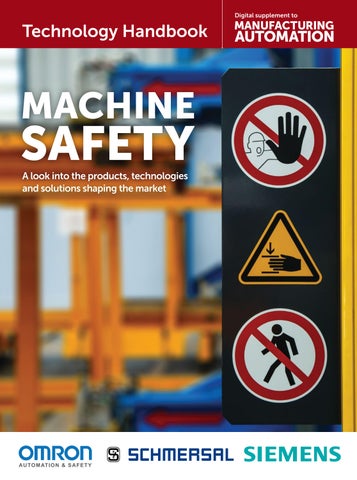
Machine
Safety A look into the products, technologies and solutions shaping the market
We Make Safety Simple STI Safety Solutions from Components to Consulting for Enhanced Worker Safety Poised at the leading-edge of safety solutions worldwide, Omron’s STI safety products focus on making safety work. We are aware of the many demands of automation safeguarding. Consequently, our automation safety products meet or exceed local and international safety standards.
Omron is committed to providing safeguarding solutions that meet your needs for safety and productivity. We design and engineer our products by listening to and working closely with our customers and authorized distributors.
We also provide:
2
• Experienced assistance
2
• Expert guidance in application, integration and maintenance • World-class support through Omron’s global network of 250 sales locations in 65 countries
1
Omron Automation & Safety www.sti.com
Contact us at www.sti.com/info or 1.866.986.6766
1
1 Laser Scanners
2 Light Curtains
3 Interlock Switches
Our OS32C is a very compact safety laser scanner. It has 70 zone configurations for complex guarding parameters. Safety coverage up to 4 m at 270 degrees.
The F3SG-RA global light curtain has advanced function and muting capabilities, and meets safety standards in Asia, Europe and the Americas. It has IP67 rating to meet most application needs, up to 255 beams, and a lower operating cost.
Tamper resistant switches enhance mechanical guarding methods.
OS32C
• • • • • •
4 Emergency Stop
Guardlocking switches Hinge pin switches Non-contact switches Limit switches Tongue switches Explosion-proof versions
Devices
• Enclosed and panel-mounted models available with keyoperated reset • Combination rope and push button actuated emergency stop switches • Heavy duty housing offering rope spans to 200 meters
A165E
Industry First! EtherNet/IP capable of status and measurement data reporting.
D4NS D4B-□N
D4F
F3SG-RA
2 MANUFACTURING AUTOMATION · Technology Handbook Machine Safety
D4N
ER6
6
6
8 4
4 5
3 4
3 7 5 Edges & Bumpers 5 Mats & Area Guarding Built tough for tough environments. Combine a mat with a controller to provide proven reliability.
p
6 Perimeter Guarding
7 Programmable
PA4600 models are available with single and multiple-beam models with an operating range to 70 meters. They’re perfect when installing fences is not practical.
Controllers 7 Monitoring Relays The NX-S Safety over EtherCAT controller offers integrated safety functionality into the Sysmac platform, suitable for mid to large sized applications.
8 Enabling Switches Provides the additional protection needed during set-up, programming and servicing of robotic and automatic equipment. • Has distinct clicks for three easily discernible positions
Choose the G9SP stand-alone controller for mid-size applications, the NE1A DeviceNet network controller for large complex applications, or safety monitoring relays for smaller applications.
NX-S
A4EG
NE1A
6022 G9SX
PA4600 G9SP
Technology Handbook Machine Safety · MANUFACTURING AUTOMATION 3
Technology Handbook | Machine Safety
Safe Solutions for Your Industry
S
chmersal is an industry leader with over 70 years’ experience in the design and manufacture of machine safety products, industrial switches, position sensors, and control accessories for a wide variety of applications. Our product designs are focused on ways to protect machinery operators and maintenance personnel from recognized hazards in a variety of industries, in compliance with current local and international standards, without compromising productivity. With over 25,000 different products to offer, Schmersal is considered one of the largest machine safety component suppliers in the world. Since 1945 Schmersal has built their reputation as a premier supplier of quality products which has provided the foundation for future innovations. Today, with a global reach, Schmersal supplies and supports multi-national companies with machine safety systems and engineered solutions. Our extensive network of safety engineers located around the world allows us to take a local approach to global support. To aid in efficient safety, Schmersal has developed and patented a proprietary technology known as Pulse-Echo. Sensors with this technology will evaluate the predetermined frequency of the actuator which is emitted after it has been triggered by an electromagnetic pulse. This operating principle allows for a non-contact actuation and because of the dual monitoring microprocessor, only one switch is required to meet Category 4, PLe per ISO 13849-1 and SIL3 per IEC 61508. In addition to the LED visualization located on the switch to indicate operating statuses
and errors, each switch has a diagnostic cable with the option of communicating its status via serial data packages. Styles of the Pulse-Echo family include solenoid locking, magnetic locking and the IP69K rating just to name a few; all of which can be wired with up to 31 devices in series without degradation to the safety levels.
Schmersal has also incorporated the main functionality of the Pulse-Echo principle into its Radio Frequency Identification (RFID) design. RFID is a technology that uses radio waves to provide a wireless data exchange of a coded identification number between a target (tag, label, or chip) and a reader - a device which transmits an encoded radio signal to the target. When applied to a safety sensor, the RFID actuator target is mounted to the safety guard door and the sensor remains stationary on the machine frame. With the
4 MANUFACTURING AUTOMATION · Technology Handbook Machine Safety
guard door closed, the sensor identifies the actuator and enables the safety outputs, allowing the machine to run. Conversely, with the guard door open and the target actuator out of range, the sensor will disable the outputs preventing machine startup. RFID systems can also provide a large number of individually encoded actuators, which can make them a “High” level encoded Type 4 interlock device, per the new ISO 14119 standard on interlock design and selection. Motivated by the vision of a safe working environment and leveraging our vast experience in machine safety systems, Schmersal also offers machine builders and production facilities qualified services related to machine safety in support of our considerable range of safety products and system solutions. Through seminars and training, risk assessments, technical support, consultancy and integration program services we support safety engineers with firsthand specialist knowledge. SCHMERSAL CANADA LTD. 15 Regan Road Unit #3 Brampton, Ontario Canada L7A IE3 Tel: 905-495-7540 Email: salescanada@schmersal.com
www.schmersalcanada.com
- Efficient Safety
AZM200
MZM100
CSS30S
RSS16R
RSS260
RSS36
Efficient Safety from Schmersal Increased productivity has always been a major focus of real world industrial applications. Machine start up, troubleshooting, and maintenance requirements are definite costs that must be considered and minimized in order to reduce downtime and improve efficiency – and today it needs to be done while preserving the highest level of machine safety. Efficient safety is now an important consideration of the design engineer and maintenance personnel.
o
f
s
highest level of safety – PLe per ISO 13849-1 or SIL3 per IEC 62061. They maintain these safety levels even when wired in series using standard cable (up to 200 meters), which results in reduced cabling expense and installation time. They feature LEDs for status indication to quickly troubleshoot faults which reduces machine downtime. These devices are available with Serial Diagnostic to communicate status via serial data packages for use in various network protocols.
ty
afe Schmersal’s electronic safety devices are a key to Schmersal is a leader in the design and efficient machine safety. At the heart of these devices manufacture of machine guarding safety is an integrated dual monitoring microprocessor which switches, including electronic safety devices. We offer provides continuous internal function tests. Because of this, only electromagnetic and solenoid locks, and a variety of nonone switch is needed per guard to meet the requirements of the contact safety sensors with these efficient advantages. Contact us to find out how efficiently we can turn your workplace into a safer place.
www.schmersalusa.com
T u rn i n g W o r places Int o S afer P laces
888-496-5143
DFFA-A10084-00-7600
Safety? All built in! SIMATIC S7-1200 with Safety Integrated The first microcontroller in Standard and Safety SIMATIC S7-1200 Basic Controllers offer enhanced performance with their extensive range of technological functions and integrated IOs as well as their particularly compact space-efficient design. They are the intelligent choice for automation tasks with a small-scale project. SIMATIC S7-1200 CPUs with Safety Integrated can additionally perform the monitoring of safety functions such as safety door with interlock. Connection of the fail-safe sensor technology and final control elements is made through fail-safe signal modules.
Integrated safety solution with a fail-safe controller of the S7-1200
Advantages at a glance • Optimal integration of the safety functions in the overall course of the manufacturing process
• Less wiring work: All information (for example signal states and diagnostics) already in the system
• Efficient engineering in the TIA Portal
• Efficient error diagnostics centrally available on an HMI panel
• Increased productivity thanks to minimized downtimes through efficient error diagnostics • Even a few safety functions means reduced costs
siemens.com/simatic-safety
Advertisement
Retrofitting the Statue of Liberty with a new rescue elevator posed some unusual challenges for Tower Elevator Systems. But with Siemens TIA Portal engineering software, they rose to the occasion by designing and manufacturing a cutting-edge system that improved safety, reliability, and personnel flow. Rising to the challenge A number of critical facility upgrades were planned for the Statue of Liberty, including the replacement of the Statue‘s existing emergency rescue elevator. Tower Elevator Systems, Inc. (TESI) a firm specializing in permanently installed custom rack and pinion elevator systems, was selected to design and furnish the equipment. To support the controls portion of this special project, TESI turned to its trusted partner, Siemens, and its TIA Portal engineering software. A proven, intuitive engineering framework, TIA Portal allows automation processes to be designed optimally and efficiently from a single computer screen. This groundbreaking innovation shortens the engineering cycle, saves commissioning time, and reduces maintenance costs and total cost of ownership. Taking technology to the next level The new elevator is designed and intended for emergency Personnel. The custom-designed machine is unique not only because of its location in one of the world’s most popular attractions, but because it also marked TESI’s first application of Siemens TIA Portal. The system includes the Siemens Fail Safe CPU, various digital inputs and outputs, and the Siemens HMI comfort panel, all of which were designed and commissioned using TIA Portal. The project also uses PROFIBUS communication protocols and PROFINET industrial Ethernet.
TESI also developed a Patented Hydraulic Rescue Lowering system that is integrated into the safety mechanisms. Should the elevator car lose power or if something goes wrong, a rider can lower the car to the next safe landing so that personnel can get off. In addition, a highly advanced laser positioning system monitors the location of the machine within the hoistway to a very accurate level. The PLC takes feedback from the system, and using a custom logic developed by TESI, directs the machine to a designated location. Making programming easy with TIA Portal Programming such a project could be complex and time consuming, but TIA Portal streamlined and simplified it. The tool made the entire transition and the programming development task easier to integrate into one overall project with all the safety modules and the safety integration. It also allowed software developers to take a big picture look at the complete safety system. Adding up the savings and the benefits The overall project savings enabled Tower Elevator to cut costs and be more competitive. “In the engineering phase, we probably saved 30 to 40% in engineering time and another 20% in the debugging phase thanks to the crossreference features,” said Todd Grovatt, TESI President.
siemens.com/safety-integrated
keeping up-to-Date CSA Z432 Safeguarding of Machinery — What’s new in 2016? By DouglaS nix
A
ccording to a recent paper from Dr. Yuvin Chinniah1, in 2008 alone, three workers were killed everyday working with machinery, adding up to nearly 1,100 fatalities. Similar numbers were seen in the United States in 2005, with about 1,000 worker fatalities occurring due to machinery2. Accidents occur for a wide variety of reasons, but inadequate safeguarding is among the leading causes. Globally, many machinery safety standards have been developed. In Canada, CSA Z432 - Safeguarding of Machinery provides guidance on risk assessment and the design of safeguarding for machines used in Canada. Federal, provincial and territorial government regulators, machine builders, integrators, employers, and users reference this standard across the country. Technical standards go through regular revisions to help keep the content current, and to give the Technical Committees the opportunity to correct problems and clarify issues that users have found when using the document. CSA Group started this process with CSA Z432 in 2014. CSA Z432 has a long history, stretching back to the first edition in 1994. Each edition has advanced the practice of safety in Canada, providing designers,
manufacturers, users, integrators and regulators with a comprehensive guide to the design of safe machinery for the Canadian workplace. The third edition, when published in 2016, will further advance this practice in a number of important ways. Harmonization of standards is extremely important for business. The closer Canadian standards get to those of our neighbours and the rest of the world, the lower the technical barriers to trade become. Technical barriers to trade are differences in technical requirements in regulation or in standards that result in the exclusion of products or services from a jurisdiction. CSA has an overriding principle of harmonization where possible with the international standards produced by ISO and IEC or other international or North American standards bodies, aimed at reducing technical barriers to trade. Many Canadian standards are already closely harmonized with the U.S., like the Canadian Electrical Code and the U.S. National Electrical Code, and we are coming closer in many other areas. In this latest edition of CSA Z432, there are a number of significant changes that are being considered to be driven least in part by technical harmonization. There is also a proposed adoption of an ISO standard that was driven by this desire for harmonization.
8 MANUFACTURING AUTOMATION · Technology Handbook Machine Safety
Safety distances The concept of safety distances for reaching up, over and through guards and guarding systems in the area of machine safety is a critical topic for keeping Canadian workers safe from injury. This is also a frequent area of questions and confusion for endusers, and as such, the CSA Technical Committee has been spending a great deal of time and effort reviewing the safety distance parameters referenced in ISO Standards as it compares to the historic safety distance values within the CSA Z432
result is reduced risk to users for openings in guards. The Technical Committee is proposing to adopt ISO 13857, Safety of machinery — Safety distances to prevent hazard zones being reached by upper and lower limbs as a Canadian national standard and incorporate some components of this within the third edition of CSA Z432. This document went through public review in recent months and is anticipated to publish later in 2015. This proposed decision will help Canada stay in step with international guarding requirements, ensuring harmonization with International requirements.
Risk assessment Risk assessment has been a part of Z432 since the first edition in 1994. The second edition expanded the guidance provided to users, harmonizing with the approach in ISO 12100-1:2003. This harmonization helped people importing machinery built to International and European standards. In 2012, CSA published CSA Z1002 Occupational health and safety — Hazard identification and elimination and risk assessment and control. This groundbreaking standard provides organizations with a risk assessment methodology that can be applied to any product, process or service. The standard is part of the CSA Z1000 OHS Management series, however, it is designed so that it can be used whether an organization has a formal OHS management system or not. The CSA Z1002 approach is also rooted in ISO 12100, and this is the proposed basis for further harmonization in the third edition of CSA Z432.
Functional safety
The closer Canadian standards get to those of our neighbours and the rest of the world, the lower the technical barriers to trade become. document, as well as considering how best to present this information to end-users for maximum clarity. The existing Table 3, Minimum distance from hazard as a function of barrier opening size, has origins in a study done by Vaillancourt and Snook3. For readers familiar with the U.S. OSHA guard
openings table, the values in Table 3 and in 29 CFR 1910.217 Table O-104 are not the same nor are they the same as those in ISO 13857. All of the guard opening tables have been used safely for many years, so whether you choose CSA Z432 Table 3, OSHA 1910.217 Table O-10, or ISO 13857 when designing guards, the
Clause 8 of CSA Z432 is anticipated to continue as the source of information on functional safety, or “control reliability” as it has been known. The Technical Committee is proposing to harmonize this clause with the International standards, directing machine builders to conduct functional safety analyses using ISO 13849 or IEC 62061 as appropriate. Review of safety-related controls postdesign is problematic, as there are key pieces of information that are only known to the designers and their organization. To facilitate the use of the standard in evaluating existing machinery, the Technical Committee is proposing that users be allowed to consider
Technology Handbook Machine Safety · MANUFACTURING AUTOMATION 9
available for public review through the CSA Group Public Review system sometime this fall. Editorial work is now in progress and when completed, the draft will be opened for public review and comment. If you are interested in participating, visit publicreview.csa.ca. Occupational Health and Safety Standards, including CSA Z432, can be found at publicreview.csa. ca/Home/Category/010.
Conclusions
the architecture of the safety-related controls alone. This proposed approach would significantly simplify the review process and eliminate the need to address organizational aspects that contribute to functional safety performance but which are not directly related to the architecture of the safetyrelated controls or the components used in those controls. These proposed changes would bring the Canadian requirements into alignment with the rest of world with respect to functional safety requirements, and allow latitude for the types of post-manufacture reviews that are done in Ontario.
Safeguarding devices Significant revisions are being proposed to Clauses 9 and 10, Performance requirements and Application requirements for safeguarding devices. The content of the existing clauses is being reviewed and revised to bring it into alignment with U.S. and International requirements. The flow and structure of these clauses are proposed to be improved to help users in applying the information.
Lasers in industry Lasers are frequently incorporated in machinery for metrology, control and for processes like welding and cutting. The previous editions of Z432 included some information related to the use of lasers in these ways, but since Canada did not have a laser safety standard in the CSA Group library, and since federal regulations do not regulate these applications, there was much confusion about the requirements. Since 2004, IEC 60825-1, Safety of Laser
Products: Equipment Classification, Requirements and User’s Guide has been adopted as CSA E60825-1. This document is used to certify new laser products but does not include specific requirements for users. For this information, we go to the U.S. ANSI Z136 family of standards. The proposed revisions to the CSA Z432 text cover the classes of lasers from the current edition of CSA E60825-1, and provide guidance on the need for Laser Safety Officers (LSO) in manufacturing facilities in Canada. There is a proposed supporting Annex that includes a flowchart to help OHS personnel decide on the need for a LSO in their facilities.
Annex material The Annexes continue to be developed, but the Technical Committee has been working hard to modernize and improve much of what existed, and are proposing the addition of more information that they believe users will find helpful.
Public review The normative text — the body of the standard, excluding the Annexes — will be
10 MANUFACTURING AUTOMATION · Technology Handbook Machine Safety
Engineers are trained to provide solutions to problems that won’t endanger the safety of people using the product, process or service that they have designed, and to do that they need data. Business leaders want to leverage existing knowledge to gain advantages over competitors. Workers want to work in safe workplaces and be assured to go home each and every day without injury. Standards like CSA Z432 and CSA Z1002 provide all of that to businesses, engineers, workers and our nation. Leveraging the combined knowledge of the technical expert contributors, CSA Group provides standards that give Canadian businesses the basis to compete effectively, efficiently and safely. Continuous revision of standards ensures that the latest proven approaches can be implemented by almost any business, without the need to “reinvent the wheel.” Involvement in standards writing is a great way for businesses to lead the way, contributing to the economy and their own success in meaningful and lasting ways. | Ma References [1] Y. Chinniah, “Analysis and prevention of serious and fatal accidents related to moving parts of machinery,” Saf. Sci., vol. 75, pp. 163–173, 2015. [2] M. T. Bulzacchelli, J. S. Vernick, G. S. Sorock, D. W. Webster, and P. S. J. Lees, “Circumstances of fatal lockout/tagout-related injuries in manufacturing,” Am. J. Ind. Med., vol. 51, no. 10, pp. 728–734, 2008. [3] D. R. Vaillancourt and S. H. Snook, “A Review of Machine-Guarding Recommendations,” Appl. Ergon., vol. 26, no. 2, pp. 141–145, 1995. [4] “Mechanical power presses. - 1910.217.” [Online]. Available: https://www.osha.gov/ pls/oshaweb/owadisp.show_document?p_ table=STANDARDS&p_id=9841. [Accessed: 02-Sep-2015]. Douglas Nix, C.E.T., SM-IEEE, is managing director at Compliance Insight Consulting. He has more than 25 years of engineering technology expertise, though he has focused on risk assessment and machinery safety since 1996.
MACHINE SAFETY
Anurag Garg (agarg@dattus.com) is the CEO of Dattus. He is a published researcher in the field of reliability and micro/nano devices.
By anurag garg
How continuous monitoring improves safety
I
n an era where functional efficacy has never been more vital, facilities are required to deliver on increased demands. The need for eliminating unplanned downtime, catastrophic breakdowns, and unnecessary maintenance costs in production processes has never been higher. The same is true for ensuring safety of personnel and assets. Maintenance anD Safety
Businesses are increasingly focusing their energy on ensuring their assets and minimizing business interruption in order to protect their bottom line. An obvious place to begin (before spending big dollars on insurance policies) is within the company’s maintenance program. Preventative maintenance had its place 20 years ago, but new advances in technology allow for more refined methods for tracking the health of machinery and getting ahead of potential failures, which undoubtedly impact the safety of people and machines alike. Predictive maintenance — as the name suggests — leverages data collection from machinery to enable users to predict when equipment failure might occur so that maintenance can be implemented before equipment breakdowns. Several reliability centered maintenance (RCM) programs attempt to do this with monthly/quarterly samplings of temperature, vibration, lubrication, loads and pressures amongst other parameters. Better methods now exist where data is gathered on a continuous basis as opposed to intermittent sampling. Analytics enable engineers to
move from an OEM-specified 1. oSha MetricS maintenance regimen to one For manufacturing comthat is defined by actual usage The key is panies, OSHA metrics and observed failure intervals. enabling recorded in a given time Prescriptive maintenance solutions that period are a common leverages advances in data reduce the measure of safety. OSHA analytics and modelling ca- complexity metrics include the orgapabilities to take predictive of adoption, nization’s Days Away Remaintenance to the next level stricted Transfer (DART), work well with — by unlocking data-drivenTotal Case Incident Rates intelligence on not only IT depart(TCIR), Total Number of when a machine will fail but ments, and Missed Days, Total Numhow it will fail so engineers are an easy ber of Restricted Days, and can be prepared with neces- retrofit option Total OSHA Recordable sary replacement parts, tools for existing Incidents. and resources to repair and infrastructure. Greater visibility into rebuild appropriately. This the operation of machines knowledge enables facilities (and subsequent early to better learn and understand their corrections) can help improve these equipment, maximize asset utiliza- metrics by reducing the total number tion, reduce unplanned downtime and of incidents. Continuous machine catastrophic failures, which in turn monitoring aims to empower engineers helps increase safety of both personnel with a real-time intelligence on the and machines. status and health of their machinery. This article outlines five key safety Through data analytics, it unlocks realperformance metrics and how con- time insights into the slightest changes tinuous machine monitoring could in operating conditions — changes that improve these metrics while decreas- have the potential to result in safety ing overall cost. incidents. This varies from traditional Technology Handbook Machine Safety · MANUFACTURING AUTOMATION 11
incidents that resulted in significant asset damages, loss of product, or environmental contamination. By moving to a predictive and prescriptive approach of taking care of your equipment through continuous monitoring, manufacturing companies can reduce the amount of money spent on machine failures. Avoiding claims altogether reduces fines, healthcare costs, short- and long-term disability claims, and total cost of safety. 4. loSt tiMe
Time is lost on a personal/individual basis as a result of safety incidents, and it results in lost productivity and operational time on machines as a result of safety shutdowns. Consider a continuous manufacturing operation (assume opportunity cost of unplanned downtime is $30,000/hour) can save at least $2-4 million on its bottom line by cutting unplanned downtime by 50 per cent. This downtime can be a result of machine failures, personnel downtime for various reasons, or shutdowns for safety incidents, etc. maintenance programs which are limited with their intermittent information and do not provide any real-time insights and often lead to late or missed alerts.
Businesses are increasingly focusing their energy on ensuring their 2. nuMBer of assets and DocuMenteD minimizing inSpectionS, claiMS business anD corrective interruption actionS taken Although a high number of in order to inspections, claims and cor- protect their rective actions may suggest a bottom line. proactive program, it comes with a high price tag. On the contrary, a number too low may suggest a lack of effort. Continuous machine monitoring and the insights that it generates may help companies achieve that sweet spot — relying on readily available data for inspection reports and reducing the number of claims. Although companies may see an increase in corrective actions, the overall cost (of inspections, claims filing,
and other administrative overheads) significantly decreases — money that can then be channelled to better training. 3. aMount of Money Spent on failureS
Most manufacturing operations measure safety by only taking into account personnel safety. The U.S. Bureau of Labor estimates that employers pay almost $1 billion per week for direct workers’ compensation costs including direct costs (workers’ compensation payments, medical expenses, and costs for legal services) and indirect ones (training replacement employees, accident investigation, lost productivity, repairs of damaged equipment and property, and costs associated with lower employee morale and absenteeism). It is worth considering, however, that the true measure should also include
12 MANUFACTURING AUTOMATION · Technology Handbook Machine Safety
5. plant operationS (per cent to goal)
Operational efficiency is a company’s ability to produce at desired capacity while minimizing downtime. This includes consideration for product quality, recalls and process deviations, etc. The benefits of continuous machine monitoring and everything outlined in this article ensure the safety of a company’s bottom line, and the ability to meet KPIs and targets across production, employee safety, and efficiency. We have laid out several metrics used to measure operational safety and the impact continuous machine monitoring technologies can have on it. There is significant opportunity in reducing cost-centres, increasing productivity, and impacting the company’s overall bottom line. The return on investment is clear and can often be realized in under six months. The key is enabling solutions that reduce the complexity of adoption, work well with IT departments, and are an easy retrofit option for existing infrastructure. | Ma
DON’T MISS OUT on your next issue of
IT’S FAST, IT’S eASy AND IT’S FRee! HIGH EFFICIENCY How smart object application programming can boost competitiveness
PRODUCTIVITY Modification of motion control products can provide safer, more efficient operations
LEAN MANUFACTURING Understanding Canadian manufacturing’s three-stage evolution plan
GRIPPING POWER Ramping up robotic assembly line tasks
POWER SUPPLIES The power of keeping manufacturing productive
SENSOR OPPORTUNITIES LVIT technology offers more flexibility for less money
O C T O B E R 2 015
Motion control Learn how thermoplastic racks open up new motion control applications
edUcation A British Columbia college debuts online robotics lab to boost hands-on learning
Machine Safety AIT uses Siemens’ integrated platform to improve performance of Boeing’s Dreamliner fuselage assembly process
www.AutomationMag.com
M AC H I N E D E S I G N • S YS T E M S • T E C H N O L O G Y
N O V E M B E R / D E C E M B E R 2 015
www.AutomationMag.com
AuTOmATION SOfTwArE CRM, ERP and PLM solutions deliver positive results for local manufacturers
M AC H I N E D E S I G N • S YS T E M S • T E C H N O L O G Y
CONNECTIVITY Bridging the OT/IT gap to leverage the Internet of Things
mAChINE SAfETY Five metrics you can use to measure operational safety
j U n e 2 015
www.automationMag.com
M AC H I N E D E S I G N • S YS T E M S • T E C H N O L O G Y
cybersecurity Annual report names cyber risks as the top challenge for Canadian businesses this year
S E p T E m b E r 2 015
KEEPING
RETURNING hOME How Canada can “compete wisely” and get a piece of the manufacturers’ reshoring pie
UP-TO-DATE machine safety upfrOnt Inspectors issue 130 stop work orders during recent material handling safety blitz
Omni-channel fulfillment ERP and other software help to maintain long-term customer relationships
AUTOMATION SOFTWARE Discover ways your business www.Automationmag.com can benefit from implementing an ERP system
LEAN MANUFACTURING Tips for implementing lean techniques that improve quality and cut wasted space
M AC H I N E D E S I G N • S YS T E M S • T E C H N O L O G Y
M Ay 2 015
m a r c h / a p r i l 2 015
CSA Z432 Safeguarding of Machinery — What’s new in 2016?
www.AutomationMag.com
www.automationmag.com
handS-on education a look at Siemens’ new high school mentoring program
Machine Safety a problem solving guide that shows what power supplies have to do with light curtains
tHe
PM #40065710
The 2015 Canadian Manufacturing Study finds industry maintains strength during rocky times
M AC H I N E D E S I G N • S YS T E M S • T E C H N O L O G Y JUNE15 A&C Front Cover Banner (MA)_Manufacturing Automation Cover Banner 5/12/15 11:42 AM Page 1
cloud scAdA
Think Allied for Industrial Automation.
condItIon-BAsed Autonomous
mAIntenAnce AutomAtIon
vIrtuAlIzAtIon
More Brands. More Products. More Solutions. See it all at thinkallied.com/industrialautomation 15-10-05 10:07 AM 2015-05-13 10:32 AM
the
year plan
Tissue manufacturer Kruger Products saves big with heat recovery and biomass gasification
WIreless
netWorkIng
More Brands. More Products. More Solutions. See it all at thinkallied.com/industrialautomation
ethernet
Think Allied for Industrial Automation.
moBIle devIces
AnAlytIcs
Internet of thIngs
robotic systems integration plays key role in restoring parliament history JUNE15 A&C Front Cover Banner (MA)_Manufacturing Automation Cover Banner 5/12/15 11:42 AM Page 1 2015-05-13 10:32 AM
IndustrIAl
More Brands. More Products. More Solutions. See it all at thinkallied.com/industrialautomation
smAller, cheAPer sensors Think Allied for Automation & Control
nArroW
15-10-05 9:57 AM
can-do
Think Allied for Industrial Automation.
2015 3d PrIntIng
BIg dAtA
MA_MarApr2015.indd 1
AlliedCover_MA_June.indd 1
systems
Think Allied for Industrial Automation.
2015-05-13 10:32 AM
sAfety
AlliedCover_MA_June.indd 1
Canadian
Issue
Build your innovation with today’s collaboration tools
PervAsIve
MA_May2015.indd 1 Alliedbanner_MA_May.indd 1
sensIng
edge comPutIng
More Brands. More Products. More Solutions. See it all at thinkallied.com/industrialautomation
JUNE15 A&C Front Cover Banner (MA)_Manufacturing Automation Cover Banner 5/12/15 11:42 AM Page 1
MA_June2015.indd 1
the STAYING STRONG
securIty
PM #40065710
www.automationMag.com
JUNE15 A&C Front Cover Banner (MA)_Manufacturing Automation Cover Banner 5/12/15 11:42 AM Page 1
our editorial advisory board discusses the top themes changing the face of manufacturing
AlliedCover_MA_June.indd 1
control SySteMS 10 reasons why you should choose Pc-based control
j a n u a r y / f e b r u a r y 2 015
snowball
effect
M AC H I N E D E S I G N • S YS T E M S • T E C H N O L O G Y
M AC H I N E D E S I G N • S YS T E M S • T E C H N O L O G Y
MA_Sept2015.indd 1 AlliedCover_MA_June.indd 1
15-10-05 10:13 2015-05-13 10:32AM AM
Search. Find. Buy @ thinkallied.com 15-10-05 10:05 2015-04-10 11:10 AM
IndustrIAl APPs
socIAl collABorAtIon
MA_JanFeb2015.indd 1
15-04-23 2:25 PM
HeRe’S HOW: FOR FASTeST SeRvICe vISIT
AutomationMag.com AND ClICk THe SUbSCRIpTION bUTTON
AutomationMag.com