I like to stay ahead of my airplane. So if I’m 40 miles out with weather rolling in, I’m listening to what’s happening in front of me. AWOS. Pilot chatter. A quick check with flight service. Sometimes, there’s a lot to decipher. But I need to hear it clearly. Because when I do, I feel confident. Prepared. In the moment. And that allows me to just
MORE NOISE REDUCTION. LESS DISTRACTION. Better sound can make all the difference, especially where you go. Which is why, with 30% greater noise reduction than conventional noise reducing aviation headsets, the A20 headset lets you hear more of what you need to hear. While proprietary cushions and minimal clamping force let you fl y comfortably for hours. Meets or exceeds TSO standards.
Matt niCHolls is editor of Helicopters
he canadian aviation and aerospace sectors are about to face significant challenges in replacing a retiring workforce. less than 40 per cent of the canadian population is made up of white males. taken together, those two facts should be forcing a cultural shift in the recruiting styles of canadian aviation companies, and of the training centres that feed our industry.
looking out over the full house at the first careers in aviation expo, it’s not clear those changes are being made. the recruiting event was hosted by Wings and Helicopters magazines in toronto in early april, and targeted high school and junior college students interested in the aviation and aerospace sectors. it drew a capacity crowd of more than 180, including 110 students.
the day included panel sessions on various career streams, including pilots, mechanics, engineers, management, navigation, sales and marketing, the military, and manufacturing. young attendees could visit the dozens of exhibits from schools and potential employers, and try their hand on a Flightsafety international flight simulator.
the attendees’ enthusiasm and probing questions were inspiring, as was the enthusiasm of the industry panel members. this is the kind of industry that “gets in your blood,” as arnaud montalvo, eurocopter canada’s cFo, told a spellbound audience. in organizing the event, we
Recruiting Job Half Done?
Careers in Aviation Expo Reveals Challenges in Recruiting Women
Why the preponderance of testosterone? We promoted the event through school guidance counsellors, sending posters and postcards that prominently featured several young women. We followed up with similar ads in tonight, toronto’s commuter newspaper, as well as radio ads in the weeks leading up to the event (it’s hard to be more gender neutral than radio). our website landing page and registration page showed seven youth walking away from a helicopter, four of which are young women. and yet the results speak for themselves.
of course Helicopters and the industry it serves are not alone in struggling to increase participation from the other 60 per cent of the population. originally for political reasons, but increasingly out of practicality, canada’s armed forces have pursued gender and race equality targets for decades now. and while they regularly face criticism for falling short, they are at least facing up to the challenge.
currently, there are no formal restrictions to the roles women can pursue in the armed forces, a long-standing policy that has in many ways made canada an example for other developed nations. the rcaF has openly and actively recruited women, visible minorities and aboriginals for years, striving to meet very public goals of 25, 12, and three per cent respectively. still women make up just 15 per cent of our armed forces, visible minorities and aboriginals five and two per cent.
the relatively low numbers for all three groups in the armed forces after years of concerted effort should be a wake-up call to our industry as we slowly realize our need to broaden our recruiting base. changing both culture and public perception is not a switch you flip when you see an empty recruiting pipeline.
the attendees’ enthusiasm and probing questions were inspiring, as was the enthusiasm of the industry panel members.
deliberately chose two elsie macgill northern lights award winners as panelists, including bombardier’s erika Kangas. the luncheon keynote speaker was also an elsie macgill northern lights award winner, as well as a successful entrepreneur and bush pilot. the education panel included two women, both pilots.
sadly, they outnumbered the women in the audience. other than exhibitors, there was a grand total of three young women in the audience – two very keen grade nine students, and a pilot trainee. certainly less than five per cent of the audience was female. visible minorities fared better.
nor are we alone in targeting these groups for future recruits, as other industries do the same. Forest products, mining, trucking and construction, for starters, are all looking to this demographic to fill their own staffing needs.
With this in mind, Helicopters will be dedicating more space to the achievements of women. our coverage kicks off with this issue, as new columnist anna Pangrazzi (an accomplished aviator in her own right) interviews ontario ministry of natural resources pilot mary ellen Pauli in our new “Women in aviation” column. as the omnr’s first female pilot, Pauli certainly is a trailblazer and has some interesting things to say about competing in a male-dominated industry. if you know other exceptional women who have made a mark in the rotary world, let me know!
IMAGINE THE CANADIAN HELICOPTER INDUSTRY WITH
• Maximum 15-day tours
• New 28-day maximum average Duty Day of 8 hours and other new cumulative Duty Day limits
• Maximum cumulative Flight time of 112 hours in 28 days
• “Zeroing” of accumulated flight time “unavailable” under any circumstances
• Mandatory 12-hour rest periods at home base and 10-hours in the field
HAC and its members have been engaged in this debate with Transport Canada for two years and time is running out. This issue affects every helicopter operator in Canada. If you don’t want to see your helicopters parked tomorrow, you need to make your voice heard today through the Helicopter Association of Canada. Together we are stronger. HAC – Bringing
JOIN HAC TODAY, AND LET’S SPEAK WITH ONE VOICE TO STOP INDUSTRY-CRIPPLING
CHC Newcomers
Relish Opportunity
the cHc safety & Quality summit in vancouver attracts the best and the brightest in the aviation business from the four corners of the globe. and while it’s hardly surprising to see industry leaders at the event, the open atmosphere and dedication to sharing knowledge and experience to promote safety in aviation also attracts a significant number of the next generation of pilots and executives. Helicopters’ western correspondent Paul dixon caught up with several young aviators to get their insight.
meagan Friesen is a pilot with coldstream Helicopters out of vernon, b.c. “i’ve been in aviation for about eight years and have about 5,000 hours of flight time: 3,500 hours of that is lowlevel pipeline patrol which i learned yesterday is one of the highest-risk flights to do. my role with the company is evolving and while i’ve always known
about the cHc safety summit, now it’s an option for me. i came here to familiarize myself with language and just try and get a better grasp on the value of safety. safety has always been a value of mine and i’ve always been fortunate to work for companies that have been very, very safety aware. it’s an exciting time.”
dale nichols, a summit volunteer, is caught in the classic example of the young pilot trapped in the low-hours conundrum. now 28, he relates how he got his commercial helicopter license in 2006 at b.c. Helicopters in abbotsford and then, “i got my first aviation job in Whistler. i started out as ground crew, ground crew supervisor and finally got some flying time, but it was fairly limited being in an environment like
Whistler as a low-time pilot, so i decided after a few years to take a break from aviation. i always held on to that dream of flying, so i’m getting back into it. i wasn’t even sure if they had volunteers here, but i contacted them anyway [about volunteering] as i thought it would be a great way to get in on some opportunities and cHc is a company that i would like to end up with at some point and time. i think it would be great to end up in the iFr offshore market and that’s the type of flying i would like to do eventually, so if i can get to know some of the people now it would be a great opportunity.”
dylan grymonpre is the Peter gardiner student grant winner for 2013. a student in aerospace engineering at
carleton university in ottawa, he made his first trip to vancouver for the event. His reaction to three days of the cHc safety summit? “it made me feel extremely satisfied, because there are a lot of poor things that go on in the aviation industry: failure to apply safety methods that are out there, resistance in certain places. i was sort of discouraged by that, but coming to this conference and seeing all these minds come together from all around the world really made an impact on me. Putting safety at the forefront, the sharing of aviation knowledge, trying to bridge the gap between the upcoming generation and those at the top of the industry today so the knowledge isn’t just kept at the top.”
For those of you out there who may still have some doubts that the Canadian helicopter industry is recovering, the Helicopter Association of Canada recently obtained the total hours for Canadian Civil Registered Helicopters by Year. The bad news is that the industry continues to lag behind the pace set in 2007; however, things are trending upward.
The data was provided by Transport Canada and was collected using information provided by Canadian operators in the Annual Airworthiness Information Reporting (AAIR) system.
Hours flown by Canadian registered helicopters
...
* Denote estimated hours Source: Transport Canada
STAyIng AlOFT
grymonpre
nichols Friesen
Ornge Directors Mum on Mazza’s ‘Extras’
former high-ranking officials with ontario’s troubled medical air transport provider ornge have testified that they were oblivious to the extra fees departed ceo christopher mazza collected on top of his ample salary.
and according to the canadian Press, they were also left in the dark with regards to the controversial deal with agustaWestland – whether to buy from the company in the first place and how much to pay for the 12 machines. some allege the deal has the earmarks of a kickback scheme.
barry Pickford, who served as chairman of the finance and audit committee, says he learned of it only in January 2012, when questionable spending at ornge made headlines. a criminal probe was launched a month later into ornge’s “financial irregularities.”
but the board members told a legislative committee that they were deceived by mazza and didn’t know he was collecting about $1.4 million in compensation, on top of hefty loans.
Former director don lowe says the board approved a base salary of $500,000 as well as a bonus of up to $500,000.
ex-director bethann colle says she had no idea that mazza had also demanded – and received – a “stipend” of hun-
New Fire
Hook Helps Douse the Flames
simplex aerospace has developed a new product to help aerial firefighters more efficiently fight fires.
the Portland, ore.-based firm has received Faa approval for its new aft Hook which allows helicopter operators to store the fiveinch hover pump during flight and deploy the pump upon
dreds of thousands of dollars for being a medical director at ornge. mazza also received $1.2 million in loans in a single year: $500,000 from ornge Peel in July 2010, $250,000 from ornge global and another $450,000 from ornge global in July 2011. ornge, which receives about $150 million from the province, has been under fire for more than a year over sky-high salaries, financial irregularities and allegations of kickbacks.
giuseppe orsi, the head of agustaWestland’s parent company Finmeccanica, was arrested in February in connection with an investigation involving bribes in the u s. $670-million sale of helicopters to the government of india. several politicians such as Progressive conservative Frank
arrival at a water fill source.
When installed on a simplex Fire attack system equipped helicopter, the aft Hook allows operators to transport passengers while the hover pump is installed and in stored position. the aft Hook will make the simplex Fire attack system model 304 for the medium bell helicopter the only tank system available with this transport category option.
the aft Hook system is a worthwhile tool for any operator involved in the aerial fire fighting game. it consists of a latch system installed on the belly of the aircraft. the hook is then attached to the end of the hover pump, allow-
Klees, maintains the deal is very similar to the $144-million deal helicopter-maker agustaWestland signed with ornge.
ornge’s former chairman rainer beltzner told the committee millions in extra fees were paid to agusta, even though it appeared that they were under no obligation to pay for weight upgrades to the new helicopters. both ontario’s auditor general and mazza’s replacement, ron mcKerlie, say they found no evidence that the work performed reflected the amount of money paid, which has fuelled allegations that it was a kickback.
mazza has testified that the extra fees were not part of a kickback scheme. agusta has vehemently denied any wrongdoing.
ing the pump to be securely stored during flight. When the aircraft reaches a water source, the pilot releases the storage latch using a cockpit-controlled switch to deploy the pump.
the aft Hook also provides several key benefits to helicopter firefighting operators. storing the hover pump during flight gives operators multi-mission capability, such as the ability to transport firefighters to the fire site with the hover pump installed. storing the pump during flight also allows operators to fly at a faster speed, which reduces transport time en route to the fire.
EDITOR MATT NICHOLLS e-mail: mnicholls@annexweb.com 416-725-5637
MEDIA DESIgnER BROOKE SHAW
COnTRIBUTIng WRITERS
MICHAEL BELLAMY, DAVID CARR, BRIAN DuNN PAuL DIxON WALTER HENEGHAN, FRED JONES, NEIL MACDONALD, JAMES MARASA, CARROLL MCCORMICK, ANNA PANGRAzzI, ROB SEAMAN
ASSOCIATE PUBlISHER ALISON DE GROOT e-mail: adegroot@annexweb.com 519-429-5191 • 1-888-599-2228 ext. 246
Canada – 1 Year - $25.00 (all taxes included) uSA – 1 Year $35.00 Foreign – 1 Year $45.00
Occasionally, Helicopters magazine will mail information on behalf of industry-related groups whose products and services we believe may be of interest to you. If you prefer not to receive this information, please contact our circulation department in any of the four ways listed above.
Helicopters Magazine is an associate member of the following Canadian aviation associations:
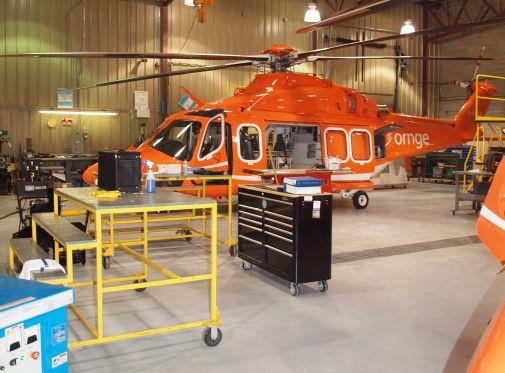
Ontario’s troubled air ambulance remains under an intense microscope for financial impropriety at the highest levels. (Photo by Matt nicholls)
Design Elements: Reader Feedback
Reader Keith sketchley from saanich, b.c. had this to say about Walter Heneghan’s piece on medical interiors (see, “creating a safe Haven,” march/april 2013, pg. 20):
“the discussion of medical interiors in your march/april 2013 is interesting. i recall debates among medical people about the risks of attempting intubation in a moving platform. the takeoff and landing phase of flight are relatively short and helicopters can in theory land en route, but road ambulances can stop more easily in more places. However, if intubation was accepted practice with the okanagan/canadian Helicopters s-76 interior used by ornge then it seems something was missed in defining requirements for its replacements.
aviation devices are highly integrated to minimize weight and maximize space. the exact geometry of the helicopter’s cabin including location of bulkheads, doors for unloading quickly, and structure to take stretcher loads to in a crash must be considered. not to overlook cost, either.
Helijet Expands its Presence
Richmond-based Helijet international continues to firmly develop its presence in the Prince rupert and Haida gwaii region of british columbia’s north coast.
Helijet told the canadian Press it has secured four-year air service agreements with two significant b c. sport fishing lodges located in the Whale channel
CalendeR of eVents
MAy
May 21-23
American Helicopters Society (AHS) International Phoenix, ariz. http://vtol.org
Hamilton Airshow 2013 canadian Warplane Heritage museum Hamilton, ont. www.hamiltonairshow.com
many choices will be encountered, the best result will occur if sensible end users are involved with designers and fabricators –easy to say, tricky to achieve in part because each person must ensure they are in touch with their colleagues in respective organizations. regarding James mewitt’s remarks about the origins of the okanagan/canadian Helicopters s-76 interior, i’d be surprised if operational and medical people weren’t significantly involved in defining configuration. rob
and caamano sound regions of the central coast of b c
the new service contracts are valued at more than $3.5 million. Helijet will provide summer-season service to these resort locations utilizing two twin-engine sikorsky s-76 helicopters, which will be operated and maintained by a Helijet team based at shearwater, adjacent to the bella bella airport.
blakely may remember, as some of it goes way back, noting rob flew the blue and orange paint scheme of the famous okanagan Helicopters company. a common problem however is that management tends to rush into modifications and thus end up with a design that is not as effective for users as it could be, nor as efficient to produce and maintain. it does take teamwork to do well, something that okanagan/canadian Helicopters headquarters were not noted for in the late 1980s.
the 13-passenger helicopters will fly guests and supplies to and from these remote lodge locations, which are situated along some of most beautiful and rugged wilderness regions of b c.’s west coast. the s-76 helicopters will also be available for general charter to other clients at times when they’re not committed to serve Helijet’s lodge clients.
JUly
July 17-20
ALEA (Airborne Law Enforcement Association) Conference orlando, Fla. www.alea.org
July 29-Aug. 5 EAA AirVenture oshkosh, Wisc. www.airventure.org
AUgUST
Aug. 9-11
Abbotsford International Airshow abbotsford, b.c. www.abbotsfordairshow. com
SEPTEMBER
Sept. 24-26
Helitech excel, london www.helitechevents.com
nOVEMBER
Nov. 7-10
Helicopter Association of Canada (HAC) Annual General Meeting and Convention vancouver, b c www.h-a-c.ca
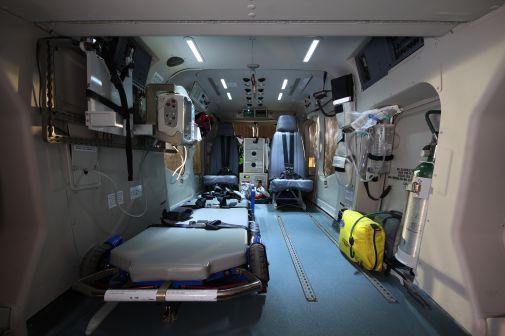
A management’s haste in putting a product together can often risk the safety of patients. (Photo courtesy of Air Methods)
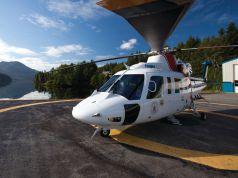
Helijet is expanding its footprint by offering service to more lodges. (Photo courtesy of Helijet)
The h elicop T er p ilo T ’s h andbook
by p hil c roucher
One problem with helicoptering is that there are virtually no flying clubs, at least of the sort that exist for fixed wing, so pilots get very little chance to swap stories, unless they meet in a muddy field somewhere, waiting for their passengers.
As a result, the same mistakes are being made and the same lessons learnt separately instead of being shared. Even when you do get into a school, there are still a couple of things they don’t teach
you, namely that aviation runs on paperwork, and how to get a job, including interview techniques, etc - flying the aircraft is actually less than a third of the job.
This book is an attempt to correct the above situations by gathering together as much information as possible for helicopter pilots, old and new, professional and otherwise, in an attempt to explain the why, so the how will become easier.
for this edition of my Helicopters column i present my loyal readers with a good old-fashioned rant responding to this phrase: “He died doing what he loved.”
oh, how i hate this phrase. “the devastated family of a climber who plunged to his death has spoken of how he died, ‘doing what he loved.’ ” Here’s another: “the family of a canoeist who died after his kayak became trapped in debris on a raging beck said yesterday he died doing what he loved.” or this, a bit closer to home: the pilot of a plane that crashed during a charity medical flight last week will be farewelled in a funeral. “the reality is, he went out on a bit of a high, doing what he loved, and doing something that he really believed in.” and finally, the most tragic circumstance of all: “. . .[the pilot], a combat pilot in vietnam who was days from retirement, was at the controls of a medical helicopter with [two] flight nurses . . . but he hit rough weather just 30 miles out and was turning back when the helicopter nosedived into a field monday night. He had four more shifts to go before he retired. [of the flight nurse this was said] When i think of [him], i think of family,” she said. “that was the thing that was most important. He was just proud of what he did. He was good at it; [he] died doing what he loved to do.”
i could go on. over the past year, i have read this phrase dozens of times from a wide swath of newspaper columns, blogs and magazine articles – and at least one time too often in reference to a helicopter acci-
Words Not to Live By
We Never Want to Hear ‘He Died Doing What he Loved’
widely about the pilot’s role in safety through his prescient books, Blue Threat and The Global War on Error. during the recent cHc safety & Quality summit in vancouver, dr. Kern highlighted his most recent work, “going Pro,” a treatise on professionalism and why the aviation industries need to overtly and proactively embrace the concept.
He writes of the various stages of professional development, from learning the trade to occupational excellence, and provides a plausible roadmap for personal, professional development. in my view, he makes a lot of sense. i have written of common-sense safety steps in previous columns: the imsaFe checklist; fatigue management, controlled flight into terrain (cFit) awareness; the “git-er-dun” attitude. some of these are tips; others, traps. but they should all be in our conscious thoughts every day we go flying.
internal company safety and quality audits can reveal systemic weaknesses in your organization. learn from the observations and become better. For multi-crew operations, good crew resource management training is invaluable, especially if it involves our customers. threat and error management awareness is a newer concept that also bears consideration. the university of texas studies of airline line operations safety audits (losa), have shown that for airline crews, there is an average of two crew errors and two external threats per flight segment. so, even in some of the most regimented and standardized cockpits in aviation, threats and pilot errors are common. losa studies present a real challenge in single-pilot ops – where most of us spend our days – but it stands to reason that we are being subjected to similar or greater numbers of threats and errors.
no normal, sane person sets out for work or play thinking that, ‘today is a good day to die.’ ‘‘ ’’
dent. this is what i think: it is pure, unadulterated codswallop. no normal sane person sets out for work or play thinking that, “today is a good day to die.” We don’t say goodbye to our wives and girlfriends and children not expecting to see them later that day (or at the end of the tour). now, i will admit that the surviving loved ones may get some solace in believing that their husband/son/daughter died engaged in an enjoyable pursuit, but as professional pilots we need to be on guard for this fatalistic approach to our jobs. We need to set out, every day, to prevent those who know us from saying such a thing. now, how can we do that?
dr. tony Kern, the respected author and speaker, has written
so, here is my challenge to you: challenge one another to increase your personal commitment to enhanced professional development this season. take the aviation Professional Pledge championed by dr. Kern: I pledge to remain vigilant, not only of my own performance, but also for identifying, reporting, and if possible, correcting all threats to the safety and integrity of my proud, chosen profession (www.surveymonkey.com/s/AviationProfessionalismPledge). and let’s work together so that we all go home to those we love instead of having them say that we died doing something we love.
Walter Heneghan is the VP of Safety and Quality at Canadian Helicopters. A passionate advocate for aviation safety and sound risk management, the veteran pilot presents his regular column for Helicopters magazine.
WalteR HeneGHan
paul dixon
must confess, i had some reluctance as i headed off to my fourth cHc safety & Quality summit this past march in vancouver, but i made a choice to try looking through new eyes and listen with new ears.
i made a point of not going to presentations i’d seen before, no matter how enjoyable scott shappell can be (and his session is always a treat). as much as i want to think that everyone at the summit is a safety zealot, we know in our hearts of hearts that there are still too many people in the choir who are simply mouthing the words – and i didn’t want to find myself in that scenario. two weeks after the summit, the vancouver sun ran an extensive three-part series on the shortcomings of the federal government’s shift of commercial aviation safety from a hands-on inspection regime to a largely self-guided compliance regime. the articles included several examples of what happens when smaller operators make conscious decisions not to follow the rules. all are real-life examples of this year’s cHc theme, “Predictive safety to avoid the inevitable.”
take a safety management system (sms) for example. We all hear about its system failures on a daily basis. and it’s the same for the justice system, the health-care system, the education system. something bad happens to someone and it’s all because the system failed them. We’ve created the illusion of the “system” as an entity – a living, breathing creature of untold mythical proportions. my trusty oxford dictionary offers more than a dozen possible definitions for the word “system,” with the first being “a complex whole.” not a black hole,
It’s
Not the
‘System’s’
Fault
Individuals Must Take More Responsibility for Safety Culture
point when they talk about systems and systemic failure. it’s not the system that has failed; it’s one or more of the people within the system. author and speaker dr. tony Kern helped me re-adjust my attitude with his “Predictable is Preventable” presentation. you don’t have to be the amazing Kreskin – forgive me for showing my age here – to make that prediction, but it’s something we see over and over again. it’s the myth of experience: that point in our lives or careers when we like to think we’ve seen it all and nothing’s going to get past us. What have we learned with an attitude like that? Well, we’ve learned to be non-compliant, especially with a sms. We’ve likely learned to be non-accountable – let the next guy make the deficiency report. above all, we’ve become satisfied with the status quo, comfortable in our little corner of the universe and good luck to anyone who tries to change us. but step outside the aviation world for a minute and look at some of the major man-made disasters or near-disasters around the world. the “system” fails because only one person fails at some aspect of their job. it’s true, as major disasters such as three mile island, chernobyl, Piper alpha, bP texas city, Hinton rail disaster, Westray and more illustrate. dig down into the reports and they are all systemic failures. From senior management right through to the front-line employees, the cause of each of these events was triggered by human action or inaction. often, a small mistake can be caught or corrected further along in the process, but when small mistakes are ignored they can easily add up to a tsunami.
there are gamblers with systems, oh yes. i knew a few of them in another universe. ‘‘ ’’
mind you, but a complex whole, “a set of connected things or parts.” read further and there’s also “a method of choosing one’s procedure in gambling.” there are gamblers with systems, oh yes. i knew a few of them in another universe. there were lots of systems, but none of them seemed to work no matter how convinced the developers of those systems were. someone has to feed the racehorses and help those casinos pay their hydro bills. it might as well be them, as it won’t be me. that’s my system, but i digress. the “interconnected parts” that make up the “complex whole” are the system of us, you and me. that’s where so many people miss the
Passing this message onto the younger generation will be critical for management teams in every facet of the aviation industry. and make no mistake – many of the upcoming “youngsters” in this industry are ready and willing to accept the challenge. it was very refreshing to see that these people were pumped to be there. take dylan grymonpre for example. the aerospace engineering student from carleton university in ottawa and this year’s recipient of the dr. Peter gardiner aviation student grant was absolutely thrilled to be a guest at the summit. What i liked best was how excited he was to meet people who were just as excited as he was about his chosen field. it was like meeting old friends for the first time.
a friend i used to work with was once asked by her daughter, mustering all the saccharine sweetness of a 16-year-old, “mom, were you sad when the dinosaurs died?” if i were asked that question, i would say that i was still waiting, but i’d be one happy fellow when the day arrives.
Paul Dixon is freelance writer and photojournalist living in
Vancouver.
at one of the forestry briefings i joined last year, i was impressed by the age of the attending pilots. of those that were gathered at the table, there must have been in excess of 100,000 hours of flying experience present. and even with the greying hair and sagging midriffs, they displayed an obvious enthusiasm for the coming day. it was readily apparent why so many of the “veteran” pilot set continue on even after normal retirement age. For some, it may be a money issue, but i believe there’s much more to it than that.
Famed australian aviator sir ross smith, K.b e. once remarked that in the air, a flying machine ceases to be a mere piece of mechanism, it becomes animate and is capable not only of primary guidance and control, but actually of expressing a pilot’s temperament. Had he not died tragically in a 1922 air accident, smith might have witnessed the birth of the helicopter and realized just how prophetic his words were.
the helicopter responds best to coaxing as any pilot will attest. subtle control inputs are carried out that are almost imperceptible, leading the casual observer to believe that there is more inflection than physical control. the pilot who maintains a close rapport with a machine that is as responsive as a helicopter, can, over time, evolve into a part of their psyche or how they perceive themselves.
Who among us hasn’t flown a helicopter and determined a temperament in the machinery whether it be diabolical or benign? the pilot establishes an animated ally to get a better awareness as to how the
Of Vintage Quality
Age
and
Experience Bring Value to the Table
tones especially in the turbine range have disappeared. my reflexes are not what they used to be and even with a non-flying day in the offing, i am usually in bed by 10:30 p.m. my comfort level has grown because i know that in order to surprise me the helicopter is going to have to dig deep to find a malfunction that has not already been experienced.
despite my age, however, medicals and pilot proficiency checks are still passed with relative ease. now, i am more concerned about a passenger’s perception sitting alongside a pilot who in all likelihood was established in a career when they were still in three-corner pants. assurances are usually unsolicited, with passengers voicing confidence in grey hair.
Helicopter charter companies, however, may not share that perception. they may maintain that older pilots will not seek out the work the way younger pilots do or may fatigue too easily. that may be the case in some instances. but a pilot who is dedicated, has a mature work ethic, is not looking for an opportunity to be heroic and has a love for the task sounds like a win-win combination especially when it comes to machine preservation and customer satisfaction. there is also the determination that older pilots are not enthusiastic when it comes to stressful or high-demand jobs. but why would they be? Past experience dictates that the jobs they were glad to be rid of would not be sought after, anyway, now that money is no longer the driving factor.
i am told that military pilots, after 20 years of service, evolve into administration duties and fly only to maintain their status and the pay bonus. unless they opt to engage in a civil flying capacity after retirement, the concept of someone willingly flying beyond is foreign to them.
i have talked to retired pilots who smile knowingly when i tell them of my intention to keep going.
machine performs, sometimes even cajoling it to do better. of course, this makes it easier to assign some of the blame to the helicopter when things don’t go as planned. Whether or not this intimacy produces a more skilful pilot is undetermined, but it certainly produces a more dedicated one!
and it’s this dedication that grips us into living out of a suitcase for months at a time, assured by the familiarity of a machine that youth has not deserted us, at least not today.
after 40-odd years of flying, my chosen career has taken its toll. the ray-bans have given way to prescription sunglasses, and some audio
i have talked to retired pilots who smile knowingly when i tell them of my intention to keep going, at least for a while. they relate that they once felt the same reluctance, but decided one day simply to hang up the helmet and walk away. the helicopter will never appreciate a lifetime of devotion, they tell me. it is only the pilot’s contribution that made the experience so satisfying.
some of you may find my perceptions absurdly theatrical, which is understandable and i sympathize. if that’s the case, however, i guess for you, piloting a helicopter is just a job.
A native of Spruce Grove, Alta., Michael Bellamy has been flying fixed- and rotary-wing aircraft in a variety of capacities since 1971, and is an accomplished author of several books, including Crosswinds.
MiCHael bellaMY
anna panGRazzi
one of the best things about having a career in aviation is meeting interesting characters and listening to the stories they tell. mary ellen Pauli is a prime example. last fall, i had the honour of presenting Pauli with the elsie macgill northern lights award. she has been a helicopter pilot with the ontario ministry of natural resources (omnr) for more than 25 years, and until quite recently, was the only woman on the roster. Pauli’s stories are fascinating. growing up near a fly-in bush camp in northern Quebec where both her father and brother were hardworking pilots, she never dreamed that flying could be a possibility for her until she read a book about amelia earhart. recently, we discussed the importance of role models and the challenges and rewards of flying.
Q: Why was the book about Amelia Earhart so important to you?
A: i was 13 when i read that book and it showed me that it really was possible for me to fly, that girls can fly. i think it’s very important young girls are exposed to as many role models as possible. they just don’t see female helicopter pilots. even my friends never see me in a uniform or flying.
Q: Did your family encourage you to fly?
A: growing up, we lived above an airbase and i wasn’t even allowed to go down there. When i expressed an interest in being a pilot my father said, ‘you’ll never get a job’. my brother encouraged me along the way but unfortunately he died in a plane crash when i was fairly young. my mother always said where there’s a will, there’s a way and so i focused on that.
A Wild Ride
OMNR’s Mary Ellen Pauli Tames the Helicopter Landscape
hard work and required not only flying skills but marketing and booking and organizing the summer “pad” rides over the maritimes. i think they appreciated my work ethic so they kept me on after the season ended.
Q: How do you describe your professional style?
A: i take flying very seriously. i would say that i am a perfectionist. Working in the north brings many challenges. i have worked in mining exploration camps, power line construction, diamond drilling, environmental studies and transportation. as a pilot you need to keep things on track and on time. i like the precision of the job.
Q: What is the most rewarding aspect of your position?
A: the projects i have been involved in are so rewarding. Working with wildlife, collaring caribou, black bears, polar bears and working with scientists to study their environment has been very exciting. Fire season also offers its own challenges. the greatest thing about my job is being able to work with interesting and dedicated people. the northern landscape is also spectacular. very few people get to see where i fly!
Q: Have you ever felt that the challenges were just too much, too hard to overcome?
A: there have been a couple of instances over the years that i found myself struggling to get over the wall. the kinds of situations that are just not rational, like discrimination. so much harder than facing a charging polar bear or staying in a swampy bug-infested camp in tents with the drill crews.
the greatest thing about my job is working with interesting and dedicated people.
Q: What kind of challenges have you had in your career? Was it hard to be taken seriously?
A: When i arrived at the helicopter base to start lessons, i found out they weren’t even expecting me. they weren’t set up to have women there and they didn’t think that i would show up. When i received my commercial helicopter’s licence and started looking for a job, 15 companies turned me down because all they had was bush work and they didn’t think a woman could do it. these challenges only deepened my resolve and i became more determined. Fredericton Helicopters finally hired me for the summer tourist season. it was
Q: Is there anything more you think we should be doing to entice young women into a career in aviation?
A: Just making women aware in any way we can. as professional pilots, it’s about making ourselves visible and available to encourage and inspire young women to follow their passion to fly or be involved in some form in the aviation world.
Q: What advice would you give young women thinking about a career in aviation?
A: if this is your passion, then don’t ever let anyone talk you out of it – stay true to yourself and your dream. if you are on that path and forging ahead, things will fall into place.
Anna Pangrazzi is president of Apex Aircraft Sales Ltd. in Toronto. An accomplished aviator, Pangrazzi has a passion for highlighting the exploits of other prominent female aviators.
CoVeR stoRY
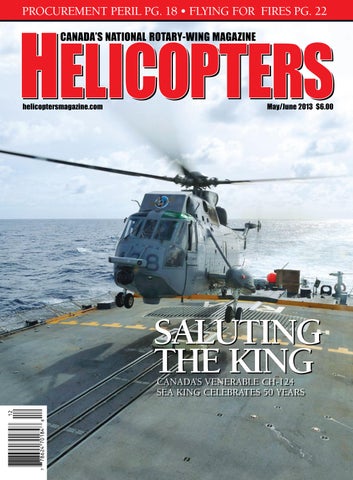
saluting
the King
Canada’s Venerable CH-124 Sea King Celebrates 50 Years
bY paul d ixon
it was late november 1962 when douglas Harkness, minister of national defence, announced that “approval has been given for the commencement of a program to equip the royal canadian navy with helicopters of the most modern type,” as reported in the royal canadian navy’s Crowsnest magazine. thus was born the era of the sea King, though the announcement was overshadowed by the lifting of the u s naval blockade of cuba that day, a move that ended the cuban missile crisis.
in the years following the second World War, the royal canadian navy (rcn) was committed to being a global leader in anti-submarine warfare (asW). While the u-boats had been vanquished, the threat shifted to the russians and their Warsaw Pact allies. the balance of power between surface ships and submarines took a huge tilt in favour of the submarine with the launch of the uss nautilus in 1995, the world’s first nuclear-powered submarine. nuclear power removed the achilles heel of the diesel-electric sub; the need to surface on a regular basis was now replaced by the ability to go deep and stay deep. the rcn had been investigating helicopters for shipboard operations from the early 1950s, as had the british and americans. in 1956, small helicopters were successfully landed on temporary platforms that were erected on several rcn escorts. While the exercise was deemed a success, there was widespread doubt about the feasibility of operating a helicopter the size of the larger Hs-04 (a.k.a. “Horse”) that was being flown from the aircraft carrier from a small escort vessel. While the rcn had proven it was possible, the question of practicality remained. there was more involved than just the helicopter.
the emergence of the nuclear submarine took the battlefield over the horizon from the destroyers and destroyer escorts that were charged with the responsibility of protecting the navy’s capital ships and merchant convoys. nuclear subs could lurk far outside the range of ship’s sonar and the weapon systems the escorts could employ, and in many cases, the new generation of submarines were faster under water than the ships tasked with locating and neutralizing them. the helicopter offered the ability to extend the protective cordon to the horizon, as well as extend the ability to prosecute its targets well beyond the range of
anything a surface ship could bring to bear on a submarine. this is where the rcn took a fork in the road that led to it becoming the pre-eminent operator of naval helicopters in the asW role for almost 30 years. the americans and the british looked at the helicopter simply as a delivery system for a weapon, taking command and control direction from the ship. the british chose to employ the Westland Wasp on their frigates, while the americans initially tried using a drone, the gyrodyne QH-50, from their small escorts. in both cases, the aircraft would simply go where it was directed by the ship’s combat control centre and launch its torpedo against the submarine. the rcn decided to go with a larger helicopter that was capable of operating in a standalone mode away from its ship, but realized that the Hs-o4 lacked the payload, performance and range needed to make this possible.
in 1959, two helicopters were short-listed, the Kaman sH-2 seasprite and the sikorsky sH-3 sea King, but as neither aircraft actually had flown yet, it was decided to await further u s. navy trials before deciding. in december 1960, the rcn and treasury board announced canada had made a decision on the question of a shipboard helicopter and that aircraft would be the smaller Kaman sH-2 seasprite – but at this point the manufacturer abruptly raised the price of the aircraft by more than 60 per cent. When further data from the u s. navy revealed the seasprite to be underpowered and overweight for canadian operations, the decision was made to go with the sea King.
a YounG KinG eMeRGes
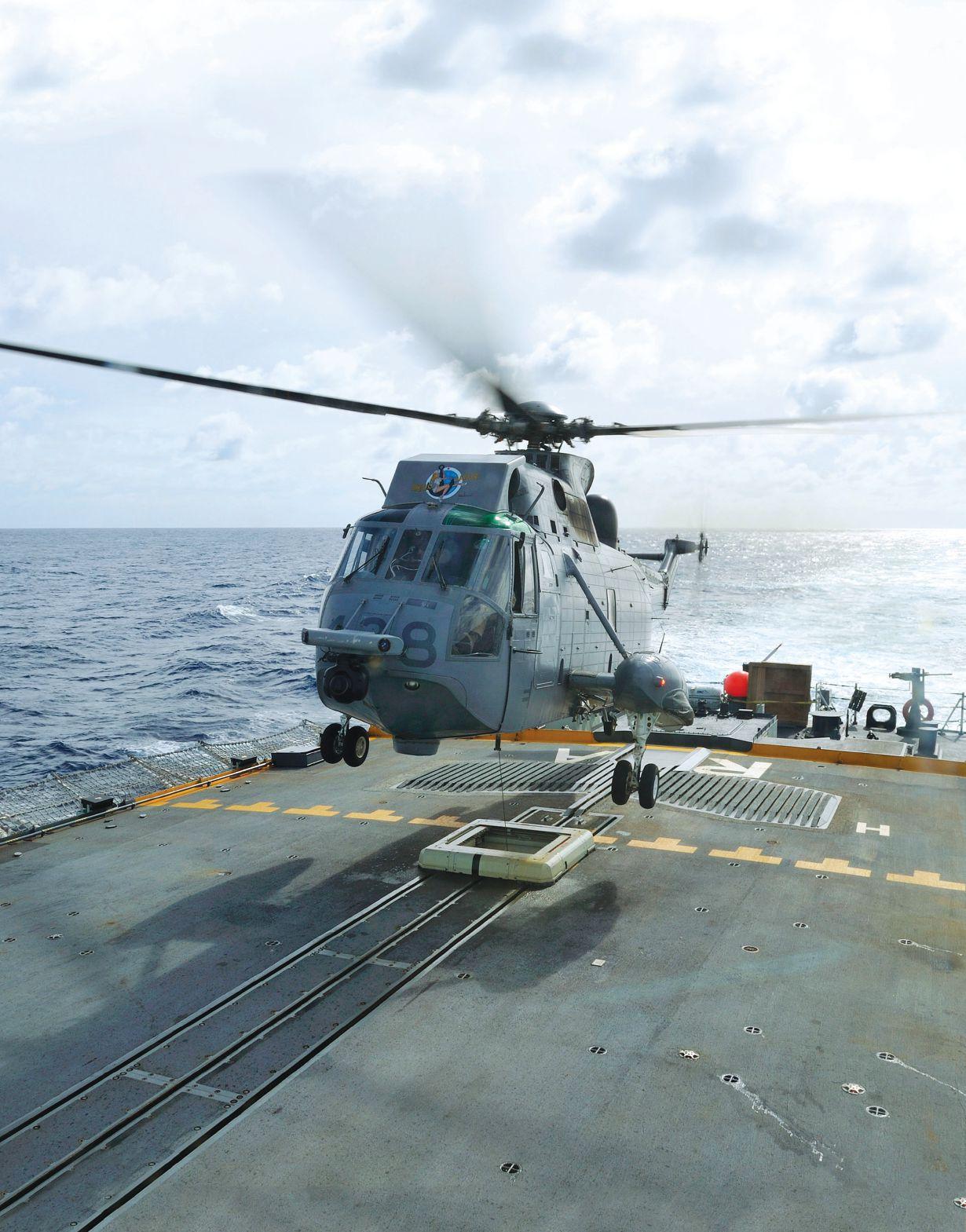
the genius moment at the dawn of the sea King era was the development of the Helicopter Hauldown and rapid securing device (HHrsd), affectionately referred to as the “beartrap” by rcn experimental squadron 10 (vX-10) and dartmouth’s Fairey aviation. the beartrap allows helicopter operations to be undertaken from a moving warship in sea conditions as extreme as nine degrees of pitch and 31 degrees of roll. Here’s how it works: as the helicopter hovers over the ship’s deck, a cable is lowered from the aircraft and attached to a heavier cable that passes through the centre of the beartrap, which is attached to a winch below. the heavier cable is pulled back up and secured to the helicopter, and the pilot then increases power to balance against the pull of the winch, flying the aircraft down to the deck with the wire as a guide. once safely on deck, the jaws of the beartrap clamp on the probe extending from the helicopter’s belly, ensuring the helicopter stays put. the rcn has set operational limits of a maximum of four degrees pitch and 24 degrees roll. While many of the world’s navies have embraced the beartrap, none comes close to operating at the same limits as the rcn in 1961, the rcn ordered the first of what would ultimately be 41 sea Kings. the first four aircraft were built at the sikorsky plant in connecticut and the subsequent 37 aircraft were assembled at united aircraft of canada, in longueil, Que. the canadian sea King differed
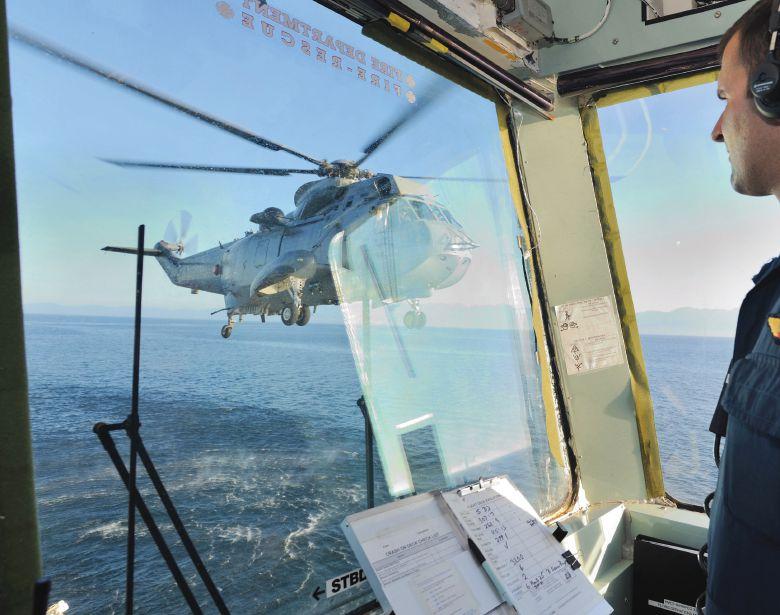
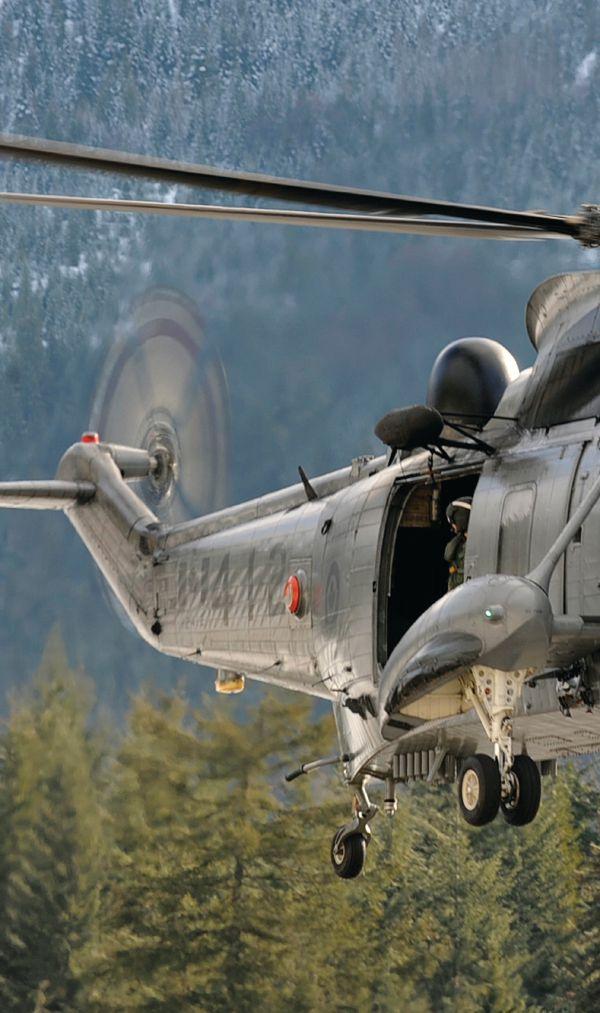
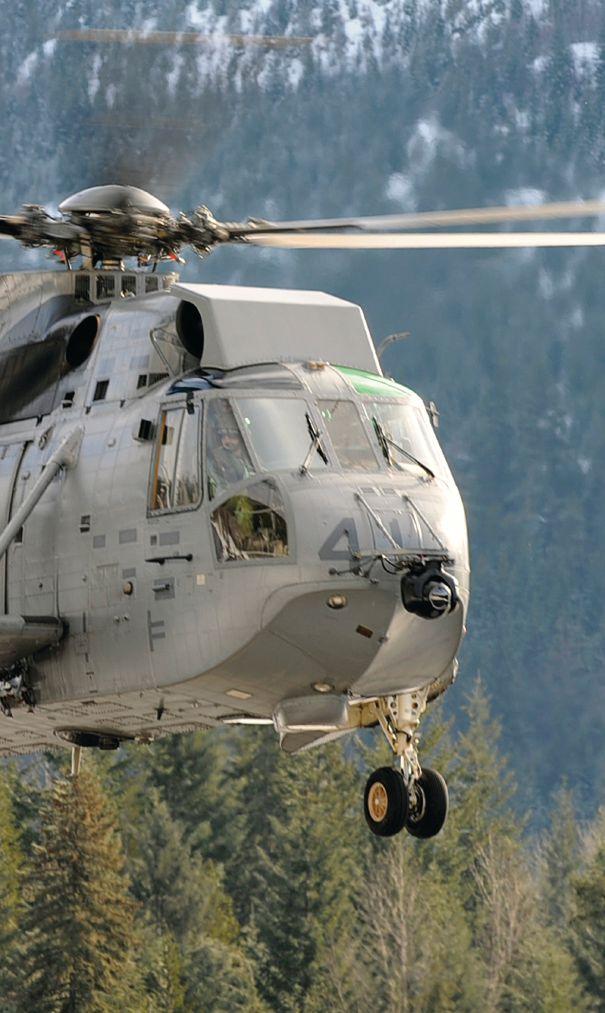
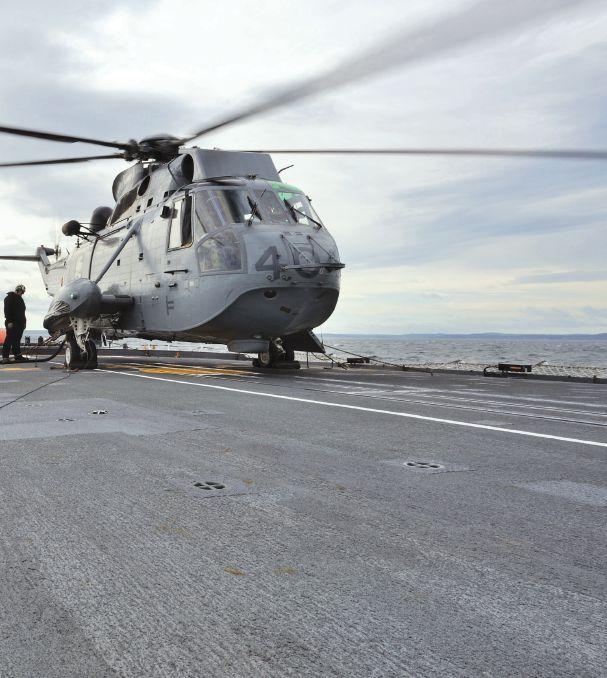
lEFT: A CH-124 Sea King helicopter from 443 Maritime Helicopter Squadron based out of Patricia Bay, B.C., lands at the Whistler Municipal Heliport during Operation PODIUM. (Photo by Sgt. Frank Hudec, Royal Canadian Air Force)
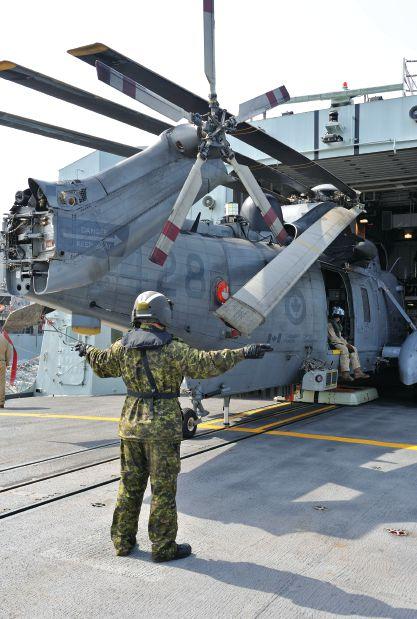
BOTTOM lEFT: Corporal gabriel Tessier directs a CH-124 Sea King helicopter out of the hangar of Her Majesty’s Canadian Ship (HMCS) Regina during Operation ARTEMIS in the Arabian Sea on Sept. 10, 2012. (Photo by Cpl. Rick Ayer, Formation Imaging Services, Halifax, n.S.)
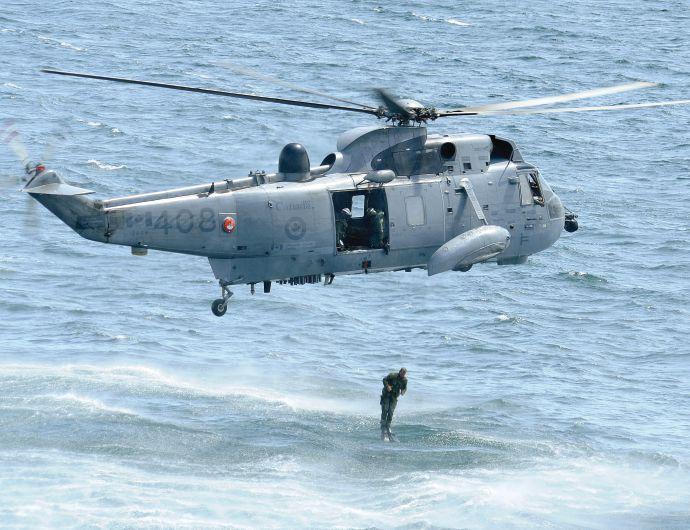
BElOW: A CH-124 Sea King in action during the Royal Canadian Air Forces’ land Advance Warfare Centre (CFlAWC) surface/subsurface training at CFB Albert Head, Esquimalt, B.C. (Photo by Cpl. Brandon O’Connell, Royal Canadian Air Force)
CoVeR stoRY
from the american model with the addition of canadian mission avionics, the helicopter rapid haul-down device system, a strengthened main undercarriage and an automatic tail-pylon folding system. operating off a small warship, the sea King was a self-contained asW unit, able to go over the horizon, locate and track submarines with its own dipping sonar and on-board mission avionics and attack targets with torpedoes far out of sight of the home ship.
col. John orr (ret.) first took the controls of a sea King in 1969 after graduation from flight school and still vividly remembers his introduction more than 40 years later. “oh my god, what a machine, it was huge.” orr went on to have five operational tours with the sea King, commanding 423 squadron in the mid-80s. When he arrived in 1969, the sea King had been fully integrated into operations.
“it was pretty phenomenal, the operation that was going on in the canadian navy with the carrier and the destroyers, the helicopters, the (cP-121) tracker and the (cP-107) argus providing long range cover,” orr said. “it was an extremely capable anti-submarine operation and then they took away the carrier.”
an iMpoRtant
neW Role
in June 1970 following a mid-life refit in 1966-67, Hmcs bonaventure was decommissioned after barely 13 years of active service and quickly consigned to the breaker’s yard. the rationale behind the elimination of the carrier was the development of the four 280-class (tribal) destroyers, which were designed and built with the sea King as the primary weapon in prosecuting the ship’s role as a long-range submarine hunter/ killer. the ships, which entered service in 1972, were a radical departure from the front-line destroyers of the royal navy and u s. navy at the time in that the 280s were designed with a large hangar and flight deck area in order to accommodate two sea King helicopters.
the sea Kings, with their full array of sensors, superior endurance and range, were able to operate independently of their ship. tactics were developed to enable two sea Kings to operate in tandem to hunt submarines, with one helicopter employing its dipping sonar to locate and track potential targets, allowing the second helicopter to engage the target with its torpedoes. this allowed a single 280-class destroyer to control a much larger area of ocean by utilizing its own sensors as well as those of the helicopters, while the british and americans were reliant on the warship alone.
When the armed forces were integrated in 1968, the cHss-2 sea King was re-christened as the cH-124. by the mid-1970s, the sea King was deployed on nine escorts that had been converted to helicopter operations, the four larger 280-class destroyers with their two helicopters and the two new replenishment ships with three helicopters in the ship’s air detachment. the number of personnel and the logistical requirements needed to manage and maintain the number of aircraft were beyond the scope of a single squadron. in september 1974, Hs 50, the original rcn asW helicopter squadron, was deactivated and two former second World War royal canadian air Force squadrons were reactivated as Hs 423 and Hs 443 under 12 Wing at shearwater, n s in 1989, 443 squadron moved to the victoria international airport (yyJ) to better support the rcn Pacific Fleet based at esquimalt, b.c.
as the cold War played out, submarines evolved into something far more sinister. While the introduction of nuclear-powered submarines had broadened the playing field immensely, it was the introduction of guided-missile submarines that turned the asW game upside down. a single missile-equipped submarine parked quietly on the ocean bottom could destroy half of the population of north america from just about anywhere in the world.
the asW game grew from creating a submarine-free zone around merchant convoys or naval battle groups to actively seeking out and
prosecuting submarines wherever they might seek to hide, hunting for the proverbial needle in the haystack under extreme conditions. in the 1970s, more was known about the geography of the surface of the moon than about the bottom of the atlantic ocean and the multitude of deep ocean currents that created conditions that could at best be called “challenging.” the rcn once again proved its mettle by excelling in its chosen field, asW in the north atlantic. then the game changed yet again with the fall of the berlin Wall.
in the game of nuclear brinksmanship we knew as the cold War, the russians blinked first and the berlin Wall, the one thing above all others that symbolized the divide between east and West, crumbled literally and figuratively almost overnight. then in august 1990, saddam Hussein’s iraqi forces invaded Kuwait. Following the united nations authorization of military intervention against iraq, canada was one of the first countries to join the u s.-led coalition. a naval task group comprising Hmcs terra nova, Hmcs athabaskan and Hmcs Protecteur was dispatched to the gulf with five sea Kings, two on athabaskan and three on Protecteur. it was a 180-degree u-turn for the sea Kings and their crews in terms of mission responsibilities and operating environment. after two-and-a half-decades of chasing shadows under the surface of the ocean in the cold and damp of the north atlantic, they would be expected to take on a wide range of new tasks in an equally harsh and demanding climate.
orr talks with great pride about the job that was done in preparing the aircraft and their crews in the time available. “the story of the conversion of the helicopter in 1990 is amazing. they took the whole helicopter and changed it in two weeks, it was bloody amazing,” he says. after operation desert storm began in January 1991, the canadian task group undertook escort duties for hospital ships and other vulnerable naval vessels of the coalition. in February 1991, the cruiser uss Princeton was disabled by two iraqi mines at the north end of the
Persian gulf. While the athabaskan was not assigned to the area, the commanding officer of Princeton specifically requested assistance from the canadian ship as she was the only warship in the region that could simultaneously operate two helicopters. the athabaskan and her helicopters helped both ships avoid mines until a minesweeper and naval tug arrived to tow the Princeton to safety in an operation that stretched over two days.
captain edward Hontz of Princeton was effuse in his praise of the Hmcs athabaskan. “We owe a debt of gratitude for the superb professionalism of those who extracted us from the minefield and delivered us to safe haven . . . to the Hmcs athabaskan for leading the way from the north arabian gulf to bahrain and even more so for the 17 cases of beer sent over by helo today.”
liVinG life on tHe fRiGate in the 1990s, the aging destroyer escorts of the 1950s were replaced by the Halifax-class patrol frigates, which were specifically designed around the helicopter. While the ships may have changed, the game remained the same – operating a large helicopter from a small warship bobbing about in the deep blue sea. Forty years after orr made his debut in the sea King, freshly minted sea King pilot capt. Kris Provan described his first experience flying off a ship in may 2009 to Helicopters onboard Hmcs calgary.
“i knew the theory behind what we are supposed to do; however, knowing it and doing it is a different story,” Provan said. “as you prepare to take off, the only thing that you can look at is the hangar which is about 12 feet in front of the rotor arc. it is very, very close. after getting clearance, instead of gently pulling the collective to get to the hover, you pull the collective in a very positive manner in order to get to the hover as quickly and in as much control as possible. it feels like you are going up in a very quick elevator. in the hover, every single tiny error is easily
seen and felt because of the proximity of the hangar. at that point i really got the sense of how tricky this whole ship idea was going to be.” getting off the ship was only the beginning, as eventually it was time to land. Provan was initially surprised by how small the ship appeared to be, surrounded by nothing but water and seemingly moving in all directions at once as the helicopter flew in formation with the ship at 25 knots. “you move over to hover above the flight deck,” he said. “all you can see from this position is a mass of equipment on top of the ship. to see the hangar door come up into my face was a little disconcerting. i tried to remain calm but above all, smooth on the controls. i found a nice little dot on the hangar door and tried my best to maintain a good hover. With my peripheral vision, i could tell that the ship was moving side to side. i could hear back, steady, forward steady, right steady. then, when it seems that time has stood still for hours (in reality only five to 10 seconds) the lso person says, ‘land now, doWn, doWn, doWn!!!’ the collective gets dropped and you slam into the deck. i didn’t realize until i took off my flying suit that i had been working really hard. i was drenched in sweat and my right arm was sore.”
an iMpRessiVe leGaCY
since the end of the cold War, the rcn has taken the sea King to places never envisioned 50 years ago and tasked it with a myriad missions. it has supported two gulf Wars, nato actions in the balkans, the blockade of libya and anti-piracy patrols off the Horn of africa, to name but a few of the international deployments. Forward looking infra-red (Flir) makes it particularly effective in locating and monitoring small boats far at sea on anti-piracy missions. back in this hemisphere, there have been the humanitarian missions to support Haiti, post-Katrina relief, manitoba’s red river floods, Hurricane Juan in nova scotia and Hurricane igor in newfoundland. For the 2010 Winter olympics in vancouver, sea Kings were the helicopter of choice for the rcmP emergency response teams (ert) over the cH-146 griffon as one sea King could carry the entire team versus a pair of griffons.
the sea King has met the challenges over the years, a testament to both the people who designed and built this robust machine as well as the aircrews and maintainers who put it in the air and kept it there, no matter what the mission. as the delivery dates for the cH-148 cyclone continue to stretch, the challenge continues to maintain the current sea Kings and their crews while at the same time preparing for the replacement aircraft. the cyclone promises to be as much of a leap forward as the sea King was 50 years ago, but aircrews and maintainers will have to be trained on both sea King and cyclone until the last sea King is retired.
Helicopters of the most modern type, indeed. From hunting red october to hunting medieval pirates, the sea King has fulfilled a range of missions that few could have imagined 50 years ago. yes, the sea King is long overdue for replacement, but as it comes to the end of a very long and distinguished career in service to canada, we must recognize that this aircraft and those who have flown – and maintained – it, have provided a level of service matched by few others. ready, aye ready.
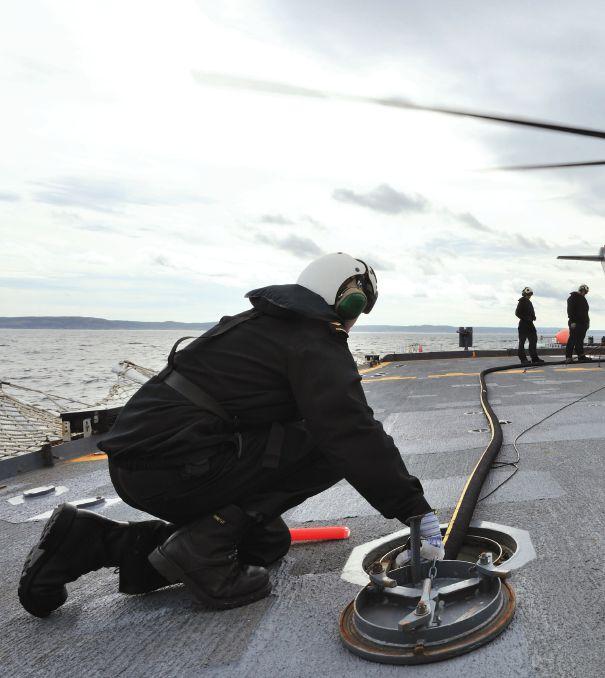
Deck Director, leading Seaman Tim Parker, holds a wand below the flight deck to signal the Helicopter In Flight Refuel (HIFR) crew to proceed with the refuelling of a CH-124 Sea King aboard HMCS Montreal during Operation lAMA. (Photo by Master Cpl. Angela Abbey, Royal Canadian Air Force)
the perils of procurement
Recent Political Decisions Compare to Past Missteps
bY paul dixon
the storm of controversy that has arisen around the cF-18 replacement project and the ongoing delays with the cH-148 cyclone are but the latest scenes in a play that has been running since confederation.
the canadian public have a limited awareness of its military. the day-to-day operations of the army, navy and air force largely take place out of the spotlight and are rarely newsworthy. two things have largely determined the state of our military, one being our political heritage and the other being the reality that we have largely been dependent on other countries to equip our military or provide the design expertise for domestic manufacture.
Prior to confederation, britain was responsible for the defence of canada through the presence of the british army and units of the royal navy. after 1967, the canadian army gradually evolved from british units with the first permanent force being created in Kingston, ont. in 1871. When the northwest Field Force was dispatched to put down the northwest rebellion in 1885, it was the first time canadian troops (a mixture of regulars and militia) had been commanded by canadian officers.
tHe failed Ross expeRiMent the boer War marked canada’s first official dispatch of troops to an overseas war. it was a political hot potato for the liberal government of sir Wilfrid laurier, establishing a pattern that would repeat itself many times over in years to come. While canadians of british heritage supported the war, urging the government to send troops, most Frenchcanadians and immigrants of other nationalities weren’t convinced that canada had any business in a war half-way around the world.
laurier demurred until the internal and external pressure forced his hand. initially agreeing to send a battalion of volunteers, he eventually sent more than 7,000 canadians to south africa. laurier rationalized at the time that this overseas expedition was not a precedent, but history
has proven otherwise.
towards the end of the boer War, a diplomatic tiff between britain in canada resulted in britain refusing to supply any more lee-enfield rifles to the canadian troops. canada had no arms or munitions industry and had relied on britain. attempts by the canadian government to entice british manufacturers to set up operations in canada failed. this forced the government to turn to the ross rifle, developed by charles ross. it was an accurate weapon and a fine hunting rifle, but a poor infantry weapon, heavy and prone to malfunction when exposed to dirt.
When britain declared war on germany in 1914, canada and the rest of the commonwealth were caught up in the rush to arms. the government had no plan in place for mobilization and the standing army of less than 3,000 exploded to more than 32,000 in the first two months of the war as recruiting centres were overwhelmed. the need to outfit and equip this many soldiers was an overwhelming task. the first two canadian battalions sent overseas were clothed in shoddy uniforms and boots that disintegrated in the filth and muck of the trenches and armed with rifles that were next to useless. there was widespread outcry of war profiteering by suppliers such as ross who were awarded contracts more on the merit of their political and social contacts than on the quality of their products.
there had been a considerable gap between the military and the industrial world before the First World War, but as warfare became increasingly mechanized, the gap closed. as germany re-armed in the ’30s after Hitler’s rise to power, the british recognized the need to remove weapons production from the reach of enemy air forces and approached the canadian government for assistance in 1937. Prime minister mackenzie-King, true to form, was hesitant to agree to the request, fearing public backlash. eventually, in 1938, the John inglis company was awarded a contract to produce bren guns for britain and canada. there was considerable outcry, not over the fact that weapons
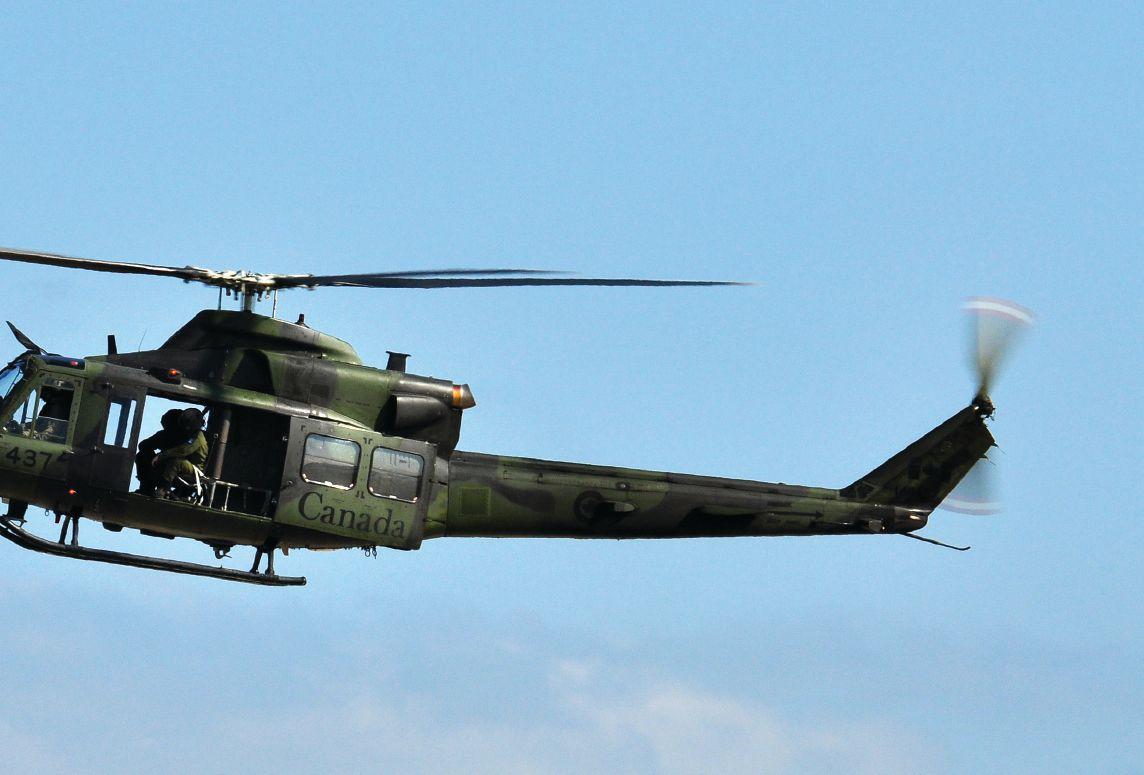
ABOVE: The versatile CH-146 griffons are indeed workhorses, but they do have their shortfalls, mainly size and agility. (Photo courtesy of the Royal Canadian Air Force)
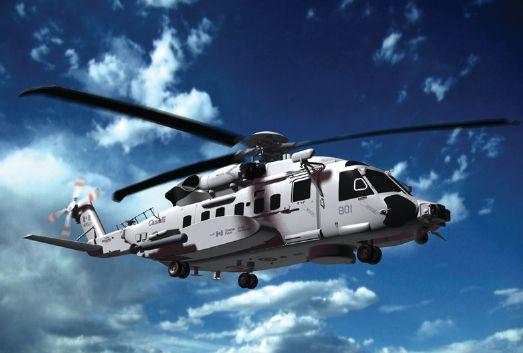
RIgHT: The Sikorsky CH-148 Cyclone has been much maligned as one of the worst procurement decisions of recent memory. (Photo courtesy of the Royal Canadian Air Force)
were being produced, but because there had been no public bid process in the awarding of the contract, a situation that awakened sentiments of war profiteering from 20 years earlier.
a royal commission was appointed and concluded that while there may not have been any actual impropriety, there were inadequate controls in place. the findings of the commission resulted in the federal government creating a centralized procurement agency with civilian experience in purchasing to deal with both canadian military needs and export demands, with the goal of economic and administrative efficiency. the defence Purchases, Profits control and Financing act was passed which authorized the creation of the defence Purchasing board in July 1939. the dPb was replaced in 1940 by the War supply board, a full government department created to handle military procurement. canada now had a system in place to deal both with determining the needs of the military and with meeting those needs. the reality is that while canadian shipyards and factories churned out ships, aircraft, vehicles of all descriptions and a wide array of arms and munitions, virtually everything was based on plans and designs provided by the british or americans. canadian industrial production boomed through the war years, but once the war ended, production shifted back to civilian needs as soldiers, sailors and airmen were demobilized.
canada’s first military exposure to helicopters was in 1944
through a group of seven young royal canadian naval volunteer reserve (rcnvr) officers who had just completed their initial flight training and were sent for additional training on the sikorsky r-4 at Floyd bennett Field in new york. the training was conducted by the u s coast guard as the u s. navy professed no interest at that time. When their training was finished, the seven moved on to fly with the royal navy Fleet air arm. at the conclusion of the war, when offered surplus helicopters by their royal navy counterparts, senior rcn officers declined the offer, saying they wanted jets instead. at the conclusion of second World War, the rcn was operating two royal navy escort carriers with rcn crews and rn air crews, with the intention of obtaining and maintaining two light fleet carriers in the post-war era. this plan was overridden by the government, and a single carrier, Hmcs Warrior, was taken on. unfortunately the ship had been designed to operate in the tropics and proved unsuitable for the harsh realities of canada’s atlantic environment. this led to the acquisition of Hmcs magnificent in 1948, which itself was replaced by Hmcs bonaventure in 1957.
HeadinG to tHe sKies
the royal canadian air Force (rcaF) bought canada’s first helicopters in 1947, seven sikorsky s-51/H-5 aircraft for training, evaluation and search-and-rescue duties. the rcaF then ordered
15 sikorsky s-55s for search-and-rescue duties as well as assisting in construction of the mid-canada radar line. the rcn bought 13 sikorsky s-55s, known as the Ho4s, which were initially used as plane guards on Hmcs magnificent and later evolved into as W duties with H mcs bonaventure.
as the cold War expanded through the 1950s, a political trump card was played by the new conservative Prime minister John diefenbaker that would have wide-reaching and long-lasting consequences for military procurement and supply in canada. in 1957, diefenbaker committed canada to norad without consulting his cabinet or Parliament, a decision that led directly to the cancellation of the avro arrow.
While the arrow captured the spotlight on the fixed-wing side of the equation, the rcn was working on the evolution of the helicopter in asW duties, with a goal of operating aircraft around the clock at sea, realizing that the Hs-o4 lacked the payload, performance and range needed to make this possible.
in 1959 two helicopters were short-
listed, the Kaman sH-2 seasprite and the sikorsky sH-3 sea King, but as neither aircraft had actually flown yet, it was decided to await further u.s. navy trials before deciding. in december 1960, the rcn and treasury board announced that the Kaman sH-2 seasprite had won out, but at this point the manufacturer abruptly raised the price of the aircraft by more than 60 per cent. When further data from the u s. navy revealed the seasprite to be underpowered and overweight for the intended operations, the decision was made to go with the sea King instead. the first four sea Kings were built at sikorsky’s plant in connecticut, with the remaining 37 aircraft assembled at u nited technologies in longueil, Que. the unification of the three branches into the single entity of the canadian Forces was touted by defence minister Paul Hellyer as a way to achieve cost savings as well as improved command, control and logistical support of a unified military. Personnel and aircraft of the rcn and rcaF were now serving together under canadian Forces air command. under the
The dependable CH-149 Cormorant has been a search-and-rescue stalwart for years. (Photo courtesy of the Royal Canadian Air Force)
new unified command, rotary aircraft were given the “cH” designators. the cH-113 was known as the labrador in the search and rescue role and as the voyageur in the tactical support role. by the 1970s, the canadian Forces was using a number of different helicopters to fulfil a wide variety of missions, including the heavy-lift cH-47 chinook, the agile cH-136 Kiowa and the versatile cH-135 twin Huey, the latter of which was manufactured in canada at mirabel, Que.
seeKinG a CHeap fix
Politicians are quick to pounce on the canadian military to find ways to trim budgets, and the mulroney conservatives saw their opportunity with a scheme that would see one helicopter fulfil the mission requirements of the chinook, twin Huey and Kiowa. between 1992 and 1995, the
c anadian Forces acquired 98 c H-146 griffon helicopters, again built in mirabel, a militarized version of the bell 412 to replace approximately 150 helicopters. and while the griffon is a fine aircraft in many regards, its many critics are quick to criticize it as not being big enough to replace the chinook, nor agile enough to replace the Kiowa while being little more than a replacement for the twin Huey.
What the mulroney government had done was move ahead with one helicopter to replace the aging sea Kings in the maritime asW role, as well as the labrador search and rescue helicopter. the eH-101 project in concert with britain and italy was turned into a political hot potato by the liberals in the 1993 election and one of the first acts of Jean chretien as prime minister was to order the cancellation of the order despite a $500 million penalty. ultimately the eH-101 reappeared in 1998 as the cH-149 cormorant when the liberal government announced that it would purchase 15 “scaled-down” versions of the eH-101 for the search-and-rescue role, with the first aircraft entering service in 2002.
e ntering the 21st century, c anada found itself supporting military operations in the remote and extremely hostile environment of afghanistan. the ability to deploy and support ground forces by helicopter was key to success and the griffon helicopters were widely decried as being woefully inadequate for the task. t he c hinooks, which had been sold off a decade before, were sorely needed. shortterm needs were met by surplus chinooks from the u s. military, which required a herculean effort from canadian maintainers to bring them back to serviceable condition while at the same time the government sole-sourced a contract for new cH-47F chinooks. shades of the 1930s, the sole sourcing provoked howls of indignation in the media and in Parliament.
as the sea Kings celebrate their 50th birthday this year, the wait for their replacement, the cH-148 cyclone continues, three years after federal auditor-general sheila Fraser stated, “national defence underestimated and understated the complexity and development nature of the helicopters it intended to buy . . . resulting in significant cost increases and project delays.”
i n the summer of 2012, d efence m inister Peter m acKay described the cH-148 project as “the worst procurement in the history of canada,” though it should
be remembered that the helicopters were originally ordered by a liberal government and macKay is dealing with his own issues around the cF-18 replacement project. it seems the whole procurement process has become a quagmire, more about process or the appearance of propriety rather than actually getting the job done. the contrariness of our political process
and the lack of a clear vision of this country’s place in the world are leading us into a dead end. it’s time canadians stopped what they are doing and figured out just what we want to be so we can understand what it will take to get us there.
f lying for f orest f ires
Quebec’s Heli-Inter at the Ready to Douse the Flames
bY CaRRoll MCCoRMiCK
Green airworthiness certification maintenance release tags hang off neat coils of 50-, 75- and 100-foot-long lines, nets and fat blue bags packed with bambi buckets. bucksaws, axes and snowshoes are stacked beside beefy yellow straps attached to blue eyehooks. the gear has been tested, checked and packed. Pond training, which takes place every march and april, is underway. it is the beginning of another firefighting season for saintHubert, Que.-based Heli-inter.
Headquartered across the street from the montreal/saint-Hubert airport, 16 kilometres east of montreal, Heli-inter holds several contracts with the province’s firefighting service, the société de protection des forêts contre le feu.
referred to in conversation by its acronym soPFeu, the Quebec city-based government agency monitors the condition of the province’s forests, evaluates the fire danger, flies detection aircraft and organizes and coordinates the strike aircraft and crews that will fight fires. last year, soPFeu recorded 762 fires that burned 30,344 hectares.
soPFeu contracts out to private companies in Quebec for all of the aircraft and pilots it uses; it has neither planes nor pilots of its own. contracts for aircraft services typically run for between 250 and 300 hours. However, soPFeu does have variable-term contracts of between three and six months duration.
For water bombing soPFeu uses bombardier canadair cl-215, cl-215t and cl-415 fixed-wing aircraft. cessna 310 and King air a-100 aircraft take care of birddogging duties and cessna 182 rg and cessna 337 planes fly aerial patrols.
Helicopter companies provide various types soPFeu has used as many as 20 helicopters at a time to fight a large fire.
Heli-inter uses several intermediate aircraft for firefighting: the
astar 350 b2, ba+ and b3. in addition, it uses the bell 205 a1-17 medium helicopter and two light helicopter types: the astar 350 ba and the bell 206 lr
“soPFeu decides which choppers it wants, and requests them. it depends on the need for the convenience of cargo pods, the power of the aircraft and the interior layout,” says roxanne allard, operations manager and co-owner of Heli-inter inc./Héli-nation. “We do not operate belly tanks though. they are not necessary in Quebec, as there are lots of lakes,” allard adds.
Heli-inter is one of several divisions of Placement b allard inc., a family-owned company headquartered in chicoutimi, Que. its other divisions are Heli-excel, based in sept-isle, Que. and goose bay, labrador; exact air, based in st-Honoré, Que.; mustang Helicopters, based in red deer, alta. and smithers, b c.; and the iservice centre, which is co-located with Heli-inter in saint-Hubert.
Heli-inter has 28 helicopters and about 90 employees, including 40 pilots, 30 mechanics and administration. Heli-inter moved its headquarters from val d’or to saint-Hubert when the group decided to merge Heli-inter and Heli-craft in 2009.
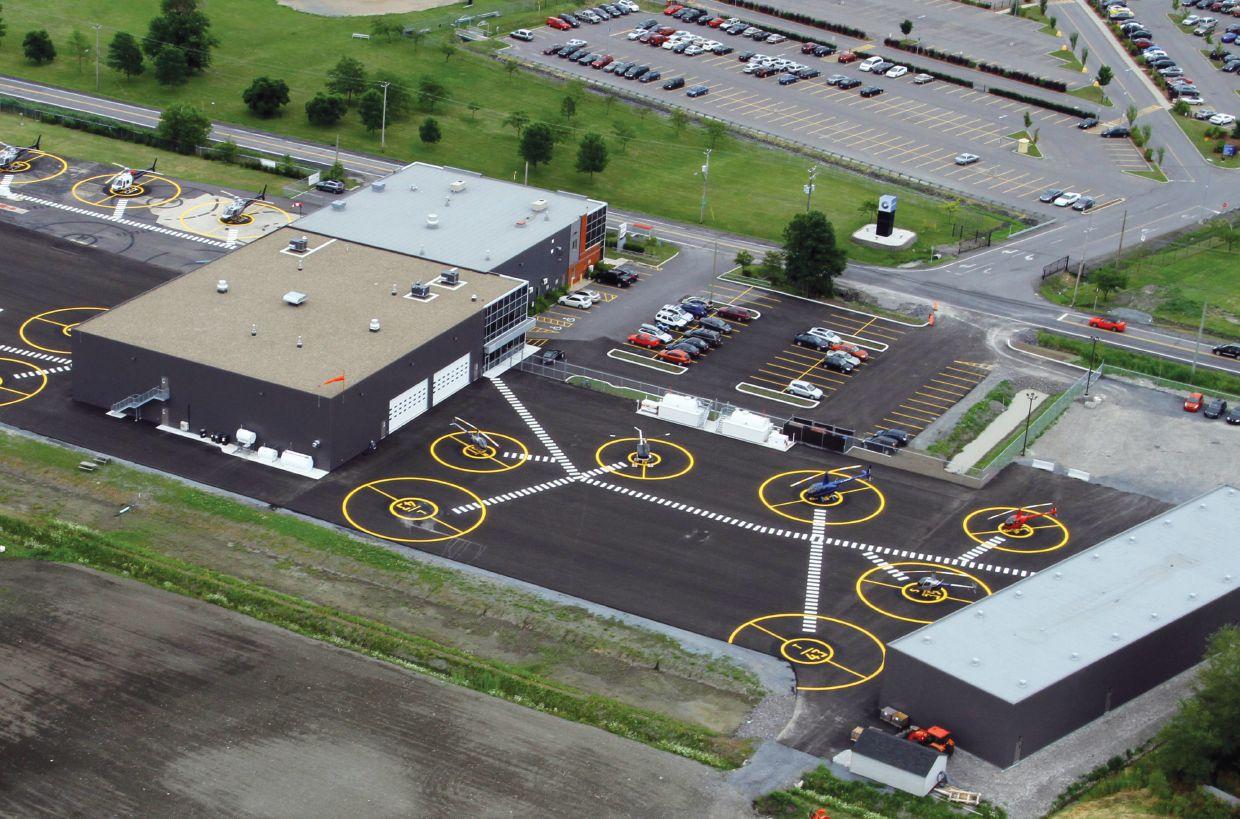
among other improvements to the facility since moving there, it added 14,000 square feet of building space in 2012. spacious and spotless helicopter bays open onto a 40,000-square-foot turbine apron on the east side and onto a 16,000-square-foot piston apron on the west side.
the company’s many activities include operating a flight school, power line inspections and a lot of flying for commercials and film production. it operates an Fbo and rents out hangar space with room for between eight and a dozen helicopters.
last year, Heli-inter logged 1,250 hours for firefighting – a medium season, allard says. “We earned about $2.2 million in firefighting revenue last year.”
soPFeu requires that helicopter pilots flying for it have a minimum of 500 hours flying time. Pilots must take a computer-based ground school training course from soPFu before getting on its approved pilot list. otherwise, Heli-inter does all of its own pilot training.
“all of our pilots are long-line pilots. they are all trained for bucket work. We have annual training for long-line and bambi bucket training. We do bucket training on our artificial pond in st-Hubert and in malartic,” allard explains.
ABOVE: Heli-Inter’s SaintHubert headquarters. (Photo courtesy of Heli-Inter)
lEFT: Firefighters put out a small blaze. (Photo courtesy of Heli-Inter)
malartic is a 12,000-square-foot sub-base Heli-inter owns just west of val-d’or, with about 25 full-time employees. malartic is strategically close to the ontario border and is at almost the same latitude as Kirkland lake, about 140 kilometres to the west. Heli-inter logs more firefighting hours in Quebec and ontario than elsewhere in canada. true to its name, coast to coast Helicopters, the red deer, alta.based leasing division of Placement b allard, fights forest fires from the Pacific to the atlantic oceans. this year, it began firefighting work in newfoundland, bringing to seven the provinces in which it carries out firefighting duties. the exceptions are new brunswick, nova scotia and Prince edward island. “the power of coast to coast is that we share with our sister companies,” allard says.
Flying for soPFeu is an earned responsibility. “soPFeu audits and qualifies companies to work for them. it checks pilot files, manuals, operational procedures and maintenance. you have to be
pre-qualified by soPFeu to work for them,” allard says.
Helicopter companies can have two types of contracts with soPFeu, allard explains.
“there are long-term, bidded contracts for soPFeu that last the whole season. there are nine of these contracts for nine choppers for the whole province. We have five of them. We have to be ready with crew, mechanics and pilots with as little as five minutes’ notice. the amount of notice required depends on the forest fire index.
“otherwise there are shortterm contracts for a pool of prequalified aircraft. if i don’t have one available, soPFeu will go to the next company on the list.” soPFeu uses the helicopters to transport firefighters, cargo and equipment, and do firefighting.
the firefighting season runs from about april to early september. last year, for exam-
ple, after just 13 fires in march that burned five hectares, the action heated up to 113 fires that torched 83 hectares in april. then things went crazy in may, with 174 fires that burned over 26,726 hectares. the october action cooled off to just seven fires and four hectares.
the granddaddy of fire months in recent memory, though, was may 2010. allard refers to it as the chibougamau fire, but in that kindling-dry month, lightning started 86 fires that raged across 173,638 hectares.
the air in montreal was thick with smoke that wafted more than 700 kilometres south, and smoke was even reported in the new england states.
soPFeu has several official bases for firefighters and aircraft, including the long-term contract helicopters: e.g., val d’or, maniwaki, metagamie, roberval,
• Commercial and Private Flight Training
• Recurrent, Advanced and Specialty Training
• Instructor Rating
• Night Rating
• Type Rating
• Numerous Operational Courses
• Certified Winter Survival
• Certified Underwater Egress
• Expertise with Foreign Licence Conversions and International Students
• Full and Part-time Courses available
• We hire from our Graduates!
Quebec city and baie-comeau.
“We base in these places, but we operate out of sub-bases elsewhere, such as hunting camps,” allard says. “soPFeu takes care of just about everything. most of the time, fuel, board and lodging are managed by soPFeu. We do not take care of the fuel. We only rent a service: pilots, aircraft and mechanics.”
allard explains that firefighting places few special maintenance demands on her helicopters.
“in hot weather the Fdc inlet filters have to be cleaned very often. there are a lot of needles flying in the air and they get packed in the filters. the pilots check them often during the course of the day. We also do a lot of painting on
the blades. there is erosion caused by beach sand and other particles kicked up on landing areas. other than that it is standard field maintenance.”
last year, soPFeu called on Heli- i nter some 25 times. “sometimes soPFeu will have 15 to 20 aircraft working a fire, and five or six might be from Heli-inter. this is co-ordinated by aircraft flying at 5,000 feet. When the big tankers come we have to go away.”
as for the length of those field trips, allard looks skyward and says, “last year our crews and equipment were in the field for periods ranging from two days to three weeks. We don’t know when our aircraft will come home. they come home when soPFeu releases them.”
Highlighting Heli-expo
Orders Abound at the Greatest Heli Show on Earth
bY Matt niCHolls
if the 2012 version of helicopter’s greatest show on earth in “big d” was all about a heaping portion of texas style, this year’s rendition of Heli-expo march 4-7 in las vegas will best be remembered for its substance.
Just exactly how much substance? Well, the numbers never lie and final tallies showed 20,393 attendees (an all-time record), 60 helicopters on display and some 736 exhibitors . . . impressive numbers all, illustrating there’s definitely strong revitalization in the international helicopters marketplace.
and while this year’s event may have lacked the panache of some previous shows for its lack of lavish big-name new product announcements from large oems, the order books showed the serious bidders came to vegas to put their chips on the table. major oems such as agustaWestland, eurocopter, bell and sikorsky, all posted impressive orders – sikorsky led the way with 96 – while smaller oems such as enstrom, newcomer marenco swissHeilcopter, md Helicopters and robinson also made their mark.
large oil and gas and leasing companies were the stars of the show, with the world’s largest helicopter provider, bristow Helicopters, getting
things going by confirming its earlier letter of intent with eurocopter for 12 ec175s, plus an unspecified number of options for more. bristow is the u s. launch company of the ec175. eurocopter also scored big with an impressive buy from dublin, ireland-based leasing company, the milestone aviation group. the milestone order padded the eurocopter order haul with up to 15 eurocopter ec225 super Pumas and five ec175s. these deals represented the most significant of eurocopter’s 69-order total over the duration of the show.
in addition to scoring some good order numbers, eurocopter was one of the only oems to make a significant splash in terms of introducing a new product: the ec135 t3/P3. the new light twin offers optimized Fadec software, longer rotor blades and a change in the location of the air intake. this results in 66-pound increase in mtow, and improved hot/high performance (an additional 440 pounds of payload at 1,500 metres isa +20.) the new model also features extended range, new interior design, bluetooth headsets
TOP: Sikorsky’s successful S-92 program is helping it ride into 2013 in good shape financially. (Photo courtesy of Cougar Helicopters)
ABOVE: Eurocopter president/CEO guy Joannes (left) helps the team from Phoenix Heli-Flight celebrate its latest fleet additions –two new AS 350 B2s, an EC135 twin-engine aircraft and a MOU for the first Canadian EC145 T2. Joining Joannes are chief pilot Darrel Peters, vice-president Andrea Spring and president/CEO Paul Spring. (Photo by Matt nicholls)
RIgHT: Sikorsky president Mick Maurer must have been particularly pleased with his company’s order haul at Heli-Expo 2013. (Photo by Matt nicholls)
and a new life raft system. the new machine will be popular with emergency medical transport firms who need the extra space, power, stability and range to ensure safe and secure patient transport.
still aCtinG Relentless
While it didn’t steal the show with lavish announcements as it did last year in dallas with the 525 relentless, bell Helicopter had a successful show with 50 orders, a significant portion of those coming when air medical Holdings confirmed a landmark deal for 30 helicopters – 24 bell 407 and six bell 206 l4 helicopters.
“these new aircraft will allow us to provide increased access to emergency healthcare in the communities we serve. We chose the bell 407 for its proven performance, which is essential to get our patients to safety as quickly as possible. the dependable and reliable bell 206l-4 is ready to go when duty calls,” said Fred buttrell, ceo of air medical group Holdings and med-trans corporation. it marked one of the largest deals in Heli-expo history. bell president John garrison made it known during the show
is seeking to increase civil helicopter sales in the months and years ahead.
(Photo by Matt n icholls)
TOP MIDD l E: In a surprise announcement, l utz Bertling stepped down as Eurocopter president/CEO just days after Heli-Expo to join Bombardier Aerospace as president/CEO of Berlin-based Bombardier Transportation. (Photo by Matt n icholls)
TOP RI g HT: Heli-Expo just wouldn’t be Heli-Expo without the annual press briefing by MD Helicopters’ president/CEO lynn Tilton. This year, the flamboyant MD Helicopters’ boss showed off her patriotic best in this mini camo ensemble while extolling the virtues of the company’s latest offerings.
(Photo by Matt n icholls)
ABOVE l EFT: Canadian Helicopters’ base pilot Heather Pelley was the proud winner of the Whirly g irls Memorial Flight Training scholarship. (Photo by Matt n icholls)
ABOVE RI g HT: Sergey Mikheev, president of the Helicopter Industry Association and general designer of the Kamov design bureau, with Ken n orie, president/CEO of the VIH Aviation g roup.
(Photo by Matt n icholls)
that his company is on a mission to get firmly get back to a position of strength in the civilian market, which represented some 40 per cent of its overall sales in 2012. “We want to reduce our dependence on military sales, particularly the u s. military, by growing the share of the civilian sector,” said garrison. bell plans to continue to make improvement to existing production lines in 2013, and is waiting with anticipation of the first flight of the 525 relentless in 2014.
tHe siKoRsKY WaY
sikorsky was not to be outdone in the order barrage, and ultimately ended up with the most successful order haul of all the major oems, with 96. the largest of these came on the show’s second day when milestone continued its fleet overhaul with the addition of 30 new sikorsky s-92a and s-76d helicopters with options for 24 more.
milestone ceo richard santulli said the changing nature of the global offshore oil business, drilling deeper wells at greater distances from shore, has changed the nature of the helicopter business supporting the industry and created more leasing demand.
speaking at the annual state of sikorsky press briefing, president mick maurer was pleased to report his firm is riding a wave of steady growth and $14 billion in sales in 2012, placing the firm on the right track – and they’re gaining momentum. on the commercial side, the s-76d is now in production and production is nearly
TOP l EFT: Bell Helicopter president John g arrison
sold out through 2014. He also sees growth prospects for the s-92, which continues to be a key player in the oil and gas market. maurer suggests this sector will account for a significant portion of the company’s business in the next few years, with the main interests coming from companies in brazil, indonesia, mexico and saudi arabia.
WelCoMinG a neW faCe
While there no significant new product announcements from agustaWestland at this year’s show, there was a new face – and everyone was dying to hear him address the fallout following the arrest of giuseppe orsi, the former ceo of the company who was arrested before the show for allegedly being paid bribes to secure the sale of 12 helicopters to the government of india.
daniele romiti faced the media during agustaWestland’s annual media dinner the night before the show’s opening and emphatically defended his company’s position as being “openly transparent” during the investigations into the alleged criminal activity
surrounding the government of india case. said romiti: “there has been no wrongdoing by the company and we are confident of that.”
romiti noted that agustaWestland continues to see a bright future for its highly successful family line of aW139, aW169, and aW189 products and said it will work hard in 2013 to take full advantage of the growing global demand in the offshore oil and gas business, particularly in south america, brazil, indonesia and saudi arabia.
the continuing development of the tiltrotor aW609 program in 2013 will also be a key priority for the company. agustaWestland assumed full ownership of the project in 2011, buying out its partnership with bell Helicopter, and work continues to bring the helicopter to market by 2017. a third prototype of the aircraft is currently under construction in italy. the aircraft is in its third decade of development.
For more on business, visit www.helicoptersmagazine.com
Making noise the northern Way
It’s always exciting when Canadian companies and individuals make an impact on such an important world stage, and this year’s show didn’t disappoint. Here’s a shortlist of some noteworthy people that impressed at this year’s show:
• Canadian Helicopters’ base pilot Heather Pelley captured the Whirly Girls Memorial Flight Training scholarship. The scholarship is funded by the Whirly Girls in memory of its founder, Jean Phelan and her husband, Jim, and Doris Mullen, who lost her life in a fixed-wing accident in 1968. The scholarship provides Pelley with $6,000 to be used toward her advanced helicopter rating (typically toward instrument ATP or turbine transition rating). Pelley currently holds her Glider and FixedWing Certificate as well as her commercial helicopter licence. She is endorsed in the EC120, EC130, Bell 206 and Robinson R22 and R44. This award will help her achieve either vertical reference training or an IFR licence. Pelley was shocked to win, noting that she wasn’t even sure if the American organization would recognize her achievements. “I said, ‘why not,’ gave it a shot and look what happened?” Pelley is definitely a resourceful and dedicated young pilot, and she’s making a name for herself in a competitive, male-dominated field.
• Ken Norie, president/CEO of the VIH Aviation Group, has always been a staunch supporter of the Kamov helicopter brand. As noted in Paul Dixon’s piece “From Russia With Love” in the January/February 2013 issue of Helicopters, Norie’s commitment to using the Kamov KA-32A11BCs for everything from heli-logging work to fire fighting, has helped VIH gain international recognition for its use of the fleet. In fact, VIH’s three KA-32A11BC aircraft are the highest tour-operating Russian helicopters in the world. To commemorate the company’s achievements, Sergey Mikheev, president of the Helicopter Industry Association and general designer of the Kamov design bureau, presented a special award to Norie during the annual “Russian Hour” to honour the company’s steadfast support of the Kamov brand.
• Pheonix-Heli Flight made a splash at this year’s event with its purchase of two new AS 350 B2s, an EC135 twin engine aircraft
and a MOu for the first Canadian EC145 T2. The B2s, a favourite of the company and popular with clients, will be used for a variety of utility roles. Pheonix-Heli Flight president Paul Spring said one of the main drivers for the purchase of the EC135 twin is to support the company’s growing EMS operation. The EC135 will be a dedicated Emergency Response Helicopter, serving the northeast region of Alberta. “Our limitation has been that with the equipment we have, we can only run daytime VFR rules in Canada. So we needed to go to a bigger machine, so we could work in a nighttime environment and still have room for the patients. But we are a utility operator, we are not strictly medical, we do work for the RCMP, missing people SAR, SWAT team issues. We also work for the environmental side of the oil industry and they need quick access if they had a pipeline break or a spill or a remote access issue that they couldn’t deal with right away. This helicopter will get them there. It’s going to enhance the company and make us very attractive to pilots and potential clients.”
• With champagne glass firmly planted in hand, Pratt & Whitney president John Saabas joined a healthy crowd in saluting the venerable PT6 family of engines, which are celebrating a 50-year anniversary in 2013. More than 6,500 operators in 82 countries rely on the PT6 for its dependability and power. And when it comes to power, the current PT6A, is four times more powerful than the original model. The PT6 is also one of the safest engines out there, with a current in-flight shutdown rate of one event per one million hours.
• Several Canadians were recognized at this year’s Salute to Excellence Awards, the annual awards ceremony that honours achievement and professionalism within the industy. Making the grade this year: AgustaWestland Safety Award, Greg Whyte, Vice President, Systems Operations, CHC Helicopter; Eurocopter Golden zero Award, Dr. Gregory Powell, O.C., Founder and Director Emeritus, Shock Trauma Air Rescue Society (STARS); Excellence in Communications Award, Shawn Corwyn Coyle, Director of Training, Marinvent Corp.; Pilot of the Year Award, Rudei Hafen, Commerical Pilot, HTSC/Niagara Helicopters Ltd.
t he i s ervice Centre i s a irborne
Chicoutimi, Que.-Based Facility Expanding Its Horizons
bY CaRRoll MCCoRMiCK
it is as quiet as a library. a mechanic leans into a turbomeca arriel 1d1 turbine engine. an avionics technician glides under an astar as350 b3e. the strippeddown cabin of a robinson r22 sits a couple of metres from its refurbished engine, ready for uncrating. engine specialists murmur over a computer diagram. behind this placid picture, however, the year-old iservice centre in st-Hubert, Que., is busy staking claims in a rich helicopter maintenance ore body. it has been an intense 12 months for Jacques laflamme, the director for the iservice centre, owned by Placement b allard inc., in chicoutimi, Que. an aircraft maintenance engineer by trade with 33 years in military and civilian aviation, including stints with bombardier and eurocopter, laflamme has been tasked with building the iservice centre from the ground up.
among other things, he has been hiring engine, avionics and composite/sheet metal specialists and meeting with new customers and suppliers. He has obtained transport canada and bell approvals to work on the bell 412 and other types. He devoted months to preparing the iservice centre for consideration for canadian armed Forces griffon helicopter maintenance contracts. the iservice centre shares a 26,000-square foot facility and 56,000 square feet of apron with Heli-inter, a sister division of Placement b allard. despite its proximity, the iservice centre is not an extension of Heli-inter, laflamme explains. “the iservice centre is very busy and dedicated to external customers. other than for engines, we do not touch Heli-inter machines. We have separate operations. We have different people, a different set of skills and 12 months a year work. i have a year-round staff here at the iservice centre.”
that said, coast to coast Helicopters, the red deer, alta.-based leasing division of Placement b allard, is capitalizing on the iservice
centre’s capabilities. before last year, most maintenance was subcontracted outside of the company. in fact, laflamme notes, “besides our mechanics, we had very little maintenance capability before 2008. if we had an avionics snag in a machine in James bay, say, we’d hire a subcontractor to fly in and fix it. now, we do all our own avionics and sheet metal. We still hire some subcontracting agencies for mechanics, because we have so much work.
“We will be hiring more mechanics, sheet metal and avionics guys in the next year. the work is growing very quickly.”
bringing some of that work back in-house helps coast to coast better manage costs. it also gives the iservice centre specialists the opportunity to hone their skills. the iservice centre is, for example, authorized to do advanced engine maintenance on turbomeca engines.
“We’ve started our engine shop and we’ve trained our personnel,” laflamme explains. “We are doing level 1 and 2 overhauls and some level 3 tasks on turbomeca engines for ourselves. We also do maintenance work up to the 1,800-hour inspection on lycoming engines. We are currently only offering this service to coast to coast choppers, but our long-term plan is to offer this service to external customers.”
the iservice centre is an approved bell customer service Facility and is already offering some bell services to external customers. “We are the central facility for bell customers for Quebec and portions of new brunswick. We honour warranty work and sell bell parts,” laflamme says. “We are set up with bell to work on the 204/205/206 a, b/206l/212/407. We have approval from transport canada to do work on the bell 412. all of our people have been trained to work on the griffon.”
the iservice centre is also authorized to do field maintenance, including basic engine maintenance, avionics and sheet metal on all the helicopter types it owns – work that it will do for external customers. given that coast to coast owns 104 helicopters, this is a
ABOVE: Technicians do completion work on a new AStar AS350 B3e. (Photo by Carroll McCormick)
RIgHT: Jacques laflamme, director for the iService Centre. (Photo by Carroll McCormick)
long list. in addition to the bell types, coast to coast also owns astar 350 b2, ba+ and b3 aircraft, robinson r22 and r44 machines and Hughes 300 and 500 types.
as an approved bell customer service Facility, the iservice centre is also allowed to work on bell helicopter tail booms. to this end, on april 4, the iservice centre took delivery of a tail boom jig for working on the bell 205, 212 and 412.
the first assignment for the tail boom jig will be refurbishing a used bell 212 tail boom that it purchased from mustang, another division of coast to coast. laflamme explains how this will play out. “We are currently training our people to use the tail boom jig,” he says. “We will refurbish the tail boom and put in parts store for sale, rent or exchange. by may, we will be ready to offer this service to external customers.” as for acquiring other specialized equipment, laflamme says, “We are looking at the market to see what the best components are to get into. We plan to add a component shop; for example, transmissions, tail rotor gearbox, actuators, main gearbox.”
the work is coming in: for example, a deal to do a 12-year/2,200hour inspection and overhaul on another robinson is almost closed and a bell 212 is scheduled to arrive by early summer for level 3 maintenance. this is all good, but laflamme says the really big pie that the iservice centre wants a share of is the bell 412cF griffon. the armed Forces took delivery of 100 of these aircraft between 1995 and 1997, but until recently, laflamme explains, maintenance contracts for them were off-limits for shops east of the ontario/manitoba border.
“bell manufactured the griffon in mirabel. since mirabel got this lucrative production contract, only third-line companies from western canada were allowed to bid on maintenance contracts for a certain number of years. this restriction has expired, so now anyone can bid on this work,” laflamme explains.
“there is a cell of people at bell who award the griffon maintenance contracts,” laflamme continues. “i worked full-time for three months preparing for the griffon program. unfortunately, we didn’t rank high enough this time for the 3,000-hour/five-year or 600hour scheduled work.”
the iservice centre did rank high enough to do other work on the griffon. “With the bell audit behind us, we will be able to do field maintenance, mobile repair party, tail boom repairs and 300-hour inspections. We are hoping to get some of this work in eastern canada, where the major concentration of griffon is found. this is currently not offered by anyone else in Quebec or, i think, in new brunswick.”
the pie is large indeed, and laflamme plans to be ready to qualify for some big slices the next time bell rewrites its list of approved maintenance centres.
Campbell River Base e-mail: info@ebhelicopters.com www.ebhelicopters.com
The ideal M1/M2 candidate would have fixed & rotary experience. Bell 206 type course would be beneficial. Crew chief, production manager or QA experience also an asset. PRM candidate would need to meet the Transport Canada requirements to hold this position. Strong interpersonal skills and exceptional attention to detail are essential in both positions.
MARKETPLACE
MARKETPLACE
Fsonable operator their Pilot
Competencies for Helicopter Wildfire Operations Best Practices Training and Evaluation
Losing Its Focus
Transport
Canada Is No Longer Measuring Up
speak the language and
Fred Jones is the president/CEO of the Helicopter Association of Canada and a regular contributor to magazine.
FRED JONES
October 16 & 17
Ottawa Convention Centre
This year’s theme:
Engage in Change
Innovate | Transform | Excel
Go to www.aiac.ca/summit for registration information, a full downloadable program, bios of this year’s key speakers and much more!
Do Business. Network. Learn.
With over 600 attendees and 100 exhibitors, the Canadian Aerospace Summit is Canada’s leading national aerospace event.
For more information or to learn about advertising/sponsorship opportunities: cas@aiac.ca
Proudly hosted by
( THINK VERSATILITY )
Eurocopter is committed to protecting Canada’s coast… At present, and in the future. The longest coastline in the world deserves the world’s most capable helicopters. Eurocopter offers safe, reliable, and innovative solutions to customers around the world.