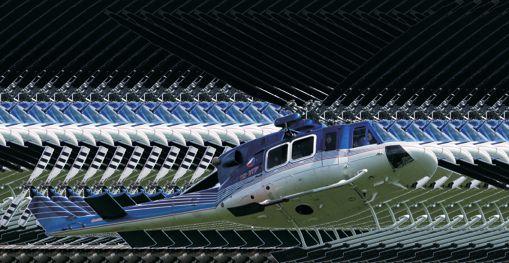
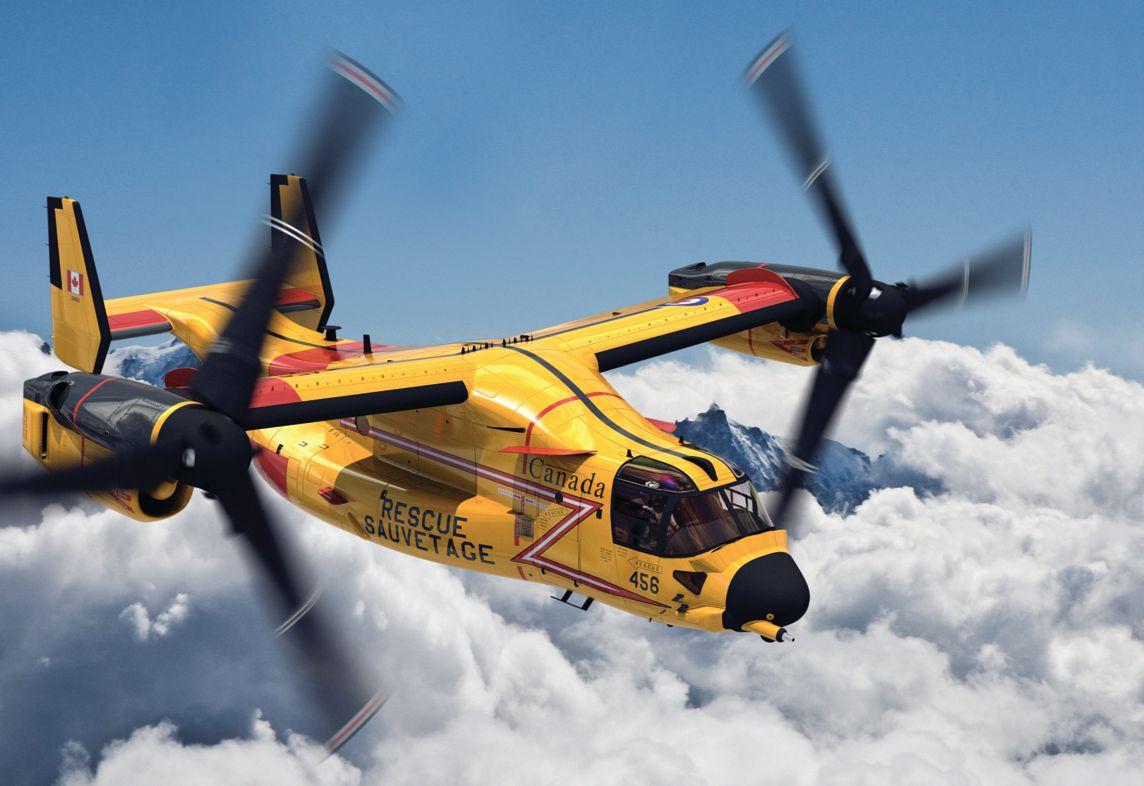
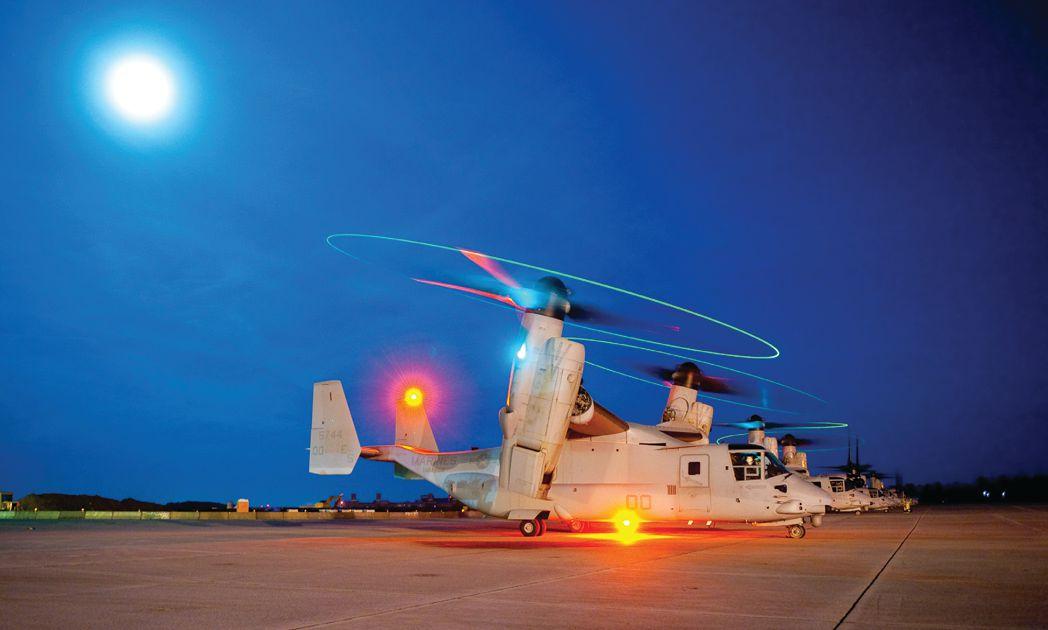
You didn’t get to where you are by compromising. Neither did Bell Helicopter, which is why there are no compromises in a 429. With impressive range and speed, plus an astonishingly smooth and quiet ride, the 429 gets you where you need to go in comfort and style. Spacious and adaptable, it was designed precisely for your fast-paced, high-stakes world.
Canadian
Matt Nicholls
James Marasa
Paul Dixon
by Peter Pigott
January/February
CMATT NICHOLLS EDITOR
anada boasts some of the best search-and-rescue (SAR) crews in the world and one of the country’s finest units has been bestowed yet another honour for its bravery and expertise.
Members of 442 Squadron stationed at Canadian Forces Base Comox, B.C., captured the 2011 Cormorant Trophy for Helicopter Rescue for a daring cliffside rescue of a British Columbian that pushed both the rescue crew and their SAR helicopter to the limits. It’s just the latest honour bestowed on a 442 crew, as members of RCAF 442 Squadron have won numerous awards, including the internationally acclaimed Prince Philip Helicopter Rescue Award.
The winners of this year’s award – Capt. Jean Leroux, aircraft commander; Maj. Troy Maa, first officer; Sgt. Carl Schouten, flight engineer; and search-and-rescue technician (SARTech) Master Cpl. Nicholas Nissen – were presented with their trophy this past November by Jeremy Tracy, AgustaWestland’s Head of Region – Canada, accompanied by Canada’s Chief of Defence Staff, Gen. Walter Natynczyk, and base commander Col. Jim Benninger. Another member of the rescue team, SARTech Sgt. George Olynyk, is presently stationed at CFB Gander.
Said Gen. Natynczyk of this year’s winning SAR team: “Their dedication is an example of extraordinary professionalism. We recognize the risks that sometimes must be taken to keep Canadians safe.”
The Cormorant Trophy for Helicopter Rescue recognizes the
SAR’s Finest Raise the Bar
442 Squadron Captures Prestigious Cormorant Trophy for Helicopter Rescue
stranded on a steep side of Hat Mountain in Cypress Provincial Park, B.C. With a winter storm approaching, the Cormorant crew was forced to race against time to execute the rescue. Unless the rescue could be carried out, the man would be stranded for days without the necessary provisions to survive.
The stranded hiker was 1,600 metres up the mountain, 150 metres into dense clouds, in a narrow and steep bowl. As the crew approached in their AW101 Cormorant, they were faced with turbulence created by wind gusts of 85 kilometres per hour blowing straight down the mountain. This forced the pilots to fight rapid power swings, causing significant rotor speed changes, which made accurate control of the helicopter difficult. Using night vision gear, the search team was able to make out only a faint light, which they hoped was their rescue target.
“We reached the estimated location of the hiker by slowly flying up the side of the mountain,” said Capt. Leroux. “We had to attempt multiple passes until the visibility was good enough for us to fly over the man’s location.” Each of these approaches pushed the helicopter to the limit. Normally, the maximum speed or power required for missions in a Cormorant reaches about 80 per cent, but during this rescue, the power fluctuated up to 117 per cent, giving constant warning alarms.
We recognize the risks that sometimes must be taken to keep Canadians safe.
’’
Canadian civilian, government or military crew that has performed the most demanding helicopter rescue of the year. Presented annually by AgustaWestland, the competition recognizes SAR excellence nationwide. The winning selection is made by a panel of judges, which includes representatives of the Canadian Forces and Canada’s aerospace journalists.
This year’s winning rescue illustrates how the collective forces of a SAR unit work together to achieve success. On Dec. 23, 2010, the Cormorant helicopter “Rescue 907” stationed with 442 Squadron at CFB Comox was dispatched to rescue a 23-year-old man who was
Facing the high risk of an avalanche, the crew decided on a fast extraction with the SARTech remaining attached to the hoist. The flight engineer then directed the aircraft about seven metres above the hiker with a vertical rock face just one-and-a-half to three metres in front of the rotor blades. The flight engineer lowered the SARTech who hooked up the rescue subject and both men were hoisted on board. Throughout this procedure, the snow was being whipped around the helicopter enveloping it in a “snowball” and drastically reducing the pilots’ visibility.
As they went to fly away, a thick layer of cloud moved in, making it impossible to backtrack the way they came in. With almost no visibility, the flight crew managed to fly the helicopter out of the cliff confines relying only on instrumentation to show them the way out. The crew flew to Lyons Bay soccer field, where the man was transferred to a land ambulance to be taken to hospital for treatment for mild hypothermia.
Helicopters salutes the efforts of 442 Squadron and the other brave SAR team members nationwide who risk their lives every day to save stranded or lost Canadians in need. Look for future SAR coverage throughout 2012.
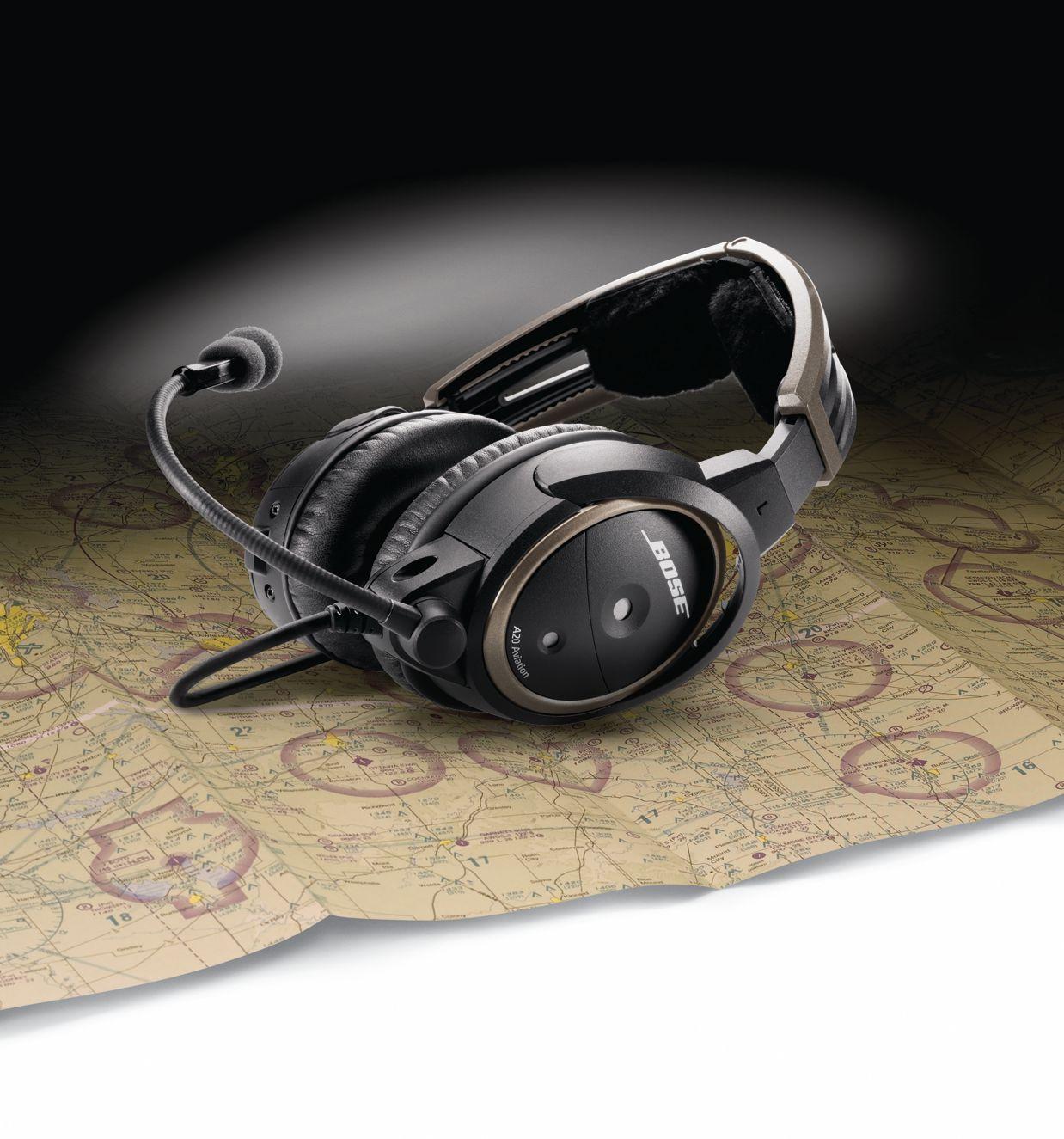
The Bose® A20® Aviation Headset. The best we’ve ever made.
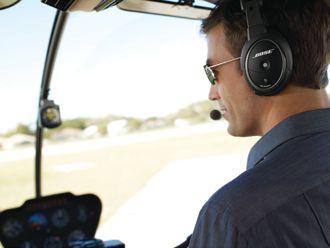
When you fly helicopters, you know being focused is critical. e acclaimed noise reduction, comfortable fit and clear audio of the Bose A20 Aviation Headset helps reduce distractions so you can concentrate on flying. In fact, it’s engineered for the high noise levels that are found in helicopter cockpits. Certified Helicopter Flight Instructor Stephen Boatwright summed it up this way, “…if you want to be able to hear everything, if you don’t want fatigue, if you don’t want to miss those radio calls…then go with the A20.”
In addition, it has an auxiliary audio input, available Bluetooth® communications interface and meets or exceeds all TSO standards. Plus, its optional flexible power circuitry allows for a connection from a 6 pin to U174, letting you take the headset from one helicopter to another. No other headset offers this advanced combination of features and benefits. Prove it to yourself. Try the A20 Aviation Headset for 30 days, satisfaction guaranteed.
Niagara Helicopters Sold
Niagara Helicopters, an industry leader in the Ontario heli-tourism business for years, has been sold to Carp., Ont.-based Helicopter Transport Services.
The deal was reached in early December of last year noted Anna Pierce, vice-president of Niagara Helicopters. The transaction had been in the works for some time and offers mutual benefit for both organizations. Niagara Helicopters will see distinct cost savings in the deal, while acquiring the firm broadens Helicopter Transport Services product offerings.
Niagara Helicopters offers sightseeing tours of the Niagara Falls, Niagara River and surrounding area, and also offers a small charter business, aerial photography, surveillance and frost flying for Niagara grape growers. Helicopter Transport Services specializes in a variety of disciplines including forestry, mining, heavy lifting, aerial suppression and executive transport.
“We have a need to diversify and expand our horizons,” said Helicopter Transport Services president Luc Pilon. “The helicopter pioneers can make great use of the talent and assets they share in the companies which form part of the Helicopter Transport Services Group. The management team will continue to operate their present enterprises but will have more resources to expand their offerings.”
Pilon added that the goal is to “create a company with many locations for our people to expand their skills and reach their goals” all without having to change employer. “We will be a
one-stop shop for both our customers and our people,” he said.
Both Niagara Helicopters and Helicopter Transport Services were founded and driven by like-minded entrepreneurs. Swiss-born Ruedi Hafen founded Niagara Helicopters in 1961 and has steadily built it into a leader in the Canadian heli tourism industry. Hafen is a key part of Niagara’s operations, and going forward, will be maintaining his role as the “face” of the organization in the role of vice-president of public relations. He is also keenly involved in search-and-rescue operations and all VIP flights.
CYCLONE PROGRAM DELAYED AGAIN
The Canadian military is still waiting for its first fully operational Cyclone maritime helicopter for training purposes, months after Defence Minister Peter MacKay said it would get one in the summer. MacKay announced the Canadian Forces could expect to have their first interim CH-148 Cyclone for training purposes by August; however, the Canadian military has yet accepted delivery of the helicopter from manufacturer Sikorksy because work on the chopper isn’t complete. Rumour has it helicopters are expected to arrive in June. Sikorsky’s Paul Jackson said, “We continue to work to provide
Like Hafen, Pilon has had a significant imprint on operations at Helicopter Transport Services. A pilot and entrepreneur, he founded the one-man, one-helicopter operation Nipissing Helicopters in North Bay, Ont. in 1976. Following a steady course of reinvestment and strategic acquisition, the company has progressively advanced its operation into what it is today. As Pierce noted, “it’s a very complementary relationship” between the two partners. “Rudy likes to stay in the forefront while Luc is confortable away from the limelight,” she said.
the Canadian Forces with these extremely capable aircraft as expeditiously as possible.”
The federal government announced the contract to acquire 28 maritime helicopters from Sikorsky seven years ago to replace the decades-old Sea Kings. The first helicopter was originally due in November 2008, but there have been numerous delays and cost overruns with the procurement. Last year, the federal auditor general released a report that estimated the costs for the helicopters had grown from $5.1 billion to about $5.7 billion.
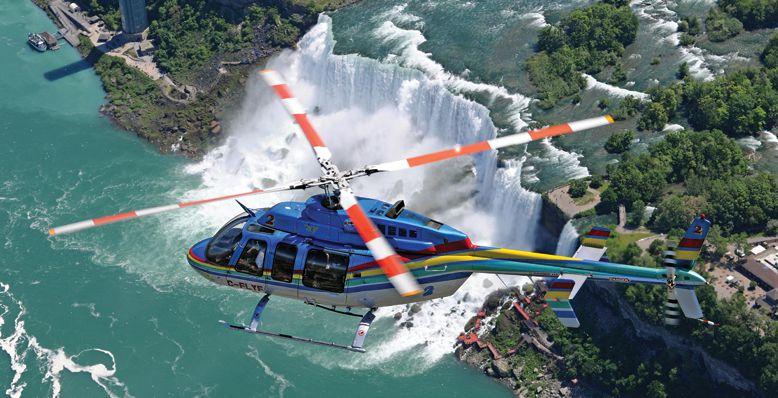
Niagara Helicopters offers sightseeing tours of Niagara Falls, Niagara River and the surrounding area. (Photo courtesy of Niagara Helicopters)
SURVIVAL
The Large Predator Myth
Executing a forced landing can flip the adrenalin switch in even the savviest of pilots, but when it happens in the remote Canadian wilderness, it can easily leave you shaken to the core. Compounded as night falls, it is made even worse when the spine-chilling images you conjure up convince you that those crimson eyes staring back from the depths of darkness are harbouring a battery of blood-thirsty fangs and razor sharp claws, poised to strike the moment you exhale.
This fear is normal of course, but no more real than anything else driven by your imagination. Realistically, you are more likely to be struck by lightning or harassed by bees than accosted by some marauding beast. But what about those deafening sounds at night? Likely just mice and voles scurrying about, merely amplified by your angst. And those riveting eyes staring back at you? Just curious racoons and squirrels, and neither likely planning your demise anytime soon.
Dispelling the Large Predator Myth and those menacing thoughts that come with it is an essential component of staying emotionally grounded as you await rescue – but do this with the help of a good fire, which will be sure to keep the animals, not to mention “the boogieman,” at bay.
Future issues of “Survivor” will discuss how to avoid coming face to face with a large predator (and how to proceed if you do). But for now, you should know that the most dangerous animal in the Canadian boreal forest, aside from yourself of course, is the Bull Moose – especially during the autumn rut. If you do happen to encounter a Bull Moose in the fall, climb a tree – a very tall tree!
Dan Gibson is a consultant with the Helicopter Association of Canada, an award-winning pilot and president of Bear Beaver Aviation Services. He teaches Wilderness Survival Skills for the Ottawa Flying Club in the Commercial Pilot/Aviation Management Program at the Algonquin School of Advanced Technology in Ottawa.
Eurocopter Canada Delivers AS350 to BCIT
Eurocopter Canada has delivered an AS350 training aid aircraft to support the British Columbia Institute of Technology’s (BCIT) AME program and AME Type Course.
Eurocopter Canada and BCIT have worked closely since September 2009 at BCIT’s Aerospace Technology Campus in Richmond, B.C. Here, instructors and students are given the opportunity to take part in Eurocopter’s intensive training program in airframe and engine maintenance. The Eurocopter and Transport Canada-approved courses leverage Eurocopter’s recognized technology to teach the next generation of aerospace technicians.
“With the continued support of Eurocopter Canada, including the recent delivery of the AS350, we are able to offer our students the best resources and training for future careers in the aerospace industry,” said BCIT president Don Wright. “Partnering with the leading helicopter manufacturer in Canada allows us to strengthen and enhance our program to benefit both our current and prospective students.”
With more than 40 per cent of Canada’s helicopters located in B.C., the agreement has enhanced BCIT’s specialized training by allowing students to practise maintenance tasks on the AS350 helicopter.
HELICOPTERS MAGAZINE
P.O. Box 530
105 Donly Drive South Simcoe ON N3Y 4N5
Tel.: 519-428-3471 Fax: 519-429-3094
Toll Free: 1-888-599-2228
Website: www.helicoptersmagazine.com
EDITOR MATT NICHOLLS e-mail: mnicholls@annexweb.com 416-725-5637
PRODUCTION ARTIST EMILY SUN
CONTRIBUTING WRITERS
MICHAEL BELLAMY, DAVID CARR, BRIAN DUNN, PAUL DIXON, DAN GIBSON, WALTER HENEGHAN, FRED JONES, NEIL MACDONALD, JAMES MARASA, PETER PIGOTT
ASSOCIATE PUBLISHER ALISON DE GROOT e-mail: adegroot@annexweb.com 519-429-5191 • 1-888-599-2228 ext. 246
ADVERTISING SALES ADAM SZPAKOWSKI e-mail: aszpakowski@annexweb.com 1-888-599-2228 ext. 273
SUBSCRIPTION RATES Canada – 1 Year - $25.00 (all taxes included) USA – 1 Year $35.00 Foreign – 1 Year $45.00
Eurocopter provides training opportunities for BCIT instructors as well as provides course materials for BCIT’s instructors.
“The AS350 is an ideal training tool to help strengthen the BCIT course curriculum and expand the growing interest in our industry amongst the students and throughout British Columbia,” said Guy Joannes, president/CEO, ECL.
Eurocopter’s AS350 is the most commonly used aircraft for ECL training and is the most popular aircraft for utility missions in Canada. The AS350 makes up for 60 per cent of ECL’s fleet, with a large contingent in Western Canada.
Occasionally, Helicopters magazine will mail information on behalf of industry-related groups whose products and services we believe may be of interest to you. If you prefer not to receive this information, please contact our circulation department in any of the four ways listed above.
Helicopters Magazine is an associate member of the following Canadian aviation associations:
COLUMN
The ‘New’ Safety Method
Reiterating the Importance of Safety Management Systems (SMS)
n a recent article on the CBC website, Transport Canada (TC) is seemingly taken to task for its new safety approach of having airlines regulate themselves (see “Flight policy change called a risky manoeuvre,” Nov. 9, 2011, CBC.ca). In the article, experts warn such an approach could endanger passengers because without oversight “people are going to do bad things.” Well, I have to disagree. With or without proper oversight, there are people who will do bad things and people who will not.
The “new safety approach” referred to in the piece is a Safety Management System (SMS), and it is not new – it has been TC’s policy since 2005, and is quickly becoming policy throughout the aviation world.
I imagine, however, many in the Canadian aviation industry cannot come up with a concise description of what SMS is. Many don’t know whether their company has one, or whether it was effective. The purpose of a safety management system is to provide a systematic way to control risk and to provide assurances that those risk controls are effective. SMS focuses on organizational safety, meaning organizations are supposed to look at risks within their company and industry, and ensure those risks have been properly addressed and appropriate mitigation measures have been put in place.
The CBC article has critics correctly saying that when mistakes happen, the airline employee is responsible for filling out an internal safety report. The critics then say that there is no requirement for the com-
helicopter operator does not tell the whole story about how safe an operation is. I would argue that this one-time spot checking of flying skills is much more of a hazard to aviation safety – certainly on that flight – than if it had not occurred.
One of the problems with the old approach is that the inspectors can't be in all places at all times. To suggest that aviators will only do the right thing if they are watched is analogous to saying people will only drive safely if the police are sitting on the side of the road. While it may be true in some cases, it suggests that driver training and media awareness campaigns about the dangers of speeding are not at all effective. That’s complete nonsense!
Let’s explore what the new approach is about. It’s meant to instil a safety philosophy, or safety culture, throughout the organization – top down, and bottom up, in which employees monitor their own actions and feel comfortable in reporting mistakes made. Employees are comfortable reporting when the culture is one where mistakes are allowed, and if found early, can prevent potential future accidents.
A safety management system often begins life as a reactive system – what happened, why did it happen and how can we stop it from happening again. These experiences are documented and grow into a proactive system. This is where we now begin to look at what may happen in the future given what we know about the past. The final stage is predictive. This occurs when systems are developed that are designed to stop the incident or accident before it can develop.
One of the problems with the old approach is that the inspectors can’t be in all places at all times. ‘‘ ’’
pany to report the infraction to TC. This is simply wrong. As aviation professionals, we know that “reportable aviation accidents” and “reportable aviation incidents” are defined terms found on the TC website, and if they occur, must be reported within certain timelines.
The other notion I find troubling in the CBC article is that critics suggest the “old” approach of spotchecks – boarding planes to monitor flying skills, checking log books and conducting undercover surveillance – will prevent accidents from happening, while the “new” approach fails to spot potential problems. This argument is too simplistic and fails to address the fact that “one day in the life” of a pilot or
I don’t want to suggest that the new approach is all good, and the old approach is all bad. We need to strike a balance. It is proper for TC to implement a national program requiring operators to have a detailed look at safety within their own operations. I believe having aviation professionals design and develop safety systems that work for their environment makes sense. I also believe it is proper for TC to monitor operators as they develop their safety management systems.
It’s time we gave this “new” approach a chance to work the way it was designed to before we decide it is – as CBC reported – a “risky manoeuvre!”
Neil MacDonald is a lawyer practising in B.C. He holds an ATPL-H and flew as a captain on B.C. Air Ambulance and IFR Off-Shore. Neil has completed QMS Lead Auditor training in Canada and ISMS training in Singapore. nmacdonald@georgialeelang.com This is not a legal opinion. Readers should not act on the basis of this article without first consulting a lawyer for analysis and advice on a specific matter.
NEIL J. MACDONALD
HAC 2012
16th Annual HAC Convention & Trade Show
March 16-18, 2012 W OTTAWA, ONTARIO
Don’t miss Canada’s largest gathering of helicopter operators, manufacturers and industry suppliers March 16-18, 2012 in the nation’s capital city, beautiful Ottawa, Ontario.
HAC is your opportunity to network with the operators of more than 1,500 helicopters, take advantage of special training and education sessions, contribute to the direction of the industry by participating in HAC committee meetings, and much more.
To register as an attendee or book your exhibit space, go to www.h-a-c.ca.
PRE-EVENT COURSES, MARCH 14-15, INCLUDE:
• Flying in the Wire & Obstruction Environment
• Helicopter Longline and Cargo Net Maintenance
• Person Responsible for Maintenance Control (PRMC) Workshop
• Managing your Costs and Profitability
PAUL DIXON
Istarted writing this column on Remembrance Day last fall, while thinking of Janick Gilbert. Sgt. Gilbert, a SAR tech with 424 Squadron, had died on the job two weeks prior in the icy Arctic waters near Igloolik, Nunavut.
The “job,” being what Sgt. Gilbert, his fellow Canadian Forces SAR techs, Coast Guard rescue specialists and hundreds of highly skilled volunteer search-and-rescue specialists train to do, is indeed a dangerous one. Simply put: they save lives – on a daily basis from sea to sea to sea across this country and all the places and spaces in between. They are the backbone of search and rescue in Canada: the thin line between those who live and those who die. All too often, we, as a nation, take them for granted.
The CBC’s Fifth Estate opened its current season with a show entitled “Mayday,” a supposed investigation of “Canada’s troubled search and rescue fleet.” The investigation involved a handful of high-profile events including the Cougar S-92 crash. In short, however, there seemed to be a genuine mystery in their inability to grasp the staffing levels of the search-and-rescue squadrons and what that meant in terms of crew scheduling and the response times that flow from that scheduling.
In the days following the death of Sgt. Gilbert, there were mumblings and musings in the mainstream media about the “delay” in the SAR response to the initial incident of the overdue hunters. Yet, there was no apparent understanding of how any SAR incident evolves, and specifically, no grasp of the logistics in this particular event. Local
Remembering a SAR Hero
Sgt. Janick Gilbert Sacrificed Everything to Help Others in Need
any one of these three aircraft. For all three of them to respond in a coordinated effort under the conditions that existed on this day is almost beyond comprehension.
Here’s a word about “response,” based on a lifetime of working in the universe that includes your local police, fire and EMS first responders. Media accounts of local events will breathlessly recount how responders “raced” to the scene. In reality, however, there is no racing. Your local fire department and ambulance service understand that to provide the best possible outcome for all involved, it is imperative they get there as quickly as possible, fully prepared to provide service. Crashing en route because they were overdriving their environment is not an option. Crashing en route does two things – it means no one gets to the original incident and it creates a second incident that could be far worse than the original.
The difference between your local fire department and a SAR response such as that at Igloolik is the scale. Urban fire departments in Canada generally have an emergency response time of four to five minutes in their service model, with response distances under two kilometres. Igloolik required two Hercs to fly between 2,300 and 2,500 kilometres and the Cormorant from Gander to fly 2,700 kilometres under less-than-ideal conditions. It’s completely the other end of the emergency response scale and an incredible testament to the aircraft and the people on board – and that’s only half of it. Once the SAR techs leave the Herc, how do you retrieve them and those they went after?
The father and son that Sgt. Gilbert set out to rescue were simply trying to live their lives.
’’
resources, such as those that existed, were assigned to investigate the two overdue walrus hunters. When conditions prevented locals from mounting a response, a SAR Hercules was dispatched from Winnipeg, followed by a second Hercules (carrying Sgt. Gilbert) from Trenton and a Cormorant from Gander.
Think about this for a moment – the time and distance required for these three aircraft from three widely separated points to converge on one tiny spot far, far away, was significant. This is something the mainstream media seems unwilling or unable to grasp. On the sunniest day of the year, at the height of summer, this trip would be a major undertaking for
It’s something I never considered until I was being briefed by the SAR CO at 1 CDN Air Division in Winnipeg last year – and the colonel spoke to this very scenario. In one of those true “duh” moments, (all too frequent in my life) I realized that once the SAR techs leave the aircraft in these scenarios, there is no other way out than by helicopter.
That’s just one segment of the Canadian SAR scene. It’s a big country and a big responsibility – and the people who do the job are stretched as thin and as tight as a drumhead. The father and son that Sgt. Gilbert set out to rescue were simply trying to live their lives as thousands of others do every day in this country –by going to work in harsh and unforgiving environments, whether in the high north or far out at sea.
Let us not forget Janick Gilbert and all those who have died so that others may live.
Paul Dixon is freelance writer and photojournalist living in Vancouver.
Ka-32A11BC
BEYOND COMPETITION IN EXTREME SITUATIONS
A bi-turbine helicopter with a dual rotor system. Highly efficient in fire fighting operations, due to large water discharge capacity, manoeuvrability and fast cruising speed. Used in different application versions: firefighting, SAR, HEMS, land and sea surveillance, ecological monitoring, transportation of fire brigade, external lift, heliborne operations and transport.
more at www.russianhelicopters.aero
Visit us at the HeliExpo-2012, Stand 3422
COLUMN
Analyzing the Unique Bond Between Pilot and Engineer Nurturing Relationships
or helicopter operations away from home base, there is a crew arrangement that is distinctive to the industry: the relationship between pilot and engineer. One provides the wear and tear on aircraft; the other provides the loving care in maintaining it. It’s an arrangement that, for the most part, works well – but there are pitfalls and ramifications of discord between the two parties that have consequences.
Unlike in the military, with its enlisted rank distinction, pilots and engineers in civilian helicopter operations shouldn’t have authority over each other. Each contributes unique expertise to the safe and efficient operation of the helicopter. An equitable arrangement occurs when the helicopter is finished flying for the day – or when addressing a snag. The machine comes under the sole jurisdiction of the engineer until he releases it back to the pilot, confirming, “She’s good to go.” This, in my opinion, is the ideal working environment – the pilot and engineer understand and acknowledge each other’s contributions.
Pilots and engineers assigned to a machine often find themselves co-ordinating transport and sharing living accommodations, and as a result, over time, the most innocuous personality trait or work habits can become an irritant. We all have differing work habits and minor personality quirks and, it’s not uncommon for these traits to be deemed unacceptable. Such situations can cause a breakdown in the pilot/engineer relationship.
passengers. For example, cynical remarks exchanged between crew members – or other complaints made in the presence of passengers –will, in all probability, be reported to the job manager. Such behaviour, is an unwanted blemish on an otherwise sterling performance if an unpleasant exchange occurs – and it will be the only thing the manager remembers long after the job is completed.
Injudicious or careless traits are also red flags that can develop in the relationship between pilot and engineer. For example, pilots who shut down a helicopter and walk away leaving the main rotor rocking in the wind, should be aware that the engineer also has a stake in the machine and its well-being. A pilot’s habit of leaving this task for the engineer is an exponential annoyance. Couple this with an indifference to each other’s well being, and this tour is well on it’s way to becoming stressful – and dangerous.
If problems arise between a pilot and engineer, the solution is a simple one: amicably discuss concerns over coffee and acknowledge unintentional irritants. This usually has the added benefit of prompting both to extend courtesy where none was considered before.
Occasionally, differences between the two parties cannot be resolved amicably – and either the pilot or the engineer may need to call management to resolve the situation by dividing the crew. Hopefully, management will not recognize this as a failing of either party; simply, it’s an acknowledgment of a situation that is beyond their control, and if left unchecked, could compromise a safe operation.
The machine comes under the sole jurisdiction of the engineer until he releases it back to the pilot.
Unaddressed animosity between crew can create a stressful workplace and can easily interfere in helicopter operations. I have witnessed a pilot taking it upon himself to garner advice on a particular snag from other engineers, after deciding that the efforts of the engineer assigned to the pilot’s machine was not up to the task. But if that engineer wanted or needed advice, he would have asked for said advice himself – the pilot’s perspective was not necessary. In this particular instance, the pilot was baffled by his engineer’s sudden hostility – until he was briefed on his lack of professional protocol.
A professional approach must also be taken in the presence of
It’s important to remember that pilots and engineers embarked on career paths with a common interest. Valuable experience gained in both occupations ingrains in us a determination not to let our best judgments be compromised, perhaps not the most auspicious personality traits to grasp the nuances of playing nice.
The last thing that I want to do here is to be patronizing to engineers. But as a pilot, I can only speak from the pilot’s perspective and speculate on that of the engineer’s perspective. Remember, it’s the team concept that’s important – and it’s vital to the success of any operation. Pilots and engineers need to embrace and respect each other’s critical key role . . . and always put safety first.
A native of Spruce Grove, Alta., Michael Bellamy has been flying fixed- and rotary-wing aircraft in a variety of capacities since 1971, and is an accomplished author of several books, including Crosswinds.
MICHAEL BELLAMY
COLUMN
PETER PIGOTT
What and where is the oldest helicopter in Canada? It’s an intriguing question, one I have always wanted to answer.
Developed in 1942, the Sikorsky R-4B was the first American helicopter to be put into production – and it has a distinct Canadian connection. A R-4B is in storage at the Canada Aviation and Space Museum (CASM) in Ottawa, and Dr. Rénald Fortier, the museum’s curator, knows something of its background.
In short, the career of the museum’s R-4B is virtually unknown, Fortier says. The museum acquired it without an engine in 1983, from the Planes of Fame Air Museum in California. Was it the first helicopter in this country? No. “The first helicopter in Canada appears to be the one designed and built by the Froebe brothers,” Fortier says. Before Sikorsky, three Manitoba brothers, Douglas, Nicholas and Theodore Froebe, invented and built a helicopter, conducting flights with it throughout 1937-39. Now it is on display at the Western Canada Aviation Museum in Winnipeg.
Another early helicopter of Canadian design worth noting is the Intercity SG-VI or Grey Gull. “This rare bird is with the Reynolds-Alberta Museum,” Fortier says. “And here lies a tale.” Bernard W. “Snitz” Sznycer (1904-1970), an American engineer of Polish origin, designed the SG-VI/ Grey Gull with the help of fellow engineer Selma G. Gottlieb. Not only was a female aeronautical engineer in the early postwar years a rarity, but Gottlieb was more than likely the only one working on helicopters.
Saluting Rare Old Birds
The Search for Canada’s Oldest Helicopter
who owned a major intercity bus company. By the middle of the 1944, Intercity Airlines was looking into the possibility of linking by air 35 or so important cities and towns in Quebec, from Boucherville to Victoriaville, not to mention Sherbrooke, my hometown, using the only vehicle it thought capable of making these short haul flights – the helicopter.”
Sznycer and Intercity Airlines signed a contract in August 1945 to guide the detailed design, testing and certification of a version of the SG-VI. It was decided that the Canadian SG-VIs would be built and marketed by a company created for that very purpose, Canadian Helicopter (CHC).
As this incarnation of CHC sank into oblivion, Montreal-based Engineering Products of Canada (EPC), a B.F. Goodrich subsidiary with no helicopter/aviation experience, agreed to assemble the prototype using U.S. and Canadian components. Sadly, the prototype may have been built without any competent inspection, in part because the company fired some of the aviation industry workers recommended by Sznycer.
Concerned by the structural integrity of the SG-VI, Sznycer convinced the management of Intercity Airlines of the necessity of making a second prototype. Christened the Grey Gull, this two- or three-seat helicopter flew in an untethered flight in July 1947, proving both remarkably easy to handle and vibration free.
But soon the project was in turmoil. Management fired trained staff, only to rehire many of them, seemingly without reason. Disgusted, numerous people quit and investor morale dropped. All the while, the managers and Sznycer – a brilliant if opinionated individual – blamed each other for the mess. But the Grey Gull received a Canadian certification in March 1951, following gruelling tests in dreadful winter weather.
Christened the Grey Gull, this two- or three-seat helicopter flew in an untethered flight in July 1947.
Sznycer had worked with Harold Pitcairn and Agnew Larsen, who built the ingenious “Roadable Autogiro” and preliminary design of the SG-VI had begun in Philadelphia, Pa., in 1943. The original team broke up, however, following some bitter infighting and Sznycer and Gottlieb moved to New York. By 1945, they had offered to sell a set of SG-VI plans to the Soviets and became involved with a group interested in producing helicopters in Mexico. The two projects went nowhere –until Montreal’s Intercity Airlines stepped in.
“Founded in 1943,” Fortier says, “its head, J. Ernest Savard, was a wellknown stockbroker and professional sport enthusiast (baseball, hockey)
“If truth be told,” Fortier says, “Sznycer’s design was the first helicopter to be certified within the Commonwealth. Sadly, neither commercial operators nor the military showed much interest. By then, of course, they were operating U.S. machines such as the Sikorsky S-51 or the Bell Model 47 – two helicopters represented in the CASM collection. Understandably enough, Intercity Airlines’ financial backing soon fell apart.
“At some point,” Fortier says, “in the 1950s or 1960s presumably, the Grey Gull ended up in New York where it was stored and forgotten.” Today Sznycer/Gottleib’s helicopter is part of the aviation collection at the Reynolds Alberta Museum, Wetaskiwin, Alta.
Peter Pigott is a veteran aviation journalist living in Ottawa.
COLUMN
Prehistoric Thinking
When It Comes to Safety, It’s Time to Step out of the Dark Ages
K, it’s time for a rant about outdated, unsafe and caustic attitudes in the Canadian helicopter industry. It is a truism that any helicopter accident affects us all and certainly fatal accidents can have the most profound impact. Recently, there was a tragic fatal accident in Alberta whereby a mainstream media outlet, in search of sound bites, sought out informed opinion on the event. The pilot, who was interviewed, shared his thoughts about the weather conditions at the time and gave a view that in spite of “terrible weather,” continued flight is an acceptable choice because, in his view, “…that’s what we do. We call it pushing the weather and we understand the risks of what we do. We’re not stupid.”
Well, I just about came out of my skin. We fly helicopters, for heaven’s sake. We can land almost anywhere. Helicopters have landed on Mount Everest; pilots have landed to go to the bathroom, or to dip a line in a lake teeming with trout, or to take a photo of a beautiful landscape, or for a million other reasons. But, as this one pilot opines, helicopter pilots: “…push the weather, because it’s what we do”? This ludicrous, prehistoric, life-defying “get-’er-done” behaviour must be erased from our industry.
In my view, there is no reason to push the weather in a helicopter. After many years of flying in the Helicopter EMS world, sent on flights where we know lives may hang in the balance, the priority was always on the safety of the crew. The priority was always on safe flight opera-
and one of three hazards in Canadian Commercial aviation. (The complete TSB documents addressing the Watch List can be found on the TSB Website at http://www.tsb.gc.ca/eng/medias-media/majeures-major/ multi-modal/MI-Watchlist.asp).
A proposed solution from the TSB encourages wider use of technology to help pilots assess their proximity to terrain. Better weather forecasting, availability of this information to airborne aircraft, Ground Proximity Warning Systems and the like can be great tools to assist a pilot in the decision-making process. Technological tools that can aid us in making better decisions can be fodder for another time. Today, I submit to you that the only end point that really matters is good oldfashioned pilot decision making and the discipline to recognize the hazard and mitigate the risk.
It’s time for all helicopter aviators, as a peer group, to take broad, definitive steps to educate or eradicate the “weather pushers,” to foster the awareness in all helicopter pilots that when faced with poor weather, landing is always an option. In many cases, it is the best option. Most companies have some form of low-visibility operations instructions in their operations manuals. I am willing to bet that these instructions rarely exceed the regulatory minima. It is time to ask if these directives provided adequate guidance to pilots.
This ludicrous, prehistoric, lifedefying ‘get-’er-done’ behaviour must be erased from our industry. ‘‘ ’’
tions. Professional pilots working in a dedicated EMS role don’t push weather to save lives – so why push the weather just to get home?
Now, I don’t just want to pick on that one pilot. Controlled flights into terrain or CFIT accidents remain a major cause factor for commercial aircraft accidents. Data from the Transportation Safety Board of Canada (TSB) indicates that between 2000 and 2009 there have been 129 CFIT accidents in Canada, resulting in 128 fatalities.
Collisions with land and water account for five per cent of accidents but nearly 25 per cent of all fatalities. These facts have led the TSB to put CFIT accidents as one of nine hazards on their Safety Watch List
Maybe the time has come for us to start emphasizing landing as the preferred option, before we get to one half statute mile visibility and before the ceiling touches the ground. One half statute mile is only 800 metres, not even the length of six CFL football fields. At 90 kts, this distance is covered in only 17 seconds. At 60 kt, it’s 26 seconds. Are you slowing down enough in these low-vis situations? Do you have the training, awareness, alertness and skills to properly manage the hazards ever present in this environment? More importantly, why are you subjecting yourself, your aircraft and possibly your passengers to this risk when there is a better option?
The TSB says that 25 per cent of all fatalities in the last decade are associated with CFIT accidents. What is your commitment to reducing that number in this decade? What is your personal commitment to eradicating “…that’s what we do. We call it pushing the weather and we understand the risks of what we do. We’re not stupid.”
Walter Heneghan is the VP of Safety and Quality at Canadian Helicopters. A passionate advocate for aviation safety and sound risk management, the veteran pilot presents his debut regular column for Helicopters magazine.
WALTER HENEGHAN
COVER STORY
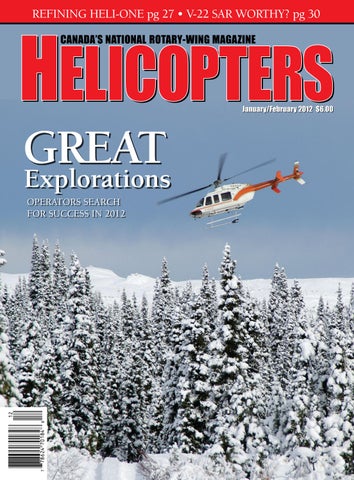
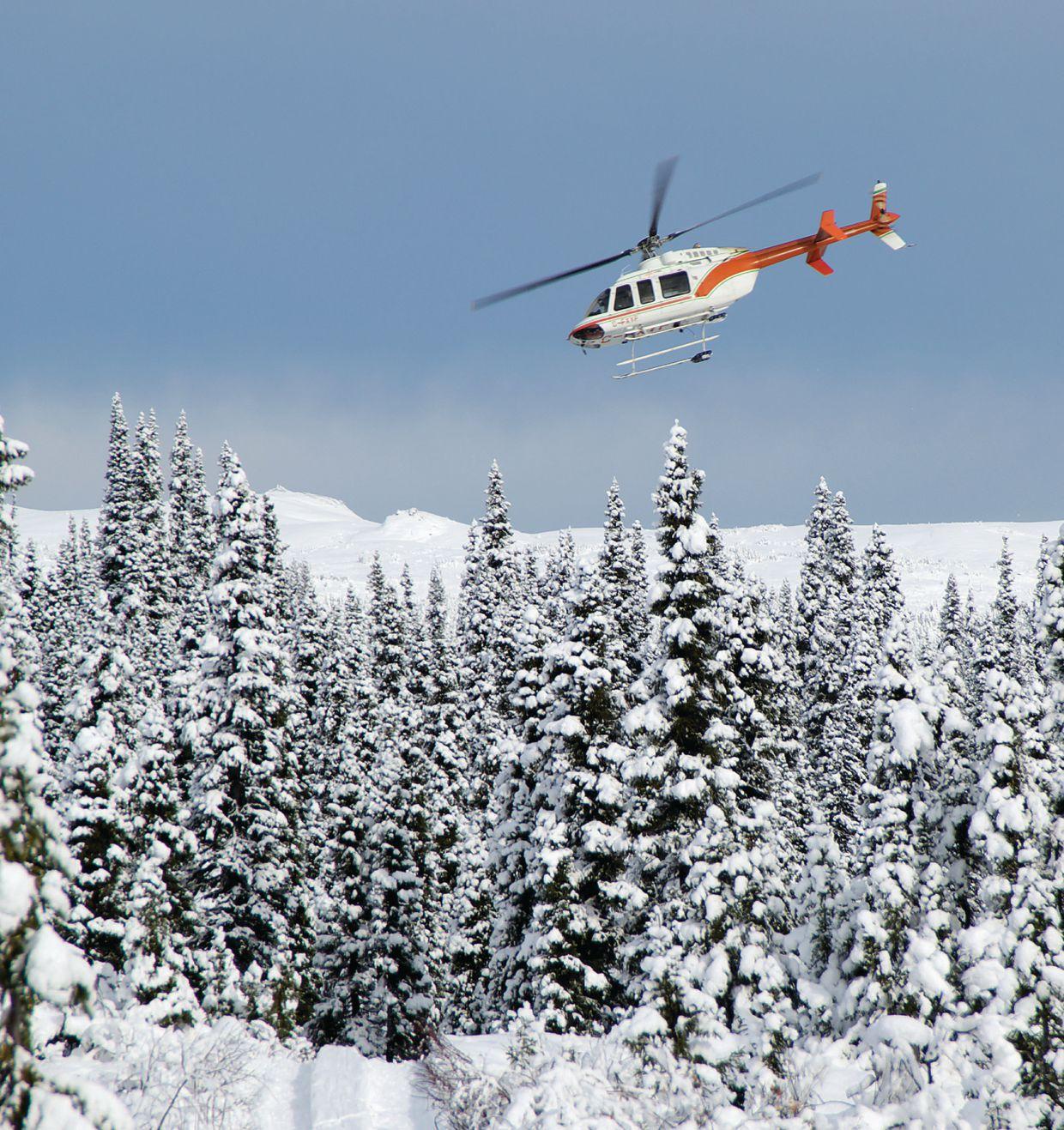
Great Explorations
Canadian Operators Search for Success in 2012
BY MATT NICHOLLS
S
tanding pat.” “Not taking many chances.” “Sticking to the status quo.”
Cautious perspectives all, but given the extremely volatile economic conditions that have prevailed worldwide in the past several months, it’s hardly surprising these are the standard refrains shared by major Canadian operators Canada-wide heading into 2012.
Careful perspectives make perfect sense given “the new normal” economic environment operators face. Add in an ample dose of political uncertainty here (a permanent leader of the official opposition NDP has yet to be named) and in the U.S. (a presidential election is set for November and it’s anyone’s guess as to the outcome), and forecasting financial stability is indeed a challenge.
“If you keep reading the newspapers, you just won’t do anything,” says Troy Fisher, operations manager for Ottawa-based Questral Helicopters. Founded in 1987, Questral is the only commercial helicopter service in North America specializing in airborne geophysical surveys. “You just have to put your head down and have faith in your product and realize that the world is still going to need oil, it’s still going to need nickel, gold and diamonds, and there’s people out there who need to find it.”
Fisher says 2011 “was a very busy year” for Questral, with all machines working to capacity. “And if I had another machine, I could have put it on fires,” he says. Fisher is optimistic 2012 will offer significant opportunity for operators, as renewed interest in sectors such as oil and gas, and mining, will keep machines in the air. “Going forward, we should be better off. And nothing is finalized, but we are looking at adding another B3 to the fleet, hopefully in the spring, which will help.”
A report by the Conference Board of Canada in late 2011 reinforces Fisher’s notion positive developments are in the offing. The report notes Canada will see economic growth next year with western provinces leading the way, benefiting from higher commodity prices and related investments in the energy sector. Growth in central and eastern Canada
will be less robust due to provincial government efforts to reduce deficits, a weak U.S. economy and sluggish consumer spending, but the overall picture is encouraging.
In short, it’s good news for the more than 130 Canadian helicopter operators that dot the Canadian landscape, as many rely on the riches our resource-based economy delivers both here and abroad.
GROUNDBREAKING DEVELOPMENTS
Operators such as Questral that benefit from mining exploration should experience steady opportunities in 2012. Mining is one of Canada’s most important economic sectors and is a major driver of our country’s prosperity. According to the Mining Association of Canada, the mining industry contributes more than $32 billion to our gross domestic product (GDP) and employs more than 306,000 workers in the sectors of mineral extraction, processing and manufacturing.
The Conference Board of Canada notes that the indicators used to assess mining – economic output and exploration expenditures – all point to a strong mining future for many regions in Canada, particularly in the North. Emerging hot spots include the northern B.C. interior (various minerals), Northwest Territories (diamonds), the Yukon (gold, silver, lead and zinc), Nunavut (gold), northern Ontario and
Quebec (chromite, iron ore, uranium), and northern Saskatchewan (uranium and gold).
“Northern Canada has a long history of mining and the future looks bright. Even in 2009 –the worst year for mining in recent history – the industry contributed $6.5 billion to the Canadian economy in real terms and continued to export a diverse variety of resources,” says Len Coad, director, environment, energy and technology policy, for the Conference Board of Canada.
Questral Helicopters did significant work in the B.C. interior in 2011 and in the Arctic. Says
Fisher: “Mineral wise, we did everything from gold, diamonds, nickel – you name it. We did surveys for diamonds in the Northwest Territories, gold out West, we did surveys for uranium. I wouldn’t say it’s all wine and roses right now, but I think, in the future, it’s going to be positive.”
Renewed interest in the mining sector is also being seen at Interior Helicopters, notes line pilot/director of special projects Brad Vankoughnett. The company’s eight helicopters have been busy servicing mining clients in the northern B.C. interior. “We do a lot of small, grass-roots-tent-camp-on-the-side-of-a-mountain kind of jobs, but we had a couple of machines on a big environmental assessment this year for one of our big mining customers.
“There’s a little of everything driving the business right now. Gold is always hot and it goes up when there’s a spike in the market – people get gold rush fever. But there’s lots of different minerals and industrial minerals that you don’t see in the news per se that you need for everyday applications.”
Jeff Denomme, president of Great Slave Helicopters, says mining exploration is a significant part of his company’s operations – and it will continue to play a key role in the business mix in 2012. “The price of gold has certainly helped in the gold exploration side of things, and there’s still a lot of activity in the diamond industry, so typically the expansion of exploration in the Yukon and Nunavut is very active. The Northwest Territories have shown a bit of a slowdown in the last number of years and that’s just because of regulatory issues, as well as environmental issues. That’s why we see the uptick here.”
Operators in Newfoundland have often played second fiddle to their counterparts in other parts of the province, but strong economic activity in the province in 2011 has Geoff Goodyear, president/CEO of Universal Helicopters, feeling confident about his company’s offerings going forward. Universal has been providing support for mineral exportation for more than 30 years, and has extensive experience in field camp support, long line drill moves and more. Clients have included Falconbridge, NDT Ventures, Castle Rock Exploration and Shell Exploration.
“I see a continuation of mining exploration activities, yes,” he says. “Despite a downturn in China, there’s still a demand that outstrips supply, and there’s lots of potential here for base metals that they are looking for. The government here has discussed lifting its moratorium on
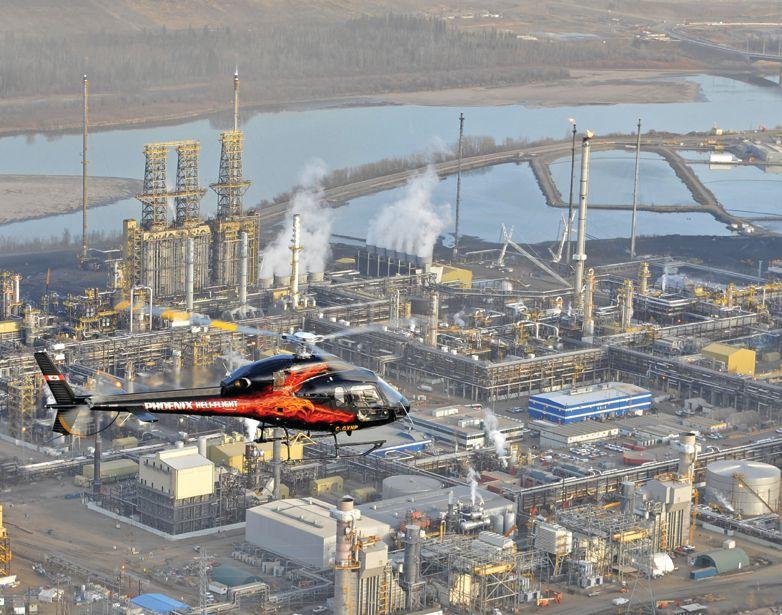
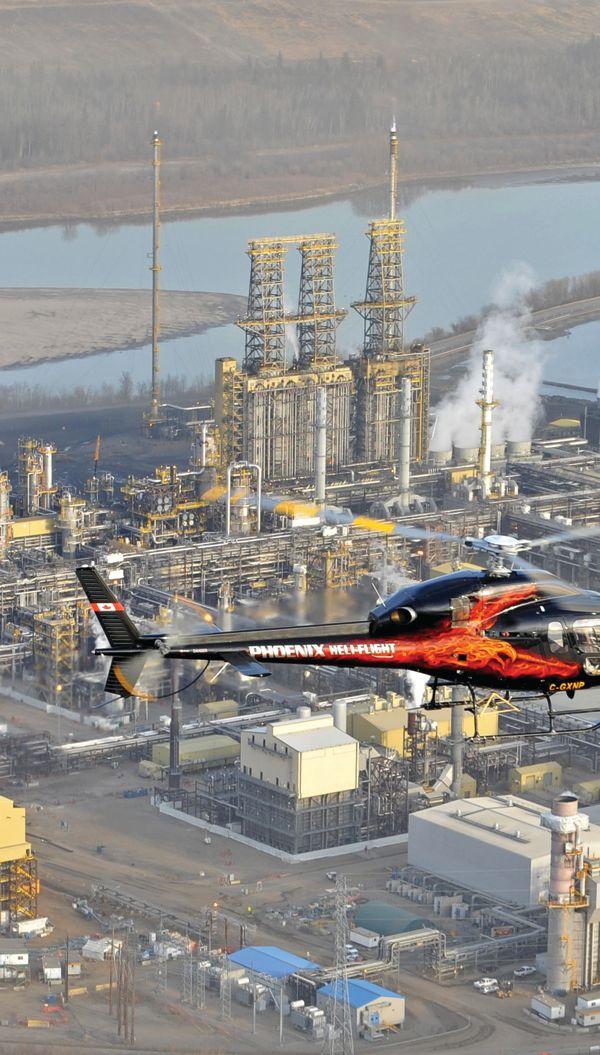
ABOVE: Phoenix Helicopters president Paul Spring has built his organization into an industry leader in a number of key areas. (Photo courtesy of Phoenix Heli Flight)
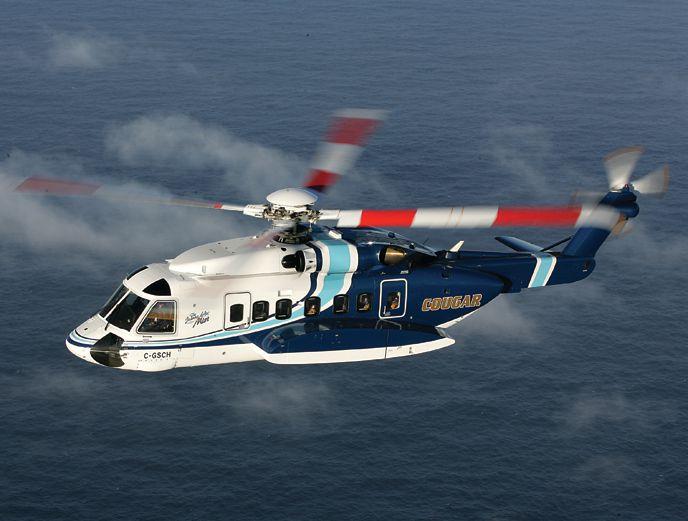
RIGHT: Cougar Helicopters continues to focus on improving safety procedures in 2012. (Photo courtesy of Cougar Helicopters)
COVER STORY
uranium mining, which we’re hoping will bring two or three very highvolume clients back to the table and back in the area, which will serve not only us, but other operators in the area. So, I see at least a maintaining of, or an improvement of, activity in 2012.”
PRIMING THE PUMP
While mining prospects offer renewed hope for operators, those with oil and gas clients seem primed for steady work. Prospects in Canada for oil and gas production remain solid, says Peter Tertzakian, chief energy economist of ARC Financial Corp. (ARC).
ARC’s research reveals that the scale of what’s going on in the Canadian oil and gas industry is impressive by any world standard. From B.C. to Newfoundland, the upstream oil and gas industry generated more than $115 billion in annual revenue, $20 billion in royalties, land sales and taxes, and $50 billion in investment into infrastructure and jobs in 2011 – with similar prospects for 2012. Major projects coming down the pipe include:
• Keystone Xl project. An expansion of Calgary-based TransCanada Corp.’s existing Keystone pipeline system. It will carry up to 830,000 barrels of crude per day from northern Alberta to refineries in Oklahoma and the Gulf Coast in Texas. The Canadian portion of the project extends for about 529 kilometres and will cost $1.7 billion. The project is a political hot button in both the U.S. and Canada.
• Northern Gateway. A pair of 1,172-kilometre pipelines to carry blended bitumen westbound and condensate eastbound between Bruderheim, Alta., and Kitimat, B.C., on the Pacific coast. Construction, subject to numerous proposals, is scheduled for 2013.
• MacKenzie Gas Project. The Mackenzie Gas Project will build a gas line that extends from the Mackenzie Delta to Alberta. The 1,196-kilometre pipeline will create more energy opportunities in the far north. Construction is set to begin in 2015.
“The seismic side of the business has picked up in the fall and it is continuing throughout the winter,” says Denomme. “We’re looking at a very busy seismic season in Alberta, Saskatchewan and B.C., so it’s nice to be able to see that work pick up. It sort of helps to take the seasonality out of our business – and that’s another aspect of keeping the right crew numbers.”
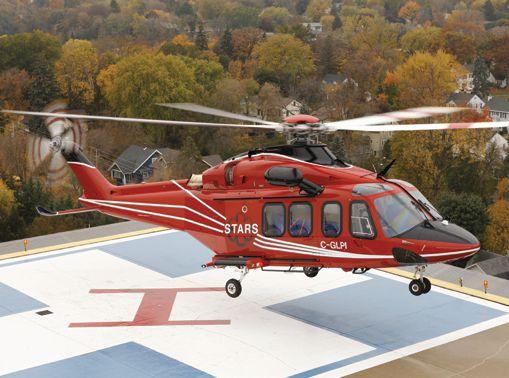
STARs is looking to build on an outstanding year in 2011, with the anticipated opening of its two new bases in Saskatchewan. A longterm medevac agreement with the Manitoba government is imminent as well. (Photo courtesy of STARS)
to the Crown’s decision to curtail opportunities until oil in the oil sands is extracted, work there has helped keep his seven Eurocopter helicop ters busy. (For more on the oil sands and future prospects, see “Supporting the Oil Sands,” pg. 22.)
“We never know what the future will bring, but looking back on last year, we had the best year we’ve had. And we don’t just judge that on hours, it’s judged on profitability,” he says. “We saw a return to, in our area, survey activity as well.”
Spring, like many operators, is wary about the future. With eco nomic chaos in Europe and uncertainty with the global economy, sig nificant changes in operations at Phoenix will not occur right away, he says. Working closely with clients to improve safety and maintenance procedures internally will carry the day.
“We’re like most companies now, we’re just hoarding cash,” he says. “We built up a bit of buffer so that if we do see a retreat in business next year, we can weather the storm. You know in 2008, everyone was chug ging along, spending and buying helicopters and building things. . . it looked like the world was good and everyone was never going to stop. Well, 2009 and 2010 taught us a lesson. Now, it’s consolidation of cash and assets and getting ready to ride out the storm in case we get a second wave.”
The fact is, if you keep reading the newspapers, you just won’t do anything.
Great Slave has also extended its oil and gas business internationally, by supporting ongoing oil and gas seismic exploration activity with South American Exploration LLC’s Peruvian operations. It allows the company to diversify its revenue by tapping into the Latin American oil and gas market. Adding international revenue streams is a goal many Canadian-based operators have set in order to diversify operations in as many markets as possible.
Paul Spring, president of Phoenix Heli Flight in Fort McMurray, is optimistic his firm will continue to benefit from consistent Alberta oil production in the new year. While the gas market “is dead for us” due
A cautious approach also carries the day in the offshore business. Hank Williams, general manager of Cougar Helicopters, says while his Sikorsky S-92s were kept busy servicing a number of offshore oil projects in 2011, the new year will be spent concentrating on existing clients, improving safety standards and mending operational voids. The company is also working closely with Sikorsky to improve safety standards and optimize the fleet.
Globally, Cougar flies crews to offshore platforms in the Gulf of Mexico, the North Sea, Greenland, the waters around Newfoundland and Labrador, Nova Scotia, Brazil, Australia, Malaysia and China. Cougar also provides SAR services for emergency response and medical evacuations. “It was a very positive year for Cougar in 2011, and we’re looking to maintain activity in 2012,” says Williams.
COVER STORY
POWERING THE FUTURE
While the mining and oil and gas sectors are producing real opportunities for operators, new projects in the hydroelectric and energy sectors will provide other opportunities –now and in the future.
In Ontario, Canada’s largest provincial electricity consumer – the government –plans to close its four remaining coal-fired plants (in Atikokan, Lambton, Nanticoke, and Thunder Bay) by Dec. 31, 2014, citing environmental and health concerns. The government plans to replace coal-fired generation with natural gas, nuclear, hydropower and wind.
Other major hydroelectric projects in construction across Canada include: HydroQuébec’s construction of a 768-megawatt facility near Eastmain and a smaller 150-MW facility at Sarcelle; and a 200-MW Wuskwatim project in Manitoba. Also, Fortis Inc., in partnership with Columbia Power Corp. and Columbia Basin Trust, says it will construct a 335-MW hydropower project at an estimated cost of $900 million near Waneta Dam on B.C.’s Pend d’Oreille River. The project also calls for the construction of a 6.2-mile transmission line. These, and other major projects, will keep operators in Quebec, Manitoba and B.C. with a vested interest in hydro work energized this year and well beyond.
Ontario’s Hydro One’s contingent of eight helicopters based in Barrie, Timmins, Dryden and Thunder Bay are tasked with a variety of responsibilities – from storm restoration to ongoing maintenance. With more than
30,000 kilometres of transmission lines and 120,000 kilometres of distribution lines threaded throughout the province, it’s a daunting task – 1.2 million customers need to be safe, warm and powered up. Has the economic slowdown zapped the power out of Hydro One?
“For us, status quo is the order of the day,” says John Bosomworth, chief pilot for Hydro One. “A few years ago, when the economy was booming, we felt that we were not picking up the pace like everyone else and moving with it. We were very busy, but then when the economic slump happened, because of the nature of the work that we do, we weren’t impacted as much. There were other helicopter companies that were hugely affected by slumps in mining and forestry and everything that goes along with the resource-based economy.”
To keep the lights burning bright in the new year, Hydro One is enhancing its fleet by adding another new helicopter in 2012, upgrading a Longranger to the highly versatile Eurocopter AS350 B3. “Our wheels sometimes turn slower than we like, but that’s OK. Sometimes, it’s at a glacial pace, but that can be good, too,” says Bosomworth. “It takes a lot of effort, and a whole lot of patience, but at the end of the day, it works.”
SHOOTING STARS
Of all Canadian operators, Alberta-based Shock Trauma Air Rescue Society (STARS) may have shone the brightest in 2011 – and 2012 looks to be just as successful. Through
November 2011, STARS had flown more than 21,881 missions since its inception and will now have the opportunity to provide medevac services on a full-time basis in two new provinces – Saskatchewan and Manitoba – while continuing to serve Alberta and eastern B.C.
In April of last year, STARS signed a service agreement with the government of Saskatchewan to provide air ambulance services from bases in Regina and Saskatoon. The Regina base, to be located at the Regina International Airport, is scheduled to open in the spring of 2012, while the base in Saskatoon is anticipated to open in late 2012. The government of Saskatchewan is investing $10 million per year beginning in 2012-2013.
In Manitoba, STARS was initially contracted to provide flood-related emergency service from April 1 to May 31, 2011; however, that contract was extended. The province and STARS then signed a memorandum of understanding on June 28 to facilitate future discussions and work toward a permanent helicopter air ambulance program in Manitoba. A long-term agreement to provide medevac services out of a base in Winnipeg will likely be signed this year.
STARS is also taking possession of its second and third AW139 aircraft to serve its new bases – and is seriously ramping up operations. Although a foray into the fixed-wing side of things isn’t in the plans at the moment, an understandably upbeat vice-president of aviation Scott Young doesn’t rule it out.
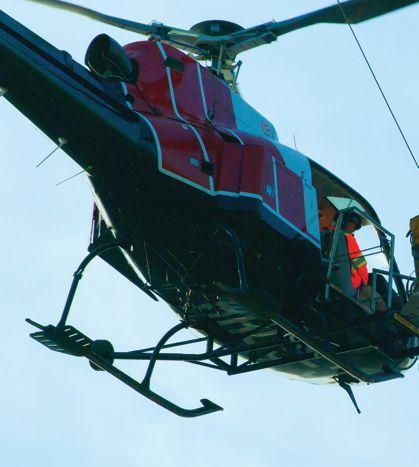
With 120,000 kilometres of distribution lines to service in Ontario, it is no wonder Hydro One’s helicopters are always on the go. (Photo courtesy of Hydro One)
ABOVE: Great Slave Helicopters president Jeff Denomme says staffing in 2012 will be a challenge for his firm. (Photo courtesy of Great Slave Helicopters)
“2011 was an incredible year for STARS,” says Young. “And heading into 2012, we’re hiring in excess of 35 pilots, probably eight AMEs plus the paramedics, nurses and doctors that we need to support our mission. So, we’re doubling our size.
“We also work closely with the fixed wing operators in Manitoba, Saskatchewan and Alberta. All three provinces have very established fixed wing programs on the medevac side of things, and we work them to get things done. They also have ground ambulance services, so they are fully integrated already. We are not. But we would look at it given the opportunity. But organizationally, we’re not actively seeking fixed wing at this time.”
While one of the country’s leading medevac services experienced significant success in 2011 and is primed to soar in 2012, Ontario’s medical transport provider, Ornge, was crushed near the end of 2011 amidst allegations of mismanagement and misuse of funds following an extensive in-depth report by the Toronto Star
Ornge chief executive officer Christopher Mazza went on indefinite medical leave in late December just before it was revealed that his salary, $1.4 million, was the highest of any Ontario public official. Mazza was relieved of his duties – along with the entire executive board – early in the new year and replaced by Ron McKerlie, a deputy minister in government services. Health Minister Deb Matthews made the switch, saying it “was abundantly clear” the province’s medical transport services was not performing up to snuff.
The medical service was heavily scrutinized about service, inadequate staffing,
equipment decisions, and alleged mismanagement in a number of areas. It dulled any accomplishments Ornge had in 2011, including the establishment of a new operations base in Oshawa, supplying southeastern Ontario with another important medevac option.
MOVING FORWARD
While opportunities in many natural resource-based industries are indeed at hand, most operators Helicopters spoke with for our
annual Market Report are concentrating on core values: working closely with existing clients to improve services; looking for ways to improve their fleets; finding creative ways to retain staff; and meeting stricter client demands. Resting on their laurels isn’t part of the equation. As Cougar Helicopters’ Williams aptly points out: “If you aren’t looking, you aren’t going to find any opportunities.” For Canada’s top helicopter operators, great explorations are certainly words to live by.
Introducing
Supporting the Oil Sands
Safety a Top Priority for Operators Large and Small
BY JAMES MARASA
At the Edmonton offices of Canadian Helicopters, a broad map of the Athabasca oil sands sprawls along the wall. It’s not for decoration. Figures from the Alberta government claim oil reserves of some 171.3 billion barrels in the Athabasca region, supporting its claim as the thirdlargest crude oil reserve in the world. With 33 bases across Canada and one of the largest helicopter fleets in the world, Canadian Helicopters Group Inc. is Canada’s largest helicopter transportation services company. As part of a wide range of services offerings, Canadian Helicopters is tapping into Alberta’s oil boom by providing support to geophysical exploration programs in search of oil and gas across the Athabasca oil sands. Putting the unique
capabilities of helicopters to work in a climate notorious for slinging special demands on air transport, pilots move seismic recording equipment, crews and drill rig components in all phases of oil sands exploration. Canadian Helicopters is also active in the planning, construction, and operational phases of oil and gas pipelines and provides standby operations for emergency response.
Craig Barraclough, Canadian Helicopters’ Fort McMurray base manager, was in town to walk me around the Edmonton facilities. As he did, a safety briefing, in which Barraclough explained how to exit the building in case of an emergency, came as a surprise. “It’s just what I’m used to,” he says when queried on the practice of briefing visitors. “It’s my background.” With a resumé crammed with some 20 years of experience, more than 4,000 flying hours and skills honed largely in his native Australia, Barraclough now heads Canadian Helicopters’ oil sands operations.
“It’s your standard bush-type flying,” Barraclough says in describing the work carried out from the Fort McMurray base. As standard as he claims the flying to be, Barraclough is as quick to extol the diversity of the work done in servicing the needs of the oil companies, as he is the company’s religious compliance to safety standards. “We do all kinds of IFR and VFR,” he says, adding that he still loves to take an active role in the flying. “There isn’t any type of flying I don’t enjoy.”
Attracting a breed of pilots who come from far afield in search of unique flying opportunities, Northern Alberta presents helicopters and their crews with a range of environmental challenges. Barraclough shakes his head and smiles as he reflects on the extreme cold and the challenge of keeping aircraft functioning well in temperatures that can drop below minus 40 degrees.
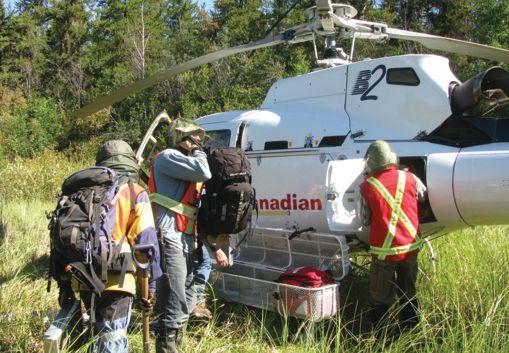
For the fleet of A-Stars, Bell 412s and 206s, 2011 was a good year. While anywhere from three to 10 aircraft may be stationed at the Fort McMurray base depending on seasonal demand, Barraclough admits it has at times been tough for clients to book available aircraft. He explains that oil crew leaders will normally select the helicopter operator in the field as and when the need arises – the selection process is
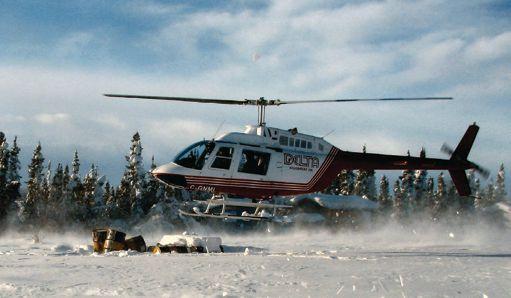
Delta Helicopters is a family-run business that has been operating in Alberta since 1972. (Photo courtesy of Delta Helicopters)
not necessarily vetted through an organized structure within the oil company. While preferred rate sheets are distributed to all the major players in oil sands, a key part of Barraclough’s job is to seek and maintain personal relationships with his passengers. “Most clients call up the day before looking for a helicopter,” he says. “They treat us almost as a taxi service.”
With clients investing such reliance in call-and-go service, the idea of a bush pilot receiving a call, loading up a helicopter, then flying under the weather to try to “get in” tends to linger in the mind of the public. Barraclough is quick to point out that while such a romanticized image of bush flying may have been valid in the past, the times have changed. “Particularly in offshore flying,” he says, “Multinational oil and gas companies are holding their contracted air operators to a more prescriptive standard than Transport Canada (TC). That’s starting to trickle across to the on-shore community as well.”
“The potential repercussions are more severe,” adds Barraclough in reference to penalties imposed by TC and the consequent risk of lost business. “Most companies have consultants working for them and can dictate the pilot requirements and aircraft requirements for their crews to be flown around.”
Such an elevated level of oversight has forced operators who are not willing to pay the price of compliance to become more specialized in the type of work they pursue. Barraclough stresses the effort Canadian Helicopters has put into arranging its fleet and range of services to meet client demands with the highest standards of compliance. “Some clients will only allow their crews to be flown in a twinengine helicopter,” he says. “But the diversified business model of Canadian Helicopters allows us to meet such needs.”
ABOVE: As part of its wide range of services nationwide, Canadian Helicopters is tapping the massive oil reserves of the Athabasca oil sands.
RIGHT: Safety is a top priority in the oil and gas sector operators both large and small. Standards are continuously on the rise. (Photos courtesy of Canadian Helicopters)
Delta Helicopter’s steady stream of business comes from a base of dedicated and long-term customers, says operations manager/line pilot Paul Stubbs. (Photo courtesy of Delta Helicopters)
While large operators are serving a significant proportion of the multinational oil and gas customers, a number of smaller operators are thriving as well. Paul Stubbs is the operations manager and a line pilot for Delta Helicopters, a family-run operation founded by his father, Don, in 1972. With several bases in Alberta and a fleet of more than 20 helicopters, Delta has been carving out a comfortable existence in the oil sands for almost four decades.
“We don’t chase exploration work [or] try to underbid other companies to win new contracts,” he says. Instead, Delta focuses on keeping happy the good customers that they already have. “We have the best customers in the world,” he says. “We [have been] flying some of the same clients for the last 40 years.” Stubbs goes on to say that just a few weeks earlier, he had, in the back of his helicopter, some of the same passengers he flew as base manager in High Level in 1991.
On the question of safety, Stubbs points out that the company follows the same intensive recurrent training procedures that would be expected of any operator. Interestingly, he also acknowledges a contribution to maintaining high levels of safety as coming from the long-term client base and the company’s understanding of how weather affects helicopter operations.
“We don’t do much different than we did back then,” Stubbs says. “We cater mostly to companies that don’t require twin-engine helicopters” meaning the company focuses mostly on survey, oil well servicing, and environmental work within the oil sands region. Contrary to the feast-or-famine, boom-bust cycles for which oil sands aviation has earned an infamous reputation, Stubbs affectionately refers to the work as “mundane,” adding that Delta Helicopter’s steady stream of business comes from a base of dedicated and long-term customers – a resource that Stubbs is quick to laud.
•
•
• API 5th Edition Truck Loading & Offloading System
• Large Inventory of Fueling Components Available 24/7
• Certified Aviation Petroleum Technicians Available 24/7
• Custom Fueling Solutions
• Towable Helicopter Fueling Units Availbale for Rent or Purchase
“They will call us up and tell us it doesn’t look like a good day to go flying; that they are driving instead,” he says. “They understand that flying in bad weather puts everyone at risk. This removes many of the external pressures on our pilots.”
The science of safe helicopter operations includes a fair measure of intuition. “We tell our pilots, ‘if it doesn’t feel right, don’t do it.’ We would sooner lose a million-dollar contract than lose a helicopter or a person. At the end of the day, we all have families to go back to.”
Stubbs jokes that as operations manager of a family business, he
reports to the owners of the company every Easter, Christmas and Thanksgiving. A question of whether or not to take on additional risk to win a certain contract may often be resolved with a simple “don’t do it, son” from across the table. “We have walked away from jobs when the profit versus risk [margin] just didn’t make sense. We are in the fortunate position where we don’t have to chase every job.”
At Canadian Helicopters, Barraclough says that he has begun to notice a greater awareness of safety standards among companies operating in the region. Unfortunately, he contends, most of these new standards have come about due to accidents, in applying what was learned during the subsequent investigations. And customers are taking note. “Clients have become much more aware of safety in regards to their own personnel,” he says. “They don’t just call up someone with an available helicopter and go flying.”
Barraclough has a similar attitude to safety to Delta Helicopters’ family-run operation, but sums it up in slightly different words. “They say you can’t put a price on safety, but risks need to be weighed against benefit or else no one would ever go flying.”
Risk can also be managed and mitigated, and it is in doing so that pilot experience becomes critical. Pilots need to accumulate at least 1,000 hours before becoming eligible for a chance to work at Canadian. The experience requirement is a tough hurdle for those wanting to break into the industry.
“It’s the classic catch-22 of aviation,” says Barraclough, “Young pilots need to find that break.” And despite the demand, Barraclough notes that first job is getting harder and harder to come by.
In an increasingly environmentally conscious world, the unique capabilities of helicopters allow the movement of people and equipment to take place with minimal impact on surrounding terrain. Looking forward, politically and environmentally stable oil supplies will without doubt continue to play a critical role in world economics. With no real easing in the price of oil in sight, emerging and growing economies, increasingly bolstered by and reliant on Canadian oil, will open up unique opportunities for helicopter operators.
Northern Alberta presents helicopters and their crews with a range of environmental challenges. (Photo courtesy of Canadian Helicopters)
LEFT: The goal at Heli-One is to be creative with the level of services offered to the customer: not just maintenance or repair, but looking beyond what they are asking for.
BELOW: New president Larry Alexandre has one goal at HeliOne – to live up to the company’s motto of being the world’s largest MRO service provider.
(Photos by Paul Dixon)
Not Maintaining the Status Quo
Heli-One’s New President Excited About Future
BY PAUL DIXON
To many, Delta, B.C.-based Heli-One is viewed as little more than the in-house maintenance department for Canadian-based helicopter giant CHC Helicopter.
Ironically, that’s how Heli-One’s new president, Larry Alexandre, viewed the company before he signed on in June of last year. Speaking with Helicopters shortly after joining the company, Alexandre said he was surprised to learn how much business actually came from outside CHC.
“I underestimated the amount of work that Heli-One does for third parties, meaning outside of the CHC fleet,” he says. “Today, it’s about 40 per cent of our revenues, and in the next 18 months, it will most likely represent more than 50 per cent, considering CHC’s growth.”
Alexandre brings 20 years’ experience in aerospace manufacturing and maintenance to his new position with Heli-One. He sports an impressive record of driving cultural change in his previous positions, most recently as CEO of Sagem Avionics and prior to that as COO of Turbomeca’s operations in North and South America.
“I like to joke with my team that I do nothing, but I do it well,” the self-effacing Alexandre says. “I’m not an expert in anything, but I’ve
kind of touched every piece of the business, from the commercial side to the operational side. What I enjoy the most, especially in the past seven years in the CEO or COO role, is to have my finger on the pulse of every function in the company and make it all work together. That’s the fun part.”
Alexandre’s arrival at Heli-One is part of a refocusing of the core operations. One of his first steps was to announce the sale of Heli-One Composites, located in Gander, N.L. He notes that while the manufacture and repair of composite materials is a viable and growing segment of the aerospace market, “it’s not our core business and Heli-One does not want to compete in that area.”
“What I knew of Heli-One from being in the marketplace through Turbomeca and Sagem, was that Heli-One and CHC were very wellknown entities,” he says. “I was fully aware that this company had gone through a lot of management changes in the past few years. There was a lack of stability in the leadership positions, which translated into an inability for the team to really come together – and when this happens, this usually leads to operational inefficiencies, miscommunication and poor financial performance as well as, probably, low employee morale.
PROFILE
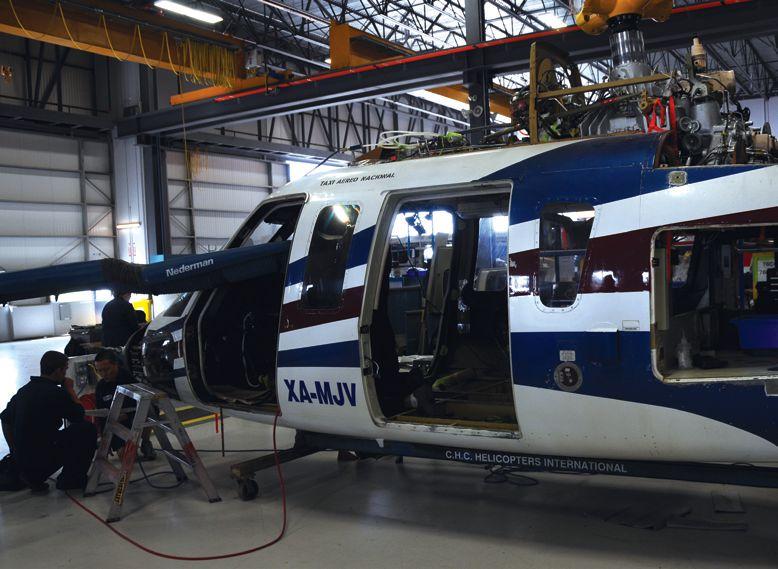
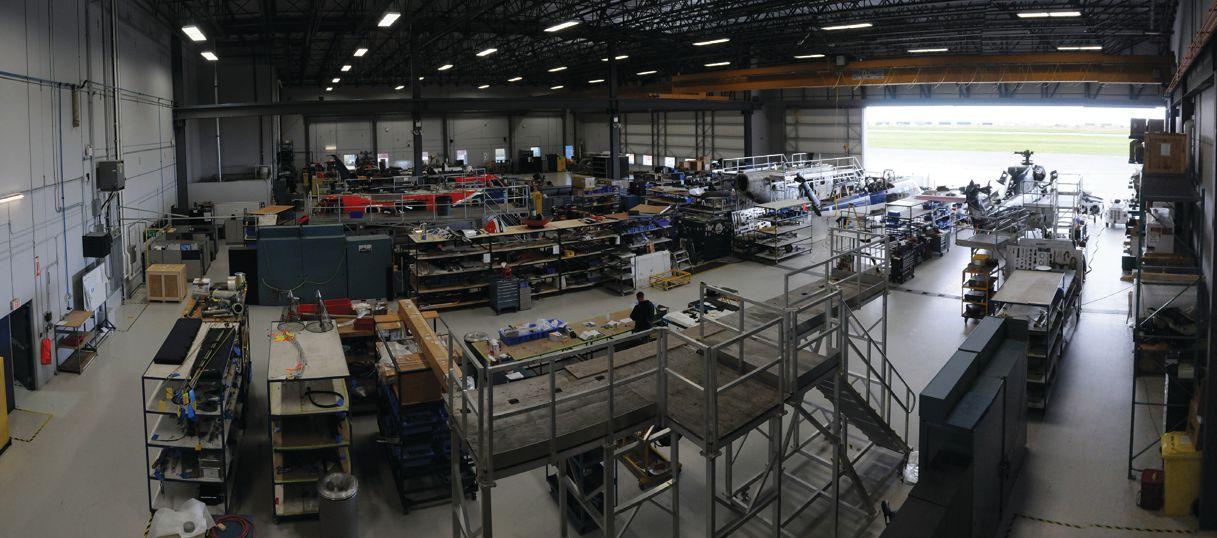
The nine work bays at the Heli-One hangar are dedicated to six streams of aircraft – the AgustaWestland AW139; Sikorsky S-61; Sikorsky S-76; Sikorsky S-92; Bell mediums; and Eurocopter Dauphins. (Photo
What I did not foresee before coming, which I discovered when I walked in to Heli-One, was that, as big as we are, we still have a lot of room for improvement in developing robust standards. We are very proud of our craftsmanship as mechanics and we have a lot of very good people. It wasn’t as robust as I imagined it could be, especially for the size of the company and its experience in supporting CHC.”
Improvement for Alexandre will come from introducing the concept of “lean” into the organization. He is determined to streamline processes and make improvements on a number of levels to maximize performance. “As big as we are, this was really not well known or applied by the majority of the employees – and it’s something I personally believe in extensively and try to drive into everything that we do, whether it’s in operations or other functions around the company,” Alexandre says. “When you’ve been doing something for 10 or 15 years, you become oblivious to the waste around you that might be apparent or obvious [to others]. You’ve done it so long, you’ve looked at it every single day for the last 10 years, you no longer see it. My hope is to get more than 900 employees coming to work every day thinking about what to improve today.”
Alexandre’s goal is to live up to the company’s motto of being the world’s largest MRO service provider. He wants Heli-One to be not only the largest MRO service provider, but also the best – in all areas. Achieving this goal means making a stronger commitment to working on products and safety, and continuing to improve operation-wise through lean deployment. It also means expanding services and not just being the old-fashioned wrench turner doing MRO work – for example, by offering such services as power by the hour, tip to tail where they can do dynamic components in addition to engines, with the ability to address mixed fleets.
“We are trying to be very creative with the level of services we offer to the customer, not just maintenance or repair, but looking beyond what the customer is looking for,” he says. “We are developing mobile repair teams where we can send teams of mechanics out
to do troubleshooting or lower-level maintenance operations in the field. It’s about realizing when a customer needs MRO services – not just about sending an asset to a repair shop. It’s also about having flexibility, quick response out in the field, or better financial terms or more adequate financial solutions such as power by the hour.”
A COMMITMENT TO QUALITY
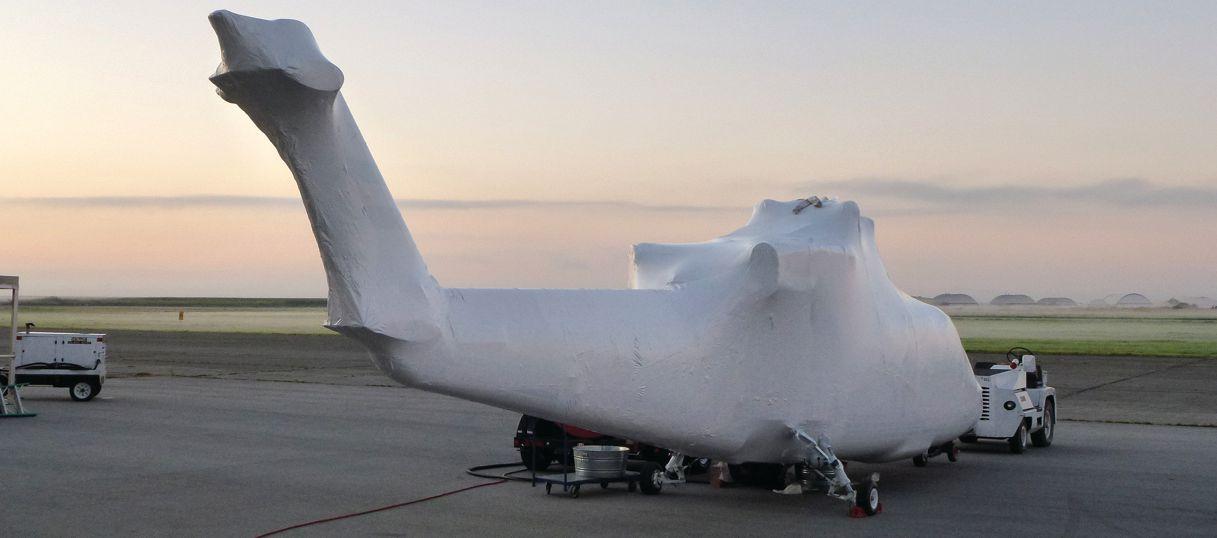
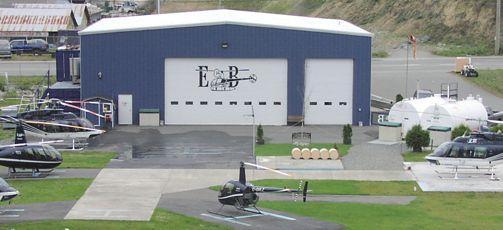
Heli-One’s corporate headquarters in the Vancouver suburb of Delta is the anchor to the reborn Boundary Bay Airport (CZBB), located 17 kilometres southeast of YVR. The facility opened in 2008, bringing operations that had outgrown a number of small facilities at YVR and Langley, B.C. together under one roof. The facility is large at 235,000 square feet. The hangar has nine work bays dedicated to the six streams handled at the facility – the AgustaWestland AW139; Sikorsky S-61; Sikorsky S-76; Sikorsky S-92; Bell mediums; and Eurocopter Dauphins.
Says Alexandre of Heli-One’s client base: “The level of awareness out there of who Heli-One is and what we have to offer is actually quite low. The large fleet operators know who we are, but as you know, the helicopter business is very fragmented and you have a lot of smaller fleet operators or small operators out there who don’t know what we do. They know we do Turbomeca engines, but they don’t know we do PT-6 engines or CT-58 engines. So, we definitely need to do a better job of communicating our array of capabilities to the market. The other thing, too often – and it was my view as well – customers see Heli-One as mainly CHC’s maintenance and repair centre. It is still the main customer at this point, but the ratio is quickly evolving and we do almost as much work with third-party customers as we do with CHC. So, we are clearly focused on the third-party and not just CHC.”
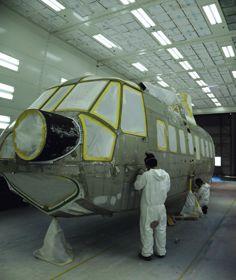
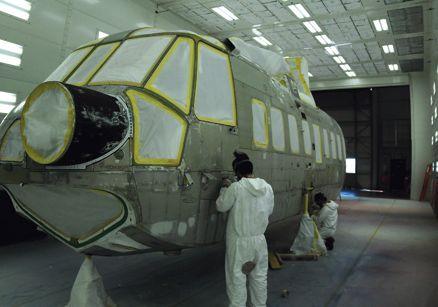
Heli-One currently has approvals on 17 different aircraft types, including several that are not part of the CHC fleet. One of the largest external customers is the Canadian Forces with Heli-One performing 600 hour inspections, 3,000 hour/five-year inspections, and repaints for CF’s fleet of CH-146 Griffons.
by Paul Dixon)
including
COPING WITH CHALLENGES
The challenge for Heli-One in Delta – as well as in its other large facility in Stavanger, Norway – is the struggle to find qualified technicians. The two locations present slightly different challenges, according to Alexandre. “British Columbia is not an aerospace hub and other than existing local operators, there is not a large pool of talent to draw from,” he says. “In Norway, we have a slightly different issue. There’s the offshore oil and gas business, which is just a very attractive field financially and it’s a different challenge. We find competent, skillful people, but it’s a different challenge, which is how to retain them in such a competitive environment.”
Hangar manager Tony Sonnendrucker says bluntly, “we’re shortstaffed. I’ve only got five apprentices (out of 42 AMEs) and I need more. It takes four years to get trained on a machine and get comfortable. I have a finite amount of time, so I have to keep bringing in new staff because the young ones eventually want to go travel and visit the rest of the world.”
By “travel,” Sonnendrucker means taking the opportunity to work around the world supporting CHC operations in the field. It’s something he encourages, but at the same time, he wants them to return to where they started and bring that field experience back to the hangar. Sonnendrucker also points out that there is a shortage of qualified people, specifically for the type Heli-One is searching for.
“To bring them in here, you have to literally search the planet,” Sonnendrucker says. “I need that experience, because I only have a certain number of people with hard time, hard field experience. They’re all my leads. They’re the ones you want at the end of the job, going through the troubleshooting, when the aircraft is going to ship in three days and you don’t have a week to troubleshoot it – that’s where these guys come in.”
The BCIT Aerospace program is a major source of local talent for Heli-One. In June of 2010, Heli-One donated $50,000 to sponsor a rotary-wing classroom in the YVR campus as well as serving on the program’s Industry Advisory Board. For BCIT’s Jack Baryluk, the partnership represents a true win-win situation.
“We are very proud of our relationship with Heli-One,” says
Baryluk. Sonnendrucker goes even further, adding that the benefits are immense. Having such a close working relationship with the instructors means he often gets a tip on a “keener” who will be offered the opportunity to job shadow at Heli-One. As an example, he says “there’s one guy who’s in here and we put him with the Dauphin team. He liked it – I tracked him through BCIT and was able to hire him when he graduated. He’s here now and doing a good job.”
MAINTAINING IRONCLAD RELATIONSHIPS
One way Heli-One is building on Alexandre’s vision of looking beyond what clients’ needs are today is by expanding its range of services. The AW139 commitment is a perfect example. Heli-One had the first OEM tailboom assembly in North America in August, 2010, even before it was available at AgustaWestland’s facility in Philadelphia. In August, 2011, Heli-One also had an AME on site at an ORNGE base in Ontario working on a service bulletin and a second AME deployed to Honeywell in New Jersey for similar work.
London Air Service, located at YVR, operates three AW139s and is the Canadian sales agent for the aircraft. For company president Wynne Powell, the relationship with Heli-One is “a strong fit. They have expanded their services and the number of trained staff. “All the work they have done for us so far has come in on time and under budget,” says Powell. This allows London to focus on its role as AgustaWestland’s sales agent with Heli-One as the MRO service provider. Even better, from an operator’s perspective, Heli-One is a six-minute flight from London’s operation at YVR, versus three days each way flying to AgustaWestland’s North American facility in Philadelphia.
For Alexandre, it all comes down to meeting customer expectations at every step of the process. “We have a lot to offer to the market, we’ve got strong talent and dedicated professionals across the globe. It is a major investment on our customer’s part. It’s an expensive asset and expensive repairs or modifications. I think our customers are looking for the best quality service out there. When you’re going to be spending that much money you want to make sure you’re sending it to a trusted source.”
Heli-One currently has approvals on 17 different aircraft types,
several that are not part of the CHC fleet. (Photo by Paul Dixon)
The Case for the V-22
Will the Tiltrotor Return to Canada as a Search-and-Rescue Option?
BY PETER PIGOTT
His F-15E Eagle suffering mechanical failure, the pilot ejected, parachuting into war torn Libya. He landed amid a field of winter wheat, 24 miles east of Benghazi. For the United States, the fear was that the pilot would be captured by Moammar Gadhafi’s forces and a repeat of the Somalia “Blackhawk Down” humiliation would ensue. But before the enemy could arrive, two Marine MV-22s from the USS Kearsarge covered the 140 miles from the aircraft carrier in about 45 minutes and brought the pilot to safety. It was a dramatic example of what the V-22 Osprey was capable of.
The Royal Canadian Air Force’s (RCAF) indefatigable De Havilland Buffalos were to be retired almost 20 years ago and now cost $20 million in annual maintenance just to keep in the air. Once the RCAF’s tactical transports, in 1975 the De Havilland Buffalos have been retasked for search and rescue (SAR) duties. Today, there are only six CC-115s flying – all with 442 Transport and Rescue Squadron, 19 Wing, CFB Comox on Vancouver Island. Their SAR territory stretches from the Arctic to the U.S. border, from the Rockies to 1,200 kilometres offshore. Defence Minister Peter MacKay has said that there are no plans to keep the Buffalos in the air after 2015. Like their animal namesakes, the CC-115s are soon to disappear from the Canadian landscape.
There had been two main contenders in the Fixed Wing SAR (FWSAR) competition – the Spanish built EADS/CASA C-295 and the Italian (Alenia) C-27J Spartan – until Bell Boeing introduced its V-22 Osprey as a potential Buffalo replacement. On Nov. 23, 2010, when representatives from all three manufacturers extolled their aircraft before the Parliamentary Standing Committee on National Defence, Bob Carrese, executive director of business development for the CV-22 program, talked about the tilt rotor.
Canada has seen tilt rotors before. In 1964, Canadair designed and manufactured the CL-84 Dynavert, a V/STOL turbine tilt-wing monoplane. Designated by the Canadian Forces as the CX-131, four experimental models were built in Montreal between 1964 and 1972. The company and the Canadian government tried hard to interest the U.S. military in the tilt rotor – even launching one off a U.S. aircraft carrier to demonstrate its SAR capabilities. But the meeting was to no avail –despite the Vietnam War and the need for V/STOL, the U.S. helicopter lobby was too strong. Without a market, Canadair abandoned the tilt rotor project in 1974, donating the models to museums.
A VERSATILE PLATFORM
Simply put, the V-22 Osprey blends in one platform the high-speed, long-range, long-endurance capability of fixed-wing aircraft with the manoeuvrability and vertical flight capabilities of rotary aircraft. It can achieve this because it’s a fixed-wing aircraft with prop rotors at each wingtip that function as both propellers and rotors. The prop rotors, along with the engines and gearboxes, are mounted in nacelles that rotate from a vertical position in the hovering mode to a horizontal position in the airplane mode.
The V-22 takes off vertically and, once airborne, the nacelles (engine and prop-rotor group) on each wing rotate into a forward position and it morphs into a turboprop aircraft. With those two rotors, unlike military helicopters whose top speeds are 140 to 175 miles per hour, the
The V-22 Osprey blends in one platform the high-speed, long-range, long-endurance capability of fixed-wing aircraft with the manoeuvrability and vertical flight capabilities of rotary aircraft. (Photo courtesy of Boeing)
Tiltrotor Tech
POWER PLANT: Two Rolls Royce-Allison AE1107C turbo shaft engines – same engine core on the CC-130J
THRUST: More than 6,200 shaft horsepower per engine
WINGSPAN: 84 ft., 7 in. (25.8 m)
LENGTH: 57 ft., 4 in. (17.4 m)
HEIGHT: 22 ft., 1 in. (6.73 m)
ROTARY DIAMETER: 38 ft. (11.6 m)
SPEED: 277 mph (241 kt) (cruising speed)
CEILING: 25,000 ft. (7,620 m)
MAXIMUM VERTICAL TAKEOFF WEIGHT: 52,870 pounds (23,982 kg)
MAXIMUM ROLLING TAKEOFF WEIGHT: 60,500 lb. (27,443 kg)
RANGE: 2,100 nmi with internal auxiliary fuel tanks
PAYLOAD: 24 troops (seated), 32 troops (floor loaded) or 10,000 lbs. of cargo
CREW: Four (pilot, co-pilot and two enlisted flight engineers)
V-22 can cruise at 290 miles per hour – a speed essential for search and rescue, especially in the high Arctic.
Manufactured under a 50-50 strategic alliance between Bell Helicopter and Boeing, the V-22 Osprey was first deployed in 2007. Hampered by cost overruns in early development, Richard Whittle, the author of The Dream Machine: The Untold History of the Notorious V-22 Osprey, would write that it was labelled by the media as a freakish, accident-prone, ugly duckling. But those days are long gone. Redesigned and retested, the V-22 is now a 21st century multifaceted aircraft, no longer experimental but in full production. Bell/Boeing are delivering more than 400 V-22 Osprey aircraft to the U.S. military and have just received a $34-million contract from the U.S. Air Force to build three V-22 trainers that will include the ability to convert the rear of the V-22 into medevac configuration – a flying hospital. And in addition to the Libyan rescue described earlier, the Osprey has performed humanitarian relief missions in Honduras, Haiti, Pakistan, North Africa, Iraq and Afghanistan.
At the parliamentary hearings in 2010, Mr. Carresse described the V-22 in detail. It has a fully marinized structure and engines for continuous corrosion-resistant operations in a maritime environment; there is extensive use of composites to increase resistance to corrosion fatigue; state-of-the-art crash-worthiness features in the areas of structural design, load attenuation, passenger safety, payload retention, fire suppression, and emergency escape; triple redundant digital fly-by-wire flight controls and hydraulic systems; modern avionics with glass cockpit displays; a number of radar options to include weather, maritime
search, or terrain-following and terrain avoidance; an ice protection system, which includes both anti-ice and de-ice capabilities certified into known moderate icing (most of the V-22 testing of that system has been performed in Shearwater, N.S.); and an open passenger and cargo cabin with roller rails, winch, hoist, and a rear loading ramp to provide the SAR technicians with the clearance required to safely perform all necessary ground and airborne tasks.
When the MPs asked what made the V-22 different from the C-295 and C-27J, Carresse replied that essentially it could do a lot of the same
has virtually unlimited range or endurance.
Were there any V-22s doing only SAR right now? “We don’t have any aircraft that are solely doing search and rescue,” Carresse replied. “Our customers don’t think they can afford an aircraft that can only do one mission. All do search and rescue with this aircraft, but it’s just one of the many capabilities the aircraft brings.”
and retested, the V-22 is now a 21st century multifaceted aircraft.
things, but unlike those aircraft, it did not require a runway. “We can operate from any place that’s large enough to hold us and that has some fuel available,” he said. “The infrastructure requirements are minimal; the crew can do whatever maintenance they need to do on the aircraft.”
Many aircraft are capable of long-range, high-speed, fixed-wing search and assist, he admitted, but only the V-22 has the ability to hover or land vertically to complete the rescue in austere environments and then transfer the rescued directly to a care facility. Its ability to operate independently of runways allows for forward basing with minimal infrastructure and because it could also be aerial-refuelled, it
For the Canadian taxpayer, what would be the approximate cost of the V-22, another parliamentarian wanted to know? “Whatever I tell you is going to be a ballpark,” Carresse admitted. “We’re in a multi-year [sic]. That multi-year was a fiveyear program, and it was $10.4 billion US for 167 aircraft, so with rough math, you could kind of figure out what the flyaway cost is. That would be something comparably equipped to what we would be offering Canada, because the aircraft pretty much does everything that you’re looking for right now.”
Last August, Bell/Boeing submitted a Letter of Interest and met with members of the FWSAR Project team. The following month, at the Bell Helicopter-hosted DND Appreciation Day at Mirabel Airport, two MV-22s were on site to provide static display and orientation flights to the FWSAR Team. A few miles from where the parliamentary committee met was a tilt rotor aircraft. Displayed on the floor of the Canada Aviation and Space Museum was one of the four Canadair CL-84s built. Now the roles were reversed – it was a U.S. company that was attempting to interest the Canadian military in a tilt rotor aircraft. History is nothing if not ironic.
Improved Safety Culture Through Talent, Training and Trust
2012 Key SPeaKerS:
Captain Chesley “Sully” Sullenberger III, Pilot of “miracle on the hudson”, safety expert and accident investigator
Stephen M.R. Covey, world renowned Speaker and author of the bestselling book “Speed of trust”
Tom Casey, author of “talent readiness - the future is now: leading a multi-Generational Workforce”
Tony Kern, author of “Going Pro: the Deliberate Practice of Professionalism”
markeTplace
COLUMN
There are only a few issues that get operators as excited as flight and duty time limitations, and every seven or eight years (whether we need it or not), Transport Canada (TC) undertakes an overhaul of the Canadian regulations on this subject.
For the past 17 months, for about four days each month, the Helicopters Association of Canada (HAC) and members of other leading Canadian aviation associations have engaged in discussions with TC and other industry stakeholders over the fatigue management regulations in Canada.
What began as an effort to tweak the regulations to bring them in line with the latest fatigue-related science has turned into an overhaul of the CARs on this subject, not unlike the leaky faucet washer that turns in to a complete bathroom renovation.
Transport Canada’s regulations are all based on a level of safety that is commensurate with the number of certified seats in the aircraft. The concept forms the very foundation of our Canadian regulatory structure. No one expects the operator of a Cessna 172 to apply the same rules that the airlines use. Now, HAC doesn’t blame TC for wanting to look at the latest fatigue-related science, but to expect the helicopter industry to apply airline-type limits is simply too much.
Admittedly, there are some absolute and common human requirements that should be considered across all levels of the commercial aviation community. Protecting eight hours of rest for the pilot for
The Gorilla in the Hall
Sorting Out Flight and Duty Time Limitations
days for a day off, or double-crew a machine one day in seven.
Furthermore, we cannot apply flight and duty time rules that were designed for application by a crew-scheduling department in a pilot self-dispatch environment. Science can’t provide us with numbers for our regulations, as convenient as that may sound. They need operational experience to apply the principles that flow from their research in the real world. To their credit, in this round of flight and duty time discussions, TC hired a well-known fatigue researcher to help the orient the working group members to the state of scientific fatigue research and to help the group separate science from science fiction. His assistance, it is HAC’s view, has been valuable.
Consider also that the working group has considered changes to the flight and duty time regulations in the context of the industry as a whole – where the rules that apply in the airline world, or at least the principles under discussion there, are also being urged on the rest of the industry as principles of common application.
This round of discussions has been fundamentally different from the previous two that I have been involved in over the years. For reasons that are still unclear to me, the large scheduled international airlines, represented for the most part by the National Airlines Council of Canada (NACC), and their unions have been regularly engaging in group hugs – this is a fundamental departure from the adversarial nature of their discussions in previous working groups on this subject. Oddly, the issues under discussion by the airlines – even those that have little support in the science – are being forced on other industry segments (CAR 702 and 703 fixedwing and all helicopter operators).
To expect the helicopter industry to apply airline-type limits is simply too much.
example, or the recuperative effect of a few consecutive days off, or the effect of disrupting a pilot’s circadian rhythm are all good examples.
There are many other areas where the science can provide some valuable guidance, but the application of those scientific principles must dovetail with industry segment-specific operational circumstances and operational experience. For example, it may work for the large scheduled international carriers to provide one day off in every seven for their crews, but there are other ways to mitigate fatigue. Helicopter operators generally conduct their businesses in a seasonal environment, and in remote areas that make it difficult to swap crews out every seven
Although HAC has been accompanied by operator-members at each of the working group meetings, we would welcome your views on the foregoing in preparation for a formal submission that we will make before the end of January 2012. Send your comments to fred.jones@h-a-c.ca.
The working group has concluded its deliberations and the working group leaders will be drafting their recommendations in the coming three or four months. It will be over to the CARAC process after that with a view to in-force regulations in the coming three or four years. (For a detailed breakdown of HAC’s deliberations regarding flight and duty times, see www.helicoptersmagazine.com.)
Fred Jones is the president/CEO of the Helicopters Association of Canada and a regular contributor to Helicopters magazine
FRED JONES
Committed to protecting Canada’s coasts… At present, and in the future.
The longest coastline in the world deserves the world’s most capable helicopters. Eurocopter offers safe, reliable, versatile and innovative solutions to customers around the world. When it comes to operating in harsh environments, our helicopters fly where others can’t. When you think protection, think without limits.