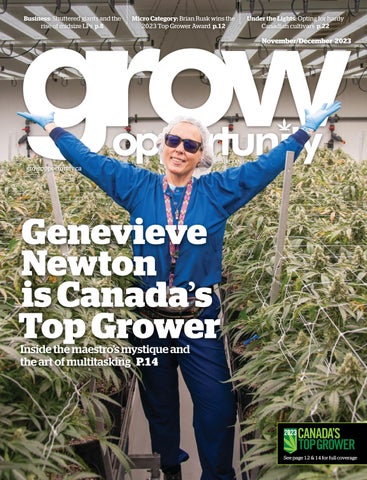

Genevieve Newton is Canada’s Top Grower

COLUMNS
08 | Business Market Conditions: Shuttered giants and the rise of midsize LPs 10 | Cultivation
A micro cultivator with a creative solution pairs cannabis and Coho salmon 20 | Vantage Point
Parsing the ‘What We Heard’ report on Canada’s cannabis framework
DEPARTMENTS
| Editorial
| In the News
| Under the Lights Q&A with Dustan McLean, master grower, Nine Lions Biosciences

FEATURES
12
Brian Rusk wins the micro LP category Top Grower Award Brian and Chanttelle Rusk embody the entrepreneurial DIY ethos at Into the Weeds BY HALEY NAGASAKI
14
COVER STORY
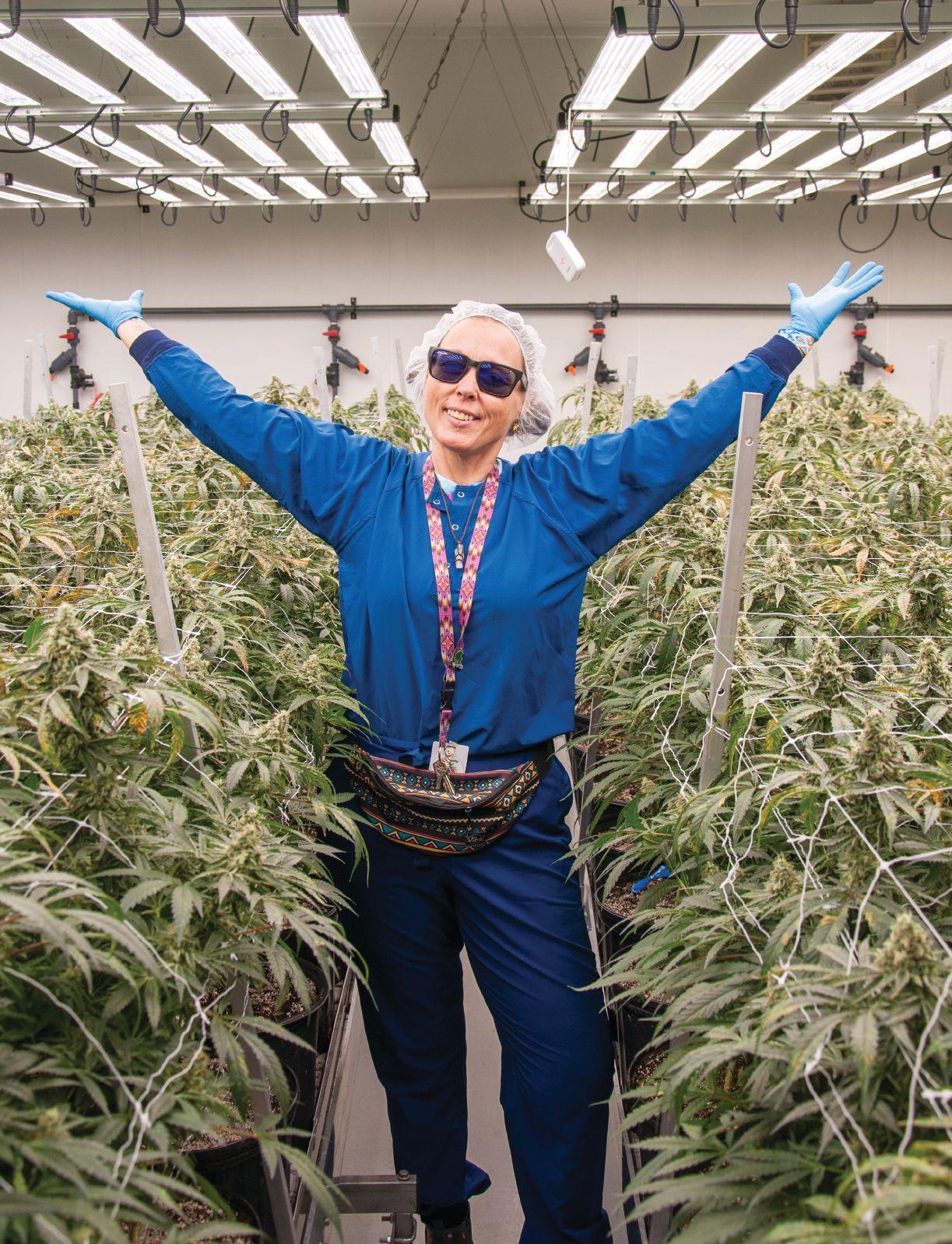
Genevieve Newton is Canada’s Top Grower Stewart Farms’ director of cultivation traces her cannabis production timeline, from home grow logs to expert SOPs BY HALEY NAGASAKI
18
Is Canada ready to adapt to a changing climate in cannabis? Record breaking weather patterns test the resiliency of industry and present challenges to outdoor cultivation BY
JAKE HRIBLJAN
Chanttelle Rusk, Into the Weeds, Top Grower Award winner – Micro LP Category.

From the Editor
By Haley Nagasaki
Congratulations Brian & Genevieve!
Here it is, the much-anticipated Top Grower Award (TGA) issue and final magazine of 2023 for Grow Opportunity. This year our TGA judges — Av Singh, David Kjolberg, Stacie Hollingworth and Mohyuddin Mirza — reviewed dozens of nominations in the standard LP and micro cultivation categories. The latter being new this year. Scores were calculated upon cultivation skill and knowledge, innovation, sustainability and leadership, followed by a round two virtual tour of our finalists’ facilities.
The award, now in its fifth year, recognizes talent dedicated to growing excellent cannabis with outstanding merit just as it highlights those cultivation leaders who operate with humility and a distinct team spirit. All of these positive attributes are defined by our winners this year. A hearty thank you is also in order to our TGA 2023 sponsors, CANNA and Grodan, whose esteemed products and services offer invaluable support to the global cannabis enterprise. Thank you to our judges, sponsors and honourable nominees, and congratulations to our winners, Brian and Chanttelle Rusk crowned top growers in the micro cultivation category for Into the Weeds, and to Stewart Farms’ Queen Genevieve Newton, winner of the standard LP category.
From Genevieve we learn patience and perseverance over the
long haul. She exemplifies how to go with the flow while focusing on the task at hand, no matter the strength of the raging current. Brian teaches not to shy away from one’s instinct and to strike without hesitation when it comes to filling gaps and meeting needs. And from them both we see truth and dedication to ourselves and to our loved ones when being proactive about mental health and wellbeing, folded in with a positive, self-starting attitude that sets the dreamers apart from the achievers.
Perhaps some of the most important advances this year stemmed from the need for cannabis businesses to continue building trust through transparency and continued education.
There is no doubt that 2023 has been an utter whirlwind for the Canadian cannabis industry. Aside from the nuances that occurred spanning regulatory updates, international expansion, the integration of AI/new tech, and the development of new product offerings, perhaps some of the most important advances this year stemmed from the need for cannabis businesses to continue building trust through transparency and continued education.
Cannabis businesses engage with industry peers, shareholders and with the public through increased means of transparency
proving efficacy of operations, services and products alike, with an uptick in third-party testing and intimate in-person events. Companies are also increasing proactivity using scientific study and research in the development of brand loyalty and team building. These and other triumphs instill a sense of optimism for 2024 and beyond.
In light of recent shifts at home and abroad, we at Grow Opportunity are also welcoming new columns and voices to the platform next year, including a regular column on international market trends, new voices in cultivation, as well as a higher altitude Drug Laws column penned by cannabis attorney Rob Laurie of Ad Lucem Law Corporation. Laurie’s writings will look to equip producers with insights into laws whose influences will assist business decisions through the decriminalization of certain substances occurring on a global level and an influx of controlled substances dealer’s licenses on home soil.
As the industry continues to expand and contract like the living organism that it is, we see innovation and strong interpersonal relationships at its core, which carries over into the theme we celebrate with this award. Put your hands together for Brian and Genevieve, our 2023 Top Grower winners.
Happy holidays from everyone at Grow Opportunity, and we’ll see you back here in 2024 with fresh perspectives on the growing opportunities in cannabis.
November/December 2023 Vol. 7, No. 15 growopportunity.ca
Reader Service
Print and digital subscription inquiries or changes, please contact Angelita Potal, Customer Services Administrator Tel: (416) 510-5113
Email: apotal@annexbusinessmedia.com
Mail: 111 Gordon Baker Rd., Suite 400, Toronto, ON M2H 3R1
EDITOR
Haley Nagasaki hnagasaki@annexbusinessmedia.com 519-410-0600
PUBLISHER
Adam Szpakowski aszpakowski@annexbusinessmedia.com 289-221-6605
NATIONAL ADVERTISING MANAGER Nashelle Barsky nbarsky@annexbusinessmedia.com 905-431-8892
ACCOUNT COORDINATOR
Mary Burnie mburnie@annexbusinessmedia.com 519-429-5175
MEDIA DESIGNER
Curtis Martin
AUDIENCE DEVELOPMENT MANAGER
Shawn Arul sarul@annexbusinessmedia.com
GROUP PUBLISHER
Paul Grossinger pgrossinger@annexbusinessmedia.com
PRESIDENT/COO
Scott Jamieson sjamieson@annexbusinessmedia.com
MAILING ADDRESS
P.O. Box 530, 105 Donly Dr. S., Simcoe, ON N3Y 4N5
SUBSCRIPTION RATES
1 year subscription (6 issues: Jan/Feb, Mar/Apr, May/Jun, Jul/Aug, Sep/Oct, Nov/Dec):
1 year offers: Canada $25.50 + Tax USA $47.00 CDN FGN $53.50 CDN GST # 867172652RT0001
ANNEX PRIVACY OFFICE privacy@annexbusinessmedia.com
Tel: 800.668.2374
ISSN: 2561-3987 (Print) ISSN: 2561-3995 (Digital) PM 40065710
Occasionally, Grow Opportunity will mail information on behalf of industry-related groups whose products and services we believe may be of interest to you. If you prefer not to receive this information, please contact our circulation department in any of the four ways listed above.

Organigram CEO Beena Goldenberg comments on BAT investment
This [$124.6M] investment bolsters an already strong balance sheet and solidifies our position as a leading cannabis company. In addition, this deepens the strategic partnership between Organigram and BAT, and we look forward to continuing to leverage BAT’s global capabilities and scientific expertise. Jupiter, the strategic investment pool, is expected to accelerate Organigram’s ambitious growth plans, enabling further geographic, technological and product expansion.
Organigram is excited about the evolution of the regulatory environment and looks to capitalize on what potential changes could mean for growth opportunities to expand our global footprint.
All potential investments will be made against Organigram’s strategic vision for the future, focusing on long-term sustainable growth, leading compliance/product stewardship and global category leadership.
Aqualitas is
the first
organic cannabis producer
to be issued
EU-GMP certification and a drug establishment license
After rigorous inspections, these accreditations confirm compliance with the highest industry manufacturing standards for the production of cannabis products and active pharmaceutical ingredients. Aqualitas’ primary processes, with respect to flower cultivation, finished packaging and extraction, are all now conducted under GMP standards. "Our ability to focus on strategic planning and on meticulous execution are rooted in the bedrock of our vision and core values." –Josh Adler
3OCS Flow-Through, educational platforms & top products in 2023
Flow-Through enabled OCS to expand its catalogue from approximately 2,800 SKUs one year ago to over 3,700 SKUs across all product formats present day. Over 100 LPs currently have products available via Flow-Through.

The Flow-Through distribution model has enabled OCS to onboard dozens of new LPs of all sizes as we continue to enable Canada’s largest and most vibrant cannabis marketplace. OCS also recently announced several new improvements to the Flow-Through customer experience.
In terms of top-performing products in 2023, dried flower remains OCS’s top performing product format for revenue, while pre-rolls is the top performing format in units sold and is the fastest growing product format.
Educational outreach programs such as Good All Around and OCS’s
Cannabis Made Clear (CMR) online education influence purchasing patterns by offering unbiased, fact-based and current educational information aimed at increasing cannabis literacy among Ontario cannabis consumers and non-consumers alike.
The more you know, the better positioned you are to make informed, responsible decisions about cannabis consumption –and that’s what CMC is all about.
For example, CMC articles talk about risks associated with smoke inhalation and introduces readers to alternative forms of consumption, such as ingestion via cannabis edibles or beverages.
– MIKE HAJMASY, SENIOR COMMUNICATIONS ADVISOR, STRATEGIC COMMUNICATIONS, ONTARIO CANNABIS STORE
Psilocybin mushroom shops in Vancouver were raided by police, two have already reopened
South Africa advances cannabis law with bill to legalize personal use and cultivation

AD LUCEM LAW CORPORATION is an international legal and consulting practise based in Vancouver, British Columbia. True to its meaning “to or towards light,” AD LUCEM LAW CORP. brings clarity and resolution to legal challenges in emerging and regulated industries.
AD LUCEM LAW CORPORATION has been instrumental in supporting policy reform, constitutional challenges, and business development since its inception in 2013, earning founder Robert W.E. Laurie recognition as a skillful lawyer, valued industry consultant, and requested public speaker.


By Steve Clark Business
Market Conditions: Shuttered giants and the rise of midsize LPs
The dynamic landscape of the Canadian cannabis industry has been nothing short of transformative these past five years. Upon legalization, several LPs emerged as key market players, however the recent shuttering of many cultivation facilities belongs to industry giants. Meanwhile, midsize LPs have displayed remarkable adaptability, navigating the challenges of running a cannabis business with limited capital and, in many cases, finding success.
Supply and demand shifts
The initial rush in the early days of cannabis legalization saw a proliferation of massive cultivation operations, often coupled with efforts to bring processing, extraction, packaging and other activities in-house. The goal was clear: meet the projected demand of a budding industry. However, the reality was these grand-scale operations proved to be highly inefficient.
The oversupply issue hit its peak in late 2022 at the Canadian Cannabis Exchange (CCX), with wholesale prices reaching an all-time low of $0.74/gram in Q4 2022. The plunge in prices partially stemmed from the oversupply issue and from smaller LPs not having a path to access provincial retail markets. LPs big and small found themselves grappling with the repercussions of rapid expansion, vaults full of inventory and managing over-built facilities. Awash with products, the natural consequence was a struggle to maintain pricing above breakeven. Now the tides are turning.
Over the past few years, reports have shown a 32 per cent decrease in indoor and greenhouse cultivation from 2.2 million to 1.5 million square meters. Some large industry players such as Sundial, Canopy and Aurora, had to make the painful decision to close large cultivation facilities. Similarly, several smaller LPs have also had to
Amid the over-supply turmoil, midsize LPs, often nimble and more flexible in their approach, found a way to adapt.
shutter operations or scale back cultivation rooms. These closures have disrupted established supply chains and resulted in shortages across several product categories. With this, we have seen buyers willing to pay higher prices to secure quality product. Transactions near and above $3.00 per gram wholesale are creeping back into the market for new harvests of high THC (30%+), craft-grown product.
Emerging midsize LPs
Amid the over-supply turmoil, midsize LPs, often nimble and more flexible in their approach, found a way to adapt. The challenge of running a business with limited capital led them to focus on efficiency, innovation and specialization. Their ability to pivot became a driving force in the industry’s transformation. We’ve observed a market shift toward right sizing the cultivation footprint and activities offered to meet market demands, focusing on core competencies and building effective teams.
Regulatory challenges and pricing dilemmas
Nevertheless, challenges persist and many of them revolve around regulation. Taxation, licensing fees, limits on marketing activities and the burden of reporting activities are among the hurdles LPs face.
Many of them will need to change to increase industry viability, but the most direct factor on wholesale pricing down pressure stems from the provincial buyers.
Provinces have been hesitant to raise cannabis prices, influenced by their need to compete with the illicit market on top of the public’s insistence on lower prices driven by a 4.8 per cent inflation increase.
Wholesale buyers are also constrained in their ability to raise their purchase price for products due to the fixed SKU prices set at the provincial level. Multiple buyers are now vying for the same use cases at similar wholesale pricing levels. Those buyers willing to increase wholesale purchase prices often find themselves unsustainably compromising their own margins to fulfill purchase orders, and unless provincial prices increase, the market will continue to face a ceiling on pricing and depressed margins. CCX has however witnessed substantial growth in international trades, with an average transaction price of $4.10/gram.
As we approach 2024, critical questions will shape the upcoming year in cannabis: Will provinces and consumers accept higher prices for cannabis products? Will we continue to see facility shutdowns without a clear path to profitability? Will the CRA enforce the collection of back taxes from LPs? Will the legislative review of the Cannabis Act bring meaningful reform? The answers to these questions will determine the direction of the Canadian cannabis industry, shaping its challenges and opportunities in the years to come.
One less thing to worry about.
EASY-TO-USE | CLEAN & QUALITY INPUTS
TRACEABILITY OF ALL PRODUCTS | TECHNICAL GROWING SUPPORT



CANNA is the pioneer and global market leader of plant nutrients and growing mediums for the cultivation of fast growing crops. All CANNA products are manufactured from the highest quality materials, as a known partner of the Green Market. We understand the importance of clean, consistent, traceable inputs, as well as keeping it simple!
enjoys sharing its knowledge & experience with the growing community!







Cultivation
By Kayla Mann
A micro-cultivator with a creative solution
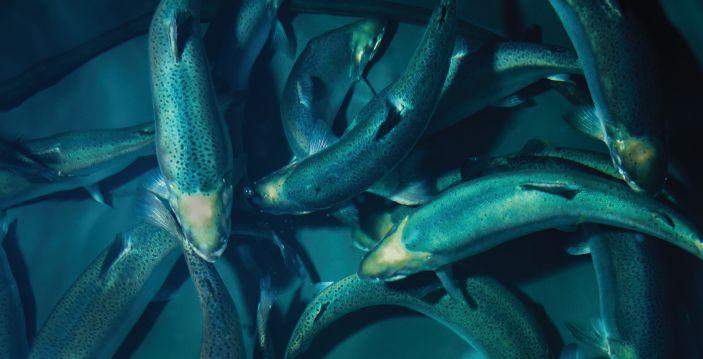
Enter the world of Habitat Craft Cannabis. Here, we practice a unique way of growing and maximizing our 200m³ micro capacity through our chosen method of growing: Aquaponics. This innovative farming approach intertwines aquaculture (Pacific Coho fish farming) with the cultivation of plants, creating a compelling story around water and fertilizer sustainability. However, it is our intense focus on production workflow that has made the difference when it comes to profitability.
Production at Habitat reveals a cultivation space divided into six rooms, each dialed in to the specific cultivar in production. Although the room size is only 320 square feet, these rooms were engineered to operate on a staggered planting and harvesting schedule, which allows for an extra crop per year per room and requires only two full-time staff members to manage all cultivation tasks within an eight-hour day.
The consistent workflow at our Chase, B.C. operation facilitates the creation of a dedicated full-time trim and packaging team and creates an organizational structure that is ready to scale. As the industry is now well aware, scaling up doesn’t solely entail increasing production, it necessitates the creation of processes that can adapt and translate easily as the business expands. It’s about growing smarter, not just bigger.
The power of a unique story
In a crowded market where competition is fierce, cannabis businesses recognize the power of a unique story. While quality and price are the tickets to getting into the game, a memorable brand ethos is needed to capture loyalty among consumers.
Our use of aquaponics and other sustainable features is one such example. However, in an industry where innovation is the norm, other brands like Pistol & Paris and Organnicraft have also found their distinctive
voices in the micro space, emphasizing countercultural rebellion and artisanal craftsmanship respectively. These brands demonstrate the impact of storytelling in forging connections with buyers and consumers and are excellent models of success.
Venturing into new horizons
For micro cultivators, expansion doesn’t stop at the cultivation room; it extends into the exploration of new market opportunities including exports. A micro’s capacity to navigate the intricacies of multiple sales channels speaks to
their ability to adapt and scale while keeping a lean work force and meticulous organizational structure.
Amidst skepticism enveloping the Canadian cannabis market, it’s crucial for industry players to continue to acknowledge and leverage Canada’s international reputation as the gold standard in medical cannabis production.
With the export market primarily centered around medical cannabis, Canadian companies, including micro cultivators, hold a unique advantage in helping establish a robust global network.
Kayla Mann is a CA, CPA and CFO/CRO at Habitat Life Sciences (Cake & Caviar). Habitat is revolutionizing agriculture with an innovative approach to vertical growing and aquaponics that provides organic Coho salmon to local markets and organic, premium cannabis internationally.
Aquaculture showcasing Pacific Coho salmon paired with organic cannabis production.
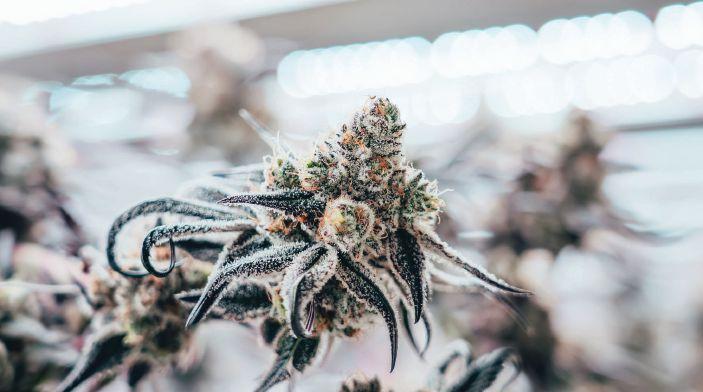
Black Pearl flower by Cake & Caviar, Habitat's hallmark brand.












Brian Rusk wins Top Grower, micro LP
Brian and Chanttelle
by
By Haley Nagasaki
Brian and Chanttelle Rusk came into cannabis production through interest as much as necessity.
Prior to their meeting, a car accident had Chanttelle using nine different pharmaceuticals her neurologist eventually swapped for a cannabis prescription. Over time, difficulty securing preferred strains, in addition to the cost, led the entrepreneurs from a medical to a commercial cultivation license, to winning the inaugural Top Grower Award micro cultivation category.
Rusk had an affinity for growing from an early age. “Where it all started was, I would see on these forums online someone say: ‘I’ve got a really nice orange flavoured sativa that had this effect.’ And all I could get was weed and it came in a bag,” he says. “So that’s what piqued my interest years and years ago.” Fast forward to 2017, when they asked themselves if it could be done for a living. The couple received their license in 2019 and began construction in their town of Rocky Mountain House, Alberta. From different lights to different mediums and cultivars, and a shop in the garage to trial, they settled on organics and lights that brought out
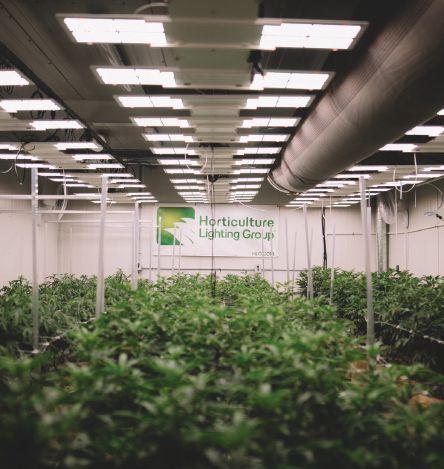
“different terpenes on the same Blueberry cut that I was running for years,” he says. Rusk grows exclusively under HLG lights and became the Canadian distributor when they were unable to purchase them otherwise.
“We like our environments dialed right in,” says Chanttelle. “We’re still using the science and the horticulture side but, you know, relying on the organic side of things,” she says.
“We keep in mind that people are consuming this for medical purposes,” says Brian. “You know the best weed I’ve smoked is grown this way.”
A team of three
The husband-and-wife duo, and Zach Ginter their full-time staff, grow in 10-gallon pots of peat-based soil with dry amendments and microbials.
Rusk grows exclusively under HLG lights and became the Canadian distributor when they were unable to purchase them otherwise.
Ginter finds that living soil plays a vital role in the flavour of the flower. After four years of managing a local dispensary in town, he attests to the quality and diversity of the terpenes and flavonoids present in craft organic batches. “I like the orangey-grapefruity Mimosa,” he says, “that has a little bit of gassiness to it as well.”
An affinity for racing dirt bikes brought Ginter down to Santa Cruz, where he was introduced to the mecca of cannabis culture. “I met a bunch of guys that grew for the dispensaries and discovered the [cannabis] world down there,” he says. Ginter has always been interested in the specifics of the genetics. He wanted to find the real Girl Scout Cookies cuts and seeds himself, “not just have some random label it.”
Making people happy
Sold under brands Token Naturals and Mendo Medicinals, Into the Weeds flower is available country wide, with the potential of international expansion on the horizon. Despite challenges for the momand-pop shop, “we get to do our dream job – growing as good of cannabis as we can – and we don’t have to look over our shoulder or compromise how we grow,” says Rusk. In addition to their value statement ‘growing weed that makes people happy,’ Into the Weeds has established preferred products and providers, and preferred methods of growing that yields access to high-quality medicine, effectively proving that if you want something done right, often you have to do it yourself.
Rusk succeed
embracing the DIY entrepreneurial ethos
Rocky Mountain House-based micro cultivator Into the Weeds grows in living soil under HLG lighting.

Genevieve Newton: The rise of Canada’s 2023 Top Grower
Av Singh, Top Grower judge:
“Genevieve
produces awardwinning weed, and she cultivates a grow environment of respect, humility, fun and welcoming.”
By Haley Nagasaki
Canada’s 2023 Top Grower Award winner for the standard license category, Genevieve Newton, head grower and director of cultivation at Stewart Farm, recalls winning Top Female Grower at Hemp Fest back in 2021. “So I told Tanner [Stewart],” she says, “I was after top male grower. Not just top female grower, but top male grower – so, everyone.”
Newton sat down for an interview from the LP’s office in the town of St. Stephen, New Brunswick, minutes from their operation and farmgate location, to discuss winning Top Grower and achieving her five-year goal in two.
“It’s funny,” she says, recalling the first winner of the award back in 2019. “[Gregg Wigeland] used to be the master grower at Sundial when I was a lowly grunt,” she says. “He won that award when I was still cleaning up plant piss off the floor; I remember him winning that!”
Between moving a 70kg load of cannabis destined for Australia, which she had done before the call, the daily affair of overseeing numerous micros while managing the residual riptide from audit season, on top of the other tasks attached to the tail end of an unprecedented year of actual tempests, Newton found time to share her journey and to revel in her well-earned spotlight, eight years in the making. “It means so much to me,” she says. “It was a sign I needed that I’m still needed in this industry.”

If 2023 were a nute, it’d be Power Bloom
“It’s been a crazy year for growth,” says Newton. It’s now been two full years since starting her position at Stewart Farms, when “topicals were the locomotive, and the dry flower was more of a side hustle,” she says. “Our biggest problem now is I don’t have enough weed.”
Meeting international and domestic needs meant the producer had to rearrange domestic supply, pulling out of B.C. “to feed the OCS because their demand was higher.” Stewart Farms has flower selling in New Brunswick, Nova Scotia, Ontario and several medical platforms, including Abba Medix, where Daily Grape is in the top five selling herbs.
Stewart Farms’ bath bombs are still a leading topical in British Columbia. “Isn’t it amazing?” she says. “This tiny little farm has such a big impact all the way across
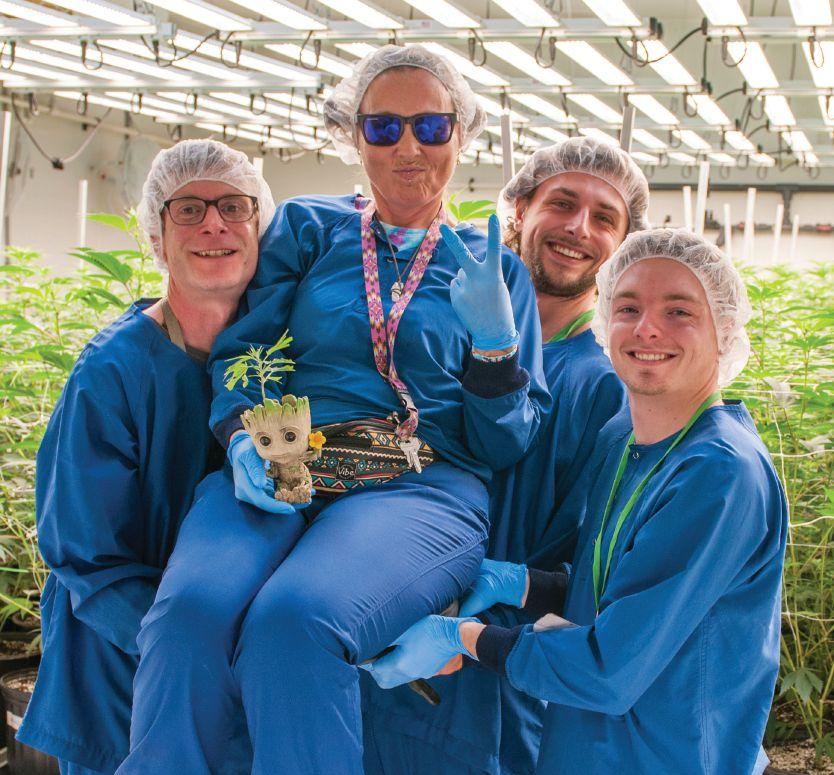
Cultivation crew left to right, Jon Mogard, Ross Braysford, Genevieve Newton & Matthew Smith. Stewart Farms, St. Stephen, New Brunswick.

Canada. And a lot of it is because of the topicals; they’re changing people’s lives.”
The micros were brought in to fulfill international orders, and over an eye-opening series of experiences, the farm has gone through several options in search for ideal partnerships. “Right now, we have one micro facility partner in Fredericton. We have one in Cape Breton and now one near Kelowna, B.C.”
The cannabis farm had their license renewed in October after a complex spring audit season attributed to GMP certification, a CRA audit, followed by a Health Canada audit.
“When I started two years ago, I had two fellas [Ross & Jon] under me and one was half time security, so 1.5 fellas,” she says. “In order to manage the micros more efficiently, Catrina secured some provincial funding, so I selected a young scientist for my team, Matt. Without
you to our dedicated sponsors
these guys I would not have been able to put my effort into post-harvest quality, export and managing the micros. These guys are like my left and right hands.”
Ability, agility and flexibility
Other curveballs the director of cultivation encountered this year was the cessation of the tilapia aquaponics operation at the farm and the closure of their Stepwell soil provider. “Basically both got ripped from me at the same time,” says Newton. “GMP happened in May, so at that time we had to make the tough decision to temporarily remove the fish farm – it was just going to be too hard to get certified while having them, and with all of these 2.0 product orders, we need the space for secure storage.”
The cultivation team began crafting their own soil mixes, using a base of Pro Mix, while Matt’s scientific research informs the other organic inputs and soil amendments. In a rural town, securing inputs they can “buy locally and get consistently” is crucial.
“Most [LPs] I’ve been at, their biggest mistake is doing 100 things in one run and expecting to figure out what worked. So, we do everything really slowly and we document everything,” she says.
Organized chaos: grow journals to SOPs
Newton began growing cannabis with a few pointers from her dad in her 2x2 closet with CFL lights and miracle grow. From there, she became active on 420 magazine forums and developed relationships with old school growers from the southern United States. Around 2016, there was very little online content about growing, so she began documenting each of her grows, participating in weekly podcasts and taping YouTube tutorials for the altruistic purpose of community and education.
Newton moved from the cannabis production program at Olds College to a practicum at Acreage Farms, a position at Sundial and finally to Candre, where they encouraged her media documentation as a form of free promotion. That’s how Catrina Jackson, Stewart Farms’ COO and product developer, discovered her work.
“The way Tanner got me over here was, he’s like, ‘you will no longer be working at a weed factory. You will be coming here to run a weed farm,’ and that’s exactly what it was.” Newton’s first assignment was to germinate 300 seeds out of a choice of 20,000 that Stewart himself had seed-hunted globally.
Thank
CANNA and Grodan for supporting the recognition of excellence in Canadian cannabis cultivation.
Soil compost pile next to antique woodchip processor on site.
In a huddle with her growers, she asked them how they germinate. ‘Okay, well that’s how I do it at home,’ she said to them. “I’m full chaos at home, you know, home growing,” says Newton. “I came into this hot and I would do 100 different seeds have them all labeled. I have logbooks from my earlier home grows and they’re wild. So, I was the lady for the job,” she says.
Of those 300 seeds, Newton oversaw a 98 per cent success rate, then began cutting back from there, finding Daily Grape and other top genetics. They cleaned up the library that had “40 different Dosi Cakes, a bunch of Brittany’s Frozen Lemons,” and now they have 43 solid genetics.
Stewart Farms also operates as a nursery that took a back seat during the winds of 2023. Still, they managed to do a lot of clone-selling through their farmgate store and to other LPs with whom they have
“genetics deals,” such as Sundial, Organigram and FIGR. “My farm is really small, but it’s everything together – all the canopies together,” she says.
Newt’s personal herstory
Genevieve Newton is a second-generation farmer. “That’s where I’m different from all these master growers who have black market experience and have been growing for 30 years,” she says, having learned her gardening skills from her dad and grandpa growing up in Saskatchewan. She knew her dad was also growing in his closet, “but weed wasn’t [her] thing at the time.”
Grodan-Ad-GROW-4.6875x4.75.pdf 1 6/23/23 12:24 PM
Newton moved to Edmonton in 2003 to complete a degree in social work from the University of Alberta, beginning her 15-year career as a social worker. In 2012, she got sober from hard drugs and alcohol and abstained from everything for four years.
“Then I got really, really sick in 2015/16 and was diagnosed with colitis,” she said. Doctors prescribed heavy drugs but due to her history, she opted out. Instead she suffered with chronic nausea for over a year and lost a tremendous amount of weight. A friend advised her to consume cannabis and her reaction was to say no. Her sponsors said they would discontinue working with her and she would lose her support.
Finally at the end of 2016, Newton tried cannabis and felt hungry for the first time in a year. Her councillors quit her even though the plant had saved her. “It gave me my nutrition back,” she says, “it helped me emotionally and it calmed me down.”
The expensive, elusive cannabis prescription led her back to nature, to gardening, and to consulting with her father whom she remembered had grown. She began a grow journal, connected with others online and fell in love with the practice.
SNDL, no longer growing, was Newton’s first cannabis job. Candre, now closed, hired her as irrigation lead then production co-ordinator. And just when it felt like time to move on from Alberta, Tanner Stewart appeared on a call asking her to transition to New Brunswick. “It felt good to be wanted,” she says. “Before no one cared about experience, or passion, or creativity. Tanner thought it was an asset.”
Newton moved to the east coast with her operations knowledge and experience in vertical farming from Candre – the “Cadillac facility.” She went east to work with living soil and aquaponics, “and I got all that,” she says. “And now we’ve moved into a different direction with lots of higher-level learning.” Despite hurricanes and market failures, Newton charges forward as the genuine, world-class cannabis cultivator that she is, growing organic medicine for all the right reasons.
“For four years while I was sober, I was searching for happiness.” says Newton. “Something to replace my addictions, my drinking. That is how you stay sober – you replace that with something you love,” she says. “I tried all these things and it was this thing. That was what it was.”
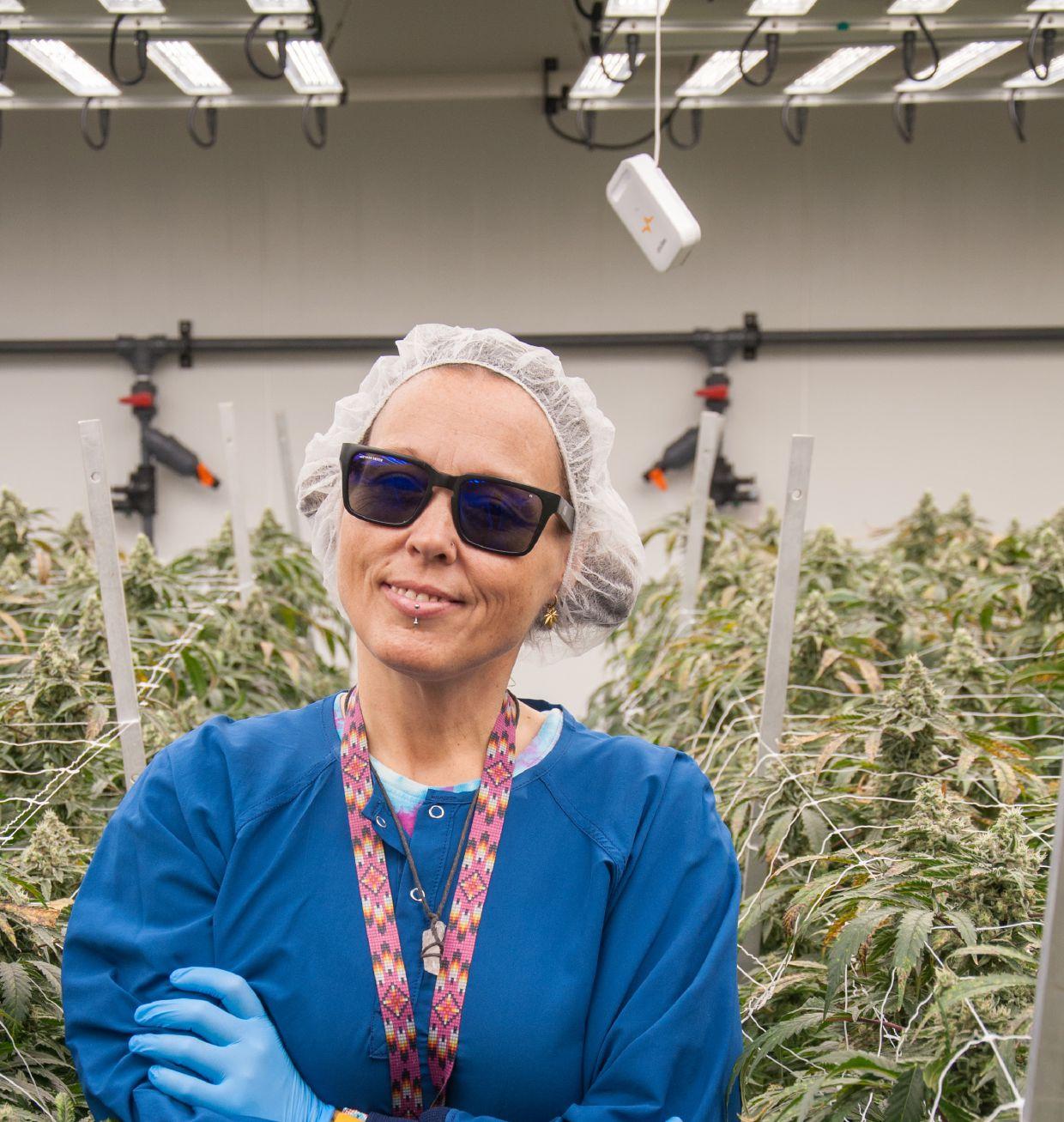


Genevieve Newton
Standard Licensed Grower, Stewart Farms
Brian Rusk Micro-Cultivator, Into the Weeds
Adapting to the haze of wildfires
Regulatory roadblocks and climate challenges means the cannabis industry operates under low-visibility conditions
By Jake Hribljan
As the cannabis industry continues to make headlines about its impact on the environment and climate change, a changing climate will in turn impact the cannabis industry.
Researchers at the University of California at Berkeley, led by Christopher Dillis, published a paper in September of this year showing for the first time the dollar figure financial impacts of wildfires, and wildfire smoke, on California – one of the world’s largest cannabis economies. Through using data from California Department of Forestry and Fire Protection, smoke plume mapping, and cultivator surveys they were able to estimate economic losses in 2020 and 2021 were as high as $1.44 billion and $970 million respectively, due to wildfires.
“There were impacts all over. Northern California was the worst…2020 was, as I usually say, like an apocalypse.” Dillis says.
Wildfires have been a serious problem around the world in recent years. According to the National Wildland Fire Situation Report, 2023 marked the worst wildfire season on record in Canada – a year in which more than 17.8 million hectares of land burned. Mapping the financial impacts of wildfires will be critical for the future of the industry.
The Berkeley team examined proxim -

ity to wildfires, percentage of growing season under a smoke plume and farmer impacts to determine what were the likely financial impacts, and the likelihood of crop failure. The result was significant financial losses.
“And we found that wildfire smoke has a bigger impact than just proximity to wildfire,” says Dillis. He further explains how the correlation between smoke and the source of a fire is not extremely strong. Smoke has the ability to travel distance, sometimes dropping down miles away from the source.
There are steps governments and producers can take to work together to mitigate cannabis agricultural losses, and that plans need to be made as wildfires will continue to be a problem. Dillis suggests implementing a subsidy or official acknowledgment through a fund that could be set up to compensate LPs for their losses.
Changing climate, practices
Canada’s worst wildfire season on record comes on the heels of increasing reports about the carbon emissions output of the cannabis industry, and the massive energy consumption related to cannabis production.
Canopy Growth made headlines in January 2022, when their ESG report found Canopy’s emissions were equivalent to burning over 65 million pounds of coal. However, some companies are making changes in a positive direction.
Recently, Wyld, an Oregon based company and producer of infused edibles, became the first Climate Neutral Certified cannabis company in North America.
The process for obtaining Climate Neutral Certification isn’t easy, but it is important for those companies that want to get serious about the climate. “Climate Neutral has stringent requirements to achieve Climate
According to the National Wildland Fire Situation Report, 2023 marked the worst wildfire season on record in Canada – a year in which 17.8 million hectares of land burned.
Neutral Certification,” explains Gray. “Being verified by a third party, like Climate Neutral, helps validate the work we’re doing.” With 60 billion tonnes of greenhouse gasses being emitted each year, it is important for the industry to take a lead on climate action.
Wyld has also produced a unique, 100 per cent compostable packaging, with the first compostable child resistant zipper. “We’re acting now because scientifically vetted solutions to climate change exist.”
Some say the future is sun-kissed
As more cannabis producers begin to look at reducing their carbon emissions, some may turn to outdoor production and abandon the energy intensive indoor model, says sales director Chris Becker of The Honeybee Collective, an employee-owned brand.
“Indoor growing uses a ton of energy, and why do it when the sun exists, right?” he questions enthusiastically.
The Collective was an idea born from a passion of sustainability that promotes earth and people-friendly practices, says Becker. Based out of Colorado, the focus is on environmental sustainability through the use of recyclable and compostable packaging, regenerative farming practices, and prioritizing outdoor grown, or at least “sun-kissed” cannabis, with products sourced from outdoor cultivation, greenhouses and hybrid facilities. While Canada’s climate differs from the U.S., still some see the same value.
Canadian LPs look to change
North of Toronto on the shores of Lake Simcoe, one Canadian LP, Carmel Cannabis, has also experienced the benefits of “sunkissed” cannabis, utilizing a hybrid greenhouse in their operation. Ontario sales manager John Strauss says the 19,000 square feet of sun exposed flower allows significant reductions in energy costs, while also produ-
YOUR FULL-SERVICE LAB WITH INDUSTRY LEADING TURNAROUND TIMES
Serving the cannabis industry with complete testing and agronomic support.

Comprehensive testing and production services

cing staggeringly high terpene levels.
“When you’re harnessing the natural sun, you’ve got the full equation…the biggest thing we notice with our [hybrid grown] flower, the terpenes are way higher,” he says.
Strauss says the benefits of a hybrid model outweigh any concerns as the environmental benefit and energy cost reductions is a boon for their bottom line. “The unfortunate reality is the environmental is often ignored in any industry in its infancy,” says Strauss. While Strauss and his team at Carmel Cannabis are concerned about the environment and carbon footprint of the cannabis industry, current economic realities are making further changes complicated. “I think a lot of companies are just doing whatever they can to survive and their carbon footprint is kind of on the backburner,” says Strauss.
[Visit growopportunity.ca for more on cannabis and climate] Jake Hribljan is a southern Ontario-based journalist and cannabis enthusiast.


By Denis Gertler
Parsing the ‘What We Heard’ report on Canada’s cannabis framework
The recent marking of the 5-year anniversary of cannabis legalization has raised numerous observations about the sector’s issues. While most of the statements I’ve read have expressed a business perspective, there’s no shortage of other opinions. A broader telling of our collective experience can be found in The Legislative Review of the Cannabis Act: What We Heard report, the first big shoe to drop in the mandated review of the legislation and its implementation.
The report was released in October following six months of consultation with stakeholders and serves as a scoping document for the final report before its tabling by March 2024. There will be some further listening but those hoping for major changes to the cannabis framework are likely to be disappointed. The expert panel undertaking the review were asked to examine how the framework is working in practice. Their task is to suggest how to make it work better, not challenge its main purpose or approach.
It’s a noteworthy piece of work, laid out in key subject areas each including an overview of measures set out in the cannabis framework with data and observations as context for what informants told the panel. To appreciate the findings, it’s worth considering the panel’s makeup and the affiliations of those presenting their views. The panel is chaired by a former federal deputy minister of health and justice, two professors of psychology/ psychiatry, an expert in mental health & addictions, and an indigenous criminal lawyer. They heard more than 200 presenters from the cannabis industry; First Nations, Métis and Inuit; public health agencies and academics; a range of public sector organizations including provincial governments, police agencies and U.S. states; and a myriad of groups representing youth, criminal justice, wellness, and other interests. The report covers most of these areas as well as home
cultivation, adult access, criminal deterrence and access for medical purposes.
The nature of the exercise suggests that the deck is already stacked against the common concerns of cannabis businesses, such as excise tax and regulatory costs, barriers to legal market entry, advertising and promotion restrictions and the like. The panel notes, however, that its suggestions for reform may exceed parameters of the Act and its regulations since the federal framework encompasses legislation, policies, and programs across Canadian jurisdictions. Because of this, the panel infers that the federal
While this is just a slice of the feedback, I had the impression of a parallel universe of stakeholders who are much more concerned about perceived health risks than business viability.
government has some overall responsibility for economic and business concerns, including those delegated to provincial governments. So, despite the report’s heavy emphasis on health and social impacts, it recognizes that keeping cannabis out of the hands of youth requires a sustainable, legal business sector. Whether the final report will make specific industry-friendly recommendations, though, is far from certain.
I was also struck by the concerns of stakeholders that I generally don’t see on the industry’s radar:
• Cannabis-related child poisonings have doubled from 2019 to approximately 2,400 in 2021, mostly from ingesting edibles. Related emergency department visits and hospitalizations are up 14 per cent over two years to 21,658 visits in 2021.
• While the age of initiating cannabis use is unchanged, several interest groups are concerned about the relationship between cannabis use and the mental
health among youth and young adults.
• Although the panel understands the industry’s position on the excise tax, it’s not clear that it cares. Some health stakeholders want to maintain fees, which they see as a deterrent to further consumption and a source of research funding.
• Health respondents do not want to relax advertising and promotion requirements which they say would lead to “over-commercialization” of cannabis. While this is just a slice of the feedback, I had the impression of a parallel universe of stakeholders who are much more concerned about perceived health risks than business viability.
Having been closely involved in tobacco control activities during the early to mid 2000s, reading the report gave me a feeling of déjà vu. During that time tobacco taxes were progressively raised to suppress demand, in tandem with extensive public education activities. Products were concealed at point-of-sale while both smoking prevention and cessation programming was amply funded in hospitals, educational institutions and among youth groups. These initiatives were quite successful at dropping smoking rates, although the battle has now shifted to deterring minors from vaping nicotine and from using sublingual pouches.
Considering all this, I think that the best way for the cannabis industry to address the Cannabis Act review is to engage with more than an eye to beating back taxes and regulatory irritants. It’s time to collaborate with other stakeholders to address community impacts, ensure a balanced research agenda and to explore joint opportunities. Working with others to strengthen the medical cannabis regime is one example of an area that concerns nearly all groups while offering promise for export markets. What’s at stake is not just a well-functioning regulatory framework but the future viability of Canada’s cannabis sector.
Denis Gertler is a regulatory consultant, board member, and former government regulator.












Q&A with Dustan McLean: Opting for hardy Canadian commercial cultivars
After a 1994 car accident, Dustan McLean went searching for pot to treat his pain and paid $15 for a gram that was full of seed, effectively catalyzing the resourceful grower’s journey into cannabis. From popping stray beans to the creation of several legacy operations in Alberta, McLean went mainstream in 2018 with the inception of Parkland Flower (the acquisition of which led to the LP’s closure in March of this year). Though the work he was doing in genetics and seed output at Parkland encouraged his transition to Nine Lions Biosciences — a Leduc, Alta.-based tissue culture and genetics lab that headhunted the grower of nearly 30 years.
GO: One of the largest circulating issues for growers is hop latent viroid. How are you helping to minimize the risk?
DM: As soon as we pop the seed – as soon as there’s a root – it gets tested, and if it shows anything, it’s gone. Anything we bring in generally we ask to have a pre-test done to make sure it’s clean before coming into the facility, and then we do our own backup testing in house to double check it. And then if we’re still concerned, we’ll send it off to a third party and have it verified. We still get some genetics out of California for sure, but it’s from very trusted sources.
GO: Are you mostly working with Canadian genetics?
DM: A big thing for me is championing Canadian genetics and some of the breeders up here because I think the world is sleeping on what we can provide. I try to create genetics that are good for outdoor
growers in Alberta and B.C. Anywhere in Canada you want to grow outdoor, I want to provide a genetic that can really work for you. In Alberta, it’s almost impossible to do outdoor photoperiod because we have the twilight here, so we’re trying to create plants that fast flowers and we’re very close to having a cultivar in Alberta that will finish in September/ early October, that’s also weather resistant, because we’ve got some crazy weather happening now. That’s the kind of work myself and a lot of my friends are putting in, is to breed those true Canadian genetics that can withstand the harsh realities of weather in this country. My Cherry Cake went 28 days without water – having something like that in drought areas is massive. We use a lot of resources to grow this plant, so having a plant that only needs 70 per cent is pretty big.
GO: What other cultivars are you most excited about?
DM: I’m still a big fan of our Motorhead. It’s resistant, grows nicely and is very tasty; it’s really good for commercial use. Hash Face is a nice extract plant. Permanent Marker is another. I’m always looking two-tothree years down the line. I’m really looking into Diesels and Hazes right now and trying to get a lot of the longer running plants out onto the market. Everyone wants to get their five-and-a-half runs in every year, but they don’t realize you can do four runs with a really nice sativa, get a good quantity out of, and it’ll sell out. People are looking for the daytime weed all the time and there’s not a lot out there.
GO: What would you like to see change in this industry?
DM: I’m a big fan of our Oreo Blizzard, but it’s not high enough on the numbers. I’m trying to get people off this numbers kick. We’ve gone from THC, to CBD, to terpenes and now flavonoids. How about we just look at the plant as a whole? We’re missing some amazing genetics because of numbers, and that kills me as a breeder. There are studies coming out showing how high THC might actually be harmful. There’s a percentage of younger men going into irreversible psychosis because of high THC cannabis use in their teens. We’re morphing this plant so fast; we need to start looking at what we’re doing to this plant. I’m a big proponent of data over dogma.
GO: How do you think Nine Lions is helping shape the dialogue?
DM: We’re gathering data that will help us sell genetics for specific grows but it’s tough because every grower thinks theirs is the best. It’s tough telling people that a plant I have might be better for them commercially. They might have an amazing plant that knocks your socks off, but to grow it commercially is a nightmare. I’m trying to steer people into saving them. One of the lessons I learned was we grew a bushy crop staff needed to defoliate so much that in the end we lost money because of the overhead that went into it. We had other runs that needed no attention, and we crushed it in sales. So, you’ve got to pick your stuff smart or else you’re going to bury yourself in the burn rate on your overhead.

That’s the kind of work myself and a lot of my friends are putting in, is to breed
those true Canadian genetics that can withstand the harsh realities of weather in this country.
Dustan McLean Master grower, Nine Lions Biosciences, provides clean genetics through tissue culture and propagation.