A look back at legalization beneath a regulatory, production and retail lens BY HALEY NAGASAKI
The grind towards sustainable packaging Who is stepping up to take accountability for the climate issues posed by the cannabis industry? BY DEVON SCOBLE
Reimagining
Assessing the future of public consumption and Canadians’ changing behavioural patterns BY JAKE HRIBLJAN
From
By Haley Nagasaki
Balancing nature and tech
With the amping of summertime energy and the visceral fast-moving of industry and of technology, there’s a near audible buzz of electricity, a current in the air, and half the time I can’t tell if it’s coming from a wireless network or from nature.
It’s strange to think the two can be compared – an electronic device and a rolling ocean as it churns negative ions – but they can. And now here we are beyond the threshold of AI immersion, attempting to merge the two.
Regardless of inventor apprehension (Elon Musk with Neuralink), we simply can’t help not knowing how far we can push the envelope, so we’ll give it a go, melding the forward-thinking of industry and the optimization of technology with our biological bodies. Or in the case of the regulated cannabis industry: AI tech with an ancient plant and all of her sacredness.
I see these two phenomena, nature and “the machine,” as the ultimate dichotomy –similar to the duality created by reason and intuition. Another opposition, when woven together, has the capacity to create endless abundance.
So, I instruct Open AI to poeticize what I’ve just written and here’s what it comes up with:
The air hums with the electricity of the ages, a strange melody of technology and of nature.
The potential thrumming, a millennia-spanning symphony of invention, influenced by invention, built to reason and intuit further invention still. The wheels of progress and progress itself, rounding the bend to an as-of-yet unknown future.
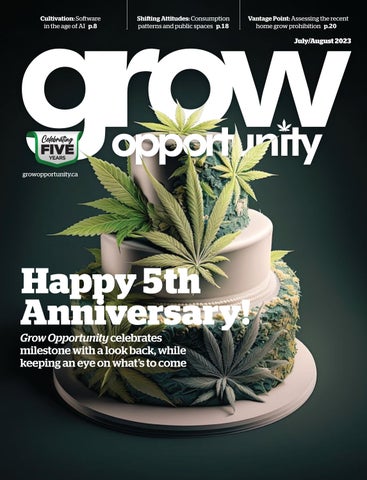
With a regal, three tier AI-generated cake on the cover of our magazine, we nod (holler?) to the times in this anniversary issue and take a pause to circle the date and reflect on how far we’ve come and how much further we have to go.
This issue operates as an exclamation mark punctuating Grow Opportunity’s five-year anniversary in the cannabis industry!
This issue operates as an exclamation mark punctuating Grow Opportunity ’s five-year anniversary covering this industry, in conjunction with the five-year anniversary of Canada’s legal market, this Fall.
When you examine the leaves on the cake, you can see their imperfections – cannabis leaves with 12-plus points, lacking symmetry and consistency. It’s cute, I think, how AI hasn’t quite mastered the composition of a pot leaf. But allow it another handful of years and it becomes child’s play.
This issue seeks to illuminate the current market conditions at a time when tech infiltrates most of our processes for better or worse and, of course,
the deep gratitude our team has for this space as it continues to mature with each passing day (albeit slower than AI).
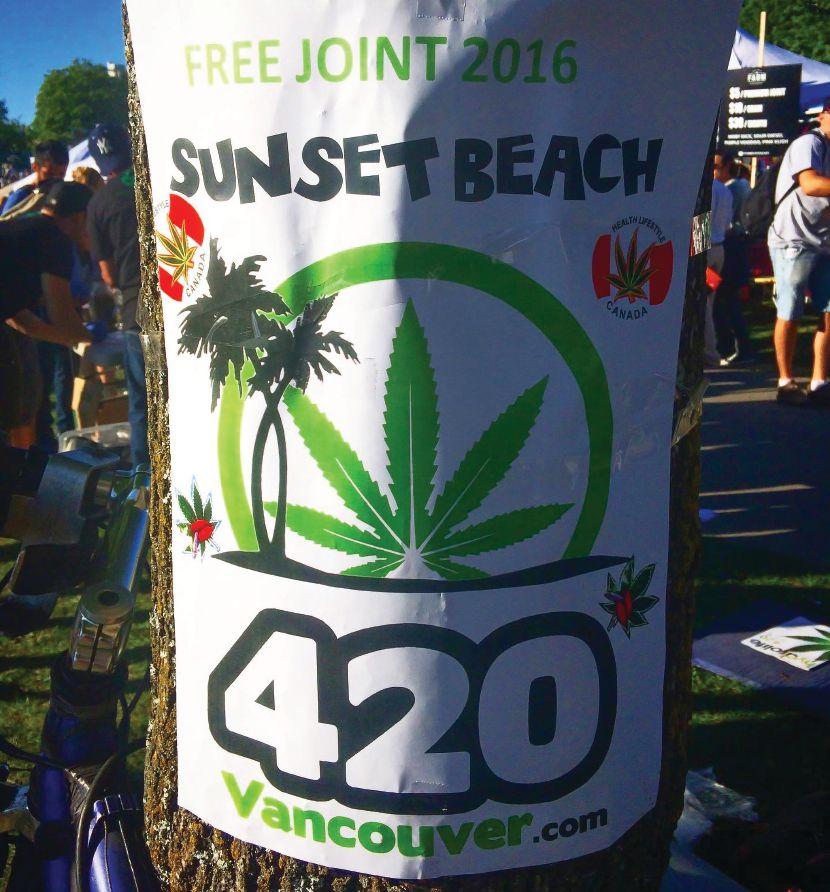
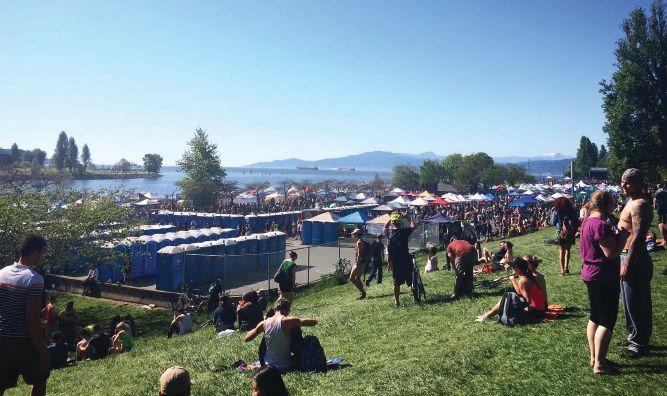
Around legalization, I was working as a legacy journalist, so I took the liberty of sharing a couple throwback photos from 4/20 in Vancouver, 2016. I’m thrilled that the maturity of my own journey has led me to the unique B2B media domain, polarizing the B2C I was doing back then.
Yet at the end of the day, the question still remains: how do you reconcile seeming opposites?
I recently heard the equation 1+1=3. Maybe this relates to mergers in cannabis, but could it also be applied here?
Rather than the duality working to cancel itself out, perhaps there’s a third point we’re after. The middle path. Perhaps the union of opposites, in this case of nature and technology, can create a better third option. And maybe there’s a way to achieve it without tipping the scales toward our tendency for self-destruction.
The philosophical questions mostly end here, though it’s certainly fun to mull over in the sun, with a free joint.
I present to you our latest issue, complete with brilliantly critical and articulate writers touching on some of the most pressing topics of our time in cannabis. Look around now, because in five years’ time, everything will be different again.
July/August 2023
Vol. 7, No. 3 growopportunity.ca
Reader Service
Print and digital subscription inquiries or changes, please contact Angelita Potal, Customer Services Administrator Tel: (416) 510-5113
Email: apotal@annexbusinessmedia.com
Mail: 111 Gordon Baker Rd., Suite 400, Toronto, ON M2H 3R1
Occasionally, Grow Opportunity will mail information on behalf of industry-related groups whose products and services we believe may be of interest to you. If you prefer not to receive this information, please contact our circulation department in any of the four ways listed above.
Indigenous kept from economic opportunities from pot legalization: Senate committee
A Senate committee says the current cannabis market and legislation has kept Indigenous Peoples from sharing in the economic opportunities that the legalization of recreational pot created.
The committee found the community’s difficulties in fully taking advantage of cannabis legalization stem from legislation around the sale and distribution of cannabis, licensing and the regulation.
“The cannabis market is now largely saturated. First Nations entrepreneurs will have to work twice as hard to gain a foothold in this market,” said Brian Francis, P.E.I. senator and Lennox Island First Nation, at a press conference.
The committee would like the Minister of Health to amend the Cannabis Act to permit First Nations to regulate cannabis on their lands. It is also recommending a meeting to solve jurisdictional challenges they face
– TARA DESCHAMPS, THE CANADIAN PRESS
61% of industry sample remains optimistic, polling suggests
In a recent survey by Grow Opportunity
61% of readers remain optimistic looking ahead to the next five years in the regulated market.
Of the sample, 75% say taxation is the biggest challenge of the past five years, while the biggest success is split between expanding export markets and steps taken towards reviewing the Cannabis Act.
Finally, 39% of readers have chosen successful product launches as their company’s biggest internal achievement, and 41% named Grow Up their favourite industry event.
86%
of consumers believe AI-generated content should be disclosed, IZEA research reveals
The report is based on a survey of more than 1,100 U.S. internet users ages 18-60+ years and aims to understand the state of adoption, usage and awareness of AI technology.
The state of the cannabis industry with David Hyde, CannaWiki panel
David Hyde, CEO of Hyde Advisory, works with LPs on their next moves – to merge or raise capital? His views on the Canadian market are as follows.
DH: Over the last 10 years, we’ve worked with about 65 per cent of the LPs. When I look at our clients, there’s probably a handful that are doing well.
Entourage Health successfully executes international sale and fulfilment of 100kg bulk order of medical cannabis with Lyphe Australia Pty Ltd., now offering four strains to medical patients in Australia
The companies who can bridge that divide have access to operating capital to sustain them and make it to the times that are coming, in my view, probably in a year to 18 months.
It’s also watching cost efficiencies. Even today there are areas of the budget that can be cut. So, it’s looking at the cost structures and partnering with other LPs. There’s often ways to partner and find innovative ways to get to market. When we talk to people struggling to raise money or access capital, which is prevalent no matter how successful you are, we look at where you are finding that money.
One thing I find that a lot of companies don’t do is really exhaust all options with their existing shareholder base, their existing investors. When they ask for our advice, it’s to turn back into the people who know you the best. They trusted you in the beginning: yes, it’s a longer journey, yes there’s been some challenges, but if you step back and think about and sell your business internally to your shareholders and investors, why shouldn’t they double down and put a bit more money into you?
To me, the key is don’t lurch. Because the B2B flower market has dried up now domestically, don’t just lurch into export. Think about what am I going to do to build a bridge into that export and how can I get myself ready?
Too many people are lurching and not thinking and planning. So going back to the people and investors who know you is one of those concepts for profitability.
AgrifoodJobsite.ca is Canada’s premier online job portal for the growing agrifood sector. A laser focus on the right people across the country’s largest agrifood media audience means you get the right applicants the first time. No more massive piles of unqualified applicants, just professional employers reaching qualified professionals.
Powered by the top agrifood media brands in Canada, the reach to over 500,000 industry professionals on AgrifoodJobsite.ca is amplified by:
Website advertising to 185,000 qualified monthly site visitors
A comprehensive and magnifying reach across multiple associated job boards
Email promotion and job alerts to 131,000 industry emails using Canada’s largest CASL-compliant direct access to agrifood professionals
Social media promotion to all brand networks on Facebook, Instagram, Twitter and LinkedIn
Cultivation
By Hardeep Shoker
Hardeep Shoker is the COO and a co-founder of Elevated Signals, which develops GMP-validated manufacturing software for the cannabis industry. He brings 15 years of experience in software development and best practices from other industries, and applies them to the cannabis marketplace.
Software in the age of AI: Charting the course of the last decade
The cannabis industry in Canada has undergone significant changes in the past decade, and along with it, the software options have also evolved. Yet many producers still rely on outdated tools, like pen, paper and spreadsheets, and systems from the ACMPR days.
Companies today struggle to maintain a profitable operation most often arising from a common problem: high costs. Here’s why having the right software is one way for companies to help reduce costs.
The evolution of tools and systems for producers
As industries evolve, so too do the tools that enable players to be compliant and efficient within them.
During the ACMPR and Cannabis 1.0 era, operators were focused on the medical market and dried flower products. Within the facility, the emphasis was on compliance and software was used to support this. However, with the introduction of the recreational market and the advent of Cannabis 2.0 (the addition of products to the legal market such as vapes, edibles and extracts), more advanced software platforms have emerged. These systems continually adapt to create greater visibility and transparency within the production process, driving improvements in both quality and cost-effectiveness.
ACMPR 2013- 2018: Seed-to-Sale software
Between 2013-2018, the evolution of software was driven by the medical industry. The software platforms developed during this time were tailored to comply with the Access to Cannabis for Medical Purposes Regulations (ACMPR) and were commonly known as “Seed-to-Sale” offerings.
Having the right software to replace manual processes, provide easy access to critical data and run the business more efficiently, is the most effective way for cannabis companies to reduce operating costs.
Seed-to-sale software assists producers in tracking various stages of the production process, including growth, harvests, drying, processing, packaging and sales and distribution. Though these tools were designed specifically for cannabis 1.0 and medical-only sales. As a result, they are unable to accommodate complicated workflows for complex SKUs leaving producers to rely on binders and spreadsheets to connect the dots between their cannabis inventory, non-cannabis inventory, current work-in-progress and QA programs.
The Cannabis Act 2018: Enterprise Resource Planning
Following the introduction of the Cannabis Act in October 2018, the recreational cannabis market began to find its feet. Large public companies emerged in the industry and as a result, financial reporting took precedence over compliance. This meant larger producers were pushed to enterprise resource planning software
(ERPs) to plug the gaps left by traditional seed-to-sale platforms.
ERP software is used by organizations in all industries to manage day-to-day activities, but will not provide granular insight into operations on the facility floor.
Cannabis 2.0 2019 – Present: Manufacturing Execution Systems
When the recreational market evolved and new product forms became available, this led to the emergence of a new type of agile software in the industry.
MES helps producers track and document the transformation of flower or biomass into finished goods. Unlike seed-tosale, this software captures all inventory movement, quality control work and environmental data into a central platform that can generate detailed batch reports and granular operational insights.
MES is all about increased visibility to critical data, automation processes and efficiency and productivity. It can also “connect the dots” between EPR and other software solutions, such as eQMS – a software system to help LPs set up, monitor and maintain their QA program.
What’s next? Artificial Intelligence
The integration of AI software is expected to play a revolutionary role, enhancing efficiency and productivity in the market.
AI-powered systems can optimize cultivation by analyzing data from sensors and making real-time adjustments for plant health and resource utilization. It can also enhance quality control by detecting pests, disease and abnormalities through image analysis. Inventory management systems driven by AI can track and predict inventory levels, reducing supply chain risks.
Cannabis companies now understand that modern day technology is vital for optimization in hopes of avoiding obsolescence in the highly competitive market.
•
•
•
•
Alexandre Gauthier, Director of Cultivation, Origine Nature Canada’s Top Grower 2022 Winner
By Matt Maurer Legal Matters
Capital and controversy: an attorney ’s reflections on five years of legalization
To me, it feels like only yesterday that Canada legalized cannabis for adult use. But as anyone who has been working in the industry for an extended period of time would say: this industry moves very fast.
Who could forget (for better or worse) the image of a smiling Bruce Linton manning the counter of a Canopy-owned retail store in Newfoundland, ringing in the first non-medical, legal sale of cannabis in our country’s history?
Just before and after legalization, LPs were the darlings and focal point of the industry. A new licensee announcement by Health Canada on a Friday was major news (and cause for investors to throw money hand over fist at them).
How can we forget these LPs racing to get licensed, racing to build out grow space, racing to get listed on publicly traded exchanges and racing to set up shop in Lesotho, Malta and pretty much anywhere in between? They were not only going to take over Canada, they were going to take over the world! And why not? These Canadian companies had a global head start that no one else had (sorry Uruguay, we never saw you as a threat).
As the LP section of the industry began to settle in, governments at the provincial level began getting their house in order as it related to retail sales. The government of our most populated province, Ontario, originally indicated that the retail market would be entirely government owned and operated, only for the Conservative party to unseat the Liberals and do a total 180 by allowing for privately owned retail.
Who can forget the great Ontario cannabis retail lotteries, which seemingly gave something to complain about to every industry stakeholder except for the many average Joe and Janes who won the golden
Suddenly, many of the smaller, initially less ambitious LPs were the ones who were doing well – making products that consumers desired while operating within their means, and at a profit.
tickets and the right to apply for a license to operate a retail store? Who can forget the controversy over what sorts of arrangements were to be permitted between brands and lottery winners, and the Alcohol and Gaming Commission of Ontario finding its way along with everyone else as the process unfolded?
And who can forget how we suddenly went from a very limited number of stores to an explosion of stores – the nature of the regulatory regime effectively removing the ability of would-be store owners to fully appreciate where their soon-to-be competitors would be operating relative to them.
“Clustering,” as the politicians in Mississauga like to say, and Queen West becoming ground zero for cannabis retail in the City of Toronto where more than a few
local residents were distressed that their beautiful neighbourhoods had suddenly “gone to pot.”
Then the reality of the market set in.
LPs who had been expanding capacity at a rapid pace and geographically as well began to discover that the global market was not ready for the robust supply that they had been preparing. The domestic market was solid, but perhaps did not contain the demand that some of these LPs had forecasted.
Large, expensive facilities that were given attractive names by their owners began to close. Operating at a continual loss, because money was being spent to expand, was no longer an acceptable way of doing business. Share prices began to crater. Investors demanded better, and founders and boards were pushed out and replaced by more experienced executives who were expected to right the ship. Some of them were able to do so. Some of them steered their companies right into insolvency protection or bankruptcy.
Suddenly, many of the smaller, initially less ambitious (either by design or necessity
PHOTO: LUNA
Matt Maurer is a partner and co-chair of the Cannabis Law Group at Torkin Manes LLP in Toronto, Ont.
due to lack of resources) LPs were the ones who were doing well – making products that consumers desired while operating within their means, and at a profit.
The retail side of things fared no better (at least certainly not in Ontario). Having to pay rent far above market (thanks to opportunistic landlords capitalizing on the rush of store applications) started to catch up with many owners. Throw in a pandemic that absolutely destroyed foot traffic for many stores for years, while being surrounded by competitors on every corner; it’s no wonder many went out of business. At first it was mom and pops, but then some of the larger brands/chains began to follow.
Lawsuits and arbitrations within the industry increased exponentially. Companies that had entered into business arrangements together during the earlier kumbaya phase of the industry were suddenly at odds with each other.
So, where do we go from here?
Many would argue that there were, or are, too many LPs and retailers for the domestic market. As unprofitable operators close up shop, we move further towards a level where supply meets demand and the remaining operators can (hopefully) continue to operate for the long term.
There are still untapped areas of the industry that most of the provinces and territories have kept wholly or partially closed to date. Cannabis tourism has yet to take off in a way that may be possible due to (depending on the province) restrictive rules on consumption, sales or both.
When festivals, hotels and restaurants are permitted to sell cannabis products, and health and other stores can carry CBD-only products, we should see a further decrease in stigma, new consumers entering the market and a general uptick in sales across the board.
On the regulatory side, more lenient rules on packaging and promotion are likely to appear on the horizon at some point. It’s now clear that the sky has not fallen because of legalization, and the tight regulatory leash that government gave industry participants can be loosened up a bit. Indeed, and for example, some provinces have already done away with the requirement that retail stores cover up their windows to the outside world.
We certainly will never again see the same rush, expansion and excitement that we saw during the first few years, and that’s okay. At this point, the industry does not need expansion and excitement, rather it needs to settle into a realistic model that becomes sustainable for years to come.
It certainly doesn’t mean that those “early days” weren’t fun while they lasted, and that we can’t all look back and reflect on the wild ride we’ve been on – that is the premise of maturity, after all.
5 years of learning: An anniversary tribute to cannabis
With enough data to sink a ship, industry has all the tools it needs to turn lessons learned into new leaves – a retrospective look at the five-year anniversary of weed in Canada By Haley Nagasaki
October 2023 marks the five-year anniversary of legal cannabis in Canada, and last Fall, Grow Opportunity also saw five years covering this industry. In honour of the occasion, for us and for our nation, we present a retrospective spin on the past handful of years with experts’ views on how to incorporate all all we’ve learned since 2018. The sections assessed herein include regulatory comments by consultant Mitchell Osak, cultivation and production insight by grower and consultant David Kjolberg and covering retail, Jaclynn Pehota, executive director of the Retail Cannabis Council of British Columbia (RCCBC), points out a bright spot in this industry: the triumphant small business owners in B.C.
Mitchell Osak on regulatory challenges
The regulatory hurdles in the Canadian cannabis market imposed by Health Canada and the federal and provincial governments combined create a minefield for licensed cannabis producers who, “today, can be paying as much as 33 per cent of their sales revenue in taxes and fees,” writes Osak, in an email to Grow Oppor-
tunity. While cannabis in Canada is federally legal, “there are a myriad of market structures, wholesaler mark-ups and policies that vary from province to province. This necessitates different strategies, thereby complicating life and raising the cost for LPs,” he says.
“The issue of regulatory inconsistencies between jurisdictions is a major challenge affecting this industry and its ability to turn a profit,” continues Osak. And regulations related to the onerous level of excise taxes will only shift if the CRA plus all provinces/territories agree to relinquish a portion of their revenue and alleviate the financial conditions impairing LP operations.
Furthermore, restrictions on THC in edibles have neglected consumer needs for higher potency products and stunted potential demand, “sending users back to the untested unregulated market” – the public health implications of which are evident yet ill-addressed.
For the past five years, industry players have acquired essential knowledge and lessons learned enabling them
to produce better products at lower costs. Osak now advises clients to “choose a strategic lane and execute with excellence.” Maintaining a profitable business, he says, depends on “aligning your operating model and capacity to your actual market demand and channel needs, because eschewing humility and the ‘build it and they will come’ model is a recipe for failure.”
Osak affirms that successful LPs understand the above winning formula is part “art and science.” The art includes “innovation, maximizing human capital and learning from your peers,” while the science could involve using “data analytics to make better operational and marketing decisions, prudently managing cash and staying close to your consumers’ changing needs.”
Though rest assured, “there is still plenty of growth left in the Canadian market,” says Osak. As much as 50 per cent or more than today. “This growth will be driven by higher consumption by existing and new users coming in from the illicit market, enticed by a greater
“You’d see the accountant’s eyes widen after he’d do the math because, on paper, it looks like they’re going to be rich. And that was the problem! It all started because everybody was focused on growing spreadsheets instead of quality flower.”
– David Kjolberg
selection of higher quality and cost competitive products that deliver 100 per cent on user needs. LP revenue growth will also be propelled by greater sales in international medical and emerging adult-use markets.”
As an unfortunate yet consistent business truth concerning nascent industry contraction, fortunately those “budding entrepreneurs now entering the market can learn from their first-moving peers.” They may employ asset-lite strategies, such as “outsourcing production while focusing on genetics curation or brand building,” writes Osak. “And after the industry goes through its inevitable shakeout of LPs and retailers, new market opportunities are likely to appear,” he concludes.
David Kjolberg on cannabis production
While working as the master grower for Peace Naturals from 2014-2017, on the eve of legalization, Kjolberg recalls the swaths of tour groups requesting to come through the facility. A group of four would arrive,
“and you’d have your grower, your lawyer, your accountant, and another c-suite exec, and they would be most interested in asking about scaling,” says Kjolberg, in a phone conversation with Grow Opportunity.
“You’d see the accountant’s eyes widen after he’d do the math because on paper, it looks like they’re going to be rich,” he continues. “And that was the problem! It all started because everybody was focused on growing spreadsheets instead of quality flower.”
Kjolberg points to the challenges producers ran into through a lack of consideration for factors such as powdery mildew, Hop Latent Viroid or the unfamiliarity of genetics with different requirements. This proved problematic for some in upper management who didn’t understand the plant or the culture that came with it.
Some of the bigger LPs, he says, likely had a grower with some good credentials who wrote the SOPs. “And after they’re gone, they’d keep using the SOPs and then end up with product they can’t sell because it’s a bunch of dry popcorn nuggets that’s not been cured properly,” says Kjolberg. “Cannabis, anywhere between 10.5 or 12 per cent moisture – you know you’ve got a nice enjoyable smoke,” he adds. “But when it gets down to five or six per cent, you’ve got problems. And consequently, the drier it is, the better the test result.”
The advancements in cannabis production over the years has been paramount. “What’s changed over the last five years is technology,” says Kjolberg. “Crop steering, using sensors in your grow, is very important. HVAC systems have gotten very good, lighting is getting very good,” he says. “So, by the use of automation, we’re able to know where we stand in our grow rooms.”
“But the biggest factor of what’s changed,” says Kjolberg, “came with the nursery licenses – it’s the availability of genetics and tissue culture.” In a 2,300-square-foot facility, real estate is reserved for flowering rather than mothering and cloning. Producers can purchase excellent genetics from nurseries as clones or as teens. “It’s plug and play, and it’s guaranteed,” he says.
“When I first started, you had what you brought with you. A bunch of seeds or plants you had when you first got your license,” he says. “And now with AI and automation, the best grow rooms are the ones you stay the hell out of.”
Some changes Kjolberg would like to see sweep this industry from a retail perspective include heightening the sensory aspect of cannabis sales, as in sight and smell, which informs consumers by drawing attention to the flavour and terpene profile of products. He’d also like to see increased budtender wages and better relationship-building between buyers and producers.
For those producers now entering the market, a hands-on approach to brand building based on great genetics, while refraining from being top-heavy in management, Kjolberg suggests, is the right way to go.
Successes as a result of B.C.’s more prudent cannabis retail development, the capping placed on store volume expansion and the profitable independent retailers, demonstrates what’s possible as we enter this next wave of regulated cannabis.
The next wave of entrepreneurs “should be lean and produce great flower that pays the bills,” says Kjolberg.
“When you know your next harvest is only two weeks away, that’s the optimal place to be.”
Jaclynn Pehota sees retail success in small business ownership
The unregulated market’s chokehold on this industry, especially in categories like concentrates, continues nearly five years into the legalization of cannabis.. Store clusters in some areas and lack of access in others compound this issue in that some retailers forecast a similar contraction as the one being experienced by LPs.
“There are situations with too many stores in an area for the population density and these challenges are redoubled by the most impactful issue: competition with the unregulated market,” writes Pehota, in an email to Grow Opportunity.
Effectively predating both Grow Opportunity and the legal market is Vancouver’s annual Sunset Beach Park 4/20 celebration (2016) complete with live music, full sun and free joints.
PHOTO: HALEY NAGASAKI
“The last Stats Canada poll I saw had 50 per cent of Canadians that use cannabis self-reporting that they exclusively used the legal system. 50 per cent market capture amplifies the struggles of licensed retailers for obvious reasons. The legal market simply isn’t playing the game with a full deck of cards,” she says. “We can’t win with half the deck missing.”
In addition to the lack of retail license capping in provinces like Ontario, other factors impede retailer success, such as “lack of understanding on the part of elected officials and overly onerous marketing restrictions.”
But what is it that sets the East apart from the West? As executive director of the RCCBC advocacy group, Pehota sees circumstances in Ontario largely as “an aftershock of two factors: a speculative bubble driven by pubcos and significant regulator flip-flops that took the total number of stores in the province from 22-
ish to over 200 in less than a year, and has expanded to over 1,800 since.” She points to the inability to differentiate in market because “all product is coming through the same public wholesaler, resulting in a race to the bottom on pricing.”
In B.C., a slower approach to store growth meant that businesses had a better chance to establish themselves, and the direct delivery opportunities between retailers and small producers created specially curated opportunities with “exclusive lines of supply.” Therefore, the difference in the outcome between provinces, as she sees it, is “down to the original regulator mindset, industry organization and the direction of industry advocacy.”
Successes as a result of B.C.’s more prudent cannabis retail development, the capping placed on store volume expansion and the profitable independent retailers, demonstrates what’s possible as we enter
YOUR FULL-SERVICE LAB WITH INDUSTRY LEADING TURNAROUND TIMES
Serving the cannabis industry with complete testing and agronomic support.
Comprehensive testing and production services
this next wave of regulated cannabis.
“What has not been successful in B.C. has been the ongoing attempt by larger chains to buy market share in place of pursuing sustainable growth. You can’t ‘fake it ‘til you make it’ in this situation,” writes Pehota. “Recent bankruptcies demonstrate this very pointedly.”
Western Canada is also leading the conversation around preventing loss and incidents by removing opaque window coverings in cannabis retail stores. As of June 23, Ontario is reconsidering its stance on this as well.
Retailers that were perhaps lost in conversation – eclipsed by production – are now coming back around to the forefront, equipped with new datasets. Incorporating this knowledge could begin with a pivot away from the big pubco narrative in favour of privately owned successful small businesses, where in B.C., RCCBC represents 175 stores, or one-third of the total retail market.
The grind towards sustainable cannabis packaging in Canada
Consumers, governments, licensed producers and retailers all say they care about sustainable packaging, but who is holding the cannabis industry to account?
By Devon Scoble
It’s not hard to find licensed producers, governments and cannabis retailers who recognize sustainability as a worthy goal. The real challenge for the Canadian cannabis industry is developing a clear definition of sustainability and creating a roadmap to get there.
Governments focused on recycling
Regarding packaging, Health Canada has much to say about materials, colours and branding elements and little about sustainability. Its Packaging and labelling guide for cannabis products acknowledges that “plastic pollution is a growing problem in Canada and around the world” and encourages innovation in packaging so long as it satisfies regulatory requirements.
Reducing plastic waste, says senior media relations advisor Tammy Jarbeau, falls under the purview of Environment and Climate Change Canada, adding that, “I believe here
at Health Canada for food product packaging, our role is to set the standards for what is included in the package and not necessarily what the package is made of.”
In an emailed statement, a separate Health Canada representative noted that amendments to the Cannabis Regulations to allow accordion or peel-back labels on smaller packages create more flexibility for licensed producers to use non-plastic packaging alternatives such as cardboard.
“Canadian governments have the right ideas, and I believe they are trying to help by requesting LPs and processors to use sustainable packaging,” says Joel Darichuk, calling it “a start.” A veteran with over 25 years in the packaging industry, Darichuk is the CEO and GM of CannaGreen Packaging, which produces cannabis packaging and supplies, focusing on sustainable and responsible manufacturing processes.
While he sees recyclability as an excellent first step, he’d like governments to
educate industry players on biodegradable and compostable packaging and encourage sustainable production practices across operations, not just in packaging.
Mika Unterman agrees that governments should be doing more. She’s a circular economy and reverse logistics consultant, and the founder of Apical – a consortium that helps cannabis companies adopt sustainable packaging.
“Government lags behind the business community, generally speaking, which is why they are focused on recycling and regulating what you can call recyclable or recycled content," she says. While recyclable packaging is ultimately a good thing, its impacts are limited when only nine per cent of the plastic goods Canadians throw in their bins are actually recycled.
Instead, Unterman wants to see governments and crown corporations “investing in the reuse infrastructure that we all need to meet our climate goals.”
The cannabis industry has been accused of being a climate villain due to the amount of waste it produces and its lack of solutions for an effective reduce/reuse model.
The industry’s role
For her part, Unterman encourages licensed producers and retailers to think long-term, arguing it’s not only the right thing, it’s also the cost-effective thing to do.
She understands that sustainability programs can seem like added expenses but says that LPs operating in provinces with extended producer responsibility (EPR) programs in place probably aren’t capturing their true packaging costs, anyway.
“Ontario’s EPR will make LPs financially responsible for the waste they put into the market,” she says. The province’s Blue Box program begins transitioning to a new regulatory framework in July. It will soon see manufacturers across industries bearing the costs of municipal recycling programs. However, she says that most LPs bury the costs of EPR within general and administrative expenses, obscuring the cradle-to-grave cost of their packaging.
The way forward
For a functioning model of sustainable packaging, Unterman suggests looking to another well-loved plant-based product: beer. In Canada, a standard refillable beer bottle is reused an average of 15 times before being recycled into a new one, while aluminum cans are infinitely recyclable.
Standardizing cannabis packages would require a high degree of collaboration, both across production, retail and government sectors and within them. “For LPs, the sustainability transition can be costly if they seek to do it all on their own. But they can save money if they collaborate with competitors,” says Unterman, who doesn’t believe standardization poses a risk to sales.
“I understand the importance of having a unique look, but given the current way sales are done – we don’t see the packaging until after purchase – what does a unique jar or tube do for the brand? And what is the good of differentiation if we are literal ly destroying the planet in the process?”
Darichuk acknowledges that a lot of the changes he’d like to see, such as better government-led sustainability education and tax credits for producers who use local sustainable packaging, are complex. He
says he’d love to get in a room with manufacturers and government bodies to work towards shared goals, and offers a quick win that would reduce packaging output and divert sales from illegal markets.
“A simple but successful change that would reduce packaging is to simply allow 100 mg packaging of edibles,” he says, allowing consumers to buy the same amounts of edibles in fewer packages. Indeed, public consultations on proposed amendments to the Cannabis Regulations surfaced back in 2019 and are likely to do so again when the government publishes the results of this year’s public review, but so far expanding the edible THC limit has been a non-starter with Health Canada.
Despite significant setbacks like this and the shuttering of Terracycle’s cannabis recycling program, the industry does have a few good-news stories to draw from: Nova Scotia LP Aqualitas uses ocean waste for
its 100 per cent-reclaimed plastic packaging, and Alberta-based [Re] Waste works with companies such as High Tide and Nova Cannabis to collect used packaging and turn it into “reusable and functional products” – including its own collection bins. Darichuk is particularly proud of the work CannaGreen has done to reduce waste. Still, there is much work to do before the industry can call itself sustainable.
“It takes time to do this well,” says Unterman. “I see the industry in a scarcity mindset, fighting tooth and nail to survive. I understand the need to focus on the short term. But doubling down on a sustainable strategy that could reduce costs and make a business viable in the next 18 to 24 months, when others are ignoring the opportunity, is undoubtedly a competitive advantage.”
Grodan-Ad-GROW-4.6875x4.75.pdf 1 6/23/23 12:24 PM
Devon Scoble is a freelance writer, editor and content strategist focusing on health and lifestyle stories. www.devonscoble.com
Reimagining shared spaces across the nation
Provincial
experts
weigh in on the future of (and need for) public cannabis consumption spaces in an industry seeking to grow its domestic market
By Jake Hribljan
With long days and warm weather finally here, patios and verandas across the country are filled with Canadians looking to relax, reenergize and enjoy some good food and music. But how many wouldn’t also mind having a toke from their rosin pen or flower vaporizer, or to sip on a CBD-infused lemonade while lounging in public recreational areas?
Nearly five full years after the legalization of recreational cannabis it remains unclear if, let alone when, cannabis will get to enter the privileged arena of public consumption spaces that alcohol has enjoyed for decades.
The stats on beer and wine sales Canadians’ tastes for social lubricants is changing. The latest report on beer and wine consumption from Statistics Canada showed that in 2021/2022, the volume of beer sold per person hit the lowest level ever recorded
since we began tracking data in 1949. Meanwhile, the volume of wine sold in the same timeframe sank by 516 million litres – the largest decrease since 1949. These statistics aren’t a random outlier due to the economy, or the COVID-19 pandemic, they represent a larger macro trend.
Beer sales by volume per person are down just over 47 per cent since sales peaked in 1973, and sales by volume are down almost 25 per cent since 2009. As beer and wine sales continue to trend lower in volume, despite inflation-related rises in profits, cannabis continues to eat a larger portion of the recreational drug lunch.
Recreational cannabis sales totalled $4
billion in 2021/2022, compared to $8.1 billion in wine sales and $9.1 billion in beer for the same calendar year. This, in spite of the fact that retail cannabis sales are prohibited at venues where alcohol sales enjoy. Think of only having access to alcohol at the LCBO, and forget concerts, live sports and festivals. In a country bent on increasing GDP through cannabis sales, I wonder with these changing trends, when and where does the public consumption of cannabis fit in?
The co-location of cannabis and alcohol in Manitoba
The nuances surrounding the sales of retail cannabis are unique from province to
Experts believe establishing dedicated areas for cannabis sale and consumption at festivals, situated away from the sale and consumption of alcohol, is a viable solution for managing public consumption in Canada.
province, which can make the rules of regulation unclear. Lisa Hansen, communications analyst for the Liquor, Gaming and Cannabis Authority of Manitoba, said in a comment, “the LGCA does not prohibit licensing a cannabis retailer on the basis of location or type of venue, [but] cannabis cannot be consumed in public spaces in Manitoba. Smoking and vaping cannabis in public is prohibited under The Smoking and Vapour Products Control Act…and ingesting edibles in public is not allowed.”
Hansen continues: “another consideration is the co-location of alcohol and cannabis sales. Canadian research has shown that combined use of cannabis with liquor increases risk. For this reason, cannabis retail cannot occur in premises in Manitoba where liquor is sold.”
Canadians’ opinions on public consumption spaces for cannabis remains unclear, if not only for a lack of data. However, a 2023 opinion poll gathered by the British Columbia Ministry of Public Safety shows almost 15 per cent of the B.C. population is interested in going to a public consumption space.
As many LPs and retailers look for avenues towards achieving market capitalization figures initially promised at the start of legalization, cracking open the doors into tourism and hospitality could be the solution.
Edmonton’s We Know Training on public consumption spaces
“I think [public consumption spaces for cannabis] is an overwhelming opportunity,” says Nathan Mison of Diplomat Consulting, an Edmonton based strategic advocacy and consulting company that has partnered with We Know Training and CannSell to create the first of its kind cannabis hospitality sales training program.
“I always believe the true way that you change cannabis culture is by opening it up for more people to consume it in a way that they understood, which was through food and drink, mirroring the alcohol experience,” continues Mison.
Polling data demonstrates that 66 per cent of Canadians who have not tried cannabis would be open to the experience if it came
in an ingestible format. Similarly, 27 per cent of travellers would like a cannabis experience when they travel, says Mison. “I don’t understand why the cannabis sector wouldn’t support [public consumption spaces]. I don’t understand why the tourism and hospitality sector wouldn’t support it.”
Ontario’s political resistance to public consumption
It seems as though resistance to public consumption spaces is coming largely from the political and regulatory sectors. After a failed bid in March 2023 by the Ontario Chamber of Commerce calling on the Ontario government to modernize retail cannabis regulations, such as introducing pop-up cannabis-only ingestion sites for outdoor sporting events and concerts, Premier Doug Ford stated: “I don’t like the idea of having a lounge outside and they’re smoking doobies or weed or whatever the heck they call it now.” The OCC clarified “it has never called for any action that would contravene the Ontario Smoke-Free Act.”
Provincial regulators have mostly punted the issues of public consumption spaces back to politicians. The Alcohol and Gaming Commission of Ontario said in a request for comment about public consumption spaces, that “it is not appropriate for the AGCO to comment on matters relating to government policy…The possible changes of [public consumption spaces] would be a matter of federal and provincial policies and legislations.”
Compromises
on co-location can be made without compromises on health
“Public health is an important consideration,” says Omar Khan, chief communication and public affairs officer at High Tide Inc., Canada’s largest cannabis retailer with over 150 retail locations nationwide.
“I think there are ways to safeguard public health, while expanding access to legal cannabis in some of these venues,” says Khan. One idea, particularly at music festivals, might be to sell cannabis in designated consumption areas where alcohol is not sold.
The United States has already begun experimenting with consumption spaces in certain states where cannabis is legal. “I believe California just recently passed a law allowing this as well,” says Khan. “I think we have a lot of examples for the government in Canada to choose from should they wish to follow in a way that is respectful of public health concerns.”
“Any product sold through our stores has already been tested by Health Canada, it’s in childproof packaging, it’s being sold in an age-restricted environment,” he says. Khan recognizes the rampant contamination of illicit products and the “strong public health argument to be made that the more we can reasonably expand access to legal cannabis, the more we will reduce the market share of the illicit market.”
As those with stakes in the regulated cannabis sector continues to focus on the problems and impacts of the illegal markets on the legal sector, it’s important for regulators and politicians to remain cognizant of the health impacts of the illicit sector and how stonewalling public consumption spaces actually emboldens the illicit market, says Mison.
“It’s pretty fascinating that one of the tenets of the Cannabis Act was the elimination of the illicit market, and the regulators whose responsibility it is to mandate and regulate the legal sector doesn’t have any comments on the public health consequences of the illicit sector…It rings a little empty,” he continues.
Five years later, Canadians continue moving forward in a post-prohibition world, yet the question still remains: will we be able to one day purchase and consume cannabis products at a major league sporting event, concert or festival?
“I absolutely believe that the opportunity to consume cannabis at an Oilers game or an Elks game in the future will happen,” says Mison. “I believe that the first step will be through food and drink; it will not be through combustion. But, you know, I think those things will come.”
Jake Hribljan is a Canadian freelance writer with a background in economics currently residing in the E.U. Twitter: @JakeHCE
By Denis Gertler
Supreme Court decision on home growing could have broader impact on industry
Ihave a confession to make – I am a home grower. So, the Supreme Court of Canada’s recent decision to uphold the Quebec Court of Appeal’s ruling to effectively ban homegrown cannabis in the province caught my attention. Advocates of the practice in Quebec and Manitoba had been waging public relations and legal battles to push back on the efforts of their provincial governments to prohibit the pastime and its products, but they have now run out of legal options.
At first blush, this just seemed like an interesting side story. Then I wondered why Quebec was waging a war on growers. If it was fighting a protracted legal battle, were there broader implications? My first thought was, “how big is this group?” According to StatsCan, it’s about 10 per cent of Canadian cannabis users, excluding licensed medical home growers.
However, the 2022 Canadian Cannabis Survey found that 6 per cent of Canadians, or 14 per cent of those who had used cannabis in the past 12 months said plants had been grown “in or around their home.” Given the tendency to understate cannabis use, the actual figures could be greater. Overall, maybe two million Canadians are involved with home growing, so the Court’s decision affects a substantial number of users.
Unpacking that decision is instructive, too, because it suggests that other provinces could follow Quebec’s example with little need to provide a convincing rationale for policy change. Speaking for the Court in a unanimous decision, Chief Justice Wagner found that the “pith and substance” of Quebec’s law is that it was enacted to maintain the government’s monopoly to protect the public – especially children and youth – from the harms of
What the decision certainly does accomplish, though, is to re-criminalize home growing in Quebec and Manitoba. This is happening at a bad time for Canada’s cannabis industry.
cannabis use. According to the Justices, Quebec’s prohibitions are intended to steer users to the legal market where “the products offered, education on the risks of cannabis consumption and compliance with rules on the minimum age for purchasing cannabis” are state-controlled.
No evidence is needed on the efficacy of state policy since achieving these outcomes rests on the assumption that home growers will lay down their garden tools and flock to authorized retailers. What the decision certainly does accomplish, though, is to re-criminalize home growing in Quebec and Manitoba. Apart from legal
purchases, home growers in these jurisdictions have the choice of continuing their hobby illegally and face a fine, or to buy from illicit sources. This is happening at a bad time for Canada’s cannabis industry.
Price compression, oversupply, high taxes, and regulatory costs are triggering business closures and layoffs. One might think that the SCC’s decision provides a needed boost to LPs and retailers, but that’s unlikely. Cheap cannabis is qualitatively different from homegrown flower. People often grow cannabis because they enjoy the process as much as the crop. The Court’s decision will not prompt home growers who embrace a do-it-yourself craft ethos, using living soil and organic inputs, to suddenly prefer store-bought weed. More likely, they will risk sanctions by continuing to grow at home, or they will buy illegal products. A recent study supports this line of thinking.
Denis Gertler is a regulatory consultant, board member, and former government regulator.
The research just published in The Journal of Studies on Alcohol and Drugs examines Canadian cannabis consumers with an eye to what is needed to engage them in the legal marketplace. The authors found that only 30 per cent of subjects appear to have their preferences met by legal sources. These consumers prefer pre-rolls over dried flower and consume less cannabis than other users. Another group who buy cannabis more frequently, are attracted by high THC potency and tend to favour illicit products.
A third group, representing 40 per cent of respondents, choose dried flower, seek packaging with detailed product information and appreciate freshness. People defined by these groups regard price differently, with those in the two cohorts least loyal to legal retailers willing to pay more for quality and high THC. Without reading too much into these findings, the re -
The Court’s decision will not prompt home growers who embrace a do-it-yourself craft ethos, using living soil and organic inputs, to suddenly prefer store-bought weed. More likely, they will risk sanctions by continuing to grow at home, or they will buy illegal products.
sults suggest weak allegiance to legal suppliers, with price not the only or even most important factor guiding buying decisions. The good news for legal suppliers is that respondents were willing to pay more for products regulated by Health Canada.
Industry leaders also question if lower prices increase profits, or whether these are doing more harm than good. Recent remarks at this year’s Lift Conference by
Ontario Cannabis Store CEO David Lobo contend that the “race to the bottom” is compounding industry issues by squeezing margins, adding cost pressures, and not pulling enough traffic to keep authorized retailers afloat.
Meanwhile, the illicit market still comprises over 40 per cent of the consumer market according to the OCS’s own research, with other estimates stating its share is much greater. Lobo noted that such vulnerabilities expose the industry to future crises, perhaps a major recall due to adverse health effects. Making legal cannabis consumers sick would cancel the moral high ground claimed by the regulated industry, further weakening its position.
The last thing needed by a fragile cannabis sector is a resurgent illegal market augmented by disgruntled home growers. Suddenly 10 per cent doesn’t seem like such as small number.
CANNABIS GROWER’S HANDBOOK
Ed Rosenthal’s Cannabis Grower’s Handbook is the definitive guide for all cultivators-from firsttime home growers to experienced large-scale commercial cannabis operators. The Grower’s Handbook breaks down the fundamentals of marijuana cultivation and demonstrates their practical applications in gardens of any size. Learn new techniques to maximize yield and efficiency and to grow bigger, more potent resinous buds!
Cannabis Grower’s Handbook covers the newest lighting technologies such as LED and adjustable spectrum bulbs; permaculture and regenerative farming techniques; advanced drying and curing methods and strategies; comprehensive integrated pest management; and over a dozen specialized garden setups.
$64.65 | Item# 1936807543
Q&A with Oana Cappellano: a look at the past decade in cannabis retail
GO: What is your background in the industry and how was the legacy Eggs Canna brand founded?
OC: My husband, Andrew Cappellano, has been cultivating cannabis for over two decades, and his passion quickly turned into his life’s vocation.
One day in 2013, he approached me and said: “you need to quit your job because we are opening a cannabis dispensary and I need you to run it.” Of course I said yes, and jumped head first into an industry I really had no experience with.
Much of my time was spent learning all that I could about the industry as a whole and the cannabis plant and its many applications and derivatives.
So, in 2014, we opened our first cannabis retail store; in 2016, we were amongst the first retailers to get licensed under the old medical marijuana-related use (MMRU) license class in the City of Vancouver; and finally, in 2019, we again were amongst the first retailers to obtain our provincial cannabis retail license in the City of Vancouver.
As I have grown with the cannabis industry, my focus has been on strategic management, business development and growth, fundraising and everything and anything regulatory – including being a stakeholder for municipalities when they were drafting their bylaws.
GO: How has your company evolved over the years, spreading into the cultivation space?
OC: Andrew was very strategic in his approach. Having been part of the grassroots eco-system that was already established pre-legalization, he felt it would be best to start with retail and grow into cultivation!
Once our retail brand was established and well on its way, we purchased a 17,000 sq ft facility with the intent of turning it into EC Farms. This facility is to serve an underserviced market in the legal framework, and Andrew will be focusing on organic craft cultivation and bringing sought-after legacy strains to the legal market.
In 2021, we began to retrofit construction and although we experienced many challenges and delays due to the pandemic and other extenuating financial obstacles, we are very happy to announce that as of May 2023, construction is complete and we are eagerly awaiting our Health Canada license.
GO: As a unique position in the industry, describe the vertical integration of cultivation and retail.
OC: It is very important that we are vertically integrated and have that direct access to customer data in real-time so that we can cultivate products that are in demand. Likewise, it is equally as important for us as retailers to understand what is important for our wholesale customers.
We have a motto in our cultivation division – we are ‘by retailers, for retailers,’ and with that concept in mind, we only wish to supply our private retailers with our products and utilize direct delivery; we want to start to create competitive advantages for our family of retailers.
GO: How has the retail landscape changed over the last five years?
OC: The last five years have been very tough on many in the industry. There were significant retail licensing
bottlenecks causing financial hardship for both retail and cultivation.
The framework was very onerous and much too restrictive, contributing to the continuation of the black-market long after legalization. Over the last year, however, I have seen positive changes to that framework, which I hope will continue and translate into profitability for the retail industry as a whole.
I would summarize that the first year of legalization was an absolute nightmare from a regulatory and profitability perspective, then years two-to-three were not much better, but at least stores were receiving licenses. But in year four, there were too many licenses being issued in clusters in several municipalities. Now in year five, we are all starting to understand the retail landscape and looking forward to some of the changes coming down the pipeline.
GO: What do you suspect the next five years will bring?
OC: I expect that the next five years will be the golden age for retailers. Anyone who has weathered the storm thus far will establish their brand and customer base. With the continued relaxing of the framework and the implementation of the direct-to-retail program in B.C., retailers will be able to better compete with the legacy market and differentiate themselves through product offerings.
Although it has been a tough first five years, and I do believe that economic circumstances will dwindle growth over the next one-to-two years, I truly believe the end of the next five years will be exciting and prosperous for those who successfully navigated the first legalized decade.
The framework was onerous and much too restrictive. Over the last year, however, I have seen positive changes to that framework, which I hope will continue and translate into profitability for the retail industry as a whole.
Oana Cappellano is the president and co-founder of the Eggs Canna Group
One less thing to worry about.
EASY-TO-USE | CLEAN & QUALITY INPUTS
TRACEABILITY OF ALL PRODUCTS | TECHNICAL GROWING SUPPORT
CANNA is the pioneer and global market leader of plant nutrients and growing mediums for the cultivation of fast growing crops. All CANNA products are manufactured from the highest quality materials, as a known partner of the Green Market. We understand the importance of clean, consistent, traceable inputs, as well as keeping it simple!