Sponsored by
LIGHTING SPECIAL SUPPLEMENT
greenhousecanada.com
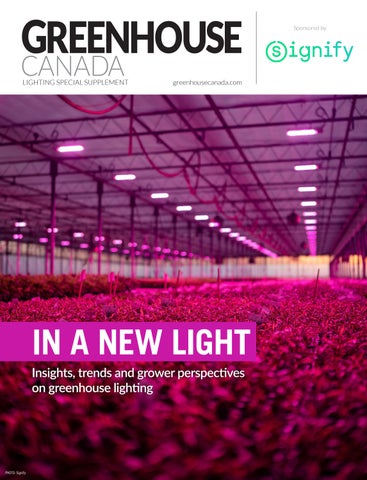
IN A NEW LIGHT Insights, trends and grower perspectives on greenhouse lighting
PHOTO: Signify
BY AMY KOUNIAKIS
Balancing the opportunities of modern lit greenhouse production with the realities of cost, infrastructure and crop demand
When Greenhouse Canada asked Canadian greenhouse producers to tell us how they’re using modern lighting technology in their operations, their responses quickly illuminated a bigger story: supplemental lighting is no longer just about turning fixtures on when daylight darkens. It’s become apparent that there’s an art to managing when, where and how that extra light is delivered. What that art looks like depends on the operation. The 2026 Grower Survey captured a sector at various stages of its lighting journey. Respondents represented fruit and vegetable production, ornamental growers, propagators, and researchers growing a number of different crops. Systems ranged from unlit to HPS, LED and hybrid configurations, and from relatively new installations to equipment eight to 12 years old. Across those differences, however, this project has allowed us to tease out a common theme: growers are becoming more deliberate about what they expect from this tool and the money and time they’re
2 GREENHOUSE CANADA - Lighting Special Supplement 2026
willing to sacrifice to get it. There’s good reason for that scrutiny: Lighting is a significant operating expense, with most survey respondents estimating it accounts for between 11 and 30 per cent of their operating costs. As energy prices rise across the country, growers are responding by dimming fixtures, trimming lit hours, avoiding peak-rate periods and, in some cases, generating their own power. One Ontario vegetable grower said their operation uses daily reports to identify expensive electricity hours and “avoid highest cost periods while meeting my PAR Sum.” Others reported dimming during peak periods while decreasing total lit hours. All of which illustrates how growers are looking much more closely at not only how much light they deliver, but when and why they deliver it. In his survey response, Marc Schurman of Atlantic Grown Organics in Kensington, P.E.I. accurately summed this shift up in four words: “more strategic light use.” Of course, using light more strategically
PHOTOS: Greenhouse Canada
THE ART OF LIGHT
requires more than just finding ways to spend less on it. The other side of the calculation is what that light is capable of delivering in return. FINDING THE VALUE Survey respondents using LEDs in their operations in various configurations pointed to improved crop quality, including uniformity, colour and size, as well as higher yields, faster crop turns and a better ability to hit specific market dates. For many, those production gains are what make the investment worthwhile. What ‘worthwhile’ looks like, however, isn’t the same from one operation to the next. The survey reflected interest in lighting economics and ROI alongside questions around crop-specific spectrum, DLI and energy efficiency. Growers were also considering capital costs, crop performance and available incentives as they weighed future upgrades. But energy savings aren’t the only return growers are weighing. For some, the ability to do more with the power they already have is just as important. CAPACITY COUNTS The economics of modern lighting systems go beyond kWh saved. During Greenhouse Canada’s webinar, The Climate Equation, which explored production under modern LEDs, Atlantic Grown’s Marc Schurman described his farm’s switch partly as an efficiency decision, but also as a ‘capacity play.’ His operation has a fixed amount of available amperage and LED retrofits gave him the opportunity either to increase the micromoles delivered or use the available electrical capacity to light more production area. “It is an efficiency play. It’s all about dollars and cents,” he said. “But for us, there was also a capacity play.” Ron Sant of George Sant & Sons in Kleinberg, Ont., encountered a similar constraint. His operation is on single-phase power, but the LED transition ultimately allowed it to light “about 30 or 40 per cent more area” while also supplying more light to the crop, he told webinar attendees. An incentive program helped get the project started. Those experiences show that a simple payback calculation doesn’t always tell the whole story. Electricity savings are only part of the return; greater production within existing electrical limits can have value of its own. For Sant, it’s clear production capability sits at the heart of the investment. At the end of the webinar, he said the lights helped the operation produce crop quality needed to remain competitive and grow some crops it otherwise could not. “If I could light more, I would,” he added. CAUTIOUSLY OPTIMISTIC While more and more growers are embracing new lighting technology, the survey found optimism about this tool tempered by practical barriers. Roughly half of respondents planned to upgrade or expand their systems over the following two to three years, with energy efficiency, crop quality and access to rebate programs among the drivers identified by survey respondents. For growers without immediate upgrade plans, capital cost, uncertain ROI and utility constraints emerged as common obstacles. A Québec respondent identified better access to financing and subsidies
as the single improvement that would have the biggest impact on the operation. Rebates can therefore become part of the investment strategy rather than merely a bonus after the fact. Schurman described taking upgrades in stages as funding became available. “The return on investment is important,” he said during the panel discussion. His operation could convert a range when funding was available, then wait for another opportunity before continuing the switch-over. Sant took a similarly measured approach, beginning with LEDs in one of two identical bays alongside HPS. Positive results led to further trials and, ultimately, the replacement of most of the operation’s old fixtures over several years. WHAT COMES NEXT? If this project has shown us anything, it’s that the learning curve doesn’t end once the lights are installed in the greenhouse. That learning curve was still evident when we revisited the subject during The Climate Equation. Asked where they needed the most support during an LED transition, webinar participants put crop-response troubleshooting at the top of the list, followed by spectrum and DLI decisions. Climate integration and energy-cost management weren’t far behind. For Schurman, navigating that complexity has meant becoming more data driven. “Before, you could do it probably a little more on the green thumbs approach,” he said. “But now I find that it’s just too difficult to do that, and we have to be more precise in what we’re doing.” Perhaps that brings us back to where we started. There is an art to managing light, but the growers we heard from made it equally clear that there is no single way to do it. Crop, market, energy costs, available infrastructure and the economics of an individual operation all shape the choices made beneath the lights. Finding that balance may be the real art of lighting the greenhouse. Lighting Special Supplement 2026 - GREENHOUSE CANADA 3
GREENHOUSE CANADA is the only national business magazine published exclusively for the commercial greenhouse grower in Canada.
From the Editor
January 2026 - Volume 45, No. 1
AMY KOUNIAKIS | @GREENHOUSECAN
THE ONGOING CONVERSATION Earlier this year, we set out to understand how Canadian greenhouse growers are employing modern lighting technology and how it’s changing their operations. Through our 2026 Grower Survey, we wanted to learn what they were using, what it’s costing, where they’re seeing results and, perhaps most importantly, where questions remained. Their responses took us beyond the fixtures hanging overhead. Repeatedly, growers connected lighting with the larger realities of modern production: energy costs, crop performance, limited electrical capacity, irrigation, climate management and the need to make increasingly precise decisions in an uncertain business climate. Our survey was only the beginning of this conversation. We followed it up by asking lighting specialists to help us make sense of what we heard. Then, we brought growers and technical expertise together for The Climate Equation: Light, Heat & Humidity Under Modern LEDs, a webinar exploring what changes inside a greenhouse as operations move from HPS to modern LED systems. In this first-ever Greenhouse Canada ebook, we bring those conversations together, add further insight and take a look at where the lighting conversation may be headed next. What became clear to me throughout this project is that the industry’s lighting conversation is entering a new, more mature phase where the question has moved beyond just how much light can be delivered to the crop. Growers are increasingly asking how much the crop needs, when it needs it, what that light costs to provide, and what else in the greenhouse must change along with it. There is no single recipe. A propagation greenhouse and a high-wire vegetable operation are solving very different problems. Geography, crop, structure, market 4 GREENHOUSE CANADA - Lighting Special Supplement 2026
and infrastructure all play a role. Our webinar itself demonstrated that contrast through the experiences of our grower panel, consisting of Atlantic Grown Organics’ Marc Schurman and George Sant & Sons’ Ron Sant. That’s why sharing experience matters and why we feature a follow-up Q&A in this ebook, asking Ron and Marc the questions we were unable to get to during the webinar. Beyond those grower perspectives, we’ve included a technical article from Signify that takes a closer look at the science behind modern lighting, along with a resource page to help point you toward further information as you consider what these conversations might mean for your own operation. I would like to thank every grower who took the time to complete our survey, join the webinar and share their experiences and the lessons they’ve learned. I’m incredibly grateful to our webinar moderator, Fadi Al-Daoud, greenhouse vegetable specialist with the Ontario Ministry of Agriculture, Food and Agribusiness, and especially to our panellists, Marc and Ron, and Signify’s Amos Bassi for volunteering their time, experience and insight. Their participation turned this report into a truly enlightening conversation. And finally, this project would not have been possible without the support of Signify. My sincere thanks to their team for sponsoring this initiative and for generously sharing their technical expertise throughout the survey, follow-up discussions, webinar and this ebook. Their support helped us take the questions growers raised and explore them in greater depth. On that note, thank YOU, reader, for joining this conversation. It is our hope that what follows gives you an idea to test, a question to ask or a different way of looking at the light above your crop. Happy reading and growing.
Reader Service Print and digital subscription inquiries or changes, please contact Angelita Potal, Customer Service Tel: 416-510-5113 Email: apotal@annexbusinessmedia.com Mail: 111 Gordon Baker Rd., Suite 400, Toronto, ON M2H 3R1 Editor AMY KOUNIAKIS akouniakis@annexbusinessmedia.com 519.429.5203 Publisher NASHELLE BARSKY nbarsky@annexbusinessmedia.com 905.431.8892 Account Coordinator KATHRYN NYENHUIS knyenhuis@annexbusinessmedia.com 416.510.6753 Audience Development Manager SHAWN ARUL sarul@annexbusinessmedia.com 416.510.5181 Group Publisher & VP, Content Strategy MICHELLE BERTHOLET mbertholet@annexbusinessmedia.com CEO SCOTT JAMIESON sjamieson@annexbusinessmedia.com Media Designer/Design Manager BROOKE SHAW Publication Mail Agreement #40065710 Printed in Canada ISSN 0712-4996 SUBSCRIPTION RATES Canada - 1 Year $41.37; Single $6.00 (plus applicable taxes) U.S.A. - 1 Year $94.41 CAD Annex Privacy Officer Privacy@annexbusinessmedia.com Tel: 800-668-2374 GST - #867172652RT0001 Occasionally, Greenhouse Canada will mail information on behalf of industry-related groups whose products and services we believe may be of interest to you. If you prefer not to receive this information, please contact our circulation department in any of the four ways listed above. No part of the editorial content of this publication may be reprinted without the publisher’s written permission. ©2026 Annex Business Media. All rights reserved. Opinions expressed in this magazine are not necessarily those of the editor or the publisher. No liability is assumed for errors or omissions. All advertising is subject to the publisher’s approval. Such approval does not imply any endorsement of the products or services advertised.
greenhousecanada.com
BY THE NUMBERS
The changing light inside Canadian greenhouses 75 to 80% Light through the darker months
The share of surveyed growers using supplemental lighting primarily from November through March.
Age of Main Lighting System
4.0 vs. 1.9 µmol/J More light from every joule
Modern LEDs can reach approximately 4.0 micromoles per joule, compared with about 1.9 for high-end HPS fixtures.
11 to 30% A major operating expense
Sources: Greenhouse Canada 2026 Grower Survey; The Climate Equation webinar, August 2026; webinar panellist and technical presentations.
The range most growers said lighting represents within their total operating costs.
1/6 Less radiant heat
An LED top light delivers about one-sixth of the radiant heat associated with an HPS fixture, fundamentally changing temperature, humidity and irrigation management.
~50% More investment ahead
Roughly half of respondents plan to upgrade or expand their lighting systems within the next two to three years, with energy efficiency, crop quality and rebate access among the principal drivers.
28% Troubleshooting tops the list
Crop-response troubleshooting was the most frequently selected area in which webinar participants wanted support during an LED transition. Spectrum and DLI decisions followed at 25 per cent. Lighting Special Supplement 2026 - GREENHOUSE CANADA 5
MORE LIGHT, MORE QUESTIONS Q & A: Two greenhouse operations offer real-world perspectives on crop response, climate control, energy and managing the transition to LEDs BY GREENHOUSE CANADA The conversation around modern greenhouse lighting practices didn’t end when our webinar did. During The Climate Equation: Light, Heat & Humidity Under Modern LEDs, growers and industry experts explored what happens beyond the switch from HPS to LED, including changes in temperature and humidity to irrigation, crop response and energy use. The discussion also prompted questions from participants looking for more detail on how those changes play out in real greenhouse operations. Time ran short, and we were unable to address all the questions from participants during
the live webinar, so as a follow-up, Greenhouse Canada went back to our grower panellists, Ron Sant and Marc Schurman, to dig further into some of those unasked questions. Their operations offer distinctly different perspectives: Sant works primarily with ornamental young plants in Southern Ontario, while Schurman grows a diverse mix of greenhouse vegetable crops in Prince Edward Island. Here, they respond to participant questions about crop and variety differences, greenhouse climate, energy and heating costs, light pollution and some of the practical changes they’ve made since moving to LEDs.
6 GREENHOUSE CANADA - Lighting Special Supplement 2026
ABOVE FROM LEFT: Ron Sant of George Sant & Sons Greenhouses in Kleinburg, ON; Marc Schurman of Atlantic Grown Organics Inc. in Kensington, P.E.I.
Q: Marc, have you had to change your lighting strategy when growing such a diverse offering of crops? Marc Schurman: Yes. We grow several types of tomatoes, cucumbers, peppers, basil and other herbs across eight climate zones, so one lighting strategy does not fit everything. A fast-growing cucumber or basil crop may need a different approach from a long-cycle tomato crop, and even our different tomato types do not always have the same production target. Q: Ron, how did LEDs change your ornamental production strategy? Ron Sant: One of the biggest advantages is that we’re able to choose the spectrum we want with the lights, and with some of our lights we can also change the spectrum during operation and dim them if needed. We’re also able to use less PGRs on some species, and the quality of our plant material has improved because the plants are getting more light and better growth. Q: What are some of the differences you’re happiest with after switching to LEDs? Ron Sant: There’s less maintenance required to operate and maintain the system. LEDs are also more efficient, so we’re able to light more area with the same energy cost. Being able to choose the spectrum we want has been another benefit, and some of our lights allow us to change the spectrum during operation or dim them if needed. We also use less PGRs on some species, and the quality of our plant material has improved because the plants are getting more light and better growth.
Q: How do differences between crops and varieties influence your lighting strategy? Marc Schurman: Each crop responds differently to light, and its needs also change with the age of the crop, plant density, crop load and time of year. That means we have to look at the crop itself rather than apply the same lighting target everywhere. Q: How much of the electrical savings from LEDs gets offset by the extra cost of heating to compensate for the loss of radiant heat? Ron Sant: It is hard to quantify the electrical savings against the heating cost because we are giving our plants more light, and we did increase the temperature by about 1ºC to compensate. Our gas price is reasonable, and in our case, we are lighting about 16 to 18 hours. Q: How have you managed greenhouse climate considering the loss of heat from HPS? Ron Sant: We have not adjusted the climate drastically, but we did increase
the greenhouse temperature. We are only lighting young plants, so humidity isn’t a big factor for us. Marc Schurman: In our low-light PEI winters, we use supplemental lighting to support production, but we have to coordinate it with temperature, irrigation, humidity and the amount of fruit the plant can realistically carry. More light without the right climate and crop balance does not necessarily produce a better result. Q: When it comes to light-pollution mitigation strategies, what has been your experience with greenhouse climate control under HPS versus LED? Ron Sant: In our area, light pollution has not become a big problem. There is very little residential development closer than about two kilometres away. Q: How did variety selection change once you moved to LEDs? Ron Sant: Our variety selection did not change, but we did have to adjust feeds, crop time and PGRs. The advantage was that we were able to grow better-quality plants.
Q: What is the biggest lesson you’ve learned about managing supplemental lighting across different crops? Marc Schurman: The biggest lesson has been to manage lighting crop by crop and zone by zone. The goal is not simply to run as many lighting hours as possible. It is to provide the right amount of light, at the right time, while making sure the plant can use it and the additional production justifies the energy cost. We also consider harvest timing and market demand when making those decisions. The questions that followed the webinar underscore just how operation-specific the LED transition can be. There may be no single lighting recipe that works for every greenhouse, but the questions raised by participants point growers toward the considerations that matter most: what the crop needs, how the surrounding climate must respond, and whether the resulting production gains justify the inputs required to achieve them.
Unlock lighting intelligence
Philips GrowWise smart spectrum automatically adapts light spectra to real-time conditions, helping you make
better lighting decisions. Built on decades of plant-light expertise, it brings intelligence, insight and control to your lighting strategy.
Visit us for more information: www.philips.com/horti Lighting Special Supplement 2026 - GREENHOUSE CANADA 7 Philips_GrowWise_Ad_2026_Greenhouse_Canada_7_125x4_75.indd 1 GH_Phillips-halfHZ__Dec26_CSA.indd 1
10/19/26 5:26 PM 2026-10-20 8:51 AM
Sponsored Content
How LED lighting is reshaping greenhouse climate strategy BY SIGNIFY For many greenhouse growers, the conversation around LED lighting began with energy efficiency. The ability to produce more light with less electricity made LEDs an attractive alternative to traditional high-pressure sodium (HPS) systems. But as adoption has matured, growers have discovered something far more significant: LEDs don’t simply change lighting. They change the greenhouse environment itself. For Signify, this broader view of the greenhouse growing environment is central to guiding growers through the installation of Philips LED lighting and the adjustments to climate and irrigation strategies that come with it. As the industry moves toward more precise, intelligent growing environments, understanding how light interacts with climate is becoming as important as understanding light itself.
THE HEAT EQUATION HAS CHANGED For decades, greenhouse climate strategies evolved around HPS lighting. HPS fixtures converted a significant portion of electrical energy into radiant heat. That heat warmed leaves directly, influenced transpiration rates, and helped contribute to the greenhouse’s overall energy balance. When LEDs replaced HPS fixtures, many growers initially focused on light output and efficiency metrics. What became apparent soon afterward was that the crop experienced a very different environment, even when air temperature measurements appeared unchanged. The reason lies in how heat is delivered. HPS systems emit substantial radiant energy that directly warms plant surfaces. LEDs, by comparison, generate considerably less radiant heat at the crop level. Leaf temperature may decrease even when greenhouse air temperature remains constant. As a result, transpiration rates, nutrient uptake, and crop
8 GREENHOUSE CANADA - Lighting Special Supplement 2026
HUMIDITY IS A BIGGER STORY One of the most immediate changes growers observe after adopting LED lighting is altered humidity behaviour. Under HPS, radiant heat often helped drive transpiration and maintain active moisture movement within the greenhouse. With less radiant energy reaching the crop, that dynamic changes. Higher relative humidity levels may persist longer, particularly during lowlight periods, winter production cycles, or overnight transitions. The challenge is not necessarily the humidity itself. The challenge is maintaining the right balance between transpiration, climate efficiency, and disease prevention. Higher humidity can reduce crop water demand while simultaneously increasing the risk of condensation and pathogen pressure if not properly managed. As a result, growers are placing greater emphasis on: • Vapour pressure deficit (VPD) • Air movement strategies • Dehumidification approaches • Energy screens and climate integration • Leaf temperature monitoring Increasingly, successful LED production is less about managing relative humidity percentages and more about understanding how the crop responds to moisture conditions throughout the entire day. The industry’s understanding of VPD has advanced significantly over the past decade, and LED adoption has accelerated that learning curve. Today’s growers are becoming far
PHOTOS: Signify
BEYOND THE FIXTURE
activity can differ from what growers previously expected under similar environmental settings. For many operations, the transition to LED lighting has required a reassessment of climate setpoints, heating strategies, and crop steering approaches that had been refined over decades of HPS production. The fixture may be different, but more importantly, the crop’s experience of the environment is different.
Sponsored Content
more sophisticated in evaluating crop activity, rather than relying solely on traditional temperature and humidity measurements. IRRIGATION REQUIRES A NEW MINDSET The shift in crop climate also influences irrigation strategy. Under HPS, growers became accustomed to predictable transpiration patterns driven by both natural sunlight and supplemental radiant heat. With LEDs, water use patterns often evolve. Many growers discover that irrigation schedules developed during the HPS era are no longer optimal. The question is no longer simply ‘How much water did the crop use?’ The more important question becomes: ‘When did the crop use it?’ Changes in leaf temperature, transpiration behaviour, and daily crop activity can alter irrigation timing requirements throughout the production cycle. Some operations have adjusted first irrigation timing. Others have modified dry-down periods, irrigation frequency, or day-ending water strategies. These adjustments are rarely universal. They vary by crop, geography, greenhouse design, and production objective. What is becoming increasingly clear, however, is that LED success depends on viewing lighting, climate, and irrigation as interconnected systems rather than independent variables. MORE THAN PHOTOSYNTHESIS As LED technology has advanced, attention has naturally focused on spectrum. Much of the industry discussion has centered on photosynthetic efficiency and morphology responses.Yet spectrum also influences climate interactions in ways growers continue to explore. Different spectral recipes can affect: • Plant architecture • Stomatal behaviour • Crop compactness • Pigmentation • Development rates • Crop timing
As research continues to expand, growers are gaining new opportunities to influence plant behaviour without relying exclusively on chemical or environmental interventions. This represents an important evolution in greenhouse production. Rather than treating lighting as a single-variable input measured primarily by intensity, growers are increasingly viewing light as a management tool capable of influencing multiple aspects of crop development. The future of greenhouse lighting will likely involve greater precision in how light is delivered, when it is delivered, and why it is delivered. CROP-CENTRIC CLIMATE STRATEGY Signify’s experience with Philips LED lighting reinforces a key lesson from nearly two decades of commercial LED adoption: growers cannot simply recreate an HPS environment using LED fixtures. The objective is not replication. The objective is optimization. LEDs create opportunities to build climate strategies around crop needs rather than around the limitations of lighting technology. That shift encourages a more crop-centric approach to production. Instead of asking, “What climate should I run because of the lighting system?” Growers can ask: “What climate does the crop need, and how can lighting support it?” This mindset has implications across the greenhouse. The result is a production strategy in which every greenhouse system is aligned with the crop’s needs. For growers facing increasing labour costs, tighter margins, and greater production complexity, that integration may prove just as valuable as the energy savings that initially drove LED adoption. LOOKING AHEAD: FROM EFFICIENT TO INTELLIGENT The next chapter in greenhouse lighting is unlikely to be defined solely by fixture efficiency. Today’s leading systems already
deliver remarkably high performance. Future advancements will increasingly focus on intelligence, adaptability, and ease of use. Growers are beginning to evaluate lighting systems not only on how much light they produce, but on how effectively that light helps support broader business objectives. Questions are becoming more strategic: • How can adjustable light intensity and spectrum help growers manage energy use and costs? • How can lighting strategies adapt throughout the crop cycle? • How can growers maintain consistency across changing weather conditions? • How can complex lighting decisions become easier to manage? These questions point toward a future where systems become more responsive to greenhouse conditions and grower priorities. Rather than operating as fixed infrastructure, lighting systems are evolving into dynamic production tools. The ultimate goal is not complexity. It is simplicity. Technology should help growers make better decisions while reducing the burden of managing increasingly sophisticated greenhouse environments. PROGRESS HAPPENS IN PRACTICE The greenhouse industry has spent years proving that LEDs work. Today, the conversation has moved far beyond that question. The focus is no longer whether LEDs can replace traditional lighting, but how growers can use them to build more precise, resilient, and intelligent production systems. For growers, progress is measured not only by fixture specifications or efficiency tables, but by how effectively lighting supports profitable production. The goal is to use electricity more efficiently while maintaining the light levels, crop performance, and consistency required to protect yield and quality. For Signify, that practical focus guides its approach to Philips LED lighting: connecting lighting technology with the realities of greenhouse production.
Lighting Special Supplement 2026 - GREENHOUSE CANADA 9
RESOURCE CENTRE WHERE TO START Energy incentives, funding opportunities across Canada Planning a lighting retrofit or expansion? Energy-efficiency incentives and agricultural funding vary by province, utility and program. Always check current eligibility and application requirements before making an incentive part of your project budget. Greenhouse Canada’s grower survey clocked participation in programs including Save on Energy and Hydro-Québec, but growers also cited complex eligibility rules and inconsistent funding cycles as barriers to access. **Don’t see a greenhouse-specific program? Look beyond the word ‘lighting.’ Potential support may be found under business energy efficiency, agricultural sustainability, farm infrastructure or clean-technology programs. Check both your electricity or energy provider and provincial ag ministry.
10 GREENHOUSE CANADA - Lighting Special Supplement 2026
CANADA-WIDE Agriculture and Agri-Food Canada This is a very useful and practical starting point for federal agricultural programs and services, including current funding opportunities that may apply to farm infrastructure, clean technology or efficiency investments. GROWER TIP Check before you start shopping. Ask the program administrator whether or not your proposed equipment and project are eligible and whether approval is required before purchase or installation. Also, be sure to ask your lighting supplier whether they have experience preparing the energy-use and equipment information required for incentive applications. BEFORE YOU BUY Questions to ask before investing in greenhouse lighting A lighting system doesn’t just have to fit your greenhouse, it also must suit your energy strategy and production goals. Before signing off on a new installation or retrofit, ask yourself and your provider:
PHOTO: Robert Heemskerk Stock / Getty Images Plus/Getty images
Practical tools, resources and questions to help growers make informed lighting decisions
Lighting decisions don’t end with fixture selection. Provincial production guidance, efficiency programs and industry resources can help growers investigate everything from light abatement and greenhouse climate to incentives and emerging technology.
PROVINCE
WHERE TO START
British Columbia
BC Hydro; FortisBC; B.C. agriculture programs
Alberta
Government of Alberta agriculture and farm programs; local electricity providers
Saskatchewan
SaskPower; Government of Saskatchewan agriculture programs
Manitoba
Efficiency Manitoba; Manitoba Agriculture
Ontario
Save on Energy; Ontario Ministry of Agriculture, Food and Agribusiness
Québec
Hydro-Québec; MAPAQ
New Brunswick
NB Power / SaveEnergyNB; provincial agriculture programs
Nova Scotia
Efficiency Nova Scotia; Nova Scotia Department of Agriculture
Prince Edward Island
EfficiencyPEI; PEI Department of Agriculture
Newfoundland and Labrador
Provincial energy-efficiency and agriculture programs; local electricity utility
Yukon
Government of Yukon energy and agriculture programs
Northwest Territories
Government of the Northwest Territories energy/business programs
Nunavut
Government of Nunavut business, agriculture and energy programs
CROP + LIGHT • What DLI and crop-level PPFD are we designing for, and why? • What evidence supports the recommended spectrum and intensity for my crop? • How uniform will the light be across the growing area?
PHOTO: fstop123 / Getty Images Plus/Getty images
GREENHOUSE + CONTROLS • How will this system affect heating, humidity, irrigation and screen management? • Will it integrate with my existing climate controls? • Does my electrical service have the capacity for this installation and future expansion? COST + RETURN • What assumptions are behind the projected ROI, including energy prices, operating hours, infrastructure costs and incentives? • Can output be adjusted to natural light, crop needs and energy costs?
SUPPORT • What warranty, service and agronomic support will be available after installation? • Can the system adapt if my crops or production strategy change?
Ontario BMP: Managing Nighttime Greenhouse Light Emissions
COMPARE SYSTEMS, NOT JUST FIXTURES Ask potential suppliers to provide comparable information on: PPFD • uniformity • spectrum • efficacy • power requirement • controls • installed cost • warranty • service/support DON’T FORGET ABOUT LIGHT ABATEMENT Before installing or expanding supplemental lighting in your operation, consider whether nighttime light emissions will need to be addressed as part of the project. Your screen package also affects greenhouse light transmission and climate management, making it worth considering early on in the design process.
Reliable today. Ready for what’s next. Equinox Growers, Louisa, Virginia
Watch the Equinox Growers story
Lighting Special Supplement 2026 - GREENHOUSE CANADA 11
Philips_Equinox_Ad_2026_Greenhouse_Canada_3_475x4_75.indd 1
GH_Phillips-equinox_quarter_Dec26_CSA.indd 1
10/19/26 5:24 PM
2026-10-20 8:49 AM
Trusted today. The smart choice for tomorrow. Hollandia Greenhouses, Pitt Meadows, British Columbia
Trust is earned through consistent results, day after day, year after year. Years of experience with Signify and Philips LED lighting led the team at Hollandia to invest in the latest generation of
Philips technology, including color-controllable Philips Toplighting Force and Philips GrowWise. Because the best investments are the ones that continue delivering value season after season.
See the Hollandia story. 12 GREENHOUSE CANADA - Lighting Special Supplement 2026