PM40065710 Return Undeliverable Canadian Addresses To Circulation Dept. P.O. Box 530 Simcoe, On N3Y 4N5 E-Mail: sbrady@annexweb.com
September/October 2008 Volume 64, No. 6 Editor Margaret Land mland@annexweb.com 1-888-599-2228 ext. 269 Page 11
Advertising Manager Sharon Kauk skauk@annexweb.com 1-888-599-2228 ext. 242 Sales Assistant Pauline Cecile pcecile@annexweb.com 1-888-599-2228 ext. 273
Contents Volume 64 • September/October 2008 • No. 6
Production Artist Kelli Kramer Editorial Director Drew McCarthy dmccarthy@annexweb.com
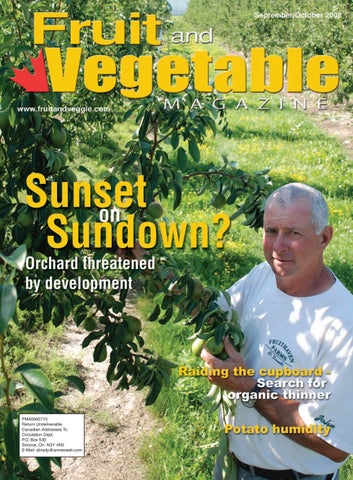
Sunset on Sundown?
VP/Group Publisher Diane Kleer dkleer@annexweb.com
Potato humidity: A key aspect of storage management
PUBLICATION MAIL AGREEMENT #40065710 RETURN UNDELIVERABLE CANADIAN ADDRESSES TO CIRCULATION DEPT., P.O. BOX 530, SIMCOE, ON N3Y 4N5 e-mail: sbrady@annexweb.com Fruit & Vegetable Magazine is published seven times a year (January, February, March, April, May/June, September/October, November/ December) by Annex Publishing & Printing Inc., P.O. Box 530, 105 Donly Dr. S.,Simcoe, ON N3Y 4N5 Printed in Canada ISSN 1488-7959 Circulation e-mail: sbrady@annexweb.com Tel: 1-866-790-6070 ext. 206 Fax: 1-877-624-1940 Mail: P.O. Box 530, Simcoe, ON N3Y 4N5
Page 17
By Jim Meyers .................................................................................................................... 6
By Lukie Pieterse .............................................................................................................. 10
Wine industry blossoming in Nova Scotia By Dan Woolley ................................................................................................................. 14
On-farm food safety programs are no longer optional By Peter Mitham ............................................................................................................... 16
Raiding the cupboard By Dan Woolley ................................................................................................................. 17
Industry experts offer winery, vineyard tips By Dan Woolley ................................................................................................................ 18
Innovative technology allows apples to stay longer in storage ........................................................................................................................................ 19
Ontario government rewards on-farm innovation ............................. 20 Comparing apples and pears from the inside out ............................. 23
Subscription Rates Canada – 1 Year $ 12.72 (includes GST – #867172652RT0001) U.S.A. – 1 Year $ 40.00 From time to time, we at Fruit & Vegetable Magazine make our subscription list available to reputable companies and organizations whose products and services we believe may be of interest to you. If you do not want your name to be made available, contact our circulation department in any of the four ways listed above. No part of the editorial content of this publication may be reprinted without the publisher’s written permission. ©2008 Annex Publishing & Printing Inc. All rights reserved. Opinions expressed in this magazine are not necessarily those of the editor or the publisher. No liability is assumed for errors or omissions. All advertising is subject to the publisher’s approval. Such approval does not imply any endorsement of the products or services advertised. Publisher reserves the right to refuse advertising that does not meet the standards of the publication.
Departments Editorial ................................................................................................................. 4 Fruit & Veggie Online ............................................................................................. 8 Briefs .................................................................................................................. 24 New Products ..................................................................................................... 26 Coming Events ................................................................................................... 27 Eye on Potatoes Potato blight resistant potatoes coming soon ................................................................. 30
www.fruitandveggie.com FRUIT & VEGETABLE MAGAZINE, SEPTEMBER/OCTOBER 2008
PAGE 3
The gathering storm
H
ello, my name is Margaret Land and I’m a cynic. I’m not proud of it but I have to be honest and admit my faults. I’m notorious for finding the storm clouds in every silver lining. I’ve tried my best to keep it under control, fighting back the urge to look for conspiracies in every news story, suppressing the need to find the loophole in ever funding announcement – holdovers from too many years as a daily newspaper reporter. It was hard work. So, when it was announced earlier this year that the Ontario government was bringing in a province-wide ban on “cosmetic” pesticides, I heard that familiar rumble, a sure sign there’s a storm brewing. All the releases, all the articles, stressed the ban would not include agriculture. The cynic in me was having a hard time believing it. Sure, the legislation didn’t include agriculture NOW, but who’s to say what would happen in a year or two, after the initial furor died down and the special interest groups and their lobbyists started applying the pressure? The precedent will already have been set with the passing of Bill 64. The bill hasn’t even been finalized yet and the barometer is rising. A group of more than a dozen health care and environmental organizations are complaining the legislation is “flawed” and are calling for the government to tighten “loopholes.” They would like to see municipalities retain the right to pass their own pesticide bylaws above and beyond those set by the provincial government. “Municipalities must retain the power to protect their citizens’ health by passing bylaws that are tougher than the provincial legislation,” says Jan Kasperski, chief executive officer of the Ontario College of Family Physicians. After all, he adds, “Pesticide use represents a real threat to all of our health.” Dr. Patrick Moore, co-founder of Greenpeace, begs to differ. In an essay published in the National Post in 2006, entitled “How pesticides are saving the Earth,” he points out that the health of people would be under more of a threat if they boycotted eating fruits and vegetables because of pesticide fears. “Eliminating pesticides would make fruits and vegetables more expensive, thereby decreasing consumption and increasing the risk of disease,” he stated, adding that analysis done by SafeFood Consulting Inc. in 2005 PAGE 4
found that without the use of pesticides, crop yields would drop by 30 to 50 per cent, due to insect and disease pressure, and food prices would rise by 27 per cent. He also cites the findings of an international panel of cancer experts, organized by the National Cancer Institute of Canada, that evaluated 70 published studies, ultimately concluding that it was “not aware of any definitive evidence to suggest that synthetic pesticides contribute significantly to overall mortality.” That finding was published in the Cancer research journal in 1997. In light of “growing public concern,” the Canadian Cancer Society has decided to revisit the issue and is organizing and hosting a “ground-breaking” conference at the Toronto Marriott Bloor Yorkville Hotel. The conference will feature experts from around the world discussing the cancer risks of pesticides used on agricultural crops. Entitled Exploring the Connection – A State of the Science Conference on Pesticides and Cancer, “this conference will be an important first step in setting the agenda for future research and action in this area,” says Heath Logan, director of cancer control policy with the Canadian Cancer Society. Presentations include: the state of the science about pesticide • exposure and cancer risk for agricultural workers, people who live near sprayed fields or consume sprayed fruits and vegetables, and children; pesticide residue monitoring in Canada; • the “rationale” for pesticide use in • agricultural and other non-cosmetic settings; the limitations of environmental expo• sure research; a description of European policies • implemented to reduce children’s pesticide exposure, and a discussion about organic farming. • Representation from agriculture in the planning of this conference appears to be limited with only one conference steering committee member out of 11 – Dr. Rene Van Acker with the Department of Plant Agriculture at the University of Guelph – having any involvement with the farmers who actually use crop protection products. And, while
agricultural groups are invited to attend, as of mid-August no farmers or other pesticide end-users are on the agenda to speak, with the possible exception of Dr. Van Acker, Dr. Gerald Stephenson, professor emeritus with the department of environmental biology at the University of Guelph, and Dr. Andrew Hammermeister, manager of the Organic Agriculture Centre of Canada. Looks like the storm clouds are gathering on the horizon and some more wild weather may be ahead for the crop protection industry in Ontario and, possibly, Canada. Horticulture may be in for a bumpy ride. ❦
Letter To the Editor Re: Wine Stores New wine store licences should be tied to the land that produces the fruit from which the 100 per cent Ontario wine is made. Those growers that choose to make wine could be issued a licence to open a store in the urban centre of their choice to reach a broader customer base. Growers who choose to sell their fruit to other wineries could grant that winery the use of the licence that accrues to the land that grows the fruit. Each 10 or 20 acres of vineyard or orchard would be entitled to one licence. This would give back the value of the land that the Greenbelt Plan expropriated without compensation. The AGCO and LCBO could continue to collect the taxes and enforce the regulations as they do now over alcohol sales at on-farm wineries, Beer Store outlets, the foreign owned grandfathered stores, the LCBO outlets, restaurants and special occasion permits at banquet halls. There would be no trade consequences since foreign individuals and corporations would be free to buy vineyards to gain entitlement to the new store licences. It would also make it more difficult for them to Continued on page 22
FRUIT & VEGETABLE MAGAZINE, SEPTEMBER/OCTOBER 2008
Sunset on Sundown? By Jim Meyers
on-the-Lake, which is constrained from development because it’s all prime agricultural land in the Ontario Greenbelt. “The only thing stopping it is its industrial zoning,” Fedorkow said, and any rezoning to residential would be at least two years down the road. He stands to lose an eight-year-old orchard that, besides being a proving ground for new varieties, is just coming into its most productive crop years and could be in production for another 20 years. That has to be upsetting to someone who has babied the trees from the beginning when he laboriously angled the young branches out from the trunks of the trees using cocktail (tooth) picks in order
to achieve a near perfect central leader training system. He would hate to see the trees – now some 12 feet high – ripped out to make room for houses. “But it wouldn’t be the end of the world – it’s just an orchard,” said Fedorkow, 51, whose 14-year-old son collapsed and died last summer. “If you can live through that, you can live through anything.” While Sundown is touted as Ontario’s fresh fruit pear of the future, Fedorkow is more enthusiastic about yet-unnamed Harovin 620, which, from a grower’s perspective, is easier to pick than Sundown, which is more prone to broken stems. Besides HW620 he has 2.5 acres of the Sundown variety on the seven-acre
Photo by Jim Meyers
S
o, what’s next for the new Sundown pear that’s larger and arguably better tasting than the bestknown Bartlett variety? Growing it is the obvious answer, but first it must be “lawyered” to protect the federal government’s plant breeder’s rights and have in place commercial licensing agreements. That delay could add a year – four years, not three – before any trees are in the hands of growers who will have to make some hard business decisions now that their only market for second-grade processing pears has shut down. And, since it takes six years to grow a tree, Sundown pears may not be widely available in grocery stores for 10 years. Budwood would have to be grafted onto rootstock in August in order not to miss a year and as of the end of July, that didn’t seem likely, said a somewhat frustrated Dr. David Hunter with Agriculture and Agri-Food Canada. He’s the plant breeder who brought to fruition some 35 years of research into developing fireblight disease-tolerant pear varieties, including Sundown, that ripens in early October and is larger and juicier than the workhorse Bartlett variety that ripens three weeks earlier. Right now, there’s only about five acres of Sundown grown on five test plots in Ontario – four in Niagara and another in Simcoe – and that’s not nearly enough to meet any large-scale demand by national grocery store chains. And now half of that acreage grown in just one test plot is threatened by development. For a number of years, Niagara fruit grower John Fedorkow has leased land belonging to the Alymer and Del Monte label canning plant in St. Davids. It closed in June and there’s plans to build houses on 50 acres of that land that’s in NiagaraIt could be four years before any large volumes of Sundown trees are in the hands of growers and 10 years in total before the variety is widely available in grocery stores. PAGE 6
FRUIT & VEGETABLE MAGAZINE, SEPTEMBER/OCTOBER 2008
Photo by Jim Meyers
John Fedorkow with his 2008 crop of Sundown pears. The crop was in the process of being thinned in late July in a field near the former Alymer and Del Monte canning plant. Fedorkow is in danger of losing his orchard to a housing development.
and Vineland Station federal research stations) Bounty, Pride, Prime or Gala. “It created a lot of interest and people would like to try them but, unfortunately, they’re not available,” Huisman said. “The buzz created may have been a bit of a wasted effort other than making Agriculture Canada look good because it did something,” he said, adding that growers have to order the trees to start the ball rolling. Dr. Hunter has a different take on the promotion that saw some 25,000 Sundown pears from Fedorkow’s orchard given away. “As an outreach to the consumer public, it was a good experience,” he said.
Photo by Jim Meyers
test site as well as canning varieties Harrow Crisp and Harrow Gold and a few Bartletts. Sundown sizes up better than the workhorse Bartlett variety and trees bear more fruit. Fedorkow spaced his trees 12 feet apart with 18 feet between rows and feels he could have planted them closer together (10 x 16) and increased production by 25 per cent. Leo DeVries from Fenwick, located above the Niagara Escarpment, is also in the in the federal CAN-ADAPT fireblight test program. He spaced his 150 Sundown trees 10 x 20 and feels they could be spaced 10 x 18. Many of the varieties in his six-acre test plot are canning varieties since that’s what the industry wanted when testing began and the fruit processing plant was owned by Nabisco Foods. “Times change,” he said. It’s likely this year’s limited crop of Sundown pears will be marketed through wholesalers to upscale markets in Toronto and Montreal, Adrian Huisman, Ontario Tender Fruit Producers’ Marketing Board manager, said in late July. The public got a taste of the new pear at last fall’s Royal Agricultural Winter Fair in Toronto and were asked (also online) to vote for a name for the up-to-then HW614 variety. Sundown was the handsdown winner, getting 6,000 of the 11,000 votes cast. Other possible names were Harovin (the combination of the Harrow
“It let them know what we are doing and, hopefully, there will be enough product on the market to maintain that interest.” By the time Sundown is readily available, there’ll be a new generation of palates to win over. By whetting the public appetite now, it’s hoped a demand will be generated and growers will want to plant the Sundown variety when it’s available. But legal red tape regarding plant breeder’s rights and commercialization licences are putting a hold on propagation. Dr. Hunter said he is applying pressure to at least get propagation licences in place or risk losing a year in bringing the variety to market. “If budwood isn’t propagated in August, a year will be lost,” Dr. Hunter said in late July. His personal philosophy is “if it’s good enough to be introduced as a variety, (then) get it out there and let the marketplace decide if it’s a success or a failure.” The development of Sundown and other recently named varieties goes back 35 years to a time when fire blight was becoming a problem in orchards. The bacterial disease enters succulent tissue at flowering time and kills young pear shoots that look like they’ve been torched by fire. Research began at the Harrow station near Windsor and moved to Vineland Station in 1995. Four years later, four sites in Niagara were chosen because for field testing because they are so geographically diverse – Grimsby, the traditional pear growing area in the west end; Fonthill on the Niagara Escarpment; Lakeshore Road on Lake Ontario, and inland in St. Davids. The fifth test site is in Simcoe. ❦
The public got a taste of the new pear at the 2007 Royal Agricultural Winter Fair in Toronto. They were also asked to vote for a name for the up-to-then HW614 variety. Sundown was the hands-down winner, getting 6,000 of the 11,000 votes cast.
FRUIT & VEGETABLE MAGAZINE, SEPTEMBER/OCTOBER 2008
PAGE 7
Read these stories and more at www.fruitandveggie.com
NEWS HIGHLIGHTS
NEW PRODUCTS
• Some blackberry varieties make production easier
Movento™ now registered June 24, 2008, Guelph, Ont. – Movento is a new two-way systemic foliar insecticide now registered in Canada to control a broad range of sucking insect pests in apples, grapes and a number of vegetable crops.
• Alberta potato farmers receive $23.5 million • Okanagan apple growers expecting ‘fairly strong’ prices for this year’s crop • New potato variety named after Newfoundland river
Helping grape growers fight cutworm damage August 7, 2008, Dorchester, Ont. – Grape growers have a new tool to protect their vines next spring from climbing cutworm chomping at the buds and reducing yields. The Pest Management Regulatory Agency (PMRA) recently granted a Minor Use Label Expansion to Pounce® 384EC insecticide for control of climbing cutworm in grapes.
• New global tomato standard • Guide for saskatoon production costs available • OnTrace launches premises registry
WEB EXCLUSIVES Ontario packaging company assembling own line of baskets Miles Containers and Packaging Supplies recently purchased a new, custom built, gluing machine capable of making 1.5-, 2-, 3- and 4-litre paper produce baskets. To spice up the baskets, the company has also designed its own graphics, resulting in a new fresh look. The baskets are assembled in an off-site warehouse, where the baskets are handled and packaged. Another feature to add to the baskets is the Miles Containers label that is on every bag once it has been made and handled. For more information, call 519-443-7107 or visit www. milescontainers.ca. Read the full story at www.fruitandveggie.com.
Minor Use Label Expansion – Ranman 400 Jim Chaput, OMAFRA, Minor Use Coordinator, Guelph July 14, 2008, Guelph, Ont. – The Pest Management Regulatory Agency (PMRA) recently announced the approval of a minor use label expansion for Ranman 400 SC fungicide for suppression of root dieback, forking and cavity spot caused by Pythium spp. on carrots in Canada.
BUYERS GUIDE The 2008 Fruit and Vegetable Buyers Guide is your key reference tool to bring the entire industry together in just one directory.
DIGITAL MAGAZINE To sign up for a free trial of Fruit and Vegetable magazine’s digital version, go to www.fruitandveggie.com.
PAGE 8
FRUIT & VEGETABLE MAGAZINE, SEPTEMBER/OCTOBER 2008
FERTILEGROUND FERTILE www.fruitandveggie.com Daily News
Blog
ENEWS
Book Store
Job Board
Classifieds
Web Exclusives Current Issue
Pests
Disease Mngt. Buyers’ Guide
In the Field
Industry Issues
EyeStandards on Potatoes
Potato humidity: A key aspect of storage management
S
hrinkage and the consequent loss of weight of potato tubers is one of the most significant challenges that faces anyone in charge of a potato storage facility. Potato tubers contain about 80 per cent water, and potatoes in storage will loose a significant amount of this water by evaporation if the tubers are surrounded by dry air during the storage period. The drier the air of the storage facility, the greater the evaporation, and thus, the more the loss in weight. Effective storage of potatoes always requires an equal balance between the water in the potato and the humidity of the surrounding air. Evaporation is responsible for the majority of weight losses when potatoes are stored, and it is therefore important that this is kept to the lowest possible level by the storage manager. By continuously surrounding the potatoes with air containing a high relative humidity, evaporation can be significantly reduced, and weight losses minimized. Water losses cause the potato to be dehydrated, resulting in weak potatoes with poor quality, inferior texture, discolouration when processed, and often loss of taste when offered to the table market. According to potato specialists at the University of Idaho’s Storage Research Unit in Kimberly, the single most important part of the storage season begins with the wound healing or curing period. During this period, they say, potatoes need to be stored for approximately two to three weeks at 50 to 55 F and 95 per cent relative humidity. During this time, the potato becomes more resistant to storage diseases and shrinkage. Wound healing, repair of cuts and bruises, the formation of a protective layer between the tuber surface and the interior tissue, are all required for potato lots, whether they are intended for short- or long-term storage. Humidification can considerably improve the quality of potatoes during storage. Since dehydration leads to PAGE 10
decreased weights, storage losses can be and the temperature of the air increases. reduced by the prevention of evaporation. The air passing over the potatoes will also If the air in a potato storage facility is pick up moisture from the potatoes due not humid enough, the greatest dehydra- to transpiration and respiration. For the tion occurs on the bottom layers of the example, let’s assume the amount of water potato pile, because these potatoes are the vapour in the air does not change. If the air first to come into contact with the dry air. warms 2 F, the RH will drop to about 91 Therefore, these potatoes lose the most per cent. If the temperature rises by 5 F, the water and become the most dehydrated. RH would drop to about 81 per cent. The This implies that the potatoes subjected lower the humidity of the air surrounding to the most weight are also subjected to the potato, the greater the rate of moisture the greatest potential for bruising damage. loss from the potato to the air.” Humidification enables potatoes to be Trivers advises storage managers to stored in much higher piles without the reduce the temperature rise across the risk of damage caused by bruising. Humidity in the potato storage facility is closely connected to the basic principles of relative humidity. Potato storage specialist Doug Trivers, based in Ontario, explains that relative humidity (RH) can be defined as “the actual amount of water vapour in an air mass relative to the amount of water vapour that air can hold at that temperature.” As air heats up, the ability to hold moisture increases. If air is warmed without changing the amount of moisture in the air, the relative humidity will drop, Trivers notes. The larger the increase in temperature, the greater the driving force of water from the potato to the air. “Consider air enter- An example of a centrifugal humidifier installed in a ing a potato pile at potato storage. This system works by throwing water 45 F and 98 per cent from a spinning disk across a set of knives to produce RH,” Trivers says. “As a mist of small droplets. This kind of system requires the air passes over the regular cleaning of disks, knives and pump screens to potatoes, it removes remove mineral deposits but is fairly low maintenance, heat from the potatoes portable, and has low cost and flow rate variables. FRUIT & VEGETABLE MAGAZINE, SEPTEMBER/OCTOBER 2008
Photo courtesy of Doug Trivers
By Lukie Pieterse
Shrinkage and the consequent loss of weight of potato tubers is one of the most significant challenges that face anyone in charge of a potato storage facility.
stored potato pile to about 2 F to minimize shrinkage. He is of the opinion that the temperature of air entering the pile should be no more than 2 F cooler than the temperature of the tubers. “When cold fresh air is brought into the storage, the effect on humidity is dramatic,” he says. “If outside air at 30 F and 80 per cent humidity is warmed to 45 F, the RH drops to about 30 per cent. If this outside air is mixed with return air ( 47 F, 91 per cent RH from above) to provide 45 F air, the humidity will be about 90 per cent. To maintain a high humidity environment, a humidifier will be required.” Trivers points out that a humidifier introduces liquid water into the air stream that can be evaporated to increase the amount of water vapour in the air. “The amount of actual humidification depends on the time the water and air are in contact and the temperature of the water,” he says. “The longer the air and water are in contact, the greater the chance for heat from the air to evaporate water.” One of the most important factors in how much humidification is provided is the temperature of the water in relation to the dew point of the air mass, according to Trivers. “If the water temperature is lower than the dew point, no humidification will take place. As a matter of fact, water vapour from the air will condense to the water particles to dehumidify the air. In most storages, heat is released to the air as it passes across the fans. This heat is available to evaporate water.” In Trivers’ experience, humidifier water temperature must be greater than the dew point of the plenum air in a storage facility to achieve humidification. According to Trivers, storage humidity is more dependent on the ventilation system management then on the type of humidifier. “All types of humidifiers on the market today can be effective if properly managed and maintained,” he says. “The selection of a humidification system should be based on the system management and maintenance, not necessarily on the reported efficiency of the system.”
In a brief overview of humidiciation systems, Trivers decribes a centrifugal system as a system where water is thrown from a spinning disk across a set of knives to produce a mist of small droplets. This kind of system requires regular cleaning of disks, knives and pump screens to remove mineral deposits. It requires fairly low maintenance, is usually portable, low cost, and flow rate variable. A high pressure water system involves a high pressure pump to deliver water at 500 to 600 psi to a system of fog nozzles, according to Trivers. This kind of system, he says, requires regular cleaning of nozzles and screens, belt tension adjustment, and pump oil level maintenance. This humidification system is relatively low cost and can be used for multiple bins, but storage managers should expect free water on the plenum floor. This can be managed with a floor drain. A pneumatic system of humidification involves pressurized air from an air compressor and water under pressure mixed at a fog nozzle. The storage manager needs to clean nozzles and screens regularly, maintaining the compressor, replacing the water filters as well as the air line filters when needed. Although this kind of system provides smallest particle size of all misting systems, Trivers pointed out that proper management is required to prevent small particles from depositing “free water” on potatoes. The last type of humidification system that Trivers mentions is an “evaporative cooling cell” system where air passes at low speed across a water soaked cellulose matrix. The cell is constructed with two sets of corrugations, one set allows water to trickle down from the top to wet the pad.
FRUIT & VEGETABLE MAGAZINE, SEPTEMBER/OCTOBER 2008
Potato tubers contain about 80 per cent water. The drier the air of the storage facility, the greater the evaporation, and thus, the greater the loss in potato weight. Effective storage of potatoes always requires an equal balance between the water in the potato and the humidity of the surrounding air.
A second set of horizontal corugations are provided to accommodate airflow. The air passing the wetted material picks up moisture along the way. This kind of system virtually eliminates free water from the plenum, he says, and allows for evaporative cooling in dry climates. It is important though that the storage manager prevents the pad from repeated wet /dry cycling to extend the life of the system. The system has limited evaporative cooling benefit in humid regions, is relatively costly, and requires a larger fan room/plenum. In arid regions, additional humidification may be required downstream of the cell. ❦ Further information on potato storage humidification can be obtained from Doug Trivers at Dayson Agrivent: 905-7706662, or daysonagrivent@sympatico.ca. PAGE 11
From pest control to environmental safety, new Delegate* insecticide from Dow AgroSciences brings a higher level of performance to your fruit or vegetable business. Delegate uses a novel mode of action to deliver quick knockdown of a wide range of problem pests with a low impact on beneficial insects. Combine these features with a low use rate on a wide range of fruit and vegetables and you’ll find many reasons to put new Delegate to use in your Integrated Pest Management program. For more information, call the Solutions Center at 1.800.667.3852 or visit dowagro.ca.
EVERY GROWER HAS THEIR OWN REASON TO DELEGATE.
*Trademark of Dow AgroSciences LLC 0308-7554
Wine industry blossoming in Nova Scotia By Dan Woolley
D
elegates at the Third Atlantic Canadian Wine Symposium saw for themselves how fast the Nova Scotia vineyard is growing and changing. The symposium’s bus tour focused on the eastern Annapolis Valley, taking them to numerous wineries, including Dr. Jonathan Murray’s Muir Murray Estate Winery near Wolfville. In 2005, Dr. Murray planted his first vines. He now has 13 acres planted next to an old farm building that is being remodelled into a winery and cellars. Dr. Murray also has another 10 acres of vines planted on 50 acres he owns in the nearby Gaspereau Valley. With 23,000 seedlings currently growing in greenhouses, he plans ultimately to have 200 acres of vines in production. Muir Murray Estate Winery’s focus is on hybrid varieties, with Foch, Baco Noir, Seyval and L’Acadie planted in the cooler Wolfville vineyard, and vinifera varieties such as Chardonnay, Pinot Noir, Cabernet Franc, Riesling and Pinot Grigio, planted in the milder microclimate of the Gaspereau vineyard. Dr. Murray estimates that within five years, his winery will be the largest in Atlantic Canada, producing 50,000 cases (600,000 bottles) of wine annually. What will it cost? “I don’t know, but my wife does,” said Dr. Murray. “But you can quote me, a project this size will cost in the millions.”
PAGE 14
Photos by Dan Woolley
Top: Pete Luckett began planting wine grapes in 2005 and plans to add another 20 acres and possibly a winery by 2011. In 2007, he planted more red varieties, including Lucie Kuhlmann, Marechal Foch and Triomphe d’Alsace. He is now thinking about planting a white hybrid, L’Acadie. Bottom: In 2005, Dr. Jonathan Murray planted his first vines near Wolfville, N.S. He now has 13 acres planted next to an old farm building that is being remodelled into a winery and cellars, Muir Murray Estate Winery. FRUIT & VEGETABLE MAGAZINE, SEPTEMBER/OCTOBER 2008
Pete Luckett, the owner of Pete’s Frootique, has planted some table grapes on his acreage and is obtaining sugars and maturity equal to what grape growers on south facing slopes in the Gaspereau Valley of Nova Scotia are achieving.
FRUIT & VEGETABLE MAGAZINE, SEPTEMBER/OCTOBER 2008
doesn’t compete with the vines for nutrients and doesn’t spread to become a weed itself. Ewert also applies manure and compost once a year with a bit of kelp applied pre-planting to help boost soil potassium. He plans to start a spraying program with compost tea for nutrient management and mildew control. Drip tape has also been installed along his vine rows as drought insurance. A few kilometres away, Pete Luckett, the owner of Pete’s Frootique, has 10 acres of vines growing on and old farm he purchased about eight years ago. He began planting wine grapes in 2005 and plans to add another 20 acres and possibly a winery by 2011. Because of his north-facing slop, Luckett chose the vigorous, winter-hardy hybrid Leon Millot as his first planting. In 2007, he planted more red varieties, including Lucie Kuhlmann, Marechal Foch and Triomphe d’Alsace. He is now thinking about planting a white hybrid, L’Acadie. Luckett has also planted some table grapes on his acreage and is obtaining sugars and maturity equal to what grape growers on south facing slopes in the Gaspereau are achieving. ❦
Photos by Dan Woolley
Bruce Ewert owns L’Acadie Vineyards, Nova Scotia’s first organic vineyard. The operation, which has extensive plantings of L’Acadie and a smaller plot of Leon Millot, opened in the fall of 2007.
A retired surgeon from Bermuda, Dr. Murray says he started the winery and vineyard project when he became bored with retirement. “It is no longer a hobby,” he said. “It is a business. This will not be just a farm winery.” Wayne MacDonald, a pioneering veteran of the Nova Scotia winery industry, is helping Dr. Murray develop the estate winery. This is MacDonald’s fifth vineyard and second winery project in the province. The tour moved on to visit the Gaspereau Valley, including Benjamin Bridge vineyard, an organic vineyard currently in development but slated to open in 2009. Co-owned by Gerry McConnell, chairman of the symposium’s organizing committee, the operation’s main product line will be champagne-style wines, which will start appearing in 2010 and 2011. The operation’s first vines were planted in 2000. The vineyard contains the first successful Nova Scotia planting of 16 acres of Semillon Blanc. Benjamin Bridge also grows Chardonnay, Vidal and Pinot Noir varieties. Nearby, Hans Christian Jost’s Gaspereau Vineyards has 13 grape varieties on 35 acres. The vineyard’s winemaker, Gina Haverstock, received a total of seven medals – including five gold – for her wines at the 2008 All Canadian Wine Championships. On the other side of the Gaspereau Valley is Nova Scotia’s first organic vineyard, L’Acadie Vineyards. Owner Bruce Ewert has extensive plantings of L’Acadie and a smaller plot of Leon Millot, all on 30 acres. He chose those varieties for their pH and acidity. Ewert, who has previous wine making experience in Australia, California and British Columbia (chief winemaker at B.C.’s Hawthorne Mountain Vineyards and Summerhill Pyramid Winery), opened his new winery in the fall of 2007. Since then, the winery’s L’Acadie Star has won a double gold, Alchemy – a special blend made with dried grapes – has won a gold, while the Leon Millot took a silver medal at the All Canadian Wine Championships. Ewert developed his vineyard on a north-facing slope and says his three biggest vineyard management issues are “weeds, weeds, weeds.” As a result, the rows between the vines are harrowed and Courtney tall fescue is planted as a ground cover. The fescue
Wayne MacDonald, a pioneering veteran of the Nova Scotia winery industry, is helping to develop Muir Murray Estate Winery. It is MacDonald’s fifth vineyard and second winery project in the province. PAGE 15
On-farm food safety programs are no longer optional By Peter Mitham
R
ecent food safety issues linked Morley says the aim was to create as not going to get paid any extra to do it,” to fresh produce, such as the comprehensive a manual as possible that Schouten says. salmonella outbreak in the U.S. would serve the needs of growers regardless Appointing a specific person to oversee and the Canadian warning of suspected of what part of the country they live in. the implementation and monitoring of onListeria contamination in sliced mush“We’re trying to provide a consistent farm food safety protocols is the best way rooms, should be a reminder to growers approach across the country,” she says. to make sure monitoring of a program of the importance of proper production Major risks targeted by the manual doesn’t get lost in the bustle of other protocols. include bacterial contamination of pota- responsibilities, he adds. While high-protein foods, such as meats toes, as well as solids that may contami“It’s the writing down that’s the proof and dairy items, have been the traditional nate or compromise the crop. you did what you said you’d do,” says focus of food safety efforts, B.C. Ministry The focus of the protocol outlined in the Morley. Without the accurate record of Agriculture and Lands food safety and manual includes water use, handling prac- keeping, a protocol won’t provide the quality specialist Alison Speirs says that’s tices, sanitation and farm management. protection from risk it’s intended to have. no longer the case. The manual has been a boon for Pete The good news is that growers surveyed “The majority of our cases are now Schouten, a partner with Wes Heppell in by B.C. Fresh Inc., which handles 85 per produce-based,” she says. Heppell’s Potato Corp. of Surrey, B.C., cent of fresh market produce grown in the It’s an issue of which Katija Morley, though the partners already believed they Fraser Valley, have scored above 90 per an on-farm food safety technical specialist were producing a safe crop. cent in checks by SGS Group, an internafor the Canadian Horticultural Council Using the manual enhanced more than tional inspection, verification, testing and (CHC), is keenly aware. food safety protocols, Schouten says, certification company. “Fresh fruits and vegetables are causing because it made Heppell’s take a look at Rick Gilmour, general manager of problems out there,” Morley says. all aspects of its operations. This prompted operations with B.C. Fresh, expects to have While much of the concern in Canada changes that have helped the farm become all the company’s growers and packers focuses on imports, domestic food safety more efficient and responsive to market assessed by the end of the 2008 growing programs help ensure confidence in the demands. season. A group rate for the assessment domestic supply. These can’t insulate “The manual has changed our perspec- was struck that reduced the cost to growers domestic produce from fallout when a tive on how we do our business,” Schouten for the audit to just $1,200 apiece. foreign product falls short, but do offer says. “The manual can play a big part in While the B.C. industry resisted reassurance to shoppers that can give local future in the organization of farms.” adopting the protocols for more than a products an edge during the recovery from Applying the manual will be an added decade, Gilmour says the recall of pet a scare. cost – not so much in cash spent but in time. products by Menu Foods showed the The CHC’s food safety manual for “Yes, we have to do it and we’re grocery industry what the fallout could be potato producers is one example if a similar scare hit human of a program that’s helping food products. growers provide retailers with “It could pretty much the assurance of safety their bury a company like ours,” looking for, Morley says. he says. Piloted on farms across Recognition of the risk Canada, the manual is split has prompted B.C. Fresh into five parts focusing on to require that its growers farm practices, documentation, sign a marketing agreemonitoring of the protocol, ment in which growers training of employees and agree to co-insure B.C. overall program management. Fresh for $5 million worth It parallels similar manuals of liability coverage. developed for the tree fruit “Industry was resisting sector and others, and is recogchange for 10 years or nized as “technically sound” by Meats and dairy items have traditionally been the focus of food more,” Gilmour says. “We the Canadian Food Inspection safety efforts but fresh produce now represents most of the recognize time has run food safety and quality issues being seen. Agency (CFIA). out.” ❦ PAGE 16
FRUIT & VEGETABLE MAGAZINE, SEPTEMBER/OCTOBER 2008
Raiding the cupboard The search for an organic apple thinner By Dan Woolley
T
he search is on in Nova Scotia’s Annapolis Valley for an organic blossom thinner for apple orchards. “The big driver on this is Honeycrisp,” explains Charles Embree, a tree fruit scientist with the Agriculture and Agri-Food Canada’s Atlantic Food and Horticulture Research Centre. Honeycrisp, a highly desirable and premium-priced apple, is notorious for its bi-seasonality, bearing an overabundance of blooms with a resulting crop of undersized apples in one year, and, in the second year, blooming sparsely due to diminished tree vigour before coming back the next year with a vengeance. Blossom thinning in the spring can help Honeycrisp trees produce a consistent harvest year after year of the much soughtafter large fruit. But Dinitro, a chemical thinner, can no longer be used after it was decertified due to environmental sustainability issues. The product’s decertification has “created quite a problem,” says Embree. AFHRC was already working on blossom thinning trials using organic products when Dr. Sara Avila-Good of nearby Acadia University, an expert on pollination-related issues, suggested joint collaboration on organic blossom thinners. “We thought it would be a good match,” recalls Embree. In May of 2007, Dr. Miriam Ferrer, who is doing postdoctoral research fellowship on organic growth regulators for apples, began her research internship with Dr. Avila-Good. Before beginning her research internship, Dr. Ferrer says she met with apple growers. She has two organic producers, Craig and Doug Nichols, on her research team. The apple producers provided her with data on what sort of products they were using for crop load management, application techniques and what they thought could be useful as blossom thinners.
During 2007, Dr. Ferrer examined interested in the “self-incompatibility” about 40 products commonly available in system of hermaphroditic fruit trees that grocery and farm supply stores, including prevent them from self-pollinating. It is this mayonnaise, egg whites, vinegar, cream professional interest that originally brought of tartar, soap, table salt, lime sulphur, her to Acadia to work with Dr. Avila-Good, calcium chloride, corn oil, citric extracts, an expert on self-incompatibility. clove oil and even sea water. The organic thinners research is Dr. The AFHRC then screened the potential Ferrer’s first scientific research project on organic blossom thinning agents, taking fruit trees. She previously completed her samples of twigs from the centre’s organic honours thesis on medicinal plants back trial plots from so Dr. Ferrer could remove home in Mexico. Dr. Ferrer’s research the pollen for analysis in the laboratory is funded jointly by the Mathematics of and greenhouse at Acadia University. Information Technology and Complex As a result, Dr. Ferrer identified five Systems (MITACS) and the NSFGA. ❦ potential organic thinners. The naturally occurring minerals were applied this season to the branches of Honeycrisp trees planted in AFHRC’s experimental organic plot. What was used cannot yet be disclosed. “We want to make sure first they will work in the field trials,” says Dr. Ferrer. The potential thinners were applied at various concentrations in the AFHRC orchard to mimic the different conditions possible in the field. Dr. Ferrer’s research internship concludes with this year’s apple harvest. She will then do a technical analysis and a final report for presentation to the Nova Scotia Fruit Growers Association (NSFGA) in December. Although Honeycrisp was the focus variety of her research, Dr. Ferrer also examined the polli- The bi-seasonality of Honeycrisp is one of the main nation process in Macin- drivers for researchers who are currently looking tosh, Jonagold and Gala. for an organic apple blossom thinner. Spring blosAs a plant breeder, som thinning can help Honeycrisp trees produce a Dr. Ferrer is particularly consistent harvest year after year.
FRUIT & VEGETABLE MAGAZINE, SEPTEMBER/OCTOBER 2008
PAGE 17
Industry experts offer winery, vineyard tips
Photo by Dan Woolley
By Dan Woolley
T
wo of Canada’s most knowledgeable and experienced winery and vineyard observers provided some timely tips during the Third Atlantic Canadian Wine Symposium, held this past summer. Tony Aspler, Canada’s foremost wine writer, and Paul Troop, a winemaker on B.C.’s Salt Spring Island, shared their views and advice on vineyard production and winery development in the Atlantic provinces during the opening session of the symposium, hosted by Nova Scotia. Aspler, based in Toronto, Ont., said he has noted tremendous growth in the industry since the late 1970s when Roger Dial founded Nova Scotia’s first modern winery and vineyard. There are now 10 wineries in the province, he added, while another two are slated to open in 2008 and more are expected to begin production in the next few years. Troop said the situation on the B.C. Gulf Islands, where he lives, “is very similar to here. It is almost eerie.” Currently, the Gulf Islands have almost 500 acres in vineyards and 30 wineries, explained Troop. “You are going through the same growth situation we did seven or eight years ago.” As a new wine region, Aspler believes Nova Scotia should play to its strengths. “You have a signature grape that no one else has,” he said. “Think of L’Acadie in those terms.” Besides its winter-hardiness, the grapes can be made in a variety of styles, Aspler said. “You are never going to ripen Syrah and Cabernet Sauvignon. Concentrate on sparkling wines and your aromatic wines, the dessert wines.” PAGE 18
The high acidity of Nova Scotia wines means not only do they last a long time, they also possess “a special cachet,” declared Aspler. “Don’t compare yourself to Ontario and British Columbia. You should compare yourself to the Loire Valley, the Moselle, the Alto Adige. What makes your wines so special is they go so well with the food you produce. You should market them as food wines. “You want to produce your wines as a region,” he added. “Embrace the emblem of Brand Nova Scotia.” Aspler also recommends the rigorous application of quality regulations to Nova Scotia’s wines. “One of the triumphs in Ontario and B.C. was the setting up of VQA. These regulations gave Ontario the basis for the quality of wines it now has.” Troop is more cautious on the issue of regulation, cautioning growers to make sure any regulations adopted for the Nova Scotia industry doesn’t become too rigid “because your industry is too young,” he said. Regulation can be very useful in protecting what is very good “but it could be 100 years before you know what works well here.” The VQA has been a “phenomenal marketing tool” but it has also stifled the ability of the industry to work with new varieties outside the official VQA list, Troop said. “I strongly recommend you don’t allow a restrictive list of varieties during your lifetime.” Picking the right varieties and production methods also play important roles in grape and wine quality. “A cool climate viticulture region can only be defined by the grapes you can grow, not the weather you have,” said Troop. “The trick is to grow grapes that can ripen 10 years out of 10.” He recommends growers try to reduce input costs by planting disease-resistant varieties. “First of all, I look at resistance. Our main disease problem is botrytis. You have other mildew issues.” Troop praises the hardiness of the vines of Swiss plant breeder Valentine Blattner,
noting their “vastly superior disease resistance.” Out of 60 Blattner vines he has tried, he has narrowed them down to about 20 varieties for commercial planting. When selecting vines, Troop recommends choosing those that are upright, vertical in growth and produce few laterals. “If they are not, they will cost more to manage.” Troop believes the major issues in vineyard management are row spacing and weed control. In an establishment year, it is very important to allow the young vines a good, healthy start by keeping the ground clear, he said. Round Up in combination with Ignite will work; but plowing is probably a better idea for soil health, he said. “I have been using a heavy woven ground cloth.” Troop has also found that spraying accounts for 15 per cent of the gross value of his grapes. As well, organic vineyard management increasingly means sustainable vineyard management. “Any time you eliminate a tractor pass through your vineyard, you are saving money,” he said. “Fuel costs have doubled this year. What will happen 10 years from now?” Aspler praised “the collegiality” of Nova Scotia’s grape growers and vintners. “Sharing and caring about each other will serve you well in the future,” he said. It was a sentiment shared by Troop. “Pull on the same rope in the same direction,” he added. The enthusiasm of the Nova Scotia wine industry is infectious, said Aspler. “I think the future is yours. You only have to go upwards from here.” ❦
Photo: Paul Troop, a winemaker on B.C.’s Salt Spring Island, shared his views and advice on vineyard production and winery development in the Atlantic provinces during the opening session of the Third Atlantic Canadian Wine Symposium, hosted by Nova Scotia.
FRUIT & VEGETABLE MAGAZINE, SEPTEMBER/OCTOBER 2008
Innovative technology allows apples to stay longer in storage
W
hen apples are brought out of storage in January or February, they are usually in peak condition – at least if you eat them right away. But sometimes, things can go wrong in storage, leading to fruit that is mushy, not crisp and unflavourful. However, a new technology is giving apples a longer storage life after harvest and is also applicable to organic production. Nova Scotia researcher Dr. Robert Prange of Agriculture Canada and Agri-Food Canada (AAFC) has, along with AAFC research scientist Dr. John DeLong, invented the HarvestWatch technology that helps extend the storage and marketing shelf life of apples to as long as eight months from the traditional two or three. The technology uses a sensor and software system to store apples in long-term
HarvestWatch technology is helping extend the storage and marketing shelf life of apples to as long as eight months using a sensor and software system.
storage at oxygen levels below one per cent. The reduced oxygen level slows the ripening process and extends storage time while maintaining the look, taste and texture of the fruit. “The lower you can get your oxygen levels, the better and longer you can keep them,” explains Dr. Prange. Dr. DeLong says the technology works on every apple variety the researchers have tested and “in fact it works on everything that has a green pigment in it, such as a green pear, green vegetables and green leaves, where it will generate the same response.” Dr. Prange says the system is a nonchemical method that makes existing controlled atmosphere technology work to a finer level so the apple storage rooms are brought down to below one per cent in concentration of oxygen. The technology was developed by AAFC in collaboration with a Nova Scotia company – Satlantic Inc. It is licensed to an international company in Europe – Isolcell Inc. – and is installed in apple storage facilities there, as well as in New Zealand and the U.S. “Around the world, packing companies are improving their storage practices and delivering higher-quality produce with longer shelf-life,” says Dr. Prange. However, the Canadian apple industry hasn’t bought into the technology, he says, adding many growers are instead using chemical technology to keep apples firm, hard and green in controlled storage. Dr. DeLong says that the HarvestWatch system will keep an apple in better condition compared to normal controlled atmosphere. The technology also makes a good fit for the organic market, says Dr. Prange. His team is testing the system with other crops and a new application for the grape industry is in development. ❦
Horticulturist for Viticulture and Tree Fruits Employment Opportunity in Okanagan (Oliver) of BC TerraLink Horticulture Inc., South Valley Division, has an opportunity for a technical sales and support specialist, providing service to BC’s grape and tree fruit growers in the Okanagan region of BC. This region boasts a thriving industry and offers the successful applicant an excellent lifestyle. The position requires a mature individual with: t A bachelors degree in a related science and 10 years of experience t Solid knowledge of plant nutrition and plant physiology t Ability to work in a multicultural setting t A keen desire to advance technology used in agriculture A competitive compensation and benefits package will be offered. The starting date is flexible for the right individual. Please send a resume and covering letter describing your character and career goals to: Mr. Brad Fossett, Division Manager TerraLink South Valley via e-mail at: svbrad@terralink-horticulture.com or by mail marked confidential to: 34625-91st St. Oliver, BC V0H 1T0 Complete confidentiality is guaranteed.
Courtesy of The Canadian Press
FRUIT & VEGETABLE MAGAZINE, SEPTEMBER/OCTOBER 2008
PAGE 19
Ontario government rewards on-farm innovation
T
wo Ontario farmers received the province’s top agri-food innovation awards. The recipients were recognized under the Premier’s Award for Agri-Food Innovation Excellence, a $2.5-million, fiveyear program (now in its second year) established to recognize innovators who contribute to the success of Ontario’s agrifood sector. The 2007 recipients were: Premier’s Award of $100,000 – William Nightingale, of B & C Nightingale Farms (LaSalette, Ont.) Minister’s Award of $50,000 – David Freeman, of Freeman Farms (Meaford, Ont.)
He was right. The high tunnels, modified to withstand Ontario’s climate, have extended the farm’s growing season by several weeks, doubled cropping opportunities, decreased insect and disease pressures, and resulted in a quality, consistent product. The Nightingale family was so impressed with the technology, they formed their own company – Tunnel Tech – that makes and markets high tunnels to other growers. The farm not only sells the system, it also provides valuable technology transfer in the form of research data on varieties, yields, use of plastics and irrigation, and demonstration days.
Freeman Farms – Meaford B&C Nightingale Farms – LaSalette
Photo courtesy of Darlene Harrietha, Ontario Government
William Nightingale travelled to Europe to research – first-hand – the benefits of covering vegetable crops with high tunnels. When he saw 20,000 acres of fresh vegetables flourishing under canopy, he was convinced the idea would help grow a better product and greater yields back in Ontario.
B & C Nightingale Farms won the Premier’s Award from the 2007 Premier’s Award for Agri-Food Innovation Excellence. Pictured from left to right are Leona Dombrowsky, Minister of Agriculture, Food and Rural Affairs; Carmina Halstead and Billy Nightingale, with their parents, Bill and Caroline Nightingale; and Dalton McGuinty, Premier of Ontario. PAGE 20
David Freeman knows how to capture value by freezing Mother Nature’s gifts. Freezedrying plant material has been shown to preserve the quantity of the active component found in plants for nutraceuticals. Freeman has worked extensively with the University of Guelph to develop freezedry technology, and as a result, his farm’s first project is to manufacture garlic powder with allicin – the key ingredient responsible for the broad-spectrum of anti-bacterial activity in garlic. Freeman has also built a stateof-the-art, large-scale, good management practice (GMP) certified processing plant to freeze dry botanicals such as garlic, blueberries, herbs and other plant material. Its equipment is the first of its kind in Ontario. The plant also meets standards for processing pharmaceuticals for humans, which opens the door to exciting new opportunities for the future. The ability to produce freeze-dried fruits and vegetables of this standard can potentially enable other Ontario farmers to partner with feed and pharmaceutical companies to produce nutraceutical supplements and whole foods.
Regional winners The innovations of 55 regional winners also received recognition, receiving $5,000
each. Among the recipients were many provincial fruit and vegetable producers. They included (in alphabetical order):
Blueberry Hill Estate – St. Williams Blueberry Hill Estate’s tourism project introduced by Dale Vranckx in Norfolk County will turn its existing farmers’ market into a major tourist destination by adding an agri- and eco-safari, an education centre, a winery and distillery offering tastings and tours, and an outdoor expo. All this will be topped off with tunnel technology in the blueberry patch. Covering the blueberry patch with tunnels will make a completely sealed enclosure, eliminating pest problems, improving berry quality and increasing yields of organically grown fruit.
Brooymans Farms – Port Stanley Brooymans Farms knows good things come in small packages. Rene Brooyman was one of the first farmers to plant #9 dwarf rootstock apple trees in Ontario. He began sharing his knowledge with other apple growers by hosting tours and educating them on how to manage and achieve high yields in this type of orchard. Today, his is one of the most visited farming operations in the province for this crop speciality. Most commercial apple orchards in Ontario are now on the #9 rootstock. Growing shorter apple trees has reduced labour and spraying costs by 50 per cent, and resulted in higher yields and better returns. The equipment innovations and practices the farm uses have been proven over the years and continue to attract significant attention.
The Cider Keg – Vittoria An apple a day keeps the doctor away but branded, value-added apple products keep consumers asking for more. The T & J Haskett farm in Norfolk County has developed a brand for its line of apple products that includes cider, jellies and relishes that can be found on the shelves of a national grocery retail chain. A recently published cookbook featuring ideas for drinks, entrées and meal enhancements encourages consumers to up their apple intake and enjoy the health
FRUIT & VEGETABLE MAGAZINE, SEPTEMBER/OCTOBER 2008
benefits. These value-added ideas have led to increased apple sales, and a diversified income source that generates income for three households plus staff.
Desert Lake Gardens – Sydenham Desert Lake Gardens is an oasis of abundance. Owners Pat and Rick Dawson have pioneered an innovative, vertically integrated operation that direct markets and delivers its own, farm-grown organic produce directly to customers via a website, through delivery and a retail shop. The farm offers a wide variety of organically grown vegetables, many of which are specialty items that appeal to a certain clientele and are difficult to find in mass markets. The Dawsons were early innovators in the local foods movement and have created an opportunity for consumers to enjoy a field-to-fork experience.
East-Central Ontario Fruit and Vegetable Growers – Cobourg The East-Central Ontario Fruit and Vegetable Growers formed a strategic alliance to develop innovative technology that will help them compete in the wholesale market. Their fruit-tracker software will help growers meet domestic and international buyers’ requirements for food safety and good agricultural practices. The system keeps grower records up-to-date, generates
reports, analyzes pest management strategies and improves integrated pest management practices. It will provide Ontario’s apple and berry growers with the necessary documentation on production practices to access North American and European markets. This innovation is helping Ontario to compete and stand out as a leader in providing the marketplace with safe, traceable apples and berries.
Featherstone Vineyard and Winery – Vineland You could say he “herd” it through the grapevine. David Johnson of Featherstone Vineyard and Winery takes a novel, environmentally gentle approach to an old routine. He “employs” a small flock of lambs to eat the leaves around the fruiting zone of his grape vines. Growers with standards of excellence remove leaves to produce premium grapes for winemaking. The exposed grape clusters dry faster in the morning, reducing their susceptibility to mildew and the need for spraying with chemicals. Traditionally, growers would remove leaves by hand or by using expensive, specialized machinery imported from Europe. Using the lambs provides an alternative, green approach to vineyard management.
Florence Estate Winery – Langton
Photo courtesy of Darlene Harrietha, Ontario Government
Terry and Margaret Marshall are toasting to their future. They have embraced the idea of alternative crops by growing grapes and establishing a winery in Southwestern Ontario’s tobacco belt. The Marshalls showed innovation by modifying tobacco equipment to accommodate grape growing, irrigation, vine staking and harvesting. Their winery is in its second year of full grape production, with 3,000 cases of wine ready for sale this year. With their Florence Estate Winery, the couple plans to attract tourism to the region by conducting tours and demonstrations highlighting the history of tobacco in the area and the unique eco-systems that exist in the property’s Carolinian forest.
Gammondale Farm – Thunder Bay Freeman Farms was awarded the Minister’s Award from the 2007 Premier’s Award for Agri-Food Innovation Excellence. Pictured from left to right are Dalton McGuinty, Premier of Ontario; David and Lynn Freeman; and Leona Dombrowsky, Minister of Agriculture, Food and Rural Affairs.
If you build it, they will come. Susan and Gerald Gammond are constantly adding agri-tourism activities to attract families, students and tourists to their traditional produce farm. On top of growing strawberries, pumpkins, squash and gourds, they offer a variety of fun and educational experiences that promote the environment, healthy lifestyles and nutrition, and agricultural aware-
FRUIT & VEGETABLE MAGAZINE, SEPTEMBER/OCTOBER 2008
ness. Activities that celebrate different seasons and holidays continue to bring people to the Gammondale Farm, rain or shine.
Grape Growers of Ontario – Vineland Station Technology is helping grow better vineyards in Ontario’s Niagara region. The VITIS Vine Management System is a grower-driven, farm management resource that intertwines several tools, including geographical information and global positioning systems. VITIS helps producers match the correct viticulture practices in a given location to maximize quality and determine where varieties perform the best. What started as a web-based farming tool has evolved into a robust crop traceability system. Ontario’s grape industry moved into a leadership role in Canada as the first commodity organization to offer growers a web-based vine management system tool that can also address information needs of other value chain participants.
Hugli’s Blueberry Ranch – Pembroke Brian Hugli’s Blueberry Ranch works to ensure everyone can enjoy the farm when they visit. This agri-tainment operation offers a high-bush blueberry picking area and giant pumpkin boat races among its activities. The ranch is fully accessible for people with mobility issues from the parking lot to blueberry picking areas, washroom facilities, space on wagons, gift store, ice cream parlour and covered deck.
J.B. Puddicombe & Sons – Winona All aboard! Visitors to the Puddicombe farm get a special treat now that the owners have added an “agricultural” train to enhance their tours. The fruit farm uses the train to entertain and educate students and the public about agriculture and the importance of buying local produce. Adding this new feature has increased interest in the farm, attracting school and wine tours. Young and old, who come to check out the ride, leave with a smile on their face and a greater appreciation for Ontario agriculture.
McCully’s Hill Farm - St. Marys McCully’s Hill Farm puts out the welcome mat for more than 3,000 students a year, with group tours and weekend events adding to that number. It’s all part of David Pullen’s continuing efforts to educate and motivate people to make positive changes PAGE 21
in agri-food systems, in environmental protection and in rural communities. In addition to experiencing the farm’s educational programs, visitors can shop at the on-farm market, where local producers showcase and sell their products. The farm also has plans to establish a Centre for Rural Learning, which will be devoted to inspiring awareness and action on issues related to local food security, agriculture, and the environment.
McMaze – Cedar Fox Farm – St. Andrews Stephen and Valerie McDonald of McMaze – Cedar Fox Farm in St. Andrews are literally reaping the benefits of their innovation. Stephen McDonald modified his International 400 Cyclo series air corn planter so that he can also use it to plant sunflowers, gourds and pumpkins, among other crops. He spends less time and money planting, even though he now plants more acres to meet the growing local wholesale demand. And yield is up on those acres. All in all, it’s an improved farm practice that boosts the bottom line.
Mill Creek Farm – Picton Barbara and Neil Vader of Mill Creek Farm are like two peas in a pod. Together, they’ve spent the last 20 years improving the process of growing, harvesting, packaging and distributing fresh peas to grocery stores across Ontario. Their expertise has enabled them to extend the shelf life for fresh, bagged peas from four days to nine days. The Vaders also came up with a marketing strategy that has enabled their business to move into central distribution for four major grocery chains.
River Village Co-operative Market Inc. – Teeswater There’s a strong sense of community in Teeswater. When the town’s only grocery store closed its doors, the locals got together and decided to form a co-operative that would continue to serve and revitalize the community, and give farmers a local outlet to sell their goods. As a result, farmers and town residents formed the River Village Co-operative Market Inc. In fact, some residents now live in other cities, but continue to support the store with their membership. They all share one thing in common – they want the community to survive. And they’ve combined their ideas and resources to contribute to its success. PAGE 22
Sunnivue Organic Farm – Ailsa Craig A group of urbanites in Middlesex County developed a unique, not-for-profit agricultural land trust to link the principles of local food systems, community and sustainability that reflected their values. By pooling their financial resources, they were able to buy a farm located in Ailsa Craig, which is close to a large urban centre. Today, Sunnivue Organic Farm produces and sells milk, beef, veal, chicken, pork and a large variety of fruits and vegetables. Volunteers routinely gather to work on the farm. The model is the first of its kind in Canada.
Tree and Twig Heirloom Vegetable Farm – Wellandport Linda Crago believes in good old-fashioned gardening with a modern twist. Her Tree and Twig Heirloom Vegetable Farm markets heirloom vegetables produced organically for local markets, restaurants and community agricultural shareholders. This grower’s passion for unique plants, horticulture and a “chemical free” lifestyle resonates with today’s consumer trends. Sometimes innovation is about breathing new life into old traditions.
Twin Pines Orchards – Thedford How do you take one of nature’s oldest gifts and make it a modern experience? Twin Pines Orchards found a way to grow their apples and profits by creating valueadded products and expanding their farm to include a variety of event-themed experiences. Mark and Mike Vansteenkiste’s innovative products include different packed apples, preserves, organic products, wines and ciders, which they sell on site and at local restaurants and shops. The farm also conducts art and science camps, an apple festival,and school tours. Twin Pines Orchards’ innovative efforts have created a positive destination for consumers who value the “total experience” as well as the product.
Weninger Farms Ltd. – Aylmer John Weninger, an Elgin County sweet potato producer, has introduced an infrared dehydrator to his operation – allowing him to become the first producer of sweet potato flour, which has significant nutraceutical benefits. John dries a variety of products, opening the door to new markets for the family farm as it phases out of tobacco production. In addition to filling all the flour orders he receives, Weninger Farms
can custom dry most raw food products thus giving farmers the ability to create their own value added products. Since its launch, the Premier’s Award for Agri-Food Innovation Excellence has attracted 358 applications. Growers interested in learning more about applying for the award program are invited to visit OMAFRA’s website at http://www.omafra.gov.on.ca. ❦
Letter to the Editor Continued from page 4 accumulate and hoard licences as they have in past. Perhaps this go around the government would have the guts to enforce the intent of the licences, the marketing of exclusively 100 per cent Ontario wine. A chance to market local wine to the Ontario customer would invigorate the rural economy. There would be no need to use the current greenwashing propaganda to convince customers that shipping foreign subsidized wine half way around the globe is somehow ecologically sound, that somehow it does not create a devastatingly large carbon footprint. Customers could be given broader choice, better service and greater convenience. The LCBO would have to lose its arrogance and sense of entitlement. Let them prove that they are entitled to their Sunshine Law salaries by competing to serve their customers and dealing fairly with their suppliers. Any improvement in access to our own markets would be welcome. Land based licences would be a full loaf. A loaf of bread and a glass of wine shared with our fellow Ontarians would be poetry. Anything would be better than the crumbs we are being left as we watch foreign conglomerates and local bureaucracies eating our lunch, the lunch we work years and generations to earn, but somehow we do not get to enjoy. ❦ Steve Kocsis Owner/Winemaker Mountain Road Wine Company
FRUIT & VEGETABLE MAGAZINE, SEPTEMBER/OCTOBER 2008
Comparing apples and pears from the inside out
D
ifferences between apples and pears are deeper than what meets the eye according to recent results from European research. Both species of fruit contain air pathways to “breathe.” The pathways are microscopically small structures for oxygen supply and are key elements in determining the fruit’s health. Researchers from the Catholic University of Leuven in Belgium and the European Synchrotron Radiation Facility (ESRF) have visualized these air pathways for the first time, therefore proving their hypothesized existence. In apples, the pathways appear as irregular cavities between cells, whilst in pears they have the shape of tiny interconnected channels. These results allow a better understanding of how the fruit degrades after harvest and provide a scientific explanation of the everyday experience that pears are more susceptible to decay during storage. Apples and pears continue to “breathe” after picking. To keep the fruit healthy, a minimum level of oxygen must be supplied to all cells of the fruit. If this does not happen, internal browning disorders appear and fruit quality decreases. This is why fruit is stored in dedicated cool rooms with accurate control of oxygen levels. The correct oxygen concentration is related to the complex mechanisms of gas exchange, respiration and fermentation in the fruit. Restricted gas exchange leads to too low a level of oxygen inside the cells. Three-dimensional images of the fruit microstructure help to determine and explain gas exchange rates and when fruit cells start to die and browning initiates. Such imaging is not easy as fruit contains a lot of water and the resolution and contrast of conventional medical 3-D scanners is insufficient. The Leuven team used the European Synchrotron Radiation Facility in Grenoble to perform tomographic imaging of fruit samples. As the researchers report in the recent issue of Plant Physiology, the powerful equipment produces 3-D images that are accurate down to and below 1/1000 of a millimetre, with sufficient contrast to separate out void spaces from cells. The images are now used in computer models to calculate oxygen concentration in individual cells of fruit tissues. “It is still unclear how airways in the fruit develop, and why apples have cavity structures and pears micro-channel networks,” explains Pieter Verboven, from the Catholic University of Leuven and corresponding author of the paper. However, the results do help explain why pears are so prone to decay during storage: “The micro-channels are so small that oxygen supply to the fruit core is very limited and cells are quickly ‘out of breath’ when oxygen levels fall below the safety threshold,” he asserts. ❦ FRUIT & VEGETABLE MAGAZINE, SEPTEMBER/OCTOBER 2008
Researchers from the Catholic University of Leuven in Belgium and the European Synchrotron Radiation Facility (ESRF) have visualized the air pathways within fruit for the first time, proving their hypothesized existence.
PAGE 23
Briefs Genes identified to protect brassicas from damaging disease Scientists have identified a new way to breed brassicas so they are resistant to turnip mosaic virus (TuMV). Their discovery has characterized a form of resistance that appears to be durable, broad-spectrum and unlikely to be overcome by the virus over time. TuMV is a virus that infects a wide range of cultivated plants, but especially brassicas. In research published recently in the Journal of General Virology, scientists at Warwick HRI in England and collaborators have identified genes that confer resistance on the plant that the virus is not able to overcome. The research could have broader implications for plant breeders and farmers as TuMV is a member of the Potyvirus family – the biggest family of viruses that attack plants – and an important model for understanding other viruses. Scientists have examined a number of types of genes that determine plant responses to virus attack. One response is for the plant to kill off individual cells if they become infected, thereby restricting the viral infection to a very localized area of the plant. Another response is to restrict virus movement within the plant and stop its spread from leaf to leaf. The researchers have identified a number of genes that appear not to allow any replication of the virus in plants when it is introduced into the plant.
Healthful compounds in tomatoes increase over time in organic fields Levels of flavonoids increase over time in crops grown in organically farmed fields according to a long-term study published in the July 18 issue of the American Chemical Society’s Journal of Agricultural and Food Chemistry. Other research has suggested that consumption of flavonoids may protect against cancer, heart disease, and other age-related diseases. In the new study, Alyson E. Mitchell – with the Department of Food Science and technology at the University of California – and colleagues compared levels of key flavonoids in tomatoes harvested over a 10-year period from two matched fields — one farmed organically and the other with conventional methods that included commercial fertilizers. The research focused on tomatoes because per capita consumption in the U.S. is so high, second only to potatoes. Researchers analyzed organic and conventional tomatoes that had been dried and archived under identical conditions from 1994 to 2004. “The levels of flavonoids increased over time in samples from organic treatments, whereas the levels of flavonoids did not vary significantly in conventional treatments,” their report states. Increases corresponded with the accumulation of soil organic matter in organic plots and with reduced fertilization rates. “Well-quantified changes in tomato nutrients over years in organic farming systems have not been reported previously,” the report states. To view Mitchell’s report in its entirety, please visit www.fruitandveggie.com.
Aggressive potato blight could push spray intervals tighter More aggressive late blight infections could push spray intervals tighter and mean earlier starts for spray programs, said a Dutch researcher. Huub Schepers, a late blight expert in the department of applied plant research at Wageningen University in the Netherlands, was speaking to a group of potato growers at a recent blight seminar in Europe. According to Schepers, there is little difference in the aggressiveness of A1 and A2 strains of blight, but both strains have become more aggressive over the past 20 years. He believes the formation of oospores through sexual recombination of the two strains, resulting in increased genetic variability of the fungus, could easily make the disease even more aggressive. Oospore-derived outbreaks have been seen in Holland and Scandinavia, although they are not common. They cause early infections in the field and can infect lots of plants at the same time. More aggressive blight could also potentially adapt to infect plants at higher and lower temperatures, to cycle more quickly, produce more spores and survive better on tubers, he said. The consequences for spray programs could include getting an earlier start, reducing spray intervals, protecting new growth as a priority, using stronger blight materials, and putting more emphasis on tuber blight control, Schepers said. In practice, this could mean changing standard spray schedules since fixed seven-day intervals could become too short if the crop is growing quickly or in high-risk weather. For more information on how growers in Europe handle late blight, visit the EuroBlight project website at www.euroblight.net. PAGE 24
FRUIT & VEGETABLE MAGAZINE, SEPTEMBER/OCTOBER 2008
Nunhems expands its seed technology focus Leading hybrid seed company Nunhems USA recently announced the addition of Bob Yaklich as business development manager of seed technology. In this newly created position, Yaklich will work with Nunhems’ internal research and development team, as well as external providers, to source and implement the best available seed technology solutions for the end-users of Nunhems products. While Nunhems has successfully offered a wide range of protectants, enhancements and other seed technology options for many years, Yaklich’s expertise and experience will provide further opportunities for both the company and its customers. Yaklich is a seed industry veteran who, before joining Nunhems, held positions at Monsanto and Becker Underwood, most recently as a territory manager responsible for sales of colorants, polymers, coating, and seed inoculants across the western U.S. He is a graduate of Iowa State University and is currently pursuing a master’s degree in seed technology and business.
Long-term influence of compost in potato rotation By Dr. Martin Carter An improved soil physical structure, associated with organic amendments in crop rotations, can be viewed as an emergent property. A study was conducted to evaluate the effect of applied compost on soil water retention and available water capacity, and other associative soil properties in a long-term, three-year potato rotation established on a Charlottetown fine sandy loam in Prince Edward Island. Soil samples (0–10 cm) were obtained from two crop phases (barley and potato) during the fourth cycle of the rotation (after four compost applications) in the 12th year of the experiment. Except for particulate nitrogen, compost had little effect on soil organic matter. In comparison to the barley phase, a combination of compost and surface tillage in the potato phase was associated with improved soil porosity parameters and increased soil water contents at –33 kPa (field capacity), –100 and –300 kPa matric potential, compared with the no-compost control. The results indicate that compost stabilized the tillage-induced soil aggregates and macro-porosity in the potato phase. Regression analysis showed that soil volumetric water content at both –33 and –1500 kPa matric potential was significantly related to soil C concentration, although the soil available water capacity remained unchanged. The results imply that the “non-nutrient” compost effect on potato productivity was related to soil water retention. Dr. Martin Carter is a research scientist in soil ecology with Agriculture and AgriFood Canada. He is based in Charlottetown, P.E.I. This summary highlights research that appeared in the November 2007 issue of the Canadian Journal of Soil Science. ❦
FRUIT & VEGETABLE MAGAZINE, SEPTEMBER/OCTOBER 2008
PAGE 25
New Products Purfresh Cold Storage
A HORTICULTURE INDUSTRY STANDARD, NOW IN TWO HANDY VOLUMES BALL REDBOOK For the fully revised and updated 17th edition, Ball Publishing presents a wealth of information in two more specialized volumes. Volume 1 and Volume 2 share everything needed to know about setting up and operating greenhouses and growing more than 160 different crops. Both books are edited by industry experts, based on the contributions of dozens of professionals and contain the same high-quality, useful information that has kept the Redbook continuously in print since 1932. Ball Redbook Volume 1 Item #: G-1883052343
Ball Redbook Volume 2 Item #: G-1883052351
63.59
$
$
87.97
THE SAFE & EFFECTIVE USE OF PESTICIDES This completely revised edition provides detailed information for training employees to select, use, handle, store, and dispose of pesticides safely and properly. Like the first edition, emphasis is placed on prevention of groundwater contamination, protection of endangered species and wildlife, and reduction of environmental impact. It is an essential reference and study tool that applies to agricultural, structural, landscape maintenance, greenhouse and nursery, rightof-way, forest, aquatic, demonstration and research, public health, and regulatory pesticide-use situations. Item#: 1879906433
$63.59 Prices do not include GST or handling charges
Purfresh – formerly known as Novazone, Inc. – recently launched its Purfresh Cold Storage product line. This latest evolution of the company’s patented technology assures food quality and safety in cold storage rooms by combining a scalable, plug-and-play ozone-based solution specifically tailored for cold storage environments along with Purfresh’s recently announced Intellipur, a powerful information management package that includes environmental sensing, web-based monitoring, alerting, data reporting and analysis along with remote control and diagnostics. Purfresh’s patented line of distributed ozone solutions deliver controlled concentrations of ozone that kill and prevent the growth of micro-organisms, such as moulds, yeasts and bacteria, eliminates ethylene to control ripening for long storage and shelf life and provide an overall enhancement of food safety practices. Made by electrifying the natural oxygen in the air, ozone does its work and then quickly degrades back to pure oxygen. Purfresh Cold Storage is more compact than previous versions and adds Intellipur’s data capabilities along with features that enable easy scaling for any size storage facility. The system incorporates its own integrated air preparation, ozone generation and distribution functions, as well as local, closed-loop control for safety purposes. In addition, it uses a wireless network to communicate to Intellipur’s monitoring, remote control, data reporting features to improve system efficacy and efficiency.
Landini Globalfarm Series A new series of tough and reliable tractors has been developed by Landini to extend its range into the utility market. The Globalfarm is ideally suited for loader work and field work. At 85- and 91-PTO horsepower respectively, the Globalfarm 95 and Globalfarm 105 fill the gap between the 65 Series and the Powerfarm Series. Equipped with the latest in emission-compliant Perkins diesel engines, the Globalfarm delivers superior power and performance. The four-cylinder turbocharged engines are coupled to the standard 12x4 speed transmission. Also available are 12x12 mechanical transmission and optional creeper gears. A dual pump hydraulic system delivers oil flow to the steering and rear hitch/spool valves independently. Standard Category 2 rear hitch lift capacity is 2,600 kg (5,700 lbs) on both models. Delivering 52.3 lpm or 13.8 gpm of oil to the rear remotes independent of the steering supply ensures that while using the remotes the steering system is not starved of oil, an ideal system for loader work. Designed with the operator in mind the Globalfarm is a simple tractor to operate. A wide-open platform with fender-mounted handles makes it easy to step up. Simple accurate dash provides all basic tractor information. Left hand reverse lever makes for fast easy directional changes. A easy-to-open, one-piece hood allows for superior service access and good forward vision.
MF 5400 Series
Tel: (877) 267-3473 Fax: (877) 624-1940 www.annexbookstore.com PAGE 26
Massey Ferguson’s 5400 Series mid-range tractors have new Tier III engines inside and a new look outside. New 110- and 115-horsepower models expand the mid-range line with a combination of weight and power. The new hood offers mid-range tractor buyers the same serviceability and style as Massey Ferguson high horsepower 6400 and 7400 Series tractors. The four-cylinder, 4.4-litre Perkins engine, 4.4-litre and 4.9-litre SisuDiesel engines and the 6.6litre Perkins engine all feature common rail fuel delivery and Electronic Engine Management. Some models are also equipped with wastegate turbochargers and air-to-air cooling, features designed to reduce emissions and deliver higher fuel efficiencies. Tier III engines will be available immediately on all but the Model 5435 and Model 5445, which will be updated in August 2008. The 16 forward and 16 reverse Dyna-4 semi-powershift transmission shifts through the four speeds and four ranges without having to use the clutch. Continued on page 28 FRUIT & VEGETABLE MAGAZINE, SEPTEMBER/OCTOBER 2008
Coming Events October 5-9, 2008 – Berries and Cherries in British Tunnels Tour, touring various farm locations in Great Britain. For more information, visit http://www.tunnelbuzz.com. November 7-8, 2008 – B.C. Horticultural Forum, Penticton, British Columbia, Penticton Trade & Convention Centre. For more information, visit http://www.bcfga.com. November 9-13, 2008 – Ontario Farm Fresh Marketing Association Bus Tour, visiting various farm locations in Massachusetts. For more information, visit the website http://www.ontariofarmfresh.com. November 13, 2008 – Saskatchewan AgriFood Value Chain Initiative Food Service Workshop, Saskatoon, Saskatchewan, Prairieland Park, Hall E. For more information, visit http://www.saskfruit.com. November 13-15, 2008 – Saskatchewan Vegetable Growers Conference & Trade Show, Saskatoon, Saskatchewan, Saskatoon Inn. For more information, visit the website http://www.saskgreenhouses.com. November 17-19, 2008 – Potato Growers of Alberta Annual General Meeting, Red Deer, Alberta, The Capri. For more information, visit http://www.albertapotatoes.ca. November 18-19, 2008 – Essex County Associated Growers Bounty of the County Trade Show, Leamington, Ontario, Leamington Kinsmen Recreation Complex, 249 Sherk Street. For more information, call 519-326-4481. November 21-22, 2008 – Wild Blueberry Producers Association of Nova Scotia Annual General Meeting, Truro, Nova Scotia, Best Western Glengarry Hotel & Convention Centre. For more information, visit http:// www.nswildblueberries.com. December 8-9, 2008 – North American Raspberry & Blackberry Conference, Grand Rapids, Michigan, DeVos Place Convention Center & Amway Grand Plaza Hotel. For more information, visit the website http://www.raspberryblackberry.com December 9-11, 2008 – 2008 Great Lakes Fruit, Vegetable and Farm Market Expo, Grand Rapids, Michigan, DeVos Place Convention Center & Amway Grand Plaza Hotel. For more information, visit the website http://www.glexpo.com. January 12-14, 2009 – 150th Anniversary & Annual General Meeting of the Ontario Fruit & Vegetable Growers’ Association, Niagara Falls, Ontario, Crowne Plaza Hotel. For more information, visit the website http://www.ofvga.org. More events at www.fruitandveggie.com.
Some fruit is just better. All the way to the consumer.
2 (R) Scholar is a registered trademark of a Syngenta Group Company.
3
Scholar® fungicide delivers improved fruit quality through postharvest decay control. Apples - Pears - Stonefruit - Cherries
1-866-613-3336
Head. Heart. Hands. Health. HelpWanted. Right now, 4-H needs volunteers to work with youth in your area. We also need you to encourage neighbours and co-workers to do the same. Join for the projects, for the competitions, for everything that helped you get where you are today. 4-H-Canada.ca/join_again
FRUIT & VEGETABLE MAGAZINE, SEPTEMBER/OCTOBER 2008
PAGE 27
New Products Sea Buckthorn book
SUBSCRIBE TODAY ! 1 YEAR SUBSCRIPTION
$ only
1200
Raven Autoboom System
(GST $12.72; QST/HST $13.68) US/Foreign $40.00 (USD)
Name: ____________________________ Title: ______________________________ Company: _________________________ Address: ___________________________ City: ______________________________ Prov.: ____________ P. Code: __________ Tel.: ______________________________ Fax: _______________________________ e-mail: _____________________________ WHICH OF THE FOLLOWING BEST DESCRIBES YOUR PRIMARY ACTIVITY - check one only ❏ Full-time farming (active in operations and/or management) ❏ Part-time farming (active in operations and/or management) ❏ Hobby Farmer ❏ Owner - But not involved in farming operations or management ❏ Agri-dealer/Supplier - Please Specify ____________ ❏ Education/Government extension ❏ Other - Please Specify _______________________
PRIMARY ACTIVITY - circle all that apply FRUIT VEGETABLES Apples Muck Crops Tender Fruit Potatoes Grapes Cucumabers Berries Leafy Greens Melons Pepper Pears Cole Crops Other (Please Specify) Other (Please Specify) ______________ _______________
PAYMENT: Cheque - Payable to Annex Publishing & Printing Inc. Visa MC AMEX Account #: _________________________ Expiry: _________________________ Signature: _________________________ Date: _________________________
TO SUBSCRIBE: Tel: 866-790-6070 Fax: 877-624-1940 Mail: Fruit and Vegetable Magazine c/o Annex Publishing & Printing Inc. P.O. Box 530, Simcoe, Ontario N3Y 4N5 e-mail: sbrady@annexweb.com
www.fruitandveggie.com GST#867172652RT0001
PAGE 28
Sea Buckthorn production is increasing in Canada and interested producers have access to a new production guide. Written by sea buckthorn expert Hans-Joachim Albrecht – who has more than 50 years’ experience breeding, growing and cultivating sea buckthorn – the book features 48 pages of information on planting, cultivation and harvesting in both English and German. The book is also filled of illustrations and photos depicting different varieties, plant care and harvesting methods. The book is published by Kordes-Jungpflanzen Handels GmbH.
Raven Industries introduces the ISOBUS compatible Autoboom system. By utilizing the ISO 11783 protocol (the industry standard network for connecting electronics and devices) in the Autoboom node, the Autoboom boom height control system is now instantly compatible with ISOBUS compatible terminals John Deere GS2 and AGCO GTA display. Autoboom height control can increase application accuracy and reduce boom wear and tear by keeping the boom level and at the optimal height. Raven Autoboom allows growers to spray faster and more accurately by automatically adjusting the height of the spray booms as they travel across the field. For the grower, this means that they spend less time watching their booms and trying to prevent them from hitting the ground or crop. Autoboom detects changes in ground height and adjusts the boom height accordingly. Autoboom not only helps decrease driver fatigue and wear and tear on a machine, but also increases the accuracy and coverage of the application. The Raven ISOBUS compatible Autoboom system can be used with any tractor or sprayer that has its own Virtual Terminal (VT) installed as specified above. Simply plug the Autoboom ISO node onto the ISOBUS network and full control of the Autoboom system can be achieved directly on the VT screen, thus eliminating the need for a separate console for the system.
Valtra N Series The popular Valtra N Series is adding new models and new options for greater productivity over a broader range of horsepower. The N82 model with 88 hp and the N92 model with 101 hp join the proven N101 through N141 models with a range of 101 to 150 hp (160 hp on the N141 with electronic engine management boost). The new models come standard with hydraulic shuttle, three-step programmable Powershift transmission and other features only found on larger model, N Series HiTech version tractors. New added comfort options now available on the larger horsepower N Series tractors include automatic air conditioning on the HiTech and Advance versions. Electronically controlled and heated side mirrors are also an option, as are Xenon lights and an extra large air filter or active charcoal filter. The N82 and N92 are powered by the extremely reliable, four-cylinder 4.4-litre SisuDiesel engine, with high torque at low RPMs, low maintenance costs, low fuel consumption and a low heat load for longer engine life. Oil only needs to be changed at 500-hour intervals, and even a cold engine starts fast and easy. The Power Control system allows fast, smooth and clutchless direction change. Operators can select from speeds of 32.8 feet/minute (0.6 km/h) to 24.8 mph (40km/h). Clutchless shifting between gears and ranges is also possible with the HiShift button-controlled clutch, although the pedal clutch can be used when precise control is needed. Automatic four-wheel drive prevents wheel and soil spin damage and automatically engages for a preset (adjustable) period when moving from rest, changing gears or changing direction. Both the automatic four-wheel drive and the automatic differential lock can be controlled manually. For more information on any of these products, visit www.fruitandveggie.com.
0908FV
FRUIT & VEGETABLE MAGAZINE, SEPTEMBER/OCTOBER 2008
REFRIGERATION
STORAGE EQUIPMENT
One-Piece and Portable Skid-Mount Systems; HydroCoolers; Medical and Process Chillers; Blast Freezers; Vacuum Coolers, Refrigerated Dehumidifiers. Manufacturer’s representatives invited
Visit our website to view our complete line
CHEMICALS
CLASSIFIEDS FOR SALE: Cherry Harvester, 12 Steel Bins with 3 monitor pitters (Size #4). Call Reg Windatt for more information at (613) 393-5289 FOR SALE: 20 Acre V&V Noordland Greenhouse with 80,000 square foot warehouse on 270 acres of land with water rights in sunny New Mexico, USA. Waste Heat available from Power Plant to be built adjacent to property. Former tomato range. Lease with option to buy also available. Contact bkluth@tgi-entp.com for details. FOR SALE: Approx. 1500 Dutch bulb crates, great for ginseng or vegetables. Call 519-582-1185.
ADVERTISER’S INDEX PACKAGING SUPPLIES Agrogreen Canada ..................................... 29 AMA Plastics .............................................. 19 Dow AgroSciences ....................... 12-13, IBC Engage Agro .............................................. 27 Farm Credit Canada ................................... 27 Gorman Controls ....................................... 29 Kooljet Refrigeration .................................. 29 Miles Containers ........................................ 29 N.M Bartlett .............................................OBC OFVC ............................................................ 5 Penn Refrigeration ..................................... 25 RE Mann .................................................... 25 TerraLink .................................................... 19 Vanden Bussche Irrigation ....................................................IFC Weber Lane ................................................ 23
FRUIT & VEGETABLE MAGAZINE, SEPTEMBER/OCTOBER 2008
PAGE 29
Eye on Potatoes Potato blight resistant potatoes coming soon
D
utch, British and American scientists have developed a method to more quickly identify and isolate genes that can be used to make potatoes resistant to Phytophthora infestans, the dreaded potato blight. With this method, multiple resistance genes from different species of potatoes can be isolated and possibly used simultaneously. This offers the prospect of achieving sustainable resistance against the pathogen because it is less capable of breaking the resistance of the potato when multiple genes are involved. According to researchers at Wageningen University in the Netherlands, the Sainsbury Laboratory at the John Innes Centre in the U.K. and Ohio State University in the U.S., the best strategy to make potatoes resistant to Phytophthora is to develop socalled broad-spectrum resistance. In their article, published in the journal PLoS One, they explained that the current methods to discover resistance genes are too slow. Moreover, because they often concern only a single gene, these methods do not lead to sustainable resistance because Phytophthora can break single-gene resistance relatively quickly and easily. The newly developed method is based on the interaction of genes of the pathogen and genes of the potato. The response of the potato involves resistance genes in the
plant, and the response of P. infestans involves socalled avirulence genes. The avirulence gene produces proteins (effectors) that are recognized by the resistance gene proteins of the potato; an interaction then takes place. By using effectors (proteins that are secreted by Phytophthora into the plant after infection takes place), researchers can relatively quickly identify and isolate the genes that are crucial to the interaction. Because the pathogen (Phytophthora) cannot switch off these proteins, but produces them constantly, genes that can recognize these proteins can potentially serve as resistance genes. In the study, a set of 54 effectors (of an estimated 500 effectors in total) were tested on a large set of wild potato species. In many cases, this led to reactions from the wild potato species (the hypersensitivity response: the location where the effector protein was applied begins die off) and in one case to the actual identification of the effector protein – known as IPiO. This effector was found to be directly correlated with the resistance of three wild species, S. stoloniferum, S. papita and S. bulbocastanum. This means that a positive response against the effector always occurred in plants that had the resistance gene. In additional studies, the researchers were able to show that the effector in this case was the avirulence gene of the resistance Scientists have developed a method to more quickly gene. Because the identify and isolate genes that can be used to make pota- researchers realized toes resistant to Phytophthora infestans, potato blight. that the resistance PAGE 30
Since Phytophthora first ravaged the potato – an event epitomized by the Irish Potato Famine in the 19th century – this pathogen has been a permanent threat, and has repeatedly led to disastrous crop damage and high production costs.
genes from the three species had to be very similar, they were quickly able to isolate the resistance genes in S. papita and S. stoloniferum by using their knowledge of the previously isolated resistance gene from S. bulbocastanum. Since Phytophthora first ravaged the potato – an event epitomized by the notorious Irish Potato Famine in the 19th century – this pathogen has been a permanent threat, and has repeatedly led to disastrous crop damage and high production costs. Until now, a very labour-intensive process of searching for sustainable resistance has yielded few or no results, and the use of fungicides has been essentially the only way to control the disease in modern agriculture. The methods described in the article make it possible – relatively quickly – to acquire an impression of the prevalence and nature of resistance genes that would be very difficult or even impossible for the pathogen to break. By combining several of these potentially hard-to-break resistance genes, sustainable resistance will come within reach. ❦
FRUIT & VEGETABLE MAGAZINE, SEPTEMBER/OCTOBER 2008
YOU WON’T FIND A BETTER FIT FOR YOUR BUSINESS.
All across Canada, in a growing number of fruit and vegetable crops, growers like you are discovering how Dow AgroSciences products fit smart business practices. From scab and mildew to leafrollers and codling moth we help control your pests and improve your profit. This season, that control includes new Delegate* insecticide for fruit and vegetables. Delegate offers exceptional control of codling moth and a wide range of other insects – and it comes with a Reduced Risk classification. From exciting new chemistries to the names you know and trust – there’s a great fit for your business with Dow AgroSciences horticulture products.
ACCOMPLISH MORE. ON THE SAME ACRES. WITH DOW AGROSCIENCES. CALL THE SOLUTIONS CENTER AT 1.800.667.3852 OR VISIT DOWAGRO.CA.
* Trademark of Dow AgroSciences LLC. 0308-7524
ONTARIO Southwestern West Central Niagara Georgian Bay East Central South Eastern National Accounts Manager
Brian Sutton Dave Reeves Matt Peters Jim Visser Sean Bartlett Doug Allen Bruce Disher
(519) 652-0469 (519) 586-3713 (905) 328-6276 (905) 459-5299 (905) 376-2362 (613) 925-4031 (905) 563-8261
QUEBEC Western Dist. Eastern Dist. Sales & Service Support
Brent Waller Francois Jobin Tyler Waller
(450) 827-2462 (450) 298-5207 (450) 544-3154
Bryan Waller Blair Stirling Ken Sanford Steve McDow
(204) 981-7772 (506) 488-2147 (902) 679-3373 (902) 680-8697
PRAIRIES NEW BRUNSWICK NOVA SCOTIA/PEI