Increased vitamin D mushrooms Research sheds light – literally – on how to improve nutritional value of fungi. | 12
Beyond the weeds
Planning helps old-school tools be more effective. | 14
Opportunity in elderberries
Canadian market is ripe for the picking. | 20
FRUIT
&VEGETABLE
November 2021
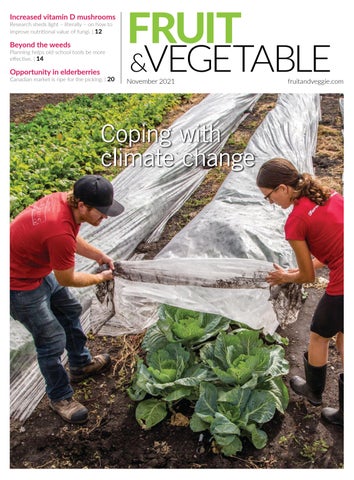
Coping with climate change
fruitandveggie.com
Strong control. Top to bottom. Neudorff North America is an innovative leader in ecologically responsible pest solutions for farmers, turf professionals, nursery and greenhouse growers. Our effective and affordable solutions for disease, insect pests, pest slugs and snails have limited impact on applicators, beneficial insects and the environment. They are an important part of integrated pest management programs.
CUEVA
Powerful disease protection for your fruit and vegetable crops with a fraction of the copper found in other copper fungicides.
®
COPPER FUNGICIDE
KOPA
The soft-bodied insect specialist. Kills aphids, mites and whiteflies on contact in a wide range of crops. A great tank mix partner.
™
INSECTICIDAL SOAP
VEGOL
A summer and dormant oil. Controls all life stages of insects and mites, and supresses powdery mildew.
®
FUNGICIDE/INSECTICIDE/MITICIDE
SLUGGO
A durable iron phosphate bait that offers excellent crop protection from slugs and snails.
®
SLUG AND SNAIL BAIT
SCORPIO ANT AND INSECT BAIT
Neudorff has you covered from the ground up.
®
A durable, fast acting spinosad bait, active against a variety of ants, cutworms, spotted wing drosophila and wireworms in a wide range of crops.
©2020 Neudorff North America. All rights reserved.
NeudorffPro.com
CONTENTS
NOVEMBER 2021 Vol.77, Issue 5
8
How CSA farmers are coping with climate change
Rising temperatures, severe weather events and increased pest pressure – oh my! Editorial
4
Industry News
6
Organic Perspective Working towards regenerative.
16
Buyers Guide 2022
25
Research Spotlight 34 Group 14 herbicide trials in Nova Scotia strawberries.
12 14 20 ON THE COVER Cabbage under row covers for pest protection. See page 8. Photo courtesy of Sandy Black.
Increasing vitamin D in mushrooms
Beyond the weeds
Research sheds light – literally – on how to improve the nutritional value of grocery store fungi.
When it comes to weed management and old-school tools, an ounce of prevention is worth a pound of metal.
BY JULIENNE ISAACS
BY PETER MITHAM
Seeds of opportunity: Elderberries
Canada’s elderberry market is ripe for the picking – with a little organization from growers. BY J.P. ANTONACCI
November 2021 - FRUIT &VEGETABLE 3
FROM THE EDITOR
FRUIT & VEGETABLE November May 2021 2021 Volume 77, No. 5 4
ALEX BARNARD | @FruitandVeggie.com
Going beyond useful Much is made of the fruit and vegetable sector’s importance in feeding the world – and for good reason. Plenty of produce is needed for people to thrive. But there are other, less tangible benefits from fruit and vegetable production that deserve appreciation, too. For most growers, there has to be a direct purpose for growing a specific fruit or vegetable, and it has to be worthwhile. It’s necessary to make decisions when there’s only so much time and resources, and focusing on return-on-investment (ROI) is one way to ensure there’s something gained for what you put into the world. As Teri Jenkins of Brown Sugar Produce states in Steph Coelho’s story on how CSAs are handling climate change (read it on page 8), crops that need really intensive management often aren’t worth growing when there are other crops that will do better with less effort. From a business perspective, this is practical advice and makes complete sense. However, when this utilitarianism takes over other aspects of life, many quiet joys go by the wayside.
experience, in my opinion. For others this might be apple-picking, going to the nearest fall fair, eating the first winter squash, or getting lost in a corn maze. Many of the most iconic fall experiences are rooted in agriculture. For many of us, fall wraps up the growing season, making it a great time to celebrate the victories of the year, big and small. The 2021 season – and the past year and a half in general – has had more than its fair share of difficulties, whether in the form of the COVID-19 pandemic, roadblocks in bringing in temporary foreign workers and other skilled labourers, drought, flooding, pests and diseases, and the more gardenvariety challenges of the average season. As you wind down in the field, be sure to take some time to congratulate yourself and your team on getting through another year, whether by the skin of your teeth or with a bumper crop. Surely the winter will bring lots of tasks and work to be completed, but in between, try to do something that
“When utilitarianism takes over other aspects of life [beyond business], many of life’s quiet joys go by the wayside.” As I write this, it’s late October and I’ve just spent the afternoon carving pumpkins with the friends in my COVID bubble. Going out to one of the local farms, finding the perfect pumpkin (or four), dusting off my rusty, once-a-year carving skills – it’s the quintessential fall
has absolutely no value beyond bringing you some happiness. The time for pumpkin-carving may have passed, but with winter and the holidays on the horizon, there are plenty of other opportunities. Might I suggest making a snowman? •
@fruitandvegmag 4 FRUIT &VEGETABLE - November 2021
@fruitandvegmag
Reader Service Print and digital subscription inquires or changes, please contact Shawn Arul, Audience Development Manager Tel: (416) 510-5181 Fax: (416) 510-6875 Email: sarul@annexbusinessmedia.com Mail: 111 Gordon Baker Rd., Suite 400, Toronto, ON M2H 3R1 Editorial Director, Agriculture STEFANIE CROLEY scroley@annexbusinessmedia.com 226-931-4949 Associate Editor ALEX BARNARD abarnard@annexbusinessmedia.com 519-429-3966 Associate Publisher NASHELLE BARSKY nbarsky@annexbusinessmedia.com 905-655-6626 National Account Manager SHARON KAUK skauk@annexbusinessmedia.com 519-410-4854 Account Coordinator MARY BURNIE mburnie@annexbusinessmedia.com 519-429-5175 Media Designer CURTIS EMILYMARTIN SUN Group Publisher MICHELLE ALLISON mallison@annexbusinessmedia.com 204-596-8710 COO SCOTT JAMIESON sjamieson@annexbusinessmedia.com Publication Mail Agreement #40065710 Printed in Canada ISSN 1488-7959 Fruit & Vegetable Magazine is published five times a year (February, March, April, May, November/December) by Annex Business Media SUBSCRIPTION RATES Canada - 1 Year $ 23.00 (plus applicable taxes) U.S.A. - 1 Year $ 53.50 CDN GST - #867172652RT0001 Occasionally, Fruit & Vegetable Magazine will mail information on behalf of industry-related groups whose products and services we believe may be of interest to you. If you prefer not to receive this information, please contact our circulation department in any of the four ways listed above. Annex Privacy Officer privacy@annexbusinessmedia.com Tel: 800-668-2374 No part of the editorial content of this publication may be reprinted without the publisher’s written permission. ©2021 Annex Business Media. All rights reserved. Opinions expressed in this magazine are not necessarily those of the editor or the publisher. No liability is assumed for errors or omissions. All advertising is subject to the publisher’s approval. Such approval does not imply any endorsement of the products or services advertised. Publisher reserves the right to refuse advertising that does not meet the standards of the publication.
fruitandveggie.com
A TERIS Company
INDUSTRY NEWS fruitandveggie.com
Apples to apples Are all apple microbiomes created equally? That is what a recent international study sought to determine. Three researchers with Agriculture and Agri-Food Canada (AAFC) – Oualid Ellouz and Karin Schneider, plant pathology research scientist and assistant (respectively) with AAFC-Vineland in Ontario, and Shawkat Ali, plant pathologist with AAFC-Kentville in Nova Scotia – took part in the first worldwide study on the apple fruit microbiome, as regards the assembly and composition of the microbial communities. A report on the study and its results was published in early 2021 in Environmental Microbiology, a Society for Applied Microbiology (SfAM) journal. The AAFC authors have curated key points from the study below. Do microbes naturally present on apple fruit affect production results? The microbial community colonizing the surface of apple peel, referred to as a “microbiome,” is the first defence against apple pathogens. This microbiome is involved in growth promotion, disease resistance, stress tolerance and fruit quality both before and after harvest. The microbiome is now factored into breeding strategies for pre- and post-harvest disease control and management. Knowing more about this microscopic world will provide insight into post-harvest diseases that occur during storage. The study examined if apple microbiomes are the same around the world, despite differences in climate and management practices. The apple cultivar “Gala” – a cross between “Kidd’s Orange Red” and “Golden Delicious” – represents a significant portion of global production and is grown extensively in all apple growing regions in the world. Gala apples were collected and analyzed from the USA, Canada, Uruguay, Italy, Spain, Switzerland, Turkey
and Israel. Tissue samples were taken from the apple calyx-end, the stem-end and peel. DNA was isolated, amplified with PCR (polymerase chain reaction) and sequenced using next-generation sequencing to identify fungi and bacteria present in each tissue. The teams found that the composition and structure of the fungal and bacterial communities vary and are highly dependent on geographical location. Ninety fungal and 57 bacterial classes were characterized; 75 per cent of the samples consisted of only six fungal and two bacterial genera. Turkey had the highest diversity of fungi and Spain the lowest; the western U.S. and Israel had the highest number of unique bacterial groups. Interestingly, the majority of the fungal core microbiome was made up of yeasts which are known to fight pre- and post-harvest pathogens. Penicillium sp., which causes blue mould in storage, was not found in the core fungal microbiome. What have we learned from all this and how does this affect Canadian apple growers? The regional differences have led scientists to propose the microbiomes shared between the domesticated apple and micro-organisms may have coevolved together and adapted to local environments. This research provides early information on the apple fruit microbiome, laying the groundwork for studying the complex microbial interactions on the apple fruit surface. Ultimately, this work will help scientists develop new approaches in the management of fruit quality and safety, as well as the reduction of fruit quality and quantity due to post-harvest micro-organisms. Paying greater attention to our local “microbiome” will ultimately lead to better long-term quality of produce and safer products for the consumer. •
BY THE NUMBERS
There are more than
50 varieties of apple grown in Canada.
Honeycrisp, Ambrosia, and Gala are the top three apple varieties (by sales) in Canada. Red Delicious, which was the top seller in the United States for the past 50 years, has been toppled by the Gala.
6 FRUIT &VEGETABLE - November 2021
APPLE PRODUCTION BY PROVINCE (in 2018)
ON 39%
QC 27%
BC 27%
NS NB 6.5% 0.5%
Sweeter, juicier varieties are more popular currently.
In 2020, Canadian apple growers produced nearly 850 million pounds of fresh apples.
HOW CSA FARMERS
PHOTO COURTESY OF SANDY BLACK.
are coping with climate change
Rising temperatures, increasingly severe weather events and increased pest pressure – climate change is affecting Canadian agriculture broadly, but CSA and small-scale farmers don’t have the same safety net. BY STEPH COELHO
Last year, on top of pandemic worries, Teri Jenkins and her family found themselves contending with unexpected flooding when nearby upper river sites failed, and water rushed into the man-made reservoir in Brandon, Man. While Jenkins’ farm, Brown Sugar Produce, isn’t situated downriver, massive flooding blocked roads and impeded farm operations. For Canadian CSA (community-supported agriculture) farmers like Jenkins, unpredictable weather events that were once an intermittent occurrence are now an ever-present threat. “It’s normal for weather to change every day, but the changes in long-term patterns we’re experiencing are not normal,” says Laurie Beyranevand, professor and director of the Center for Agriculture and Food Systems at Vermont Law School.
While many people may not feel the direct impacts of these changes, farmers are able to observe the fluctuations in weather firsthand, Beyranevand adds. As weather events become increasingly intense and frequent, farmers face a host of challenges as they work to serve their local communities. Some of the biggest challenges, Beyranevand says, have to do with warming temperatures, drought (and, conversely, flooding), and the proliferation of pests. Add to that the unpredictability of it all, and there’s no doubt that farming in the era of climate change takes a heavy mental toll. COPING WITH RISING TEMPERATURES In Canada, most farmers, regardless of the province in which they reside, have to deal with big swings in tem-
ABOVE Row covers are one way to manage pests that are showing up earlier and thriving in the warmer temperatures. 8 FRUIT &VEGETABLE - November 2021
PHOTO COURTESY OF TERI JENKINS.
ABOVE In 2020, Teri Jenkins and her family found themselves contending with unexpected flooding when nearby upper river sites failed, and water rushed into the man-made reservoir in Brandon, Man.
perature from season to season. Even those farming in pleasOBSTACLES THRIVING IN THE HEAT ant climes, like the West Coast, must contend with snow and Additionally, many pests thrive in warmer weather, Beyranevand cold weather at some point during the year. Still, from B.C. to explains. Cormier says that while cabbage moth has always been P.E.I., farmers are increasingly experiencing the effects of rising an issue on his farm, the pest has become more problematic in temperatures. Random heat spells make it difficult for farmers, recent years. It turns up earlier and earlier, making it difficult particularly those with CSA models, to plan crops and work to control even with row covers. “We don’t grow a lot of those efficiently in the fields, Beyranevand says. crops because they’re just really intensive to Frequent bouts of intense heat have manage for us, and row covers suck,” Jencaused Mark Cormier – whose certified kins admits with a laugh, adding that they When crops fail, organic CSA, Glorious Organics, is located tend to focus on what they believe they can in Aldergrove, B.C. – to adapt his planting customers don’t always do well. If something is a magnet for pests, schedule. He avoids planting certain early it’s unlikely they’ll grow it. grasp why they’re crops because of a higher risk of bolting Cormier also notes increased instancduring early April heatwaves. While the es of disease in the last decade that he missing something. hot weather poses a threat to specific attributes to the weather. His onion crop, crops, he adds that the diversity inherent a crop that typically nets around $10,000 to the CSA model is a plan in and of itself. a season, was wiped out one year because If something happens to one crop, there’s another to fall back of mould growth – something he says other farmers in the on. Cormier also builds expectations of failure into his plan area have had to contend with as well. An indirect challenge of every year. increased instances of pests and disease – and all climate-related More isn’t necessarily better, though. Getting too diverse, he challenges that require additional spending to address – is the warns, can backfire and cause burnout. Having too many difdifficulty in translating the struggle to the customer. Every year ferent crops also makes it challenging to practice crop rotation. there’s a new bug that can survive further north because of the Because of heat and unpredictable weather, Louis Ménard of La warmer temperatures, Ménard says. People don’t necessarily unFerme Trotteuse Co-op in Sainte-Marie-de-Blandford, Que., says derstand why something is more expensive, he explains. When that he tends to schedule more backup plantings, which can crops fail because of pests or other issues, customers don’t alsometimes cost more money, and, at the very least, may require ways grasp why they’re missing something from their basket or more labor. paying more for their farm share because they don’t experience these obstacles firsthand. November 2021 - FRUIT &VEGETABLE 9
THE TOLL OF UNCERTAINTY When the weather behaves in a slingshot-manner, it’s difficult for farmers to plan ahead. Ménard says his answer to uncertainty is to invest fewer dollars into farm operations. He’s less likely to take big financial swings nowadays because of the increased risks related to climate change. Some farmers note that weather changes, like warmer springs and autumns, occasionally offer an opportunity to grow things they’ve never grown before, like sweet potatoes. However, this silver-lining is hard to appreciate because of planning difficulties. Leslie Moskovits of Cedar Down Farm in Neustadt, Ont., explains that starting earlier isn’t necessarily possible in her neck of the woods. Even when the spring weather is dryer and more hospitable to specific crops, the snow often still lingers on the ground. Her strategy involves paying closer attention to patterns and taking copious notes to better cope in following years. Cormier concedes that every season is different, and predicting the weather is challenging. In a profession where planning is part of the deal, he admits that plans are constantly changing. Like Moskovits, he monitors the weather, but it’s not always a foolproof strategy. He believes it’ll only get tougher to work with the weather. The unpredictability of the weather 10 FRUIT &VEGETABLE - November 2021
PHOTO COURTESY OF TERI JENKINS.
DRY LIKE THE DESERT “In Canada, many farmers are already facing increased flooding and increased droughts due to drier summers and wetter winters and springs,” Beyranevand says. Coupled with unrelenting heat, drought poses an incredible challenge for all farmers, particularly small farms that may not have the infrastructure or budget to meet increasing water demands. Intermittent flooding and drought conditions also make it increasingly difficult to grow plants without high amounts of intervention. About six or seven years ago, Cormier says his farm went through a period of massive drought. The drought, along with skyrocketing temperatures, was the catalyst for investing in drip tape. Cormier adds that relying on drip tape has its downsides: it’s difficult to use, requires labor to move around, and is made of plastic that ultimately ends up in landfills. He’s conscious that some solutions to climate change’s effects may have their own environmental impacts and worries about how farms like Glorious Organics will fare with upcoming plastic-free legislation in B.C.
ABOVE Beyranevand says many farmers are already facing increased flooding and increased droughts due to drier summers and wetter winters and springs.
puts a strain on crops but also on mental health. Jenkins admits that farming is stressful and both physically and mentally demanding. However, being able to grow food tempers her worries for the future. “I would be afraid if I didn’t have my hands in the food that I grow,” she says. Cormier admits that witnessing and experiencing the effects of climate change has been a struggle but adds that if he were doing anything else, his mental health would likely suffer even more. For Cormier, the winter is the hardest, but spring is a time of renewal and hope. CSA FARMERS CAN’T HACK IT ALONE Many CSA farmers have found ways to adapt to the challenges thrown their way by Mother Nature. However, as the desire for local food grows, spurred on partially by the pandemic, some farmers remark that it’s impossible to meet the growing demand alone. “Not all farms with CSAs are created equal,” Beyranevand says. Despite this, she adds that research shows that CSA farms are usually smaller and helmed by younger-than-average farmers. “Studies suggest that they’re also more likely to trend organic or biodynamic,” Beyranevand says. But while these smaller farms are more likely to employ earth-friendly practices, they’re also more likely to be left behind in terms of access to government programs. Financially, they’re also unlikely to have long-term relationships with banks allowing them to access lines of credit for equipment and adaptations to
combat heat, drought and increasing pest activity. Jenkins says that as a CSA, she largely feels ignored by the government; “We’re not fitting into the agriculture box that they’re trying to put us in.” For Moskovits, the issue of access to resources is paramount. “I think more people are interested in providing for themselves and their communities and that we have a system that makes it very difficult for people to do that,” she adds. Beyranevand suggests that governments should look to these small farms as conservators of land and ecosystems and support them for their work contributing to climate change resilience via a “Payment for Ecosystem Services” program. In turn, this would encourage farms not doing so to move towards sustainable, climate change-combatting practices like crop rotation and integrated pest management. Beyranevand, who contributed to the research that helped form Canada’s National Food Policy, is adamant that governments need to approach climate and agriculture issues in a unified manner. “Agriculture contributes to climate change, but it also has the potential to mitigate it,” she explains. Moskovits is hesitantly hopeful about the future of her chosen profession. She does her best to farm in a way that mitigates climate change and strongly believes in the resiliency of CSA and organic farming. Despite the challenges they face, Moskovits, Ménard, Cormier, and Jenkins are all committed to moving forward in a way that serves to combat climate change rather than simply withstand it.•
CANADIAN FRUIT & VEGETABLE
SUMMIT Seeding ideas for a growing industry fruitandveggie.com
JOIN US ONLINE MARCH 9, 2022 – 1:00PM ET
Join us for the second Canadian Fruit & Vegetable Summit, an online event presenting up-to-date production tips and research for the Canadian horticultural industry. Hear from growers and industry experts about key insights to start your growing season off strong.
TO SECURE YOUR SPONSORSHIP, PLEASE CONTACT:
Nashelle Barsky, Associate Publisher nbarsky@annexbusinessmedia.com 905-431-8892
Sharon Kauk, National Sales Manager skauk@annexbusinessmedia.com 519-410-4854
Presented by
FRUIT
&VEGETABLE
ALL PHOTOS COURTESY OF AAFC.
Increasing vitamin D in mushrooms Research sheds light – literally – on how to improve the nutritional value of grocery store fungi. BY JULIENNE ISAACS Everyone knows that vitamin D is good for you. Study after study has shown its benefits, particularly for promoting calcium absorption; it facilitates bone growth, reduces the risk of osteoporosis and rickets, minimizes inflammation and modulates cell growth. Because of this, vitamin D is a common additive in breakfast cereals, milk and other goods. But there’s only one item in the produce aisle that naturally contains it: mushrooms. Although they’re treated as vegetables, mushrooms actually belong to the eukaryotic kingdom of fungi. They contain a high amount of ergosterol, a sterol (or steroid-based alcohol) in their cell membranes. Ergosterol performs similar functions to cholesterol in animals – such as strengthening cell walls – but is also considered a precursor to vitamin D. This is because, when UV radiation hits a mushroom, some of its ergosterol is changed into vitamin D2. Here’s the thing: the vitamin D in most conventionally-grown mushrooms is very low. That’s because they’re grown in darkness. Studies have shown that mushrooms grown outside can contain three times the amount of vitamin D2 of
mushrooms grown in the dark. Suqin Shao, an Agriculture and Agri-Food Canada (AAFC) research scientist at the Guelph Research and Development Centre, recently shined a light on this problem. Specifically, a radiation lamp. Working together with colleagues at universities in China, Shao developed an experiment to test the long-term effects of exposure to UV-C radiation (200 to 280 nanometres (nm) in wavelength) on brown and white button mushrooms (Agaricus bisporus), in combination with cold storage at 4 C. UV-C light is used in sterilization, she says, but past studies have mainly looked at immediate impacts of exposure on ergosterol and vitamin D2 content. “We know that the levels of vitamin D in mushrooms is very low. We wanted to see how the UV-C treatment would affect vitamin D and hypothesized that we would see an increase,” Shao says. Crucially, they also wanted to see whether those levels stayed high after prolonged
TOP: Mushrooms in Shao’s lab. BOTTOM: Suqin Shao, an AAFC research scientist at the Guelph Research and Development Centre. 12 FRUIT &VEGETABLE - November 2021
cold storage of up to 14 days – a real-world condition. Typically, the ergosterol content of mushrooms is between 0.6 and 0.7 per cent of their dried weight, and cultivated mushrooms are deficient in vitamin D2, the authors state in the beginning of their publication on these findings. “When mushrooms are exposed to UV light (270 to 310 nm), ergosterol undergoes photolysis and results in an increase in the amount of previtamin D2, which rapidly isomerizes to vitamin D2.” STUDY SETUP AND FINDINGS To conduct the study, mushrooms were harvested and collected from two farms and transported to Shao’s lab, where they were immediately exposed to UV-C light. The mushrooms were placed on a holding tray under the UV-C light reactor with their caps facing towards the lamp and irradiated for zero, 50, 100 and 200 seconds. Then they were turned upside down so their stems received the same doses. After they were treated, the mushrooms were placed in perforated plastic bags and stored in the dark at 4 C. On
days one, seven and 14, the mushrooms were removed, frozen and freeze-dried, and caps and stems were separated and ground for analysis. The researchers found that the greater the exposure to UV-C light, the more ergosterol reduced. But the stored caps and stems gained ergosterol over time. The researchers found that immediately after UV-C treatment, vitamin D2 increased in mushrooms, both in caps and stems. “The general trend for vitamin D2 contents in different mushroom parts is that significantly more vitamin D2 was found in the UV-C-treated samples, and the higher the UV-C dose, the greater the vitamin D2 content,” the study authors note. Interestingly, over time, the amount of vitamin D2 in the mushrooms reduced in cold storage – except in brown button mushroom stems, which continued to gain vitamin D2 during the whole study period. It’s the first time this “reducing effect” in cold storage has been recorded for mushrooms. But even after the 14-day period, there was still more vitamin D2 in the treated samples in cold storage versus
untreated; the treated mushrooms had higher vitamin D2 levels to begin with, and both treated and untreated mushrooms lost vitamin D2 at the same rate over time. Vitamin D2 more than doubled in the treated versus untreated samples, Shao says, and would increase even more under higher doses of UV-C light. “The dosage we used was really for proof of principle,” she says. “Later on, we could modify UV-C dosage for the industry.” Currently, Shao says UV-C light is not used in the industry except as a sterilization tool. In mushrooms, it isn’t commonly used at all. For that reason, she believes the findings could add significant value to Canada’s mushroom industry as more and more studies emerge from labs around the world linking vitamin D to health benefits. But there are other hurdles to jump through first. “The UV-C lamp is just the first step,” Shao says. “We need to consider infrastructure, fertility and lots of other factors to apply this technology. But there’s potential here.” •
If your farm is open to the public, you should be a member of
OntarioFarmFresh.com
now booking
2022 NEW VARIETIES to be included in the February edition reaching more than 8,500 subscribers. Reserve by January 7th TO INQUIRE ABOUT ADVERTISING & VARIETY SUBMISSIONS, PLEASE EMAIL: Nashelle Barksy nbarsky@annexbusinessmedia.com Sharon Kauk skauk@annexbusinessmedia.com
November 2021 - FRUIT &VEGETABLE 13 FV_OFFMA_QP_Mar21_CWM.indd 1
2021-02-02 8:30 AM
BEYOND THE WEEDS Looking back to move forward Planning can help old-school tools be more effective. When it comes to weed management, an ounce of prevention is worth a pound of metal. BY PETER MITHAM
P
andemic-related disruptions to supply chains last year, combined with limits on the kinds of chemical controls registered for use in Canada, have many growers taking a closer look at low-input weed management. While organic growers have wrestled with the challenge for years, Wisconsin sustainable horticulture instructor Sam Oschwald
PHOTO COURTESY OF SAM OSCHWALD TILTON.
properties, their lifecycle and be able to recognize them at each life stage. This will give them an edge on weeds throughout the season. “I can target it with the type of tillage, I can target it with the timing of the tillage, I can target it with the depth of tillage and I can target it with cover crops,” Oschwald Tilton says. He encourages growers to cultivate just the top 4 centimetres Tilton took his love of metalwork as the starting point. (cm) of soil, where 90 per cent of horticultural weeds germinate. “When I first got into mechanical cultivation, I got into it beThis is gentle on the soils and prevents daylighting buried weed cause I was a metalhead,” he said. “I loved welding and building seeds. things and I was a vegetable grower. But the deeper I got in, I “It’s very important that I can kill the weeds that have germirealized that my interest in shiny pieces of metal was misplaced nated but not bring up the new weeds,” he because if I really wanted to do effective says. “When my crop comes up there’s a lot weed control, I had to see tools as part of less competition.” the bigger picture.” Working with field conditions is a focus Tools work in partnership with nature, of Krystine McInnes of Athena Organic which is the starting point for all agriculFarm, who farms 60 acres near Cawston, ture, says Oschwald Tilton, who teaches at B.C., on the floodplain of the Similkameen Lakeshore Technical College in Cleveland, River. Seasonal flooding churns the soil, Wis. Controlling weeds effectively begins making the river-bottom land vulnerable to with ecological controls, with tools helping weeds. In addition, the shape of the valley manage issues that spring up during the funnels winds that introduce seeds from growing season. An ounce of prevention is the surrounding wilderness. Workers have worth a pound of metal, to turn a phrase. put in 12 hours a day in bad years just to “These ecological techniques can really stay ahead of the weeds. pay off big time,” Oschwald Tilton says. “Once the weeds get away from you, “They’re a lot easier to do … than to have you’re cooked. You’re done,” says McInnes, the right tool at the right time.” ABOVE: Cutaway discs (dual knives) who purchased the farm in 2015 after leavGood ecological practices help make can protect tender, direct-seeded ing a career in real estate development. crops by honing row definition while tools more effective, however. Working to disrupt the soil biome as cutting away soil and burying weeds. Oschwald Tilton foregrounds two key little as possible, she has worked to “learn practices: stale seed-bedding, which reducthe rhythm of the land, what the plants are trying to say.” A es the bank of viable weed seeds in the field, and an intentional farm manager identifies problem areas, the dominant species approach to row spacing to make tools more efficient. of weeds present and addresses hotspots each season. Soil “The mistakes that you make at the ground floor get magniamendments and cover cropping have helped build soil health fied as you move up. The tools are not magic,” he says. “Even and reduce weed pressure. Those that emerge between the rows with the same tool, adjusted perfectly, the weeds in my soil that are harrowed. I’m starting with are either going to set me ahead for success or Cultivating, whether as part of creating a stale seedbed or hold me back.” late in the season, will be more efficient if the field is designed Stale seed-bedding aims to eliminate weeds before the crop with the equipment in mind. While plenty of row spacings exist emerges, reducing competition later in the year. The practice involves encouraging weed germination early in the season, then – based on field size, desired densities and production targets – Oschwald Tilton notes that most equipment has been designed tilling them into oblivion. to accommodate three rows spaced 15 inches apart in a 30-inch Smart growers will know the top three weeds on their 14 FRUIT &VEGETABLE - November 2021
bed, with a shoulder either side of six inches. Wheel spacing is 30 inches from the centre of the bed. The spacing needs to be flexible, however, both to account for the equipment as well as changes to field topography during the season. Shoulder space that was originally six inches may diminish after several passes, and as the crops mature. The spacing should also account for the crop itself. While three rows spaced 15 inches apart can handle beets or carrots, reducing the density of the middle row (or forgoing it altogether) could mean more even sizing of the crop. Alternatively, the arrangement could allow for a larger crop, such as cabbage, in the outside rows without any need to retool the equipment or make multiple passes. Salad greens could be spaced seven inches apart. “All of your equipment is going to be sized for that cultural system,” he says. “The sooner that you can choose your cultural system, [the sooner] you can really size your machinery and start there.” Consistent row spacing and properly calibrated equipment are critical. “You’re only as good as the jig you have in the field,” says Lydia Ryall of Cropthorne Farm in Delta, B.C., which has 16 acres of field crops. She began stale seed-bedding this past year, but having equipment that can deliver consistent results is key. Driving a straight line through the field is one thing, but using the same configuration is equally important. “If I’m using a certain tractor for seeding, it’d be nice to use it for the basket weeder,” she says; she also flames weeds. “You really want to hit the weeds when they don’t even have a first
true leaf on yet so it doesn’t have the energy to come back after cultivation.” A consistent set-up will help achieve this. Oschwald Tilton recommends calibrating equipment in the shop then making adjustments as equipment responds to field conditions. The centre of the row should be indicated on the toolbar, a standard depth can be set for the tools, and row spacing can be indicated. “If they move during the season you’ll know right away,” he says. “I like to set everything evenly in the winter in the shop because I can do it accurately, and then when I get out to the field, if I have to change anything, then I know I can deviate from a common set point.” Parallel linkages can help improve responsiveness to field conditions. Consistency doesn’t rule out diversity, however. This is where Oschwald Tilton’s love of metalworking comes into play. Basket weeders, finger weeders and cutaway discs (dual knives) each have their place, with specific advantages for burying weeds, keeping them away from the crop and reducing competition. Sometimes a combination works best; knives, for example, can help break up soil ahead of a finger weeder, making its action more effective. Spyder weeders, revived and manufactured by North Dakota -based Tilmor LLC, are particularly useful in thick, wet soils because they don’t get gummed up like finger weeders. During the season, cutaway discs can be ideal for burying weeds between rows while giving carrots room to grow. “You want to have the goal of not adjusting each tool every single time,” Oschwald Tilton says. “[But] if you can have five different tools that do five different jobs … it really makes things easier.”•
You see a harvest.
We see a way to preserve it.
cascades.com
Sustainable and innovative packaging solutions for fruits and vegetables.
November 2021 - FRUIT &VEGETABLE 15 FV_Cascades-half_Nov21_CSA.indd 1
2021-10-19 2:49 PM
ORGANIC PERSPECTIVE SAMANATHA MILLS | organiccouncil.ca
PHOTO COURTESY OF THORSTEN ARNOLD AND KRISTINE HAMMEL.
Working towards regenerative
ABOVE The need for (and understanding of) regenerative agriculture is growing across Canada.
Canadian weather has always been unpredictable but climate change brings new meaning to the word, with the agriculture industry posed to suffer as a result. Even in the face of such uncertainty, agriculture has the opportunity to not only adapt to the effects of climate change but also reduce its impacts through the regeneration of cultivated land. AGRICULTURE IS VULNERABLE TO EXTREME WEATHER RISKS Although climate change does offer a few benefits to Canadian agriculture, such as warmer temperatures during the growing season, this does not outweigh the hazards it presents. With the rising average temperatures associated with climate change, we know that weather events will be more severe and frequent and create even riskier conditions for farmers. The summer of 2021 was extremely tumultuous across Canada, where farmers had to fight an uphill battle with insect swarms, droughts, forest fires, and heat waves so powerful they cooked fruit on the trees. In 2018, Canadian farms suffered over $2 billion in damages due to severe weather – the fourthhighest cost on record at the time. While the agri-
16 FRUIT &VEGETABLE - November 2021
culture sector is extremely vulnerable to the effects of climate change, it also currently emits 73 Mt CO2 eq (million tonnes of carbon dioxide equivalent) annually, representing roughly 10 per cent of Canada’s total annual emissions. A growing number of farmers and consumers understand the need for food systems that repair the ecosystems that support their productivity. This understanding has contributed to the already rapidly expanding organic market, including the emergence of a new term associated with sustainable farming: regenerative agriculture. PERSEPHONE MARKET GARDEN For the past 11 years, Persephone Market Garden in Allenford, Ont., has been on a journey towards regeneration. Founded by husband and wife Thorsten Arnold and Kristine Hammel, Persephone Market Garden is slowly being transformed into an ecologically rich working farm using little to no tillage and organic methods. The Bruce County market garden provides the local community with over fifty varieties of produce and herbs. It also serves as a research hub, where the couple hosts workshops, summer camps and internships, as well as farming and forest schools specializing in
holistic land management. While regenerative agriculture is still a term with no single definition, Arnold and Hammel view regenerative agriculture as a way to rebuild the local ecosystem of a farm, particularly its biodiversity, soil health and a balanced microclimate. “I think the key contribution of the regenerative agriculture frame is actually not to view doing something about climate change as a fight. In the field, I don’t ‘fight’ pests, weeds, or drought. I instead foster healthy soil. And I do that guided by a few principles – disturb the soil as little as possible, cover the soil as much as possible, have living roots in the soil as much of the time as possible, integrate animals, and increase diversity,” Hammel says. “So I’m not fighting – I’m trying to nurture it. I’m practicing observing, learning, and responding. I’m practicing seeing the soil, plants and creatures on the land as my teachers. It’s not a fight, it’s collaboration. At its core, our climate change problem is a problem of how we see ourselves in creation and how we interact with all the other beings. As long as we are fighting, we will lose.” To put their philosophy into action, Hammel and Arnold have significantly increased their crop diversity through intercropping. This involves breaking their farm into six blocks of vegetables to spread the diversity of crops over the farm, and planting leek and onion crops in the same beds as their cabbages and beets. “I want to make sure there is always mycorrhizal supporting crops like alliums with non-mycorrhizal crops like chenopods and Brassicas,” Hammel states. She admits they are still on their journey; they do require the use of “transition tools” like the broadfork or landscape fabric to kill off quackgrass or ensure soil coverage over winter if they miss a cover-cropping window. At the beginning of their efforts, difficult weather conditions – such as flooding, droughts and pests – created many obstacles to producing a healthy crop. But this year – three years into the transition to no-till, organic methods – the couple’s crop was healthy and thriving in the wake of yet another summer of difficult weather conditions. This comes as no surprise. For years, organic and regenerative crops have been praised for their resilience to the effects of extreme weather events. Recently, the UN has released a set of climate-resilient practices, many of which are foundational to organic and regenerative agriculture.
INNOVATING AGRICULTURE FOR A SUSTAINABLE FUTURE Regenerative and organic practices, such as those employed by Persephone Market Garden, represent an opportunity for Canadian farmers to rebuild soil and create climate-resilient crops. However, these practises go beyond resilience: it is also an effective way of sequestering carbon, helping to rejuvenate ecosystems and create on-farm biodiversity. The Organic Council of Ontario believes regenerative and organic agriculture offer significant solutions to the climate
crisis and building a more sustainable food system. Visit OCO’s website for more information. The Organic Council of Ontario (OCO) represents more than 1,400 certified organic operators, as well as the businesses, organizations, and individuals that bring food from farm to plate. OCO works to catalyze sector growth, support research, improve training, increase data collection, encourage market development, protect the integrity of organic claims, and inform the public of the benefits and requirements of organic agriculture.
Scotia Horticultural Congress 2022
Celebrating Survival
January 24 & 25, 2022
Old Orchard Inn • Greenwich, Nova Scotia
REGISTER TODAY!
www.horticulturens.ca I info@horticulturens.ca
November 2021 - FRUIT &VEGETABLE 17
CONGR
2021 INFLUENTIAL WOM The incredible nominations we received for the second year of this program highlighted just how many influential women there are working within Canada’s agriculture industry. To our Top 7 recipients, those who nominated an influential woman, those who offered support through social media or tuning into the podcast series on AgAnnex Talks, and to our generous sponsors:
THANK YOU AGWOMEN.CA
T OP CROP MANAGER
IN
RATULATIONS
MEN IN CANADIAN AGRICULTURE WINNERS
Andrea McKenna
Leona Staples
N CANADA
Crystal Mackay
Noura Ziadi
Ellen Sparry
Simone Demers-Collins
Tina Widowski
Sponsored by
Presented by
FRUIT
&VEGETABLE
Seeds of Opportunity:
ELDERBERRIES Steady interest from commercial growers in recent years and a market that’s ripe for the picking: elderberries are poised to become a strong choice for crop diversification – if growers can get organized.
BY J.P. ANTONACCI
ALL PHOTOS COURTESY OF JED WIEBE.
BELOW Blue elderberry (Sambucus cerulea), one of the 25 varieties grown at Elderberry Grove.
The Canadian elderberry market is ripe for the picking – if growers can get organized. “When the pandemic hit last March, we sold what we would normally sell in six months in two weeks,” says Jed Wiebe, an elderberry farmer in Salmon Arm, B.C. “It was definitely encouragement to plan more.” Wiebe is a Canadian elderberry pioneer in a young industry he says is poised to explode to meet a growing demand for value-added products infused with juice from the tiny superfruit. “They’re an emerging crop, for sure. There’s a huge amount of new elderberry going in,” Wiebe says, with the United States leading that growth at the moment. “The amount that’s being planted is doubling every couple years. There’s 30 times as much per capita in Europe, so the potential for our market to grow to that size seems fairly likely to me.” Wiebe bases his confidence on the fact that American processors were importing most of their elderberries from Europe as recently as 2017. “I know Canada was buying from the States at that time. So almost all the elderberry that is consumed in North America is imported,” he says. “In the States, if you grow elderberries, someone will buy it. I have people from the States messaging me all the time asking to buy my Canadian elderberries. It just seems like there’s a ton of room for growth.” Last year, a major European food producer inquired about purchasing elderberries wholesale from Elderberry Grove, the farm Wiebe runs with his partner, Louise Lecouffe. But the duo needs every berry they can harvest for their own value-
20 FRUIT &VEGETABLE - November 2021
LEFT Lousie Lecouffe and Jed Wiebe have been growing elderberries on their farm, Elderberry Grove, in Salmon Arm, B.C., for years.
its antiviral and anti-inflammatory value,” Wiebe says. “I think people want to eat healthier food and be as healthy as possible so they can recover better or fight off colds and flus and COVIDs. That’s what I have gathered from our customers.”
added products, which fly off the shelves. Growing 25 varieties of elderberry on five acres – the latest two acres planted in April 2021 to keep up with the demand – the couple makes and sells elderberry juice, syrup and shrub through local farmers’ markets and health food stores in British Columbia, as well as shipping directly to customers through an online store. “We saw it as an opportunity,” says Wiebe, who planted their first elderberry cuttings in 2017. More popular in juiced form than as an eating berry, elderberries end up in jams and jellies, pies and cakes – most famously the Lemon Elderflower Royal Wedding Cake served at the wedding of Prince Harry and Meghan Markle – fruit bars, wine and spirits, while elderflowers can be used in tea, kombucha and cordials, or dusted with flour and turned into fritters. Niche markets also exist for elderberry juice as a natural food colourant and fabric dye, and for elderberry bark in leather tanning. That both the berries and flowers have commercial uses make the plant particularly appealing to growers, says Evan Elford, new crop development specialist with Ontario’s Ministry of Agriculture, Food and Rural Affairs (OMAFRA). “Just the idea that you can get multiple uses from the same planting and potentially derive more income or just multiple markets from the same plant,” he says. Interest in the native perennial crop has been steady in recent years from commercial growers in Ontario looking to diversify their crop mix and increase “direct market or farmers market sales,” Elford said. “We did a series of webinars [in early 2021], and elderberry was one of the crops that was specifically requested by growers for a presentation.”
According to the 2016 Census of Agriculture, there were 25 to 30 acres of elderberries grown in Ontario and around 240 acres nationwide. Over 20 Canadians growers listed elderberry among their crops, but Elford says some producers might not have been counted because they describe their operation as “mixed fruit production.” He expects the 2021 census will show those numbers have grown. NATURE’S MEDICINE CHEST Elderberries are becoming more popular as consumers look to eat healthier. Before they started planting elderberries commercially, Wiebe and Lecouffe harvested wild berries to make a “shrub,” a mixture of elderberry juice, honey and vinegar that is prized for its antiviral properties. The recipe dates back 2,500 years to Greek physician and “father of medicine” Hipprocrates, who called the elderberry plant nature’s “medicine chest.” Indigenous peoples in North America have long incorporated elderberry fruit, flowers and bark into remedies for colds, flu and other ailments. Today, the vitamin-rich berries are sold fresh, frozen, dried and as concentrate to be used in supplements and health foods. “It is satisfying to know it’s been a triedand-true food that people have incorporated into their lives for thousands of years and found great benefit from,” Wiebe says. Researchers have verified the antioxidant power and immunity-boosting properties of the European black elder – Sambucus nigra – which has been cultivated in Europe for thousands of years. Wiebe said there is every reason to think the native North American species, Sambucus canadensis, is similarly beneficial. “The appeal of the berry is much more in its nutrition than in its sweetness – in
AT HOME JUST ABOUT ANYWHERE An adaptable plant that can grow in a variety of conditions, elderberry is happiest in sandy or loamy soil that is moist and welldrained, with a pH level of 6.0 to 7.5. Elderberry plants prefer temperate climates and open fields with good air movement and full sun, but also tolerate partial shade and frost, growing in hardiness zones 2 to 6, according to OMAFRA. Plants can be propagated from hardwood or softwood cuttings, root cuttings or suckers, and should be irrigated during their first year, with subsequent irrigation as dictated by the weather. A hardy plant, elderberry grows quickly and can withstand drought and occasional flooding. They are suitable for riparian areas and their horizontal roots reduce erosion and nutrient runoff into waterways, making elderberry a good fit for riverbank naturalization. Wiebe plants in hedgerows rather than the single trees seen in Europe to increase yield to roughly 10 pounds of fruit per mature plant every year. “Elderberry is a good second or third crop to have on your farm to diversify,” Wiebe says, adding that elderberries are particularly suitable for small-scale farmers looking for a value-added offering. Since plants can reach a height of 10 feet at maturity and stretch as much as six feet wide, Elford says farmers should leave one metre between plants and four to five metres between rows. He adds the standard site preparation advice for perennial plants applies to elderberries: test the soil for nutrient levels, add organic material as needed, get weed management under control, and – most importantly for fruit crops – have an irrigation and drainage system in place. CHOOSING THE RIGHT CULTIVARS To maximize yields, Elford advises elderberry growers to plant several different cultivars. November 2021 - FRUIT &VEGETABLE 21
“Elderberries are partially self-fruitful. That means they do benefit from cross pollination between two or more cultivars,” he says. Different cultivars produce berries of varying size and juiciness, with irrigation also a factor in how plump the berries get. Most commercial cultivars – including stalwarts like York, Scotia, Kent, Victoria and Adams – were developed in Canada and the United States in the mid-20th century to meet the demand for a stable natural replacement for synthetic food dyes. American researchers recently developed newer varieties such as Bob Gordon, Ranch and Wyldewood that Wiebe calls “really productive but more climate-picky,” as they prefer the milder West Coast and southern climates to colder zones. Wiebe suggests growers do their homework and then try out a few varieties to see what works well together. “I have narrowed it down to my favourite 13 varieties,” he laughs. “It’s a perennial crop, so it takes a couple years to really figure it out.” Wiebe also grows the pale blue Sambucus cerulea, an elderberry species native to British Columbia and the western United States. “People are just now, in the last couple years, starting to research into growing cerulea commercially,” he says. “It’s delicious, [has the] same medicinal value, and [is] a super cool, drought-tolerant crop. Very minor [acreage] and very new, but there’s a lot of very excited people working on it.” TO PRUNE AND PROTECT Birds are the main natural threat to commercial elderberry production. Growers can deploy netting and typical bird deterrents like noise cannons to keep the winged pests away. Cultivar selection can also help keep birds at bay, since the clusters of
22 FRUIT &VEGETABLE - November 2021
certain varieties of elderberry turn down as they ripen. Netting can also guard against spotted wing drosophila, an invasive fruit fly first identified 10 years ago in Ontario that has since become a major issue for later-ripening berries. The flies lay eggs inside the fruit, potentially ruining entire crops. “Growers can check the pesticide labels that they would typically use for spotted wing management and just make sure elderberry is specifically listed on the product label,” Elford says. Growers should also monitor elderberry shoots for the telltale holes made by the elder shoot borer, a moth that lays egg masses on the canes. “When the larvae start to feed, they’ll burrow into the elderberry shoots, and that causes the stems to wilt and bend over and break,” Elford says. Pruning and destroying infested shoots and canes is vital to rooting out the borer and ensuring the crop’s survival. It’s also a good idea to prune older shoots and remove dead and broken canes every year in early spring. “The two-year-old and three-year-old canes will bear the most flower clusters and fruit clusters,” Elford says. “Removing anything that’s over three years old is a good practice at keeping the planting productive.” Some growers mow their mature planting to encourage new cane growth, but Elford says that will likely mean a drop in production the following season. THE RAW TRUTH Elderberry plants start producing fruit in their second year, hitting their stride in year three. White flowers bloom in July, with berries ripening in the fall. Elderberries must be harvested by hand, but opinion is split on how labour-intensive that is. “There are no mechanized options for harvesting elderberries, so that’s a big labour consideration,” Elford says. Further complicating harvest, plants may ripen in waves depending on the amount of sunshine and age of the canes, so several hand harvests may be needed from mid-August to mid-September. But Wiebe says having to harvest by hand should not limit farmers’ ability to grow more elderberry. “Elderberry is not labour-intensive to harvest in the same way a lot of other berries are. It’s way faster to harvest than, say, raspberries or strawberries,” he says. Wiebe explains that elderberries grow in clusters, like grapes, but grape clusters need to be cut with scissors, which slows harvest. “With elderberry, you just grab the cluster and break it off,” he says. “So you can just cruise through the rows, fill up your basket and go get another one.” Since the berries are frozen soon after harvest, workers don’t need to be as delicate as they would be when picking strawberries, where leaving a thumbprint in a berry renders it unsellable. “It’s so much less to worry about,” Wiebe says. “As part of the juice extraction process, to improve efficiency of yield, you freeze the berries anyway.” Elford says small-scale commercial growers in Ontario are more likely to sell berries fresh or frozen to processors, who will juice them, strain the seeds and stems, and then add the juice to jams, pies, wine and other value-added products. “Otherwise, there is equipment that growers can purchase to be able to do further processing, whether it’s juicing and the like, on farm,” he says. Elderberries are commonly thought to be toxic if eaten raw, but Elford says that’s a bit of a misconception. “The research has shown that the common elderberry, which is the one that we grow mainly
PRESENTED BY
IN CANADA
JOIN US ONLINE
FEBRUARY 2, 2022 12:00 PM EDT
The Canadian Potato Summit is your yearly update for what’s happening in the Canadian potato industry. Join industry members and growers in a virtual format to stay updated on research, industry projects and the latest field insights. This interactive event will arm you with tools and information you need to kick off a successful growing season through live speaker sessions and on-demand presentations.
Visit www.potatoesincanada.com/summit for details and to register for free! PRESENTING SPONSOR
GOLD SPONSORS
SILVER SPONSORS
BRONZE SPONSOR
TO BECOME A SPONSOR, PLEASE CONTACT: Michelle Allison, Group Publisher mallison@annexbusinessmedia.com 204-596-8710
Quinton Moorehead, National Account Manager qmoorehead@annexbusinessmedia.com 204-720-1639
here in Ontario and Canada, has very low toxicity in the fruit, whereas the European black elderberry has some mild toxicity.” Berries from both plants are usually cooked to neutralize the trace amounts of hydrocyanic acid found inside, but Elford says North American elderberries are fine to eat raw “most of the time,” provided the leaves, stems and unripe berries are avoided. “Most people aren’t going to be eating the volumes that you would need to cause any kind of adverse reactions,” he says. With an average diameter of 0.5 centimetres, fresh elderberries aren’t exactly easy to eat by the handful. “It is not a dessert berry, unless you’ve cooked it and baked it into something,” Wiebe says, adding that “the briefest cooking,” such as pasteurizing for four minutes, makes the berries palatable. ”SUPER POPULAR” IN HOME GARDENS Interest in elderberries extends beyond commercial operations. Veronique Alexandre, co-owner of Hardy Fruit Tree Nursery just north of Montreal, says elderberry shoots have become “a big hit” with home gardeners across the country. Hardy Fruit Tree Nursery grows and sells fruit trees suitable for Canada’s northern climate. The nursery has stocked elderberry shoots since opening in 2013, and Alexandre says she gets good feedback from customers. “They’re easy to grow, they grow fast, they produce fruit quickly – sometimes the first year people plant them, or if not, the second year,” she says, adding that the plant is forgiving no matter the setting, growing well in damp or dry soil. Ontario Native Plants, a nursery in Hamilton, Ont., that caters to home gardeners, has also seen an uptick in elderberry orders. “Elderberry shrubs are very popular with our customers. They are a great fruit-producing shrub to allow for cover and habitat for native birds and wildlife,” says manager Reyna Matties. “I think that with the pandemic and people working from home more, there has been a surge in gardening and planting in your own yard.” Elderberry Grove is deluged with orders from gardeners who want to grow health-boosting food at home. “We’ve sold so many. We just sell cuttings – we don’t sell started plants – but we had five times the demand this year as compared to other years,” Wiebe says. “There was a bit of an elderberry shortage at the beginning of the pandemic. People don’t want to not be able to get elderberry the next time the shelves are empty. They want to have some elderberry for their family, so they want to grow their own.” Alexandre says the need to process the berries limits their appeal as a food source for gardeners, who may instead use elderberry as an ornamental or landscape plant to add a splash of colour. “People usually like to have fruit that they can eat fresh, as it is on the tree. Elderberry is not a big hit in terms of flavour just eaten raw like this,” she says. “You can eat a few berries, but I’ve never met anyone who’s crazy about it and wants to eat a full bowl. It’s more like you will make a jam, you will make syrup – you will transform it, so that’s not for everyone. Commercially, I think that could be something interesting, because people are willing to buy local produce that’s ready-made for them to use. But at home, I think it will become more of an ornamental [plant].” SKY’S THE LIMIT Farmers intrigued by elderberry’s potential can meet Wiebe and other growers on Facebook, where forums for new and established growers add members every week. Wiebe says that the information-sharing among “the su24 FRUIT &VEGETABLE - November 2021
ABOVE Both the berries and flowers of elderberries have commercial uses, making the plant particularly appealing to growers, according to OMAFRA’s Evan Elford.
per-friendly elderberry growing community” online is “inspiring.” “The elderberry grower culture is ‘collaboration not competition,’” he says. “So you can go on and ask your questions and crowdsource the answers to your problems, and everybody will share their information and help you.” That spirit of co-operation is due in part to all Canadian elderberry growers being pioneers in a burgeoning industry. “This is a very, very young industry, and it’s still a niche crop,” Wiebe says. “There’s very little information or research out there on growing elderberry, compared to, say, a grape. You know, some grape varieties are 2,000 years old. You could take a grape-growing course in university. You cannot for elderberry. You have to experiment and test things out.” On the business side, Elford advises growers to have a plan before they plant. “With elderberries, like with any specialty crop, it’s really important for growers to think about their markets first: where they’re going to sell it and how they’re going to sell the products,” he says. “What we want to avoid is a grower coming to the point where they’re harvesting and then they’re saying, ‘Well, what am I going to do with the product?’ Or, ‘I don’t have enough people showing up to buy it.’ So doing that background market and sales planning is really important for niche crops like elderberries.” The University of Vermont Extension and Iowa State University both released production and viability guides in 2016 in response to farmers and landowners looking to diversify their properties with specialty crops or eke some value out of marginal land. The schools concluded the crop had “serious potential” as a commercial crop, though at the time more research was needed. Five years later and that potential has only grown. “Despite the fact that people have been planting a lot of elderberry in the last 10 years, there still was a total shortage” in the U.S. during the pandemic, Wiebe says, noting that the total acreage in North America is still only around 1,000 acres, with most of that in the United States, compared to 32,000 acres in Europe. That tells him if Canadian elderberry growers can band together, the sky’s the limit. “There are companies out there waiting to put in huge orders of elderberry, but we’re not going to be able to fill that demand until we have a large group of growers who are willing to get together and form a growers co-op,” he says. “We have to get ourselves organized and create an industry that co-operates in some way. The opportunity to grow is here.” •
FRUIT
&VEGETABLE 2022 BUYERS GUIDE & DIRECTORY Your official guide to industry suppliers and services
A.M.A. HORTICULTURE INC. 2011 Spinks Dr. Kingsville ON N9Y 2E5 Tel: 519-322-1397 Toll-Free: 800-338-1136 Fax: 519-322-1358 e-mail: ama@amahort.com www.amahort.com Twitter: twitter.com/amahort Facebook: www.facebook.com/amahort Description: Since 1982, it’s been our privilege to serve the horticulture industry and partner with so many innovative, interesting and kind people who work hard to grow beautiful plant products. We Start with YOU! No two growers are alike. Everything from what, to how, to why you grow is unique to you and your operation. We know success for you won’t look the same as for your neighbor. We start with your goals and challenges, and then work with you to find the right solution. We ask questions like, “What are you growing? What’s your current set-up? What do you want to achieve?” Then we tap into our team’s expertise and our global network of partners to source the solution you need to succeed. Our commitment to this collaborative approach means we may create it ourselves. When you work with A.M.A., you can count on us to be resourceful, honest, and genuinely have your best interests in mind with the solutions that we deliver. Why? Because it all starts with what’s best for you.
ACCU-LABEL INC. 439 Silver Creek Industrial Dr. Windsor ON N8N 4W2 Tel: 519-727-0888 www.accu-label.com Twitter: twitter.com/AccuLabel Facebook: @AccuLabelInc Description: Accu-Label is the World Leader in Eco-Friendly Fruit Labelling Technology. Accu-Label’s patented ORB-it® G-2 High Speed Labelling System delivers superior performance and reliability. Accu-Label helps growers, packers, marketers and distributors of produce to minimize label inventory through its Print & Apply technology that enables item-level traceability complete with lot code and grower code directly on the PLU label.
AGRO-100 990 chemin des Prairies Joliette QC J6E 0L4 Tel: 866-770-8887 e-mail: info@agro-100.com agro-100.com Facebook: www.facebook.com/profile. php?id=100057700410222 Description: Agro-100 Ltd. develops, manufactures and markets innovative, exclusive, value-added fertilizers of proven efficacy for field, vegetable, fruit, and potato crops in North America. Agro-100’s R&D, as well as its high performance Agrofoliars with biostimulants, have become a benchmark for efficacy in the industry. Agro-100’s Agrofoliars are formulated as true solutions
to stabilize microelements and avoid precipitation (deposits). Our innovative liquid solutions are designed to encourage the rapid absorption of nutrients as well as their translocation in the plant. Póma is a calcium acetate-based liquid foliar nutrient, specially designed to prevent and correct nutritional and physiological imbalances caused by deficient or poor calcium assimilation. Póma can be applied though the crop’s entire growth cycle to sustain the plant’s development. Póma is highly recommended in the hotter periods of summer when transpiration decreases and during the phases of fructification and fruit bulking.
AGROHAITAI LTD. 2764 Hwy. 99 Lynden ON L0R 1T0 Tel: 519-647-2280 Fax: 519-647-3188 e-mail: seed@agrohaitai.com www.agrohaitai.com Description: Specializing in Oriental vegetable seeds. BASF CANADA INC. 510 - 28 Quarry Park Blvd SE Calgary AB T2C 4P5 Tel: 877-371-2273 e-mail: basf@basf-agsolutions.ca AgSolutions.ca Twitter: @BASFAgSolutions
November 2021 - FRUIT &VEGETABLE 25
MANUFACTURERS & DISTRIBUTORS
A&L CANADA LABORATORIES INC. 2136 Jetstream Road London ON N5V3P5 Tel: 519-280-6830 Toll-Free: 855-837-8347 Fax: 519-457-2664 e-mail: nmcdougall@alcanada.com www.alcanada.com
MANUFACTURERS & DISTRIBUTORS
develops, registers, and markets protection, nutritional and management products for a wide variety of agricultural crops, across Canada. We work closely with end users and supply partners to evaluate market needs, and to provide cost effective products that offer superior performance. Belchim specializes in providing crop protection products to fruit & vegetable producers through research and working directly with growers to ensure exceptional results. BAYER CROPSCIENCE INC. 130-160 Quarry Park Boulevard SE Calgary AB T2C 3G3 Tel: 888-283-6847 e-mail: info@bayercropscience.ca cropscience.bayer.ca Twitter: twitter.com/Bayer4CropsCA Description: Health for all, Hunger for none. This is what drives us towards a better tomorrow. At Bayer, we believe human ingenuity can shape the future of agriculture. For more than 150 years, we’ve used science and imagination to advance health and nutrition. We are committed to improving lives through a food system that is better for farmers, consumers and the planet. We’re focused on shaping the agriculture—for the better. Our Crop Science division invests in industry-leading integrated solutions that help farmers get the most out of every acre of land. For potato farmers, that means innovations like vayego®insecticide, the newest member of potato products from Bayer, that provides long-lasting, residual control of Colorado potato beetle – both adults and larvae. Our trusted family of superior crop protection products for potatoes includes Emesto® Silver, a fungicide seed-piece treatment; Velum® Prime, an in-furrow nematicide with a unique mode of action; Serenade® SOIL, a biological fungicide; Luna Tranquility® fungicide, for exceptional preventative and systemic disease control in an all-in-one formulation and Sencor® herbicide for economical and reliable broadleaf weed control. Together, these products help you maximize your yield potential and return on investment, now and in the future. Through our wide variety of seeds & traits, crop protection products and data-driven digital solutions, Canadian farmers have access to the latest tools that make them more profitable, efficient and sustainable.And we’re local. The solutions we create comes from our industry-leading research and development activities in communities across Canada backed by our well-respected sales and support teams delivering market-leading agronomic expertise to growers, agronomists and our retail network.
BELCHIM CROP PROTECTION CANADA 104 Cooper Dr. Guelph ON N1C 0A4 Tel: 519-826-7878 Toll-Free: 866-613-3336 Fax: 519-826-7675 e-mail: info.canada@belchim.com www.belchimcanada.com Twitter: @belchimcanada Description: Belchim Crop Protection Canada 26 FRUIT &VEGETABLE - November 2021
BERGER 121 1er rang St-Modeste QC G0L 3W0 Tel: 418-862-4462 Toll-Free: 1-888-771-4462 Fax: 418-867-3929 e-mail: customerservice@berger.ca www.berger.ca Facebook: www.facebook.com/berger.ca Description: Mastering the Craft of Growing Media. Berger is a worldwide leader in the production of high-quality growing media. For over 55 years, our commitment to expertise, excellence and constant innovation has helped our horticultural customers far and wide to achieve unremitting growth with their crops and businesses. Our reputation for quality and consistency is our trademark. Berger’s team of specialists uses a client-focused approach that meets the specific needs of its customers’ crops. We believe that success is in the details: the right growing mixes can not only jumpstart the quality and yield of your crops but can also boost your bottom line. Indeed, from start to finish, how you grow matters as much as what you grow.
BIOWORKS, INC. 100 Rawson Rd., Ste. 205 Victor NY 14564 Tel: 905-932-0300 Toll-Free: 800-877-9443 Fax: 585-924-4412 e-mail: customerservice@bioworksinc.com www.bioworksinc.com Twitter: twitter.com/bioworksinc?lang=en Facebook: www.facebook.com/BioWorksInc Description: For over 25 years, BioWorks has been helping our customers in the horticulture and specialty agriculture markets successfully grow crops with biological control and plant nutrition products. Today, we focus our efforts on consistently providing plant health programs and services to meet your specific operational and strategic needs. We believe that How You Grow Matters. That’s why we are committed to bringing you
products that are environmentally sound, products that work and products that fit within your operational growing plan. All of our products are effective alternatives or additions to traditional chemical programs whether it’s for disease control, insect control or plant nutrition. And as always, we are here to help you. Our technical services and program management teams provide the service and support you need to ensure your are set-up for success. - Disease Control - Insect Control - Plant Nutrition
CANADIAN ASSOCIATION OF FARM ADVISORS (CAFA) INC. PO Box 277 Seven Sisters Falls MB R0E 1Y0 Tel: 204-348-3578 Toll-Free: 877-474-2871 e-mail: info@cafanet.ca www.cafanet.ca Twitter: @CAFAnet Description: CAFA is a national non-profit organization dedicated to assisting farm families and businesses by increasing the skills and knowledge of farm advisors.
CLIMATROL SOLUTIONS LTD. 307-17665 66A Ave. Surrey BC V3S 2A7 Tel: 604-576-7677 Toll-Free: 877-576-7677 e-mail: office@climatrolsolutions.com www.climatrolsolutions.com Description: Greenhouse equipment manufacturer and supplier.
feature allows growers to easily access their data and know when to take action among their multiple farm tasks. It saves you time, tracks your past irrigation and allows you to identify how you can improve your irrigation habits. Using Hortau, you can expect reducing water use, energy consumption, and environmental impact. We offer you soil moisture monitoring, weather station and irrigation automation services. It will be a pleasure to assist you and give you additional great aspects to our technology. Regards, Caroline Letendre Sales Rep with Hortau since 2009.
GRINDSTONE CREEK NURSERY INC. 148 Concession 6 Rd. East Millgrove ON L8B 1M4 Tel: 905-689-5466 Fax: 905-689-8584 e-mail: info@gcntrees.com www.gcntrees.com HGI AND COMPANY 1913 Dundas St. East Whitby ON L1N 2L5 Tel: 905-728-6956 Toll-Free: 800-376-3187 Fax: 905-728-7194 e-mail: bmscanga@hgiandcompany.com www.HGIandCompany.com
HORTAU 966, chemin Olivier, suite 450 Levis QC G7A 2N1 Tel: 418-456-3131 Toll-Free: 1-888-5-HORTAU Fax: 418-836-1174 e-mail: cletendre@hortau.com www.hortau.com Twitter: twitter.com/hortau Facebook: www.facebook.com/hortau Description: Since 2002, Hortau’s patented irrigation management system has been helping growers keep their plants healthy and use their inputs more efficiently. By tracking soil tension, a direct measurement of how much water is available to the plant, growers can anticipate plant stress and irrigate in a way to always maintain the plant’s specific optimal growth window. Our real-time App and alarm
HORTINOVA SEEDS 1300 Rene-Levesque Ouest Montreal QC H3G 0B7 Tel: 514-443-4030 e-mail: contact@hortinova.ca www.hortinova.ca
HOSKIN SCIENTIFIC #5-3280 South Service Road West Oakville ON L6L 0B1 Tel: 905-333-5510 Toll-Free: 800-665-5871 Fax: 905-333-4976 e-mail: salesb@hoskin.ca www.hoskin.ca Twitter: http://www.twitter.com/HoskinSci Facebook: www.facebook.com/ HoskinScientificLimited Description: For over 70 years Hoskin Scientific has provided expert consultative support to find the right product to fit your application needs. Our Environmental Department provides solutions for monitoring and sampling biological and chemical parameters in the environment. Our team of environmental sales representatives and diverse product range guarantee that you will find the right products for your application. Whatever the area of specialty, Hoskin Scientific’s Environmental department can equip you to collect the data you need for your project whether through a purchase or rental.
JOHNNY’S SELECTED SEEDS 955 Benton Ave. Winslow ME 04901 Tel: 877-564-6697 Fax: 207-238-5375 e-mail: service@johnnyseeds.com www.johnnyseeds.com Description: Johnny’s Selected Seeds is a privately held, employee-owned seed producer and merchant headquartered in Winslow, Maine, USA. Our mission is helping fami-
KAM’S GROWERS SUPPLY (HEAD OFFICE - GUELPH) Unit 2, 32 Airpark Place Guelph ON N1L 1B2 Toll-Free: 877-821-1684 Fax: 519-821-5714 e-mail: orders@kams.ca www.kams.ca Description: Supplier of Bioline biologicals, insecticides, miticides, herbicides, fungicides, PGR’s, Fertilizer (ProGro Water Soluble, organic, foliar, custom blended and bulk fertilizers), greenhouse shade paint. Buy online at www.kams.ca KAM’S GROWERS SUPPLY (KINGSVILLE OFFICE) 39 South Talbot Rd. Cottam (Kingsville) ON N0R 1B0 Tel: 519-839-4778 Fax: 519-839-5931 e-mail: kvorders@kams.ca www.kams.ca Facebook: www.facebook.com/kamsgrowers
KOOLJET REFRIGERATION INC. 150 Adams Blvd. Brantford ON N3S 7V2 Tel: 519-752-2424 Toll-Free: 866-748-7786 Fax: 519-752-4040 e-mail: info@kooljet.com www.kooljet.ca Twitter: twitter.com/KooljetR Facebook: www.facebook.com/kooljetrefrig
November 2021 - FRUIT &VEGETABLE 27
MANUFACTURERS & DISTRIBUTORS
DOMINION & GRIMM INC. 18766 Communication Rd. Blenheim ON N0P 1A0 Tel: 519-676-1914 Toll-Free: 877-676-1914 e-mail: heather@dominiongrimm.ca www.dominiongrimm.ca Facebook: www.facebook.com/pages/category/Commercial---Industrial/DominionGrimm-Inc-259502154148301 Description: We are a family owned business that has been in operation for 100+ years. We carry a wide variety of glass jars and bottles, plastic pails and containers, metal and plastic caps.
lies, friends, and communities to feed one another by providing superior seeds, tools, information, and service. We understand that putting the seeds in the ground is but a small part of your total investment of time, energy, and money. When you buy from Johnny’s, you can be confident that the seeds you are planting are fresh, vital, and of superior quality. We guarantee it. Our research farm is the heart of the company, where we trial thousands of seeds, tools, and supplies every year. It is here that Johnny’s carries out its mission to find and develop the best seeds and tools for farmers and gardeners.
MANUFACTURERS & DISTRIBUTORS
KOPPERT CANADA LIMITED 3 - 40 Ironside Cr. Scarborough ON M1X 1G4 Tel: 416-291-0040 Toll-Free: 800-567-4195 Fax: 416-291-0902 e-mail: info@koppert.ca www.koppert.ca Twitter: @KoppertCa Facebook: @KoppertCanada Description: Koppert Biological Systems produces sustainable cultivation solutions for food crops and ornamental plants. Together with growers and in partnership with nature, we work to make agriculture and horticulture healthier, safer, more productive and resilient. We achieve this by using natural enemies to combat pest infestations, bumblebees for natural pollination, and biostimulants that support and strengthen the crops both above and underground. Restoring and protecting vital ecosystems in a natural way is the basis for healthy crops and a balanced environment. Add our quality know-how and consultancy services to this and you will understand why an increasing number of growers regards us as a partner with whom they can realize their ambitions. L & R SHELTERS INC 461 Hwy. 5 Dundas ON L9H 5E2 Tel: 905-627-1101 Toll-Free: 866-216-4113 Fax: 905-627-1109 e-mail: info@lrshelters.ca www.lrshelters.ca Facebook: www.facebook.com/LRShelters
LAKEVIEW VINEYARD EQUIPMENT INC. 40 Lakeshore Rd., RR 5 Niagara-on-the-Lake ON L0S 1J0 Tel: 905-646-8085 Toll-Free: 866-677-4717 Fax: 905-646-3289 e-mail: marketing@lvequipment.ca www.lakeviewvineyardequipment.com Facebook: www.facebook.com/lvequipment Description: Lakeview Vineyard Equipment Inc. is the leading choice for all of your vineyard and orchard equipment needs. We stand behind all of our products and aim to cut your costs to keep your operation growing. With our service department, sales department, and parts department available for you during the week and 24/7 service calls, we can keep your equipment running! Gregoire, Collard, Orchard-Rite, Infaco, Weberlane, CEP, Clemens Grape Harvesters | Mechanical Leaf Removal | Mechanical Weed Control & Soil Management | Mechanical Hand Pruners | Vineyard & Orchard Tractors | Wind Machines | And More! 28 FRUIT &VEGETABLE - November 2021
LAMBERT PEAT MOSS INC. 106 Lambert Rd. Riviere-Ouelle QC G0L 2C0 Tel: 800-463-1313 Fax: 418-852-3352 e-mail: info@lambertpeatmoss.com www.lambertpeatmoss.com Description: For over than 90 years, Lambert Peat Moss has been acknowledged as a leader in sphagnum peat moss industry. Wellknown for their ability to quickly adapt to the customers requests and special needs. Lambert’s success is based on their obsession for quality control. Their devotion and passion for their products makes the perfect partner, whether if you are a professional grower or an amateur horticulturist. At Lambert Peat Moss, we stand behind our products! Lambert at the root of your success… since 1928
MILLENNIUMSOILS COIR, VGROVE INC. 111 Fourth Ave, Suite 371 St. Catharines ON L2S 3P5 Tel: 905-687-1877 e-mail: info@vgrove.com www.vgrove.com Description: Millenniumsoils Coir offers high quality Coconut Coir substrate for variety of crops. From greenhouse grown veggies to tunnel grown soft fruits and anything in between, we’ve got you covered. Offering only the highest quality Coconut Coir from Sri Lanka, we can custom make your order to meet your growing needs. With over 30 years of experience supplying the North American market, we can offer exactly what you need or offer support to help you decide what will work best to achieve high yields. We have Growbags, Bulk material, disks for pots, Coconut Husk Chips, and even Coco Weed stoppers. Give us a call or email us to see what we can do for you.
MNP LLP 602-1122 International Blvd Burlington ON L7L 6Z8 Tel: 905-641-0846 Fax: 905-641-3083 e-mail: rick.wismer@mnp.ca www.mnp.ca/en/agriculture Twitter: twitter.com/MNP_LLP Facebook: www.facebook.com/MNPLLP
Description: MNP is a leading national accounting, tax and business consulting firm in Canada. We proudly serve and respond to the needs of our clients in the public, private and not-for-profit sectors. Through partner-led engagements, we provide a collaborative, cost-effective approach to doing business and personalized strategies to help organizations succeed across the country and around the world. Agriculture – it’s one of Canada’s core industries. It has also always been one of MNP’s key areas of focus. We have invested more time and resources into understanding agriculture than any other accounting or business consulting firm in Canada.
THRIVES NATURAL INSECT CONTROL (NIC) 3737 Netherby Rd. Stevensville ON L0S 1S0 Tel: 905-382-2904 Fax: 905-382-4418 e-mail: info@naturalinsectcontrol.com.com www.naturalinsectcontrol.com Description: Natural Insect Control (NIC) is the only CANADIAN producer of beneficial NEMATODES and a master distributor of beneficial insects. If you have an insect problem we have the solution. We are the experts on developing preventative bio-programs. Prevention is the key to successful crop yield & development. We can design a program specific to your growing needs, what ever they may be (greenhouse, field crop, hydroponic.) NIC offers FRESH beneficial insects. Fresh means no storage, creating stronger, more resilient insects resulting in faster control & better reproduction capabilities. Being the only nematode producer in Canada offers us the unique ability to create customized Nematode blends to target your particular pest. Look to us for all your biologicals program needs. NEUDORFF NORTH AMERICA 6761 Kirkpatrick Crescent Unit 4 Saanichton BC V8M 1Z8 Tel: 250-652-5888 e-mail: info@neudorff.ca www.neudorffpro.org Twitter: twitter.com/neudorffpro Facebook: www.facebook.com/neudorffnorthamerica
mixes, made from choice ingredients and according to strict quality standards, are designed to satisfy the different requirements of various crops. Scotts also provides greenhouse and nursery growers with attentive technical support, helping them achieve commercial success.
NNZ 2076, 192 St., Unit 107 Surrey BC V3S 3M3 Tel: 778-819-1139 Fax: 778-785-1128 e-mail: west@nnz.ca nnz.ca
PENN REFRIGERATION LTD. 18 Seapark Dr. St. Catharines ON L2M 6S6 Tel: 905-685-4255 Toll-Free: 877-680-4255 Fax: 905-685-0333 e-mail: info@pennrefrigeration.com www.pennrefrigeration.com
PHYTOCULTURES LTD. P.O. Box 905 Cornwall PE C0A 1H0 Tel: 902-629-1229 Fax: 902-629-4645 e-mail: admin@phytocultures.com www.phytocultures.com
RUPP SEEDS INC. 17919 County Rd. B Wauseon OH 43567 Tel: 419-337-1841 Toll-Free: 800-700-1199 Fax: 419-337-5491 e-mail: requests@ruppseeds.com ruppseeds.com Facebook: www.facebook.com/ruppseedsinc Description: For three generations, Rupp has been providing high-performing seed products to farms big and small—from community farms to large commercial vegetable production in more than 48 states and a dozen countries. Each farmer we serve is working to help feed friends and neighbors at home and around the world—and we think that’s a very good thing. Find the products that are right for your farm and then let’s grow some good together. This season, plant Rupp. See What Good Yields.
SCOTTS CANADA LTD. 771 Principale St. St. Bonaventure, QC J0C 1C0 Tel: 819-396-2293 Toll-Free: 800-667-2112 e-mail: annie.yargeau@scotts.com www.fafardpro.ca North America’s leading company in lawn, garden and hydroponic growing products, Scotts also plays a major role in the professional horticulture industry. A trailblazer in this sector, the company’s Fafard brand boasts an impressive number of specialized substrates. These high-performance soil
SEEDWAY LLC 99 Industrial Rd. Elizabethtown PA 17022 Tel: 800-952-7333 e-mail: vegseed@seedway.com www.seedway.com
STOKES SEEDS LTD. 296 Collier Rd. S. Thorold ON L2V 5B6 Tel: 905-688-4300 Toll-Free: 800-396-9238 e-mail: stokes@stokeseeds.com www.stokeseeds.com Twitter: twitter.com/stokeseeds Facebook: facebook.com/stokeseeds Description: Stokes Seeds® has been a premier seed supplier to vegetable producers since 1881. In addition to customer-focused, experienced sales professionals, Stokes Seeds offers one of the most comprehensive product lines in the industry. The Stokes Seeds territory managers and product development teams have spent the summer and fall reviewing new products. This commitment to matching the best product to a grower’s specific production needs helps maximize the yield, quality and profit potential of the crop. 2022 will bring another growing season of opportunities and challenges. As you make your crop and seed supply decisions, your Stokes Seeds territory manager is prepared to offer solutions to meet your production goals. Featuring an experienced sales team, exciting new varieties from world-class vendors and exceptional customer service, Stokes Seeds continues to be the seed supplier of choice for growers across Canada. To request a 2022 Commercial Growers Guide visit www.stokeseeds.com.
November 2021 - FRUIT &VEGETABLE 29
MANUFACTURERS & DISTRIBUTORS
NNZ INC. 136 Main St. W. Unit 3 Norwich ON N0J 1P0 Tel: 519-863-5782 Fax: 519-863-5784 e-mail: adejonge@nnz.ca www.nnz.ca Description: NNZ, the Packaging Network, carries a broad portfolio of agricultural packaging. We offer boxes, onion bags, potato bags, baskets. We carry egg cartons, meat boxes and butcher wrap; firewood bags; shopping bags in plastic, biodegradable and paper options. Whether you are a farmer, a re-packer, you have a roadside stand, you are a butcher, a baker or crafter, we have many options to help you!
PROVIDE AGRO 4825 Union Rd. Beamsville ON L0R 1B4 Tel: 905-563-8261 Toll-Free: 800-263-1287 e-mail: info@provideag.ca www.provideag.ca Description: Provide Agro offers custom, high quality packhouse lines, and specialty field equipment. Backed with over 100 years of experience, we work with our customers to create custom solutions focusing on quality, safety and efficiency. We are dedicated to ensuring quality service for the machines we sell, offering electronic and mechanical maintenance.
MANUFACTURERS & DISTRIBUTORS
SYFILCO LTD. 320 Thames Rd. E. Exeter ON N0M 1S3 Tel: 519-235-1244 Toll-Free: 877-235-1233 Fax: 519-235-1280 e-mail: syfilco@syfilco.on.ca www.syfilco.on.ca Description: Manufacturer of knitted netting products for bird and crop protection. We also produce round bale net wrap, pallet net wrap, shade fabrics and much more.
TERRALINK HORTICULTURE INC. 464 Riverside Rd Abbotsford BC V2S 7M1 Tel: 604-864-9044 Toll-Free: 800-661-4559 Fax: 604-864-8418 e-mail: info@tlhort.com www.tlhort.com Twitter: twitter.com/Tlhort Facebook: www.facebook.com/ TerraLinkHorticulture Description: TerraLink is a leading supplier of nutrients, crop protection products, beneficial insects, seeds, growing media and hard goods to fruit and vegetable growers in Western Canada.
TIMAC AGRO CANADA 9236 Branch Road North Augusta ON L2A 2X1 Tel: 905-651-5021 e-mail: corinna.ward@ca.timacagro.com ca.timacagro.com Twitter: twitter.com/TimacAgroCanada?s=20 Description: TIMAC AGRO is an industrial
company specializing in soil conditioners, plant and animal nutrition, and biostimulants. In operation since 1959, we are a subsidiary of Groupe Roullier, and are currently present in 39 countries around the world. At TIMAC AGRO our mission is at the forefront of everything we do. Our primary focus is to help Canadian farmers improve their production, in pursuit of a sustainable and more profitable agriculture. TIMAC AGRO utilizes an innovative range of compound fertilizers based on agronomic additives from natural origins, stimulating plant physiology and improving the efficiency of fertilizer use. In crop production, we take a systems approach to address limiting factors in yield and quality. Our programs focus on nutrient efficiency, soil health, and crop productivity.
V. KRAUS NURSERIES LTD. 1380 Centre Rd., Box 180 Carlisle ON L0R 1H0 Tel: 905-689-4022 Fax: 905-689-8080 e-mail: sales@krausnurseries.com www.krausnurseries.com Description: Located in South-Central Ontario, V. Kraus Nurseries has 200 varieties of fruit trees, including Asian Pears on a large selection of proven rootstock. Contact us for availability and quotes.
VANDEN BUSSCHE IRRIGATION 2515 Pinegrove Rd. Delhi ON N4B 2E5 Tel: 519-582-2380 Toll-Free: 800-387-7246 Fax: 519-582-1514 e-mail: info@vandenbussche.com www.vandenbussche.com Twitter: @VBIrrigation Description: Vanden Bussche Irrigation believes in total customer satisfaction. We strive to be your most valued resource in irrigation by providing irrigation design, consulting, world-class product supply, and service excellence.
VEGTECH 160a rue Saint-Patrice Sherrington QC J0L2N0 Tel: 514-829-4966 e-mail: gverner@vegtech.ca www.vegtech.ca Facebook: www.facebook.com/ EquipementsVegtech Description: Vegtech is an agricultural equipment manufacturer specializing in automated equipment for vegetable production. Whether it’s for the field or in the factory, we have developed equipment for different types of crops and we also do custom projects.
WELLMASTER CARTS 1494 Bell Mill Rd., PO Box 456 Tillsonburg ON N4G 4J1 Tel: 519-688-0500 Toll-Free: 800-387-9355 Fax: 519-688-0563 e-mail: carts@wellmaster.ca www.wellmaster.ca Description: Four wheel steer tracking wagon, carts, adjustable racks, benches, cart trailers, platform and mobile work units WESTBROOK GREENHOUSE SYSTEMS P.O. Box 18 Beamsville ON L0R 1B0 Tel: 289-432-1199 Toll-Free: 855-945-0806 Fax: 905-563-9304 e-mail: mail@westbrooksystems.com westbrooksystems.com
MODIFIED ATMOSPHERE PACKAGING FOR FRESH-CUT FRUITS AND VEGETABLES Modified Atmosphere Packaging for Fresh-cut Fruits and Vegetables provides comprehensive coverage of all aspects of modern MAP technologies for fresh-cut fruits and vegetables.
$300.50 Item #0813812748
877-267-3473
annexbookstore.com
Scan Code to Buy Book
30 FRUIT &VEGETABLE - November 2021 FV_BOOKAD_NEWSIZE_OCT_BAS.indd 1
2021-10-26 2:30 PM
EQUIPMENT, SUPPLIES & SERVICES MACHINERY & ACCESSORIES
CONVEYORS
Berger Johnny’s Selected Seeds Lakeview Vineyard Equipment Inc. Scotts Canada Ltd.
FLATS & TRAYS
HARVEST EQUIPMENT
GRADERS & SIZERS
CULTIVATION
Johnny’s Selected Seeds Lakeview Vineyard Equipment Inc. Provide Agro
TILLERS
Johnny’s Selected Seeds Lakeview Vineyard Equipment Inc.
VEGETABLE TRANSPLANTERS
Lakeview Vineyard Equipment Inc. Provide Agro A.M.A. Horticulture Inc. Johnny’s Selected Seeds TerraLink Horticulture Inc. Climatrol Solutions Ltd. Provide Agro
LABELLING EQUIPMENT Johnny’s Selected Seeds Provide Agro
PICKING CONTAINERS
FROST PROTECTION
Hortau Hoskin Scientific Johnny’s Selected Seeds Lakeview Vineyard Equipment Inc. TerraLink Horticulture Inc.
GENERATORS
Hoskin Scientific
GREENHOUSE EQUIPMENT
SECURITY
Westbrook Greenhouse Systems
SEED/SEEDING EQUIPMENT AgroHaitai Ltd. Johnny’s Selected Seeds Rupp Seeds Inc. SeedWay LLC Stokes Seeds Ltd. TerraLink Horticulture Inc.
Berger Climatrol Solutions Ltd. Hoskin Scientific Johnny’s Selected Seeds Provide Agro Vanden Bussche Irrigation Wellmaster Carts Westbrook Greenhouse Systems
SERVICES MNP LLP
SHADE/NETTING EQUIPMENT Johnny’s Selected Seeds Syfilco Ltd. TerraLink Horticulture Inc.
A.M.A. Horticulture Inc. TerraLink Horticulture Inc.
PEST CONTROL
SCALES
INSURANCE
BIRD SCARING EQUIPMENT
Hoskin Scientific TerraLink Horticulture Inc.
A.M.A. Horticulture Inc. Johnny’s Selected Seeds TerraLink Horticulture Inc. Vanden Bussche Irrigation
FUNGICIDES
SORTING TABLES & ACCESSORIES
Canadian Association of Farm Advisors (CAFA) Inc. HGI and Company
IRRIGATION
SOIL TESTING
Johnny’s Selected Seeds
BASF Canada Inc. Bayer CropScience Inc. Belchim Crop Protection Canada BioWorks, Inc. Johnny’s Selected Seeds Kam’s Growers Supply (Head Office - Guelph) Kam’s Growers Supply (Kingsville Office) Neudorff North America TerraLink Horticulture Inc.
HERBICIDES
BASF Canada Inc. Bayer CropScience Inc. Belchim Crop Protection Canada Johnny’s Selected Seeds Kam’s Growers Supply (Head Office - Guelph) Kam’s Growers Supply (Kingsville Office) Neudorff North America TerraLink Horticulture Inc.
INSECTICIDES
Kam’s Growers Supply (Head Office - Guelph) Kam’s Growers Supply (Kingsville Office) Neudorff North America
INTEGRATED PEST CONTROL Bayer CropScience Inc. Belchim Crop Protection Canada BioWorks, Inc. Kam’s Growers Supply (Head Office - Guelph) Kam’s Growers Supply (Kingsville Office) Koppert Canada Limited Natural Insect Control (NIC) TerraLink Horticulture Inc.
PHEROMONE INSECT TRAPS Natural Insect Control (NIC)
Lakeview Vineyard Equipment Inc. Provide Agro
WAX & WAXERS Provide Agro
PRODUCTS & SERVICES
MACHINERY & ACCESSORIES
Canadian Association of Farm Advisors (CAFA) Inc.
MAINTENANCE & REPAIR
BINS
MULCHES / SOIL MIXES
ASSOCIATIONS
A.M.A. Horticulture Inc. NNZ Inc.
BUILDINGS
L & R Shelters Inc
CONSULTANTS
Canadian Association of Farm Advisors (CAFA) Inc. HGI and Company TerraLink Horticulture Inc.
CROP PROTECTION
Bayer CropScience Inc. Belchim Crop Protection Canada Hoskin Scientific Johnny’s Selected Seeds Kam’s Growers Supply (Head Office - Guelph) Kam’s Growers Supply (Kingsville Office) Natural Insect Control (NIC) Neudorff North America TerraLink Horticulture Inc. Timac Agro Canada
CULTIVATION
Millenniumsoils Coir, Vgrove Inc.
FARM SAFETY/LABOUR AND COMPLIANCE Canadian Association of Farm Advisors (CAFA) Inc.
PRODUCE PROCESSING AND PACKAGING
FARMERS’ MARKETS
A.M.A. Horticulture Inc. NNZ Inc. TerraLink Horticulture Inc.
Agro-100 Kam’s Growers Supply (Head Office - Guelph) Kam’s Growers Supply (Kingsville Office) Scotts Canada Ltd.
BAGS
BASKETS
A.M.A. Horticulture Inc. NNZ Inc. TerraLink Horticulture Inc.
A.M.A. Horticulture Inc. Hortau Johnny’s Selected Seeds Provide Agro Vanden Bussche Irrigation
Johnny’s Selected Seeds
FERTILIZERS
Lakeview Vineyard Equipment Inc. Lakeview Vineyard Equipment Inc. A.M.A. Horticulture Inc. Lambert Peat Moss Inc. Scotts Canada Ltd. TerraLink Horticulture Inc.
SMALL TOOLS
A&L Canada Laboratories Inc. Hoskin Scientific Johnny’s Selected Seeds Kam’s Growers Supply (Head Office - Guelph) Kam’s Growers Supply (Kingsville Office) TerraLink Horticulture Inc.
SPRAY EQUIPMENT & SUPPLIES
A.M.A. Horticulture Inc. Lakeview Vineyard Equipment Inc. Provide Agro TerraLink Horticulture Inc.
TRAILERS
NURSERY & PLANT STOCK
Wellmaster Carts
Grindstone Creek Nursery Inc. Phytocultures Ltd. V. Kraus Nurseries Ltd.
TRELLISING EQUIPMENT & SUPPLIES
PEST CONTROL
WATER TESTING
Bayer CropScience Inc. Belchim Crop Protection Canada Kam’s Growers Supply (Head Office - Guelph) Kam’s Growers Supply (Kingsville Office) Natural Insect Control (NIC) Neudorff North America
POLLINATION
Kam’s Growers Supply (Kingsville Office) Koppert Canada Limited Natural Insect Control (NIC)
PRODUCE PROCESSING AND PACKAGING
Accu-Label Inc. Lakeview Vineyard Equipment Inc. NNZ NNZ Inc.
Johnny’s Selected Seeds
Kam’s Growers Supply (Head Office - Guelph) Kam’s Growers Supply (Kingsville Office)
WINE/CIDER
Dominion & Grimm Inc.
SEED/SEEDING EQUIPMENT HERB SEED
AgroHaitai Ltd. Johnny’s Selected Seeds Stokes Seeds Ltd.
POTATO SEED
Johnny’s Selected Seeds Phytocultures Ltd.
SEEDING EQUIPMENT
PRUNING
A.M.A. Horticulture Inc. Johnny’s Selected Seeds
REFRIGERATION EQUIPMENT
AgroHaitai Ltd. Hortinova Seeds Johnny’s Selected Seeds Rupp Seeds Inc. Stokes Seeds Ltd.
A.M.A. Horticulture Inc. Johnny’s Selected Seeds Lakeview Vineyard Equipment Inc. Provide Agro TerraLink Horticulture Inc.
VEGETABLE SEED
KoolJet Refrigeration Inc. Penn Refrigeration Ltd.
November 2021 - FRUIT &VEGETABLE 31
EQUIPMENT, SUPPLIES & SERVICES
Vanden Bussche Irrigation
FRUIT
&VEGETABLE
BUSINESS DIRECTORY fruitandveggie.com
CLASSIFIED FRUIT TREE PRUNING Small Acreage and Hobby Farms Serving parts of Ontario Call 705-888-2602 or email: amaxwell25@rogers.com
T:3.33"
PERFECT
FV_AgroHaitai_BC_Nov21_MLD.indd 1
2021-10-18 10:52 AM FV_AMA-BC_november2021_CSA.indd 1
2021-10-04 9:10 AM
FROM PLANTING TO PLATTER T:1.8"
berger.ca CROPSCIENCE.BAYER.CA
FV_Bayer BC_NovDec21_CSA.indd 1
Toll Free: 1-888-771-4462
2021-10-26 3:02 PM FV_Berger-BC_novDec21_MLD.indd 1
_142.indd
2021-10-27 10:27 AM
Bayer-142-4C-2021
1 None 3.33" x 1.8" None 3.33" x 1.8" CMYK 100%
Helvetica Neue LT Std FV Buyers Guide ---Luna All Crops print
2
FV_Koppert_BC_NovDec21_CSA.indd 1
2021-10-26 1:06 PM
FV_MillenniumsoilsCoir_BC_NovDec21_CSA.indd 1 2020-10-16 2:00 PM
2021-10-26 7:25 AM
32 FRUIT &VEGETABLE - November 2021 FV_KooljetBusCArd_Nov20_CSA.indd 1
FRUIT
&VEGETABLE
BUSINESS DIRECTORY fruitandveggie.com
HASKAP
EDIBLE BLUE HONEYSUCKLE HASKAP NURSERY STOCK EDIBLE BLUE HONEYSUCKLE Contact us for variety, availability, Visit our website for Visit our and website for information information pricing production guide. about about our our varieties, varieties, pricing, pricing, research, research, and and production production guide.! guide.! admin@phytocultures.com Plants for sale at Plants for sale at // Fax: 902-629-4645 Ph: 902-629-1229 www.phytocultures.com www.phytocultures.com www.phytocultures.com Phytocultures Ltd admin@phytocultures.com admin@phytocultures.com | | 902.629.1229 902.629.1229
!!
.
FV_NIC_buscard_NovDec21_CSA.indd 1
2021-10-20 FV_Phytocultures_SingleCard_NovDec18_CWM.indd 1:29 PM 1
2018-11-08 11:02 AM
2021-10-04 FV_Vegtech_novDec21_MLD.indd 11:22 AM 1
2021-10-25 11:08 AM
~ Quality Seed Since 1881 ~
PO Box 10 Thorold ON L2V 5E9 800-263-7233 www.stokeseeds.com
FV_Stokesseds-BC_Nov21_CSA.indd 1
Fruit Trees Apples Plums Cherries Peaches
Nectarines Pears Small Fruit
1380 Centre Rd, Box 180, Carlisle, ON L0R 1H0 Tel: 905-689-4022 • Fax: 905-689-8080 www.krausnurseries.com
November 2021 - FRUIT &VEGETABLE 33 FV_Vandenbussche-dblcard_march21_CSA.indd 1
2021-02-01 3:08 PM FV_VKRAUS_DBBC_Aug21_CWM.indd 1
2021-08-18 2:48 PM
RESEARCH SPOTLIGHT PERENNIA | perennia.ca
Group 14 herbicide trials in strawberries
PHOTO COURTESY OF SONNY MURRAY.
Most strawberry growers in Nova Scotia experience unique challenges when it comes to weed control. With recent label expansions to include strawberries for many Group 14 herbicides, the field research team at Perennia, a provincial development agency focused on agri-food industry support and growth in Nova Scotia, explored herbicide options to control weeds unique to strawberry crops in the province through a field trial during the 2020 and 2021 growing seasons.
ABOVE Strawberries in Nova Scotia are subject to unique challenges when it comes to weed control.
“With weed control being a major challenge in field production, we wanted to see how these group 14 active ingredients would control weeds that are unique to our area, including wood sorrel, field violet, sandwort, and scentless chamomile,” says Sonny Murray, berry specialist and trial lead. Group 14 herbicides are a diverse group of products in their control of weeds. Also known as PPO inhibitors or cell membrane disruptors, some are active on weeds only if applied pre-emergence and give a residual control. Other products in this group, such as oxyfluorfen and fomesafen, work post-emergence on weeds in the two- to four-leaf stage. All Group 14 herbicides tend to be weak on grasses. Fields for the trial sites were selected that were going into their second harvest year, and had even and heavy weed pressure. The treatments were all applied after the strawberries had shown the characteristic leaf drop and reddening for plants going
34 FRUIT &VEGETABLE - November 2021
dormant for the winter. The trial design used a standard randomized complete block design with four reps. Straw was then applied shortly after treatment. Visual weed control and phytotoxicity ratings were collected in the spring and until harvest was completed the following year. Treatments included fomesafen, sulfentrazone, flumioxazin and oxyfluorfen, and tank-mixes of oxyfluorfen plus flumioxazin, flumioxazin plus clopyralid and flumioxazin plus fomesafen. The data is still being analyzed, but at first glance the team is pleasantly surprised at the control oxyfluorfen, sulfentrazone and flumioxazin provide on wood sorrel and field violet. Although more site years are needed, the trial has shown that tank-mixing select products can give excellent weed control of emerged seedlings and will provide good residual activity for four to six weeks in the spring after the straw is removed. Fomesafen also was shown to provide good control of newly emerged swamp smartweed. Both flumioxazin and sulfentrazone controlled eastern black nightshade through harvest the following year. No phytotoxicity was noted between the treatments, even in the tank-mix treatments, which would be characterized by discoloration and stunting of growth for this group of herbicides. The team is planning on expanding this demonstration trial over several growing seasons but is pleased with the results to date. Capitalizing on weed control in late fall, after the strawberry plants have gone dormant, gives growers a head start on weed control in the spring and goes a long way to getting through harvest with a weed-free field, especially on early berry varieties. “Being able to control weeds chemically drastically reduces labour costs, and frees that labour up to do other timely jobs on the farm,” says Curtis Millen of Millen Farms in Great Village, N.S. “Having local weed control data on our specific weeds that are only found in the Maritimes gives us the confidence that we can use these products in our production system.” • Perennia is a provincial development agency, based in Nova Scotia, which is focused on agri-food industry support and growth. Their mission is to support growth, transformation, and economic development in Nova Scotia’s agriculture, seafood, and food and beverage sectors. To assist this development, Perennia has an agriculture team of over 20 employees. For more information, visit perennia.ca.
AVAILABLE ONLINE NOV. 8, 2021
GROWING HORTICULTURE
A VIRTUAL ROUNDTABLE DISCUSSION
Fruit & Vegetable and Greenhouse Canada brought stakeholders in horticultural production, education and policy together to a virtual roundtable to discuss their experiences, ideas and initiatives to grow the next generation of horticulturalists. Listen to the discussion on recruitment and training, what horticultural operations are looking for in candidates, and how to tap into a new labour pool.
Speakers include: ^ Kim Wickwire | Olds College ^ Laura Bryce | Kwantlen Polytechnic University ^ Dusty Zamecnik | EZ Grow Farms and
Hometown Brew ^ Niki Bennett | Ontario Greenhouse Vegetable Growers
Hosted by
FRUIT
&VEGETABLE
^ Tania Humphrey | Vineland Research and
Innovation Centre ^ Stephanie Slaman | John Slaman Greenhouses Ltd./Slaman’s Quality Flowers
Sponsored by
View the roundtable at fruitandveggie.com/tag/growing-horticulture
You see a harvest.
We see a way to preserve it.
Sustainable and innovative packaging solutions for fruits and vegetables.
cascades.com