PM40065710
Some growers have unusual traditions. Things they do every year to ensure a successful harvest. It’s the old rule. If it ain’t broke, don’t fix it. And we couldn’t agree more. There’s no reason to take unnecessary risks during the growing season. Thanks for putting your trust in our products, year after year.
To learn more about products that work and for a chance to win a Craftsman® generator, call 1-866-761-9397 toll free or visit gowithwhatworks.ca/generator. Always read and follow label directions. ELEVATE, the ELEVATE logo, MAESTRO and the MAESTRO logo are registered trademarks of Arysta LifeScience North America, LLC. Arysta LifeScience and the Arysta LifeScience logo are registered trademarks of Arysta LifeScience Corporation. ORTHENE is a registered trademark of OMS Investments, Inc., exclusively licensed to Arysta LifeScience Corporation in numerous countries. Craftsman is the registered trademark of Sears Brands, LLC. ©2009 Arysta LifeScience North America, LLC. ELEC-056
March 2009 Volume 65, No. 3 Editor Margaret Land mland@annexweb.com 1-888-599-2228 ext. 269 Advertising Manager Sharon Kauk skauk@annexweb.com 1-888-599-2228 ext. 242 Sales Assistant Mary Burnie mburnie@annexweb.com 1-888-599-2228 ext. 234 Production Artist Emily Sun VP/Group Publisher Diane Kleer dkleer@annexweb.com PUBLICATION MAIL AGREEMENT #40065710 RETURN UNDELIVERABLE CANADIAN ADDRESSES TO CIRCULATION DEPT., P.O. BOX 530, SIMCOE, ON N3Y 4N5 e-mail: sbrady@annexweb.com Fruit & Vegetable Magazine is published seven times a year (January, February, March, April, May/June, September/ October, November/ December) by Annex Publishing & Printing Inc., P.O. Box 530, 105 Donly Dr. S., Simcoe, ON N3Y 4N5 Printed in Canada ISSN 1488-7959 Circulation e-mail: sbrady@annexweb.com Tel: 1-866-790-6070 ext. 206 Fax: 1-877-624-1940 Mail: P.O. Box 530, Simcoe, ON N3Y 4N5 Subscription Rates Canada – 1 Year $ 12.72 (includes GST – #867172652RT0001) U.S.A. – 1 Year $ 40.00 From time to time, we at Fruit & Vegetable Magazine make our subscription list available to reputable companies and organizations whose products and services we believe may be of interest to you. If you do not want your name to be made available, contact our circulation department in any of the four ways listed above. No part of the editorial content of this publication may be reprinted without the publisher’s written permission. ©2009 Annex Publishing & Printing Inc. All rights reserved. Opinions expressed in this magazine are not necessarily those of the editor or the publisher. No liability is assumed for errors or omissions. All advertising is subject to the publisher’s approval. Such approval does not imply any endorsement of the products or services advertised. Publisher reserves the right to refuse advertising that does not meet the standards of the publication.
Page 12
Page 22
Contents Volume 65 • March 2009 • No. 3
Preparing for wireworms in potatoes in 2009 By Dr. Bob Vernon ............................................................................................................... 6
Manitoba grower shares experience with irrigation monitoring system By Myron Love .................................................................................................................. 10
Managing apple scab this season By Hugh McElhone ............................................................................................................ 12
Climate change presents opportunities and pitfalls By Myron Love .................................................................................................................. 13
New early detection method for ring rot in potatoes explained By Myron Love .................................................................................................................. 14
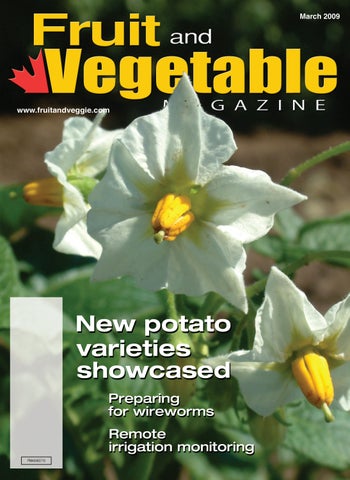
New Canadian potato varieties showcased at annual variety day By Lukie Pieterse .............................................................................................................. 18
Cereal fusarium making the leap into potatoes By Myron Love ................................................................................................................. 20
Light shortens the life of vegetables ........................................................................................................................................ 21
Top awards at OFVGA By Jim Meyers .................................................................................................................. 22
Child safety is priority, says new farm safety study ........................................................................................................................................ 24
Weather was tough on crops, growers in 2008 By Hugh McElhone ............................................................................................................ 30
Departments Editorial ................................................................................................................... 4 Fruit & Veggie Online .............................................................................................. 8 New Products........................................................................................................ 26 Briefs ..................................................................................................................... 28
www.fruitandveggie.com MARCH 2009 FRUITANDVEGGIE.COM 3
Innovate or perish
I
recently travelled to California to attend the World Ag Expo in Tulare. I serve as editor of a second agricultural publication – Manure Manager (www. manuremanger.com) – and decided to tag along with the publication’s sales manager to see the latest and greatest in agricultural equipment and services, specifically manure handling equipment. Of course, while I was there, I had to check out the newest developments in fruit and vegetable production equipment and innovations in irrigation. I wasn’t disappointed. Half of the annual show’s Top 10 New Products were geared toward fruit and vegetable producers. They included: Aqua-PhyD, an environmentallyfriendly device that fits into the main line of drip, sprinkler or flood irrigation systems allowing growers to stretch their water supply without chemicals or extra electrical power. The unit is mounted between the sand filters and before the water line goes into the ground. According to the company, the technology improves hydraulic conductivity, increasing water use efficiency, and improves the leaching of salts, enabling the use of water with high levels of total dissolved solids (TDS). www.aqua-phyd.com LectroSense is a new sensing system for orchard sprayers that automatically shuts off the sprayer between trees. According to product developer Progressive Ag Inc., the new technology can cut chemical costs by 75 per cent while also reducing waste and drift. The system is designed for use in young, uniform orchards up until the canopies are touching. It features an electronic sensor mounted at the end of a break-away boom on each side of the sprayer. The boom adjusts manually to fit different row spacings and the sensor height can also be changed to match different trunk heights. The system is designed for use on Progressive Ag Inc.’s LectroBlast Electrostatic Sprayers. www.proaginc.com The NV-851 Produce Wrapping Machine is made by San-Ai Corporation, U.S.A, and offers packing houses the ability to wrap as many as 850 or more pieces of produce per hour in a plastic film. The machine can wrap a wide variety of produce, including iceberg lettuce, broccoli, cabbage, cauliflower, bell peppers, zucchini,
4 MARCH 2009 FRUITANDVEGGIE.COM
cucumbers, leafy lettuces and multiple mushrooms. The NV-851 uses a mechanical method of wrapping that begins when the operator places an item in the machine’s tray. A sensor detects the item and activates the wrapping process. The machine detects the subtle differences in the produce commodity size and wraps the proper amount of plastic film around the item with just enough pressure to prevent any bruising. An optional conveyor system can be added to offload the wrapped produce for sorting or boxing. www.san-ai-usa.com Andros Engineering’s Series III Carrier is designed to place drip irrigation tape accurately, quickly and safely. According to the product’s designers, it can be difficult to lay drip tape accurately because the tape rolls have to be placed so close together. The Series II Carrier includes an arbor shaft for handling a spool of tape, a cradle for holding the shaft and spool combination, and a brake to control freewheeling of the tape at the end of the row. It can be mounted to a variety of planting implements, bed shapers or a tool bar and can be adjusted from one line per bed to up to three lines per 40-inch bed. www.andros-engineering.com The Valley Tracker Mobile allows growers to check the status of their sprinkler irrigation and control its operation by pressing a cell phone touch screen. All that’s required is a web-enabled smart phone or
smart PDA, a Windows mobile browser and access to the Internet. Tracker Mobile is included with each new Valley Tracker or TrackerSP and provides colourful graphics to depict the current status of each irrigation system. Using the cell phone touch screen, the grower can view different status reports, check for malfunctions and send commands to operate the irrigation equipment. The user can also group irrigation systems for viewing different farms very easily. www.valleyirrigation.com This is just a small sampling of the new products and innovations on display by more than 1600 exhibitors covering 2.6 million square feet of exhibit space. Canadian innovation was well represented with more than 35 Canadian companies exhibiting at the three-day show. There were also companies from Australia, Israel, India, China, United Kingdom, Switzerland, Denmark, Austria, Brazil, Italy, Mexico and Korea showcasing their agricultural advances. Possibly the most encouraging element of the event was the grower attendance and enthusiasm. As part of the show, a special pavilion is erected in the centre of the show grounds, showcasing the top innovative new products. During the entire three days, the tent was packed with interested growers and product literature was constantly in need of replenishment. Hopefully, this interest will result in sales in the future months. ❦
Haskap berries In the February 2009 issue of Fruit & Vegetable Magazine, an article on blue honeysuckle berries, also known as Haskap berries, was featured. Reader interest is very high for this crop and many people contacted our office, interested in obtaining contact information and finding out whom they can contact to purchase plant stock. I hope these websites and e-mail addresses are of some assistance to you. Haskap Canada Association – www.haskap.ca This website is aimed at promoting the production of Haskap berries in Canada. It includes a list of coming events,
including Haskap Day (July 17, 2009 at the University of Saskatchewan), a list of licensed plant propagators, links to more information and contact information for growers and researchers. The organizing committee of the Haskap Canada Association can be reached at haskap.committee@haskap.ca. Dr. Bob Bohrs is currently on sabbatical searching out different kinds of blue honeysuckle cultivars across Canada. His e-mail at the University of Saskatchewan is bob.bohrs@usask. ca. According to his sabbatical agenda, he will be visiting Alberta in May and Saskatchewan in June.
Introducing Movento® New two-way systemic aphid control for tree fruit, grapes and vegetables Put an end to hide-and-seek There’s nowhere for insect pests to hide with Movento, a revolutionary new systemic insecticide. Movento travels up and down to protect leaves, roots and new growth, controlling pests above and below ground. Movento protects apples and grapes from a broad range of sucking insect pests – including hard to control pests like woolly apple aphid and grape Phylloxera. And Movento’s new class of chemistry, Group 23, provides a different mode of action for better resistance management and rotation options. Movento – there’s no hiding from this new two-way insecticide.
bayercropscience.ca or 1 888-283-6847 Always read and follow label directions. Movento® is a registered trademark of Bayer. Bayer CropScience is a member of CropLife Canada.
9234FruitVeg-1108
Preparing for wireworms in potatoes during 2009 season By Dr. Bob Vernon
W
ireworms, which are the larval stage of click beetles, have become major pests of many horticultural crops across Canada. There are several pest species of wireworms, and one or more of these species can be found in a field causing damage. Favoured crops are cereals and other grassy hosts and forages, where wireworms can build up to millions per acre in a short period of time. If a field is in pasture or has been planted to a cereal crop, emerging click beetles from the field or from surrounding grassy headlands in the spring will lay eggs by the hundreds. Later in the spring and summer, the new, or ‘neonate’ wireworms, begin to feed and grow.
understand how they behave in the soil. Typically, wireworms are mostly dormant and deeper in soil in winter months when temperatures are low and food is scarce. In spring, as soil temperatures increase to five to 10oC, wireworms become active and move to the surface in search for food. Wireworms are attracted by CO2 , which is produced by germinating seeds or existing plants (i.e. pasture) in the spring. In the case of cereal crops (wheat, barley, etc) or forage crops (corn), wireworms are attracted to the germinating seeds and can wound or kill the seedlings, resulting in reduced stand and yield. In crops such as potato, wireworms are attracted to potato seed pieces during
Wireworms are the larval stage of click beetles and have become major pests of many horticultural crops across Canada, including potatoes. Favoured crops are cereals and other grassy hosts and forages, where wireworms can build up to millions per acre in a short period of time. (Contributed photo)
Wireworms will generally grow about five millimetres per year, and can generally cause crop damage in their third growing season. Depending on the species, the wireworm stage can last from three to five years, culminating in a brief pupation period and adult click beetles late in the summer. The new click beetles stay buried in the ground until the next spring, and emerge to mate and lay more eggs.
The life cycle of wireworms To control wireworms, we must first 6 MARCH 2009 FRUITANDVEGGIE.COM
sprouting and will feed on the seed piece or on the developing roots and shoots. During the hot and dry months of summer, wireworms will often move deep into the soil until cooler temperatures and higher moisture occur later in August and September. Wireworms will then feed on the maturing crops at that time. In the case of established cereal and forage crops, wireworm feeding activity on roots causes little yield damage in late summer, however, feeding on crops such as potato and carrot can cause significant cosmetic injury by harvest.
The importance of field management How you manage and prepare your fields prior to the growing season can have a marked effect on wireworm behavior and the amount of damage to your crops. You are at greatest risk of wireworm damage when you take a field out of pasture and into a crop situation. Wireworm populations will likely be extremely high in the pasture, and remain in the soil when the pasture is removed. When you plant other crops in the spring, wireworms will be compelled to feed on those crops (cereals, forages, vegetables, strawberries, etc) and can cause extensive damage for several years. Work at Agriculture and Agri-Food Canada (AAFC) in Agassiz, B.C., suggests that how and when you remove pasture has an effect on wireworm damage and on how well insecticides will work. For example, if you remove the pasture by plowing in the early spring, many wireworms will be attracted to the CO2 produced by the rotting vegetation about 30 centimetres (one foot) below the surface. If you then plant potatoes with an in-furrow insecticide (i.e. Thimet 15G), only part of the wireworm population will move to the treated rows and be killed. Later in the season, after the plowed pasture has rotted away, surviving wireworms will then be attracted to the developing daughter tubers at a time when the insecticide has lost its effectiveness. If you fall plow, there will be no rotting pasture at the time of planting in the spring, and the majority of wireworms will be attracted to the insecticide-treated potato rows and be killed. The same principle applies to planting other crops following pasture. Certain crop rotations also favor wireworm buildup. If your rotation includes a cereal crop, these crops will be selected by click beetles for egg laying. From these eggs, wireworms will be large enough in a couple of years to cause major damage to your crops. Be prepared for this eventuality.
Coming Events
Dr. Bob Vernon surveys a field of potatoes. The Agriculture and Agri-Food Canada researcher based at Agassiz, B.C., is currently involved in a wireworm survey across Canada. Contributed photo
Control options After 1950, several insecticides were registered for wireworm control in Canada. Among the most effective were the organochlorine insecticides (i.e. DDT, aldrin, heptachlor and lindane). Some of these insecticides (heptachlor) controlled wireworms in the soil for up to 13 years with a single application. Lindane was used for decades by cereal and forage crop growers as a seed treatment (Vitavax Dual, Agrox DL Plus), and wireworms were controlled in fields with one treatment every three to four years. Work by AAFC has shown that lindane killed not only existing wireworms in the soil, but persisted long enough in the growing season to kill the new neonate wireworms produced that year. Repopulation of fields by wireworms large enough to cause damage would take at least another three to four years, at which time the seed treatment would be used again. All of the effective organochlorines, however, including lindane
(2004) have now been de-registered in Canada and elsewhere. At the present time, there are no insecticidal seed treatments for cereal or forage crops that will kill both existing and neonate populations of wireworms, although some products will prevent early season wireworm damage. Other insecticides, including various carbamates (e.g. Furadan), organophosphates (e.g. Thimet) and pyrethroids (e.g. Force) have been registered for wireworm control on various crops in North America, but many of these insecticides are no longer registered or will soon be de-registered in Canada. The next article in this series will focus on what the current insecticide options are for controlling wireworms and what we might expect in the future. ❦ AAFC is conducting a wireworm survey across Canada, and you can help. If you have a wireworm problem, contact Dr. Bob Vernon at AAFC, Agassiz, B.C. at (604) 796-1708.
March 14, 2009 – Creating a Memorable Customer Experience, Brampton, Ontario. Visit www. farmersmarketsontario.com. March 14, 2009 – Meet the Media: Getting their attention on your terms, Port Hope, Ontario. Visit www.farmersmarketsontario.com. March 21, 2009 – Creating a memorable Customer Experience, London, Ontario. Visit www.farmers marketsontario.com. March 21, 2009 – Meet the Media: Getting their attention on your terms, Thunder Bay, Ontario. Visit www.farmersmarketsontario.com. March 22-25, 2009 – 7 th World Potato Congress, Christchurch, New Zealand. Visit www.wpcnz.org.nz. March 24, 2009 – Market Caravan Ontario, CASO Railway Station, St. Thomas, Ontario. Visit www.farmcentre.com. March 25-26, 2009 – 2009 Muck Crops Conference, Holy Martyrs of Japan Catholic Church, Bradford, Ontario. March 28, 2009 – Creating a Memorable Customer Experience, Thunder Bay, Ontario. Visit www. farmersmarketsontario.com. March 28, 2009 – Meet the Media: Getting their attention on your terms, Carp, Ontario. Visit www. farmersmarketsontario.com.
Correction In the February 2009 issue of Fruit & Vegetable Magazine, an article entitled “Weather was tough on crops, growers in 2008” (page 18) was printed that contained some errors and misinformation. As a service to our readers, the article has been reprinted in this issue (see page 30) with corrections made. We thank Janice LeBoeuf of the Ontario Ministry of Agriculture, Food and Rural Affairs (OMAFRA) for her understanding and assistance. We apologize for the errors and any confusion they may have caused. MARCH 2009 FRUITANDVEGGIE.COM 7
Read these stories and more at www.fruitandveggie.com
NEWS HIGHLIGHTS •
NS Winery/dried grape research.
•
Ministers announce transition measures for AgriInvest.
•
Study says PEL farms need major change to remail financially viable.
•
Potato companies announce cutbacks.
•
Ag producers are optimistic says FCC survey.
•
New apple more than 20 years in the making.
•
Cranberry bogs may be moving to Canada from New Jersey.
•
Atlantic AG ministers agree to regional co-operation.
NEW PRODUCTS New Holland’s Boomer 8N
WEB EXCLUSIVE
Scientists discover how ethylene is triggered By Salk Institute Genomic Analysis Laboratory Best known for its effects on fruit ripening and flower fading, the gaseous plant hormone ethylene shortens the shelf life of many fruits and plants by putting their physiology on fast-forward. In recent years, scientists learned a lot about the different components that transmit ethylene signals inside cells. But a central regulator of ethylene responses, a protein known as EIN2, resisted all their efforts. Finally, after more than a decade of constant probing, a team of researchers led by Dr. Joseph Ecker, a professor in the Plant Biology laboratory and director of the Salk Institute Genomic Analysis Laboratory in La Jolla, California, successfully pinned down the elusive protein. Turns out, the presence of ethylene stabilizes the otherwise ephemeral EIN2 allowing it to gather up enough strength to pass on ethylene’s message.
New Holland announces the introduction of the new Boomer 8N, a compact tractor that combines vintage design with modern, innovative amenities. The latest addition to the company’s Boomer line, the redesigned 8N features distinctive, timeless styling, a Continuously Variable Transmission (CVT) that creates a fun, easy, car-like driving experience as well as a variety of customizable accessories. First sold in 1948, this updated version of the classic 8N is now available to consumers seeking reliable power wrapped in a compact and timehonored package. Whatever the job requires; whether loading mulch, mowing the lawn, clearing a pasture or digging a trench, the new Boomer 8N tractor makes it fun, easy and comfortable for serious rural lifestyles or hobby farmers to complete any task. Read more online at www.fruitandveggie.com
Lantech Pallet-Grip® Lantech introduces its new easy-adjust Pallet-Grip® load locking system for its straddle stretch wrapping systems.
Pallet-Grip is a patented system that locks a load to a pallet with a cable of film rolled into the bottom wraps and placed below the deck of the pallet. The new Pallet-Grip system captures any style of pallet in a wider range of heights, from four to six inches high, while retaining the ability to completely wrap to top of the load. The system places a rolled cable of film approximately 1.5 inches (3.8 cm) below the pallet deck, while the remainder of the film web captures the load above the deck. Read more online at www.fruitandveggie.com
Read more online at www.fruitandveggie.com 8 MARCH 2009 FRUITANDVEGGIE.COM
THE ONLY GROUP 9
LEAVING YOUR PROTECTION BEHIND CAN BE A PAINFUL MISTAKE
It’s best to use the right protective equipment for the job. The same is true for your potatoes. Scala® protects against early blight and is the only Group 9 fungicide on the market. So you get excellent early blight control in a smart rotation management tool. New Scala. Growing potatoes without it is like taking a puck in the groin.
bayercropscience.ca or 1 888-283-6847 Always read and follow label directions. Scala® is a registered trademark of Bayer. Bayer CropScience is a member of CropLife Canada. 9412-0109
Manitoba grower shares experience with remote irrigation monitoring system By Myron Love
B
rent Metcalfe is a young progressive potato grower in the Treherne area of south-central Manitoba, located northwest of Winnipeg. In 2008, Metcalfe, along with his cousin Barry Watson, installed a new remote irrigation monitoring system on the pair’s 1,000acre operation, WM Ventures. Metcalfe recently shared his experiences using the system with fellow potato growers during the province’s annual potato production seminars held at the Keystone Centre in Brandon, Man. The irrigation system that WM Ventures started building in 2003 in partnership with neighbouring grower, Northern Potatoes, consists of approximately 40 kilometres of pressurized pipeline fed by eight pumps that service as many as eight centre pivot irrigation systems. The radio monitoring system was installed in 2008 to allow Metcalfe and Watson the opportunity to monitor the irrigation system’s performance remotely. “The system not only remotely monitors the pivot positions but also measures soil moisture, rainfall, evapo-transpiration, flow, and water pressure in the pipelines,” Metcalfe said. “It has made running our operation much easier. “We have studied the system’s efficiencies and cost savings,” he added. “It has saved us in terms of down time as well as travel time. Our land is fairly spread out. The cost savings just in gas usage and repairs have been tremendous.” Included in the system is a warning program sent via text messaging should any problems arise with the pumps or water pressure in the pipelines, or should the pivots stop for any reason. Metcalfe said he also wanted electronic rain gauges. These tools have taken the guesswork out of rainfall levels, he said. “I can even check the gauges in the middle of the night,” he added. Because the system keeps a data log, he can look back at the information if someone adverse should happen to the crop.
10 MARCH 2009 FRUITANDVEGGIE.COM
Brent Metcalfe and his cousin Barry Watson, co-owners of WM Ventures, installed a new remote irrigation monitoring system on their operation to help monitor and control eight centre pivot irrigation systems, similar to the system pictured above.
Overall, Metcalfe said, the He noted there are a number system is working well. of components involved in WM Ventures’ remote monimonitoring irrigation systems, toring system was installed including radio receivers, senthrough consultation with the sors, gauges to measure rain Manitoba branch of the Prairie volume, compasses, GPS systems Farm Rehabilitation Administraand the Internet. Producers can tion (PFRA), a branch of Agrihave a system that collects data culture and Agri-Food Canada. Brent Metcalfe right on the farm – which is The system was supplied by Weather convenient in that it allows the producer Innovations Network of Chatham, Ont. to monitor his situation on a daily basis Bruce Shewfelt, the head of the PFRA’s – or you can have the data transmitted Irrigation and Drainage Unit based in to a third party off-site for analysis and Morden, Man., described WM Ventures’ receive notifications through the Internet system and other aspects of real time ir- or a cell phone network. rigation system monitoring, “The systems are getting better and “Real time monitoring allows the pro- less costly all the time,” Shewfelt said. ducer to make better decisions,” he point- “Satellite access, cell phones, smart sensors ed out. “That results in better productivity and broad spectrum radio are all coming and is better for the environment.” into play.” ❦
Deals with target pests. Integrates with IPM. Introduced in 2008, DuPont™ Altacor™ insecticide has quickly established itself as a highly effective choice for the control of economically significant pests in Canada’s orchards and vineyards. Powered by DuPont™ Rynaxypyr™, Altacor™ provides broad-spectrum residual control of the pests that matter: Oblique-banded leafroller, Codling moth, Grape berry moth, Climbing cutworm, Oriental fruit moth, plus others. As a new chemistry, there are no cross-resistance issues to worry about, and its low use rate means Altacor™ is easy to use and convenient.
Questions? Ask your retailer, call 1-800-667-3925 or visit www.dupont.ca/ag
With any crop protection product, read and follow label directions. The DuPont Oval Logo®, DuPont™, The miracles of science™, Altacor™ and Rynaxypyr™ are registered trademarks or trademarks of E. I. du Pont de Nemours and Company. DuPont Canada is a licensee. Member of CropLife Canada. © Copyright 2009 DuPont Canada. All rights reserved.
Managing apple scab this season By Hugh McElhone
G
ood and vigilant management is needed to address apple scab and the potential for resistance to fungicides says Dr. Wendy McFaddenSmith, tender fruit and grape specialist with the Ontario Ministry of Agriculture, Food and Rural Affairs (OMAFRA). “Pretty well everyone had some scab this year (2008),” she says. “It was always raining or it was too windy. It was very difficult to spray.” The incidence of apple scab in Ontario has been steadily increasing over the past five years; for example scab in packout from orchards in Eastern Ontario rose from 1.4 per cent in 2002 to six per cent in 2007. Fungicide resistance should be a major concern for all growers and, once established, apple scab populations are permanent. Fungicide timing is also very important, otherwise the resistance problems in the U.S. could develop here, Dr. McFaddenSmith says. The development of the apple scab fungus’s resistance to benomyl was unexpected and sudden in the U.S. It took only one mutation to allow it to spread rapidly through orchards, she explains. Resistance to multi-site fungicides, such as thiram, ferbam, sulphur, copper, mancozeb and polyram, is extremely unlikely, Dr. McFadden-Smith says, adding but for all other fungicides, resistance has developed. Research was conducted in 16 Ontario orchards from 1999 to 2000 to test for apple scab tolerance to demethylation inhibiting (DMI) fungicides such as Nustar and Nova. Isolates of the apple scab fungus were collected and screened by mounting them on agar plates with and without a discriminatory dose of myclobutanil. Resistant isolates grew as well on amended plates as on the unamended agar. According to a formula developed by Dr. Wolfram Koeller of Cornell University, once 43 per cent of the isolates from an orchard are tolerant of the discriminatory dose, practical resistance is present. This means that the labeled rate of the DMI fungicide no longer provides control of apple scab. In 1999, none of the orchards were even 12 MARCH 2009 FRUITANDVEGGIE.COM
Symptoms of apple scab on fruit. Photo courtesy of the American Phytopathological Society
Symptoms of apple scab on crabapple.
infections can produce lesions that can infect fruits at petal fall. If a leaves are protected from green-tip, the chances of having sporulating lesions when fruit are young and very susceptible to infection will be much less.” Dr. Mcfadden-Smith suggests growers use mancozeb or a copper spray, adding Symptoms of apple scab on a leaf. Photo courtesy of South Dakota State University.
Fungal spores that cause apple scab disease (Venturia inaequalis) erupting through the cuticle of a crabapple leaf.
close to having practical resistance. In the 2007 survey, three of the orchards were “resistant.” Dr. Koeller also determined that practical resistance will start to develop in an orchard after approximately 60 applications. This assumes excellent coverage, proper spray intervals and no sprays applied after lesions have developed. Dr. McFadden-Smith collected spray records from the orchards where she sampled. From 1992 to 1999, the most sprays applied by a cooperator over the entire seven-year study period was 33. Ontario growers also applied DMI fungicides in a tank mix with a protectant and did not apply them after first cover, both important factors in reducing resistance pressure. “While peak scab spore release occurs at bloom, green tip is the time to spray,” explains Dr. McFadden-Smith “Green tip
that Captan would also work too but growers would have to watch for phytotoxicity with dormant oils. Dr. McFadden-Smith says growers should be conservative in orchards with high levels of inoculum present over winter, using the label rate and a tight spray schedule from silver tip through petal fall. For suppression of overwintering disease inoculum, she suggests they consider a ground spray of urea in the fall or early spring. She also suggests nor more than two DMI or strobilurin sprays be used in one year. The sprays should also not be used after lesions occur. Always follow the instructions on the label and be aware of what is going on in your orchard, Dr. McFadden-Smith reminds, adding spray coverage is generally the worst at the top of the tree and apple scab can often develop there first. ❦
Climate change presents opportunities and pitfalls By Myron Love
G
lobal warming has the potential for improved growing conditions for hard-pressed prairie vegetable growers but a Saskatchewan researcher cautions it brings potential pitfalls as well. “A Minnesota climate for Saskatchewan may mean warmer temperatures and a longer growing season,” admits Dr. Doug Waterer, an associate professor with the department of plant science at the University of Saskatchewan. “But it also means new disease, weed and bug problems that will need to be addressed.” Under current conditions – a short growing season and a cool climate – some vegetables, such as potatoes, carrots and cabbage, do reasonably well in Saskatchewan whereas others, such as melons and tomatoes, are riskier. “They require more skill to grow them and tend to fail more often,” Dr. Waterer says. “You can’t fight Mother Nature.” While he points out that global warning is not a foregone conclusion, Dr. Waterer admits the temperature trend seems to be toward warming, especially
on the Canadian Prairies. “Climate is changing on the prairies faster than anywhere else in the world,” he says. “If this trend continues, it will mean longer summers, a longer growing season and more frost-free days.” In every crop, there are several different varieties available and in Saskatchewan, growers have tended to select for fast maturing varieties, not necessarily be the best quality. If the growing season was longer, growers could select better quality crops, says Dr. Waterer, adding a longer growing season would also result in higher yields and the possibility of trying different crops that are not well suited to the present climate. While this may sound positive, Dr. Waterer points out that with a warming climate could be a trend toward a dryer growing season.
“This is already a region that doesn’t get a lot of rainfall,” he says. “Irrigation could become much more important. “At the same time, there could be more competition for water from a growing urban population and livestock operations.” Dr. Waterer also notes that the current cold Saskatchewan winters kill off many troublesome insects and the shorter summers don’t give any insects that do survive much time to reproduce. That could change with a warmer climate, which might also attract new insects species, weeds and diseases to the region. “A warmer climate will present new opportunities if growers manage change carefully,” Dr. Waterer says, adding new markets may open up in areas adversely affected by global warmer, such as the already dry American southwest. ❦
Above: Could long-season stake tomatoes such as these become a regular crop of choice in Saskatchewan? Global warming has the potential to improve growing conditions for Prairie vegetable growers but a Saskatchewan researcher cautions there could be potential pitfalls as well. MARCH 2009 FRUITANDVEGGIE.COM 13
New early detection method for ring rot in potatoes explained By Myron Love
B
acterial ring rot has caused havoc in potato fields throughout North America over the years. “We have just barely escaped a (ring rot-created) nuclear meltdown in the Dakotas over the past two years,” said Dr. Neil Gudmestad, a professor of plant pathology at North Dakota State University with more than 30 years of experience doing research on potato diseases. Ring rot is not easily detected, Dr. Gudmestad noted. The bacteria can survive on equipment and in storage facilities for a very long time. And only one or two potatoes in a field may show any symptoms. In the 1980s, immunofluorescence and ELISA tests were the industry stan-
dards for detecting bacterial ring rot. In the 1990s, Dallice Mills of Oregon State University introduced genetic screening using polymerase chain reaction (PCR) to detect the DNA of ring rot bacteria. “We have developed a better mousetrap,” said Dr. Gudmestad. “We have developed a PCR detection method that can detect ring rot in real time and produce results in minutes.” Building on the work of a Finnish team that took the DNA sequence and developed a knockout gene that makes ring rot non-virulent, Dr. Gudmestad and his team of researchers focused their studies on the cellulase A gene on the plasmid and cellulase B gene. They took some of the gene sequence from
Wherever you find Canadian agriculture, you’ll find FCC Call us at 1-800-387-3232 (your local office) or 1-888-332-3301 (extended hours). See what we’re up to at www.fcc.ca/advancing
50 years /ans
1959-2009
14 MARCH 2009 FRUITANDVEGGIE.COM
cellulase A and B for their PCR. They then compared their detection method to the ELISA and original PCR testing methods. “We tested 4,000 tubers in 20 sublots,” said Dr. Gudmestad. “We also infected some of our seed lots. “Our method of detection was noticeably more effective,” he said, supporting his assertions with a selection of statistical charts showing the test results. “Bacterial ring rot is not going to go away any time soon,” he said. “We are suggesting that our technology will help detect the disease at a much earlier stage than anything else out there and allow growers to take action that much sooner to save their crops.” ❦
%V1POU $PSBHFO
JOTFDUJDJEF
/&8 5IFZ KVTU DBOµU SFTJTU OFX $PSBHFO
Introducing new DuPont™Coragen™ insecticide for: UÊ ÌÀ Ê vÊ À>` Ê« Ì>Ì ÊLiiÌ iÃÊ V Õ` }Ê `>V «À ` Àià ÃÌ> ÌÊL ÌÞ«iÃÊ UÊ ÊÜ iÊ iÜÊ}À Õ«Ê vÊV i ÃÌÀÞÊqÊ À Õ«ÊÓn UÊ,ià `Õ> ]Ê Õ Ì ÃÌ>}iÊV ÌÀ Ê vÊ ÕÀ «i> ÊV À ÊL ÀiÀÊ 2VFTUJPOT "TL ZPVS SFUBJMFS PS DBMM Ê Ì Ê> ÞÊVÀ «Ê«À ÌiVÌ Ê«À `ÕVÌ]ÊÀi>`Ê> `Êv ÜÊÌ iÊ >Li Ê ÃÌÀÕVÌ ÃÊV>ÀivÕ Þ° 7 / iÊ Õ* ÌÊ"Û> Ê } ]Ê Õ* Ì™]Ê/ iÊ À>V iÃÊ vÊÃV i Vi™]Ê À>}i ™Ê> `Ê,Þ >ÝÞ«ÞÀ™Ê>ÀiÊÀi} ÃÌiÀi`ÊÌÀ>`i >À ÃÊ ÀÊ ÌÀ>`i >À ÃÊ vÊ °Ê °Ê`ÕÊ* ÌÊ`iÊ i ÕÀÃÊ> `Ê «> Þ°Ê Õ* ÌÊ > >`>Ê ÃÊ>Ê Vi Ãii°Ê i LiÀÊ vÊ À « viÊ > >`>°Ê ^Ê «ÞÀ } ÌÊÓää Ê Õ* ÌÊ > >`>°Ê ÊÀ } ÌÃÊÀiÃiÀÛi`°
From pest control to environmental safety, new Delegate™ insecticide from Dow AgroSciences brings a higher level of performance to your fruit or vegetable business. Delegate uses a novel mode of action to deliver quick knockdown of a wide range of problem pests with a low impact on beneficial insects. Combine these features with a low use rate on a wide range of fruit and vegetables and you’ll find many reasons to put new Delegate to use in your Integrated Pest Management program. For more information, call the Solutions Center at 1.800.667.3852 or visit dowagro.ca.
EVERY GROWER HAS A NEED TO DELEGATE.
™
Trademark of Dow AgroSciences LLC 0209-10365
New Canadian potato varieties showcased at annual variety day By Lukie Pieterse
O
n February 18, 2009, the Potato Research Centre of Agriculture and AgriFood Canada (AAFC) held its 12th Potato Selection Release Open House in Fredericton, New Brunswick. Ten new AR2009 Accelerated Release selections were made available for two years of non-exclusive evaluation. Through the Accelerated Release Program, the Potato Research Centre offers potato industry entrepreneurs an opportunity to evaluate first-hand, in their own field, the front runners coming out of early
selection trials. The Accelerated Release Program is a mechanism to “fast track” the release of promising potato selections developed at the Potato Research Centre of Agriculture and Agri-Food Canada. Interested companies receive a limited quantity of breeder’s seed and non-exclusive rights to conduct their own field and processing trials for two years. If sufficiently impressed with the results during this initial testing phase, interested parties can bid for three more years of exclusive testing. At the end of this second phase,
or sooner, if there is still an interest, a sixyear, renewable licence agreement can be negotiated with the Potato Research Centre to commercialize the variety. This year the Research Centre showcased 10 promising varieties. Further information can be obtained from Agnes Murphy, breeder at the Research Centre, (agnes.murphy@agr.gc.ca). ❦
AR2009-02 (ND2008-2 x CS7232-4) Uniform chip selection with bright skin.
AR2009-03 (Certa x ND0860-2) Vigourous, high yielding selection with potential for starch production.
AR2009-04 (Barbara x Rochdale GoldDorée) Round, purple splashed selection with yellow flesh, very good culinary quality, extreme resistance to PVY and PVX, ideal for the fresh market.
18 MARCH 2009 FRUITANDVEGGIE.COM
Above: AR2009-01 (F95031 x CS7232-4) Uniform chip selection with resistance to golden nematode
AR2009-05 (N1700-8 x AC Chaleur) High yielding, fresh market selection with purple skin and resistance to wart.
AR2009-06 (F87031 x CS7294-10) Uniform, round, fresh market selection with good appearance and resistance to golden nematode.
AR2009-07 (N1698-6 x Chieftain) High yielding, fresh market selection with red skin, good quality and resistance to PVX.
AR2009-08 (AC Red Island x Rochdale Gold-Dorée) Uniform, round, fresh market selection with good quality and resistance to PVX. May have potential in the creamer market.
R2009-09 (AC Red Island x Rochdale Gold-Dorée) Uniform, fresh market selection with good quality.
AR2009-10 (F91031 x Congo) Long selection with dark purple flesh, good culinary quality and resistance to golden nematode.
Protects new growth Reason® for early blight and late blight control
bayercropscience.ca or 1 888-283-6847 Always read and follow label directions. Reason® is a registered trademark of Bayer. Bayer CropScience is a member of CropLife Canada. 9581-02-0109
MARCH 2009 FRUITANDVEGGIE.COM 19
Cereal fusarium making the leap into potatoes By Myron Love
A
lthough Fusarium sambucinum remains the most common form of the fungus that causes dry rot in potatoes, F. graminearum – a species of fusarium commonly found in cereal crops – has been identified in potatoes. Addressing Manitoba potato growers during the recent Manitoba Potato Production Days Seminar and Trade Show, Dr. Tracy Shinners-Carnelley reported that F. graminearum was documented for the first time last year in potatoes grown in Manitoba, Quebec and New Brunswick. In Manitoba, F. graminearum accounted for eight per cent of samples surveyed compared to F. sambucinum, which was identified as the fungus in 56 per cent of provincial fusarium diagnoses in potatoes. The presence of F. graminareum in potatoes may come from crop rotation practices, suggested Dr. Shinners-Carnelley, referring to Dr. Rick Peters’ findings in P.E.I. Dr. Shinners-Carnelley’s presentation focused on seed piece decay and management of fungicide-resistant fusarium. In her talk, she referred frequently to research 20 MARCH 2009 FRUITANDVEGGIE.COM
conducted by Dr. Peters, a plant Dr. Shinners-Carnelley said, pathologist with Agriculture occured in the mid 1990s. In the and Agri-Food Canada (AAFC) past five years, she noted, Dr. based in Charlottetown, P.E.I. Peters has found most isolates The external signs of fuof F. sambucinum continue to sarium, Dr. Shinners-Carnelley be resistant to TBZ (THiabenoted, are shrinking and shriveldazole) and TPM, however ing of lesions. Cutting inside some sensitive isolates have the potato, the grower will notice Dr. Tracy Shinners- been recovered in Manitoba. mycelium-filled cavities and Carnelley She cited a recent Manitoba light to dark brown rot. survey that found two out of 10 samples of “Seed piece decay occurs in storage as F. sambucinum were resistant to both TPM well,” she said. “The inoculum spreads and fludioxonil (Maxim). She reported that during seed cutting and handling early in fludioxonil (Maxim) resistance has also the year. The infection occurs in wounds been documented in other provinces. and infected seeds can infest the soil where Dr. Shinners-Carnelley suggested grothe fungus can survive for many years.” wers use resistance management strategies The amount of dry rot in seed is not when selecting seed piece treatments. a good indicator of the amount of dry She also recommended using clean seeds rot you will see in the overall harvested stored in a disinfected facility. crop, Dr. Shinners-Carnelley added. The “You should warm your seed tubers determining factor is in the amount of to 10 Celsius before cutting and handling wounding. them to minimize injury and promote Turning to the matter of fungicide growth and remove diseased tubers before resistance to chemicals, the first case of cutting them,” she said. “And don’t store resistance to thiophanate-methyl (TPM), them for more than 10 days.” ❦
Light shortens the life of vegetables
A
ccording to various studies undertaken by researchers from the University of La Rioja in Spain, exposure to light reduces the quality of cauliflower, broccoli, chard, leeks and asparagus, which have been processed for sale. Their latest work has been published in the Journal of the Science of Food and Agriculture, and shows the useful life of chard is reduced by 11 days if it is exposed to light instead of keeping it in the dark, even though it has been covered in the best protective wrap. “We have established that there is a negative effect on the sensory quality of minimally processed vegetables (MPV) if they are exposed to light. These are foods that are ready for immediate consumption after being washed, peeled, cut and wrapped in protective polymeric wraps” explains Susan Sanz. Her team has shown that the useful life of leeks is reduced from approximately 26 to 18 days if they are exposed to light, broccoli from 14 to 11 days, and cauliflower from 11 to three days. Scientists have shown that fresh or near fresh vegetables “do not usually exceed the two weeks’ useful shelf life,” and that light promotes their deterioration since this accelerates the transpiration and respiration of these plants, and changes the way they behave. Sanz does point out that not only is it important not to break the cold chain, but it is also important to control the atmosphere inside the container so that it suits the type of vegetable.
Recent research from Spain shows exposure to light reduces the quality of cauliflower, broccoli, chard, leeks and asparagus.
The research team is already carrying out tests to see which is the ideal colour for lights at the point of sale so that the vegetables are not affected so much. ❦
CALL ABE FIRST... BUY A DIESEL PUMP UNIT FROM THE
DIESEL MECHANICS FOR BETTER PRICES, MORE CHOICES, AND FRIENDLY SERVICE
New, Used & Rebuilt Irrigation Diesel Pumps 20 - 450 HP Perkins, International, Cummins, John Deere, Iveco, Deutz, etc. * Also for pumps, engine parts, pipe couplers - nipp, camlock, ringlock, suction & high pressure hose, clamps, etc. And for service – 2 diesel mechanics. Also diesel gan-sets and liquid manure pump units.
A. KOOLMEES R.R. 1, Otterville, Ontario, N0J 1R0
Systemic, translaminar and anti-sporulant Reason® for early blight and late blight control
bayercropscience.ca or 1 888-283-6847 Always read and follow label directions. Reason® is a registered trademark of Bayer. Bayer CropScience is a member of CropLife Canada. 9581-02-0109
(519) 879-6878 Fax: (519) 879-6319 MARCH 2009 FRUITANDVEGGIE.COM 21
Top awards at OFVGA By Jim Meyers
G
ood and vigilant management is needed to address apple scab and the potential for resistance to fungicides says Dr. Wendy McFadden-Smith, tender fruit and grape specialist with the Ontario Ministry of Agriculture, Food and Rural Affairs (OMAFRA). During the Ontario Fruit and Vegetable Growers’ Association’s recent 150th annual meeting, some important industry awards were presented. The following is a brief recap of the winner’s of the association’s Lifetime Achievement Award, Award of Merit and the Ontario Golden Apple Award.
OF &VGA Lifetime Achievement Award – Hector Delanghe Hector Delanghe, a Blenheim, Ont.-area fruit and vegetable grower and wellknown to growers across Canada through his work with the Canadian Horticultural Council (CHC), was presented with a Lifetime Achievement Award by the Ontario Fruit and Vegetable Growers Association at it’s 150th annual general meeting. In making the presentation Hamiltonarea grower Ken Forth, who is chair of the OF & VGA’s Labour Issues Coordinating Committee (LICC), said that Hector, while having a successful farm business, is most noted for his off-farm representation of growers on numerous organizations that include stints as head of the OF&VGA, the national Canadian Horticulture Council as well as many farm labour, fruit testing, and crop insurance organizations. He is a former chairman of the Burley Tobacco Growers Marketing Board and was a recipient of the OF &VGA annual Award of Merit in 1989. He is also a past recipient of the Ontario Golden Apple Award. “Hector Delanghe, as most people in this industry realize, has dedicated himself to the betterment of the horticultural industry, in particular labour and safety nets,” Forth said, adding that Hector is a strong supporter of the concept of farm organizations working together. Hector, 69, began farming when he was 16 and now farms 410 acres including 170 acres of fruit and 75 acres of vegetables and cash crops in Kent County with 22 MARCH 2009 FRUITANDVEGGIE.COM
The Ontario Fruit and Vegetable Growers’ Association’s Lifetime Achievement Award was presented at the 150th annual meeting to Hector Delanghe by Ken Forth (right) who has worked with him on many farm labour issues. Also making the presentation of the award are CEO Art Smith (left) and re-elected OF&VGA chair Brenda Lammens. Photo by Jim Meyers
his son, Mark. He operates a farm market and retail/wholesale fruit packing line and Cherry Lane Farms, which provides crop protection products for area growers.
OF &VGA Award of Merit – Denton Hoffman Denton Hoffman, general manager of the Ontario Asparagus Growers’ Marketing Board, and the Ontario Ginseng Growers’ Association, was presented with the Ontario Fruit and Vegetable Growers’ Association Award of Merit at its 150th annual meeting in Niagara Falls. The award was presented by re-elected OF & VGA chair Brenda Lammens, who is also chair of the asparagus growers marketing board. “Denton has been seen grilling asparagus everywhere – from the lawns of Queens Park to the streets of Brantford, and the aisles of the Canadian Produce Marketing Association convention and trade show,” she said about his passionate promotion of Ontario asparagus and his culinary skill. During his earlier 15-year tenure as general manager of the Ontario Greenhouse Vegetable Growers’ Association
Ontario Fruit and Vegetable Growers’ Association board chair Brenda Lammens presents the organization’s annual Award of Merit to Denton Hoffman at OF&VGA’s 150th annual meeting in Niagara Falls. Photo by Jim Meyers
(OGVG) he saw the need for growers to assure consumers that the vegetables they bought were not only good to eat, but also safe to eat, Lammens said. Denton helped to usher in a grower-driven on-farm food safety program in the greenhouse industry long before safe food handling from the grower to the consumer became the issue it has become today. At the national level
of the Canadian Horticulture Council, he was a member of the committee that developed the current On Farm Safety Program. “Denton’s impressive tenure with the OGVG established many industry milestones that remain legendary today in the horticultural world,” Lammens said in her introduction. He also led growers through what was a very difficult postfree trade agreement when the sale of Ontario-grown greenhouse tomatoes into the U.S. was threatened and the continued existence of the grower association was in doubt. Denton was born and raised in Eganville, Ont., in the Ottawa Valley and ran the family creamery after graduating from McGill University in Montreal with a degree in agrology. He later became general manager of Ault Foods (Black Diamond) in Napanee and then moved to London where he was general manger of the Elgin CO-OP before joining the OGVG.
Ontario Golden Apple Award – Keith Wright Keith Wright of Wrightland Farms in Harrow, Ont., was presented with the Ontario Golden Apple Award at the annual meeting of the Ontario Fruit and Vegetable Growers’ (OF&VGA) and the Ontario Apple Growers (OAG) in Niagara Falls. Keith was a voluntary member of a steering committee that worked four years to form the OAG in 2004 and since that time has been a director for his growing area near Windsor in Essex County. He’s past president and is currently a director of the Essex County Associated Growers and is a director on the board of the Ontario Asparagus Growers’ Marketing Board. Keith is also a past director and former president (1993-94) of the OF&VGA. Keith graduated with a degree in agriculture from the University
Essex County apple grower Keith Wright (middle) and his wife, Susan, receive the Ontario Golden Apple Award from Keith Lockhart (right), commercial manager – crop protection with Chemtura Canada. The company sponsored the award and wrap-up luncheon at the OF&VGA’s 150th annual meeting. Photo by Jim Meyers
of Guelph and began his farming career on the family farm. Wrightland Farms harvests 62 acres of apples as well as asparagus, cabbage, and cantaloupe fruit and vegetable crops plus soybeans and seed corn. The award presentation sponsored by Chemtura was made by OAG chairman Brian Gilroy, who outlined Keith’s cutting edge farm practices in regard to Integrated Pest Management spray programs, irrigation, removing old varieties for new ones, and his attendance at industry functions. ❦
Insecticide
For more information please call Engage Agro at 1-866-613-3336 or visit the BASF website at www.agsolutions.ca
Always read and follow label directions. Ripcord is a trademark of BASF (c) 2007 BASF
MARCH 2009 FRUITANDVEGGIE.COM 23
Child safety is priority, says new farm safety study
A
new farm safety study says that although most Canadian primary producers believe farm safety is important (83 per cent), very few actually have a formal safety plan in place (15 per cent). Although producers report that safety is important, they may not practice all safety measures regularly. Farm Credit Canada partnered with the Canadian Agricultural Safety Association (CASA) to conduct a study of Canadian producers to find out how safe producers are when working. “We found out what’s going well and what could be improved,” said Greg Stewart, FCC president and CEO. “We also discovered what is preventing producers from implementing safety measures.” Taking precautions for children is the general safety measure most frequently
practiced (93 per cent). More than eight out of ten respondents state that they practice safe equipment handling (89 per cent), safe livestock handling (85 per cent) and training family members (83 per cent) on a regular basis. “It makes sense that producers say they make the safety of their children their top priority,” says Marcel Hacault, executive director of CASA. “But we have work ahead of us to convince producers to include their own safety as a priority. We definitely see a gap between intention and action.” Only half of the respondents (51 per cent) say they order additional safety options, such as ladders and monitors. Two-thirds of respondents (66 per cent) report that they regularly work when tired, and only one-third manage stress (32 per cent). Working tired and working under
f rea ks super
stress increase the chance of injury. Producers explain that safety is a priority on their farms for three key reasons: safekeeping of their family members; the potential for financial loss due to accidents, largely through lost productivity; and the impact of first-hand exposure to farm accidents. What prevents producers from taking safety measures? Respondents report that the key barriers to practicing safety measures are old habits (35 per cent) and time constraints (31 per cent). In short, producers take shortcuts to get the job done. The individuals surveyed were members of FCC’s Vision Panel. For more information regarding the study findings and CASA, log on to www.casa-acsa.ca or www.fccvision.ca/InAction.aspx. ❦
TM
ourds g & s in k p m u p e u uniq
KNUCKLE HEAD 12-16 lbs. 105 DAYS
The largest new variety in the SUPER FREAK™ series!
GOOSE BUMPS 8-12 lbs. 95 DAYS
Round medium size warted SUPER FREAK™ patent pending
patent pending
Ernie Szucs
If UNIQUE is what you seek
Don’t miss out on these freaks of nature. These 814.460.4102 creepy, ghoulish, scary, even freaky, pumpkins are Walsingham, Ontario TM ernie_szucs@siegers.com the first of the SUPER FREAK series! These ghostly creatures will be the talk of the town this year.
Call 1-800-962-4999 or visit us online at www.siegers.com 24 MARCH 2009 FRUITANDVEGGIE.COM
GREMLINS 100 DAYS
Vibrantly colored, solid and speckled unique and interesting large gourds. Beautifully FREAKY.
FAIR IS FINALLY HERE! Introducing...
Fair Price. Brand Results. INSECTICIDE • HERBICIDE • FUNGICIDE The launch of MANA Canada is bringing more competition to the fruit and vegetable industry. This will mean fair prices for everybody, so all Canadian farmers can finally enjoy the choice and the savings we bring to over 120 countries around the world. With the same active ingredients as the comparable alternatives, you get the same results without the restrictions of bundled packages. Visit our website, get what you need, at a price that works for you. FAIR has finally made it to the farm.
manainc.ca Makhteshim Agan of North America, Canada, Ltd.
New Products Valtra A Series The Valtra® A Series tractors now feature new engines that run cleaner, quieter and cooler. The three-cylinder and four-cylinder Tier 3 emissions-compliant engines are now more fuel efficient and biodiesel friendly. The new Tier 3 engines feature an air-to-air intercooler and a new, smaller and more efficient air filter located above the radiator. The new design ensures that both cooling systems receive the maximum amount of fresh air for more complete fuel combustion and reduced emissions. The 3.3-litre, 3cylinder equipped A72 produces 74 engine horsepower. The 4.4-litre, 4-cylinder equipped A82 and A92 produce 94 and 101 horsepower, respectively. While the
NH T5000 Series New Holland’s 70- to 96PTO-horsepower T5000 Series utility tractors feature powerful yet quiet four-cylinder engines that are turbocharged and intercooled for maximum fuel efficiency. The maximum engine speed has been reduced from 2500 rpm to 2300 rpm to reduce noise and prolong engine life. The four models in the T5000 Series are available in standard and deluxe configurations, with a flat-deck platform or all-weather cab. All models feature a highcapacity hydraulic system, three-point lift capacity up to 6,805 pounds and a lighting package. Standard models come with a 12x12 Synchro Command™ manual transmission with either a mechanical or optional power shuttle. The deluxe configuration is available with a 24x24 Dual Command™ transmission with power shuttle. Both provide easy forward/reverse shift with the convenience of a left-hand shuttle lever. T5000 standard models offer plenty of impressive features and conveniences, including a 12x12 Synchro Command™ mechanical transmission with four syn26 MARCH 2009 FRUITANDVEGGIE.COM
new A Series retain their basic mechanical fuel injection system and two- and fourwheel-drive models, operators will find a driver’s armrest with joystick controls as standard. All three A Series models utilize the fully synchronized 12 forward and 12 reverse transmissions with mechanical forward/reverse shuttle. With three ranges and four main gears, including creeper gears, this proven transmission offers Valtra customers a high degree of dependability and efficiency. The optional HiShift button-operated clutch control makes A Series tractors even more loader friendly, eliminating the need to depress the clutch pedal when shifting gears or direction. The new A Series models are equipped with four-wheel drive, enjoy electro hydraulic activation and automatically activated four-wheel braking. Autocontrol lift linkage is available, as is front lift linkage and PTO for even greater versatility. For more information, visit www.fruitandveggie.com.
New Kioti Warranty
chronized gears in each of three ranges. A 20 x 12 creeper transmission is optional for low-speed applications. The standard models are available in two-wheel drive or four-wheel drive. An optional wet clutch PTO system with oil cooler is available (standard equipment on power shuttle models), which is ideal for severe applications like roadside mowing. Standard models are now available with a choice of open- or closed-centre remotes. T5000 deluxe models feature the 24 x 24 Dual Command™ transmission with one power shift per gear and convenient no-clutch electrohydraulic power shuttle and flow control on the rear remotes. Electro-hydraulic PTO engagement on the T5000 deluxe models provides gradual PTO engagement and smooth power flow to implements. Fourwheel drive is standard. The deluxe models include a 25 m.p.h. (40 k.p.h.) transmission for faster road transport speeds than typically found on competitive utility tractors. For more information, visit www.fruitandveggie.com.
Dickson Wireless Wizard
Kioti Tractor recently launched a new fouryear, full-fleet warranty program. Kioti has had a four-year warranty in place since early 2006 that was geared towards tractors purchased for non-commercial use only. The new Kioti warranty has been enhanced to cover owners who use their Kioti tractor(s) for commercial purposes as well. The previous warranty covered the engine and driveline components for up to 36 months or 2,000 hours of commercial use. The new warranty extends commercial use coverage to 48 months and eliminates all hourly usage ceilings for coverage eligibility within the first four years. By removing the maximum hours covered by the warranty, all those who purchase a Kioti tractor will have few worries about unexpected repair costs, regardless of the tractor’s use, during the first four years of ownership. For more information, visit www.fruitandveggie.com.
Dickson’s Wireless Wizard is now available to fruit growers for monitoring storage area temperature and/or humidity. Dickson’s Wireless Wizard data loggers can be monitored in real-time from a desktop PC or other computer workstation and totally eliminate the delays for data downloading and cumbersome cabling of other temperature and humidity data logger technology. Dickson Wireless Wizard special features include: real-time alarms for out-of-range • conditions right at users’ workstations up to nine days of data backup stor• age with failsafe Dickson Data-Keep easy setup and network monitoring • with Wizard Signal Sensor easy-to-use software that manages all • loggers from one desktop • graphical display of real-time temperature and humidity data. For more information, visit www.fruitandveggie.com.
JD F-Series To better meet the needs of orchard and vineyard operations, John Deere recently introduced a new line of specialty tractors: the F-Series Orchard/Vineyard Tractor specifically designed to operate and manoeuvre in the confined work environments and field conditions of specialty crops and plants. There are three models – the 76F rated at 76 horsepower, the 85F rated at 83 horsepower, and the 100F rated at 96 engine horsepower. All are powered by a turbocharged VM Detroit Diesel engine. The tractors feature a durable
transmission with 24 forward and 16 reverse speeds. This easy-shifting transmission allows the operator to work at speeds from under one mph and up to 20 mph in
transport – an excellent range for the many jobs required in orchards and vineyards. The three-point hitch has 5,500 pounds of lift capacity and an adjustable rate control for raising and lowering the hitch. A lowprofile cab is available on all F-Series models. The tractors are designed with a tight turning radius and a low centre of gravity. The 76F tractor is 53 inches wide and the 85F and 100F tractors are 57 inches wide for exceptional manoeuvrability in orchards and specialty crop operations. For more information, visit www.fruitandveggie.com.
AutoFarm® ReflexTM Technology When farmers are in the field operating with GPS hands-free steering, they want to maintain maximum uptime of their high accuracy steering signal. To assist with this, AutoFarm has introduced Reflex™ Technology, now built into the company’s RTK Steering Systems, including A5 RTK AutoSteer™ and the FarmPRO™ GPS Steering and Application Control System. Reflex Technology provides continuity of position solution to maintain automated steering by seamlessly “flexing” to a lower accuracy mode when a higher accuracy mode is lost; such as loss of the RTK radio link. Reflex offers multiple signal selection, allowing the operator to jump from RTK to WAAS with blockage, or OmniSTAR to WAAS. Reflex is constantly running OmniSTAR and WAAS in the background, “flexes” to whichever provides the best solution when necessary, then automatically returns to the higher accuracy mode as soon as it becomes available. “What we find is if you get too close to a large area of trees or buildings, we might temporarily lose signal. The Reflex technology allows us to “flex” back to either a WAAS or OmniSTAR system. We might temporarily lose a little bit of accuracy but we have zero downtime as far as assisted steering is concerned,” says Dustin Ehler, Ehler Bros. Fertilizer Co., Thomasboro, Ill. Ehler Bros. Fertilizer has been testing the AutoFarm FarmPRO GPS Steering & Application Control System with Reflex Technology. Ehler Bros., an independent custom applicator and retailer in the seed business, has covered approximately 20,000 acres with the system. MARCH 2009 FRUITANDVEGGIE.COM 27
Briefs UPI names new director of marketing, field development Don Guy has joined United Phosphorus, Inc. (UPI) as the director of marketing and field development. Guy joins UPI after serving as Midwest field development and technical services manager for another agrichemical company. His new position at UPI is effective February 25, 2009. He can be reached at don.guy@uniphos.com or 919-623-1481.
SUBSCRIBE TODAY ! 1 YEAR SUBSCRIPTION
$ only
1200
(GST $12.72; QST/HST $13.68) US/Foreign $40.00 (USD)
Name: ____________________________ Title: _____________________________ Company: _________________________ Address: __________________________ City: _____________________________ Prov.: ____________ P. Code: _________ Tel.: ______________________________ Fax: ______________________________ e-mail: ____________________________ WHICH OF THE FOLLOWING BEST DESCRIBES YOUR PRIMARY ACTIVITY - check one only O Full-time farming (active in operations and/or management) O Part-time farming (active in operations and/or management) O Hobby Farmer O Owner - But not involved in farming operations or management O Agri-dealer/Supplier - Please Specify ____________ O Education/Government extension O Other - Please Specify _______________________
PRIMARY ACTIVITY - circle all that apply FRUIT VEGETABLES Apples Muck Crops Tender Fruit Potatoes Grapes Cucumbers Berries Leafy Greens Melons Pepper Pears Cole Crops Other (Please Specify) Other (Please Specify) ______________ _______________
Cheque - Payable to Annex Publishing & Printing Inc. Visa MC AMEX Account #:__________________________ Expiry: _________________________ Signature: _________________________ Date: __________________________
TO SUBSCRIBE: Tel: 866-790-6070 Fax: 877-624-1940 Mail: Fruit and Vegetable Magazine c/o Annex Publishing & Printing Inc. P.O. Box 530, Simcoe, Ontario N3Y 4N5 e-mail: sbrady@annexweb.com
www.fruitandveggie.com 28 MARCH 2009 FRUITANDVEGGIE.COM
The Massey Ferguson 5400 Series mid-range tractor was recently awarded the 2008 FinOvation award. The Farm Industry News honour is bestowed upon the most innovative products coming to market, based on reader interest. The Massey Ferguson 5400 Series mid-range tractors were introduced in 2008. According to Massey Ferguson, online interest in the models was significant; the video about the new changes in the series was one of the most viewed on Farm Industry News TV last year. “This type of recognition is extremely gratifying to all of us involved in the 5400 Series,” said Kyle Leymann, product marketing specialist for utility, mid-range and specialty tractors for Massey Ferguson. “It is a reflection of what we consider the ultimate goal of our relationship with our customers: trust and reliability. “Farmers can’t afford to breakdown,” Leymann said. “Our customers asked for a reliable and rugged tractor.”
New technique developed for quick detection of Salmonella
PAYMENT:
GST#867172652RT0001
Massey Ferguson wins top technology award
0309FV
Iowa State University researchers have developed a technique for testing for the presence of salmonella that may give investigators better, faster answers. The process, developed by Byron Brehm-Stecher, assistant professor in food science and human nutrition, and his graduate student Bledar Bisha, begins with testing the food, in most cases produce, with a strip of adhesive tape. The tape is applied to the produce, then carefully removed, taking a sample of whatever is on the skin of the produce. That sample is then put on a slide and soaked in a special warm, soapy mixture that contains a genetic marker that binds with salmonella and gives off a fluorescent glow when viewed under an ultraviolet light. Use of this genetic marker approach is called Fluorescent In-Situ Hybridization, or FISH. The approach can tell investigators if the produce is contaminated with salmonella in about two hours. “This method is rapid, it’s easy, and it’s cheap,” said Brehm-Stecher. Current methods of detecting salmonella take one to seven days. “I think this will be good tool in outbreak investigation and routine surveillance especially since all you need is tape, a heat block, a small centrifuge and a fluorescence microscope,” said Brehm-Stecher. “It has the potential to be very portable.” Brehm-Stecher’s and Bisha’s findings will be published in the journal Applied and Environmental Microbiology, published by the American Society of Microbiology.
IRRIGATION
REFRIGERATION
One-Piece and Portable Skid-Mount Systems; HydroCoolers; Medical and Process Chillers; Blast Freezers; Vacuum Coolers, Refrigerated Dehumidifiers. Manufacturer’s representatives invited
Visit our website to view our complete line
FRUIT TREES PRUNING
Apples Plums Cherries Peaches
Nectarines Pears Apricots Currants Fruiting Quince
CLASSIFIEDS FOR SALE: Organic Sour Cherry Orchard in southwest Saskatchewan. Log onto www.welist.com scroll down and enter ad number, 37692 or Call Cam 306 587-7710. FOR SALE: 20 Acre V&V Noordland Greenhouse with 80,000 square foot warehouse on 270 acres of land with water rights in sunny New Mexico, USA. Waste Heat available from Power Plant to be built adjacent to property. Former tomato range. Lease with option to buy also available. Contact bkluth@tgi-entp.com for details.
1380 Centre Rd, Box 180, Carlisle, ON L0R 1H0 Tel: 905-689-4022 • Fax: 905-689-8080 www.krausnurseries.com
MARCH 2009 FRUITANDVEGGIE.COM 29
Weather was tough on crops, growers in 2008 By Hugh McElhone
L
ooking back over 2008’s growing season, producers and researchers alike faced many weather-related challenges, says Janice LeBoeuf, vegetable specialist with the Ontario Ministry of Agriculture, Food and Rural Affairs (OMAFRA). According to Environment Canada, southwestern Ontario generally saw less rain during the month of May with temperatures two degrees cooler than average. With the exception of the Windsor area, June, July and August were 30 per cent wetter than normal with a three-month record rainfall of 396.2 millimetres. The yearly total for southern Ontario was also a record setter at 995.8 millimetres, easily topping the previous record of 971 millimetres set in 1977. There were not many insect calls during the season, says LeBoeuf, but “there were certainly disease issues.” The wet conditions and storms proved ideal for spreading bacterial disease through pepper and tomato fields. “Some grew out of it while others worsened,” she noted. LeBoeuf says bacterial disease prevention would have been difficult in some areas last year but timely sprays did minimize effects. Applications of fixed copper bactericides during greenhouse transplant production, followed by three applications soon after transplanting, helps to keep bacterial populations low. Outbreaks of phytophthora blight were observed last year in a few fields in Essex County, says LeBoeuf. Zucchini was particularly hard hit with some fields wiped out. The disease was also seen in peppers in a few locations in southern Ontario. The first signs of phytophthora blight in peppers are usually wilted plant, explains LeBoeuf. Dark discolouration is generally seen on the stem. Symptoms may also occur on the root, leaves, and fruit. In zucchini, the crown of the plant may show the first symptoms, but fruit lesions are common as well. Too much rain is certainly a factor and it can spread rapidly, she says. The phytophthora blight pathogen can remain in the soil for a long time, notes LeBoeuf, and in some areas of the U.S. susceptible crops cannot be grown in areas so afflicted. When the pathogen is present at high levels, even long crop rotations may not help. The key is preventing it from gaining a foothold. Growers should routinely rotate out of host crops for at least three years between susceptible crops like cucurbits and peppers. Non-host crops include corn, soybeans, small grains, and most brassica crops. While phytophthora blight can move through airborne spores under some circumstances, by far the most common means of transmission is through water movement, including surface runoff. The disease can spread through irrigation if runoff from a diseased field can enter the irrigation water source. Raised beds and mulch can help to a certain degree and good drainage is also beneficial. LeBoeuf suggests to avoid planting in low spots where water ponds. Another disease found last summer in tomatoes was buckeye rot. Under wet conditions, it causes the fruit to develop dark target-
30 MARCH 2009 FRUITANDVEGGIE.COM
Downy mildew was prevalent again in cucumbers during the 2008 season. This is an example of downy mildew infection on a cucumber leaf.
like patterns, usually on fruit close to the soil. There are no fungicides registered for this disease in Canada. Downy mildew was found in some cucumber crops last year. LeBoeuf says 30 monitoring sites were set up by OMAFRA vegetable specialist Elaine Roddy. The first infected field was found by June 20. Roddy issued regular e-mail and fax updates to growers throughout the season, to provide the most up-to-date information on controlling downy mildew. Despite heavy disease pressure for much of the season, cucumber growers were able to maintain good control by following a preventative fungicide program. Tattoo C was available in 2008 under an emergency use registration. This product used in rotation with Ranman 400SC provided a good level of protection against downy mildew. Last year, LeBoeuf monitored a few sites in Essex and Kent counties for pepper maggot. This pest is occasionally a problem in southern Essex County, but it is unknown how wide its range is in Ontario, or if it is present every year. The pepper maggot leaves egg-laying scars on the skin of the pepper. When the eggs hatch, the larvae feed inside the fruit prior to dropping to the soil to pupate. “The adults can be monitored by placing yellow sticky traps, baited with ammonia, 20 to 30 feet up in a nearby tree – not a particularly handy method,” she said. LeBoeuf will continue the monitoring in 2009 across a wider area. ❦
• s • l eed i • h quid and f er fe er Ju bicid rtilize tilize • h ly 2 e M r J r M a u arv 7, o n es 200 da ne 2 y 27, tA ys, 9, Gr 2 ug 9 ow Ju 200 009 .1 n nw e1 9 ,2 ith 00 – 9 pri de
See how easy traceability can be Track your vegetable production with Field Manager PRO
Order now and you could win an Arctic Cat Prowler*
Your customers want products that are traceable. With Field Manager PRO, you can track your inputs, costs and activities. Increase the marketability of your vegetable crop and get a complete picture of your production and field records. Field Manager PRO includes desktop and mobile software.
*Contest details at www.AgExpert.ca/dyff
09-066-172-57 E 02/05/09 LP
Call 1-877-926-0064 or visit www.AgExpert.ca.
Revolutionary protection. For your orchard, only the best protection will do! Bartlett Superior “70” Oil is now formulated with Petro-Canada’s ultra-pure spray oil base fluids. This combination delivers 99% unsulphonated residue and less phytotoxicity – which means it’s better for your orchards. Bartlett Superior “70” Oil is also better to use because it has reduced toxicity and is environmentally biodegradable. Outstanding fruit protection from an alliance you can trust – N.M. Bartlett and Petro-Canada. Now that’s revolutionary!
To get protected see your local retailer or call 1-800-263-1287
*Marque de commerce de Petro-Canada – Trademark. LUB 2087 (06.03) Utilisée sous licence – Used under license.
1774_Bartlett_AD_FA.indd 1
3/17/06 11:43:06 AM