Growing horticulture
Starting the conversation on labour shortage solutions for horticulture. | 10
Small but mite-y
Garlic mites might be in your storage. | 26
Organic perspective
Managing weeds in organic, no-till operations. | 30
FRUIT
&VEGETABLE
February 2022
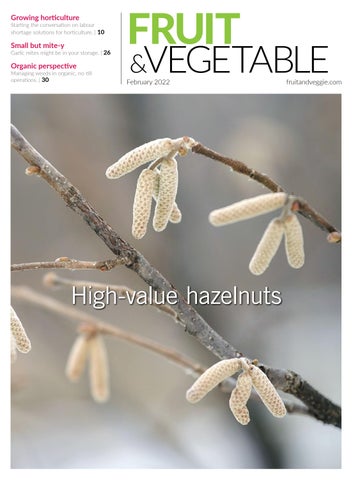
High-value hazelnuts
fruitandveggie.com
Strong control. Top to bottom. Neudorff North America is an innovative leader in ecologically responsible pest solutions for farmers, turf professionals, nursery and greenhouse growers. Our effective and affordable solutions for disease, insect pests, pest slugs and snails have limited impact on applicators, beneficial insects and the environment. They are an important part of integrated pest management programs.
CUEVA
Powerful disease protection for your fruit and vegetable crops with a fraction of the copper found in other copper fungicides.
®
COPPER FUNGICIDE
KOPA
The soft-bodied insect specialist. Kills aphids, mites and whiteflies on contact in a wide range of crops. A great tank mix partner.
™
INSECTICIDAL SOAP
VEGOL
A summer and dormant oil. Controls all life stages of insects and mites, and supresses powdery mildew.
®
FUNGICIDE/INSECTICIDE/MITICIDE
SLUGGO
A durable iron phosphate bait that offers excellent crop protection from slugs and snails.
®
SLUG AND SNAIL BAIT
SCORPIO ANT AND INSECT BAIT
Neudorff has you covered from the ground up.
®
A durable, fast acting spinosad bait, active against a variety of ants, cutworms, spotted wing drosophila and wireworms in a wide range of crops.
©2020 Neudorff North America. All rights reserved.
NeudorffPro.com
CONTENTS
February 2022 Vol.78, Issue 1
14
Seeds of opportunity: Hazelnuts The native nut has significant potential as a high-value, low-input crop.
Editorial
4
Industry News
6
Growth Trends
18
Research Spotlight
34
10 26 30 ON THE COVER Hazelnut catkins. See page 14. Photo courtesy of Jeff Tribe.
Growing horticulture
Small but mite-y
Starting the conversation on labour shortage solutions for the horticulture sector.
Garlic mites have been mighty inconvenient this year, but they’re also indicative of larger-scale issues in garlic-growing.
BY ALEX BARNARD
BY ALEX BARNARD
Organic perspective
Managing weeds in organic, notill operations is a challenge, but possible. BY SAMANTHA MILLS
February 2022 - FRUIT &VEGETABLE 3
FROM THE EDITOR
FRUIT & VEGETABLE February May 2021 2022 Volume 77, 78, No. 4 1
ALEX BARNARD | @FruitandVeggie.com
Breaking the habit I was recently chatting with a friend who worked for years in Canadian horticulture extension, but now works in agriculture in Zambia. Aside from the obvious differences in geography, climate, and some crops, there are many similarities. Managing outreach for several hundred growers – whether for a single crop like apples or operations growing a cornucopia of different vegetables – will always be a balancing act. The methods and frequency of communication differ, as do the specific resources at hand, but maximizing yields and profits while minimizing costs are fairly universal goals. One thing she specifically noted was the importance of changing behaviour – the key to any meaningful, lasting change, and the most difficult element wherever you are.
specific – to connect to it beyond the perceived benefit or expectation. It’s all well and good to say that drinking more water or eating more produce are healthy habits, but as long as they remain abstract ideas, separated from my day-to-day reality, I’m not likely to do anything beyond thinking about them. If you’ve been considering adopting a new practice or changing how you do something, think about why and make it your own. The more specific your goal, the more likely you can make progress. We’re closing out year two of the COVID-19 pandemic, so it goes without saying that we’re all facing unusual and weighty challenges. With supply chain and shipping issues manifesting more fully and additional virus variants cropping up to reduce capacity, impede travel and
“She noted the importance of changing behaviour – the key to any meaningful, lasting change, and the most difficult element.” Many growers in the region of Zambia where she lives still practice slash-and-burn agriculture, where wooded areas are cut down and burned for charcoal and the land is farmed for a few years before the farmers repeat this process with a different section of land. This is, as you can imagine, not the most sustainable way to farm and has consequences for the land and local environment. Attempting to convince a group of growers to change their practices without adequate support – whether material, financial or proof of the benefits – is an uphill battle, especially when surrounded by the remnants of previous, similar projects. When trying to break a bad habit or make an important change, I find it helps to make it personal and
shut down businesses, it’s safe to say that 2022 will continue to provide more than its fair share of difficulties. This makes it tricky to plan ahead, but some forethought now will give you the ability to make quick decisions and pivot in the moment should problems arise. Check that your equipment is in tip-top shape, ensure your seed and inputs are on hand or on the way, and reach out to a fellow grower to discuss the season ahead – it’s amazing what can come from a conversation. You just might find the solution to an issue or a new idea to try out. And if you’re in need of a listening ear or someone off of whom to bounce ideas, please don’t hesitate to drop us a line. We’d love to hear from you. •
@fruitandvegmag 4 FRUIT &VEGETABLE - February 2022
@fruitandvegmag
Reader Service Print and digital subscription inquires or changes, please contact Shawn Arul, Audience Development Manager Tel: (416) 510-5181 Fax: (416) 510-6875 Email: sarul@annexbusinessmedia.com Mail: 111 Gordon Baker Rd., Suite 400, Toronto, ON M2H 3R1 Editorial Director, Agriculture STEFANIE CROLEY scroley@annexbusinessmedia.com 226-931-4949 Associate Editor ALEX BARNARD abarnard@annexbusinessmedia.com 519-429-3966 Associate Publisher NASHELLE BARSKY nbarsky@annexbusinessmedia.com 905-655-6626 National Account Manager SHARON KAUK skauk@annexbusinessmedia.com 519-410-4854 Account Coordinator MARY BURNIE mburnie@annexbusinessmedia.com 519-429-5175 Media Designer SVETLANA CURTIS MARTIN AVRUTIN Group Publisher MICHELLE ALLISON mallison@annexbusinessmedia.com 204-596-8710 COO SCOTT JAMIESON sjamieson@annexbusinessmedia.com Publication Mail Agreement #40065710 Printed in Canada ISSN 1488-7959 Fruit & Vegetable Magazine is published five times a year (February, March, April, May, November/December) by Annex Business Media SUBSCRIPTION RATES Canada - 1 Year $ 23.00 (plus applicable taxes) U.S.A. - 1 Year $ 53.50 CDN GST - #867172652RT0001 Occasionally, Fruit & Vegetable Magazine will mail information on behalf of industry-related groups whose products and services we believe may be of interest to you. If you prefer not to receive this information, please contact our circulation department in any of the four ways listed above. Annex Privacy Officer privacy@annexbusinessmedia.com Tel: 800-668-2374 No part of the editorial content of this publication may be reprinted without the publisher’s written permission. ©2021 ©2022 Annex Business Media. All rights reserved. Opinions expressed in this magazine are not necessarily those of the editor or the publisher. No liability is assumed for errors or omissions. All advertising is subject to the publisher’s approval. Such approval does not imply any endorsement of the products or services advertised. Publisher reserves the right to refuse advertising that does not meet the standards of the publication.
fruitandveggie.com
You put the food on our tables. We put the tools in your hands. At Syngenta, we’re passionate about Bringing plant potential to life®. Our dedicated team is committed to helping you grow higher quality produce – and more of it – with innovative crop protection products and agronomic advice tailored to your farm. Whatever the season brings, we’ll be there with the solutions and support you need to grow a crop that looks good, tastes great, travels well and exceeds expectations from farm to table.
Learn how we can help you achieve your production goals at Syngenta.ca.
Always read and follow label directions. Bringing plant potential to life®, the Alliance Frame, the Purpose Icon and the Syngenta logo are trademarks of a Syngenta Group Company. © 2021 Syngenta.
INDUSTRY NEWS fruitandveggie.com
U of G offers farm business management course Free farm business management skills training, ranging from farm business planning to maintaining mental health, will be offered through a new, self-paced, virtual course recently launched by the University of Guelph and partner organizations. The university’s new “Foundations in agricultural management” online certificate course will enable farmers, and especially younger producers, to brush up on their farm business management skills. Through eight 20-minute video modules recorded
with University of Guelph experts, participants will learn the basics of business planning, finance, human resources, risk management, farm family transitions, and farmer mental health and resilience. The course will be offered four times a year. The new venture is funded by a three-year, $1.25-million donation from the RBC Foundation and with support from Farm Credit Canada (FCC). For more information, visit https://www. guelphagriculturalmanagement.com.
PHOTO: © HOWARD / ADOBE STOCK.
New governmental committee to assist affected P.E.I. potato farmers On Jan. 7, Marie-Claude Bibeau, minister of agriculture and agrifood, announced the creation of the new Federal Ministerial Coordinating Committee on P.E.I. Potatoes, with the objective of enhancing co-ordination and collaboration across the federal government to respond to concerns and find solutions.
The committee will be an important forum to exchange information and further develop strategies to address the issue, while minimizing impacts of potato wart on the P.E.I. potato sector. It will build on and complement the work that has been done to date. The committee will examine a range of issues, such as
updates on the technical discussions to provide scientific assurance to the United States, the delivery of programs to support farmers, the progress of the IndustryGovernment Potato Working Group, and advocacy efforts to access international markets. As of Dec. 23, 2021, the Canadian Food Inspection Agency
(CFIA) had completed its national survey for potato wart ahead of schedule, and potato wart was not detected. The national survey conducted in fall 2021 involved soil testing across areas of Canada that grow seed potatoes (except Newfoundland) to confirm that unregulated areas of Canada remain free from this pest.
BY THE NUMBERS
Canada’s seed industry is estimated to employ
57,420 Canadians directly and indirectly.
Domestic seed production created a value of $2.15 billion and was the basis for crop production that generated over $22 billion of farm gate revenue in 2011.
Seed exports accounted for an extra $450 million in value for 2013, up from $220 million in 2010.
THE LARGEST IMPORTERS OF CANADIAN SEED, AS OF 2011/2012 ARE THE U.S.
THE NETHERLANDS 4%
CHINA
GERMANY
JAPAN
3%
3%
3%
75%
Wheat is the most widely grown crop among pedigreed seed producers at 387,000 acres in 2012, followed by soybeans at 255,000 acres. Information courtesy of Canadian Seed Growers’ Association.
6 FRUIT &VEGETABLE - February 2022
THE FUNGICIDE THAT JUST KEEPS ON GIVING. Broad-spectrum disease control that lasts. You go to great lengths to protect your apples. So does new Merivon®. It’s the advanced fungicide that helps maximize yields with broad-spectrum disease control and two modes of action. But it doesn’t stop there. Merivon also offers unique plant health benefits and extended residual. Because like you, Merivon was made to go the distance. Visit agsolutions.ca/Merivon to learn more.
Always read and follow label directions. AgSolutions and MERIVON are registered trade-marks of BASF, used under license by BASF Canada Inc. © 2022 BASF Canada Inc.
INDUSTRY NEWS fruitandveggie.com
PHOTO: © JJ GOUIN / ADOBE STOCK.
New TFW pilot project to address Quebec labour shortage On Jan. 10, Carla Qualtrough, minister of employment, workforce development and disability inclusion, announced the implementation of an increase to the maximum number of temporary foreign workers (TFWs) Quebec employers in specific sectors – including the agri-food sector – can hire for lowwage positions. Effective as of Jan. 10, those employers can hire up to 20 per cent – an increase of 10 per cent for the majority of them. “Quebec employers in the agri-food industry have been hit very hard by the labour shortage,” said MarieClaude Bibeau, minister of agriculture and agri-food. “Developed in close collaboration between Ottawa and Quebec, this pilot project will allow businesses to recruit more temporary foreign workers and reduce the pressure on their operations.” This increase is part of a TFW pilot project in partnership with the Government of Quebec announced in August 2021, and also builds on
flexibilities to existing advertising and recruitment requirements for specific in demand occupations, as designated by Quebec, that were implemented on Dec. 6, 2021. “A critical part of Canada’s economic recovery and long-term growth is a strong workforce. That’s why our government is updating the Temporary Foreign Worker Program to help address labour shortages in Quebec immediately,” Qualtrough said. “We will always work closely with provinces and territories to meet the needs of employers across the country.” The occupations and sectors selected by Quebec for pilot measures have been identified following consultations with labour market stakeholders, part of the Commission des Partenaires du March<1> du Travail. This was done to ensure that measures included in this pilot project are representative of labour market needs in the province and do not displace opportunities for Canadian workers.
IMAGE: © MOUZE_ART / ADOBE STOCK.
Minor use label expansions for certain vegetable crops The Pest Management Regulatory Agency (PMRA) recently announced the approval of minor use label expansion registrations for Select and pyroxasulfone herbicides for control of labelled weeds in Canada. Select and
pyroxasulfone were already labelled for management of weeds on a wide range of crops in Canada. The Select minor use proposals were submitted by Agriculture and Agri-Food Canada, Pest Management Centre (AAFC-PMC)
for green onion and leek and the Ministère de l’Agriculture, des Pêcheries et de l’Alimentation (MAPAQ) for rutabaga. The minor use proposals for pyroxasulfone were submitted by AAFCPMC as a joint project
with the United States Department of Agriculture (USDA) IR-4 project for edamame and celery grown in muck soils. Both label expansions were a result of minor use priorities established by growers and extension personnel.
Hexanal curbs post-harvest apple spoilage Apple growers can stem costly post-harvest spoilage losses by up to 20 per cent by applying a natural compound in orchards, according to a new University of Guelph study. The study found that applying hexanal to apples pre-harvest helps curb losses from a condition called “bitter pit,” which impairs fruit appearance and flavour, especially in the Honeycrisp cultivar that normally fetches a premium in the grocery produce section, according to Jay Subramanian, a professor 8 FRUIT &VEGETABLE - February 2022
with the university’s Ontario Agricultural College. Besides extending shelf life in the grocery store, hexanal helps delay fruit ripening in the field, lengthening the apple harvest period for growers by about two weeks beyond the end of September, Subramanian added. These findings add weight to farmers’ calls for Canadian regulatory changes to allow spraying of hexanal on crops. The compound is registered as a food additive in the United States and other countries.
PLOT A
REVYLUTION A G A I N S T D I S E A S E.
New Veltyma fungicide, with Revysol technology, provides broader, stronger and longer protection. Potato growers can rise up against disease like never before thanks to Veltyma® fungicide. It combines the enhanced performance of Revysol® and the proven Plant Health Benefits of pyraclostrobin for optimal protection against early blight, black dot and brown spot. Visit agsolutions.ca/veltyma to learn more.
Always read and follow label directions. AgSolutions, REVYSOL and VELTYMA are registered trade-marks of BASF; all used under license by BASF Canada Inc. REVYSOL and/or VELTYMA fungicide should be used in a preventative disease control program. © 2022 BASF Canada Inc.
PHOTO: © VALMEDIA / ADOBE STOCK.
Growing horticulture: Starting the conversation on labour shortage solutions An industry-wide approach is needed to address this major issue. BY ALEX BARNARD
Staffing shortages in horticulture are not a new problem, and the issue is not expected to get any better without addressing the root causes at an industry-wide level. According to the Canadian Agricultural Human Resources Council (CAHRC), labour shortages in 2018 cost the greenhouse sector more than $100 million; the field fruit and vegetable growing sector took a hit to the tune of more than $400 million, and tree fruit and vine sector lost $94 million. By 2029, the CAHRC predicts the domestic labour gap to be higher than 50 per cent across these three sectors. In 2018, surveyed growers already reported that 26 per cent of advertised positions did not receive any Canadian applicants. The COVID-19 pandemic has exacerbated these
issues in the short-term, and will likely worsen the long-term consequences too. With greater demand for fresh, local produce and ornamental plants, what can be done? How will the horticulture sector succeed in attracting – and keeping – qualified workers? Just as there’s no silver bullet for any issues in agriculture, solutions to the labour shortage are far from simple. But change has to start somewhere, which is why Greenhouse Canada and Fruit & Vegetable sought to start the conversation. In September, Greenhouse Canada editor Greta Chiu and Fruit & Vegetable associate editor Alex Barnard hosted a panel discussion to break down the challenges, successes and trends in labour attraction and retention observed by a panel of growers, educators and industry representatives.
ABOVE Growers and industry groups have noted the difficulty of attracting local – especially young – Canadians to careers in agriculture. 10 FRUIT &VEGETABLE - February 2022
February 2022 - FRUIT &VEGETABLE 10
S OY BE AN PORTFOLIO
PROTECT YOUR SOYBEAN YIELDS WITH PROVEN SOLUTIONS FROM UPL At UPL, we’re committed to bringing solutions to the Canadian soybean market that optimize productivity and efficiency. We invite you to
BROADLOOM™ herbicide
review our expanded portfolio for soybeans which includes a complete range of herbicides, and a new biostimulant, that delivers exceptional performance and value. To learn more, talk to
HURRICANE™
KOMODO™
STRIM™ MTZ
TRICOR® LQ
TRICOR® 75DF
ULTRA BLAZER®
herbicide
herbicide
herbicide
herbicide
herbicide
herbicide
OHM™
biostimulant
Always read and follow label directions. UPL, OpenAg, the UPL logo and all products are trademarks of a UPL Corporation Limited Group Company. ©2021 UPL Corporation Limited Group Company. SOYCA-2101A
your local UPL representative or retailer, or visit us online at www.uplcanadaeast.ca.
specific program stream, but estimates that each of the department’s specializations has 30 full-time students at any given time. Something Bryce notes as very important to the current crop of students is sustainability and awareness of environmental impact. “I see students’ disdain for a relatively high use of plastics in our industry; I see them wanting to work at a place that adopts IPM (integrated pest management),” she says. “They have values that they want [from] this career that they’re going to take on, [so] that it feels aligned to them.” The horticulture program at Olds College was created more than 60 years ago, and in its prime during the 1990s, the program saw 120 students per program year. Kim Wickwire says this wasn’t sustainable, but that horticulture is coming back as “the sexy thing to do,” with the department having more students than any other at the college and a waitlist of students eager to learn. She notes the students who Chiu and Barnard asked panelists about are drawn to horticulture have changed in challenges and barriers they’ve encountered the past seven to 10 years, saying they’re or observed in hiring, training and keeping more focused on food security and susemployees, the qualities they each look tainable practices. However, she fears some for in the hiring process, their thoughts on students might be overly idealistic and what the future holds for the horticulture have an unrealistic, financially unsustainsector and how the industry can collaboable idea of farming and horticulture from rate to improve the labour situation. popular media. Dusty Zamecnik is a fourth-generation Niki Bennett sees OGVG’s role as one farmer, growing highbush blueberries and of advocating for the ag sector, drawing in greenhouse strawberry plants. EZ Grow people who are young or unfamiliar with Farms has 20 full-time employees, but in agriculture and specifically trying to fill the peak season they employ 380 to 400 peosector’s needs that aren’t met through SAWP. ple, including temporary foreign workers Similar to the two growers on the panel, (TFWs) and local labour. He estimates his Bennett says OGVG has also struggled to atlabour force to be approximately 60 per cent Changing established tract local – especially young – Canadians to TFWs through the Seasonal Agricultural Worker Program (SAWP), five per cent local impressions of modern agriculture, finding that established impresof what modern agriculture is are very residents, and 15 per cent members of local agriculture to reflect the sions different from the reality. Mexican Mennonite communities. “Farms are busy, dynamic, modern placStephanie Slaman is also part of a reality is a key step. es. They’re not quiet, they’re not slow-movmulti-generation farming operation as ing – they’re super busy and lots of things the third generation to manage Slaman’s are happening, and they’re growing and changing at an increasQuality Flowers, selling cut floriculture products year-round for ingly rapid pace,” she says. One major challenge she’s observed North American markets. While the greenhouse operation is in her seven years with OGVG is how much the complexity of also reliant on SAWP, Slaman says it makes up a smaller amount growers’ needs has grown. While many growers recognize they of the overall workforce, with six TFWs (around 30 per cent need help, they are unsure where to begin. Bennett says OGVG of the total workers). As the greenhouse operates 12 months of has found itself in a consultant-like role, helping growers deterthe year, they have TFWs supporting their labour needs almost mine which solutions will actually help their unique situation and year-round, operating on six- to eight-month rotating contracts. providing a “sober second thought” on topics like automation. Local workers fill about 20 full-time positions, with five to 10 Tania Humphrey directly manages and oversees all of Vinepart-time student workers rounding out their team. land’s scientists, engineers and technical staff – which, as an Slaman notes the importance in shifting perceptions of careers independent, industry-focused research institute with a view of in agriculture and highlighting the full-time, long-term careers creating products and processes the industry can use, means a available. “It always breaks my heart when people see ag as a large part of Vineland’s 100 employees are under her purview. starting point to get to somewhere else, especially if they’re bringTheir difficulty in staffing comes from the wide diversity of ing that science background,” she says. “Critical and analytical research projects and crops covered at Vineland. There isn’t as thinking skills, the science framework for hypothesis testing – we much overlap in duties as there might be for many growers, need those skill sets in agriculture. We’re seeing dramatic changes and Humphrey says they’re constantly hiring at all experience and new, incredibly complex challenges.” and task levels. Humphrey notes they’re also involved in labour Laura Bryce has been teaching the next generation of hortiissues from the grower side, as Vineland is often involved in culturalists at Kwantlen Polytechnic University for the past six research projects that help growers deal with labour shortages years, with her speciality being protected cultivation of producthrough automation or improving process efficiency. tion horticulture (floriculture and vegetables). The university’s How have you recruited and retained new employees? Share horticulture department offers a variety of diploma and certificate your thoughts, best practices and bold ideas with us on social programs, as well as degree programs in plant health and urban media. Join the conversation on social using #GrowingHort.• ecosystems. Bryce says enrollment numbers are dependent on the THE ROUNDTABLE SPEAKERS CONSISTED OF: • Niki Bennett, innovation, adaptation and plant protection lead with Ontario Greenhouse Vegetable Growers (OGVG); • Laura Bryce, horticulture instructor at Kwantlen Polytechnic University in Langley, B.C.; • Tania Humphrey, vice-president of research and development at Vineland Research and Innovation Center in Vineland, Ont. • Stephanie Slaman, manager of administration and government relations for John Slaman Greenhouses Ltd./Slaman’s Quality Flowers in Burford, Ont.; • Kim Wickwire, horticulture instructor at Olds College in Olds, Alta.; and • Dusty Zamecnik, general manager of EZ Grow Farms in Langton, Ont.
12 FRUIT &VEGETABLE - February 2022
Getting in the Know for
BETTER MENTAL HEALTH While there are numerous areas of farm safety that are emphasized year in and year out – tractor rollovers, equipment entanglements and falls to name but a few – there has been great progress made in an area that once was not even considered an agriculture hazard by many. That area is mental health. In recent years it has gotten more attention across the board. With the already stress-filled aspects of farming further increased during COVID, it’s good to know that we now have remarkable resources that specifically focus on mental health in agriculture. Many of these resources are free of charge and several of them are detailed below.
Mental Health Literacy Program for Farmers In the Know is a mental health program developed at the Ontario Veterinary College (University of Guelph). It recognizes how busy farmers are and has been formatted as one, four-hour, half day workshop. It was developed in collaboration with farmers/ producers in various agriculture sectors, including Workplace Safety & Prevention Services (WSPS). It is also intended for individuals who have regular contact with those groups such as family members, peers, veterinarians, breeders, feed or seed salespeople and others who are directly or indirectly impacted. It provides insight and actionable routes in areas including stress, depression, anxiety and substance misuse as well as techniques on how to communicate effectively about mental well-being. For more information about In the Know visit https://wsps.news/CMHA For free online resources relating to mental health for farmers, visit:
engage.wsps.ca/ag-mental-health-2021
Raising Awareness of Mental Health WSPS offers two webinars developed by the WSPS team including subject matter experts with literally a lifetime of experience growing up on farms, ensuring that the materials will resonate with farmers’ realworld experiences. Raising Awareness of Mental Health in Agriculture details what mental health is in terms farmers will relate to as well as why it’s important to discuss. It defines mental health and stress in very relatable terms. It also uses the Stop Think Act method, a proactive approach to help take care of our mental health. The Stop Think Act model is demonstrated in ways that relate to many aspects of farm life including isolation, anxiety, regulations, financial concerns, crop loss and work-life balance. The recorded webinar is available free of charge on the WSPS website. Visit https://wsps.news/AgriHealth1 Continuing the Conversation on Mental Health Continuing the Conversation on Mental Health in Agriculture is a follow-up webinar. Following a review of the definitions of mental health and stress as well as the Stop Think Act approach, it introduces 13+ workplace factors that contribute positively or negatively to mental health on the farm. It then focuses on 5 of these workplace factors and incorporates the Stop Think Act model: To stop and ask what could go wrong. To think, am I physically and mentally ready? And finally act. What needs to be done to make it safe? It ends with a comprehensive list of resources to help farmers as they move forward and is also available free of charge on the WSPS website. Visit https://wsps.news/AgriHealth2 Check out ThinkMentalHealth for additional mental health resources for the agriculture community. Visit https://wsps.news/Think
OMAFRA is providing funding to Workplace Safety & Prevention Services to deliver resources and consulting services to help farmers and other agri-food businesses provide safe workplaces.
Call Customer Care to speak with a consultant. 1 877 494 WSPS (9777) customercare@wsps.ca WSPS.CA
SEEDS OF OPPORTUNITY:
ALL PHOTOS COURTESY OF JEFFI TRIBE.
Hazelnuts
The native nut has significant potential as a high-value, low-input crop. BY JEFF TRIBE
Kevin Hodge’s Scotland, Ont., hazelnut plantation is a thing of precise, agricultural beauty: neatly trimmed orchard grass cradling arrow-straight tree rows, browned swaths defining weed and sucker control application. The backdrop of Hodge’s on-farm drying and storage bins and bank of solar panels is, however, arguably of greater interest to a nascent industry’s development. Hazelnuts are not a hobby for the 50-year-old corn, soy and edible beans and ginseng producer; rather, they’re a potential new commodity for an existing 1,800-acre cash crop operation. “To diversify, try something different,” states the self-described “lifetime farmer,” instructor in
Conestoga College’s two-year Agriculture Equipment Operator Pilot Program, and current chair of the Ontario Hazelnut Association (OHA). Ferrero’s massive Brantfordarea processing plant and the company’s stated enthusiasm for 25,000 acres of domestic hazelnuts provided instant market potential for a crop familiar to Oregon and British Columbia, but little known in Ontario. Field trials followed its early 2000s construction, according to Linda Grimo of Grimo Nut Nursery near Niagara-On-The-Lake, with a “big push” in 2015. Ferrero represents long-term possibilities if production capacity expands significantly and is a driver for interest in hazelnuts, but replacing
ABOVE Hazelnut catkins, the male part of the tree that produces and releases pollen, which is carried by the wind to small red flowers (female part), which develop into a hazelnut. 14 FRUIT &VEGETABLE - February 2022
ABOVE Rebecca Compton (left) stands in front of her imported hazelnut cleaning machine with a tray of cleaned nuts; Kevin Hodge (right) started growing hazelnuts a few years ago to diversify his cash crop operation.
current Canadian import requirements and developing fresh or local valueadded markets are also seen as viable and potentially higher-return options. Hazelnuts are native to Canada but agricultural varieties were sourced from warmer climes indirectly through the state of Oregon, which accounts for the vast majority of North American production. Climatic limitations mean Canadian orchards are largely in British Columbia and southern Ontario, although colder-weather options are under development. Hodge began planting hazelnuts with a tape measure and post-hole auger and installing trickle irrigation in the spring of 2018 (fall planting is another option), and is two rows away from 2,700 trees on ten acres, enough “to see where it leads,” he says. “I call it a ten-acre experiment – I’m not betting the farm on it, put it that way.” Technical support from Ontario Ministry of Agriculture, Food and Rural Affairs (OMAFRA) staff has been vital, he notes, along with the OHA’s centralized industry development hub and associated resources.
The OHA is currently compiling a marketing report in conjunction with the South Central Ontario Region Economic Development Corporation (SCOR EDC). Identified goals include outlining global and domestic realities with regards to provincial industry development and branding for all growers, from large to smaller acreages. “A clear pathway as to what the OHA can do to support Ontario hazelnut growers wherever they are on that spectrum,” sums up SCOR EDC executive director Kim Earls. THE LOGISTICS Roughly 75 per cent of Hodge’s trees are Oregon varieties – Yamhill, Jefferson and Gamma – popular for the large, consistently shaped nuts required by Ferrero, and also because they were proven, available and provincially field-tested. The balance are so-called “Ontario” varieties including Gene, Cheryl, Linda, Matt and Northern Blais. An 18-foot grid between rows and trees is a popular layout for mature orchards; however, Hodge opted for double density planting, trees nine feet
apart, rows still at 18 ft., to accelerate production. Extra trees can eventually be transplanted or sequentially pruned and eliminated. Orchards must include varieties – Grimo recommends a minimum of four – matched for pollination compatibility, concurrent or overlapping emission and acceptance schedules, along with cold hardiness. “They should be working to cross pollinate each other,” she says, adding a “healthy, well-drained soil” is also crucial. Hazelnut trees have projected 50 per cent production in five years, full production between eight and 10 years, and can live to 75 years, offering sustainable, high-value, low-input potential. Hodge anticipates a mature harvest of between 1,000 and 2,000 pounds per acre and an “in-the-shell” return beginning around $2 per pound, although he is also considering valueadded options. His crop is fertilized, watered and sprayed for weeds and suckers around the base of trees, pests including gypsy moth caterpillars and Japanese beetles, and preventatively against what Hodge considers its biggest challenge: eastern February 2022 - FRUIT &VEGETABLE 15
filbert blight (EFB). Admittedly, its limited emergence in his orchard over the past two seasons is highly concerning. “Are we able to control it with pruning and fungicide? That’s the big question,” he says. Three pillars of defence against this potentially devastating fungus are preventative spraying, cutting out and burning any incidence, and proactively breeding or selecting EFB-resistant trees, which can be a lengthy process. “It’s 17 to 18 years from cross to release,” explains Grimo, whose father Ernie began breeding Ontario-based hazelnuts 45 years ago. Not all varieties are specifically targeted toward Ferrero standards, but are suited for domestic markets and additionally may have regional climatic and EFB resistance advantages. Beyond the three Oregon varieties, Grimo offers six “Ontario selections” either bred by Ernie or selected through a discontinued New York State breeding program. “And they’ve never had blight,” she says. Additional blight-resistant varieties being developed under Tom Molnar at Rutgers University are in the pipeline. Although intended for the U.S.’s Eastern Seaboard, they are also hoped to be climatically suitable for this province, Grimo says. SURVIVAL OF THE FITTEST Martin Hodgson of Courtland, Ont., followed unnatural selection to blightresistant stock, planting 5,000 hazelnut seedlings (clonal propagation is preferred for crop consistency and other reasons) between 1994 and 1997. Hodgson celebrated viable cropping in 2000 before EFB arrived with a “boom,” leaving him with 150 living trees by 2003. Describing the process as Darwinian, Hodgson has plant breeder’s rights to two cold-resistant pollinator varieties developed from the best of the 150, which have lived for 25 years: Norfolk C16 and Chelsea C28. He is also looking at a third production variety which, Hodgson says, “Meets all of Ferrero’s requirements.” Estimating double-density planting costs between $6,000 and $7,000 per acre, Hodgson suggests hazelnuts are a viable 100-acre farm crop. He recommends beginning with an acre or two to learn the process, ordering trees two years in advance and preparing the soil through testing, balancing and adequate tillage. 16 FRUIT &VEGETABLE - February 2022
ABOVE Martin Hodgson of Courtland, Ont., shows off some of his hazelnuts from the survivors of the eastern filbert blight that struck his farm in the early 2000s.
“And when you get your friends helping you, leave the beer in the barn until it’s done,” he laughs. Organic development of Ontario’s fledgling industry means initial plantings are reaching meaningful production. Enter the need for processing capacity, along with Delhi, Ont.’s Rebecca Compton. A hazelnut producer and multi-disciplinary agri-entrepreneur, Compton imported cleaning machinery from Italy and purchased 4,000 pounds of nuts from three other farms for an effective pilot project on process and costing in conjunction with St. George, Ont., producer Bill Sharp, who sourced cracking equipment. “I’m not going to say we’ve got it down yet, but we’re going in the right direction,” Compton reports. Nuts were received directly from the field, underwent primary and secondary cleaning and sanitization, were dried in Compton’s repurposed tobacco kilns and kernels cracked out of their shells. Her short-term plan is offering roasted nuts for sale in her own on-farm and other farmer’s markets. “And to anyone else who wants to come and get them,” she says, smiling. Compton views consumer education as vital to market development of a product which is neither cheap to grow or process. “But it’s a beautiful product, a wonderful product; it’s finding those markets that appreciate quality and local,” she notes.
VALUE-ADDED POSSIBILITY Fergus, Ont.-area artisan nut producer Elisabeth Burrow of Jewels Under The Kilt has proof-of-concept for niche nut growing and marketing. Her patented roasting process utilizes maple syrup as a preservative in conjunction with unique flavour profiles built on fresh fruit, vegetables and spices. The two-time provincial premier’s award winner began offering low-sugar, highly flavoured nuts at one farmer’s market in 2013 and was in seven by the end of the season. Burrow currently employs five outside of partner Mitja Kosir and daughter Jessica James and ships across Canada. The Jewels line features several hazelnut options, including cabernet chocolate, highlighting a local wine, an espresso/chocolate combination, and two additional chocolate-based offerings utilizing Mexican cacao, including Hot Chocolate, described as “Mexican chocolate with some habanero heat.” Different hazelnut varieties offer different flavour profiles, Burrow says – sweeter-meat nuts are better for roasting; earthier options are ideal for flour and oil production – which she sees as additional avenues with significant growth potential. “You have so much variety to choose from.” HOW ARE THINGS ON THE WEST COAST If Ontario’s hazelnut industry were to be characterized as “evolving,”
the descriptor for British Columbia’s would be “rebounding.” B.C. Hazelnut Growers Association president Steve Hope says at peak, production was over 1.5-million pounds annually from close to 1,500 acres, before a “devastating” EFB infestation wiped out the majority of farms. In its wake, and with support from the B.C.’s Ministry of Agriculture, Food and Fisheries, the approach has been to eradicate older affected or potentially affected trees to reduce EFB pressure, and introduce EFB-resistant varieties developed over the past couple of decades at Oregon State University. Due to climatic similarities, they are also appropriate for British Columbia. An eight- to ten-year removal and replacement process has seen close to 500 acres of new planting, Hope says, mainly in the Fraser Valley. Skyrocketing agricultural land costs in the lower mainland have contributed to trials supporting expanded hazelnut development in B.C.’s interior, north and on Vancouver Island. The marketing push is twofold, encouraging more farmers to service existing demand, underlined by the “Buy B.C.” tagline.
Hope farms 38 acres of hazelnuts near Chilliwack and is also co-owner of Fraser Valley Hazelnuts, the province’s largest processing hub with a washing/ drying capacity of 1.5 million pounds. Historically acting as a receiving station for a major Oregon packer, output has been shifted to meet local demand over the last three years. “That has maximized the margin for our growers,” Hope says. Fraser Valley Hazelnuts has added cracking and roasting services for the past two years, creating raw and roasted kernels and is additionally investigating valueadded options to meet both expanded farmer production and opportunity, growing the business model along with producers and market demand. “For the foreseeable future, we’ll be able to keep everything local,” says Hope, who is excited to be part of hazelnuts’ provincial and national evolution, summed up succinctly by Hodge as “learning how to grow, process and market a new crop.” “It’s interesting to see what the future can be for this industry,” Hope concludes. •
Interested in learning more? • OMAFRA Fact Sheet: http://www.omafra.gov.on.ca/CropOp/ en/spec_fruit/nuts/haze.html • Ontario Hazelnut Association https://ontariohazelnuts.com • BC Hazelnut Growers Association https://bchga.ca • Grimo Nut Nursery Hazelnut Grower Guide http://www.grimonut.com/shared/media/ editor/file/Hazelnut%20Trees%20for%20 Zones%204-8%202019.pdf • Grimo Cultivar Guide http://www.grimonut.com/shared/media/ editor/file/Hazelnut%20Trees%20for%20 Zones%204-8%202019.pdf • Jewels Under The Kilt: https://jewelsunderthekilt.com
THINK FAST. AND HOT. Efficient and complete burndown of annual grasses and broadleaf weeds. When it comes to controlling weeds, you don’t have time to mess around. That’s why there’s Ignite® herbicide. It provides proven and complete burndown of annual grasses and broadleaf weeds within 7 to 10 days in a range of crops, including tree fruit, blueberries and grapes. And as an additional bonus, Ignite also prevents sucker growth. So what are you waiting for? Visit agsolutions.ca/horticulture today. Always read and follow label directions. AgSolutions and IGNITE are registered trade-marks of BASF, used under license by BASF Canada Inc. © 2022 BASF Canada Inc.
FV_BASF_JanFeb22_CSA.indd 3
Client: BASF F&V
February 2022 - FRUIT &VEGETABLE 17 Publication: Fruit & Veg
2022-01-07 10:07 AM
KEN
DESIREE
GROWTH TRENDS fruitandveggie.com
Plant-based packaging film could extend soft fruit shelf life
New Quebec controlled-environment vertical strawberry farm the largest in Canada
An international team of scientists from Nanyang Technological University in Singapore and Harvard’s T.H. Chan School of Public Health in Boston, Mass., has developed a “smart” food packaging material. The new material could also extend the shelf life of soft fruit for up to three days. The waterproof packaging, made from a type of corn protein called zein, starch and other naturally derived biopolymers, is biodegradable, sustainable and even kills dangerous micro-organisms which are harmful to human health. In controlled lab experiments, the packaging released natural antimicrobial compounds when exposed to increased humidity and killed common harmful bacteria such as E. Coli and Listeria, as well as fungi. The packaging is designed to release only the necessary small amount of antimicrobial compounds when it detects the presence of increased humidity or bacteria. This ensures the packaging can last several months and endure multiple exposures. The results of experiments conducted with fresh strawberries wrapped in the new material were encouraging, with fruit staying fresh and mold-free for seven days compared to regular-packed berries, which showed signs of decay after only four days.
Quebec company Winter Farm (Ferme d’hiver) has inaugurated its first industrial unit in Vaudreuil. With a total area of 1,150 m2, the project becomes the largest controlledenvironment vertical strawberry farm in Canada. The project was carried out in two phases in partnership with Les Serres Vaudreuil. Every year, between October and June, over 180,000 kilograms of strawberries will be grown, which is the equivalent of production yielded by more than two hectares of traditional greenhouse area. This inauguration is an important milestone for Winter Farm, which works together with local produce growers in order to deploy its technology on a large scale.
“The Winter Farm solution is a 100 per cent made-inQuebec innovation and a powerful lever to stimulate local offseason production,” said Alain Brisebois, president and CEO of Winter Farm. “In addition to increasing the production capacity of market gardeners, our units emit no GHGs and significantly reduce those emitted by greenhouses. This first industrial installation is another step towards our food autonomy.” In order to reach its goal of replacing 10 per cent of strawberry imports to Canada and produce over 13 million kg by 2025, Winter Farm is integrating its units into the existing agriculture ecosystem and supporting the development of Quebec expertise in optimized interior growing.
The MUCK Show is Virtual
April 6 & 7, 2022
For the latest information about The MUCK Vegetable Growers Conference 2022 Visit bradfordcoop.ca or uoguelph.ca/muckcrop 18 FRUIT &VEGETABLE - February 2022 FV_MUCK_5x7_Feb22_MLD.indd 1
2022-01-10 10:04 AM
2022
NEW VARIETIES Chinese Cabbage
Chinese Cabbage
Michihili napa. 70~75 days after sowing. The head is long-cone shaped, 12~15” long, 2.5~3LBs. Beautiful shape, compact and uniform. Good for sowing in late spring, summer and fall seasons.
Wa Wa Tsai-type napa, 3~4 lbs. Dark green outer leaves. Yellow internal color. Slow bolting. Tolerant to DM. Resistant to Clubroot (some races). Good for sowing in spring and fall.
AgroHaitai Ltd.
AgroHaitai Ltd.
Little Pagoda F1
NEW VARIETIES
2022
Eggplant
CR Mini Napa #3 F1
Pumpkin
Purple Eggs F1
Kabocha Silver F1
Indian brinjal. Early maturity. 55 days after transplanting. Oval shape, in shiny purple red color, with green calyx. Avg. 50~60g. Fruits bearing in clusters. Productive.
Early maturity. Flat fruits in gray color with orange flesh. Average 4~5LBs. Mature fruit is nutty with a little sweetness. The longer it is stored, the sweeter the flesh becomes. After storage over 2 months, the flesh turns to be both nutty and sweet, giving a fantastic eating quality. AgroHaitai Ltd.
AgroHaitai Ltd.
Eggplant
Pumpkin
Chinese eggplant. Shiny long purple fruit with purple calyx. The fruits can be harvested from 10” long to 16” long. White meat, tender and excellent flavored. Vigorous and high yielding. AgroHaitai Ltd.
Asian pumpkin squash. 70~80 days after transplanting. The fruits are cylindrical-shaped, up to 20” long, 10 LBs. The fruit flesh is nutty and sweet.
Fiteng F1
Canton Long F1
AgroHaitai Ltd.
February 2022 - FRUIT &VEGETABLE 19
2022
NEW VARIETIES
Eggplant
Fresh Ideas
Asian Delite F1
PanAmerican Seed® has expanded the HandPicked Collection for 2022 with more vegetables and herbs that taste delicious and offer great performance! HandPicked are novel, high-quality vegetables and herbs for those who supply fresh market farmers and hobby gardeners. What sets HandPicked varieties apart are their fresh, home-grown flavour, along with exceptional fruit quality, earlier and longer harvests and loads of produce. Many also feature compact habits to fit smaller growing spaces. Find out more about this exceptional collection at panamseed.com/HandPicked.
Tomato
Slender, elongated eggplants have bright purple skin and white, non-bitter flesh. Plants are upright and semi-spineless, so they are very easy to harvest. Fruit is early to mature, and plants have very high yield potential if harvested regularly. PanAmerican Seed
Bellatrix F1
Marzito F1
Tomato
Tomato Loki F1
DarkStar F1
High-yielding red Roma/paste tomato ripens in a short period of time with good shelf life. Features high resistance to late blight and Fusarium. Determinate habit.
Versatile tomato has an elongated shape reminiscent of a small-fruited Roma. Resistant to leaf mold, Fusarium, nematodes and tobacco mosaic virus. Indeterminate plants perform well in the field and in high tunnel production. PanAmerican Seed
Early-maturing, round, red slicer tomato with high yield potential. Leaf mold resistance is great for growing in high tunnels or areas with high humidity. Indeterminate plants.
Early-maturing, rich, purple beefsteak tomato with disease resistance, great flavour and fewer blemishes than most heirlooms. Offers resistance to late blight and verticillium. Indeterminate plants.
PanAmerican Seed
PanAmerican Seed
PanAmerican Seed
Pepper
Pepper
Tomato
Peppi Cornissimo F1
Candy Cane Chocolate Cherry F1
Lemon Sun Patty Pan F1
Summer Squash
Winter Squash
Extra-large corno-shaped fruit ripens from green to red, with outstanding thick walls, rich flavour and more sweetness than most large-fruited peppers. Fruit can be produced seedless if grown in isolation from other (non-seedless) pepper varieties. Best grown with support of stakes or a cage. PanAmerican Seed
Early maturing mini bell pepper with fruit that ripens from green and white stripes to unique chocolate and cherry red stripes. Sweet flavour and crisp texture make it perfect for fresh eating at any stage of ripeness. Best in containers or in-ground, with or without support. Plant has eye-catching variegated foliage. PanAmerican Seed
Vigorous and strong bush plant habit will produce exceptional yields of uniform, yellow, scalloped, disc-shaped fruit with no green on the blossom end. Fruit is 4 to 5 in./10 to 13 cm wide.
Uniquely ribbed, round fruit ripens to dark tan with a frosted overlay. Offers rich flavour and a shelf life of up to 4 months after maturity. Standard vines. Powdery mildew resistant.
PanAmerican Seed
PanAmerican Seed
20 FRUIT &VEGETABLE - February 2022
Autumn Frost F1
Multipurpose MARZITO! Versatile Marzito Tomato is a unique mini-Marzano type that is great for cooking in sauce or fresh eating! The fruit has an elongated shape with a firm texture and rich, sweet flavour. This indeterminate plant offers high disease resistance to leaf mold, Fusarium, nematodes and tobacco mosaic virus, making it the perfect choice for high tunnel and field growing. Book your order now!
tasty
Panamseed.com/handpicked makes growing easy
©2022 Ball Horticultural Company 20174804-GC ® denotes a registered trademark of Ball Horticultural Company in the U.S. It may also be registered in other countries.
NEW VARIETIES Sweet Corn
Broccoli
Skyray F1 Bic. Sh2
Kingdom (FBC 6317) F1
Nice large ear. Excellent tenderness and sweet taste. Great tip cover and tip fill. Attractive green husk package. High quality shipper with a small shank and an easy snap. Good disease tolerances. Ear length: 20 cm. Number of rows: 18-20. Maturity: 78 days. Norseco
Impressive variety that stands out for its excellent uniformity in maturity and in shape. Dark green heads with medium size beads. Firm and well domed. Small, open plant. A very high quality for your season start and end. Maturity: 71 days. Norseco
Carrot
OVERLOOK A good companion to Catskill for long-term storage. Will yield large and firm onions with good skin quality. Maturity 109 days.
Pumpkin
Jefferson F1
Spicy Mocha F1
CATSKILL
New Imperator type, for the cello-jumbo market. Well filled, uniform and smooth roots. The tops hold well against Alternaria. Root length: 28-30 cm. Suited for muck and mineral soil. Maturity: 70 days.
Nice round pumpkin. Coffee colour for a touch of originality in fall assortments. Good disease tolerance. Fruit dimensions: 25 x 30 cm. Fruit weight: 4,5-5,5 kg. Maturity: 105 days.
Norseco
Norseco
Onion
SV2384 Good quailty roots for both mineral and muck soil. Very strong tops.
Customer Service order@norseco.com 514 332-2275| 800 561-9693 450 682-4959| 800 567-4594
Basil
Venecia F1
Late maturity variety with large size potential. Well adapted to the northeast growing conditions. Attaractive bulb with nice golden-brown skin. Medium to long term storage. Maturity 105 days.
Our Team of Experts
Emma (Genovese)
Yves Thibault, agr. Warren Peacock Ontario Central & Eastern Québec warren.peacock@norseco.com yves.thibault@norseco.com 519 427-7239 418 660-1498 Michel Gratton North Shore of Montreal michel.gratton@norseco.com 514 898-4281
Improvement of the Oneida variety: higher percentage of large size bulbs. Very uniform round shape. Good dark skin and small neck. Storage: medium term. Maturity: 107 days.
The next generation of downy mildew tolerant basil varieties. Particularly well suited for indoor pot production. Short internodes and uniform fragrant cupped leaves.
Norseco
Norseco
Ben Yurkiw British Columbia ben.yurkiw@norseco.com 604 830-9295 Isabelle Dubé, Agr. Organic & Small-Scale Farms isabelle.dube@norseco.com 514 295-7202
Marie-Pierre Grimard, P. Tech Eastern Montérégie & Maritime Provinces marie-pierre.grimard@norseco.com 450 261-7468 Marie-Hélène Monchamp Western Montérégie marie-helene.monchamp@norseco.com 514 968-2906 Stéphanie Gosselin, agr. Central and Eastern Quebec stephanie.gosselin@norseco.com 418 254-1469
norseco.com
22 FRUIT &VEGETABLE - February 2022 FV_Norseco-Half_Feb22_CSA.indd 1
2022-01-21 9:01 AM
2022
NEW VARIETIES Sweet Corn
Sweet Corn Tempo XR
Bannack Gold (RPX 6208)
Garnet Gold (RPX 6209)
Ignition is a new 72 day bi-color with strong cold soil emergence from Seneca Vegetable Research. It produces a high quality, 8” ear with 16-18 kernel rows. Ignition provides a tender bite. It’s strong disease package helps promote consistent high yields. Rupp Seeds
Tempo XR is a 76 day bi-color SH2 sweet corn that has a great ear size for mid-season roadside and fresh markets. This IFSI, rust resistant variety provides excellent husk protection and consistent tip fill across varying environmental conditions. Rupp Seeds
Bannack Gold (RPX 6208) is a 100 day, mid-size variety. The 19 pound fruit have a tall fruit shape, dark green handle, and shadowed warts. Bannack Gold provides intermediate resistance to powdery mildew. Our trial cooperators think this could be a replacement for our popular Solid Gold variety. Rupp Seeds
Garnet Gold (RPX 6209) weighs in with a 14.6 pound average. This 100 day, mid-size variety has high resistance to powdery mildew. This new pumpkin has a round shape and heavy ribbing. The strong handle on Garnet Gold will “hold on” well in your market. Trial cooperators called it “Very nice!” and “Beautiful!”.
Ignition
Pumpkin
Pumpkin
Rupp Seeds
Giltedge Gold
Quigley Gold
Thunderstruck
Melon
Winter Squash
Giltedge Gold (RPX 6879) is a new, 100 day variety that weighs in at 18-24 pounds. It has intermediate resistance to powdery mildew. The fruit have an elevated shape with a rough texture and dark, healthy handles.
Quigley Gold (RPX 6883) is a 22-26 pound pumpkin with varying amounts of warts. The round fruit have slight ribbing, some gold flecking, and a dark handle. Harvest early for green warts. Quigley Gold provides intermediate resistance to powdery mildew.
Thunderstruck is a new melon from Seneca Vegetable Research with outstanding Eastern flavor, sugar levels, and texture. Full slip, full color change aids in an easier harvest. Fruit provide enhanced holding ability giving you extended time to market.
Autumn Frost is a uniquely ribbed, round winter squash that ripens to dark tan with a frosted overlay. It is as decorative as it is tasty. Fruit is similar in taste to a butternut with superior quality, and rich flavor. Autumn Frost has a shelf life of up to 4 months after maturity.
Rupp Seeds
Rupp Seeds
Rupp Seeds
Rupp Seeds
Cauliflower
Pumpkin
Pumpkin
Twister
Celebrity Plus
STM2255
Tomato
Watermelon
Twister is a tight, heavy-headed, white cauliflower with good internal wrap. This Sakata variety is mid-maturing with very uniform harvest. Twister seems to prefer heavier ground.
Celebrity Plus tomato is everything you loved about the original Celebrity, plus an added resistance to tomato spotted wilt virus. This Seminis variety is a widely adaptable hybrid for fresh market and home garden. Celebrity Plus produces large, smooth fruit with outstanding flavor. Rupp Seeds
STM2255 has potential to be used in multiple slots and regions across the eastern USA. It is a very versatile and adaptable determinate, salad tomato variety from Sakata. STM2255 provides high yield potential, good vine-ripe flavor, and shelf-life. It can be used for both mature green and vine ripe markets.
Dark Knight watermelon is eye-catching, with its globe shape and dark green, smooth exterior. Dark Knight’s strong disease package keeps the plants healthy throughout the season. The fruit are slightly larger than Sweet Gem. It has shown less hollow heart than comparable varieties in trials. Rupp Seeds
Rupp Seeds
Tomato
Autumn Frost
Rupp Seeds
Dark Knight
February 2022 - FRUIT &VEGETABLE 23
2022
NEW VARIETIES Sweet Corn
Sweet Corn Tempo XR
Troubadour XR
Sweet Corn
Sweet Corn
77 day. Beautiful refined kernels with 16-20 row count, excellent husk protection on a 7.5-8.25 in/19-21 cm ear. Well adapted to various growing conditions with great standability. High quality taste, texture and sweetness. Perfect choice for mid-season roadside stands and fresh markets. Exclusive. Stokes Seeds
76 day. Good 7-8 in/17.8-20 cm bicolor ear size for mid-season roadside or fresh markets. Good husk protection, consistent tip fill and excellent rowing. Very good sweetness and flavour.
76 day. This bicolor corn has excellent husk protection and has good sweetness and flavour. Ear length: 7.50-8.5 in/1921.5 cm. Row Count: 16-18. Resistant to Common Rust and Northern Leaf Blight.
Stokes Seeds
Stokes Seeds
72 day. Icon XR yellow corn, has improved husk protection, 7.5-8.25 in/19-21 cm ear length and tip fill under stress. Good field holding ability and resistance to common rust. Exceptional eating quality, perfect for high quality fresh markets and roadside stands. Stokes Seeds
Sweet Corn
Synergistic Corn
Broccoli
Carrot
78 day. A nice large 8 in/20 cm ear with excellent tenderness and eating quality for local markets in the Northeast. Great tip cover and tip fill in an attractive green husk package. Good disease resistance.
72 days. Synergistic Plus bicolor variety with a large 8 in/20 cm ear with 16-18 rows, attractive outside package, good cold soil emergence and outstanding eating quality.
An exciting new first early variety for crown cuts with very good vigor even in cool conditions. Kingdom has a nice domed shape, small beads and can be multi-use. Compact plant with high yield potential.
Nantes type. Versatile 10-11 in/25-28 cm cylindrical jumbo/ dicer with a slight taper and blunt tip. Attractive orange skin coloration and strong top attachment. For fresh market or processing.
Stokes Seeds
Stokes Seeds
Stokes Seeds
Stokes Seeds
Expedition XR
Skyray
Evolution
Carrot
Kingdom
Icon XR
Caravel
Trophypak
Damaris
Melon
Pumpkin
Pumpkin
High yielding, smooth, durable uniform roots with good tops for top pull harvesting. Adaptable to both muck and mineral soils. Use for cello and jumbo markets.
78-80 day. This melon has a uniform oval fruit shape and weighs 6 lbs/2.7 kg. Tight seed cavity and good eating quality due to high sugar content. Holds well in the field, has a good shelf life and is widely adaptable.
95 day. Eye catching round bright golden yellow 17.5 lb/8 kg pumpkin with medium ribbing. Thick dark green handle on a strong vine with a potential for high yields. A patch stand out!
Stokes Seeds
Stokes Seeds
95 day. Slightly warted 9 lb/3.5 kg vibrant orange and yellow striped pumpkin with unique patterns. Dark green stripes mature to orange over time. Excellent yields. Good post-harvest holding. An explosive addition to any patch! Good disease resistance. Stokes Seeds
24 FRUIT &VEGETABLE - February 2022
Fireball
Lemonade
Stokes Seeds
Stokes Seeds Trial Evaluation
Researching the best for our customers since 1881.
W
NE
SAILFISH
50 days. Medium to strong plant offering a high yielding dark green, blocky, concentrated fruit set. Eureka style with improved disease resistance.
An early red bell pepper for fresh market, with high quality, blocky smooth fruit. Improved disease resistance.
W
NE
ESPIRIT
CATSKILL
SKYRAY
105 days. Good skin retention and neck size. High yield and adaptability provides flexibility to plant on all soil types.
78 days. A nice large ear with excellent tenderness and eating quality for local markets in the Northeast. Great tip cover and tip fill in an attractive green husk package.
Paul Banks ON, NS
Alexandre Bisson QC
Leah Erickson AB, BC
Rob Hovius ON, PEI, NB
905-688-4300
438-334-1996
604-957-2359
519-580-3231 514-984-4589
Marc André Laberge QC
Jessica TellierLambert QC
Darcy Leiter AB, MB, SK
Bridget Visser ON
Henry Zomer ON
514-984-0662
306-491-6485
905-715-8595
905-308-4396
— Quality Seed Since 1881 — T: 1-800-263-7233 │ F:1-800-272-5560 │ www.stokeseeds.com │ Box 10 Thorold ON L2V 5E9
ALL PHOTOS COURTESY OF TRAVIS CRANMER, OMAFRA.
SMALL BUT MITE-Y
Garlic mites have been mighty inconvenient this year, but they’re also indicative of larger-scale issues in garlic-growing.
BY ALEX BARNARD
Have you noticed your stored garlic shrinking and developing brown spots? You might have garlic mites. Travis Cranmer, vegetable crop specialist (Brassicas, Alliums and leafy vegetables) with the Ontario Ministry of Agriculture, Food and Rural Affairs (OMAFRA), says these mites have been more prevalent this year due to the extremely wet, humid periods during harvest, especially during curing – creating favourable conditions for the mites. The pest most likely to be causing the lesions is known as the Acarid bulb mite, which lives between the
papery layers on the clove. They are present in the soil and hitch a ride on the bulb when it is put in storage or overwinter on fall-planted garlic or crop debris. The mites can survive during the growing season on other crops, including corn, grains, Brassicas, or grassy cover crops. “These Acarid mites are the ones taking a bite out of the clove, and these bites end up leading to the scars that we’re seeing,” Cranmer says. While a bulb’s edibility is not affected by this scarring – cutting off the affected area is adequate
ABOVE Garlic mites were more prevalent during the 2021 season due to the extremely wet, humid periods during harvest and curing, creating favourable conditions for the mites in storage. 26 FRUIT &VEGETABLE - February 2022
for anyone concerned by the spots – marketability decreases quickly due to the visible marks and shrunken cloves from lost moisture. Acarid mite feeding also increases the risk of damage from two pathogens often found in garlic storage – Fusarium and penicillium green mould. Mites and these pathogens can act in combination in storage to increase the rate of moisture loss from individual cloves in a bulb or an entire bulb compared to the surrounding bulbs. As the damage happens between the papery layers and can’t be seen without cracking open the bulb, garlic mites are not the easiest pest to scout for in storage. Cranmer says growers can check for the presence of these pathogens by selecting bulbs from the bottom and middle of their stored garlic every month or so to test that they’re still firm. The loss of moisture caused by the pathogens means the cloves shrink beneath the papery covering, so an affected clove will yield a small amount of space when pressed. DEEP-SEEDED ISSUES One of the major challenges with growing garlic is the nature of how garlic is planted. The “seed” portion that is planted in the fall is actually the cloves, or bulbils, from previously harvested garlic bulbs.
“Garlic has a lot of problems with [pests and] pathogens because [they’re] building up over time,” Cranmer says. “That clove is from the mother plant, so all of the problems that were in that mother plant are now in the daughter plant, and every generation it builds up.” This propagation method also cuts into the revenue earned from a garlic harvest, as one-fifth or one-sixth of the crop is kept in order to seed the following year. Competition from foreign garlic imports that sell for around $2 per pound also puts pressure on local growers, who have to charge at least $4 per pound to be economically viable. So, with these challenges, why grow garlic? “Because I think it’s one of the few commodities where we see someone with very little acreage get into the market and be profitable,” Cranmer says. “So, if you were to grow one acre and you had your own labor at your disposal, and you’re able to sell that crop for $10 a pound by selling through farmers’ markets, or directly to restaurants or the consumer and garlic festivals – you’re able to get $10 a pound, for Music and other rare varieties you might get $15 or $20 – there’s a lot of growers that rely on this model.” ABOVE Scars left on a garlic clove due to Acarid bulb mite feeding.
February 2022 - FRUIT &VEGETABLE 27 FV_OFFMA_QP_3versions_JAN22_BAS.indd 1
2022-01-17 2:54 PM
There are limits to how large a grower can size up before the crop ceases to be profitable in the same way, though. “A lot of stuff has to be done by hand, whether it’s planting, cracking or harvesting. And as you start to mechanize, costs add up, and then you have a huge crop and you can’t sell it in the same way as you were selling it before. So, you’re unable to sell for that $10 a pound,” Cranmer adds. “You’re selling wholesale and that’s where it gets a little bit trickier. But as for getting into the market – it’s not like you can start with one acre of broccoli and be profitable, you need 50 to 100 acres of broccoli to start to become profitable. Whereas with garlic, you can start at a quarter of an acre and move your way up. “Garlic is a relatively easy crop to grow, but once you grow it on a mass scale, pests and pathogens just infect everything and then it becomes difficult.” GOOD IN, GOOD OUT Focusing on how to improve storage conditions is important but might be putting the cart before the horse. “The best thing to do before you even think about storing is curing. I feel like this step is underappreciated,” Cranmer says, highlighting the importance of shortening the curing period (72 hours or less is ideal) through removing moisture from the
A NEW ERA IN FINANCING FOR GROWERS
Fast & flexible financing options created by farmers, for farmers.
Call 844-458-FARM or visit glengarryfarmfinance.com for more information.
air and reducing humidity. He says this can be done with dehumidifiers or even air conditioners, but the progressive nature of harvest over days and weeks means that the first pallet of garlic harvested will likely go through a longer curing period than those harvested later, as the ambient humidity of the curing room will likely rise when a new pallet – and air from outside – is added. Dehumidifiers and air conditioners, especially on the scale that would help cure a garlic harvest quickly, are expensive and not an option for every operation. Drying the garlic outdoors or in a greenhouse are also not advisable, with high humidity or wet weather and accidentally cooking the garlic as the respective obstacles. When it comes to storing garlic, Cranmer ascribes to the philosophy of getting out what you put in. “You put quality [garlic] into storage, you get quality out; if you put in crap, it’s not going to store,” he says. There are two ideal temperature ranges for garlic storage – -1 C to 1 C and 15 C to 18 C – and each has its benefits and detractors. “If you put in a quality crop at either of those temperatures it’s going to keep, because those storage pathogens have been quashed right off the get-go,” Cranmer says. While garlic stored at -1 C to 1 C might be less affected by pests like garlic mites and diseases, its storage quality when moved from those cold conditions to room temperature deteriorates rapidly and the garlic must be used within a short timespan. Garlic stored at 15 C to 18 C may be more susceptible to pests but, as the temperature change between storage and store shelves is lower, the garlic will last longer with the consumer. MANAGEMENT OPTIONS Much like the “good in, good out” reality of garlic storage, planting garlic bulbils that aren’t infested with garlic mites is the best strategy to avoid continuing issues with the pest. However, there are currently no insecticides or miticides registered in Canada for control of mites on garlic. Cranmer and his predecessors have worked on developing a clean seed program for garlic over the past several years, partnering with the University of Guelph’s New Liskeard Agricultural Research Station’s Seed Potato Upgrade and Distribution (SPUD) Unit to propagate virus- and pathogenfree garlic seed for growers. However, demand far outstrips the availability of clean seed at the moment, so Cranmer says basing management strategies on pathogen-free seed is “setting up a standard that doesn’t exist.” Beyond shortening curing time to limit the pathogens that can proliferate in storage, Cranmer suggests crop rotation as an option to manage garlic mite populations. Legumes, carrots, beets, leafy greens or Solanaceae crops – such as tomatoes, eggplant, peppers or potatoes – are good choices for this purpose. For growers who are interested in learning more about garlic, Cranmer recommends joining the closest growers association – for Ontario growers, that would be the Garlic Growers Association of Ontario. •
28 FRUIT &VEGETABLE - February 2022 FV_Glengarry_JanFeb22_CSA.indd 1
2022-01-19 1:08 PM
AVAILABLE
ONLINE
NOW
GROWING HORTICULTURE
A VIRTUAL ROUNDTABLE DISCUSSION
Fruit & Vegetable and Greenhouse Canada brought stakeholders in horticultural production, education and policy together to a virtual roundtable to discuss their experiences, ideas and initiatives to grow the next generation of horticulturalists. Listen to the discussion on recruitment and training, what horticultural operations are looking for in candidates, and how to tap into a new labour pool.
Speakers include: ^ Kim Wickwire | Olds College ^ Laura Bryce | Kwantlen Polytechnic University ^ Dusty Zamecnik | EZ Grow Farms and
Hometown Brew ^ Niki Bennett | Ontario Greenhouse Vegetable Growers
Hosted by
FRUIT
&VEGETABLE
^ Tania Humphrey | Vineland Research and
Innovation Centre ^ Stephanie Slaman | John Slaman Greenhouses Ltd./Slaman’s Quality Flowers
Sponsored by
View the roundtable at fruitandveggie.com/tag/growing-horticulture
ORGANIC PERSPECTIVE SAMANATHA MILLS | organiccouncil.ca
IMAGES COURTESY OF THE ORGANIC COUNCIL OF ONTARIO.
Managing weeds in organic, no-till vegetable operations
ABOVE Developing a successful weed control system for organic, notill operations is challenging but possible.
Weed control is a major agricultural issue: opportunist weeds flourish wherever there are unclaimed soil nutrients and sunlight. While conventional agriculture has traditionally solved this problem with agrochemicals and tillage, organic farming aims to rebuild soil health and improve a farm’s surrounding environment without using chemical inputs. This requires limiting or completely removing both tillage and agrochemicals from organic food production systems. So, without resorting to laborious hand-weeding, what weed control options are available to organic farmers, and what equipment do they need to facilitate this process? Ken Laing of Orchard Hill Farm has been researching this question for two years now. Laing has lived on a farm all his life. He established Orchard Hill Farm in 1979 and transitioned to organic agriculture in 1989. In his semi-retirement, Laing has been conducting research on organic weed management using no-till techniques for Living Lab - Ontario, a government-funded research project focused on developing and testing new and innovative farming techniques. Laing’s project is focused on medium-sized market garden operations in terms of both costs and equipment requirements. The techniques he is researching can be accomplished using only a small tractor, a crimper or a roller, a heavy-duty flail mower, a no-till transplanter for the garlic and potatoes (the transplanter Laing uses cost an estimated
30 FRUIT &VEGETABLE - February 2022
$14,000), a no-till planter for the vegetable seeds and a modified compost spreader. Although organic farmers sometimes use plastic tarps to control weeds, Laing’s experiments avoided this to reduce plastic waste. His research tested a variety of techniques and crop combinations and found three techniques to be the most successful. These techniques will work best for organic farmers who already have healthy soil and experience with cover crops; someone still in the process of rebuilding soil health might have limited success with them. WINTER-KILLED COVER CROPS Laing’s first technique involves planting a cover crop after fall harvest the previous year. The cover crop is left in the field to be killed by frost and, come spring, the next cash crop is planted into the leftover biomass from the cover crop. This practice adds organic matter to the soil, which recycles nutrients, improves soil health, allows for an earlier spring planting and, most importantly, keeps weeds at bay by covering the ground throughout the fall, winter and early spring to suppress weed populations. Cover crops like sorghum-sudan, pearl millet or cowpeas can be planted in late June for the best results, allowing the cover crop to build up the necessary biomass before winter sets in. The cash crop that paired best with these practices was garlic.
Do you know an influential and innovative woman involved in Canadian agriculture? We’re looking for six women making a difference in Canadian agriculture. Whether actively farming, providing agronomy or animal health services, or leading research, marketing or sales teams, we want to honour women who are driving Canada’s agriculture industry. Gold Sponsors:
Visit AgWomen.ca to learn more and submit your nomination. DEADLINE: MARCH 25, 2022
TOP
CROP MANAGER
IN CANADA
FRUIT
&VEGETABLE
agwomen.ca
All three of these techniques resulted in significant weed reduction. While some of them come with added costs, they also produce many cost-saving benefits. Laing saved time and money by eliminating the need for hand- or machine-weeding. For farmers who wish to convert to organic farming but are concerned about weeds, Laing suggests first focusing on improving soil health using cover crops. Buckwheat and mustard plants are great starter cover crops since they are particularly fast-growing and excellent at smothering perennial weed populations. “Farming has never been an easy profession, but I think that DEEP COMPOST MULCH is especially true for no-till organic agriculture,” he says. “It takes Laing’s third technique involves spreading compost over a field years of experience before you can move into successful no-till to completely cover the soil to a depth of two inches. While this farming, but it is possible.” technique produced a strong crop, the mushroom compost Laing Developing an environmentally “It takes years of experience to move into successful, no-till farming.” friendly weed-control system is integral for farmers to become part of the solution to the climate crisis. Check purchased was very expensive, costing $35 per ton and using out the Organic Council of Ontario’s Organic Climate Solutions roughly 100 tons per acre. It is important to plant a high-priced campaign to learn more about how farming can be good for the crop when using this technique to ensure a significant profit marplanet and for profits. Visit www.organiccouncil.ca to learn more. • gin. Composting also serves as an excellent way to restore poor soil health and so can be viewed as an investment. The Organic Council of Ontario (OCO) represents more than 1,400 Laing experienced issues with weed seeds accidentally mixed certified organic operators, as well as the businesses, organizations, into the compost by the supplier and recommends anticipating and individuals that bring food from farm to plate. OCO works to some weeds when using this technique, although the results still catalyze sector growth, support research, improve training, increase produced far fewer weeds than would be expected without the data collection, encourage market development, protect the integrity compost. After struggling to grow the winter squash in a rollof organic claims, and inform the public of the benefits and requireer-crimped rye/vetch bed, Laing tried winter squash in a deep ments of organic agriculture. composted bed and yields went through the roof. PLANTING INTO A GREEN COVER CROP This technique involves planting winter rye/hairy vetch alone the year before. Depending on the planting situation, this technique involves seeding or planting a crop into a living cover crop then mowing off the cover as soon as the cash crop emerges. Alternatively, this may also involve rolling or crimping a live cover crop just before transplanting. Potatoes proved to be an excellent crop to pair with this technique.
32 FRUIT &VEGETABLE - February 2022 FV_ Cohort_Webinar_HP_Feb22_CWM.indd 1
2022-01-19 9:56 AM
FRUIT
&VEGETABLE
BUSINESS DIRECTORY fruitandveggie.com
CLASSIFIED FRUIT TREE PRUNING Small Acreage and Hobby Farms Serving parts of Ontario Call 705-888-2602 or email: amaxwell25@rogers.com
FV_AgroHaitai_BC_Nov21_MLD.indd 1
2021-10-18 10:52 AM FV_Hortinova_buscard_JanFeb22_CSA.indd 1
2022-01-06 3:01 PM
‘‘A tasty choice of produce packaging" NNZ offers a broad portfolio of materials for retail packaging of agricultural products. NNZ Inc Canada | 136 Main Street West | Unit 3, Norwich | Ontario, N0J 1P0 adejonge@nnz.ca | F:+1-519-863-5784 | T: +1-519-863-5782 | www.nnz.ca
NNZ Inc. Western Canada | Unit 107 -2076 | 192 Street, Surrey | BC, V3S 3M3 west@nnz.ca | F:+1-778-785-1128 | T: +1-778-819-1139 | www.nnz.ca
COLD CLIMATE
FV_NNZ_dbl_Feb21_CSA.indd 1
2021-01-12 9:08 AM
WINE GRAPE VARIETIES Phytoculture is producting greenhouse grown virus indexed – Cold Climate Vinifera Wine Grape Varieties.
Fruit Trees Apples Plums Cherries Peaches
For detailed variety information, availability, and pricing:
www.virusindexedgrapes.com
admin@phytocultures.com | 902-629-1229
Nectarines Pears Small Fruit FV_Phytocultures-grape-BC_JanFeb22_CSA.indd 1
Phytocultures Ltd.
HASKAP
1380 Centre Rd, Box 180, Carlisle, ON L0R 1H0 Tel: 905-689-4022 • Fax: 905-689-8080 www.krausnurseries.com
2022-01-10 9:30 AM
EDIBLE BLUE HONEYSUCKLE HASKAP NURSERY STOCK EDIBLE BLUE HONEYSUCKLE Contact us for variety, availability, Visit our website for Visit our and website for information information pricing production guide. about about our our varieties, varieties, pricing, pricing, research, research, and and production production guide.! guide.! admin@phytocultures.com Plants for sale at Plants for sale at // Fax: 902-629-4645 Ph: 902-629-1229 www.phytocultures.com www.phytocultures.com www.phytocultures.com Phytocultures Ltd admin@phytocultures.com admin@phytocultures.com | | 902.629.1229 902.629.1229
!!
.
November 2021 - FRUIT &VEGETABLE 33 FV_VKRAUS_DBBC_Aug21_CWM.indd 1
FV_Phytocultures_SingleCard_NovDec18_CWM.indd 1 2021-08-18 2:48 PM
2018-11-08 11:02 AM
GROWTH TRENDS fruitandveggie.com
GoodLeaf Farms builds vertical farm project in Calgary
First bred four decades ago, Happi Pear recently made its North American consumer debut thanks to the combined efforts of Vineland Research and Innovation Centre, Agriculture and Agri-Food Canada (AAFC) and grower-marketer Stemilt. The pear traces its origins to the AAFC tree fruit breeding program, now under the auspices of Vineland. Its attributes are highly desired by consumers: firm with sweet, juicy flavour and rosy, yellow-green skin. The tree’s resistance to fire blight, a destructive bacterial disease, and consistent production of large fruit make Happi Pear attractive to growers, too.
GoodLeaf Farms, Canada’s largest commercial vertical farming company, has targeted Calgary for its next expansion project: a 74,000-square-foot indoor vertical farm. The new farm will create about 70 skilled and unskilled job opportunities in the city and will serve as a focal point for partnerships with post-secondary schools in Canada’s West. The design will allow for possible future expansion to double its size and create more local jobs. Construction is currently underway with an expected completion date by the end of 2022. The Calgary farm will produce more than one million pounds of fresh, local leafy greens each year, which will be on the shelves of grocery stores across Western Canada by early 2023. The Alberta farm is being assisted with $2.73 million from the Alberta Government’s Investment and Growth Fund and is the first project to receive funding from that program. GoodLeaf’s Calgary farm will be the company’s second Canadian location. The first GoodLeaf commercial-scale farm was established in Guelph, Ont., in 2019, with plans to expand into Quebec in 2022.
PHOTO: © NITR / ADOBE STOCK.
PHOTO: © HALFPOINT / ADOBE STOCK.
Vineland’s Happi Pear makes Canadian consumer debut
Along with encouraging more Canadian growers and consumers to turn to pears as a local fruit choice, there are also hopes this new fruit can help rejuvenate the U.S. pear market, where long-time staple varieties like Bartlett, Bosc and Anjou dominate. Although grower-friendly, these traditional varieties are not novel to consumers who are looking for a different product. “We haven’t released any branded pears in the U.S., so we’re really excited about this one because it is grower-friendly with unique texture and flavour,” says Brianna Shales, marketing director at Stemilt. The pear could also shows international commercialization potential. Vineland is working with AAFC, Stemilt and fruit tree producer Associated International Group of Nurseries (AIGN) to move the pear into non-North American markets. 34 FRUIT &VEGETABLE - February 2022
Vineland now providing biological crop protection research services Vineland Research and Innovation Centre in Vineland, Ont., has recently introduced biological crop protection research services. The new services support the introduction and use of new products and integrated pest management (IPM) solutions to improve production efficiency while promoting horticulture crop quality, environmental performance and safe working conditions. Services include: Discovery and development of new bioprotectants: Macrobial – predators, parasitoids; Biochemical. • Evaluation of bioprotectants, biostimulants, biosecurity practices, plant resistance traits and other IPM tools: Efficacy against pests and diseases; Plant phenotyping, •
•
morphological and physiological evaluation, plant and fruit quality assessment and phytotoxicity; Biochemical plant responses (metabolomics); Determination of mode of action, plant protection mechanisms and interactions between products and practices. Process analysis to develop recommendations for implementation and optimization of biological plant protection tools.
Through each service, Vineland hopes to deliver impactful solutions, proven scientific excellence and reputation, vendor neutrality, integrated multi-disciplinary research, pre-commercial greenhouse and laboratory facilities and established connections along the value chain.
RAISING THE BAR
Icon XR has exceptional eating quality and is part of IFSI’s Reserve quality class. It is a 72 day, yellow version of Signature XR. Icon provides excellent husk protection, ear length, and tip fill under stress. It is a perfect choice for high quality fresh markets and roadside stands.
ICON XR
BANNACK GOLD
AUTUMN FROST
EL CAPITAN
Bannack Gold has a unique look with dark flecking and shadowed warts. The 16-22 lb. fruit of this Rupp pumpkin have a slightly elevated shape with a well attached handles. Bannack Gold has intermediate resistance to powdery mildew.
Autumn Frost is a uniquely ribbed, round fruit that ripens to dark tan with a frosted overlay. This PanAmerican Seed variety provides a similar taste to a butternut, with superior quality, rich flavor and a shelf life of up to 4 months.
El Capitan has shown excellent yield potential of uniform, blocky fruit as well as extended shipping and field holding ability. This new Sakata triploid watermelon has deep red, firm flesh, small pip size and excellent flavor.
RAISING THE BAR
IN QUALITY, FLAVOR, AND YIELD Bringing you the best products in partnership with IFSI, PanAmerican Seed, and Sakata.
Visit ruppseeds.com to request or download your copy of our 2022 catalog including 36 new products.
800-700-1199
ruppseeds.com
You see a harvest.
We see a way to preserve it.
Sustainable and innovative packaging solutions for fruits and vegetables.
cascades.com