PM40065710
“I NEVER SHAVE DURING THE GROWING SEASON.” Some growers have unusual traditions. Things they do every year to ensure a successful harvest. It’s the old rule. If it ain’t broke, don’t fix it. And we couldn’t agree more. There’s no reason to take unnecessary risks during the growing season. Thanks for putting your trust in our products, year after year.
GO WITH WHAT WORKS.™
For more information about ELEVATE, MAESTRO and ORTHENE, visit www.arystalifescience.ca or call 1-866-761-9397 toll free. Always read and follow label directions. ELEVATE, the ELEVATE logo, MAESTRO and the MAESTRO logo are registered trademarks of Arysta LifeScience North America, LLC. Arysta LifeScience and the Arysta LifeScience logo are registered trademarks of Arysta LifeScience Corporation. ORTHENE is a registered trademark of OMS Investments, Inc., exclusively licensed to Arysta LifeScience Corporation in numerous countries. ©2009 Arysta LifeScience North America, LLC. ELEC-056
ELEC-056 Works 8x10.875.indd 1
1/13/09 12:07:21 PM
February 2009 Volume 65, No. 2 Editor Margaret Land mland@annexweb.com 1-888-599-2228 ext. 269 Advertising Manager Sharon Kauk skauk@annexweb.com 1-888-599-2228 ext. 242 Sales Assistant Pauline Cecile pcecile@annexweb.com 1-888-599-2228 ext. 273 Production Artist Brooke Shaw
nnecessary
.
WORKS.™
1-9397 toll free.
a LifeScience North egistered trademark erica, LLC. ELEC-056
Volume 65 • February 2009 • No. 2
2009 Pest Management Guides
Publication Mail Agreement #40065710 Return undeliverable Canadian addresses to Circulation Dept., P.O. Box 530, Simcoe, ON N3Y 4N5 e-mail: sbrady@annexweb.com
By Jim Meyers................................................................................................................... 12
Fruit & Vegetable Magazine is published seven times a year (January, February, March, April, May/June, September/ October, November/ December) by Annex Publishing & Printing Inc., P.O. Box 530, 105 Donly Dr. S., Simcoe, ON N3Y 4N5
Weather was tough on crops, growers in 2008
Three backyard fruit trees test positive for PPV Blue honeysuckle berries gaining popularity among Western growers By Tony Kryzanowski ......................................................................................................... 14
By Hugh McElhone............................................................................................................. 18
Cover crops can be nature’s fumigants By Hugh McElhone............................................................................................................. 20
Ravine winery to be showcased as tourist destination in St. Davids By Jim Meyers................................................................................................................... 22
Pruning for big cherries in B.C. By Hugh McElhone............................................................................................................. 30
Subscription Rates Canada – 1 Year $ 12.72 (includes GST – #867172652RT0001) U.S.A. – 1 Year $ 40.00 From time to time, we at Fruit & Vegetable Magazine make our subscription list available to reputable companies and organizations whose products and services we believe may be of interest to you. If you do not want your name to be made available, contact our circulation department in any of the four ways listed above. No part of the editorial content of this publication may be reprinted without the publisher’s written permission. ©2009 Annex Publishing & Printing Inc. All rights reserved. Opinions expressed in this magazine are not necessarily those of the editor or the publisher. No liability is assumed for errors or omissions. All advertising is subject to the publisher’s approval. Such approval does not imply any endorsement of the products or services advertised. Publisher reserves the right to refuse advertising that does not meet the standards of the publication.
Departments Editorial . ................................................................................................................ 4 Fruit and Veggie Online ........................................................................................ 6 New Products ..................................................................................................... 26 Briefs . ................................................................................................................. 28
www.fruitandveggie.com Fruit & Vegetable Magazine, February 2009
1/13/09 12:07:21 PM
Contents .......................................................................................................................................... 8
Circulation e-mail: sbrady@annexweb.com Tel: 1-866-790-6070 ext. 206 Fax: 1-877-624-1940 Mail: P.O. Box 530, Simcoe, ON N3Y 4N5
est. It’s the
Page 22
VP/Group Publisher Diane Kleer dkleer@annexweb.com
Printed in Canada ISSN 1488-7959
SON.”
Page 14
Page 3
A
sk any business owner what the biggest expense in business is and they’ll tell you labour. Agriculture is no different, with employee wages representing up to 60 per cent of all farm expenses. Labour is such a big issue for fruit and vegetable producers that the Ontario Fruit and Vegetable Growers’ Association (OFVGA) formed a Labour Issues Coordinating Committee (LICC) almost 20 years ago. That committee’s chair, Ken Forth, a berry farmer from the Ancaster, Ont., area, recently gave his committee report for 2008 at the OFVGA’s annual meeting. It foreshadowed many of the challenges facing growers this season, including the increase to the minimum wage starting March 31 and the recent court decision to strike down Ontario’s Agricultural Employees Protection Act, thus allowing farm workers the right to unionize and undertake collective bargaining. Since Forth’s presentation, the Ontario government has announced it’s appealing the Nov. 18, 2008, Ontario Court of Appeal decision. It has yet to be announced whether the Supreme Court will hear the case and, if so, when the appeal would be heard. Forth assured growers the OFVGA would
‘Bank’ breaking work do “everything in (its) power to stop it.” He urged producers to set up a safety system on their farms and to provide the best quality housing possible. Workers should not only be productive, they should also have an “enjoyable, satisfying experience on our farms,” said Forth. The minimum wage increase issue is also a big threat to Ontario producers, especially considering many are not seeing reciprocal increases in produce prices. “We all know we have no control of those prices,” said Forth. “Our competition in the U.S., Mexico and the Far East have labour rates much lower than ours – they get the market. “Canadians seem to be satisfied with the cheapest, no matter how or where it is produced.” A quick tour down any aisle at the neighbourhood grocery store supplies more than enough evidence of this fact. Cheap food is shipped thousands of miles to Canadian store shelves. Meanwhile, about 10 miles away, the same crop is grown and can’t find a market.
Forth admits the buy local movement is helping increase interest in Canadian and Ontario produce. “But will it be enough?” he questions. Time isn’t on the side of Ontario growers. Next year – 2010 – minimum wage will rise from $9.50 to $10.25 per hour. ❦ Correction In the November/December 2008 issue of Fruit and Vegetable Magazine, an article entitled “Pruning for big cherries in B.C.” (page 12) was printed that contained some factual errors and misinformation (see Letter to the Editor below). At Fruit and Vegetable Magazine, we do our best to properly review articles before they go to press. Unfortunately, this was one that made it through without being thoroughly vetted. As a service to our readers, the article has been reprinted in this issue (see page 30) with corrections made. We apologize to Lindsay Hainstock of the Okanagan Tree Fruit Cooperative and thank her for her understanding and assistance. We apologize to our readers for the errors and any confusion they may have caused.
Letter to the Editor Dear Ms. Land, I read the article in the November/December 2008 Fruit and Vegetable Magazine and have some concerns. It appears the author misinterpreted what Ms. Hainstock had to say and may have been somewhat confused between apple and cherry production. In paragraph 3 he states “….larger varieties are also proving more profitable for growers to produce, particularly those operating on a nine and one half row system…”. This seems to imply the some kind of planting system that involves nine and one half row something, perhaps feet, perhaps rows per area? Nine and a half row usually refers to the size of the fruit. Cherries used to packed by hand and the width of the top of the box was about 11 inches. If 10 cherries fit across the width of the last row the fruit was referred to as 10 row. If there were 9 1/2 on average the fruit was referred to as nine and a half row. The lower the number of cherries per row the larger the fruit size. A 12 row cherry is significantly smaller than a 10 row cherry. This method of identifying cherry size is still in use even though packing methods are different. Later in the paragraph the author refers to pounds per acre, pounds per pack and costs per acre. This sentence makes no sense what so ever. Page 4
In reference to pruning the author says Ms. Hainstock refers to the 50% rule. The 50% rule is usually referred to in conjunction with pruning spindle and super spindle apple trees. In paragraph seven the author says Ms. Hainstock suggests “toothpicks, spreaders and young wood are all good to keep”. Toothpicks, the actual toothpicks you use to pick your teeth, are used to create branch angles in trees. These are used when the trees are really young as the toothpicks are used to flatten out the fleshy new growth arising from the main stem. Spreaders are used after the tree is older and the branch angles need to set in older wood. Young wood refers to actual wood growing from the tree. Usually the younger the wood the larger the fruit in cherries. There is a reference to Gisela holding its own for six years then may need a support system. Gisela is not a variety it is a line of rootstocks. Some are more dwarfing than others. As far as I know none need support. Apple trees produced on Malling 9 and Budagovsky 9 need support structures not cherries. Later in the article Ms. Hainstock apparently refers to dwarfing cherries. Varieties are not dwarfing only rootstock cause dwarfing of the upper structure. 13S2009 (Staccato) is not dwarfing. Continued on page 8 Fruit & Vegetable Magazine, February 2009
bayercropscien
Always read and follow
9234-02 MoventoAd_Fru
2
Introducing Movento® New two-way systemic aphid control for tree fruit, grapes and vegetables Put an end to hide-and-seek There’s nowhere for insect pests to hide with Movento, a revolutionary new systemic insecticide. Movento travels up and down to protect leaves, roots and new growth, controlling pests above and below ground. Movento protects apples and grapes from a broad range of sucking insect pests – including hard to control pests like woolly apple aphid and grape Phylloxera. And Movento’s new class of chemistry, Group 23, provides a different mode of action for better resistance management and rotation options. Movento – there’s no hiding from this new two-way insecticide.
bayercropscience.ca or 1 888-283-6847
Always read and follow label directions. Movento® is a registered trademark of Bayer. Bayer CropScience is a member of CropLife Canada.
9234-02 MoventoAd_FruitVeg_FV.indd 1
9234FruitVeg-1108
1/8/09 8:40:09 AM
Read these stories and more at www.fruitandveggie.com
NEWS HIGHLIGHTS •
Less herbicide means fewer potatoes
•
George Webster new Minister of Agriculture in P.E.I.
•
EU scientists developing GM potato
•
Scientists serve up mustard meal to tame weeds
•
Nunhems moves U.S. research facilities to California
•
Squash and gourd bees are superb pollinators
•
Apple peel getting boost from sports events
•
Nanotechnology may be used for food safety
Web Exclusive
Saskatchewan growers learn about ‘reduced risk’ products By Myron Love
During last fall’s Saskatchewan Vegetable Growers Association conference and trade show, Ron Howard, an Alberta Agriculture and Rural Development scientist in plant pathology, helped bring growers in that province up-to-speed on recent registrations under the Federal Pesticide Risk Reduction program. “Reduced risk” applies to uses of active ingredients that are registered through NAFTA’s Joint Review Program for Reduced Risk Pesticides and the Pest management Regulatory Agency’s (PMRA) Initiative for Reduced Risk Pesticides, explained Howard. The designation doesn’t mean that there is no risk with the product, but rather that the risk profile is lower than similar products, he added. Reduced risk products can include conventional chemical pesticides, biopesticides, microbials, pheromones and other USEPA-designated biopesticides, Howard explained.
Read more online at www.fruitandveggie.com Page 6
New products Megastar Gen-2
The Standen-Pearson Megastar soil separator recently received a makeover aimed at reducing ownership costs and enhancing performance. Megastar Gen-2 replaces the previous Megastar model but retains some the earlier version’s qualities, including compact dimensions, excellent operator visibility, easy manoeuvrability and low power requirements. The Megastar Gen-2 will be available for potato growers for the 2009 potato planting season, with pre-production examples having completed testing on many different soil types during 2008. Low maintenance, positive drive toothed belts now feature throughout, with the associated advantages of reduced wear and running costs, greater reliability and quietness of operation. Toothed belt drives also makes the machine much cleaner to work on than greasy sprockets and chains. Read more online at www.fruitandveggie.com
HeatBlocker engine exhaust insulation
After 10 years of research and development plus thousands of hours of in-field testing, the Kalb Corporation recently announced that its HeatBlocker Ultra Performance engine exhaust insulation exceeds the rigorous thermal demands of tier 4 engine exhaust components and after treatment devices. Offered to the defence, power generation, heavy equipment, marine, mining, forestry, and agricultural industries, this new generation of insulating blanket is reported to have the capability to withstand temperatures up to 982 C/1800 F.
Not Not Not Not Not Not Not Not Not Not Not Not Not Not
Not
KANEMI of Europ applicat perfect you batt www.ary
Read more online at www.fruitandveggie.com
Fruit & Vegetable Magazine, February 2009 KANC-047 KANEMITE
Not a knife. Not a sword. Not a harpoon. Not a spear. Not a slingshot. Not a cannon. Not a booby trap. Not a karate chop. Not a light saber. Not a phaser. Not a torpedo. Not a missile. Not a stick of dynamite. Not a box of kryptonite. Nothing eliminates mites like KANEMITE.® KANEMITE® Miticide provides fast knockdown and excellent control of European red and two-spotted spider mites with a single rate of application in pome fruit. Plus, the unique mode of action makes it perfect for your resistance management program. So, next time you battle mites, make sure you use KANEMITE. To learn more, visit www.arystalifescience.ca/kanemiteca or call 1-866-761-9397 toll free.
Might Versus Mites™
Always read and follow label directions. KANEMITE and the KANEMITE logo are registered trademarks of Arysta LifeScience North America, LLC. Arysta LifeScience and the Arysta LifeScience logo are registered trademarks of Arysta LifeScience Corporation. ©2009 Arysta LifeScience North America, LLC. KANC-047
KANC-047 KANEMITE 8x10.875.indd 1
1/7/09 9:48:07 AM
Pest Management Guides for 2009
F
ruit & Vegetable Magazine is continuing its annual resource for growers this month. In preparation for the 2009 growing season, pest management tables, covering six of the top fruit and vegetable crops produced in Canada, have been formulated. The tables – which cover apples, grapes, strawberries, field tomatoes, sweet corn, and carrots – are published in the February 2008 print version of the magazine (page 9 to 11) and/or on Fruit & Vegetable Magazine’s website. Each of the tables lists the more important pests affecting each of the featured fruit and vegetable crops and the products registered to prevent and/or eliminate that pest. This is the continuation of a venture started by Fruit & Vegetable Magazine in 2008 and, while every effort has been made to list the most accurate and complete information, it’s stressed that these tables are meant as a guide only. It is highly recommended that growers refer to local provincial guides and product labels. In light of the constantly changing Canadian disease and pest management industry, the 2009 Pest Management Guides will also be listed at www.fruitandveggie.com. As changes and additions are made to the registrations, the tables will be updated to remain as current as possible. It’s understood that growers have more than pests to worry about in their crops. Fruit & Vegetable Magazine featured the disease side of the growing equation in its January
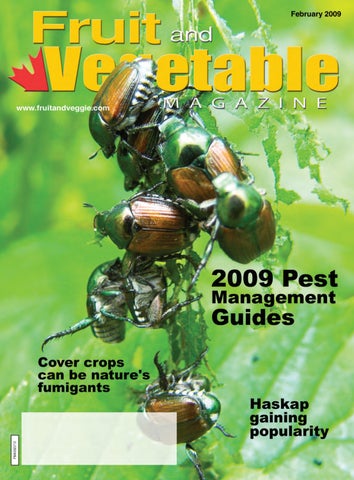
Above: Gypsy moth caterpillar Right: Japanese beetle
2009 issue. Disease Management Guides for apples, grapes, strawberries, field tomatoes, sweet corn, and carrots were published in both the print publication and online. Fruit & Vegetable Magazine hopes to build on the Disease and Pest Management Guides and provide tables for additional fruit and vegetable crops over time. For more information or to suggest other crops to cover, don’t hesitate to contact the magazine at mland@annexweb.com or 1-888-599-2228, ext. 269. ❦
Continued from page 4
I have not heard of Staccato or other varieties being sensitive to bud damage caused by pruning. There are varieties that are sensitive to cold injuries and this situation can be worse if there is excessive vigor caused by late pruning. A couple of other notes: There is no cherry variety named Summerland. There are numerous varieties from the Breeding Program at the Pacific AgriFood Research Centre (PARC) at Summerland but none named Summerland. Lapin is actually Lapins and the name comes from a former breeder Karlis Lapins. The PARC program is by far the best cherry breeding program in the world and owes its success to Page 8
breeders like Mr. Lapins. Lapins bred and introduced a variety named Stella. Stella is the first commercially viable, self-compatible, cherry variety and is the base for all other self-compatible varieties in the world. I know Lindsay Hainstock and have a great deal of respect for her. She has been a field person for the OK Tree Fruit Company for a number of years and seems well versed in tree fruit production in BC. I suspect the article was not Lindsay’s doing. I suggest an apology would be appreciated by Lindsay. Regards, Ken Haddrell Operations Manager Okanagan Plant Improvement Corporation (PICO) Fruit & Vegetable Magazine, February 2009
Fruit & Vegetable Magazine,February 2009
Page 9
diazinon
diazinon
spinosad
phosmet
chlorpyrifos
permethrin
chlorpyrifos
cypermethrin
carbaryl
spinosad
Diazinon 50 W
DZN 600 EW
Entrust 80 W
Imidan 50 WP
Lorsban 4E
Pounce
Pyrinex 480 EC
Ripcord 400 EC
Sevin XLR
Success 480 SC
kaolin clay
spinetoram
Delegate WG
Surround WP
Common name
Insect management products
F
organophosphate
S/F
organophosphate
naturalyte
carbamate
pyrethroid
organophosphate
F
F
F
F
F
F
F
organophosphate
pyrethroid
F
naturalyte
organophosphate
F
Soil/foliar applied
spinosyns
Chemical group (rotate groups to manage resistance)
G
G
A/G
G
G
A*/G
G
G
G
G
G
Aerial/ground
3
1
35
60
60
40
3
10
10
3
Pre-harvest interval days
12
dry
24
24
12
12
Re-entry period (hrs)
Carrot pest control 2009
7
7
7
5
Days between applications
3
3
2
1
2
3
3
Max. times per season
•
•
Aster Leafhopper
•
•
•
Cabbage Looper
•
•
•
Carrot Rust Fly
•
Carrot Weevil
•
•
•
•
Cutworms
Pests
•
•
•
Diamondback Moth
•
•
•
•
•
•
Imported Cabbage Worm
Use low rate on young plants.
For cutworm control - do not disturb the soil for five days following application.
Use high rate on large larvae or dry soils.
Do not disturb the soil for five days following application. *Aerial applications only for control of Pale Western Cutworm, one application per season.
Use high rate on large larvae or dry soils.
Use higher rate for heavy infestations.
Important: The Fruit & Vegetable Magazine Carrot Pest Control tables are a guide only. It is highly recommended that growers refer to local provincial guides and labels.
Notes
Page 10
Fruit & Vegetable Magazine, February 2009
chlorantraniliprole
acetamiprid
spinetoram
diazinon
spirodiclofen
azinphosmethyl
phosmet
Altacor
Assail 70 WP
Delegate WG
Diazinon 50 W
Envidor 240 SC
Guthion Solupak
Imidan 50 WP
spinosad
kaolin clay
endosulfuran
endosulfuran
Surround WP
Thiodan 50 WP
Thionex 50 W
F F
chlorinated cyclodiene
F
F
chlorinated cyclodiene
naturalyte
G
G
G
G
30
30
0
7
5*
Success 480 SC
G
28
organophosphate
F
azinphosmethyl
carbamate
Sniper 50 W
7
25
0
G
G
21
ferric phosphate
F
F
G
1
Sluggo
pyrethroid
pyridazinone
F
G
7
carbaryl
pyridaben
Pyramite
pyrethroid
F
G
7
28
14
16
7
7
14
14
Preharvest interval days
Sevin XLR
permethrin
Pounce 384EC
organophosphate
F
G
G
G
G
G
G
G
G
Aerial/ ground
cypermethrin
malathion
Malathion 500 E
diphenylethane
F
organophosphate
F
tetronic acid derivative F
F
organophosphate
organophosphate
F
spinosyns
F
F
F
Soil/foliar applied
Ripcord 400 EC
dicofol
Kelthane 50 W
Isomate GBM Plus
diamides
bifenazate
Acramite 50 WS
neonicotinoid
carbazate
Common name
Insect management products
Chemical group (rotate groups to manage resistance)
12
672
24
24
28
12*
12
12
12
12*
Re-entry period (hrs)
Grape pest control 2009
14
10
5
7
Days between applications
3
2
2
1
2
3
1
1
2
1
3
2
3
1
Max. times per season
•*
•
Climbing Cutworm
•
•
•
•
European red mite
•
•
•
•
•
•
•
•
Grape Berry Moth (First generation)
•*
•
•
•
•
•
•
•*
Grape Berry Moth (Second generation)
•
•
Grape Phylloxera (Leaf Form)
Pests
•
•
•
•
•
•
•
Leafhoppers
•
•
Multicoloured Asian Lady Beetle
•
Slugs & Snails
•
•
•
•
Twospotted spider mite
Only French hybrids & vinifera varieties are susceptible to this pest.
Only French hybrids & vinifera varieties are susceptible to this pest.
May delay Brix accumulation. Use high rate for first two applications.
*For suppression of grape berry moth and thrips.
Apply when infestation begins. Apply higher rates when population is very high.
* Check with processor & winery for wine grapes.
Cannot be used on juice grapes destined for export to the U.S.
Is most effective against active nymphal stages, not adults.
* Do not disturb soil for 5 days after application.
Lasts for 150 days. Vineyard block must be bigger than 2 hectares.
* 6 days for cane girdling & turning.
*For suppression
* 48 hours for hand labour.
Important: The Fruit & Vegetable Magazine Grape Pest Control tables are a guide only. It is highly recommended that growers refer to local provincial guides and labels.
Notes
Fruit & Vegetable Magazine,February 2009
Page 11
F
organophosphate
carbamate
pyrethroid
inorganic
acephate
pirimicarb
permethrin
chlorpyrifos
cypermethrin
carbaryl
cyhalothrinlambda
ferric phosphate
spinosad
Orthene 75 SP
Pirimor 50 DF
Pounce 384 EC
Pyrinex 480 EC
Ripcord 400 EC
Sevin XLR
Silencer 120EC
Sluggo
Success 480 SC
cyhalothrinlambda
F
pyrethroid
cyhalothrinlambda
Matador 120 EC
Warrior
S/F
pyrethroid
naturalyte
pyrethroid
small larvae/ low populations
5 leaf stage
F
F
F
F
F
F
F
organophosphate 2-5 leaf stage
F
pyrethroid
carbamate
2-5 leaf stage
chlorpyrifos
Lorsban 4E
F F
planting
carbamate
carbamate
organophosphate
pyrethroid
F
egg hatch/ small larvae
methomyl
naturalyte
spinosad
Entrust 80 W
F
pinhole feeding
Lannate
biological
Bacillus thuringiensis
DiPel 2X DF
F
F
telfluthrin
pyrethroid
deltamethrin
Decis 5 EC
pinhole feeding
F
carbofuran
biological
Bacillus thuringiensis
Bioprotec 3P
pinhole feeding
Soil/foliar applied
Force 3.0 G
biological
Bacillus thuringiensis
Bioprotec CAF
Application timing
Furadan 480 F
Chemical group (rotate groups to manage resistance)
Common name
Insect management products
G
G
G
A/G
A/G
A/G
G
A/G
A/G
G
A/G
G
G
G
G
G
G
A/G
G
G
Aerial/ ground
1
7
0
1
1
21
70
1
3
21
1
70
3
7
7
5
1
1
Pre-harvest interval days
24
12
24
24
24
24
24
48
12
0
0
Re-entry period (hrs)
Sweet Corn pest control 2009
7
7
4
7
7
7
Days between applications
3
2
3
1
2 aerial
1 G&A
4
3 (2 aerial)
1
2
6
2 (1 aerial)
6
6
Max. times per season
•
Aphid
•
•
•
•
•
•
•
Corn Earworm
•
•
Corn Rootworm
•
•
•
•
•
•
Cutworms
•
•
•
•
•
•
•
•
•
•
•
•
•
•
European Corn Borer
Pests
•
•
•
•
•
Fall Armyworm
•
Slugs
Do not apply within 7 days of forage harvest
Use high rates on severe infestations.
Can be tank-mixed with Tilt 250E fungicide. Do not harvest within 14 days of application for sileage corn.
Do not disturb soil for 5 days after application.
Consult and follow local spray programs for ground applications.
Use high rate for corn borer.
Rootworm adults only
Apply in-furrow at planting
Do not exceed 50g of product per hectare per application; Do not apply within 28 days of fodder harvest. Must be applied to time with peak egg hatch.
Apply when feeding is observed on 5 percent of plants.
Apply when feeding is observed on 5 percent of plants.
Apply when feeding is observed on 5 percent of plants.
Important: The Fruit & Vegetable Magazine Sweet Corn Pest Control tables are a guide only. It is highly recommended that growers refer to local provincial guides and labels.
Notes
Three backyard fruit trees test positive for PPV Discovery a setback to getting a disease-free foothold
Photo courtesy of USDA ARS
T
By Jim Meyers
he discovery of three plum-pox-infected fruit trees in a homeowner’s backyard in Grimsby last summer has been an unfortunate, yet minor, setback, in what has been an eight-year, $180-million battle to eradicate the disease in Niagara. It takes three years of negative test results to declare an area free of the disease that saps sugar from the fruit, but does no damage to the tree. When the current government funding for plum pox eradication ends in 2011, all of Niagara below the Niagara Escarpment will still be designated as the only infected area in Canada. There had been hope the Grimsby area could be plum pox free by then to show that a disease-free foothold had been made in the extreme west end of Canada’s largest tender fruit growing area. Otherwise, there’s been positive news to report from leaf testing last summer. “There were very few positives samples in sub Area A (west of St. Catharines) and, in (commercial) orchards in Grimsby, there were no positive samples,” said Violet Galvin, project manager for the PPV eradication program in Ontario. The most heavily infected areas are Area B – located east of Highway 55 in Niagaraon-the-Lake – and Area C – a “hot spot” area inside Area B where PPV was first detected in 1999. In a press release distributed in early November, the Canadian Food Inspection Agency (CFIA) that oversees the leaf testing and tree removal program said the three trees that were found in the backyard have a strain of PPV (PPV-Rec) that’s only been recently discovered and known to occur only in Europe. “We can’t do a trace back and say definitively where it came from,” Galvin said. The unique PPV strain was found on single apricot, peach, and plum trees planted by a previous homeowner. The trees were grafted off the same plum tree rootstock. An example of what plum pox symptoms can look like on a tree leaf.
She said it’s similar to the PPV-W strain that was found on a single tree in a backyard in Winona six years ago. At that time, leaf sampling around the infected tree was stepped up to see if it had spread. Nothing was found. The infected tree was removed and the strain was never detected again in Canada. “We sent inspectors into the woods to sample anything that could be a host and didn’t find anything,” Galvin recalled. She believes in this case, the newly detected PPV strain is isolated to the three trees and likely spread on the rootstock.
per cent and many more 15 per cent (acreage),” said Galvin. It’s applicable to only a handful of growers and many are in the “hot spot” area of contamination in the McNab area of Niagara-on-the-Lake, said Len Troup, chairman of the OTFPMB. “It’s (CFIA) looking at the viability of each farm. They were really getting clobbered.” He added it’s an excellent way to show some compassion and allow these growers to buy time so they can remain in business.
More samples, fewer positives
Currently, a third season of winter testing of dormant wood has been intensified in order to identify and remove infected trees in highrisk blocks before they leaf out and flying aphids can possibly spread the disease. Testing was scheduled to begin in early December and some 100,000 samples are expected to be tested compared to 40,000 samples last winter, and just a handful of samples when winter testing began three years ago. Winter testing was a recommendation of an international panel of experts on the disease and how it spreads. “We’re going to find them sooner or later anyway,” Troup said about the stepped-up,
Last summer, there was a significant drop in the number of positive samples even though there was a 35 per cent year-over-year increase in the number of samples collected. Of the 750,000 leaf samples tested, only 131 were positive. This compared to 261 positives in 2007 from some 200,000 fewer samples. “That many more samples (tested) and half the number of positive trees,” Galvin said is a good indication the program is working. “We’re doing more targeted sampling based on research on where the virus is on the tree certain times in the summer and up our sampling every year. The labs are getting very good at handling the (increased) number of samples.” The CFIA policy of wholesale removal of trees in a 20-metre “buffer block” around an infected tree, rather than taking a surgical approach and removing only infected trees, has been a contentious issue with growers. “We’re concerned there’s no scientific support for a buffer block or any distance and to this point we’ve asked CFIA to reconsider,” said Adrian Huisman, secretary-manager of the Ontario Tender Fruit Producers’ Marketing Board (OTFPMB). Currently, if a positive sample is found three consecutive years in the same block of trees, or if infection is over one per cent, growers would lose an entire block (same variety planted at the same time in the same area) of trees. For some time, a number of large growers had asked for a go-slow approach to largescale removals that could cause them to lose market share and the CFIA took a more compassionate view – a “special consideration policy” – to tree removal. A year ago last fall, tree removal was capped at 10 per cent of total acreage of bearing trees and the same policy was extended this past fall. “We know that’s too hard a hit for any grower. Some would have lost as much as 30 Fruit & Vegetable Magazine,February 2009
Increased winter testing
off-season testing program that augments leaf testing. He believes funding for the PPV eradication program will be extended beyond 2011 if it’s shown the disease is being contained in a smaller and smaller area and less money is needed. (In 2004, the federal government approved an $85-million program to eradicate PPV – $65-million for testing/ $20-million for tree removal and replanting – and, in 2007, bumped that up an additional $45.6 million, largely to pay for grower compensation. An initial $50 million for a three-year period from 2001 to 2003 was spent largely on leaf testing.) “Were moving along very nicely and I think there’s an acceptance this deal will be done. No one’s going to quit on it. It’s too far down the road,” said Troup, adding the United States has corralled the problem to a few identifiable trees and has vowed to eradicate PPV no matter what. Canada would be shooting itself in the foot if it had the only PPV-infected area in North America, he said. “If anyone thinks Ontario can sit back and back off, they can forget it in a North American environment.” ❦
Economical control Reason® for early blight and late blight control
bayercropscience.ca or 1 888-283-6847
Always read and follow label directions. Reason® is a registered trademark of Bayer. Bayer CropScience is a member of CropLife Canada. 9581-0109
9581 Reason_Eco_FV.indd 1
Page 13
1/14/09 10:47:30 AM
group.com antic.ca est Ave.,
ation & raphic d lp r your umber
Submitted photo
Atlantic u! Haskap, or blue honeysuckle berries, ripen in June, making them a good complement to later ripening berries in a commercial operation.
n
Submitted photo
e e
Fruit & Vegetable Magazine, February 2009
e ut... ich way t will
The haskap berry is described as among the easiest berries to harvest by researchers, who have used some rather unique methods to pick berries in the past.
many Western Canadian growers and for anyone interested in getting in on the ground floor of a new commercial berry crop, it definitely fits the bill. Only about 100 hectares of haskap bushes have been planted in Canada so far. A growers group called the Haskap Canada Association has been formed, and its aim is to promote the marketing and production of this berry crop. At present, most of its members are in Western Canada. The University of Saskatchewan has an active haskap breeding program aimed at producing tasty, productive, and hardy varieties. Two named varieties, Borealis and Tundra, as well as three numbered varieties have already been released. At present, growers are propagating haskap plant varieties to meet the demands of commercial growers. University of Saskatchewan plant breeder and Haskap Canada Association board member, Dr. Bob Bors, has been largely responsible for uncovering this berry gem, managing the university’s
.
Page 14
more consistent cash flow. With a taste that is a cross between a blueberry and a raspberry, it’s possible that wild blue honeysuckle – or its Japanese name haskap, as it is better known in the commercial market – has been growing on the back forty near a slough for as long as fruit-bearing shrubs have been growing in northern Canada. Haskap and its commercial potential has already caught the attention of
s idea, t, a new simply a lp you
B
erries produced by blue honeysuckle, a shrub that grows throughout northern Canada, has a lot of commercial upside potential, particularly in the large Japanese consumer market, according to researchers at the University of Saskatchewan and members of a fledging growers association. The berries are considered a delicacy on the Japanese island of Hokkaido, where they are consumed as fresh fruit, or in baked goods, wine, candies and ice cream. What’s particularly exciting about commercial blue honeysuckle berry production is that it is quite suitable as a Prairie-based commercial crop because of its hardiness. Dormant plants have survived with the temperature falling to as low as -45 C, and blossoms have withstood temperatures to as low as -8 C. It is also an excellent complement to other berry crops, such as saskatoons, blueberries and raspberries, because it ripens in June, while these other crops ripen later in the year. This makes for
By Tony Kryzanowski
Sometimes you have to turn things completely upside down to find that one unique, innovative idea that can make the difference in your packaging!
At Atlantic Packaging Products we like to turn things upside down... inside out... backwards... forwards... and every which way in order to find that creative idea that will help you attain your packaging goals. Whether it is a unique labour savings idea, a novel way to package your product, a better way to protect your items, a new method to market your product, or simply a new way of doing things, we can help you develop ideas and solutions. Submitted photo
Atlantic Packaging offers the largest number of facilities and innovation experts to respond to your needs. With 4 Innovation & Design Centres, two state of the art Graphic centres, backed up by a fully equipped testing facility, we are available to help develop new and unique methods for your corrugated packaging. Entrust us with your business and let Atlantic Packaging bring the innovation to you!
Service Driven! “Responsive to your needs”
Atlantic Packaging Products Ltd. Corrugated Division Scarborough-Progress Ave., Scarborough-Midwest Ave., Brampton, Mississauga and Ingersoll 416-298-8101 • 1-800-268-5620 • www.atlantic.ca Add Ink (Atlantic Decorated & Display) Toronto 416-421-3636 • www.addink.ca Mitchel-Lincoln Packaging Ltd. Montreal and Drummondville 514-332-3480 • 1-800-361-5727 • www.mlgroup.com
Submitted photo
Haskap berries are considered a delicacy on the Japanese island of Hokkaido.
breeding program, and bringing haskap’s potential to the growing public’s attention. “We have a plant sale one day every year and last year, we had thousands of people show up,” he says. “I would say that 75 per cent of these people purchased haskap.” Three reasons he identifies for this level of interest is a growing public interest in the fruit industry, haskap’s early ripening threshold, and three scientific articles that have been published over the past year praising the berry’s health benefits. One article, for example, did a comparison with blueberries and pointed out that haskap has twice as many antioxidants. From a northern grower’s perspective, it’s a dream plant. A haskap bush typically grows to between one and two metres, is non-suckering and noninvasive, and requires virtually no pruning. Fruit, which is a fat, ovalshaped berry, will begin to appear the year after planting, but it will take three to four years to reach favourable comPage 16
mercial productivity of about seven kilograms of berries per bush. In the wild, Dr. Bors says haskap tends to grow, “halfway between where the woods are and where the swamp or standing water is located.” However, it does not necessarily favour a wet environment. He says that it has been grown on both wet and regular farmland, and actually grows better on regular farmland. It likes soil that has a little bit higher pH, but is not limited to the high acid pH preferred by blueberries. “These plants will grow in a much wider range of soil types,” Dr. Bors says, “so if you like blueberries and you can’t grow them on the Prairies, you can plant haskap instead.” Seedlings sell for about $3.50 per plant and growers should expect to plant about 1,975 haskap seedlings per hectare. In terms of harvesting a crop, methods will vary depending on the varieties planted. Some varieties will drop their berries with a minor amount of shaking while other varieties only give up their
berries after a lot of effort. Part of the University of Saskatchewan’s breeding program is to develop varieties with superior taste qualities that are also easy to pick. “This fruit is among the easiest to harvest,” says Dr. Bors. “It doesn’t hold on as hard as a lot of other berries. There’s a good chance that a raspberry harvester would work on it.” Other mechanical harvesters that would likely work well are saskatoon and cherry harvesters. He adds that growers with only a few hundred bushes don’t require a mechanical harvester and, in some instances, growers can shake the berries off into a tub below. Dr. Bors has identified both a domestic and an international market for haskap, although there is still a lot of work to do to both promote the berry and establish potential customer contacts. So far, Dr. Bors says the university has made contact with a few companies in the Saskatoon area that are interested in a substantial amount of Fruit & Vegetable Magazine, February 2009
fruit for gelato and ice cream. “The ice cream people really love it because it has such a dark juice,” he says. “It makes the ice cream a deep purple.” As far as overseas markets, he has had discussions with a Japanese pharmaceutical company that is developing a line of five health products based on the haskap. The company would require 100 hectares of haskap production in Canada to supply only one of its product lines during the initial trial phase. If the health products gain acceptance, the company would require a lot more. Dr. Bors adds there are also a lot of smaller companies that would probably require smaller lots such as one freezer container per year. In terms of what customers are prepared to pay, “a lot of them assume the haskap fruit should cost the same as blueberries,” says Dr. Bors. “Grade A, sorted blueberries are going for about $5 per pound.” ❦
Submitted photo
Submitted photo
Haskap is native to northern Canada and can withstand extremely cold temperatures.
Wherever you find Canadian agriculture, you’ll find FCC Call us at 1-800-387-3232 (your local office) or 1-888-332-3301 (extended hours). See what we’re up to at www.fcc.ca/advancing
50 years /ans
1959-2009
Fruit & Vegetable Magazine,February 2009
Page 17
Weather was tough on crops, growers in 2008 Discovery a setback to getting a disease-free foothold
L
ooking back over 2008’s growing season, producers and researchers alike faced many weather-related challenges, says Janice Le Boeuf, vegetable specialist with the Ontario Ministry of Agriculture, Food and Rural Affairs (OMAFRA). According to Environment Canada, southwestern Ontario generally saw less rain during the month of May with temperatures two degrees cooler than average. With the exception of the Windsor area, June, July and August were 30 per cent wetter than normal with a three-month record rainfall of 396.2 millimetres. The yearly total for southern Ontario was also a record setter at 995.8 millimetres, easily topping the previous record of 971 millimetres set in 1977. Driven by weather, there were not many insect calls during the season, says Le Boeuf, but “there were certainly disease issues.” The wet conditions and wind proved ideal for spreading bacterial canker, plus speck and spot throughout pepper and tomato fields. “Some grew out of it while others worsened,” she noted, adding that in some cases, entire fields were lost to infection. Le Boeuf says disease prevention would have been difficult last year but timely sprays did minimize effects. Three copper-based applications, timed at five- to 10-day intervals, did prove very effective on vegetable crops early in the season. Outbreaks of phytophthora leaf blight were common last year in Essex County, a county where it is normally not a big factor, says Le Boeuf. Zucchini and other vine crops were particularly hard hit with some fields wiped out. The first signs of phytophthora leaf blight usually appear as a mould on the leaf surface that resembles icing sugar, explains Le Boeuf. The fully established spores turn the leaf soft and black while moving through the plant to the root system. Too much rain is certainly a factor and it can spread rapidly, she says. As a root rot, phytophthora can remain in the soil for a long time, notes Le Boeuf, Page 18
By Hugh McElhone
Downy mildew was prevalent again in cucumbers, cantaloupe and watermelon during the 2008 season. This is an example of downy mildew infection on a cucumber plant.
and in the U.S. some crops such as pepper, squash and melon cannot be grown in areas so afflicted. Given phytophthora’s longevity in the soil, a three-year crop rotation of corn, grain, soybeans or brassica crops is recommended before vine crops are planted again. While the leaf blight version of the disease moves through airborne spores, the root rot version can be carried in field runoff or by overhead watering from infected irrigation ponds. There are no treatments for pond water. Raised beds with good mulch can help to a certain degree and good drainage is also beneficial. Rather than planting in low spots where water traditionally tends to pool, Le Boeuf suggests picking up the planter and avoiding the area altogether. She also recommends a close inspection of transplant seedlings before they leave the greenhouse. Another disease found last summer was buckeye rot, which shows itself initially as small black dots on such crops as tomatoes. As it develops, a dry scab resembling a smouldering cigar forms. The disease was particularly common in cases where the crop was touching the ground. The right fungicide can help, says Le
Boeuf, who noted the problem persisted in the U.S. last year despite their application of fungicides that are not available in Canada. Downy mildew was prevalent again in cucumber, cantaloupe and watermelon crops last year. Le Boeuf says 30 monitoring sites were set up under the watchful eye of Elaine Roddy, OMAFRA researcher, and by June 20 all sites were infected. While applied fungicides such as Cabrio and Reason were effective, she noted that resistance problems have been found in the U.S. Last year, Le Boeuf initiated a loose study tracking pepper maggot in Essex and Kent counties and will see if it moves east to Elgin or even Norfolk counties. The pepper maggot leaves egg-laying scars on the skin of the pepper. When the eggs hatch, the larvae gorge themselves on the inside of the pepper prior to dropping to the soil in which they pupate. “They are attracted to the smell of ammonia, which we used as bait in maple trees,” she said. With the bait in place, Le Boeuf hung sticky yellow strips high in the trees to capture the bugs and estimate the population. She will repeat this study in 2009 and track their movement. ❦
NE Th
Introd
• Contr • A wh • Resid
Questi
With any cr The DuPont trademarks © Copyrigh
Fruit & Vegetable Magazine, February 2009
DP12075COR_FV_AE
DuPont Coragen
™
™
insecticide
NEW! They just can’t resist new Coragen . ™
Introducing new DuPont™Coragen™ insecticide for: • Control of Colorado potato beetles including imidacloprid-resistant biotypes • A whole new group of chemistry – Group 28 • Residual, multi-stage control of European corn borer Questions? Ask your retailer or call 1-800-667-3925. With any crop protection product, read and follow the label instructions carefully. The DuPont Oval logo, DuPont™, The miracles of science™, Coragen™ and Rynaxypyr™ are registered trademarks or trademarks of E. I. du Pont de Nemours and Company. DuPont Canada is a licensee. Member of CropLife Canada. © Copyright 2009 DuPont Canada. All rights reserved.
DP12075COR_FV_AE.indd 1
12/9/08 10:53:54 AM
Cover crops can be nature’s fumigants
T
By Hugh McElhone
Cover crops, such as oilseed radish, can serve as biological fumigants. The long taproot system of the oilseed radish plant makes the crop ideal as a winter cover crop.
need to select the appropriate species, the seeding rate and the growing time, plus determine your fertilizer needs,” he says, adding the brassica crop chosen must have enough time to grow to the flowering stage but be incorporated before seed heads form. If the cover crop seed is broadcast, it should be worked into the soil to a depth of one to two inches. A seed drill can also be used if covering a large amount of acres. “We’ve found no difference in either production method. It’s just whatever is easiest for you,” says Dr. Ngouajio. Some of the optimal seeding rates found by Dr. Ngouajio and his research team include 7 to 10 pounds per acre for the oilseed radish varieties Defender and Diakon. For brown mustard and oriental mustard, six pounds per acre provides adequate biomass, while eight pounds per acre works best for yellow mustard. “Biomass production varies with the variety and the seeding rate,” he says, adding that if the seeding rate is too high, there is too much competition and less biomass produced. “More is not always better.” The next step is to crush the tissue at flowering time and incorporate it into the soil. Most brassica crops require 45 days after sowing to reach this stage, which generally works out to June 23. If the end of June is too late for growers who want their transplants in the ground by mid-May, Dr. Ngouajio suggests they plant oilseed radish. With its large taproot system, the crop can be used as a winter cover crop. While optimal levels are not achieved this way, as the taproot rots, some biofumigants are slowly released into the soil, he explains. In their small research plots, the biomass was incorporated with four passes of a rototiller. For larger acreages, a flail-type mower and disc can be used. “The key is to incorporate it immediately, otherwise you’ll lose its value.” Dr. Ngouajio says his team has found good long-term control results for soil-borne phytophthora and fusarium,
Page 20
Fruit & Vegetable Magazine, February 2009
radish and mustard. They also act as a natural pesticide and deter plant-eating animals. One glucosinolate of particular interest is called isothiocyanate, the active ingredient in the fumigant Vorlex Plus, which is effective against nematodes and other soil parasites. As is the case with mustard, the glucosinolates and enzymes produced are not toxic to the plant because it stores them in “separate rooms,” explains Dr. Ngouajio. When the plant is shredded or crushed, the tissue damage allows the compounds to leave their “rooms” and form a liquid chemical that turns into a toxic vapour or “mustard bomb.” It is this action that makes brassicas ideal as a biological fumigant, he says. While Dr. Ngouajio promotes brassicas in general as a cover crop, he believes some are more ideally suited to certain field crops than others. “You
Photo courtesy of Anne Verhallen, Soil Management Specialist, Horticulture, OMAFRA
here are many benefits to cover crops, such as protecting the soil from wind and water erosion during the winter months when it is most vulnerable, suppressing weeds, plus providing organic matter for the next crop while preventing the leaching of nitrates into groundwater. Researchers have found that certain cover crops can also serve as biological fumigants. While there are many synthetic fumigants on the market, the residue from plants that produce glucosinolates can act as a natural fumigant, says Dr. Mathieu Ngouajio with the department of horticulture, Michigan State University (MSU). Glucosinolates are secondary plant metabolites produced by 15 different plant families. More than 120 glucosinolates have been identified to date and are most prevalent among the brassica genus of plants, commonly known as the cole crop or mustard family. Glucosinolates are organic compounds that result when the plant produces one element of glucose and one of sulphur, says Dr. Ngouajio. These substances are responsible for the bitter taste found in Brussels sprouts, horse-
Most brassica crops, such as mustard, require 45 days after sowing to reach the flowering stage, the ideal time to work down the cover crop and incorporate it into the soil.
with populations kept in check throughout the growing season. This compares well with synthetic fumigants that tend to knock down all organisms in the soil, good and bad alike, with an increase in disease populations generally occurring one month after applying, he says. In one biofumigant trial, onions were grown following a cover crop of oilseed radish. “Onions need 120 days to grow so both couldn’t be planted in the same year. The oilseed radish was planted the fall before,” he explains. For onions, the researchers found oilseed radish left the most beneficial organisms in the soil, which led to a significant increase in onion production with one small problem: “We had more bulbs but they were smaller than the control plot which had fewer bulbs but they were bigger,” Dr. Ngouajio says. He concludes the oilseed radish did too good a job and, with nearly all the onions surviving, there was too much competition, which led to smaller bulbs. To test this theory, the trial was repeated four times on 60 research plots using different seeding rates for oilseed radish. From these trials, Dr. Ngouajio found the optimal seeding rate to be 172,000 seeds per acre, down from the Fruit & Vegetable Magazine, February 2009
industry standard of 225,000. At this rate, they achieved a 15.4 per cent increase in onion yield while decreasing seed costs by 24 per cent. The latter is significant, he explains, because oilseed radish seed can be difficult to find and expensive to buy. As mentioned earlier, not all brassica crops work equally well with all field crops, as Dr. Ngouajio discovered
with oilseed radish and celery. From their trials, researchers found that celery fared much better following a cover crop of oriental mustard. “Some 60 per cent of Michigan (celery) growers now use this in their rotation,” he notes. Among their other findings, Dr. Ngouajio’s team found nematodes were best controlled by oilseed radish compared to oriental mustard, yellow mustard or rapeseed. His team also found that melon crops, in particular muskmelon, are sensitive to mulched brassica crops and it is best to wait two weeks after soil incorporation before planting. This research is ongoing and continues to find natural ways to improve vegetable production and reduce costs. “I really like working with the growers and I’m happy if we can earn them one more cent,” says Dr. Ngouajio. ❦
Protects both sides of leaf Reason® for early blight and late blight control
bayercropscience.ca or 1 888-283-6847
Always read and follow label directions. Reason® is a registered trademark of Bayer. Bayer CropScience is a member of CropLife Canada. 9581-0109
9581-01 Reason_Pro_FV.indd 1
Page 21
1/14/09 10:53:49 AM
Ravine winery to be showcased as tourist destination in St. Davids
O
rganic wines, a celebrity TV pastry chef known as “Sugar,” a peripatetic old house, and a family farm that’s played a significant role in Niagara’s agricultural history are the basic marketing ingredients in the business plan for a new winery in Niagara. The Ravine Vineyard Estates Winery/ Olson Foods at Ravine café bakery enterprise opened quietly last November while restoration was ongoing on the house that will be the focal point of the winery. It will have its official opening this spring with a lot more fanfare. Indeed, the well-travelled house has a story to tell that’s equally as compelling as the food and wine partnership forged between winery owners, Blair and Norma Jane Harber, plus Anna Olson, host of a TV cooking show on The Food Network,
By Jim Meyers and her husband Michael Olson, co-ordinator of the culinary program at Niagara College. For years, the Woodruff House was a rundown landmark in the village of St. Davids in Niagara-on-the-Lake where the winery is located. It was carefully dismantled in 1969 and, for the next 35 years, travelled about Ontario, stopping in three communities before coming back to its hometown. Like police on a cold case file, the Harbers used the Internet to follow a trail that saw the house moved in pieces first to the Caledon Hills and then to Bond Head, north of Toronto, then east of Toronto to Port Hope. In each case, new owners of the architecturally significant clapboard house constructed in the Loyalist Georgian style wanted to put the house back
together to use as a home for themselves. But it never happened. Built in 1802, the house was torched by American invaders who set fire to St. Davids in the War of 1812, destroying all but the tavern and the home of Maj. David Secord, whom the village is named after. Rebuilt in 1827, the house included the original kitchen and, for years, it was the family seat of the Woodruff family that put down deep roots in the farm community of 600 located at the junction of two Indian trails below the Niagara Escarpment in Niagara-on-the-Lake. The house was turned into an apartment house around 1910 and for almost 60 years was lovingly called the “House of Nations” because of the numerous new Canadians who lived there before moving elsewhere, says Blair Harber, who is
Norma Jane and Blair Harber behind the plank counter in the temporary tasting room that was the summer kitchen of the Woodruff House. The walls are panelled with wide pine boards that at one time were on the ceiling. The winery’s rolling vineyards can be seen through the window and a picture of the vineyard is over Blair Harber’s shoulder. Page 22
Fruit & Vegetable Magazine, February 2009
The restored Woodruff House and reconstructed farm packing shed that houses the Olson Foods bakery café. There are five fireplaces (one wood burning) in the house, which also has a large tasting room and lounge on the ground level and a second tasting room and offices above.
originally from Fort Erie and shares his wife’s love of local history. “Anyone who ever stayed in the house, or knows anyone who has, is invited to the opening this spring,” he said. Norma Jane, 62, who grew up in St, Davids, made it her mission to repatriate the house to serve as a perfect historical showpiece for the winery that’s located on the 34-acre Lowery Farm. The farm has been in her family for four generations. She also has a family connection by marriage to the Woodruff family through her ancestors, “as do many people in the village,” her husband Blair, 61, joked
The goal: a tourist destination
The Harbers had hoped to incorporate the Lowery Farm packing shed, built in 1920, into their building plans and had carefully moved it onto a new foundation next to the house that was still in pieces. Torched by a local arsonist in 2007, the shed was totally reconstructed and serves as a delicatessen, bakery, and food emporium run Fruit & Vegetable Magazine, February 2009
for the Olsons, who have a similar operation in the Port Dalhousie tourist area of St. Catharines. “Everything they stood for, we stood for,” Blair Harber said, describing the Olsons. They were introduced to the couple through winery start-up consultant Peter Gamble, who is now Ravine’s chief winemaker. What started as a restaurant consulting role for the Olsons turned into a longterm, opened-ended business relationship that should make both stronger and still be compatible with a high-end restaurant that’s planned for the winery, said Michael Olson. “We thought Niagara needed something added to the winery experience that wasn’t a ‘white table cloth,’ three-hour lunch,” he said. “As the industry and tourist area matures, I find things tend to get simpler, not more complicated, and we’re trying to deliver all the virtues of that high-end experience, but in a different fashion,”
he added. It’s hoped the joint enterprise will encourage other tourist-related businesses to come to St. Davids and make it a tourist destination, much like Cave Springs Winery and the Inn on the Twenty did for the village of Jordan, which is located further along the bench growing area west of St. Catharines. It’s hard to imagine you’re viewing a winery, looking at the low profile of the two buildings on the rolling bench below the Niagara Escarpment. Underneath is the heart of the combined operation – a cellar for barrel aging the wine and a full-service kitchen for the Olsons’ catering business. The winery sits in the middle of vineyards and back from houses that are owned by a number of Lowery family members on the street. “It’s a family farm, a place where you can relax and learn about the history and feel comfortable in the surroundings,” said Blair Harber. The farm could easily have been sold for housing, as it’s entirely within St. Davids and is surrounded by unique farmland that cannot be developed. But the Harbers Page 23
wanted to keep it intact and preserve a piece of their own and local history. After Norma Jane’s father Howard Lowery died seven years ago, the couple bought out her siblings, who also thought the same way. “It’s worth more money that way,” Blair said. Commercial value aside, historically it’s the first farm in Niagara to have a commercial 500-vine vineyard that was planted in 1869, and the first commercial peach orchard. Also, the Lowery family started the Lowery Brothers canning factory that had a 110-year history in the village before it closed last June. It became Canadian Canners and, in quick succession, was owned by Nestle Foods, then Kraft Foods, and finally by two private investment firms in the U.S. that operated it as CanGro. The winery is named after Ravine Sand and Gravel, a family business that was run by Norma Jane’s father and uncle. The land is in a gorge that was once the outlet for water flowing from Lake Erie to Lake Ontario before it changed course at the Niagara Whirlpool to follow its present course, the Niagara River. As a result, there’s a great variety of soil ranging from sand, clay, to almost gravel and rich garden soil, which is where the Merlot was planted.
Seeking organic certification
“And exceptional air drainage,” Blair Harber hastened to add about the microclimate on the bench that drains down the gorge
from Niagara Falls. “We grow Merlot – our largest planting – because we can.” For that reason, it’s hoped the winery won’t need the wind machines that some growers are relying on to move air if it gets too cold. The winery is moving toward becoming an organic farm when the vines are certified later this year (2009). Estate bottled wines are currently available, made from Riesling, Cabernet Sauvignon, Cabernet Franc and Merlot grapes grown on the farm, and Gewurztraminer and Cabernet Rose grapes from other growers. Going organic was advice given to them by their winemaker, Peter Gamble. “We are in a residential area and wanted to be good neighbours,” said Gamble. The operation has reduced the use of pesticides and herbicides and uses superior netting, rather than bird bangers, to scare off the ravenous flocks of birds at harvest time. The land had been fallow for a number of years, which is the first step toward getting organic certification, Gamble added. Two of the Harbers three sons are on a career path to work in the new family business. The couple’s youngest son, Alex, 22, is studying viticulture at the Cool Climate Oenology & Viticulture Institute (CCOVI) at Brock University. Another son, Paul, 28, is in Europe studying to become a chef. Their oldest son, Andrew, 31, is the general manager of Harber Industries in Fort Erie, a family-owned sheet metal and air filtration company. ❦
Coming Events February 1-7, 2009 – North American Farmers Direct Marketing Association Convention, Savannah Marriott Riverfront, Savannah, Georgia. Visit www.nafdma.com. February 3-4, 2009 – New Brunswick Potato Conference & Trade Show, Woodstock, New Brunswick, Eagles Nest. Visit www. potatoesnb.com. February 11, 2009 – Market Caravan New Brunswick, Memramcook Institute, Memramcook, New Brunswick. Visit www.farmcentre. com. February 12, 2009 – Horticulture 2009, Hotel Mortagne, Boucherville, Quebec. Visit www.cqh.ca. February 17, 2009 – 2009 Ontario Berry Growers’ Association Annual Meeting, Four Points by Sheraton, St. Catharines, Ontario. Visit www.ontarioberries.com. February 18-19, 2009 – 2009 Ontario Fruit & Vegetable Convention, St. Catharines, Ontario, Brock University. Visit www.ofvc.ca. February 18-19, 2009 – Step It Up 2009, Black Knight Inn, Red Deer, Alberta. Visit www.albertafarmfresh.com. February 19-21, 2009 – 2009 Pacific Agricultural Show, Abbotsford, British Columbia, Tradex - Trade & Exhibition Centre. Visit www.agricultureshow.net. March 5-8, 2009 – 2009 Canadian Horticultural Council Annual General Meeting, Fairmont Chateau Laurier Hotel, Ottawa, Ontario. Visit www.hortcouncil.ca. March 24, 2009 – Market Caravan Ontario, CASO Railway Station, St. Thomas, Ontario. Visit www. farmcentre.com. May 5-7, 2009 – PackEx Toronto, International Centre, Toronto, Ontario. Visitwww.packextoronto. com. May 6-8, 2009 – 84th Annual Canadian Produce Marketing Association Convention & Trade Show, Metro Toronto Convention Centre, Toronto, Ontario. Visit www.cpma.ca.
THE ONL
prot be a
It’s best t for the job Scala® pr only Grou
get exce rotation m
New Sca
like takin
bayercrop Page 24
Fruit & Vegetable Magazine, February 2009
Always read an 9412-0109
9412 ScalaBrandAd_F
THE ONLY GROUP 9
Leaving your protection behind can be a painfuL mistake
It’s best to use the right protective equipment for the job. The same is true for your potatoes. Scala® protects against early blight and is the only Group 9 fungicide on the market. So you get excellent early blight control in a smart rotation management tool. New Scala. Growing potatoes without it is like taking a puck in the groin.
bayercropscience.ca or 1 888-283-6847
Always read and follow label directions. Scala® is a registered trademark of Bayer. Bayer CropScience is a member of CropLife Canada. 9412-0109
9412 ScalaBrandAd_FV.indd 1
1/9/09 2:03:26 PM
New Products JD Agri Services Labor and Product Tracking
To assist producers of hand-harvested fruit and vegetable crops in working more productively, efficiently and profitably, John Deere Agri Services has introduced two information management tools – Product Tracking and Labor Tracking solutions. These innovative systems work collaboratively to record, store and manage information to improve operations. The Labor Tracking solution utilizes a hand-held device to collect in-field information to track and monitor harvest and production data such as whom harvested what crops, where and when. All infield collected data is automatically stamped with GPS co-ordinates, date and time for
accurate reporting and record keeping. The Labor Tracking information is transferred to a secure web-based system that allows managers to view in near real-time harvest progress and yield and quality grade information to better manage risk and allocate resources in a more timely fashion and according to customer needs. Electronically captured Labor Tracking information eliminates manual entry of field data, which reduces paperwork and errors; allows managers to better monitor and track equipment and field labour productivity for scheduling and payment; and makes analysis of data quick and easy, depending on the needs of the operation. The Product Tracking solution records all growers and fields and all chemical applications and production inputs by field; tracks bins from the field to the packer; matches bin lots with the grower and the packer; and tracks case and pallets from the packer to the retailer. In addition, the Product Tracking solution is a fully automated data collection system that uses unique barcode labelling, RFID tags and hand-held devices to record information, and that creates a chain of custody record for all produce from the field to the retailer. And the web-based connectivity of the system crosses all enterprises to share information with growers, suppliers and retailers. For more information, visit www.fruitandveggie.com.
Solo 433 High-Pressure Sprayer
New Holland T1510
mission. With the hydrostatic transmission, the operator chooses the appropriate range and a single foot pedal allows the operator to change speed and direction with no shifting or clutching required. The 9 x 3 mechanical transmission offers three ranges for more gear choices, providing greater flexibility in working speeds. It has a three-point hitch lifting capacity of 1,635 pounds, allowing the T1510 to handle heavier, wider implements with ease. Generous hydraulic flow provides fast cycle times and plenty of flow to operate a loader, blade or other hydraulically powered implements. A wide range of implements is available for the T1510. For more information, visit www.fruitandveggie.com.
The New Holland three-cylinder, 30-horsepower T1510 compact tractor delivers reliable performance, solid construction and easy operation at an economical price. Part of New Holland’s Lean and Mean™ series of economy tractors, the T1510 can be customized with a choice of transmissions, two-wheel drive or front-wheel drive axle, and other features. The T1510 features several standard feature upgrades compared to the TC30 model it replaces, including a foldable ROPS (Roll Over Protective Structure) for height restrictions or special work, two-position extendable drawbar and a fender-mounted cup holder. The T1510 can be equipped with a three-range hydrostatic transmission or 9 x 3 gear transPage 26
With a heavy-duty Solo 25-c.c. two-cycle gas engine and a high performance push-pull piston pump, the new Solo 433 High Pressure Sprayer can reach a controlled operating pressure of up to 435 psi (30 bar) and achieve fine spray mist applications even at extreme heights. The sprayer is one of a new generation of “intelligent” high-pressure backpack sprayers. It is designed for large spraying jobs at home, on the farm or for professional applications, and, at 435 psi, it can achieve a flow rate of up to two litres/ minute. The sprayer has more than a fivegallon capacity (20 litres) and uses a two-foot (60-centimetre) stainless steel spray lance. A pressure gauge on the sturdy quick-release handle allows the pressure to be matched to any application. The model 433 sprayer is supplied with a high-quality double flat-jet nozzle with stainless steel nozzle screens, and a Dual Y nozzle and Triple concentric nozzle are optional. Accessories also include a Triple nozzle 24-inch (60-centimetre) wand, a 48inch (120-centimetre) extension wand and spray lance with changeable nozzle and a telescopic wand that extends from 48 inches to 90 inches (120 to 230 centimetres). For more information, visit www.fruitandveggie.com.
Fruit & Vegetable Magazine, February 2009
Valtra LHLink
Valtra customers will enjoy increased productivity with the introduction of the LHLink adjustable front linkage. With LHLink, the operator controls the turning degree of the front-mounted implement and the vertical position of the lift arms independent of each other. LHLink attaches to the tractor frame with a vertical pivot that is controlled hydraulically from an operator panel in the cab. It can turn with the front wheels or to the degree the operator selects. Independent hydraulic control of each lift arm further adds to operator control. Sensors transmit the position of the arms to the electronic control unit. Once the arms have been adjusted, they are locked in position without the need for a horizontal torsion bar. The operator can adjust the position of the implement through a turn to eliminate overlaps or underlaps and reduce the turning radius required with front-mounted equipment. Because the implement actually follows the turning radius, the lateral load is reduced on the implement. Operators can choose from four control modes for adjusting how the front linkage turns. In the first, it is fully independent of the
Fruit & Vegetable Magazine, February 2009
AF-Viewer II software package
front wheels. In the second mode, it turns in relation to the front wheels, but the ratio between the turning angle of the wheels and the implement can be adjusted infinitely. With the third mode, the operator can vary the central position of the front linkage in either direction, and in the fourth mode, the implement can turn at a higher angle than the front wheels. This last mode is designed for operating front and rear mower combinations, with the front mower able to turn at its full cutting width within a turning radius of less than 33 feet (10 metres). LHLink front linkage will be test marketed in 2008 on N Series tractors. For more information, visit www. fruitandveggie.com.
The AF-Viewer™ II software was developed by Farm Works Software exclusively for AutoFarm. It offers AutoFarm GPS steering customers easy collection and field-to-office transfer of GPS-generated farm management data. AF-Viewer II software is compatible with virtually all AutoFarm GPS steering systems currently in use: A5 RTK AutoSteer™, DGPS AutoSteer™, RighTrac™, OnTrac™, and ATC, as well as the new FarmPRO™ GPS Steering & Application Control System. AF-Viewer II software is Windows based and runs on Windows versions 2000 and higher. It will collect and store field management data and allow users to read and write from any of the AutoFarm terminals via data cards or USB key depending on products. AF-Viewer II: offers set-up files on farms, fields, crops, • people, equipment, products/supplies (seed, fertilizer, chemicals) includes jobs and maps that are exportable • • prints job reports • works in standard and metric measurement systems tracks precise areas tilled, planted or • sprayed. For more information, visit www.fruitandveggie.com.
Page 27
Briefs Recycling leaves on pumpkin farms
SUBSCRIBE TODAY ! 1 Year Subscription only
1200
$
(GST $12.72; QST/HST $13.68) US/Foreign $40.00 (USD)
Name: _____________________________ Title: ______________________________ Company: __________________________ Address: ___________________________ City: _______________________________ Prov.: ____________ P. Code: _ _________ Tel.: _______________________________ Fax:_ ______________________________ e-mail:_____________________________ which of the following best describes your PRIMARY ACTIVITY - check one only ❏ Full-time farming (active in operations and/or management) ❏ Part-time farming (active in operations and/or management) ❏ Hobby Farmer ❏ Owner - But not involved in farming operations or management ❏ Agri-dealer/Supplier - Please Specify ____________ ❏ Education/Government extension ❏ Other - Please Specify _______________________
PRIMARY ACTIVITY - circle all that apply FRUIT VEGETABLES Apples Muck Crops Tender Fruit Potatoes Grapes Cucumbers Berries Leafy Greens Melons Pepper Pears Cole Crops Other (Please Specify) Other (Please Specify) ______________ _______________
Payment: Cheque - Payable to Annex Publishing & Printing Inc. Visa MC AMEX Account #:___________________________ Expiry:__________________________ Signature: ___________________________ Date: ___________________________
TO Subscribe:
Tel: 866-790-6070 Fax: 877-624-1940 Mail: Fruit and Vegetable Magazine c/o Annex Publishing & Printing Inc. P.O. Box 530, Simcoe, Ontario N3Y 4N5 e-mail: sbrady@annexweb.com
www.fruitandveggie.com
GST#867172652RT0001
Page 28
0209FV
Researchers in the U.S. have found a great way for farmers to improve quality and field conditions for their you-pick pumpkin patches while providing a cost-effective way to recycle leaves. During 2005 and 2006, researchers Christian Wyenandt, Joseph R. Heckman, and Nancy Maxwell from the Department of Plant Biology and Pathology at the Rutgers New Jersey Agricultural Experiment Station, conducted experiments comparing different production systems on pumpkin yield and fruit quality. “The studies revealed that applying municipal leaves to the soil surface exhibited a marked advantage over bare soil in producing clean pumpkin fruit,” the researchers’ final report states. “In both years, the percentage of clean fruit at harvest was higher in both leaf mulch production systems compared with bare soil.” The scientists noted the benefits of the research to both farmers and taxpayers. “Small farm operators near urban areas can apply autumn leaves collected from municipal shade trees to help maintain attractive fields, maintain suitable soil conditions for consumers, improve the cleanliness of you-pick pumpkins, and improve overall soil health with the addition of organic matter to the soil,” their report states.
Weed seeds reduced when tomatoes rotated with suppressive crops
A report published in Weed Technology has determined that fewer weeds emerge in tomato crops that have been preceded by weed-suppressive crops, such as soybeans. In addition, it was found that tomato crop yields were maintained regardless of the weed control method applied. Full-season weed control in tomatoes is considered to be ideal, but herbicide use and physical weed extraction are both expensive and labour intensive. Knowing when to apply herbicides and for how long can help growers minimize their costs. The researchers studied crop sequence, tillage, and duration of weed control and how these variables affected the weed seed bank. They observed that soybeans, which provide a continuous canopy, act as a barrier that prevents increases in the weed seed bank. Tomatoes, however, do not have such a competitive crop canopy and so allow weed seed bank increases. As a result, soybeans planted after tomatoes were faced with more weeds than were tomatoes planted after soybeans. Growers commonly apply herbicides just long enough to protect crop yields. However, this study discovered that tomato yields were the same regardless of whether herbicides were applied for a part of the growing season or throughout the season. Although weeds are ever present among crops, rotating such suppressive crops (for example, soybeans) with less competitive crops (for example, tomatoes) is an effective means of reducing the amount of herbicides and physical weed extraction applied to crops and, thus, the associated costs. To read the entire study, Comparison of Threshold Strategies in Tomatoes and Soybean (2008, Vol. 22(4):729-735), visit www.allenpress.com/pdf/WETE_22.4_729_735.pdf Fruit & Vegetable Magazine, February 2009
A
A.M.A. Arysta Atlantic Bayer .. Dubois DuPont Engage KoolJet V. Krau
IRRIGATION
REFRIGERATION
One-Piece and Portable Skid-Mount Systems; HydroCoolers; Medical and Process Chillers; Blast Freezers; Vacuum Coolers, Refrigerated Dehumidifiers.
Manufacturer’s representatives invited
Visit our website to view our complete line
FRUIT TREES
ADVERTISER’S INDEX A.M.A. Plastics ............................................................26 Arysta LifeScience Canada Inc. ........................... IFC, 9 Atlantic Packaging Products Ltd. ...............................15 Bayer ............................................................5,13, 21, 25 Dubois Agrinovation Inc..............................................29 DuPont Canada ................................................. OBC, 19 Engage Agro Corp.......................................................27 KoolJet Inc...................................................................29 V. Kraus Nurseries Ltd. ...............................................29
Fruit & Vegetable Magazine, February 2009
Apples Plums Cherries Peaches
Nectarines Pears Apricots Currants Fruiting Quince
1380 Centre Rd, Box 180, Carlisle, ON L0R 1H0 Tel: 905-689-4022 • Fax: 905-689-8080 www.krausnurseries.com
Page 29
Pruning for big cherries in B.C.
C
onsumer demand for the regularsized sweet cherry has been changing over the past few years, says Lindsay Hainstock of Okanagan Tree Fruit Cooperative, Oliver, B.C. The market is now demanding big cherries, and B.C. growers have some of them the size of ping-pong balls. Since 2003, nearly 89 per cent of the cherry trees planted in B.C. have originated from the Pacific Agriculture Research Centre’s Summerland breeding program, with the majority of orchards being planted with Lapins, Sweetheart and Staccato plus some early producing varieties. While consumers are demanding bigger cherries, the larger varieties are also proving more profitable for growers to produce, particularly those using orchard management systems that produce nine and a half row sized fruit. While variety selection is an important determinant in cherry size and shape, proper pruning is the deciding factor in just how big the cherries will be, says Hainstock. She advises growers and pruning crews to stand back and assess each tree before making the first cut. Choose three big cuts, removing big, older wood – the younger the wood, the larger the cherries – and start cutting at the top, shaping your way down, she adds. When pruning, growers might want to consider the “water flow” theory when making branch cuts, Hainstock says. According to this theory, water will flow to the biggest pipe first or, in the case of cherry trees, the biggest branch. She adds that growers in Washington state prune out what they call the “wood of mass domination.” Whichever way you want to think of it, “just try to balance out that flow throughout the tree,” says Hainstock. Attention should be paid to obtaining and maintaining good branch crotch angles. A flat branch, jutting out at 90 degrees from the trunk, is more prone to break when laden with fruit than a branch with a slight upward, but not steep, angle, says Hainstock. She recommends using toothpicks or spreaders on young wood to help train and develop good crotch angles. As for where to prune, Hainstock suggests cutting to the trunk if a branch is too strong or upright. Cutting to a stub will help Page 30
By Hugh McElhone to increase the number of fruiting branches, she says, adding that weaker tree branches can be strengthened by cutting the tips. As for when to prune, Hainstock likes pruning during the late B.C. summer as a complement to regular winter pruning and knows of one grower who harvests his crop and then prunes afterward. “Consider the tree like a wound-up spring in winter just ready to pop,” she says, referring to the growth potential of the tree. “Consider it sprung in summer.” By pruning in the summer months, growers can help to control growth in vigorous plantings, says Hainstock, adding branches are usually softer and easier to prune in summer. Summer pruning can also assist with light distribution within the tree canopy. Good sunlight distribution throughout the tree is very important and improves fruit quality, yield and bud quality. “You may have to change the shape around the main leader to keep light through to the centre,” Hainstock says, adding this can be accomplished by removing some of the tree’s inner branches, which will increase airflow and help to de-
Consumers are demanding largersize cherries and the way to produce them is through variety selection, plus a little know-how with a pair of pruning shears, says Lindsay Hainstock, Oliver, B.C.
crease pressure from disease. “Again, go with three cuts … and don’t get greedy for crop. You don’t want a tree overloaded with fruit,” she says. Managing crop load is another goal that can be achieved by pruning, says Hainstock. Growers can reduce fruit load by pruning out branches but can also thin out the blossoms and the fruit if needed, something that may be necessary with new dwarfing rootstocks. “We are finding that we need to prune much more aggressively in trees on the new Gisela dwarfing rootstocks compared to trees on the standard rootstocks like Mazzard,” says Hainstock. “Base your pruning on the tree’s vigour,” she suggests. “The tree has limited resources so balance it as best as you can with the fruit. There is an inverse relationship between fruit size and crop load.” Growers should consider the tree’s leaf to bud ratio and its distribution. Contemplate how that tree will look three years down the road and balance the need for renewal wood with the current year’s cropping wood. “Don’t bonsai the tree,” says Hainstock. “It may look great but it won’t produce any fruit. “If you overcrop the tree, you’ll get zip, zero from it the next year,” she cautions. Growers should avoid heavy croppers, and know their varieties, especially the dwarfing ones. Of the dwarfs, Hainstock notes that Staccato on dwarfing rootstock can be sensitive to bud damage and care must be taken during pruning. Based on research out of Washington state, Gisela 6 rootstock may require a support system after six years of growth, she adds. Of the planting styles currently in use in B.C., Hainstock says it is popular to plant whips and delay the heading cut in the planting year until around the time the trees would typically be in bloom. The whips should be watered at planting but shouldn’t need any further irrigation until green growth is seen or the soil is dry down one foot, she says. If growers think they can add fruit size through irrigation, they should think again. “It (irrigation) won’t help size, so it’s best to plant them, go fishing and not worry about them,” Hainstock concludes. ❦ Fruit & Vegetable Magazine, February 2009
FAIR IS FINALLY HERE! Introducing...
Fair Price. Brand Results. INSECTICIDE • HERBICIDE • FUNGICIDE The launch of MANA Canada is bringing more competition to the fruit and vegetable industry. This will mean fair prices for everybody, so all Canadian farmers can finally enjoy the choice and the savings we bring to over 120 countries around the world. With the same active ingredients as the comparable alternatives, you get the same results without the restrictions of bundled packages. Visit our website, get what you need, at a price that works for you. FAIR has finally made it to the farm.
manainc.ca Makhteshim Agan of North America, Canada, Ltd.
Fruit & Vegetable Altacor Ad 1:Layout 1
1/12/09
11:24 AM
Page 1
Deals with target pests. Integrates with IPM. Introduced in 2008, DuPont™ Altacor™ insecticide has quickly established itself as a highly effective choice for the control of economically significant pests in Canada’s orchards and vineyards. Powered by DuPont™ Rynaxypyr™, Altacor™ provides broad-spectrum residual control of the pests that matter: Oblique-banded leafroller, Codling moth, Grape berry moth, Climbing cutworm, Oriental fruit moth, plus others. As a new chemistry, there are no cross-resistance issues to worry about, and its low use rate means Altacor™ is easy to use and convenient.
Questions? Ask your retailer, call 1-800-667-3925 or visit www.dupont.ca/ag
With any crop protection product, read and follow label directions. The DuPont Oval Logo®, DuPont™, The miracles of science™, Altacor™ and Rynaxypyr™ are registered trademarks or trademarks of E. I. du Pont de Nemours and Company. DuPont Canada is a licensee. Member of CropLife Canada. © Copyright 2009 DuPont Canada. All rights reserved.