Supplement of
Fall 2026
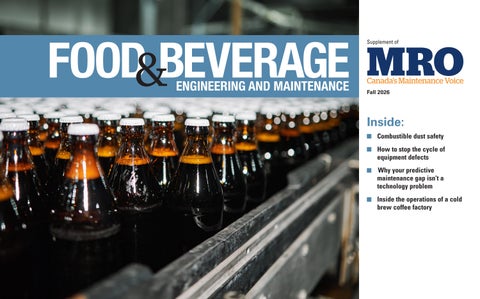
Inside: Combustible dust safety How to stop the cycle of equipment defects Why your predictive maintenance gap isn’t a technology problem Inside the operations of a cold brew coffee factory
Supplement of
Fall 2026
5
Contents 3 EDITOR’S LETTER 5
F&B NEWS The lastest industry news from across the country.
EDITOR
Kirstyn Brown kbrown@annexbusinessmedia.com (519) 429-5205
9
Learn the hazards of combustible dust
BRAND SALES MANAGER
Pat Lorusso plorusso@annexbusinessmedia.com
(416) 518-5509
11 RELIABILITY MATTERS
ACCOUNT CO-ORDINATOR
Stuck in a cycle of equipment defects? Here’s how to turn off the tap.
Debbie Smith dsmith@annexbusinessmedia.com
(416) 510-5107
MEDIA DESIGNER
18
Jaime Ratcliffe
CIRCULATION MANAGER
Beata Olechnowicz bolechnowicz@annexbusinessmedia.com
GROUP PUBLISHER
Paul Grossinger pgrossinger@annexbusinessmedia.com (416) 510-5240
Scott Jamieson sjamieson@annexbusinessmedia.com
2 Fall 2026 • Food & Beverage Engineering & Maintenance
14 PREDICTIVE MAINTENANCE
If there’s a gap in your predictive maintenance program, -technology may not be to blame.
18 MOTHER PARKERS’ MANUFACTURING EXPANSION
PRESIDENT & CEO
WWW.MROMAGAZINE.COM/INDUSTRY/FOOD-BEVERAGE/
SMALL PARTICLES, SERIOUS RISKS
9
A tour of the company’s new cold brew operations.
COVER IMAGE: © MLADENBALINOVAC / GETTY IMAGES
EDITOR’S LETTER
Passing the torch
T
his is my last issue as editor of the MRO Food & Beverage, Engineering and Maintenance digital supplement. Starting with the next edition, my colleague Nithya, editor of Food in Canada, will be taking the reins, and I think it’s a natural fit. Food and beverage processing is a unique corner of manufacturing. In my 16 months as editor, I’ve learned just how hard equipment has to work while meeting strict cleanliness standards, and how often maintenance teams are balancing shutdowns against sanitation windows, production schedules, seasonal shifts and even technology changes. There’s perhaps no industry where the phrase “time is money” rings truer – when a line goes down, the cost is measured in lost product as well as lost time. My focus here has been on these challenges from the maintenance and reliability side, while Nithya brings years of experience and knowledge of the food and beverage sector. She knows the processors, the issues and the people driving the industry forward. I think that combination of food industry knowledge and an engineering and maintenance focus will bring readers content that’s even more closely connected to what’s happening in their own operations. Before I sign off, I want to thank the maintenance managers, engineers and plant leaders who took the time to share their advice and give me a
3 Fall 2026 • Food & Beverage Engineering & Maintenance
look inside their operations. Trade journalism depends on people being willing to speak openly and share their knowledge, and you’ve been generous with your time and experience. I’m also grateful to our contributors and advertisers for supporting a resource built for this sector, and to our reaaders for checking out each issue and, I hope, finding something useful to bring back to their teams. As for me, I’m not going far. I’ll continue leading the MRO brand and regular issue, covering maintenance, reliability and manufacturing across Canada. Much of what we publish there applies to food and beverage facilities, too, so I hope you’ll keep reading. In the meantime, please give Nithya a warm welcome! I know this book will be in good hands. And if there’s something you’d like to see covered, whether here or in MRO, let me know. I’d love to hear from you.
Kirstyn Brown kbrown@annexbusinessmedia.com
Built for Food and Beverage Processing
Washdown Bearing Isolators
Keep food and beverage processing moving with components designed for demanding applications. Daemar offers a broad range of components to help design engineers meet strict regulatory requirements and achieve reliable performance across processing operations.
PTFE Encapsulated O-Rings
Custom Metal Detectable Seals
Sanitary Gaskets
Essential Components for Industry daemar.com
4 Spring 2026 • Food & Beverage Engineering & Maintenance
1.800.387.7115
NEWS
NEWS new manufacturing capabilities. The company said the expansion is the first major project under the co-operative’s approximately $450-million Network for Growth strategy, a multi-year initiative aimed at modernizing its Canadian manufacturing network. The investment is intended to not only increase production capacity, but also improve productivity and provide greater opera-
PHOTO: GAY LEA FOODS
GAY LEA INVESTS $200M IN PLANT EXPANSION Gay Lea Foods plans to invest more than $200 million to expand its dairy manufacturing facility on Clayson Road in Toronto. According to a Gay Lea Foods’ press statement, the project will increase production capacity for cottage cheese and other high-protein dairy products while adding advanced processing technology and
Gay Lea Foods’ Clayson Road Facility (conceptual rendering) 5 Fall 2026 • Food & Beverage Engineering & Maintenance
tional flexibility at the facility, the company said. The company expects the expansion to be completed in 2028. According to the co-operative, the project will create up to 75 new positions at the Toronto facility. In the statement, Gay Lea Foods said the investment is being made in response to growing demand for cottage cheese and other highprotein dairy products in Canada.
OLD DUTCH OPENS NEW FACILITY IN P.E.I. Old Dutch Foods has opened a new energy-efficient Eastern Canadian office and warehouse facility in Slemon Park in Summerside, P.E.I. According to a press release, the 8,400 square foot facility is designed to improve operational efficiency while reducing energy consumption. It incorporates solar power generation, geothermal heating and cooling, and an Energy Recovery Ventilation (ERV) system, while using no fossil fuels and releasing zero carbon dioxide to the atmosphere. The facilities solar array is expected to generate approximately 40 kilowatts of power. MAPLE LODGE FINED $500K AFTER INJURY Maple Lodge Farms Ltd. was fined $500,000 in August after pleading
PHOTO: LACTALIS CANADA
NEWS
guilty to a workplace safety violation stemming from a carbon dioxide leak at its Brampton poultry processing facility that critically injured a worker. The incident occurred March 16, 2024, when a hose carrying carbon dioxide to a vacuum blender ruptured in the facility’s deli area, releasing approximately 16,072 pounds of CO2. A Ministry of Labour, Immigration, Training and Skills Development investigation found the company had no carbon dioxide sensor or alarm system in place, a failure to take every precaution reasonable for worker protection under section 25(2)(h) of the Occupational Health and Safety Act. Maple Lodge Farms pleaded guilty in Provincial Offences Court in Brampton and was sentenced August 27 by Justice of the Peace Damanpaul Dulai, with a 25 per cent victim fine surcharge added as required under the Provincial Offences Act. The company has since
6 Fall 2026 • Food & Beverage Engineering & Maintenance
installed a permanent carbon dioxide sensor in the area.
LACTALIS OPENS NEW R&D CENTRE IN ONTARIO Lactalis Canada has opened a new research & development centre in Ingleside, Ont. Located adjacent to Lactalis Canada’s cheese processing plant, the R&D centre features pilot-scale capabilities and specialized testing and evaluation spaces designed to support product and process development. “Since 2018, Lactalis Canada has completed four strategic acquisi- Lactalis Canada executives and government and industry representatives tions and invested more than $900 celebrate the official opening of the company’s new R&D centre. Pictured million in manufacturing, distribu- (L-R):Pamela Nalewajek, chief marketing and communications officer, Dairy tion and transformation initiatives Farmers of Canada; Sandra Senez, VP, R&D, Lactalis North America; François across the country. This new R&D Landry, warden of the United Counties of Stormont, Dundas and Glengarry; centre is another example of our Mark Taylor, president and CEO, Lactalis Canada; His Worship Brian McGillis, continued commitment to dairy Mayor of South Stormont; Gilles Froment, SVP, government & industry and food manufacturing in Can- relations, Lactalis Canada; and Mark Hamel, chair, Dairy Farmers of Ontario. ada,” said Mark Taylor, president and CEO, Lactalis Canada. “Over provinces. In this instance we’re deep cheese expertise, strong partthese years, we have been expand- proud to anchor this innovation nerships and significant presence ing our capabilities in a number of hub in Ingleside, building on our in Eastern Ontario.”
NEWS
INTELLECT AND EMAINT ANNOUNCE CMMS INTEGRATION Intellect, an AI-powered manufacturing technology company, has announced a partnership with eMaint, the computerized maintenance management (CMMS) and enterprise asset management (EAM) software owned by Fluke Corporation. In a press release, Intellect said the integration connects eMaint’s maintenance and asset management system with Intellect’s IntellectIQ platform, which handles quality, safety and compliance. The goal, according to the company, is to let maintenance issues flagged on the shop floor trigger action across quality, safety and production teams, and vice versa, without staff having to leave their usual software. Under the partnership, eMaint stays the system of record for maintenance and asset reliability, while IntellectIQ remains the system of record for quality, safety, and frontline operations. The two systems will share data so an issue identified anywhere in that 7 Fall 2026 • Food & Beverage Engineering & Maintenance
chain can move through detection, maintenance execution, corrective action and compliance reporting as a single connected process. eMaint X5 will be the first eMaint product to support the integration with Intellect. No timeline for broader rollout or pricing details were included in the announcement.
FEDS GRANT CFIN $50M TO ADVANCE ITS FOOD 4.0 PLAN The federal government invests $50 million in the Canadian Food Innovation Network (CFIN) to help accelerate the adoption of advanced technologies and support innovation in the food sector. CFIN is an industryled notforprofit that helps food and beverage companies access the expertise, partners and technologies they need to innovate and grow. This additional funding through the Strategic Response Fund (SRF) and Canada’s National Food Security Strategy will enable CFIN to expand its services, helping more food and beverage processors, particularly
small and medium-sized enterprises (SME), adopt and implement automation, artificial intelligence, digital manufacturing and other advanced technologies. With this funding, CFIN is expected to support more than 200 SMEs and expand its national network to 20,000 members through its established collaborative online platform and targeted programming. “Canada’s food processors are working hard to keep prices in check, but many are doing it with equipment and systems that haven’t kept pace with their global competitors,” said Dana McCauley, CEO, Canadian Food Innovation Network. “Food 4.0 is CFIN’s plan to close that gap by helping manufacturers and processors adopt Canadian-made automation, AI and digital tools and by backing the homegrown companies that build them. With the Government of Canada’s support, we can help our food sector produce more here at home and compete with the best in the world.”
OLYMEL EXPANDS, MODERNIZES QUEBEC PLANT Pork and poultry producer Olymel inaugurated its new integrated plant in TroisRivières, Que. in September, marking the completion of one of the company’s largest modernization projects. The $142-million project resulted in increasing the plant’s production capacity fourfold to 50 million kilograms. The plant’s footprint went from 51,700 to 137,200 sf, nearly 2.5 times its original size. In addition to La Fernandière sausages and hams (whole and sliced), the plant now produces the vast majority of Olymel’s deli meats. According to Olymel, the plant also features new equipment such as an industrial battery system that stores energy when demand is low and releases it when demand is high. Other innovations include a focus on water-based over air-based cooking, heat recovery, closed-loop water management, and reduced transportation.
8 Spring 2026 • Food & Beverage Engineering & Maintenance
HEALTH & SAFETY
SMALL PARTICLES, SERIOUS RISKS What food processors need to know about combustible dust hazards. BY ALEXANDRA SKINNER
S
WHAT IS COMBUSTIBLE DUST? Many types of dust are combustible, which means they can easily catch fire and burn. If fine dust particles catch fire when suspended in the air, the fire can spread rapidly. Under some conditions, this may result in an explosion, with the potential to cause serious injuries, damage to facilities, and disruption of operations. In British Columbia, new requirements for combustible dust under the Occupational Health and Safety Regulation take effect Jan. 4, 2027. While the requirements apply specifically to B.C. workplaces, the hazards they address are relevant to food9 Fall 2026 • Food & Beverage Engineering & Maintenance
PHOTO: © ANDRESR / GETTY IMAGES
PHOTO: ANDRESR/GETTY IMAGES
ome of the most familiar ingredients in food production can create an unexpected hazard. Flour, sugar, cocoa powder, starch, milk powder, and other combustible ingredients can produce dust that, under the right conditions, can ignite and cause a fire or explosion.
HEALTH & SAFETY
processing facilities across Canada. The changes provide clearer directions on how employers should identify, assess, and control combustible dust hazards. “Combustible dust isn’t always obvious,” says Tami Der, an industry and program specialist at WorkSafeBC. “It can accumulate gradually on overhead structures, conveyors, ductwork, processing equipment and other areas that may be difficult to see. That’s why it’s important to understand not only where dust is generated, but where it can travel and accumulate.” An ignition source, such as a spark, can ignite airborne dust and cause a fire or explosion. This initial event can disturb dust that has built up nearby, sending more particles into the air. If that dust also ignites, it can cause a much larger secondary explosion. The risk is not theoretical. In 2017, combustible corn dust ignited at the Didion Milling facility in Wisconsin, causing multiple explosions and fires that killed five workers and injured 14 others. Investigators identified significant deficiencies in the recognition and control of combustible dust. The incident echoed another catastrophic explosion nine years earlier. In 2008, combustible sugar dust at the Imperial Sugar refinery in Georgia fuelled a series of explosions and fires that killed 14 workers and injured 38. 10 Fall 2026 • Food & Beverage Engineering & Maintenance
And while these incidents involved different products and processes, they demonstrate a common risk across food manufacturing operations.
WHAT EMPLOYERS SHOULD DO NOW Understanding where combustible dust is generated and how it is controlled is an important part of preventing fires and explosions in food-processing facilities. Employers should: • Identify the types of dust in the facility: Consider raw products, finished products, byproducts and waste generated from your work processes. • Identify dust accumulation points: Determine where dust from ingredients like flour, sugar, grain, cocoa, spices and milk powder can collect. Routinely inspect these areas for dust buildup. • Identify tasks that can create airborne dust: Consider tasks such as mixing, conveying, bag dumping, packaging, or cleaning that could suspend dust in the air. • Be aware of potential ignition sources: Consider hot equipment, static electricity, electrical systems, hot work, and equipment that could generate sparks through mechanical contact or friction. • Review housekeeping and maintenance prac-
tices: Ensure procedures are in place for removing dust and regularly inspect the work environment and equipment. Regular vacuums cannot be used. Use cleaning equipment that is appropriate for combustible dust hazards and designed to minimize ignition risks. • Ensure worker awareness and training: Identify training needs for staff who handle, generate, transport or store materials that pose a combustible dust hazard. Training should also be provided to other workers in areas where combustible dust is generated.
INVOLVING WORKERS AND JOINT HEALTH AND SAFETY COMMITTEES Workers and joint health and safety committees play an important role in preventing combustible dust incidents. Workers can provide valuable insight into where dust accumulates, which tasks generate airborne dust and where existing controls may not be working as intended. They should also be involved in training and developing safe work procedures. For food manufacturers, the takeaway is simple: ingredients that are safe on the production line can become a serious hazard in dust form. Knowing where dust is generated, where it accumulates, and how it is controlled is critical to preventing a serious incident.
RELIABILITY
RELIABILITY MATTERS:
TURNING OFF THE TAP OF EQUIPMENT DEFECTS BY GEORGES OUELLETTE
PHOTO: EDWIN TAN/GETTY IMAGES
W
alk through almost any manufacturing plant and you will find teams working hard to improve equipment reliability. The maintenance team is chasing recurring breakdowns, production engineers are investigating chronic issues and planners are refining maintenance strategies to keep production running. This work is essential. Improving the reliability of existing equipment directly supports safety, quality, delivery and cost performance. But there is a question every manufacturing leader should ask: Are we fixing today’s reliability problems while continuing to introduce new ones tomorrow? Many organizations are effective at repairing equipment and responding to failures. Far fewer are equally focused on preventing new reliability problems from entering the plant in 11 Fall 2026 • Food & Beverage Engineering & Maintenance
RELIABILITY
the first place. A simple analogy helps explain the challenge. Imagine a bathtub overflowing with water. Most people immediately grab a bucket and start removing water. In manufacturing, that bucket represents reliability activities such as root cause analysis, preventive maintenance optimization, condition monitoring and defect elimination. These activities are important because they reduce the water level. But if the tap remains open, the bathtub will continue to fill. In manufacturing, the tap is often new equipment being introduced into the business. Every year, plants invest in new automation, equipment replacements, process upgrades and expansion projects. However, many of the reliability issues maintenance teams struggle with years later were introduced long before startup. Poor access for maintenance, difficult-to-replace components, weak diagnostics, missing spare parts strategies, inadequate lubrication
provisions, limited condition monitoring capability and incomplete maintenance documentation are not maintenance failures; they are design and implementation defects that become maintenance problems for years to come. The result is a familiar trap. Reliability teams spend their days removing defects from existing equipment, even as new ones walk in the front door through the next capital project or equipment purchase. You can’t fix your way out of that cycle — not unless you’re working both ends of it: improving what’s already running and keeping new problems from being built in to begin with. Make no mistake, the existing asset base still comes first. It’s what keeps the plant running today, and effort should go where it matters most — safety, throughput, quality, environmental performance, the operating cost line. Not every machine earns the same
attention, and with resources always tight, they need to go where they’ll actually move the needle. The good news is the toolbox for existing equipment isn’t a mystery. Root cause analysis takes aim at recurring failures, while preventive maintenance gets realigned to actual failure modes instead of the calendar. Condition monitoring
catches trouble before it becomes downtime — and when something does need fixing, a solid spare parts review is what keeps that repair from stalling out for a week. The harder call comes at end-of-life: fix it again or finally replace it. These activities improve plant performance and reduce operational risk. In other words, they
12 Fall 2026 • Food & Beverage Engineering & Maintenance MRO_DavleyDarmex_FBOct26ebook_CSA.indd 1
2026-10-07 1:03 PM
RELIABILITY
help drain the bathtub. However, long-term success depends on turning off the tap as well. Reliability should not begin after equipment is installed and handed over to production. By that point, many important decisions have already been made. Reliability must be considered much earlier in the project lifecycle. Maintenance, Operations, Engineering and Reliability should all have a seat at the table from equipment specification through startup, not just at handover. Their role is to ensure reliability and maintainability receive the same level of attention as production output and project schedule. The discussion should not end with the question: “Will this equipment run?” It should also include the following: • Can it be safely maintained? • Are critical components standardized? • Are spare parts readily available? • Can failures be detected early? • Is the equipment easy to in13 Fall 2026 • Food & Beverage Engineering & Maintenance
{
The balance will vary by organizational maturity, but the principle remains the same: improve today’s equipment while reducing the flow of future problems
spect and repair? • Have lessons learned from similar equipment been applied? One of the most valuable resources available to any organization is the knowledge gained from operating existing equipment. Every recurring failure, difficult repair and maintenance challenge provides an opportunity to improve future designs. Unfortunately, many lessons learned remain trapped in reports, databases or individual experience. High-performing organizations convert those lessons into standards. Preferred component lists, controls standards, lubrication requirements, maintainability guidelines, spare parts expectations and condition monitoring requirements ensure that knowledge gained from yesterday’s problems is incorporated into tomorrow’s solutions.
The goal is not to choose between improving old equipment and supporting new projects because both are necessary. Most reliability efforts should remain focused on improving current business performance through existing assets, while at the same time, a portion of resources should be dedicated to influencing new equipment before it enters operation. The balance will vary by organizational maturity, but the principle remains the same: improve today’s equipment while reducing the flow of future problems. The plants that achieve this balance gain a significant advantage. They experience fewer recurring failures, lower lifecycle costs, improved maintainability and higher equipment availability. More importantly, they stop repeating the same reliability mistakes generation after generation of equipment.
Ultimately, reliability is not just about fixing what breaks, but learning from what breaks, applying those lessons to the future and preventing unnecessary defects from entering the plant in the first place. The best reliability programs do more than drain the bathtub — they turn off the tap. Georges Ouellette, CMRP, CRL, CET is the Reliability Strategy Lead for Honda of Canada Mfg. in Canada. He brings a systemsbased, practitioner perspective to reliability, focusing on embedding asset reliability and cultural change into daytoday manufacturing operations.
PREDICTIVE MAINTENANCE
YOUR PREDICTIVE MAINTENANCE GAP ISN’T TECHNOLOGY Wireless sensors, smart instrumentation and AI software are purchased, installed and eventually forgotten. Closing that gap has less to do with buying more technology than with building the process to use what’s already there.
BY KURT WENTZELL
P
redictive maintenance, built on a high-quality condition monitoring program, is the best-in-class strategy for high reliability at the lowest maintenance cost. The reasoning is simple. Roughly 85 per cent of equipment failures follow a random pattern rather than a wear-out clock (Nowlan & Heap), so time-based maintenance either intervenes on assets that were running fine or arrives after the damage is done. Yet roughly 80 per cent of those failures give warning; a detectable 14 Fall 2026 • Food & Beverage Engineering & Maintenance
defect appears before functional failure. That is exactly what condition monitoring technologies such as vibration analysis, lubrication analysis and thermography are built to find, which is why they deliver far more reliability per dollar than a calendarbased PM schedule. The ROI is strong and well established, and maintenance-intensive organizations are quick to buy the best tools and license the best software. However, for some reason the savings never quite materialize and then the technology starts to gather
dust. Sound familiar? Vendors get blamed for overselling, but that is rarely the problem. These tools only return value when they are deployed with a clear purpose, with skilled people empowered to act on what the data tells them and with processes that create reliable workflows and clear accountability. That gap is where the breakdown occurs. Consider an analogy we all understand: buying exercise equipment to get in shape and maybe shed a few pounds. The treadmill in the basement is capable and well-engineered,
everything you need to achieve your cardio dreams. Somehow the weight does not come off, so you buy an elliptical, because the reviews are better and it proves equally good at gathering dust. The not-so-secret answer is that the equipment has to be used and only converts effort into results; it cannot supply the effort. A wireless sensor or an AI model is no different.
PROGRAM FIRST, TECHNOLOGY SECOND Closing the gap between best-in-
PHOTO: FREEMIXER/GETTY IMAGES
PREDICTIVE MAINTENANCE
class hardware and best-in-class results has little to do with buying more technology and has more to do with implementing solid processes and depends on four things the technology cannot supply on its own. The first is building the process and the accountability. Every alert needs a defined path: who reviews it, how it is triaged, when it becomes a work order and who owns the outcome. Diagnostics feeding a dashboard that no one owns will always lose to the daily pressure of running the plant. Naming that ownership is what separates a live program from a dormant one. The second is training and resourcing the people. Diagnostics deliver value only in the hands of people who understand them well enough to make quality decisions, which means investing in your analysts and technicians, providing training and protecting their time. Outsourcing is fine, but contractors do not decide for you; you still need the competency and process to act on their recommendations. The third is adjusting the maintenance strategy. Condition monitoring only lowers cost when it changes what maintenance actually does: suitable assets move off calendar-based PMs onto condition-based tasks, intrusive inspections the diagnostics now cover are retired and the data dictates when work happens. If monitoring is layered on 15 Fall 2026 • Food & Beverage Engineering & Maintenance
top of an unchanged PM schedule, it just adds cost without value. The fourth is winning over operations. Operations see the value of condition monitoring when it prevents a shutdown or a safety event. Communicating the wins can turn operations from skeptics into allies. Predictive findings need to be prioritized against a backlog of known failures, and therefore, without that buy-in, even a well-run
program can struggle to survive the next budget cycle.
ASSESS WHAT YOU ALREADY HAVE Start with an assessment: a documented inventory of the condition monitoring technology you own and the competency your people have to use it. The purpose is to find out what you are already paying for and not using. It does not need to be
PREDICTIVE MAINTENANCE
a six-month study; a few days with the right people in the room gets you most of the way there, and it almost always turns up high-value capability sitting idle. Rank what you find by value and implementation effort, then start where any of these three are already true: 1. The technology is installed and paid for. 2. Someone already knows how to use it. 3. There is a recurring failure or PM task it can immediately prevent or replace. The assessment will flag capability you own but have never properly implemented, along with gaps where new technology is justified. Do not ignore the latter; the return can still be excellent. Just buy after you know how the technology will be used, not in the hope that the process will follow. Then align your maintenance strategy with the capability you now have. This is where organizations leave the most value on the table: a strong condition monitoring program running
alongside the time-based tasks it was meant to replace. Vibration analysis on a pump plus an annual alignment PM means paying twice to mitigate one risk, and the condition monitoring is by far the more effective of the two. Run that assessment across a plant and one capability lands at the top of the list far more often than any other. It is rarely the vibration program, and it is never the new AI platform. It is the technology already wired into the process, quietly reporting on its own health, with nobody watching.
every option, including the device management software, and then never switch the diagnostics on. Instrumentation follows a random failure distribution, which makes it a poor fit for calendar-based maintenance and an ideal fit for condition monitoring. As technology has grown more capable, the diagnostics have become genuinely predictive:
travel deviation alerts that reveal stiction in a control valve, low air supply alarms, plugged process connections on pressure transmitters, fouling of instrument internals on magnetic and Coriolis flow meters, and many more. Meanwhile the PM system still carries the old tasks. Calibrate every transmitter annually, visually inspect
THE MOST OVERLOOKED CONDITION MONITORING TECHNOLOGY It is smart instrumentation diagnostics, fed by the instrument management system that came with your control system, AMS Device Manager or its equivalent. Companies routinely specify high-end instrumentation with
16 Fall 2026 • Food & Beverage Engineering & Maintenance MRO_RotoPrecision_FBOct26ebook_CSA.indd 1
2026-10-07 1:05 PM
PHOTO: ALEKSANDARGEORGIEV/GETTY IMAGES
PREDICTIVE MAINTENANCE
the valve, replace the device during an outage because of time on the calendar rather than condition. Those tasks consume enormous craft hours and return very little value. Smart instrumentation you have already paid a premium for can retire most of them, cutting calibration volume and confirming device health without ever touching the equipment. So why is the capability so often left idle? The same three reasons as stated before: no owner, no understanding, no process. In several years of helping companies build value through condition-based maintenance, smart instrumentation diagnostics has almost always ranked as the single highest-value opportunity on the list. It applies to the largest asset population you maintain, it retires the largest number of low-value PM tasks and it delivers the biggest gain in plant reliability and safety. Once the light goes on, it feels like a no-brainer. It doesn’t help that condition monitoring programs are usually owned by the mechanical discipline, so instrumentation and controls rarely show up on the radar. Run the assessment as a multi-discipline exercise, with instrumentation, electrical and mechanical at the table, or you will walk right past the largest opportunity in your plant. I have watched several asset-intensive companies embrace smart instrumentation technology, 17 Fall 2026 • Food & Beverage Engineering & Maintenance
build a solid process around it and retire more than a million dollars in annual maintenance tasks, all while plant performance improved. None of it required a capital project. The capability was already installed and already paid for, the kind of ROI plant managers dream about, and it was sitting there in their control system the whole time.
IN CLOSING Technology is an incredibly powerful enabler of reliability, but it is still only an enabler. The best predictive maintenance programs are not built by organizations with the most technology. They are built by organizations that know exactly why they have it, who owns it, how it will be used and what they will stop doing because of it. The treadmill in the basement was never the problem. You just have to use it. Kurt Wentzell is Director and Senior Consultant at Janus Reliability Solutions. An experienced reliability professional with a 20+ year career in heavy industry, he focuses on leading reliability programs that drive value through condition monitoring, advanced analytics and defect elimination, specializing in lean maintenance strategies and optimized asset performance. This article was originally published in the Fall 2026 issue of MRO.
PLANT TOUR
MANUFACTURING EXPANSION BY SADI MUKTADIR
W
alk the floor of Mother Parkers’s 320,000-squarefoot facility in Mississauga and the story isn’t really about coffee beans anymore, it’s about steel tanks, ultra-high-temperature flash treatments, and giant drums meant to store coffee extracts safely on countertops. Mother Parkers is betting on the rise of cold coffee and varied extract solutions. Chris Irvine, Category Director for Tea & Extracts, and Steve Vizinho CES Production Manager gave a walkthrough of their updated facility and capabilities, explaining how the company got here and why a centuryold roaster decided to reinvent itself 18 Summer 2026 • Food & Beverage Engineering & Maintenance
around a chilled cup of coffee.
CHASING A TREND BEFORE THE PEAK The idea traces back to 2020, when Chris says that the company noticed a shift in how younger consumers were ordering their coffee. “Cold coffee is growing in the market,” he says, and the numbers back him up. By 2025, more than half of the coffee ordered by 18-to-24-yearolds at Canadian quick-service restaurants was being served cold — a sharp break from older demographics. “The younger demographic is requesting to have it served cold, which is very different to the overall picture. That said, when you look at cold coffee for Ca-
PHOTO© MOTHER PARKERS
MOTHER PARKERS
nadian QSR last year, about 25 percent of servings were cold, which is still up two points.” Rather than simply riding the trend, Mother Parkers decided to engineer around it. That meant confronting a technical question: how do you process and package coffee so it can sit unrefrigerated on a shelf without losing what makes it coffee? The answer was aseptic processing: flash-heating the product to an ultrahigh temperature for a few seconds, then cooling it immediately. “The process is able to preserve the delicate taste profile of coffee,” Irvine explained, unlike processing methods that expose the product to heat for lon-
ger stretches or depend on refrigerated cold-chain logistics to protect flavour. “We’re working with our customers on this to really try and bring forward the best sensorial experience for their restaurant needs.” For a low-acid product like coffee, getting aseptic processing to work reliably was, in his words, “a real endeavour” — enough of one that employees internally nicknamed the project Endeavour. When asked what he was proudest of, Irvine didn’t point to the equipment. “I would say the team, more than anything else,” he says, describing years spent clearing hurdles to find a solution that would help the company grow its sales in the market.
MAINTENANCE
SOLVING COLD BREW’S BACK-OF-HOUSE PROBLEM The other trend driving the investment was the growth of cold brew, and the difficulties associated with brewing it properly in a restaurant. Done properly, cold brew requires steeping coarse grounds in water for eight to 24 hours, along with the cleanup, equipment and consistency concerns that are associated with it. Mother Parkers’s answer is a cut-andpour pouch: an operator snips it open, dilutes it with water, stirs, and has product ready in minutes instead of a full day’s lead time. START THEM YOUNG Irvine pointed to another broader behavioural shift among Gen Z and younger millennial consumers pushing the rise of cold coffees, many of whom he describes as more cash-strapped, but still willing to spend on what he calls “treat occasions.” Instead of a proper sit-down meal which may now be unaffordable, a $5 cold brew purchase could be more of a realistic habit. SCALING TOWARDS THE FUTURE The Mississauga facility is still in its early ramp-up. Mother Parkers has launched its own brand of cold brew formula for food service customers, while still leaving room to build custom formulations for larger accounts as demand grows. “As volume ramps up, we’re going see if there is
more of a need for us as a food service operator in terms of total volume, or if it will be from an industrial side through ingredients or in bottling. So there’s really a lot more to come. But across retail, industrial, and food service markets there’s high interest and high demand for our products and our capabilities,” he says. On automation, the company describes its approach as practical rather than trend driven. A connected line running from roasting and grinding through to extraction, blending, aseptic processing and filling is already reducing variability and supporting consistent food safety, the company says. In a written statement, Mother Parkers also says it is currently evaluating where and how AI tools could support decisionmaking in the future, in areas like demand forecasting, production planning, maintenance and quality monitoring.
The recent changes at the company aren’t just limited to the facility either. Irvine himself seems personally invested. A self-described lifelong hot coffee drinker, he has now slowly become a cold coffee convert himself over the last few years. “You really get a smooth, delicious cold coffee,” he says. “I think it delights a lot of people.” For a company built over a century ago on hot coffee and tea, it’s no small pivot, and Mississauga is where they’re betting it pays off.
19 Fall 2026 • Food & Beverage Engineering & Maintenance MRO_SEWEurodrive_FBOct26ebook_CSA.indd 1
2026-10-08 1:09 PM