SEPTEMBER 2026
CANADA’S INFORMATION LEADER FOR ELECTRONIC ENGINEERS AND DESIGNERS
EPT.CA
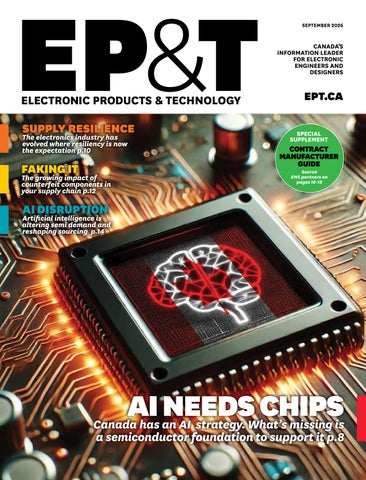
SUPPLY RESILIENCE The electronics industry has evolved where resiliency is now the expectation p.10
FAKING IT
The growing impact of counterfeit components in your supply chain p.12
SPECIAL SUPPLEMENT
CONTRACT MANUFACTURER GUIDE Source EMS partners on pages 16-19
AI DISRUPTION
Artificial intelligence is altering semi demand and reshaping sourcing p.14
AI NEEDS CHIPS
Canada has an AI strategy. What’s missing is a semiconductor foundation to support it p.8
INSIDE Cover photo: Adobe Stock Photos (this page, from top) Adobe Stock; Getty; Rochester Electronics; Adobe
Columns
4 EDITORIAL Supply chain resilience becomes a primary focus today 7 WEST TECH REPORT 4AG Robotics builds mushroom-harvesting robots
In every issue
6 NEWSWATCH 20 NEW PRODUCTS 21 SUPPLY SIDE 32 DEV BOARD Adafruit Feather ESP32 Series
8
10 12 18
SOVEREIGN AI NEEDS SOVEREIGN SILICON Paul Slaby of Canada’s Semiconductor Council underscores the need for a dedicated strategy on chips built at home
RETHINKING SUPPLY CHAIN PROCUREMENT Sourcing decisions directly into product design to reduce risk and improve buildability PERVASIVE RISKS IN SUPPLY CHAIN Counterfeit components have become a pervasive threat, especially during supply shortages
12 14
SUPPLY CHAINS RIDE AI REVOLUTION AI isn’t just changing how electronic systems are designed, it’s reshaping the entire component ecosystem behind them
Example: 016008C Series The World’s Smallest Wirewound Chip Inductors (Tiny, isn’t it?)
SEPTEMBER 2026
COVER STORY
Continuous Innovation Actual Size
8 10
Without The EOLs Example: TRF2000 Tip and Ring Common Mode Filter Introduced November 15, 1989 Free samples still available ...
@ www.coilcraft.com EPT.CA EPT_Coilcraft_Oct24.indd 1
September 2026 / EP&T
3
2024-09-12 11:37 AM
EDITORIAL
Supply chain resilience starts early in process For year s, supply-chain management in electronics was largely viewed as a procurement function. Engineers designed the product, procurement sourced the components and manufacturers built it. When a part became difficult to obtain, the sourcing team was expected to find a solution. That model is becoming increasingly difficult to sustain. The four feature articles in this issue of EP&T Magazine illustrate just how profoundly the electronics supply chain has changed. Whether the challenge is semiconductor sovereignty, AI-driven demand, component availability, counterfeiting or product obsolescence, supply considerations are no longer downstream concerns. They are becoming fundamental to how electronic products are conceived, designed and made. The most significant shift may be taking place at the schematic. As Avnet’s Robert Cowan argues in this issue, supply-chain risk increasingly needs to become a design input rather than a procurement afterthought. The semiconductor shortage may have eased, but the industry has not returned to the predictable environment that existed before the pandemic. Availability remains uneven, demand can change rapidly and constraints can emerge. For engineers, that means a component selected solely because it meets electrical and mechanical requirements may not necessarily be the right component. Lifecycle status, geographic availability, supplier capacity and the ability to accommodate an alternative increasingly belong in
Connect with EP&T
facebook.com/EPTmag/
4
the design conversation. AI is adding another layer of complexity. As Mouser’s Tom Busher points out, the AI buildout is not simply creating demand for GPUs and accelerators. It is increasing requirements for memory, networking, optical interconnects, power-management devices, connectors, passives and thermal solutions. More computing power means more electricity, more heat and, consequently, greater demands on the supporting electronics. For OEMs and CEMs, this concentration of demand creates both opportunity and risk. A component that appears readily available today can become a constraint tomorrow if demand suddenly shifts toward a particular technology or product category. That uncertainty also creates a darker supply-chain threat: counterfeit components. Rochester Electronics highlights how shortages and end-of-life situations can push buyers toward unauthorized channels, where the risk of counterfeit, recycled, remarked or otherwise compromised components increases. The danger is particularly acute for CEMs supporting customers in markets where reliability is non-negotiable. A questionable component can lead not only to production losses and rework, but to field failures, reputational damage and potentially serious safety or security consequences. The lesson is uncomfortable but straightforward: when legitimate supply becomes difficult, the cheapest or fastest alternative may ultimately be the most expensive choice. There is, however, a broader issue underlying all four stories. Canada’s semiconductor discussion, examined in our interview with Canada’s Semiconductor Council managing director
/ept-magazine
info@ept.ca
ELECTRONIC PRODUCTS & TECHNOLOGY / September 2026
Paul Slaby, demonstrates that supply-chain resilience is also becoming a matter of national economic and strategic policy. Canada cannot, and need not produce every semiconductor it consumes. But, building domestic strengths in areas such as chip design, photonics and advanced packaging, while maintaining trusted international relationships, can provide greater resilience without attempting to replicate the world’s largest semiconductor fabs. That philosophy applies equally at the company level. The objective is not to eliminate supply-chain uncertainty. That is unrealistic. Rather, all players in the ecosystem need to identify where uncertainty exists early enough to do something about it. For the engineering community, that means designing with greater sourcing flexibility. For manufacturers, it means closer communication with customers before production is locked in. For distributors, it means providing more than boxes and part numbers: market intelligence, lifecycle information, availability data and visibility into alternatives are becoming increasingly valuable. The supply chain is therefore evolving from a transactional network into an information network. And that may be the most important takeaway from this issue. Resilience is not something that can simply be purchased when a shortage occurs. It has to be designed into the product, considered during sourcing, protected through authorized channels and supported by a diverse ecosystem of suppliers and manufacturing partners. STEPHEN LAW Editor slaw@ept.ca ept.ca
www.omnetics.com | sales@omnetics.com Canada’s information leader for electronic engineers and designers
SEPTEMBER 2026 Volume 48, Number 4 READER SERVICE Print and digital subscription inquiries or changes, please contact Angelita Potal Tel: (416) 510-5113 Fax: (416) 510-6875 Email: apotal@annexbusinessmedia.com Mail: 111 Gordon Baker Rd., Suite 400 Toronto, ON M2H 3R1
EDITOR Stephen Law slaw@ept.ca · (416) 510-5208 WEST COAST CORRESPONDENT Mike Straus · mike@brandgesture.ca BRAND MANAGER Joanna Malivoire jmalivoire@ept.ca · direct (416) 881-0731 ACCOUNT COORDINATOR Shannon Drumm sdrumm@annexbusinessmedia.com MEDIA DESIGNER Graham Jeffrey gjeffrey@annexbusinessmedia.com AUDIENCE DEVELOPMENT MANAGER Anita Madden amadden@annexbusinessmedia.com (416) 510-5183 GROUP PUBLISHER Paul Grossinger pgrossinger@annexbusinessmedia.com CEO Scott Jamieson sjamieson@annesbusinessmedia.com EP&T is published five times per year by ANNEX BUSINESS MEDIA 111 Gordon Baker Road, Suite 400 Toronto, ON M2H 3R1 Tel (416) 442-5600 Fax (416) 510-5134 annexbusinessmedia.com SUBSCRIPTION RATES Canada – $62.06 one year; $99.72 two years USA – $142.15 (CAD) per year International – $194.66 (CAD) per year Single copy – Canada $15.00 ISSN 0708-4366 (print) ISSN 1923-3701 (digital) PUB. MAIL AGREEMENT NO. 40065710 Return undeliverable Canadian addresses to: EP&T Circulation Department, 111 Gordon Baker Rd. Suite 400, Toronto, ON M2H 3R1
© 2026 EP&T. All rights reserved. Opinions expressed in this magazine are not necessarily those of the editor or the publisher. No liability is assumed for errors or omissions or validity of the claims in items reported. All advertising is subject to the publisher’s approval. Such approval does not imply any endorsement of the products or services advertised. Publisher reserves the right to refuse advertising that does not meet the standards of the publication. Occasionally, EP&T will mail information on behalf of industry-related groups whose products and services we believe may be of interest to you. If you prefer not to receive this information, please contact our circulation department. PRINTED IN CANADA
EPT.CA
Omnetics’ connectors and cable harness range complex to basic with experience expanding the globe to serve key requirements for extreme rugged performance in unique environments. They meet Quality and Performance specifications for Space applications used in NASA and ESA with cable and connectors in CubeSats to Mars and Military Specifications.
HASSLE-FREE
CUSTOMIZATION
RELIABILITY
A wide range of connectors and cable configurations are available.
Omnetics’ connectors and cable assemblies are 100% customizable.
Omnetics’ techniques enhance ruggedness and durability.
NEWSWATCH
WEST TECH REPORT
HIRING
EAST WEST MANUFACTURING ACQUIRES VEXOS
SIEMENS EXPANDS SASKATOON R&D HUB
East West Manufacturing, a leading Integrated Manufacturing Solutions (IMS) contract manufacturer in Saint-Hubert, Quebec, has acquired Vexos, a Markham, Ontario-based electronics manufacturing services (EMS) company. The acquisition marks another step in East West’s longterm growth strategy, further strengthening the company’s engineering, manufacturing, and supply chain capabilities while expanding its presence across the Americas and Asia, including Vexos’ existing locations in Canada. Vexos adds meaningful scale in high-mix, high-complexity manufacturing, while serving medical, aerospace, and AI data centre industries.
growth in AI software development for chip design. Siemens’ investment in Saskatoon supports the development of AI capabilities that aim to help customers design and verify semiconductor systems. The expansion is expected to support the creation of up to 100 new roles over the next two years, growing the local workforce from to 400 employees. Recruitment will reportedly focus on software engineering, AI research and customer application expertise.
Up to 100 high-tech jobs planned for AI-driven chip design.
Siemens announced an expansion of its Saskatoon research and development hub to strengthen Siemens’ EDA business within Siemens Digital Industries and support demand for semiconductor and artificial intelligence technologies. The expansion reportedly adds 10,000 square feet at the Innovation Saskatchewan Research and Technology Park, bringing the site to approximately 45,000 square feet and enabling
HUBS
KANATA NORTH ROARS AS $17.9B INNOVATION ENGINE
According to an economic impact report, Kanata North Tech Park, generated $17.9 billion in economic output across Canada and 63,000 jobs. Prepared by Doyletech using its DT ECONWIN model, the report
draws on data from more than 800 firms and quantifies the Tech Park’s growing influence as an economic engine driving Canada’s economy. In addition to a remarkable $17.9 billion in total gross economic output, Kanata North also produces $2.8 billion in international exports and generates approximately $3 billion in tax revenue across all three levels of government. Since the first Economic Impact Study in 2015, Kanata North has continued to grow in “remarkable ways,” according to Kelly Daize, executive director of the Kanata North Business Association. “It remains one of the rare places globally where advanced hardware and software are developed together in the same ecosystem. Our companies combine deep expertise in software, cybersecurity, semiconductors, photonics, networking, mobility, advanced manufacturing, and cloud systems.”
The mushroom machine
4AG Robotics builds shroom-harvesting robots for niche funghi cultivators
BY MIKE STRAUS, WEST TECH CORRESPONDENT Robotics technology is revolutionizing a variety of industries, agriculture included. For 4AG Robotics in Salmon Arm, B.C., automating the process of picking mushrooms started as a client project. “4AG started as an engineering services consultancy,” says Robbie Edwards, chief technology officer. “The team here in Salmon Arm did all kinds of projects in robotics and automation, and many of them occurred in the food industry. Eventually, a client asked the team to prototype a mushroom harvesting system. The team started to develop intellectual property around that, and as COVID-19 hit, they went allin on this as a product.” Edwards says that the client in question, a mushroom farm located in British Columbia’s Lower Mainland, was suffering from labour shortages. The farm found it difficult to train and retain employees. Edwards notes that robots tend to perform well at dirty and dangerous jobs, making mushroom picking an excellent application for a robotics system.
Image Source: Siemens
CEM
EXTENDING LIFECYCLE CONFIDENCE WITH TLS360.™ Through Life Support 360™ (TLS360) is Rochester Electronics’ lifecycle assurance program that maintains select semiconductor product families as Active beyond standard end-of-life milestones. It enables customers to extend the life of existing designs while continuing to operate within an authorized, transparent lifecycle framework aligned with JEDEC standards.
Photo 4AG Robotics
+1.978.462.9332 / canadasales@rocelec.com / www.rocelec.com 6
ELECTRONIC PRODUCTS & TECHNOLOGY / September 2026 EPT_Rochester Electronics_Sept26_CSA.indd 1
EPT.CA 2026-08-11 2:11 PM
Robot manages vast area
Forager HX800 is a rail-mounted robot that picks mushrooms.
AI powered robotics
Visit https://www.rocelec.com/products/tls360 to learn more.
Authorized Distribution Licensed Manufacturing Manufacturing Services
explains. “Then, the HX800 can sort the mushrooms into different punnets based on side and quality. It directly packs the mushrooms into the punnets, handling picking, trimming, packing, and transport.” The HX800 is a tightly integrated platform of hardware and software that is controlled through a PLC that controls various drives. In between the key joints are up to 20 actuators that enable movement. Additional actuators control the trim fingers, the trimming knife, and the dispensing of the punnets.
“We’ve created several iterations of this system,” Edwards explains. “We’re working on our seventh iteration right now. Having robots pick mushrooms is quite a complex process; mushroom farmers train their harvesters for months on how to get the best yield. How you manage and thin the bed has a great impact on the final yield. We’ve trained an AI model to replicate that process.” 4AG’s AI-powered robotics technology can manage the mushroom bed and achieve good yield from it; something that typically can only be done by human harvesters. Another challenge with having robots harvest mushrooms is ensuring the robot doesn’t damage the mushroom during handling. 4AG’s technology involves a suction gripper that can pull a mushroom from its EPT.CA
bed without leaving any damage or marks. The company has several different sizes of suction grippers that the robot can choose from to handle mushrooms. 4AG Robotics’ latest innovation is the Forager HX800, a 500-kilogram rail-mounted robot for use with Dutch racks. A Dutch rack, Edwards says, is a set of mushroom beds stacked six high. The rack is approximately 30 meters long.
Computer camera faces mushroom Robbie Edwards, chief technology officer, 4AG Robitcs in Salmon Arm, BC.
In the past, 4AG Robotics’ system would take the mushroom from the bed, trim it, and put it in a box for shipping. The Forager HX800 can perform these tasks faster, using an AI model to determine the appropriate trim height and perform a quality score on the mushroom in question. “There are several different computer cameras facing the mushroom, and we run the images through eight different neural networks to assess for bruising and damage,” Edwards
All of these functions flow through the logic controller. The system features a full computer with a GPU that runs the company’s AI networks for grading and trimming. The computer also assists with harvesting strategy – determining which mushrooms to pick – based on data from various sensors. “We can refit the system onto different sizes of racks to accommodate different customers,” Edwards says. “The mushrooms are grown in a room with between two and four of these racks, which contain six shelves each. So the robot manages hundreds of meters of bed area.” 4AG Robotics has customers in the Lower Mainland, the Netherlands, Ireland, and Australia. Edwards says the company is now working on a new iteration of their system that will give customers more modularity, so they can deploy picking capacity more efficiently. 4AG Robotics is also working on improved harvest intelligence and automated bed management software. In the past, harvesters would make harvesting decisions for the robot; 4AG is now in the process of making their robots fully automated. 4AG Robotics is a Salmon Arm, B.C.-based producer of mushroom harvesting robots. https://sapixinnovations.com/ Mike Straus is EP&T’s West Coast correspondent. mike@brandgesture.ca September 2026 / EP&T
7
SUPPLY CHAIN
FEATURE
Canada’s AI ambitions need a semiconductor foundation
in investment — and every dollar spent will ultimately support semiconductor technologies, including chips, photonics, packaging and systems. “The real question is: would that money buy Canadian?” Slaby asked. Without a deliberate strategy to include Canadian semiconductor companies in the AI infrastructure build-out, he warned that much of that investment will naturally flow offshore. “Without a plan to source Canadian where it exists, you end up with AI hardware that we neither make, control nor govern,” he said. The CSC estimates that Canada’s semiconductor market is already worth approximately $14 billion and supports high-value jobs across multiple regions. “The point is not to slow the AI build-up,” said Slaby. “The point is to make sure that it builds and pulls Canadian industry up with it.”
Canada’s Semiconductor Council argues that sovereign AI requires sovereign silicon BY STEPHEN LAW
8
Existing Canuck chip advantages
“Semiconductors aren’t just an economic story. They are also a defence and security story,” he said.
No need to replicate Taiwan
Paul Slaby, managing director of Canada’s Semiconductor Council, says we don’t have to compete with TSMC or Intel in the semiconductor space.
ELECTRONIC PRODUCTS & TECHNOLOGY / September 2026
When discussing semiconductor sovereignty, many people immediately think about massive semiconductor fabrication plants operated by companies such as TSMC or Intel. However, Slaby emphasized that this is not the model Canada should pursue. “We’re not advocating that Canada out-fab Taiwan or out-Intel Intel,” he said. “That’s not the Canadian model, and we should be honest about that.” Instead, he believes Canada should focus on areas where the country already possesses world-class expertise, including photonics, chip design, advanced packaging and compound semiconductors. “Canada’s advantage is brain power, not cash outlay,” Slaby explained. For the CSC, semiconductor sovereignty does not mean building
every part of the semiconductor supply chain domestically. Rather, it means establishing Canadian capability in strategic areas while working with trusted international partners in areas where Canada does not have existing strengths. “It means designed in Canada, developed in Canada, and Canadian capability where we are strong,” he said. “Trusted partners where we are not, open standards throughout, and never locking into a single supplier.”
Economic opportunity behind AI
Canada is preparing to significantly expand its AI computing infrastructure, with national compute capacity expected to grow from approximately 800 megawatts toward 2.3 gigawatts. Slaby said the scale of this investment is difficult to overstate. “To put that into perspective, 2.3 gigawatts is roughly the amount of power needed to run a city the size of Toronto,” he said. That expansion will require tens of billions of dollars EPT.CA
Photo: Adobe Stock
Artificial intelligence has become a national priority for Canada, with the federal government’s AI for All strategy outlining an ambitious vision for sovereign AI infrastructure. However, according to Canada’s Semiconductor Council (CSC), a critical piece is missing from that vision: a dedicated semiconductor strategy. In a recent interview with EP&T Magazine, Paul Slaby, managing director of Canada’s Semiconductor Council, argued that Canada’s ability to achieve AI sovereignty depends on building domestic semiconductor capabilities in areas where the country already has competitive advantages. “Sovereign AI needs sovereign silicon,” said Slaby. “You can own the models and the data, but if the computer underneath runs on hardware that you don’t make, don’t control and can’t govern, your sovereignty stops at the plug.” The CSC recently released a position paper calling on the federal government to recognize semiconductors as a formal pillar of Canada’s AI strategy. While the AI for All strategy acknowledges Canada’s dependence on foreign-made chips, Slaby believes semiconductors must move from being viewed as simply part of the compute infrastructure to becoming a strategic foundation of the entire AI ecosystem. “No sovereign AI without sovereign compute, and no sovereign compute without a domestic semiconductor capability,” he said. According to Slaby, this issue extends well beyond artificial intelligence.The same semiconductor technologies underpin defence systems, secure communications networks, industrial automation, energy infrastructure and critical supply chains.
According to Slaby, Canada already has many of the ingredients needed to become a meaningful global semiconductor player, particularly in areas that are becoming increasingly important as AI workloads grow. One example is photonics. “Canada is one of the few countries with a credible photonics story,” he said. Canadian optical interconnect technology is already being integrated into next-generation processors developed by major global semiconductor companies, including AMD and NVIDIA. At the centre of this capability is the Canadian Photonics Fabrication Centre in Ottawa, which develops compound semiconductor technologies that enable high-speed optical communications. As AI systems consume increasing amounts of power, Slaby believes optical interconnects will become increasingly important because they can improve performance while reducing energy consumption. Advanced packaging represents another area where Canada has significant expertise. Slaby highlighted the growing ecosystem involving organizations such as C2MI in Quebec and major global packaging and assembly companies operating in Canada. “These facilities provide a path from rapid prototyping here in Canada to volume manufacturing,” he said. “That is critically important.” He also pointed to Canadian companies involved in chip design, optical technologies and AI edge applications as examples of where the country can compete globally. “This is probably one of the most exciting opportunities we have,” he said. “But it is also a story we could lose if we don’t act.” EPT.CA
Government procurement - a strategic tool?
One recommendation in the CSC position paper is using government procurement to increase Canadian content in AI infrastructure. However, Slaby emphasized that this should not become a protectionist approach that discourages global technology companies from investing in Canada. The solution, he said, is open standards. “When procurement is based on open standards, Canadian companies can plug in and compete with global suppliers,” he explained. He pointed to emerging standards such as UCIe, which enables chiplet-based architectures, as examples of technologies where Canadian companies could participate within a broader global ecosystem. “Companies like AMD and NVIDIA are partners, not substitutes for domestic capability,” said Slaby. He believes the federal government can act as an anchor customer by ensuring that AI infrastructure investments create opportunities for Canadian semiconductor companies. “Use that leverage, keep the architecture open and vendor agnostic, and it becomes a demand pool for Canadian capability rather than a trade barrier.” While much of today’s AI conversation focuses on massive hyperscale data centres and advanced GPUs, Slaby believes Canada may find its greatest semiconductor opportunity in edge AI. “The GPUs get the headlines,” he said. “But the low-power chips that put AI into vehicles, factories, power grids and medical devices — that is where a lot of the value and jobs will be.” Edge AI applications do not require Canada to build multi-billion-dollar leading-edge fabrication facilities. “We don’t need a $20-billion fab to win,” said Slaby. “We need great designs — and design is a Canadian strength.”
Building semiconductor talent
The CSC also highlighted concerns surrounding Canada’s semiconductor talent pipeline, particularly the future of programs such as FABrIC, which supports advanced semiconductor skills development. Slaby warned that Canada risks training worldclass semiconductor engineers only to see them leave for opportunities elsewhere. “Letting that lapse would mean we are training world-class talent and handing it to someone else,” he said. He believes semiconductor skills — including photonics, chip design, compound semiconductors and analogue technologies — need to be explicitly recognized in national workforce programs.
“The fix is straightforward,” he said. “Renew FABrIC, name semiconductor talent in workforce programs and give people a clear path to stay here in Canada.” Although the CSC advocates stronger domestic capability, Slaby stressed that Canada should not attempt to build the entire semiconductor ecosystem alone. “Nobody builds the entire stack alone,” he said. The organization is actively building international partnerships with countries including Germany, France, the United Kingdom, Japan and South Korea. “Our approach is: build where we are strong, partner where we are not, and never lock into a single supplier,” said Slaby.
A semiconductor pillar could deliver results
If the federal government adopts the CSC’s recommendations, Slaby believes Canadians should see measurable outcomes within the next five years. Those outcomes would include: • Increased Canadian content within sovereign AI infrastructure; • Growth of Canadian semiconductor design companies; • Expansion of photonics fabrication and optical packaging capabilities; • Renewal of semiconductor workforce programs; • New commercial partnerships with trusted international allies. “The through-line is simple,” said Slaby. “More of those tens of billions staying in Canada and creating high-value jobs across the country.” When asked what message he would deliver directly to Canada’s Minister of Artificial Intelligence, Slaby said the country has already taken an important first step by recognizing AI sovereignty as a national priority. However, the next step is ensuring that sovereignty is built on a foundation Canada can control. “The biggest mistake would be to build a sovereign AI strategy on a shaky foundation — a foundation we don’t own,” he said. “Bring semiconductors in as a named pillar now. The funding vehicles already exist, the industry is ready, and it costs almost nothing new.” His final message was simple: “Put more Canada into sovereign cloud. Inject more maple syrup into it. And do it while the window is open.” Canada’s Semiconductor Council is a national semiconductor industry association dedicated to accelerating the growth and development of Canada’s semiconductor sector. https://www.canadassemiconductorcouncil.com/ September 2026 / EP&T
9
DISTRIBUTION
FEATURE
Supply chain risk now a design input, not an afterthought
In this approach, supply considerations are evaluated alongside electrical, mechanical and cost requirements during product development. Component availability, lifecycle risk and sourcing strategy are incorporated into design decisions rather than addressed after the fact. Several changes are driving this shift: • Earlier component selection with validation: Design teams are committing to key components earlier in the development cycle, using available data to validate supply assumptions before finalizing designs. • Designing for multi-source flexibility: Engineers are incorporating pin-compatible or functionally equivalent components to enable alternate sourcing paths, reducing dependency on a single supplier. • Lifecycle-aware BOM development: Components are selected with long-term availability in mind to reduce redesign risk and support the intended product lifecycle. • Early collaboration with distribution: Distributors provide insight into supplier capacity, backlog and demand trends during NPI, helping teams identify potential constraints before designs are locked. Early collaboration improves
As supply variability persists, OEMs are integrating availability, lifecycle and sourcing decisions directly into designs BY ROBERT COWAN, SUPPLY CHAIN ARCHITECT, AVNET
In many cases, the root cause of supply disruption is not sourcing execution, but component selection.
Fragmented supply situation
One of the defining characteristics 10 ELECTRONIC PRODUCTS & TECHNOLOGY / September 2026
of today’s supply landscape is inconsistency. Availability can vary significantly depending on component type, supplier and geography, while demand signals shift rapidly across end markets. This creates a disconnect between manufacturing realities and delivery expectations. Backlog and logistics variability can extend delivery timelines well beyond production time, making it difficult to align development schedules with actual availability. Importantly, this dynamic is not limited to semiconductors. While memory and logic devices have been widely discussed, similar constraints are emerging across power devices, passives and specialty materials. In many cases, these categories are less visible but equally impactful, particularly in systems where a single constrained component can become the golden screw. For engineering teams, this means that availability risk is no longer isolated or predictable. It must be assumed as part of the design environment. Traditionally, supply chain challenges have been addressed through procurement. When constraints emerge, sourcing teams respond by expediting orders, identifying alternates or negotiating allocation. While necessary, these actions are inherently reactive.
They occur after the bill of materials (BOM) is defined and when design flexibility is limited. In many cases, the root cause of supply disruption is not sourcing execution, but component selection. When parts are chosen without visibility into supply conditions—such as capacity constraints, extended production timelines or lifecycle status—risk is introduced early, even if it is not immediately visible. The consequences tend to appear later in the lifecycle: • Redesign efforts to accommodate unavailable components; • Last-minute substitutions with performance trade-offs; • Delays in product introduction or volume ramp; • Increased costs due to expedited sourcing. These outcomes reflect a broader issue: supply chain considerations are often treated too late to meaningfully reduce risk.
Moving decisions into design
To address this gap, many OEMs are bringing supply chain considerations earlier into product development, evaluating component availability, lifecycle risk and sourcing flexibility alongside technical requirements. EPT.CA
insight enables adjustments that reduce the likelihood of late-stage disruption. Product design criteria are evolving. Performance, cost and reliability remain critical, but they are increasingly joined by a fourth parameter: supply resilience. This does not require over-engineering. It requires informed trade-offs to ensure that products can be built consistently under real-world conditions. In practice, this may include: • Selecting components with more stable supply characteristics; • Avoiding unnecessary single-source dependencies; • Structuring BOMs to allow controlled substitution. These decisions help reduce exposure to disruption without compromising core product requirements. As these practices become more common, the boundary between engineering and supply chain functions is evolving. Supply chain decisions are no longer confined to purchasing. They span the entire product lifecycle. Robert Cowan is Director of Supply Chain Solutions Development for Avnet Velocity. https://www.avnet.com
CONNECT TECHNOLOGY WITH CONFIDENCE Photo: kokouu / iStock / Getty Images
The global semiconductor shortage has largely stabilized, but electronics supply chains have not returned to a predictable pre-pandemic baseline. Instead, OEMs and design teams are operating in a more complex environment shaped by uneven component availability, demand spikes driven by AI and data infrastructure, and continued pressure across analog, power and passive components. The result is not a temporary disruption, but an ongoing shift in how supply chains behave. Variability has become structural rather than cyclical, and that is changing how products need to be designed. In response, many organizations are rethinking when and where supply chain risk should be addressed. Rather than relying on procurement teams to manage constraints after designs are finalized, leading OEMs are moving those considerations upstream into engineering decisions where design flexibility still exists. This shift reflects a broader realization: supply chain performance is increasingly determined at the design stage. In today’s electronics market, the most successful products are not only optimized for performance. They are designed for availability. Increasingly, that starts at the schematic.
decision-making where changes are still manageable. Another important aspect of this shift is the use of better data to inform decision-making. Organizations are increasingly monitoring indicators such as delivery variability, lead times, backlog levels and supplier capacity signals to identify risk earlier in the lifecycle. These insights help teams move from reactive problem-solving to proactive planning. Just as importantly, they create alignment across engineering, procurement and supply chain functions to ensure that stakeholders are working from a shared view of supply conditions. The goal is not to eliminate uncertainty, but to make it visible early enough to act on it. As supply chains become more complex, collaboration is becoming a critical capability. Internally, organizations are aligning engineering, procurement and supply chain teams earlier in the development process. Externally, distributors provide visibility into supplier pipelines and demand signals that individual OEMs may not have independently. Organizations that maintain strong engagement across this ecosystem are better positioned to respond to change. Early
Harwin’s connector products are proven to perform in extreme conditions, with shock, vibration and temperature range rigorously tested. WITH OUR QUALITY, SERVICE, SUPPORT, AND HIGHLY RELIABLE PRODUCTS, YOU CAN DEPEND ON HARWIN.
WWW . H A RW I N . C O M
Harwin half page ad EP&T July 26.indd 1 EPT.CA EPT_NJW Media-Harwin_Sept26_CSA.indd 1
24/07/2026 September 2026 / EP&T13:0011 2026-07-29 11:13 AM
DISTRIBUTION
FEATURE
The growing threat of counterfeit components
unregulated storage. Exposure to excessive humidity, water, and salt is routine. The final process of replating and reforming leads introduces further ESD, thermal, and mechanical risks. This process can produce superficially authentic used products that are unreliable.
Engineers face pervasive risk in the supply chain
* Identifiable Surplus Stock: Traceability without authorization provides no guarantee of quality, reliability, or legitimacy. Often regarded as a no-risk option, unauthorized semiconductor storage and handling conditions are uncontrolled. ESD damage and moisture ingress are equally disastrous for the reliability of authentic surplus-stock semiconductor devices. In times of desperate procurement, the unauthorized space provides perfect cover for component-source mixing and an increased risk of counterfeiting. The consequences to the customer in allowing substandard products to enter the supply chain include: * Reduced production yields and costly rework
BY ROCHESTER ELECTRONICS
Industry experts estimate that as many as 15% of all spare and replacement semiconductors purchased by the Pentagon are counterfeit.
Counterfeits include:
* Non-functional or scrap product which is re-marked as good and resold. * Substandard functional product purchased by the counterfeiter that’s re-marked and resold as a fullgrade product at an increased price. * Recycled and recovered components sold as new components. * Faked testing and traceability documentation that hides a component’s real specification or history. When lead times stretch, or 12
* Increased in-service failures and reliability issues * Cybersecurity vulnerabilities and malware risks Reputational damage and legal liability In high-reliability sectors, such as aviation, defense, and healthcare, these failures can endanger lives and compromise security.
In high reliability sectors, component failure can endanger lives and compromise security.
Why testing alone isn’t enough
Visual inspection under AS6081 and electrical testing under AS6171 are
Rochester Electronics is a globally authorized source of semiconductors, specializing in the manufacturing and distribution of end-of-life (EOL) and active components. www.rocelec.com
26_008027_EPnT_SEP_CN Mod: July 27, 2026 2:26 PM Print: 07/27/26 page 1 v2.5
ELECTRONIC PRODUCTS & TECHNOLOGY / September 2026
components are discontinued, buyers often turn to unauthorized channels. This decision, though seemingly practical, opens the door to counterfeits. Today’s counterfeiters are highly sophisticated, forging documentation, replicating markings, and even mimicking test results. Many of these parts are harvested from electronic waste or recycled under harsh conditions, leaving hidden defects that can cause failures immediately or years later. “Experts have estimated that as many as 15 percent of all spare and replacement semiconductors purchased by the Pentagon are counterfeit.” said SIA president Brian Toohey. The true number of counterfeits cannot be known. While self-reporting tools, such as the Government-Industry Data Exchange Program (GIDEP), exist, customers lack the incentive to admit to purchasing failures. For customers to protect themselves, it is safer to assume that all chips sourced outside authorized channels are a risk.
Each counterfeit poses risks: * Re-marking: When products are re-marked, re-etching the original external markings with aggressive chemicals or mechanical grinders can damage internal bonds or the substrate. Chemical residues from the cleaning process slowly penetrate and contaminate remarked devices, causing bond pad or bond wire failures. The re-mark printing is highly deceptive and may not be detected during AS6081 testing. Basic product testing under AS6171 will not identify performance differences in parts remarked as higher-spec products. Nor will it catch components that narrowly fail the Original Component Manufacturer’s (OCM) tests. * Recovery Process: Recovering used semiconductors from old pcbs can also cause catastrophic heat and mechanical damage. Recovering ICs from pcbs is the final step in a lengthy process that involves prior use and EPT.CA
π LET'S ROLL TAPE FOR EVERY TASK
Photos: Rochester Electronics
Semiconductors power everything from medical devices and automotive systems to defense and aerospace technologies. Yet, counterfeit components have become a pervasive threat, especially during supply shortages or when parts reach end-oflife.These fraudulent devices compromise reliability, safety, and security, sometimes with catastrophic consequences. Counterfeits come in many forms. The most basic definition of a counterfeit product is “an imitation device intended to be passed off fraudulently or deceptively as genuine, for profit.” In times of supply shortages or when component obsolescence limits availability, the prevalence of counterfeit devices increases as opportunities for higher profits grow. As market awareness increases, so does the sophistication of counterfeiters. We have moved far beyond incorrect manufacturer logos and IC packages with no die inside, which are caught by visual inspections used by those following AS6081. Counterfeiters can now imitate all elements of the production process and duplicate evidence that falsely indicates authenticity.
the two most common methods of identifying counterfeits, but they may both be unreliable for these reasons: * Paperwork and visual inspection are unlikely to detect counterfeit devices. Traceability documents and certificates are regularly forged to support the deception. * X-ray are likely to miss fraudulently up-screened, recovered-reused, or recovered-failed-test devices. * Basic continuity or functional testing will not identify fraudulently upscreened or recovered-and-reused devices. * 3rd-party functional testing (predominantly focused on the datasheet attributes) - datasheets provide only a subset of the characteristics tested by the OCM and may not be carried out over the full temperature range.
ORDER BY 6 PM FOR SAME DAY SHIPPING EPT.CA EPT_Uline_Sept26_CSA.indd 1
1-800-295-5510
uline.ca September 2026 / EP&T
13
2026-07-29 11:05 AM
DISTRIBUTION
FEATURE
AI changes everything including supply chains
world runs on electronic components, and AI is only increasing that reliance. AI, data centers, and cloud computing will continue to be major demand drivers across virtually every product category. Over the next several years, we expect overall demand to rise alongside the global expansion of data centers, which could place additional pressure on lead times for certain products. Aside from some memory-related categories, we’re currently able to meet customer demand for most products. While traditional cloud computing has historically relied heavily on CPUs and storage, AI infrastructure is driving increased investment in accelerators, memory, networking equipment, and power delivery systems. Some of the most in-demand technologies include AI accelerators (GPUs and ASICs), high-bandwidth memory, networking silicon, optical interconnects, and power-management semiconductors. Looking ahead, AI is expected to remain a significant driver of component demand, although its impact will vary by product category as new applications continue to emerge.
The AI revolution is driving demand for chips and reshaping sourcing, as well as design priorities BY TOM BUSHER, SENIOR VICE PRESIDENT OF GLOBAL SALES & SERVICE AT MOUSER ELECTRONICS
More power means more heat
Power management is a great example. AI applications consume significantly more energy than many traditional embedded systems, which means power delivery must be carefully designed throughout the
Looking ahead, AI is expected to remain a significant driver of component demand, although its impact will vary by part category.
Access to information is becoming increasingly important. Visibility into market trends, inventory levels, product lifecycles and potential alternatives can help. 14
The bottom line is…
In today’s rapidly evolving electronics market, having a distributor with the expertise, processes, and global reach to support an efficient supply chain is more important than ever. Tom Busher is senior vice-presidentof global sales and service at Mouser Electronics.
and inventory. Broad e-commerce catalogues can give engineers greater visibility
Mouser Electronics is a worldwide leading authorized distributor of semiconductors and electronic components for more than 1,200 industry-leading manufacturers. https://www.mouser.ca/en
Visibility into market trends, inventory levels, product lifecycles
ELECTRONIC PRODUCTS & TECHNOLOGY / September 2026
entire architecture. More power also creates more heat, making thermal management a priority much earlier in the development process. As a result, engineers are spending more time evaluating efficient power conversion technologies, higher-current connectors, cooling solutions, and passive components that can support demanding workloads without compromising reliability. AI is also influencing purchasing decisions and supply chain planning. Although component availability has generally improved in recent years, demand is increasingly concentrating around technologies that support AI infrastructure and intelligent edge devices.That makes early component
selection and sourcing discussions more important than ever. Authorized distributors such as Mouser play a key role in helping customers navigate these evolving market dynamics. AI isn’t just changing how electronic systems are designed, it’s reshaping the entire component ecosystem behind them. Understanding where demand is growing and planning accordingly can help engineers build more resilient designs while avoiding costly surprises later in the development cycle.
AI is increasing reliance on electronics
One thing is certain: our modern EPT.CA
Photo: Grispb / iAdobe Stock
When people think about AI, they usually focus on the processors and accelerators powering the technology. But behind every AI server, intelligent edge device, and embedded system is a much broader ecosystem of electronic components making it all possible. From power management and memory to connectors, passive components, and thermal solutions, AI’s rapid growth is increasing demand across the entire electronics industry. As AI adoption continues to accelerate, engineers and supply chain professionals are paying close attention to how these changing demands affect system design and component availability. For engineers, success is no longer just about maximizing computing performance. AI workloads require more power, generate more heat, and place greater demands on overall system reliability. Components that were once considered supporting players are now becoming critical to delivering the performance, efficiency, and longevity expected from today’s AI-enabled designs.
into available devices and newer products as they evaluate options for next-generation designs. At the same time, local technical and customer support can provide an additional resource when sourcing requirements become more complex. Together, these factors point to a broader evolution in the role of electronic component distribution. Beyond simply providing access to parts, distributors are increasingly part of the information and sourcing infrastructure that engineers rely on to balance technical requirements, availability, lifecycle considerations and supply-chain risk.
For engineers and procurement teams, the ability to access components from a broad range of manufacturer, while having confidence in their authenticity and traceability, will remain an important consideration as supply chains become increasingly complex. Global distributors such as Mouser Electronics provide access to components from more than 1,200 semiconductor and electronic component manufacturers, with products sourced directly from manufacturers. Access to information is also becoming increasingly important. Visibility into market trends, inventory levels, product lifecycles and potential alternatives can help engineering teams make more informed sourcing decisions throughout the design process, particularly when component availability or market conditions change unexpectedly. That need for flexibility is influencing the design process itself. Engineers are increasingly considering alternative components, lifecycle status and anticipated product availability earlier in development. Building this flexibility into a design can help reduce the risk of delays and costly redesigns if supply conditions change. In some cases, supply-chain considerations are becoming nearly as important as technical performance when components are being evaluated. The shift is also placing greater emphasis on digital access to component information EPT.CA
Enclosures & Subracks Configured Your Way
The Pixus modular enclosure cases and 19” subracks let you configure a solution in virtually limitless options. The result is a tailored solution to your specific application that is faster, more reliable, and cost-effective. Contact Pixus today! pixustechnologies.com 519-885-5775 916-297-0020
EPT_Pixus_MarApr26_CSA.indd 1
September 2026 / EP&T
15
2026-03-02 9:14 AM
Link2 Manufacturing Full service solution electronics assembly company. 7177 Vantage Way #150, Delta, BC V4G 1K7 Tel: 604-940-4556 sales@link2mfg.com link2mfg.com Maxtech Electronics Inc. One-stop electronic manufacturing service provider. 102-1750 Hartley Avenue, Coquitlam, BC, V3K 7A1 Tel: +1.604.998.1564 info@maxtechelectronics.com maxtechelectronics.com
Electronic Manufacturing Services Guide 2026 quality and scale production efficiently. Serving industries ranging from aerospace and defence to medical, industrial, automotive, IoT and emerging technologies, Canada’s CEM community supports projects of all sizes — from prototype development and low-volume specialized builds to complex production programs. The annual EP&T CEM Guide provides engineers, OEMs and procurement professionals with a valuable resource for identifying Canadian manufacturing partners equipped to support their next electronics project.
BRITISH COLUMBIA
ForeSeeson Electronic manufacturing services provider. #2105-11980 Hammersmith Way, Richmond, BC, V7A 0A4 (604) 233-0247 1-866-233-0247 Email: info@foreseeson.com www.foreseeson.com
Active Electronic Manufacturing PCB assembly line includes high-speed pick & place machines. 8 - 12357 82a Ave, Surrey, BC V3W0L5 Tel: 778-591-2361 info@activeelectronic.com activeelectronic.com Ampco Advanced manufacturing and printing company. #101 – 9 Burbidge Street, Coquitlam, BC V3K 7B2 Tel: 604-472-3800 1-800-663-5482 info@ampcomfg.com ampcomfg.com 16
Canadian Circuits Inc. (CCI) Quick-turn pcb board shop. #12 –13140 88th Avenue, Surrey, BC Tel: 604.599.8600 1-888-590-6464 sales@canadiancircuits.com www.canadiancircuits.com Dorigo Systems Ltd. Full turnkey CEM. 5085 North Fraser Way, Burnaby, BC V5J 0J2 Tel: (604) 294-4600 Sales@dorigo.com www.dorigo.com
ELECTRONIC PRODUCTS & TECHNOLOGY / September 2026
Hansen Indusries Ltd. Metal fabricator. 2871 Olafsen Ave, Richmond, BC V6X 2R4 Tel: 604-278-2223 www.hansenindustries.com/
Mountain Technologies Ltd Electrical sub-assemblies, cable assemblies and wiring harnesses. 35 Gostick Pl, North Vancouver, BC V7M 3N2 Tel: (604) 986-9008 www.mtntech.com NDS Electronic Solutions Electronics manufacturing services provider. 2425 Canoe Ave., Coquitlam, BC V3K 6A9 Tel: 604-474-4040 www.ndselectronics.com
Humble Manufacturing Co. Ltd. Precision-made custom sheet metal components, subassemblies. 3331 Ardingley Ave, Burnaby, BC V5B 4A5 Tel: 604-294-3331 humblemfg.com Leach Pcba Inc. EMS services for industrial and medical clients all over the world. 107-7188 Progress Way, Delta, B.C. V4G1M6 Tel.: 604-940-6797 www.leach-pcba.com/en
EPT.CA
RT Prime Our team of engineers, project coordinators and manufacturing specialists work in unison to deliver precision and consistency at every stage of product design. 102 2932 Ed Nixon Terrace, Victoria, BC V9B0B2 Tel: 250-590-5297 sales@rtprime.com www.rtprime.com SAPA Technologies Ltd. Turnkey electronics manufacturing services provider. 3202 Beta Ave, Burnaby, BC V5G 4K4 Tel: 604-520-5611 info@sapatechs.com www.sapatechs.com Surtek Industries Inc., Specializes in the assembly of pcbs, connector cables, motor controllers, electrical control panels. 13018 84 Ave, Surrey, BC V3W 1L2 Tel: 604-590-2235 www.surtek.net
U Choice Manufacturing Inc. Quick turn pcb assembly. 17665 66A Ave #505, Surrey, BC V3S 2A7 Tel: 778-574-2570 www.uchoice.ca
ONTARIO AirBorn Flexible Circuits Inc. (Parent firm Molex LLC) Specialty CEM / flexible electronics manufacturer; niche rigid-flex assemblies, pcb assembly, prototyping, aerospace/defence electronics. 11 Dohme Avenue, Toronto ON, M4B 1Y7 Tel: (416) 752-2224 arsenaultw@airbornflex.com www.airbornflex.com
WESTERN CANADA August Electronics Inc. (Kaynes Canada Ltd.) End-to-end electronic manufacturing services from prototyping to production. 1810 Centre Ave NE Calgary, AB T2E 0A6 Tel: 403-273-3131 info@eeicm.com aeicm.com Dynamic Source Manufacturing Full suite of EMS services including quick-turn- prototyping, volume manufacturing, testing, component sourcing and box build assembly. 2765 48 Ave NE Unit 117, Calgary, AB T3J 5M9 Tel: 403-516-1888 dynamicsourcemfg.com Price Electronics Ltd. Contract manufacturing of pcb assemblies. 638 Raleigh St, Winnipeg, MB R2K 3Z9 Tel: 204-669-4220 info@priceelectronics.ca www.priceelectronics.ca
Alta Electronics Supplier of quality interconnect products and custom services. 148 Armstrong Avenue, Georgetown, ON L7G 4S3 Phone: 905-702-9588 Fax: 905-702-7501 Toll Free: 1-800-257-2927 www.alta-electronics.com Artaflex Inc. Multinational and integrated EMS firm serving high-mix and high reliability OEMs, with multiple facilities in USA and Canada. 181 Whitehall Drive, Markham ON L3R 9T1 Tel: 905 470-0109 1(866) 502-3378 sales@artaflex.com artaflex.com
OUR SERVICES
Photo: Sergii Kolesnikov / iStock / Getty Images
C
anadian Contract Electronics Manufacturers (CEMs) — also known as Electronic Manufacturing Services (EMS) providers — play a vital role in Canada’s electronics ecosystem, helping OEMs bring innovative products from concept through production. Today’s CEMs deliver far more than printed circuit board (pcb) assembly. They provide a broad range of services, including design support, prototyping, component sourcing, advanced testing, supply chain management, box-build integration and full product manufacturing. These capabilities enable companies to improve time-to-market, enhance
MechWareTronik Inc. Delivering high quality SMT laser cut stencils for the electronics printed circuit board assembly industry. 215-12837 76th Avenue, Surrey, BC V3W2V3 Tel: (778) 590-0358 www.stencil-express.com
RCS Specializing in wire harness, a complex electronic assembly, or a custom control panel to deliver quality solutions to the automotive industry. #309-8352 130th St, Surrey, BC V3W 8J9 (604) 594-5731 sales@rcsca.com rcsca.com
Q PCB Assembly & Production
Q Turnkey Assembly Q Component Procurement Q Short Run Emergencies & Prototypes
Q SMT & Thru-Hole Assembly Q Box Build & Testing Q Providing Lead & Lead Free Assemblies in Compliance with RoHS
Q Mid Volume Production
110 Ironside Crescent, Unit #20, Scarborough, ON M1X 1M2 CA 416-291-1117 | 416-414-6204 satya@torontronics.com
EPT.CA EPT_TORONTONICS_SEPT25_BAS.indd 1
September 2026 / EP&T 2025-08-18 2:25 PM
17
ELECTRONIC MANUFACTURING SERVICES GUIDE 2025
Avnan Electronics design and EMS services, with electronic product design, engineering, pcb assembly, custom electronic controls, global manufacturing, sourcing and supply-chain management services. 2355 Royal Windsor Drive, Unit #12, Mississauga, ON L5J 4S8 1-888-286-2698 info@avnan.com avnan.com Bittele Electronics Inc 2680 14th Ave Unit 1/2, Markham, ON L3R 5B2 Tel: 416-800-7540 1-888-812-1949 sales@7cpb.com www.7pcb.com Celestica Canadian multinational electronics manufacturing services company. 1900-5140 Yonge Street PO Box 42, Toronto, ON M2N 6L7 Tel: 416-448-5800 1 888-889-9998 www.celestica.com Creation Technologies Global EMS solutions partner from design, prototyping, to logistics for OEM products. 6820 Creditview Rd, Mississauga, ON L5N 0A9 Tel: 905.814.6323 1-877-812-4212 www.creationtech.com Data Cable Company Custom cable assembly & connectivity solutions provider for a diverse group of industries. 31 Robb Boulevard, Orangeville, ON L9W 3L1 1-877-395-5133 information@datacable.ca www.datacable.ca Designfusion Dedicated solution provider of Siemens PLM software in North America. 305 Milner Ave, Scarborough, ON M1B 3V4 1-877-215-1883 support@designfusion.com www.designfusion.com 18
ECI Technology Group A trusted full turn-key partner for OEMs through a responsive and responsible approach. 815 Middlefield Rd #1&2, Scarborough, ON M1V 2P9 Tel: (416) 291-2220 ecitech.com Elrex Manufacturing Provider of quality custom fabrications and reliable solutions for your manufacturing challenges. 2413 Stevenage Drive, Unit 8, Ottawa ON Tel: 613-247-0404 info@elrexmfg.com elrexmfg.com Green Circuits (formerly OES Manufacturing) CEM provides pcb assembly; rapid prototyping; NPI, engineering services, full EMS services. 4056 Blakie Road, London, ON N6L 1P7 1-866-730-5288 oes@oes-inc.com www.greencircuits.com Invotek Group Inc. (Mara Tech) CEM provides reliable product design, engineering services & EMS services. 5680 14th Avenue, Markham, ON L3S 3K8 Tel: 905-201-1787 sales@invotekinc.com invotekgroup.com KAMM Industries Inc. Contract assembly services, full SMT and thru hole lines, lead & lead/free processing with final assembly/testing. 5875 Highway 7, Unit 11, Vaughan, ON L4L 1T9 matthew.kamm@outlook.com Tel: 905-264-0473 kammindustries.ca Kingstec Technologies Inc. One-stop engineering, manufacturing and logistics business partner. 2335 Argentia Road, Mississauga, Ontario L5N 8K4 Tel: 905- 712-2171 www.kingstec.com
ELECTRONIC PRODUCTS & TECHNOLOGY / September 2026
Microart Services Inc. Electronic manufacturing and design services company providing pcb layout, bare board manufacturing, pcb assembly testing and box build for prototype and low-to-mid volume productions. 4412 14th Avenue, Markham, ON L6G 1C6 Tel: 905-752-0800 1-833-722-3278 inquiries@microartservices.com microartservices.com M.I.S. Electronics Inc. End-to-end EMS player and pcb board specialists. 174 West Beaver Creek Rd., Richmond Hill, ON L4B 1B4 Tel: 905-707-2305 miselectronics.com NeuronicWorks Design engineering & manufacturing company specializing in the development of custom electronics and software products. 210 Lesmill Rd, North York, ON M3B 2T5 Tel: (416) 546-1575 info@neuronicworks.com neuronicworks.com RLX Solutions Full-service rigid, flex, rigid-flex, and metal-core pcb fabrication paired with turnkey SMT assembly, component procurement and cable integration. UL listed from day one. ISO 9001:2015 certified. 23 McCleary Court, Unit 21 Concord, ON L4K 3R6 Tel: 416-953-1620 sales@rlxsolutions.com rlxsolutions.com RMF Design and Manufacturing Inc. Electronic design and manufacturing services to clients across Canada. 5675 Timberlea Blvd., Mississauga, ON L4W 2S4 Tel: 905-602-6777 mdenicola@rmfdesign.com www.rmfdesign.com
Sanmina Facility partners with some of the world’s most advanced technology leaders to create complex optical and RF/Microwave products. 500 March Road, Kanata, ON K2K 0J9 Tel: 613-886-6000 www.sanmina.com SigmaPoint Technologies Inc. Turnkey contract manufacturer, with satellite facility at Catalyst 137 in Waterloo, ON. 2880 Marleau Ave, Cornwall, ON K6H 6B5 Tel: 613-937-4462 www.sigmapoint.com SMT Industrial Supply Inc. A Canadian representative firm, providing solutions for electronics manufacturing. 3-200 Memorial Ave., Suite 202, Orillia, ON L3V 5X6 Tel: 416-578-8070 smtindustrial@rogers.com smtindustrialsupply.com SMTC Corporation Corporate HQ & operates as Centre of Excellence to global advanced EMS locations. 7050 Woodbine Ave #300, Markham, ON L3R 4G8 Tel: 905-479-1810 contact.us@smtc.com www.smtc.com/about/locations/ toronto-canada
Torontronics Circuit Technology Inc. Full service pcb contract manufacturing. Flexible, lowvolume, high-mix. 110 Ironside Crescent, Unit 20, Toronto, ON M1X 1M2 Tel: 647-400-0018 info@torontronics.com www.torontronics.com Vexos (Owned by East West Manufacturing) Full service, high-mix, low- to mid-volume electronics manufacturing and custom material solutions provider. 195 Royal Crest Ct, Markham, ON L3R 9X6 Tel: 905-479-6203 1-800-965-4446 www.vexos.com/can-markham QUEBEC C2MI - MiQro Innovation Collaborative Centre Fundamental link between applied research and the rapid commercialization of microelectronic products. 45 Boulevard de l’Aéroport, Bromont, QC J2L 1S8 Tel: 450-534-8000 www.c2mi.ca/en
Starfish Medical Award-winning medical device development, design and flexible manufacturing outsourcing services. Box build, complex low-mid volume production. 139 Mulock Ave, Toronto, ON M6N 3C5 Tel: 416-653-9031 info@starfishmedical.com starfishmedical.com
CMAC Manufacturer of high reliability electronics solutions for harsh environments – including automotive, aerospace, industrial & medical electronics assembly solutions. 3000 Industrial Boulevard, Sherbrooke, QC J1L 1V8 Tel: 819-821-4524 cmac.com Cysca Technologies System engineering, software engineering, electronic engineering, pcb design, system integration, IT architecture and cybersecurity. 816, boulevard des Seigneurs, bureau 300, Terrebonne QC J6W 1T9 Tel: 844-585-6393 www.cysca.com/en DB Lectro Inc. Provides a wide range of standard and customized electronic & electromechanical components. 3755 Place de Java #140, Brossard, QC J4Y 0E4 Tel: 450-444-1424 dblectro.com/en Diverse Electronics Authorized electronic components and electromechanical parts distributor. 5400 Boulevard Thimens, Saint-Laurent, Quebec H4R 2K9 Tel: 514-388-7308 1-800-381-7308 sales@diverseelectronics.com www.diverseelectronics.com
East West Manufacturing End-to-end services in electronic design and manufacturing services. 4811 Ch de la Savane, Saint-Hubert, QC J3Y 9G1 Tel: 450-926-1778 www.ewmfg.com Fabrique Manic CEM specializing in the assembly of pcb with rapid prototyping in three days. 2580 Av. Dalton, Quebec, QC G1P 3S4 Tel: 418-473-7170 service@fabriquemanic.com fabriquemanic.ca M2S Electronique Full turnkey pcb and pcb assembly services. 2855 rue de Celles, Québec, QC, G2C 1K7 Tel: 418-842-1717 www.m2selectronique.com Prodexport Technologie Inc. Specializes in the manufacturing of electronic products. 4780 Rue Saint-Félix, Entrée #1, Local 205, Saint-Augustin-deDesmaures, QC G3A 2J9 Tel: 418-266-7977 prodexport.ca
RS Electronics Pcb assembly services ranging from low to mid-volume production. Their services include turnkey solutions, component procurement and pcb fabrication. 5580 Rue Vanden Abeele, Saint-Laurent, QC H4S 1P9 Tel: 438-833-8477 rspcbassembly.com SMT Intelligence Design, engineering NPI, pcb assembly, complete box-build CEM services. 2160, boul. Dagenais Ouest Laval, QC H7L 5X9 Tel: 450-963-7878 info@smtintelligence.com smtintelligence.com T A Wire and Harness Inc. Full range of services to provide complete solutions for all types of customized cables and harnesses. 183 Chemin Bates, Mont-Royal, QC H3S 1A1 Tel: 514-341-2131 info@tawireandharness.com tawireandharness.co ATLANTIC Sunsel Systems 433 Cutler Ave, Dartmouth, NS B3B 0J5 902-444-7867 1-855-718-4787 sunsel@sunsel.ca www.sunsel.ca
Sterling Industries Vertically integrated contract manufacturer of medical devices 10 Whitmore Road, Woodbridge, ON L4L 7Z4 1-888-669-0246 sales@sterlineindustries.com www.sterlingindustries.com EPT.CA
EPT.CA EPT_Neuronic Works_CEMElectronicsManGuide25_CSA.indd 1
September 2026 / EP&T
19
2025-08-01 11:39 AM
DESIGN SOURCE
SUPPLY SIDE
NEW PRODUCTS
4 2.54MM THT DIP-SWITCH SERVES ELECTRONIC DESIGNS
SCHURTER DMTH series robust DIP switch is suitable for reliable manual configuration in industrial and electronic applications. Featuring the industry-standard 2.54 mm pitch and THT mounting technology, device provides improved compatibility with established pcb designs while ensuring secure mechanical retention and soldering reliability. With up to 12 positions,
SPST contacts, recessed or raised actuator options, and a low-profile 3.6 mm design, product supports flexible system configuration without increasing board space requirements. Switch is rated for up to 2,000 operating cycles. https://www.schurter.com/en
Quality Built Into Every Cycle The Strip Series B300 Ultra combines high-performance cable processing with award-winning quality monitoring to deliver exceptional stripping accuracy and process reliability. Its integrated Adaptive Incision Control (AIC) and Automatic Conductor Detection (ACD) technologies automatically optimize every cycle, helping manufacturers reduce scrap, protect conductors, and achieve consistent, repeatable results.
AIC automatically optimizes incision depth for faster setup and optimal stripping quality ACD continuously monitors blade-to-conductor contact in real time to prevent damage and maximize process reliability Wire Solutions for a Connected World
schleuniger.com 905-827-1166
20 ELECTRONIC PRODUCTS & TECHNOLOGY / September 2026 EPT_Schleuniger_Sept26_CSA.indd 1
TDK LAMBDA D1SE series of cost-effective DIN-rail mount power supplies with 12, 48, and 72V output models are available in 120, 240 and 480 W 24V versions. Products support the needs of various applications, such as PLCs, sensors, robotic arms and security applications for the 12V model. The 48V output option was also designed to aid engineers in the industrial networking and power over Ethernet (PoE) markets, with the 72 V model for dc motors and drives. With efficiencies of over 95%, internal losses are reduced, lowering the temperature of heat sensitive components like electrolytic capacitors to enhance long-term product reliability, and lessen energy consumption. https://product.tdk.com/en
PUSH-PULL ISOLATION TRANSFORMERS OPTIMIZED FOR HIGH FREQUENCY DRIVERS
To Be Creative Strip Series B300 Ultra
DIN-RAIL MOUNT POWER SUPPLIES COMES IN 12, 48, 72V
COILCRAFT TX1 Series push-pull isolated switching power supplies utilize the smallest possible transformers. Using push-pull switching drives the transformer primary in alternating directions and therefore utilizes the core very efficiently and reduces peak magnetizing current with less inductance than unipolar excitation. Low peak current means small transformer size, low conduction loss and inherently low EMI. With push-pull supplies being forward-mode converters, VOUT in an output-regulated supply depends on the transformer turns ratio and the regulation scheme. https://www.coilcraft.com/en-us
ACQUISITIONS
and integration. The acquisition further expands Siemens’ EDA portfolio with capabilities that help customers manage growing SoC complexity through automated SoC design creation, earlier implementation assessment and integrated verification.
CADENCE ACQUIRES EMA DESIGN AUTOMATION, FLOWCAD
Cadence Design Systems has expanded its electronic system design portfolio through the acquisition of long-time channel partners EMA Design Automation and FlowCAD, a move aimed at strengthening its printed circuit board (pcb) design capabilities and enhancing access to electronic component data for engineers worldwide. The acquisition brings the EMA Design Automation and FlowCAD teams into Cadence’s Electronic System Design and Analysis Group, combining pcb design technology with electronic component intelligence to deliver a more integrated design environment. EMA Design Automation and FlowCAD have distributed and supported Cadence software for more than two decades, building specialized expertise in pcb design workflows, engineering services, and customer support across North America and Europe.
TE CONNECTIVITY GAINS ASTRODYNE TDI
TE Connectivity has entered into a definitive agreement to acquire Astrodyne TDI, a leading provider of advanced power management and filter solutions
for mission-critical industrial applications, from Tinicum L.P.The deal represents another deliberate step in TE’s disciplined long-term strategy to build a differentiated portfolio of highly engineered technologies benefiting from secular growth trends. Headquartered in Hackettstown, New Jersey, and with manufacturing operations in North America, China and Southeast Asia, Astrodyne TDI has a proven track record of solving complex power electronics challenges. The company is recognized for its deep engineering expertise and close collaboration with customers developing next-generation technologies across semiconductor manufacturing equipment, medical, defense and industrial applications.
SIEMENS TO ACQUIRE DEFACTO TECHNOLOGIES
Siemens has entered into an agreement to acquire Defacto Technologies, a France-based EDA software company active in the register-transfer level (RTL) design field focused on automated SoC design creation
Defacto Technologies’ technology complements Siemens’ existing EDA solutions by extending end-to-end continuity across the SoC design lifecycle, from early design creation through downstream implementation, verification and signoff. The combined offering supports advanced design workflows, enabling automation across connectivity, timing constraints and power intent process flows.
CONTRACT ELECTRONICS
GREEN CIRCUITS CREATES CEM BEACHEAD IN LONDON
Green Circuits, a full-service electronics manufacturing services (EMS) partner to leading OEMs in aerospace and defense, medical and life sciences, industrial
electronics, and semiconductor and AI hardware markets, announced the expansion of its organization with the addition of a Canada-based operation that will operate under the Green Circuits brand. The facility, located in London, Ontario, will integrate the long-standing expertise of OES Manufacturing into the Green Circuits organization. This move represents a strategic step in strengthening the company’s capabilities while expanding its geographic reach to better support customers across North America. OES Manufacturing brings more than 45 years of experience in rapid electronic prototyping, manufacturing, and assembly. Known for its speed, flexibility, and engineering-driven approach, the company has developed more than 1,000 EMS prototype designs, supports products used in over 67 countries, and holds 16 patents. By bringing OES under the Green Circuits name, the organization adds a well-established operation with deep technical expertise and a strong track record across multiple industries, including environmental, healthcare, automotive, and defense. The London facility provides a full range of in-house EMS capabilities, including PCB assembly, prototyping and new product introduction (NPI), and electronic engineering and design services.
PRODUCT SOURCE GUIDE
AD INDEX
ABSOPULSE Electronics Ltd. . . . . . . . . . . . 21 BlockMaster . . . . . . . . . . . . . . . . . . . . . . . 21 CEM Guide . . . . . . . . . . . . . . . . . . . . . . 16-19 Coilcraft . . . . . . . . . . . . . . . . . . . . . . . . . . . 3 Digi-Key Corporation . . . . . . . . . . . . . . . IFC EPTech 2026 . . . . . . . . . . . . . . . . . . . . . . IBC Hammond Mfg Co. . . . . . . . . . . . . . . . . .OBC Harwin . . . . . . . . . . . . . . . . . . . . . . . . . . . .11 Master Bond Inc . . . . . . . . . . . . . . . . . . . . 21 Neuronic Works . . . . . . . . . . . . . . . . . . . . 19 Omnetics . . . . . . . . . . . . . . . . . . . . . . . . . . 5 Pixus Technologies . . . . . . . . . . . . . . . . . . 15 Rochester Electronics . . . . . . . . . . . . . . . . 6 Schleuniger, Inc.. . . . . . . . . . . . . . . . . . . . 20 Torontronics Circuit Technology Inc. . . . . 17 Uline Canada Corporation . . . . . . . . . . . . 13 EPT.CA
ONE PART EPOXY with Ultra High
Heat Transfer Capability Silver filled adhesive EP3HTSDA-2
High thermal conductivity | 6.5-7.0 W/(m•K) Very low thermal resistance | 2-3 x 10 -6 K•m /W
+1.201.343.8983 • main masterbond.com EPT.CA
September 2026 / EP&T
21
2026-08-13 9:28 AM
EPT_Blockmaster_Sept26_CSA.indd 1
EPT_Blockmaster_Sept26_CSA.indd 1 2026-07-24 10:51 AM
2026-07-31 12:35 PM EPT_Absopulse_PSG_Sept26_cSA.indd 1
2026-08-14 8:31 AM
DEVELOPMENT BOARDS in 2026
in 2026
Wi-Fi/Bluetooth board occupies sweet spot for embedded projects VENDOR: ADAFRUIT INDUSTRIES FEATHER ESP32 SERIES Among the widely used Wi-Fi/Bluetooth development platforms in the maker and professional embedded community, the current flagship variant is the Adafruit ESP32-S3 Feather with STEMMA QT/ Qwiic. The Feather ESP32 family occupies a sweet spot between hobbyist platforms and professional embedded development. It provides: • Rapid prototyping capability • Battery operation • Strong documentation • Extensive community support • Easy migration to custom ESP32-based hardware For many North American electronics designers, it has become the wireless equivalent of the STM32 Nucleo platform and one of the most accessible entry points into IoT product development. The dev board combines powerful wireless connectivity with a flexible hardware architecture, making it well suited for a broad range of embedded and IoT applications. Built around the ESP32 platform, the board integrates both Wi-Fi and Bluetooth Low Energy capabilities for applications such as smart home devices, wearable electronics, and remote monitoring systems. Native USB support allows the board to emulate peripherals including keyboards, mice, MIDI devices, and USB storage devices, providing additional versatility for developers creating interactive or connected products. The Feather platform also provides compatibility with Adafruit’s ecosystem of FeatherWing expansion boards, which include options such as OLED displays, motor drivers, GPS modules, relay boards, CAN interfaces, and LoRa radios. The dev board is also supported by multiple development environments, including Arduino IDE, Espressif’s ESP-IDF, CircuitPython, PlatformIO, and Visual Studio Code, giving engineers the freedom to work with the tools and workflows best suited to their projects. Together, these capabilities enable rapid prototyping while providing a straightforward path toward custom product development.
@ Catalyst137
KITCHENER/ WATERLOO SEPTEMBER 30
22 ELECTRONIC PRODUCTS & TECHNOLOGY / September 2026
OCTOBER 15
OCTOBER 27
Explore what’s next in AI, MedTech, IoT, wireless, test, pcbs, and more
Based on the Adafruit ESP32-S3 Feather (4 MB Flash / 2 MB PSRAM version):
REGISTER NOW IT’S FREE! Photo: Adafruit Industries
Specification Espressif ESP32-S3 dual-core Xtensa LX7 Up to 240 MHz 2.4 GHz Wi-Fi + Bluetooth Low Energy (BLE 5) 4 MB onboard Flash 2 MB 512 KB Native USB-C LiPo battery connector with onboard charging MAX17048 fuel gauge STEMMA QT / Qwiic I²C connector 3.3 V Deep sleep current approximately 100 µA Arduino IDE, ESP-IDF, CircuitPython FCC and CE certified module Adafruit Feather ecosystem compatible 52.3 × 22.7 × 7.2 mm 6.3 g
CALGARY
CANADA’S COAST-TO-COAST ELECTRONICS TRADE SHOWS
Technical Specifications Feature Processor Clock Speed Wireless Flash Memory PSRAM SRAM USB Battery Support Battery Monitor Expansion Interface Operating Voltage Low-Power Capability Programming Environments Certification Form Factor Dimensions Weight
OTTAWA
Click here to view more information on this dev board. https://www.adafruit.com/product/5477 EPT.CA
BOOK YOUR BOOTH
SECURE YOUR BOOTH NOW Register at eptech.ca
24 ELECTRONIC PRODUCTS & TECHNOLOGY / September 2026
EPT.CA